25 Stunning Iron Staircase Railing Ideas That Instantly Make Your Staircase Look Expensive
From scrollwork and twisted balusters to slim modern spindles and glass infill panels, these 25 iron staircase railing ideas show how the right railing can turn an ordinary staircase into the most elegant feature in your home.
An iron staircase railing does far more than keep you safe on the stairs — it sets the tone for your whole entryway, adding craft, contrast, and character that wood or glass alone rarely achieve. The best iron staircase railing for your home depends on your architecture: a slim matte-black spindle suits a modern hallway, while a hand-forged scroll design belongs in a traditional one, and the finish you choose — oil-rubbed bronze, satin black, or antique brass — changes the mood completely.
If your staircase sits inside a closed stairwell rather than an open hall, the railing works even harder as a design feature, so it pays to plan it alongside your enclosed staircase ideas before you commit to a pattern. This guide walks through 25 distinct iron railing designs, each with a concrete example you can picture in a real home, so you can choose with confidence.
Key Takeaways
What is the most popular iron staircase railing style?
Classic wrought iron balusters with a warm wood handrail remain the most popular choice, because the combination suits traditional, transitional, and farmhouse homes alike.
Is an iron staircase railing safe for families with children?
Yes — iron railings are one of the safest options, provided balusters are spaced no more than 4 inches apart and the handrail sits 34 to 38 inches above the stair nosing.
Does iron railing work in a modern home?
Absolutely. Slim flat bars, horizontal rails, and matte black finishes give iron a clean, minimal look that fits modern and contemporary interiors perfectly.
How much does an iron staircase railing cost?
A simple straight run of stock iron balusters is the most affordable option, while custom scrollwork, curved rails, and hand-forged details cost considerably more because of the labour involved.
How do I keep an iron railing looking good?
Dust it weekly, wipe it with a damp cloth and mild soap, and touch up any chips in the finish promptly so moisture never reaches the bare metal. —
Classic Wrought Iron Balusters With a Warm Wood Handrail
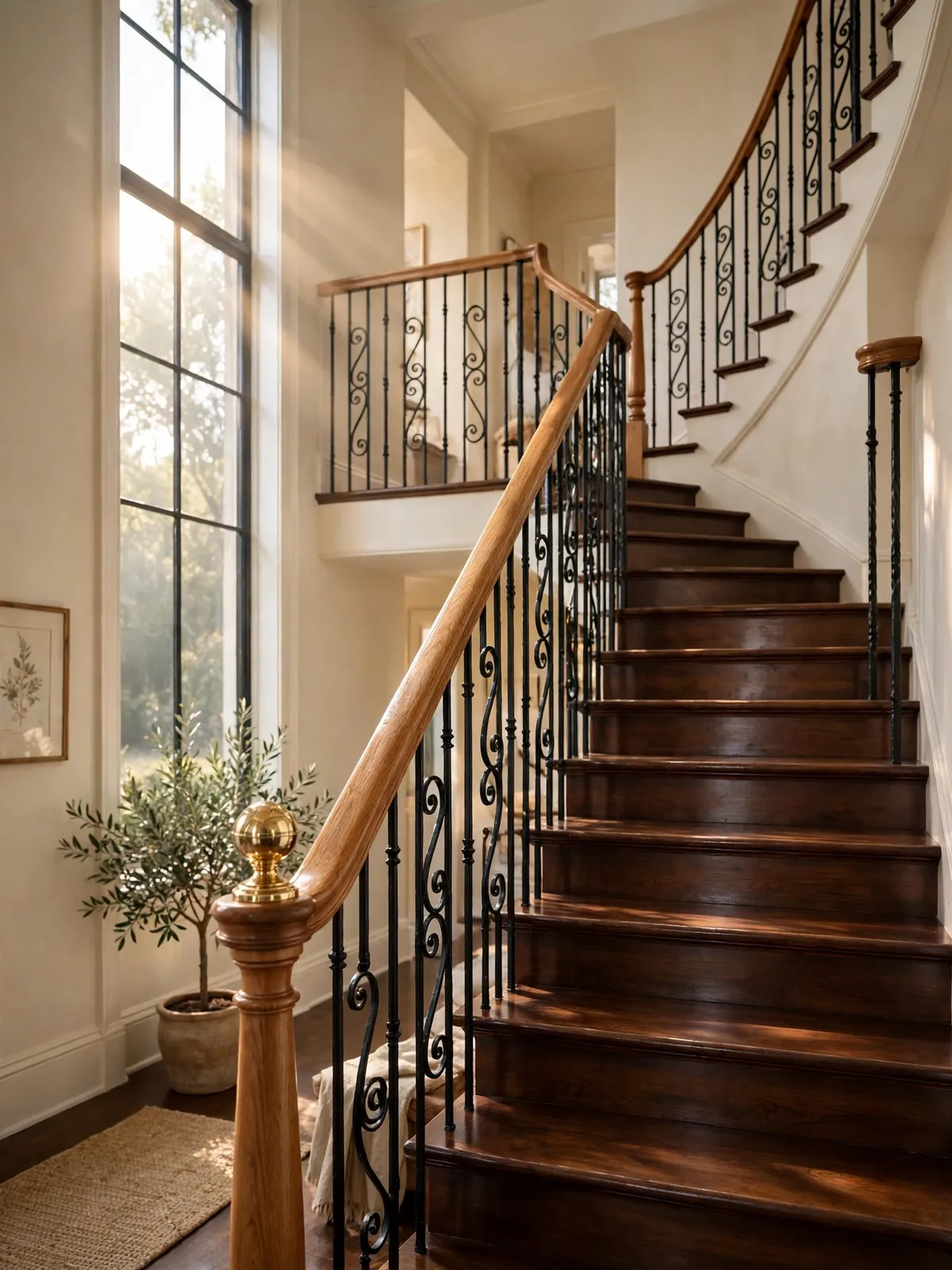
A classic wrought iron baluster paired with a warm wood handrail is the combination most people picture when they think of an iron staircase railing, and it earns that place because the two materials balance each other so well. Picture a straight flight of twelve steps in white oak, each tread edged with a slim black iron baluster in a simple basket-twist pattern, the balusters set 4 inches apart and topped by a handrail in honey-toned walnut with a softly rounded profile. The dark iron reads as crisp and tailored against the pale walls, while the wood handrail warms the whole composition and feels comfortable under the hand. This pairing works in entryways, split-level homes, and anywhere a staircase needs to feel both substantial and inviting.
Quick tips:
- Choose a handrail stain one or two shades warmer than the stair treads for gentle contrast.
- Keep baluster spacing at 4 inches or less so the railing meets safety standards.
- Match the newel post cap to your door hardware for a pulled-together look.
- A satin or oil-rubbed bronze finish softens black iron in a traditional room.
Gently Curved Iron Railings for a Softer, Romantic Line
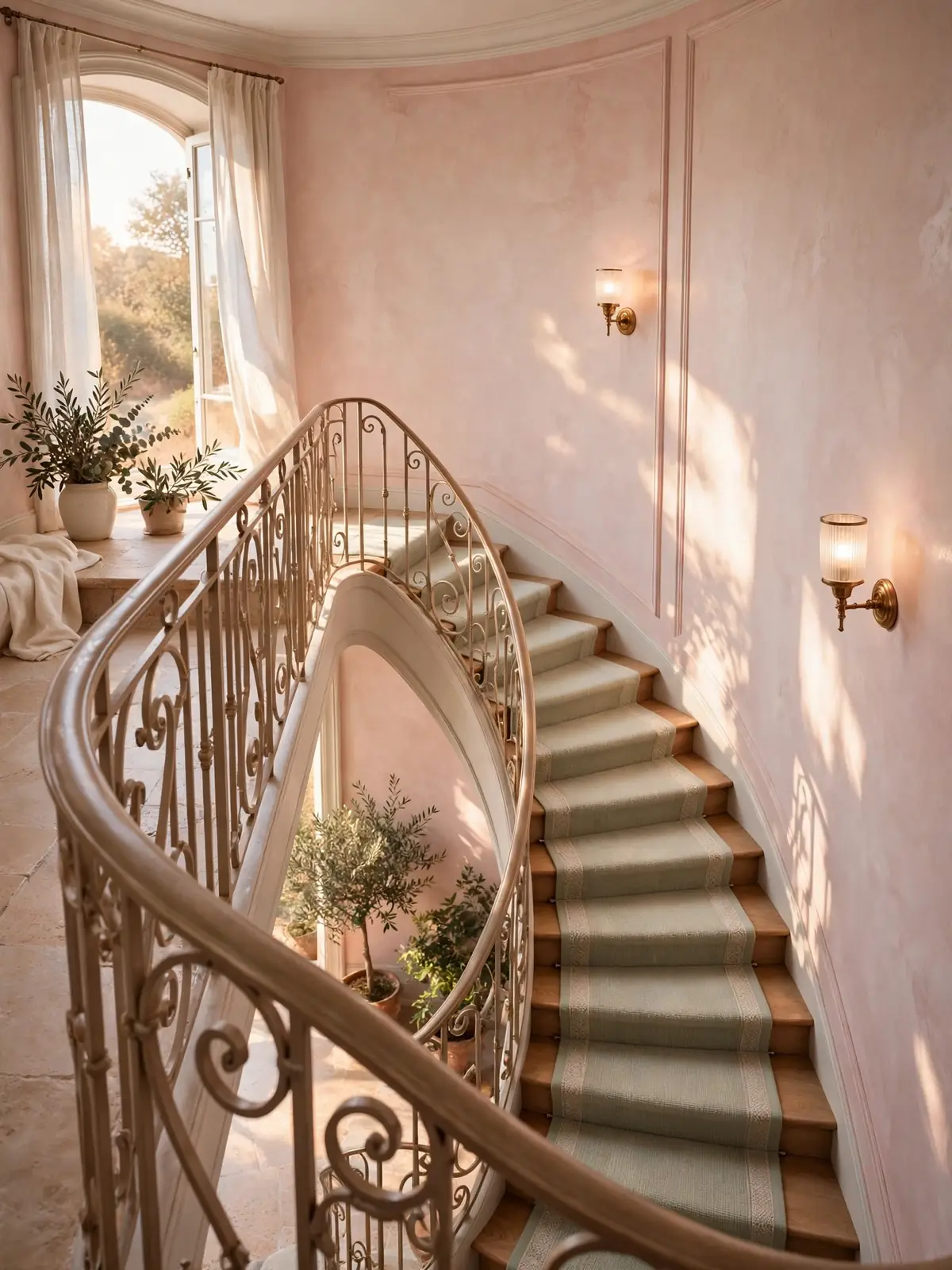
A gently curved iron railing turns a staircase from a functional climb into a graceful gesture, softening the hard lines of a hallway with one continuous flowing line. Imagine a curved stair in a cottage-style home where the iron rail sweeps in a slow S-shape, forged from 12-millimetre round bar in a champagne-bronze finish, with slender spindles that fan slightly as the curve widens. The rail follows the stair’s arc so closely that from the hallway below it reads as a single ribbon of metal, and the effect is romantic without being fussy. This works beautifully in homes with arched doorways or a rounded entry, where the curve of the railing echoes the architecture around it.
Quick tips:
- A curved rail must be templated on site — measure twice before the forge work begins.
- Keep the spindle pattern simple so the curve itself stays the star.
- A champagne or antique bronze finish warms a curved rail more than stark black.
- Pair with a curved runner in a soft neutral to echo the line underfoot.
Iron Staircase Railings Mixed With Wood for a Balanced Look
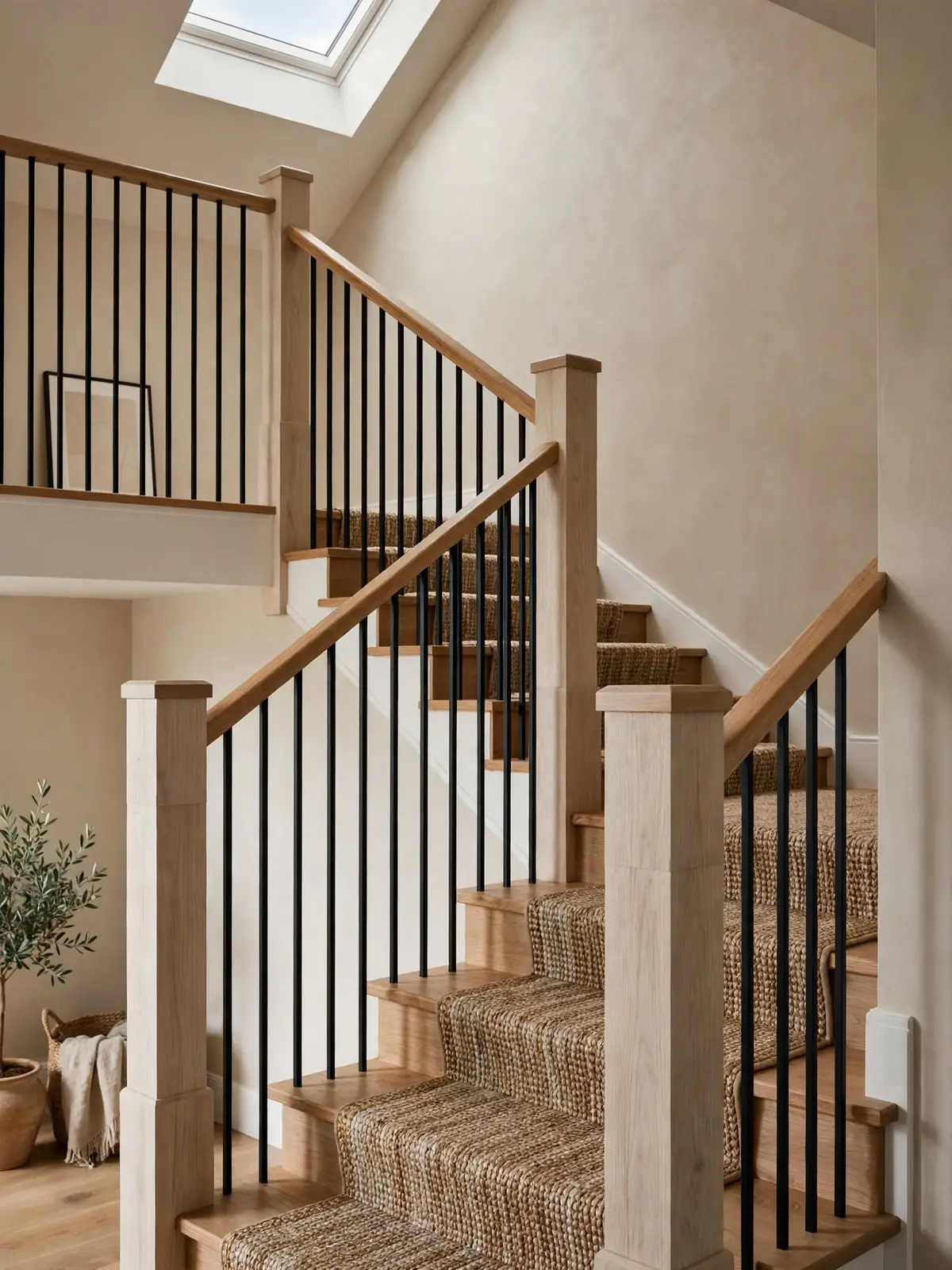
Mixing iron with wood gives you the best of both materials: the strength and fine detail of iron, and the warmth and softness of timber. Consider a staircase where every third baluster is replaced by a slim turned-wood spindle in pale ash, alternating with black iron spindles in a simple scroll pattern, all under a solid oak handrail with a square profile. The wood elements stop the iron from feeling cold or severe, while the iron keeps the wood from looking heavy or old-fashioned. This balanced mix suits transitional homes especially well, where neither a fully traditional nor a fully modern railing would feel right.
Quick tips:
- Alternate one wood spindle to every two or three iron spindles for rhythm, not randomness.
- Keep the wood tone consistent — handrail, newel posts, and wood spindles in one stain.
- A matte black iron finish contrasts best with pale woods like ash or white oak.
- Test the mix on one flight first if your staircase has two runs.
Slim Iron Spindles That Keep the Stair Feeling Open
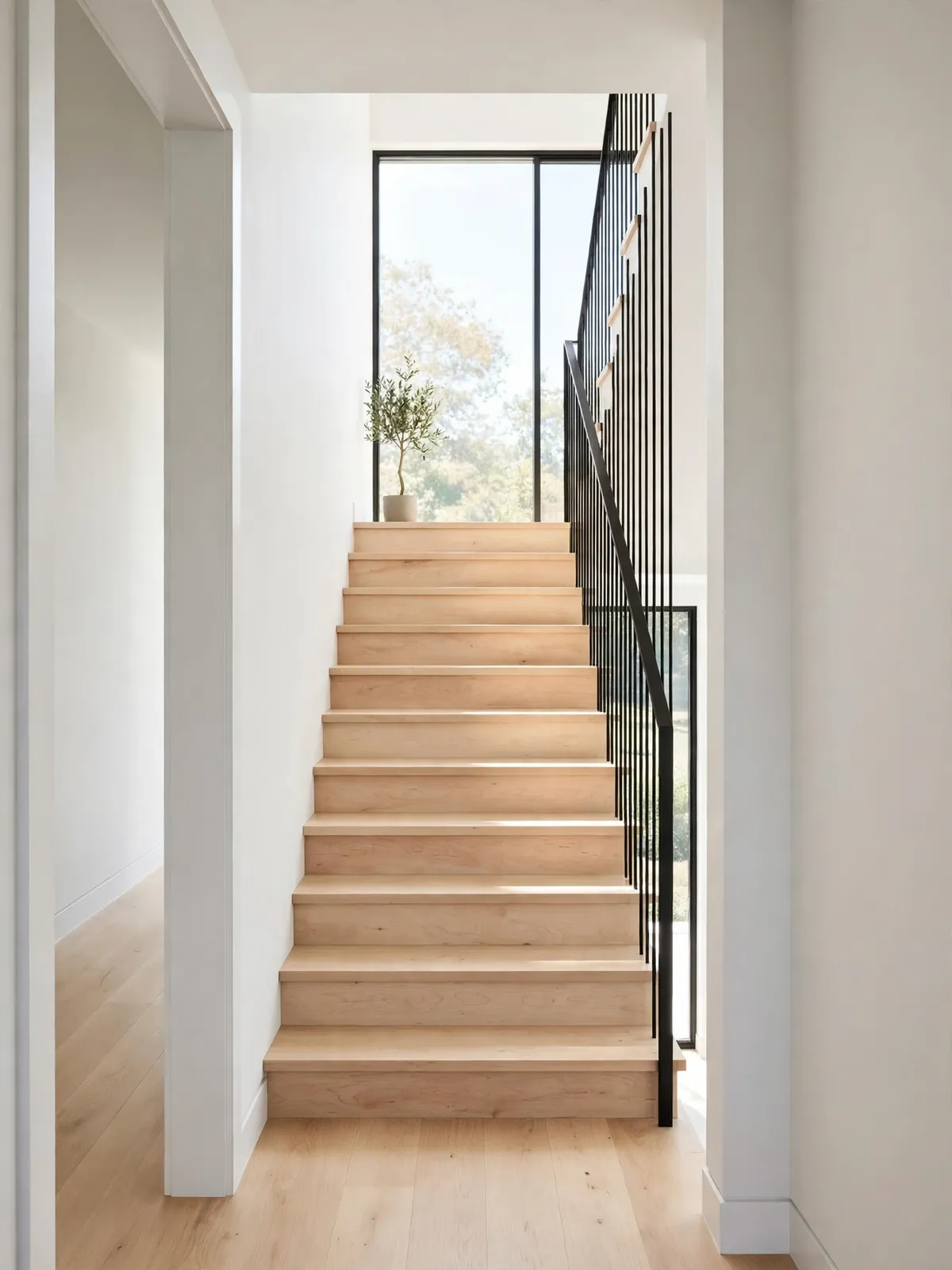
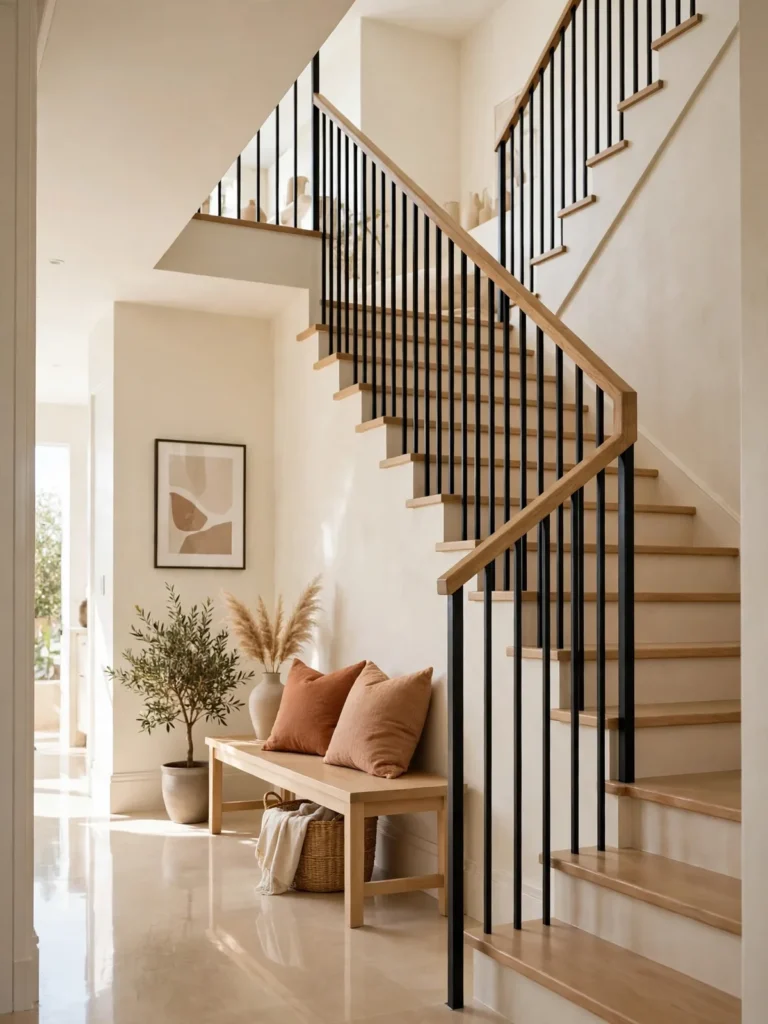
Slim iron spindles are the answer when you want the safety and definition of a railing without blocking light or sightlines. Picture a straight staircase in a small entry where 10-millimetre square iron spindles, finished in matte black, rise from pale maple treads to a slim steel handrail, spaced 4 inches apart but so fine that from across the room the railing almost disappears. Because each spindle is barely wider than a pencil, light passes through freely and the staircase feels like part of the room rather than a barrier in it. This is the right choice for narrow hallways, basement stairs, and any home where the staircase competes with the living space for light.
Quick tips:
- Choose square spindles over round ones for the slimmest possible profile.
- A matte finish hides fingerprints better than gloss on slim bars.
- Keep the handrail slim too — a chunky rail defeats the airy effect.
- Paint the stair stringer the same colour as the wall so the spindles float visually.
Bronze or Antique Iron Finishes for Warmth and Depth
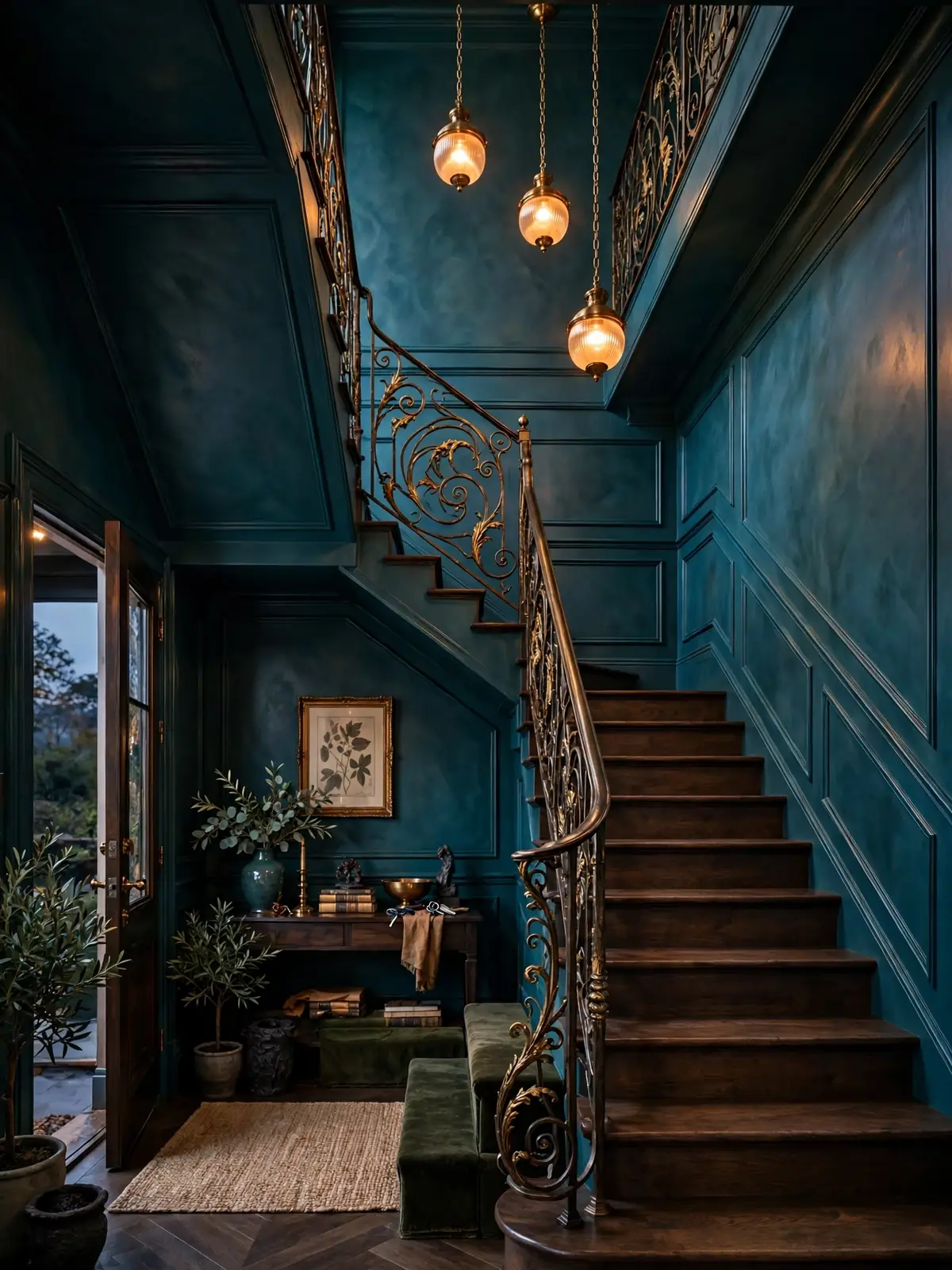
A bronze or antique iron finish adds a depth that plain black can never match, because the metal shows subtle variations of colour as the light moves across it. Imagine an iron staircase railing finished in oil-rubbed bronze, where each baluster carries faint copper highlights on its raised scrolls, catching the warm glow of a brass pendant above the landing. The railing sits against deep teal walls and dark walnut treads, and the bronze tones tie the metals together so the whole stairwell feels layered and collected rather than newly installed. Antique finishes are forgiving too — they hide dust and small scuffs far better than a flat black coat.
Quick tips:
- Ask for a hand-applied patina rather than a flat spray finish for real depth.
- Repeat the bronze tone in a mirror frame or light fixture nearby.
- Avoid mixing bright chrome with antique bronze — the contrast is jarring.
- Seal the finish with a clear wax coat to slow tarnishing in humid homes.
Iron Panels With Cut-Out Designs Instead of Spindles
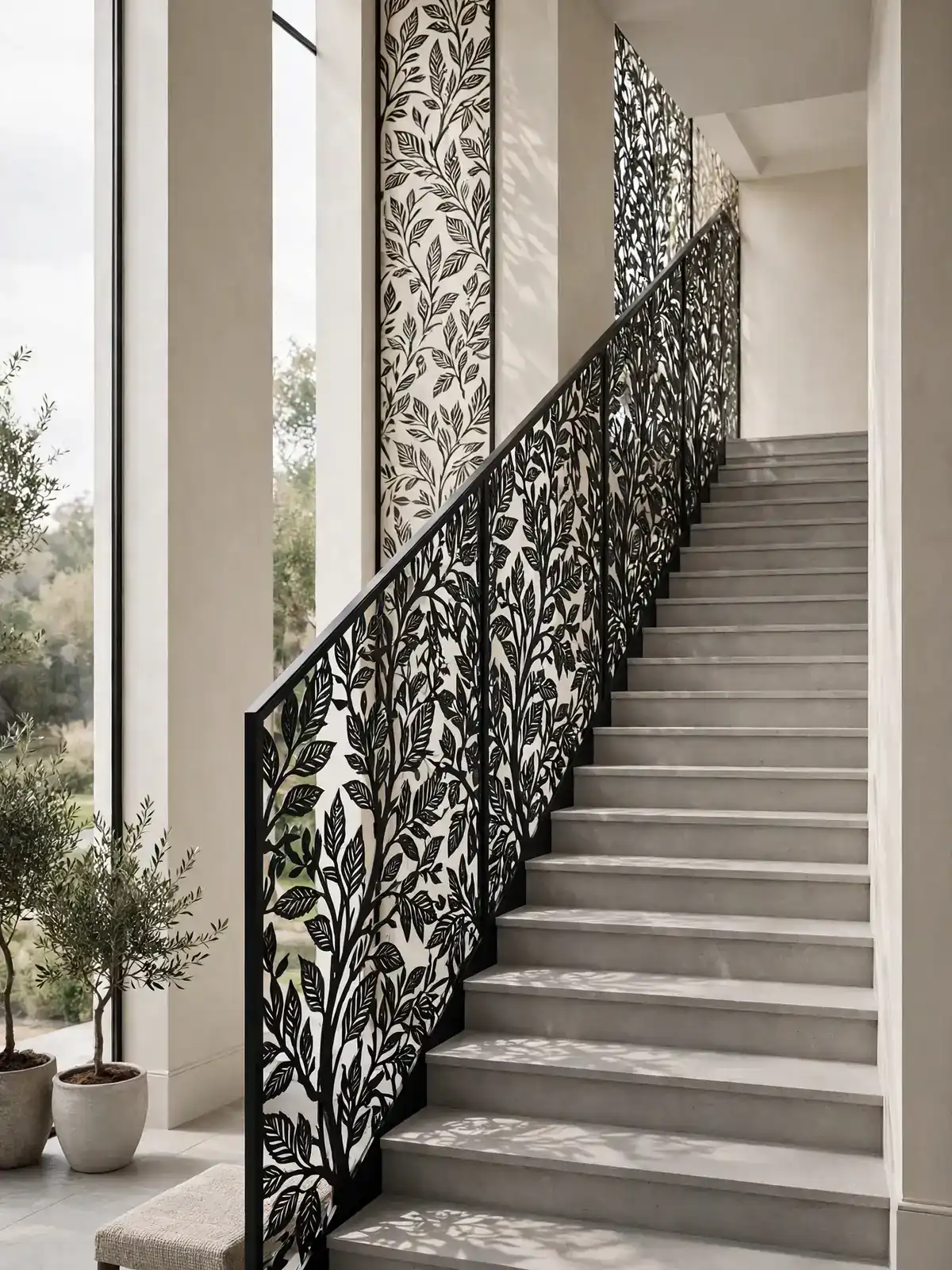
Replacing individual spindles with a single cut-out iron panel turns the railing into a piece of artwork that runs the whole length of the stair. Picture a staircase where each flight is guarded by one continuous panel of 6-millimetre iron, laser-cut with a repeating leaf pattern, finished in soft charcoal and framed by a slim handrail in brushed nickel. Light filters through the cut-outs and throws leaf-shaped shadows on the wall behind, so the railing changes through the day as the sun moves. This approach suits homes with a strong design point of view, where the staircase is meant to be looked at as much as used.
Quick tips:
- Keep cut-out openings under 4 inches at their widest point for safety.
- A single repeated motif reads calmer than several different patterns.
- Backlighting a panel at night turns it into a glowing feature wall.
- Choose a pattern that echoes another motif in the room, such as a wallpaper leaf.
Ornate Vintage Iron Detailing With Scrollwork
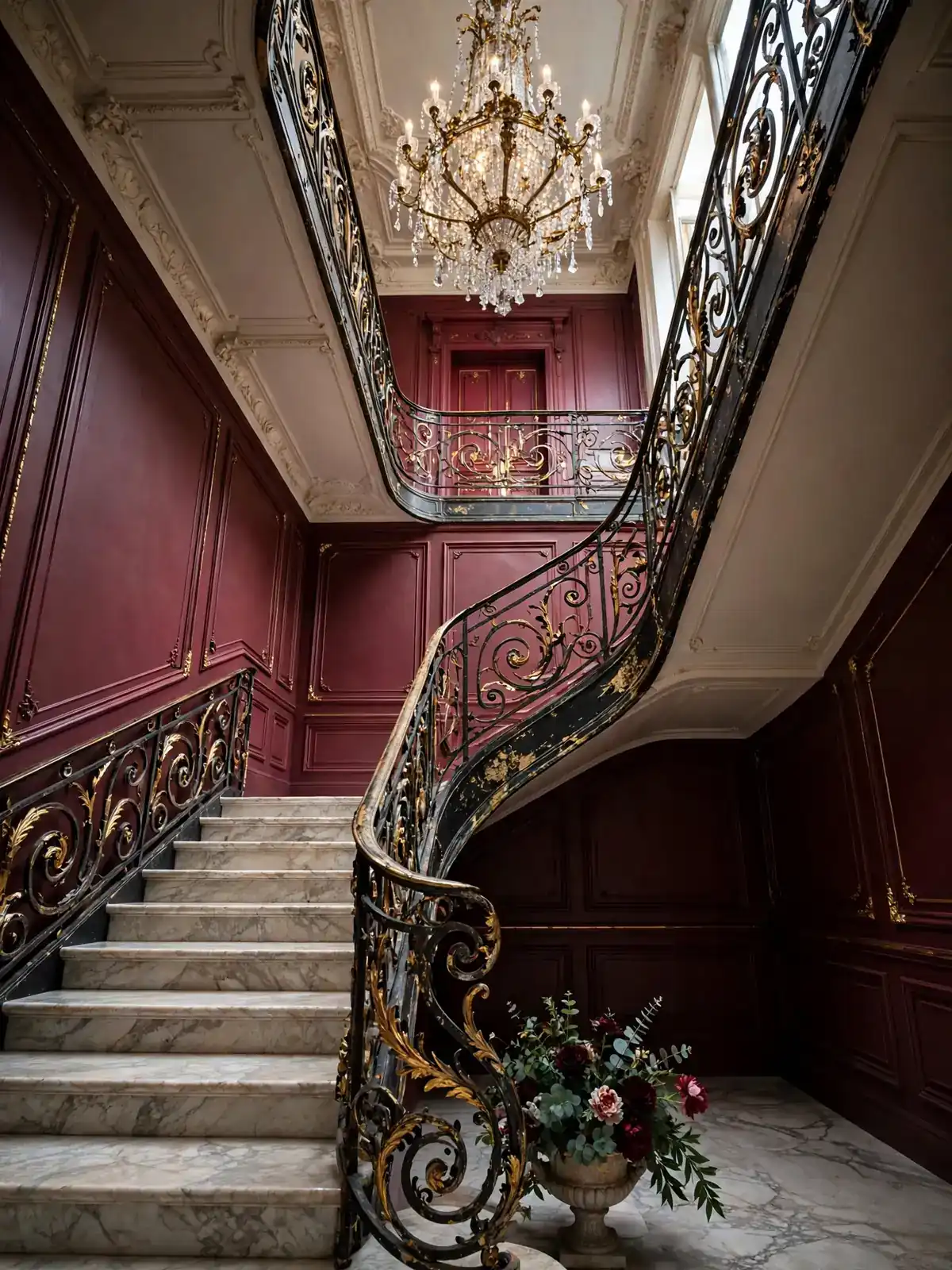
Ornate vintage scrollwork is iron at its most decorative, and it suits homes that embrace grandeur rather than shy away from it. Imagine a wide staircase in a period home where the railing is a cascade of hand-forged C-scrolls and S-scrolls, each one slightly different because it was shaped by hand, finished in aged black iron with the high points picked out in soft gold leaf. The scrolls cluster more densely near the newel post, which is crowned with a brass finial, then open out into a lighter rhythm as the flight rises. The effect is unapologetically romantic, and it pairs naturally with marble treads, a chandelier, and deep wall colours.
Quick tips:
- Let a blacksmith hand-forge the scrolls — cast copies look flat by comparison.
- Keep the wall colour deep so the scrollwork silhouette reads clearly.
- Limit gold leaf to the raised details; too much turns elegant into gaudy.
- Dust scrollwork with a soft brush weekly — ornate iron collects dust fast.
White-Painted Iron Railings for a Light, Fresh Feel
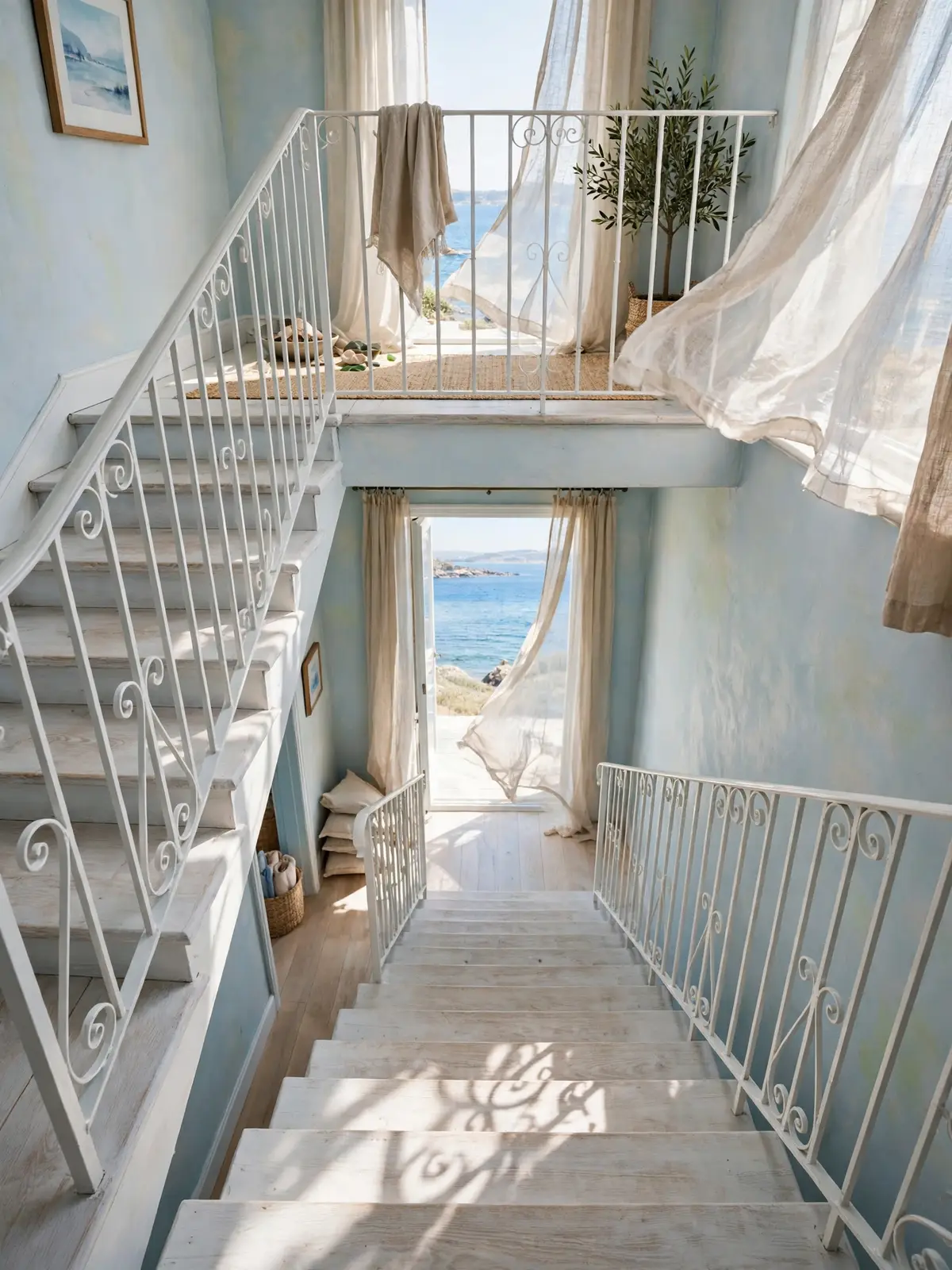
White-painted iron railings give you the elegance of iron without any of its visual weight, which makes them ideal for bright, airy homes. Picture a staircase in a coastal cottage where the iron balusters — a simple scroll pattern — are painted the same soft white as the walls, with a handrail in whitewashed oak that keeps the palette pale and calm. The railing reads almost like lace against the pale blue walls, and the staircase feels like it floats rather than anchors the room. White iron is also a clever way to update an existing dark railing without replacing it, since a good paint job transforms the whole stairwell in a weekend.
Quick tips:
- Use a rust-inhibiting primer under white paint or chips will show fast.
- A satin finish is easier to clean than flat white on a handrail.
- Keep the treads pale too — dark treads with white rails can look top-heavy.
- Touch up scuffs promptly; white shows every mark.
Flat Iron Bars in a Modern Minimal Space
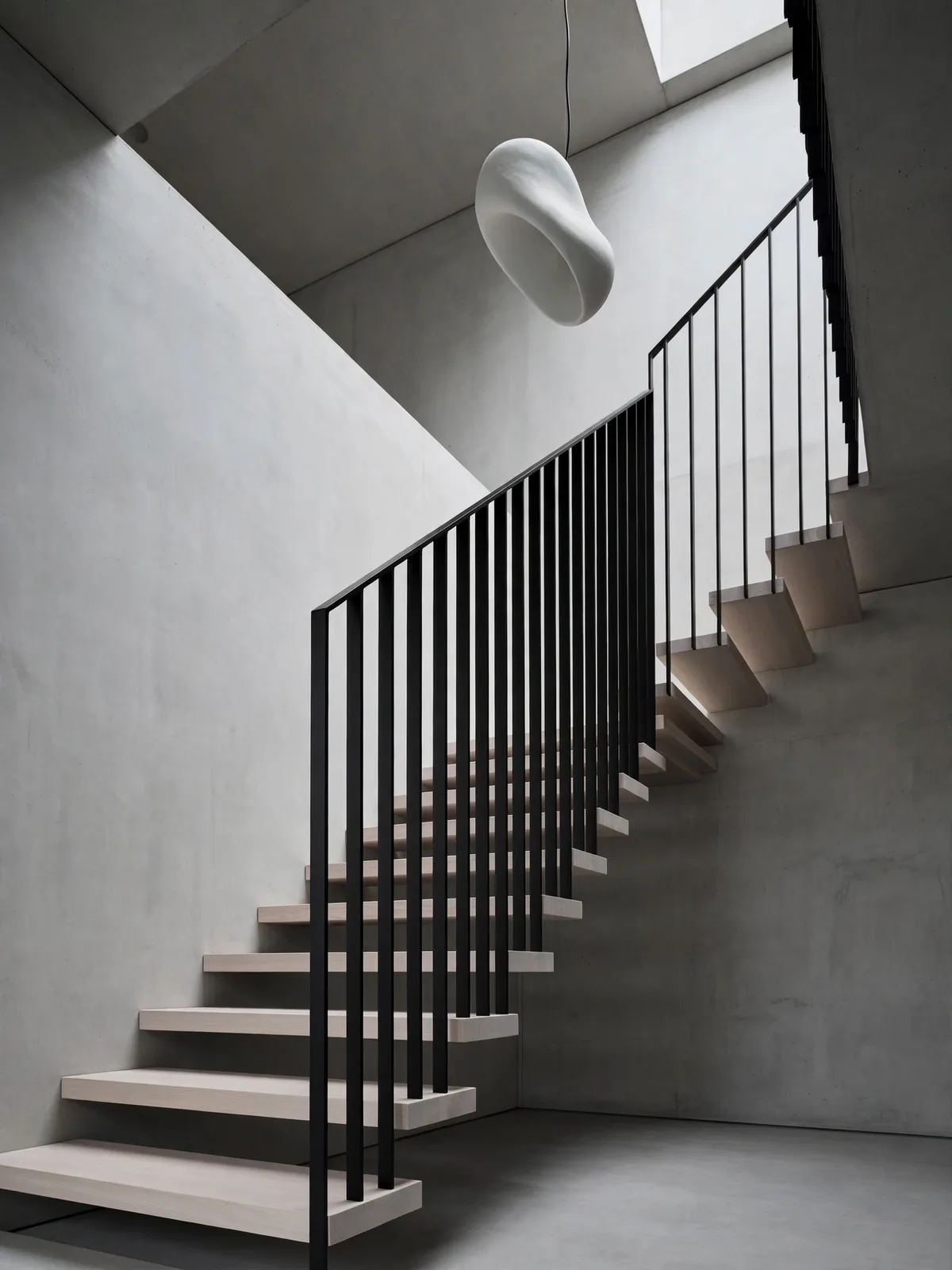
Flat iron bars bring an architectural, almost sculptural quality to a staircase, replacing the turned and twisted shapes of traditional ironwork with clean rectangular lines. Imagine a modern home where the railing is made of flat bars 40 millimetres wide and 8 millimetres thick, set vertically at 100-millimetre centres, finished in matte black and welded to a slim rectangular handrail of the same material. The bars catch the light along their flat faces, creating a rhythm of light and shadow that changes as you walk past. This design suits concrete, glass, and pale timber interiors where every element is chosen for its line and proportion.
Quick tips:
- Flat bars look best when the welds are ground smooth and invisible.
- Keep the handrail the same flat profile for a unified, architectural line.
- A matte black finish suits concrete and pale wood equally well.
- Space bars evenly and precisely — uneven gaps are obvious with flat stock.
Horizontal Iron Bars for a Sleek Modern Update
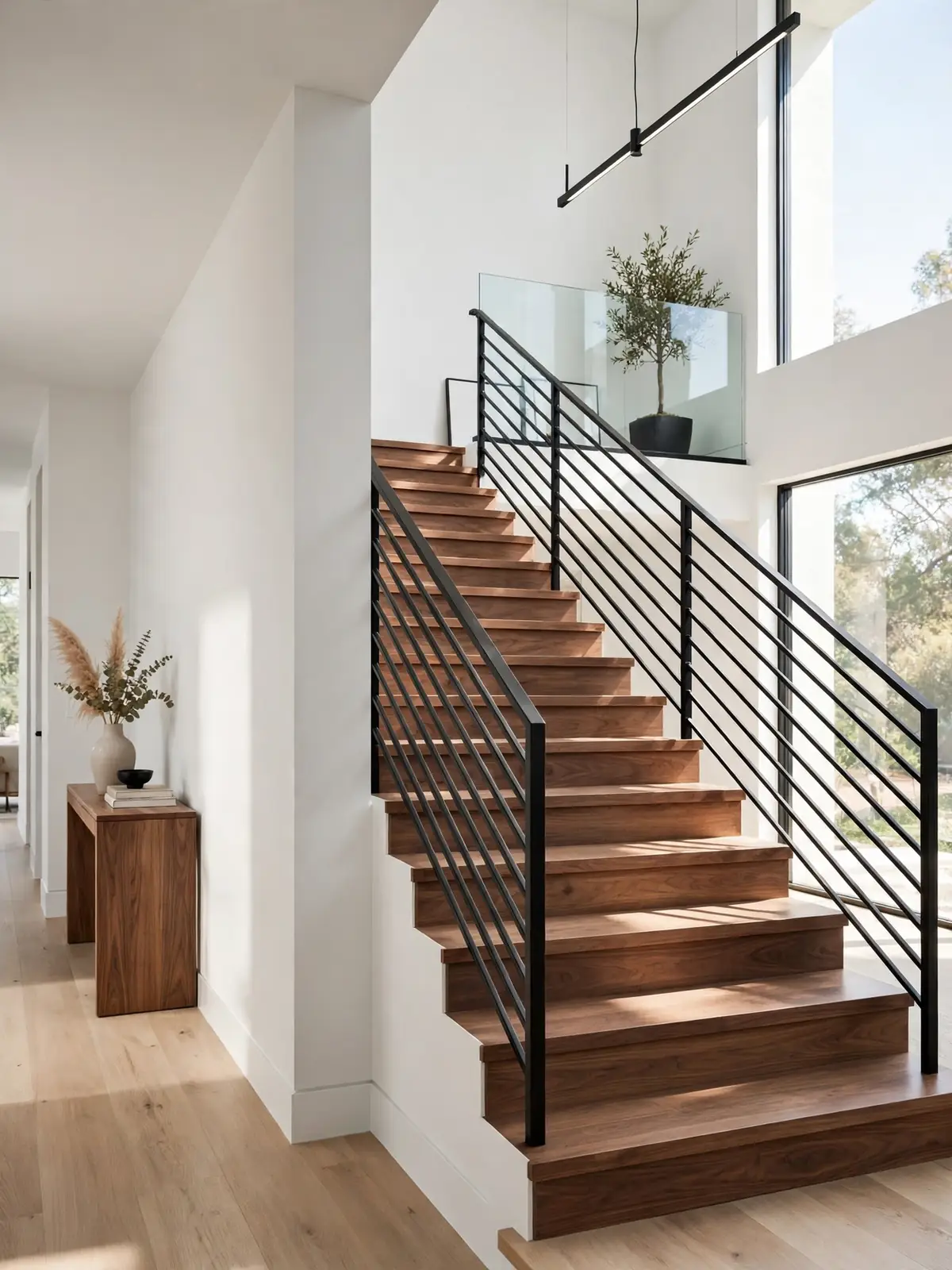
Horizontal iron bars give a staircase a long, low, modern line that draws the eye along the flight instead of up it. Picture a staircase where five horizontal round bars, each 20 millimetres in diameter and finished in satin black, run parallel between slim vertical supports at each end, with a walnut handrail floating just above the top bar. The horizontal lines echo the treads themselves, so the whole staircase reads as a series of calm, level layers. This is a popular update for older homes built a few decades ago, where it replaces dated wooden spindles with something that feels current without a full rebuild.
Quick tips:
- Check local building codes — some areas restrict horizontal rails because children can climb them.
- Use at least five bars so the gaps between them stay under 4 inches.
- A wood handrail softens the industrial feel of horizontal bars.
- Keep the vertical end supports slim so the horizontal lines dominate.
A Repeating Iron Motif: Circles, Squares, or Arches
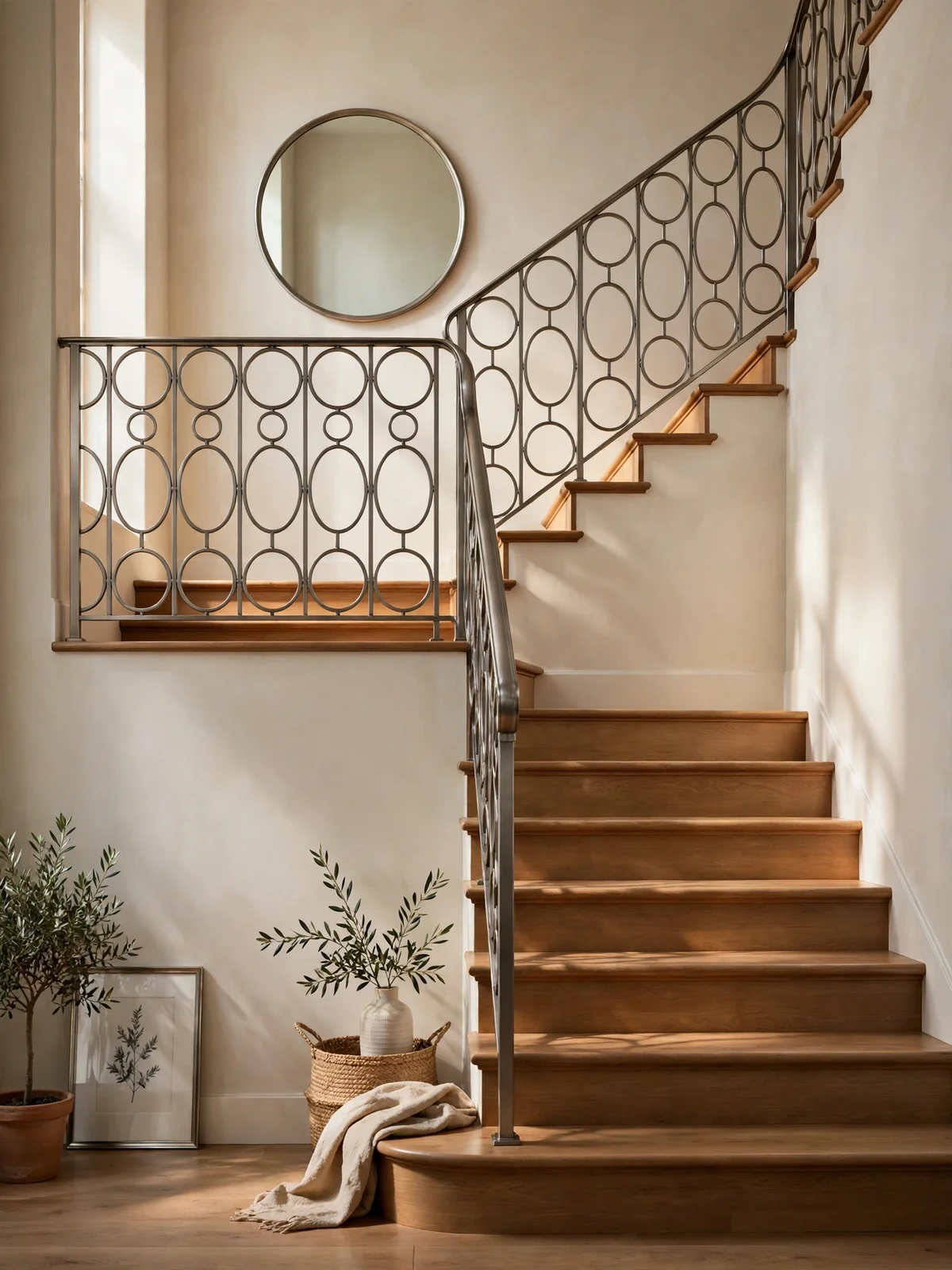
A repeating motif — circles, squares, or arches worked into the iron — gives a railing a rhythm that ties the whole staircase together. Imagine a staircase where every baluster panel contains a single iron circle, 150 millimetres across, forged in brushed pewter and set between slim vertical bars, so the circles march up the flight like a row of coins. The repetition is calming and deliberate, and it gives the eye a pattern to follow. Choose circles for a soft, classic feel, squares for something more tailored, or arches when the home has arched windows or doorways the motif can echo.
Quick tips:
- Pick one motif and repeat it exactly — variation breaks the rhythm.
- Match the motif to an existing shape in the room, such as an arched window.
- A brushed pewter or nickel finish makes geometric motifs feel modern.
- Keep the motif size consistent on every flight, including the landing.
Organic Iron Shapes With Flowing, Leaf-Like Curves
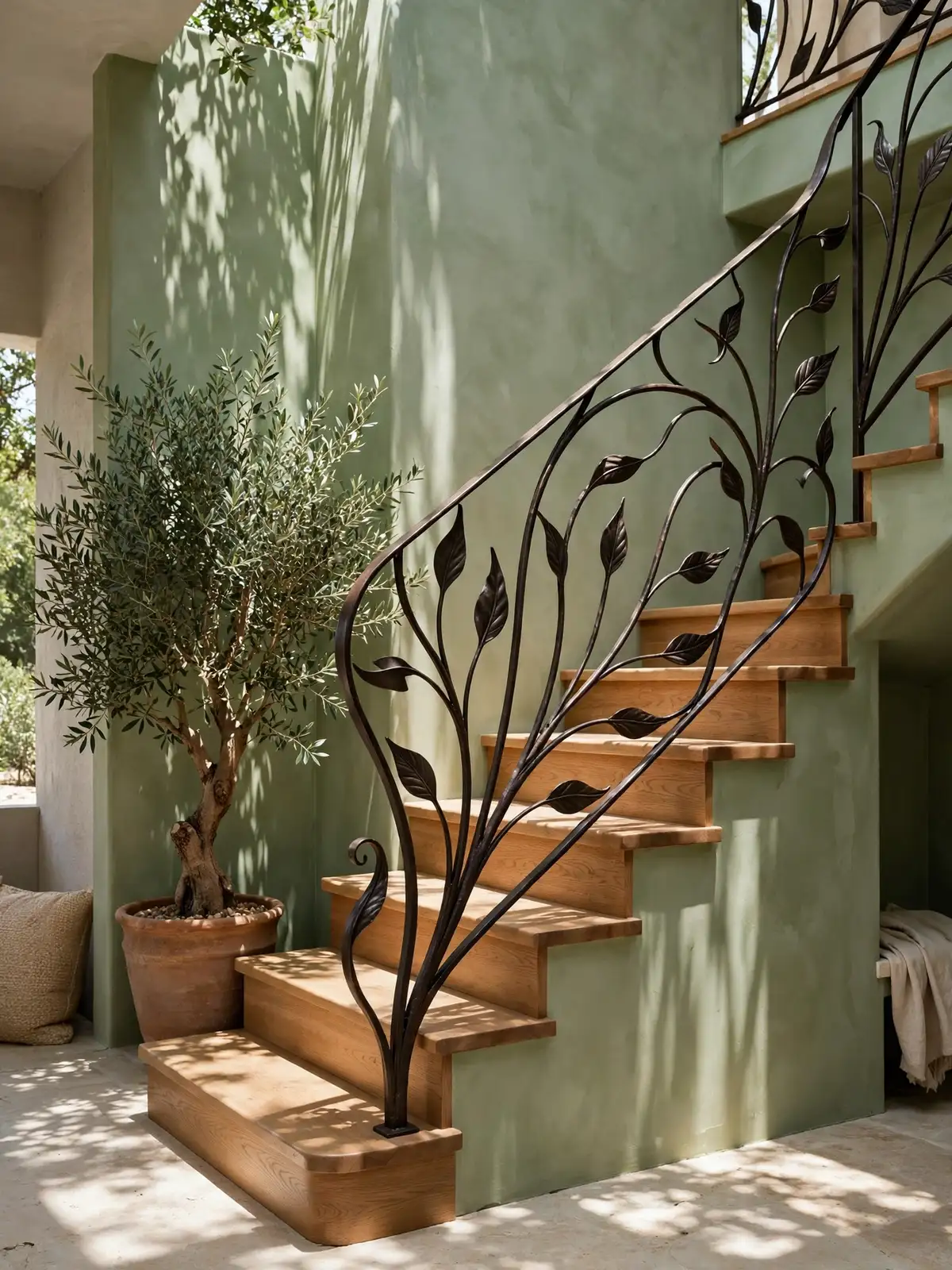
Organic iron shapes bring the outdoors inside, with flowing curves that suggest vines, leaves, and branches rather than geometry. Picture a staircase in a garden-facing home where the railing is forged into a series of leaf-like curves, each baluster bending gently like a stem, finished in a deep verdigris green-black that recalls aged copper. The curves are irregular by design — no two are exactly alike — so the railing feels grown rather than manufactured. This style suits homes with plants, natural materials, and a relaxed, nature-led interior, and it pairs beautifully with oak treads and linen textiles.
Quick tips:
- Let the blacksmith vary each curve slightly — uniformity kills the organic feel.
- A verdigris or dark green-black finish reinforces the botanical theme.
- Keep the handrail simple and smooth so the curves stay the focus.
- Place a real plant near the stairs to complete the connection.
Custom Iron Railings That Follow a Curved Staircase
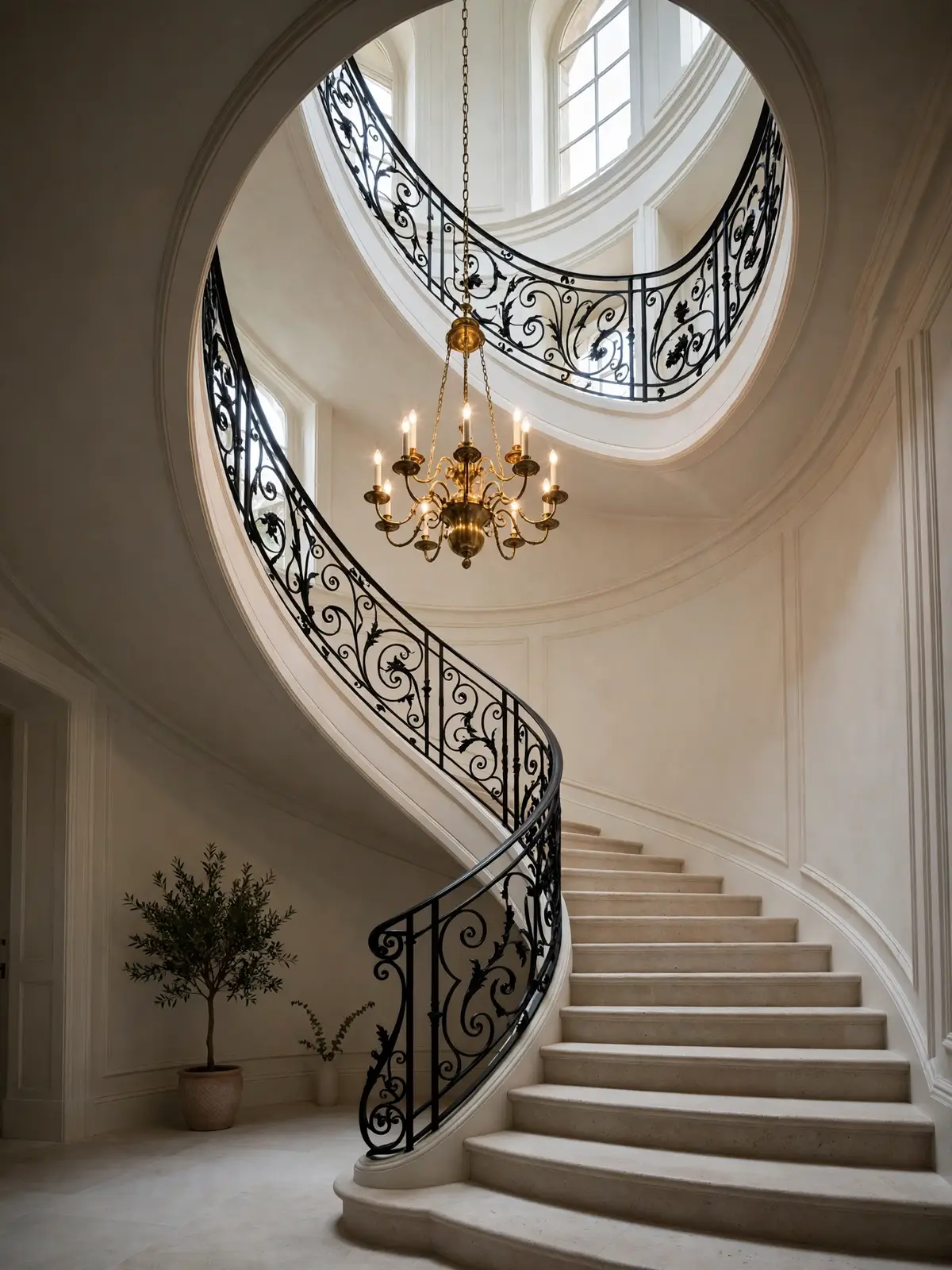
A curved staircase deserves a railing made for it, not adapted from straight stock, and custom ironwork is the way to achieve that perfect fit. Imagine a sweeping stair that turns 180 degrees, its railing forged in one continuous length of satin-black iron, with balusters that lean at subtly different angles to follow the curve, each one measured and bent to its exact position. The handrail is laminated from thin strips of walnut, bent and glued over a form so it matches the iron’s arc precisely. The result is a staircase that feels like a single sculpted object, and it becomes the defining feature of the whole entryway.
Quick tips:
- Budget for a site template — curved work cannot be measured from drawings alone.
- Laminated wood handrails bend more reliably than solid timber on tight curves.
- Keep the baluster pattern simple so the curve reads cleanly.
- Allow extra lead time; custom curved ironwork takes weeks, not days.
Mixed Metals: Iron With Brass or Copper Accents
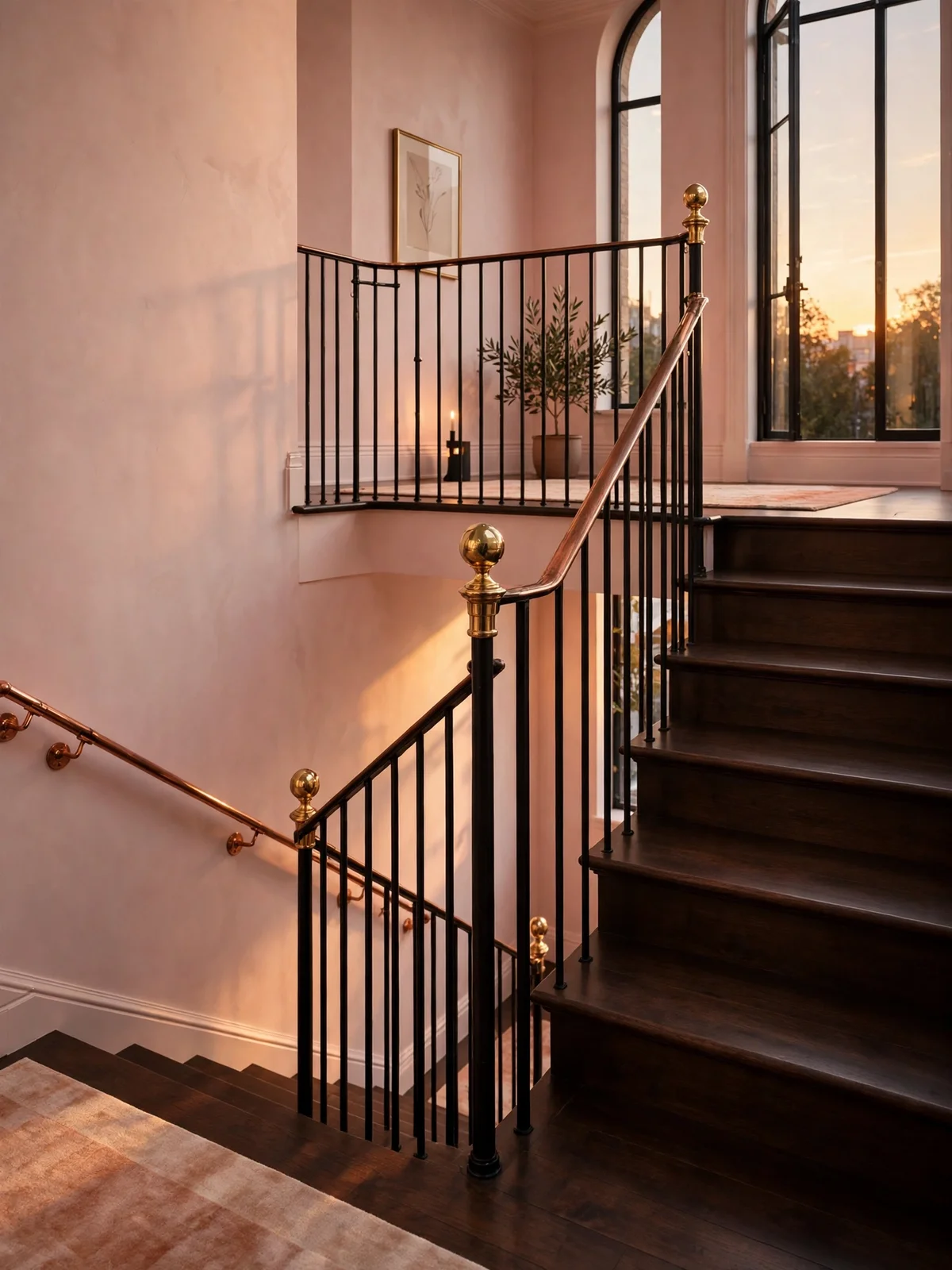
Mixing iron with brass or copper accents adds warmth and a jewellery-like finish to a railing that might otherwise feel plain. Picture a staircase where the balusters and handrail are matte black iron, but the newel posts wear polished brass caps, the handrail brackets are solid copper, and a thin brass inlay runs along the top edge of the handrail. The warm metals catch the light and draw the eye to the details, while the black iron keeps the overall look grounded and modern. This mix works in both traditional and contemporary homes, because the warm accents bridge the gap between the two styles.
Quick tips:
- Use one warm metal as the accent and repeat it at least three times.
- Lacquer brass caps to slow tarnishing, or embrace the patina.
- Keep the iron finish matte so the polished accents stand out.
- Match the accent metal to your tapware or light fittings for cohesion.
Iron Mesh Panels for Industrial Character
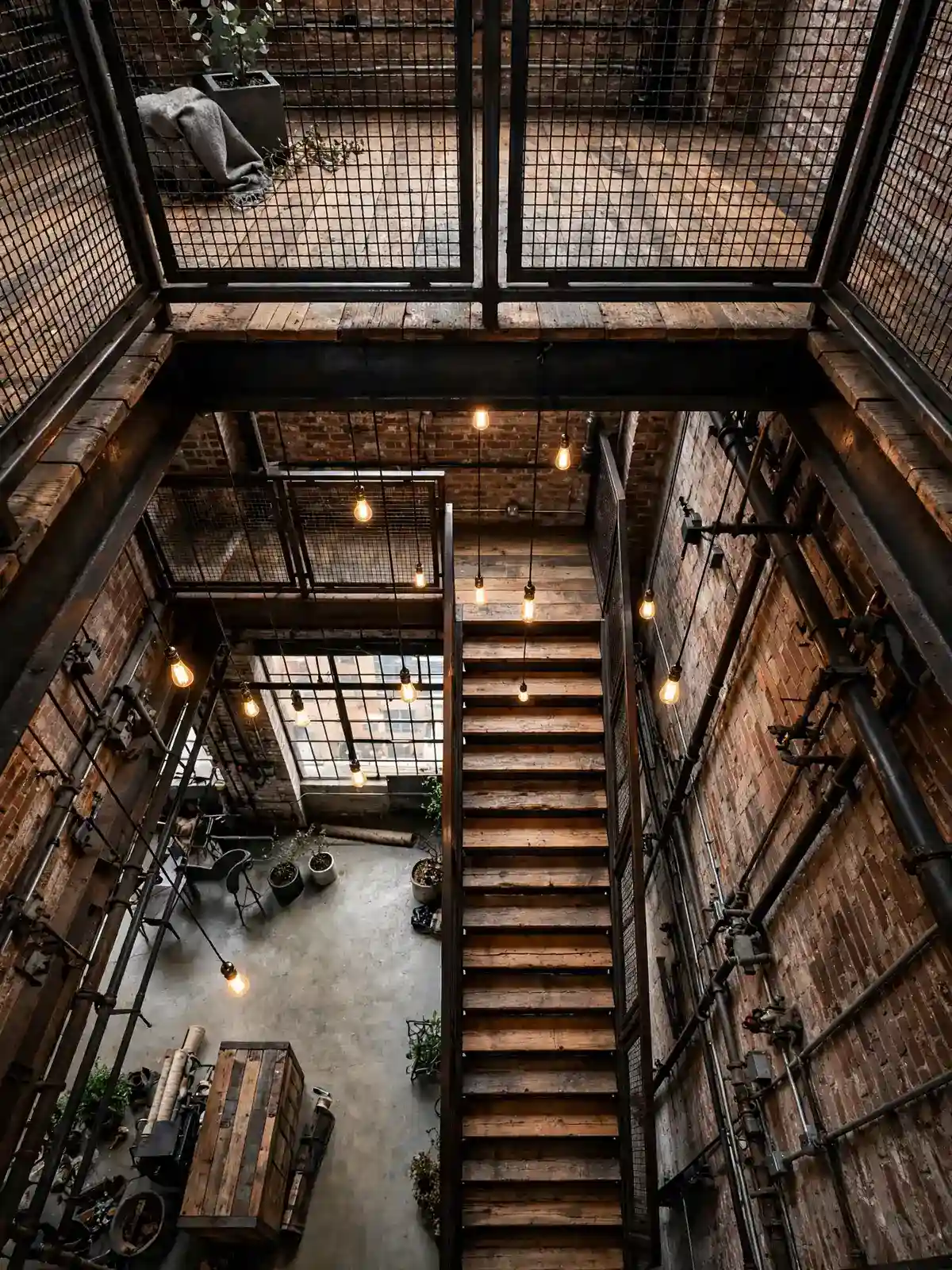
Iron mesh panels give a staircase an industrial edge, with a texture that is both transparent and tough. Imagine a converted loft where the railing is a frame of blackened steel holding a panel of woven iron mesh, the diamond weave fine enough to be safe but open enough to see through, with reclaimed timber treads and an exposed brick wall behind. The mesh catches the light in a way solid panels never do, and it gives the staircase a workshop character that suits brick, concrete, and raw timber. It is also practical — mesh is strong, low-maintenance, and hard to damage.
Quick tips:
- Choose a mesh with openings under 4 inches for safety.
- A blackened steel frame makes the mesh look intentional, not improvised.
- Pair mesh with warm wood treads to soften the industrial feel.
- Seal the mesh with a clear coat to prevent rust in damp lofts.
Iron Railings With a Leather-Wrapped Handrail
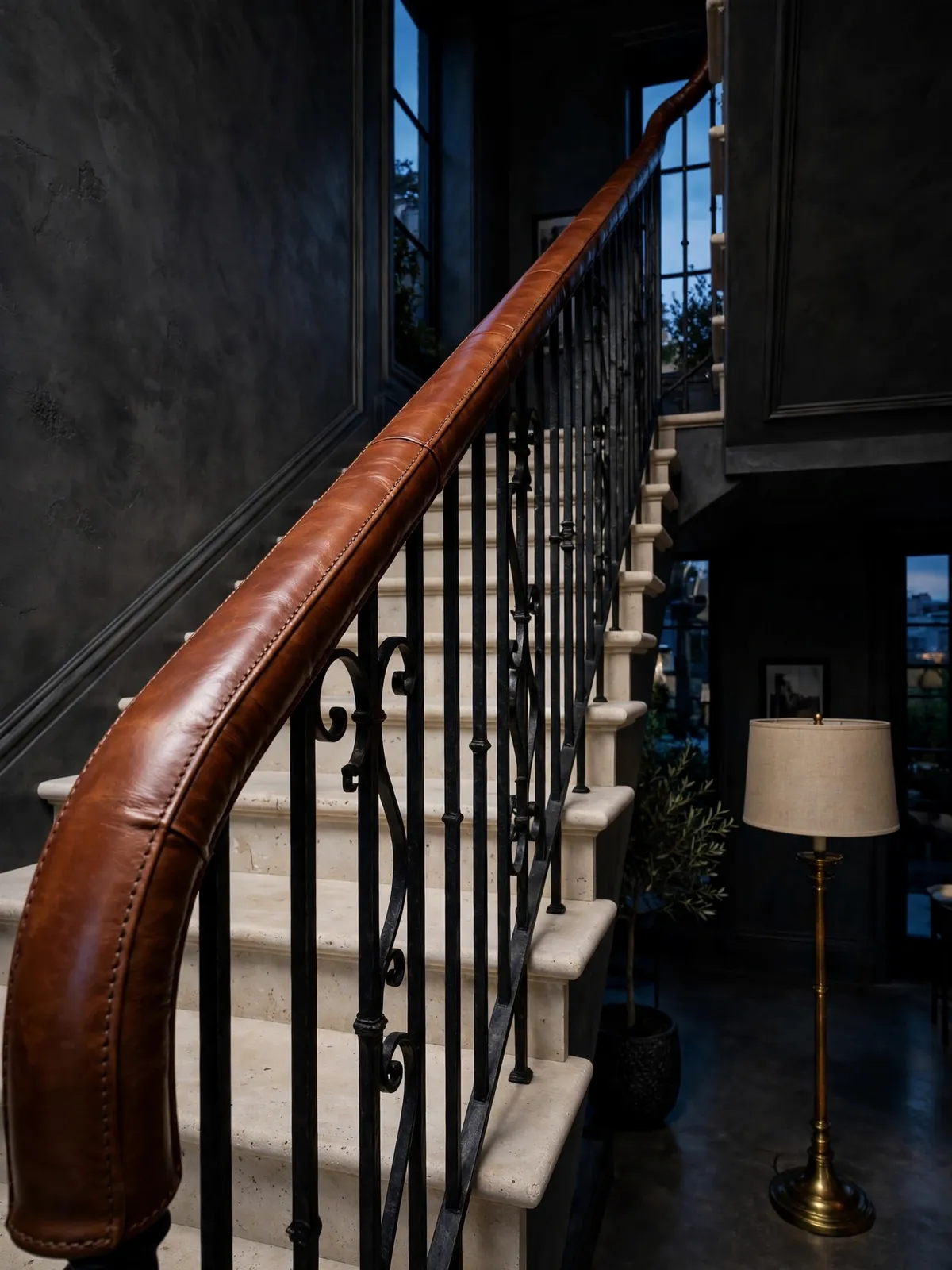
A leather-wrapped handrail adds a tactile, luxurious layer to an iron railing, turning something you grip every day into a pleasure. Picture a staircase where slim black iron balusters support a handrail wrapped in cognac-brown leather, stitched along the underside in a saddle stitch, the leather slightly padded so it feels warm and soft under the palm. The cognac tone warms the charcoal walls and pale stone treads around it, and the stitching adds a crafted, equestrian detail. This is a detail that guests notice and remember, and it suits libraries, studies, and homes with a tailored, club-like feel.
Quick tips:
- Use full-grain leather, not bonded leather, for durability.
- Condition the leather twice a year to prevent drying and cracking.
- Match the leather tone to a chair or bag in the room for cohesion.
- Keep the stitching on the underside so the top feels smooth.
Iron Railings Paired With a Stone Staircase Wall
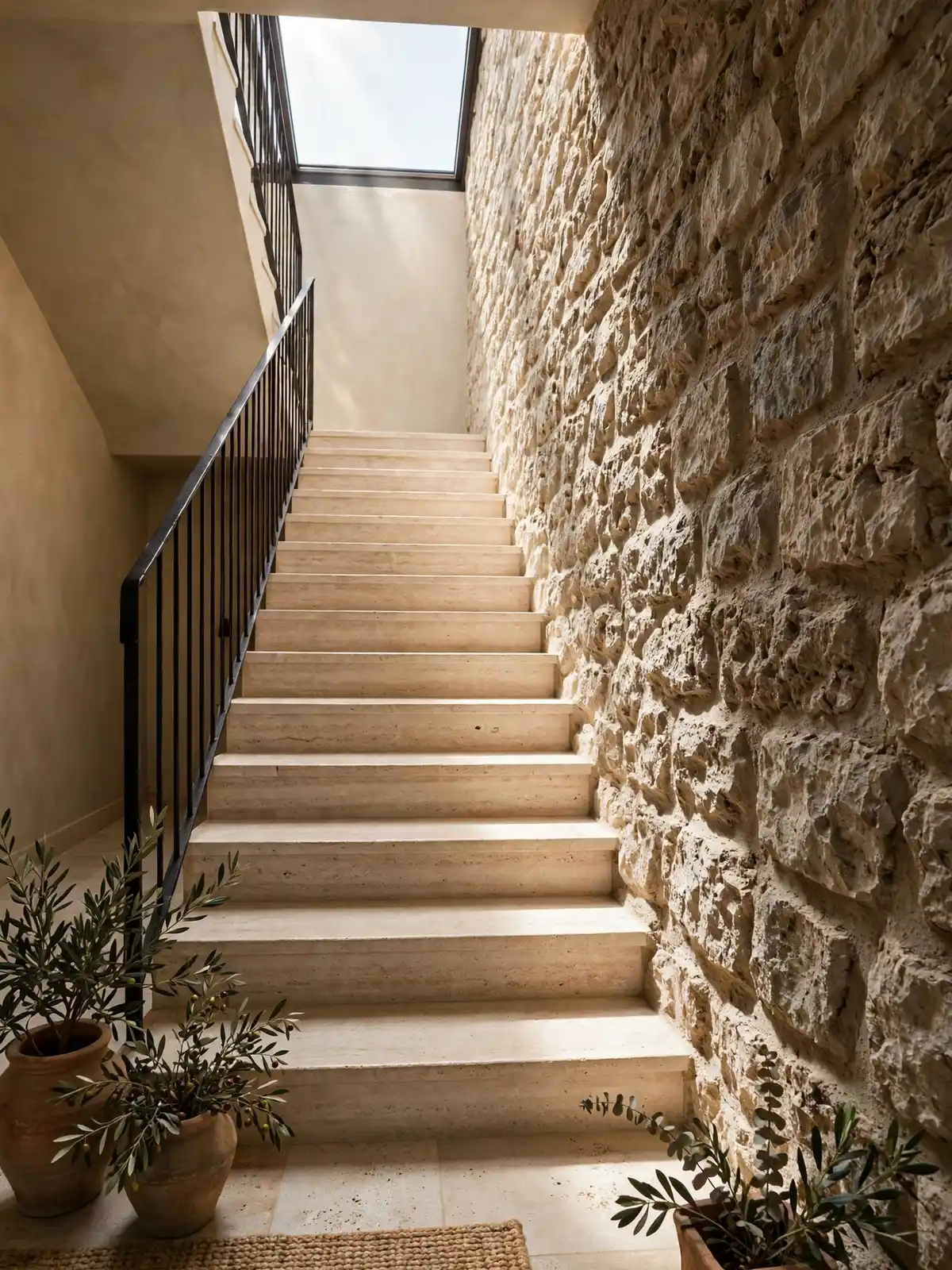
Iron railings look at home against stone, because both materials are honest, heavy, and made to last. Imagine a staircase that climbs alongside a rough limestone wall, the iron railing a simple run of slim vertical bars in matte black, fixed directly into the stone at the base and into a slim handrail above. The contrast between the rough, uneven stone and the precise, straight iron is the whole point — each material makes the other look better. Pale travertine treads and a skylight above keep the stairwell bright, so the stone never feels cave-like.
Quick tips:
- Fix the railing into the stone with chemical anchors, not raw plugs.
- Keep the iron pattern simple — the stone is the decoration here.
- A matte finish suits rough stone better than a polished one.
- Add a skylight or wall washer if the stone wall blocks natural light.
Iron Railings With Integrated LED Light Under the Handrail
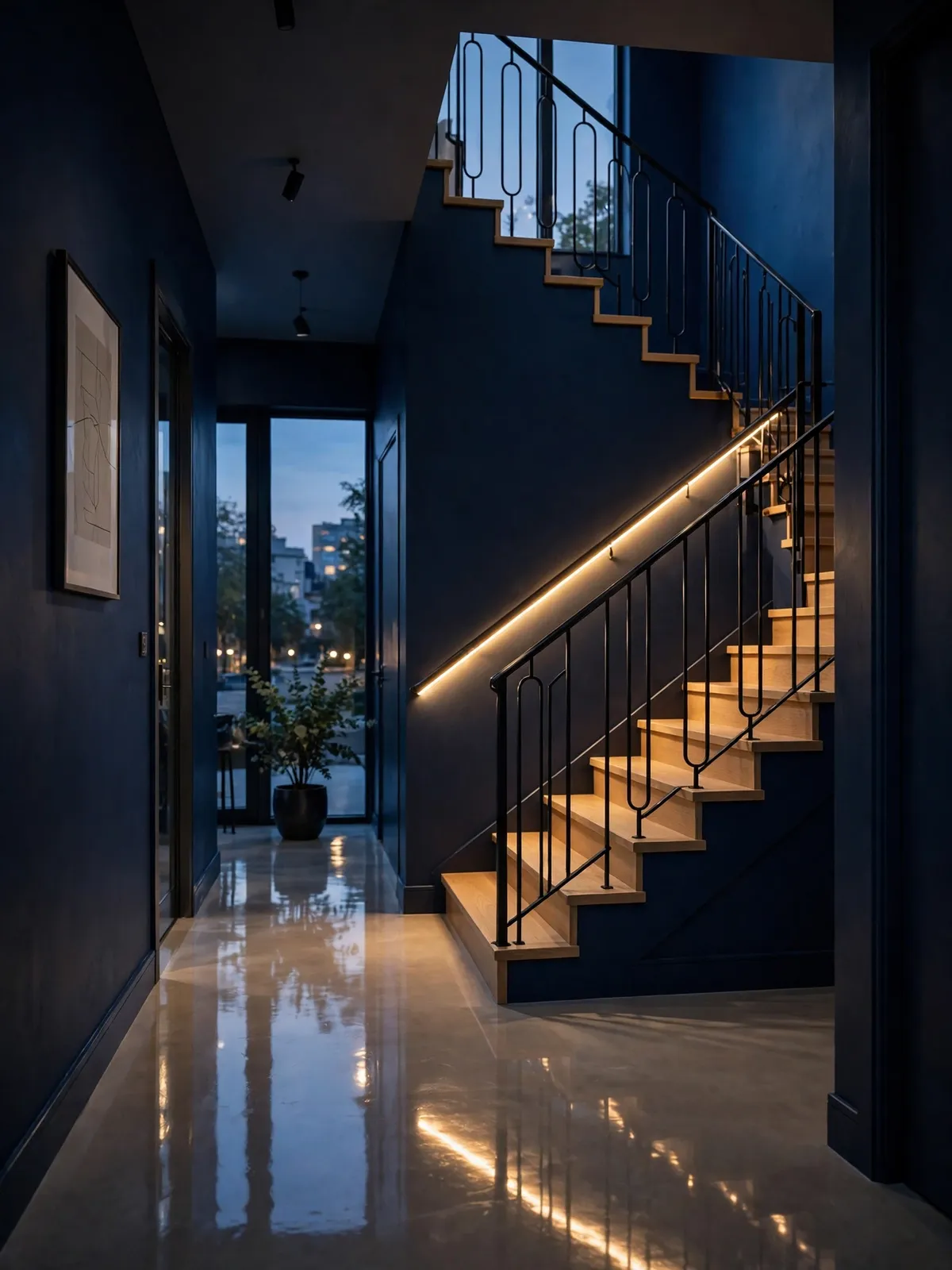
An LED strip hidden under the handrail turns an iron railing into a light source, guiding you safely up the stairs while creating a beautiful glow. Picture a modern staircase at dusk, where a warm 2700K LED strip runs the full length of the handrail’s underside, washing the iron balusters and oak treads in a soft amber light that reflects gently off the polished floor. The iron itself is a simple run of slim matte-black spindles, deliberately plain so the light becomes the feature. The effect is both practical — no more fumbling for a switch at night — and atmospheric, giving the stairwell a hotel-like warmth after dark.
Quick tips:
- Choose warm white (2700K) LEDs; cool white feels clinical on a staircase.
- Hide the driver and wiring inside the newel post or under the stringer.
- Use a dimmer or motion sensor so the light is gentle at night.
- Keep the iron pattern simple so the glow, not the metal, takes centre stage.
Iron Railings in a Matte Black Finish With Gold Newel Caps
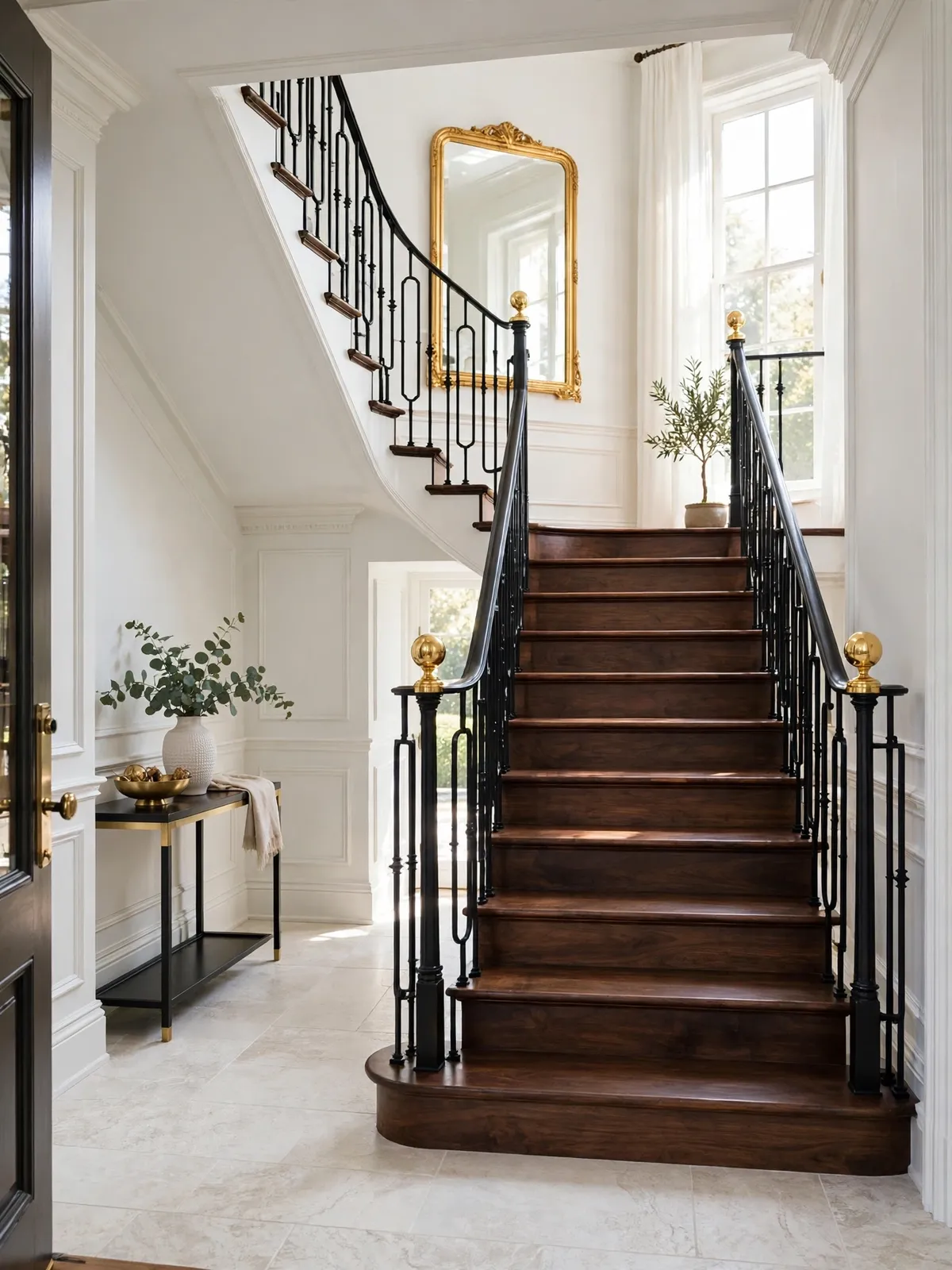
Matte black iron with gold newel caps is a classic pairing that feels both tailored and glamorous. Imagine a staircase where the balusters are a simple scroll pattern in flat matte black, and each newel post is crowned with a polished brass cap shaped like a small dome, catching the light from a gold-framed mirror on the landing wall. The black gives the railing its structure and the gold gives it its jewellery, and the combination works with white walls, dark walnut treads, and almost any style of furniture. It is a look that feels expensive without being showy.
Quick tips:
- Keep the gold to the newel caps — more gold turns the look brassy.
- A matte black finish hides dust better than gloss black.
- Repeat the gold once more nearby, such as a mirror frame or sconce.
- Choose solid brass caps, not plated plastic, so they age gracefully.
Iron Railings That Frame a Double-Height Entry
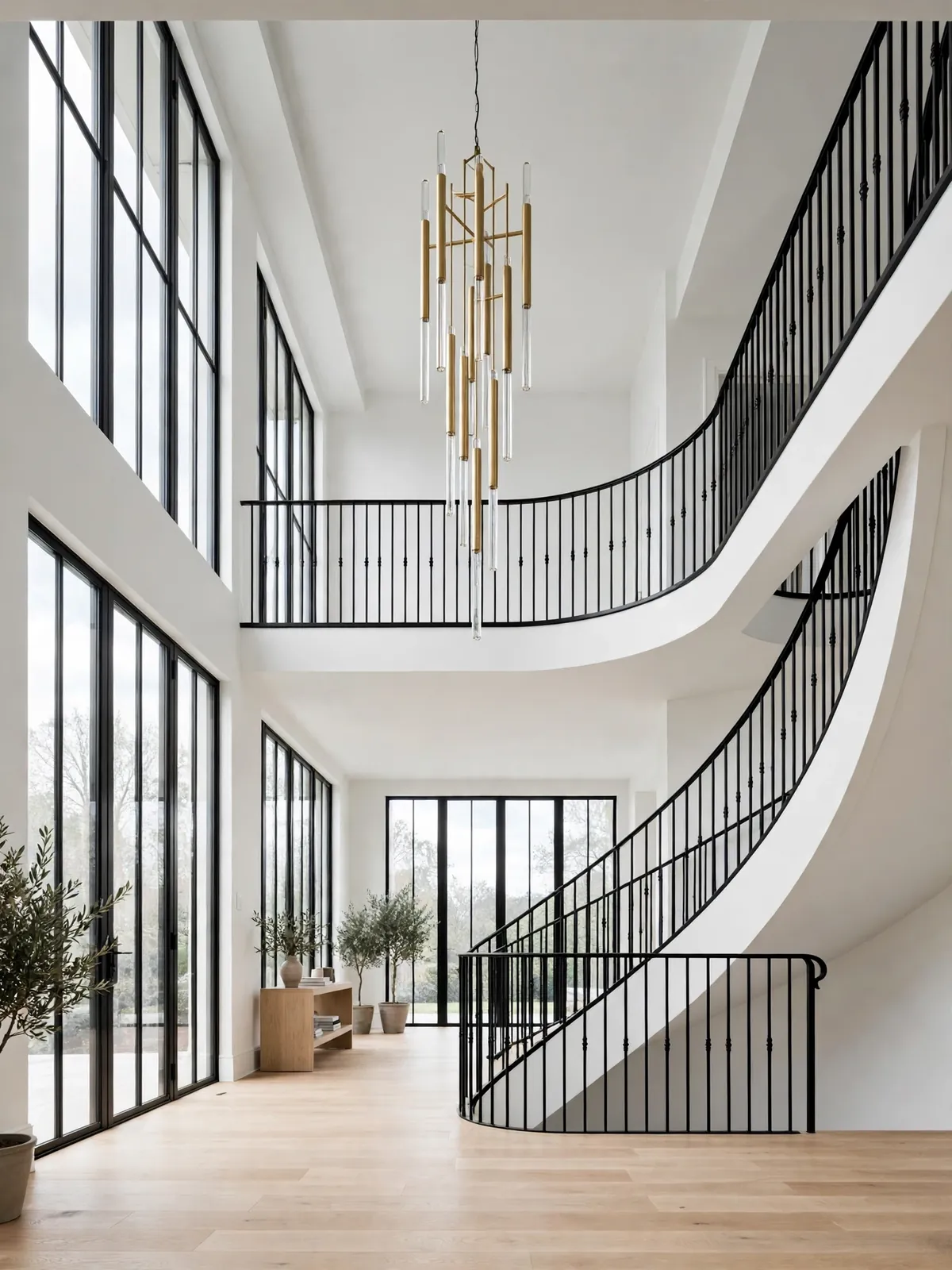
A double-height entry is made for an iron railing, because the railing can run the full height of the space and turn the staircase into architecture. Picture a two-storey entry where the iron railing climbs the staircase, turns the corner at the landing, and continues along the gallery above, a single unbroken line of slim satin-black balusters that frames the void and gives the tall space a sense of scale. A large modern chandelier hangs in the centre of the void, and the railing’s vertical lines echo its drop. From the ground floor, the railing reads as a drawing in iron against the white walls — the most striking feature in the room.
Quick tips:
- Keep one consistent baluster pattern from the stairs to the gallery.
- The landing railing must meet the same height rules as the stair railing.
- A slim profile matters more at height — chunky bars look heavy overhead.
- Plan the chandelier and railing together so their lines complement each other.
Iron Railings With a Geometric Diamond Pattern
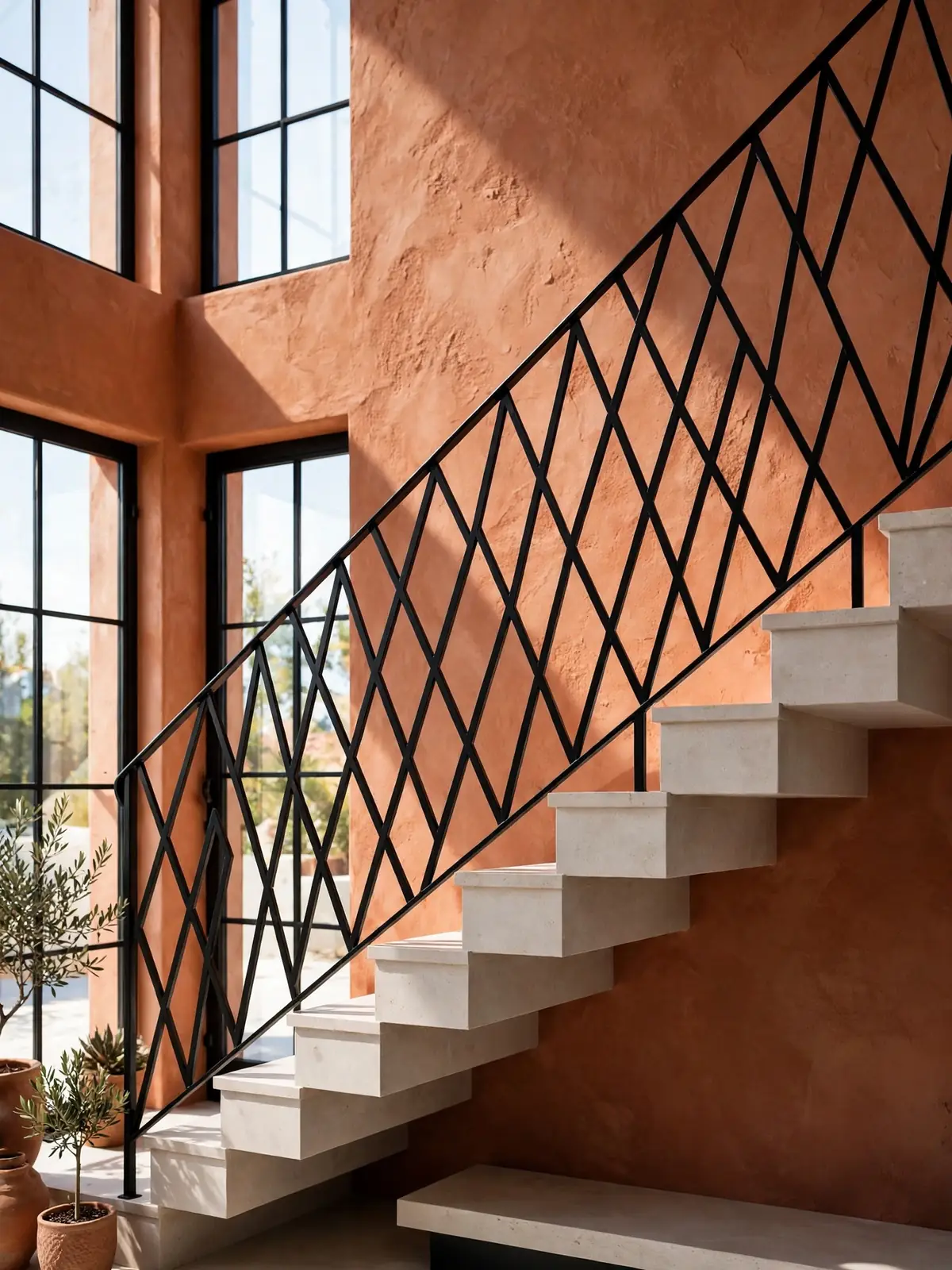
A geometric diamond pattern gives an iron railing a bold, graphic energy that suits confident, design-led homes. Imagine a staircase where the balusters are replaced by a lattice of iron diamonds, each one about 200 millimetres tall, forged from flat bar in satin black and set against warm terracotta walls. The diamonds catch the light on their edges, and the pattern feels both modern and timeless — it has echoes of Art Deco and of traditional latticework at once. This pattern works best when the rest of the room is calm, so the railing can be the graphic statement.
Quick tips:
- Keep the diamond size consistent — even a small variation is obvious.
- A single accent colour on the wall behind makes the pattern pop.
- Flat bar suits geometric patterns better than round bar.
- Test the pattern at full scale on paper before committing to the forge.
Iron Railings Paired With Glass Infill Panels
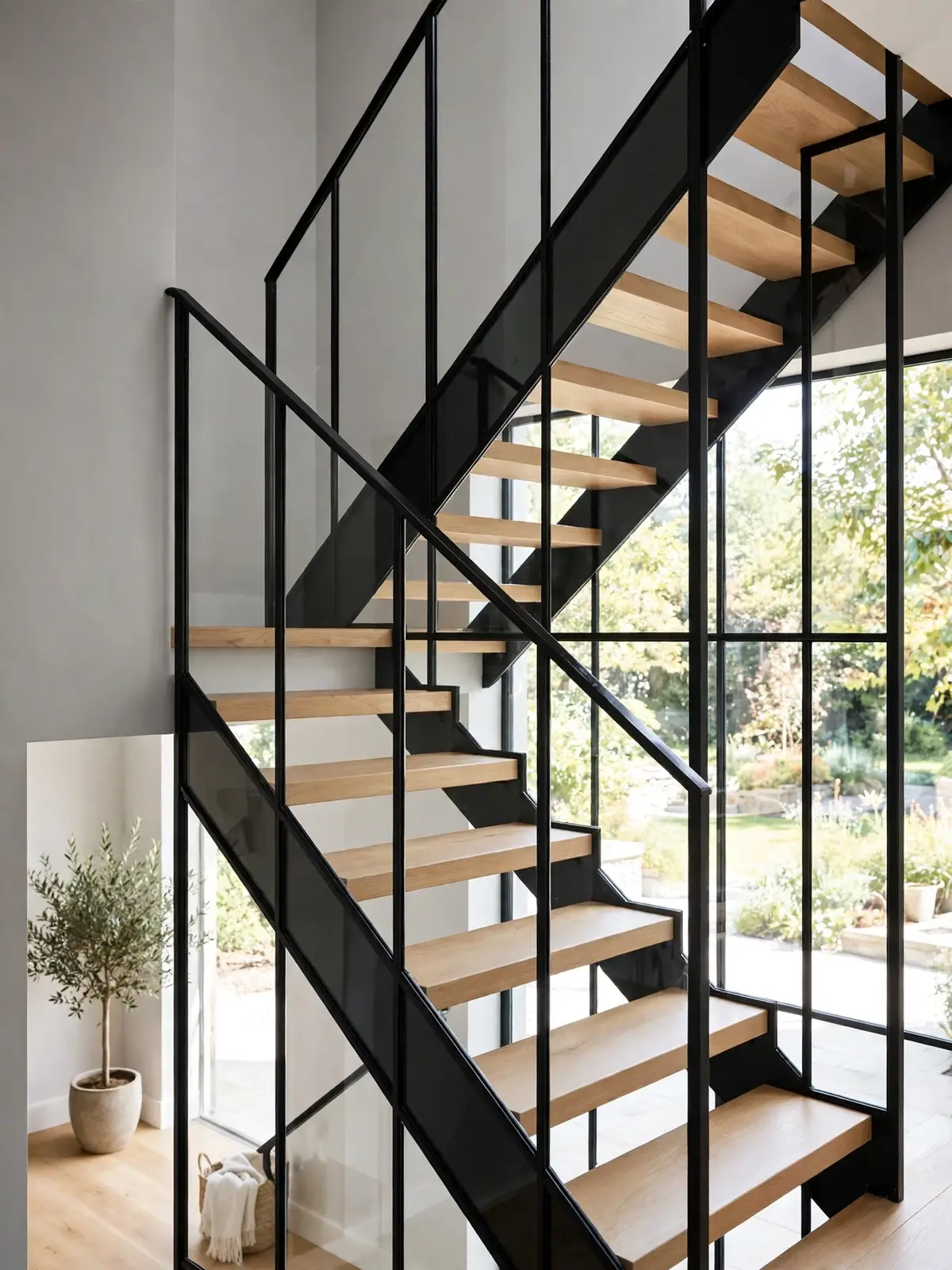
Iron framing with glass infill panels gives you the structure of iron and the openness of glass in one railing. Picture a staircase where slim black iron posts and a matching handrail hold clear tempered glass panels, each one cut to follow the stair’s slope, so you can see straight through the railing to the garden window beyond. The iron frame gives the glass its definition and its strength, while the glass keeps the staircase feeling light and unobstructed. This combination suits modern homes and any staircase where the view beyond matters — a garden, a fireplace, or a piece of art on the far wall.
Quick tips:
- Use tempered or laminated safety glass, never ordinary float glass.
- Keep the iron frame slim so the glass stays the dominant material.
- Clean the glass with a squeegee weekly — fingerprints show fast.
- A black iron frame suits grey and white interiors; bronze suits warmer rooms.
Iron Railings With a Built-In Planter Ledge Along the Base
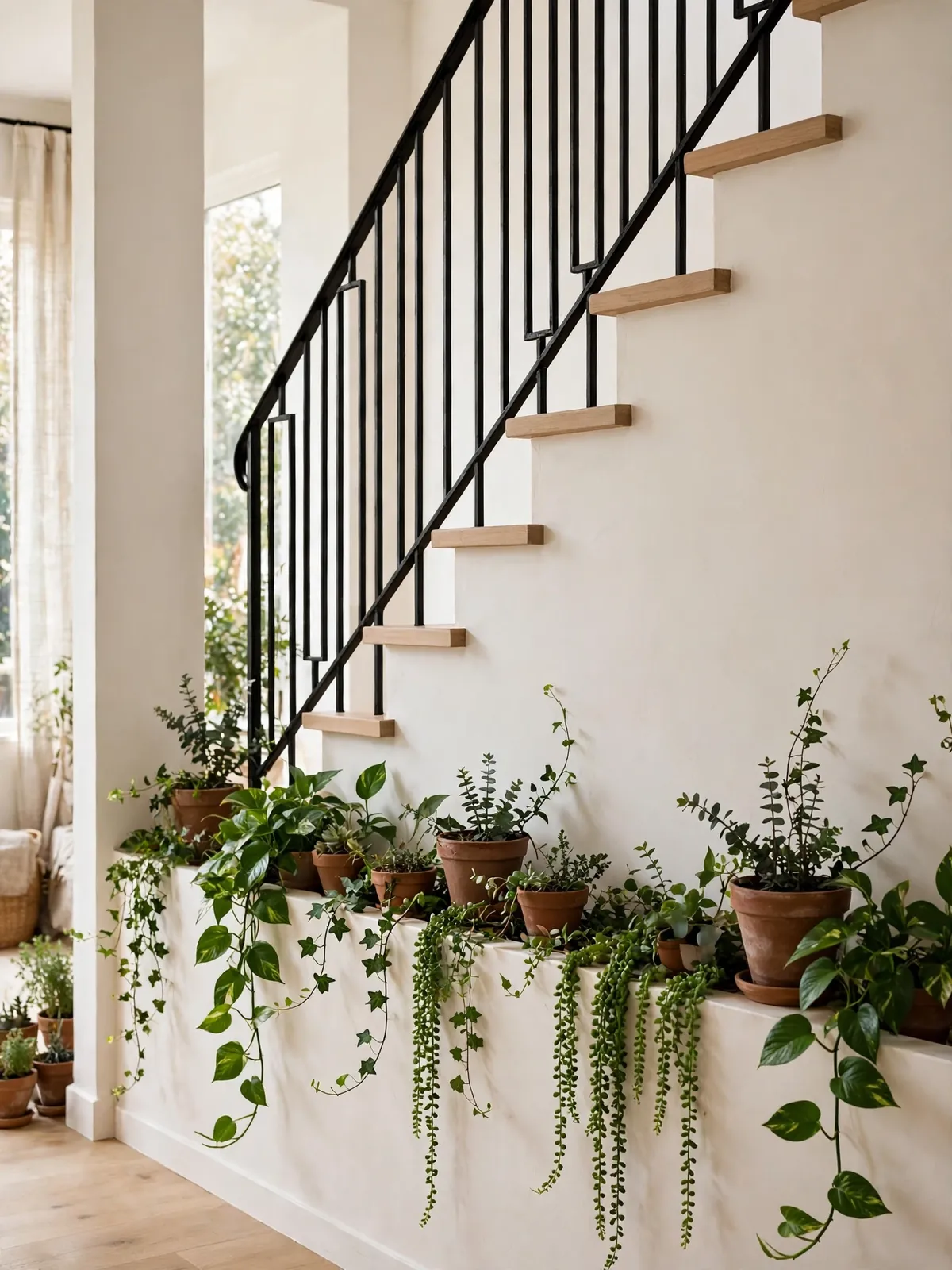
A planter ledge built into the base of an iron railing brings living greenery right onto the staircase. Imagine a staircase where the iron railing rises from a low ledge, 200 millimetres deep, lined with waterproof trays and filled with trailing plants — pothos, string of pearls, and small ferns — their leaves spilling gently over the edge and softening the iron above. The black iron frames the green beautifully, and the plants make the stairwell feel alive. This works best on a wide staircase or a landing, where the ledge has room to breathe and the plants get enough light.
Quick tips:
- Line the ledge with a waterproof tray and drainage mat to protect the floor.
- Choose trailing plants that need little light if the stairwell is dim.
- Keep the iron pattern open so the plants are visible through it.
- Water with a long-spout can to avoid splashing the ironwork.
Iron Railings in a Coastal Home With Whitewashed Wood
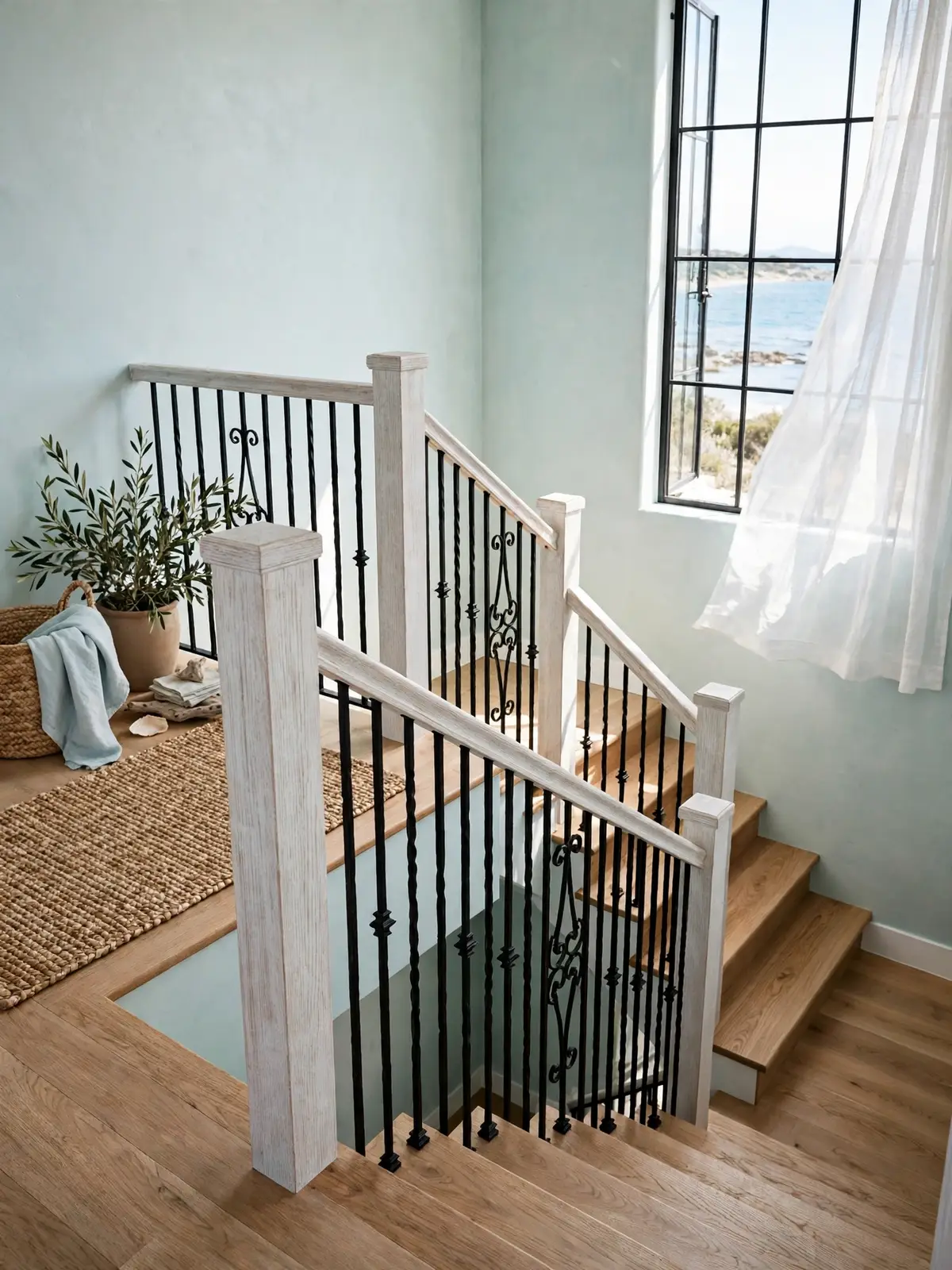
In a coastal home, iron railings work best when they are paired with whitewashed wood and a pale, breezy palette. Picture a staircase in a beach house where slim black iron balusters in a simple scroll pattern sit between whitewashed oak newel posts and a matching handrail, the whole composition set against pale aqua walls and sandy oak treads. The black iron gives the pale room its anchor and its contrast, while the whitewashed wood keeps everything light and relaxed. A woven seagrass rug at the foot of the stairs completes the coastal feel without a single seashell in sight.
Quick tips:
- Choose a matte black finish — glossy iron looks out of place in a coastal room.
- Whitewash the handrail and newel posts to match, not contrast.
- In salty air, seal the iron with a marine-grade clear coat to prevent rust.
- Keep the baluster pattern simple; coastal style is about calm, not ornament.
Iron Railings With a Hand-Forged Twisted Baluster Design
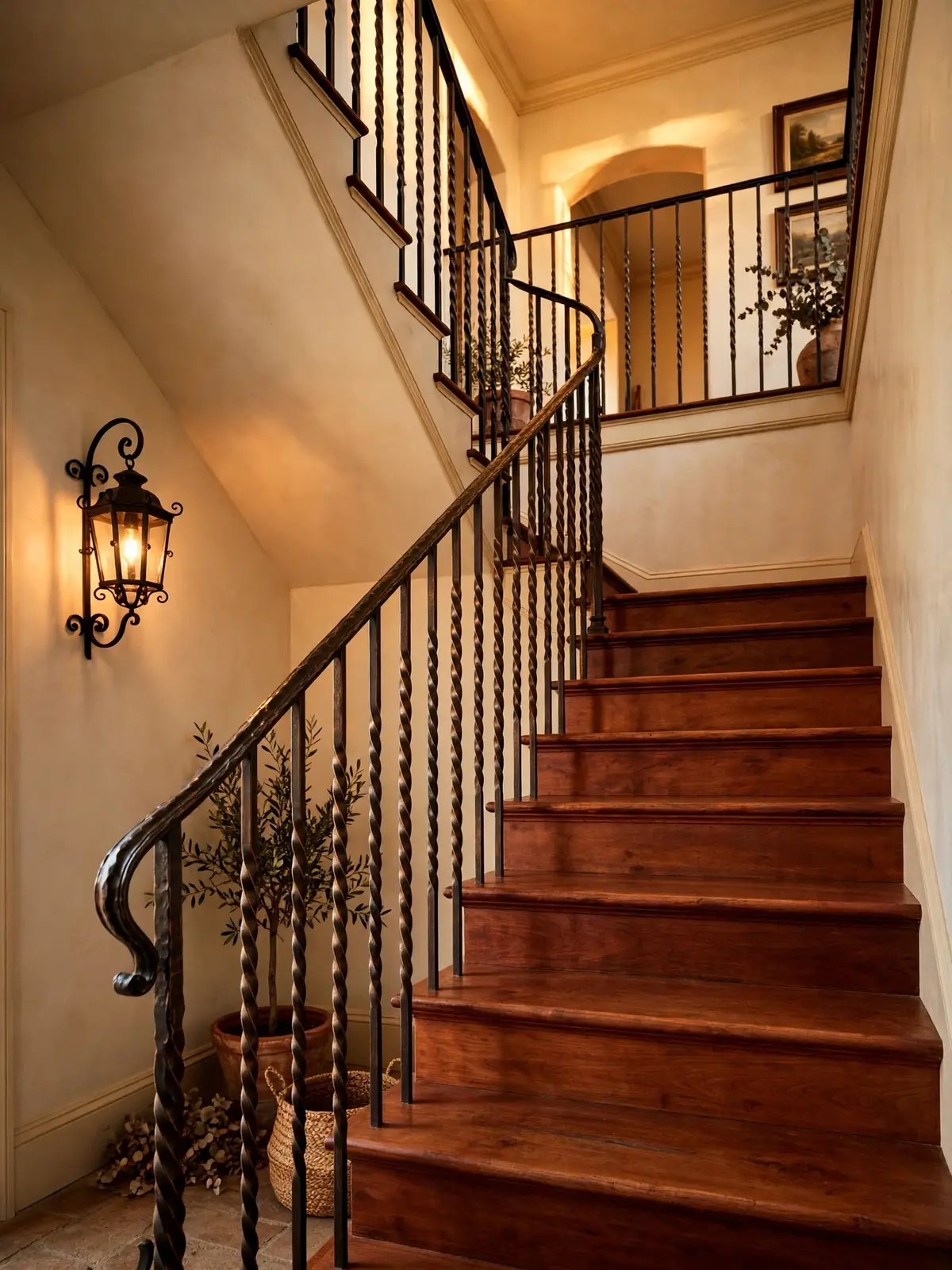
A hand-forged twisted baluster is ironwork at its most tactile, each bar twisted by hand so the metal catches the light along its spiral. Imagine a staircase where every baluster is a 16-millimetre square bar, twisted through 180 degrees in its middle third, finished in dark bronze, with the twists alternating direction so the pattern ripples up the flight. The handrail is rich cherry wood, and a wrought iron wall lantern glows beside the landing, so the whole stairwell feels warm and crafted. No two twists are identical, and that small irregularity is exactly what makes the railing feel made rather than manufactured.
Quick tips:
- Ask the blacksmith to alternate the twist direction for a rippling effect.
- A dark bronze finish shows the twist’s shadows better than flat black.
- Pair twisted balusters with a plain handrail so the twists stay the focus.
- Twisted bars suit traditional and rustic homes best; keep them out of ultra-modern rooms.
FAQs
Is an iron staircase railing better than a wood railing?
An iron staircase railing is better than a wood railing when you want fine detail, a slimmer profile, and a longer lifespan with less maintenance. Wood suits homes that need warmth and a softer look, while iron suits homes that want definition, contrast, and a crafted feel. Many homes use both, with iron balusters and a wood handrail.
Can I replace just the balusters with iron and keep my existing handrail?
Yes, in most cases you can replace wooden balusters with iron ones while keeping a sound existing handrail. A joiner or ironworker will cut the old balusters out, fit iron shoes to the treads, and fix the new balusters into the handrail above. Check the handrail is solid and level first, because iron balusters will show up any sag the old wooden ones hid.
How do I clean an iron staircase railing?
Dust an iron staircase railing weekly with a soft cloth or a feather duster, then wipe it monthly with a damp cloth and a drop of mild washing-up liquid. Dry it straight away so water does not sit in the joints. Touch up any chips in the paint or finish with a matching touch-up pen to keep rust away.
Does an iron railing make a staircase feel cold?
An iron staircase railing can feel visually cold in a room with hard surfaces and cool colours, but the effect is easy to soften. Pair the iron with a wood handrail, warm wall colours, a runner, or brass accents, and the railing reads as elegant rather than cold. A bronze or antique finish also warms iron considerably compared with plain black.
What is the standard height for an iron staircase railing?
The standard height for an iron staircase railing is 34 to 38 inches measured vertically from the front edge of the stair tread to the top of the handrail. On a landing or balcony, the guard rail should be at least 36 inches high. Always check your local building code, because the exact requirement varies by area.
Conclusion
An iron staircase railing is one of the few features in a home that is both purely practical and purely decorative at the same time, and the right design rewards you every single day you walk up the stairs. Whether you choose classic wrought iron balusters with a warm wood handrail, slim modern spindles that keep the stair feeling open, or a hand-forged twisted design that shows off real craft, the key is to match the railing to your home’s architecture and to the way you actually live in it. Start with the finish, choose a pattern that suits the scale of your stairwell, and let the details — the newel caps, the handrail, the spacing — do the quiet work of making it feel considered. Your staircase will thank you for it.