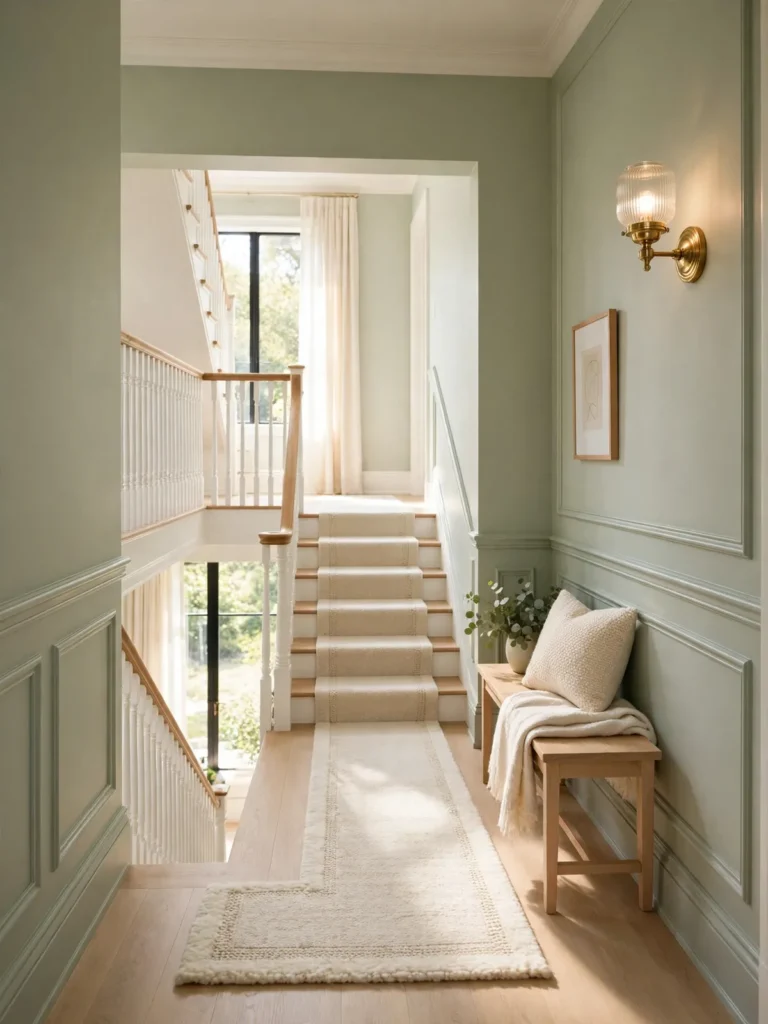
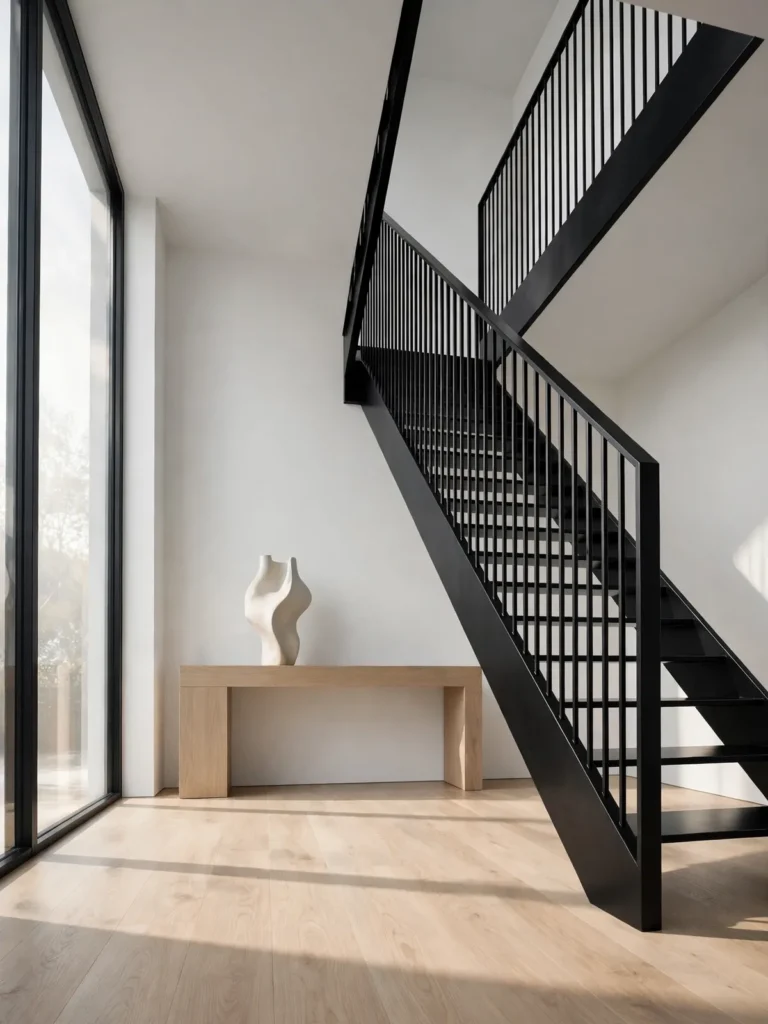
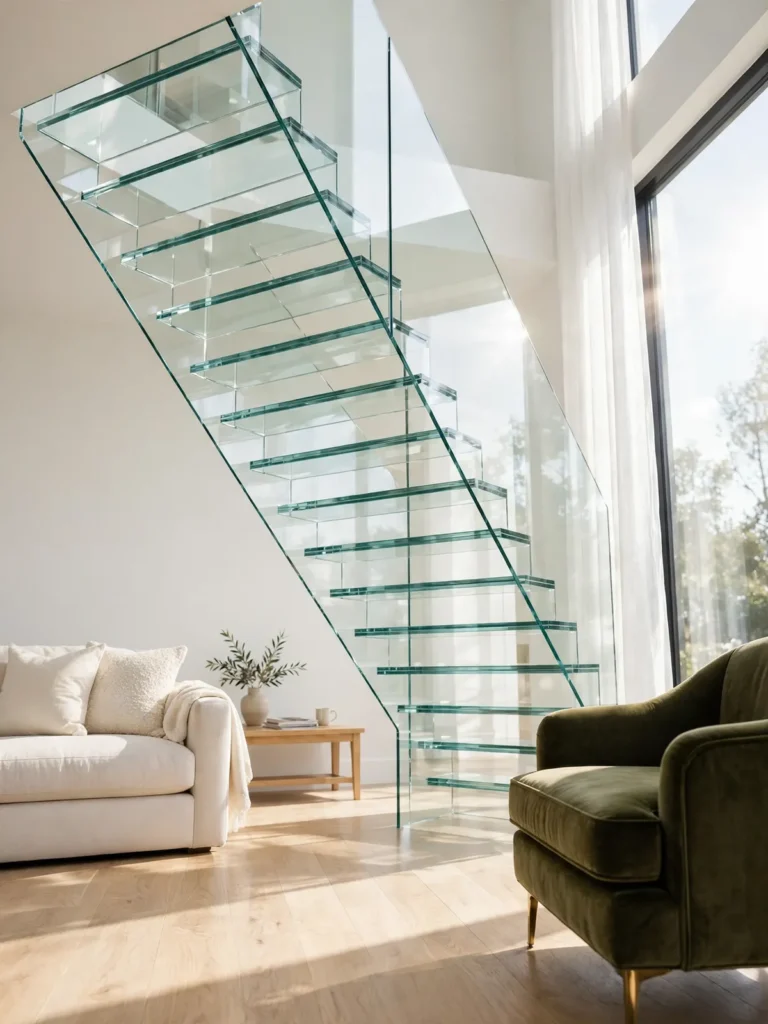
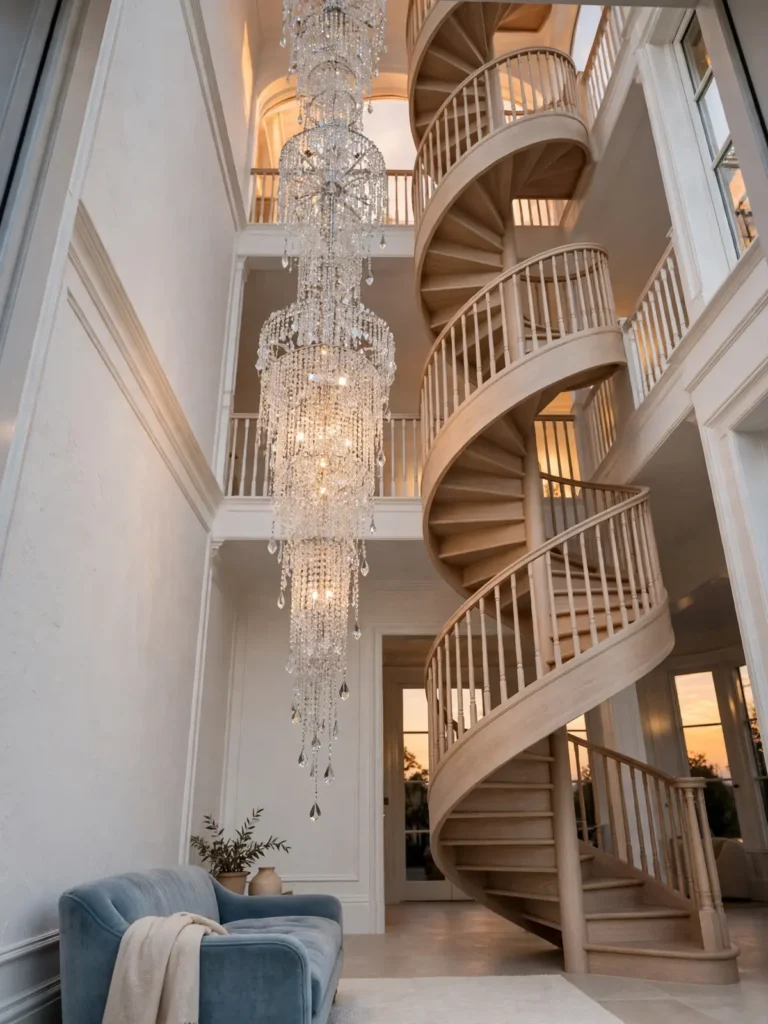
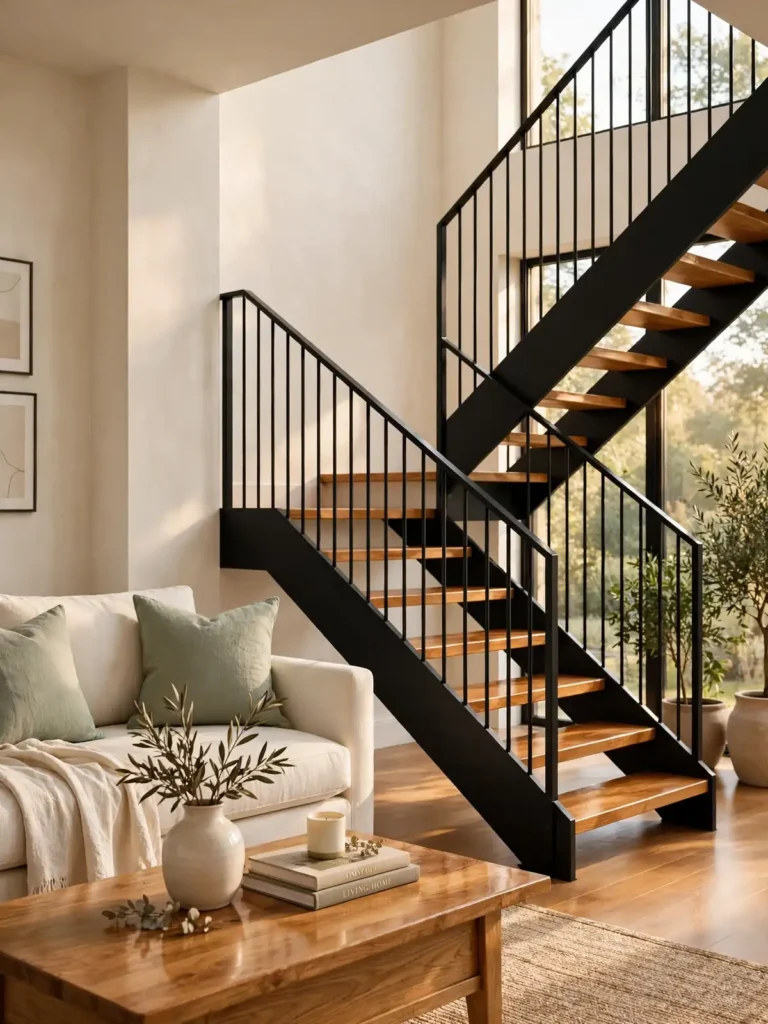
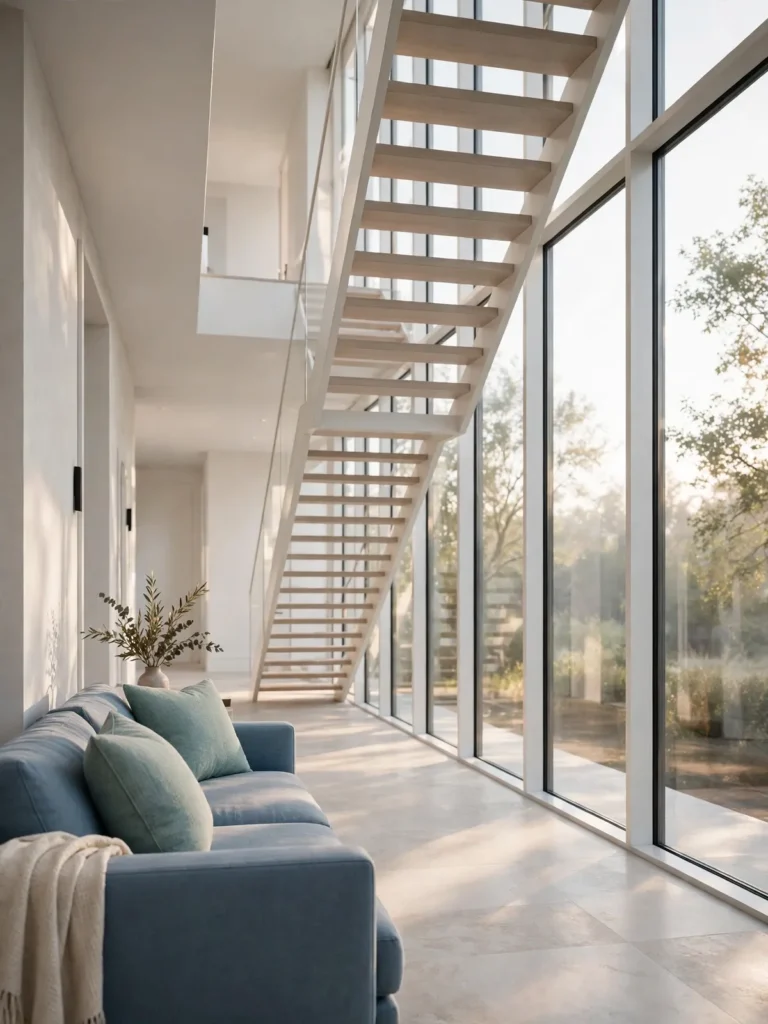
25 Stunning Modern Staircase Wall Design Ideas That Instantly Transform Your Space
A modern staircase wall does not need clutter or decoration for its own sake. These 25 modern staircase wall design ideas show how vertical wood slats, soft gradients, LED lighting, limewash plaster, sculptural panels, mirrors and a few well-chosen pieces of art can turn a blank stair wall into the most considered feature in your home — clean, calm and unmistakably modern.
Modern staircase wall design ideas are the clean, intentional treatments that turn a blank stair wall into a feature — a slatted timber panel here, a wash of LED light there, a single bold colour block, a row of identical frames climbing the flight. The best modern stair wall starts with one strong decision: choose the texture, the light or the art, and let everything else stay quiet, so the wall reads as designed rather than decorated by accident.
For the wider picture — the treads, the railing and the shape of the stair itself — these modern staircase ideas show how open risers, slim steel railings and pale timber keep a stair feeling bright and architectural. The 25 ideas below cover every modern treatment for the wall itself — its texture, its colour, its lighting and the objects hung on it — so you can choose a design that suits your home, your budget and the way your family actually climbs the stairs.
Key Takeaways
What makes a staircase wall look modern?
A modern stair wall looks modern because it is restrained: clean straight lines, a limited palette of two or three colours, contemporary materials like slatted timber, limewash plaster, glass or matte black steel, and lighting built into the wall rather than hung on it. One strong feature — a slat panel, a colour block, a lit niche — does the work, while the rest of the wall stays calm.
What are the best colours for a modern staircase wall?
Warm white, soft taupe, pale grey and light oak are the safest modern base colours, because they keep a stair bright and make the timber and lighting stand out. One accent colour — terracotta, deep sage, charcoal or a soft blush — adds personality without breaking the modern look, as long as it appears in only one place on the wall.
What lighting works best on a modern staircase wall?
Hidden lighting works best: LED strips recessed along the handrail, behind a slat panel or under a floating shelf, plus one or two slim wall lights in matte black or brass. Warm white light at about 2700K keeps the wall soft, and a motion sensor or dimmer means the light is there when you climb and gentle when you do not need it.
How can I get a modern staircase wall look on a budget?
Paint is the cheapest modern treatment: one bold colour block, a soft gradient in two tones of the same colour, or a matte black feature wall all cost little more than a tin of paint. A row of identical frames with monochrome prints, a few slim floating shelves, or a single length of LED strip behind a shelf are the next cheapest steps, and each one changes the wall for under the cost of a new railing.
How do I keep a modern staircase wall timeless instead of trendy?
Choose natural materials and simple geometry — timber, plaster, stone, glass and plain matte paint — and keep the art and the colour easy to change. A limewash wall, a slatted timber panel or a stone veneer will still look right in ten years, while a loud pattern or a novelty fixture dates quickly. If a treatment can be repainted or re-hung in an afternoon, it is safe to try.
Vertical Wood Slat Panels in Light Oak
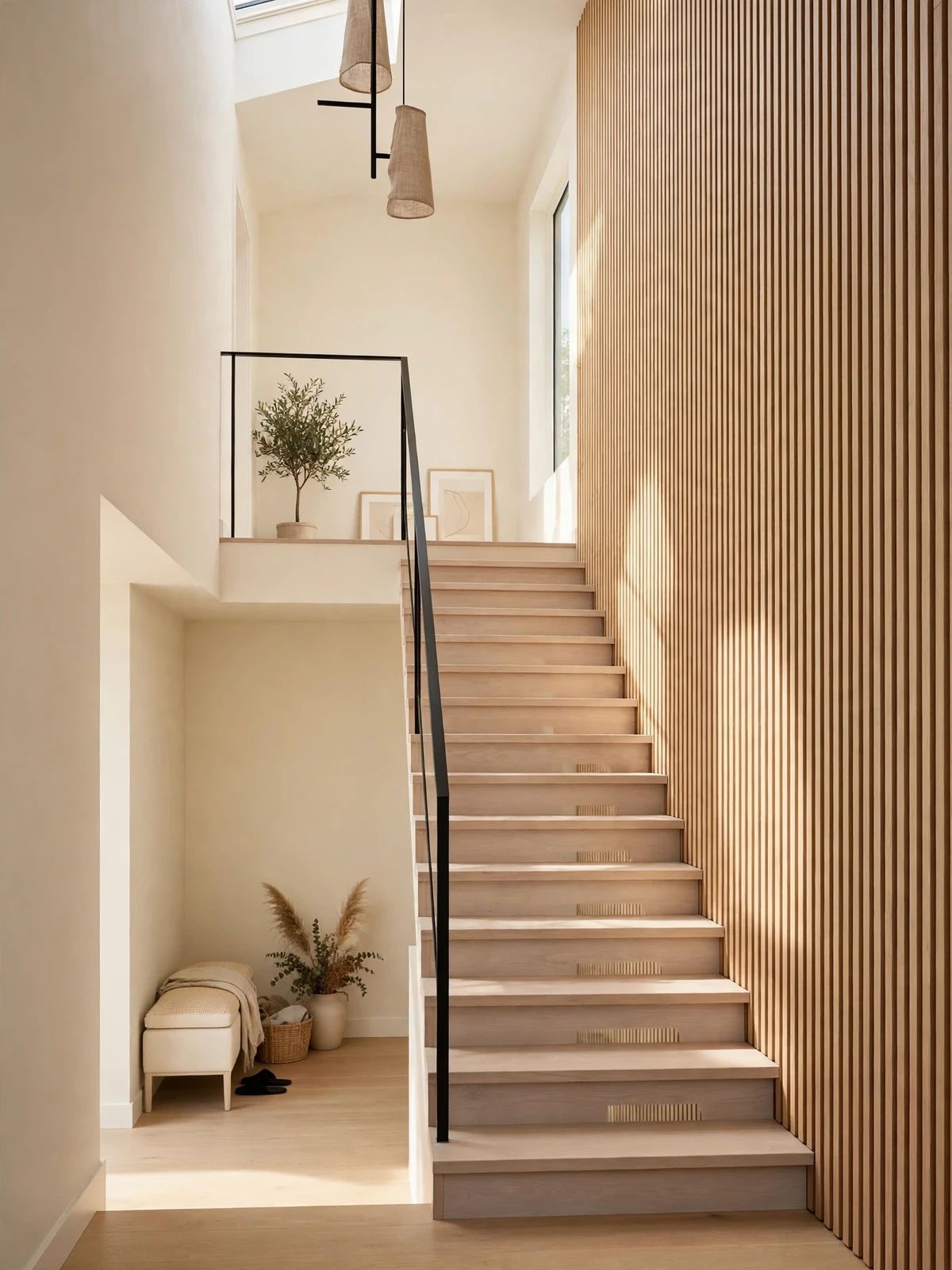
Vertical wood slats are the cleanest modern treatment for a stair wall, because they add warmth and rhythm without a single decoration. On this wall, slim light oak slats, each 40 mm wide and spaced 12 mm apart, run floor to ceiling beside pale ash treads, each 950 mm wide, with a slim black steel handrail fixed directly to the slats. Soft cream walls and warm daylight keep the stair bright, while the vertical lines draw the eye upward and make the whole flight feel taller.
Quick tips:
- Keep the slats slim — about 40 mm wide — for a refined modern rhythm.
- Space them evenly, about 12 mm apart, so the gaps read as shadow lines.
- Choose light oak for a warm, Scandinavian feel.
- Fix the handrail to the slats so the wall reads as one designed piece.
A Soft Gradient Wall That Fades as You Climb
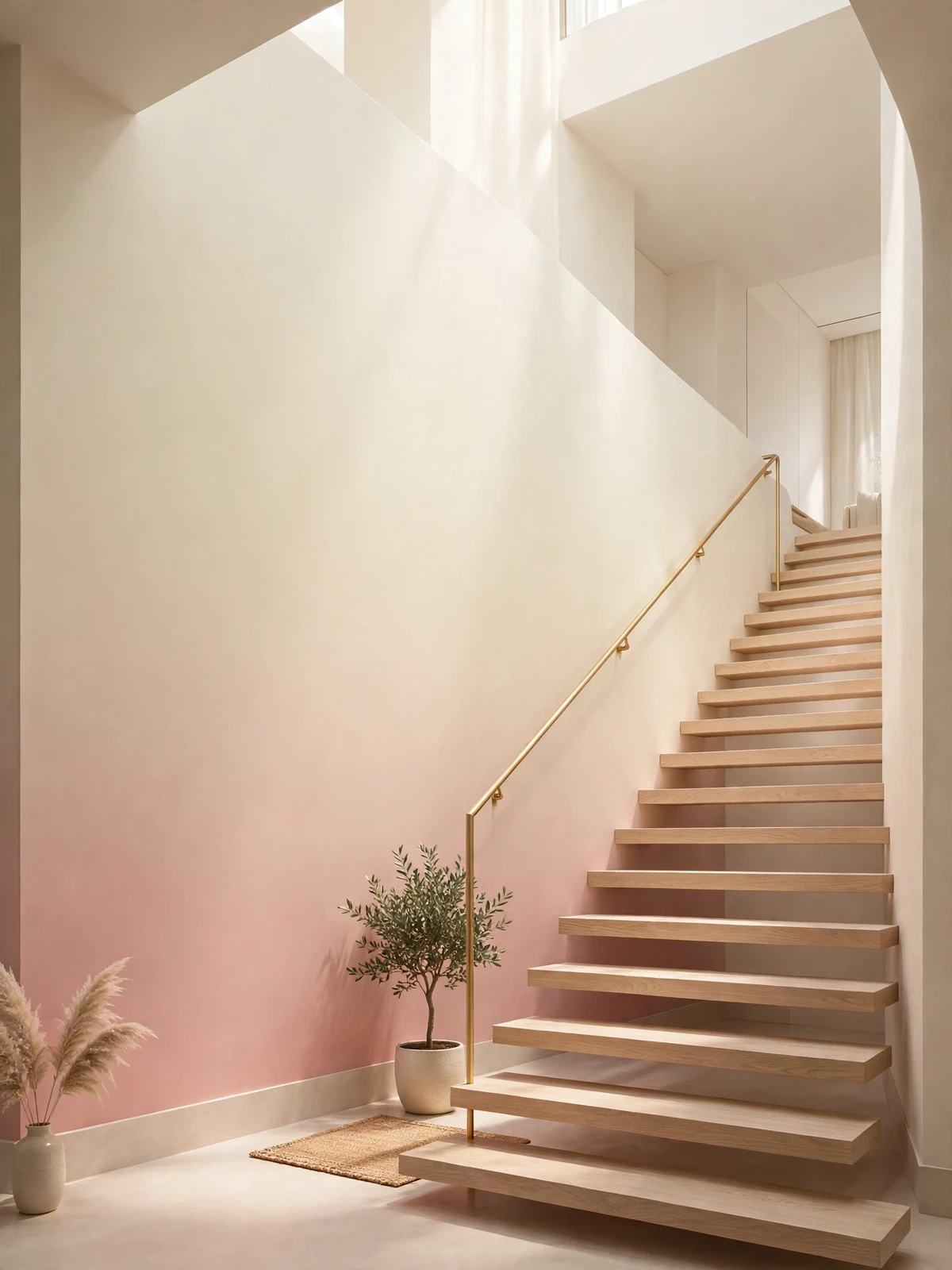
A gradient wall is the most gentle modern treatment, because the colour itself does the decorating and nothing else is needed. Here, the stair wall fades from a warm blush at the base to pale cream at the top of the flight, painted in five blended bands over a 3.6 metre rise, beside white oak treads, each 950 mm wide, with a slim brass handrail following the slope. Gentle morning light softens the bands into one smooth wash, and the stair feels lighter at the top, as if the colour is lifting with you.
Quick tips:
- Blend the gradient in five bands so the fade looks smooth, not striped.
- Use two tones of the same colour family for a soft, modern result.
- Keep the treads pale so the colour stays the feature.
- Match the handrail to a warm metal — brass or brushed gold.
Slim Floating Shelves in Matte Black
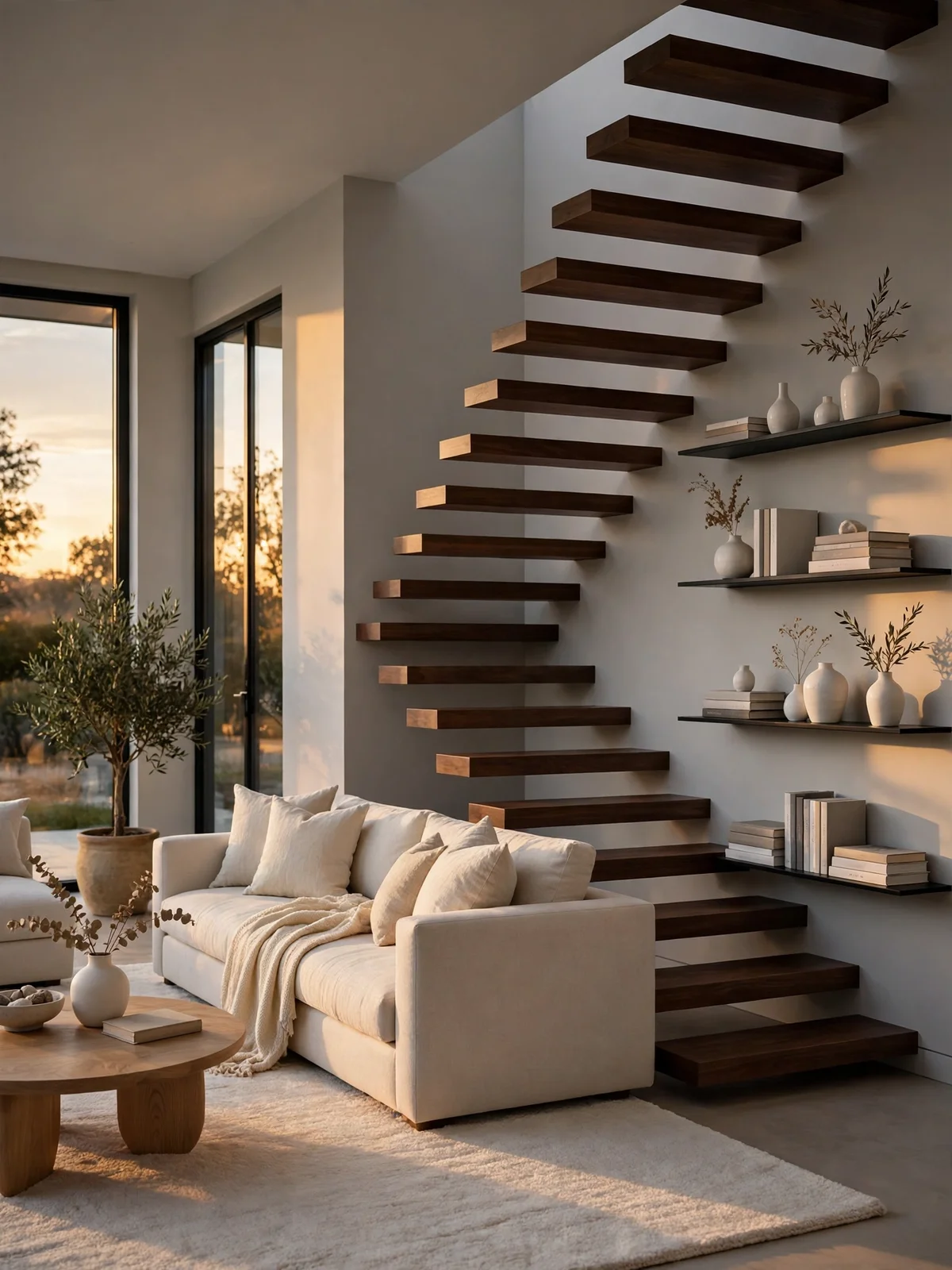
Slim floating shelves turn a stair wall into a quiet display without any visible brackets or clutter. Along this wall, three matte black shelves, each 900 mm long and 200 mm deep, step upward following the angle of the flight beside dark walnut treads, each 950 mm wide, holding a small white vase, a stack of two books and a single ceramic bowl. Soft dove-grey walls and a cream rug below keep the room calm, while the black shelves draw a clean horizontal line against the slope of the stair.
Quick tips:
- Step the shelves upward to follow the angle of the stair.
- Keep each shelf to three objects at most — less is more.
- Choose matte black shelves for a crisp modern contrast.
- Leave one shelf empty so the display breathes.
LED Strip Lighting That Washes the Wall
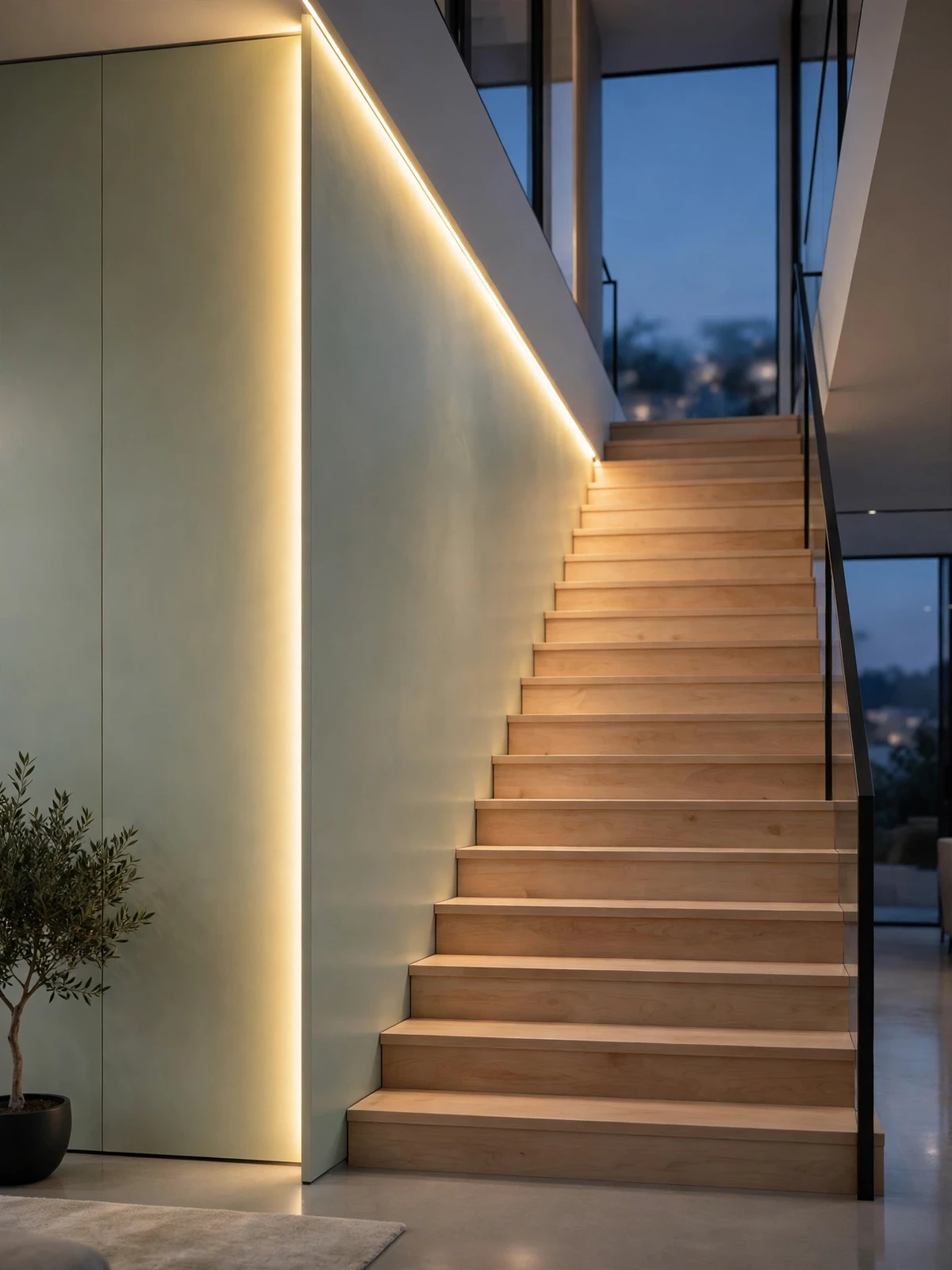
LED strips that wash the wall are the most modern lighting treatment of all, because the light itself becomes the decoration and the fixture disappears. Here, a warm white LED strip, 2700K, is recessed into a slim channel along the top of the stair wall, washing soft light down a pale sage-green wall beside light maple treads, each 950 mm wide, while a second strip runs behind the handrail. At dusk the wall glows gently from top to bottom, the treads are easy to see, and the whole stair feels like it is lit from within.
Quick tips:
- Choose warm white LEDs — about 2700K — for a soft, welcoming glow.
- Recess the strip in a channel so the fixture stays invisible.
- Wash the wall from above so the light falls evenly down the flight.
- Put the strips on a dimmer or motion sensor for evening use.
A Textured Limewash Plaster Finish
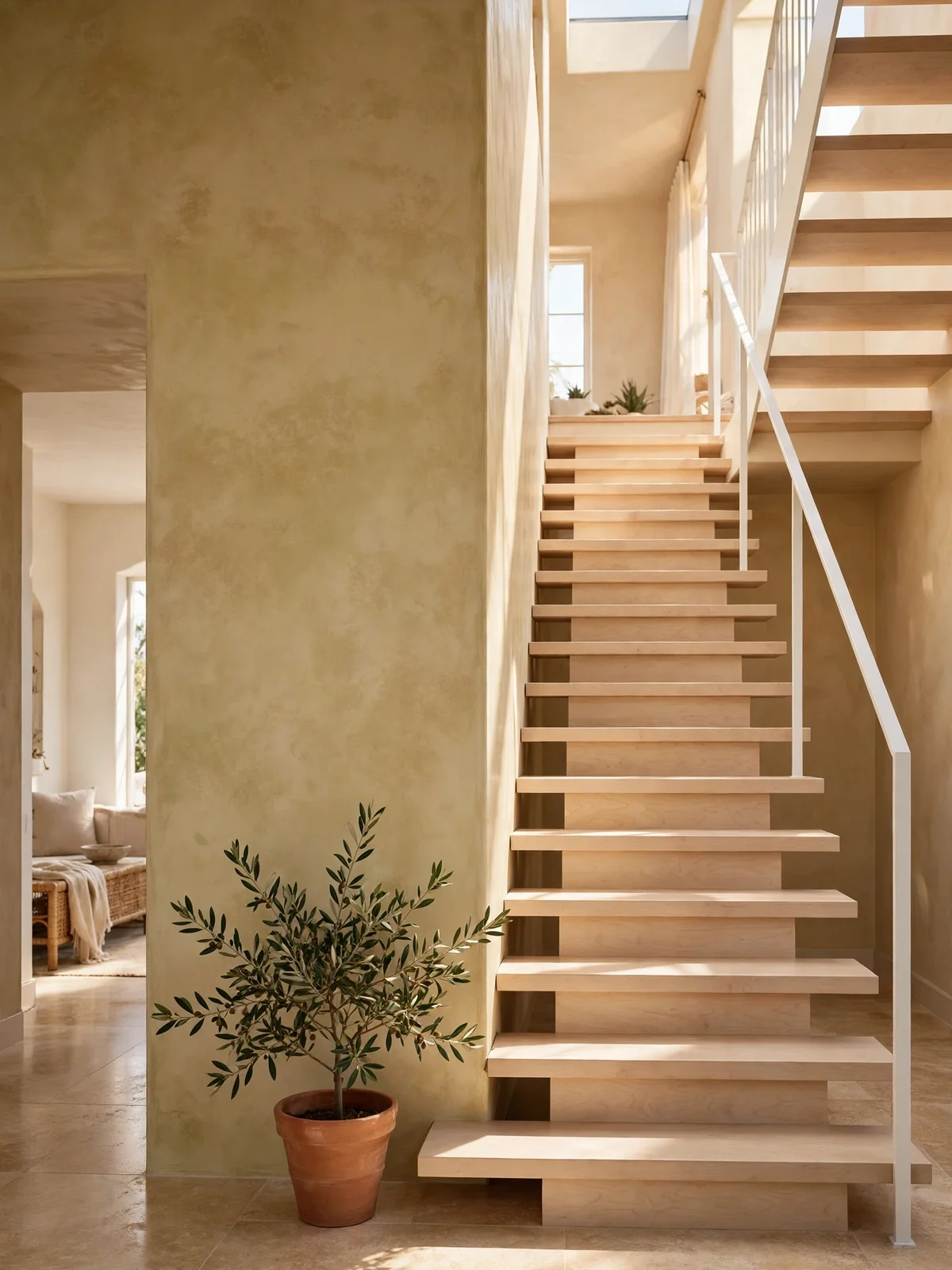
Limewash plaster gives a modern stair wall a soft, cloudy texture that flat paint can never match, and it changes with the light all day. On this wall, two coats of limewash in warm sand are brushed over the plaster in loose strokes, leaving subtle tonal movement across a 4 metre high wall beside pale birch treads, each 900 mm wide, with a slim white steel handrail. A terracotta pot holding an olive branch at the base picks up the wall’s warm tones, while soft afternoon light makes the texture glow gently.
Quick tips:
- Apply two coats of limewash in loose, overlapping strokes.
- Choose warm sand, soft taupe or pale clay for a timeless tone.
- Keep the handrail slim and pale so the texture stays the feature.
- Seal the limewash if the wall is near a busy hallway.
A Sculptural Wall Installation in Neutral Metal
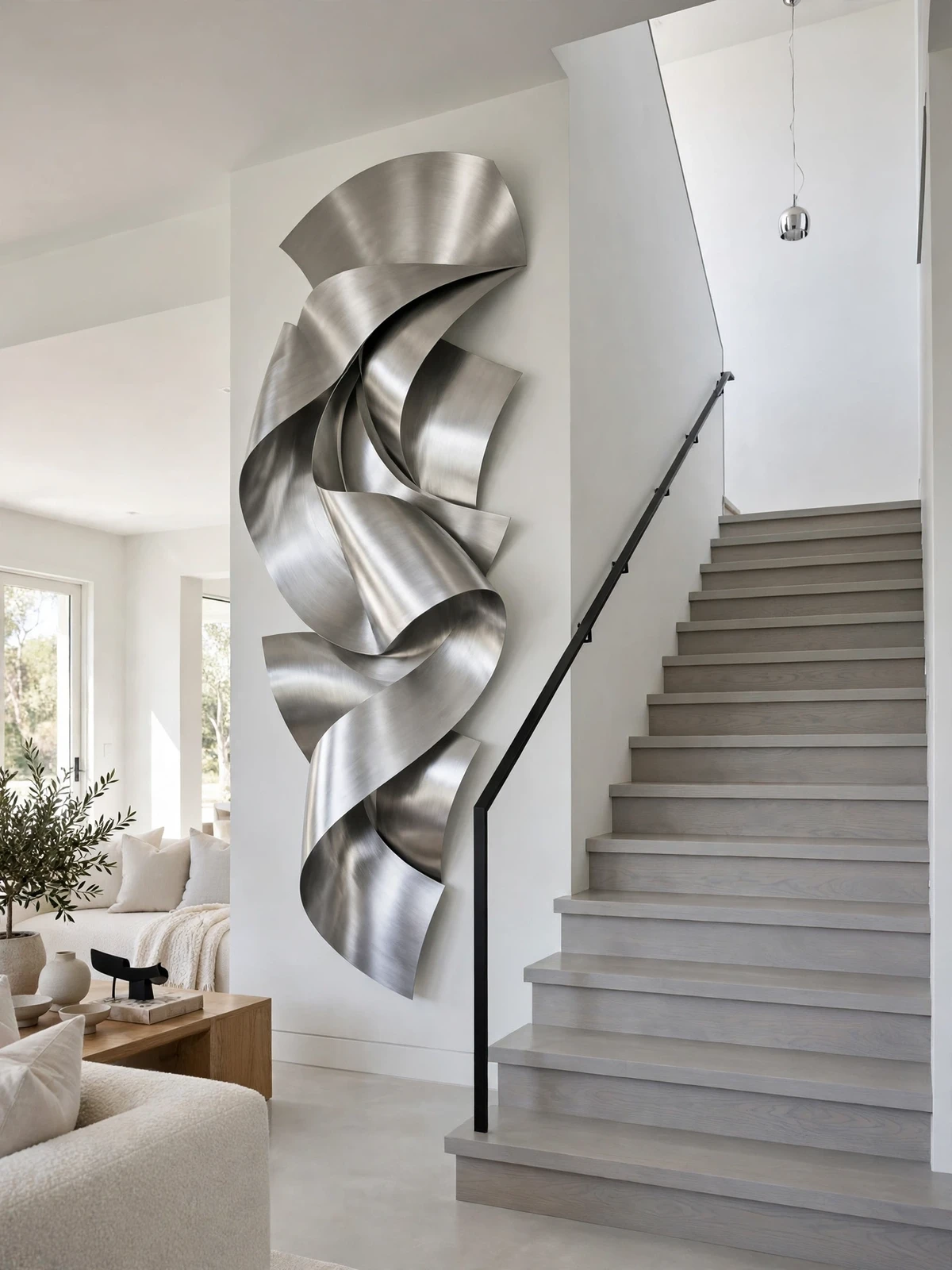
A sculptural metal installation turns a stair wall into a piece of architecture, and the neutral finish keeps it modern rather than loud. On this wall, seven overlapping brushed silver panels, each about 600 mm tall, curve gently outward from the wall beside pale grey oak treads, each 950 mm wide, catching daylight from the landing window and throwing soft shadows across the plaster. A slim black handrail and a small chrome pendant below keep the palette cool and restrained, so the sculpture carries all the drama.
Quick tips:
- Choose brushed silver or champagne metal for a soft, neutral shine.
- Let the panels overlap so the installation reads as one flowing piece.
- Keep the wall pale so the metal stands out clearly.
- Match the handrail to a dark metal for contrast.
A Continuous Abstract Mural in Soft Tones
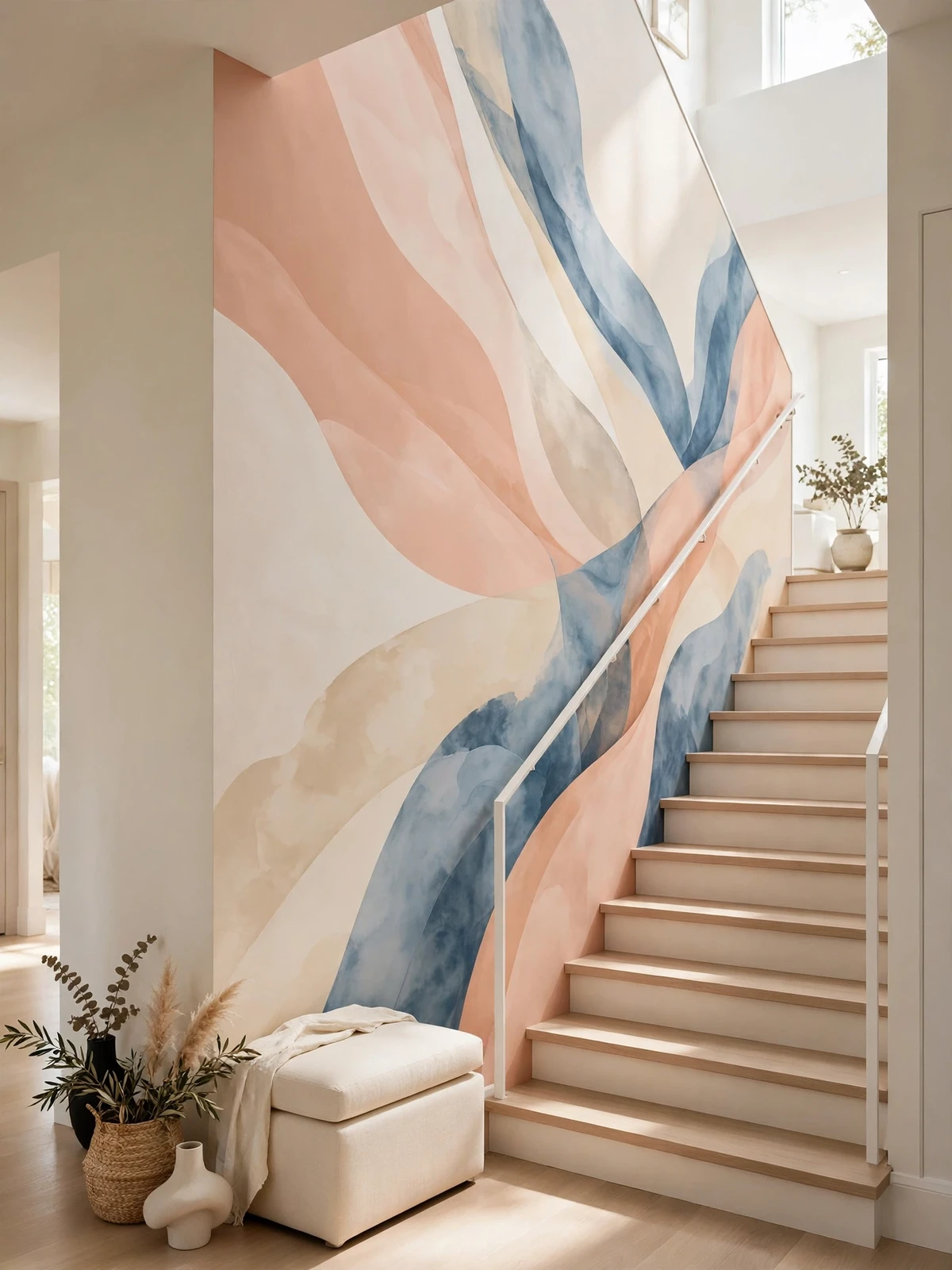
A continuous abstract mural is the most expressive modern stair wall treatment, because the artwork grows with the climb instead of sitting in one frame. Here, soft sweeping shapes in peach, dusty blue and cream flow up a 4.5 metre wall beside pale oak treads, each 950 mm wide, painted directly onto the plaster so the mural and the wall are one surface. A slim white handrail and a cream bench at the base keep the stair quiet, so the mural’s gentle curves carry all the colour.
Quick tips:
- Keep the mural palette to three soft tones for a modern feel.
- Let the shapes follow the slope of the stair upward.
- Paint directly onto the plaster so the mural feels built in.
- Keep the handrail and treads pale so the mural stays the feature.
Mixed Materials: Concrete Panels and Warm Wood
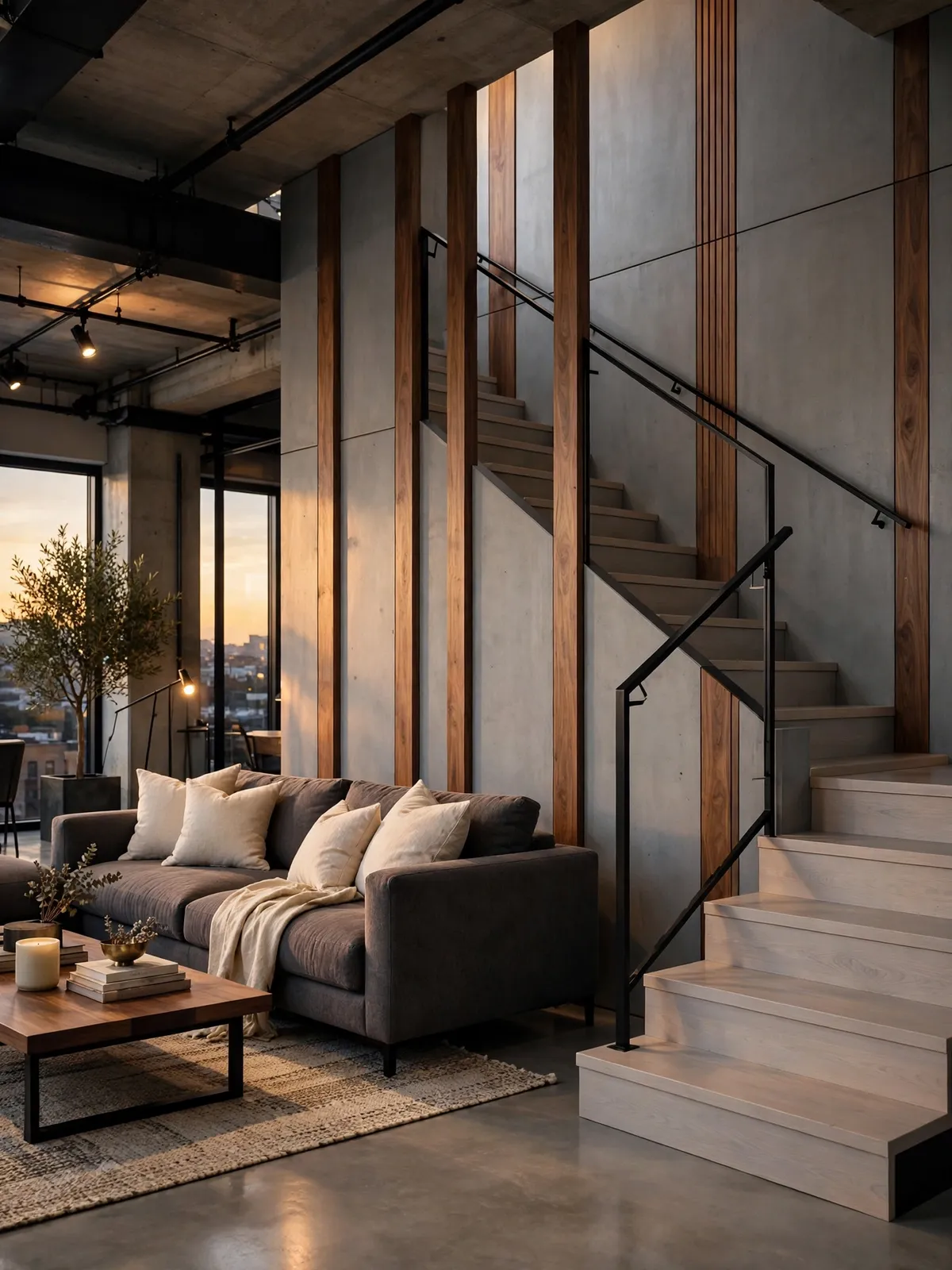
Mixing concrete and warm wood is the modern stair wall at its most confident, because two honest materials do opposite jobs at the same time. On this wall, smooth light-grey concrete panels, each 600 mm square, run the lower half of the flight, while warm walnut battens fill the upper half beside pale ash treads, each 950 mm wide, with a slim black steel handrail fixed across both materials. A soft charcoal sofa and cream cushions below pick up the concrete’s cool tone, while warm evening light makes the walnut glow against it.
Quick tips:
- Split the wall roughly half concrete, half wood for balance.
- Keep the concrete panels large — about 600 mm square — for a clean look.
- Choose warm walnut to soften the concrete’s cool grey.
- Use one slim black handrail across both materials to tie them together.
Monochrome Photography in Uniform Frames
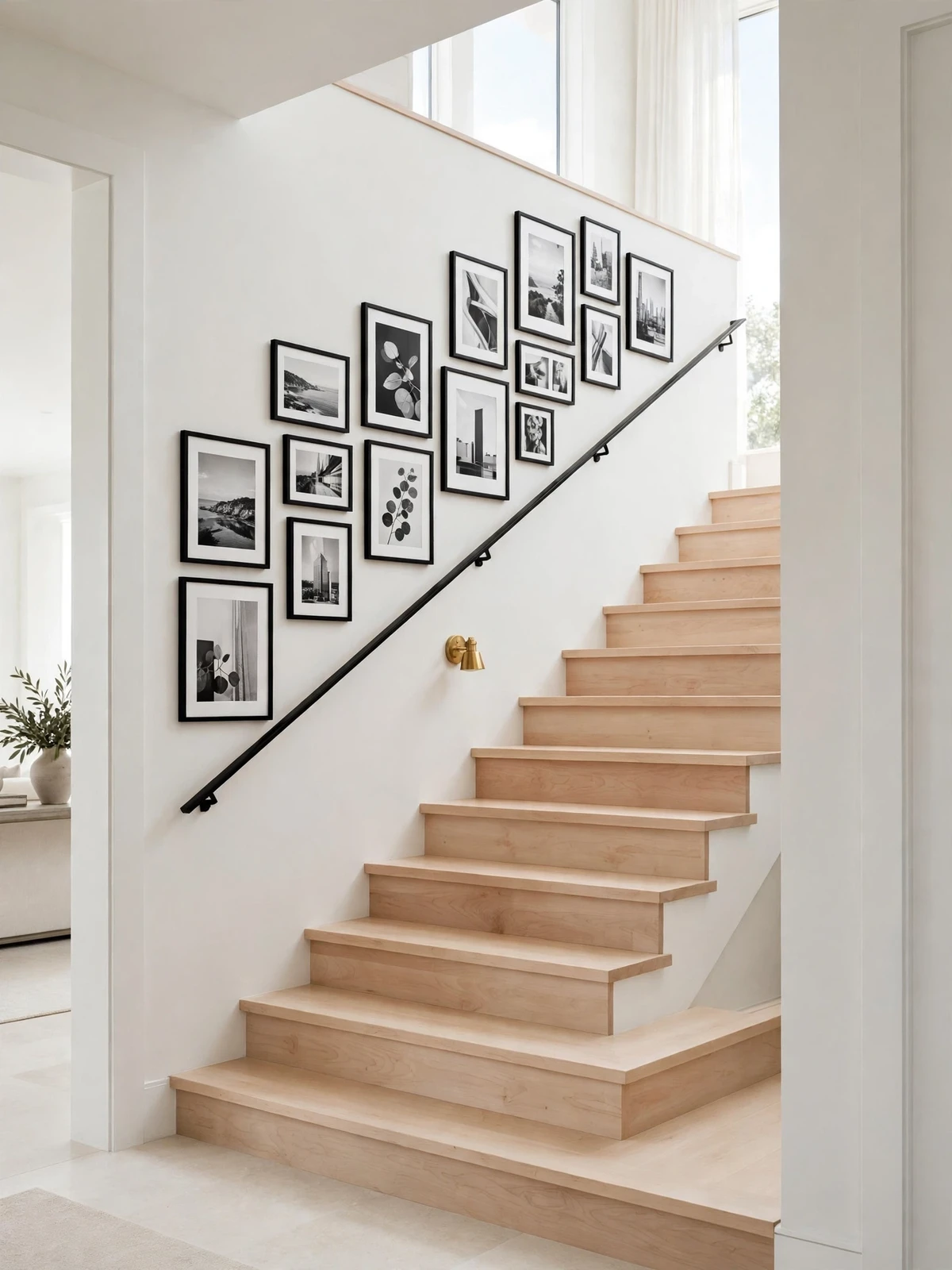
Monochrome photography in identical frames is the most disciplined modern gallery wall, because the uniform frames make even very different photographs read as one designed series. Along this stair, ten black-and-white photographs in thin black frames, each 300 mm by 400 mm, climb the white wall in a loose diagonal, each frame hung 120 mm from the next, following the slope of the flight beside pale maple treads, each 950 mm wide. A slim black handrail and a small brass wall light keep the stair itself quiet, so the photographs carry all the character.
Quick tips:
- Use one frame size and one frame colour for a unified series.
- Space the frames evenly, about 120 mm apart, following the stair.
- Print every photograph in black and white for a modern, calm look.
- Start the series at eye level on the lowest tread and climb from there.
Floor-to-Ceiling Mirrors Along the Stair
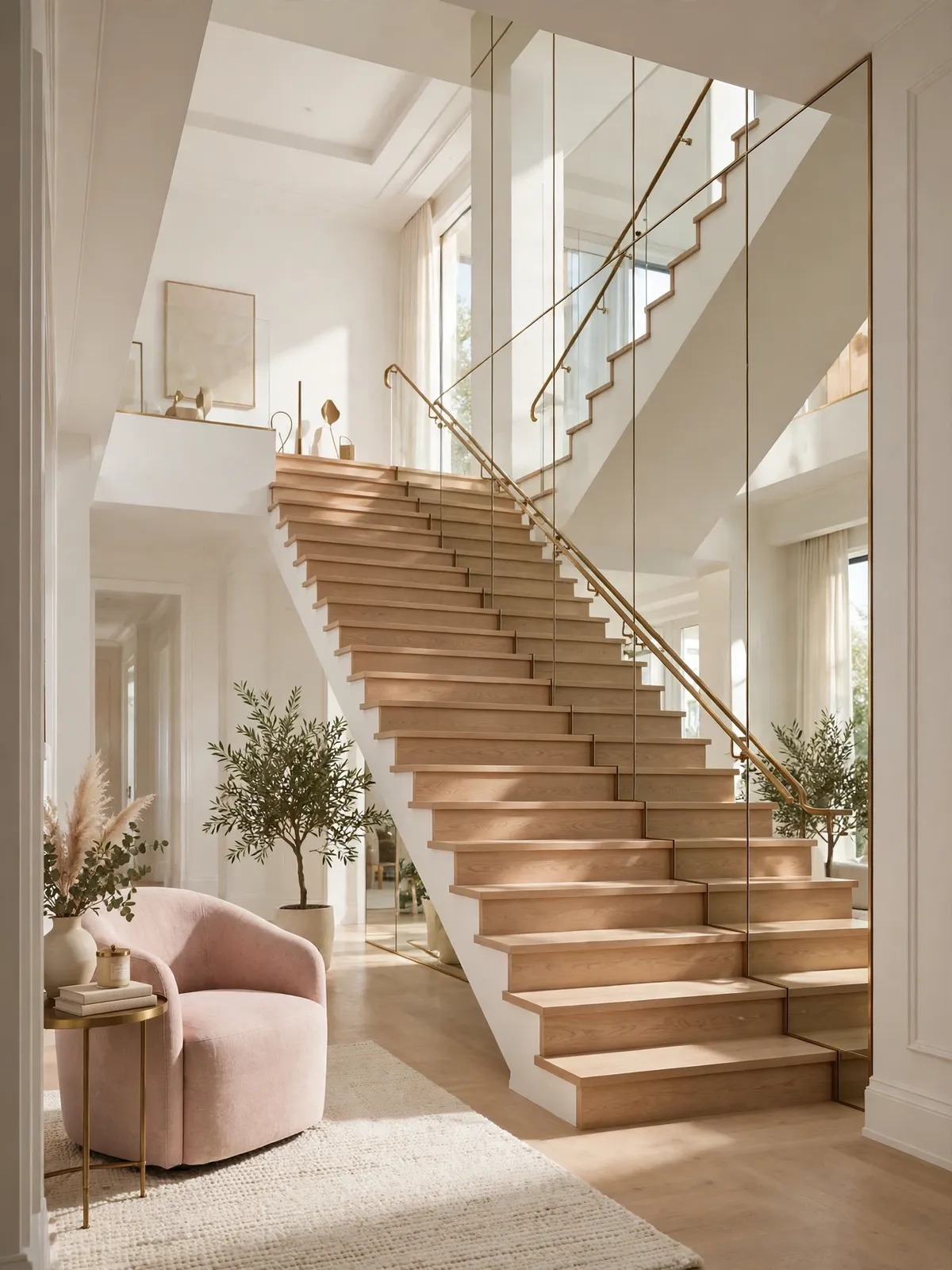
Floor-to-ceiling mirrors are the most transformative modern stair wall treatment, because they double the light, double the room and disappear at the same time. Here, three frameless mirror panels, each 800 mm wide and 3.2 metres tall, run the full height of the stair wall beside light oak treads, each 900 mm wide, reflecting the daylight from the landing window and the cream rug below. A soft blush-pink armchair at the base and a slim brass handrail keep the palette warm, while the mirrors make a narrow stair feel twice as wide.
Quick tips:
- Use frameless panels for a clean, seamless modern look.
- Run the mirrors floor to ceiling so the wall feels taller.
- Keep the treads pale oak so a narrow stair feels wider.
- Match the handrail to a warm brass for a soft, glamorous finish.
A Bold Colour Block in Terracotta
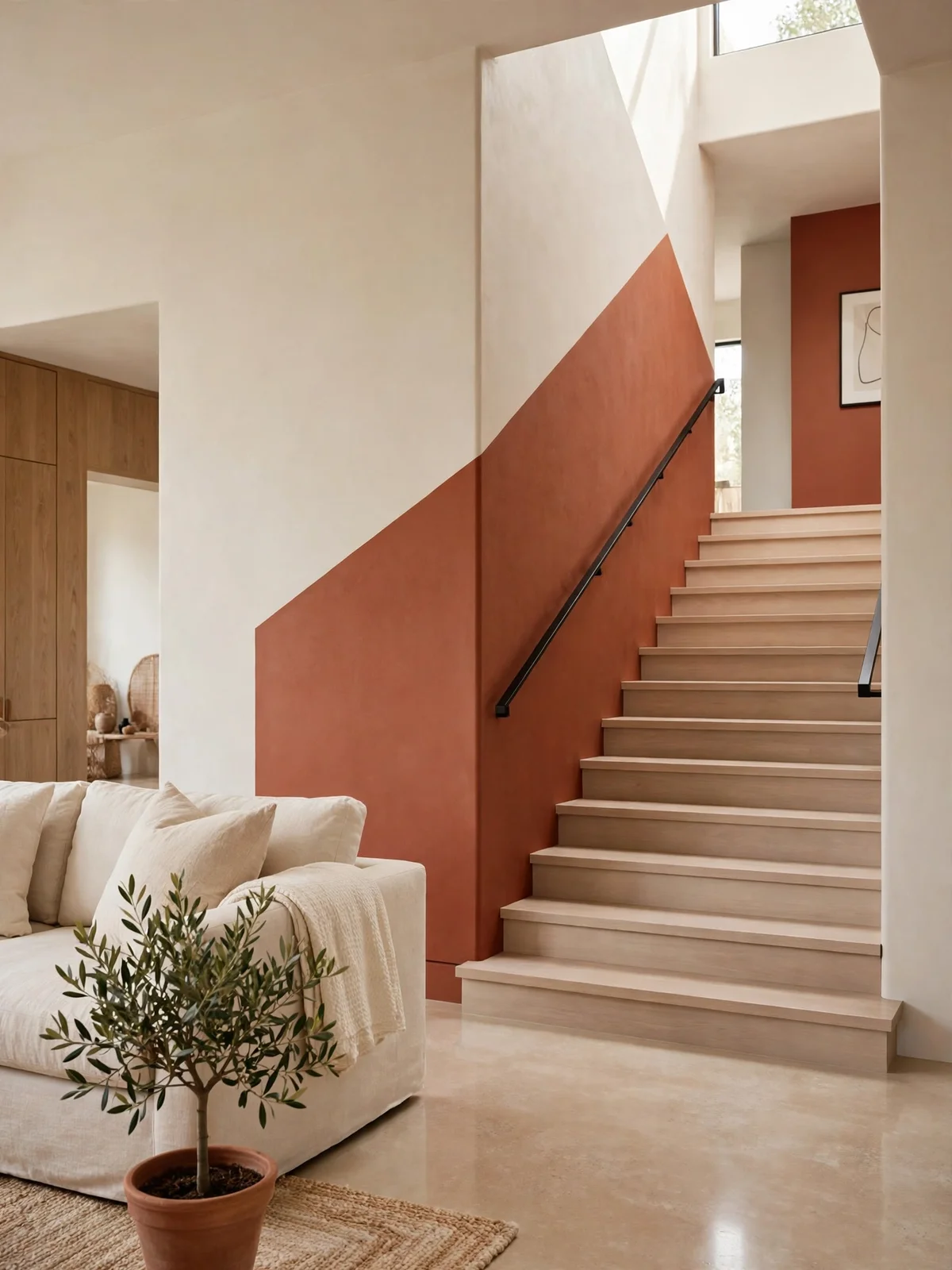
One bold colour block is the most confident modern stair wall move, because a single rectangle of colour does more than a whole wall of decoration. Here, a terracotta block, 2.4 metres wide and running the full 3.6 metre height of the stair wall, sits beside pale ash treads, each 950 mm wide, with a slim black handrail fixed across the colour. A cream sofa and a small olive tree in a clay pot at the base keep the entry calm, while daylight from the landing window makes the terracotta glow warmly against the pale treads.
Quick tips:
- Paint one rectangular block, not the whole wall, for a modern look.
- Choose terracotta, deep sage or charcoal for a confident accent.
- Keep the treads pale so they glow against the bold colour.
- Use a slim black handrail to frame the colour block.
Built-In Display Niches With Soft Lighting
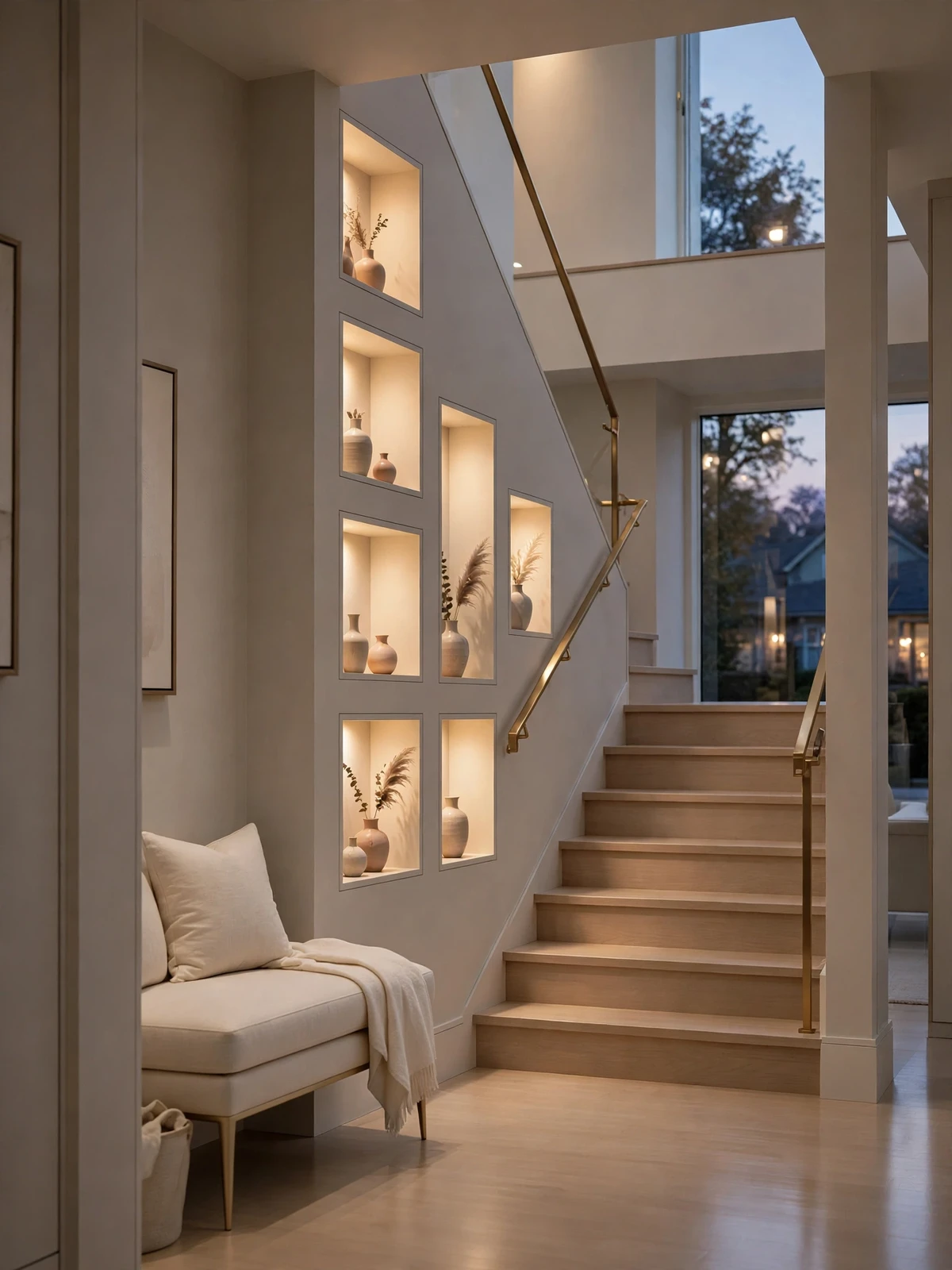
Built-in niches turn a stair wall into a quiet gallery, because the objects sit inside the wall rather than hanging on it. Along this flight, four niches, each 400 mm square and 120 mm deep, are set into the stair wall at staggered heights beside pale oak treads, each 950 mm wide, each lit by a tiny recessed warm white light at the top of the niche. Small ceramic vases in cream and soft grey sit inside, while a cream bench and a slim brass handrail keep the hallway calm and the niches carry all the detail.
Quick tips:
- Stagger the niches at different heights to follow the stair.
- Light each niche from the top with a small warm white spot.
- Keep each niche to one object so the display stays calm.
- Choose ceramic or stone objects in soft, neutral tones.
Subtle Modern Wallpaper in a Linen Texture
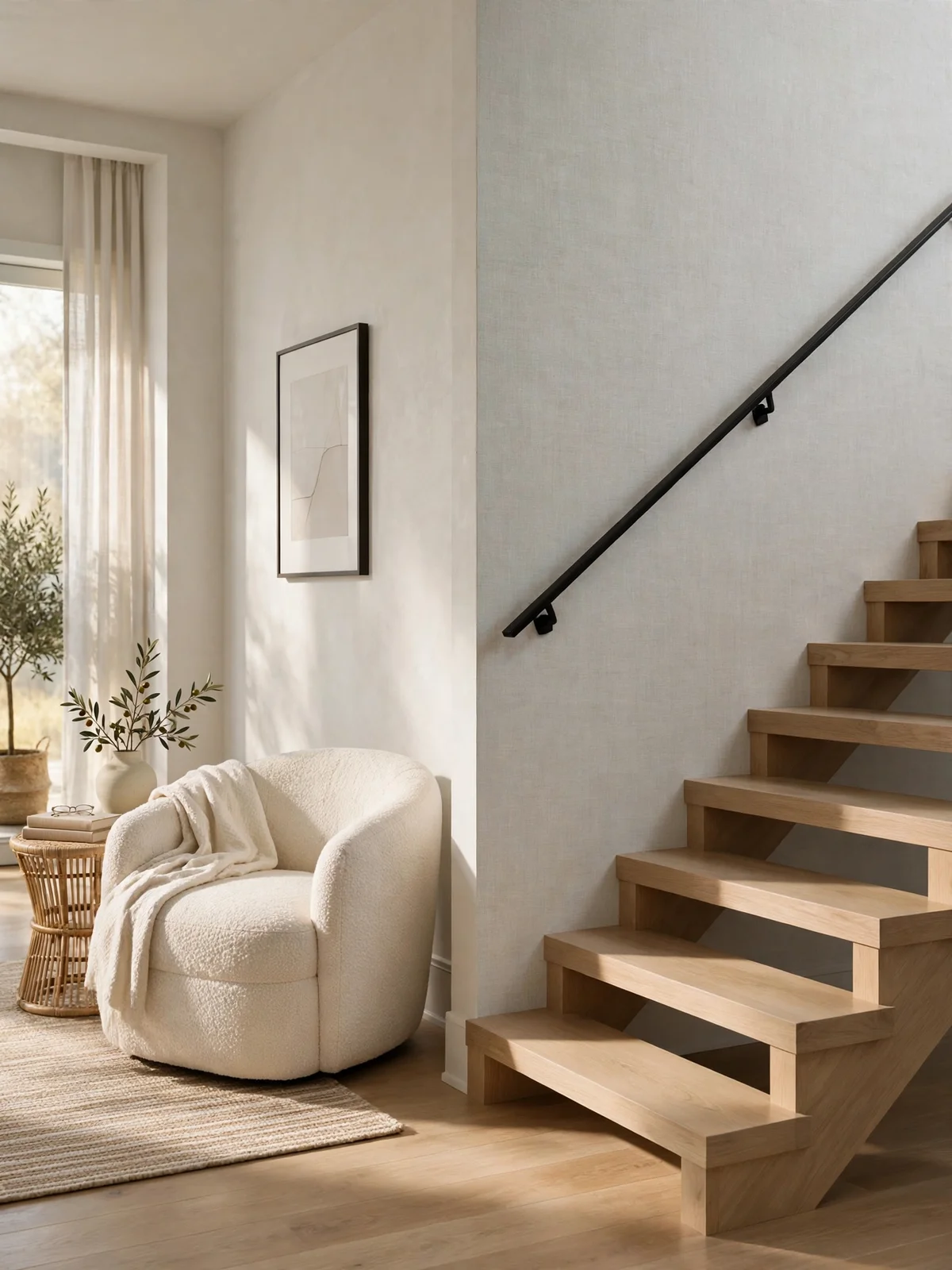
Linen-textured wallpaper is the quietest modern stair wall treatment, because it adds texture you can almost feel while the colour stays almost nothing at all. On this wall, a pale stone-grey wallpaper with a fine woven linen texture covers the full flight beside white oak treads, each 950 mm wide, with a slim matte black handrail fixed to the paper. A cream boucle armchair at the base and soft morning light keep the hallway serene, while the wallpaper’s subtle weave catches the light differently at every step.
Quick tips:
- Choose a fine linen texture in a pale, neutral tone.
- Cover the whole stair wall so the texture reads as one surface.
- Keep the handrail slim and matte black for a crisp modern edge.
- Use a washable wallpaper so the stair wall stays easy to clean.
Indoor Greenery Displays in Wall Planters
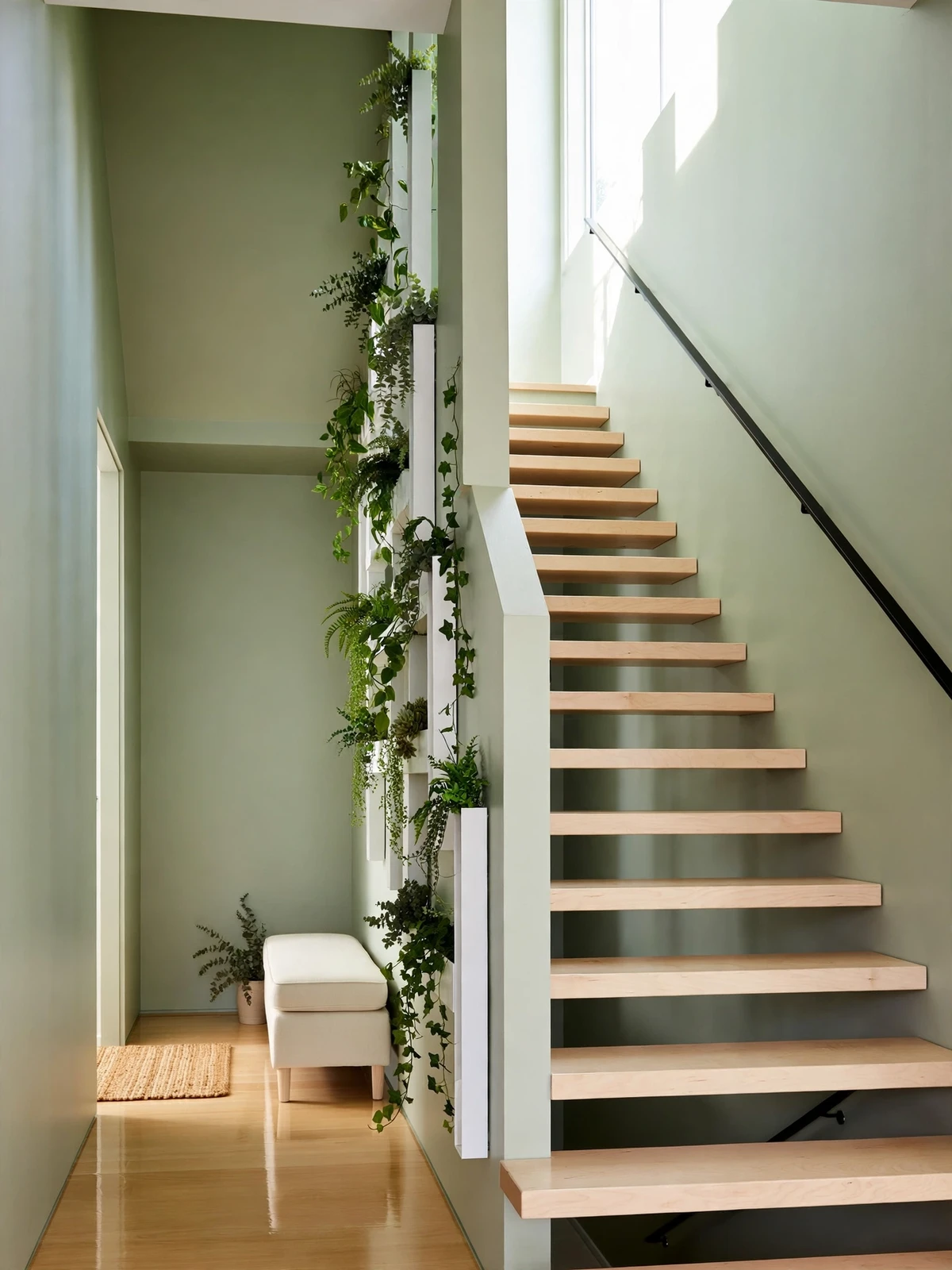
Wall planters bring a modern stair wall to life, because the green is alive and it changes with the seasons. Along this flight, six slim white planters, each 300 mm wide, step upward following the angle of the stair beside pale birch treads, each 900 mm wide, holding trailing pothos and small ferns that spill gently over the edges. Soft sage-green walls and a cream bench below keep the hallway fresh, while bright daylight from the landing window makes the leaves glow against the white planters.
Quick tips:
- Step the planters upward to follow the angle of the stair.
- Choose trailing plants — pothos or ferns — so the green softens the wall.
- Use identical white planters for a clean, modern rhythm.
- Pick low-light plants if the stair gets little sun.
Frosted Glass Panels for a Light, Modern Wall
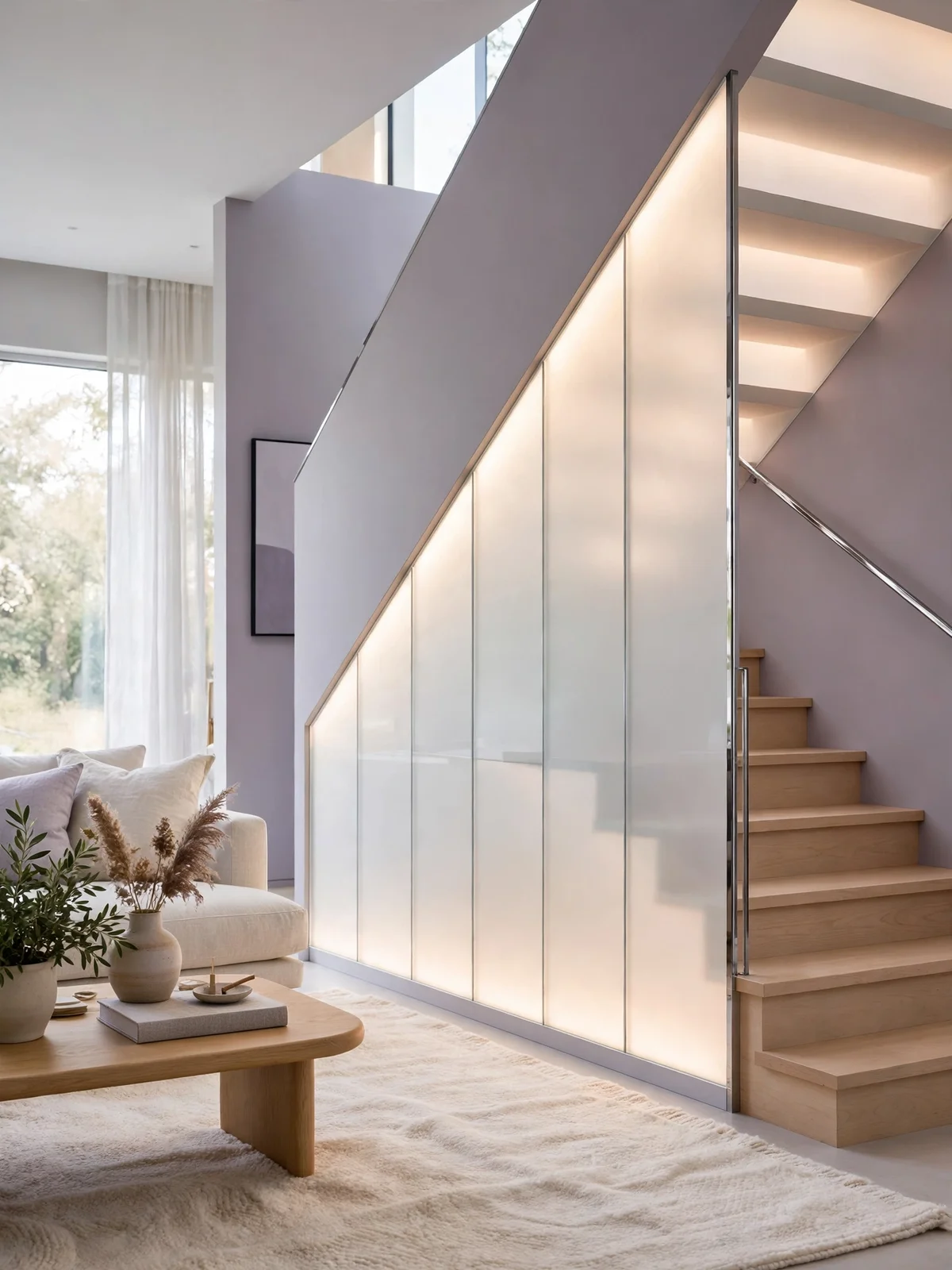
Frosted glass panels make a stair wall feel light and luminous, because they let the light through while keeping the shape of the wall. Here, three frosted glass panels, each 700 mm wide and running floor to ceiling, are set into the stair wall beside pale maple treads, each 950 mm wide, glowing softly as daylight passes through them from the room beyond. Soft lavender-grey walls and a cream rug below keep the palette gentle, while a slim chrome handrail adds one cool, polished line.
Quick tips:
- Use frosted glass so the panels glow without showing the room beyond.
- Run the panels floor to ceiling for a clean architectural look.
- Keep the handrail slim and chrome for a cool modern finish.
- Match the wall colour to a soft, pale tone so the glass glows.
One Handcrafted Ceramic Tile Panel
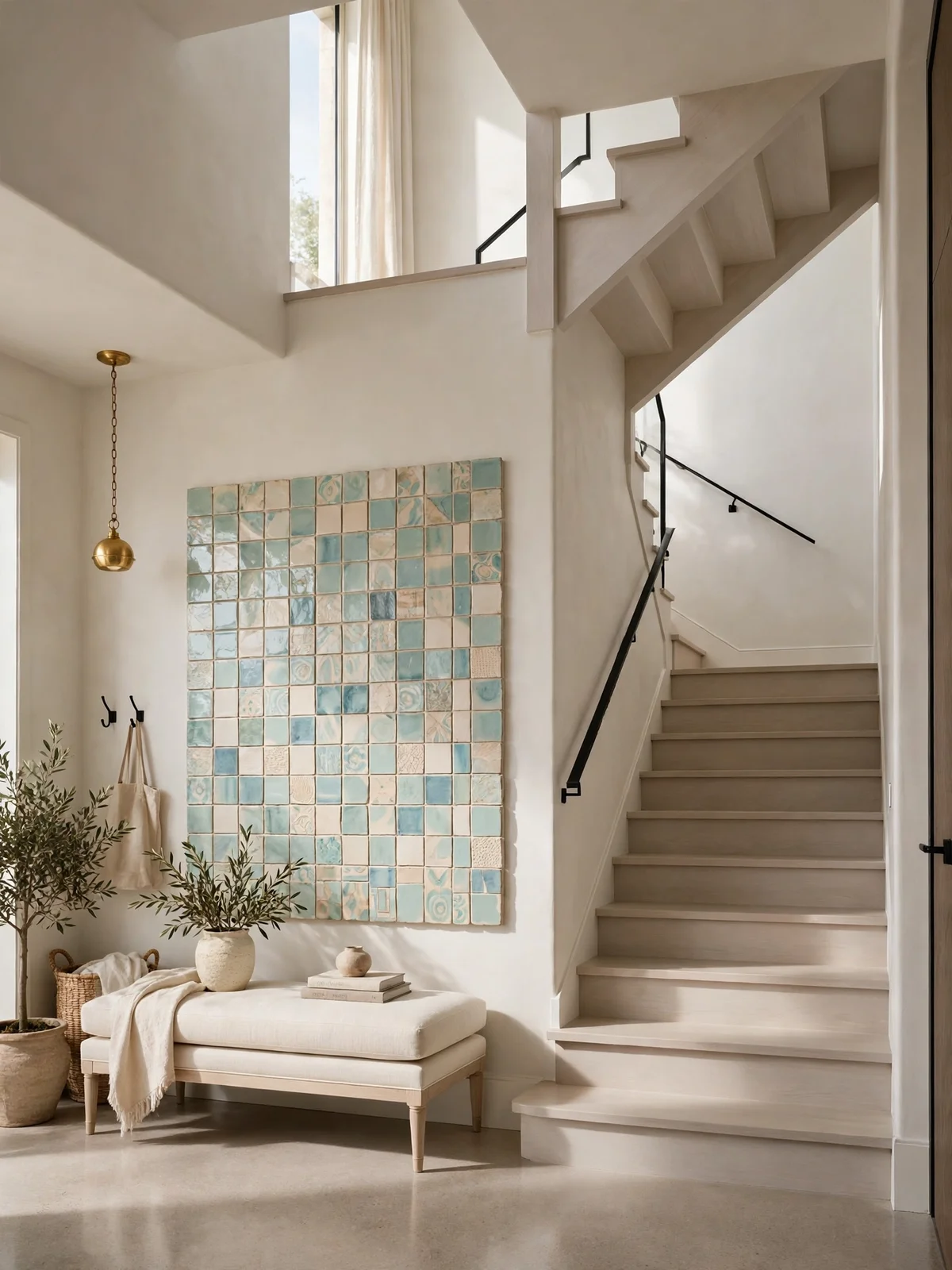
One handcrafted tile panel is the most artisanal modern stair wall treatment, because a single handmade piece says more than a wall full of decoration. On this wall, a ceramic tile panel, 900 mm wide and 1.2 metres tall, in soft aqua and cream with a gentle hand-painted ripple pattern, sits at eye level on the landing wall beside pale ash treads, each 950 mm wide. A slim black handrail, a cream bench below and a small brass pendant above keep the entry calm, so the tile panel carries all the craft.
Quick tips:
- Choose one panel, about 900 mm by 1.2 metres, as the single feature.
- Pick soft aqua, cream or sage tones for a modern, calm look.
- Hang the panel at eye level on the landing where it can be seen.
- Keep the handrail and bench simple so the tiles stay the focus.
Shadow Box Frames for Small Objects
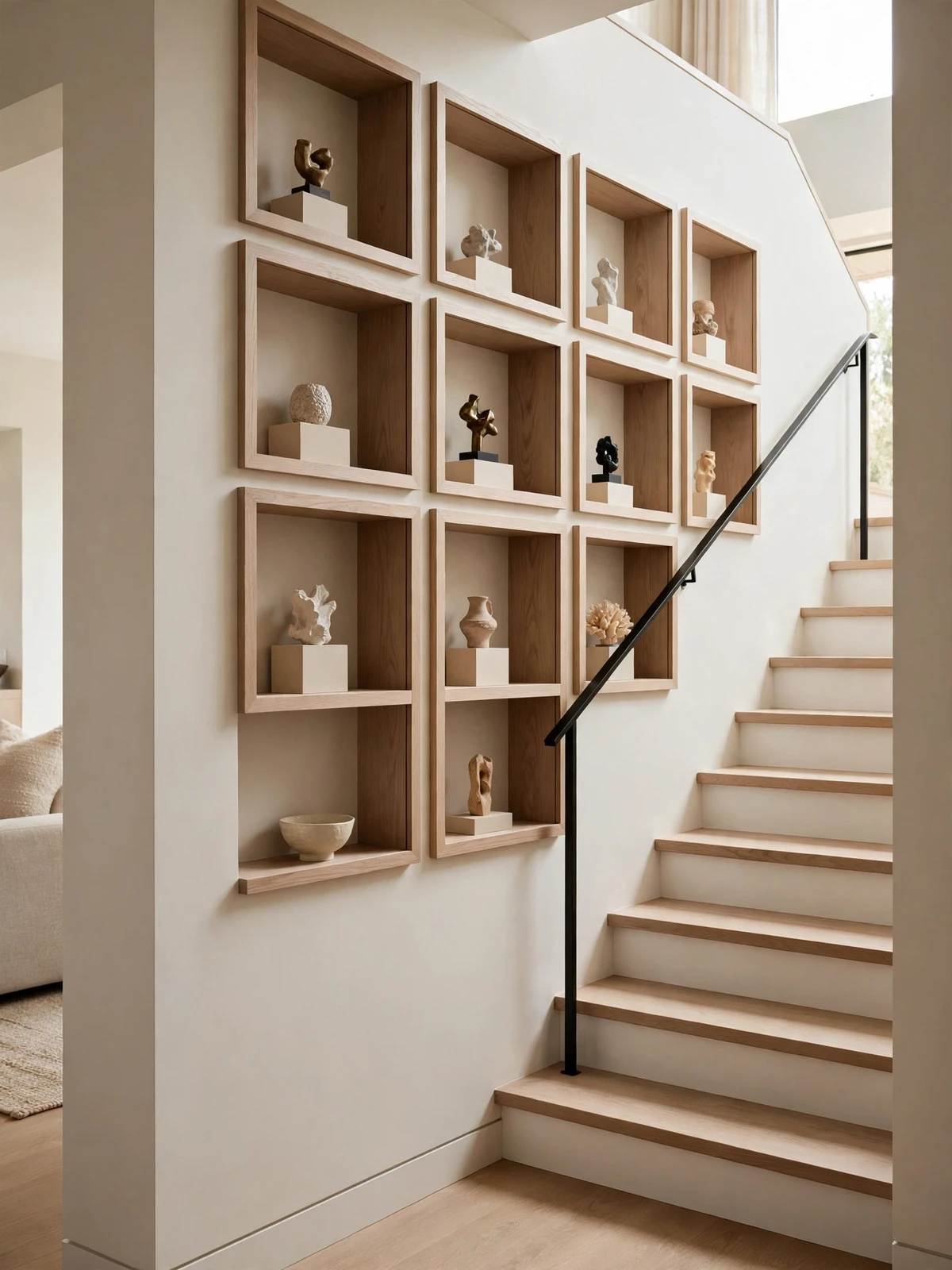
Shadow box frames turn small objects into a modern gallery, because the depth of the frame gives each piece its own little room. Along this stair, five deep shadow boxes in pale oak, each 350 mm square and 80 mm deep, climb the warm-white wall beside white oak treads, each 950 mm wide, holding a small ceramic bowl, a smooth stone, a dried seed head, a tiny brass sculpture and a single shell. A slim black handrail keeps the stair quiet, while the objects inside the boxes add texture, story and a sense of collection.
Quick tips:
- Use identical pale oak frames so the boxes read as one series.
- Keep one small object per box — never crowd them.
- Space the boxes evenly, following the angle of the stair.
- Choose natural objects — stone, ceramic, dried botanicals — for a calm look.
Continuous Trim Lines Running Parallel to the Stair
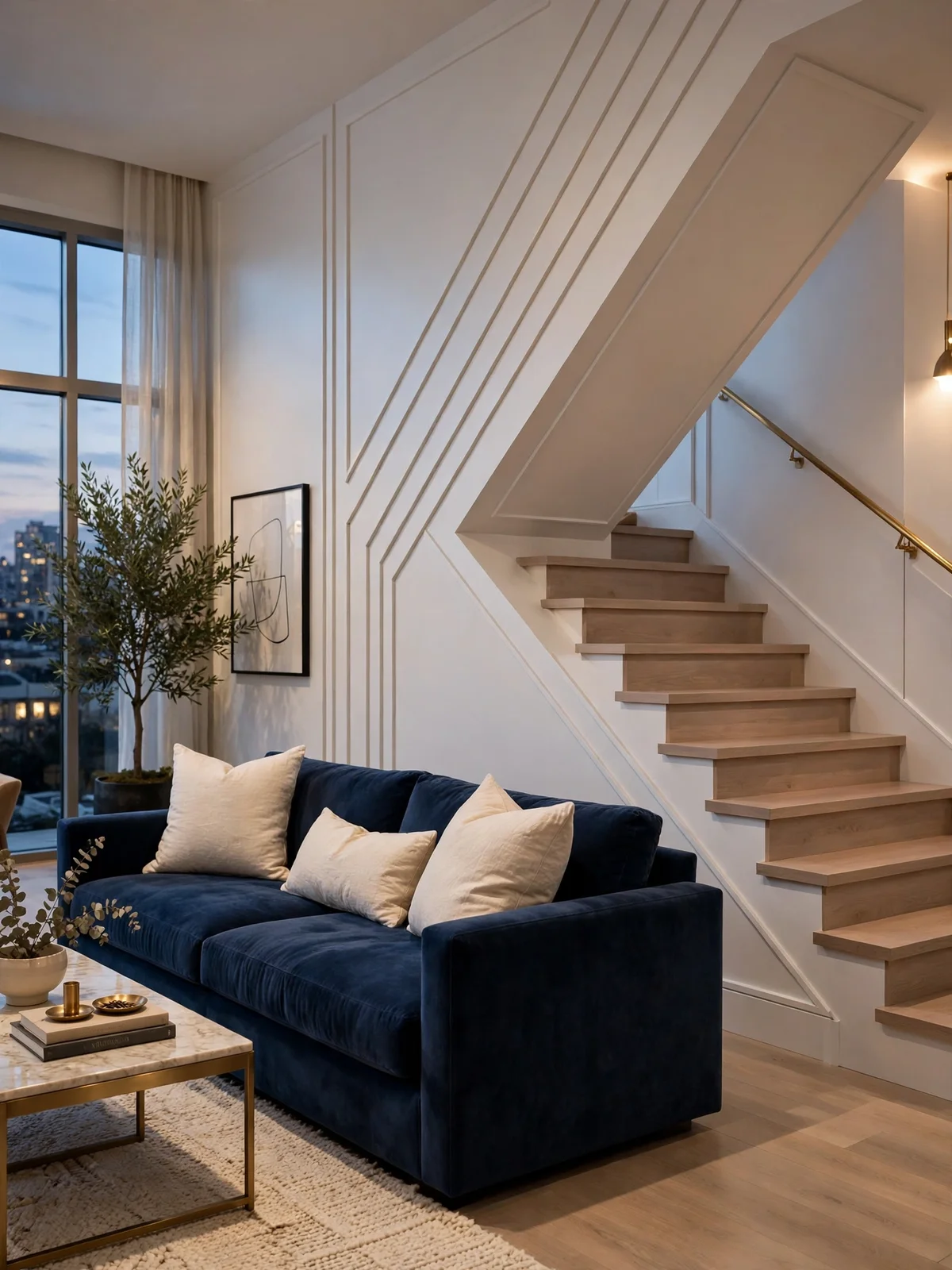
Continuous trim lines are the most architectural modern stair wall treatment, because a few slim lines make a plain wall look custom and expensive. Here, three slim white trim lines, each 30 mm wide, run parallel to the slope of the stair across a soft warm-grey wall beside pale walnut treads, each 950 mm wide, spaced 250 mm apart and running the full 4 metre length of the flight. A deep navy-blue sofa and cream cushions below pick up the wall’s cool tone, while a slim brass handrail follows the same slope and soft evening light makes the trim’s shadows glow gently.
Quick tips:
- Run three trim lines, spaced about 250 mm apart, parallel to the stair.
- Paint the trim the same colour as the wall for a subtle shadow effect.
- Keep the lines slim — about 30 mm wide — for a modern look.
- Match the handrail to a warm brass to lift the wall colour.
A Stone Veneer Wall in Soft Taupe
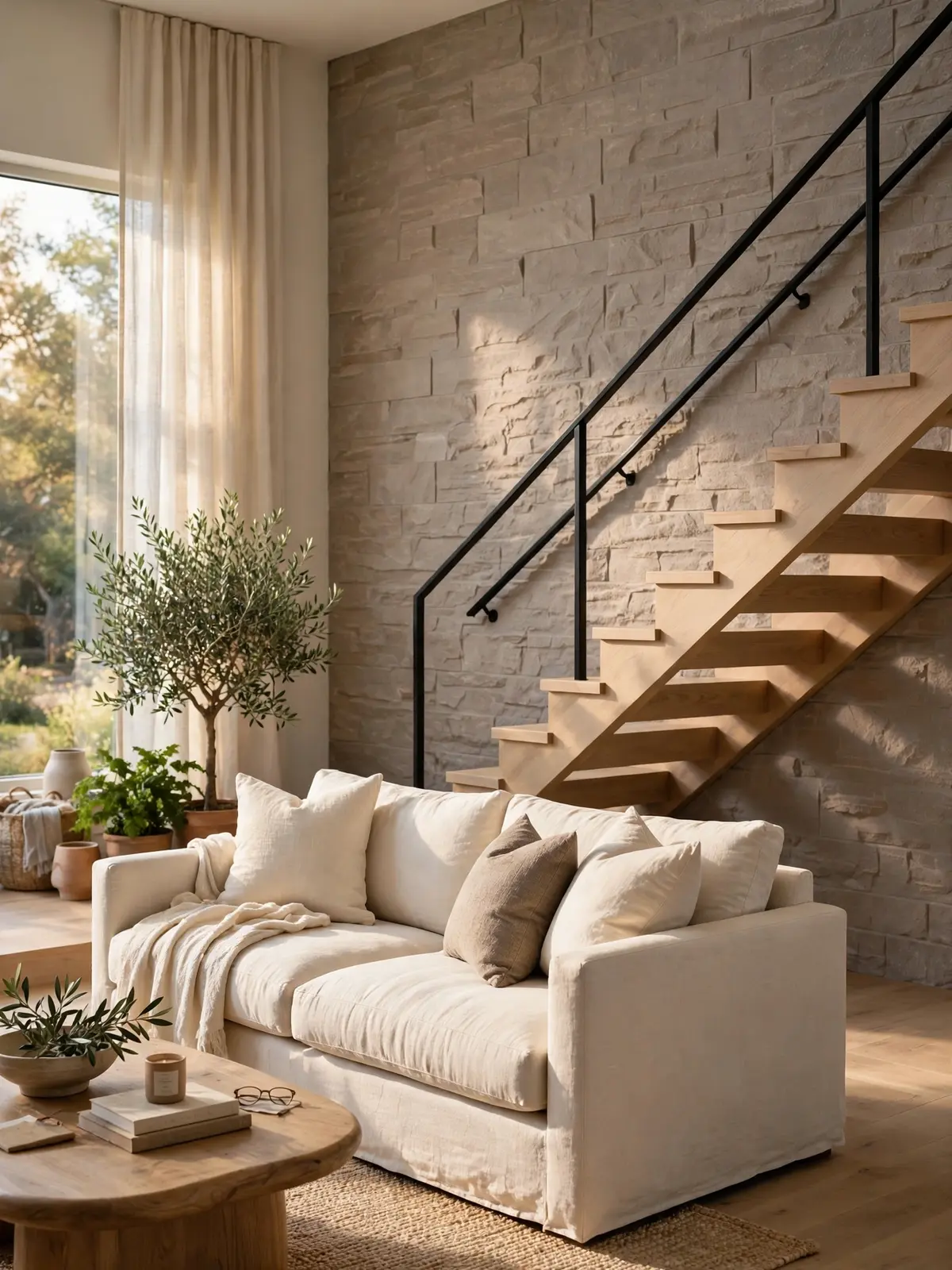
A stone veneer wall brings a modern stair wall down to earth, because the stone’s natural texture and warm tone balance all the clean lines around it. On this wall, thin-cut stone veneer in soft taupe, laid in long horizontal courses, covers the full flight beside pale oak treads, each 950 mm wide, with a slim black steel handrail fixed directly to the stone. A cream linen sofa and a small olive tree at the base keep the room warm, while gentle afternoon light picks out the stone’s subtle variation and makes the wall feel solid and calm.
Quick tips:
- Choose thin-cut stone veneer in soft taupe or warm grey.
- Lay the stone in long horizontal courses for a modern feel.
- Keep the handrail slim and black so it reads cleanly against the stone.
- Seal the stone so the stair wall stays easy to dust and clean.
Layered Lighting and Art Combined
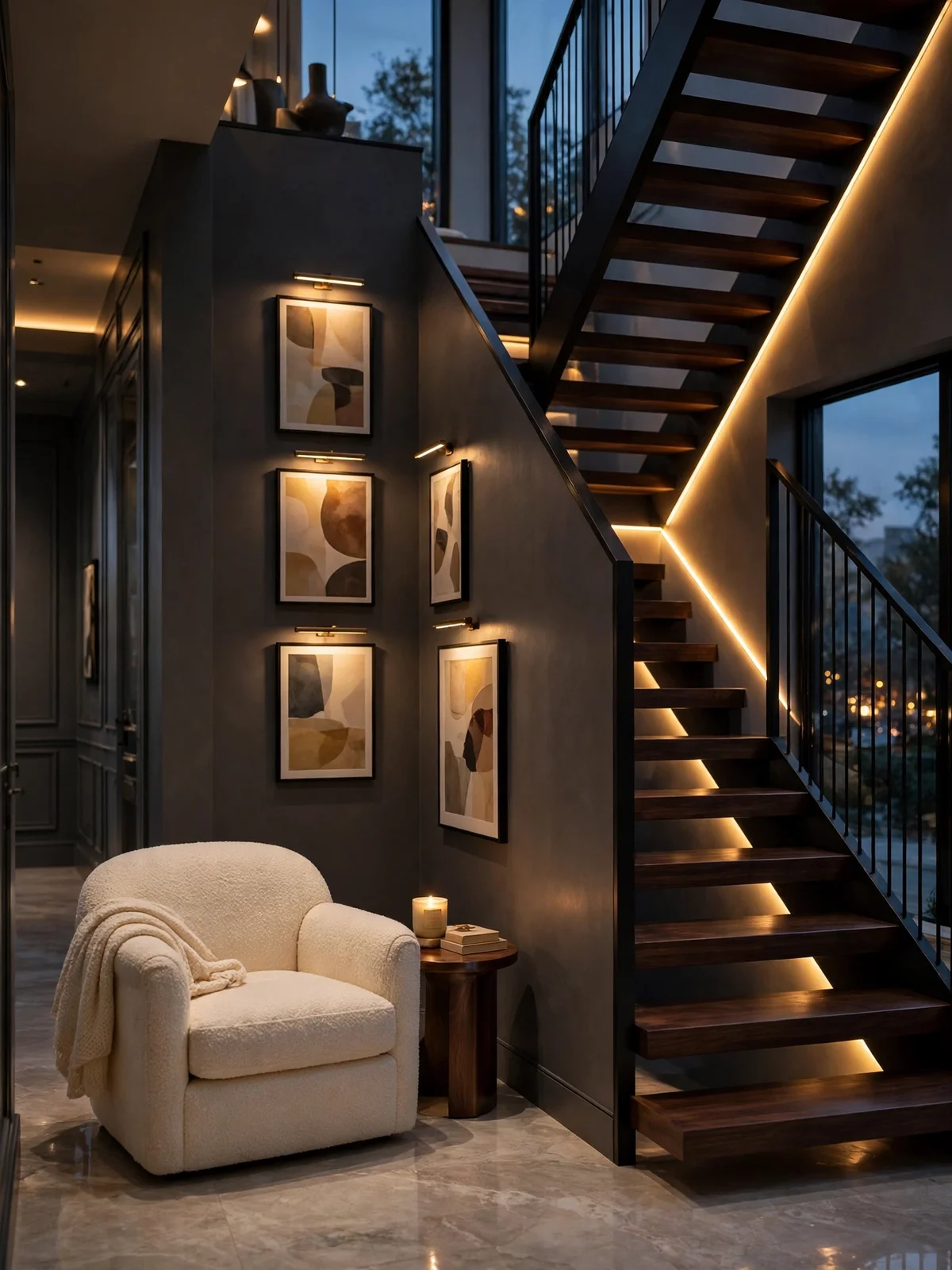
Layering lighting and art together is the most polished modern stair wall treatment, because the light is designed for the art and the art is chosen for the light. On this wall, three abstract prints in soft ochre, cream and charcoal, each 500 mm by 700 mm, hang in slim black frames beside dark walnut treads, each 950 mm wide, with a slim brass picture light above each print washing warm 2700K light down the canvas. Soft charcoal walls and a cream armchair below keep the room calm, while the layered light makes the stair feel like a small private gallery after dark.
Quick tips:
- Hang one slim picture light above each framed print.
- Choose warm white bulbs — about 2700K — for a gallery glow.
- Keep the prints to one colour family so the wall reads as a series.
- Match the picture lights to the handrail metal for a unified look.
A Colour-Coordinated Art Series
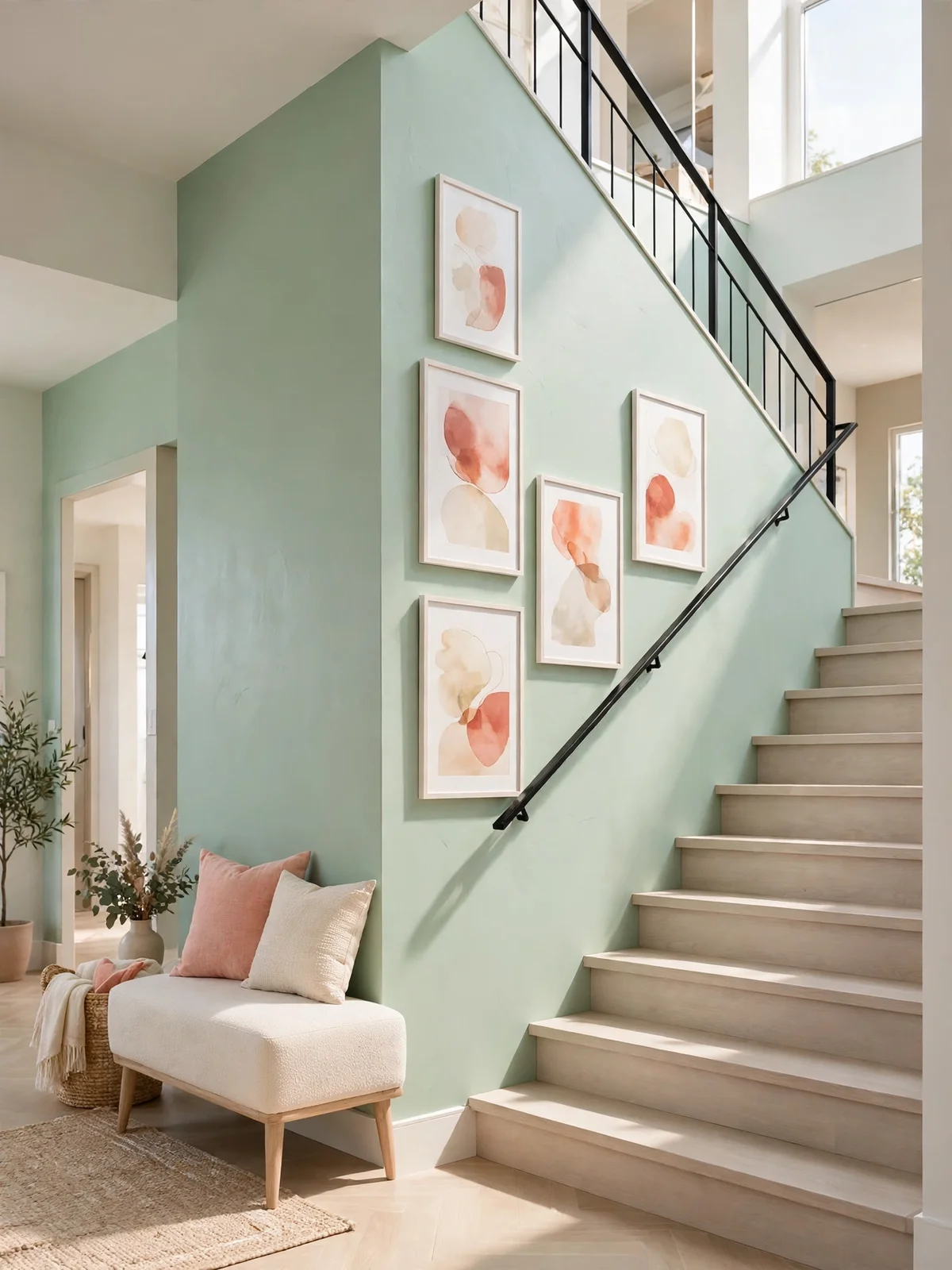
A colour-coordinated art series is the most joyful modern stair wall treatment, and it works because the colour is the plan — every print shares the same two or three tones, so even very different images feel like one designed set, and the wall reads as intentional from the bottom of the flight to the top. On this wall, six abstract prints in soft coral and cream, each 400 mm by 500 mm and framed in identical slim white frames, climb the soft mint-green wall beside pale ash treads, each 950 mm wide, spaced 150 mm apart and following the slope of the stair. A cream bench at the base picks up the cream in the prints, while a slim black handrail draws one clean line beneath them, and bright daylight from the landing window makes the coral glow gently against the mint green. The trick is the discipline: the coral appears in every print, the cream appears in every print, and nothing else is allowed in — no fourth colour, no competing frame, no extra object on the wall — so the series feels calm even though it is colourful. If you already own prints you love in different colours, the cheapest way to coordinate them is to reframe them all in the same slim white frame and hang them in a row; the matching frames alone will pull the series together, and the shared wall colour behind them will do the rest. A colour-coordinated series also ages well, because when one print starts to feel tired you can swap it for another in the same coral and cream palette without rethinking the whole wall, and the stair keeps its modern, pulled-together look year after year.
Quick tips:
- Limit the series to two or three shared colours across every print.
- Use identical slim frames so the series reads as one designed set.
- Space the prints evenly, about 150 mm apart, following the stair.
- Match one print colour to the bench or a cushion nearby.
Backlit Architectural Cut-Out Panels
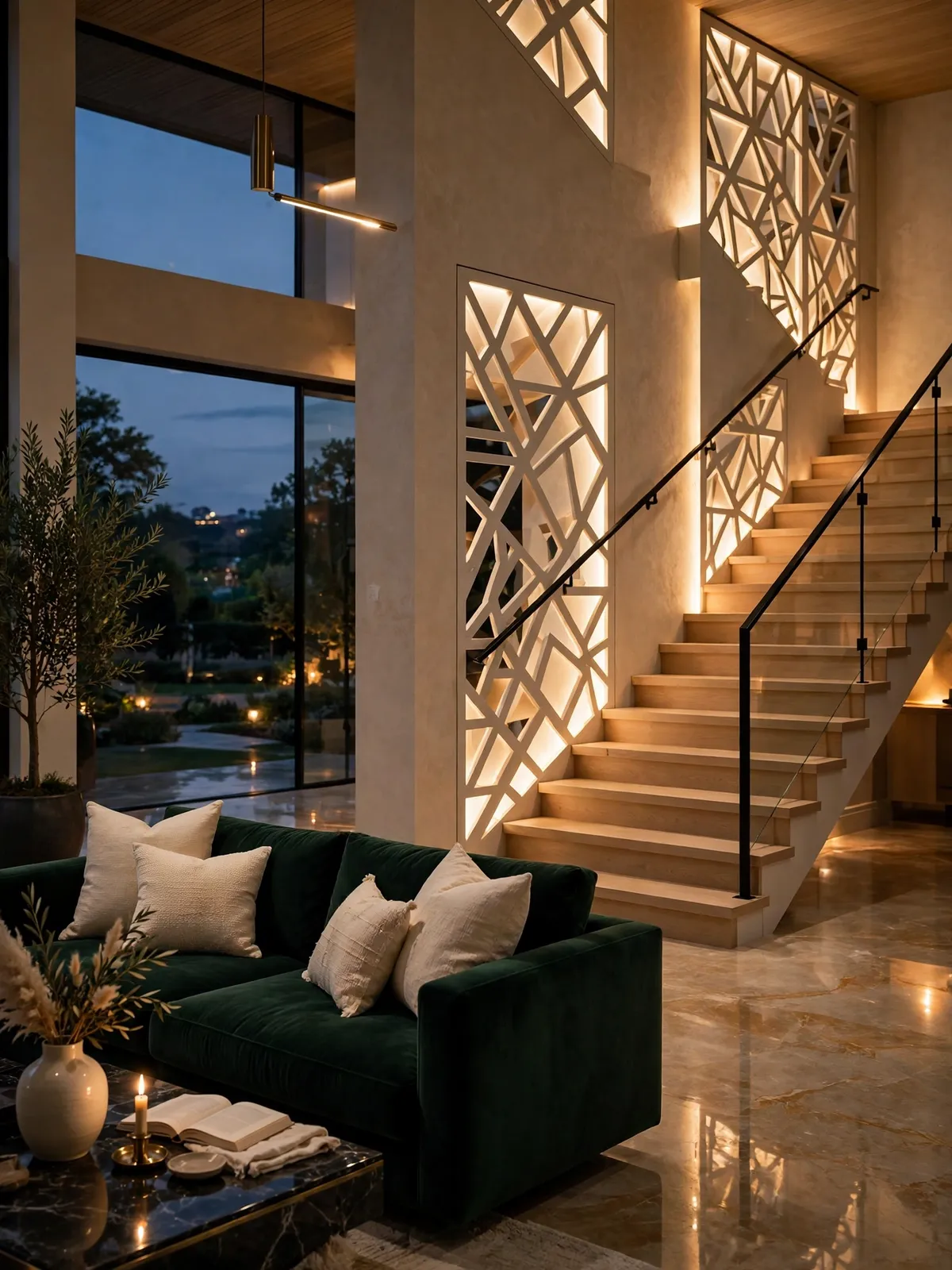
Backlit cut-out panels are the most dramatic modern stair wall treatment, because the wall itself becomes the light. Here, three warm white panels, each 800 mm wide and 1.8 metres tall, are set into the stair wall beside pale oak treads, each 950 mm wide, each cut with a slim geometric pattern and lit from behind with warm white LEDs so the pattern glows softly at dusk. A deep emerald-green sofa and cream cushions below pick up the panels’ warm glow, while a slim black handrail draws one dark line across the light.
Quick tips:
- Choose a simple geometric cut-out pattern for a modern look.
- Light the panels from behind with warm white LEDs.
- Keep the panels warm white so the glow stays soft.
- Use a slim black handrail for contrast against the glowing panels.
An Intentionally Minimal Wall: One Texture, One Light
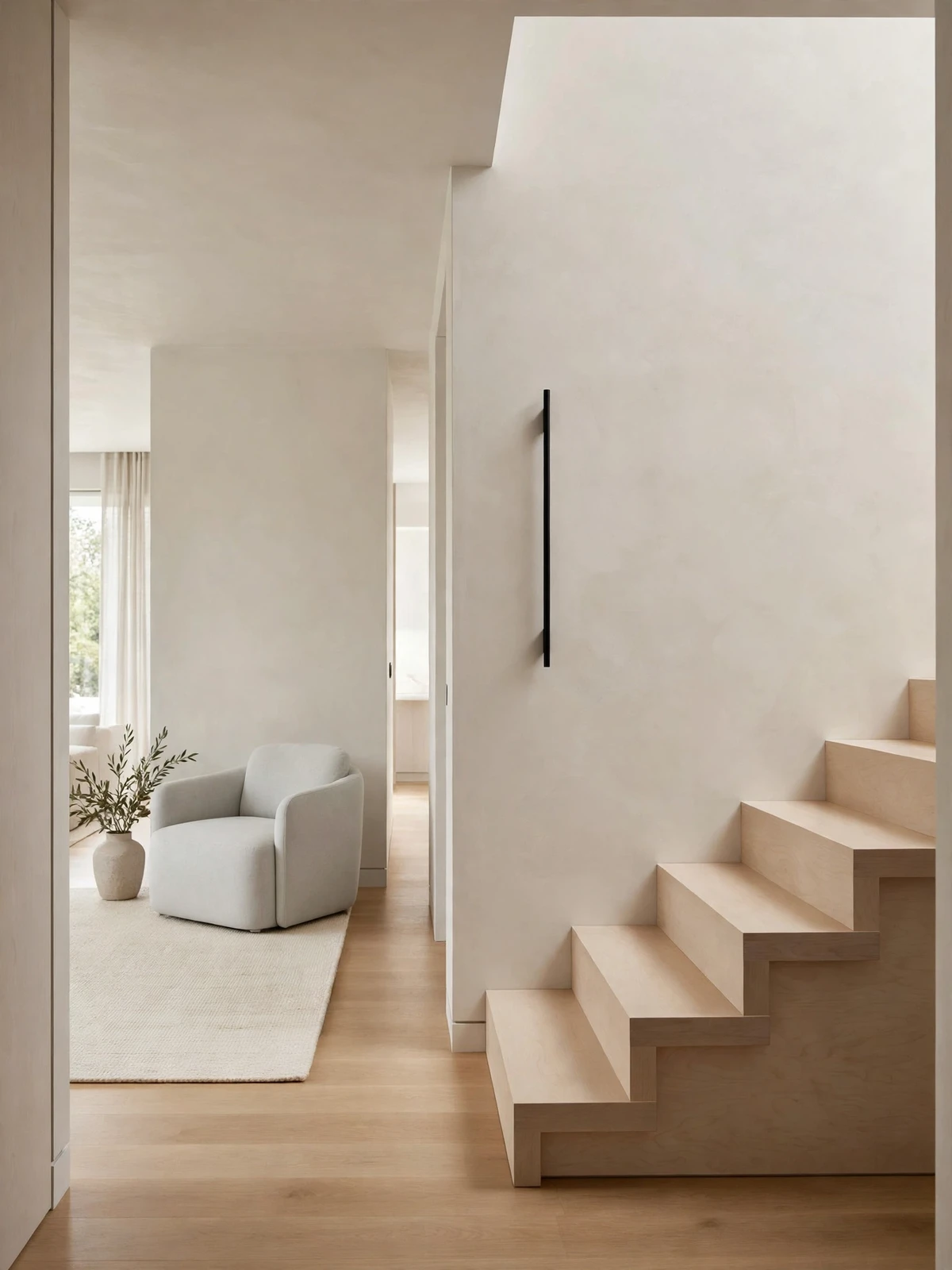
An intentionally minimal wall is the bravest modern stair wall choice, because it trusts one texture and one light to do everything. On this wall, a single smooth warm-white plaster finish covers the full flight beside pale birch treads, each 900 mm wide, with one slim black wall light, 600 mm long, mounted at the midpoint of the flight and nothing else on the wall at all. A soft pale-grey armchair and a cream rug below keep the hallway calm, while gentle daylight from the landing window moves across the plaster through the day, so the wall is never quite the same twice.
Quick tips:
- Choose one beautiful texture — smooth plaster or limewash — and stop there.
- Hang one slim wall light at the midpoint of the flight.
- Keep the treads pale so the stair feels light and calm.
- Resist adding art or objects — the empty wall is the design.
A Matte Black Feature Wall With Slim Brass Details
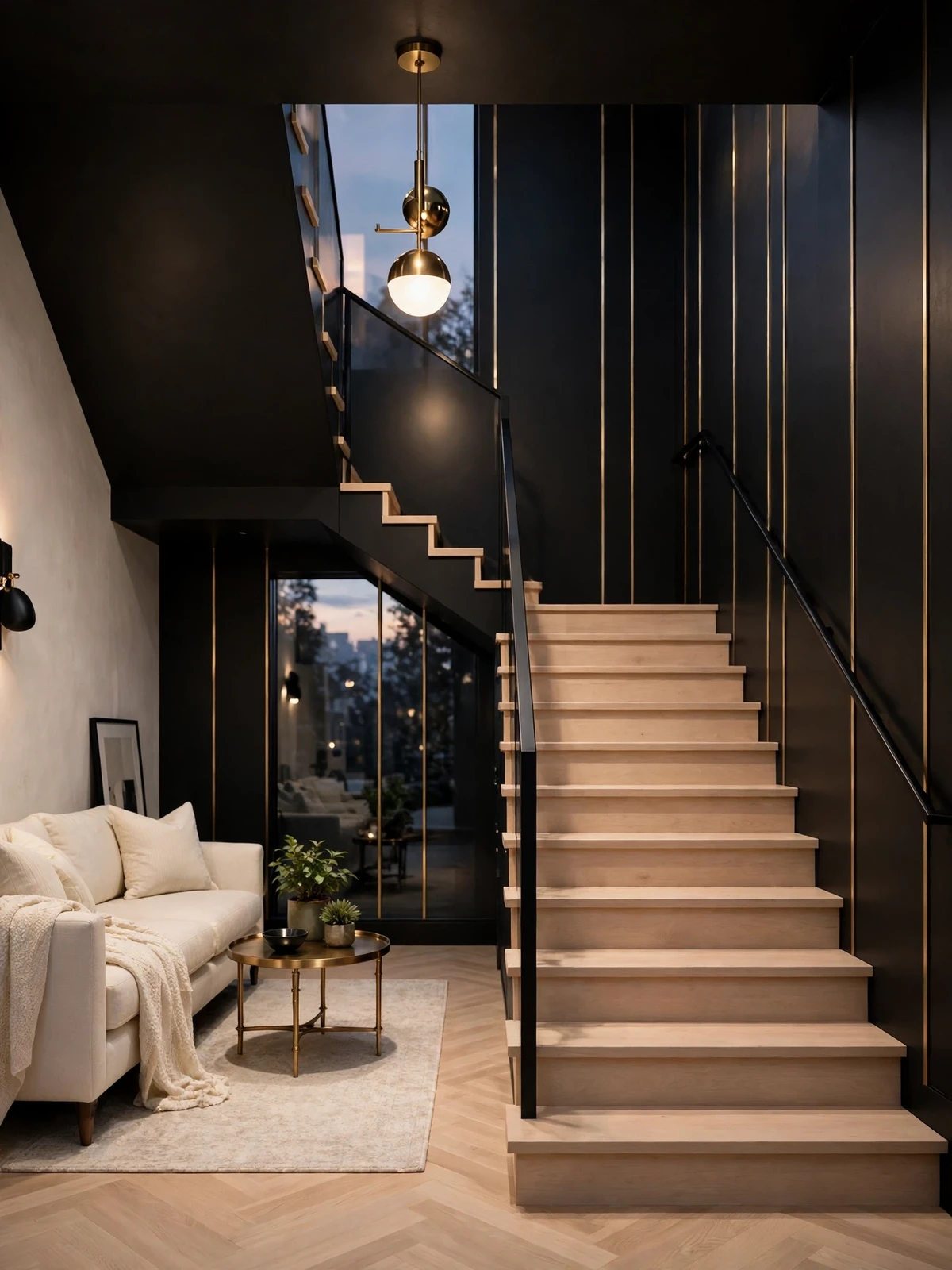
A matte black feature wall with slim brass details is the most glamorous modern stair wall treatment, because the dark wall makes everything in front of it glow. Here, a matte black wall rises the full height of the flight beside pale maple treads, each 950 mm wide, with a slim brass handrail, two thin brass picture lights and a narrow brass trim line running along the base of the wall. A soft ivory sofa and a small green plant at the base keep the entry warm, while soft evening light makes the brass shine gently against the black.
Quick tips:
- Use a true matte black paint so the wall absorbs light softly.
- Add slim brass details — handrail, picture lights, one trim line — for warmth.
- Keep the treads pale maple so they glow against the black wall.
- Use a soft ivory sofa or bench below to balance the dark wall.
Modern Staircase Wall Design Ideas in Warm White and Pale Timber
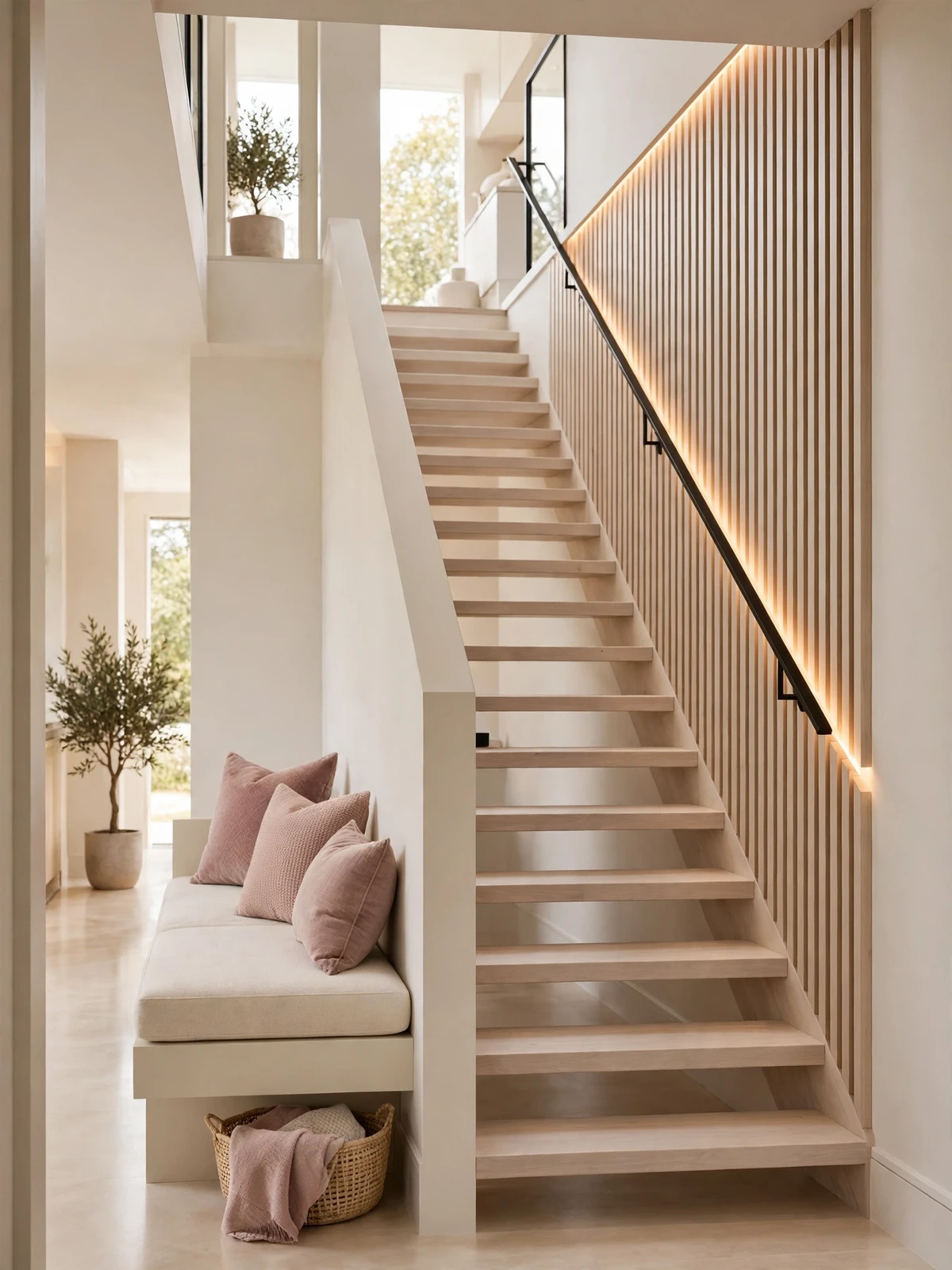
Warm white and pale timber together are the most timeless of all modern staircase wall design ideas, because the combination is calm, bright and warm at once — and it is the easiest modern look to live with every day. On this wall, a warm white plaster finish covers the full flight, with a single slatted pale timber panel, 1.2 metres wide, running floor to ceiling at the midpoint of the stair beside pale ash treads, each 950 mm wide, and a slim LED strip glowing softly behind the panel’s top edge. Soft dusty-rose cushions on a cream bench at the base add one gentle accent, while a slim black handrail draws a clean line across the white wall and warm daylight from the landing window makes the timber glow.
Quick tips:
- Pair warm white walls with one pale timber panel for a timeless look.
- Add a slim LED strip behind the panel for a soft modern glow.
- Keep the accent colour gentle — dusty rose, soft sage or pale blush.
- Use a slim black handrail to give the pale palette one crisp edge.
FAQs
What is the cheapest modern staircase wall design?
Paint is the cheapest modern stair wall design. One bold colour block, a soft gradient in two tones of the same colour, or a matte black feature wall costs little more than a tin of paint and a weekend of work. A row of identical frames with monochrome prints or a single length of LED strip behind a floating shelf are the next cheapest steps, and each one changes the wall for very little money.
How do I light a modern staircase wall without visible fixtures?
Hide the light source. Recess LED strips into a channel along the handrail, behind a slat panel, under a floating shelf or behind a cut-out panel, so the wall glows and the fixture disappears. Slim recessed picture lights above framed art are the only visible fixtures a modern stair wall needs, and a dimmer or motion sensor keeps the light gentle after dark.
Can a modern staircase wall work in a small or narrow hallway?
Yes — a modern stair wall often works best in a small hallway, because clean lines, pale colours and reflective surfaces make a narrow stair feel bigger. Floor-to-ceiling mirrors, a pale limewash or warm white wall, vertical slats that draw the eye upward, and a single slim LED strip all add height and light without taking up any floor space.
What materials look most modern on a staircase wall?
Slatted light oak, limewash plaster, smooth concrete, frosted glass, matte black steel and thin-cut stone veneer are the most modern stair wall materials, because they are honest, simple and tactile. Mix at most two materials on one wall — timber with concrete, or plaster with brass — so the wall reads as designed rather than busy.
How do I choose art for a modern staircase wall?
Choose art by colour first and subject second. Pick two or three tones that already appear in your home, then choose prints in those tones only, framed in identical slim frames and spaced evenly following the slope of the stair. Monochrome photography, abstract prints and a colour-coordinated series all work; the uniform frames and the limited palette are what make the wall look modern.
Conclusion
A modern staircase wall is not about filling the wall — it is about choosing one strong idea and letting it breathe. Whether you clad the wall in vertical oak slats, wash it with LED light, paint one bold terracotta block, set niches into the plaster, hang a row of monochrome photographs, or simply leave a warm white wall with one texture and one light, the best modern staircase wall design is the one that suits the rooms around it. Start with the material or the light, keep the palette calm, keep the lines clean, and your stair wall will make every room it touches feel brighter, calmer and more considered.