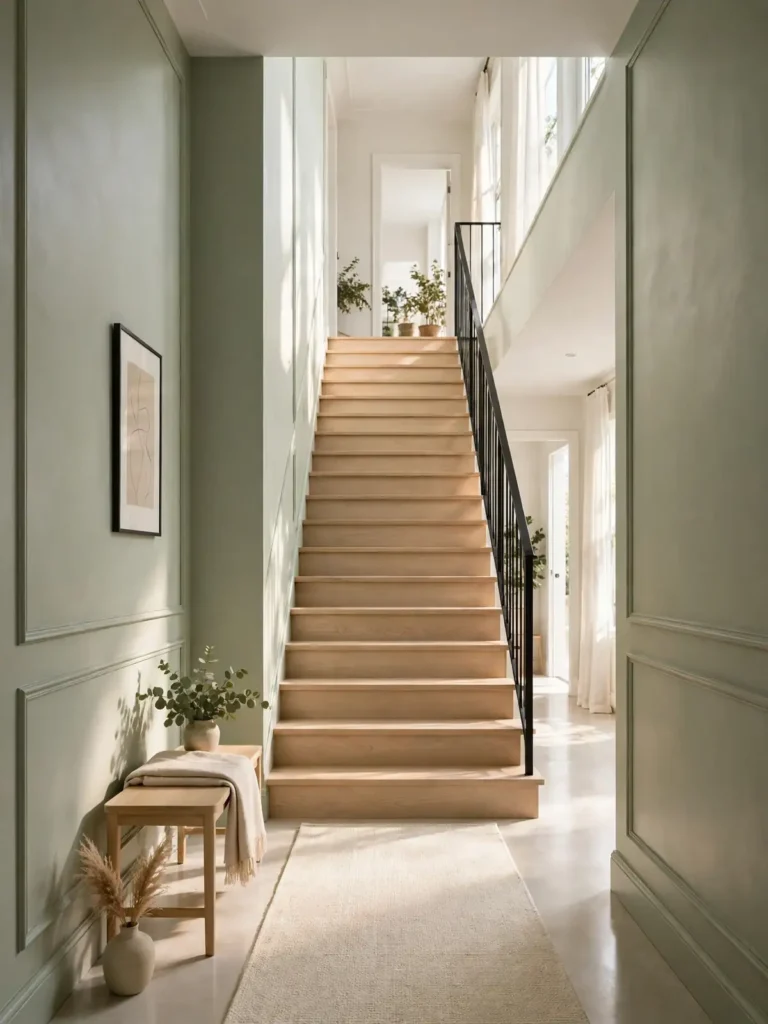
20 Stunning Wooden Staircase Railing Ideas That Turn Your Stairs Into a Showpiece
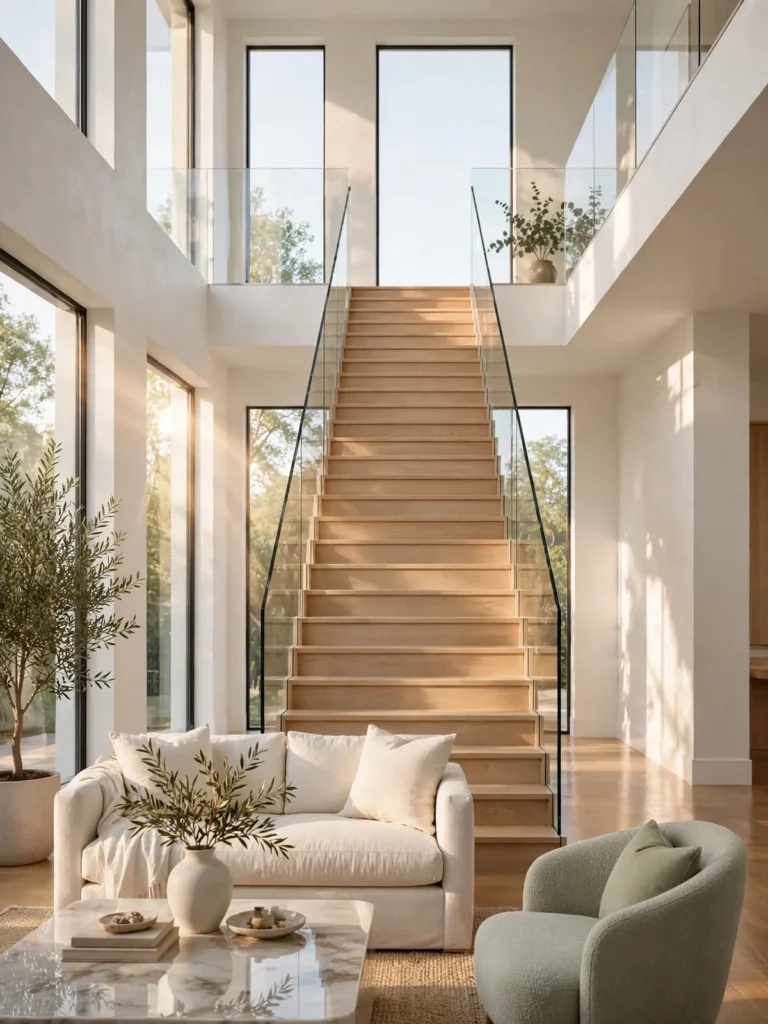
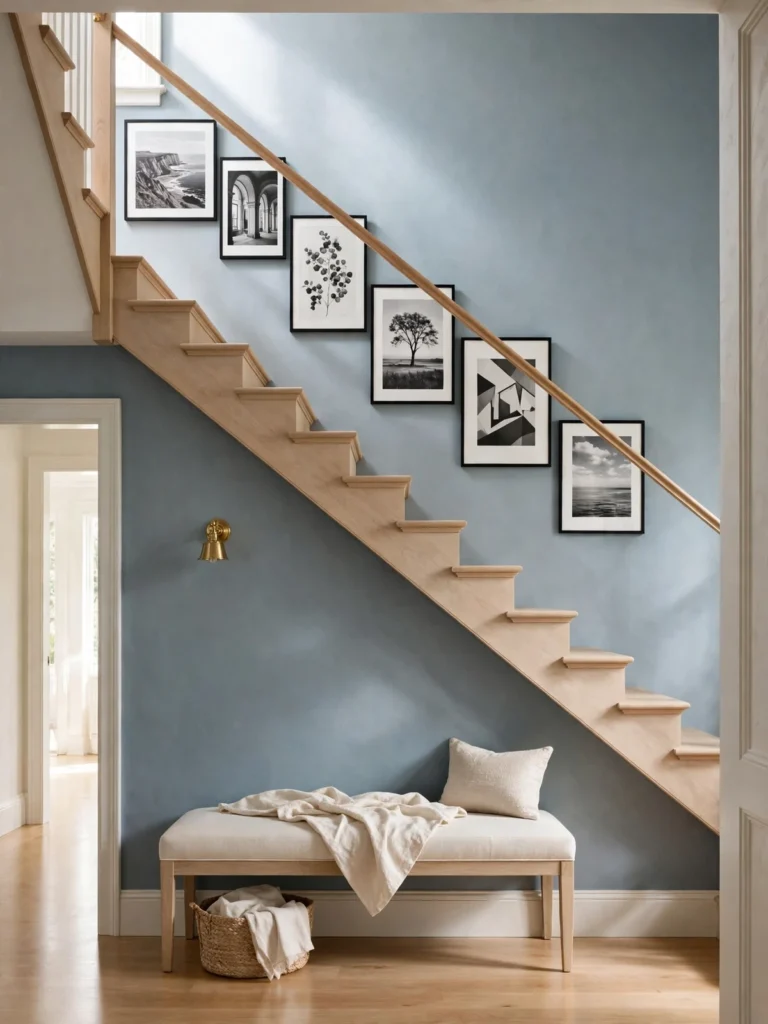
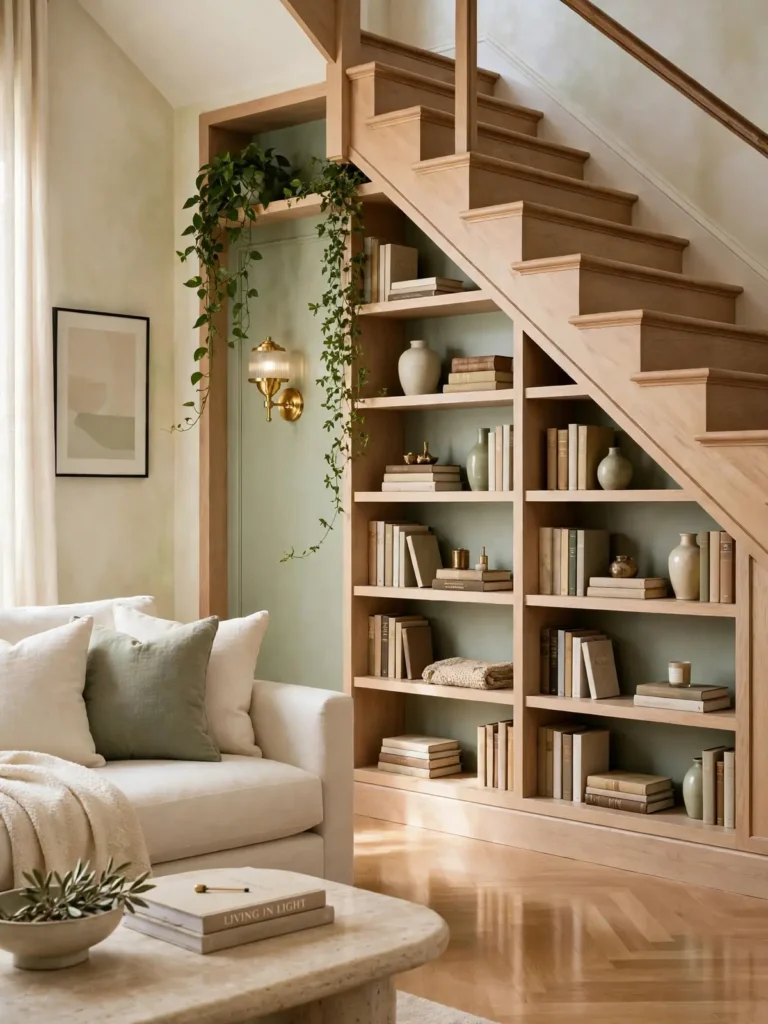
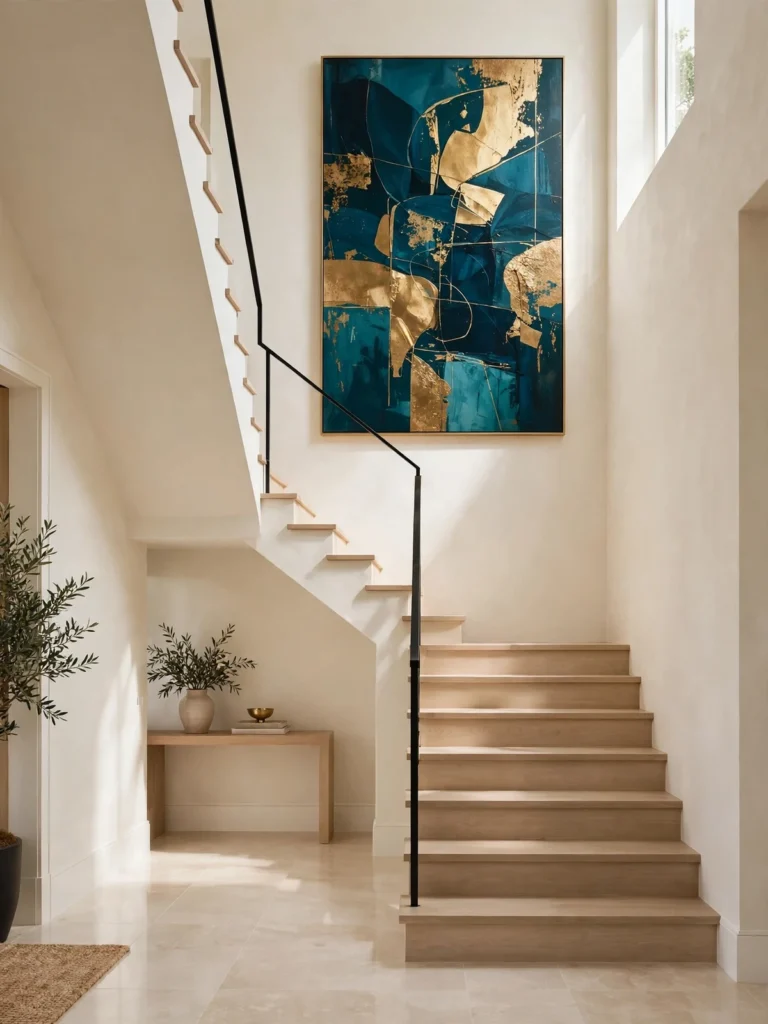
A wooden staircase railing does far more than keep you safe: it frames the stairs, sets the style of the whole hallway and adds warmth no other material can match. These 20 wooden staircase railing ideas cover classic balusters, curved handrails, glass panels, reclaimed timber and bold geometric designs, so you can choose a railing that fits your home, your budget and your daily life.
Wooden staircase railing ideas work because a wooden railing is the warmest way to frame a staircase — it adds natural grain, a comfortable handrail to grip, and a style that suits traditional, farmhouse, Scandinavian and contemporary homes alike. The best railing balances three things: safety (baluster spacing and a sturdy handrail), style (wood species, stain and profile), and the rest of your home (floors, doors and furniture should share the same wood tone or a deliberate contrast).
If you are planning the whole stair, not just the railing, these staircase design ideas show how the stair’s shape, treads and materials set the tone the railing completes. The 20 ideas below cover everything from classic vertical balusters and curved handrails to glass panels, reclaimed wood and geometric patterns, so you can pick a design that looks built-in from the start and still feels safe under your hand every single day.
Key Takeaways
What is the best wood for a staircase railing?
Oak, maple, walnut and ash are the most reliable choices for a staircase railing. Oak is hard-wearing and takes stain evenly, maple gives a smooth pale finish for modern homes, walnut brings rich dark colour for dramatic stairs, and ash is light and flexible for curved handrails. Avoid very soft woods such as pine for handrails, because they dent easily under daily use.
How far apart should wooden balusters be spaced?
Wooden balusters should be spaced so that a 100 mm (4 inch) sphere cannot pass between them — in practice that means a gap of around 90–100 mm between balusters, depending on their thickness. Always check your local building code before installing, because spacing rules vary, and a code-compliant railing is a safety feature first and a design feature second.
Should a wooden railing match the floor or contrast with it?
Matching the railing to the floor creates a calm, cohesive look, while a deliberate contrast — light oak railings against dark treads, or a dark walnut handrail on pale stairs — adds energy and makes the staircase a feature. The mistake to avoid is a near-match: two wood tones that are almost the same but not quite look like an error, so either match the stain properly or contrast clearly.
How do I keep a wooden staircase railing looking good?
Dust it weekly, wipe the handrail with a damp cloth and a mild wood cleaner, and re-oil or re-seal it once a year in high-traffic homes. Clear matte sealers protect the grain without hiding it, while a satin finish hides fingerprints better than high gloss. Touch up chips quickly, because bare wood absorbs moisture and stains.
Can I update a wooden railing without replacing the whole staircase?
Yes. Painting the balusters white while keeping a stained handrail, swapping square balusters for slim dowels, adding a glass panel, or simply re-staining the handrail can transform the whole stair for a fraction of a full replacement. Keep the newel posts and handrail if they are solid — they carry the structure — and change only the infill and finish.
Classic Vertical Wooden Balusters for a Timeless Look
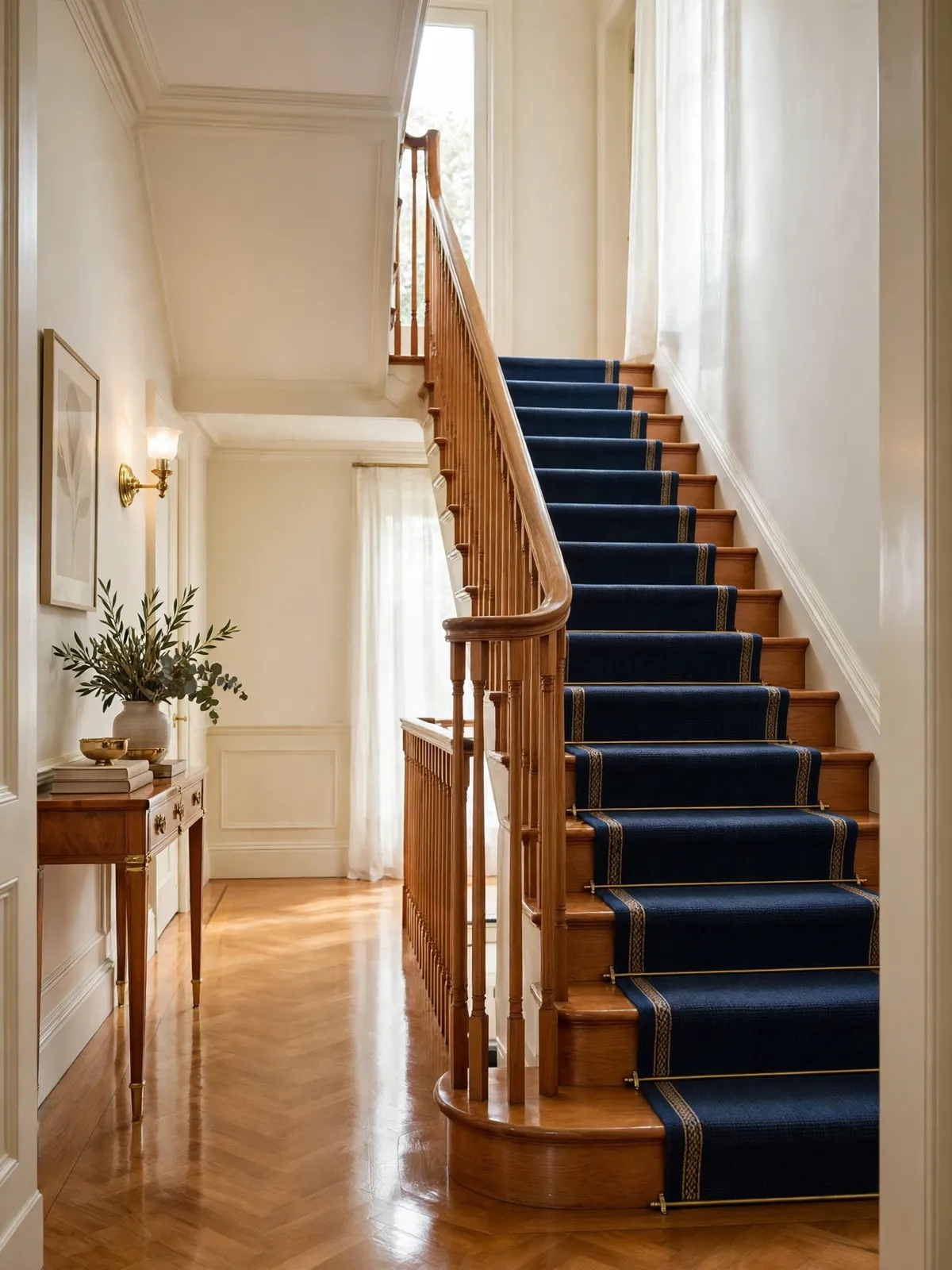
Classic vertical wooden balusters are the safest starting point in wooden staircase railing ideas, because their clean rhythm has suited traditional and transitional homes for generations and never looks dated. Here, warm honey-oak balusters run in even spacing beneath a slightly thicker handrail, with a cream wall behind them and a deep navy runner softening the treads. The design works in almost any home, it feels solid under the hand, and it pairs happily with painted or stained finishes. The weakness is that plain balusters can look builder-basic if the handrail is too thin, so choose a handrail with a comfortable, generous profile and keep the baluster spacing perfectly even — the eye notices a single crooked spindle immediately.
Quick tips:
- Choose a slightly thicker handrail for a solid, reassuring grip.
- Keep baluster spacing perfectly even along the whole run.
- Paint balusters crisp white and stain the handrail for contrast.
- Use turned balusters for traditional homes, square ones for transitional rooms.
White Wooden Spindles With a Stained Handrail
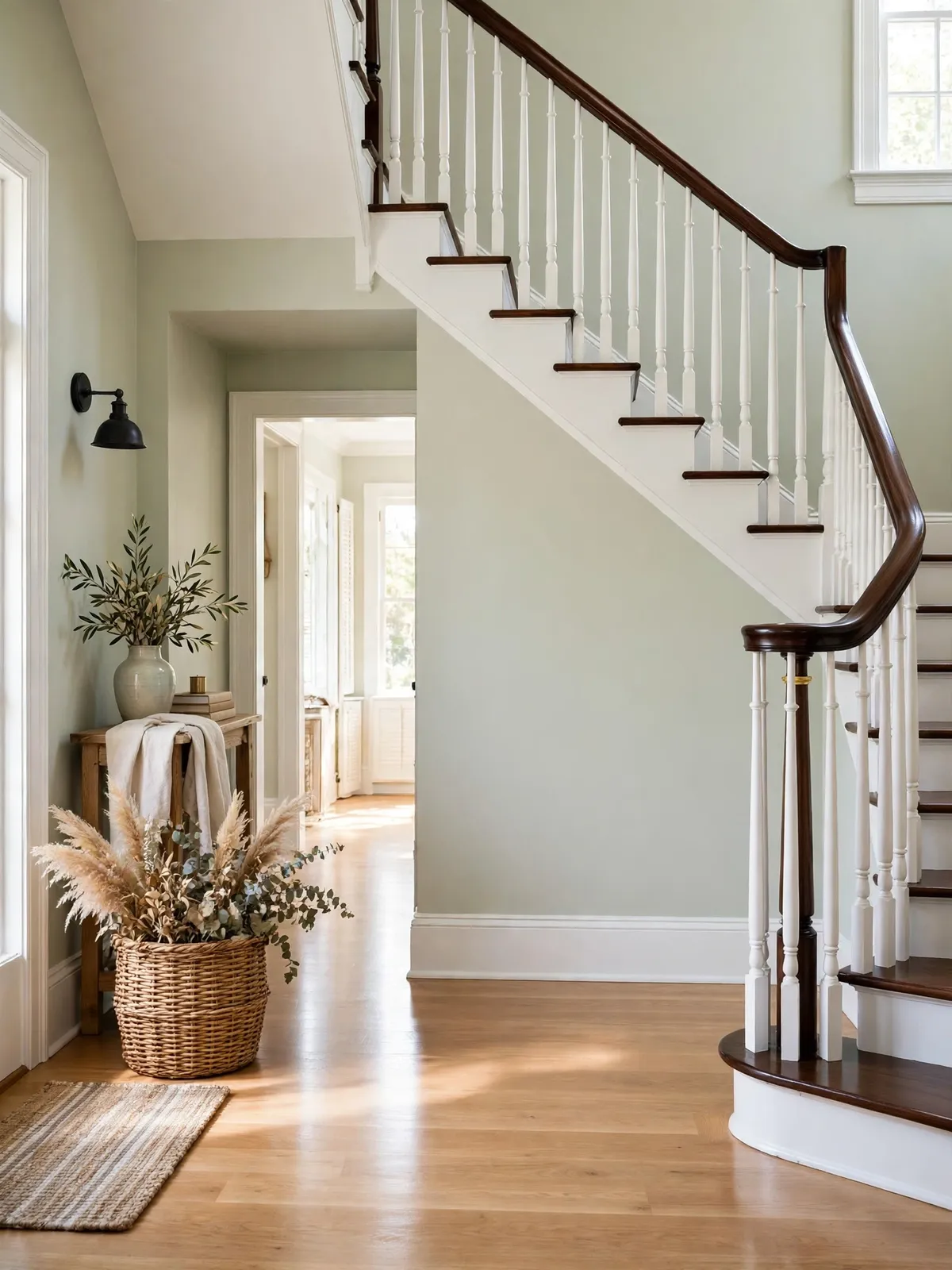
White wooden spindles with a stained handrail is the most forgiving two-tone combination in wooden staircase railing ideas, because the white keeps the stair light and airy while the warm handrail grounds it. Here, crisp white spindles stand against pale sage-green walls, with a dark walnut handrail that matches the newel post caps and a light oak floor below. The design suits farmhouse, coastal and transitional homes, it photographs beautifully, and it hides dust better than an all-dark railing. The weakness is upkeep — white paint shows scuffs from shoes and hands — so use a durable satin or semi-gloss paint on the spindles and keep a small pot of touch-up paint in the cupboard.
Quick tips:
- Use satin or semi-gloss paint so scuffs wipe off easily.
- Match the handrail stain to the newel posts, not the floor.
- Try honey oak with cream spindles for a softer version.
- Keep wall colours pale so the white spindles stay bright.
Natural Unfinished Wood for a Rustic Feel
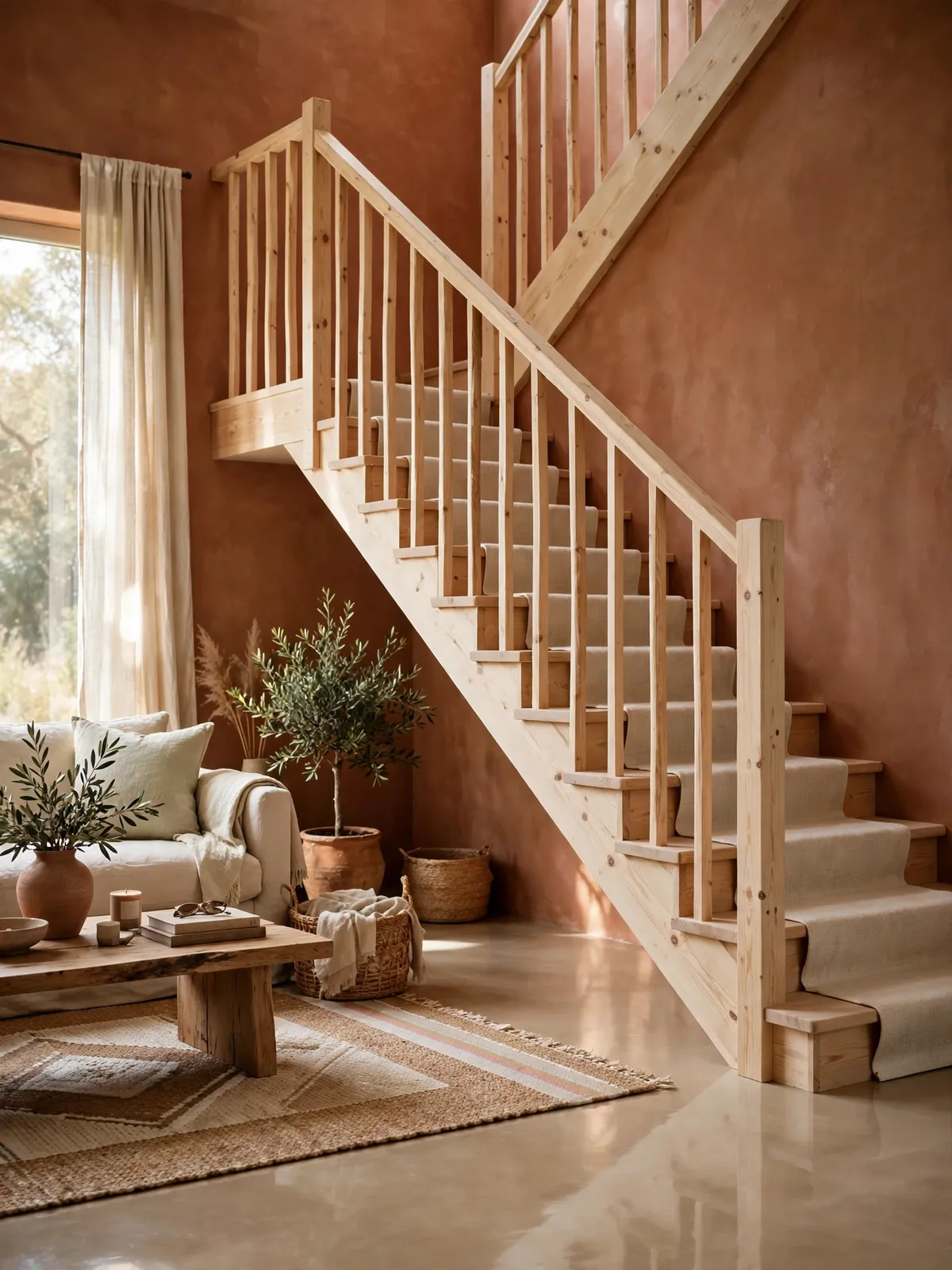
A natural, unfinished wooden railing brings an honest, tactile quality that stained wood cannot copy, because the raw grain, the knots and the pale colour make the stair feel handmade rather than manufactured. Here, lightly sanded pale pine balusters and a handrail sealed only with clear matte sealer run against warm terracotta walls, with a cream linen runner softening the steps. The design suits farmhouse, cottage and rustic homes, it adds texture to plain rooms, and it costs little beyond sanding and sealing. The weakness is protection — raw wood marks, absorbs spills and greys in sunlight — so seal every surface with a clear matte finish, re-seal once a year, and avoid this finish on the handrail of a busy family stair unless you accept a lived-in patina.
Quick tips:
- Sand lightly, then seal with a clear matte finish.
- Re-seal once a year in high-traffic homes.
- Pair raw wood with warm wall colours for balance.
- Accept a soft patina — it is part of the rustic charm.
Chunky Square Balusters for a Contemporary Vibe
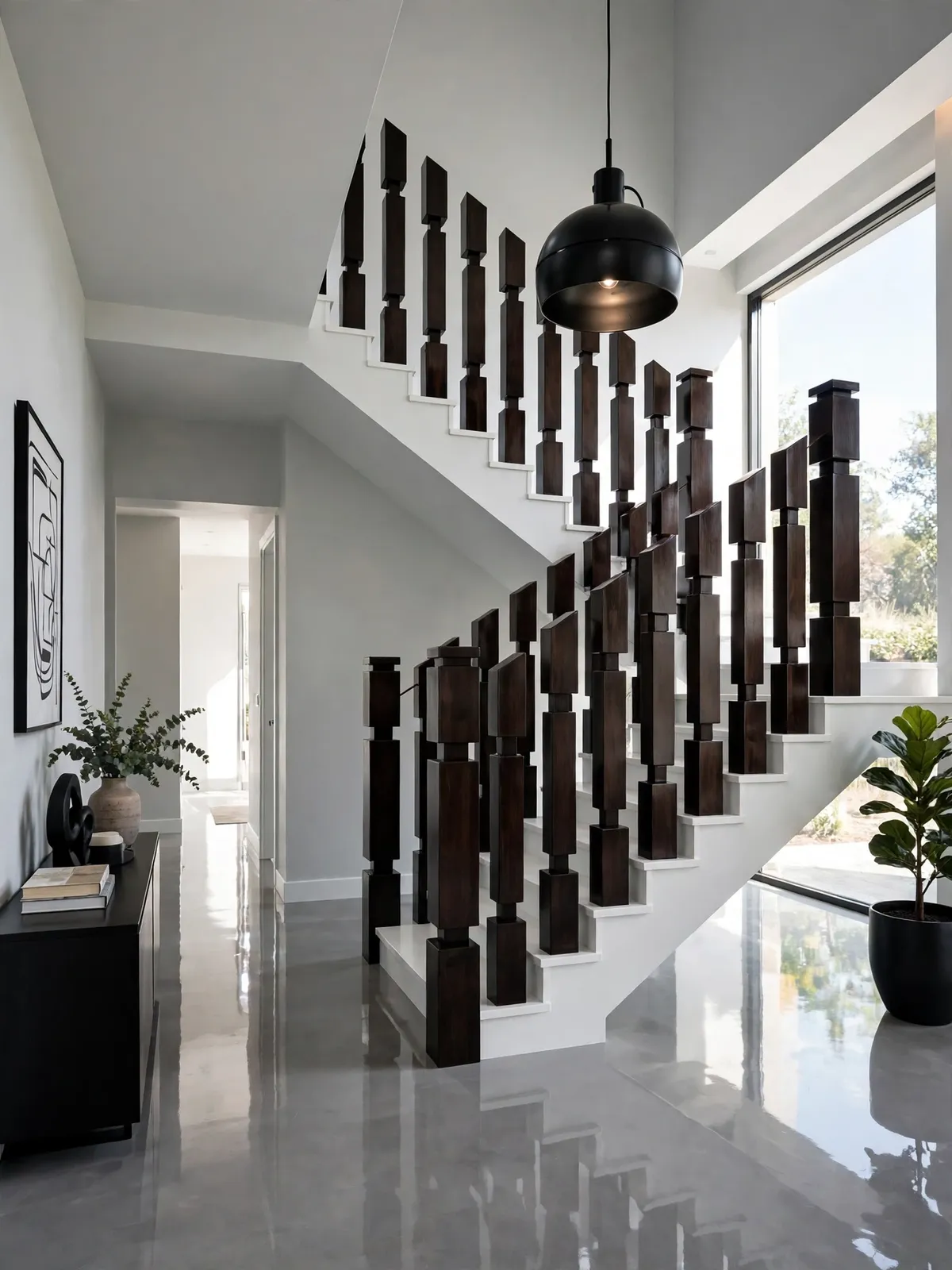
Chunky square balusters give a staircase a grounded, architectural presence that thin spindles cannot match, because the bold square profile reads as modern and deliberate rather than delicate. Here, dark espresso square balusters and a solid matching handrail stand against pale grey walls, with white treads and a black pendant light overhead. The design suits contemporary and modern homes, it makes a narrow stair feel substantial, and it works especially well with flat, unadorned newel posts. The weakness is visual weight — chunky balusters can darken a small hallway — so keep the walls pale, the treads light, and everything else in the stair simple, letting the shape of the railing do the talking.
Quick tips:
- Keep walls and treads pale to balance the bold balusters.
- Use flat, unadorned newel posts to match the square profile.
- Choose one wood tone and repeat it exactly.
- Avoid fussy decor nearby — the railing is the statement.
A Curved Wooden Handrail for Elegance
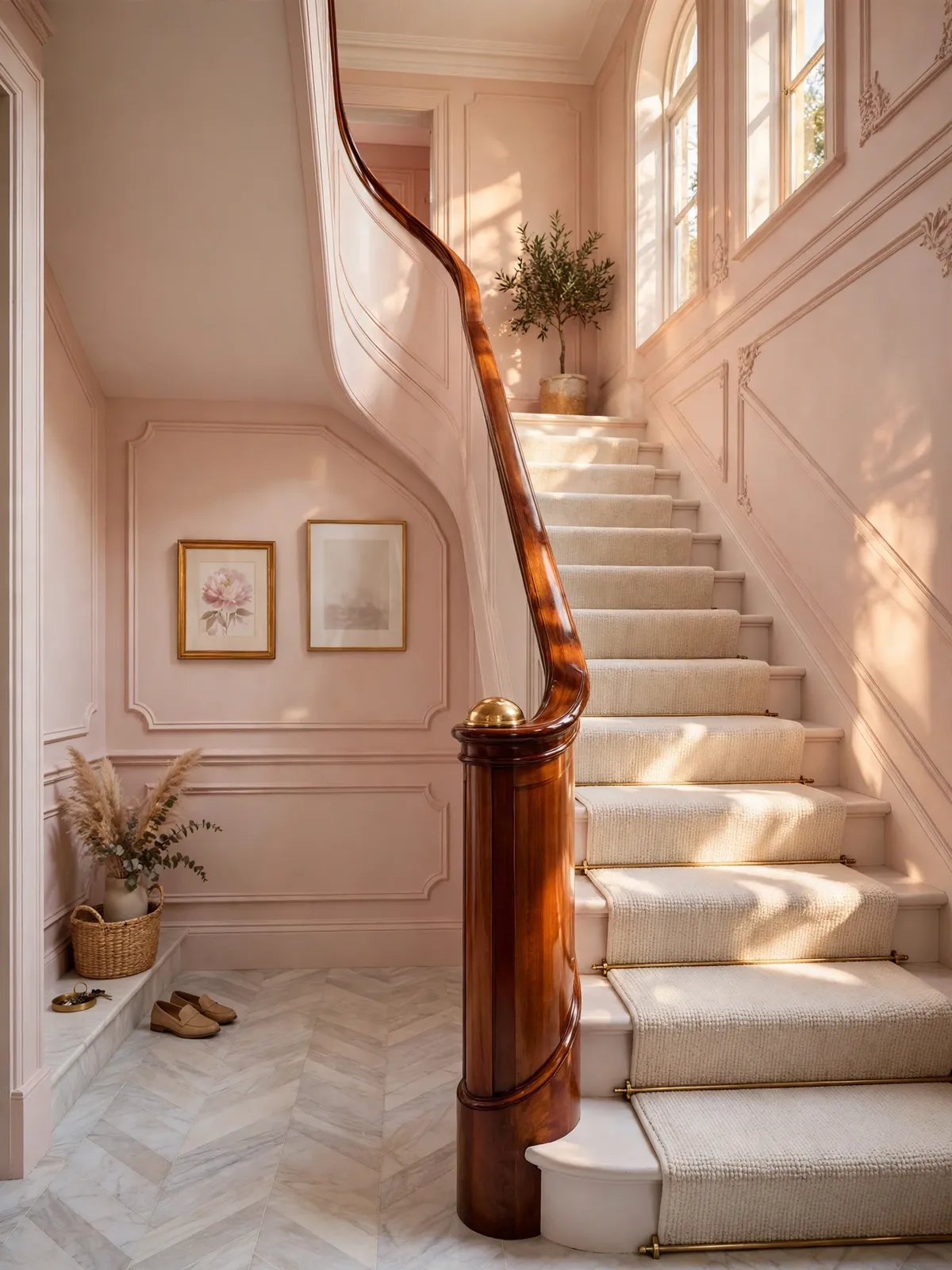
A curved wooden handrail is the most elegant upgrade in wooden staircase railing ideas, because the gentle curve softens the straight lines of the stair and makes the whole design feel custom-made. Here, a polished mahogany handrail sweeps around the landing turn, with slim balusters below and soft blush-pink walls behind it, finished with a brass newel cap. The design suits homes with a landing or a turning stair, it feels wonderful under the hand, and it instantly lifts a plain staircase into a feature. The weakness is cost and craft — a true curved handrail is bent or laminated by a specialist, so it costs far more than a straight rail — and it needs a skilled installer to get the curve perfectly smooth, so get a specialist quote before promising yourself this look.
Quick tips:
- Use a curved rail only where the stair turns or lands.
- Choose a flexible wood such as ash for bent handrails.
- Keep balusters slim so the curve stays the star.
- Budget for a specialist — this is not a DIY bend.
A Railing Matched to Your Hardwood Flooring
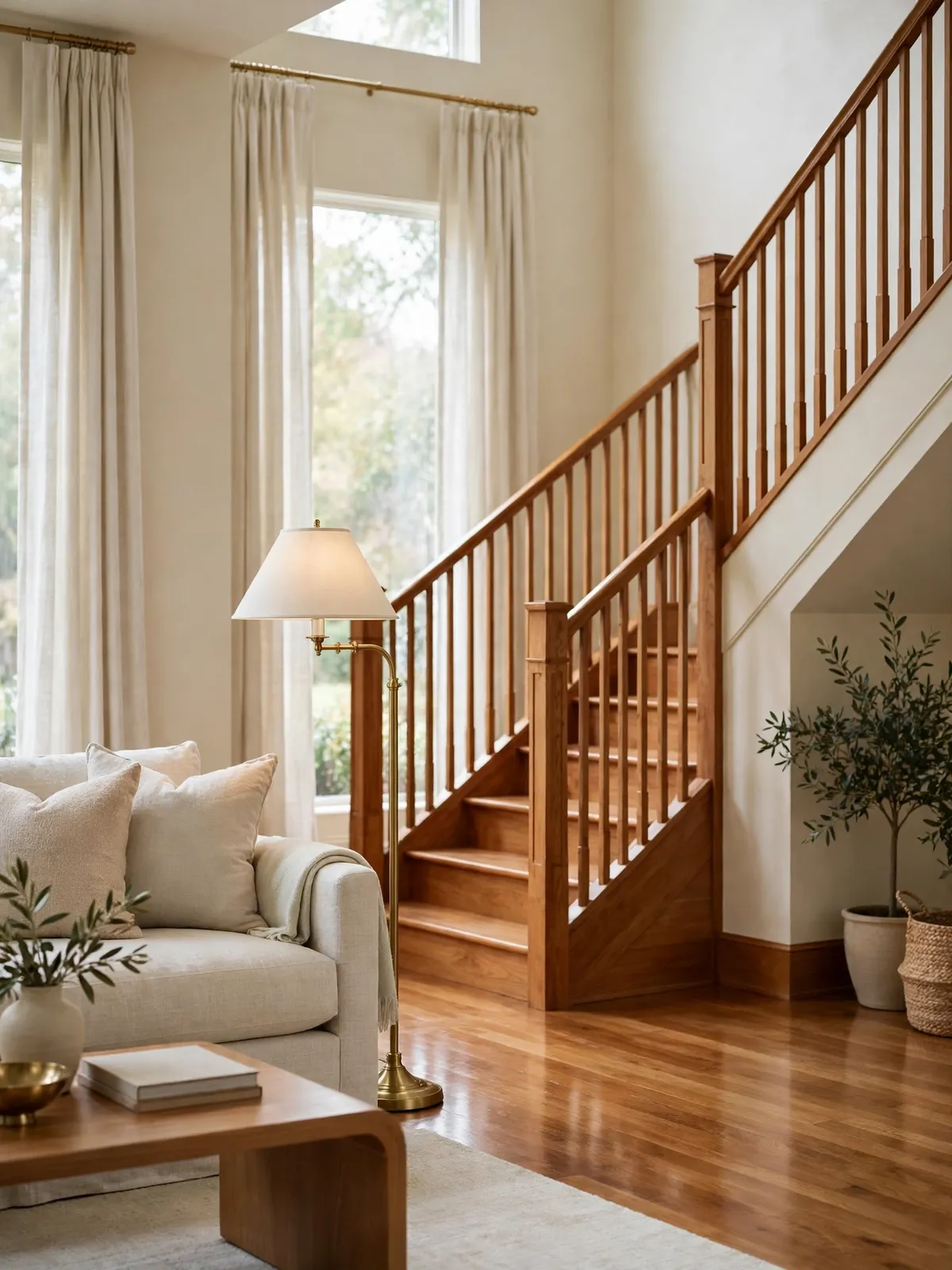
Matching the railing to your hardwood flooring is the simplest way to make a staircase feel part of the house rather than an add-on, because the same wood tone and undertone flow from the floor up the stair without a visual break. Here, a warm medium-oak railing, treads and floor all share the same stain, with soft cream walls and pale linen curtains keeping the room light. The design suits open-plan homes and anyone who loves a calm, cohesive look, it makes small spaces feel larger, and it is easy to get right if you stain a test piece first. The weakness is the near-match trap — two oak stains that are almost the same but not quite look like a mistake — so test the stain on the same species of wood, in the same light, before committing to the whole stair.
Quick tips:
- Stain a test piece of the same wood species first.
- Match the undertone — warm with warm, cool with cool.
- Repeat the same stain on treads and handrail.
- Keep walls neutral so the wood tone leads.
Light Oak Railings Against Dark Stair Treads
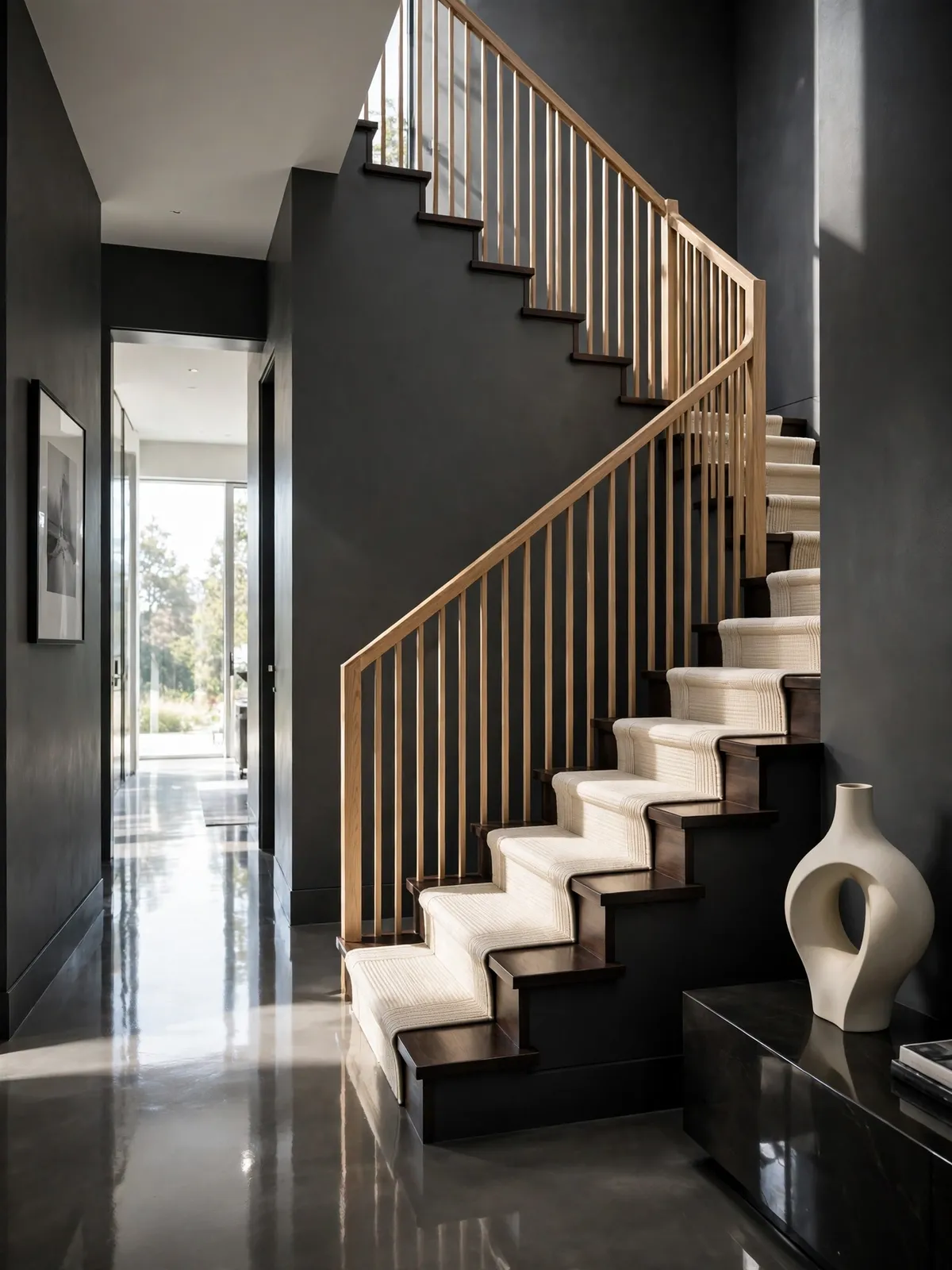
Light oak railings against dark stair treads create the kind of contrast that makes a staircase impossible to ignore, because the pale wood frames each dark step and the eye follows the rhythm all the way up. Here, slim light-oak balusters and a pale handrail stand out against deep walnut treads, with charcoal-grey walls and a cream runner adding a third layer of tone. The design suits contemporary homes that want subtle drama without bold paint, it photographs beautifully, and it works with both square and turned balusters. The weakness is balance — too much dark wood elsewhere in the room tips the stair from dramatic to heavy — so keep the walls and furniture light and let the dark treads be the only deep tone in the space.
Quick tips:
- Keep wall colours neutral so the wood contrast shines.
- Use a cream or pale runner to soften the dark treads.
- Repeat the light oak on a nearby console or shelf.
- Avoid dark furniture right beside the stair.
Glass Panels Beneath a Wooden Handrail
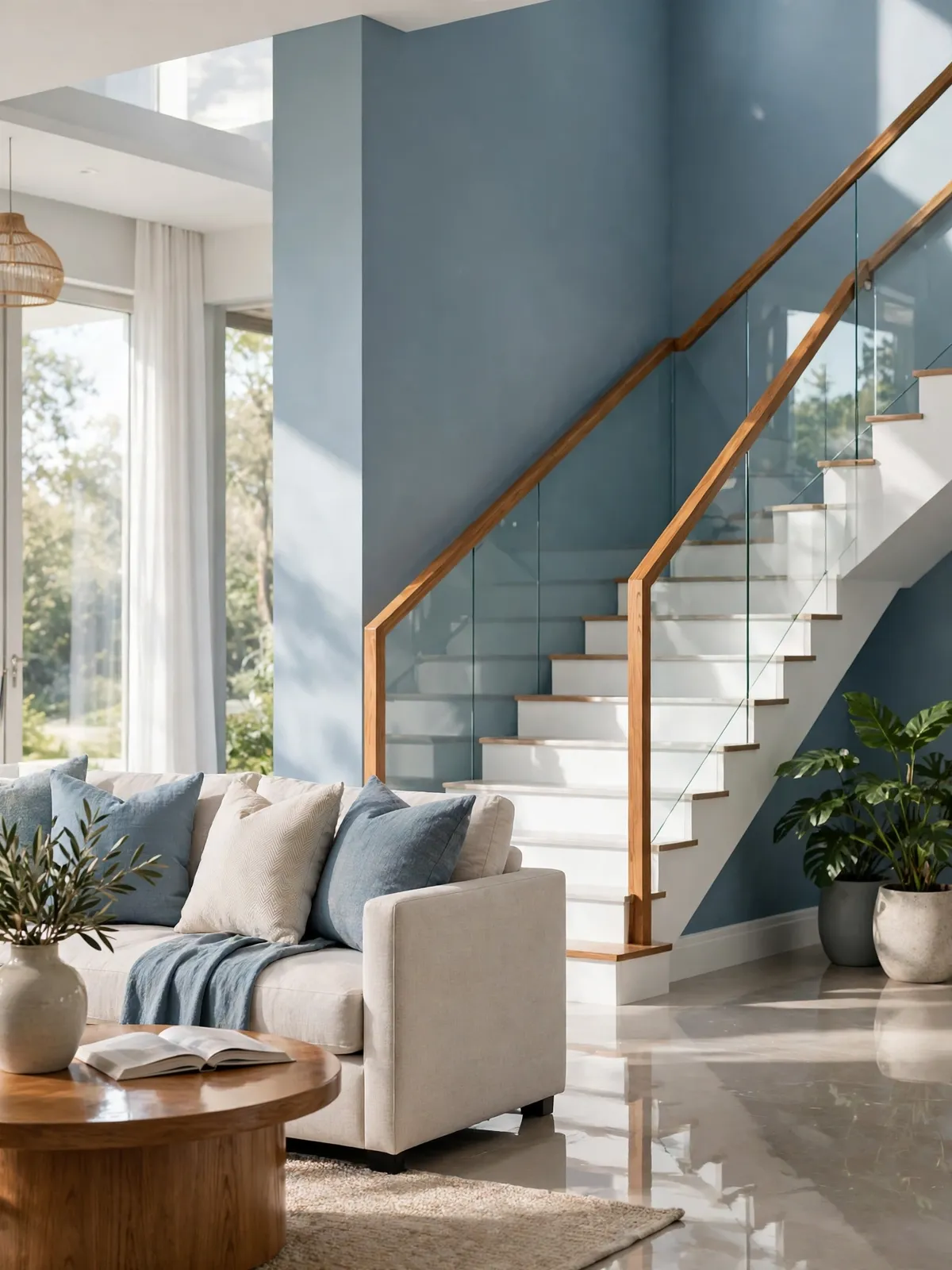
Glass panels beneath a wooden handrail give you the warmth of wood and the openness of glass in one railing, because the wooden top rail keeps the traditional feel while the clear panels let light pass straight through. Here, a warm oak handrail caps frameless glass panels, with soft dusty-blue walls and white treads keeping the stair bright. The design suits small homes and dark hallways where solid balusters would block the light, it makes a stair feel twice as wide, and it works with almost any wood tone. The weakness is cleaning — glass shows fingerprints and dust, especially at hand height — and it costs more than timber balusters, so use tempered glass, budget for regular wiping, and consider a slim wooden shoe rail at the base to hide the glass fixings.
Quick tips:
- Use tempered glass only — never standard glass.
- Wipe the panels weekly to keep them invisible.
- Add a wooden shoe rail at the base for a finished look.
- Try acrylic panels as a lighter budget alternative.
Thin Wooden Dowels for a Minimalist Look
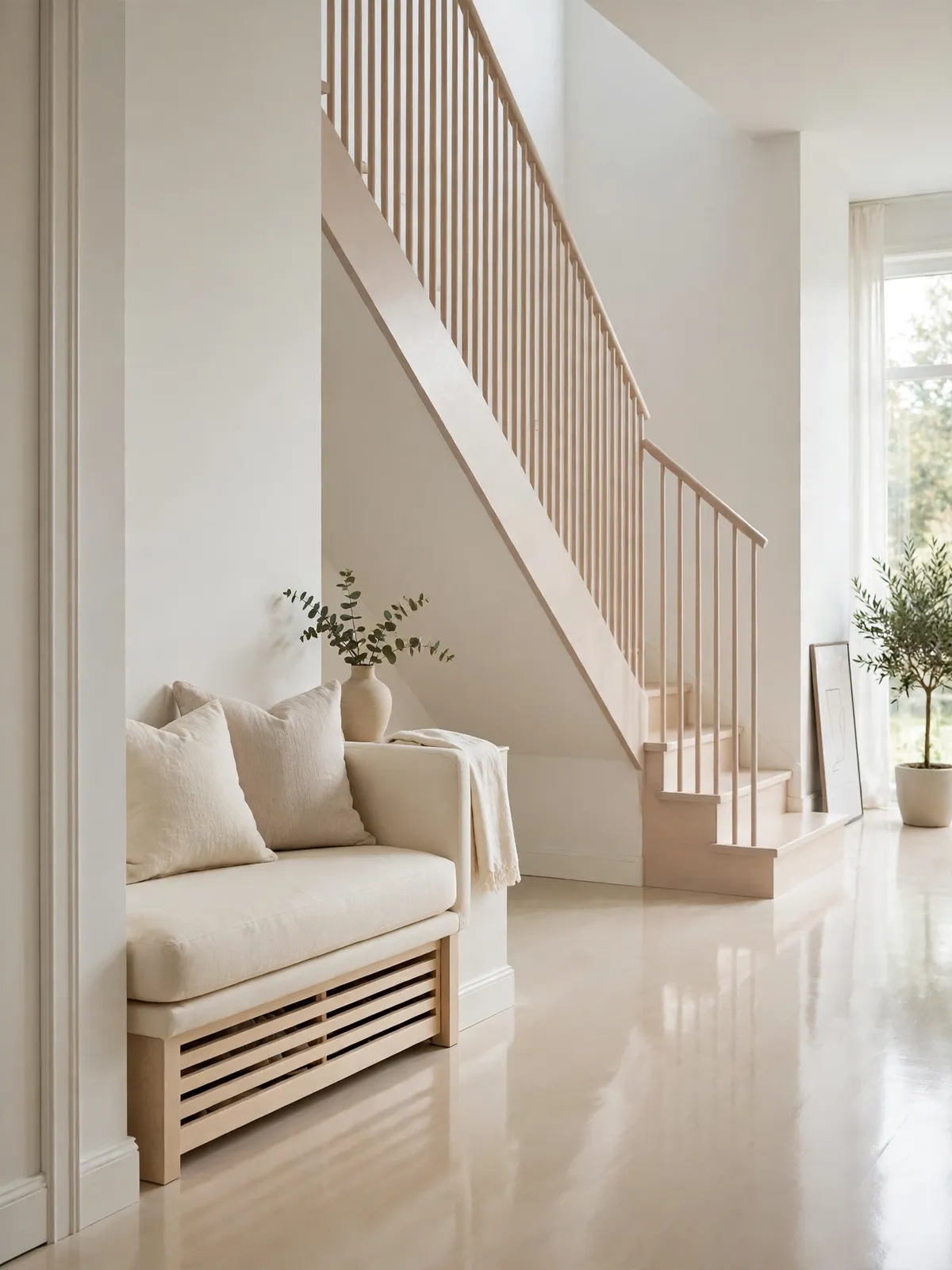
Thin wooden dowels are the quietest way to build a wooden staircase railing, because slim, evenly spaced rods create a clean rhythm without any visual noise. Here, pale ash dowels run between a slim handrail and the treads, with soft white walls and a light birch floor keeping the whole stair pale and calm. The design suits Scandinavian, Japandi and minimalist homes, it works in small apartments where a heavy railing would overwhelm the room, and it is one of the cheapest custom looks. The weakness is that dowels need perfect spacing — a single uneven gap breaks the rhythm — so use a spacing jig during installation, keep the finish matte, and pair the dowels with a handrail in the same pale wood for a seamless line.
Quick tips:
- Use a spacing jig so every gap is identical.
- Keep the finish matte for a soft, natural look.
- Choose pale woods such as ash, maple or pale oak.
- Pair with a slim handrail in the same timber.
Geometric Wooden Panels for a Bold Statement
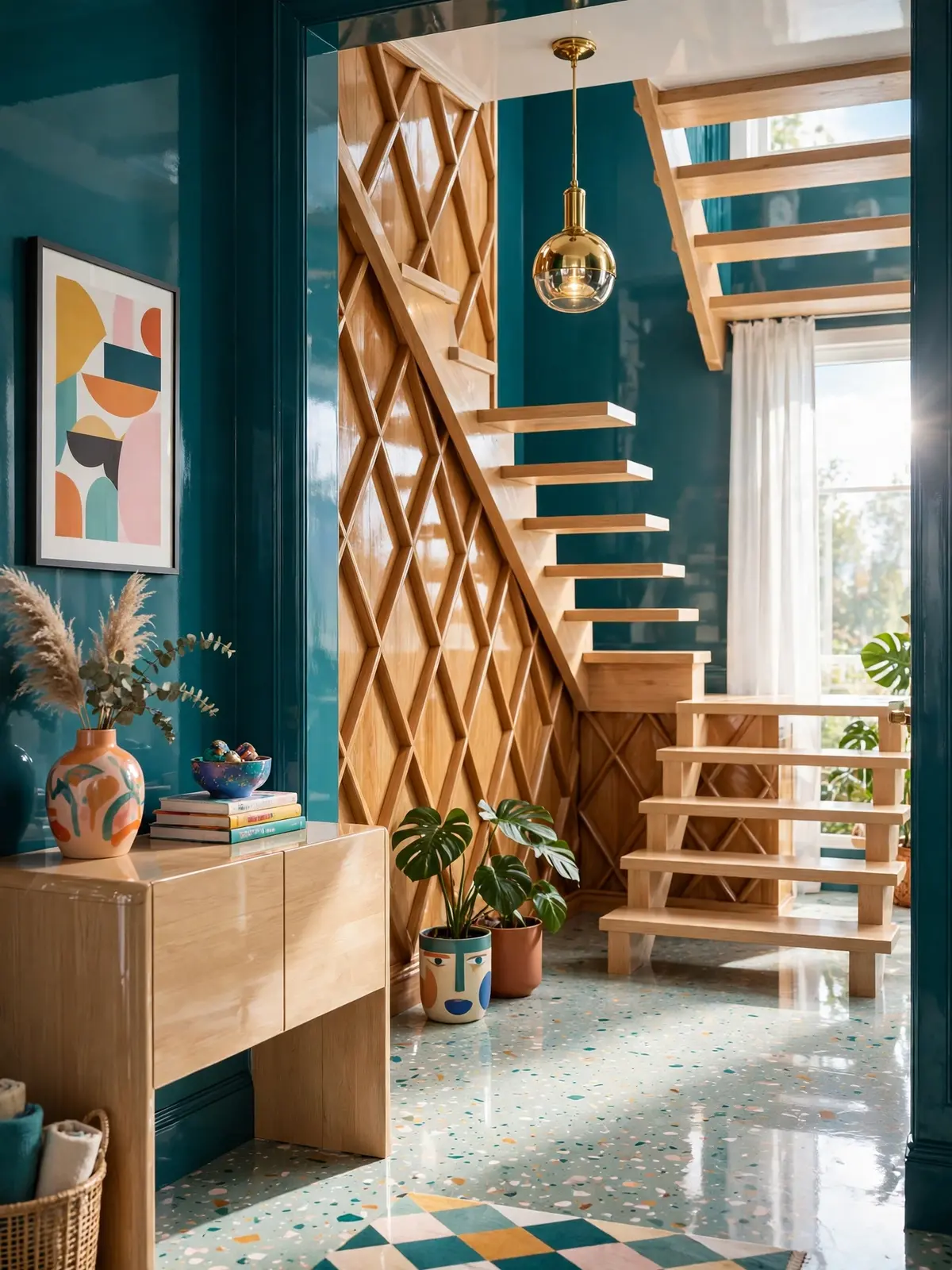
Geometric wooden panels turn a railing into a piece of art, because diamonds, angles and overlapping rectangles replace plain spindles with a pattern the eye keeps returning to. Here, a diamond-pattern panel in warm wood sits beneath a matching handrail, with deep teal walls and pale oak treads letting the pattern stand out. The design suits modern and eclectic homes, it makes a plain stair unforgettable, and it works best as a single feature run rather than on every flight. The weakness is precision — a geometric panel cut even slightly off looks wrong — so have the panels CNC-cut or made by a specialist joiner, keep the surrounding walls plain, and measure the stair twice before ordering.
Quick tips:
- Have panels CNC-cut for perfectly clean lines.
- Keep surrounding walls plain so the pattern leads.
- Use the pattern on one flight, not the whole stair.
- Measure twice — a wrong panel cannot be trimmed to fit.
Carved Details for Vintage Charm
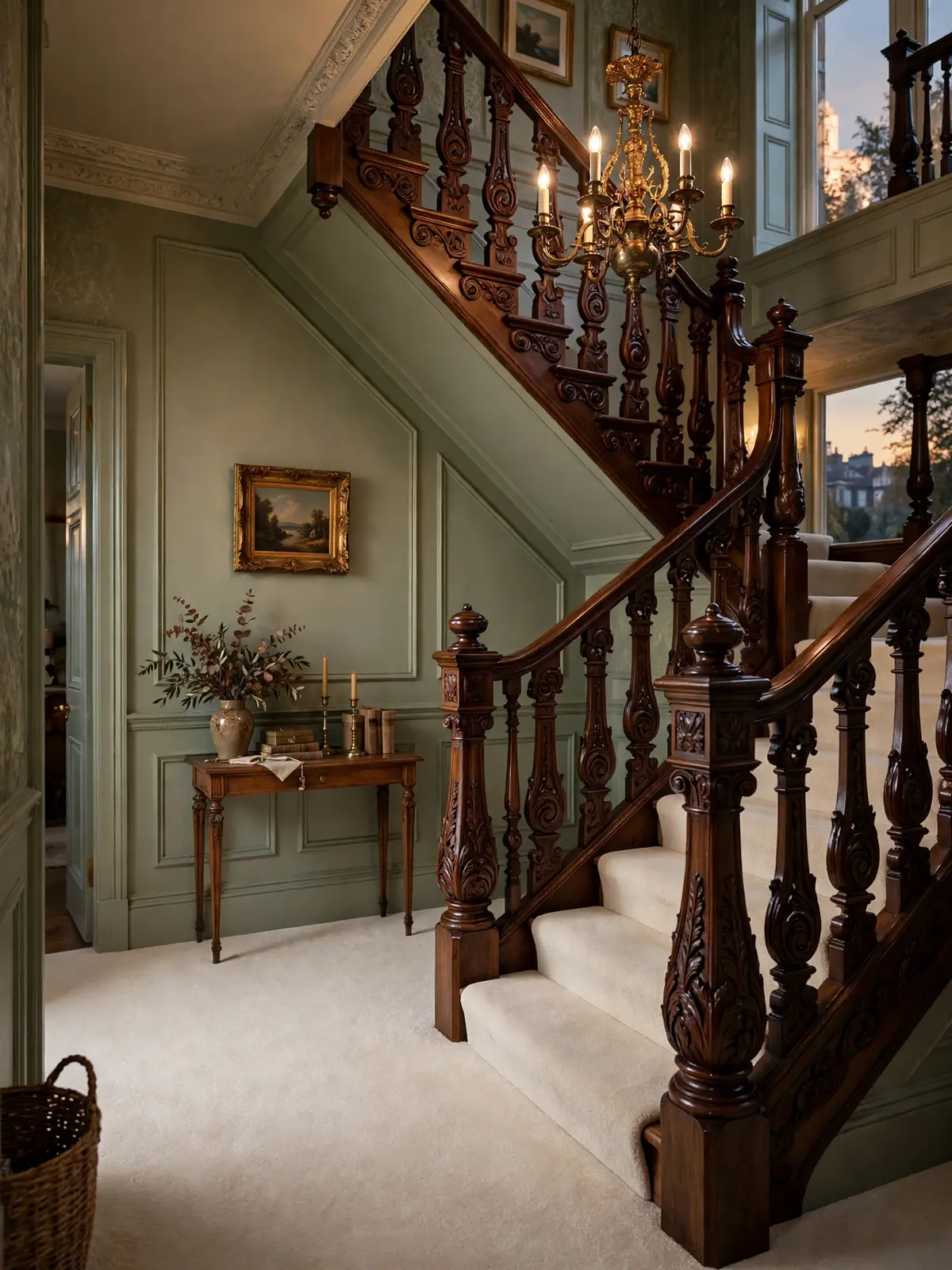
Carved wooden details bring a romance to a staircase that plain balusters never will, because ornate balusters, a shaped handrail profile and a carved newel post tell you the stair was made by hand, not bought off a shelf. Here, dark walnut carved balusters and a decorative handrail run against muted sage walls, with a cream carpet and an antique brass chandelier completing the heritage look. The design suits period homes and anyone who loves vintage character, it makes the stair the most talked-about feature in the house, and it pairs beautifully with classic wall colours. The weakness is overdoing it — carving on every baluster, every newel and every tread looks cluttered — so let one or two detailed sections shine, keep the rest of the balusters simpler, and dust the carving regularly because it collects dust in every groove.
Quick tips:
- Let one or two carved sections shine — do not carve everything.
- Pair carved wood with muted sage or soft grey walls.
- Dust carved grooves weekly with a soft brush.
- Keep the handrail profile simple so the carving leads.
Reclaimed Wood for Texture and History
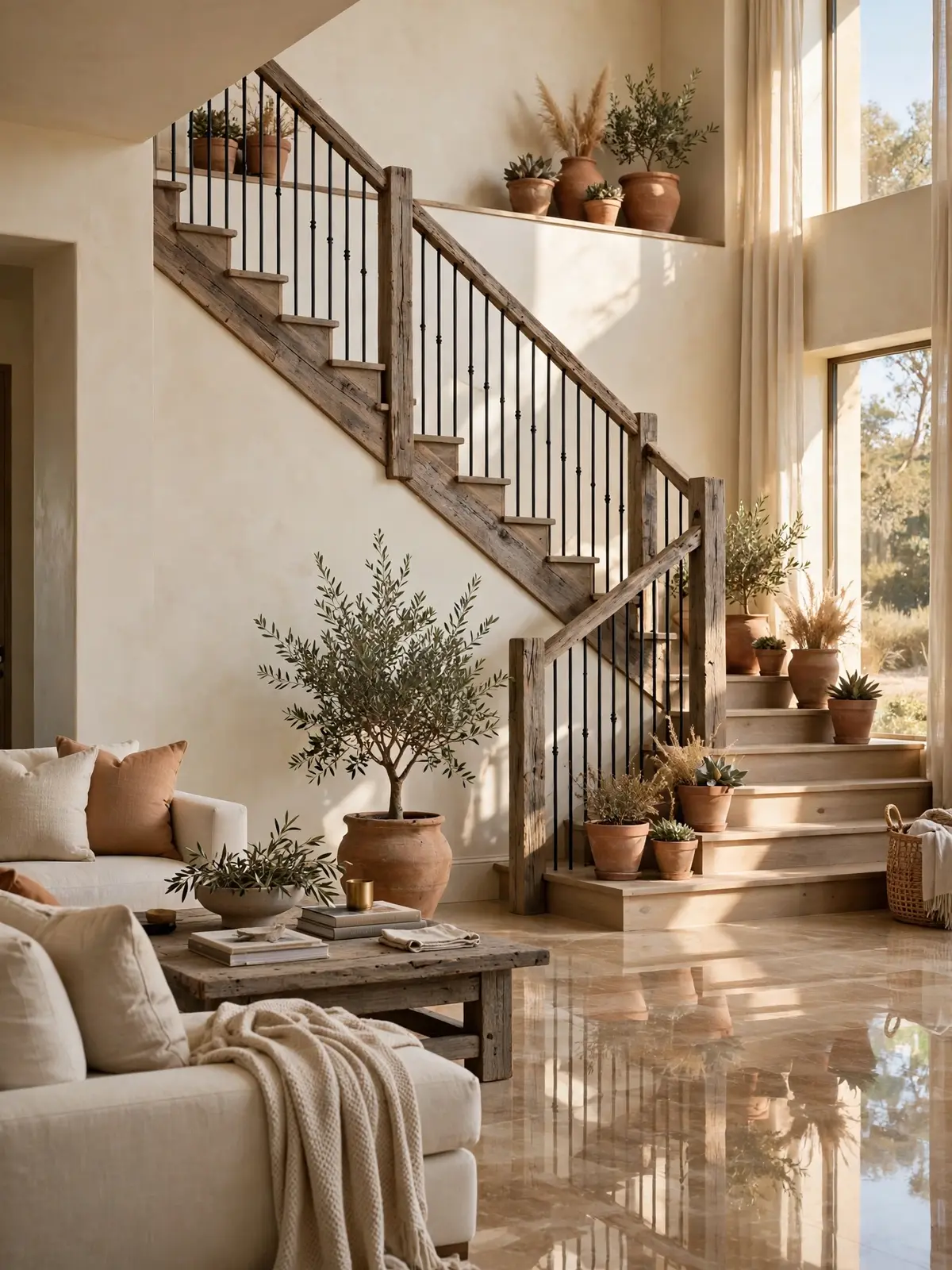
Reclaimed wood gives a staircase railing a texture and a story that new timber simply cannot fake, because every knot, nail hole and weathered mark is evidence of a previous life. Here, a weathered grey-brown reclaimed handrail runs above slim black metal balusters, with soft cream walls and terracotta pots warming the entry. The design suits rustic, industrial and modern farmhouse homes, it adds instant character to a new-build house, and it is a genuinely sustainable choice. The weakness is preparation — reclaimed timber must be cleaned, checked for nails, kiln-dried and sealed before it is safe to touch daily — so buy from a reputable reclaimed-timber supplier, seal it properly, and pair it with simple balusters so the wood itself stays the focus.
Quick tips:
- Buy reclaimed timber from a reputable supplier only.
- Check for hidden nails and seal the wood thoroughly.
- Pair reclaimed wood with simple, plain balusters.
- Let the handrail be the feature — keep everything else quiet.
A Half-Wall Base With a Wooden Railing Topper
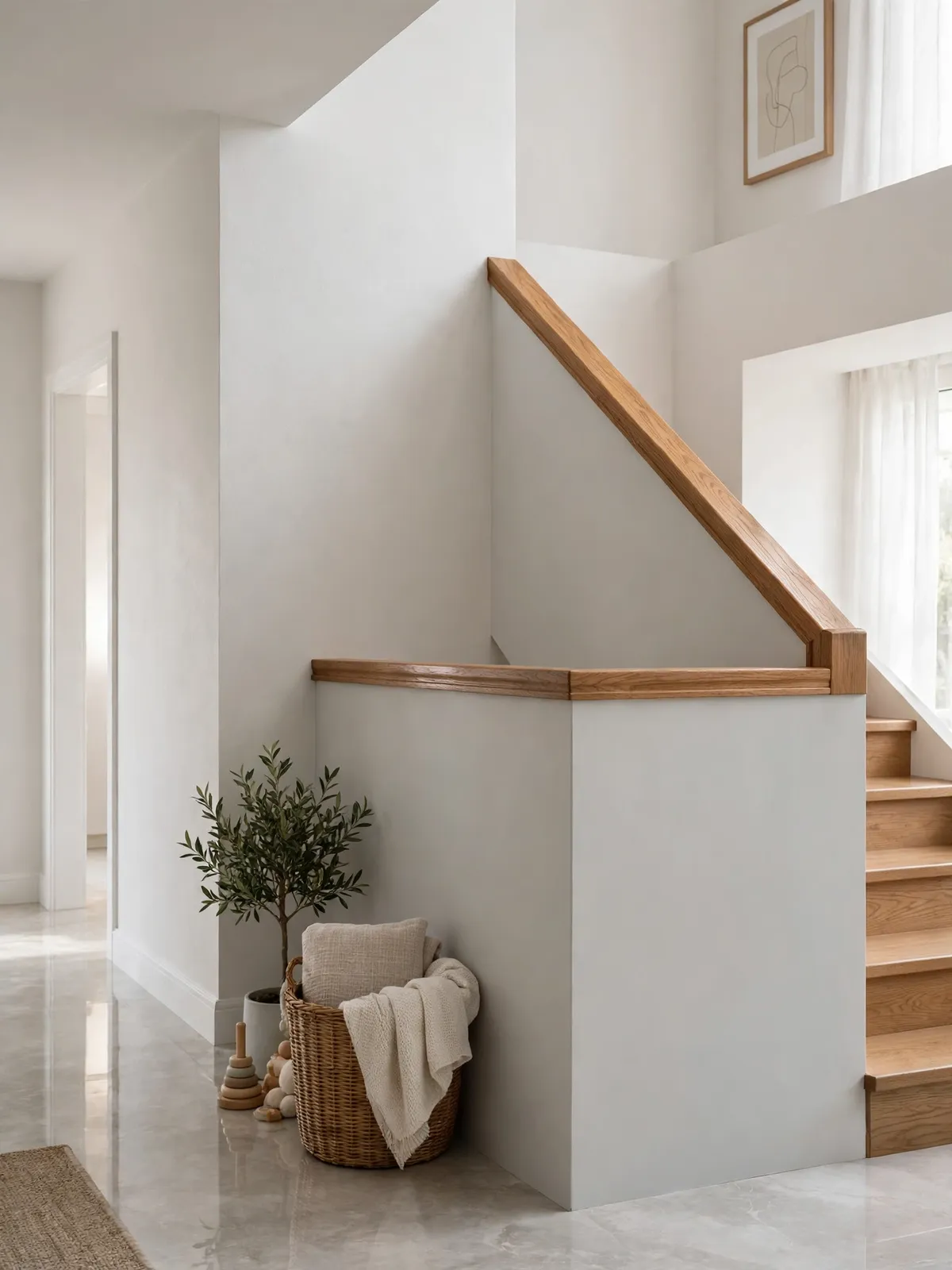
A half-wall base with a wooden railing topper feels solid and safe, because the short wall gives you privacy and a sturdy base while the wooden cap adds warmth and a comfortable handhold. Here, a pale grey half-wall runs along the stair, finished with a warm oak railing cap, with soft white walls and a woven basket softening the hallway. The design suits family homes with small children, it works on stairs that open onto a living room, and it hides clutter on the far side of the wall. The weakness is height — build the wall too tall and the stair feels closed in, too short and the railing looks lost — so aim for a wall height that lets you rest your hand naturally on the cap, and paint the wall a different tone from the railing so the two layers read clearly.
Quick tips:
- Keep the wall low enough that the stair stays open.
- Paint the wall and stain the railing in contrasting tones.
- Use the wall base to hide cables or storage.
- Choose a rounded cap profile for a comfortable grip.
Wooden Railings Mixed With Black Metal
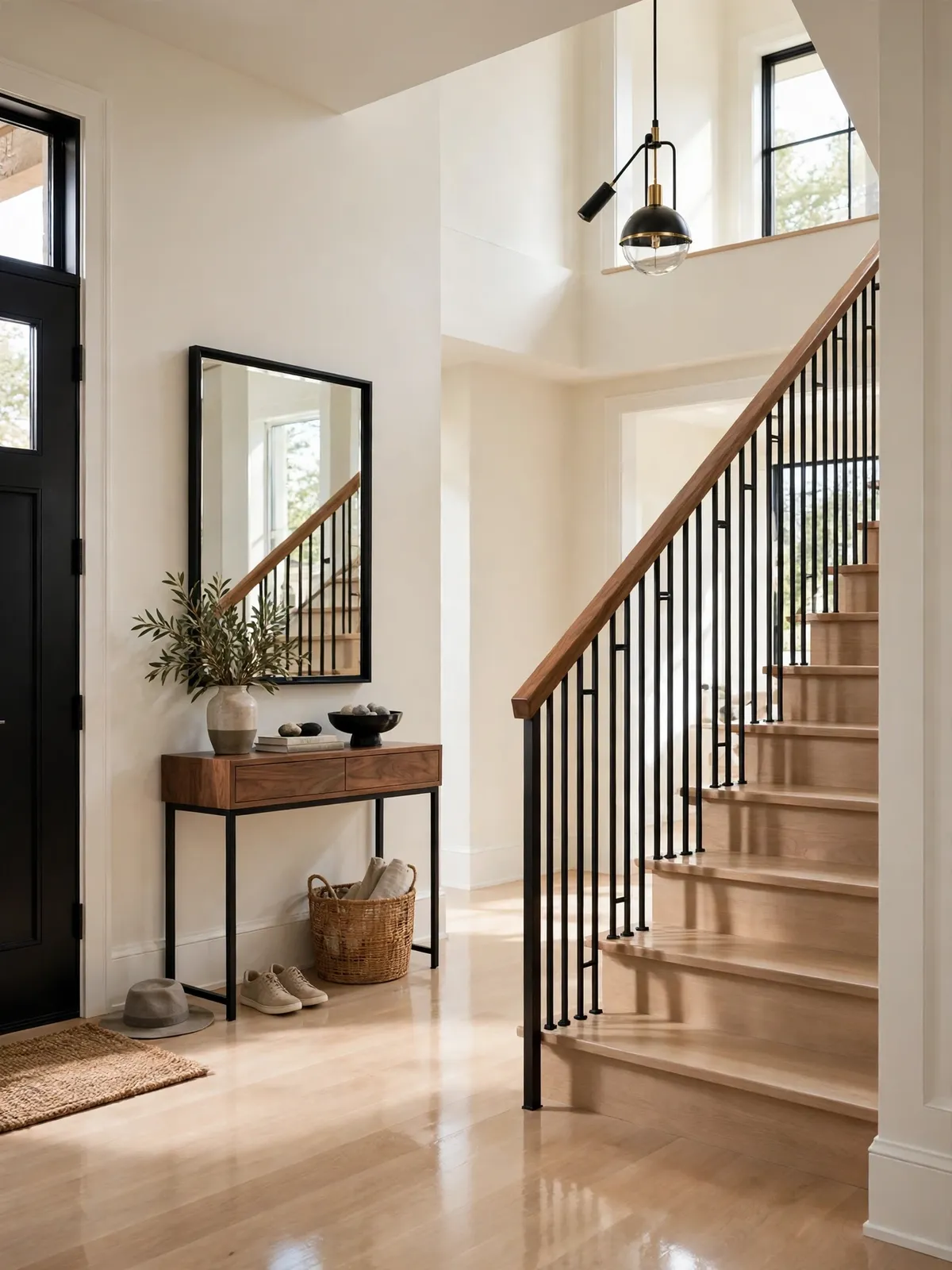
Mixing a wooden handrail with black metal balusters is the most popular hybrid in wooden staircase railing ideas, because the warm wood softens the industrial metal and the black metal sharpens the warm wood. Here, a warm walnut handrail and newel posts frame slim black metal balusters, with soft ivory walls and a black-framed mirror echoing the metal tone. The design suits transitional, industrial and contemporary homes, it is easier to keep clean than an all-wood railing, and it lets you introduce black accents without repainting the whole stair. The weakness is proportion — too much black metal turns the stair cold, too little looks accidental — so keep the wood on the handrail and newels, the metal on the balusters only, and repeat the black in one other nearby detail such as a mirror frame or a light fitting.
Quick tips:
- Keep the wood on the handrail and newels, metal on the balusters.
- Repeat the black tone once more nearby for balance.
- Use a satin black finish — gloss shows fingerprints.
- Try iron balusters with a honey-oak handrail for warmth.
A Slim Wooden Handrail on the Wall Only
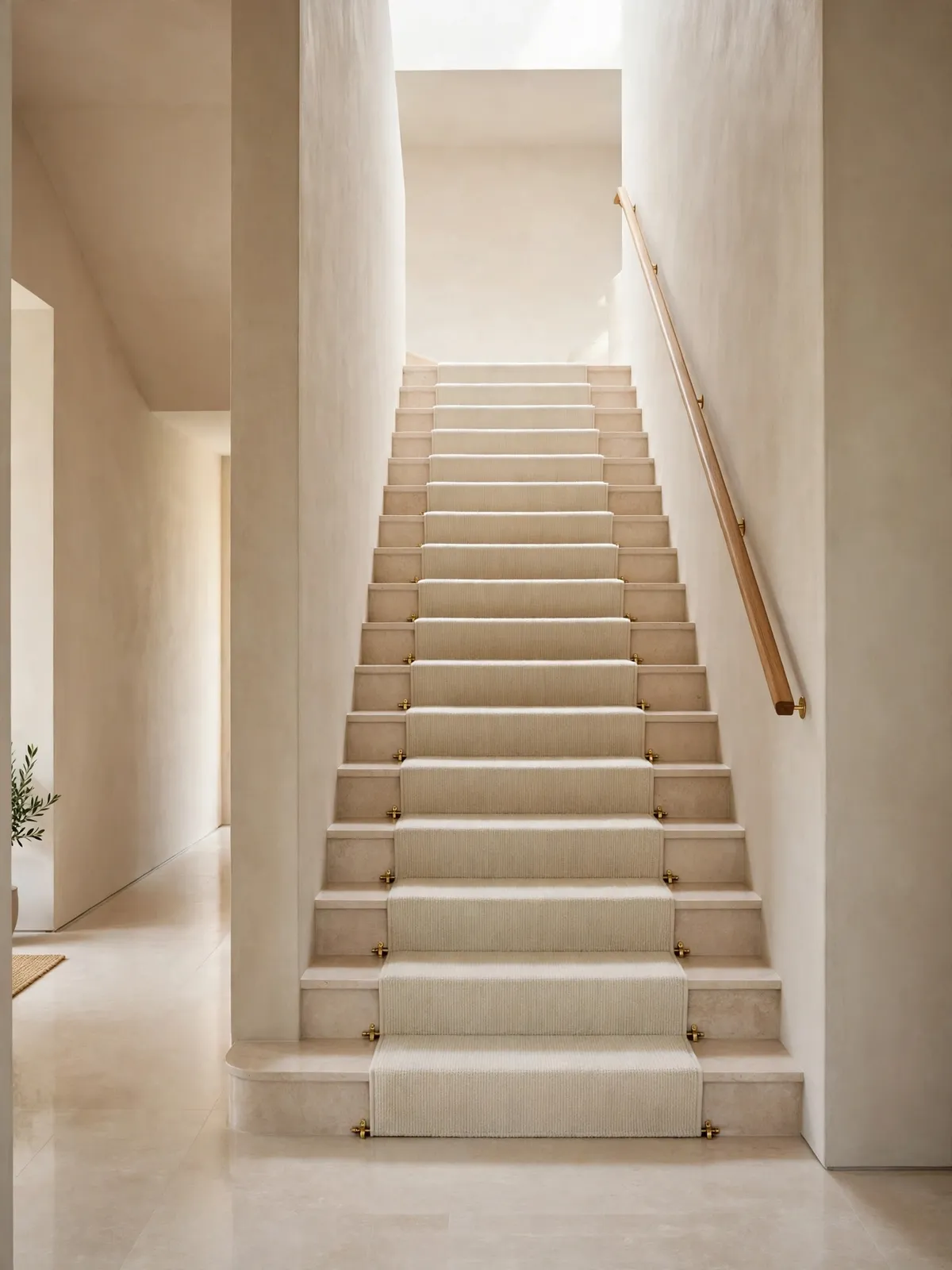
A slim wooden handrail mounted directly on the wall is the boldest exercise in restraint, because it skips balusters entirely and leaves the stair completely open. Here, a slim pale-oak handrail runs along a soft beige wall on small brass brackets, with pale stone treads and a cream runner below. The design suits modern and small homes where a full railing would overwhelm the space, it costs very little, and it keeps the stair feeling light and uncluttered. The weakness is safety and code — this only works on a stair with a wall on one side and a proper balustrade on the open side, and the wall rail must be fixed into studs at the correct height — so check your local code first, use solid brass or steel brackets, and never use a wall-only rail as the sole guard on an open stair.
Quick tips:
- Fix brackets into wall studs, never just plasterboard.
- Check local code — a wall rail is not a full balustrade.
- Use it only where the open side already has a guard.
- Choose a slim profile so the rail disappears into the wall.
Wooden Railings Paired With Under-Step Lighting
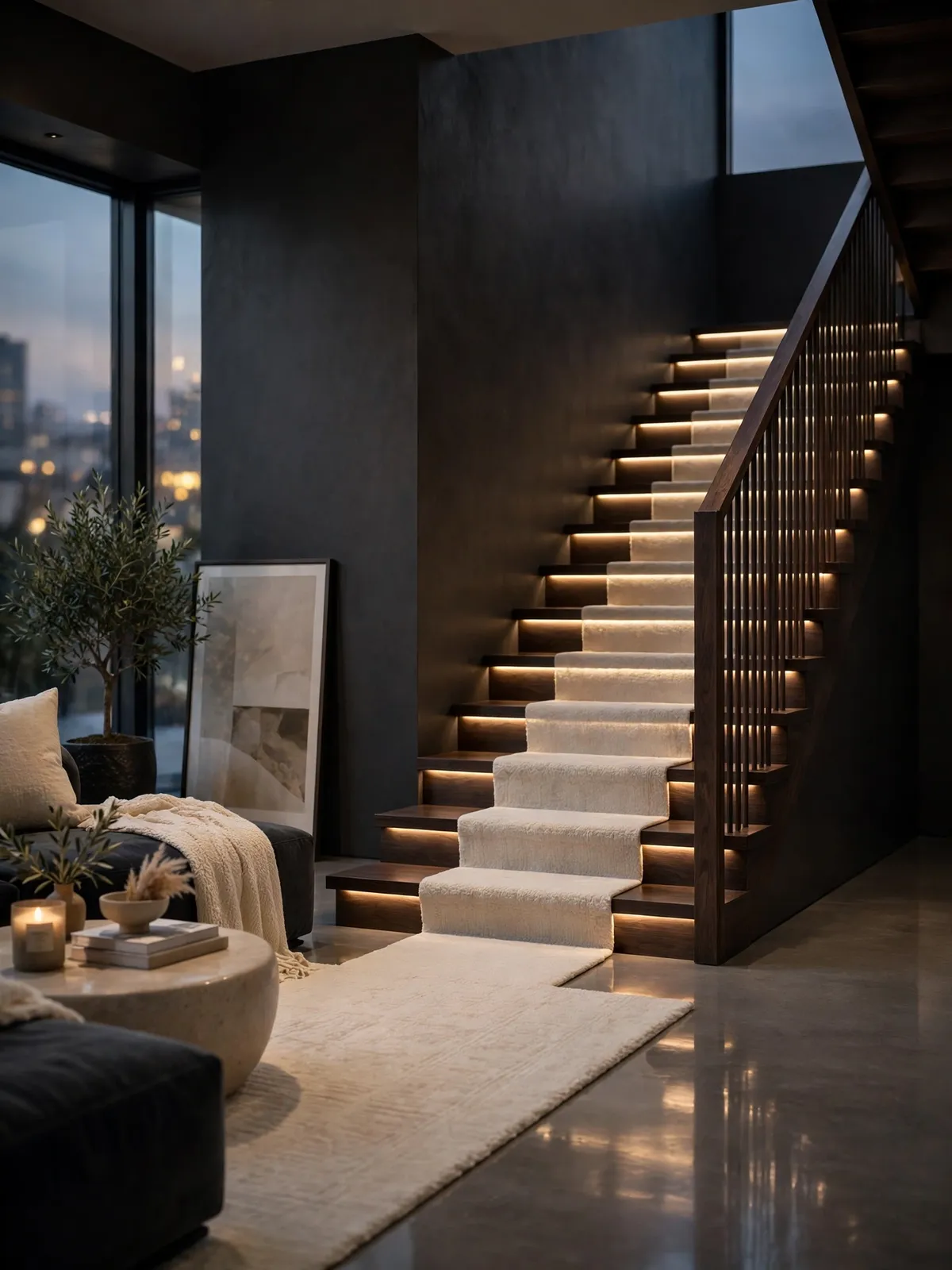
Wood looks magical when it is lit softly, and under-step lighting is the easiest way to show off a wooden railing after dark, because the warm glow catches the grain of the handrail and washes each tread in light. Here, a dark walnut railing stands above warm LED strips set under every tread, with deep charcoal walls and a cream runner softening the stair. The design suits any home that uses the stair at night, it adds safety on dark stairs, and it turns an ordinary staircase into an evening feature. The weakness is colour temperature — cool white LEDs make wood look flat and grey — so choose warm-toned strips around 2700K, hide the strips under a small lip so you see the glow and not the bulb, and wire them to a dimmer or a motion sensor.
Quick tips:
- Choose warm-toned LEDs around 2700K for wood.
- Hide the strips under a lip so only the glow shows.
- Wire the lights to a dimmer or motion sensor.
- Match the light tone to the wood stain.
A Railing Framed by Built-In Wall Panelling
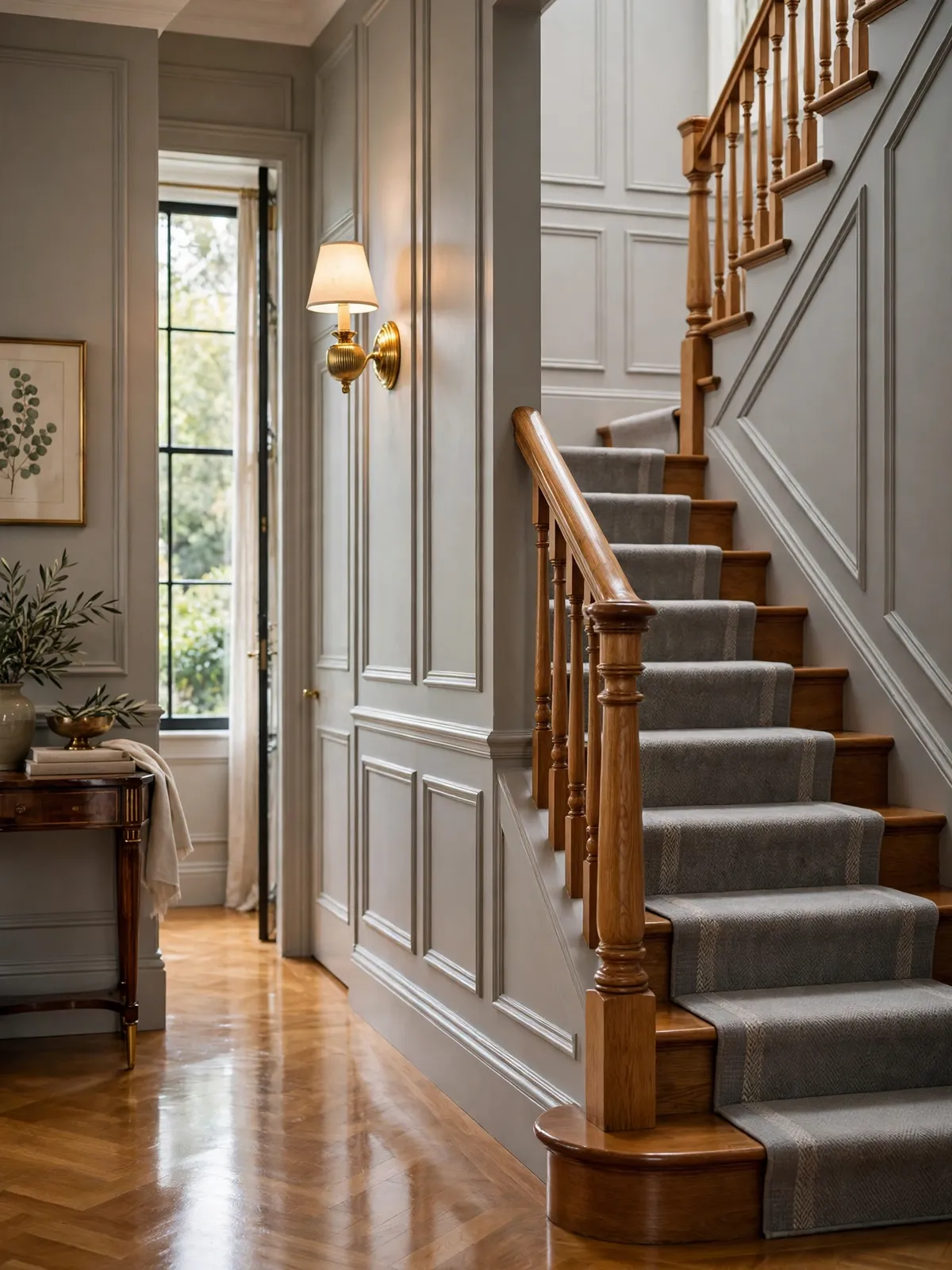
Framing a wooden railing with built-in wall panelling turns a staircase into a focal wall, because the panel moulding, the wood and the lighting layer together like a designed room rather than a passage. Here, a honey-oak handrail runs beside picture-frame moulding on soft mushroom-grey walls, with a brass wall sconce adding a warm pool of light. The design suits traditional and transitional homes, it makes a plain hallway feel intentional, and it works with almost any railing style underneath. The weakness is proportion — panelling that is too busy fights the railing for attention — so keep the moulding simple, paint the wall and the panelling the same colour, and let the wood of the railing be the only contrasting tone.
Quick tips:
- Paint the wall and panelling the same colour for calm.
- Keep the moulding simple — picture-frame style is enough.
- Add a wall sconce for evening warmth.
- Let the railing wood be the only contrasting tone.
A Railing Extended Onto the Landing Wall
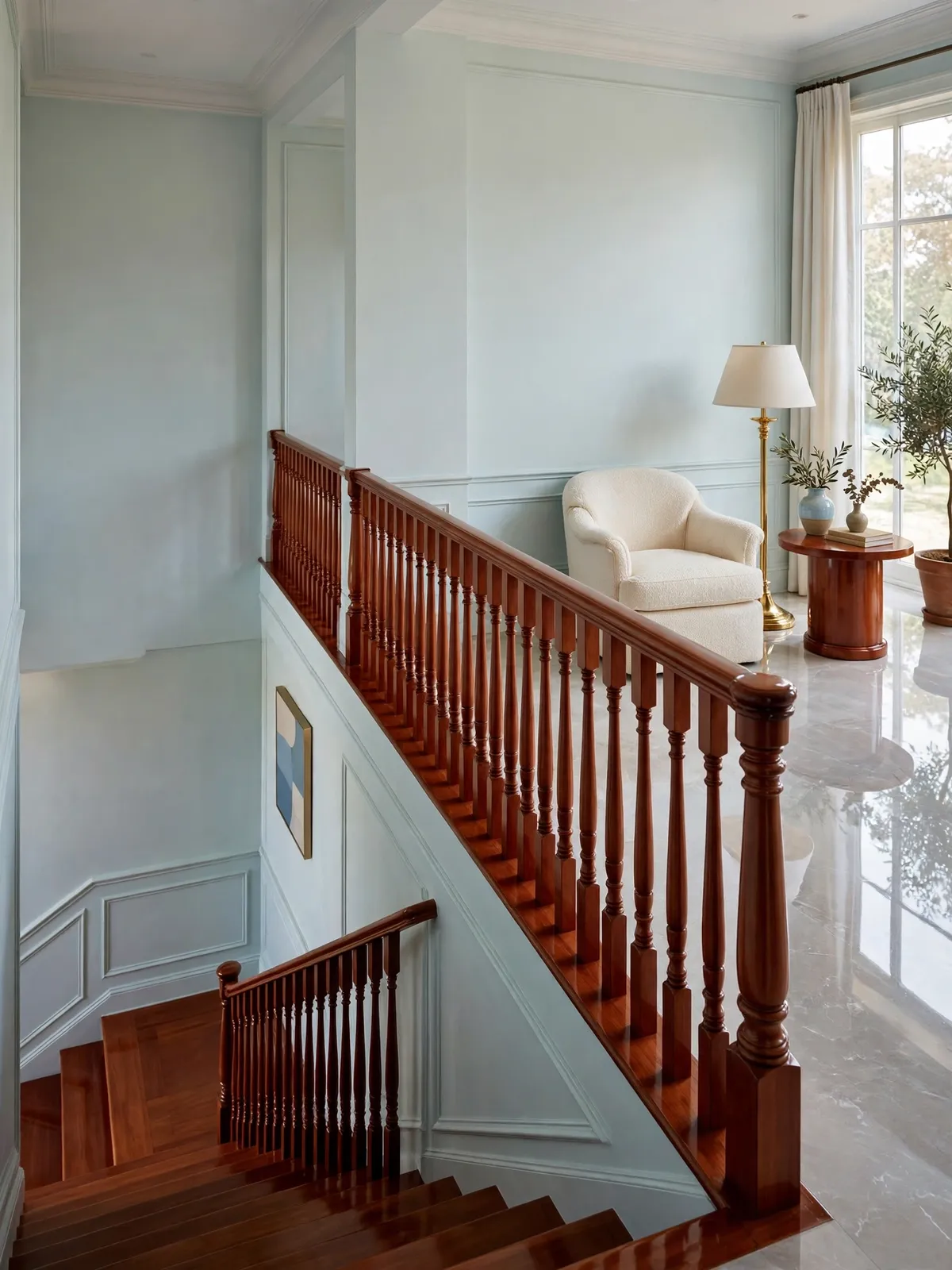
Extending the wooden railing onto the landing wall makes the staircase feel like one continuous piece of architecture, because the same wood, the same profile and the same stain wrap around the corner instead of stopping abruptly at the top step. Here, a rich cherry railing runs along the landing wall above a cream armchair and a brass floor lamp, with soft pale-blue walls keeping the landing bright. The design suits homes with a generous landing, it creates a natural gallery or reading corner upstairs, and it makes the stair feel designed rather than assembled. The weakness is precision — the landing rail must match the stair rail exactly in species, stain and height, or the join looks wrong — so order the landing rail from the same supplier, measure the landing length carefully, and fix the brackets evenly into studs.
Quick tips:
- Match wood species and stain exactly on both runs.
- Measure the landing length before ordering.
- Fix brackets evenly into wall studs.
- Use the landing wall for art or a reading chair.
Decorative Brackets Under the Handrail
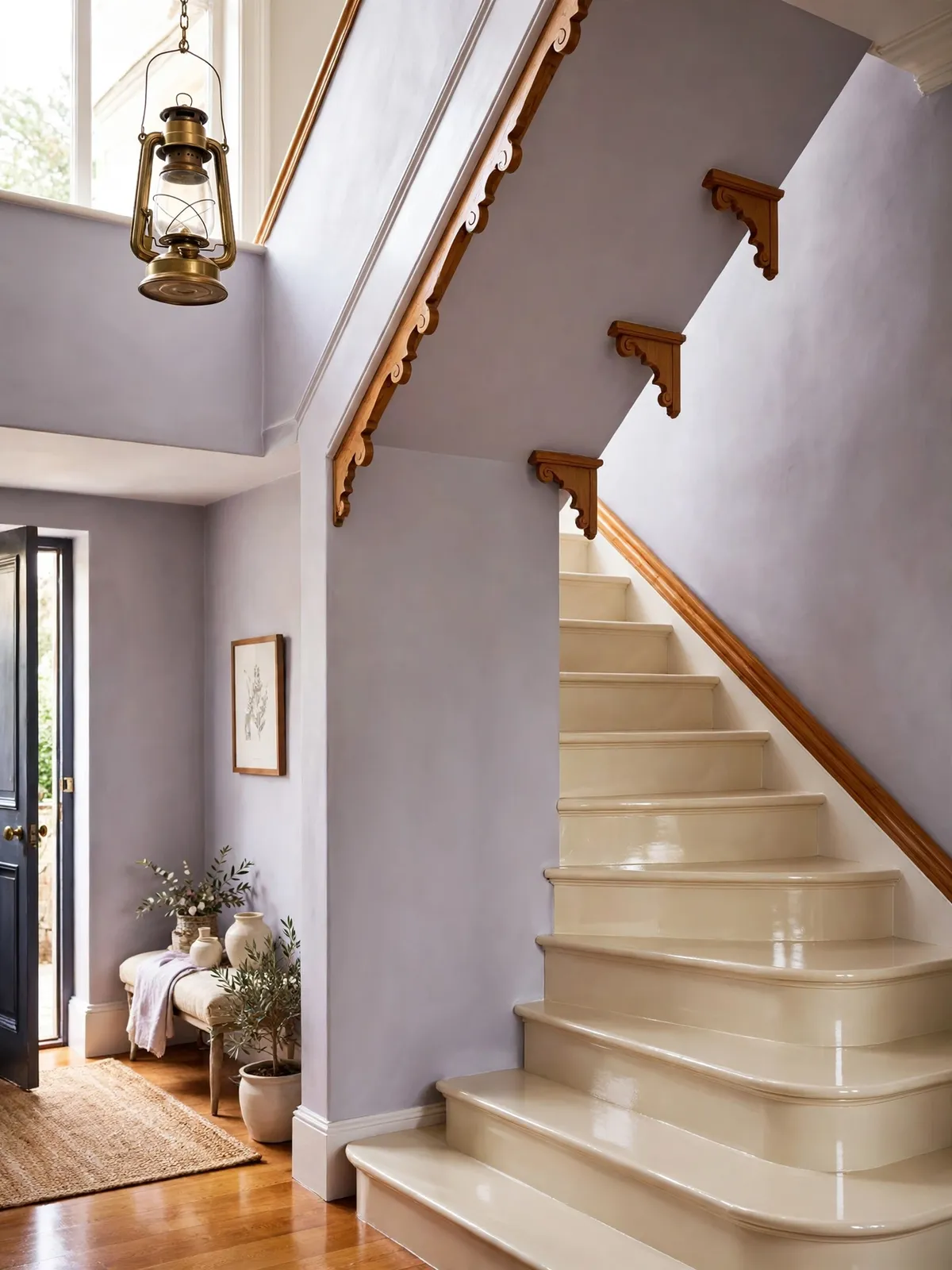
Small decorative brackets under the handrail are the tiniest upgrade with the biggest payoff in wooden staircase railing ideas, because they add a crafted, furniture-like detail without changing the structure of the stair. Here, slim carved brackets sit evenly beneath a honey-oak handrail, with soft lavender-grey walls and a vintage brass lantern adding charm. The design suits farmhouse and traditional homes, it is an affordable weekend upgrade, and it softens a plain straight handrail beautifully. The weakness is spacing — uneven brackets look like a mistake — so measure and mark every bracket position before drilling, keep the spacing identical, and choose brackets in the same wood and stain as the handrail so they read as one piece.
Quick tips:
- Measure and mark every bracket position before drilling.
- Keep bracket spacing perfectly even along the rail.
- Match the brackets to the handrail wood and stain.
- Use them as a softer alternative to carved balusters.
Wooden Staircase Railing Ideas That Make Your Stair the Star of the Home
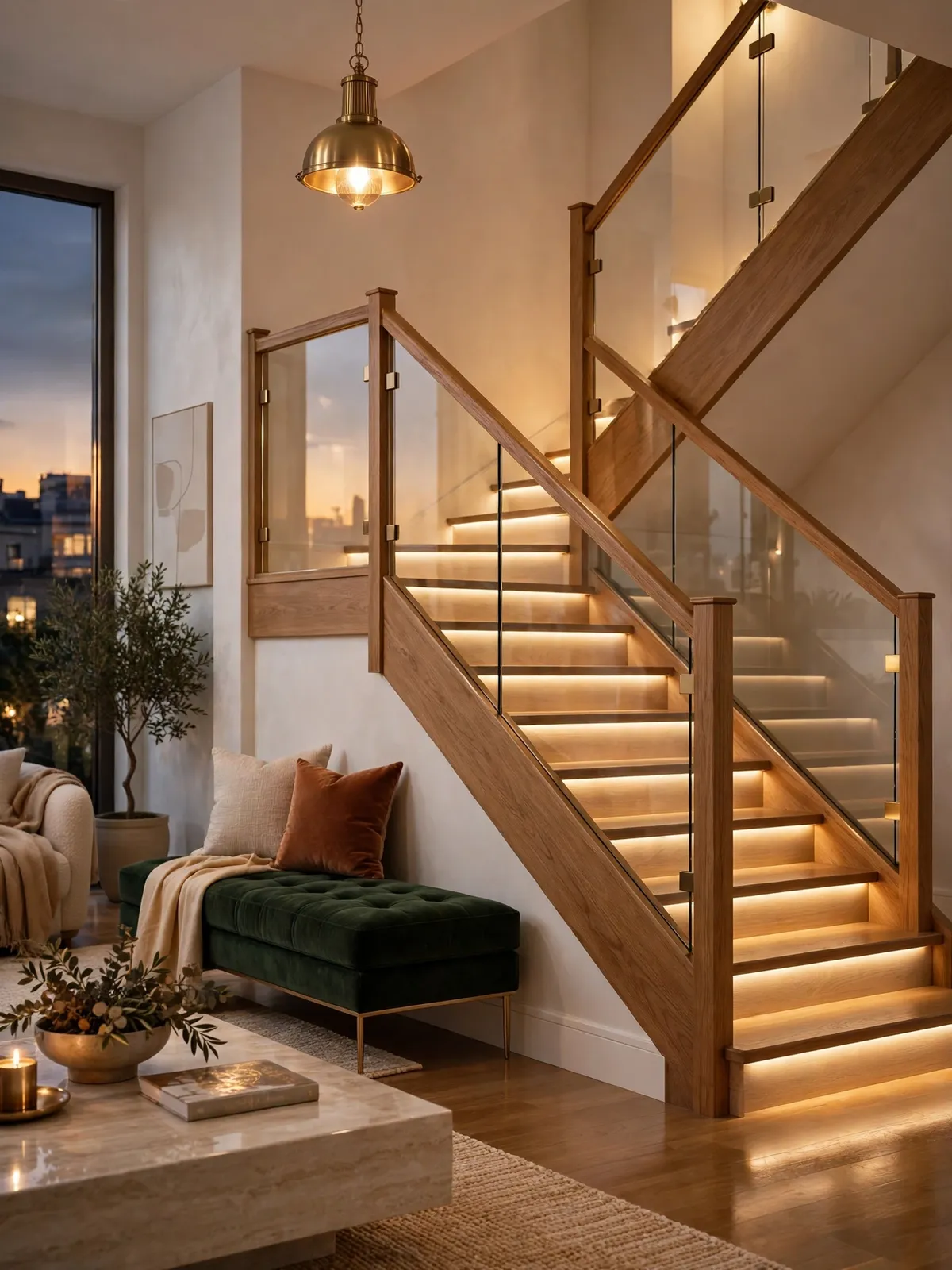
The last of these wooden staircase railing ideas is the principle behind them all: one confident combination — a warm wooden handrail, a light-catching infill and soft lighting — does more than any single feature on its own. Here, a warm oak handrail caps clear glass panels, with warm LED strips glowing under each tread, a deep green velvet bench at the foot of the stairs and a brass pendant overhead. The handrail gives you warmth and grip, the glass keeps the stair open, the lighting shows the grain after dark, and the bench makes the entry a place to pause rather than pass through. That combination is the real lesson of wooden railing design: choose your wood with intent, match or contrast it deliberately, keep the spacing safe, and let the railing frame the stair the way a good frame shows off a picture.
Quick tips:
- Combine a warm handrail, a light infill and soft lighting.
- Choose the wood tone first, then everything else follows.
- Keep baluster spacing safe and perfectly even.
- Test stain samples in the stair’s own light before committing.
FAQs
How much does a wooden staircase railing cost?
A simple wooden railing — painted balusters with a stained handrail — is one of the cheapest stair upgrades, while a curved handrail, glass panels or a full reclaimed-wood rebuild costs several times more. The biggest cost drivers are the handrail profile, the baluster material and the installer: a specialist curved rail or a glass panel run needs a professional, while painting or re-staining is a realistic DIY weekend. Always get a quote that separates materials, labour and finishing before committing.
Can I mix wood and metal in a staircase railing?
Yes, and it is one of the most popular combinations. A wooden handrail with black metal balusters, or a reclaimed wood handrail with iron spindles, gives you the warmth of wood and the crispness of metal in one design. Keep the wood on the handrail and newel posts and the metal on the balusters only, and repeat the metal tone once more nearby — a mirror frame or a light fitting — so the mix looks deliberate.
What stain colour suits a wooden staircase railing?
The right stain depends on your floors and your light. Warm honey oak and medium walnut suit most homes and hide wear well; dark espresso looks dramatic but shows dust; pale ash and natural finishes suit Scandinavian and modern rooms but need regular sealing. Always test the stain on a piece of the same wood species in the stair’s own light, because the same stain looks different on oak, maple and pine.
How do I paint a wooden railing without it looking cheap?
Sand lightly, prime with a wood primer, and use a durable satin or semi-gloss paint — never flat paint on a handrail, because it marks instantly. Paint the balusters white or cream and keep the handrail stained, or paint the whole railing one deep colour such as charcoal or navy for a modern look. Two thin coats beat one thick coat, and a small foam roller gives a smoother finish than a brush on flat balusters.
Is a wooden railing safe for homes with small children?
Yes, provided the baluster spacing is code-compliant — no gap wide enough for a 100 mm sphere to pass through — and the handrail is sturdy and fixed properly. A half-wall base with a wooden topper adds extra safety for toddlers, and a clear matte sealer keeps the wood wipe-clean. Check your local building code before installing, and never rely on a decorative railing as a child’s only guard without confirming it meets the rules.
Conclusion
A wooden staircase railing is the warmest way to frame a staircase, and the right design does three jobs at once: it keeps your family safe, it sets the style of the whole hallway, and it adds natural grain and colour that no other material can match. Whether you choose classic vertical balusters, white spindles with a stained handrail, a curved handrail, glass panels, reclaimed wood or a bold geometric pattern, the rules stay the same — pick a wood you love, match or contrast it deliberately, keep the spacing safe and even, and test your stain in the stair’s own light. Get those four things right and your staircase stops being a passage and becomes the feature your home is remembered for.