24 Stunning Neutral Bathroom Ideas for a Calm, Timeless Space
A neutral bathroom should feel like a deep breath: calm, warm and quietly luxurious, never cold or blank. These 24 neutral bathroom ideas cover walls, floors, vanities, lighting, texture and the small natural layers that keep a pale palette interesting, so you can build a bathroom that feels timeless today and still beautiful in ten years.
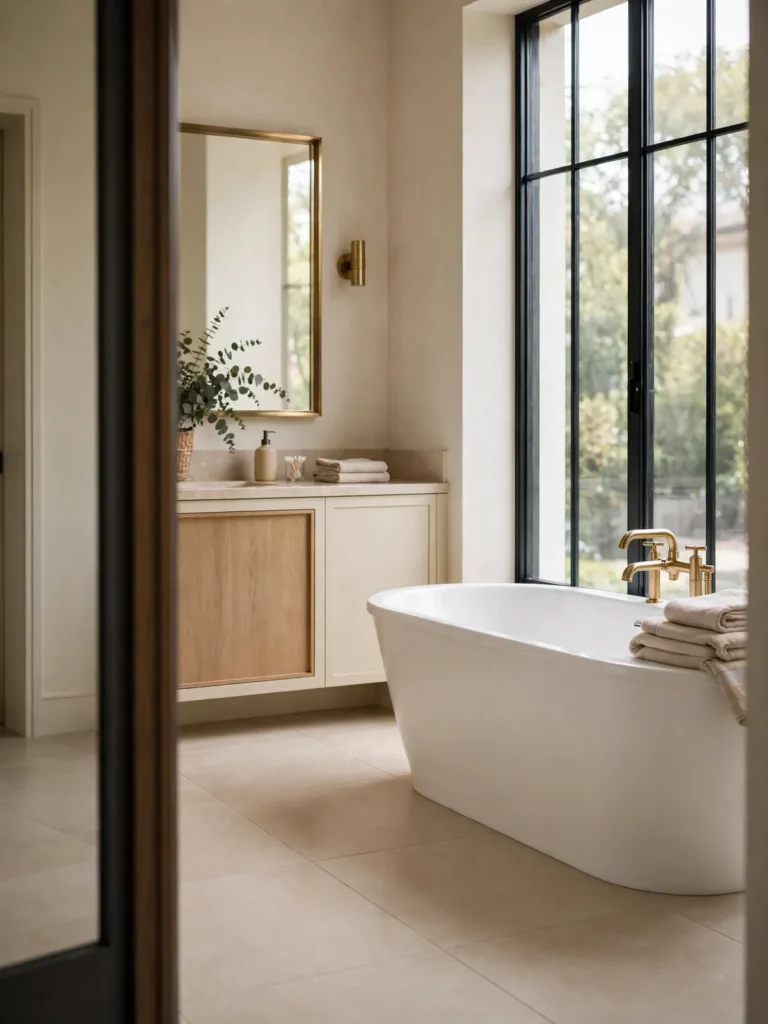
A neutral bathroom works when the palette is quiet but the room is not — warm greige walls, a pale oak vanity, a stone-look shower wall and soft light at the mirror all working together so the space feels calm without feeling empty. The trick is layering: mix warm whites with creamy ivory, add wood and woven texture, and let one material, like travertine or brushed brass, repeat through the room. A great neutral bathroom answers the question “how do I make beige feel luxurious?” in the first glance, and the 24 ideas below show exactly how, with a style guide in the middle to help you pick your direction.
If your bathroom is small as well as neutral, these cozy bathroom ideas show how to make a compact footprint feel warm and generous. Every idea includes a concrete example with real materials, colours and fixtures, so you can start with one change this weekend or plan a full refresh.
Key Takeaways
What colours make a neutral bathroom?
A neutral bathroom uses warm whites, greige, creamy ivory, soft taupe, gentle grey and pale stone, with natural wood and one muted accent such as olive, clay or dusty charcoal. Choose shades with warm undertones so the room feels inviting rather than clinical, and repeat two or three related tones around the room instead of mixing many different whites.
How do I stop a neutral bathroom feeling boring?
Layer texture instead of adding colour: a stone-look shower wall, a linen curtain, a woven basket, a wood vanity and a curved mirror give the eye plenty to notice while the palette stays quiet. Add one living plant and warm lighting, and the room feels calm and interesting at the same time.
What is the best flooring for a neutral bathroom?
Large-format porcelain tiles in a warm stone or greige tone work best for a neutral bathroom, because fewer grout lines make the floor look seamless and the room feel bigger. Pale oak-look planks or travertine-look tiles are good alternatives, and underfloor heating underneath makes pale floors comfortable barefoot.
Should a neutral bathroom have warm or cool lighting?
Warm lighting suits a neutral bathroom best, around 2700K, because it flatters skin, warms up pale walls and makes stone and wood glow. Layer it — sconces at face level by the mirror, a dimmable ceiling light, and a soft glow near the tub — so the room works for bright mornings and slow evenings alike.
How much does a neutral bathroom refresh cost?
A cosmetic neutral bathroom refresh — paint, a larger mirror, new hardware, linen curtains and fresh towels — can cost very little and change the whole room in a weekend. A mid-range refresh with a floating vanity, stone-look shower tiles and a stone vanity top costs more, while a full renovation with a freestanding tub, microcement walls and underfloor heating is a major investment best planned in stages.
Paint the Walls a Warm Greige That Never Feels Stark
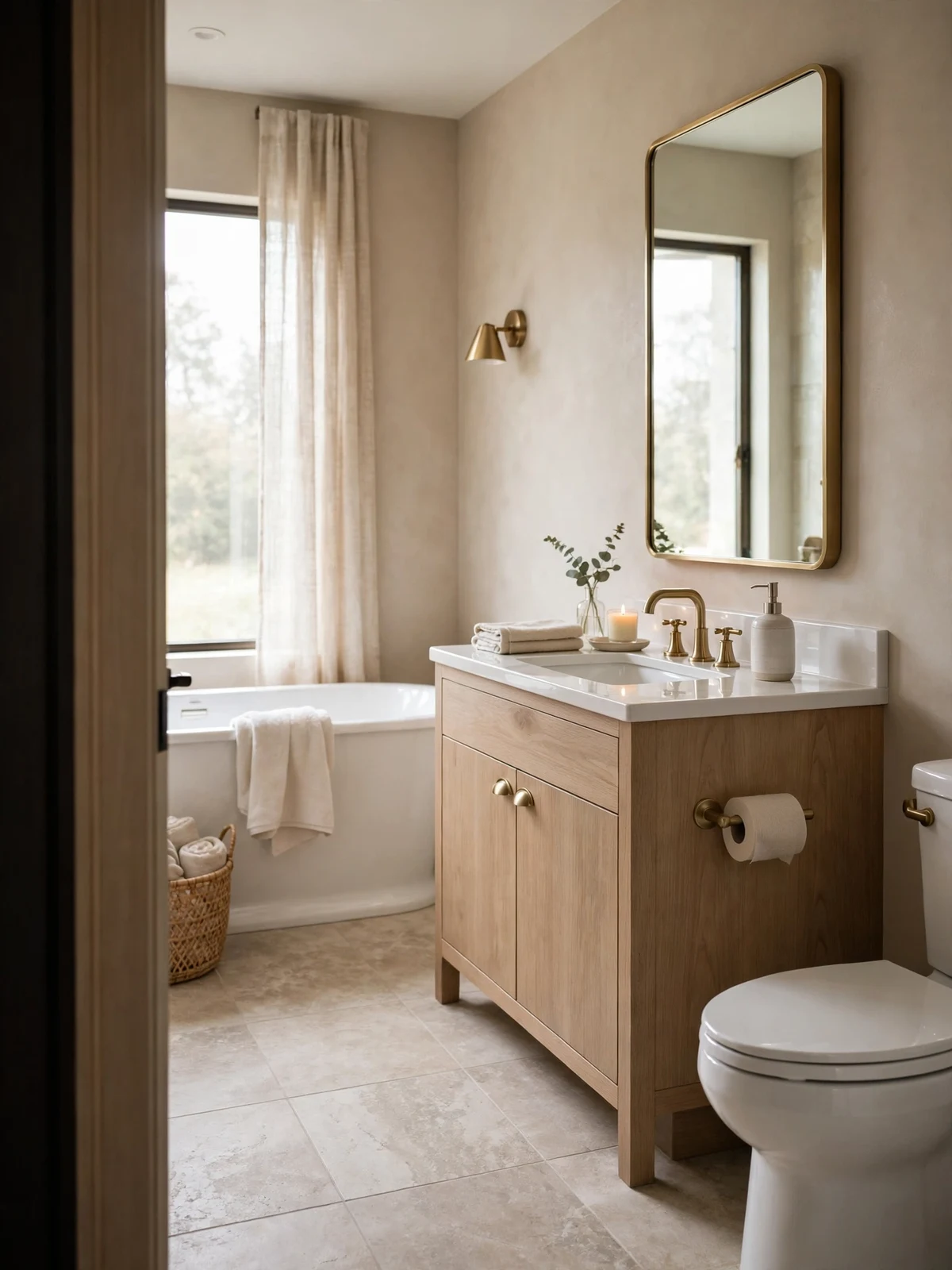
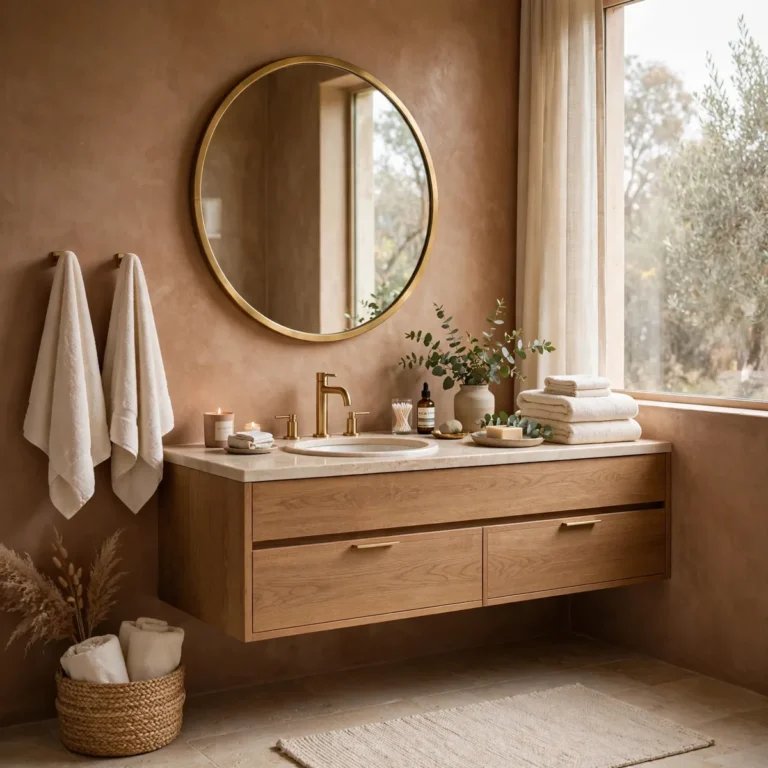
Warm greige — the soft middle ground between grey and beige — is the single most forgiving wall colour for a neutral bathroom, because pure white can feel stark under bathroom lighting while greige warms the whole room without committing it to any one colour. Here, greige walls with a warm undertone sit behind white sanitaryware, brushed brass taps and a light oak vanity, with stone-look floor tiles grounding the palette. The design suits any bathroom, especially north-facing rooms that feel cold, and it costs the price of a tin of paint. The weakness is undertone: a greige with a cool or pink cast can look muddy in artificial light, so test a large swatch on the wall before committing.
Quick tips:
- Choose a greige with a warm, yellow-beige undertone.
- Paint the ceiling soft white to keep the room bright.
- Use the same greige on the trim for an enveloping look.
- Test a large swatch in morning and evening light first.
A Floating Oak Vanity That Makes the Floor Feel Bigger
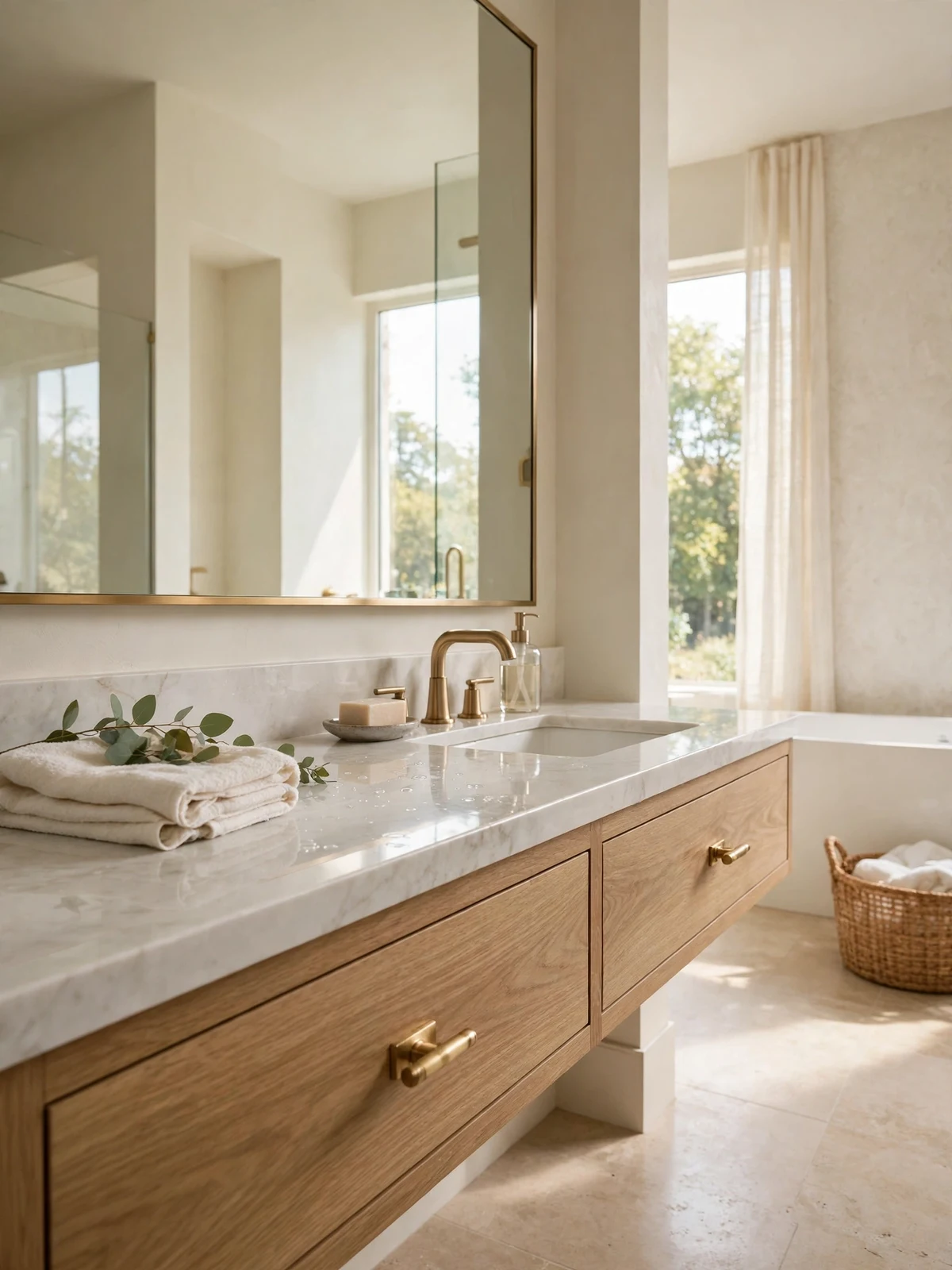
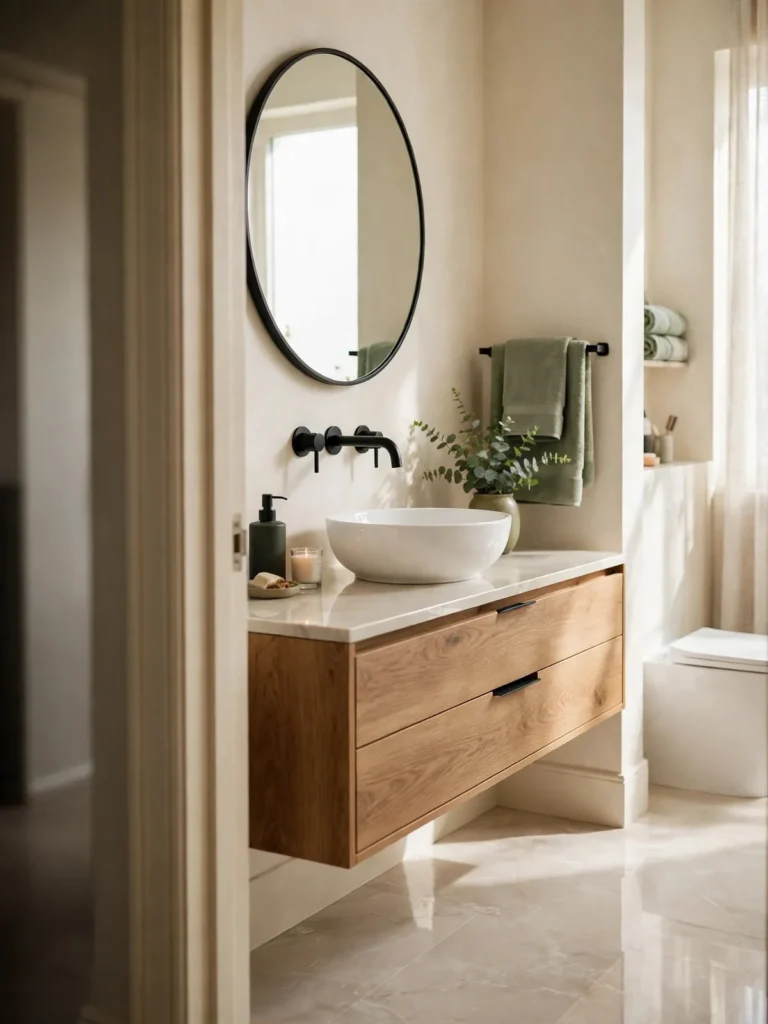
A floating oak vanity brings natural warmth into a neutral bathroom while making the room feel larger, because the visible floor underneath tricks the eye into reading more space, and the wood grain adds interest without introducing a loud colour. Here, a light oak vanity floats above pale stone floor tiles, topped with a white quartz countertop and simple brushed brass pulls, against cream walls. The design suits small and medium bathrooms best, it pairs beautifully with warm white walls, and it keeps cleaning the floor easy. The weakness is storage: a floating vanity usually holds less than a floor-standing one, so add a basket or a slim shelf for backup supplies.
Quick tips:
- Choose light or medium oak so the grain stays visible.
- Keep the countertop plain white so the wood is the star.
- Match the hardware finish to the taps.
- Add a basket underneath for spare towels.
A Stone-Look Shower Wall as the Room’s Quiet Focal Point
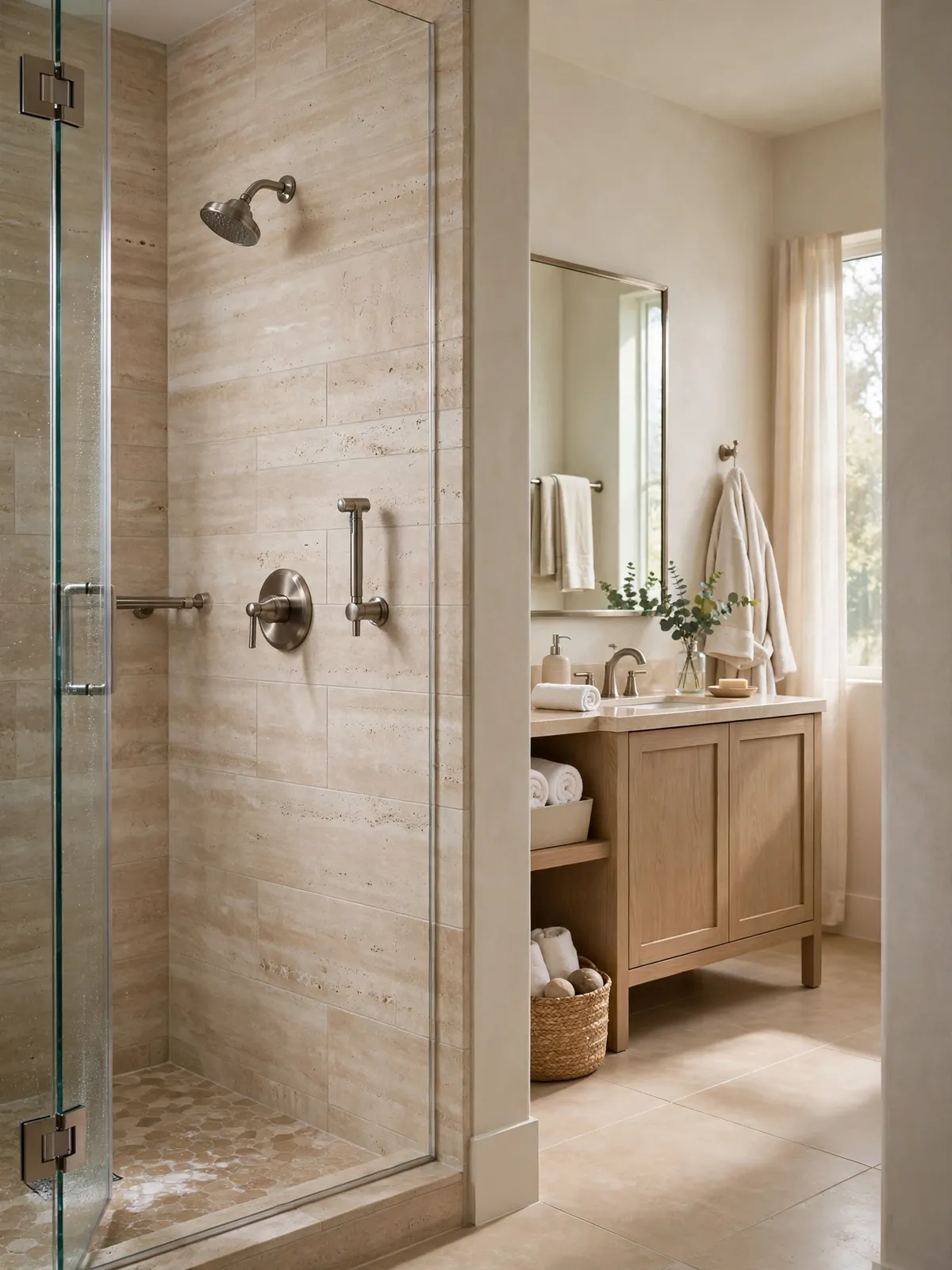
A stone-look shower wall gives a neutral bathroom a focal point without a single bold colour, because soft travertine or limestone veining adds quiet movement to the largest surface in the room. Here, large-format porcelain tiles with gentle beige veining run floor to ceiling in the shower, behind a frameless glass door with brushed nickel fixtures, while warm beige floor tiles tie the rest of the room together. The design suits any bathroom with a shower, and porcelain gives the stone look with far easier maintenance than real stone. The weakness is drama: strong, dark veining would dominate the room, so choose patterns with soft, gentle movement.
Quick tips:
- Choose porcelain with soft, gentle veining, not dramatic streaks.
- Run the stone-look tile floor to ceiling for a taller feel.
- Keep the fixtures simple so the stone is the focus.
- Seal grout well so the pale wall stays clean.
An Oversized Mirror That Doubles the Light
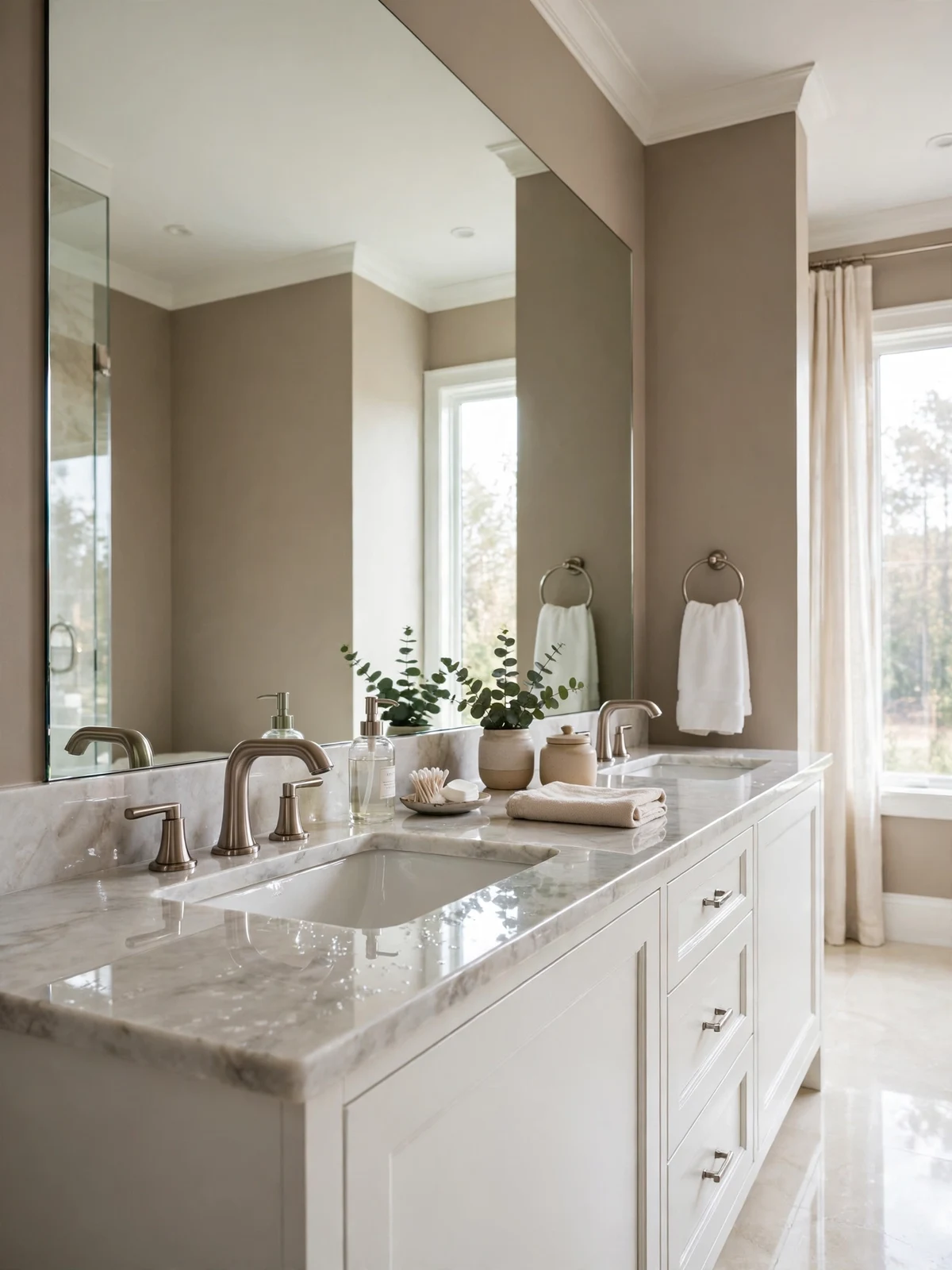
An oversized mirror is the fastest upgrade in a neutral bathroom, because a mirror that spans most of the vanity reflects light, doubles the sense of space and turns a functional rectangle into a major visual element. Here, a wide frameless mirror runs almost edge to edge above a white vanity, reflecting warm taupe walls and brushed nickel taps and making the whole room feel brighter. The design suits every bathroom, especially small or windowless ones, and swapping a small mirror for a large one is a one-afternoon job. The weakness is maintenance: a large mirror shows every splash and smear, so keep a microfibre cloth in the vanity and wipe it daily.
Quick tips:
- Size the mirror to nearly the width of the vanity.
- Choose frameless for a clean look or a thin wood frame for warmth.
- Hang it at face level, not too high.
- Wipe splashes daily so the large surface stays clear.
Layer Warm White and Creamy Ivory for Real Depth
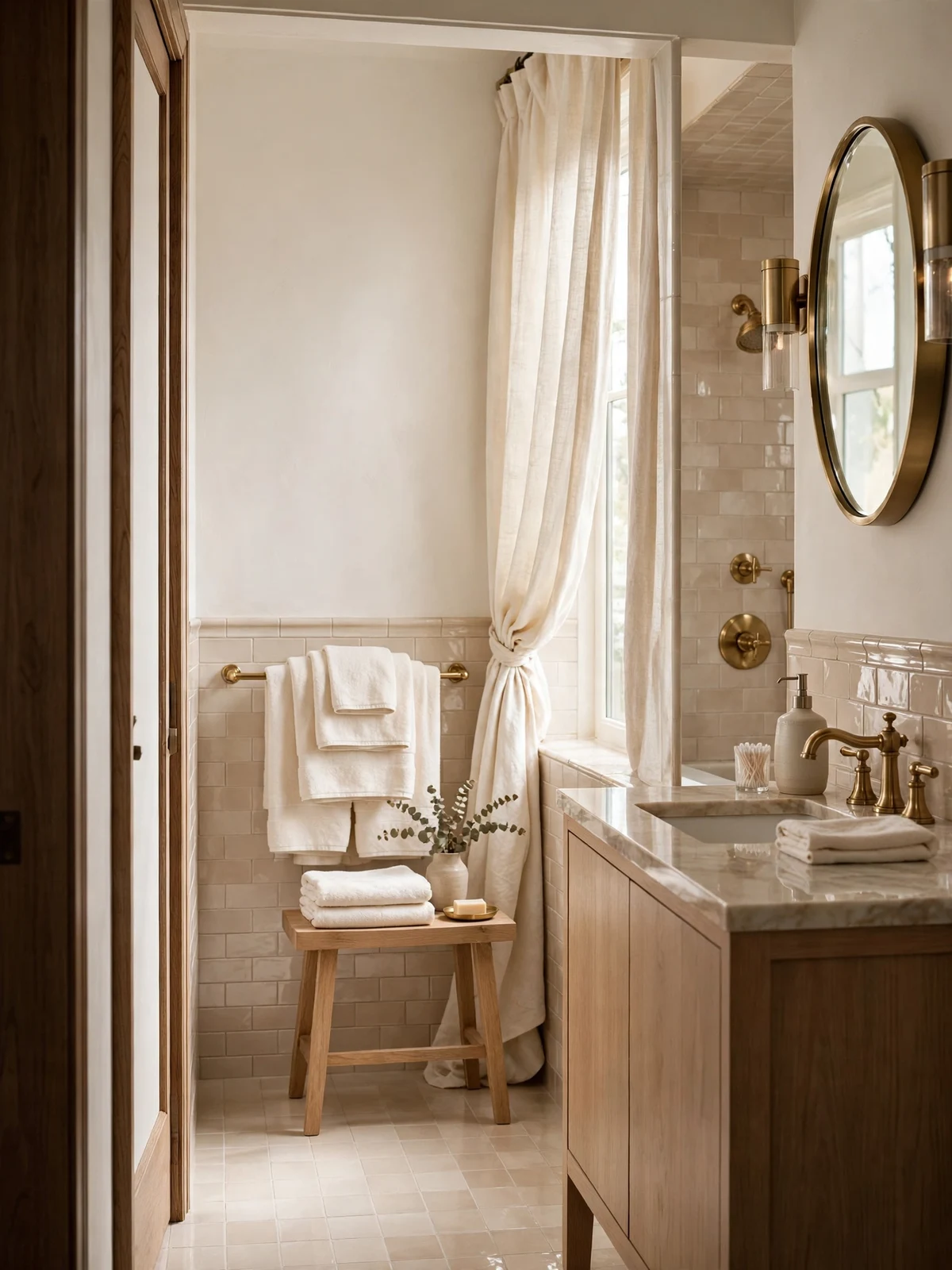
Warm white and creamy ivory sound almost identical, but layered together they give a neutral bathroom real depth, because the subtle difference between the wall colour and the textiles stops the whole room blending into one flat block. Here, warm white wall tiles meet ivory linen towels, a cream shower curtain and a soft beige floor, with a light wood stool and brushed brass fixtures adding warmth. The design suits any pale bathroom that feels flat or washed out, and it costs nothing more than choosing towels in a slightly different shade. The weakness is clashing undertones: some whites lean blue, others yellow or pink, so stick to two or three related warm shades and repeat them.
Quick tips:
- Use warm white on walls and ivory in towels and curtains.
- Repeat each shade at least twice around the room.
- Avoid mixing whites with very different undertones.
- Add one wood tone to anchor the pale palette.
Swap Busy Hardware for Simple Brushed Brass Fixtures
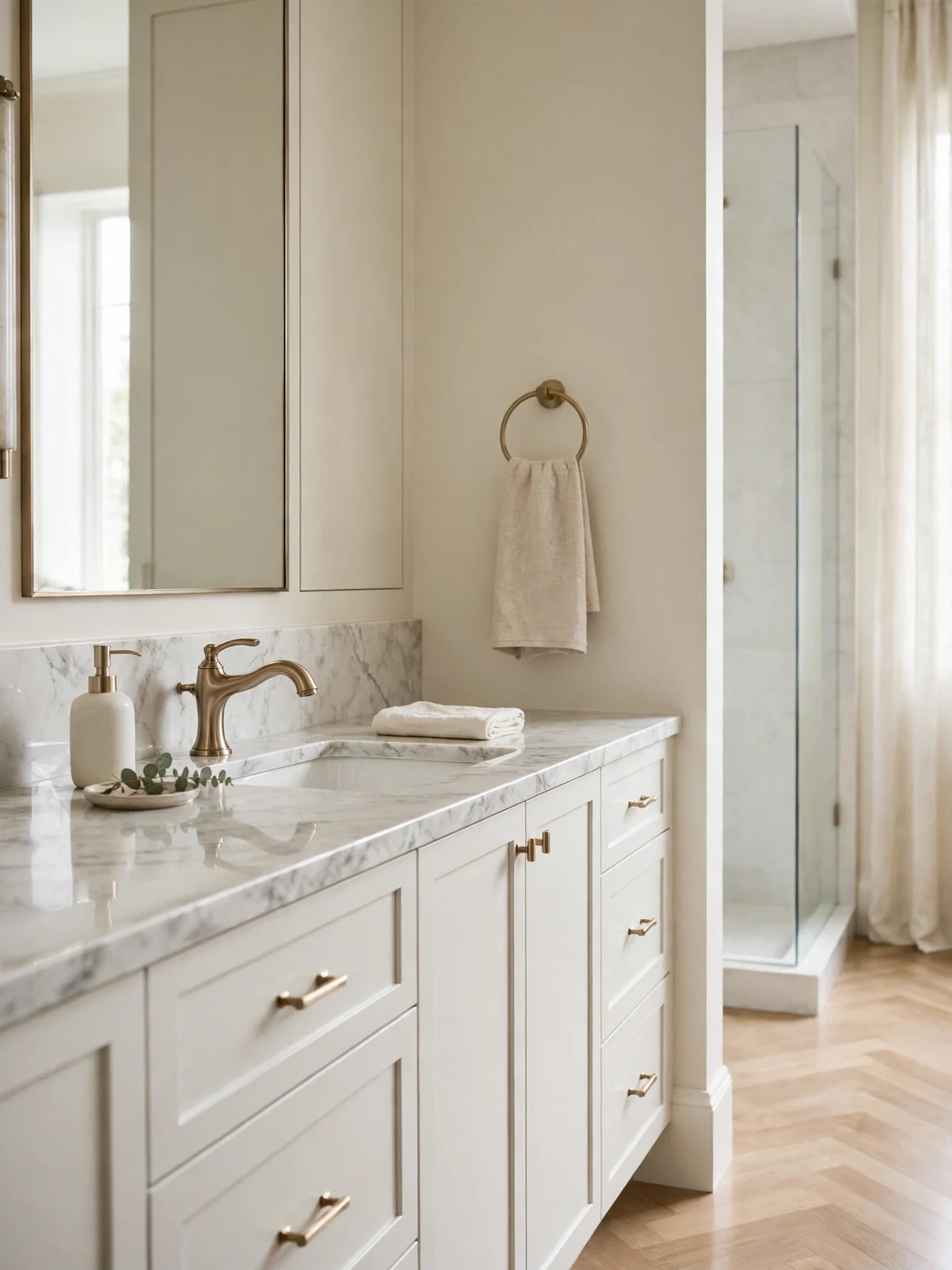
The easiest way to create a neutral bathroom is often to remove visual noise, and swapping ornate handles, fussy taps and complicated towel bars for clean-lined hardware lets the tiles, stone and wood shine instead. Here, brushed brass taps, slim cabinet pulls and a simple towel ring in one consistent finish sit against cream walls and a marble-look countertop, with nothing competing for attention. The design suits any bathroom, especially rooms that already have neutral tiles and cabinetry, and it is a weekend job. The weakness is mixing metals: two or three unrelated finishes make the room look accidental, so commit to one dominant metal throughout.
Quick tips:
- Pick one dominant metal finish and use it everywhere.
- Brushed brass warms pale rooms; brushed nickel suits cooler ones.
- Choose clean, straight lines over ornate shapes.
- Replace the towel ring and robe hook to match.
A Freestanding Stone Tub as a Sculptural Centrepiece
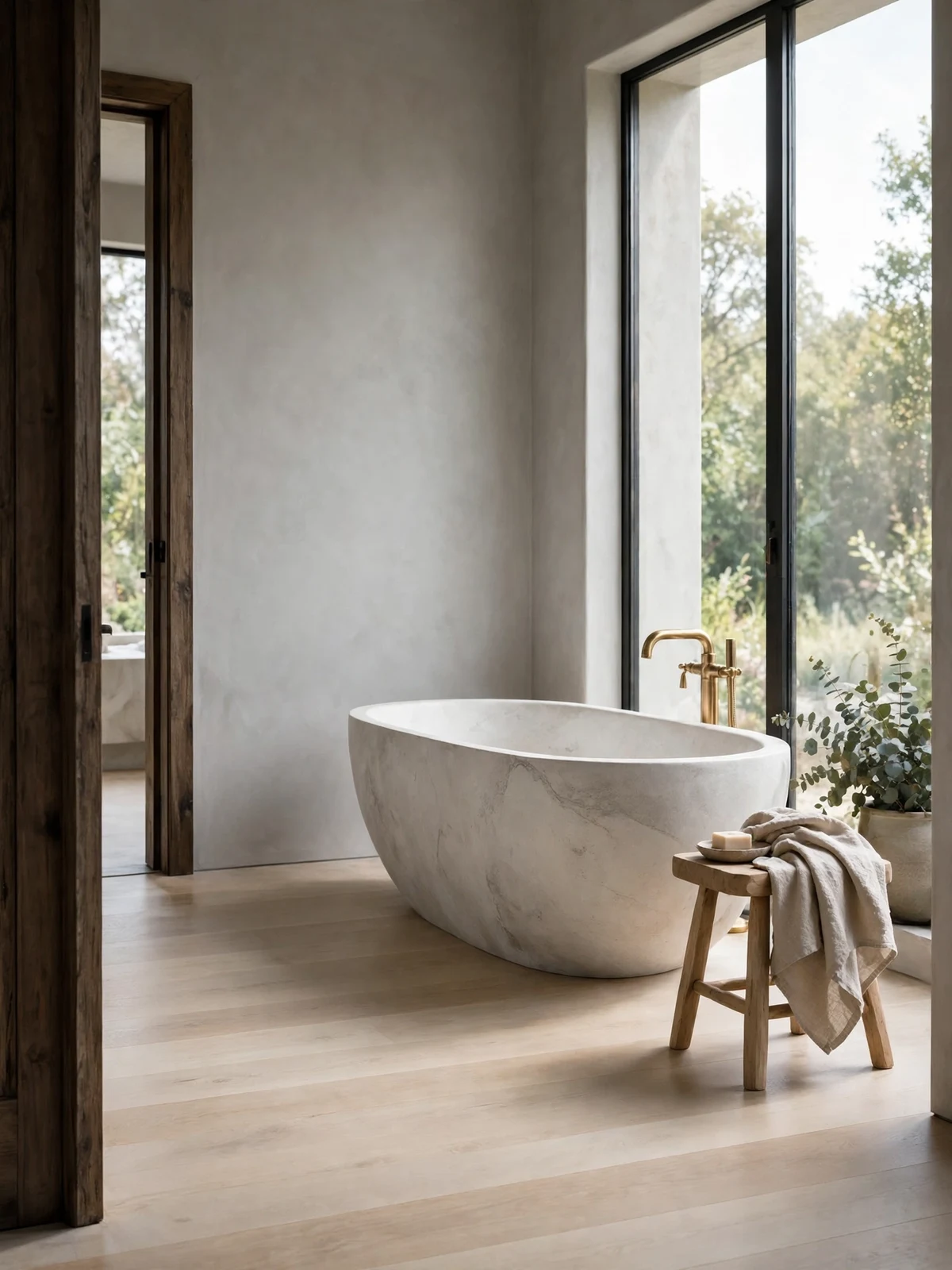
A freestanding tub turns a neutral bathroom into a spa, because a simple white or soft-stone tub with gentle curves becomes a sculptural centrepiece that needs no colour to make an impression. Here, a white freestanding tub sits near a large window on a pale wood floor, with soft grey walls, a brushed brass floor-mounted tap and a linen towel folded on a nearby stool. The design suits larger bathrooms best, and it works beautifully as the room’s single statement piece. The weakness is cost and space: a stone tub is expensive and heavy, and a small bathroom cannot spare the floor, so a standard white acrylic freestanding tub gives a similar look for far less.
Quick tips:
- Place the tub near a window so daylight highlights its shape.
- Choose gentle curves over complicated silhouettes.
- Keep the area around the tub uncluttered.
- Try a white acrylic model first if a stone tub is out of reach.
A Linen Shower Curtain That Softens Hard Tile
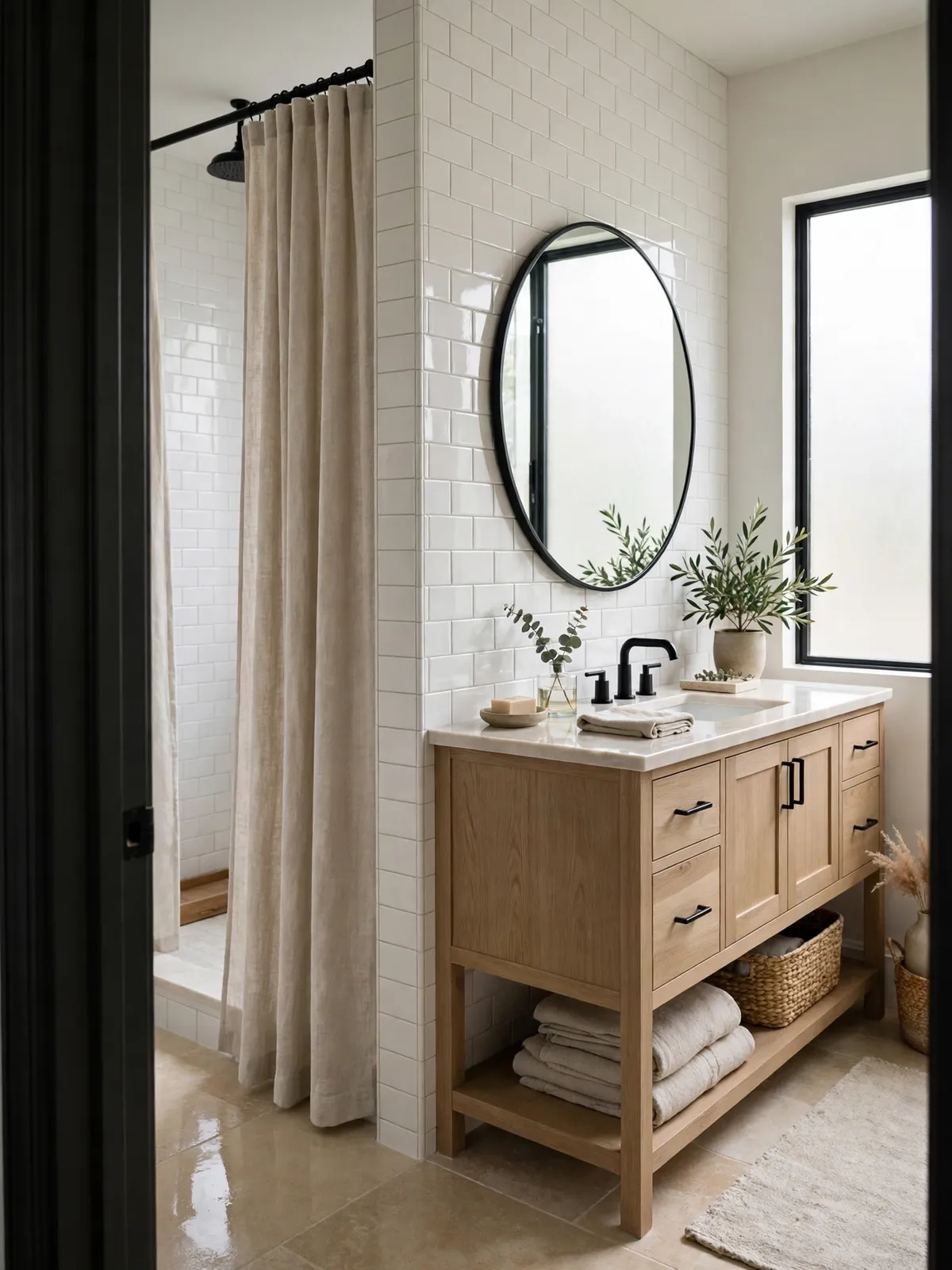
A linen shower curtain softens a neutral bathroom in a way tile and glass never can, because fabric introduces movement and warmth into a room full of hard surfaces, and oatmeal, ivory or flax shades stay firmly within the palette. Here, an oatmeal linen-look curtain hangs from a matte black rod against white subway tiles, with a light oak vanity tying the warm tones together. The design suits any bathroom with a tub or shower, it is a one-hour change, and it adds texture without touching the tile. The weakness is damp: fabric in a steamy room needs a waterproof liner and regular washing, or it mildews.
Quick tips:
- Choose oatmeal, ivory, flax or soft beige linen.
- Always use a waterproof liner behind the fabric.
- Keep the curtain simple if the tile already has texture.
- Wash the curtain and liner regularly.
Open Shelves Styled With Restraint
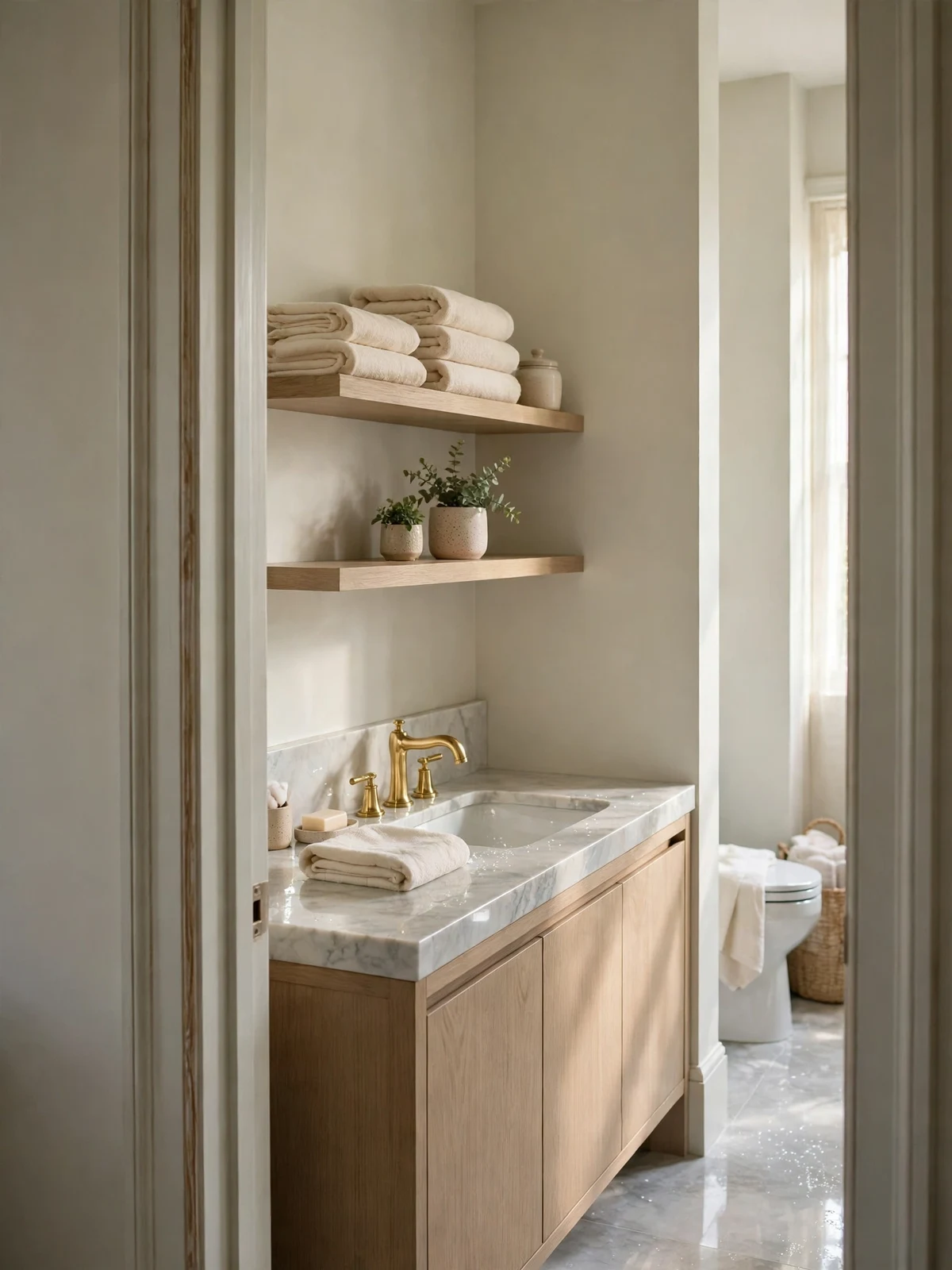
Open shelves make a neutral bathroom feel warm and lived-in, but only when they are styled with restraint, because a shelf treated like a storage closet looks cluttered while a shelf with three or four beautiful things looks intentional. Here, two slim light oak shelves hold folded cream towels, a small ceramic jar and one tiny green plant against pale greige walls, with everything else hidden behind cabinet doors. The design suits bathrooms with a spare wall above the toilet or beside the vanity, and it adds warmth for very little money. The weakness is dust and steam: open towels collect both, so keep the shelf away from the toilet and wash display towels regularly.
Quick tips:
- Install one or two slim shelves, not a whole wall.
- Display only towels, one basket and one plant.
- Hide less attractive essentials behind cabinet doors.
- Keep the shelf away from direct shower spray.
Curved Shapes That Soften Every Straight Line
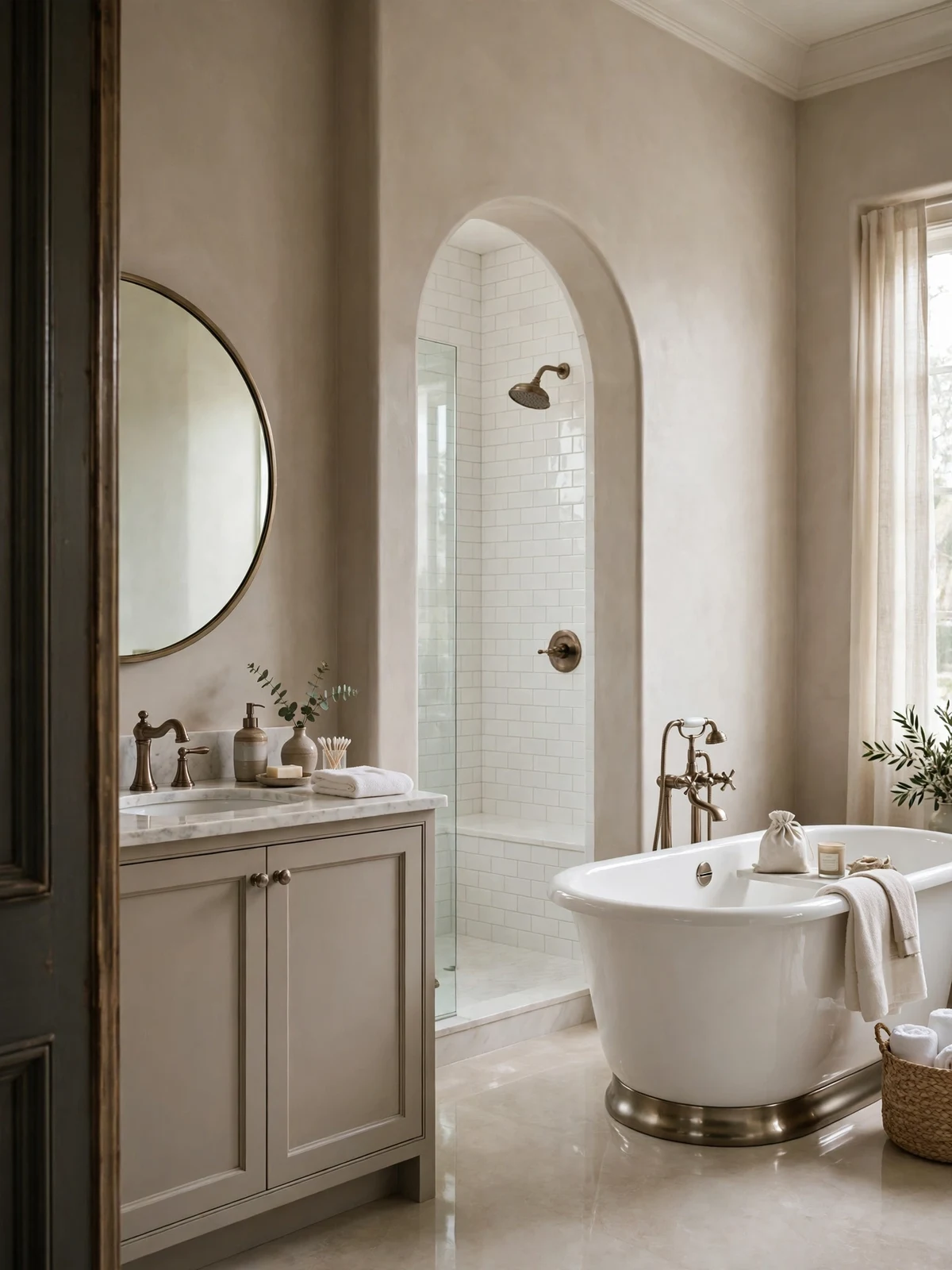
Bathrooms are full of rectangles — tiles, vanities, mirrors, doors — and a few curved shapes soften all those straight lines, making a neutral bathroom feel relaxed instead of rigid. Here, a round mirror, an arched shower opening and an oval freestanding tub work together against soft mushroom walls, with brushed bronze fixtures warming the pale room. The design suits any bathroom, and it is especially effective in rooms with lots of rectangular tile. The weakness is overdoing it: too many curves in one room look fussy, so start with one curved mirror and repeat the curve once in a small accessory.
Quick tips:
- Start with one curved mirror above the vanity.
- Repeat the curve in a tap, a light or a stool.
- Keep the rest of the architecture simple and straight.
- Choose rounded hardware where it suits the style.
A Seamless Microcement Finish for a Modern Calm
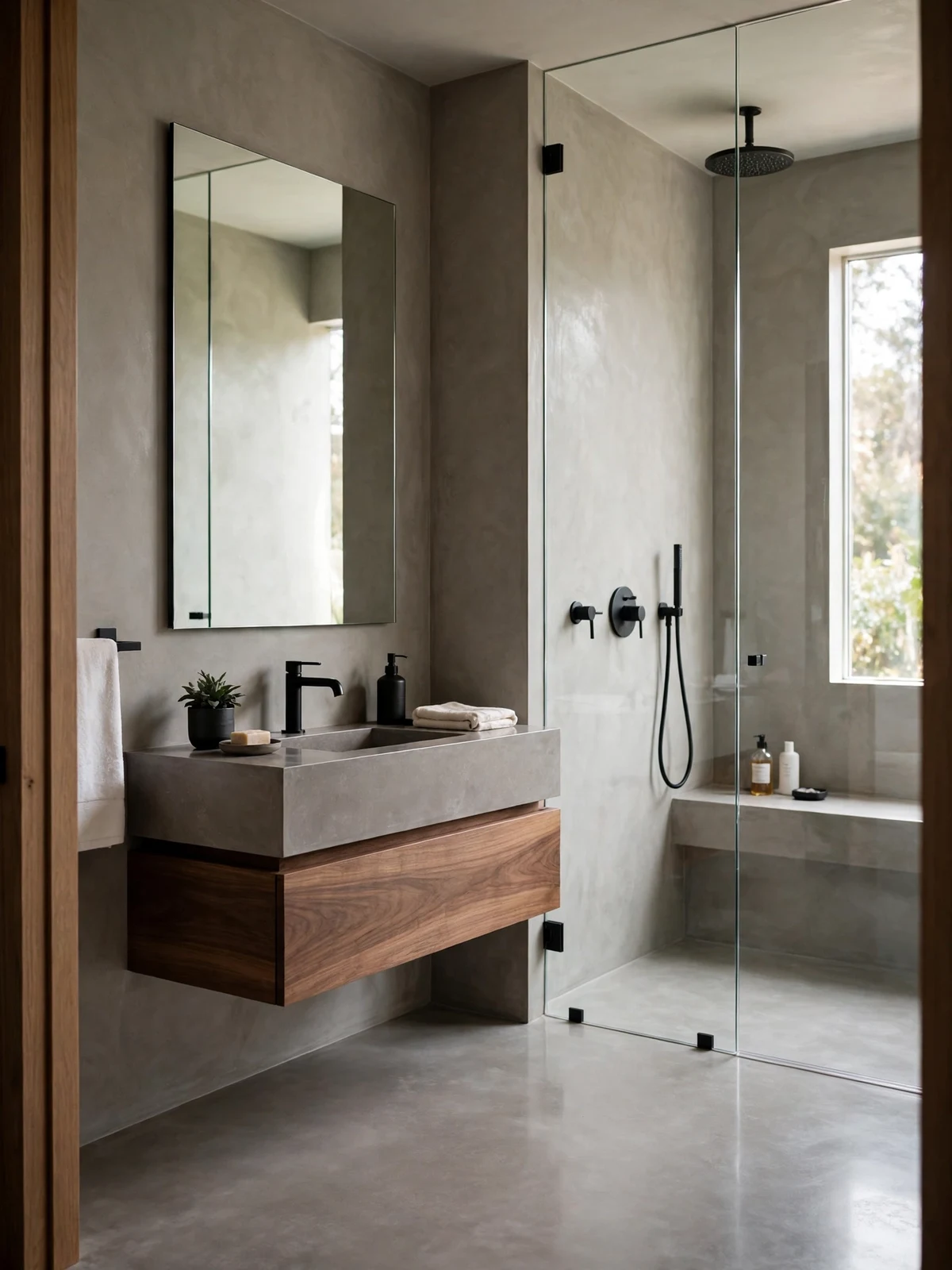
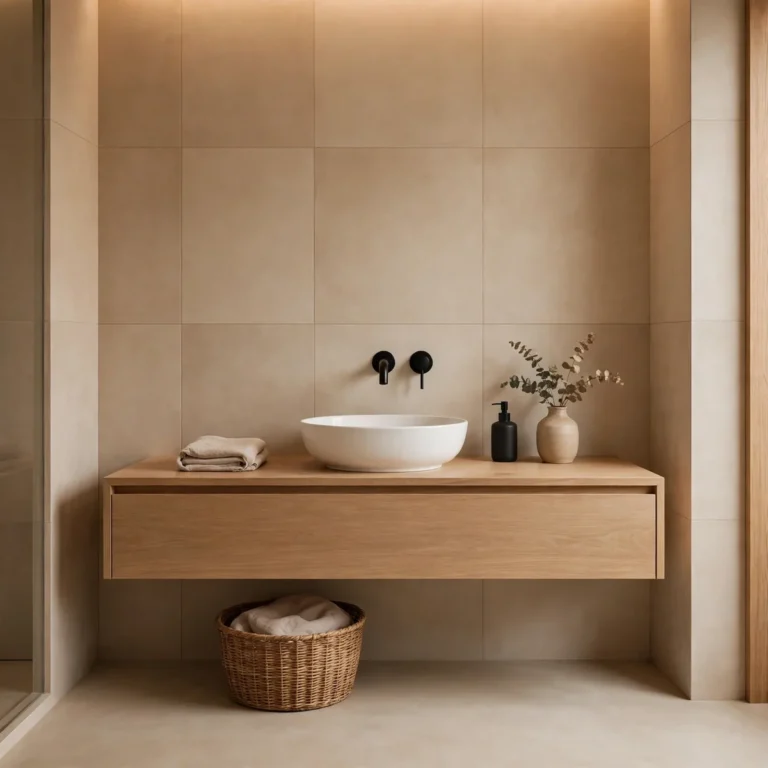
Microcement gives a neutral bathroom a nearly seamless finish, because the continuous surface has almost no grout lines or joints to break the eye, creating a wonderfully quiet backdrop in soft grey-beige, warm stone or mushroom tones. Here, warm stone-grey microcement covers the walls of a modern bathroom, with a floating walnut vanity, a frameless glass shower and matte black fixtures providing the only contrast. The design suits modern, Japandi and minimalist bathrooms best, and it works beautifully in wet rooms. The weakness is installation: microcement needs a skilled applicator and proper sealing, so it is not a DIY job and costs more than tile.
Quick tips:
- Choose warm stone, mushroom or soft grey-beige tones.
- Use it on walls and floors for a fully seamless look.
- Hire a specialist applicator and seal it properly.
- Pair it with one warm wood tone to avoid a cold feel.
Choose Your Neutral Bathroom Style Before You Buy Anything
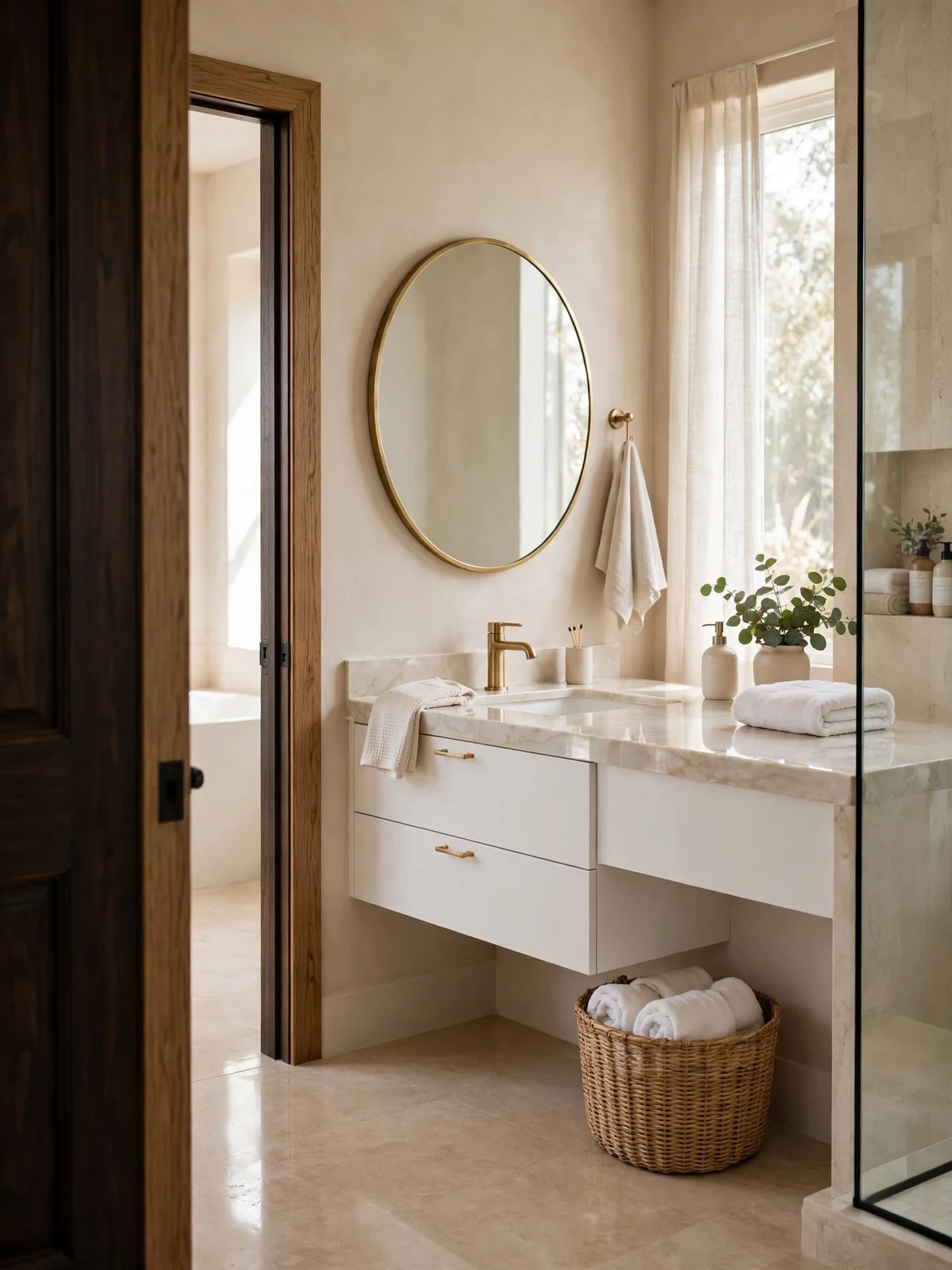
Choosing one clear neutral bathroom style before buying anything saves money and prevents the mismatched look that comes from five good ideas competing in one room, because a defined style decides the palette, the fixtures and the accessories for you. Here, a warm modern neutral bathroom shows how it works: soft beige walls, a white floating vanity, brushed brass fixtures, a large round mirror and a woven basket, all pulling in the same direction. The design suits anyone starting a refresh from scratch, and it makes every later decision easy — if it does not fit the style, it does not go in the room. The weakness is rigidity: a style followed too strictly can feel like a showroom, so leave room for one personal item, like a framed print or a favourite vase.
Quick tips:
- Pick the style that matches the rest of your home.
- Write the palette down before you buy anything.
- Keep the fixtures in one finish throughout.
- Allow one personal item so the room does not feel staged.
| Neutral bathroom style | Best for | Colours | Budget level |
|---|---|---|---|
| Warm Modern | Small rooms, easy cleaning, timeless look | Greige, white, oak, brushed brass | Low to medium |
| Spa Sanctuary | Large rooms, slow mornings, luxury feel | Stone, cream, taupe, soft grey | Medium to high |
| Japandi Calm | Minimalists, clutter-free living | Warm white, mushroom, walnut, black | Medium |
| Classic Traditional | Period homes, formal hosting | Ivory, navy accent, marble, brass | Medium to high |
| Coastal Neutral | Light-filled rooms, beach houses | Sand, soft white, driftwood, pale blue | Low to medium |
One Leafy Green Plant for Living Colour
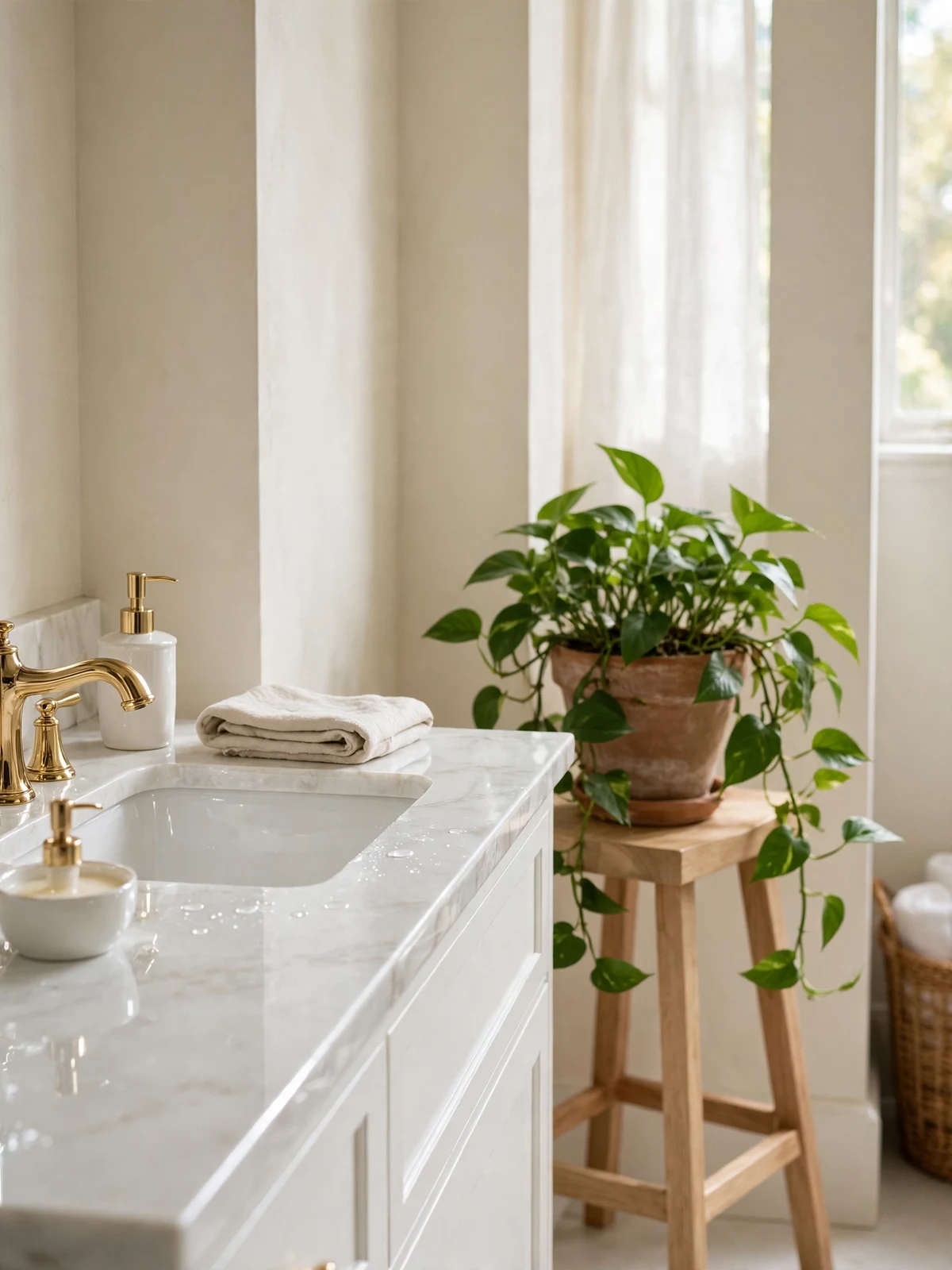
A single leafy green plant is the easiest way to add colour to a neutral bathroom, because the green reads as a natural accent that works with beige, cream, white and wood, and it keeps the palette from feeling flat without breaking it. Here, a trailing pothos in a terracotta pot sits on a light wood stool beside a white vanity, against cream walls, adding life to an otherwise pale room. The design suits any bathroom with a little light, and humidity-loving plants thrive in the steam. The weakness is light: a plant in a windowless bathroom will struggle, so choose a low-light variety or a good-quality faux plant instead.
Quick tips:
- Choose humidity-loving plants like pothos or ferns.
- Place the plant on a stool, shelf or windowsill.
- Use a terracotta or ceramic pot that suits the palette.
- Rotate the plant occasionally so it grows evenly.
A Warm-Toned Stone Vanity Top With Soft Veining
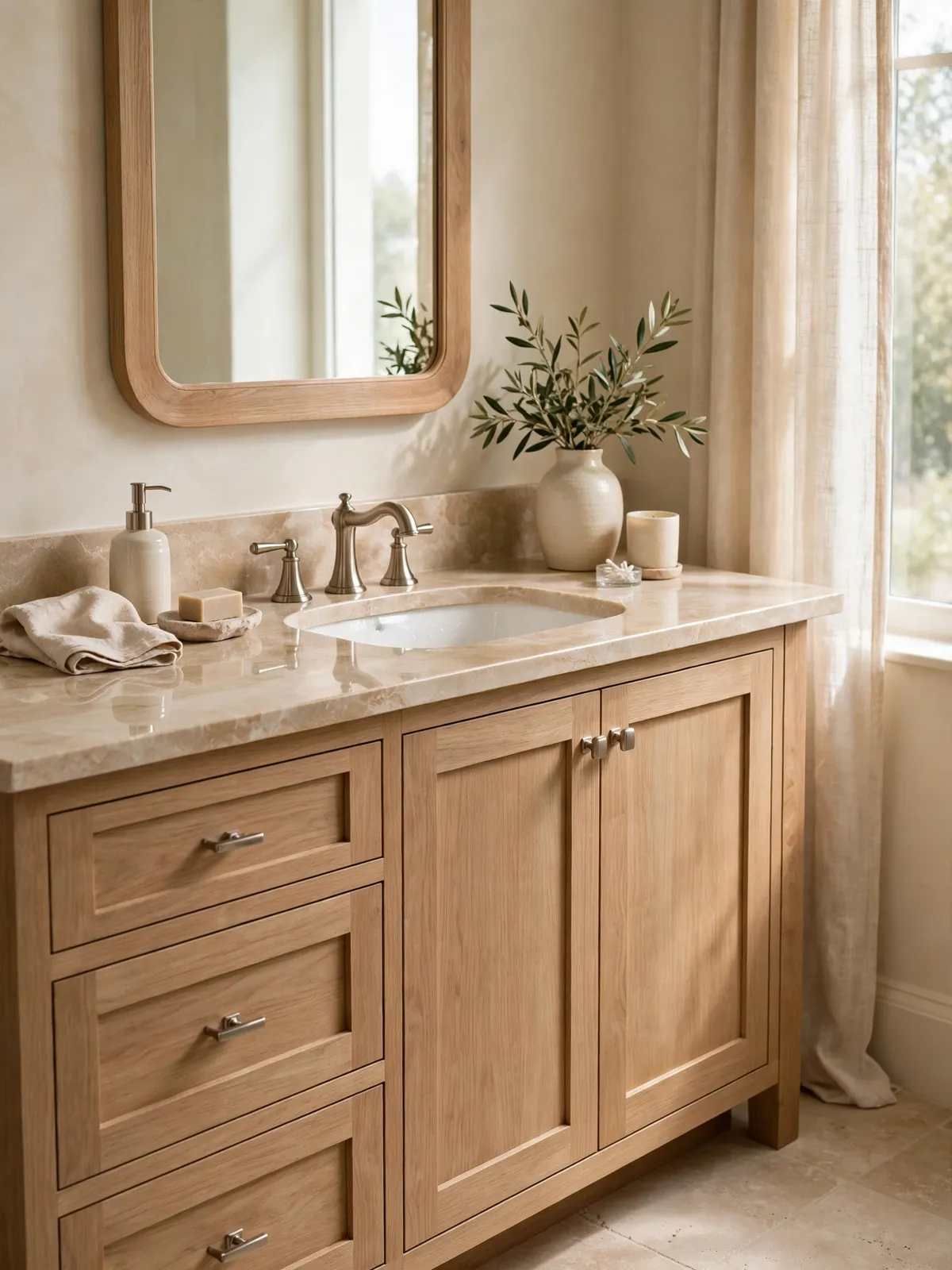
A warm-toned stone vanity top gives a neutral bathroom a refined finish, because creamy limestone, marble or quartzite with soft beige movement adds quiet luxury to the surface you touch every day. Here, a limestone-look quartz countertop with gentle taupe veining sits on a light wood vanity, with brushed nickel taps and cream walls keeping the composition calm. The design suits any bathroom, and it is one of the most noticeable upgrades in a small room. The weakness is balance: if the floor already has strong variation, a busy countertop will crowd the room, so choose a quiet top with a patterned floor, or a little more movement with a plain floor.
Quick tips:
- Choose creamy backgrounds with soft beige or taupe movement.
- Keep veining subtle so the top stays quiet, not dominant.
- Match the countertop tone to the floor, not against it.
- Seal natural stone so water and cosmetics do not stain it.
Natural Decorative Layers That Finish the Room
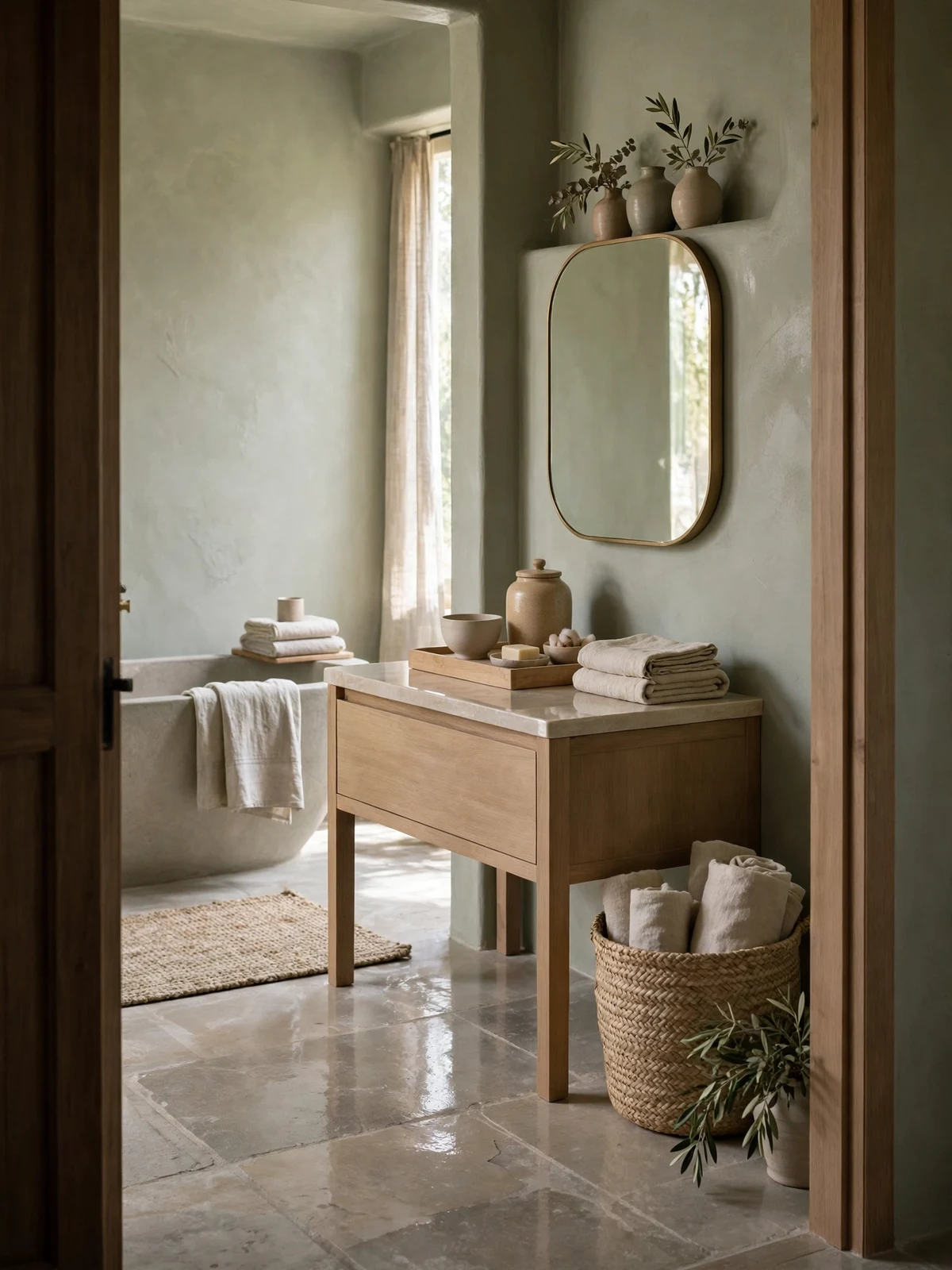
Natural decorative layers are what finish a neutral bathroom, because woven baskets, linen towels, light wood and ceramic vessels add personality while staying firmly within a quiet palette. Here, a seagrass basket holds rolled towels beside linen hand towels, ceramic vessels and a light wood tray, against soft sage walls and pale stone tiles. The design suits any neutral bathroom that feels finished but flat, and it is the cheapest layer to add. The weakness is clutter: too many decorative objects turn a calm room into a display shelf, so start with the biggest surfaces first and add small layers last.
Quick tips:
- Layer baskets, linen, wood and ceramic, not all at once.
- Start with the biggest surfaces, then add small details.
- Muted olive, dusty clay or soft charcoal all count as neutral.
- Keep surfaces mostly clear so each layer can breathe.
Warm Layered Lighting That Flatters at Every Hour
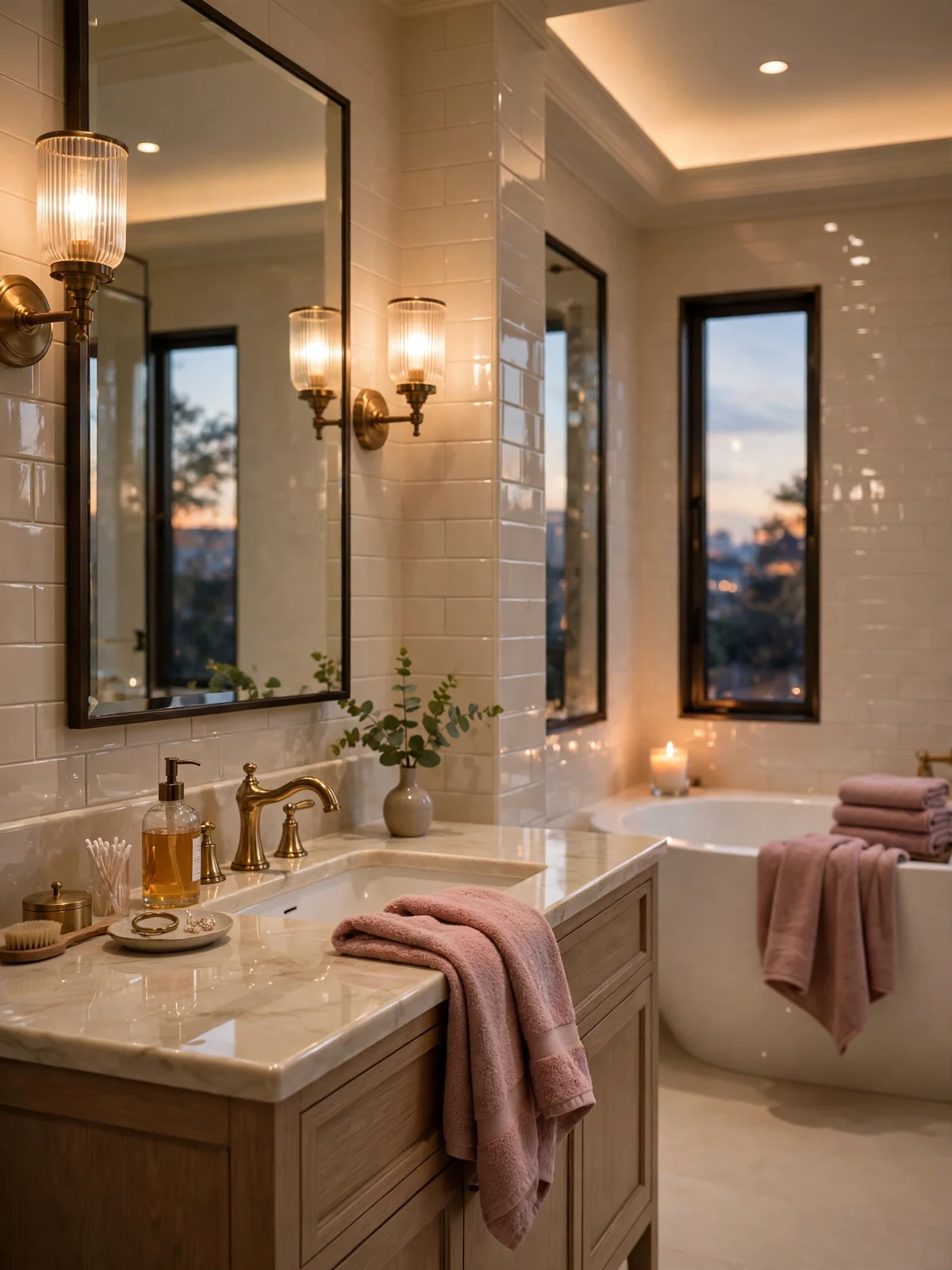
Warm layered lighting is what makes a neutral bathroom feel luxurious at every hour, because face-level sconces flatter the skin, a dimmable ceiling light handles bright mornings, and a soft glow near the tub turns an evening bath into a ritual. Here, two warm sconces flank a large mirror over a cream-tiled vanity, with dusty rose towels and a lit candle near the tub completing the warm evening mood. The design suits every bathroom, and it matters most in windowless rooms where artificial light does all the work. The weakness is temperature: cool white bulbs make pale walls look grey and clinical, so choose warm bulbs around 2700K and dimmers throughout.
Quick tips:
- Put sconces at face level, not above the mirror.
- Choose warm bulbs around 2700K for flattering light.
- Add a dimmer so the room works morning and evening.
- Use a soft glow near the tub for relaxing baths.
Large-Format Floor Tiles That Make a Small Room Feel Bigger
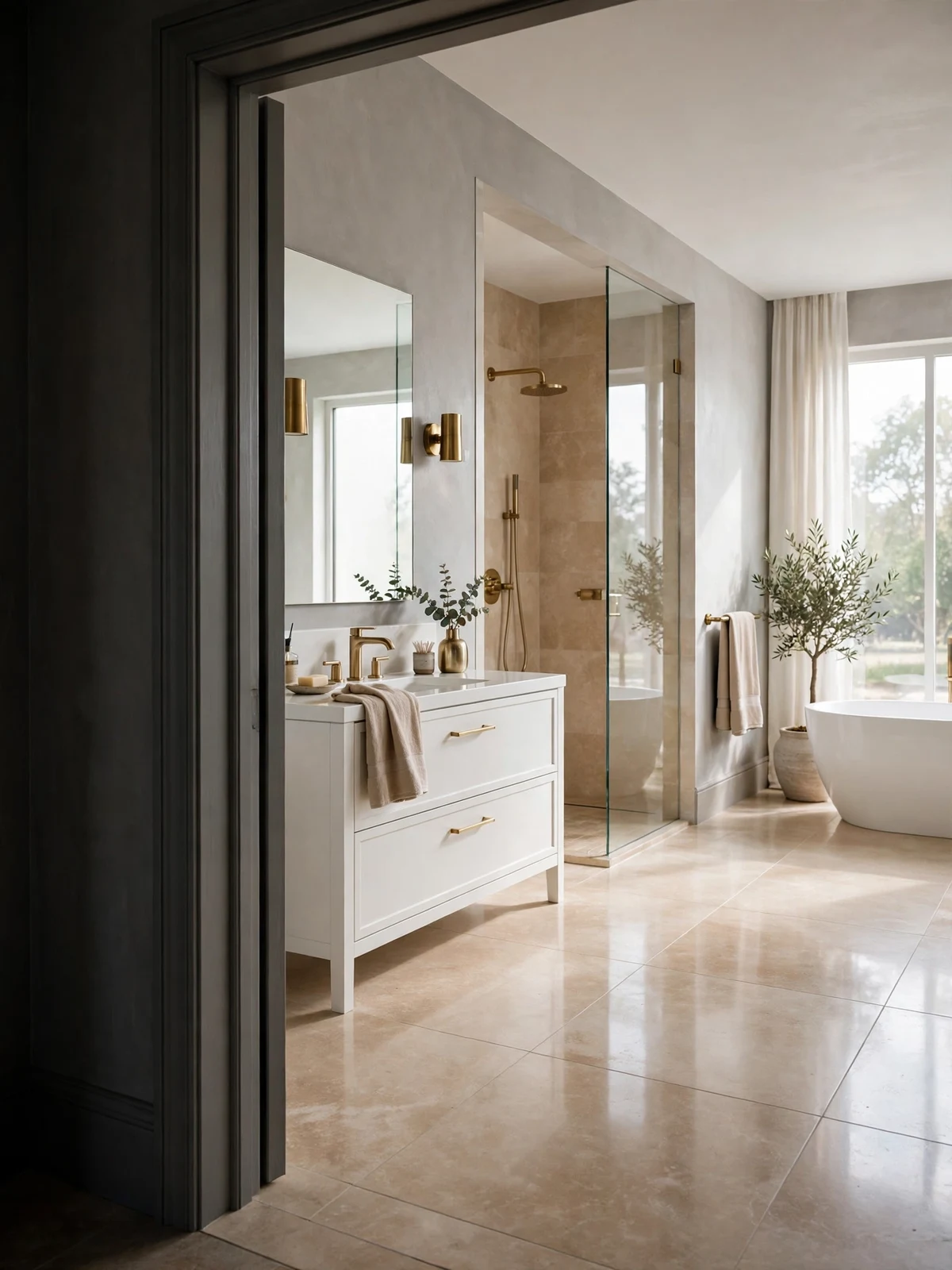
Large-format floor tiles make a neutral bathroom feel bigger, because fewer grout lines mean fewer visual breaks, and the eye reads the floor as one continuous surface instead of a grid. Here, large warm stone-look porcelain tiles run across the whole floor with barely visible joints, under a white vanity and against soft grey walls with brushed brass fixtures. The design suits small bathrooms most of all, and it also makes cleaning easier since there is less grout to scrub. The weakness is layout: large tiles in a tiny room need careful cutting around the toilet and vanity, so a good tiler matters more than the tile itself.
Quick tips:
- Choose tiles at least 60 by 60 centimetres for the effect.
- Match the grout colour closely to the tile.
- Run the same tile into the shower for a seamless look.
- Hire a careful tiler, since large tiles show bad cuts.
A Walk-In Shower With Frameless Glass and Stone
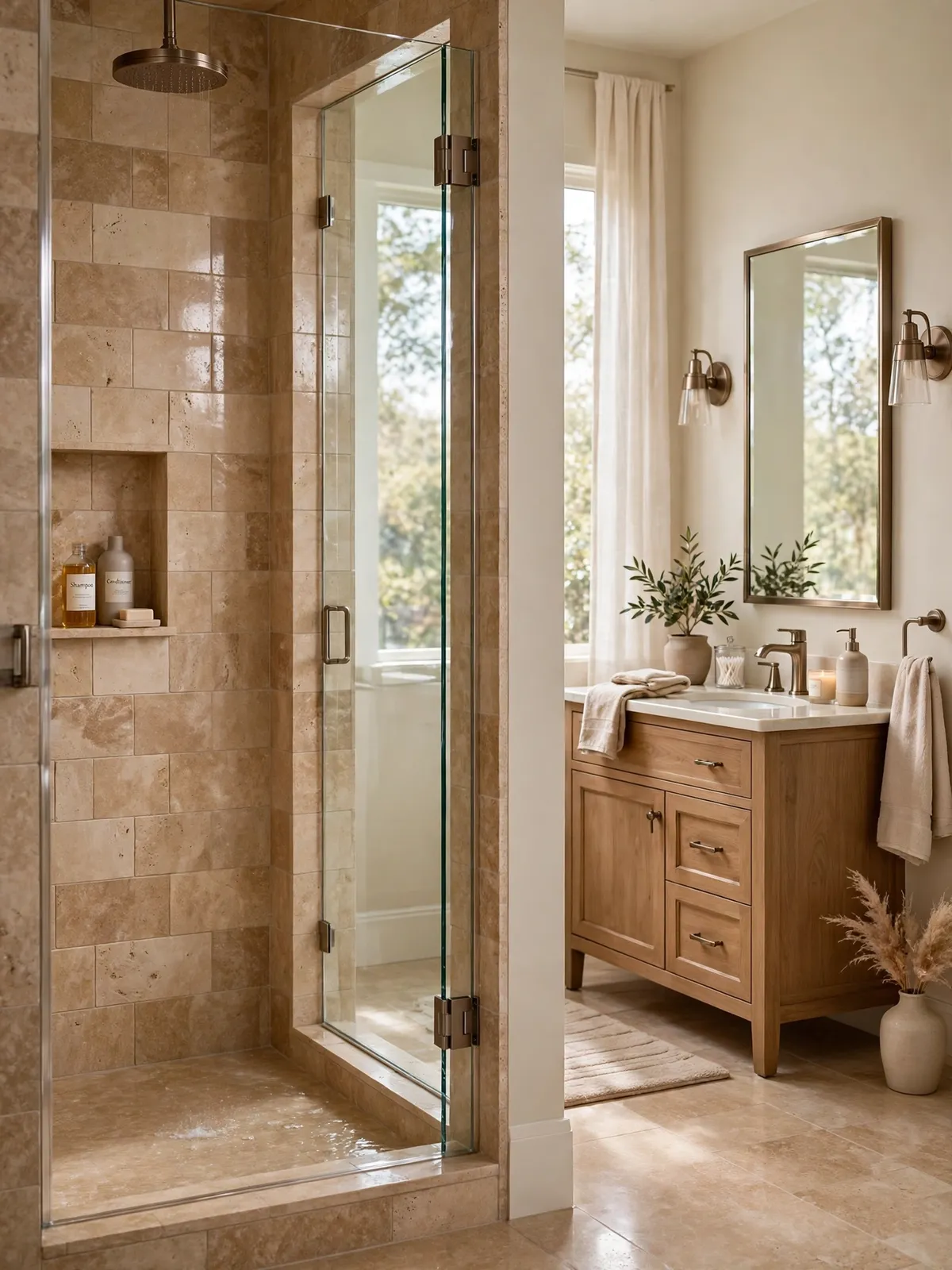
A walk-in shower with frameless glass opens up a neutral bathroom, because removing the shower door and the visual barrier of a curtain lets the eye travel the full length of the room, and warm stone tiles inside the shower become part of the room’s palette. Here, a frameless glass panel separates a walk-in shower lined with warm travertine tiles, with a rainfall head and brushed bronze fixtures, while pale beige walls keep the rest of the room calm. The design suits medium and large bathrooms best, and it is easier to step into than a tub for older guests. The weakness is splashing: without a door, water travels further, so slope the floor properly and keep towels and wood away from the opening.
Quick tips:
- Use one frameless glass panel, not a full enclosure.
- Slope the shower floor toward the drain.
- Choose stone-look tiles that continue the room’s palette.
- Keep the rainfall head centred so water stays inside.
Textured Wall Tiles That Add Interest Without Colour
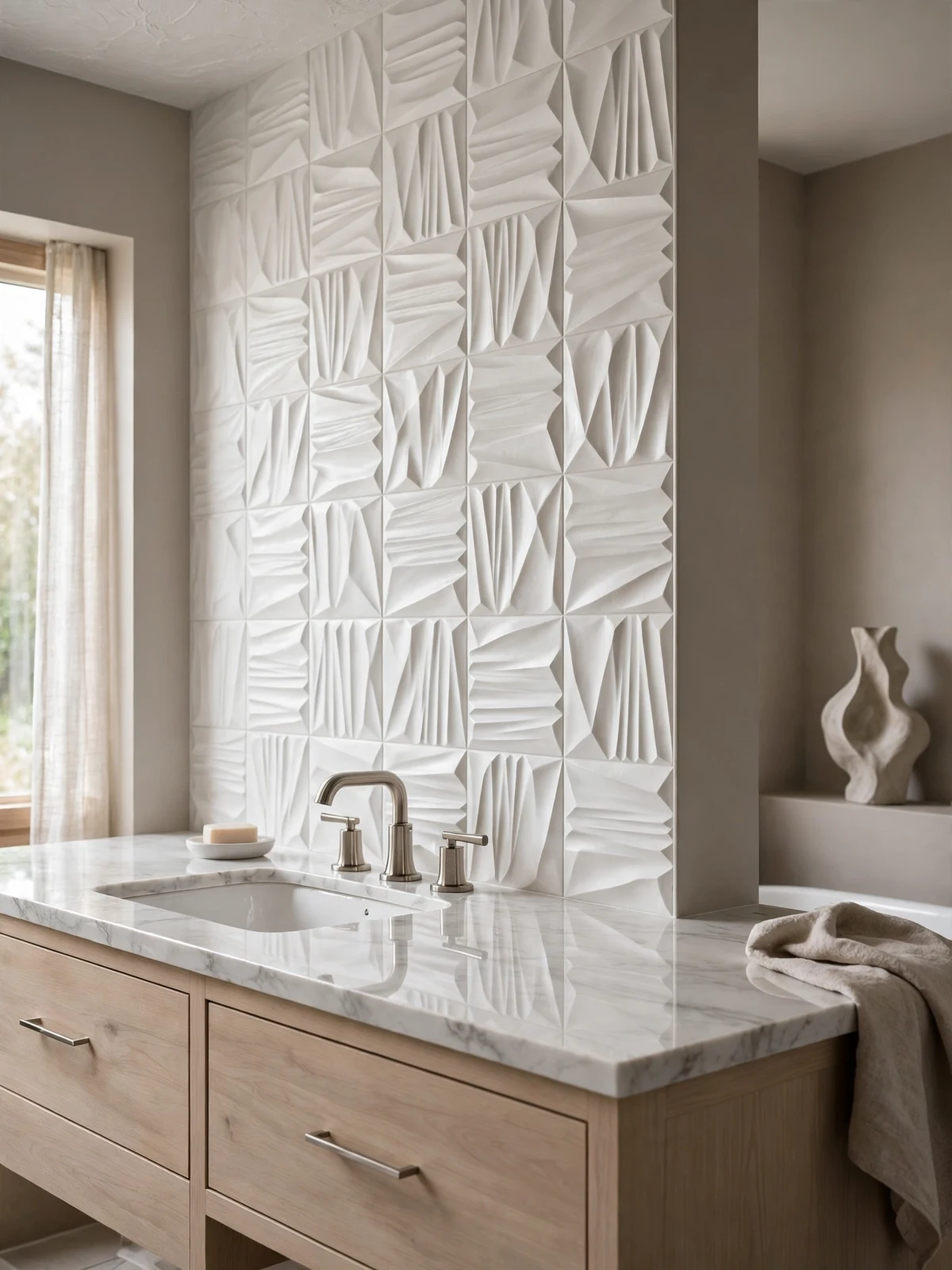
Textured wall tiles add interest to a neutral bathroom without adding a single colour, because the play of light and shadow across a three-dimensional surface gives the eye something to notice while the palette stays completely quiet. Here, sculptural white tiles with a gentle wave pattern cover the vanity wall, against soft taupe walls and a light wood vanity with brushed nickel taps. The design suits bathrooms that feel too plain but where the owner does not want colour, and one feature wall is enough. The weakness is cleaning: deep textures trap dust and limescale, so choose shallow relief and wipe the wall down weekly.
Quick tips:
- Tile one feature wall only, behind the vanity or tub.
- Choose shallow relief that is easy to wipe clean.
- Keep the rest of the walls smooth and plain.
- Let the texture be the room’s only pattern.
A Built-In Niche for Storage That Disappears
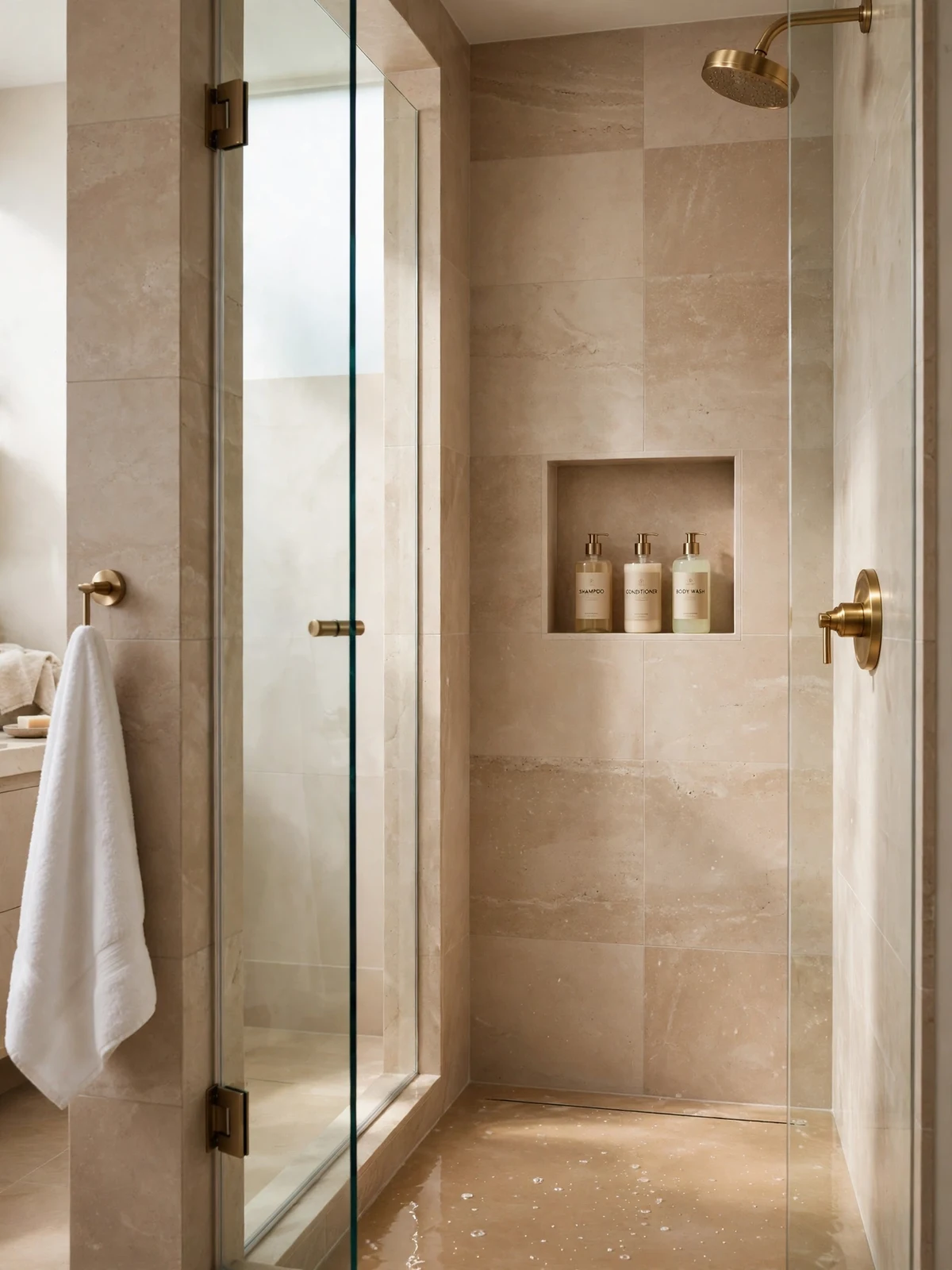
A built-in niche is storage that disappears into a neutral bathroom, because shampoo and soap sit recessed into the wall instead of cluttering the shower ledge or hanging in a plastic caddy. Here, a tiled niche lined with warm beige stone holds a few simple bottles in the shower wall, with frameless glass and brushed brass fixtures keeping the rest of the room calm. The design suits any shower or bath wall, and it is cheapest to add during a renovation when the wall is already open. The weakness is retrofitting: cutting a niche into a finished wall is disruptive and can hit pipes or wiring, so plan it before tiling, not after.
Quick tips:
- Plan the niche before tiling, not after.
- Line it with the same tile as the shower wall.
- Size it for tall bottles, not just small ones.
- Add a second small niche near the tub if space allows.
Warm Wood Accents That Stop Neutrals Feeling Cold
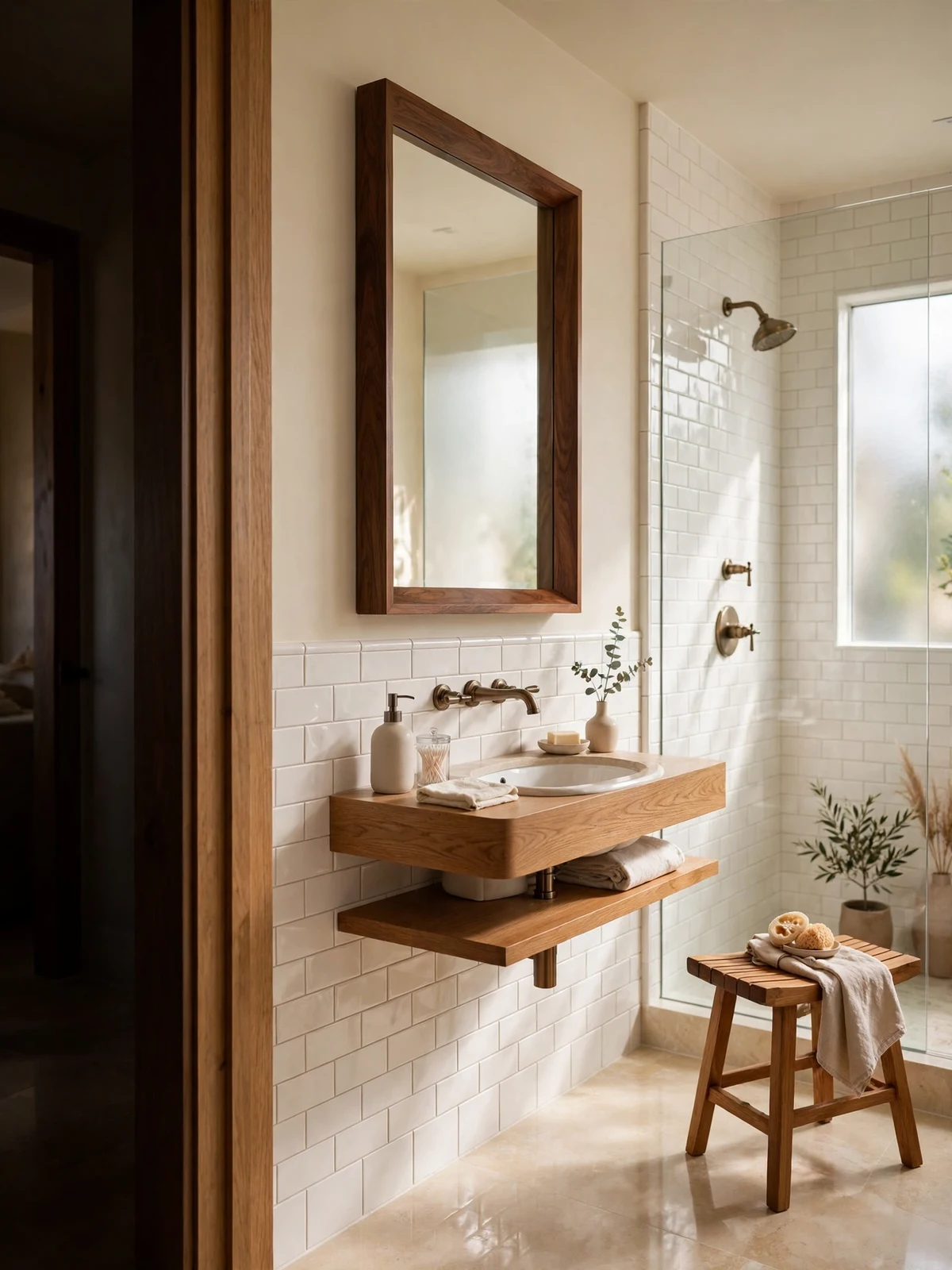
Warm wood accents are what stop a neutral bathroom feeling cold, because pale stone, white tile and grey walls can read as chilly on their own, and a walnut mirror frame, a teak stool or an oak shelf adds the warmth the room is missing. Here, a walnut-framed mirror, a teak stool and a light oak shelf work together against soft cream walls and white tiles, with brushed bronze fixtures tying the warm tones together. The design suits any neutral bathroom that feels stark or clinical, and it costs little. The weakness is damp: untreated wood in a steamy room swells and stains, so choose sealed or naturally water-resistant woods like teak.
Quick tips:
- Repeat one wood tone at least twice in the room.
- Choose sealed teak or oiled oak for steamy rooms.
- Use wood in the mirror frame, stool or shelf.
- Balance cool stone with at least one warm wood piece.
A Heated Floor for Barefoot Comfort in a Pale Room
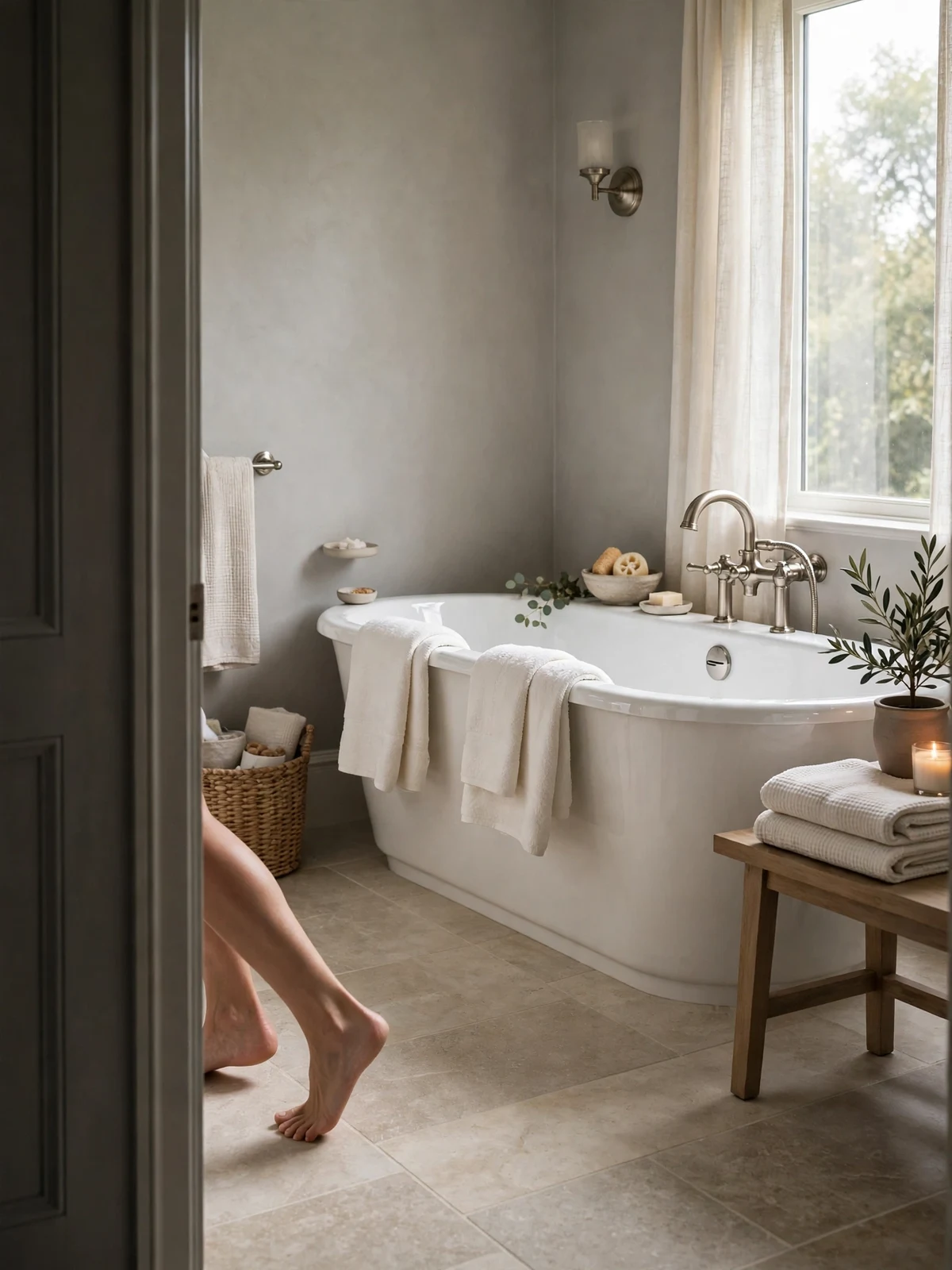
A heated floor is the invisible luxury that makes a pale neutral bathroom feel cosy, because stepping onto warm limestone tiles on a cold morning changes how the whole room feels, and it dries the floor faster after showers too. Here, pale limestone floor tiles glow in soft daylight beneath a white freestanding tub, with soft grey walls and brushed nickel fixtures, and the warmth is felt rather than seen. The design suits any bathroom being retiled, and it is especially valuable in cold climates or north-facing rooms. The weakness is cost and timing: electric mats or water pipes must go under the tiles, so it is a renovation-stage decision, not a weekend add-on.
Quick tips:
- Install heating under the tiles during a renovation.
- Use a timer so the floor is warm for morning showers.
- Choose stone or porcelain tiles, which conduct heat well.
- Zone the heating so it warms only the bathroom.
Muted Accent Colours That Stay Neutral
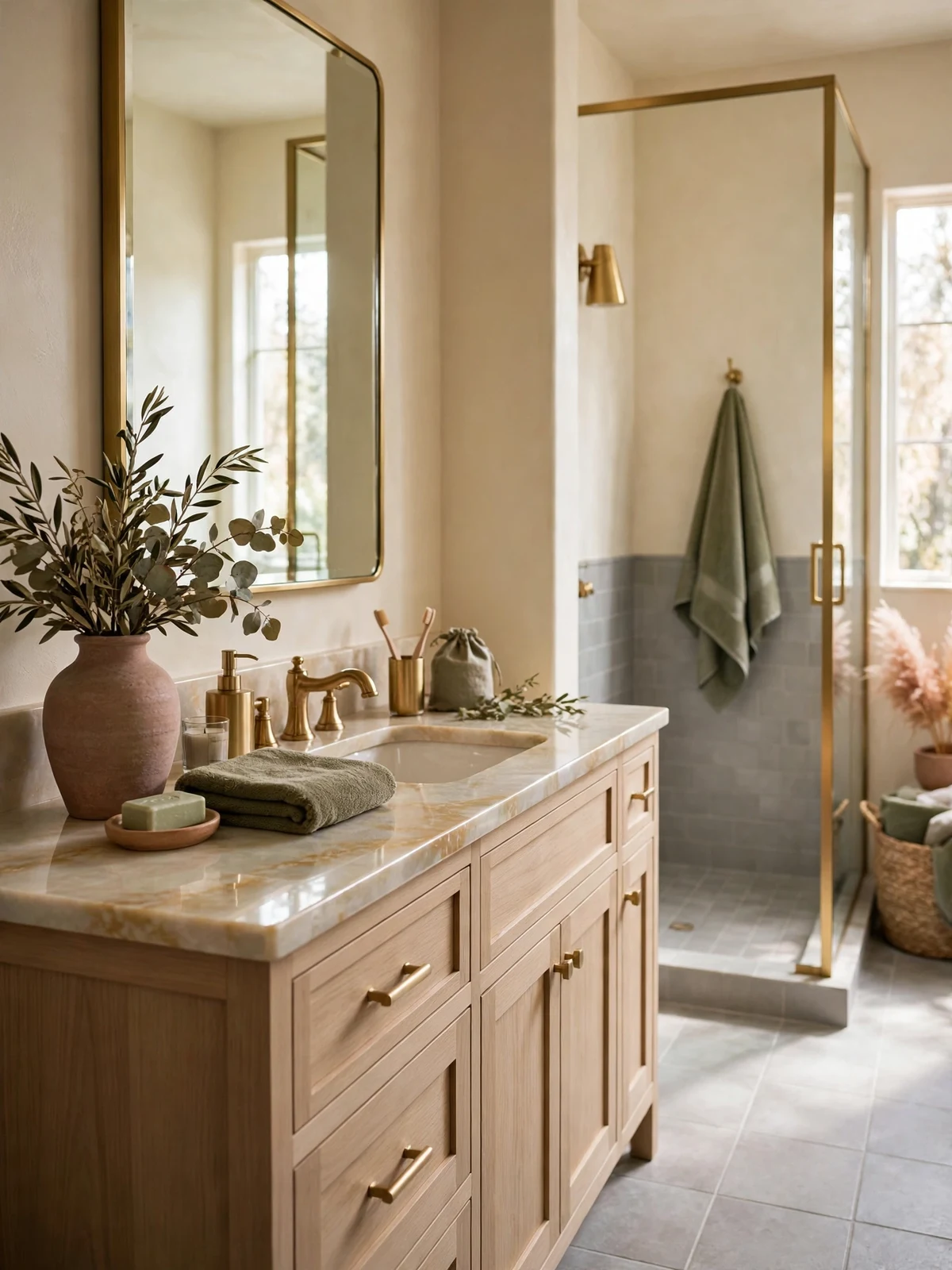
Muted accent colours prove that a neutral bathroom does not have to be all beige, because olive, dusty clay, soft charcoal and gentle mushroom are quiet enough to sit inside a neutral palette while giving the room a little more personality. Here, muted olive towels and a dusty clay vase add soft colour to warm cream walls, a light wood vanity and soft grey floor tiles, with brushed brass fixtures warming the whole composition. The design suits anyone who finds all-beige bathrooms dull but does not want a bold colour scheme, and it is easy to change with the seasons. The weakness is drift: add two or three muted accents and the room stays neutral, but add five and it becomes colourful, so keep the accents in towels and accessories, not on the walls.
Quick tips:
- Pick one muted accent, like olive or dusty clay.
- Keep the accent in towels, vases and accessories only.
- Repeat the accent twice so it looks deliberate.
- Change the accent with the seasons for a fresh feel.
Neutral Bathroom Ideas That Pull the Whole Room Together
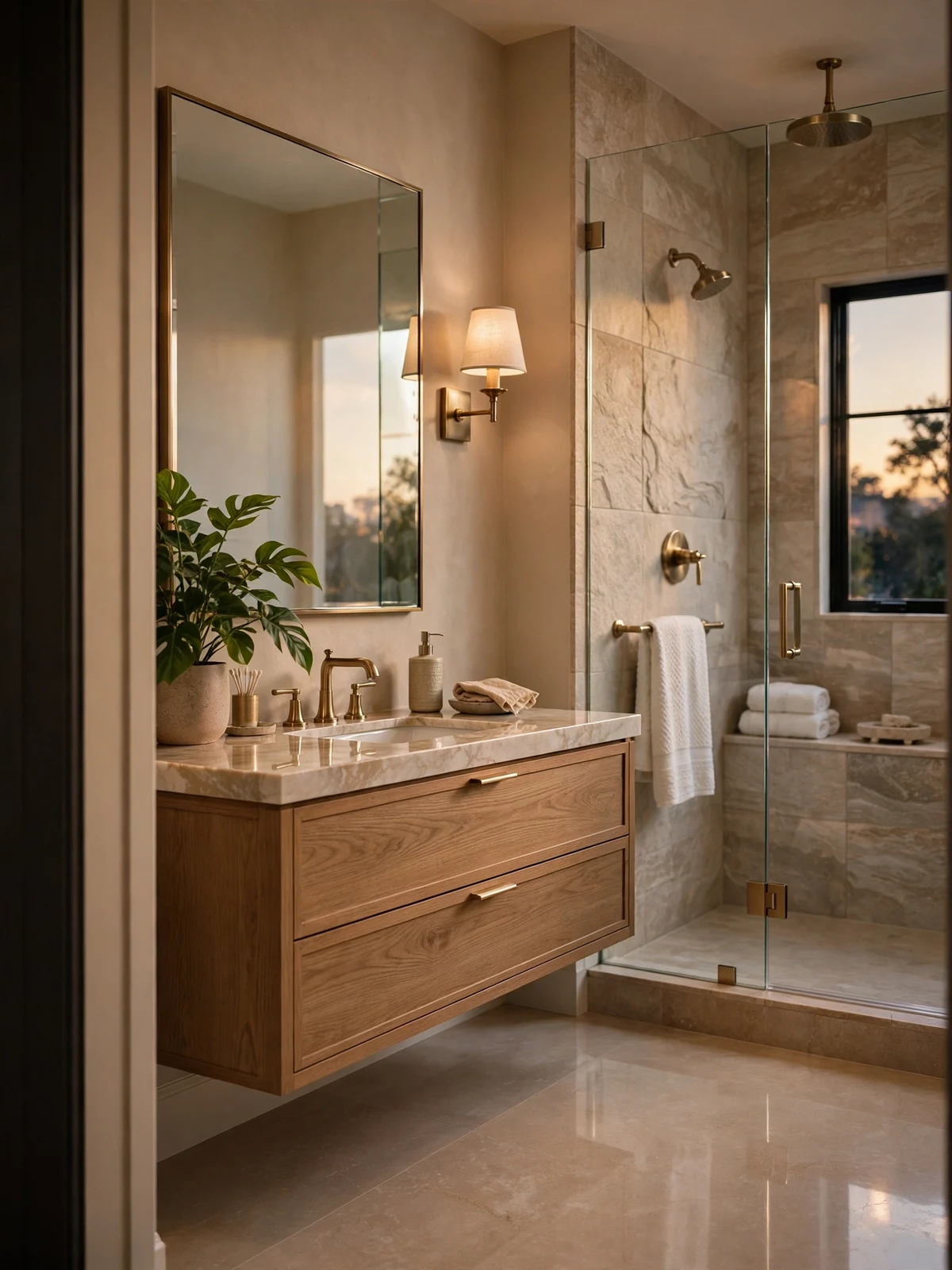
The last of these neutral bathroom ideas is the principle behind them all, and it is worth stating plainly because it is the difference between a bathroom that looks good in a photograph and one that feels calm every single morning: a great neutral bathroom is not one expensive feature, it is the layering of the right quiet choices — warm greige walls instead of stark white, a floating oak vanity that shows the floor, a stone-look shower wall with gentle veining, a mirror big enough to double the light, warm lighting at face level and one living plant — working together so that nothing shouts and everything belongs, and the room rewards the owner too, because a palette built on warm whites, stone and wood is easy to live with, easy to clean and easy to refresh with a new towel colour or a different plant, even in a small room, even on a modest budget, and even when you change only one thing at a time. Here, a warm greige and cream neutral bathroom pulls it together — floating oak vanity, stone-look shower wall, large mirror, brushed brass fixtures and a leafy green plant — and nothing in the room is there by accident. The lesson is to start with the biggest surfaces first: paint the walls, choose the floor, then the vanity and the mirror, and layer the small natural details last, because a neutral bathroom built in that order stays timeless with very little effort, and it gives you room to evolve, swapping a clay vase for an olive towel or a linen curtain for a woven basket, without ever repainting a wall. Pick the three ideas from this list that solve your biggest problem first, add one luxury that makes you smile, and your neutral bathroom stops being the room you apologise for and becomes the calmest room in the house.
Quick tips:
- Start with the biggest surfaces: walls, floor, vanity.
- Fix the basics first, then add one luxury.
- Layer texture and wood before adding any accent colour.
- Refresh towels and plants to update the room without renovating.
FAQs
What is the cheapest way to create a neutral bathroom?
The cheapest neutral bathroom changes are a tin of warm greige paint, a larger mirror, new brushed brass hardware, a linen shower curtain and fresh ivory towels — together they cost far less than a single fixture and change the whole feel of the room. Clean the grout, replace a stained bath mat and add one leafy plant, and the room looks renovated without any building work.
How do I choose the right neutral paint colour for my bathroom?
Choose a neutral paint with a warm undertone, such as greige, warm white or creamy ivory, and test a large swatch on the wall in both morning and evening light before committing. North-facing bathrooms need warmer shades, while south-facing rooms can take slightly cooler greys, and the ceiling should stay soft white to keep the room bright.
Can a neutral bathroom work in a small space?
Yes, a neutral bathroom works especially well in a small space, because pale walls, a large mirror, large-format floor tiles and a floating vanity all make the room feel bigger. Keep storage hidden, use frameless glass in the shower, and limit the palette to two or three related warm tones so the small room reads as one calm, open space.
What materials work best in a neutral bathroom?
The best materials for a neutral bathroom are natural and quiet: travertine or limestone-look porcelain, pale oak or walnut wood, warm quartz or marble-look stone, linen and cotton textiles, and brushed brass or nickel fixtures. Mix at least three textures — stone, wood and fabric — so the pale palette feels rich rather than flat.
How do I add colour to a neutral bathroom without ruining it?
Add colour through accessories, not walls: muted olive towels, a dusty clay vase, a soft charcoal bath mat or one leafy green plant give a neutral bathroom personality while the palette stays quiet. Keep the accent to one or two muted tones, repeat each twice, and change them with the seasons for a fresh feel without repainting.
Conclusion
A neutral bathroom does not need to be boring to be timeless — it needs the right quiet choices, layered thoughtfully. The 24 ideas above show that warm greige walls, a floating oak vanity, a stone-look shower wall, an oversized mirror, warm lighting and a few natural layers can turn a plain pale bathroom into a space that feels calm, warm and quietly luxurious. Start with the biggest surfaces, pick one style and let it guide every choice, and add texture and wood before you reach for any colour. Do that, and your neutral bathroom stays beautiful for years, with nothing more than a fresh towel or a new plant to keep it feeling new.