26 Stunning Christmas Tree Decorating Ideas That Make Your Tree the Star of the Season
A great Christmas tree is not the most expensive tree — it is the tree with a clear point of view: one palette, one ribbon, lights woven deep into the branches, and ornaments placed like a designer did it. These 26 christmas tree decorating ideas cover the 2026 themes, the pro decorating order, small-space trees and the finishing touches, so your tree becomes the star of the season.
Christmas tree decorating works best in a fixed order: fluff every branch from the bottom up, weave the lights deep into the branches first, then add ribbon, then ornaments, and finish with the topper and the skirt. Plan on roughly 100 lights per foot of tree height — about 700 for a standard 7-foot tree — all warm white at 2700K unless your theme says otherwise. The 26 ideas below cover the 2026 themes, from jewel tones and cherry cola to sage and pearl and gingerbread whimsy, plus the small-space, tabletop and budget trees most guides skip.
Once the tree is dressed, these Christmas centerpiece ideas carry the same palette onto the dining table so the whole house feels connected.
Key Takeaways
What order should I decorate a Christmas tree in?
Fluff every branch first, working from the bottom up and pulling each tip outward and slightly upward, then weave the lights deep into the branches from the top down, then add ribbon, then ornaments largest first, and finish with the topper and the tree skirt. Lights before ornaments is the rule that matters most — ornaments hung first block the lights from sitting deep in the tree.
How many lights do I need on a Christmas tree?
Plan on roughly 100 lights per foot of tree height — about 700 for a standard 7-foot tree and 900 for a 9-footer. Weave the strands deep into the branches rather than draping them on the surface, and choose warm white at 2700K for almost every theme, because it flatters every ornament colour.
What are the biggest Christmas tree trends for 2026?
Heritage nostalgia leads 2026: jewel tones in emerald, ruby and sapphire, cherry cola deep red-brown, sage and pearl, gingerbread whimsy, nutcracker with royal blue, and oversized cherry-red velvet bows. The mood underneath is practical maximalism — fewer pieces, bigger ones, handmade ornaments and rooms that feel moody and collected rather than decorated.
How do I make my Christmas tree look full?
Fluffing is the single biggest difference — pull every branch tip outward and upward before anything else. Then layer ornaments in three sizes, push the largest ones deep inside the branches, fill gaps with ribbon, picks and pinecones, and add a tree skirt that covers the stand so the base looks finished from every angle.
Real or artificial Christmas tree — which is better?
A real tree smells wonderful and looks naturally irregular, but it needs water daily and drops needles, so it suits a main living room you can tend. A good artificial tree costs more once, repeats for years, holds its shape perfectly, and is the practical choice for small rooms, flats with pets, and anyone who wants the tree up early in November.
Choose Your Christmas Tree Theme
| Tree theme | Best for | Colours | Budget level |
|---|---|---|---|
| Heritage Red and Gold | Traditional rooms, family homes | Deep red, gold, green | Low to medium |
| Jewel Tones | Dramatic rooms, evening glow | Emerald, ruby, sapphire, brass | Medium |
| Cherry Cola | Modern rooms, vintage feel | Red-brown, gold, cream | Low to medium |
| Sage and Pearl | Light rooms, calm homes | Sage, pearl ivory, brushed gold | Medium |
| Gingerbread Storybook | Family trees, homes with children | Warm brown, red, cream | Low |
| Nutcracker | Classic whimsy, formal rooms | Royal blue, red, white, gold | Medium |
| Winter Woodland | Rustic rooms, farmhouse homes | Brown, cream, forest green | Low |
| Scandi Minimal | Small flats, minimalist homes | White, light wood, soft grey | Low |
Start With the Pro Order: Fluff, Lights, Ribbon, Ornaments
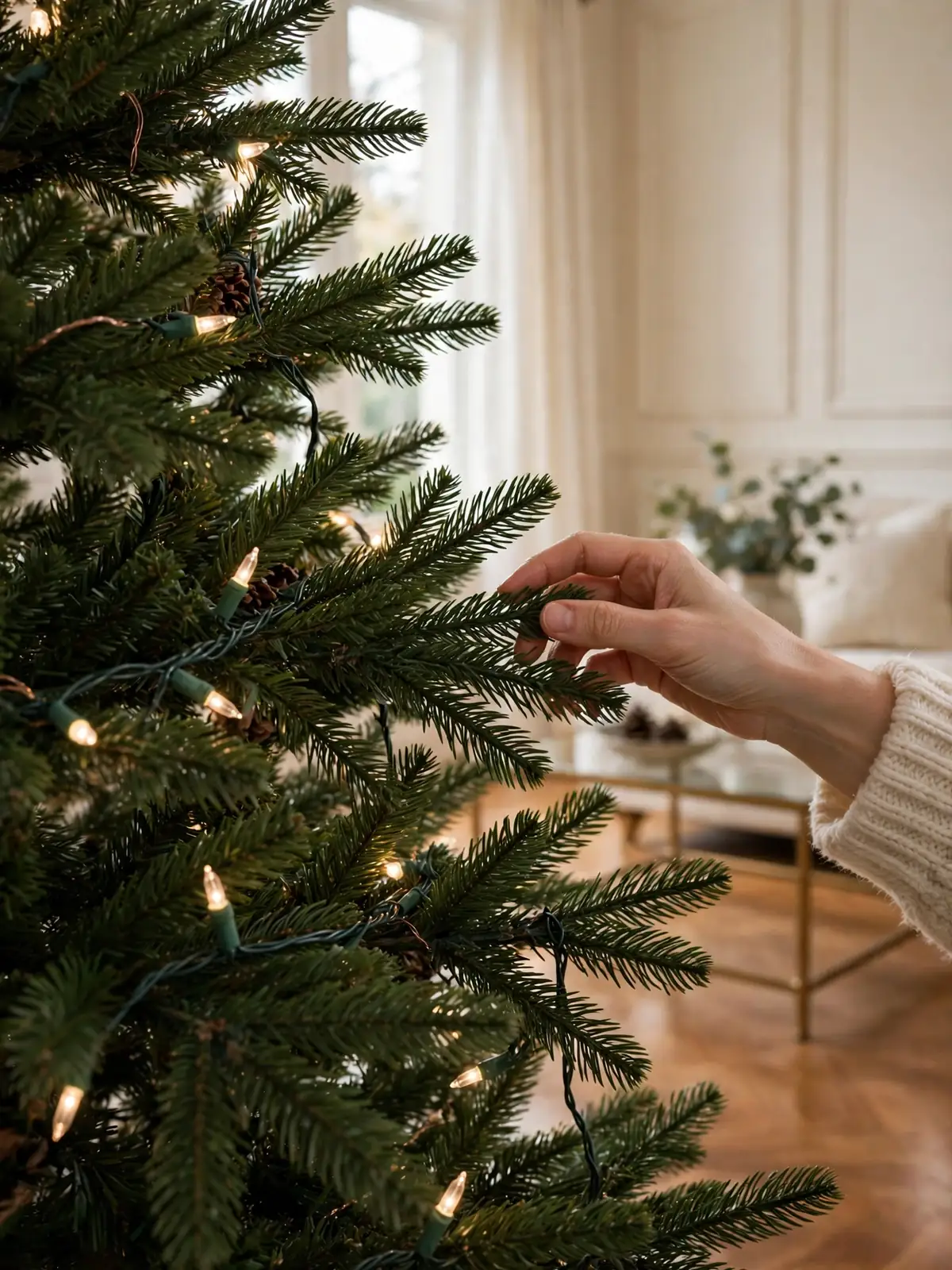
The secret of professional christmas tree decorating is not talent — it is order, because a tree decorated in the right sequence looks twice as full as the same tree decorated at random. Here, a deep green artificial tree stands in a bright living room with its branches half fluffed, warm-white lights woven deep into the lower branches, and a box of ornaments waiting on the warm wood floor, cream walls catching the soft daylight. The design suits every home and every tree, it costs nothing, and fluffing alone is the single step that makes the biggest difference on an older tree. The weakness is patience: fluffing a 7-foot tree properly takes 30 to 45 minutes, so put on music, work from the bottom up, and do not skip it.
Quick tips:
- Fluff from the bottom up, pulling each tip outward and upward.
- Weave lights deep into the branches, top down, before ornaments.
- Add ribbon next, then ornaments largest first.
- Finish with the topper and the tree skirt last.
A Heritage Red and Gold Classic Tree
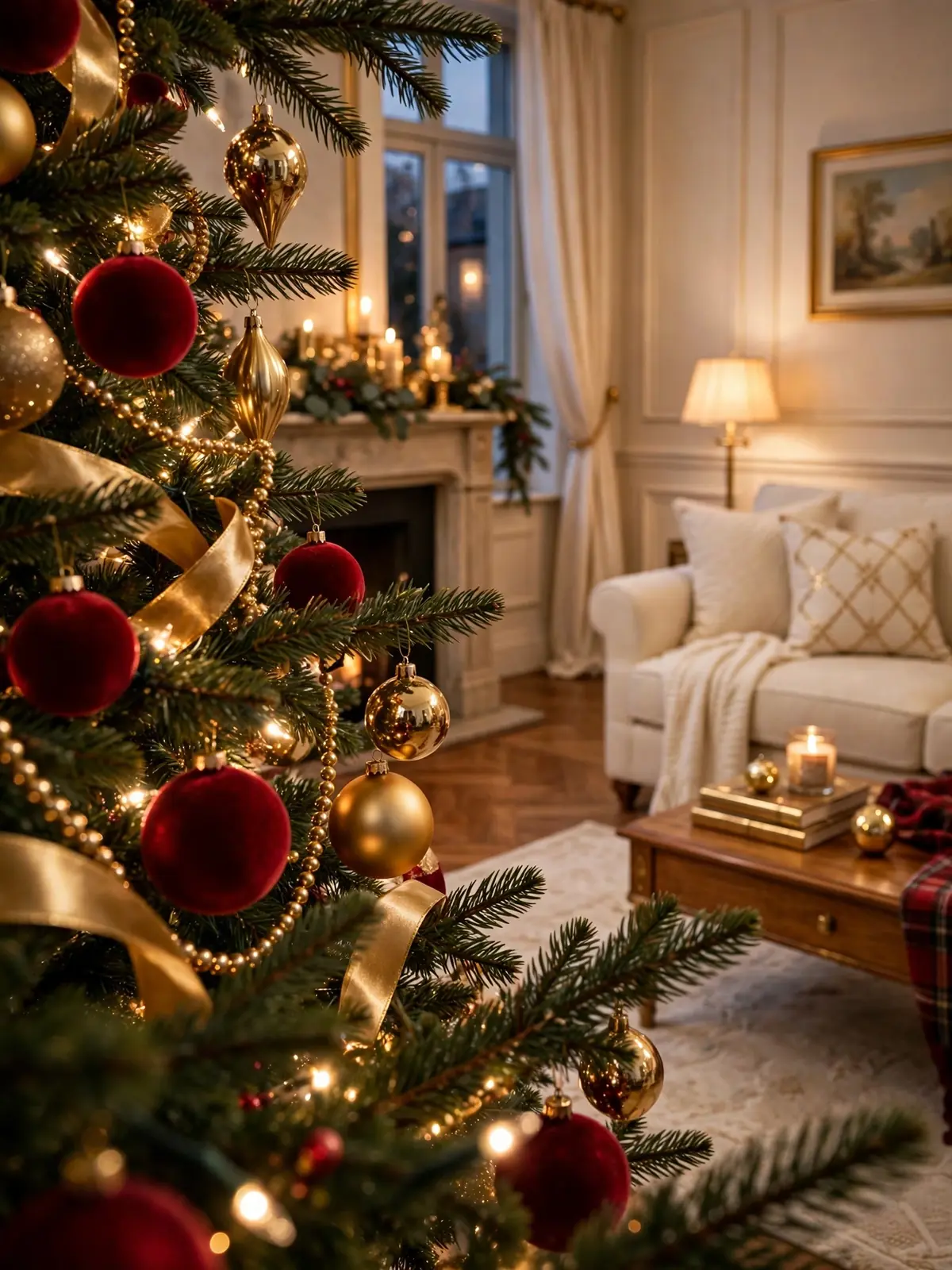
A heritage red and gold tree is the christmas tree decorating classic that never goes out of style, because deep red and warm gold against green branches reads as Christmas in any room, in any decade. Here, a full green tree glows with warm-white lights, matte red baubles mixed with glossy gold ornaments, a gold ribbon cascading down in loose spirals, and a gold star on top, beside a cream sofa on a warm wood floor in soft evening light. The design suits traditional living rooms and family homes, it is almost impossible to get wrong as long as the reds match, and the ornaments are the easiest to find in any shop. The weakness is shine overload: too many glossy surfaces make the tree feel busy, so vary the finishes — matte red, glossy gold, one large focal ornament — and leave breathing room between clusters.
Quick tips:
- Vary the finishes: matte red, glossy gold, one large focal piece.
- Keep all the reds in the same family so they match.
- Run one ribbon colour down the tree in loose spirals.
- Hang the largest ornaments deep inside, the smallest at the tips.
A Jewel Tones Tree in Emerald, Ruby and Sapphire
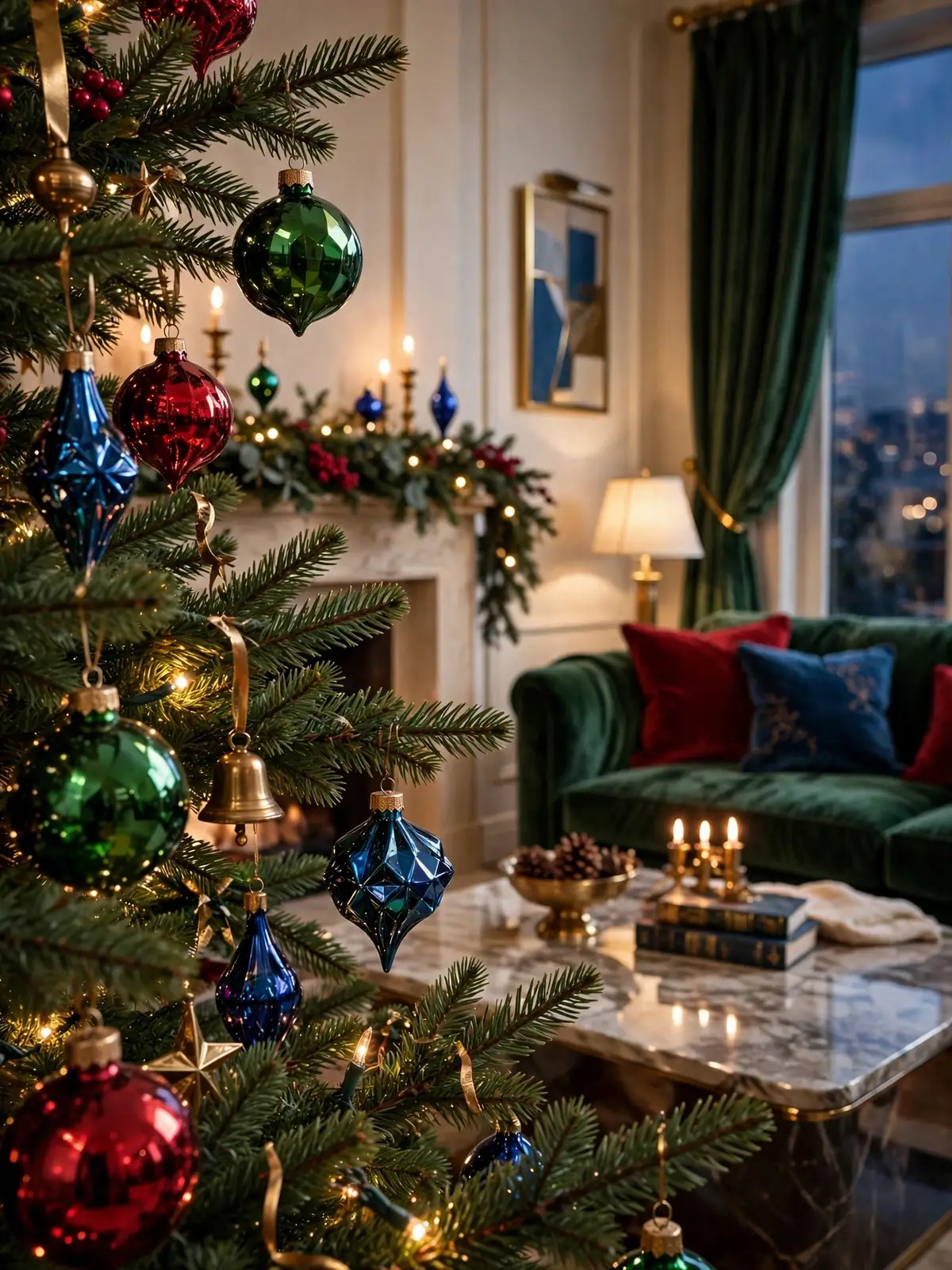
Jewel tones are the defining christmas tree decorating palette of 2026, because emerald, ruby, sapphire, burgundy and plum are rich and saturated in a way that looks especially good on green trees with warm-white lights. Here, a full tree carries deep emerald baubles, ruby red ornaments and sapphire blue glass drops, with brass ornament caps and a burgundy velvet ribbon tying the colours together, against cream walls in soft evening light. The design suits living rooms that want drama without kitsch, it photographs beautifully, and the saturated colours glow against the green branches. The weakness is balance: five jewel colours at once turn muddy, so pick three — emerald, ruby and sapphire — and let brass be the only metallic.
Quick tips:
- Pick three jewel colours at most, never all five.
- Let brass be the only metallic so the colours stay rich.
- Use a burgundy or plum ribbon to tie the palette together.
- Warm-white lights flatter jewel tones; cool lights wash them out.
A Cherry Cola Tree in Deep Red-Brown and Gold
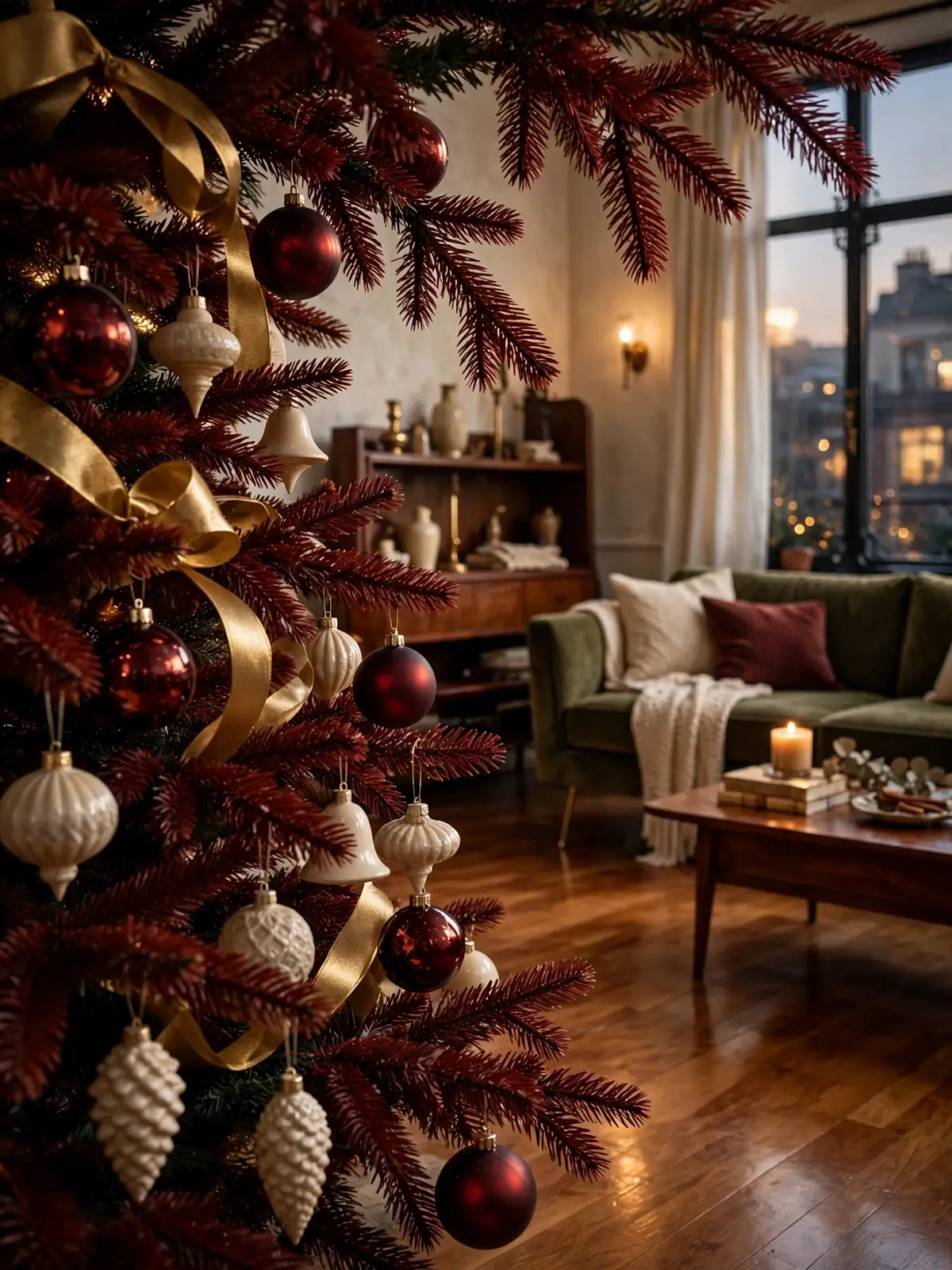
Cherry cola is the breakout christmas tree decorating colour of 2026, because deep red-brown with a glossy finish feels vintage and modern at the same time. Here, a green tree carries glossy cherry cola baubles in deep red-brown, a gold ribbon cascading vertically, and cream ornaments to keep the dark palette from going too heavy, on a warm wood floor in soft evening light. The design suits modern and transitional living rooms, it looks expensive for the cost of one ribbon and a box of baubles, and the glossy finish catches the lights beautifully. The weakness is darkness: a tree that is all deep red-brown disappears into a dark corner, so keep the cream ornaments coming and put the tree where daylight reaches it.
Quick tips:
- Pair cherry cola with gold ribbon and cream ornaments.
- Keep at least a third of the ornaments pale so the tree stays bright.
- Glossy finishes suit cherry cola best — skip matte here.
- Put the tree where daylight reaches it, not in a dark corner.
A Sage and Pearl Tree for a Calm, Light Room
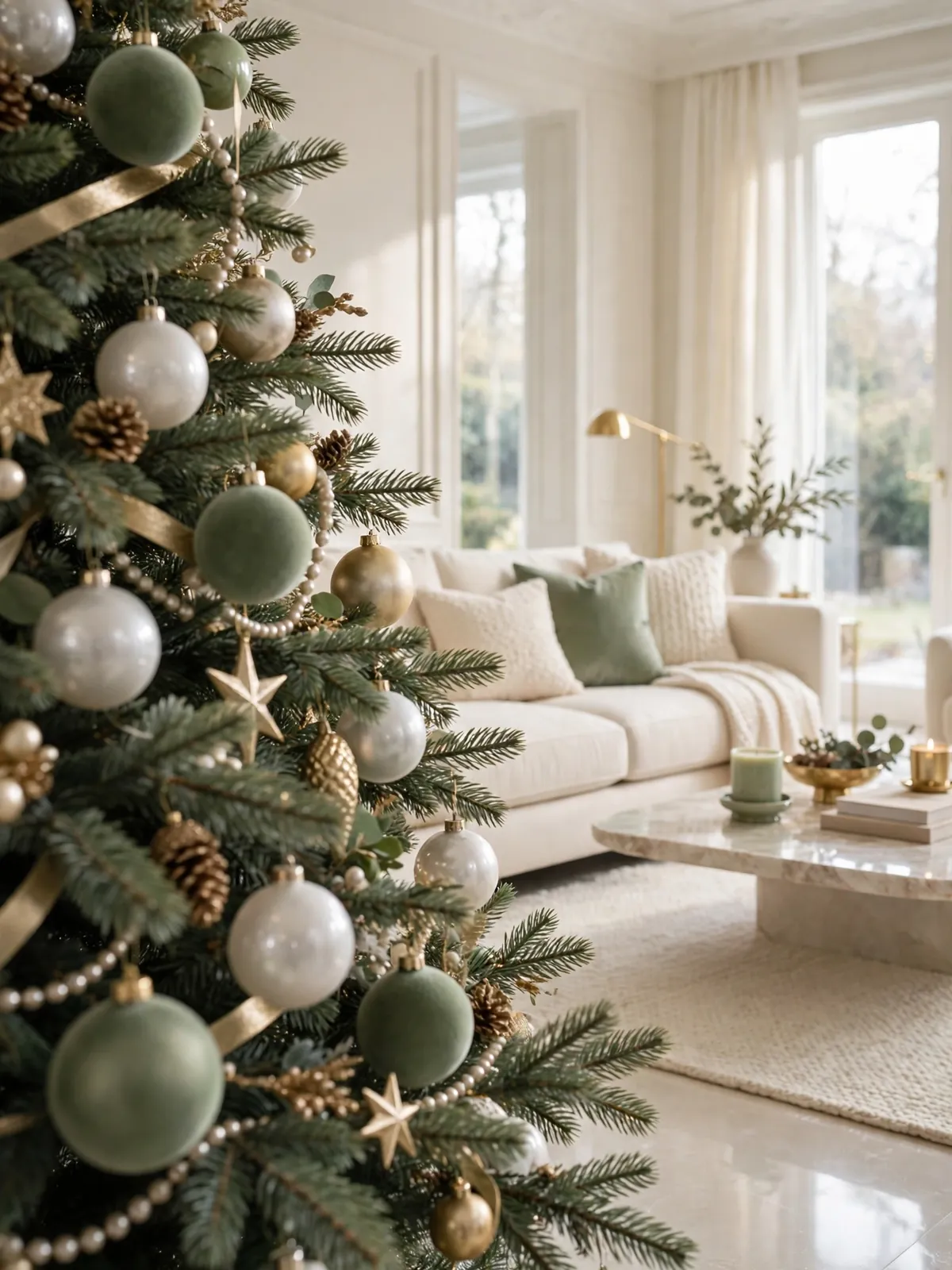
Sage and pearl is the calmest christmas tree decorating palette of 2026, because muted green ornaments with ivory, pearl-like finishes and a little brushed gold make a tree that feels light, quiet and expensive. Here, a green tree carries matte sage baubles, pearly ivory ornaments and brushed gold stars, with a cream ribbon and warm-white lights, beside a cream sofa in a bright room full of soft daylight. The design suits light, calm interiors and modern homes that find red and gold too loud, and the matte-and-pearl contrast gives the tree depth without any bright colour. The weakness is flatness: an all-pale tree can disappear against a white wall, so add the brushed gold stars and a few deeper sage pieces for definition.
Quick tips:
- Mix matte sage with pearly ivory for depth without bright colour.
- Add brushed gold stars so the pale tree reads against white walls.
- Use a cream ribbon, not white, so it shows on the branches.
- Keep the lights warm-white — cool lights make sage look grey.
A Gingerbread Storybook Tree
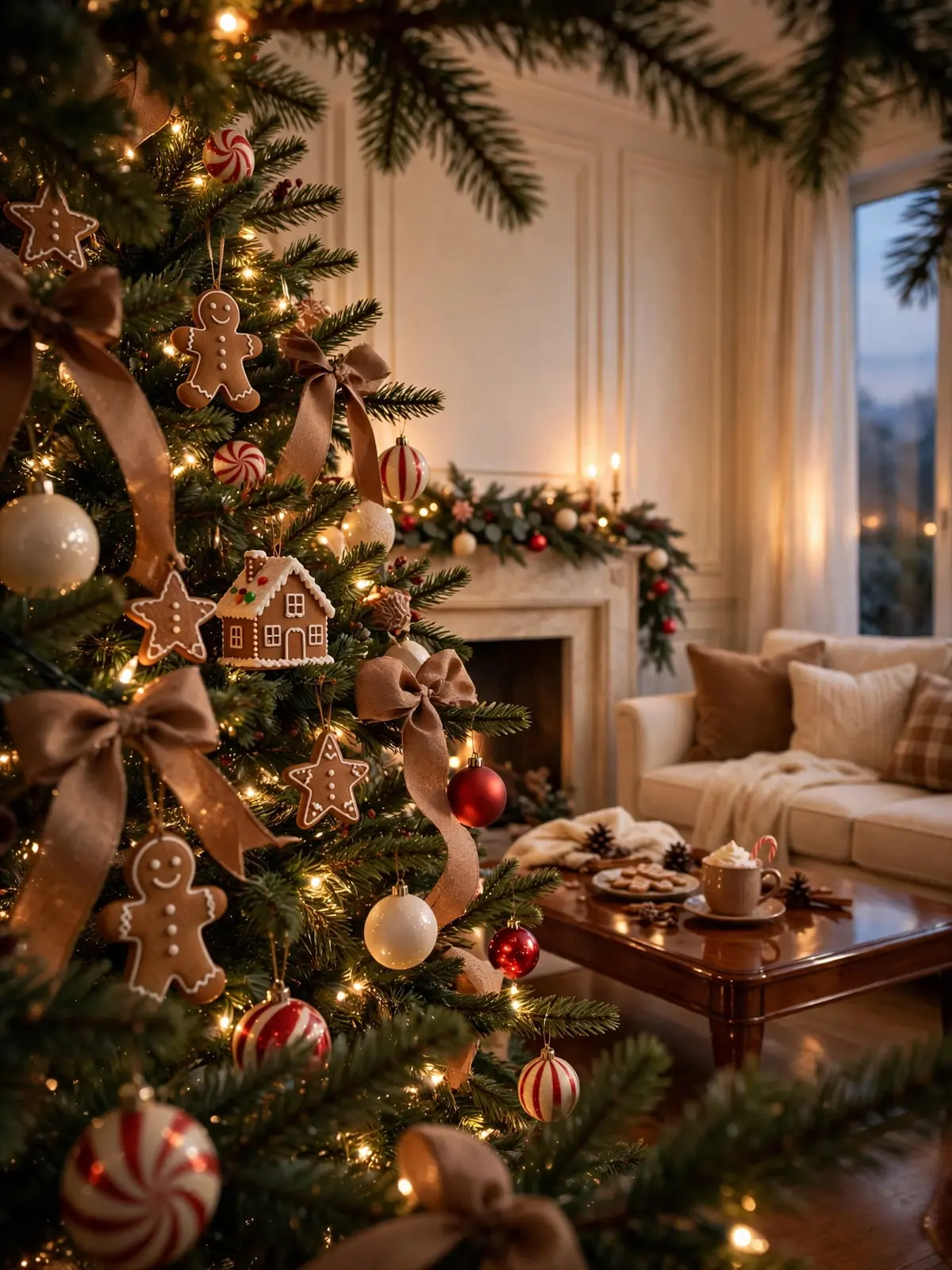
A gingerbread storybook tree is the happiest christmas tree decorating theme of 2026, because gingerbread people, candy-inspired colours and warm brown ribbon turn the tree into a scene children remember. Here, a green tree carries gingerbread-person ornaments, red and cream candy baubles, warm brown ribbon and warm-white lights, with a small gingerbread house at the base and cream walls catching the soft evening light. The design suits family trees and homes with children, it is easy to build with handmade salt-dough ornaments, and the warm brown palette feels cosy rather than sugary. The weakness is clutter: too many candy colours at once turn the tree into a sweet shop, so keep the palette to warm brown, red and cream only.
Quick tips:
- Keep the palette to warm brown, red and cream.
- Let handmade salt-dough ornaments dry fully before hanging.
- Put the gingerbread house at the base, not on the tree.
- Use warm-white lights — cool lights make brown look dull.
A Nutcracker Tree With Royal Blue and Red
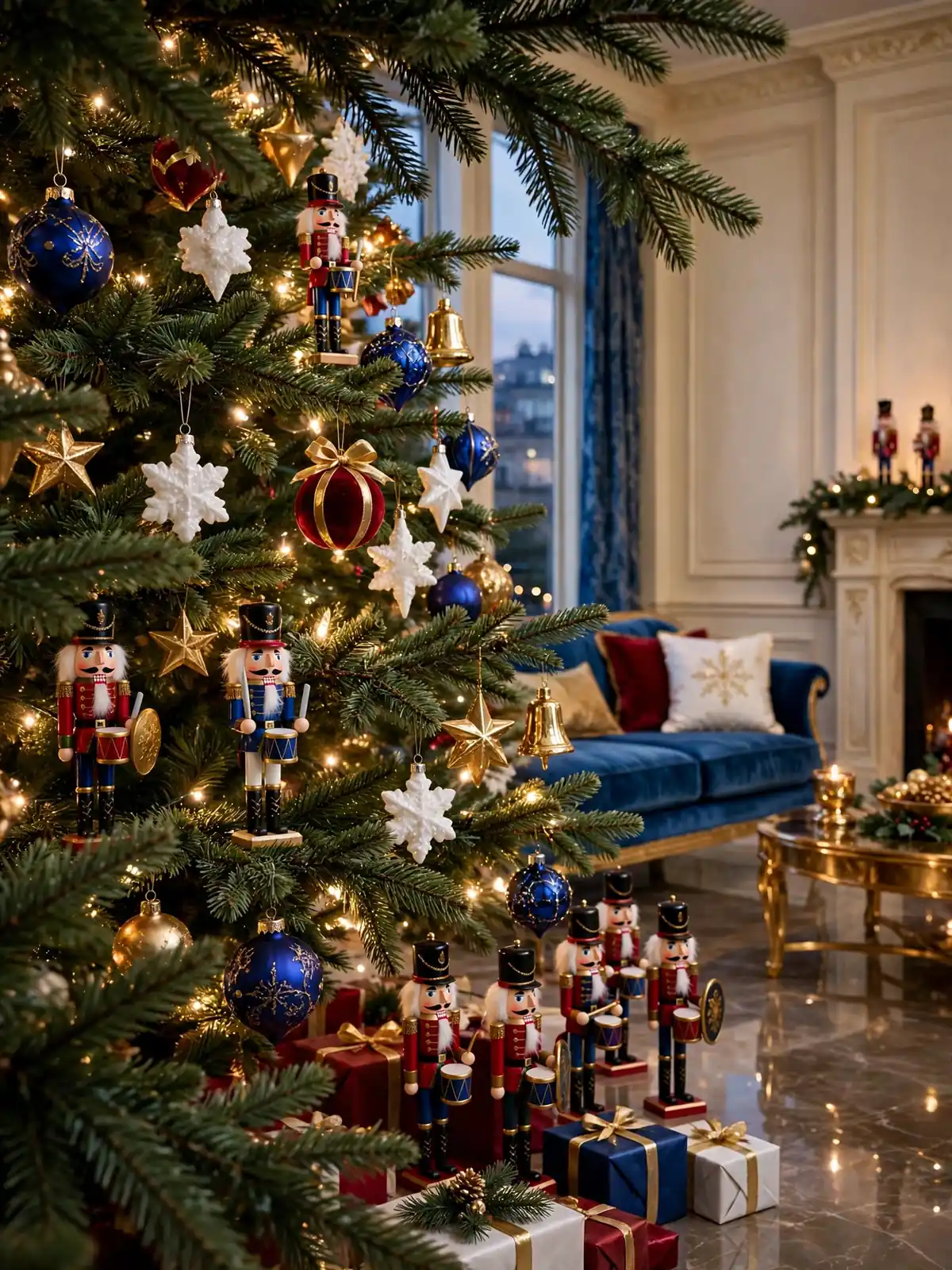
A nutcracker tree is the classic whimsy of christmas tree decorating, and 2026 gives it a fresh update with bold royal blue alongside the traditional reds, crisp whites, rich golds and soft matte finishes. Here, a green tree carries royal blue baubles, deep red ornaments, white glass drops and gold ribbon, with small wooden nutcracker figures arranged around the base and warm-white lights glowing through the branches, against cream walls in soft evening light. The design suits family rooms and homes that love tradition with a twist, and the toy soldiers give children something to find on every branch. The weakness is cost: good nutcracker figures add up, so buy three statement figures for the base and let the baubles carry the tree itself.
Quick tips:
- Let royal blue be the update — keep red, white and gold classic.
- Place nutcracker figures around the base, not high in the tree.
- Use soft matte finishes beside the glossy baubles for balance.
- Repeat the royal blue in the tree skirt or the stockings.
A Winter Woodland Tree With Pinecones and Felt Animals
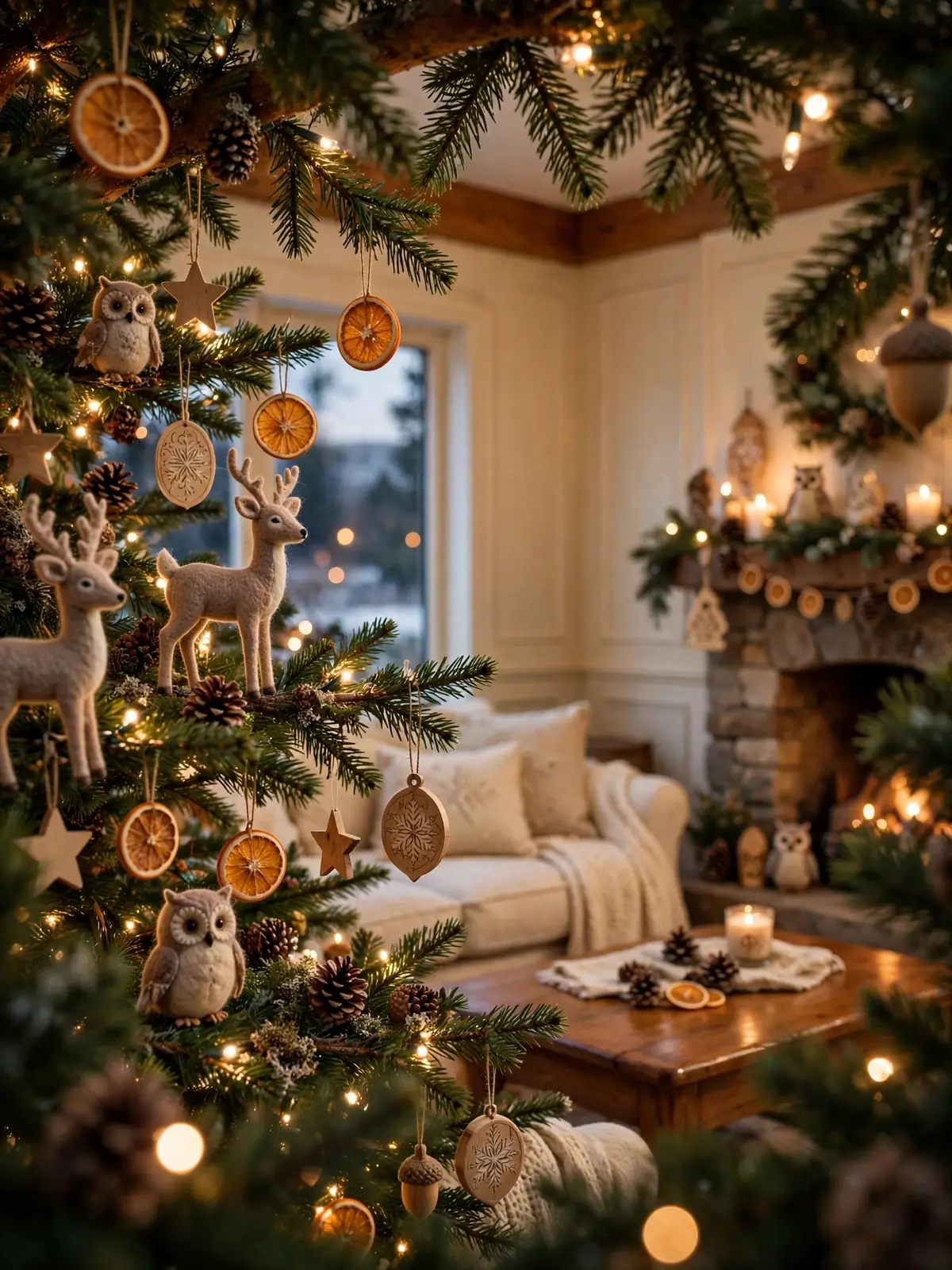
A winter woodland tree brings christmas tree decorating back to nature, because pinecones, felt animals, dried orange slices and simple wood ornaments make a tree that feels gathered rather than bought. Here, a green tree carries pinecones tucked deep into the branches, small felt deer and owls, dried orange slices and plain wooden baubles, with warm-white lights and a burlap ribbon, against cream walls in soft evening light. The design suits rustic, cottage and farmhouse living rooms, it costs little if you make the felt animals and dry the oranges yourself, and the natural textures photograph beautifully. The weakness is weight: pinecones are heavy, so wire them to sturdy inner branches, never to the delicate tips.
Quick tips:
- Wire pinecones to sturdy inner branches, never to the tips.
- Mix three natural textures: wood, felt and dried fruit.
- Use a burlap or faux-fur ribbon, not a shiny one.
- Add a few cream ornaments so the brown palette stays bright.
A Scandinavian Minimal Tree
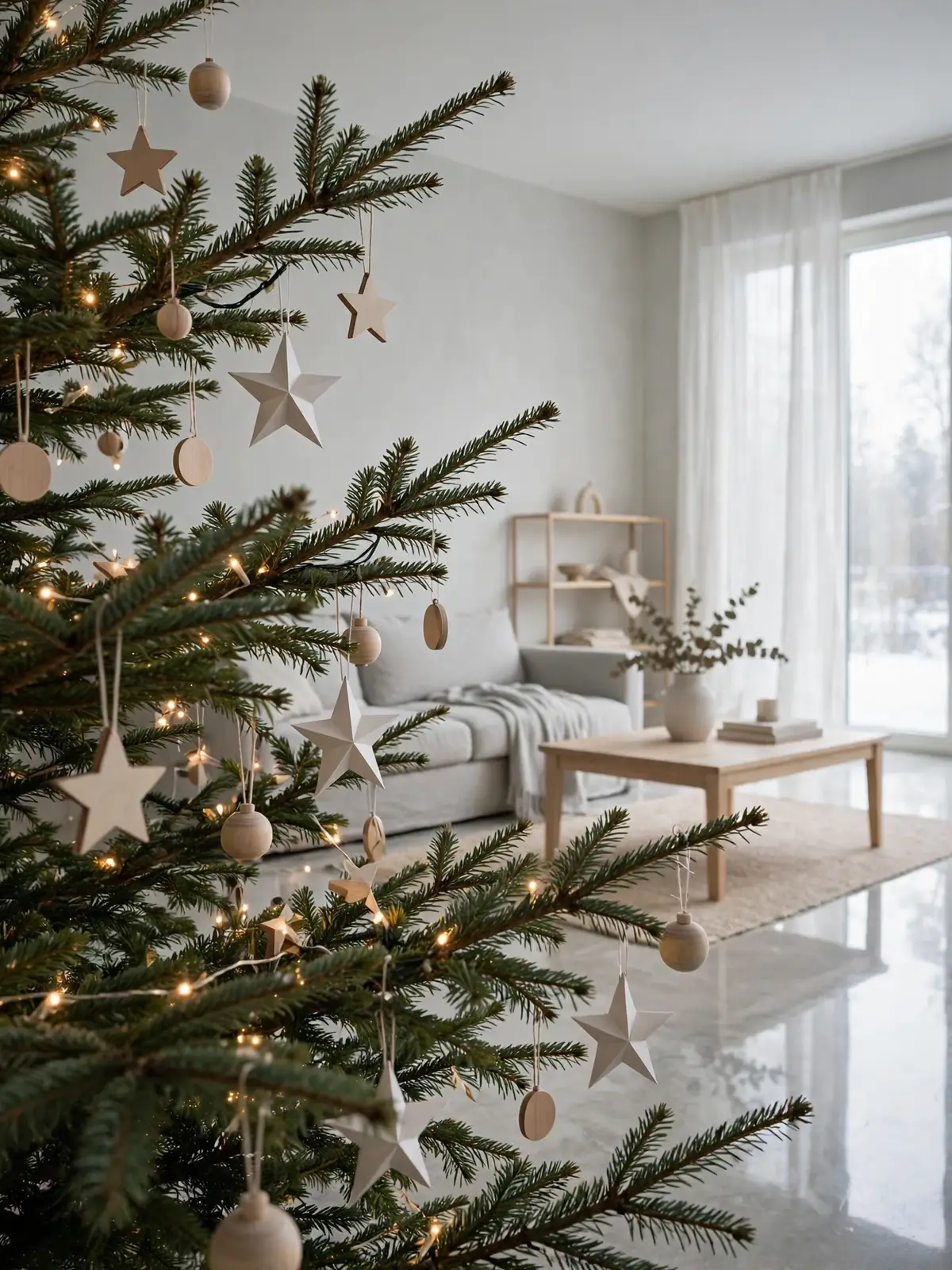
A Scandinavian minimal tree is the quiet answer in christmas tree decorating, because a sparser tree with widely spaced branches, white and light-wood ornaments, simple paper stars and warm-white lights only feels calm in a season of excess. Here, a slim green tree stands in a bright room with pale grey walls, carrying white ceramic baubles, light-wood stars and paper ornaments, with warm-white lights and nothing else, in soft daylight. The design suits small flats, minimalist homes and anyone who finds a fully dressed tree overwhelming, and it takes half the ornaments of a traditional tree. The weakness is bareness: a sparse tree with too few ornaments looks unfinished, so choose a tree with naturally wide branch spacing and hang one ornament per branch tip.
Quick tips:
- Choose a tree with wide branch spacing so the sparseness looks deliberate.
- Hang one ornament per branch tip, never clusters.
- Use white, light wood and paper only — no metallics.
- Keep the tree skirt plain linen so the minimal look holds.
A Champagne Gold and Metallics Tree
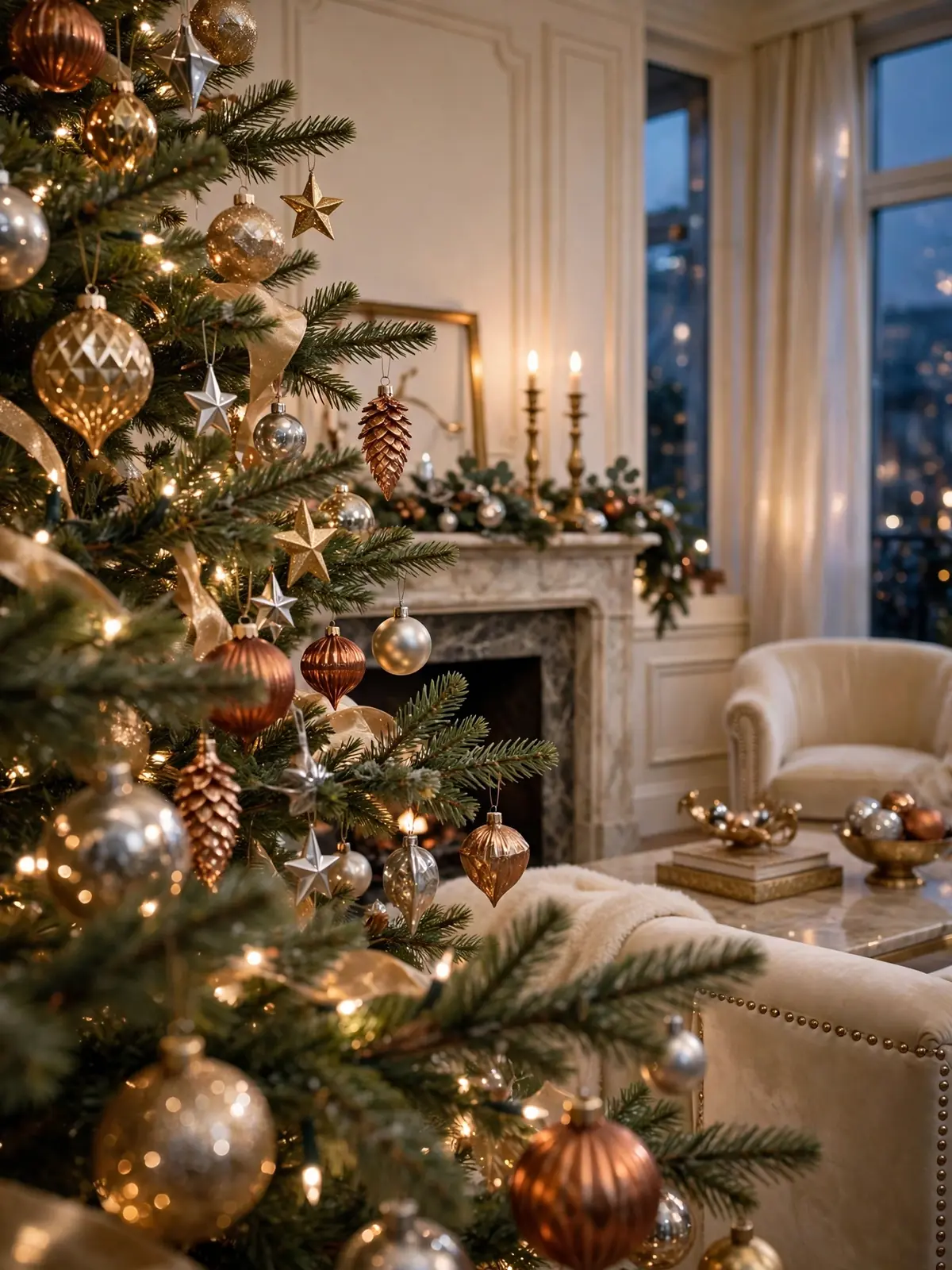
A champagne gold and metallics tree is the luxe neutral of christmas tree decorating, because gold, champagne, copper and silver mixed together work with almost any theme and photograph beautifully. Here, a green tree glows with warm-white lights and champagne gold baubles, copper ornaments and silver glass drops, with a champagne ribbon and a gold star topper, beside brass candlesticks against cream walls in soft evening light. The design suits elegant living rooms and homes that entertain, it is the easiest theme to build from ornaments you already own, and the mixed metallics feel collected rather than matched. The weakness is coldness: all metallics with no soft texture feel like a shop window, so add a velvet ribbon and a faux-fur tree skirt for warmth.
Quick tips:
- Mix three metallics — gold, champagne and copper — plus a little silver.
- Add a velvet ribbon and a faux-fur skirt so the tree feels warm.
- Vary the ornament finishes: matte, glossy and glittered.
- Keep the lights warm-white so the metals glow, never glare.
Cherry-Red Velvet Bows Tucked Into the Branches
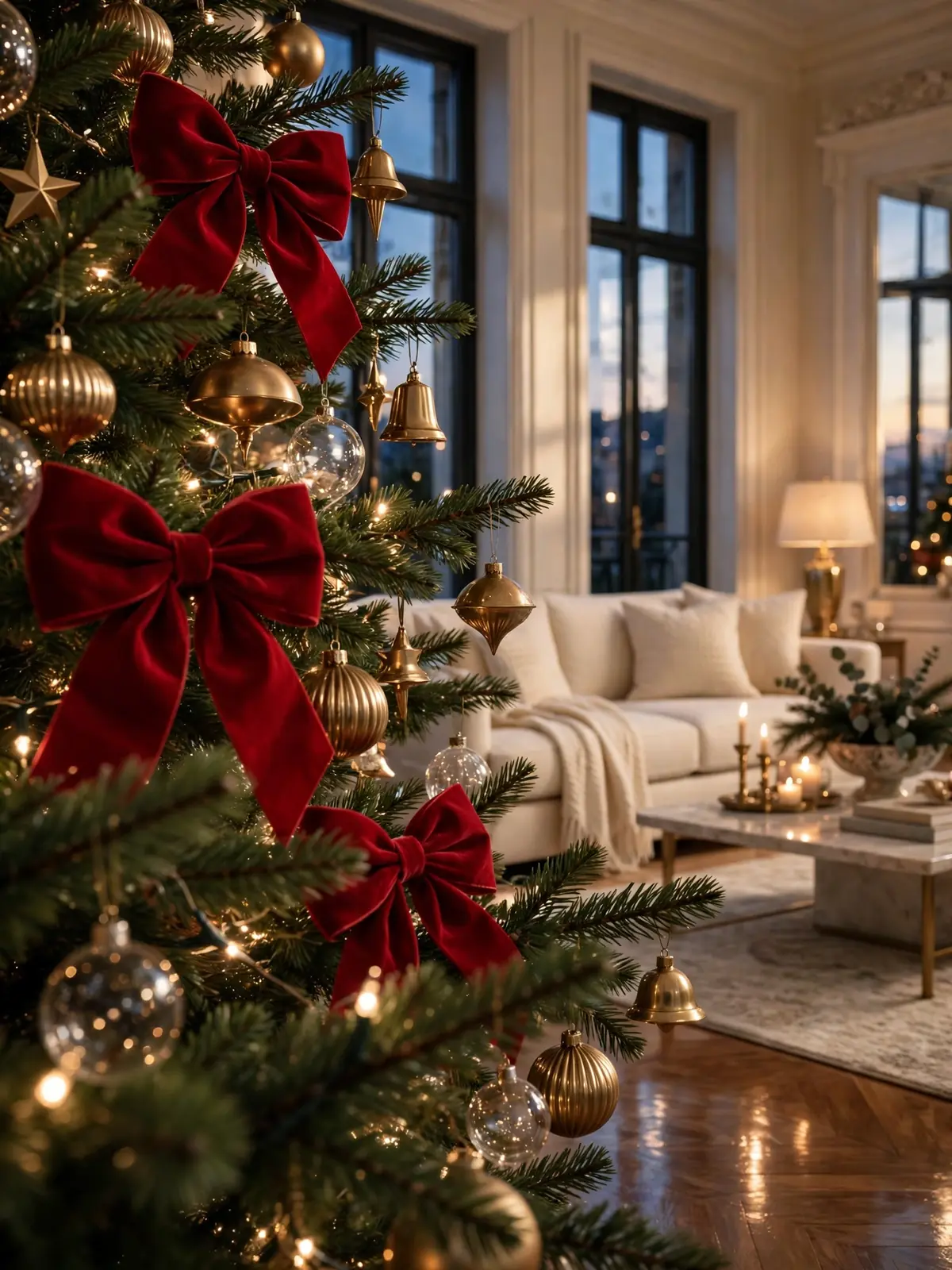
Cherry-red velvet bows are the single most copied christmas tree decorating detail of 2026, because wide velvet ribbon tied into loose bows and tucked into the branches makes the red the star of the whole tree. Here, a green tree carries five oversized cherry-red velvet bows tucked deep into the branches, with brass ornaments and clear glass baubles around them, warm-white lights glowing behind, beside a cream sofa in soft evening light. The design suits any living room, it costs the price of one ribbon spool, and the bows do the work of twenty ornaments. The weakness is droop: unwired ribbon goes limp within days, so use wired velvet ribbon and pin each bow to a sturdy branch with floral wire.
Quick tips:
- Use wired velvet ribbon so the bows hold their shape.
- Tie five or seven bows, in odd numbers, at different heights.
- Keep the other ornaments simple — brass and clear glass only.
- Pin each bow to a sturdy branch with floral wire.
A Vertical Ribbon Cascade Like a Designer
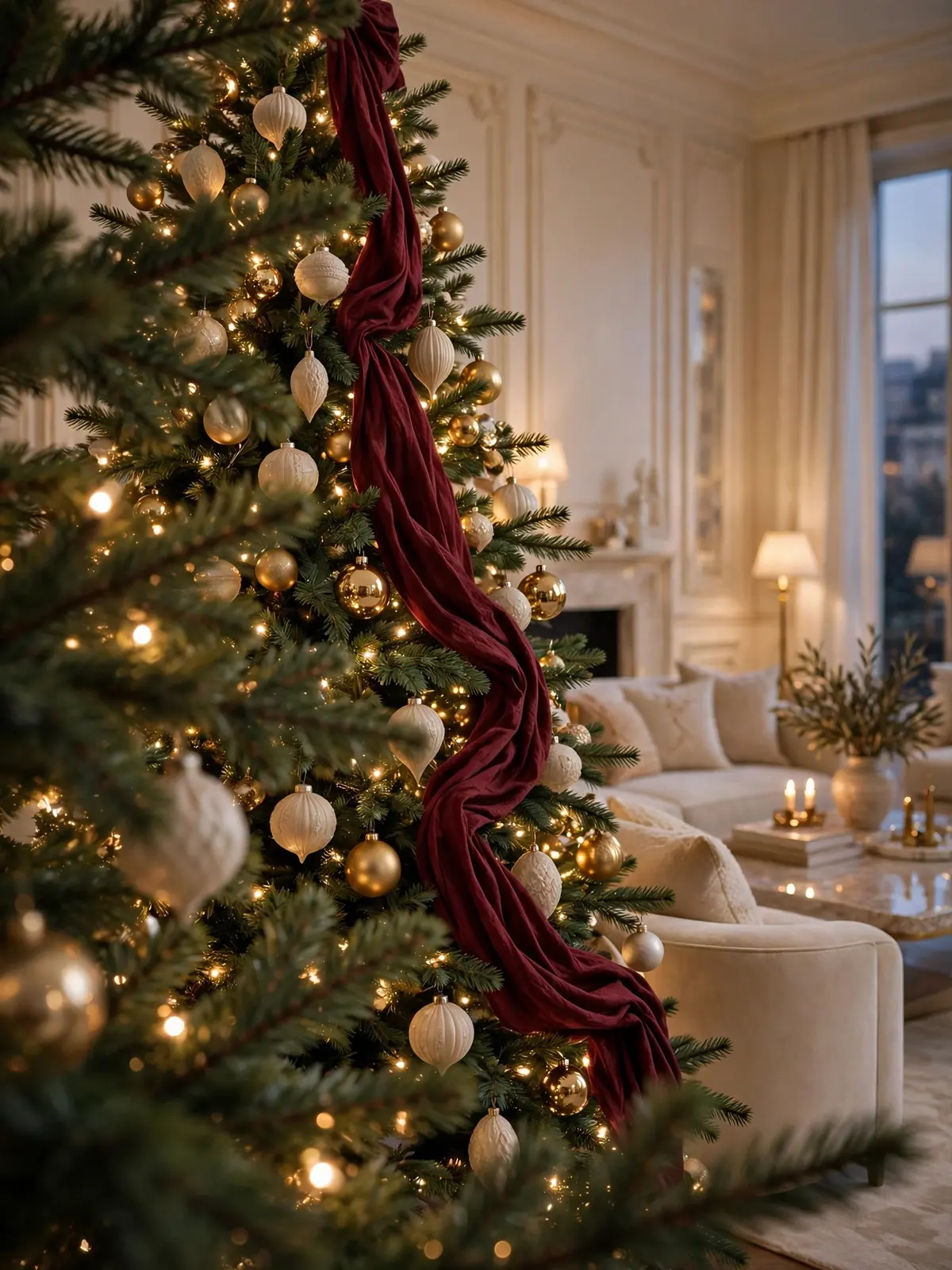
A vertical ribbon cascade is the designer trick of christmas tree decorating, because ribbon run top to bottom in long vertical falls gives the tree height and movement that horizontal wrapping never achieves. Here, a green tree carries deep burgundy ribbon cut into 3- to 4-foot sections and tucked vertically from top to bottom, with cream ornaments and gold baubles between the falls, warm-white lights glowing through, against cream walls in soft evening light. The design suits tall trees and formal living rooms, it takes about 30 minutes, and the vertical lines make a slim tree look taller. The weakness is bunching: ribbon pushed too deep disappears, so tuck each section just under the branch tips and let the ends curl outward.
Quick tips:
- Cut wired ribbon into 3- to 4-foot sections for the cascade.
- Use 2.5-inch wide ribbon so the falls read from across the room.
- Tuck each section just under the branch tips, not deep inside.
- Let the ribbon ends curl outward for a finished look.
An All-White Flocked Tree
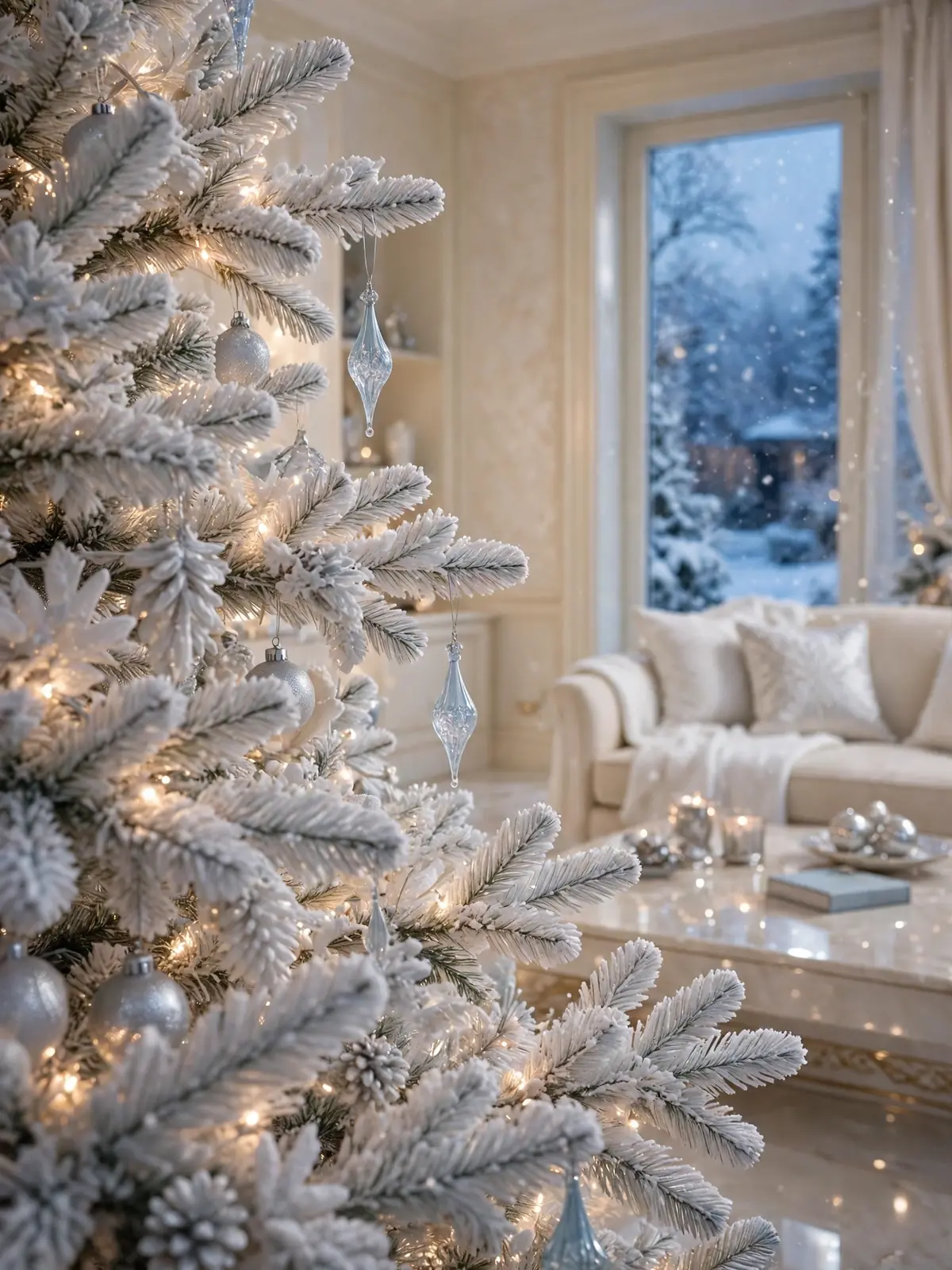
An all-white flocked tree is the most elegant look in christmas tree decorating for 2026, because a white or flocked tree with white and silver ornaments feels like a snowy forest brought indoors. Here, a flocked white tree carries white ceramic baubles, silver glass drops and pale blue ornaments, with warm-white lights and a silver ribbon, against cream walls in soft evening light. The design suits modern and glamorous living rooms, it brightens a dark corner at once, and the white branches make every ornament colour pop. The weakness is flatness: pure white can read as blank, so add the pale blue drops and a few silver pieces for depth, and keep the lights warm-white so the tree glows instead of glaring.
Quick tips:
- Add pale blue and silver so an all-white tree never reads flat.
- Use warm-white lights — cool lights make white look clinical.
- Choose a silver or white tree skirt so the base disappears.
- Shake a flocked tree outdoors first to cut the white dust.
A Pastel Tree in Blush, Powder Blue and Mint
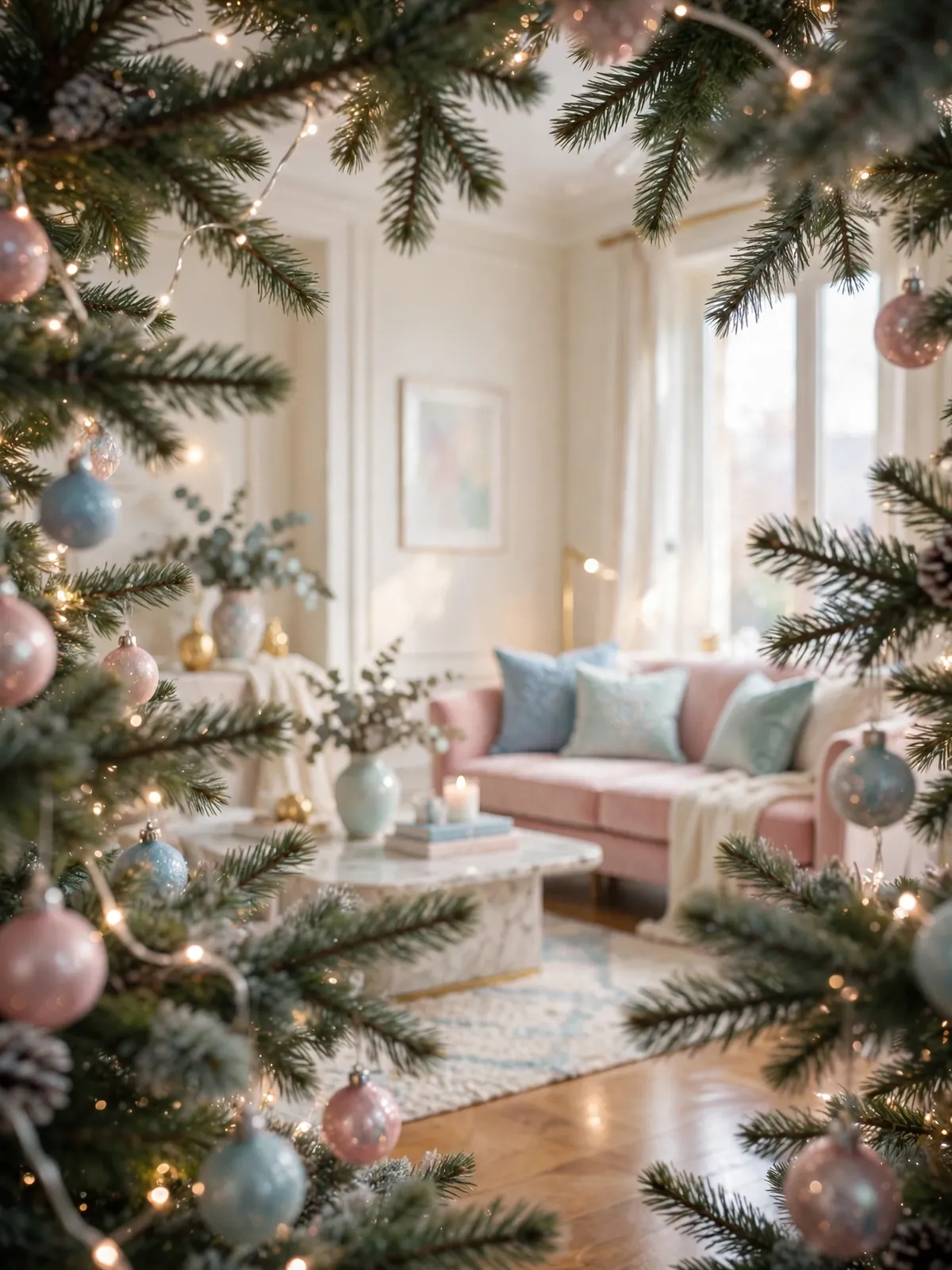
A pastel tree is the romantic side of christmas tree decorating, because blush pink, powder blue and soft mint ornaments make a dreamy, soft tree that feels completely different from the traditional red and green. Here, a green tree carries blush pink baubles, powder blue glass drops and soft mint ornaments, with white fairy lights and a pale pink ribbon, against cream walls in soft daylight. The design suits bedrooms, girls’ rooms and light modern living rooms, and the pastels photograph beautifully in daylight. The weakness is washout: pastels against a white wall disappear, so add a few deeper pink or blue pieces and a silver star topper for definition.
Quick tips:
- Use three pastels at most — blush, powder blue and mint.
- Add a few deeper pink or blue baubles so the tree reads clearly.
- Keep the ribbon pale pink, not white, so it shows on the branches.
- A silver star topper finishes a pastel tree better than gold.
A Heritage Plaid Tree
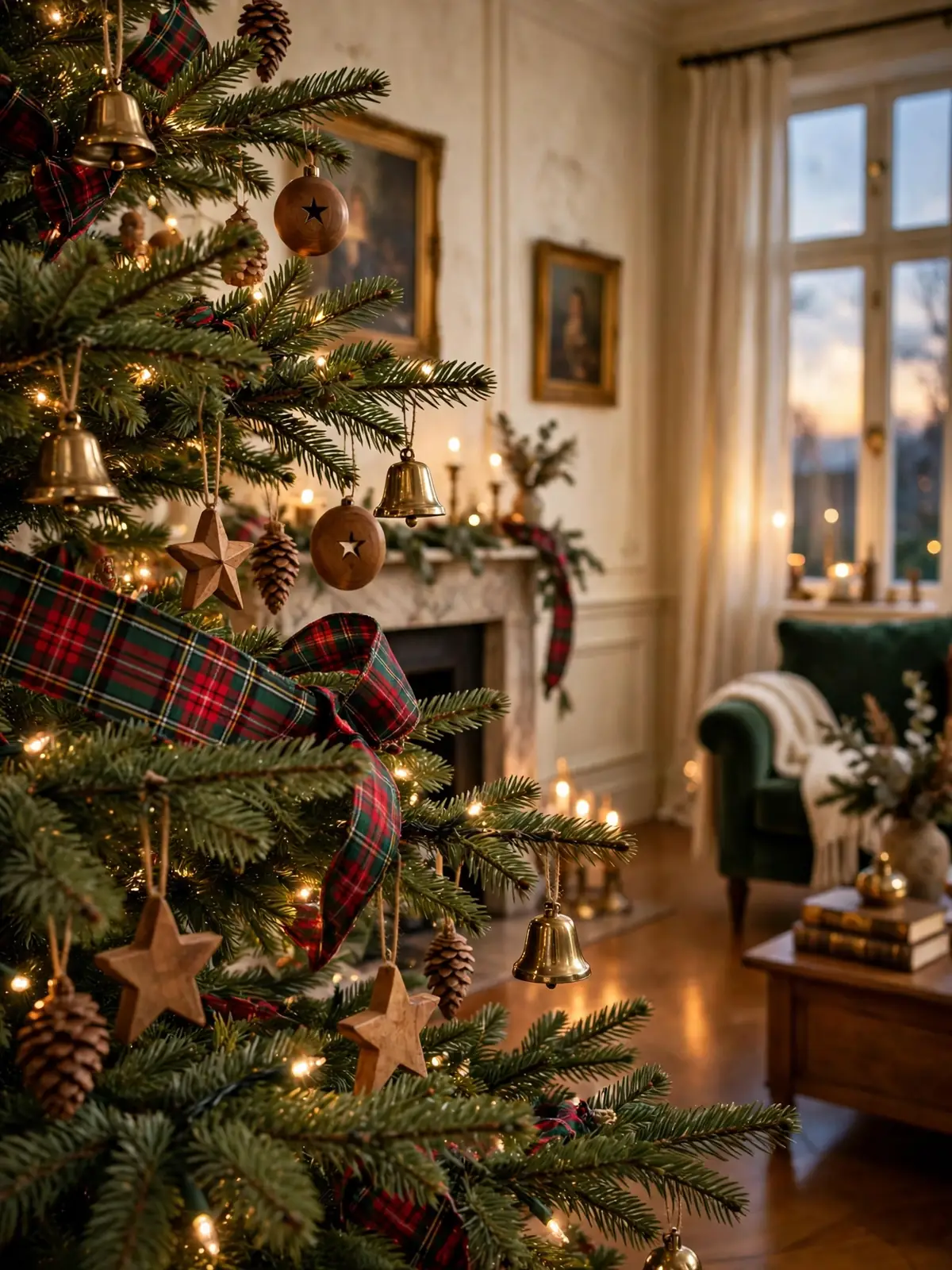
A heritage plaid tree is the nostalgic heart of christmas tree decorating, because a narrow plaid ribbon run vertically through the tree, with its colours repeated in a few ornaments, looks at home with traditional furniture and warm wood. Here, a green tree carries a red and green tartan ribbon in vertical falls, warm wood ornaments, small brass bells and warm-white lights, against cream walls on a warm wood floor in soft evening light. The design suits traditional and farmhouse living rooms, it is easy to build from one ribbon spool, and the plaid ties the tree to the cushions and throws in the room. The weakness is busyness: plaid plus patterned ornaments plus coloured lights is too much, so keep the ornaments plain — wood, brass and one red — and the lights warm-white.
Quick tips:
- Run a narrow plaid ribbon vertically, not horizontally.
- Repeat the plaid colours in the ornaments, not in a second pattern.
- Keep the ornaments plain: wood, brass and one red.
- Match the tree plaid to a cushion or throw in the room.
A Personal Tree With Travel and Handmade Ornaments
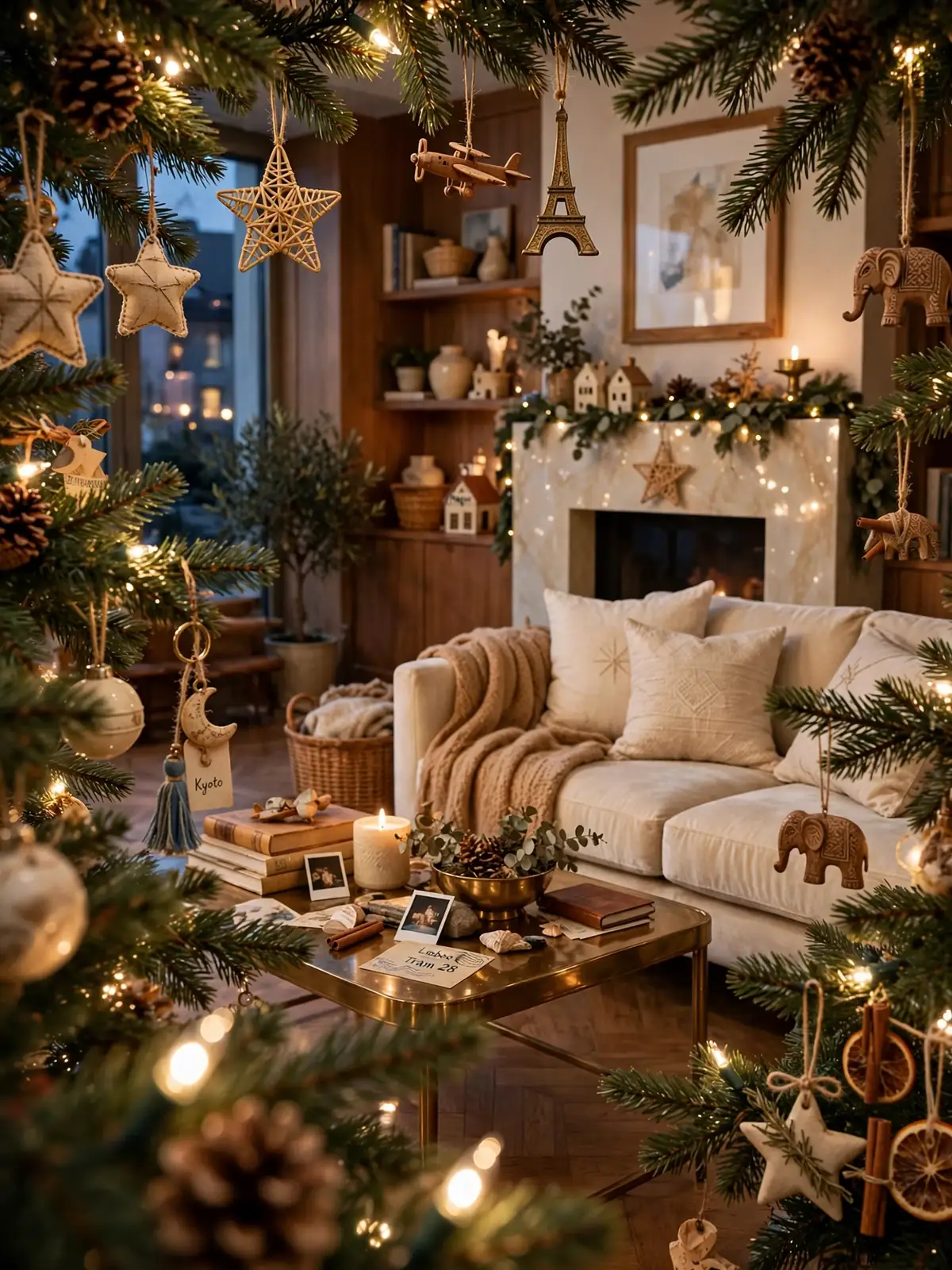
A personal tree is the most meaningful version of christmas tree decorating, because travel ornaments, hobby ornaments and handmade ones from the children turn the tree into the family’s story. Here, a green tree carries a joyful mix — small travel souvenirs, handmade paper stars, a few hobby ornaments and cream baubles to calm the mix — with warm-white lights and a simple cream ribbon, in a lived-in living room in soft evening light. The design suits any family home, it costs nothing new, and the tree gets better every year as the collection grows. The weakness is chaos: a tree of unrelated ornaments can look accidental, so calm it with cream baubles between the personal pieces and one ribbon colour throughout.
Quick tips:
- Calm a mixed tree with cream baubles between personal pieces.
- Use one ribbon colour throughout to tie the collection together.
- Hang the most precious ornaments at eye level, not at the top.
- Add one new ornament per person per year so the tree grows.
A Pencil Tree for a Small Corner
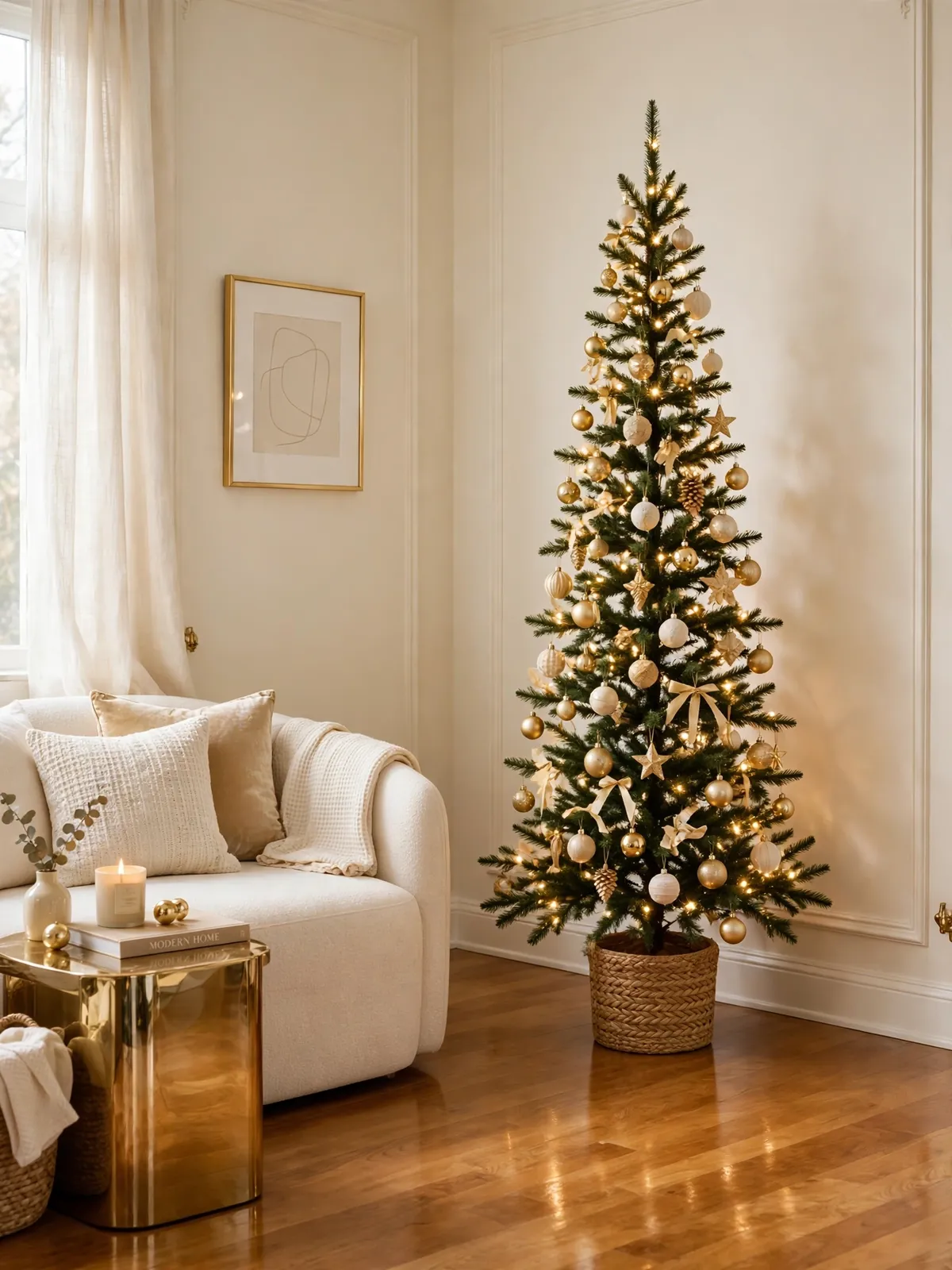
A pencil tree is the small-space hero of christmas tree decorating, because a slim tree fits a corner without eating floor space while still giving a full tree shape at eye level. Here, a slim pencil tree stands in a bright corner with gold and cream ornaments, warm-white lights and a slim gold ribbon, against cream walls on a warm wood floor in soft daylight. The design suits flats, small living rooms and rented homes, a 5-foot pencil tree costs little and fits a corner that a full tree never could, and the slim shape makes every ornament visible. The weakness is stability: a tall slim tree tips easily, so use a heavy stand, keep it out of the main walkway, and hang the heaviest ornaments low.
Quick tips:
- Choose a 5- or 6-foot pencil tree for a standard corner.
- Use a heavy stand — slim trees tip more easily than full ones.
- Hang the heaviest ornaments low for balance.
- Keep the tree out of the main walkway.
A Tabletop Tree on a Sideboard
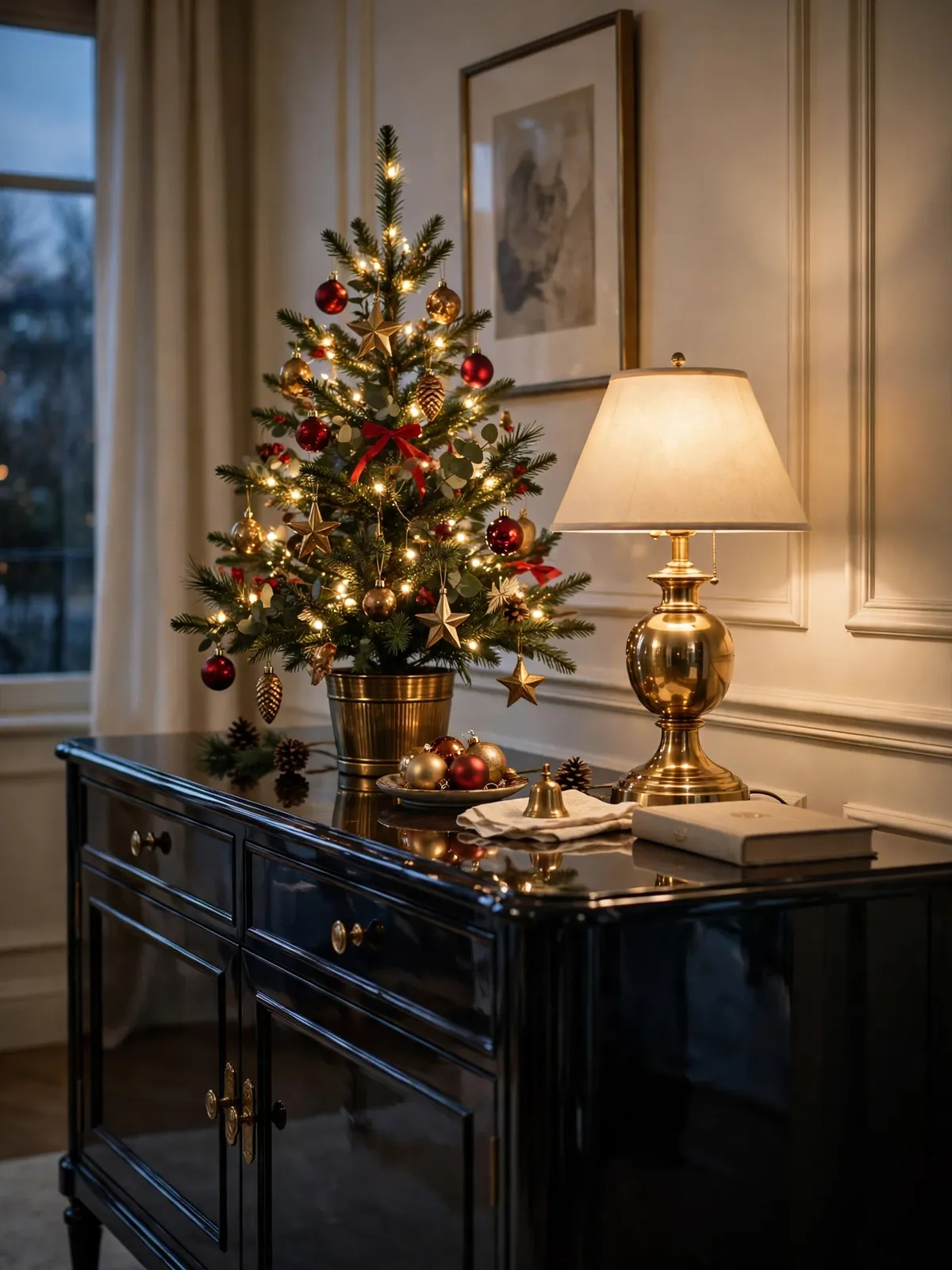
A tabletop tree is the smallest full version of christmas tree decorating, because a 2- to 3-foot tree on a sideboard gives a complete tree shape at eye level with no floor space at all. Here, a small green tree stands on a warm wood sideboard with red and brass ornaments, warm-white lights and a tiny gold star, beside a brass lamp against cream walls in soft evening light. The design suits flats, bedrooms, hallways and homes with no floor to spare, it takes 20 minutes to dress, and the tree can move from room to room. The weakness is scale: full-size ornaments swamp a small tree, so use mini baubles and a small topper, and keep the ribbon narrow.
Quick tips:
- Use mini baubles — full-size ornaments swamp a small tree.
- Keep the ribbon narrow, about 1 inch wide.
- Put the tabletop tree where it is seen at eye level.
- A small tree needs only 100 to 200 lights, not 700.
A Tree Skirt That Finishes the Base
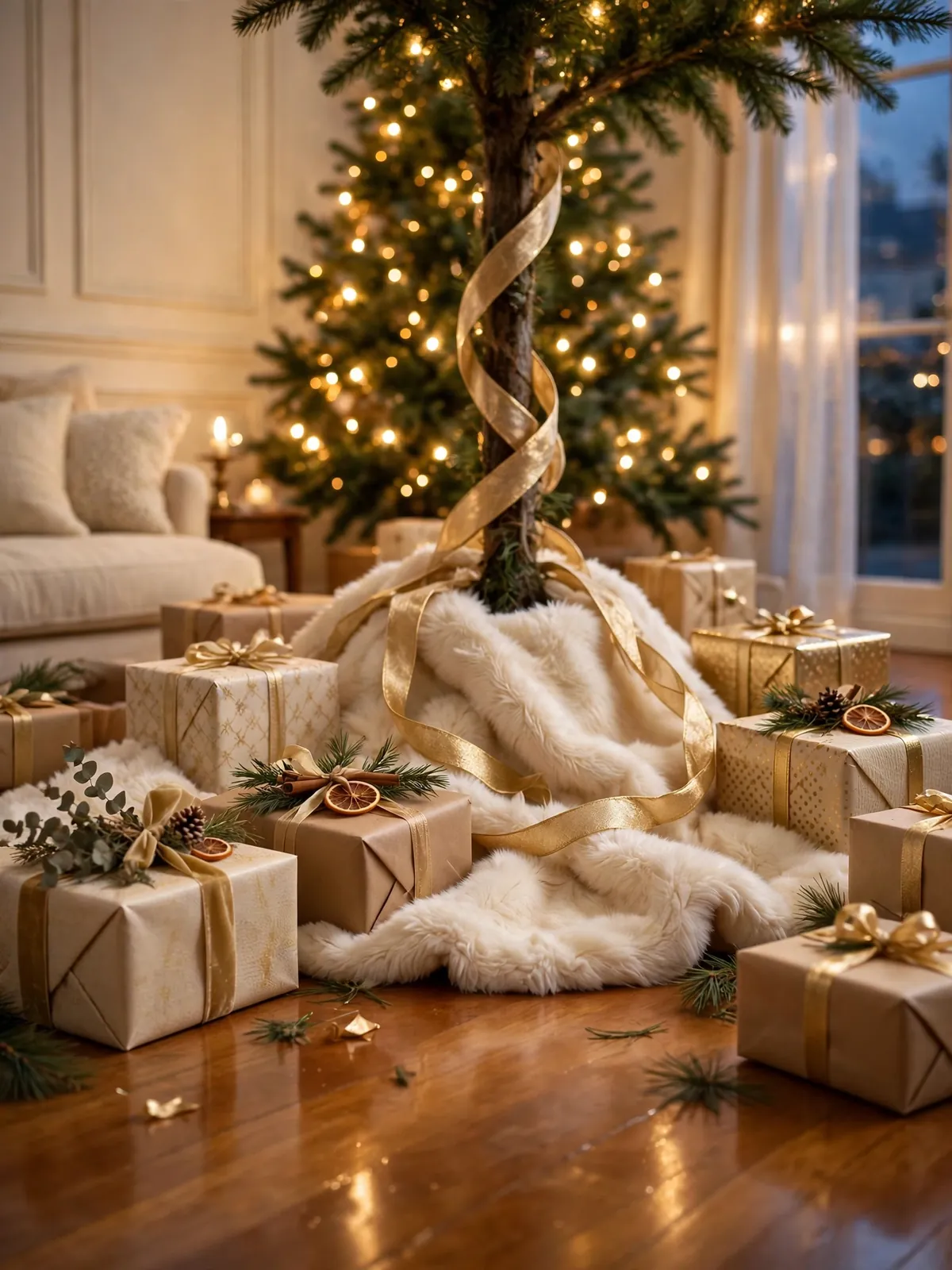
A tree skirt is the finishing touch of christmas tree decorating that most people forget, because a beautiful tree on a bare metal stand looks unfinished from every angle. Here, an ivory faux-fur tree skirt spreads under a green tree dressed in gold ribbon, with wrapped presents arranged on top of it, on a warm wood floor against cream walls in soft evening light. The design suits every tree, it takes two minutes, and the skirt hides the stand, the wires and the water bowl in one move. The weakness is size: a skirt that is too small leaves the stand showing, so measure the tree’s widest branch spread and buy a skirt at least that wide.
Quick tips:
- Buy a skirt at least as wide as the tree’s lowest branches.
- Faux fur suits glam trees; linen suits minimal trees; plaid suits traditional.
- Arrange presents on the skirt, not beside it, for a finished base.
- A tree collar is the modern alternative if skirts feel too soft.
A Tree Topper: Star, Angel or Oversized Bow
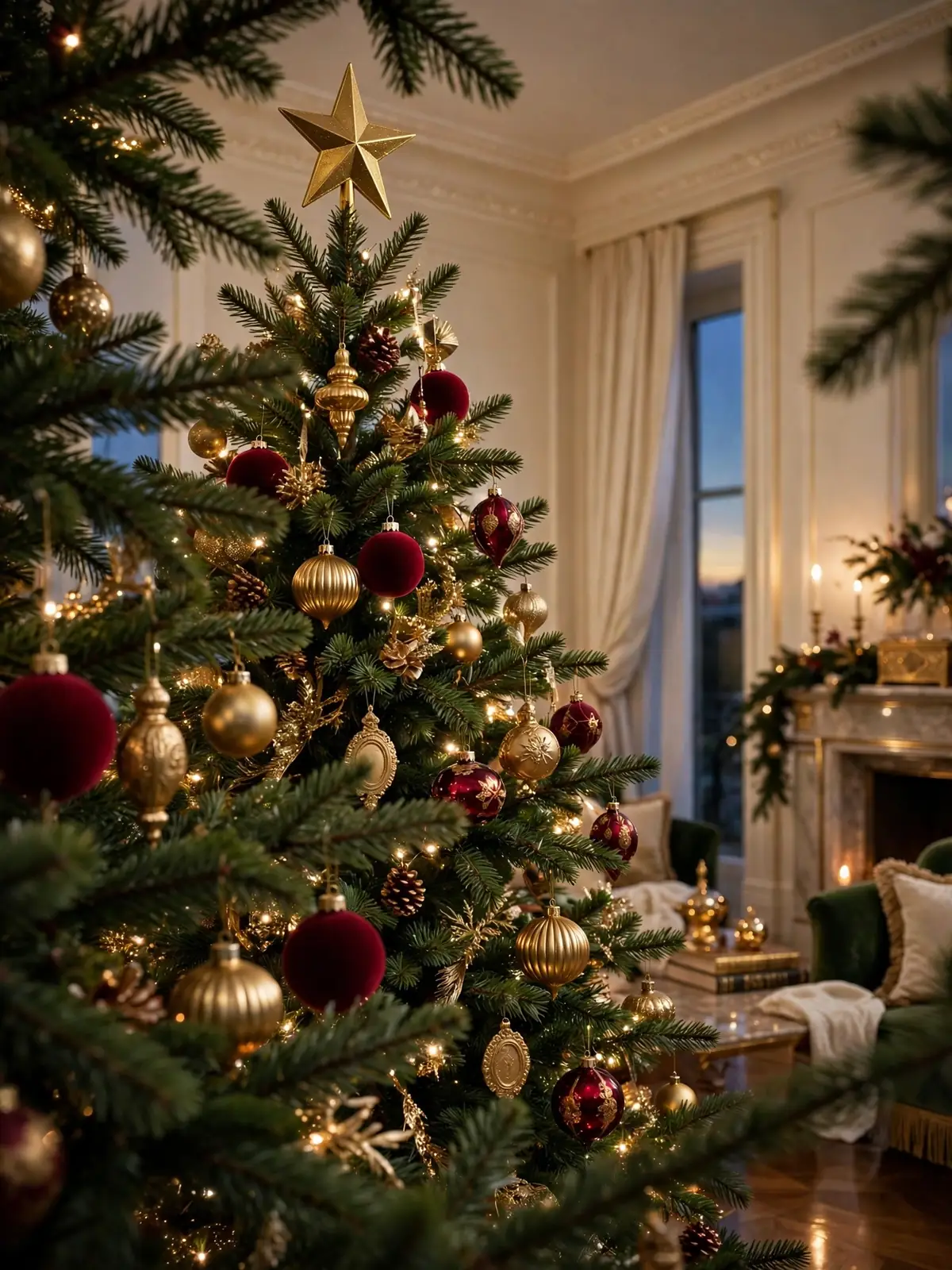
The tree topper is the crown of christmas tree decorating, because the top of the tree is the first thing the eye finds and the last detail that makes the tree feel finished. Here, a large gold star tops a green tree dressed in deep red and gold ornaments with warm-white lights, against cream walls in soft evening light, the star catching the light from across the room. The design suits every tree, and the choice — star, angel or oversized bow — sets the tone: a star is classic, an angel is traditional, and a big velvet bow is the 2026 look. The weakness is proportion: a topper that is too small disappears and one that is too big topples the tree, so size it to the tree — about 10 inches tall on a 7-foot tree — and wire it to the top branch.
Quick tips:
- Size the topper to the tree: about 10 inches on a 7-foot tree.
- Wire the topper to the top branch so it never leans.
- Match the topper to the tree’s metallic — gold star, gold ornaments.
- An oversized velvet bow is the freshest 2026 topper choice.
Ornament Placement Like a Pro: Big Inside, Small Outside
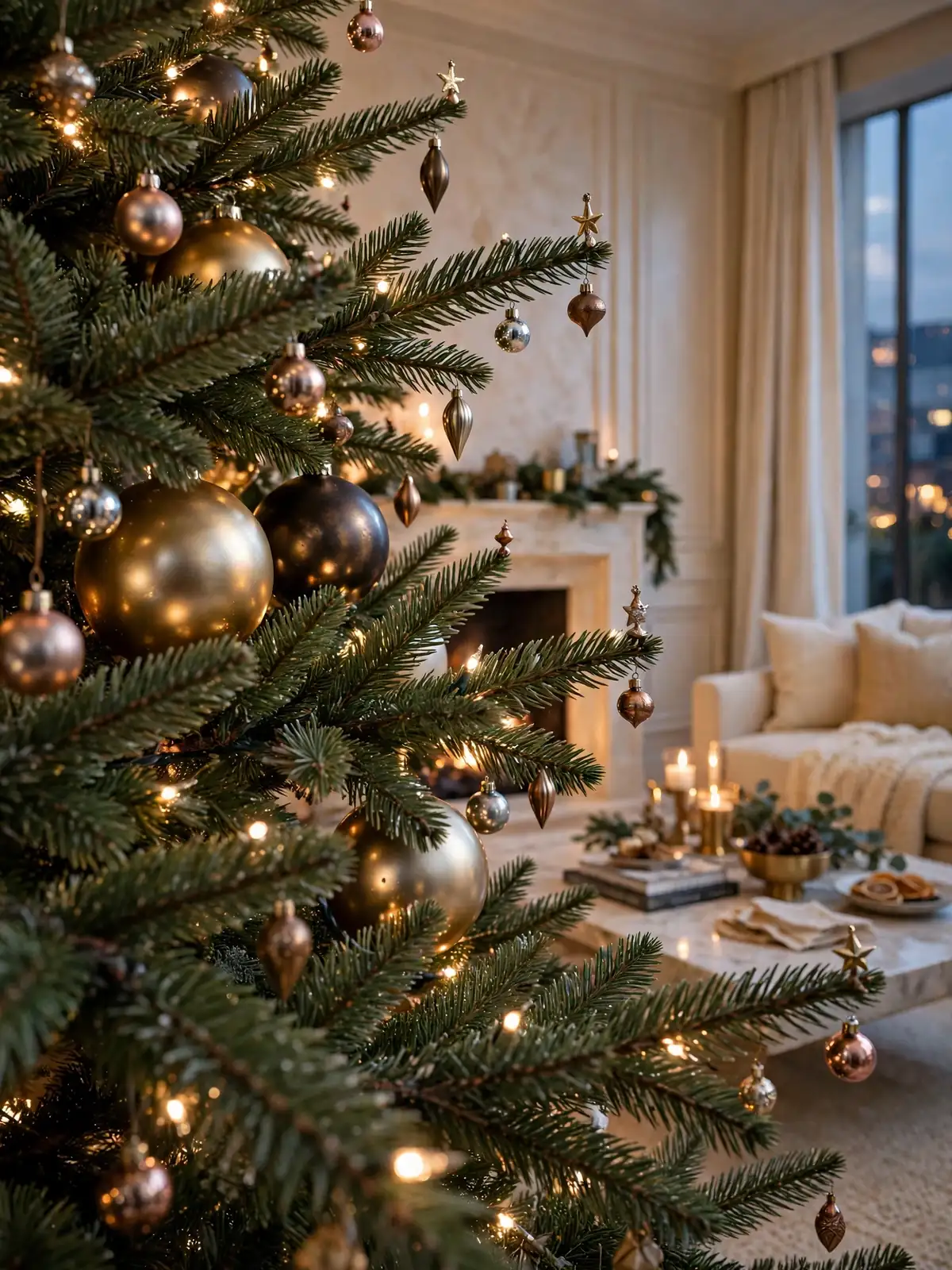
Ornament placement is the quiet skill of christmas tree decorating, because the same ornaments placed well look twice as expensive as the same ornaments hung at random. Here, a green tree shows the rule in action: large baubles in mixed metallics sit deep inside the branches where they catch the lights, medium ornaments fill the middle layer, and small ornaments hang at the branch tips, with warm-white lights glowing through every layer, against cream walls in soft evening light. The design suits every tree and every theme, it costs nothing, and the depth it creates is what makes a tree look professionally dressed. The weakness is habit: most people hang everything on the outer tips, so step back every ten ornaments and check the depth before continuing.
Quick tips:
- Hang large ornaments deep inside, small ones at the tips.
- Place ornaments in clusters of three, not evenly spaced.
- Step back every ten ornaments to check the depth.
- Fill bare gaps with ribbon, picks or pinecones, not more baubles.
A Rustic Burlap and Wood Tree
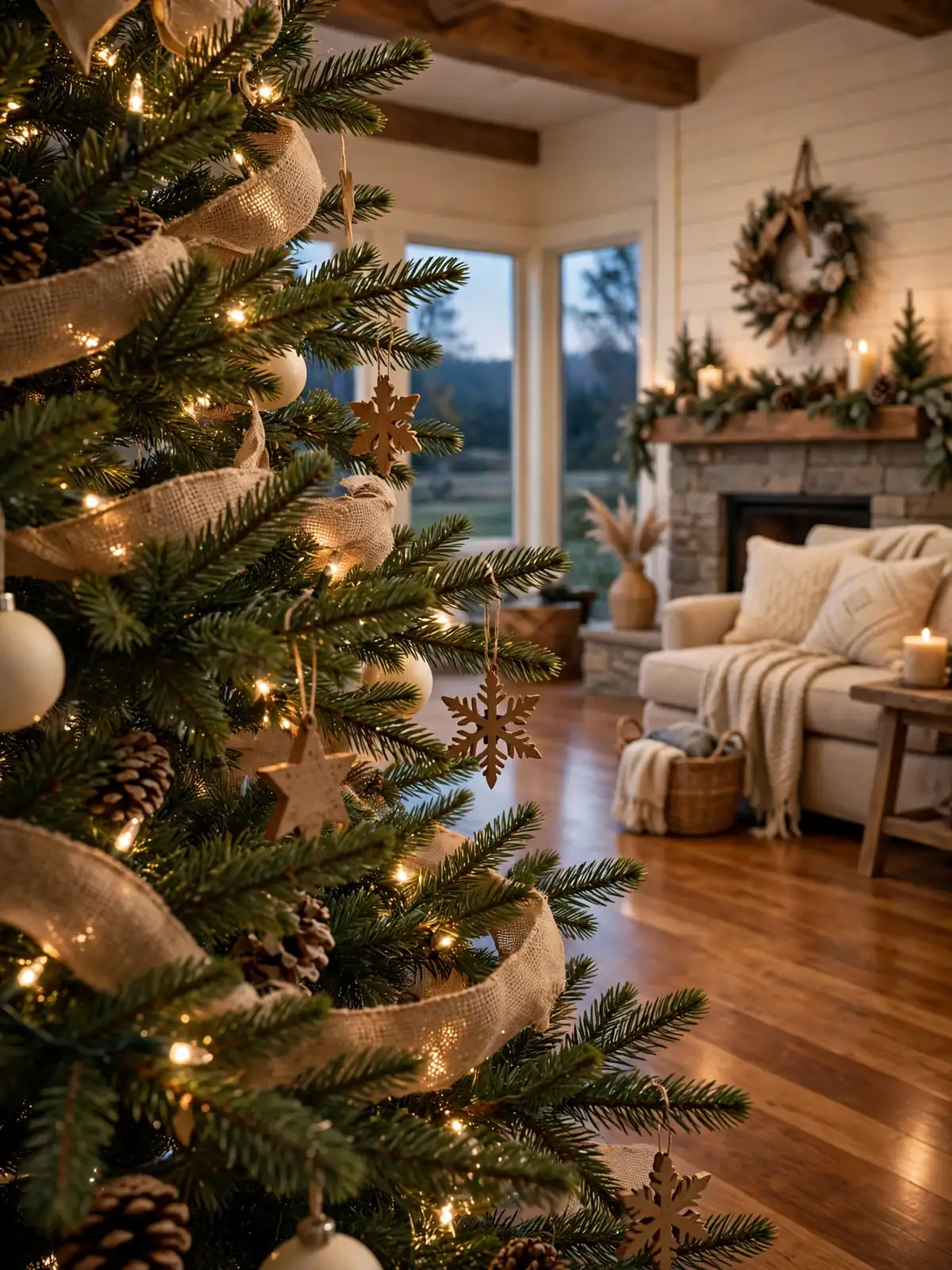
A rustic burlap and wood tree is the farmhouse version of christmas tree decorating, because burlap ribbon, wooden ornaments and pinecones make a tree that feels handmade and warm rather than polished. Here, a green tree carries wide burlap ribbon in loose spirals, plain wooden baubles, cream ornaments and pinecones wired to the inner branches, with warm-white lights glowing through, on a warm wood floor in soft evening light. The design suits farmhouse, cottage and rustic living rooms, it costs little, and the natural materials age well year after year. The weakness is dust: burlap sheds fibres, so shake the ribbon outdoors before hanging and keep the tree away from a working fireplace’s draught.
Quick tips:
- Shake burlap ribbon outdoors before hanging to cut the fibres.
- Mix wood, cream and pinecone — three natural textures only.
- Use a wooden star or a burlap bow as the topper.
- Keep the tree away from fireplace draughts that stir dust.
A Coastal Pale Aqua and White Tree
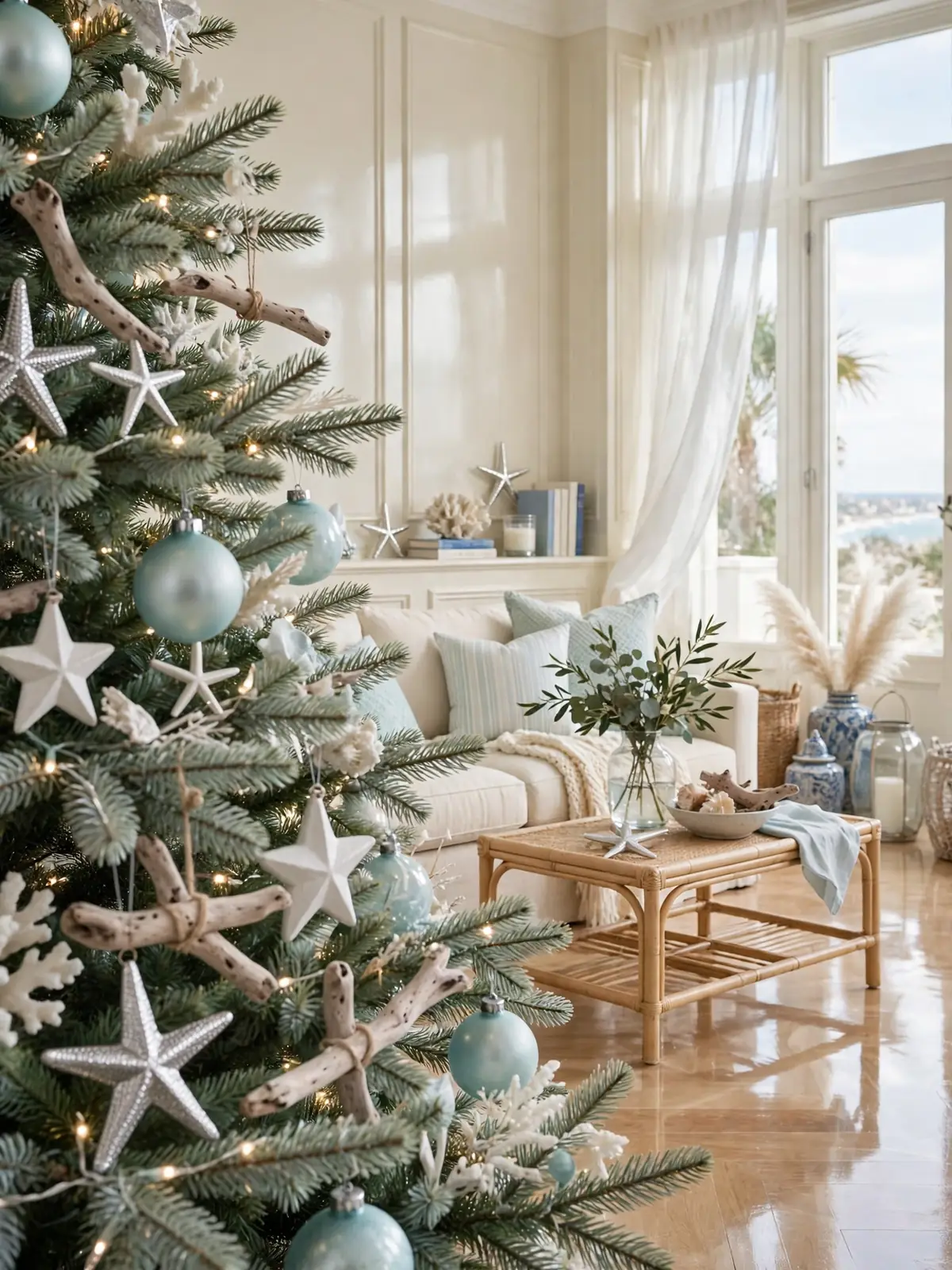
A coastal pale aqua and white tree is the breezy alternative in christmas tree decorating, because pale aqua, white and driftwood bring a seaside calm to a season that usually runs red and green. Here, a green tree carries pale aqua baubles, white ceramic ornaments, small driftwood stars and silver starfish, with warm-white lights and a white ribbon, against cream walls in a bright room full of soft daylight. The design suits coastal homes, beach houses and light modern living rooms, and the pale palette brightens a room that gets little winter sun. The weakness is theme drift: too many shells and starfish turn the tree into a beach display, so keep the coastal pieces to a few ornaments and let the aqua and white palette do the work.
Quick tips:
- Keep coastal pieces to a few ornaments — let the palette lead.
- Use pale aqua, not deep blue, so the tree stays light.
- A white ribbon suits a coastal tree better than a coloured one.
- Driftwood stars make the best coastal tree topper.
A Candy Cane and Peppermint Tree
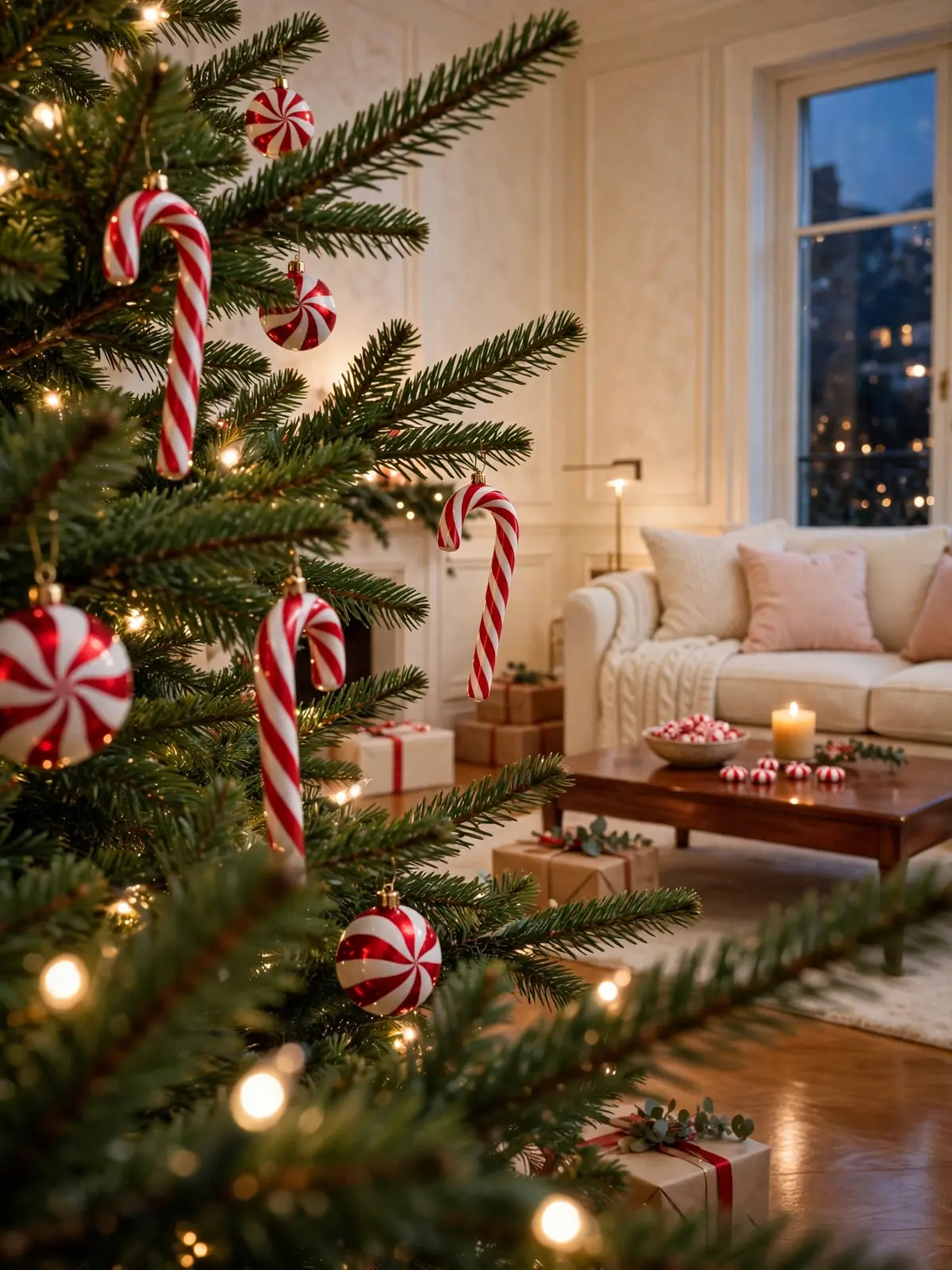
A candy cane and peppermint tree is the sweetest version of christmas tree decorating, because red and white stripes against green branches are instantly festive and children love finding every candy on the tree. Here, a green tree carries candy cane ornaments, red and white peppermint baubles and striped ribbon, with warm-white lights and a red bow topper, against cream walls in soft evening light. The design suits family trees and homes that love a playful Christmas, it is easy to build from one box of candy ornaments, and the red and white palette reads clearly from across the room. The weakness is sugar overload: an all-candy tree can feel like a sweet shop, so balance it with plain white baubles and one green ribbon to calm the stripes.
Quick tips:
- Balance candy ornaments with plain white baubles.
- Use one green ribbon to calm the red and white stripes.
- Hang real candy canes low where children can reach them.
- Keep the topper a simple red bow, not another candy piece.
A Kids’ Tree With Handmade Ornaments
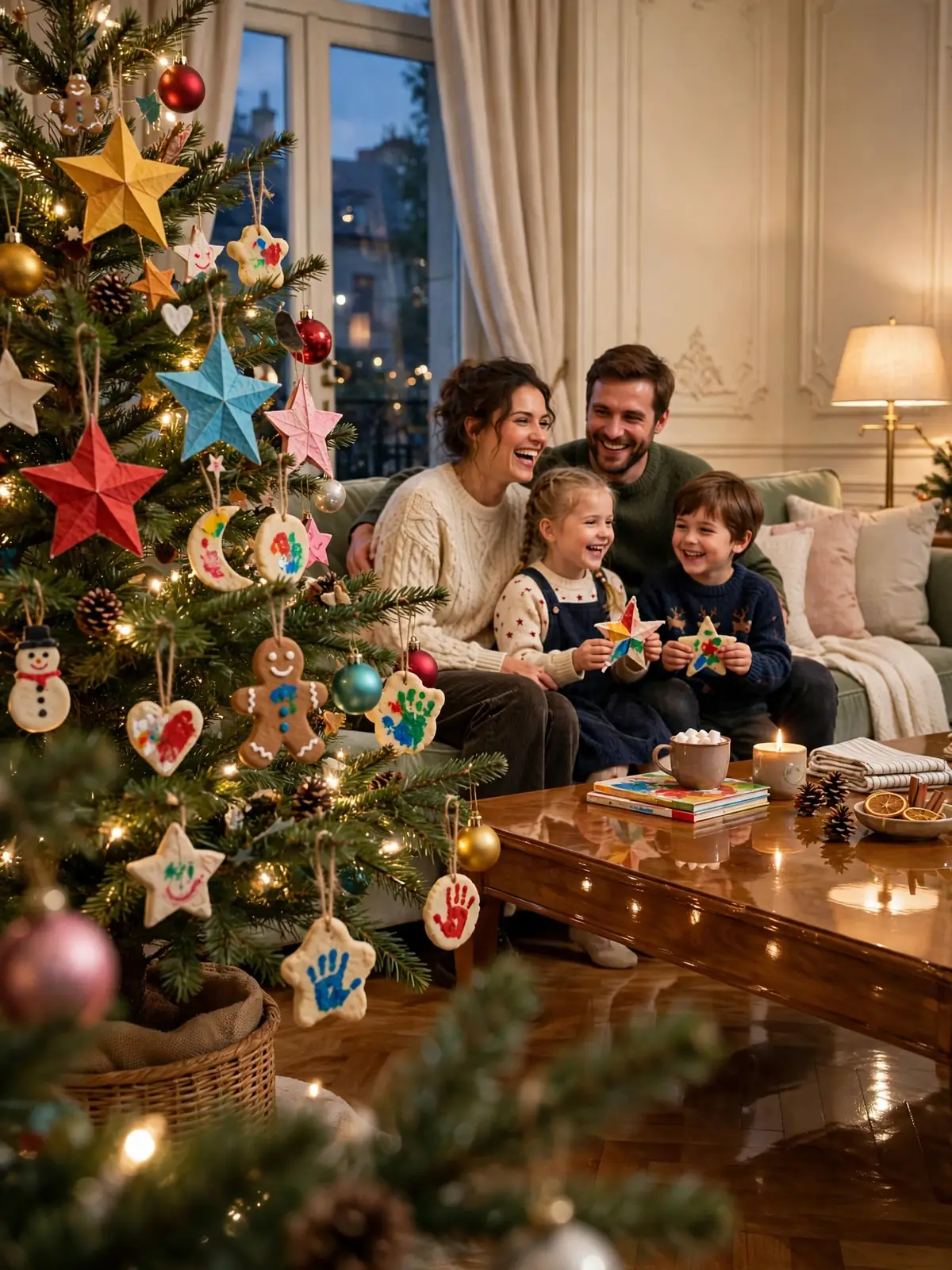
A kids’ tree is the most joyful version of christmas tree decorating, because a small tree covered in handmade paper stars, salt-dough shapes and bright baubles belongs entirely to the children. Here, a small green tree stands in a family living room covered in colourful handmade ornaments — paper stars, painted salt-dough shapes and bright baubles — with warm-white lights and a handmade paper star on top, against cream walls in soft evening light. The design suits family homes, it costs almost nothing, and the tree becomes a memory the children will ask for every year. The weakness is fragility: handmade ornaments break, so use shatterproof baubles beside them and hang the most precious pieces at eye level where they will not be knocked.
Quick tips:
- Use shatterproof baubles beside handmade ornaments.
- Hang the most precious pieces at eye level, not at the top.
- Let children place their own ornaments — wonky is the charm.
- Keep a small step stool nearby so little arms can reach.
Christmas Tree Decorating Ideas That Pull the Whole Room Together
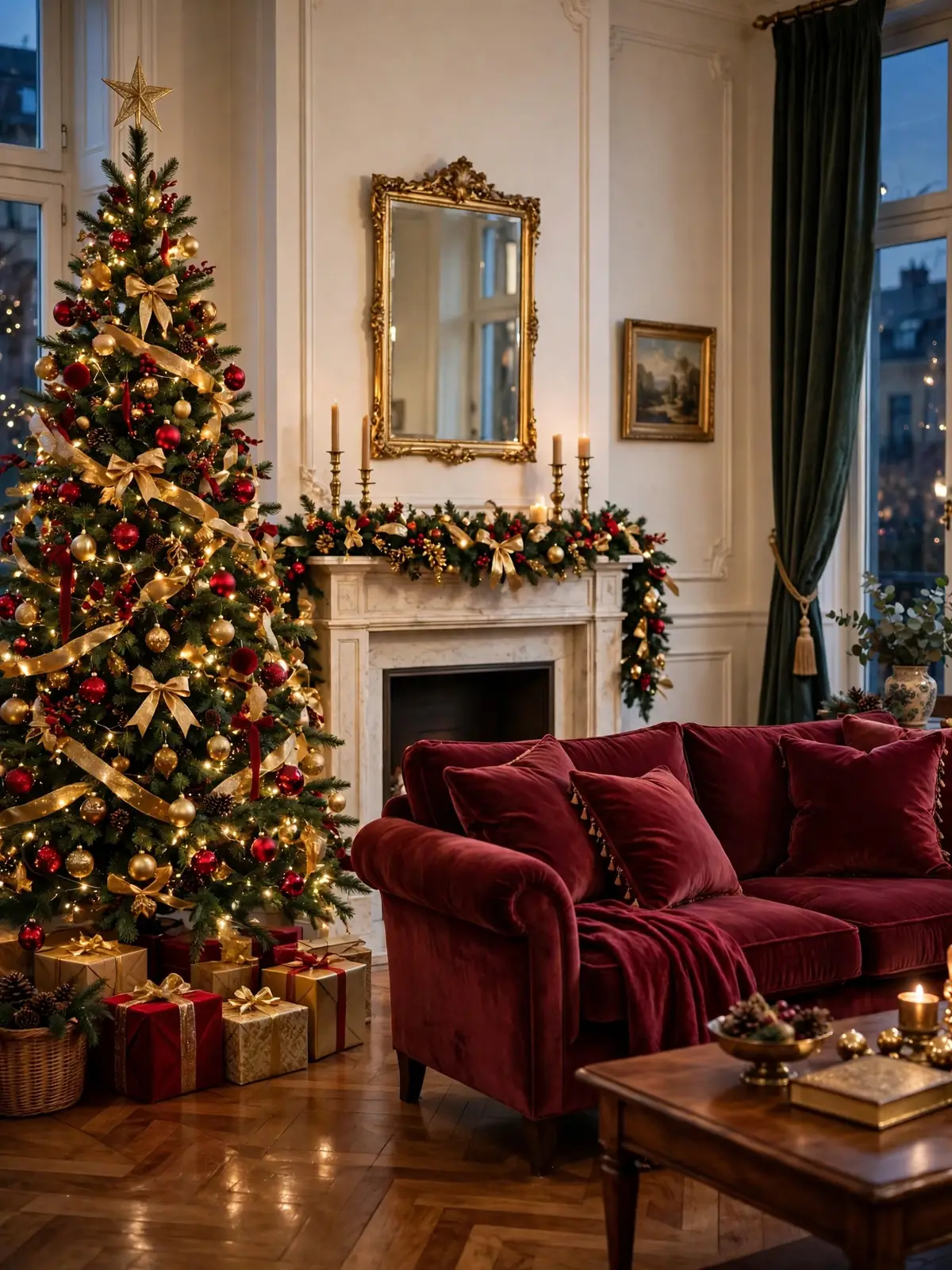
The last of these christmas tree decorating ideas is the principle behind them all, and it is worth stating plainly because it is the difference between a tree that looks decorated and a room that feels like Christmas: a great Christmas tree is not one expensive ornament, it is the combination of the right choices in the right order — branches fluffed from the bottom up, lights woven deep into the tree before anything else, one ribbon colour run through the branches, ornaments placed big inside and small outside, a topper sized to the tree and a skirt that hides the stand — working together so that the tree, the mantel garland, the cushions and the candles all carry the same palette, the same warmth and the same glow, and the house rewards the people who live in it too, because a tree dressed in that order is easy to live with, easy to refresh and easy to take down in January, even in a small flat, even on a modest budget, and even when you change only one thing at a time. Here, a cream and forest green living room pulls it together — a heritage red and gold tree, a matching garland on the mantel, burgundy velvet cushions and brass candlesticks — and nothing in the room is there by accident. The lesson is to start with the three ingredients: order, palette and light, then build outward from the tree to the rest of the room, because a home decorated around those three ingredients stays magical with very little effort, and it carries you from the first weekend of December right through to Christmas morning without ever feeling tired. Pick the three ideas from this list that solve your biggest problem first, add one luxury that makes you smile, and your tree stops being the decoration you put up for Christmas and becomes the star of the season you look forward to gathering around.
Quick tips:
- Start with the three ingredients: order, palette and light.
- Dress the tree first, then carry its palette to the mantel and table.
- Keep one ribbon colour on the tree, the garland and the stockings.
- Step back 8 feet before you finish — trees are viewed from a distance.
FAQs
How many lights do I need on my Christmas tree?
Plan on roughly 100 lights per foot of tree height — about 700 for a standard 7-foot tree and 900 for a 9-footer. Weave the strands deep into the branches from the top down rather than draping them on the surface, and choose warm white at 2700K for almost every theme, because it flatters every ornament colour.
What order should I decorate my Christmas tree in?
Fluff every branch first, working from the bottom up, then weave the lights deep into the branches, then add ribbon, then ornaments largest first, and finish with the topper and the tree skirt. Lights before ornaments is the rule that matters most — ornaments hung first block the lights from sitting deep in the tree.
How do I make my Christmas tree look full?
Fluffing is the single biggest difference — pull every branch tip outward and upward before anything else. Then layer ornaments in three sizes, push the largest ones deep inside the branches, fill gaps with ribbon, picks and pinecones, and add a tree skirt that covers the stand so the base looks finished from every angle.
Real or artificial Christmas tree — which is better?
A real tree smells wonderful and looks naturally irregular, but it needs water daily and drops needles, so it suits a main living room you can tend. A good artificial tree costs more once, repeats for years, holds its shape perfectly, and is the practical choice for small rooms, flats with pets, and anyone who wants the tree up early in November.
When should I put up and take down my Christmas tree?
Most homes put the tree up in late November or the first weekend of December, once the garland and the mantel are dressed, and take it down in early January after the New Year. An artificial tree can go up earlier and stay up longer, while a real tree should go up closer to Christmas so it stays fresh and safe.
Conclusion
Christmas tree decorating does not need the most expensive ornaments to feel magical — it needs the right order, one clear palette and warm light, woven deep into the branches. The 26 ideas above show that fluffing first, lighting deep, one ribbon colour, ornaments placed big inside and small outside, and a topper and skirt to finish can turn any tree — heritage red and gold, jewel tones, cherry cola, sage and pearl or gingerbread whimsy — into the star of the season. Pick one theme, dress the tree in order, and carry its palette to the mantel and the table. Do that, and your tree stops being the decoration you put up for Christmas and becomes the star of the season you look forward to gathering around.