25 Stunning Farmhouse Desk Ideas for a Workspace You’ll Actually Love
A farmhouse desk is the heart of a cozy home
A great farmhouse desk is simple: a solid wood top, a sturdy apron, and legs that look like they’ve been working for a century. That’s the whole formula — everything else is just details you choose around your room size, your work style, and how much storage you actually need. Laptop-and-notebook people do beautifully with a slim writing desk; anyone with a monitor, printer, and papers needs drawers, a deeper top, and a place to hide the cables.
If you nail the desk, the rest of the room almost styles itself. For the bigger picture — wall colors, lighting, and full room layouts — browse these farmhouse home office ideas and borrow whatever fits your space. This guide stays focused on the desk itself: which style to pick, where to put it, how to style it, and how to keep it organized.
Reclaimed Wood Farmhouse Desk Ideas for a Warm, Lived-In Workspace
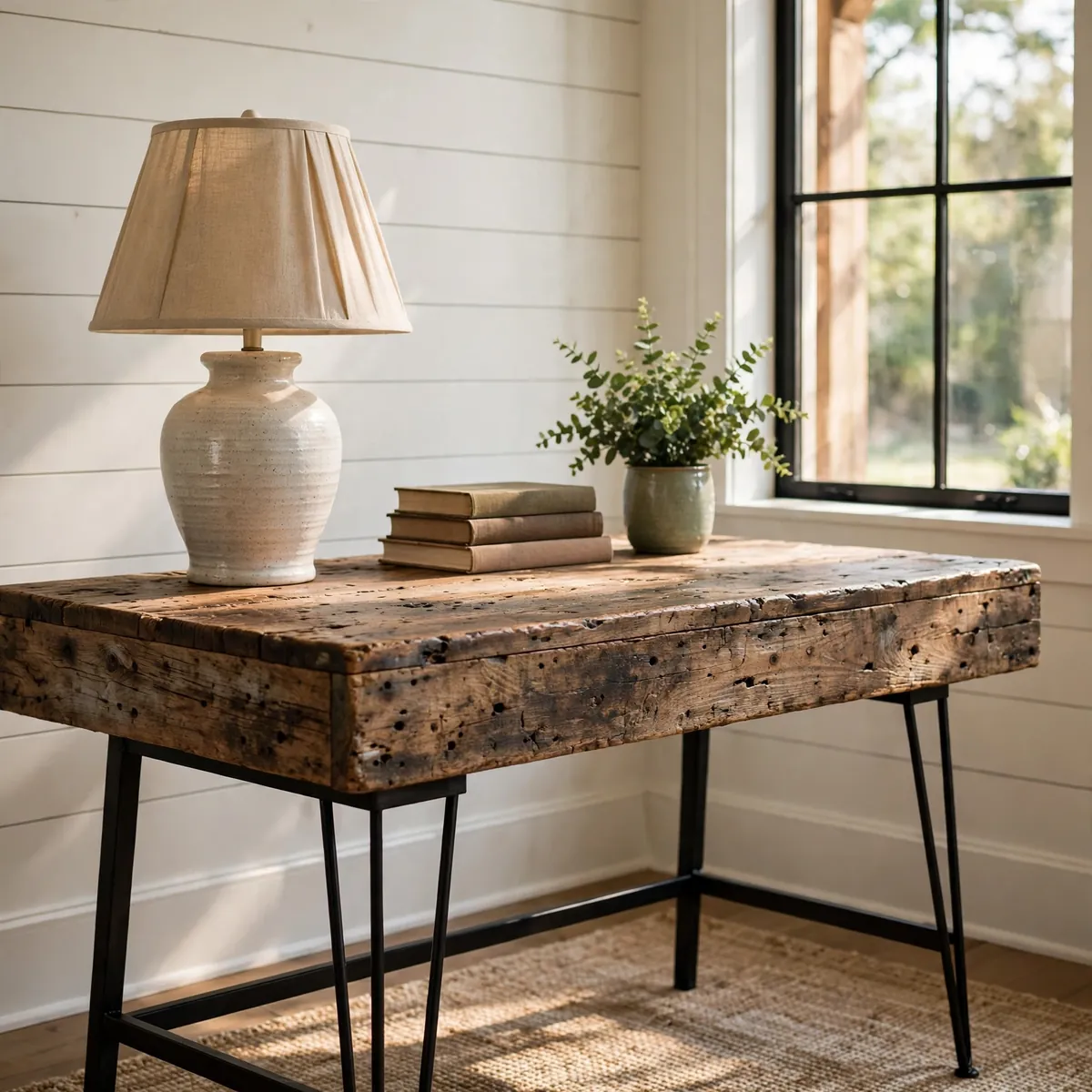
A desk built from reclaimed wood — barn boards, old floor planks, salvaged beams — brings instant character no new lumber can fake: nail holes, saw marks, and a patina that took decades to earn. Because the wood is the whole visual statement, keep the styling quiet: one ceramic lamp, a small stack of books, and a single green plant. Best for: people who work long hours and want warmth around them. Weakness: reclaimed tops can be uneven, so check that your laptop or monitor sits flat before you commit; a sheet of glass cut to size fixes wobble without hiding the grain.
- Seal reclaimed wood with matte polyurethane so coffee rings wipe off easily.
- Pair with black metal legs for contrast that keeps the look current.
- Leave 30 inches of depth if a monitor arm is involved; 24 inches is fine for laptops.
The Classic X-Leg Farmhouse Desk

The X-leg desk is the silhouette most people picture when they hear “farmhouse desk” — two crossed side frames, a thick plank top, and zero fuss. Its strength is structural honesty: those crossed legs carry heavy loads, so this is the desk for a dual-monitor setup or a sewing machine that vibrates. Its weakness is the footprint — the X braces eat knee space at the sides, so it’s better as a centered statement desk than a tight-corner squeeze. Best for: spare bedrooms and dedicated offices where the desk can breathe. Style it with a woven rug underneath to anchor the chunky legs.
- Choose a top at least 1.5 inches thick so the proportions look right.
- Center it on a rug to stop it feeling like it’s floating in the room.
- Add felt pads under the legs if your floors are hardwood.
A Slim Writing Desk for Tight Corners

When the room is small, the desk should be too — a slim farmhouse writing desk, 40 to 48 inches wide, gives you a real work surface without swallowing the room. The trade-off is storage: with no drawers, you need a wall-mounted shelf or a rolling cart beside it. This is the best pick for journaling, laptop work, and students, and the worst pick for anyone with a printer. Tuck it into an unused corner facing the wall, then hang one piece of art above it — the art becomes the “office” the furniture can’t provide.
- Wall-mount a shelf 18 inches above the top for supplies.
- Pick turned or tapered legs so it reads light, not bulky.
- A 24-inch depth is the sweet spot for laptop + notebook.
A Distressed White Desk That Brightens a Dark Room
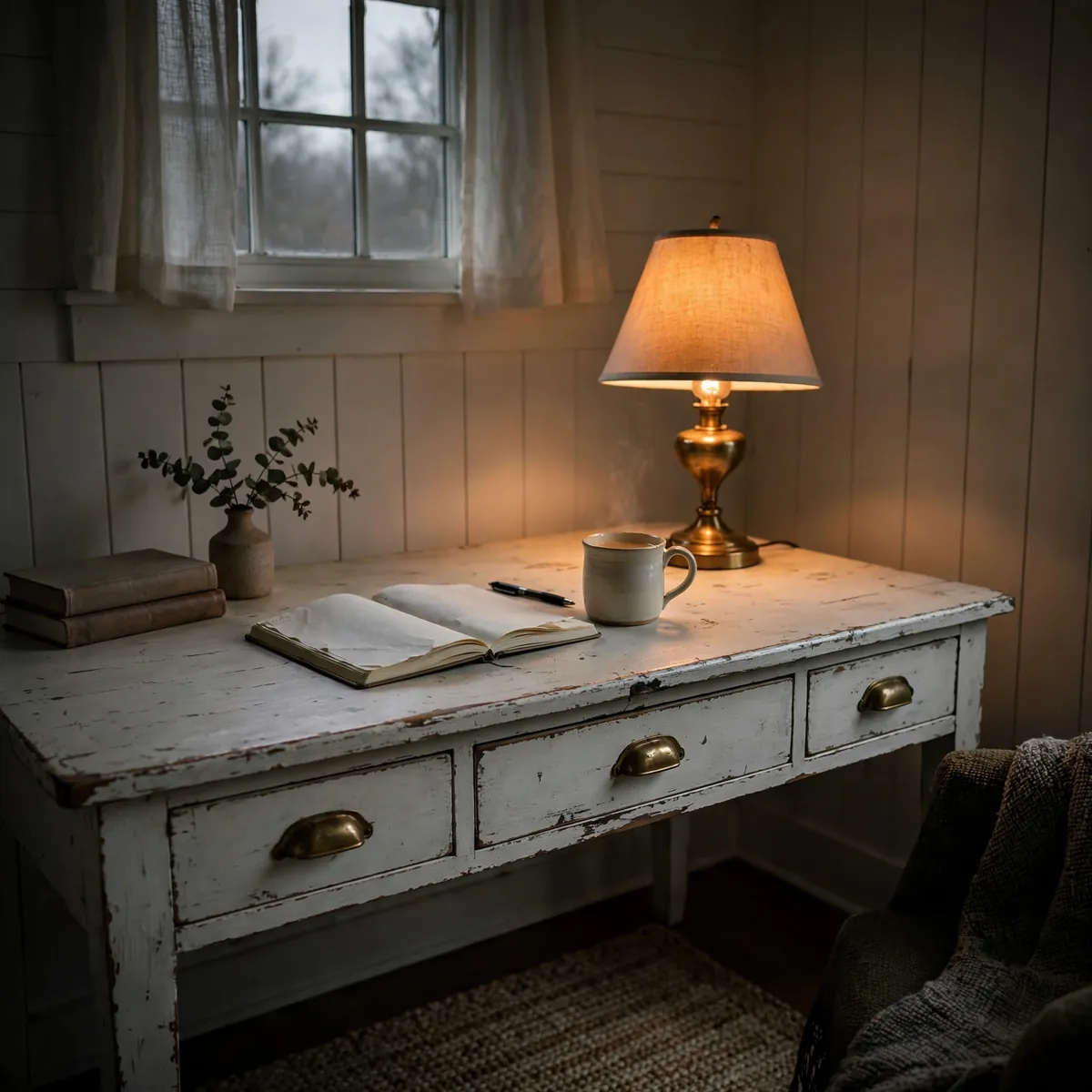
Dark home offices are a real problem — north-facing rooms and basement corners swallow light, and a dark wood desk makes it worse. A distressed white farmhouse desk solves it: the light finish bounces what little daylight exists, and the worn edges keep it from looking like flat-pack furniture. Strength: it pairs with any wall color, from sage to navy. Weakness: white shows every scuff, so this desk is best for low-mess work (writing, laptop, planning) rather than crafts or painting. Seal it with a wipeable satin finish and keep a coaster ritual.
- Use a satin — not matte — paint finish so it wipes clean.
- Distress only the edges; heavy distressing everywhere reads dated.
- Warm brass hardware keeps the white from feeling cold.
A Secretary Desk with an Overhead Hutch

The secretary desk is the introvert of farmhouse desks: a compact writing surface with a hutch of cubbies and small drawers above, and on some designs a drop-front that closes to hide the mess entirely. That close-up-and-walk-away feature is its superpower in living rooms and bedrooms where the office shares space with real life. The weakness is depth — most are only 20 to 24 inches deep, so a full desktop computer won’t fit; it’s a laptop-and-paperwork desk. Best for: anyone whose desk must disappear visually at 5 PM. Style the hutch with books spine-out and one small framed photo.
- Use the drop-front (if yours has one) as a hard “workday over” ritual.
- Line hutch cubbies with kraft paper boxes for uniform storage.
- Keep the desktop to three zones: laptop, inbox tray, lamp.
A Trestle-Base Desk for Two People Sharing
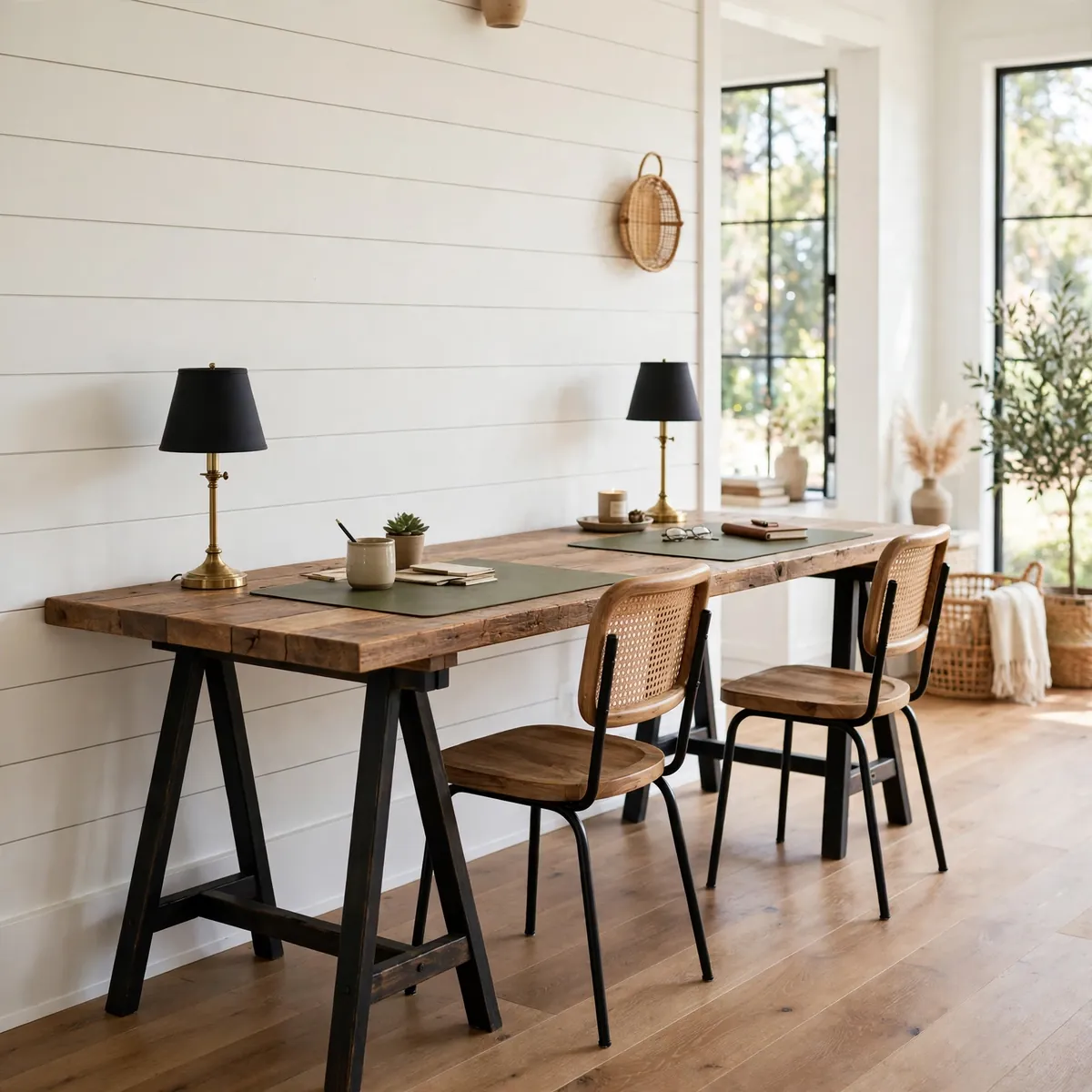
A trestle desk — a long top resting on two A-frame or panel ends — is the farmhouse answer to the shared home office. At 60 to 72 inches long, two people can genuinely work side by side without elbowing each other, and the open center means no drawer bank stealing legroom in the middle. The downside is obvious: zero built-in storage, so each person needs their own side solution (a small filing cabinet or a drawer unit at each end works). Best for: couples or parent-and-teen setups. Place it perpendicular to a wall rather than against one so both sides get in and out easily.
- Mark invisible halves with a small desk mat for each person.
- Put a shared power strip under the center of the desk.
- Use backless stools that tuck fully under when not in use.
The Farmhouse Roll-Top Revival

The roll-top desk is the most romantic farmhouse desk shape — curved tambour cover, pigeonholes, tiny drawers — and the most practical for paper people. Everything has a slot, and the roll-top closes over the chaos. Its real strength is vertical organization in a small footprint: you get a hutch’s worth of storage without a separate piece of furniture. The weaknesses: the tambour mechanism needs occasional waxing to glide, and the knee space is shallow, so measure before buying if you’re tall. Best for: bill-paying stations, home admin, and anyone who loves paper systems. A modern monitor fits on most; just route cables through the back.
- Wax the tambour tracks once a year with candle wax for smooth gliding.
- Use the pigeonholes as a tickler file: one slot per month.
- Keep the top surface clear — the storage is above and inside, not on top.
An L-Shaped Desk That Owns the Corner

If your work genuinely needs two zones — computer on one side, writing or crafting on the other — an L-shaped farmhouse desk beats every other layout. The corner, usually dead space, becomes the most useful square footage in the room. Look for a design where both arms are at least 20 inches deep; anything shallower and the return arm becomes a shelf you can’t use. The weakness is that L-desks dominate a room, so they’re best in dedicated offices rather than bedrooms. Place the long arm under the window for daylight on your main work, and keep the return for reference materials and the printer.
- Put the monitor arm on the long section, not the corner joint.
- A corner cable tray keeps the junction tidy.
- Leave 36 inches of clearance behind for the chair to roll.
A Wall-Mounted Floating Desk in Farmhouse Finish

A floating desk — a thick plank bracketed straight into the wall — is the boldest small-space move in the farmhouse playbook. With no legs at all, the floor stays visible, which makes a tiny room feel bigger, and cleaning underneath takes ten seconds. The catch: it must be anchored into studs (never drywall alone), and it can’t move, so commit to the placement. Best for: hallway landings, dorm-style rooms, and renters with a drill and a landlord’s blessing. Style it with a wall-mounted lamp to keep the surface completely clear, and add a floating shelf above for vertical storage.
- Anchor every bracket into a stud; use a stud finder, not guesswork.
- Keep the depth to 20 inches so it doesn’t sag or crowd the room.
- A chunky 2-inch-thick plank reads farmhouse; thin shelves read office-supply.
A Console Table Repurposed as a Desk

Here’s the farmhouse trick nobody talks about: a narrow console table (12 to 16 inches deep) makes a brilliant desk in a hallway, entryway, or behind a sofa. It’s not for heavy computer work — there’s no knee depth for long sessions — but for a laptop landing spot, homework check-ins, or a bill-paying station, it’s perfect, and it looks like furniture, not office equipment. The weakness is ergonomics for long hours, so treat this as a 30-minute desk, not an 8-hour one. Add a pretty chair that doubles as extra seating for guests, and the “office” vanishes into the decor.
- Choose a console at desk height (28–30 inches), not counter height.
- A slim stool or bench tucks underneath completely.
- Use the lower shelf for baskets that hide chargers and papers.
A Vanity-Style Desk for Beauty and Business
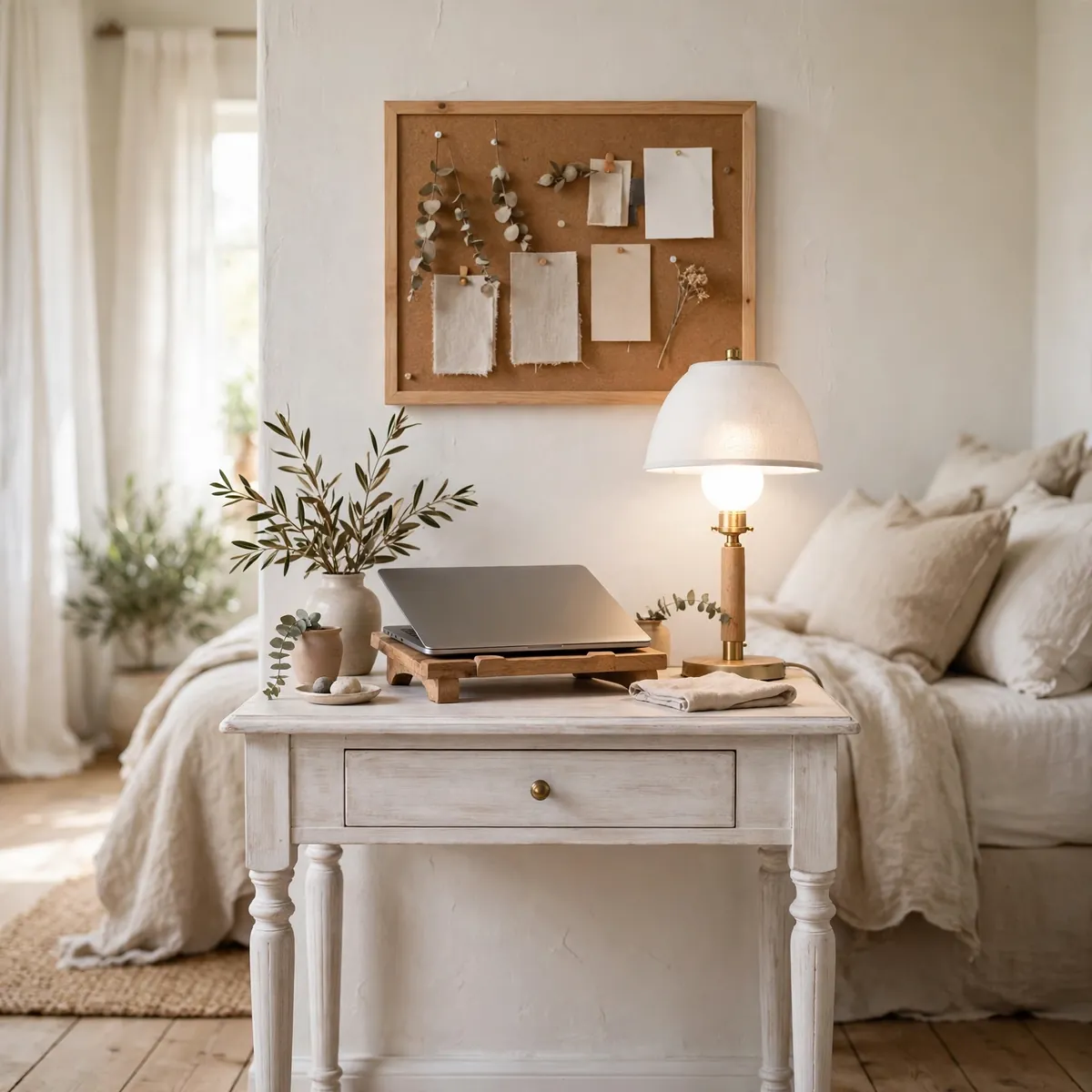
A farmhouse vanity desk — smaller scale, often with a drawer or two and delicate turned legs — pulls double duty beautifully in a bedroom: makeup station in the morning, laptop desk in the afternoon. Its strength is that it never looks like office furniture, which matters when the desk lives where you sleep. The weakness is size: most vanities are 36 to 42 inches wide, so one screen only, and the mirror that usually sits above needs relocating when you work. Best for: bedrooms and dressing areas where a full desk would feel wrong. Swap the mirror for a small pinboard during work hours if you need the wall space.
- Add a drawer organizer so cosmetics and office supplies don’t mix.
- A daylight-bulb lamp serves both makeup and video calls.
- Keep a laptop stand so the screen hits eye level.
A Barn-Door Cabinet Desk That Hides the Workday

An armoire-style cabinet with sliding barn doors that opens to reveal a full desk inside is the ultimate farmhouse solution for open-plan living. Doors open: you have a desk, shelves, and task lighting. Doors closed: it’s a handsome cabinet. The strength is total visual shutdown — guests never know you work there. The weakness is depth and ventilation: most are 20 to 24 inches deep, fine for a laptop but tight for a desktop tower, and a closed cabinet traps heat, so don’t run a powerful PC inside with the doors shut. Best for: living rooms, dining rooms, and studio apartments where the office must vanish daily.
- Mount a power strip inside the cabinet so everything plugs in one place.
- Leave doors open an inch when charging to vent heat.
- Use the inside of the doors for a corkboard or whiteboard.
Face the Window: The Desk Placement That Beats Any Lamp

Before buying anything new, try moving the desk you own to face the window. Daylight from the front or side is the single biggest upgrade to any farmhouse desk setup — it flatters video calls, reduces eye strain, and makes even a plain pine desk look expensive. The catch is glare: if the window is directly behind your monitor, you’ll fight reflections all afternoon. Fix it with sheer linen curtains (very farmhouse) or by angling the desk 45 degrees to the window. Best for: literally everyone with a window. This one change costs nothing and improves the desk more than any accessory.
- Side light beats back light; angle the desk if glare hits the screen.
- Sheer curtains diffuse light without killing the farmhouse look.
- Keep the windowsill clear — it becomes part of your desk styling.
The Under-Stairs Desk Nook

The space under a staircase is the most wasted square footage in a farmhouse-style home, and a desk fits it perfectly. A simple plank desk built wall-to-wall under the stairs, with the sloping ceiling above, creates a cocoon-like office that feels intentional rather than leftover. Strength: it’s out of the main traffic flow, so it reads as a real office. Weaknesses: headroom and light — measure the tallest point (you need at least 5 feet at the chair position) and plan for a plug-in sconce or picture light since overheads rarely reach. Paint the stair underside white and add shiplap on the back wall to make the nook feel finished.
- Measure seated headroom before building — 5 feet minimum at the chair.
- Add a plug-in wall sconce; don’t rely on room light alone.
- Use the triangular side gaps for a tiny bookshelf or file boxes.
The Closet Office: A Desk Inside a Closet
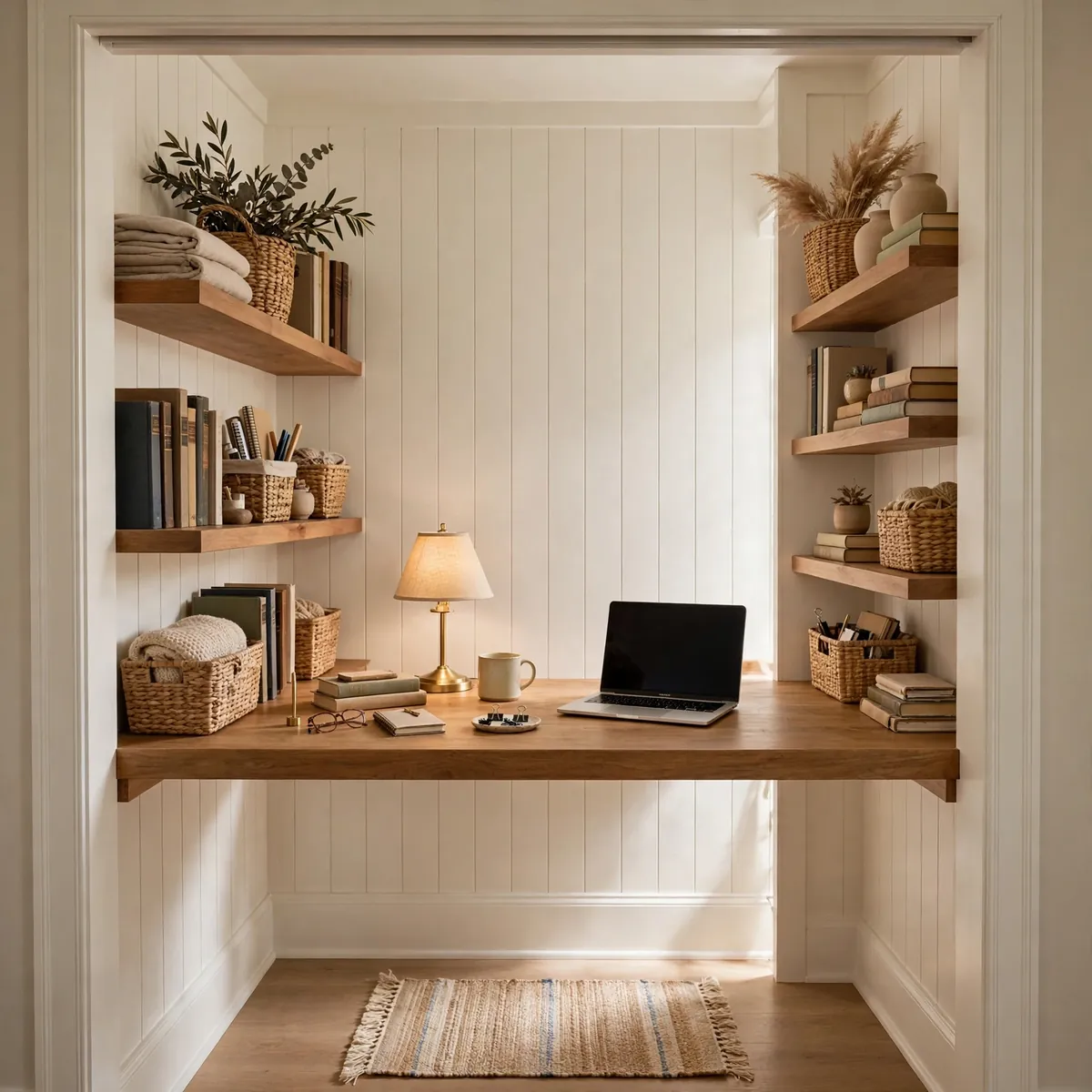
Remove the doors from a spare closet, fit a desk across the opening, and you have a “cloffice” — a full farmhouse desk setup in about 6 square feet. The closet’s depth (usually 24 inches) is exactly desk depth, and the side walls become free mounting space for shelves and a pegboard. Strength: the ultimate small-space office, closable if you keep the doors. Weakness: ventilation and light — closets are dark boxes, so budget for a good lamp and leave the doors open (or off) during work hours. Paint the interior a light warm white and add a small rug; suddenly it’s a room, not a closet.
- Mount shelves on the closet side walls for zero-footprint storage.
- A battery puck light under the top shelf fixes the darkness cheaply.
- Keep the desk 28 inches high max so the closet rod (if kept) doesn’t collide.
A Shiplap Backdrop Wall Behind the Desk
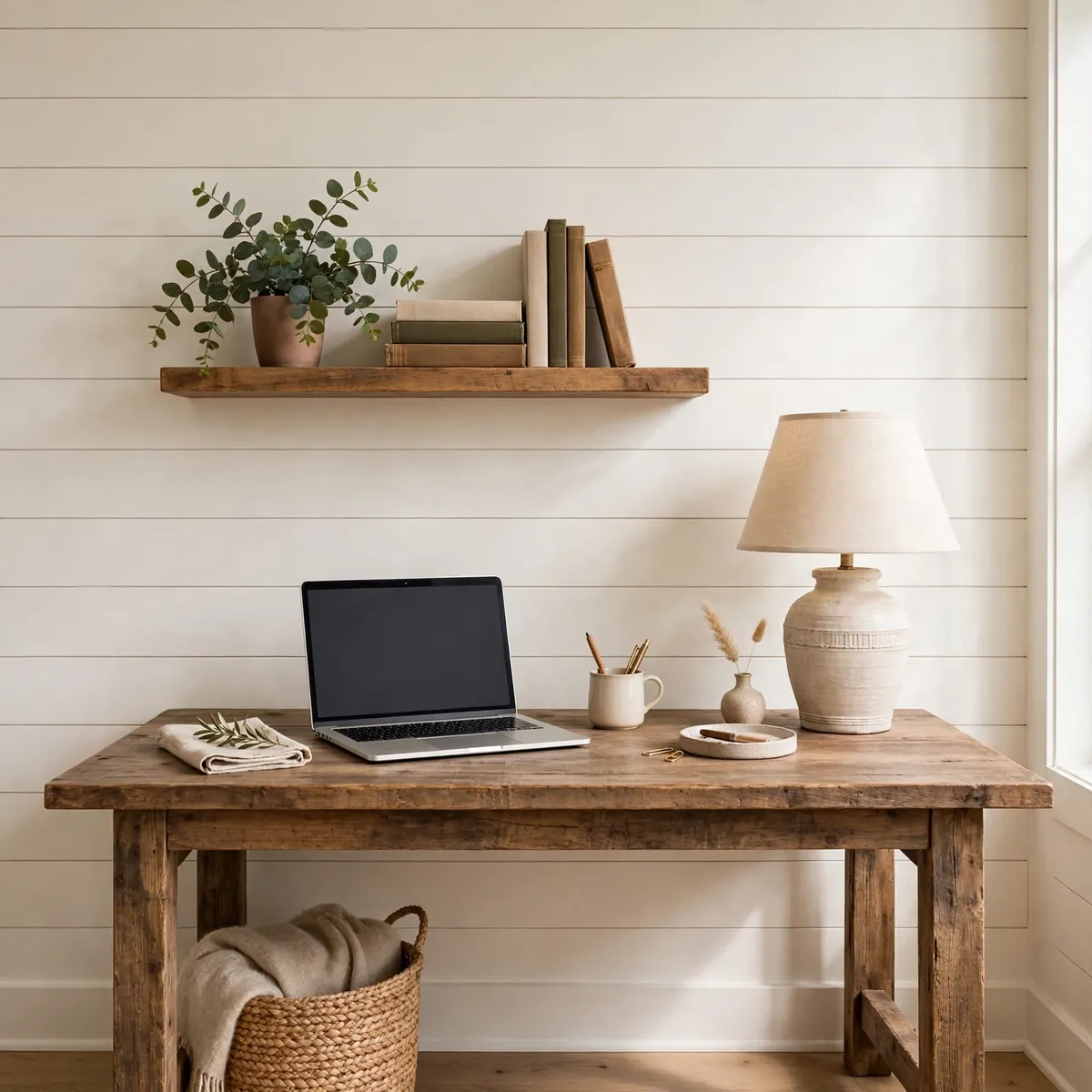
If your farmhouse desk faces into the room — the executive position — everyone on a video call sees the wall behind you, not the desk. A shiplap accent wall turns that background into the best-looking part of your office for the cost of a few boards and a weekend. Strength: it makes even a basic desk look styled and deliberate. Weakness: it’s a commitment to one wall, so pick the wall your camera sees or the one the desk faces. Paint it warm white for brightness or a moody green for character; either way, keep desk accessories minimal so the wall does the talking. One floating shelf on the shiplap holds the few items you actually reach for.
- Install shiplap on the camera-facing wall first if budget is tight.
- Warm white shiplap brightens; deep green adds video-call drama.
- One shelf is enough — more turns the backdrop into clutter.
A Pegboard Command Wall Above the Desk

A pegboard hung above a farmhouse desk is storage that doubles as decor — wooden pegs, small shelves, hanging jars, and hooks for headphones, all in a warm wood frame that suits the style. Its strength is flexibility: rearrange the layout in minutes as your work changes, no new holes in the wall. The weakness is visual noise — an overloaded pegboard reads as clutter, so edit ruthlessly and leave a third of it empty. Best for: crafters, makers, and anyone whose tools change by project. Paint the pegboard the same color as the wall for a built-in look, or stain it to match the desk.
- Leave one-third of the pegboard empty or it reads as clutter.
- Use wood-framed pegboard, not raw brown hardboard, for the farmhouse look.
- Hang the heaviest items lowest so nothing pulls the board off the wall.
An Apron-Drawer Desk for Hidden Clutter
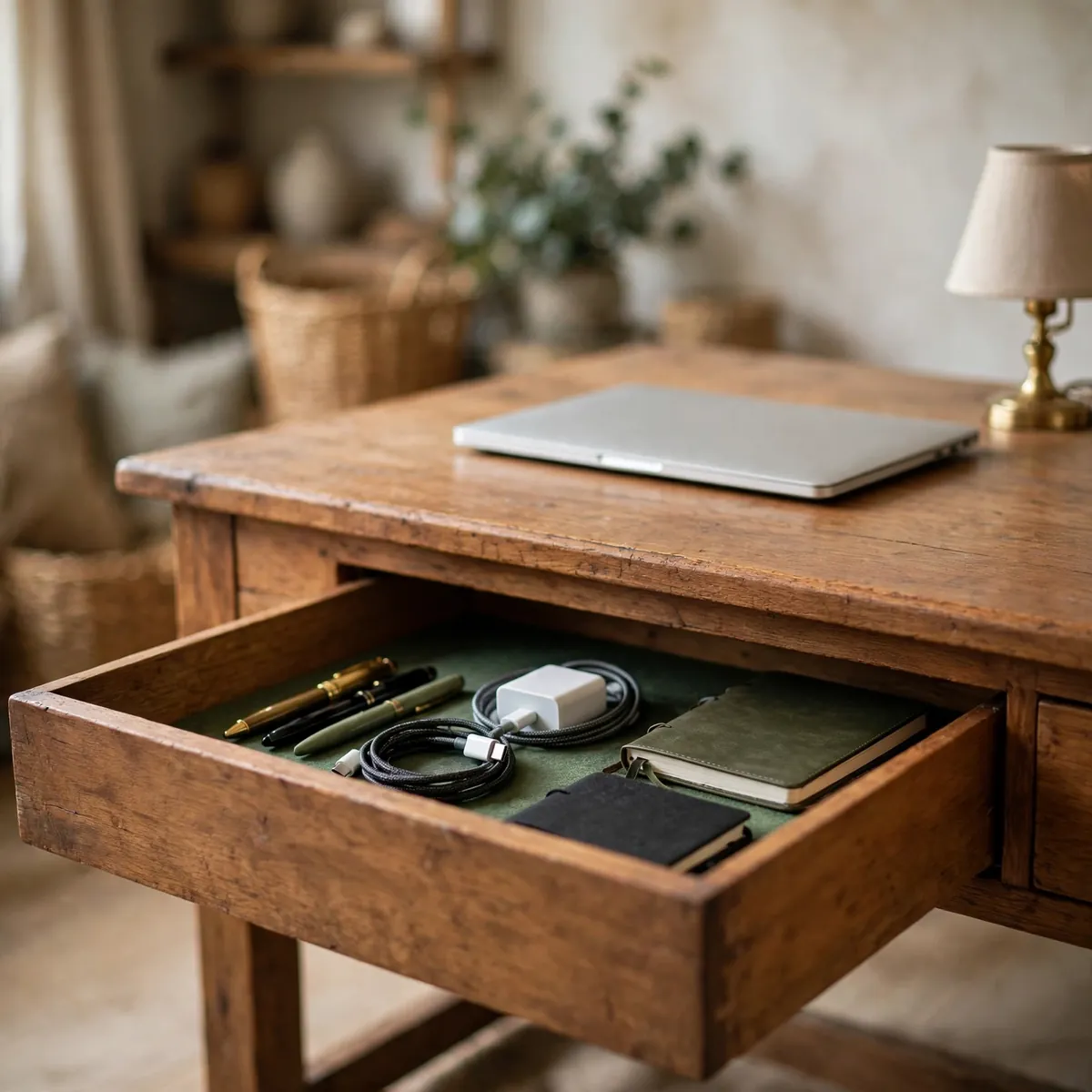
The apron drawer — the shallow drawer running under the desktop on classic farmhouse desks — is the hardest-working 4 inches in home office furniture. It’s exactly deep enough for pens, chargers, notebooks, and the remote, which means the desktop stays clear without a single organizer tray in sight. Strength: invisible storage that preserves the desk’s clean lines. Weakness: it’s not deep enough for files or a laptop, so this is a supplement, not a filing cabinet. When shopping, pull the drawer fully out and check that it glides — a sticky apron drawer will drive you mad daily. Line it with felt to stop the rattle of pens.
- Line the drawer with felt or cork to silence rattling supplies.
- Keep only daily-use items here; everything else lives elsewhere.
- Test the drawer glide in the store — sticky drawers ruin the experience.
The Two-Person Farmhouse Desk Setup
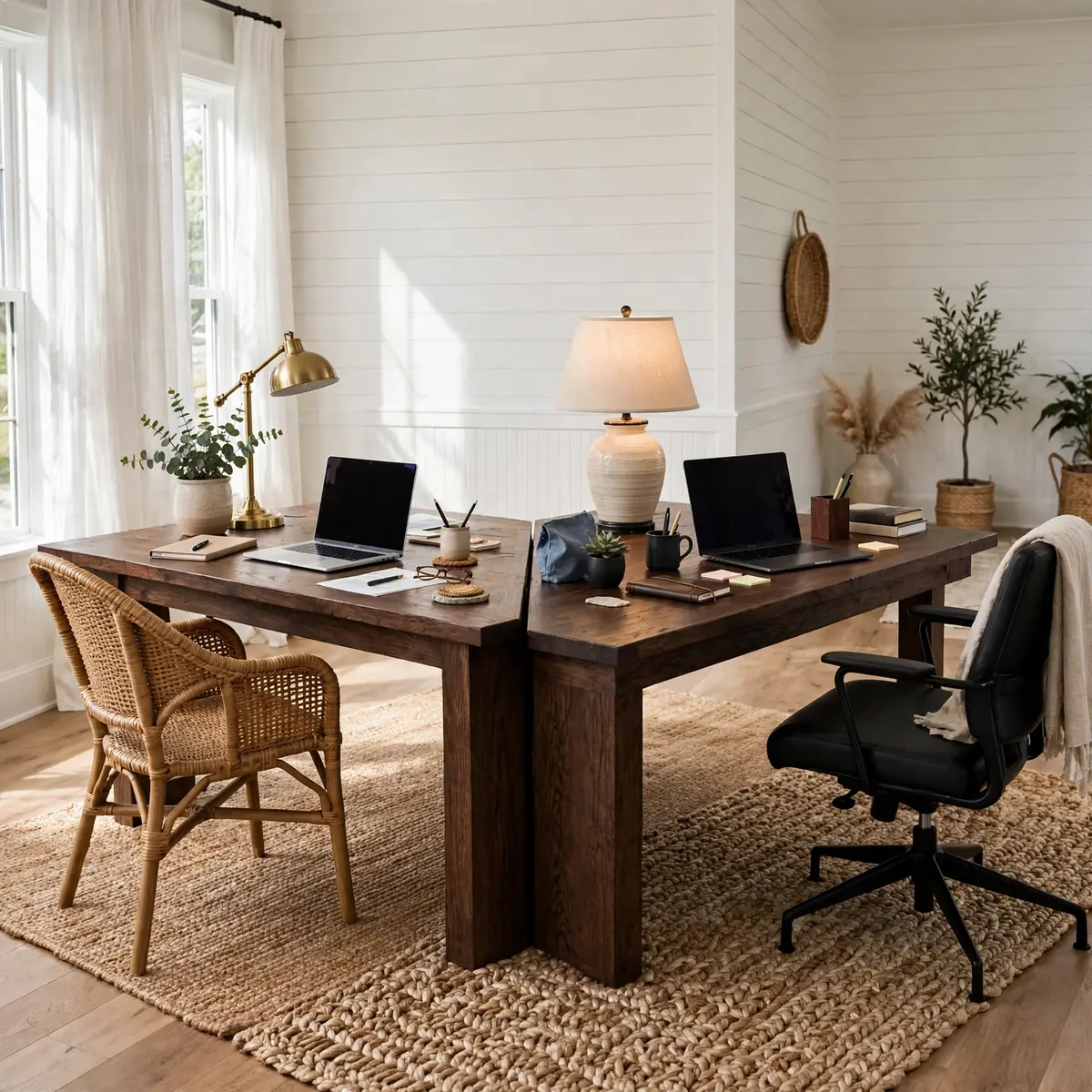
Two farmhouse desks pushed back-to-back in the center of a room create a partner desk with a shared surface nearly 4 feet deep — twice the workspace of a single desk against a wall, and both people get a view of the room instead of a wall. Strength: collaboration feels natural, and the arrangement looks intentional, like a studio. Weakness: cable management doubles, so a floor outlet or a flat cord cover is almost mandatory. Best for: couples who both work from home and creative partners. Keep each person’s side styled differently (different lamp, different chair) so the shared desk still feels like two territories.
- A rug under both desks defines the shared zone.
- Run cables down the center gap between the desks.
- Give each person their own small lamp to avoid light wars.
A Vintage School Desk with Farmhouse Character
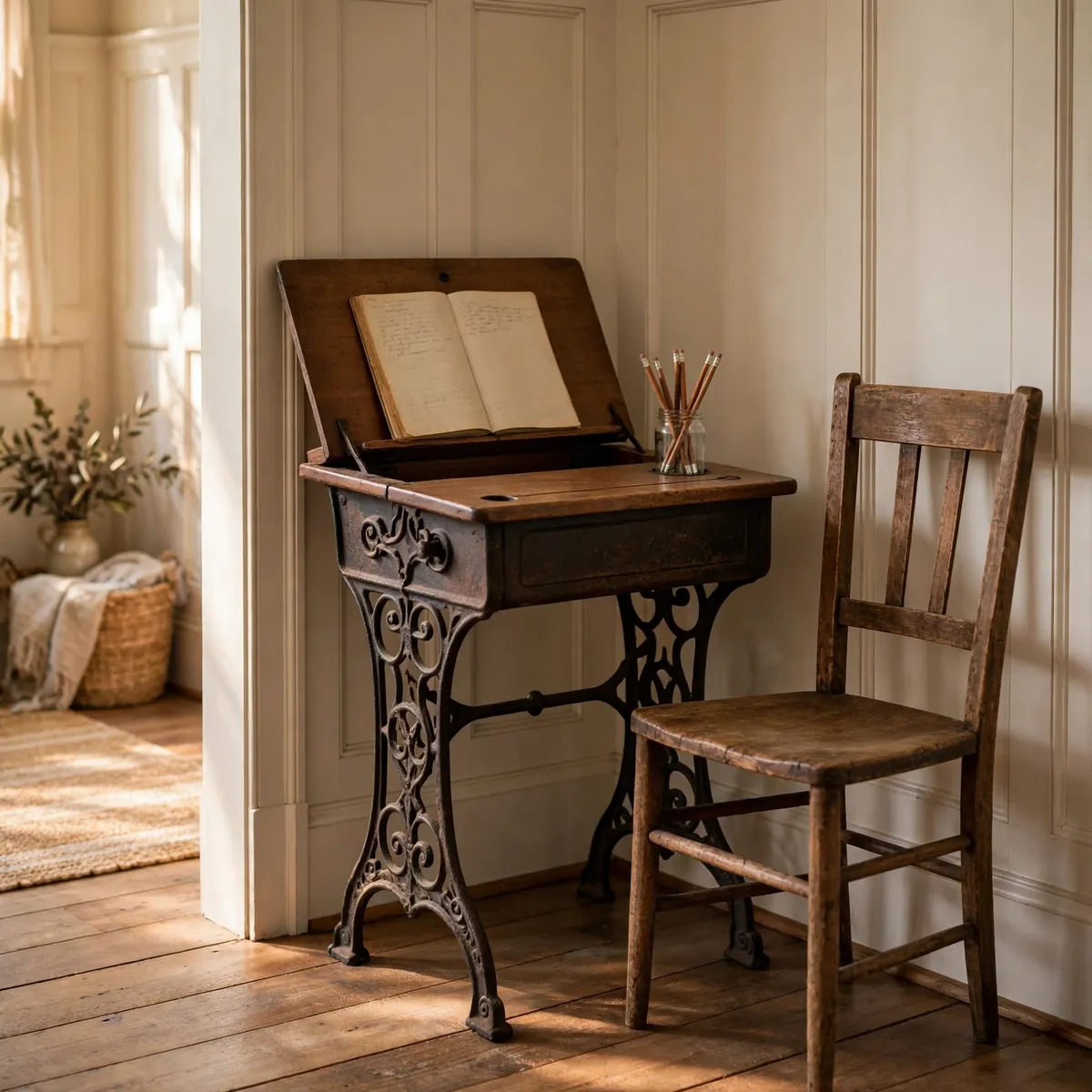
An antique school desk — cast-iron sides, a lift-up wooden lid, an inkwell hole — is farmhouse style in its purest form, and it makes a desk with genuine history for under the price of new furniture. Its strength is character and compactness; most are barely 30 inches wide, perfect for a hallway or bedroom corner. The weaknesses are real though: the desktop is small and often sloped, the chair is sized for a child, and the lift-top isn’t laptop-friendly. Best for: a writing spot, a child’s homework desk, or a decorative entryway station — not a full work-from-home command center. Pair it with a full-size chair and treat the lid as a writing surface.
- Buy for character corners and homework spots, not full-time work.
- The inkwell hole is a perfect pencil cup — drop in a small jar.
- Check the lid hinge; replace it if it slams — laptops and slamming lids don’t mix.
A Printer Station Tucked Under a High Desk
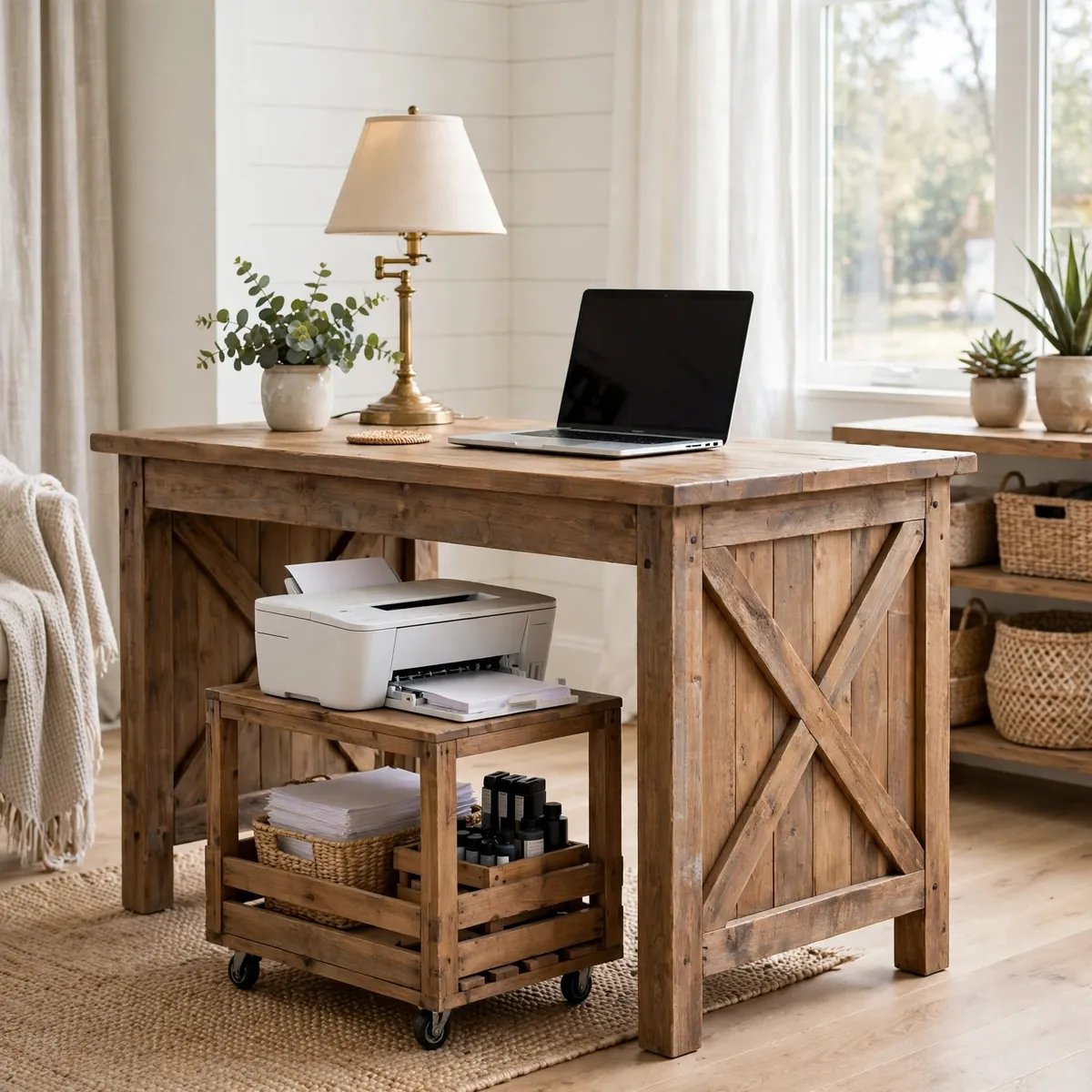
Printers are the enemy of pretty desks — bulky, ugly, and used twice a week. The farmhouse fix: a desk with a high clearance (or a counter-height desk at 36 inches) with the printer living on a rolling cart underneath, pulled out only when needed. Strength: the desktop stays beautiful and the printer stays accessible. Weakness: you need the vertical clearance — measure your printer’s height plus paper tray before committing, and make sure the cart rolls smoothly on your flooring. A small wooden crate-style cart keeps the farmhouse look; a wire cart does not. Keep paper and ink in a basket on the cart’s lower shelf so everything printing-related lives in one mobile unit.
- Measure printer + paper tray height before buying the cart.
- A wooden crate cart matches farmhouse style; avoid chrome wire.
- Store paper flat on the cart’s lower shelf to stop curling.
Mason Jar Organizers on a Wooden Desktop
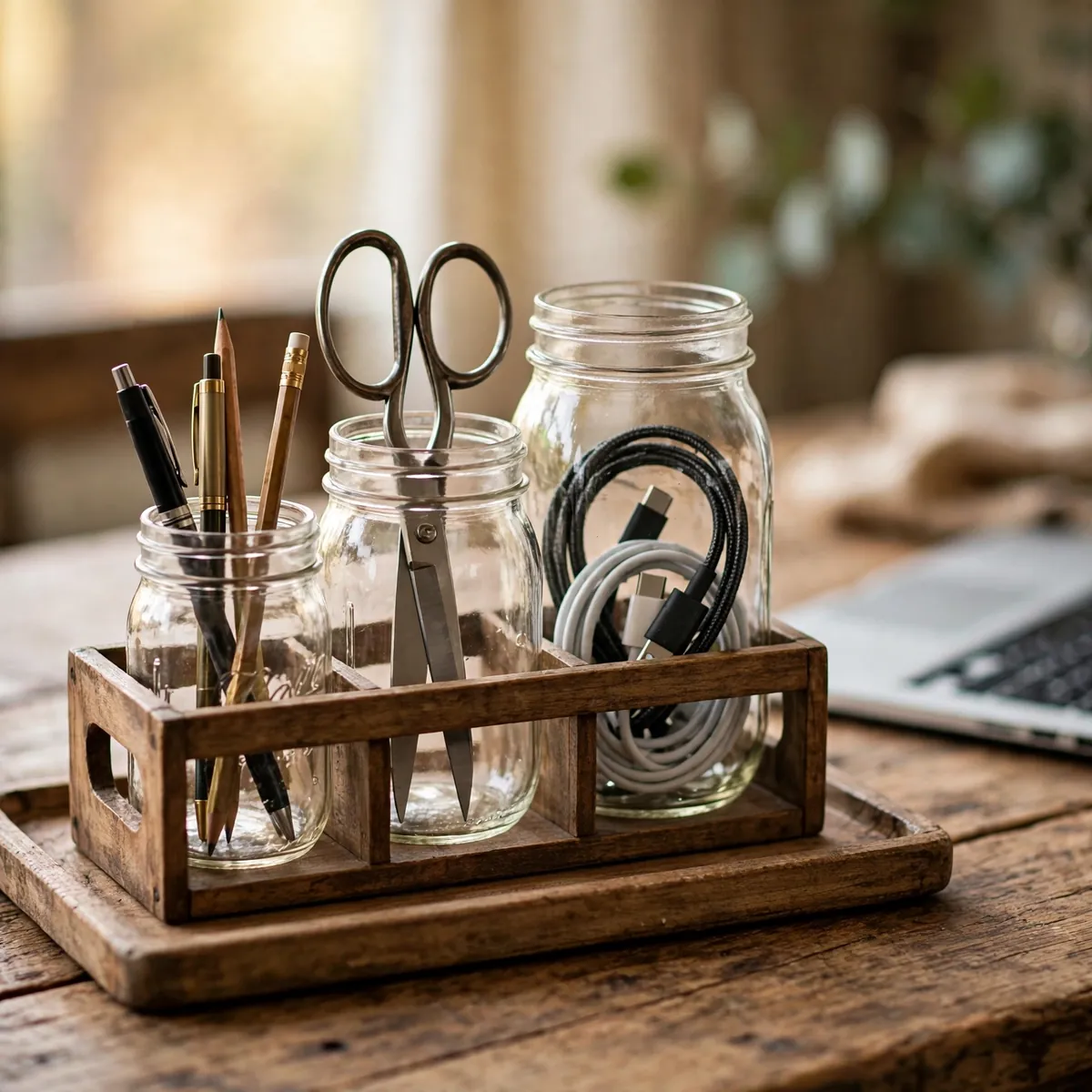
Mason jars are a farmhouse cliché for a reason — on a desk, they’re genuinely useful. A trio of jars in a wooden carrier holds pens, scissors, and charging cables for almost no money, and because they’re glass, you can see what’s inside instead of digging. Strength: cheap, replaceable, and endlessly rearrangeable. Weakness: glass on a wood desk chips both, so set the carrier on a small tray or mat, and keep jars away from the desk edge if you have kids or a wagging dog nearby. Use different jar sizes — pint for pens, quart for cables — and label the cable jar so chargers actually go back.
- Set the jar carrier on a tray to protect the wood desktop.
- Pint jars for pens, quart jars for coiled cables.
- Keep jars 6 inches from the desk edge in kid or pet households.
A Pipe-Leg Industrial Farmhouse Desk

Black iron pipe legs under a thick wood top is the industrial-farmhouse hybrid that suits modern farmhouse offices — the pipes add edge while the wood keeps it warm. Strength: pipe legs are incredibly sturdy and adjustable, so you can level the desk on uneven old-house floors, a real farmhouse problem. Weakness: the look is specific — if the rest of your room is soft cottage farmhouse, pipe legs will clash; they belong with black hardware, Edison bulbs, and leather. Also, cheap pipe kits wobble, so buy flanges with real weight or build from actual plumbing pipe. Best for: modern farmhouse offices and anyone with gloriously uneven floors.
- Buy heavy flanges or real plumbing pipe — light kits wobble.
- Adjustable feet level the desk on uneven farmhouse floors.
- Echo the black metal in your lamp and hardware for cohesion.
A Farmhouse Desk with a Standing Desk Converter

Love the farmhouse look but your back demands standing breaks? A standing desk converter — the scissor-lift platform that sits on your existing desk — gives you both without replacing the furniture. Strength: you keep the desk you love and gain sit-stand flexibility in an afternoon. Weaknesses: converters are heavy (25+ pounds) and eat desktop real estate, so your desk needs to be at least 48 inches wide and rock solid; a spindly writing desk will wobble. Also, the converter’s modern look clashes a bit with rustic wood — choose a wood-tone or white converter rather than black to soften the contrast. Best for: anyone working 6+ hours at a beloved farmhouse desk.
- Your desk must be 48+ inches wide and sturdy — test for wobble first.
- Pick a wood-tone or white converter to blend with rustic wood.
- Route the monitor cable with slack so it doesn’t yank when raised.
A Kid-Friendly Farmhouse Homework Desk

A small-scale farmhouse desk — think a 36-inch pine desk with a couple of cubbies — gives kids a “real” workspace that survives crayons, glue, and growth spurts. Strength: a wipeable painted finish (satin or semi-gloss) shrugs off the mess that would scar a stained heirloom top, and the farmhouse look means it still fits your decor. Weakness: kids outgrow desk height fast, so pair it with an adjustable chair rather than buying a bigger desk later, and skip the precious styling — this desk will be drawn on. Place it where you can see it (kitchen corner, hallway) rather than exiling homework to a bedroom; younger kids work better within earshot.
- Choose wipeable satin paint over stain — crayons and glue wipe off.
- Pair with an adjustable chair so the desk lasts through growth spurts.
- Place it in sight lines (kitchen, hallway) for younger kids.
FAQs
What makes a desk “farmhouse style”?
Solid wood (or wood-look) tops, sturdy aprons, turned or chunky legs, and simple joinery — often with distressed, whitewashed, or natural finishes. It’s the construction and materials, not the price tag, that define it.
How deep should a farmhouse desk be?
24 inches works for laptop work; go 30 inches if you use a monitor on a stand or arm. Anything under 20 inches is a console, not a desk — fine for short sessions, uncomfortable for full workdays.
Can a farmhouse desk work in a modern home?
Yes — pair one rustic wood piece with clean-lined modern surroundings and it becomes a warm focal point instead of a theme. The pipe-leg and floating desk ideas above blend most easily with modern rooms.
What’s the best wood for a farmhouse desk?
Reclaimed wood for character, oak for durability, pine for budget. Seal any of them with matte polyurethane so the top survives daily coffee and laptop heat.
Conclusion
The best farmhouse desk isn’t the prettiest one in a catalog — it’s the one that matches how you actually work. Pick the style that fits your room and your workload, place it where the light is, give everything a home with one storage trick from this list, and you’ll have a desk that looks like a farmhouse dream and works like a proper office. Start with one change — even just moving the desk toward the window — and build from there.