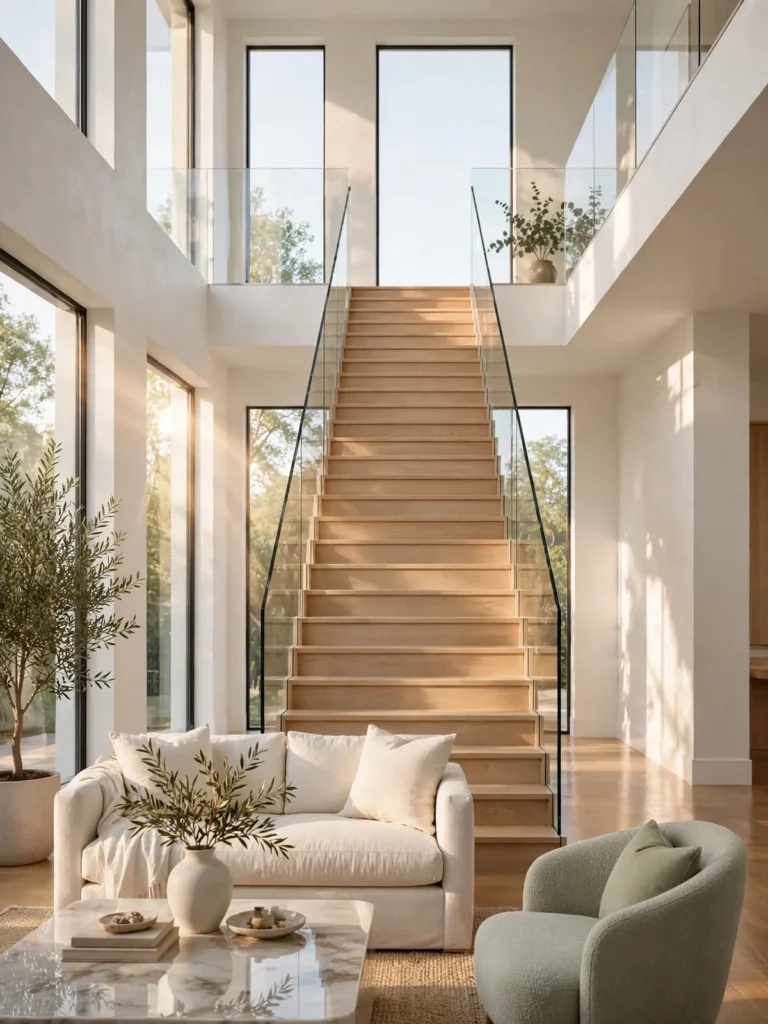
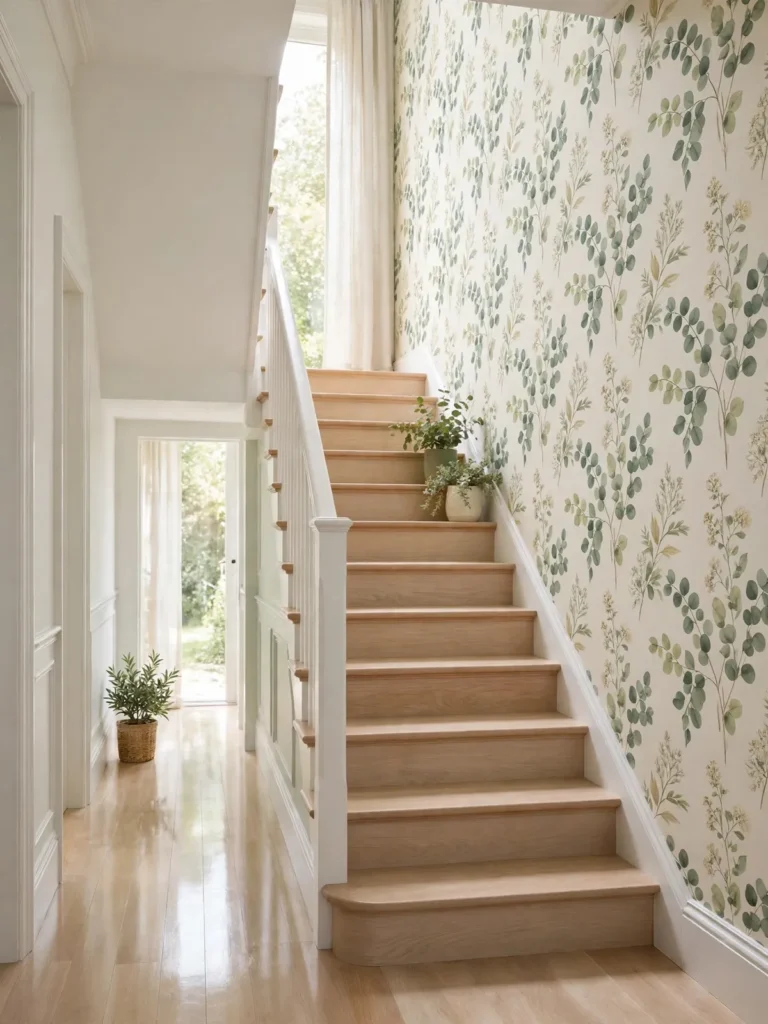
25 Stunning Grand Staircase Ideas That Make Your Foyer Feel Like a Palace
A grand staircase is the crown jewel of a luxury foyer. These 25 ideas — from sweeping marble curves to cascading chandeliers and hidden storage — show how to make yours unforgettable.
A grand staircase is more than a way to move between floors — it is the architectural centrepiece of a home, the first thing guests see and the feature that sets the tone for everything beyond the front door. The most successful designs combine generous proportions with rich materials: wide treads, a sculptural balustrade, warm lighting and a focal point above or beside the stair that draws the eye upward. Whether your foyer is double-height or simply wide and bright, the right staircase turns an ordinary entrance into a moment of drama.
If you love the idea of treating the wall beside the stair as part of the design, these accent wall staircase ideas show how colour, panelling and texture can make the whole composition feel intentional. Use the ideas below as a menu — pick the one that matches your home’s scale, then layer in lighting, art and a runner to finish it.
Key Takeaways
What makes a staircase a grand staircase?
Generous width, a strong visual focal point such as a chandelier or curved sweep, and high-end materials like marble, brass or carved timber — all working together to make the stair the star of the foyer.
Which materials look most luxurious on a grand staircase?
Veined marble, dark walnut, polished brass, wrought iron and crystal all read as luxury, especially when paired with a plush runner and warm, layered lighting.
How wide should a grand staircase be?
Aim for at least 48 inches of clear tread width, and 60 inches or more if the foyer allows — the extra width is what gives the stair its grand, welcoming feel.
Do grand staircases work in homes without double-height ceilings?
Yes — a wide sweep, a statement chandelier, a mural or a gallery wall can create grandeur even with standard ceiling heights, as long as proportions stay generous.
What is the easiest way to make an existing staircase feel grand?
Add a plush runner, upgrade the lighting above the stair, and dress the wall beside it with panelling, art or a mural — three changes that transform the whole foyer.
A Sweeping Curved Staircase That Owns the Whole Foyer
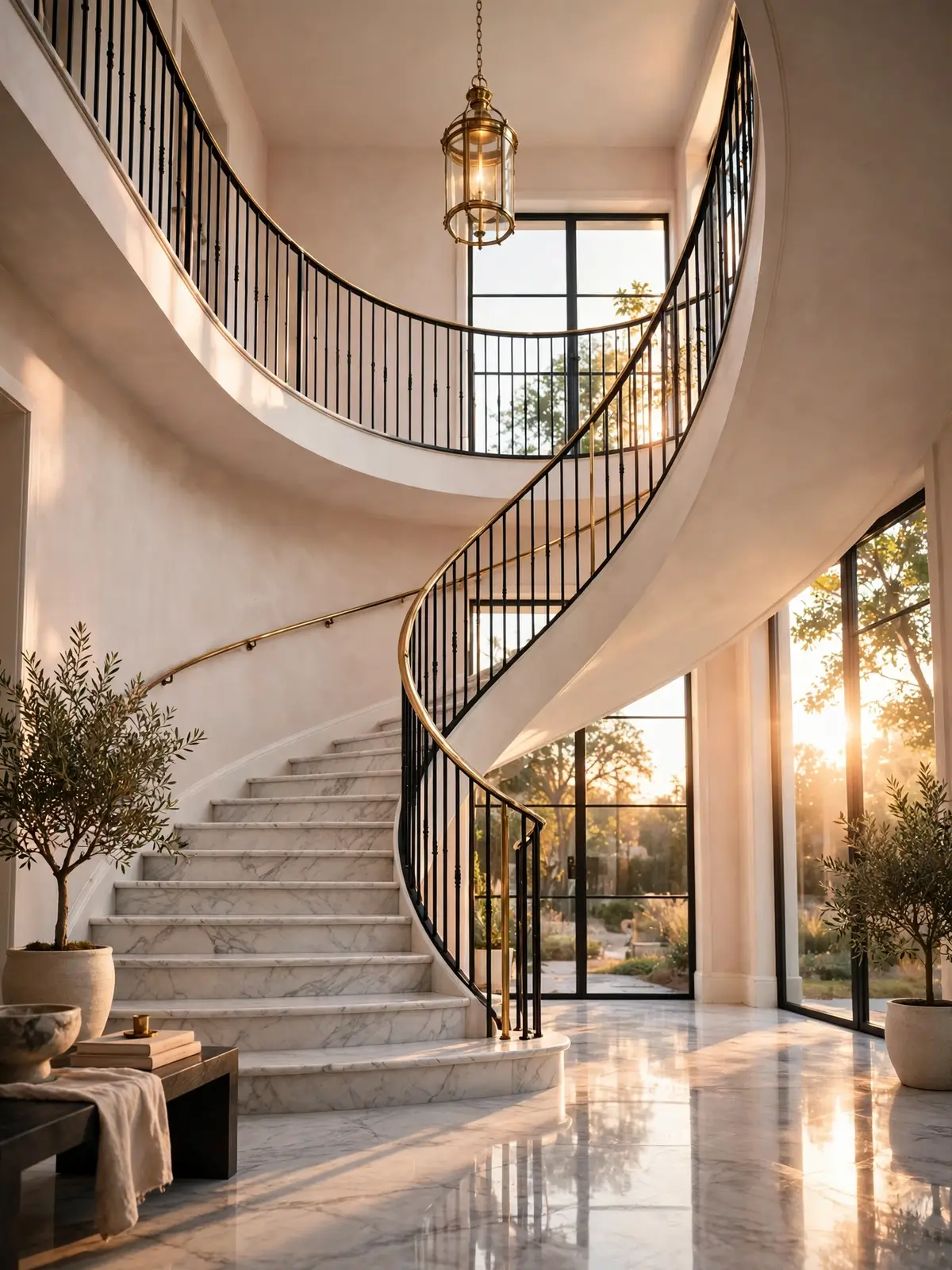
A curved staircase does not ask for attention — it commands it. The sweep itself becomes the room’s sculpture, so keep everything else calm and let the curve do the talking. A concrete example: a 60-inch-wide curved stair in honed Calacatta marble with a continuous brass handrail, rising 10 feet to a half-landing, with the first three treads fanned out into a gentle bullnose that spills into the foyer floor. Paint the walls a soft warm white and hang a single oversized lantern above the centre of the curve.
Quick tips:
- Keep the curve’s radius generous — a tight curve looks cramped, not grand.
- Fan the bottom two or three treads wider than the rest for a welcoming spill.
- Use one continuous handrail with no visible joints for a seamless line.
- Leave the wall beside the curve mostly bare so the shape stays the star.
Ornate Wrought Iron Railings Like Jewellery for the Stair
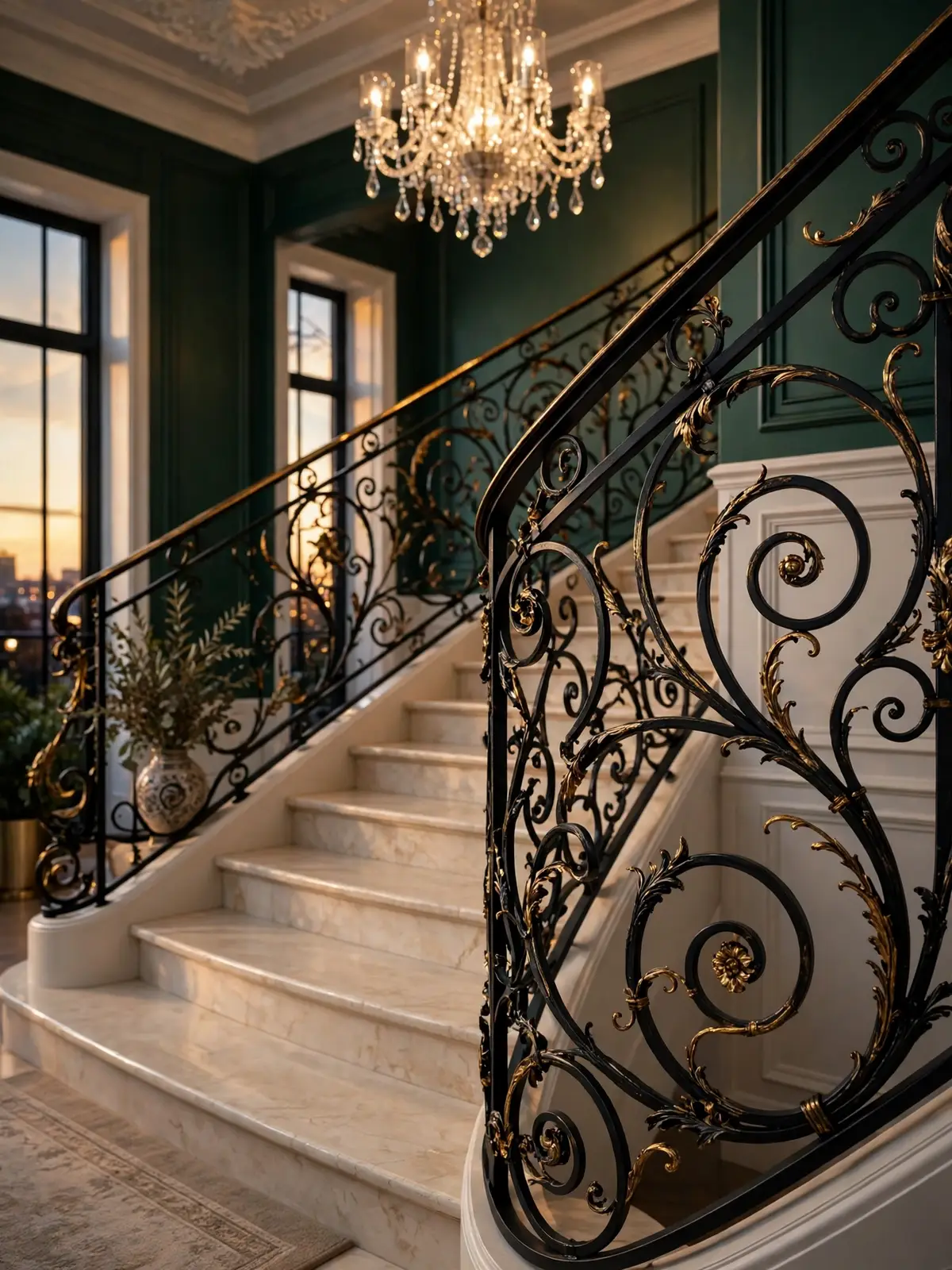
Wrought iron railings are the jewellery of a grand staircase — the detail that turns solid architecture into something delicate and deliberate. A concrete example: hand-forged matte-black scrollwork balusters with gilded tips, set into 2-inch-thick honed limestone treads, with a dark walnut handrail that warms the black metal. The pattern should repeat rhythmically — a scroll, a straight bar, a scroll — so the eye travels up the stair in a steady beat.
Quick tips:
- Mix one ornate panel with plainer bars so the design breathes.
- Add a whisper of gold leaf on finials for warmth without glitter.
- Match the iron’s finish to other dark metal in the foyer for cohesion.
- Keep baluster spacing under 4 inches for safety and a fine, dense look.
A Cascading Crystal Chandelier Above the Staircase
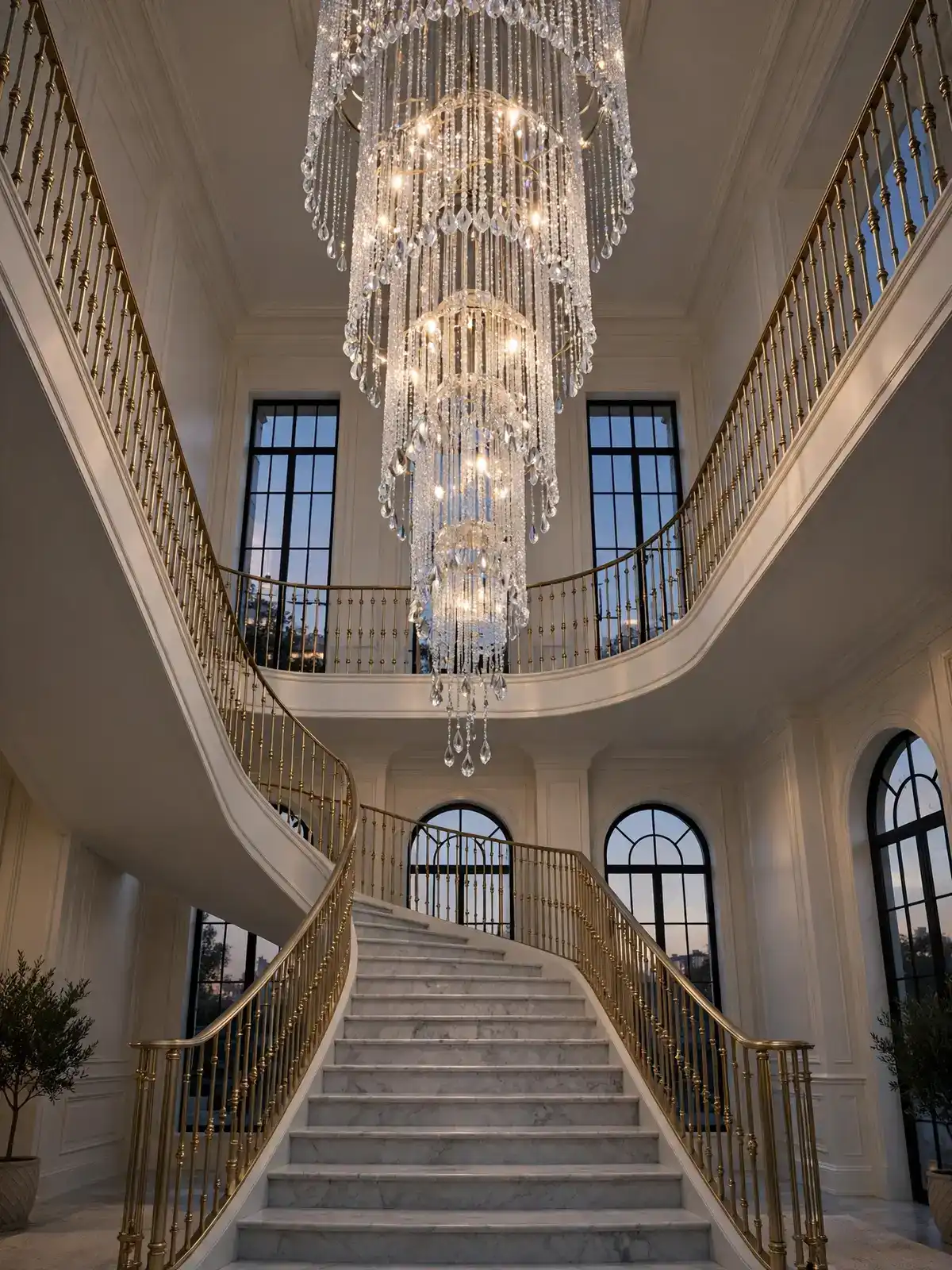
Nothing says grand quite like a chandelier that drops through the stairwell like a waterfall of light. A concrete example: a five-tier crystal chandelier, 36 inches wide and 72 inches tall, suspended on a brass chain so its lowest crystals hover 7 feet above the landing, casting prisms across pale grey marble treads below. Choose a dimmer switch so the same fixture glows softly in the evening and sparkles brightly when guests arrive.
Quick tips:
- Size the chandelier to the stairwell void — it should fill about two-thirds of the width.
- Hang it so the lowest point clears the tallest person by at least 7 feet.
- Put it on a dimmer for day-to-evening flexibility.
- Add a winch or lowering system so cleaning the crystals is actually possible.
A Bold Marble Staircase in Veined Calacatta
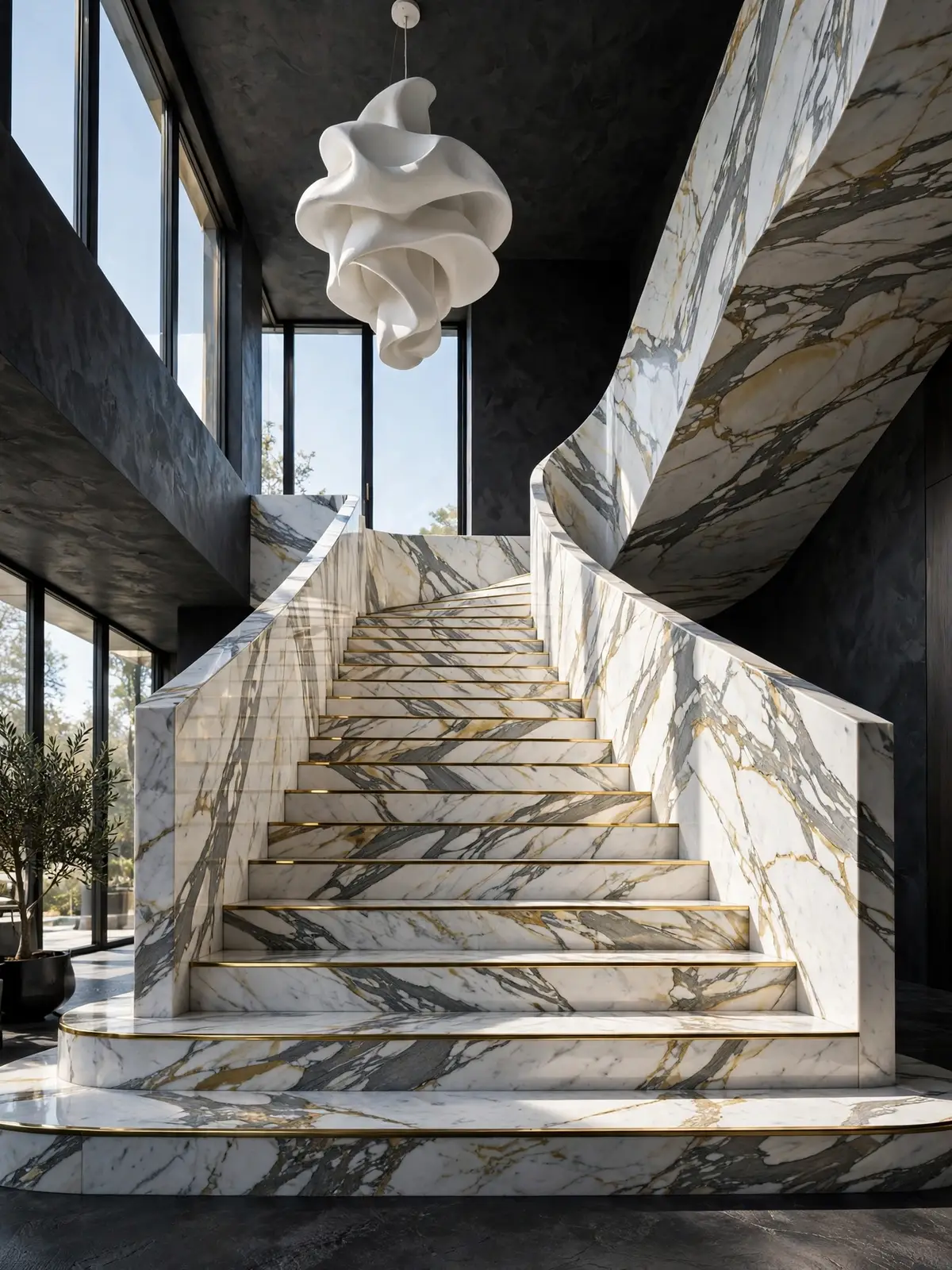
Calacatta marble turns a staircase into a geological artwork — every tread carries its own bold, unrepeatable veins. A concrete example: 48-inch-wide Calacatta treads, 2 inches thick, with book-matched veining running continuously down the risers, finished with slim brass inlay strips on each nosing and a honed — not polished — surface for grip. Pair it with charcoal walls so the white stone glows by contrast.
Quick tips:
- Book-match the veining across treads for a continuous, flowing pattern.
- Choose honed marble for treads to reduce slipperiness.
- Seal the stone twice a year to protect it from scuffs and stains.
- Let the marble be the pattern — keep the balustrade simple and slim.
A Statement Wall Mural Running Along the Staircase
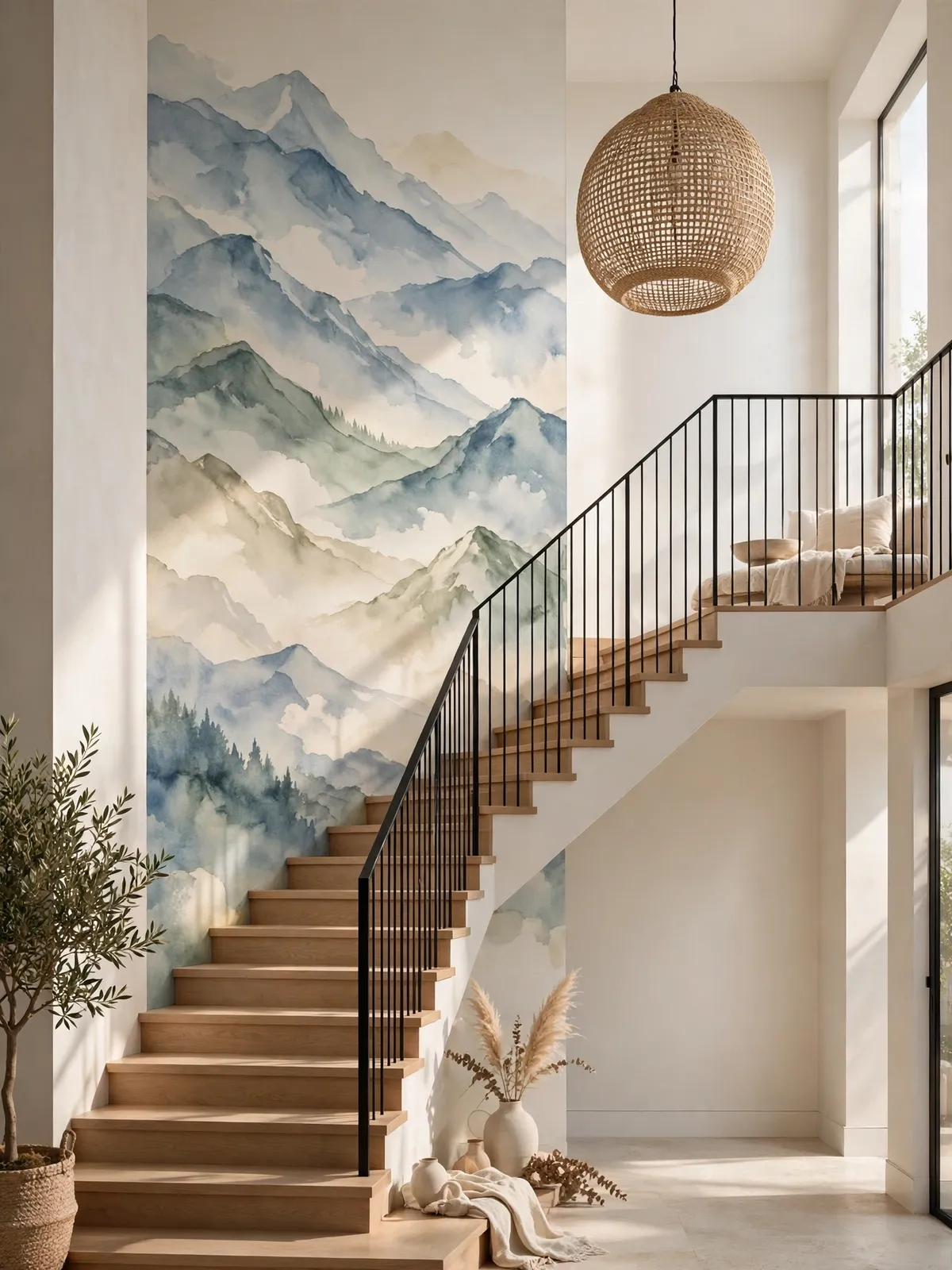
A mural turns the long, often-ignored stair wall into a canvas — and because the wall is tall and narrow, it suits vertical, unfolding designs beautifully. A concrete example: a hand-painted style mural of misty mountains in dusty blue, sage and warm cream, spanning a 14-foot-high wall beside a light oak staircase, with the palest tones at the top so the wall feels taller. Keep the stair itself simple — slim black railings, plain oak treads — so the mural carries the colour.
Quick tips:
- Choose a design that reads vertically, like mountains, trees or an abstract gradient.
- Keep the palette to three or four colours so it stays serene, not busy.
- Test a large sample in place — murals look very different at full scale.
- Use washable wallpaper or sealed paint for easy cleaning along the stair.
A Plush Runner Gliding Down the Centre of the Stair
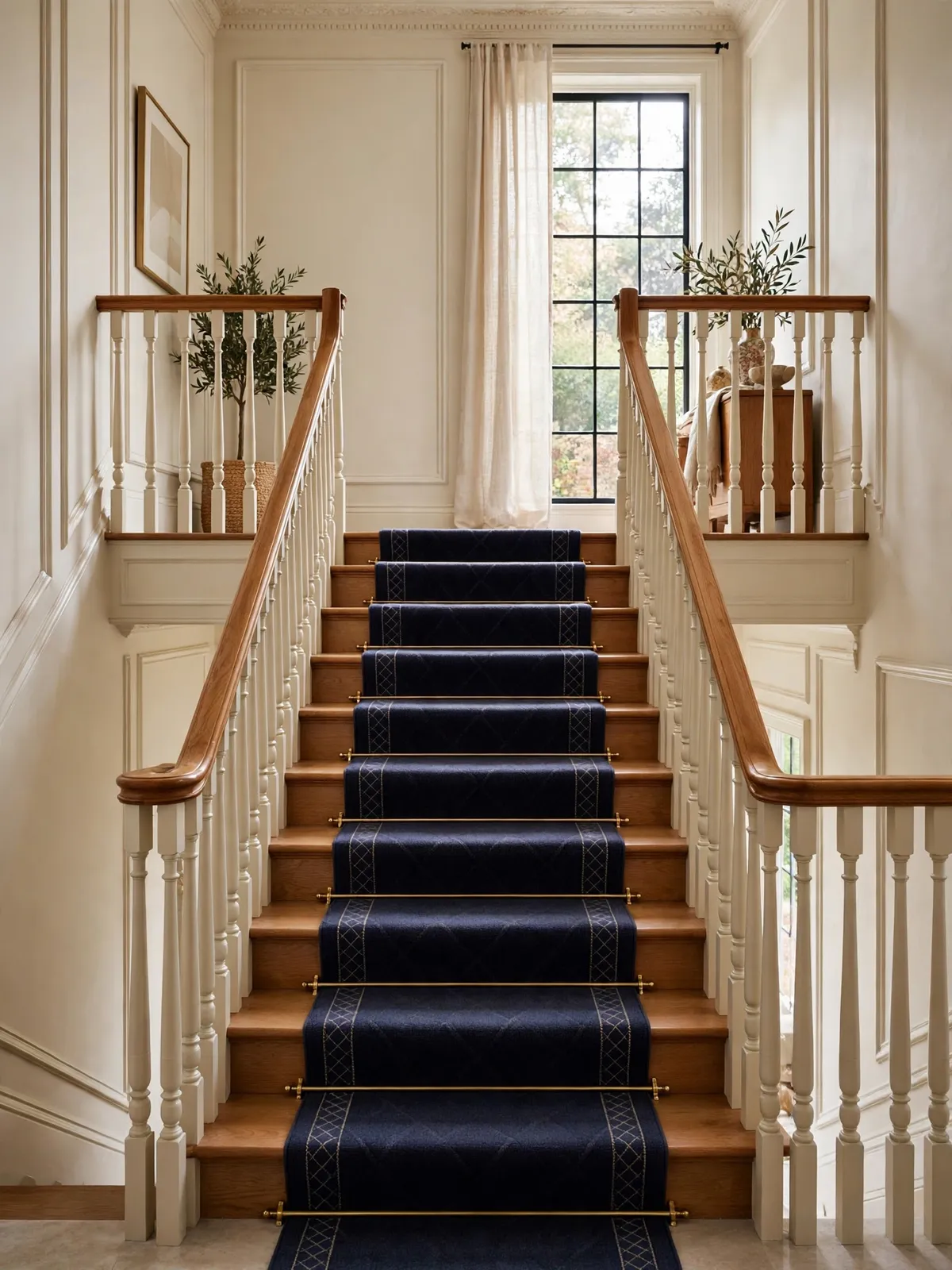
A runner is the fastest way to make a hard staircase feel soft, quiet and expensive — it adds colour, pattern and a hush underfoot. A concrete example: a deep-navy wool runner, 27 inches wide, with a thin cream diamond border, laid down the centre of 48-inch cream-painted treads and held by polished brass stair rods on every tread. The exposed painted tread edges frame the runner like a border, and the wool muffles every footstep.
Quick tips:
- Leave 4 to 6 inches of bare tread visible on each side for a tailored look.
- Choose wool for durability — it bounces back and resists crushing.
- Brass stair rods add a jewellery-like finish and keep the runner taut.
- Vacuum with a stair attachment weekly to keep the pile plush.
Decorative Wall Panelling Along the Grand Staircase
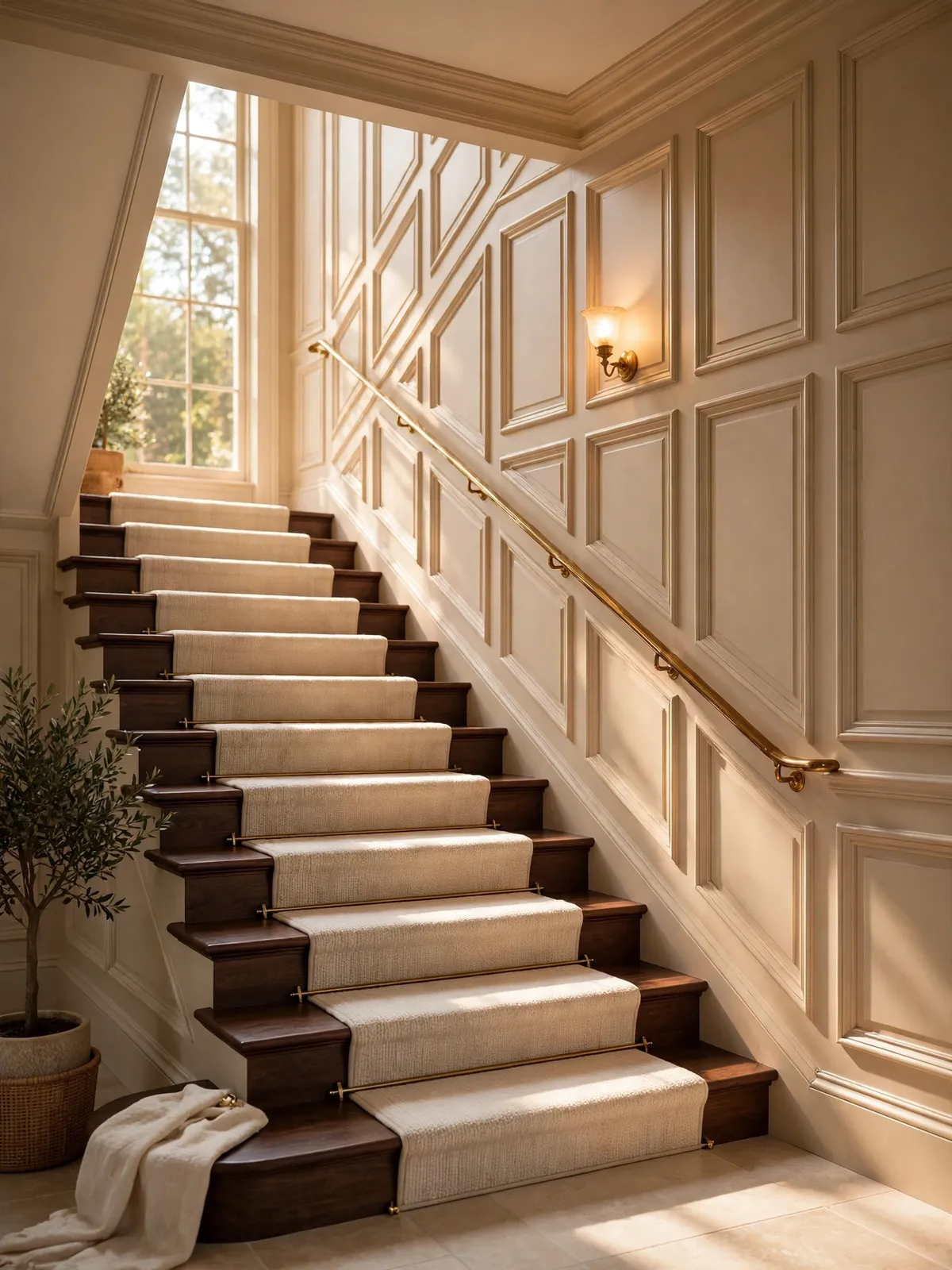
Wall panelling gives a staircase wall the tailored, architectural feel of a grand hotel — it adds shadow, rhythm and a sense of craft. A concrete example: full-height raised rectangular mouldings in warm greige, painted the same colour as the wall for a tone-on-tone effect, running the full 12-foot rise of the stair beside dark walnut treads and a brass handrail. Add slim picture lights or brass sconces between panels for a soft evening glow.
Quick tips:
- Paint panelling and wall the same colour for a subtle, expensive tone-on-tone look.
- Let the panels follow the stair’s slope — horizontal rails that step up look wrong.
- Keep panel sizes consistent so the rhythm feels calm.
- Add a chair rail at the base for a finished, furniture-like edge.
A Split Staircase With Two Symmetrical Flights
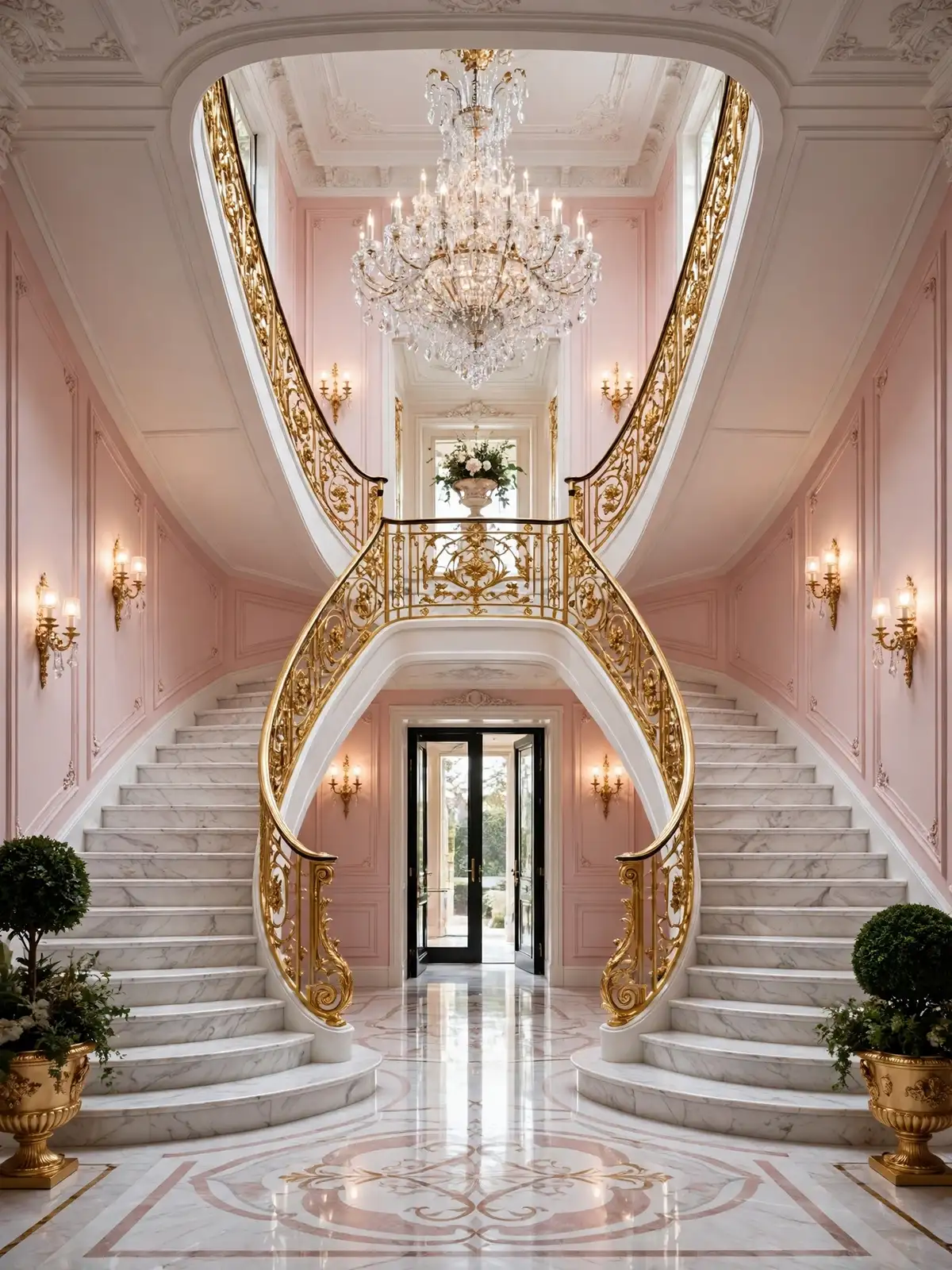
A split staircase — two flights rising symmetrically to a shared landing — is the most theatrical layout of all, made for grand entrances and slow, sweeping descents. A concrete example: two 42-inch-wide flights in white marble curving gently apart from a shared 8-foot-wide base, meeting at a central landing dressed with a round gilt mirror and a pair of porcelain vases. A single crystal chandelier hangs exactly on the centre line, tying both flights together.
Quick tips:
- Symmetry is everything — measure both flights to the millimetre.
- Centre a mirror, artwork or chandelier on the landing’s axis.
- Keep both flights identical in material, runner and lighting.
- Use the space beneath the landing for a console table or sculpture.
A Gallery Wall of Art Along the Grand Staircase
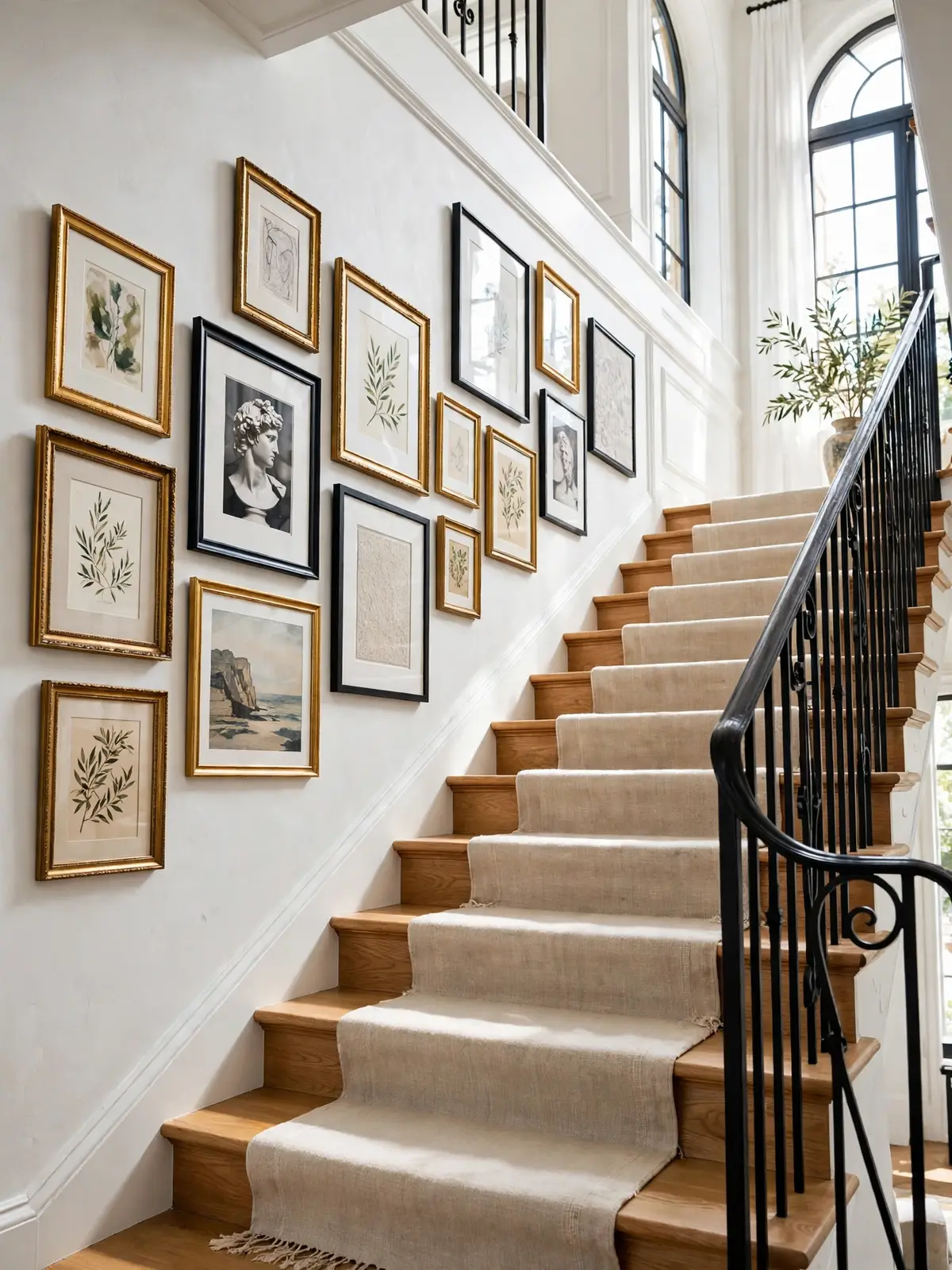
A gallery wall turns the climb into a slow walk through a private collection — and the stair’s diagonal line makes arranging art feel natural rather than forced. A concrete example: twelve frames in mixed gold and black, ranging from 8-by-10-inch sketches to a 24-by-36-inch landscape, arranged so their centres follow the stair’s slope at about 60 inches above each tread. Mix landscapes, portraits and abstracts in a shared warm palette so the wall feels curated, not random.
Quick tips:
- Follow the stair’s slope — hang frames so their centres step up evenly.
- Use one unifying element, like matching frames or a shared colour.
- Lay the arrangement on the floor first to test the composition.
- Add a picture light or two for evening drama.
A Skylight Flooding the Grand Staircase With Daylight
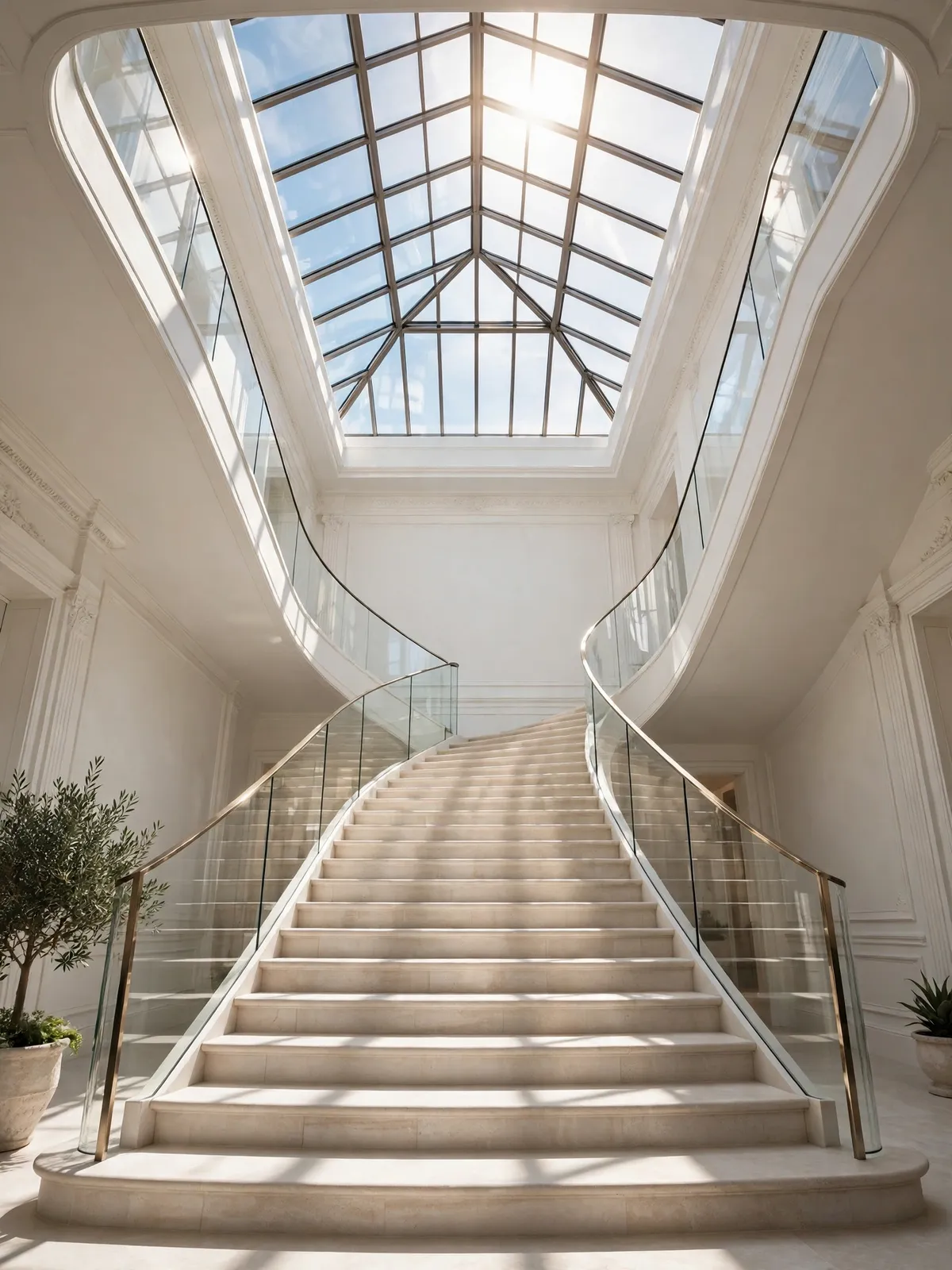
Daylight from above is the most flattering light a staircase can have — it washes the treads, lifts the ceiling and makes the whole stairwell feel taller. A concrete example: a 4-by-6-foot operable skylight centred over the stairwell, with pale limestone treads and white plaster walls that bounce the light down every step. Add a sheer blind on a remote control so summer glare can be softened without losing the glow.
Quick tips:
- Centre the skylight over the stairwell void, not over the landing.
- Choose pale, light-reflecting materials below to maximise the effect.
- Add a remote blind for glare and heat control.
- Clean the skylight twice a year — dust dulls the light fast.
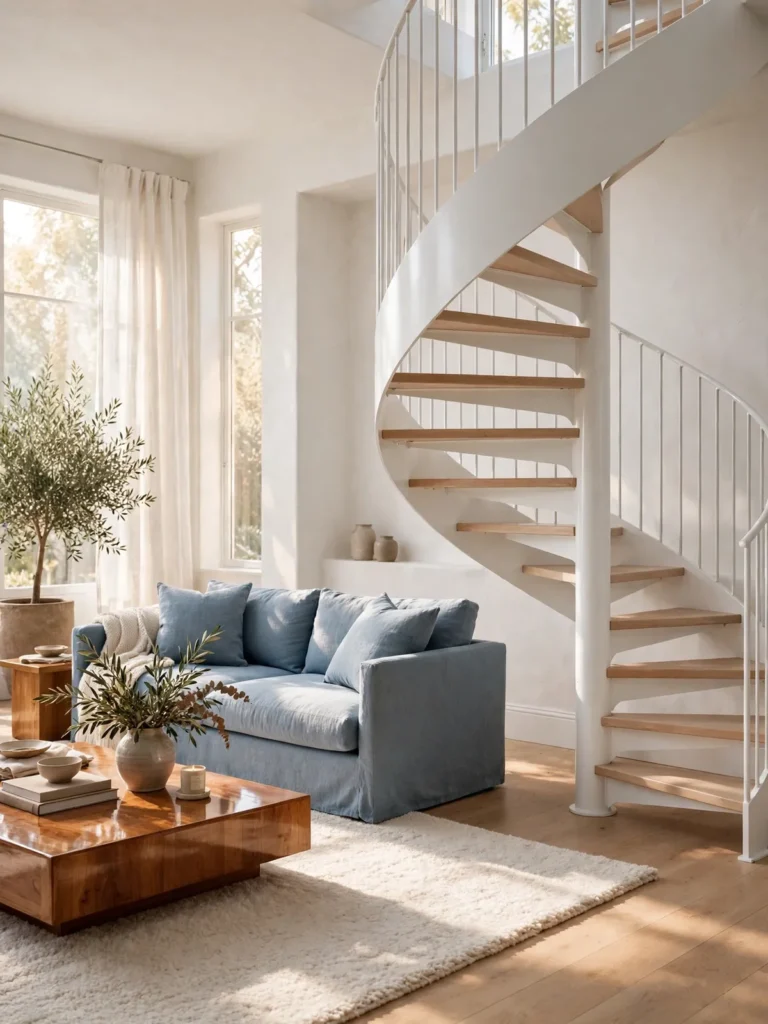
An All-White Monochrome Grand Staircase
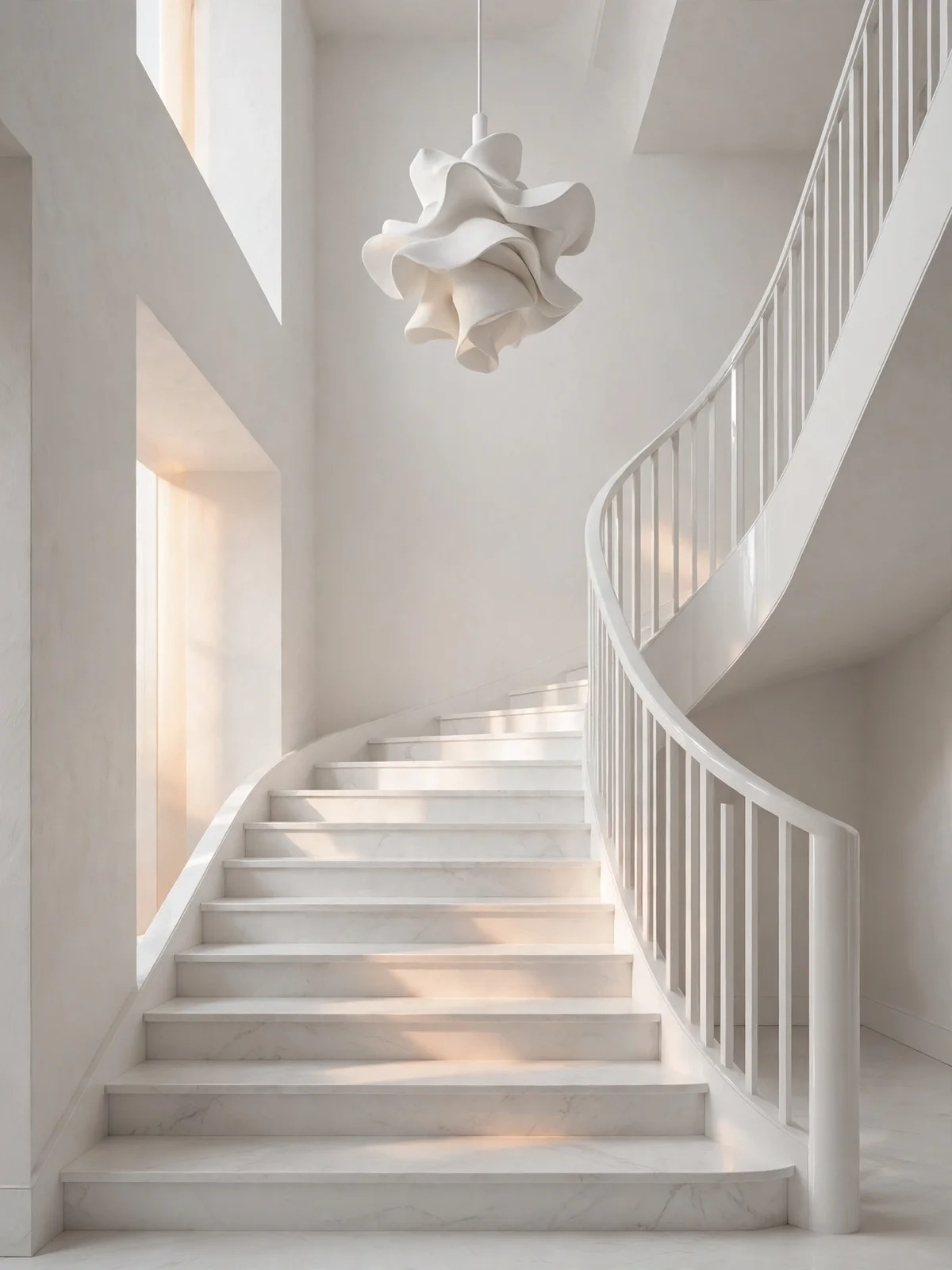
An all-white staircase is pure serenity — the monochrome palette lets shape, shadow and light do all the work. A concrete example: white marble treads with a whisper of grey veining, a white lacquered balustrade with slim turned spindles, and walls in warm white rather than stark white, so the space glows instead of glaring. A single sculptural pendant in matte white plaster hangs above, its shadow the only decoration.
Quick tips:
- Mix warm and cool whites deliberately — one flat white looks clinical.
- Vary textures: polished marble, matte lacquer, soft plaster.
- Add one warm accent, like a brass handrail, to stop it feeling cold.
- Choose washable paint — white stairs show every scuff.
Chunky Carved Newel Posts That Anchor the Design
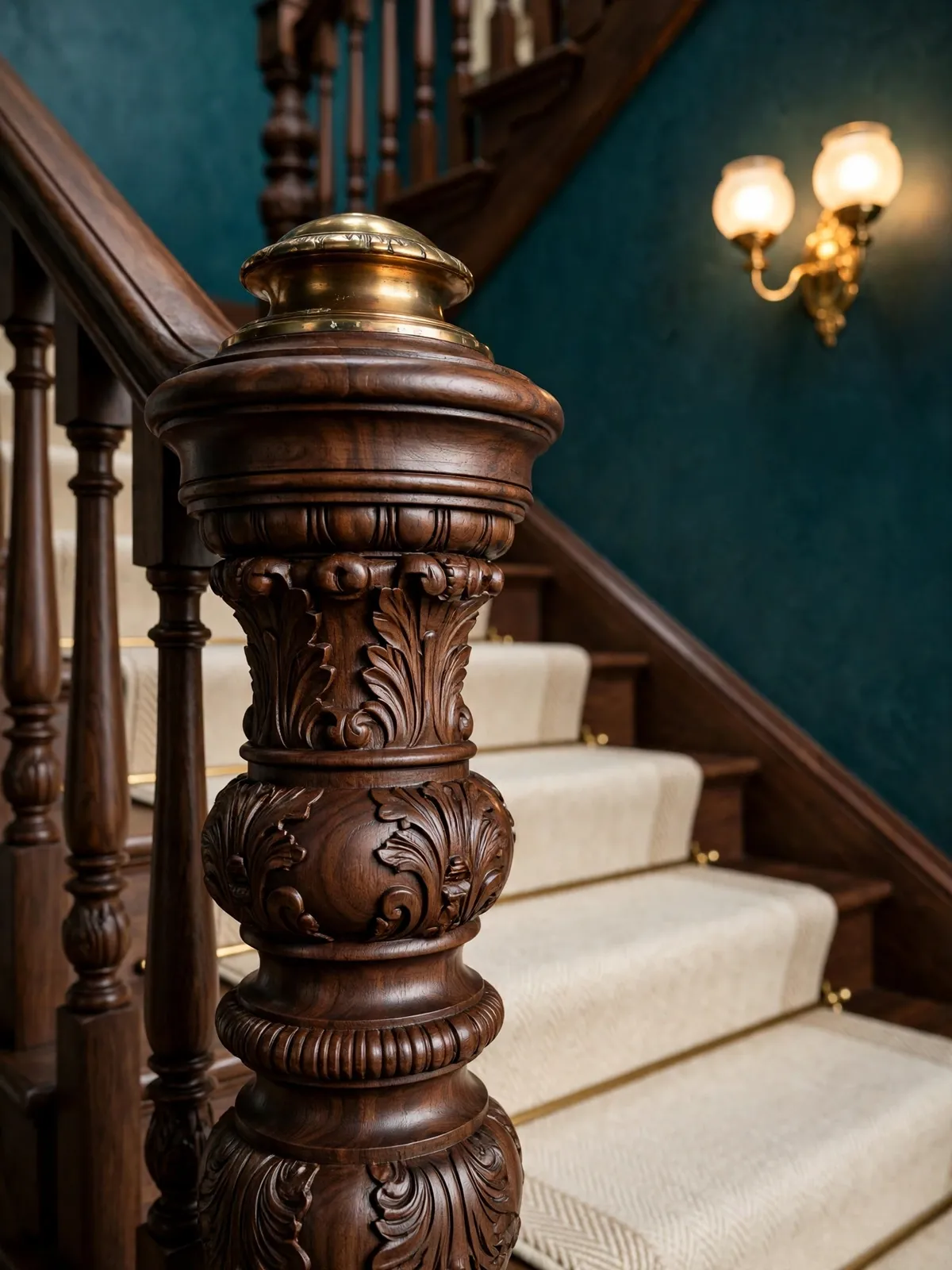
Chunky carved newel posts are the full stops of a staircase — they ground the design and give the hand something substantial to hold. A concrete example: 6-by-6-inch newel posts in dark walnut, hand-turned with a ball finial and a polished brass cap, standing at the base and landing of a cream-carpeted stair against deep teal walls. The posts’ weight balances the lightness of slim balusters between them.
Quick tips:
- Go bold on size — a 6-inch post reads grand, a 4-inch post reads ordinary.
- Match the post wood to the handrail for a unified look.
- Add a brass or crystal finial for a jewellery-like finish.
- Repeat the same post design at every turn for consistency.
A Marble Inlay Medallion in the Floor at the Stair Base
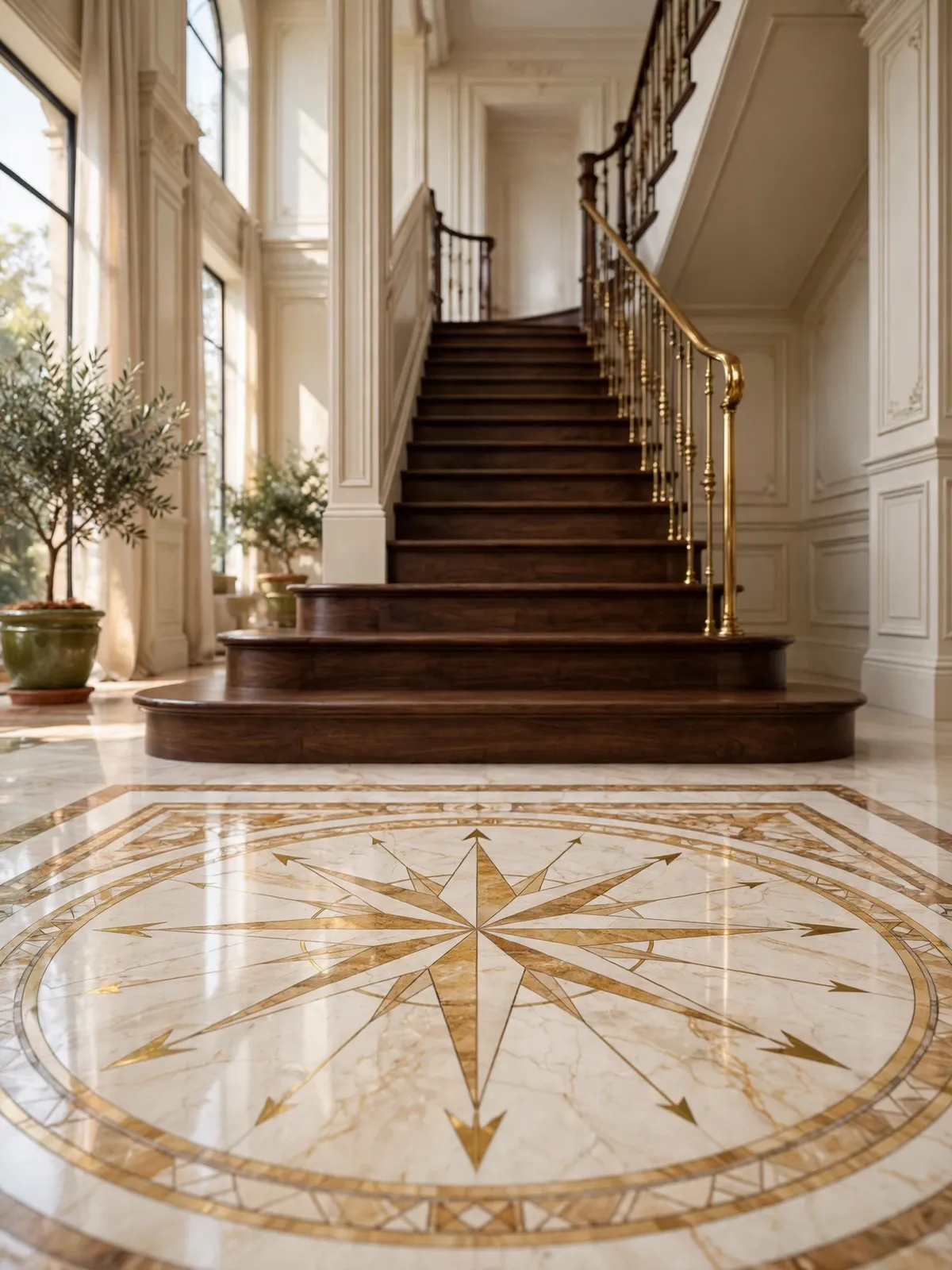
A marble medallion in the floor at the stair base is like a red carpet rendered in stone — it marks the stair as a destination. A concrete example: a 48-inch-diameter compass medallion in cream, gold and charcoal marble, inlaid flush into the foyer floor exactly on the stair’s centre line, with the bottom bullnose tread echoing its curve. The medallion tells guests where to stand and where to look.
Quick tips:
- Centre the medallion precisely on the stair’s axis.
- Echo its colours in the stair materials for cohesion.
- Keep the design bold and simple — fine detail gets lost underfoot.
- Seal the inlay well, since the foyer floor takes the most wear.
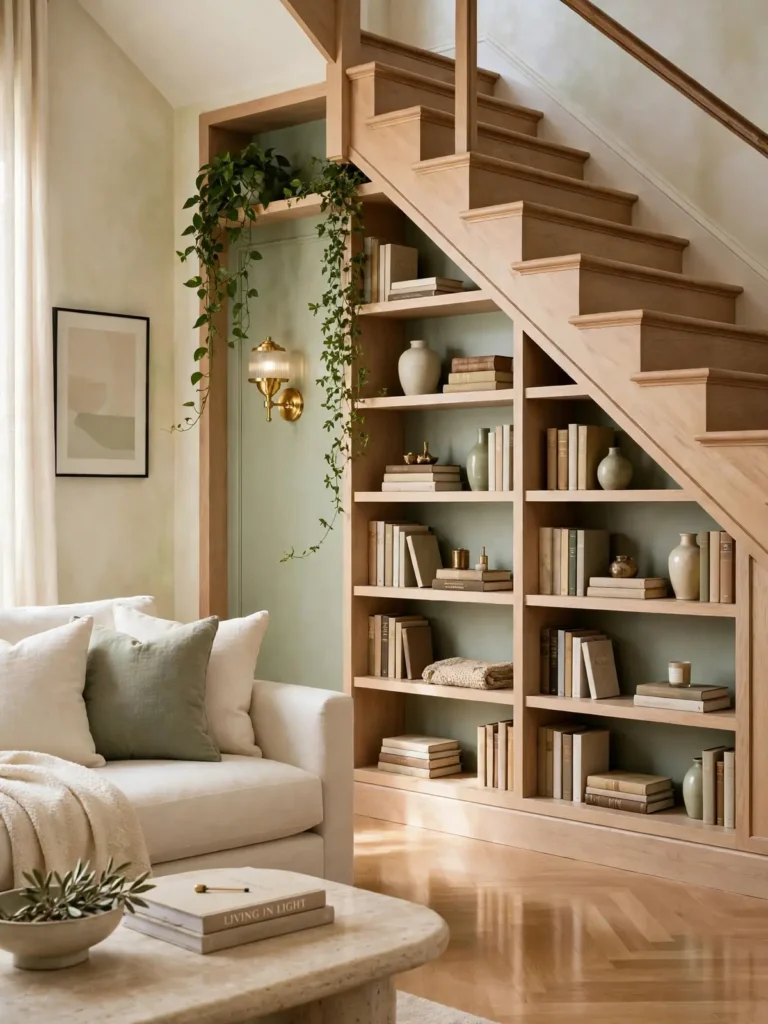
A Grand Staircase With a Hidden Storage Room Beneath
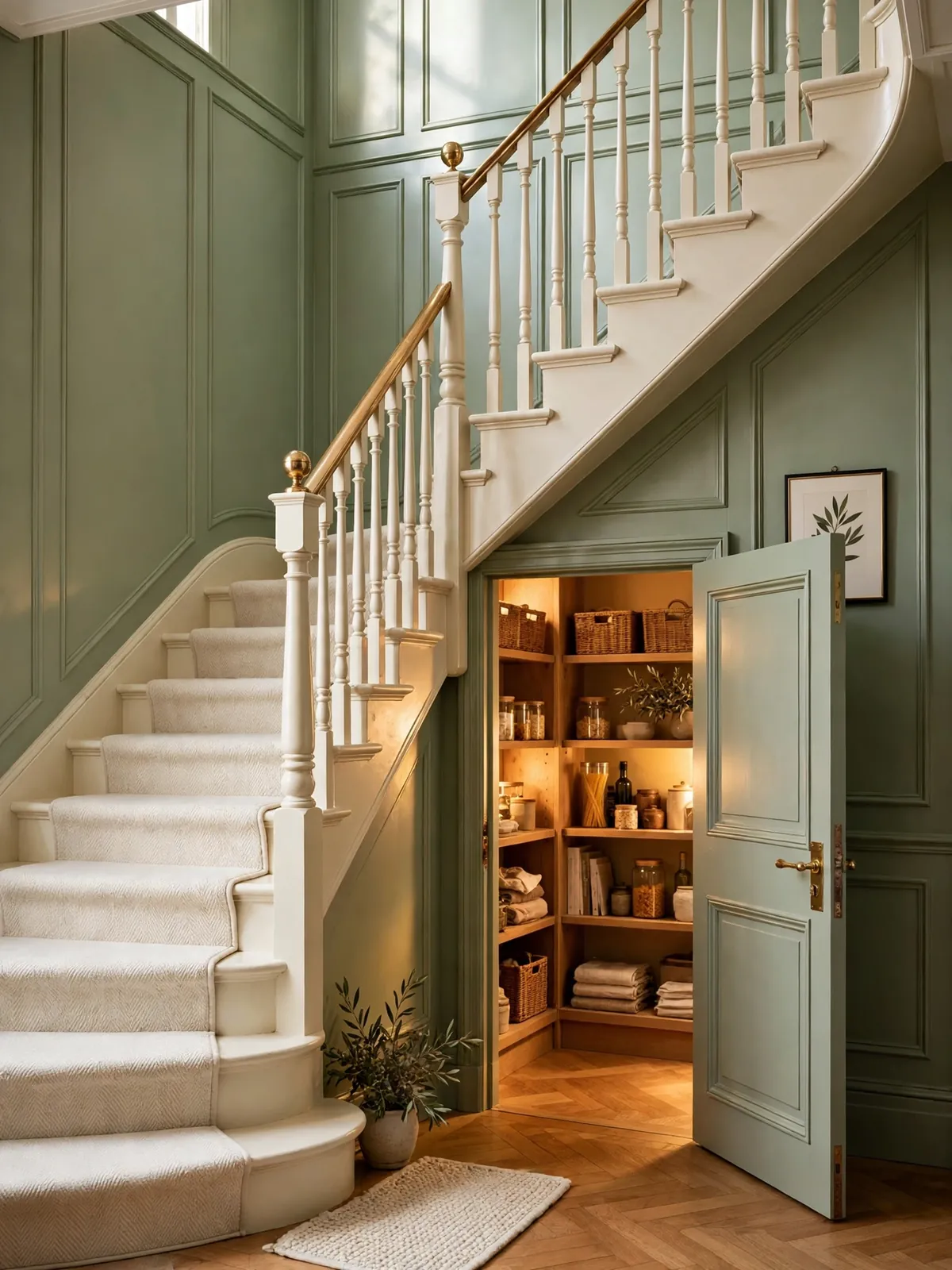
The space beneath a grand staircase is too valuable to waste — a hidden room turns dead space into a secret. A concrete example: a panelled door, flush with the stair wall and painted the same sage green, opening onto a 6-by-8-foot storage room with warm oak shelving, motion-sensor lighting and space for coats, luggage and seasonal decor. The door’s seams disappear into the panelling, so guests never guess it is there.
Quick tips:
- Make the door flush and paint-matched so it vanishes into the wall.
- Add motion-sensor lighting so the room is bright the moment it opens.
- Use the deepest part for bulky items and the shallow part for shelves.
- Ventilate the space to keep it fresh and dry.
Thick Floating Treads on a Grand Staircase
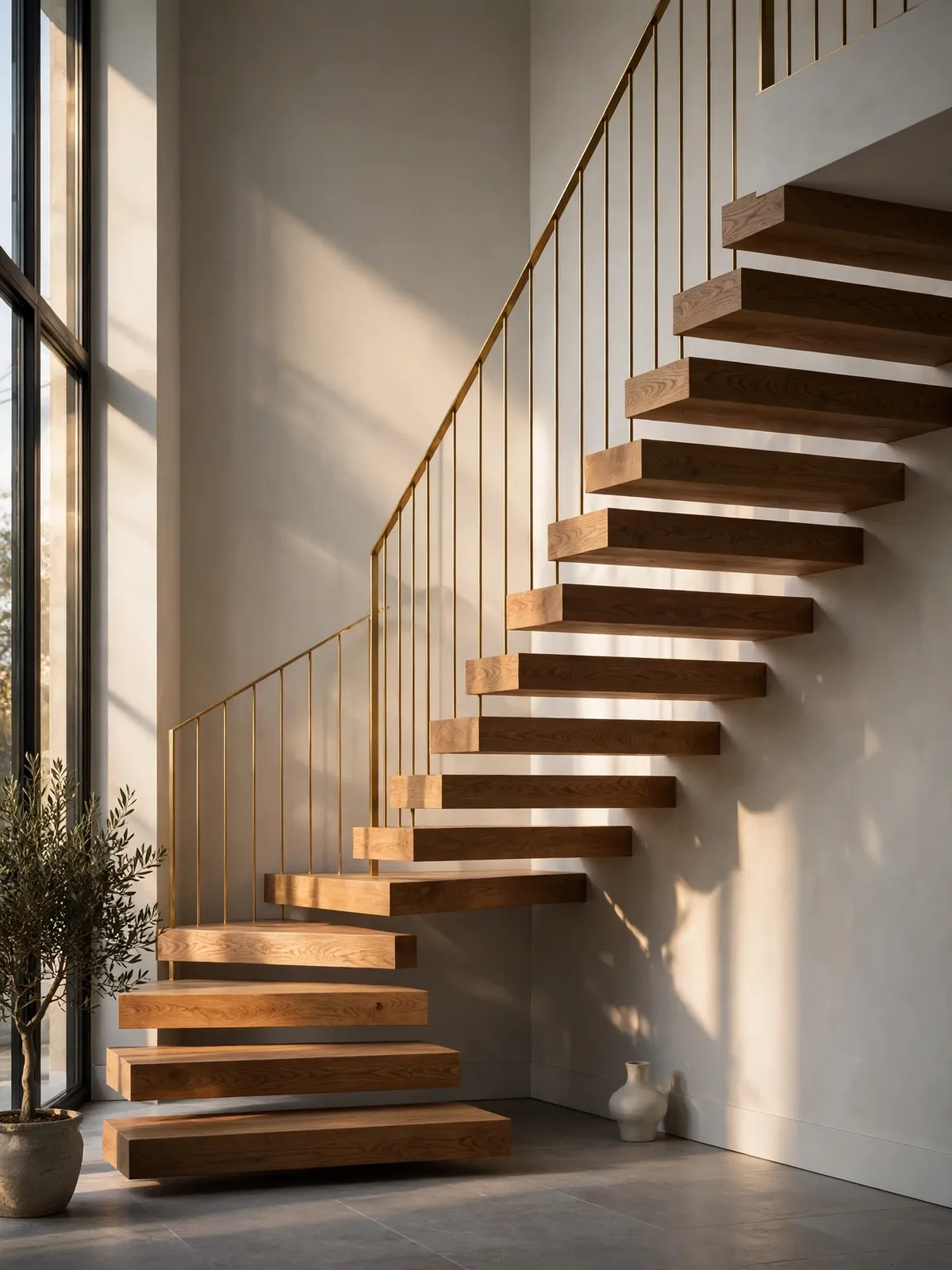
Thick floating treads bring a modern, weightless drama to a grand staircase — each step looks as if it hovers in mid-air. A concrete example: 3-inch-thick white oak treads, 48 inches wide, cantilevered from a steel spine hidden in a pale plaster wall, with a slim brass balustrade on the open side and a soft grey stone floor below that catches the shadows. The thickness is what makes them read as grand rather than minimal.
Quick tips:
- Go thick — 3-inch treads read substantial, 2-inch treads read flimsy.
- Hide the steel support completely for the true floating effect.
- Add LED strips under each tread for a magical evening glow.
- Keep the wall behind the treads plain so the shadows become the decoration.
A Grand Staircase Framed by Double-Height Windows
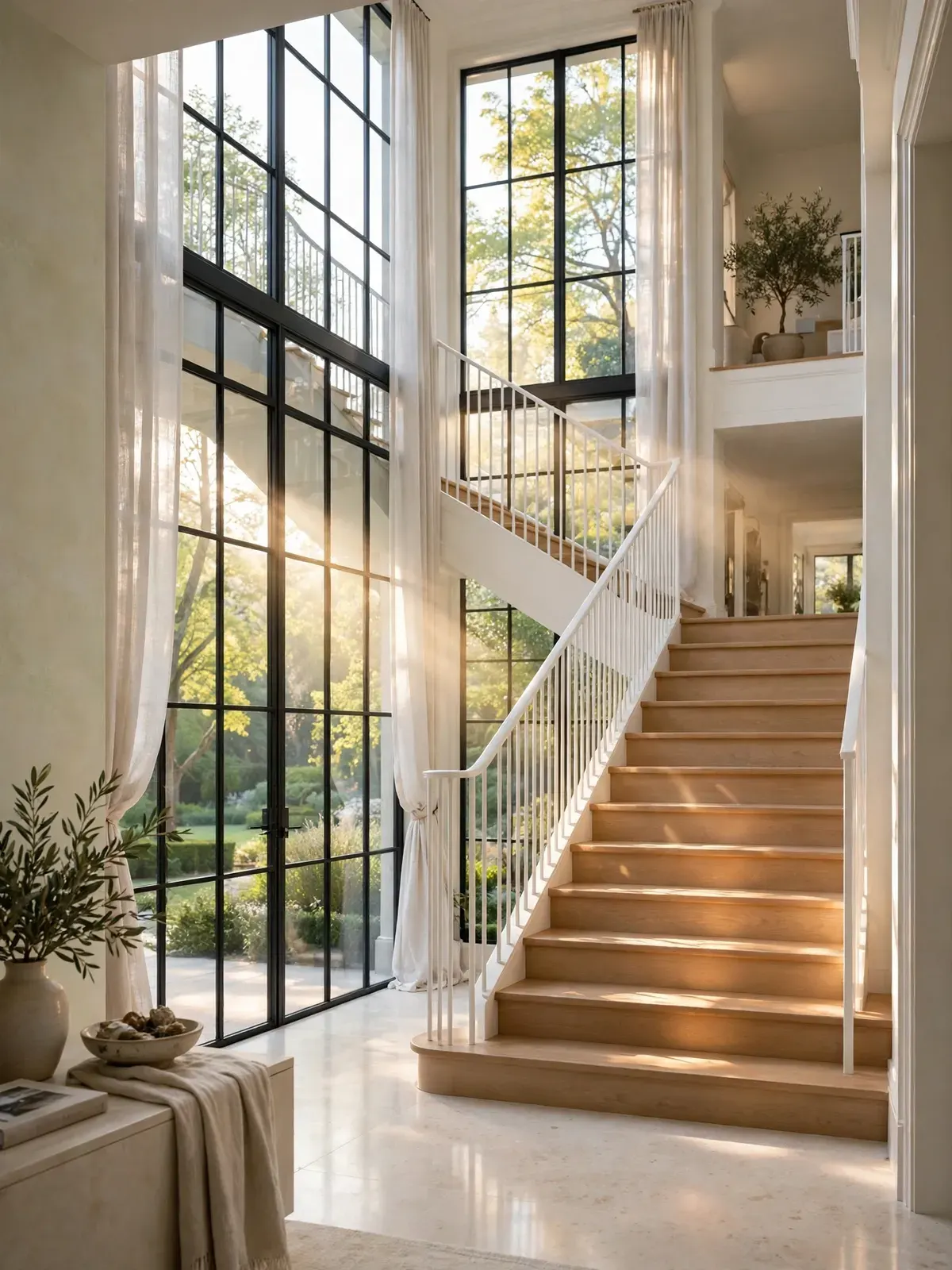
Double-height windows turn a staircase into a viewing platform — the stair becomes the frame for the world outside. A concrete example: two 18-foot-tall black-steel windows flanking a light oak staircase, with sheer linen curtains softening the edges and a white balustrade that disappears against the light. In the morning, sunlight rakes across the treads; in the evening, the glass reflects the chandelier like a second light source.
Quick tips:
- Keep the balustrade light and slim so it never blocks the view.
- Use sheer curtains for privacy without losing daylight.
- Choose low-iron glass for a clearer, greener-free view.
- Add a window seat or console on the landing to enjoy the outlook.
A Grand Staircase With a Velvet-Covered Bench at Its Foot
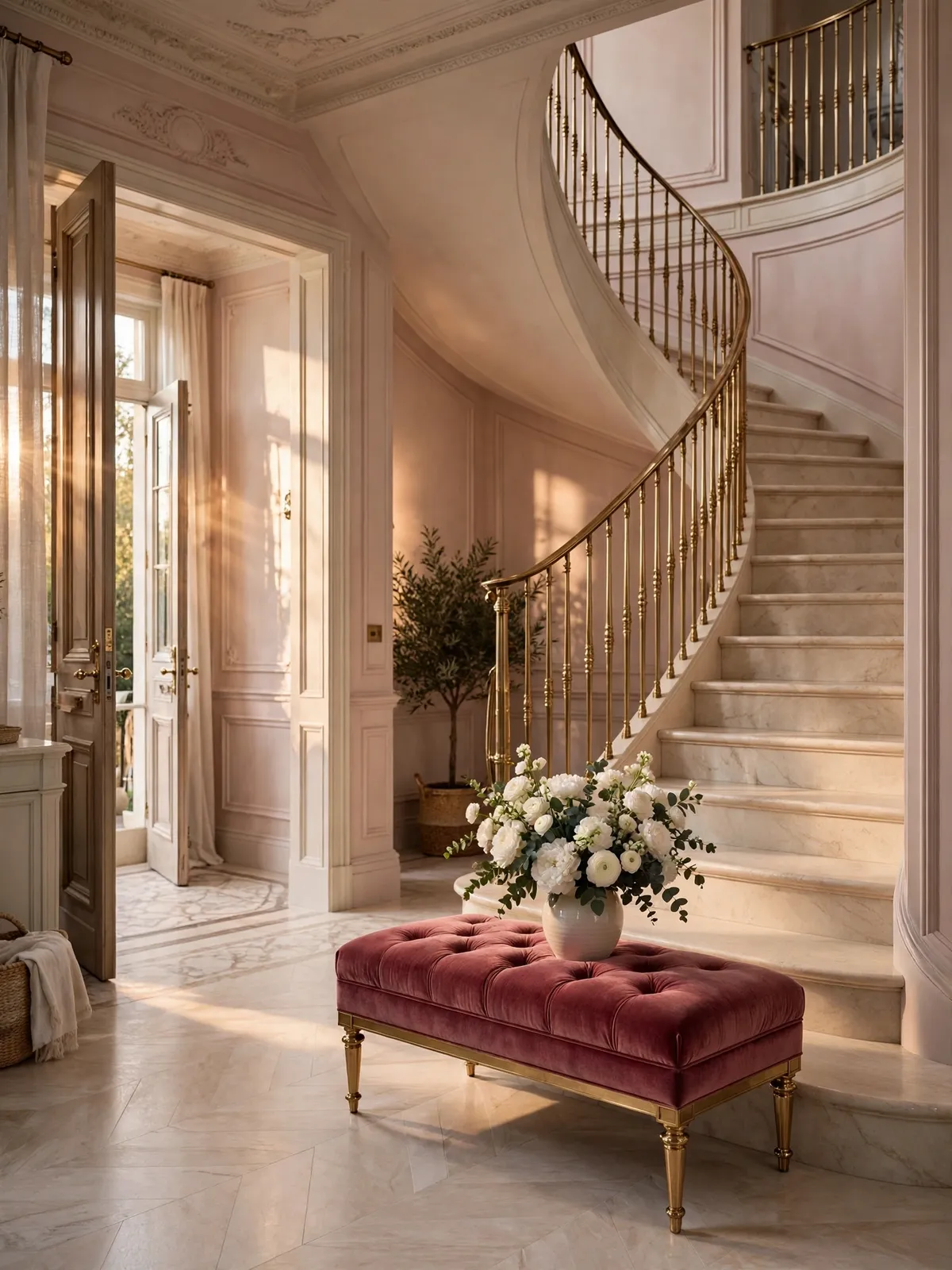
A velvet bench at the foot of the stair is both practical and theatrical — a place to pause, put on shoes, or simply admire the room. A concrete example: a 48-inch bench in deep rose velvet with slim brass legs, placed on the stair’s centre line 3 feet from the bottom tread, topped with a cream linen cushion and a small vase of white ranunculus. The bench’s colour echoes a runner or artwork above, tying the foyer together.
Quick tips:
- Size the bench to about two-thirds of the stair’s width.
- Choose a performance velvet that resists stains and crushing.
- Keep the bench’s legs slim so it feels light, not blocky.
- Style it minimally — one vase, one cushion, nothing more.
A Grand Staircase With a Fireplace Beside the Landing
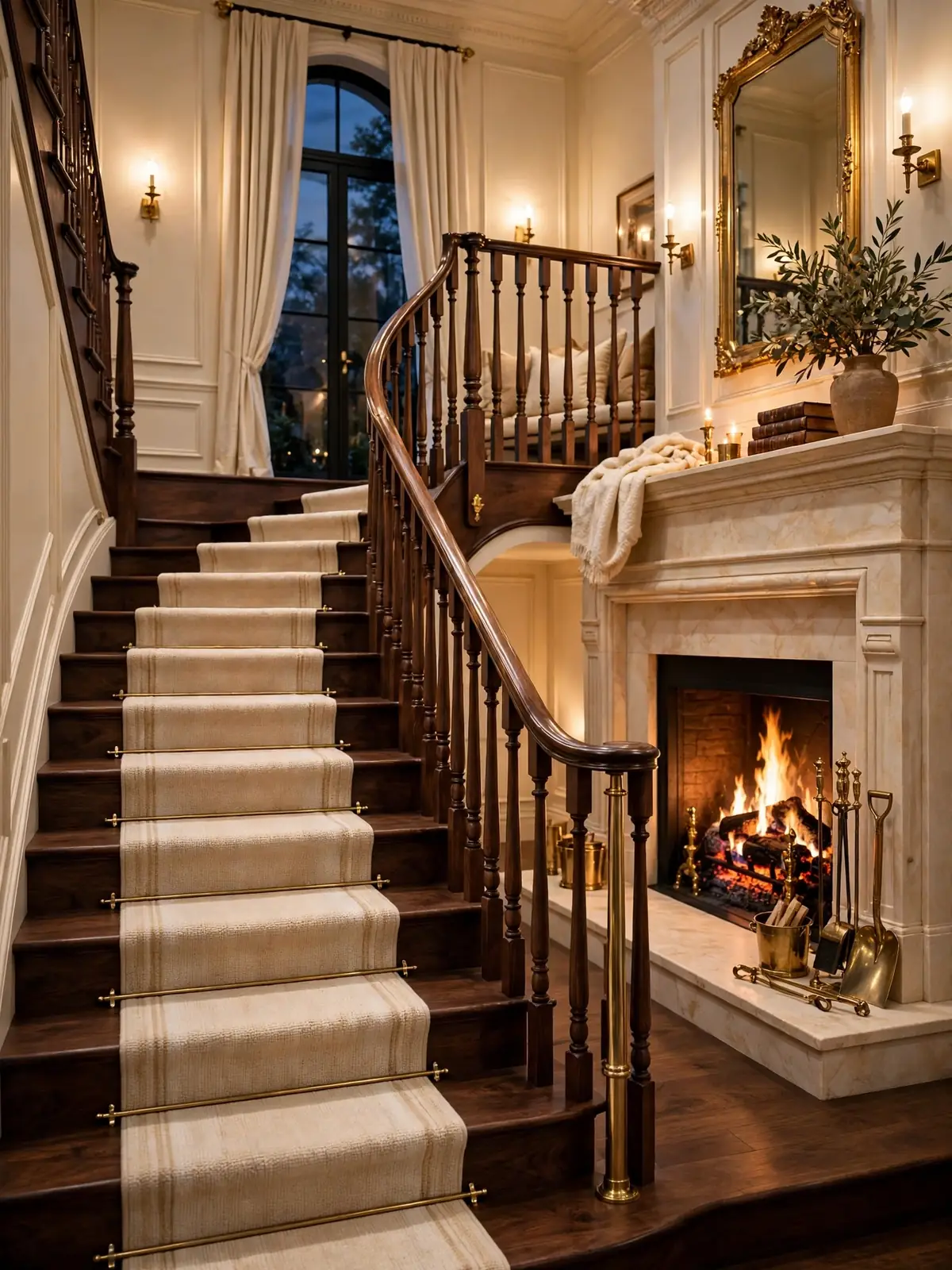
A fireplace beside the landing makes the staircase feel like the heart of the home, not just a passage — warmth and grandeur in one gesture. A concrete example: a cream limestone fireplace with a simple mantel, set into the landing wall of a dark walnut staircase, with a pair of brass fire tools and a stack of birch logs beside it. The fire’s glow warms the wood and the stone, and the landing becomes a destination rather than a pause.
Quick tips:
- Keep the fireplace surround simple — the stair is the ornament.
- Choose a gas or electric fire for safety beside a busy stair.
- Add a fireproof hearth that extends 18 inches in front.
- Hang one large artwork above the mantel, not a clutter of small frames.
A Grand Staircase in Dark Walnut and Brass
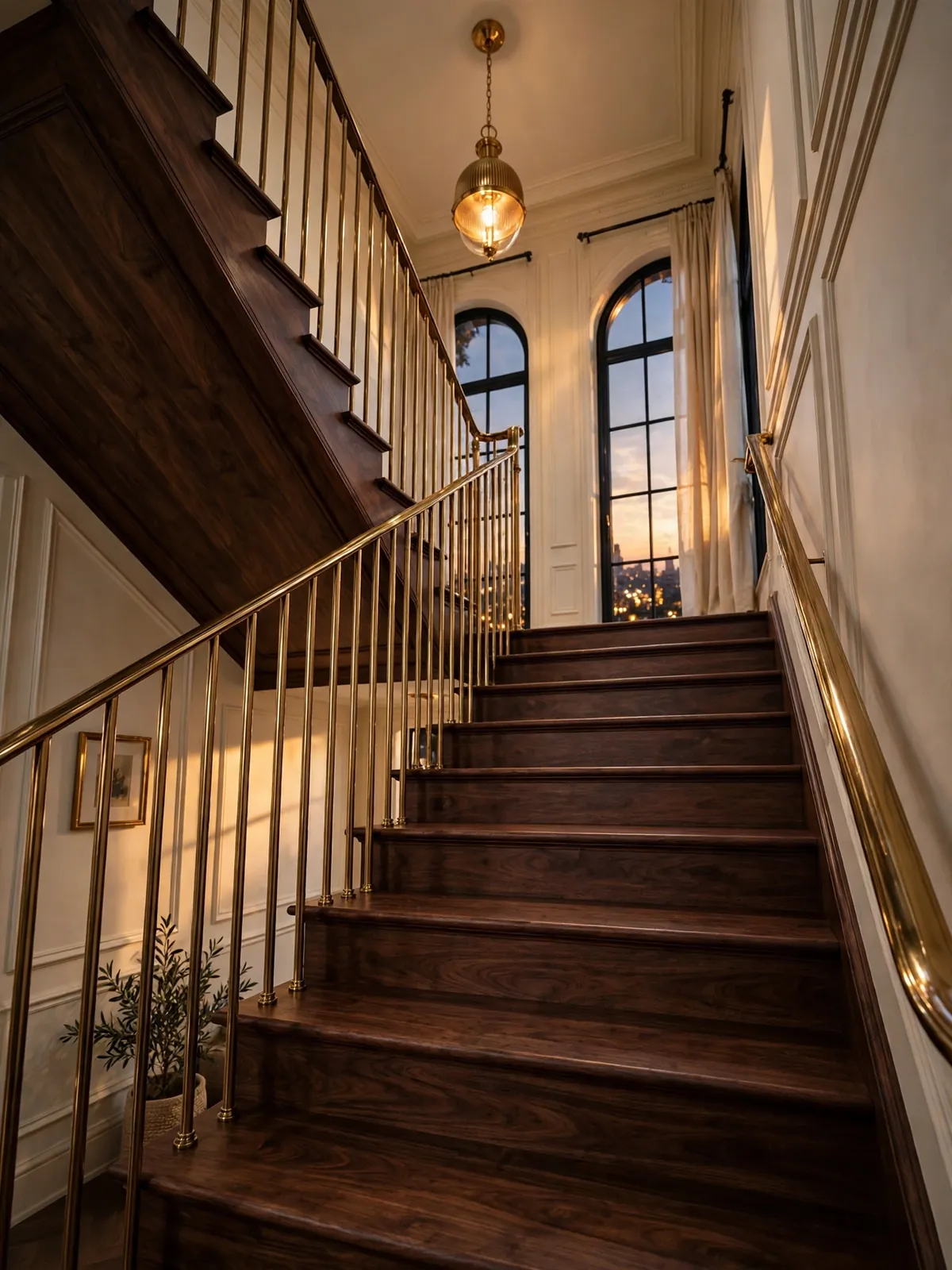
Dark walnut and brass is the most timeless luxury pairing for a staircase — deep, warm wood against gleaming metal, like a fine piece of furniture scaled up to architecture. A concrete example: dark walnut treads, 2 inches thick with a satin finish, paired with polished brass balusters and a continuous brass handrail, against cream walls that keep the dark wood from feeling heavy. A brass pendant above the landing picks up the same warm metallic note.
Quick tips:
- Use a satin finish on the walnut — high gloss shows every scratch.
- Keep brass polished or lacquered so it stays bright.
- Balance the dark wood with pale walls and a light runner.
- Repeat brass in small foyer details — door handles, mirror frame, light fittings.
A Grand Staircase With a Glass Dome Above
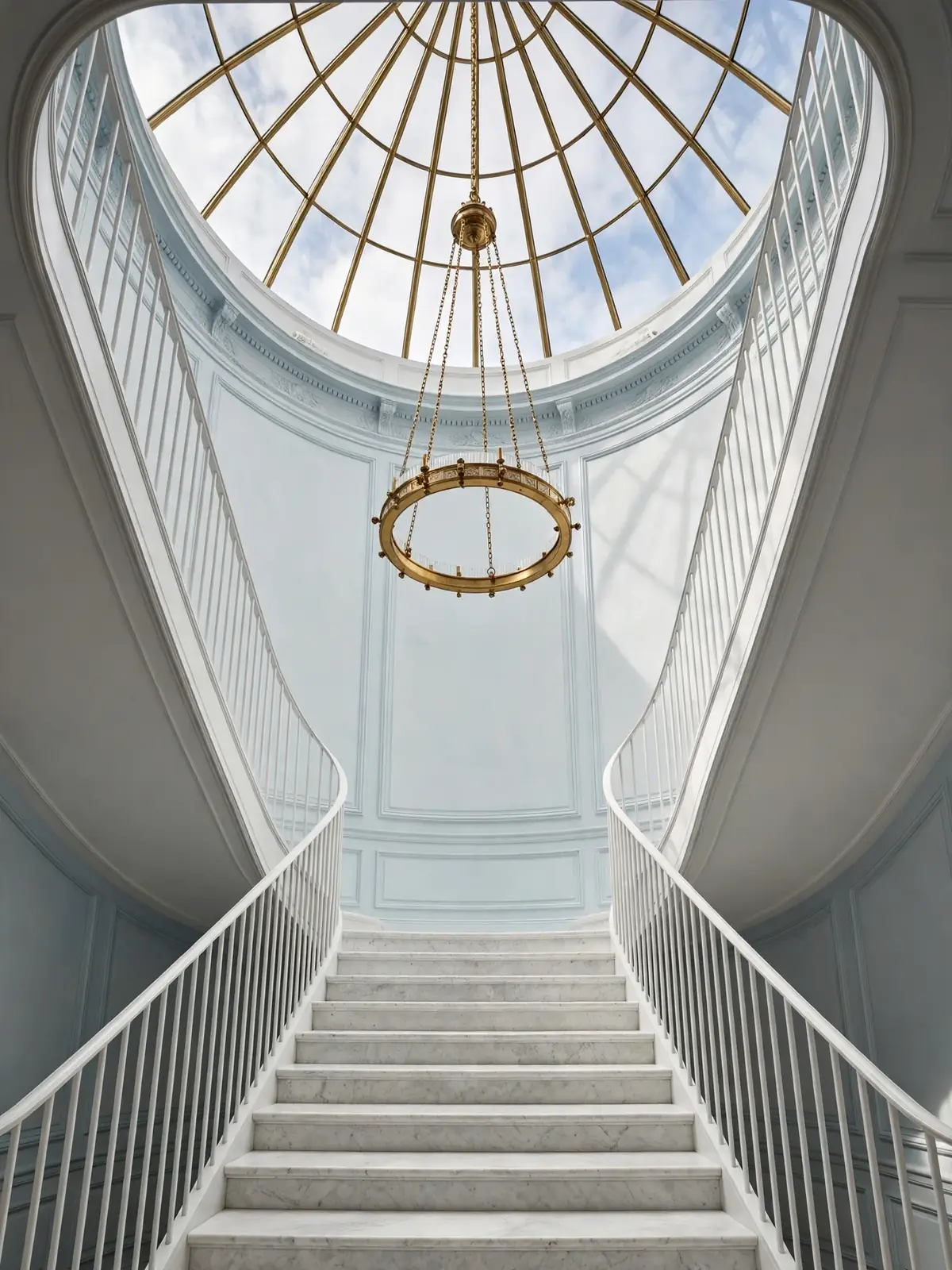
A glass dome above the stairwell is pure theatre — a circle of sky that makes the whole staircase feel like it rises toward the heavens. A concrete example: a 6-foot-diameter glass dome with slim steel ribs, centred over a white marble staircase, with a brass ring chandelier suspended just below it so the light fixture and the dome read as one composition. Pale blue-grey walls keep the light cool and airy.
Quick tips:
- Centre the dome exactly over the stairwell void.
- Add a motorised blind inside the dome for hot summer days.
- Keep the chandelier slim so it never competes with the dome.
- Choose self-cleaning glass to keep the view clear.
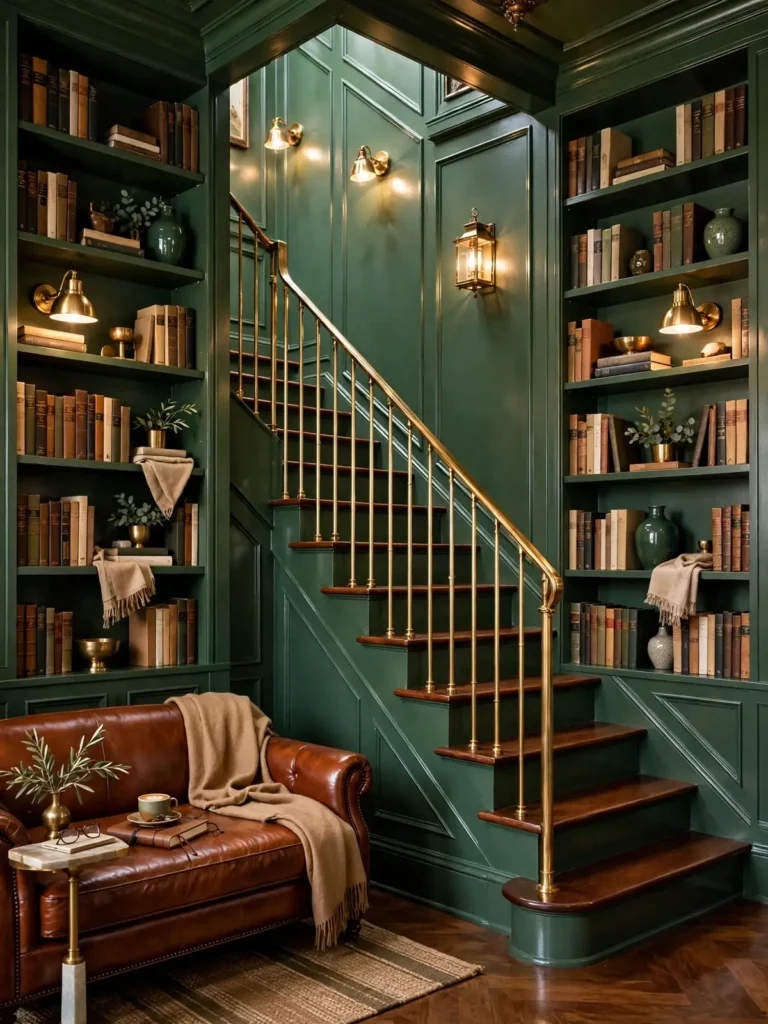
A Grand Staircase That Opens Onto a Double-Height Library
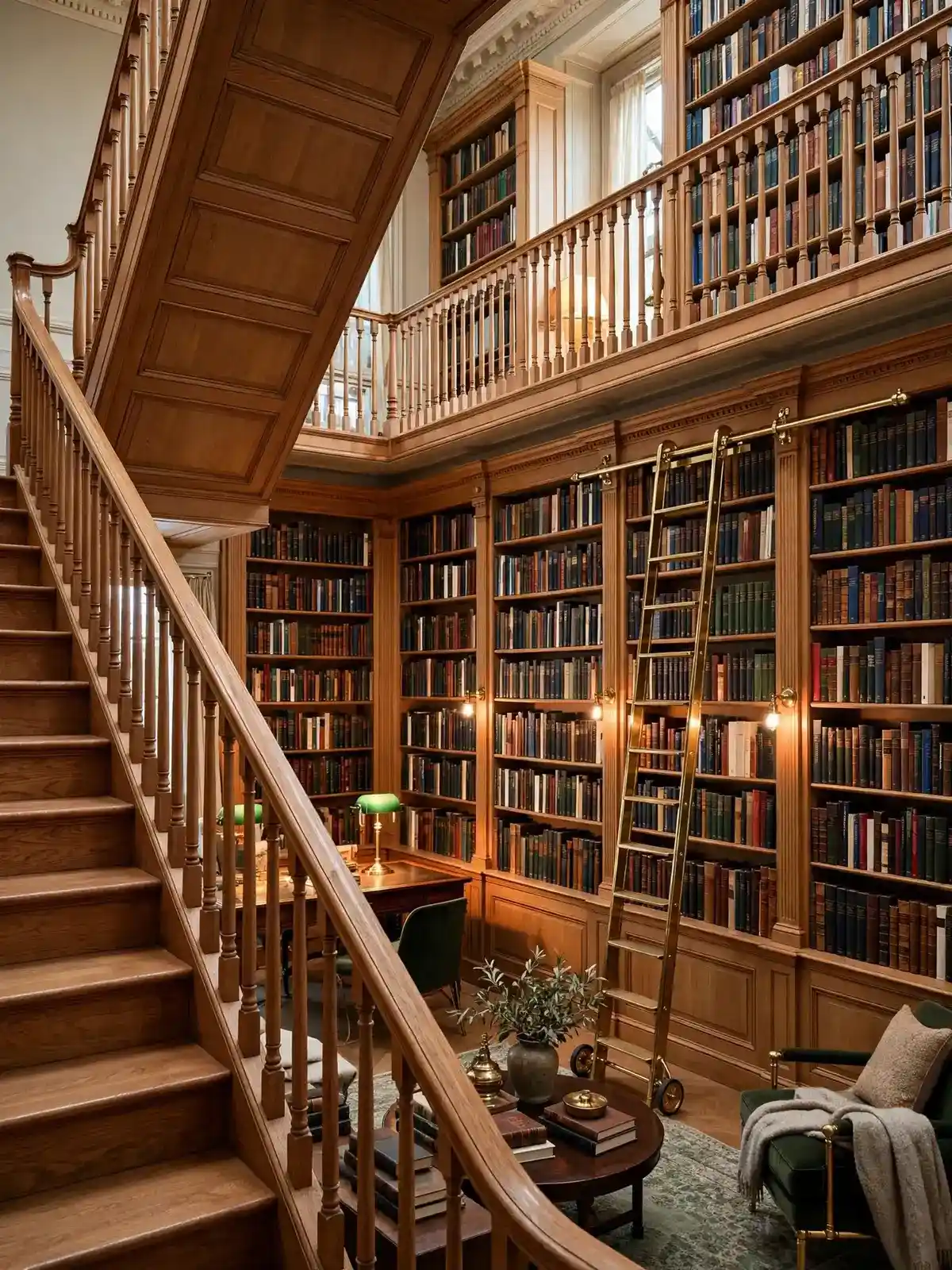
A staircase that lands in a double-height library is the stuff of daydreams — the stair becomes the threshold to a room full of stories. A concrete example: a warm oak staircase rising to a landing lined with floor-to-ceiling oak bookshelves, filled with cloth-bound books in cream, navy and burgundy, with a brass rolling ladder and two green-shaded library lamps glowing on the landing. The stair’s wood matches the shelves, so the two spaces read as one.
Quick tips:
- Match the stair wood to the shelving for a seamless transition.
- Use a rolling ladder — it is both practical and impossibly charming.
- Light the shelves with picture lights or shelf LEDs.
- Keep the landing clear of clutter so the books are the decoration.
A Grand Staircase With Sculptural Newel Lanterns
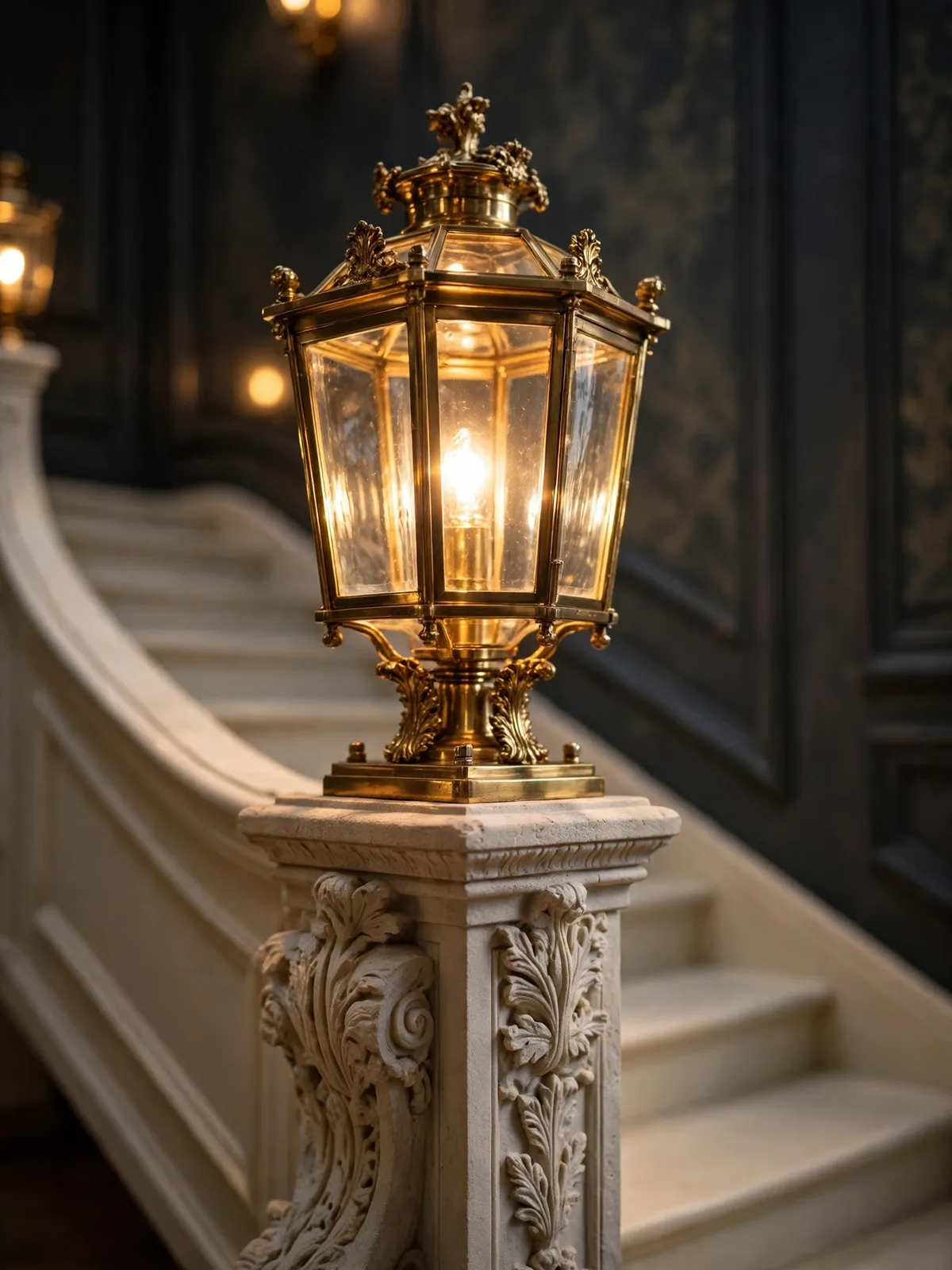
Sculptural newel lanterns turn the stair’s end posts into glowing beacons — part sculpture, part lighting, entirely memorable. A concrete example: hand-carved stone newel posts topped with brass-and-glass lanterns, 18 inches tall, glowing warmly against deep charcoal walls beside a cream staircase. The lanterns light the first and last steps, so the stair is safe and beautiful at once.
Quick tips:
- Choose lanterns with warm-toned bulbs for a welcoming glow.
- Keep the lantern scale generous — small lanterns disappear on a grand stair.
- Wire them to the same dimmer as the foyer lights.
- Match the lantern metal to the handrail and balusters.
A Grand Staircase With a Patterned Tile Riser Design
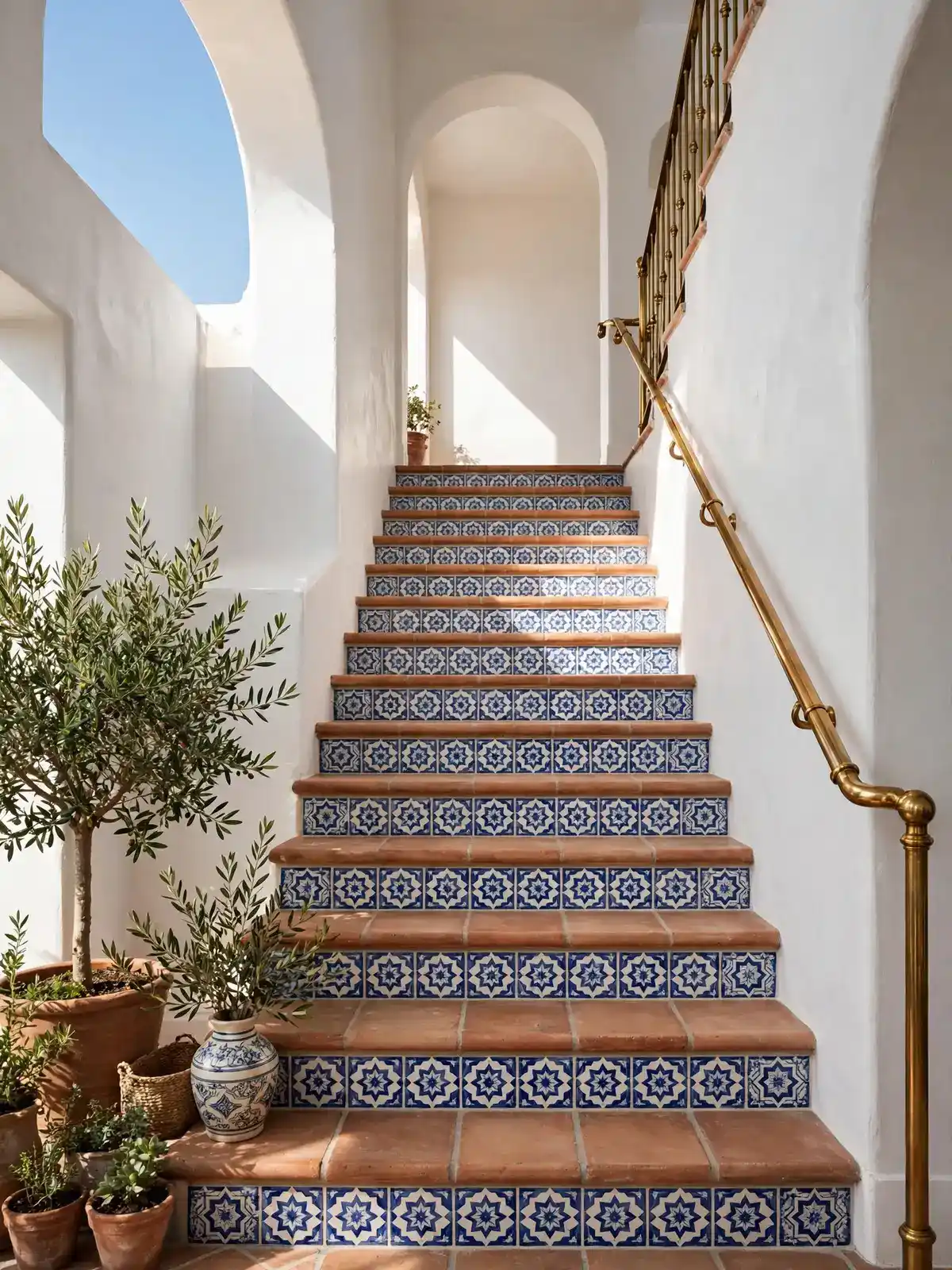
Patterned tile risers turn every step into a small artwork — the pattern unfolds as you climb, like a story told one line at a time. A concrete example: hand-painted-look tiles in blue and white geometric patterns on each riser, paired with warm terracotta treads and a brass handrail, against plain white walls that let the pattern shine. Use one repeating pattern for calm, or alternate two complementary patterns for rhythm.
Quick tips:
- Use one pattern family so the stair feels cohesive, not chaotic.
- Choose tiles rated for vertical use — floor tiles are heavier than needed.
- Seal the tiles and grout to protect against scuffs.
- Keep the treads plain so the risers stay the focus.
A Grand Staircase With a Piano Beneath the Sweep
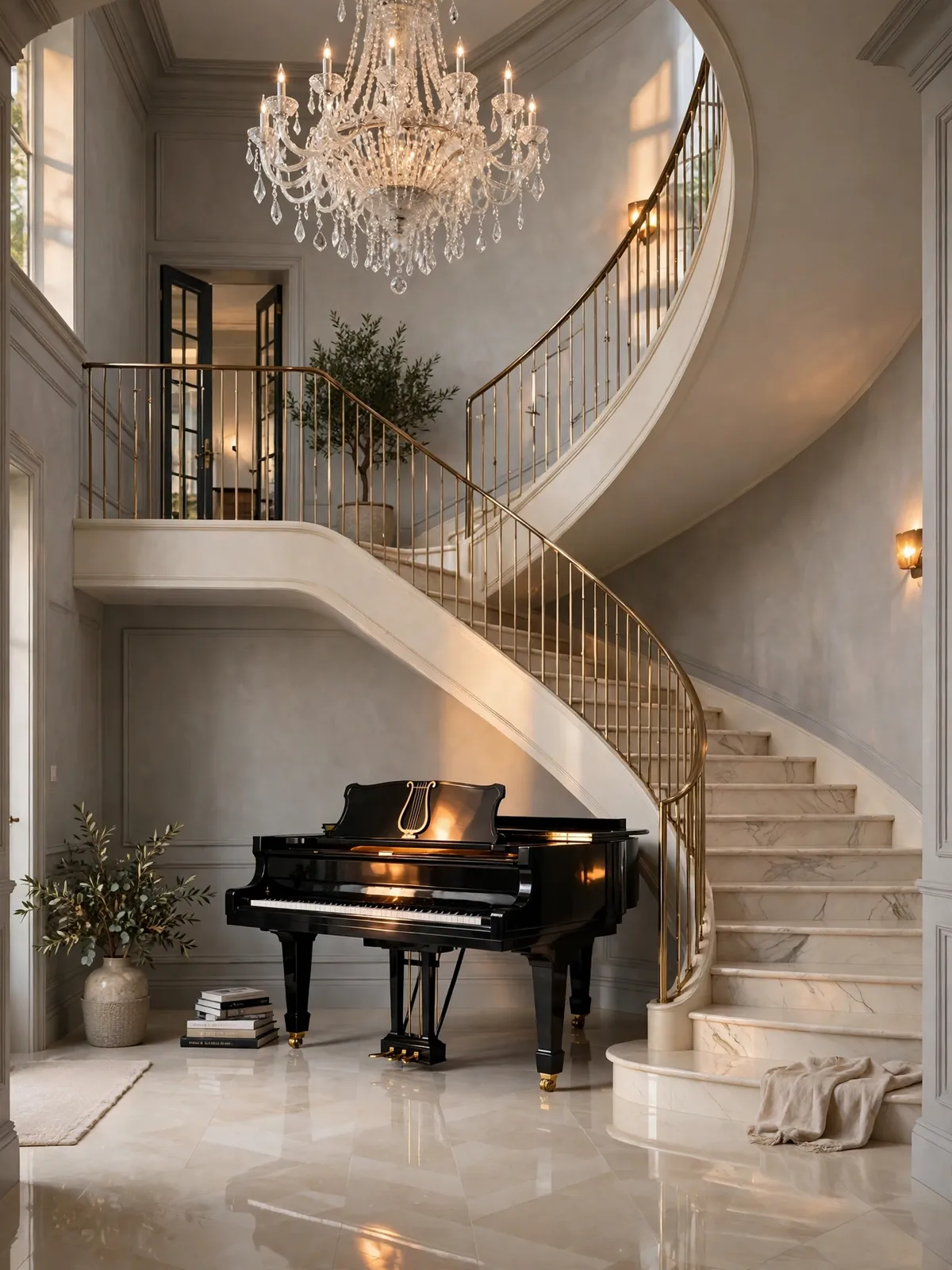
A grand piano beneath the sweep of a grand staircase is the ultimate pairing — two curves, one black and gleaming, one pale and architectural, in perfect conversation. A concrete example: a glossy black baby grand piano, 5 feet 7 inches long, tucked beneath the curve of a cream marble staircase, with a crystal chandelier above and soft grey walls behind. The piano’s lid reflects the chandelier’s light, doubling the sparkle.
Quick tips:
- Measure carefully — allow at least 6 inches of clearance above the piano.
- Keep the piano tuned regularly; the stairwell’s acoustics amplify every note.
- Add a soft rug beneath the piano to warm the sound.
- Style the piano with one vase of flowers, never clutter.
A Grand Staircase With a Coffered Ceiling Overhead
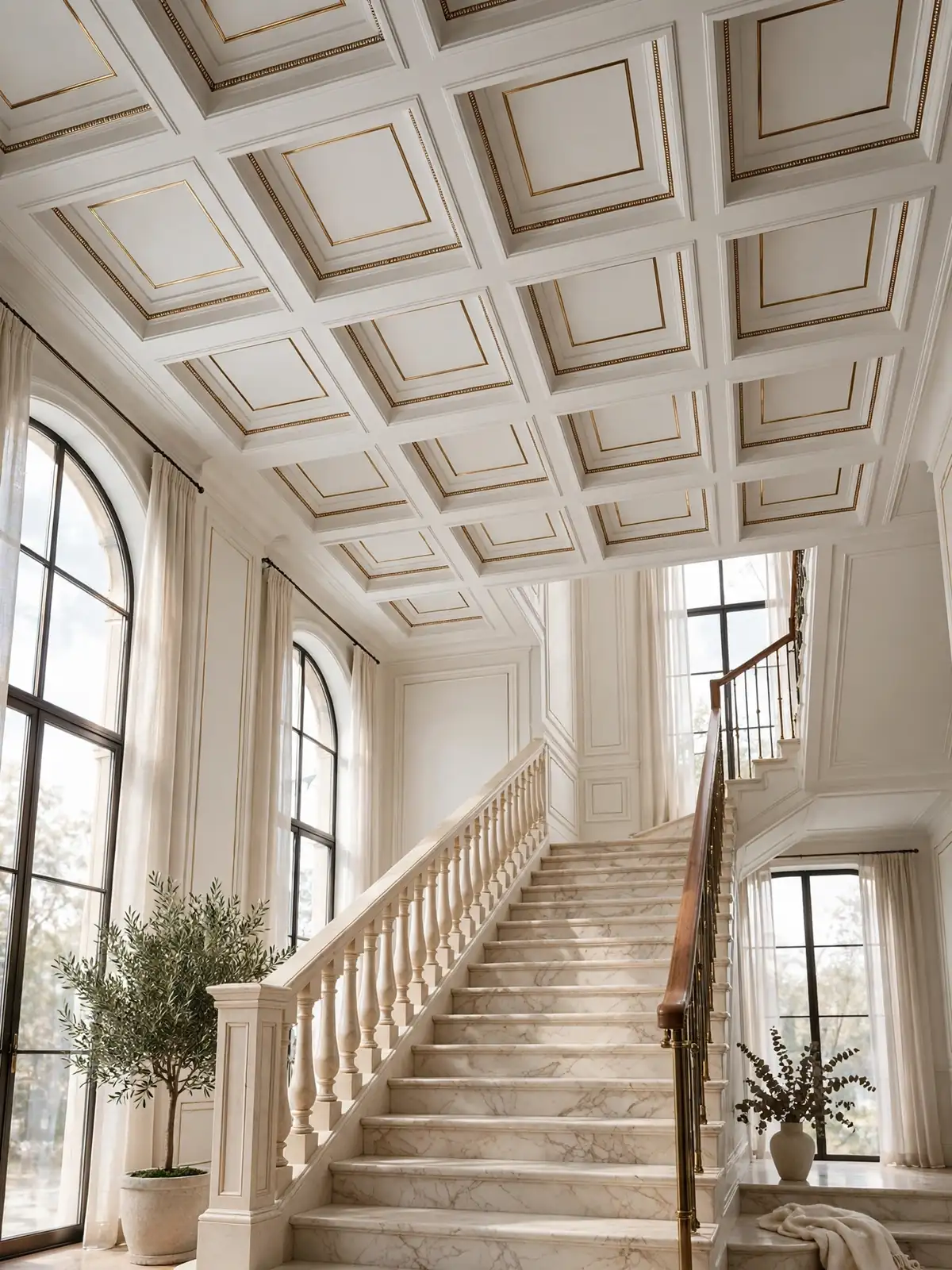
A coffered ceiling above the stairwell adds a final layer of architecture — a grid of deep, shadowed panels that makes the ceiling feel like part of the design, not just a lid. A concrete example: a white coffered ceiling with 12-inch-deep coffers and slim brass inlay along each beam, spanning the double-height stairwell above a cream marble staircase with a warm wood handrail. The coffers’ shadows shift through the day, so the ceiling is never static.
Quick tips:
- Keep coffer depth proportional — 8 to 12 inches suits a double-height space.
- Paint coffers the same colour as the ceiling for subtlety, or contrast for drama.
- Add a recessed light in every other coffer for even evening light.
- Let the coffer grid align with the stair’s axis for a composed look.
FAQs
What is the best material for a grand staircase?
Marble, dark walnut and limestone are the classic choices, each with its own character — marble for drama, walnut for warmth, limestone for quiet elegance. The best material is the one that suits your home’s style and your tolerance for maintenance: marble needs sealing, walnut needs occasional refinishing, and limestone needs gentle cleaning. Whatever you choose, pair it with a metal accent like brass or wrought iron for contrast.
How much does a grand staircase cost?
Costs vary widely with materials, size and craftsmanship, from a modest five-figure sum for a well-built straight stair in quality timber to a far larger investment for curved marble flights, custom ironwork and a statement chandelier. The biggest cost drivers are the curve, the stone, and hand-forged details. Get at least three quotes from specialist stair makers and ask each to break out materials, labour and finishing separately.
Can a grand staircase be added to an existing home?
Yes, in many cases, though it depends on the structure, the available footprint and the ceiling height. A straight or L-shaped grand stair can often replace an existing stair within the same footprint, while a curved or split stair usually needs more space and structural work. A structural engineer and a specialist stair designer should assess the space before any work begins.
How do I keep a grand staircase safe for children and older family members?
Choose a continuous handrail at a comfortable height, keep baluster gaps under 4 inches, add non-slip finishes or a runner on the treads, and light every step well — including a low-level light on the first and last treads. A runner in a grippy wool pile is one of the simplest safety upgrades, and it adds luxury at the same time.
What lighting works best above a grand staircase?
Layered lighting works best: a statement chandelier or pendant for drama, wall sconces or picture lights for warmth at eye level, and small step lights or an LED strip under the handrail for safe night-time use. Put the main fixture on a dimmer so the stair can glow softly in the evening and shine brightly when guests arrive.
—
Conclusion
A grand staircase is the single most powerful statement a foyer can make — it sets the scale, the mood and the standard for the whole home. Whether you fall for a sweeping marble curve, a split flight beneath a chandelier, or a quiet all-white stair under a glass dome, the secret is the same: generous proportions, honest materials, and lighting that flatters both. Pick the idea that fits your space, invest in the details that guests will touch — the handrail, the runner, the newel posts — and let the staircase do what it has always done best: make every arrival feel like an occasion.