21 Stunning MCM Bathroom Ideas for a Warm Retro Retreat
An MCM bathroom is warm wood, clean lines and just enough retro character to feel designed without feeling themed. These 21 MCM bathroom ideas cover vanities, mirrors, tiles, lighting and storage, so you can bring mid century modern style into your bathroom whether you are doing a full renovation or changing one fixture at a time.
An MCM bathroom works because it balances two things at once: the warmth of walnut and teak against the lightness of floating furniture, glass and open space, so the room feels both retro and calm. The best MCM bathroom starts with one strong move — usually a floating wood vanity or a bold geometric floor — and then repeats the same warm wood, brass and muted colour in smaller doses until the whole room feels intentional.
If you are choosing surfaces first, these bathroom tile ideas show how hexagon, terrazzo and subway tiles compare across floors, walls and showers. The 21 ideas below cover vanities, mirrors, tiles, lighting, storage and colour, with an MCM materials guide in the middle, so you can build a bathroom that feels like a 1960s classic and still works for everyday life.
Key Takeaways
What makes a bathroom MCM?
An MCM bathroom is defined by clean lines, warm wood such as walnut or teak, brass fixtures, geometric tile and muted retro colours like sage, mustard and dusty blue. The furniture floats or stands on tapered legs, the hardware is minimal and consistent, and every surface earns its place — nothing is ornamental for its own sake.
What is the best wood for an MCM bathroom?
Walnut is the best wood for an MCM bathroom, because its deep brown grain is the signature look of mid century furniture and it pairs beautifully with brass and cream tiles. Teak is a close second for its warm honey tone and natural water resistance, while white oak suits paler, calmer MCM bathrooms.
Which tiles suit an MCM bathroom?
Hexagon tiles, terrazzo and small geometric mosaics suit an MCM bathroom best, because the era loved structured, repetitive patterns. Use them on the floor or one feature wall, keep the colours muted — cream, sage, terracotta or charcoal — and pair them with plain large-format tiles elsewhere so the pattern stays the star.
How do I make a small MCM bathroom feel bigger?
Use a floating walnut vanity, a frameless glass shower panel and large-format tiles in a pale colour, because visible floor and fewer grout lines make a small MCM bathroom feel wider. Add one round mirror with a thin brass frame to bounce light, and keep the palette to two warm tones plus brass.
Can I get an MCM bathroom look on a small budget?
Yes — swap the hardware for brushed brass, hang a round mirror with a thin frame, add a vintage-style rug and paint one wall in a muted retro colour such as sage or dusty blue. Those four changes cost little and deliver most of the MCM bathroom look, and you can add the floating vanity and geometric tiles later when the budget allows.
A Floating Walnut Vanity That Sets the Whole MCM Tone
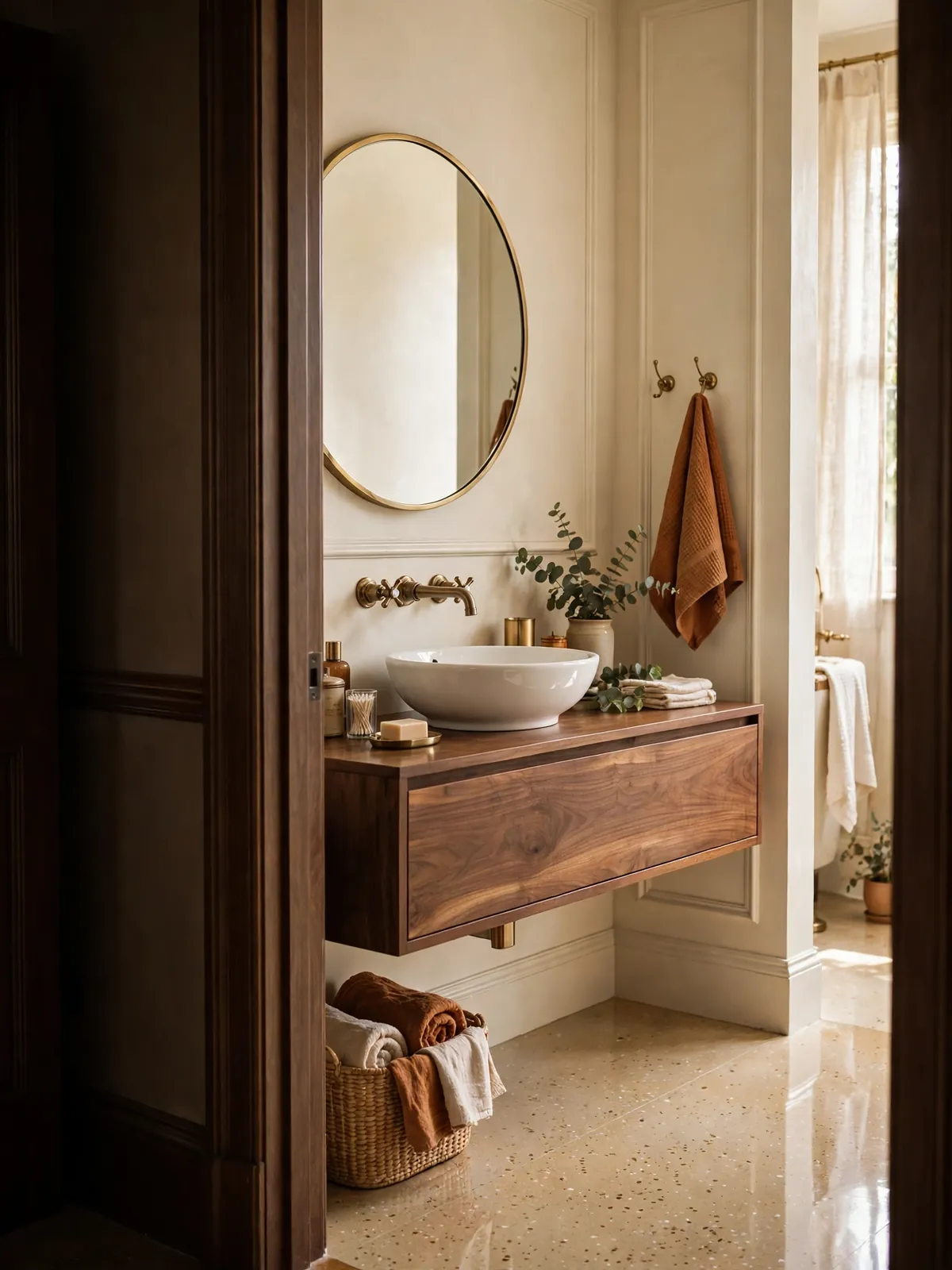
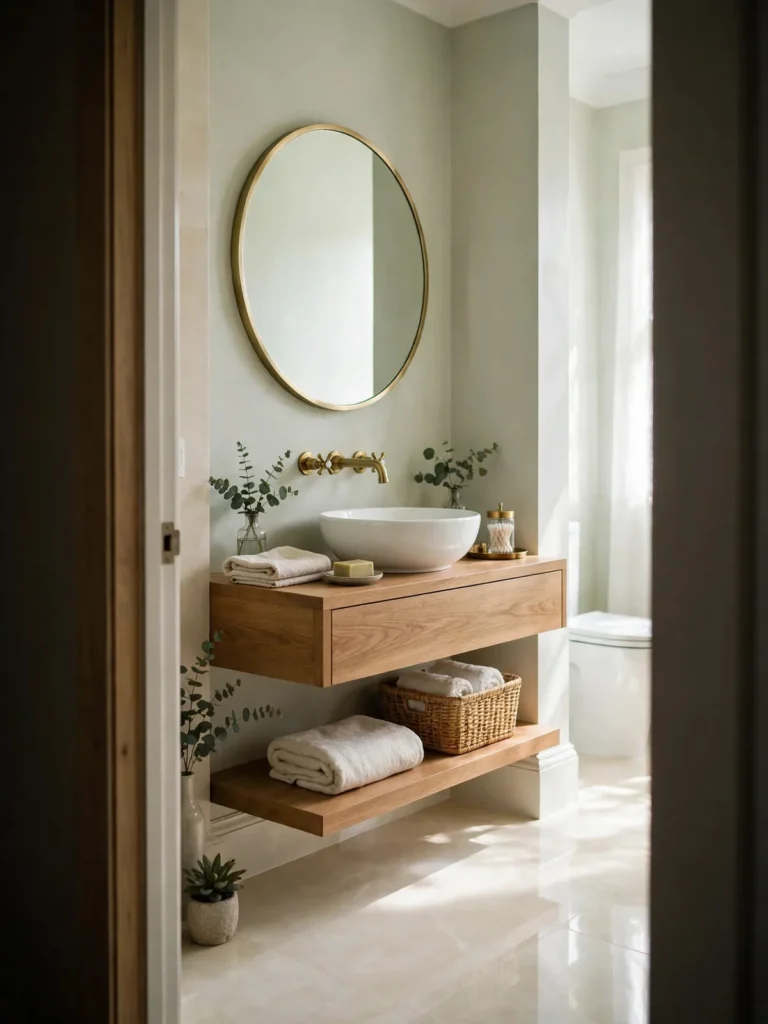
A floating walnut vanity is the single highest-impact move in an MCM bathroom, because the deep brown grain instantly says mid century while the floating design keeps the floor visible and the room feeling light. Here, a slab-front walnut vanity with a white vessel sink and brushed brass taps sits against cream walls, with a round brass-framed mirror above it and a woven basket tucked underneath for towels. The design suits almost any bathroom, it makes small rooms feel bigger, and it sets the wood tone every other element can follow. The weakness is storage: a floating vanity holds less than a full cabinet, so it suits people who keep their counter clear.
Quick tips:
- Choose a slab-front walnut vanity with no visible handles.
- Mount it at standard counter height with the plumbing hidden in the wall.
- Repeat the walnut once more, in a shelf or a mirror frame.
- Keep the counter clear — one soap dispenser and one small plant only.
A Round Mirror With a Thin Brass Frame
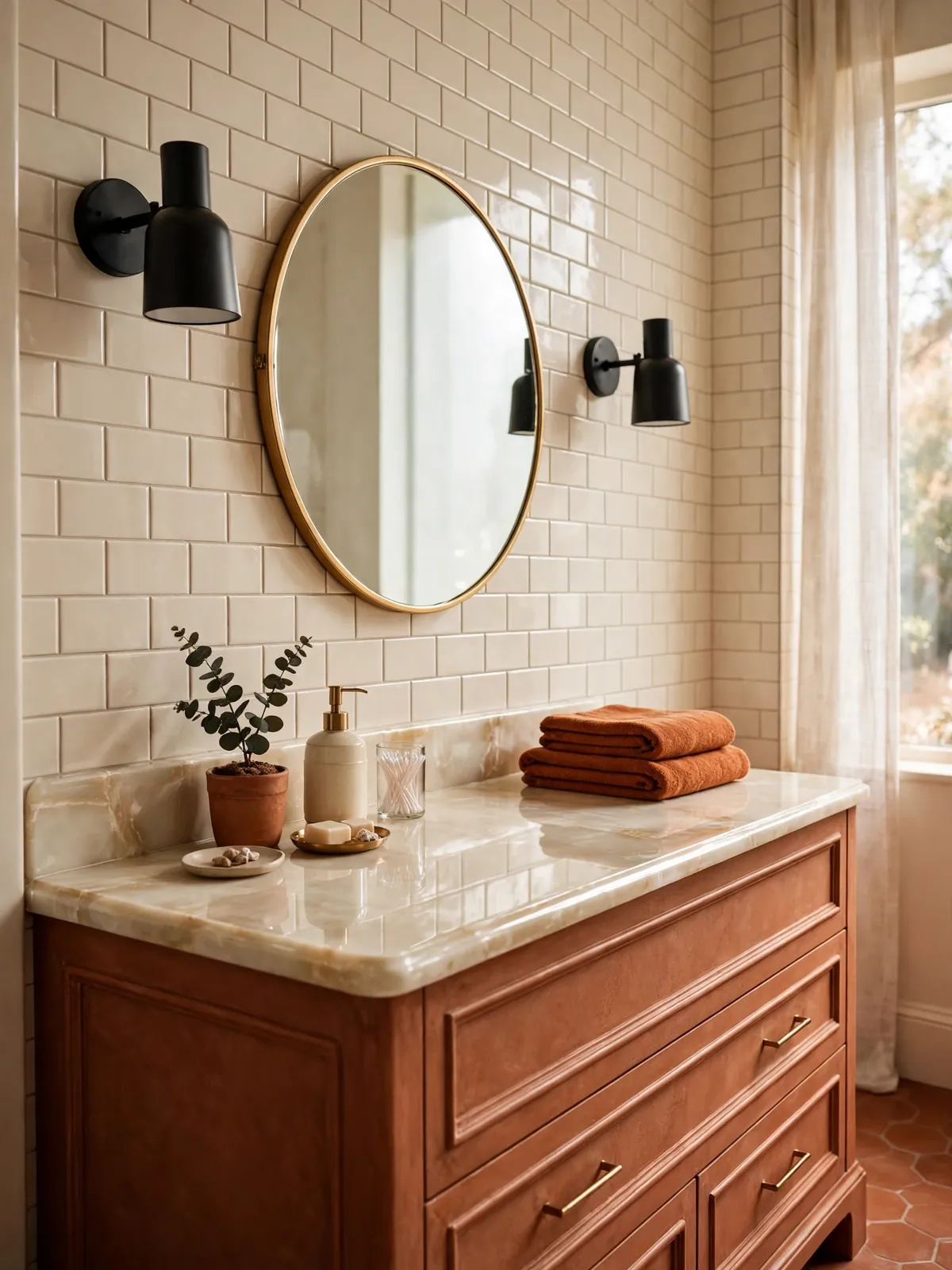
A round mirror with a thin brass frame softens every straight line in an MCM bathroom, because the circle breaks up the grid of tiles, vanity and shower glass and gives the eye somewhere gentle to land. Here, a large round mirror in brushed brass hangs above a terracotta-painted vanity, with cream subway tiles, matte black sconces and folded rust towels completing the palette. The design suits wide vanities best of all — two smaller round mirrors over a double vanity look even better — and it costs far less than a full renovation. The weakness is scale: a mirror that is too small looks lost above a wide vanity, so measure first.
Quick tips:
- Hang the mirror just above eye level, centred on the vanity.
- Use two smaller round mirrors over a double vanity.
- Match the frame finish to the taps for a cohesive look.
- Keep the frame thin — the round shape should do the talking.
Geometric Hexagon Floor Tiles in Warm Neutrals
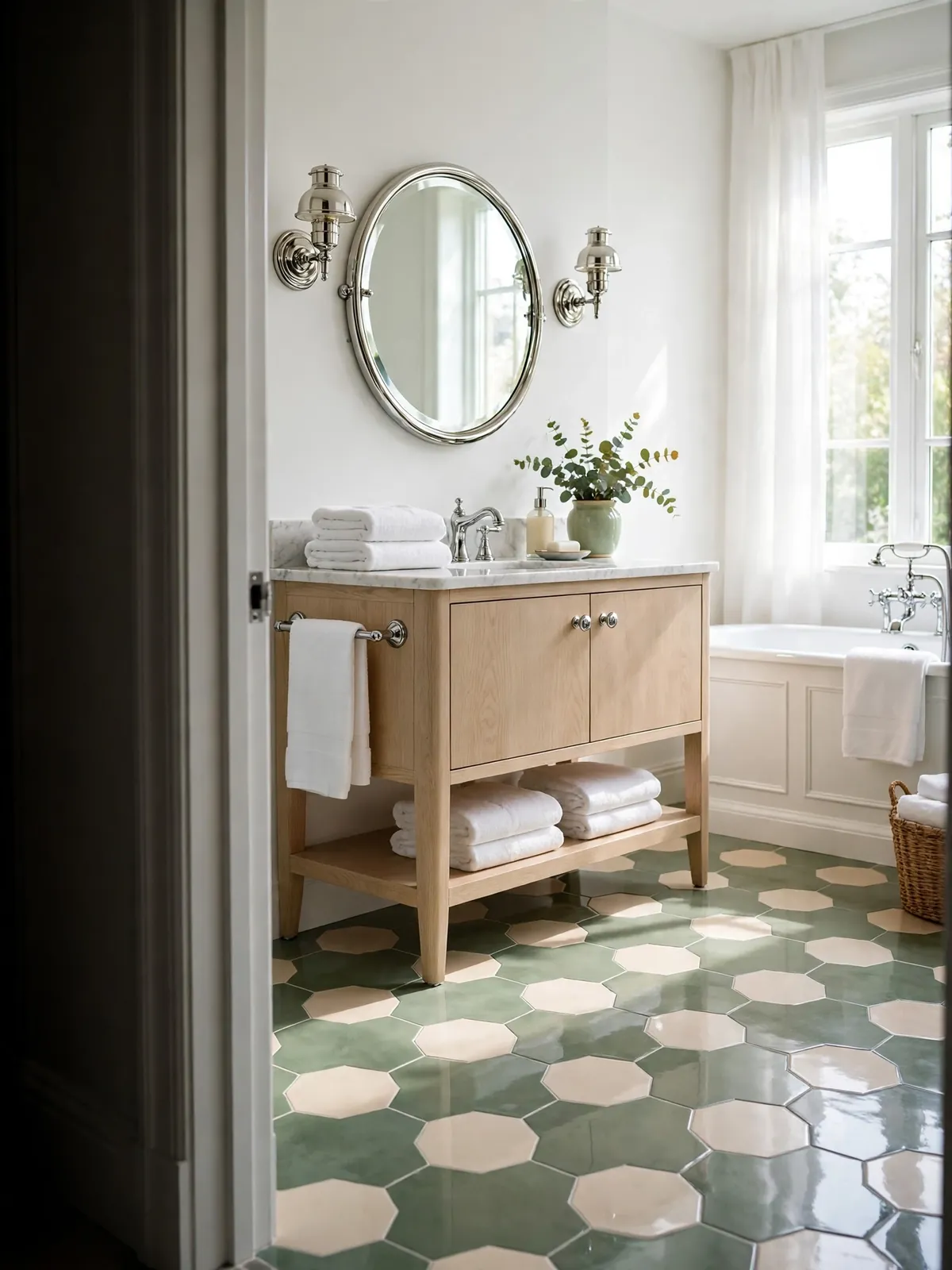
Geometric hexagon floor tiles bring instant MCM character underfoot, because the honeycomb pattern was a staple of the era and it breaks up the grid of ordinary square tiles without shouting. Here, large sage and cream hexagons cover the floor of a white bathroom, with a pale oak vanity, chrome fixtures and folded white towels keeping the rest of the room calm. The design suits small bathrooms especially well — the shape distracts from the room’s size — and the many grout joints give the floor natural grip. The weakness is grout: a hexagon floor has far more grout lines than a large-format floor, so choose a mid-tone grout that hides dirt.
Quick tips:
- Use large hexagons to reduce the number of grout joints.
- Choose a mid-tone grout that hides dirt but shows the shape.
- Keep wall tiles plain so the floor stays the feature.
- Seal the grout on a hexagon floor every year.
Open Teak Shelving for Airy Storage
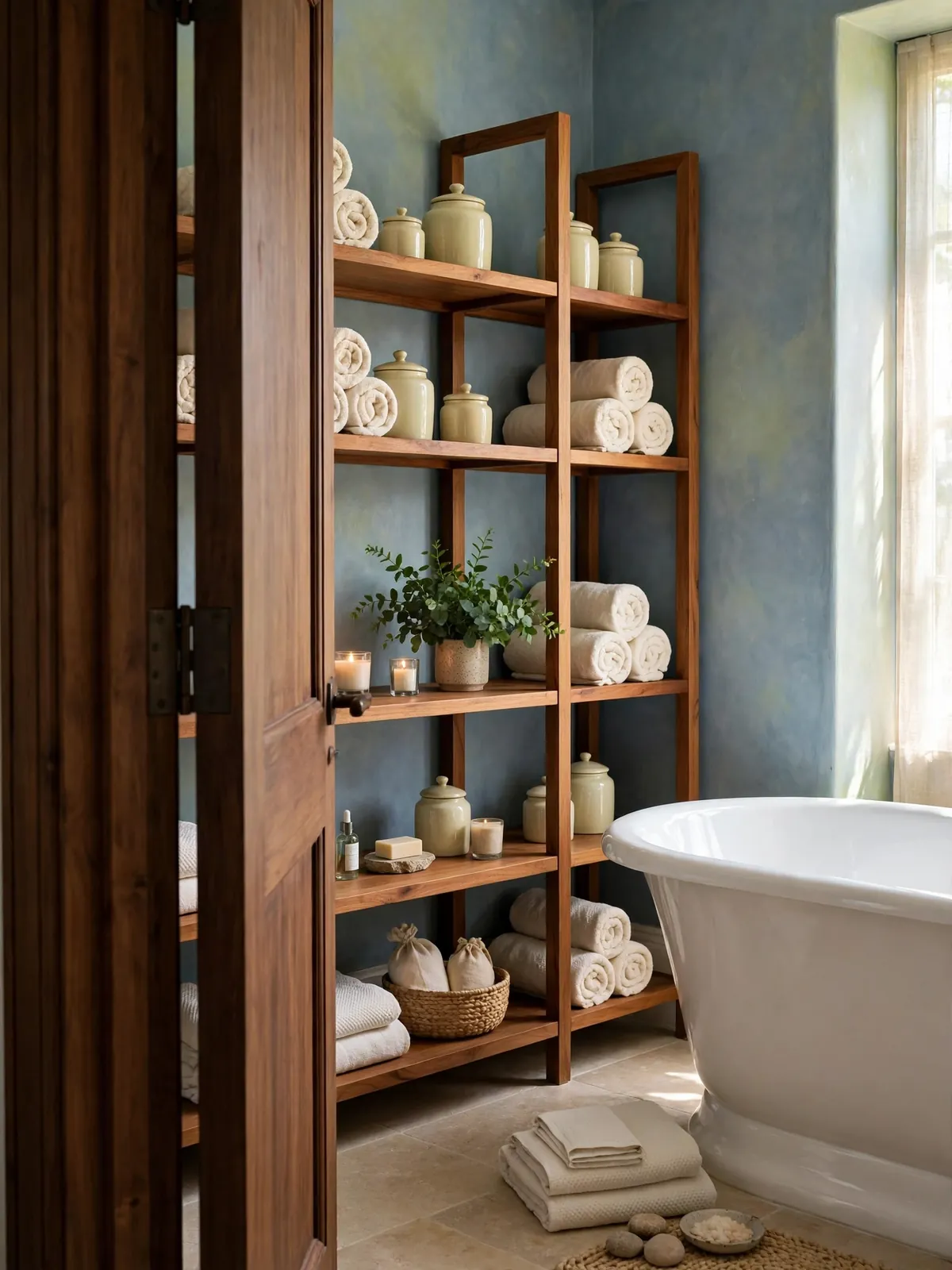
Open teak shelving keeps an MCM bathroom feeling airy, because closed cabinets add visual weight while open shelves let the wall breathe and show off a few beautiful objects. Here, two teak shelves on a dusty blue wall hold rolled cream towels, ceramic jars and a small green plant, with a white freestanding tub below completing the spa feeling. The design suits bathrooms with good ventilation, it costs little, and it forces the useful discipline of keeping only what you actually use. The weakness is dust and clutter: open shelves show everything, so they suit tidy people and need a quick wipe each week.
Quick tips:
- Hang shelves at eye level, with space between items.
- Keep only daily essentials and one decorative object per shelf.
- Match the shelf wood to the vanity for a cohesive look.
- Roll towels instead of folding them for a spa feel.
A Single Plant That Softens the Straight Lines
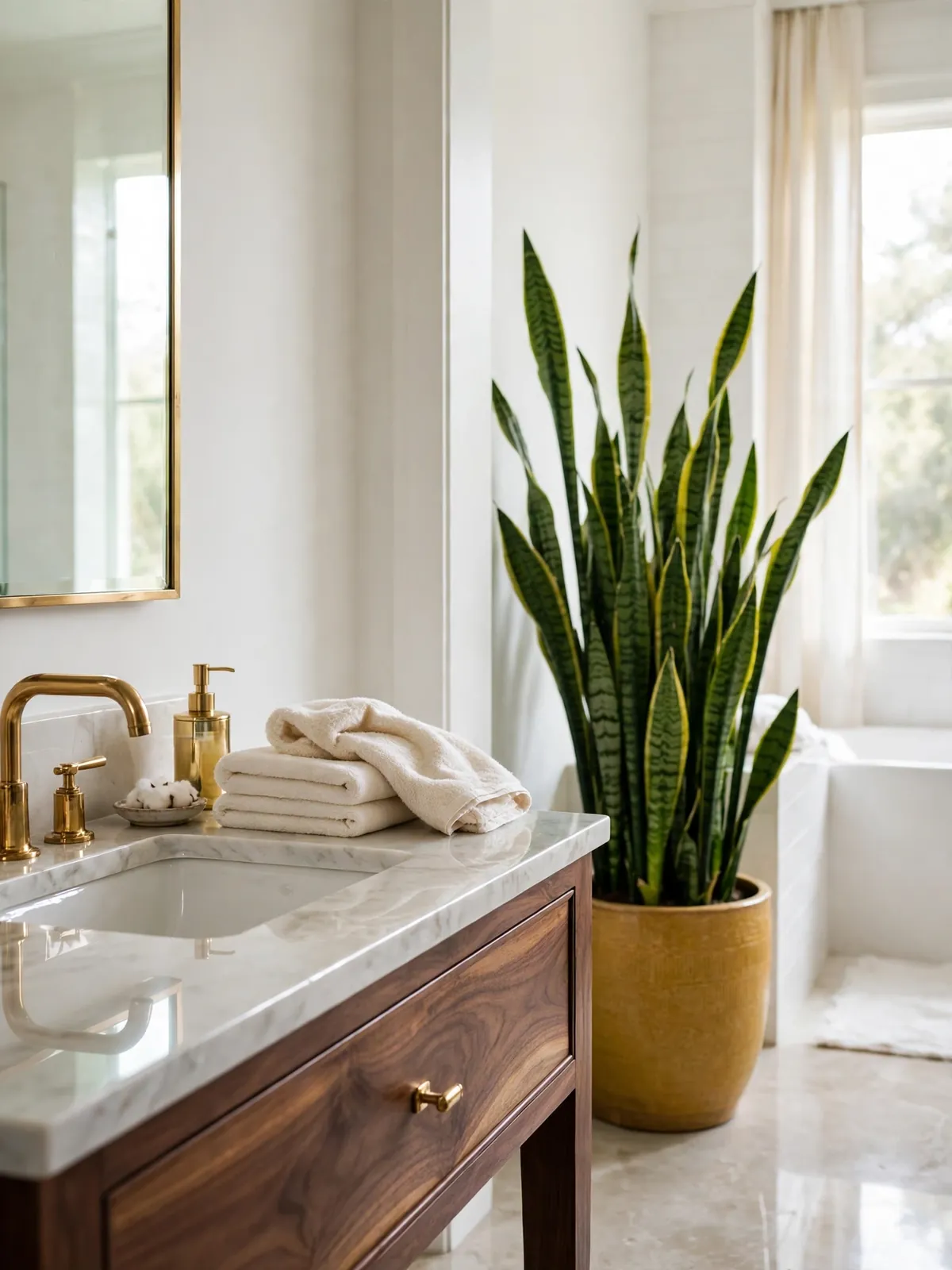
A single plant softens an MCM bathroom in a way no fixture can, because the organic shape and green colour break up all the straight lines of tile, wood and glass and make the room feel alive. Here, a tall snake plant in a mustard ceramic pot stands beside a walnut vanity, with brass fixtures and cream towels keeping the palette warm. The design suits any bathroom with even a little natural light, it costs almost nothing, and snake plants and pothos thrive in bathroom humidity. The weakness is light: a plant in a windowless bathroom will fade, so choose a low-light variety or use a good-quality faux plant.
Quick tips:
- Choose snake plants, pothos or ferns — all love humidity.
- Use one large plant, not several small ones.
- Match the pot to a colour already in the room.
- Place the plant where it gets light but not direct sun.
A Statement Tile Wall in Muted Retro Colour
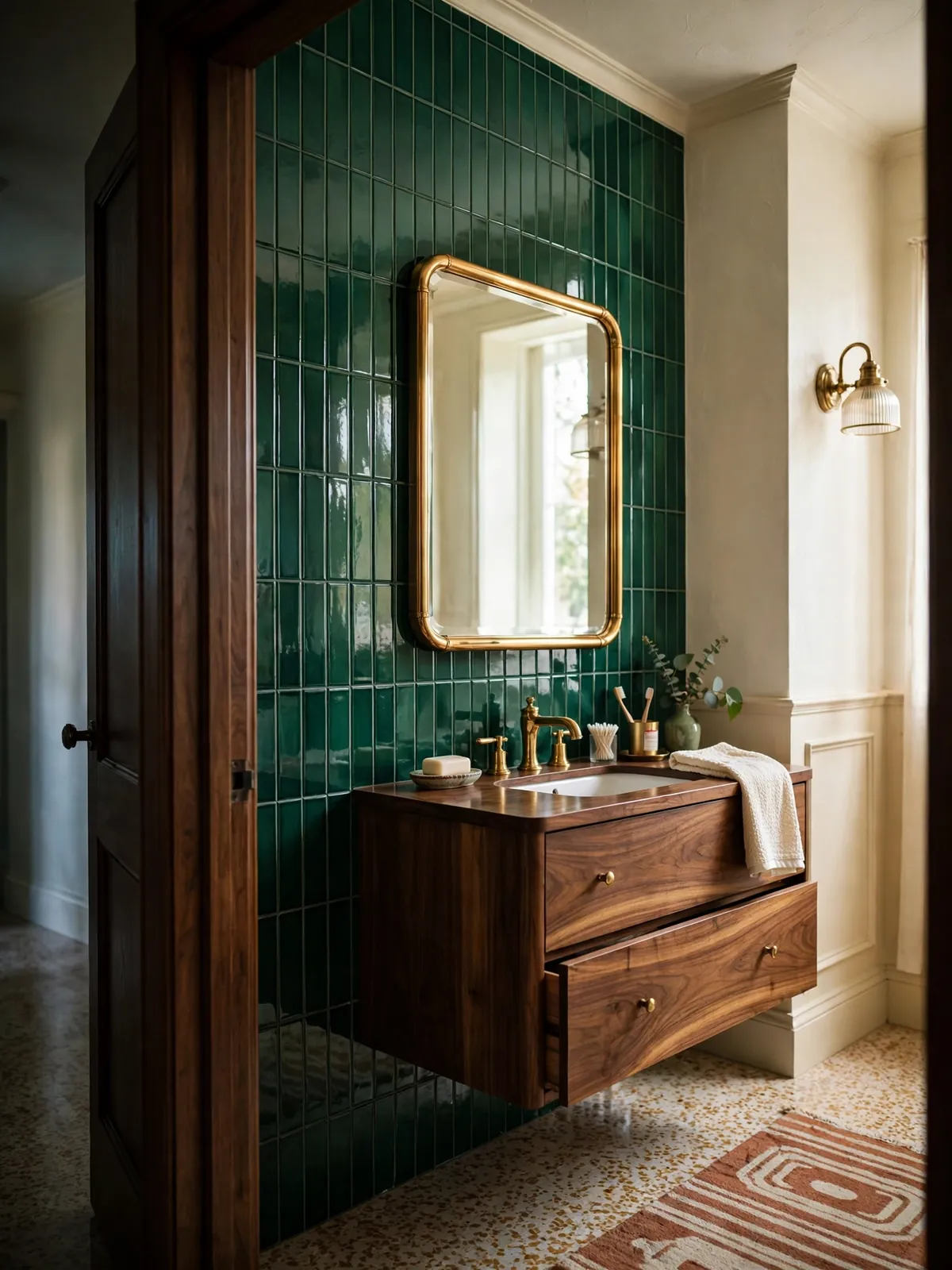
A statement tile wall concentrates all the colour of an MCM bathroom onto one surface, so the room feels rich and retro without becoming overwhelming. Here, emerald green vertical subway tiles cover the wall behind a walnut vanity, while the other walls stay cream and a brass-framed mirror ties the palette together. The design suits plain bathrooms that need personality, it costs far less than tiling the whole room, and the vertical stack pattern draws the eye upward so the ceiling feels higher. The weakness is commitment: a bold colour is hard to live with if you tire of it, so keep it to one wall you can retile later.
Quick tips:
- Tile the wall you face when you enter the room.
- Use vertical stack bond to make the ceiling feel higher.
- Keep the other walls plain and pale.
- Repeat one colour from the tiles in a towel or vase.
Slim Profile Storage That Disappears Into the Wall
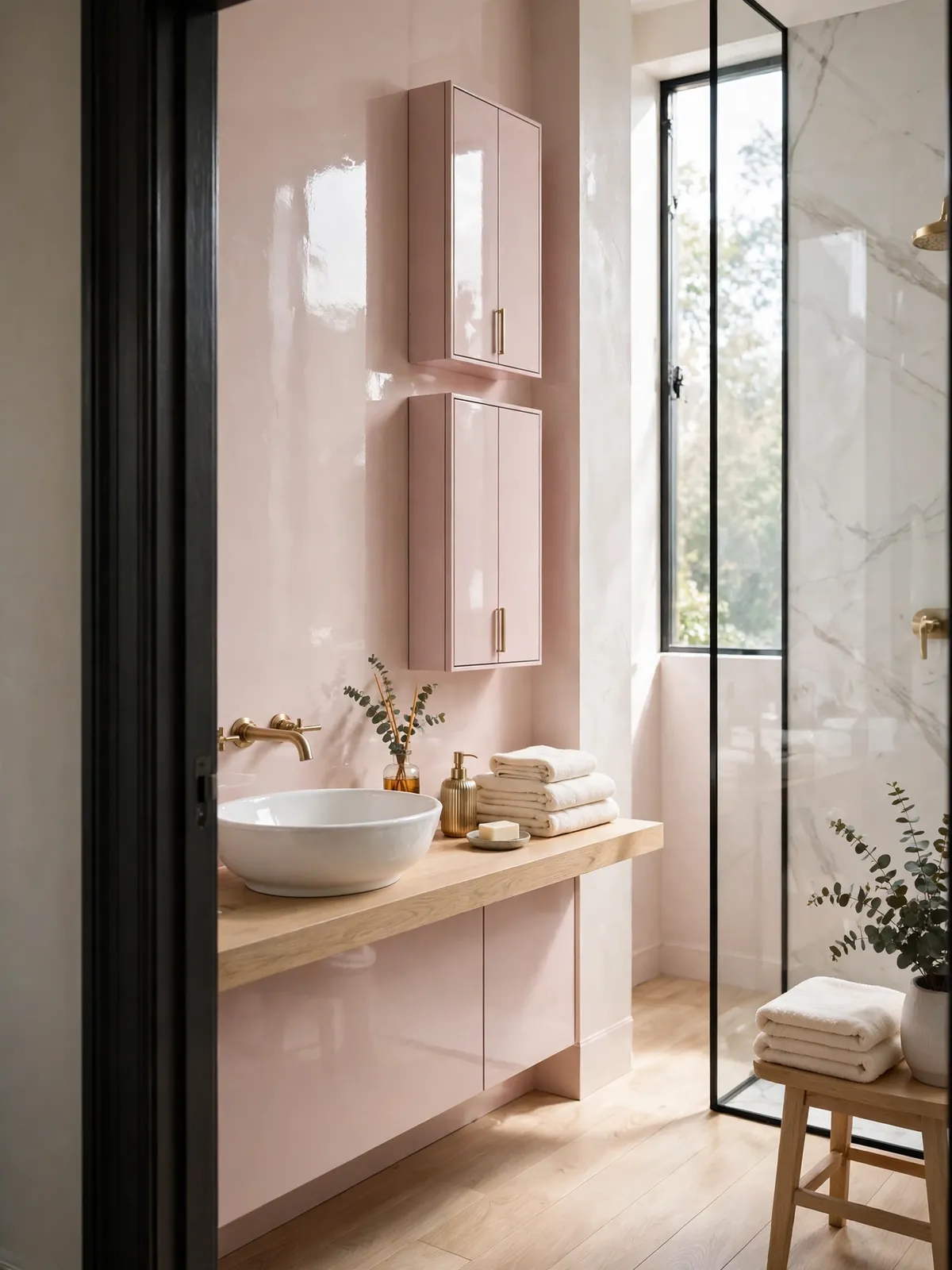
Slim profile storage keeps an MCM bathroom feeling open, because bulky cabinets kill the light, airy mood that mid century design depends on. Here, a slim blush pink wall-mounted cabinet with flat fronts and no visible handles sits beside a white vessel sink, with a pale oak floor, brushed brass taps and cream towels keeping the room soft. The design suits small bathrooms best of all, it holds daily essentials without eating floor space, and wall mounting makes cleaning underneath easy. The weakness is capacity: slim cabinets hold less, so they work best alongside a vanity drawer or a recessed niche.
Quick tips:
- Choose wall-mounted cabinets with flat fronts and hidden handles.
- Keep the depth under 15 cm so the cabinet reads as a panel, not a box.
- Match the cabinet finish to the vanity or the wall colour.
- Store only daily essentials inside — decant the rest elsewhere.
Mixed Wood Tones That Talk to Each Other
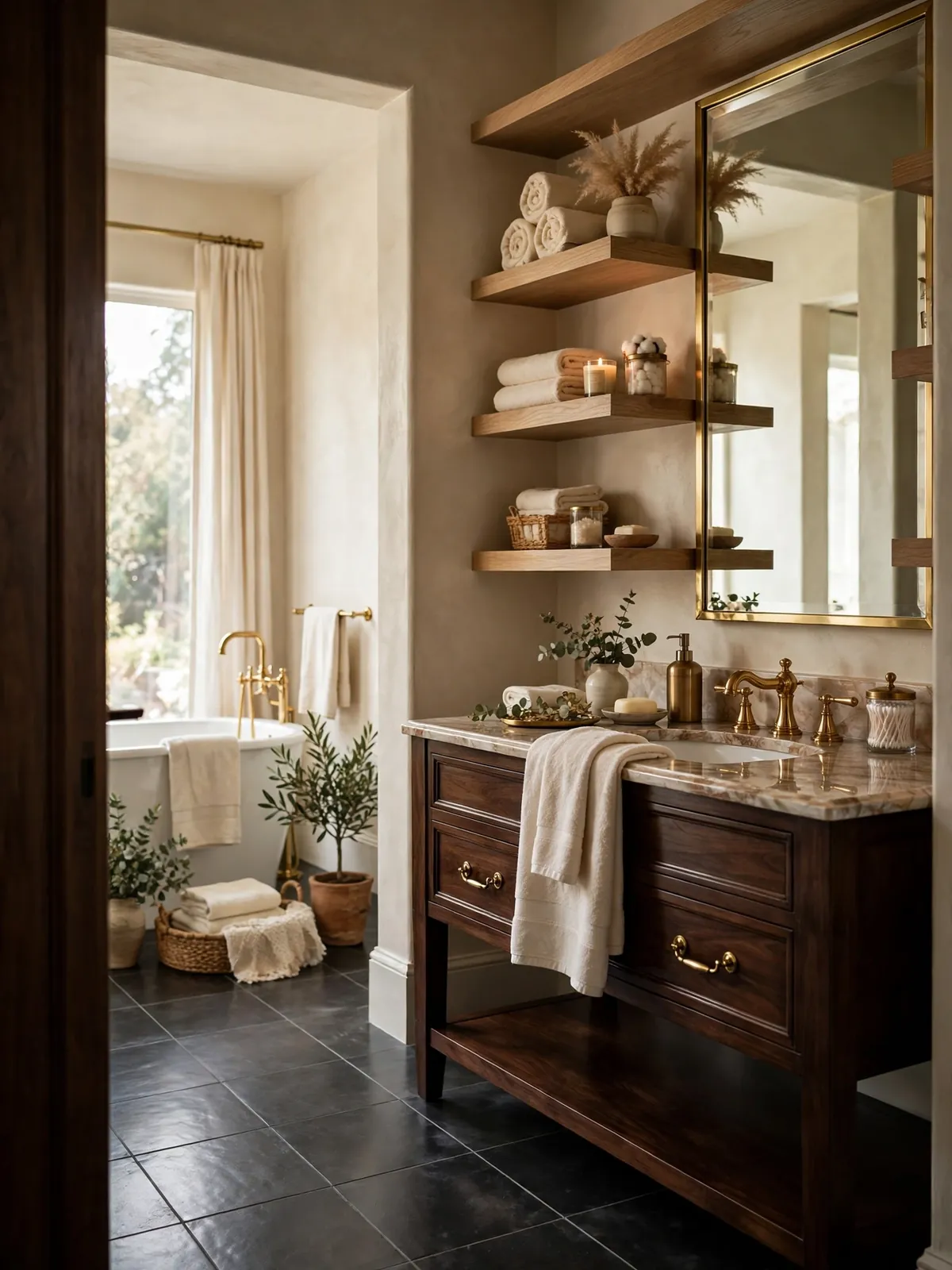
Mixed wood tones add depth to an MCM bathroom, because the era loved warm woods in more than one shade and the contrast between dark walnut and pale oak makes the room feel collected rather than bought in one set. Here, a dark walnut vanity pairs with light oak open shelves, charcoal floor tiles, brass fixtures and cream towels, and the two woods sit comfortably together because both are warm-toned. The design suits bathrooms that feel one-note, it costs nothing extra, and it lets you keep a vintage piece that does not match the vanity exactly. The weakness is undertone: mixing a warm walnut with a cool grey-stained oak looks accidental, so keep all the woods in the same warm family.
Quick tips:
- Keep all wood tones warm — walnut, teak and honey oak together.
- Let the darkest wood be the vanity, the lightest the shelves.
- Repeat each wood at least twice so it looks deliberate.
- Avoid grey-stained wood next to warm walnut.
A Walk-In Shower With Clear Glass Panels
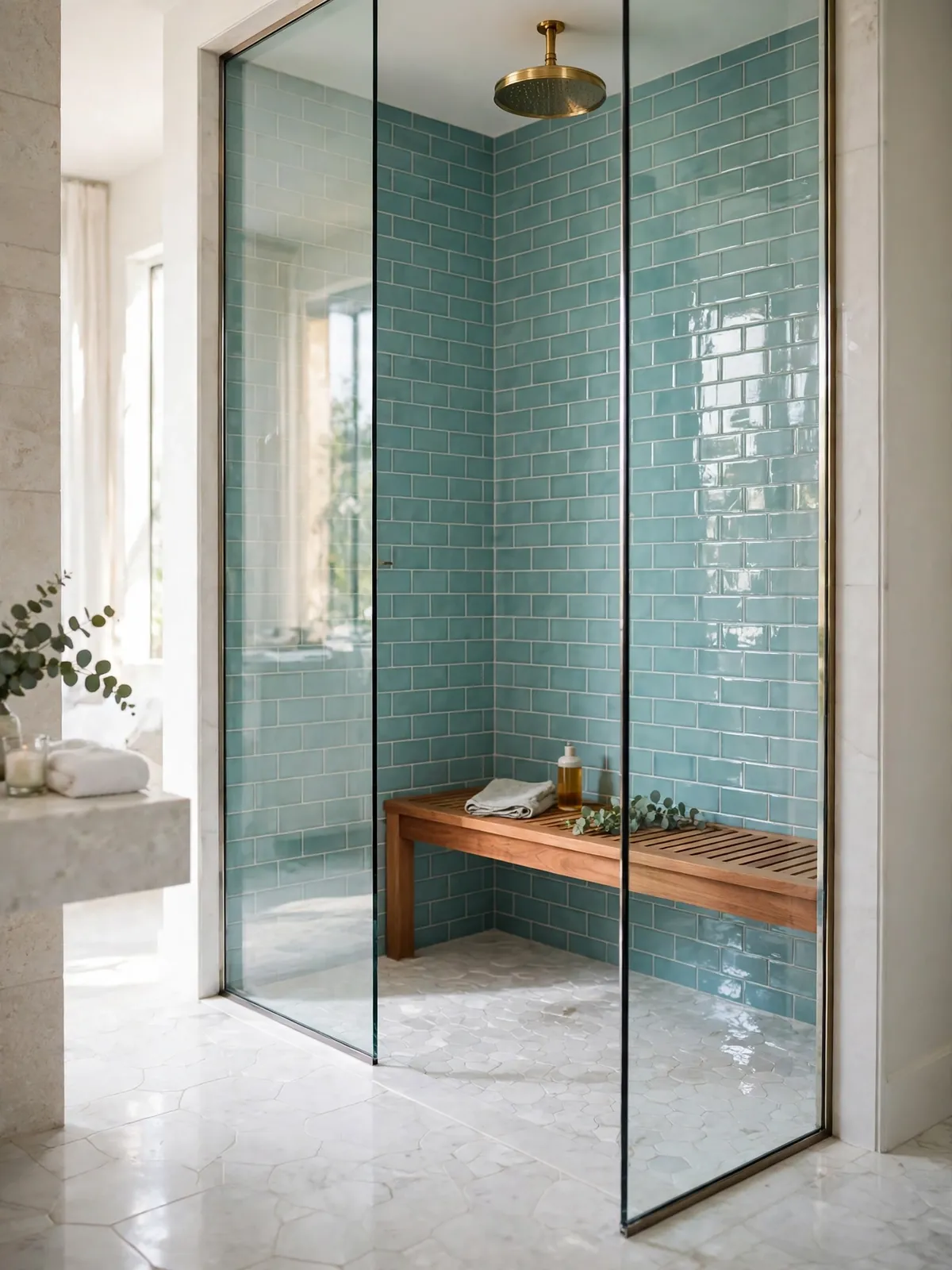
A walk-in shower with clear glass panels keeps an MCM bathroom feeling open, because there is no curtain or bulky frame cutting the room in half and the eye travels straight through to the tiled wall beyond. Here, aqua subway tiles line a walk-in shower with a rain head and a teak bench, with a white stone floor and frameless glass keeping every line clean. The design suits small bathrooms best of all, it makes the room feel larger, and it shows off the tilework instead of hiding it. The weakness is water: a frameless panel splashes more than a curtain, so add a small return panel or accept a quick wipe after each shower.
Quick tips:
- Use frameless glass with minimal hardware in brass or chrome.
- Add a small return panel to contain splashes.
- Tile the shower wall in a colour or pattern worth showing off.
- Keep a squeegee in the shower for a ten-second wipe.
Muted Colour Pops in Sage, Terracotta and Dusty Blue
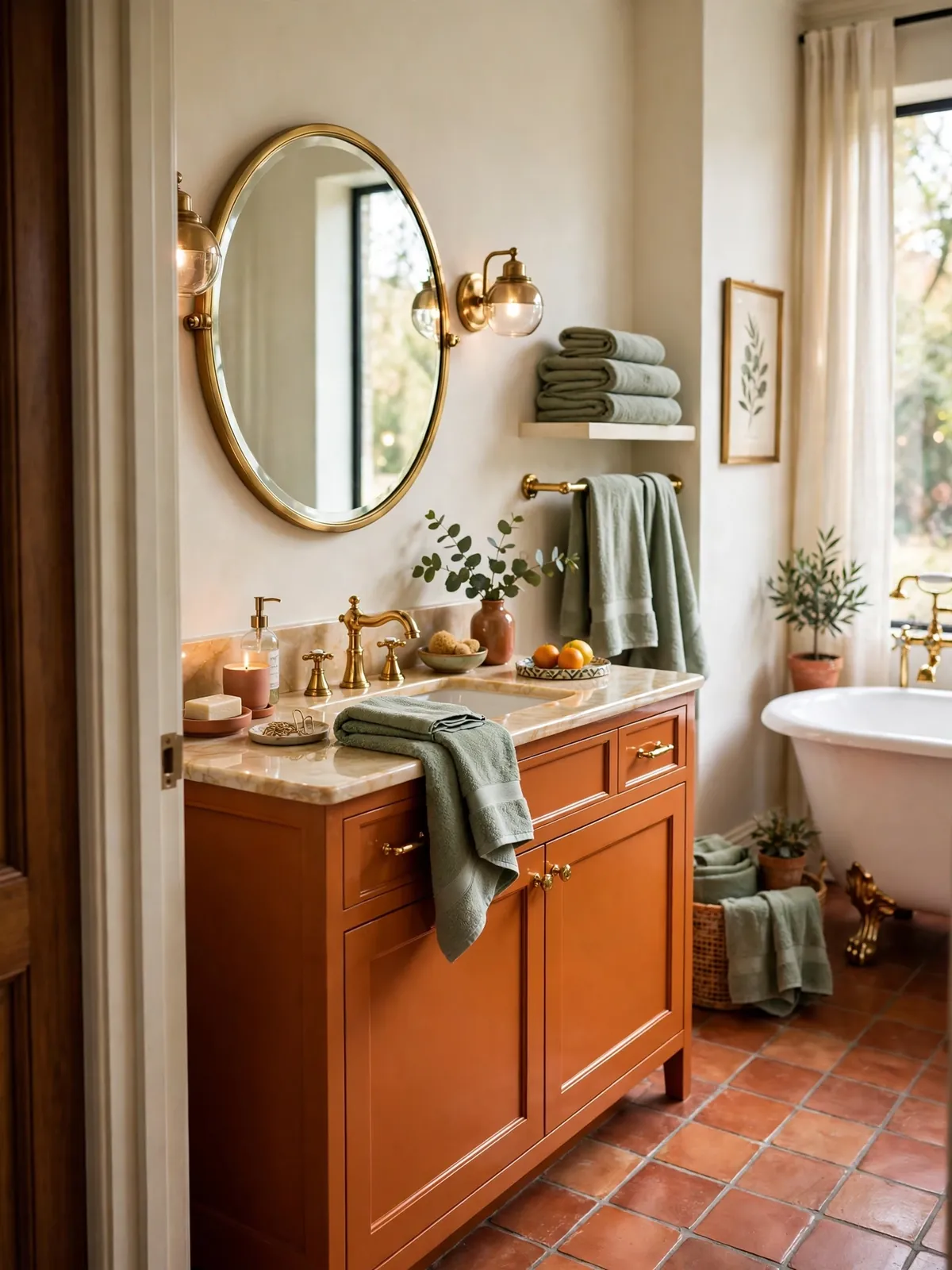
Muted colour pops are the easiest way to make an MCM bathroom feel retro, because sage green, dusty blue, terracotta and mustard are the colours of the 1950s and 60s, and they feel nostalgic without feeling loud. Here, a burnt orange vanity, sage towels and terracotta floor tiles bring colour into a cream bathroom, with brass fixtures tying the warm tones together. The design suits renters and renovators alike — paint and towels are weekend jobs — and it lets you change the mood of the room for very little money. The weakness is overdoing it: three muted colours work, five start to feel busy, so pick two and repeat them.
Quick tips:
- Pick two muted retro colours and repeat them, not five.
- Put the boldest colour on the vanity, where it is easy to repaint.
- Keep the walls pale so the colours stay the focus.
- Match the towels to one of the colours for a pulled-together look.
MCM Bathroom Materials Guide
| Material | Best use in an MCM bathroom | Cost level | Care |
|---|---|---|---|
| Walnut | Floating vanity, shelves, mirror frames | Medium to high | Wipe dry, oil occasionally |
| Teak | Vanity, shower bench, shelving | Medium to high | Naturally water-resistant, oil yearly |
| White oak | Pale vanities, flooring, slat walls | Medium | Seal well in wet areas |
| Brushed brass | Taps, hardware, mirror frames, lighting | Medium | Wipe clean, avoid harsh polish |
| Terrazzo | Floors and feature walls | Medium to high | Seal occasionally, hides dirt well |
| Hexagon tile | Floors and shower walls | Low to medium | Seal grout, more joints to clean |
| Matte black metal | Sconces, towel bars, shower frames | Low to medium | Wipe clean, shows water spots |
A Recessed Shower Niche Lined With Contrasting Tile
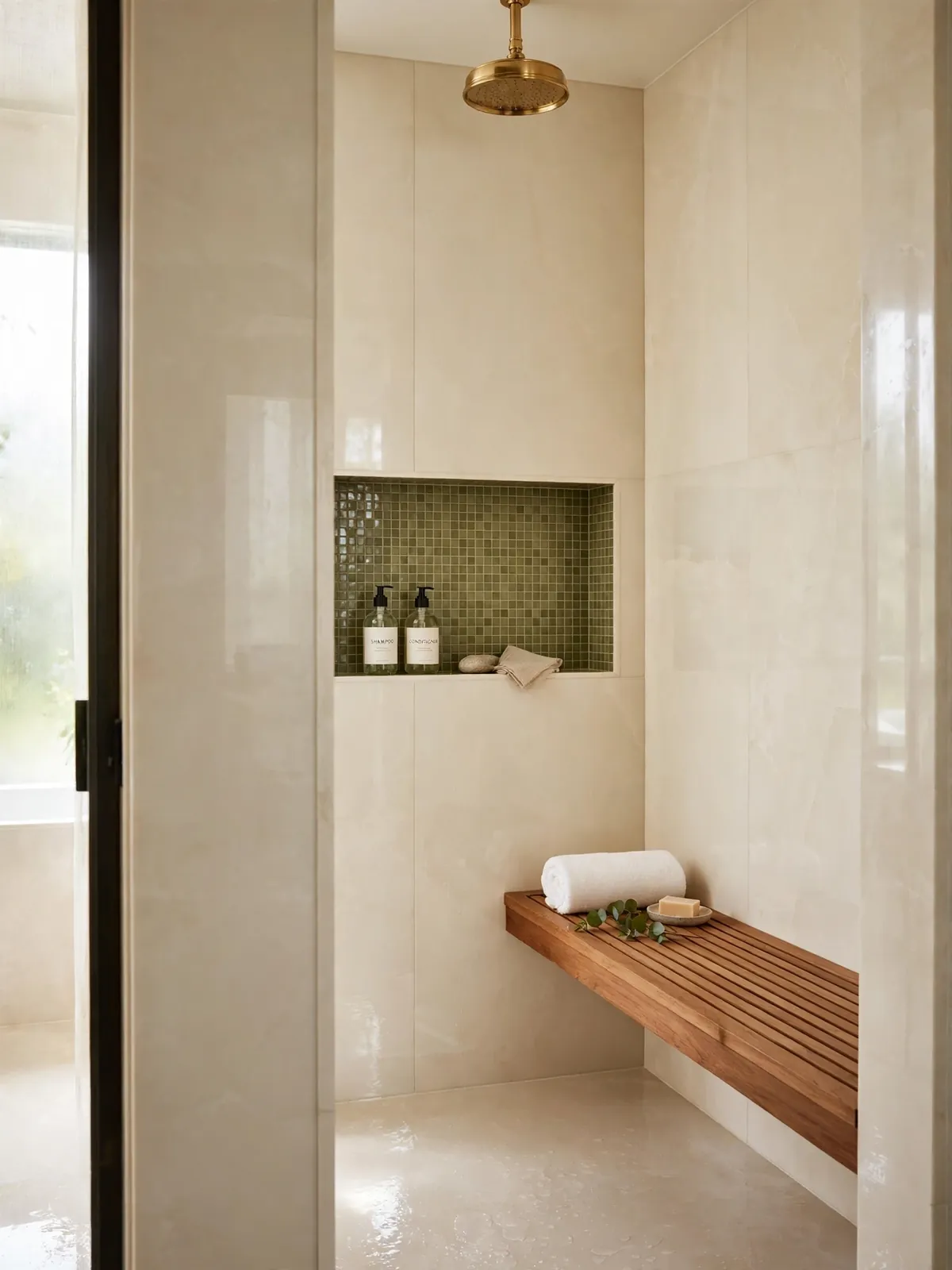
A recessed shower niche lined with contrasting tile is the quiet luxury of an MCM bathroom, because it replaces the clutter of shower caddies with a built-in shelf that looks like part of the architecture. Here, an olive green mosaic niche sits in a cream large-format shower wall, with a brass rain shower and teak bench completing the spa feeling. The design suits any shower, it keeps bottles off the floor, and the contrasting tile turns a practical shelf into a design moment. The weakness is alignment: a niche that cuts across tile lines looks accidental, so plan it into the tile layout from the start.
Quick tips:
- Align the niche with the tile lines for an intentional look.
- Line it with a contrasting tile or mosaic for a design moment.
- Make it wide enough for tall bottles, not just small ones.
- Seal the niche grout well, since it sees constant water.
A Wood-Framed Mirror for Warmth
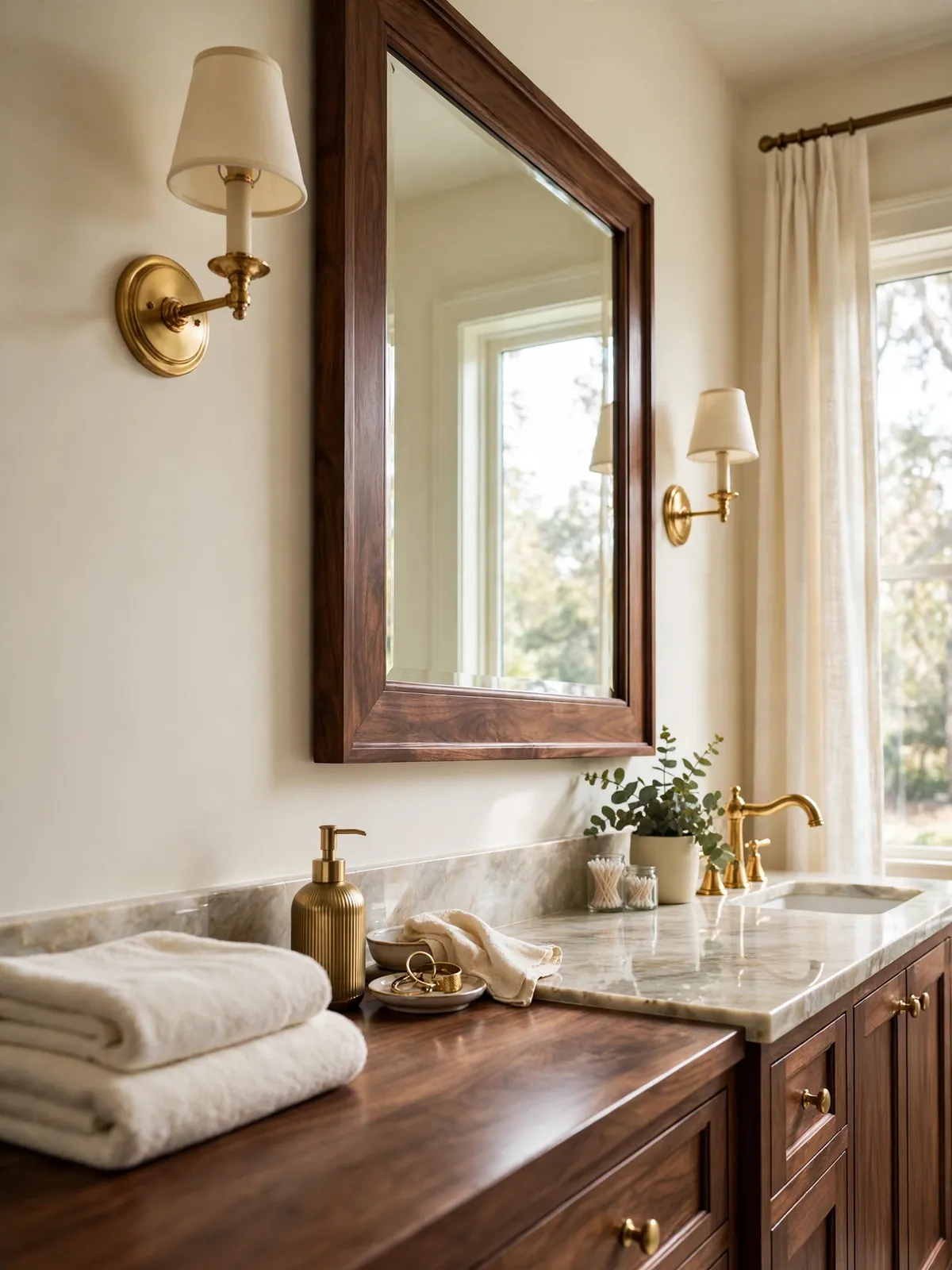
A wood-framed mirror adds warmth to an MCM bathroom in a way a metal frame cannot, because the timber softens the glass and ties the mirror directly to the vanity below it. Here, a thick chocolate brown wood frame surrounds a large mirror above a walnut vanity, with ivory walls, brass sconces and cream towels keeping the room calm. The design suits bathrooms that feel too cold or too modern, it is a simple DIY job on a plain mirror, and it makes the vanity area feel like furniture rather than fixtures. The weakness is moisture: untreated wood near a sink can warp, so seal the frame well or choose teak.
Quick tips:
- Match the frame stain to the vanity, or go one shade darker.
- Seal the frame against moisture, or use teak.
- Keep the frame slim on small mirrors, thicker on large ones.
- Pair a wood frame with brass sconces for warmth.
Wall-Mounted Faucets That Free the Counter
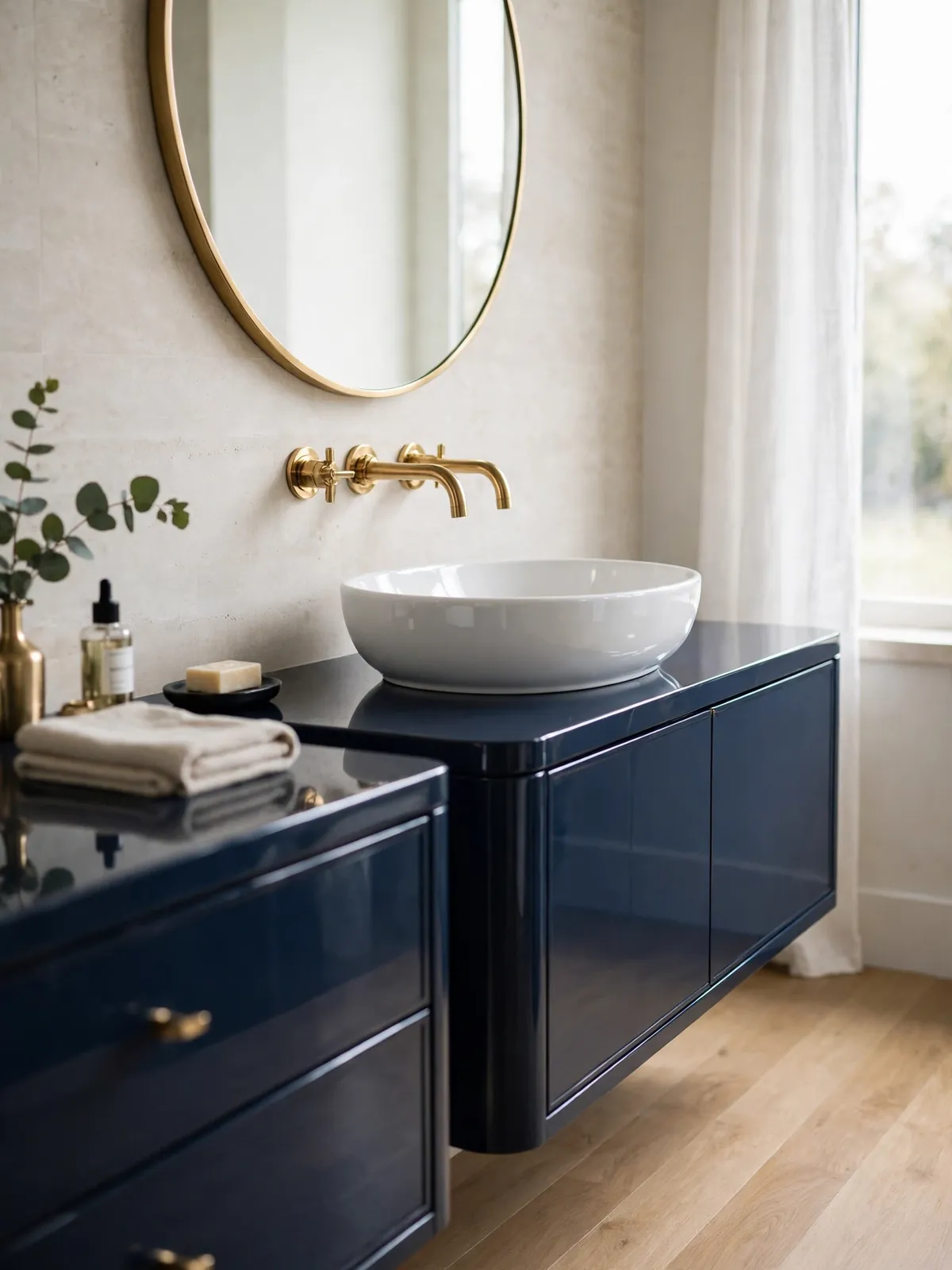
Wall-mounted faucets are one of those subtle MCM upgrades that feel very high-end, because they free the counter completely and leave a clean, unbroken surface that suits the era’s minimal aesthetic. Here, brushed brass wall-mounted faucets sit above a white vessel sink on a navy blue vanity, with a light oak floor and round mirror completing the look. The design suits floating vanities especially well, it makes cleaning the counter effortless, and it looks deliberately designed rather than assembled. The weakness is plumbing: moving the pipes into the wall costs more than a deck-mounted tap, so plan it during a renovation, not as a quick swap.
Quick tips:
- Plan wall-mounted faucets during a renovation, not after.
- Pair them with a vessel sink or a slim basin.
- Match the faucet finish to the mirror frame and hardware.
- Check the spout reach so water lands in the centre of the basin.
A Sliding Wooden Door That Saves Space
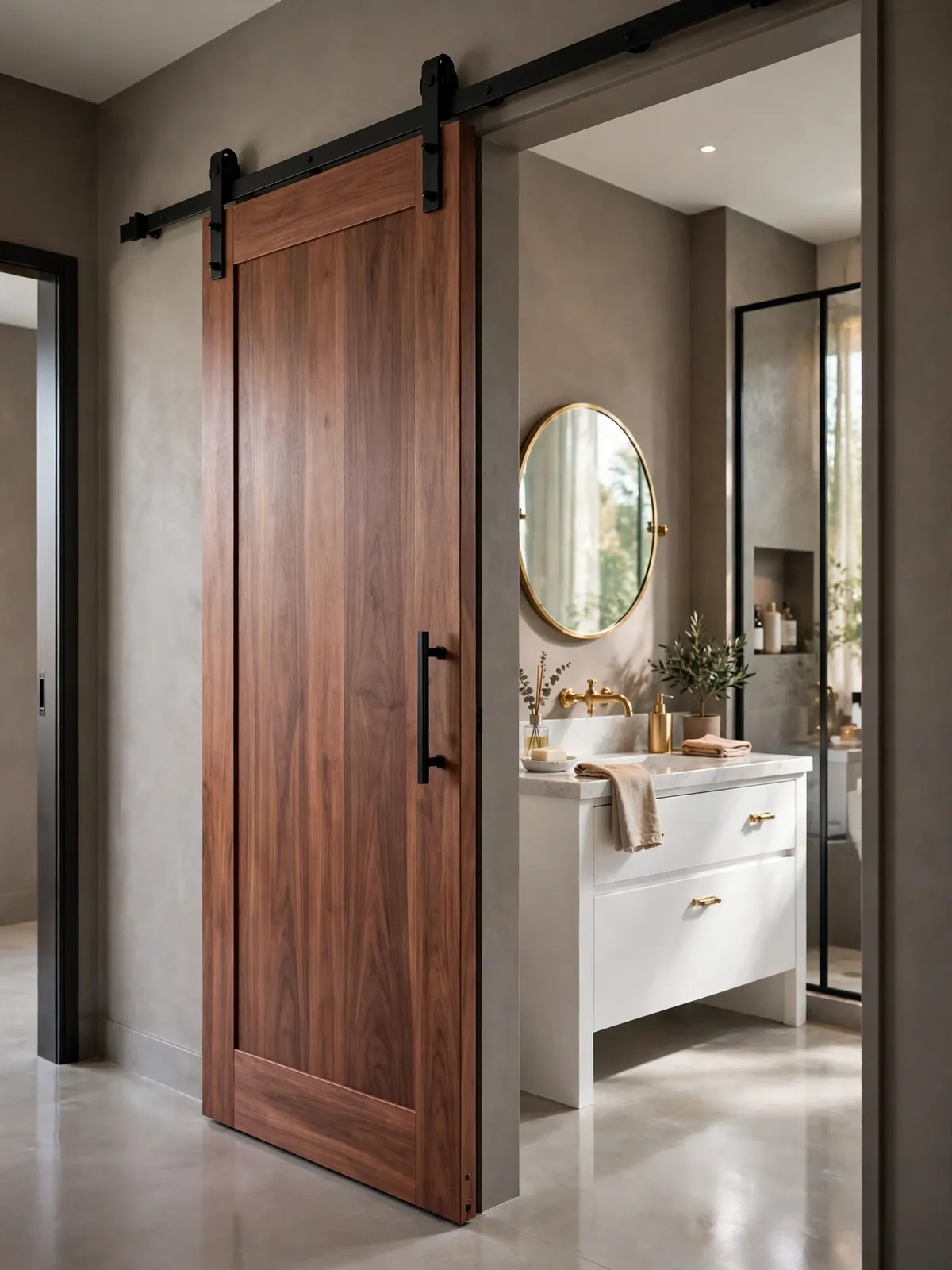
A sliding wooden door saves space and adds architecture to an MCM bathroom, because it removes the swing arc of a normal door and turns the entrance into a design feature. Here, a warm rose-toned walnut door slides on a slim black metal track against warm grey walls, with a white vanity and brass fixtures inside. The design suits small bathrooms and en suites where every centimetre matters, it reads as mid century rather than barn-door rustic when the panel is flat and the finish is clean. The weakness is privacy: sliding doors seal less tightly than hinged doors, so they suit en suites and powder rooms better than shared family bathrooms.
Quick tips:
- Choose a flat panel in walnut or teak, not a rustic barn style.
- Use a slim black metal track that matches the hardware.
- Keep the door finish consistent with the vanity wood.
- Add a soft-close mechanism so the door never slams.
A Built-In Shower Bench in Matching Tile
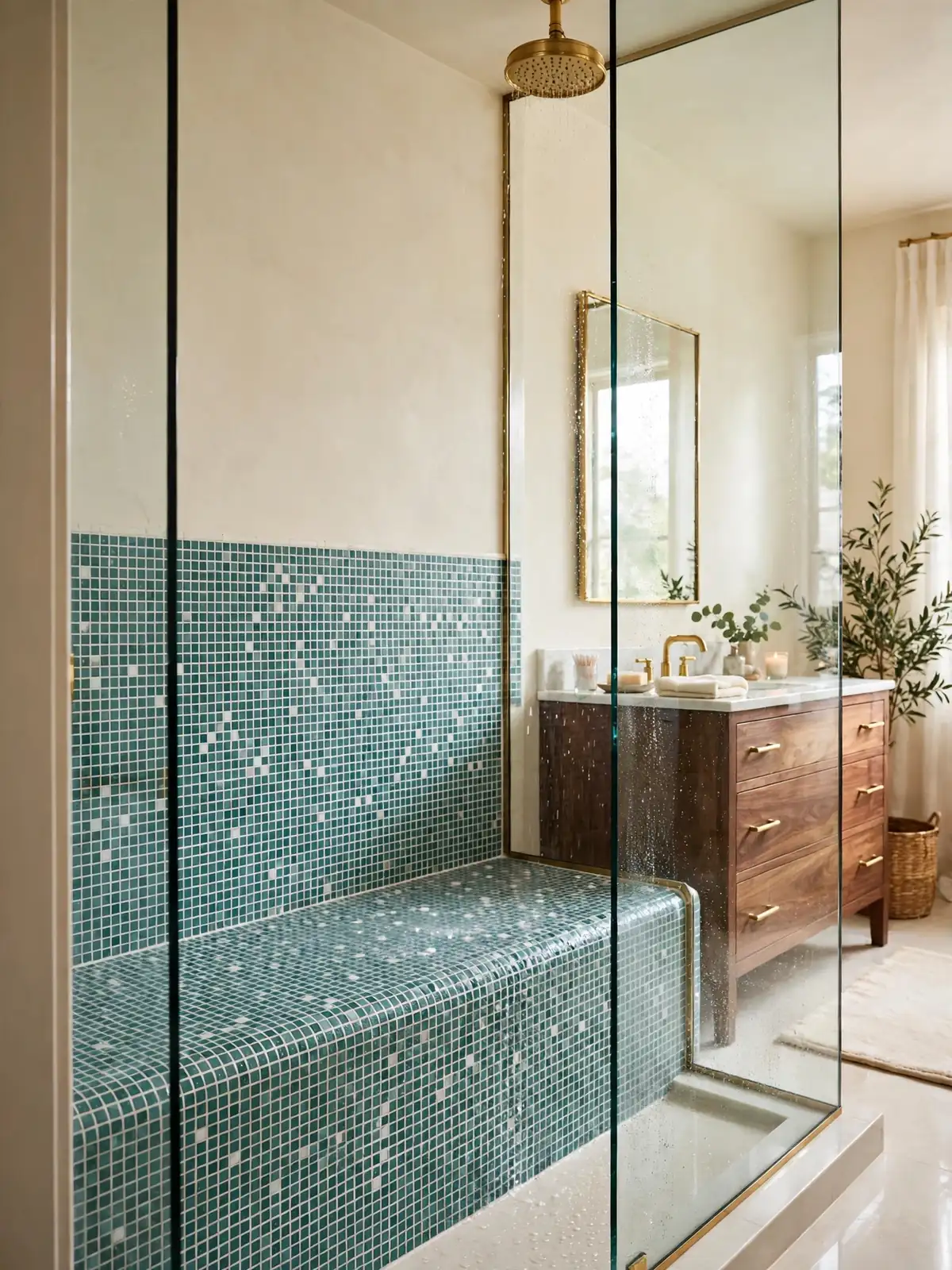
A built-in shower bench adds comfort and spa luxury to an MCM bathroom, because it gives you somewhere to sit, shave or set down products, and it turns a plain shower into a room designed for lingering. Here, a teal and white mosaic bench sits in a glass shower with a brass rain head, with a walnut vanity visible beyond the glass and cream walls keeping the room calm. The design suits larger showers best of all, it is tiled to match or contrast subtly, and it makes the bathroom feel like a boutique hotel. The weakness is space: a bench needs a shower at least 120 cm wide, or it crowds the standing area.
Quick tips:
- Tile the bench in the same tile as the niche for cohesion.
- Slope the bench top slightly so water drains off.
- Keep the bench depth around 40 cm for comfortable sitting.
- Add a teak bath mat beside it for warmth underfoot.
Fluted or Ribbed Texture That Catches the Light
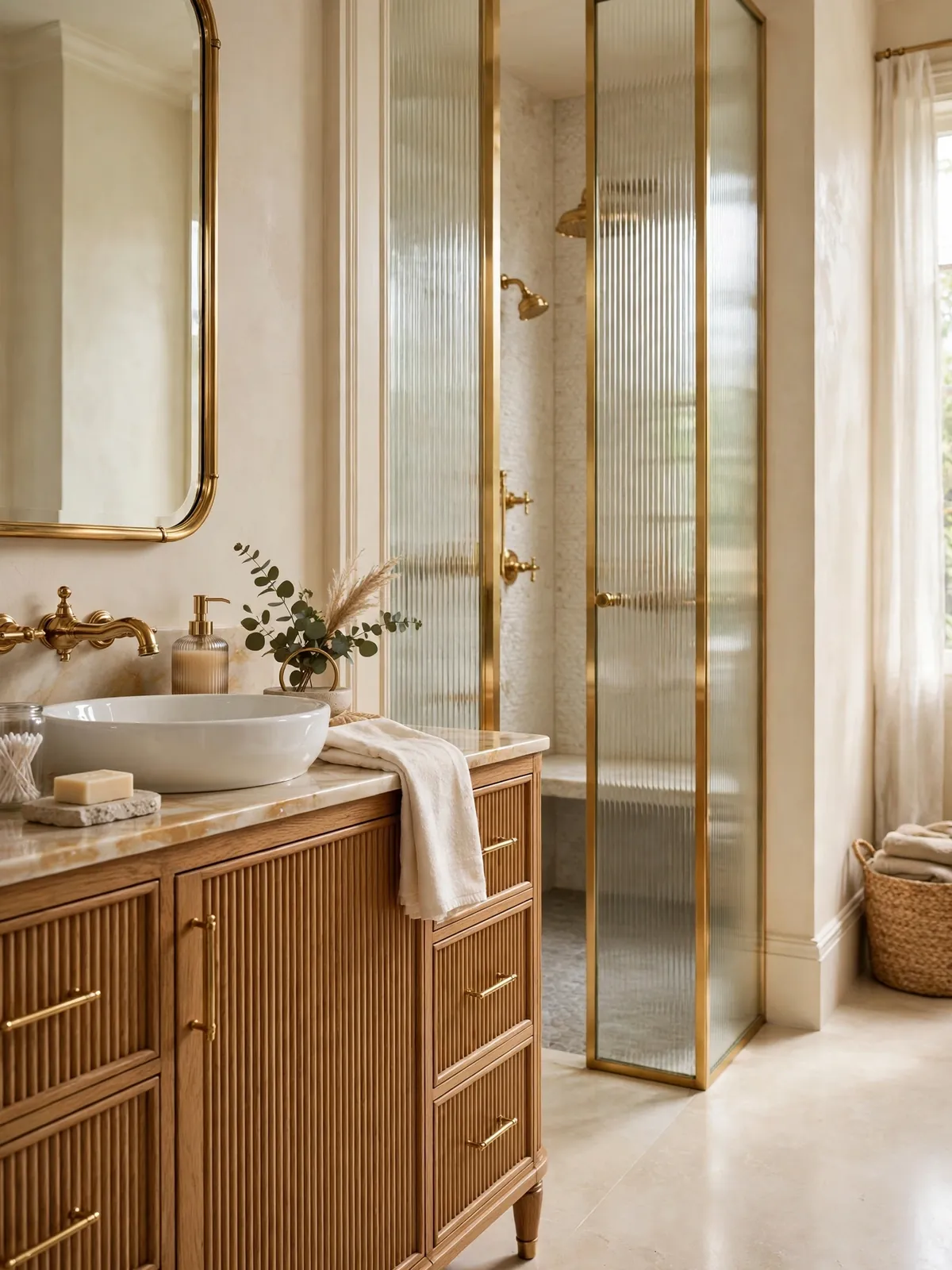
Fluted or ribbed texture adds subtle drama to an MCM bathroom, because the vertical ridges catch the light and create shadow in a room that is otherwise all flat planes. Here, a fluted honey oak vanity and ribbed glass shower panels sit against cream walls, with brass fixtures and a white vessel sink keeping the palette warm. The design suits bathrooms that feel flat or one-dimensional, it adds depth without adding colour, and it was a genuine mid century detail. The weakness is cleaning: deep flutes collect dust and soap, so choose a shallow rib near the shower and wipe it weekly.
Quick tips:
- Use fluting on the vanity front or one wall, not every surface.
- Choose shallow ribs near wet areas for easy cleaning.
- Pair fluted wood with smooth tiles in the same colour family.
- Light the fluted surface from the side so the shadows show.
Globe Sconces That Glow Like Jewellery
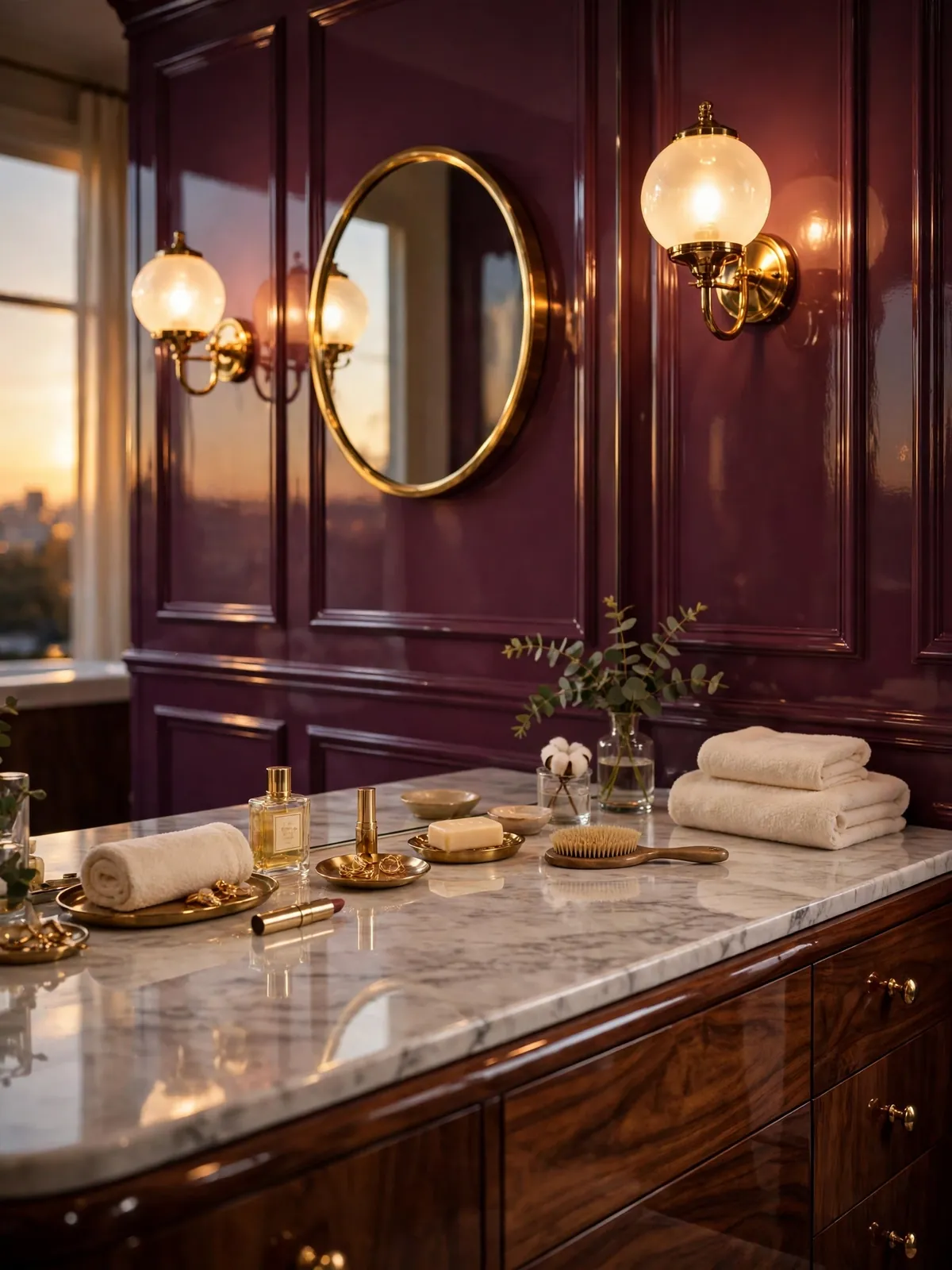
Globe sconces are the jewellery of an MCM bathroom, because the opal glass spheres glow softly and break up the straight lines of the room with a shape that is pure 1960s. Here, two brass globe sconces flank a round mirror on plum walls, with a walnut vanity and cream towels below, and the warm evening glow makes the whole room feel like a boutique hotel. The design suits any bathroom, it flatters the face far better than a single overhead light, and it is one of the cheapest ways to make the room feel designed. The weakness is placement: sconces hung too high or too far apart leave shadows, so mount them at eye level, about 60 cm apart.
Quick tips:
- Mount globe sconces at eye level on either side of the mirror.
- Choose opal glass for a soft, flattering glow.
- Use warm white bulbs around 2700K for the retro feel.
- Match the sconce arms to the tap finish.
A Skylight That Changes the Whole Room
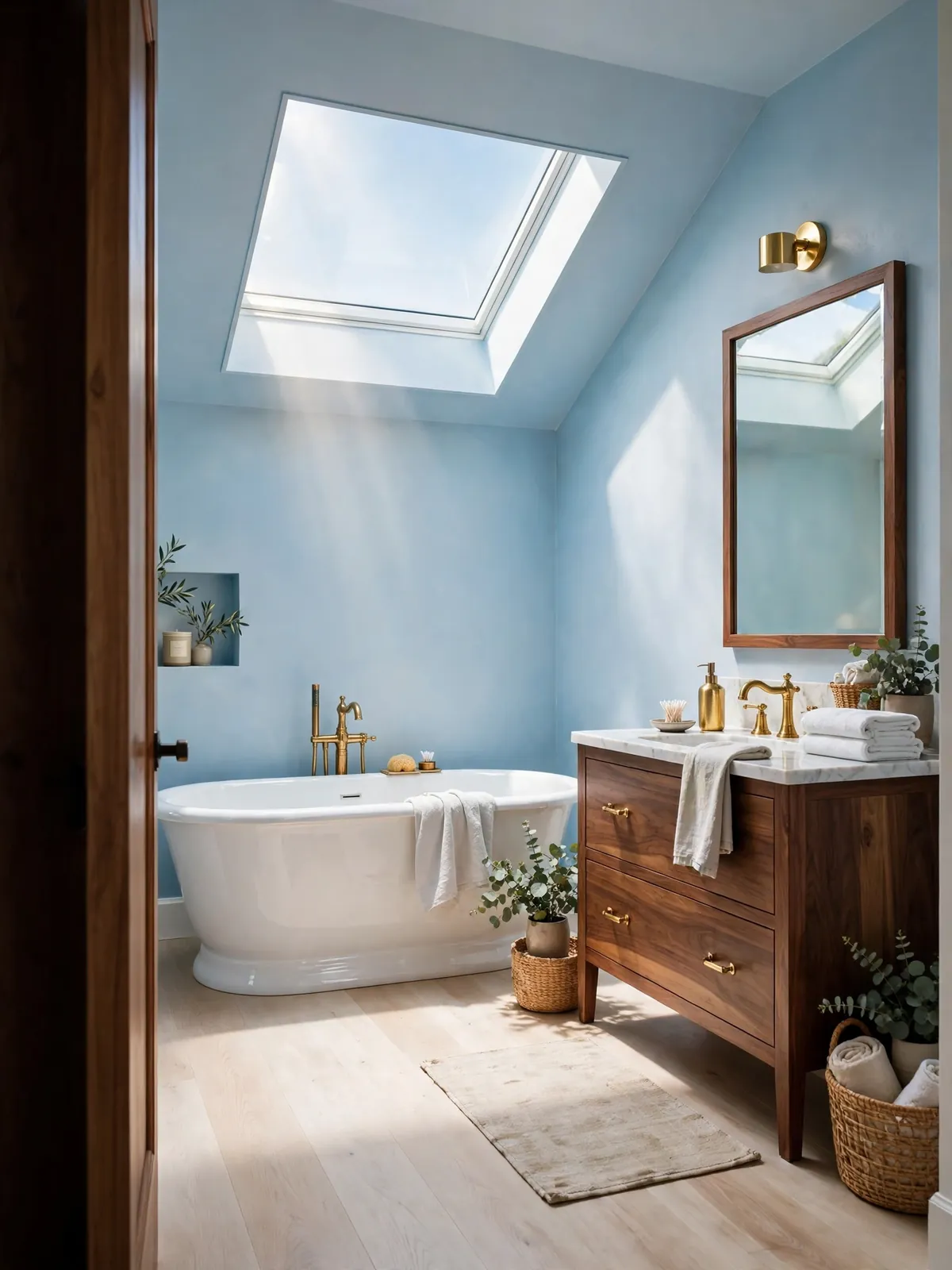
A skylight changes an MCM bathroom more than any fixture can, because natural light from above makes the wood glow, the tiles shine and the whole room feel open, fresh and alive. Here, a skylight above a freestanding tub sends daylight down onto sky blue walls, a white oak floor, a walnut vanity and brass fixtures. The design suits bathrooms with a roof directly above, it is the best fix for a dark or windowless room, and it makes morning routines feel calmer. The weakness is cost and timing: a skylight is a structural job that takes a few days and needs proper flashing, so plan it as part of a renovation.
Quick tips:
- Place the skylight above the tub or shower for the best effect.
- Add a blind if the sun hits the room directly in summer.
- Keep the ceiling pale so the light bounces further.
- Check the roof structure before committing to the size.
Consistent Hardware in One Warm Finish
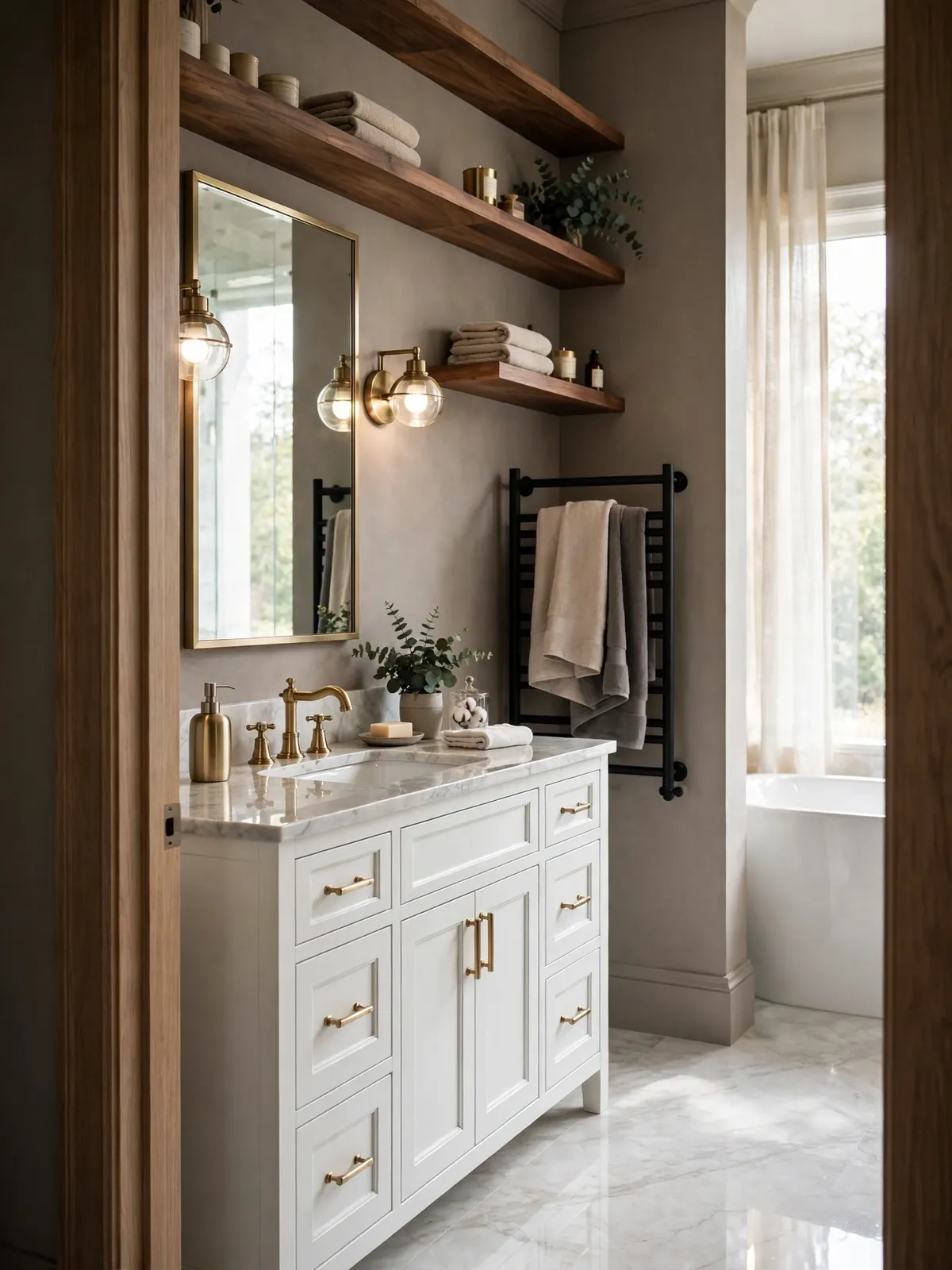
Consistent hardware in one warm finish is the detail that makes an MCM bathroom feel designed rather than assembled, because matching taps, handles, hooks and towel bars tie every element together. Here, brushed brass runs across the taps, drawer pulls, towel hooks and mirror frame, with taupe walls, a white vanity and walnut shelves completing the calm palette. The design suits any bathroom, it costs little when done as a single swap, and it is the fastest way to make a mixed bag of fixtures feel intentional. The weakness is temptation: one chrome item in a brass room stands out immediately, so replace everything or nothing.
Quick tips:
- Pick one finish — brushed brass is the classic MCM choice — and stick to it.
- Replace taps, handles, hooks and towel bars together.
- Keep the shapes similar: slim, straight and unadorned.
- Avoid mixing chrome, black and brass in the same room.
A Vintage Rug That Softens the Tile
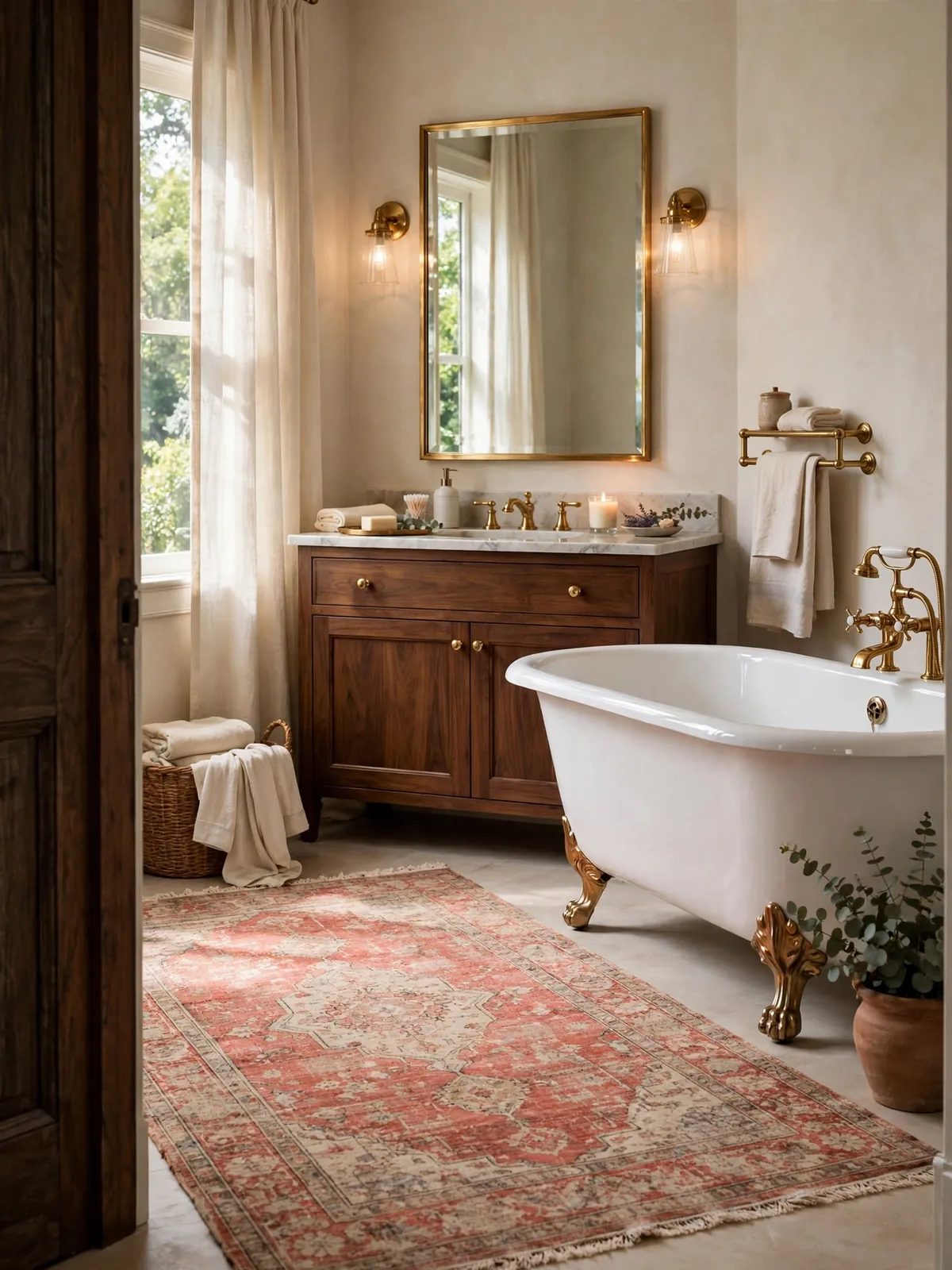
A vintage rug softens an MCM bathroom in seconds, because it warms cold tile underfoot, adds a faded pattern the era loved, and breaks up the hard surfaces that make bathrooms feel echoey. Here, a coral and cream faded rug lies beside a white freestanding tub, with a walnut vanity and brass fixtures warming the rest of the room. The design suits any bathroom with a dry floor area, it costs little, and it is the easiest MCM change to reverse if you tire of it. The weakness is moisture: a rug beside the shower gets damp and must be washed or aired regularly, so choose a low-pile, washable rug and keep it away from the splash zone.
Quick tips:
- Choose a faded, low-pile rug in muted retro colours.
- Keep the rug away from the shower splash zone.
- Use a non-slip pad underneath for safety.
- Wash or air the rug regularly to keep it fresh.
MCM Bathroom Ideas That Pull the Whole Room Together
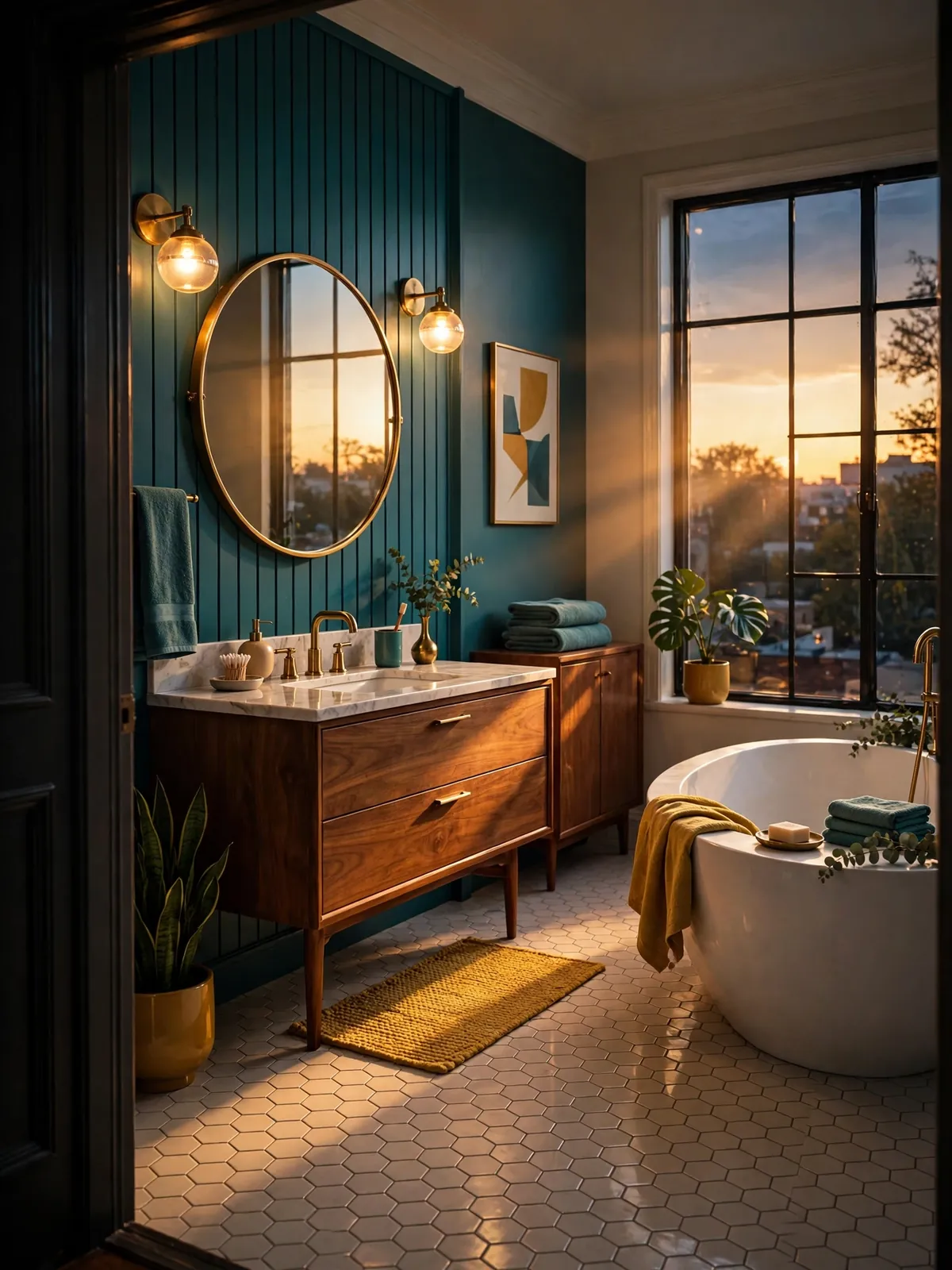
The last of these MCM bathroom ideas is the principle behind them all, and it is worth stating plainly because it is the difference between a bathroom that looks retro in a photograph and one that feels beautiful every day: a great MCM bathroom is not one expensive feature, it is the combination of warm wood, one consistent metal finish and one muted retro colour, repeated in small doses across the whole room — a floating walnut vanity that sets the wood tone, brushed brass on every fixture so nothing clashes, a geometric tile floor that gives the room its pattern, and a single muted colour, sage or terracotta or dusty blue, appearing in the towels, the paint and one tiled wall so the eye finds the same story everywhere it looks — working together so that the floor, the walls, the fixtures and the light all support each other instead of competing for attention, and the room rewards you every time you walk in rather than only on the day it was finished. Here, a warm retro bathroom pulls it together — a floating walnut vanity, teal and mustard accents, a hexagon floor, brass fixtures and a freestanding tub — and nothing in the room is there by accident. The lesson is to choose the vanity wood first, since it sets the tone for every other timber in the room, then pick one metal finish for all the hardware, add one geometric tile as your pattern, and let one muted colour carry the personality, because a bathroom built in that order stays beautiful with very little effort, even in a small bathroom, even on a modest budget, and even when you change only one thing at a time. Start with the vanity, add the mirror and the brass, and the MCM bathroom stops being a style you admire in photographs and becomes the room you use every morning.
Quick tips:
- Choose the vanity wood first — it sets the tone for the room.
- Pick one metal finish for all the hardware.
- Add one geometric tile as your pattern, not three.
- Let one muted retro colour carry the personality.
FAQs
What colours work best in an MCM bathroom?
Sage green, dusty blue, terracotta, mustard and burnt orange work best in an MCM bathroom, because they are the muted retro colours of the 1950s and 60s. Use them as accents — a painted vanity, towels, one tiled wall — against warm neutrals like cream, ivory and pale wood, and keep the palette to two accent colours so the room stays calm.
Is walnut or teak better for an MCM bathroom vanity?
Walnut is better for the classic MCM look, because its deep brown grain is the signature timber of mid century furniture. Teak is better for wet areas, because it is naturally water-resistant and its honey tone suits paler bathrooms. Either works — choose walnut for drama, teak for durability, and keep the finish consistent across the room.
Can an MCM bathroom work in a small space?
Yes, an MCM bathroom works very well in a small space, because the style is built on floating furniture, clean lines and visible floor. Use a floating walnut vanity, a frameless glass shower panel, large-format tiles in a pale colour and one round mirror, and the room will feel larger than it is.
What lighting suits an MCM bathroom?
Globe sconces with opal glass and brass arms suit an MCM bathroom best, because they are the signature light of the era and they flatter the face. Add a globe pendant or a sputnik-style fixture if the ceiling is high enough, use warm white bulbs around 2700K, and avoid harsh overhead downlights on their own.
How do I stop my MCM bathroom looking like a theme park?
Keep the retro elements to three or four — a walnut vanity, brass fixtures, one geometric tile and one muted colour — and let the rest of the room stay plain and modern. The moment every surface is shouting mid century, the room tips into theme; restraint is what makes the style feel timeless instead of costume.
Conclusion
An MCM bathroom is warm wood, clean lines and just enough retro character to feel designed without feeling themed, and the 21 ideas above show that you can get there at almost any budget, whether you install a floating walnut vanity and a geometric tile floor, swap the hardware for brushed brass and hang a round mirror, or simply paint one wall sage and add a vintage rug. Start with the vanity wood, pick one metal finish for all the hardware, add one geometric tile as your pattern and let one muted colour carry the personality. Do that, and your bathroom stops being a plain room you rush through and becomes a warm, calm, quietly retro retreat you enjoy every single day.