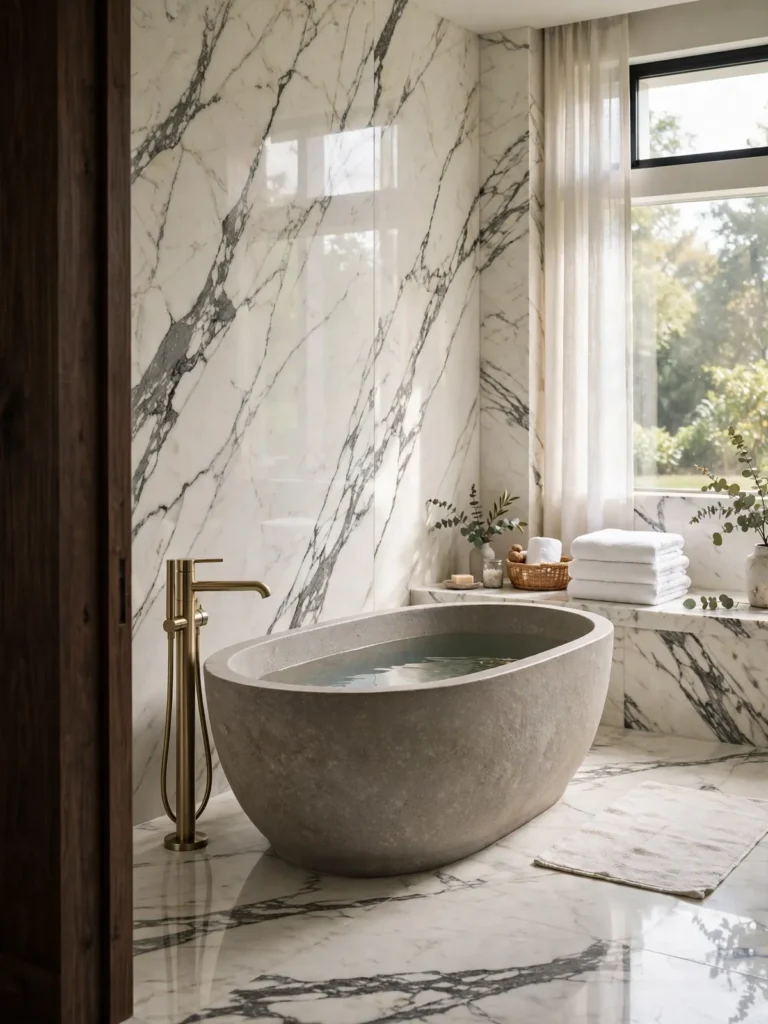
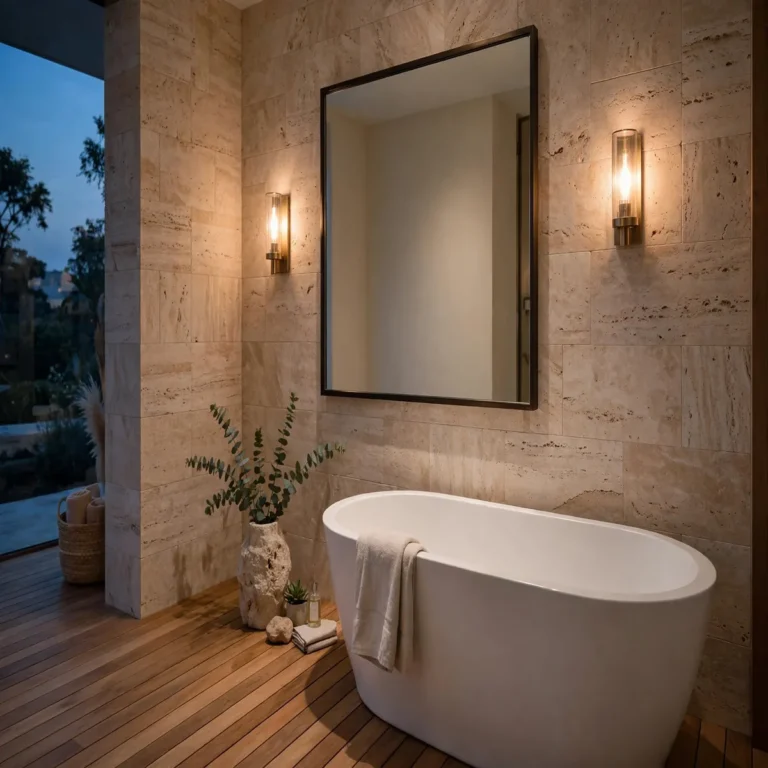
22 Gorgeous Minimalist Bathroom Ideas for a Calm Spa-Like Retreat
A minimalist bathroom is not an empty bathroom — it is a room where every fixture, finish and object has a clear purpose, and the calm comes from what was left out. These 22 minimalist bathroom ideas cover decluttering, storage, tiles, lighting and warmth, so you can create a bathroom that feels like a spa without losing the comfort of a real, used room.
A minimalist bathroom works because it removes visual noise: one palette, one hardware finish, clear counters and hidden storage, so the room feels larger, brighter and calmer the moment you walk in. The best minimalist bathroom is intentional, not empty — it keeps the warmth of wood, the softness of a towel and the glow of hidden light, and it hides everything else behind closed doors and inside the walls.
If your minimalist room starts to feel cold or stark, these cozy bathroom ideas show how warm textures and soft light add comfort without adding clutter. The 22 ideas below cover decluttering, storage, tiles, lighting, mirrors and warmth, with a minimalist choices guide in the middle, so you can build a bathroom that feels like a calm retreat and still works for everyday life.
Key Takeaways
What is a minimalist bathroom?
A minimalist bathroom is a functional, uncluttered space where every fixture, finish and accessory has a clear purpose. It uses clean lines, a limited neutral palette, hidden storage and a small number of materials — usually two or three — so the room feels calm, bright and easy to keep clean.
How do I make a minimalist bathroom feel warm, not cold?
Add warmth through texture and natural materials, not through objects: warm white walls instead of stark white, a light oak vanity, a woven basket, a wooden tray for towels and warm white lighting around 2700K. One plant and one textile are enough — the warmth comes from the materials, not from decoration.
What is the best storage for a minimalist bathroom?
Hidden storage is the best storage for a minimalist bathroom: a floating vanity with deep drawers, a recessed mirror cabinet, a shower niche and a slim wall cabinet. Everything you use daily stays within reach but out of sight, and the counters stay clear — that clear counter is what makes the room feel minimalist.
Which tiles suit a minimalist bathroom?
Large-format tiles in a pale, warm neutral suit a minimalist bathroom best, because fewer grout lines make the walls and floor read as one continuous surface. Use the same tile on the floor and walls, match the grout to the tile, and add texture — pebble shower floors or a fluted wall — instead of pattern.
Can a minimalist bathroom work in a small space?
Yes, a minimalist bathroom works best in a small space, because the style is built on visible floor, clear counters and pale surfaces. Use a floating vanity, a frameless glass shower panel, large-format tiles and one large mirror, and the room will feel much bigger than it is.
Clear the Counters First and Let the Room Breathe
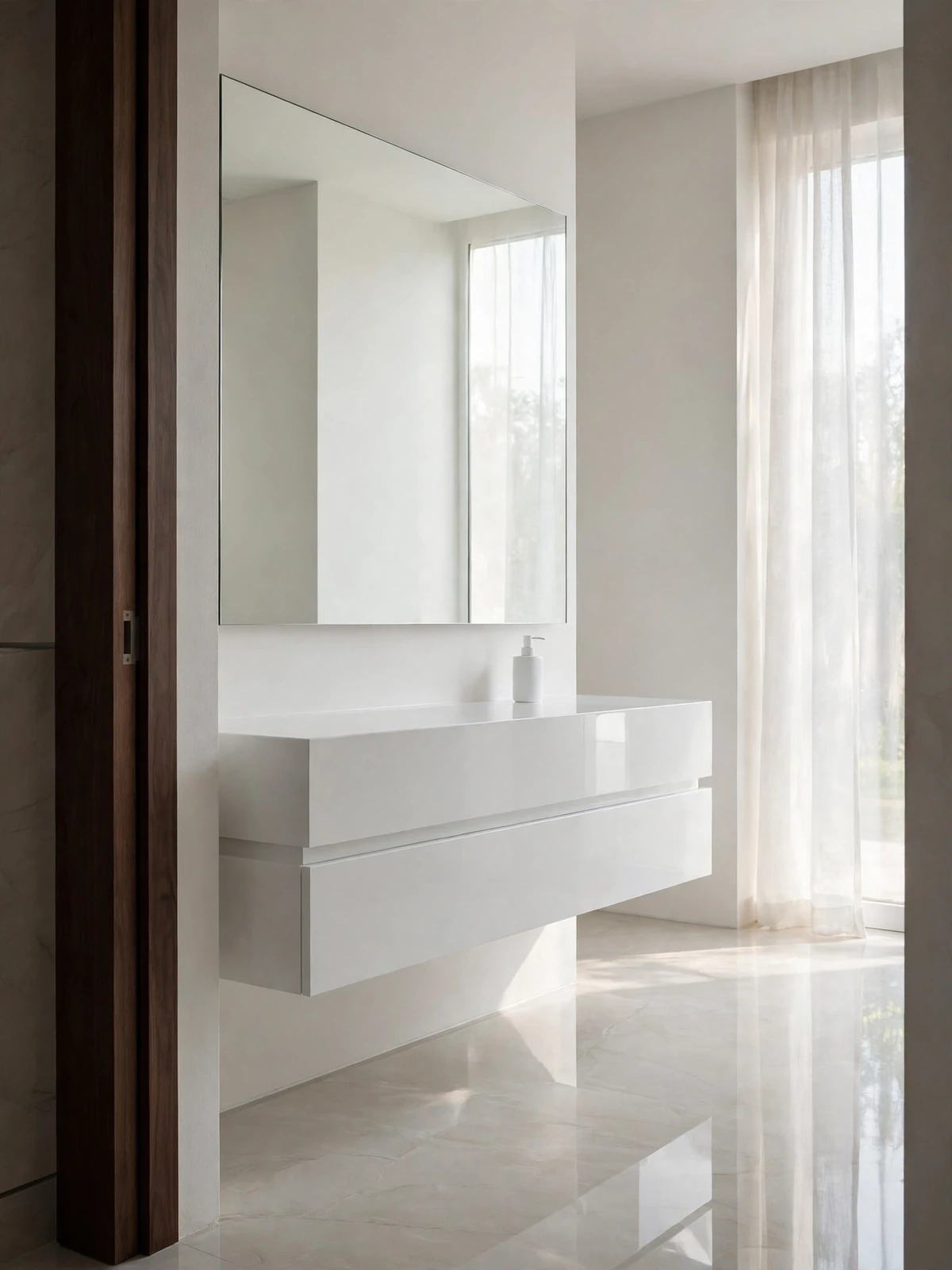
Clearing the counters is the first and cheapest minimalist bathroom idea, because a surface crowded with bottles and brushes makes even a beautiful room feel chaotic, while a clear counter makes the same room feel like a spa. Here, a floating white vanity holds a single soap dispenser and nothing else, with a large frameless mirror above it and soft daylight filling the room. The design suits every bathroom, it costs nothing, and it is the test that proves minimalism works: remove everything, live with the clear counter for a week, and only bring back what you genuinely use daily. The weakness is discipline: a clear counter needs a home for everything that was on it, so pair this idea with hidden storage.
Quick tips:
- Remove everything from the counter and live with it clear for a week.
- Bring back only what you use every single day.
- Give every removed item a drawer, cabinet or niche to live in.
- Keep one soap dispenser and one small plant as the only counter objects.
Muted Matte Walls in Greige or Warm Ivory
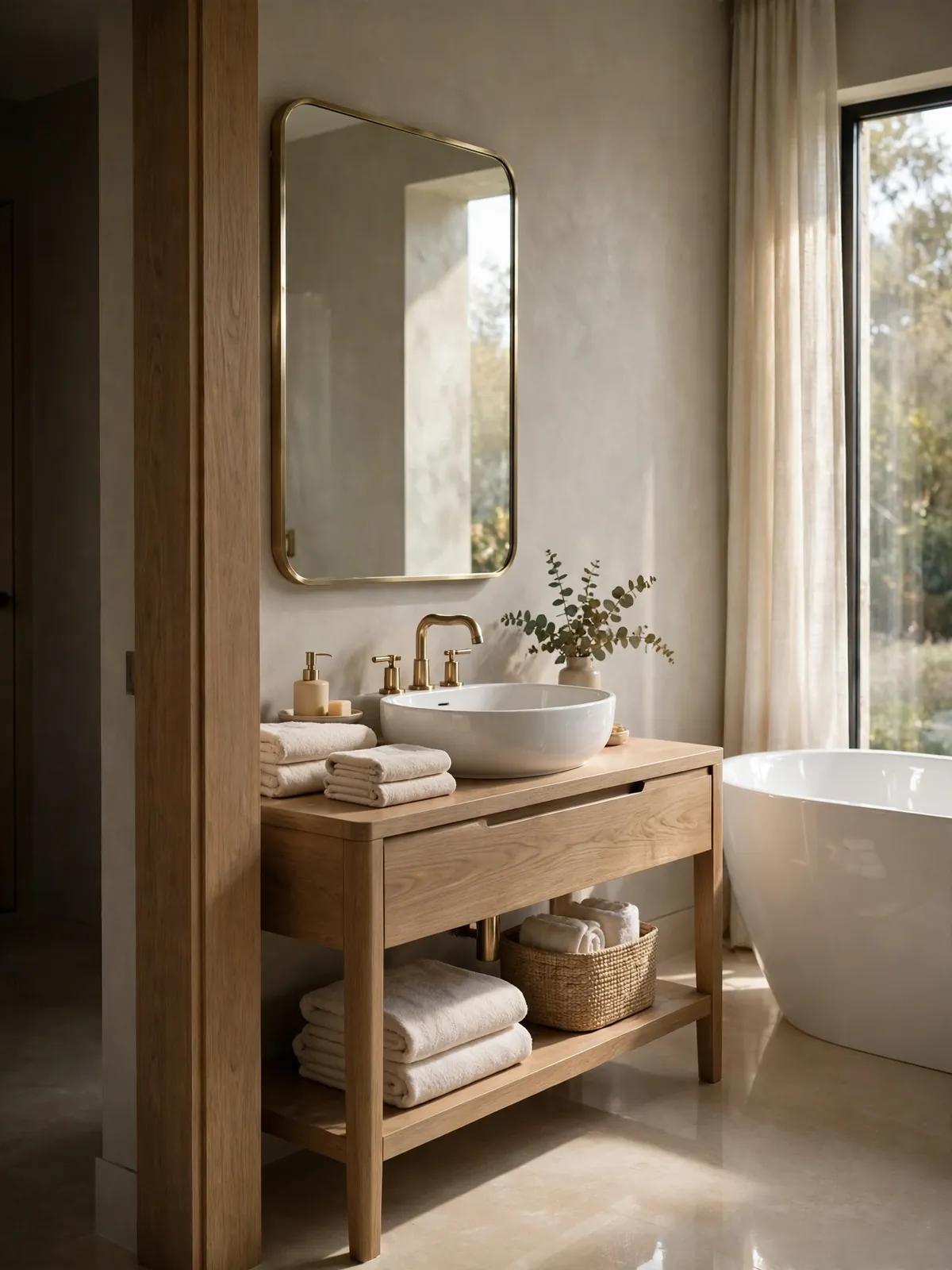
Muted matte walls in greige or warm ivory set the calm tone of a minimalist bathroom, because soft, desaturated colours sit quietly in the background and let the form and light of the room do the talking. Here, matte greige walls wrap a bathroom with a light oak vanity, a white vessel sink, brushed brass taps and cream towels, and the room feels restful rather than stark. The design suits any bathroom, it is a weekend paint job, and matte finishes absorb light gently instead of bouncing it harshly. The weakness is colour matching: a greige that looks warm in the shop can read grey under cool bulbs, so test the paint under warm white light first.
Quick tips:
- Choose warm whites with cream, sand or soft grey undertones.
- Use a matte finish to remove glare and soften the light.
- Test the paint under warm white bulbs around 2700K.
- Pair muted walls with warm wood, not cold chrome.
A Frameless Mirror That Floats on the Wall
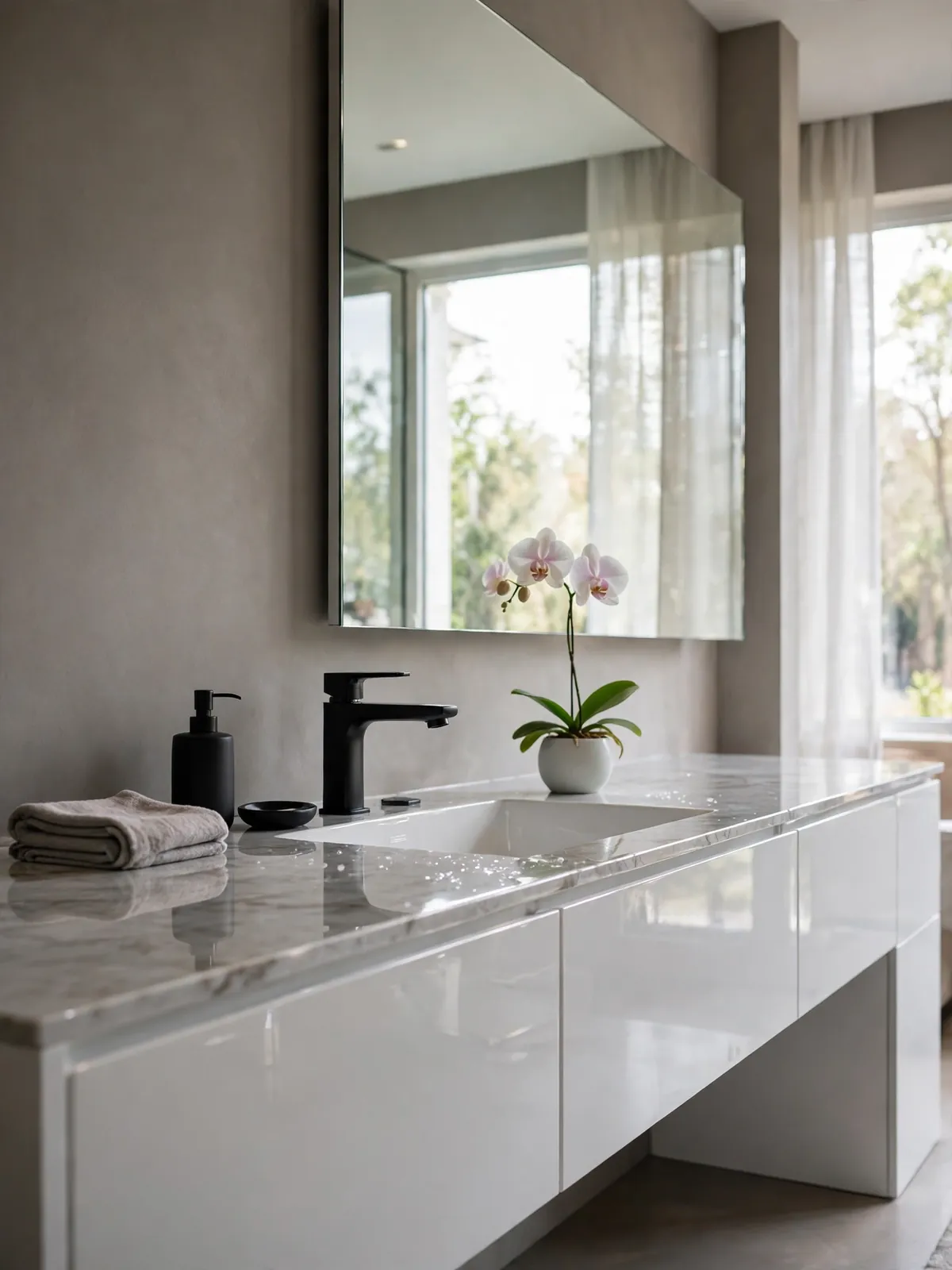
A frameless mirror that floats on the wall brings quiet elegance to a minimalist bathroom, because without a frame cutting the space the reflection expands the room and the lines of the wall stay clean and uninterrupted. Here, a large frameless mirror sits above a floating white vanity on a warm grey wall, with matte black taps and a single orchid as the only other objects. The design suits small bathrooms best of all, it makes the room feel brighter and more refined, and it has fewer nooks for dust and grime to hide. The weakness is edges: a frameless mirror needs a polished edge and careful mounting, so have it installed professionally.
Quick tips:
- Choose a mirror at least as wide as the vanity.
- Hang it so the top sits just above eye level.
- Keep the wall behind it plain so the reflection stays calm.
- Clean it with a squeegee to avoid streaks and water spots.
One Consistent Hardware Finish Throughout
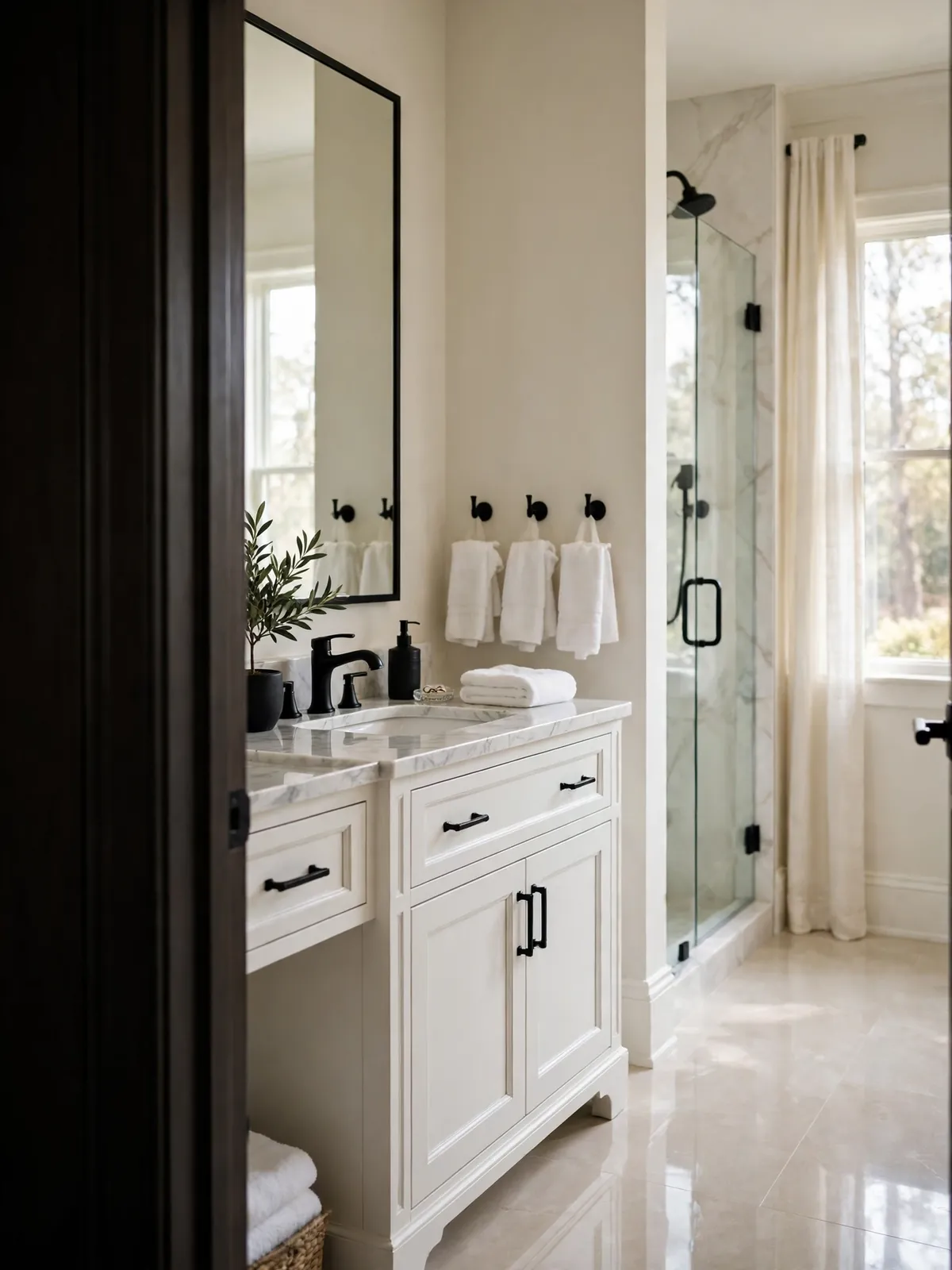
One consistent hardware finish is the detail that makes a minimalist bathroom feel designed rather than assembled, because matching taps, handles, hooks and towel bars tie every element together in a single quiet story. Here, matte black runs across the taps, drawer pulls, towel hooks and mirror edge, with ivory walls, a white vanity and folded white towels completing the calm palette. The design suits any bathroom, it costs little when done as a single swap, and it is the fastest way to make a mixed bag of fixtures feel intentional. The weakness is temptation: one chrome item in a black room stands out immediately, so replace everything or nothing.
Quick tips:
- Pick one finish — matte black or brushed brass — and stick to it.
- Replace taps, handles, hooks and towel bars together.
- Keep the shapes similar: slim, straight and unadorned.
- Avoid mixing chrome, black and brass in the same room.
A Floating Vanity for Airy Openness
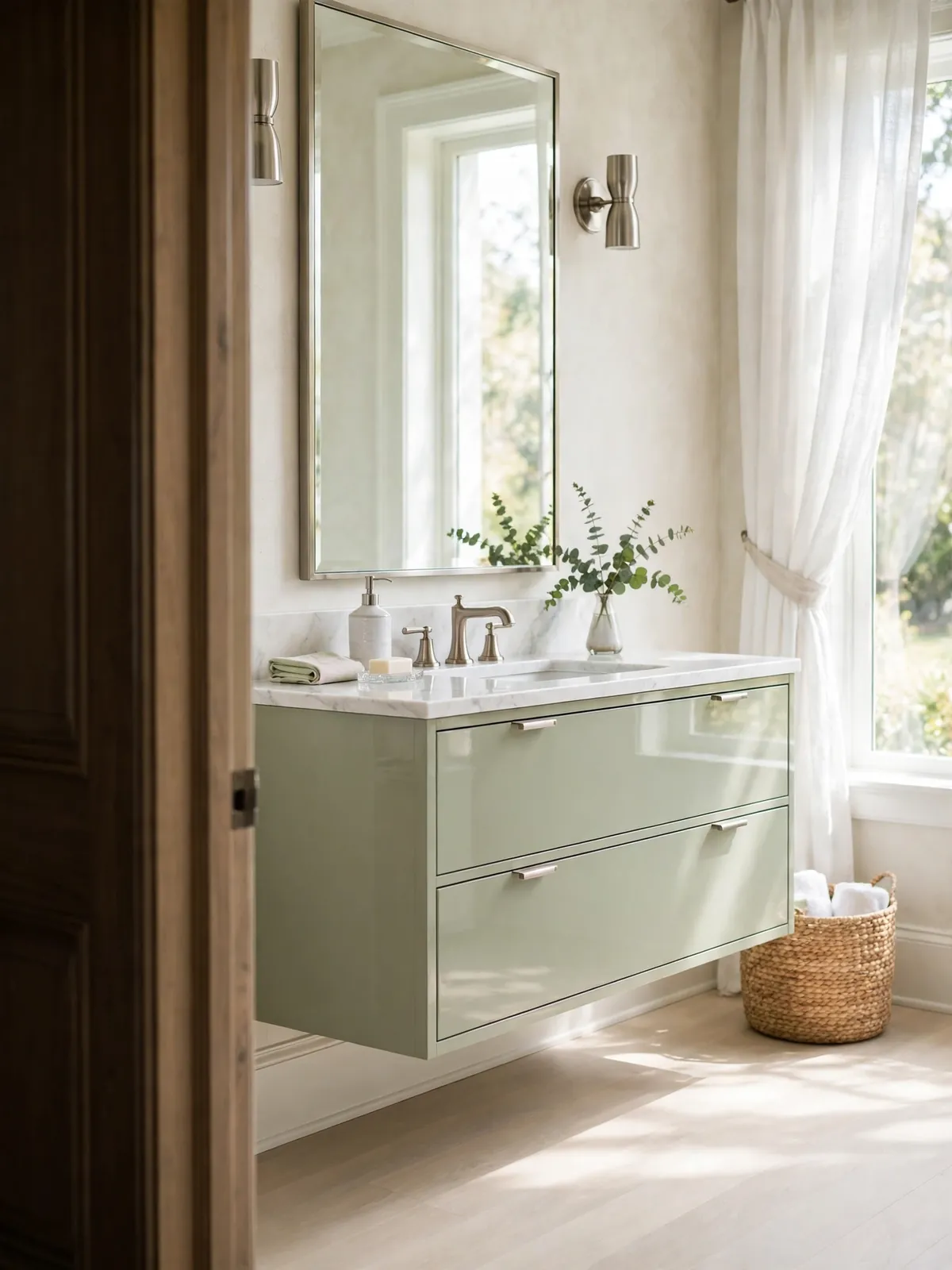
A floating vanity is the signature move of a minimalist bathroom, because lifting the vanity off the floor frees up visible space and makes the room feel larger, lighter and more open. Here, a pale sage floating vanity with a white stone countertop and brushed nickel taps sits against a large mirror, with a pale ash floor keeping the room bright. The design suits small bathrooms best of all, it makes cleaning underneath easy, and the space below can hold a basket or stay empty for maximum openness. The weakness is storage: a floating vanity holds less than a full cabinet, so pair it with a recessed mirror cabinet.
Quick tips:
- Choose a floating vanity with deep drawers for hidden storage.
- Mount it at standard counter height with plumbing hidden in the wall.
- Keep the space below empty or hold one woven basket.
- Match the vanity colour to the wall for a seamless look.
A Single Striking Light Fixture
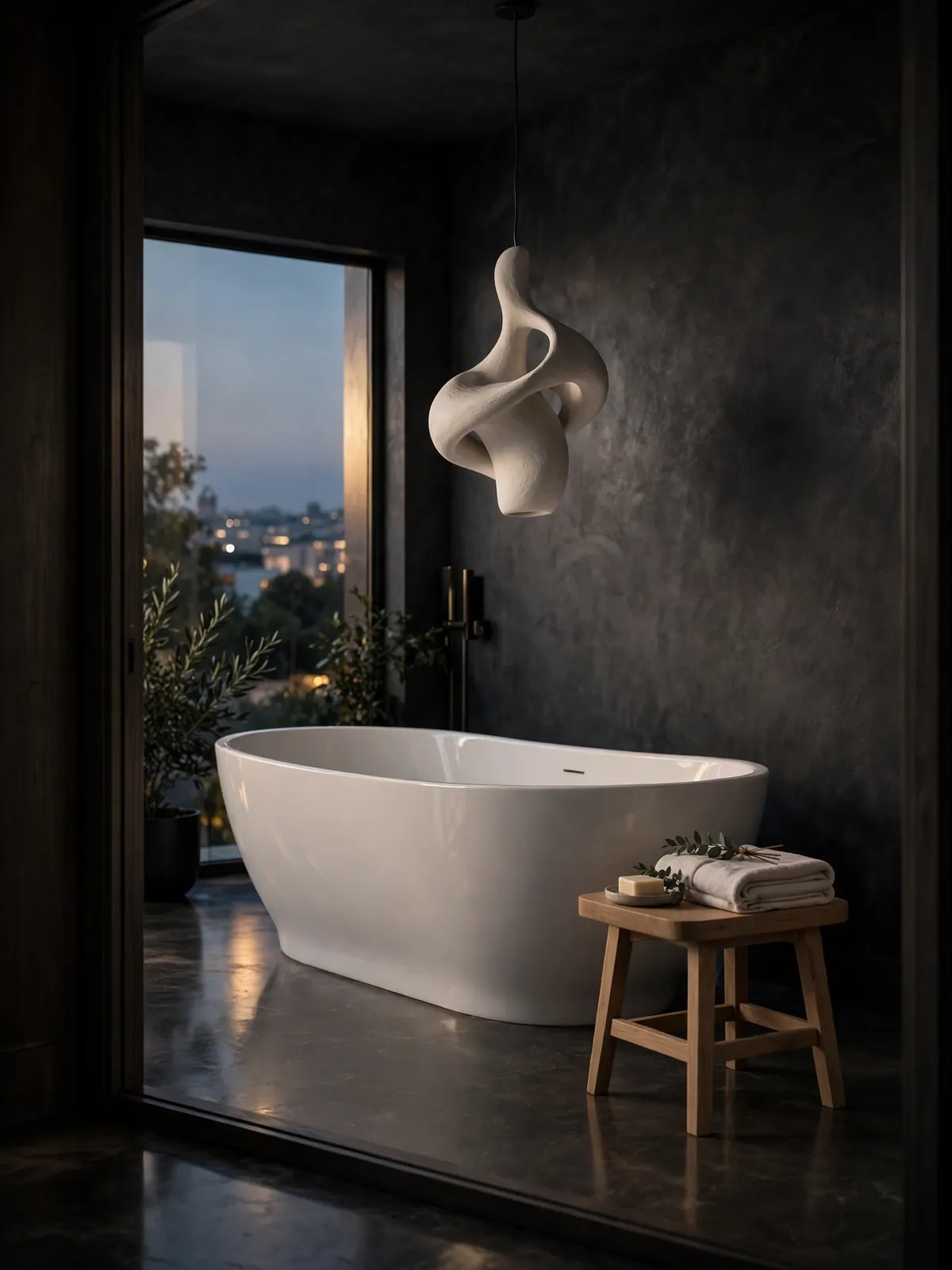
A single striking light fixture gives a minimalist bathroom its focal point, because one well-chosen pendant or sconce carries the whole atmosphere and the room feels curated rather than busy. Here, a sculptural pendant hangs over a freestanding tub on charcoal walls, with a light wood stool and a soft evening glow completing the calm scene. The design suits any bathroom, it doubles as sculpture, and it is the minimalist answer to a room full of competing fixtures. The weakness is light levels: one fixture alone rarely lights the mirror well, so pair it with hidden lighting behind the mirror.
Quick tips:
- Choose one pendant or one pair of sconces — not both.
- Hang the pendant above the tub, not over a walkway.
- Use warm white bulbs around 2700K for a calm glow.
- Add hidden LED light behind the mirror for grooming.
Frosted Windows for Privacy Without Curtains
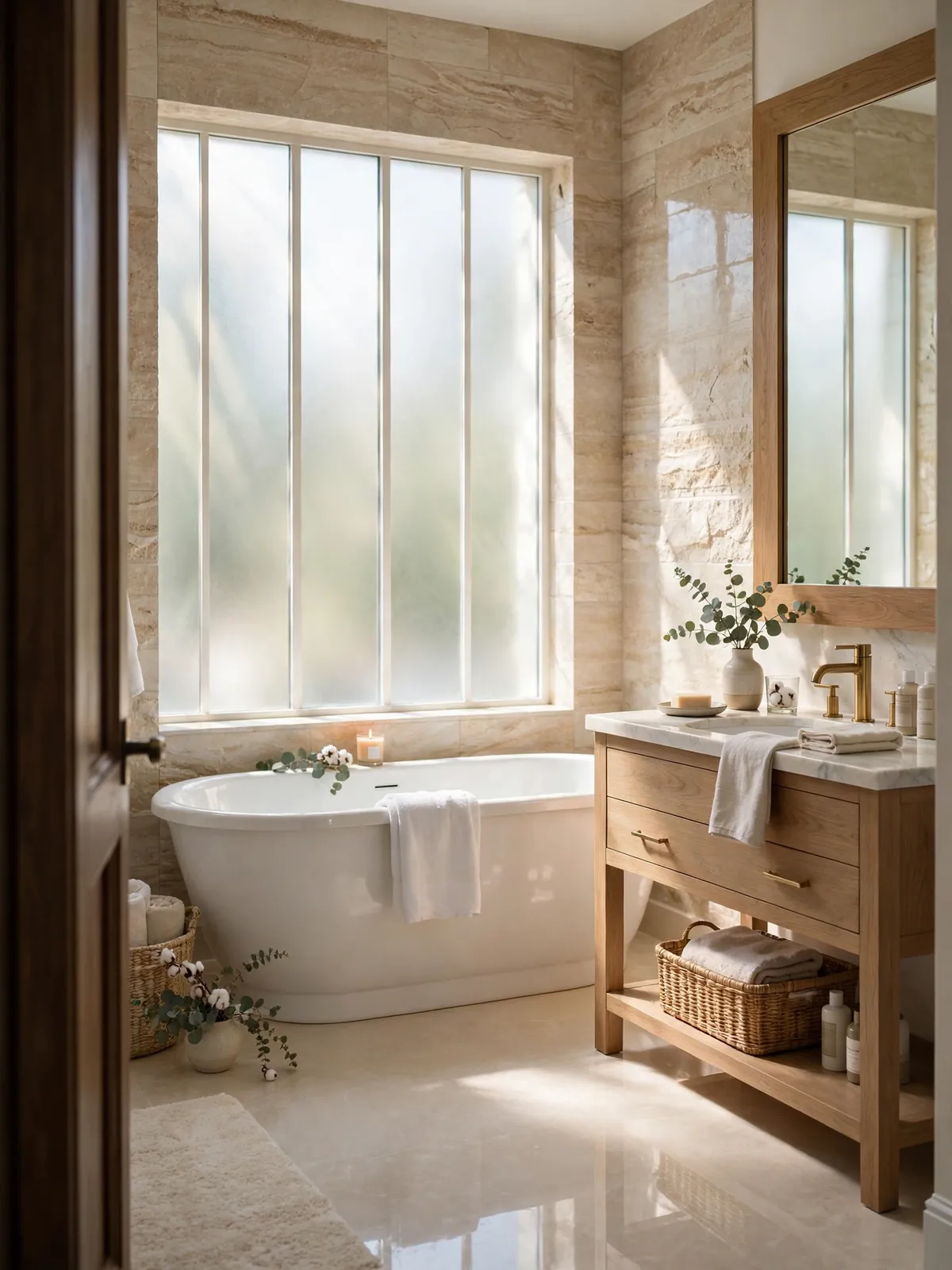
Frosted windows give a minimalist bathroom privacy without curtains, because the frosted glass lets daylight in while keeping the room hidden, and it feels like part of the architecture rather than an add-on. Here, a large frosted window fills a stone beige bathroom with soft daylight, with a white freestanding tub and a light wood vanity below. The design suits any bathroom with a window, it removes the visual clutter of fabric, and it is low-maintenance — no curtains to wash or blinds to dust. The weakness is the view: frosted glass gives you light but no outlook, so keep one clear window elsewhere in the home for the view.
Quick tips:
- Use frosted glass or a frosted film on existing windows.
- Keep the window frame slim and the same colour as the wall.
- Pair frosted windows with a skylight for extra daylight.
- Clean the glass regularly — frosted glass shows water spots.
Wall-Mounted Faucets for a Streamlined Counter
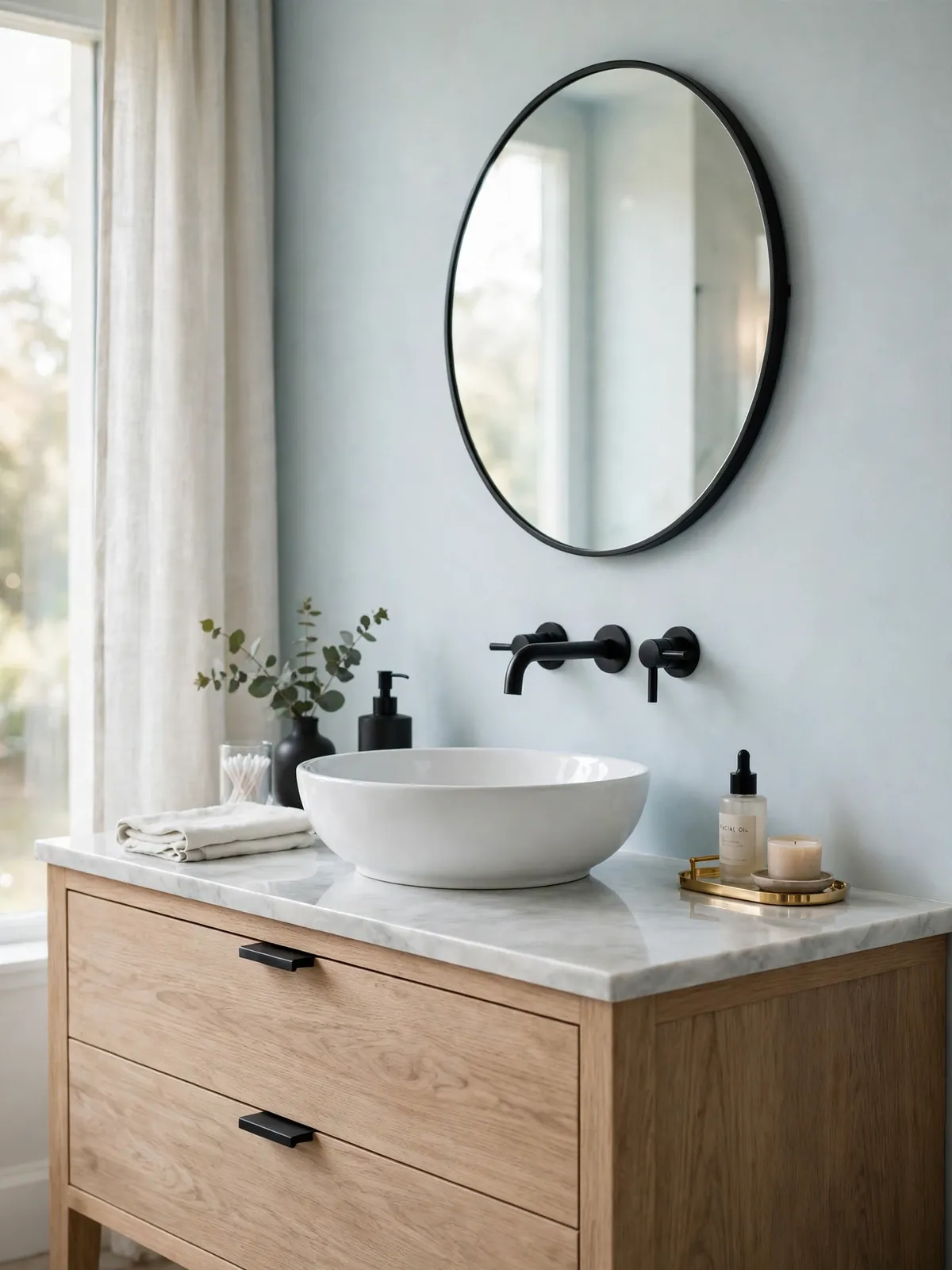
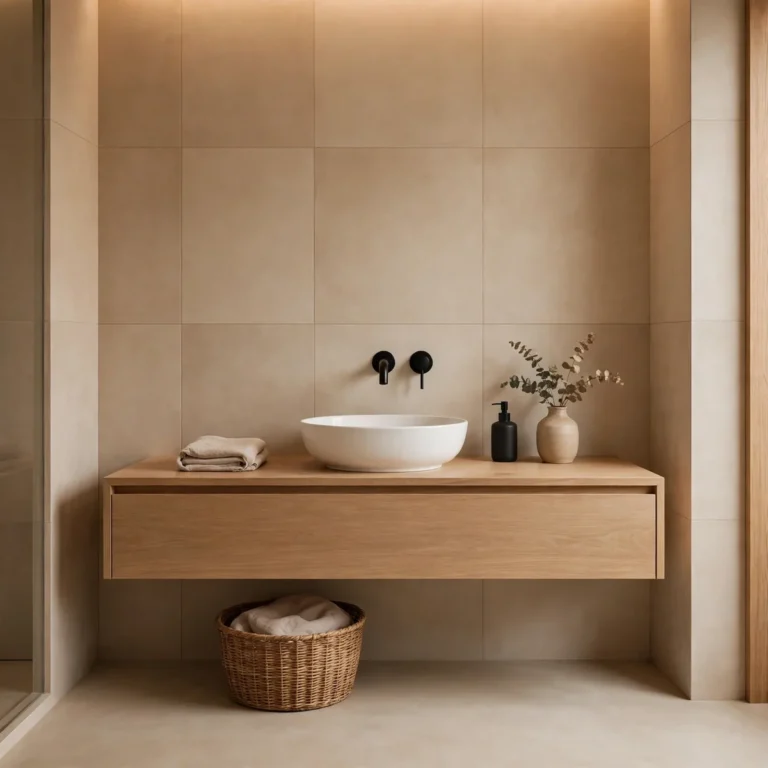
Wall-mounted faucets streamline a minimalist bathroom, because they free the counter completely and leave a clean, unbroken surface that suits the style’s love of clear lines. Here, matte black wall-mounted faucets sit above a white vessel sink on a white oak vanity, with pale blue walls and a round mirror completing the calm look. The design suits floating vanities especially well, it makes cleaning the counter effortless, and it looks deliberately designed rather than assembled. The weakness is plumbing: moving the pipes into the wall costs more than a deck-mounted tap, so plan it during a renovation, not as a quick swap.
Quick tips:
- Plan wall-mounted faucets during a renovation, not after.
- Pair them with a vessel sink or a slim basin.
- Match the faucet finish to the mirror frame and hardware.
- Check the spout reach so water lands in the centre of the basin.
Minimalist Bathroom Choices Guide
| Choice | Minimalist option | Why it works | Watch out for |
|---|---|---|---|
| Vanity | Floating, slab-front, deep drawers | Frees visible floor, hides clutter | Less storage than a full cabinet |
| Tiles | Large-format, same tile floor and walls | Fewer grout lines, seamless look | Needs flat walls and a skilled tiler |
| Shower | Frameless glass panel, no frame | Keeps the room open and bright | More splashing, needs a squeegee |
| Storage | Recessed niche, mirror cabinet, slim wall unit | Everything hidden, counters clear | Plan niches into the tile layout early |
| Lighting | One pendant plus hidden LED behind mirror | Calm atmosphere, shadow-free grooming | One fixture alone leaves the mirror dark |
| Hardware | One finish throughout (matte black or brass) | Ties the room together quietly | Mixing finishes breaks the calm |
| Colour | Two shades only, warm neutrals | Cohesive, restful, never busy | Stark white alone can feel clinical |
A Two-Shade Palette Only
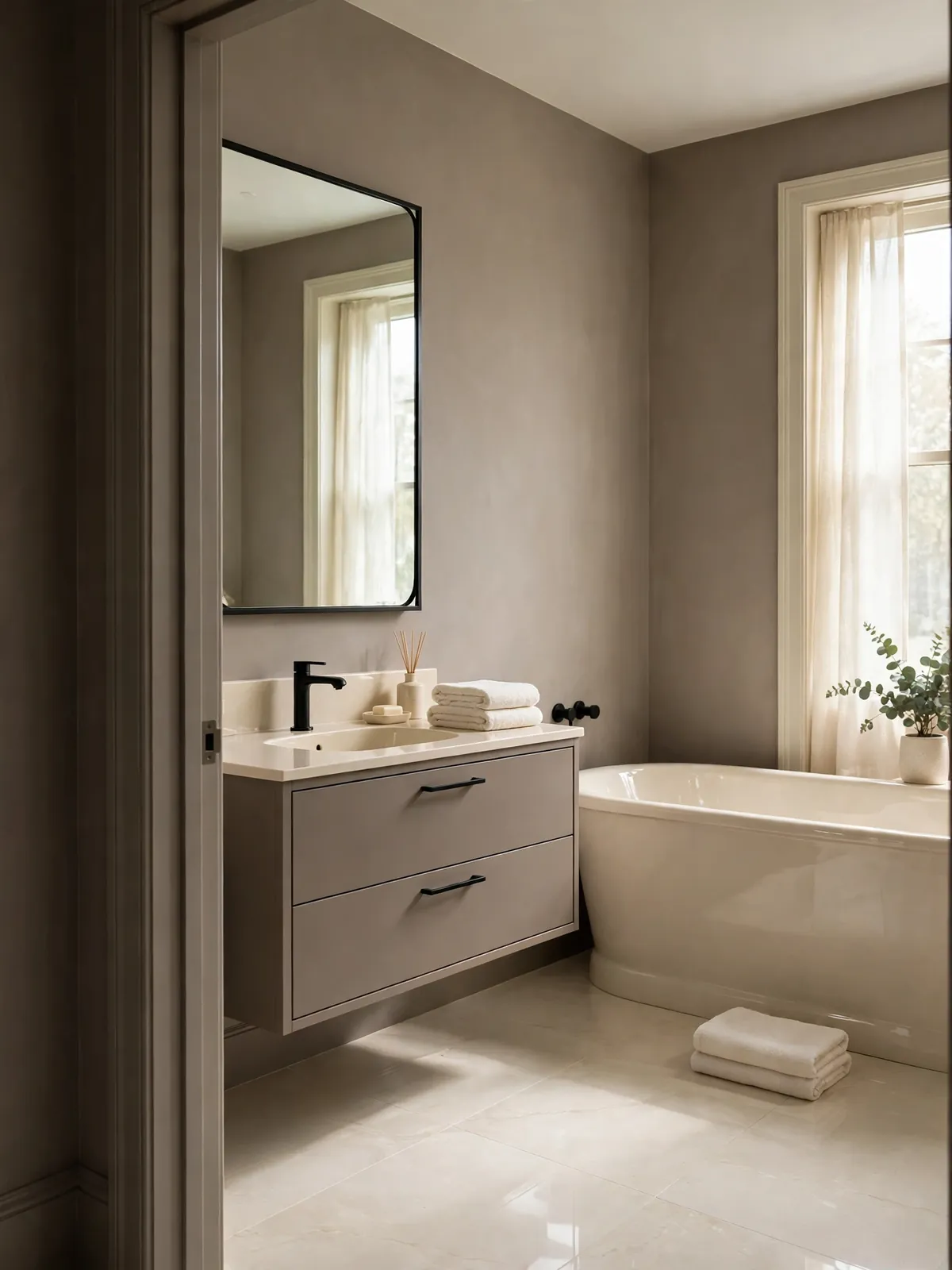
A two-shade palette is the discipline that keeps a minimalist bathroom calm, because two tones that work in harmony — taupe with cream, sage with white, charcoal with ivory — steady the eye and make every corner feel intentional. Here, taupe walls and a taupe floating vanity pair with cream fixtures and towels, with matte black taps as the only dark note. The design suits any bathroom, it costs nothing extra, and it is the fastest way to make a busy bathroom feel composed. The weakness is flatness: two shades in one finish can look dull, so vary the texture — matte walls, glossy tiles, warm wood — while keeping the colours the same.
Quick tips:
- Choose two tones that work in harmony and let them guide the room.
- Vary the texture, not the colour, for interest.
- Repeat each shade at least three times so it looks deliberate.
- Keep the hardware finish as the only accent.
Recessed Shelving That Disappears Into the Wall
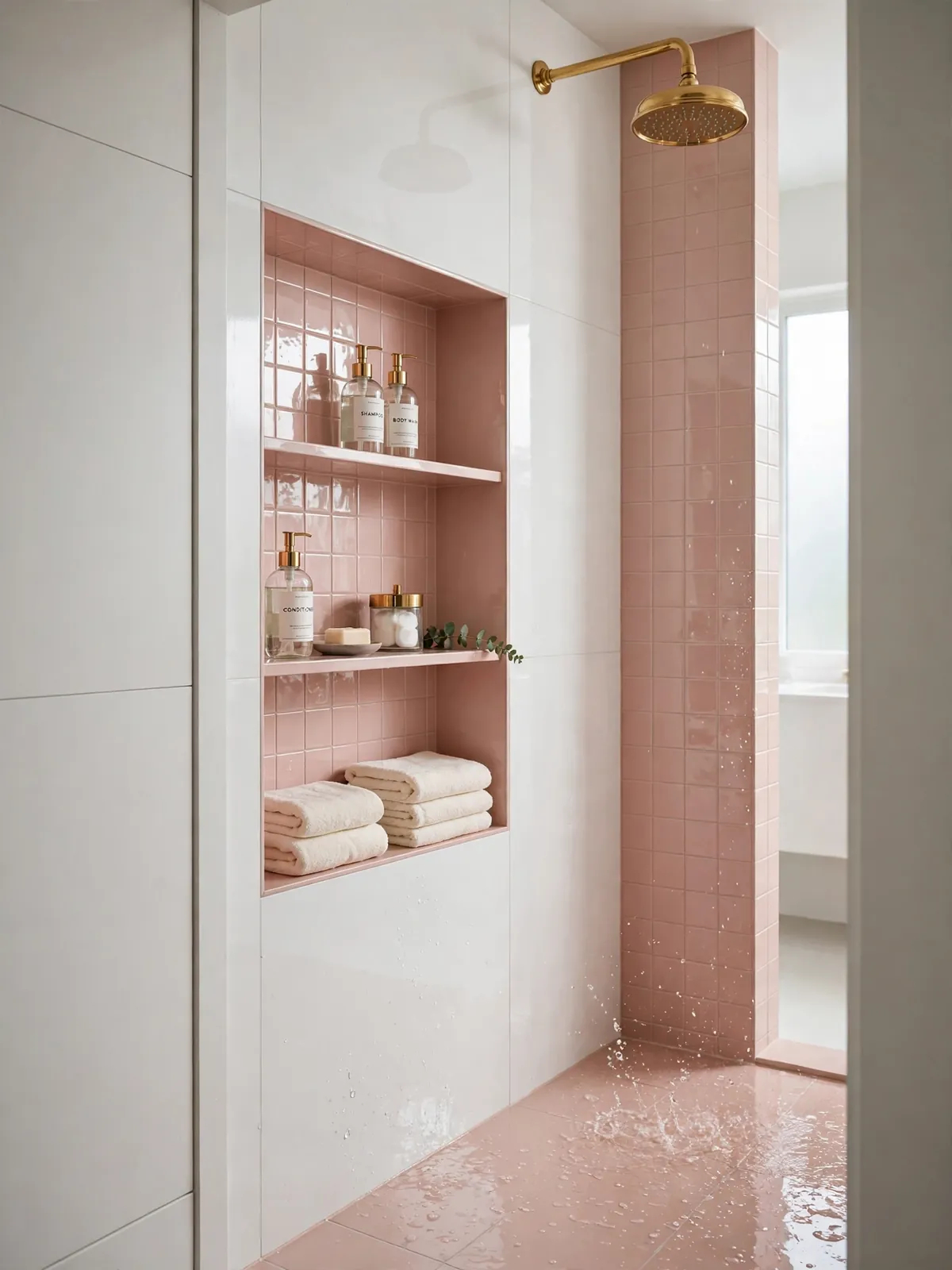
Recessed shelving disappears into the wall of a minimalist bathroom, because a niche carved into the architecture holds bottles and essentials without interrupting the lines of the room. Here, a blush pink tiled niche sits in a white large-format shower wall, with a brass rain shower and cream towels completing the spa feeling. The design suits any shower, it looks custom and intentional, and it removes the bulk of caddies and corner shelves. The weakness is planning: a niche must be built into the wall and aligned with the tile lines, so decide its size and position before the tiling starts.
Quick tips:
- Align the niche with the tile lines for an intentional look.
- Make it wide enough for tall bottles, not just small ones.
- Line it with a contrasting tile for a quiet design moment.
- Seal the niche grout well, since it sees constant water.
Glass Shower Panels for Seamless Openness
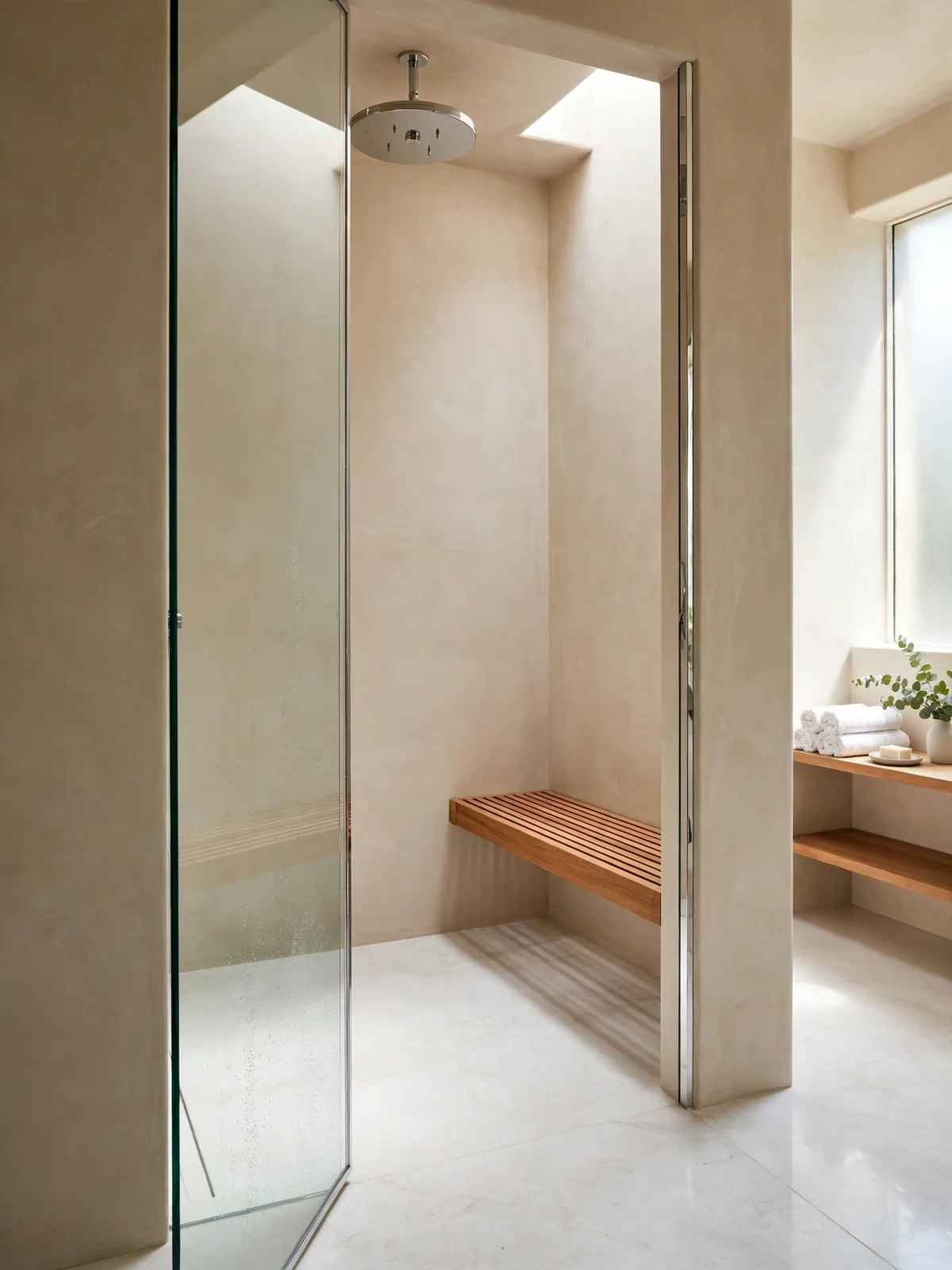
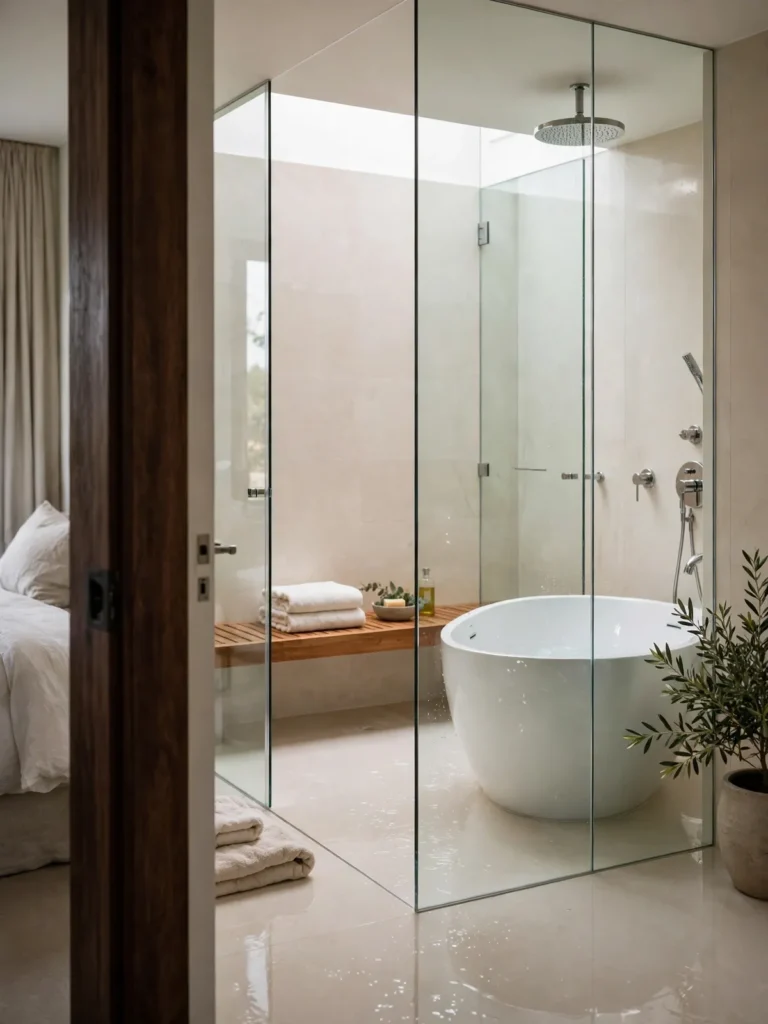
Glass shower panels make a minimalist bathroom feel seamless, because clear glass blends into the room instead of cutting it off, and the shower becomes part of the design instead of a hidden corner. Here, a frameless glass panel encloses a shower with sand walls, a teak bench and a white stone floor, and light flows through the panel effortlessly. The design suits small bathrooms best of all, it makes the room feel larger and brighter, and cleaning is a single wipe. The weakness is water spots: glass shows every drop, so keep a squeegee in the shower and wipe it after each use.
Quick tips:
- Use frameless glass with minimal hardware.
- Keep a squeegee in the shower for a ten-second wipe.
- Tile the shower wall in a colour worth showing off.
- Choose low-iron glass if you want the clearest view.
Rolled Towels in a Wooden Tray for Spa Energy
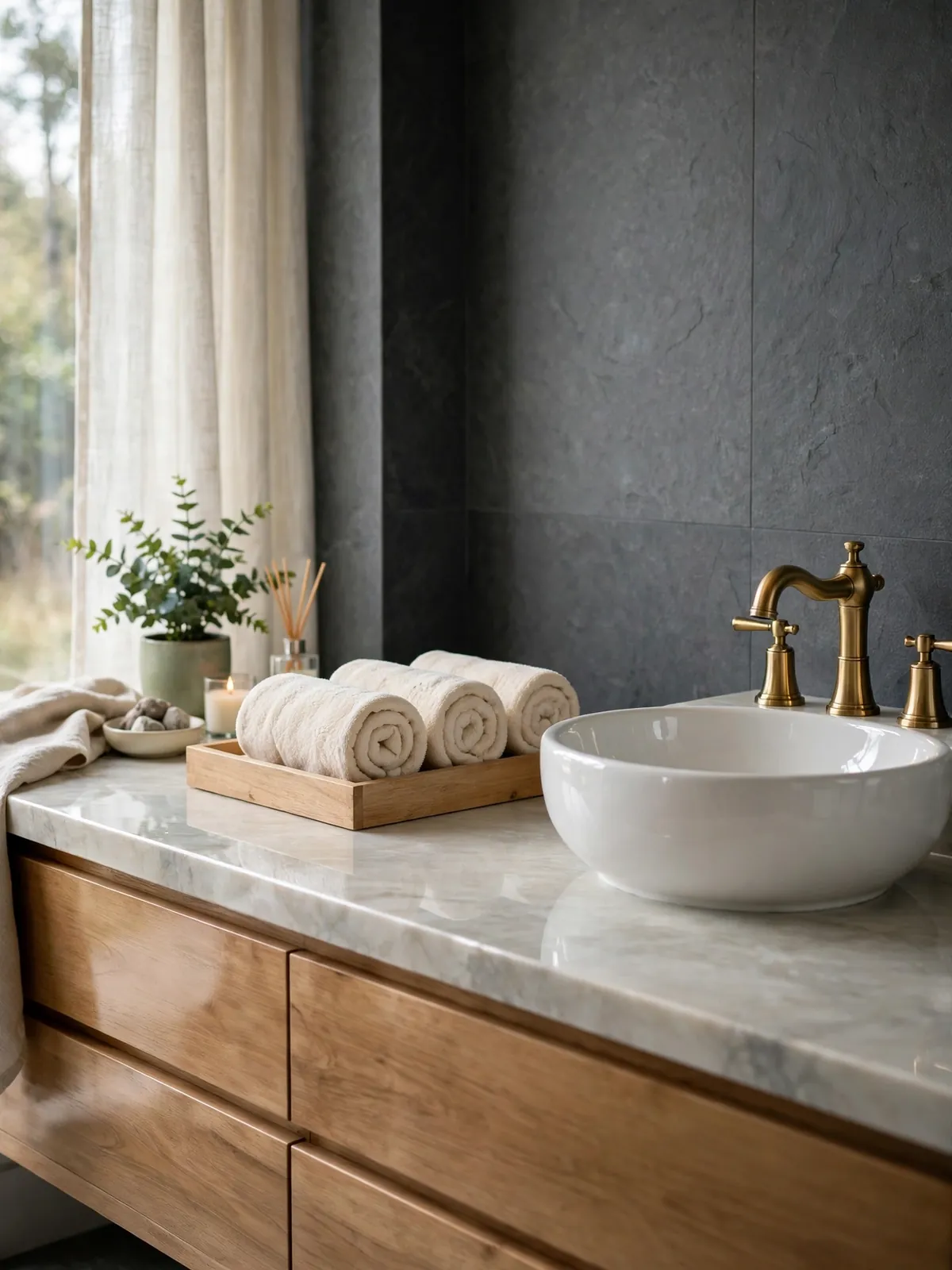
Rolled towels in a wooden tray bring spa energy to a minimalist bathroom, because the rolled shapes add soft texture while the tray keeps them contained and stylish. Here, cream towels rolled neatly into a light wooden tray sit on a vanity against slate grey walls, with a white vessel sink, brushed brass taps and a small green plant completing the scene. The design suits any bathroom, it costs little, and it is the one decorative touch that is also genuinely useful. The weakness is damp: towels left in a tray in a humid bathroom need regular washing, so change them every few days.
Quick tips:
- Roll towels instead of folding them for a spa feel.
- Choose a wooden tray that matches the vanity wood.
- Keep the tray to one per bathroom — two starts to feel busy.
- Change the towels every few days to keep them fresh.
Stone or Concrete Flooring Instead of a Bath Mat
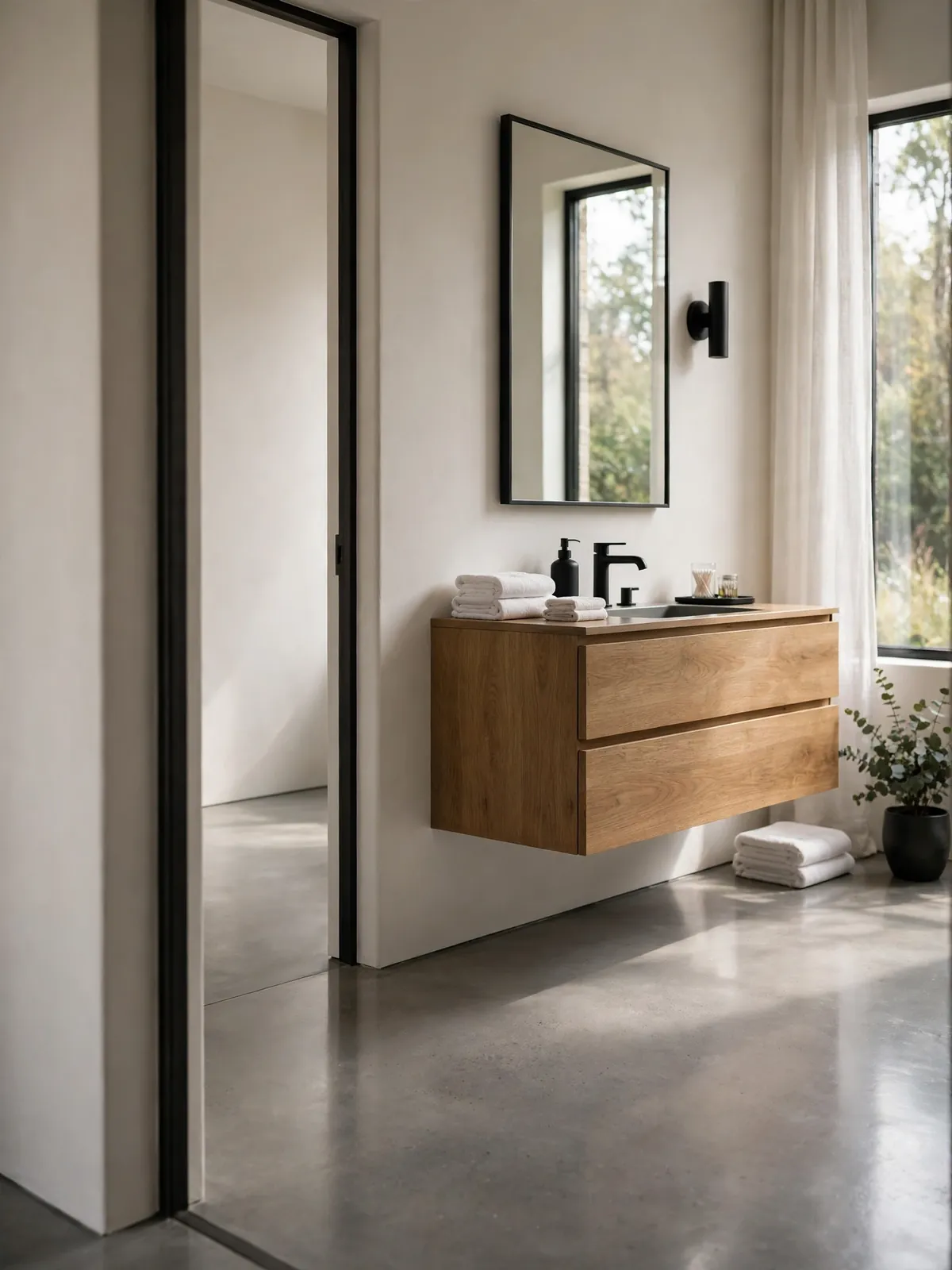
Stone or concrete flooring replaces the soggy bath mat with a surface that is sleek, durable and endlessly modern, because it stays crisp and smooth where fabric mats collect lint and damp. Here, polished concrete floors ground a warm white bathroom, with a floating oak vanity, matte black fixtures and folded white towels keeping the room calm. The design suits wet rooms and walk-in showers best of all, it is easy to clean, and it gives the bathroom a calm, refined simplicity. The weakness is cold: bare concrete is cold underfoot, so pair it with underfloor heating or a small washable rug beside the tub.
Quick tips:
- Pair stone or concrete floors with underfloor heating.
- Choose a honed or matte finish for grip when wet.
- Keep the floor colour warm, not cold grey, for a calm feel.
- Add one small washable rug beside the tub for warmth.
Wall Hooks Instead of Bulky Towel Bars
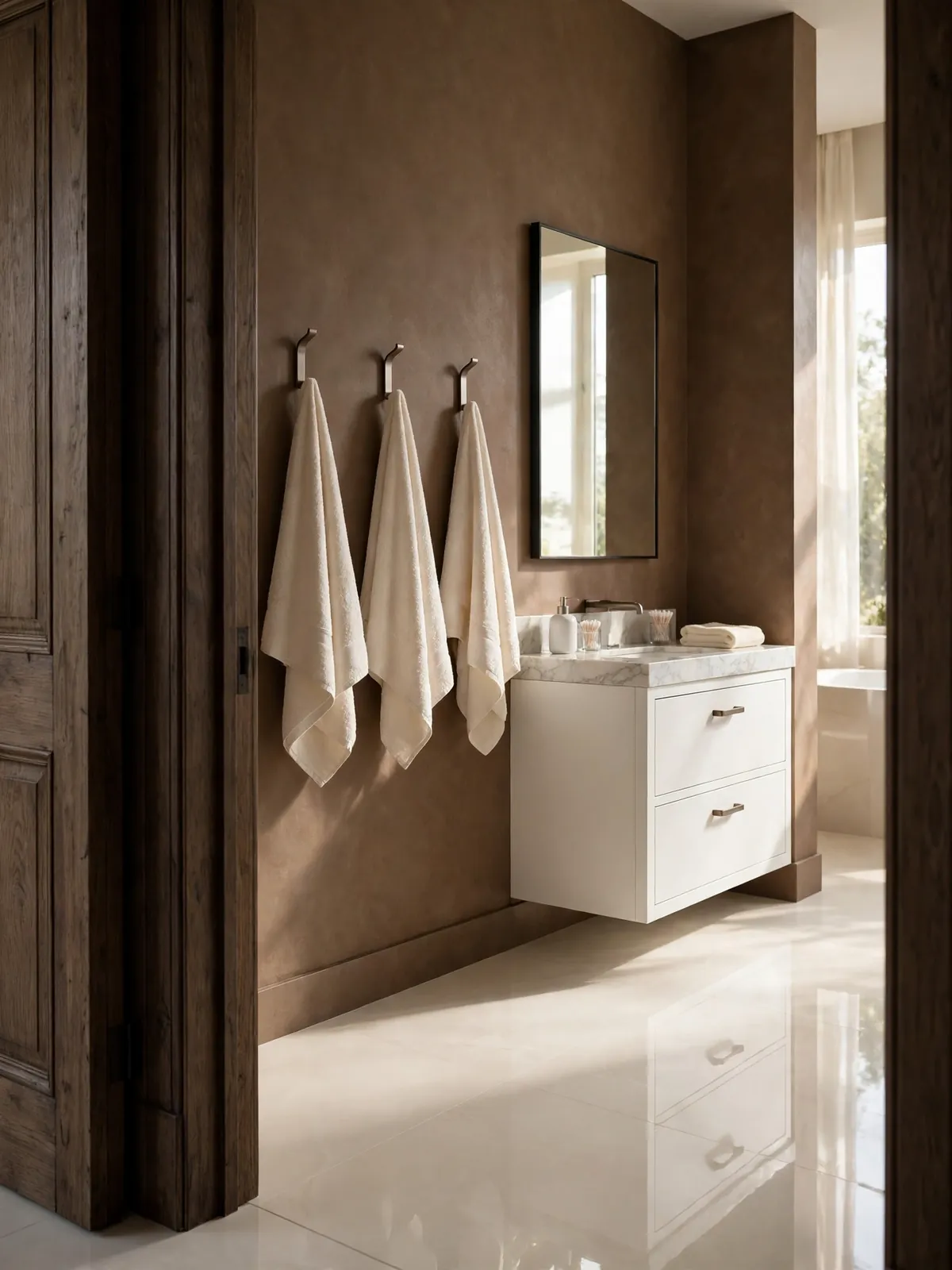
Wall hooks replace bulky towel bars in a minimalist bathroom, because they are small, practical and versatile, and they keep towels neatly off counters and floors without adding visual clutter. Here, three brushed bronze hooks hold cream towels on a warm brown wall, with a white vanity and ivory floor keeping the room calm. The design suits small bathrooms best of all, it is easier to install and clean around than a long bar, and a cluster of hooks looks tidy and intentional. The weakness is capacity: hooks hold fewer towels than a long bar, so use them for daily towels and keep spare towels in a cabinet.
Quick tips:
- Cluster three hooks close together for a tidy look.
- Match the hook finish to the taps and hardware.
- Hang hooks at a height that keeps towels off the floor.
- Keep spare towels in a cabinet, not on display.
Large-Format Tiles for a Calmer Finish
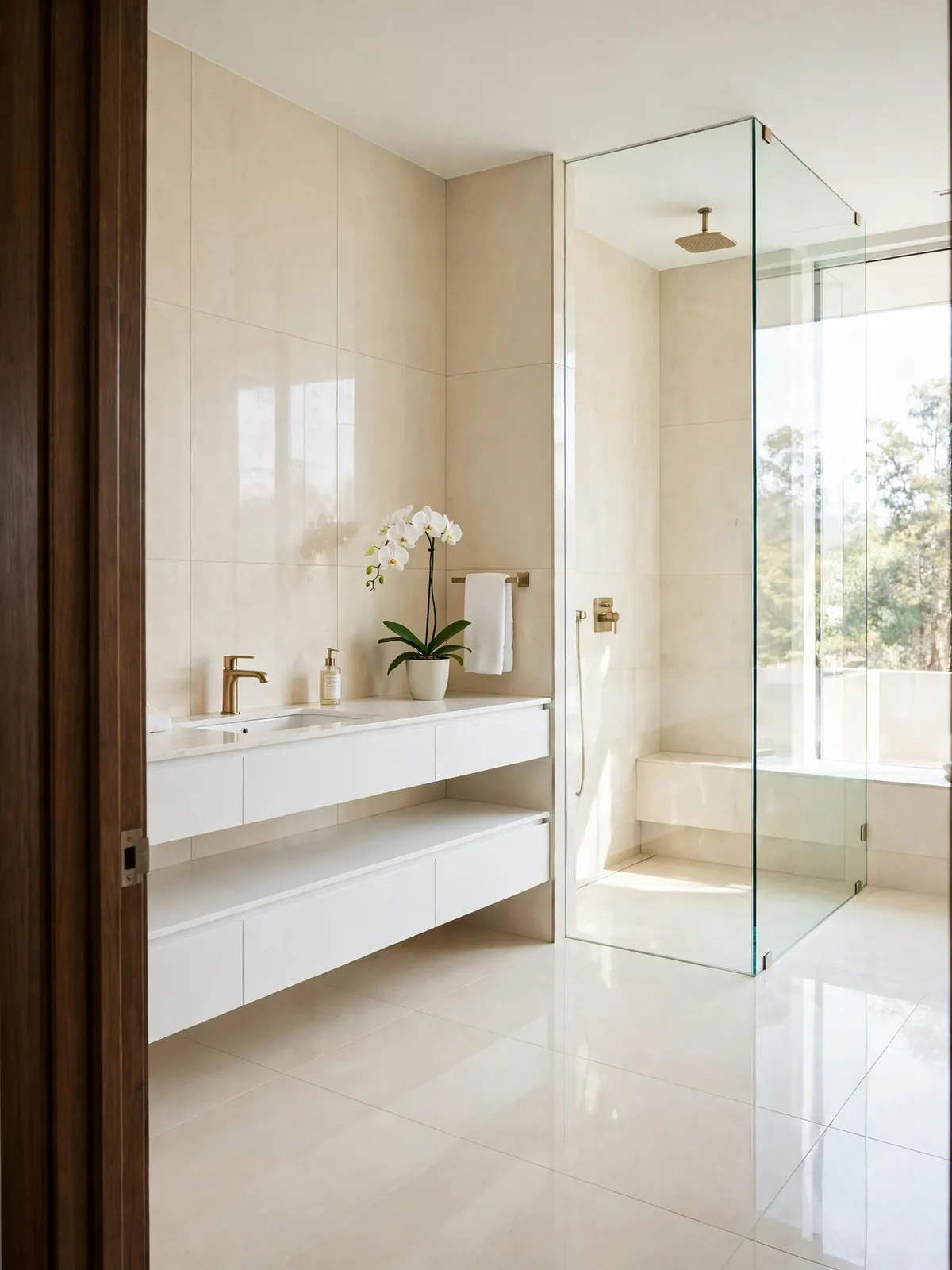
Large-format tiles give a minimalist bathroom a calmer finish, because fewer grout lines mean a smoother, more seamless appearance that instantly calms the eye. Here, large cream tiles stretch across the floor and walls, with a floating white vanity, a frameless glass shower and a single orchid keeping every line clean. The design suits small bathrooms best of all, it simplifies upkeep with less grout to scrub, and big tiles make compact rooms feel larger. The weakness is installation: large tiles need perfectly flat walls and a skilled tiler, and they can crack if the floor underneath moves.
Quick tips:
- Use the same tile on floor and walls for a seamless look.
- Match the grout colour to the tile so joints disappear.
- Choose a matte finish on the floor for grip.
- Hire a tiler experienced with large-format tiles.
One Piece of Minimal Wall Art
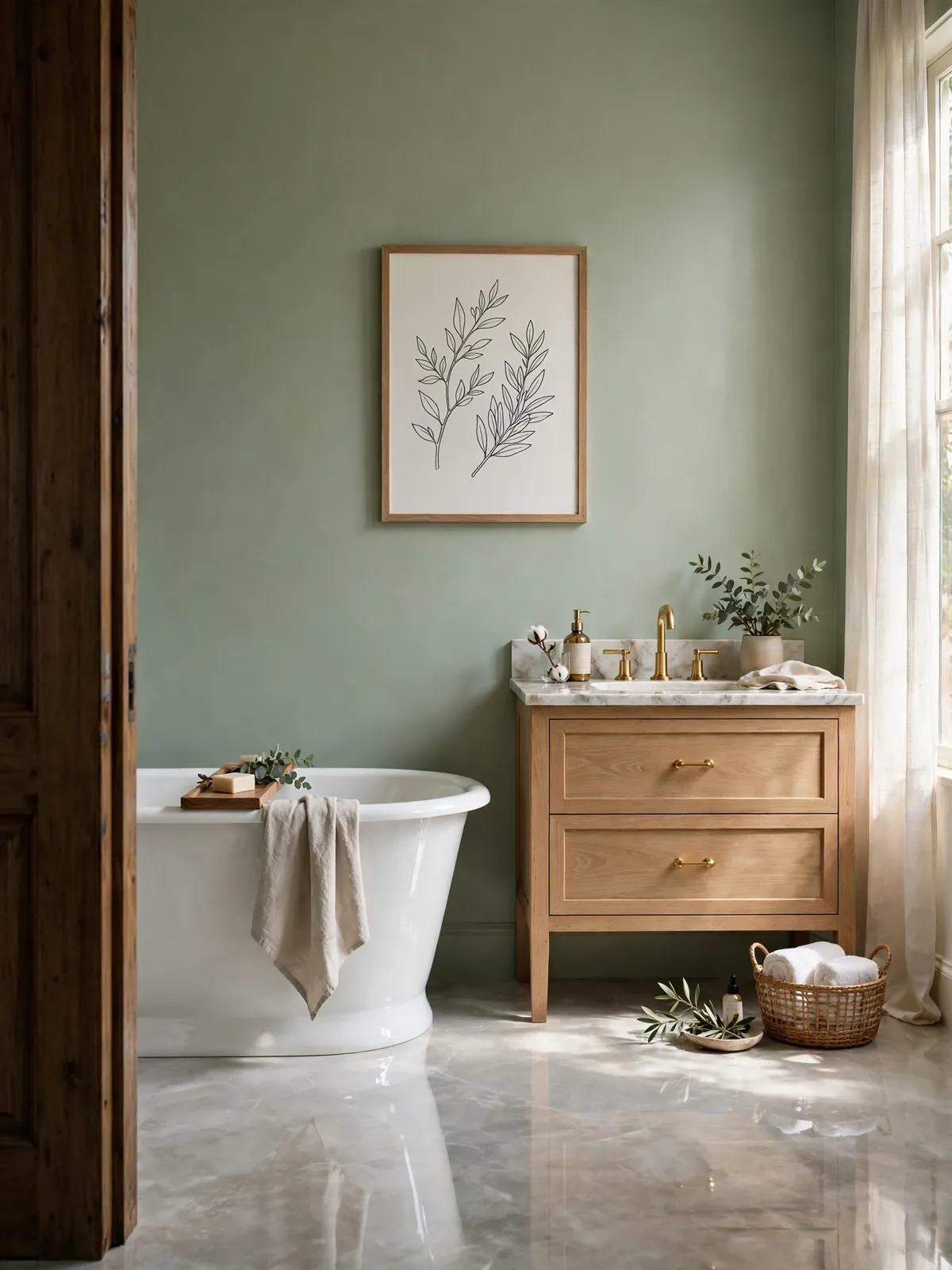
One piece of minimal wall art gives a minimalist bathroom personality without clutter, because a single line drawing or understated print adds a thoughtful touch while the simplicity of the art keeps the atmosphere quiet. Here, one framed line drawing hangs on a soft green wall above a white freestanding tub, with a light oak vanity and brass fixtures completing the calm scene. The design suits any bathroom, it costs little, and it breaks up a plain wall without dominating it. The weakness is choice: a busy or colourful print fights the minimalist palette, so choose a slim frame and neutral tones.
Quick tips:
- Choose one piece only — a line drawing or understated print.
- Use a slim frame in a neutral tone that matches the room.
- Hang it where you see it from the tub or vanity, not behind the door.
- Keep the art smaller than the wall — empty space is part of the design.
A Single Plant for Natural Calm
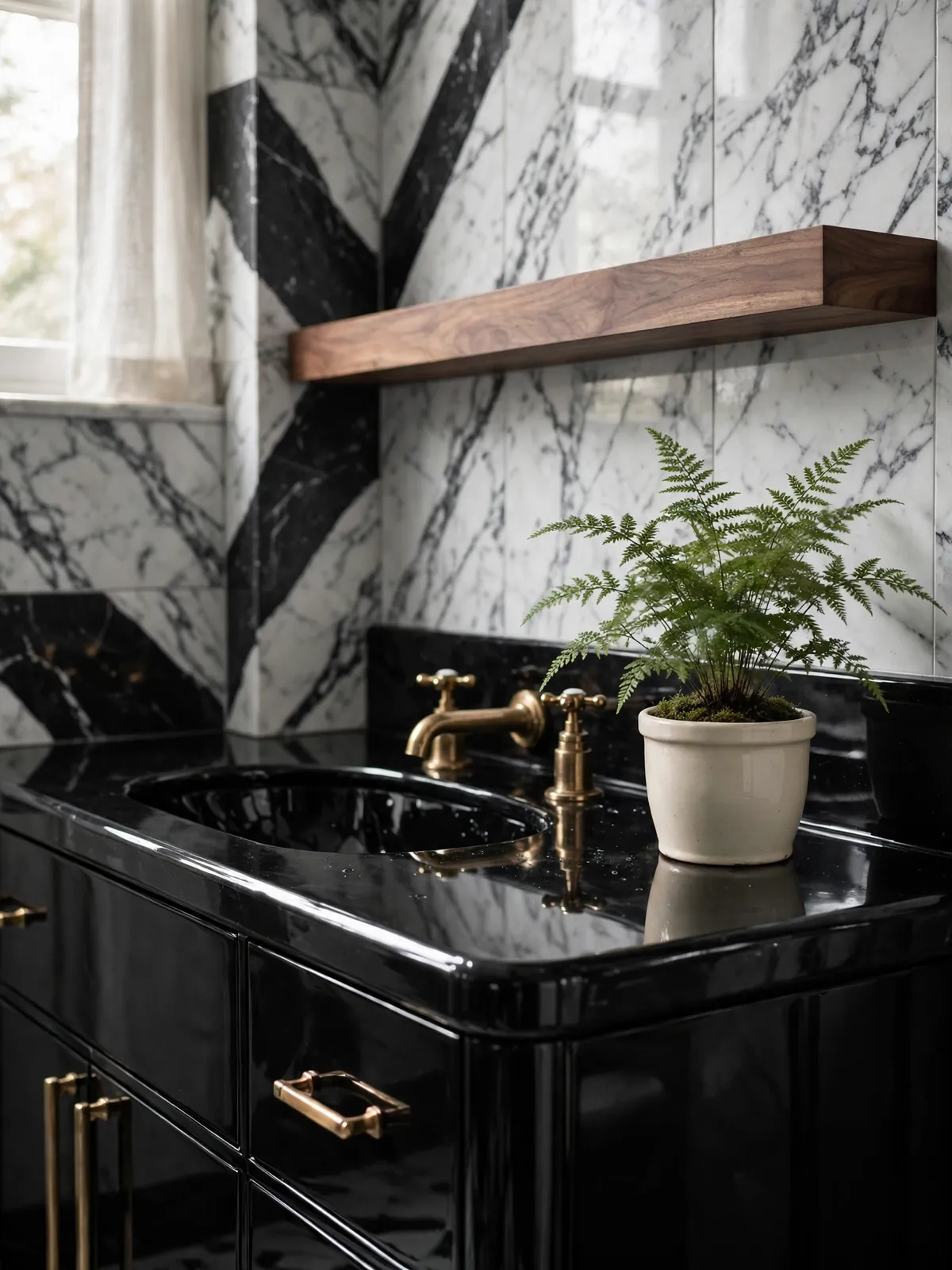
A single plant brings natural calm to a minimalist bathroom, because one well-chosen fern or succulent adds life and softness without overwhelming the clean lines. Here, a small fern in a cream ceramic pot sits on the vanity of a monochrome black and white bathroom, with a walnut shelf and brass taps warming the scene. The design suits any bathroom with even a little natural light, it costs almost nothing, and the green softens the harder lines of minimal design. The weakness is overdoing it: three plants start to feel like a jungle, so keep it to one.
Quick tips:
- Choose one plant — a fern, succulent or snake plant.
- Use a plain ceramic pot in a colour already in the room.
- Place it where it gets light but not direct sun.
- Keep it small so it never crowds the counter.
A Frameless Glass Shower Door
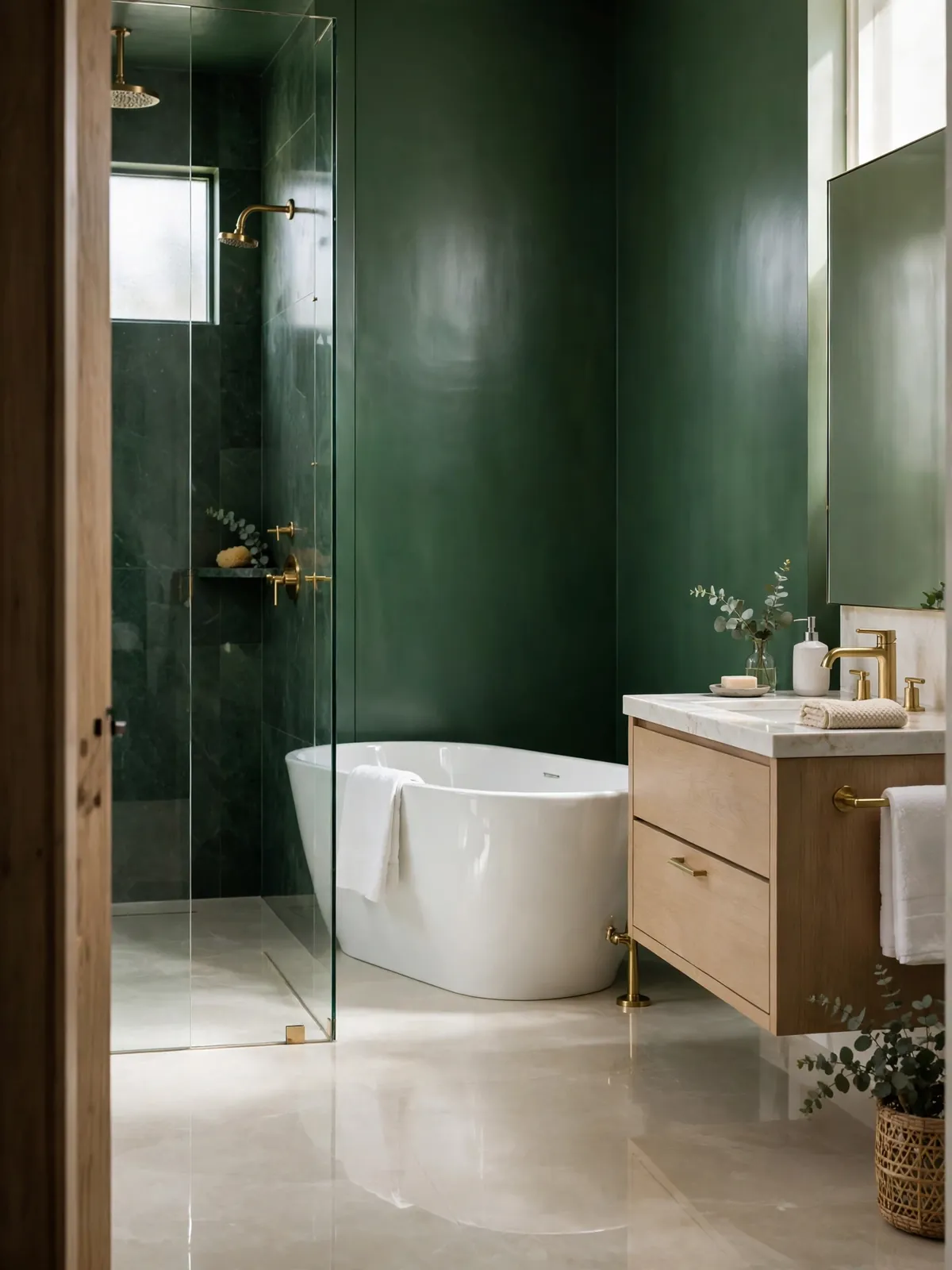
A frameless glass shower door upgrades a minimalist bathroom instantly, because the clean glass eliminates clutter, lets light flow freely and makes the shower feel like part of the architecture. Here, a frameless glass door encloses a shower against deep green walls, with a white freestanding tub, a light wood vanity and brass fixtures completing the hotel-worthy look. The design suits any shower, it makes the space feel more open and modern, and it has no fabric to wash or replace. The weakness is water spots: glass shows every drop, so keep a squeegee in the shower and wipe it after each use.
Quick tips:
- Choose frameless glass with minimal hardware.
- Keep a squeegee in the shower for a ten-second wipe.
- Match the door hardware to the taps and fixtures.
- Use low-iron glass if you want the clearest view.
Hidden Lighting for a Soft Glow
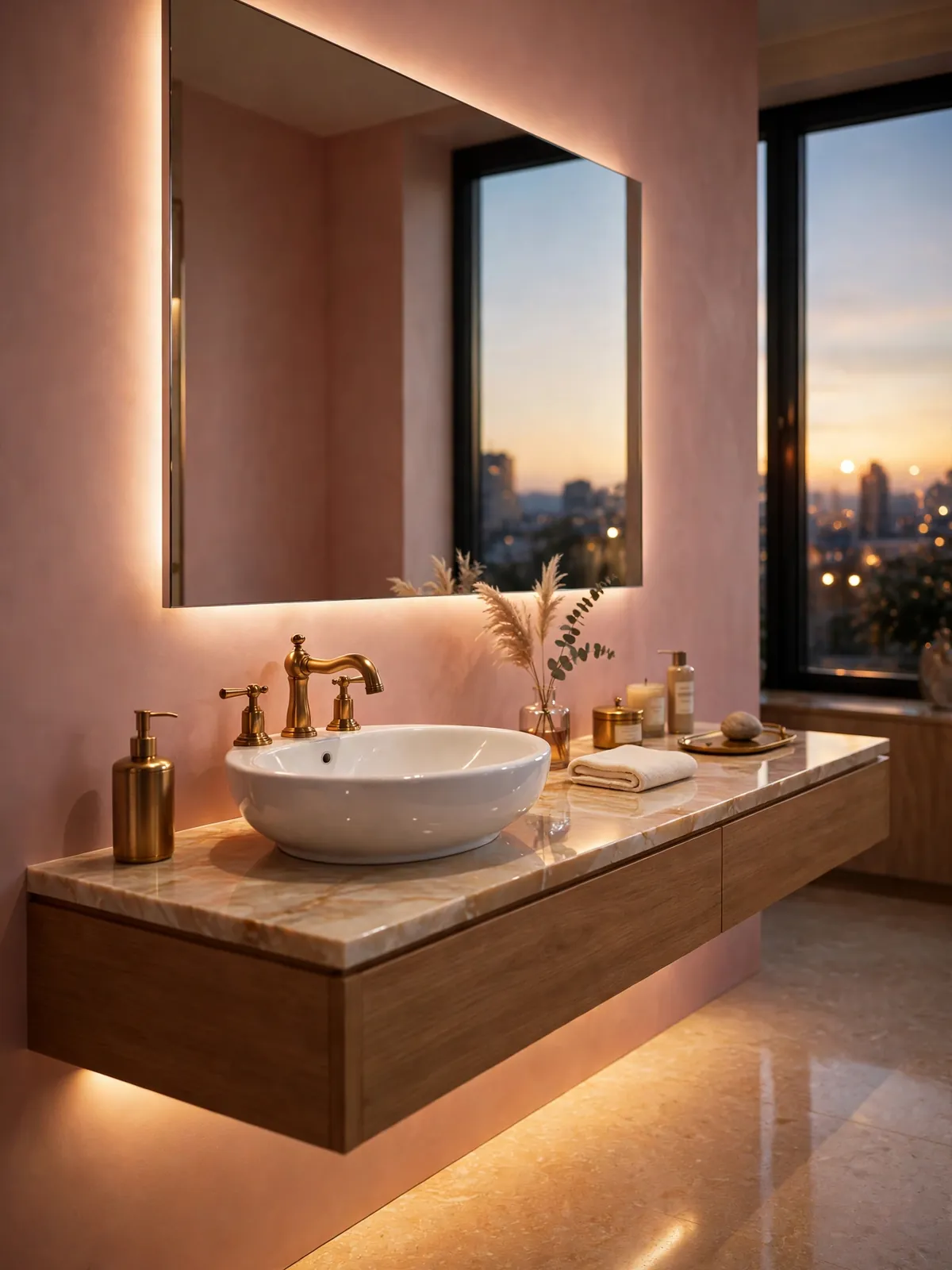
Hidden lighting gives a minimalist bathroom a soft glow that no ceiling bulb can match, because light tucked under cabinets or behind mirrors creates a gentle, ambient wash that feels restful and refined. Here, LED strips glow under a floating vanity and behind a mirror on dusty rose walls, with a white vessel sink, brass taps and a warm evening glow completing the boutique feeling. The design suits any bathroom, it makes mornings less jarring and evenings more serene, and with no bulky fixtures competing for attention the room stays sleek. The weakness is wiring: hidden LED strips need a driver and a planned power point, so install them during a renovation or a mirror swap.
Quick tips:
- Use warm white LED strips around 2700K for a calm glow.
- Hide strips under the vanity and behind the mirror.
- Add a dimmer so the light adapts to morning and evening.
- Keep the fixtures invisible — the glow is the design.
A Single Bench for Function and Calm
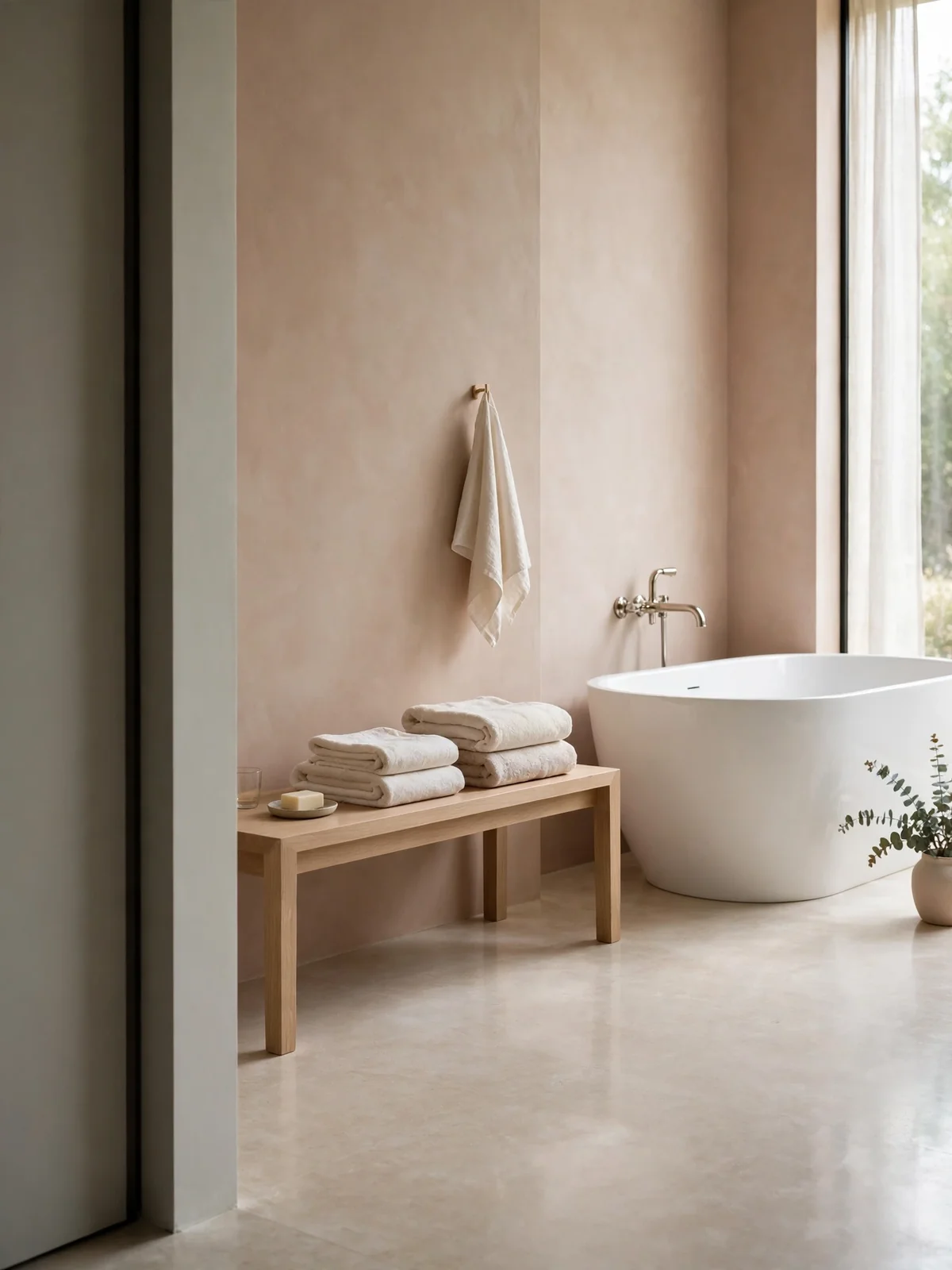
A single bench adds function and calm to a minimalist bathroom, because one simple piece offers a place to sit, set things down or relax while you wait, and it becomes a calming focal point instead of clutter. Here, a light wood bench with clean lines holds folded cream towels beside a white freestanding tub, with pale terracotta walls keeping the room warm. The design suits larger bathrooms best of all, it is a small luxury that encourages you to slow down, and it doubles as storage for towels. The weakness is space: a bench needs floor area that small bathrooms cannot spare, so keep it slim and against the wall.
Quick tips:
- Choose a bench with clean lines in wood or stone.
- Keep it slim and against the wall, not in the walkway.
- Use it for folded towels, not for piled clutter.
- Match the bench material to the vanity for cohesion.
A Backlit Mirror That Glows Like Art
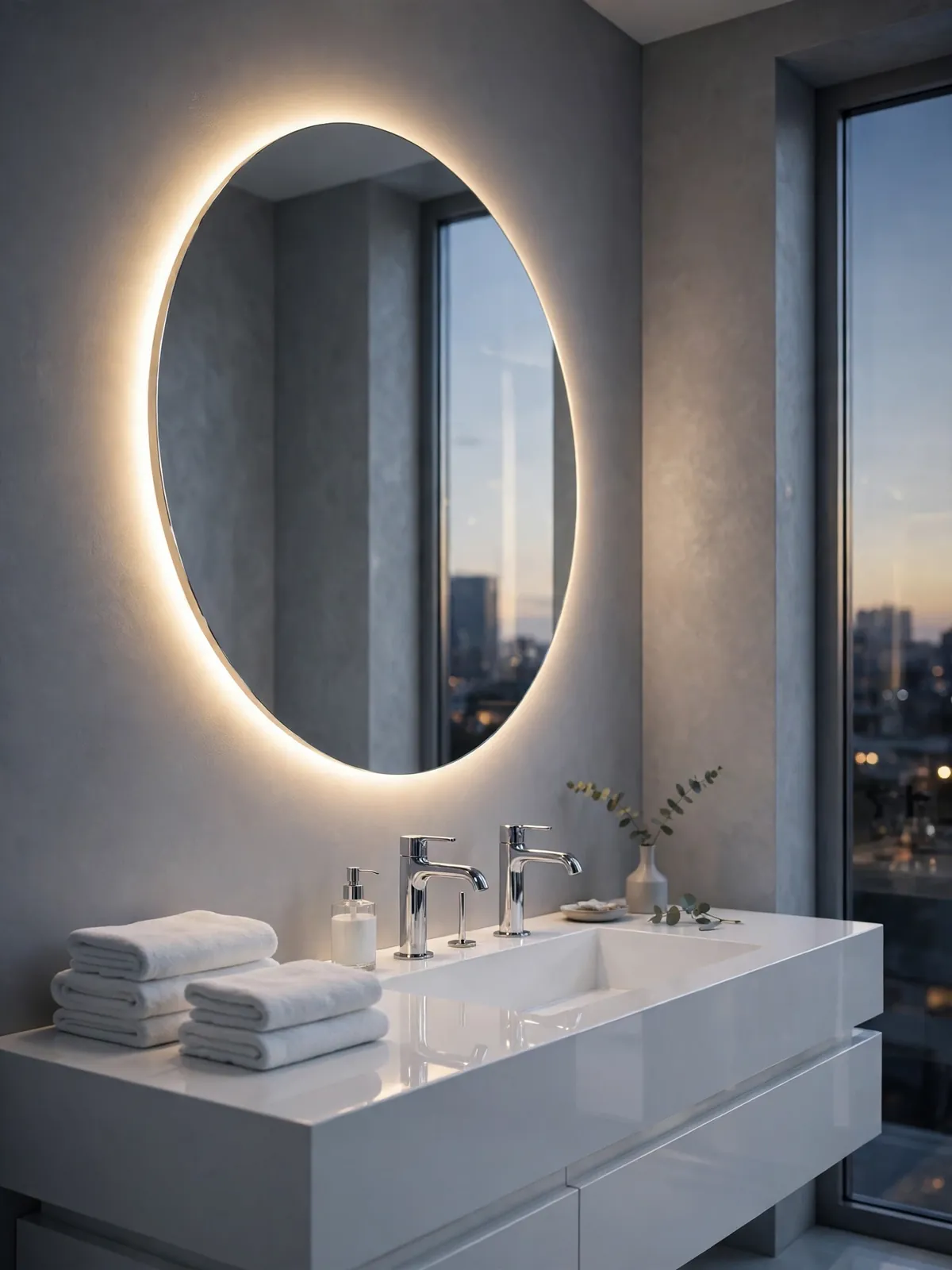
A backlit mirror glows like art in a minimalist bathroom, because the halo of LED light around its edges creates a cosy centrepiece that is easy on the eyes and surprisingly elegant. Here, a round mirror with a soft backlight hangs above a white floating vanity on cool grey walls, with chrome taps and folded white towels completing the refined scene. The design suits any bathroom, it removes harsh shadows for grooming, and it turns a plain mirror into the room’s focal point. The weakness is wiring: a backlit mirror needs a power point behind it, so plan it during a renovation or a mirror swap.
Quick tips:
- Choose a round or oval mirror for the softest halo.
- Use warm white LED backlighting around 2700K.
- Add a dimmer or a touch sensor for control.
- Keep the wall behind the mirror plain so the glow stays the focus.
Minimalist Bathroom Ideas That Pull the Whole Room Together
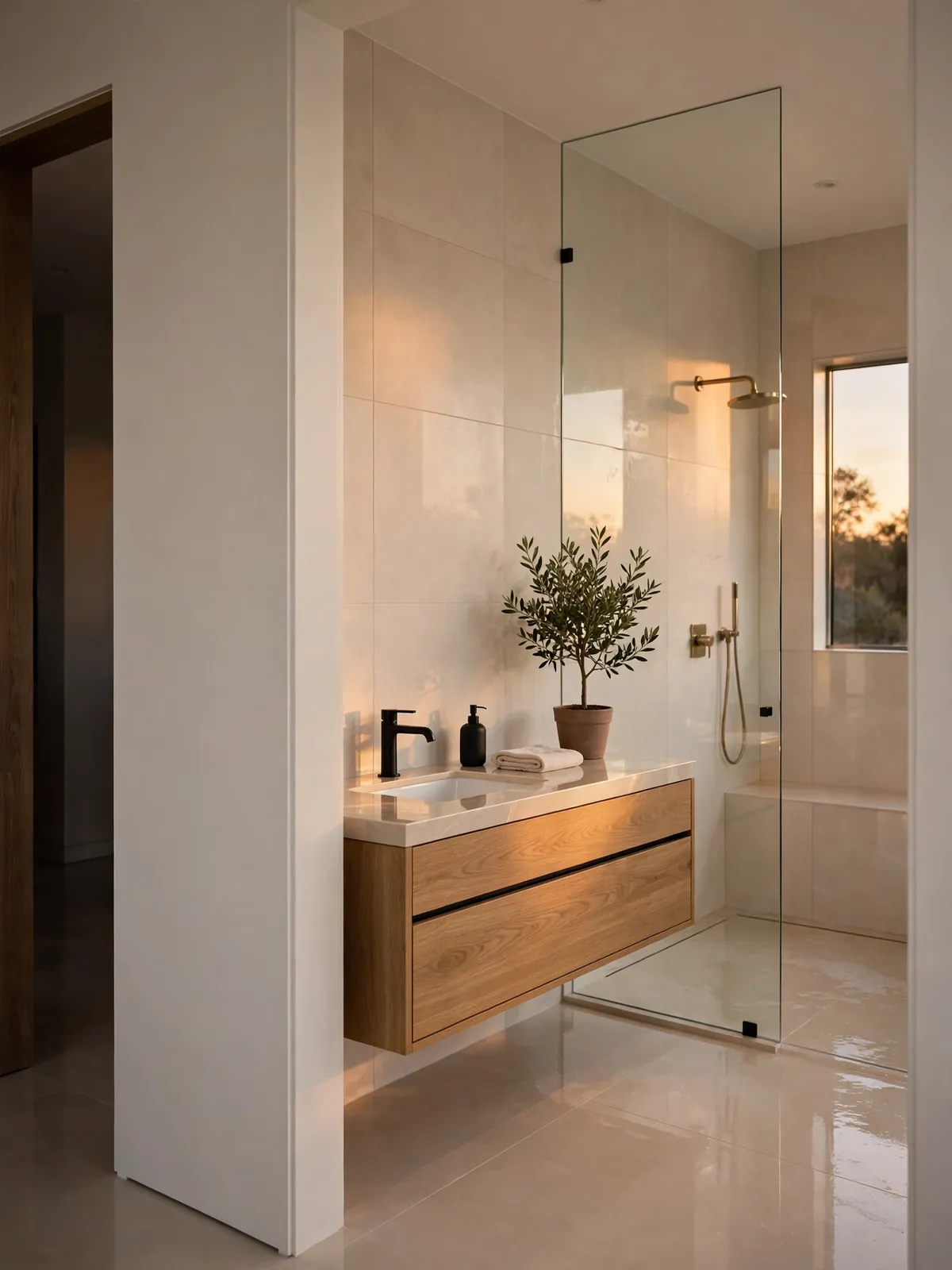
The last of these minimalist bathroom ideas is the principle behind them all, and it is worth stating plainly because it is the difference between a bathroom that looks minimalist in a photograph and one that feels calm every day: a great minimalist bathroom is not an empty room, it is a room where every choice was made once and then repeated quietly — a floating vanity that frees the floor, one hardware finish on every fixture so nothing clashes, large-format tiles in a warm neutral so the walls and floor read as one continuous surface, hidden storage that keeps the counters clear, and one warm material, light oak or teak, appearing in the vanity, the tray and the bench so the room feels warm instead of clinical — working together so that the floor, the walls, the fixtures and the light all support each other instead of competing for attention, and the room rewards you every time you walk in rather than only on the day it was finished. Here, a calm bathroom pulls it together — a floating oak vanity, warm white walls, large-format tiles, a frameless glass shower and a single plant — and nothing in the room is there by accident. The lesson is to clear the counters first, since a clear surface is the test that proves minimalism works, then choose the vanity and the tile, hide everything behind closed doors and inside the walls, and add warmth through texture and wood rather than through objects, because a bathroom built in that order stays calm with very little effort, even in a small bathroom, even on a modest budget, and even when you change only one thing at a time. Start with the clear counter, add the floating vanity and the hidden storage, and the minimalist bathroom stops being a style you admire in photographs and becomes the calm room you use every morning.
Quick tips:
- Clear the counters first — a clear surface is the test.
- Choose the vanity and the tile before anything else.
- Hide everything behind closed doors and inside the walls.
- Add warmth through texture and wood, not through objects.
FAQs
How do I keep a minimalist bathroom from feeling cold?
Add warmth through texture and natural materials, not through objects: warm white walls instead of stark white, a light oak vanity, a woven basket, a wooden tray for towels and warm white lighting around 2700K. One plant and one textile are enough — the warmth comes from the materials, not from decoration.
What is the best vanity for a minimalist bathroom?
A floating vanity with a slab front and deep drawers is the best vanity for a minimalist bathroom, because it frees visible floor, hides clutter and keeps the counters clear. Choose a pale, warm colour — white, light oak or pale sage — and match it to the wall so the vanity reads as part of the room.
How much storage does a minimalist bathroom need?
A minimalist bathroom needs enough hidden storage for everything you use daily, and no open storage at all: a floating vanity with deep drawers, a recessed mirror cabinet, a shower niche and one slim wall cabinet. If something has no hidden home, it does not belong in the room — that rule is what keeps the counters clear.
Which colours work best in a minimalist bathroom?
Warm whites, greige, soft grey, pale sage and warm taupe work best in a minimalist bathroom, because they are calm, bright and easy to live with. Limit the palette to two shades, keep the hardware finish as the only accent, and avoid stark blue-white, which feels clinical instead of calm.
Can a minimalist bathroom have any decoration?
Yes — a minimalist bathroom can have one plant, one piece of wall art, one textile and one decor object, and that is enough. The rule is one of each, in the room’s existing colours, so the decoration adds personality without adding visual noise. The moment a second of anything appears, the calm starts to break.
Conclusion
A minimalist bathroom is not an empty bathroom — it is a room where every fixture, finish and object has a clear purpose, and the 22 ideas above show that you can get there at almost any budget, whether you install a floating vanity and large-format tiles, swap the hardware for one consistent finish and hide the storage, or simply clear the counters and paint the walls warm white. Start with the clear counter, choose the vanity and the tile, hide everything behind closed doors, and add warmth through texture and wood. Do that, and your bathroom stops being a cluttered room you rush through and becomes a calm, bright, spa-like retreat you enjoy every single day.