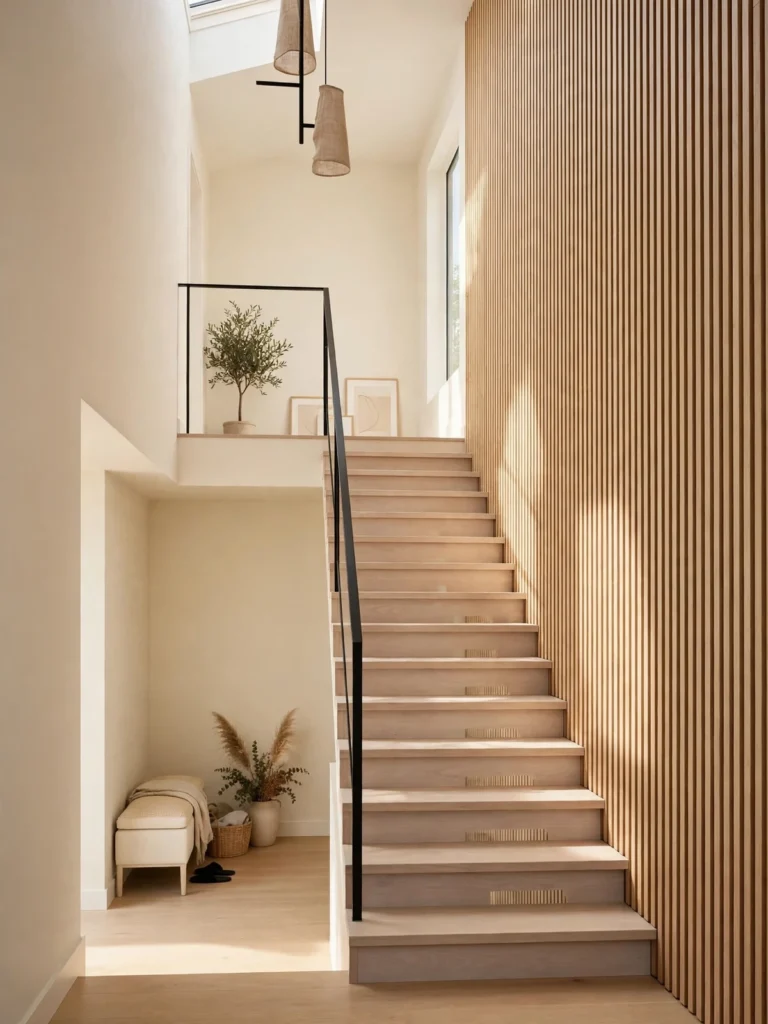
22 Stunning Wrought Iron Staircase Ideas That Turn Your Stair Into a Showpiece
Wrought iron is one of the few staircase materials that suits almost every home — classic, modern, farmhouse or grand. These 22 wrought iron staircase ideas cover scrollwork, handrails, balusters, finishes, lighting and outdoor iron, so you can choose a design that fits your space, your budget and the way your family actually uses the stairs.
Wrought iron staircase ideas work because wrought iron is strong, slim and endlessly adaptable: a hand-forged scroll railing suits a traditional entry, a geometric black panel suits a modern loft, and a weathered iron stair suits a farmhouse. A wrought iron staircase is a staircase whose railings, balusters or newel posts are made from hand-worked iron — forged, bent and welded into scrolls, twists or clean lines — rather than from wood or steel tube alone. The iron gives the stair its structure and its character, while the steps, handrail and finish decide whether the result feels grand, romantic, rustic or minimal.
If you are planning the whole stair, not just the metalwork, these staircase design ideas show how the stair’s shape, materials and railing work together before you commit to a single finish. The 22 designs below cover curved stairs, spiral stairs, open risers, marble pairings, gold accents, integrated lighting and weatherproof outdoor iron, with honest notes on cost, cleaning and safety, so you can pick the ironwork that will still look right in twenty years.
Key Takeaways
What is a wrought iron staircase?
A wrought iron staircase is a staircase with railings, balusters or newel posts made from hand-worked iron that is heated, bent and welded into decorative or straight forms. The iron provides the balustrade — the safety barrier along the open side of the stair — while the steps are usually wood, stone or marble. Genuine wrought iron is malleable and durable; most modern “wrought iron” railings are mild steel worked in the same traditional style.
How much does a wrought iron staircase cost?
Cost depends on design complexity, length and finish. A simple straight run with plain balusters is the most affordable option; hand-forged scrollwork, curved rails, spiral stairs and marble steps cost considerably more because they need skilled metalwork and more labour. Always get an itemised quote that separates the ironwork, the handrail, the steps, the finish and the installation before ordering.
Is wrought iron safe for homes with children and pets?
Yes, when it is built to code. Baluster spacing must be close enough that a small child cannot slip through — in most regions the gap should not pass a 4-inch sphere — and the handrail must sit at a comfortable gripping height. Choose smooth, rounded scrollwork over sharp finials in family homes, and check local building codes before fabrication, because spacing and height rules vary.
How do I stop a wrought iron staircase from rusting?
Keep the finish intact. Indoor iron needs only dusting and an occasional wipe with a damp cloth, followed by drying. Outdoor iron needs a weather-resistant powder coat or paint, and any chip or scratch should be touched up promptly so moisture cannot reach bare metal. In coastal or damp homes, ask your fabricator for a galvanised base coat under the powder coat.
Can wrought iron suit a modern home, or is it only traditional?
It suits modern homes very well when the pattern is simple. Slim straight balusters, geometric panels, matte black finishes and glass paired with iron all read as contemporary. The ornate scrollwork is what makes iron feel traditional, so for a modern look, keep the lines straight, the spacing even and the finish matte.
A Classic Curved Staircase With Hand-Forged Scrollwork
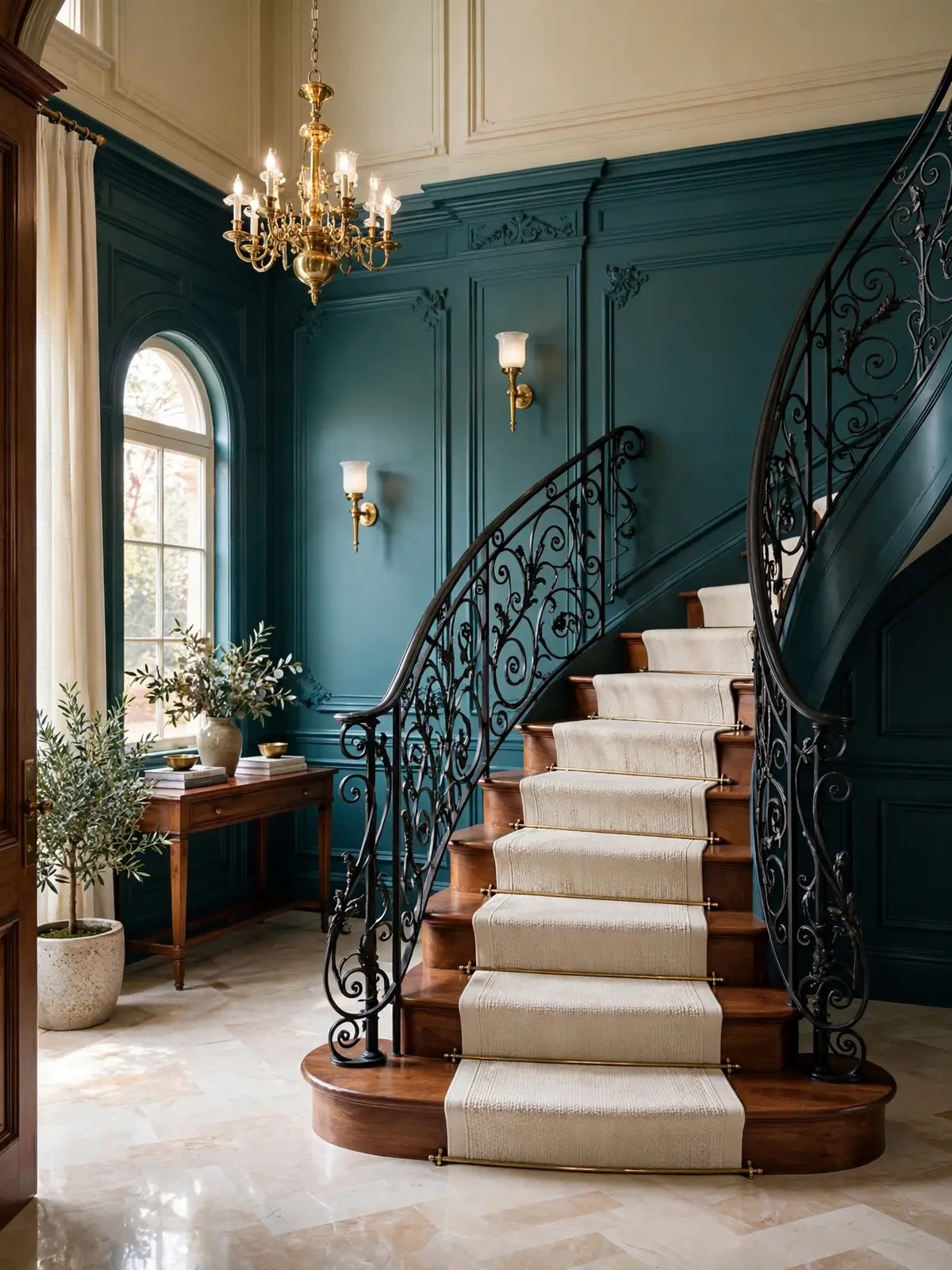
A classic curved staircase with hand-forged scrollwork is the most romantic of all wrought iron staircase ideas, because the gentle sweep of the stair and the curl of the iron work together like a piece of architecture rather than a piece of furniture. Here, deep teal walls set off black scrollwork balusters that curl into small rosettes, with warm walnut treads and a cream runner softening the metal underfoot, and a brass chandelier hanging above the curve. The design suits grand entries and traditional homes, it makes the stair the first thing guests notice, and it photographs beautifully from both floors. The weakness is cost and space — a curved stair needs a skilled fabricator and a generous footprint — and the scrolls collect dust, so keep a soft brush handy and budget for hand-forged work rather than off-the-shelf panels.
Quick tips:
- Let the scrollwork follow the curve — never force straight panels onto a bend.
- Pair scroll iron with warm wood treads so the metal feels inviting.
- Add a chandelier or pendant above the curve for evening drama.
- Dust scrolls with a soft brush; a damp cloth misses the curls.
Wrought Iron Paired With a Warm Walnut Handrail
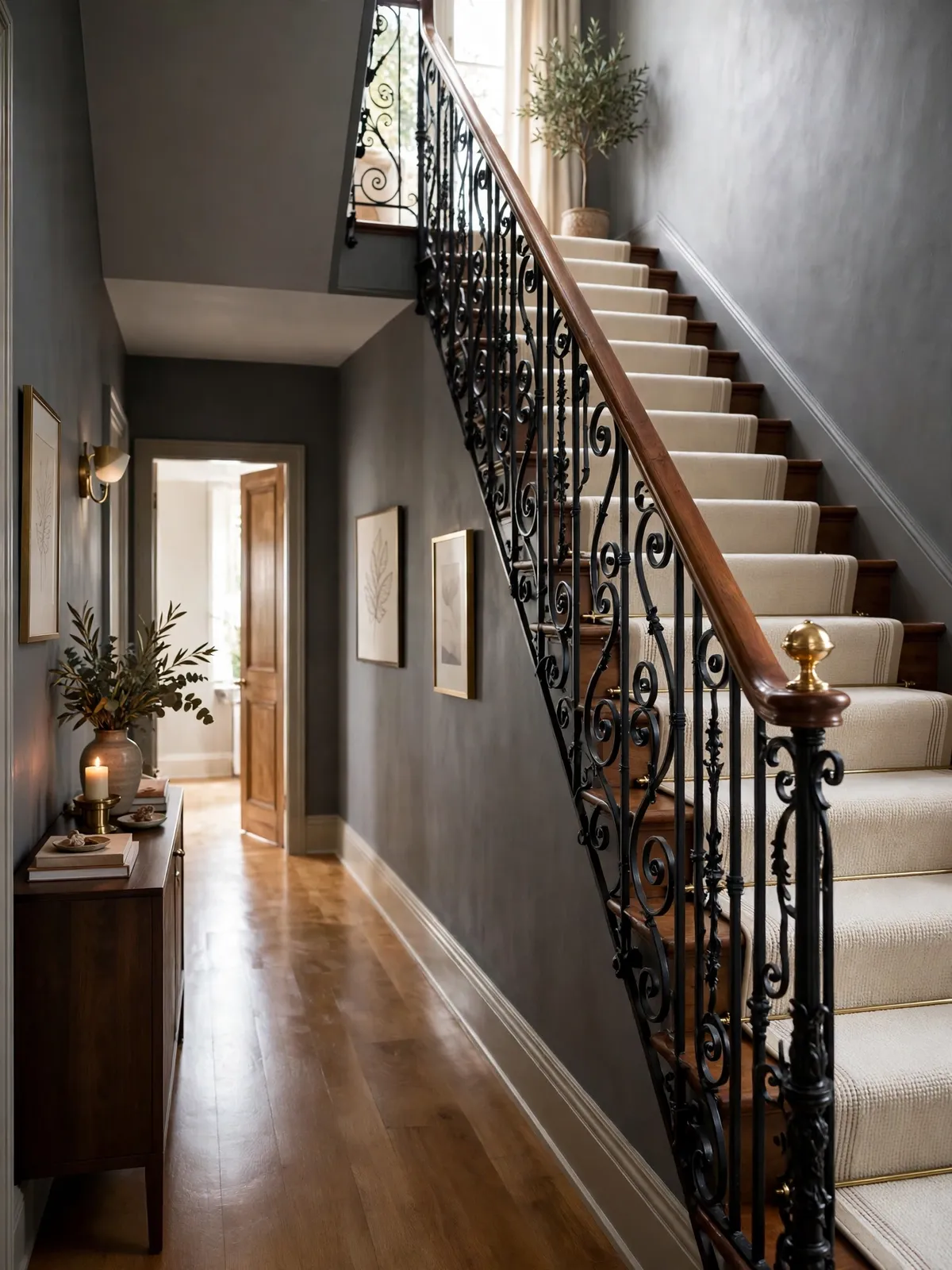
Wrought iron paired with a warm walnut handrail is the combination most designers reach for first, because iron gives strength and walnut gives warmth where your hand actually touches the stair. Here, slim black iron balusters rise to a smooth walnut rail with a brass newel cap, against charcoal-grey walls and a cream carpet runner that quiets footsteps. The design suits almost any home, it makes a cold material feel human, and it is comfortable to grip in winter when bare metal feels cold. The weakness is matching tones — a walnut rail that clashes with the floor looks accidental — so match the handrail to the flooring or the treads, and choose a satin finish on the wood so it stays smooth under daily use.
Quick tips:
- Match the handrail tone to the floor or the treads.
- Choose a satin finish so the rail stays smooth to grip.
- Keep balusters slim so the wood rail stays the visual anchor.
- Add a brass or bronze newel cap for a finished detail.
A Spiral Wrought Iron Staircase for Compact Homes
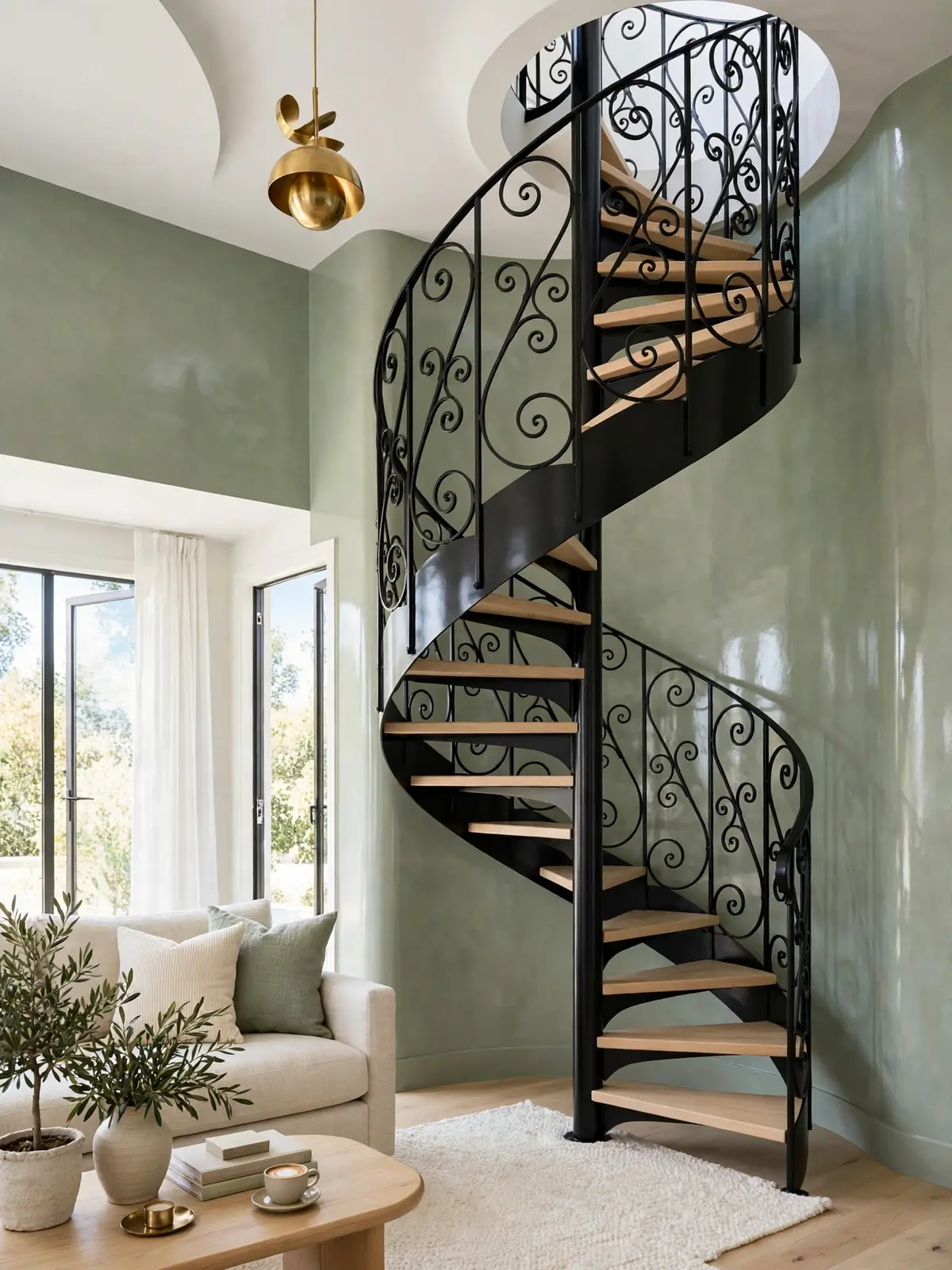
A spiral wrought iron staircase for compact homes is the smartest use of iron in a small footprint, because the metal can be bent into a tight, self-supporting coil that a wooden stair could never manage in the same space. Here, a black iron spiral rises through a double-height corner, with pale oak treads, sage-green walls and a brass pendant hanging through the centre, and a cream rug softening the floor below. The design suits studio apartments, lofts and garden rooms, it adds movement and sculpture to a plain corner, and it leaves the floor beneath free. The weakness is everyday use — spiral stairs are steep, the treads narrow at the centre, and carrying furniture up them is difficult — so keep the railing open and airy, measure the headroom carefully, and treat it as a secondary stair rather than the main route for heavy loads.
Quick tips:
- Keep the railing open so a tight spiral does not feel cramped.
- Measure headroom at every turn before ordering.
- Use pale treads to keep the coil feeling light.
- Hang a pendant through the centre to light the whole spiral.
Geometric Wrought Iron Panels for a Modern Look
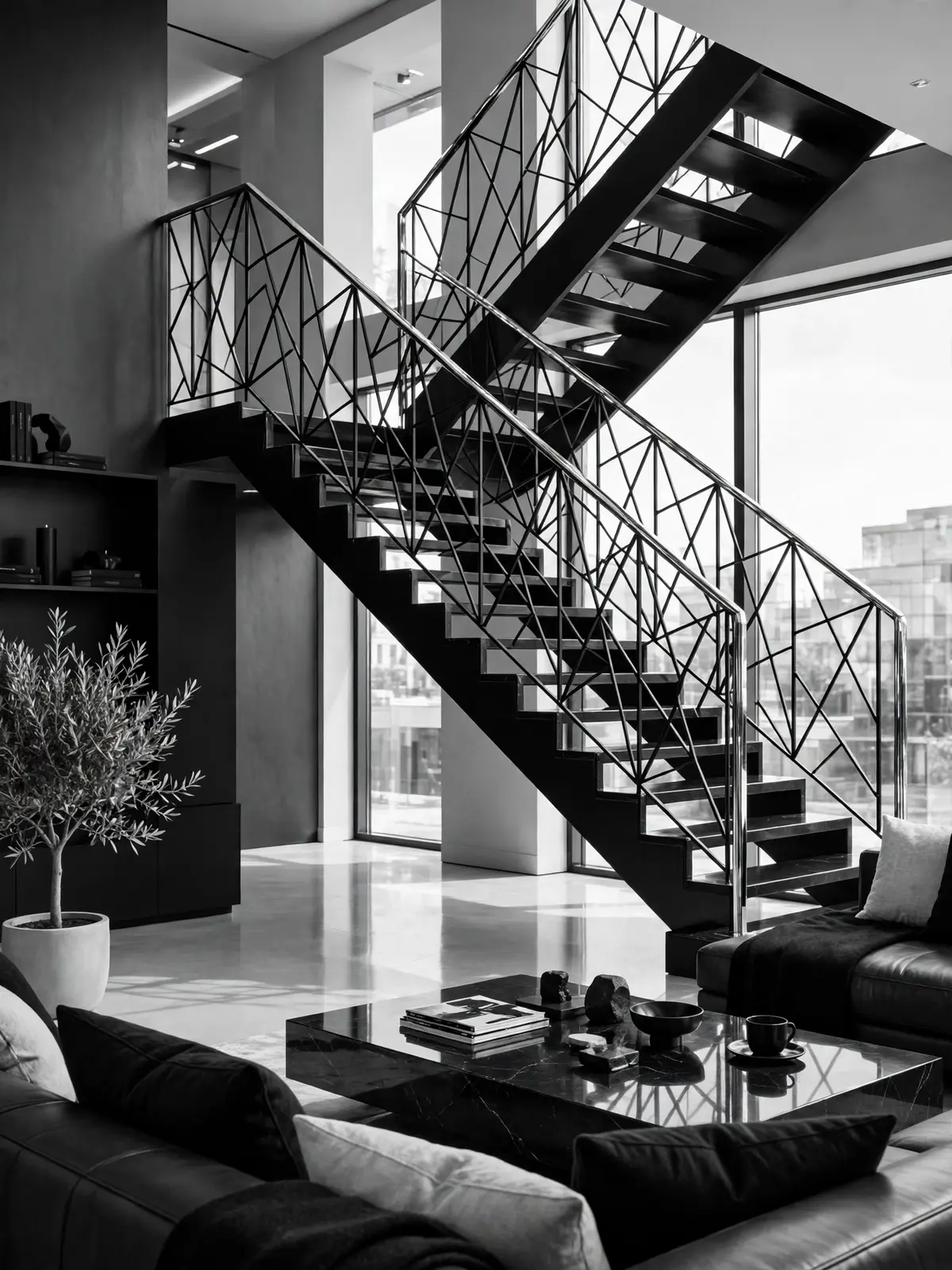
Geometric wrought iron panels for a modern look prove that iron is not only traditional, because squares, diamonds and clean diagonal lines turn the railing into a piece of graphic art. Here, black iron panels in a repeating diamond pattern run along a straight flight, with a slim chrome handrail, white walls and a pale grey floor keeping the whole composition crisp. The design suits modern and minimalist homes, it reads as intentional rather than decorative, and it works well where a classic scroll would feel out of place. The weakness is that a bold pattern dominates the room, so keep the surrounding decor minimal and the finish matte black, and check the pattern scale on site — a diamond that looks elegant in a drawing can feel busy at full size.
Quick tips:
- Keep surrounding decor minimal so the pattern stays the star.
- Use a matte black finish for a sharp modern read.
- Test the pattern at full scale before fabrication.
- Pair geometric iron with pale floors for contrast.
Floral and Vine Motifs for a Romantic Stair
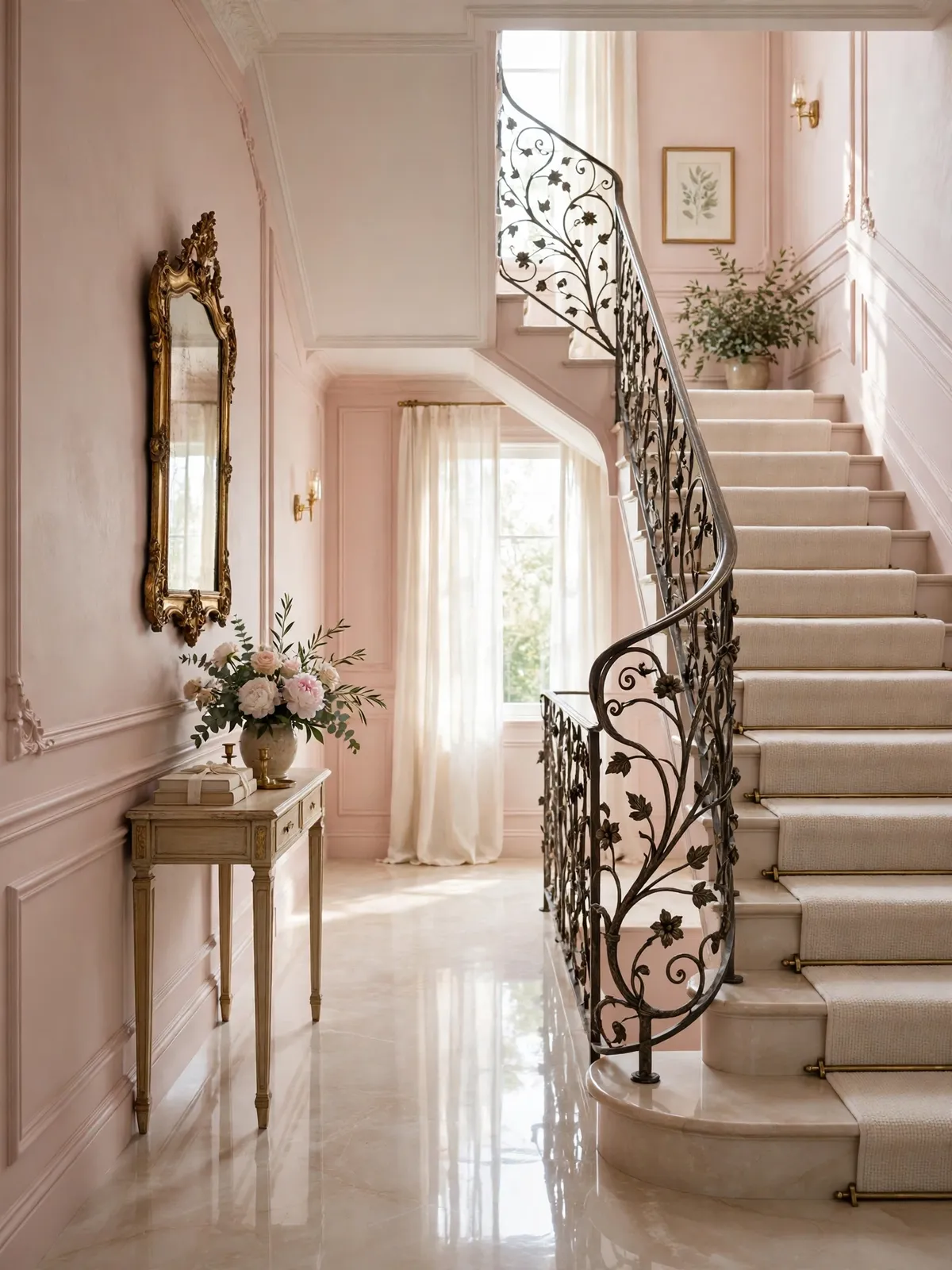
Floral and vine motifs for a romantic stair soften iron in a way no other pattern can, because leaves, stems and small blooms bent into the balusters make the metal feel grown rather than made. Here, delicate iron vines climb the balustrade with small forged leaves, against blush-pink walls, a cream carpet runner and an antique gold mirror at the landing. The design suits cottage-style homes, bedrooms stairs and living rooms with a soft, personal feel, it adds charm without needing colour, and it pairs beautifully with linen, rattan and pale wood. The weakness is overdoing it — too many flowers and the stair looks like a garden gate — so keep the motif to one panel or a repeating leaf, and choose a dark bronze or black finish so the shapes read clearly against pale walls.
Quick tips:
- Keep the floral motif to one repeating element, not a tangle.
- Use a dark finish so the shapes read against pale walls.
- Pair vine iron with linen, rattan and pale wood.
- Place it near a living room or bedroom stair for the softest effect.
An Open-Riser Staircase With Slim Iron Railings
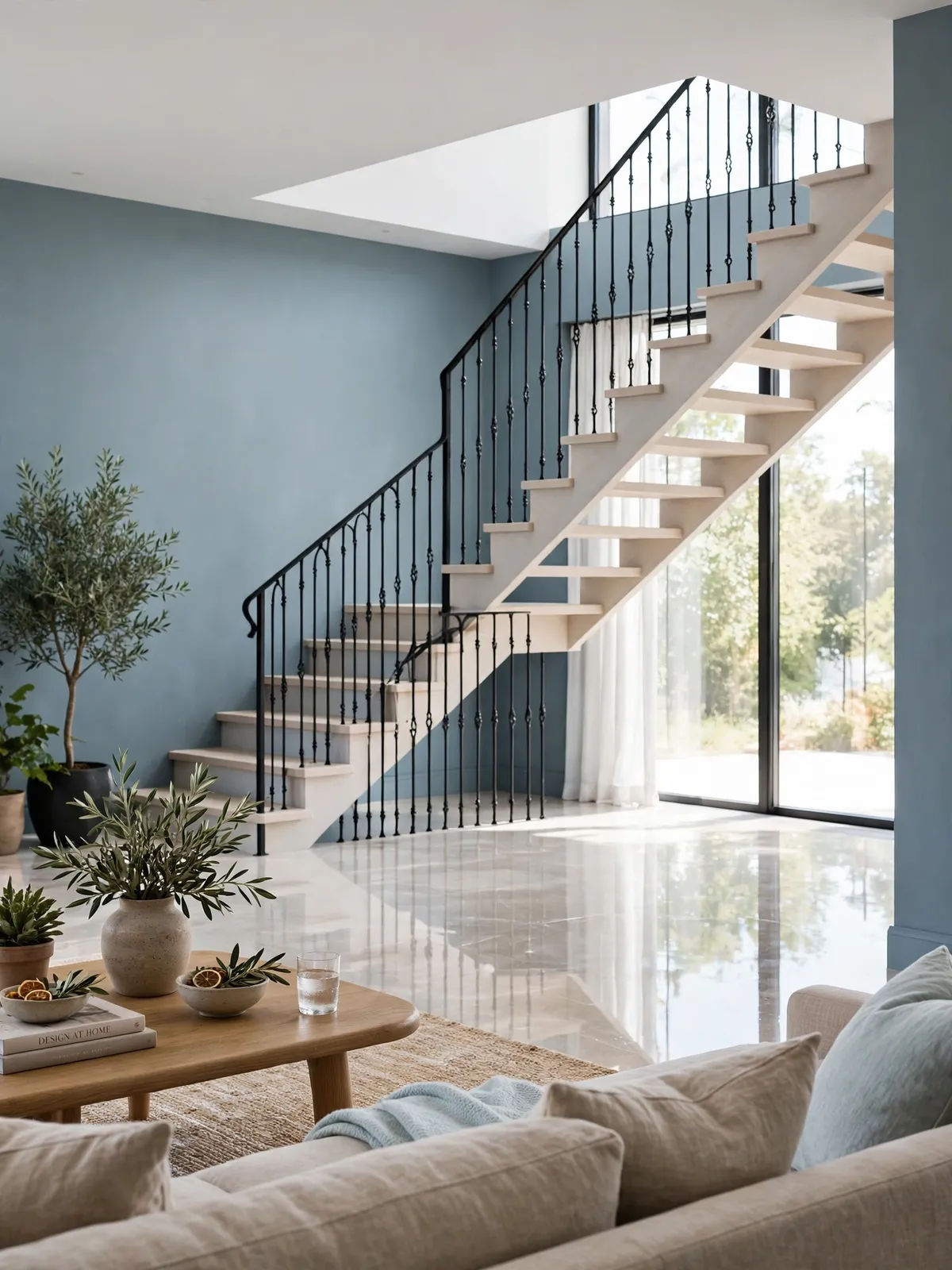
An open-riser staircase with slim iron railings makes a small home feel larger, because light passes between the treads and through the slim balusters instead of being blocked by solid risers and a heavy balustrade. Here, pale ash treads float between two walls, with thin black iron balusters and a slim rail, against dusty-blue walls and a white ceiling that bounces the daylight around. The design suits small homes, lofts and open-plan living, it keeps the stair feeling like furniture rather than a wall, and it shows off the ironwork from every angle. The weakness is safety and draughts — open risers are not ideal for very small children or for homes where things fall through the gaps — so check local code on riser gaps, add a runner if the treads feel slippery, and keep the balusters close enough to meet spacing rules.
Quick tips:
- Check local code on open-riser gaps before building.
- Keep balusters slim but closely spaced for safety.
- Add a runner if the treads feel slippery underfoot.
- Use pale treads so the floating effect stays light.
Matte Black Wrought Iron for Bold Contrast
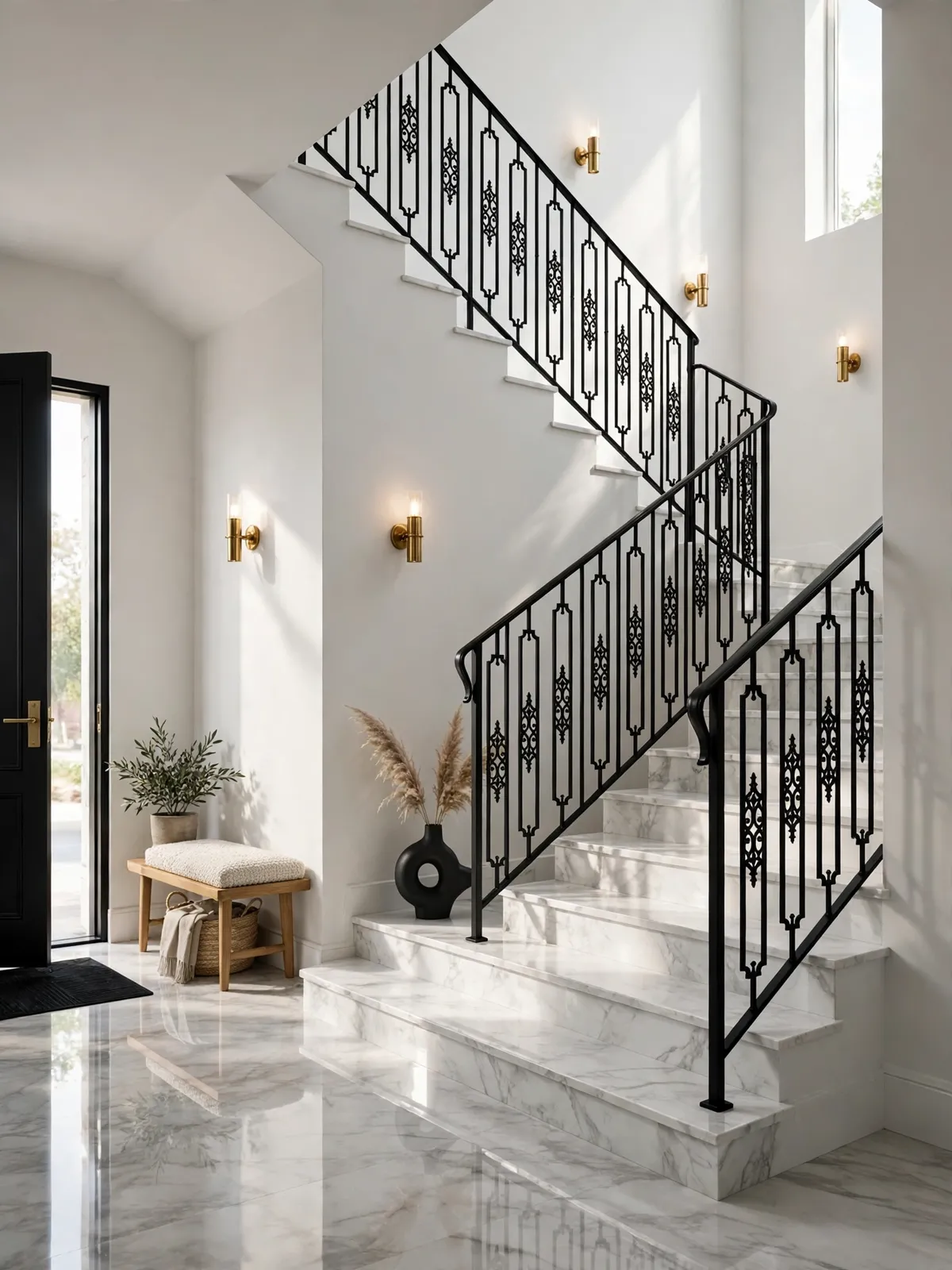
Matte black wrought iron for bold contrast is the simplest way to make a stair unforgettable, because a flat black railing against pale walls draws the eye along the whole flight like a drawn line. Here, matte black balusters and a matching rail run beside white marble treads, with brass wall sconces warming the wall and soft white paint keeping the room bright. The design suits all-white homes, modern farmhouses and monochrome interiors, it grounds a pale room, and it needs almost no other decoration to look finished. The weakness is fingerprints and dust, which show more on matte black than on a gloss finish, so wipe the rail weekly, keep the surrounding decor minimal so the stair stays the focal point, and avoid pairing matte black with another strong black feature that competes with it.
Quick tips:
- Keep surrounding decor minimal so the stair stands out.
- Wipe the rail weekly — dust shows on matte black.
- Pair matte black iron with one warm metal, like brass.
- Use pale walls and floors for maximum contrast.
Gold-Tipped Ironwork for a Quiet Luxury Touch
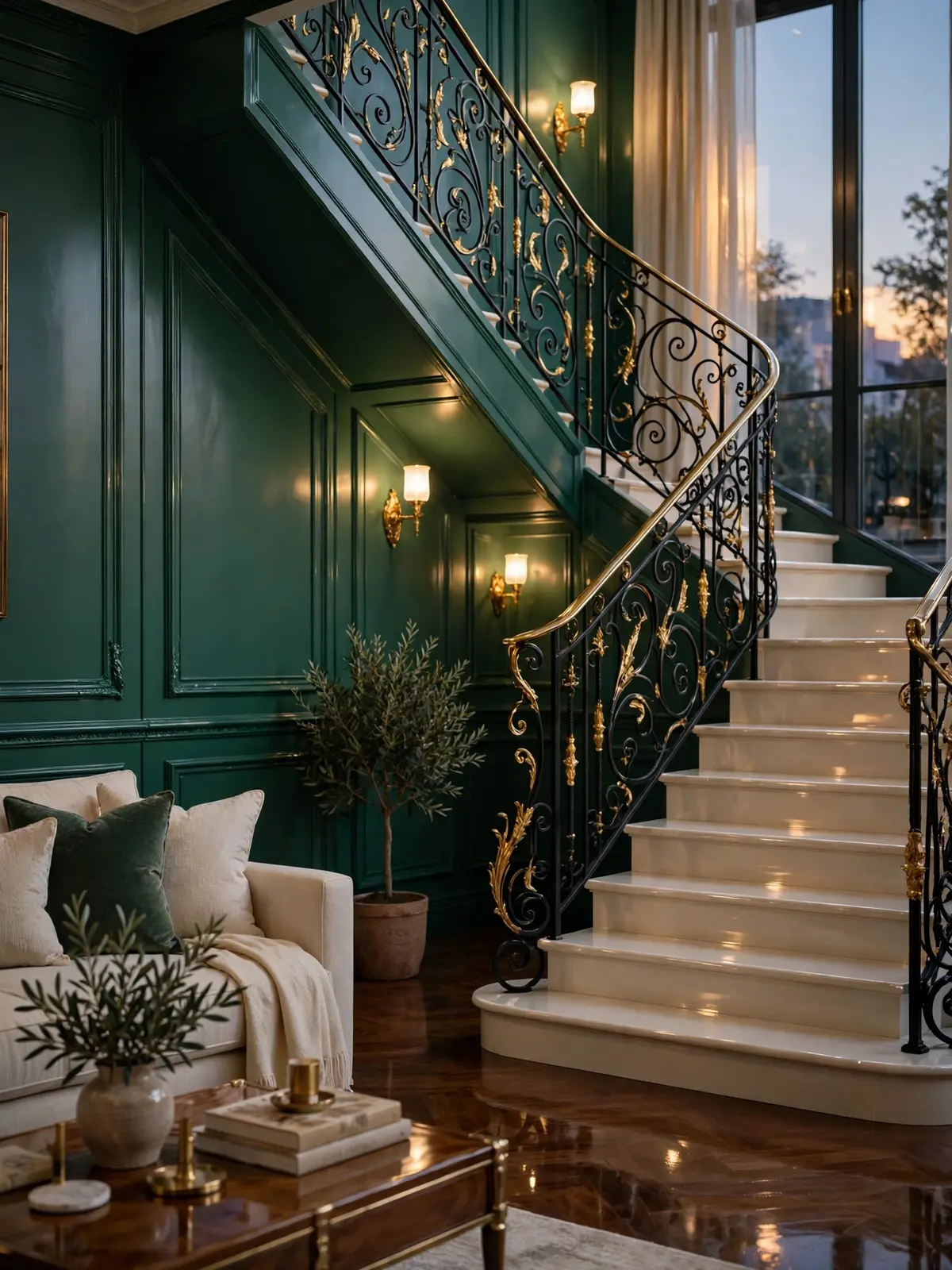
Gold-tipped ironwork for a quiet luxury touch elevates a plain iron stair without turning it into a showpiece, because a hint of gold on the finials, joints or scroll tips catches the light while the black iron does the structural work. Here, black iron balusters carry small gold tips and a gold newel finial, against emerald-green walls, cream treads and warm brass lighting that makes the gold glow in the evening. The design suits homes that entertain, traditional living rooms and entries that need a little glamour, it feels expensive without a full gold railing, and it pairs well with velvet, marble and dark wood. The weakness is restraint — too much gold turns elegant into flashy — so limit the gold to tips, joints and one finial, and keep the rest of the room’s metals in the same warm family.
Quick tips:
- Limit gold to tips, joints and one finial.
- Pair gold iron with warm lighting so it glows.
- Keep other metals in the room warm-toned too.
- Never use a full gold railing — it reads as flashy.
Twisted Balusters That Add Texture Without Clutter
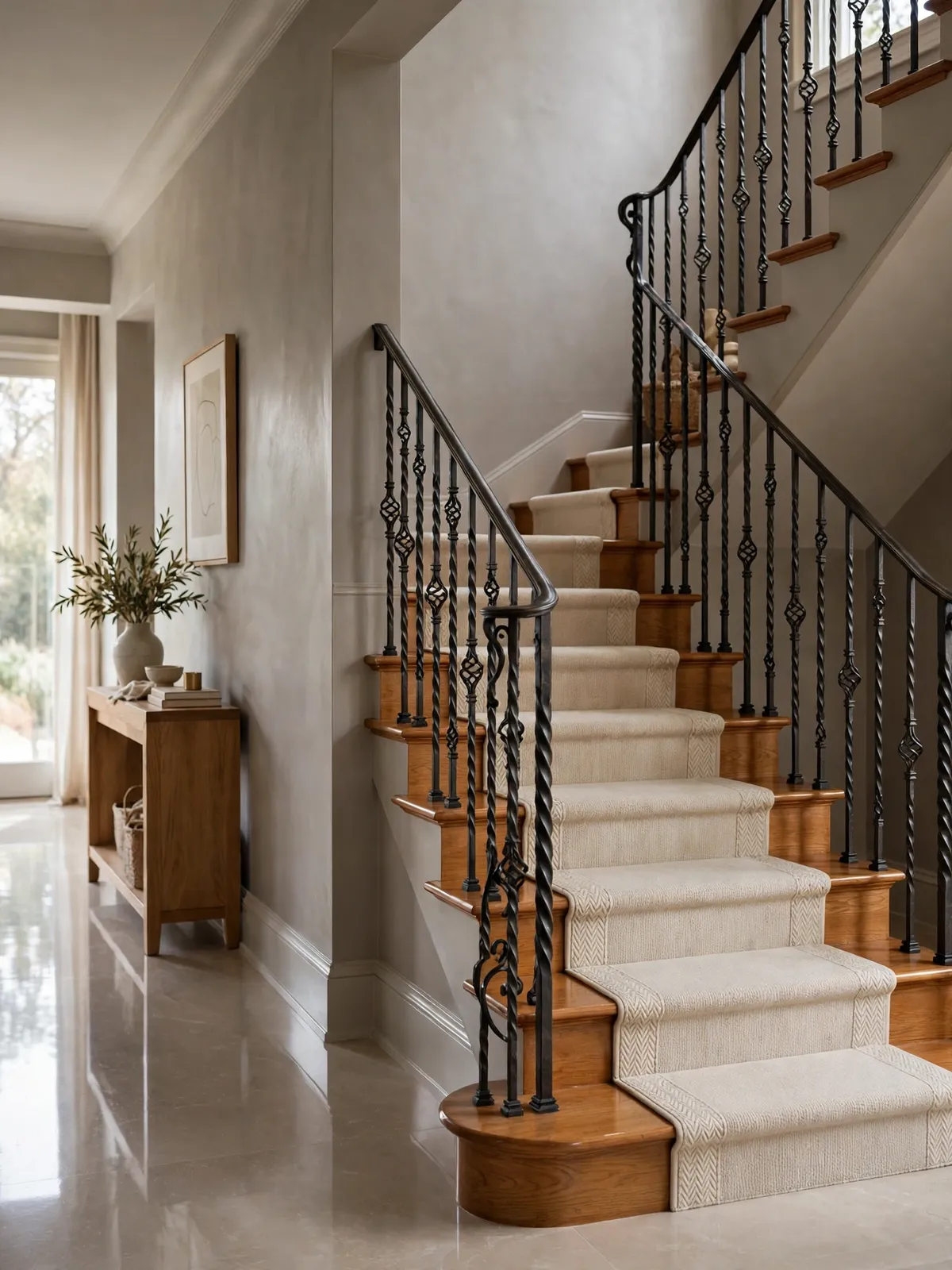
Twisted balusters that add texture without clutter are the middle ground between plain iron and full scrollwork, because a single twist in each baluster gives the eye something to follow without filling the stair with ornament. Here, black twisted balusters alternate with straight ones along a straight flight, with honey-oak treads, warm grey walls and a cream runner that keeps the palette calm. The design suits transitional homes, families who want detail without fuss, and anyone who finds scrollwork too busy, it feels handcrafted, and it costs less than a fully scrolled panel. The weakness is repetition — a twist on every single baluster can feel monotonous — so alternate twisted and straight balusters, keep the twist gentle rather than tight, and let the handrail stay plain so the balusters carry the detail.
Quick tips:
- Alternate twisted and straight balusters for rhythm.
- Keep the twist gentle — a tight twist looks busy.
- Let the handrail stay plain so balusters carry the detail.
- Dust twists with a soft brush to reach the grooves.
A Double-Height Staircase With Dramatic Ironwork
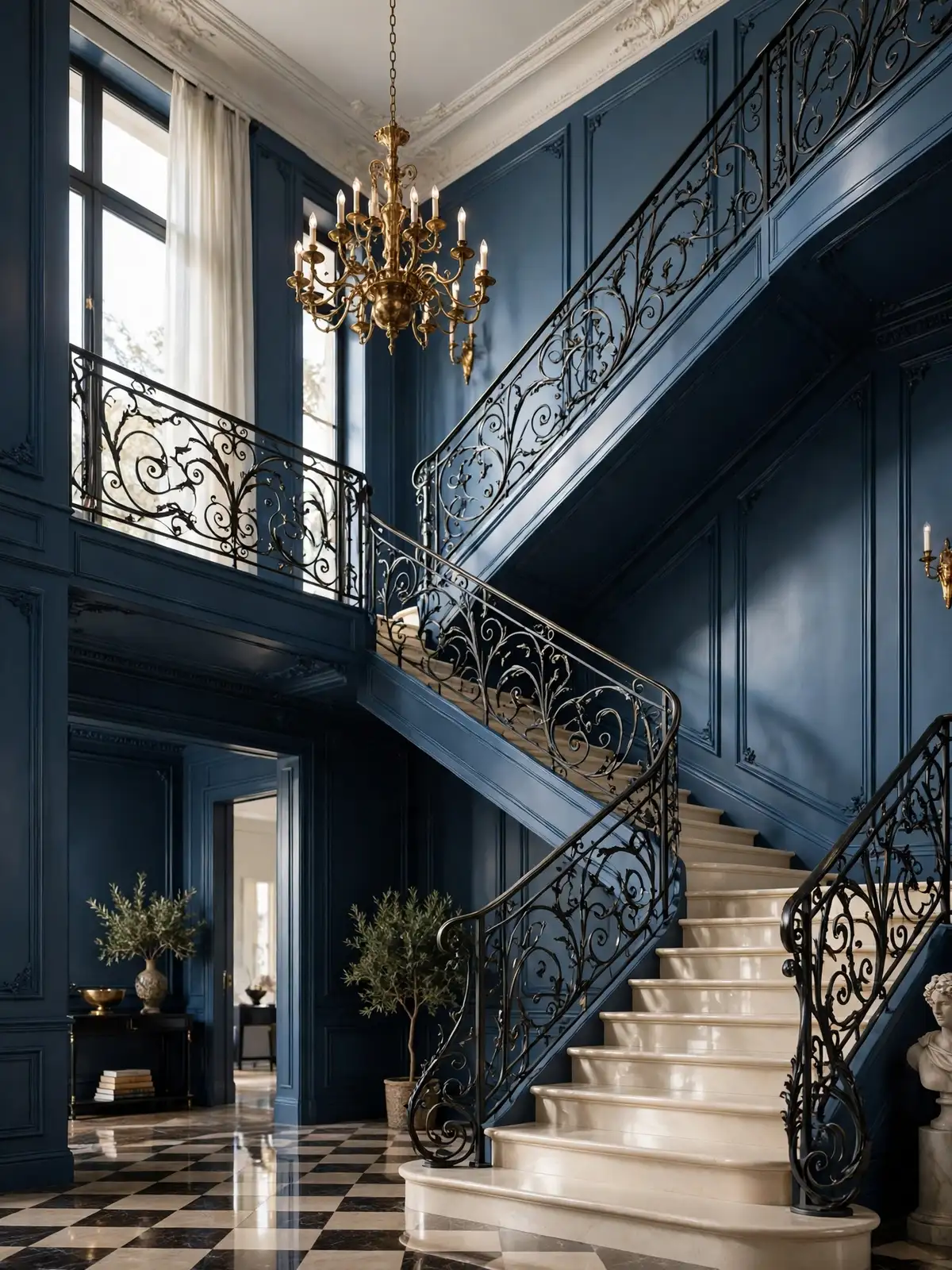
A double-height staircase with dramatic ironwork turns height into theatre, because a tall run of iron draws the eye upward and makes a two-storey foyer feel like a hotel lobby rather than a hallway. Here, black iron railings climb two full storeys with a long scroll panel at the landing, against navy-blue walls, cream stone treads and a brass chandelier that hangs through the void. The design suits homes with high ceilings and open foyers, it becomes the centrepiece of the whole house, and it gives a landing or gallery a reason to exist. The weakness is scale and cost — the ironwork is long, the installation needs scaffolding, and a small pattern disappears at that height — so choose a bold, large-scale pattern, budget for professional installation, and light the void well or the upper railings vanish into shadow.
Quick tips:
- Choose a large-scale pattern — small scrolls disappear at height.
- Light the void with a chandelier or tall sconces.
- Budget for scaffolding and professional installation.
- Keep the floor below clear so the stair commands the space.
Weathered Rustic Iron for Farmhouse Character
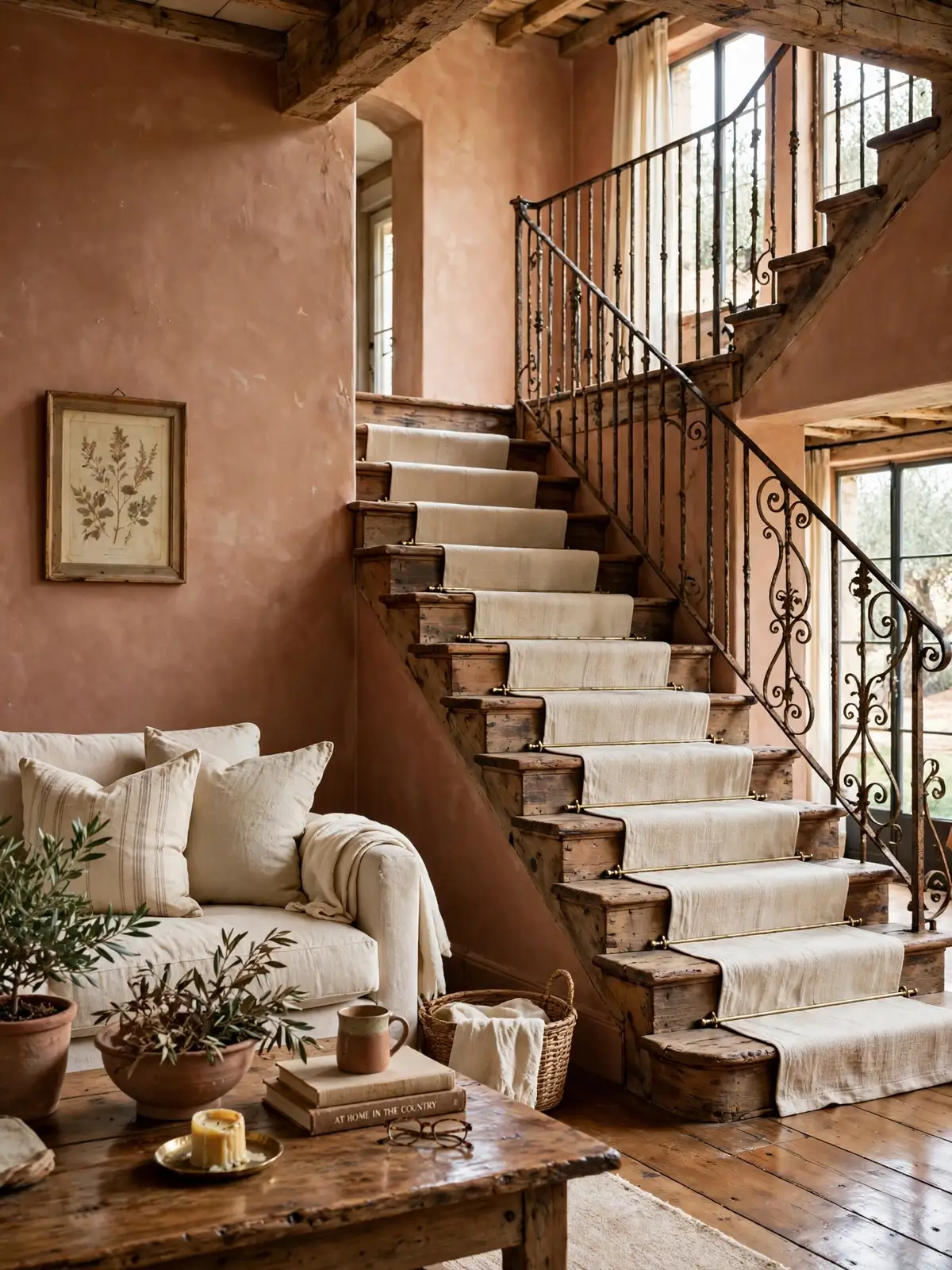
Weathered rustic iron for farmhouse character gives a stair a story, because a slightly aged, hand-hammered finish with a soft patina feels lived-in rather than newly installed. Here, dark iron with a weathered bronze patina runs beside reclaimed wood treads, against terracotta walls and a cream linen runner, with a woven basket at the base of the stair. The design suits farmhouse, industrial and cottage homes, it hides small marks and wear gracefully, and it pairs naturally with wood, linen and stone. The weakness is that a fake weathered finish can look painted-on, so ask for a genuine patina or a hand-applied antique finish, seal it properly so the patina does not rub off on hands and clothes, and keep the rest of the ironwork simple so the texture stays the feature.
Quick tips:
- Ask for a genuine patina, not a painted fake.
- Seal the finish so it does not rub off on hands.
- Pair weathered iron with reclaimed wood and linen.
- Keep the pattern simple so the texture stays the star.
A Black and White Monochrome Staircase
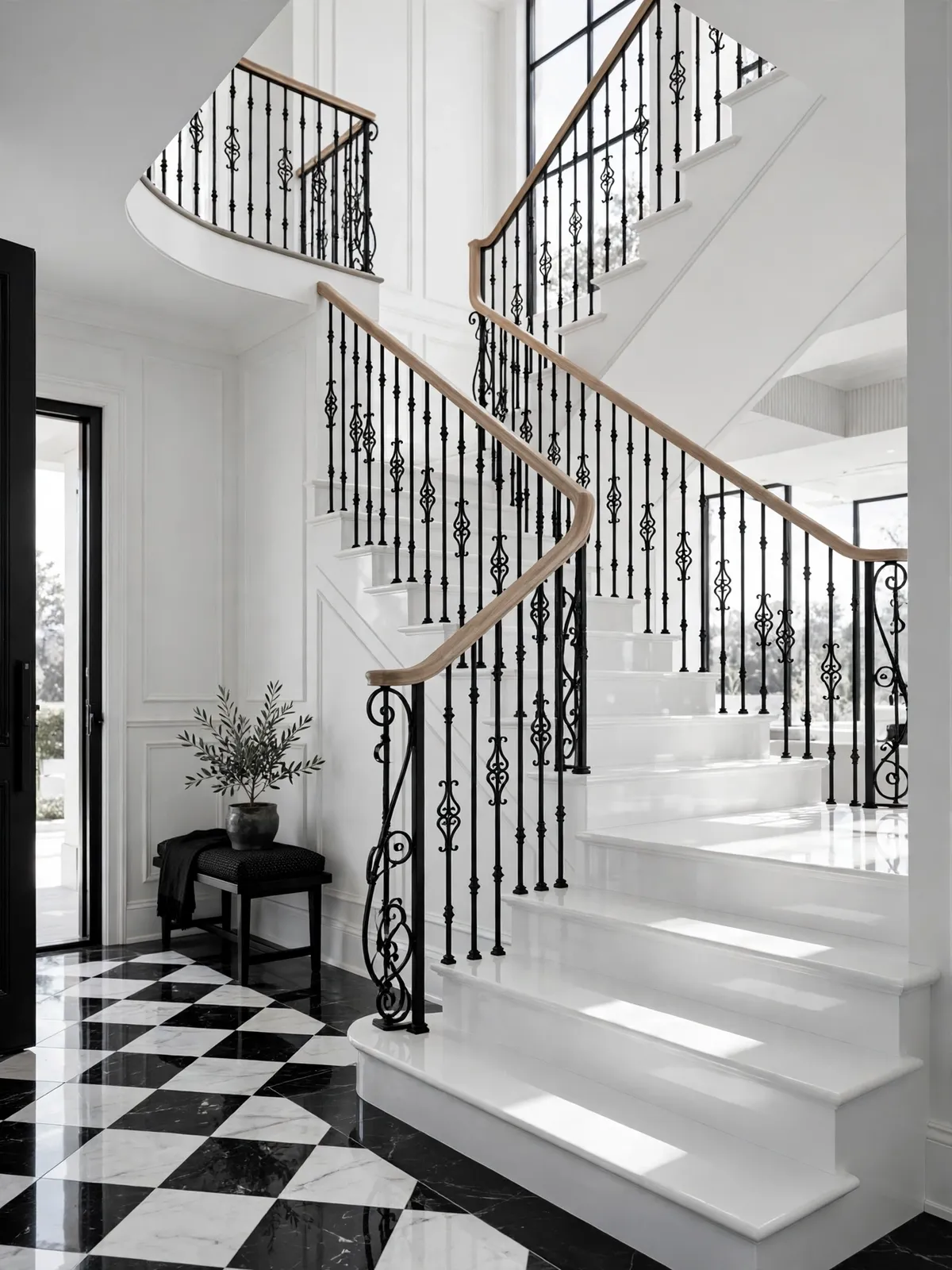
A black and white monochrome staircase is the most timeless colour pairing in wrought iron design, because black iron against white steps is graphic, clean and impossible to date. Here, black iron balusters and a light wood handrail run beside crisp white painted steps, with white walls and a pale floor keeping the whole stair bright and sharp. The design suits modern, classic and Scandinavian homes alike, it works with almost any furniture, and it makes a small entry feel larger because the contrast is so clear. The weakness is maintenance — white steps show scuffs and black iron shows dust — so choose a hard-wearing paint on the steps, wipe the rail regularly, and add a slim runner if the household is busy and the white paint takes a beating.
Quick tips:
- Use hard-wearing paint on white steps — they scuff fast.
- Add a slim runner in a busy household.
- Keep the handrail light wood for warmth against the contrast.
- Wipe the black rail weekly so dust does not dull it.
An Arched Iron Frame That Turns the Stair Into Architecture
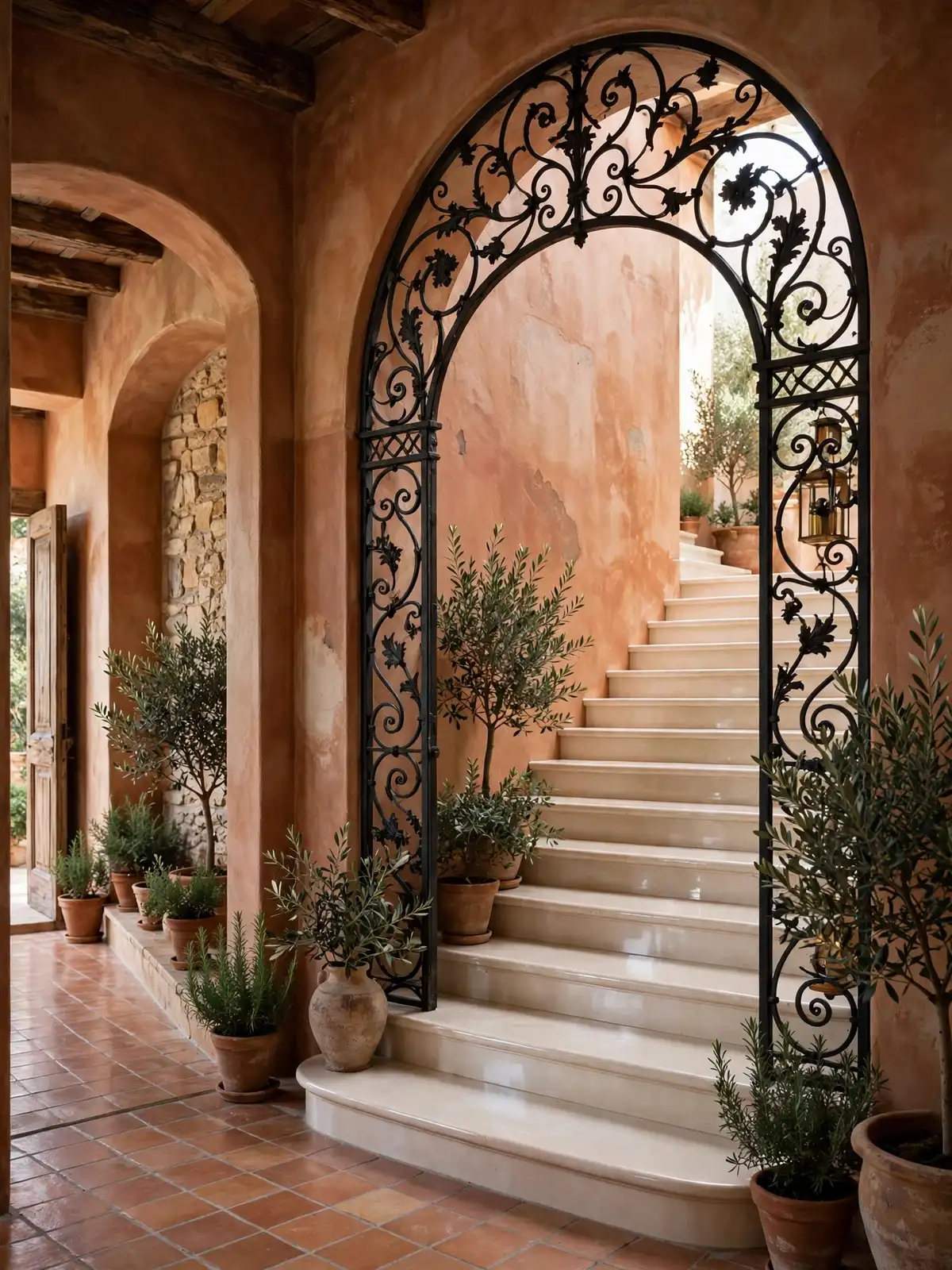
An arched iron frame that turns the stair into architecture works because the arch does more than decorate — it frames the stair like a doorway and gives the whole hallway a sense of passage. Here, a black iron arch curves over the stair entry, with terracotta walls, cream stone steps and olive-green plants softening the metal, so walking up the stair feels like entering another room. The design suits Mediterranean, Spanish and old-world homes, it adds depth to a flat hallway, and it makes an ordinary stair feel like a designed moment. The weakness is that an arch needs height and a skilled fabricator, and a poorly proportioned arch crowds the stair, so measure the opening carefully, keep the arch slim rather than heavy, and let the ironwork stay black so the shape reads clearly.
Quick tips:
- Measure the opening carefully — a low arch crowds the stair.
- Keep the arch slim so the shape reads clearly.
- Soften the iron with plants at the base of the stair.
- Pair an iron arch with stone or terracotta for an old-world feel.
A Narrow Wrought Iron Stair for Tight Corners
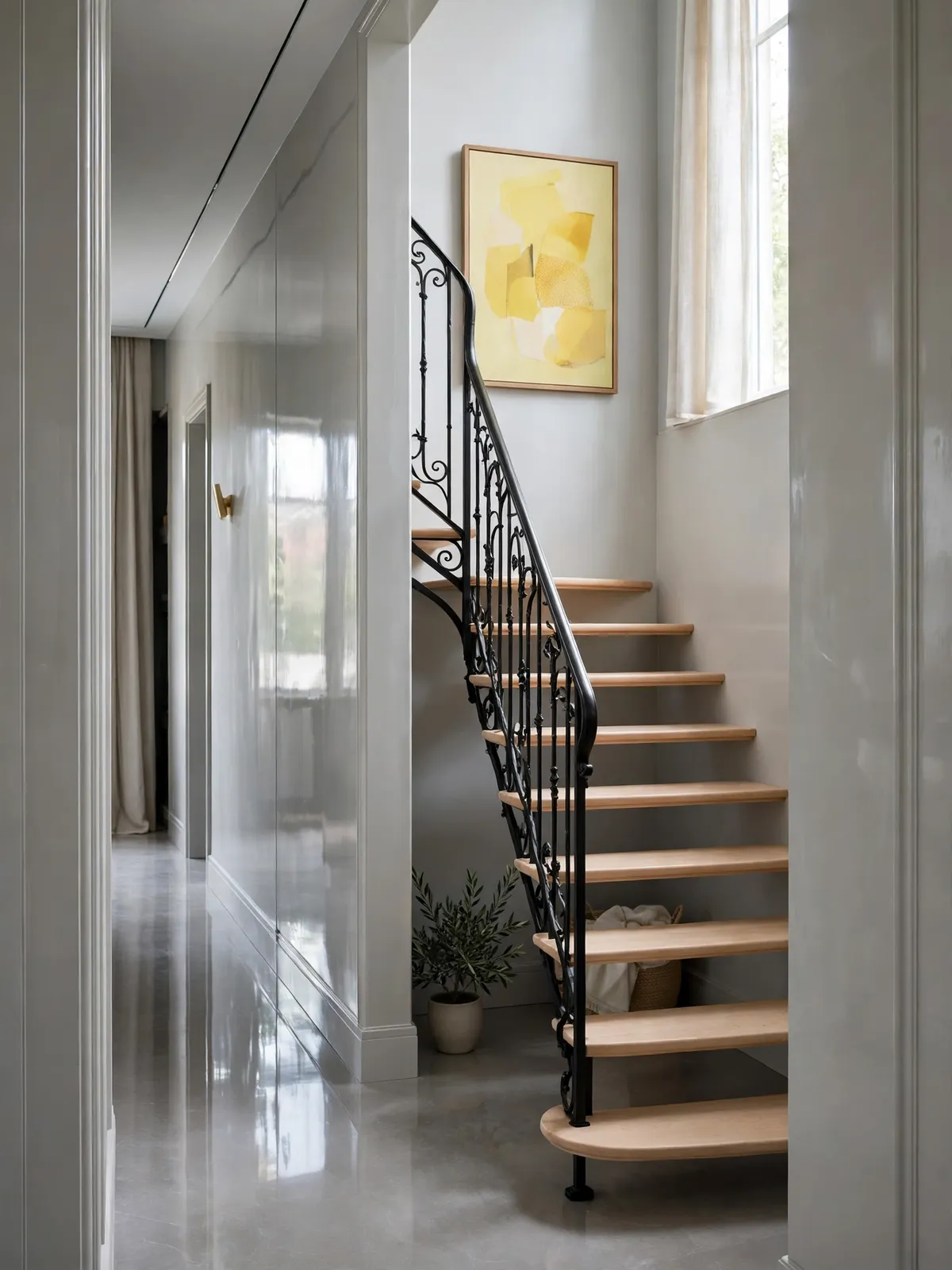
A narrow wrought iron stair for tight corners proves that a small stair can still look intentional, because slim iron balusters and a minimal rail take up almost no visual space while still meeting safety rules. Here, a slim black iron stair tucks into an awkward corner, with birch treads, pale grey walls and a small soft-yellow artwork at the landing to draw the eye upward. The design suits cottages, townhouses and attic conversions, it fits where a wooden stair would feel bulky, and it keeps the hallway feeling open. The weakness is comfort — a narrow stair is steep, the treads are short, and two people cannot pass — so measure the width honestly, keep the railing minimal, use light colours around it so the corner feels bright, and add a wall handrail on the closed side for extra grip.
Quick tips:
- Measure the width honestly before ordering.
- Keep the railing minimal so the stair feels open.
- Use light colours around a tight stair.
- Add a wall handrail on the closed side for extra grip.
A Grand Split Staircase With Sweeping Iron Railings
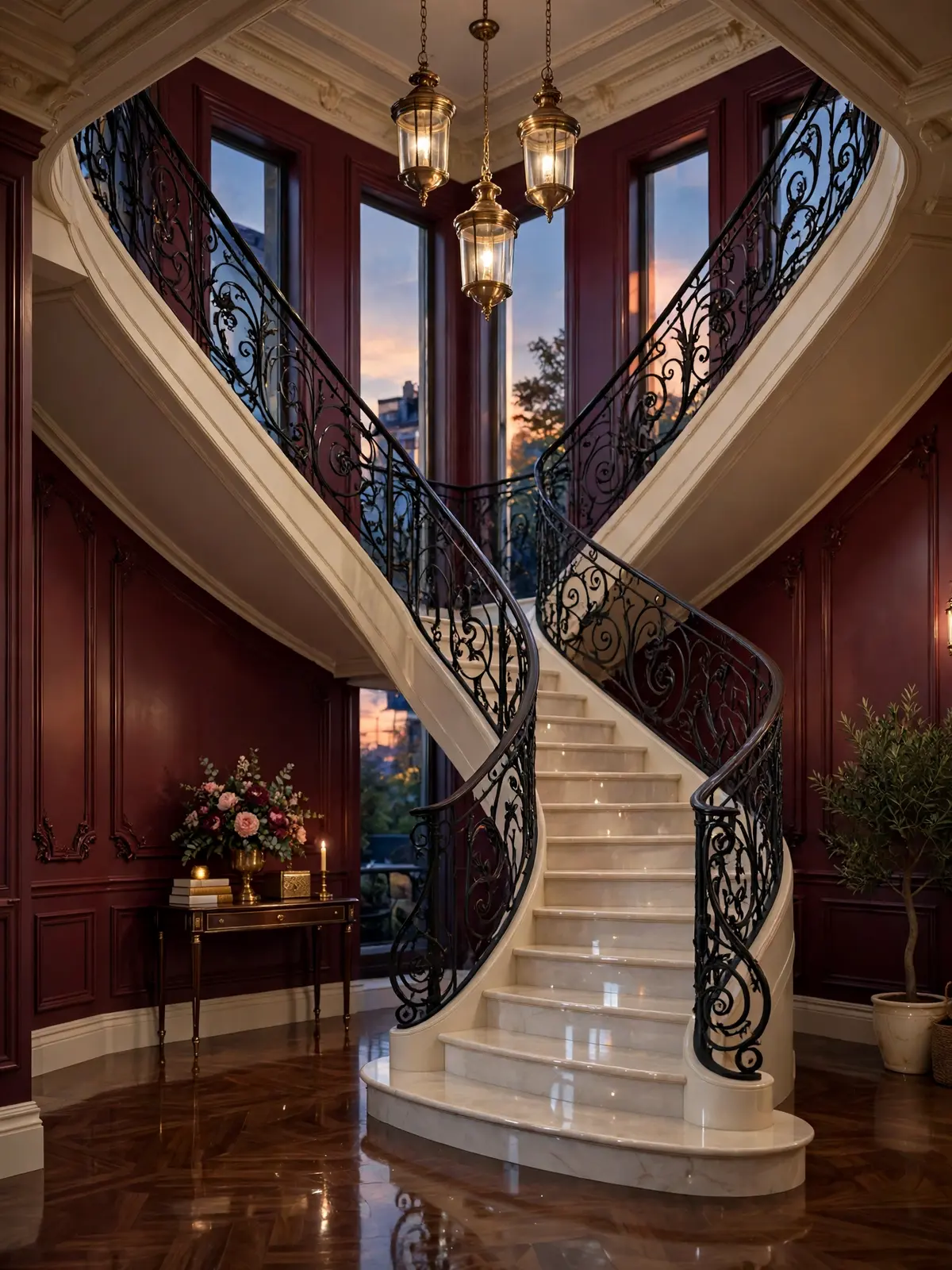
A grand split staircase with sweeping iron railings is the showstopper of wrought iron design, because two flights divide from a central landing and the iron sweeps outward like open arms. Here, black iron railings with gentle scrolls run up both flights, with cream marble steps, deep burgundy walls and brass pendant lights above the landing, so the whole foyer feels like a ballroom entry. The design suits large homes, wedding venues and grand entries, it sets the tone for the entire house, and it gives the landing a purpose as a viewing point. The weakness is that it needs a very large foyer and a very large budget, and the two flights must mirror each other exactly or the symmetry breaks, so work with a fabricator who can template both sides, keep the flooring neutral so the railing takes centre stage, and add soft lighting along the step edges for evening use.
Quick tips:
- Keep the two flights perfectly mirrored for symmetry.
- Keep the flooring neutral so the railing takes centre stage.
- Add soft lighting along the step edges.
- Leave the landing clear — it is a viewing point, not storage.
Vintage-Inspired Ironwork With an Aged Patina
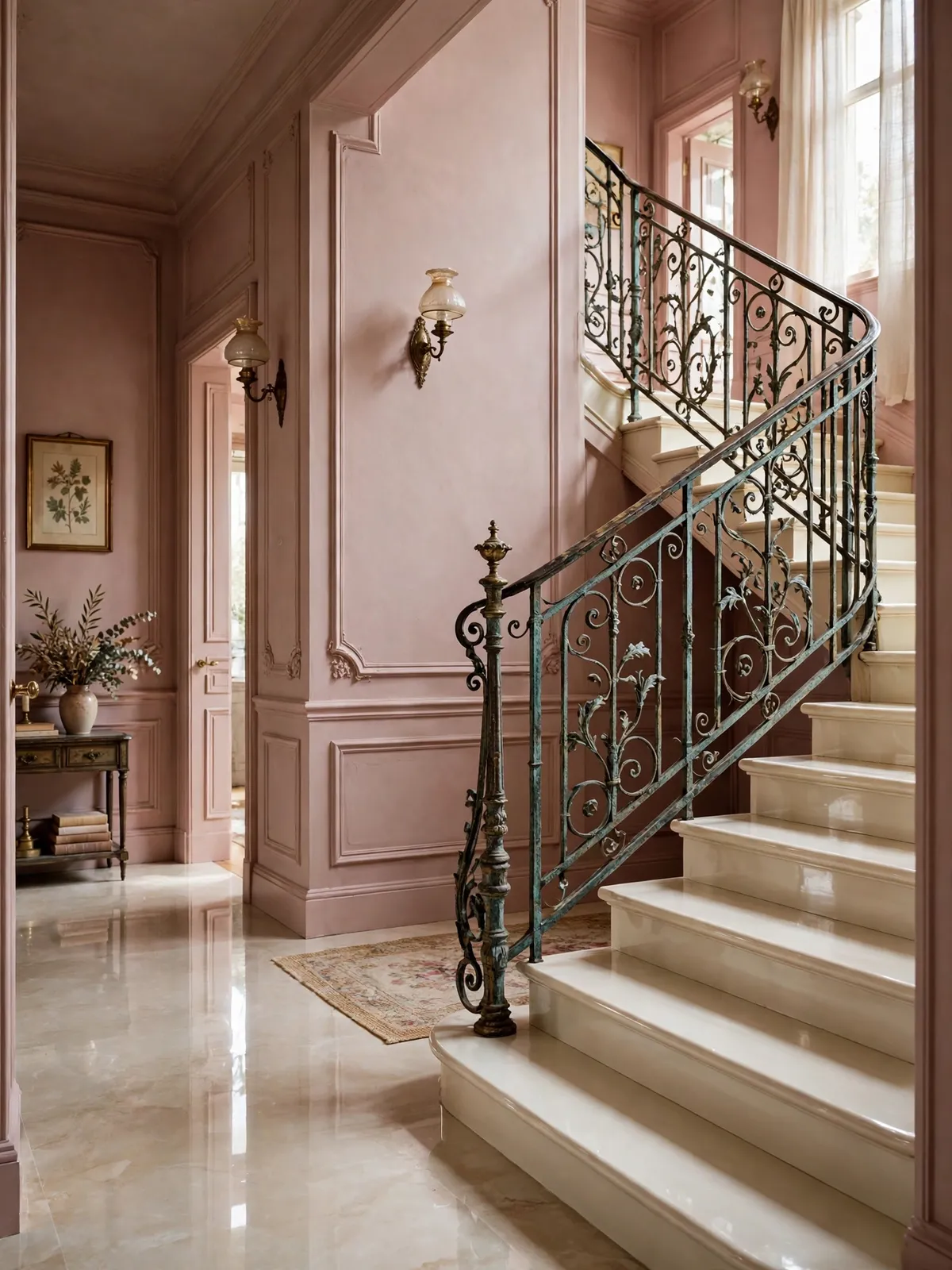
Vintage-inspired ironwork with an aged patina brings nostalgia without looking old-fashioned, because intricate curves, slightly softened edges and a dark bronze finish suggest a stair that has been loved for decades. Here, aged bronze ironwork with gentle scrolls runs beside cream treads, against dusty-rose walls and antique brass sconces that warm the whole flight. The design suits period homes, romantic interiors and anyone who loves vintage style, it feels timeless, and it hides wear better than a sharp new finish. The weakness is that too much ornament dates fast, so choose one vintage element — the scroll, the patina or the finial — and keep the rest simple, and check that the finish is sealed so the patina stays stable rather than continuing to darken unevenly.
Quick tips:
- Choose one vintage element and keep the rest simple.
- Seal the patina so it darkens evenly, not in patches.
- Pair vintage iron with brass sconces and soft wall colours.
- Avoid mixing vintage scrolls with modern geometric panels.
Marble Steps Paired With Slender Iron Balusters
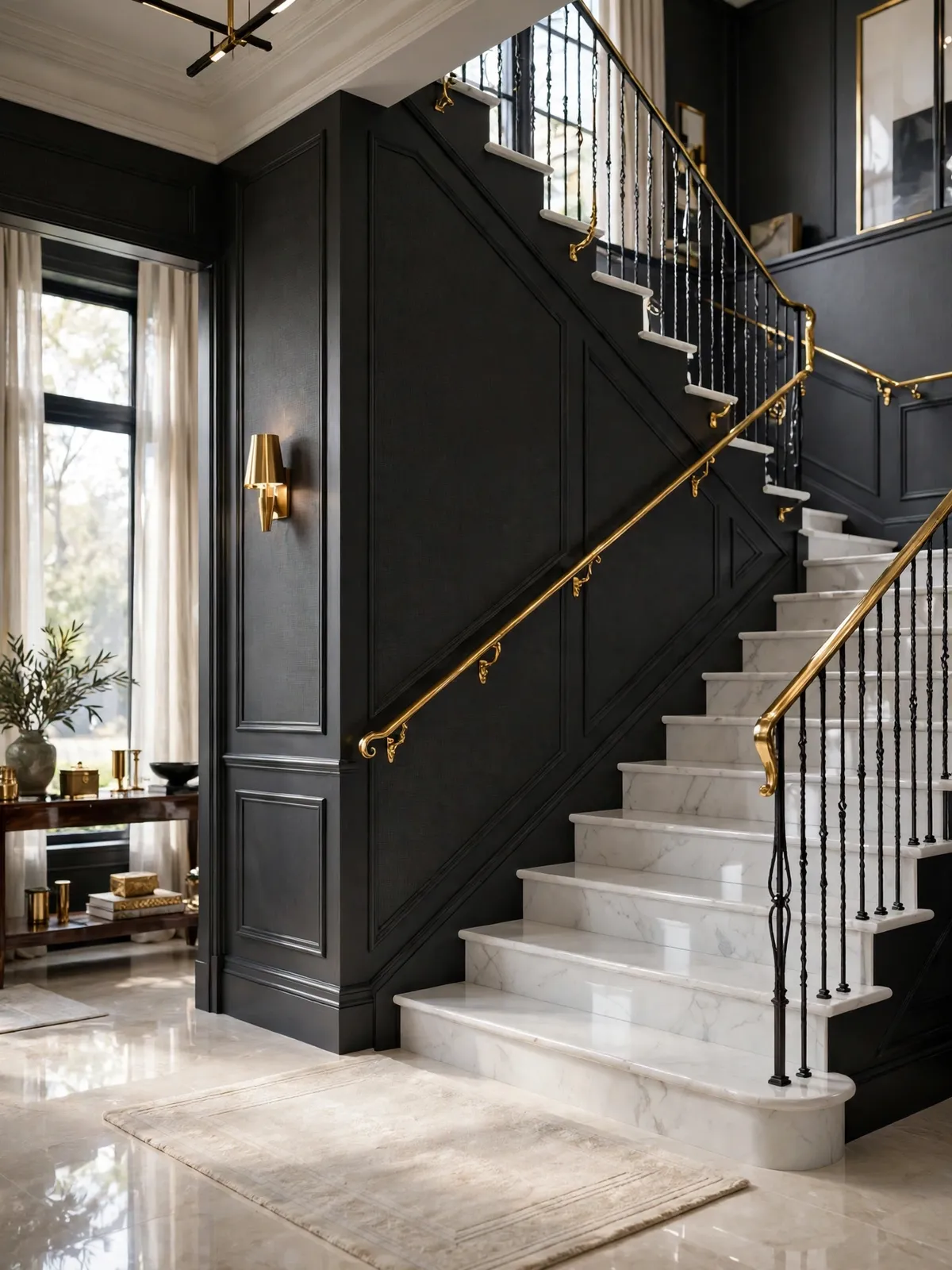
Marble steps paired with slender iron balusters are the most luxurious combination in this list, because the cool, veined stone and the slim black iron balance each other — the marble feels grand, the iron keeps it from feeling cold. Here, white marble steps with soft grey veining rise beside thin black iron balusters, against charcoal walls, gold handrail brackets and a cream rug at the base. The design suits luxury homes, hotels and grand entries, it feels upscale but still grounded, and it photographs as pure elegance. The weakness is cost and care — marble is expensive, slippery when wet and stains if not sealed — so seal the stone, add a runner or non-slip treatment if the household includes children or older adults, and keep the balusters slim so the marble stays the star.
Quick tips:
- Seal marble steps to prevent staining.
- Add a runner or non-slip treatment if the stair gets wet.
- Keep balusters slim so the marble stays the star.
- Use gold brackets to warm the black-and-white palette.
Integrated Lighting Inside the Iron Railing
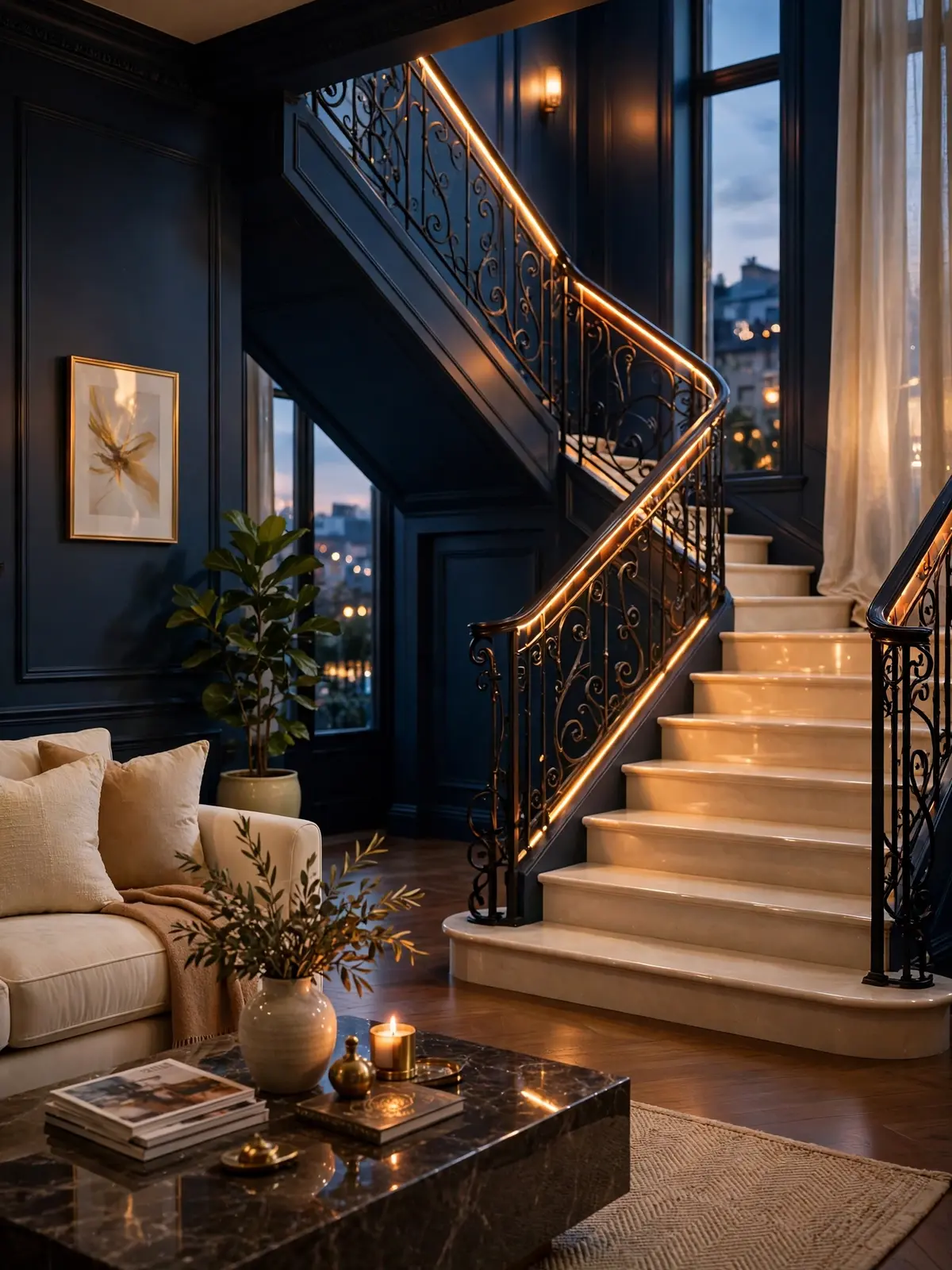
Integrated lighting inside the iron railing changes a stair completely after dark, because small warm LEDs set into the rail or along the balusters make the ironwork glow and light each step without a single visible fixture. Here, warm amber LED strips run beneath the handrail and along the base of the balusters, against midnight-blue walls and cream stone steps, so the whole flight glows softly in the evening. The design suits modern homes, homes that entertain at night and anyone who wants a stair that works as a night light, it adds safety on dark stairs, and it makes the ironwork visible long after sunset. The weakness is wiring — the lights need a qualified electrician, a hidden driver and a dimmer — so plan the electrics before the ironwork is fabricated, choose warm white rather than cool white for a cosy glow, and keep spare LED strips in the same colour temperature for repairs.
Quick tips:
- Plan the electrics before the ironwork is fabricated.
- Choose warm white LEDs for a cosy glow, not cool white.
- Add a dimmer so the stair can glow softly at night.
- Keep spare strips in the same colour temperature.
An Outdoor Wrought Iron Stair With a Weatherproof Finish
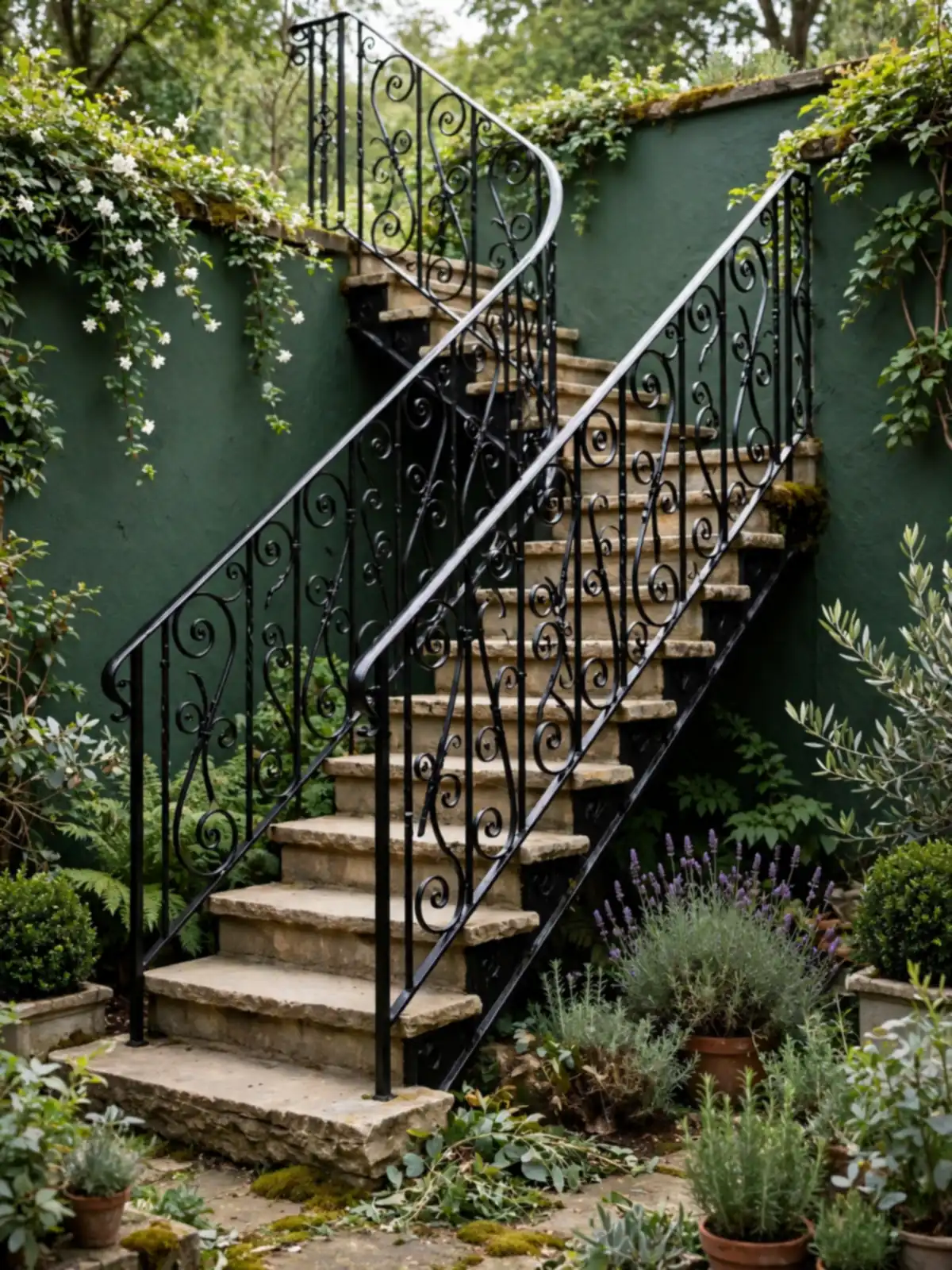
An outdoor wrought iron stair with a weatherproof finish brings the same elegance outside, because iron handles garden steps, terraces and deck levels with a slimness that wood and concrete cannot match. Here, black iron railings with a powder-coated finish run beside natural stone steps, with forest-green planting softening the metal and a stone terrace below. The design suits garden stairs, terraces and pool levels, it looks elegant against greenery, and it lasts for decades when it is treated properly. The weakness is rust — outdoor iron lives in rain, and any chip in the coating lets moisture in — so insist on a galvanised base coat plus powder coat, touch up chips promptly, avoid glossy finishes outdoors because they show water marks, and check drainage around the base of the steps so water never pools against the iron.
Quick tips:
- Insist on a galvanised base coat plus powder coat outdoors.
- Touch up any chip promptly to stop rust starting.
- Avoid glossy finishes outdoors — they show water marks.
- Check drainage so water never pools at the base.
Wrought Iron and Glass Panels for an Airy Modern Stair
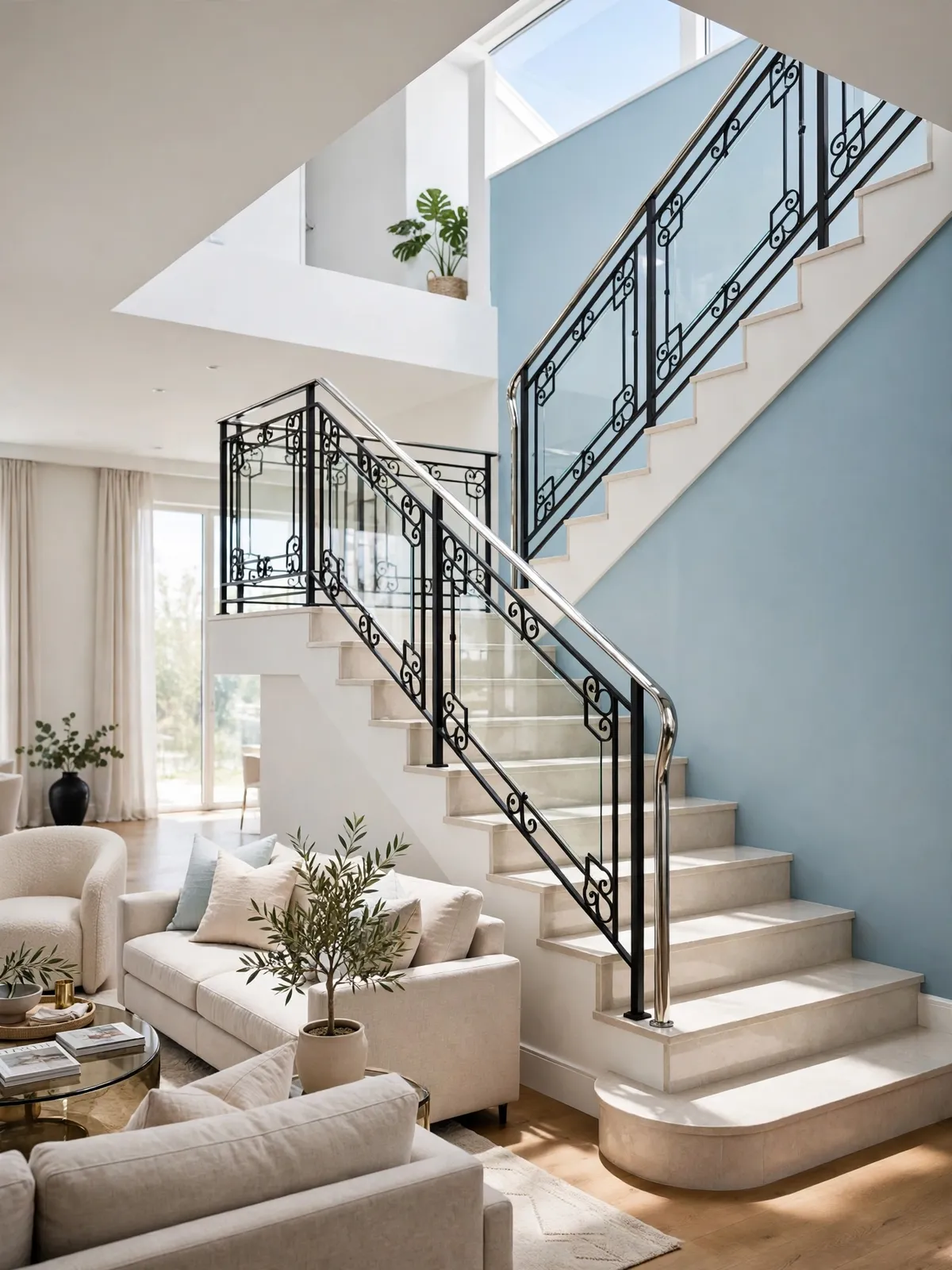
Wrought iron and glass panels for an airy modern stair are the best of both materials, because the iron gives the stair its frame and strength while the glass keeps the view open and the light flowing. Here, slim black iron frames hold clear glass panels along a straight flight, with pale stone steps, a sky-blue accent wall and a chrome handrail keeping the palette fresh. The design suits modern homes, open-plan living and small spaces that cannot afford a solid balustrade, it feels light and architectural, and it shows off the ironwork as a frame rather than a barrier. The weakness is cleaning — glass shows fingerprints and dust — and the glass must be toughened safety glass, so budget for proper glazing, keep a glass cloth handy, and check that the iron frame is powder-coated so it never rusts against the glass edge.
Quick tips:
- Use toughened safety glass, never ordinary glass.
- Keep a glass cloth handy — fingerprints show fast.
- Powder-coat the iron frame so it never rusts at the glass edge.
- Pair glass and iron with pale stone for a light, modern feel.
Sculptural Iron Newel Posts That Anchor the Stair
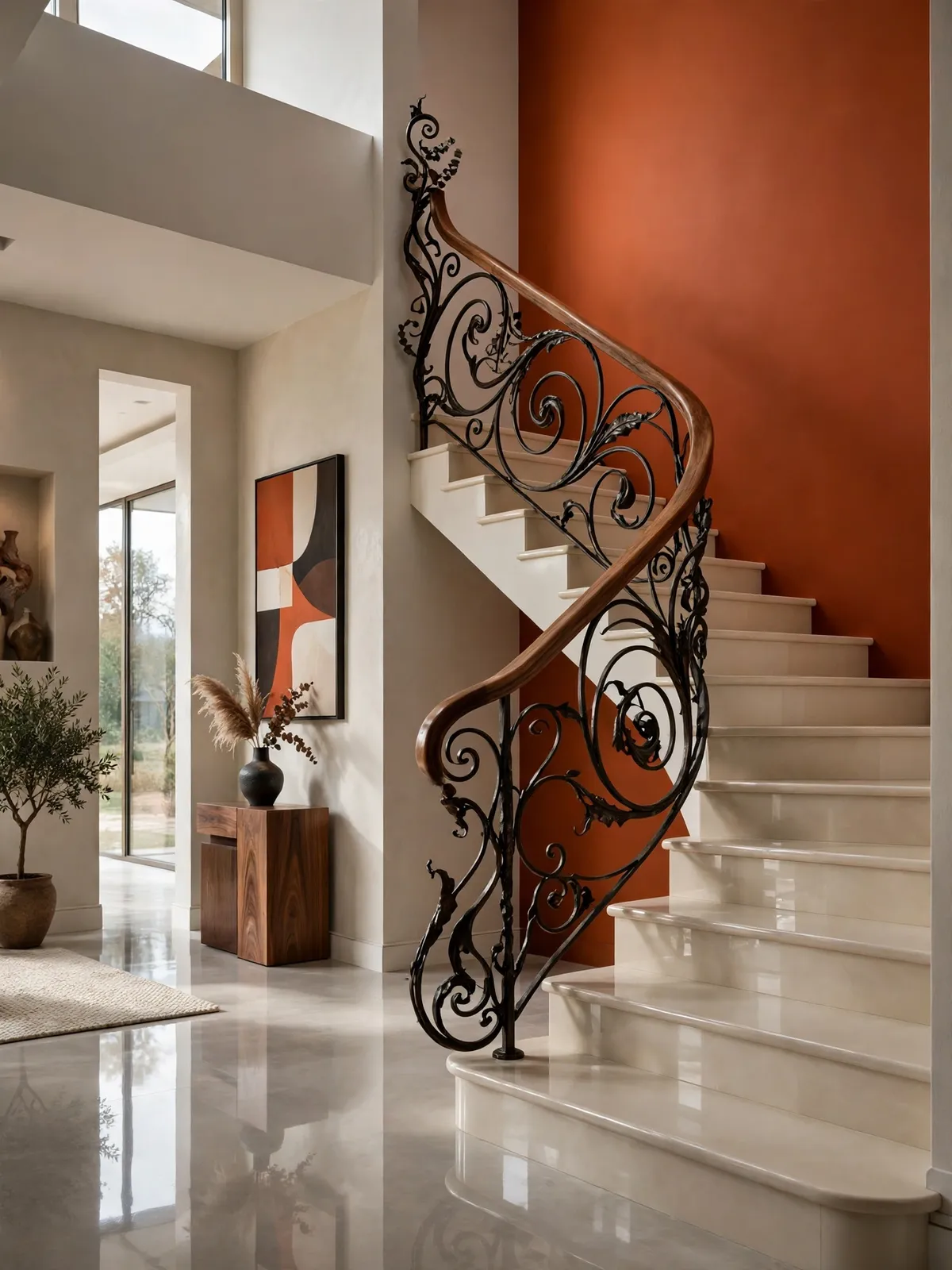
Sculptural iron newel posts that anchor the stair are the detail most people overlook, because the newel — the post at the foot and the turns of the stair — is where the hand first meets the iron and where the whole railing is held together. Here, oversized black iron newels with a hand-forged twist and a small brass ball finial anchor each turn, with a walnut handrail, cream steps and a burnt-orange accent wall behind them. The design suits any home that wants one strong crafted detail without a full ornate railing, it makes the stair feel custom-built, and it works even with plain straight balusters. The weakness is proportion — a newel that is too tall or too heavy overwhelms a small stair — so size the newel to the stair, keep the balusters plain so the newel stays the focus, and make sure the post is bolted solidly, because a wobbling newel makes the whole railing feel unsafe.
Quick tips:
- Size the newel to the stair — oversized posts overwhelm small flights.
- Keep balusters plain so the newel stays the focus.
- Bolt the newel solidly; a wobble ruins the whole railing.
- Add a brass ball or cap finial for a finished detail.
Wrought Iron Staircase Ideas That Make Iron the Star of Your Home
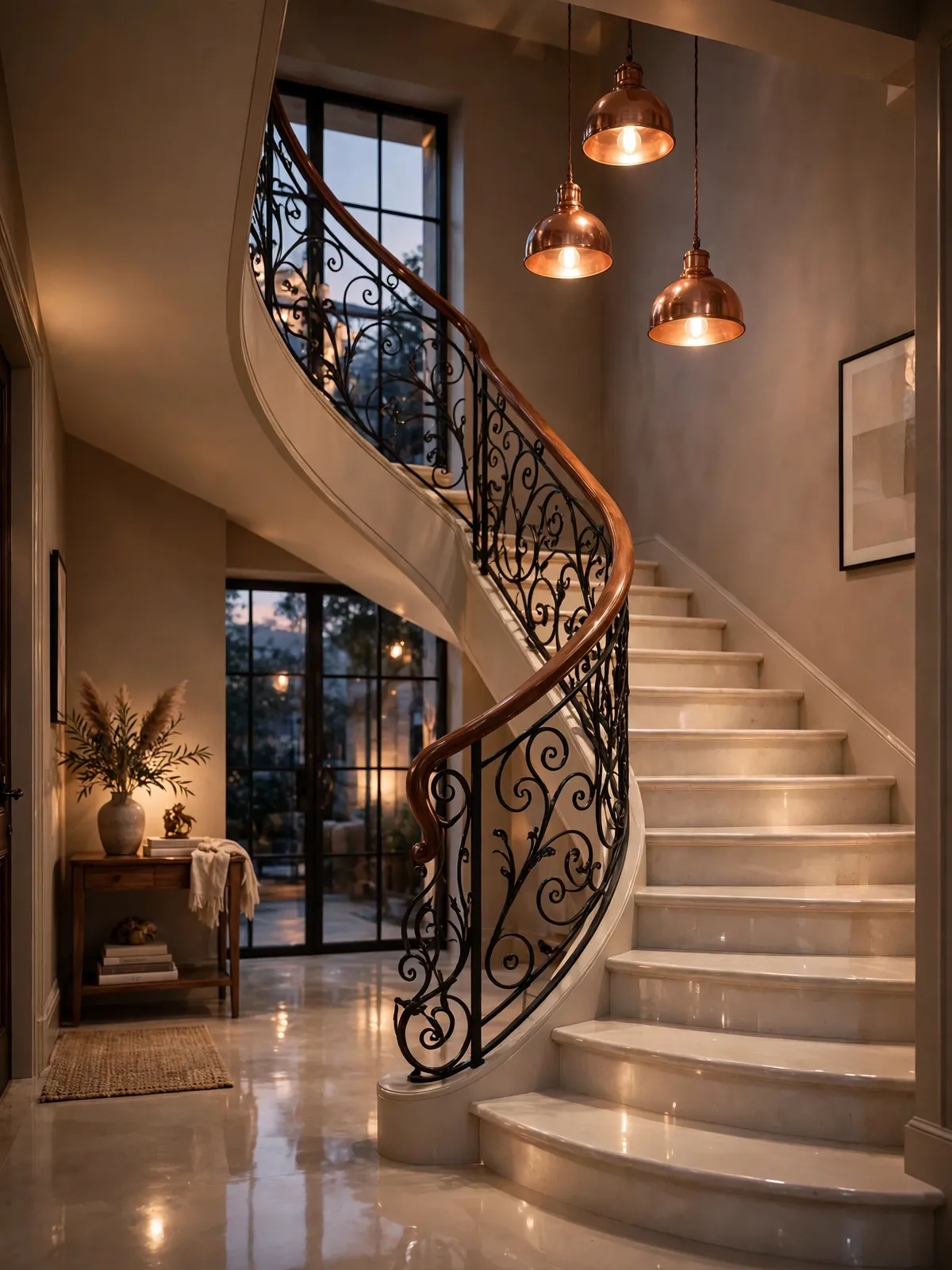
The last of these wrought iron staircase ideas is the principle behind them all: one complete stair that combines the best ironwork, the right handrail and thoughtful lighting does more than any single feature on its own. Here, a straight flight pairs hand-forged scroll balusters with a walnut handrail, warm taupe walls, ivory stone steps and copper pendant lights, so the iron, the wood and the light all work together instead of competing. The scrollwork gives character, the walnut rail gives warmth where your hand rests, the lighting makes the stair safe and beautiful after dark, and the neutral palette lets the iron stay the star. That combination is the real lesson of wrought iron design: choose the pattern for your home’s style, match the handrail to the floor, finish the iron for its location, and the stair stops being a way between floors and becomes the most crafted part of your home.
Quick tips:
- Combine ironwork, handrail and lighting in one plan.
- Match the handrail to the floor or the treads.
- Finish the iron for its location — powder coat outdoors, patina indoors.
- Let the iron stay the star; keep the palette around it calm.
FAQs
How much does a wrought iron staircase railing cost?
A plain straight run with simple balusters is the most affordable option, while hand-forged scrollwork, curved rails, spiral stairs and marble steps cost much more because they need skilled metalwork and more labour. Get an itemised quote that separates ironwork, handrail, steps, finish and installation, and compare at least two fabricators before ordering.
What finish is best for wrought iron stairs?
Indoors, a matte black powder coat or paint is the most versatile finish, with bronze or aged patina for traditional homes. Outdoors, a galvanised base coat under a powder coat is essential, because paint alone will not survive rain. Whatever the finish, touch up chips promptly so moisture cannot reach bare metal.
How do I clean a wrought iron staircase?
Dust the railings and balusters weekly with a soft cloth or brush, reaching into scrolls and twists where dust collects. Wipe with a damp cloth and dry immediately — never leave iron wet. Avoid harsh chemicals, which can damage the finish, and polish brass or gold accents separately with a suitable metal cleaner.
Are wrought iron stairs noisy?
Iron stairs can ring or echo if the treads are hard stone or metal, but a carpet runner, wooden treads or rubber pads under the treads quieten them considerably. A well-bolted railing and solid newel posts also stop rattles, so ask your installer to check every fixing before handover.
Can I replace only the railing with wrought iron and keep my existing steps?
Yes. Replacing just the balustrade is the most common wrought iron upgrade, because the steps, stringer and structure usually stay in place while the old wooden spindles are swapped for iron balusters. A fabricator will measure the existing stair, check that the handrail height and baluster spacing meet code, and fit the new ironwork to the old structure.
Conclusion
Wrought iron earns its place on a staircase because it is strong, slim and adaptable enough to suit a grand curved entry, a compact spiral, a modern geometric panel or a weathered farmhouse stair. Whether you choose hand-forged scrollwork, a warm walnut handrail, matte black contrast, gold-tipped details, marble steps, integrated lighting or a weatherproof outdoor stair, the best design is the one that matches your home’s style, meets safety rules and is finished for its location. Measure the stair, get an itemised quote, plan the lighting before the ironwork is made, and your wrought iron staircase will still look crafted and confident decades after it is installed.