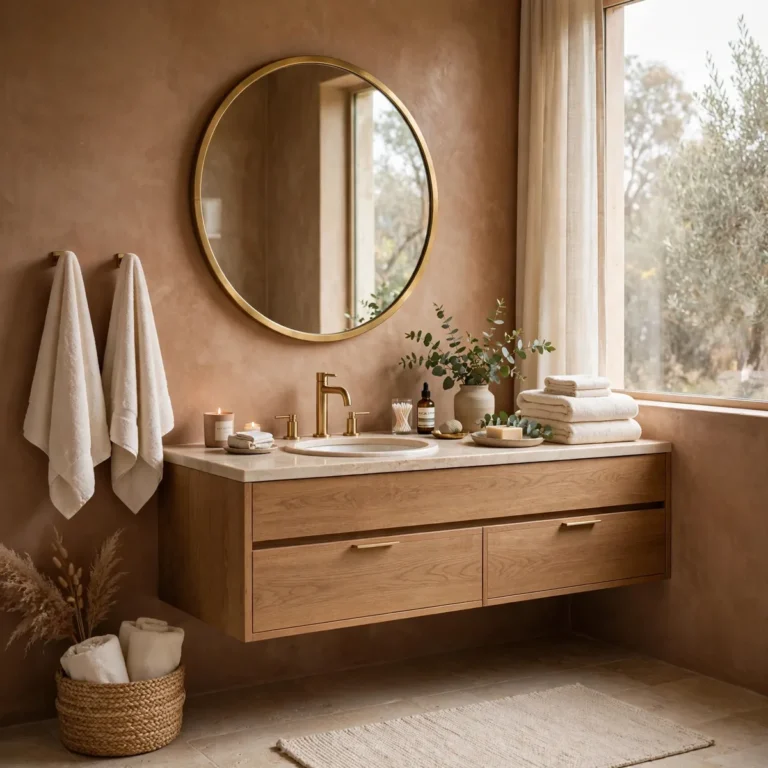
15 Beautiful Japandi Bathroom Ideas That Blend Japanese Calm With Scandinavian Warmth
A japandi bathroom blends Japanese minimalism with Scandinavian warmth —…
A japandi bathroom blends Japanese minimalism with Scandinavian warmth — clean lines and honest materials on the Japanese side, soft textures and liveable comfort on the Scandinavian side. The result is a bathroom that feels like a spa without trying to look like one: light oak, quiet stone, matte black fixtures, and almost nothing on the counter. If you are restyling more than one space, our broader bathroom decor ideas collection has the wider inspiration to pair with these.
These 15 ideas are organized from the biggest-impact decisions (the vanity, the materials) down to the styling details that finish the room. Use them for a full renovation or cherry-pick the small ones this weekend.
The Low-Profile Wooden Vanity Is the Heart of a Japandi Bathroom
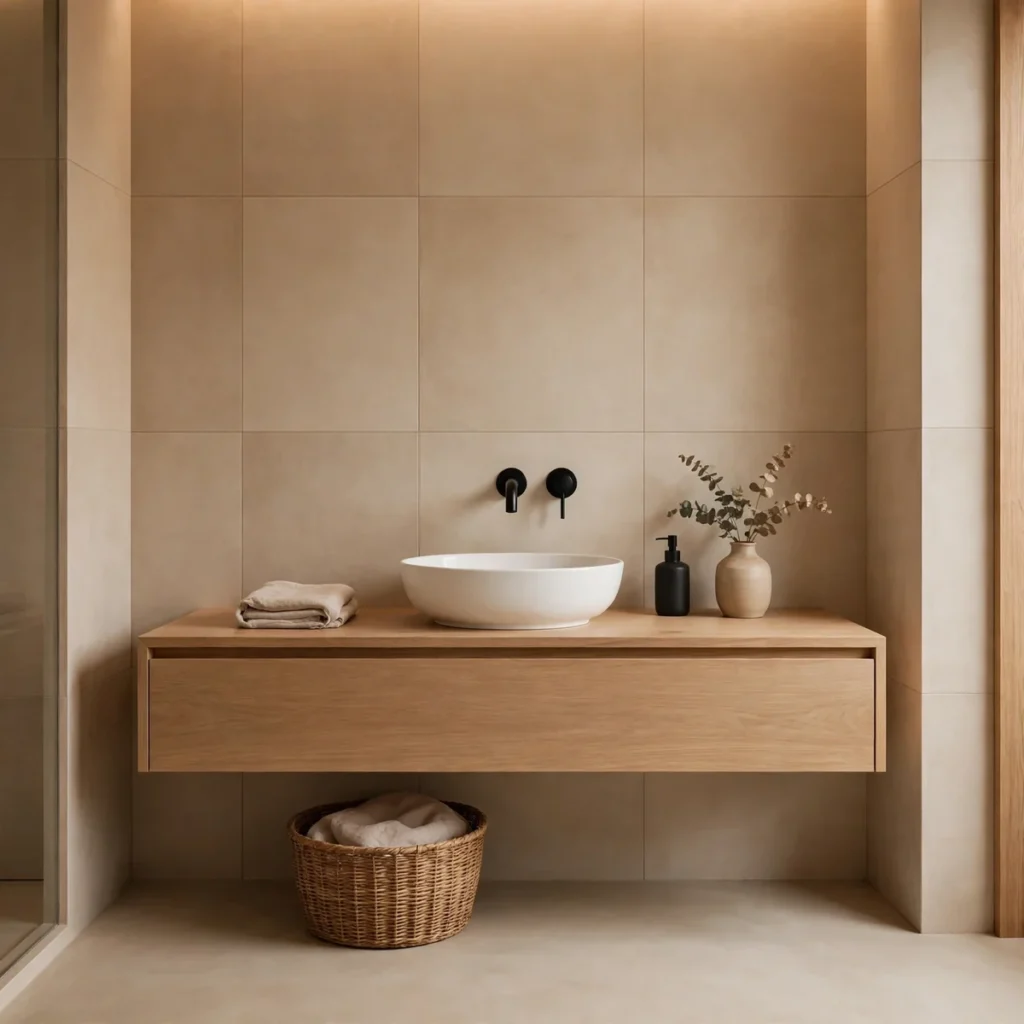
A japandi bathroom starts at the vanity, because it is the largest piece of furniture in the room and the one that sets the material story. Choose a low, floating vanity in light oak or pale ash with clean slab fronts and no visible hardware. The floating mount keeps the floor visible, which makes the room feel larger, and the uninterrupted oak grain does the warming work that a whole palette of colors would do elsewhere. Wall-mounted also means no awkward legs collecting dust and water splashes in the hardest corner of the room to clean.
The practical question is moisture. Light oak needs to be sealed — a marine-grade matte finish or a hardwax oil made for wet areas keeps the pale tone while protecting the wood. If you want the lowest-maintenance version of this idea, teak and thermo-treated ash handle steam and splashes far better than raw oak, though they run a little darker. This idea suits anyone planning a real renovation; renters can approximate the look with a simple oak-topped open shelf under an existing sink. The weakness to watch: cheap oak-look laminate in a humid bathroom peels and yellows, so spend the vanity budget on real wood or a quality veneer rather than on fancier fixtures.
- Keep vanity hardware hidden — push-to-open fronts beat knobs for the clean Japandi look.
- Leave the space beneath the floating vanity empty or hold a single woven basket.
- Seal oak with matte marine-grade finish; re-oil hardwax finishes once a year.
Pair a Stone Vessel Sink With Warm Oak
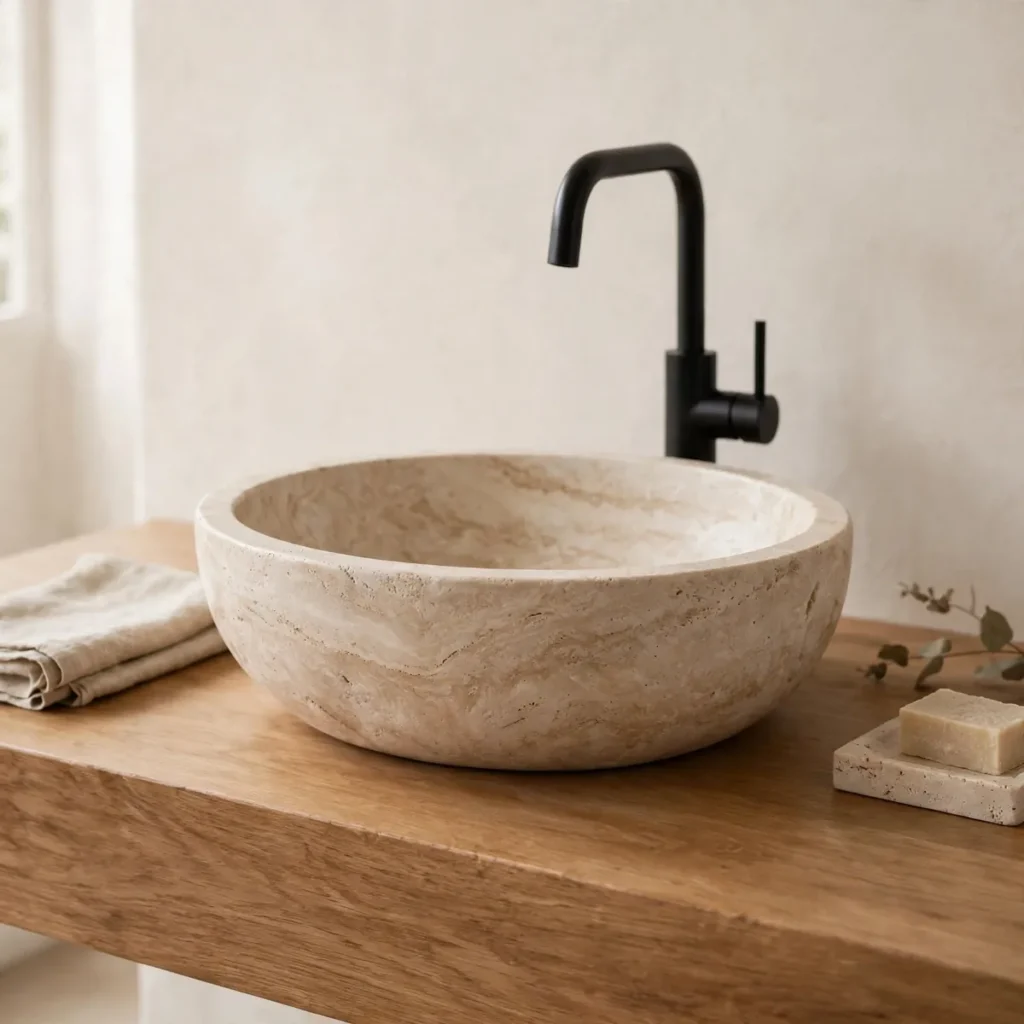
A stone vessel sink sitting on top of a warm oak counter is the classic Japandi pairing: heavy, carved natural material against smooth, pale wood. Unlike an undermount sink that disappears into the countertop, a vessel sink is a visible object, and in Japandi that visibility is the point — every object in the room earns its place by being beautiful. Travertine, honed marble, and carved river-stone basins all work; each brings subtle veining or pitting that reads as wabi-sabi rather than flaw.
This is best for vanities with enough counter depth to hold the bowl comfortably, since a vessel needs roughly 5 inches of height above the counter and room to breathe on all sides. The trade-off is practical: vessel sinks splash more than undermounts and need wiping around the base, so they suit powder rooms and calm primary baths better than kids’ bathrooms. Choose a wall-mounted or tall vessel faucet in matte black to keep the composition minimal.
- Honed (matte) stone hides water spots far better than polished finishes.
- Match the stone’s tone to your tile — warm travertine with warm tile, grey marble with cool tile.
- Wipe the base ring weekly; water collects where the bowl meets the wood.
Use Handmade-Look Crackle Tile for Wabi-Sabi Texture
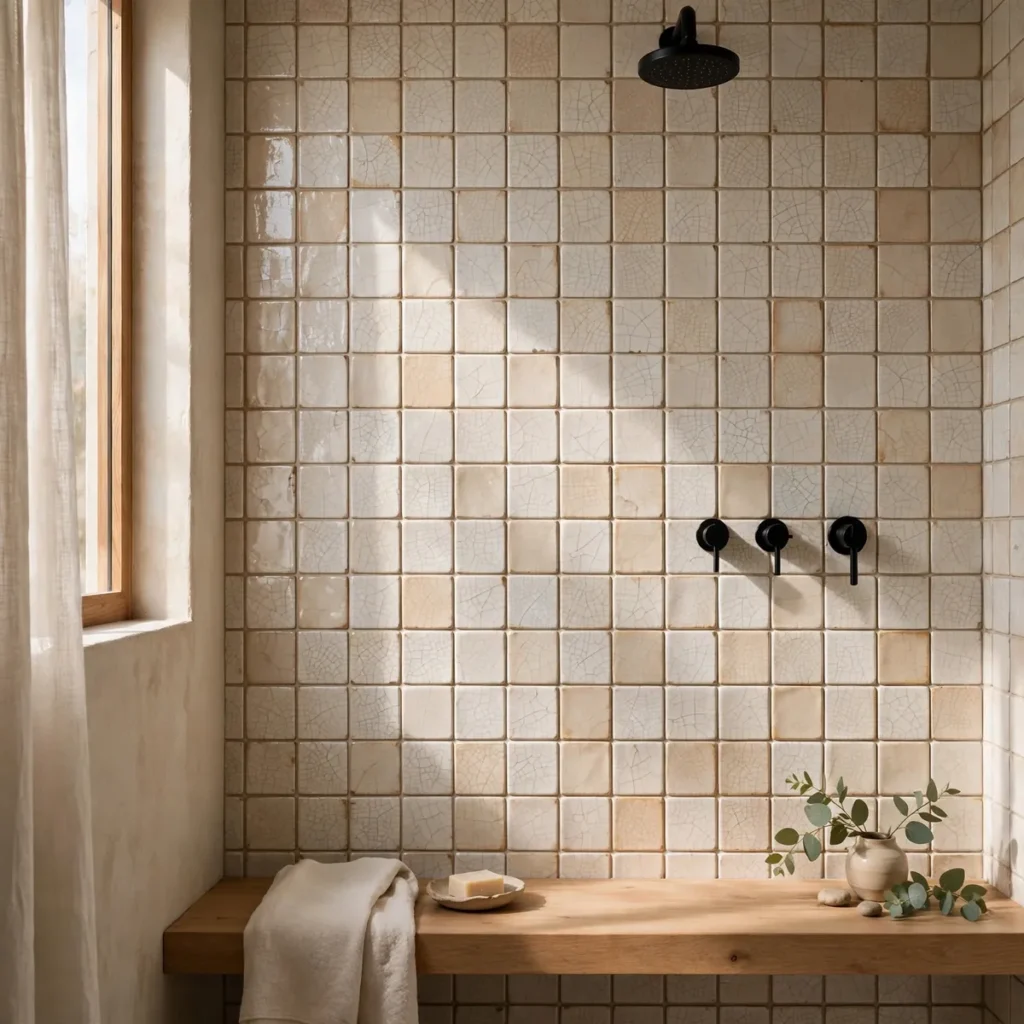
Wabi-sabi — the Japanese appreciation of imperfection — is the soul of Japandi, and the easiest place to express it is the tile. Handmade-look tiles with crackle glaze, slight color variation, and uneven edges catch light differently across the wall, giving a neutral bathroom the texture it needs without any pattern or color. Large-format crackle tiles behind the vanity or on the shower wall add depth that flat matte tile simply cannot.
This idea is for anyone who finds the standard Japandi bathroom a little too sterile. The crackle glaze does the decorative work so everything else can stay quiet — one textured surface means you can keep the rest of the room plain. Stick to warm whites, soft beiges, or pale sage crackle; darker glazes start reading modern-industrial rather than Japandi. The limitation: genuine handmade tile is expensive, so use it as a single feature wall or backsplash and pair it with a budget large-format tile elsewhere in the same tone.
- Use crackle tile on one wall only — a full room of it overwhelms the calm.
- Order 15% extra; handmade-look tile has more breakage and variation per box.
- Epoxy grout keeps the crackle pattern clean in shower areas.
Frame the Shower With a Shoji-Style Black Grid Screen
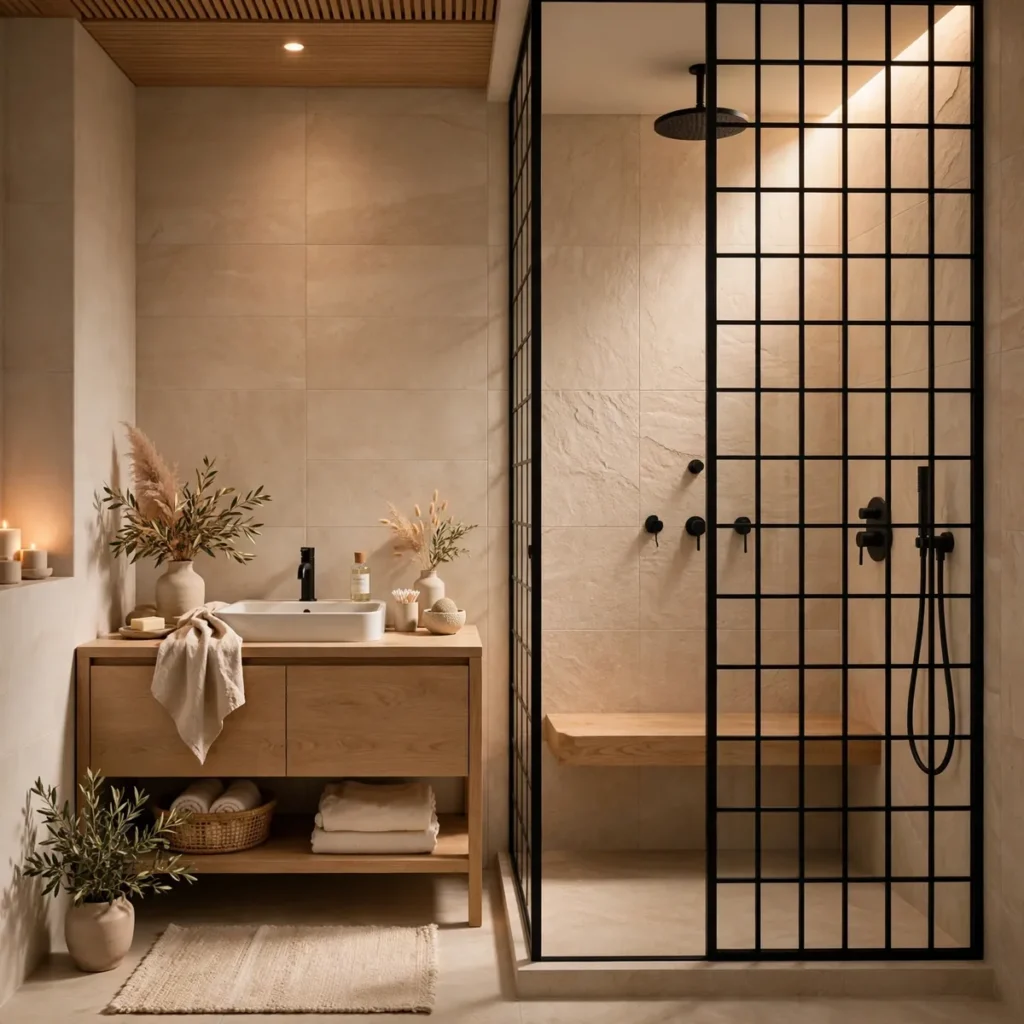
Shoji screens — the Japanese wood-and-paper room dividers — translate beautifully into bathroom glass. A frameless shower panel with a thin black grid pattern (or real matte-black framing in a grid) borrows the shoji’s graphic calm and gives a glass enclosure a Japandi identity that plain glass never achieves. It is one of the most distinctive Japandi moves you can make, and it costs far less than most people expect since patterned vinyl or black-grid glass is a small upcharge over standard glass.
This works in any bathroom with a walk-in or alcove shower; in a tub-shower combo, apply the grid to a fixed panel or sliding door instead. The strength is visual order — the grid’s repetition disciplines everything around it — but there is a real weakness: more framing means more edges to squeegee, so hard-water areas need a daily wipe to stay crisp. For the budget version, matte black grid-pattern window film on an existing glass panel gets you 80% of the look with zero demolition.
- Keep the grid fine and even — chunky industrial grids read as loft, not Japandi.
- Pair with warm wall tones so the black lines feel like ink calligraphy, not metalwork.
- Squeegee after every shower in hard-water areas; framed edges show spots fastest.
Go All-Matte: Honed Stone, Brushed Fixtures, Linen
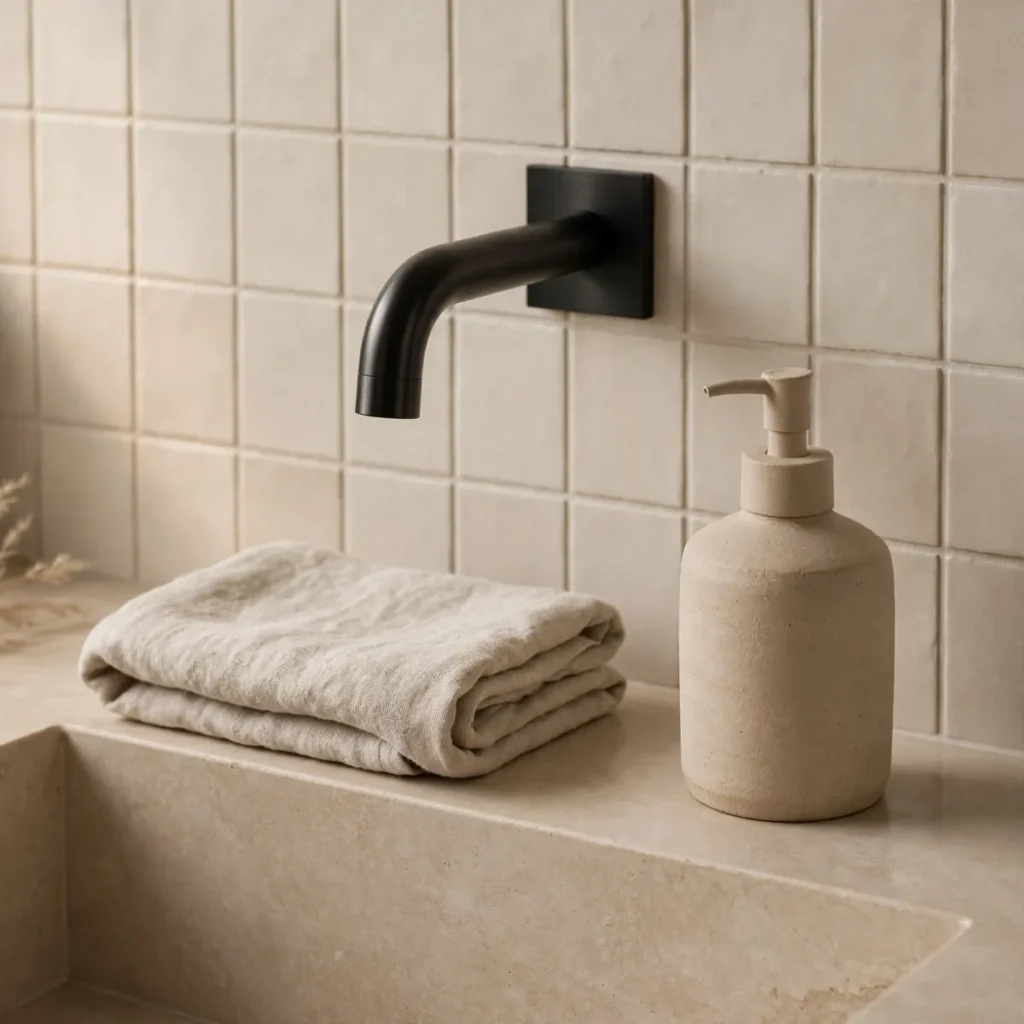
Gloss is the enemy of the Japandi bathroom. A strict all-matte finish discipline — honed stone counters, brushed or matte black fixtures, matte tile, unglazed ceramics, linen textiles — is what makes the room feel calm rather than showroom-shiny. Reflections create visual noise; matte surfaces absorb light and let the eye rest. This is not a small tweak — it is the single most unifying system in Japandi design, and it is what separates a genuinely Japandi bathroom from a beige bathroom with wood accents.
Apply it everywhere at once: faucet, shower fixtures, towel hooks, mirror frame, soap dispensers. One glossy element (usually the existing chrome faucet or a glass shelf) will undo the calm the rest of the room is working toward. The practical bonus is that matte and brushed finishes hide fingerprints and water spots far better than polished chrome, so the room stays looking clean with less effort. Budget-wise this is a hardware swap, not a renovation — one of the cheapest high-impact ideas in this list.
- Swap the faucet first — it is the most visible reflective surface in the room.
- Choose brushed nickel or matte black; both hide water spots, chrome does not.
- Match dispenser and accessory finishes to the faucet for a single-metal rule.
Hang a Rice-Paper Lantern Pendant
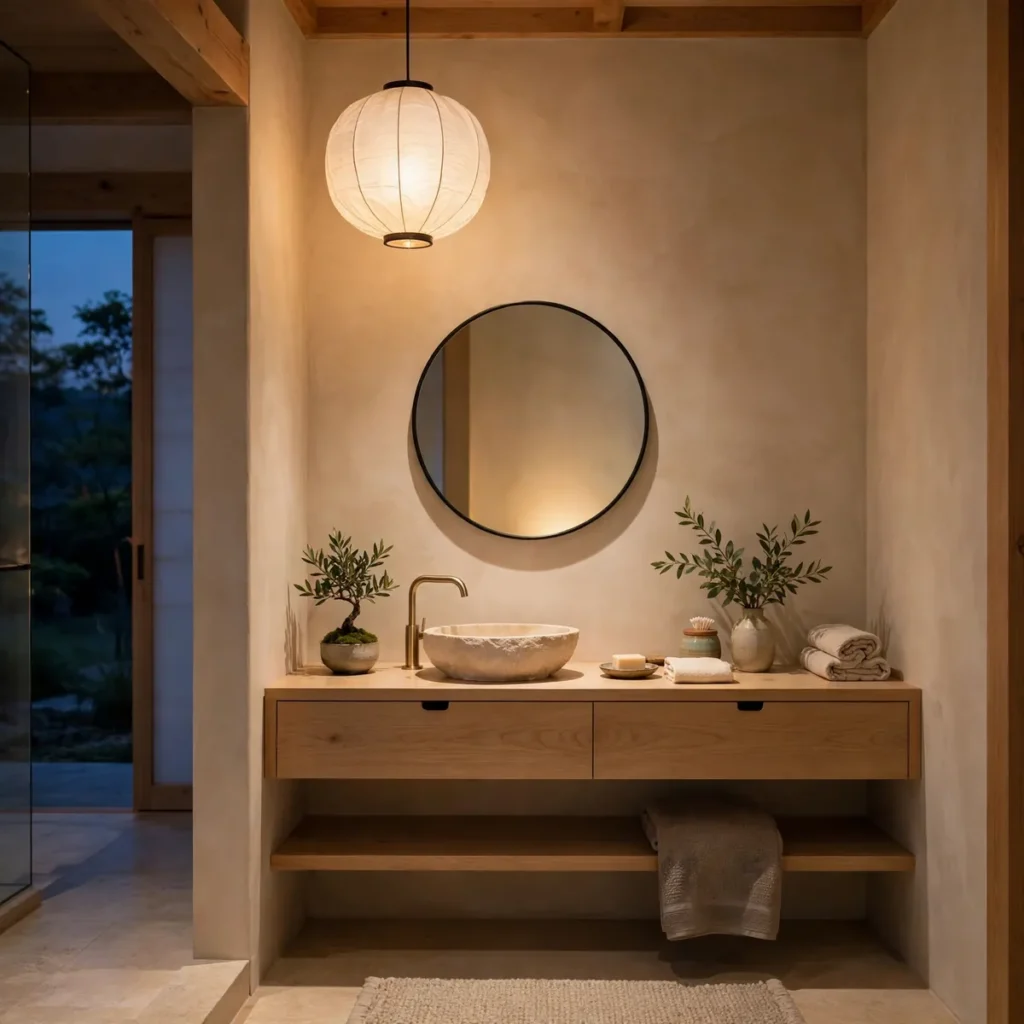
Overhead lighting is usually the most ignored element in a bathroom, which is exactly why a rice-paper lantern pendant makes such a difference. The glowing paper sphere diffuses light in every direction, softening shadows and giving the whole room a warm, lantern-lit calm that recessed cans never achieve. It is an unmistakably Japanese gesture — paper lanterns are among the oldest lighting forms in the world — and it instantly signals the style without a single extra decorative object.
Choose a damp-rated pendant if it hangs anywhere near the shower, and keep it high enough that tall users won’t brush it. The lantern suits powder rooms and primary baths equally; in a tiny bathroom, one small lantern replaces the harsh overhead dome light with something sculptural. Its limitation is output — paper diffuses light beautifully but dimly, so pair it with a wall sconce or two near the mirror for tasks like shaving and makeup. The renter-friendly version: a plug-in paper lantern swag hung from a ceiling hook, no wiring needed.
- Use a warm 2700K bulb; anything cooler turns the paper glow clinical.
- Damp-rated fixtures only — standard paper lanterns sag in steamy bathrooms.
- One lantern is a statement; two small ones over a double vanity is a composition.
Layer Three Depths of Warm Light
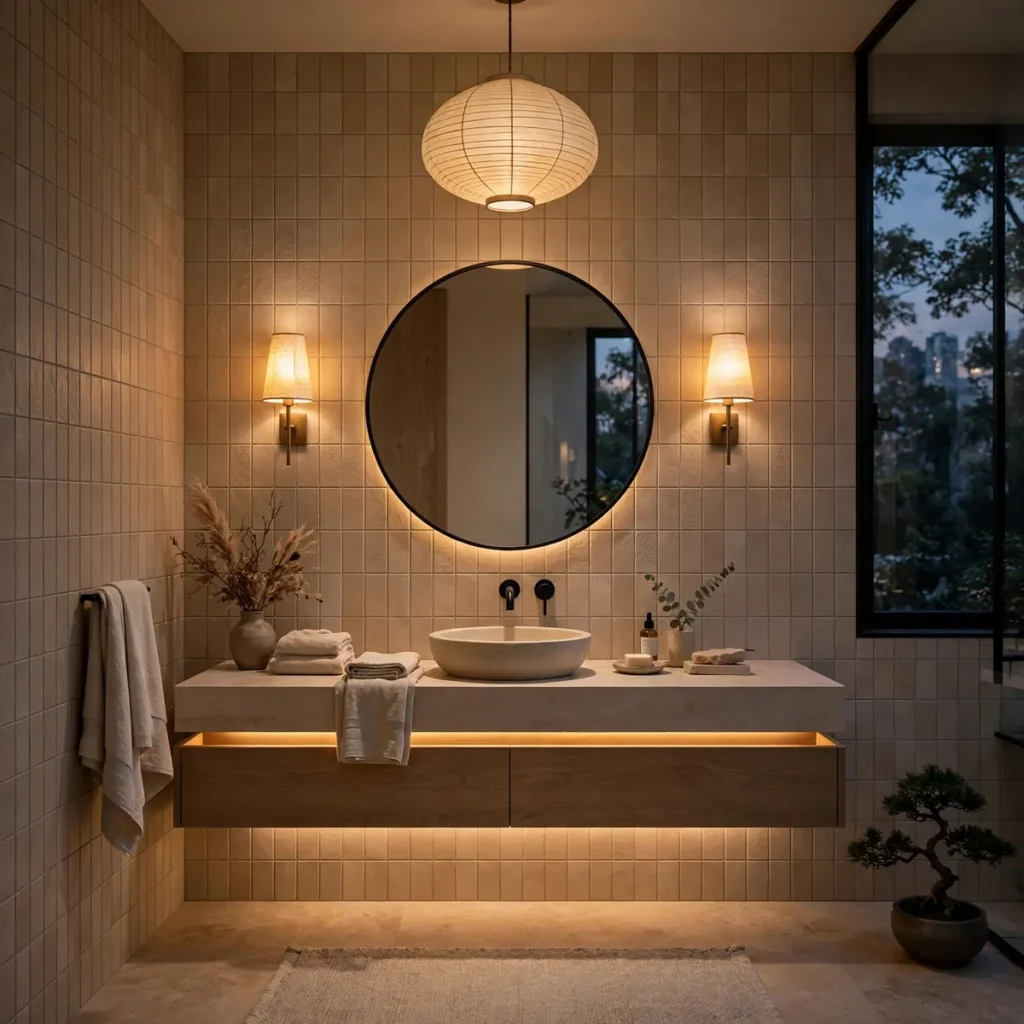
A single ceiling light cannot make a Japandi bathroom feel spa-like, no matter how soft the bulb. The trick is three depths of light: ambient (the paper lantern or dimmable ceiling light for overall glow), task (warm sconces flanking the mirror at face height for shadow-free grooming), and glow (a low strip under the floating vanity or behind the mirror that washes the floor or wall at night). Each layer on its own dimmer means the room can shift from bright morning routines to a candle-warm evening soak.
This layered approach is what separates a Japandi bathroom that photographs well from one that feels well. Morning light needs to be functional — bright enough to see — while evening light should be low and warm, ideally under 2200K at night. Install dimmers on every circuit; they cost almost nothing and change the room’s mood more than any fixture upgrade. The weakness is complexity for older bathrooms: adding new circuits means opening walls, so in a refresh, fake the layers with plug-in sconces and a motion-sensor LED strip under the vanity.
- Sconces at face height flanking the mirror eliminate the overhead shadows ceiling lights create.
- Put every layer on a dimmer; one shared switch defeats the purpose.
- Under-vanity glow strips on motion sensors give safe night lighting without glare.
Choose a Teak Bath Mat Over a Fabric Rug
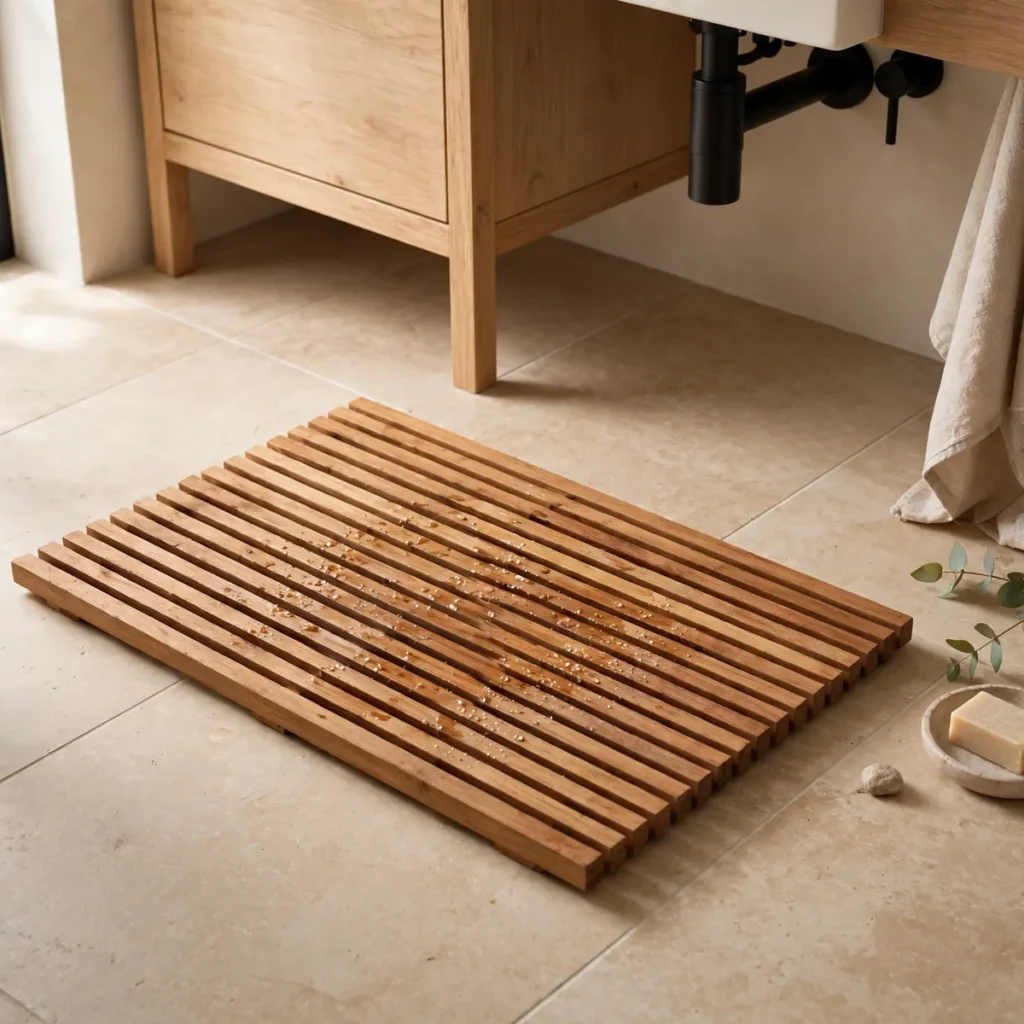
Fabric bath rugs fight the Japandi bathroom on two fronts: they trap moisture in a room that should feel dry and clean, and their softness clashes with the room’s hard natural materials. A teak bath mat — a slatted wooden platform you step onto from the shower — solves both. It dries in minutes, feels warm underfoot, looks sculptural, and echoes the wooden vanity so the room’s material palette repeats at floor level. Japanese bathrooms have used wooden bath platforms for centuries; this is one of the most authentic Japandi moves available.
Teak is the wood to buy here because its natural oils resist water and mildew far better than oak or bamboo in a wet application. Rinse it weekly and oil it twice a year, and it lasts for years. This idea suits shower-heavy bathrooms best; in a tub-focused bath, place it beside the tub instead. The honest trade-off: a teak mat costs more than a rug and feels firm at first, but most people prefer it within a week — and it never develops that damp-rug smell.
- Buy solid teak, not teak-stained bamboo — the oil content is what resists water.
- Elevate the mat slightly on its built-in rails so air circulates underneath.
- Oil twice a year with teak oil; skip varnish, which peels in steam.
Add One Statement Plant, Not a Jungle
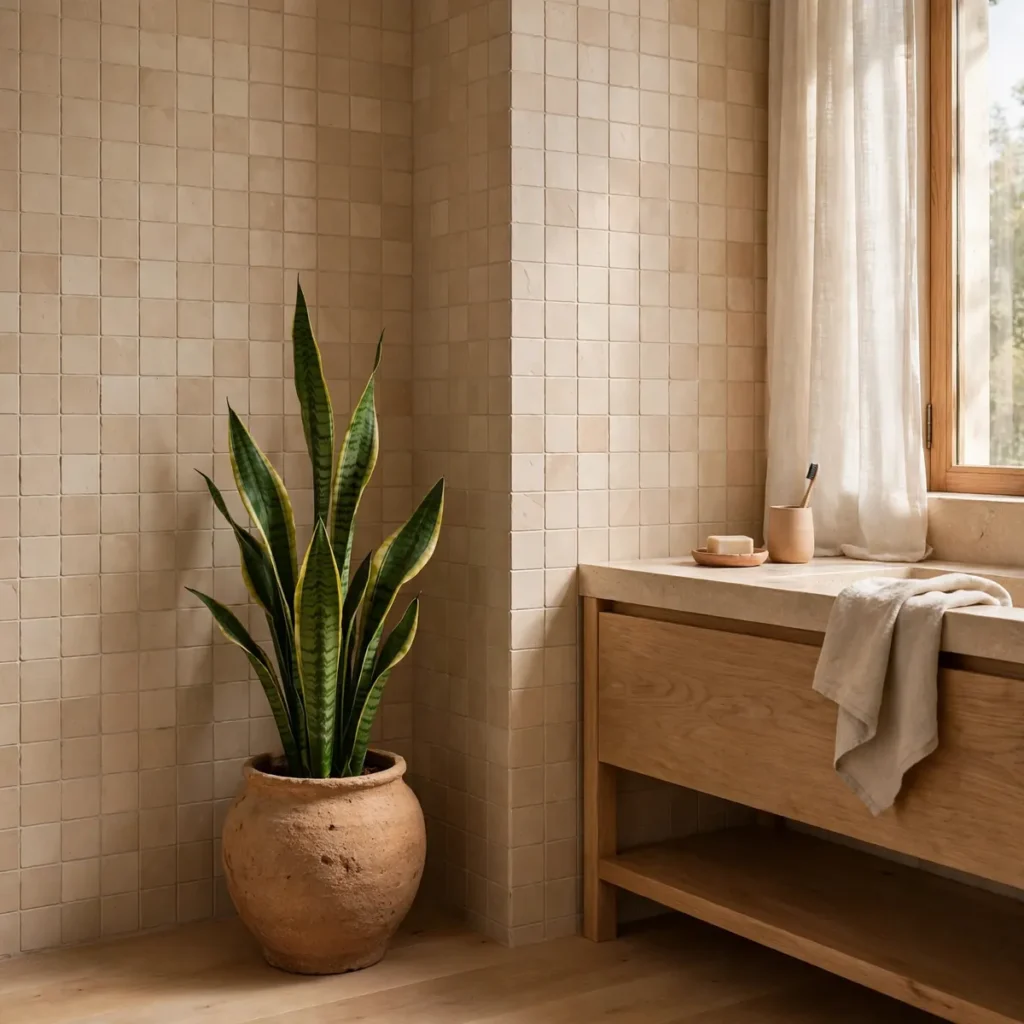
Japandi rooms want the presence of nature, not a greenhouse. One well-chosen plant — a small olive tree, a sculptural snake plant, a trailing pothos on the vanity shelf — brings the living element that keeps minimalism from feeling cold. The restraint is the design: a single plant in a handmade ceramic pot reads as intentional, while five plants read as clutter, and clutter is what Japandi exists to eliminate.
Pick for the bathroom’s actual conditions: low natural light favors snake plants and ZZ plants; a bright windowed bath can host ferns or an orchid. The handmade ceramic pot matters as much as the plant — rough, unglazed, in a warm neutral tone, it continues the room’s material story. Who should skip this idea? Anyone whose bathroom has zero natural light and no skylight; even shade plants need some light, and a struggling plant contradicts the calm. For those rooms, a single dried branch in a ceramic vase gives the same organic gesture without the light requirement.
- One large plant beats three small ones in a minimal room.
- Match the pot to the room: unglazed stoneware, warm white or clay tone.
- No-light bathrooms: use a dried branch or preserved eucalyptus stem instead.
Carve Out a Recessed Niche for Bathing Rituals
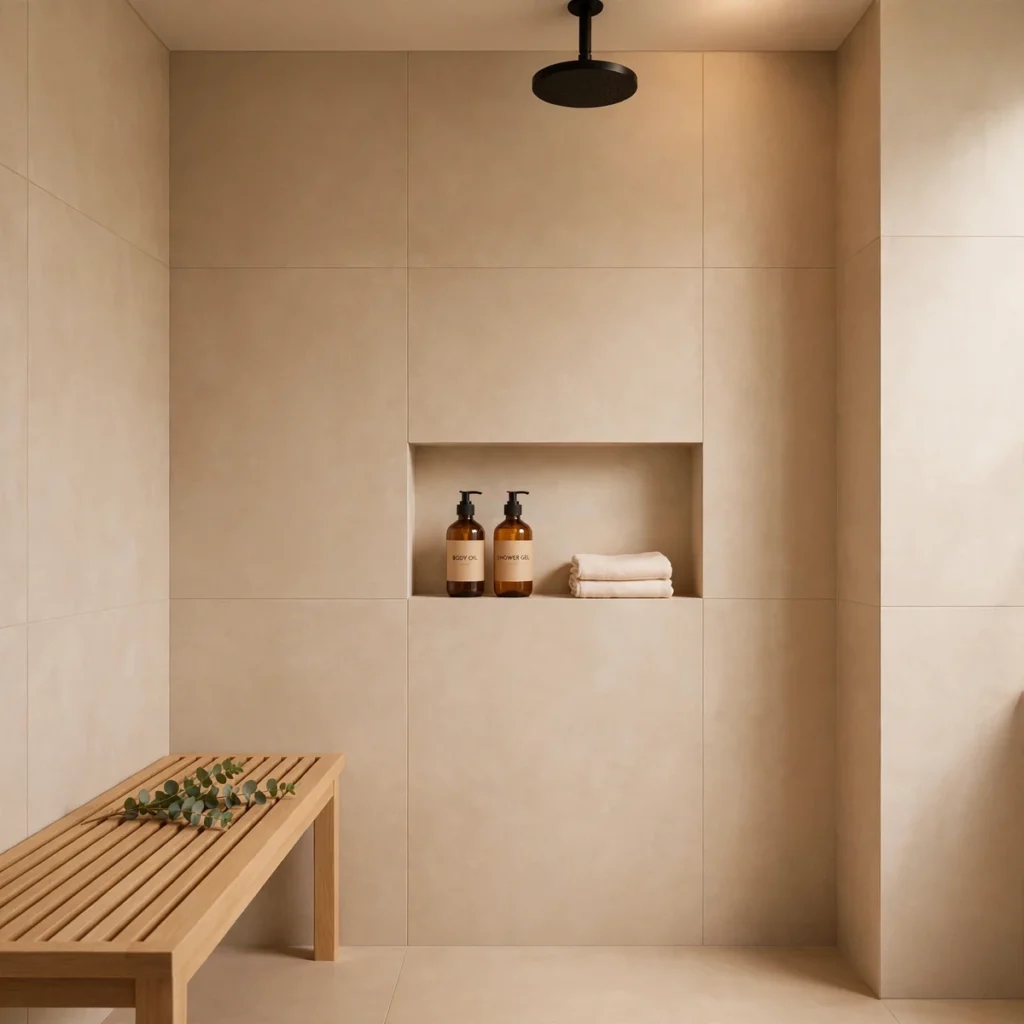
A recessed wall niche in the shower or above the tub is the Japandi answer to bathroom storage: storage that disappears into the wall instead of protruding into the room. But the real idea here is how you style it. Instead of filling it with half-empty plastic bottles, treat the niche as a small altar to your bathing ritual — two products decanted into matching ceramic or amber glass bottles, a natural sponge, a folded washcloth. The niche stops being storage and becomes part of the room’s calm.
This idea works best planned during a renovation, since cutting a niche into an existing tiled wall is messy work; in a refresh, a shallow teak or bamboo shelf mounted flush to the wall approximates the effect. Limit the niche to what fits in one tidy row — if products overflow, the calm breaks. The strength is that it removes the visual chaos of product packaging entirely, which is the single biggest clutter source in most bathrooms.
- Decant daily products into matching bottles; packaging is the clutter.
- One niche per shower is enough; a second one invites overflow.
- Seal niche edges with waterproof grout — recessed corners trap moisture.
Set a Woven Stool Beside the Tub
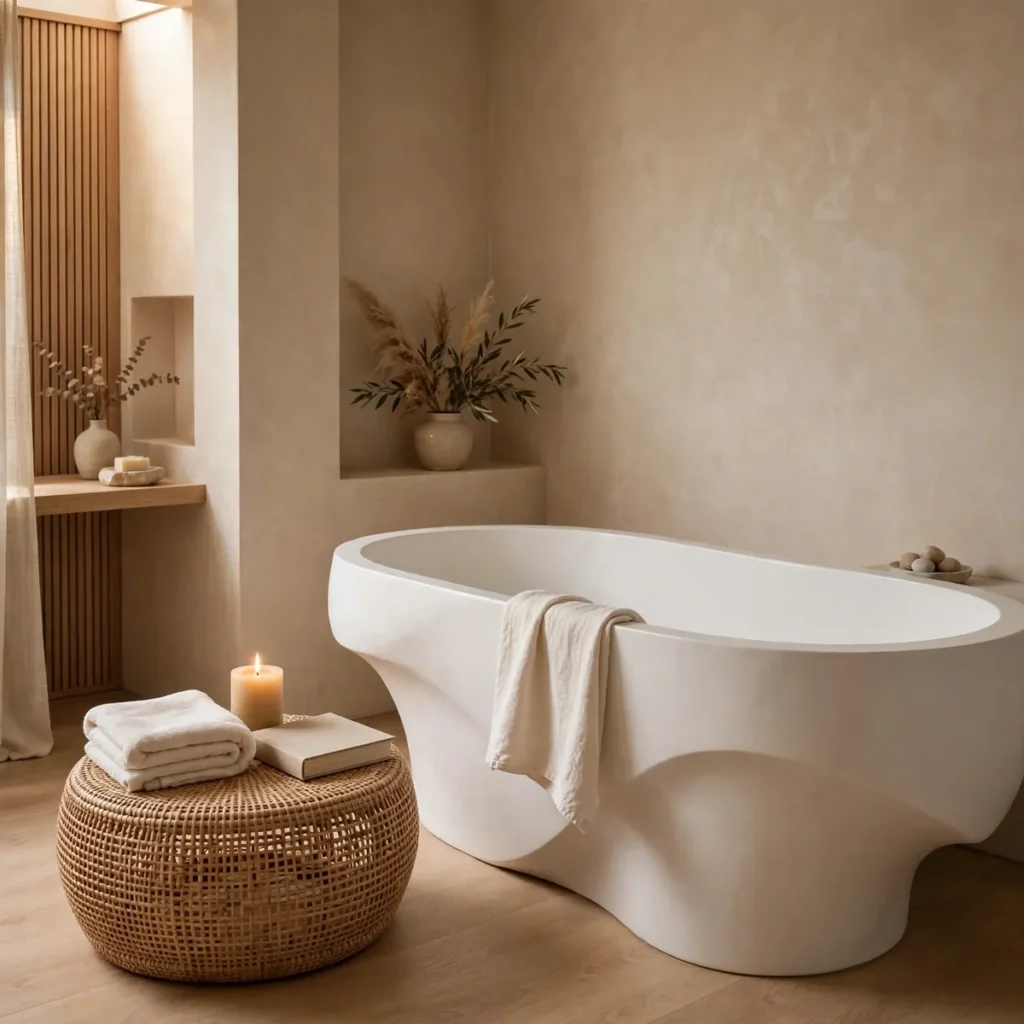
A low woven stool beside the bathtub — holding a folded towel, a candle, and a book — is a small piece of furniture with outsized effect. It gives the tub a companion, turning an empty corner into a composed scene, and it is genuinely useful: a place for the towel within arm’s reach, a stand for tea during a soak, a seat while a child bathes. Stools like this come from Japanese bathing culture, where low seating is part of the ritual, and the woven texture adds the tactile warmth that keeps a stone-and-wood bathroom from feeling austere.
Choose rattan, seagrass, or bent oak in a natural finish; avoid anything painted or glossy. Keep it low — 15 to 18 inches — so it sits below the tub rim and reads as a servant piece, not competing furniture. The limitation is space: in a tight bathroom, a stool becomes an obstacle rather than a gesture, so this is for medium and large baths. In small rooms, swap the stool for a wall-mounted teak fold-down seat that disappears when not in use.
- Keep the stool’s top styling to three items: towel, candle, one small object.
- Natural woven materials only — painted wicker reads coastal, not Japandi.
- Tight bathrooms: use a wall-mounted teak fold-down seat instead.
Edit the Countertop to Three Objects
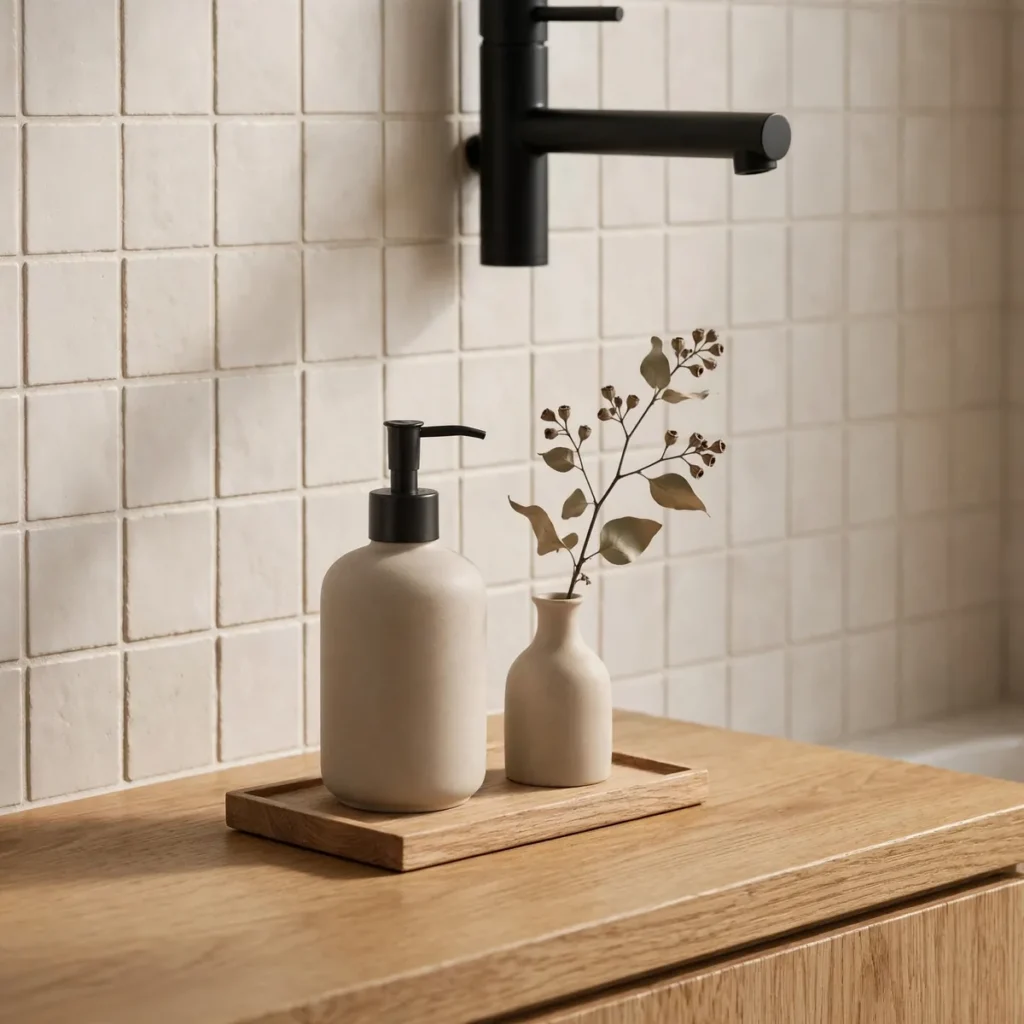
The fastest, cheapest Japandi transformation is not a purchase — it is a removal. Edit the vanity countertop down to three objects: a soap dispenser, one small vessel (a ceramic tray or cup), and one living or organic element (a stem in a bud vase, a small plant). Everything else goes into drawers, a cabinet, or a lidded box. Three objects on an empty counter reads as serene; seven objects reads as busy, and the difference between those two states is about ten minutes of decluttering.
This is the idea that tests whether you actually want Japandi or just like looking at it, because it requires ongoing discipline — the countertop edit only works if the hidden storage behind it can absorb the overflow. If your vanity has no drawers, add a single lidded basket under it first, then do the edit. The payoff is disproportionate: visitors will assume you renovated when you only removed things.
- Corral the three objects on a small tray — one grouping reads calmer than three scattered items.
- If an item hasn’t been touched in a week, it doesn’t live on the counter.
- Decant soap into a ceramic or matte dispenser; labels are visual noise.
Hide Storage Behind Seamless Flat-Panel Doors
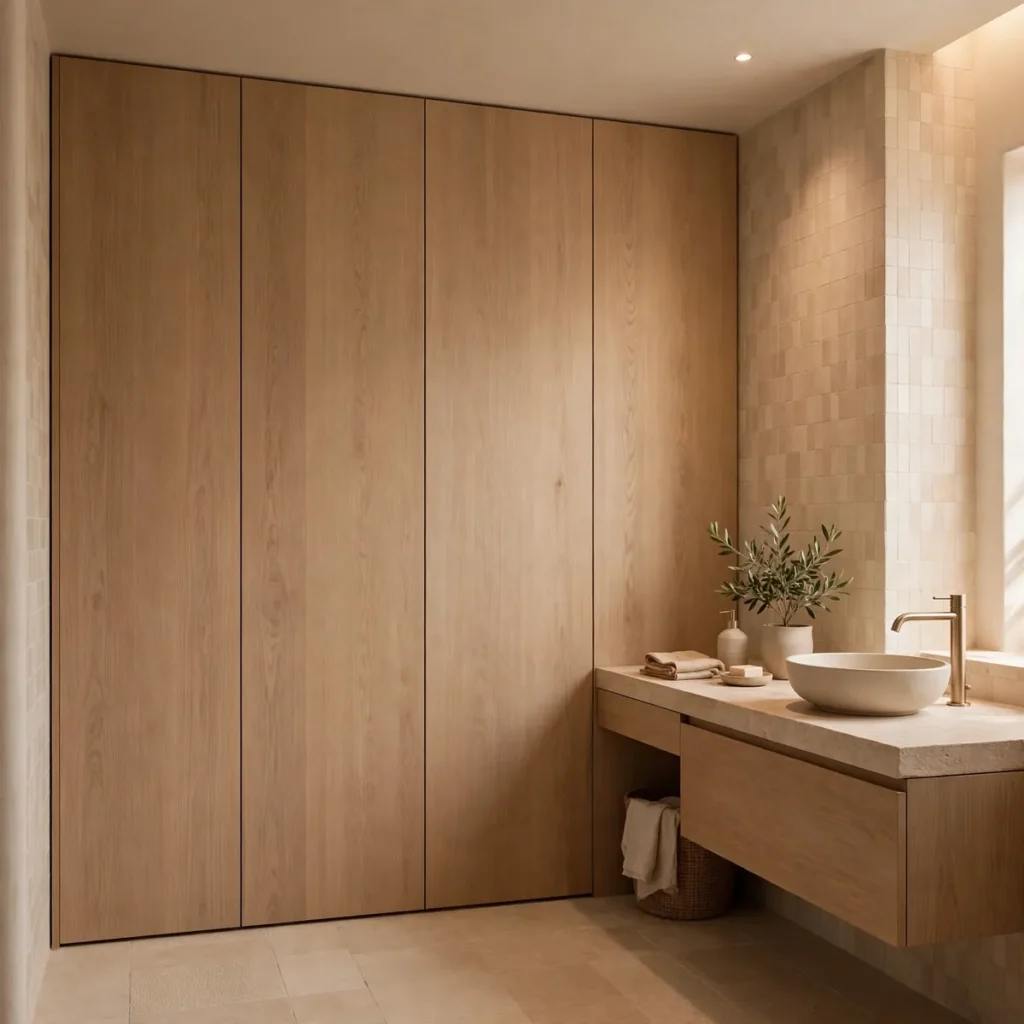
Japandi calm depends on closed storage — open shelves collect visual noise faster than any other feature in a bathroom. Flat-panel cabinet doors in the same oak as the vanity, with no knobs and push-to-open hardware, let an entire wall of storage read as a single calm wood panel. From across the room, the storage wall should look like architecture, not furniture. This is how Japanese interiors handle storage: everything hidden, nothing announced.
Plan the interior honestly before committing to the minimal exterior. A tall cabinet needs divided compartments — pull-out trays, drawer inserts, a lidded laundry slot — or the flat fronts just hide chaos that erupts every morning. For existing bathrooms, replace open shelving with a single tall linen cabinet in oak; even one closed door changes the room’s noise level. The weakness is cost and planning time — seamless storage is a design decision, not a shopping trip — but it is the structural foundation every other idea on this list assumes.
- Push-to-open hardware keeps fronts seamless; skip knobs entirely.
- Divide cabinet interiors with trays and inserts or the calm is only skin-deep.
- One tall closed cabinet beats three open shelves for visual calm.
Wrap Walls in Stone-Look Large-Format Tile
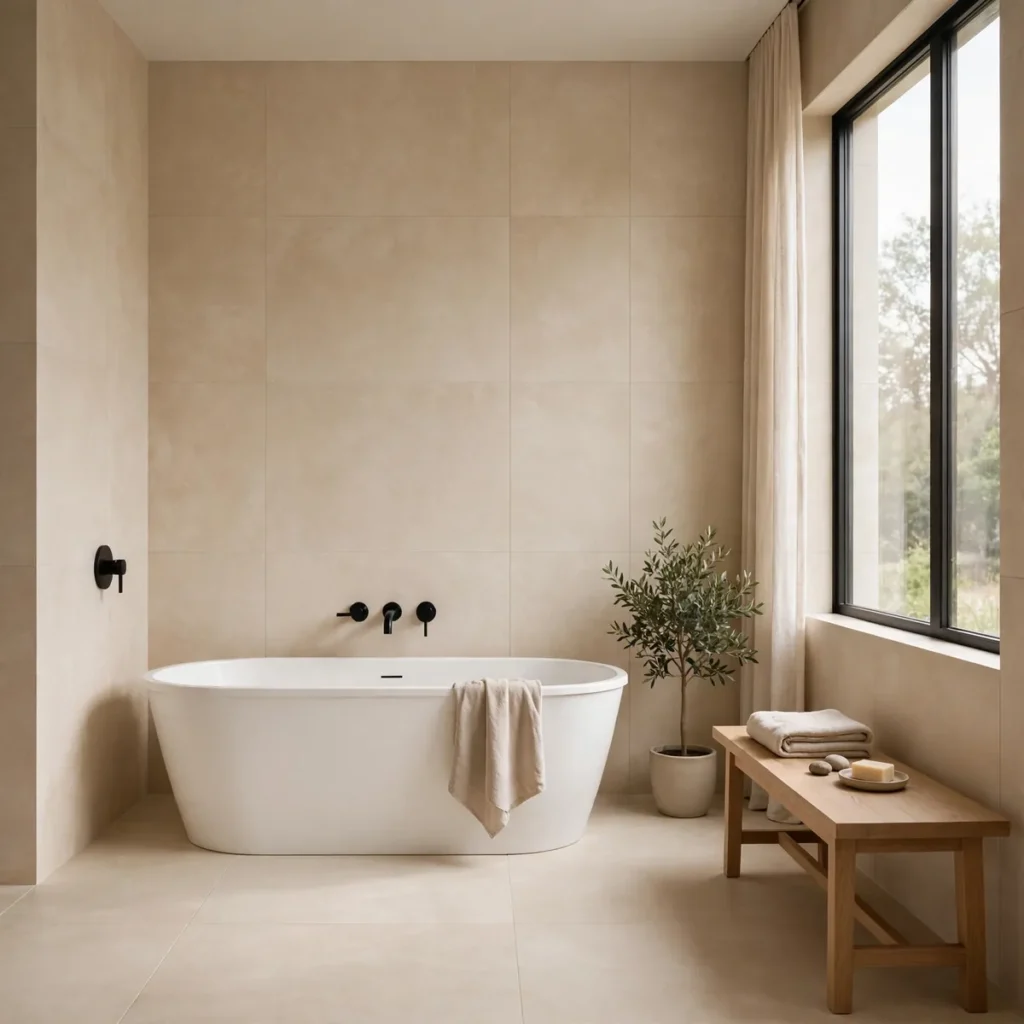
Few grout lines, one continuous material, walls that read as carved rather than tiled — stone-look large-format tile is the Japandi wall system. Formats of 24×48 inches and larger in warm limestone or soft travertine tones wrap the shower and the main walls in an almost seamless skin, and running the same tile from floor to ceiling blurs the boundaries of the room so it feels larger. Matte finish only; polished stone-look tile reflects light in a way that reads luxury-hotel, not Japanese calm.
This is a renovation-level idea with renovation-level cost, so choose the tone carefully — warm limestone suits the Scandinavian warmth side, cool grey stone leans more modern-Japanese. The practical win is maintenance: fewer grout lines mean less grout to scrub and reseal, which keeps the calm literally cleaner. In a budget refresh, the renter-friendly echo of this idea is a single large-format-look peel-and-stick panel behind the vanity in a stone tone; it won’t fool anyone up close, but it unifies the wall in photographs and daily use.
- 24×48 or larger formats minimize grout; small tiles create visual static.
- Run the same tile floor-to-wall in the shower for the seamless effect.
- Warm limestone tones read Japandi; cool grey can read industrial.
Finish With a Round Mirror and a Scent Layer
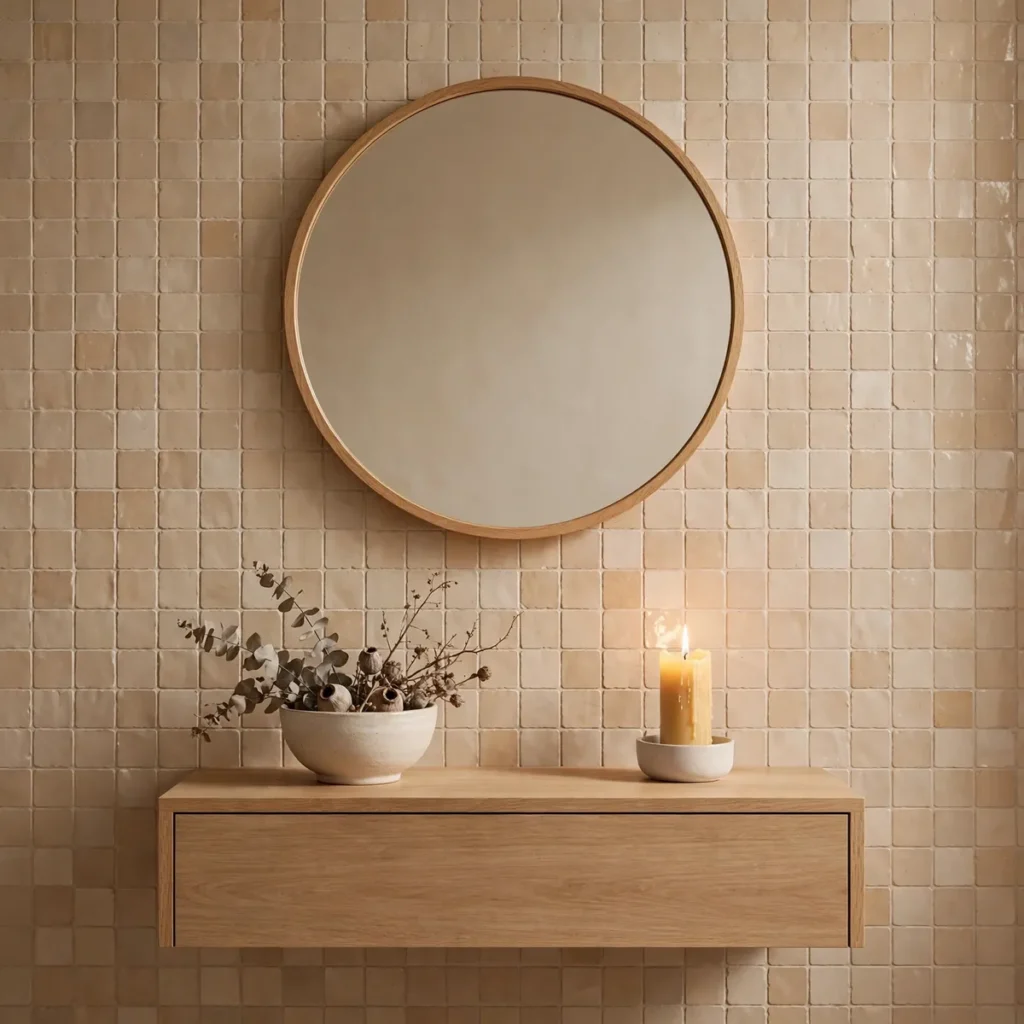
The last five percent of a Japandi bathroom is atmosphere, and atmosphere comes from two finishing moves. First, a round mirror — no frame or a thin oak frame — softens every straight line in the room the way a rectangular mirror cannot; the circle is the wabi-sabi shape, gentle and complete. Second, a scent layer: a cedar or hinoki-wood bath stool, a bowl of dried eucalyptus, or a single beeswax candle. Japanese bathing culture treats scent as part of the room, and a faint hinoki or eucalyptus note makes the bathroom feel like an onsen rather than a washroom.
These are finishing touches, not foundations — they only work once the materials, light, and storage are already calm. The round mirror suits every bathroom size and is one of the cheapest swaps on this list; the scent layer costs almost nothing but changes how the room is remembered. Skip synthetic plug-in fragrances — their sweetness fights the room’s earthiness. Real wood, real dried botanicals, or one quality candle is the entire scent system.
- Thin oak frame or frameless for the mirror; thick black frames shout modern.
- Hinoki wood accessories and dried eucalyptus give the most authentic scent.
- One candle or one botanical bowl — two scents compete and the calm breaks.
FAQs
Is Japandi the same as minimalism?
Not quite. Minimalism removes; Japandi curates. A Japandi bathroom keeps warm wood, handmade texture, and a few meaningful objects — it is minimal in quantity but rich in material. Pure minimalism can feel cold and empty; Japandi should feel calm and human.
Which woods actually survive in a humid bathroom?
Teak is the safest choice — its natural oils resist water and mildew. White oak and ash work if sealed with marine-grade matte finish or hardwax oil. Avoid raw pine and MDF-based wood-look products in steamy bathrooms; they swell, peel, and yellow.
Can I get the Japandi look in a small bathroom?
Yes — small bathrooms are arguably the best candidates, since the style’s restraint makes tight rooms feel larger. Focus on the highest-impact small moves: a floating vanity, a round mirror, all-matte finishes, the three-object countertop edit, and one rice-paper pendant instead of a harsh ceiling light.
Conclusion
A japandi bathroom is not a style you buy — it is a discipline you apply. Start with the honest materials (oak, stone, matte black), give everything a place behind closed doors, soften the light, and then stop adding things. Whether you renovate the whole room or just edit the countertop and swap the mirror this weekend, the principle is the same: fewer, better, quieter. Pick the idea that fits your bathroom today and let the calm follow.