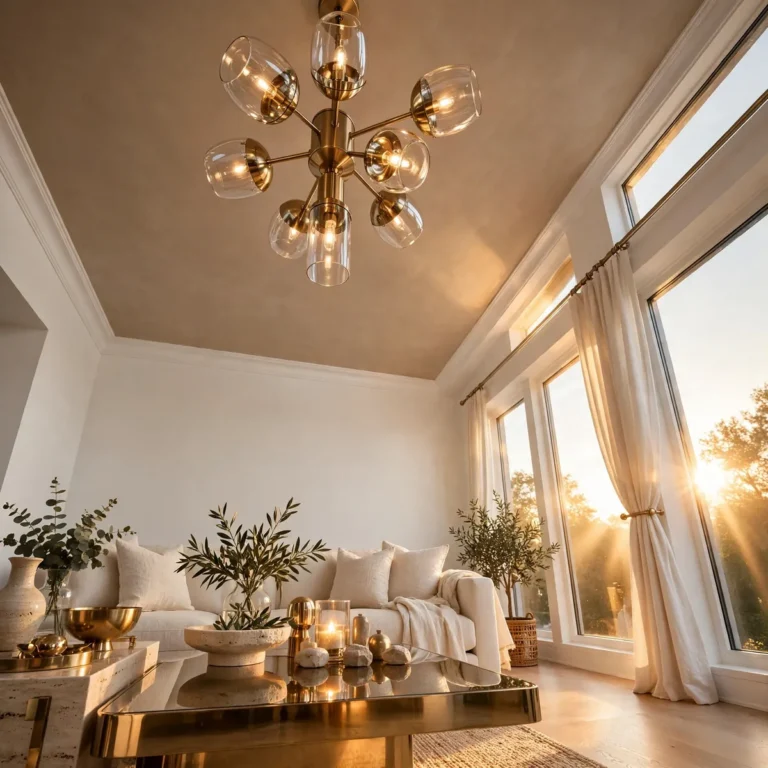
25 Living Room Inspiration Ideas to Spark Your Next Room Refresh
Twenty-five curated living room looks organized by style and mood — warm minimalism, moody drama, coastal ease, boho layers, and more — each with a concrete example to help you find the direction that fits your home.
The best living room inspiration ideas start with one decision: the mood you want to feel when you walk in. A living room can feel calm, dramatic, collected, or sunlit — and each of those feelings is built from a different mix of color, texture, and furniture. This guide gathers 25 living room inspiration ideas organized by style and mood, each with a concrete example, so you can find the direction that actually fits your space instead of scrolling endlessly through unrelated rooms.
Inspiration works best when you save a look you love and then adjust it to your room’s size and light. As you browse, notice which palettes keep pulling you back — those are your real preferences speaking. For warmth-focused comfort specifically, these living room inspiration ideas pair beautifully with cozy living room ideas, which digs deeper into layering textures and glow without a full redesign.
Key Takeaways
What are living room inspiration ideas?
Living room inspiration ideas are curated room styles, moods, and looks — like warm minimalism or moody charcoal — that show you a direction for your own space.
How do I choose a style for my living room?
Start with the mood you want (calm, dramatic, cozy, collected), then pick a palette of three colors and repeat them across the rug, sofa, and art.
Can I mix two living room styles?
Yes — transitional mixing works when you keep one consistent element, such as warm wood tones or a repeated metal finish, tying the room together.
How many ideas should I use from this list?
Pick one primary style for 70% of the room and borrow one or two ideas from a second style for the remaining 30%.
| Style direction | The mood it creates | Anchor pieces to start with | Best for |
|---|---|---|---|
| Warm minimalist | Calm, uncluttered, soft | Low-profile bouclé sofa, oak coffee table, single linen-textured rug | Small spaces and open plans |
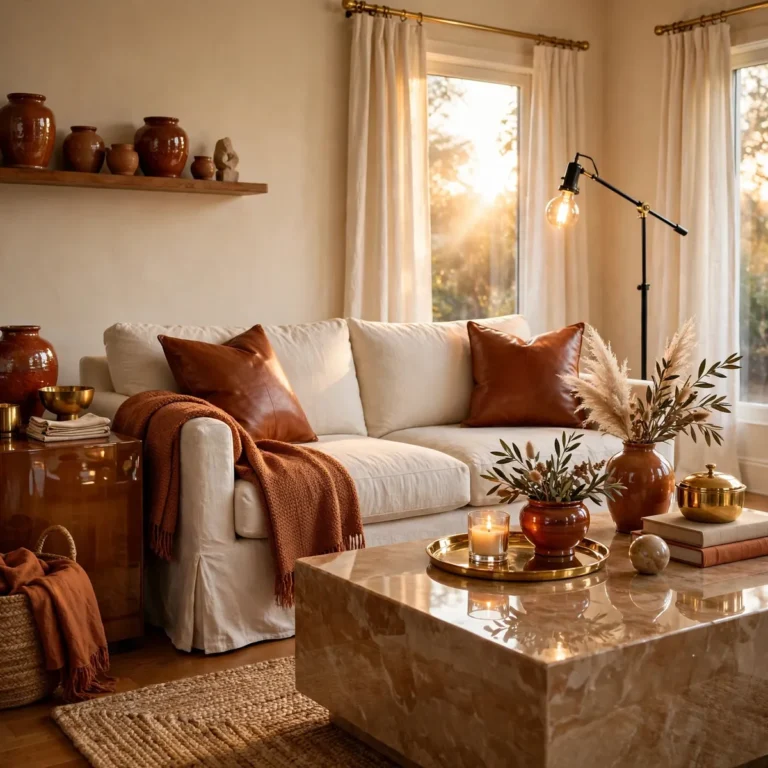
| Earthy terracotta | Warm, grounded, sunlit | Terracotta accent wall or throw pillows, woven jute rug, clay pottery | North-facing rooms that need warmth |
| Moody charcoal | Dramatic, cocooning, luxe | Dark walls, velvet armchair in emerald, brass floor lamp | Evening entertaining spaces |
| Scandinavian light | Airy, bright, effortless | Pale wood legs, white slipcovered sofa, sheepskin throw | Low-natural-light apartments |
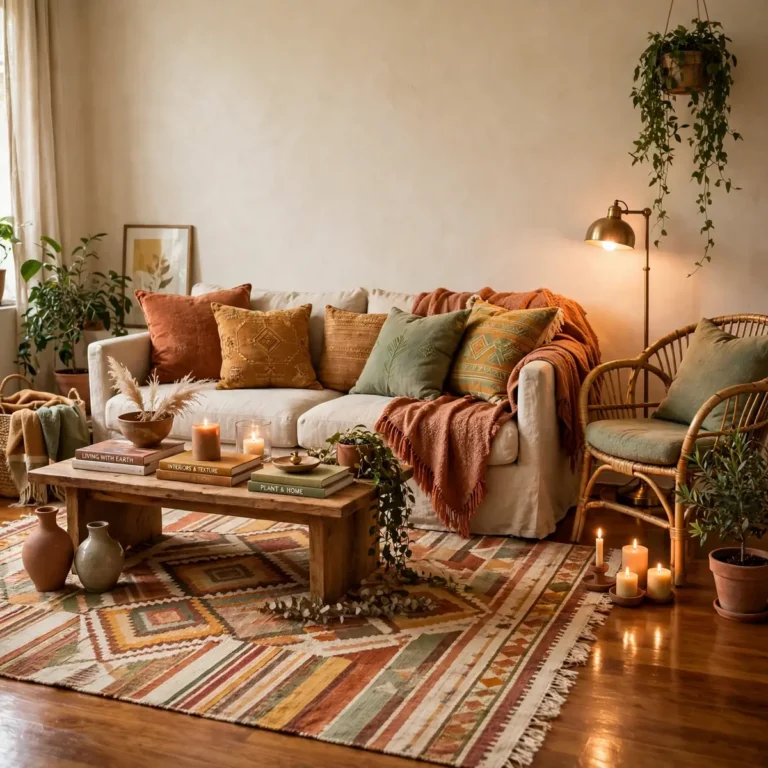
| Boho collected | Creative, layered, personal | Patterned rugs layered two-deep, rattan chairs, plants in clusters | People who love color and pattern |
| Modern glam | Polished, striking, rich | Marble coffee table, gold arc lamp, velvet sofa in navy or blush | Statement lovers with big windows |
Calm Warm-Minimalist Living Room
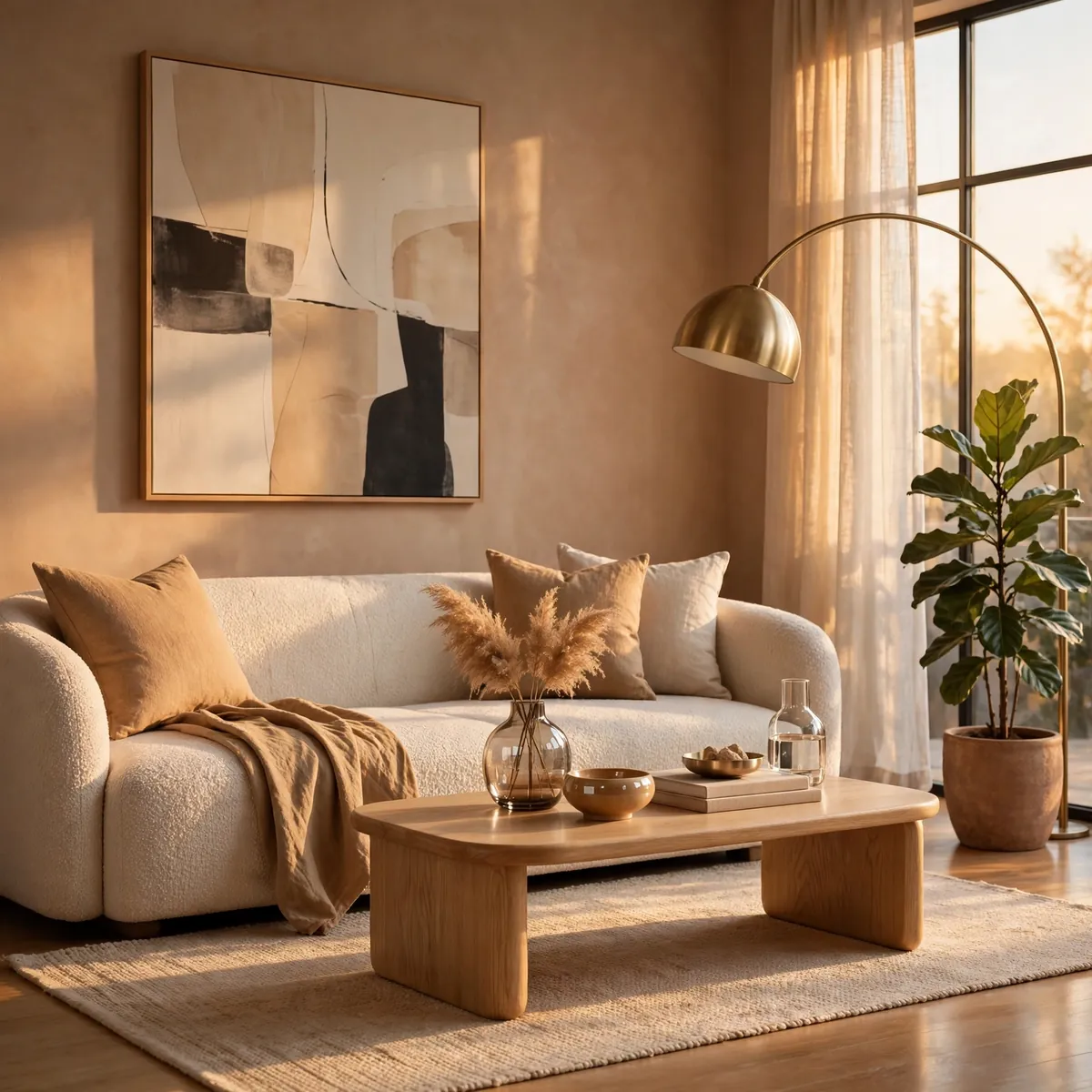
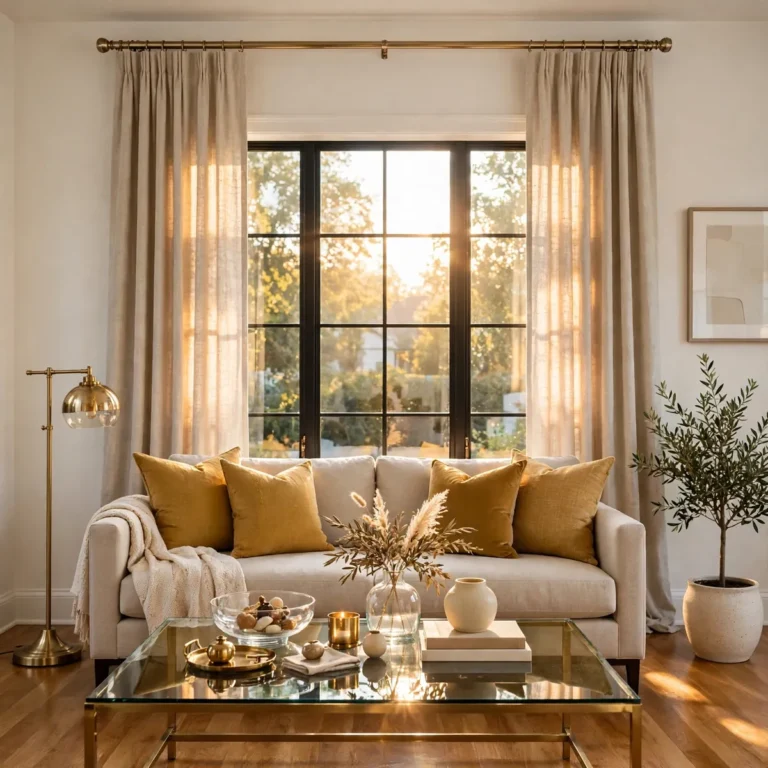
A warm minimalist living room keeps only what it needs and makes every piece feel intentional, and the key shift from cold minimalism is warm neutrals instead of stark white: oatmeal, camel, and soft clay layered over oak and linen. This is one of the most forgiving living room inspiration ideas because the palette does the heavy lifting, so you do not need expensive furniture for it to read as designed. The look is built in layers — first a low-profile sofa in an oatmeal bouclé or performance linen, then a pale jute or wool rug under the front legs of all seating, then a single oak coffee table with rounded edges so nothing in the room has a hard, aggressive line. Add one oversized piece of abstract art in warm beige and charcoal, hang it so its center sits at about 57 inches (average eye level), and finish with a single floor lamp in brushed brass or black metal arched over a reading corner. The magic is restraint: two cushions per sofa maximum, one throw draped casually rather than folded, and surfaces kept clear enough that the textures — bouclé, linen, oak grain — get to speak. Concrete example: a 14×16-foot living room with one west-facing window used an oatmeal IKEA-style loveseat, a $180 jute rug, a thrifted oak coffee table refinished in one afternoon, and a single tall fiddle-leaf fig in a clay pot — total spend under $700, and the room reads as a curated design studio sitting room.
Quick tips:
- Limit the palette to three warm neutrals repeated across the rug, sofa, and art.
- Choose rounded furniture edges; hard corners fight the soft mood.
- Keep surfaces 70% clear so texture, not clutter, carries the look.
Modern Organic Curves
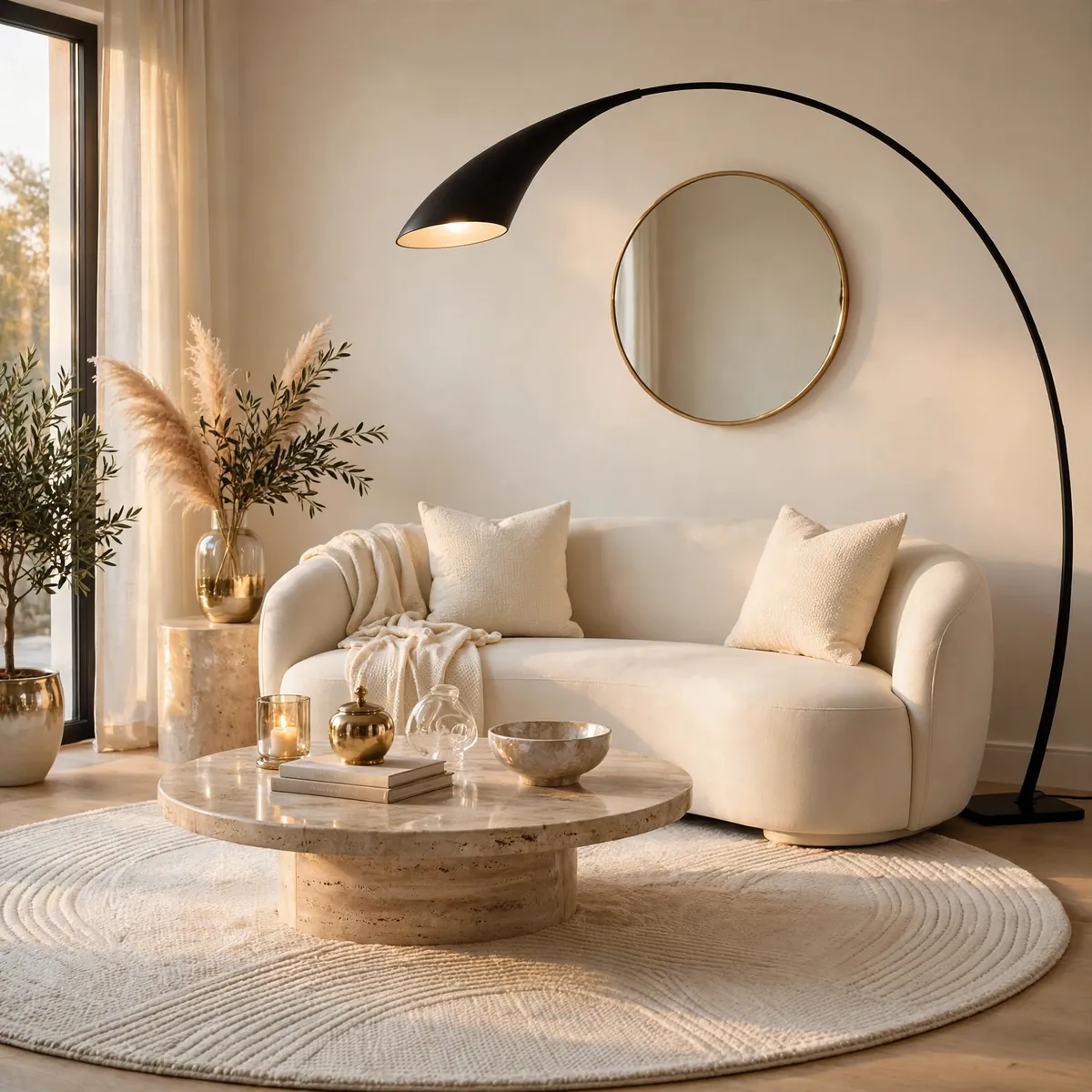
Curved furniture is the fastest way to make a boxy room feel designed, because arches and rounded silhouettes break the grid of rectangular walls and windows. A curved sofa, a round coffee table, or even an arched floor lamp can carry the whole idea. Concrete example: swap a straight two-seater for a curved loveseat in cream performance fabric, pair it with a 36-inch round travertine coffee table, and add one arc floor lamp in matte black — the room instantly feels like a boutique hotel lounge.
Quick tips:
- Repeat the curve at least three times (sofa, table, mirror or lamp) so it reads as intention.
- Balance curves with one rectangular element so the room does not feel unstable.
- Round rugs work best with round tables; match the geometry.
Moody Charcoal Drama
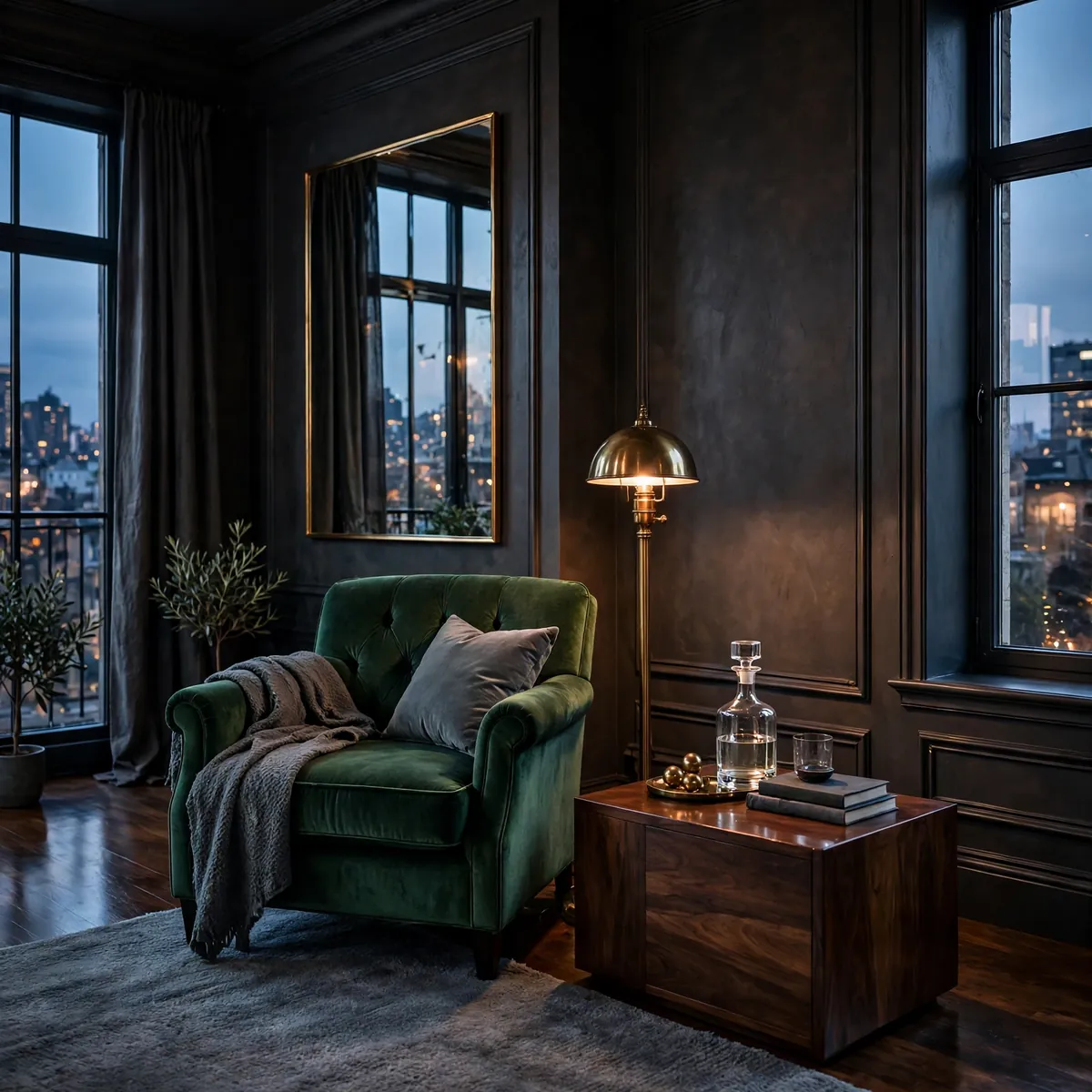
Dark walls make a living room feel smaller in the best way: cocooning, cinematic, and intimate, like a private club you own. Charcoal or deep slate on all four walls works when you counterweight it with warm light and at least one reflective surface. Concrete example: paint the walls in a charcoal with warm undertones, place an emerald velvet armchair against it with a brass pharmacy floor lamp beside it, and hang a large mirror with a thin gold frame opposite the window — the mirror bounces light around so the room feels dramatic but never cave-like.
Quick tips:
- Use warm-white bulbs (2700K) only; cool bulbs on dark walls feel flat.
- Add one reflective piece — brass, glass, or mirror — per dark wall.
- Keep the ceiling a shade lighter than the walls to avoid a closed-in feel.
Sun-Washed Coastal Ease
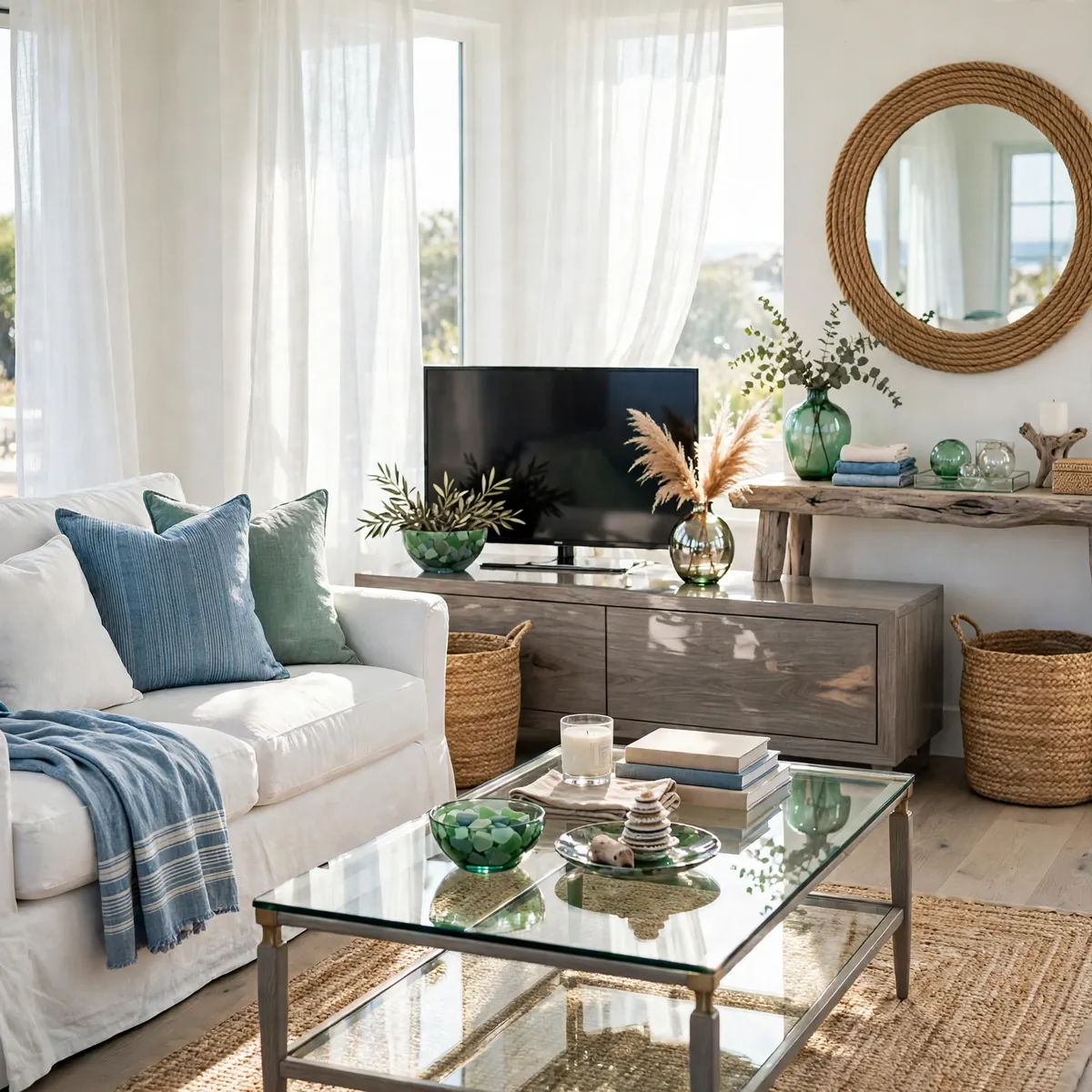
Coastal living rooms are less about seashells and more about light, air, and washed-out color: bleached blues, sand, driftwood grey, and crisp white. The palette keeps rooms feeling bright even in winter. Concrete example: a white slipcovered sofa, a washed-blue striped linen throw folded over one arm, a driftwood-toned console with a round jute mirror above it, and a pair of woven seagrass baskets flanking the media unit for texture.
Quick tips:
- Use blue as an accent, not the wall color — washed blues in textiles feel modern, on walls they date fast.
- Slipcovers make the coastal look practical for homes with kids or pets.
- One large woven texture (jute rug or seagrass baskets) per room is enough.
Earthy Terracotta Warmth
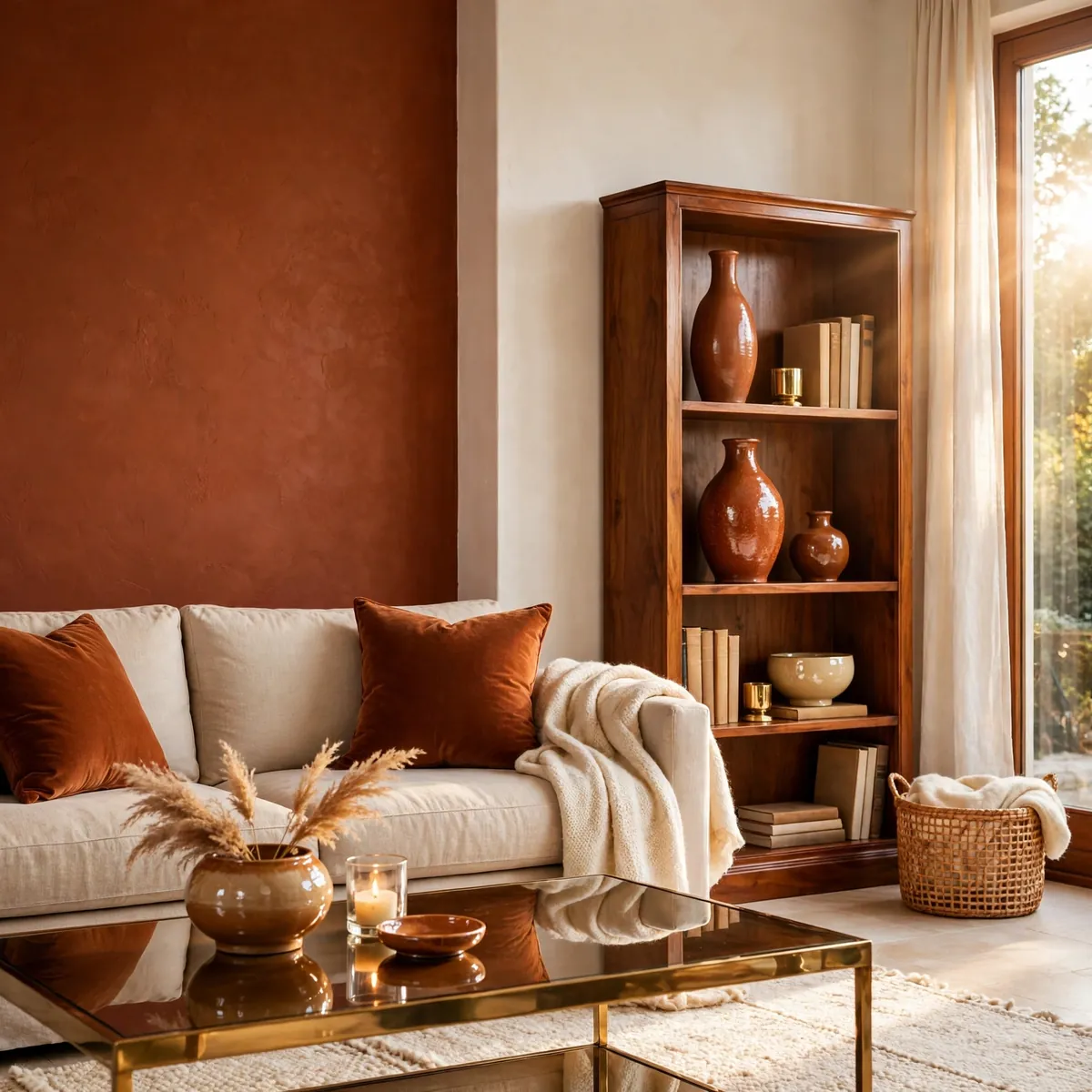
Terracotta sits between orange and brown, and it warms a room the way late-afternoon sun does — it is especially good in north-facing rooms that get cool light. Concrete example: paint a single accent wall in burnt terracotta, then layer a cream wool rug over the floor, add rust-colored velvet cushions on a beige linen sofa, and finish with handmade-look clay vases in three different heights on the mantel or shelf.
Quick tips:
- Pair terracotta with cream and warm wood, not grey — grey cools it down and dulls the glow.
- One accent wall beats four painted walls; terracotta is strong.
- Repeat the color in at least three spots so it feels deliberate, not random.
Classic Traditional Comfort
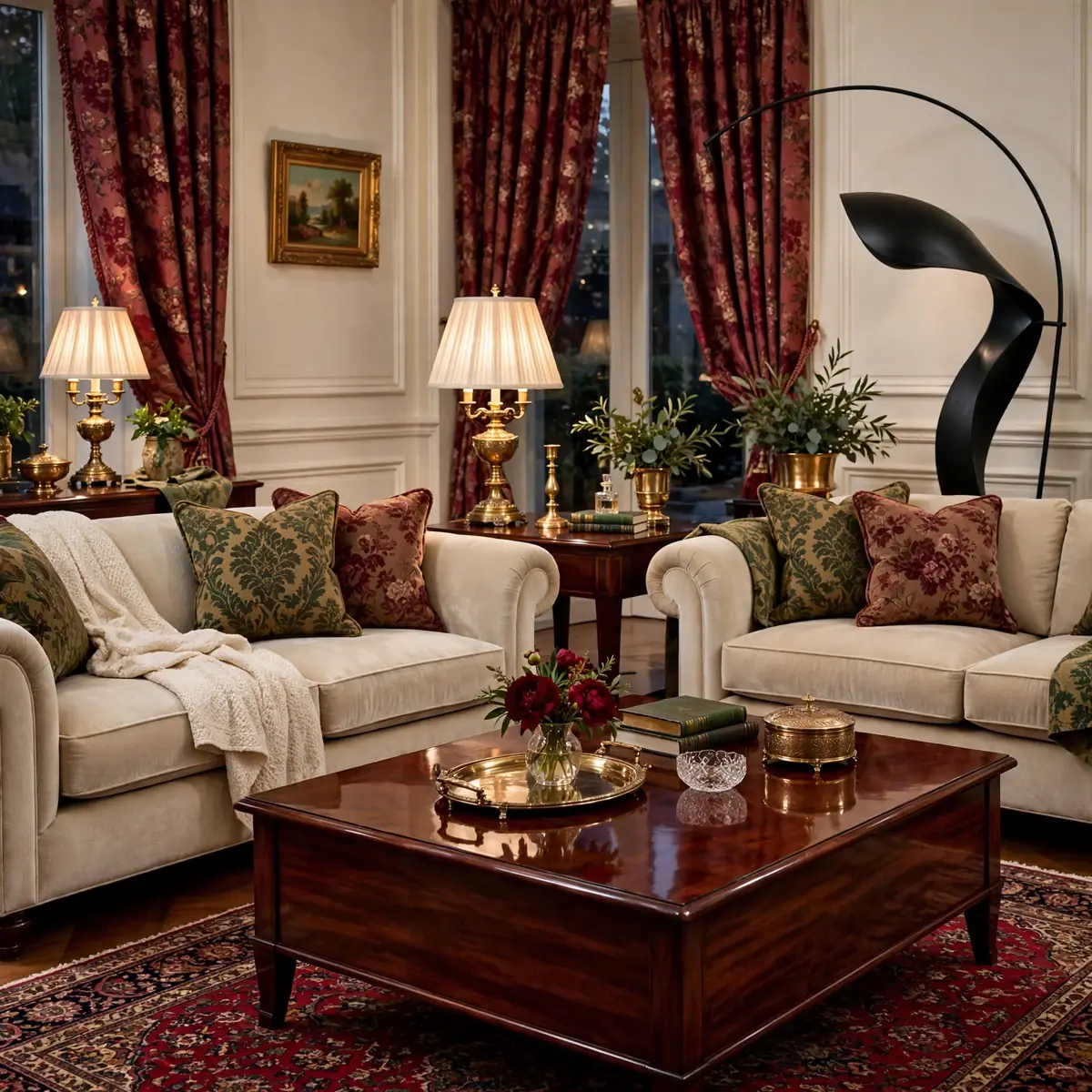
Traditional living rooms are symmetrical, tailored, and timeless: rolled-arm sofas, matching lamp pairs, and patterns that have been around for centuries. Concrete example: two matching rolled-arm sofas facing each other across a mahogany coffee table, a pair of identical brass table lamps on the side tables, and a Persian-style rug with a formal border anchoring the seating — the symmetry alone makes the room feel calm and finished.
Quick tips:
- Symmetry is the shortcut: pairs of lamps, chairs, or pillows instantly read traditional.
- Choose patterns with a long history (florals, damask, stripes) in a tight palette.
- Add one modern piece, like a sculptural floor lamp, so the room does not feel like a museum.
Scandinavian Light and Air
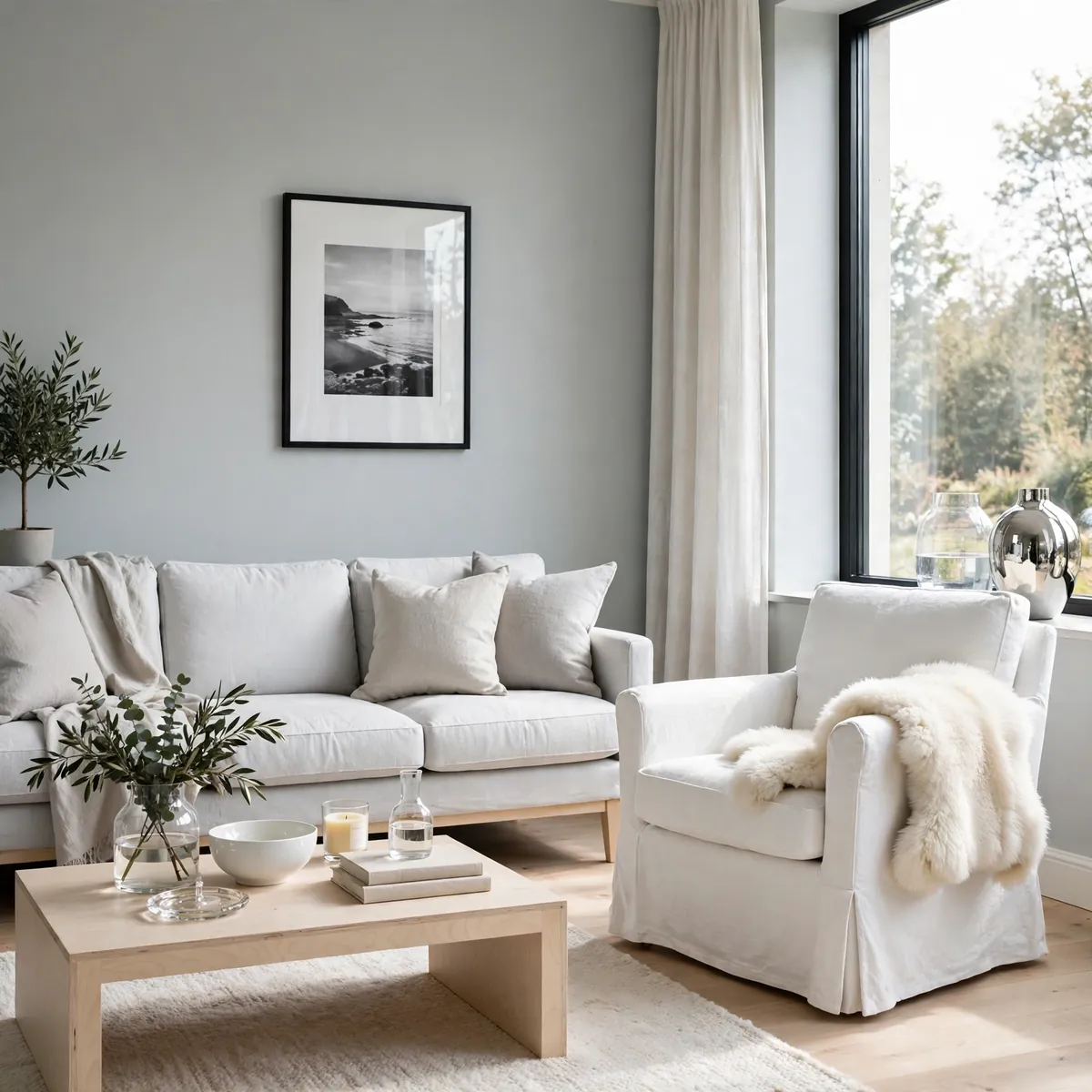
Scandinavian living rooms are pale, functional, and bright: white or pale-grey walls, pale wood, and textiles that add warmth without adding visual weight. Concrete example: a light-grey three-seater with pale oak legs, a white sheepskin draped over one armchair, a simple birch coffee table, and one black-and-white framed print — everything light except one dark accent so the room has a focal point.
Quick tips:
- Pale wood (birch, ash, light oak) is the signature; dark walnut fights the look.
- Textiles do the warming: wool throws, linen cushions, sheepskins.
- Edit ruthlessly; every object on display should earn its spot.
Boho Collected Layers
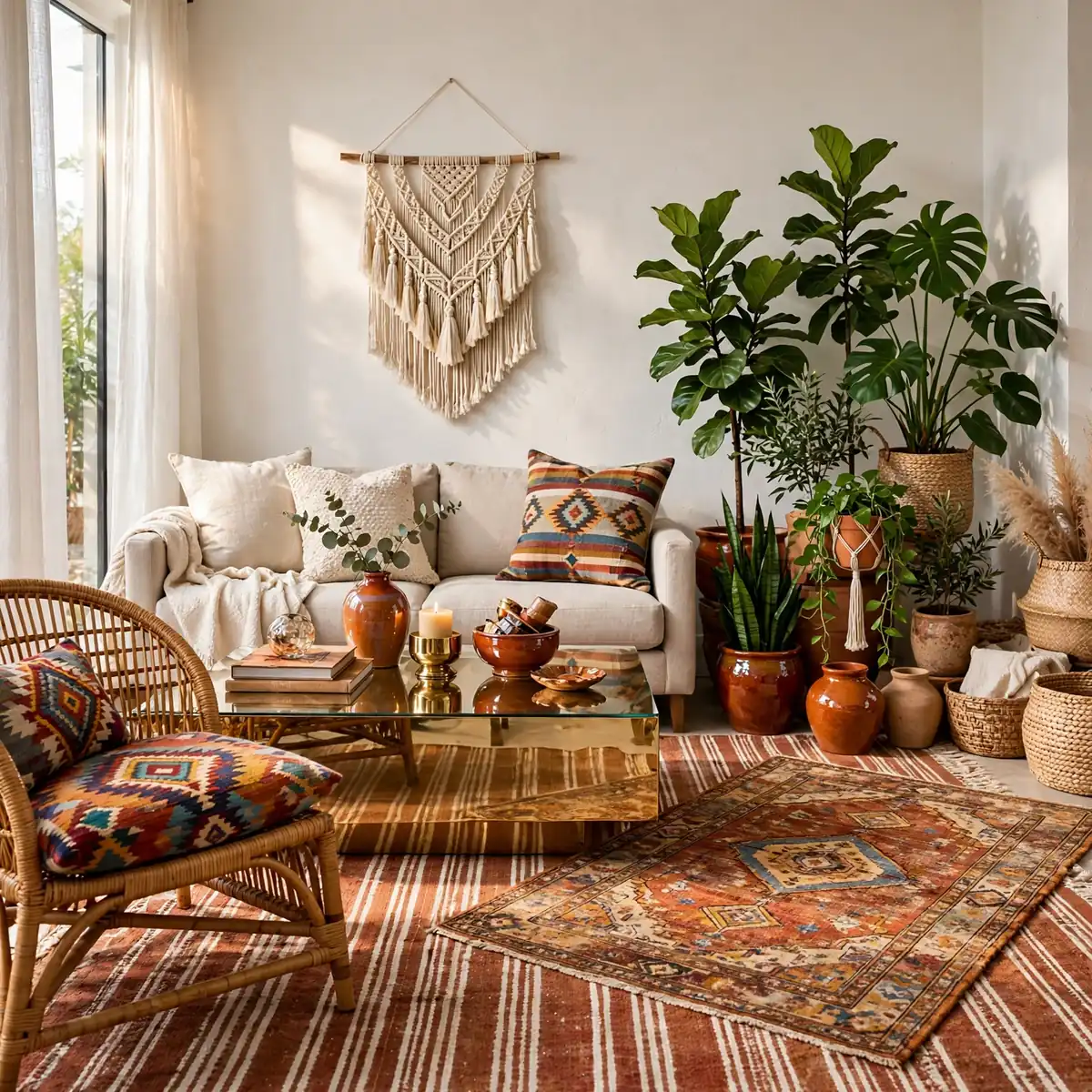
Boho living rooms feel gathered over time rather than bought in one trip: layered rugs, mixed patterns, rattan, plants, and pieces with a story. Concrete example: start with a large flat-weave rug in rust and cream, layer a smaller vintage-style rug on top at an angle, add a low rattan armchair with a kilim cushion, cluster five plants of different heights in one corner, and hang a macramé wall hanging above the sofa — collected, not matched.
Quick tips:
- Layer two rugs with different scales of pattern so they do not compete.
- Group plants in odd numbers (3 or 5) for a natural look.
- Keep the sofa neutral so the layers around it can be bold.
Japandi Quiet Balance
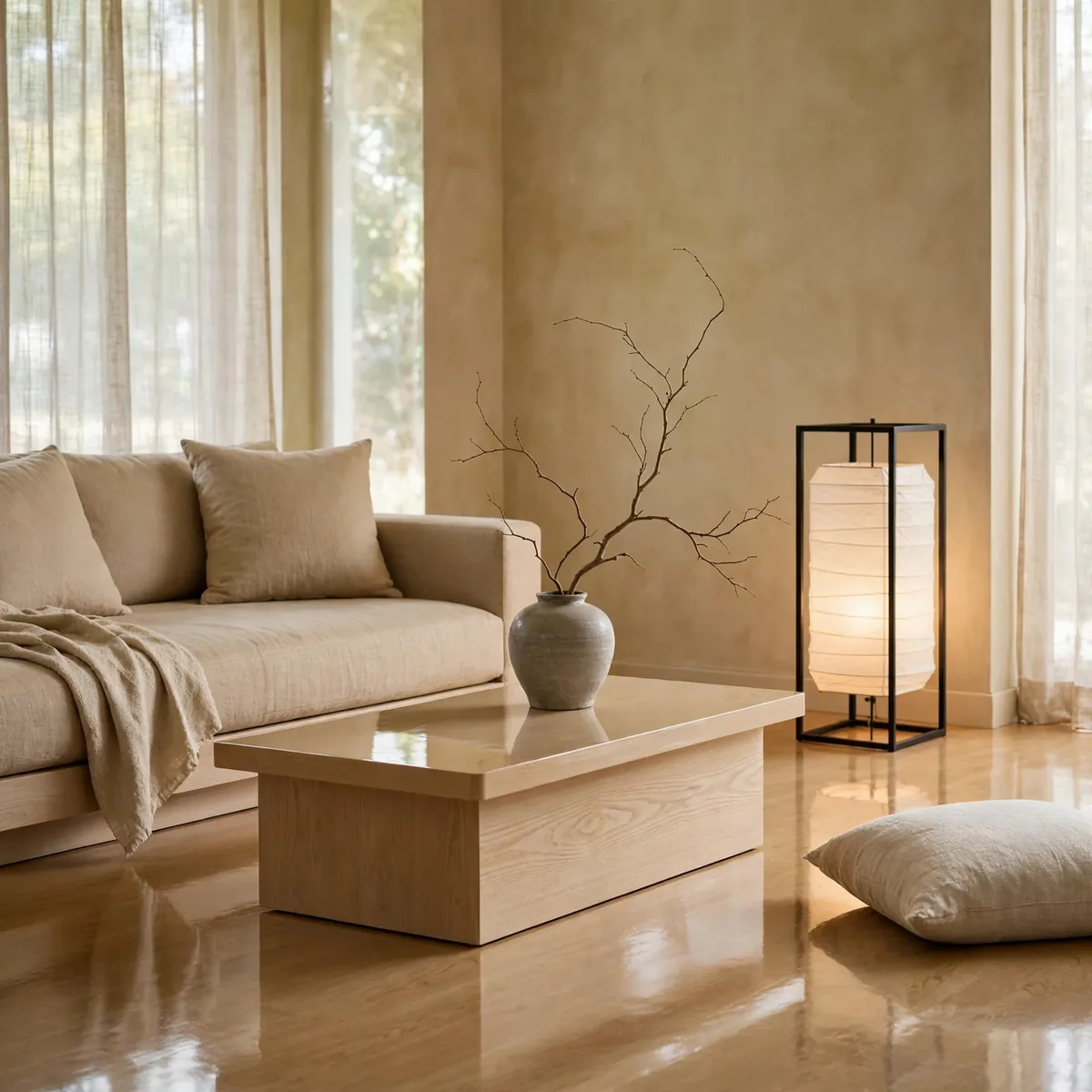
Japandi blends Japanese restraint with Scandinavian warmth: low furniture, natural materials, and empty space treated as a design element. Concrete example: a low platform-style sofa in warm beige, a low oak bench as a coffee table, a single ceramic vase with one branch on it, and a paper-style floor lantern in the corner — the room breathes, and every object has room to be noticed.
Quick tips:
- Keep furniture low; low profiles create the calm, grounded feeling.
- One branch, one vase, one lantern — resist filling every surface.
- Natural materials only: wood, linen, clay, paper, stone.
Mid-Century Retro Revival
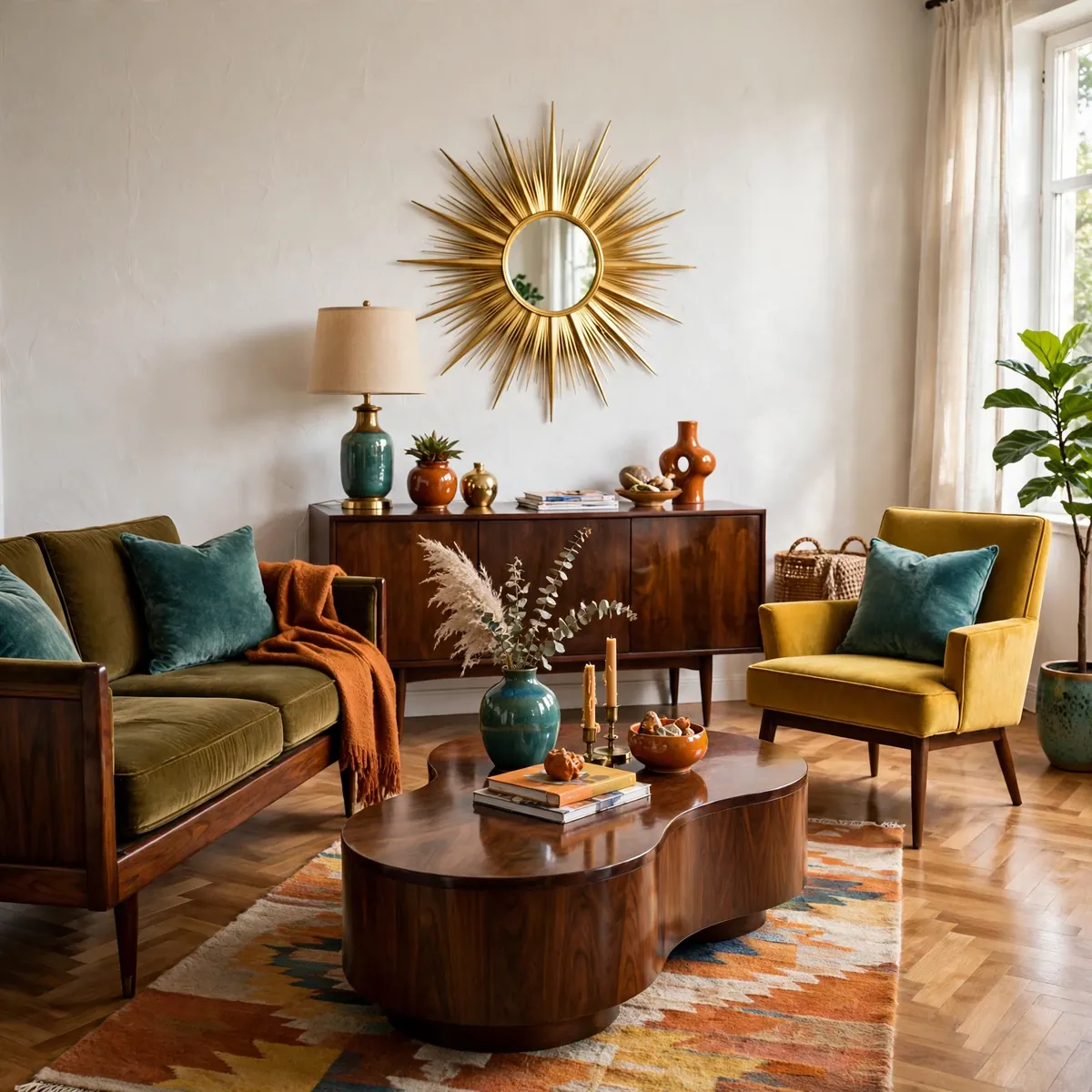
Mid-century living rooms are defined by tapered wooden legs, clean lines, and a confident mix of walnut with mustard, teal, or burnt orange. Concrete example: a walnut-trimmed sofa with tapered legs, a kidney-bean-shaped coffee table in walnut veneer, a mustard-yellow accent chair with angled arms, and a starburst-style mirror above a low credenza — the 1950s silhouette reads fresh again when the fabrics are new.
Quick tips:
- Tapered legs on everything: sofa, chairs, coffee table, sideboard.
- Use one bold retro color (mustard, teal, orange) against warm wood.
- Keep walls neutral; the furniture is the pattern here.
Soft Sage Serenity
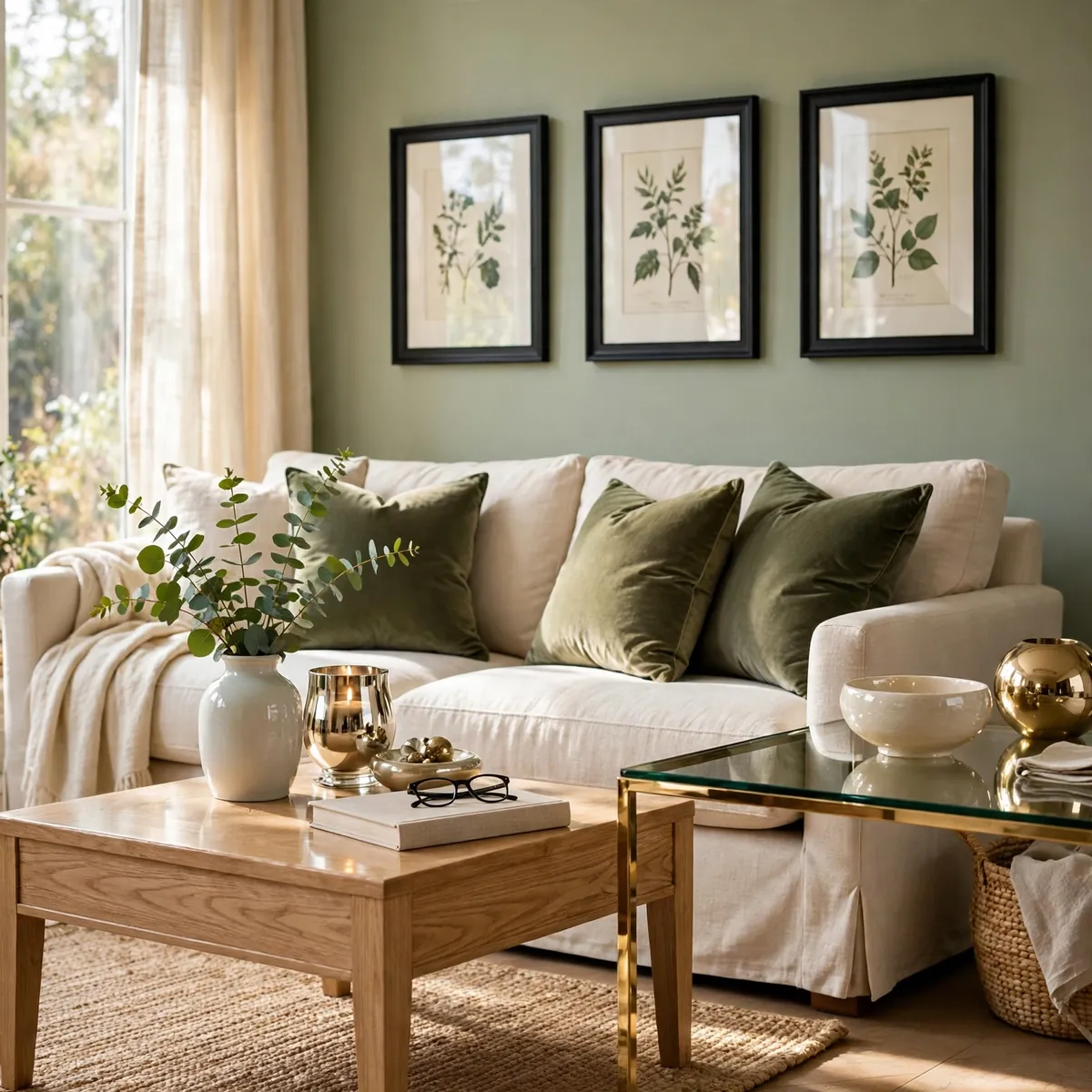
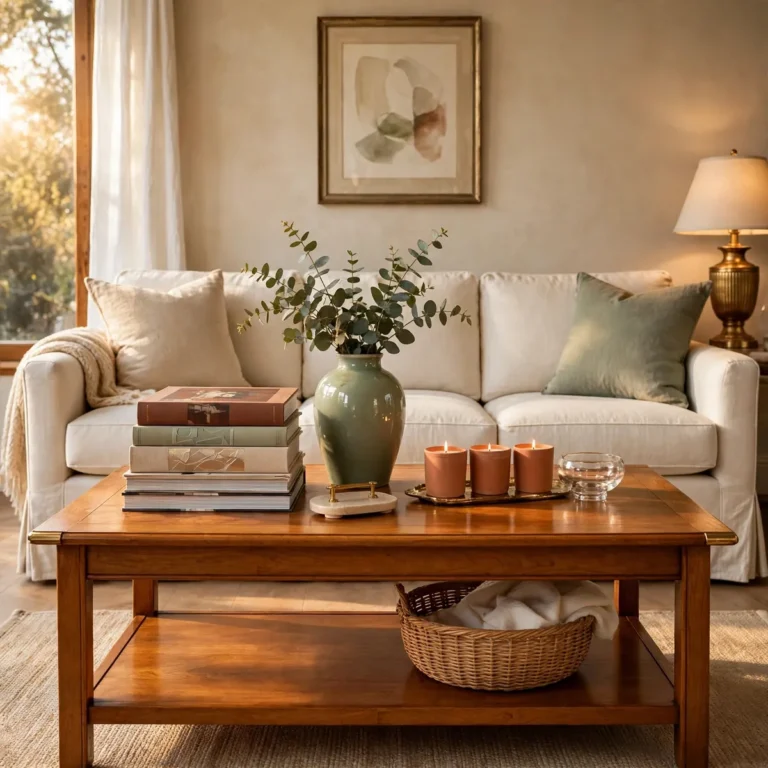
Sage green is the quietest way to add color to a living room: muted, greyish, and calm, it works like a neutral with a pulse. Concrete example: paint the wall behind the sofa in soft sage, pair it with a cream linen sofa and a natural jute rug, add olive-green velvet cushions for depth, and finish with eucalyptus stems in a simple ceramic vase — the whole room feels like a deep breath.
Quick tips:
- Sage pairs best with cream, oak, and black accents — avoid pairing it with bright green.
- Use it on one wall or in textiles; full-room sage can feel flat.
- Black picture frames or a black floor lamp sharpen sage beautifully.
Rich Emerald Depth
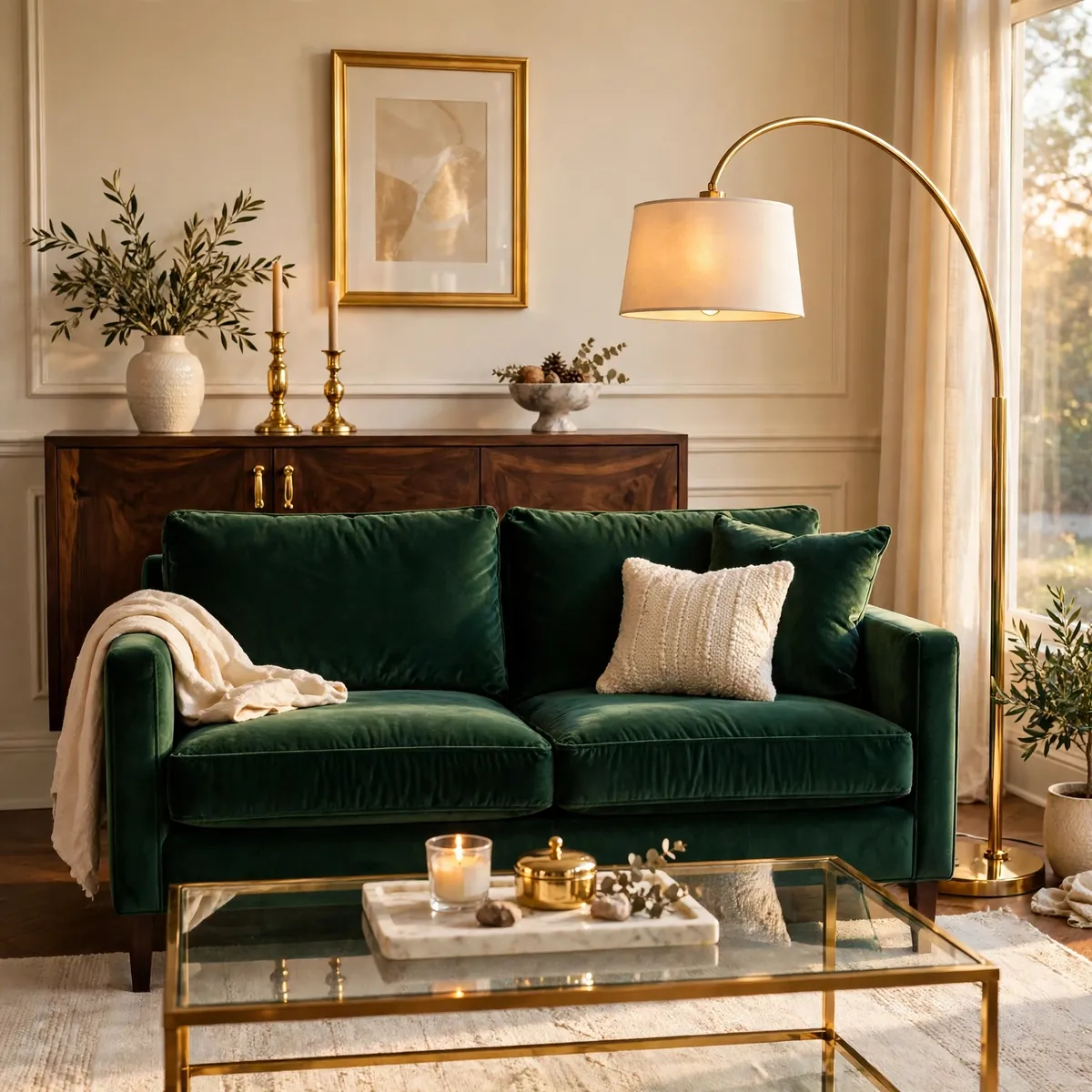
Emerald green brings jewel-box richness to a living room: deep, saturated, and luxurious, especially against brass and dark wood. Concrete example: an emerald velvet two-seater sofa as the room’s centerpiece, a brass arc floor lamp curving over it, a dark walnut sideboard behind with two brass candleholders, and a cream area rug to keep the floor light — the green reads as confident, not loud.
Quick tips:
- Emerald + brass is the classic pairing; both metals and wood deepen the jewel tone.
- Keep the rug and walls light so the emerald stays the star.
- Velvet upholstery shows emerald at its richest; flat weaves wash it out.
Desert Adobe Warmth
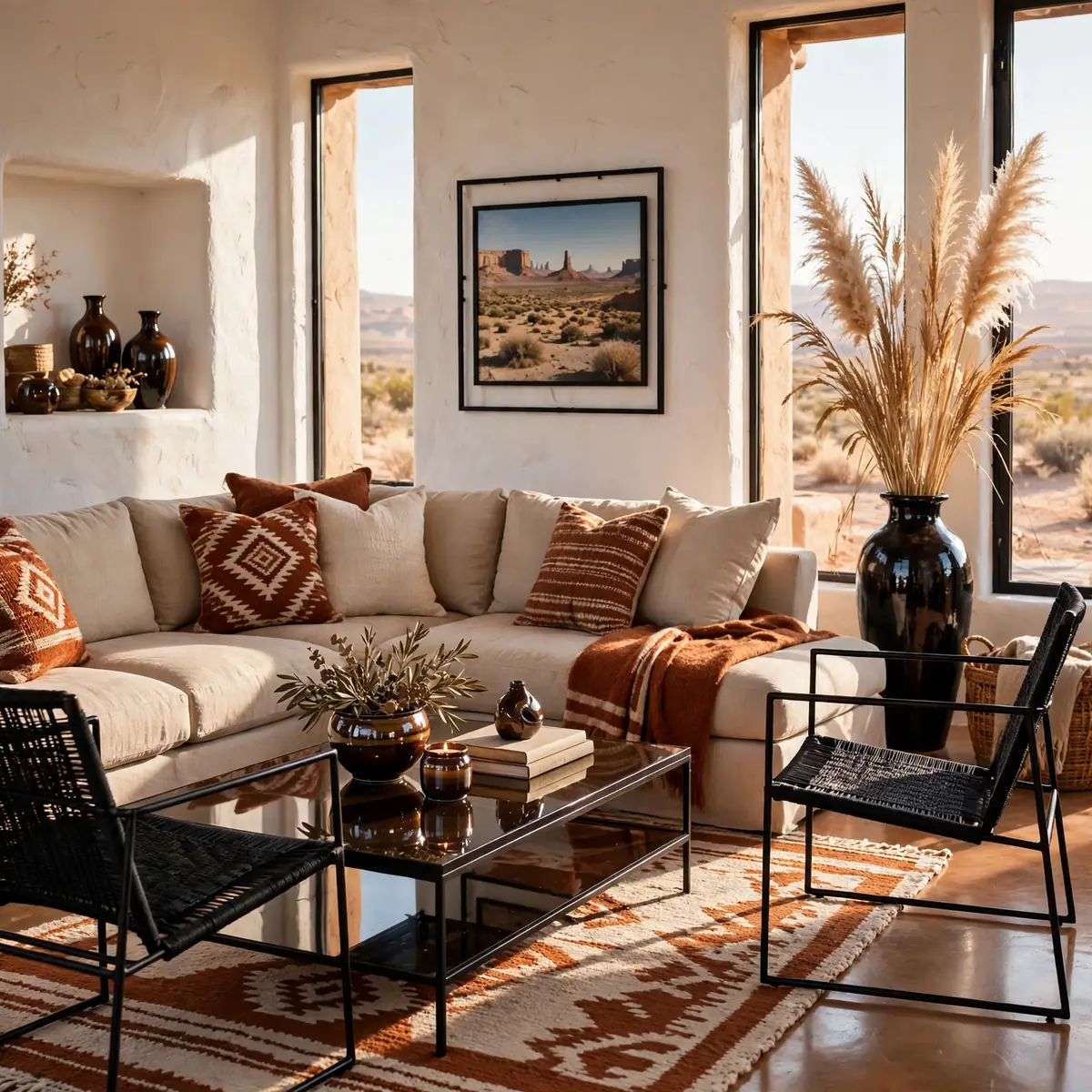
Adobe-inspired living rooms borrow the palette of the desert Southwest: sand, clay, warm white, black accents, and lots of natural texture. Concrete example: warm-white walls, a sand-colored linen sectional, black metal-frame accent chairs, a woven wool rug in rust and cream, and tall dried pampas or wheat stems in a black ceramic floor vase — sunbaked warmth without a single cactus print.
Quick tips:
- Black accents (frames, lamp, vase) keep the warm palette from feeling washed out.
- Dried botanicals suit the desert mood better than tropical plants.
- Texture is everything: wool, clay, woven fibers, rough linen.
Modern Glam Shine
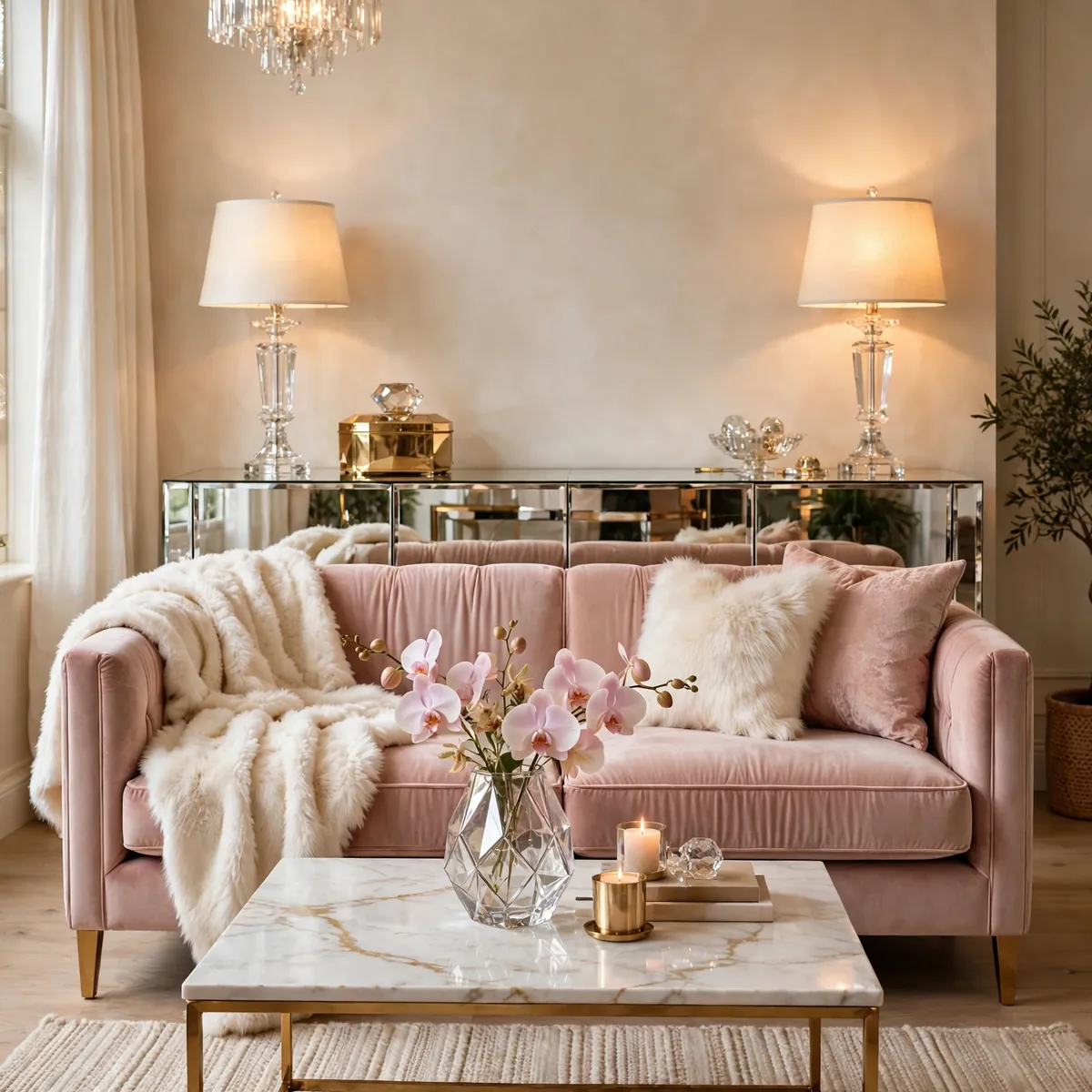
Glam living rooms are unapologetically polished: mirror, marble, velvet, and gold or brass, balanced so the shine never turns cold. Concrete example: a blush-pink velvet sofa, a white marble coffee table with brass legs, a tall mirrored console behind the sofa with two crystal table lamps, and a faux-fur throw in ivory — the trick is soft fabrics warming up the hard reflective surfaces.
Quick tips:
- One mirrored piece per room; more than that reads as a showroom.
- Soften the shine with velvet, faux fur, or silk cushions.
- Keep the palette to three: one light, one jewel tone, one metallic.
Industrial Raw Edge
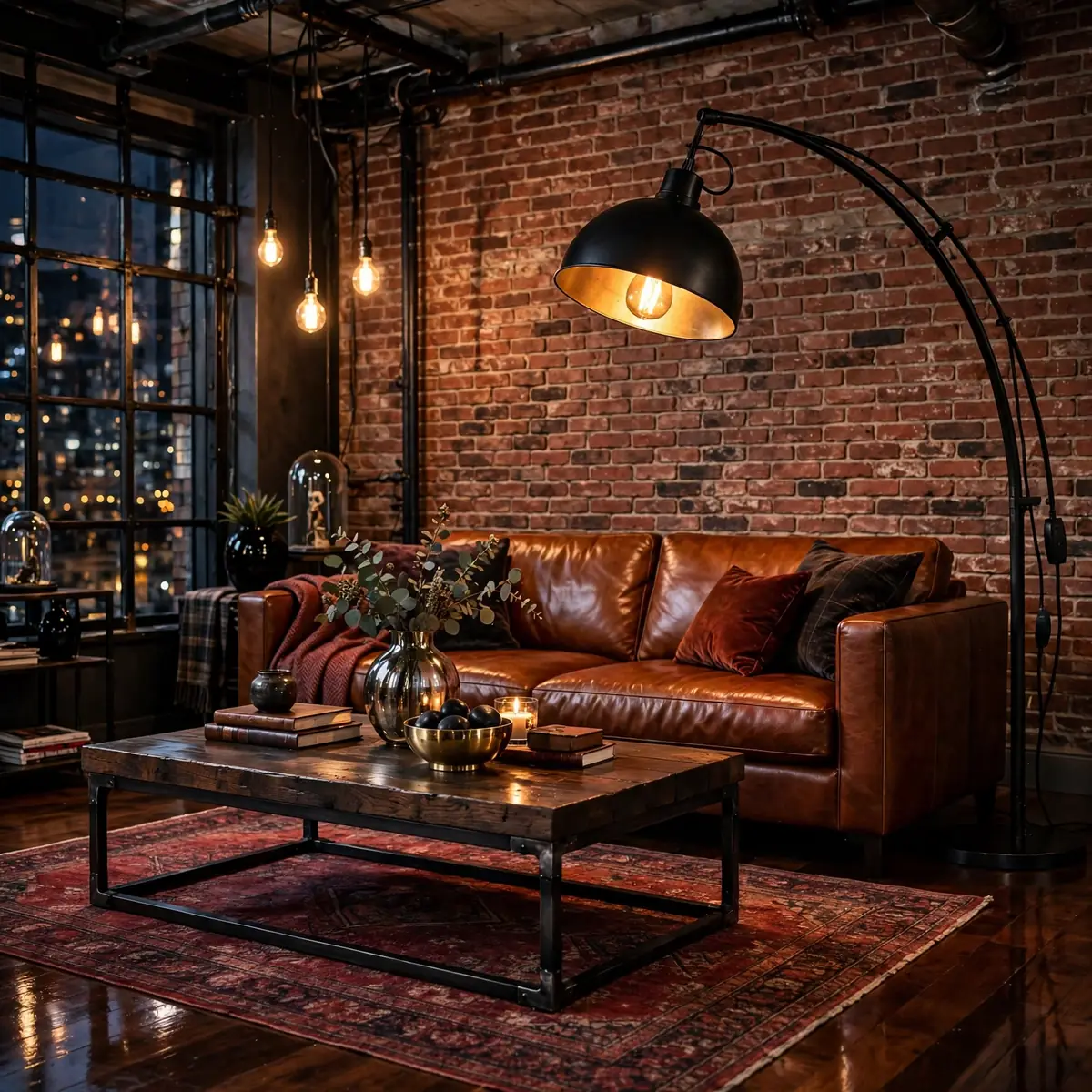
Industrial living rooms celebrate raw materials: exposed brick or concrete, black metal, reclaimed wood, and leather. The mood is urban loft, relaxed and masculine. Concrete example: a cognac-brown leather sofa against a brick-look accent wall, a reclaimed-wood coffee table with black metal legs, an oversized black metal arc lamp, and a vintage-style rug in muted reds to warm the hard surfaces — the leather softens as it ages, which suits the look.
Quick tips:
- Warm it up: leather, wood, and a rug are mandatory or the room feels like a warehouse.
- Black metal frames on furniture and lighting tie the look together.
- Exposed bulbs work; just use warm filaments and dimmers.
Maximalist Pattern Play
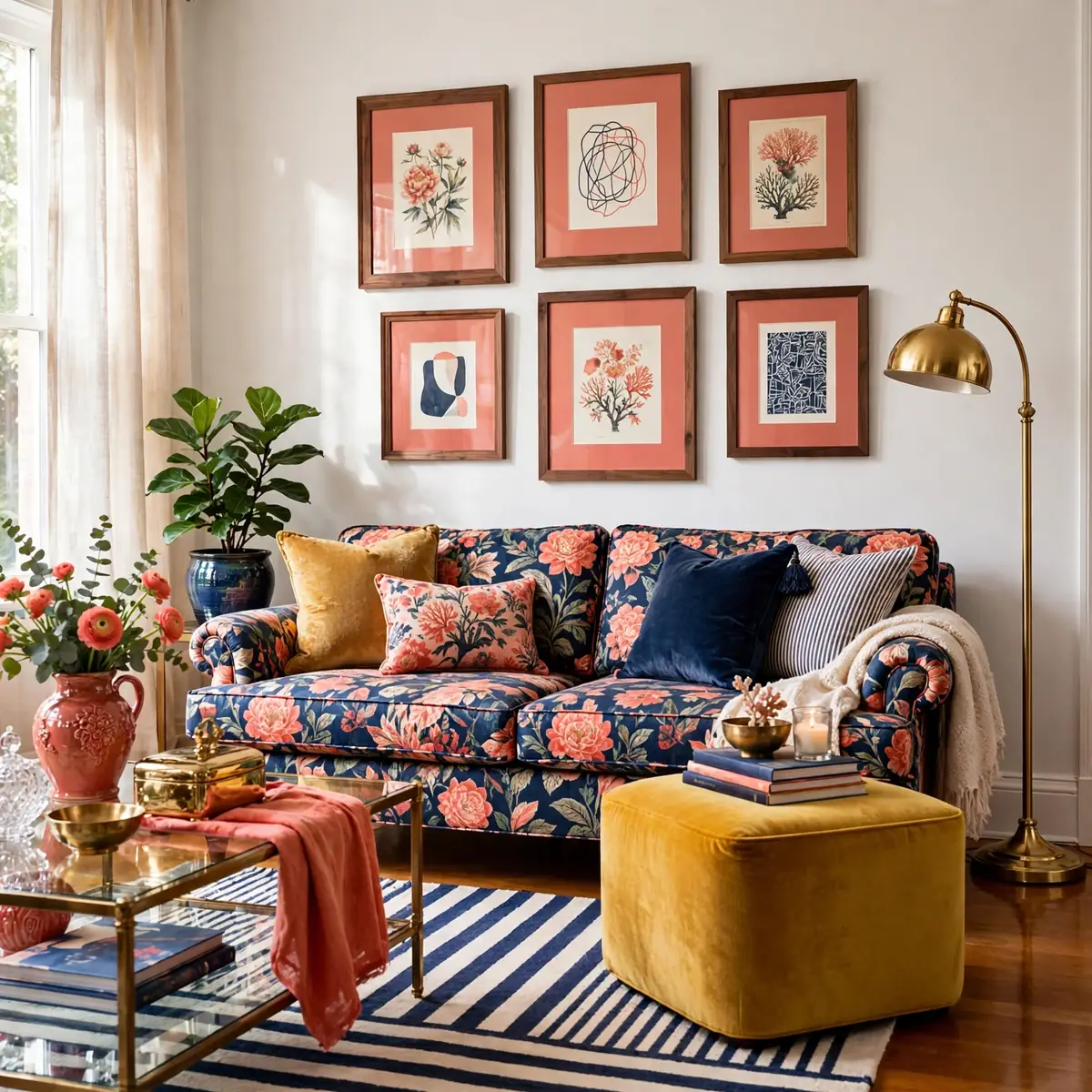
Maximalism is permission to love everything at once: layered patterns, bold color, gallery walls, and objects that spark joy. The rule that keeps it from chaos is a repeated color thread. Concrete example: a floral-patterned sofa in coral and navy, a striped rug pulling the same navy, a gallery wall of six mismatched frames all with one coral mat in common, and a mustard velvet ottoman — every piece is different, but navy and coral appear everywhere, so it reads as curated abundance.
Quick tips:
- Pick two anchor colors and repeat them in at least five places.
- Vary pattern scale: one large, one medium, one small.
- Give the eye one rest spot: a plain wall or a solid-colored chair.
Rustic Farmhouse Heart
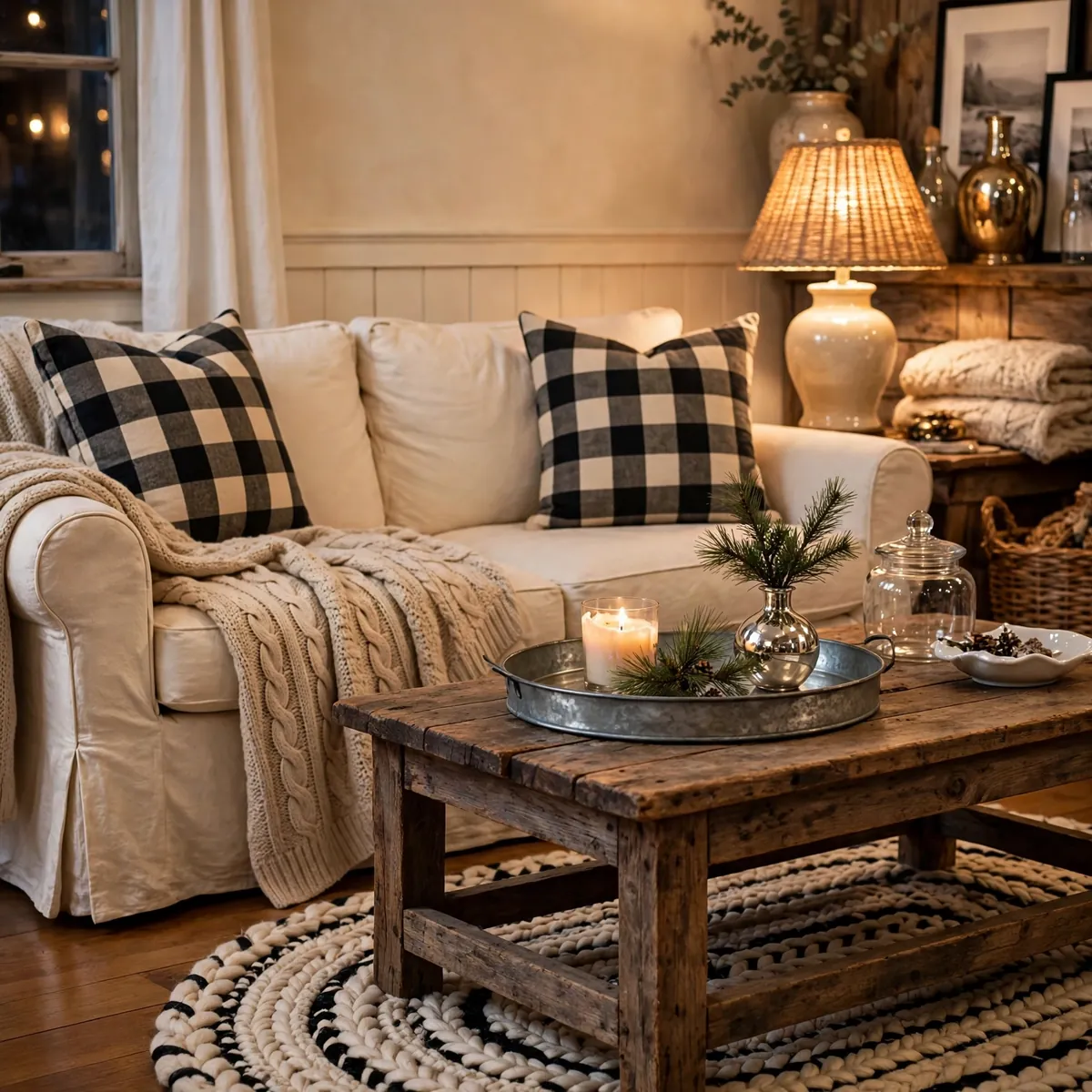
Farmhouse living rooms are cozy and unpretentious: warm wood, white or cream walls, plaid or grain-sack textiles, and honest, sturdy furniture. Concrete example: a cream slipcovered sofa, a reclaimed-barn-wood coffee table, buffalo-check throw pillows in black and cream, a galvanized metal tray on the table holding a candle and a small pine sprig, and a chunky knit throw — the room feels like it hugs you back.
Quick tips:
- Mix wood tones but keep them all warm; cool grey wood fights the farmhouse feel.
- One or two galvanized or black metal accents are enough.
- Slipcovers keep it practical and reinforce the relaxed look.
Art Deco Sparkle
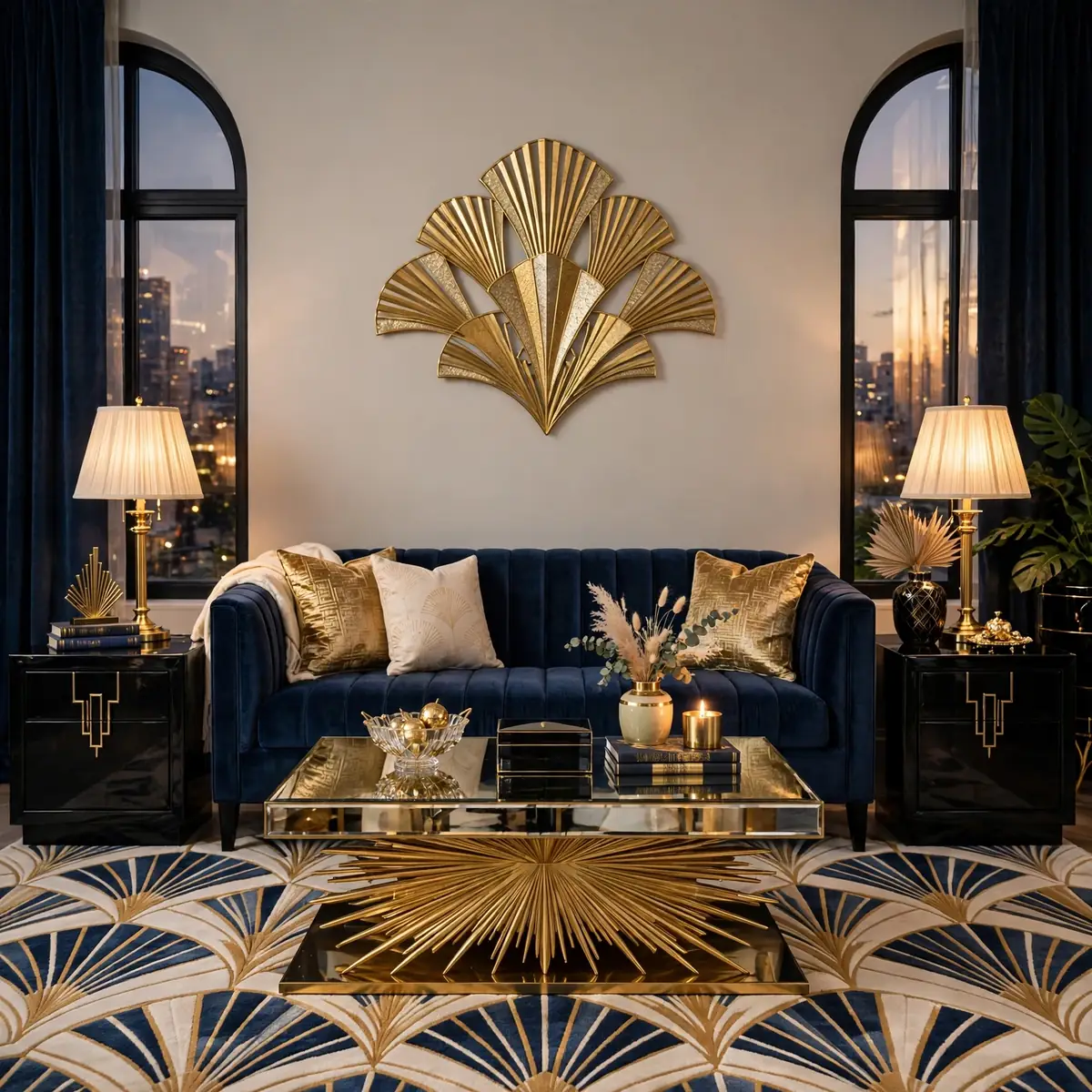
Art Deco living rooms are geometric and glamorous: mirrored surfaces, fan and sunburst motifs, lacquered black, and gold. Concrete example: a navy velvet sofa with channel tufting, a mirrored coffee table with a sunburst base in gold, two black lacquer side tables, and a geometric fan-pattern rug in navy, gold, and cream — symmetrical, shiny, and unmistakably 1920s in spirit.
Quick tips:
- Geometry is the signature: fans, chevrons, sunbursts in art and textiles.
- Symmetry suits deco; mirror-image the seating arrangement.
- Keep walls simple so the geometric pieces shine.
Urban Eclectic Energy
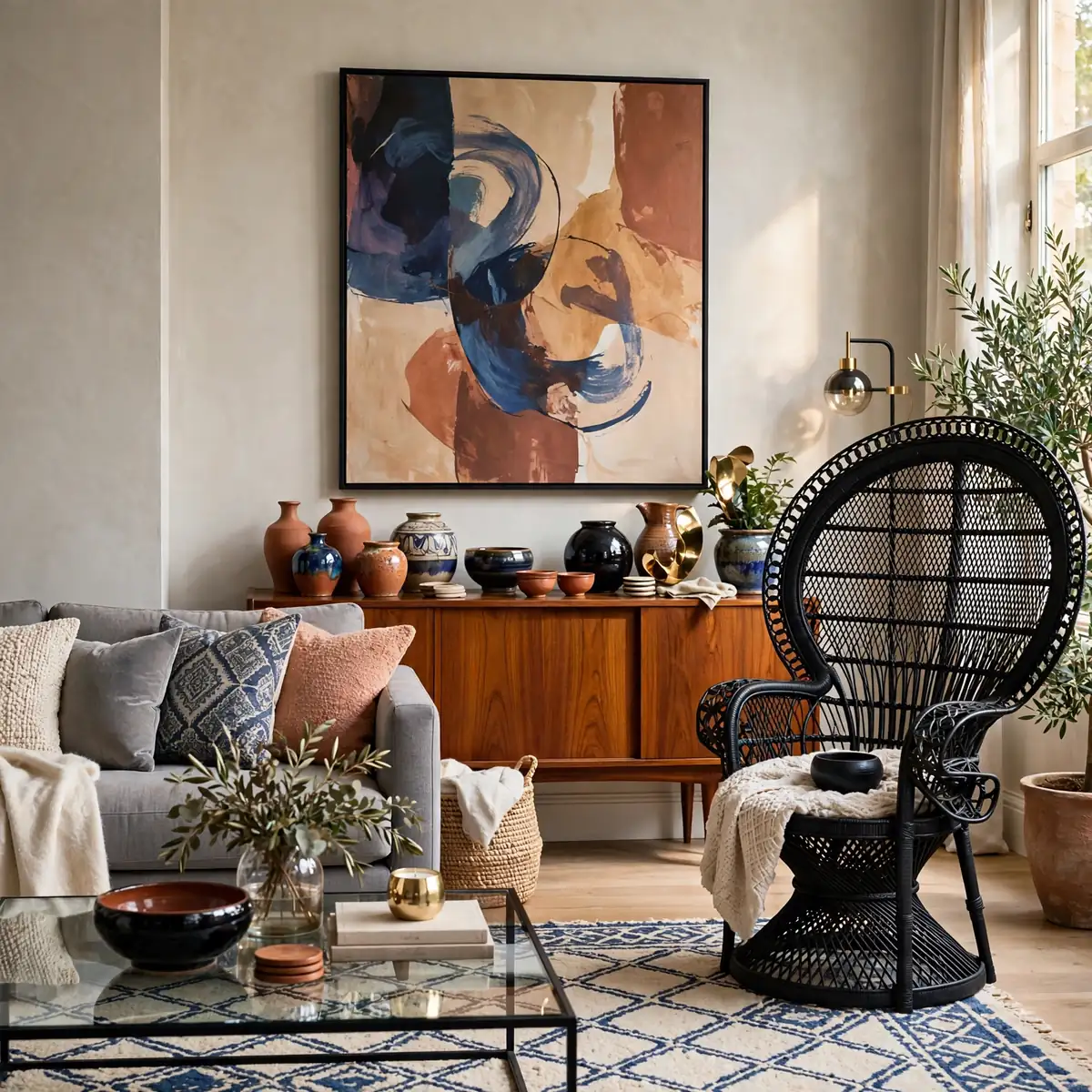
Eclectic living rooms mix eras and origins with confidence: a vintage chair next to a modern sofa, travel finds next to new art. The glue is color or material. Concrete example: a modern grey sofa, a vintage rattan peacock chair painted matte black, a Moroccan-style rug in indigo and cream, a mid-century teak sideboard holding a collection of travel ceramics, and one large contemporary abstract painting — different decades, one indigo-and-wood thread tying it together.
Quick tips:
- One unifying thread (color, wood tone, or metal) keeps eclecticism from chaos.
- Mix eras in odd groupings: vintage + modern + handmade.
- Display collections together; scattered single objects look accidental.
Classic Navy Blue
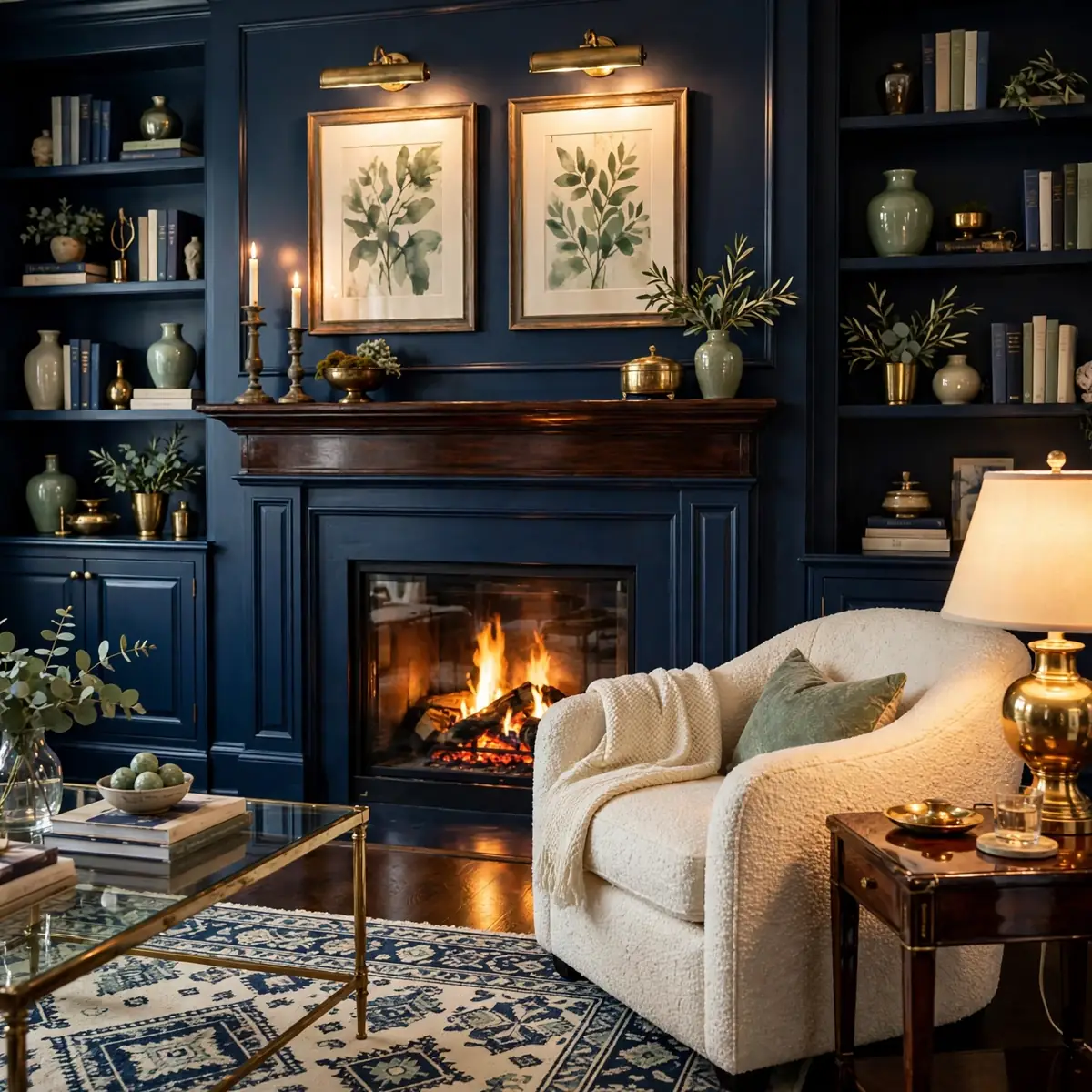
Navy is the most livable bold color: deep enough to feel dramatic, neutral enough to live with for years. Concrete example: paint the fireplace wall or built-in shelving in deep navy, place a cream bouclé armchair in front of it, add brass picture lights above the art, and layer a cream-and-navy patterned rug — the contrast makes everything else in the room pop.
Quick tips:
- Navy + cream + brass is a can’t-miss combination.
- Use navy on the wall you face most (fireplace, TV wall) for maximum effect.
- In small rooms, navy on one wall or on shelving only.
Hotel-Suite Neutrals
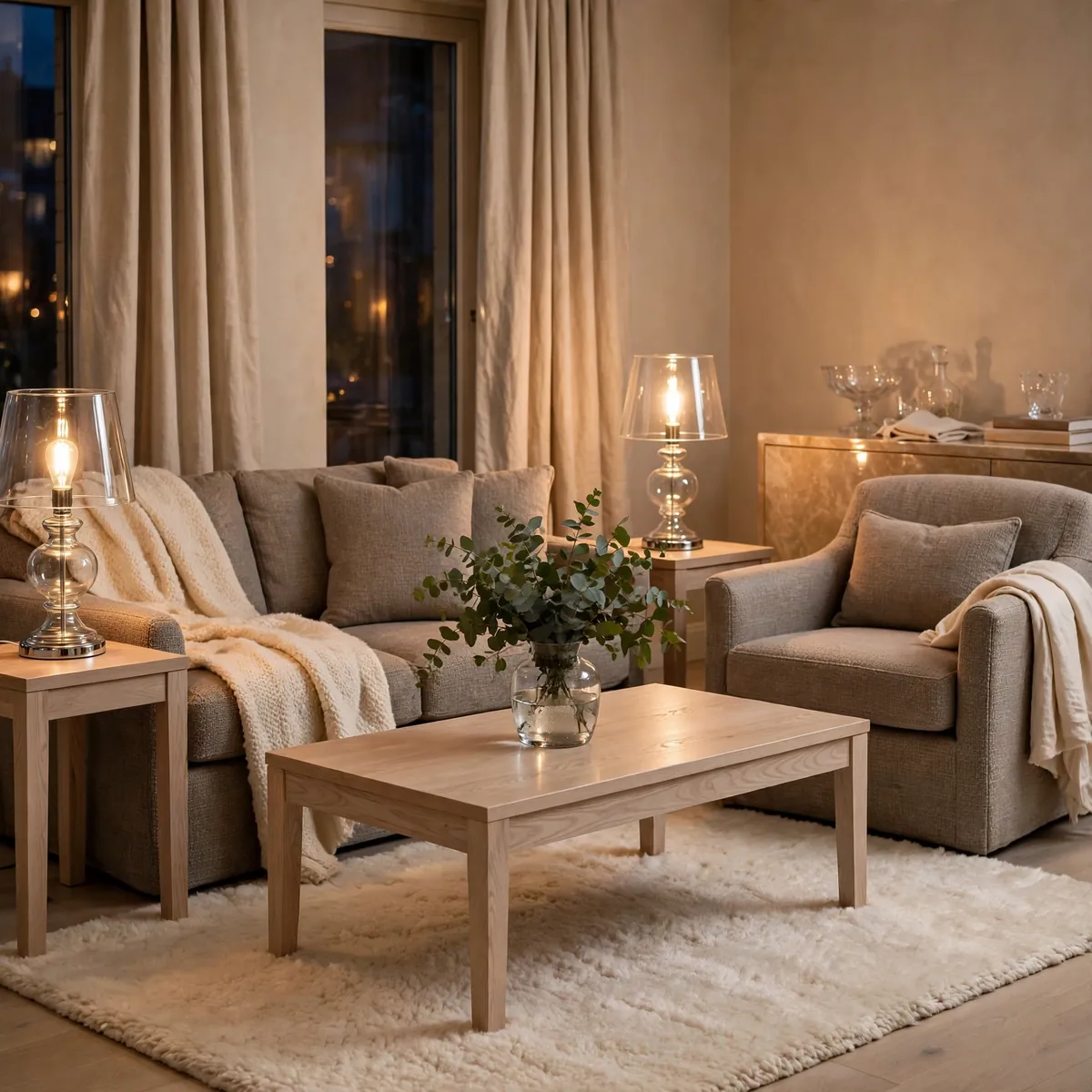
Hotel-suite living rooms feel instantly calming because everything matches: one neutral palette, layered textures, and nothing fighting for attention. Concrete example: a warm-grey sofa, matching warm-grey armchair, a cream wool rug, linen curtains in the same tone as the walls, two identical glass table lamps, and a single eucalyptus arrangement — monochrome done in four different textures so it never feels flat.
Quick tips:
- Use four textures minimum in one color family: wool, linen, glass, wood.
- Matching lamp pairs and curtain tones create the hotel calm.
- One living thing (plant or flowers) keeps monochrome from feeling sterile.
Neutral Living Room Inspiration Ideas
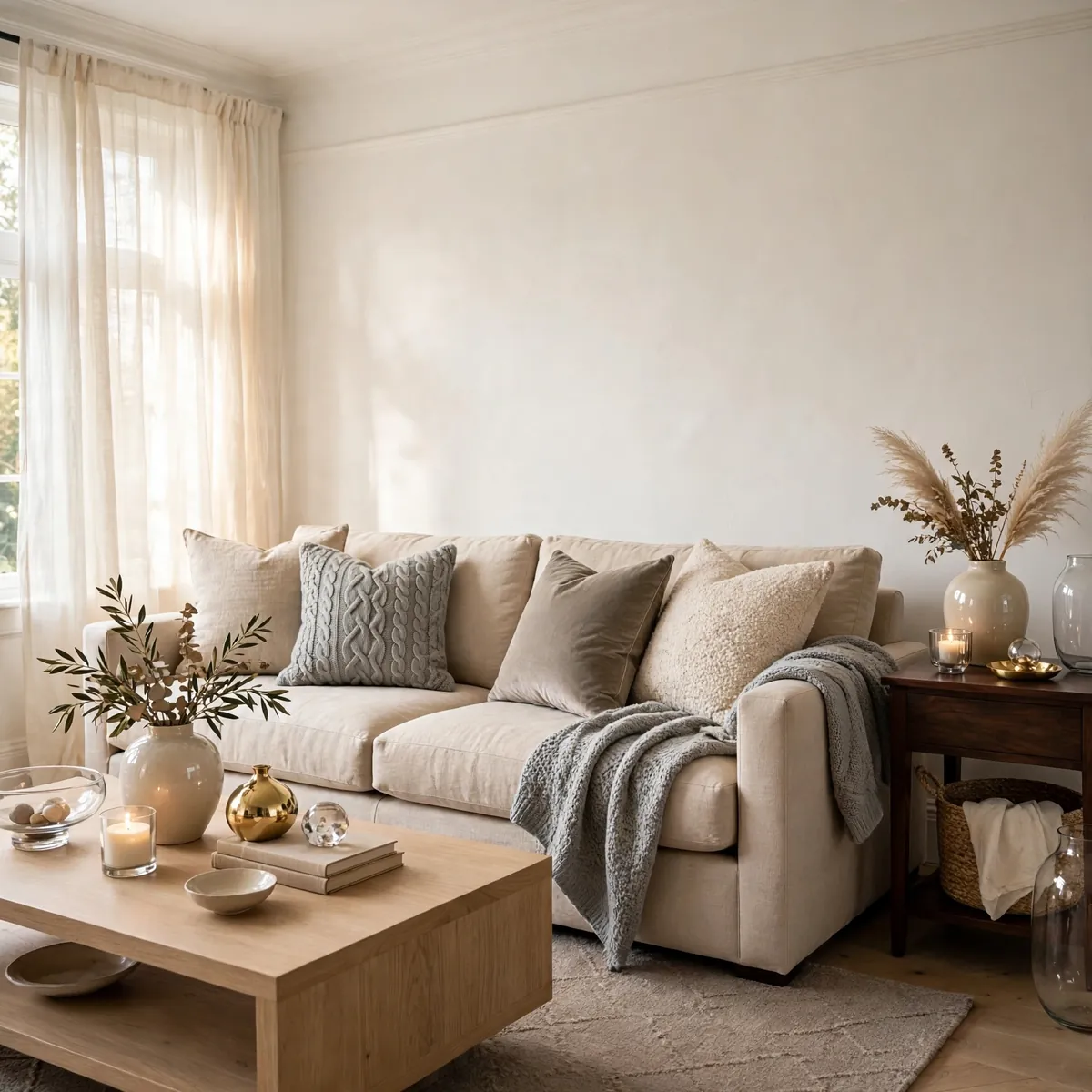
If bold color scares you, this is your lane: living room inspiration ideas built entirely on neutrals — cream, beige, taupe, soft grey, and warm white — where depth comes from texture and shadow rather than color. Concrete example: a beige linen sofa, a taupe wool rug with a subtle pattern, cream sheer curtains, a light-oak coffee table, and cushions in four different neutral textures (linen, knit, velvet, boucle) — no color at all, yet the room feels rich because every surface catches light differently.
Quick tips:
- Mix warm and cool neutrals carefully; lean 80% one temperature.
- Texture variety is mandatory — five neutral textures beat five neutral colors.
- Add black or dark wood in one or two spots for grounding.
Gallery Wall Storytelling
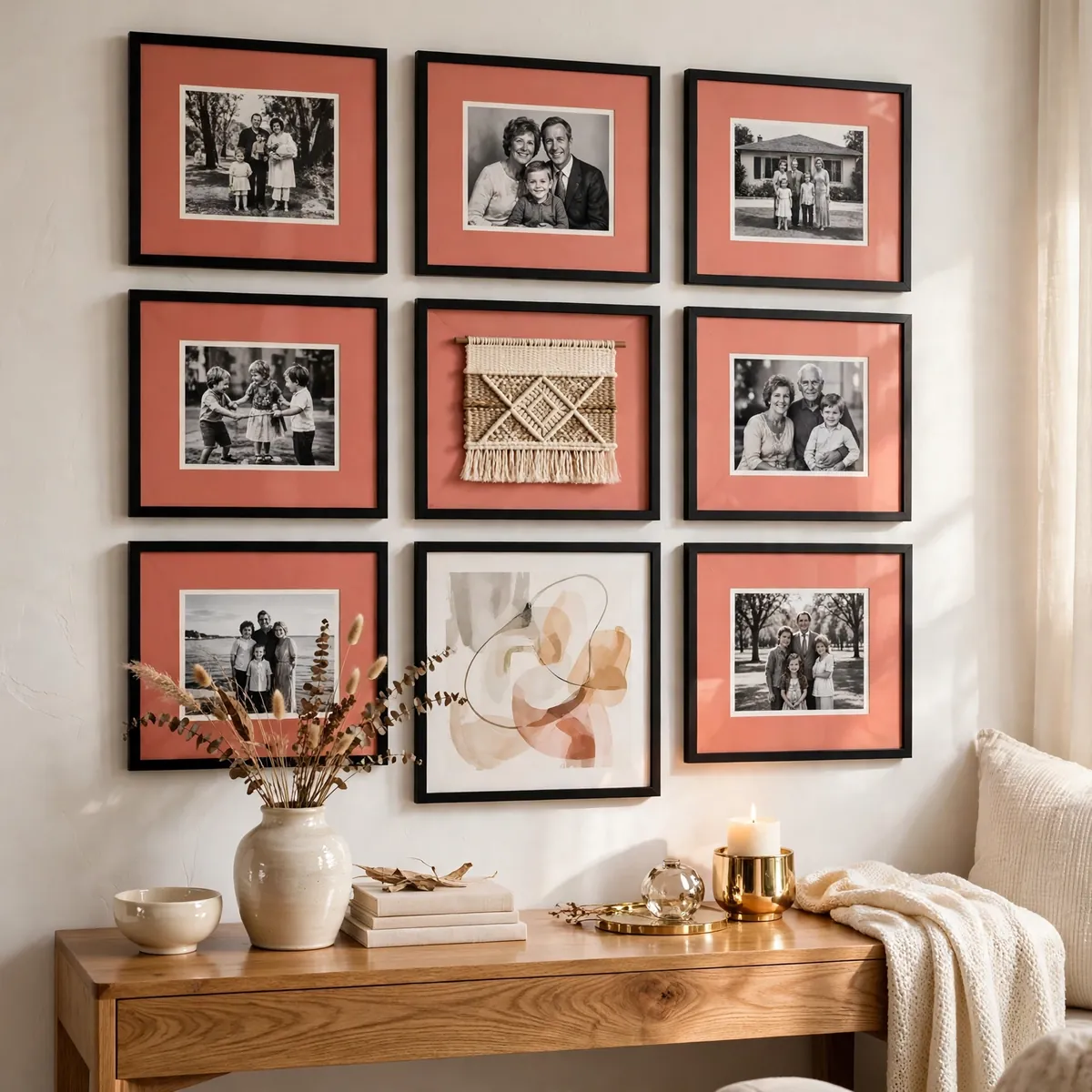
A gallery wall turns a blank living room wall into the room’s personality: family photos, art prints, and small objects arranged as one composition. Concrete example: above a console table, hang nine frames in a tight grid — three rows of three, two inches apart — mixing black-and-white family photos, one large abstract print, and a small woven wall hanging in the center; keep all frames the same thin black profile so the mix feels curated.
Quick tips:
- Lay the arrangement on the floor first and photograph it before hanging.
- Two inches between frames keeps a grid tight and intentional.
- One unifying element (frame color, mat color, or theme) holds mixed content together.
Fireplace-Centered Warmth
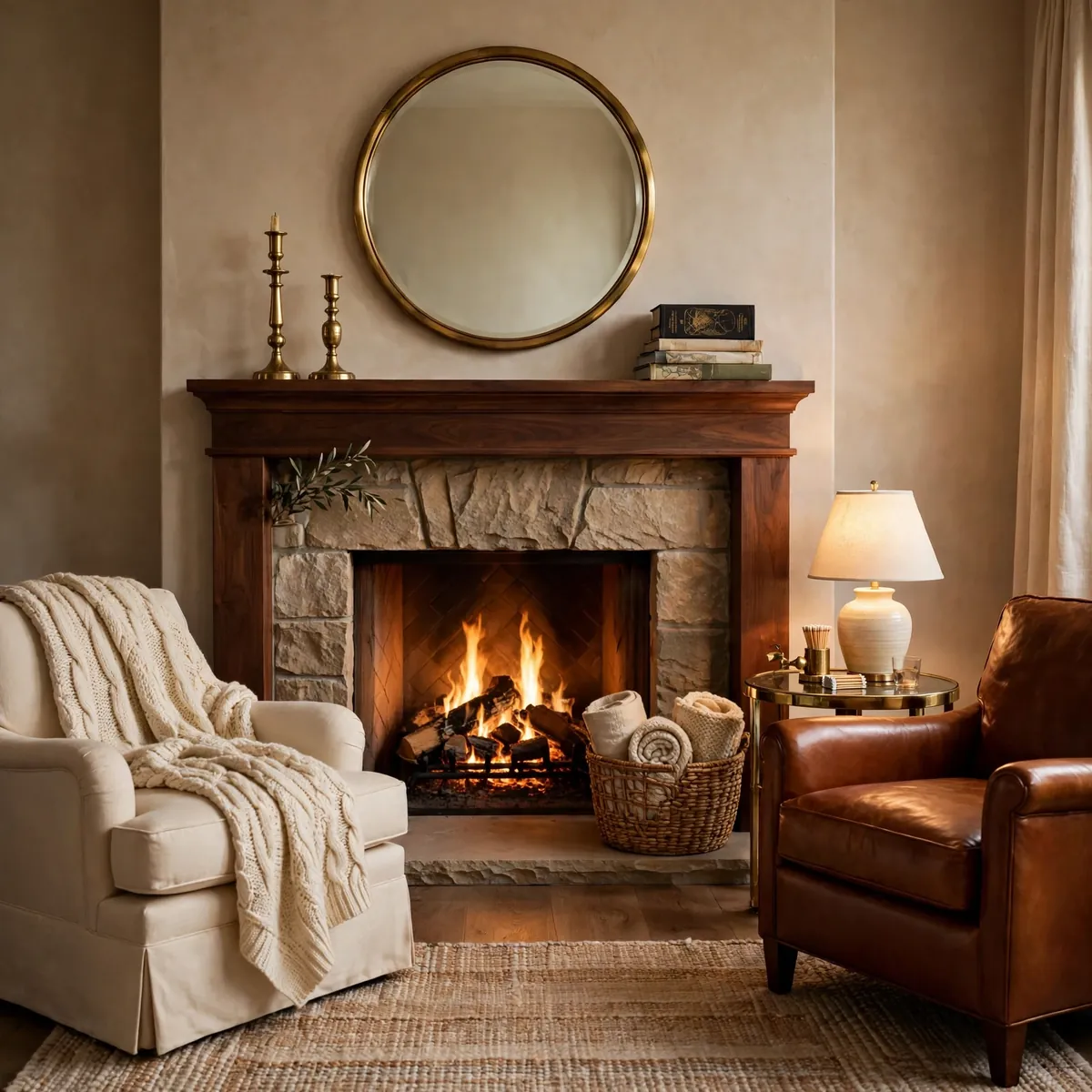
When a living room has a fireplace, everything should orbit it: seating angled toward the hearth, the mantel styled as the room’s jewelry, and lighting that flatters the fire glow. Concrete example: two armchairs angled toward the fireplace with a small round side table between them, a chunky knit throw over one chair, the mantel styled with a large round mirror, two brass candlesticks of different heights, and a stack of three art books — plus a basket of rolled throws beside the hearth for the full fireside invitation.
Quick tips:
- Angle seating toward the fireplace, not the TV, for conversation-first rooms.
- Style the mantel in odd numbers: one mirror or art + two candlesticks + one stack of books.
- A basket of throws by the hearth is both decor and function.
Light-Filled Indoor-Outdoor Flow
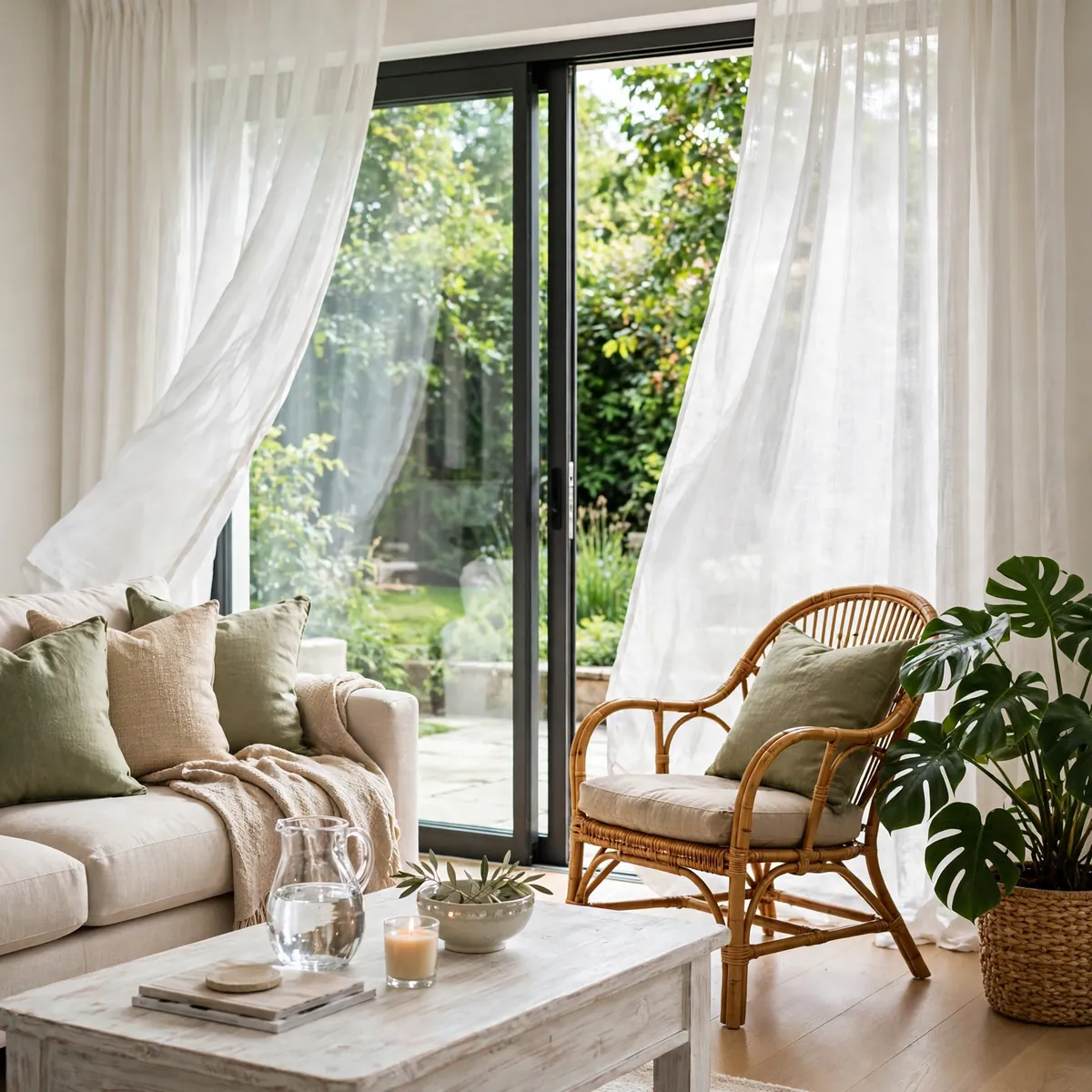
Living rooms that open to a patio or garden can borrow the outdoors: sheer curtains that move in the breeze, indoor plants that echo the garden, and a palette pulled from the view. Concrete example: floor-to-ceiling sheers in white linen on sliding doors, a rattan lounge chair angled toward the garden, a large monstera in a woven basket beside it, and cushions in leaf-green and sand — the boundary between inside and outside blurs, and the room feels twice its size.
Quick tips:
- Pull two colors from the view outside and repeat them indoors.
- Sheers instead of heavy drapes keep the flow open.
- One large plant reads better than five small ones in the sightline to the garden.
FAQs
What is the easiest way to get living room inspiration?
Walk through your home and note the one spot you love most, then identify what you love about it — the color, the light, the texture — and repeat that in the living room. Pinterest boards help, but they work best when you limit yourself to one board and look for the repeated colors across your saved pins; those repeats are your real style.
How do I choose between a light and a dark living room style?
Match the style to your room’s light and your evenings. North-facing or small rooms usually feel better in light styles like Scandinavian or coastal; rooms with good evening light and a social purpose suit moody styles like charcoal or emerald. If you are unsure, paint large sample boards and live with them for three days before committing.
Can I combine two living room styles in one room?
Yes, and it usually looks better than a single pure style. Keep 70% of the room in your primary style and borrow 30% from a second — for example, a Scandinavian base with boho textiles, or a traditional layout with mid-century furniture. One repeated color or material ties the two together.
How much does a living room refresh cost?
A cosmetic refresh — paint one wall, new cushions, a rug, and lighting — typically runs a few hundred dollars if you shop sales and secondhand. Furniture swaps push it higher. Start with textiles and paint, which deliver the biggest visual change per dollar, and add furniture only after the palette is settled.
Do I need an interior designer to get a stylish living room?
No. Designers help with complex layouts and renovations, but a style-led refresh is very doable yourself: pick one inspiration direction from this list, build a three-color palette around it, and buy pieces that fit the palette rather than buying pieces you like in isolation. The palette is what makes a room look designed.
Conclusion
The living room that inspires you is the one built around a mood you actually want to live in, not the mood that photographs best for someone else. Pick the one style from these 25 that made you pause, save its palette of three colors, and start with the biggest surface — the rug or the sofa — before adding the smaller layers. One clear direction, repeated confidently, is what separates a decorated room from a designed one.