25 Christmas Living Room Decor Ideas for a Magical Holiday Home
Twenty-five Christmas living room decor ideas — from garland-draped mantels to layered candlelight and tree-first styling — each with a concrete, copyable example for a warm, magical holiday room.
The best christmas living room decor ideas do two things at once: they make the room feel festive the moment you walk in, and they keep it livable for the whole season. That means a decorated tree that does not block the hallway, a mantel that glows without cluttering, and textiles you can actually curl up in. This guide shares 25 Christmas living room decor ideas, each with a concrete example, covering classic, modern, rustic, and neutral looks for big rooms and small ones.
Start by picking one focal point — the tree, the mantel, or the window — and let everything else support it, because rooms where every surface shouts end up feeling chaotic rather than magical. Work in layers: lights first, then greenery, then color. If the tree is your centerpiece, our christmas tree decor ideas guide pairs perfectly with this room plan, covering ornament styling and tree themes in detail.
Key Takeaways
What are the most important Christmas living room decor ideas?
Layered warm lighting, a styled tree or mantel focal point, festive textiles (throws and pillows), and natural greenery — these four carry most of the holiday feeling.
How do I decorate a small living room for Christmas?
Choose one focal point, decorate vertically (wreaths, garlands, window silhouettes), use a slim or tabletop tree, and keep pathways clear of large pieces.
What colors work for a modern Christmas living room?
Neutrals with metallics (white, champagne, gold), jewel tones (emerald, ruby, navy), or classic red-green — pick one palette and repeat it across the tree, textiles, and mantel.
How can I make my Christmas living room look expensive on a budget?
Spend on lights and one quality garland; use free or cheap greenery clippings, swap pillow covers instead of buying new pillows, and group items in styled vignettes so less looks like more.
When should I decorate my living room for Christmas?
Most early decorators start in mid-November; if you host Thanksgiving, decorating the living room the week before gives you one setup for both holidays.
| Look | Palette | Must-have pieces | Lighting | Best for |
|---|---|---|---|---|
| Classic cozy | Red, green, gold, cream | Plaid throws, pinecone garland, stockings on the mantel | Warm-white string lights, candles | Traditional homes, family gathering rooms |
| Modern neutral | White, champagne, soft gold | Ceramic trees, eucalyptus garland, glass ornaments | Fairy lights, flameless candles | Minimalist rooms, small spaces |
| Rustic natural | Pine green, wood, burlap, cream | Wooden bead garland, dried oranges, basket tree base | Edison-style warm bulbs, lanterns | Farmhouse and cabin-style homes |
| Jewel-tone glam | Emerald, ruby, navy, brass | Velvet ribbon, jewel ornaments, metallic garland | Warm spotlights on the tree, candle clusters | Evening entertaining, dramatic rooms |
Let the Tree Be the Undisputed Star
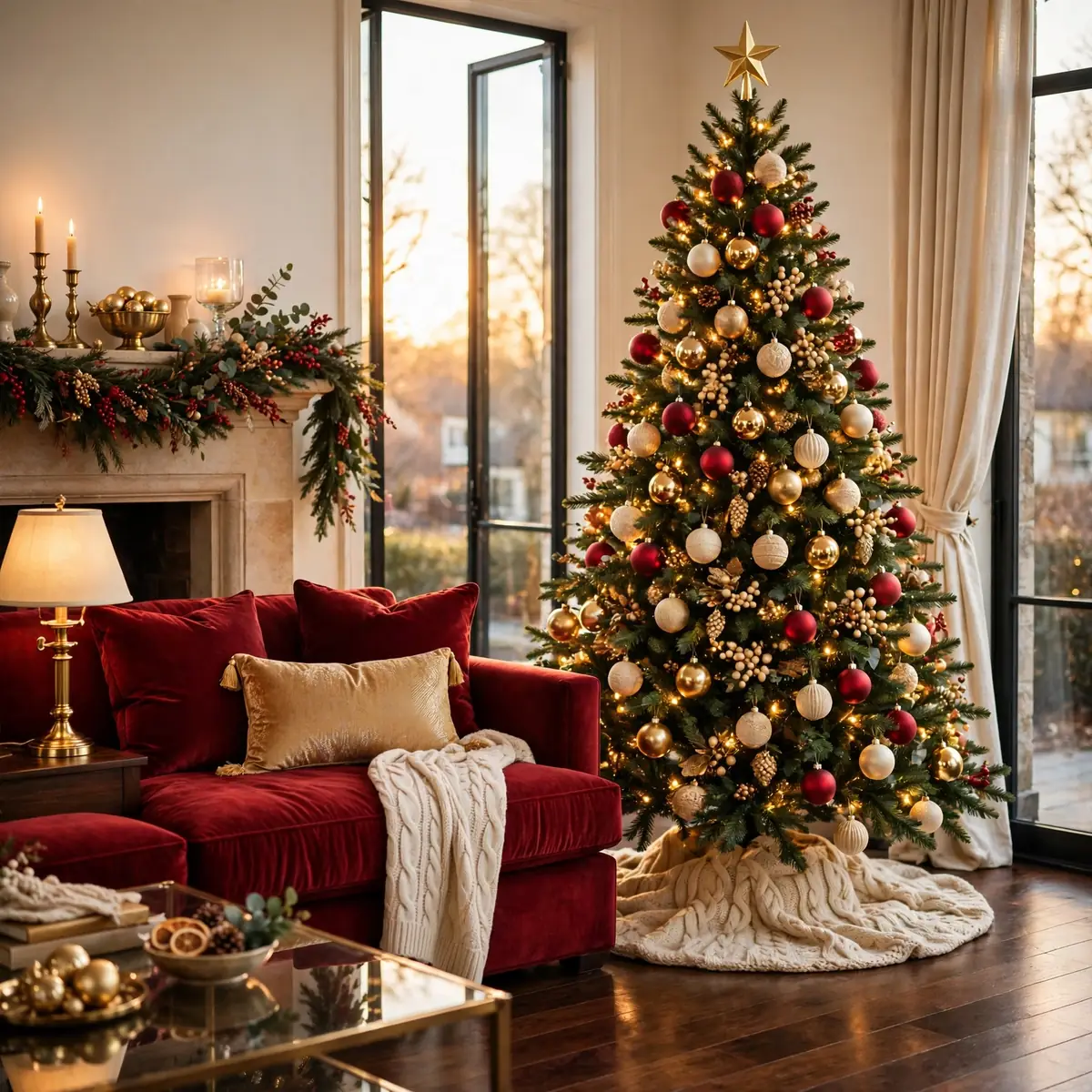
A Christmas living room works best with one clear focal point, and the tree is the natural choice — everything else in the room should support it rather than compete with it. The tree-first approach means choosing the tree’s palette first (say, red and gold, or white and champagne) and then repeating those exact colors in the pillows, the mantel garland, and the window decor. Concrete example: a 7.5-foot tree in the corner by the window decorated in matte red, shiny gold, and cream ornaments, with a cream cable-knit tree skirt, while the sofa gets two red velvet pillows and one gold lumbar pillow, and the mantel garland carries red berries to echo the tree — one palette, three zones, total cohesion.
Quick tips:
- Choose the tree palette first; let every other decoration repeat it.
- Keep the tree skirt simple — cable knit, burlap, or a woven basket collar.
- Leave at least 3 feet of clearance around the tree for walkways.
Drape the Mantel in Layered Garland
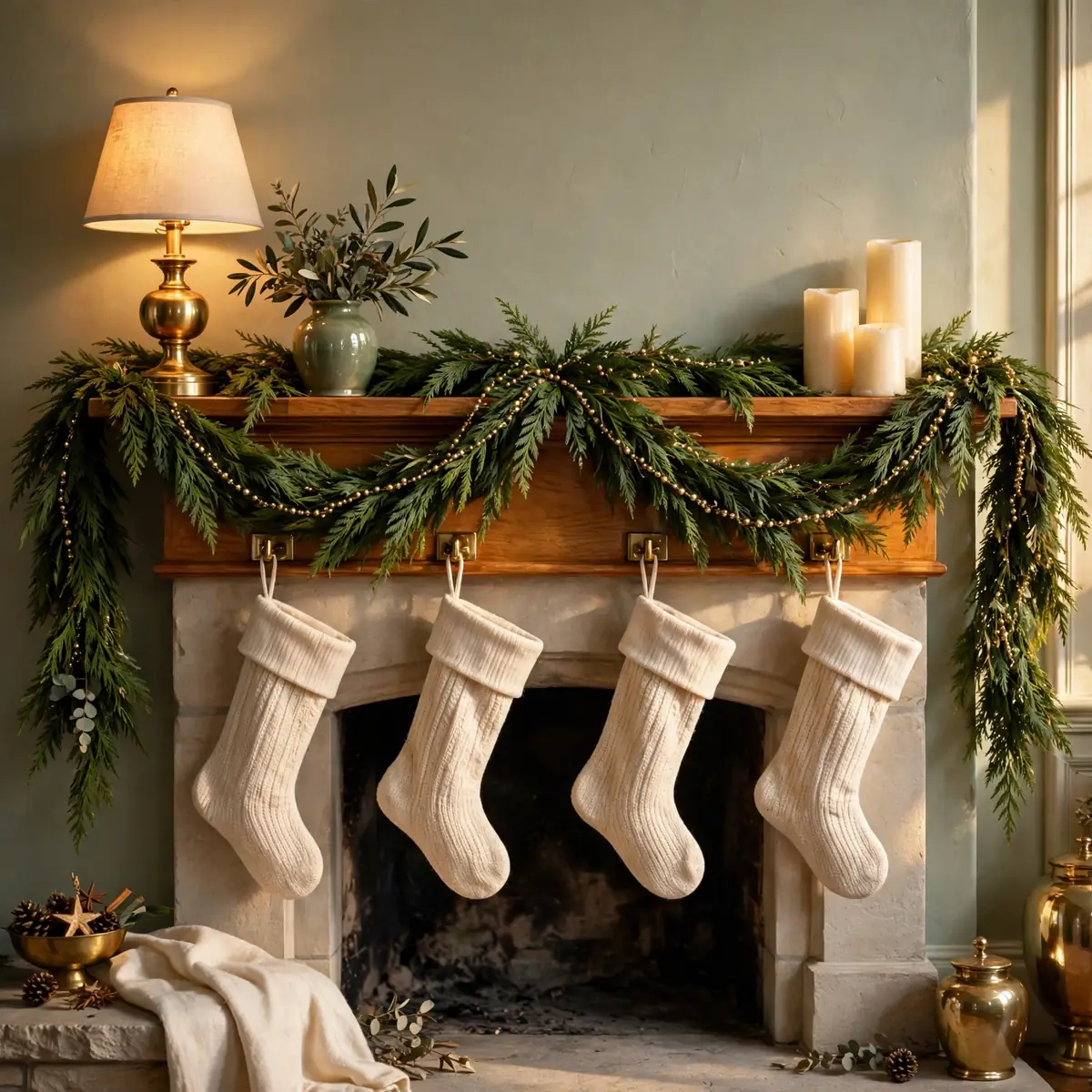
A mantel dressed in layered garland becomes the room’s second focal point and the spot where holiday photos get taken. Layering means combining two garlands — one fuller base (pine or cedar) with one accent (eucalyptus, berries, or a beaded strand) — rather than hanging a single thin strand. Concrete example: a 6-foot cedar garland swagged across the mantel with gentle dips, a thinner gold-bead garland woven through it, three cream pillar candles of different heights on one end, and four stockings hung from brass stocking holders spaced evenly — the dips and layers give it a professionally styled look.
Quick tips:
- Swag garland with dips rather than stretching it straight; dips read as styled.
- Anchor stockings with heavy holders so garland does not slide.
- Weave battery fairy lights through the garland for evening glow.
Layer Throws and Pillows Like a Stylist
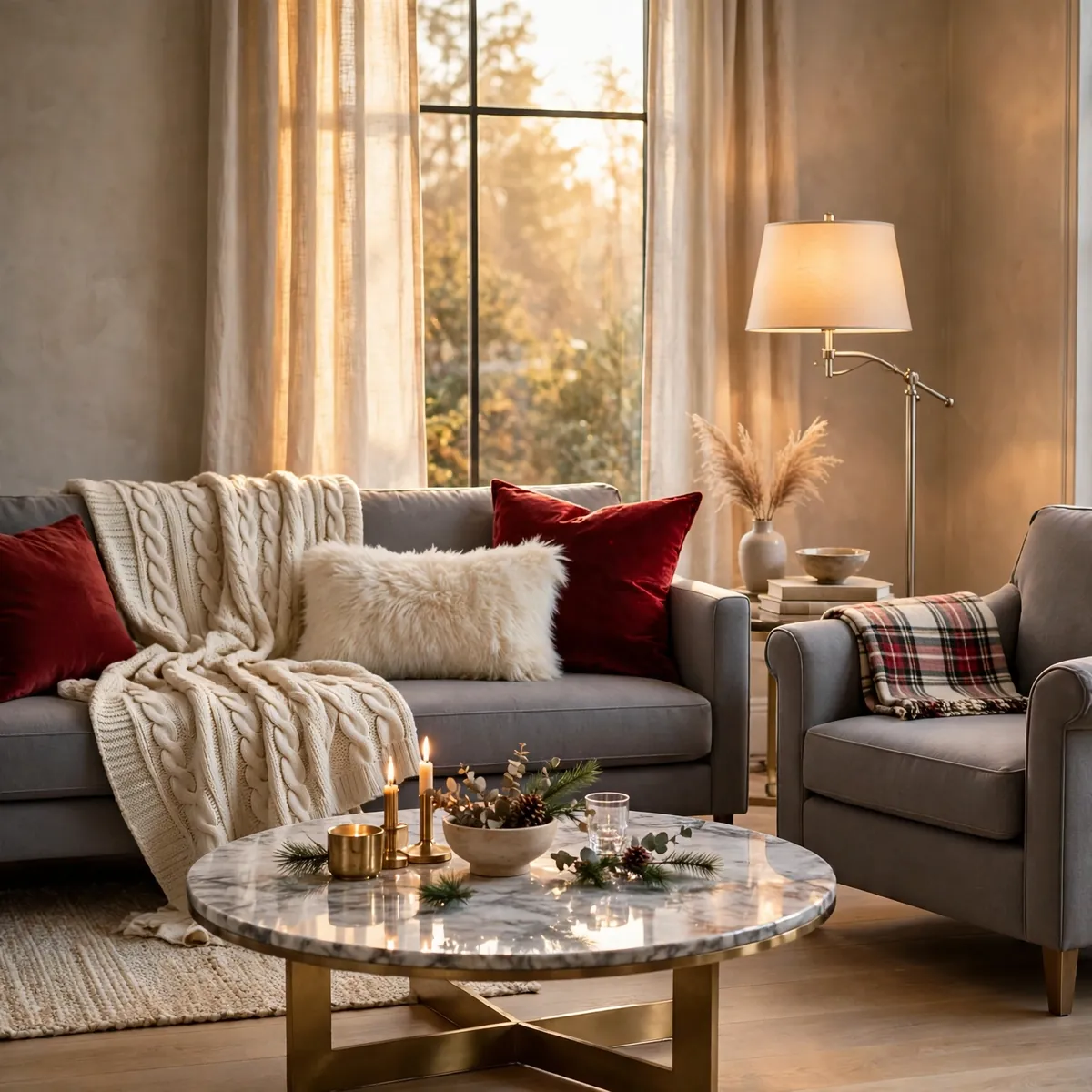
Swapping everyday textiles for holiday ones is the fastest, cheapest living room Christmas transformation — no ladder, no storage bins of ornaments required. The stylist trick is mixing textures rather than matching sets: chunky knit, velvet, and faux fur in your chosen palette. Concrete example: on a grey sofa, drape a chunky cream cable-knit throw diagonally across one corner, add two deep-red velvet cushions and one faux-fur cream lumbar pillow, and fold a plaid throw over the armchair — five pieces, one palette, and the room reads as Christmas without a single ornament.
Quick tips:
- Mix three textures (knit, velvet, fur) instead of three matching pillows.
- Swap covers, not pillows — covers store flat and cost far less.
- Keep one everyday throw in the mix so the room still feels livable.
Build Layers of Warm Light
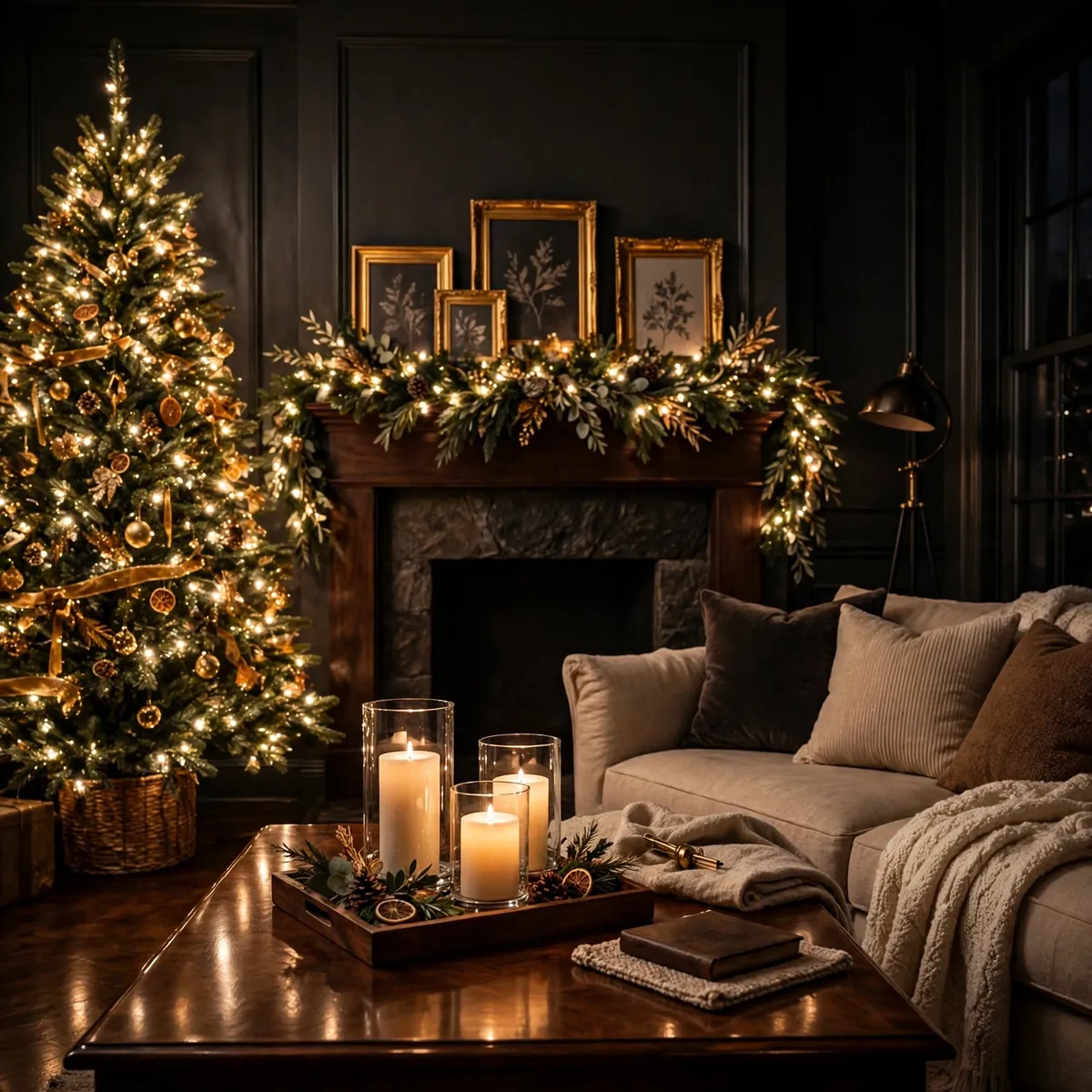
Christmas lighting is about layers, not brightness: the tree lights, plus garland lights, plus candles, plus one dimmed lamp create the glow that makes a room feel magical after dark. Overhead lights should stay off or very dim in the evening. Concrete example: tree with 700 warm-white lights, a pre-lit garland on the mantel, a cluster of three flameless pillar candles on the coffee table inside a wooden tray, and the floor lamp switched to its lowest dimmer setting — four light sources, all warm, none overhead.
Quick tips:
- Use warm-white (2700K) bulbs everywhere; cool white kills the cozy mood.
- Battery-operated candles are safe around kids, pets, and garlands.
- Put tree and garland lights on timers so the room glows when you walk in.
Bring in Natural Greenery Everywhere
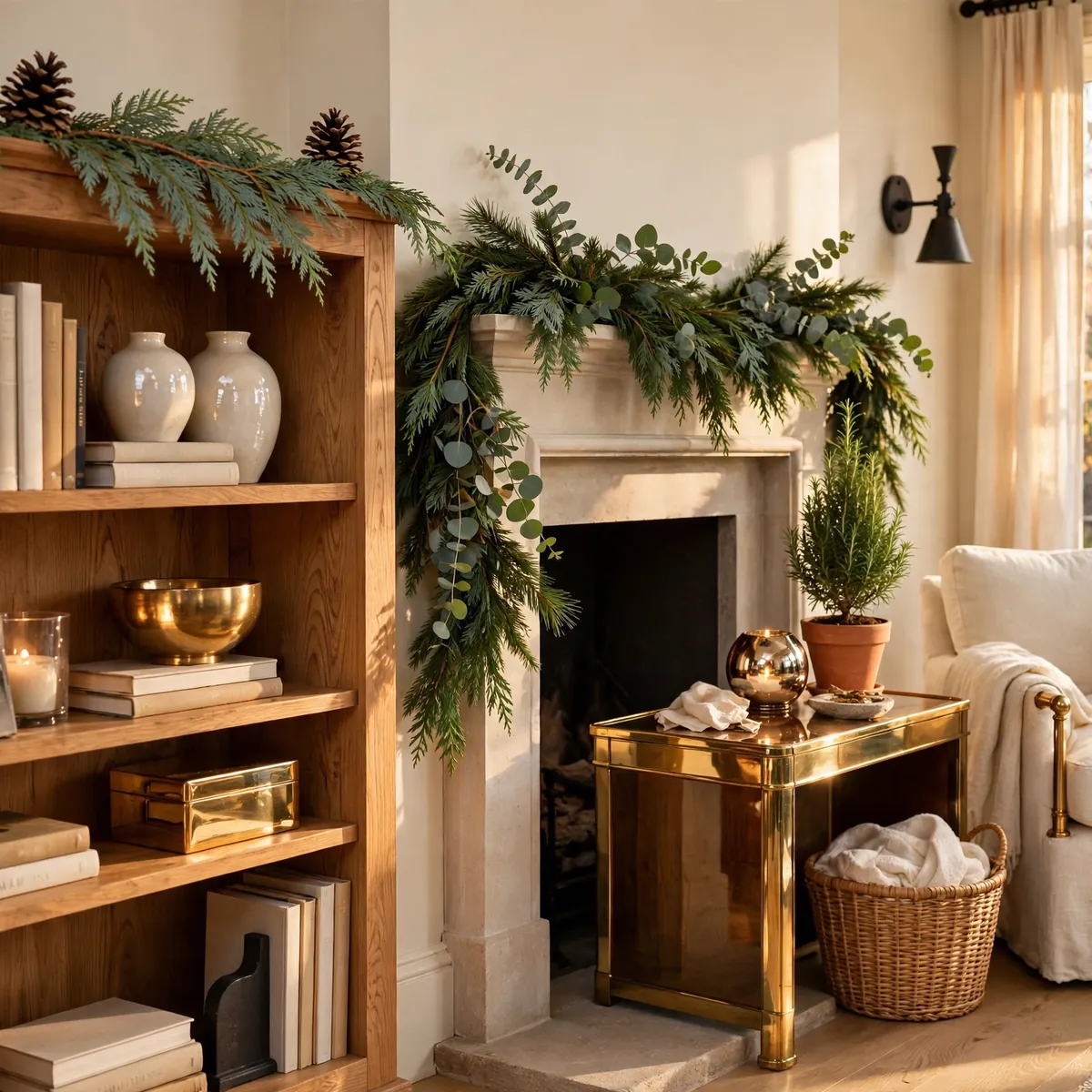
Fresh or faux greenery — pine, cedar, eucalyptus — is what makes Christmas decor smell and feel like Christmas rather than just looking red. Tuck sprigs anywhere a surface meets a vertical: shelves, frames, candle clusters, the tree base. Concrete example: lay a 12-inch cedar sprig along the top of a bookshelf with two pinecones, tuck eucalyptus stems into the gaps of the mantel garland, and place a small potted rosemary tree (shaped like a mini Christmas tree) on the side table — greenery in three unexpected spots, none of them the main tree.
Quick tips:
- Eucalyptus lasts weeks indoors and smells wonderful; cedar holds its needles.
- Mist fresh greenery lightly every few days to keep it from drying.
- One type of greenery repeated reads more designed than five mixed types.
Go Classic With Plaid and Tartan
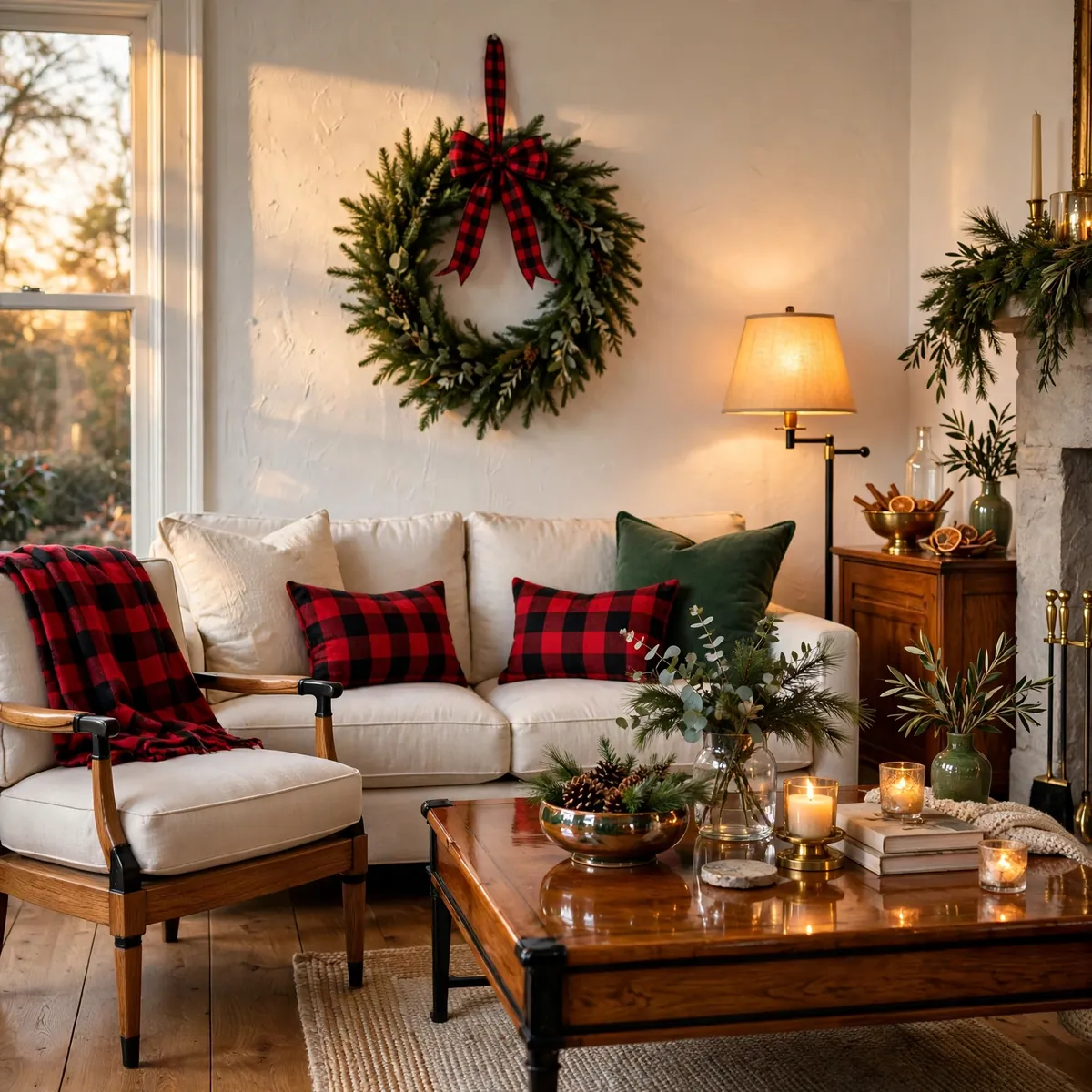
Plaid is the fastest visual shorthand for Christmas: one plaid throw or a pair of plaid pillows tells the whole room what season it is. The key is restraint — plaid is a strong pattern, so it works as an accent, not a takeover. Concrete example: a red-and-black buffalo plaid throw folded over the back of the armchair, two small plaid lumbar pillows on the sofa mixed with solid cream and forest-green pillows, and a plaid ribbon tied around a plain wreath on the wall — the pattern appears three times, always paired with solids.
Quick tips:
- Limit plaid to three appearances so it stays an accent.
- Pair plaid with solid velvet or knit in the same color family.
- Buffalo check reads rustic; tartan reads traditional — pick one.
Try a Neutral Scandinavian Christmas
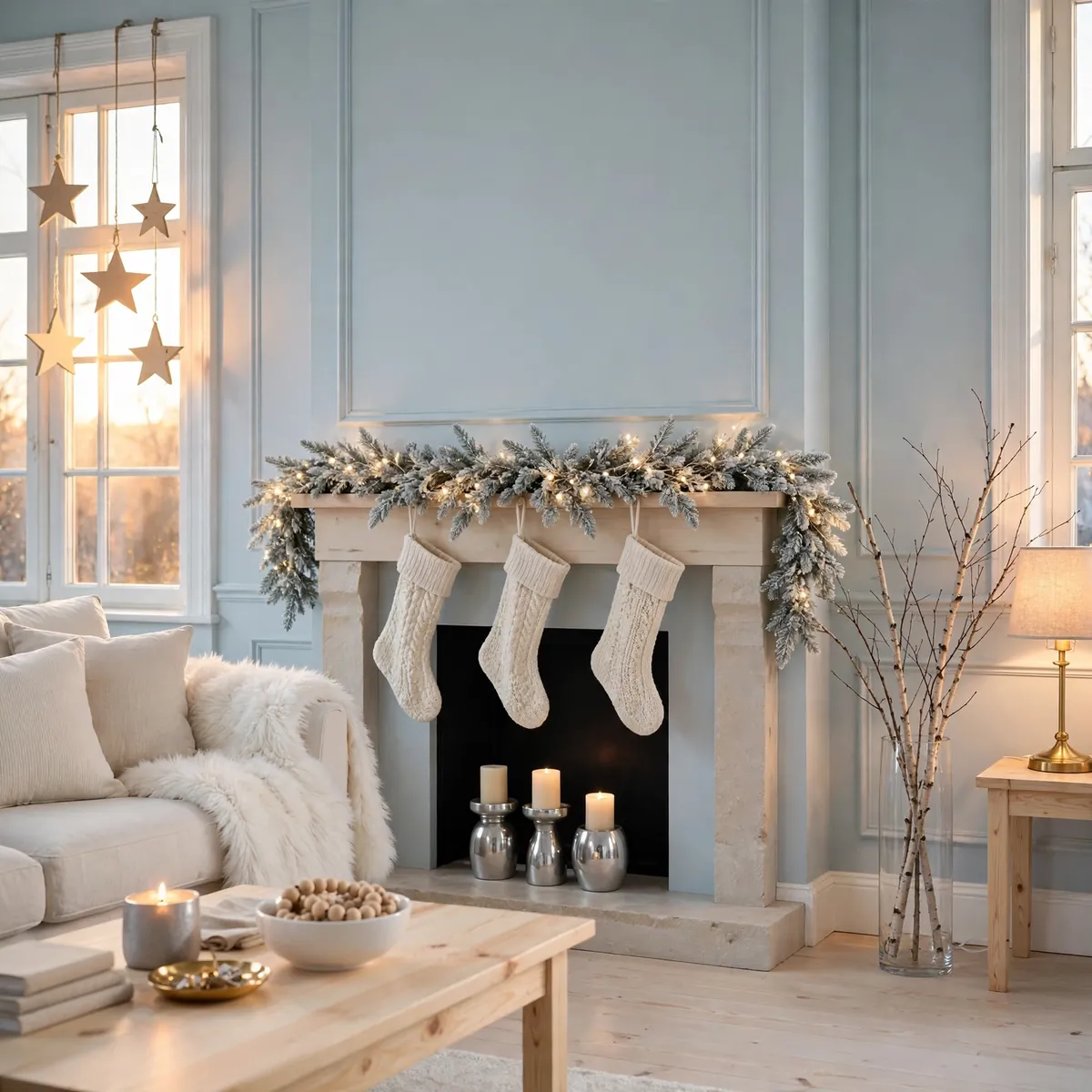
A Scandinavian Christmas skips the red and green entirely: white, cream, natural wood, and soft greenery, with texture doing the festive work. It suits modern rooms and small spaces because it never looks cluttered. Concrete example: a white faux-fur throw on the sofa, a simple birch-branch arrangement in a tall glass vase instead of a big tree, cream knit stockings on the mantel, a eucalyptus garland with white fairy lights, and wooden star ornaments hung in the window — calm, bright, unmistakably Christmas.
Quick tips:
- Texture replaces color: fur, knit, wood grain, and greenery carry the look.
- Keep ornaments to one material family (wood, glass, or paper).
- White fairy lights are essential — they are the “color” in a neutral scheme.
Go Bold With Jewel Tones
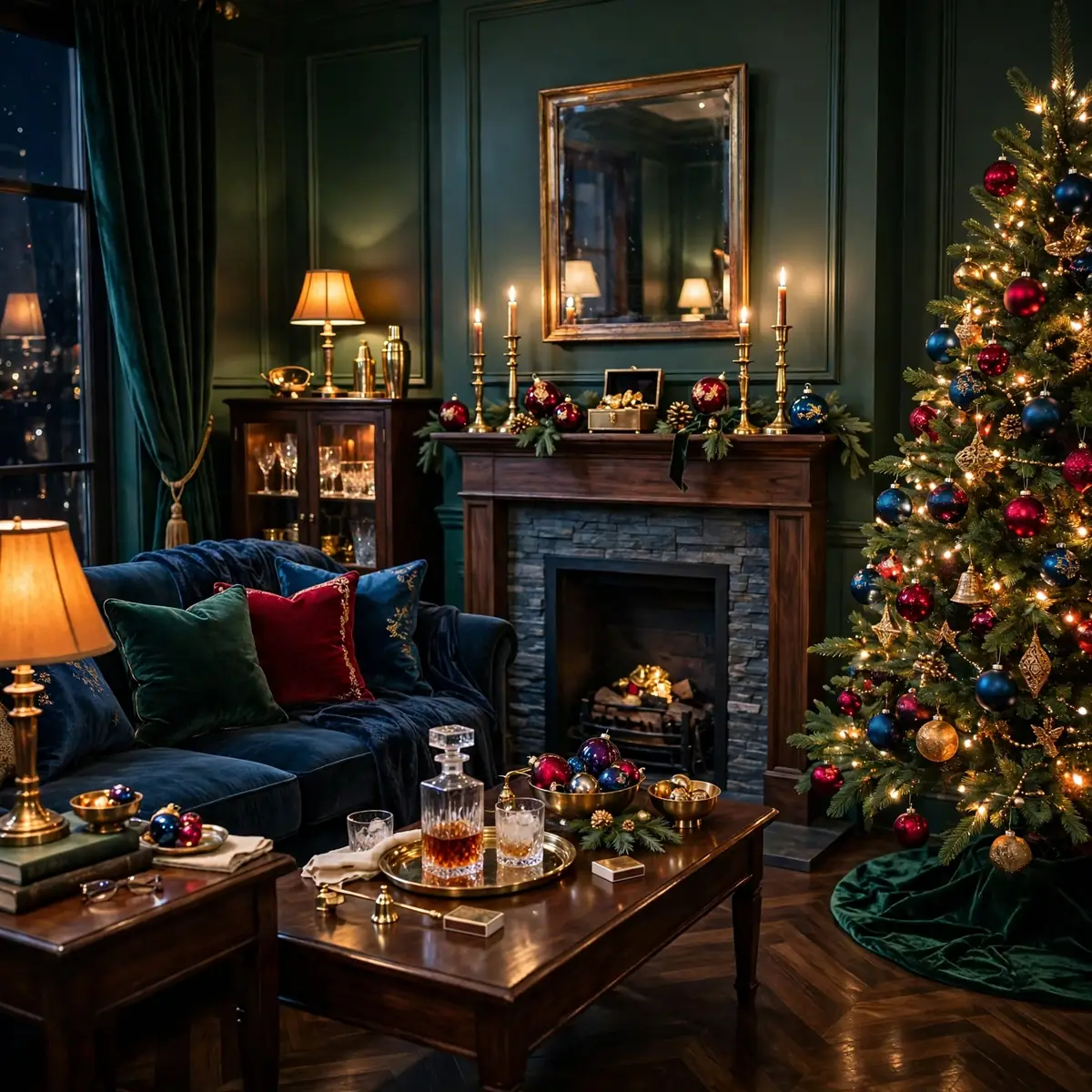
Jewel tones — emerald, ruby, sapphire, amethyst — make a Christmas living room feel like a private cocktail lounge: rich, dramatic, and grown-up. They work best in rooms that are used mostly in the evening. Concrete example: an emerald velvet tree skirt, ornaments in ruby red and deep sapphire with gold accents, a navy velvet throw on the sofa, brass candlesticks on the mantel, and the room’s lamp shades swapped to a warm amber — the whole room glows like the inside of a jewel box after dark.
Quick tips:
- Anchor jewel tones with brass or gold; silver cools them down.
- Keep walls and rug neutral so the jewel colors stay the stars.
- Velvet ribbon on the tree ties the jewel palette together.
Style the Window as a Holiday Silhouette
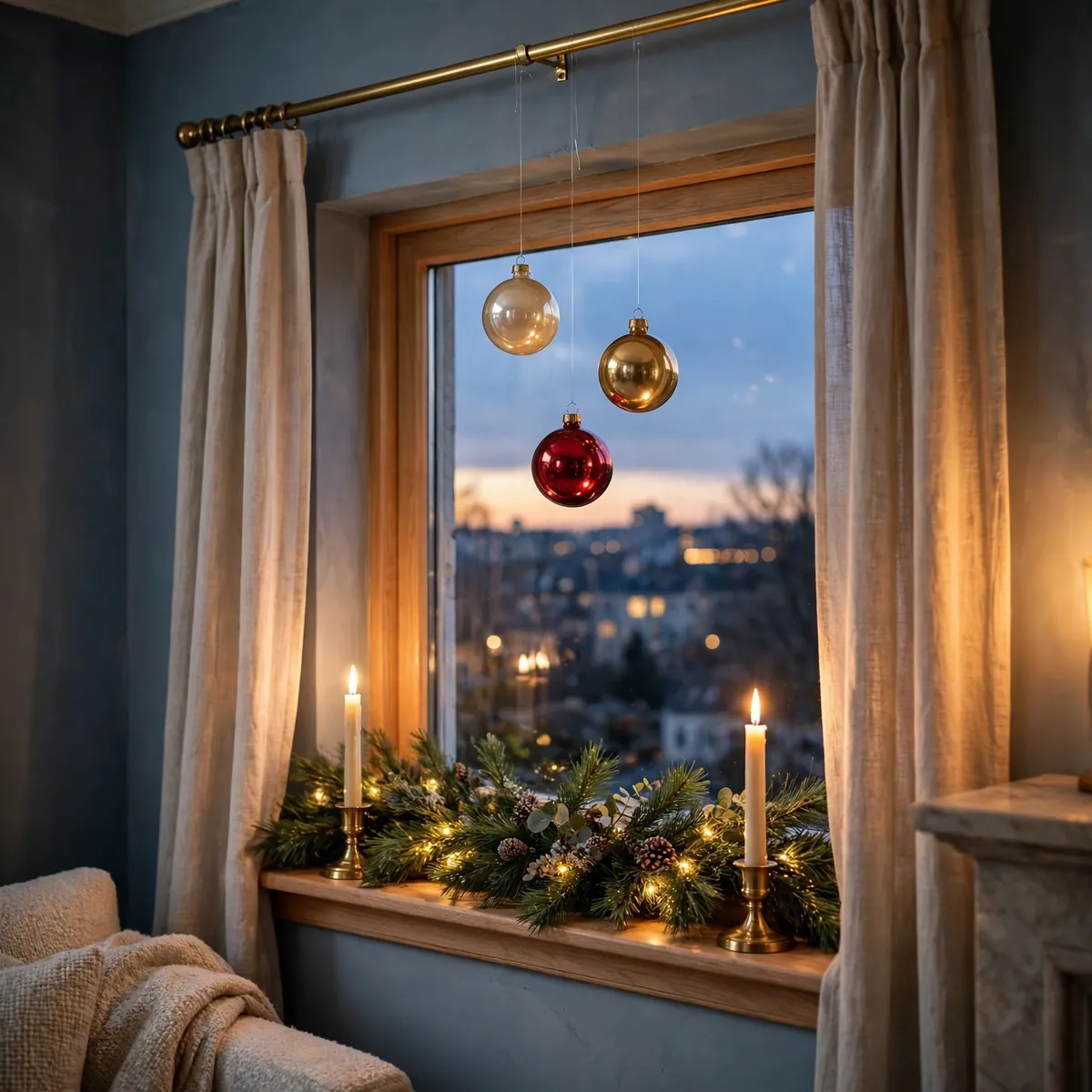
Windows decorated for Christmas create the view from the street and a glowing backdrop inside: a lit garland along the sill, ornaments hung at different heights, or a simple light silhouette. Concrete example: hang three glass ornaments in red, gold, and cream from the curtain rod at staggered heights using clear fishing line, lay a pre-lit pine garland along the windowsill, and place two flameless taper candles in brass holders on the sill — from outside it reads as a glowing holiday window; from inside it frames the evening view.
Quick tips:
- Hang ornaments at three different heights for a designed, not random, look.
- Clear fishing line makes ornaments look like they float.
- Battery tapers on the sill are safe and create the classic window-candle look.
Create a Holiday Coffee Table Tray
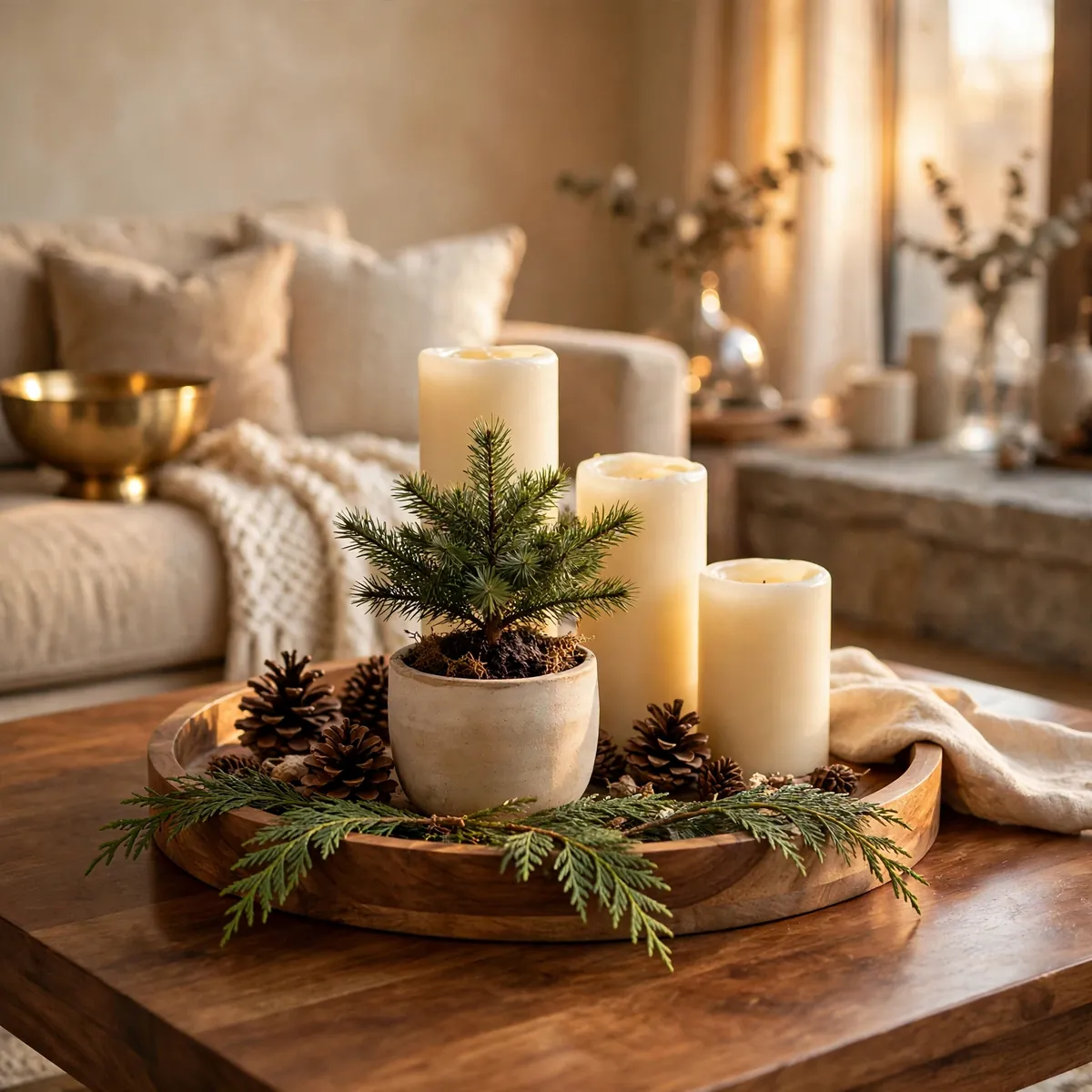
A styled tray on the coffee table concentrates the holiday feeling in one tidy, movable vignette — and it lifts off in seconds when you need the table. Concrete example: a round wooden tray holding a small potted pine, three cream pillar candles of different heights, a handful of pinecones, and a sprig of cedar laid across the front edge — everything grouped, nothing scattered, and the whole thing moves to the side table when guests arrive with board games.
Quick tips:
- Trays make decor movable; group everything on one tray per surface.
- Odd numbers (3 or 5 items) look styled; even numbers look placed.
- Include one candle or light source in every tray for evening glow.
Hang Stockings With Intention

Stockings are a Christmas classic, but they look best when they are part of a composition rather than a lone row: vary heights, mix textures, and anchor them visually. Concrete example: four stockings in cream cable knit, red velvet, buffalo plaid, and natural burlap hung from individual brass holders on the mantel, with the garland swagged behind them and a small pine sprig tucked into each cuff — the mix of textures keeps it interesting while the brass holders unify it.
Quick tips:
- Mix stocking textures but keep one unifying element (color or holders).
- Tuck a sprig of greenery into each cuff for a finished look.
- No mantel? Hang stockings from a console table, a ladder shelf, or wall hooks.
Dress the Shelves and Bookcases
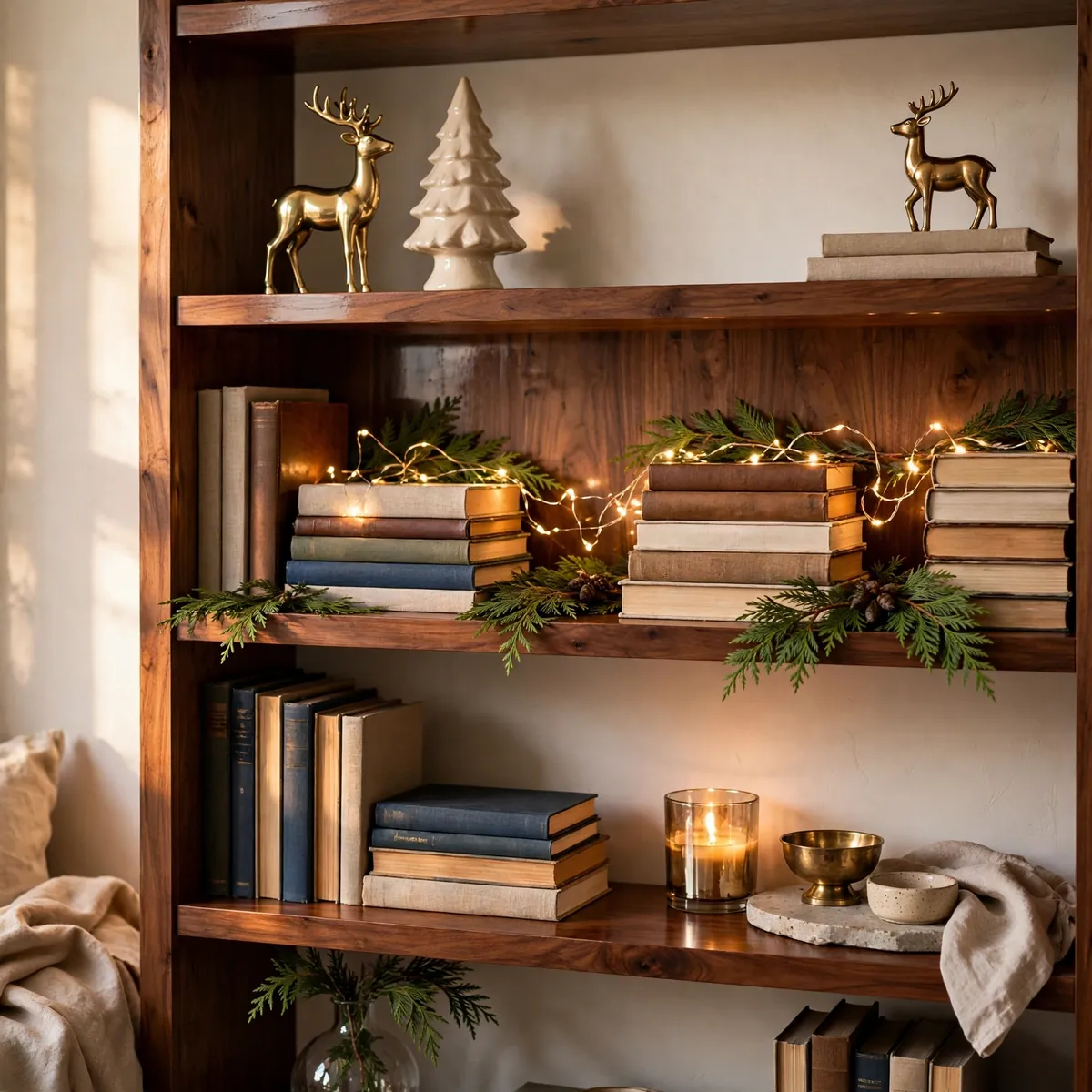
Open shelves and bookcases are often forgotten at Christmas, but a few sprigs and lights there make the whole room feel decorated rather than just the tree corner. The trick is editing the everyday items first, then adding holiday pieces. Concrete example: on a living room bookshelf, remove a third of the books, tuck cedar sprigs horizontally between the remaining stacks, add a string of 50 warm fairy lights woven along the middle shelf, and place two small brass reindeer figures and one ceramic tree on the top shelf — the shelf reads as styled for the season, not cluttered.
Quick tips:
- Remove some everyday items before adding holiday ones; shelves need breathing room.
- Fairy lights on one shelf create depth and draw the eye.
- Repeat one element (greenery, brass, ceramic) across all shelves for cohesion.
Add Mini Tabletop Trees
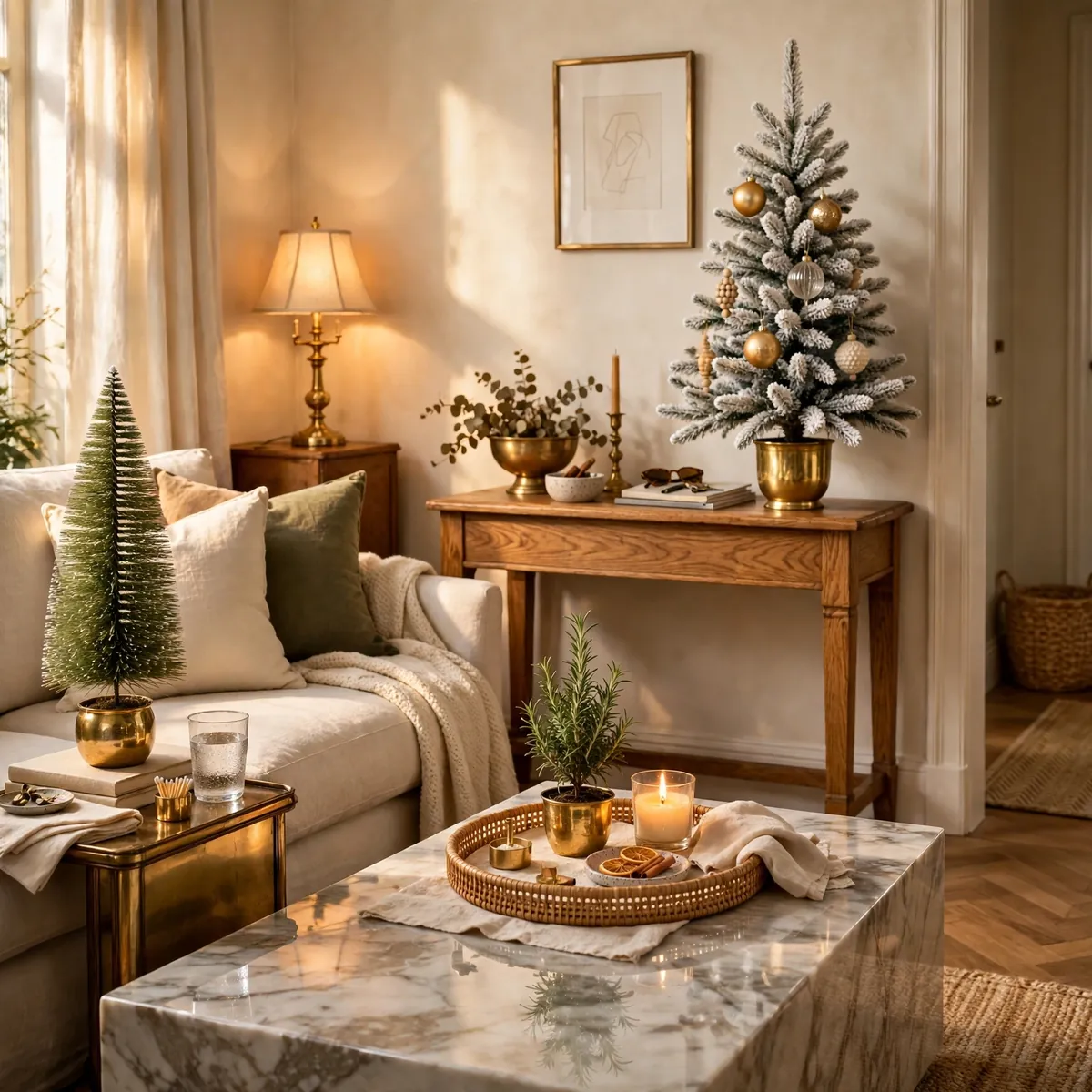
Small trees in unexpected spots — side tables, the console, the bookshelf — multiply the Christmas feeling without multiplying the work, and they are perfect for small rooms. Concrete example: a 2-foot bottle-brush tree in a small brass pot on the side table next to the sofa, a 3-foot flocked tree on the entryway console with five ornaments, and a tiny rosemary tree on the coffee table tray — three mini trees, three surfaces, and the room feels fully dressed even before the main tree goes up.
Quick tips:
- Vary the tree styles (bottle-brush, flocked, rosemary) so they do not look like a set.
- Small trees in real pots or brass containers look intentional; plastic bases do not.
- Five to seven ornaments are plenty on a tabletop tree.
Tie Everything With Velvet Ribbon
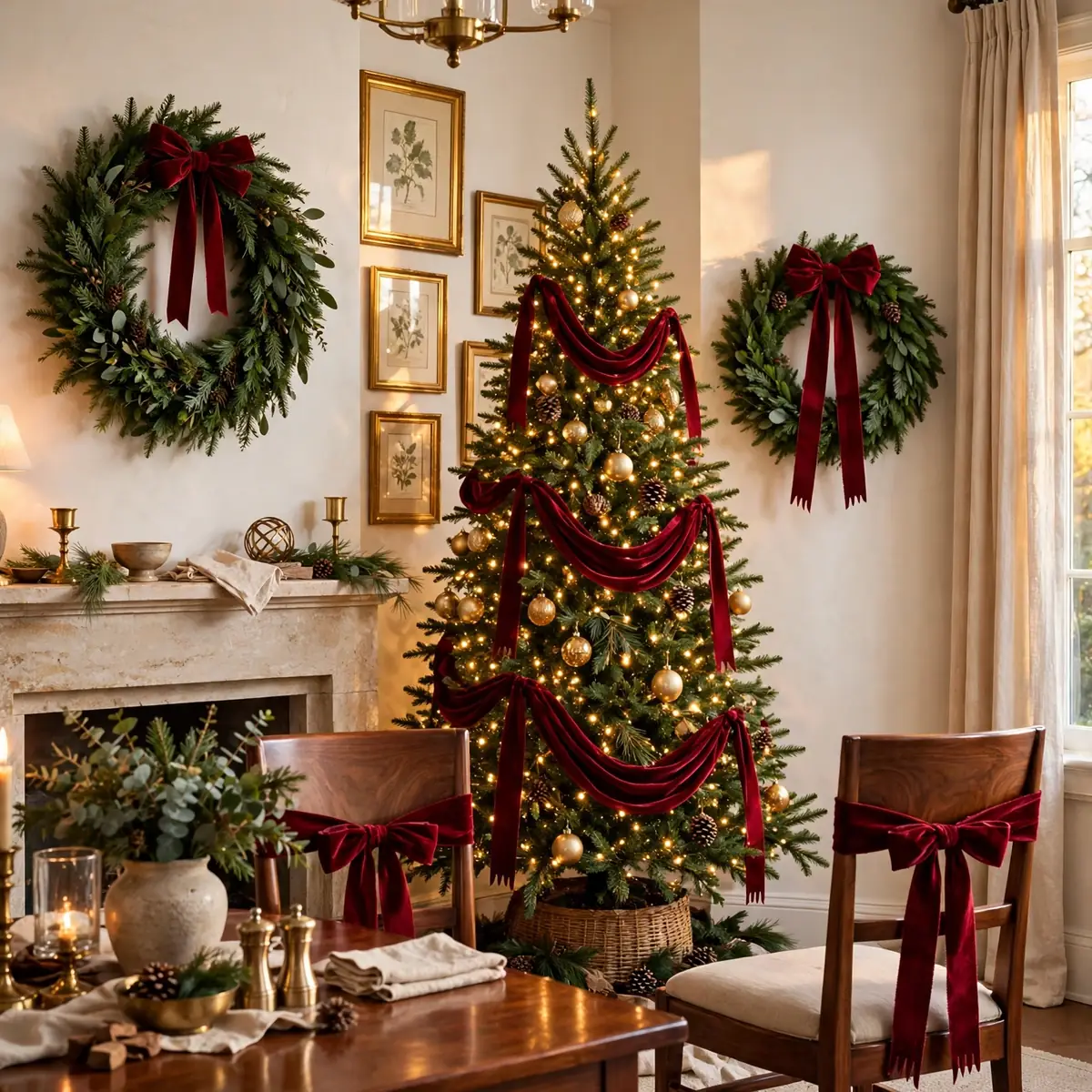
Wide velvet ribbon is the detail that makes Christmas decor look expensive: tied on the tree, on wreaths, on stockings, on chair backs. It costs little and photographs beautifully. Concrete example: 2.5-inch deep-red velvet ribbon tied in loose bows at the top of each wreath, woven vertically down the tree in three swags, and tied around the back of each dining-adjacent chair in the living room — one $12 spool of ribbon unifies the whole room.
Quick tips:
- Wide ribbon (2+ inches) reads luxurious; thin ribbon reads crafty.
- Velvet beats satin for a modern, rich look.
- Cut ribbon ends in a dovetail (V-shape) for a finished appearance.
Warm It Up With Rustic Wood Accents
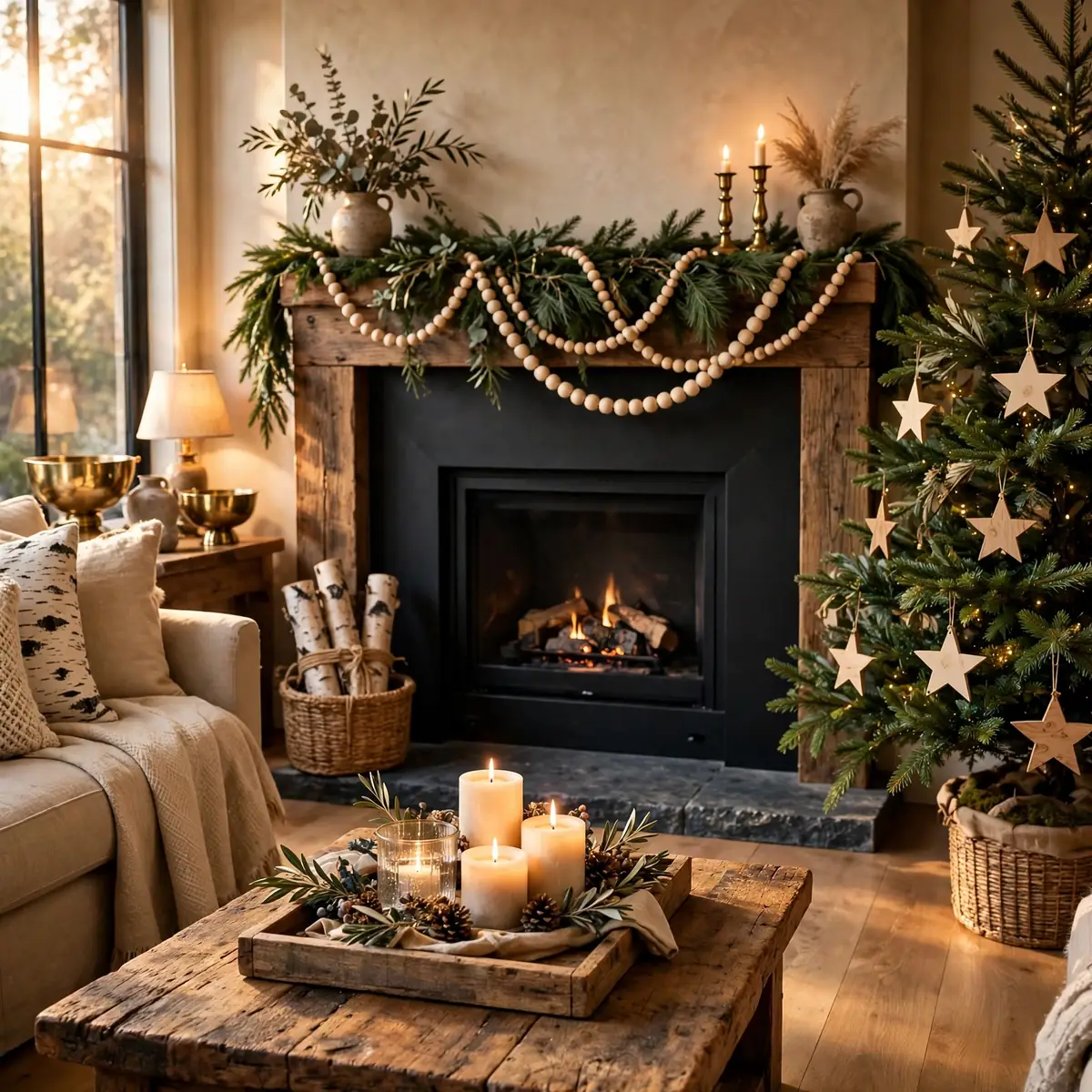
Wood accents — reclaimed trays, wooden bead garlands, birch logs — ground Christmas decor in something natural and keep shiny ornaments from feeling cold. Concrete example: a wooden bead garland draped over the mantel garland, a reclaimed-wood tray holding the candle cluster on the coffee table, three birch logs tied with twine in a basket beside the fireplace, and wooden star ornaments on the lower branches of the tree — the wood tones warm up every metallic in the room.
Quick tips:
- Mix wood tones freely; Christmas wood accents do not need to match furniture.
- Birch bark, with its white-and-black pattern, reads as winter without paint.
- One wooden element per zone keeps it balanced, not cabin-themed.
Add Shine With Gold Metallics
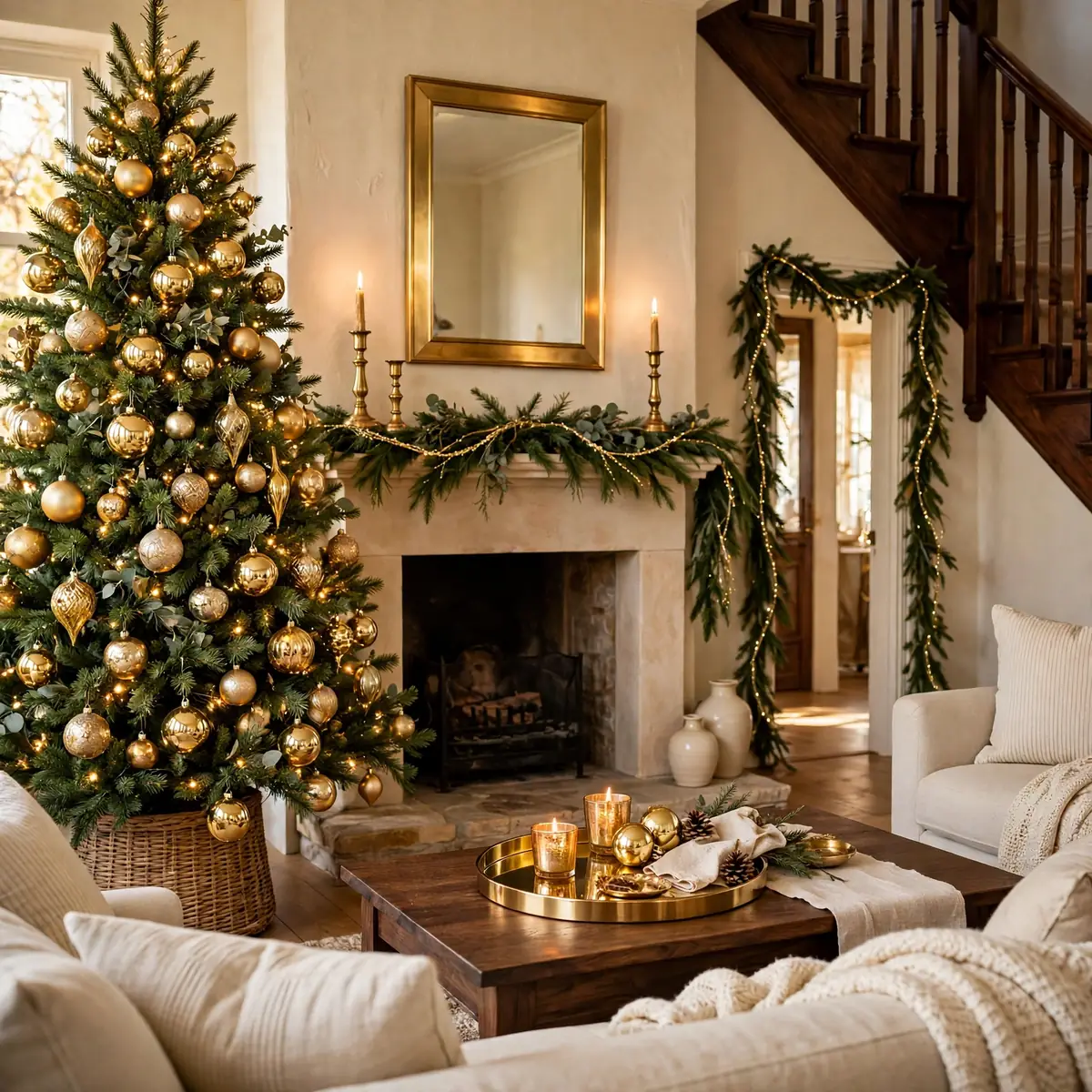
Gold is the metallic of Christmas: it catches tree light and candlelight and throws it around the room. Use it in ornaments, candleholders, and small accents rather than big furniture pieces. Concrete example: gold glass ornaments mixed into the tree at a ratio of one gold to every three colored ornaments, two brass candlesticks on the mantel, a gold-rimmed tray on the coffee table, and a thin gold garland woven through the stair rail or doorway garland — the gold appears in four places, always catching light.
Quick tips:
- Mix gold finishes (matte, shiny, brushed) for depth; single-finish gold looks flat.
- One gold to three colored ornaments keeps the tree balanced.
- Brass and gold are interchangeable in Christmas styling; do not overthink it.
Pop Red Berries Throughout
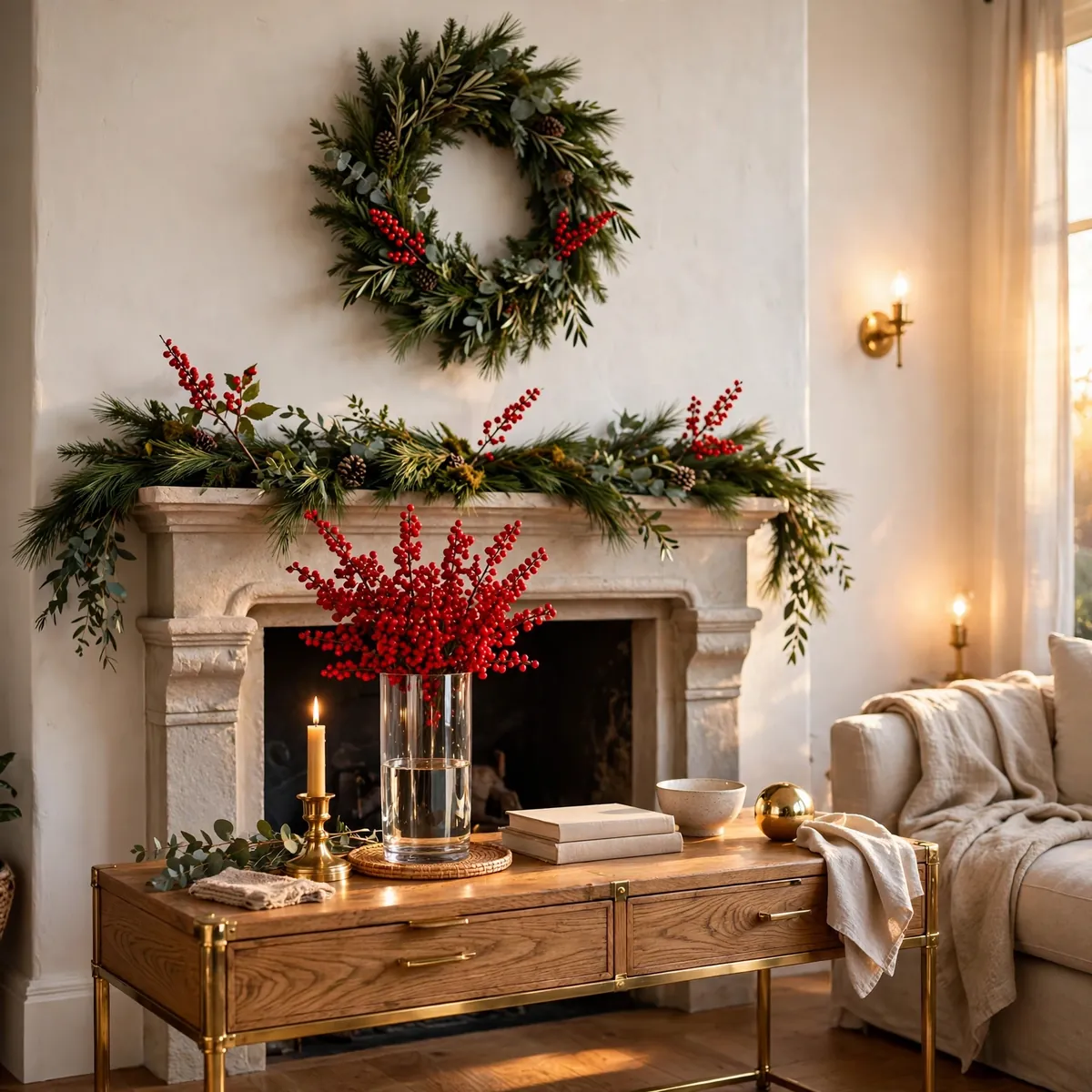
Red berry sprigs are the cheapest high-impact Christmas accent: a $5 bunch transforms garlands, wreaths, vases, and candle rings. They add the red of Christmas without any big commitment. Concrete example: tuck three red berry sprigs into the mantel garland (left, center, right), place one bunch in a tall glass vase on the console, and wire two sprigs into the wreath on the wall — the same berry repeated in three spots ties the room’s red together.
Quick tips:
- Artificial berries look convincing and last for years; fresh ones dry out.
- Cluster berries in odd numbers for a natural look.
- Berries + greenery alone (no ornaments) make a beautiful minimalist arrangement.
Create a Holiday Reading Nook
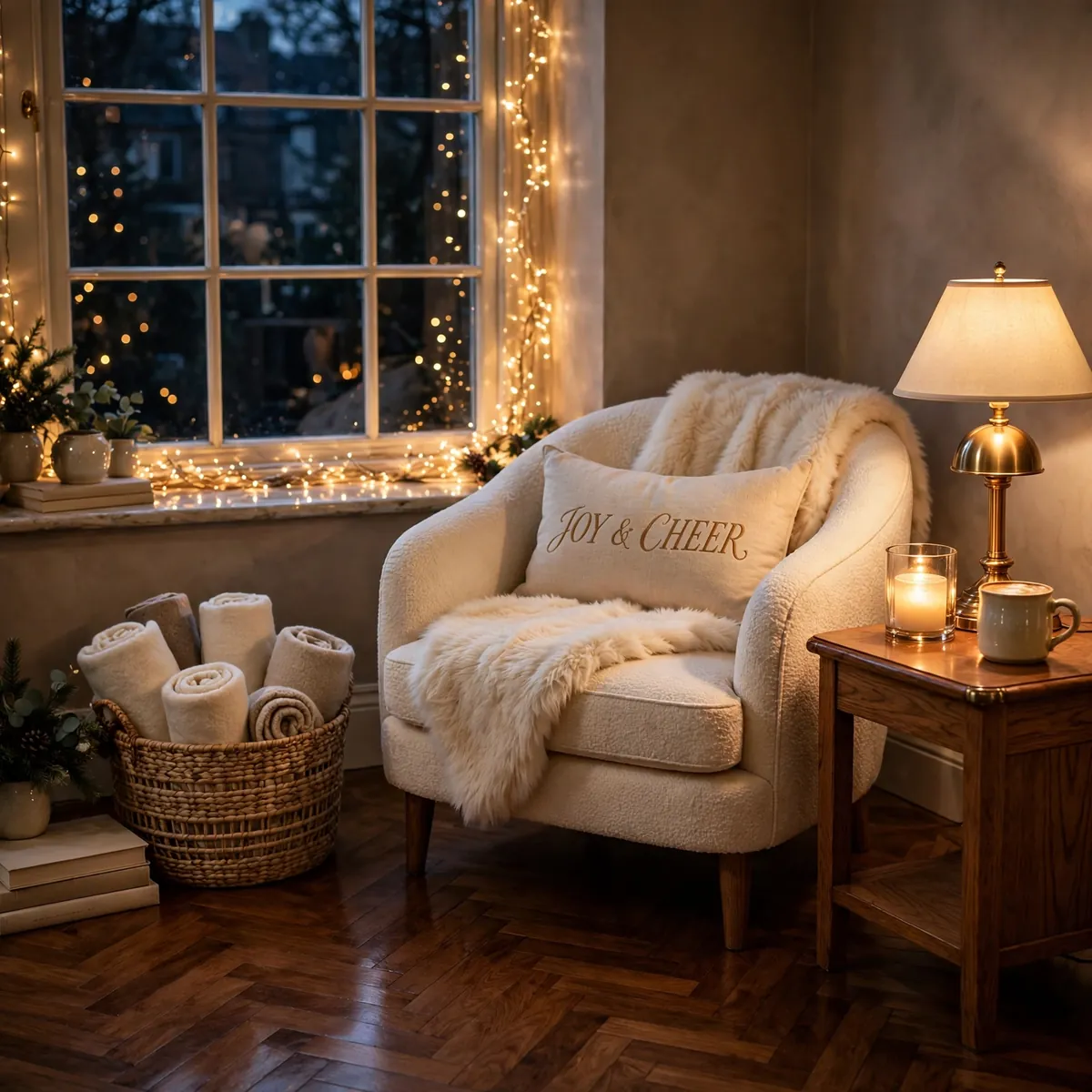
A corner chair dressed for Christmas becomes the most fought-over seat in the house: a throw, a pillow, a small light source, and something to drink from. Concrete example: the armchair by the window gets a faux-fur throw, a “Merry” lumbar pillow, a small side table with a flameless candle and a mug, and a basket of rolled extra throws beside it — plus a string of fairy lights draped along the windowsill behind it, so the nook glows in the evening.
Quick tips:
- Every reading nook needs three things: light, a throw, and a surface for a drink.
- Fairy lights behind the chair create a halo effect in photos.
- A basket of throws nearby invites people to settle in.
Connect the Entryway to the Living Room
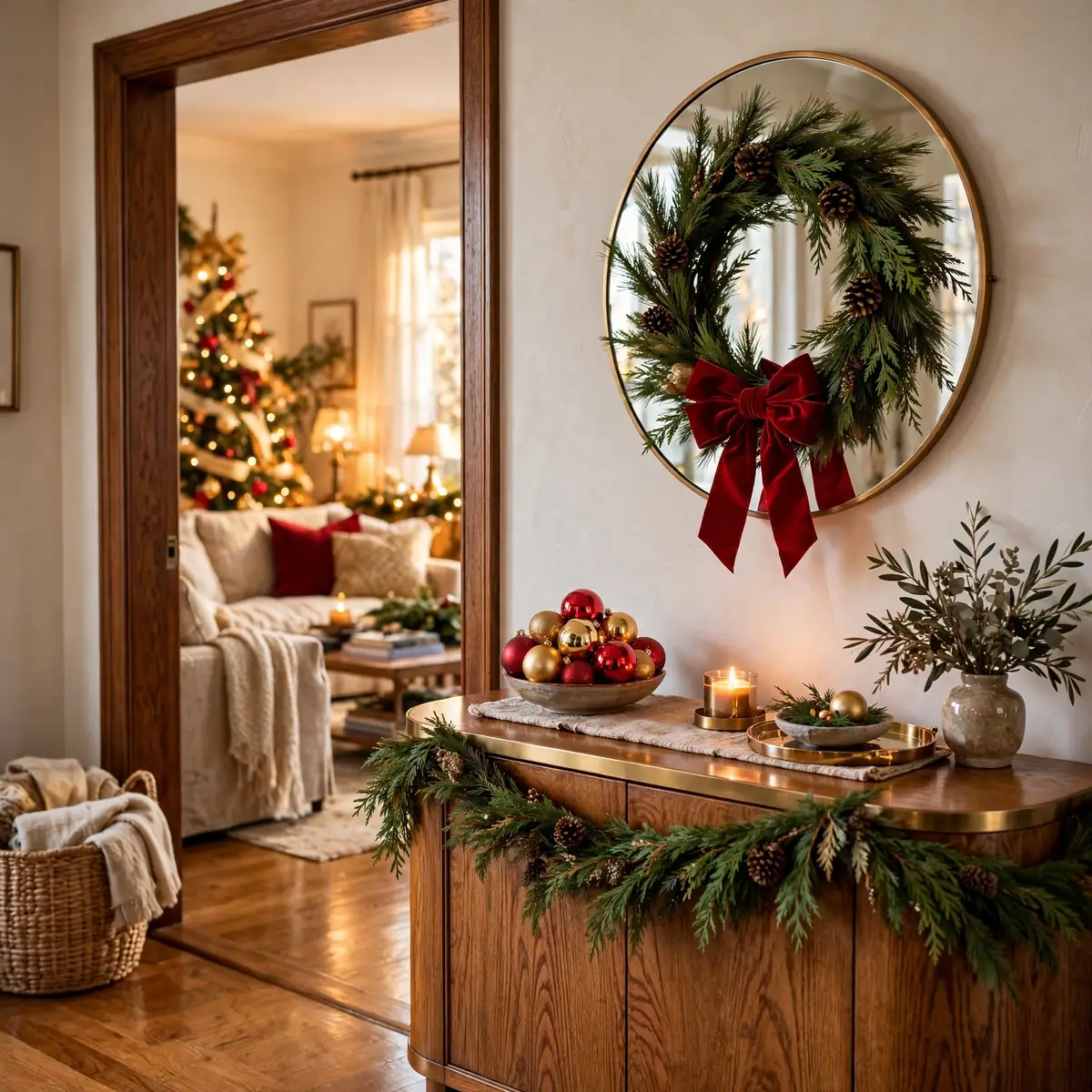
The Christmas feeling should start at the front door and flow into the living room: repeat one element — the garland style, the ribbon color, or the ornament palette — in both spaces so the house feels connected. Concrete example: if the living room tree is red and gold, hang a simple pine wreath with a red velvet bow on the entryway mirror, place a small red-and-gold ornament bowl on the console, and run the same cedar garland along the console — three echoes of the living room palette greet guests before they even sit down.
Quick tips:
- Repeat one element (ribbon color, greenery type, or palette) between connected spaces.
- The entryway needs less, not more — two or three touches are enough.
- Match the formality: rustic living room, rustic entry touches.
Cluster Candles by the Fireplace
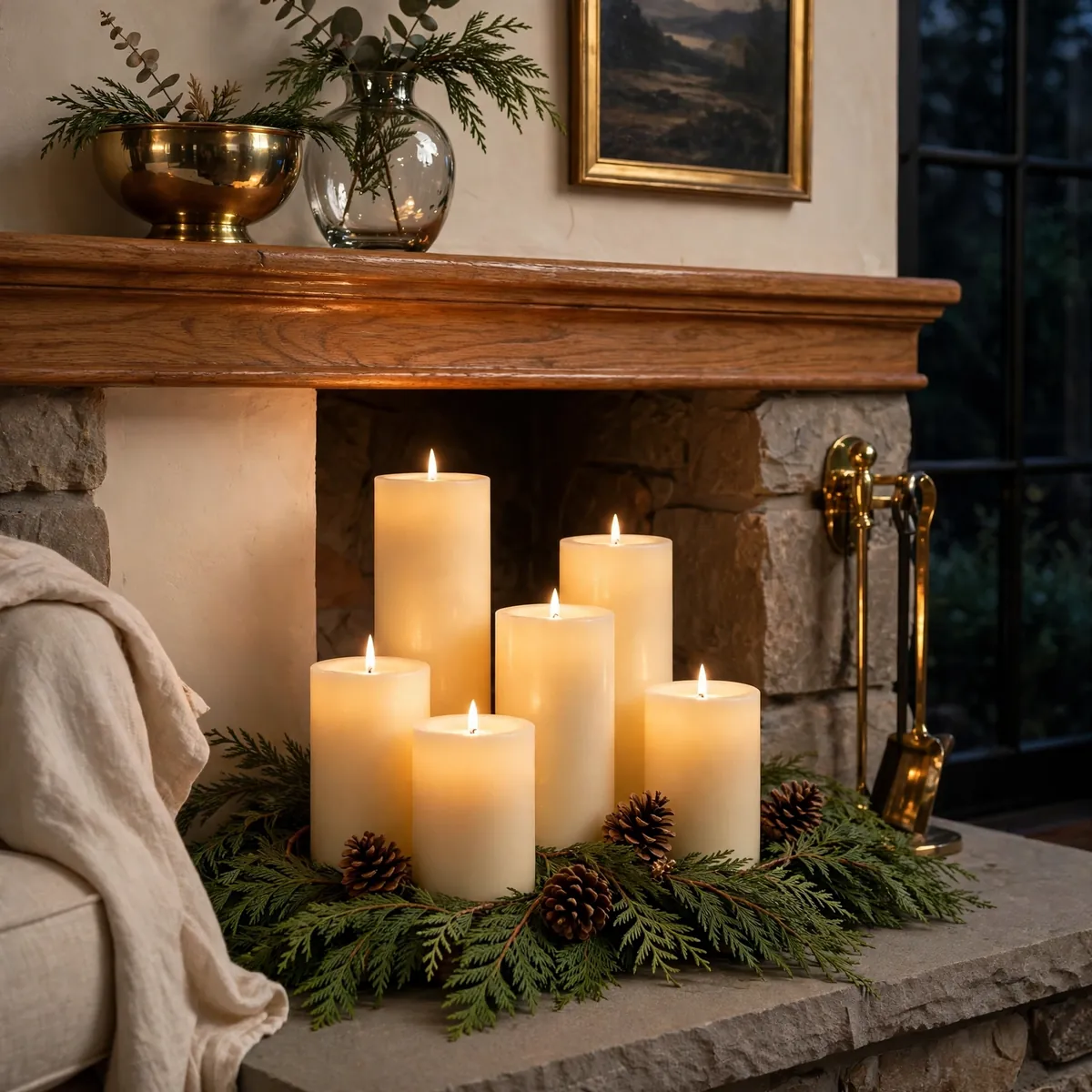
If you have a fireplace — working or not — a cluster of candles in front of it or on the hearth creates the firelight feeling even when the fire is not lit. Concrete example: on the hearth, group seven flameless pillar candles in cream at three different heights (use books or small boxes underneath to vary height), add a cedar garland base underneath them, and tuck three pinecones between the candles — the cluster glows like embers in the evening and looks styled by day.
Quick tips:
- Vary candle heights; uniform heights look like a display case.
- Flameless candles with timers turn themselves on at dusk.
- A greenery base under the cluster keeps it from looking sparse.
Build a DIY Advent Calendar Corner
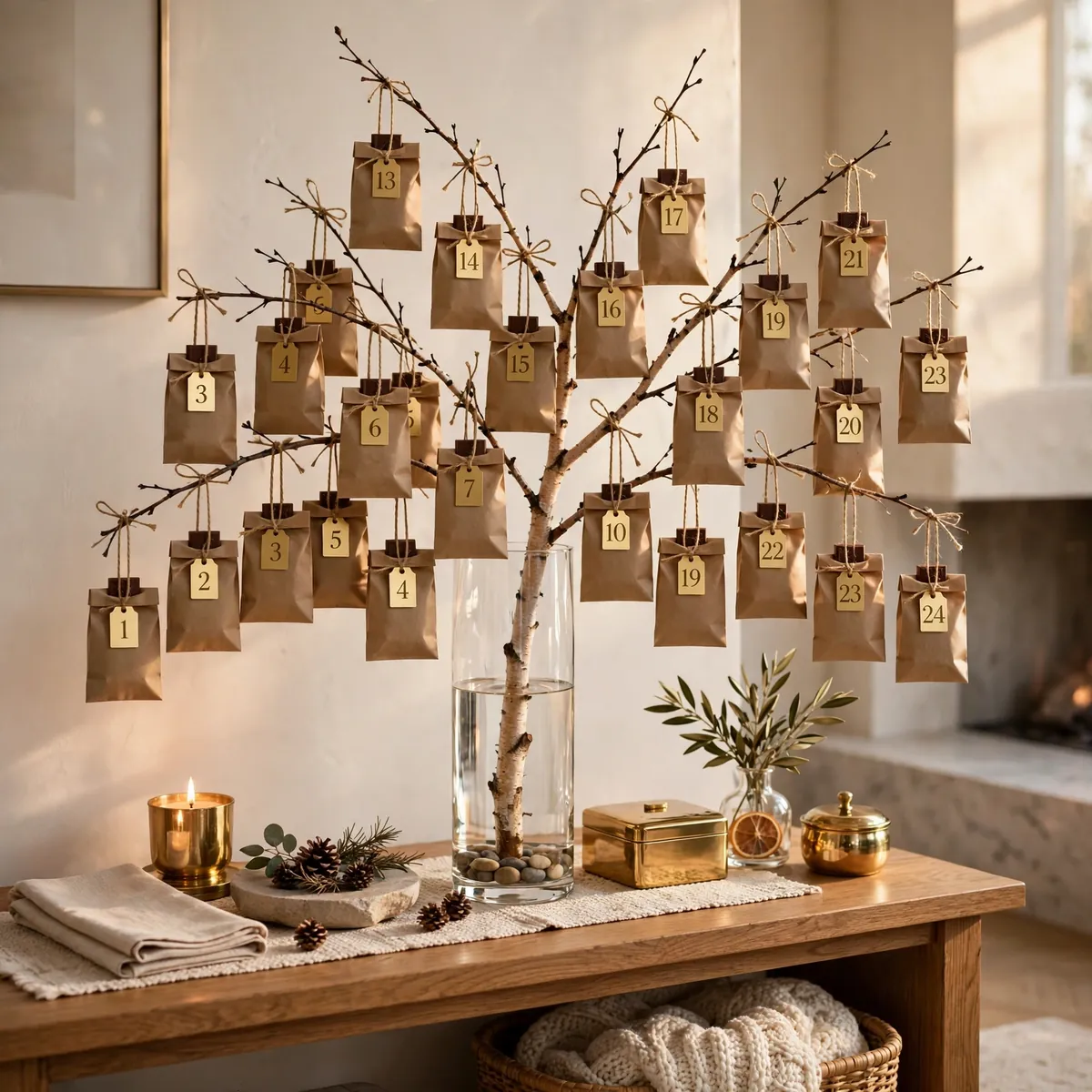
An advent calendar display adds anticipation to the room and gives kids (or guests) a daily ritual: small numbered bags, boxes, or envelopes arranged as decor. Concrete example: hang 24 small kraft-paper bags numbered with a gold marker from a bare birch branch secured in a tall vase, each bag holding a chocolate or a small note, placed on the console table — it is a countdown and a sculpture at once, and it costs almost nothing to make.
Quick tips:
- Number bags or boxes with a metallic marker for a finished look.
- Hang the display where it is reachable but out of the main walkway.
- Fill with experiences (movie night, cocoa) as well as treats.
Hang a Wreath Over the Mirror
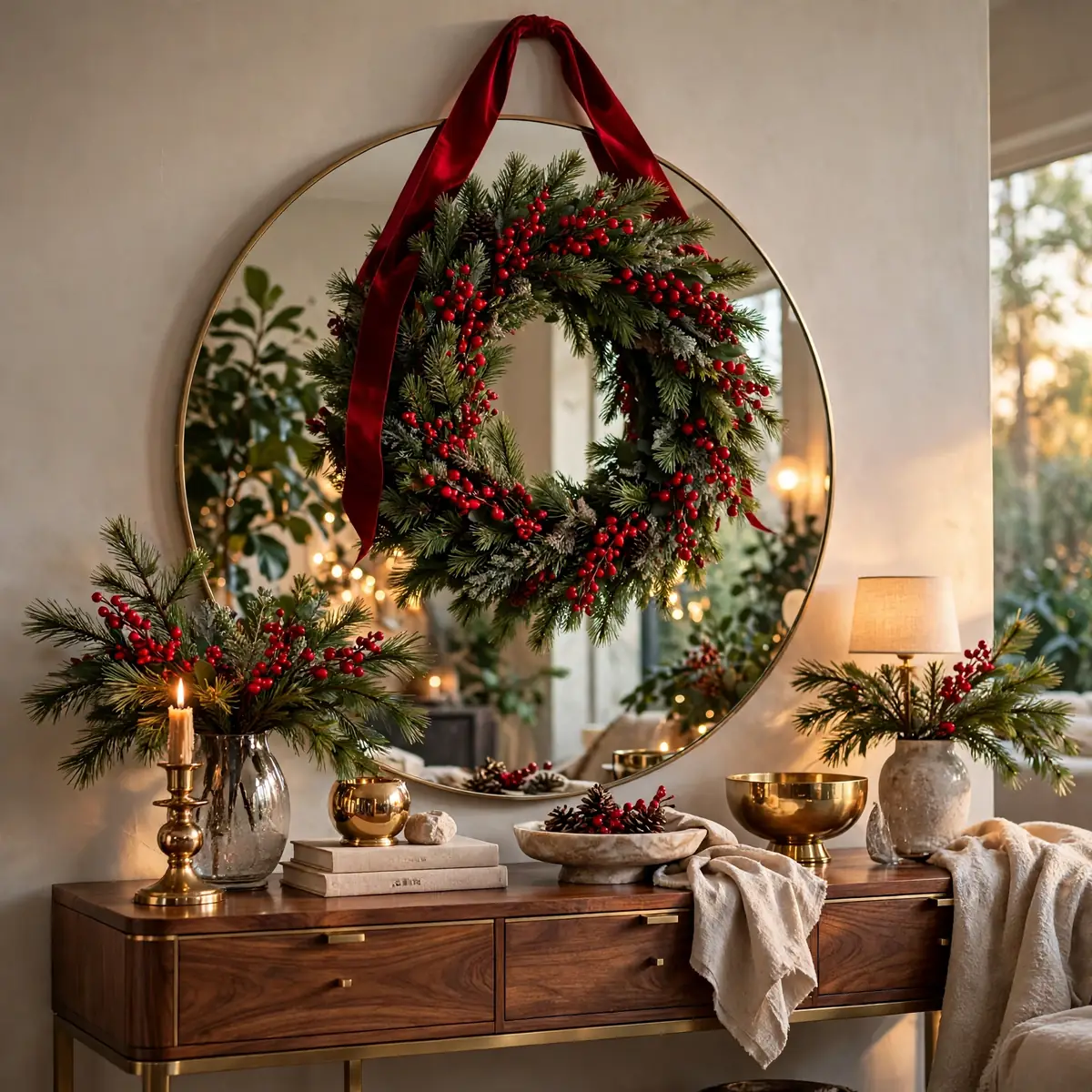
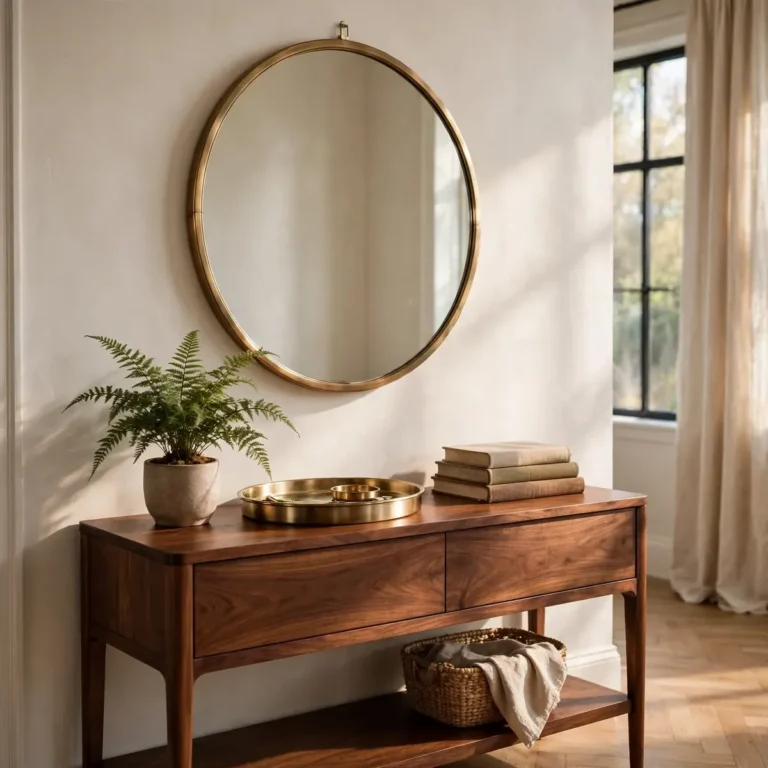
A wreath hung over a mirror doubles its visual impact: the mirror reflects the greenery and the room’s lights, making both look fuller. Concrete example: hang a 24-inch pine wreath with red berries centered on the large round mirror above the console, using a wide red velvet ribbon looped over the top of the mirror frame — the reflection shows the back of the wreath, so it looks lush from every angle, and the ribbon adds a tailored finish.
Quick tips:
- Size the wreath to about two-thirds of the mirror’s width.
- Hang with ribbon, not wire — ribbon is part of the decor.
- A mirror behind any wreath makes it look twice as full.
Warm the Floor With Layered Rugs
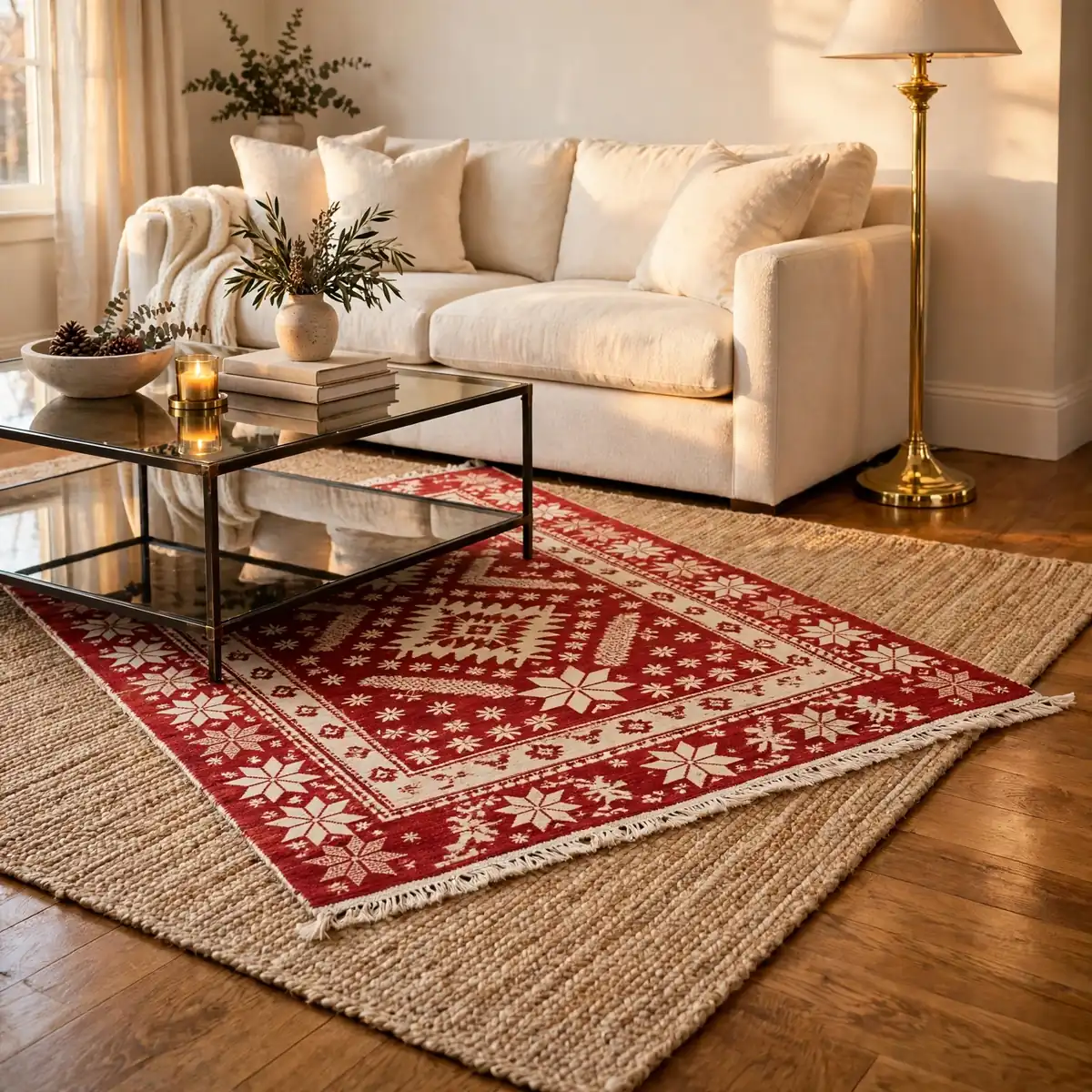
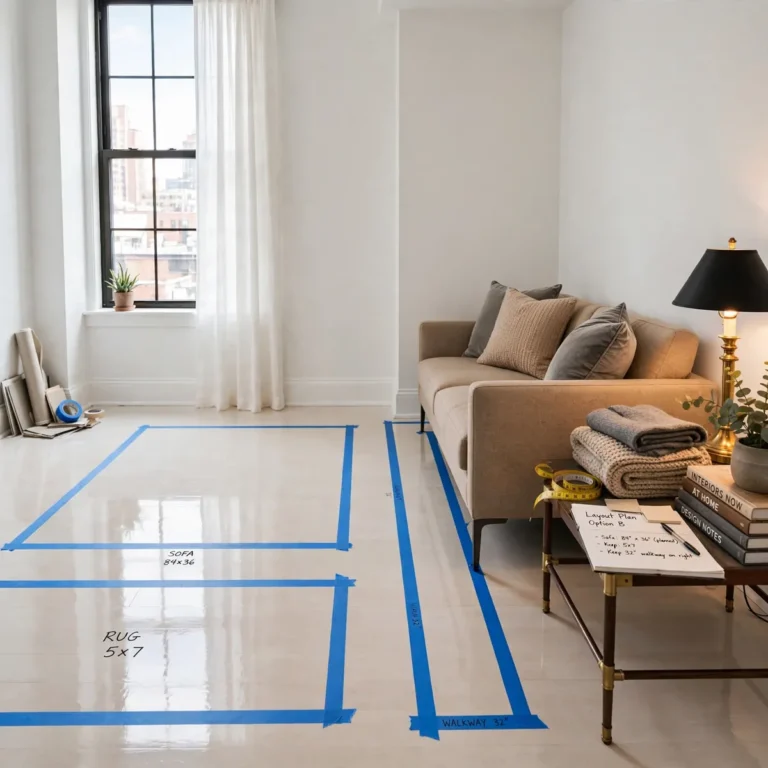
Christmas is the season of bare feet on cold floors, so layering a smaller festive rug over the everyday rug adds warmth literally and visually. Concrete example: lay a 5×7 red-and-cream patterned flat-weave rug over the existing neutral area rug in front of the sofa, angled slightly for a relaxed look — the pattern brings Christmas color to the floor, the layer adds insulation, and it rolls up for storage in January.
Quick tips:
- Layer a smaller rug (5×7 or 4×6) over the main rug, never wall-to-wall.
- Flat-weave rugs layer best; thick rugs on thick rugs slip.
- Use a rug pad between layers to prevent sliding.
Do a Full Festive Pillow Swap
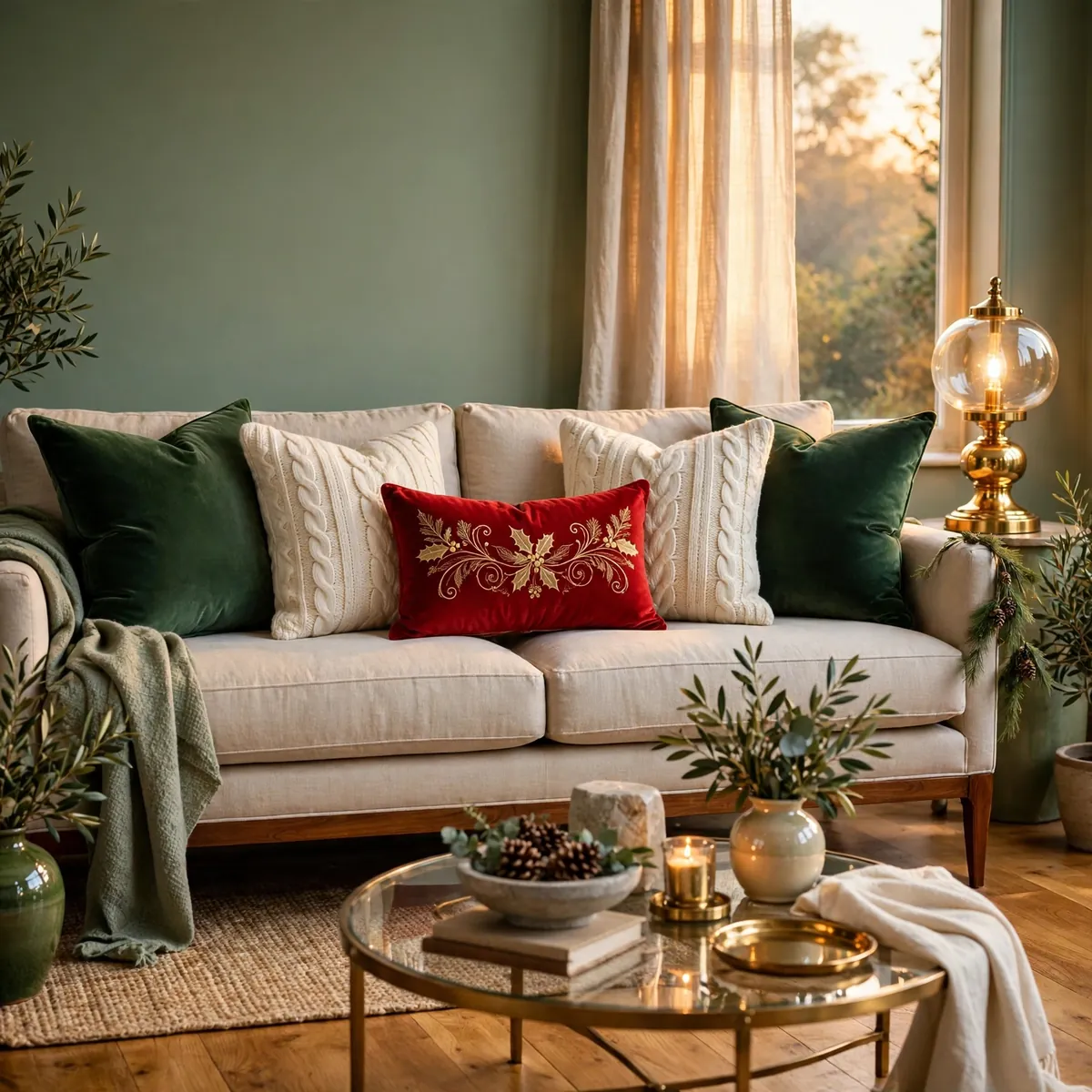
Replacing all the sofa pillows with a coordinated holiday set — rather than mixing one or two in — creates the biggest single-evening transformation in the room. Concrete example: remove the four everyday pillows and replace with two deep-green velvet squares, two cream cable-knit squares, and one red lumbar pillow with “Joy” embroidered in gold — five pillows, one palette, and the sofa looks like it belongs in a holiday catalog. Store the everyday set in a vacuum bag under the bed until January.
Quick tips:
- Odd numbers of pillows (3 or 5) arrange better than even.
- Mix sizes: squares in back, lumbar in front.
- Vacuum bags make off-season pillow storage nearly flat.
Small-Space Christmas Living Room Decor Ideas That Actually Work
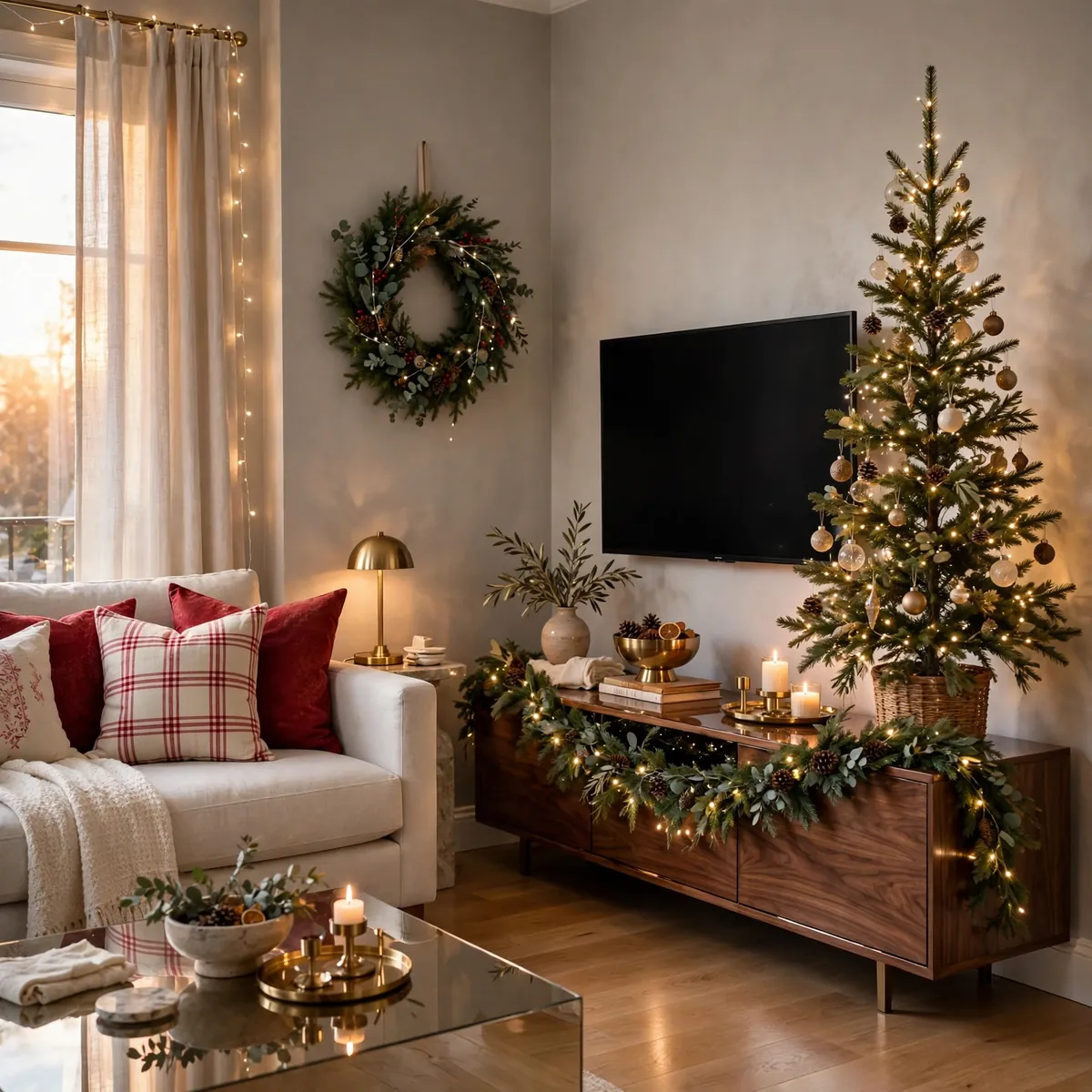
Small living rooms can absolutely do Christmas — the strategy is vertical decorating and one right-sized tree instead of spreading decor across every surface. Concrete example: in a 10×12 living room, use a 6-foot slim-profile tree in the corner (it has the height of a full tree with half the footprint), hang a wreath on the wall instead of taking up table space, drape the garland along the TV console instead of a mantel, swap just the pillow covers, and string fairy lights along the curtain rod — five moves, zero floor space lost, and the room feels fully dressed. The biggest small-room mistake is a tree that is too wide; measure the corner and leave 3 feet of walkway before buying.
Quick tips:
- Slim-profile trees give full height with half the floor footprint.
- Decorate walls and windows, not tables — vertical space is free.
- One focal point beats five small ones in a tight room.
FAQs
How can I decorate my living room for Christmas without blocking walkways?
Keep large pieces — the tree, big lanterns, floor baskets — in corners and against walls, and decorate vertically with wreaths, wall-hung ornaments, and garlands along the mantel or curtain rod. Measure your main walkways and keep at least 3 feet clear; a slim-profile tree gives you full height with half the footprint of a standard tree.
How do I balance bold Christmas colors with my neutral living room?
Introduce red, green, or metallics through small, swappable accents — pillow covers, throws, ornaments, and ribbon — while keeping the sofa, rug, and walls neutral. One bold color repeated in three places (tree, pillows, mantel) looks intentional; five bold colors scattered everywhere looks chaotic.
How do I keep Christmas decorations from damaging walls and furniture?
Use removable adhesive hooks for garlands and stockings, Command-style strips for wreaths, and felt pads under heavy candle clusters or trays. Avoid nails, staples, and tape on painted walls; for brick or stone fireplaces, use hooks designed for masonry or drape garlands instead of attaching them.
How can I make my Christmas decor look cohesive if my furniture styles are mixed?
Pick one palette — two main colors plus one metallic — and repeat it across the tree, textiles, and mantel. Consistent color unifies mixed furniture styles faster than any other trick; a modern sofa and a vintage chair both look deliberate when they share the same red-and-gold accents.
What is the easiest Christmas living room update if I have no storage space?
Choose decor that folds flat or does double duty: pillow covers instead of pillows, throws you use year-round, string lights that coil into a drawer, and a slim tree that disassembles into a narrow box. Skip bulky figurines and anything that needs its own storage bin.
Conclusion
A magical Christmas living room is not about owning the most decorations — it is about one clear focal point, layers of warm light, and a palette repeated with confidence across the tree, the textiles, and the mantel. Pick the five ideas from this list that fit your room and your budget, start with the lights, and let the season build from there. The glow you create in the evenings is what you will remember long after the ornaments are packed away.