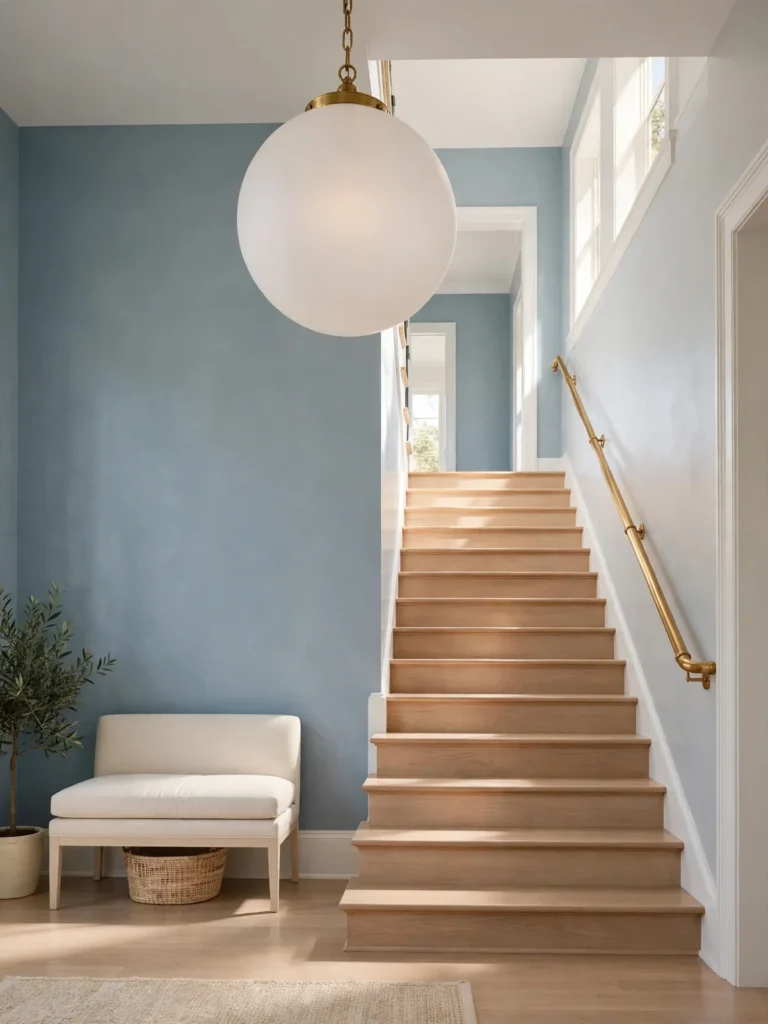
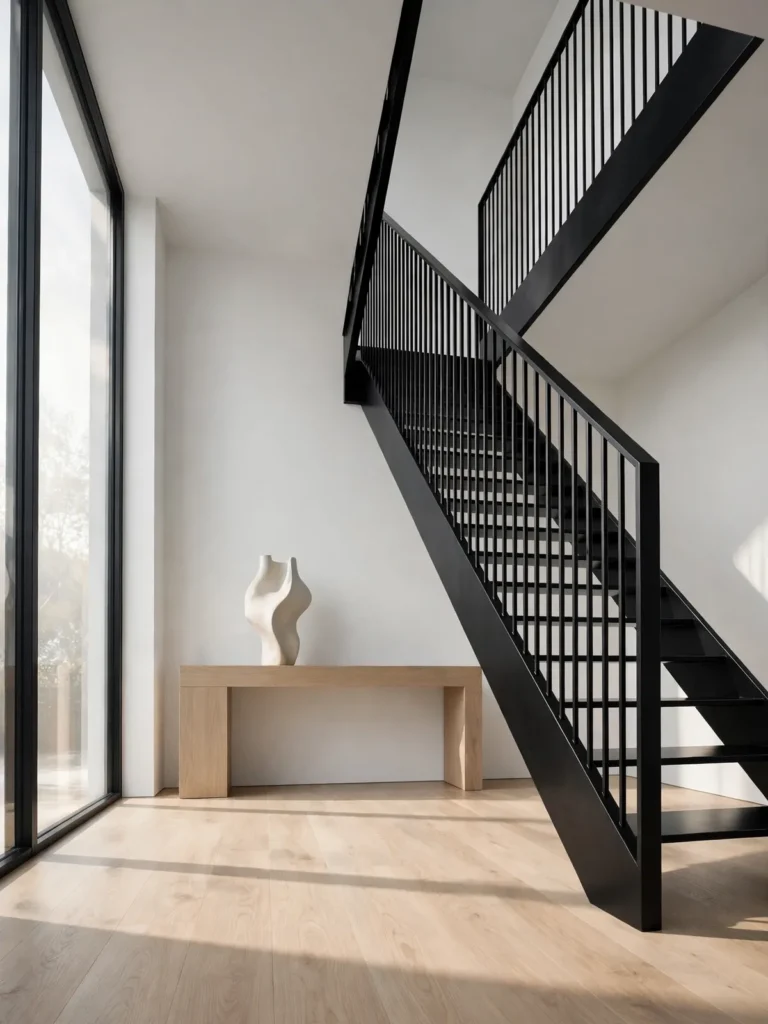
25 Stunning Oak Staircase Ideas That Instantly Make Your Home Feel Warm, Bright and Luxurious
An oak staircase does far more than connect two floors — it brings warmth, grain and character into the heart of the home. These 25 ideas show how honey oak, pale white oak, deep-stained oak, glass panels, black steel and brass can make a hallway brighter, a living room feel richer, and an everyday stair feel calm, polished and luxurious.
An oak staircase is a stair built with solid oak treads — and often an oak handrail and newel posts — chosen for its warm golden grain, hard-wearing surface and timeless look that suits almost any home, from a cottage to a modern open-plan house. The best oak stair balances that warmth with light: pale walls, slim railings, glass panels or a bright landing window keep the wood from feeling heavy, while one strong accent — black steel, brass, a patterned runner or a deep wall colour — gives it a clear feature.
If you love that warm timber look with a relaxed, country feel, these modern farmhouse staircase ideas show the same oak-and-steel pairing in a farmhouse setting. The 25 ideas below cover the whole stair — its finish, its shape, its railings, its lighting, and the space around it — so you can choose a design that suits a compact entry, a bright loft, or a calm family home.
Key Takeaways
What makes an oak staircase a good choice?
Oak is hard-wearing, warm-toned and timeless. Its visible grain adds character, it takes stain and paint well, and it suits almost any style — from a rustic cottage to a modern open-plan home.
Do oak staircase ideas suit a small home?
Yes — pale oak, open risers and glass panels keep an oak stair feeling light, so a narrow hallway feels wider and brighter instead of boxed in by heavy timber.
What finishes work best on an oak staircase?
Honey oak, pale white oak and deep walnut or espresso stains are the most popular. A clear matte or satin lacquer protects the grain, while painted risers or a contrasting stringer add definition.
Is an oak staircase practical for a family home?
Yes, when the treads have a non-slip finish, the handrail is secure and the lighting is good. Oak is one of the hardest domestic timbers, so it stands up well to daily use, pets and children.
Where should an oak staircase sit in the home?
Near a window, beside an open-plan living area, or in an entryway where its warm grain can be seen from the front door and where daylight can show off the wood.
Honey Oak Treads With a Slim Black Steel Balustrade
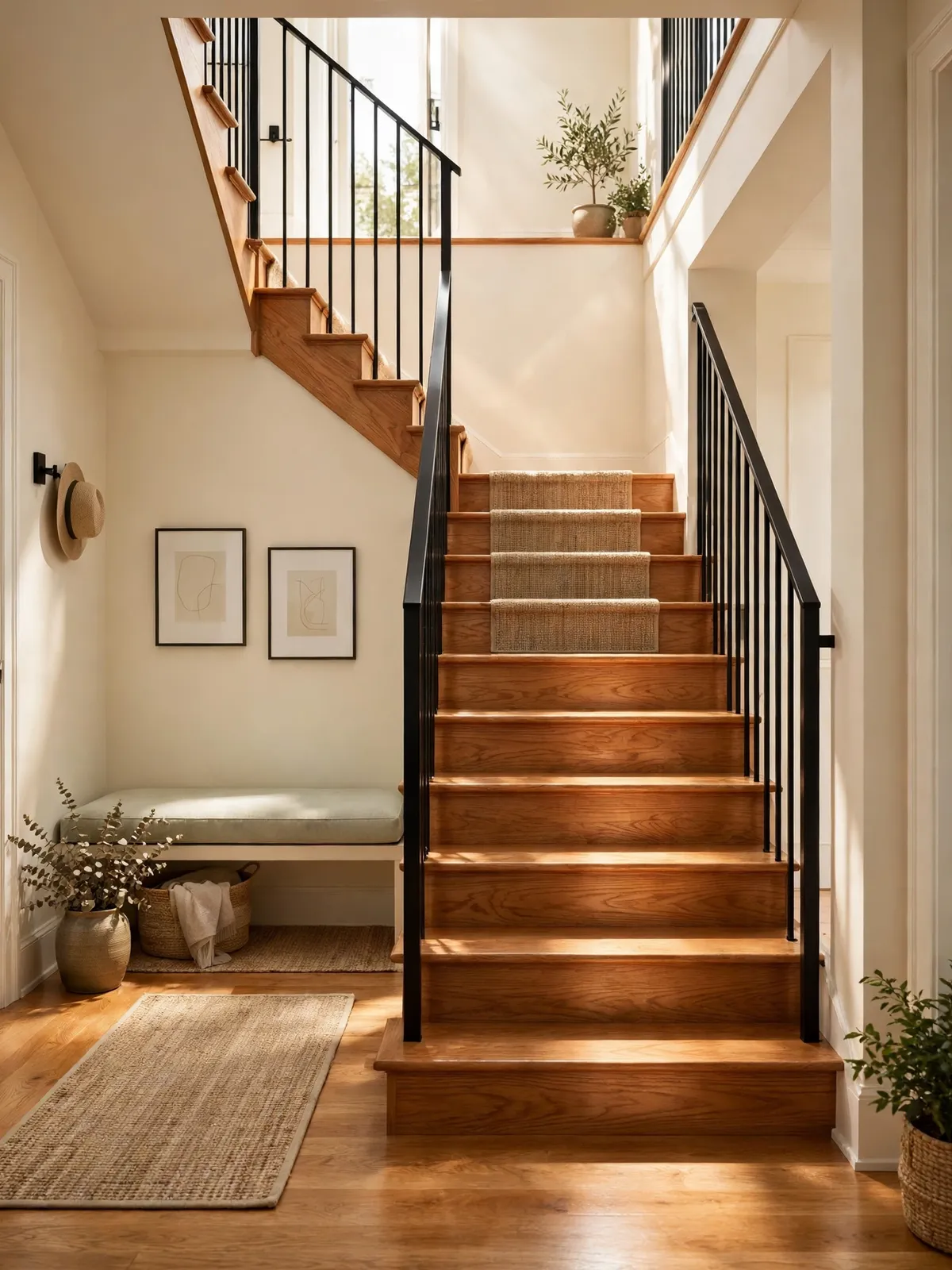
Honey oak treads with a slim black steel balustrade give an oak staircase a warm, modern edge without losing its natural character. In one family entryway, 40 mm thick honey oak treads, each 950 mm wide and 280 mm deep, sit on white painted stringers, with slim matte black steel balusters and a matching black handrail. A pale sage-green bench cushion and a woven jute runner at the base keep the palette soft, while morning light picks out the grain in every tread.
Quick tips:
- Choose honey oak so the grain stays warm and visible against black steel.
- Keep balusters slim and evenly spaced for a clean, modern rhythm.
- Paint the stringers white so the oak treads stand out.
- Add a woven runner at the base to soften the landing.
Pale White Oak Floating Treads on a Plain Plaster Wall
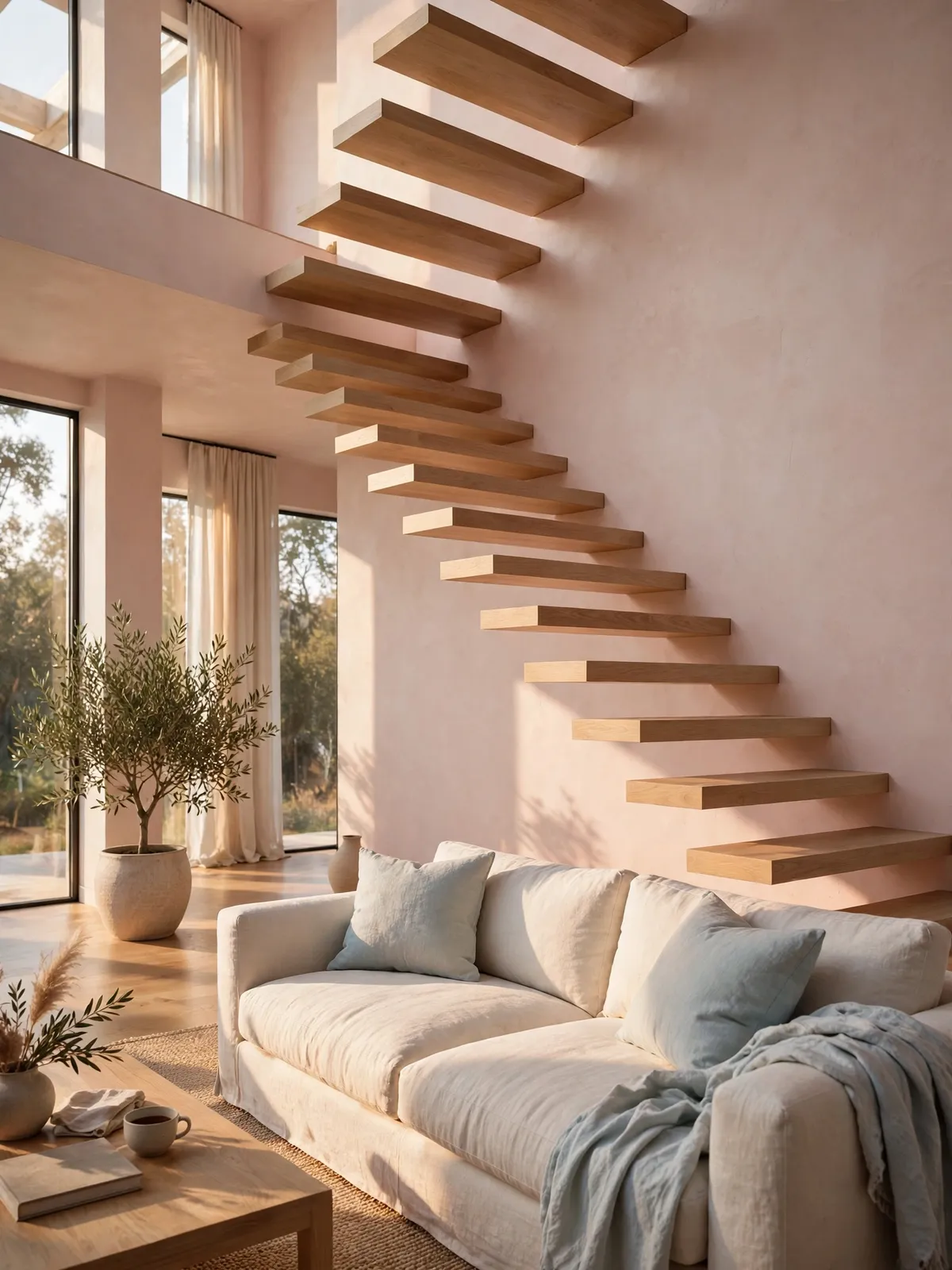
Pale white oak floating treads make an oak staircase feel almost weightless, because each tread appears to hover against a plain wall. In one open-plan home, 50 mm thick white oak treads, each 900 mm wide, are fixed into a hidden steel spine, with 180 mm open gaps between them and no risers at all. A slim brushed-brass handrail runs along the wall side, while an ivory linen sofa and pale blue-grey cushions below keep the palette soft and light.
Quick tips:
- Choose white oak for the palest, calmest floating look.
- Hide the steel support inside the wall for a true floating effect.
- Keep the wall beside the stair plain so the treads stand out.
- Add a slim wall handrail for confidence on an open-riser stair.
A Deep Espresso-Stained Oak Staircase With Brass Stair Rods
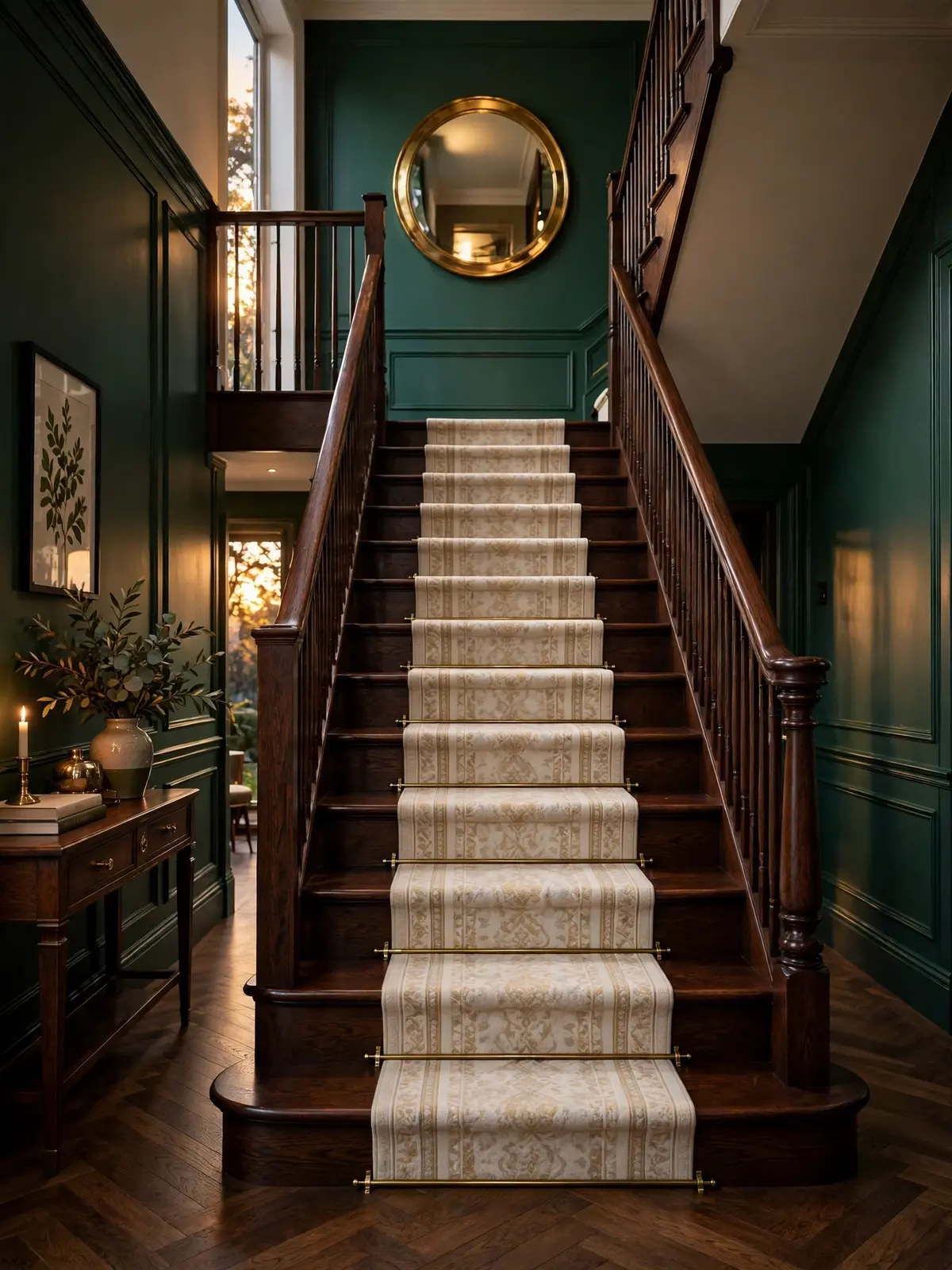
A deep espresso stain turns an oak staircase into a rich, dramatic feature, especially when the grain still shows through the dark finish. On this stair, espresso-stained oak treads, each 1 metre wide, are dressed with a patterned cream runner, 700 mm wide, held in place by slim brass stair rods on every third tread. Deep emerald-green walls beside the stair make the dark oak glow, while a large round brass mirror at the base catches the evening light.
Quick tips:
- Test the stain on a hidden tread first — oak absorbs stain unevenly.
- Use brass stair rods to add shine against dark oak.
- Pair dark oak with a deep wall colour for a rich, layered look.
- Keep the runner pattern small so it does not fight the wood grain.
An Oak Staircase With a Soft Wool Runner in Warm Terracotta
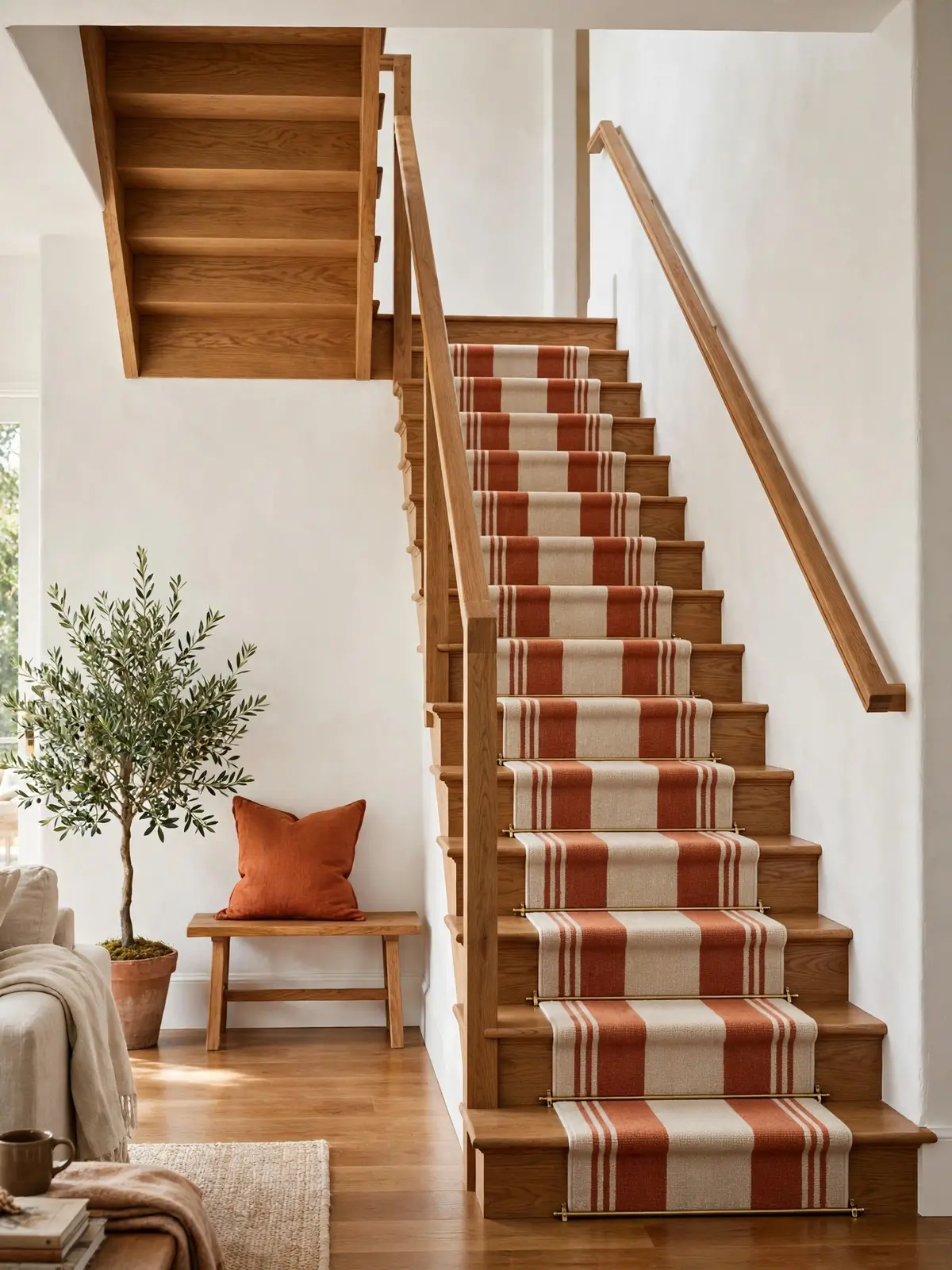
A soft wool runner in warm terracotta turns an oak staircase into the cosiest feature in the home, softening every step underfoot. Here, natural oak treads, each 280 mm deep, are covered down the centre by a wool runner in terracotta and cream stripes, 650 mm wide, with the oak showing on both edges. A small wooden bench with a rust-orange cushion sits at the base, a potted olive tree adds life, and the white walls keep the warm palette fresh.
Quick tips:
- Choose wool for a runner — it is soft, hard-wearing and easy to clean.
- Leave the oak edges showing so the wood still frames the runner.
- Match the runner tone to a cushion or throw nearby.
- Use a non-slip underlay so the runner stays flat and safe.
Oak Treads and Clear Glass Panels for a Light-Filled Hall
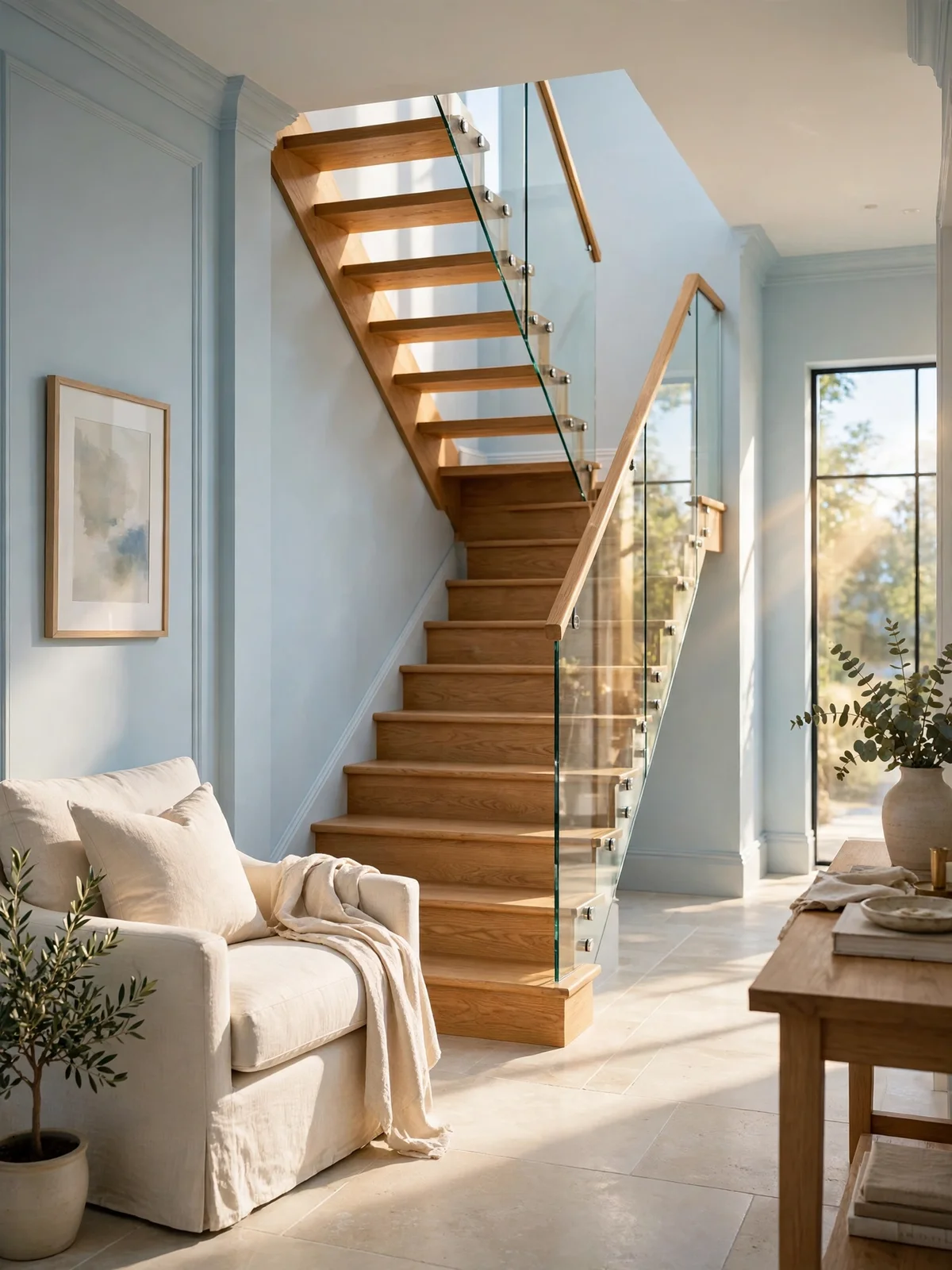
Clear glass panels let an oak staircase keep all its warmth while the hallway stays bright and open. In this home, honey oak treads, each 950 mm wide, pair with frameless clear glass panels held by slim brushed-steel brackets and a slim oak handrail on top. Soft sky-blue walls, a cream linen armchair and a pale stone floor pick up the morning light, which passes straight through the glass and across the whole hallway.
Quick tips:
- Use frameless clear glass so the oak stays the star.
- Add a slim oak handrail on top of the glass for warmth.
- Keep the walls pale so light bounces through the panels.
- Wipe the glass weekly to keep it clear and streak-free.
A Cottage Oak Staircase With Painted Sage-Green Risers
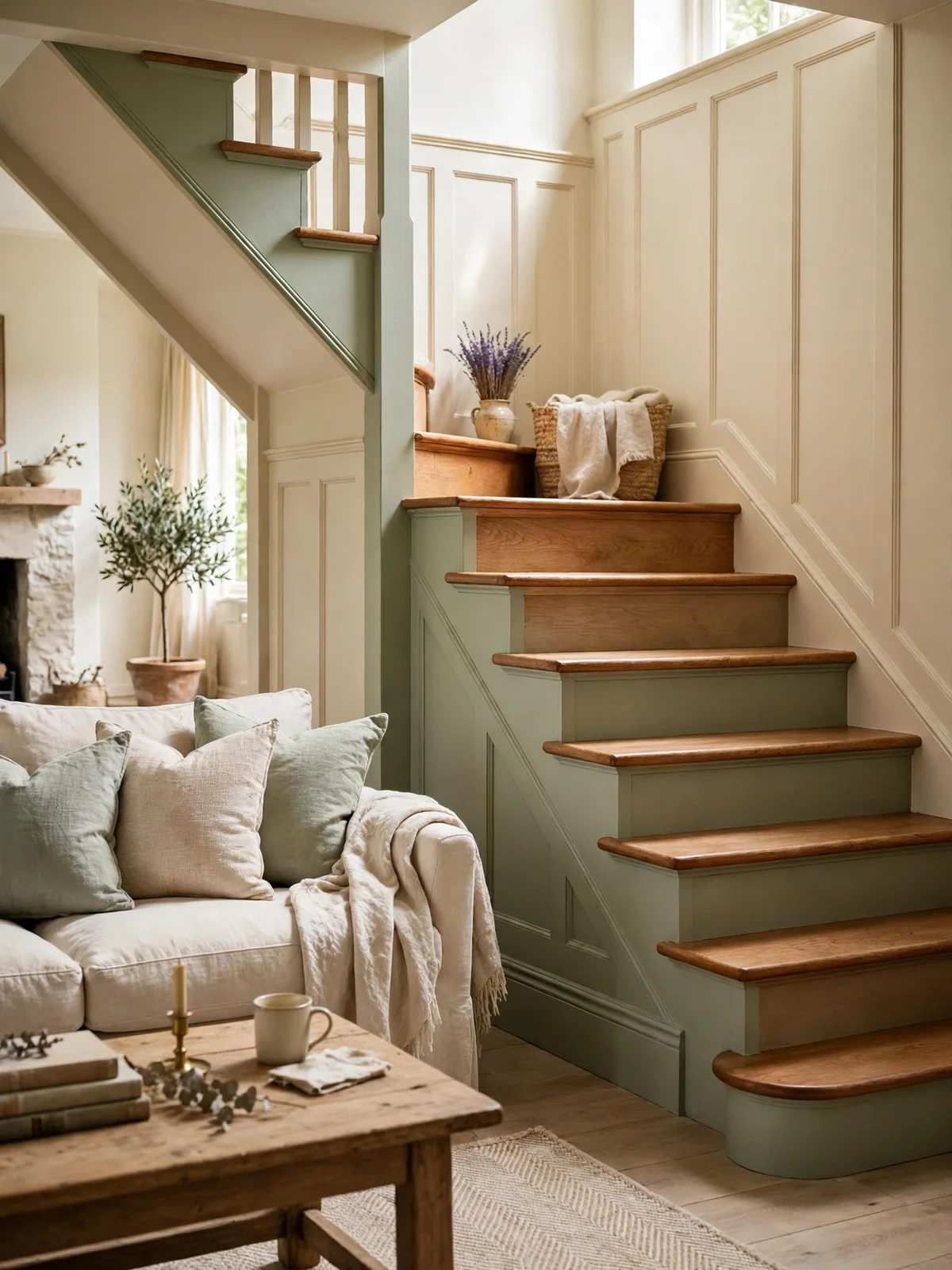
Painted sage-green risers give a cottage oak staircase a gentle, hand-painted charm while the oak treads keep their warm grain. On this stair, warm oak treads, each 900 mm wide, sit above risers painted a soft sage green, with a slim oak handrail and cream panelled walls beside the flight. A small vase of dried lavender sits on the landing, a woven seagrass basket waits at the base, and daylight from a small cottage window falls across the painted risers.
Quick tips:
- Paint only the risers, never the treads, so the oak grain stays visible.
- Choose a soft, muted paint colour that suits the room.
- Keep the handrail oak to tie the stair together.
- Add one small natural detail, like dried flowers, on the landing.
An L-Shaped Oak Staircase With a Sunny Landing Window
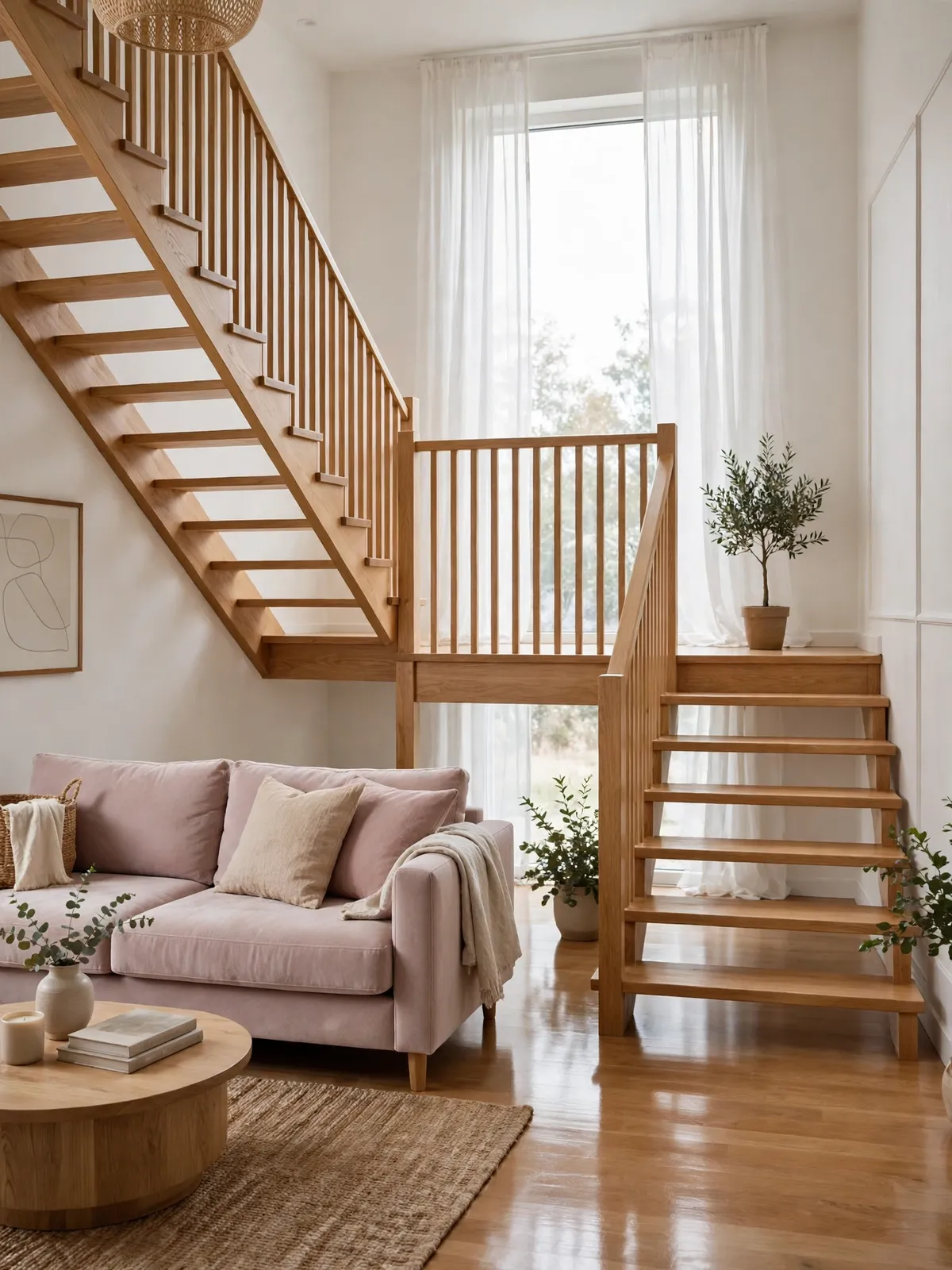
An L-shaped oak staircase breaks the climb into two short flights with a square landing, which feels calmer and safer than one long straight run. In this living room, light oak treads, each 260 mm deep and 950 mm wide, turn at a 1.1-metre-square landing beside a tall window with sheer white curtains. A pale dusty-rose sofa and a woven jute rug underneath keep the palette calm, and daylight from the landing window falls down both flights and across the oak grain.
Quick tips:
- Put a window on the landing so daylight reaches both flights.
- Use sheer curtains, not heavy drapes, to keep the landing bright.
- Keep the landing at least 1 metre square so it feels generous.
- Choose pale oak treads to make the turn feel open, not boxed in.
Oak and Wrought Iron in a Classic European-Style Stair
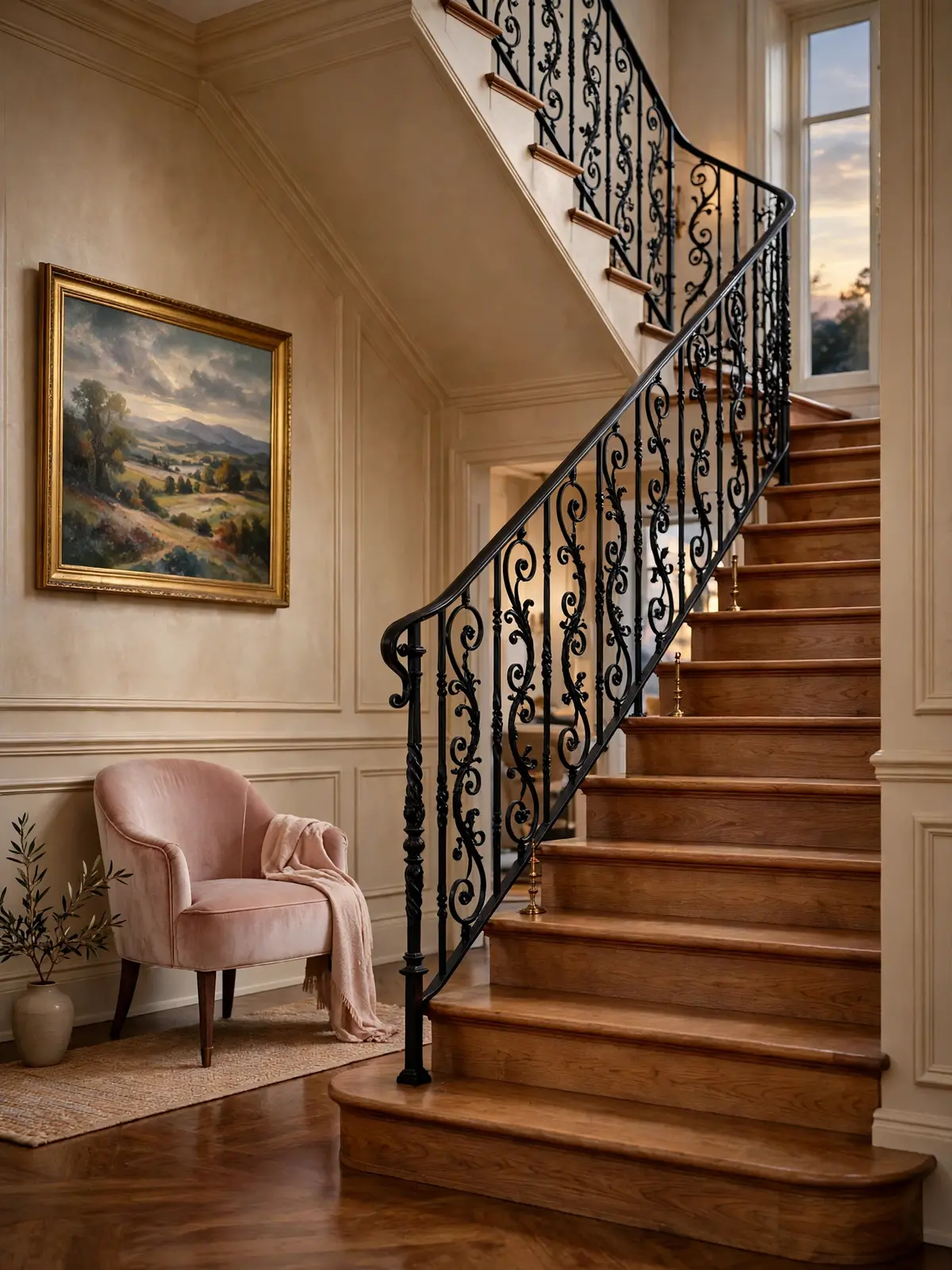
Ornate wrought iron gives an oak staircase an old-world, European elegance that slim modern steel cannot match. Here, warm oak treads, each 1 metre wide, pair with hand-forged black wrought-iron balusters in a gentle scroll pattern, a polished oak handrail and warm champagne-coloured walls. A velvet blush-pink chair and a large framed landscape painting on the landing complete the classic look, while the evening light catches the ironwork and the oak grain together.
Quick tips:
- Keep the ironwork pattern simple — one scroll repeat, not a tangle.
- Use a polished oak handrail to balance the dark iron.
- Pair wrought iron with warm wall colours, not stark white.
- Choose one large framed artwork for the landing, not many small pieces.
A Curved Oak Staircase That Softens a Grand Entryway
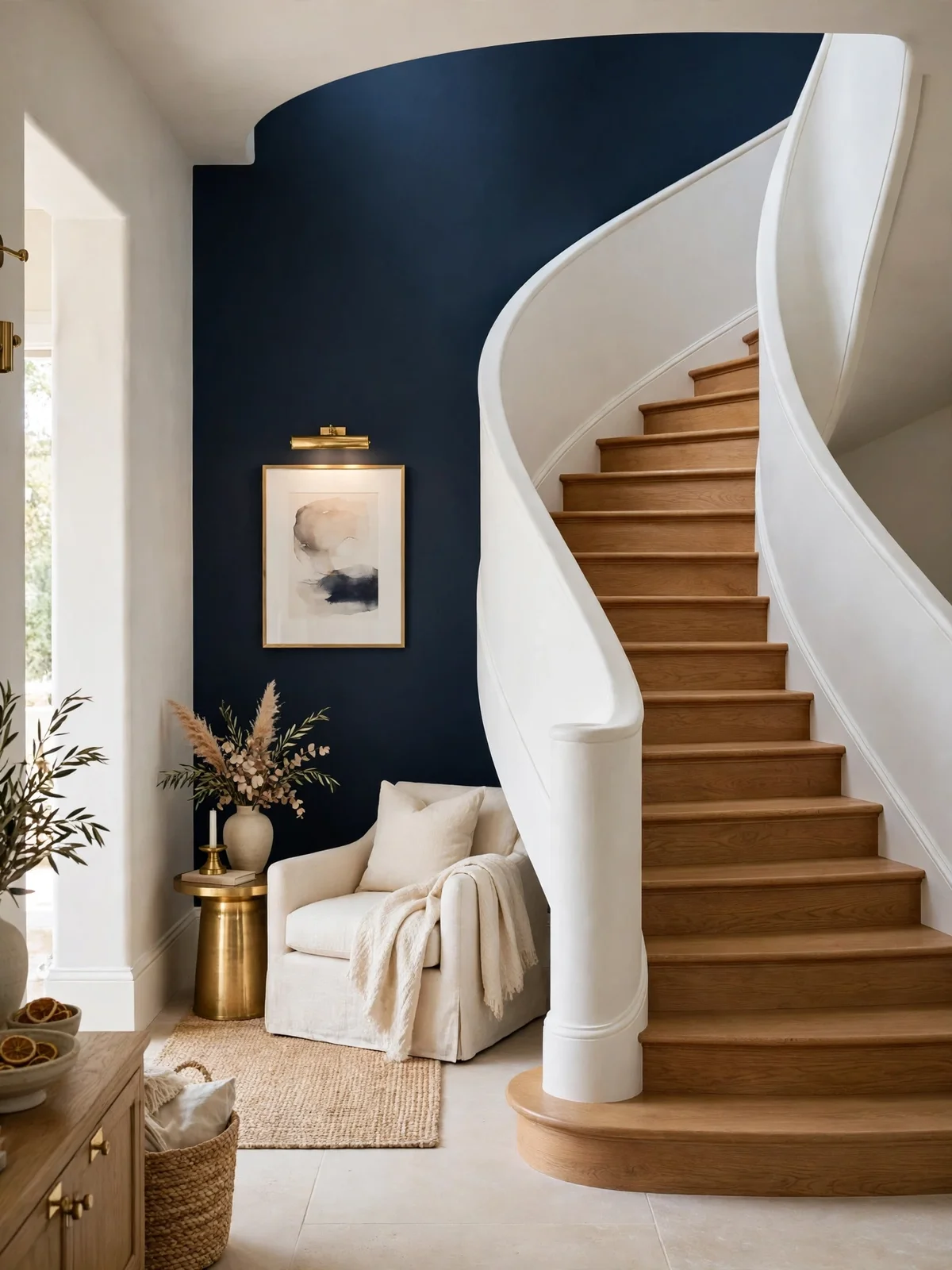
A gentle curve softens an oak staircase and turns it into the calm centrepiece of the entryway. On this stair, honey oak treads, each 1 metre wide at the outer edge and 280 mm deep, sweep around a smooth white plaster balustrade with a slim oak handrail on top. The wall beside the stair is painted a deep navy blue that makes the honey oak glow, a gold picture light shines above, and a cream linen armchair nearby picks up the warmth of the wood.
Quick tips:
- Keep the balustrade smooth plaster so the curve reads as one clean line.
- Use honey oak treads so the curve feels warm, not stark.
- Add one bold wall colour beside the stair for contrast.
- Leave the landing clear so the curve stays the focal point.
Whitewashed Oak Treads for a Coastal, Breezy Stair
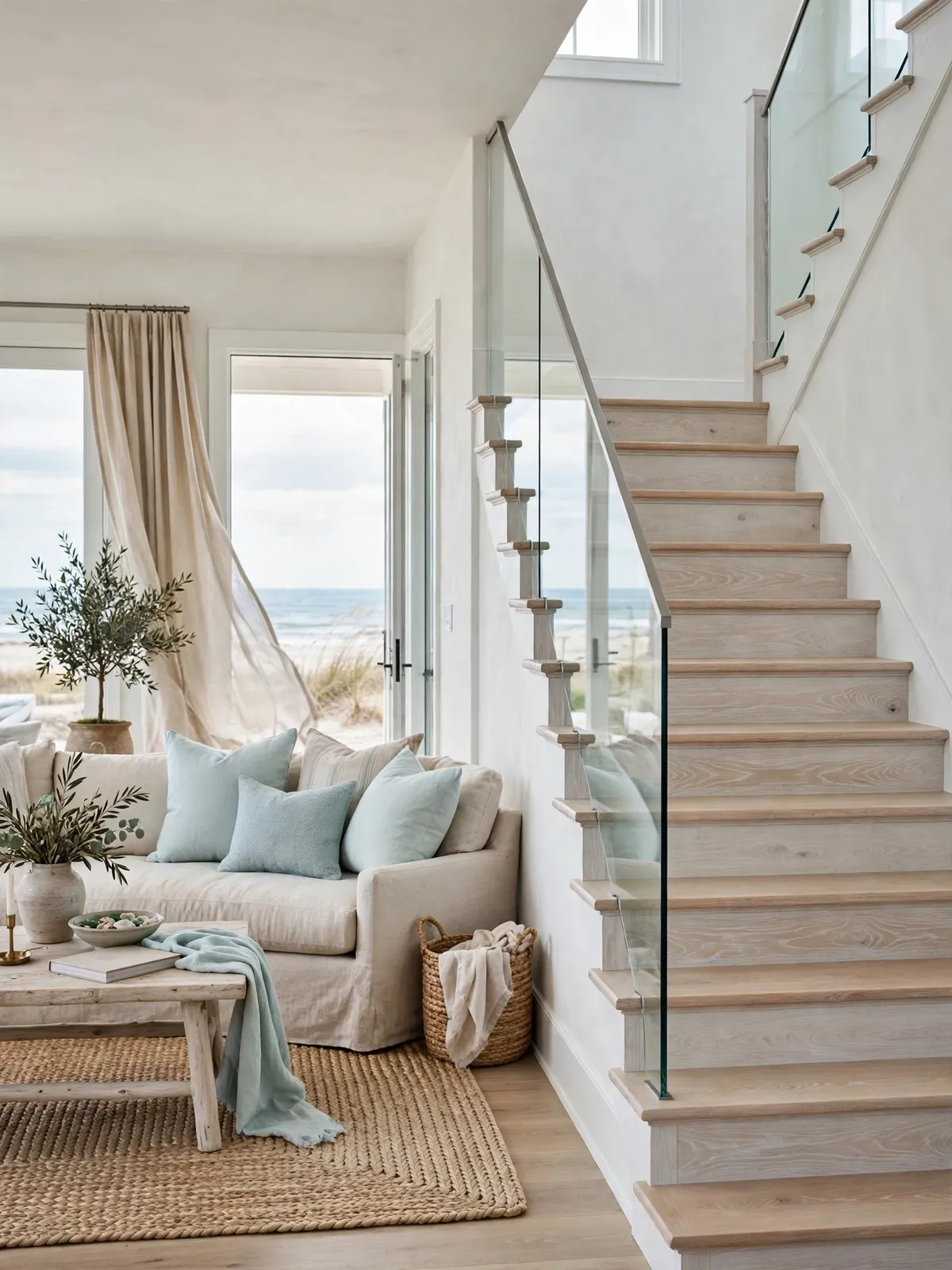
Whitewashing softens an oak staircase without hiding the grain, so it suits a coastal or Scandinavian home perfectly. In this beach house, whitewashed oak treads, each 950 mm wide, pair with clear glass panels and whitewashed walls, while a natural linen sofa, a woven seagrass rug and pale aqua-blue cushions complete the coastal palette. Daylight from the sea-facing windows passes straight through the glass, so the hallway feels as bright as the living room.
Quick tips:
- Whitewash lightly so the oak grain still shows through.
- Keep the glass clear so sea light travels through the stair.
- Add linen and seagrass textures to soften the glass.
- Choose pale aqua accents to echo the sea without overdoing the theme.
An Oak Staircase Lit by Warm Wall Sconces
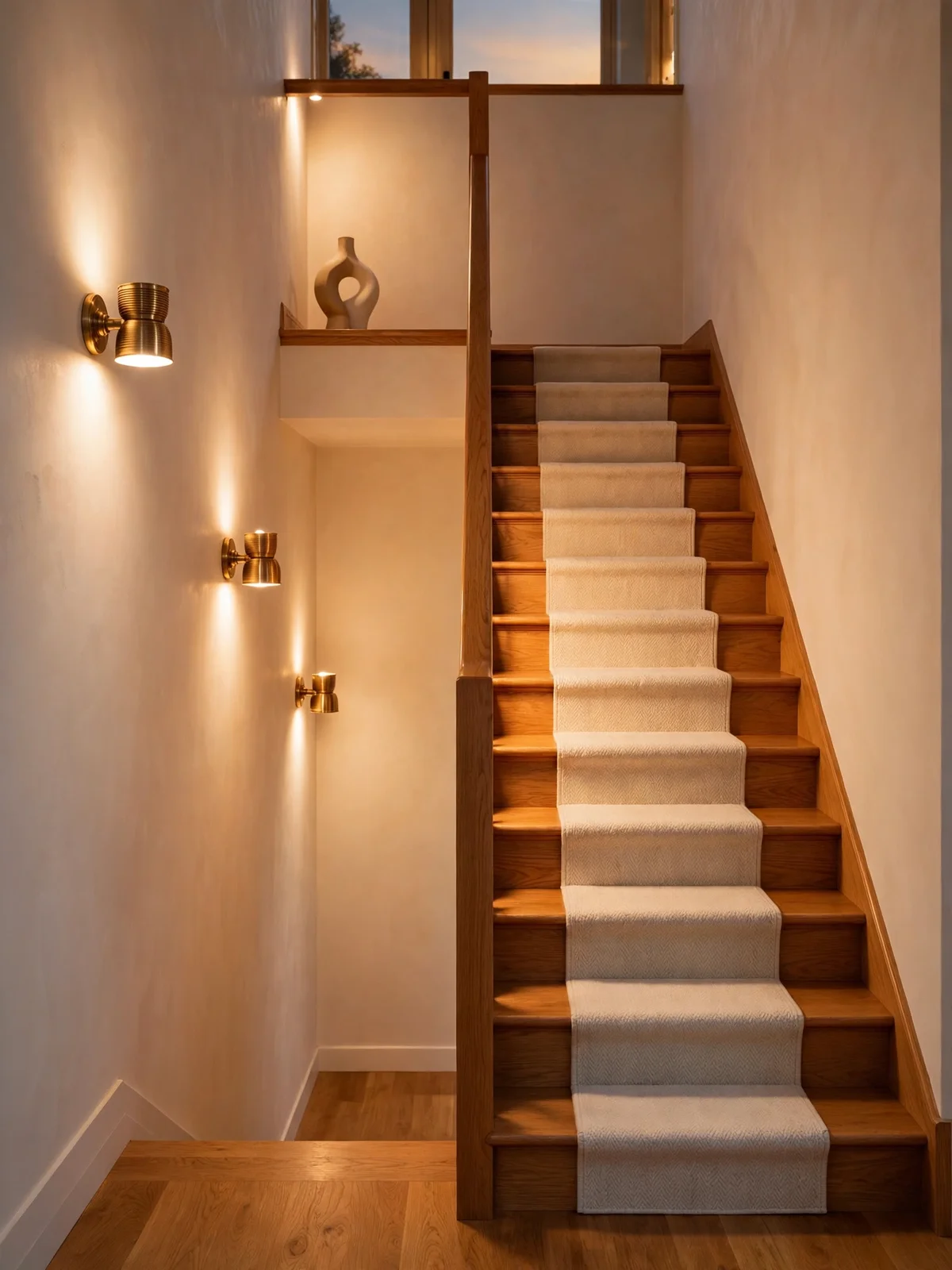
Warm wall sconces turn an oak staircase into a glowing feature after dark, with the light falling evenly down every tread. Along this stair, three brass sconces, spaced 1.2 metres apart, shine warm light across honey oak treads, each 900 mm wide, while a soft warm-white plaster wall behind them catches the glow. A small sculptural vase sits on the landing, a cream runner softens the floor at the base, and the oak grain glows softly in the evening light.
Quick tips:
- Space sconces evenly — about 1.2 metres apart — for a steady rhythm.
- Use warm bulbs, 2700K, so the oak glows rather than glares.
- Choose brass sconces to echo the warmth of the oak.
- Put the sconces on a dimmer for soft evening light.
Oak Treads With Under-Tread LED Strips for a Night Glow
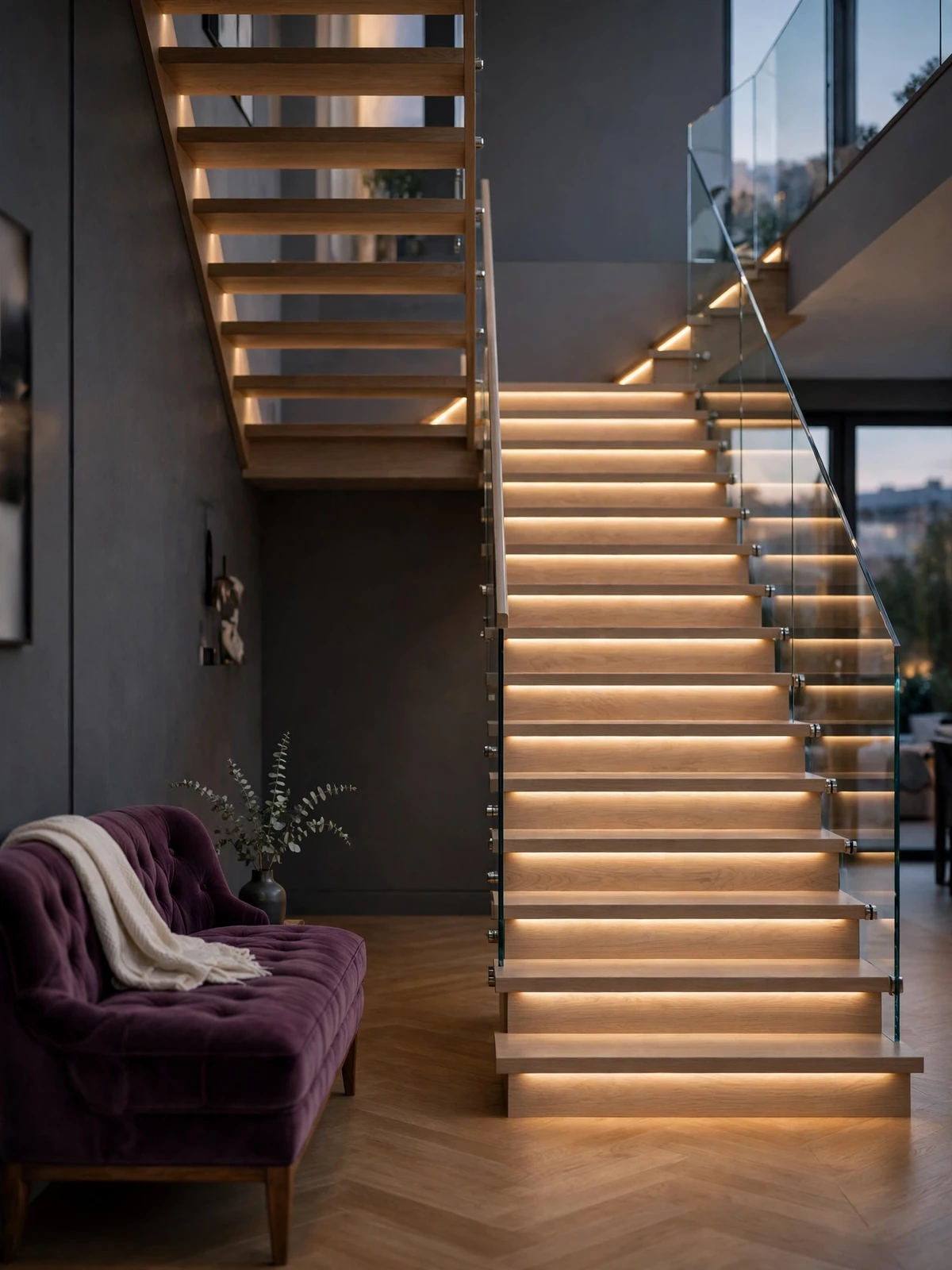
LED strips beneath each tread turn an oak staircase into a soft lantern after dark, and the effect is especially beautiful on oak because the light catches the grain from below and makes every step glow with a warm, honeyed edge that feels both modern and welcoming, while the charcoal-grey wall behind the stair makes the lit treads stand out even more and the deep plum velvet bench at the base adds a rich, jewel-toned contrast that keeps the whole hallway feeling cosy rather than stark. On this stair, each 180 mm high riser gap holds a warm-white LED strip, 2700K, hidden beneath pale oak treads, each 1 metre wide, with a clear glass balustrade on the open side, so the whole flight glows gently without a visible fitting, and it is bright enough to guide you safely at night yet soft enough for a bedroom hallway, which is exactly why this is one of the most loved upgrades for a family home.
Quick tips:
- Use warm-white LEDs, 2700K to 3000K, for a soft evening glow.
- Put the lights on a dimmer or motion sensor so they stay subtle.
- Pair lit oak treads with a dark wall for the strongest contrast.
- Hide the strips fully beneath the tread nosing for a clean finish.
A Two-Tone Oak Staircase With Charcoal Stringers
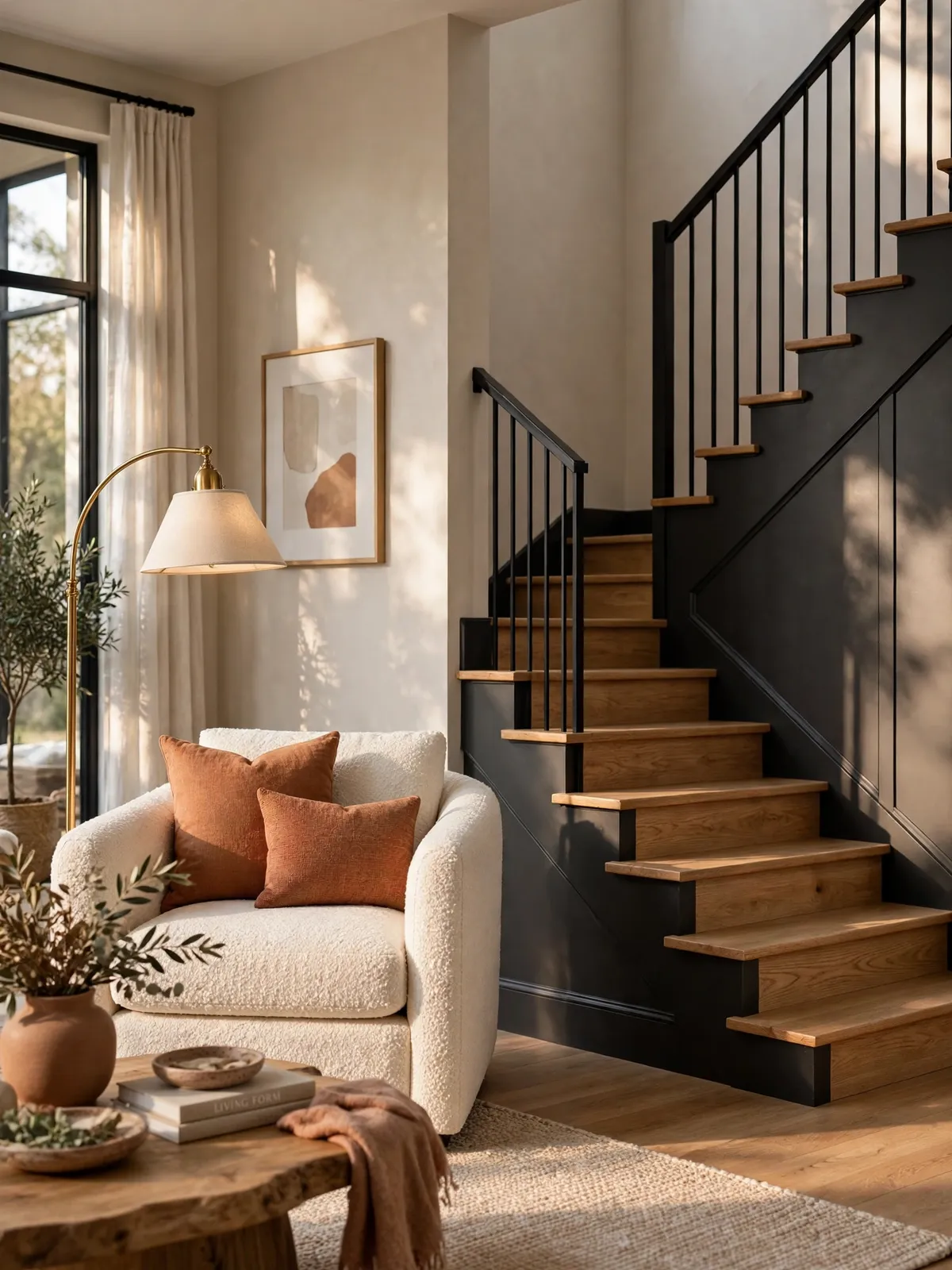
A two-tone oak staircase frames the natural oak treads beautifully, because the dark stringers make each step stand out. Here, natural oak treads, each 950 mm wide, sit between deep charcoal-painted stringers and side panels, with slim black steel balusters and a matching handrail. A cream boucle armchair and terracotta cushions below echo the warmth of the oak, while a brass floor lamp adds a soft evening glow and the soft greige walls keep the contrast calm.
Quick tips:
- Keep the treads natural oak and paint only the stringers.
- Use a matte charcoal paint so the stringers read as a frame, not a shine.
- Match the baluster colour to the stringers for a unified look.
- Add one warm accent, like terracotta, to soften the dark contrast.
Oak Staircase With a Gallery Wall Climbing Beside It
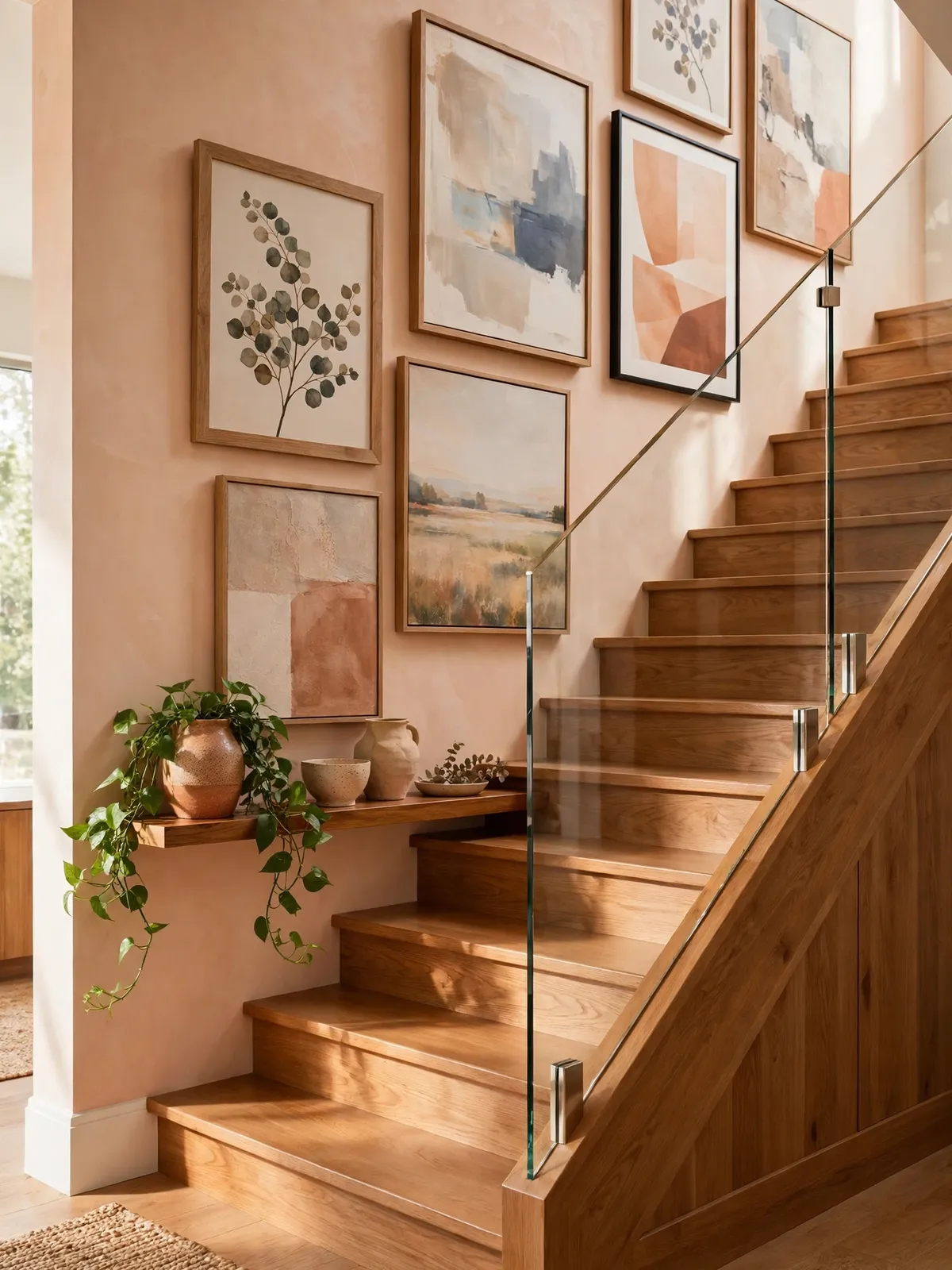
A gallery wall climbing beside an oak staircase turns the stair wall into a display, while the warm wood keeps it feeling personal. Here, three large coordinated canvases in warm peach, cream and charcoal climb the wall following the angle of the stair, above a slim oak shelf, 200 mm deep, holding handmade pottery and a trailing green plant. The honey oak treads and clear glass panels let daylight fall across the art, so the colours glow softly and the stair feels like a home, not a showroom.
Quick tips:
- Hang art following the angle of the stairs, not straight across.
- Choose three large pieces, not many small frames, for a modern look.
- Keep frames slim and simple — black, white or thin metal.
- Use the same oak for the shelf and the treads for a unified look.
An Oak Staircase Framed by Board-and-Batten Wall Panelling
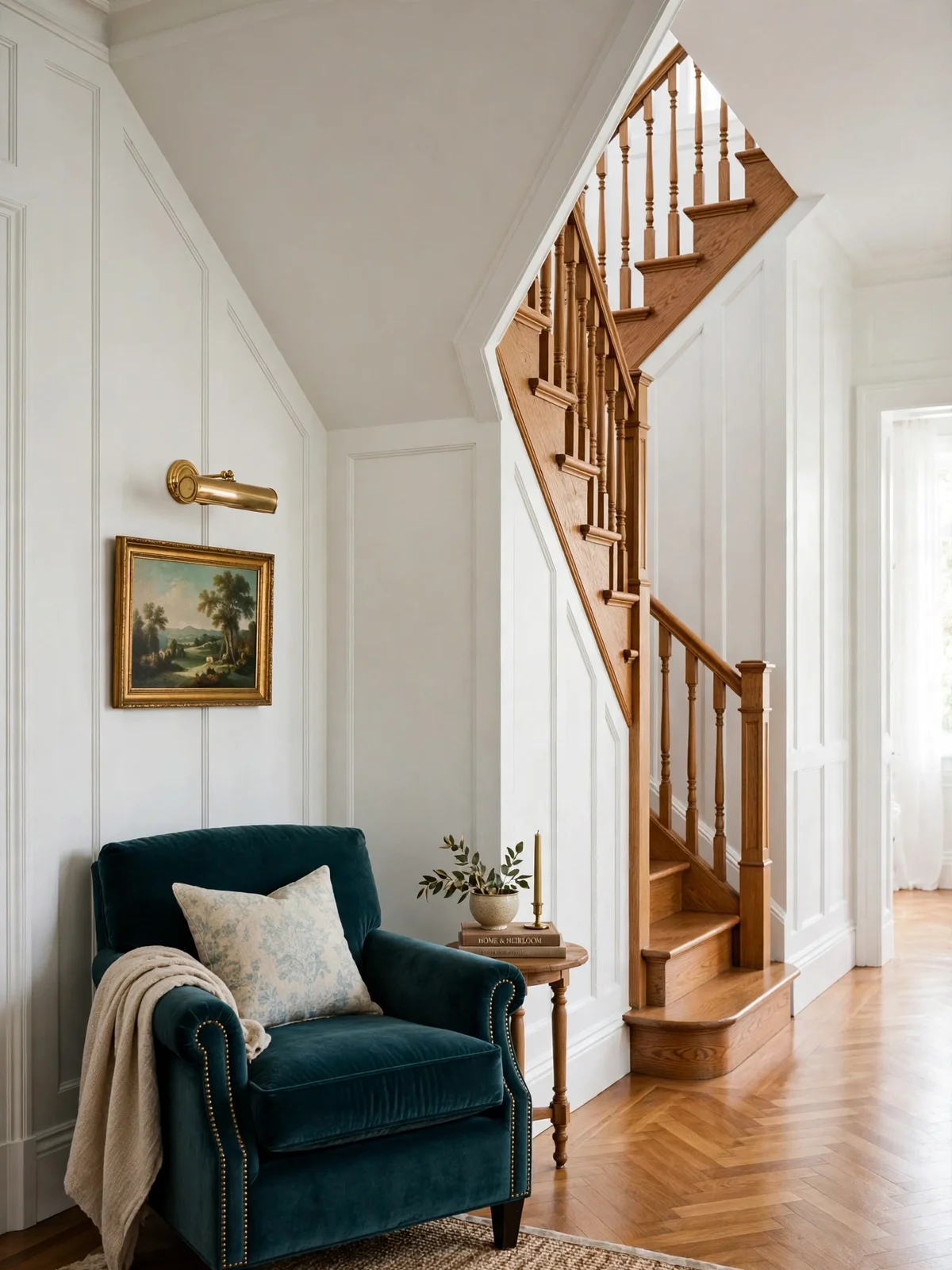
Board-and-batten panelling frames an oak staircase and makes it feel like part of a considered design story instead of a standalone structure. Along this stair, crisp white panelling runs up the wall at the same angle as the flight, beside warm oak treads, each 900 mm wide, a slim oak handrail and white balusters. A deep teal velvet armchair and a small wooden side table sit at the base, while a brass picture light above the panelling adds a warm evening glow.
Quick tips:
- Run the panelling at the stair angle so it follows the flight.
- Keep the panelling white so the oak treads stay the warm feature.
- Add one deep-toned chair below to anchor the palette.
- Use a brass picture light to warm the panelling in the evening.
A Spiral Oak Staircase for a Compact Corner
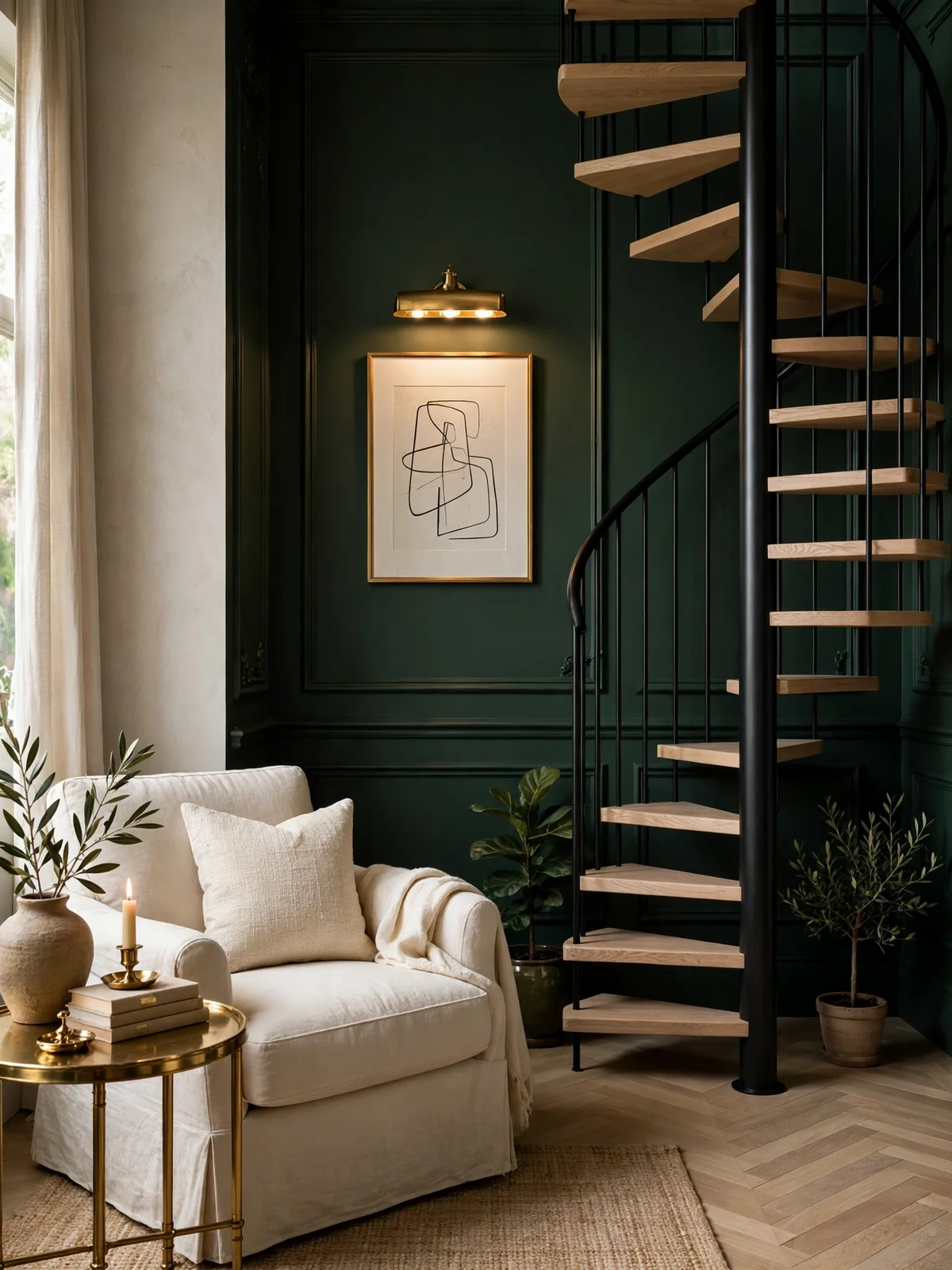
A spiral oak staircase fits a warm timber look into a corner where a straight flight would never work. This stair winds around a slim matte black steel centre pole, with pale oak treads, each 750 mm wide at the outer edge, and a slim black steel handrail following the curve. It sits against a deep forest-green panelled wall, with a gold picture light above and a cream linen armchair nearby, while polished brass details pick up the warmth of the pale oak.
Quick tips:
- Choose pale oak treads so a spiral stair never feels dark or cramped.
- Keep the centre pole slim and matte black for a clean look.
- Add a picture light or pendant above the spiral for evening warmth.
- Keep the wall colour bold on one side only, with the rest pale.
Oak Treads and a Herringbone Oak Floor That Flow Together
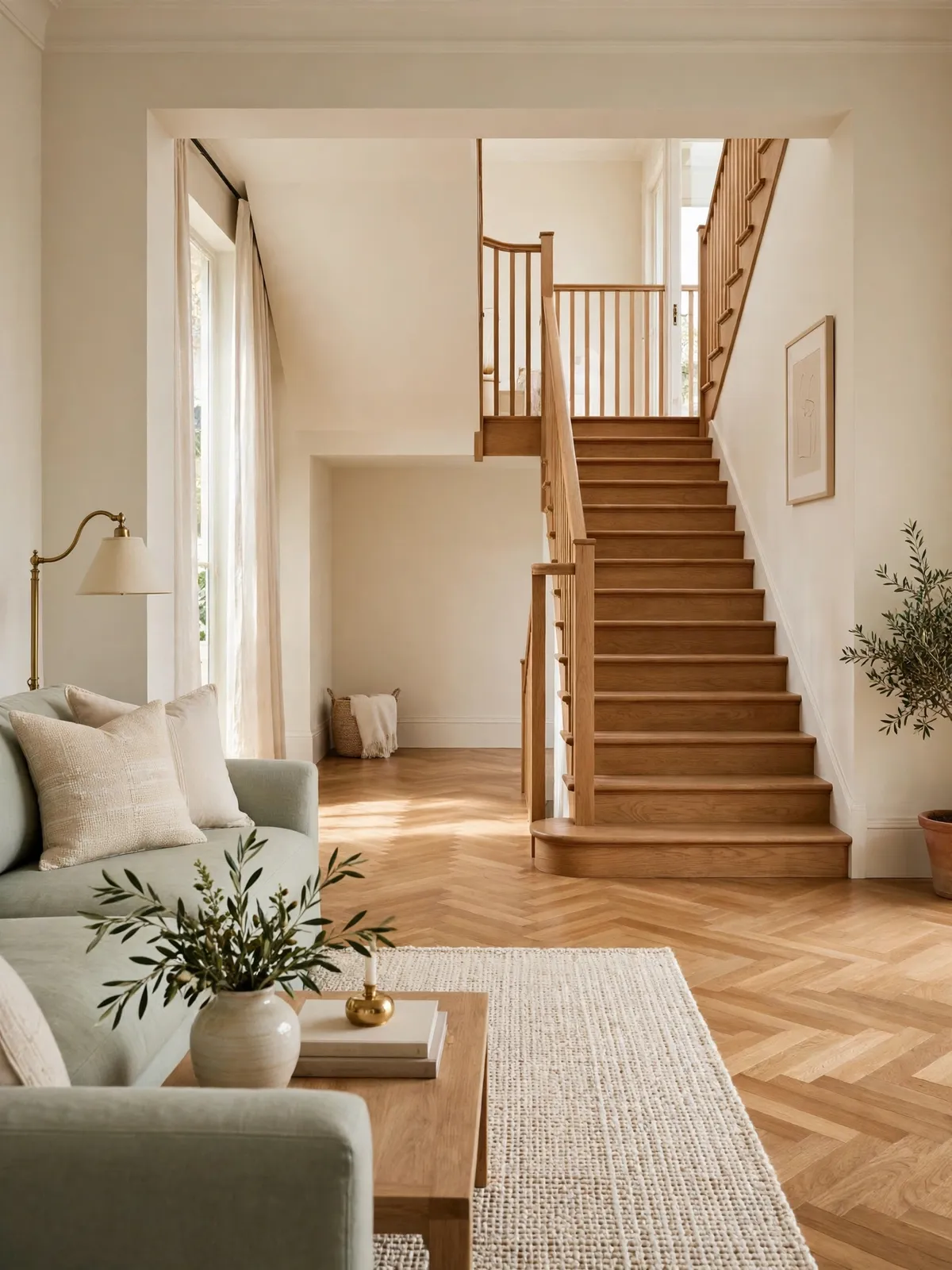
When the oak treads match a herringbone oak floor, the staircase and the room flow together as one seamless surface. In this living room, honey oak treads, each 950 mm wide, meet a herringbone oak floor laid in the same honey tone, with slim black steel balusters and a matching handrail. A pale sage-green sofa, a warm brass floor lamp and a woven cream rug keep the palette soft, while daylight across the floor shows off the grain in both the stair and the boards.
Quick tips:
- Match the tread stain to the floor stain so the two read as one.
- Use the same oak species for treads and floor for a true match.
- Keep balusters slim and dark so they do not break the flow.
- Add a woven rug at the base to soften the hard oak surfaces.
An Oak Staircase With Built-In Storage Under Every Step
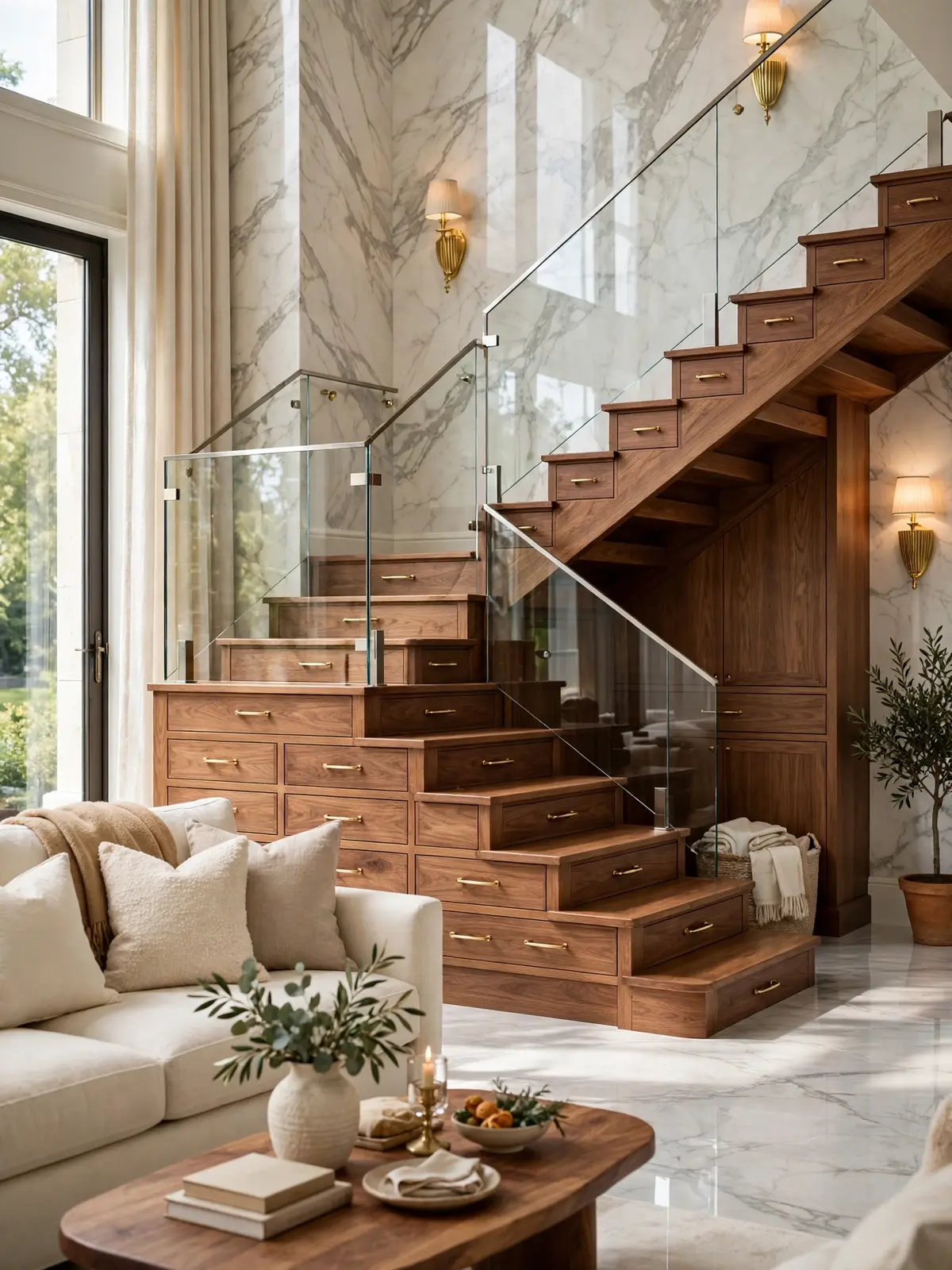
Built-in storage under an oak staircase makes every step work harder, without changing the stair’s clean look. Here, a straight flight with warm walnut-stained oak treads, each 1 metre wide, hides push-to-open drawers beneath the lower six treads — deep enough for shoes, books and seasonal decor — with no visible handles at all. A full-height white marble wall with soft grey veining runs beside the stair, gold wall sconces add a warm glow, and a cream sofa opposite keeps the room soft.
Quick tips:
- Use push-to-open hardware so the drawer fronts stay handle-free.
- Store only light, everyday items in tread drawers — not heavy boxes.
- Keep the drawer fronts in the same oak as the treads.
- Label the inside of each drawer so the family knows what lives where.
Oak Staircase With a Reading Nook Tucked Underneath
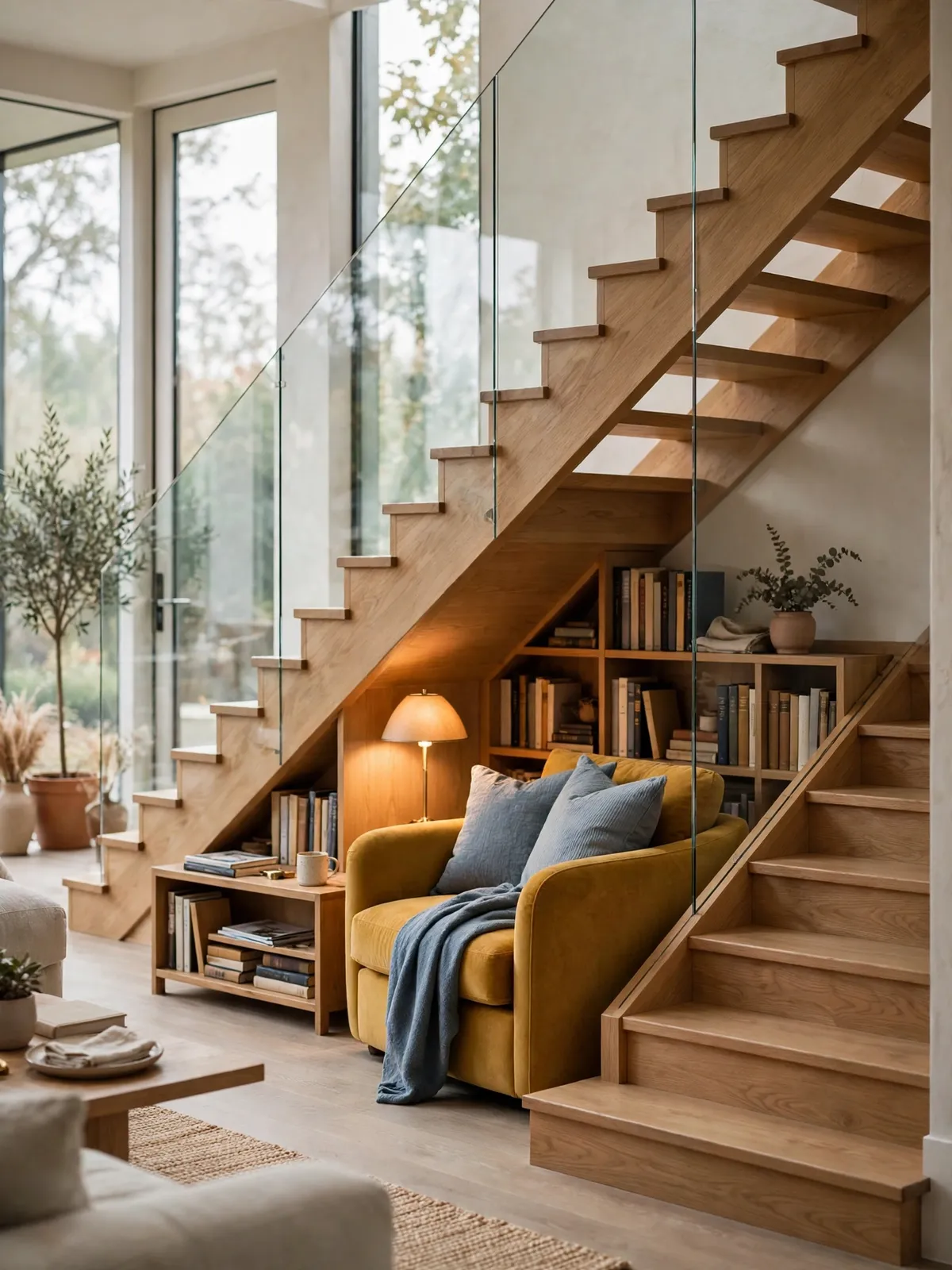
Because an open oak staircase lets light through, the space beneath it stays bright enough for reading. Under this stair, a mustard armchair with dusty-blue cushions sits beside built-in oak shelves holding books in cream, rust and olive, with a warm reading lamp and a soft throw. The light oak treads and clear glass above filter daylight down into the nook, so it never feels dark or closed in, and the whole corner feels private yet still connected to the living room.
Quick tips:
- Choose a compact armchair that fits neatly under the stair slope.
- Build shelves to follow the stair angle so no space is wasted.
- Use a warm lamp for evening reading in the nook.
- Keep the nook palette warm so it feels cosy under the glass.
A Moody Oak Staircase With Dark Navy Walls
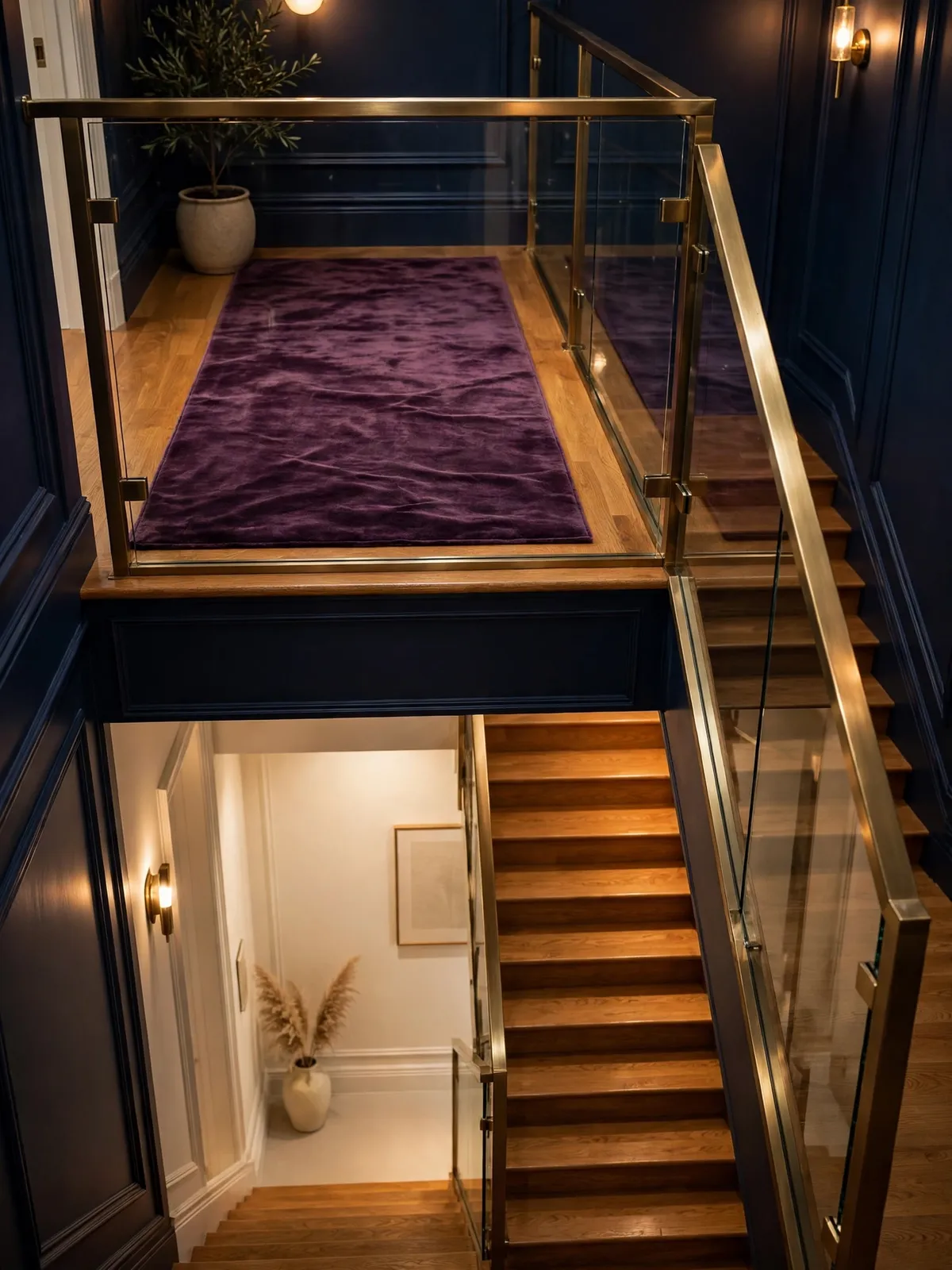
Dark navy walls make an oak staircase glow, because the warm wood pops against the deep, moody backdrop. Here, the straight flight keeps honey oak treads, each 900 mm wide, and navy walls, while the landing at the top is dressed with a deep plum velvet runner, 1.2 metres wide, held by slim brass stair rods. A brushed-brass handrail and a clear glass balustrade catch the warm lighting, and soft ivory walls beyond the stair keep the hallway from feeling closed in.
Quick tips:
- Balance dark walls with warm brass and soft lighting.
- Keep the runner to the landing so the oak flight stays visible.
- Choose a deep jewel tone — plum, emerald or navy — for the runner.
- Paint the walls beyond the stair pale so the dark stair feels intentional, not gloomy.
An Oak Staircase That Opens Onto the Kitchen Island
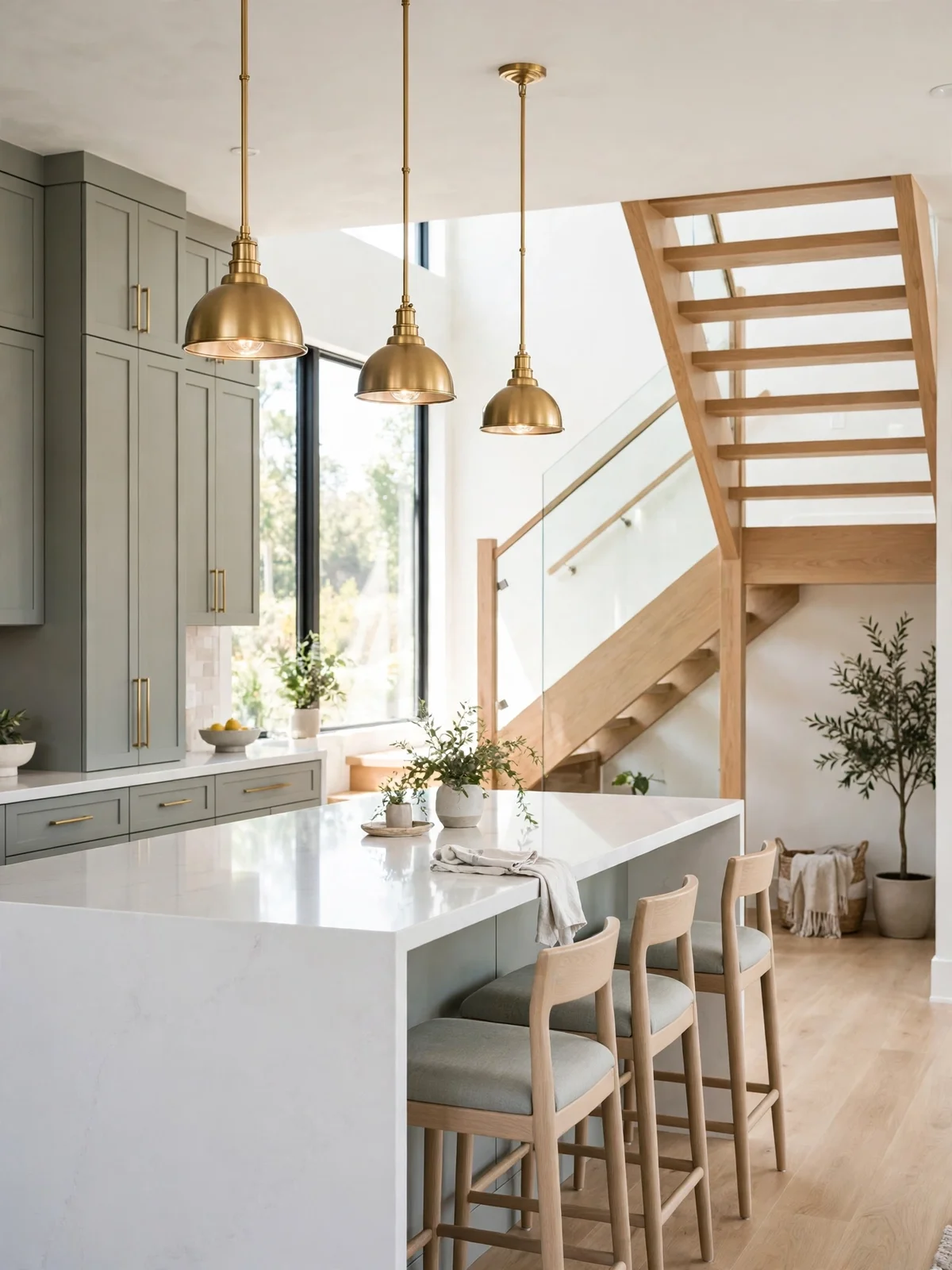
When the oak staircase faces the kitchen island opposite, the open-plan room feels designed as one space. In this home, a stair with pale oak treads and clear glass panels faces a white quartz kitchen island with a waterfall edge, 2.4 metres long, while soft grey-green cabinets and brass pendant lights tie the two sides together. The glass lets you see the island from the stair and the stair from the island, so cooking, climbing and chatting all happen in one bright, connected room.
Quick tips:
- Match the stair tread tone to the island stools or kitchen timber.
- Keep the island and stair in the same pale, reflective palette.
- Use the same brass finish on pendants and stair fixings.
- Leave the sightline between stair and island clear.
Oak Staircase With Decorative Trim on the Risers
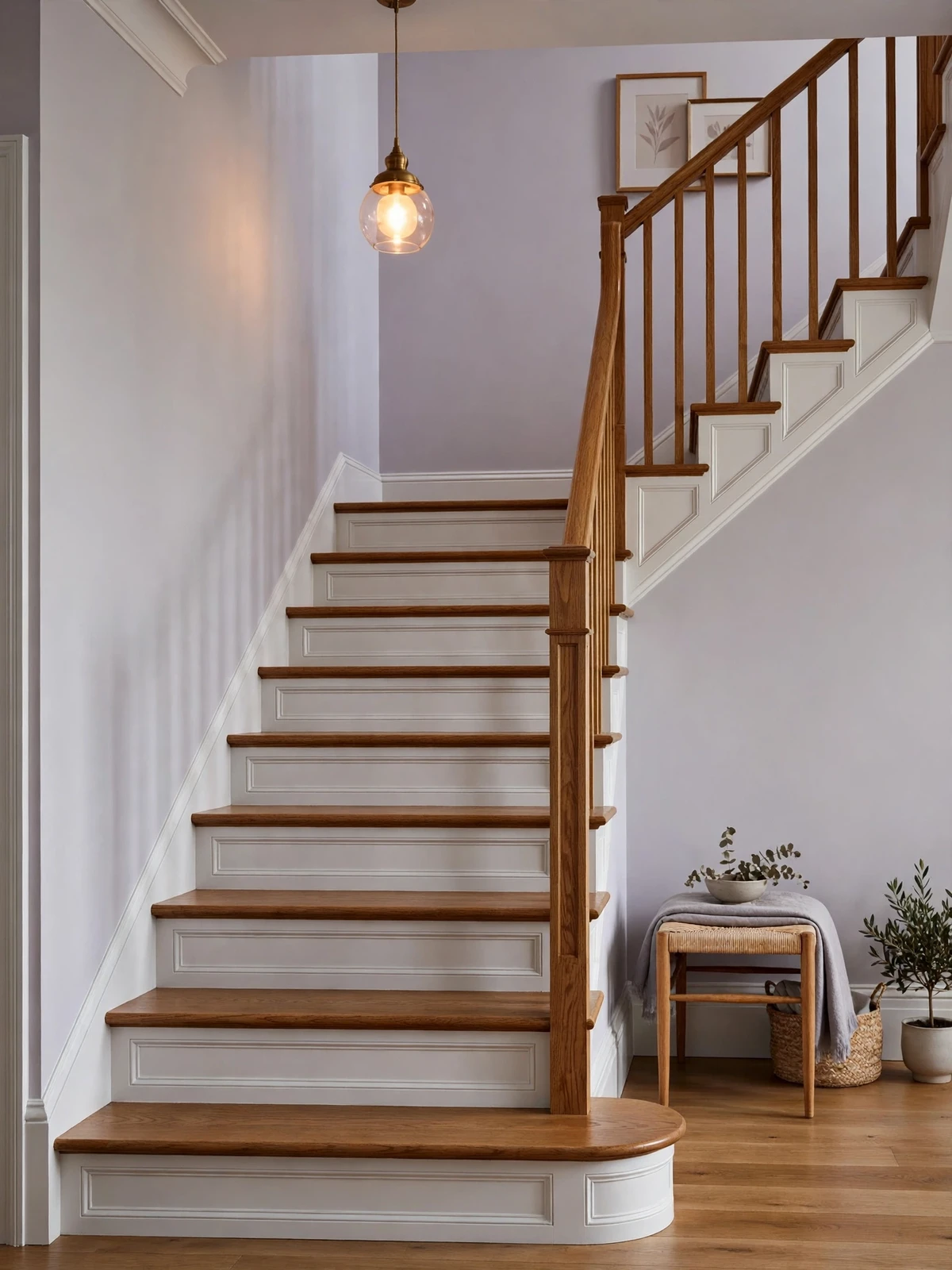
Thin decorative trim on the risers gives an oak staircase a custom, elegant feel without rebuilding anything. On this stair, slim moulding frames each riser, painted a soft white against warm oak treads, each 280 mm deep and 950 mm wide, with a slim oak handrail and white balusters. Pale lavender-grey walls and a small wooden bench at the base keep the palette gentle, while a warm pendant light brings out the trim detail in the evening.
Quick tips:
- Keep the trim thin and simple — clean lines win every time.
- Paint the risers soft white so the oak treads stay the warm feature.
- Use the same trim profile on every riser for a neat, even look.
- Add a warm pendant light to show off the trim in the evening.
An Oak Staircase With a Window Seat on the Landing
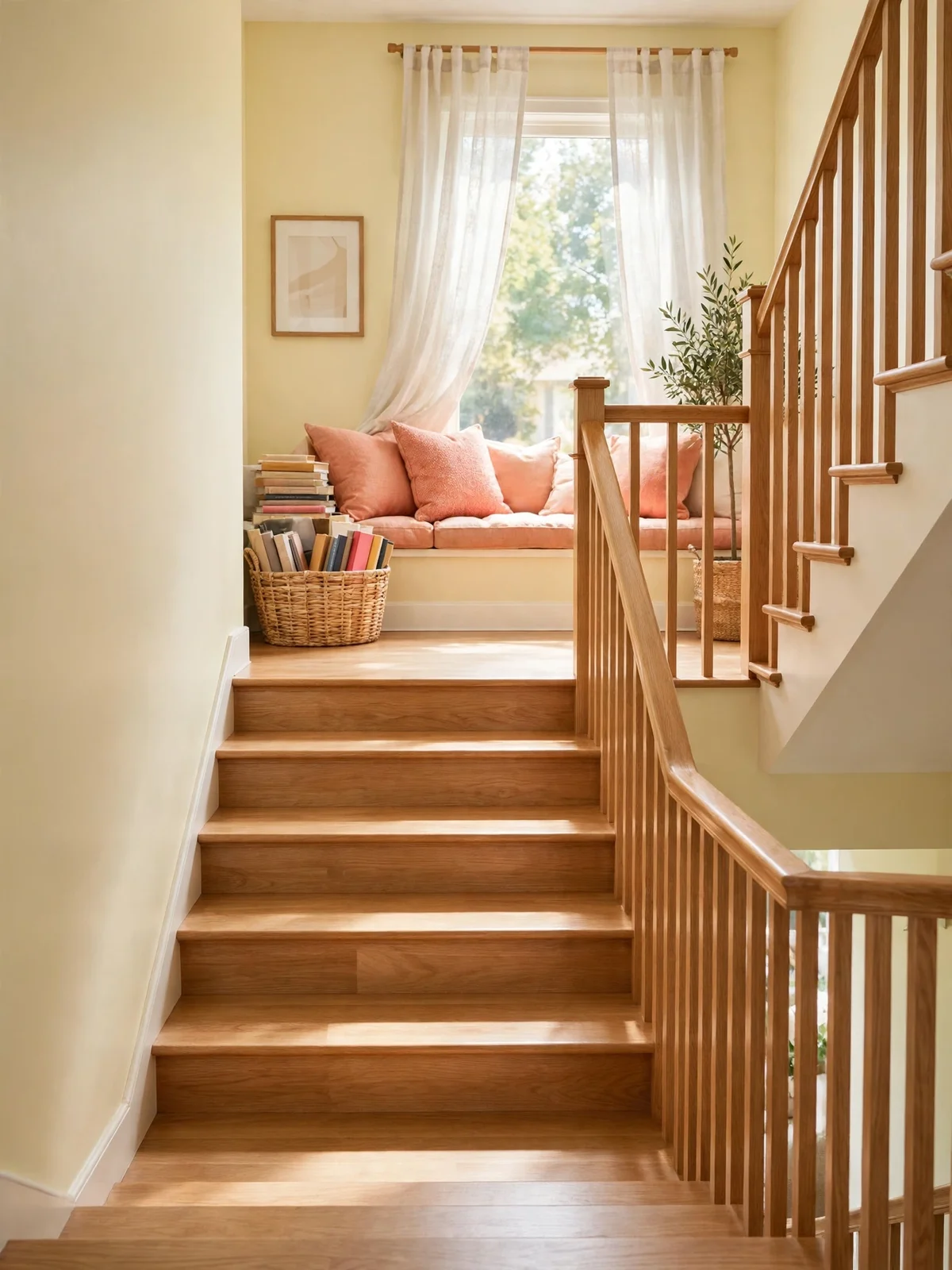
A window seat on the landing turns an oak staircase into a place to pause, read and enjoy the view. On this stair, light oak treads, each 950 mm wide, rise to a landing with a built-in window seat, 1.2 metres wide, dressed in soft coral cushions and a woven basket of books beside it. Pale butter-yellow walls and sheer linen curtains keep the landing bright, while daylight falls across the oak treads and down both flights.
Quick tips:
- Build the window seat into the landing so it feels part of the stair.
- Choose washable cushion covers for a seat that gets daily use.
- Keep the landing window clear of heavy curtains.
- Add a small basket of books so the seat invites a pause.
Oak Staircase With Sculptural Pendant Lights Above
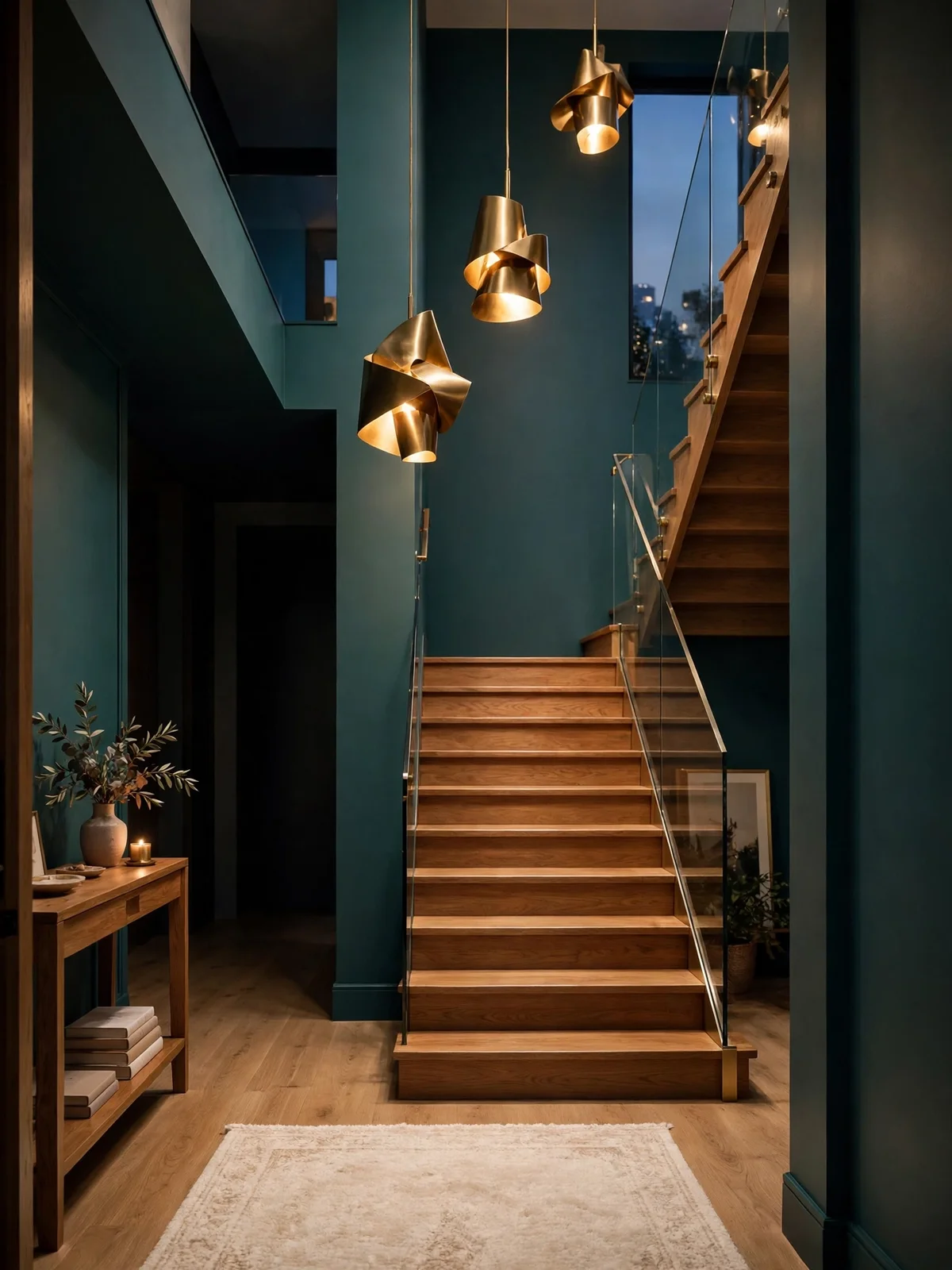
A row of sculptural pendants turns an oak staircase into an evening feature. Three brass pendants, hung at staggered heights above a straight stair with warm oak treads and clear glass panels, cast warm pools of light down the flight. The deep teal wall behind the stair makes the brass glow richer, while a cream rug at the base softens the landing. In the evening, the glass catches the light and the whole stair shimmers gently, like a piece of jewellery in the hallway.
Quick tips:
- Hang pendants at staggered heights for a natural, flowing look.
- Use warm bulbs so the light feels cosy, not stark.
- Keep the pendant shades simple so they do not block the glass.
- Put the pendants on a dimmer for soft evening light.
An Oak Staircase That Turns a Dark Hallway Into the Brightest Room
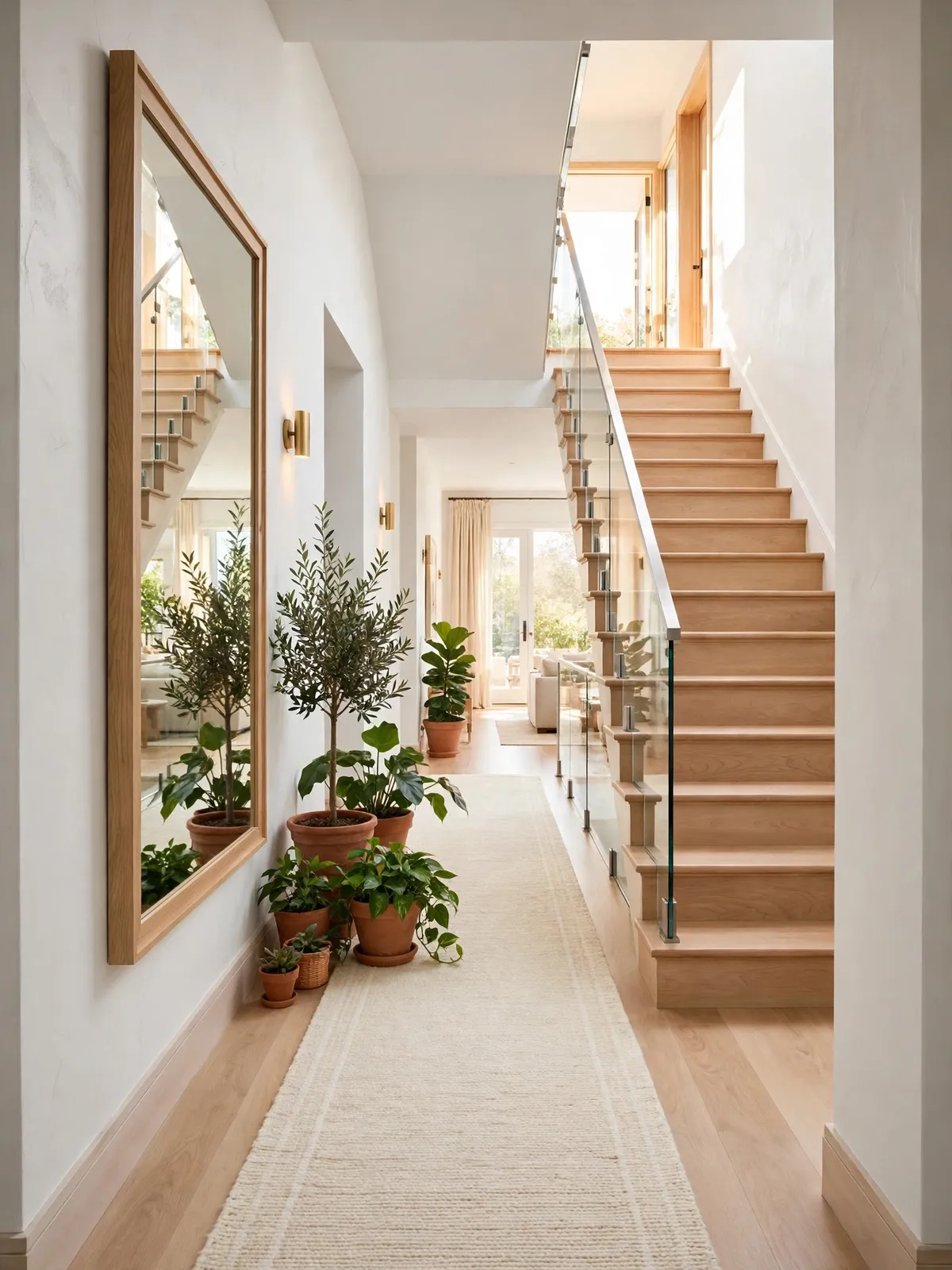
A dark hallway is where an oak staircase makes the biggest difference. In this home, a narrow hallway with only one small window was opened up with a straight oak stair — pale maple-stained oak treads, clear glass panels, white walls, and a large mirror opposite the stair to bounce the light further. A cream runner softens the floor, lush indoor plants in terracotta pots frame the base, and the golden light from the landing window now travels down the glass and across the whole hallway. What was once the darkest room is now the brightest.
Quick tips:
- Paint the hallway white so it reflects every bit of light.
- Add a large mirror opposite the stair to double the brightness.
- Choose the palest oak treads you love for the most light.
- Keep the hallway free of tall furniture that could block the glass.
FAQs
How much does an oak staircase cost?
Costs vary widely with materials, shape and size. A simple straight oak stair with painted stringers and a steel balustrade is usually the most affordable option, while a curved oak stair, cantilevered oak treads or a full glass balustrade costs far more because of the engineering and custom work. Always get at least two detailed quotes that include the handrail, lighting and finishing, not just the treads.
Can you paint an oak staircase?
Yes — the risers, stringers and balusters can all be painted while the treads stay natural oak, which is one of the easiest ways to update a stair. Sand and prime the painted parts first so the paint grips, and use a hard-wearing satin or eggshell finish that stands up to scuffs. Keep at least the treads and handrail in oak so the warmth of the wood is not lost.
What is the best stain for an oak staircase?
There is no single best stain — it depends on the look you want. Honey oak keeps the grain warm and classic, white oak or a pale wash suits coastal and Scandinavian homes, and a deep walnut or espresso stain modernises a traditional stair. Always test the stain on a hidden tread first, because oak absorbs stain differently depending on its age and finish.
Are oak stairs slippery?
Oak treads can be slippery when finished with a high-gloss lacquer, so a matte or satin non-slip finish is the safer choice. A wool runner down the centre of the treads adds grip and softness, and under-tread LED lighting helps you see each step clearly at night. Keep the treads clean and dry, and avoid wax polishes on stair treads.
How do you maintain an oak staircase?
Oak stairs are low maintenance. Sweep or vacuum the treads weekly, wipe them with a damp cloth, and reseal the finish every few years depending on wear. Glass panels need a weekly wipe, steel or brass fixings need an occasional polish, and a wool runner can be vacuumed and professionally cleaned once a year.
Conclusion
An oak staircase is not just a way to move between floors — it is a way to bring warmth, grain and character into the whole home. Whether you choose honey oak with black steel, pale white oak floating treads, a deep espresso stain with brass, a soft wool runner, or glass panels that let the light through, the best oak staircase is the one that suits the rooms around it. Keep the palette warm, the sightlines open, and the space under and beside the stair intentional, and your stair will make every room it touches feel brighter, richer and more welcoming.