25 Stunning Rustic Staircase Ideas That Instantly Make Your Home Feel Warmer, Cosier and More Welcoming
A rustic staircase does far more than connect two floors — it brings the warmth of the countryside into the heart of your home. These 25 ideas show how reclaimed timber, rough stone, hand-forged iron, woven textures and warm, earthy colours can turn an ordinary stair into a cosy, character-filled feature that makes every room feel more welcoming.
A rustic staircase is a stair built around natural, honest materials — reclaimed barn oak, rough-hewn pine, warm stone, hand-forged iron and woven rope or jute — instead of polished chrome, glass and machine-perfect finishes. The best rustic stair feels lived-in and welcoming: its timber shows its grain and knots, its iron looks hammered rather than painted, and its colours come from nature, so the climb feels like a walk through a warm country home.
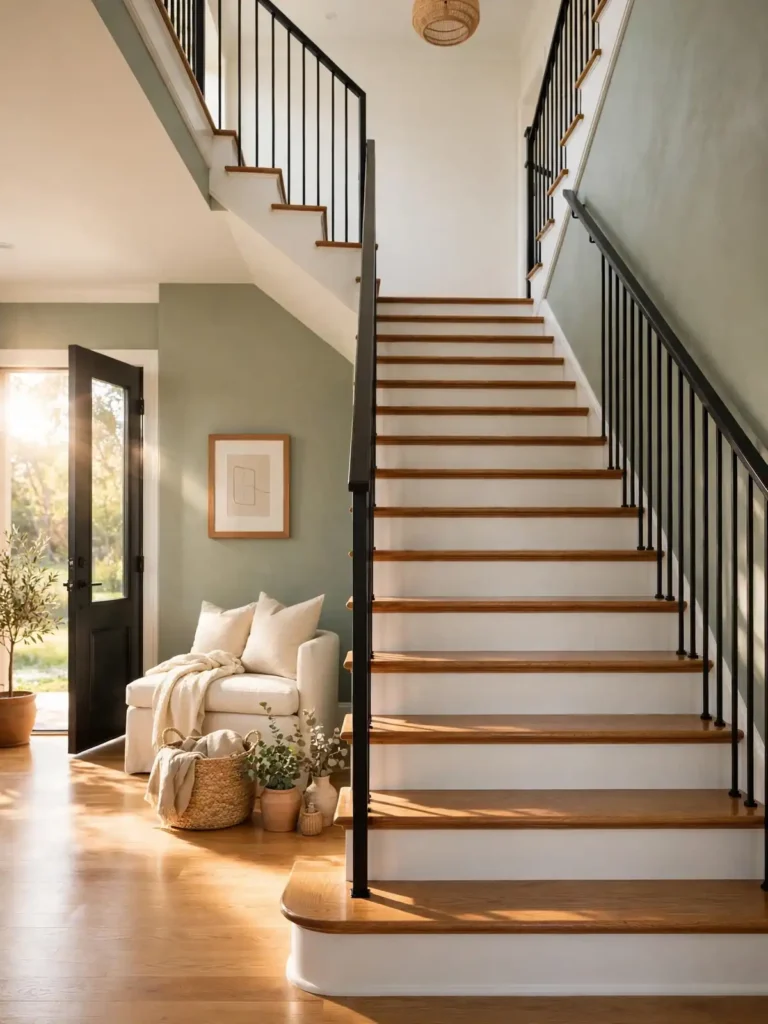
For a softer take on the same country character, these modern farmhouse staircase ideas blend rustic timber with clean, fresh lines in a way that suits a family home. The 25 ideas below cover the whole stair — its timber, its stone, its ironwork, its lighting, and the space around it — so you can choose a design that suits a cottage entry, a barn conversion, or a warm family hallway.
Key Takeaways
What defines a rustic staircase?
Natural, honest materials such as reclaimed timber, rough-hewn stone, hand-forged iron and woven rope or jute, with visible grain, knots and texture. A rustic staircase feels warm, lived-in and connected to nature instead of polished and machine-perfect.
Does a rustic staircase suit a modern home?
Yes — it works beautifully when the timber is paired with one clean element, such as a slim black steel handrail, a simple plaster wall or a pale floor. The rustic materials add warmth while the clean lines keep the home feeling fresh, not old-fashioned.
What wood works best for a rustic staircase?
Reclaimed barn oak, rough-hewn pine, honey-toned Douglas fir, warm walnut and weathered cedar. Each shows its own grain and knots, so choose the timber whose colour and texture suit your home and seal it well for everyday use.
Is a rustic staircase practical for a family home?
Yes, when it uses sturdy treads, a secure handrail, non-slip finishes and good lighting. A woven runner or rough-sawn treads add grip, while a solid balustrade or closed risers add safety for toddlers and pets.
How do you keep a rustic staircase from looking dark?
Balance dark timber and iron with pale plaster walls, a light floor, warm lighting and soft furnishings in cream, sage or dusty blue. One dark material at a time keeps the stair warm without closing the hallway in.
A Rustic Staircase in Reclaimed Barn Oak With Hand-Forged Iron Balusters
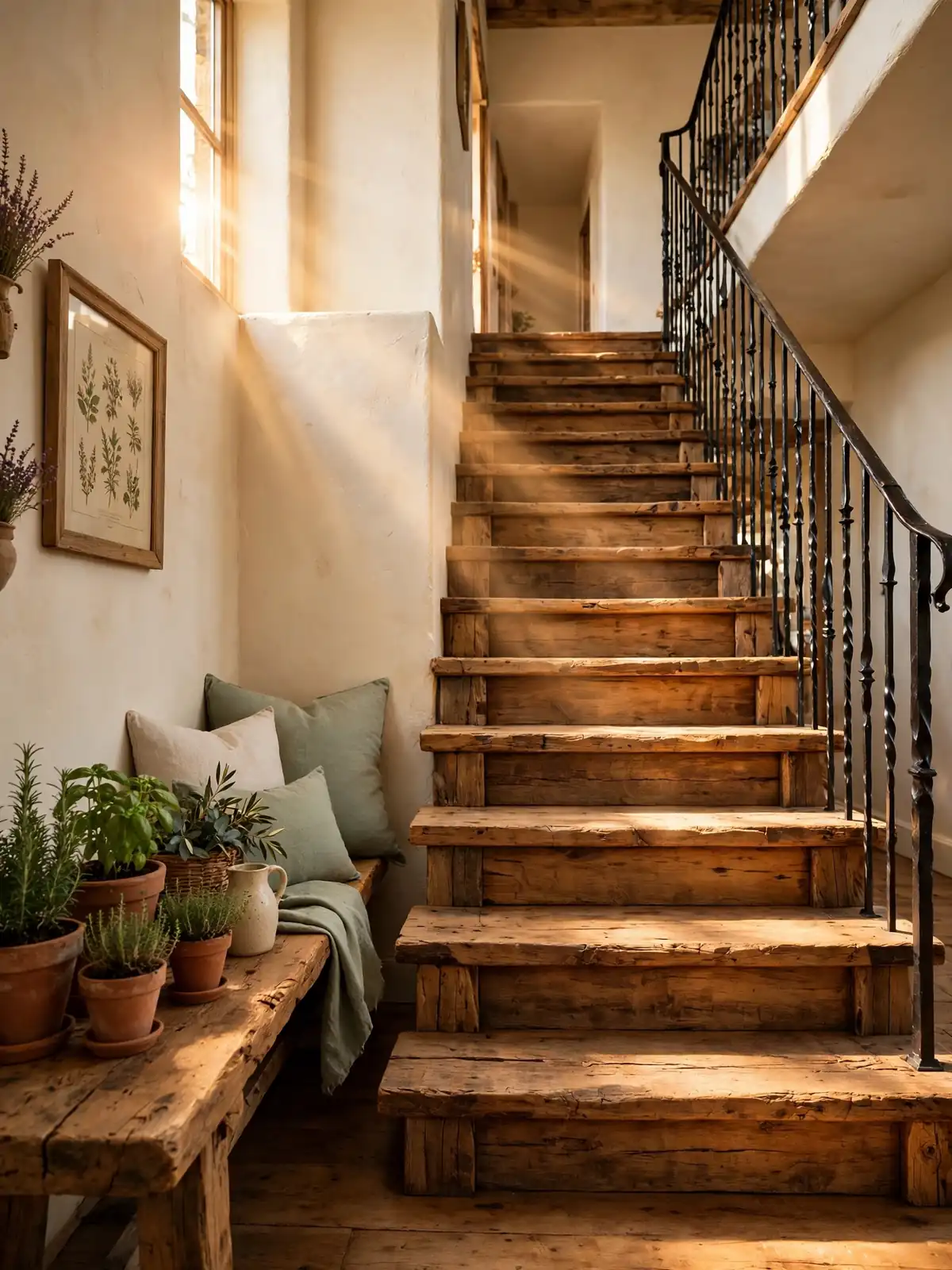
A reclaimed barn oak stair carries the story of its timber in every knot and grain line, and that history is what makes it feel so warm. In one farmhouse hallway, reclaimed barn oak treads, each 950 mm wide and 45 mm thick, rise in a straight run with 175 mm risers, their honeyed grain sealed in a soft matte finish, while slim hand-forged iron balusters, each slightly irregular from the hammer, support a chunky oak handrail. A wooden bench at the base, dressed with soft sage-green linen cushions, and terracotta pots of herbs on the landing keep the palette natural and calm.
Quick tips:
- Choose reclaimed barn oak with visible knots and grain for real character.
- Use hand-forged iron balusters, not machine-made ones, for an authentic feel.
- Keep the walls cream plaster so the honeyed timber glows.
- Seal the treads in matte finish so the grain stays visible.
A Rustic Staircase in Rough-Hewn Pine With a Rope Handrail
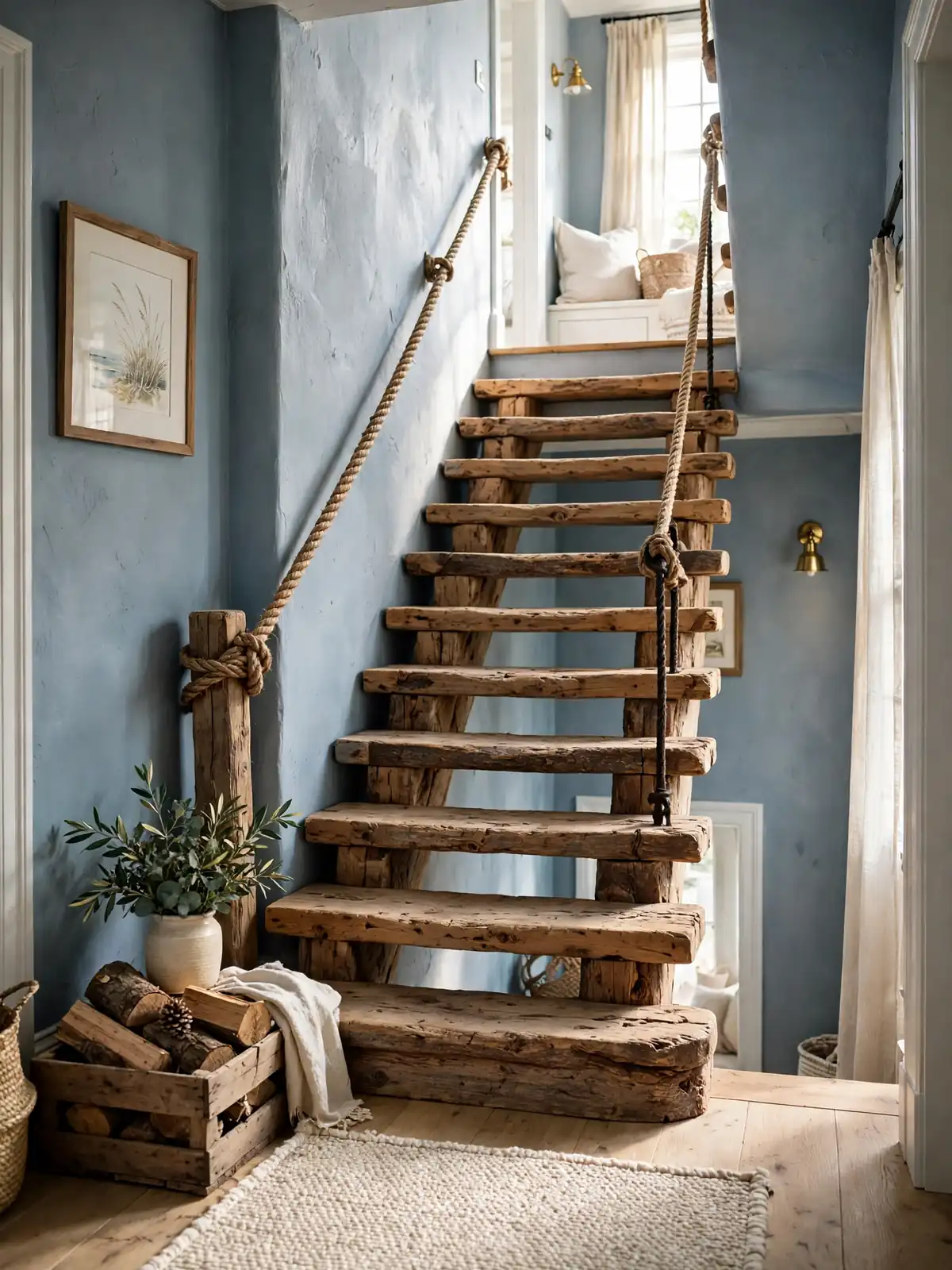
A thick rope handrail turns a simple pine stair into a seaside cottage feature, and it feels wonderful under the hand. Here, rough-hewn pine treads, each 900 mm wide and 40 mm thick, show their saw marks and knots, while a 40 mm diameter natural hemp rope runs through iron eyelets as the handrail. Soft dusty-blue walls and a cream woven rug at the base keep the palette fresh, while a small wooden crate of firewood beside the stair adds a practical, lived-in touch.
Quick tips:
- Choose thick hemp rope — about 40 mm — for a comfortable grip.
- Fix the rope through black iron eyelets for a nautical look.
- Pair rough pine with dusty blue for a fresh cottage feel.
- Keep the rug cream and woven so the stair stays the feature.
A Rustic Staircase in Warm Walnut Beside a Rough Stone Wall
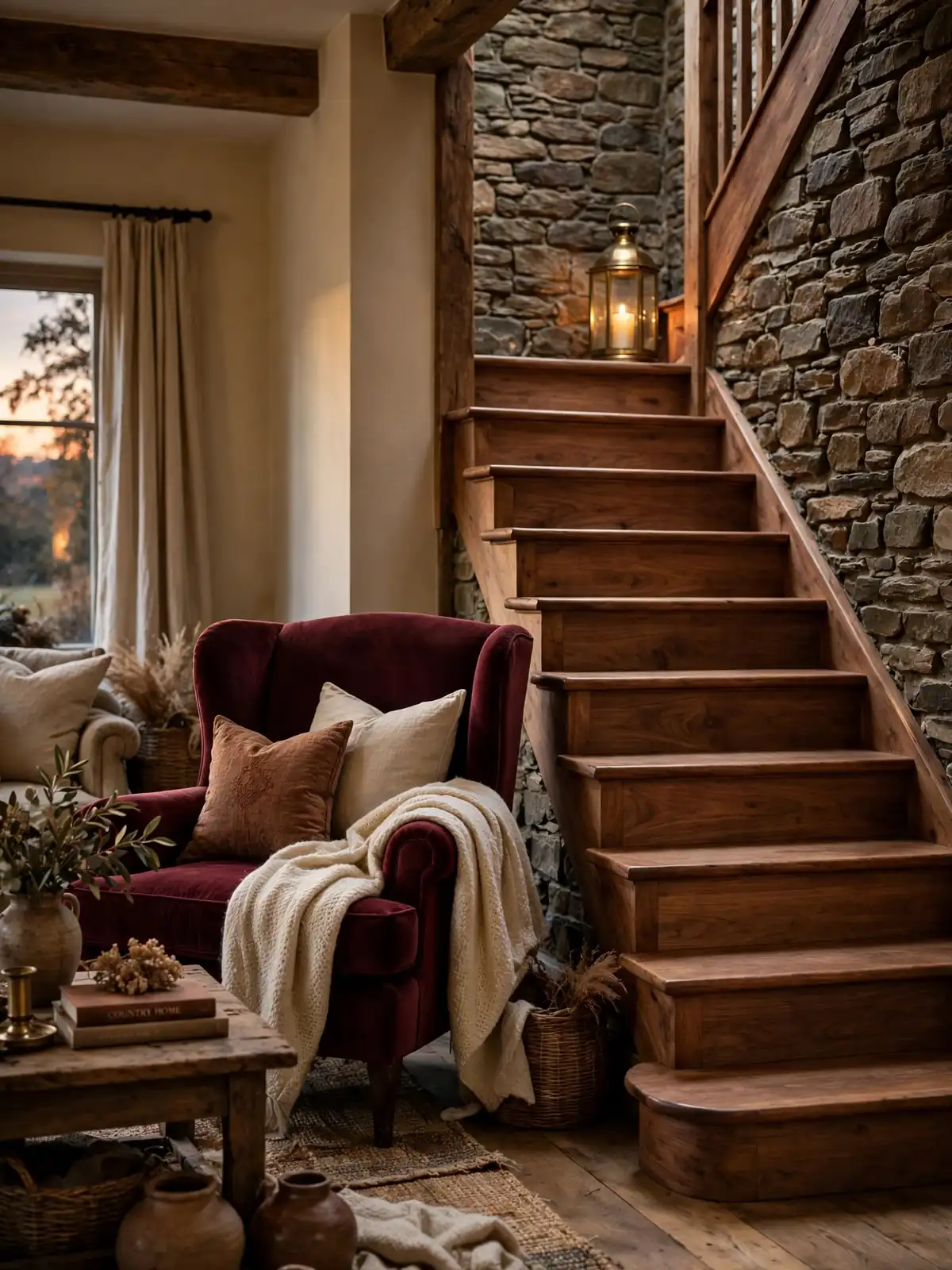
Rough stone and warm walnut make a rustic staircase feel like it grew out of the house itself. On this stair, warm walnut treads, each 1 metre wide and 280 mm deep, run beside a full-height wall of rough, uneven stone, with a slim black iron handrail fixed into the stonework. A deep burgundy velvet armchair at the base and a cream wool throw add rich comfort, while a brass lantern on the landing glows softly in the evening and picks out the stone’s texture.
Quick tips:
- Let the stone wall stay rough and uneven for real texture.
- Choose walnut treads for warmth against cool stone.
- Add a brass lantern to warm the stone in the evening.
- Use a slim iron handrail so it does not hide the stonework.
A Rustic Staircase With a Woven Jute Runner and Timber Treads
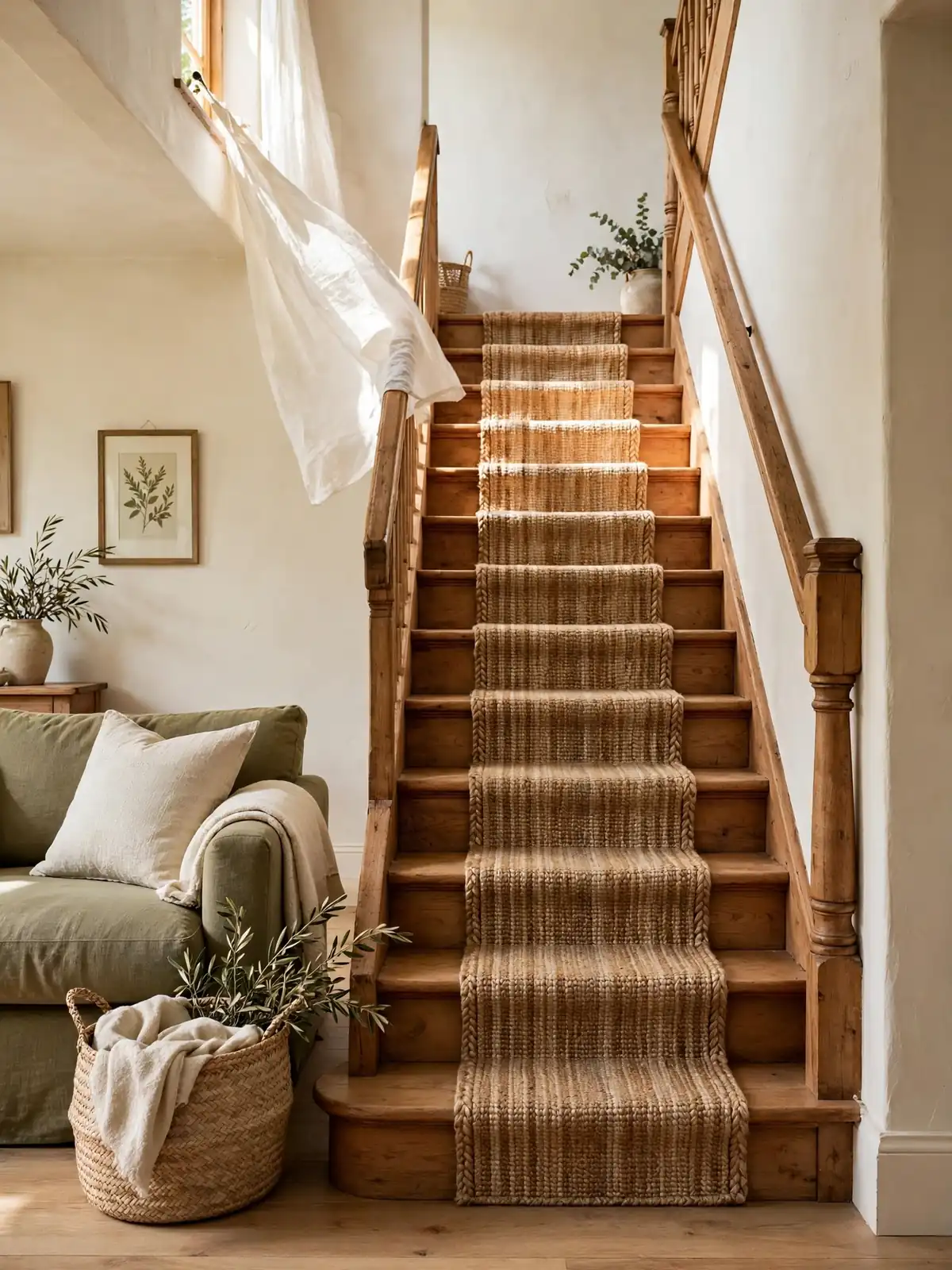
A jute runner down the centre of a rustic staircase softens every step and adds a layer of natural texture. In this farmhouse hallway, a 600 mm wide natural jute runner, held by slim dark iron rods, runs down the centre of honey-toned timber treads, each 1 metre wide, leaving a strip of warm wood showing on either side. A soft olive-green sofa and a woven seagrass basket nearby complete the relaxed palette, while cream walls keep the hallway bright and the runner makes the stair quieter underfoot.
Quick tips:
- Keep the runner about 600 mm wide so timber shows on both sides.
- Use dark iron stair rods to hold the runner neatly in place.
- Choose natural jute for texture, not a patterned carpet.
- Vacuum the runner weekly to keep the fibres clean and flat.
A Rustic Staircase in Weathered Cedar With a Log Newel Post
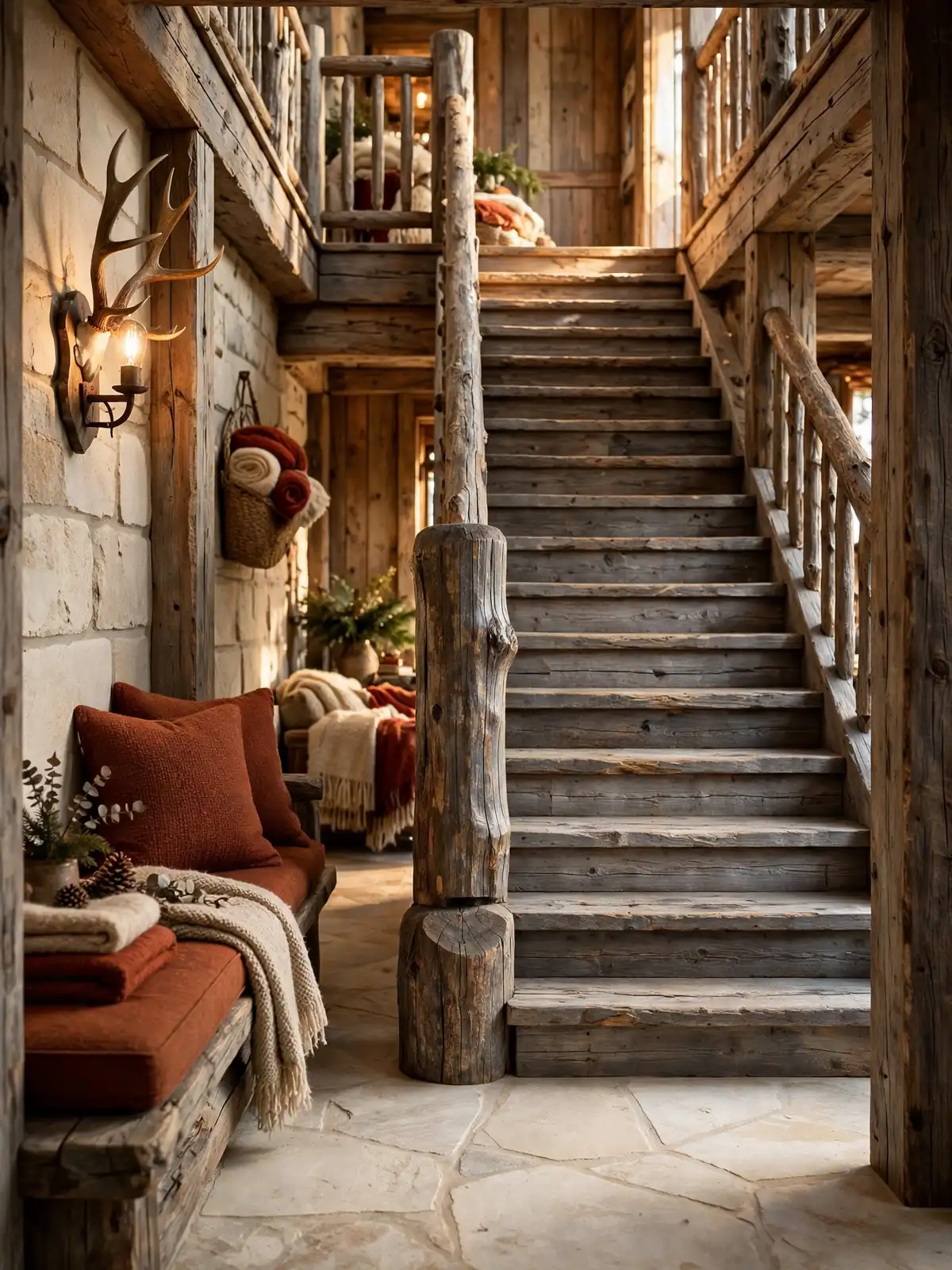
A log newel post anchors a rustic staircase like a tree trunk at the foot of the climb. On this stair, weathered grey cedar treads, each 950 mm wide, with their soft silvered grain, rise beside a chunky log newel post, 150 mm square, left with its bark texture sanded smooth. Warm rust-red wool cushions on a wooden bench at the base and a cream stone floor keep the palette warm, while an antler wall light glows softly above the landing.
Quick tips:
- Choose weathered cedar for a soft silvered look, not fresh timber.
- Make the log newel chunky — about 150 mm square — for real presence.
- Pair grey cedar with rust red for warmth against the cool timber.
- Sand the newel smooth so it is comfortable to grip.
A Rustic Staircase With a Stone Tread Edge and Timber Risers
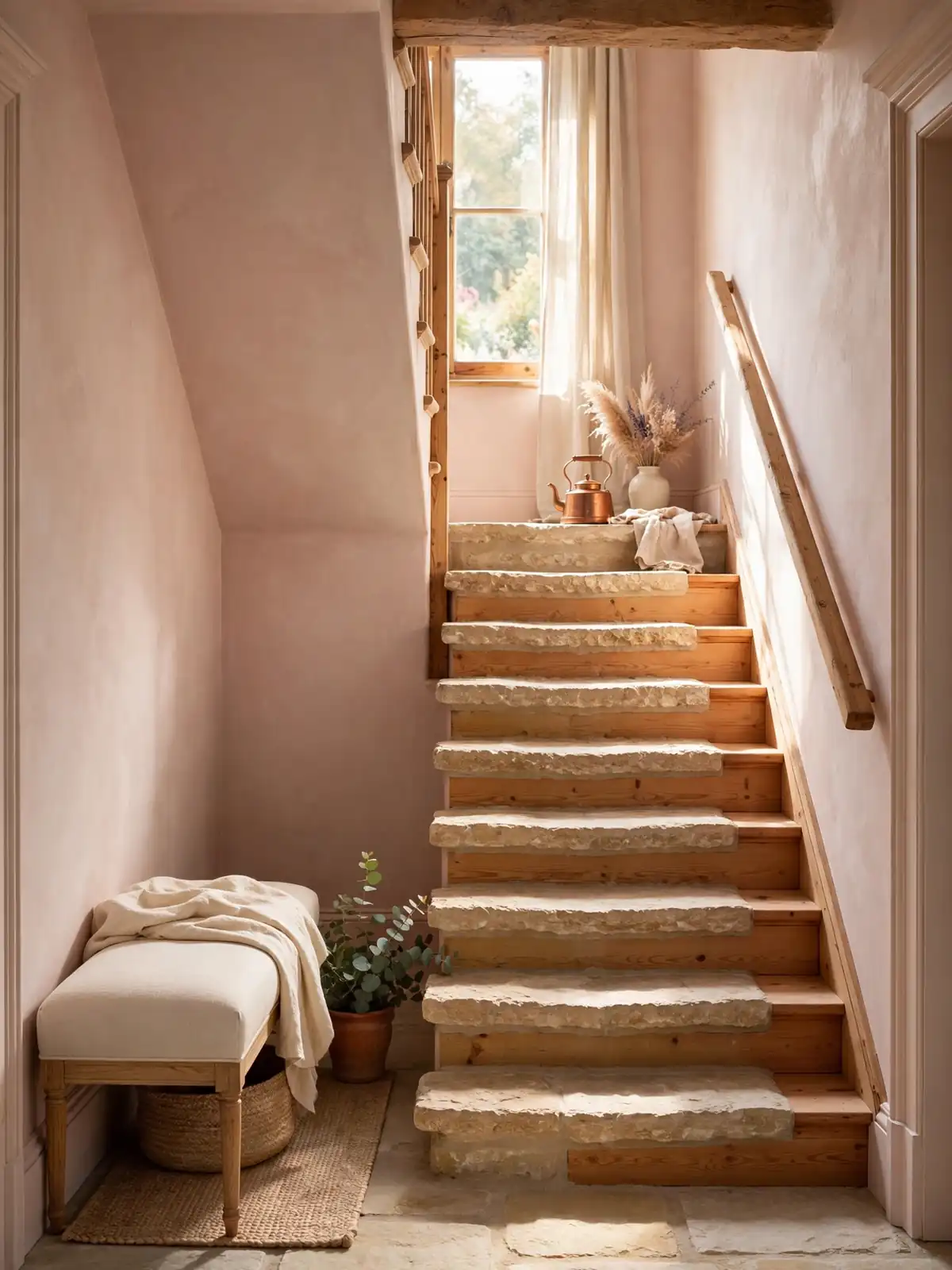
Stone tread edges with timber risers mix two country materials in one stair, and the contrast is quietly beautiful. Here, each tread carries a 40 mm thick rough limestone edge, 950 mm wide, over a warm pine riser, so the stair reads as stone from above and timber from below. Soft blush-pink walls and a cream linen bench keep the entry gentle, while a small copper kettle on the landing adds a warm metallic accent that catches the morning light.
Quick tips:
- Use rough limestone edges for texture, not polished stone.
- Choose warm pine risers to soften the cool stone.
- Keep the wall colour soft — blush or cream — for balance.
- Add one copper accent to warm the stone and timber.
A Rustic Staircase Beside a Whitewashed Timber Wall
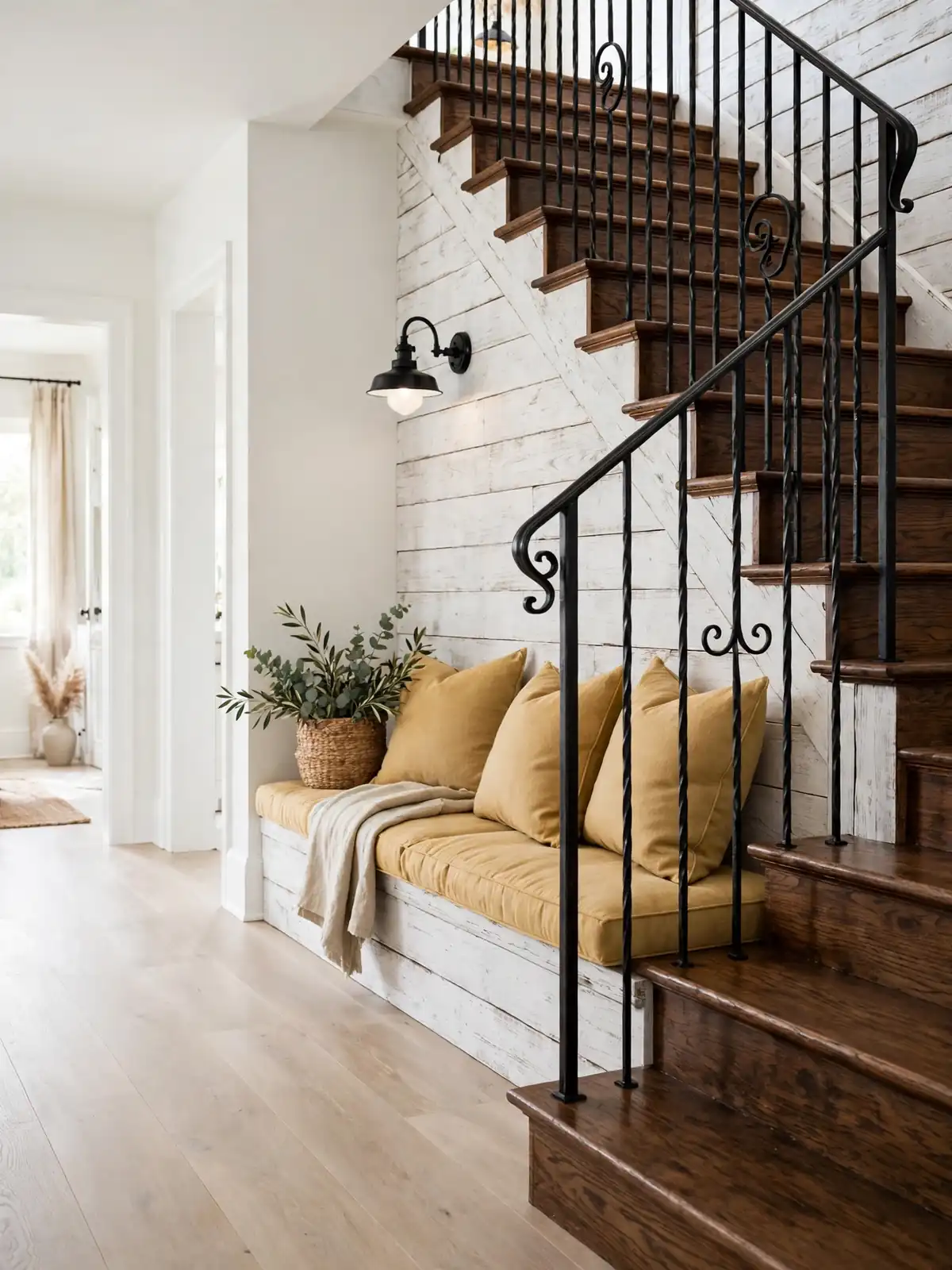
A whitewashed timber wall makes dark oak treads glow, and the contrast keeps a rustic staircase bright instead of heavy. On this stair, dark oak treads, each 900 mm wide and 280 mm deep, run beside a wall of vertical whitewashed timber planks, with a slim black iron handrail fixed to the planks. Soft mustard-yellow cushions on a wooden bench at the base add a cheerful accent, while the pale wood floor reflects daylight through the hallway.
Quick tips:
- Whitewash the planks lightly so the timber grain still shows.
- Pair dark oak with whitewash for a bright, balanced contrast.
- Add mustard cushions for one cheerful accent.
- Use a slim black iron handrail so it does not compete with the wall.
A Rustic Staircase With a Chunky Timber Handrail and Iron Straps
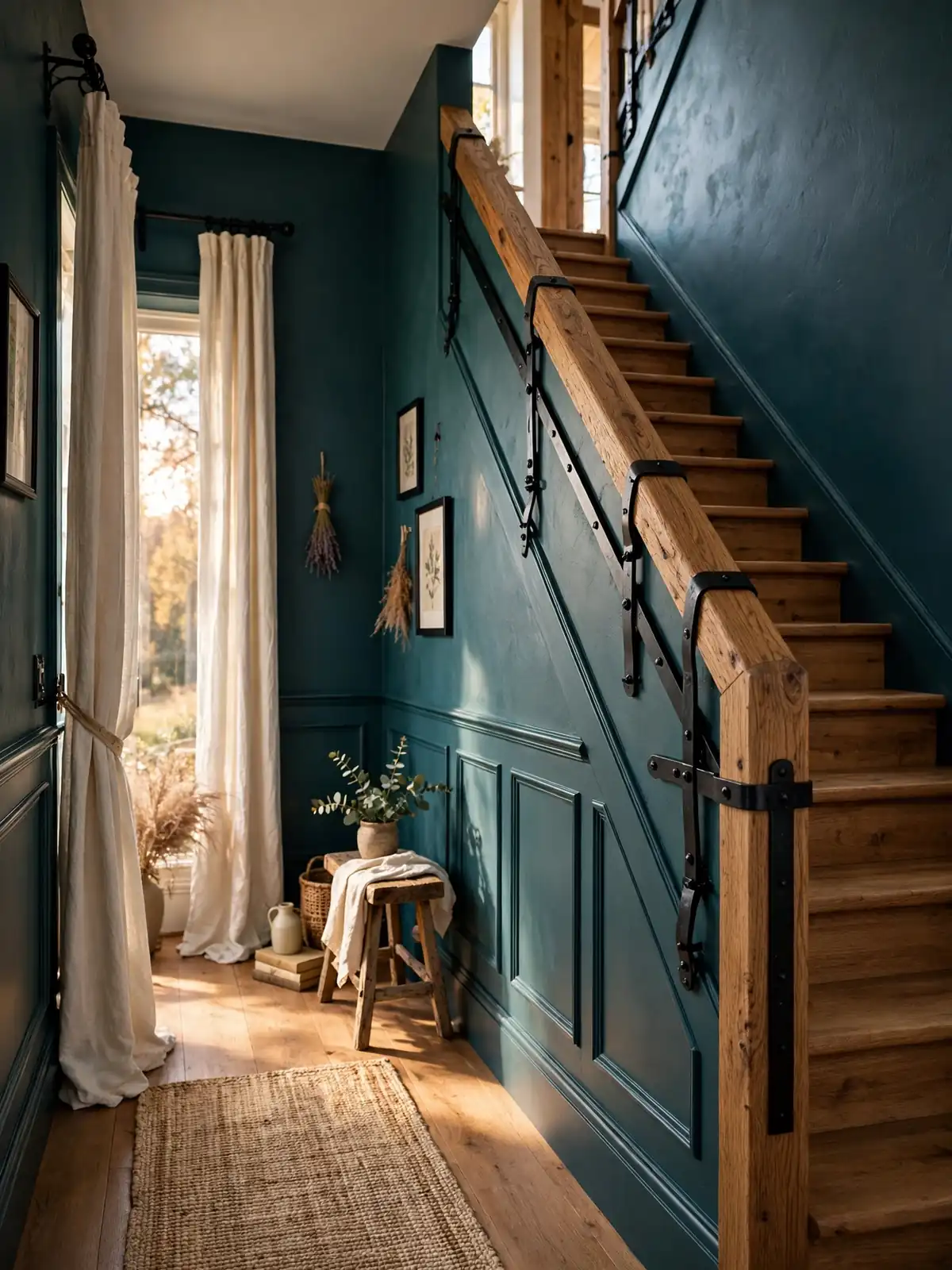
A chunky timber handrail held by iron straps is the kind of detail a blacksmith would have made a hundred years ago, and it still feels right today. Here, a 100 mm wide oak handrail, sanded smooth on top and left rough underneath, runs along a flight of pale pine treads, each 950 mm wide, held by hand-forged black iron straps every 600 mm. Deep teal walls and cream linen curtains frame the stair, while a small wooden stool at the base holds a stack of books.
Quick tips:
- Make the handrail chunky — about 100 mm wide — for a real grip.
- Space the iron straps evenly, about 600 mm apart.
- Pair chunky oak with deep teal for a rich, homely contrast.
- Sand the top of the rail smooth and leave the underside rough.
A Rustic Staircase With a Built-In Firewood Store Under the Flight
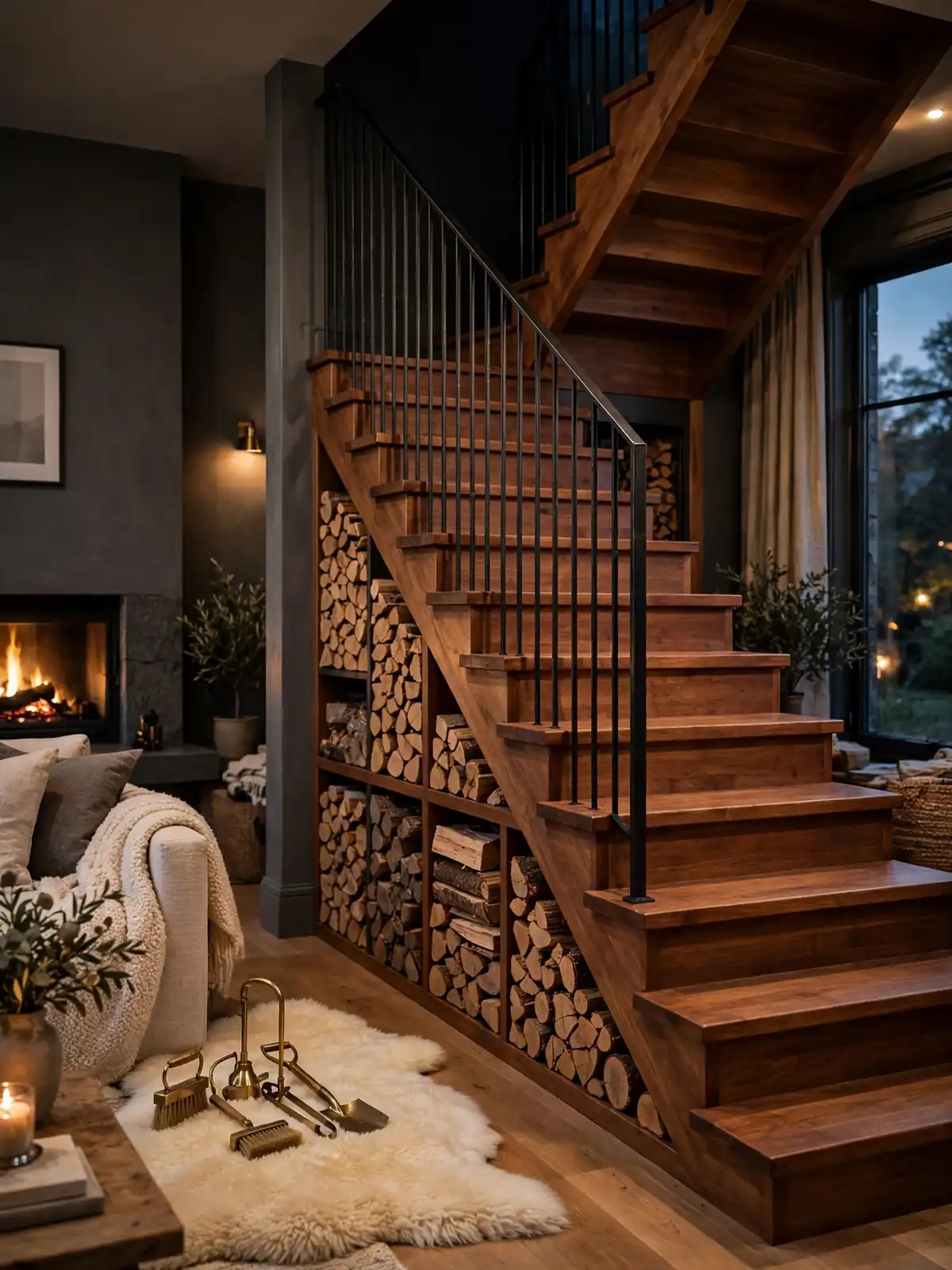
The space under a rustic staircase is perfect for firewood, and a neat stack of logs turns a dead corner into a warm, practical feature. Beneath this stair, warm chestnut treads, each 900 mm wide, rise above a built-in store where split logs are stacked in tidy rows, 1.2 metres deep, behind a slim iron frame. Soft charcoal walls and a cream sheepskin rug keep the room cosy, while brass fire tools beside the hearth catch the evening glow from the fire.
Quick tips:
- Stack the logs in tidy rows so the store looks intentional, not messy.
- Keep the store at least 1.2 metres deep for a useful amount of wood.
- Use a slim iron frame to hold the logs neatly in place.
- Keep a sheepskin rug nearby to soften the charcoal walls.
A Rustic Staircase With a Full-Height Window Overlooking the Garden
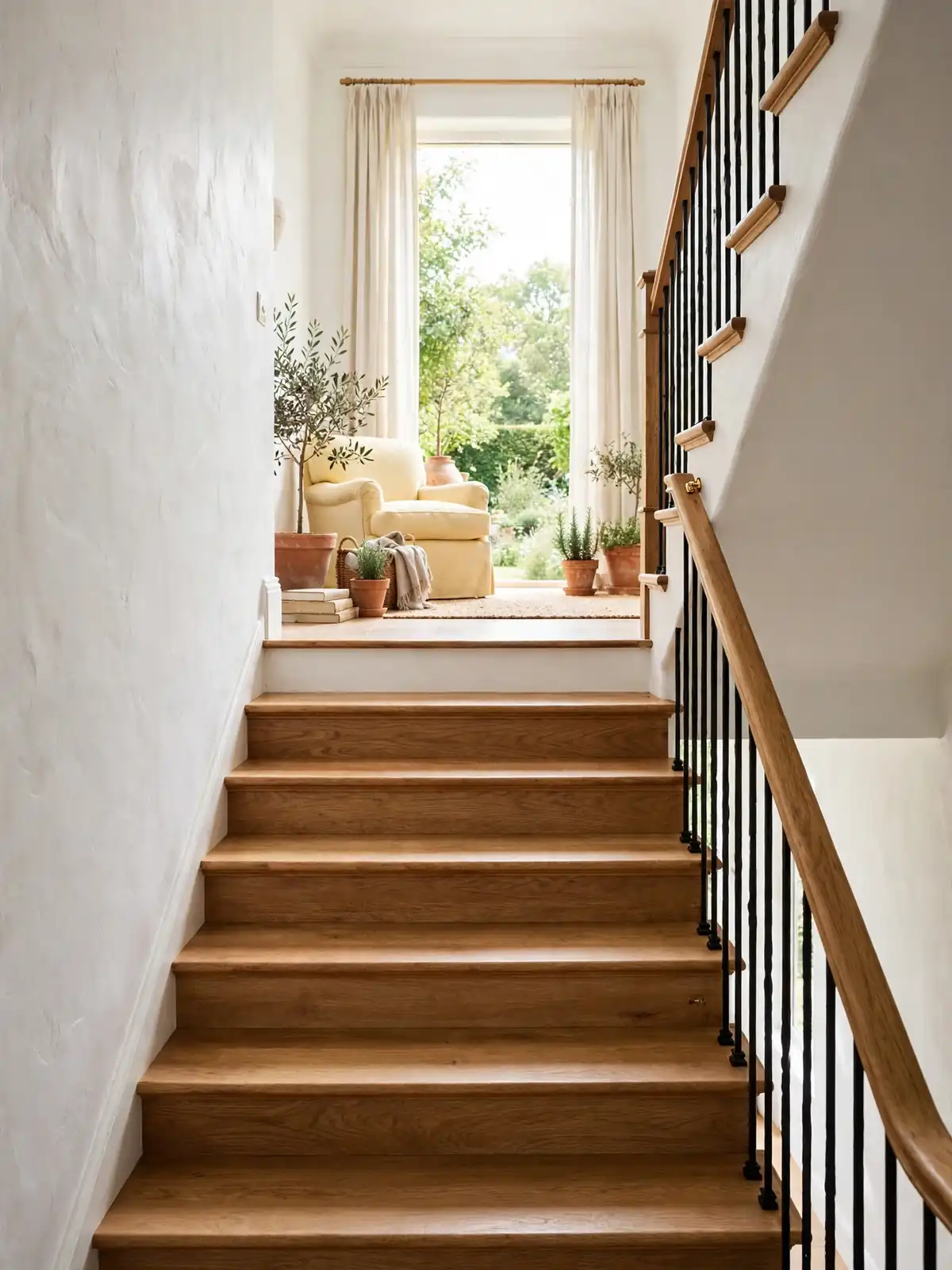
A full-height window at the top of a rustic staircase changes the whole feeling of the climb, because daylight that enters at the landing does not stop there — it pours down every honey oak tread, warms the rough plaster, picks out the grain and knots in the timber, and reaches the hallway below, so a stair that could have felt dark and enclosed becomes the brightest, most welcoming route in the house. In this home, the window is 2.4 metres tall and 1.1 metres wide, set into the wall at the top landing beside honey oak treads, each 950 mm wide, with a slim black iron handrail and a simple timber balustrade on the open side. A soft butter-yellow armchair sits on the landing, catching the morning sun, while pale linen curtains frame the window without blocking it, terracotta pots of herbs line the landing sill, and the green garden beyond becomes a living picture at the top of every climb. The stair feels less like a passage and more like a destination, and because the window is tall rather than wide, it keeps the wall’s clean country lines while still flooding the stairwell with light from dawn until dusk.
Quick tips:
- Make the landing window full-height so light reaches every tread.
- Use honey oak treads to bounce the window light further down.
- Choose sheer linen curtains that filter light without blocking it.
- Keep the landing clear so the window stays the focal point.
A Rustic Staircase in Honey Douglas Fir Against a Deep Green Wall
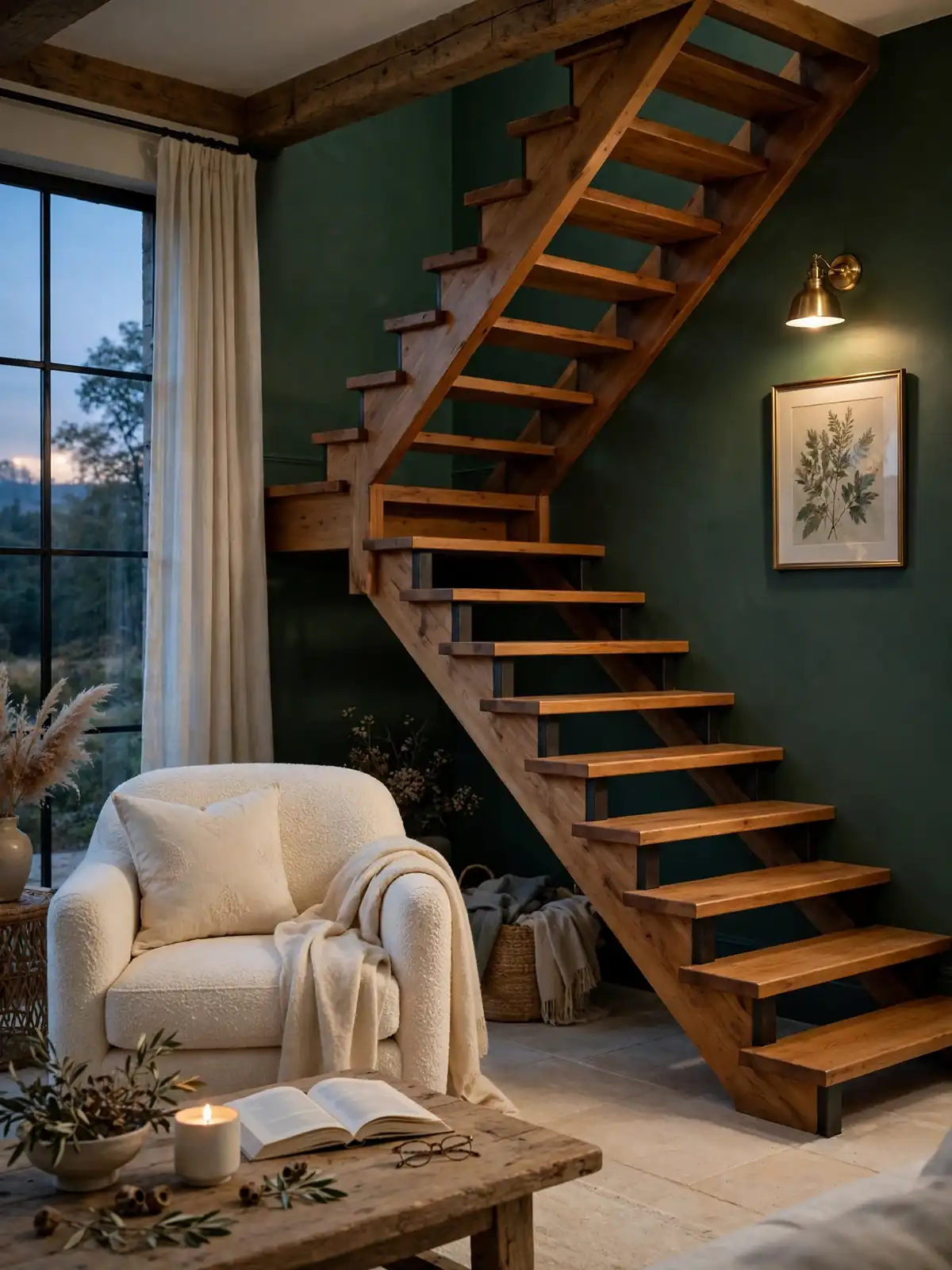
Honey Douglas fir and deep green make a rustic staircase feel rich and calm, like a quiet library stair in a country house. Here, honey Douglas fir treads, each 900 mm wide with a soft matte finish, run beside a deep forest-green wall, with a slim brass handrail and a cream boucle armchair below. A brass picture light above the landing warms the green in the evening, while the pale stone floor keeps the room from feeling dark. The stair feels dramatic, yet completely liveable.
Quick tips:
- Choose honey Douglas fir for warmth without the harshness of dark timber.
- Keep the green wall to one side only, with the rest pale.
- Add brass fittings to warm the deep green.
- Use a matte tread finish to avoid glare in low light.
A Rustic Staircase With a Plaid Wool Runner in Red and Cream
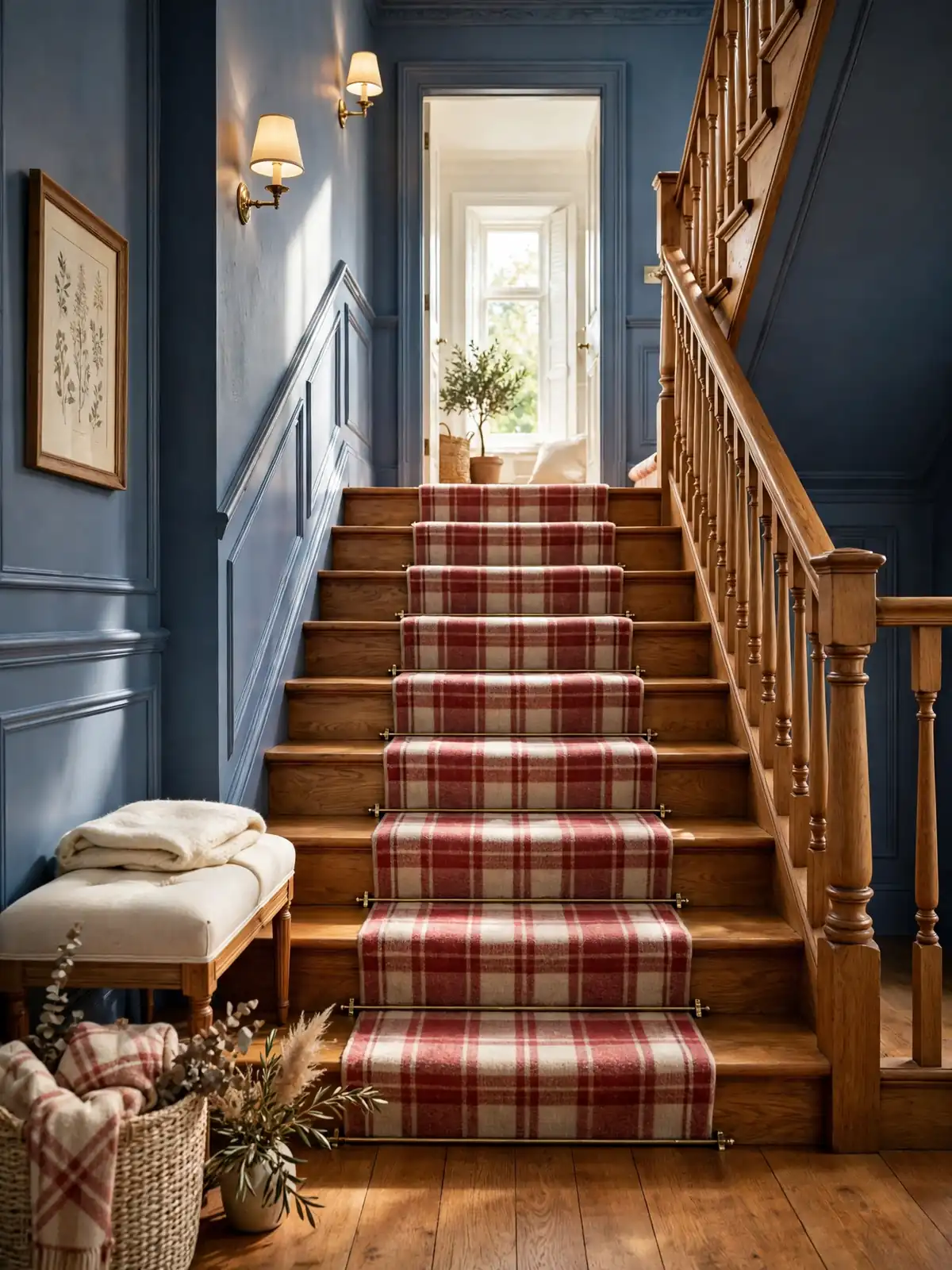
A plaid wool runner brings instant country charm to a rustic staircase, and the pattern hides everyday wear beautifully. In this hallway, a 650 mm wide red and cream plaid wool runner, held by slim brass rods, runs down the centre of warm oak treads, each 1 metre wide, leaving a strip of timber showing on either side. Soft navy-blue walls and a cream bench below pick up the runner’s colours, while a woven basket holds scarves and hats by the door.
Quick tips:
- Keep the runner about 650 mm wide so timber shows on both sides.
- Use brass stair rods to hold the runner neatly in place.
- Choose wool plaid for warmth and durability.
- Match one runner colour to the wall for a pulled-together look.
A Rustic Staircase With Recessed Timber Shelves for Books and Pottery
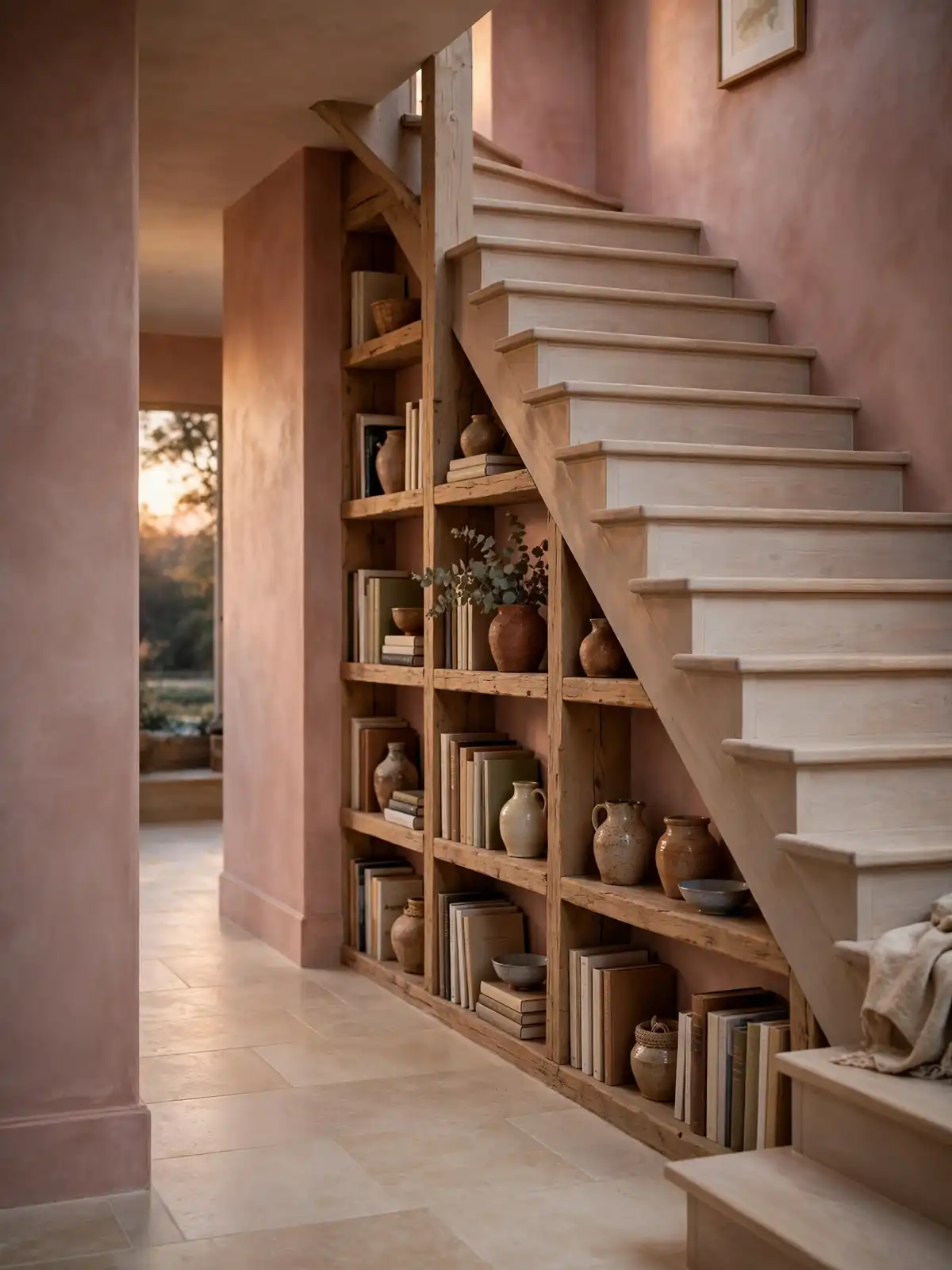
Recessed timber shelves in the stair wall turn the climb into a small display of books and handmade pottery. Along this stair, three shelves, each 500 mm wide and 300 mm deep, are set into the wall following the angle of the flight, each holding a small stack of books and a handmade ceramic jug or bowl lit by a tiny warm light. Pale ash treads, each 900 mm wide, and soft dusty-rose walls keep the palette gentle, while the cream stone floor reflects the shelf lights softly in the evening.
Quick tips:
- Space shelves evenly, following the angle of the stair.
- Use warm recessed lights above each shelf for a soft glow.
- Keep the pottery handmade and simple — one or two pieces per shelf.
- Build the shelves in the same timber as the treads for a unified look.
A Rustic Staircase With a Timber Beam Handrail Fixed to the Wall
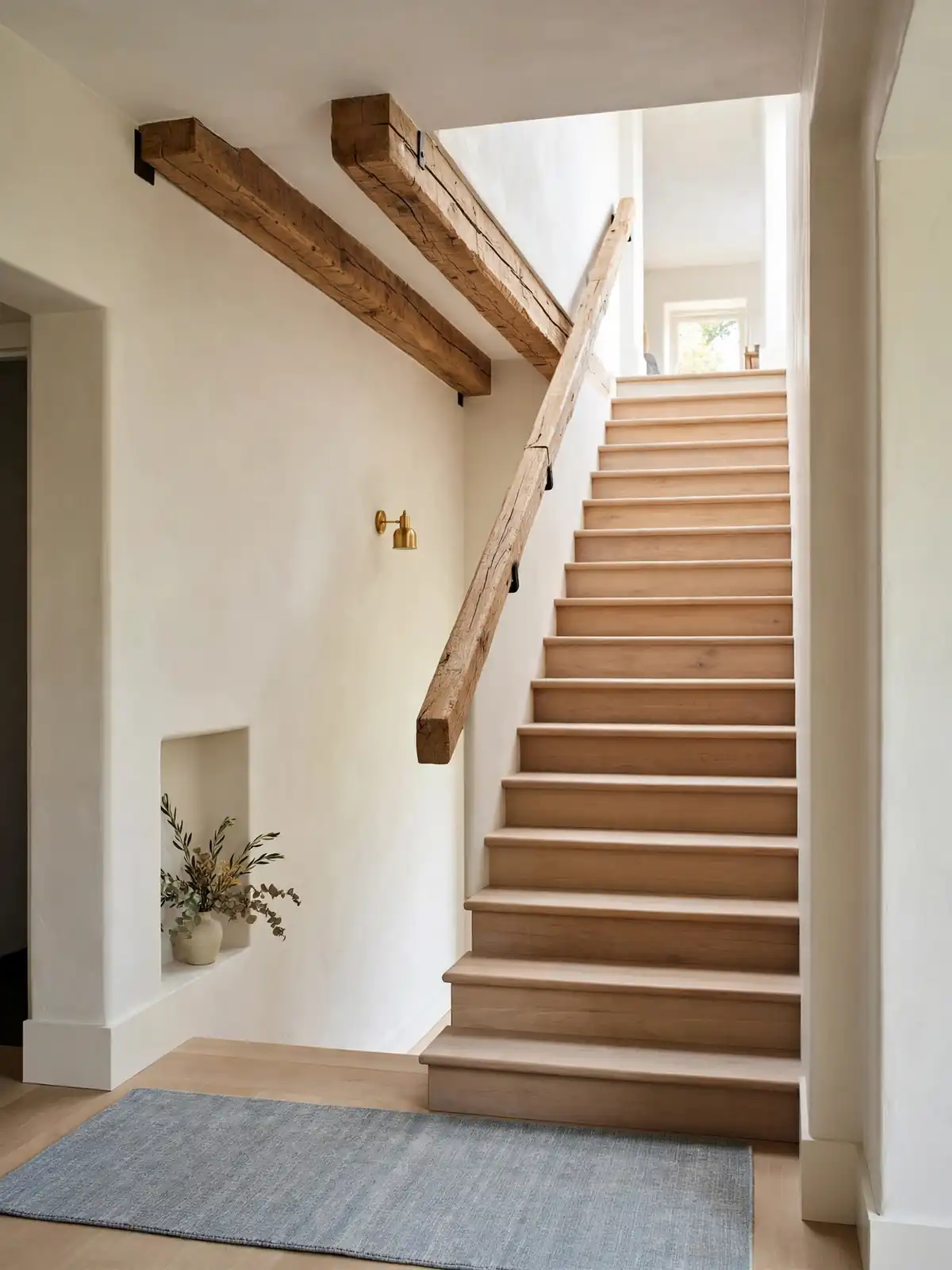
A thick timber beam handrail fixed to the wall is the simplest rustic handrail of all — one solid piece of wood, warm under the hand. On this stair, a 90 mm square oak beam, sanded smooth, is fixed to a smooth cream plaster wall beside light beech treads, each 950 mm wide, on slim iron brackets. A soft grey-blue rug at the base and a small brass wall light add quiet warmth, while the cream wall stays completely clean and unbroken.
Quick tips:
- Use a beam about 90 mm square for a comfortable, solid grip.
- Fix it on slim iron brackets so the timber stands proud of the wall.
- Keep the wall cream plaster so the timber reads clearly.
- Add one warm wall light so the handrail is easy to find at night.
A Rustic Staircase in Pale Pine With Whitewashed Risers
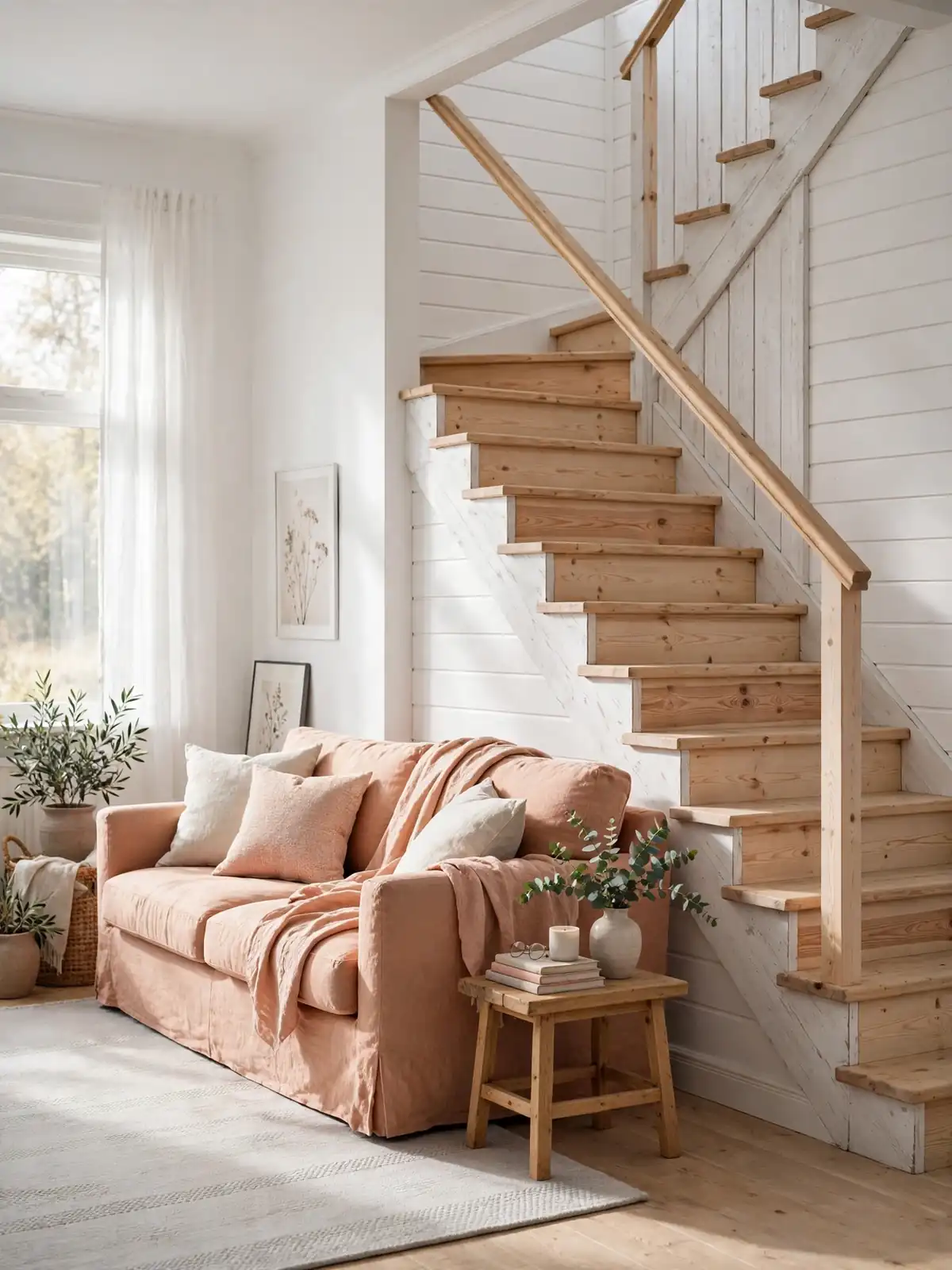
Pale pine treads with whitewashed risers make a rustic staircase feel fresh and light, because the pale timber glows against the soft white. Here, 40 mm thick pale pine treads, each 900 mm wide, sit on whitewashed risers, 175 mm high, with a slim white-painted timber balustrade and a pale oak handrail. A soft peach linen sofa and a pale grey rug below keep the room warm, while morning light falls across the pine and makes the whole stair shine softly.
Quick tips:
- Choose pale pine for the palest, freshest timber look.
- Whitewash the risers lightly so the wood grain still shows through.
- Pair the stair with soft peach or pale grey furnishings.
- Use a pale oak handrail to match the treads.
A Rustic Staircase With a Split Landing and a Window Seat in Gingham
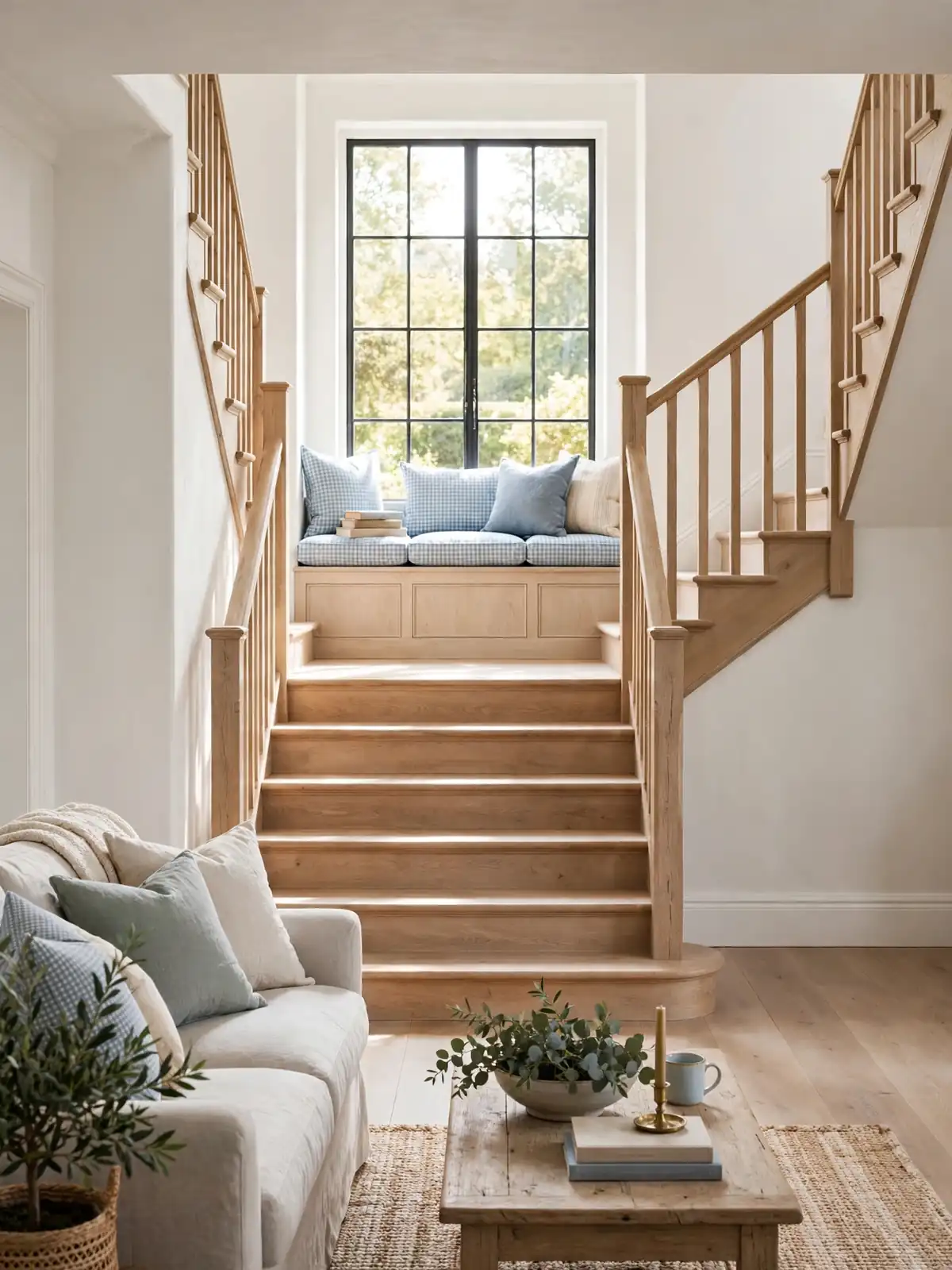
A split landing breaks the climb into two short flights with a window seat in between, so the stair becomes a place to pause. In this home, the landing sits halfway up, 1.1 metres square, with a built-in window seat, 500 mm deep, dressed in blue gingham cushions and a small stack of books. Pale oak treads, each 950 mm wide, rise on either side, while white walls and warm daylight keep the space bright. Children read there in the afternoon, and adults pause there with a coffee.
Quick tips:
- Make the window seat at least 500 mm deep so it is comfortable to sit on.
- Use washable gingham cushion covers for a family window seat.
- Keep the landing window clear of heavy curtains.
- Choose pale oak treads so the split landing feels open, not boxed in.
A Rustic Staircase With a Terracotta Accent Wall at the Turn
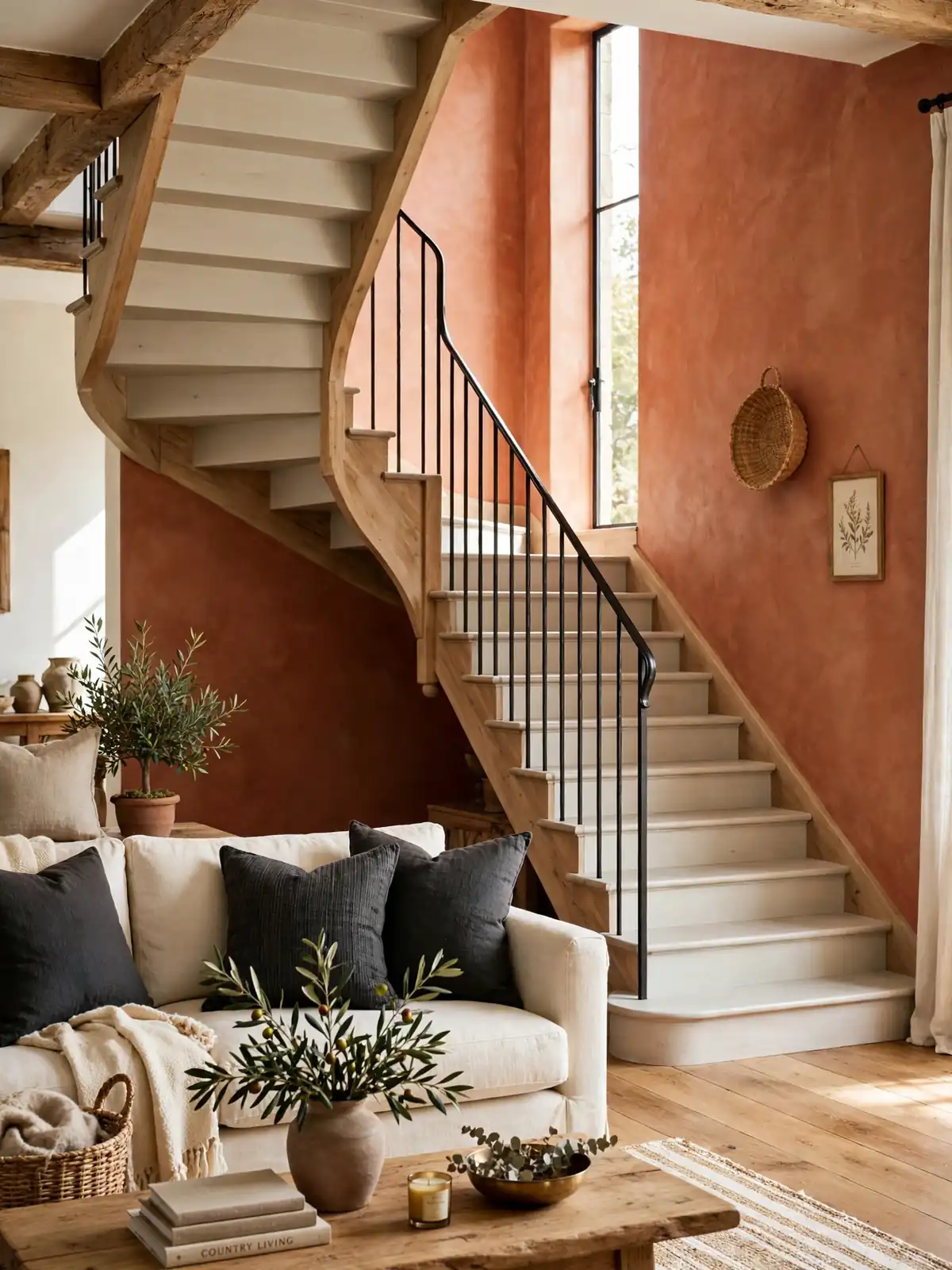
A terracotta accent wall at the turn of a stair adds one warm, joyful moment to an otherwise calm country home. Here, the wall at the landing turn is painted a warm terracotta, while pale ash treads, each 900 mm wide, and a slim black iron handrail keep the stair itself clean and simple. A cream sofa and charcoal cushions below pick up the contrast, and daylight from a nearby window makes the terracotta glow. The stair feels cheerful without feeling loud.
Quick tips:
- Paint only the turn wall terracotta, keeping the rest pale.
- Pair terracotta with pale ash and black iron for balance.
- Add one charcoal cushion to ground the warm wall.
- Keep the landing clear so the terracotta wall stays the feature.
A Rustic Staircase With a Slim Iron Handrail and a Flagstone Floor
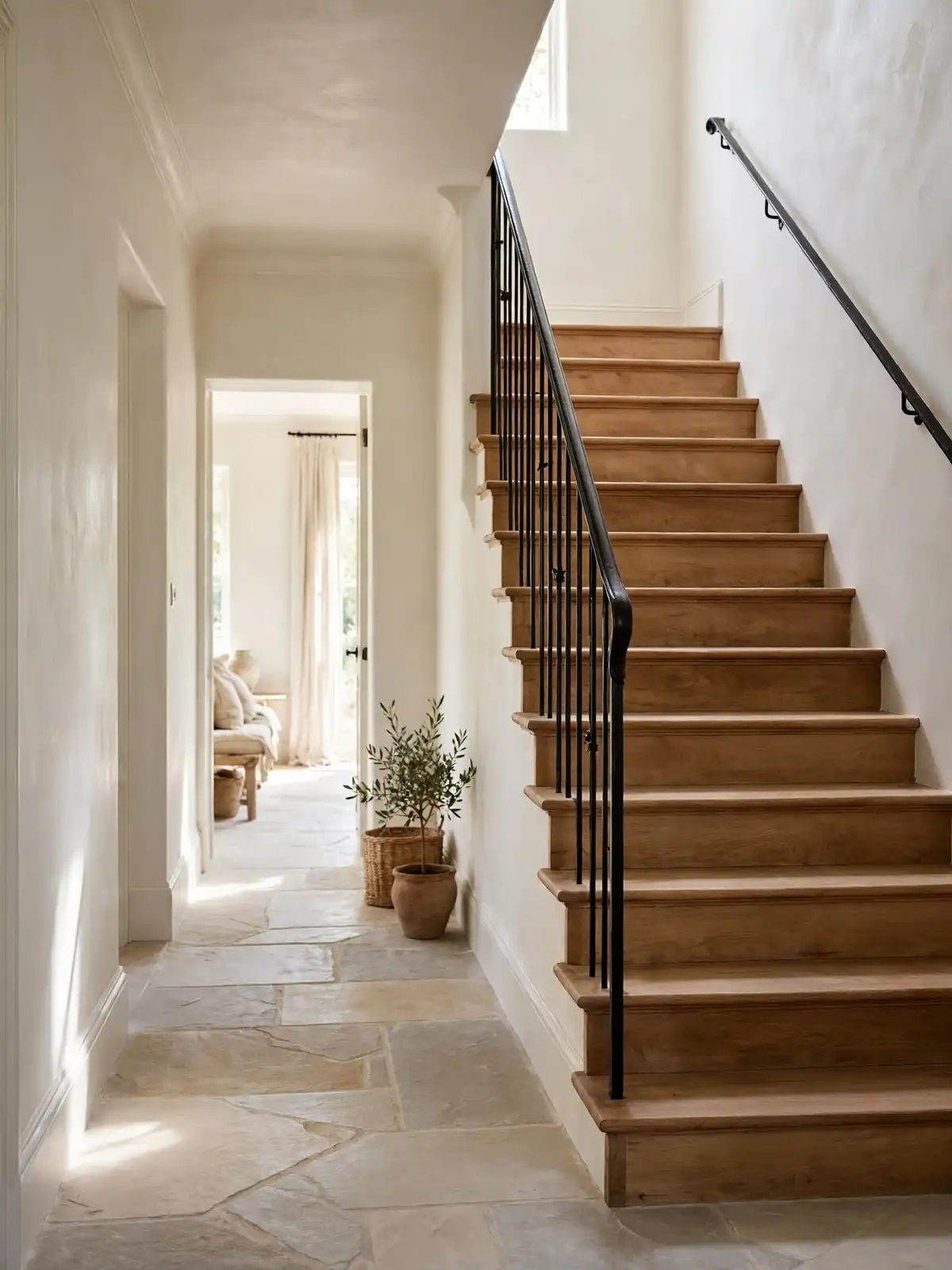
A slim iron handrail against pale flagstone is a study in contrast — dark line, light stone, warm timber in between. On this stair, warm oak treads, each 950 mm wide, sit above a pale flagstone floor, with a 40 mm diameter matte black iron handrail running the full length of the flight on slim posts. Soft ivory walls and a small green plant in a clay pot keep the hallway fresh, while daylight reflects off the flagstones and up the treads. The black line draws the eye upward without closing the stair in.
Quick tips:
- Keep the handrail slim — about 40 mm in diameter — for a light look.
- Choose pale flagstone so the black handrail stands out cleanly.
- Use warm oak treads to soften the black-and-stone contrast.
- Keep the floor free of rugs so the stone reflects the light.
A Rustic Staircase With a Herb Shelf Running Along the Balustrade
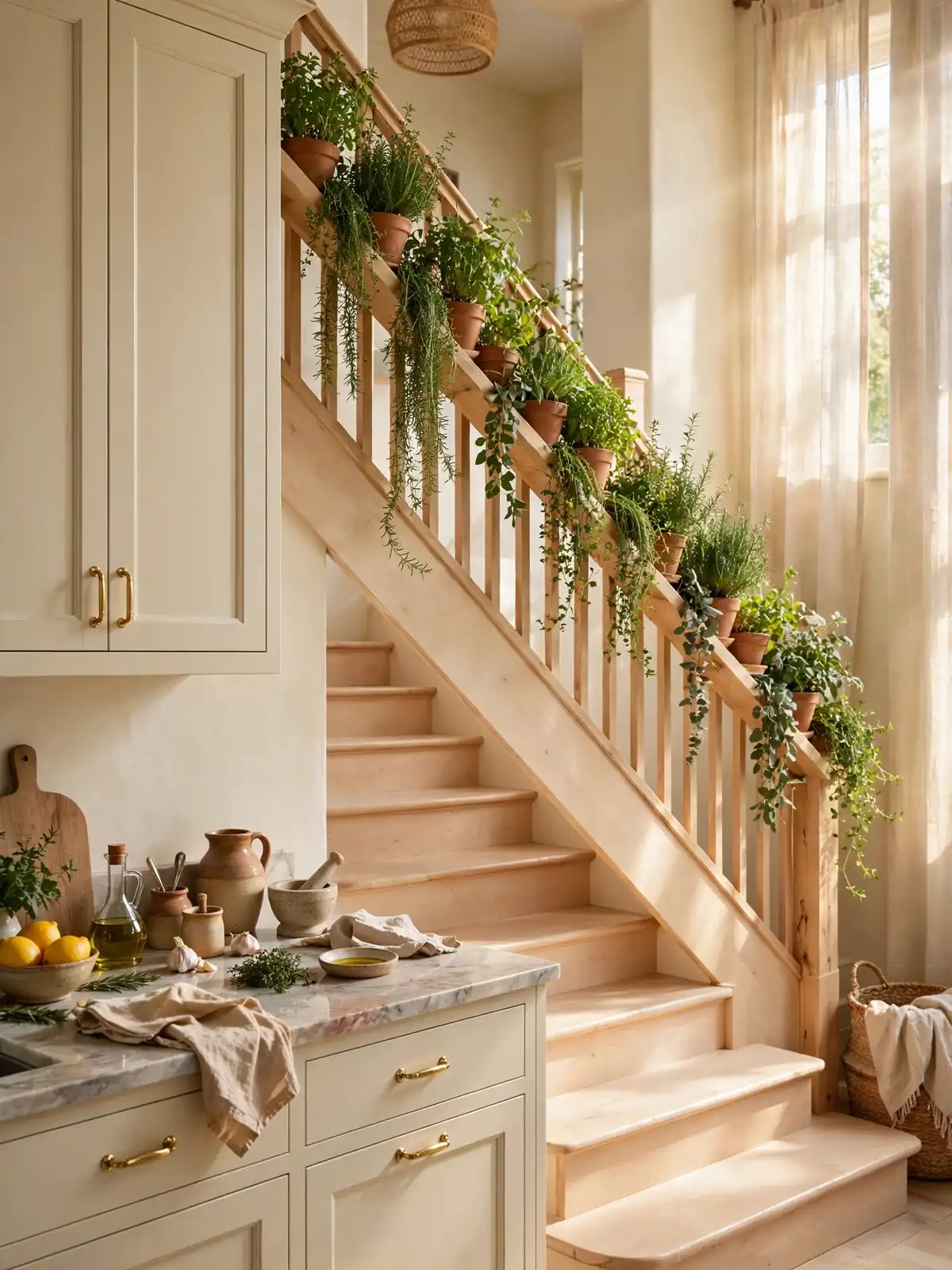
A herb shelf along the balustrade brings greenery and scent into the climb itself. Here, a slim pale timber shelf, 150 mm deep, runs along the top of a simple timber balustrade beside pale birch treads, each 900 mm wide, holding small terracotta pots with trailing rosemary, thyme and mint that spill gently toward the floor below. Soft cream walls and warm morning light keep the room bright, while the herbs soften the timber and fill the stairwell with a fresh, green scent.
Quick tips:
- Keep the shelf slim — about 150 mm deep — so it does not block the light.
- Choose trailing herbs that spill softly, not tall plants that block the view.
- Use terracotta pots for warmth against pale timber.
- Water the herbs with a small can to avoid spills on the treads.
A Rustic Staircase in Sage Green Painted Timber With Cream Treads
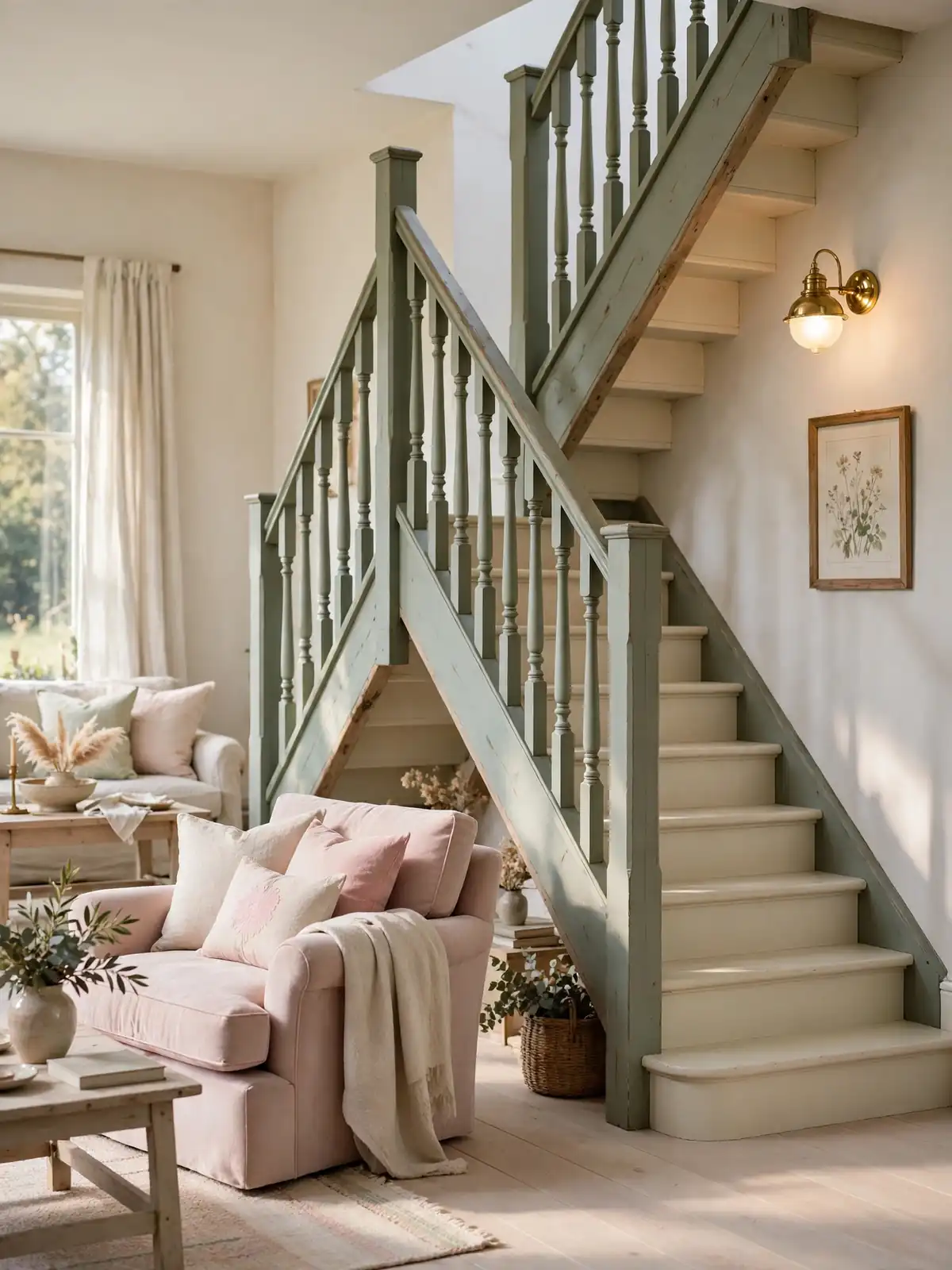
Sage green painted timber is a softer alternative to dark stain — rustic, but gentle. On this stair, a sage green painted timber balustrade and slim sage posts support cream treads, each 950 mm wide, with a slim sage handrail above. A soft blush-pink armchair below adds a warm contrast, while a brass wall light glows softly in the afternoon. The green feels calm and natural, like a garden colour brought indoors, and the cream treads keep the stair bright.
Quick tips:
- Choose sage green in a matte paint finish for a soft, country look.
- Pair sage timber with cream treads so the stair stays bright.
- Add one blush or warm pink accent to contrast the green.
- Match the sage tone to a cushion or plant pot nearby.
A Rustic Staircase With a Copper Inlay on Every Tread Edge
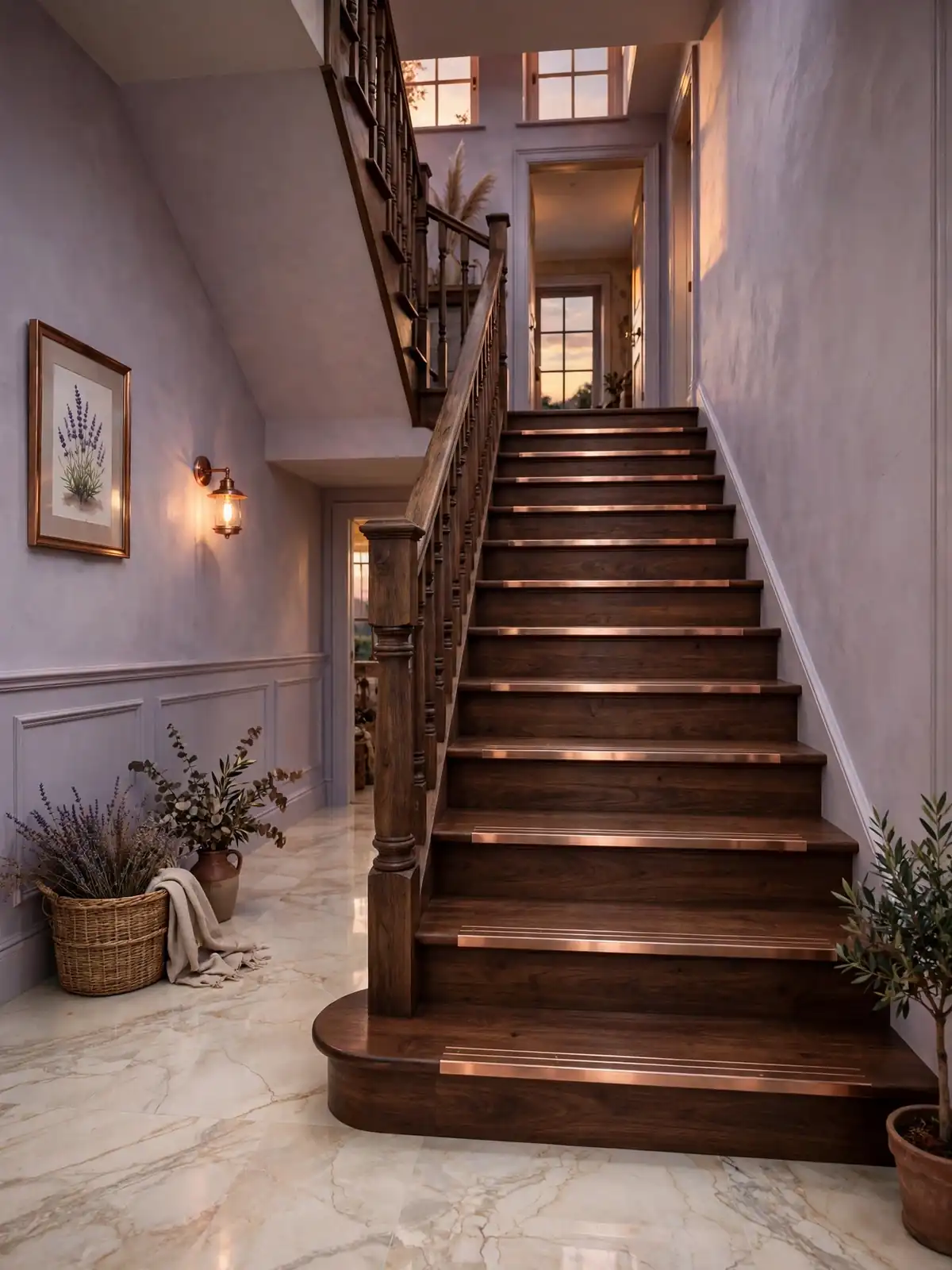
A thin copper line on the edge of every tread turns a simple country stair into a piece of jewellery. Here, dark walnut treads, each 1 metre wide, carry a 10 mm wide brushed-copper inlay strip along the nosing, catching the light on every step. Soft lavender walls and a cream marble floor keep the palette gentle, while a small copper wall sconce on the landing echoes the inlay. The copper glows gently in the evening and guides the eye upward.
Quick tips:
- Use brushed copper, not polished, for a softer, rustic shine.
- Keep the inlay strip slim — about 10 mm — so it reads as a fine line.
- Pair dark treads with pale walls so the copper stands out.
- Match the copper tone to a sconce or mirror nearby.
A Rustic Staircase Beside a Warm Brick Feature Wall
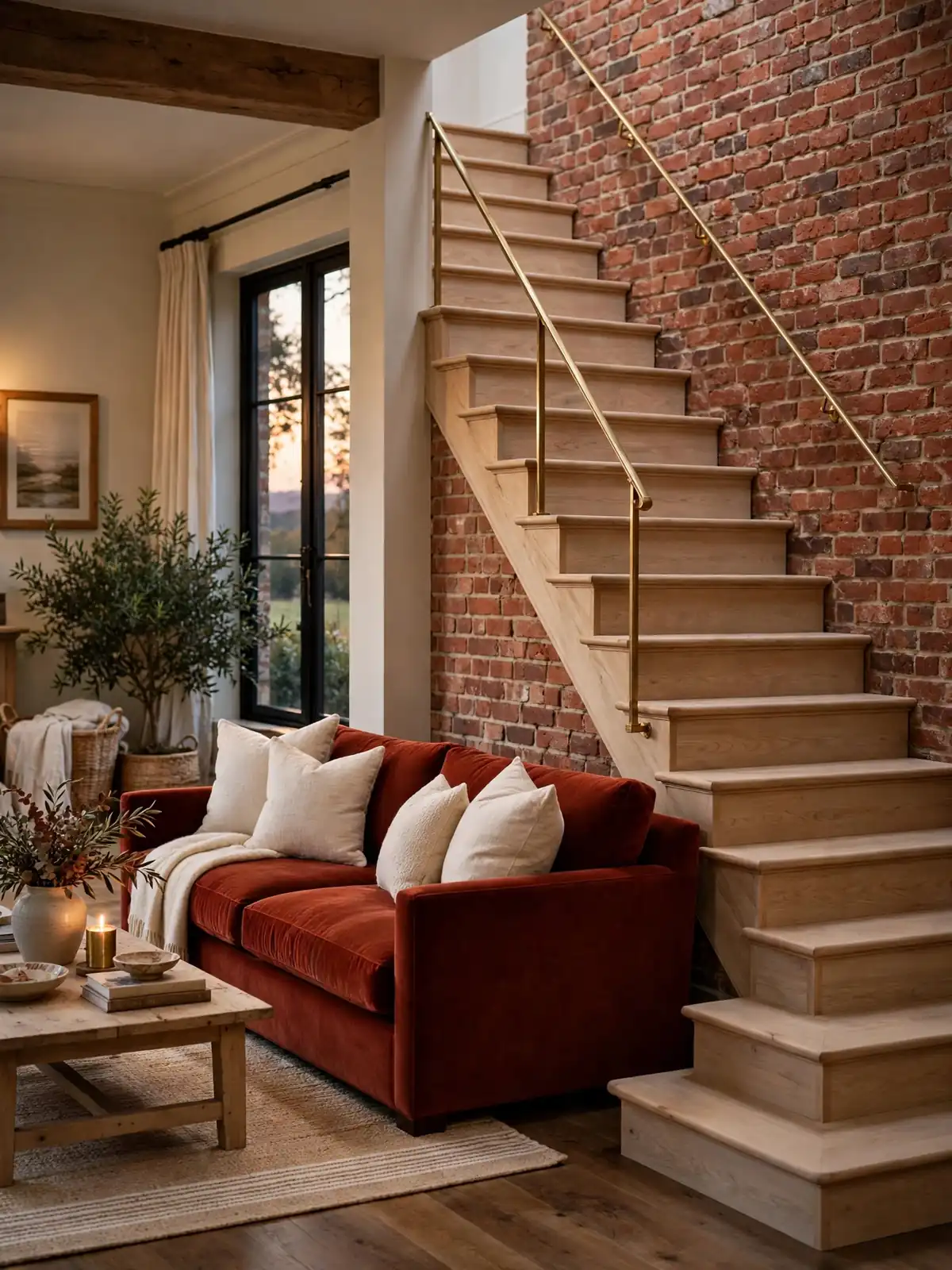
Exposed brick is warm, textured and timeless — a beautiful wall beside a rustic staircase. On this stair, pale oak treads, each 950 mm wide, run beside a full-height exposed red-brick wall, with a slim brass handrail fixed to the brickwork. A deep rust-red sofa and cream cushions below pick up the brick’s warm tones, while soft evening light makes the wall glow gently. The brick also softens sound, so the stair feels quieter underfoot.
Quick tips:
- Seal the brick wall so it stays clean and easy to dust.
- Pair brick with pale oak for a warm, natural palette.
- Add a brass handrail to lift the brick’s earthy tone.
- Keep the sofa colour warm — rust, ochre or deep red — to match the wall.
A Rustic Staircase With a Landing Turned Into a Small Reading Nook
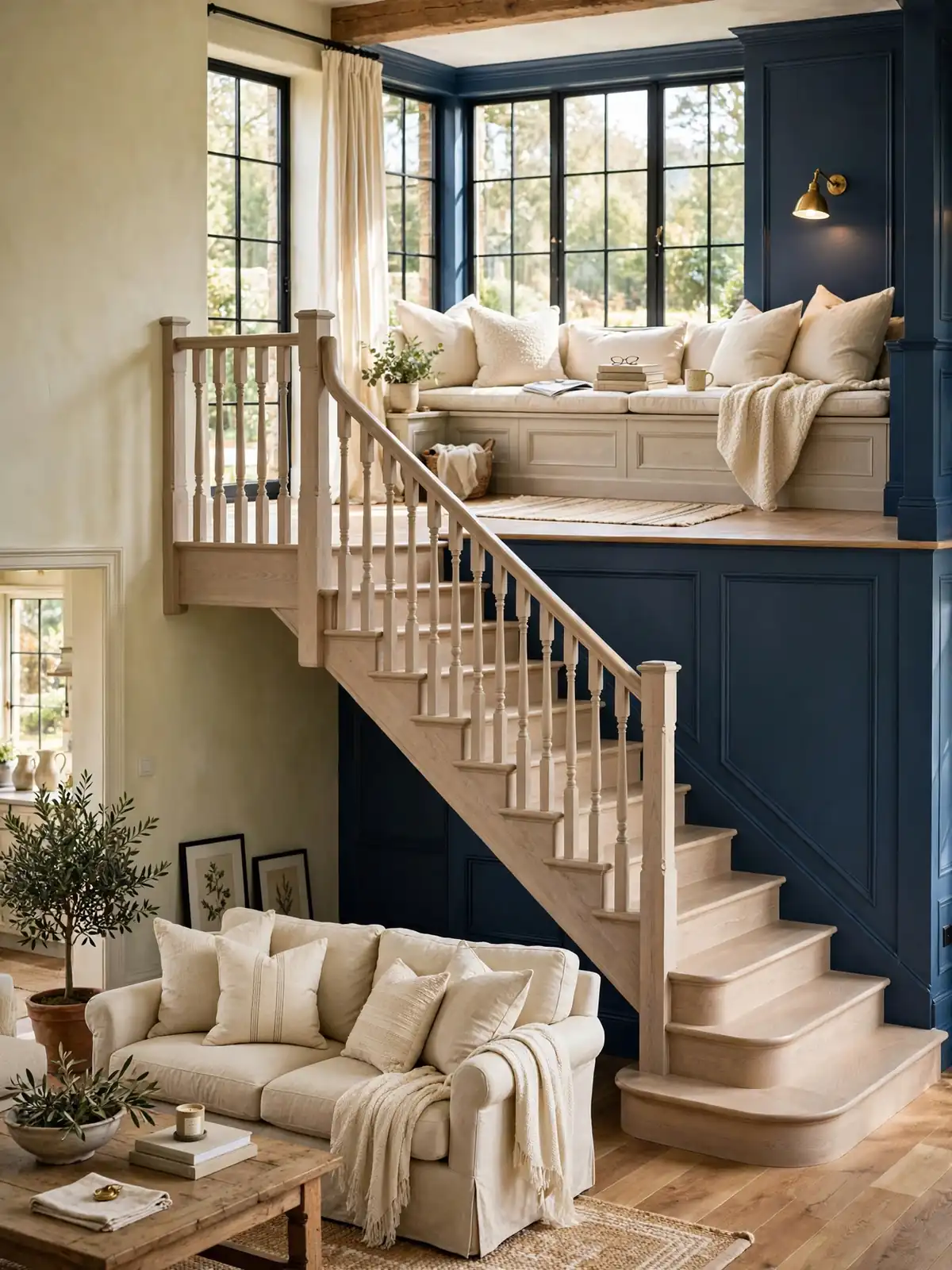
A wide landing can do more than turn the stair — it can become a small reading nook. Here, the landing is 1.2 metres deep, with a built-in oak bench, 500 mm deep, dressed in cream cushions, a brass reading lamp glowing softly, and a small stack of books. Pale ash treads, each 900 mm wide, rise on either side, while navy-blue walls make the pale landing stand out. It is a quiet corner that borrows daylight from the stairwell and needs no extra room at all.
Quick tips:
- Make the landing at least 1.2 metres deep so the nook feels usable.
- Build the bench in the same oak as the treads for a unified look.
- Add a brass lamp for focused evening reading.
- Keep the cushions cream so the nook stays bright against navy walls.
A Rustic Staircase With a Slim Oak Newel and a Wrought-Iron Lantern Above
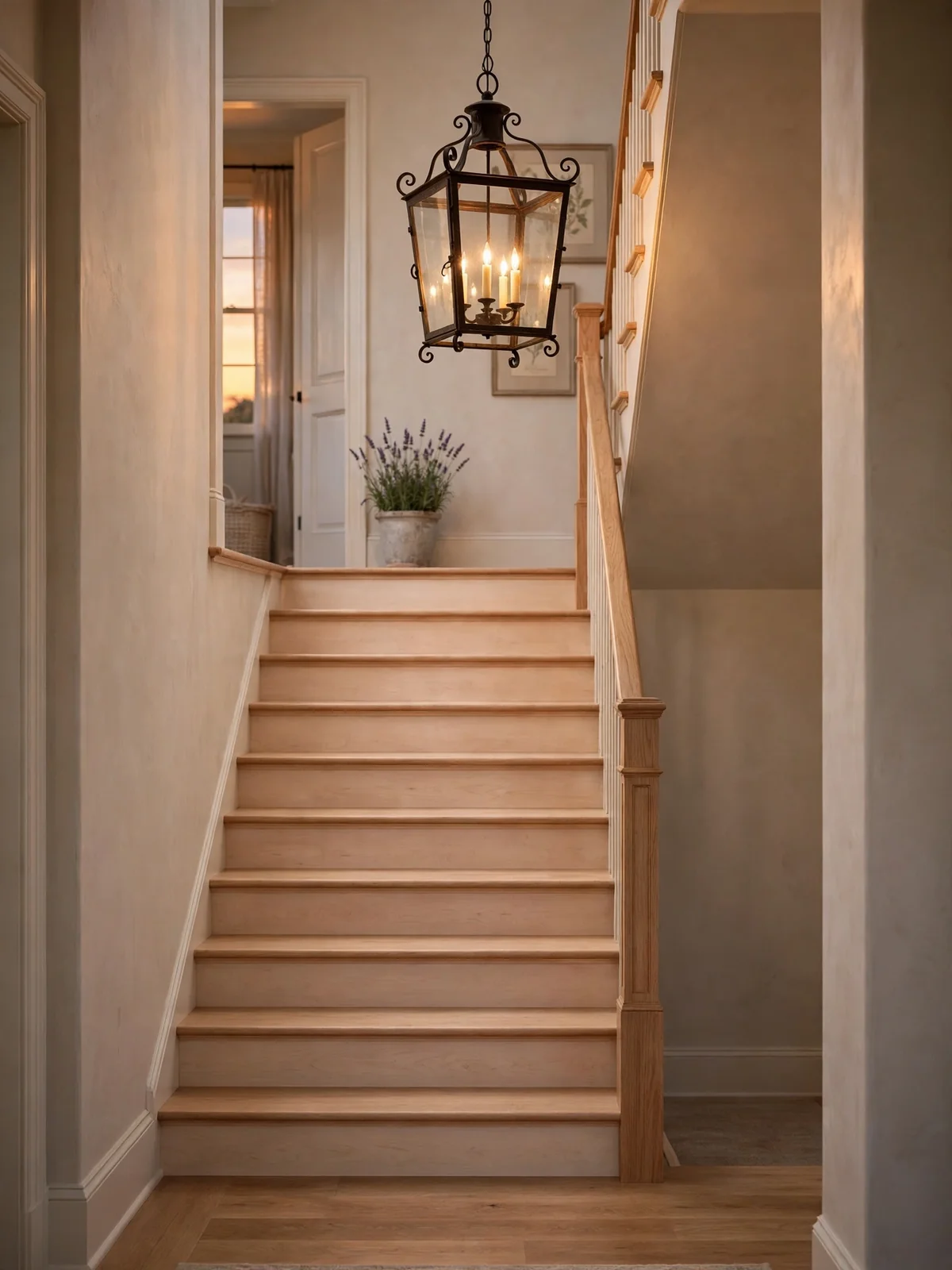
A slim oak newel and a wrought-iron lantern give a rustic staircase a calm, farmhouse warmth. On this stair, pale maple treads, each 900 mm wide, rise beside a slim oak newel post, 80 mm square, at the base, while a large wrought-iron lantern, 500 mm tall, hangs above the landing and glows warmly in the evening. Soft beige walls and a small potted lavender on the landing complete the quiet palette, and the lantern’s diffused light falls softly across every tread.
Quick tips:
- Keep the newel slim — about 80 mm square — for a light, country look.
- Hang the lantern above the landing, not the middle of the flight.
- Choose a warm bulb so the lantern glows softly, not starkly.
- Add one living detail, like potted lavender, on the landing.
A Rustic Staircase That Links a Loft Bedroom to the Living Room
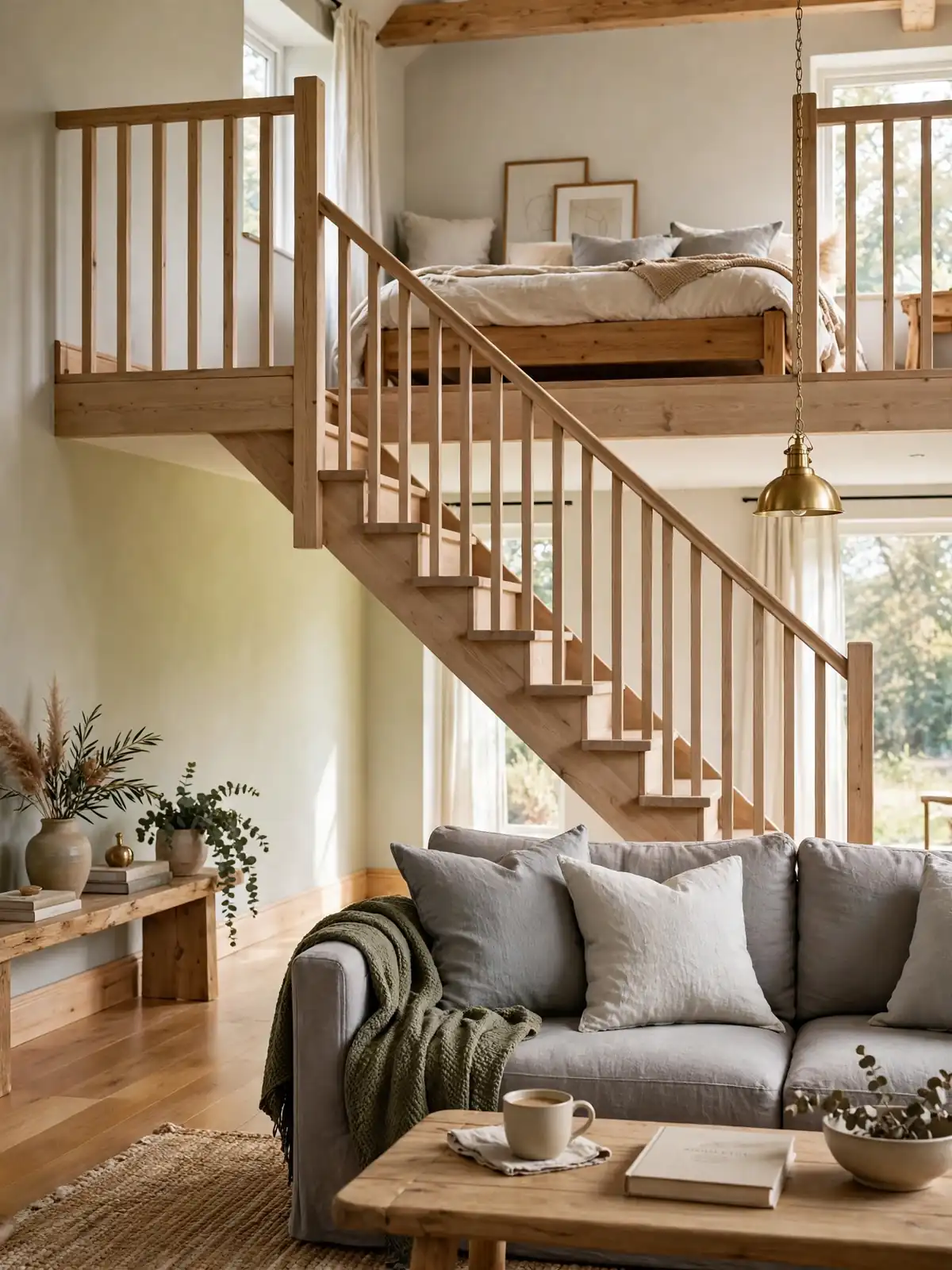
A stair to a loft bedroom connects sleeping and living without a wall between them. In this open-plan home, a rustic staircase with pale oak treads, each 950 mm wide, and a simple timber balustrade rises from the living room to a cosy loft bedroom, where a warm timber bed frame and a brass pendant light sit above a soft grey sofa below. Daylight from the living room windows travels up the stair to the loft, so the bedroom feels bright and the living room feels taller. The stair is the link that makes both levels feel like one room.
Quick tips:
- Use a simple timber balustrade on the loft side so light reaches the bedroom.
- Match the bed frame timber to the stair treads for a unified look.
- Keep the loft railing slim so the living room stays open.
- Add a brass pendant above the bed for warm evening light.
FAQs
How much does a rustic staircase cost?
Costs vary widely with materials, shape and size. A simple straight stair with reclaimed pine treads and an iron balustrade is usually the most affordable rustic option, while a curved stair, a full stone stair, or a stair built from rare reclaimed barn oak costs far more because of the sourcing and custom work. Always get at least two detailed quotes that include the handrail, lighting and finishing, not just the treads.
Are open risers safe in a rustic staircase?
Open risers are safe for most adults and older children when the gaps are kept small and the treads are deep and non-slip. For toddlers, pets, or anyone unsteady on stairs, a closed riser, a solid timber balustrade, or a low panel adds safety without losing the rustic, open look. Building rules in your area may also set a maximum gap size, so check before you build.
Can a rustic staircase work in a modern home?
Yes, if the stair is paired with one clean element. Warm walnut treads, a slim black iron handrail, a pale plaster wall and simple modern furniture keep the stair feeling at home in a contemporary house, while the reclaimed timber quietly adds warmth without changing the character of the rooms. The key is to keep one warm, natural material in the mix.
What is the best railing for a rustic staircase?
There is no single best railing — it depends on the look and the light you want. Hand-forged iron balusters feel most authentic, a thick rope handrail suits a cottage, a chunky timber rail adds warmth, and a simple timber balustrade keeps the stair open and bright. Choose the railing after the treads, so the two materials balance each other.
Does a rustic staircase need a lot of maintenance?
Most rustic stairs are low maintenance. Timber treads need resealing every few years, iron fixings need an occasional wipe to prevent rust, and woven runners need regular vacuuming. Stone and brick are among the easiest to keep clean, while whitewashed timber shows scuffs sooner and needs a touch-up now and then.
Conclusion
A rustic staircase is not just a way to move between floors — it is a way to bring warmth, texture and the character of the countryside into the whole home. Whether you choose reclaimed barn oak with hand-forged iron, rough-hewn pine with a rope handrail, walnut beside a stone wall, a jute runner, a firewood store, or a loft stair that links two levels, the best rustic staircase is the one that suits the rooms around it. Keep the palette warm, the materials honest, and the space under and beside the stair intentional, and your stair will make every room it touches feel cosier, more welcoming and more alive.