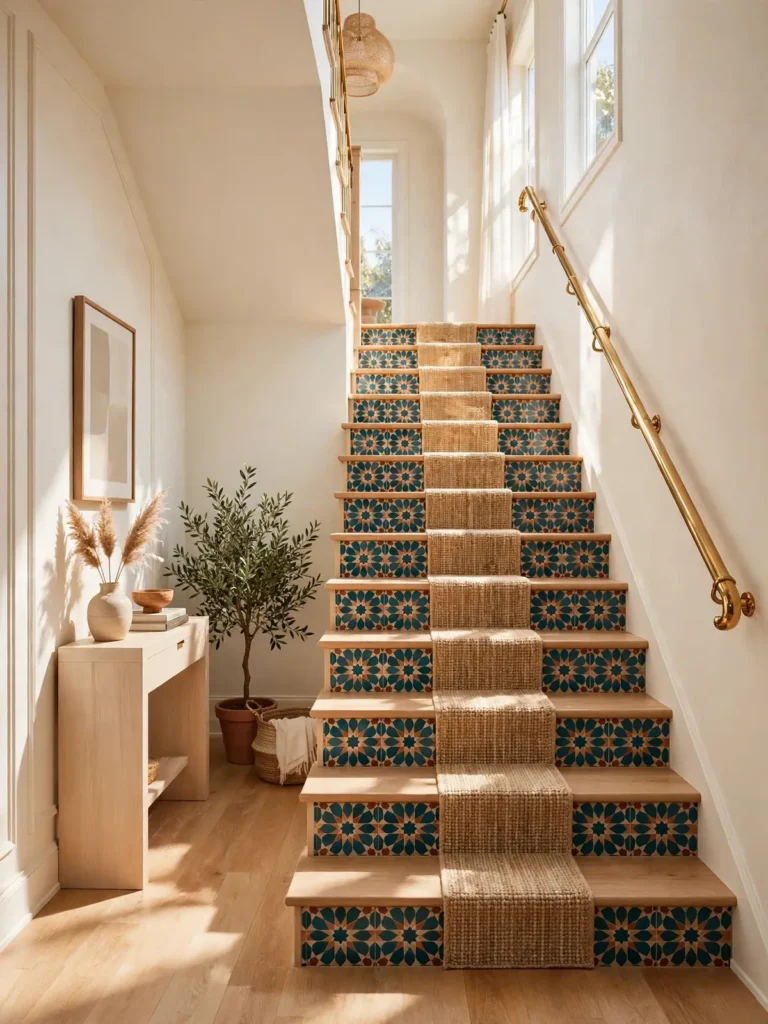
25 Stunning Staircase Railing Design Ideas That Instantly Transform an Overlooked Staircase Into a Design Statement
Staircase railings are one of the most underestimated design features in a home — built for safety, but visually they carry serious weight. These 25 staircase railing design ideas show how black metal balusters, horizontal rails, glass panels, cable railings, wrought iron and sculptural forms can turn an everyday staircase into a design statement, whether your home is modern, farmhouse, traditional or somewhere in between.
Staircase railing design ideas are the choices that turn a safety feature into a design statement — the balusters, the handrail, the newel posts and the materials that carry the eye up the flight. The best staircase railing design starts with the simplest upgrade: swapping traditional spindles for slim black metal balusters, because the slim lines open up the space, let light pass through, and make the whole staircase feel lighter in a single afternoon.
For a clean, contemporary version of the same thinking, these modern staircase railing ideas show how slim steel, glass and pale timber keep a stair feeling bright and architectural. The 25 ideas below cover every style of railing — modern, traditional, coastal, industrial and sculptural — so you can choose a design that suits your home, your budget and the way your family actually lives.
Key Takeaways
What is the most popular staircase railing design?
Slim black metal balusters with a warm wood handrail is the most popular staircase railing design, because it suits modern, transitional and traditional homes alike. The black lines add contrast, the timber adds warmth, and the slim profile keeps the stair feeling open and light.
How much does it cost to replace a staircase railing?
Painting an existing railing costs under a hundred pounds in paint and takes a weekend. Replacing balusters with slim black metal ones usually costs a few hundred pounds in materials. A full new railing — glass panels, cable, or a custom sculptural design — usually runs into the low thousands, depending on the length of the flight and the materials.
What railing design is safest for children?
A railing with vertical balusters spaced no more than 100 mm apart is the safest for children, because small heads cannot pass through the gaps. Avoid horizontal rails and wide-spaced cables in homes with small children, because they can be climbed like a ladder. Glass panels are safe when made from tempered glass.
Can I change my staircase railing without rebuilding the stairs?
Yes — most railing changes need no structural work. Swap the balusters, repaint the handrail, replace the newel posts, or add glass panels to the existing structure. Only a floating stair, a new stringer, or a curved handrail needs a joiner or a stair specialist.
How do I choose a railing design that suits my home?
Match the railing to the architecture around it. Modern homes want clean lines — slim steel, glass or cable. Farmhouses want warmth — timber, iron and woven textures. Traditional homes like detail — turned balusters, carved newels and classic handrails. Take cues from your doors, trim and hardware, so the staircase belongs.
Sleek Black Metal Balusters in Staircase Railing Design for a Modern Refresh
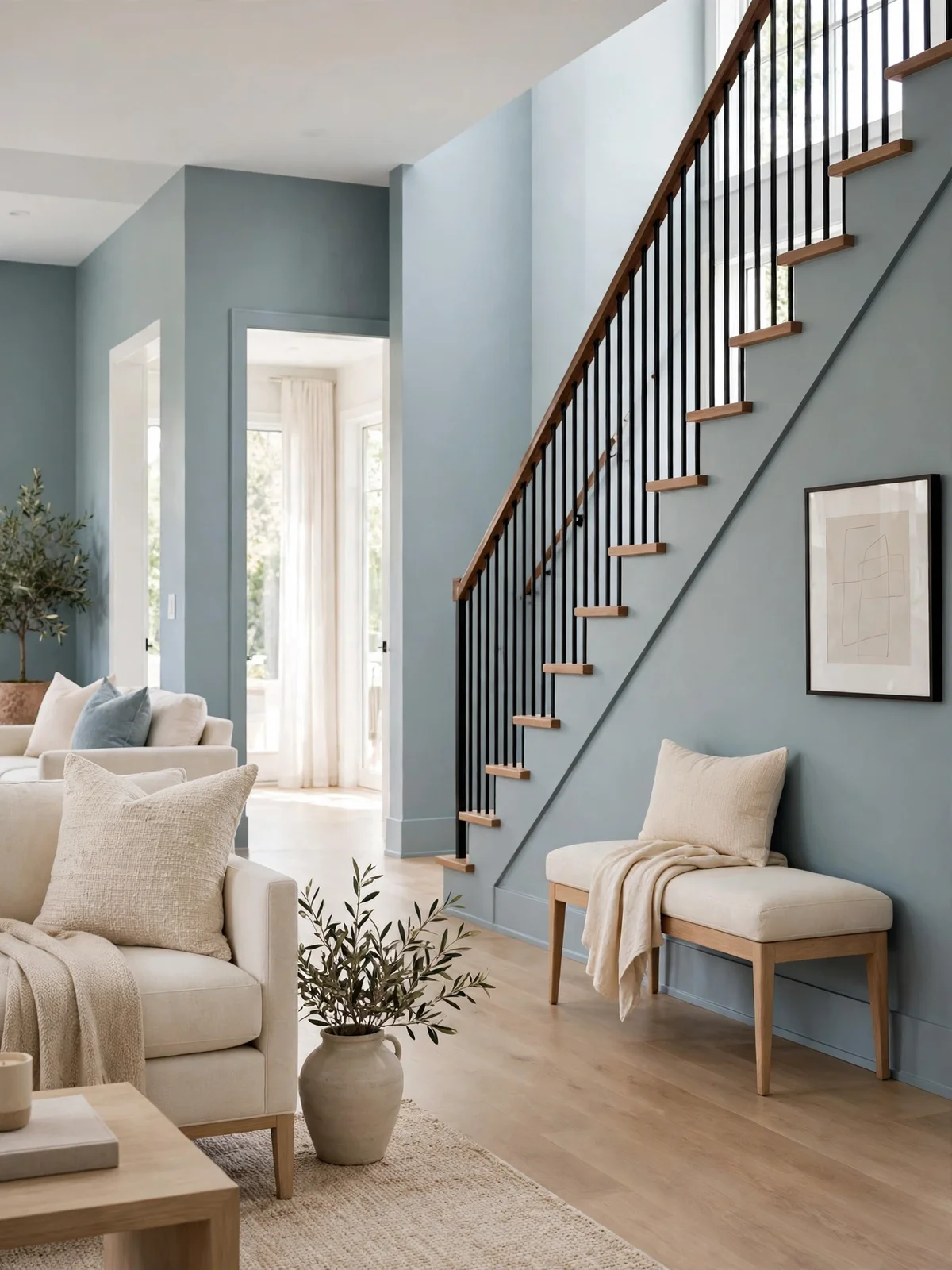
Black metal balusters instantly modernise a staircase in staircase railing design, even when the rest of the house leans traditional, because they add contrast without screaming for attention. Here, slim 12 mm square black steel balusters, two per tread, rise from pale oak treads, each 950 mm wide, to a warm walnut handrail, 60 mm wide, sanded smooth and oiled. Soft dusty-blue walls and a cream bench below keep the hallway calm, while the slim metal lines let light pass through and make the staircase feel lighter.
Quick tips:
- Use two slim balusters per tread for a clean, even rhythm.
- Pair black steel with a warm timber handrail for balance.
- Keep the balusters slim — about 12 mm — so the stair stays open.
- Paint the newel post the same black so the set reads as one piece.
Horizontal Railings in Staircase Railing Design for a Clean, Linear Edge
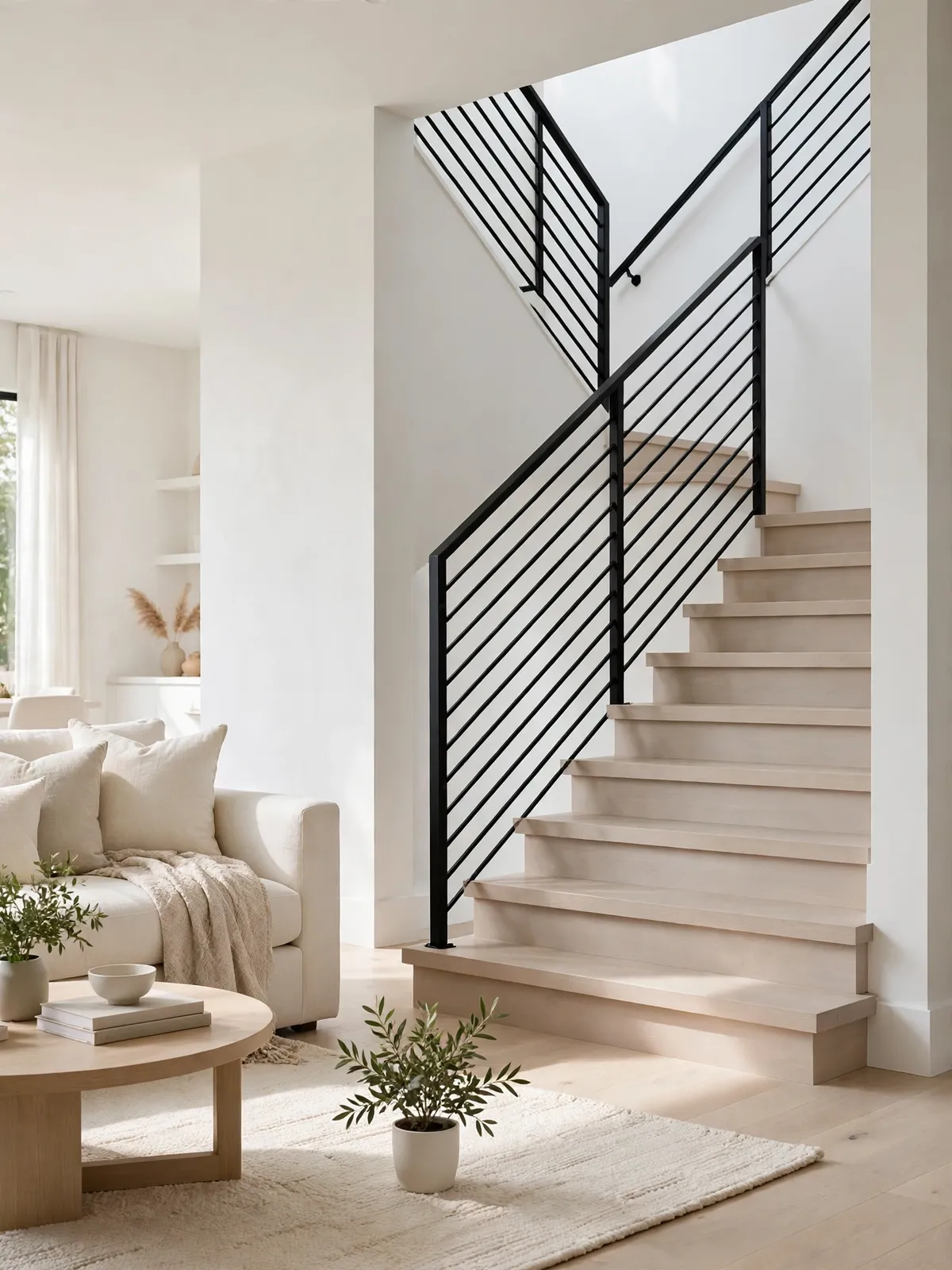
Horizontal railings bring a totally different energy to staircase railing design — clean, linear and architectural, especially in contemporary homes and open floor plans. Here, five slim black steel rods run horizontally between slim black posts above pale ash treads, each 900 mm wide, with soft white walls and a cream rug below. The rods are spaced 90 mm apart, the handrail is a slim black steel tube, and the whole railing feels crisp and confident — a design that says, yes, this was designed.
Quick tips:
- Space horizontal rods about 90 mm apart for safety and rhythm.
- Choose stainless steel for a sleek feel, black-coated metal for boldness.
- Keep the handrail slim so the horizontal lines stay the feature.
- Avoid horizontal rails in homes with small children — they can be climbed.
A Chunky Wood Handrail in Staircase Railing Design for Warmth and Substance
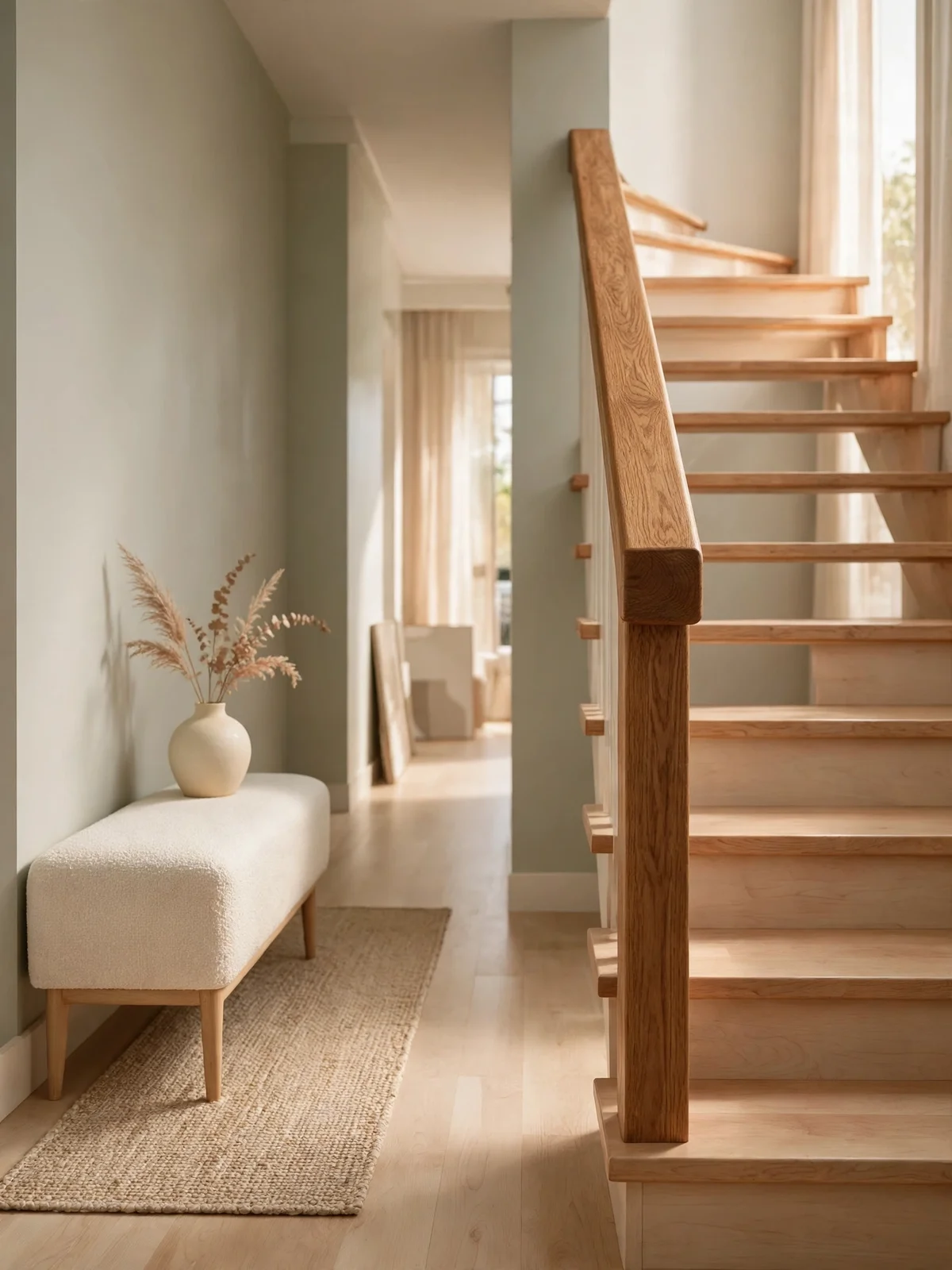
Sometimes it is not about changing everything — sometimes it is about upgrading one detail, and a chunky wood handrail in staircase railing design adds instant warmth and substance. Here, a thick oak handrail, 80 mm wide and 50 mm deep, runs the full flight above pale maple treads, each 950 mm wide, with simple white spindles below and soft sage-green walls around. The handrail feels good in the hand — solid, grounded, warm — and even paired with simple white spindles, the thicker rail elevates the entire staircase.
Quick tips:
- Choose a handrail about 80 mm wide so it feels substantial in the hand.
- Let the wood grain show — oak, maple or walnut, oiled not varnished.
- Pair a chunky handrail with simple white spindles for balance.
- Round the edges so the rail is comfortable to grip every day.
Painted Railings in Staircase Railing Design for a Budget-Friendly Refresh
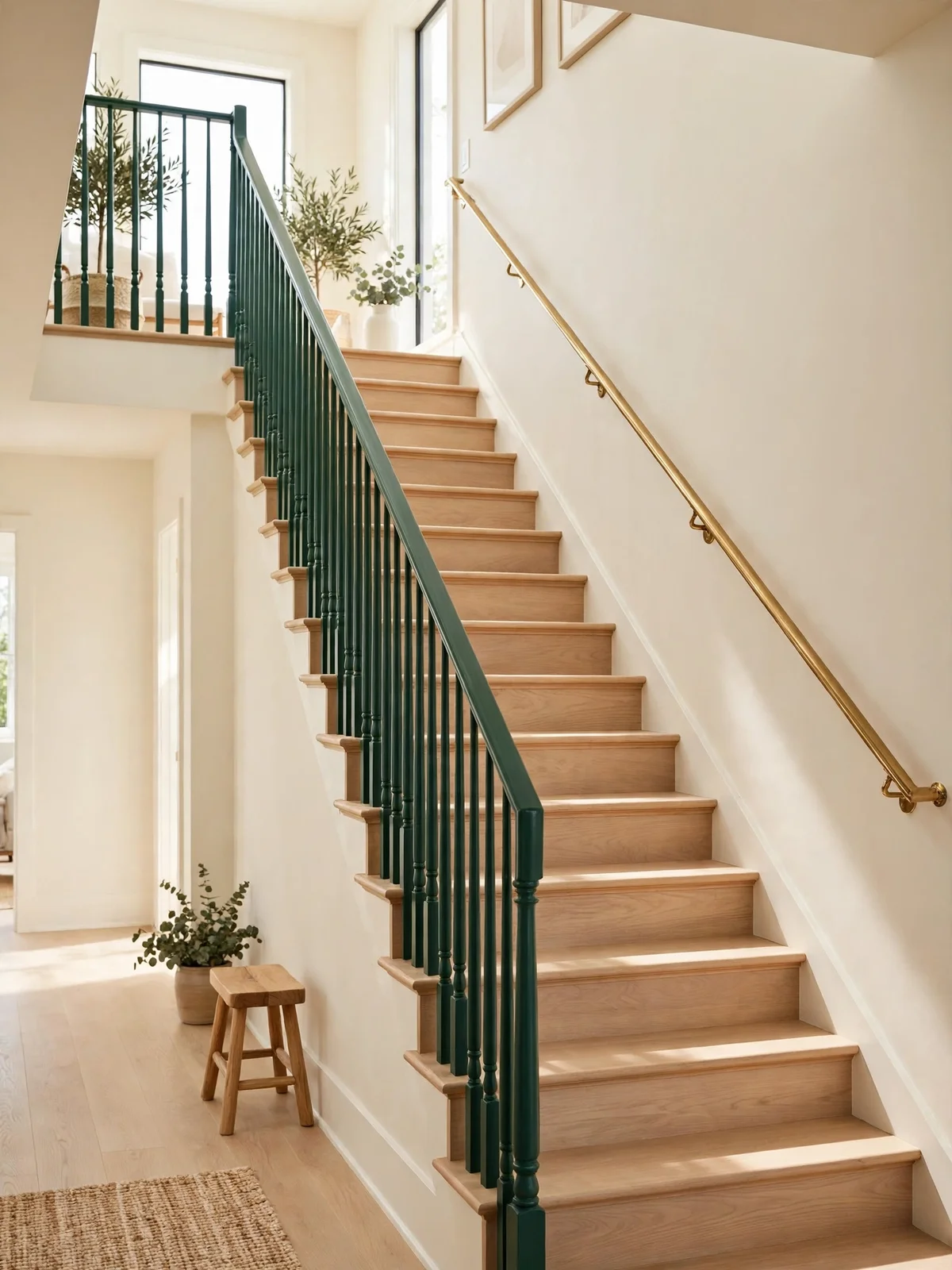
If replacing the railing is not in the cards, paint can do wonders in staircase railing design — painting railings black, charcoal or deep green gives them new life, especially against light walls. Here, the existing balusters and handrail are painted deep forest green in a durable satin finish above pale oak treads, each 950 mm wide, with soft cream walls and slim brass handrail brackets. The green looks expensive, the paint cost almost nothing, and the whole stair feels new.
Quick tips:
- Clean well, sand lightly and prime before painting a railing.
- Choose deep green, navy or charcoal for a dramatic refresh.
- Use a durable satin paint so the railing wipes clean.
- Paint the newel posts the same colour so the set reads as one piece.
Glass Panels in Staircase Railing Design for Openness and Light
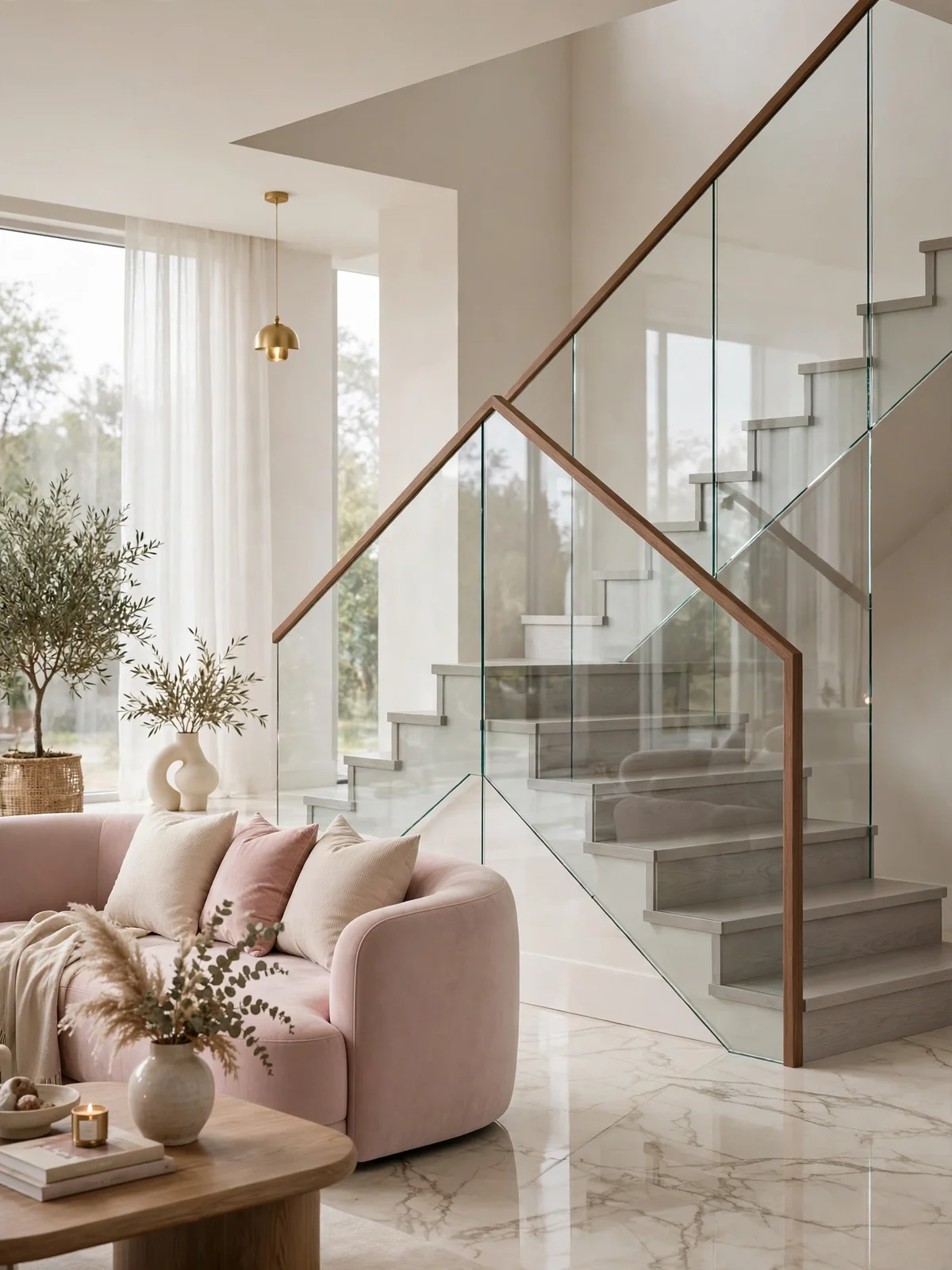
Glass railings are stunning when done right in staircase railing design, because they practically disappear — if a staircase blocks light or chops up the space, glass is the answer. Here, 12 mm thick tempered glass panels run along a flight of pale grey oak treads, each 950 mm wide, held in slim steel channels, while a warm walnut handrail, 60 mm wide, runs along the top of the glass. A soft blush-pink sofa and a cream marble floor below keep the palette gentle, while the glass keeps everything open and airy.
Quick tips:
- Use tempered glass for safety — always.
- Choose low-iron glass so the panels stay crystal clear.
- Pair glass with a wood or metal handrail to ground the look.
- Wipe the panels with a microfibre cloth to keep them streak-free.
Turned Wood Balusters in Staircase Railing Design for Classic Charm
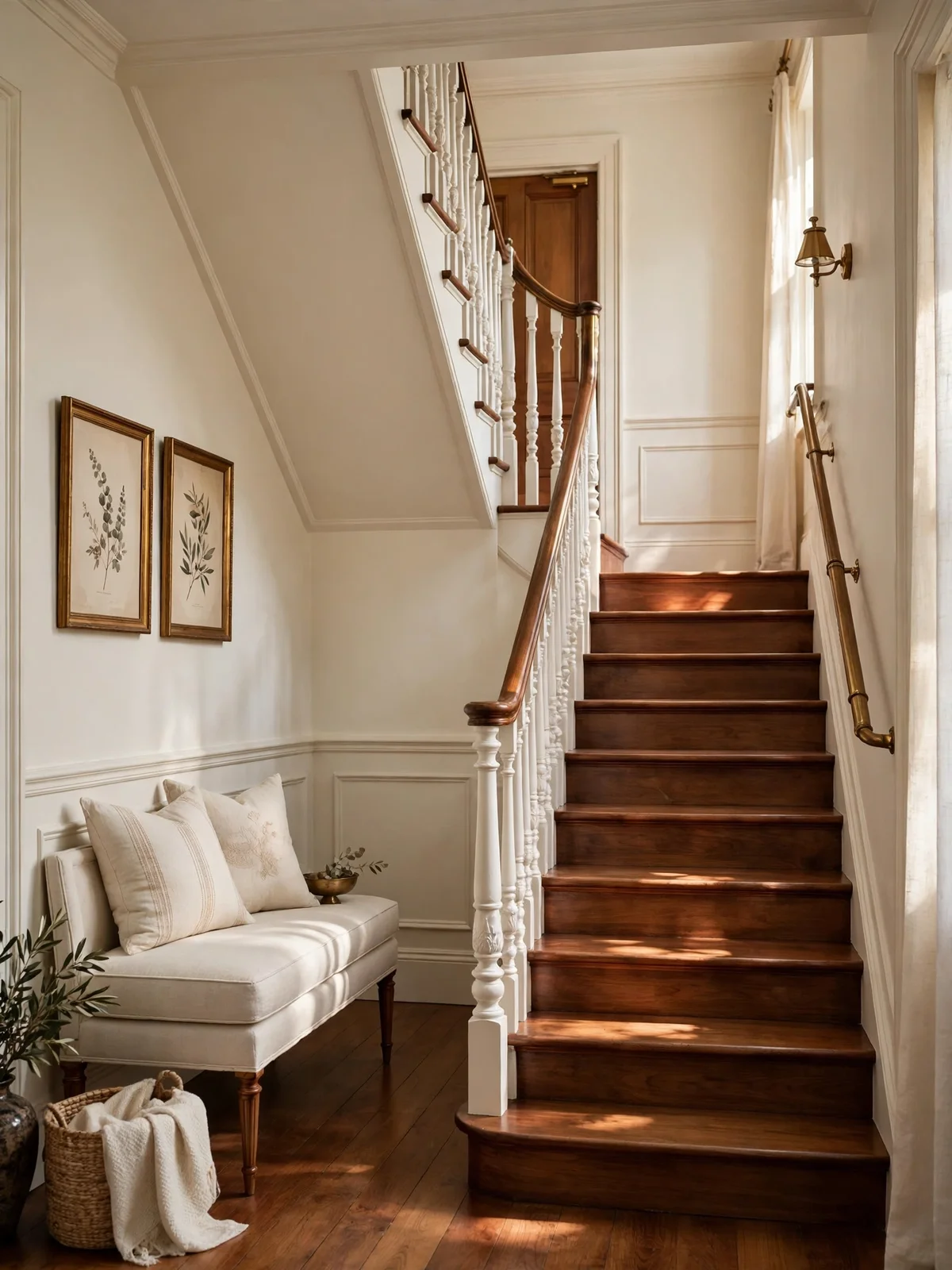
Classic never really goes out of style in staircase railing design, and turned wood balusters bring charm and detail, especially in traditional or cottage-style homes. Here, turned white balusters, each 50 mm at their widest, rise from warm walnut treads, each 950 mm wide, to a slim brass-capped handrail, with soft ivory walls and a cream bench below. The balusters add rhythm, texture and quiet elegance, and the stair feels familiar in the best way — like it has always been there.
Quick tips:
- Paint turned balusters white for a clean look, or stain them to match the handrail.
- Keep the baluster profile classic — a gentle vase shape, not too ornate.
- Pair turned balusters with a warm timber handrail for richness.
- Choose turned balusters for traditional and cottage-style homes.
A Railing Extended Higher in Staircase Railing Design for Drama
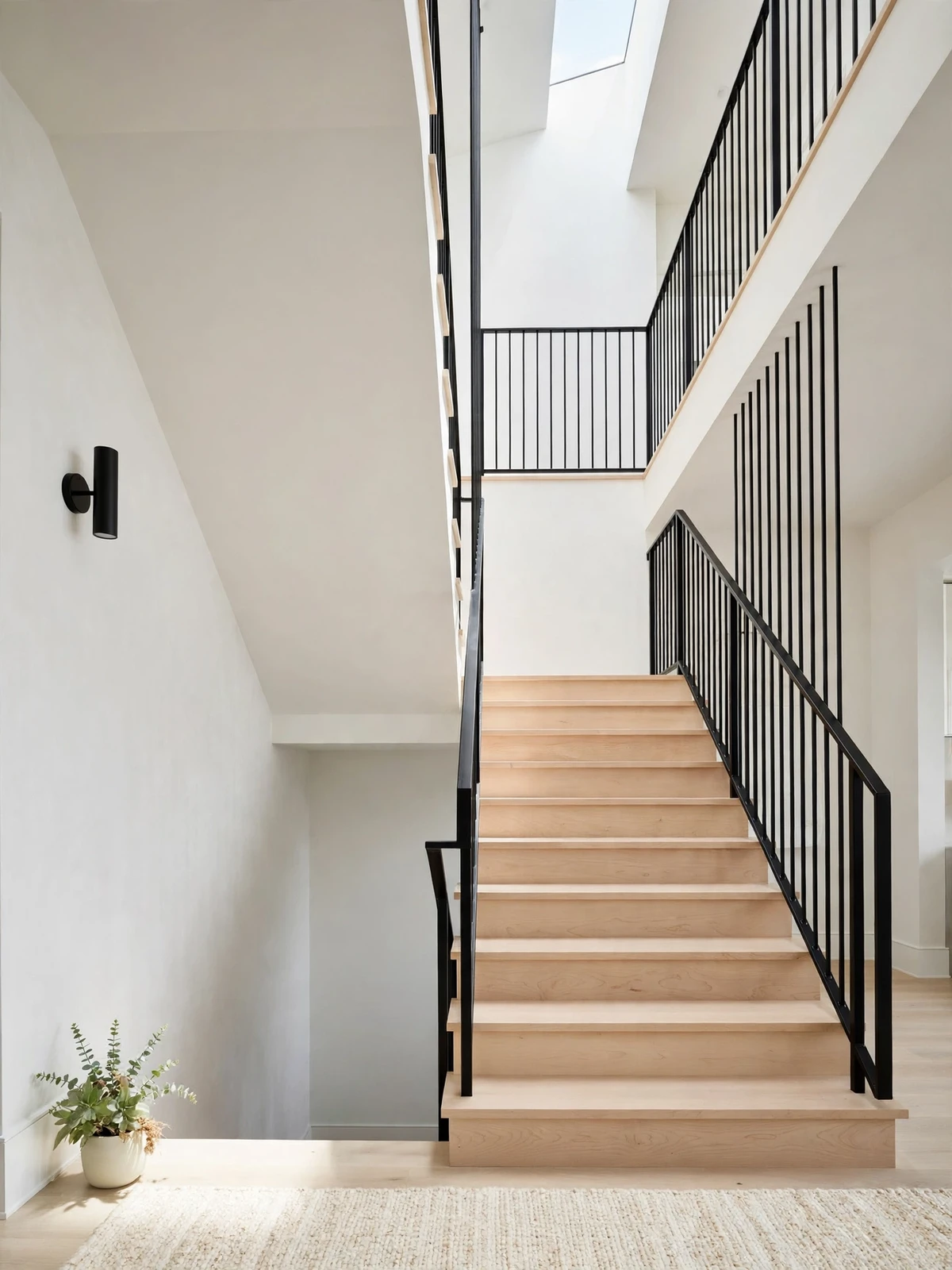
Most railings stop where the stairs end, but they do not have to — extending the railing upward in staircase railing design creates a dramatic vertical line that draws the eye up and makes ceilings feel taller. Here, slim black steel balusters continue 1 metre above the landing beside pale maple treads, each 950 mm wide, with soft white walls and a cream rug below. The extended railing feels like a sculpture in the entryway, and the small change has a big visual impact.
Quick tips:
- Extend the railing about 1 metre above the landing for drama.
- Keep the design simple so the extension does not overwhelm.
- Match the extension to the existing balusters for a seamless look.
- Choose an extended railing for entryways and open stairwells.
A Curved Handrail in Staircase Railing Design for a Softer Flow
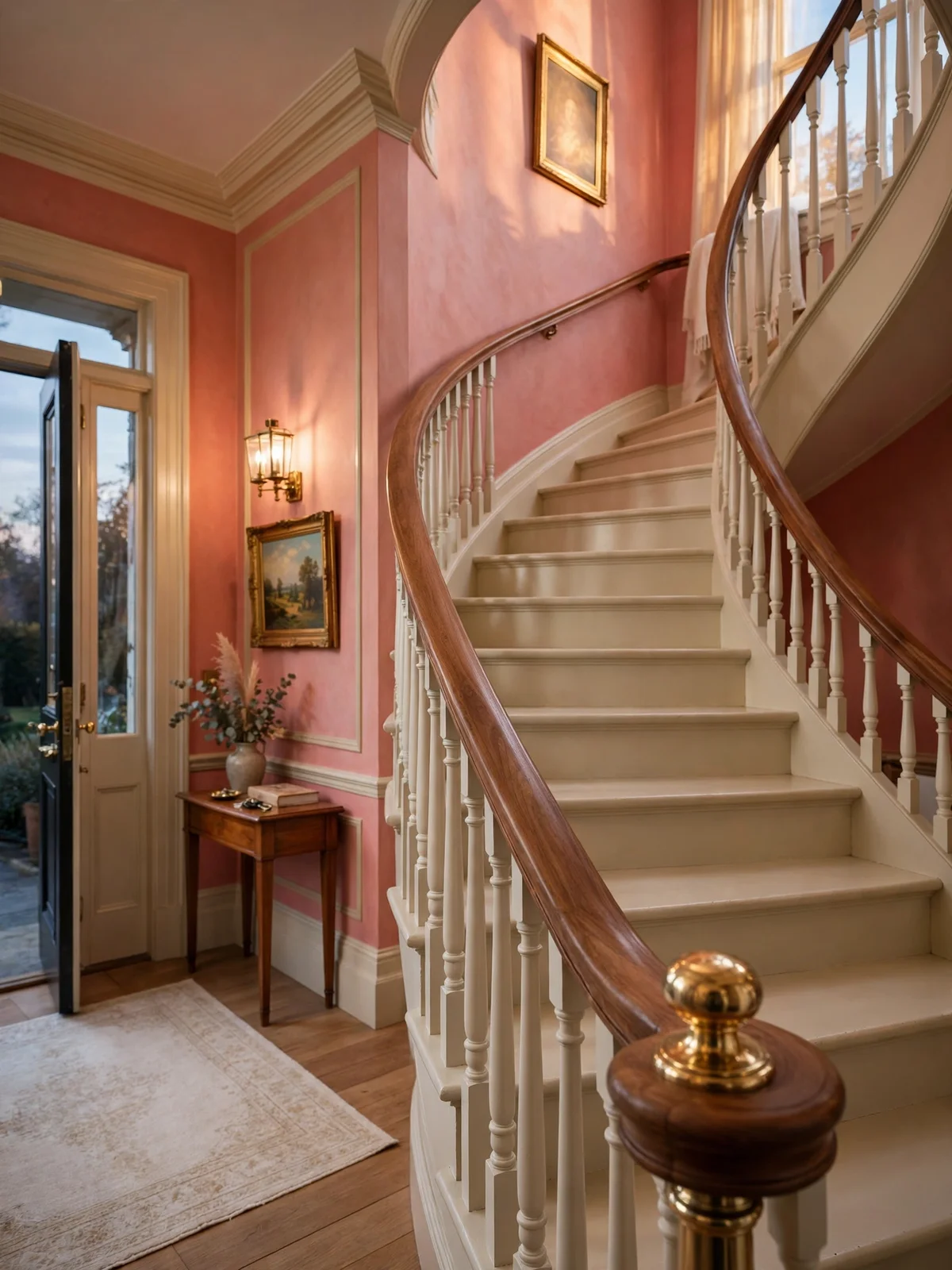
Straight lines are fine, but curves feel special in staircase railing design — a curved handrail adds elegance and movement, especially on staircases with landings or gentle turns. Here, a sweeping walnut handrail, 70 mm wide, curves gently around the landing above pale cream treads, each 1 metre wide, with slim white balusters and a brass newel cap finishing the turn. Soft coral walls and a cream rug below keep the entry warm, and every time you run your hand along the rail, you notice the curve.
Quick tips:
- Choose a curved handrail when the stair has a landing or a gentle turn.
- Keep the balusters slim and white so the curve stays the feature.
- Match the handrail timber to the treads for a unified look.
- Budget for a joiner — a curved handrail is skilled work.
A Railing Matched to the Home’s Architecture in Staircase Railing Design
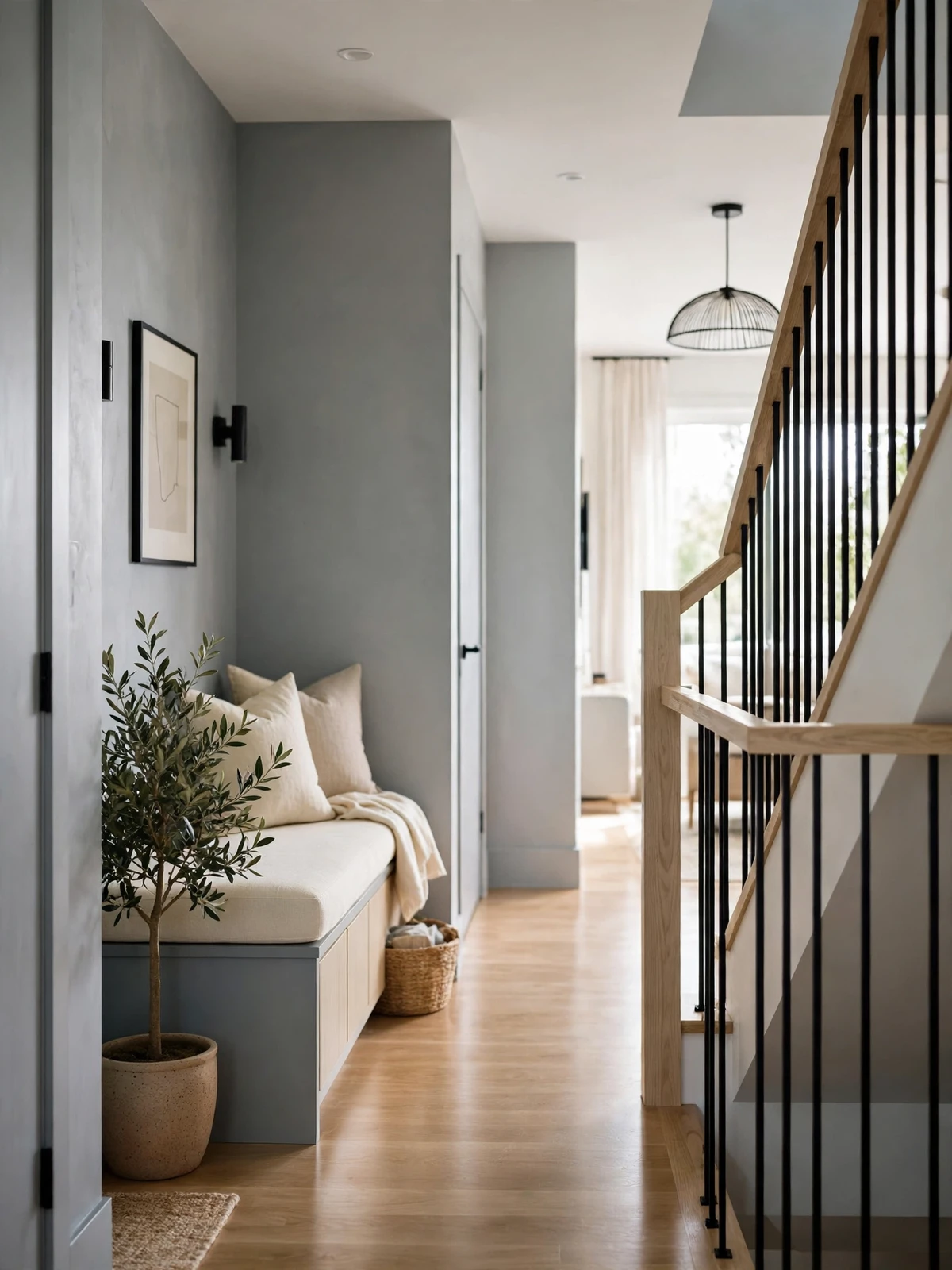
This sounds obvious, but it is often overlooked in staircase railing design — when the railing matches the architecture, everything feels right and nothing fights. Here, slim black steel balusters and a pale oak handrail echo the black window frames and the oak floor of a bright modern home, beside pale oak treads, each 950 mm wide, with soft grey-blue walls and a cream bench below. A small olive tree in a clay pot adds one living accent, and the staircase belongs — it does not feel like it wandered in from another house.
Quick tips:
- Take cues from your doors, trim and hardware when choosing a railing.
- Match black steel to black window frames, oak to oak floors.
- Modern homes want clean lines, farmhouses want warmth, traditional homes like detail.
- Keep the railing consistent with the rest of the house, not a statement on its own.
Cable Railing in Staircase Railing Design for a Light, Coastal Feel
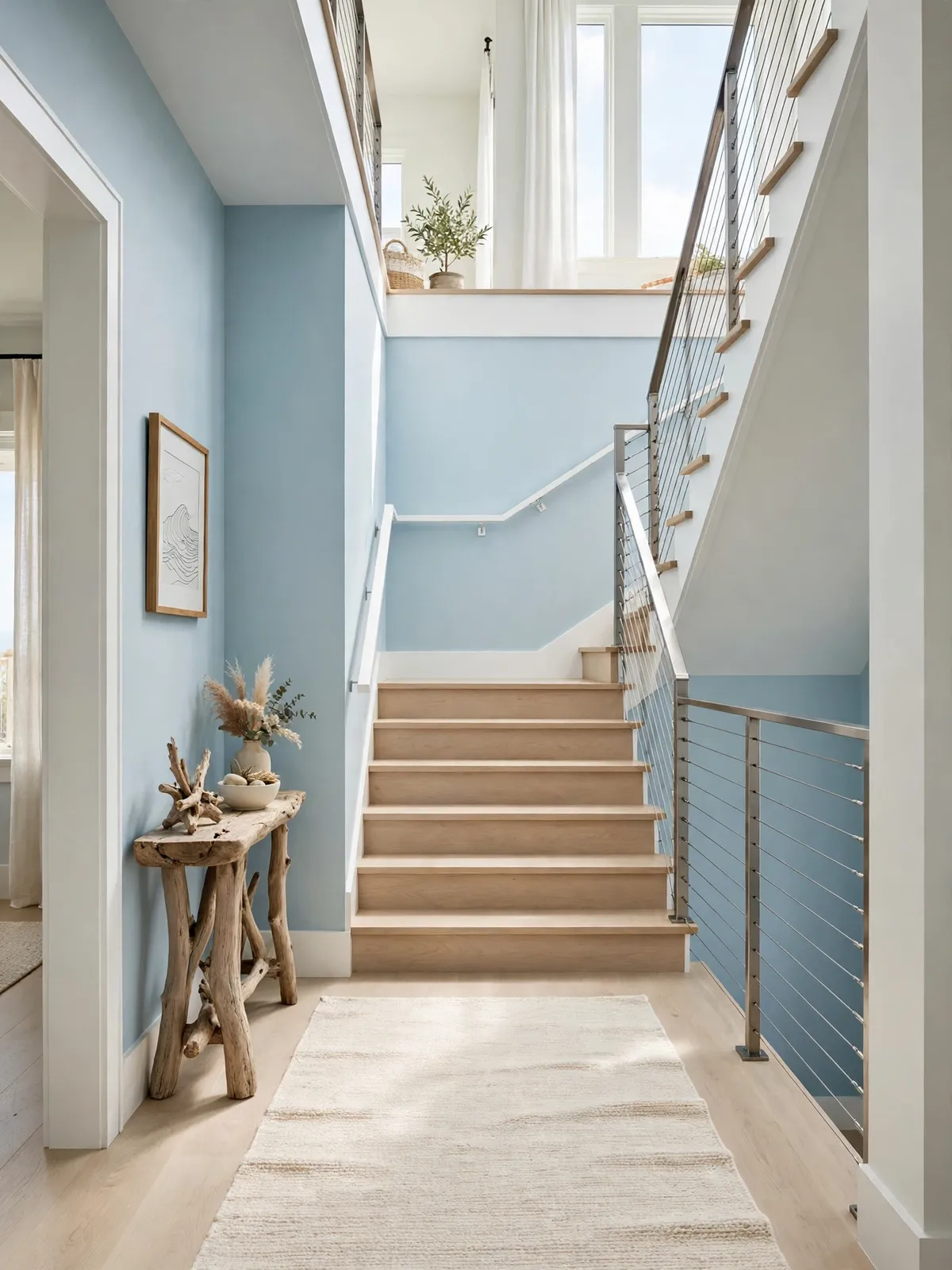
Cable railings have a relaxed confidence in staircase railing design — not flashy, just cool, and perfect for homes that want openness without going full glass. Here, thin steel cables, each 4 mm thick, stretch horizontally between slim white posts above pale oak treads, each 950 mm wide, with soft sky-blue walls and a cream rug below. The cables keep the views clear while adding structure, and the staircase feels casual, airy, like a deep breath.
Quick tips:
- Pair cable railings with wood posts to soften the industrial edge.
- Keep the cables taut so they never sag or feel loose.
- Choose cable railings for coastal, modern and mountain homes.
- Avoid cable railings in homes with small children — they can be climbed.
A Railing Painted the Same Colour as the Wall in Staircase Railing Design
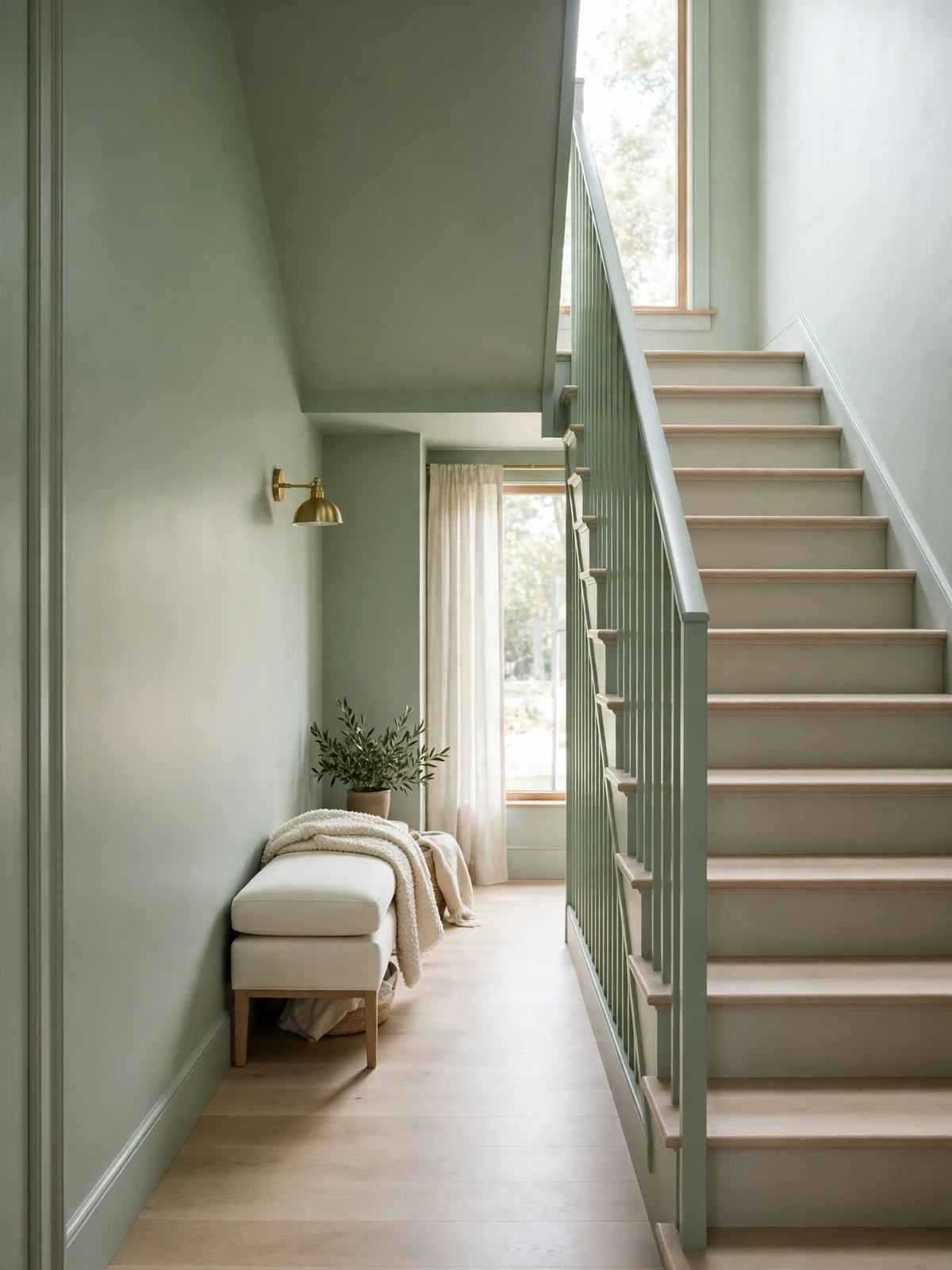
This trick is quietly powerful in staircase railing design — when the railing blends into the wall colour, it visually disappears, and the staircase feels calmer and more cohesive. Here, the balusters, handrail and newel posts are all painted soft sage green, the same as the wall, above pale ash treads, each 900 mm wide, with a cream bench below and a small brass wall light glowing in the afternoon. The staircase becomes part of the architecture, not a distraction, and the small space feels larger without a single structural change.
Quick tips:
- Paint the railing the same colour as the wall for a disappearing effect.
- Use soft neutrals or mid-tone colours — nothing too dark.
- Choose this trick for small spaces where visual clutter overwhelms.
- Keep the treads pale so the stair still reads clearly.
Wrought Ironwork in Staircase Railing Design for Old-World Charm
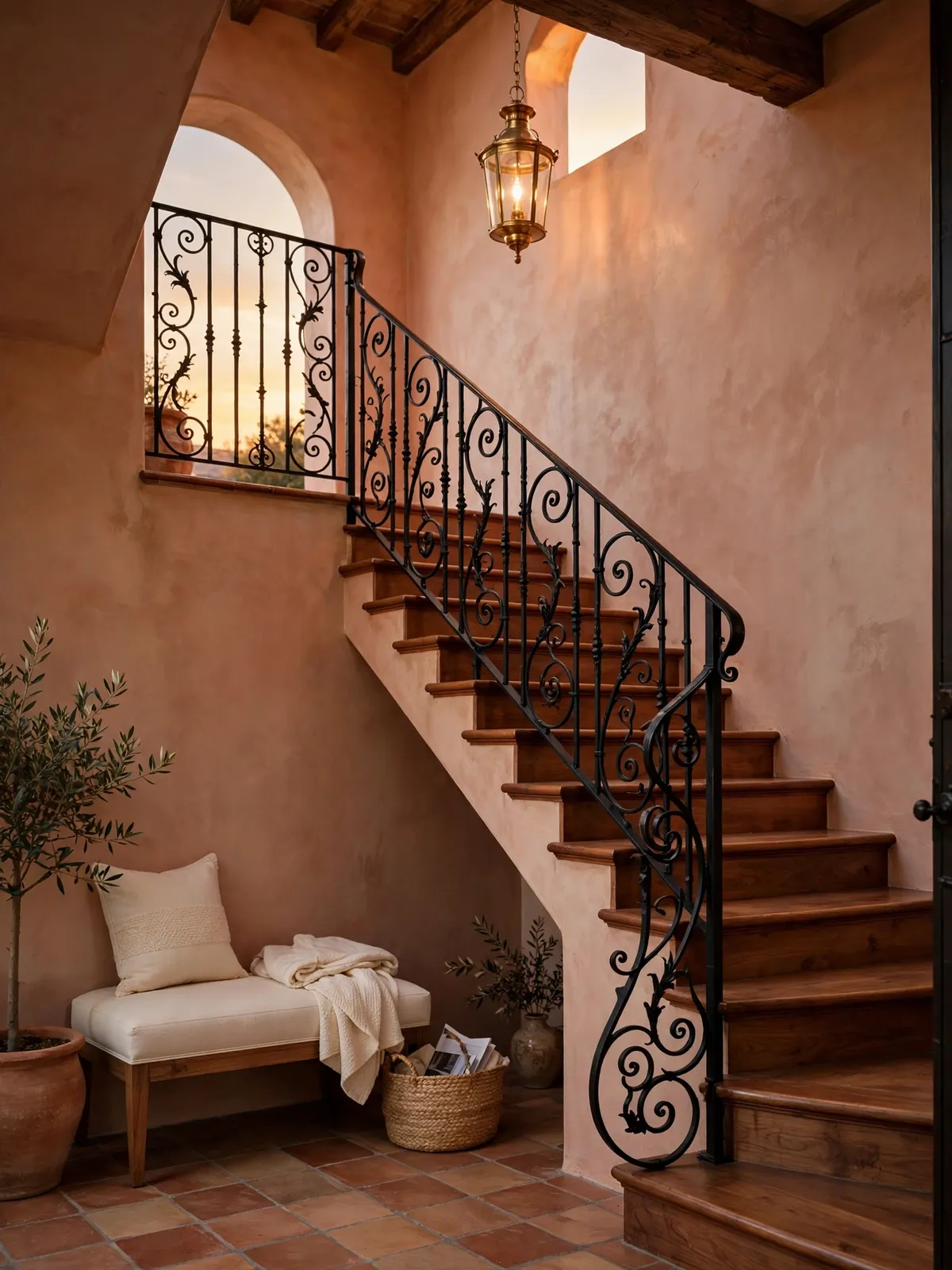
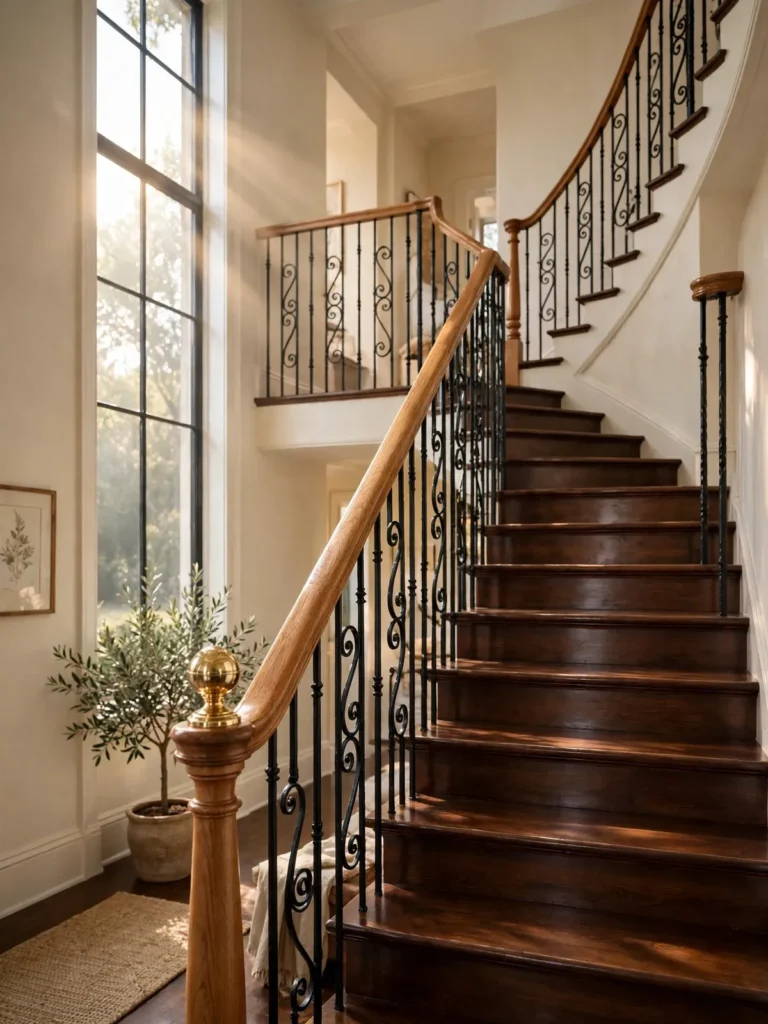
Wrought iron railings bring drama and history to staircase railing design, because intricate scrolls or simple forged designs add weight and romance. Here, black wrought iron balusters with a gentle scroll pattern rise from warm walnut treads, each 950 mm wide, to a dark walnut handrail, with soft terracotta walls and a cream bench below. A small brass pendant above the landing warms the iron in the evening, and the railing feels timeless — like it has always been there.
Quick tips:
- Choose black wrought iron for classic charm, aged bronze for warmth.
- Keep the surrounding space simple so the iron can shine.
- Pair ironwork with warm timber treads for a balanced look.
- Choose ironwork for Mediterranean, Spanish and European-inspired homes.
A Solid Half-Wall Railing in Staircase Railing Design for Families
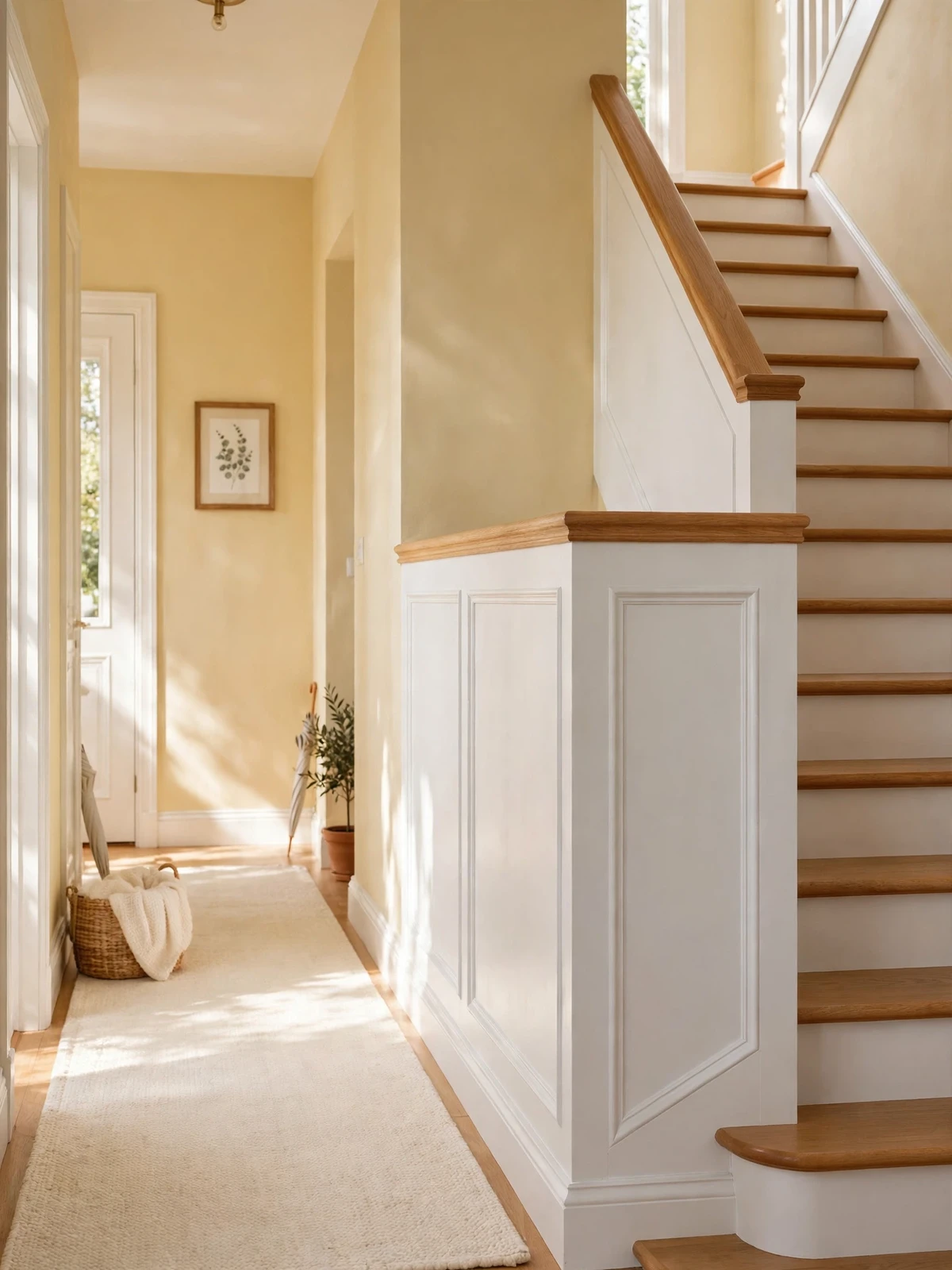
Not every railing has to be open in staircase railing design — a half-wall railing creates a sense of enclosure without closing things off completely, and it feels sturdy and safe. Here, a solid white half-wall, 900 mm high, runs along the flight above honey oak treads, each 950 mm wide, topped with a warm oak cap, 80 mm wide, that doubles as a handrail. Soft butter-yellow walls and a cream rug below keep the hallway warm, and a small woven basket at the base holds the family’s shoes.
Quick tips:
- Top the half-wall with a wood cap for warmth and grip.
- Paint the half-wall the same colour as the walls for a seamless look.
- Choose a half-wall railing for families and traditional homes.
- Keep the cap timber matched to the treads for a unified look.
Decorative Newel Posts in Staircase Railing Design for Personality
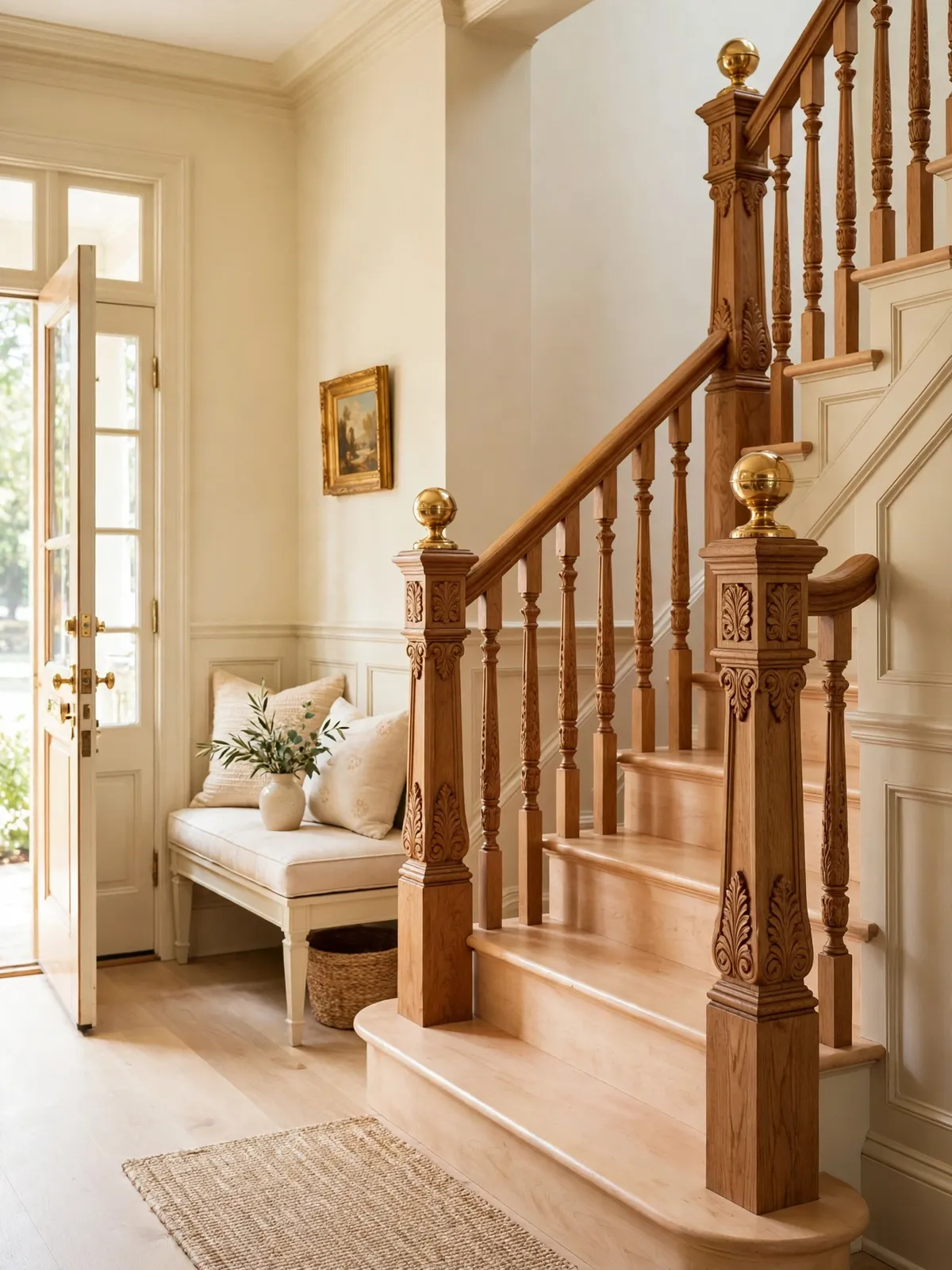
Newel posts are the bookends of a staircase in staircase railing design, and they deserve attention — oversized, carved or uniquely shaped posts anchor the railing and add character. Here, two carved oak newel posts, each 120 mm square with a brass cap, stand at the base and the landing above pale maple treads, each 950 mm wide, with slim white balusters between them. Soft cream walls and a cream bench below keep the entry calm, and the newels carry all the detail while the balusters stay simple.
Quick tips:
- Keep the spindles simple and let the newel posts shine.
- Choose oversized or carved newels for personality without clutter.
- Match the newel timber to the handrail for a unified look.
- Add a brass cap to finish the newel elegantly.
Rope Railing in Staircase Railing Design for Casual Coastal Charm
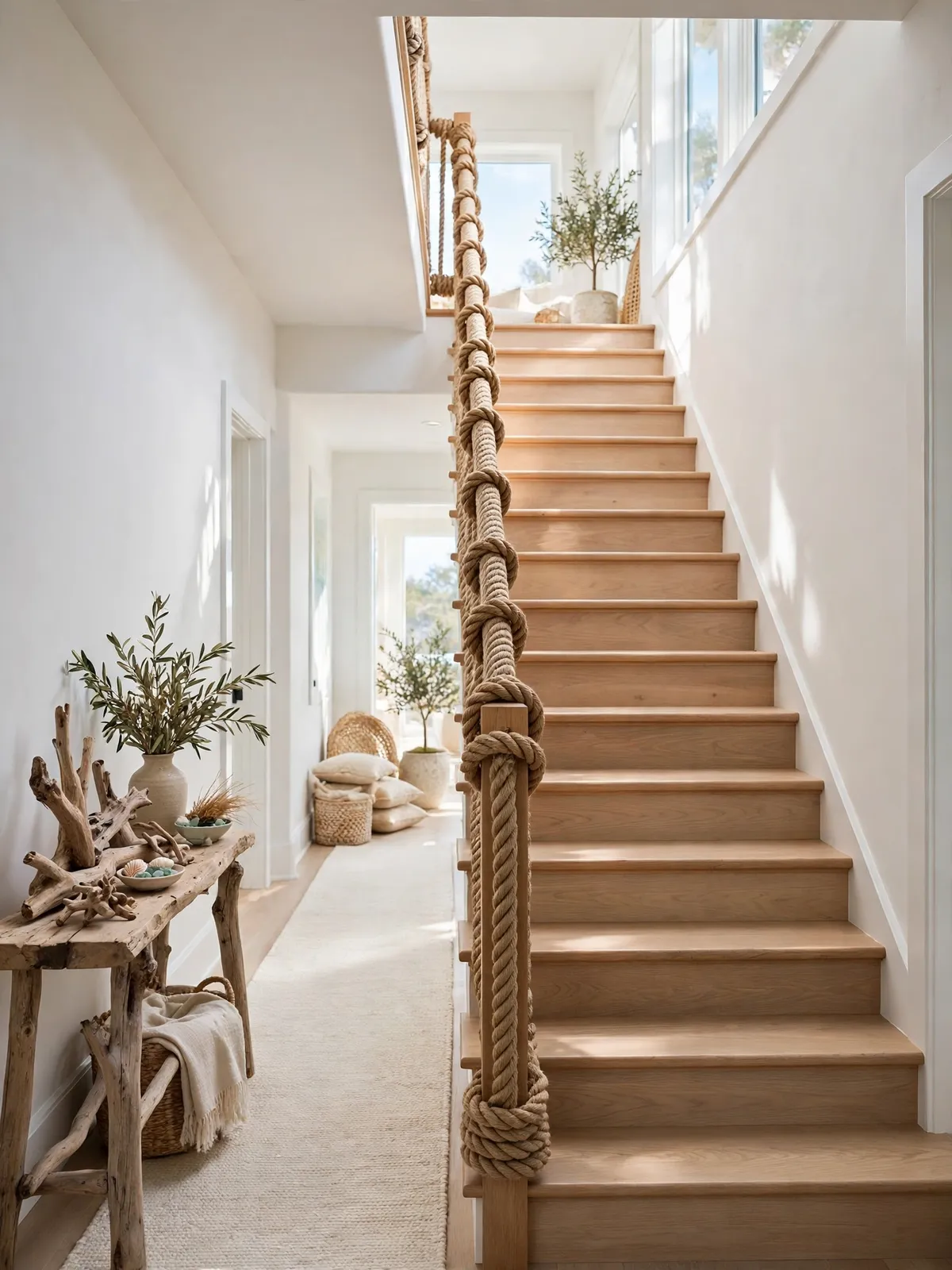
Rope railings are not for everyone in staircase railing design, but when they work, they really work — they bring a relaxed, coastal vibe that feels playful and unexpected. Here, thick natural rope, 30 mm in diameter, runs between slim white posts above pale oak treads, each 950 mm wide, with soft white walls and a cream rug below. A small piece of driftwood decor on the landing echoes the rope, and the stair feels like a beach house — casual and full of character.
Quick tips:
- Choose thick, natural rope and sturdy hardware — safety still matters.
- Keep everything else simple so the rope does not feel kitschy.
- Choose rope railings for beach houses and rustic cabins.
- Check the rope tension regularly so it never sags.
Integrated Lighting in Staircase Railing Design for Evening Magic
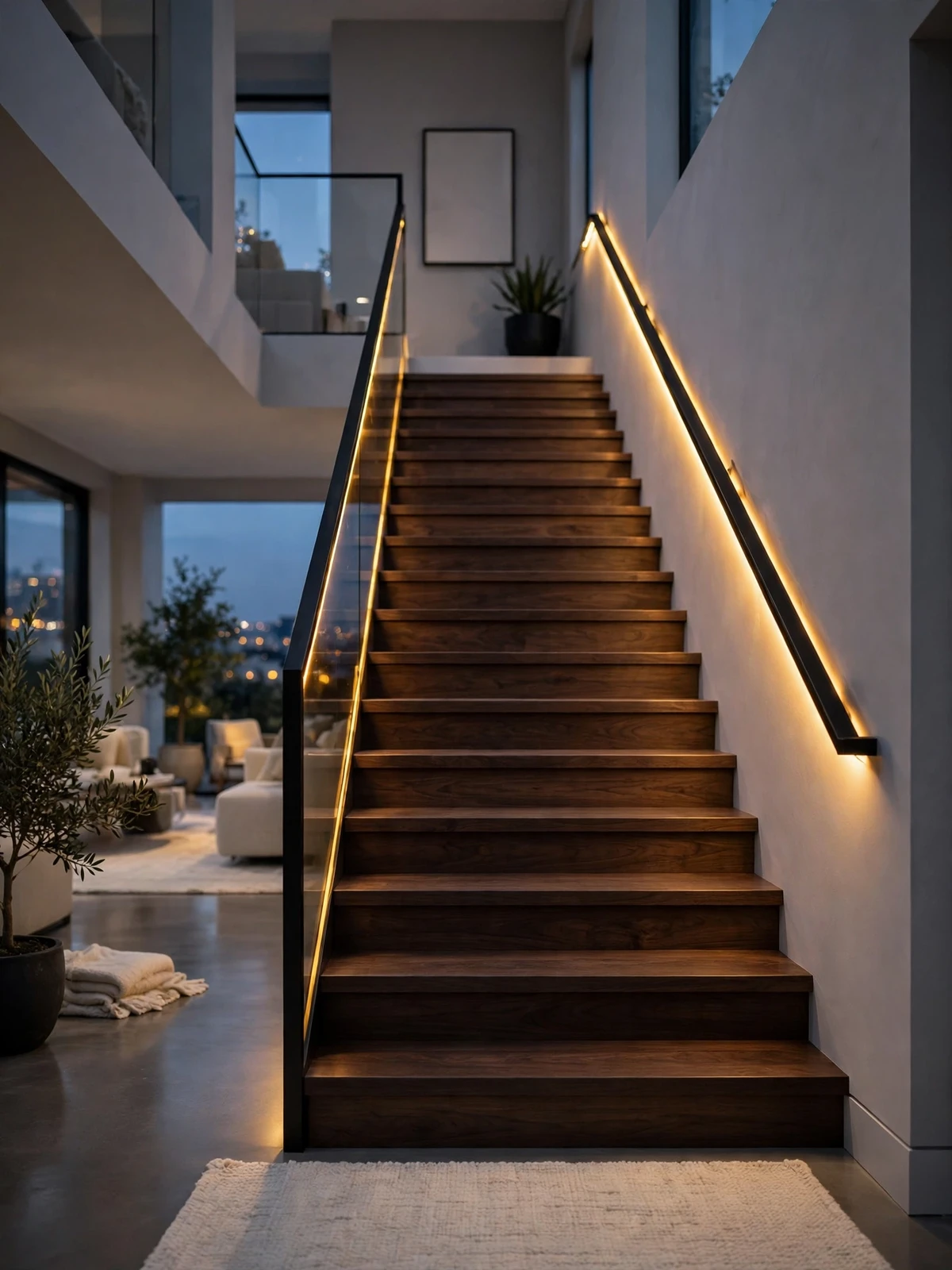
Lighting and railings are a powerful duo in staircase railing design, because LED strips under the handrail or along the base create a soft glow that is especially beautiful at night. Here, warm white LED strips, 2700K, run in a slim channel beneath a dark walnut handrail above dark walnut treads, each 1 metre wide, so the rail glows softly and the edge of each tread is easy to see at night. Soft grey walls and a cream rug below keep the room calm, and the whole stair feels thoughtful — and a little magical.
Quick tips:
- Choose warm white LEDs, about 2700K, for a cosy glow.
- Set the strips in a channel under the handrail so the light washes down.
- Put the strips on a motion sensor so they switch on as you approach.
- Keep the light warm — always — for a welcoming evening feel.
Dark Railings With Light Stairs in Staircase Railing Design for Contrast
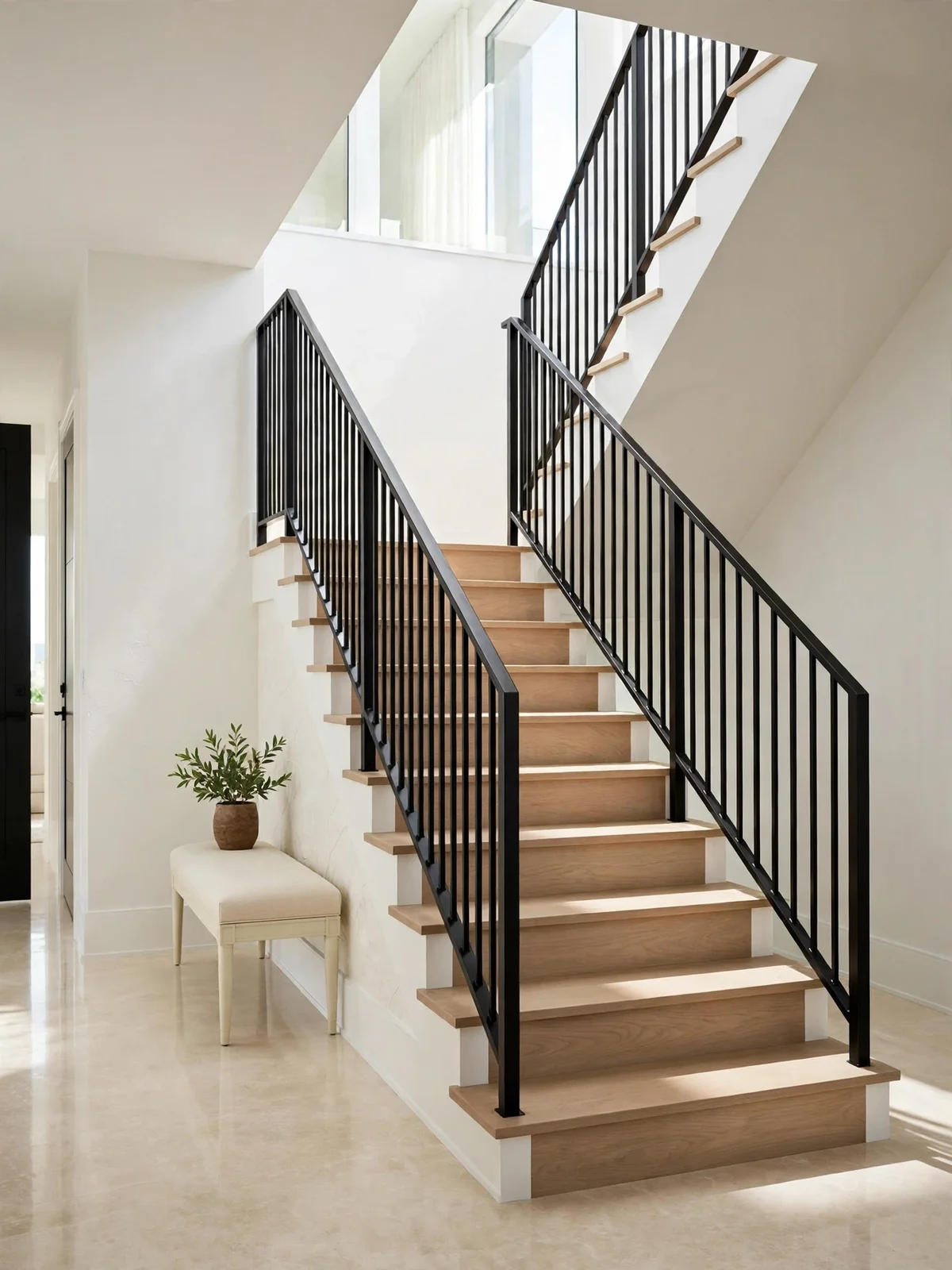
Contrast adds drama in the best way in staircase railing design — dark railings against light stairs create definition and structure, and the staircase feels grounded and bold. Here, matte black balusters and a matte black handrail stand against white risers and pale oak treads, each 950 mm wide, with soft white walls and a cream bench below. A small green plant at the base adds one living accent, and the black-and-pale contrast commands attention without being loud.
Quick tips:
- Pair black railings with white risers for a classic contrast.
- Keep the walls pale so the dark railing stands out cleanly.
- Use dark wood with pale stone for a softer version of the contrast.
- Choose this look when the staircase is visible from main living areas.
A Continuous Handrail in Staircase Railing Design for Seamless Flow
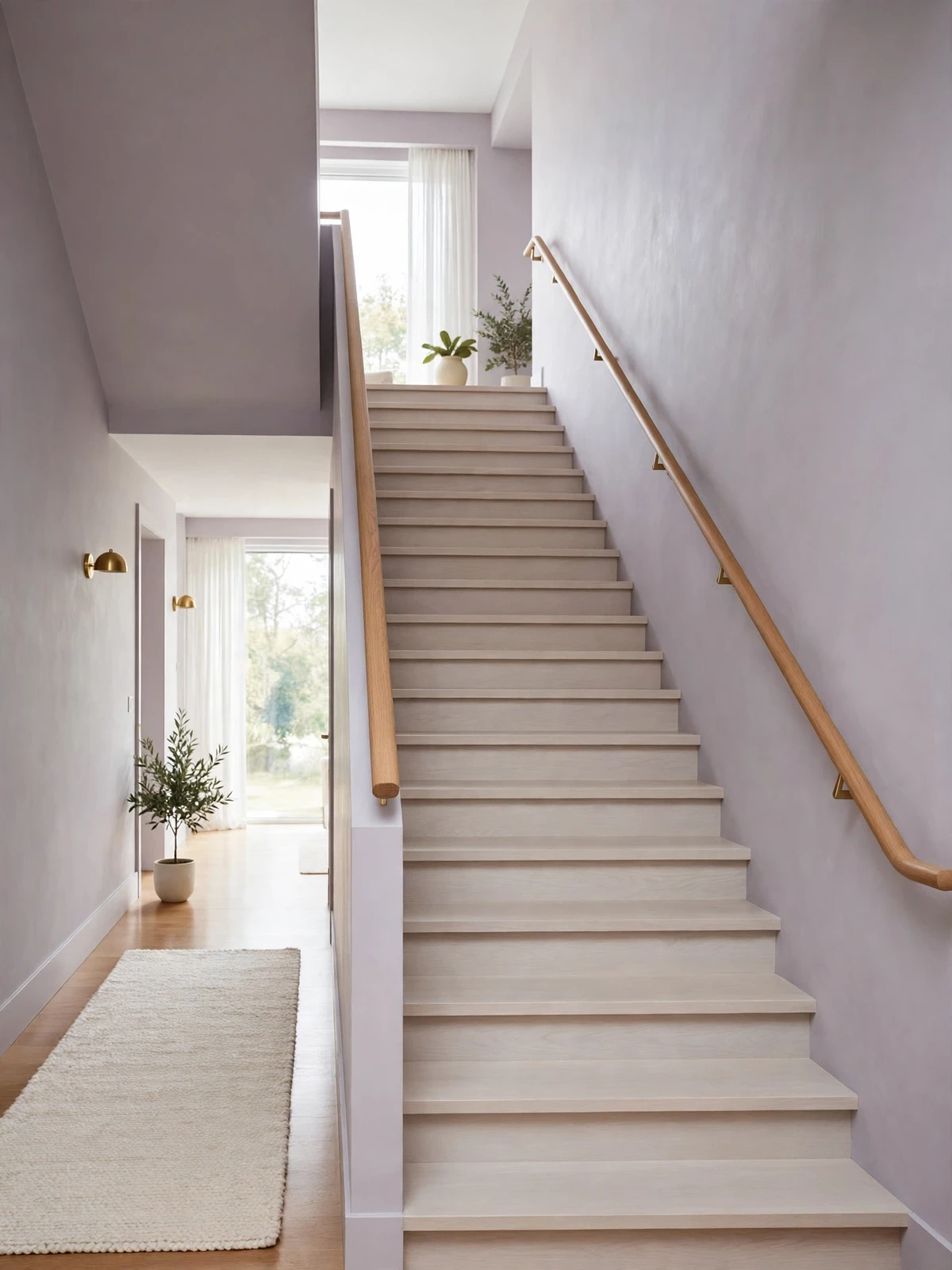
A continuous handrail runs uninterrupted from top to bottom in staircase railing design — no breaks, no awkward stops — and it feels smooth and intentional, especially on long staircases. Here, a smooth oak handrail, 60 mm wide with rounded edges, runs the full length of a long flight above pale ash treads, each 900 mm wide, with slim black balusters below and soft lilac-grey walls around. The flow feels natural and effortless, and the handrail is both a design win and a functional one — easier to use, easier on the eyes.
Quick tips:
- Choose a handrail shape that is comfortable to grip, with rounded edges.
- Run the rail continuously, with no breaks, from top to bottom.
- Match the handrail timber to the treads for a unified look.
- Keep the balusters slim so the continuous rail stays the feature.
A Sculptural Railing in Staircase Railing Design as the Focal Point
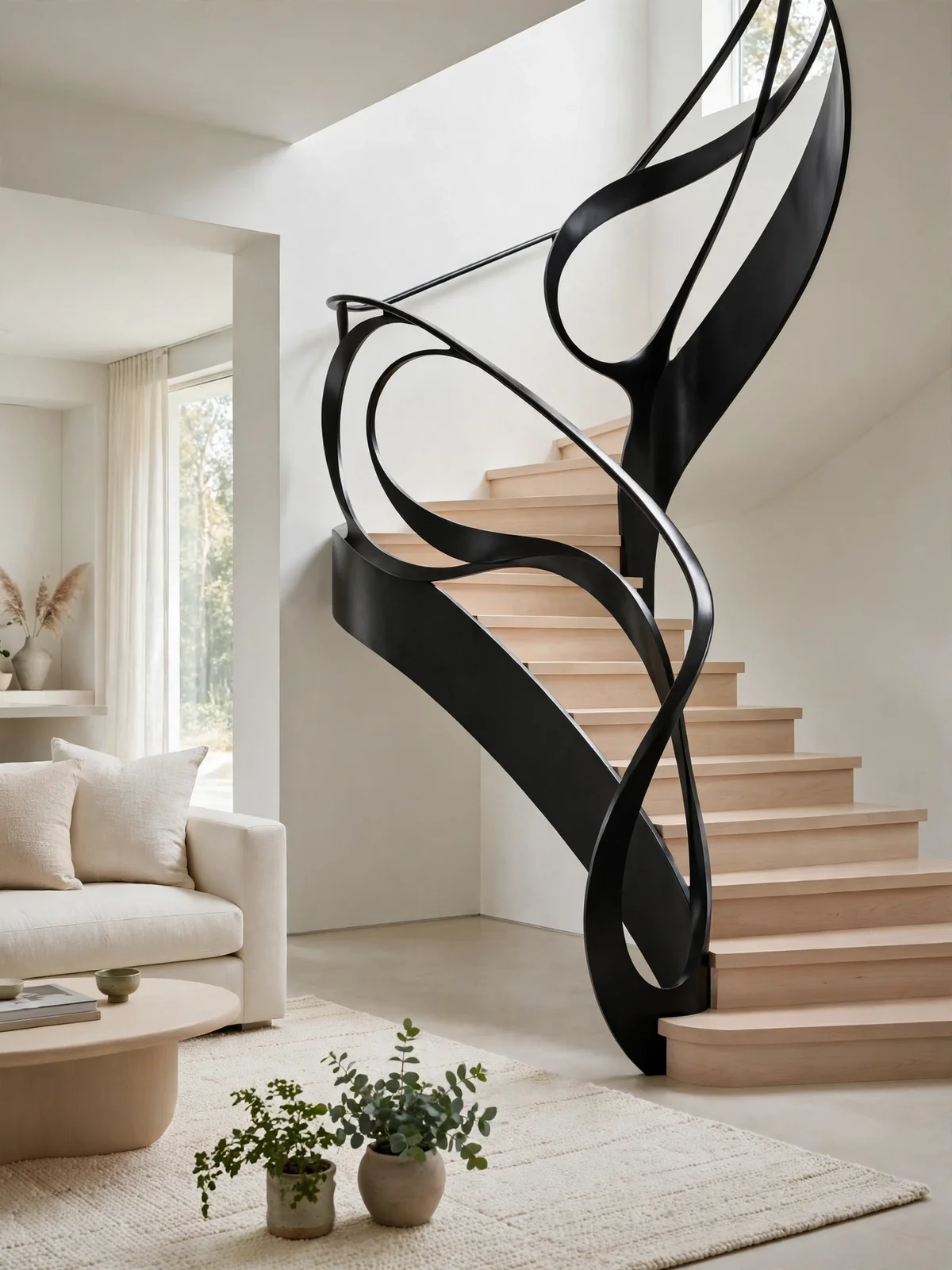
This is where railings stop being background elements and start being art in staircase railing design — custom metalwork, curved forms, laser-cut panels and organic shapes turn the staircase into a moment. Here, a sculptural black steel railing with flowing curved panels runs beside pale maple treads, each 950 mm wide, with soft white walls and a cream rug below. The rest of the space supports the railing rather than competing with it — neutral walls, simple stairs — and the railing leads. It is bold, but unforgettable.
Quick tips:
- Let the sculptural railing lead — keep the walls neutral and the stairs simple.
- Choose custom metalwork, curved forms or laser-cut panels for art.
- Budget for a specialist, because sculptural railings are custom work.
- Keep the handrail comfortable to grip, even on a sculptural design.
Asymmetry in Staircase Railing Design for a Custom Feel
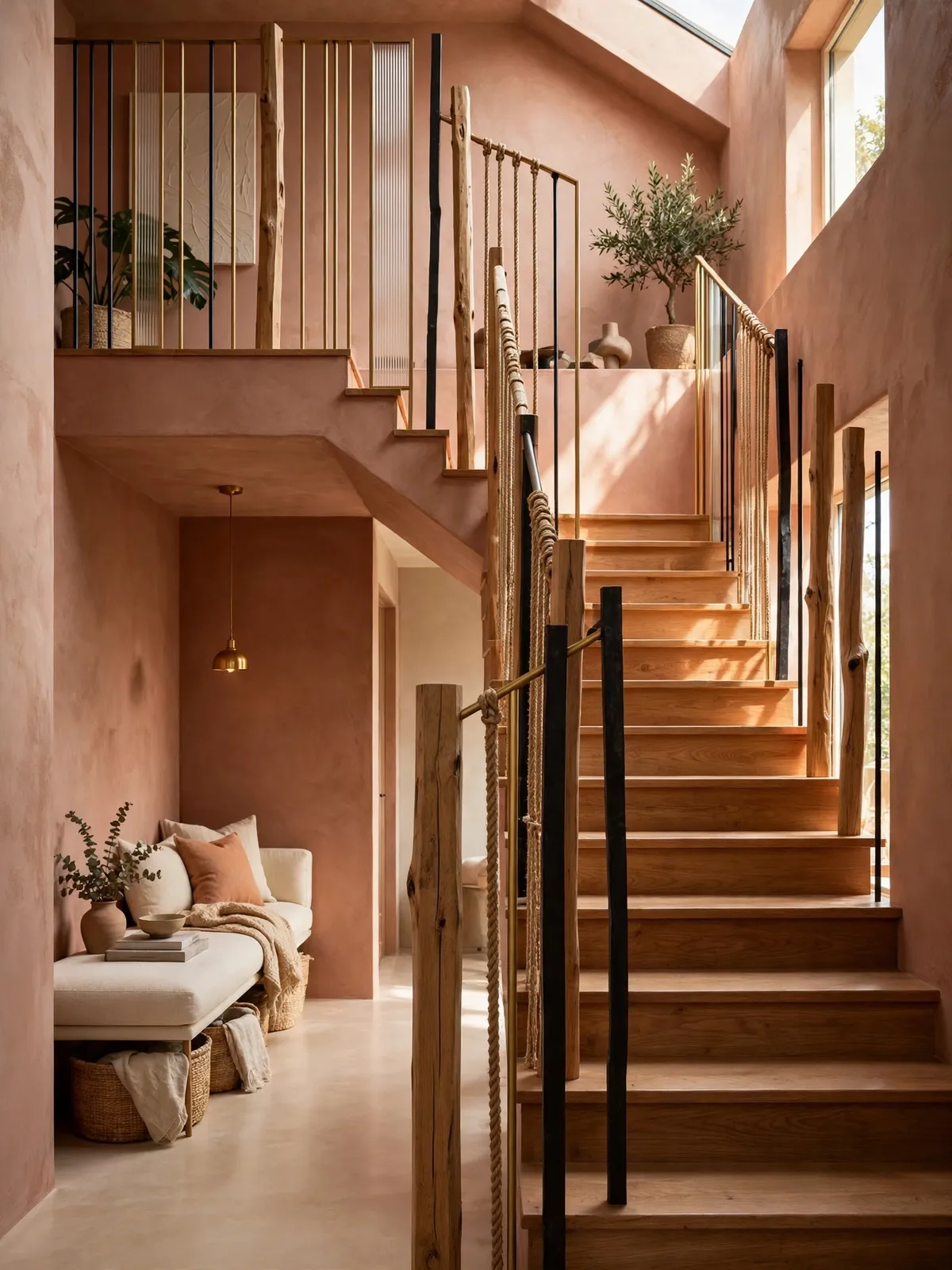
Perfect symmetry is safe, but asymmetry is interesting in staircase railing design — vary the post spacing, mix solid sections with open ones, and change materials subtly as the staircase rises. Here, slim black balusters alternate with a solid oak panel on the lower flight, then open into glass on the upper flight, above warm oak treads, each 950 mm wide, with soft terracotta walls and a cream bench below. The asymmetry feels intentional when done thoughtfully, not chaotic, and the staircase feels one-of-a-kind — because it is.
Quick tips:
- Vary post spacing or mix solid and open sections for asymmetry.
- Change materials subtly as the staircase rises, not abruptly.
- Keep one element consistent — the handrail — so the design holds together.
- Choose asymmetry for modern and artistic homes where uniqueness matters.
Staircase Railing Design Ideas With Reclaimed Wood and Slim Black Balusters
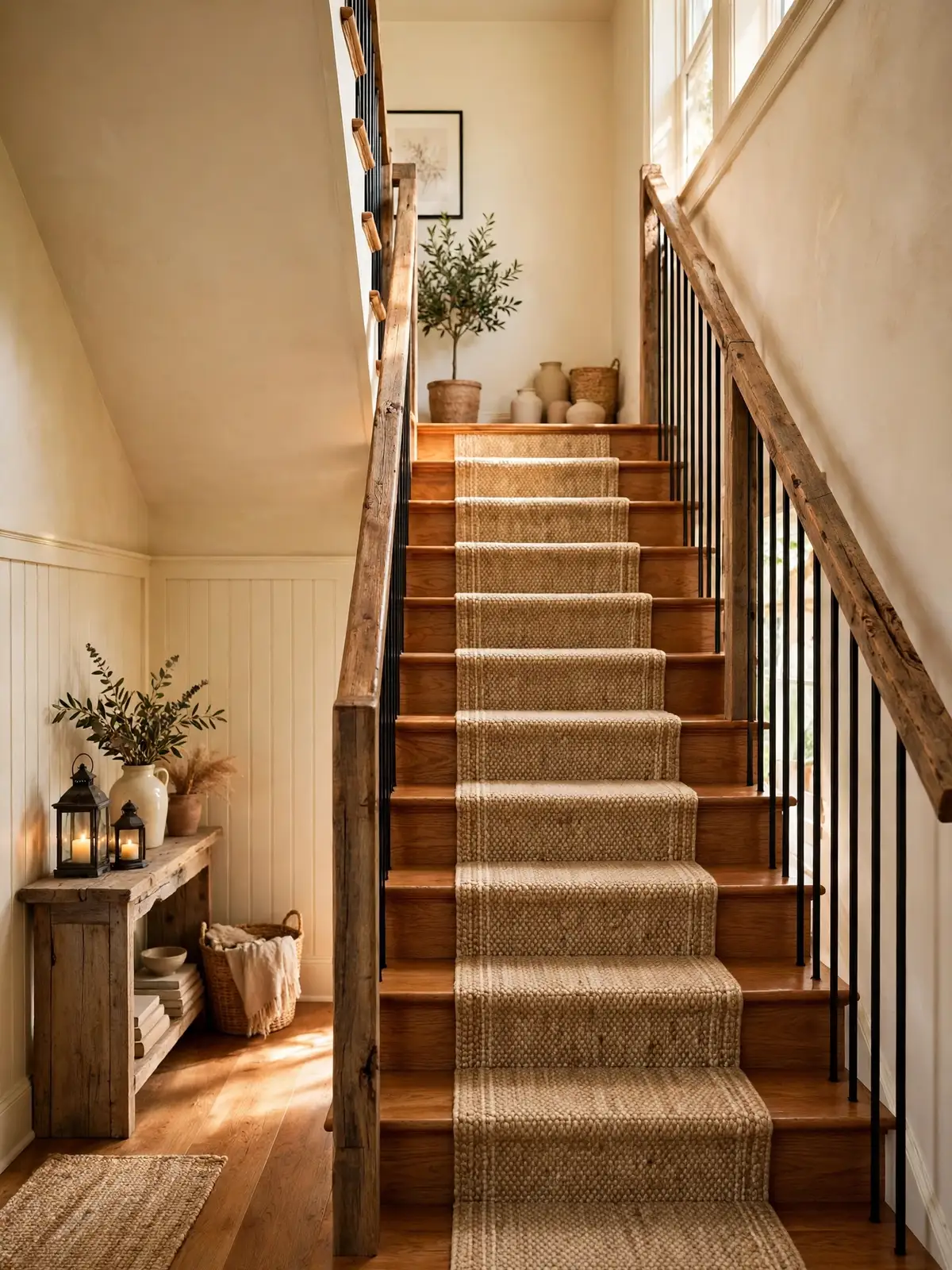
Reclaimed wood railings tell a story in staircase railing design, and you can feel it — weathered grain, old nail holes, natural imperfections, all welcome, especially when paired with slim black balusters that keep the look balanced. In this farmhouse home, a reclaimed oak handrail, 80 mm wide with a soft, worn edge, runs above warm oak treads, each 950 mm wide, with slim 12 mm black steel balusters, two per tread, rising to meet it. A woven runner in cream and oatmeal softens the climb, soft cream walls keep the hallway bright, and a small iron lantern glows on the landing in the afternoon. The reclaimed timber brings soul — the kind of warmth that new wood takes years to earn — while the black balusters keep the railing from feeling heavy or old-fashioned. The handrail is oiled, not varnished, so the grain stays touchable and the old nail holes show as small dark marks that catch the light. A woven basket at the base holds the family’s scarves, and the whole stair feels honest: real wood, real steel, no imitation. If your home is a farmhouse or a cottage, this is the railing design that belongs there — warm, storied and quietly confident, the kind of detail that makes guests run their hand along the rail just to feel it.
Quick tips:
- Pair reclaimed wood with simple black metal balusters for balance.
- Oil the reclaimed timber, not varnish, so the grain stays touchable.
- Keep the balusters slim so the reclaimed wood stays the feature.
- Choose reclaimed wood for farmhouse, cottage and rustic homes.
Colour on the Railing Only in Staircase Railing Design for Playful Personality
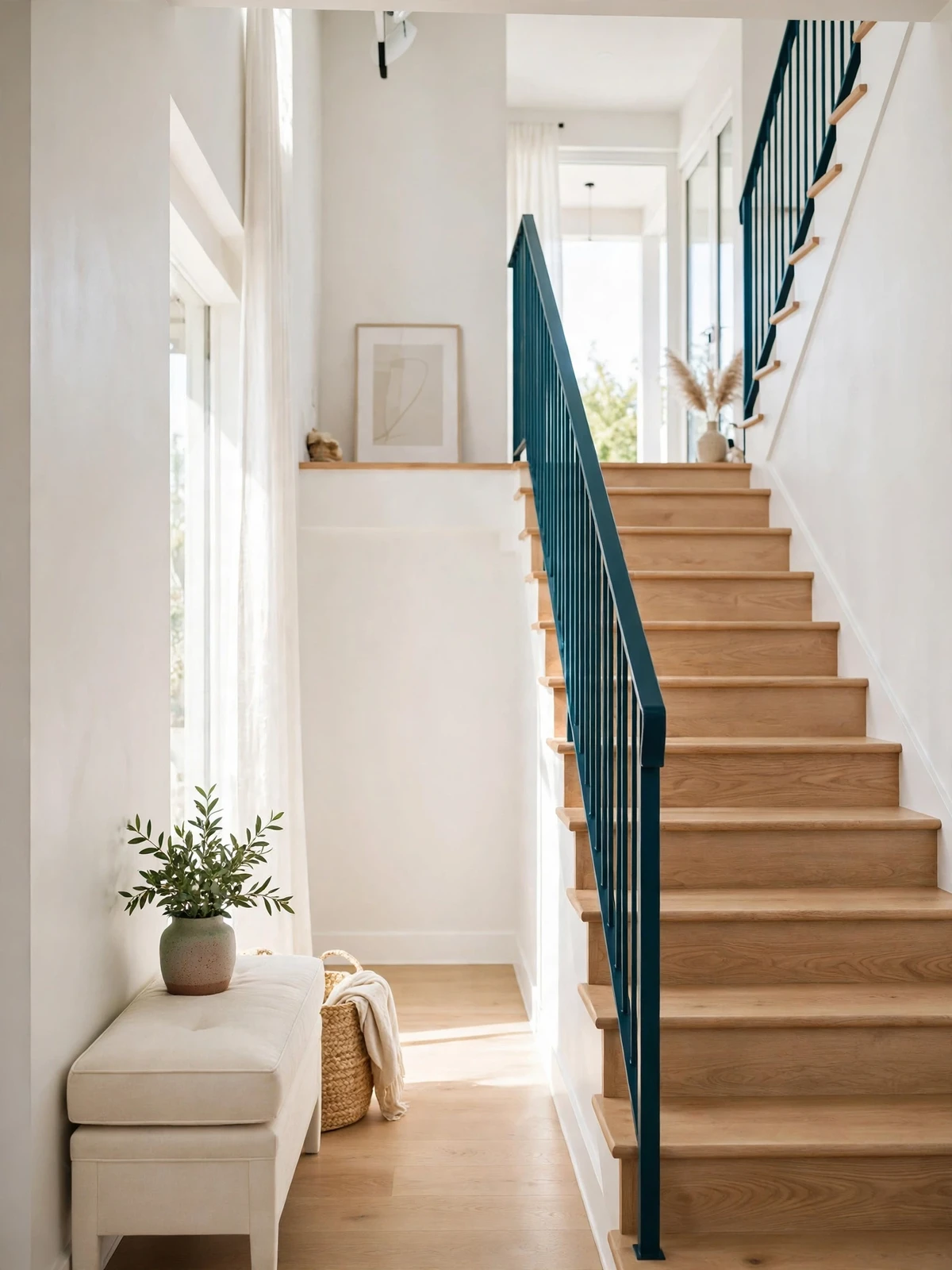
If painting walls feels scary, paint the railing instead in staircase railing design — a deep green, navy or muted terracotta railing adds personality without overwhelming the space. Here, the balusters and handrail are painted deep teal in a durable satin finish above pale oak treads, each 950 mm wide, with soft white walls and a cream bench below. A small green plant at the base echoes the teal, and the railing feels playful but controlled, because everything else in the hallway stays neutral.
Quick tips:
- Choose one bold colour — deep green, navy or muted terracotta — for the railing.
- Keep the rest of the hallway neutral so the railing stands out.
- Use a durable satin paint so the railing wipes clean.
- Echo the railing colour in one cushion or plant nearby.
Minimalist Wire Railings in Staircase Railing Design for an Airy Look
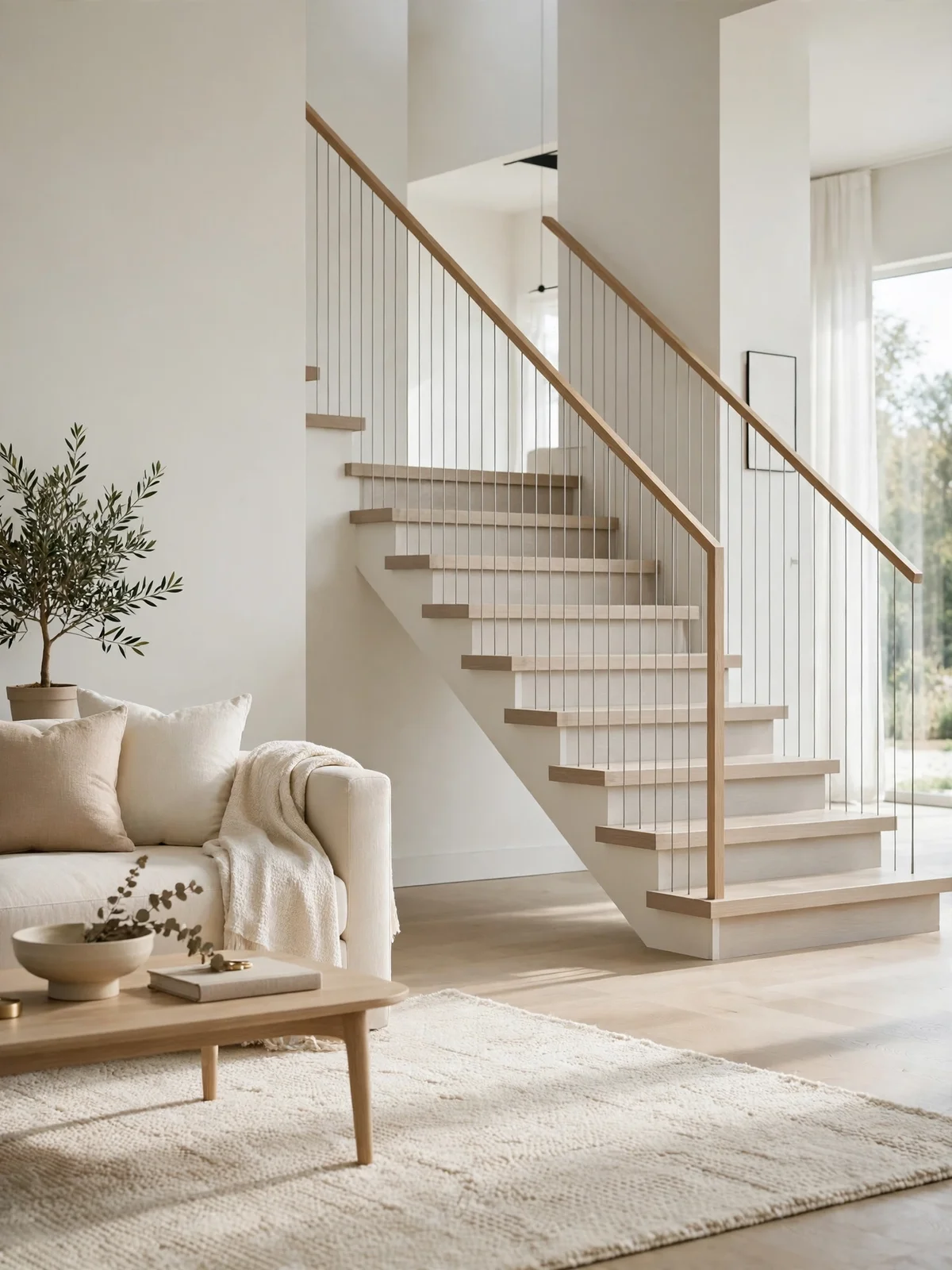
Wire railings are ultra-light visually in staircase railing design, because thin vertical or horizontal wires keep everything open while still providing safety. Here, thin vertical steel wires, each 3 mm thick and spaced 80 mm apart, run between a slim oak handrail and the pale ash treads, each 900 mm wide, with soft white walls and a cream rug below. The staircase feels weightless, almost floating, and the oak handrail softens the industrial edge of the wires beautifully.
Quick tips:
- Choose thin vertical wires, about 3 mm, for an airy look.
- Pair wire railings with wood to soften the industrial feel.
- Keep the wires taut so they never sag or feel loose.
- Choose wire railings for modern and industrial homes.
Custom Joinery in Staircase Railing Design for Subtle Luxury
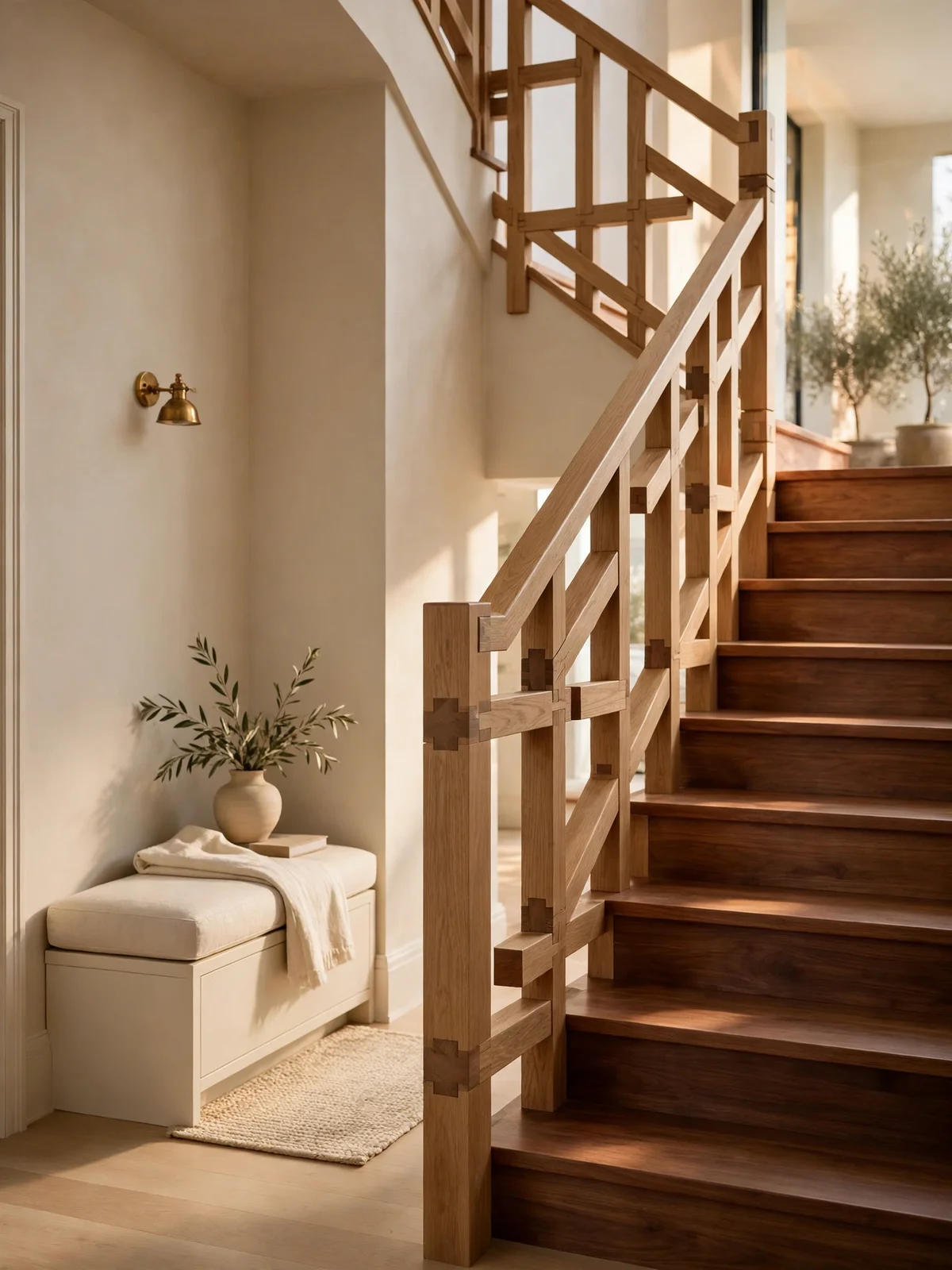
Sometimes it is all about the details in staircase railing design — custom joinery at connection points, corners and posts elevates the entire railing, and you notice it up close. Here, a warm walnut handrail meets the newel posts with precise, visible joinery — clean mortise-and-tenon joints, no visible screws — above warm walnut treads, each 950 mm wide, with soft beige walls and a cream bench below. A small brass wall light glows in the afternoon, and the railing whispers quality rather than shouting it. This is subtle luxury.
Quick tips:
- Choose custom joinery for connection points, corners and posts.
- Use a skilled joiner — precise joints are not a DIY job.
- Keep the timber consistent across the handrail, posts and treads.
- Let the joinery show — clean joints are a feature, not a flaw.
A Railing That Carries the Story of the Whole Home
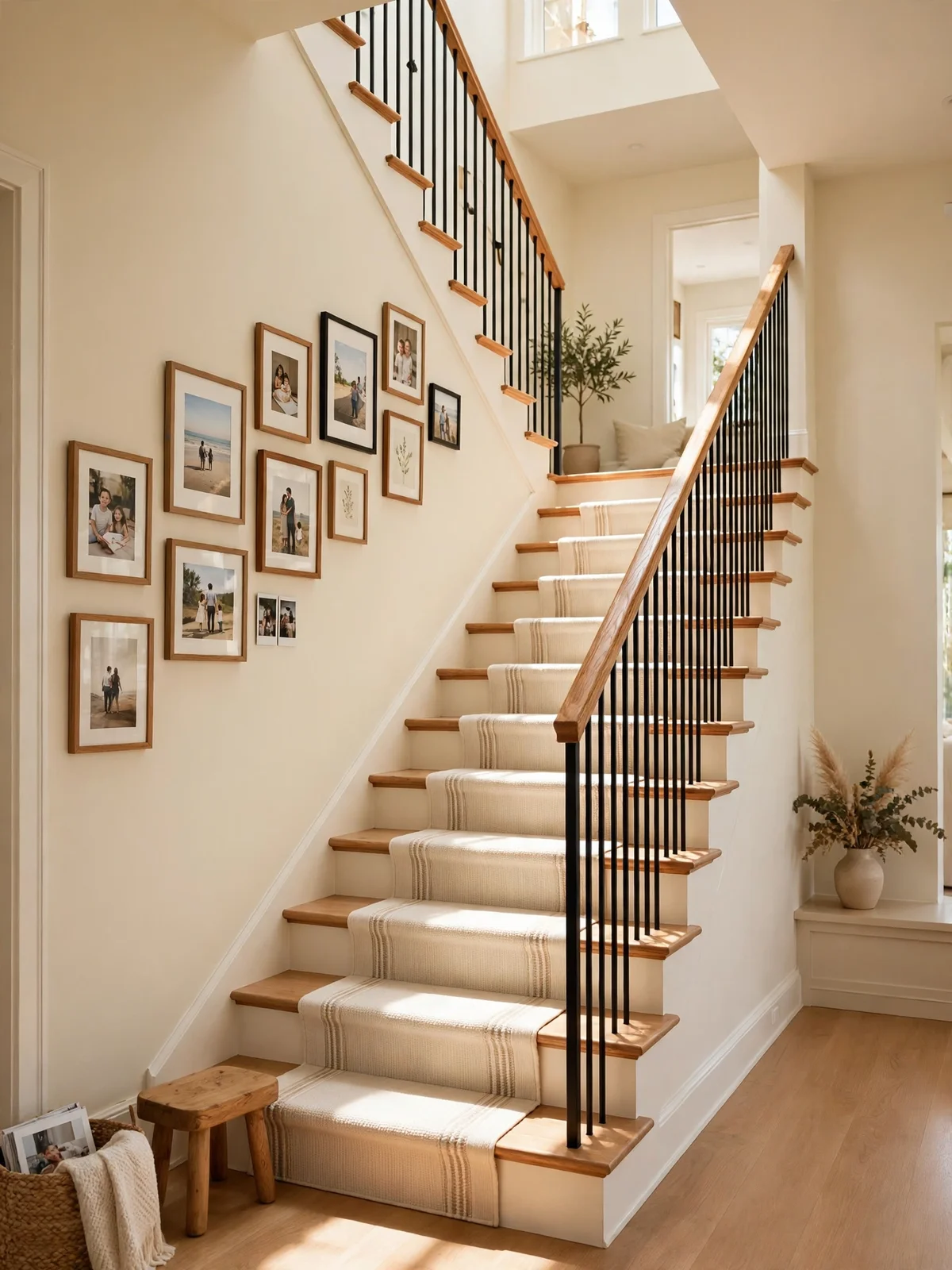
A staircase railing is not just a safety feature — it is part of how a home feels, and the best railing design reflects the way the family lives. In this home, slim black balusters and a warm oak handrail run above pale oak treads, each 950 mm wide, with a cream runner softening the climb, soft cream walls around, and a small wooden stool at the base. The black echoes the window frames, the oak echoes the floor, the cream echoes the walls — and the railing carries the story of the whole home in one clean line from the ground floor to the landing.
Quick tips:
- Let the railing reflect how your home feels — warm, bold, calm or playful.
- Match the railing to the doors, trim and hardware around it.
- Keep one element consistent — the handrail — across the whole flight.
- Choose the railing last, after the floors and doors, so it ties the home together.
FAQs
How much does it cost to replace staircase balusters?
Replacing balusters with slim black metal ones usually costs a few hundred pounds in materials for a standard flight, plus a day of a joiner’s time if you do not DIY. The balusters themselves are inexpensive; the cost is in the fitting, the handrail adjustments and the finishing. Painting the existing balusters costs under a hundred pounds and takes a weekend.
What is the safest staircase railing design for children?
A railing with vertical balusters spaced no more than 100 mm apart is the safest for children, because small heads cannot pass through the gaps. Avoid horizontal rails, wide-spaced cables and rope in homes with small children, because they can be climbed like a ladder. Glass panels are safe when made from tempered glass, and a solid half-wall is the safest of all.
Can I mix materials in a staircase railing design?
Yes — mixing materials is one of the best ways to make a railing feel designed. Black steel with warm timber, glass with brass, cable with oak, and iron with stone all work beautifully. The rule is restraint: two materials, not four, and one consistent element — usually the handrail — that holds the design together.
How high should a staircase railing be?
A staircase handrail should sit 900 to 1000 mm above the tread nosing, measured vertically from the front edge of each tread. A landing balustrade should be at least 900 mm high, and 1100 mm on a balcony or a landing with a drop. Always check local building regulations before installing a new railing.
What is the best railing design for a small staircase?
Slim black metal balusters, glass panels or cable railings suit small staircases best, because they keep the stair feeling open and let light pass through. Pale treads, a tall mirror on the stair wall and a slim handrail help too, while bulky newel posts, dark paint and heavy runners make a narrow stair feel smaller.
Conclusion
A staircase railing may seem like a small detail, but it has the power to anchor an entire home’s design. Whether you choose slim black metal balusters, horizontal rails, a chunky wood handrail, glass panels, turned wood balusters, a cable railing, wrought iron, a sculptural form, or simply a fresh coat of paint, the best staircase railing design is the one that suits the rooms around it. Keep the lines clean, the materials honest, the handrail comfortable and the spacing safe, and your railing will make every room it touches feel more intentional, more elegant and more beautiful.