25 Stunning Modern Staircase Railing Ideas That Make Your Home Feel Open, Bright and Luxurious
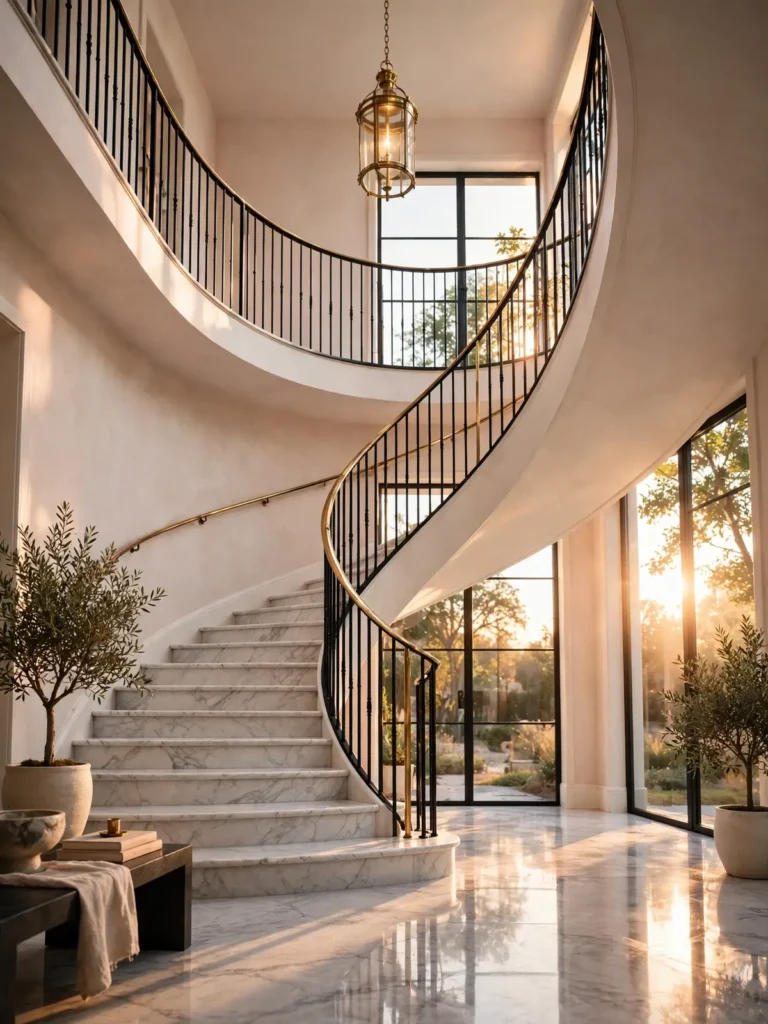
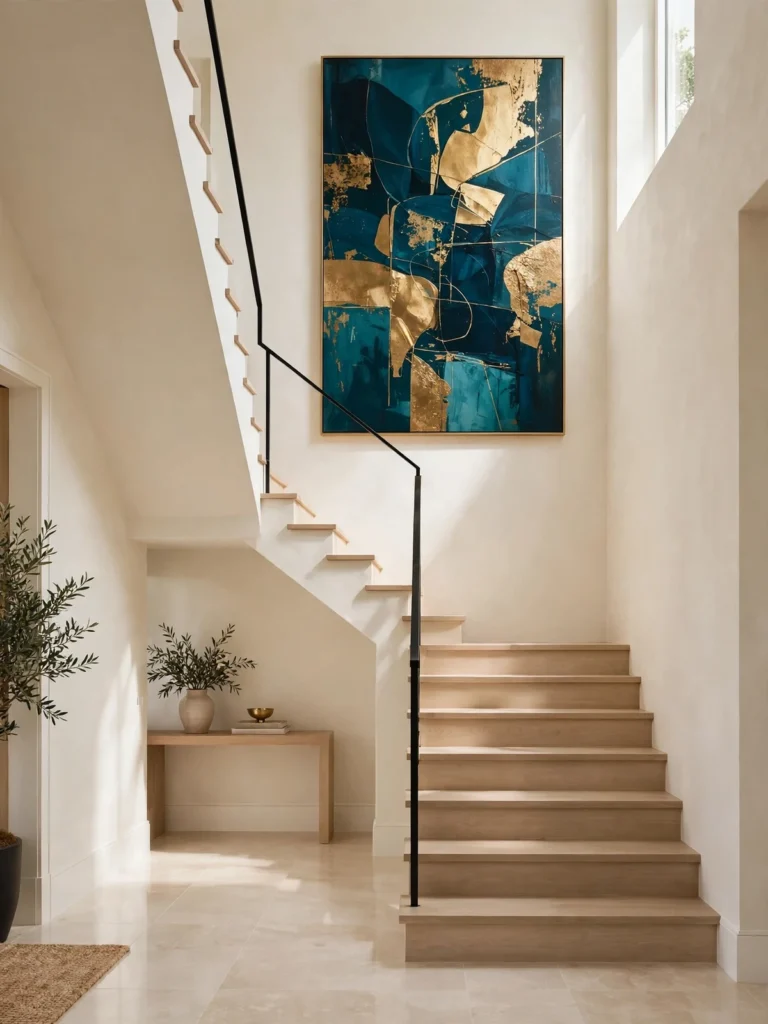
A modern staircase railing does more than keep you safe — it sets the mood of the whole hallway. These 25 ideas show how glass, black steel, warm wood, brass and cable railings can open up a stair, add warmth, and make everyday movement feel calm and luxurious.
A modern staircase railing is a slim, clean-lined safety barrier — usually frameless glass, matte black steel, horizontal cable, or warm wood — that protects the stair while making the whole hallway feel lighter and more open. The best choice pairs a strong, durable material with your home’s palette: clear glass almost disappears, matte black steel adds quiet drama, and warm oak softens both.
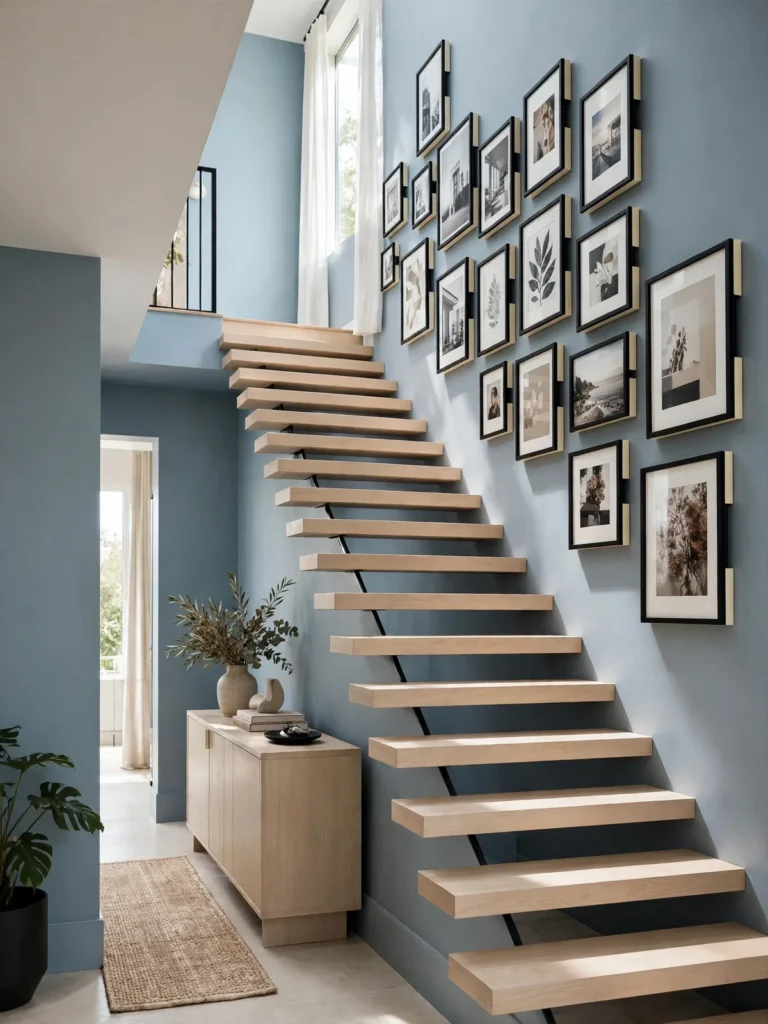
For a stair that floats without risers, these floating staircase ideas show how the same open feeling works when the treads have nothing beneath them. The 25 ideas below cover every setting, from a compact entry to a double-height foyer, so you can choose a railing that is safe, practical, and beautiful in your own home.
Key Takeaways
What is a modern staircase railing?
A modern staircase railing is a slim, clean-lined barrier along a stair — usually made from glass, black steel, cable, brass, or warm wood — that keeps the stair safe while keeping sightlines open and the hallway feeling light.
Which modern staircase railing is best for a small home?
Frameless glass or thin horizontal cable railings work best in a small home, because they block the least light and sight, so a narrow hallway feels wider and brighter.
What materials are safest for a modern staircase railing?
Tempered glass, powder-coated steel, and solid hardwood handrails are the safest choices. Baluster gaps should stay under 100 mm so a small child cannot slip through, and the handrail should sit about 900 mm above the tread nosing.
Does a modern staircase railing suit a family home?
Yes — choose tempered glass with rounded edges, a warm timber handrail for a comfortable grip, and easy-clean finishes. Smudges show more on glass, so a quick weekly wipe keeps it looking clear.
How do I choose between glass, metal and wood railings?
Choose glass for maximum light, black steel for drama and contrast, and warm wood for softness and comfort. In most homes, a mix — such as glass with a timber handrail — gives the best balance of all three.
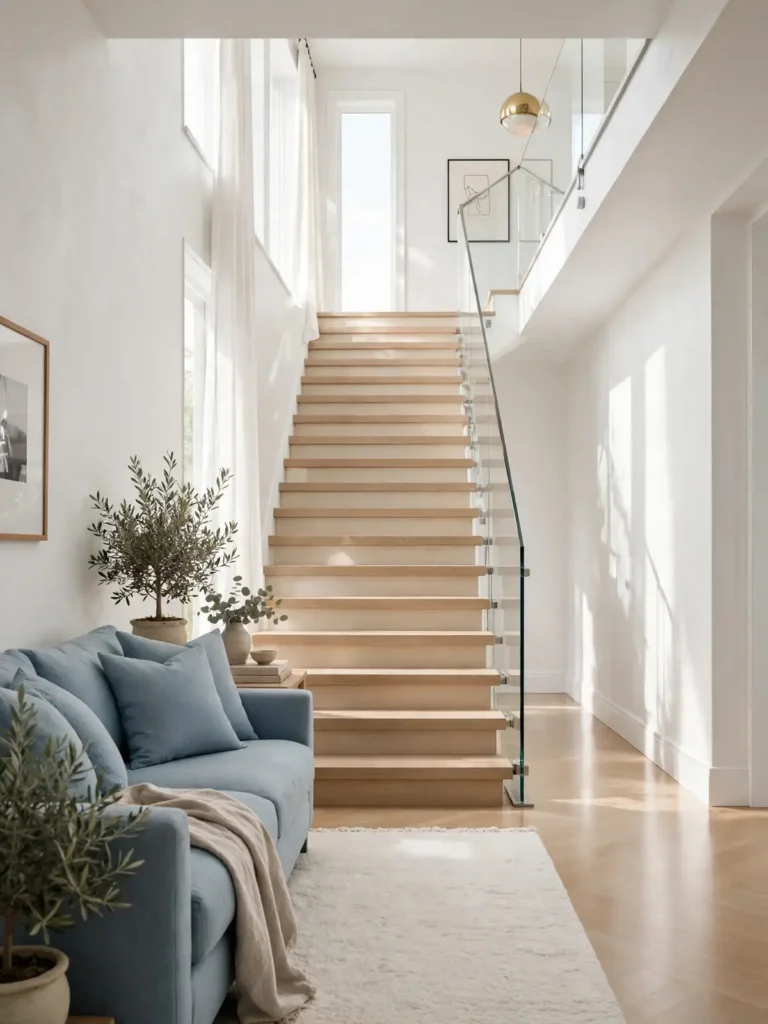
Frameless Glass Panels for a Modern Staircase Railing That Almost Disappears
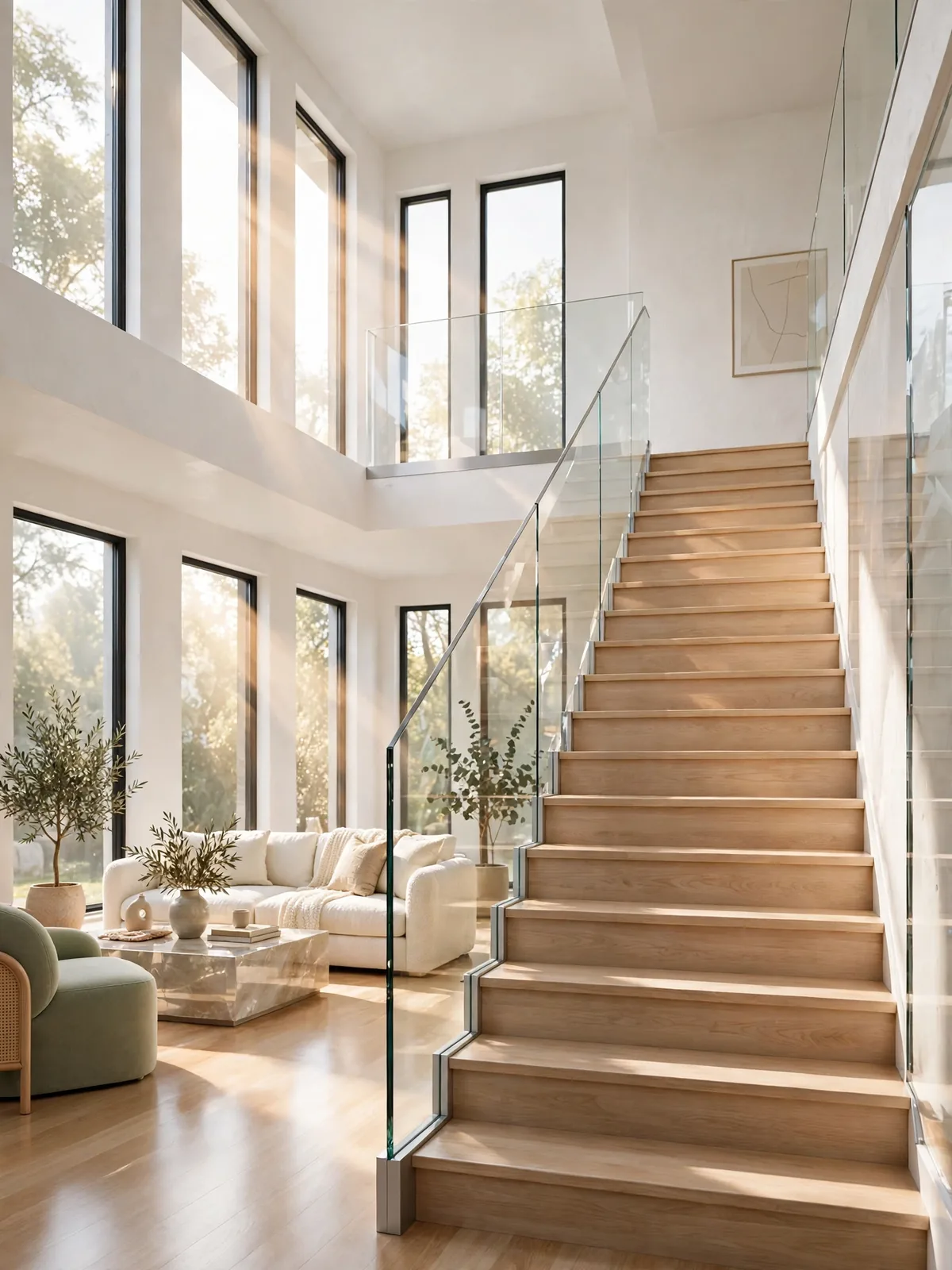
Frameless glass is the lightest modern staircase railing of all, because the panels let light and sight pass straight through. In one open-plan home, 12 mm tempered glass panels, each 1.1 metres tall, run the full length of a 1-metre-wide oak stair, held only by slim brushed-steel channels set into the treads. The pale oak treads, each 280 mm deep, warm the glass, while the white walls and a low ivory sofa keep the focus on the light moving through. From the sofa, you can see straight through the railing to the garden door beyond.
Quick tips:
- Use tempered glass at least 12 mm thick for strength and safety.
- Choose low-iron glass if you want the clearest finish with no green tint.
- Hide fixings in slim steel channels for a truly frameless look.
- Wipe panels weekly with a glass cloth to keep them smudge-free.
Matte Black Vertical Rods for a Bold Modern Staircase Railing
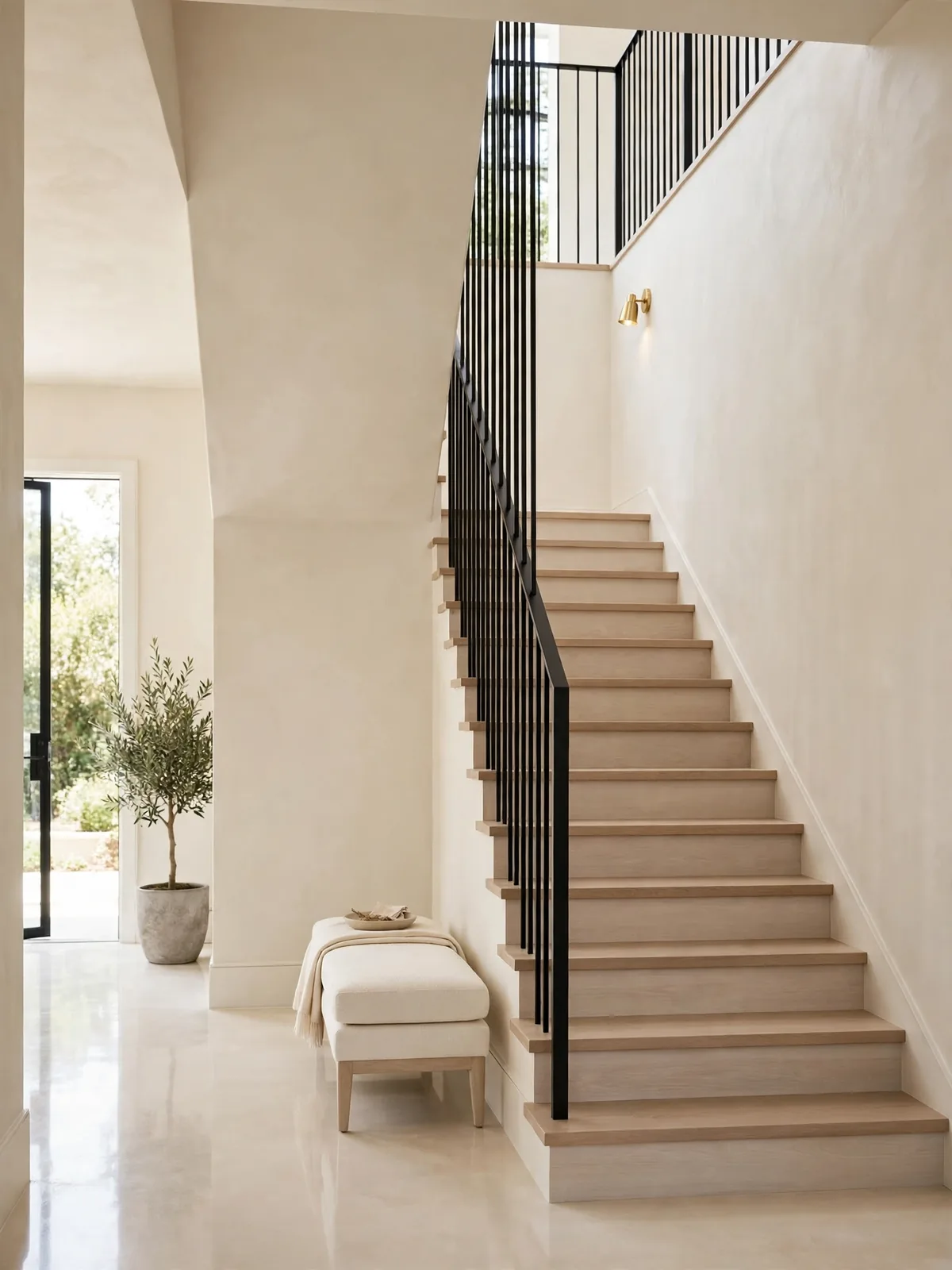
Slim vertical rods give a modern staircase railing a sculptural rhythm without closing off the stair. Here, 16 mm matte black steel rods run from tread to handrail every 110 mm along a 1-metre-wide stair with light ash treads, each 280 mm deep, topped by a slim black steel handrail. The cream walls and a small brass wall light soften the graphic black lines, while an ivory bench at the base adds a calm, welcoming note. As you climb, the repeated rods draw the eye upward and make the ceiling feel taller.
Quick tips:
- Keep rod spacing under 100 mm if small children use the stair.
- Use a matte finish so fingerprints and dust stay invisible.
- Pair black rods with pale treads for the strongest contrast.
- Add one warm metal accent, like brass, to soften the black.
Warm Oak Slats for a Soft Modern Staircase Railing
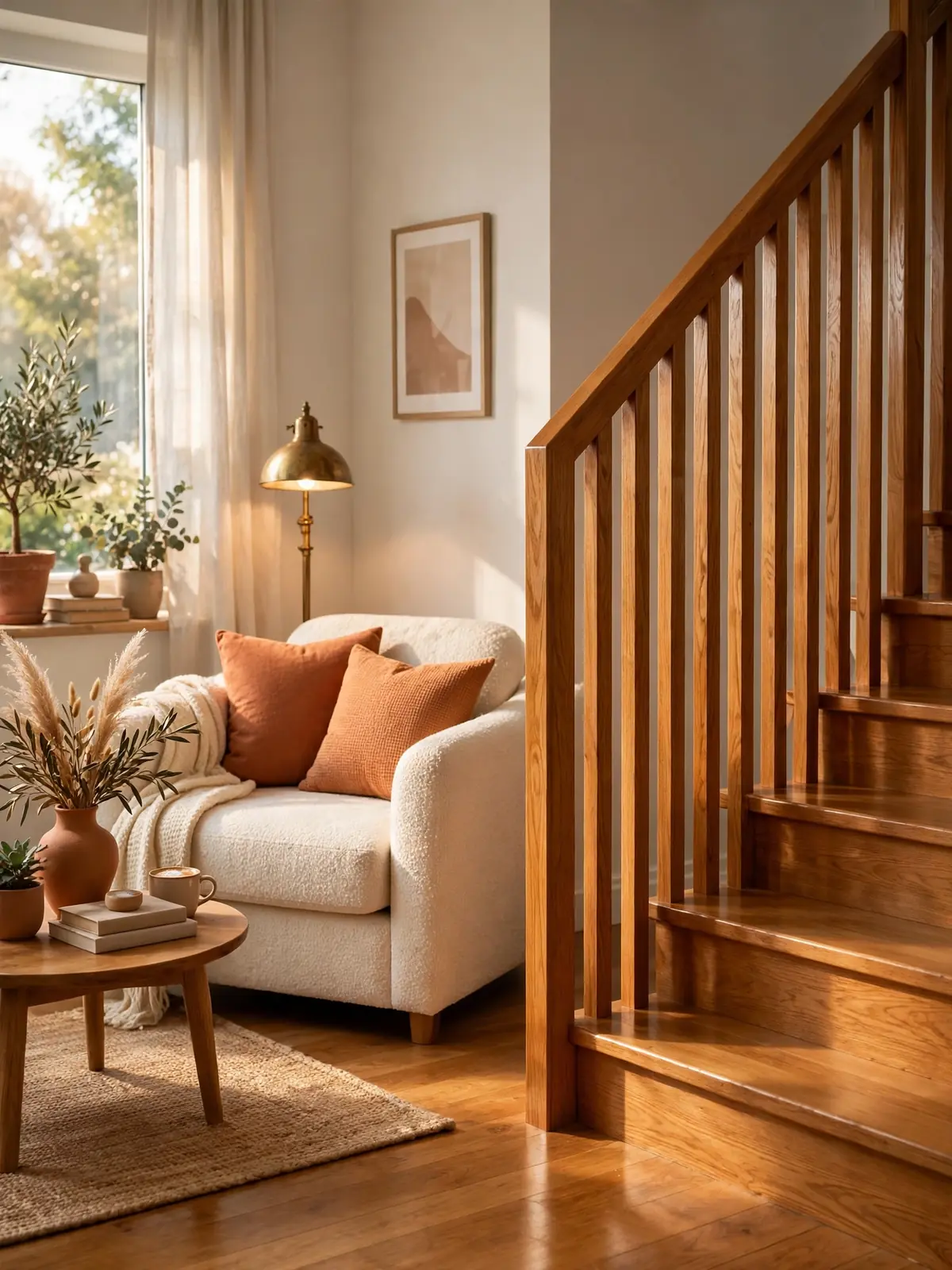
Warm oak slats bring softness to a modern staircase railing without losing its clean, contemporary lines. Picture a straight stair with 40 mm wide vertical oak slats, spaced 60 mm apart, running from a pale oak handrail down to the treads, each 900 mm wide. Below, a cream boucle armchair and terracotta cushions echo the honey tone of the wood, while a brass floor lamp adds a soft glow in the evening. The grain of the oak is the decoration — no extra pattern is needed.
Quick tips:
- Keep slat spacing even for a clean, premium look.
- Match the slat tone to a timber sideboard or coffee table nearby.
- Seal the oak well so it stays glossy and easy to clean.
- Pair oak slats with beige or cream walls for a Scandinavian feel.
Horizontal Stainless Steel Cables for a Minimalist Modern Staircase Railing
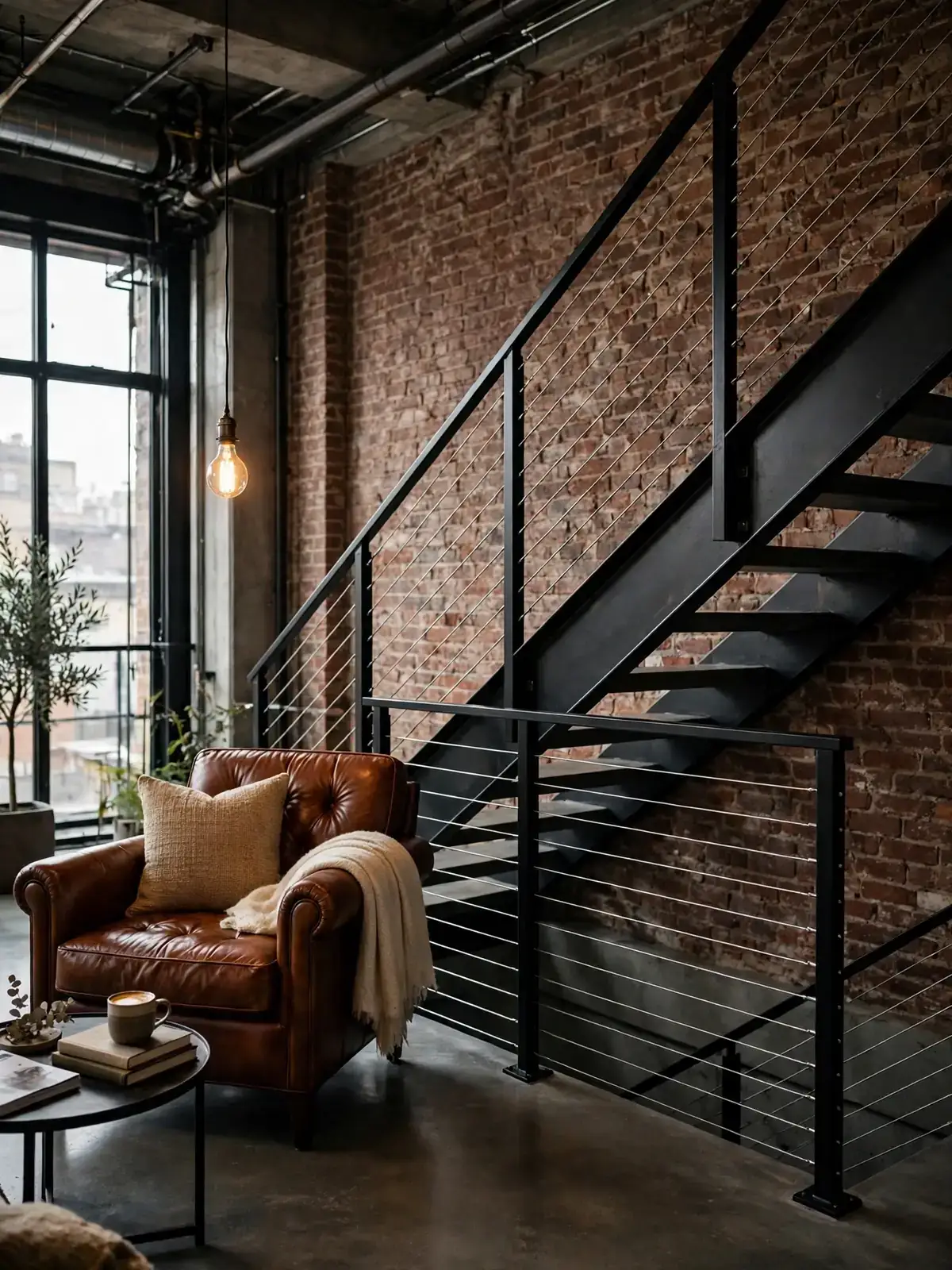
Horizontal cables create one of the airiest modern staircase railing designs, because thin steel lines almost disappear against the room. In this loft, six 4 mm stainless steel cables run horizontally between slim black steel posts, spaced 1.2 metres apart, along a 1-metre-wide stair with polished concrete treads. The exposed brick wall behind the stair adds texture, a cognac leather chair adds warmth, and a black steel-framed window floods the cables with daylight. The railing feels light and industrial at once.
Quick tips:
- Tension cables properly so they stay taut and safe.
- Keep cable gaps under 100 mm to meet safety standards.
- Pair cables with black posts or a warm wood handrail.
- Wipe cables occasionally to keep the steel bright.
A Slim Brushed Brass Railing for Quiet Luxury
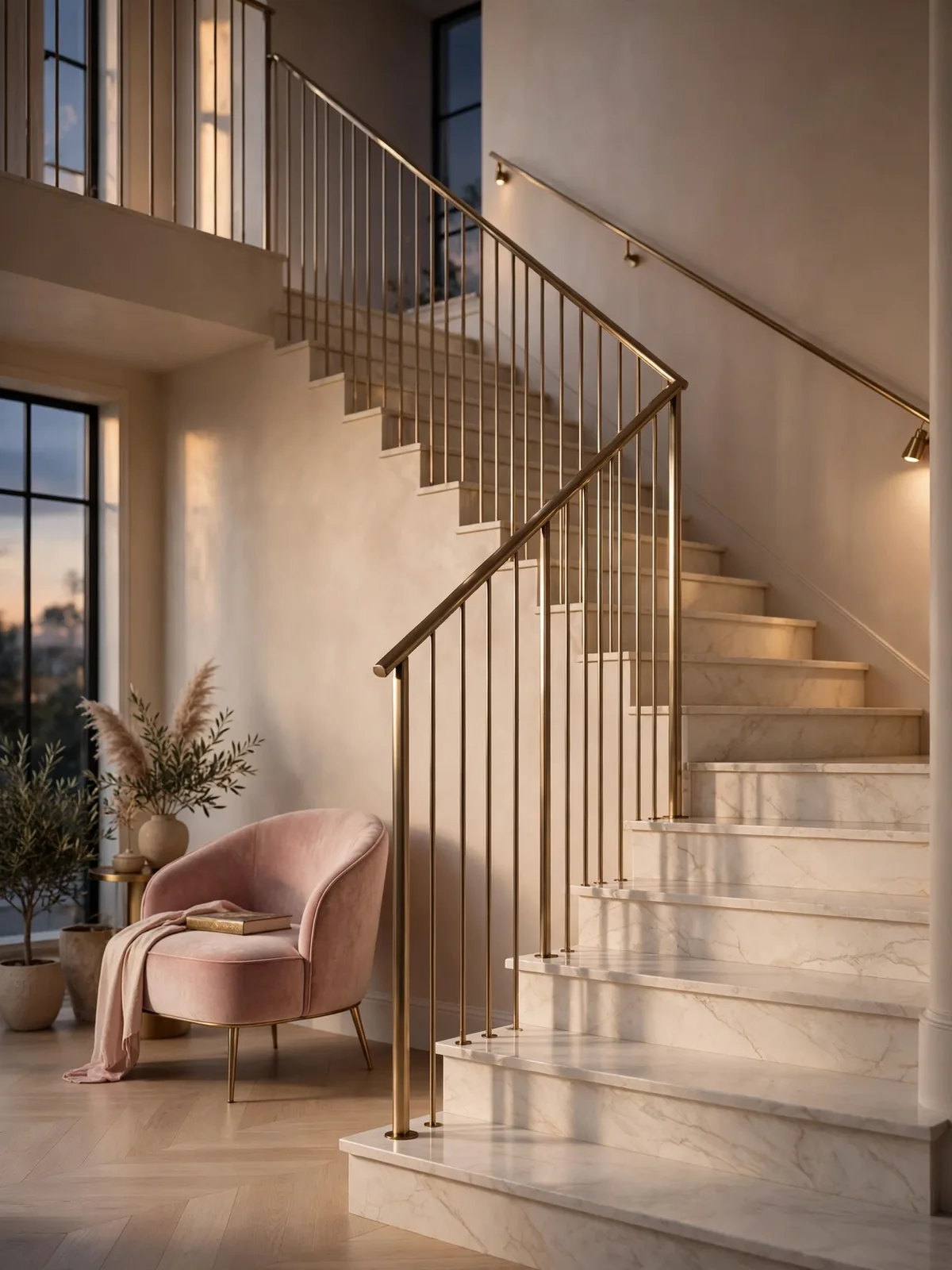
Brushed brass gives a modern staircase railing quiet luxury — warmth and shine without shouting. On this stair, cream marble treads, each 900 mm wide, are edged with slim brushed-brass balusters, 12 mm in diameter, topped by a smooth brass handrail with a soft, satin finish. The champagne-coloured walls and a blush-pink velvet chair add warmth, while the brass catches the evening light and glows gently. It feels expensive, yet calm and modern.
Quick tips:
- Choose brushed brass, not polished, for a softer, modern shine.
- Keep the brass lines slim so the railing stays light.
- Pair brass with cream marble or pale wood for warmth.
- Match the brass tone to a lamp or mirror nearby.
A Crisp White Metal Railing for a Softer Modern Look
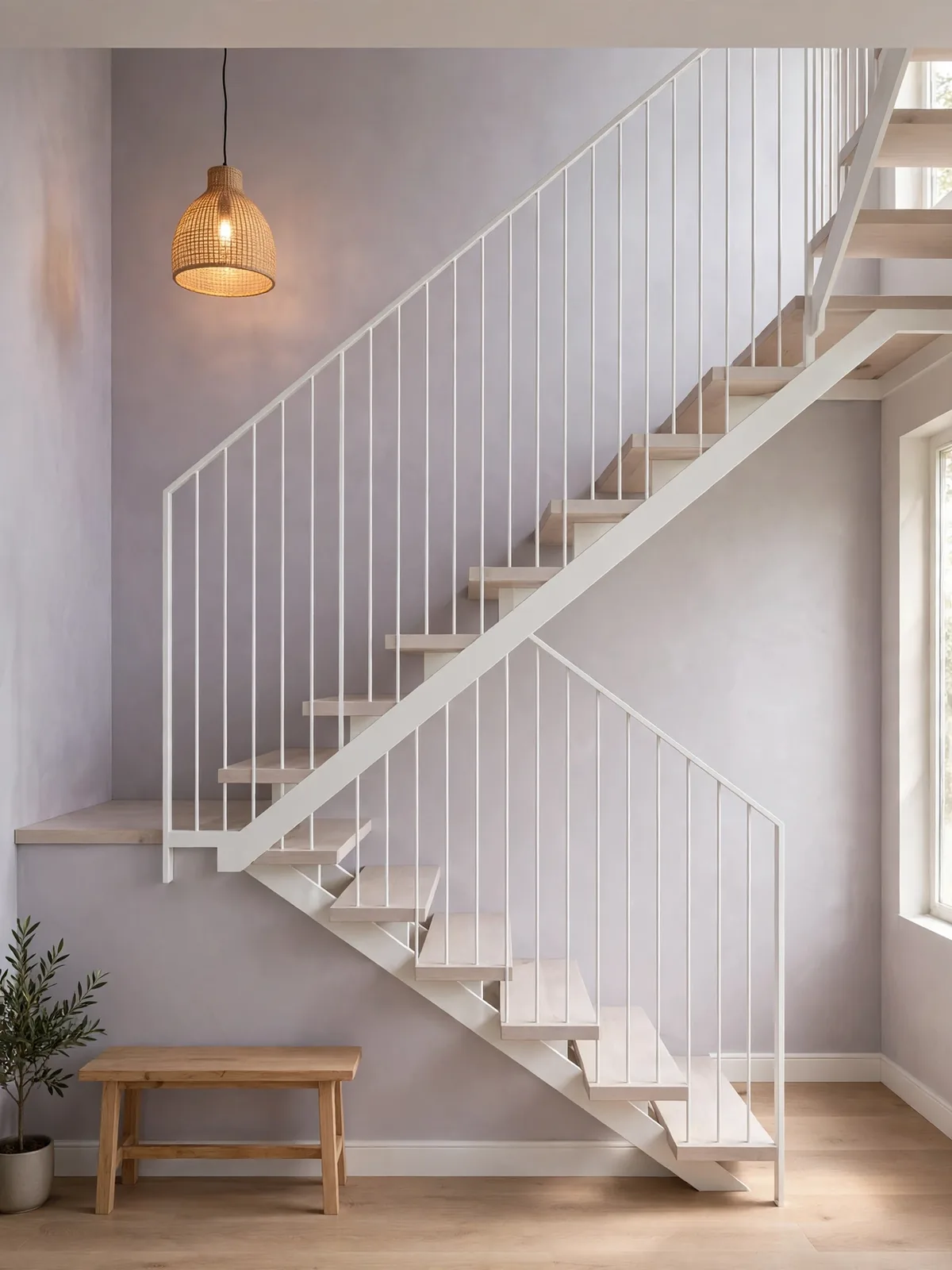
White metal makes a modern staircase railing feel calm and weightless, especially in a pale home. Here, slim white powder-coated steel balusters, spaced 100 mm apart, run between a white handrail and pale ash treads, each 950 mm wide, against soft lavender-grey walls. A small wooden bench at the base and a warm pendant light add quiet comfort, while the white railing blends into the light walls so the stair never feels bulky. It is the gentlest way to keep a stair safe and modern.
Quick tips:
- Use powder-coated white steel so the finish stays smooth and chip-free.
- Keep walls pale so the white railing blends in softly.
- Add one timber accent, like a bench, to warm up the white.
- Wipe white metal regularly — dust shows more on white than on black.
An LED-Lit Handrail for a Futuristic Modern Staircase Railing
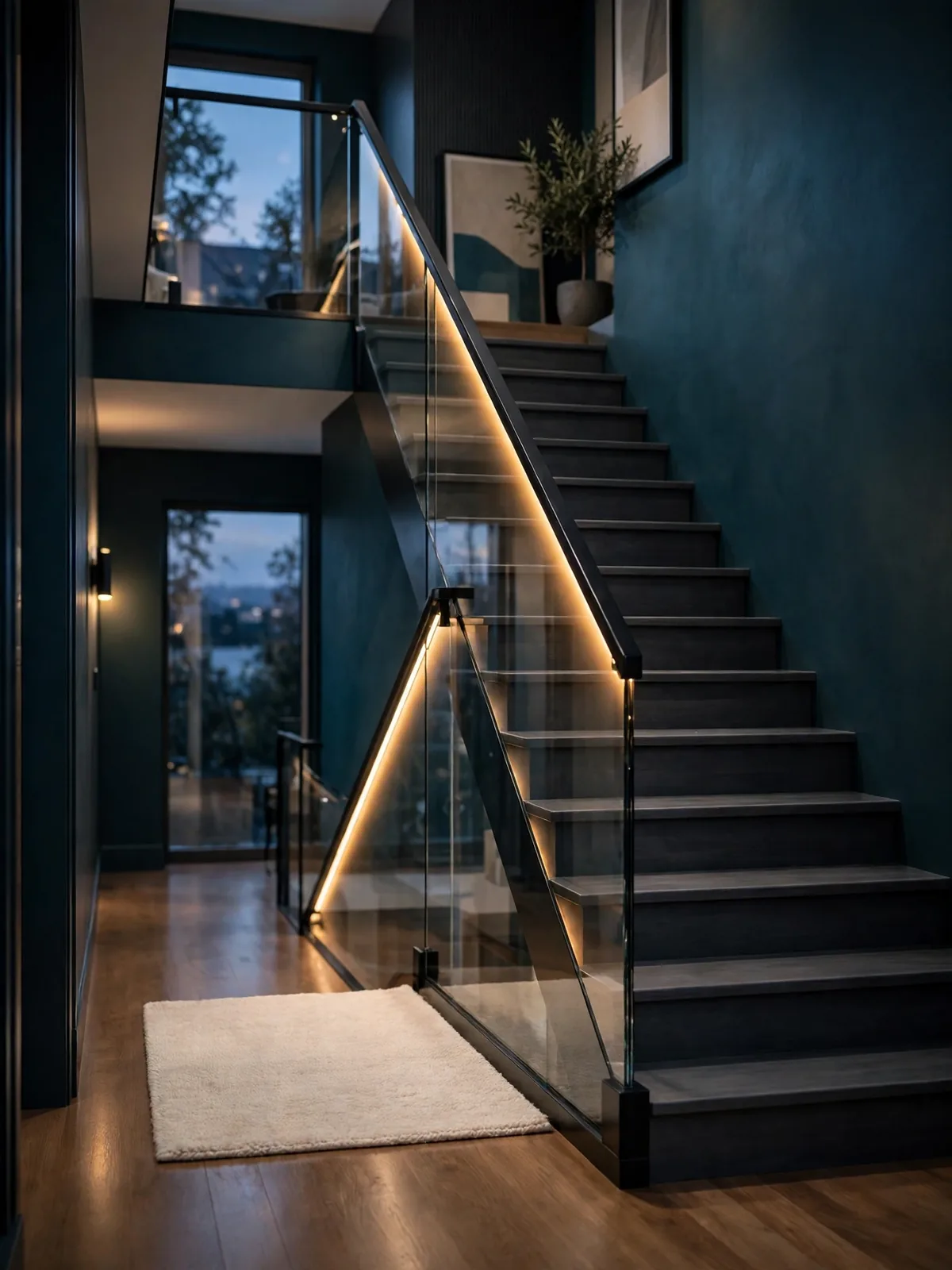
A handrail with built-in light turns a modern staircase railing into an evening feature. Three warm-white LED strips, hidden in a slim channel beneath a matte black handrail, run the full length of a straight stair with charcoal treads and clear glass panels below. The deep teal wall behind the stair makes the warm glow richer, while a cream rug at the base softens the landing. After dark, the glass catches the light and the whole stair shimmers gently, guiding you safely up at night.
Quick tips:
- Use warm-white LEDs, not cool white, for a premium evening glow.
- Put the lights on a dimmer so the glow can stay subtle.
- Hide the LED strip inside the handrail channel for a clean look.
- Pair LED lighting with dark treads for the strongest contrast.
Smoked Bronze Glass Panels for a Rich Modern Staircase Railing
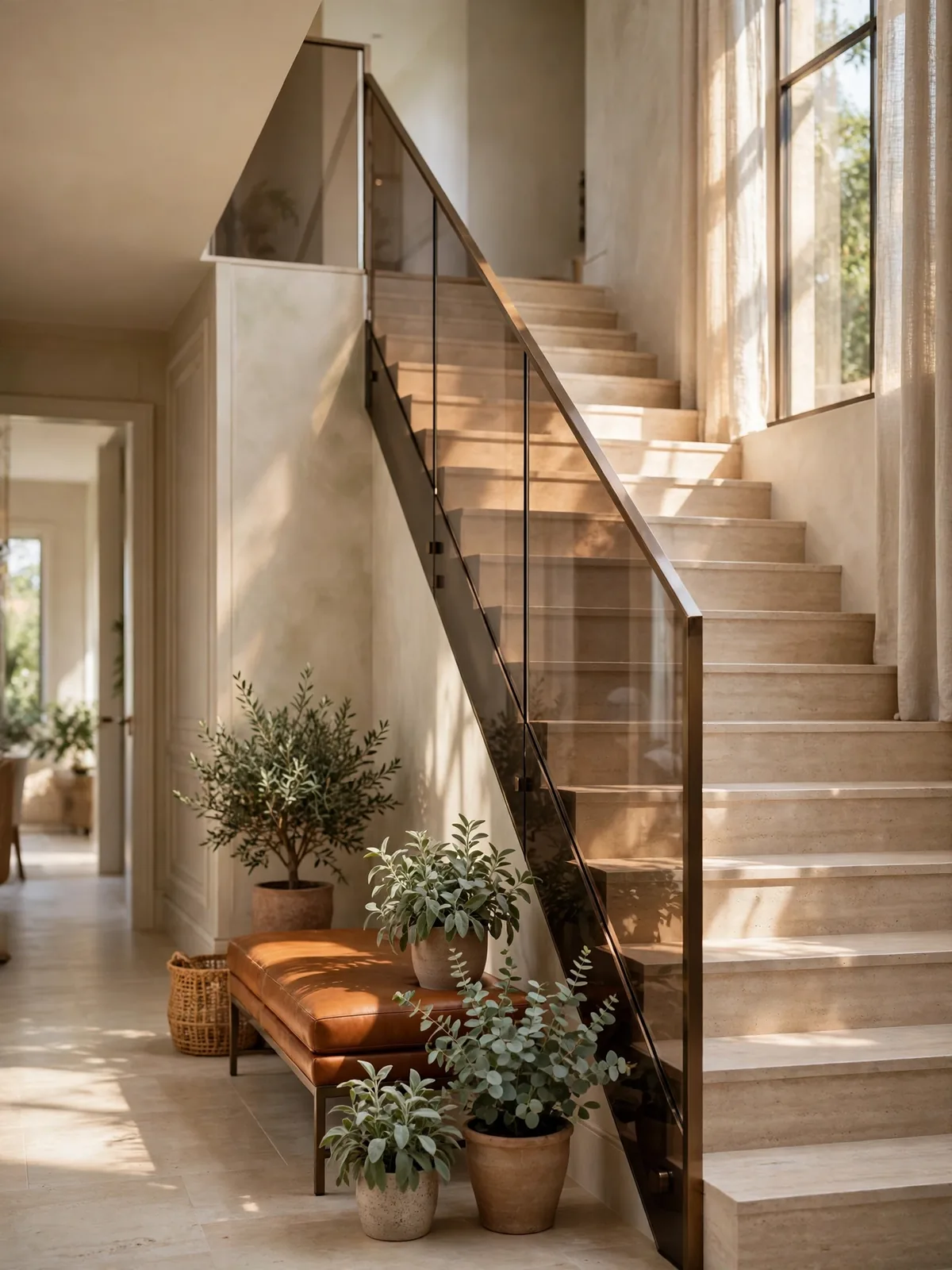
Smoked bronze glass adds depth and mood to a modern staircase railing without blocking the light. This stair uses 12 mm bronze-tinted glass panels, just dark enough to add colour, beside pale travertine treads, each 280 mm deep, with a warm caramel leather bench at the base and soft sage-green plants nearby. Daylight still passes through the bronze tint, casting a warm, honeyed glow on the travertine. It feels richer than clear glass, but just as open.
Quick tips:
- Choose a light bronze tint so daylight still passes through.
- Pair tinted glass with pale stone treads for the best glow.
- Keep the wall colour warm to match the tint.
- Test a sample panel in daylight before committing to the tint.
A Geometric Laser-Cut Panel Railing That Turns the Stair Into Art
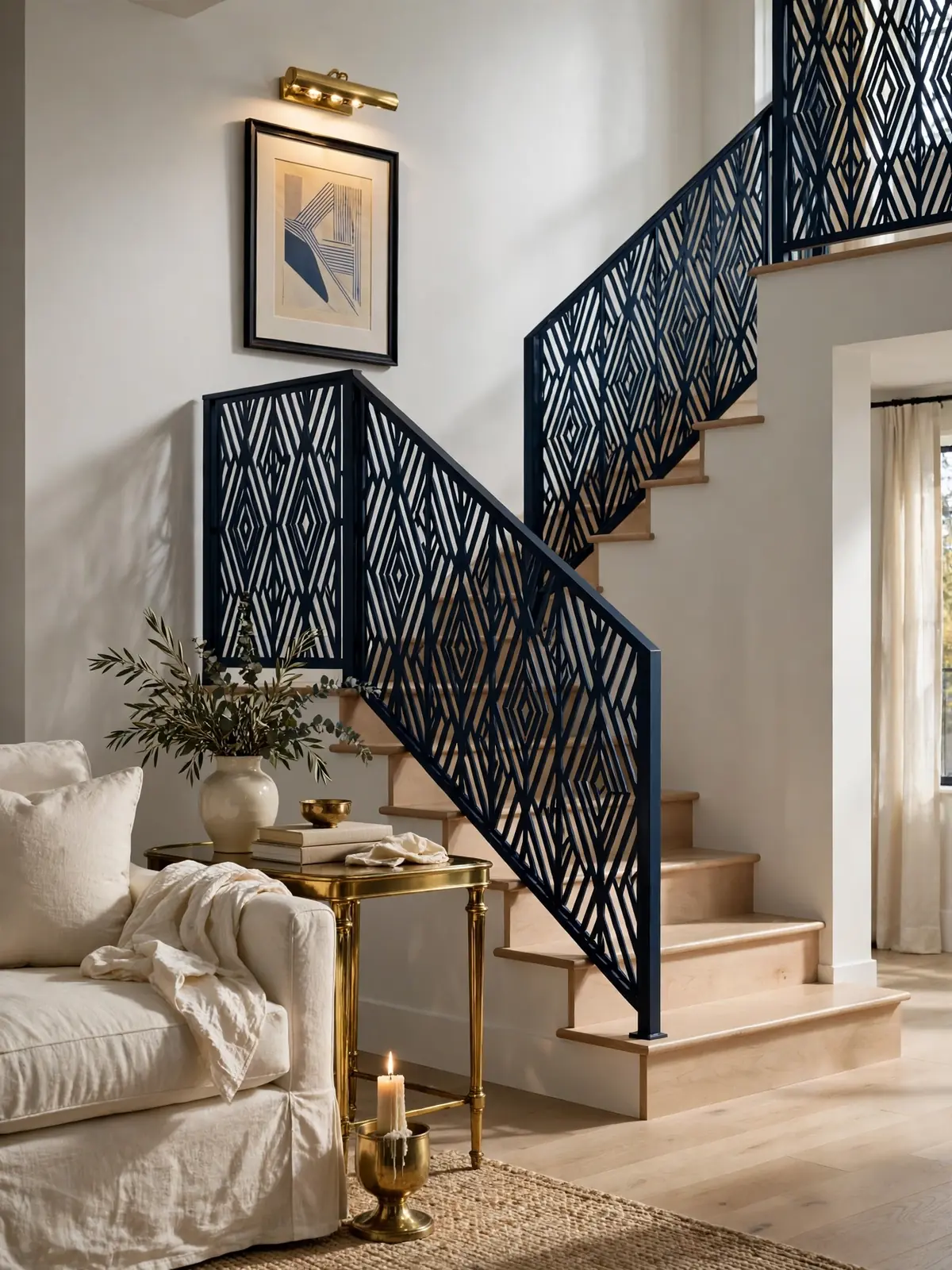
A laser-cut panel turns a modern staircase railing into a piece of wall art. Here, 3 mm steel panels in deep navy blue, cut with a repeating diamond pattern, run the full length of a straight stair with pale maple treads, each 900 mm wide. Sunlight falls through the cut-outs and throws soft geometric shadows on the white wall behind, so the pattern moves across the room through the day. A gold picture light and a cream linen armchair nearby soften the drama, while polished brass details pick up the warmth of the maple.
Quick tips:
- Choose a simple geometric pattern — diamonds or rectangles — for a modern feel.
- Keep the wall behind the stair pale so the shadows show clearly.
- Use one bold panel colour and keep the rest of the room calm.
- Ask for smooth, sealed cut edges so the panels are safe to touch.
A Wood-and-Black-Metal Mixed Railing for Warmth and Edge
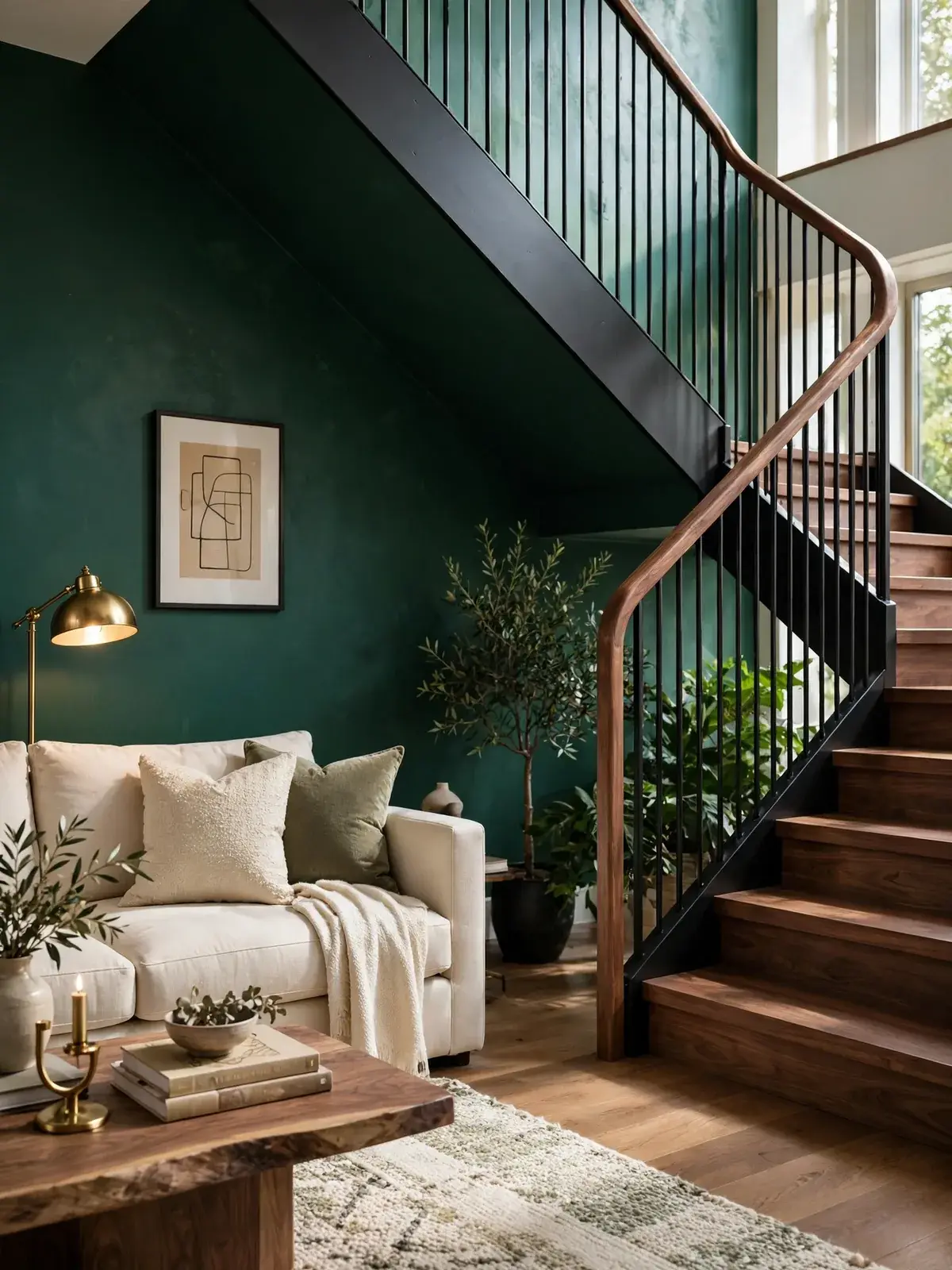
A black steel frame with a walnut handrail is one of the safest, most loved modern staircase railing combinations — modern lines with warm character. In this home, slim matte black steel balusters, spaced 100 mm apart, support a smooth walnut handrail, 60 mm wide, along a 1-metre-wide stair with walnut treads. The deep emerald-green wall behind the stair makes the black steel look richer, while a cream sofa and a brass floor lamp keep the room soft. It feels current without ever feeling stark.
Quick tips:
- Use engineered walnut for the handrail to keep costs down without losing warmth.
- Choose matte black steel, not gloss, for a modern finish.
- Match the handrail tone to the treads for a unified look.
- Add a warm wall colour behind the stair to soften the black.
A Sculptural Curved Metal Railing for a Statement Stair
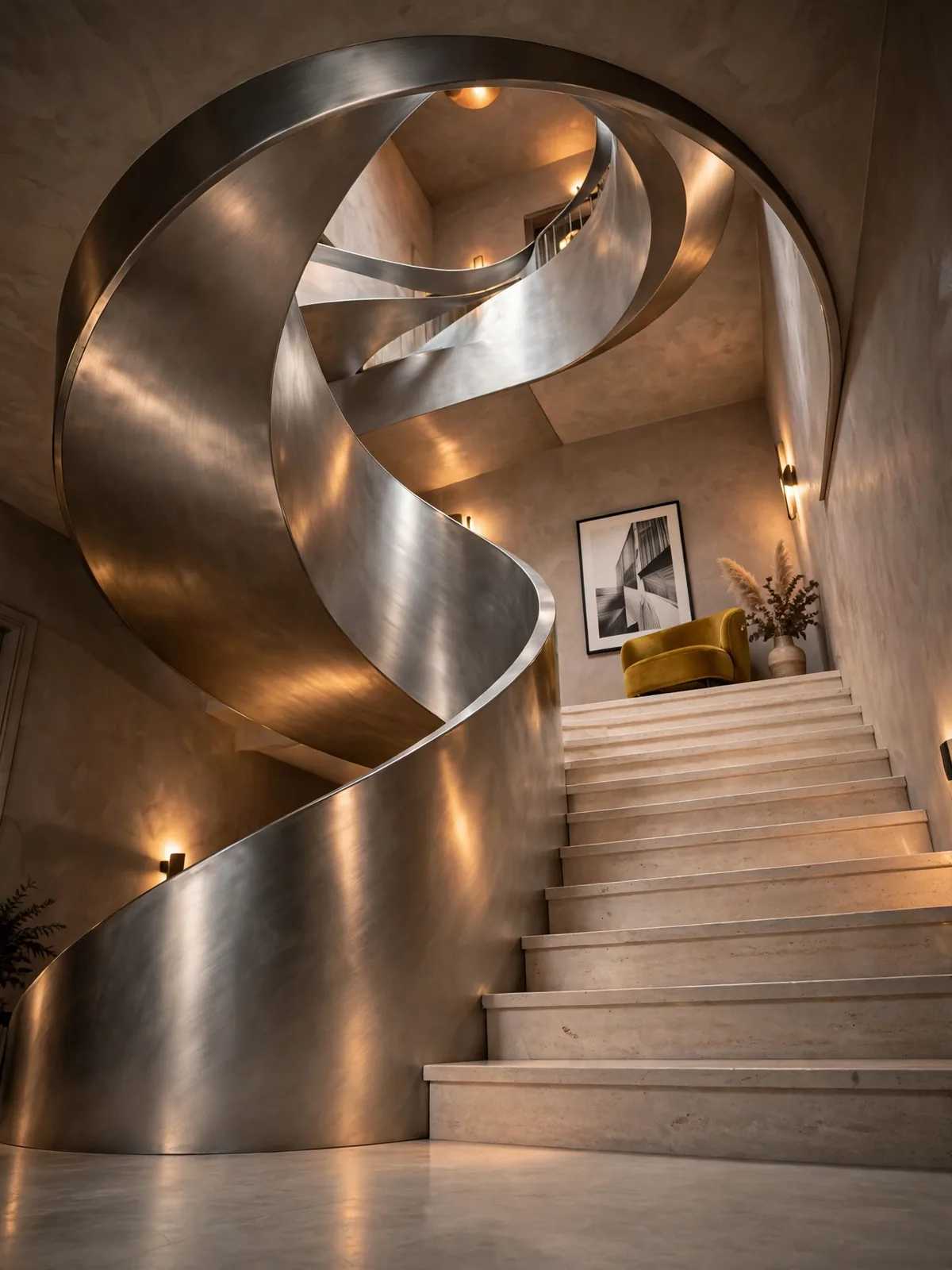
A curved railing turns a modern staircase railing into sculpture. Here, a single smooth curve of brushed steel, bent in one continuous sweep, follows a gently curved stair with pale stone treads, each 1 metre wide, against warm taupe walls. A mustard-yellow velvet chair below makes the pale stone and steel feel warm, while a black-and-white art print on the landing adds a graphic finish. When natural light hits the curve, the shadows alone make the entryway feel more luxurious.
Quick tips:
- Keep the rest of the stair simple so the curve stays the star.
- Use brushed steel, not polished, for a soft, modern sheen.
- Add one strong accent colour below the stair to balance the drama.
- Check the curve is made in one piece — joints can weaken the line.
Fine Black Mesh Panels for an Industrial Modern Staircase Railing
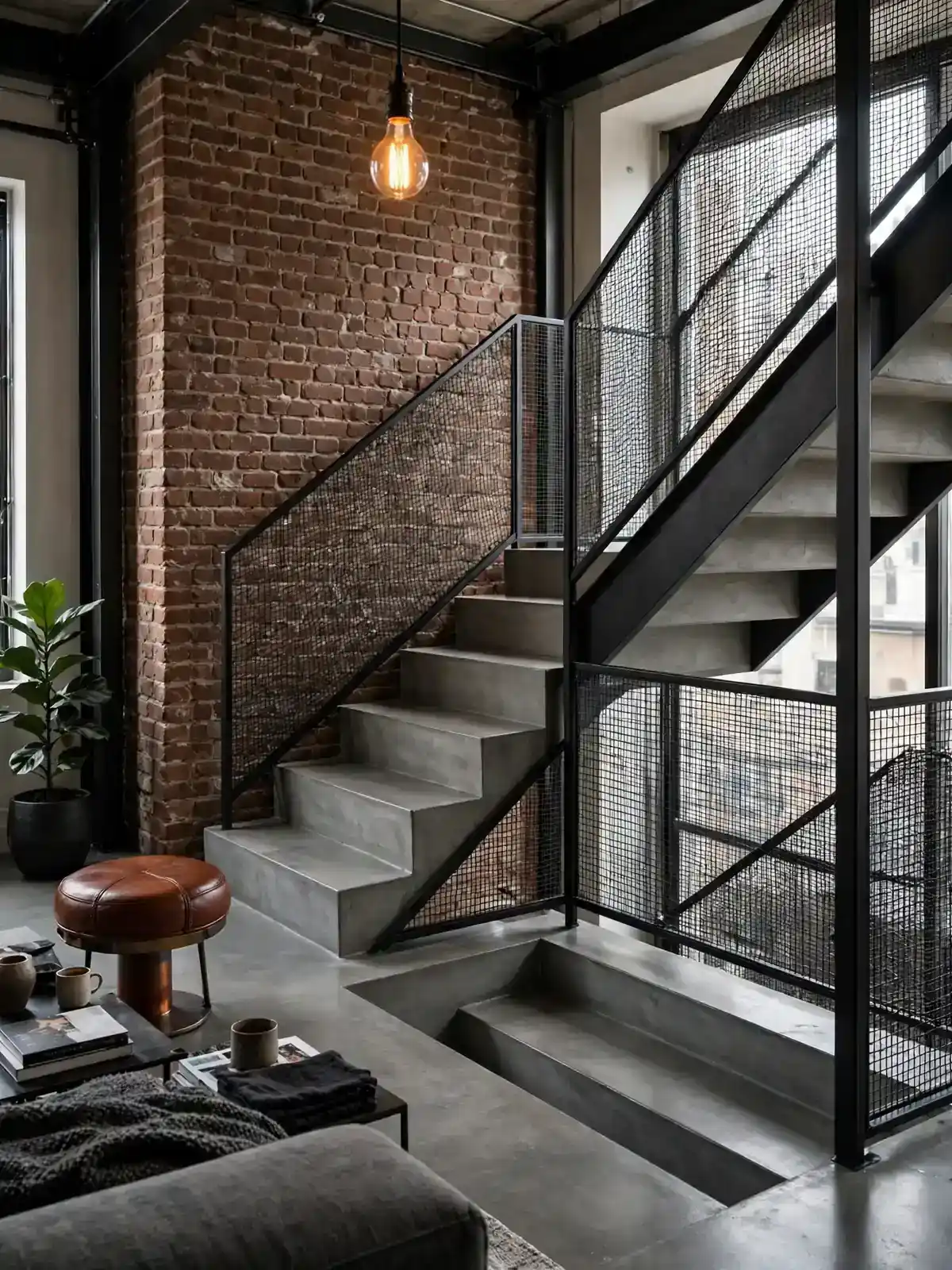
Fine mesh gives a modern staircase railing texture and a light industrial edge while still letting you see through. In this loft, black steel mesh panels with a tight 10 mm weave sit inside slim matte black frames along a stair with polished concrete treads, each 1 metre wide. The exposed brick wall behind adds warmth, a cognac leather stool adds a soft note, and a warm Edison pendant glows above. The mesh feels edgy and contemporary, yet refined enough for a family living room.
Quick tips:
- Choose a fine mesh weave so the railing still feels refined.
- Frame the mesh in slim steel so the panels stay rigid and safe.
- Pair mesh with warm leather or timber to soften the industrial feel.
- Dust mesh panels with a soft brush to keep the weave clear.
An All-Black Railing System for Maximum Drama
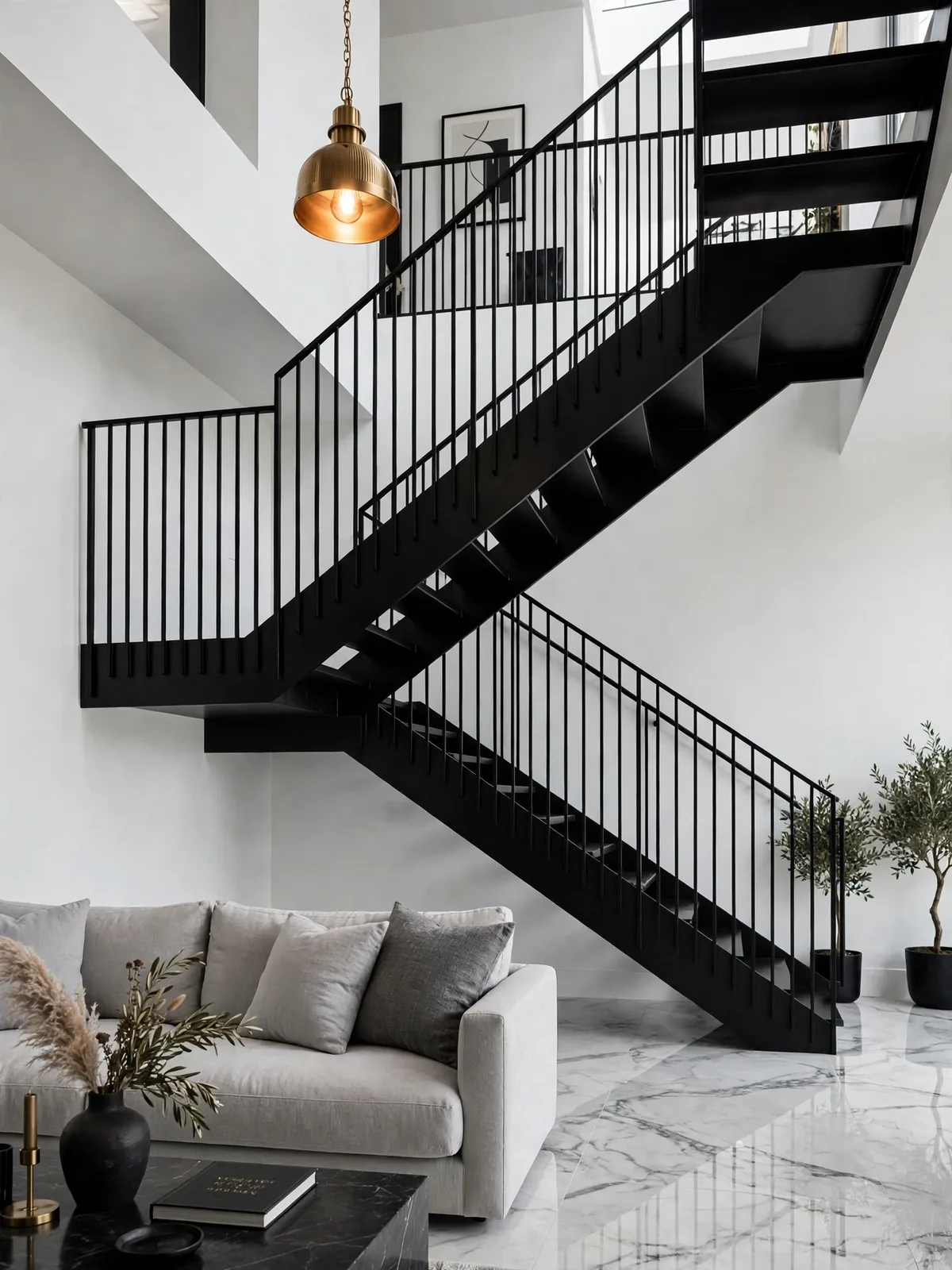
An all-black system is the boldest modern staircase railing choice — black balusters, black handrail, black treads, all in one striking line. Here, 1-metre-wide matte black steel treads with a soft, non-slip finish are edged with slim black balusters and a matching black handrail, set against white walls and a white marble floor. A soft grey sofa and a warm brass pendant light keep the room from feeling cold, while the contrast makes the stair look like a boutique hotel feature. It is drama, balanced by light.
Quick tips:
- Use matte black throughout — never mix gloss and matte black.
- Balance black with white walls and a light floor.
- Add warm lighting to keep an all-black stair feeling cosy.
- Choose a non-slip tread finish for safety on dark treads.
A Stone Base Wall With Glass Above for a Premium Railing
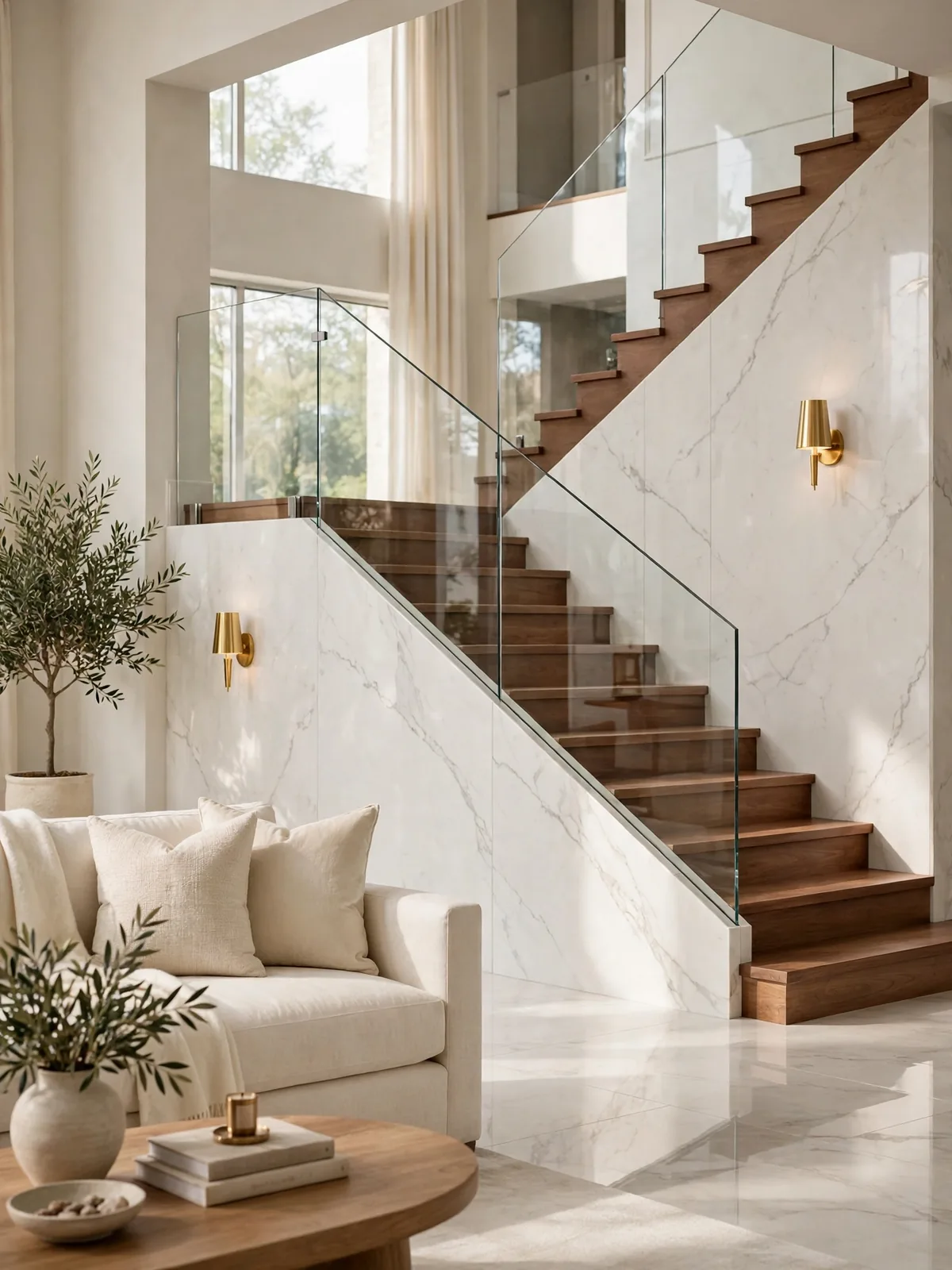
Stone below and glass above is one of the most luxurious modern staircase railing combinations. In this home, a 900 mm high white marble wall with soft grey veining forms the lower half of the railing, with 12 mm clear glass panels rising above it to handrail height, beside warm walnut treads, each 1 metre wide. Gold wall sconces on the marble add a warm glow, a cream sofa opposite keeps the room soft, and the polished marble floor reflects the daylight from the stair. The stone adds permanence and richness, while the glass keeps the whole stair open.
Quick tips:
- Choose marble with soft, fine veining so it does not overwhelm the glass.
- Use warm wood treads to keep white marble feeling cosy.
- Add gold lighting to warm up the cool marble and glass.
- Keep the glass panels clear so the stone stays visible through them.
A Matte Bronze Railing for Grounded Warmth
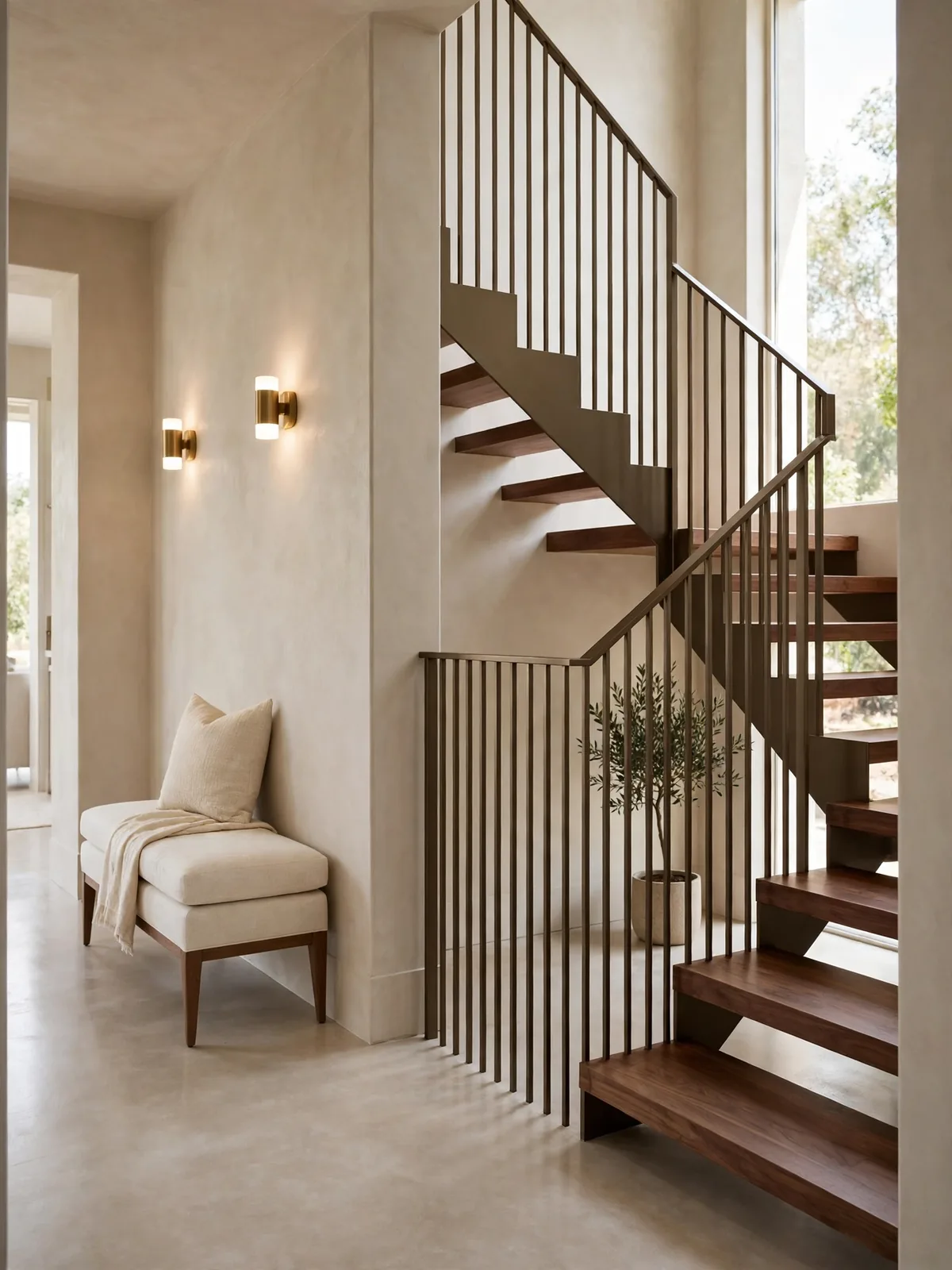
Matte bronze brings warmth like brass but feels more grounded and subtle — an underrated modern staircase railing finish. On this stair, slim matte bronze balusters, 12 mm in diameter, run between a bronze handrail and walnut treads, each 950 mm wide, against beige plaster walls. Warm white wall lights glow softly above the stair, and a cream linen bench at the base keeps the palette calm. Bronze also hides fingerprints better than polished metals, so the railing stays looking clean with very little effort.
Quick tips:
- Choose matte bronze, not polished, for a calm, modern finish.
- Pair bronze with beige walls and walnut wood for warmth.
- Use warm white lighting to bring out the bronze tone.
- Match the bronze to a tap or light fitting nearby for a pulled-together look.
Open-Grid Metal Panels for an Architectural Railing
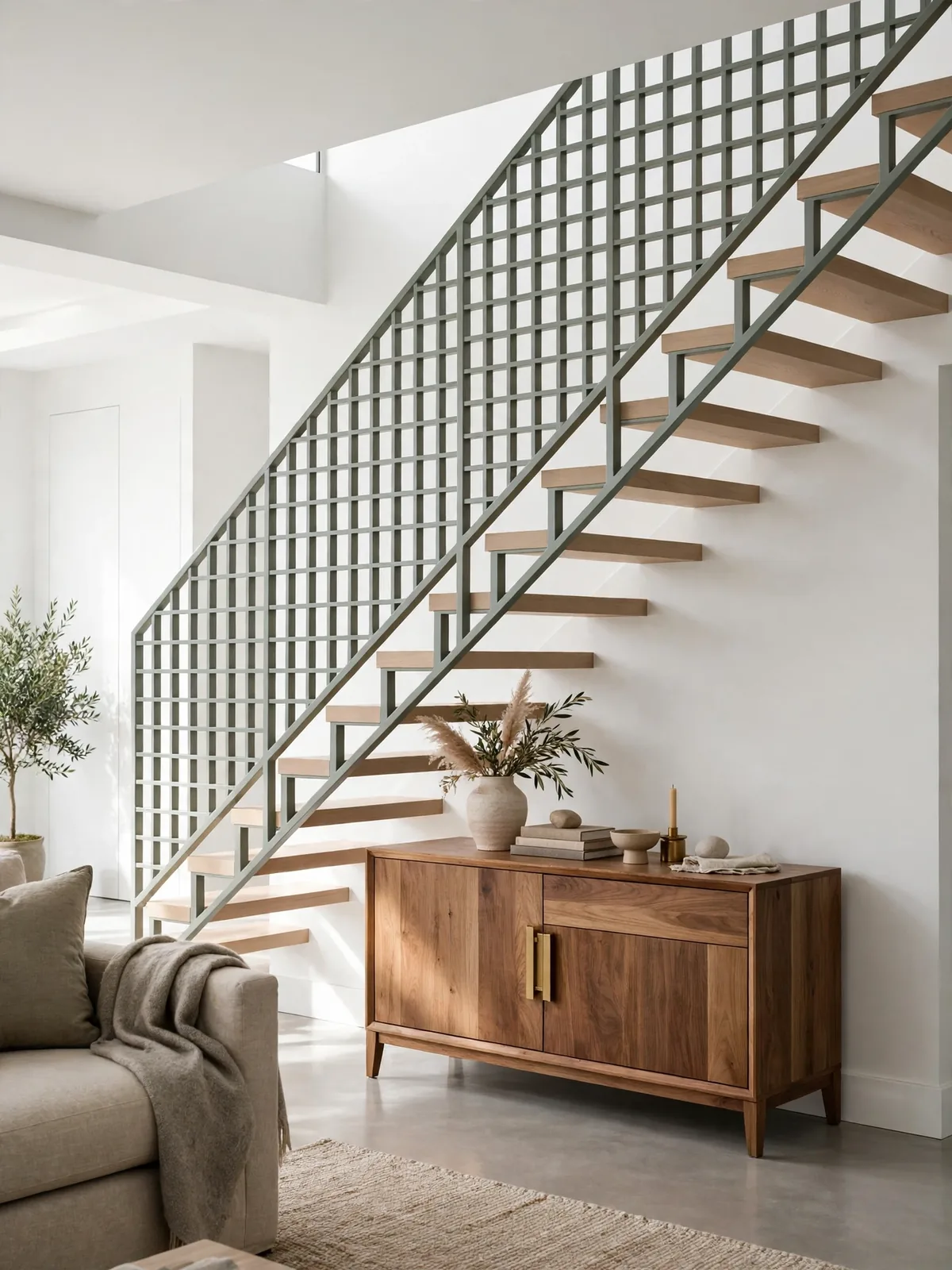
Open-grid panels give a modern staircase railing a structured, architectural feel while keeping visibility through the stair. Here, powder-coated steel panels in soft grey-green, with an even 80 mm square grid, run along a straight stair with pale oak treads, each 900 mm wide, against white walls. A warm timber sideboard nearby echoes the oak treads, and soft daylight falls through the grid, casting a gentle square pattern on the wall. The grid feels graphic and bold, yet the gaps keep the stair light.
Quick tips:
- Keep grid spacing even — uneven grids look untidy.
- Use a powder-coated finish so the panels resist chips and scratches.
- Pair the grid colour with a cabinet or wall colour nearby.
- Add warm overhead lighting to soften the graphic pattern.
Clear Acrylic Panels for a Family-Friendly Modern Railing
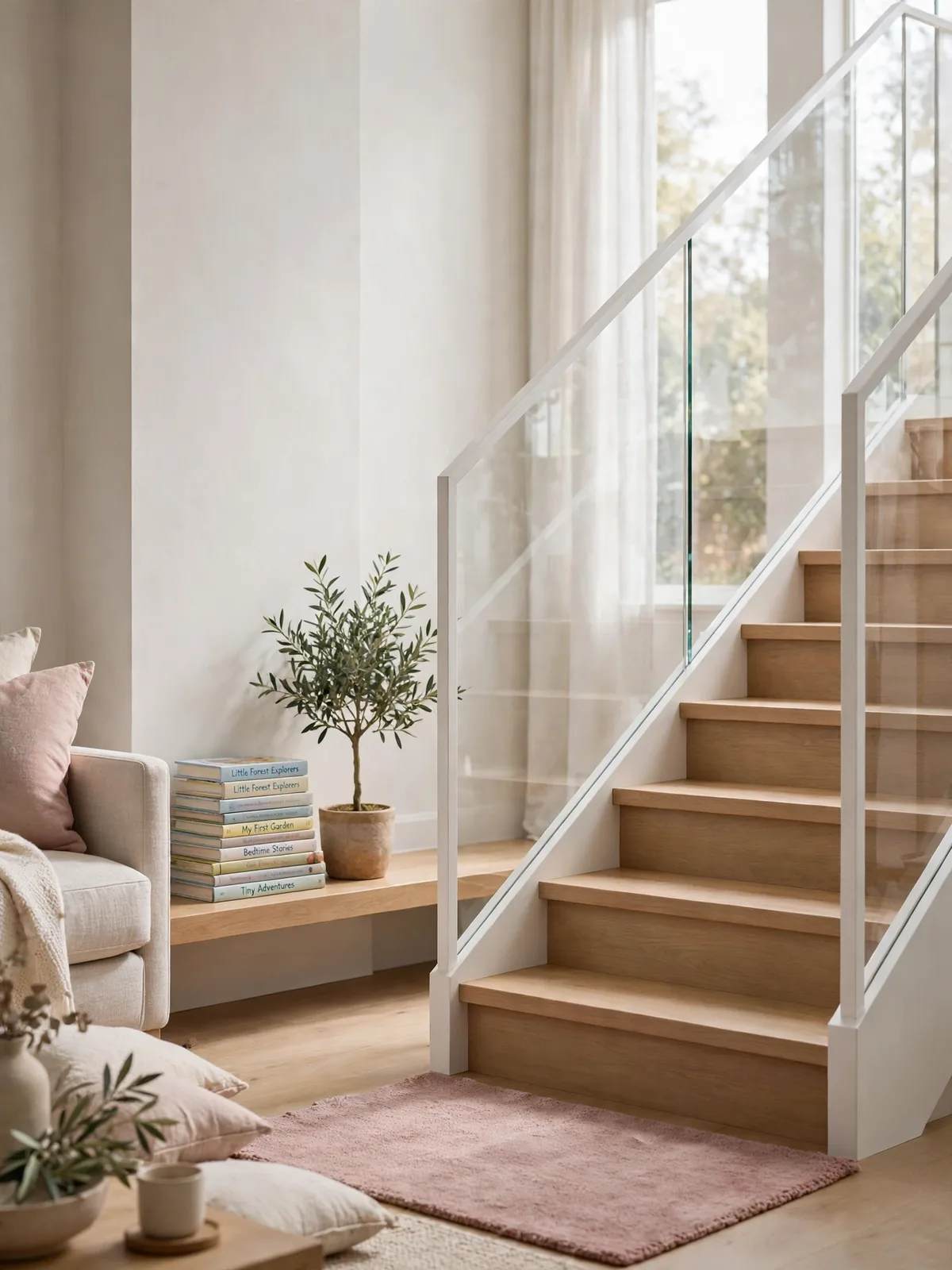
Acrylic gives a modern staircase railing the openness of glass with a softer, more forgiving feel — a smart choice for a family home. In this living room, 10 mm clear acrylic panels run beside light oak treads, each 1 metre wide, topped by a slim white handrail with a comfortable rounded grip. A dusty-rose rug at the base softens the landing, a small olive tree adds life, and a low shelf of children’s books shows the stair belongs in a real family home. Acrylic is lighter than glass and less prone to shattering, so it suits busy households.
Quick tips:
- Choose acrylic at least 10 mm thick for rigidity and safety.
- Clean acrylic with a soft cloth and mild soap, never harsh glass cleaner.
- Add a timber or white handrail for a warm, comfortable grip.
- Keep the landing rug low-pile so it does not catch feet.
A Floating Wall-Mounted Handrail With No Visible Brackets
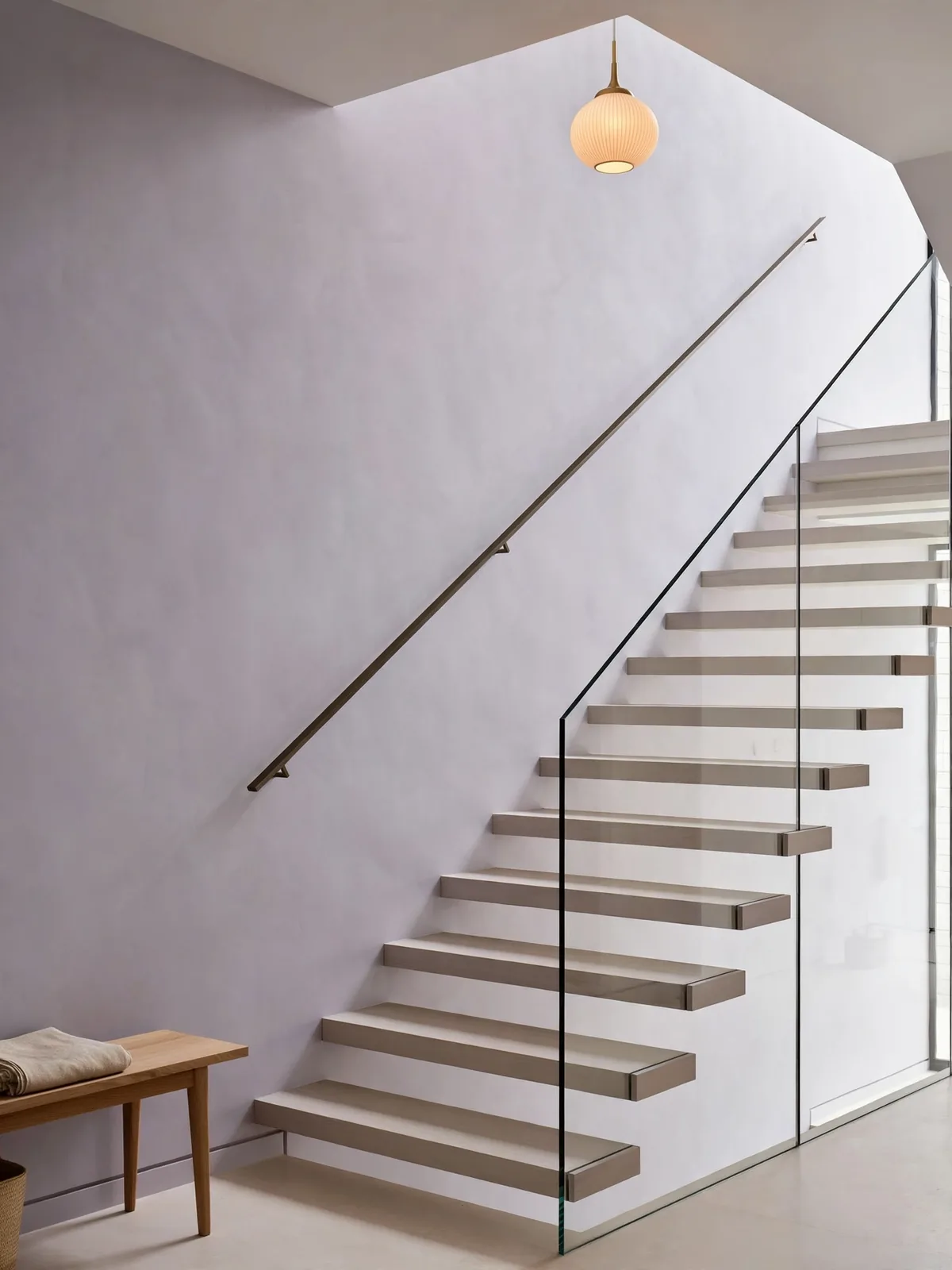
Sometimes the most modern staircase railing is barely there at all. On this stair, a slim 40 mm diameter brushed-steel handrail floats along the soft lavender-grey wall, held by hidden brackets set into the plaster, with a clear glass panel guarding the open side. The pale ash treads, each 280 mm deep, stay light and simple, while a small wooden bench at the base and a warm pendant light add quiet comfort. The rail is there when you need it and almost invisible when you do not.
Quick tips:
- Use hidden brackets set into the wall for a truly floating look.
- Set the rail about 900 mm above the tread nosing for a natural grip.
- Match the rail finish to the glass fixings on the open side.
- Add a slim LED strip under the rail for a soft night-time glow.
Asymmetrical Bars for a Custom Designer Railing
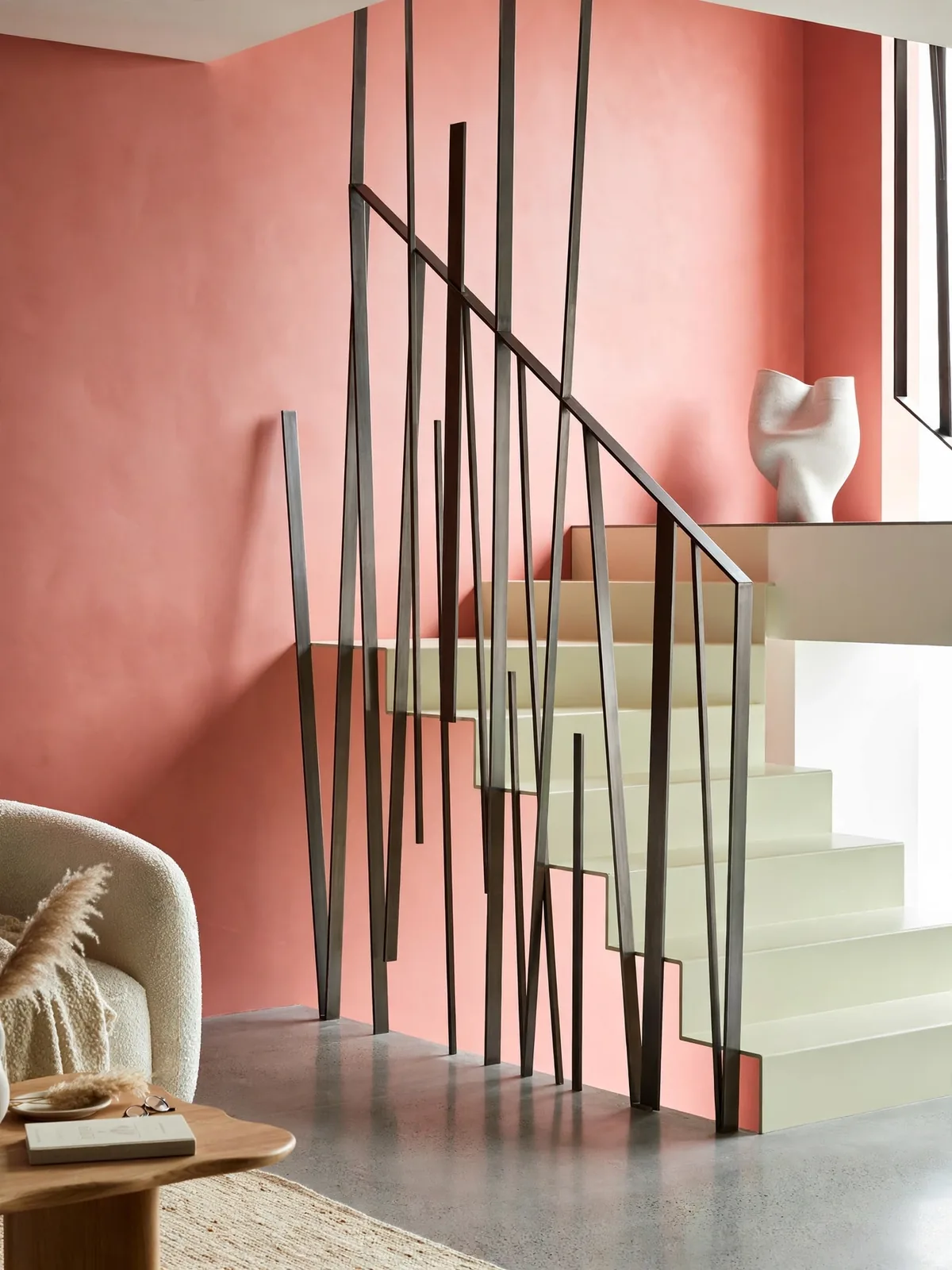
Asymmetrical bars give a modern staircase railing a fresh, custom-made feel. Here, matte black steel bars in three different widths — 20 mm, 40 mm and 60 mm — are set at varied spacing along a straight stair with pale cream treads, each 950 mm wide, against a soft coral-pink wall. The irregular rhythm feels intentional and artistic, like a piece of abstract art, while a sculptural ceramic vase on the landing echoes the bold lines. It works best when the rest of the room is kept calm and minimal.
Quick tips:
- Keep the asymmetry balanced — too much variation looks chaotic.
- Use one bold wall colour and keep the rest of the room pale.
- Vary bar widths, not heights, so the handrail stays level and safe.
- Sketch the pattern full-size first to check the rhythm feels right.
A Coastal Railing in Pale Timber, Rope and Linen Tones
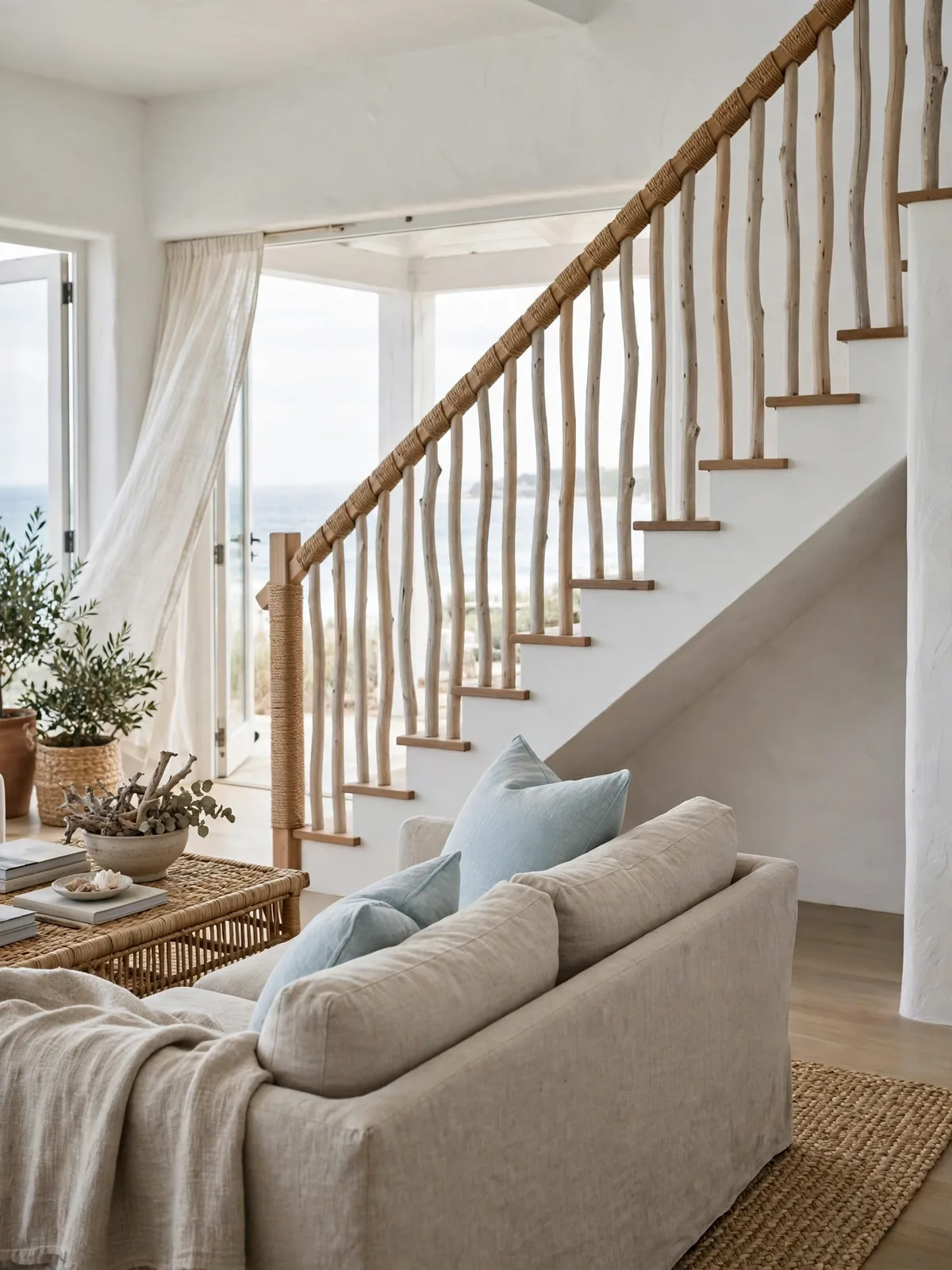
A coastal railing brings a modern staircase railing the relaxed feel of a beach house. In this home, pale driftwood balusters, each 40 mm wide, support a slim handrail wrapped in natural rope, beside pale timber treads, each 950 mm wide, and whitewashed walls. A natural linen sofa, a woven seagrass rug and pale blue cushions complete the palette, while daylight from the sea-facing windows passes straight through the open balusters. The whole home feels like one breezy, open space.
Quick tips:
- Use pale, weathered timber for a relaxed coastal feel.
- Keep walls whitewashed so sea light bounces through the railing.
- Add linen and seagrass textures to soften the timber.
- Choose pale blue accents to echo the sea without overdoing the theme.
A Two-Tone Black-and-White Railing for a Graphic Look
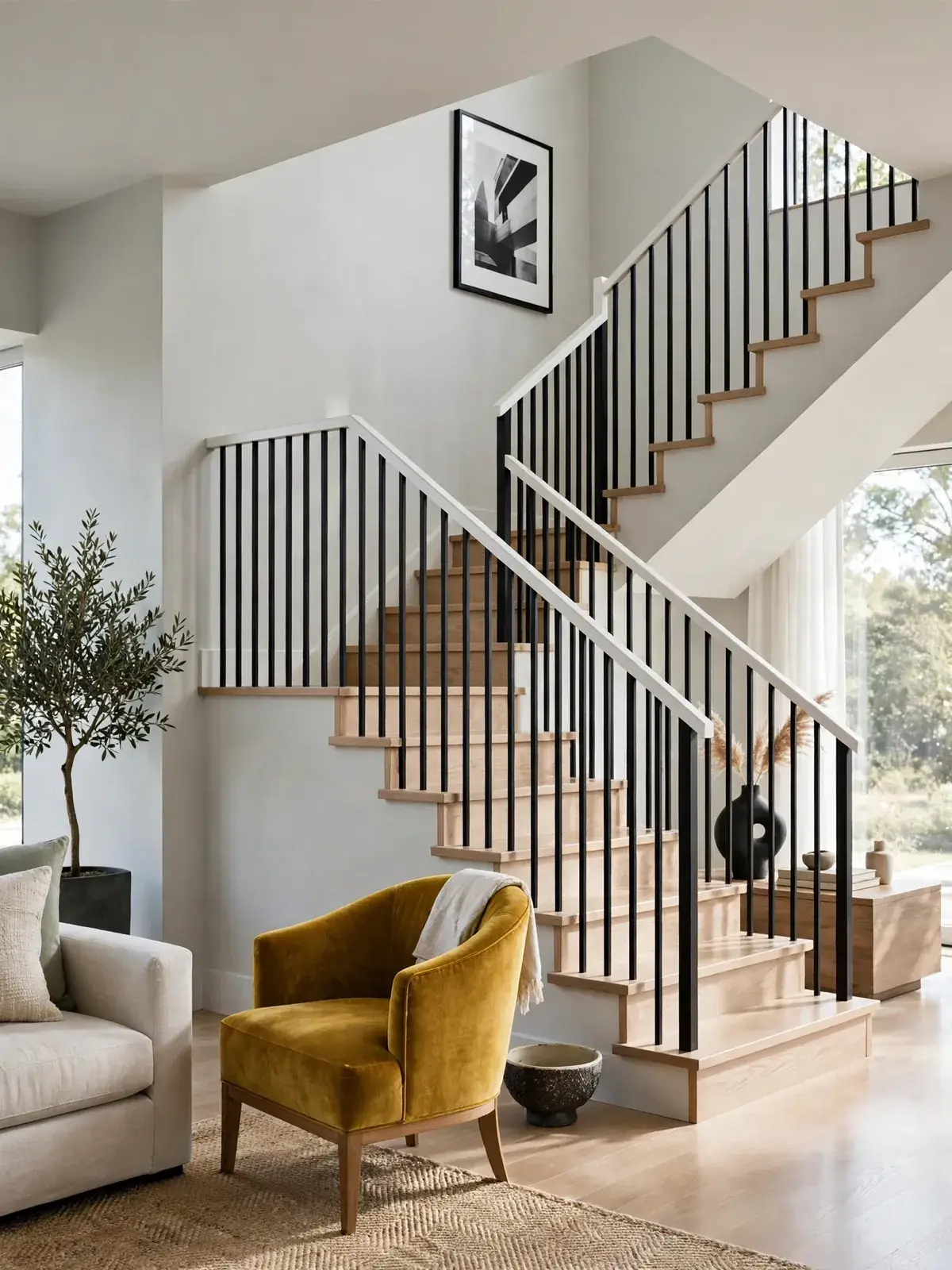
Two tones make a modern staircase railing feel graphic and deliberate. Here, slim matte black steel balusters, spaced 100 mm apart, meet a crisp white handrail along a straight stair with white oak treads, each 900 mm wide, against pale grey walls. A mustard-yellow velvet chair below the stair adds one warm, confident accent, while a black-and-white art print on the landing echoes the railing’s two tones. The black-and-white contrast is bold, yet the pale walls keep it feeling fresh rather than heavy.
Quick tips:
- Keep the two tones strictly black and white — no third metal.
- Add one warm accent colour, like mustard, to soften the contrast.
- Use matte black so the balusters do not glare in daylight.
- Echo the two tones in nearby art or cushions for a pulled-together look.
A Floating Wood-and-Glass Railing for a Dream Stair
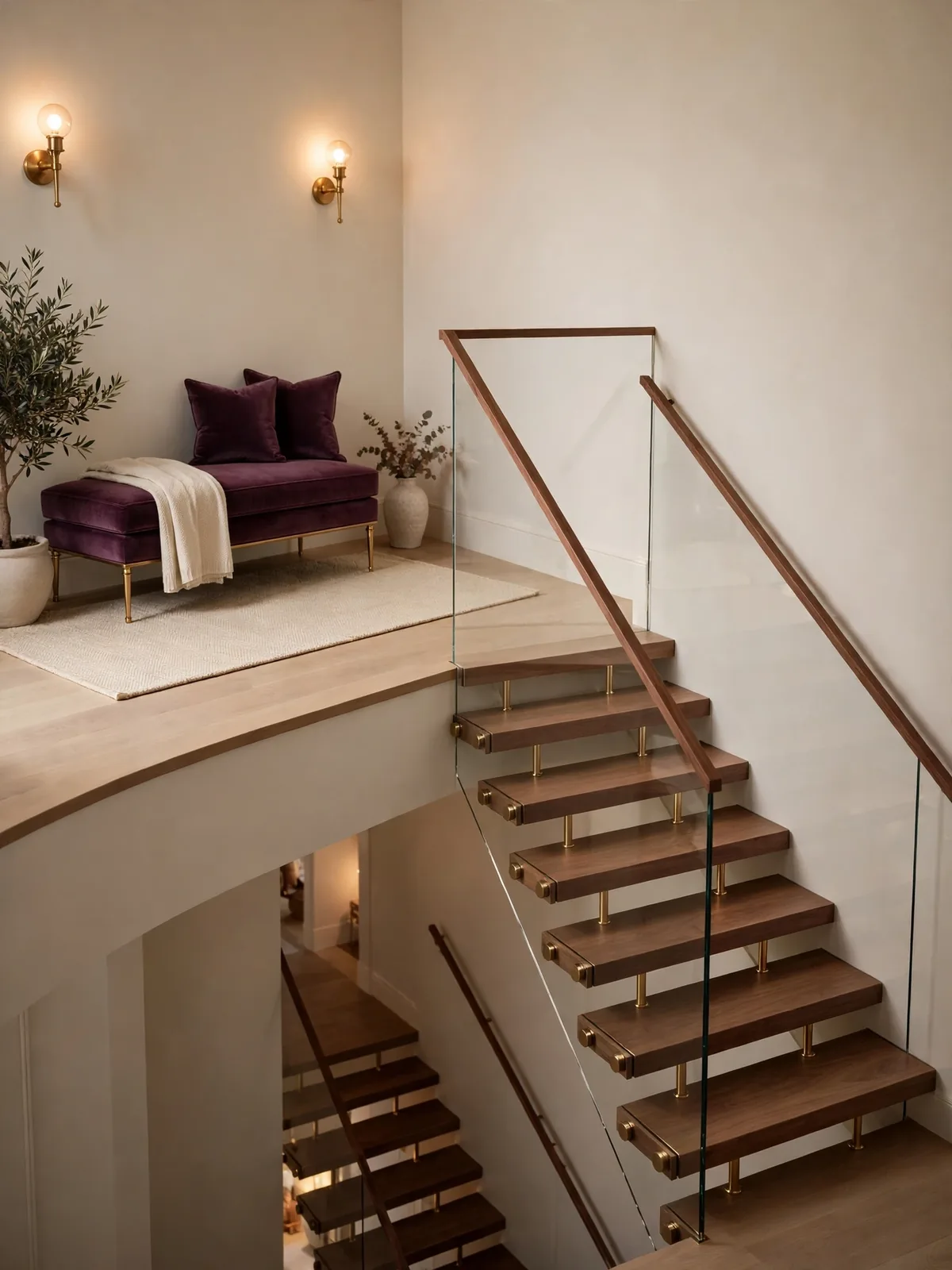
Floating wood with glass is the dream combination for a modern staircase railing — warm, open, and effortlessly luxurious. In this home, floating walnut treads, each 1 metre wide and 50 mm thick, appear to hover with 180 mm gaps between them, edged by frameless clear glass panels and a slim floating walnut handrail with no visible brackets. A deep plum velvet bench on the landing adds a rich, jewel-toned note, while ivory walls and warm lighting keep the whole stair feeling calm and refined. The wood keeps it inviting, while the glass keeps it open and bright.
Quick tips:
- Use thick walnut treads, at least 50 mm, so floating treads feel solid.
- Keep the glass completely clear for the strongest floating effect.
- Add a slim wall handrail on the wall side for extra confidence.
- Choose one deep jewel tone, like plum, for the landing accent.
A Sage-Green Powder-Coated Railing for a Fresh Colour Pop
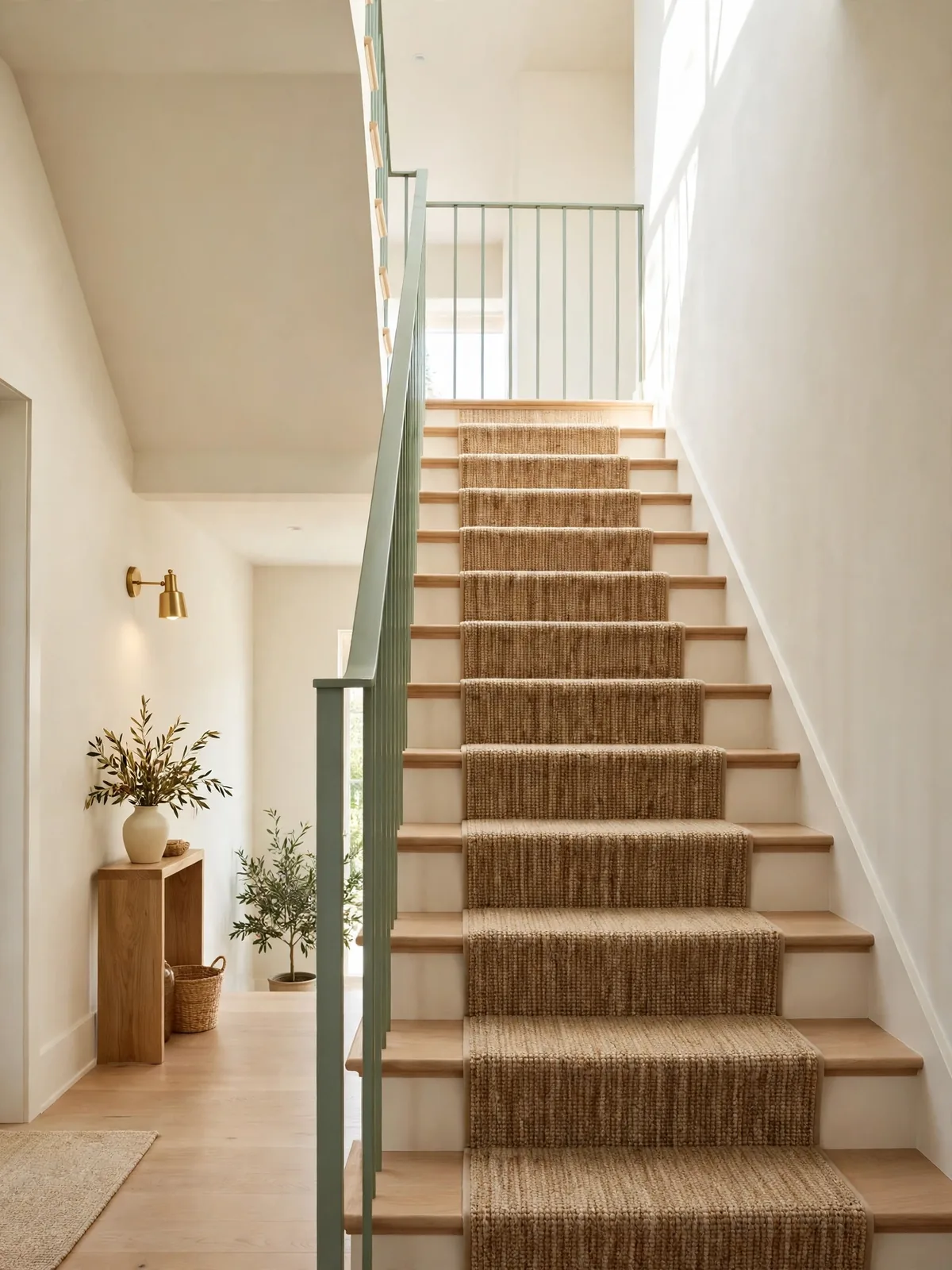
Colour turns a modern staircase railing into a feature without adding clutter. Here, slim sage-green powder-coated steel balusters, spaced 100 mm apart, run between a sage-green handrail and pale oak treads, each 950 mm wide, against cream walls. A brass wall light warms the green, and a woven jute runner at the base adds natural texture. Sage green feels fresh and calm, and because it is a muted tone, it sits beautifully with timber, cream and brass for years without dating.
Quick tips:
- Choose a muted colour, like sage, so the railing does not date quickly.
- Pair a coloured railing with pale treads and cream walls.
- Use powder coating for a smooth, hard-wearing colour finish.
- Echo the colour in one soft furnishing, like a cushion, nearby.
A Railing With a Built-In Display Shelf Along the Wall
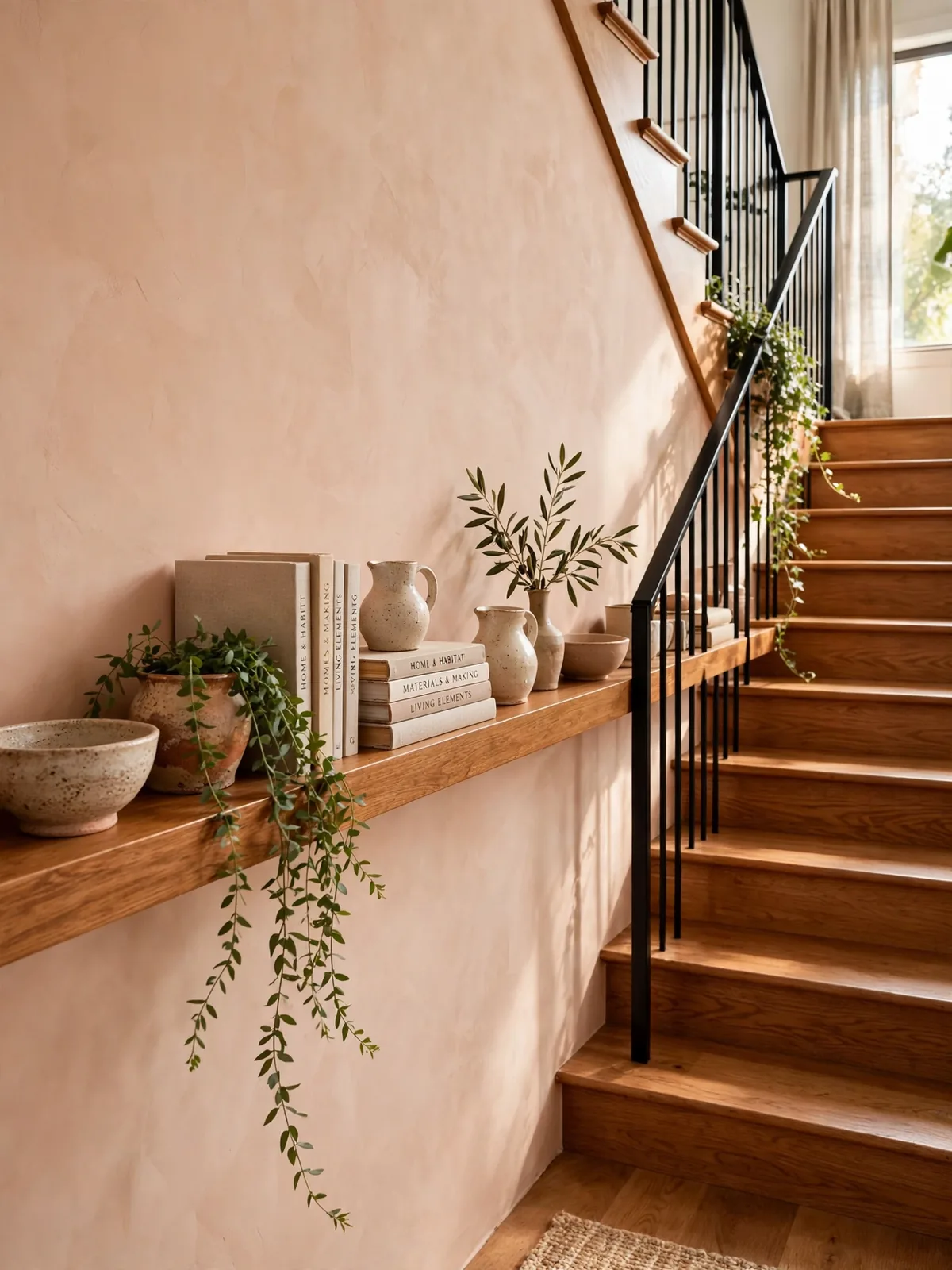
A built-in shelf turns the wall beside a modern staircase railing into a display, while the railing keeps the stair light. Here, a slim oak shelf, 200 mm deep, runs the full length of the stair wall at hand height, holding handmade pottery, small books and a trailing green plant, beside slim black balusters and warm oak treads, each 900 mm wide. The soft peach wall makes the ceramics glow, and daylight falls across the shelf through the open balusters. The stair feels personal — a home, not a showroom.
Quick tips:
- Keep the shelf slim so it does not narrow the stair.
- Display a few favourite pieces, not a crowded row.
- Use the same timber for shelf and treads for a unified look.
- Add one trailing plant to soften the straight shelf line.
A Slim Glass-and-Steel Railing That Opens Up a Narrow Stair
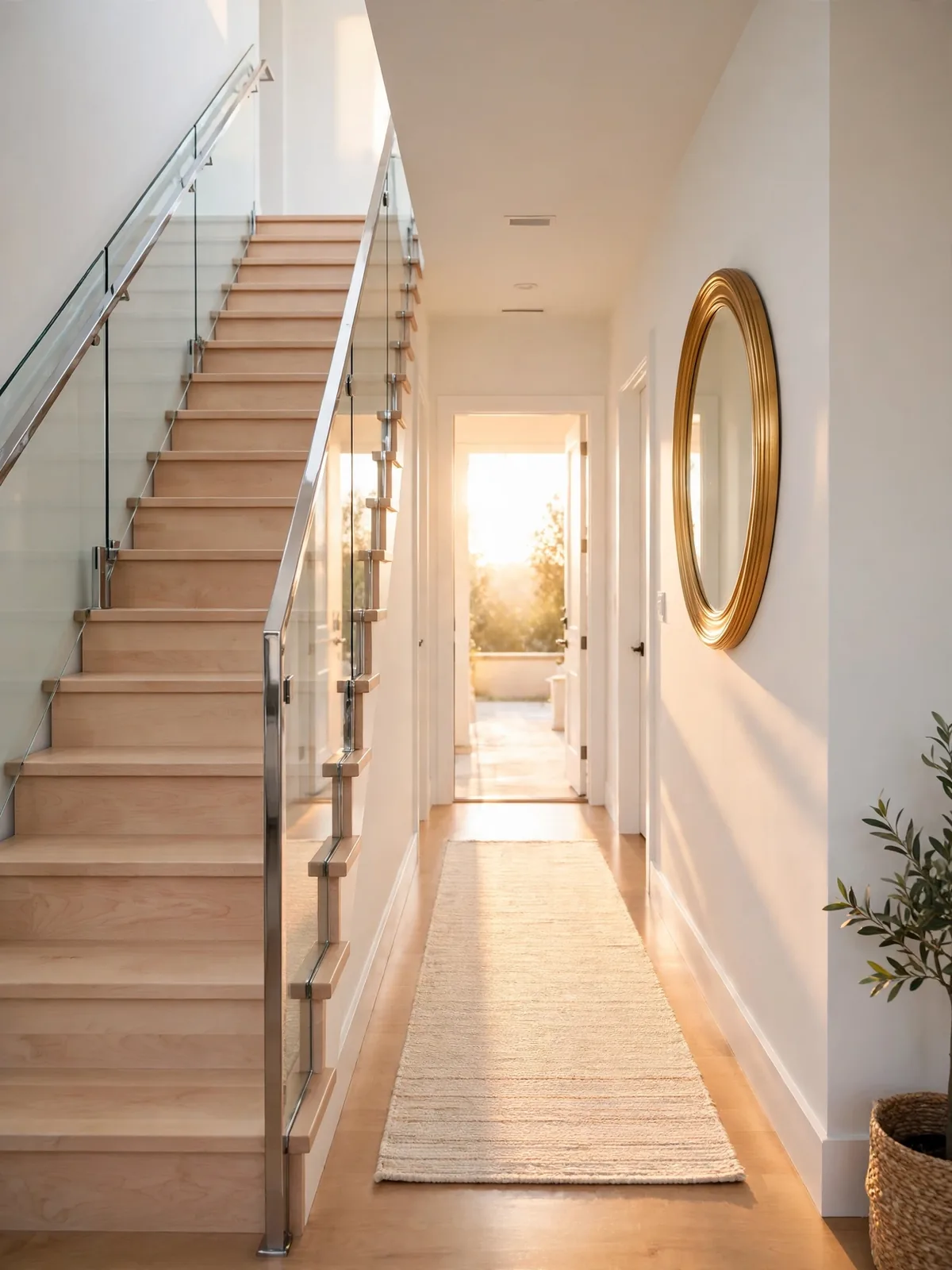
A narrow stair is where a modern staircase railing makes the biggest difference. In this home, a hallway only 900 mm wide was opened up with a slim railing — 10 mm clear glass panels held by small chrome fixings, beside pale maple treads, each 800 mm wide, and white walls. A large round gold mirror opposite the stair bounces the light further, a cream runner softens the floor, and the golden light from the landing window now travels through the glass and across the whole hallway. What was once the darkest corner is now the brightest.
Quick tips:
- Use clear glass on a narrow stair so no light is blocked.
- Paint the hallway white so it reflects every bit of light.
- Add a large mirror opposite the stair to double the brightness.
- Keep the hallway free of tall furniture that could block the glass.
FAQs
What is the safest modern staircase railing for children?
Tempered glass with a timber handrail is one of the safest choices, because there are no gaps a child can climb through and the handrail gives a comfortable grip. Keep any baluster gaps under 100 mm, choose rounded handrail edges, and check fixings regularly so panels stay secure.
How much does a modern staircase railing cost?
Costs vary widely by material and stair length. A simple powder-coated steel railing is usually the most affordable, glass panels and brass sit in the middle to upper range, and custom curved or laser-cut steel is the most expensive. Always get at least two quotes from local installers before committing, and check what is included — fixings, handrails and fitting.
Can I replace just the railing without rebuilding the whole staircase?
Yes, in most homes the railing can be replaced on its own. A new balustrade, handrail or glass panel system can usually be fitted to the existing treads and stringer, as long as the stair structure is sound. Ask an installer to check the tread fixings first, because the new railing needs a solid base to anchor into.
Does a glass railing make a home feel cold?
It can feel cool if everything around it is white and grey, but warm wood treads, a soft rug, brass details or a warm wall colour balance it easily. The glass itself does not make the room colder — it simply lets light through, and the materials around it set the mood.
What is the best handrail height for a modern staircase railing?
A handrail height of about 900 mm above the tread nosing feels natural for most adults and meets common building guidance in the US and UK. Always check your local building code before installing, because exact requirements can vary by region.
Conclusion
A modern staircase railing is not just a safety feature — it is the detail that decides whether a stair feels open or closed, warm or cold, ordinary or unforgettable. Whether you choose frameless glass that almost disappears, matte black steel for quiet drama, warm oak for softness, or brass for a touch of luxury, the best railing is the one that suits the rooms around it. Keep the gaps safe, the handrail comfortable, and the palette honest to your home, and your stair will make every room it touches feel brighter, lighter and more welcoming.