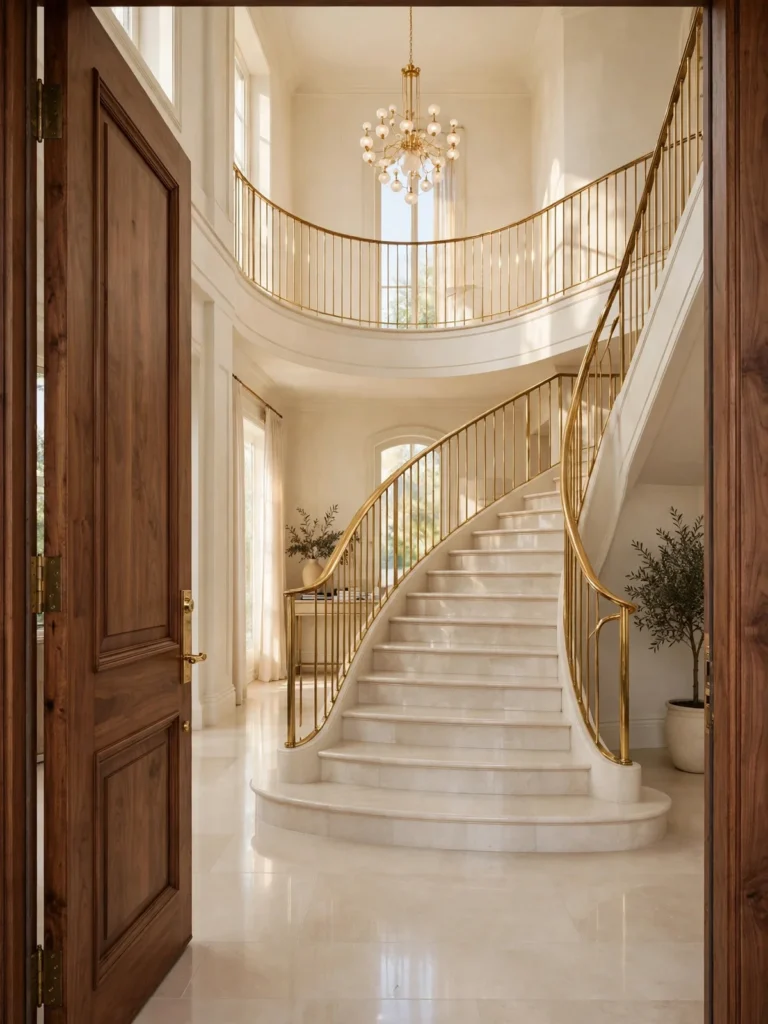
25 Stunning Staircase Railing Ideas That Instantly Make Your Entryway Feel Bigger, Brighter and More Expensive
A staircase railing does more than keep you safe — it sets the tone for the whole hallway. These 25 staircase railing ideas cover wood, iron, glass, cable, rope and mixed materials, so you can find a railing that suits your home, your budget and the way your family actually lives, whether your style is classic, farmhouse, coastal or modern.
Staircase railing ideas are the fastest way to change how a stair looks and feels, because the railing is the part you touch, see and lean on every single day. The right railing makes a narrow hallway feel wider, a dark stair feel brighter, and a plain flight feel finished — and the wrong one can make even a beautiful stair feel heavy or dated.
If you want a sleeker, more contemporary take on the same stair, these modern staircase railing ideas show how slim steel, glass and cable keep a stair feeling light and architectural. The 25 ideas below cover every material and every style — wood, iron, glass, cable, rope and thoughtful combinations — so you can choose a railing that is safe, durable and beautiful in your home.
Key Takeaways
How much does a new staircase railing cost?
A simple painted wood railing can cost a few hundred pounds if you keep the existing handrail and replace only the balusters, while a new hardwood handrail with metal balusters usually runs into the low thousands. Glass panels and curved iron are the most expensive options, because the panels are made to measure and curved iron is hand-forged. Paint or stain first if your budget is tight — a colour change alone can transform a railing.
What is the safest spacing for staircase balusters?
Balusters should be spaced so a 100 mm sphere cannot pass between them — in practice that means a gap of no more than about 90 to 99 mm between balusters. That rule protects small children, who can otherwise slip through or get their head stuck. If your railing has wide gaps, add extra balusters or a slim panel until the spacing is safe.
Which staircase railing material is best?
There is no single best material — it depends on your home. Wood is warm, quiet and easy to repair; black metal is slim, strong and modern; glass keeps light flowing and makes small halls feel bigger; cable suits open-plan homes; rope suits coastal and cottage homes. Choose the material that matches the rooms around the stair, not the one that looks best in a photograph.
Can I replace a staircase railing myself, or do I need a professional?
Painting balusters, swapping straight balusters for slim metal ones, and fitting a rope railing are confident DIY jobs for a careful homeowner. Glass panels, cable tensioning, curved iron and anything structural — a new handrail, a newel post or a railing on an open-sided stair — need a joiner or a stair specialist, because the railing must hold weight and meet building regulations.
How do I choose a staircase railing that suits my home style?
Match the railing to the rooms around it. A traditional home suits turned white spindles, wrought iron scrollwork or a honey oak balustrade; a farmhouse suits white wood with black iron; a coastal home suits rope or pale timber; a modern home suits glass, cable or slim steel rods. One strong material pairing is better than three competing ones.
Slim Matte Black Metal Balusters With a Warm Oak Handrail
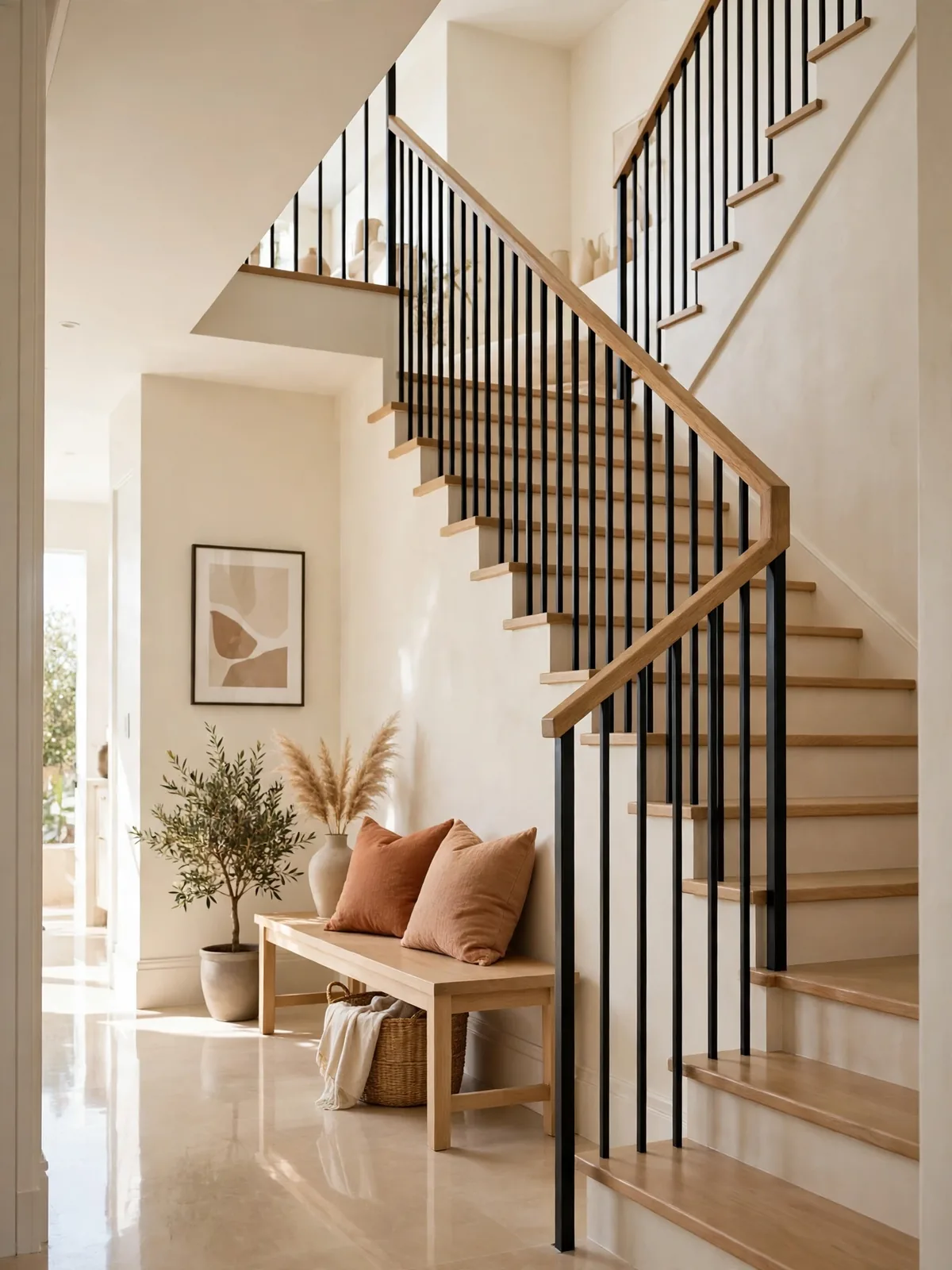
Slim matte black balusters with a warm oak handrail are the most reliable staircase railing idea of all, because the contrast does the work — dark lines against pale timber, cool metal against warm wood. On this stair, slim 12 mm square black steel balusters, two per tread, rise from pale oak treads, each 950 mm wide, to a warm oak handrail, 60 mm wide, sanded smooth and oiled. Cream walls keep the hallway bright, while soft terracotta cushions on a wooden bench at the base pick up the oak and warm the black lines.
Quick tips:
- Use two slim balusters per tread for a clean, even rhythm.
- Keep the balusters slim — about 12 mm — so the stair stays open.
- Pair black steel with a warm oak handrail for balance.
- Oil the handrail rather than varnishing it for a natural feel.
Horizontal Cable Lines That Keep Sightlines Open
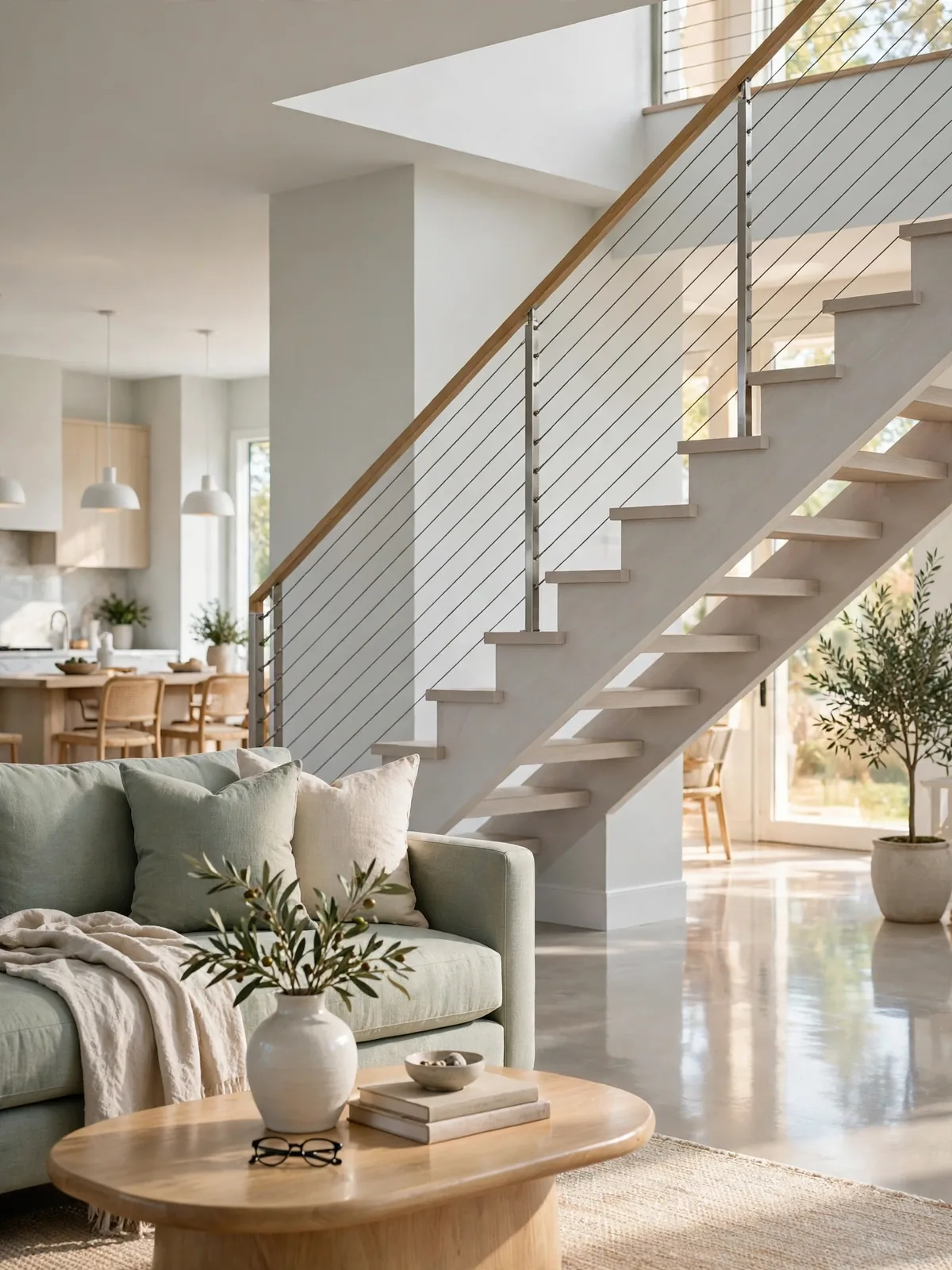
Horizontal cable lines are the staircase railing idea for homes where the view matters, because the thin cables almost disappear and the eye travels straight through the stair. Here, five horizontal stainless steel cables, each 4 mm thick, run between slim steel posts, 40 mm square, along a flight of pale ash treads, each 1 metre wide, with a slim timber handrail, 50 mm wide, above them. Pale grey walls and a soft sage-green sofa below keep the room calm, while the cables let daylight fall through the stair onto the floor beneath.
Quick tips:
- Tension the cables evenly so none of them sags.
- Use five or six cable runs for a safe, even look.
- Pair the cables with a warm timber handrail to soften the steel.
- Keep the wall behind the stair pale so the cables stay visible.
A Classic Wooden Balustrade in Honey Oak
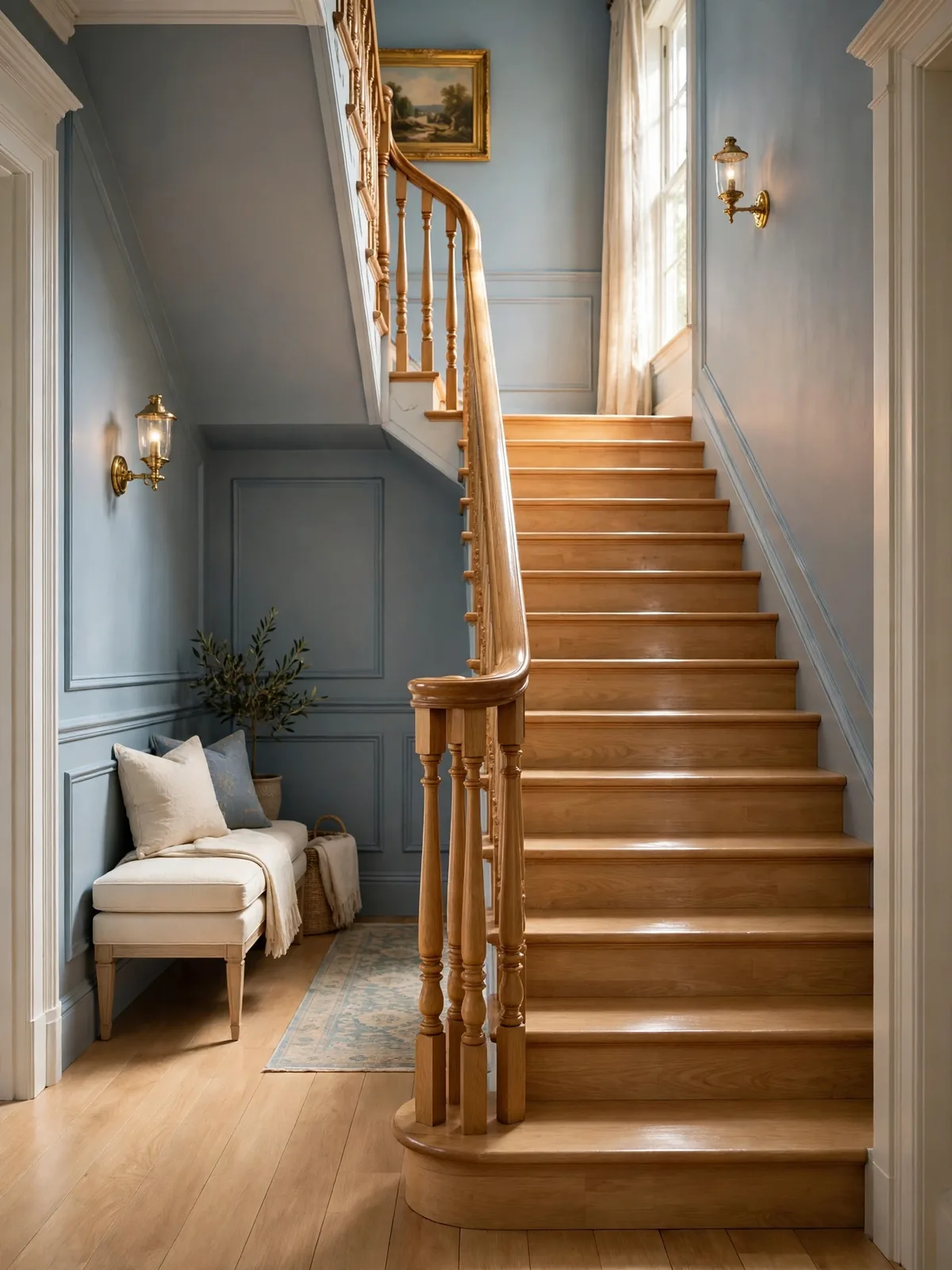
A classic wooden balustrade in honey oak never dates, because real timber warms a hallway in a way no metal or glass can. On this stair, turned honey oak balusters, each 45 mm wide, rise from pale oak treads, each 950 mm wide, to a honey oak handrail, 65 mm wide, with a chunky newel post at the base finished with a simple ball cap. Soft dusty-blue walls and a cream bench below keep the hallway fresh, while a small brass wall light above the bench warms the oak in the evening.
Quick tips:
- Choose honey oak for warmth that suits traditional and farmhouse homes.
- Keep the balusters turned, not square, for a classic feel.
- Match the handrail timber to the treads for a unified look.
- Use a brass wall light to warm the timber in the evening.
Wrought Iron Scrollwork With a Soft, Traditional Feel
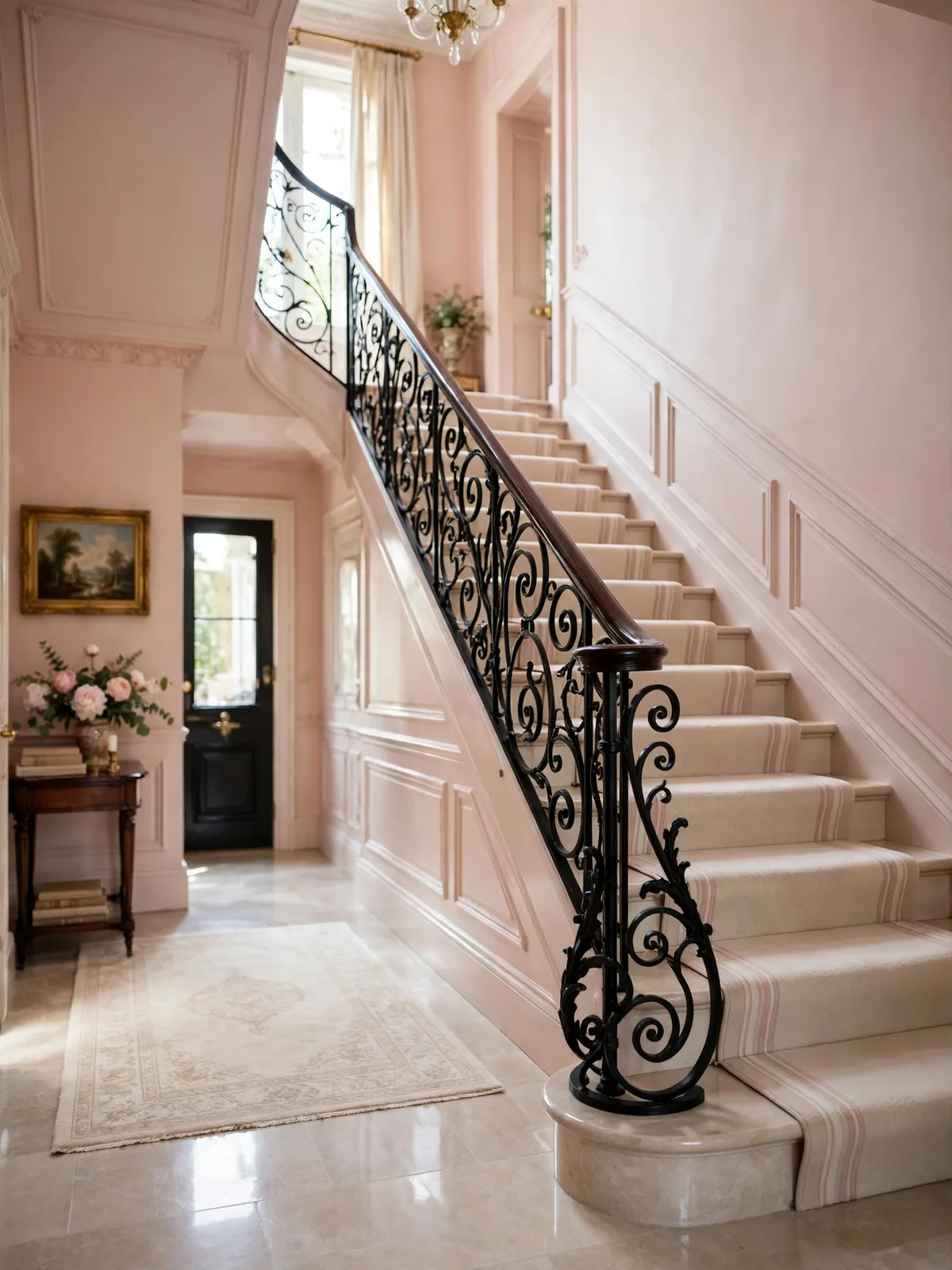
Wrought iron scrollwork brings a soft, traditional feel to a stair, because the curves slow the eye down and make the railing feel handmade rather than factory-made. Here, black wrought iron balusters with a gentle scroll at the centre of each one, 20 mm wide, rise from pale stone treads, each 1 metre wide, to a dark walnut handrail, 60 mm wide, with a curved newel post at the base. Soft blush-pink walls and a cream rug below keep the entry gentle, while daylight from the front door makes the ironwork cast soft shadows on the wall.
Quick tips:
- Choose one scroll pattern and repeat it along the whole flight.
- Pair black iron with a dark walnut handrail for warmth.
- Keep the treads pale so the ironwork stands out.
- Use the same black iron tone on a mirror or light fitting nearby.
Clear Glass Panels With a Timber Handrail
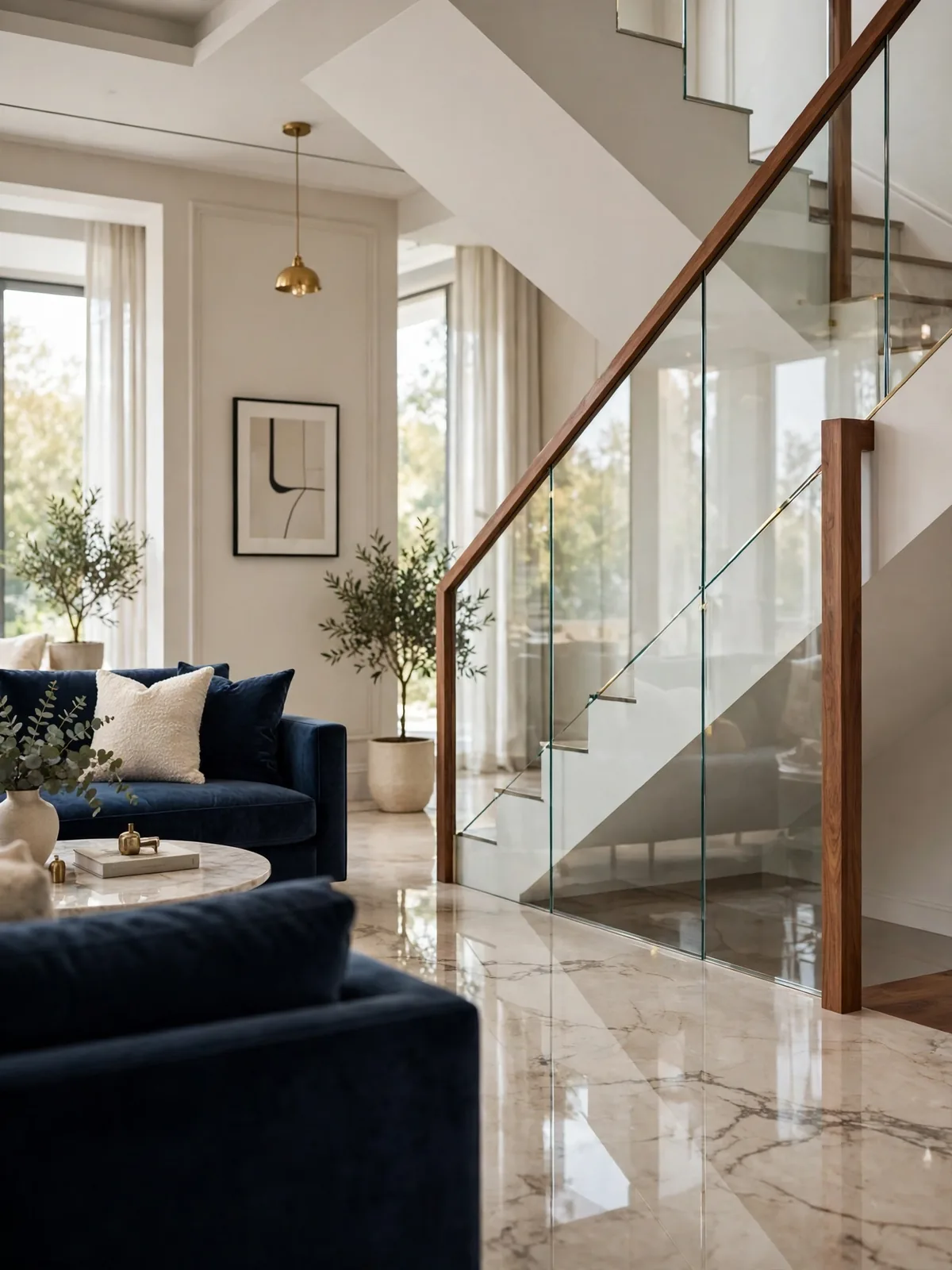
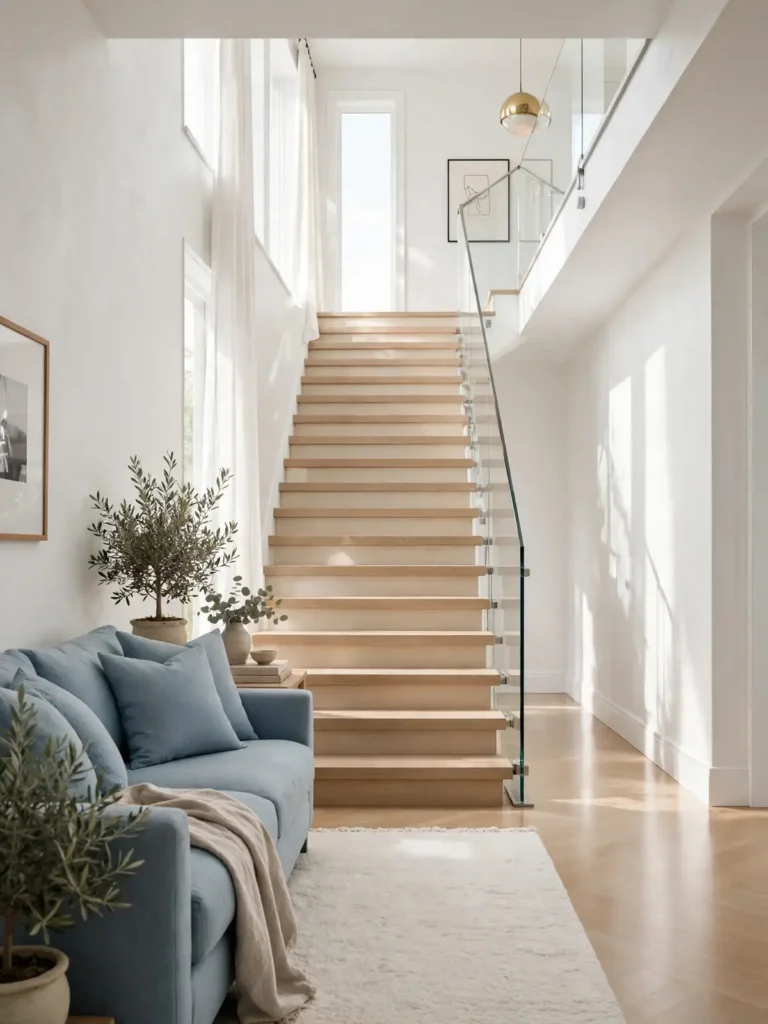
Clear glass panels with a timber handrail are the staircase railing idea that makes a small hallway feel twice as big, because the glass disappears and the room breathes. On this stair, 12 mm thick low-iron glass panels run along a flight of pale grey oak treads, each 950 mm wide, held in slim steel channels, while a warm walnut handrail, 40 mm in diameter, runs along the top of the glass. A deep navy sofa and a cream marble floor below keep the palette rich, while a small brass pendant on the landing echoes the warmth of the timber.
Quick tips:
- Use low-iron glass so the panels stay crystal clear.
- Choose a timber handrail so the glass feels warm, not cold.
- Keep the treads pale so the handrail stands out.
- Wipe the panels with a microfibre cloth to keep them streak-free.
Slim Vertical Steel Rods for a Clean, Tailored Line
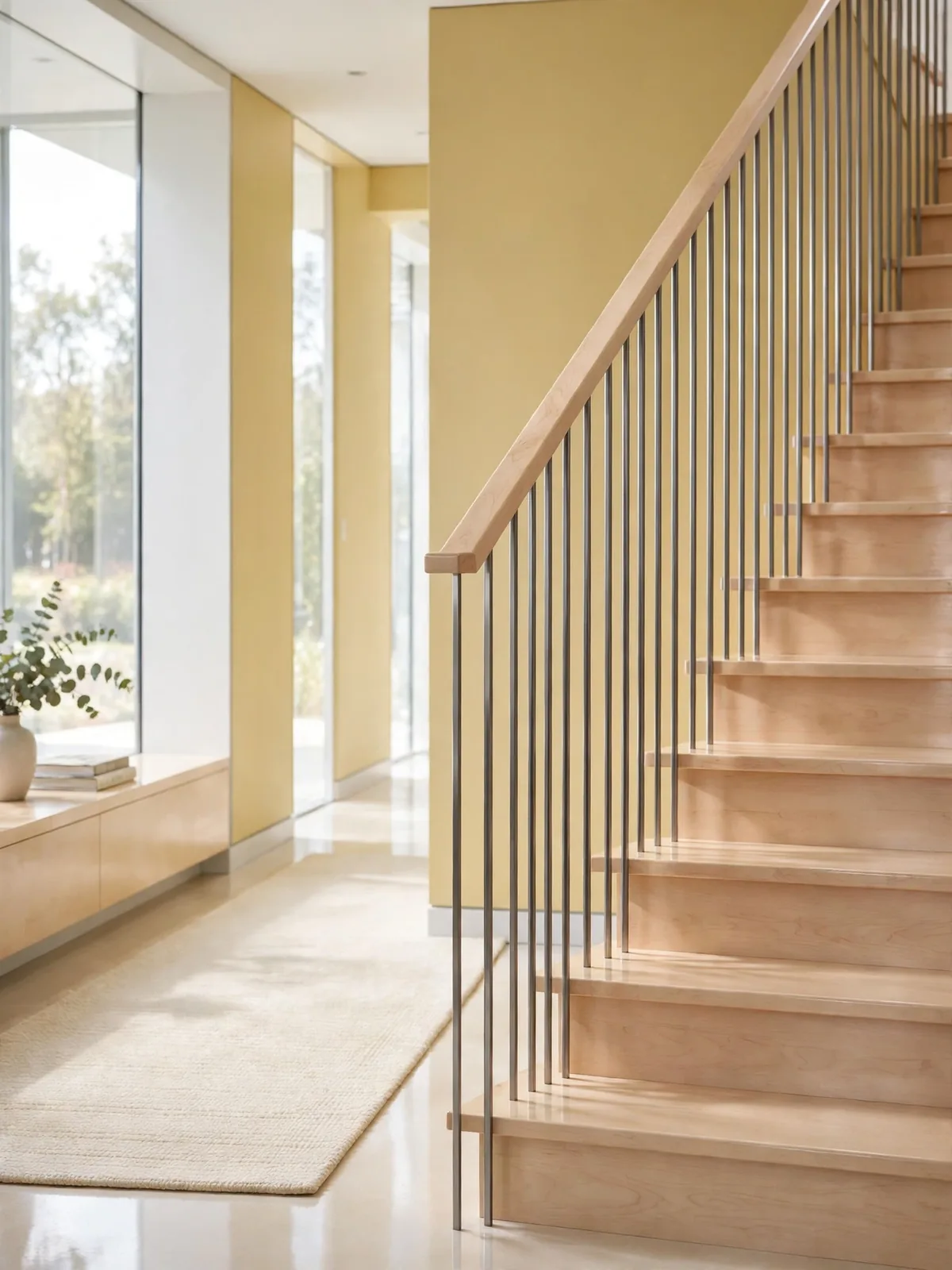
Slim vertical steel rods give a stair a clean, tailored line, because every rod is straight, evenly spaced and exactly the same — the railing reads as quiet precision. Here, slim 10 mm brushed steel rods, spaced 90 mm apart, rise from pale maple treads, each 900 mm wide, to a pale maple handrail, 55 mm wide, with a simple square newel post at the base. Soft butter-yellow walls and a cream rug below keep the hallway warm, while the vertical rods draw the eye upward and make the stair feel taller than it really is.
Quick tips:
- Space the rods no more than 99 mm apart for child safety.
- Use brushed steel, not polished, for a softer shine.
- Pair the rods with a pale timber handrail for warmth.
- Keep the wall colour soft so the rods stay the feature.
A Rope Railing for Coastal and Cottage Homes
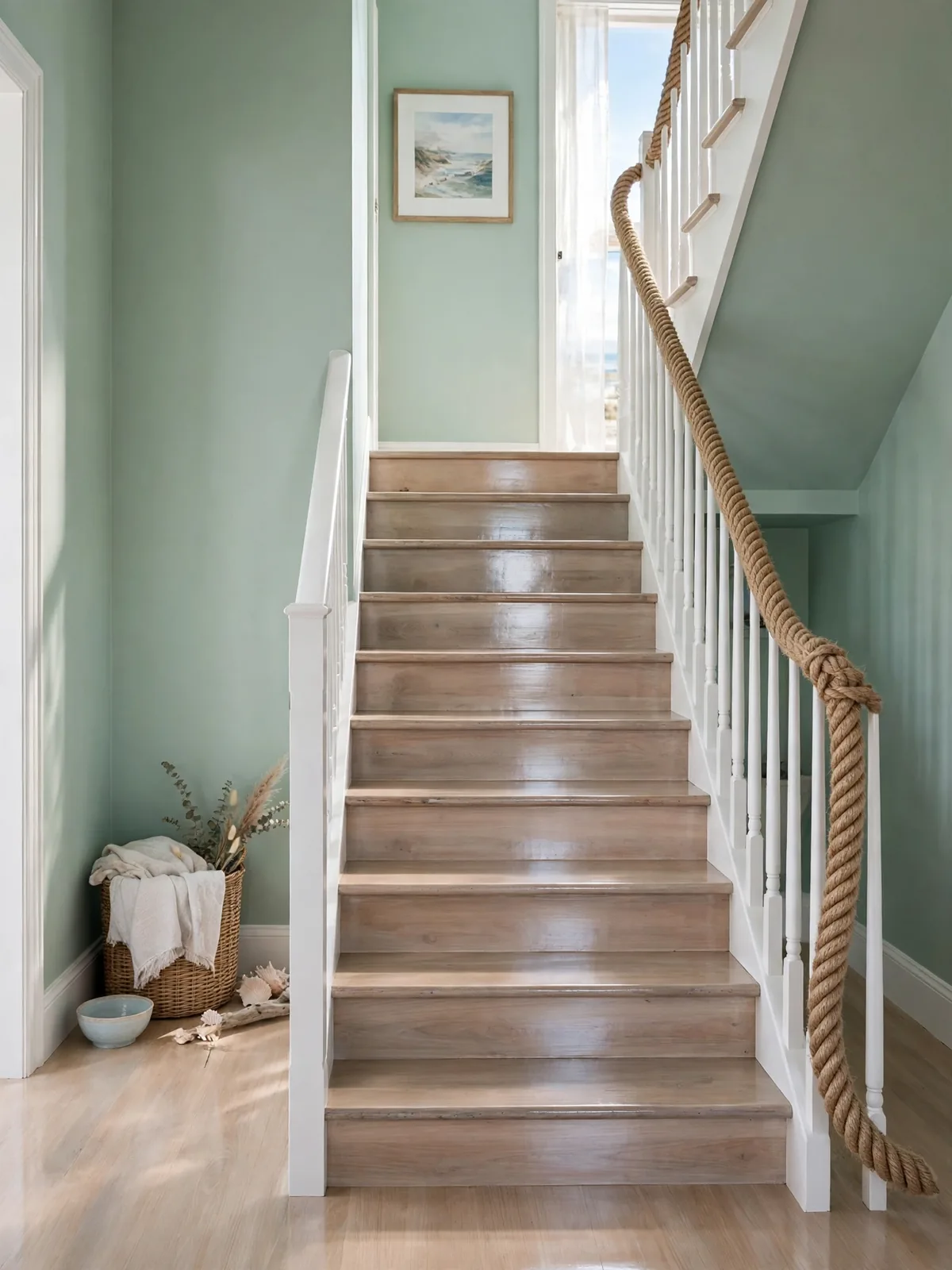
A rope railing suits coastal and cottage homes perfectly, because the thick, soft rope feels like something from a boat or a beach house — relaxed, natural and touchable. On this stair, a thick natural jute rope, 32 mm in diameter, runs through brass eyelets fixed to slim white wooden balusters, each 30 mm square, above pale driftwood treads, each 850 mm wide. Soft seafoam-green walls and a woven basket at the base keep the hallway breezy, while daylight from a small window makes the rope glow warm against the white paint.
Quick tips:
- Choose a thick rope — about 32 mm — so it feels solid in the hand.
- Use brass eyelets to hold the rope neatly in place.
- Keep the balusters white so the rope stays the feature.
- Seal the rope ends so they do not fray over time.
Two-Tone Railings: Dark Handrail, Pale Balusters
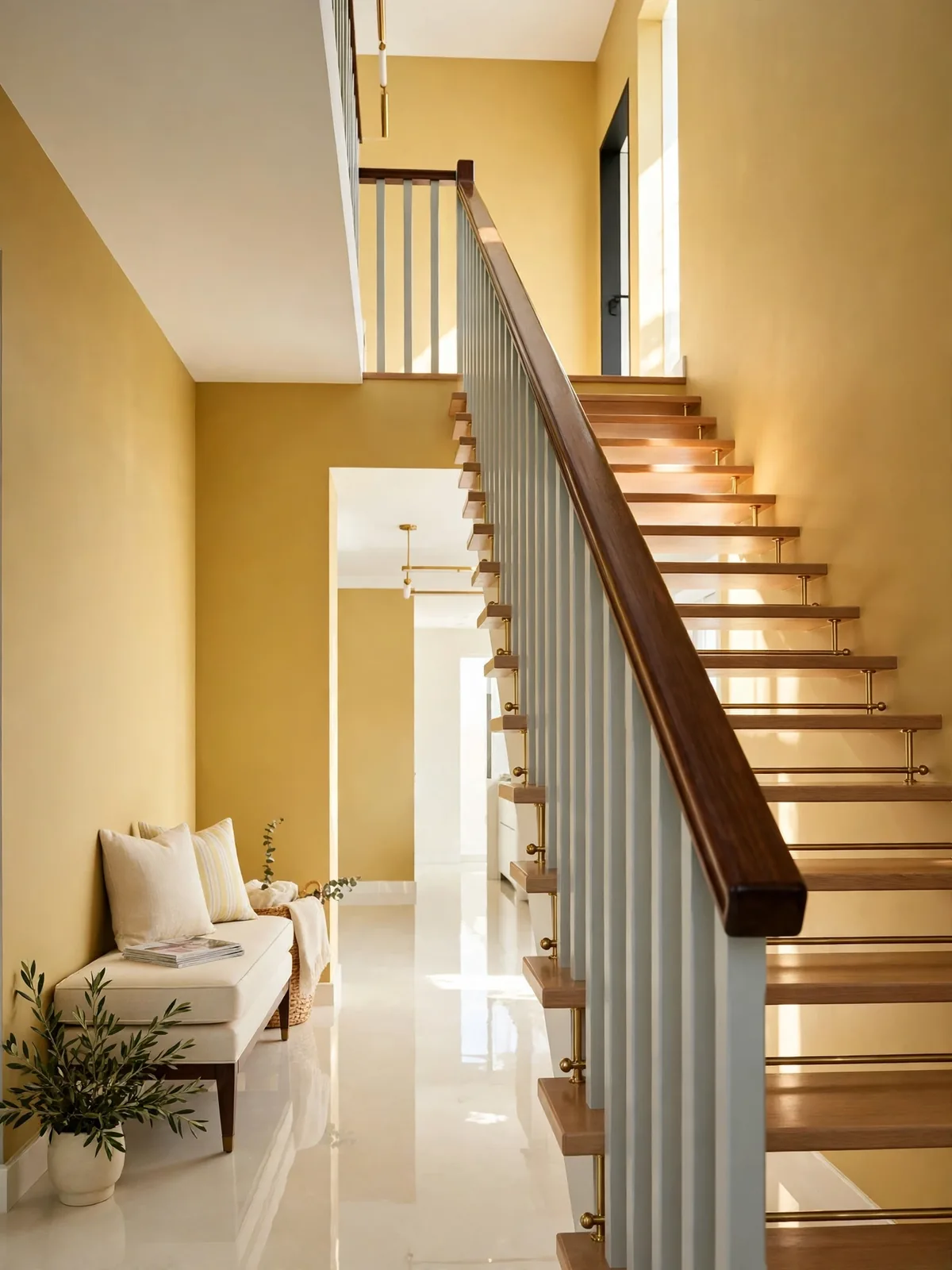
A two-tone railing — dark handrail, pale balusters — is a small detail with an outsized effect, because the contrast draws a clear line along the stair and makes the whole flight feel designed. On this stair, a dark walnut handrail, 60 mm wide, runs above pale grey balusters, each 25 mm square, rising from warm oak treads, each 950 mm wide, with a dark newel post at the base to anchor the set. Soft mustard-yellow walls and a cream bench below keep the hallway cheerful, while slim brass stair rods on the runner echo the warmth of the walnut.
Quick tips:
- Paint the balusters pale and keep the handrail dark for contrast.
- Use a durable satin paint so the balusters wipe clean.
- Keep the treads warm oak so the pale balusters stand out.
- Match the dark handrail to a cushion or frame nearby for balance.
A Reclaimed Timber Handrail With Black Iron Balusters
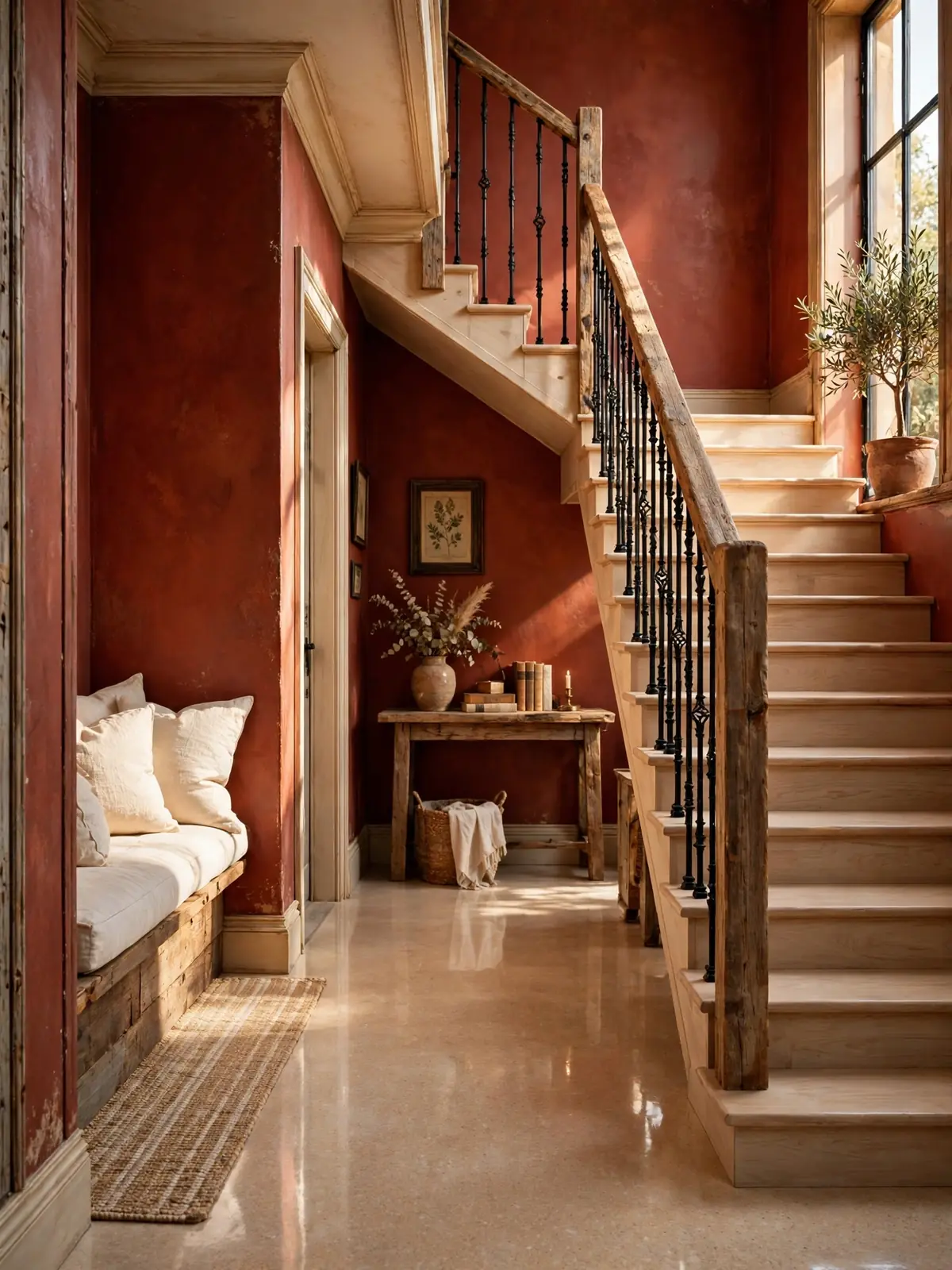
A reclaimed timber handrail with black iron balusters tells a story no new timber can, because every knot, nail hole and weathered edge in the old wood is a mark of its previous life. Here, a reclaimed oak handrail, 70 mm wide, with a visible grain and a soft, worn edge, runs above slim black iron balusters, each 12 mm square, rising from pale oak treads, each 950 mm wide. Deep rust-red walls and cream cushions on a bench below keep the hallway warm, while afternoon light makes the old timber glow and the iron lines stand out crisply against it.
Quick tips:
- Sand reclaimed timber smooth so it is comfortable to grip.
- Seal the handrail with oil so the old grain stays visible.
- Pair the timber with slim black iron for a rustic-modern balance.
- Keep the wall colour warm — rust, ochre or deep red — to match the wood.
Brass Balusters and a Walnut Handrail for Warmth
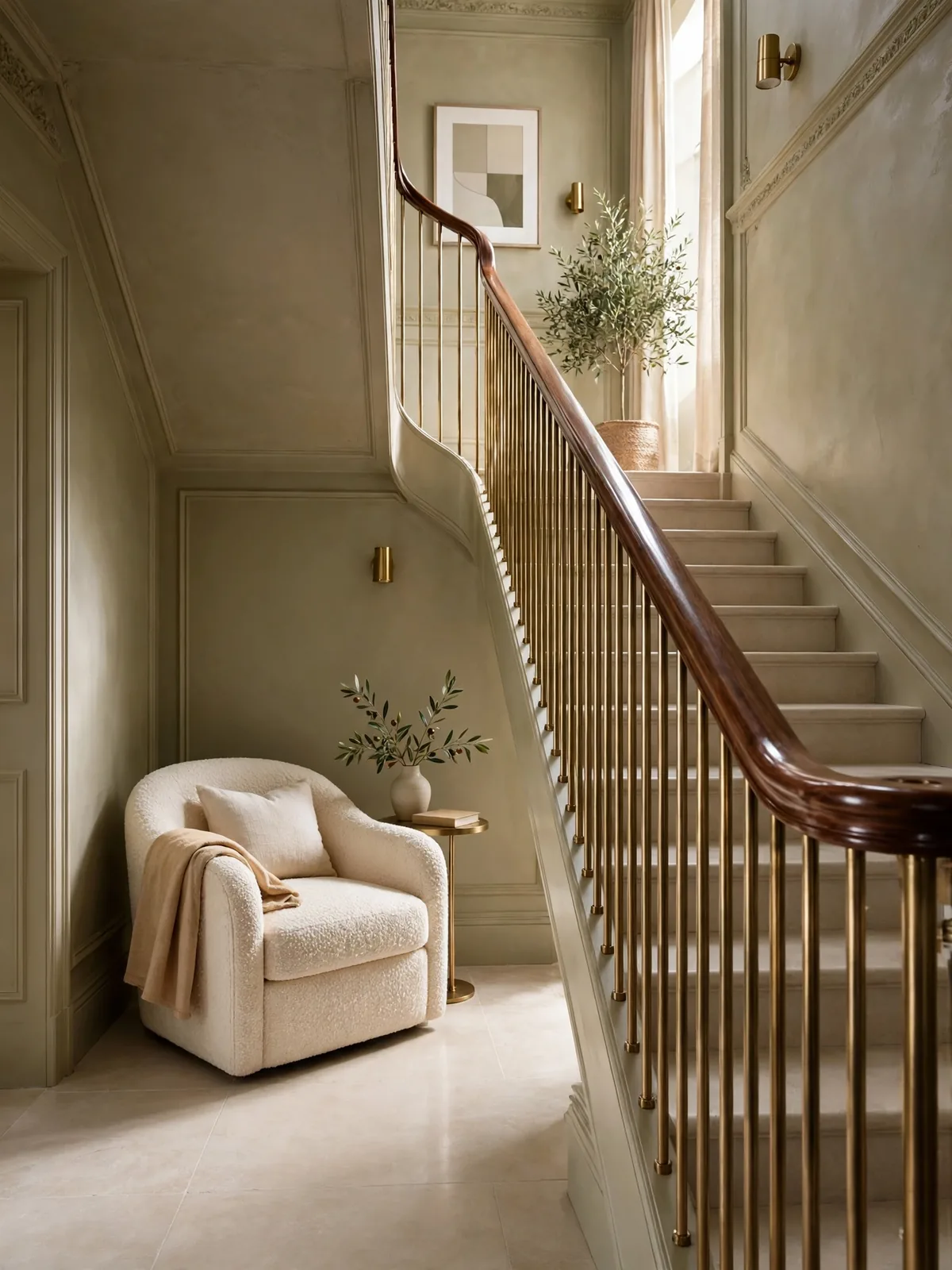
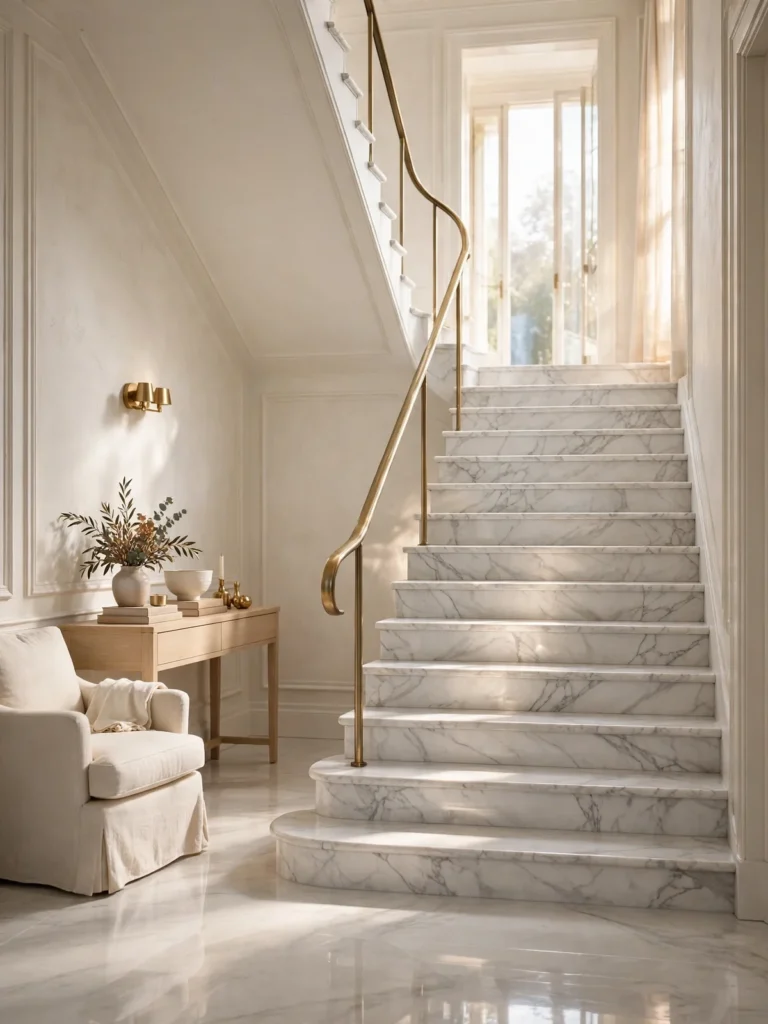
Brass balusters with a walnut handrail are the warmest metal-and-wood pairing you can choose, because the brass glows softly and the walnut is deep, rich and smooth under the hand. On this stair, slim brushed brass balusters, each 16 mm square, rise from pale stone treads, each 950 mm wide, to a rich walnut handrail, 60 mm wide, with a brass newel cap finishing the base. Soft olive-green walls and a cream boucle armchair at the foot of the stair keep the hallway calm, while daylight makes the brass shine gently without glare.
Quick tips:
- Choose brushed brass, not polished, for a softer shine.
- Pair brass with rich walnut for a warm, luxurious feel.
- Keep the treads pale stone so the brass stands out.
- Match the brass tone to a lamp or mirror nearby.
Curved Iron Railings for a Sweeping Stair
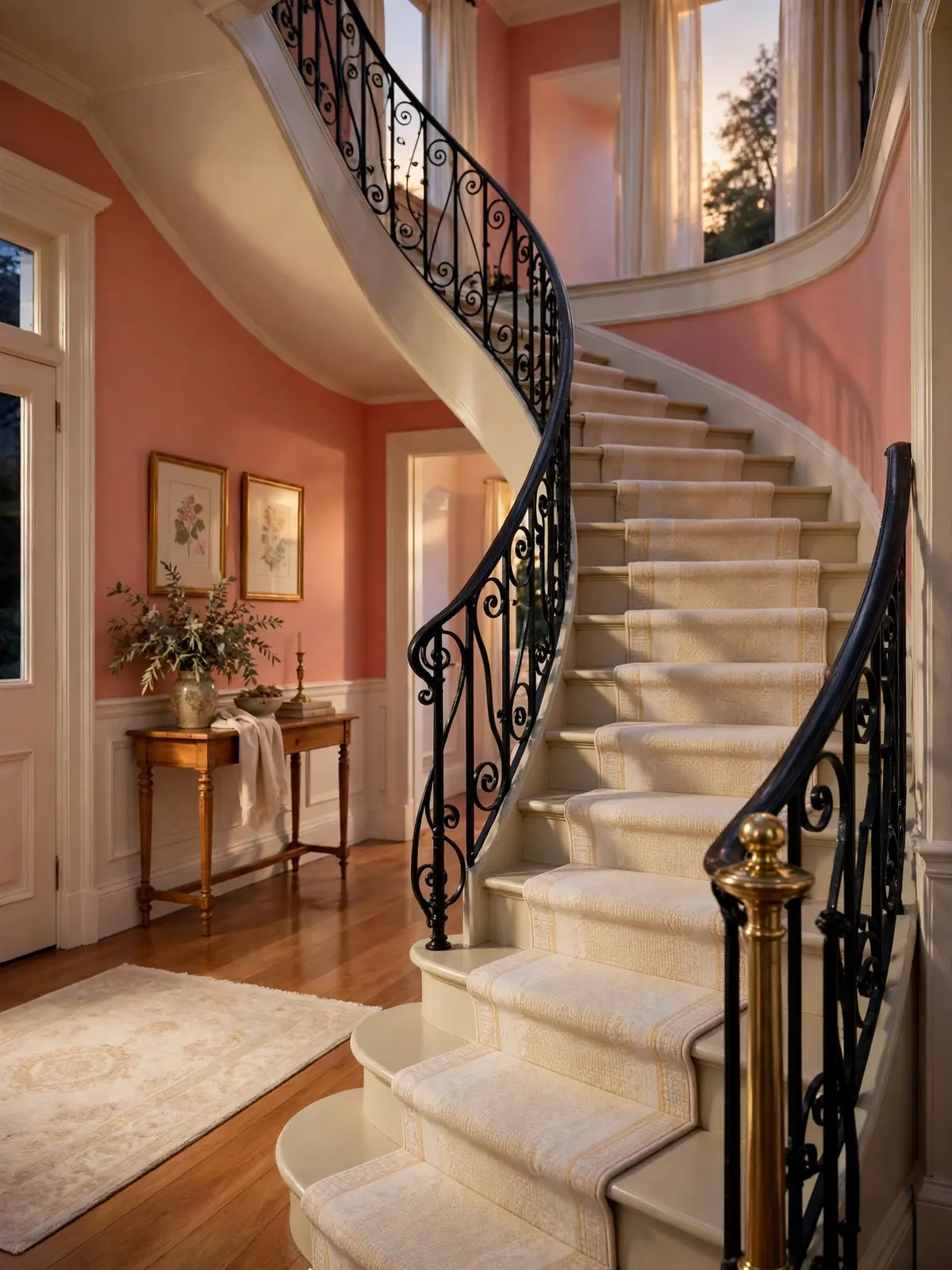
A curved iron railing feels elegant and soft, especially compared to the harsh lines of a straight rail, and it softens a sweeping stair in a way no straight railing can. On this stair, a sweeping black iron handrail, 50 mm wide, curves gently around the landing above pale cream treads, each 1 metre wide, with slim black iron balusters and a brass newel cap finishing the turn. Soft coral walls and a cream rug below keep the entry warm, while soft evening light from a pendant above the landing makes the iron glow gently against the coral.
Quick tips:
- Choose a curved railing when the stair has a landing or a gentle turn.
- Keep the balusters slim and black so the curve stays the feature.
- Match the handrail to the balusters for a unified look.
- Add a brass newel cap to finish the curve elegantly.
Painted Balusters in Deep Navy for Instant Drama
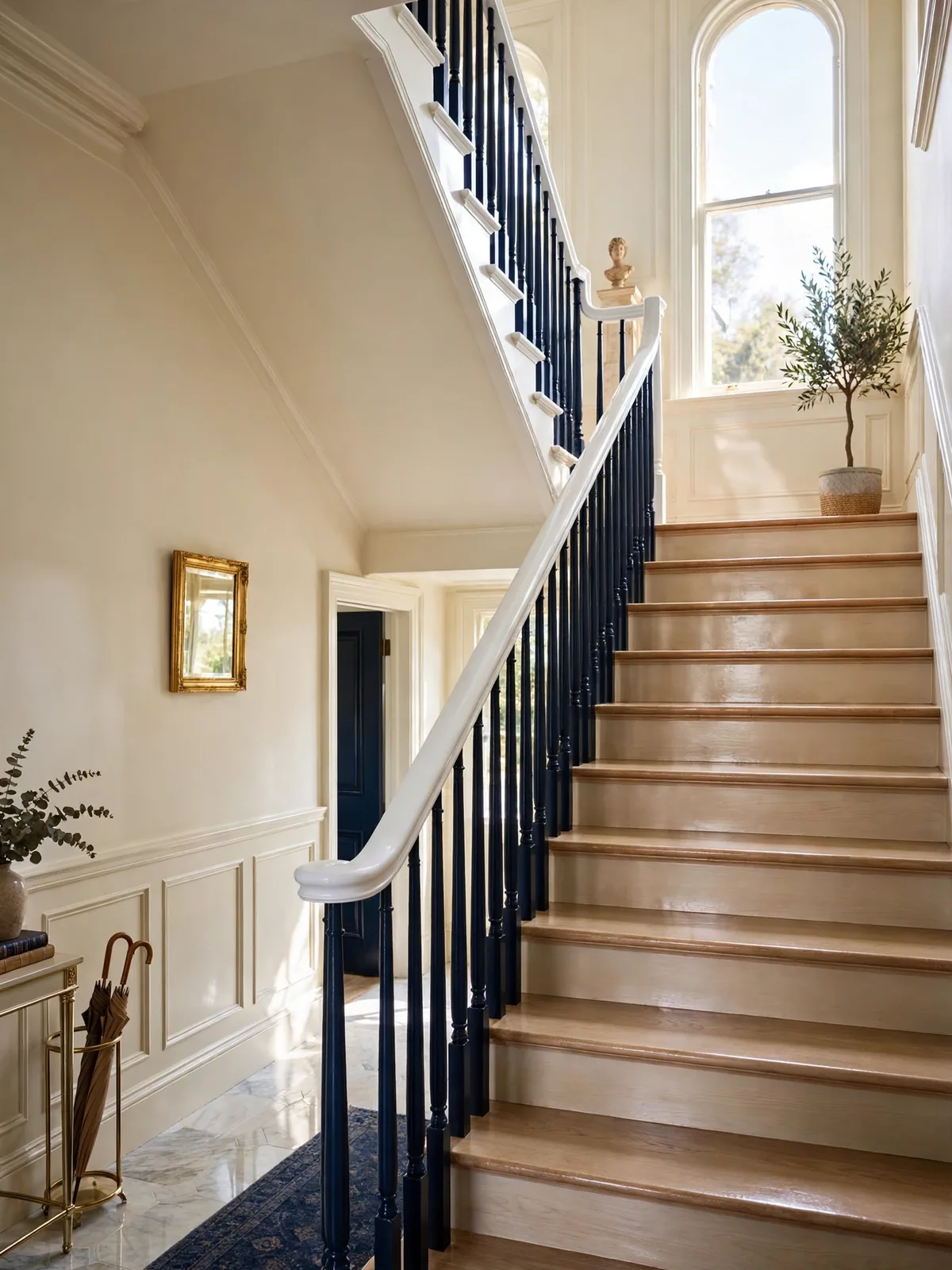
Painted balusters in deep navy are the fastest way to add drama to a stair, because the dark blue reads as rich and confident against pale timber and white paint. Here, deep navy balusters, each 25 mm square, rise from pale oak treads, each 950 mm wide, to a crisp white handrail, 60 mm wide, with a white newel post at the base. Soft cream walls keep the hallway bright, while a small gold-framed mirror on the wall above the stair picks up the navy and adds one warm accent that ties the whole stair together.
Quick tips:
- Paint only the balusters navy, keeping the handrail white.
- Use a durable satin paint so the balusters wipe clean.
- Keep the treads pale oak so the navy stands out.
- Echo the navy in one cushion or piece of art nearby.
A Monochrome Railing Painted the Same Colour as the Wall
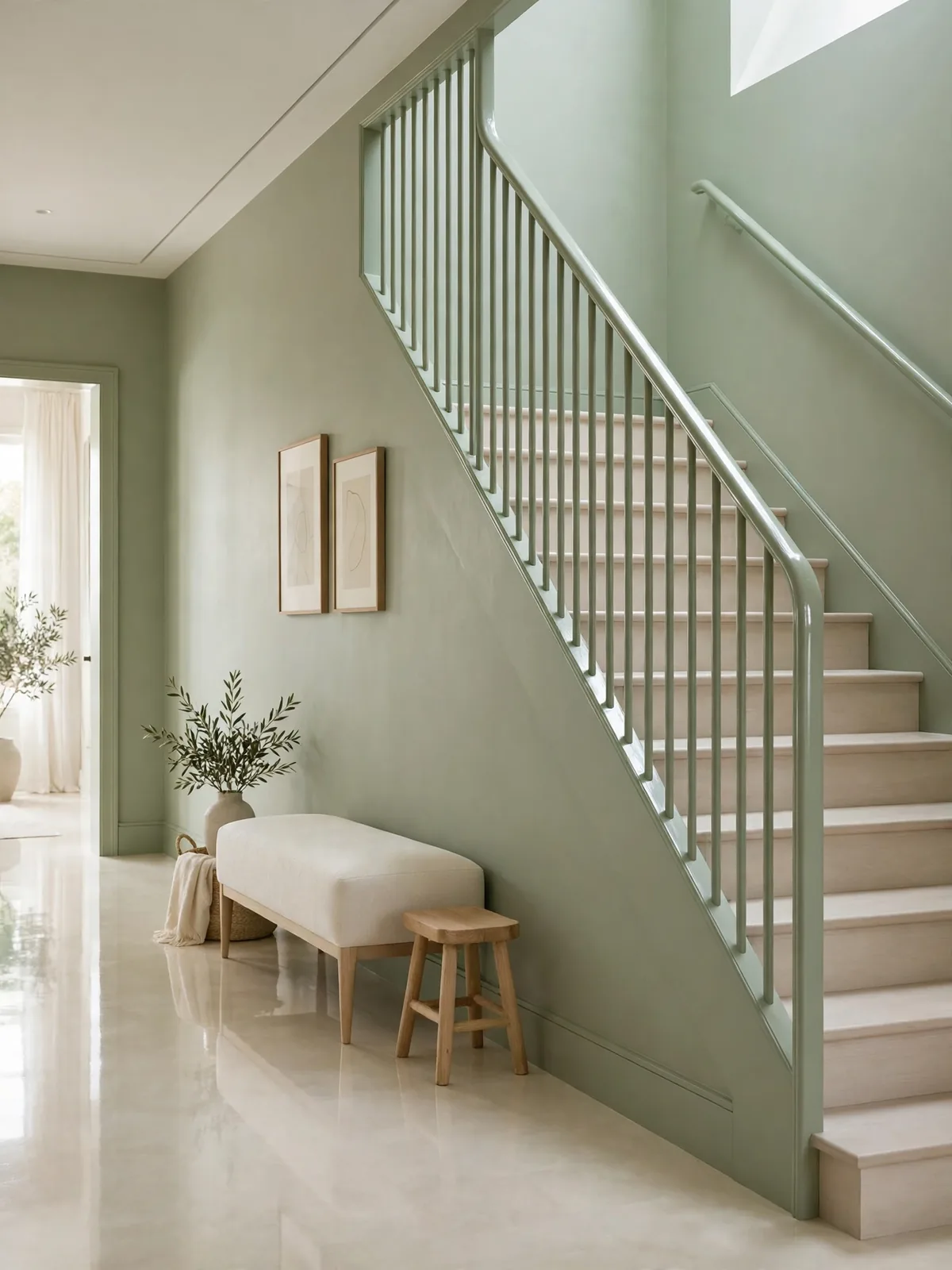
A monochrome railing painted the same colour as the wall is the calmest staircase railing idea, because the railing disappears into the wall and the stair feels like one seamless piece of architecture. On this stair, the handrail, balusters and newel post are all painted soft sage green, the same shade as the stair wall, above pale ash treads, each 900 mm wide, with a cream bench below. The single colour makes the hallway feel wider and quieter, while the pale treads provide the only contrast and keep the stair easy to read.
Quick tips:
- Paint the handrail, balusters and newel the same wall colour.
- Choose a soft colour — sage, pale grey or warm white — for calm.
- Keep the treads pale so the stair stays easy to see.
- Use a durable satin paint so the railing wipes clean.
LED Strips Hidden Under the Handrail
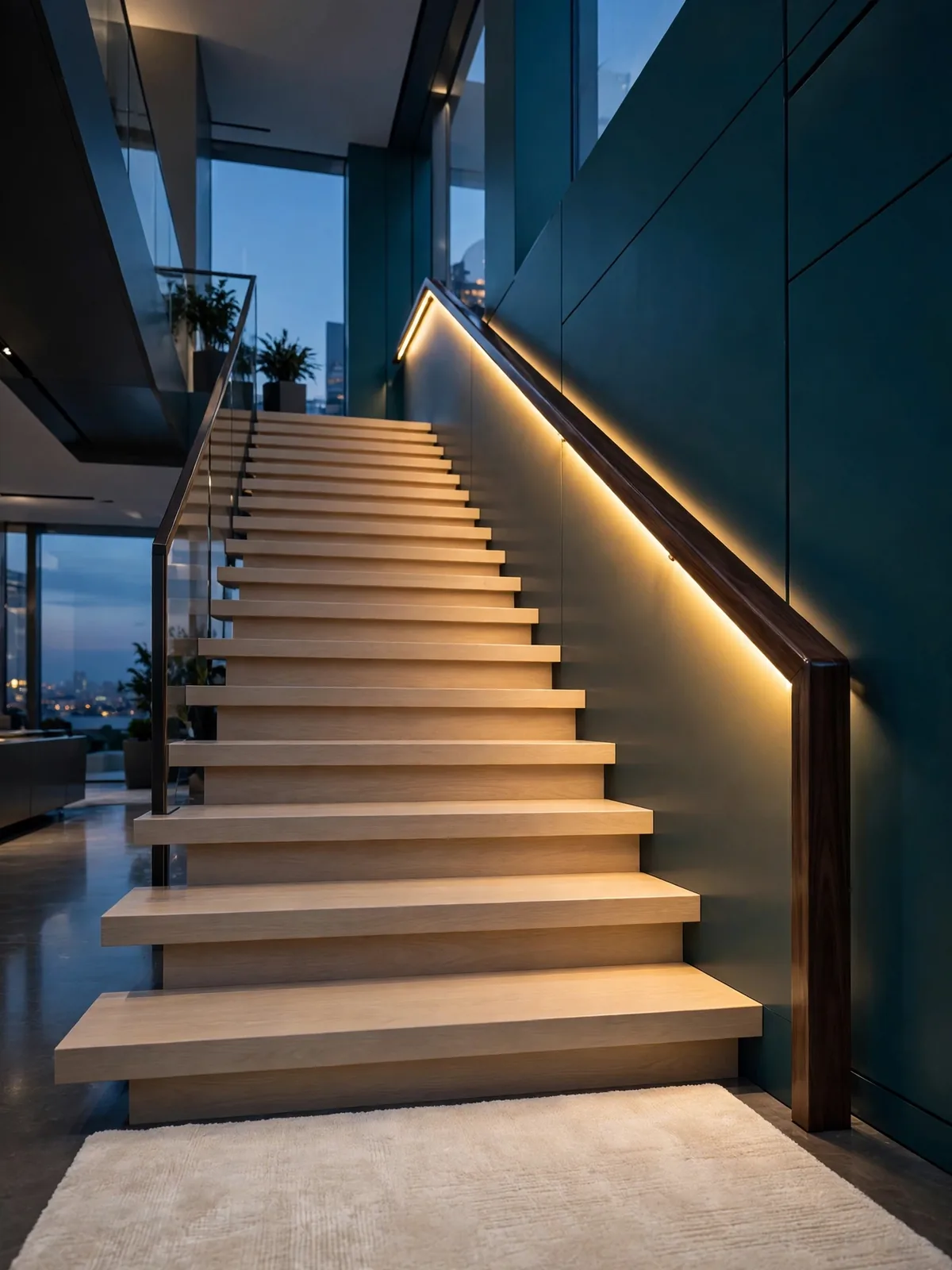
LED strips hidden under the handrail turn a staircase railing into a ribbon of light after dark, and they make the stair safer at the same time. Here, warm white LED strips, 2700K, are set into a slim channel beneath a dark walnut handrail, 60 mm wide, so a soft glow washes down over slim black balusters and pale oak treads, each 1 metre wide, and the edge of each step is easy to see at night. Deep teal walls and a cream rug below keep the room calm, while the glow follows the handrail upward and the whole stair reads as floating light.
Quick tips:
- Choose warm white LEDs — about 2700K — for a cosy glow.
- Set the strips in a channel under the handrail so the light washes down.
- Put the strips on a motion sensor so they switch on as you approach.
- Keep the balusters slim and dark so the glow stands out clearly.
A Mixed-Material Railing: Glass, Wood and Black Steel
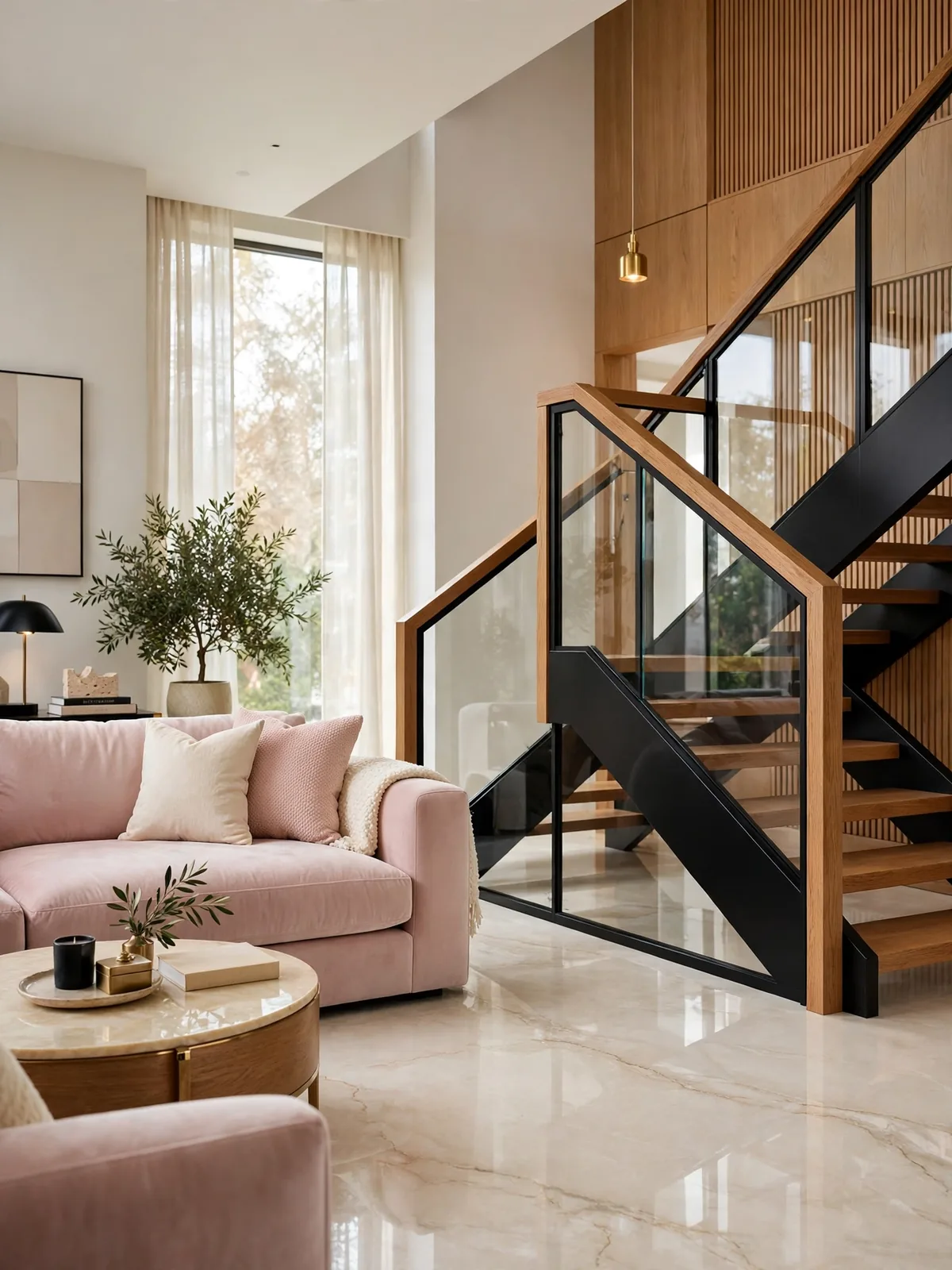
A mixed-material railing — glass, wood and black steel together — is the staircase railing idea for homes that want a little of everything, because each material does a different job and the combination feels richer than any single one. In this living room, clear glass panels, 12 mm thick, run along the lower flight, slim black steel balusters, 12 mm square, run along the upper flight, and a warm oak handrail, 60 mm wide, ties the two together above pale grey oak treads, each 950 mm wide. A soft blush-pink sofa and a cream marble floor below keep the palette gentle, while a small brass pendant on the landing echoes the warmth of the oak. The glass keeps the lower stair open, the steel keeps the upper stair light, and the oak handrail is the warm thread that holds the whole railing together — a combination that works because the materials are honest, the lines are clean, and no single material shouts over the others. If your home already mixes timber, metal and glass in the kitchen or living room, this is the railing that ties those rooms to the stair.
Quick tips:
- Use one handrail material to tie mixed balusters together.
- Keep the glass on the lower flight where light matters most.
- Use slim black steel on the upper flight for a light feel.
- Match the handrail timber to the treads for a unified look.
Traditional Turned Spindles in Crisp White
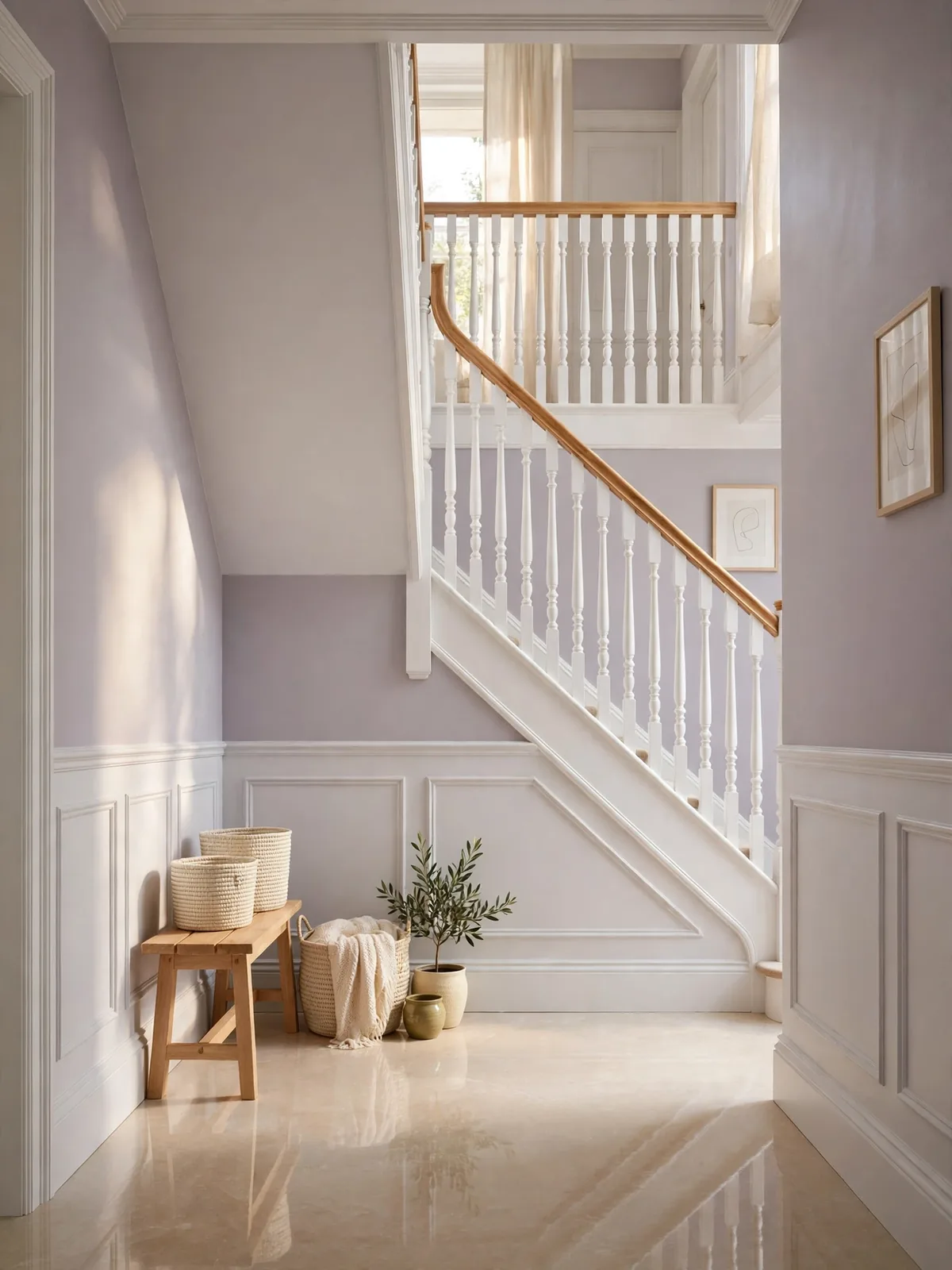
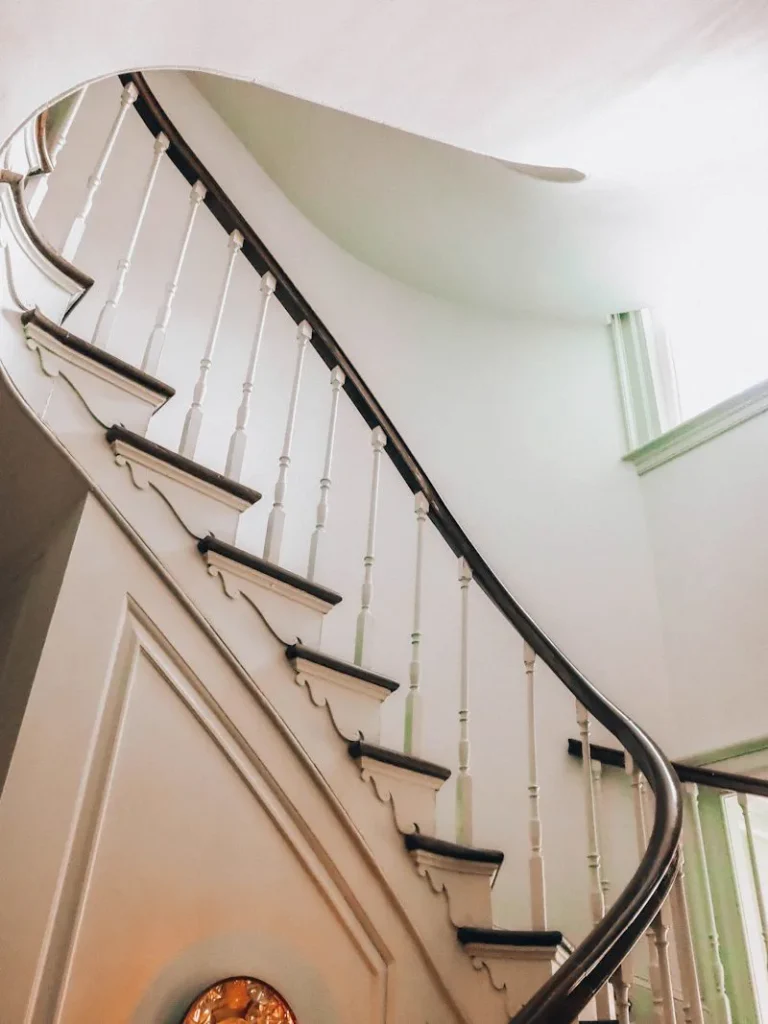
Traditional turned spindles in crisp white are the staircase railing idea that suits almost any classic home, because the turned shape is familiar, friendly and easy to live with. Here, turned white spindles, each 40 mm wide, rise from pale oak treads, each 950 mm wide, to a pale oak handrail, 60 mm wide, with a white newel post at the base finished with a simple ball cap. Soft lilac-grey walls and cream baskets on a small wooden bench keep the hallway calm, while daylight from the landing window makes the white spindles glow softly against the grey.
Quick tips:
- Choose turned spindles for a classic, traditional feel.
- Keep the handrail pale oak so the white spindles stand out.
- Paint the spindles crisp white, not cream, for a fresh look.
- Match the white to the skirting boards for a unified finish.
A Chunky Newel Post as the Railing’s Focal Point
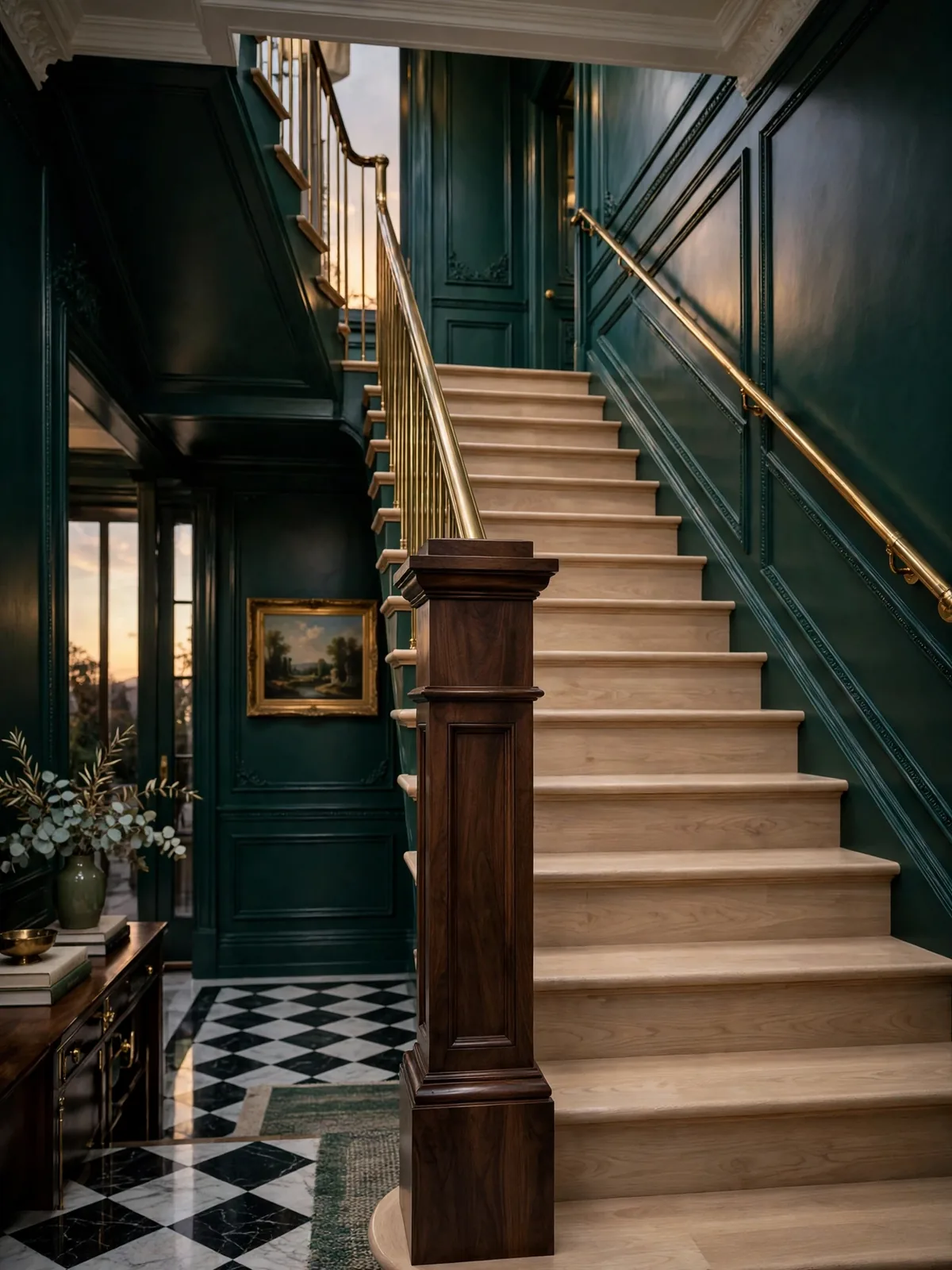
A chunky newel post turns a railing into a statement, because the post is the first thing you touch and the last thing you see — it anchors the whole stair. On this stair, a chunky dark walnut newel post, 120 mm square and 1 metre high, stands at the base of the flight, finished with a brass cap, while slim black balusters, each 12 mm square, rise from pale oak treads, each 950 mm wide, to a slim brass handrail. Deep emerald-green walls keep the entry rich, while soft evening light from a pendant above the landing makes the walnut glow and the brass cap shine.
Quick tips:
- Make the newel post chunky — about 120 mm square — so it anchors the stair.
- Finish the post with a brass or timber cap for a polished look.
- Keep the balusters slim so the newel stays the focal point.
- Match the newel timber to the handrail for a unified look.
Decorative Metal Brackets Beneath the Handrail
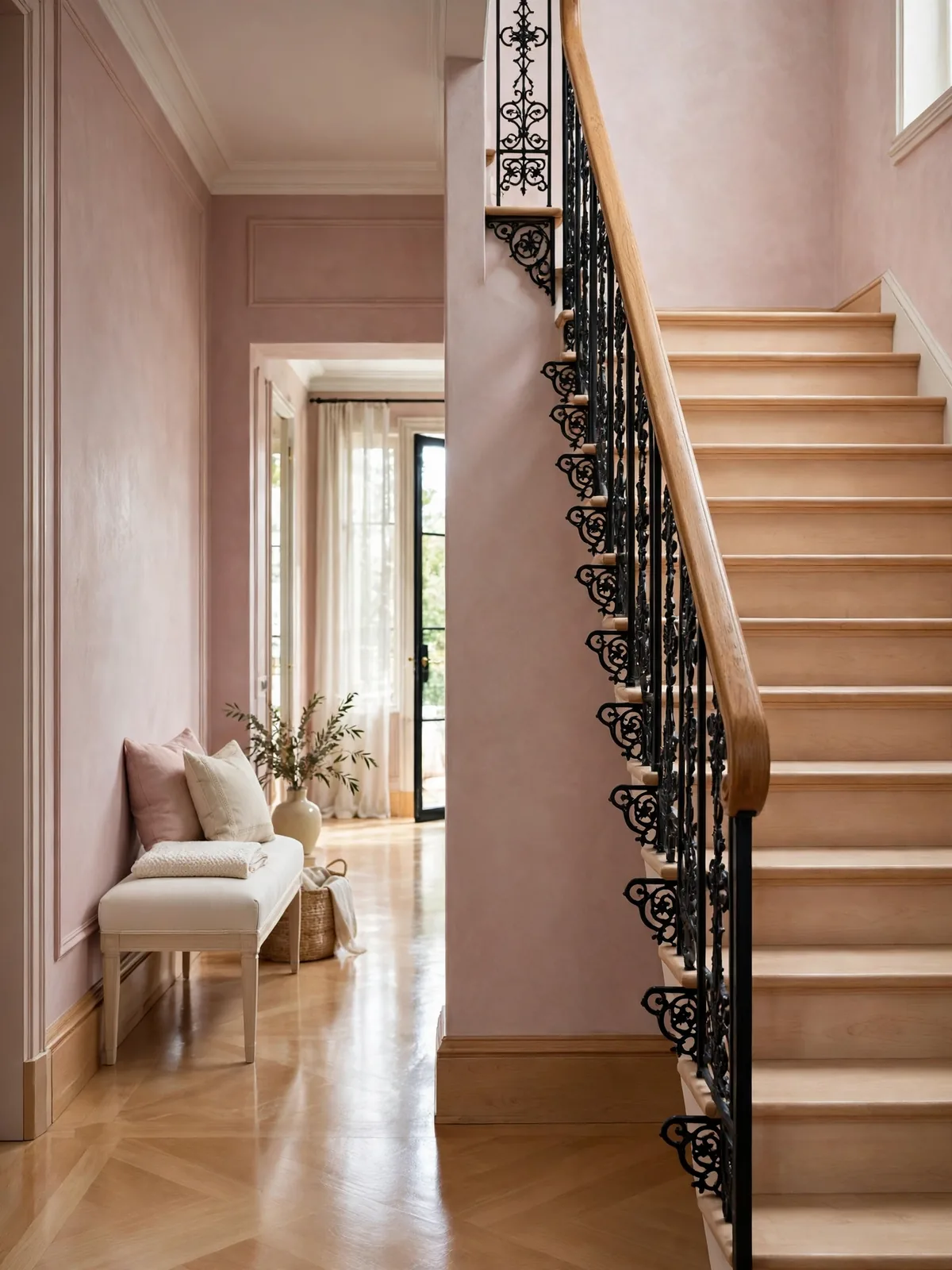
Decorative metal brackets beneath the handrail are the jewellery of a staircase railing — small, detailed and easy to miss, but they make the whole stair feel crafted. Here, slim black metal brackets with a delicate curl, each 150 mm high, are fixed at intervals beneath a warm oak handrail, 60 mm wide, above pale maple treads, each 950 mm wide, with slim white balusters between them. Soft dusty-rose walls and an ivory bench below keep the hallway gentle, while daylight makes the brackets cast soft shadows on the wall behind them.
Quick tips:
- Choose one bracket design and repeat it along the whole flight.
- Pair black brackets with a warm oak handrail for balance.
- Keep the balusters slim and white so the brackets stand out.
- Use the same black metal tone on a mirror or light fitting nearby.
A Farmhouse Railing in White Wood and Black Iron
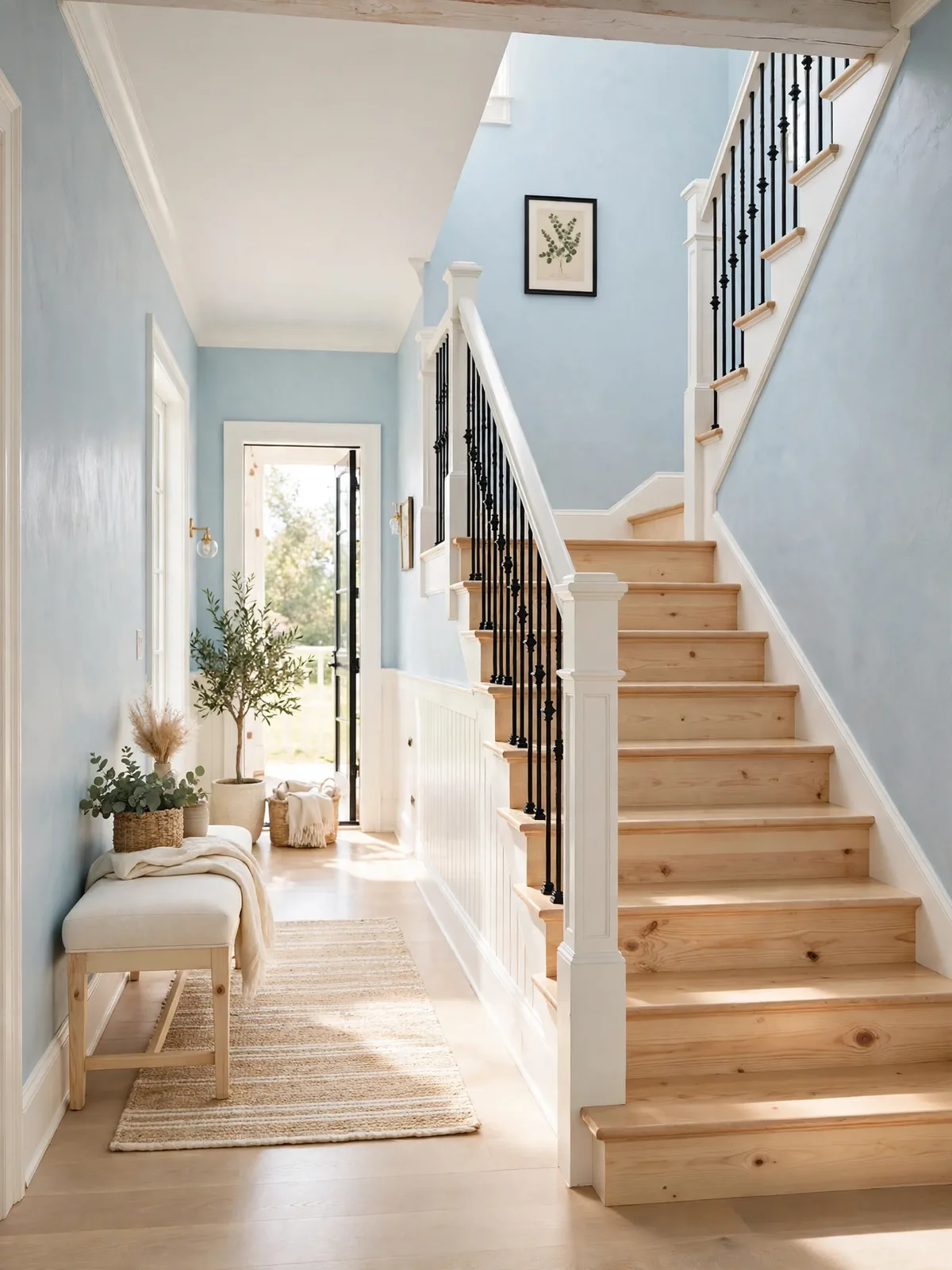
A farmhouse railing in white wood and black iron is the staircase railing idea that feels fresh, honest and easy to live with, because the white keeps the stair bright and the black keeps it grounded. On this stair, white painted wooden balusters, each 30 mm square, rise from pale pine treads, each 950 mm wide, to a white painted handrail, 60 mm wide, with slim black iron balusters alternating with the white ones for rhythm. Soft sky-blue walls and a cream bench below keep the hallway airy, while a woven rug at the base adds texture and warmth.
Quick tips:
- Alternate white wood and black iron balusters for a farmhouse rhythm.
- Keep the handrail white so the stair stays bright.
- Use pale pine treads for a warm, natural feel.
- Add a woven rug at the base for texture and warmth.
Frosted Glass Panels for Light and Privacy
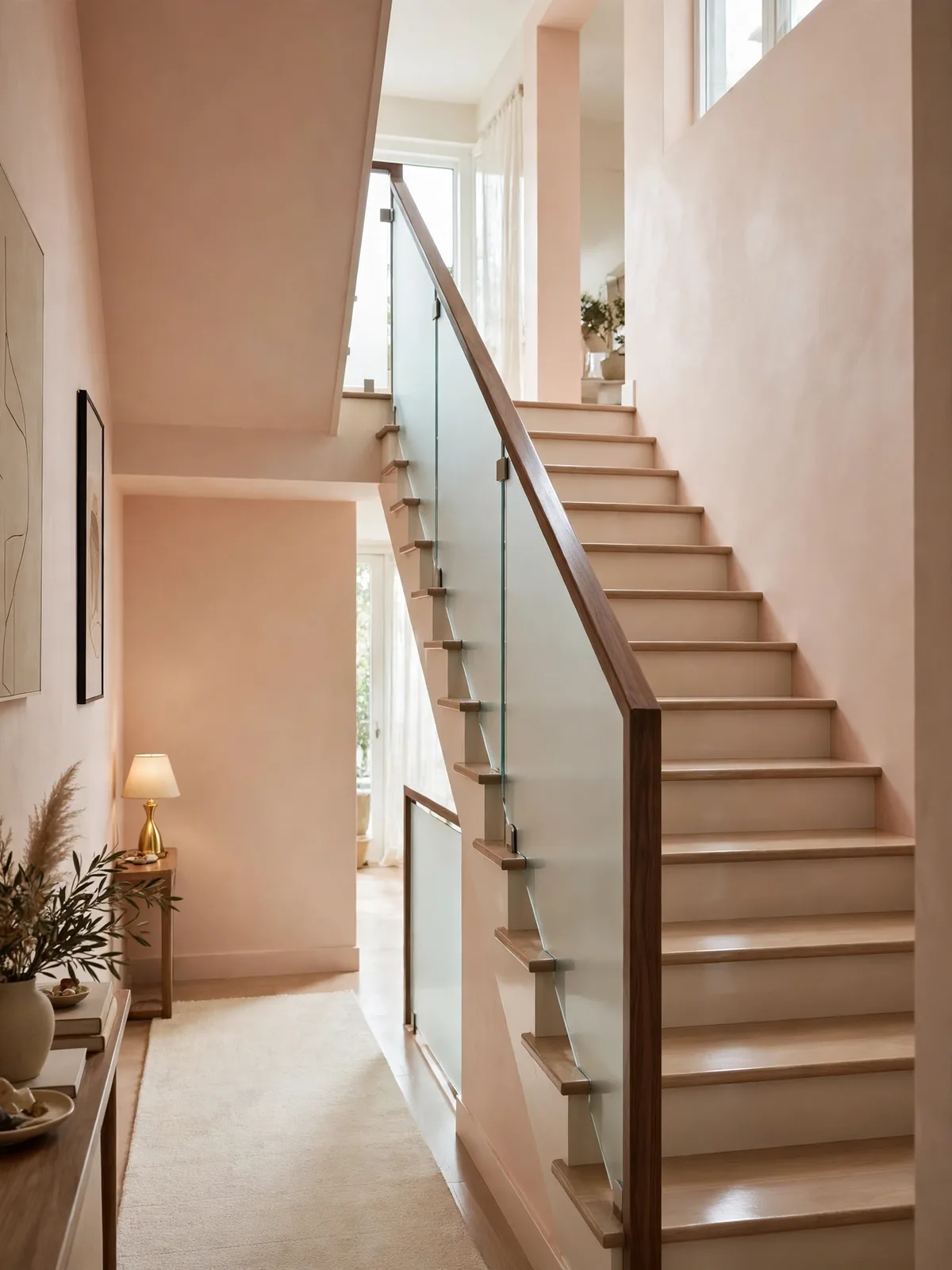
Frosted glass panels give you the light of glass with the privacy of a solid balustrade, because the frosted surface lets daylight through while softening everything behind it. Here, frosted glass panels, 10 mm thick, run along a flight of pale oak treads, each 950 mm wide, held in slim steel channels, while a slim walnut handrail, 40 mm in diameter, runs along the top. Soft peach walls and a cream rug below keep the hallway warm, while a small brass lamp on a bench at the base glows softly in the evening and the frosted glass turns the light into a gentle haze.
Quick tips:
- Choose frosted glass where the stair faces a bedroom or bathroom.
- Use a slim timber handrail so the glass feels warm, not cold.
- Keep the treads pale so the frosted panels glow softly.
- Wipe the panels with a microfibre cloth to keep them clean.
A Rope-and-Wood Railing for a Loft or Cabin
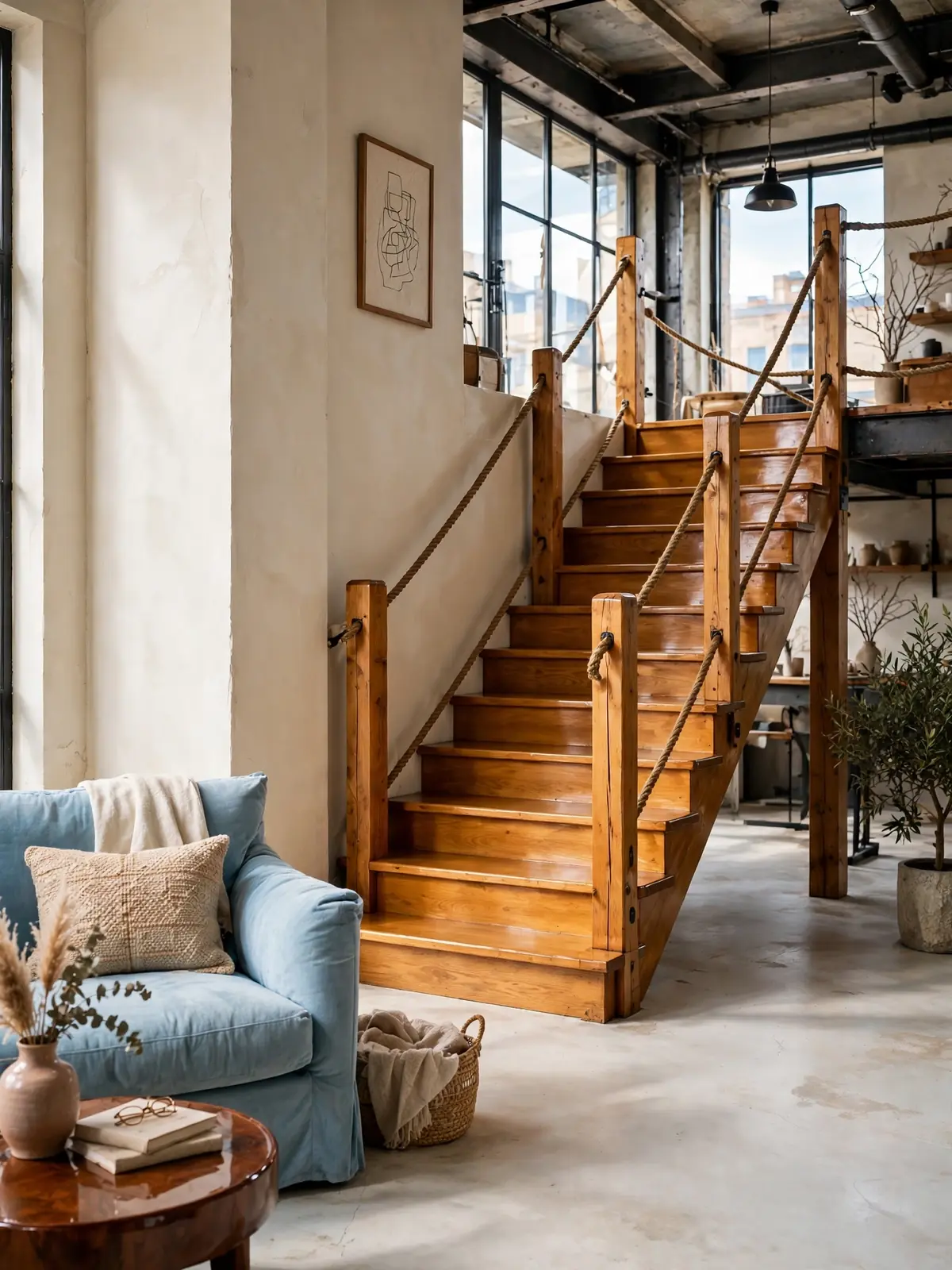
A rope-and-wood railing suits a loft or cabin perfectly, because the thick rope and warm timber feel rugged and honest — the kind of railing you would expect in a converted barn or a mountain cabin. In this loft, a thick natural rope, 32 mm in diameter, runs between warm timber posts, each 80 mm square, above honey oak treads, each 1 metre wide, with no balusters at all between the posts. A soft sky-blue armchair sits beneath the stair, its cool tone balancing the honey warmth of the timber, and cream plaster walls and a pale concrete floor keep the loft bright even though the rope is dark.
Quick tips:
- Use thick rope — about 32 mm — so it feels solid in the hand.
- Space the timber posts no more than 1 metre apart for safety.
- Keep the timber warm — honey oak or pine — for a cabin feel.
- Seal the rope ends so they do not fray over time.
Vertical Wood Slats as a Warm Railing Alternative
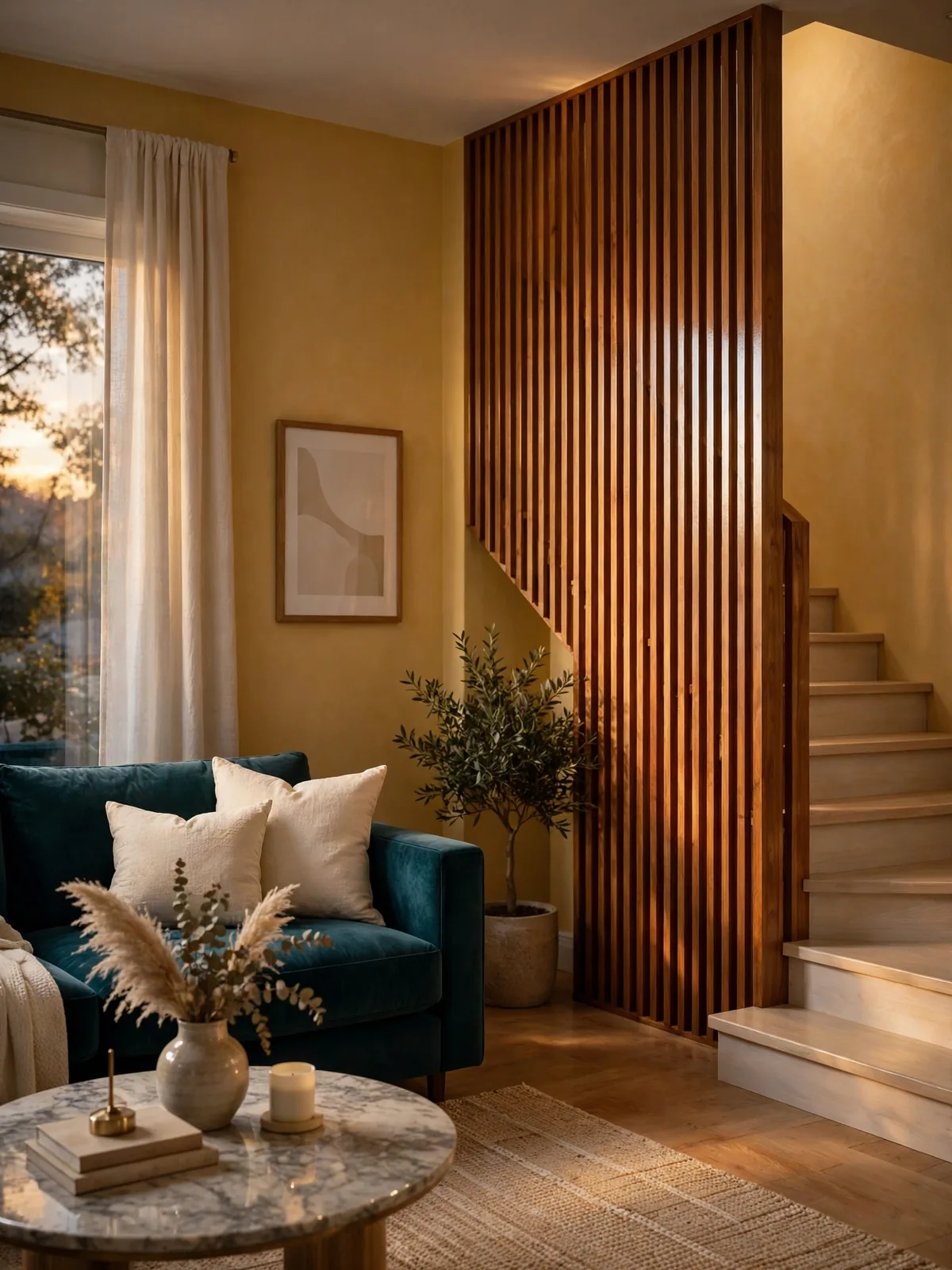
Vertical wood slats are a warm alternative to a traditional railing, because the slats form a soft screen — they guard the stair, filter the light, and add texture all at once. Here, vertical pale cedar slats, each 40 mm wide and spaced 20 mm apart, run floor to ceiling beside pale ash treads, each 900 mm wide, with a slim timber handrail fixed to the slats at hand height. Soft mustard-yellow walls and a deep teal sofa below pick up the timber’s warm tones, while soft evening light makes the wood glow gently and the slats cast long, soft shadows on the wall.
Quick tips:
- Space the slats about 20 mm apart so light filters through.
- Use pale cedar or ash for a warm, natural feel.
- Fix a slim handrail to the slats at hand height for grip.
- Keep the sofa colour warm — teal, rust or mustard — to match the wood.
A Painted Railing in Forest Green With Brass Fittings
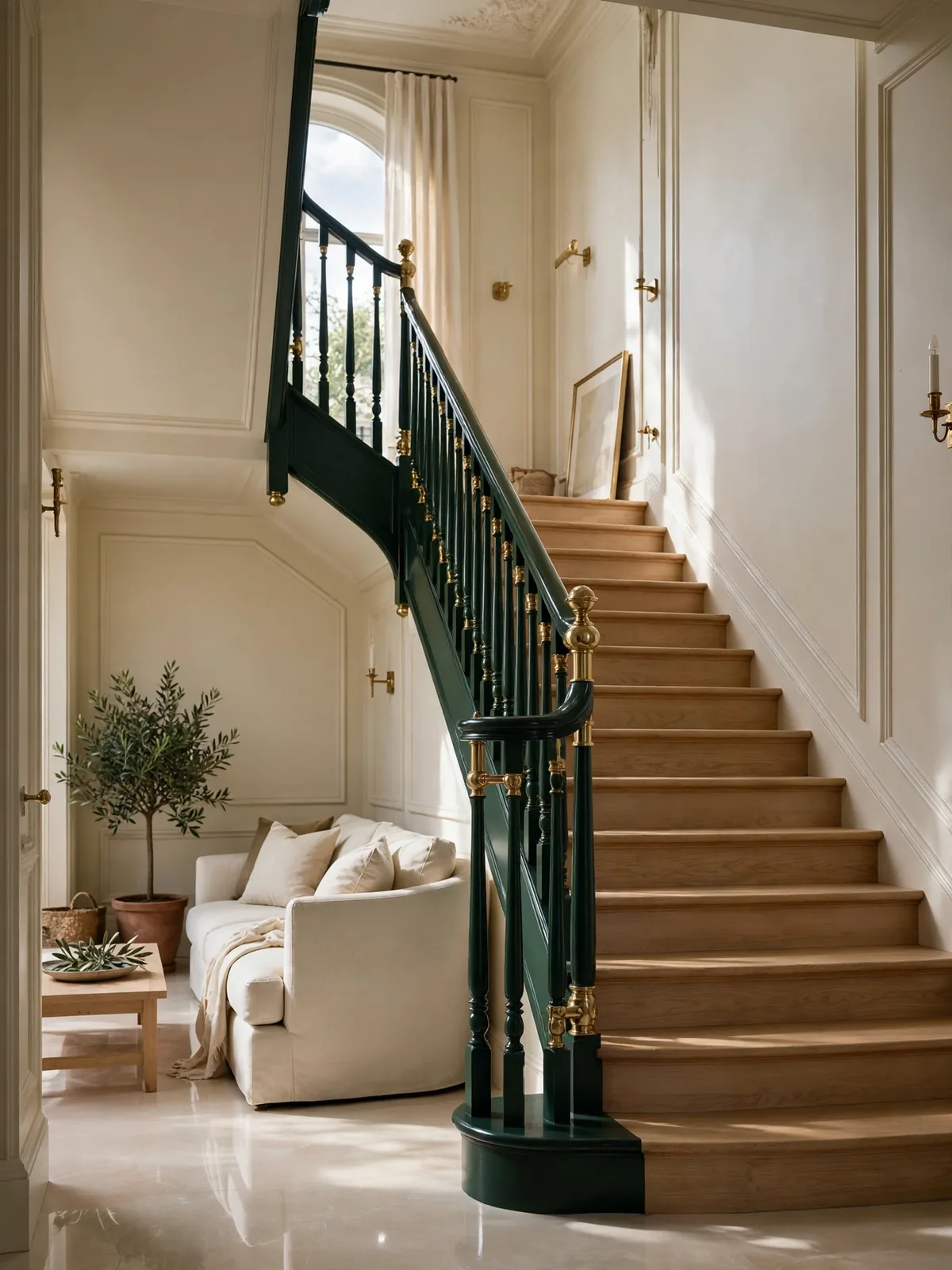
A painted railing in forest green with brass fittings is the staircase railing idea for homes that want colour with confidence, because the deep green reads as rich and grown-up while the brass keeps it warm. Here, the handrail, balusters and newel post are all painted deep forest green, with brass brackets and a brass newel cap, above pale oak treads, each 950 mm wide. Soft cream walls keep the entry bright, while a cream sofa below and a small olive tree in a clay pot at the base pick up the green and keep the stair feeling fresh rather than dark.
Quick tips:
- Paint the whole railing forest green for a bold, unified look.
- Add brass brackets and a brass newel cap for warmth.
- Keep the treads pale oak so the green stands out.
- Use a durable satin paint so the railing wipes clean.
A Child-Safe Railing With Narrow Baluster Spacing
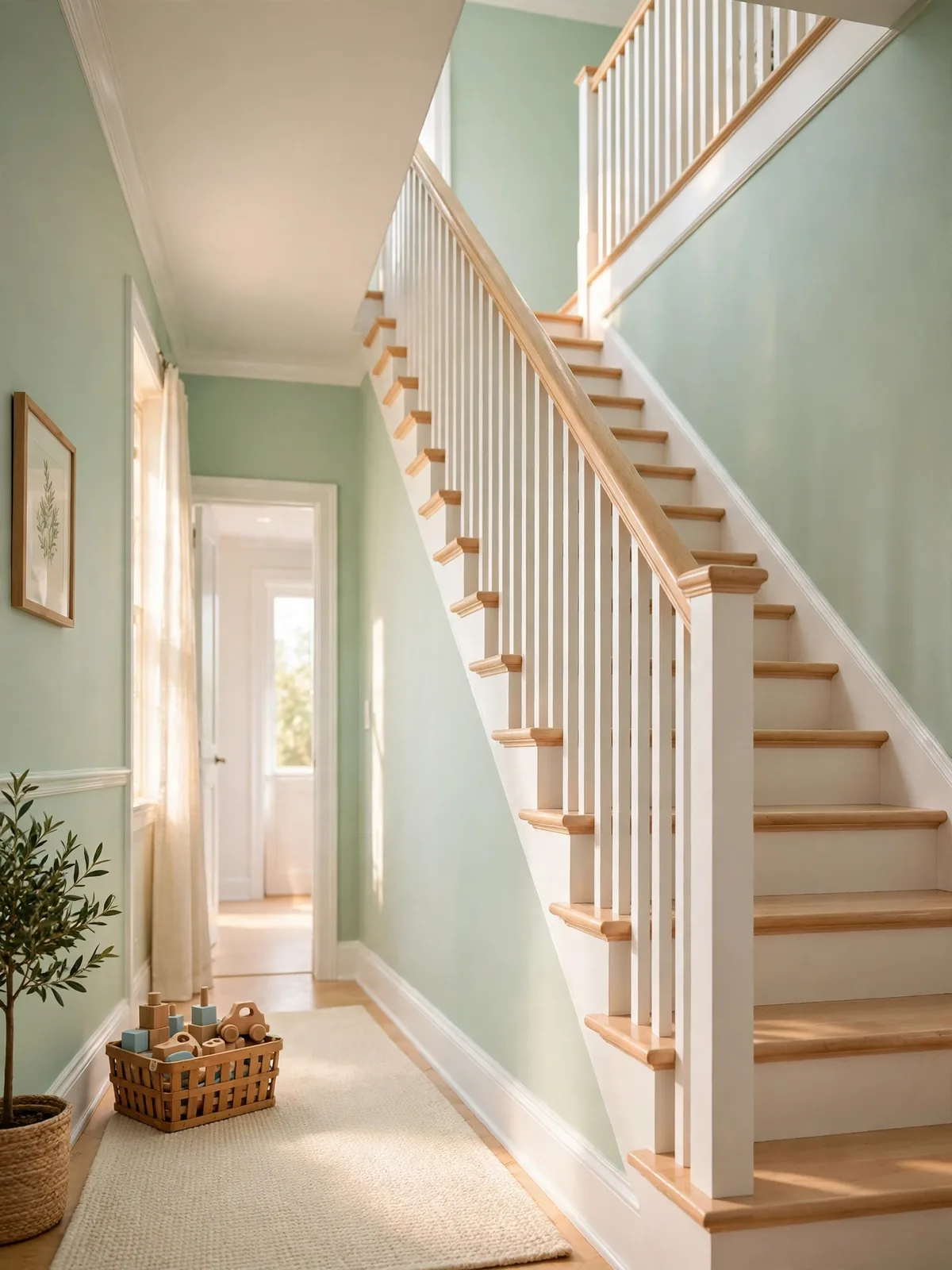
A child-safe railing with narrow baluster spacing is the most important staircase railing idea for any family with small children, because safety has to come before style — and narrow spacing can still look beautiful. On this stair, slim white balusters, each 25 mm square, are spaced just 85 mm apart, rising from pale maple treads, each 950 mm wide, to a smooth pale maple handrail, 60 mm wide, with no horizontal rails a child could climb. Soft mint-green walls and a cream rug below keep the hallway cheerful, while a small wooden toy basket at the base shows this is a stair built for a real family.
Quick tips:
- Keep baluster gaps under 99 mm so a 100 mm sphere cannot pass.
- Avoid horizontal rails that a small child could climb.
- Choose a smooth handrail with no sharp edges.
- Check the spacing again after fitting, with a tape measure.
Staircase Railing Ideas That Make a Small Hallway Feel Grand
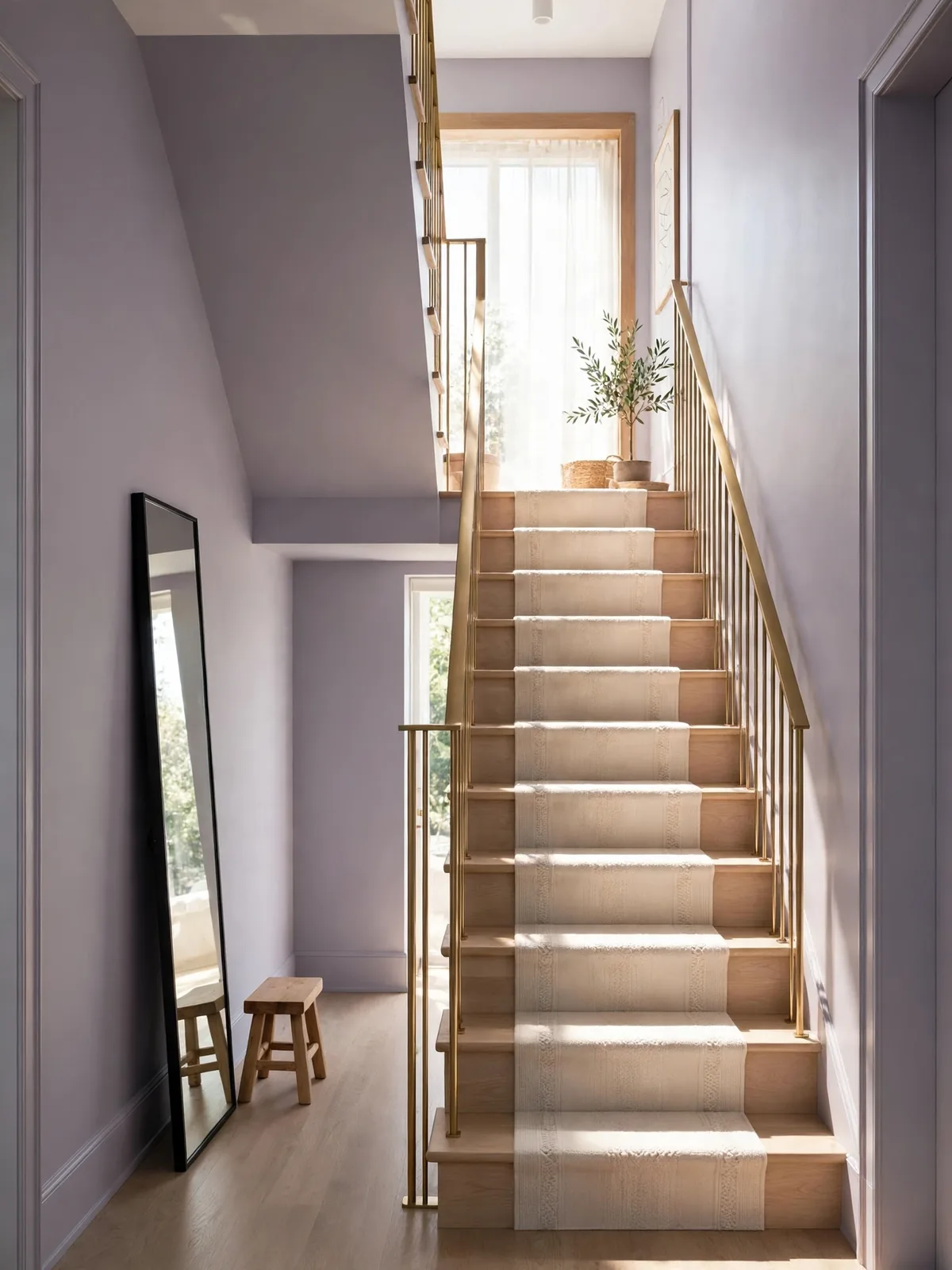
A small hallway does not need a grand staircase to feel grand — it needs a few clever staircase railing ideas working together. In this compact home, slim brass balusters, each 16 mm square, rise from pale oak treads, each 850 mm wide, to a slim brass handrail, while a tall mirror, 1.8 metres high, hangs on the stair wall and doubles the daylight, and a cream runner softens the climb. Soft lavender-grey walls and a small wooden stool at the base keep the hallway uncluttered, and because every element is pale, slim or reflective, the stair feels twice as wide as it really is.
Quick tips:
- Use slim brass balusters so a narrow stair feels lighter.
- Hang a tall mirror on the stair wall to double the daylight.
- Choose pale oak treads so a narrow stair feels wider.
- Keep the hallway free of bulky furniture so the stair breathes.
FAQs
How do I update a staircase railing without replacing the whole stair?
Start with the balusters and the handrail, not the stair itself. Swap chunky spindles for slim metal balusters, repaint the handrail, or add a new handrail over the old one — these three changes transform the look of a stair for a fraction of the cost of a new flight. A newel post cap or decorative brackets add a finished feel without structural work.
What is the best railing for a small hallway?
Glass panels, cable lines or slim vertical rods are best for a small hallway, because they let light through and keep sightlines open. A pale timber handrail warms the look without adding weight, and a tall mirror on the stair wall doubles the daylight. Avoid chunky turned spindles and dark, heavy railings in a narrow hall — they make the space feel smaller.
Are glass staircase railings safe?
Yes, when they are made from toughened or laminated safety glass, at least 10 mm thick, and fitted in proper channels or clamps by a professional. Toughened glass is designed to break into small, blunt pieces rather than sharp shards, and laminated glass holds together even if it cracks. Always use a specialist for glass — the fitting matters as much as the glass itself.
How often should I clean or maintain a staircase railing?
Wipe a timber handrail weekly with a damp cloth and oil it once or twice a year to keep the wood from drying out. Wipe glass panels weekly with a microfibre cloth, dust metal balusters monthly, and check cable tension every few months — cables can loosen slightly over time. Repaint painted balusters every few years when the finish starts to wear.
Can I mix railing materials in one staircase?
Yes — mixed materials work well when one material leads and the others support it. A common pairing is a timber handrail with glass on the lower flight and slim steel balusters on the upper flight, or black iron balusters with a reclaimed timber handrail. Keep the handrail consistent along the whole stair so the mix feels intentional, not accidental.
Conclusion
A staircase railing is not just a safety feature — it is the detail that sets the tone for the whole hallway. Whether you choose slim black balusters with a warm oak handrail, clear glass panels, horizontal cables, wrought iron scrollwork, a rope railing for a cottage, or a painted railing in forest green, the best staircase railing is the one that suits the rooms around it, keeps your family safe, and feels good under your hand every day. Start with the material you love, keep the spacing safe, choose one strong pairing, and your stair will make every room it touches feel brighter, bigger and more beautiful.