25 Stunning Staircase Runner Ideas That Instantly Make Your Stairs Feel Softer, Warmer and More Expensive
A staircase runner does more than soften the climb — it adds colour, pattern, warmth and grip to the hardest-working part of your home. These 25 staircase runner ideas show how stripes, geometrics, vintage patterns, wool, flatweave and clever colour choices can transform a plain flight of steps into a beautiful feature, whether your home is modern, traditional, farmhouse or somewhere in between.
Staircase runner ideas work because a runner does four jobs at once: it softens every footstep, adds colour and pattern to a plain flight, protects the timber underneath, and gives bare feet and paws much-needed grip. The best staircase runner is about 650 mm wide on a standard 950 mm tread, leaving a strip of wood showing on each side, and it should be fixed tightly at every tread so it never slips or rucks.
If your whole stair needs a wider refresh first, these staircase makeover ideas show how paint, new balusters and lighting work alongside a runner to transform the flight. The 25 ideas below cover every style of runner — classic stripes, bold geometrics, vintage Persian, soft wool, tough flatweave and seasonal swaps — so you can choose one that suits your home, your budget and the way your family actually climbs the stairs.
Key Takeaways
What is the best material for a staircase runner?
Wool is the best all-round material for a staircase runner, because it is soft underfoot, naturally stain-resistant, hard-wearing and easy to clean. A 100% wool runner, or an 80% wool and 20% nylon blend, holds its shape on the tread nosing and bounces back after years of daily footsteps. For a busy family hallway, a wool flatweave or a wool blend with a tight weave lasts longest.
How wide should a staircase runner be?
A staircase runner should be about 650 mm wide on a standard 950 mm tread, leaving roughly 150 mm of timber showing on each side. On a narrower stair with 850 mm treads, a 600 mm runner keeps the same balance. Measure every tread before ordering, because older stairs often vary by 10–20 mm, and order the runner to fit the narrowest tread.
How much does a staircase runner cost?
A ready-made stair runner costs from around £25–£40 per metre for synthetic flatweave, £60–£120 per metre for good wool, and £150 or more per metre for hand-knotted or vintage Persian runners. Professional fitting adds roughly £150–£300 for a standard flight, including underlay and stair rods if you choose them. A painted or stencilled runner is the cheapest option of all.
How do you clean a staircase runner?
Vacuum a staircase runner twice a week with the upholstery head, working from the top tread down, and blot spills immediately with a clean cloth and cold water — never rub, which pushes the stain deeper. Wool runners need a wool-safe carpet cleaner and should never be steam-cleaned at high heat. A dark pattern or a busy geometric hides everyday marks far better than a pale plain runner.
Can I fit a staircase runner myself, or do I need a professional?
A confident DIYer can fit a straight flight with a staple gun, a stair tool and gripper rods, working one tread at a time from the top down. Winder stairs, curved flights and runners that continue across a landing are best left to a professional fitter, because the folds at the nosing and the turns need precise cutting and tensioning to sit flat and stay safe.
A Classic Striped Runner in Navy and Cream
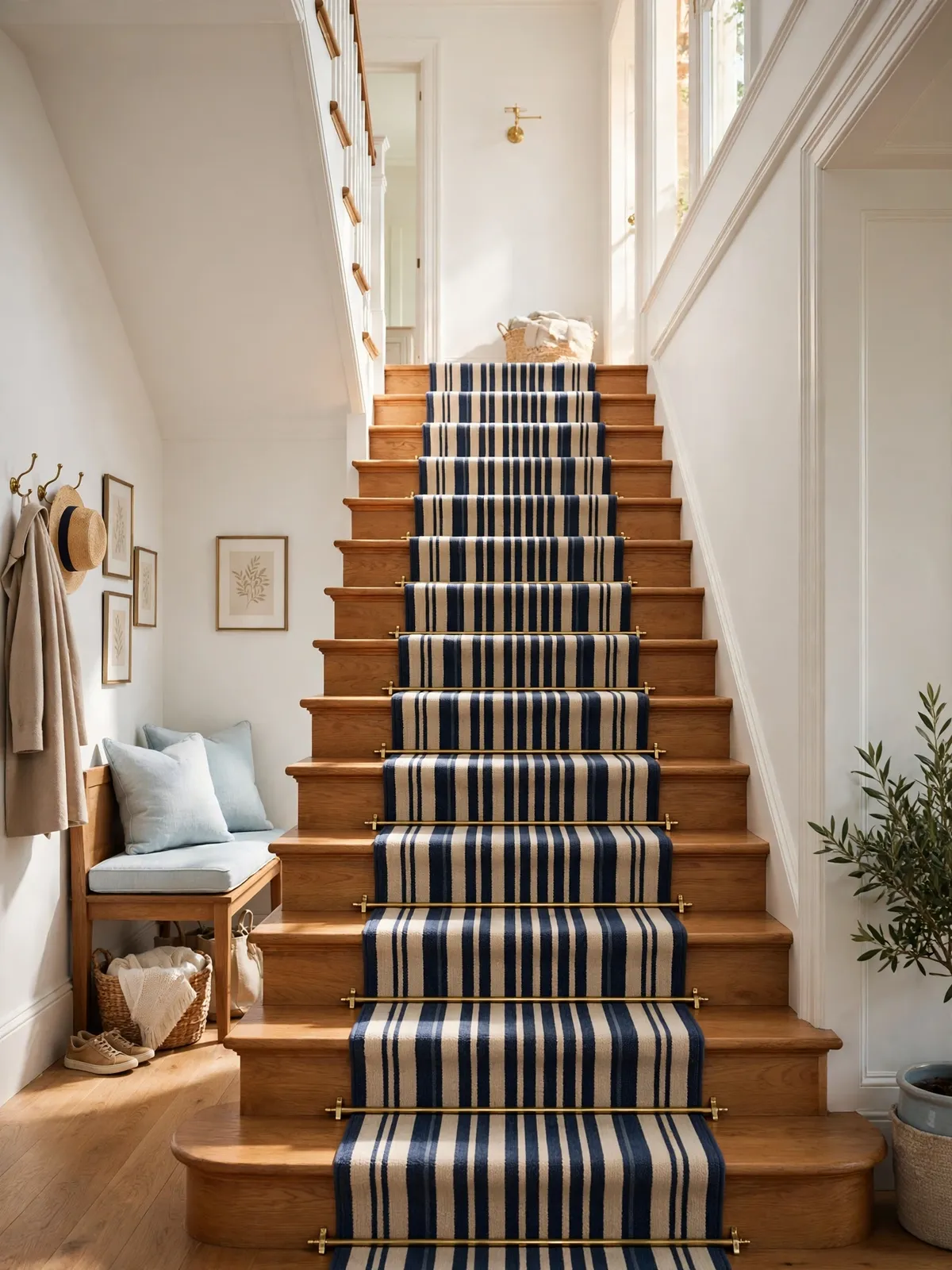
A classic striped runner in navy and cream is the safest and most loved staircase runner of all, because stripes suit almost every home and never date. On this stair, a 650 mm wide navy and cream striped wool runner runs down the centre of warm oak treads, each 950 mm wide, held in place by slim brass stair rods at the base of every riser. The stripes run along the length of the runner, so the eye follows them up the flight, and the cream in the stripe picks up the white walls while the navy grounds the hallway beautifully.
Quick tips:
- Keep the runner about 650 mm wide so timber shows on both sides.
- Choose stripes that run lengthways to make the stair feel longer.
- Use brass stair rods to hold the runner neatly in place.
- Match the navy to a cushion or frame nearby for a pulled-together look.
A Bold Geometric Runner in Black and White
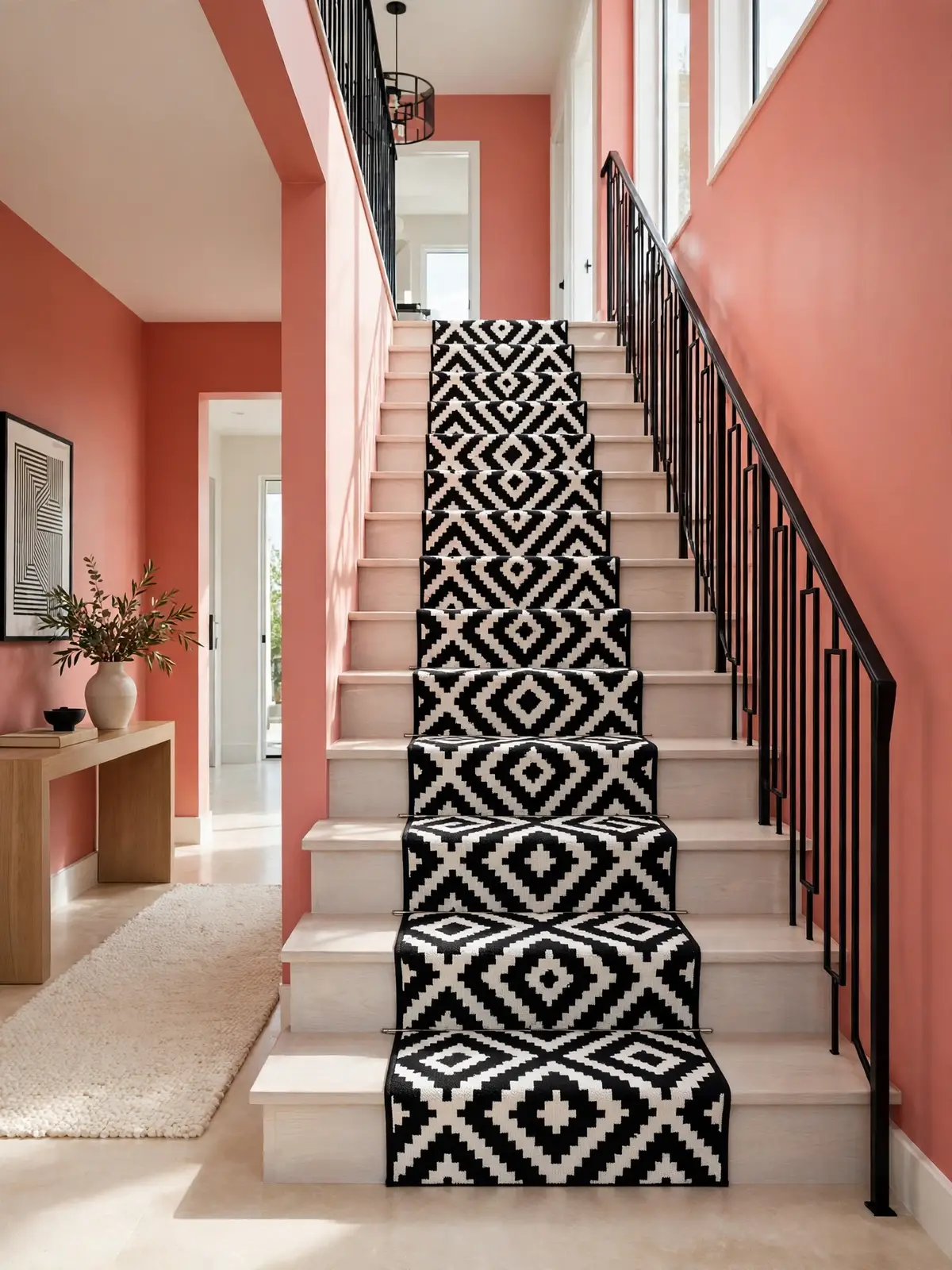
A bold black and white geometric runner turns a plain stair into a graphic statement, and the pattern does the decorating so the rest of the hallway can stay quiet. Here, a 600 mm wide black and white diamond runner runs down pale ash treads, each 900 mm wide, with a slim black iron handrail following the pattern upward. Soft coral walls warm the monochrome, while a cream rug at the base softens the contrast, and because the pattern is large and regular, it reads clearly from the bottom of the flight to the top.
Quick tips:
- Choose a large-scale geometric so the pattern reads from a distance.
- Keep the walls one warm colour so the black and white stays the feature.
- Use a slim black handrail to echo the darkest part of the pattern.
- Vacuum along the pattern lines so the diamonds stay crisp.
A Vintage-Inspired Persian Runner
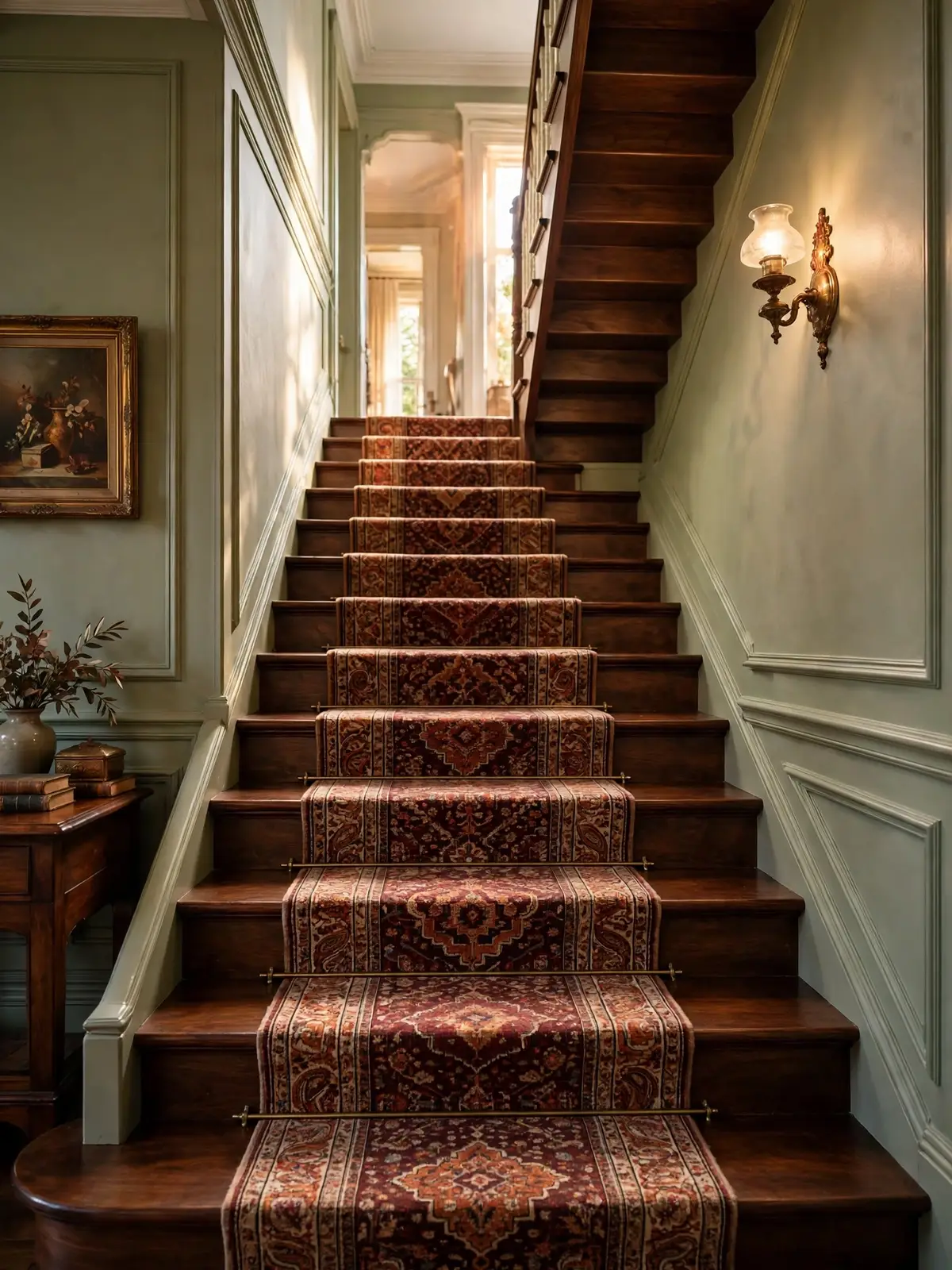
A vintage-inspired Persian runner brings instant history to a stair, with its deep colours and intricate pattern making even a new-build hallway feel collected and characterful. On this flight, a 650 mm wide Persian-style runner in deep burgundy, rust and cream, with a faded, time-worn finish, runs down dark walnut treads, each 950 mm wide. Soft sage-green walls calm the rich pattern, while a small antique brass wall light above the landing warms the burgundy in the evening and makes the whole stair feel like it has been loved for decades.
Quick tips:
- Choose a faded or distressed finish so the pattern feels genuinely vintage.
- Pair rich burgundy and rust with soft sage or cream walls.
- Use a wool runner — it holds the intricate pattern best.
- Match the brass tone to a wall light or mirror nearby.
A Tonal Runner Matched to the Wall Colour
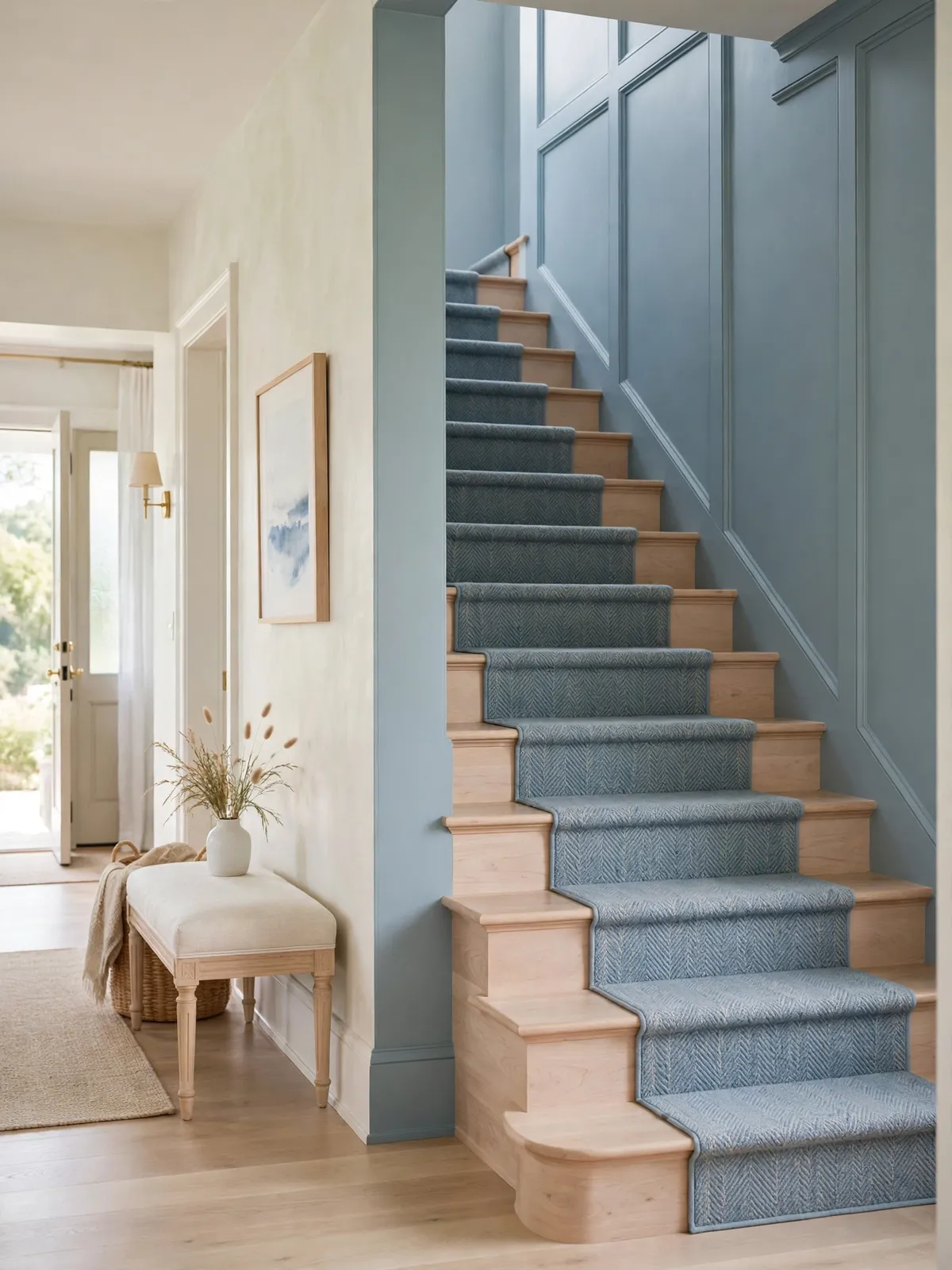
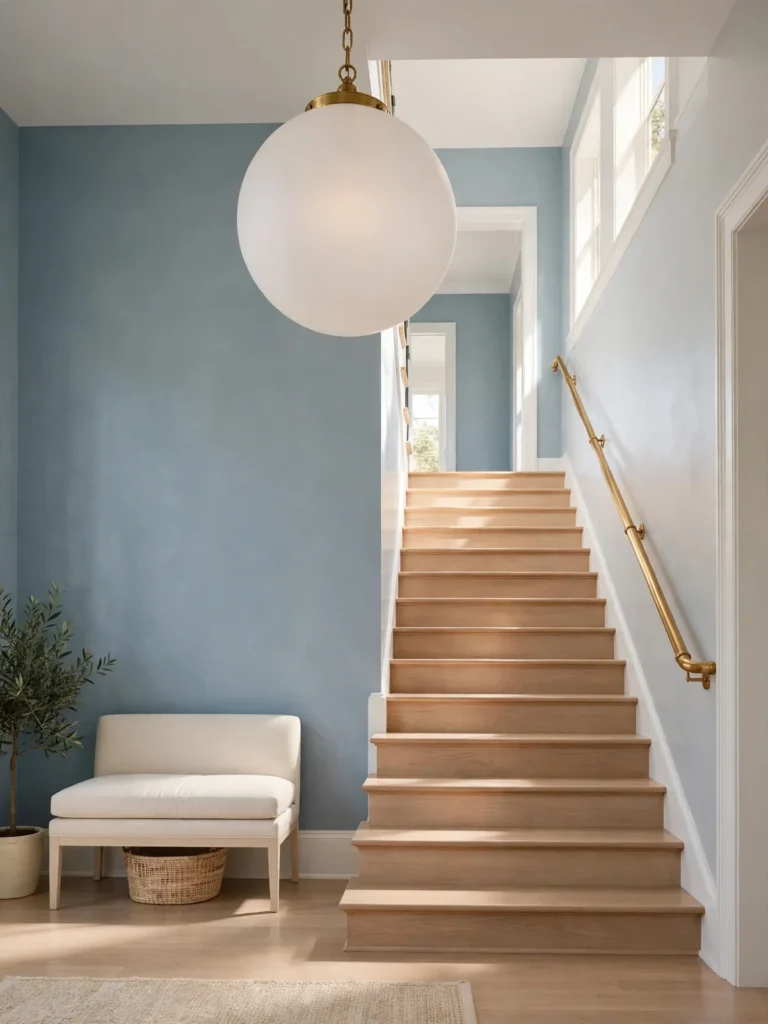
A tonal runner matched to the wall colour is the quietest luxury in staircase design, because the stair and the wall read as one continuous sweep of colour. Here, a 650 mm wide runner in soft dusty blue, woven with three slightly different blue tones, runs down pale maple treads, each 950 mm wide, beside a wall painted in the exact same dusty blue. A cream bench at the base and a small white vase of dried grasses keep the hallway calm, and because nothing competes, the stair feels longer, taller and far more expensive than it is.
Quick tips:
- Take a paint swatch to the carpet shop to match the runner exactly.
- Choose a runner with two or three tones of the same colour for depth.
- Keep the treads pale so the tonal wall and runner stand out.
- Add one cream accent at the base to stop the colour feeling flat.
Brass Stair Rods Framing a Neutral Runner
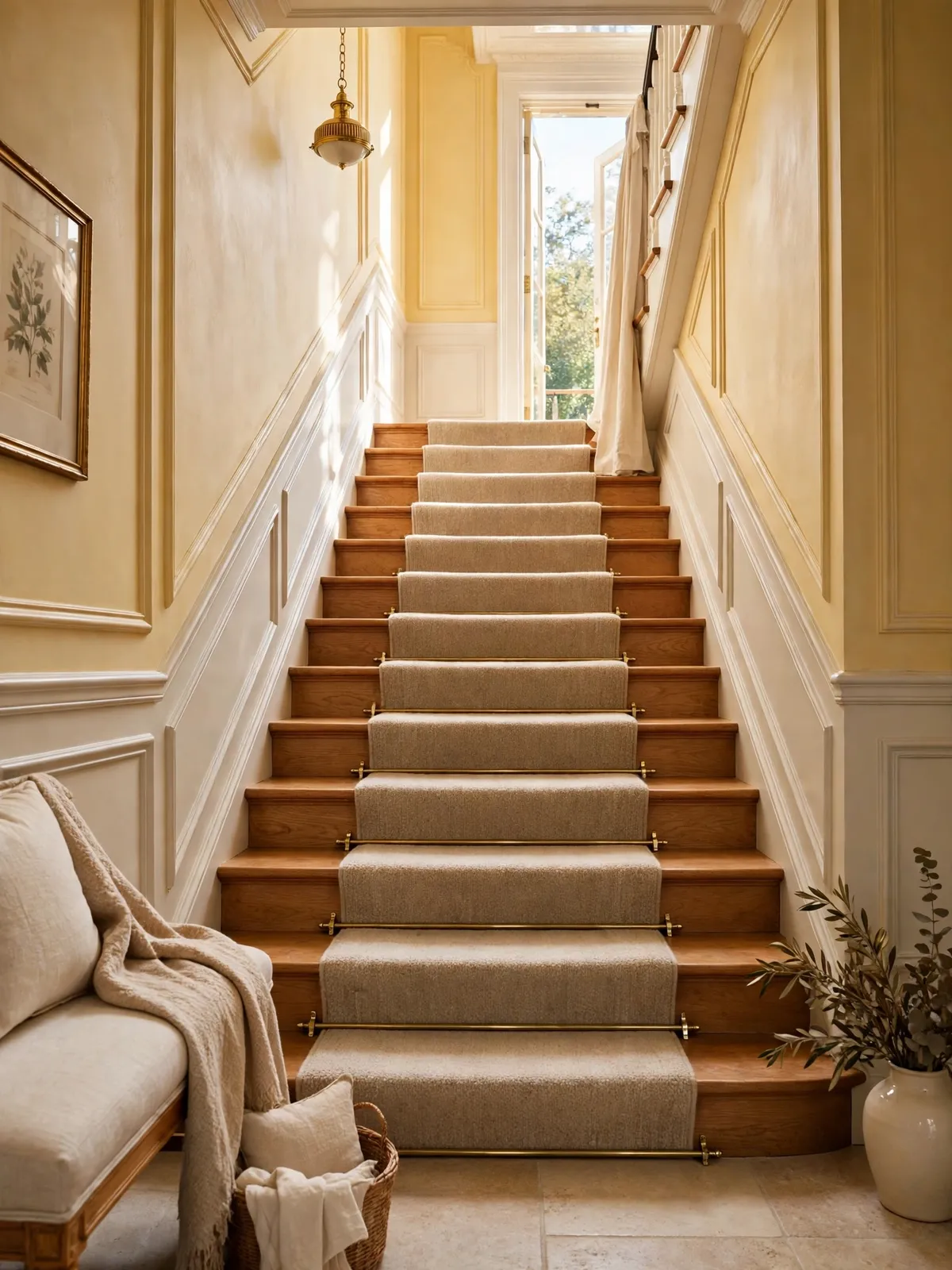
Brass stair rods are the jewellery of a staircase runner — slim, gleaming bars that hold the runner in place and make a plain neutral runner look finished and expensive. On this stair, a 650 mm wide oatmeal wool runner runs down honey oak treads, each 950 mm wide, with a slim brass rod, 12 mm in diameter, fixed at the base of every riser, its finials catching the daylight. Soft butter-yellow walls and a cream linen bench below keep the hallway warm, while a small brass pendant on the landing echoes the rods and ties the whole flight together.
Quick tips:
- Choose solid brass rods, not plated, so they keep their shine.
- Fit one rod at the base of every riser for a neat, even rhythm.
- Keep the runner neutral — oatmeal, cream or soft grey — so the brass shines.
- Match the brass tone to a pendant or door handle nearby.
A Soft Wool Runner for Barefoot Comfort
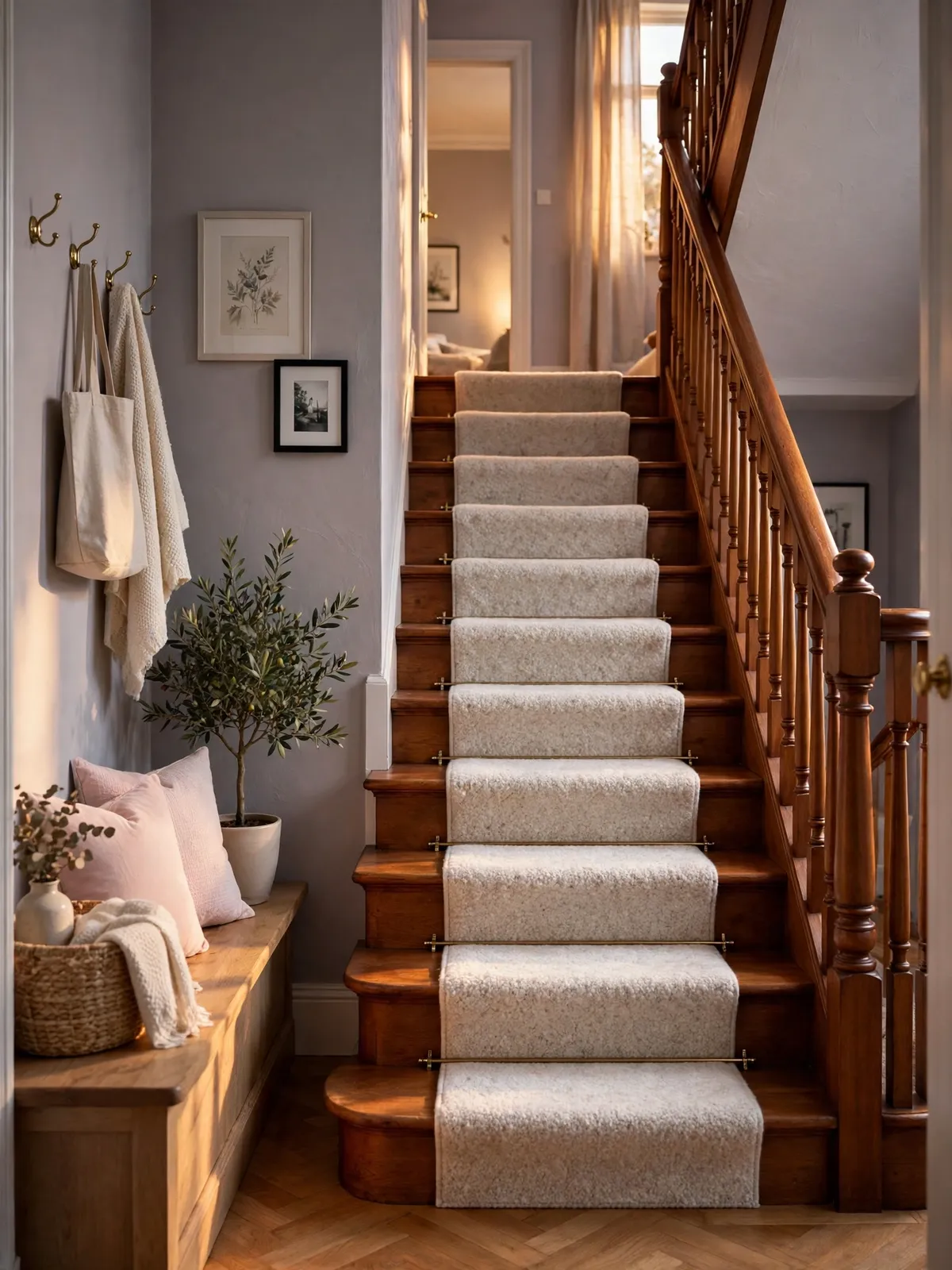
A thick wool runner is the staircase runner for bare feet, because wool is warm in winter, cool in summer and wonderfully soft on the first step of the morning. Here, a 650 mm wide cream wool runner, 12 mm thick with a gentle flecked texture, runs down warm chestnut treads, each 950 mm wide, with a dense felt underlay beneath it that cushions every step. Soft lilac-grey walls and pale pink cushions on a wooden bench at the base keep the hallway gentle, and the wool muffles footsteps so the whole house feels quieter.
Quick tips:
- Choose a wool runner at least 10 mm thick for real barefoot comfort.
- Add a dense felt underlay beneath the runner for extra softness.
- Pick a flecked or heathered cream to hide everyday marks.
- Vacuum with the upholstery head so the pile stays soft.
A Subtle Diamond Pattern in Soft Neutrals
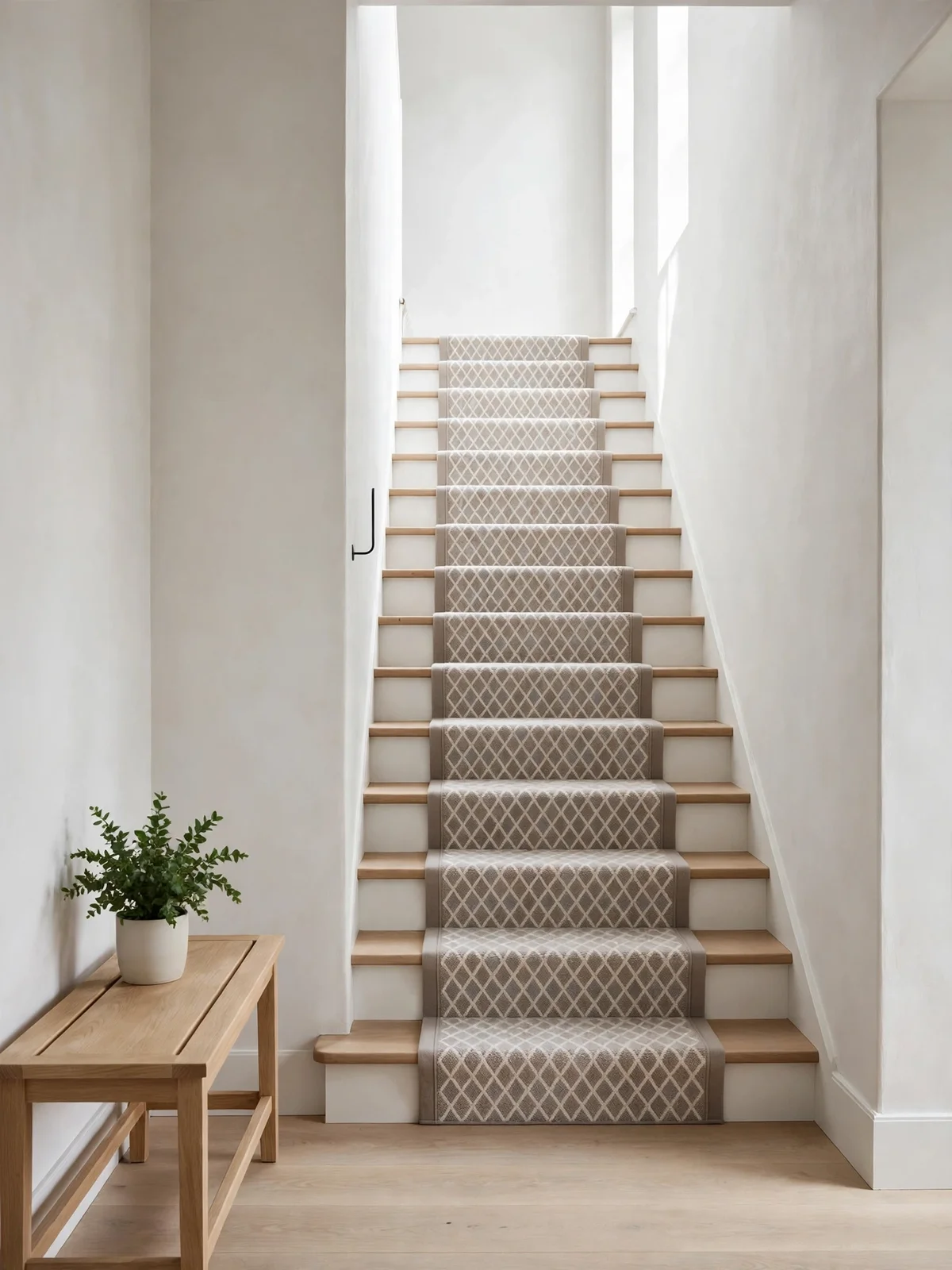
A subtle diamond pattern in soft neutrals is the staircase runner for homes that want pattern without shouting, because the diamonds add texture and interest while the palette stays calm. On this stair, a 650 mm wide runner in taupe, ivory and pale grey diamonds runs down pale birch treads, each 900 mm wide, with a slim light oak bench and a small green plant at the base. Soft white walls keep the hallway bright, and because the pattern is small and the colours are close together, the runner reads as texture from a distance and as pattern up close.
Quick tips:
- Choose diamonds in three close neutrals for a soft, layered look.
- Keep the treads pale birch or ash so the neutrals stay light.
- Add one green plant at the base for a touch of life.
- Use a small-scale pattern so it reads well on a 175 mm riser.
A Flatweave Runner for High-Traffic Stairs
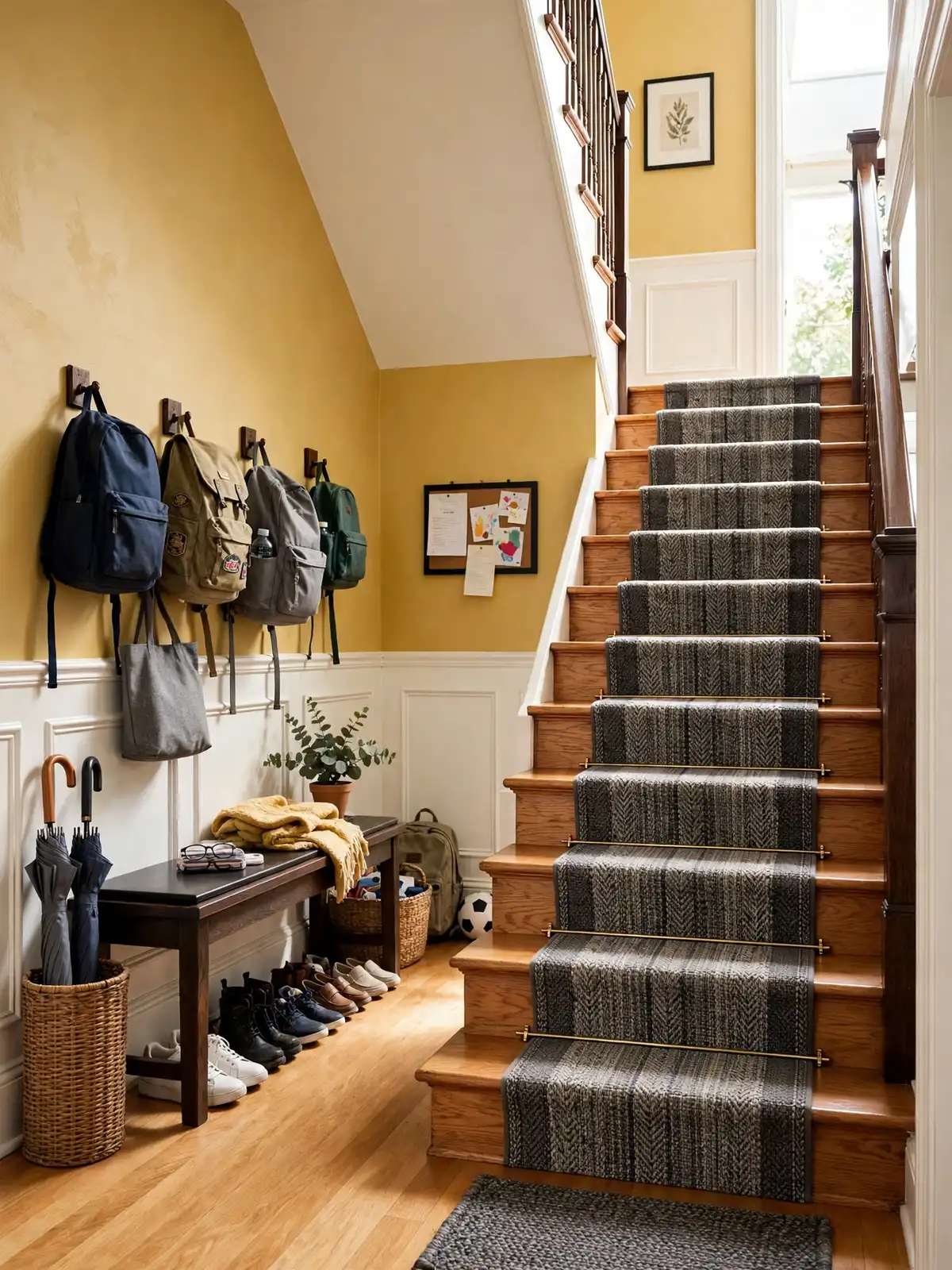
A flatweave runner is the workhorse of staircase runners, because its tight, flat weave shrugs off muddy shoes, school bags and daily traffic that would flatten a deep pile in months. Here, a 650 mm wide charcoal and stone flatweave runner runs down warm oak treads, each 950 mm wide, in a hallway where shoes and bags line up neatly on a dark wooden bench. Soft mustard-yellow walls keep the hallway cheerful, while the flatweave’s hard-wearing surface vacuums clean in minutes and shows almost no wear after years of use.
Quick tips:
- Choose flatweave for the busiest stair in the house.
- Pick a mid-tone or patterned flatweave to hide dirt between cleans.
- Fit gripper rods at every tread so the flat runner never slips.
- Vacuum twice a week — flatweave shows dust more than pile does.
A Runner That Continues Across the Landing
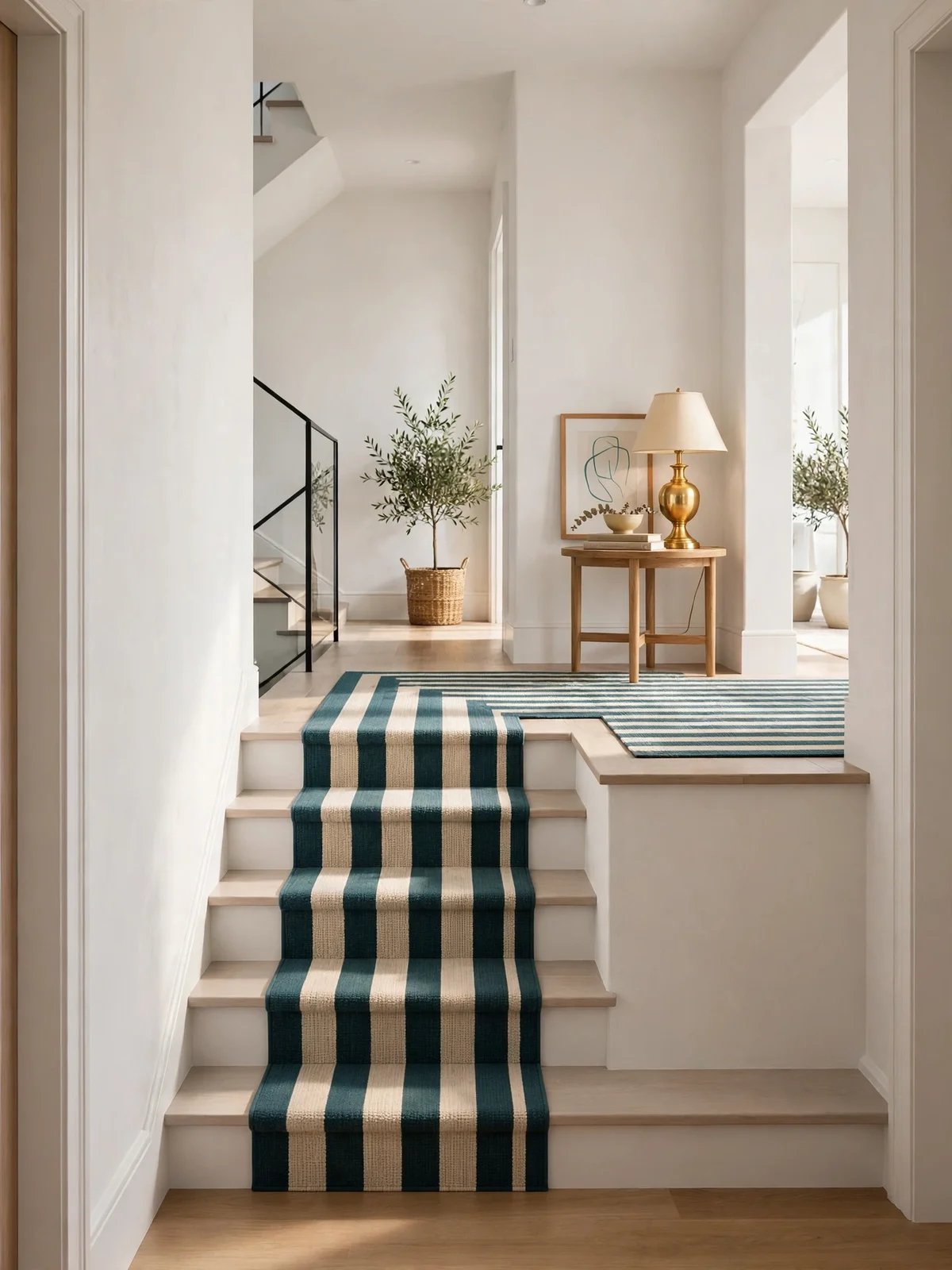
A runner that continues across the landing turns two separate flights into one flowing design, because the pattern never breaks and the eye travels smoothly from the bottom step to the top. On this stair, a 650 mm wide deep teal and cream striped runner runs up the first flight, crosses a 1.2 metre square landing in one unbroken sweep, and continues up the second flight, with the stripes aligning perfectly at every turn. Soft white walls and a small round wooden side table with a brass lamp on the landing keep the space calm, while the unbroken runner makes the whole stair feel designed rather than assembled.
Quick tips:
- Use a professional fitter for a runner that crosses a landing.
- Choose a stripe or simple pattern so the joins stay invisible.
- Measure the landing carefully — the runner must turn without a seam.
- Keep the landing furniture small so the runner stays the feature.
A Soft Grey Runner for Modern Versatility
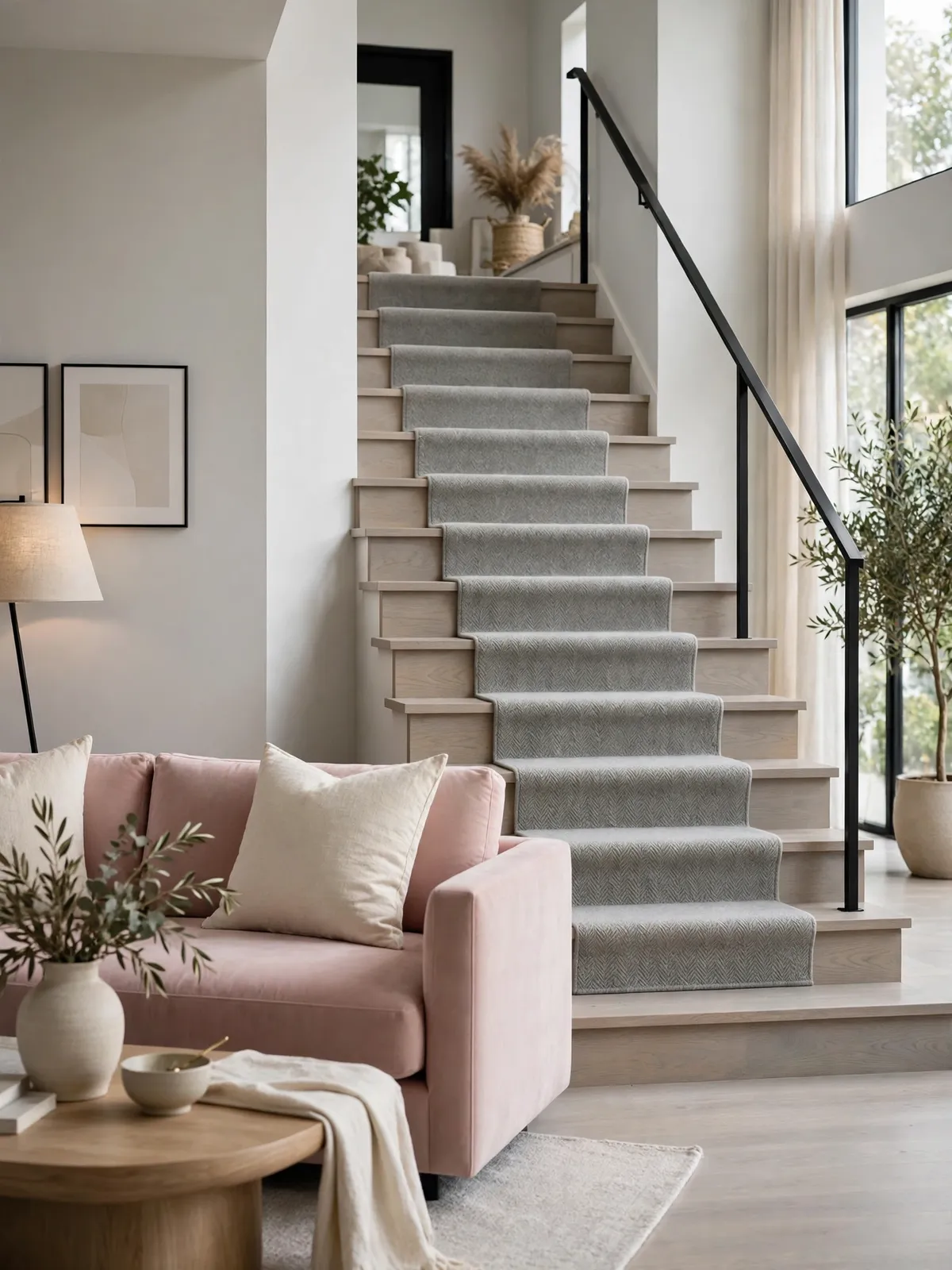
A soft grey runner is the most versatile staircase runner of all, because grey sits happily beside almost any wall colour, any timber and any style of furniture. Here, a 650 mm wide mid-grey wool runner runs down pale grey oak treads, each 950 mm wide, with a slim black handrail and a soft blush-pink sofa below adding one gentle accent. Cream cushions keep the palette light, and because the grey is warm rather than cold, the stair feels calm and modern without ever feeling stark or bare.
Quick tips:
- Choose a warm grey, not a cold blue-grey, for a cosy feel.
- Pair grey with one soft accent — blush, sage or mustard — below the stair.
- Use wool for a soft, durable finish that holds its colour.
- Keep the handrail slim and black for a crisp modern edge.
A Patterned Runner With Neutral Borders
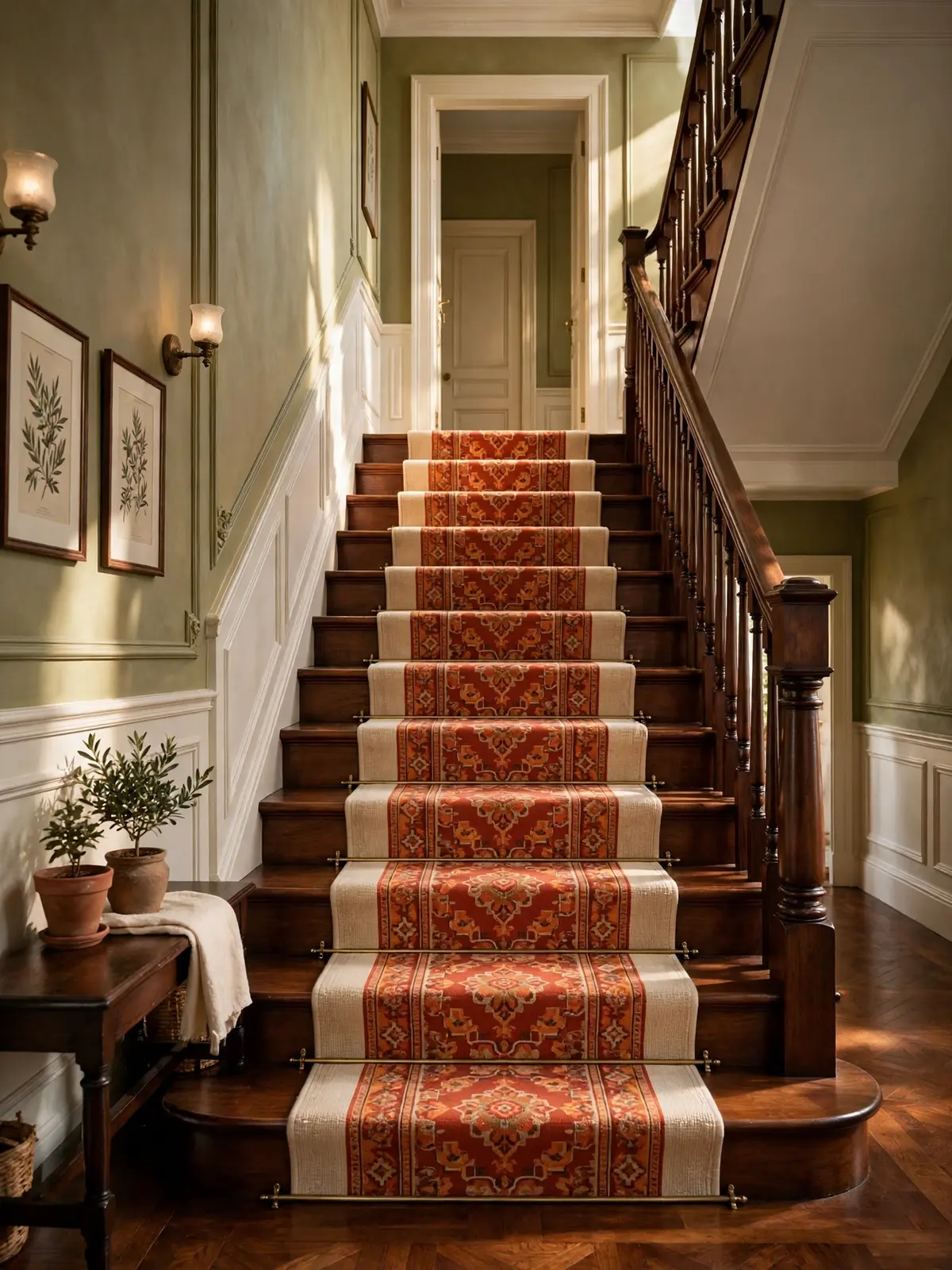
A patterned runner with wide neutral borders is the cleverest way to enjoy a bold pattern without overwhelming the stair, because the plain borders frame the pattern like a picture. On this flight, a 700 mm wide runner carries a bold terracotta pattern in its centre, framed by 100 mm wide cream borders on each side, running down warm walnut treads, each 1 metre wide. Soft olive-green walls and a dark wooden bench below keep the hallway grounded, while a small clay pot plant echoes the terracotta and makes the whole stair feel warm and intentional.
Quick tips:
- Choose borders at least 80 mm wide so they read clearly.
- Keep the border colour plain — cream, oatmeal or soft grey.
- Let the border colour match the wall or the bench for balance.
- Use the pattern colour in one small accessory nearby.
A Pop of Colour on Painted Stairs
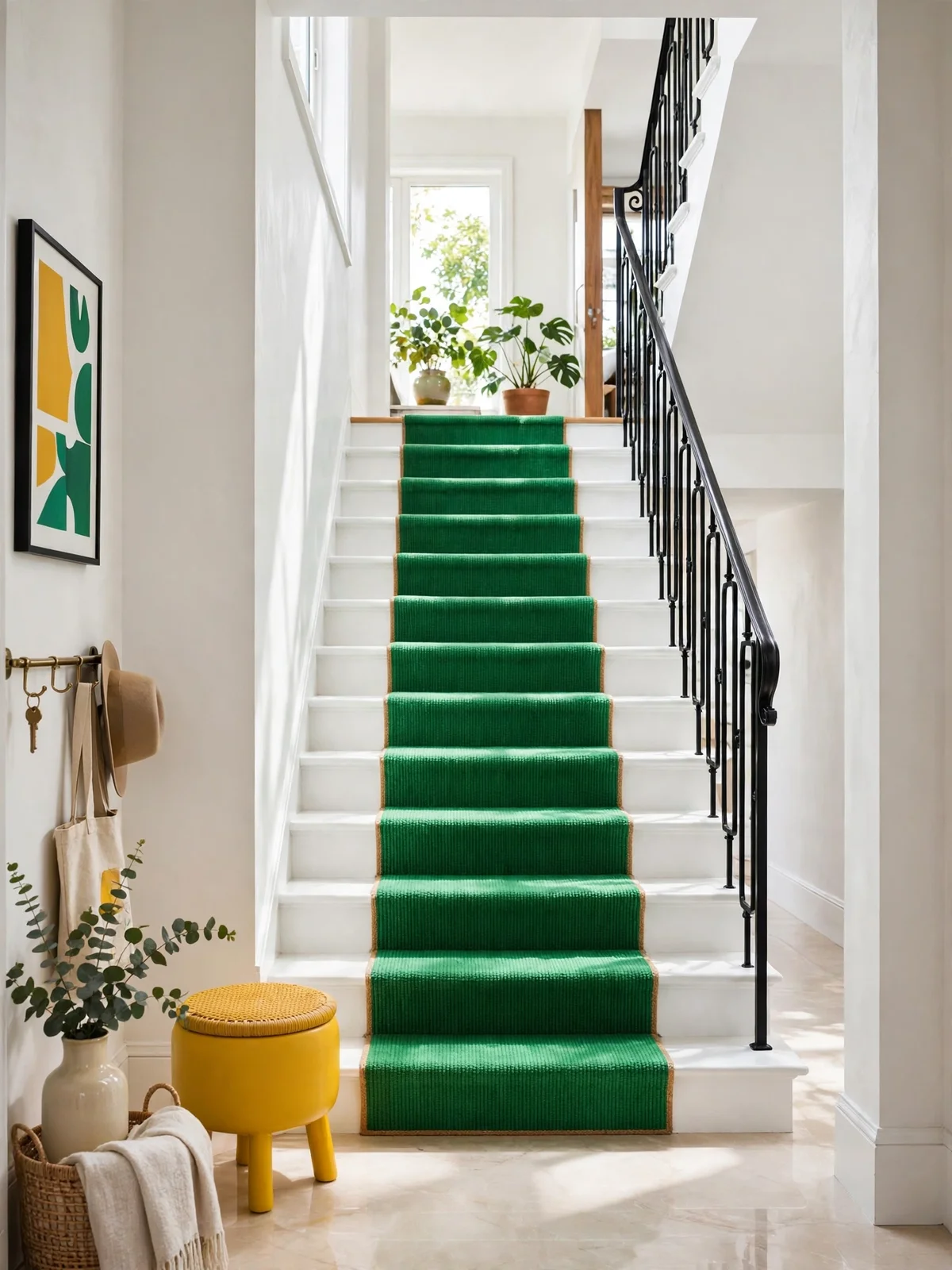
A vivid runner on crisp white painted stairs is the boldest staircase runner idea, because the white stair acts like a blank canvas and the runner becomes the whole decoration. Here, a 600 mm wide emerald green wool runner runs down white painted treads, each 950 mm wide, with a slim black iron handrail and a small mustard-yellow stool at the base adding a second cheerful accent. Soft white walls keep the entry bright, and the green glows against the white so vividly that the stair becomes the first thing every visitor notices.
Quick tips:
- Paint the treads white first so the colour really pops.
- Choose one vivid colour — emerald, cobalt or coral — and commit to it.
- Keep the walls white so the runner stays the star.
- Add one small accent in a contrasting colour at the base.
An Ombré Runner That Fades Light to Dark
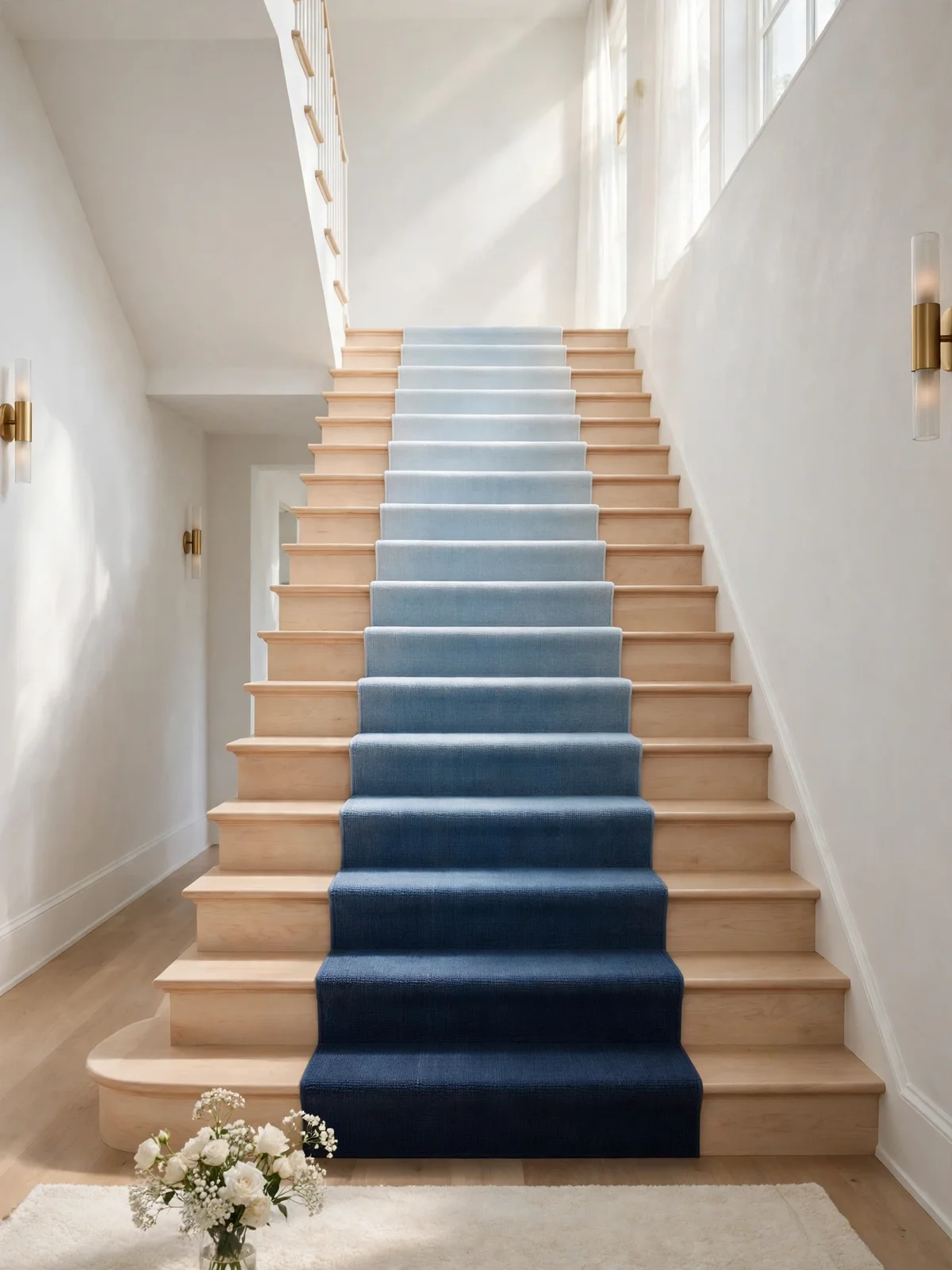
An ombré runner that fades from pale at the bottom to deep at the top is the most artistic staircase runner, because the stair itself becomes a gradient and the climb feels like walking through a sunset. On this flight, a 650 mm wide ombré wool runner fades from pale sky blue at the first tread to deep navy at the top, running down pale maple treads, each 950 mm wide. Soft white walls and a cream rug at the base keep the hallway calm, while a small glass vase of white flowers on the landing picks up the palest blue and makes the gradient feel intentional.
Quick tips:
- Choose an ombré that fades light at the bottom to dark at the top.
- Keep the treads pale so the gradient reads clearly.
- Use a wool runner — the dye takes most evenly on wool.
- Keep the walls white so nothing competes with the fade.
A Narrow Runner That Shows Off the Wood
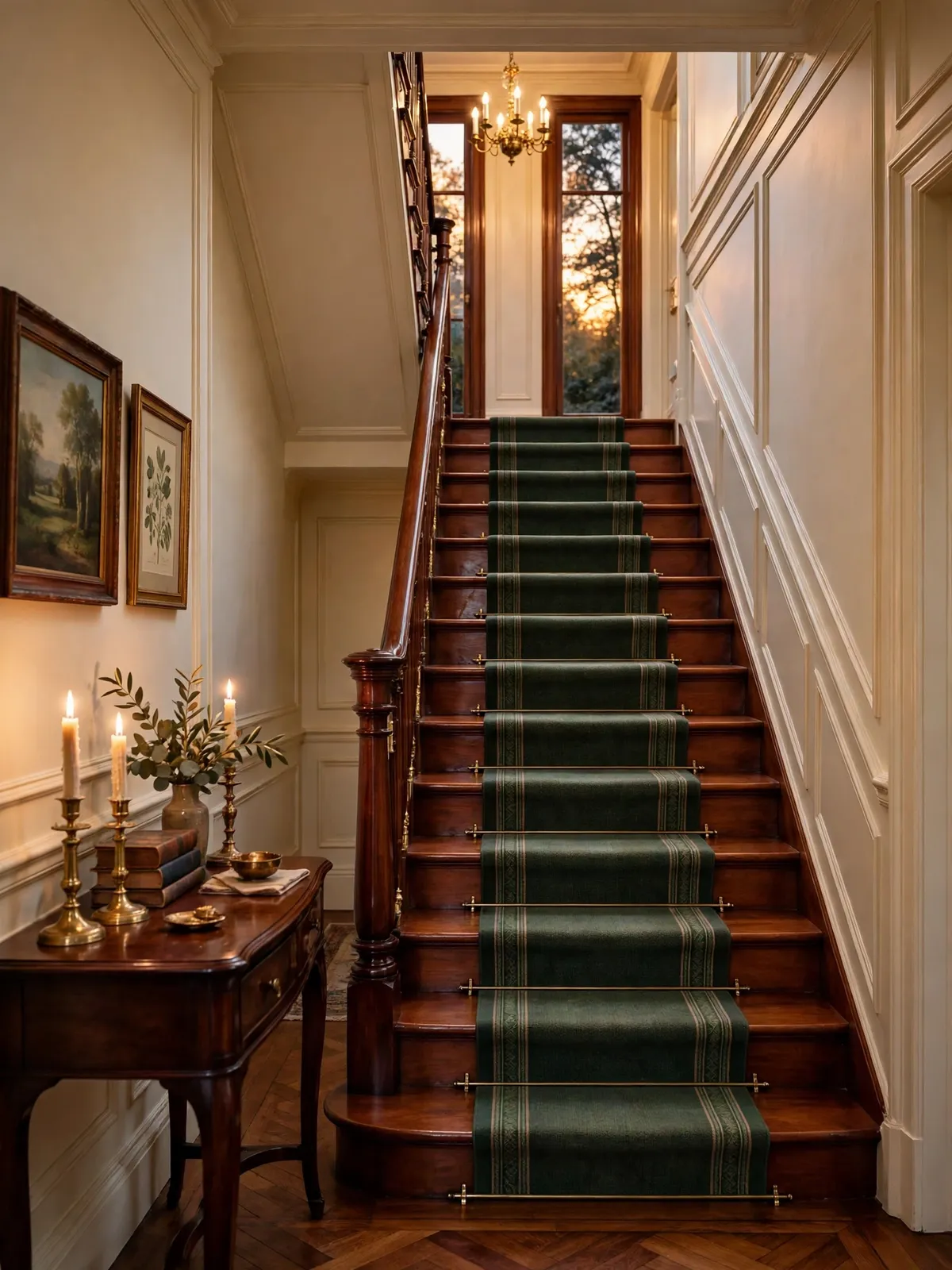
A narrow runner is the staircase runner for beautiful timber, because it protects the centre of each tread while leaving wide strips of wood showing on either side. Here, a slim 500 mm wide deep forest-green runner runs down rich mahogany treads, each 1 metre wide, leaving 250 mm of polished wood visible on each side. Soft cream walls and a dark wooden console table with brass candlesticks at the base keep the hallway grand, and the green stripe reads like a ribbon laid over the timber rather than a carpet covering it.
Quick tips:
- Choose a narrow runner — about 500 mm — on wide, beautiful treads.
- Keep the runner one rich colour so the wood stays the feature.
- Polish the exposed timber regularly so it keeps its shine.
- Match the runner colour to a cushion or curtain nearby.
A Sisal-Look Synthetic Runner for Durability
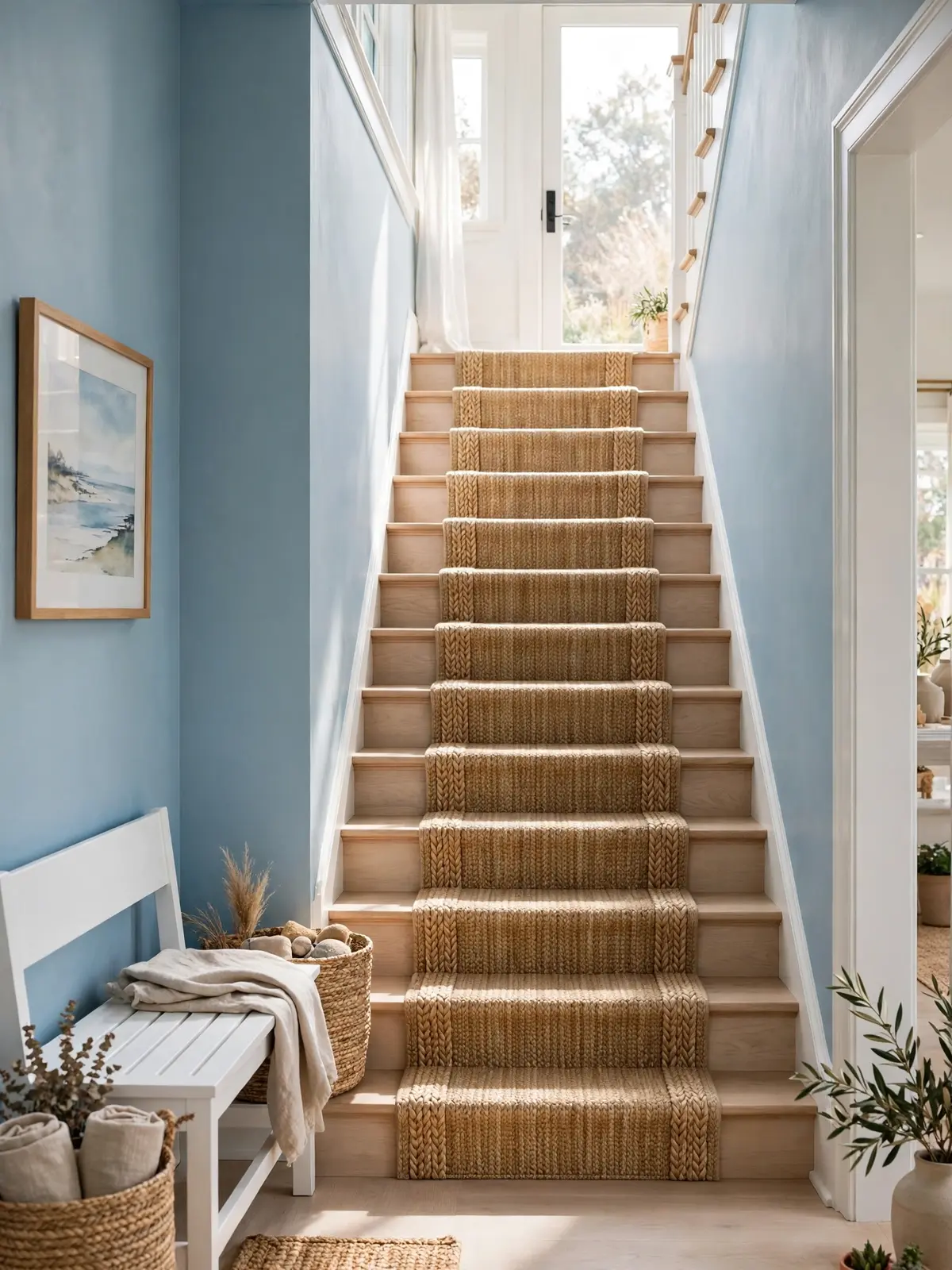
A sisal-look synthetic runner gives you the natural, textured look of sisal with the easy cleaning and durability that real sisal cannot offer on stairs. On this flight, a 650 mm wide synthetic runner in warm sand tones, woven to look exactly like natural sisal, runs down pale oak treads, each 950 mm wide. Soft sea-blue walls and a white bench below keep the hallway fresh and coastal, while a woven basket at the base echoes the runner’s texture, and because the runner is synthetic, muddy paws and spilled drinks wipe off without staining.
Quick tips:
- Choose a synthetic sisal-look for homes with pets or small children.
- Pick warm sand or natural tones for the most realistic look.
- Add a cotton border to stop the edges fraying.
- Vacuum with a suction-only head so the weave stays intact.
A Runner Coordinated With Hallway Rugs
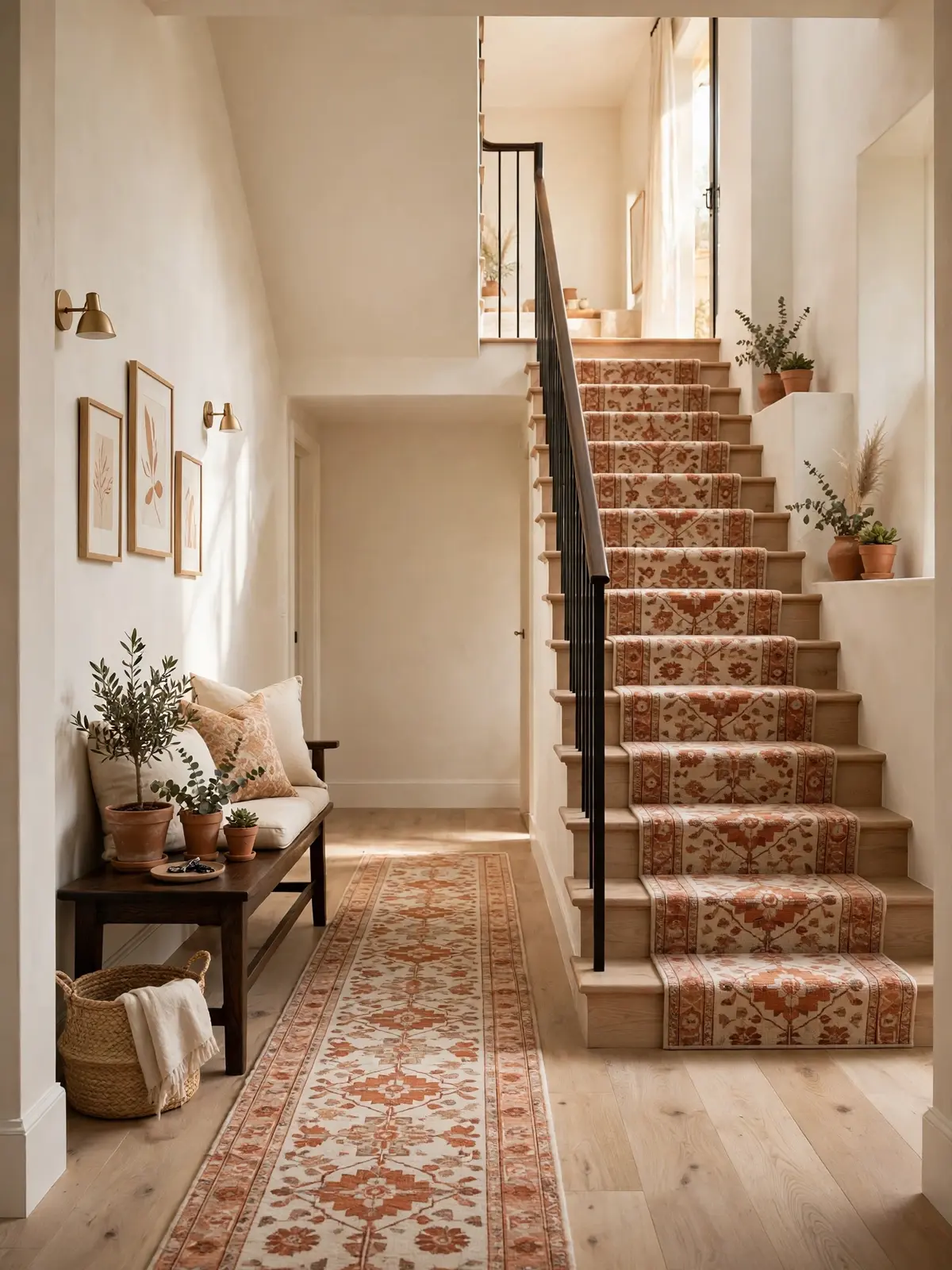
Coordinating the stair runner with the hallway rugs turns the whole ground floor into one flowing design, because the same pattern and colours repeat from the front door to the top of the stairs. In this home, a 650 mm wide rust and cream patterned runner climbs pale oak treads, each 950 mm wide, while a matching flatweave rug in the same rust and cream pattern lies in the hallway below, with a dark wooden bench and small terracotta pots tying the colours together. Soft cream walls keep the hallway bright, and because the pattern repeats, the eye moves smoothly from room to stair without a jolt.
Quick tips:
- Buy the runner and the hallway rug in the same pattern or colour family.
- Keep the hallway rug flatweave so it sits neatly under the front door.
- Use one accent colour — rust, teal or navy — in both pieces.
- Leave a gap of bare floor between the rug and the stair so each piece breathes.
Vertical Stripes That Make the Stair Feel Taller
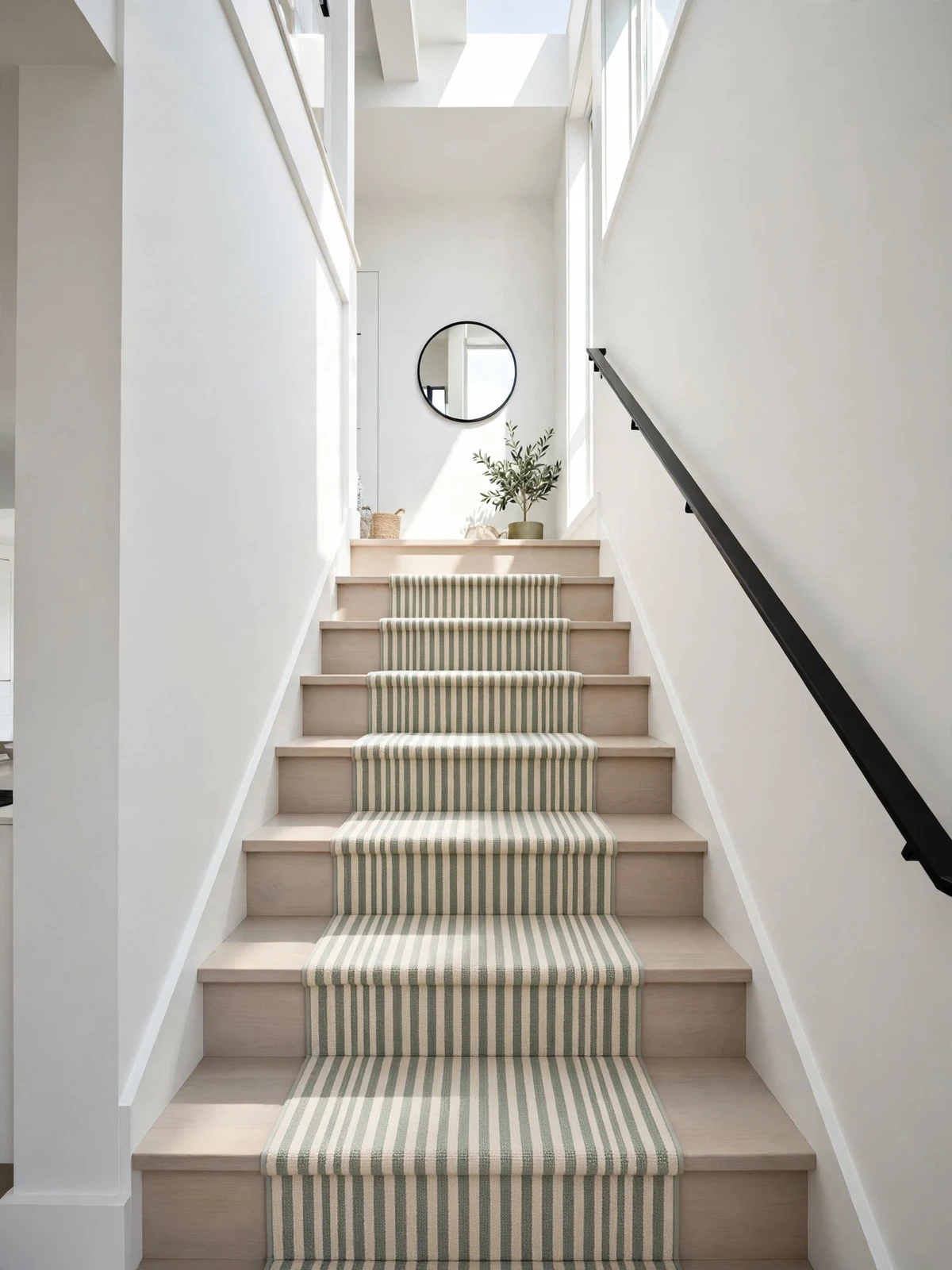
Vertical stripes on a stair runner draw the eye straight upward, which makes a short flight feel taller and a low ceiling feel higher. Here, a 650 mm wide runner in soft sage and cream vertical stripes runs down pale ash treads, each 900 mm wide, in a compact home where every centimetre of height matters. Soft white walls and a slim black handrail keep the stair light, while a small round mirror on the landing reflects the stripes and doubles the sense of height, so the whole flight feels far grander than its measurements suggest.
Quick tips:
- Choose stripes that run along the length of the runner.
- Keep the stripes narrow — about 40–60 mm — for the tallest effect.
- Pair sage or soft blue stripes with white walls for freshness.
- Add a mirror on the landing to double the height effect.
Two Layered Runners for a Custom Look
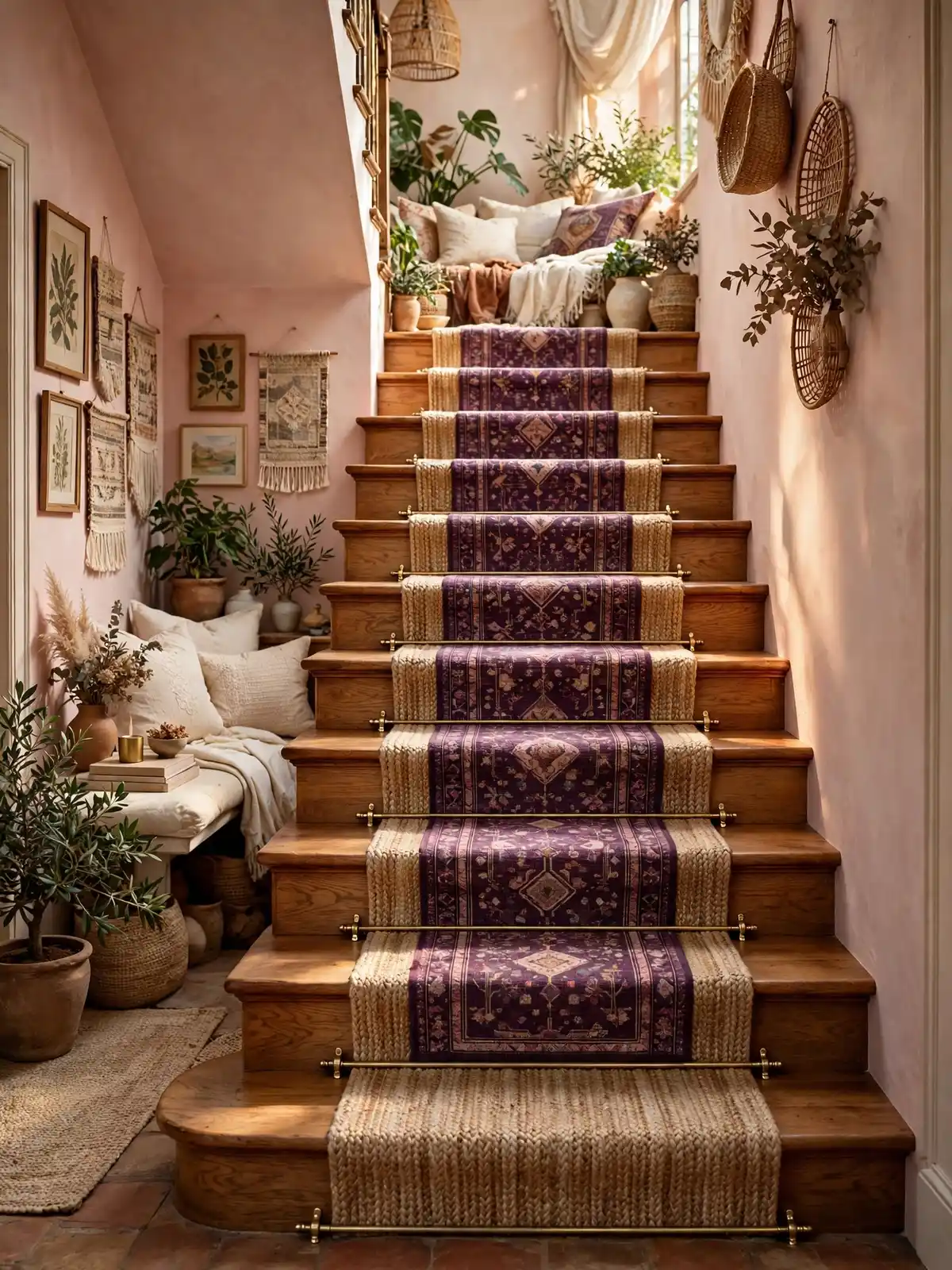
Layering two runners — a wide natural base with a narrower patterned runner on top — creates a custom, one-of-a-kind stair that no single runner could achieve. On this flight, a wide 800 mm jute runner forms the base, while a narrower 500 mm deep plum patterned runner sits on top of it, both running down warm oak treads, each 1 metre wide, held by brass stair rods. Soft blush-pink walls and cream cushions on a bench below keep the hallway warm, and the layered edges add depth and texture that make the stair feel handmade and personal.
Quick tips:
- Lay the wider runner first, then centre the narrower one on top.
- Choose a plain natural base — jute or sisal-look — under a patterned top.
- Fix both runners with stair rods so the layers never slip.
- Keep the top runner at least 250 mm narrower than the base.
Metallic Threads Woven Into a Neutral Runner
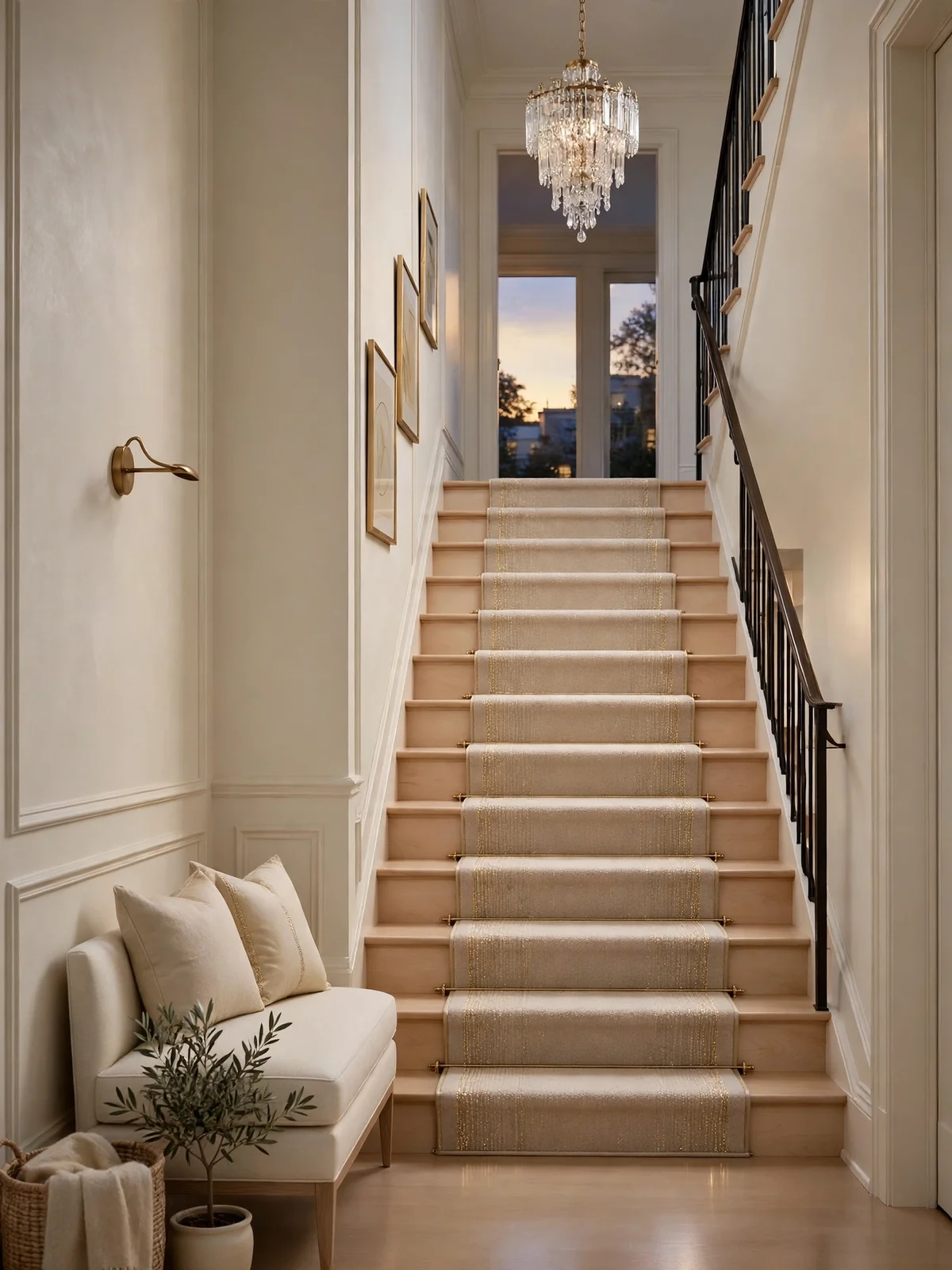
Metallic threads woven into a neutral runner add a whisper of glamour that catches the light as you climb, without ever looking flashy. Here, a 650 mm wide champagne wool runner, woven with fine gold threads that shimmer softly in the evening light, runs down pale maple treads, each 950 mm wide. Soft ivory walls and a crystal pendant above the landing pick up the gold, while a cream bench below keeps the hallway calm, and because the metallic threads are fine and sparse, the runner looks luxurious up close and simply warm from a distance.
Quick tips:
- Choose fine metallic threads, not thick glitter, for a subtle shine.
- Pair gold threads with champagne, cream or soft grey wool.
- Keep the lighting warm so the metallic threads glow softly.
- Match the metallic tone to a pendant or mirror frame nearby.
Decorative Binding Edges in a Contrasting Colour
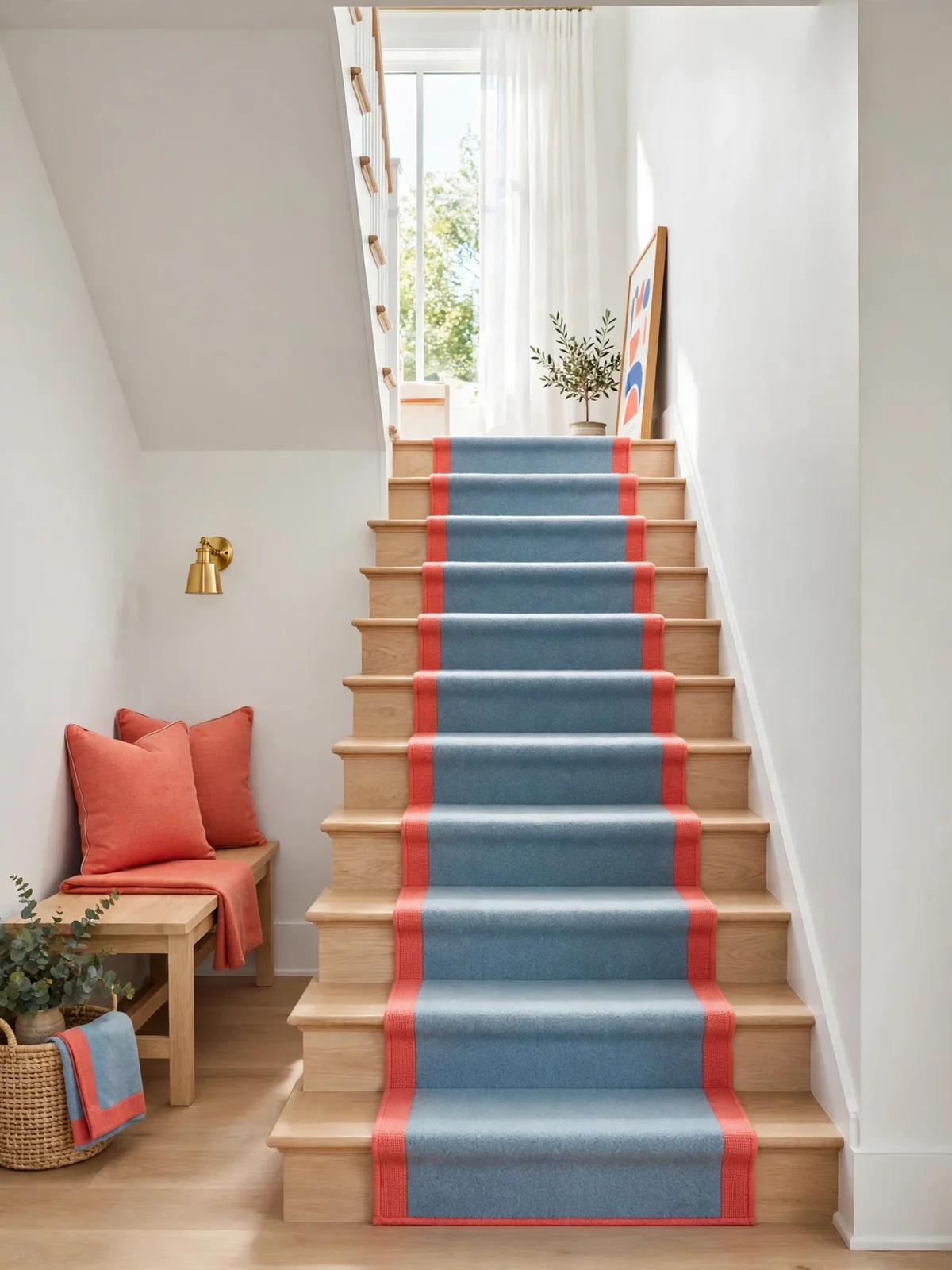
Decorative binding edges in a contrasting colour are the tailor’s touch on a staircase runner, because a slim band of colour along each edge makes even the plainest runner look custom-made. On this stair, a 650 mm wide duck-egg blue wool runner is finished with 25 mm wide coral cotton binding along both long edges, running down pale oak treads, each 950 mm wide. Soft white walls keep the hallway bright, while coral cushions on a wooden bench below echo the binding exactly, and the contrast makes the runner look crisp, finished and deliberately designed.
Quick tips:
- Choose binding in a colour that contrasts with the runner, not matches it.
- Keep the binding about 25 mm wide so it reads as a neat edge.
- Echo the binding colour in one cushion or accessory nearby.
- Ask the fitter to mitre the binding neatly at the tread nosing.
A Patterned Runner That Hides Wear and Tear
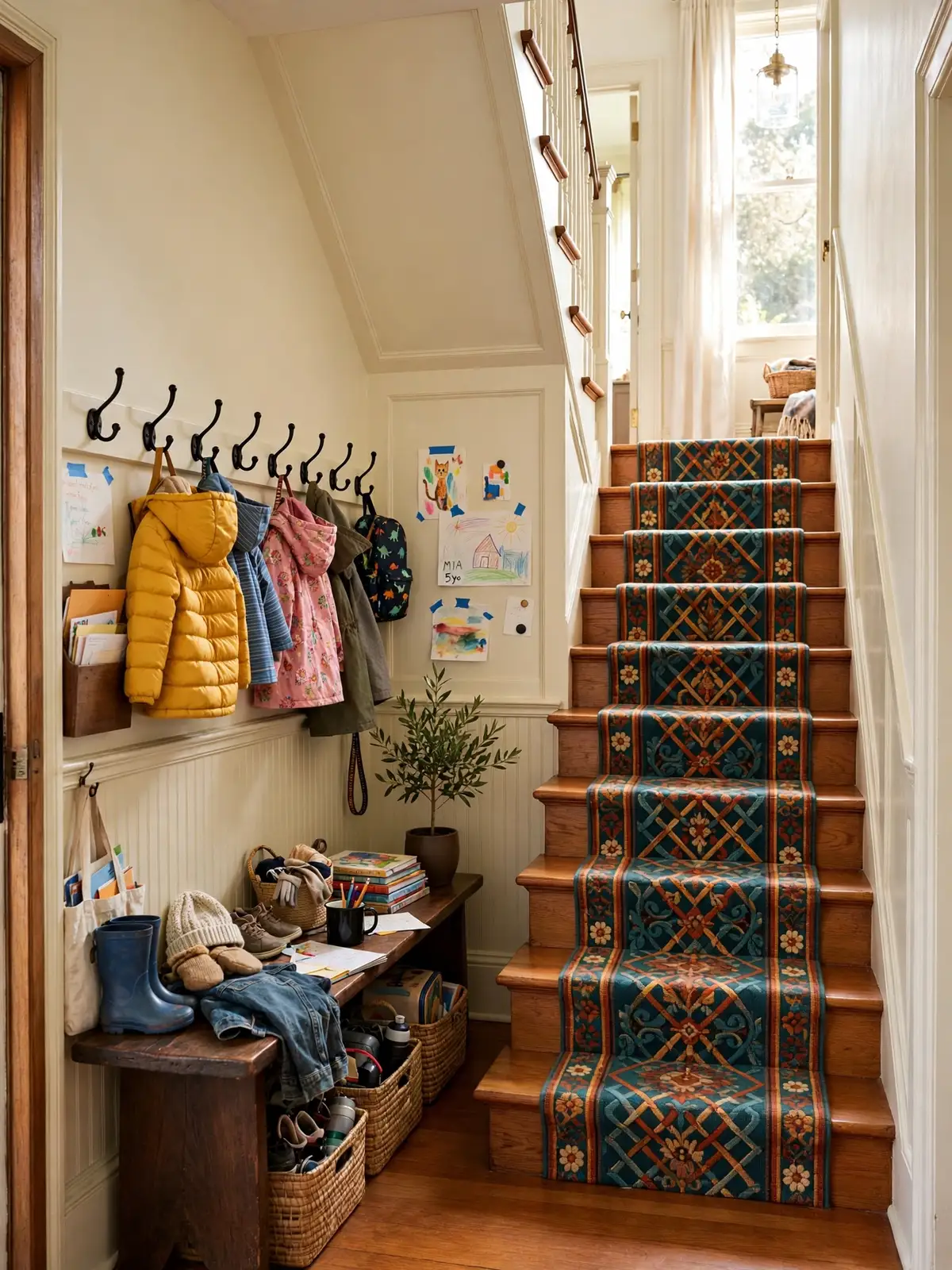
A busy patterned runner is the most forgiving staircase runner a family can choose, because its pattern hides the marks, scuffs and spills that a plain runner would show within weeks. In a busy family hallway, the centre of every tread takes the most wear — the same spot, step after step, day after day — and a plain cream or pale grey runner shows that worn path within months, while a busy pattern breaks up the eye and makes the wear almost invisible. Here, a 650 mm wide runner in a bold trellis pattern of deep teal, rust and ochre runs down warm oak treads, each 950 mm wide, in a hallway where children’s coats hang on hooks and shoes pile up by the door. The pattern is deliberately busy: small trellis shapes in three colours, none of them pale, so muddy footprints, pet hair and the odd dropped biscuit disappear into the design rather than standing out against it. Soft cream walls keep the hallway bright, while a dark wooden bench below gives the family somewhere to sit and tie their shoes, and because the runner is wool with a tight weave, it also survives the daily traffic without flattening. The lesson is simple and practical: if your stair gets heavy use, choose pattern over plain every time, and choose a pattern with at least three colours and no large pale areas, because that is the runner that will still look good in five years. A dark, busy runner is not a compromise — it is the smartest choice for a real family home, and it looks better for longer than any pale plain runner ever will. When the pattern finally does start to show wear, it fades evenly across the whole design, so the stair still reads as intentional rather than tired, and a professional clean every twelve months keeps the colours fresh and the pile standing proud.
Quick tips:
- Choose a busy pattern with at least three colours and no large pale areas.
- Pick wool with a tight weave so the pattern survives heavy traffic.
- Vacuum twice a week to stop grit wearing the pile down.
- Book a professional clean once a year to keep the colours fresh.
Thick Padding Under the Runner for Safety
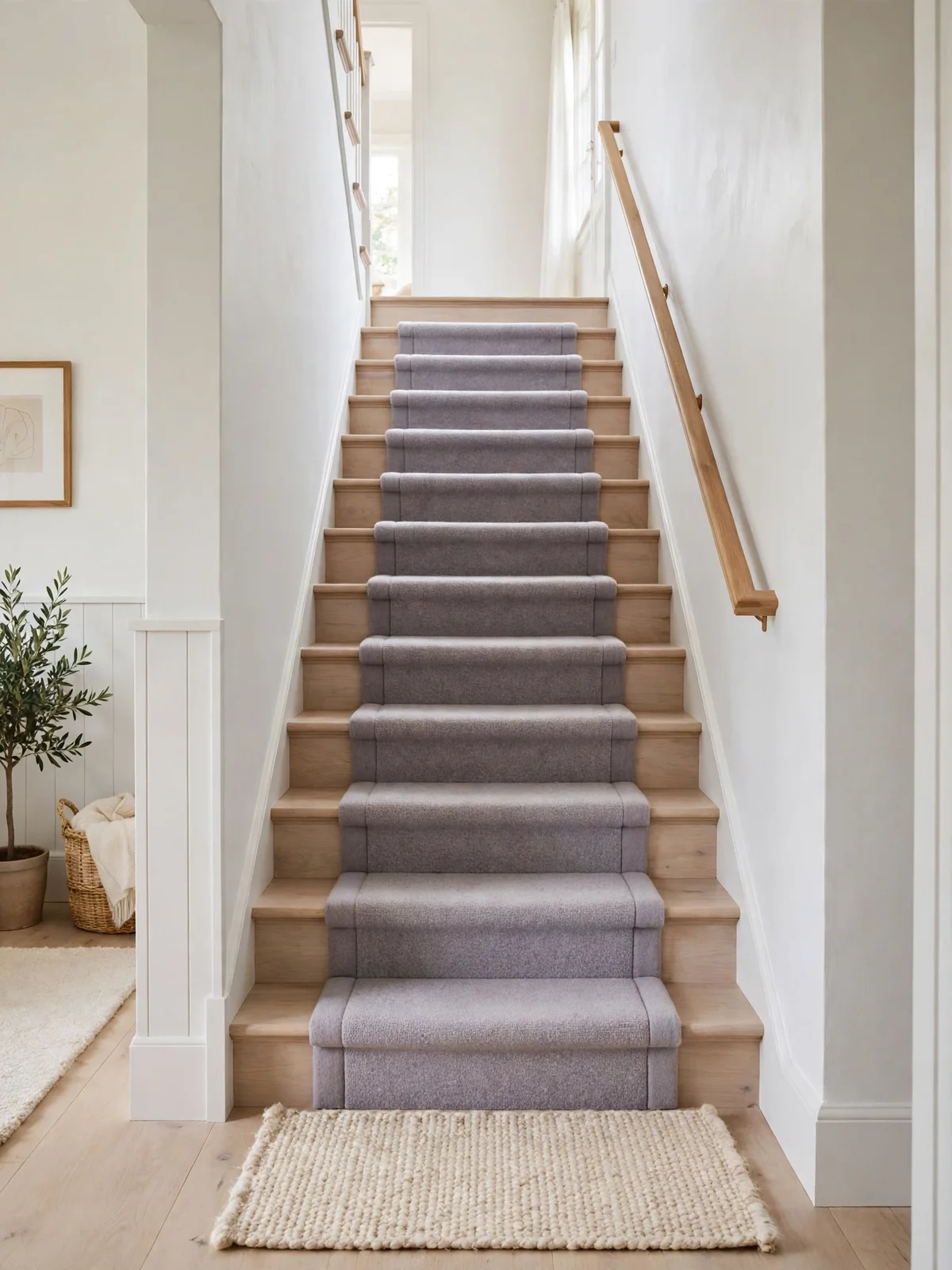
Thick padding under a staircase runner is the safety feature nobody sees but everybody feels, because it cushions every step and gives the runner a soft, luxurious tread. Beneath this 650 mm wide lavender-grey wool runner, a 10 mm dense felt underlay runs the full flight over pale ash treads, each 900 mm wide, so every footstep lands softly and quietly. Soft white walls and a small wooden handrail keep the hallway calm, while a cream rug at the base catches the first step, and the padding also helps the runner grip the treads so it never slips underfoot.
Quick tips:
- Choose a dense felt underlay about 10 mm thick for the best cushioning.
- Fit the underlay under the full runner, tread by tread.
- Pick a runner with a tight weave so the padding does not show through.
- Replace the underlay when you replace the runner — it wears out too.
A High-Contrast Runner for Dramatic Impact
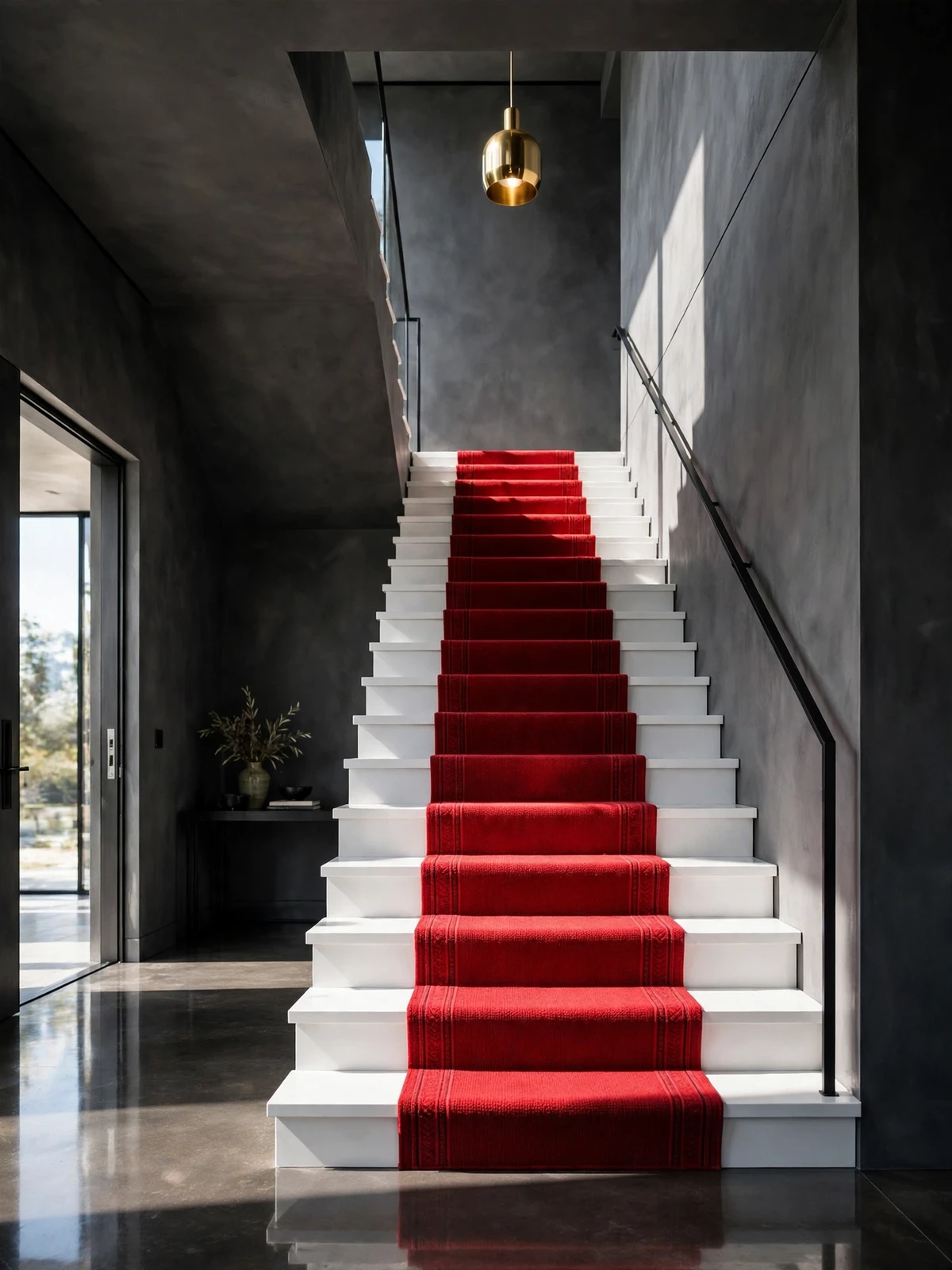
A high-contrast runner is the staircase runner for drama, because one bold colour against a pale stair creates a line of colour that dominates the whole entryway. Here, a 650 mm wide scarlet red wool runner runs down crisp white treads, each 950 mm wide, beside soft charcoal walls that make the red glow even brighter. A slim black handrail follows the red upward, while a brass pendant above the landing warms the whole flight, and because everything else in the entry is pale or dark, the red runner becomes the single unforgettable feature of the home.
Quick tips:
- Choose one bold colour — scarlet, cobalt or emerald — and commit to it.
- Keep the treads white or very pale so the contrast stays strong.
- Use dark walls on one side to make the colour glow.
- Keep the rest of the entry quiet so the runner stays the star.
A Seasonal Runner You Swap Twice a Year
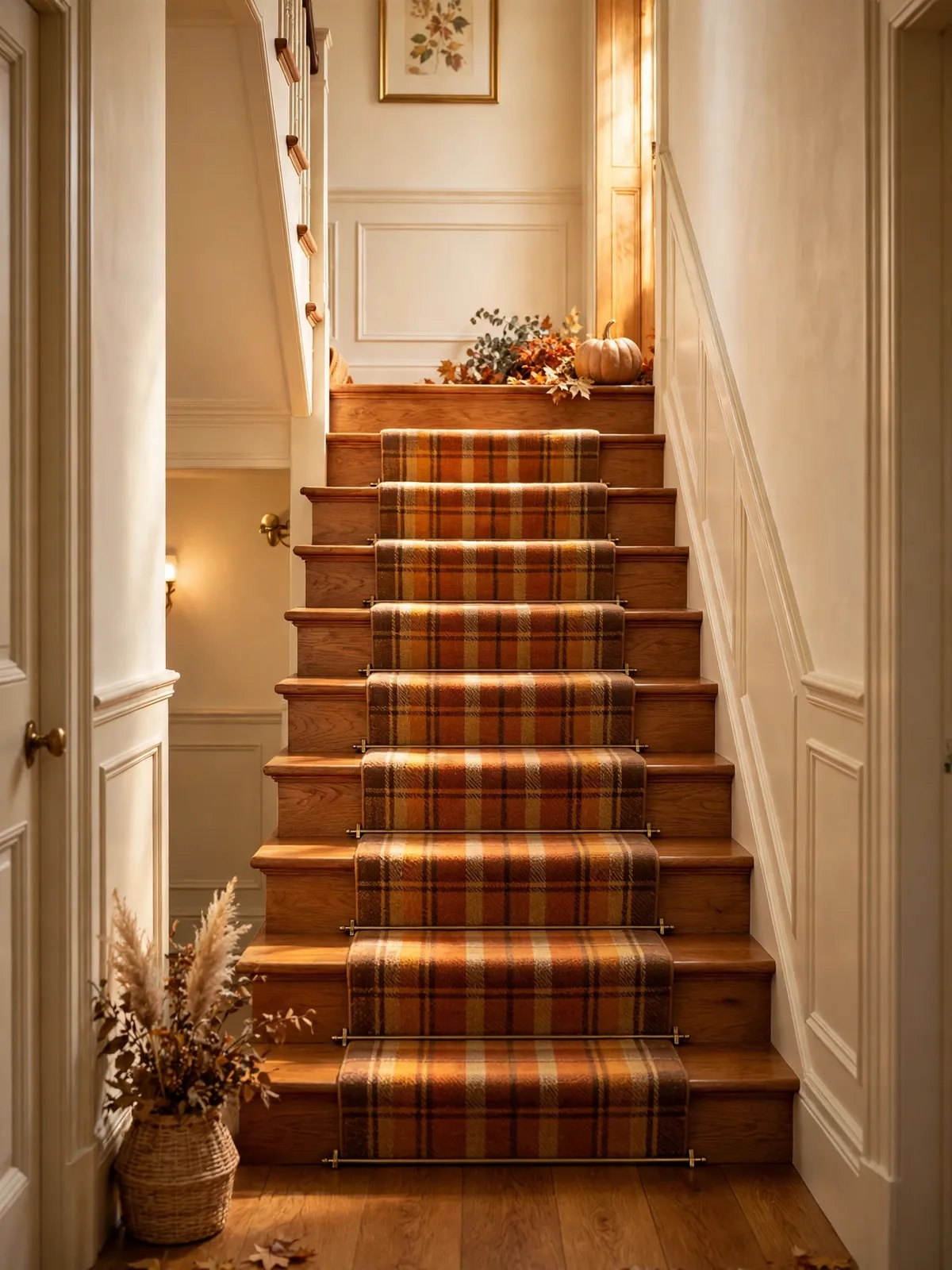
A seasonal runner you swap twice a year is the staircase runner for people who love change, because it lets the stair follow the seasons without redecorating the whole hallway. In this home, a warm autumnal plaid runner in burnt orange, gold and brown runs down warm oak treads, each 950 mm wide, from October to March, while a pale linen-look runner in soft sage and cream takes its place for spring and summer. Soft cream walls suit both runners, and a small pumpkin on the landing marks the autumn change, while the swap itself takes an afternoon and costs far less than a new carpet.
Quick tips:
- Buy two runners in the same size so the swap is simple.
- Store the spare runner rolled, not folded, in a dry cupboard.
- Choose a warm plaid for autumn and a pale linen-look for spring.
- Keep the walls neutral cream so both runners suit the hallway.
Staircase Runner Ideas in Warm Terracotta for a Cosy Climb
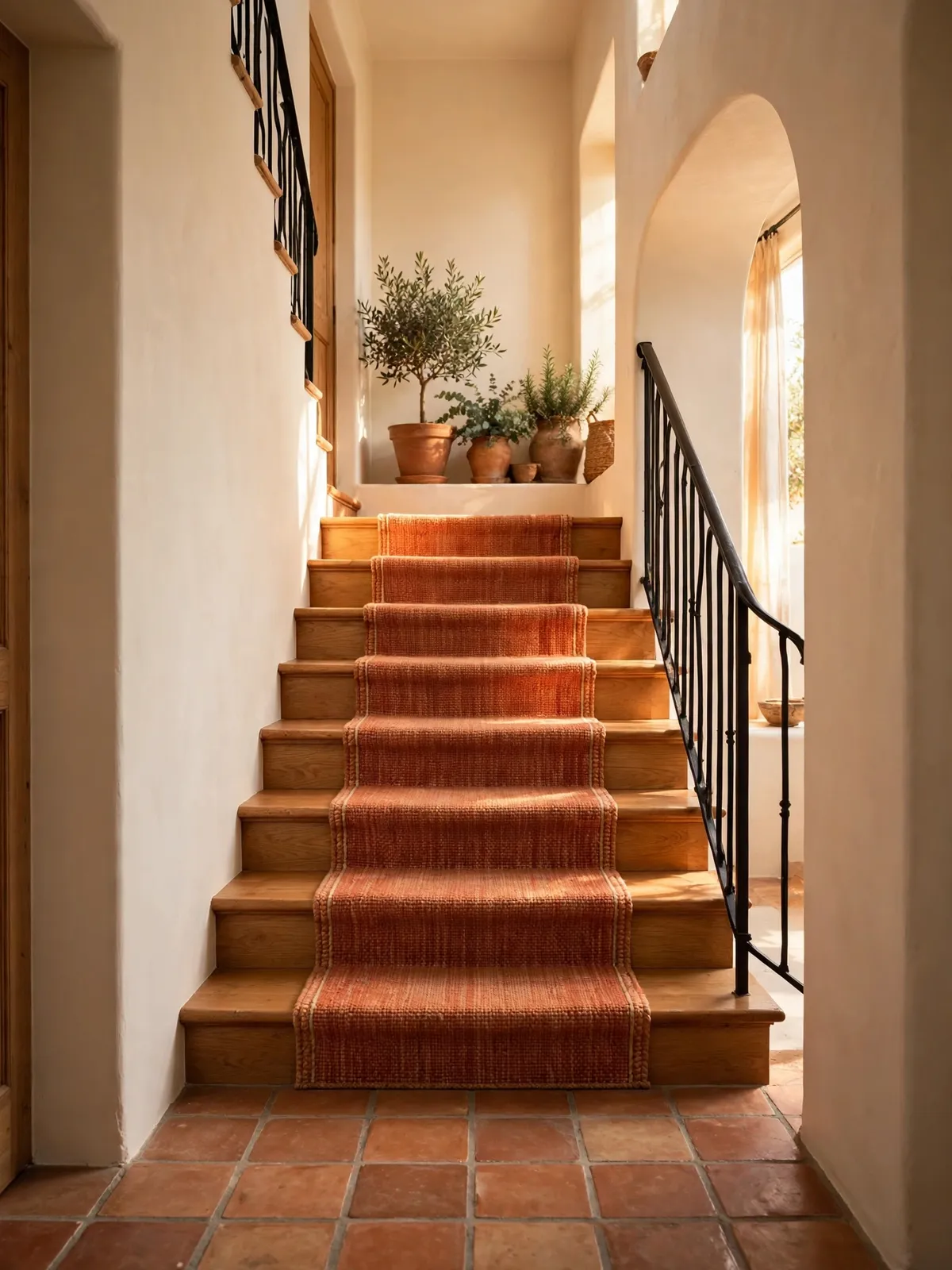
Warm terracotta is the staircase runner colour for a cosy climb, because it brings the warmth of baked clay and Mediterranean sun to a stair that might otherwise feel cold and plain. On this flight, a 650 mm wide terracotta wool runner with a subtle woven texture runs down honey oak treads, each 950 mm wide, with the warm orange-brown of the runner glowing against the honey timber. Soft cream walls keep the hallway bright, while clay pots with green plants on the landing echo the terracotta exactly, and warm golden afternoon light makes the whole stair feel like a sunlit courtyard.
Quick tips:
- Choose warm terracotta, not bright orange, for a cosy, grown-up feel.
- Pair terracotta with honey oak treads and cream walls.
- Add clay pots and green plants on the landing to echo the colour.
- Use wool so the terracotta holds its rich colour for years.
FAQs
How do I stop my staircase runner from slipping?
Fix the runner tightly at every tread with gripper rods or a staple gun, working from the top tread down, and always fit a dense underlay beneath it. The underlay grips the timber and cushions the runner, while the rods hold it flat against the riser. Check the tension every six months — a runner that has loosened will ruck at the nosing, and that is when it becomes a trip hazard.
What colour staircase runner is best for a dark hallway?
Choose a pale or mid-tone runner — cream, soft grey, warm oatmeal or pale sage — because it reflects the most light and makes a dark stair feel brighter. Avoid very dark runners in a dark hallway, as they swallow what little light there is. A runner with a pale border also helps, because the light edges frame each tread and make the steps easier to see.
Can a staircase runner go over carpeted stairs?
Yes, but the carpet underneath must be low-pile and firmly fixed, or the runner will move and bunch. Most fitters recommend removing the old carpet first so the runner sits flat on the timber, with a proper underlay beneath it. If you keep the carpet, use a thicker underlay and check the runner’s tension regularly.
How long does a staircase runner last?
A good wool runner lasts 10–15 years on a family stair, while a synthetic flatweave lasts 8–12 years with regular vacuuming. The centre of each tread wears first, so a busy pattern or a mid-tone colour hides that wear far longer than a plain pale runner. Professional cleaning once a year and prompt stain treatment add years to any runner.
Should the staircase runner match the carpet in the rooms upstairs?
It does not need to match exactly, but it should sit in the same colour family so the landing feels connected to the rooms beyond it. If the upstairs carpet is a soft grey, a grey, cream or charcoal runner works beautifully. If the upstairs carpet is a bold colour, pick a runner that repeats one of its tones rather than competing with it.
Conclusion
A staircase runner is the simplest way to make your stairs softer, warmer, safer and more beautiful all at once. Whether you choose classic navy stripes, a bold black and white geometric, a vintage Persian pattern, a soft wool runner for bare feet, a tough flatweave for a busy hallway, a dramatic scarlet statement or a warm terracotta climb, the best staircase runner is the one that suits your home, your family and the way you actually live. Measure carefully, choose wool where you can, fit it tightly with a good underlay, and your runner will make every climb feel softer, warmer and more expensive for years to come.