25 Stunning Staircase Wall Decor Ideas That Create a Beautiful First Impression Every Time You Climb
A bare stair wall is wasted space. These 25 staircase wall decor ideas show how oversized art, murals, paneling, photo grids, floating shelves, clocks, mirrors and woven baskets can turn the wall beside your stairs into a warm, personal feature — whether your home is modern, traditional, farmhouse or somewhere in between.
Staircase wall decor ideas work best when the wall is treated as one long, sloping canvas rather than a blank space to fill at random. Start with one strong piece at eye level on the lowest tread — a large artwork, a mirror or a framed photo — then build upward in the same direction as the stair, keeping the spacing even and the frames in one family of colours or materials.
A staircase gallery wall follows the same climb, and it is the easiest way to see how spacing, scale and a single frame colour can make a whole flight feel designed. The 25 ideas below cover art, photographs, texture, shelves, plants and colour, so you can choose a look that suits your hallway, your budget and the way your family actually uses the stairs.
Key Takeaways
How do I hang art on a sloping stair wall?
Hang art so it follows the angle of the stair, not the level of the floor. Start at eye level — about 145 cm from the tread you are standing on — on the lowest step, then move each next piece up by the same amount as the rise between treads, keeping the gap between frames at about 100 to 150 mm. Lay the arrangement out on the floor first, or cut paper templates and tape them to the wall, so you can check the diagonal line before you make a single hole.
What size art works best on a stair wall?
One large piece works better than many small ones on a stair wall, because the wall is tall and narrow. Choose a piece that covers about two-thirds of the wall width at its widest point — for most stairs that means 90 to 120 cm wide — and hang it so its centre sits at eye level from the middle tread. Small frames work best in a group, with at least six frames, so they read as one display rather than a scatter of tiny pictures.
How far apart should frames be on a stair wall?
Keep 100 to 150 mm between frames for a clean, gallery look, and keep that gap the same all the way up the flight. Wider gaps make the display feel disconnected, while gaps under 75 mm make it feel crowded. If your frames are different sizes, line up their centres along one diagonal line that runs parallel to the stair, and the eye will read the whole group as intentional.
What are the best budget staircase wall decor ideas?
Paint is the cheapest change: a painted arch, a colour-blocked section or a bold wall colour costs a tin of paint and transforms the whole flight. After that, a photo timeline printed at home, a set of woven baskets from a thrift shop, leaning artwork you already own, or a picture ledge with frames you can swap seasonally all cost very little and look deliberate. Spend money only on the one piece you look at every day — the large artwork or the mirror at the bottom of the stairs.
How do I keep stair wall decor from feeling cluttered?
Pick one idea per wall and give it empty space to breathe. A gallery wall needs plain wall around it, a mural needs no competing frames, and shelves need only two or three objects each. Use one frame colour, one metal finish and no more than three colours in the whole display, and leave at least one stretch of bare wall — negative space is what makes the decorated parts look intentional instead of crowded.
One Oversized Artwork as the Bold First Impression
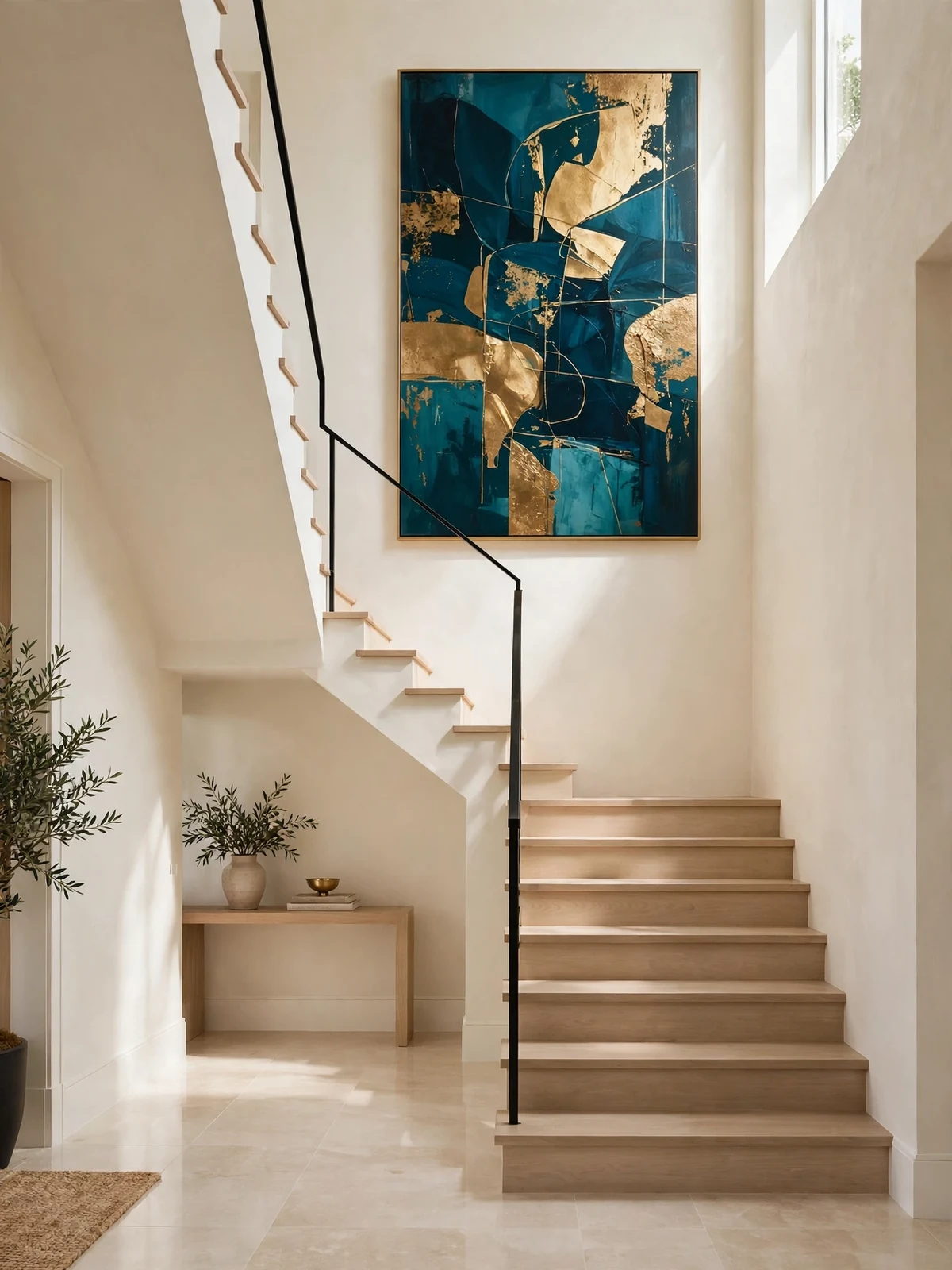
One oversized artwork does more for a stair wall than a dozen small frames, because it gives the eye a single place to land. Hang a canvas 120 cm wide and 90 cm high, centred at eye level from the third tread, above pale oak treads and a slim black handrail. Deep teal brushstrokes, a touch of brass and a cream background keep the piece calm enough for a hallway, while its size makes the whole stair feel designed the moment you walk in.
Quick tips:
- Choose one piece 90 to 120 cm wide so it fills the wall properly.
- Centre it at eye level from the middle tread, not from the floor.
- Keep the frame slim and simple so the art stays the focus.
- Pick up one colour from the artwork in a cushion or runner nearby.
A Hand-Painted Mural That Climbs the Wall
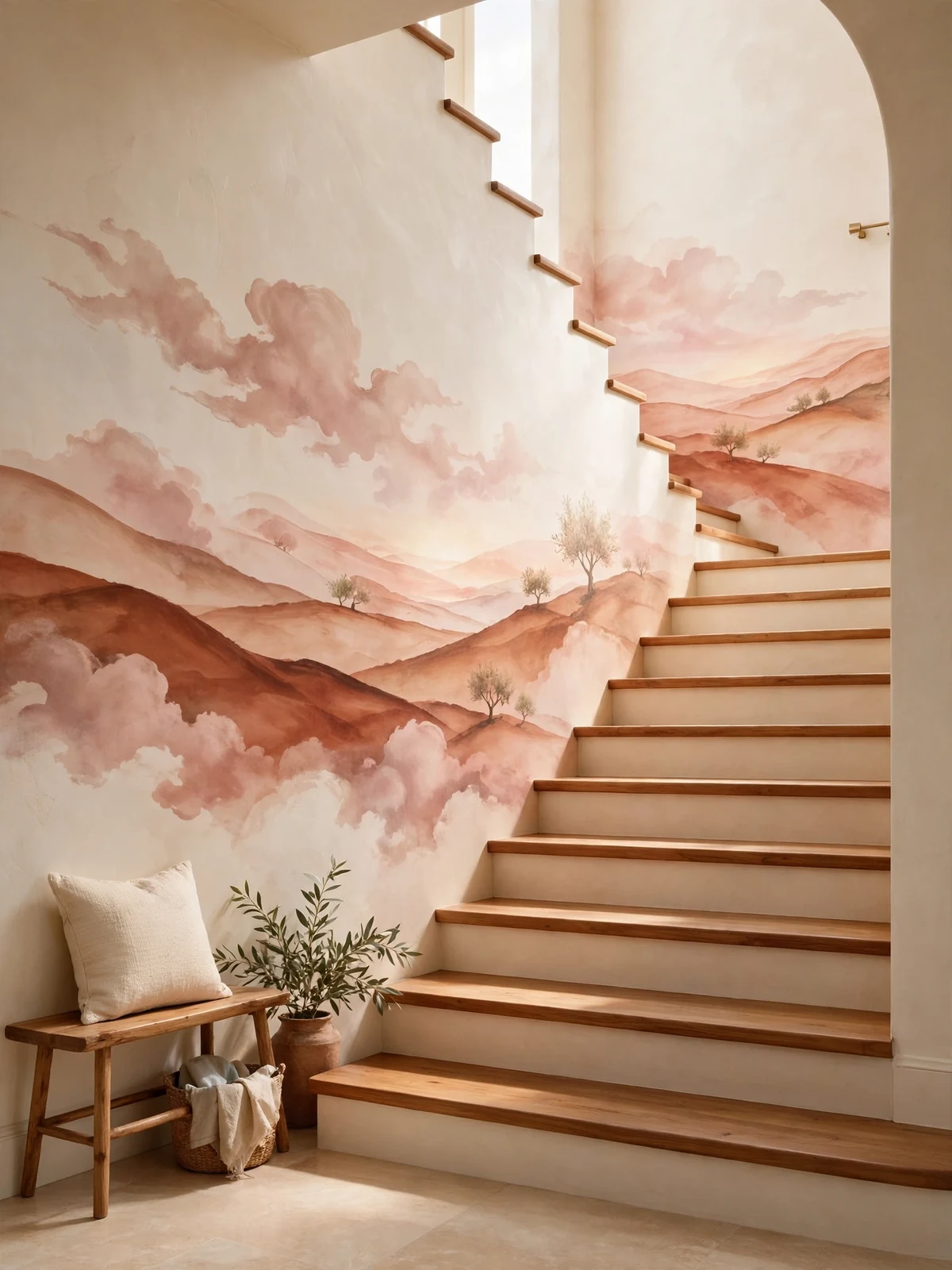
A hand-painted mural turns the stair wall into a landscape that rises with you, and it needs no frames at all. Soft terracotta hills, dusty-rose clouds and a pale cream sky sweep diagonally up the wall, following the slope of warm pine treads, each 950 mm wide, with a small wooden bench at the base. The mural is painted directly onto plaster, so the wall itself becomes the artwork, and the stair feels like a walk through a painting.
Quick tips:
- Sketch the design on paper first, following the stair angle.
- Use soft, muted colours so the mural stays calm in a hallway.
- Keep the treads and handrail plain so the mural stays the feature.
- Seal the paint with a clear matt topcoat in a busy family home.
Vertical Wood Paneling for Texture and Warmth
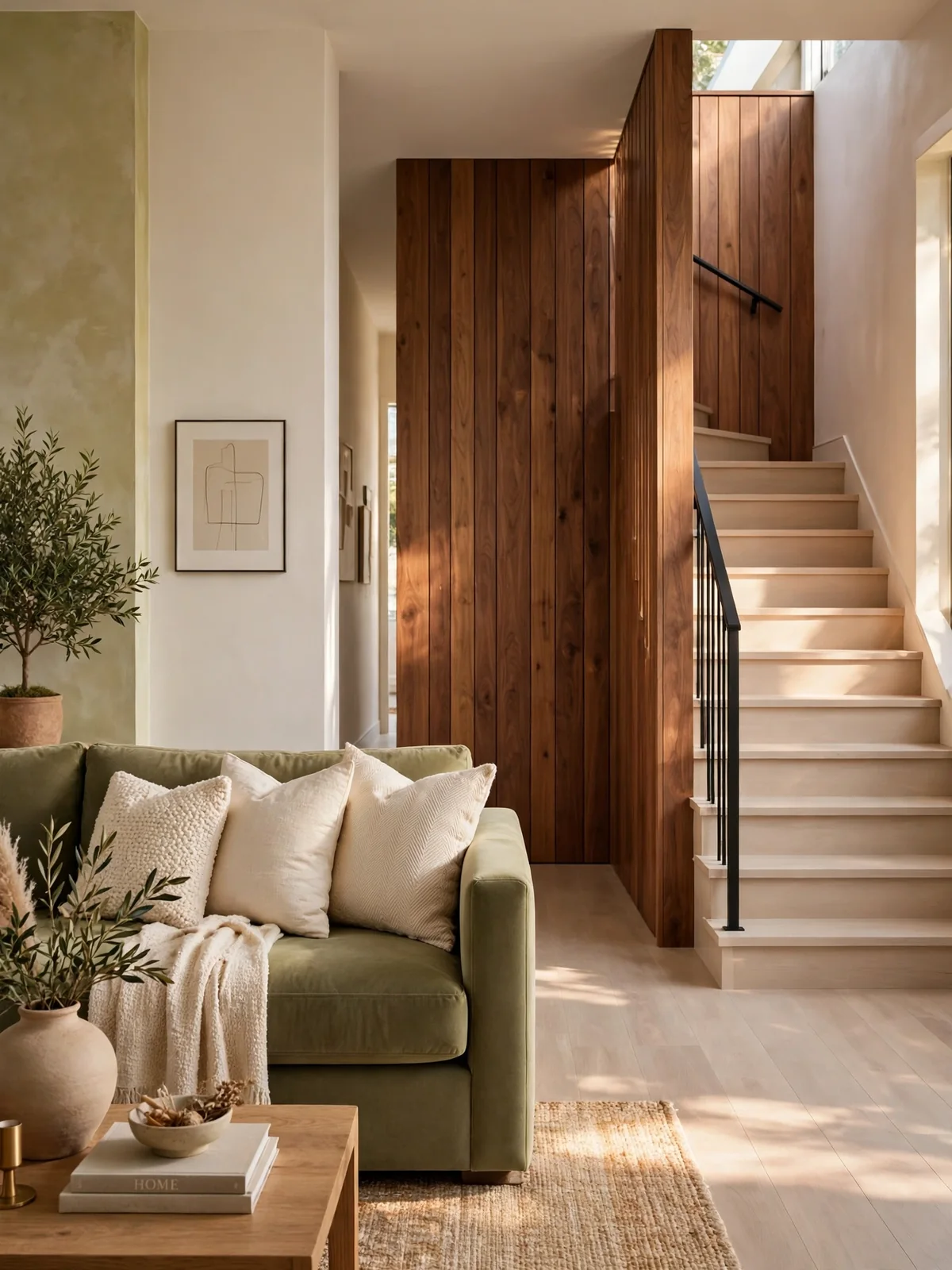
Vertical wood paneling adds warmth and texture to a stair wall without a single picture, and the vertical lines make the wall feel taller. Slim walnut boards, each 90 mm wide, run floor to ceiling beside pale ash treads, each 900 mm wide, with a slim black handrail fixed straight to the timber. A soft olive-green sofa and cream cushions below pick up the wood’s warm tones, and the paneling softens sound, so the stair feels quieter underfoot.
Quick tips:
- Run the boards vertically so the wall feels taller.
- Seal the timber so it stays clean and easy to dust.
- Pair dark walnut paneling with pale ash treads for balance.
- Keep the opposite wall plain so the timber stays the feature.
Framed Quotes That Read as You Walk Up
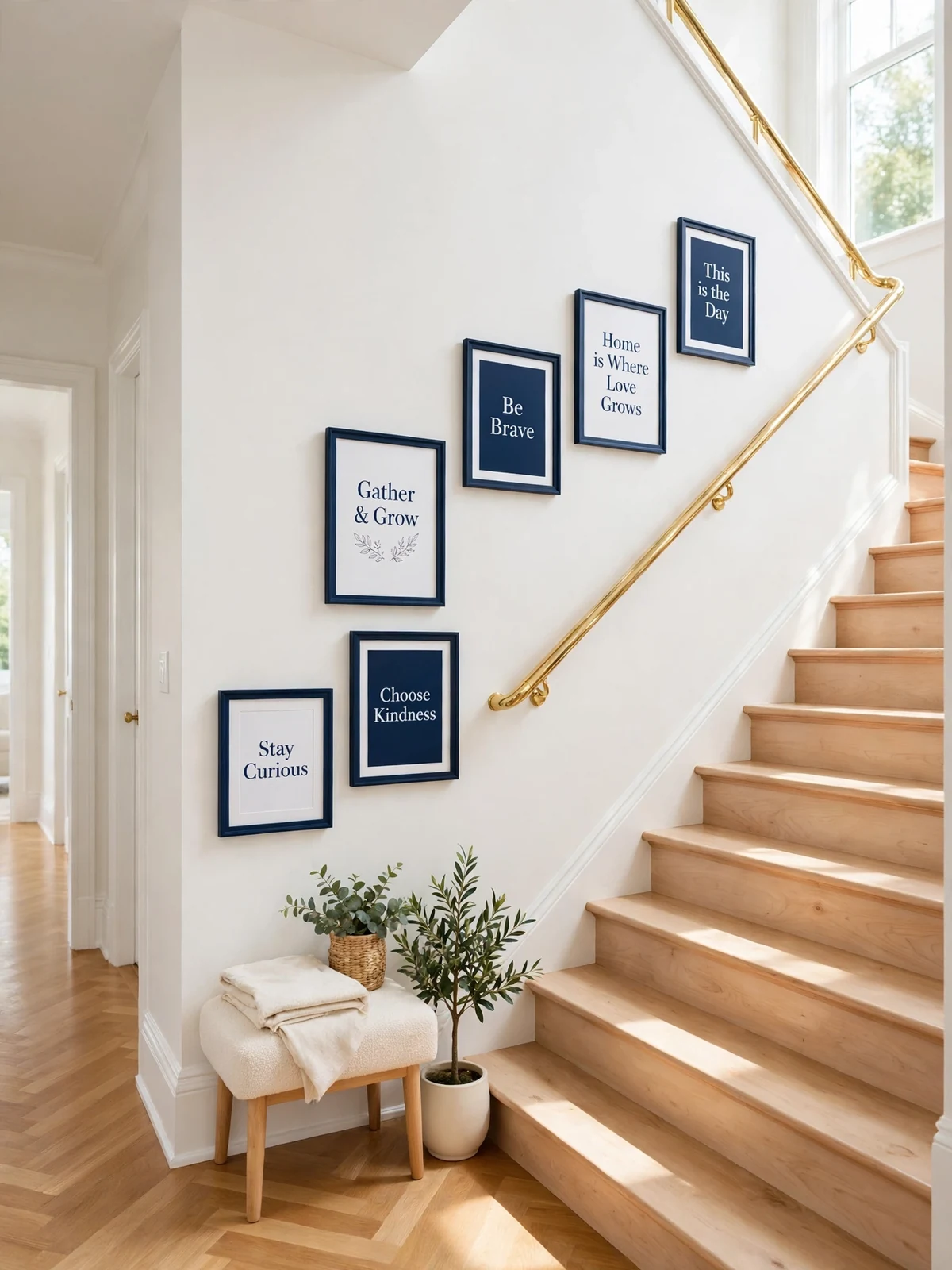
Framed quotes turn the climb into a short story, because each step reveals the next line. Five slim navy frames, each 40 cm by 50 cm, climb the white wall in a neat diagonal, spaced 120 mm apart, following the slope beside pale maple treads, each 950 mm wide. A slim brass handrail runs below the frames, and a small cream bench at the base gives the hallway a place to pause and read the first line.
Quick tips:
- Choose one short quote, split across five frames, for a natural rhythm.
- Use one frame colour and one font style for a unified look.
- Space the frames 120 mm apart, following the stair angle.
- Keep the quote positive and easy to read from two steps away.
Family Photos in a Clean, Cohesive Grid
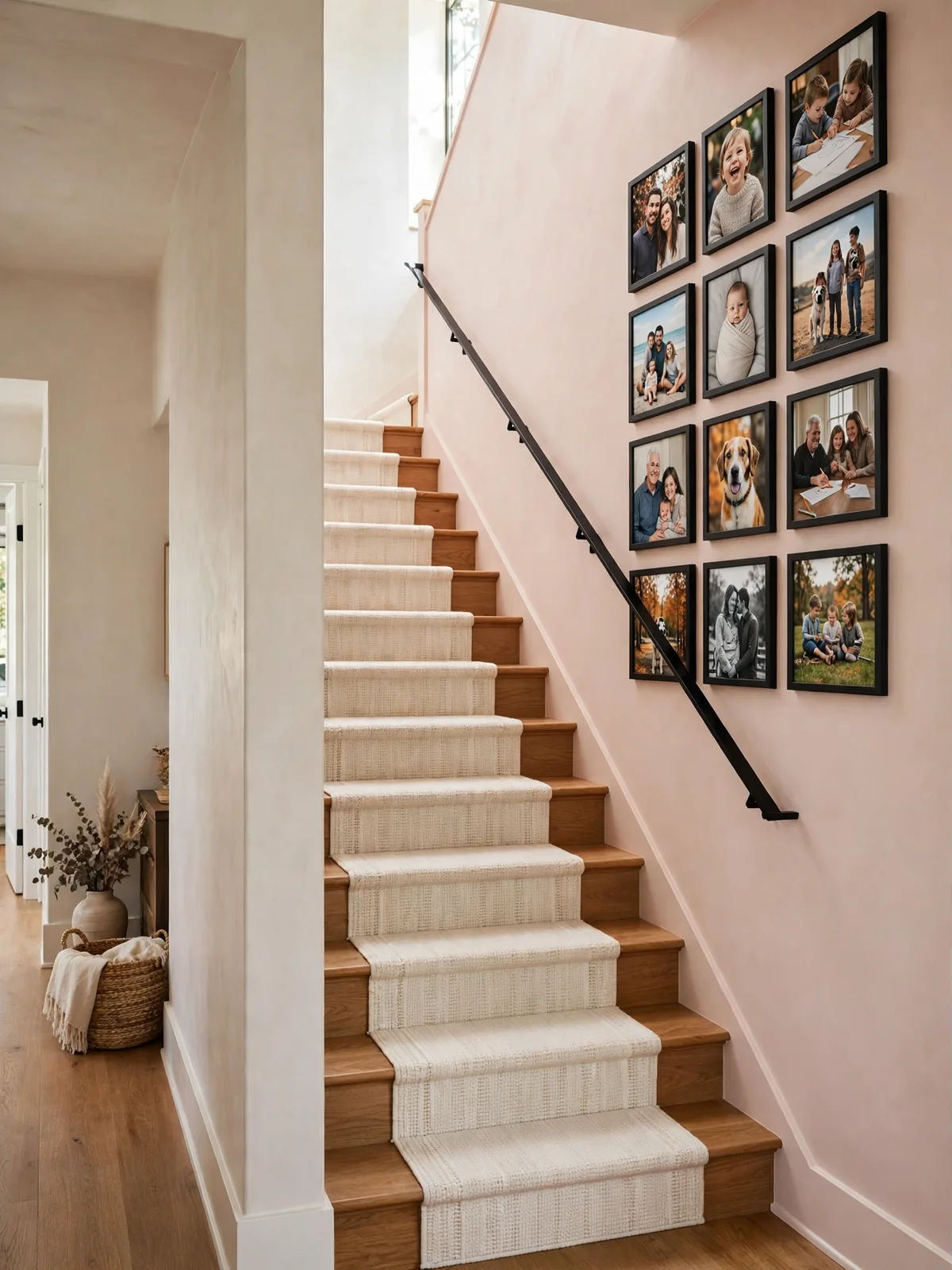
A clean grid of family photos feels calm and intentional, even on a sloping wall, because the grid gives the eye order. Twelve photographs in slim charcoal frames, each 30 cm square, sit in three neat rows on a soft blush-pink wall, spaced 100 mm apart, beside warm oak treads, each 950 mm wide. A cream runner softens the climb, and because every frame is the same size and colour, the photographs themselves — not the frames — carry all the personality.
Quick tips:
- Use identical frames, all the same size and colour, for a calm grid.
- Print the photos in the same finish, all colour or all black and white.
- Keep the gaps at 100 mm so the grid reads as one piece.
- Start the grid at eye level on the lowest tread and build upward.
Wallpaper That Follows the Stair Incline
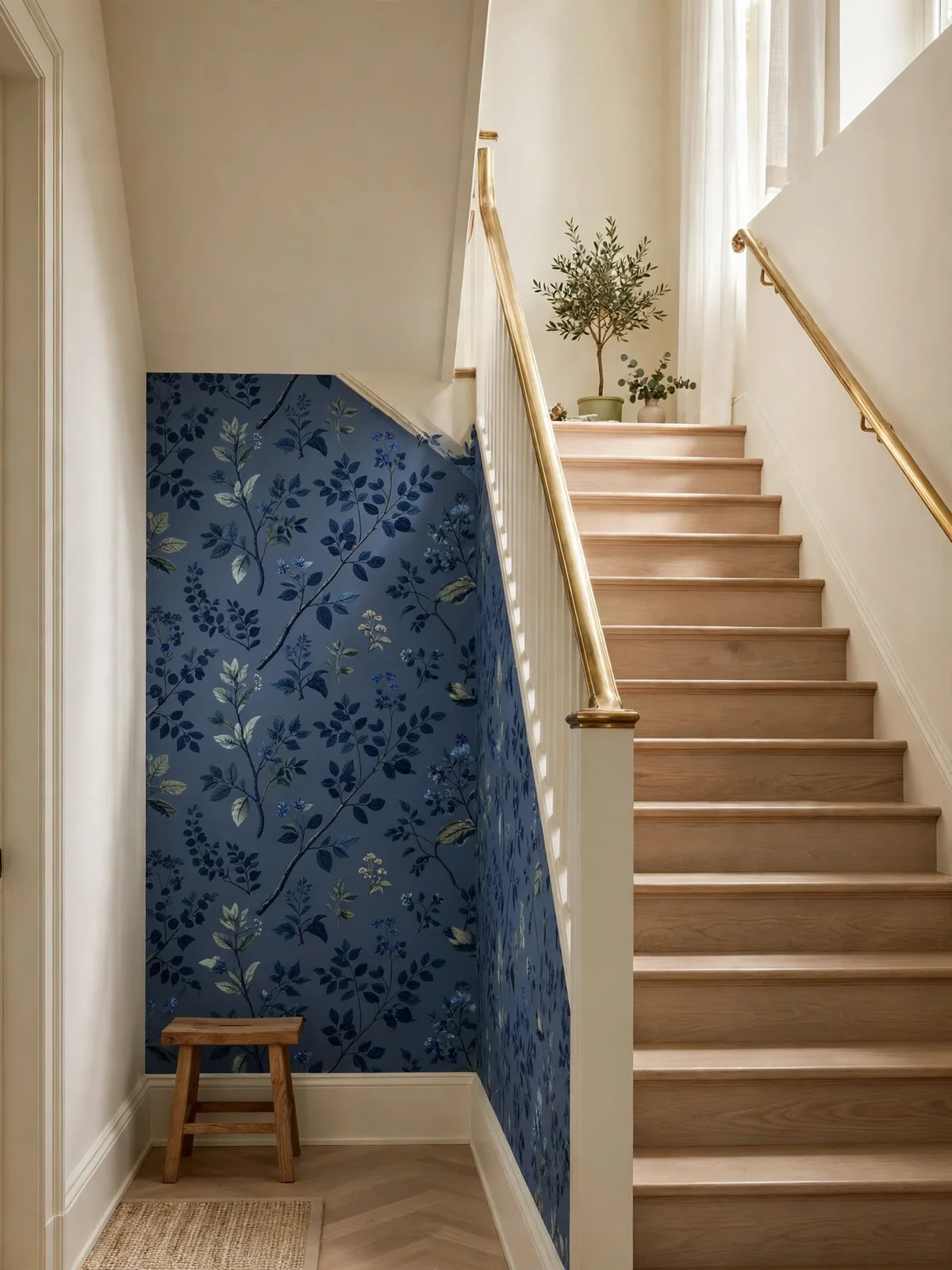
Wallpaper that follows the incline makes the stair wall feel like a garden climbing with you, and the pattern does all the decorating work. A bold indigo botanical print, with cream leaves and soft gold stems, covers the full stair wall in one diagonal sweep beside pale oak treads, each 900 mm wide, with a slim brass handrail fixed over the paper. A small wooden stool at the base keeps the hallway simple, so the wallpaper carries the whole look.
Quick tips:
- Choose a large-scale pattern so it reads well on a tall wall.
- Match the handrail to one colour in the wallpaper.
- Keep the opposite wall plain cream so the pattern stays the feature.
- Use a washable wallpaper in a busy hallway.
A Photo Timeline That Tells Your Story
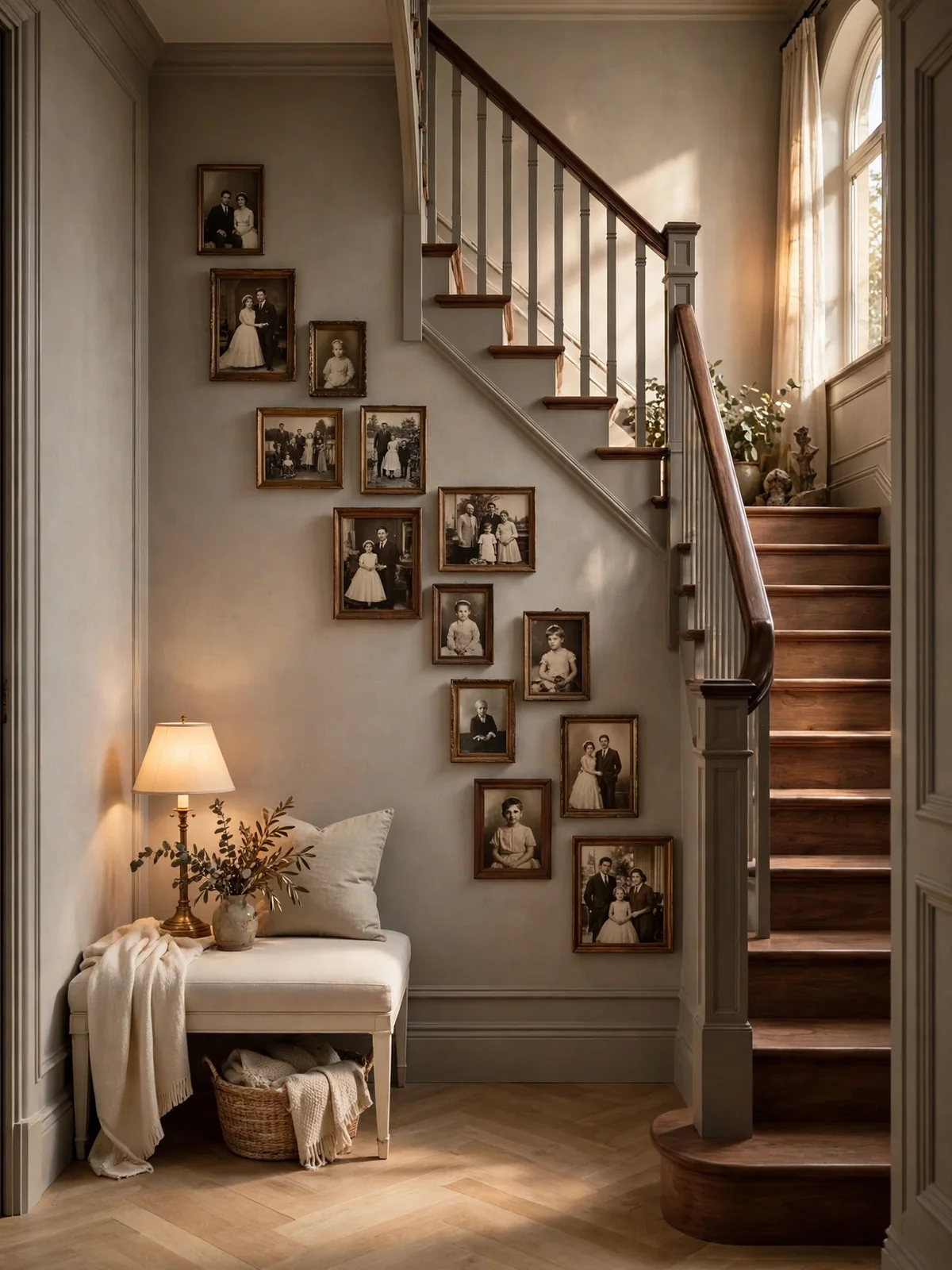
A photo timeline turns the stair into a walk through your family’s story, from the bottom step to the top. Ten sepia photographs in slim walnut frames, each 25 cm by 30 cm, climb the warm-grey wall in chronological order, spaced 120 mm apart, beside warm walnut treads, each 950 mm wide. A cream bench and a small brass lamp at the base invite you to stop and look, and a tiny date label under each frame turns the display into a timeline you can actually follow.
Quick tips:
- Hang the photos in date order, oldest at the bottom.
- Use sepia or black-and-white prints so the timeline feels unified.
- Add a small date label under each frame.
- Keep the frames identical so the story, not the framing, stands out.
Floating Shelves That Add Dimension
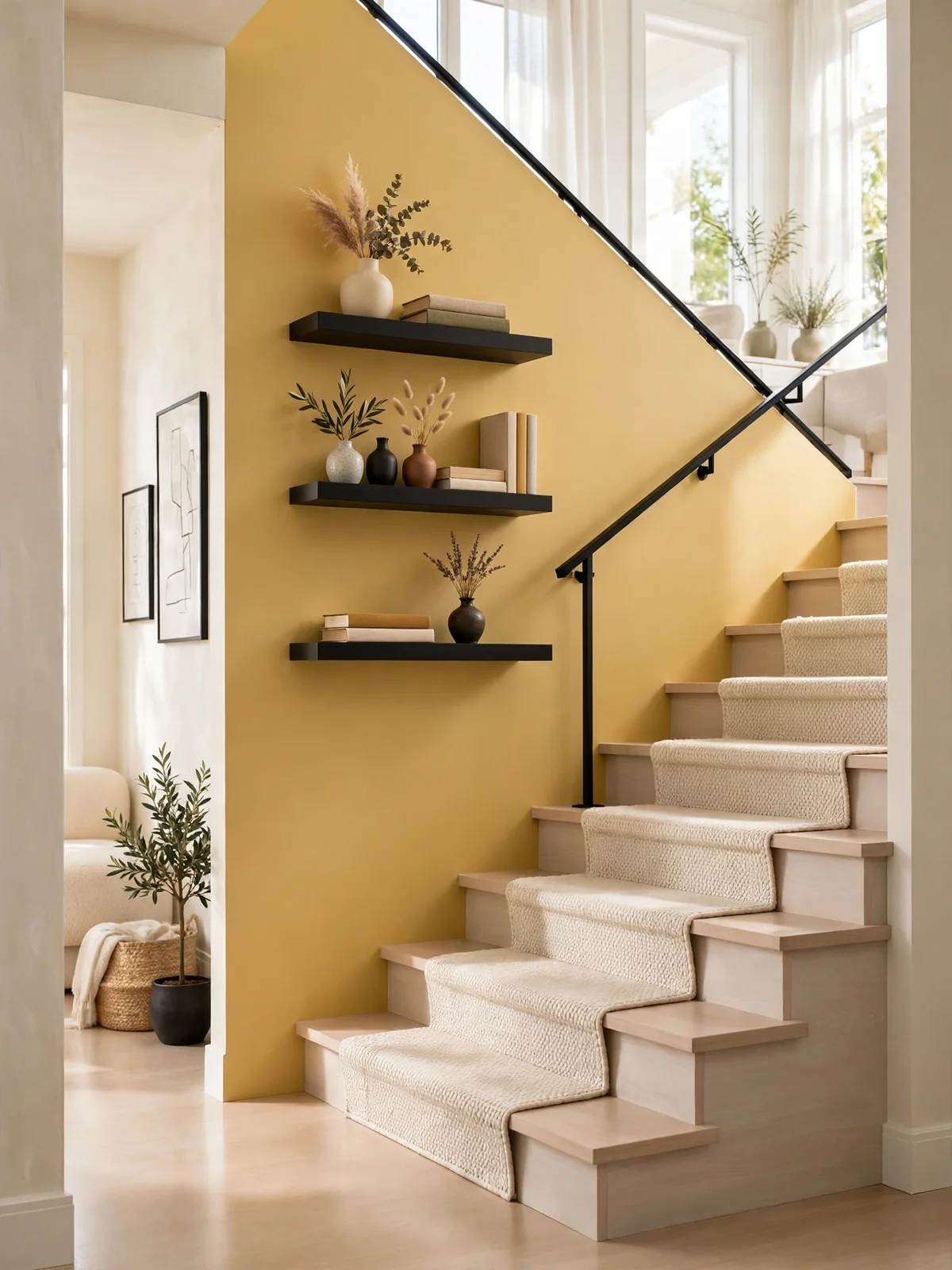
Floating shelves add depth to a flat stair wall, because they bring objects out into the room instead of keeping everything flat against the plaster. Three matte black shelves, each 60 cm long, step up the soft mustard-yellow wall in a diagonal line, each holding two or three small objects — a white vase, a stack of two books, a tiny plant — beside pale ash treads, each 900 mm wide. A cream runner softens the climb, and the shelves cast gentle shadows that make the wall feel layered.
Quick tips:
- Step the shelves up the wall in a diagonal that follows the stair.
- Keep two or three objects per shelf, never a crowded row.
- Use one shelf colour, matte black or natural oak, for a clean look.
- Leave one shelf nearly empty so the display can breathe.
Contrasting Trim or Molding on the Stair Wall
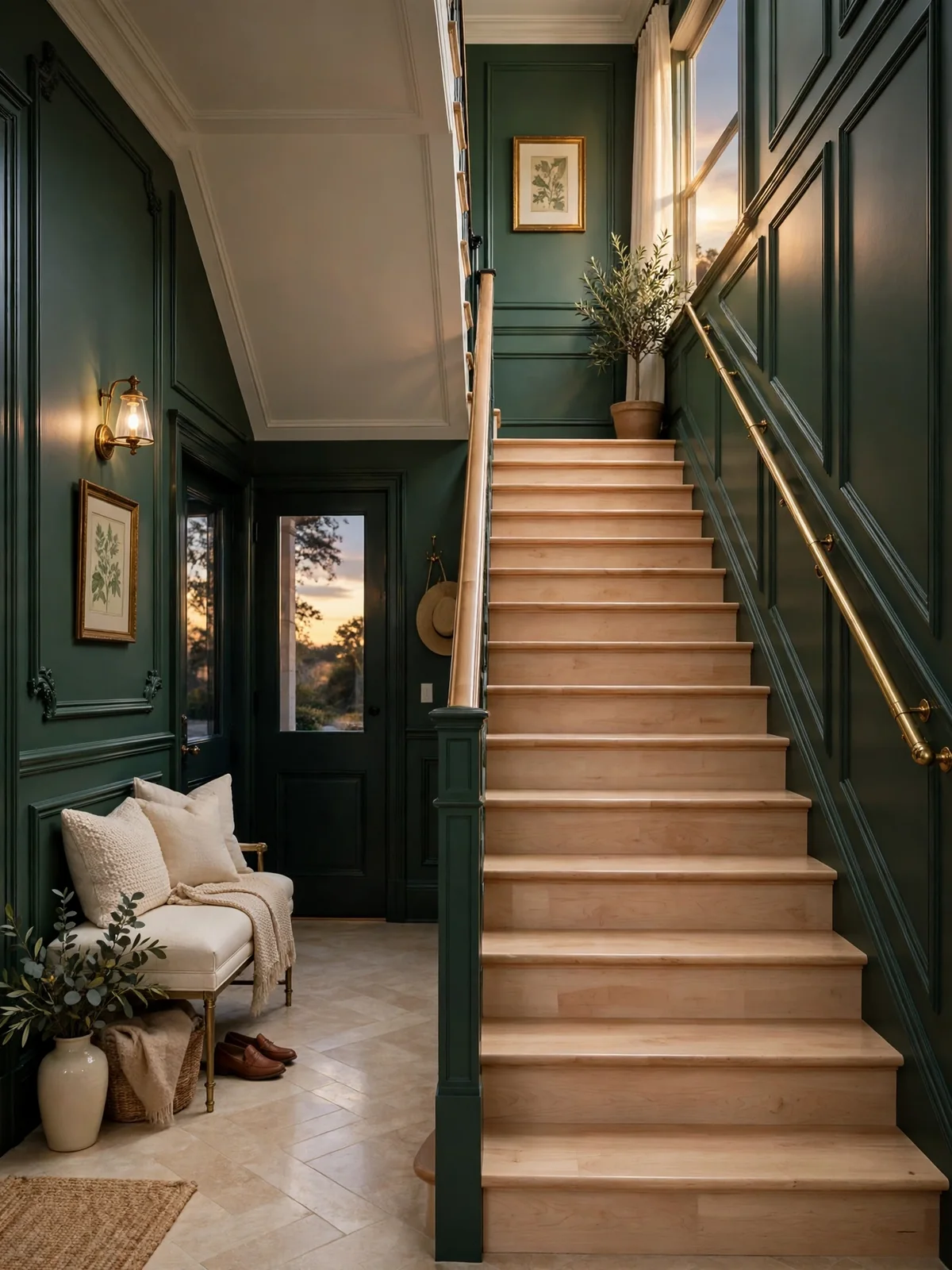
Contrasting trim turns a plain painted wall into architecture, because the molding adds shadows and structure without a single picture. Slim white picture-frame molding, in rectangles 60 cm wide and 90 cm high, climbs the deep forest-green wall in a neat diagonal beside pale maple treads, each 950 mm wide, with a slim brass handrail running below the frames. A cream bench at the base keeps the entry calm, and evening light from the landing makes the molding’s shadows glow against the green.
Quick tips:
- Space the molding rectangles evenly, following the stair angle.
- Paint the trim white against a dark wall for the strongest contrast.
- Keep the rectangles large so the wall does not feel fussy.
- Match the handrail to a warm metal, brass or bronze, to lift the colour.
Large Artwork Leaned Casually Against the Wall
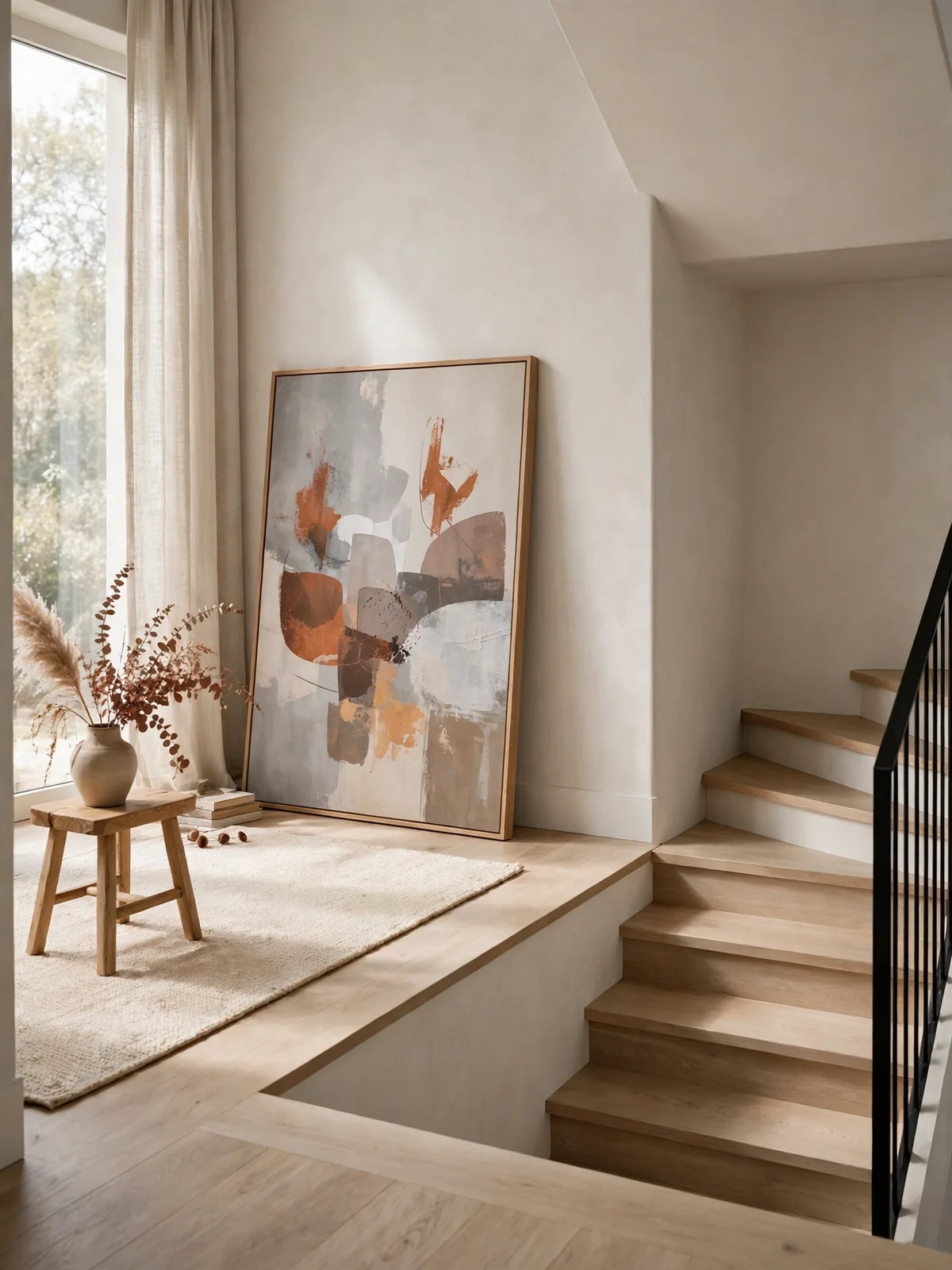
Leaning artwork feels relaxed and effortless, because it skips the hanging altogether and lets the art rest on the landing. A large canvas, 100 cm wide and 120 cm high, in soft grey and rust tones, leans against the stair wall on a wide landing, its bottom edge resting on pale oak treads, with a cream rug and a small wooden stool beside it. The casual lean makes the landing feel like an artist’s studio, and the art can be swapped in seconds whenever you want a change.
Quick tips:
- Lean the art on a landing or a wide tread, never on a narrow step.
- Choose a large piece, at least 100 cm wide, so the lean looks deliberate.
- Secure the top edge with a small clear bumper so it cannot slip.
- Keep the wall behind it plain so the leaned piece stays the focus.
Wall Planters That Soften the Stair Wall
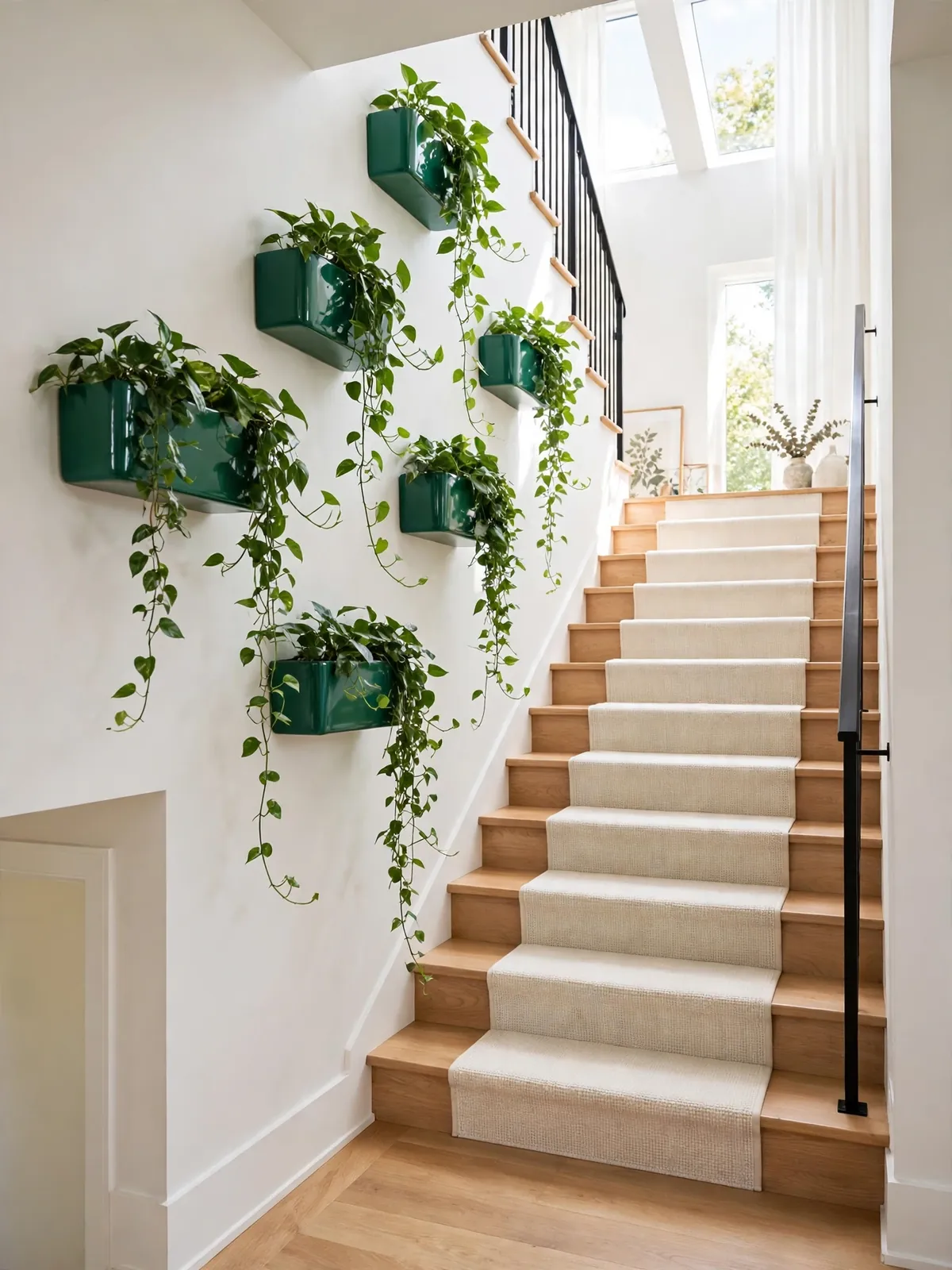
Wall planters soften a hard stair wall with living green, and trailing plants make the wall feel alive as they spill downward. Five emerald-green ceramic planters, each 20 cm wide, step up the soft white wall in a diagonal line, each holding a trailing pothos or fern, beside light oak treads, each 900 mm wide. A cream runner softens the climb, and the green leaves make the pale timber look richer by contrast, while the plants clean the hallway air.
Quick tips:
- Choose trailing plants so the green spills down the wall.
- Use identical planters in one colour for a unified look.
- Pick low-light plants if the stair gets little direct sun.
- Water the planters over a tray so drips never reach the treads.
Art and Objects Mixed for a Collected Look
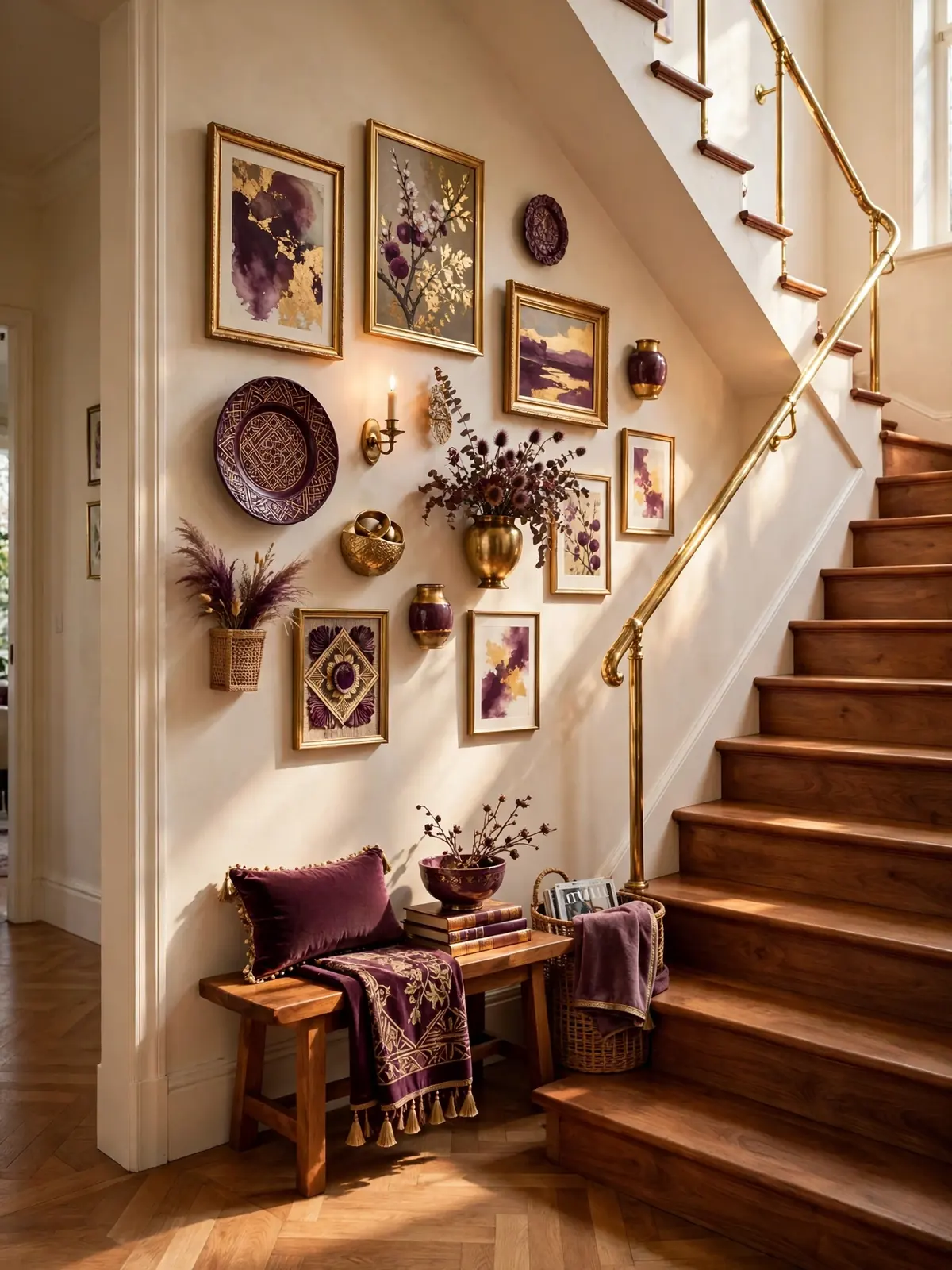
Mixing art and objects makes a stair wall feel collected over time, like a shelf in a favourite shop rather than a set bought in one afternoon. A small plum-toned painting, a gold-framed print, a tiny brass dish and a woven wall pocket sit together on the soft cream wall, spaced 120 mm apart in a loose diagonal beside warm walnut treads, each 950 mm wide. A slim brass handrail and a small wooden bench below keep the hallway calm, while the mix of textures — paint, metal, fibre — makes the wall interesting from every step.
Quick tips:
- Mix two flat pieces with one or two three-dimensional objects.
- Keep one colour, plum or gold, running through every piece.
- Space the pieces 120 mm apart so the group reads as one display.
- Start with the largest piece and build outward from it.
Framed Architectural Drawings or Blueprints
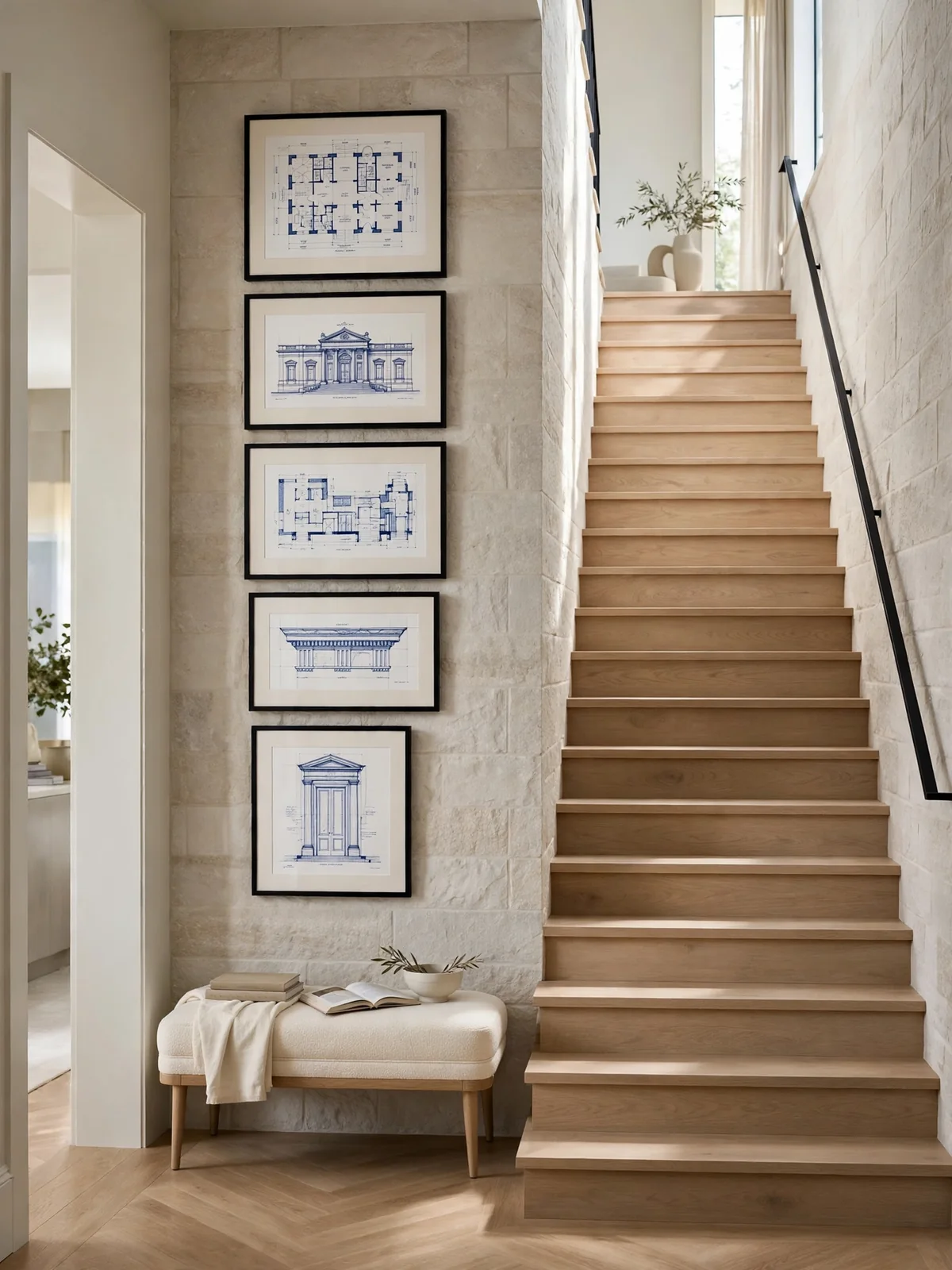
Framed architectural drawings bring a quiet, intellectual elegance to a stair wall, because their fine lines and pale blue paper feel like a study. Three large blueprint prints, each 60 cm by 80 cm, in ink blue and white, hang in slim black frames on a pale stone wall, spaced 120 mm apart in a diagonal line beside light timber treads, each 950 mm wide. A cream bench below keeps the hallway simple, and the drawings’ crisp geometry echoes the straight lines of the stair itself.
Quick tips:
- Choose drawings of buildings you love, or your own home’s plans.
- Use identical slim black frames for a crisp, architectural look.
- Hang three large prints rather than many small ones.
- Keep the wall pale so the ink-blue drawings stand out.
A Statement Clock That Anchors the Wall
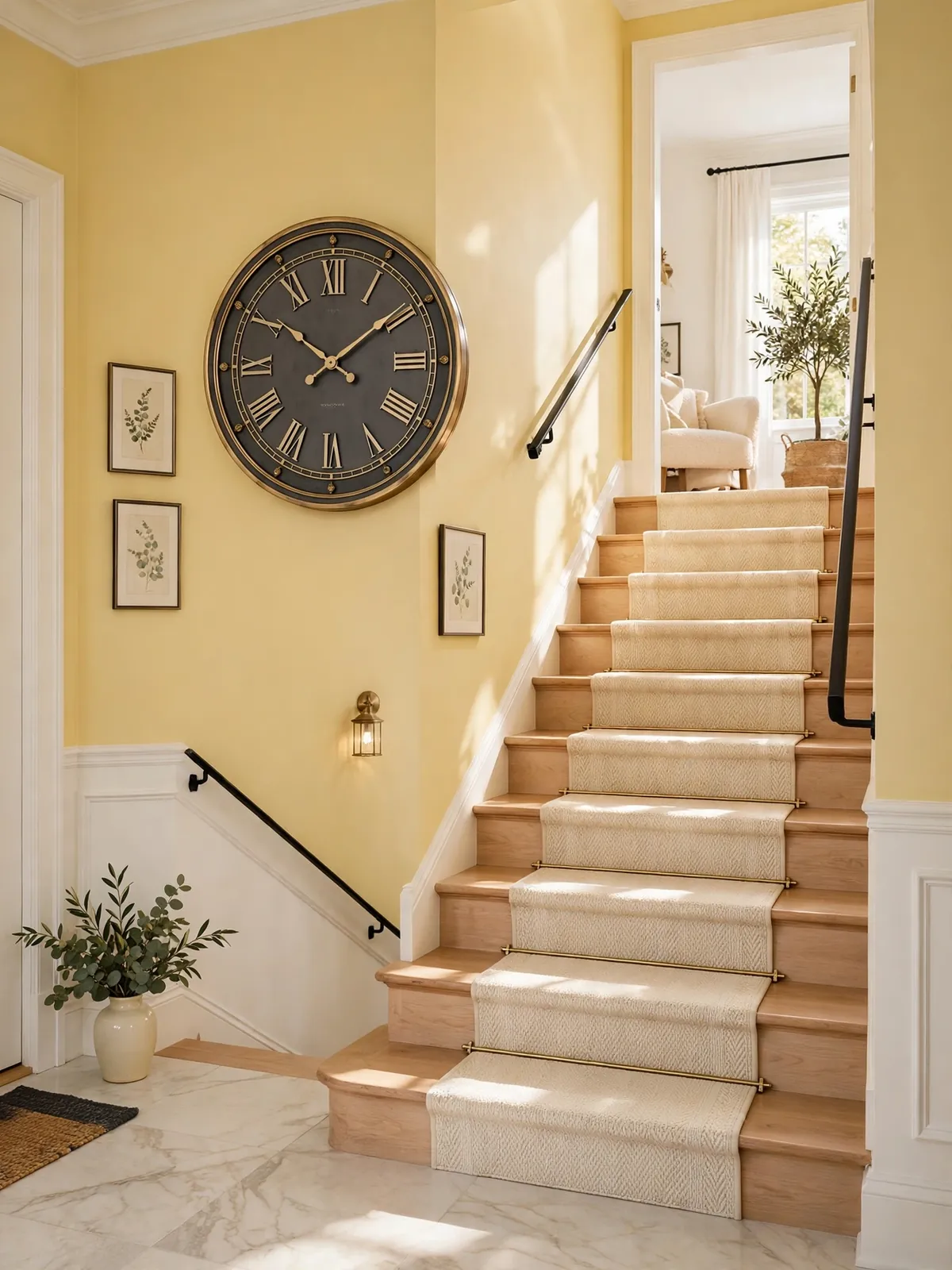
A statement clock anchors a stair wall because it is both decoration and useful, and its round shape softens all the straight lines of the stair. A large clock, 80 cm across, in charcoal with slim brass hands, hangs centred at eye level from the middle tread on a soft butter-yellow wall beside pale oak treads, each 900 mm wide. A cream runner softens the climb, and the clock’s face is easy to read from the bottom of the stairs, so the whole family checks the time on the way out.
Quick tips:
- Choose a clock at least 60 cm across so it holds the wall.
- Centre it at eye level from the middle tread.
- Pick a round clock to soften the straight lines of the stair.
- Match the clock’s metal to the handrail for a pulled-together look.
A Monochromatic Art Display in One Colour
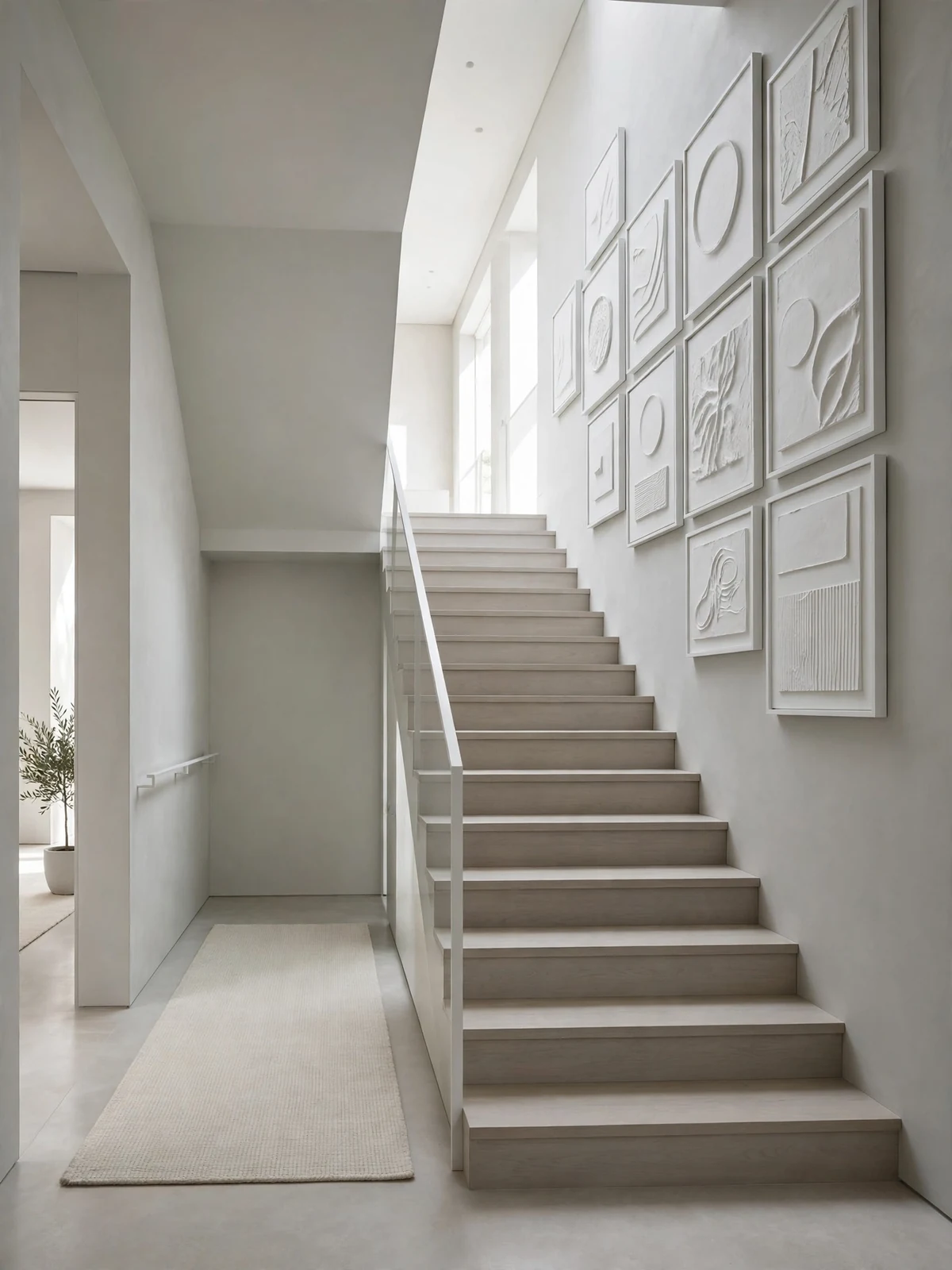
A monochromatic display in one colour feels serene and sculptural, because the eye notices texture and shape instead of colour. Seven white artworks — a plaster relief, a white-framed print, a ceramic disc, a woven white panel — climb the pale grey wall in a loose diagonal, spaced 120 mm apart, beside pale ash treads, each 900 mm wide. A cream rug and a slim white handrail keep the palette soft, and the different textures catch the daylight differently, so the wall changes as the light moves.
Quick tips:
- Choose one colour and vary the texture, not the shade.
- Mix flat art with one or two three-dimensional pieces.
- Keep the frames in the same colour as the art for a seamless look.
- Leave generous gaps so each texture has room to show.
Textile Art and Woven Wall Hangings
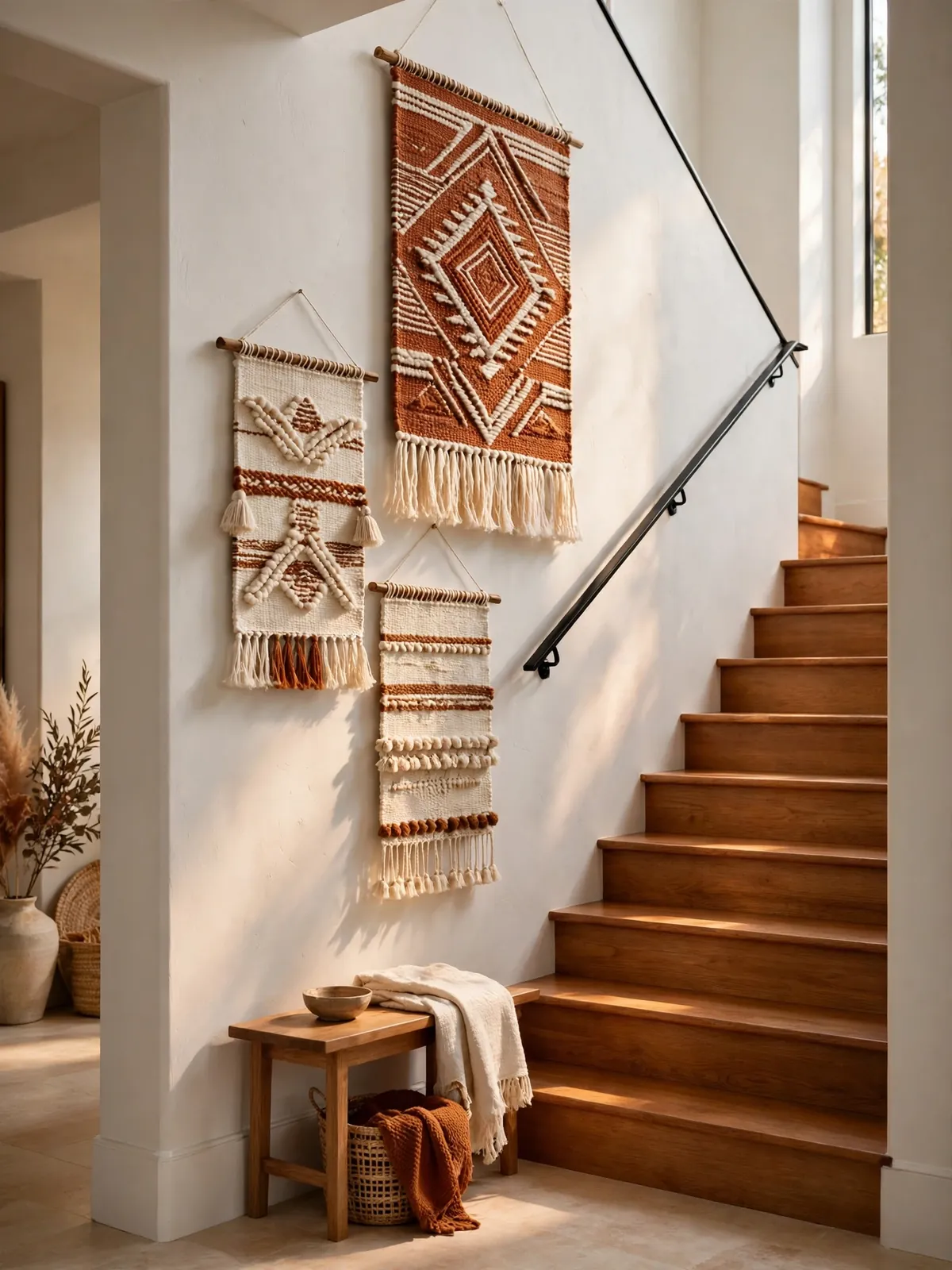
Textile art softens a stair wall in a way no framed print can, because fabric absorbs sound and adds a handmade warmth. A large rust-and-cream woven hanging, 80 cm wide and 120 cm high, hangs beside two smaller macramé pieces on the soft white wall, their fringes falling gently beside warm oak treads, each 950 mm wide. A small wooden bench below keeps the hallway simple, and the woven textures make the stair feel cosy even on a cold morning.
Quick tips:
- Hang one large textile as the anchor, with one or two smaller pieces.
- Choose natural fibres — wool, cotton, jute — for a soft, handmade feel.
- Keep the wall pale so the textile colours stand out.
- Dust the hangings gently with a soft brush once a month.
A Painted Arch That Follows the Stair Angle
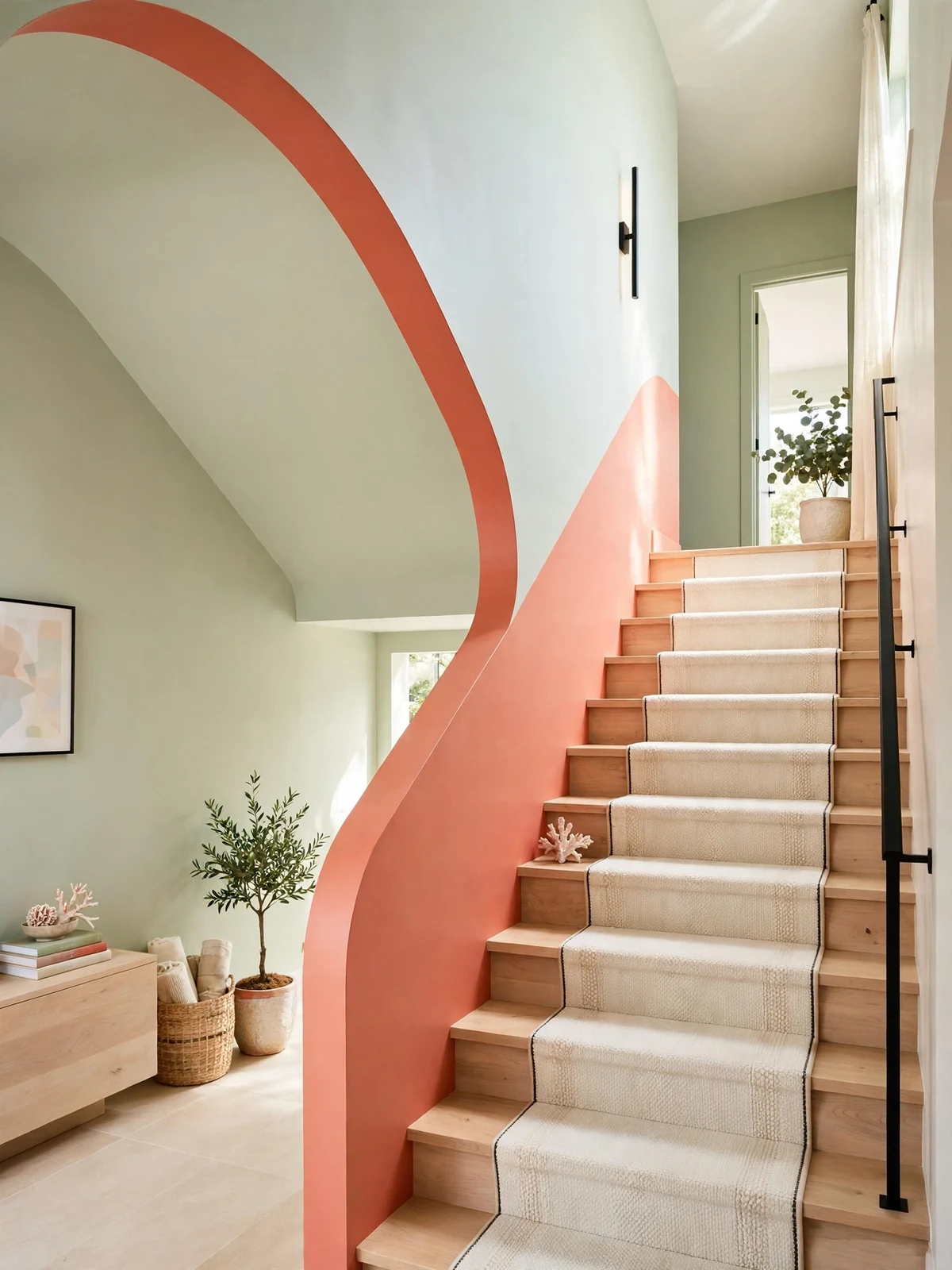
A painted arch that follows the stair angle turns a flat wall into a frame, and it costs little more than a tin of paint. A soft coral arch, 2 metres high at its peak, sweeps diagonally up the pale sage-green wall, echoing the slope of pale maple treads, each 900 mm wide, with a cream runner softening the climb. A slim black handrail runs below the arch, and a single small framed print inside the arch gives the eye a focal point without competing with the painted shape.
Quick tips:
- Draw the arch with a pencil and string before you paint.
- Choose a warm arch colour against a cool wall colour for contrast.
- Keep the art inside the arch small and simple.
- Use a matt paint so the arch reads as flat colour, not shine.
Travel Photos in One Cohesive Style
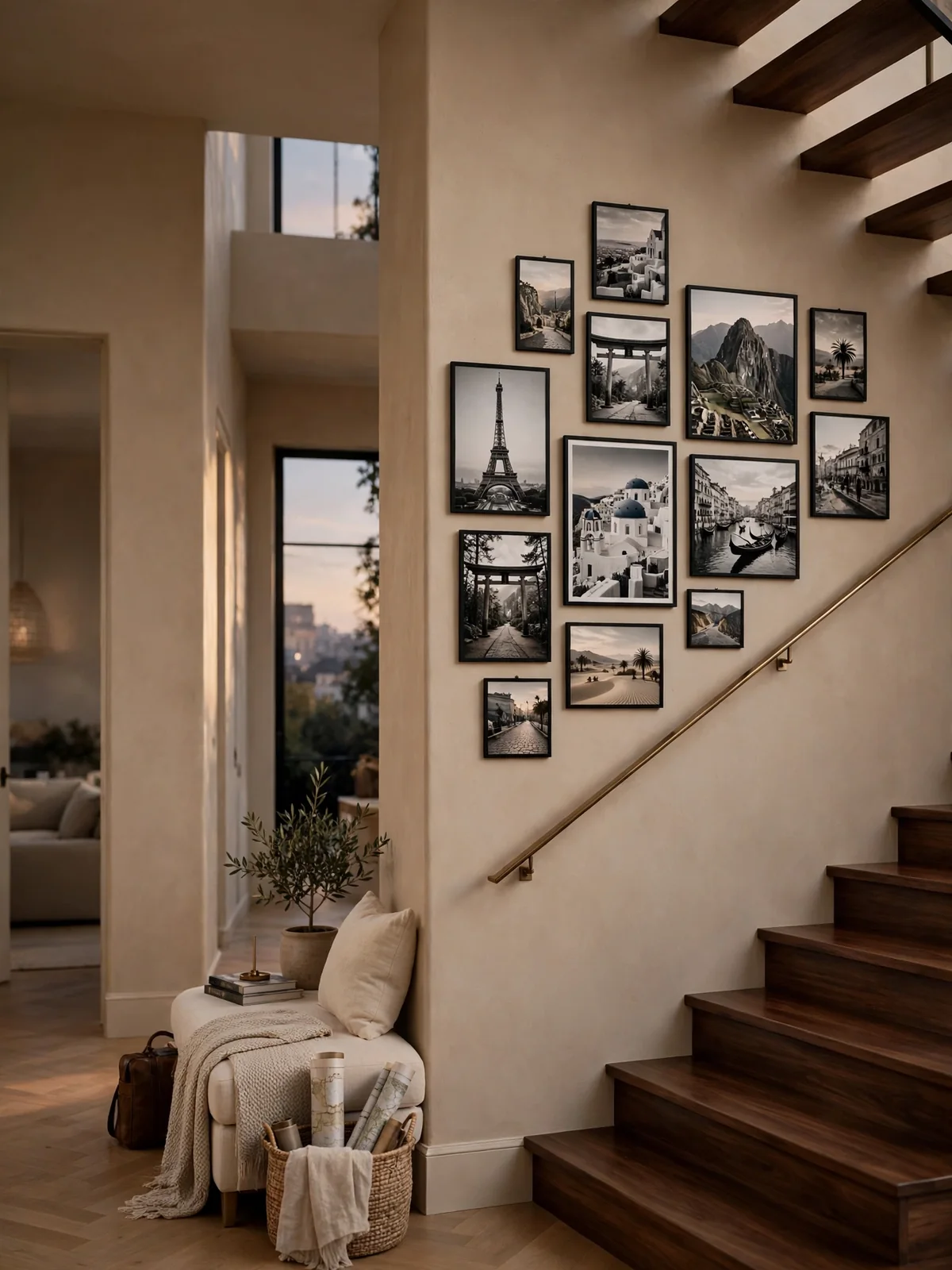
Travel photos in one cohesive style turn the stair into a journey, because every picture feels like part of the same trip. Eight black-and-white travel photographs in slim walnut frames, each 30 cm by 40 cm, climb the warm sand-beige wall in a neat diagonal, spaced 120 mm apart, beside dark walnut treads, each 950 mm wide. A cream bench and a slim brass handrail below keep the hallway calm, and because every photo shares the same black-and-white treatment, places from different continents sit happily side by side.
Quick tips:
- Print all the photos in the same style, all black and white or all warm-toned.
- Use identical frames so the photos, not the framing, tell the story.
- Hang the photos in the order you visited the places.
- Keep the gaps at 120 mm so the diagonal line stays clear.
Negative Space as Part of the Design
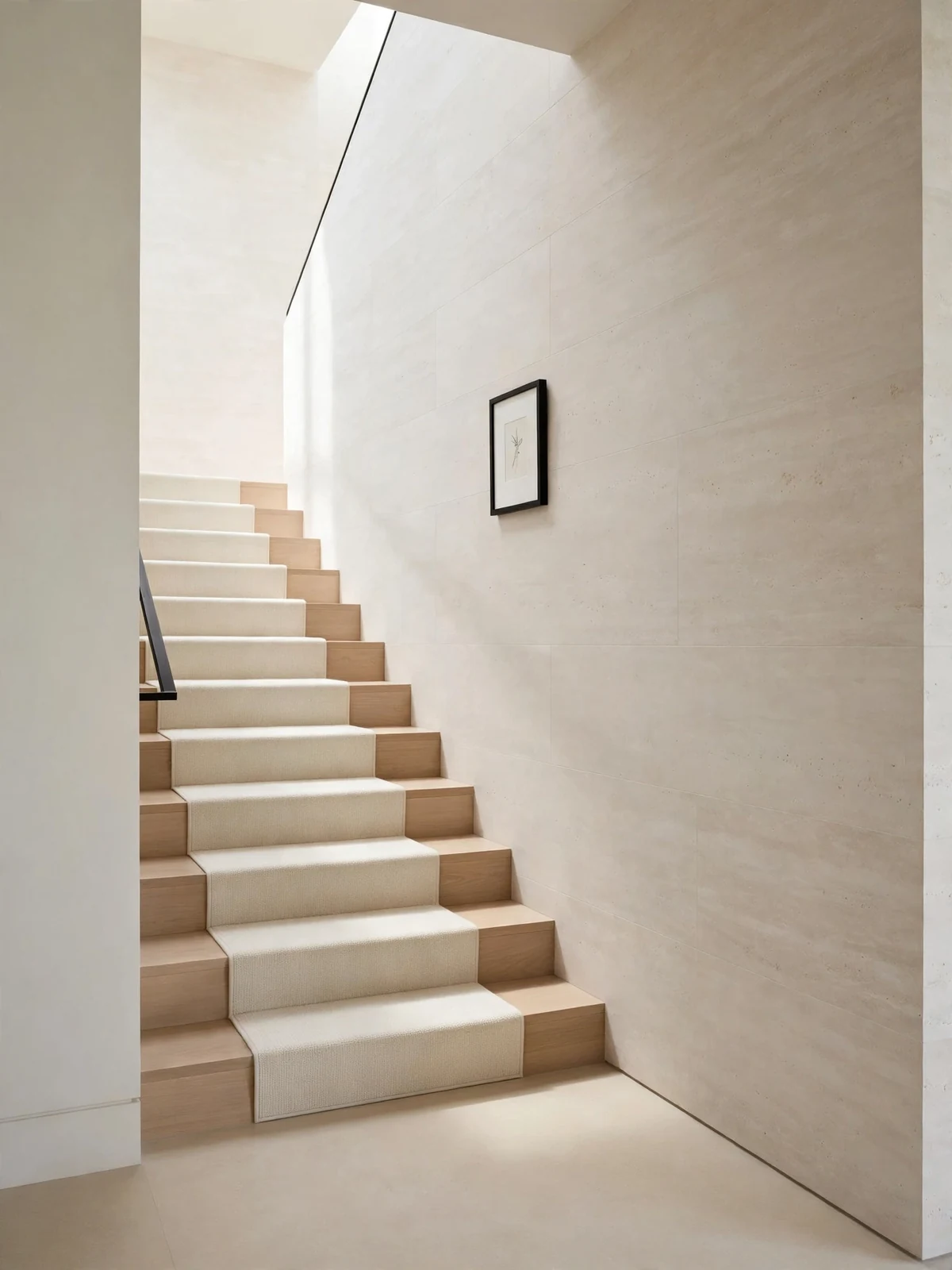
Negative space is the bravest staircase wall decor idea, because it means leaving most of the wall empty — and the empty wall is what makes the one decorated moment shine. A single small black-framed print, 40 cm by 50 cm, hangs alone on a wide pale stone wall, centred at eye level from the middle tread beside pale oak treads, each 900 mm wide, with a cream runner softening the climb. The bare plaster around it feels calm and intentional, and the stair itself — its timber, its light, its proportions — becomes the decoration.
Quick tips:
- Hang one small piece and leave the rest of the wall bare.
- Centre the piece at eye level from the middle tread.
- Keep the wall colour pale so the empty space feels bright, not blank.
- Resist adding more — the empty space is the design.
A Dramatic Colour-Blocked Wall
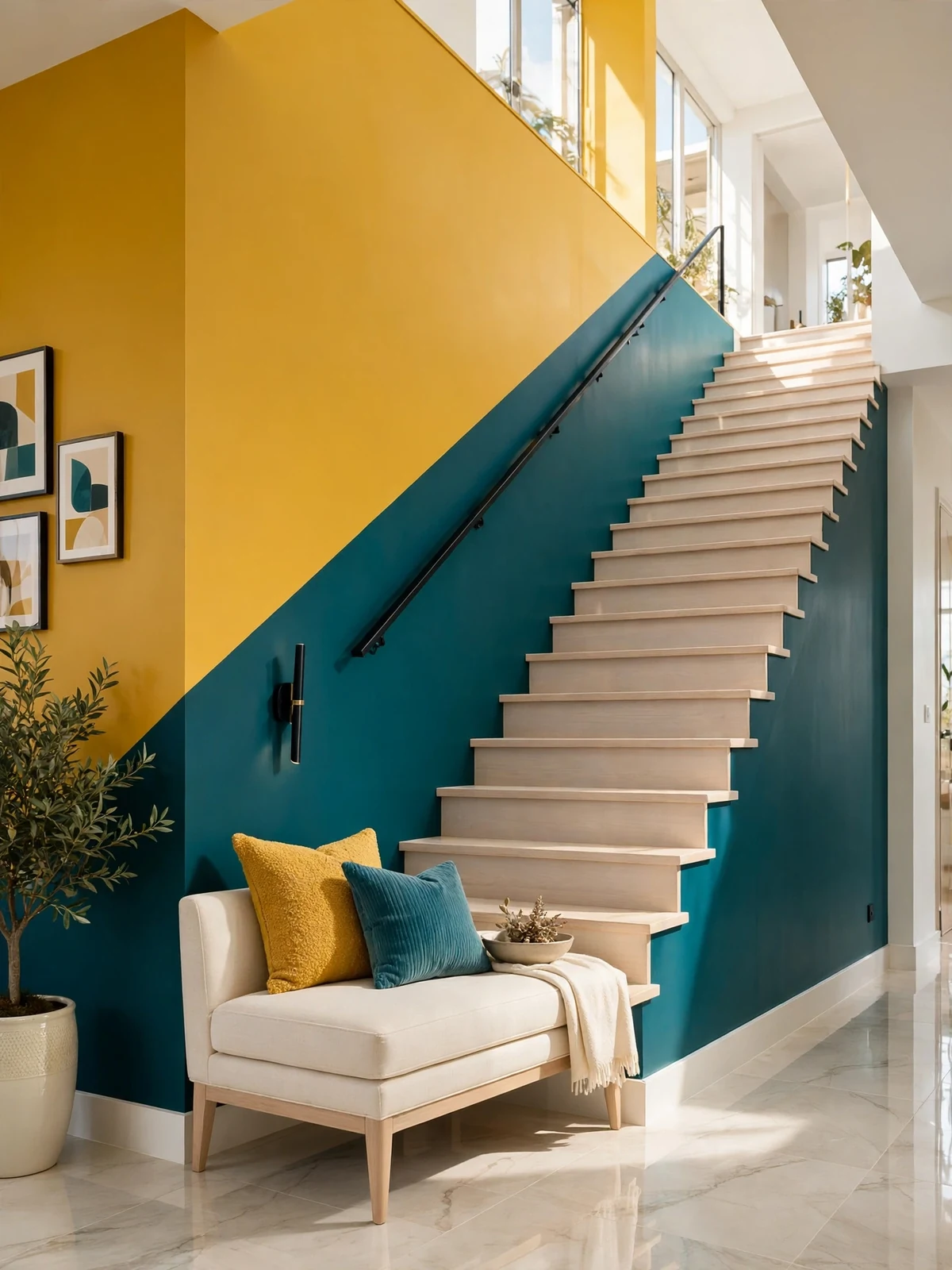
A colour-blocked wall divides the stair wall into bold bands of colour, and the diagonal edge between them echoes the slope of the stair itself. Mustard covers the lower half of the wall and deep teal the upper half, split by a crisp diagonal line that runs parallel to pale ash treads, each 950 mm wide, with a slim black handrail fixed to the teal. A cream bench at the base keeps the entry calm, and the two strong colours make the stair feel playful and modern without a single frame.
Quick tips:
- Split the wall with a diagonal line parallel to the stair.
- Choose two colours with similar strength so neither dominates.
- Tape the edge carefully for a razor-sharp line.
- Keep the treads pale so the colour blocks stay the feature.
Sculptural Wall Art for Depth and Shadow
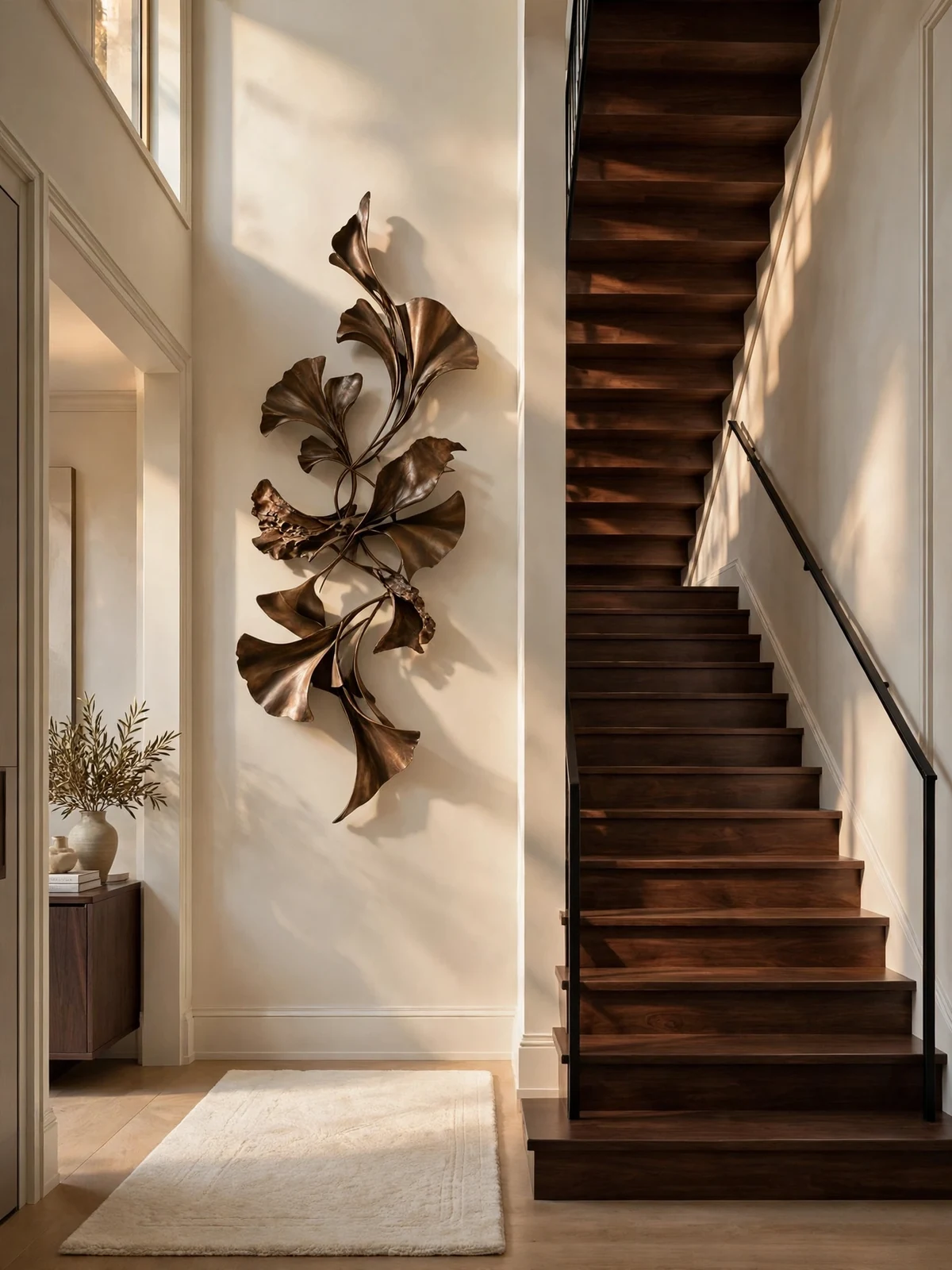
Sculptural wall art adds depth and shadow to a stair wall, because it stands out from the plaster instead of sitting flat against it. Three bronze sculptural pieces — a curved disc, a folded panel and a small ring — hang in a diagonal line on the ivory wall, spaced 150 mm apart, casting soft shadows in the afternoon light beside dark walnut treads, each 950 mm wide. A cream rug below keeps the hallway soft, and the shadows move through the day, so the wall never looks quite the same twice.
Quick tips:
- Choose three sculptural pieces in one metal for a unified look.
- Space them 150 mm apart so each shadow has room to show.
- Hang them where afternoon light will catch their edges.
- Keep the wall pale so the shadows stay visible.
A Wall That Changes With the Seasons
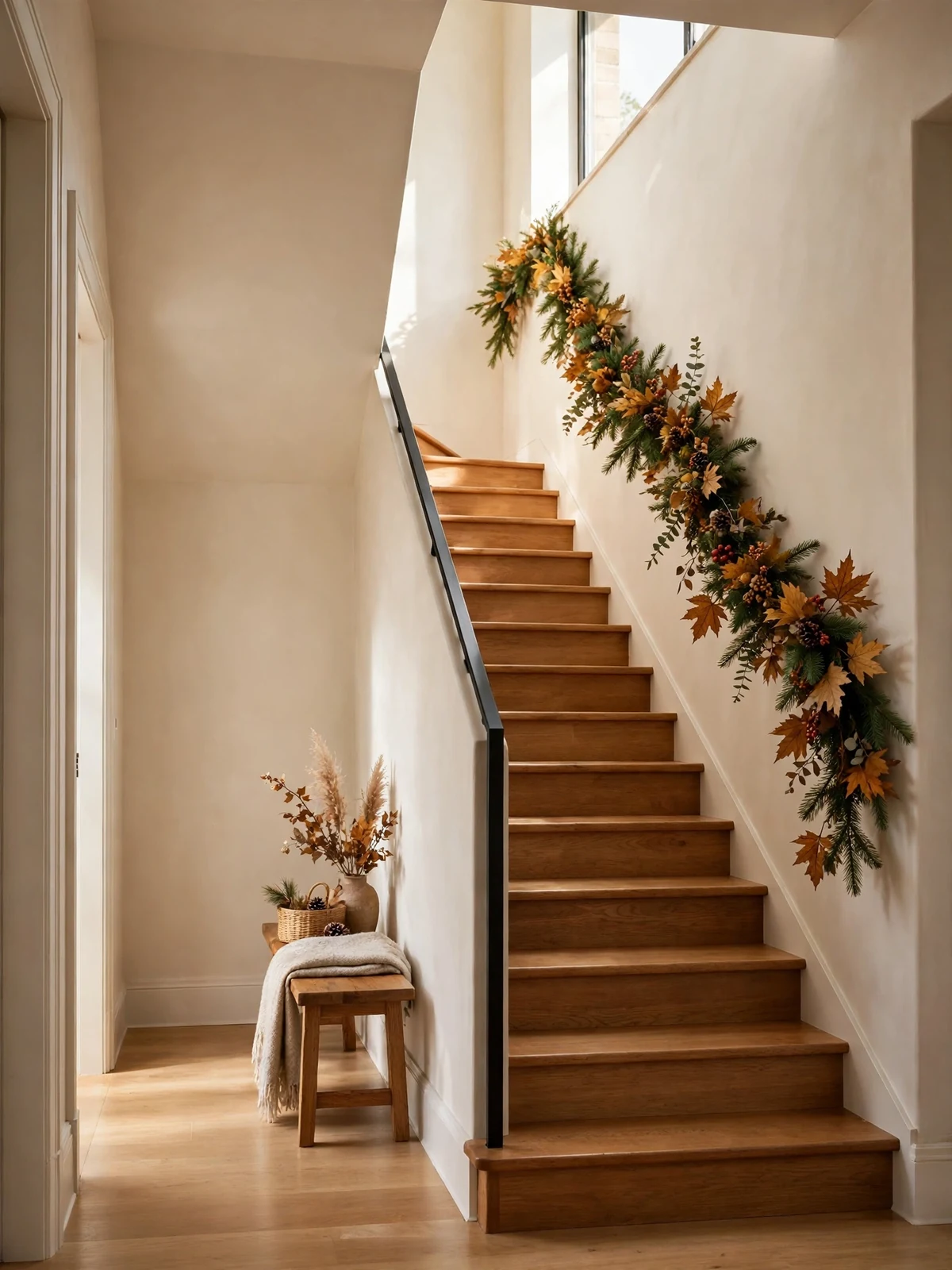
A wall that changes with the seasons keeps the stair feeling fresh all year, because the decor is never finished — it is always the current season. In autumn, amber leaves, dried grasses and a pine-green garland hang from small brass hooks on the soft cream wall beside warm oak treads, each 950 mm wide, with a small wooden bench below holding a stack of seasonal books. The hooks stay up all year, so swapping the display takes ten minutes, and the stair always reflects the month outside.
Quick tips:
- Fit small brass hooks once, then swap the display each season.
- Choose natural seasonal materials — leaves, branches, dried flowers.
- Keep the base hooks and frames the same all year for continuity.
- Store each season’s pieces in one labelled box so the swap is quick.
A Picture Ledge You Can Restyle in Minutes
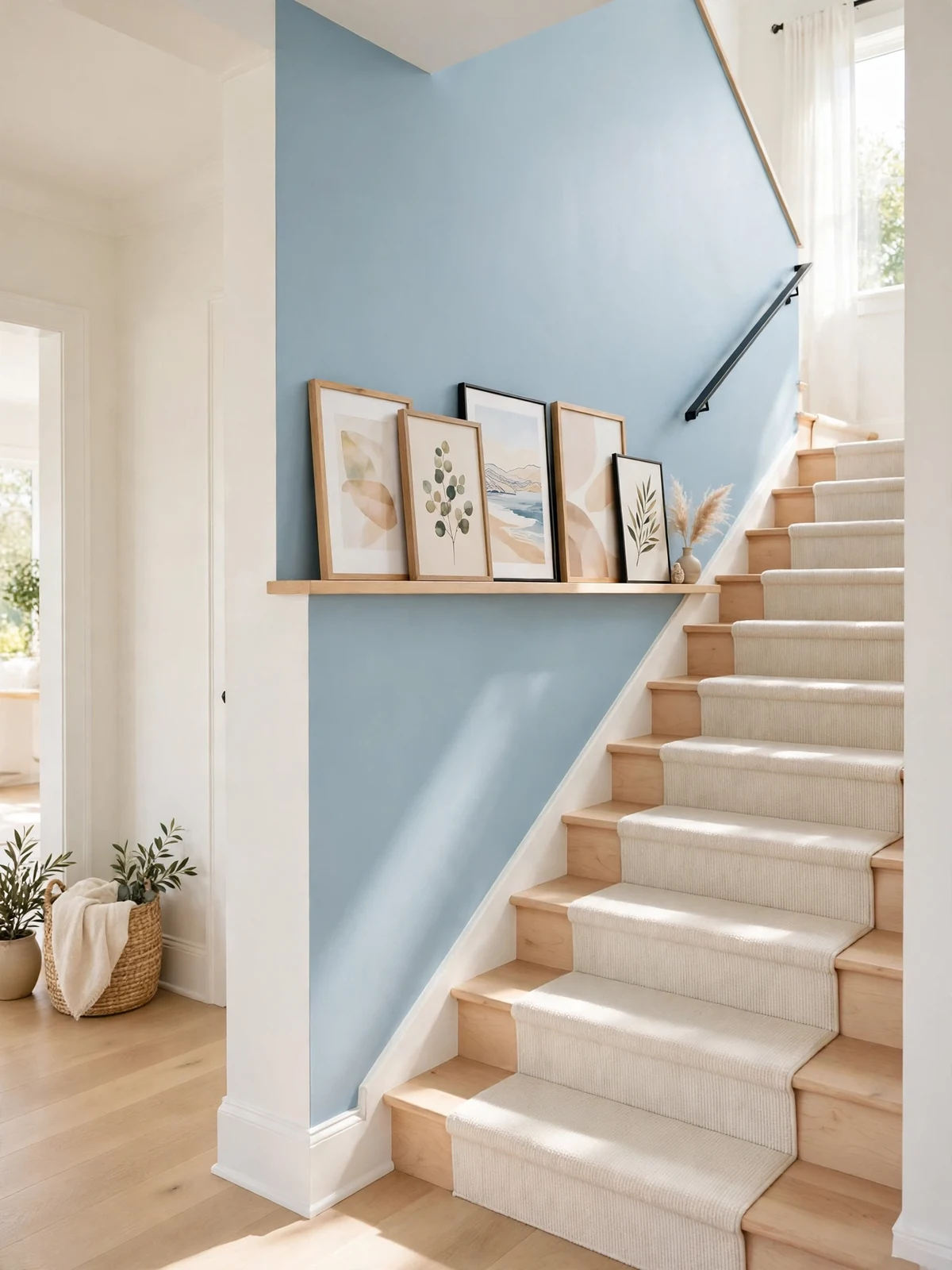
A picture ledge is the most flexible staircase wall decor idea, because the art is never nailed down — it simply rests on the ledge and can be swapped in minutes. Two slim white ledges, each 120 cm long, run diagonally up the soft sky-blue wall, each holding three framed prints in oak frames, layered slightly so the front frames overlap the back ones, beside pale maple treads, each 900 mm wide. A cream runner softens the climb, and when you want a new look, you lift the frames off and set down different ones — no holes, no tools, no repainting.
Quick tips:
- Fit the ledge so it follows the stair angle, not the level floor.
- Layer the frames slightly, front overlapping back, for depth.
- Mix frame sizes but keep one frame colour for unity.
- Leave one end of the ledge empty so the display can grow.
A Cluster of Small Mirrors Along the Climb
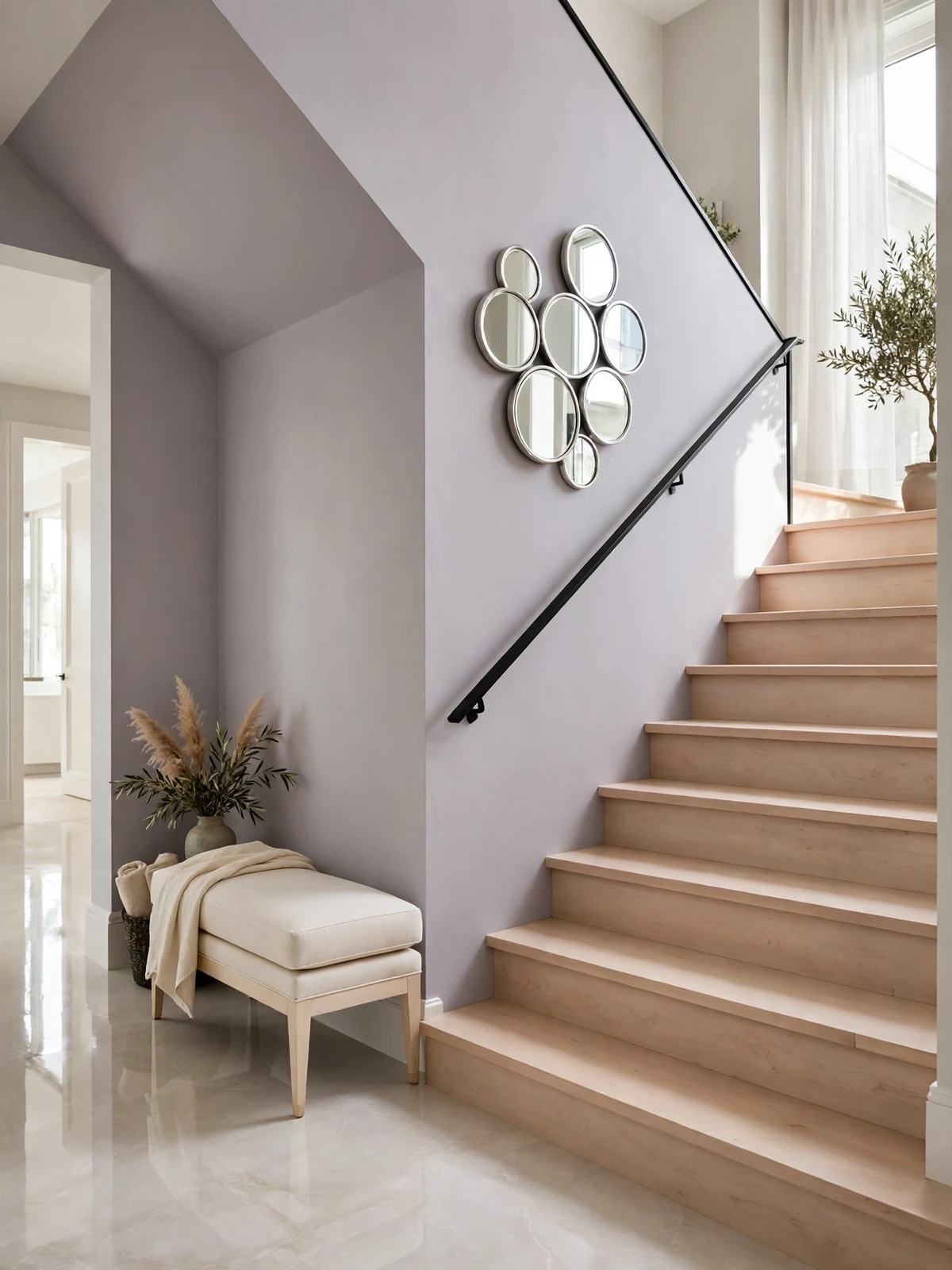
A cluster of small mirrors brightens a stair wall twice over, because each mirror catches daylight and throws it back into the hallway. Nine small round mirrors, each 25 cm across, in slim silver frames, cluster in a loose diagonal on the soft lilac-grey wall, spaced 100 mm apart, beside pale maple treads, each 900 mm wide. A cream bench below keeps the hallway calm, and the mirrors reflect the treads, the runner and the window light, so a narrow stair feels wider and brighter from every step.
Quick tips:
- Cluster the mirrors in a loose diagonal that follows the stair.
- Use identical round mirrors in one metal finish for unity.
- Keep the gaps at 100 mm so the cluster reads as one display.
- Hang the mirrors where they catch window light, not a blank wall.
Staircase Wall Decor Ideas With Woven Baskets for Warmth and Texture
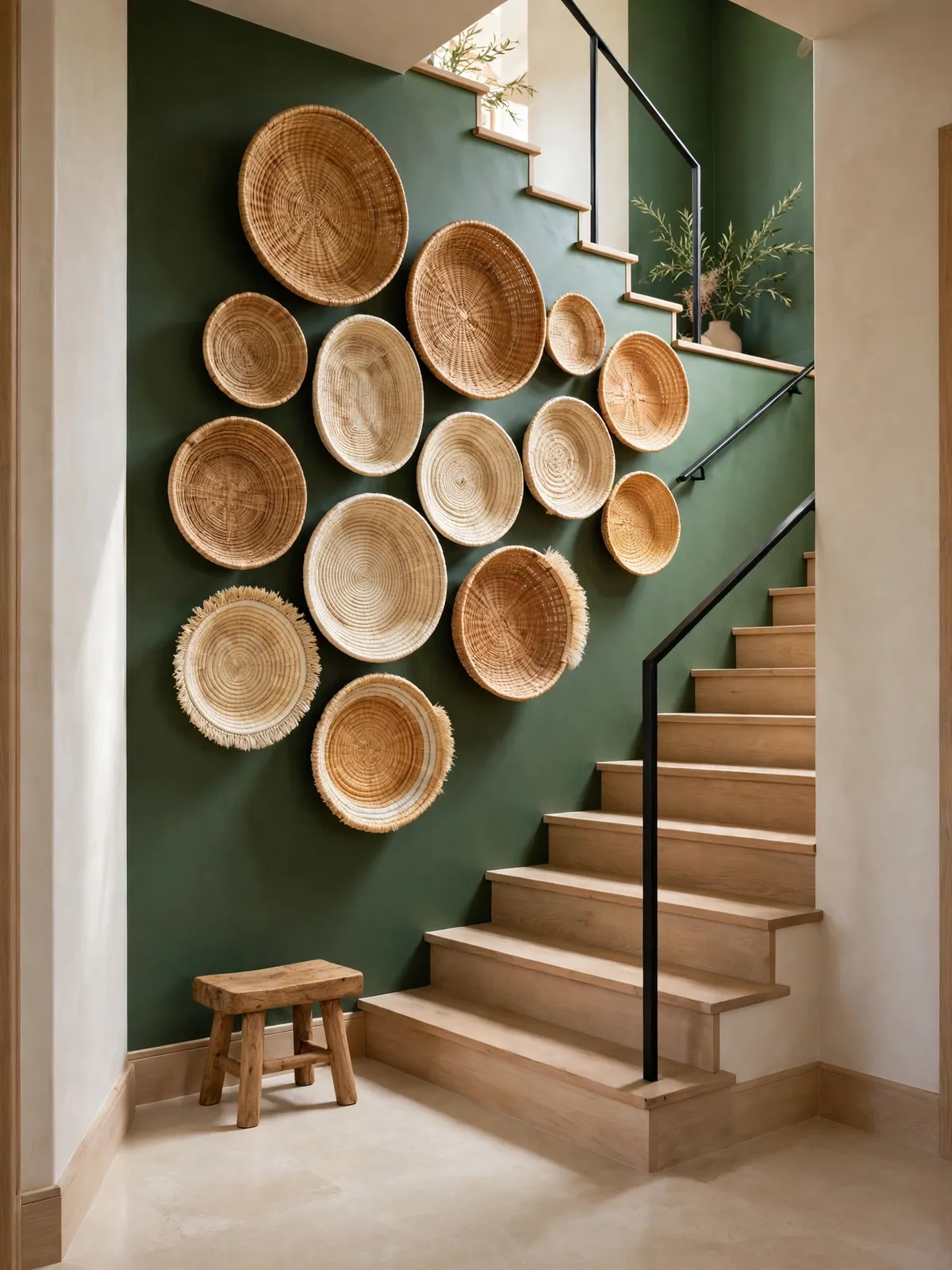
Woven baskets bring warmth and texture to a stair wall in a way no flat art can, because their woven fibres catch light and shadow from every angle. Seven baskets in warm honey, cream and natural seagrass, ranging from 25 cm to 50 cm across, cluster in a loose diagonal on a deep green wall, spaced 100 mm apart, beside pale oak treads, each 950 mm wide. A small wooden stool below keeps the hallway simple, and the baskets’ handmade texture makes the stair feel warm, relaxed and collected — like a market find brought home and given pride of place.
Quick tips:
- Mix basket sizes, from 25 cm to 50 cm across, for a natural cluster.
- Use one wall colour, deep green or warm white, so the baskets stand out.
- Hang the baskets with small nails through their woven backs.
- Keep the cluster loose and diagonal, following the stair angle.
FAQs
How do I decorate a stair wall without making holes everywhere?
Use picture ledges, leaning art, adhesive hooks for lightweight pieces, or a single large artwork on two fixings instead of many small frames. Lay the arrangement out with paper templates taped to the wall first, so you only drill once you are happy with the diagonal line. For rented homes, leaning art on a landing and a picture ledge fixed with removable strips give you a full display with almost no holes at all.
What should I put on a very tall stair wall?
A very tall stair wall needs scale: one oversized artwork, a mural, vertical wood paneling, or a tall gallery that runs the full height of the flight. Small frames get lost on a double-height wall, so choose pieces at least 90 cm wide, or group six or more frames into one large display. A statement clock or a large mirror also fills vertical space well, because their size matches the wall.
Can I mix photos and art on the same stair wall?
Yes, if you keep one thing consistent — the frame colour, the print style or the spacing. Mix black-and-white photos with black-framed art prints, or warm-toned photos with oak-framed art, and keep the gaps between every piece the same. The shared frame or the shared colour is what makes the mix look deliberate instead of random, so choose that one unifying element before you start hanging.
How do I light staircase wall decor?
Wall sconces spaced every four or five treads wash warm light down the wall and make art glow after dark, while a picture light above a single large artwork gives it a gallery feel. Choose warm white bulbs, about 2700K, and put the lights on a dimmer so the stair stays soft in the evening. Avoid a single harsh ceiling light, which flattens art and casts shadows across the frames.
What is the best staircase wall decor for a narrow hallway?
In a narrow hallway, keep everything flat against the wall: framed art, a mural, wallpaper, molding or a painted arch all add interest without taking up floor space. Avoid deep shelves or bulky planters that jut into the walkway, and use mirrors or pale colours to make the space feel wider. One large flat piece is better than a cluster of small objects, because it reads clearly even in a tight space.
Conclusion
Staircase wall decor ideas work when the wall is treated as one long, sloping canvas, not as a blank space to fill at random. Whether you hang one oversized artwork, paint a mural that climbs with you, panel the wall in warm timber, build a photo timeline, step floating shelves up the flight, hang a statement clock, cluster small mirrors, or fill the wall with woven baskets, the best choice is the one that suits the rooms around it and the way your family climbs the stairs every day. Start with one strong piece at eye level, keep the spacing even, leave room for the wall to breathe, and your stair wall will make a beautiful first impression every time you climb.