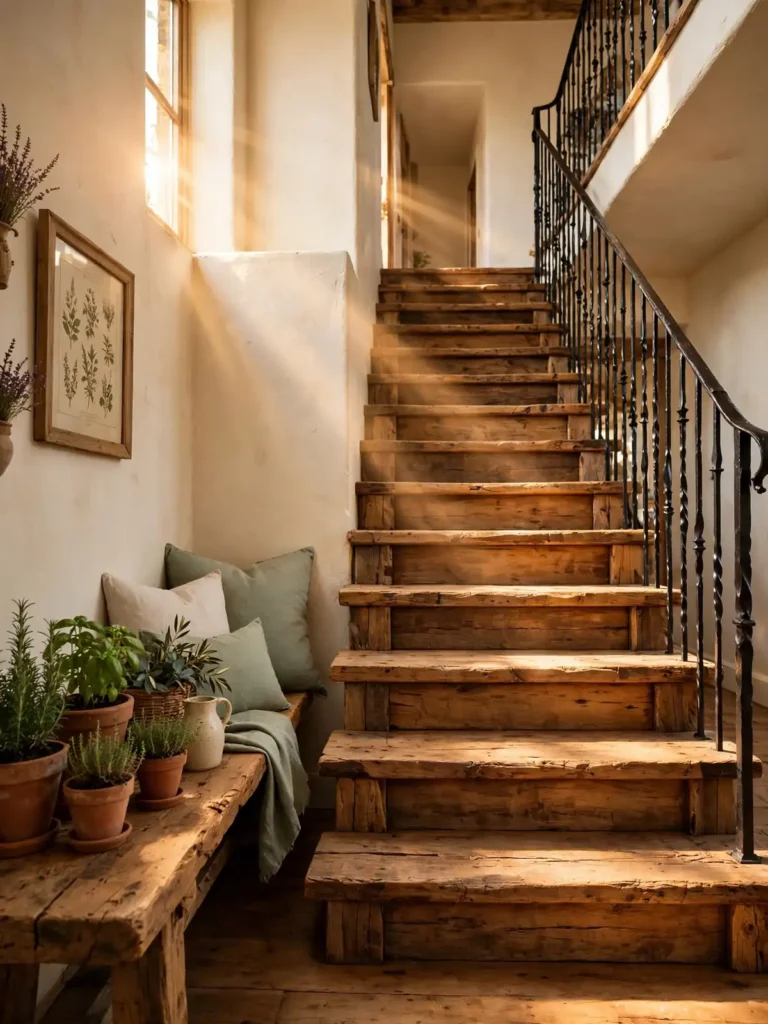
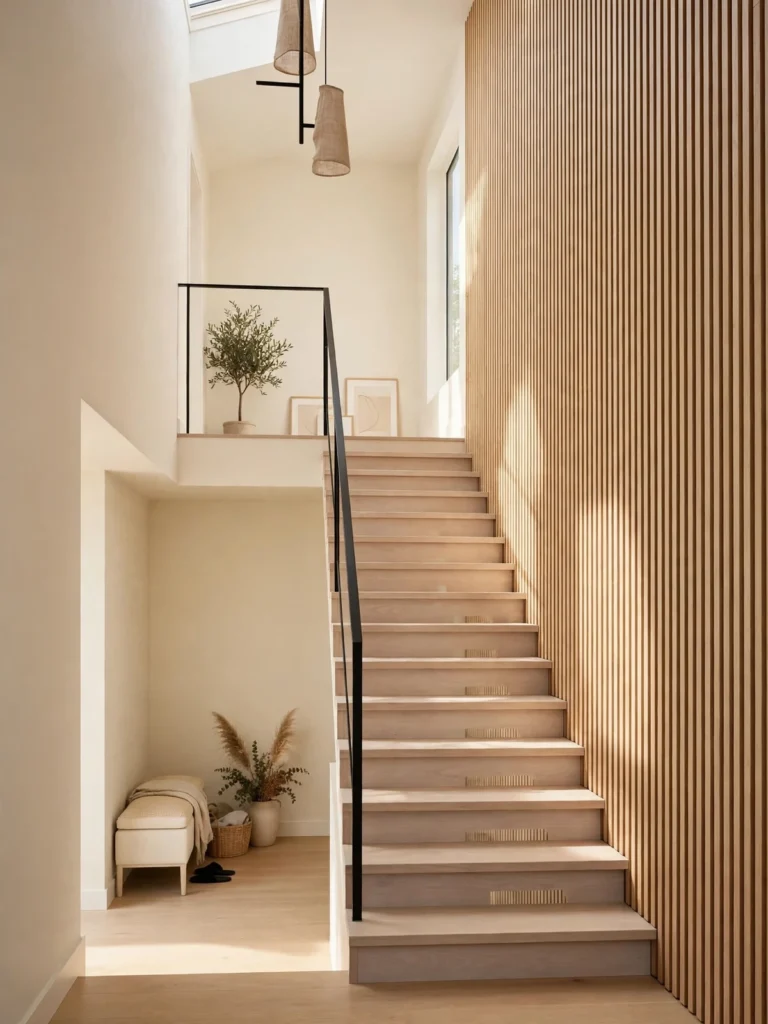
26 Beautiful Victorian Staircase Ideas Full of Old-World Drama, Carved Wood and Jewel Colour
A Victorian staircase is a statement, not just a way upstairs: curves, craftsmanship and unapologetic drama in every detail. These 26 Victorian staircase ideas cover carved wood, pattern, colour, brass, glass and velvet, so you can bring old-world elegance into a grand townhouse or a tiny fixer-upper.
Victorian staircase ideas are worth your time because a Victorian stair does something no other style does: it turns the journey between floors into a moment of drama, craft and colour. Carved banisters, bold patterned runners, jewel-tone risers, damask wallpaper and brass stair rods all celebrate detail, and the Victorians never believed in holding back.
If you love the drama of a curving stair, these spiral staircase ideas show how a spiral stair — wooden or steel — makes the same sculptural statement in a smaller footprint. The 26 ideas below cover banisters, runners, paint, wallpaper, brass, glass, lighting and landings, so you can go full maximalist or start small with one detail and build from there.
Key Takeaways
What makes a staircase look Victorian?
Visible craftsmanship, rich pattern and deep colour make a staircase look Victorian. Carved wood banisters, turned spindles, patterned runners, jewel-tone risers, damask wallpaper, brass stair rods, stained glass and wainscoting are the strongest signals. Victorian design layers pattern on pattern, so one bold detail is rarely enough — it is the layering that creates the look.
How much does a Victorian staircase cost?
Paint and a runner are the cheapest route — a weekend project with a big impact. Carved banisters, custom ironwork, stained glass and a full wooden spiral cost far more because they need skilled handwork. Always get a detailed quote that separates the structure, the railing, the treads and the installation before committing.
Can a Victorian staircase work in a small home?
Yes, if you choose one or two details rather than all of them. A patterned runner with brass rods, jewel-tone risers or a damask feature wall gives a small stair Victorian character without overwhelming it. Keep the walls pale around the bold detail, and avoid heavy carved balusters in compact halls.
Are Victorian staircases safe for children?
Yes, when the details are right. Baluster gaps should stay under 99 mm, treads need a non-slip surface, and a low-pile runner adds grip. A sturdy handrail at a comfortable height matters more than style, and stair gates fit best on straight Victorian stairs with solid newel posts.
How do I keep a Victorian staircase from feeling too dark or heavy?
Balance the dark wood and rich colour with light. Paint the spindles cream, keep one wall pale, add brass sconces or a chandelier, and let daylight in through a landing window. Heavy detail feels grand when it has light and breathing room around it — and a runner in a lighter tone lifts the whole stair.
An Ornate Carved Wood Banister
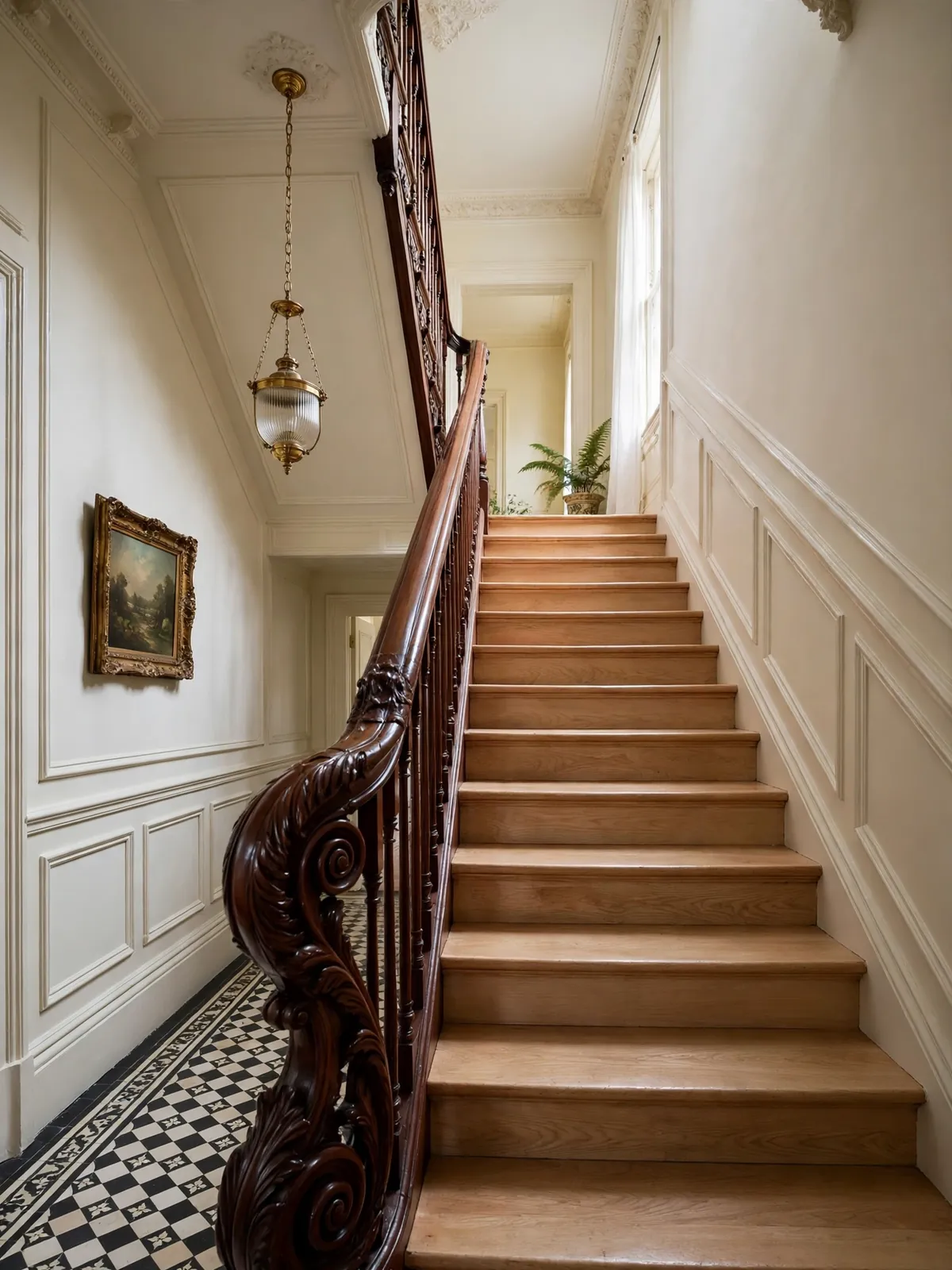
An ornate carved wood banister is the single most important Victorian detail, because it is the part your hand touches every day and it shows craftsmanship in every curve. Here, a dark mahogany handrail with scrollwork carving runs above slim turned spindles, against soft cream walls and pale oak treads. The idea suits period homes and new homes that want heritage character, it feels solid and warm, and it instantly tells visitors the stair was made by someone who cared. The weakness is cost — real carving is skilled work — so even subtle carving adds heritage charm without going overboard, and a plain handrail with carved newel caps is a cheaper compromise.
Quick tips:
- Choose mahogany, walnut or stained oak for the richest carving.
- Keep the carving subtle — even a little detail adds charm.
- Pair the banister with slim spindles for balance.
- Oil the handrail twice a year so it stays smooth.
A Bold Patterned Stair Runner
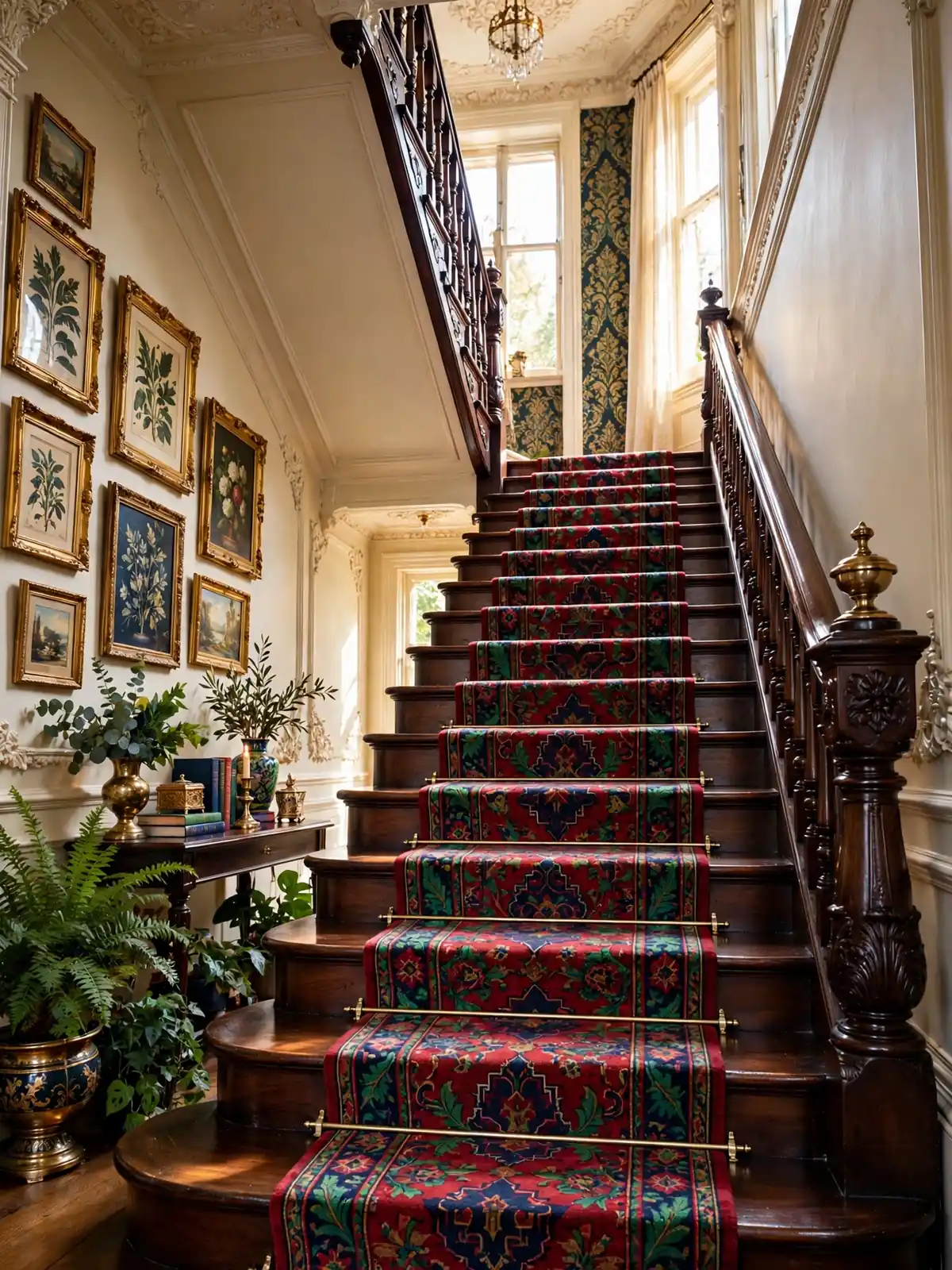
A bold patterned stair runner is the heart of a Victorian staircase, because Victorians loved pattern and the busier the better. Here, a deep red, emerald and navy runner with floral medallions runs down the centre of dark wood treads, held by brass stair rods, against soft cream walls. The idea suits any Victorian stair, it softens foot traffic noise, adds grip, and transforms even a basic staircase into something dramatic and cosy at the same time. The weakness is cleaning — a busy pattern hides dirt well, but a light runner shows it fast — so choose a low-pile runner that hugs the steps tightly and feels tailored rather than bulky.
Quick tips:
- Choose a low-pile runner so it hugs the steps tightly.
- Pick deep reds, emerald greens or navy blues with florals.
- Use brass stair rods to hold the runner in place.
- Vacuum the runner weekly to keep the pattern crisp.
Jewel-Tone Paint on the Risers
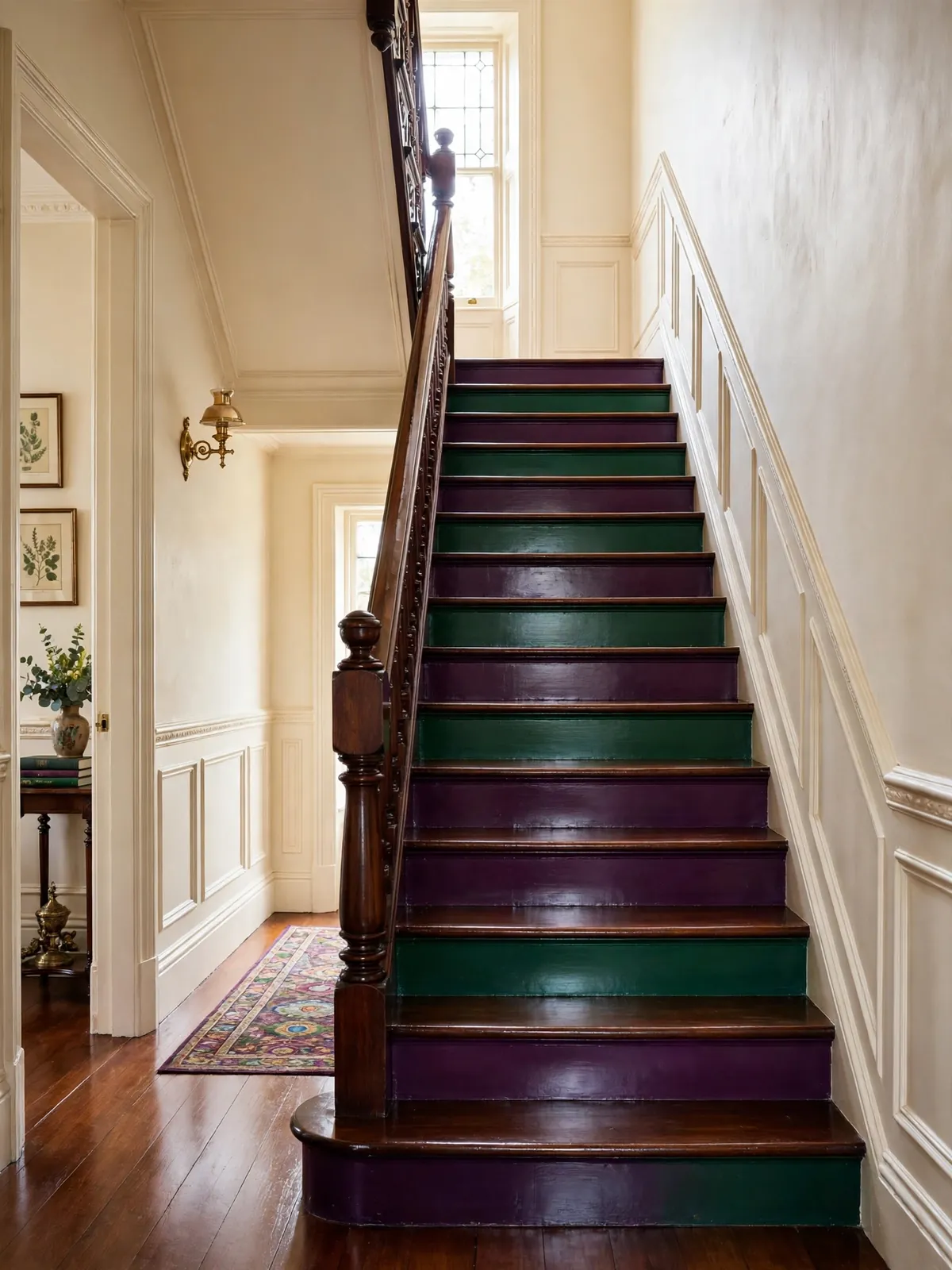
Jewel-tone paint on the risers is the cheapest dramatic Victorian change, because deep plum, forest green or midnight blue on the risers alone gives the stair a bold personality without any structural work. Here, jewel-tone risers sit beneath dark wood treads, with soft cream walls keeping the look balanced. The idea suits anyone not ready for structural changes, it pairs beautifully with a patterned runner, and it is fully reversible. The weakness is durability — paint on risers scuffs where shoes kick — so use a tough satin finish and keep a small tin for touch-ups, and never mix glossy finishes with random mismatched shades.
Quick tips:
- Use satin or semi-gloss paint for durability.
- Stick to jewel tones — plum, forest green, midnight blue.
- Keep the treads dark wood so the colour pops.
- Test swatches first — jewel tones change in stair light.
Wainscoting Along the Stair Wall
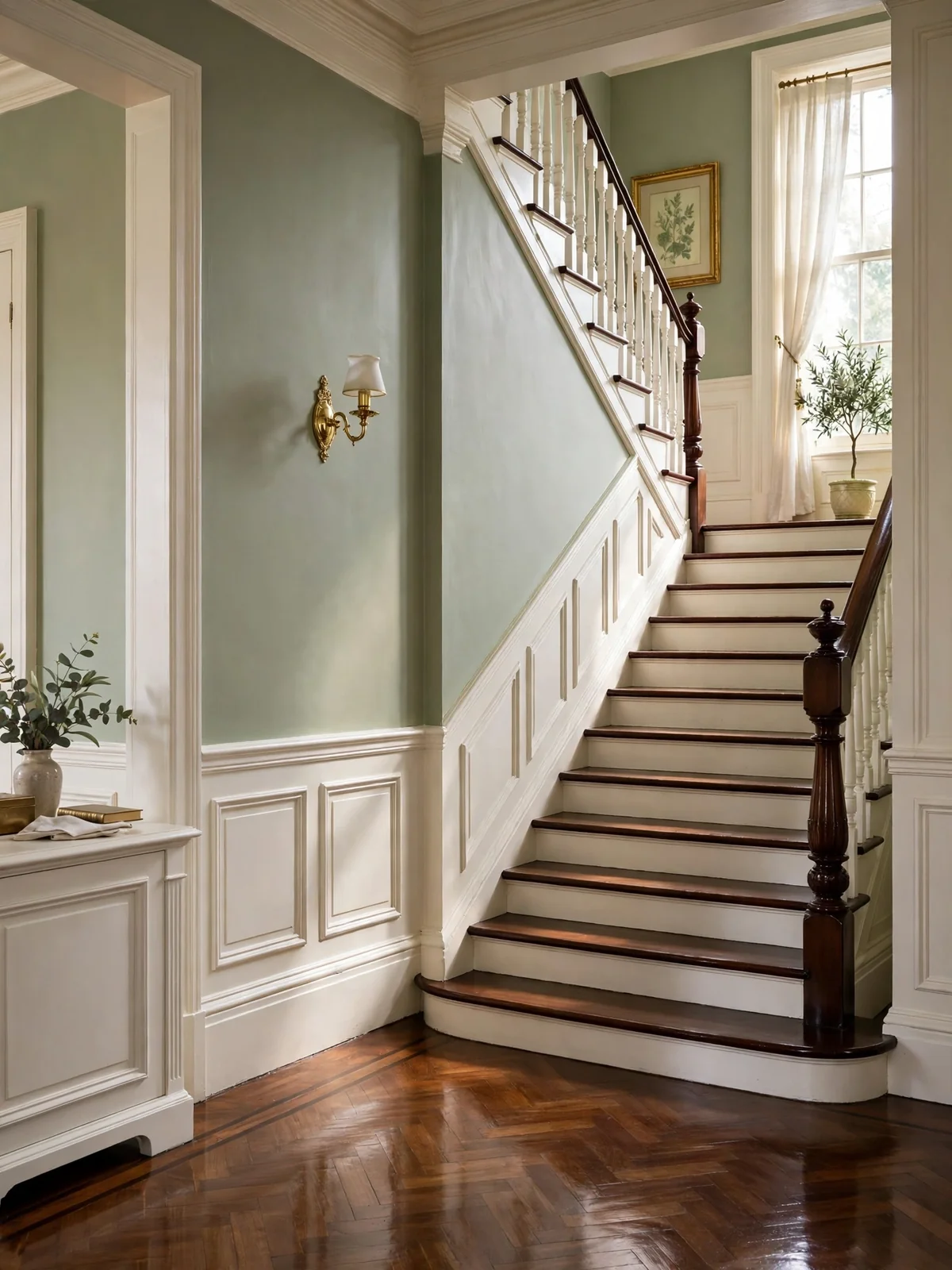
Wainscoting along the stair wall gives a Victorian staircase structure and texture, because panel moulding or beadboard halfway up the wall adds rhythm to a flat surface and protects it from scuffs. Here, creamy white wainscoting runs up the stair wall, with soft sage-green walls above, dark wood treads and a brass sconce. The idea suits any traditional home, it feels rich without being loud, and it is practical in busy family halls. The weakness is that bare walls are not very Victorian — so if the budget is tight, paint the wainscoting a muted heritage tone instead of plain white, and extend the moulding around the landing for a seamless look.
Quick tips:
- Paint wainscoting creamy white or a muted heritage tone.
- Extend the moulding around the landing for continuity.
- Use panel moulding for a formal look, beadboard for a softer one.
- Keep the upper wall pale so the stair stays bright.
A Damask Wallpaper Statement Wall
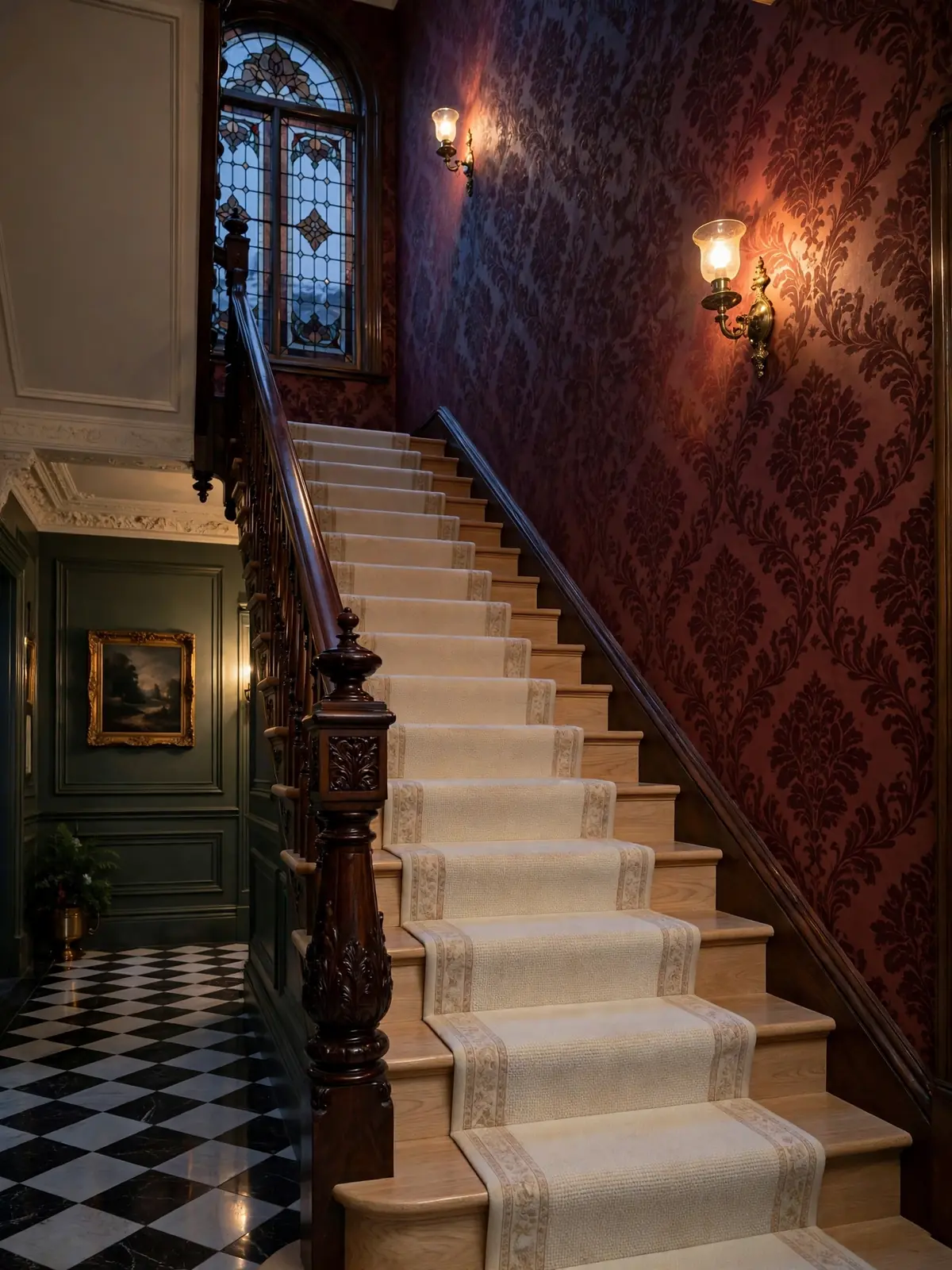
A damask wallpaper statement wall makes a Victorian staircase feel unapologetically dramatic, because the large repeating pattern in deep tones turns a plain wall into a showpiece. Here, deep burgundy damask with a soft sheen covers the stair wall, balanced by a dark walnut handrail, pale oak treads and a cream runner. The idea suits bold homeowners and grand entries, it hides wall imperfections, and it photographs beautifully. The weakness is that a pattern too small for the tall wall looks busy, and cool-toned lighting flattens the wallpaper — so choose a large-scale pattern, align it carefully at corners, and use warm light.
Quick tips:
- Choose a large-scale damask pattern for tall walls.
- Use matte finishes for a more historic feel.
- Align the pattern carefully at corners.
- Use warm lighting so the wallpaper glows.
Brass Stair Rods for Old-World Charm
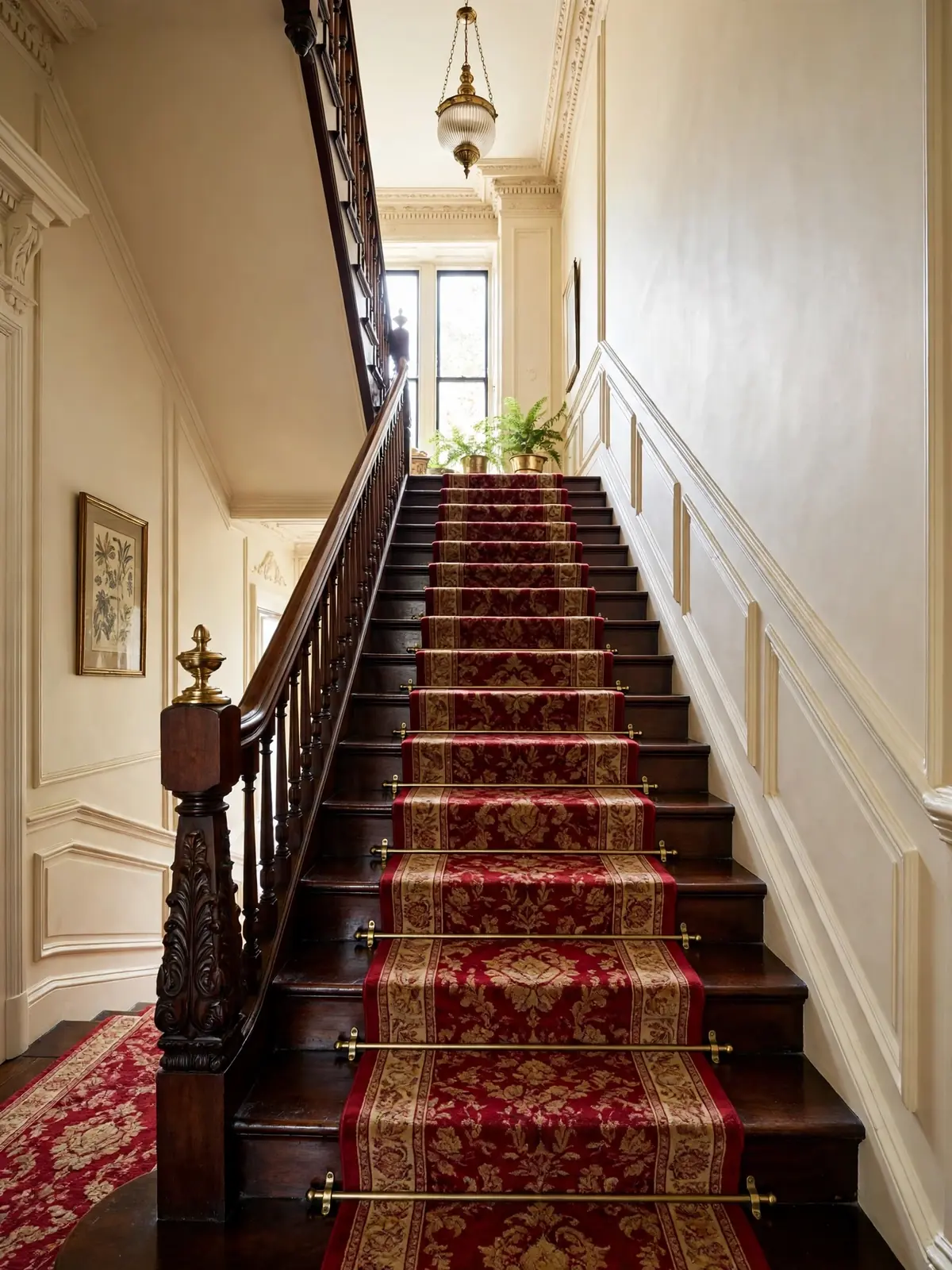
Brass stair rods are a small detail with an outsized effect, because polished or antique brass rods hold the runner in place while adding shine and a sense of intention. Here, brass rods sit at the base of each tread, holding a deep red patterned runner on dark wood steps, against soft cream walls. The idea suits any Victorian stair with a runner, it feels intentional, and it is one of the cheapest upgrades on this list. The weakness is that brass-finish rods need polishing to stay bright — and many retailers offer affordable brass-finish rods that look high-end without custom pricing, so there is no need to buy solid brass.
Quick tips:
- Pair brass rods with a patterned carpet for maximum impact.
- Polish the rods monthly to keep the shine.
- Choose antique brass for a softer, older feel.
- Match the rod finish to a sconce or pendant nearby.
Dark Wood Treads With Light Painted Spindles
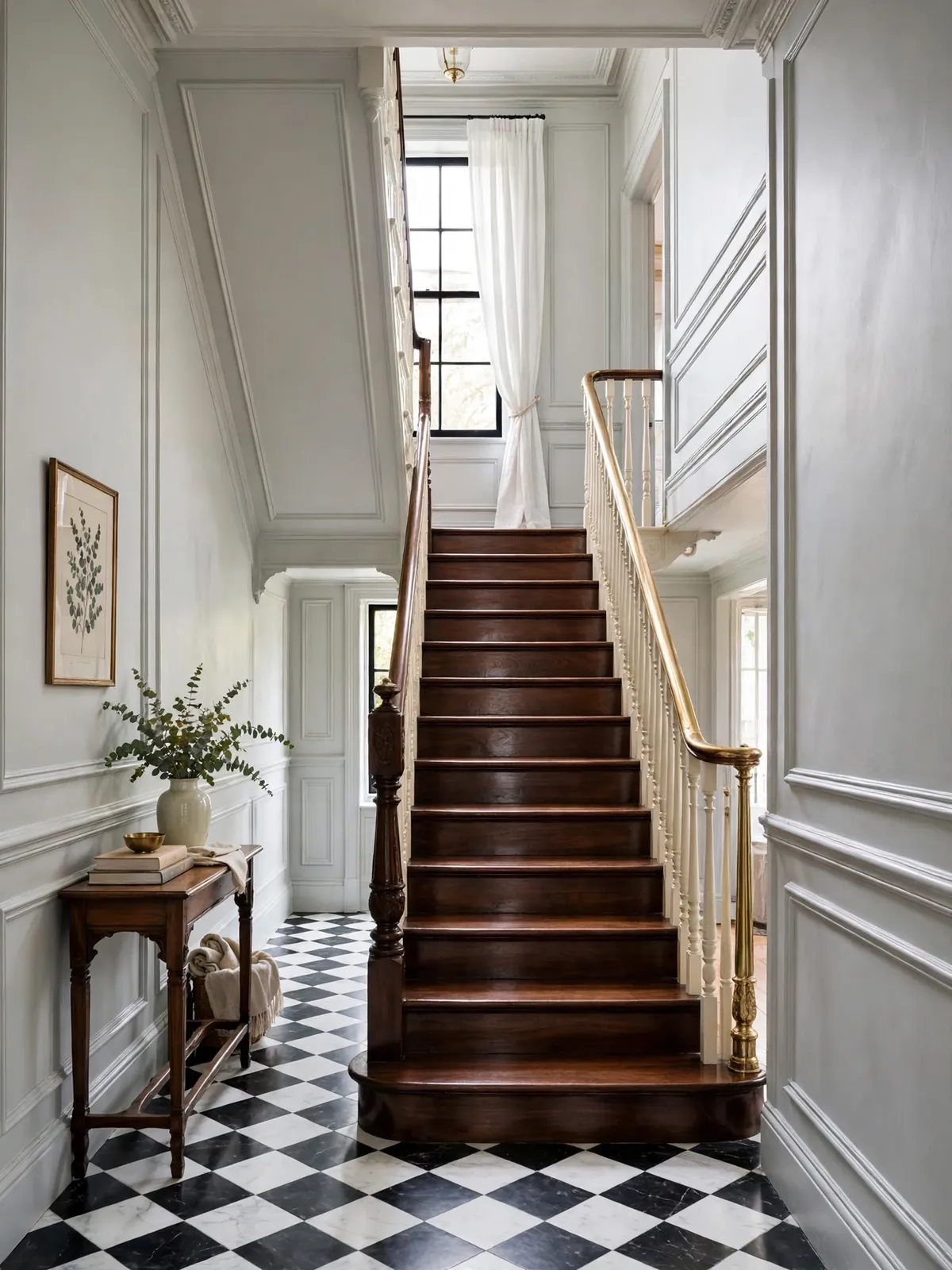
Dark wood treads with light painted spindles are the most balanced Victorian combination, because the contrast brightens the staircase while keeping its depth. Here, deep walnut treads sit beneath soft cream spindles, with pale grey walls and a brass handrail tying the look together. The idea suits homes that want heritage vibes without feeling heavy, it feels both fresh and traditional, and it works with moody walls, neutral décor or modern art nearby. The weakness is upkeep — painted spindles show scuffs faster than stained wood — so use a tough satin paint and keep a small tin for touch-ups.
Quick tips:
- Paint spindles soft white or cream, keep treads dark.
- Use a tough satin paint on the spindles.
- Pair the combination with a brass handrail.
- Match the tread timber to the handrail for cohesion.
A Ceiling Medallion Above the Stairwell
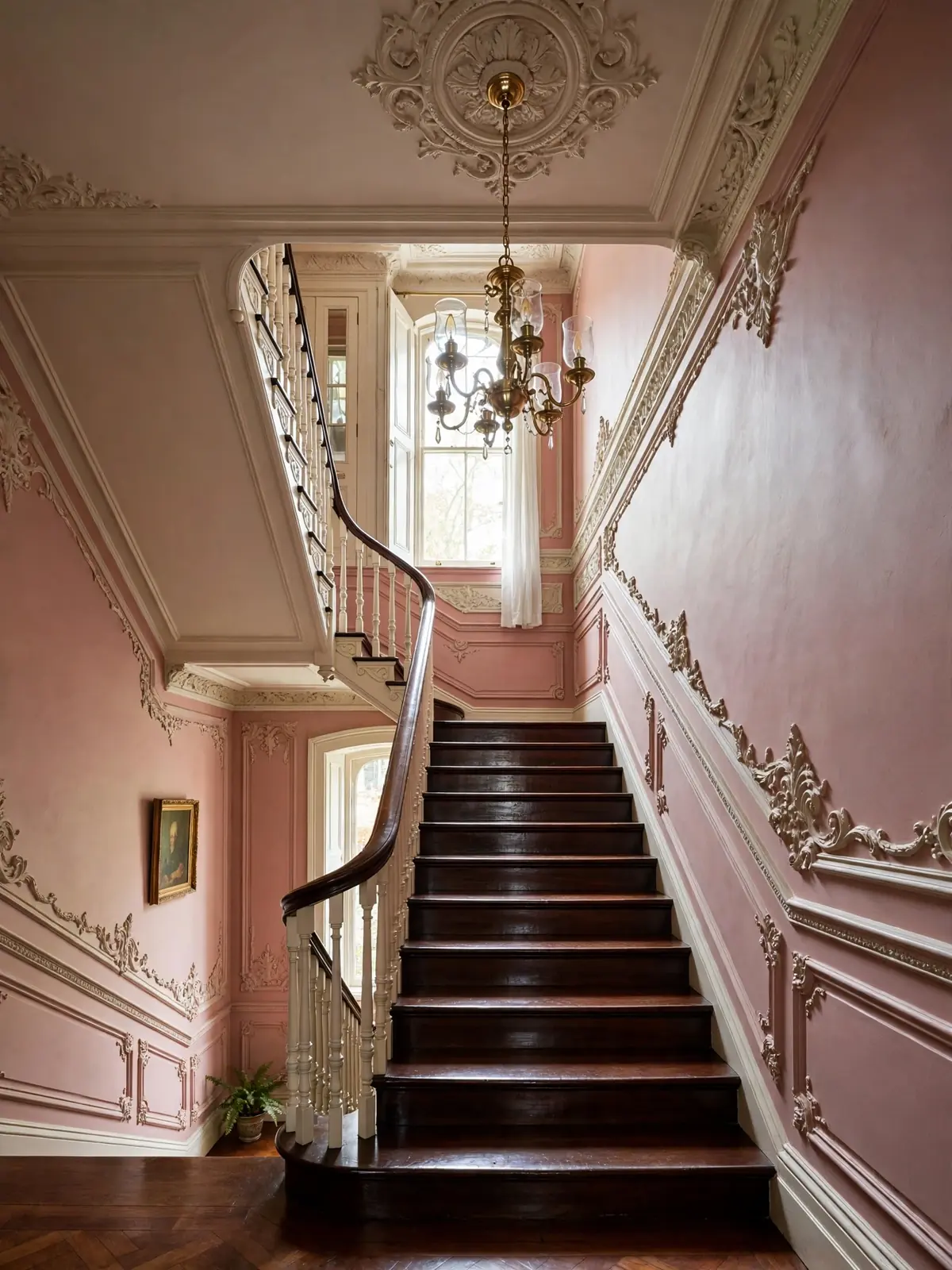
A ceiling medallion above the stairwell is a detail the Victorians never skipped, because they paid attention to ceilings and a decorative medallion around the light fixture completes the room. Here, an ivory plaster medallion frames a brass chandelier above a stair with dark wood treads and soft dusty-rose walls. The idea suits any stairwell with a pendant or chandelier, it is a weekend project, and the impact is timeless. The weakness is scale — a medallion too small looks lost, too large looks heavy — so measure the chandelier and choose a medallion slightly wider than its canopy, and use adhesive and caulk for a clean fit.
Quick tips:
- Choose a medallion slightly wider than the light canopy.
- Use adhesive, a level and painter’s caulk for a clean fit.
- Keep the chandelier simple so the medallion shines.
- Paint the medallion ivory with a gold edge for a historic feel.
A Built-In Nook With Vintage Seating
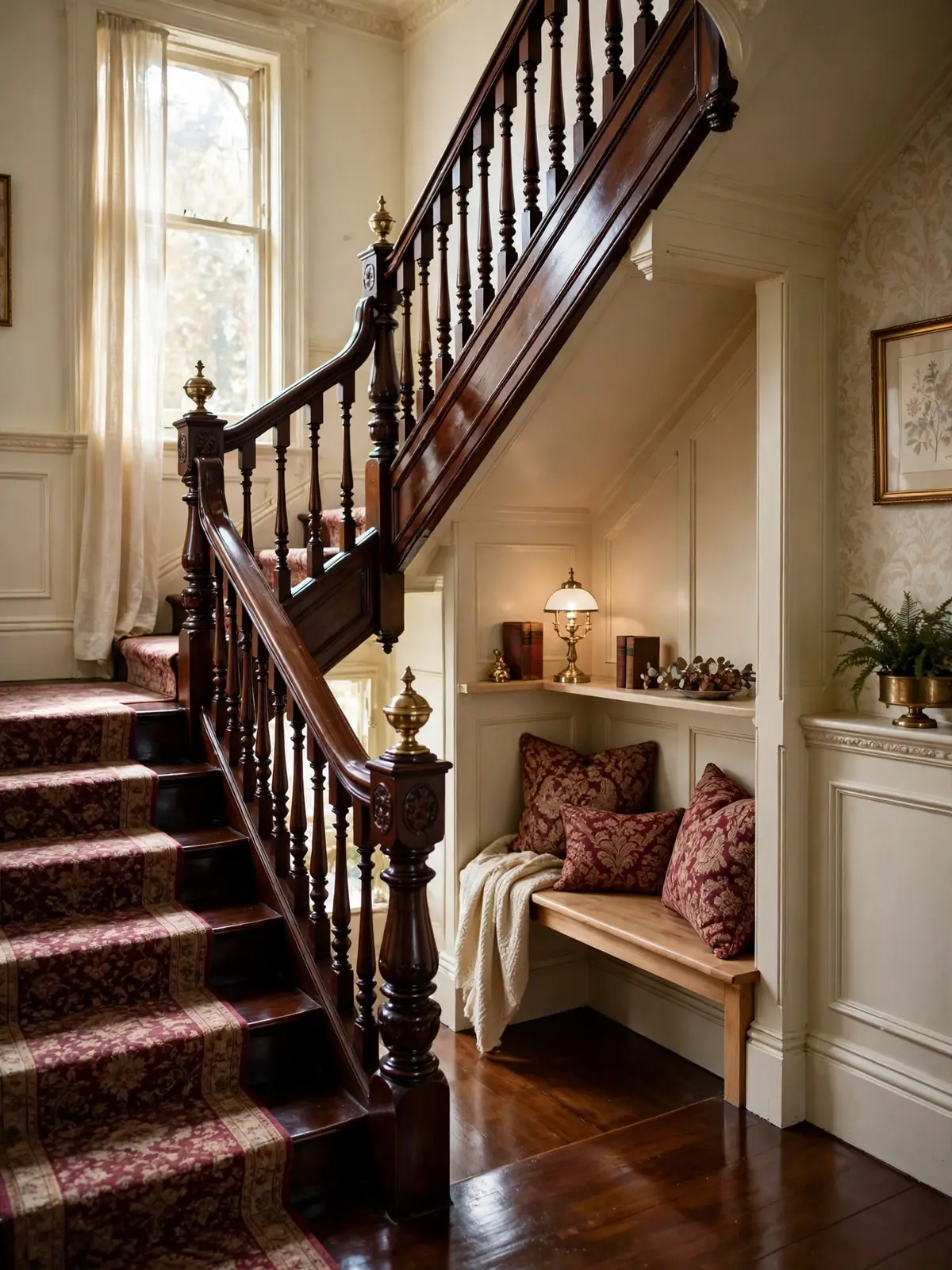
A built-in nook with vintage seating turns an awkward stair corner into a romantic pause point, because a slim bench with patterned cushions and a tiny side table makes the staircase a moment rather than a pass-through. Here, a narrow wooden bench with burgundy patterned cushions sits in the stair corner, with a small brass lamp and a few books, against soft cream walls. The idea suits stairs with an awkward corner, it feels intentional and intimate, and it is a simple weekend project. The weakness is space — the nook needs enough depth for a bench without blocking the walk — so measure first and keep the styling minimal.
Quick tips:
- Measure the available space before installing the bench.
- Use Victorian-inspired fabric for the cushions.
- Add a small lamp or a few books for styling.
- Keep the bench narrow so the walkway stays clear.
The Whole Staircase Painted a Deep Moody Hue
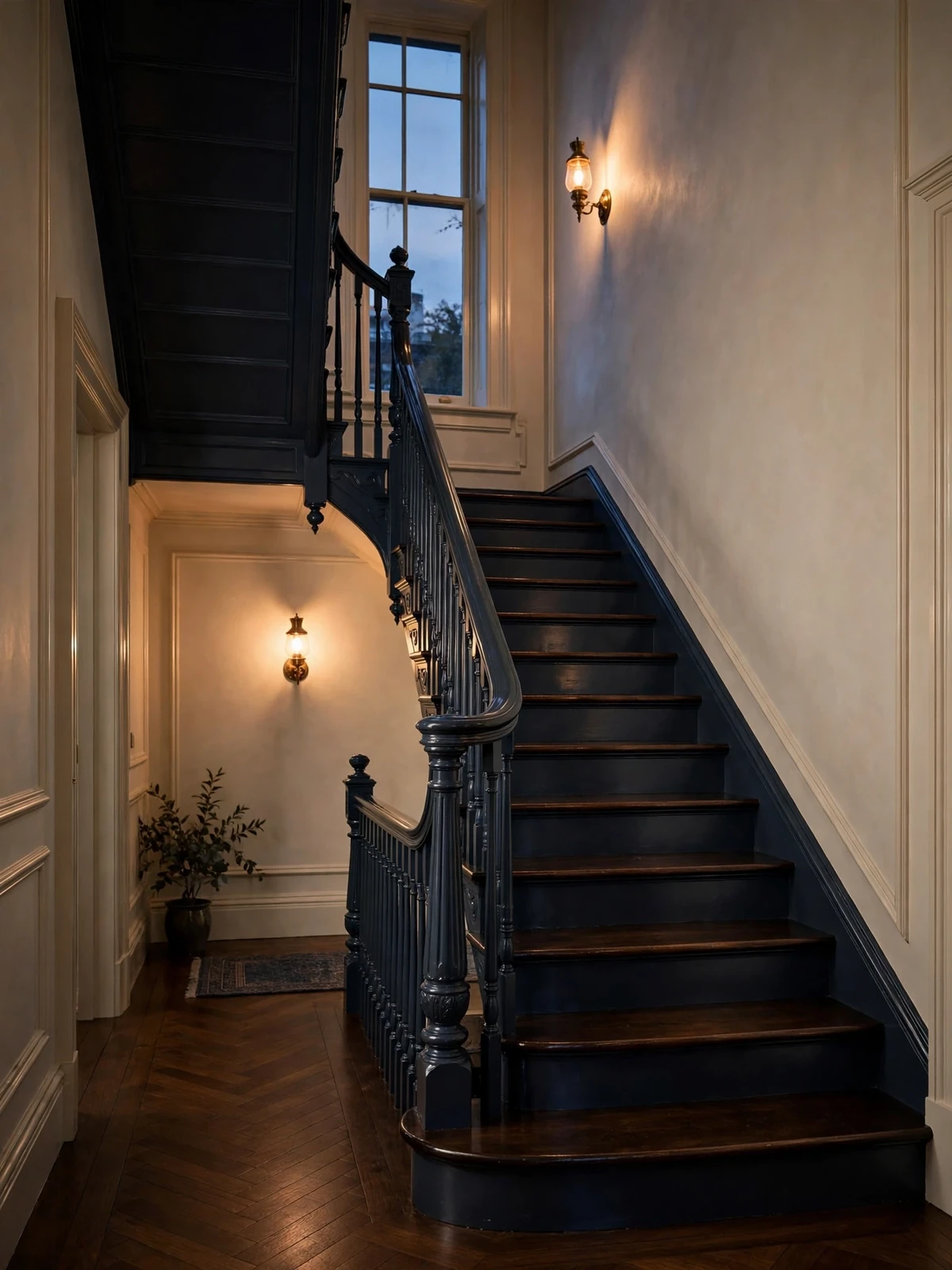
Painting the whole staircase a deep moody hue is the boldest Victorian move, because charcoal, navy or deep green on the railing, spindles and trim creates drama that feels historic and intimate. Here, a charcoal navy staircase stands against soft cream walls, with brass sconces warming the dark paint. The idea suits confident homeowners, it photographs beautifully, and it makes the stair the centrepiece of the hall. The weakness is that flat paint looks dull and poor preparation shows — so use a satin or semi-gloss finish, test swatches first, and prepare the wood properly before painting.
Quick tips:
- Use satin or semi-gloss finish, never flat paint.
- Test swatches in the stair light before committing.
- Prepare the wood properly — sand and prime first.
- Balance the dark stair with pale walls.
Stained Glass at the Landing Window
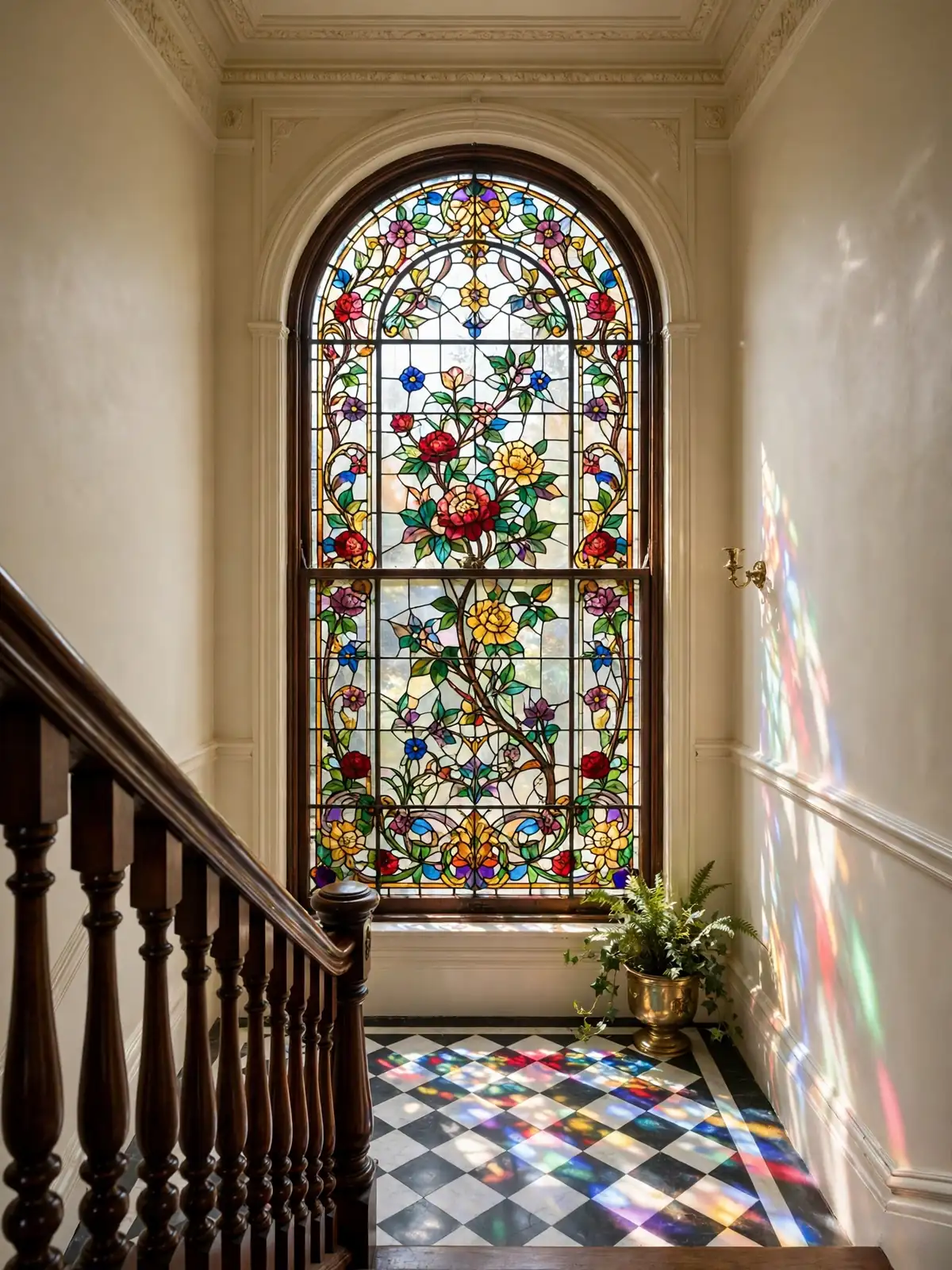
Stained glass at the landing window is a Victorian dream, because floral motifs and geometric patterns in coloured glass turn ordinary daylight into shifting colour across the stair wall. Here, a stained glass panel with roses and leaves fills the landing window, with soft cream walls and a dark walnut handrail below. The idea suits any stair with a window nearby, it needs no structural work, and even a small panel transforms the whole stairwell mood. The weakness is cost — real leaded glass is expensive — so a good-quality film or a small panel is a sensible compromise, and Victorian stained glass often used symbolic flowers, so choose motifs with meaning.
Quick tips:
- Choose floral or geometric patterns for classic Victorian feel.
- Try one small panel first if full glass is too costly.
- Keep the surrounding walls pale so the colours glow.
- Clean stained glass gently with a soft cloth.
Heavy Velvet Drapery at the Stair Window
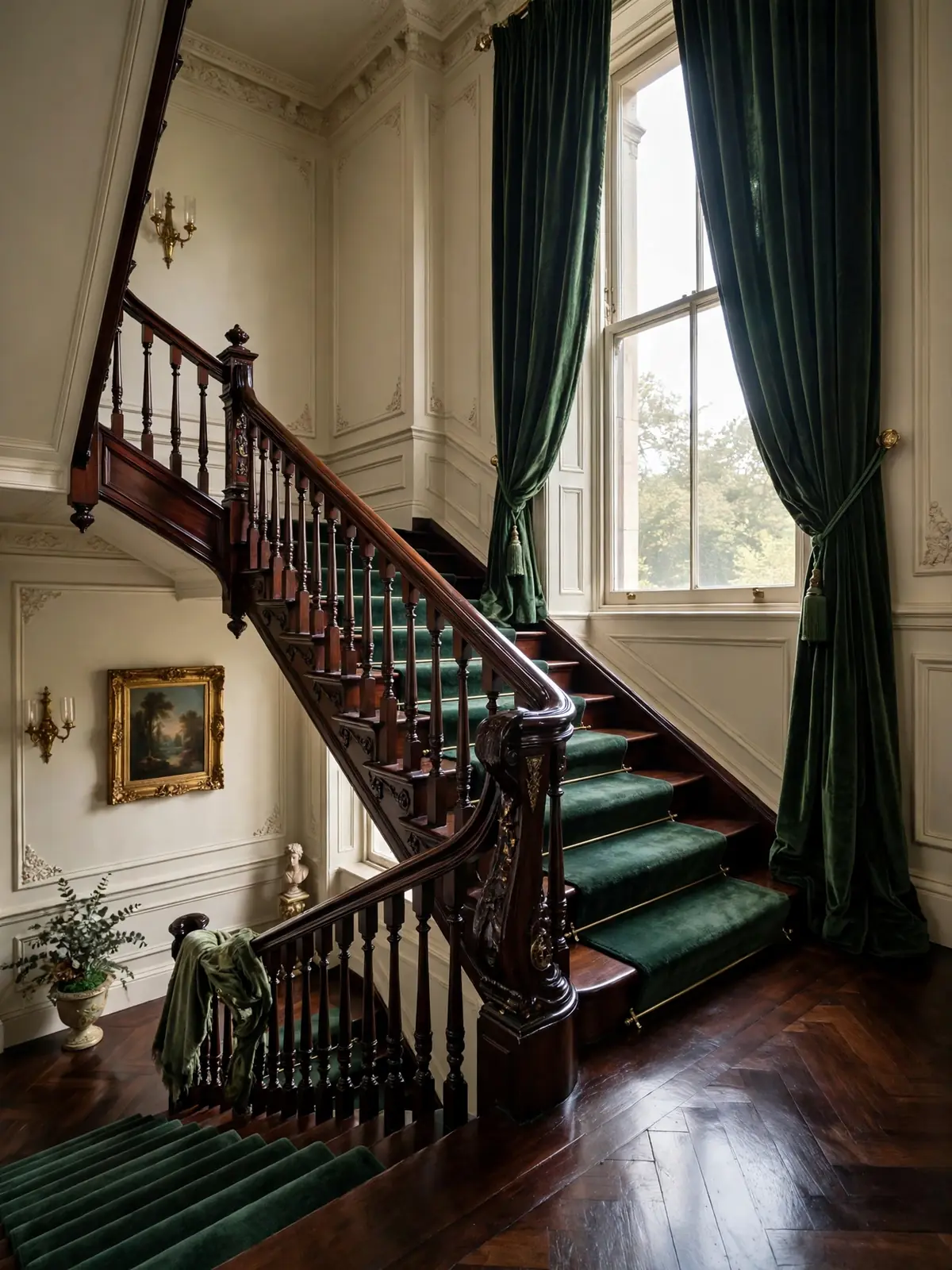
Heavy velvet drapery at the stair window adds theatre to a Victorian staircase, because deep burgundy or emerald velvet pooling slightly at the floor makes the stairwell feel like a grand house. Here, emerald velvet curtains with brass tiebacks frame a tall landing window, with soft cream walls and dark wood treads below. The idea suits homes with large stair windows, it insulates against draughts, and it brings colour and softness to hard wood and plaster. The weakness is upkeep — velvet collects dust and needs dry cleaning — and it can darken a small stairwell, so keep it for stairwells with generous light.
Quick tips:
- Let the velvet pool slightly at the floor for drama.
- Use brass tiebacks to hold the curtains in shape.
- Choose deep burgundy or emerald for Victorian luxury.
- Vacuum velvet gently to keep dust down.
Decorative Newel Post Finials
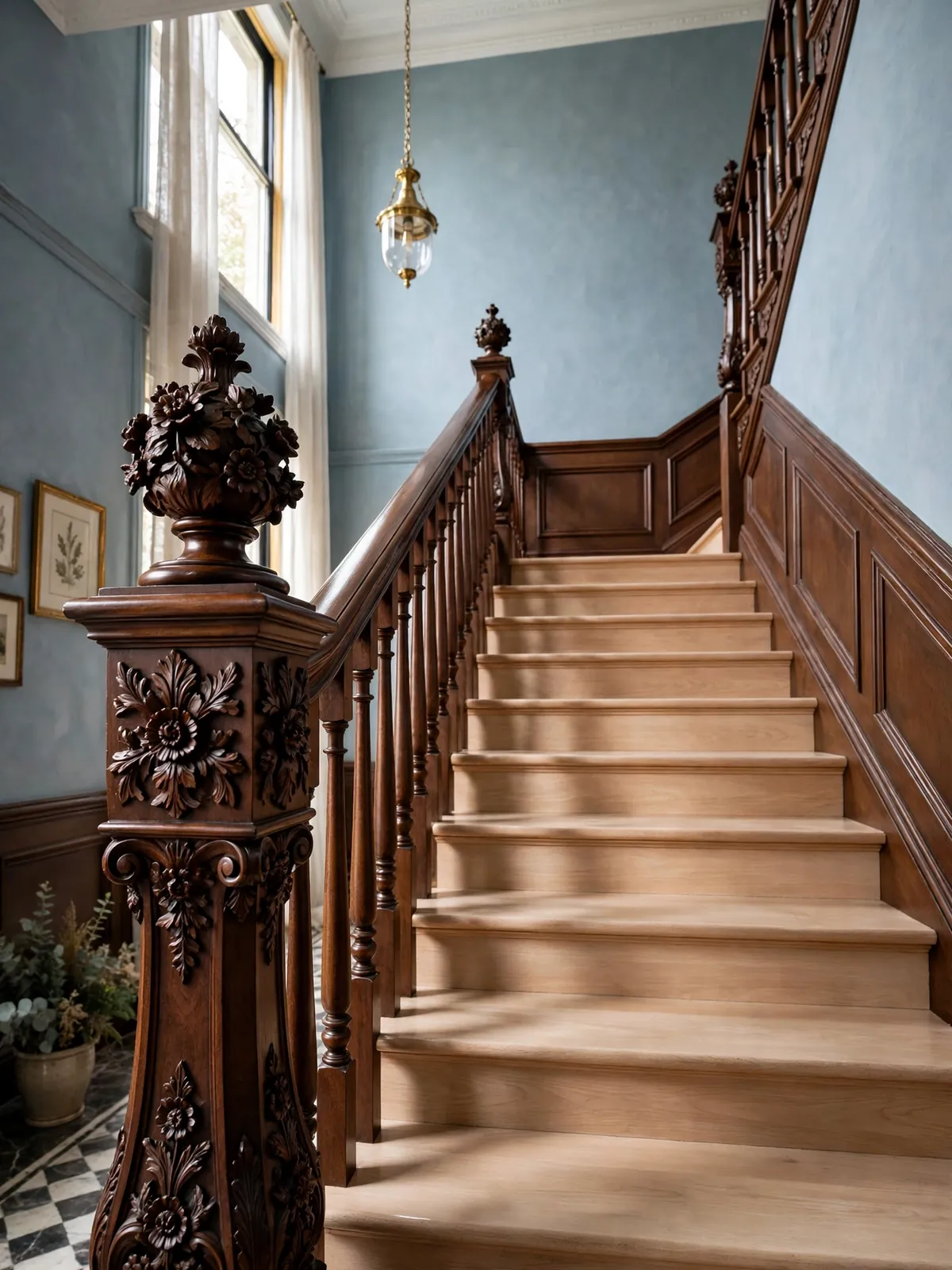
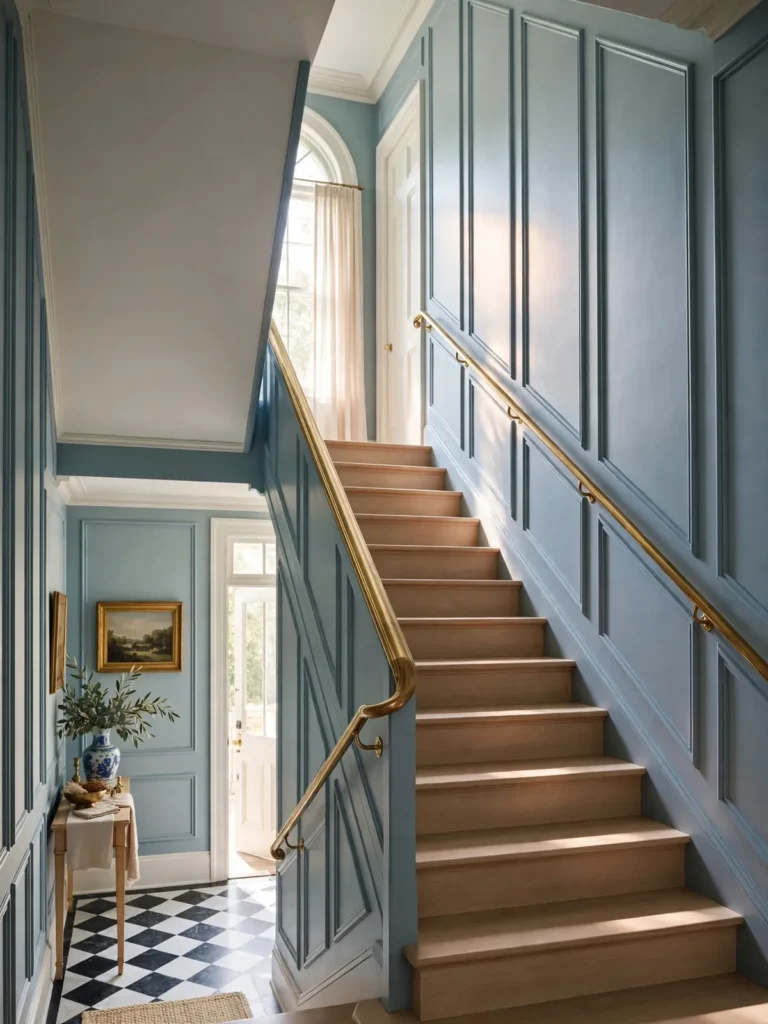
Decorative newel post finials are prime real estate for Victorian detail, because swapping plain caps for carved finials — floral, acorn or turned wood shapes — adds sophistication to the most visible point of the stair. Here, carved floral finials crown dark walnut newel posts, against soft dusty-blue walls and pale oak treads. The idea suits any Victorian stair, it is a small and affordable upgrade, and it shows that the details matter as much as the big gestures. The weakness is that most people overlook these small features — so choose finials that match the banister carving, and keep them in proportion to the newel post.
Quick tips:
- Match the finial carving to the banister.
- Choose floral, acorn or turned wood shapes.
- Keep the finial in proportion to the newel post.
- Oil the finials when you oil the handrail.
Floral and Stripe Patterns Mixed Together
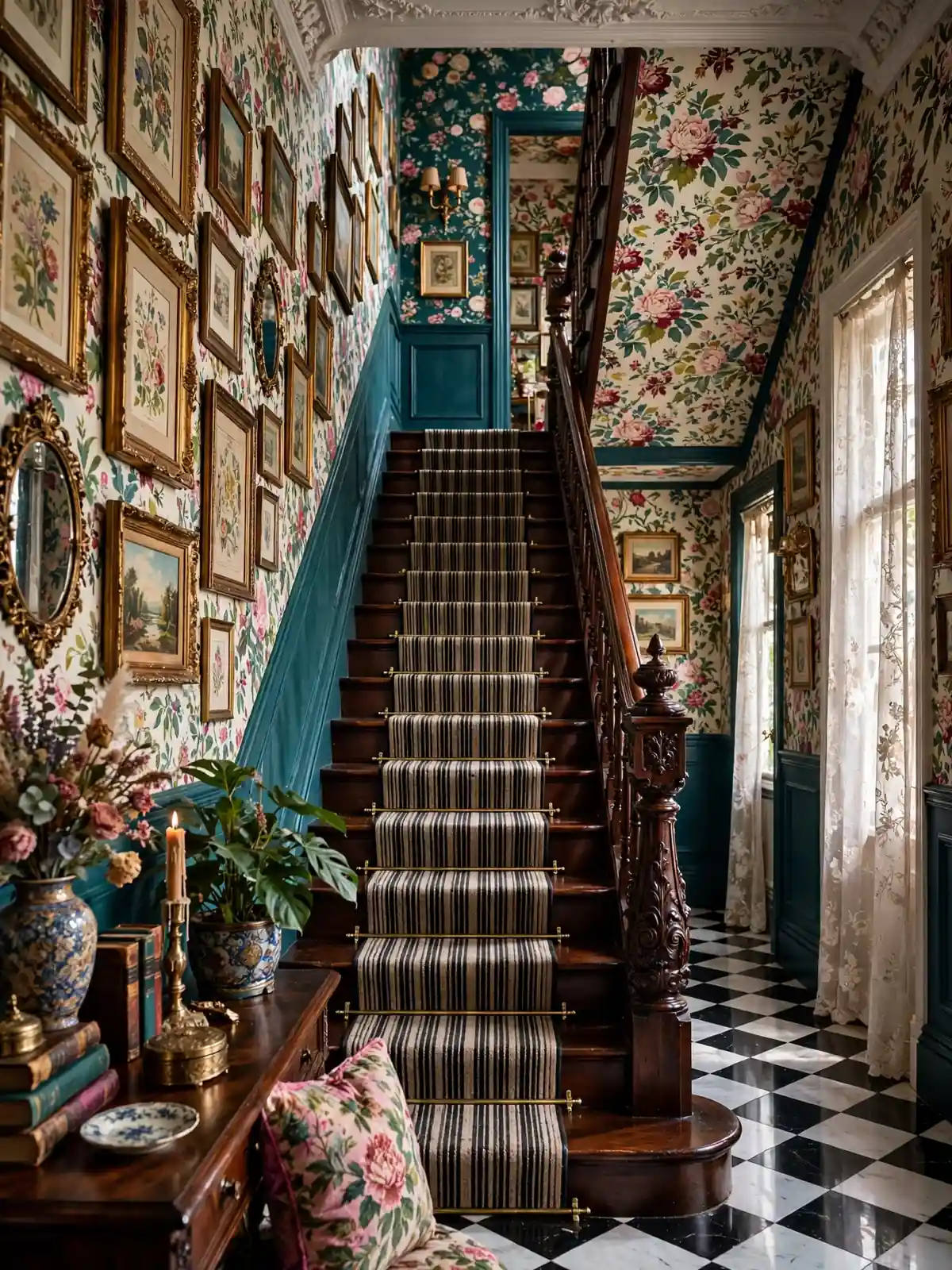
Mixing floral and stripe patterns is authentically Victorian, because the Victorians loved pattern and mixed it freely — a striped runner with floral wallpaper, or floral carpet with striped upholstery nearby. Here, a striped runner climbs dark wood treads beside deep teal floral wallpaper, held by brass stair rods. The idea suits confident maximalists, it feels layered rather than chaotic, and it is the fastest way to make a stair feel period-correct. The weakness is that it only works if the colour palette stays consistent — so keep the colours the same even as the patterns vary, and introduce one pattern at a time.
Quick tips:
- Keep the colour palette consistent across patterns.
- Pair a striped runner with floral wallpaper.
- Introduce one pattern at a time.
- Repeat one colour in both patterns for cohesion.
Decorative Wall Panels With Gold Accents
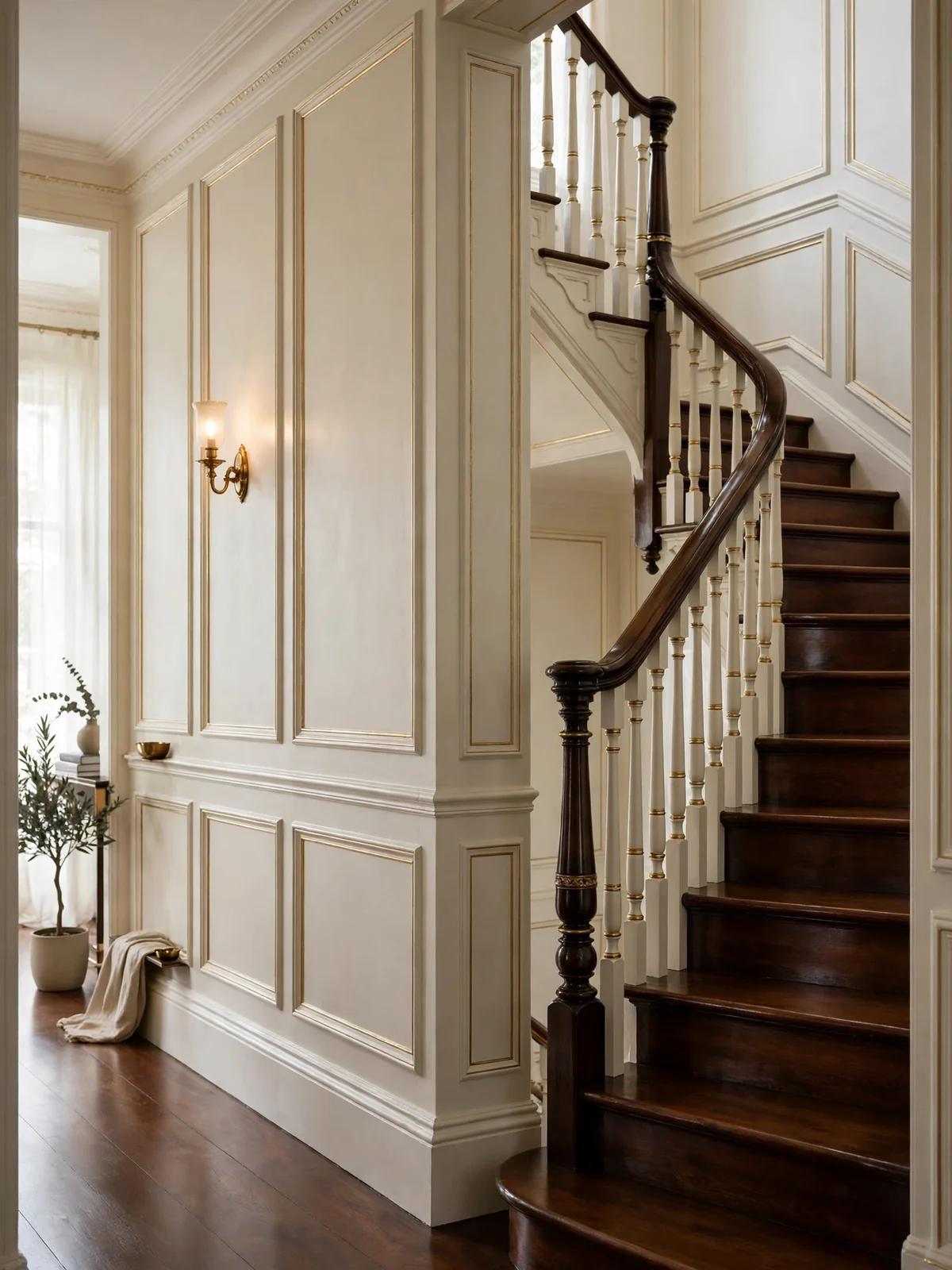
Decorative wall panels with gold accents feel incredibly Victorian, because panel moulding with a light brush of gold paint over the edges gives the stair wall a subtle shimmer. Here, ivory panel moulding with gold-edged details runs up the stair wall, with dark wood treads and a brass sconce nearby. The idea suits any traditional home, it is affordable luxury — panel moulding, gold paint and a weekend of DIY — and it makes the staircase feel like art. The weakness is overdoing the gold — too much looks gaudy — so brush it lightly over the edges only, and keep the rest of the wall calm.
Quick tips:
- Brush gold paint lightly over the panel edges only.
- Use panel moulding for a formal, structured look.
- Keep the wall colour soft so the gold glows.
- Match the gold tone to a sconce or pendant nearby.
Hidden Storage Beneath the Staircase
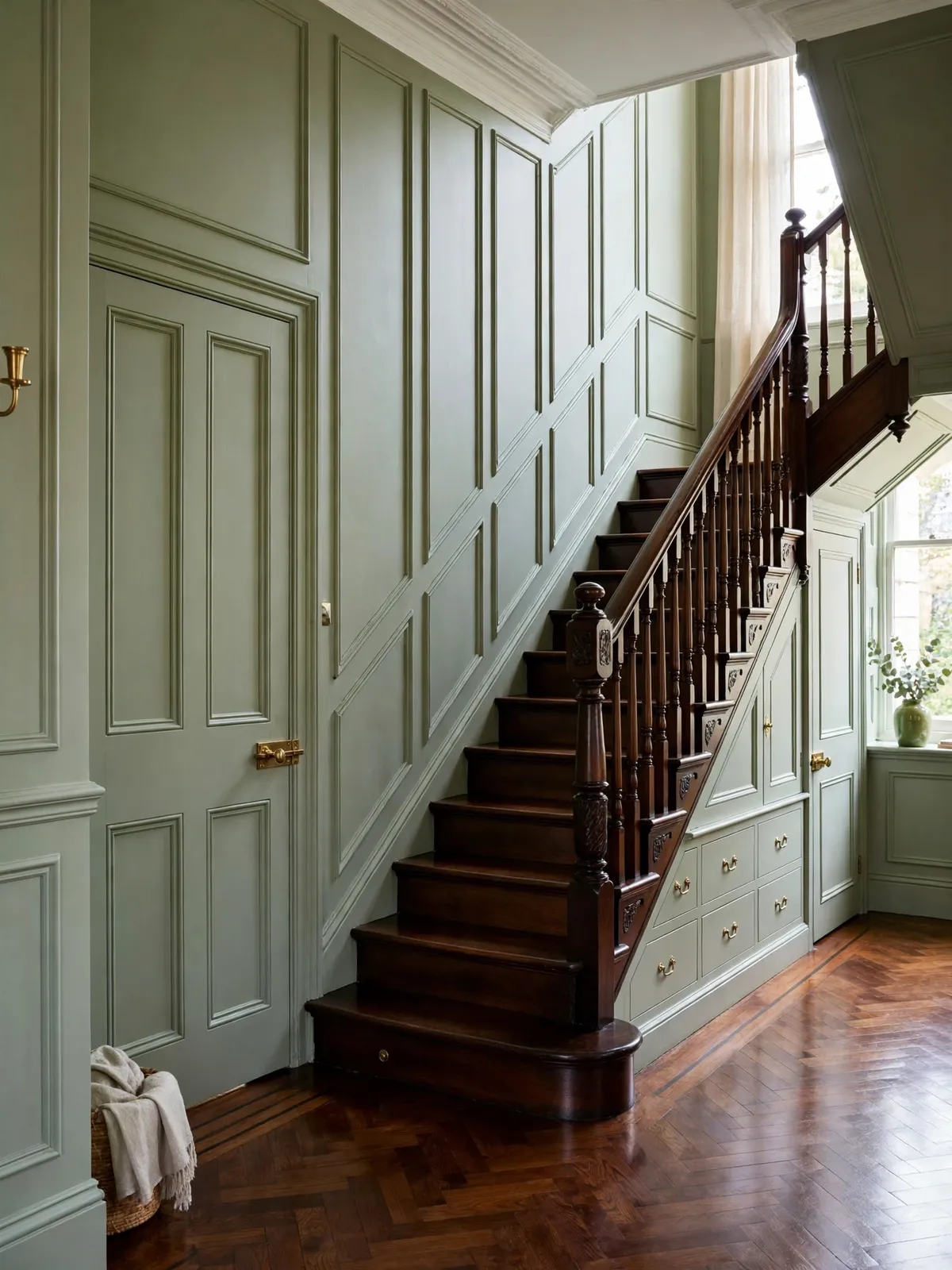
Hidden storage beneath a Victorian staircase proves the Victorians were practical too, because concealed cabinets behind panelled doors store shoes, linens and seasonal décor while preserving the elegant façade. Here, panelled doors that match the wall hide shallow drawers and cabinets, with brass handles, against soft sage-green walls. The idea suits any home, it keeps clutter out of sight, and it looks seamless when the doors blend with the wall. The weakness is depth — deep cabinets hide things — so install shallow drawers that pull out fully instead of deep cabinets, and label the interiors.
Quick tips:
- Blend the doors with the wall panelling.
- Install shallow drawers that pull out fully.
- Use brass handles that match the stair hardware.
- Label the interiors so nothing gets lost.
Patterned Tile on the Stair Risers
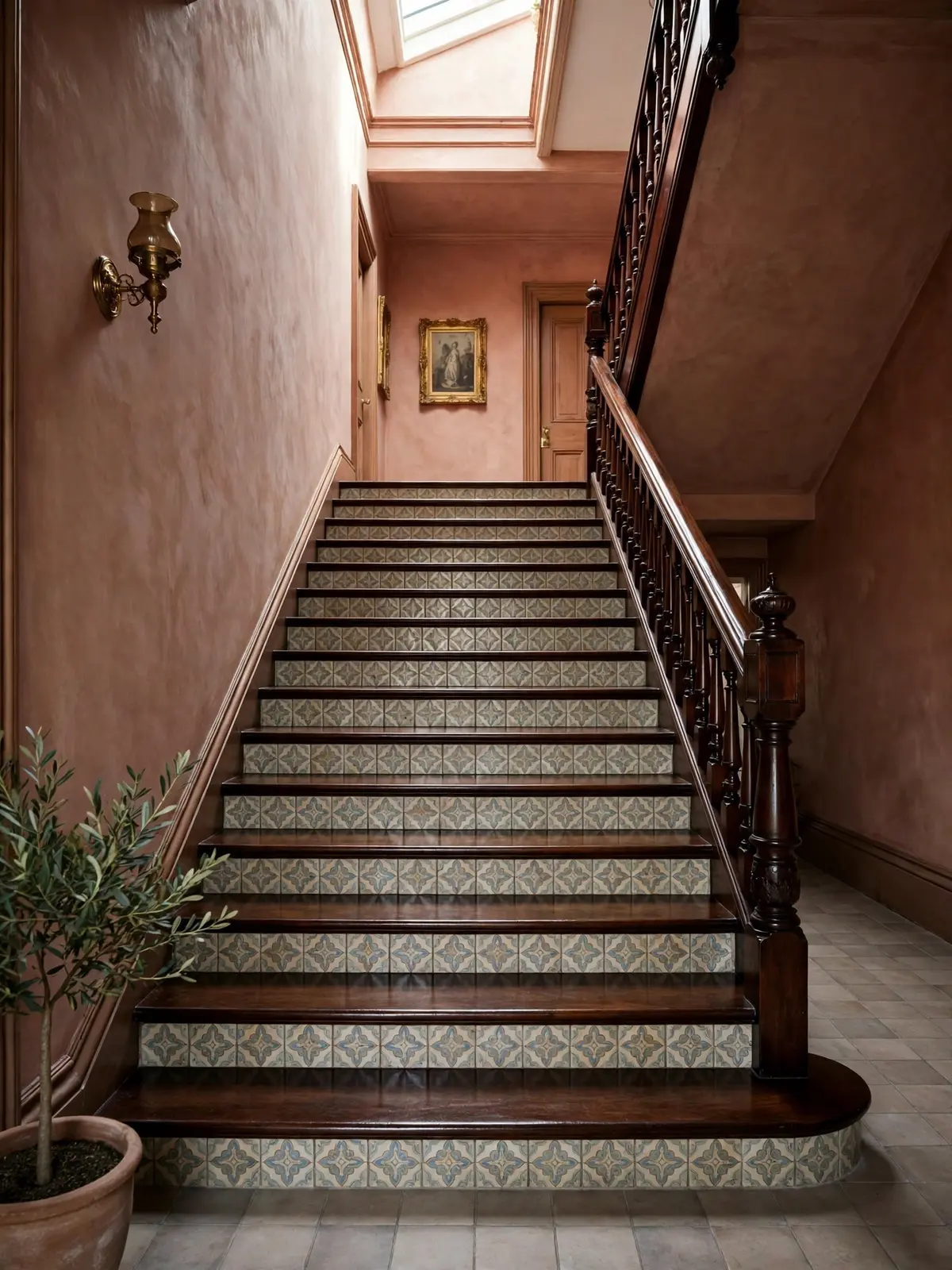
Patterned tile on the stair risers adds colour, texture and permanence to a Victorian staircase, because ceramic tiles feel slightly Mediterranean yet still fit Victorian eclecticism. Here, muted patterned tiles cover the risers, with dark wood treads and soft terracotta walls around them. The idea suits entries and hallways, it is easy to clean, and it lasts far longer than paint. The weakness is that tile adds more pattern to an already patterned style — so choose muted tones if you want subtle, or bold contrasting patterns if you want drama, and never mix too many patterns at once.
Quick tips:
- Choose muted tones for a subtle look, bold for drama.
- Seal the tiles so scuffs wipe off easily.
- Keep the treads plain wood so the tiles stay the feature.
- Repeat one tile colour on a nearby cushion or frame.
Decorative Carpet Tacks Along the Runner
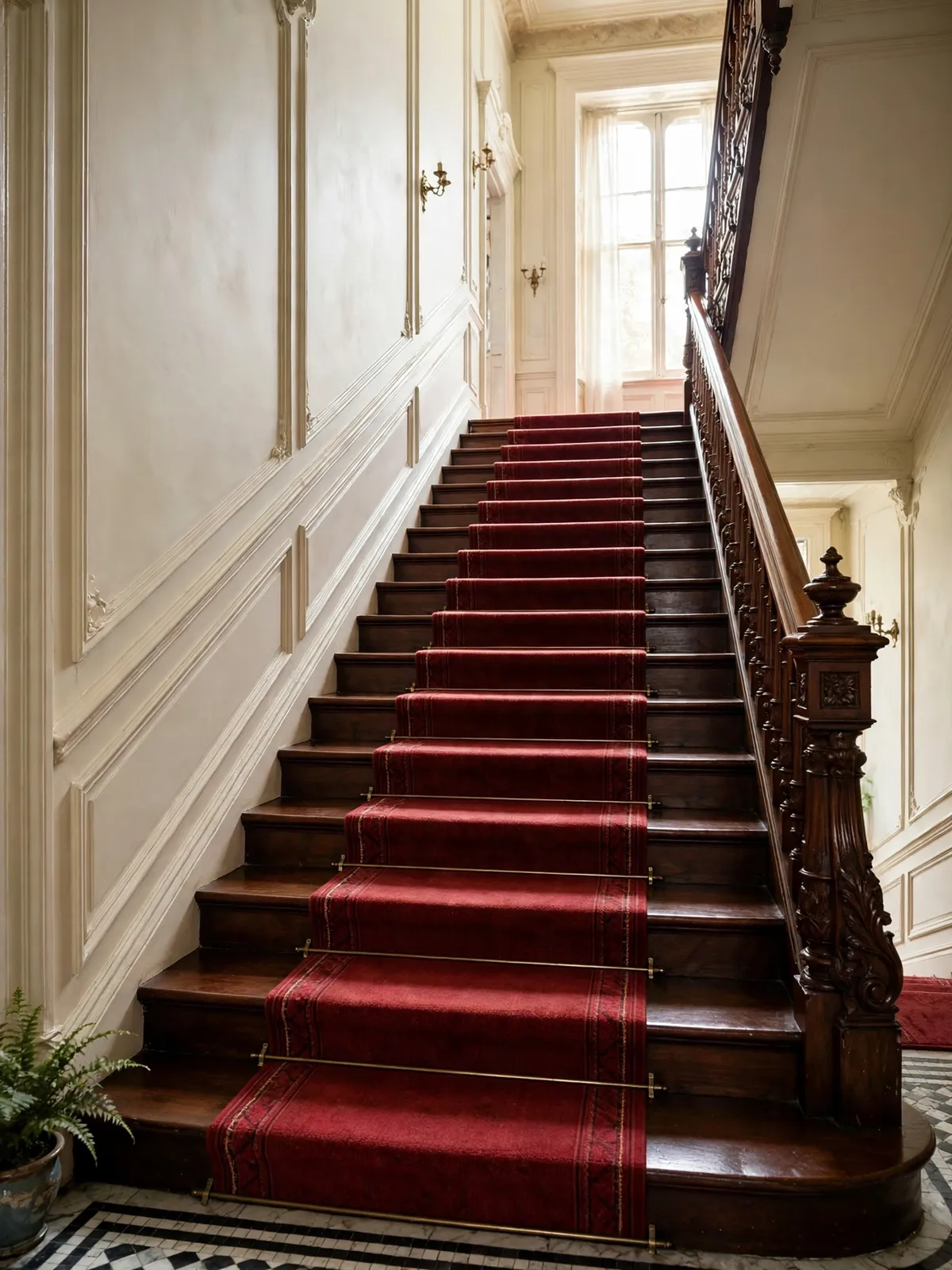
Decorative carpet tacks along the runner are a tiny detail most guests will never notice consciously, yet they elevate a Victorian stair, because evenly spaced brass tacks add texture and an old-fashioned craftsmanship feel. Here, brass tacks line the edges of a deep red runner on dark wood treads, against soft cream walls. The idea suits any Victorian stair with a runner, it costs almost nothing, and it is the kind of layer that makes Victorian design feel rich. The weakness is that it only works with a runner — and even then, the tacks must be evenly spaced, or the effect looks careless.
Quick tips:
- Space the tacks evenly along the runner edges.
- Choose brass tacks to match the stair rods.
- Use a low-pile runner so the tacks sit flat.
- Pair the tacks with brass stair rods for maximum effect.
Botanical Prints in Ornate Frames
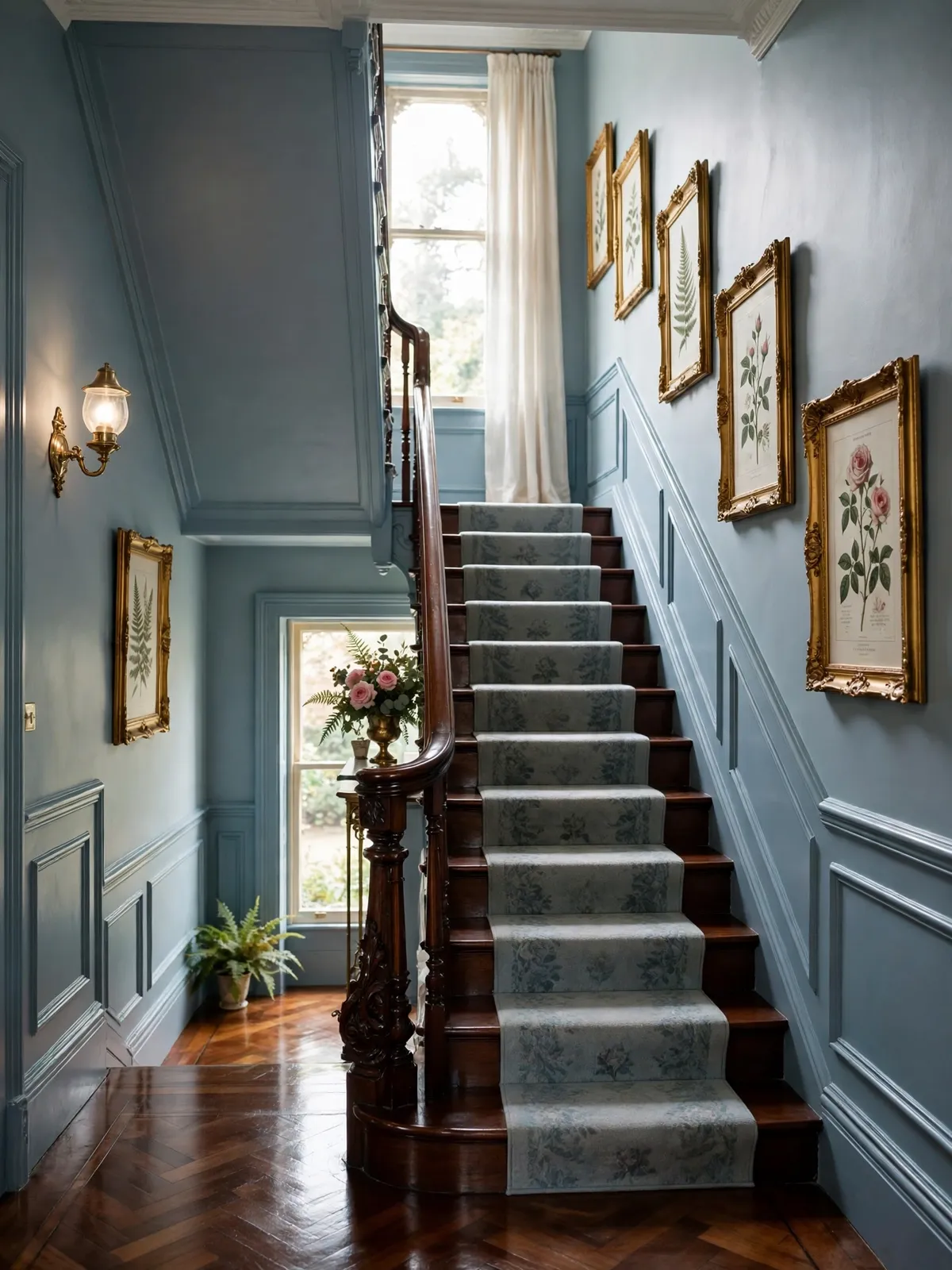
Botanical prints in ornate frames soften a Victorian staircase, because ferns, roses and wildflowers in gilded or dark wood frames bring greenery into a room full of heavy wood and rich colour. Here, botanical illustrations climb the stair wall in gilded frames, against soft dusty-blue walls and dark wood treads. The idea suits any Victorian stair, it works especially well where jewel tones are already in use, and it is a cheap way to add art. The weakness is that botanical prints need a consistent frame style — mixing too many frame colours looks messy — so keep the frames gilded or dark wood and let the greenery do the softening.
Quick tips:
- Keep frames gilded or dark wood for consistency.
- Mix ferns, roses and wildflowers for variety.
- Hang the prints along the stair slope.
- Layer the prints with jewel-tone walls for depth.
A Runner With Tassel Fringe
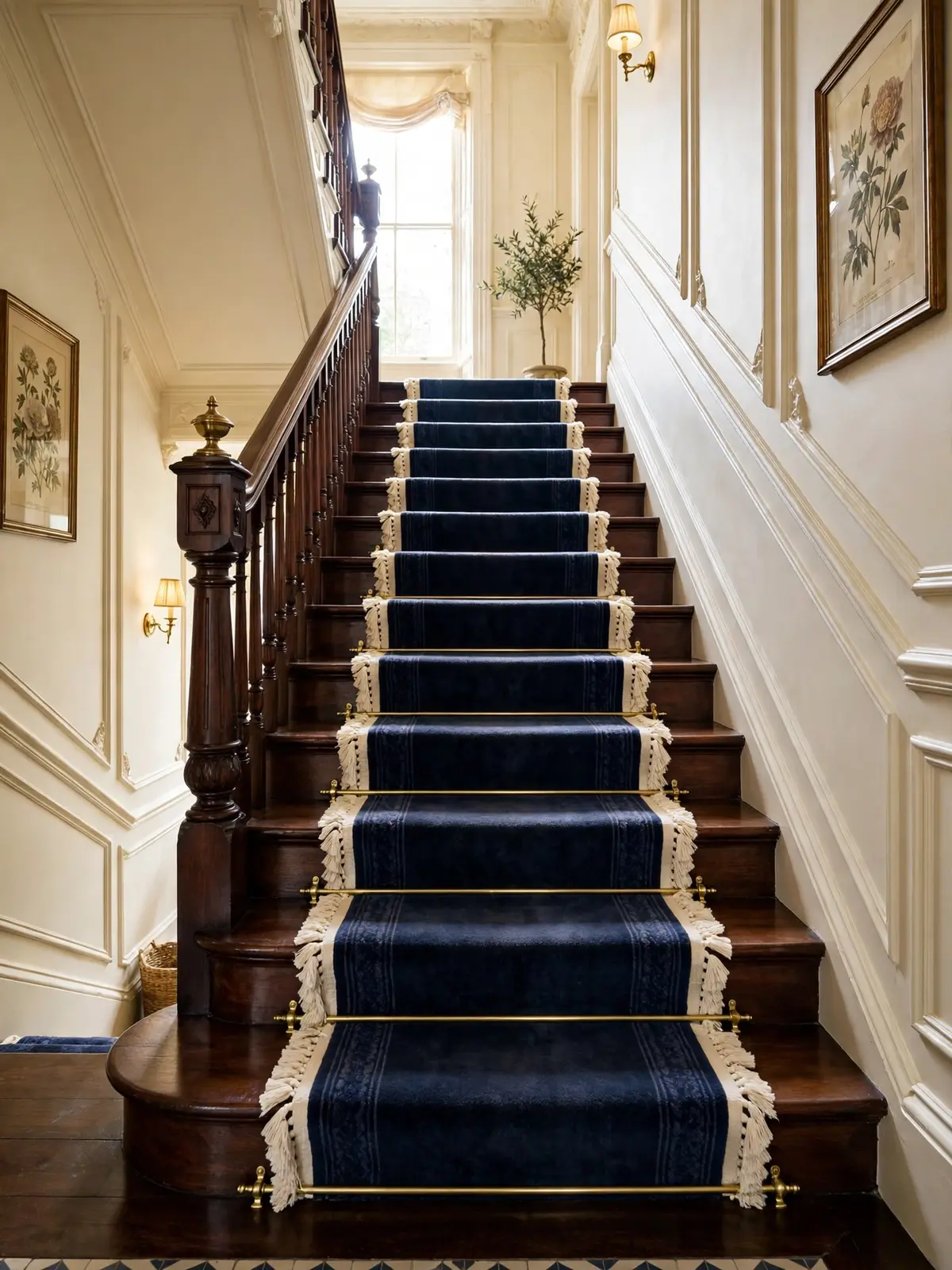
A runner with tassel fringe adds movement and softness to a Victorian staircase, because the fringe catches the light and makes the runner feel just a little indulgent. Here, a deep navy runner with cream tassel edges climbs dark wood treads, held by brass stair rods, against soft cream walls. The idea suits any Victorian stair with a runner, it pairs beautifully with brass rods, and it is a small change with a big effect. The weakness is cleaning — tassels trap dust and can fray — so vacuum them gently and choose a runner with a subtle tassel edge rather than a long, heavy fringe.
Quick tips:
- Choose a subtle tassel edge, not a long heavy fringe.
- Pair the runner with brass stair rods.
- Vacuum the tassels gently to keep them clean.
- Keep the runner pattern simple so the fringe shines.
A Faux Rug Painted Directly Onto the Steps
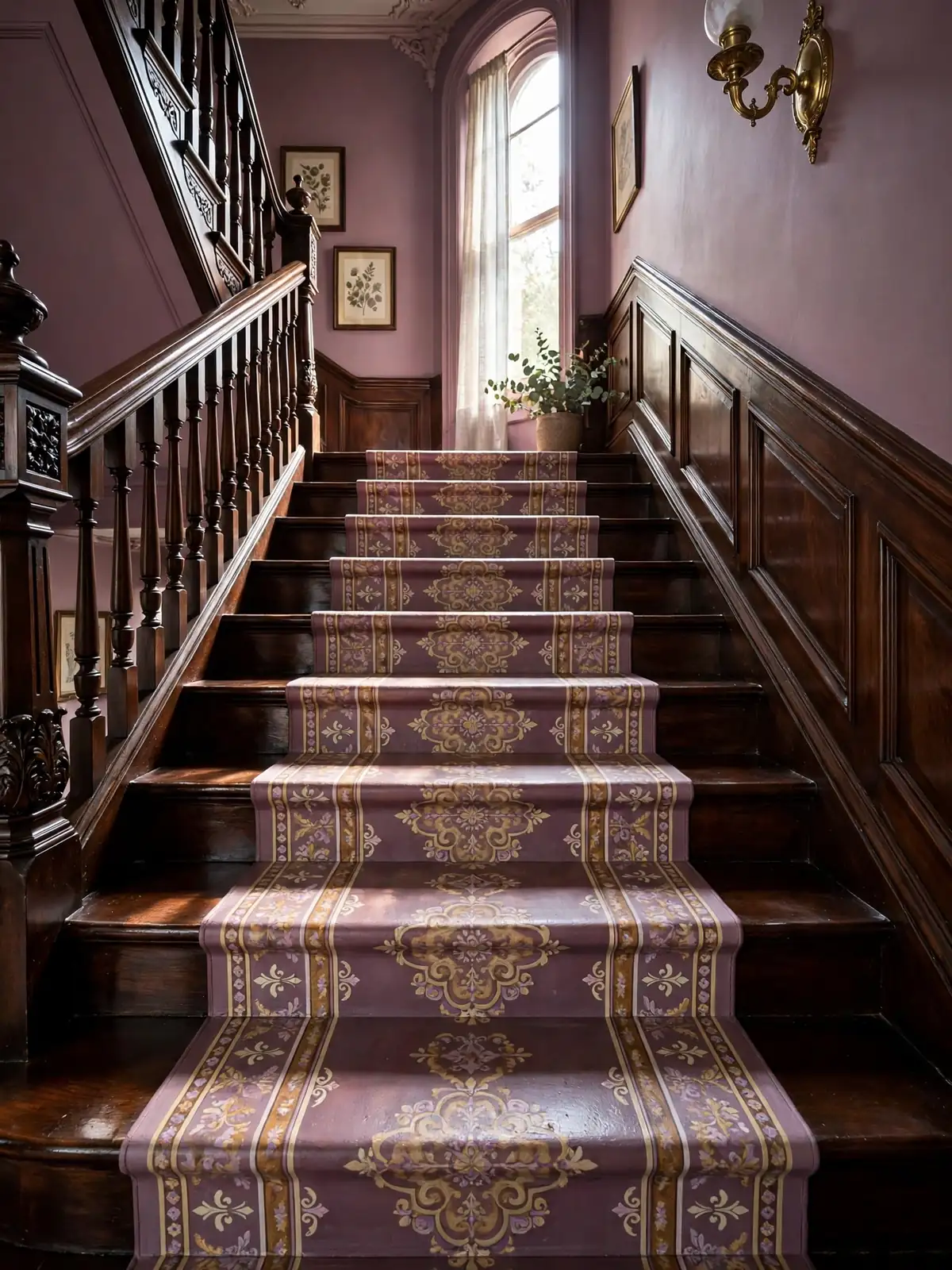
A faux rug painted directly onto the steps is the most creative Victorian idea, because instead of installing a runner, you paint a rug pattern down the centre of the staircase — an outlined border filled with repeating motifs — and seal it for durability. Here, a painted faux rug in deep red and cream runs down dark wood treads, against soft plum walls. The idea suits artistic homeowners, it is budget-friendly and totally custom, and unlike actual carpet you can change it whenever you crave something new. The weakness is skill — a faux rug needs a steady hand and a good sealant — so practise on a board first and seal it properly, because unsealed paint wears fast underfoot.
Quick tips:
- Practise the pattern on a board before painting the steps.
- Outline a border first, then fill with repeating motifs.
- Seal the paint properly for durability.
- Keep the pattern simple — complexity wears badly.
A Grand Chandelier Over the Stairwell
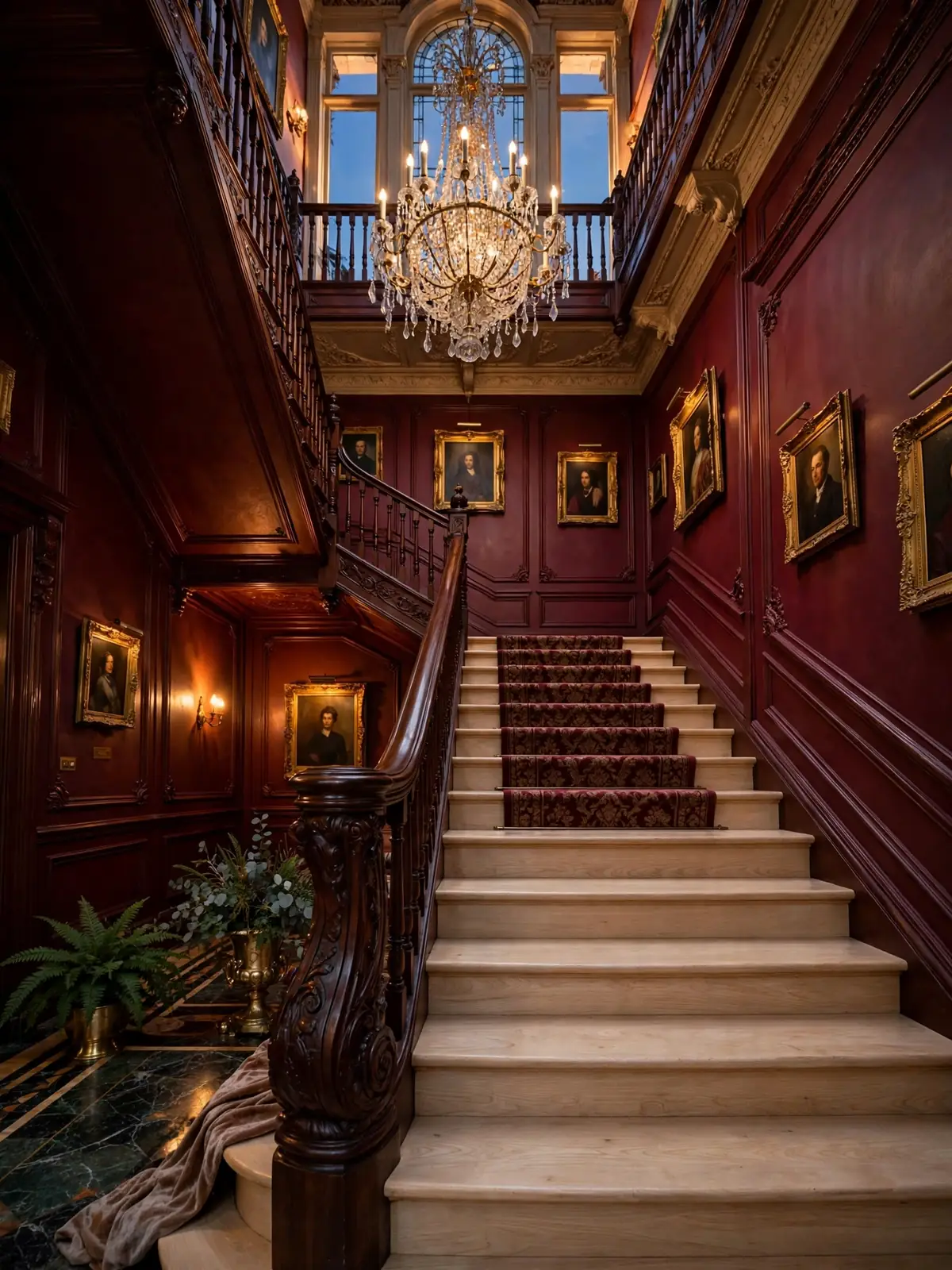
A grand chandelier over the stairwell is the crown of a Victorian staircase, because crystal and candlelight falling down a double-height stairwell make the whole house feel like a grand hotel. Here, a crystal chandelier hangs above a stair with a dark walnut handrail and pale oak treads, against deep burgundy walls. The idea suits double-height entries, it makes the stair the centrepiece of the home, and it pairs beautifully with a ceiling medallion. The weakness is cost and cleaning — crystal needs regular dusting and the chandelier needs a proper ceiling fixing — so choose a size that fits the stairwell and keep the chain and canopy in proportion.
Quick tips:
- Choose a chandelier sized to the stairwell, not the room.
- Hang it low enough to be seen, high enough to walk under.
- Pair it with a ceiling medallion for a finished look.
- Dust the crystals monthly to keep the sparkle.
A Portrait Gallery Climbing the Stair Wall
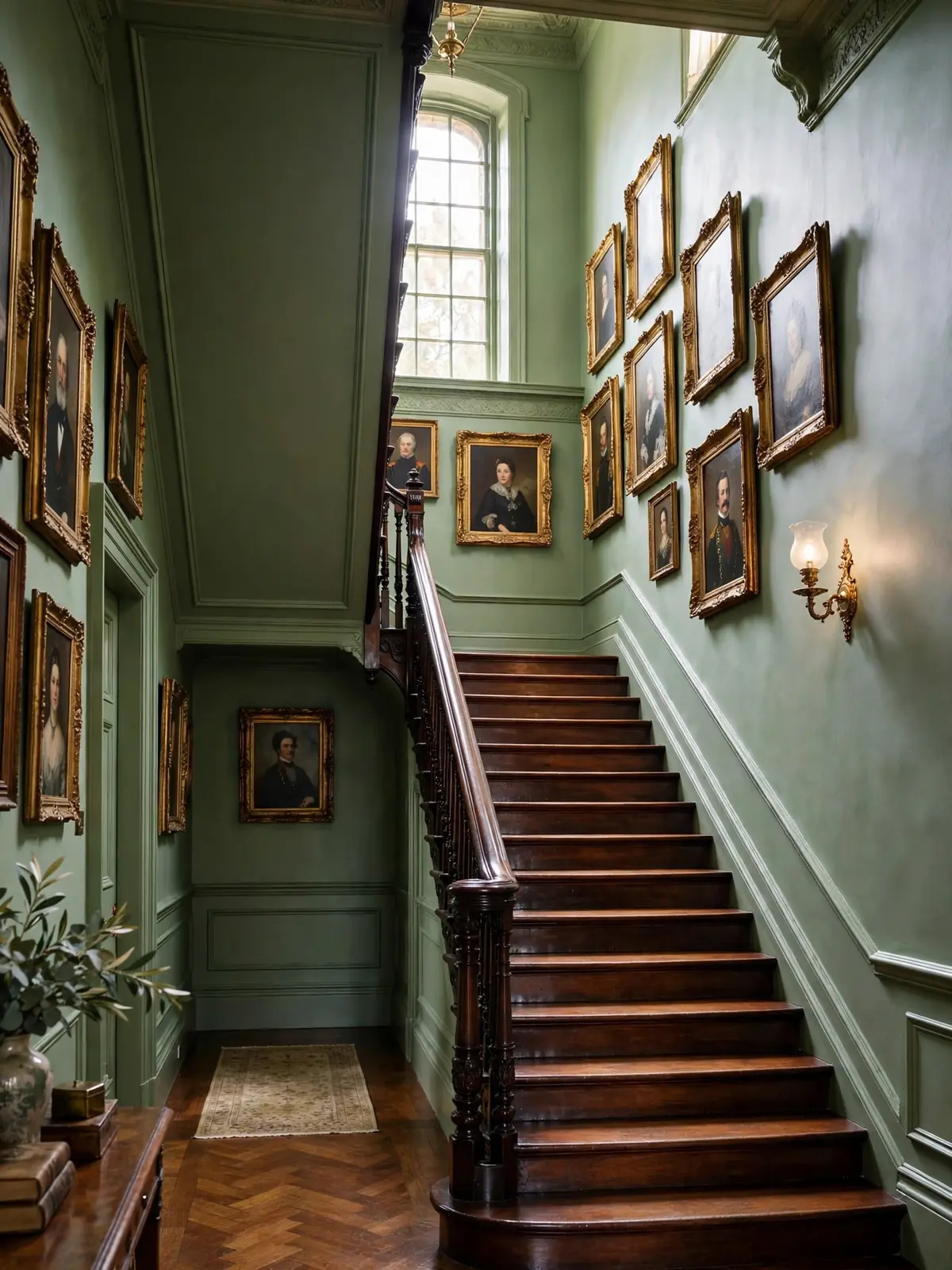
A portrait gallery climbing the stair wall is the most stately Victorian idea, because oil portraits in antique gold frames following the slope make the stair feel like a country house corridor. Here, portraits in mixed antique gold frames climb the stair wall, against soft forest-green walls and dark wood treads. The idea suits grand homes and anyone with portraits worth showing, it fills a tall wall beautifully, and it feels deeply traditional. The weakness is that portraits need the right scale — too small and they look lost on a tall wall — so use larger frames on the lower wall and keep the spacing even as they climb.
Quick tips:
- Use larger frames on the lower wall for scale.
- Keep spacing even as the portraits climb.
- Choose antique gold frames for a unified look.
- Mix portraits with a landscape or two for variety.
A Carved Wood Newel With a Globe Light
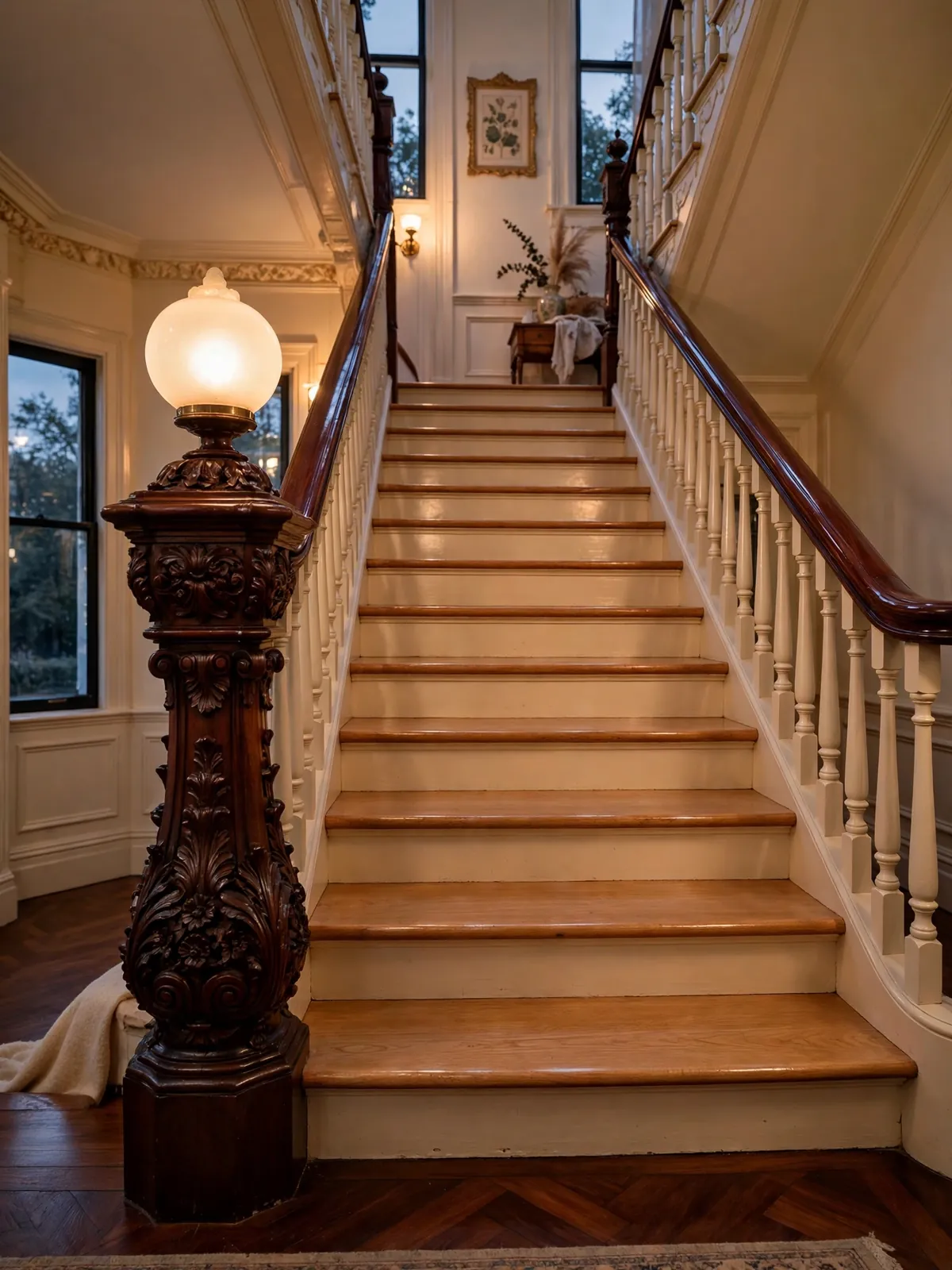
A carved wood newel with a globe light combines two Victorian details into one, because the carved newel post anchors the stair and the frosted glass globe on top lights the way after dark. Here, a dark mahogany newel with a carved base holds a frosted glass globe, glowing warmly against soft cream walls and pale oak treads. The idea suits entries and landings, it makes the stair safer at night, and it feels like a piece of history. The weakness is wiring — the globe needs power in the newel — so plan it during a renovation, and choose a warm bulb so the glow feels historic rather than harsh.
Quick tips:
- Plan the wiring during a renovation.
- Choose a warm bulb, about 2700K, for a historic glow.
- Match the newel carving to the banister.
- Use frosted glass so the light stays soft.
A Velvet Bench on the Landing
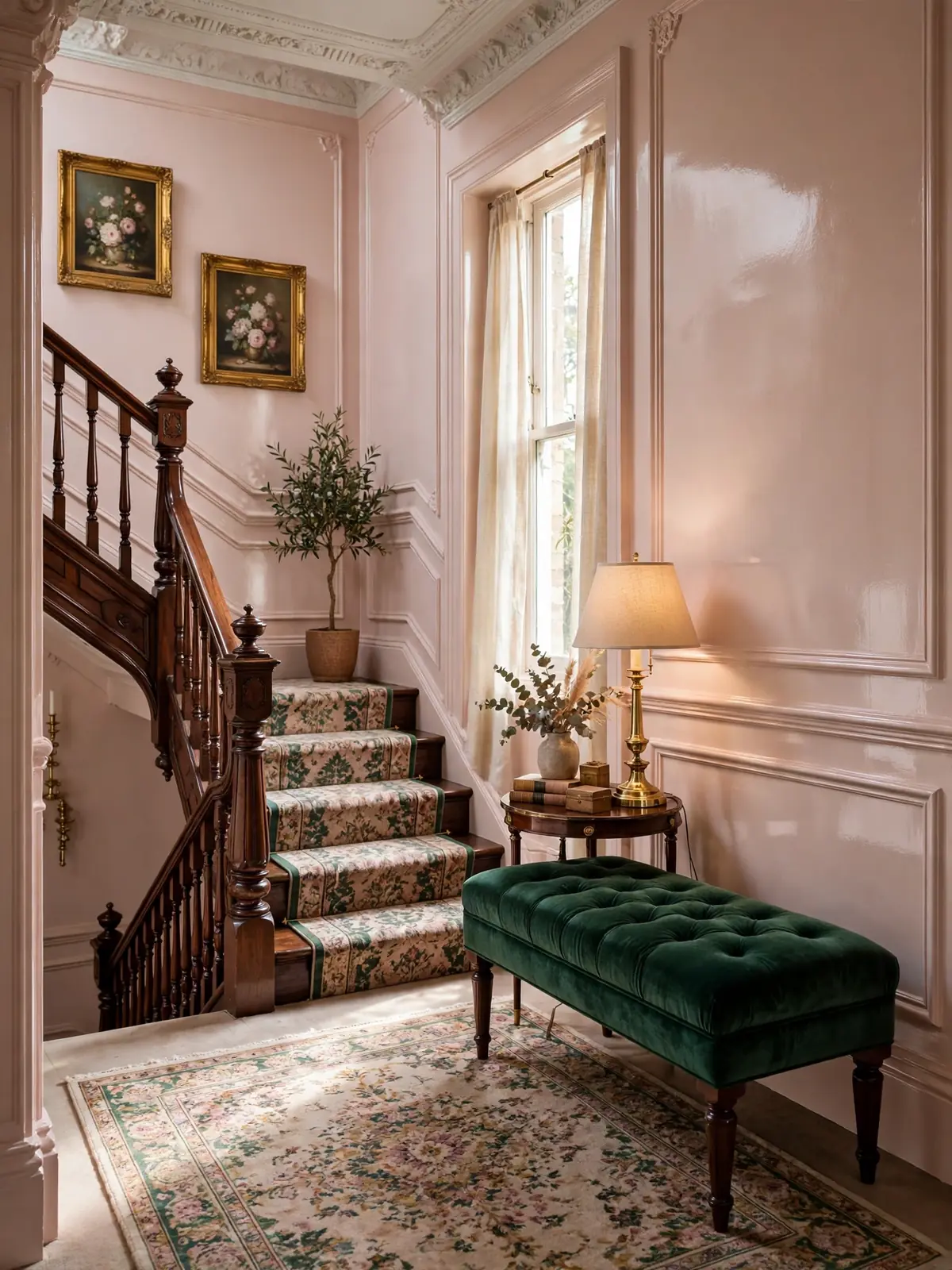
A velvet bench on the landing gives a Victorian staircase a place to pause, because deep emerald velvet on a wooden bench with brass details turns the landing into a small drawing room. Here, an emerald velvet bench with dark walnut legs sits on the landing, with a brass lamp and soft blush-pink walls around it. The idea suits wide landings, it feels luxurious and intimate, and it is an easy addition that needs no building. The weakness is that velvet needs care — it marks easily and needs gentle cleaning — so keep the bench out of the main walkway and choose a deep colour that hides marks.
Quick tips:
- Choose a deep velvet colour that hides marks.
- Keep the bench out of the main walkway.
- Add a small brass lamp for evening warmth.
- Vacuum velvet gently with an upholstery attachment.
Victorian Staircase Ideas That Bring Old-World Drama Home
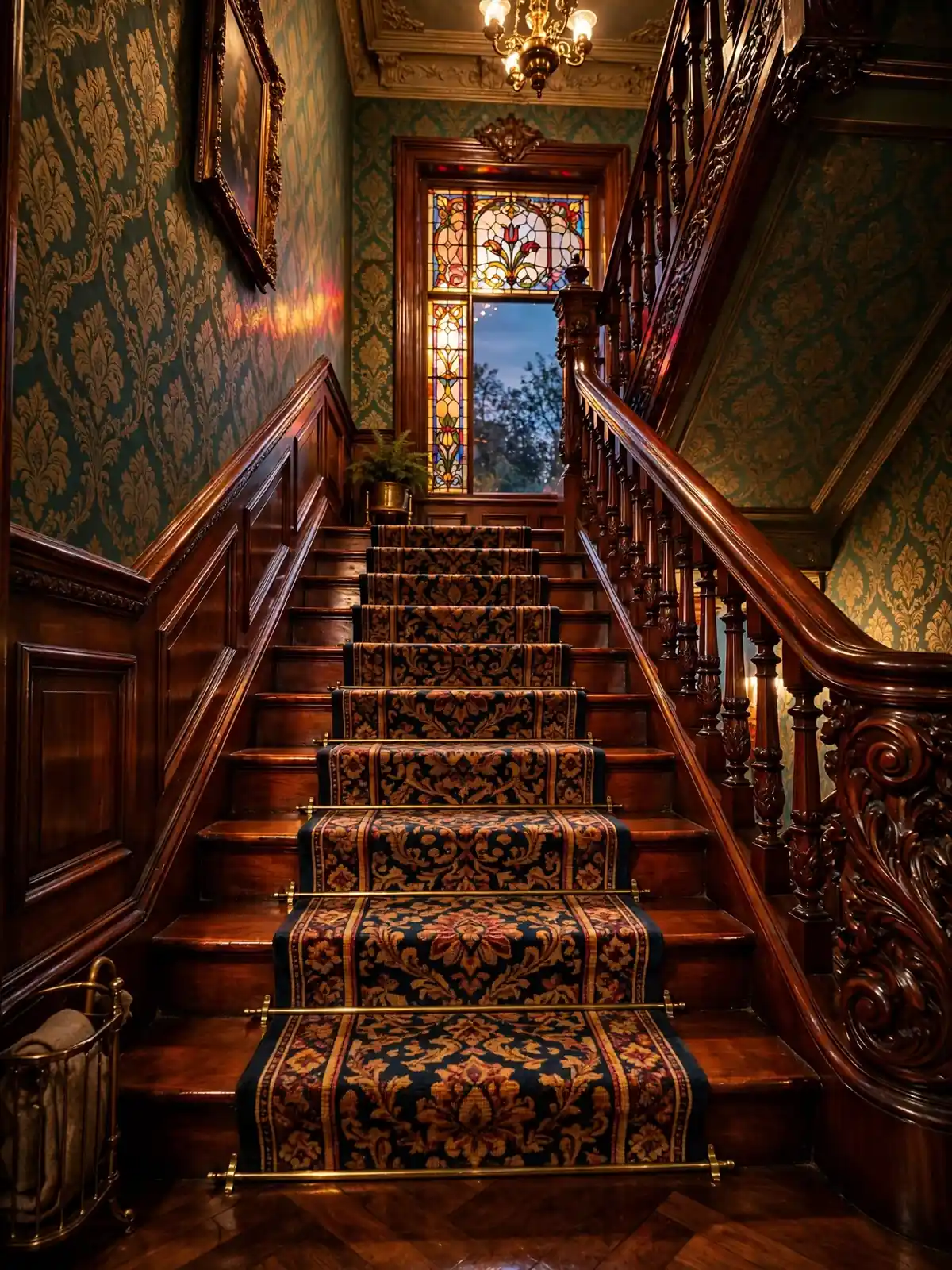
The last of these Victorian staircase ideas is the principle behind them all: old-world drama comes from layering — carved wood, bold pattern, jewel colour, brass and glass, all in one stair. Here, a carved mahogany banister, a bold patterned runner held by brass stair rods, damask wallpaper and a stained glass window come together on one staircase, glowing in the evening light. The wood gives the stair its craft, the pattern gives it energy, the brass gives it shine, and the glass gives it colour — and that layering is the real lesson of a Victorian staircase. Start small if you need to, with a runner or a coat of jewel-tone paint, or dive in headfirst with wallpaper and velvet — either way, make it yours.
Quick tips:
- Layer the details — wood, pattern, brass and glass together.
- Start small with a runner or jewel-tone paint.
- Keep one colour pale so the rich tones can breathe.
- Let the stair age — Victorian materials only get better.
FAQs
How do I make a modern staircase look Victorian?
Start with a bold patterned runner held by brass stair rods, paint the risers in jewel tones, and add a carved newel cap or turned spindles. Damask wallpaper on the stair wall and brass sconces complete the look. These five changes give a plain stair Victorian character without touching the structure.
What colours are Victorian for a staircase?
Deep, rich colours: burgundy, forest green, navy, plum, charcoal and deep teal, balanced with cream, ivory and warm wood tones. Jewel tones on the risers or walls, a patterned runner in deep reds and greens, and brass accents are the classic Victorian palette. Keep at least one element pale so the stair does not feel too dark.
Are Victorian staircases expensive to maintain?
Not particularly. Dust the banister and spindles weekly, oil the handrail once or twice a year, vacuum the runner weekly, and touch up painted risers promptly. Brass fittings need polishing monthly, velvet needs gentle vacuuming, and stained glass needs only a soft cloth. Regular simple care keeps a Victorian stair looking grand.
Can I mix Victorian and modern styles on one staircase?
Yes. A carved wooden banister with a glass balustrade, or jewel-tone risers with a minimalist handrail, both work — as long as one style leads and the other accents it. Keep the colour palette consistent and let the Victorian details be the feature, with modern elements staying quiet in the background.
What is the difference between Victorian and traditional staircases?
A traditional staircase is a broad style — carved wood, natural materials and warm colour — while a Victorian staircase is a specific, bolder version of it: more pattern, deeper colour, heavier ornament and maximalist layering. Every Victorian stair is traditional, but not every traditional stair is Victorian.
Conclusion
A Victorian staircase is not just functional. It is a transition space, a storytelling space, and a statement all at once. Whether you try one idea — like adding brass stair rods — or go full maximalist with damask wallpaper, velvet drapery and stained glass, the best Victorian staircase is the one that suits your home, your budget and the way your family lives. Start small if you need to, or dive in headfirst. Either way, make it yours, and let the drama of carved wood, rich pattern and jewel colour turn your stair into the most memorable part of your home.