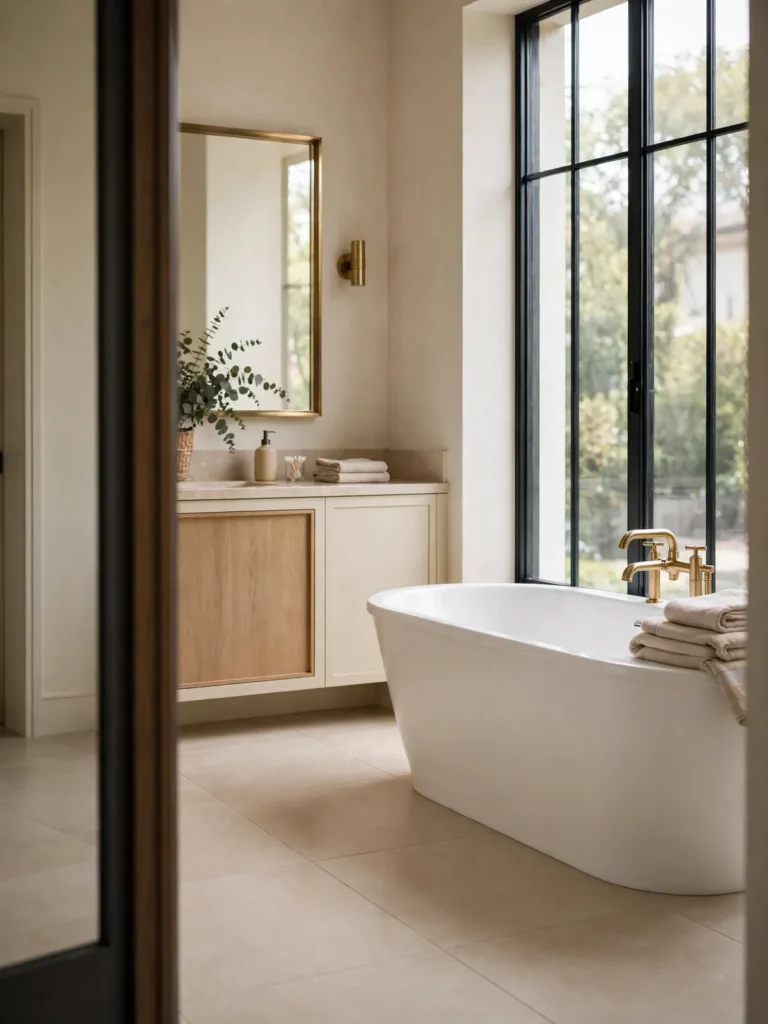
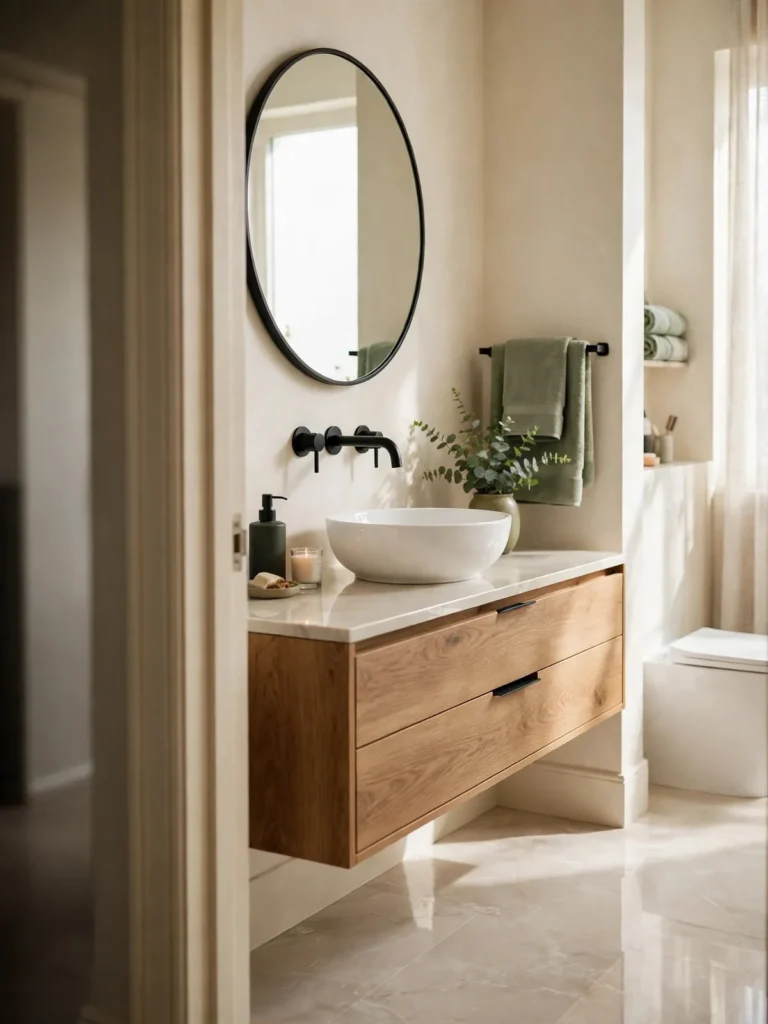
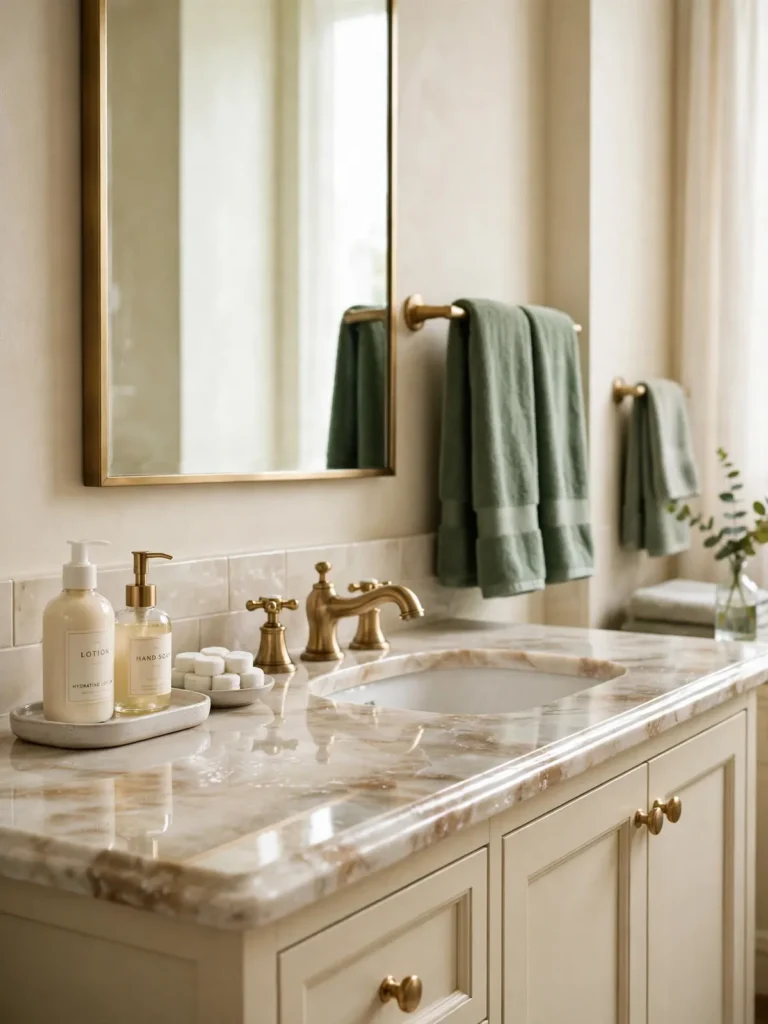
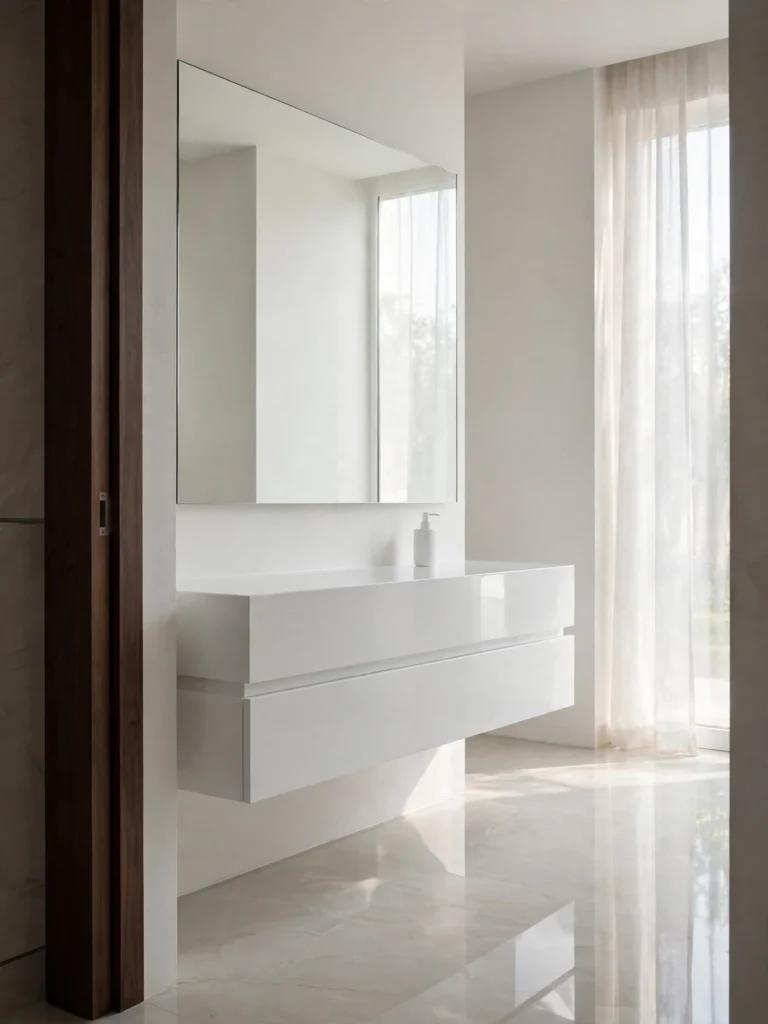
27 Gorgeous Marble Bathroom Ideas That Turn Your Bathroom Into a Luxury Retreat
Marble is not just a material — it is a mood. Its natural veins and textures turn an ordinary bathroom into a spa, a boutique hotel or a classical retreat. These 27 marble bathroom ideas cover slabs, tiles, vanities, showers, floors and small luxuries, with a marble-type guide and sealing advice, so you can bring real stone into your bathroom at any budget.
A marble bathroom works because no two pieces of marble are ever the same: the veining is nature’s artwork, and a single slab can carry the whole room. The best marble bathroom ideas balance that drama with restraint — one bold surface, calm companions, and fixtures that let the stone speak. Choose the marble first, then let the wood, brass or black metal follow it, because the stone sets the palette.
For the floor underfoot, these bathroom flooring ideas show how marble, stone and porcelain compare across the whole room. The 27 ideas below cover walls, floors, vanities, showers and ceilings, with a marble-type guide in the middle, so you can choose the stone that fits your bathroom, your budget and the way you actually live in the room.
Key Takeaways
Is marble a good choice for a bathroom?
Marble is a beautiful choice for a bathroom because it is naturally water-resistant and adds instant luxury, but it is porous and must be sealed before use and resealed every year. It stains from acidic products like citrus and some shampoos, so it suits people who will maintain it — or those who choose marble-look porcelain instead.
What is the best marble for a bathroom?
Carrara is the best marble for most bathrooms because it is the most affordable, widely available and softly veined, so it suits floors, walls and vanities. Calacatta is bolder and more expensive, Statuario is dramatic and bright white, and Nero Marquina suits dark feature walls — choose by the look you want and the budget you have.
How do I keep a marble bathroom looking new?
Seal the marble before use and once a year afterwards, wipe up spills immediately, and clean only with a pH-neutral stone cleaner — never vinegar, bleach or acidic bathroom sprays. Use a squeegee on shower walls after every use, and keep coloured toiletries off the stone.
Is marble-look porcelain as good as real marble?
Marble-look porcelain gives you the veining and the luxury look with almost no maintenance, because it never needs sealing, never stains and costs far less than real marble. Real marble has a depth and variation that porcelain cannot fully copy, so use real marble for one feature and porcelain where the room gets the hardest use.
Does a marble bathroom suit a small bathroom?
Yes — pale marble with soft veining makes a small bathroom feel larger, especially when the same stone runs from floor to walls with few grout lines. Use large-format tiles, a frameless glass shower and a floating vanity, and keep the fixtures simple so the stone stays the focus.
Go Seamless With Large Marble Slabs
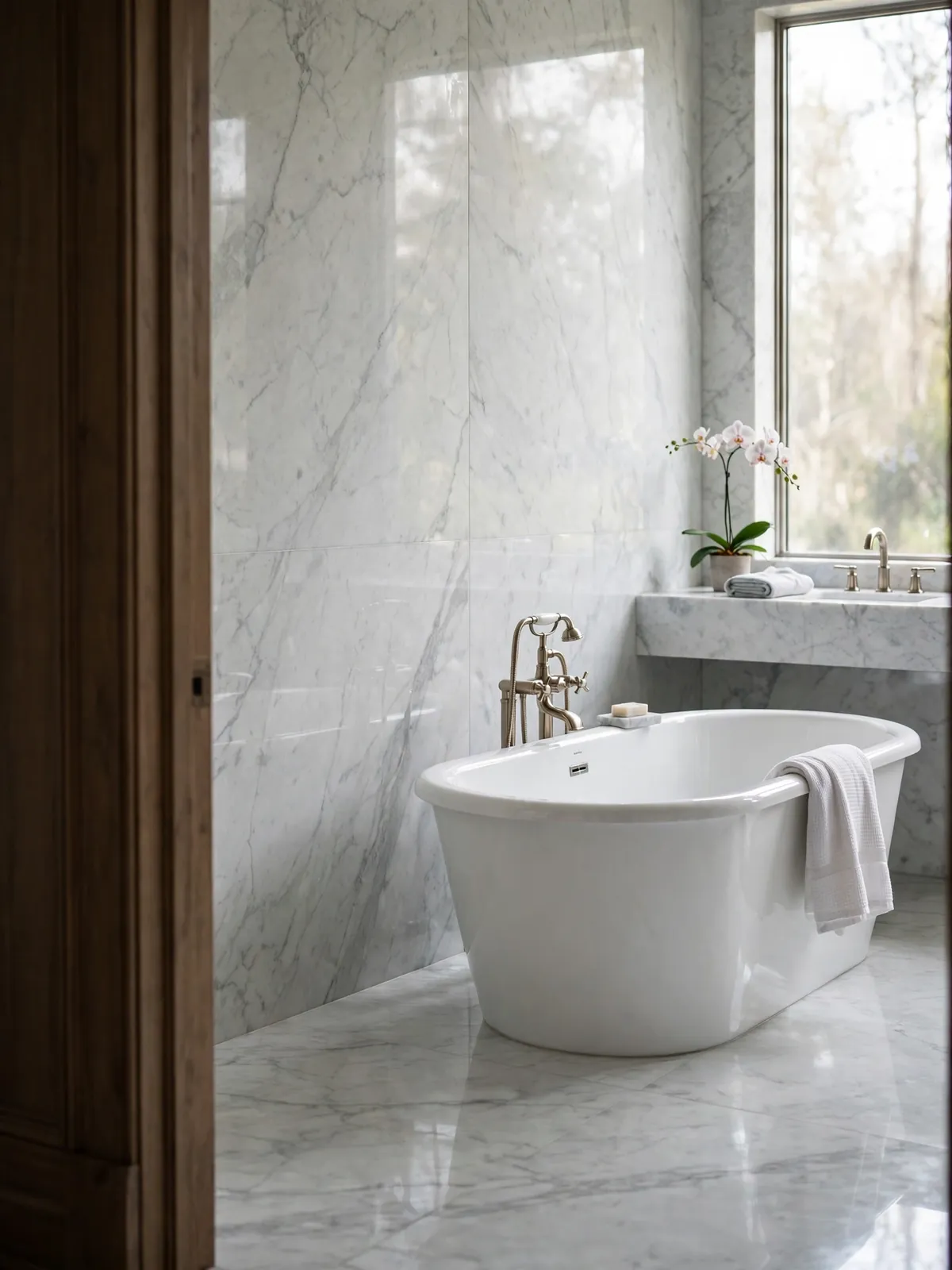
Large marble slabs give a bathroom the five-star resort feeling nothing else can, because a wall wrapped in one continuous piece of stone has no grout lines to break the veining, and the pattern flows like silk across the whole room. Here, Carrara slabs with soft grey veining run from floor to ceiling around a white freestanding tub, with brushed nickel fixtures and a single orchid as the only colour. The design suits bathrooms meant to feel like a spa, it makes cleaning easier because there is almost no grout, and it adds real value to a home. The weakness is cost and weight: large slabs are expensive, heavy and need a specialist installer.
Quick tips:
- Choose Carrara for the softest veining at the best price.
- Use slabs on one feature wall if the whole room is too costly.
- Seal slabs before use and reseal every year.
- Keep accessories minimal so the veining stays the star.
Elevate White Marble With Black Fixtures
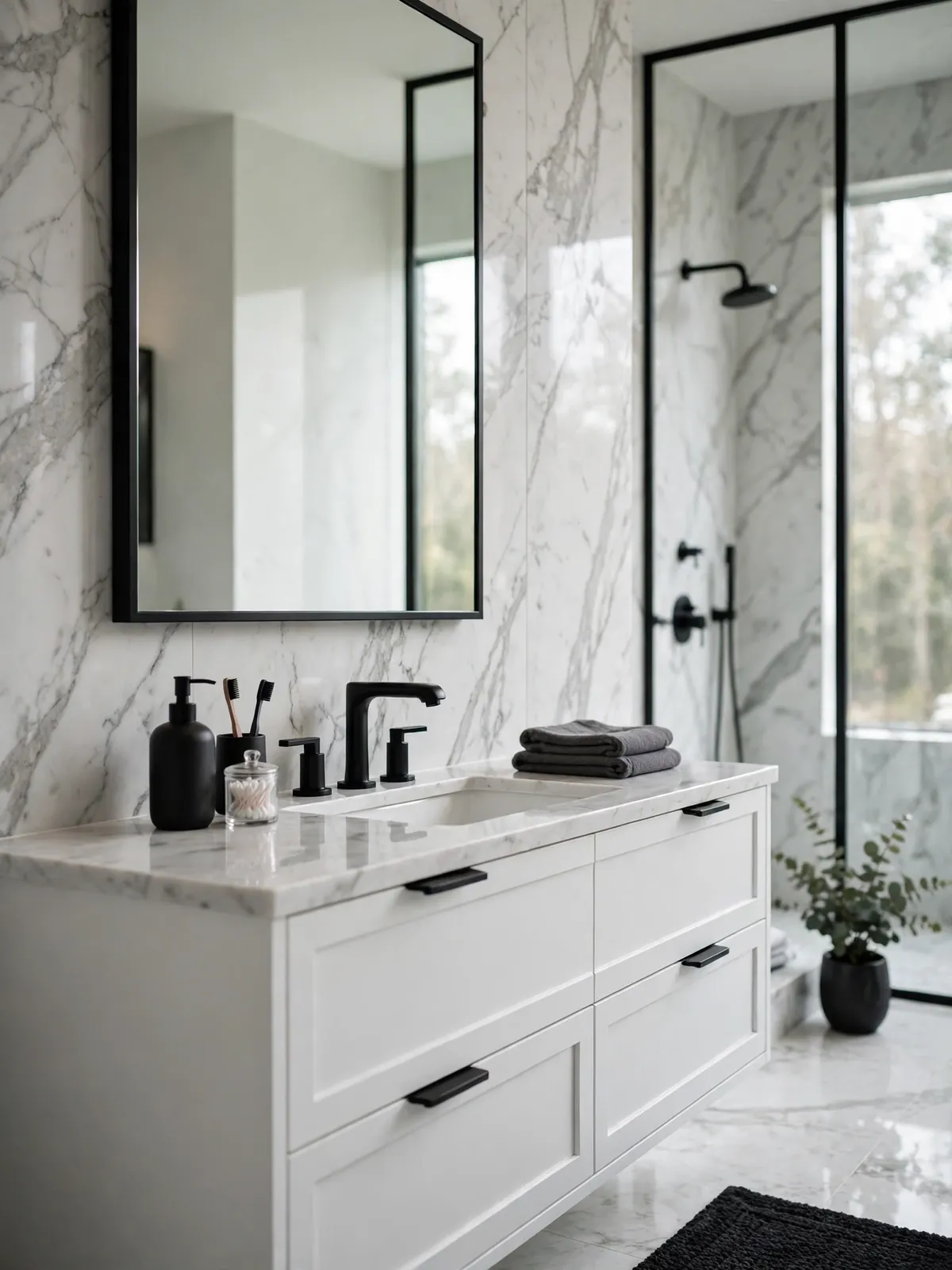
White marble with matte black fixtures is a design power move, because the dark hardware draws a crisp graphic line against the pale stone, like a tuxedo that never goes out of style. Here, white marble walls meet matte black taps, a black-framed mirror and black cabinet pulls, with a white vanity keeping the contrast clean. The design suits modern and minimalist bathrooms, it hides fingerprints better than chrome, and it costs no more than standard fixtures. The weakness is balance: too much black turns the room heavy, so keep the black to fixtures and one frame, and let the marble dominate.
Quick tips:
- Keep black to taps, pulls and one mirror frame.
- Use matte black, not gloss, for a softer contrast.
- Match the black tone across every fixture.
- Add one warm element, like a wood stool, to soften the contrast.
Balance Cool Marble With Warm Wood
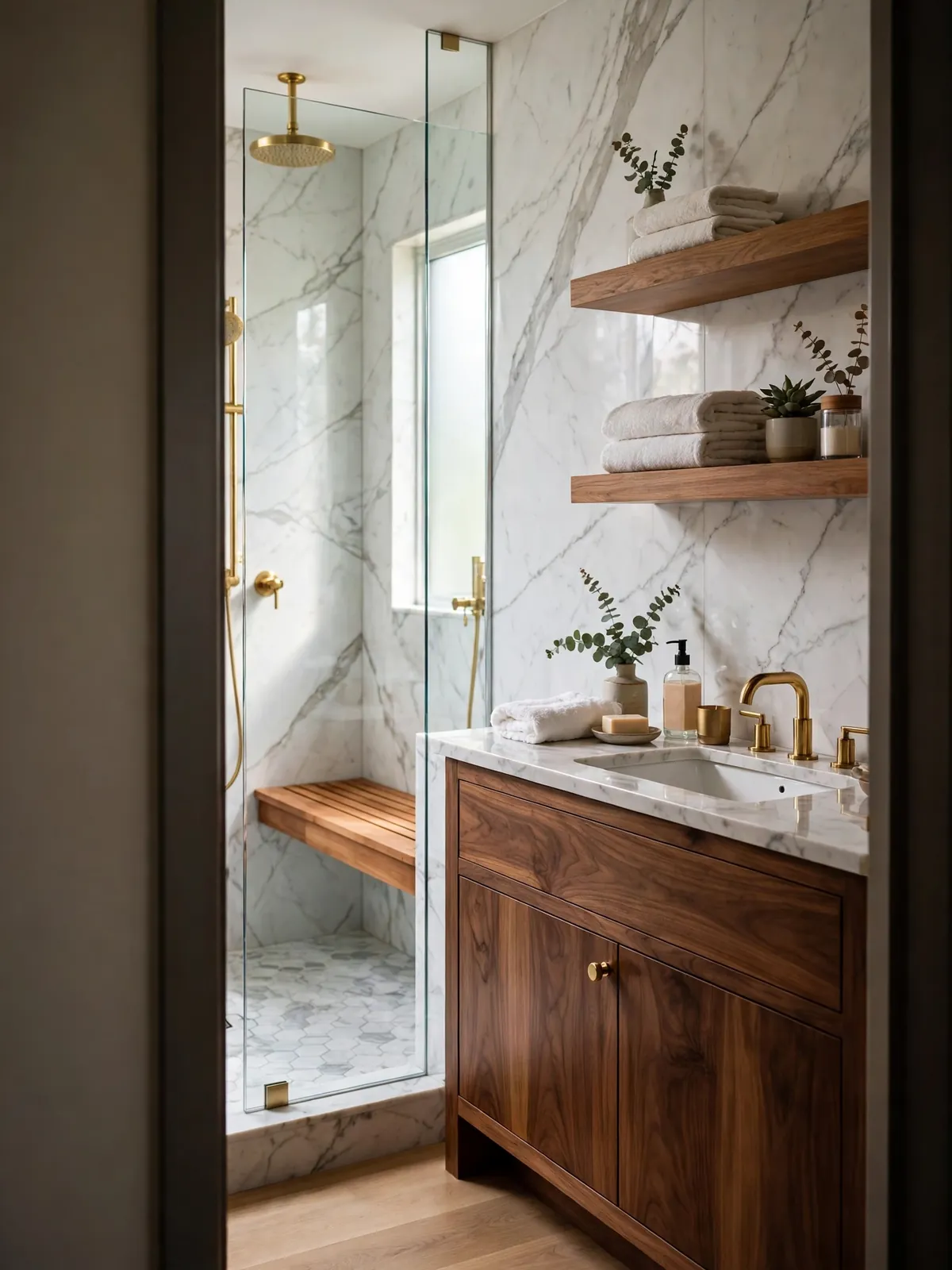
Marble on its own can feel cold or museum-like, but warm wood changes everything, because walnut, oak and teak soften the stone’s sleekness and make the room feel like a place to live in rather than a gallery. Here, a walnut vanity and floating oak shelves sit against white marble walls, with a teak shower bench adding a third warm note. The design suits anyone who loves marble but fears a cold room, it works in every bathroom size, and it ages beautifully. The weakness is moisture: wood near a shower needs sealing, so keep the bench oiled and the vanity away from direct spray.
Quick tips:
- Use walnut for drama, oak for calm, teak for the shower.
- Repeat the wood tone at least twice in the room.
- Oil teak benches regularly to protect them from steam.
- Pair wood with brass for extra warmth.
Add Depth With Marble Mosaic Tiles
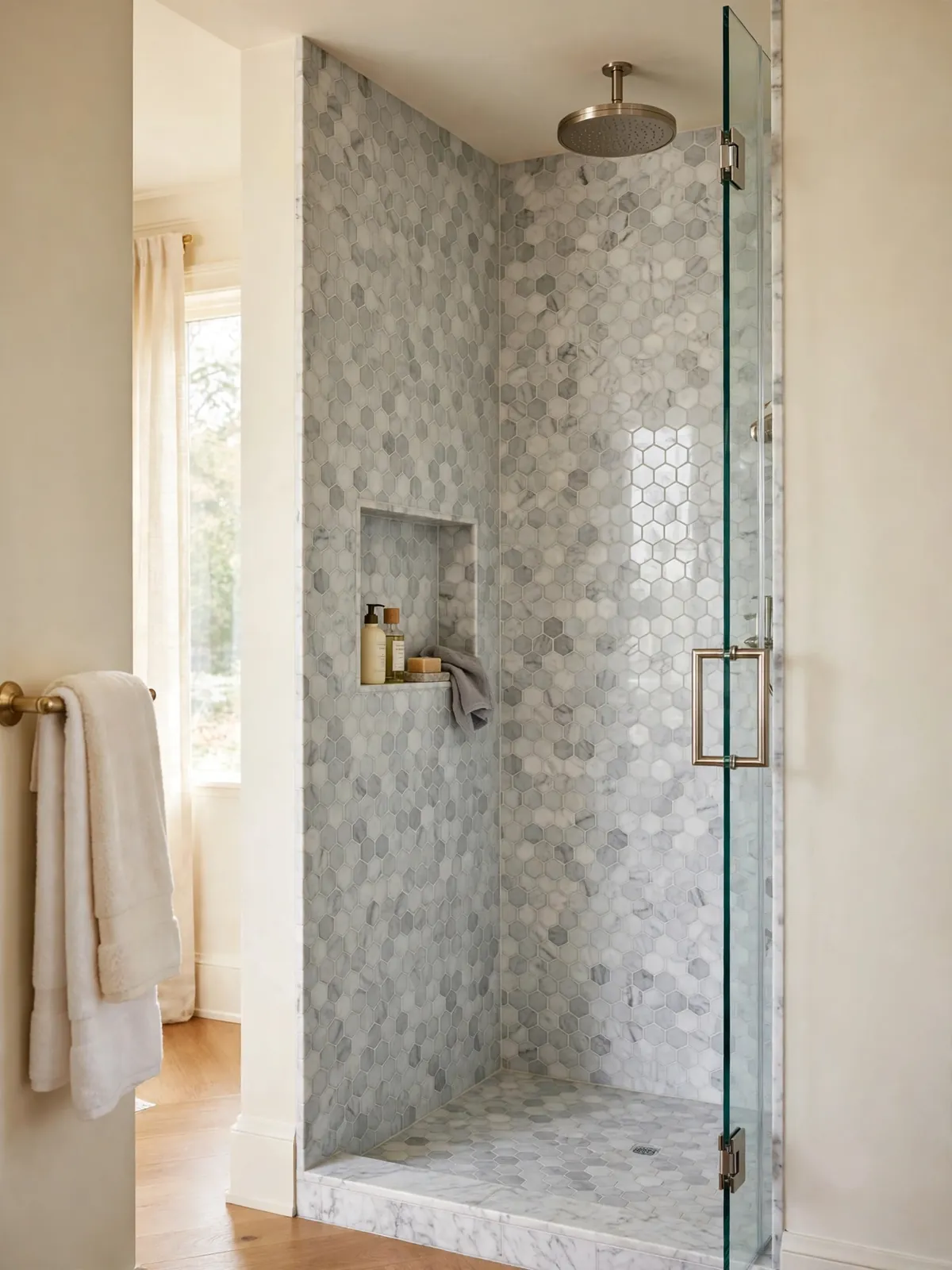
Marble mosaic tiles add depth to a bathroom in a way large slabs cannot, because hundreds of tiny pieces catch the light differently, and the shower wall shimmers like a jewel box. Here, soft grey and white marble hexagons cover the shower wall, with a rain head, a glass screen and cream walls keeping the rest of the room calm. The design suits shower walls, niches and splashbacks, it makes a bathroom look instantly more expensive, and it is the easiest way to use real marble on a budget. The weakness is grout: mosaics have many joints, so seal the grout well and choose a colour close to the lightest stone.
Quick tips:
- Use mosaic on one wall or in the shower only.
- Choose hexagon, chevron or basketweave patterns.
- Seal the grout twice, since mosaics see the most water.
- Match the grout to the lightest marble tone.
Choose a Honed Finish for Soft Elegance
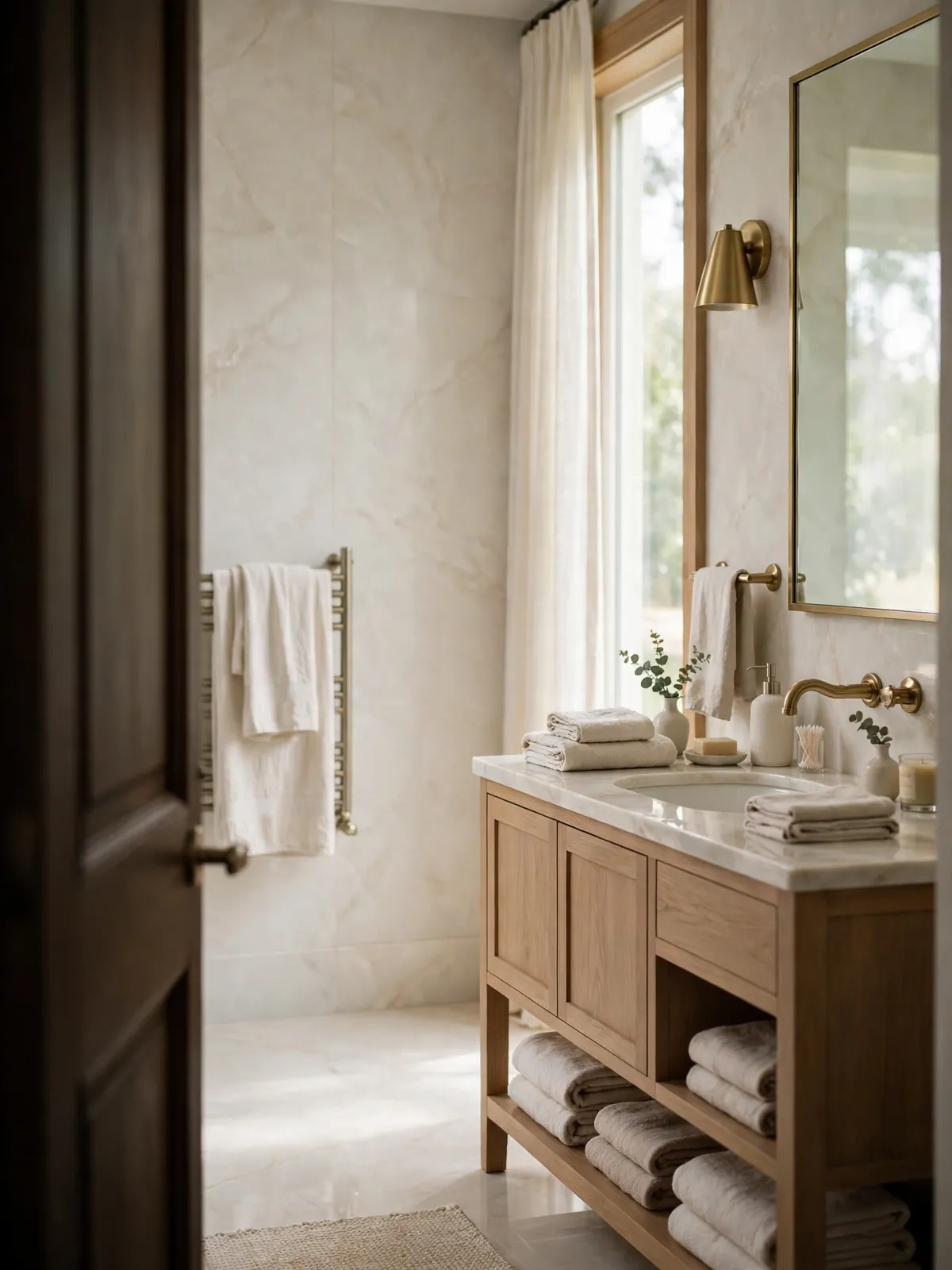
Honed marble offers a quieter kind of luxury than polished stone, because its matte finish diffuses light gently instead of reflecting it, and the room feels velvety and calm rather than shiny. Here, honed ivory marble covers the walls around a light oak vanity, with linen towels and brushed brass fixtures adding warmth. The design suits modern bathrooms and anyone who finds polished marble too flashy, it hides water spots far better than gloss, and it gives better grip on floors. The weakness is staining: honed marble is slightly more porous than polished, so seal it carefully and wipe spills quickly.
Quick tips:
- Use honed marble on floors for better grip.
- Seal honed stone before use and reseal yearly.
- Pair honed marble with linen and wood for softness.
- Wipe water spots off promptly to keep the finish even.
Frame the Vanity Mirror in Stone
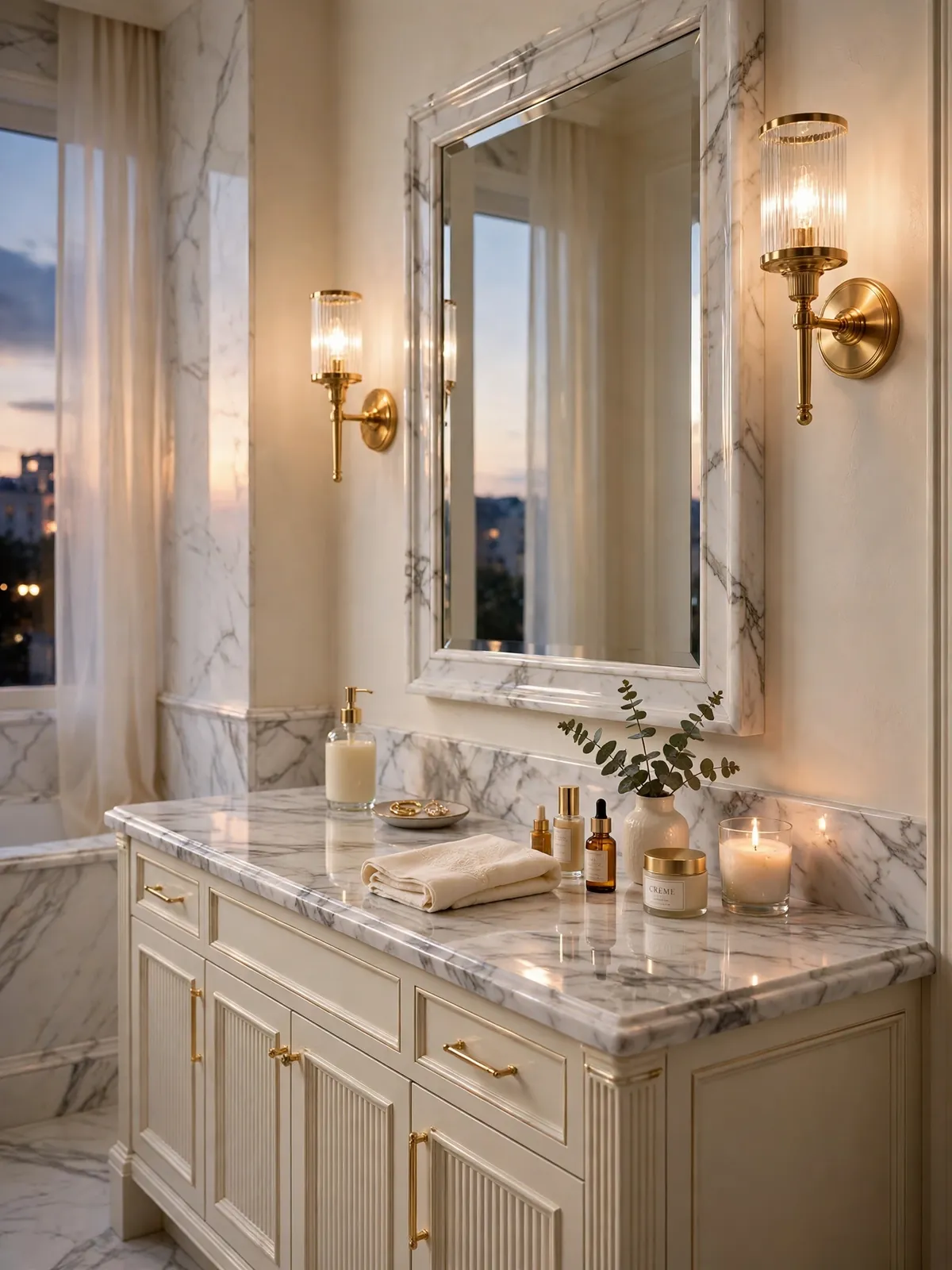
Framing the vanity mirror in marble turns an ordinary mirror into a custom centrepiece, because the stone ties the mirror into the rest of the design and gives it weight and presence. Here, a white marble frame surrounds a large mirror above a marble countertop, with gold sconces and cream walls completing the glamorous composition. The design suits any marble bathroom, it looks far more expensive than it costs, and it makes the vanity the room’s focal point. The weakness is weight: a stone frame needs solid wall fixings, so have it installed by a professional.
Quick tips:
- Use off-cut marble from the vanity top for the frame.
- Match the frame stone to the countertop.
- Add warm sconces so the stone glows at night.
- Keep the mirror large so the frame earns its place.
Create Movement With a Herringbone Marble Layout
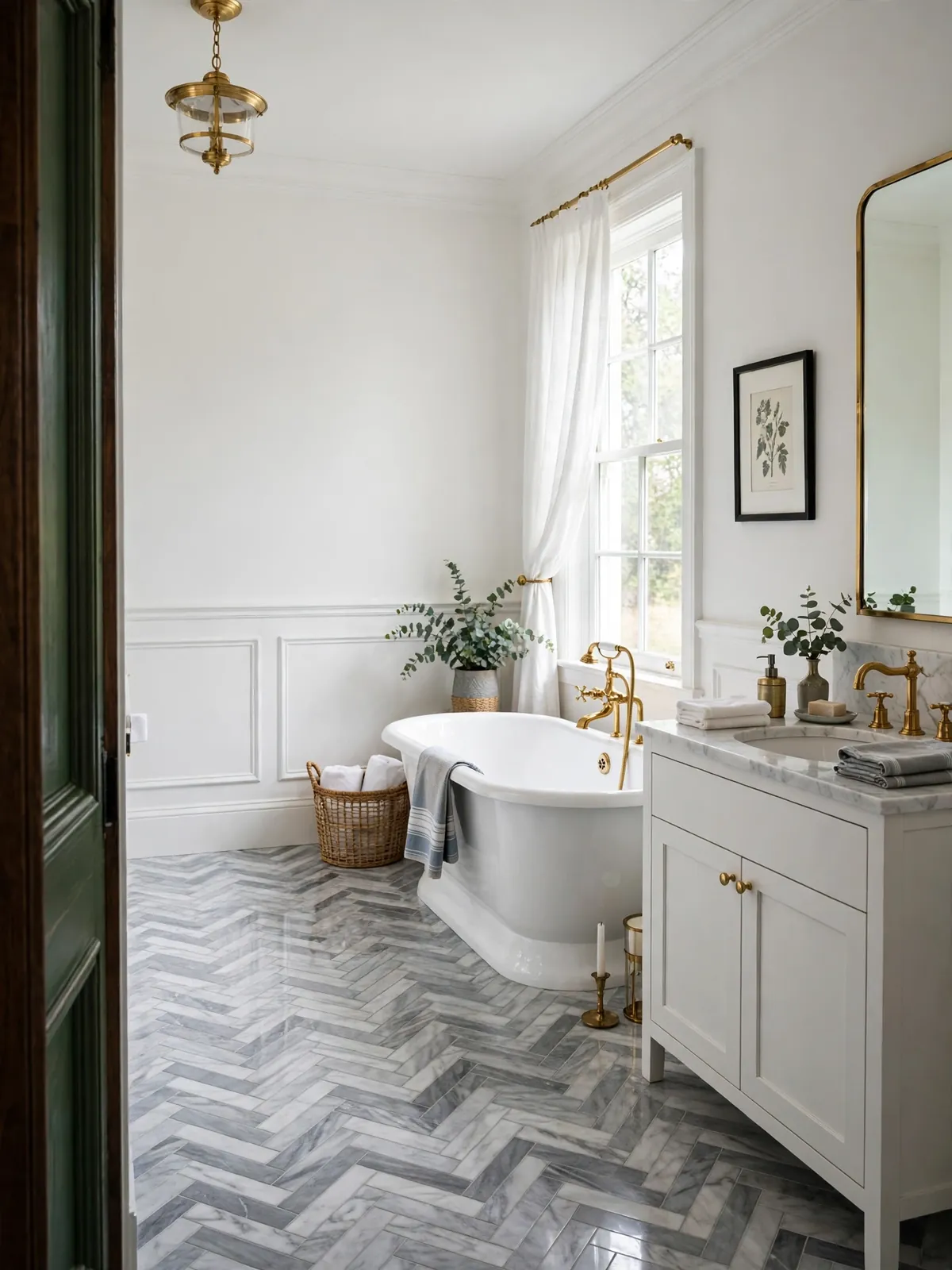
A herringbone layout gives marble floors instant energy, because the angled pattern creates movement underfoot and turns even the simplest white or grey stone into something refined. Here, grey and white marble herringbone covers the floor beneath a freestanding tub, with white walls and brass fixtures keeping the room elegant. The design suits floors and backsplashes, it feels classic without being boring, and it makes a plain bathroom feel designed. The weakness is waste and labour: herringbone needs more cuts and more tiles than a straight layout, and it demands a skilled tiler.
Quick tips:
- Order 15% extra tile for herringbone cuts.
- Use herringbone on the floor or one backsplash, not both.
- Keep the walls plain so the pattern stays the star.
- Hire a tiler experienced with herringbone.
Make a Statement With a Marble Pedestal Sink
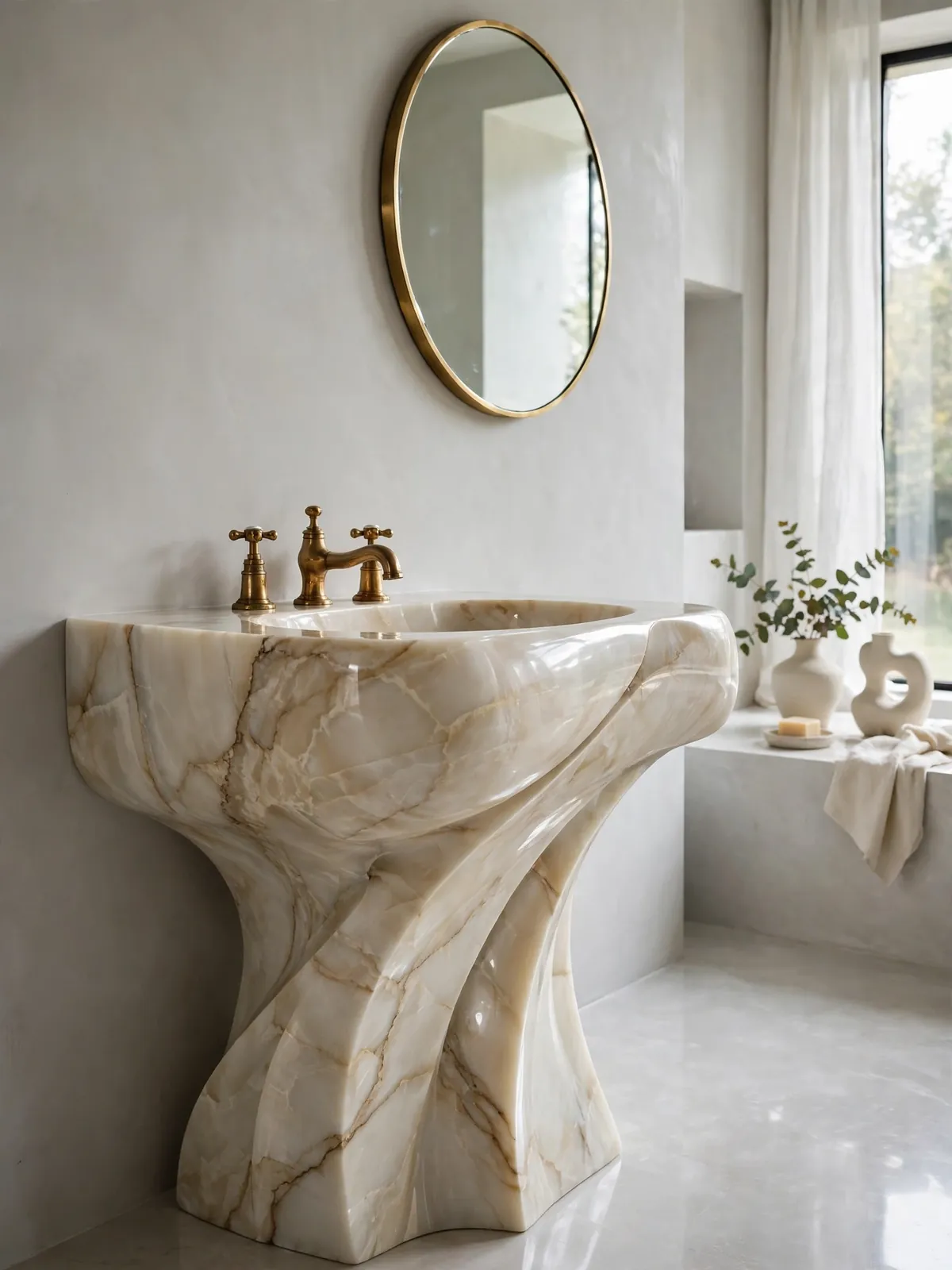
A pedestal sink carved from a single block of marble is pure sculpture, because the stone itself becomes the furniture, and a functional necessity turns into the room’s focal point. Here, a cream veined marble pedestal stands against pale grey walls, with brass taps and a round mirror completing the gallery-like composition. The design suits powder rooms and minimalist bathrooms, it needs very little space, and it makes a lasting impression. The weakness is practicality: a pedestal sink has no counter space and no storage, so add a small shelf or tray nearby for essentials.
Quick tips:
- Use a pedestal sink in a powder room or small bathroom.
- Add a wall shelf for soap and essentials.
- Match the taps to the stone’s warmest vein.
- Keep the walls pale so the stone stays the focus.
Turn the Shower Niche Into a Marble Highlight
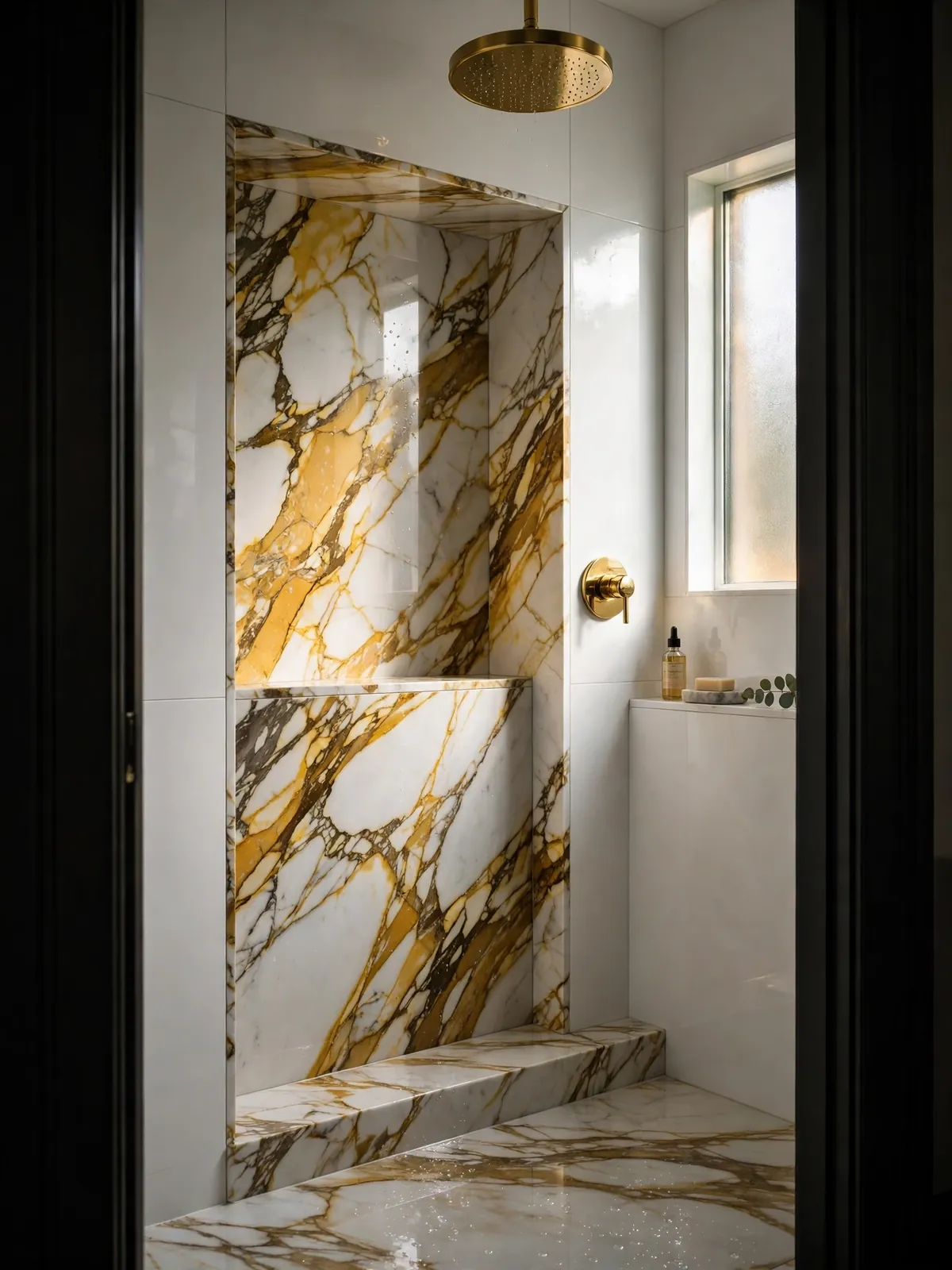
A shower niche lined with bold-veined marble turns a storage necessity into a design feature, because the contrast between the dramatic stone and the plain wall draws the eye exactly where you want it. Here, Calacatta marble with gold veining lines a niche set into white large-format walls, with a rain shower head above. The design suits any marble bathroom, it is a smart use of off-cut stone, and it adds drama for very little money. The weakness is water: a niche sees constant spray, so seal the marble well and choose a stone whose veining hides water marks.
Quick tips:
- Use off-cut marble from the vanity or floor for the niche.
- Choose bold veining so the niche reads as a feature.
- Seal the niche marble twice, since it stays wet.
- Keep the niche shelf level so bottles do not slide.
Showcase Marble With Ambient Lighting
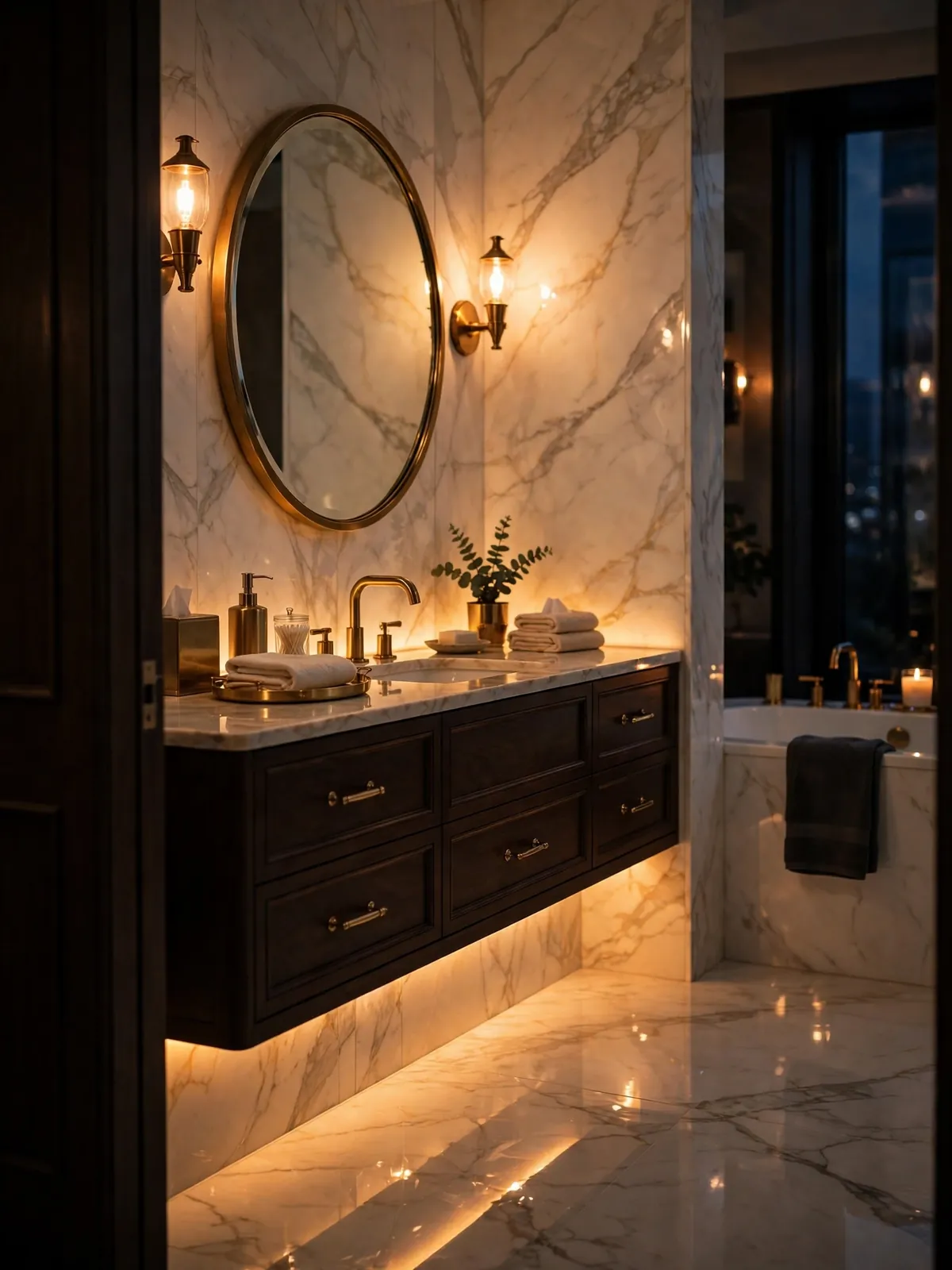
Marble is beautiful in daylight, but warm ambient lighting makes it glow, because LEDs under the vanity or behind the mirror highlight the veining like a spotlight on a work of art. Here, warm under-vanity LEDs wash a dark wood vanity in amber light against glowing white marble walls, with brass fixtures completing the boutique-hotel mood. The design suits evening bathing, it makes midnight trips less jarring than bright overhead light, and it is a small upgrade with a large payoff. The weakness is colour temperature: cool white LEDs make marble look cold and grey, so always choose warm light around 2700K.
Quick tips:
- Use warm LEDs around 2700K, never cool white.
- Light the marble from below or behind, not from above.
- Add a dimmer so the glow can be soft at night.
- Backlight the mirror to make the veining shine.
Wrap the Bathtub Apron in Stone
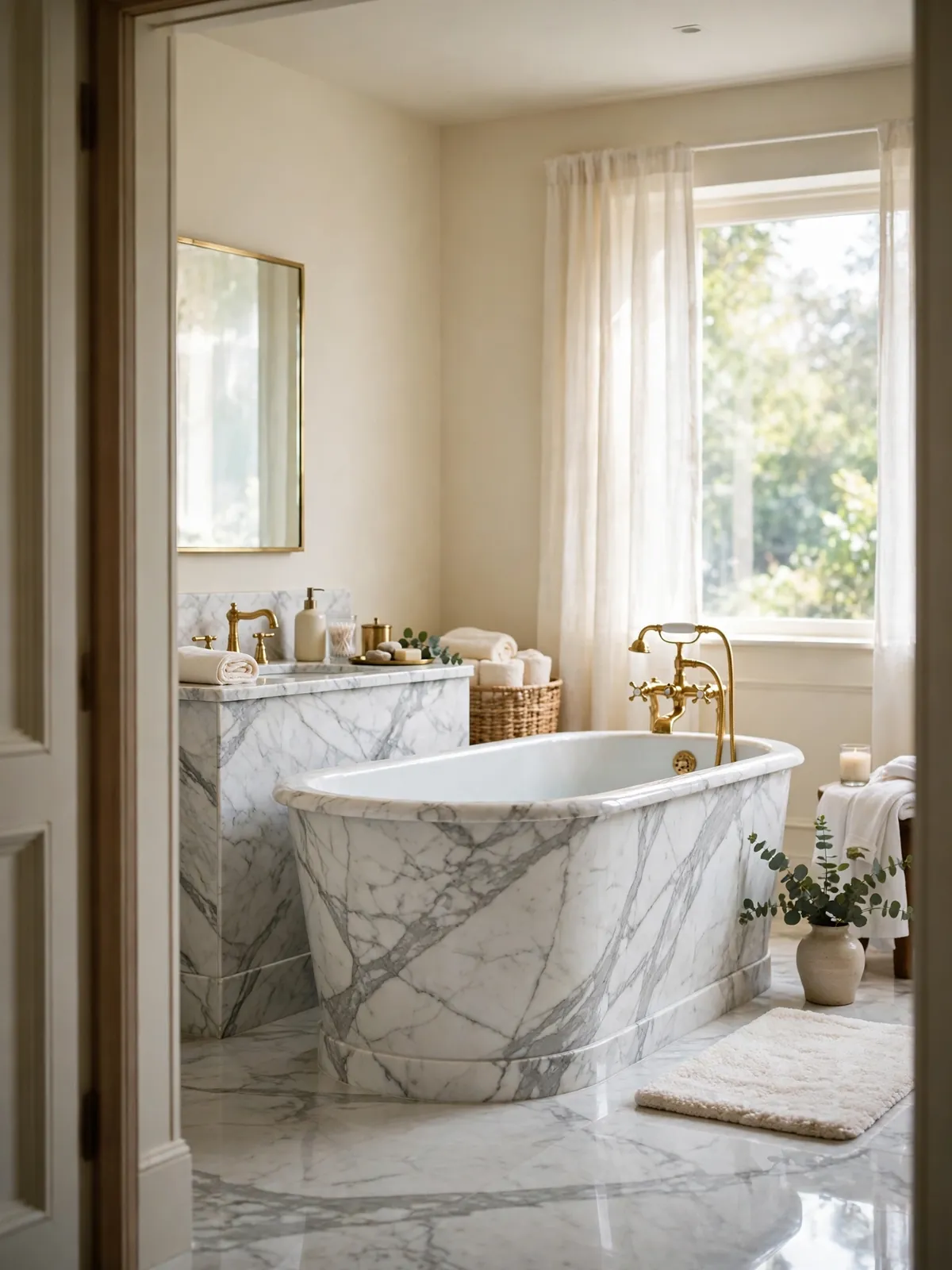
Cladding a bathtub apron in marble turns even a basic tub into a showpiece, because the seamless stone wrap connects the tub visually to the rest of the bathroom and makes the whole room feel intentional. Here, bright white Statuario marble with grey veins wraps a freestanding tub, with brass fixtures and cream walls keeping the palette warm. The design suits bathrooms where the tub is the centrepiece, it is a splurge that pays back every day, and it makes a daily soak feel like a spa ritual. The weakness is cost: a stone-clad apron needs a specialist, so budget for both the stone and the installation.
Quick tips:
- Match the apron stone to the vanity or floor marble.
- Use a single slab per side to avoid visible joints.
- Seal the apron well, since it sees splashes daily.
- Keep the tub surround simple so the stone speaks.
Crown the Vanity With a Single Marble Slab
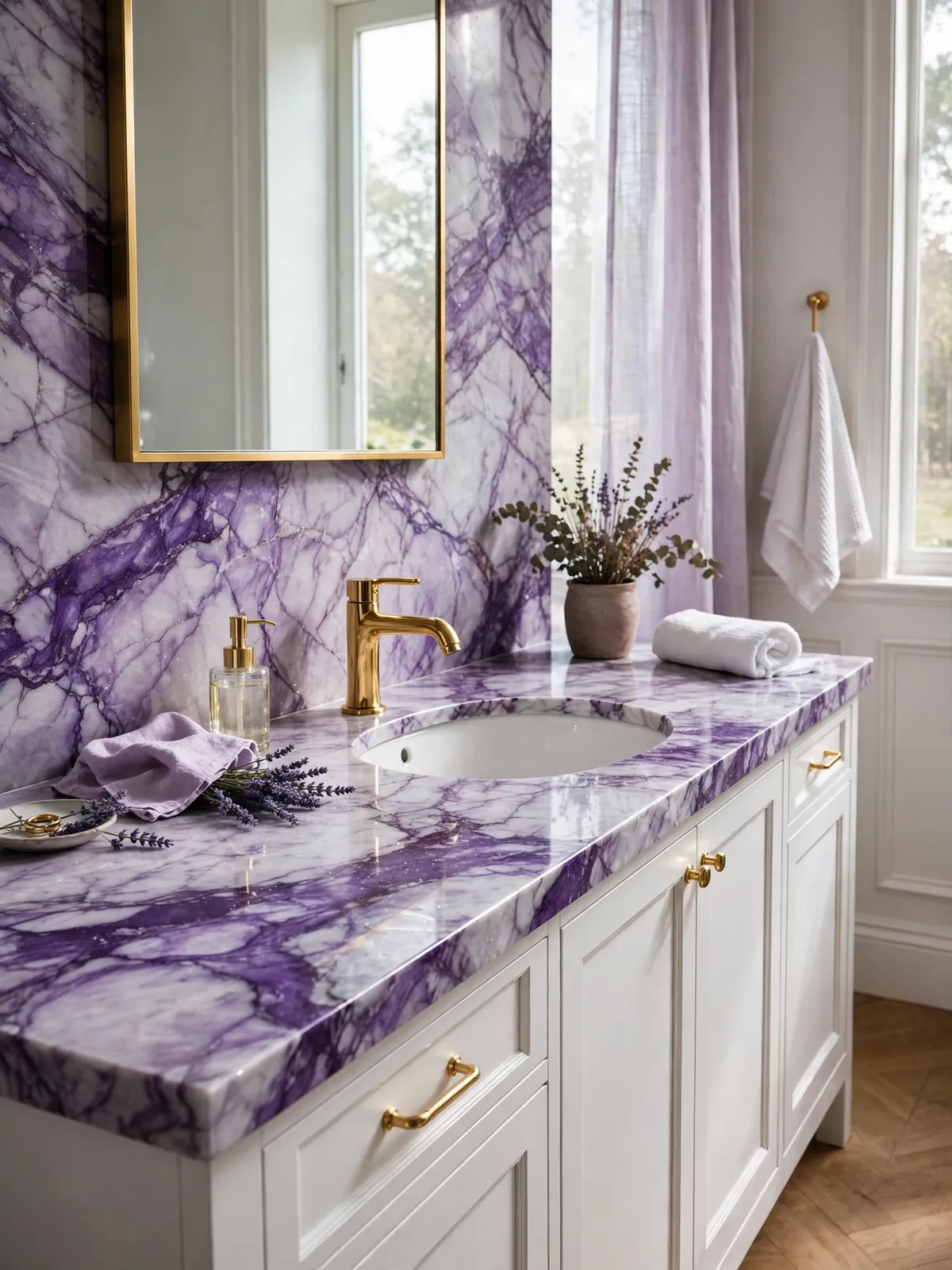
A single marble slab on the vanity turns the sink area into a piece of art, because the natural veining becomes the star and there are no seams or grout lines to break the flow. Here, a Calacatta Viola slab with purple and lavender veining crowns white cabinetry, with gold taps echoing the stone’s warmth. The design suits anyone who wants drama in a small area, it makes cleaning easier, and it instantly feels custom. The weakness is price: a single slab costs far more than tiles, so use it on the vanity only and use porcelain elsewhere.
Quick tips:
- Choose the slab in person — every piece is different.
- Use the slab on the vanity only to control cost.
- Seal the slab before use, especially around the sink.
- Keep the cabinetry plain so the veining stays the star.
Extend Marble From Floor to Walls for a Seamless Room
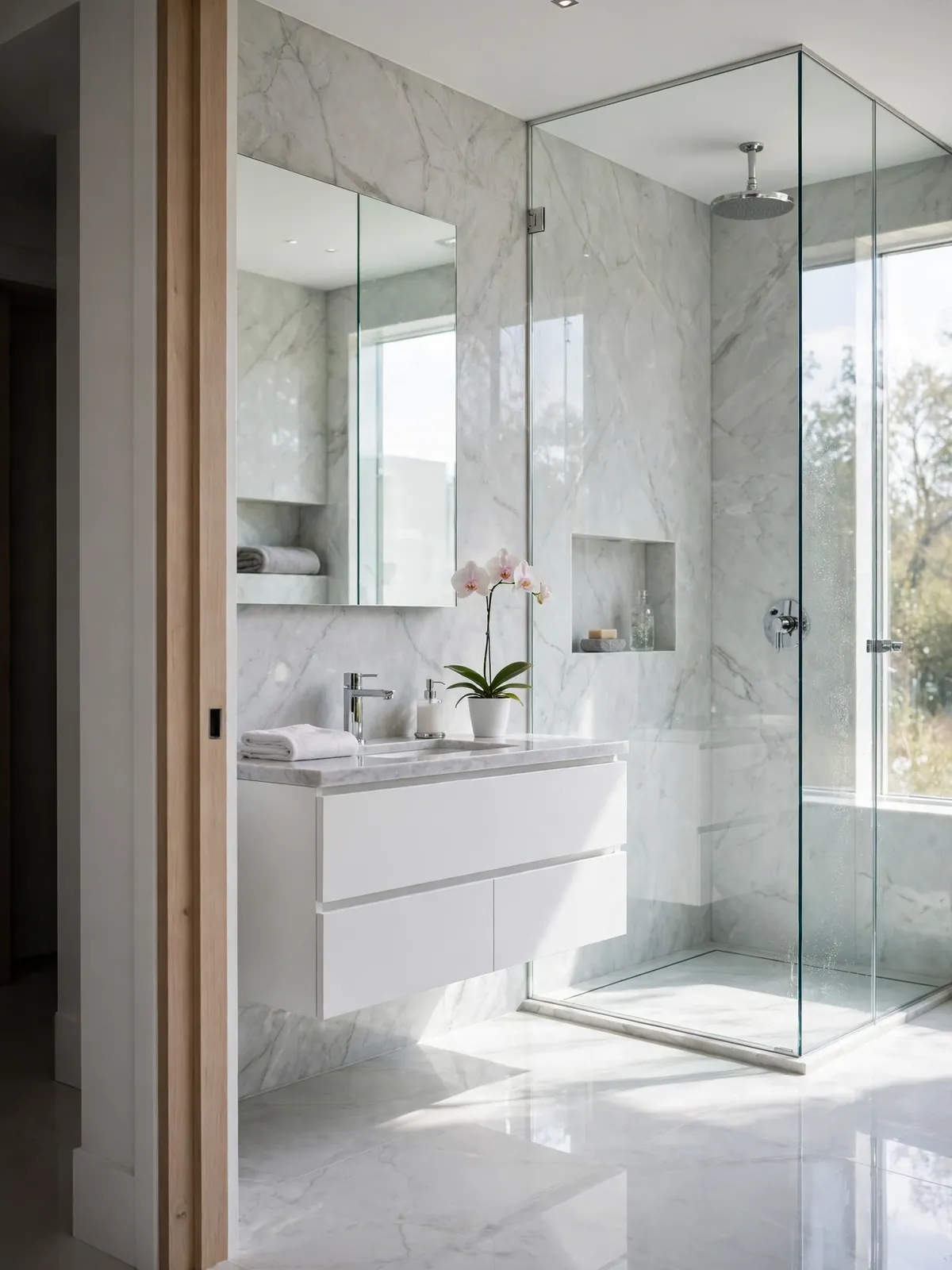
Running the same marble from floor to walls makes a bathroom feel larger and more modern, because the continuous stone removes every visual break and the room reads as one calm, expansive surface. Here, pale grey marble covers the floor and walls of a compact bathroom, with a frameless glass shower and a floating white vanity keeping every line clean. The design suits small bathrooms best of all, it creates a spa-like atmosphere, and it looks professionally designed. The weakness is monotony: a single stone everywhere can feel flat, so vary the finish — honed on the floor, polished on the walls — or add one warm accent.
Quick tips:
- Use the same stone on floor and walls for continuity.
- Vary the finish: honed underfoot, polished on walls.
- Add one warm accent, like wood or brass.
- Keep accessories pared down so the marble breathes.
Experiment With Coloured Marble for Character
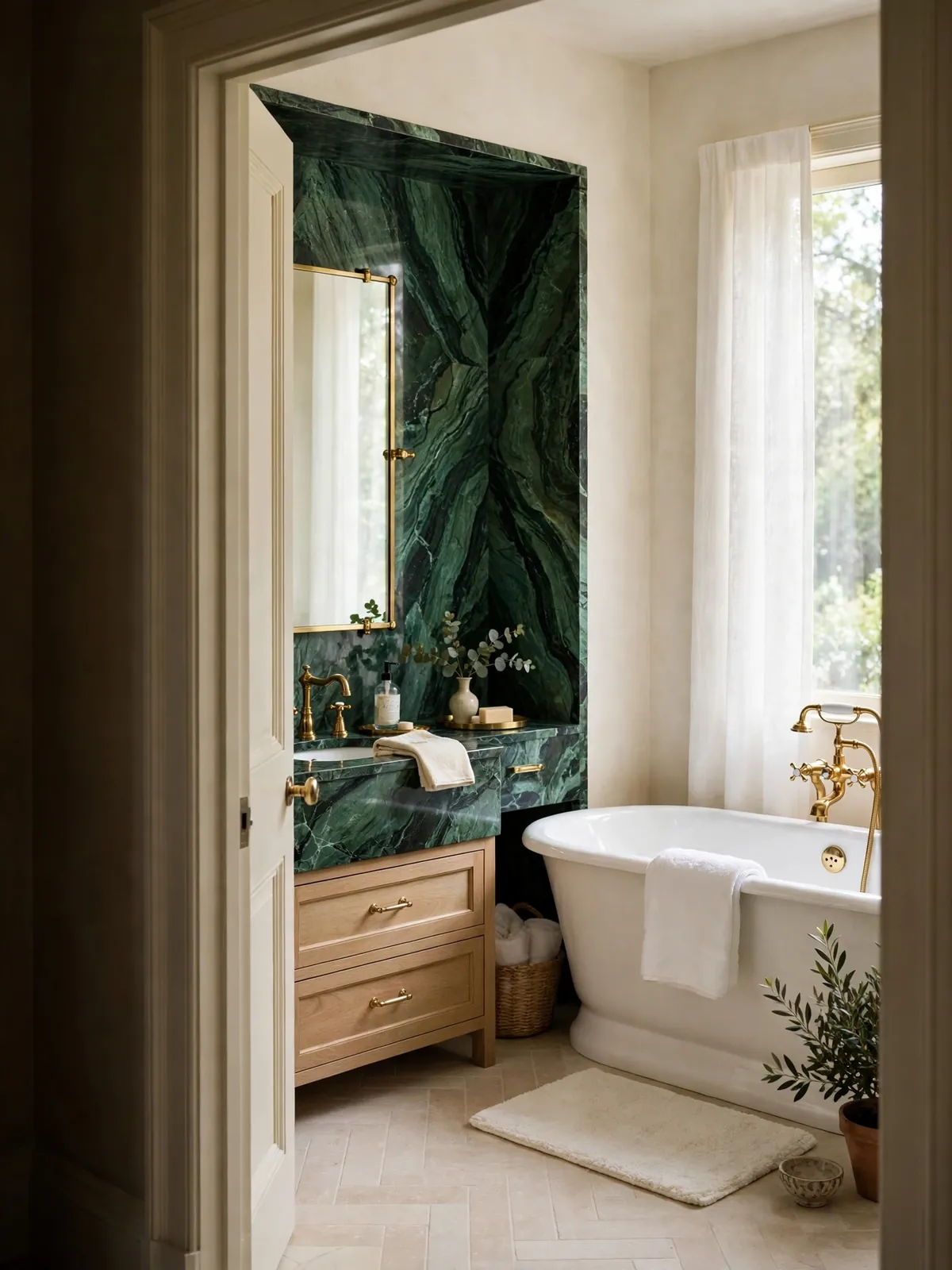
Coloured marble is the most individual choice in a marble bathroom, because green, blush pink or deep burgundy stone brings character that white marble cannot, while still staying timeless. Here, deep green Verde Alpi marble covers the vanity wall, with a white freestanding tub, brass fixtures and cream walls balancing the drama. The design suits anyone who wants their bathroom to stand out, it pairs beautifully with wood and warm metals, and it feels bespoke without being flashy. The weakness is resale: a bold coloured marble is a personal choice, so keep it to one wall or one vanity if you may sell the home.
Quick tips:
- Keep coloured marble to one wall or the vanity.
- Pair green marble with brass, pink with chrome.
- Balance the colour with plenty of white or cream.
- Test a large sample in your own light before committing.
Build a Bench From Spare Marble Tiles
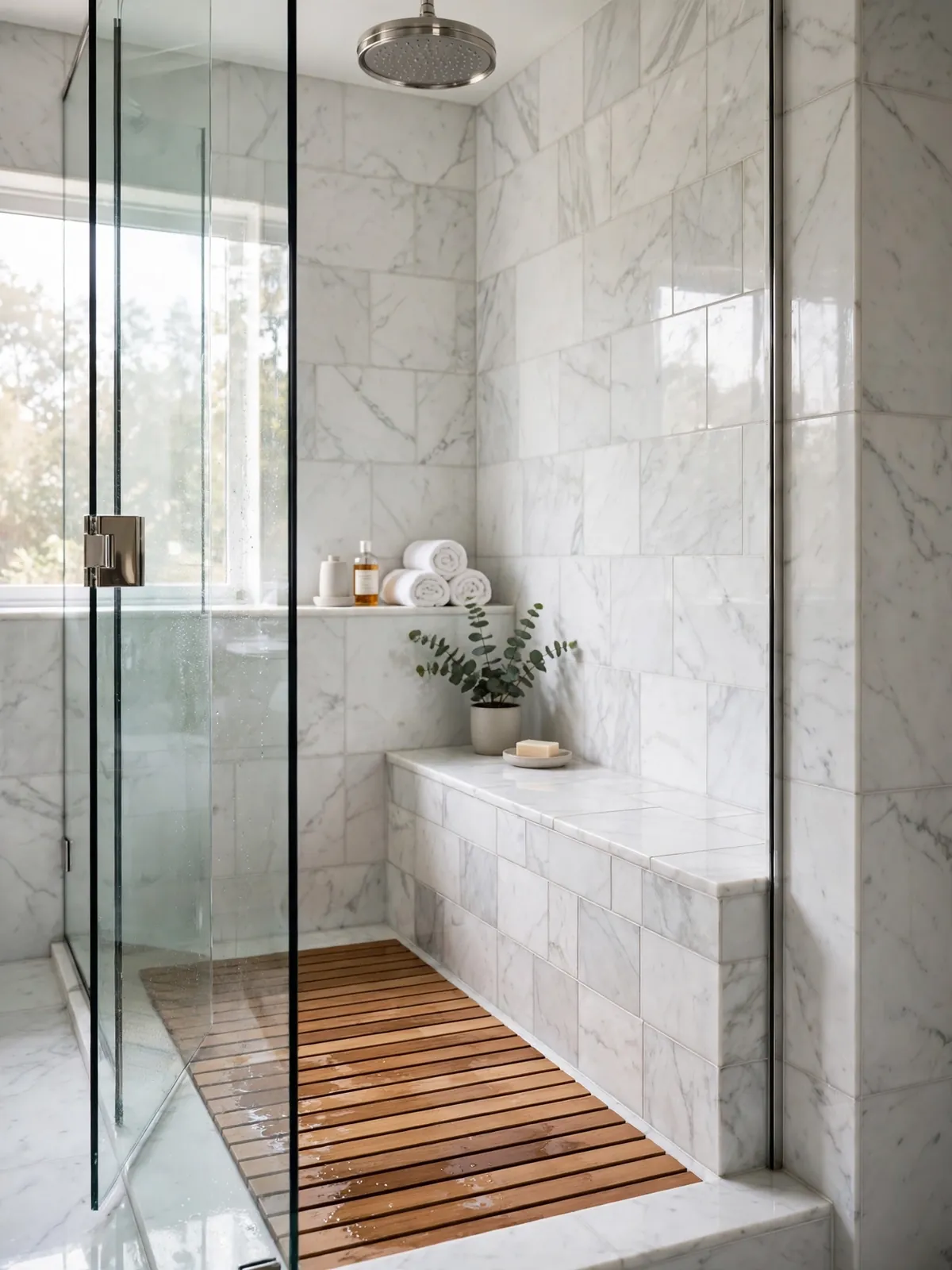
A shower bench built from spare marble tiles is recycling with a luxe twist, because leftover tiles become a comfortable seat and an extra surface for products, and the bench matches the room perfectly. Here, a white marble bench sits in a glass-screened shower with a teak mat and a rain head, turning a practical corner into a spa feature. The design suits larger showers, it adds comfort for daily routines, and it uses material that would otherwise go to waste. The weakness is space: a bench needs a shower at least 1.2 metres wide, so measure before you build.
Quick tips:
- Use leftover tiles from the floor or walls for the bench.
- Slope the bench slightly so water drains off.
- Add a teak mat on top for warmth and grip.
- Seal the bench well, since it stays wet.
Bookmatched Marble Walls for a Mirror-Image Showpiece
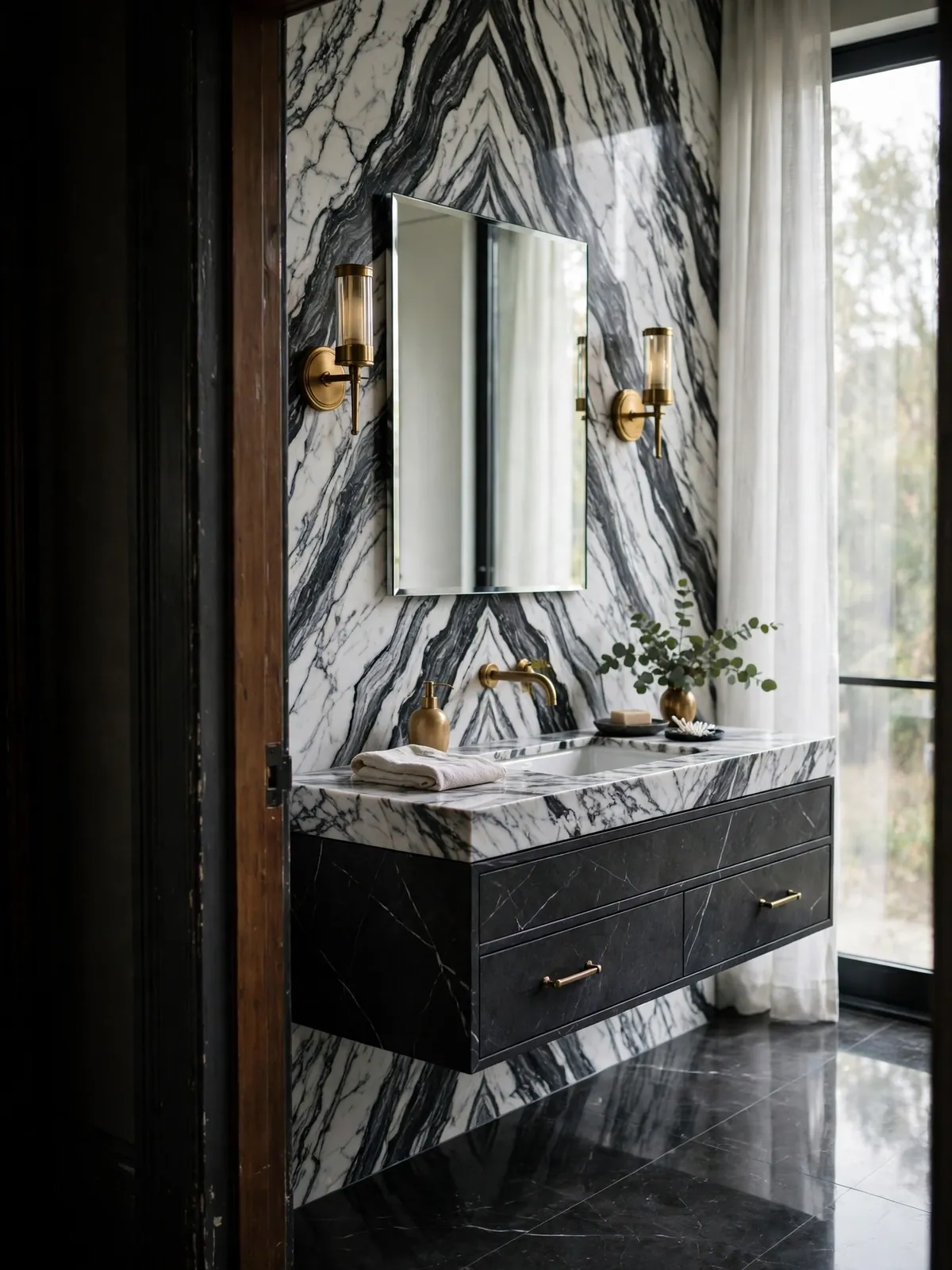
Bookmatched marble is the most dramatic wall treatment in a bathroom, because two slabs cut from the same block are opened like a book, and the veining mirrors itself into a symmetrical work of art. Here, charcoal and white bookmatched marble covers the wall behind a floating vanity, with brass sconces and soft daylight completing the gallery-like room. The design suits a single feature wall, it is the ultimate luxury statement, and it makes the bathroom feel like a five-star hotel. The weakness is cost and planning: bookmatching needs matched slabs and a specialist installer, so it is the most expensive idea on this list.
Quick tips:
- Use bookmatched marble on one feature wall only.
- View the slabs together before they are cut.
- Keep the rest of the room plain so the wall dominates.
- Budget for a specialist installer.
Know Your Marble: Six Stones Compared
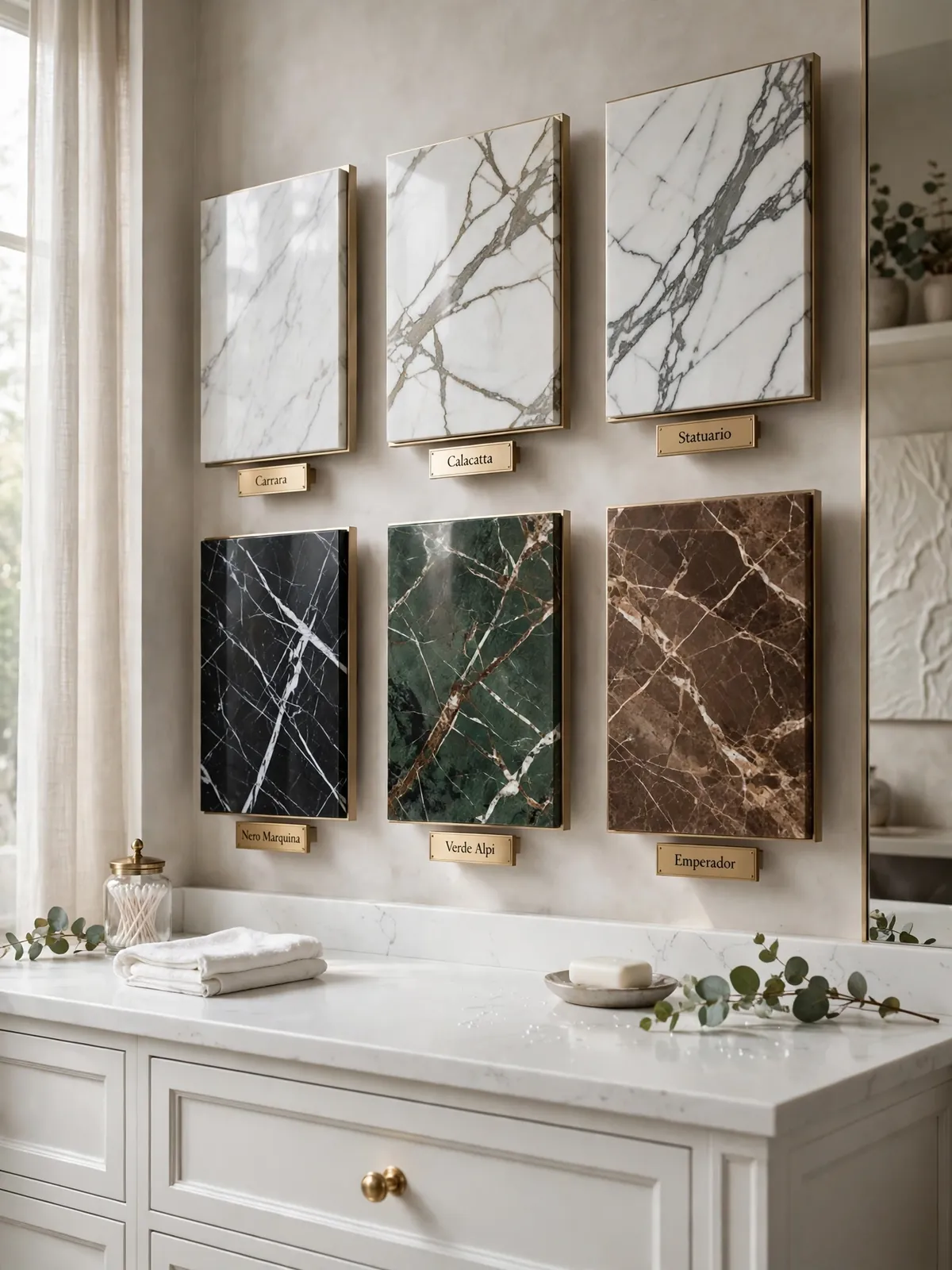
Choosing the right marble starts with knowing the stones, because each variety has its own look, price and personality, and the wrong choice can cost thousands or date quickly. Here, six marble samples — Carrara, Calacatta, Statuario, Nero Marquina, Verde Alpi and Emperador — are laid out on a white vanity, showing how different the stones look side by side in the same light. The design suits anyone planning a marble bathroom, it prevents expensive mistakes, and it turns a confusing choice into a simple comparison. The weakness is samples: a small chip never shows the full veining of a slab, so always view the actual slab before you buy.
Quick tips:
- View the actual slab before buying, not just a sample.
- Choose Carrara if you want the best value.
- Save Calacatta and Statuario for one feature.
- Seal every marble type before use and yearly after.
| Marble type | Look | Cost level | Best use |
|---|---|---|---|
| Carrara | Soft grey veining on white | Low to medium | Floors, walls, vanities — the all-rounder |
| Calacatta | Bold gold and grey veining | High | Feature walls and slab vanities |
| Statuario | Bright white, dramatic grey veins | High | Statement walls and tub surrounds |
| Nero Marquina | Black with white veining | Medium to high | Feature walls and dramatic floors |
| Verde Alpi | Deep green with white veins | Medium to high | Vanity walls and accent pieces |
| Emperador | Warm brown with fine veining | Medium | Floors and traditional bathrooms |
Anchor the Floor With a Marble Medallion
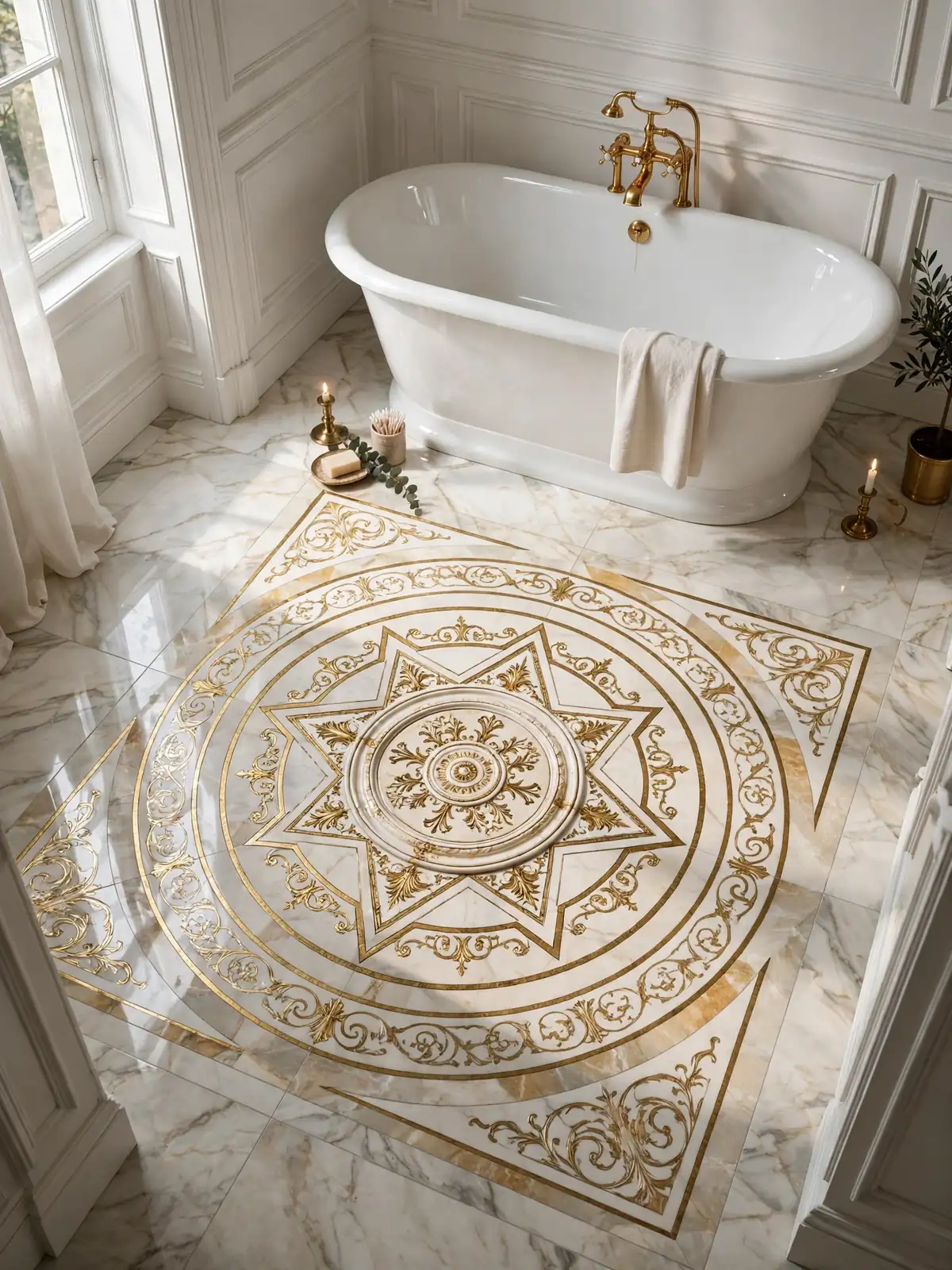
A marble medallion on the floor is the oldest luxury trick in the book, because a custom inlaid pattern draws the eye instantly and makes the whole bathroom feel curated rather than merely functional. Here, a cream and gold medallion anchors the floor beneath a freestanding tub, with white walls and brass fixtures completing the classical room. The design suits larger bathrooms, it is a true focal point, and it turns a plain floor into a statement. The weakness is cost: a custom medallion is cut and laid by hand, so it is one of the most expensive ideas on this list.
Quick tips:
- Keep the rest of the floor plain so the medallion shines.
- Match the medallion colours to the vanity stone.
- Place it where it is seen on entering the room.
- Seal the inlay well, since it sees daily foot traffic.
Define the Floor With Border Marble Inlays
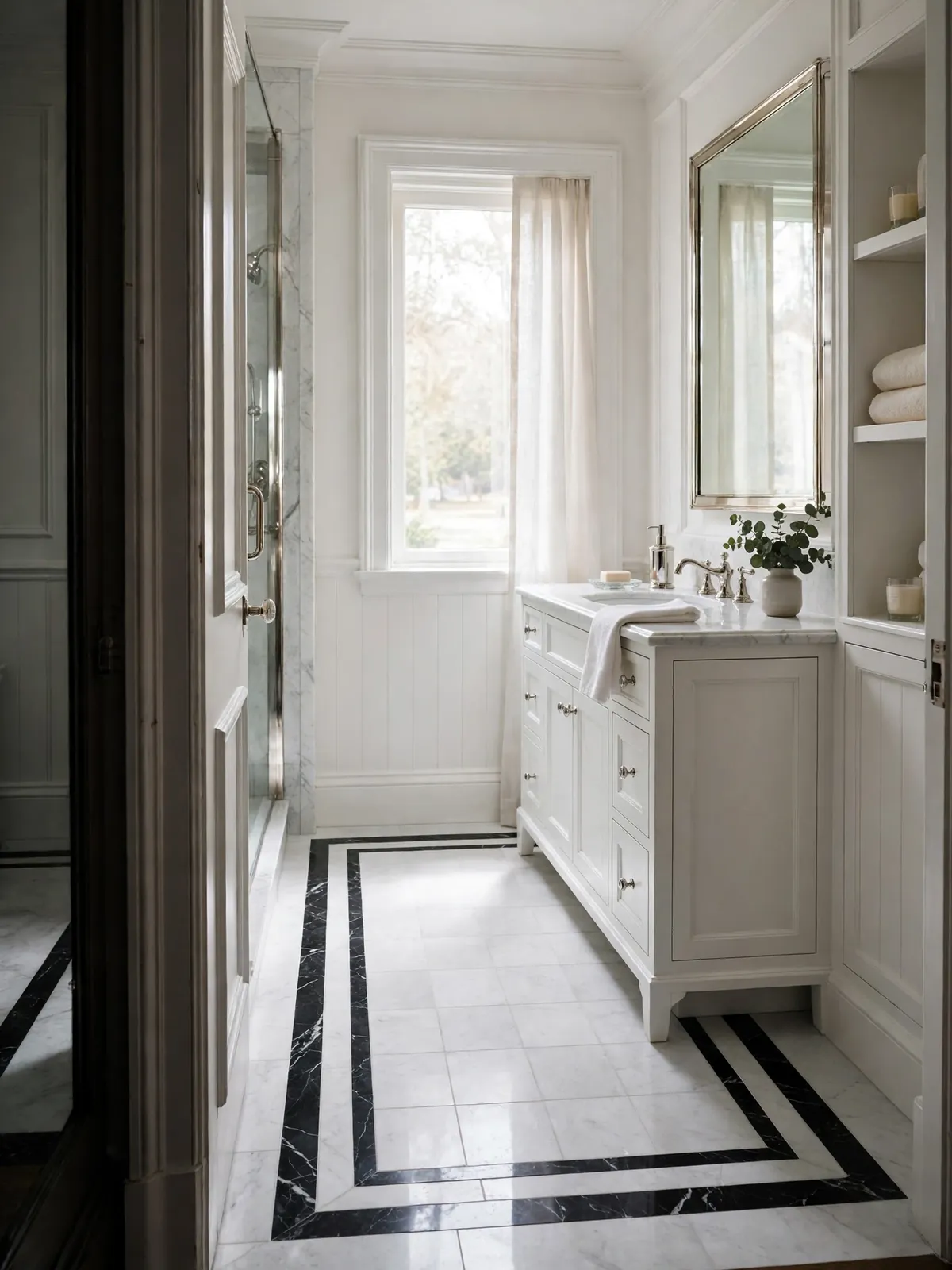
A border inlay frames a marble floor the way a frame finishes a picture, because a thin band of contrasting stone around the edge makes the whole room feel finished and polished. Here, a black marble border frames white marble floor tiles, with a white vanity and chrome fixtures keeping the room crisp. The design suits any marble floor, it is subtle but elevating, and it is far cheaper than a medallion. The weakness is precision: a border needs exact cutting and laying, so hire a tiler who has done inlays before.
Quick tips:
- Use a contrasting stone for the border, not a matching one.
- Keep the border slim, around 5 to 10 cm wide.
- Match the border to the taps or the mirror frame.
- Seal the inlay joints well to stop dirt collecting.
Trim the Windows With Marble Edging
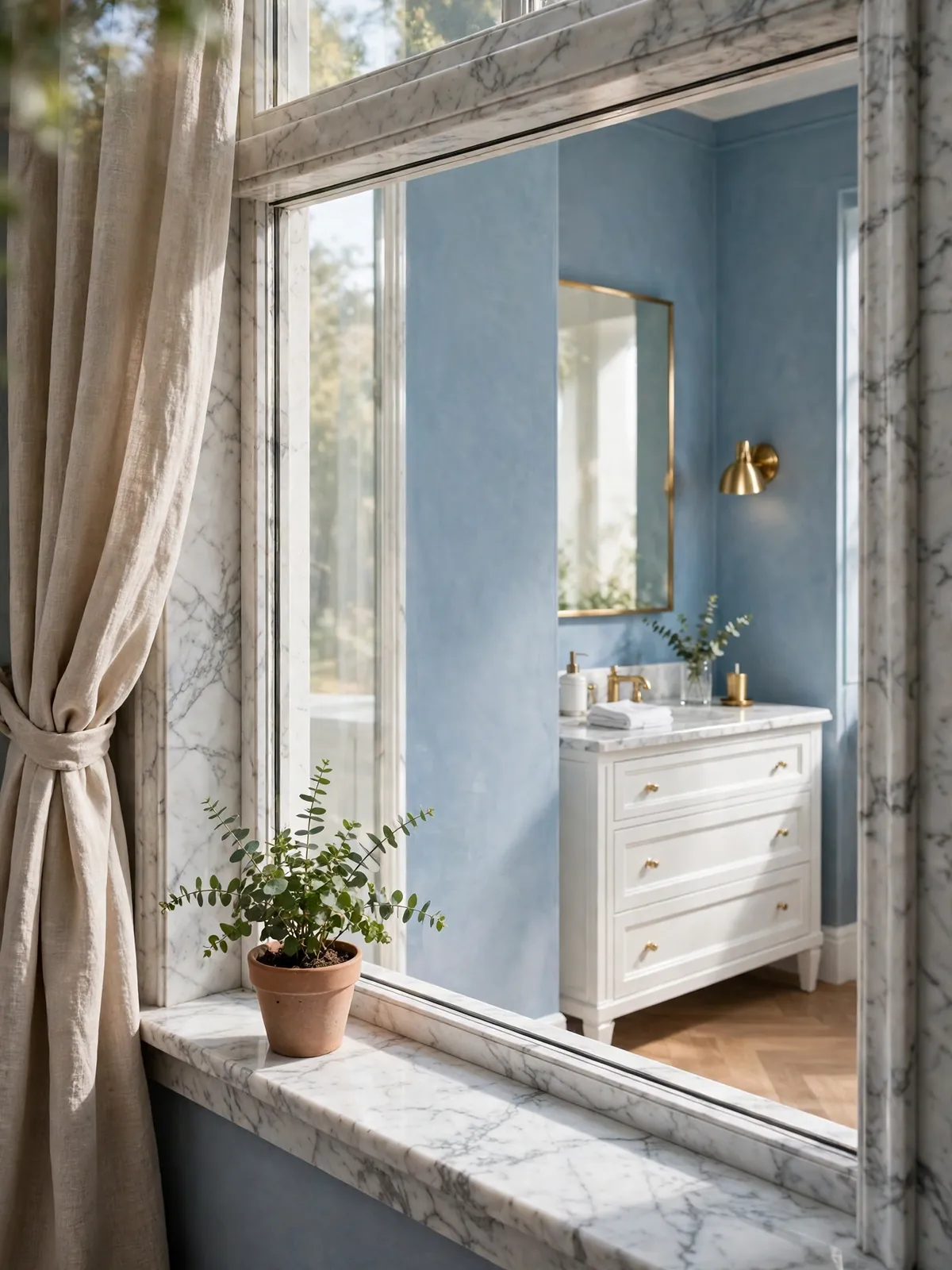
Marble window trim is the small detail that completes a marble bathroom, because stone edging around the window ties the light source into the rest of the design and makes the room feel considered in every corner. Here, white marble trims a window set into soft blue walls, with a linen curtain, a white vanity and a small plant on the sill. The design suits any marble bathroom with a window, it reflects light beautifully, and it is a modest upgrade with a polished result. The weakness is condensation: marble around a window sees moisture, so seal it well and ventilate the room.
Quick tips:
- Match the window trim to the vanity or floor stone.
- Use a single piece per side to avoid joints.
- Seal the trim well against condensation.
- Keep the sill clear so the stone shows.
Extend Marble to the Ceiling for Pure Drama
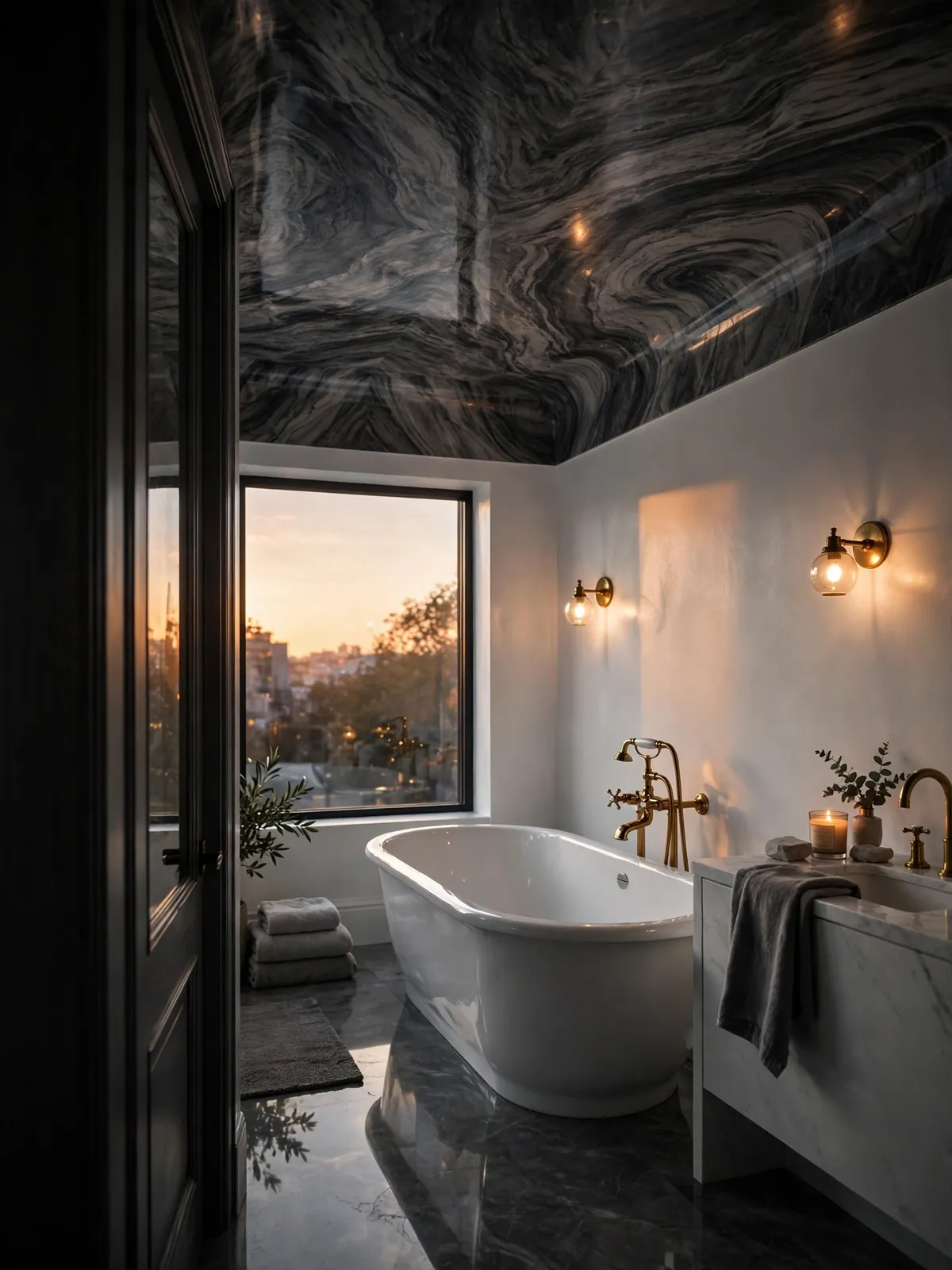
Tiling the ceiling in marble is the most unexpected idea in a marble bathroom, because the stone above catches the light differently from every angle and turns the whole room into a statement. Here, dark grey marble covers the ceiling above white walls, with brass fixtures, a freestanding tub and warm evening light completing the dramatic room. The design suits bathrooms where you want instant wow factor, it adds depth and luxury, and it is genuinely rare. The weakness is weight and cost: ceiling stone needs specialist fixing and a strong structure, so get a professional assessment first.
Quick tips:
- Use a dark marble on the ceiling for drama, pale elsewhere.
- Get a structural check before fixing stone overhead.
- Keep the lighting warm so the ceiling glows.
- Use marble-look porcelain on the ceiling to save weight.
Balance Marble With Greenery and Linen
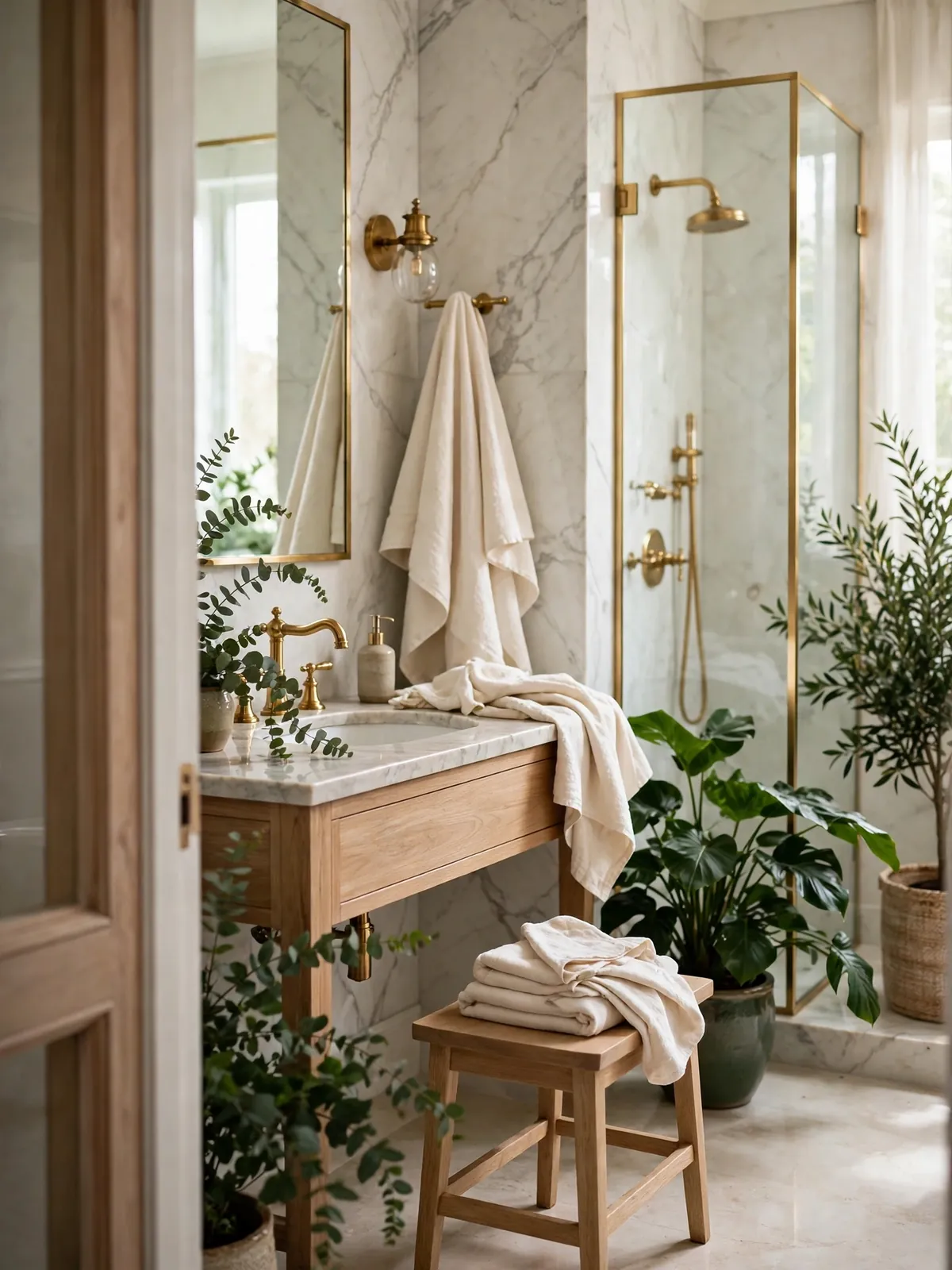
Marble can lean cold, but greenery and linen bring it back to life, because plants add freshness and soft textiles add warmth, and the room stops feeling like a museum. Here, deep green plants and cream linen towels soften white marble walls, with a light oak stool and brass fixtures completing the livable look. The design suits any marble bathroom, it costs almost nothing, and it is the easiest way to warm a stone room. The weakness is humidity: plants love it, but linen towels in a steamy room need regular washing, so keep a spare set.
Quick tips:
- Choose pothos, ferns or orchids that love humidity.
- Use cream or oatmeal linen, not bright white.
- Add one wood element, like a stool or tray.
- Keep plants away from direct shower spray.
Marble-Look Porcelain for the Luxury Without the Upkeep
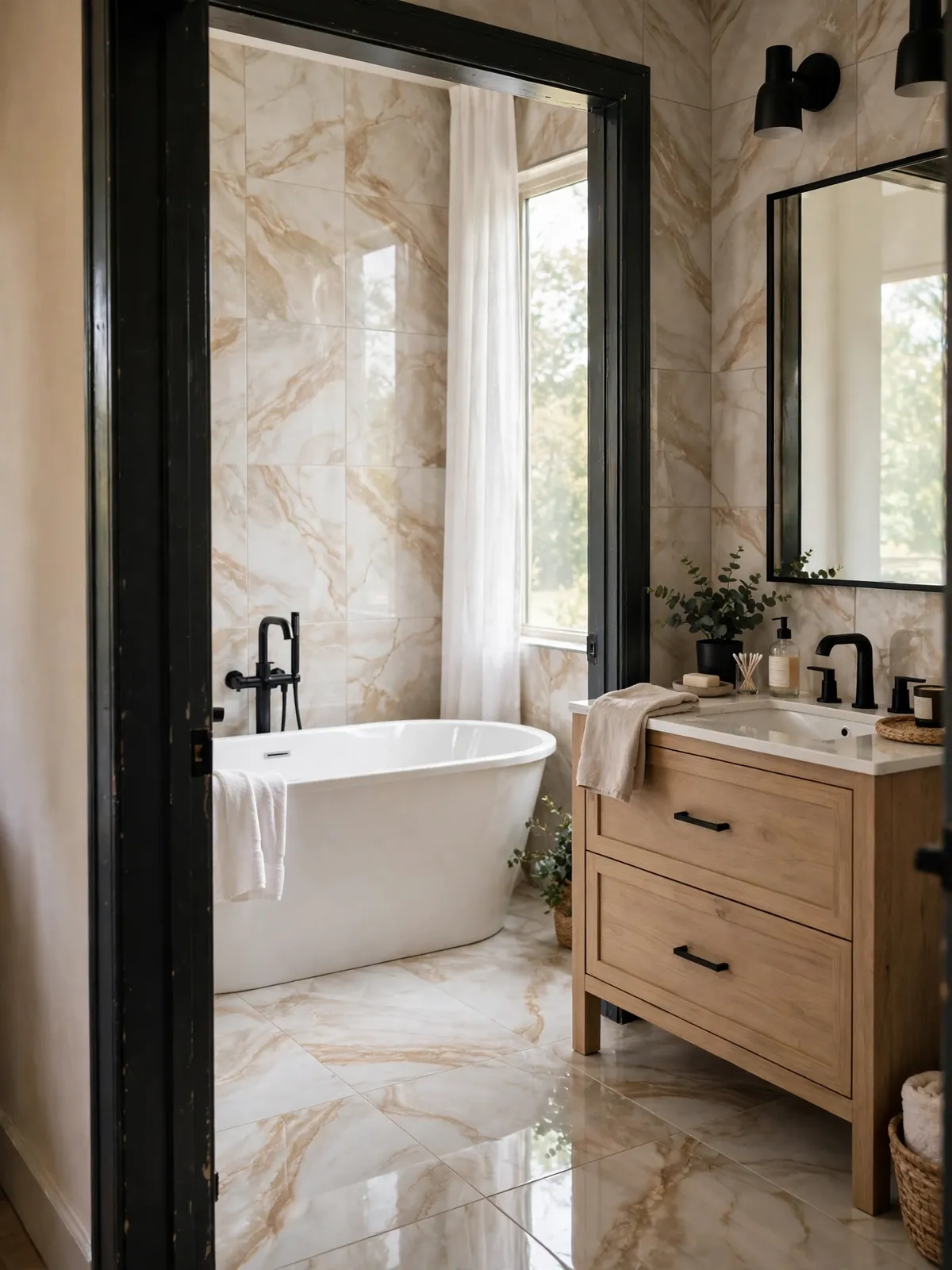
Marble-look porcelain is the smartest compromise in a marble bathroom, because modern printing copies the veining so well that most visitors cannot tell the difference, while the porcelain never needs sealing, never stains and costs far less. Here, warm beige-veined porcelain covers the walls around a white freestanding tub, with matte black fixtures and a light wood vanity. The design suits family bathrooms, wet rooms and anyone who loves marble but not maintenance, and it is as easy to clean as any porcelain. The weakness is realism: cheap porcelain repeats the same vein pattern too obviously, so choose a range with many different tile designs.
Quick tips:
- Choose a range with at least six different tile patterns.
- Use real marble for one feature, porcelain elsewhere.
- Pick large-format porcelain to reduce grout lines.
- Use a matte finish on the floor for grip.
Gold Fixtures That Make Marble Glow
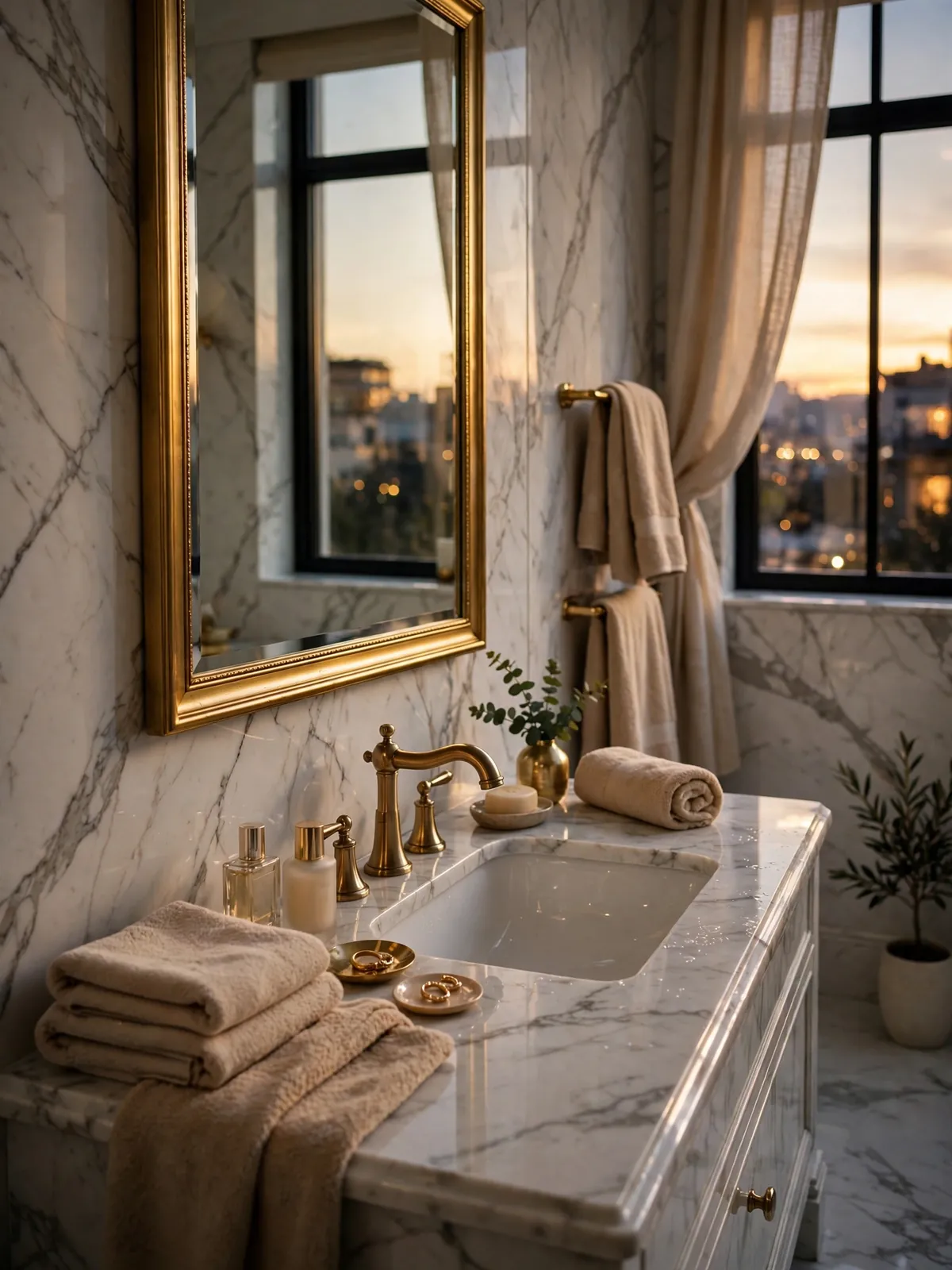
Gold fixtures are the perfect partner for marble, because brushed brass or gold warms the cool stone and makes the whole room glow, especially in evening light. Here, brushed gold taps, a gold-framed mirror and gold sconces sit against white Carrara walls, with warm beige towels softening the palette. The design suits any marble bathroom, it is the most flattering metal for white stone, and it feels timeless rather than trendy. The weakness is matching: gold finishes vary between brands, so buy all the fixtures from one range.
Quick tips:
- Buy all gold fixtures from one brand and finish.
- Choose brushed gold over polished for a softer look.
- Repeat the gold at least three times in the room.
- Pair gold with warm white marble, not cool grey.
Black Marble Drama for a Moody Retreat
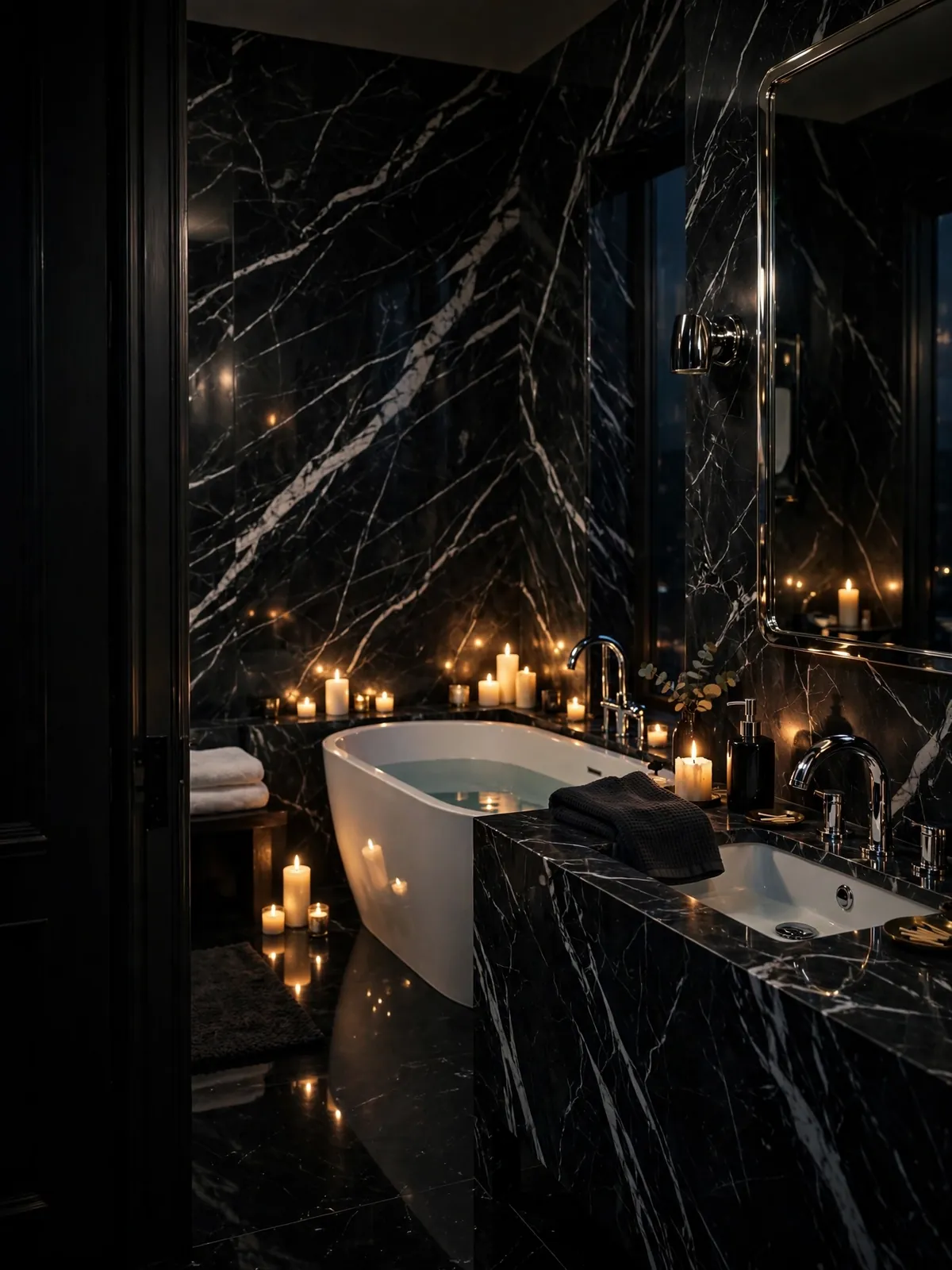
Black marble turns a bathroom into a moody, boutique-hotel retreat, because the dark stone with white veining reflects candlelight and lamplight in a way pale marble never does. Here, Nero Marquina walls wrap a bathroom with a white freestanding tub, chrome fixtures and warm candlelight, and the room feels private and indulgent. The design suits larger bathrooms and evening bathers, it hides water marks better than white stone, and it makes a freestanding tub feel like a ritual. The weakness is light: a dark marble bathroom with a small window can feel gloomy in the morning, so balance it with a large mirror and warm bulbs.
Quick tips:
- Balance black marble with a large mirror and warm light.
- Keep the ceiling and towels pale to lift the room.
- Use chrome or nickel with black marble, not brass.
- Test the stone in morning and evening light first.
Marble in a Small Bathroom That Feels Larger
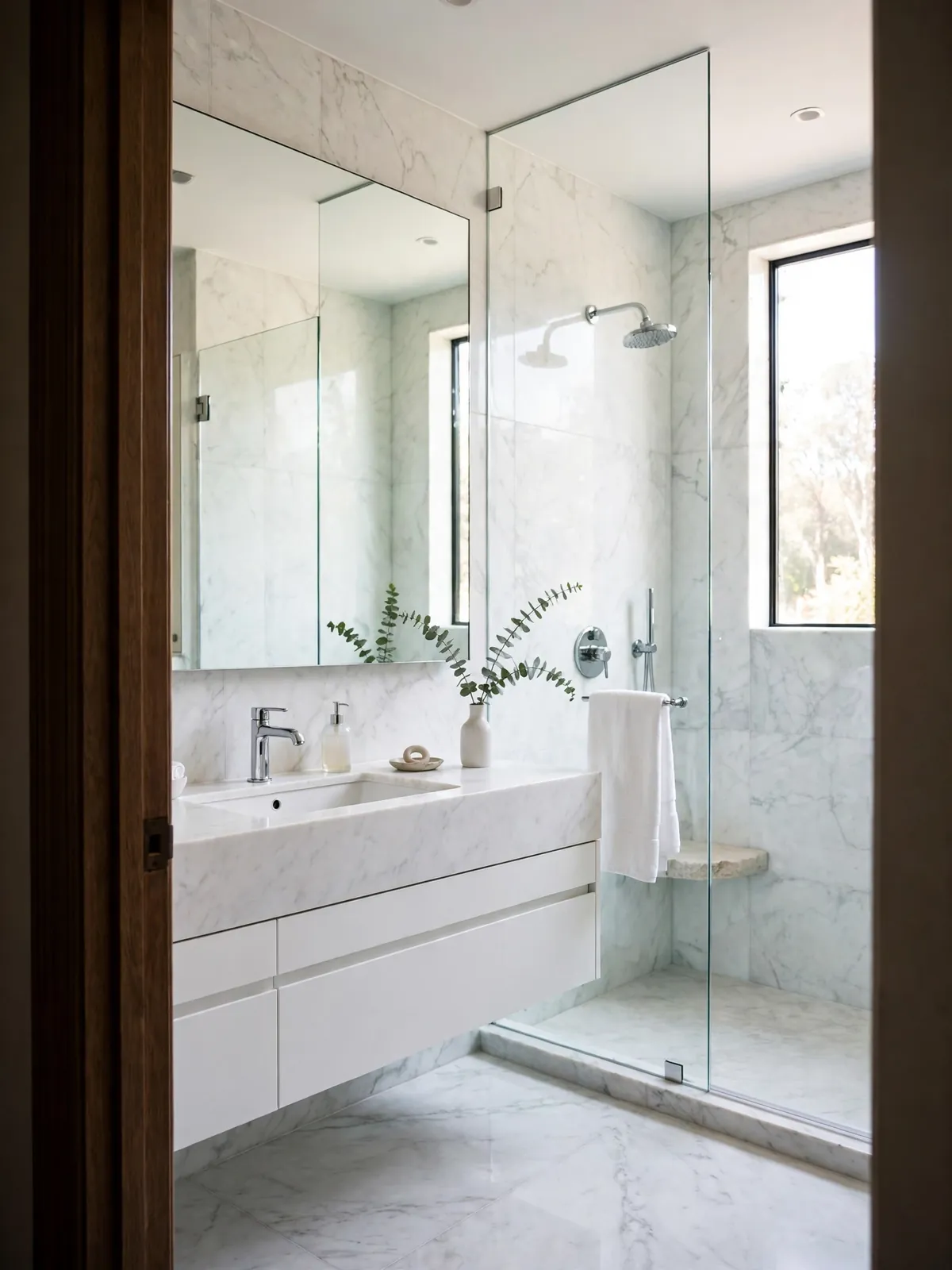
Pale marble is one of the best materials for a small bathroom, because the soft veining adds interest without breaking the room into pieces, and large-format tiles with few grout lines make the walls read as one continuous surface. Here, pale marble tiles cover a compact bathroom, with a large mirror, a floating white vanity, a frameless glass shower and a single eucalyptus stem. The design suits cloakrooms and en suites, it makes the room feel larger, and it looks expensive without a luxury price. The weakness is grout: pale grout on a floor shows dirt quickly, so use a slightly darker grout on the floor than on the walls.
Quick tips:
- Use large-format pale marble to reduce grout lines.
- Run the same tile on floor and walls.
- Add a frameless glass shower to keep the room open.
- Keep the vanity floating so the floor shows through.
Marble Bathroom Ideas That Let the Stone Lead
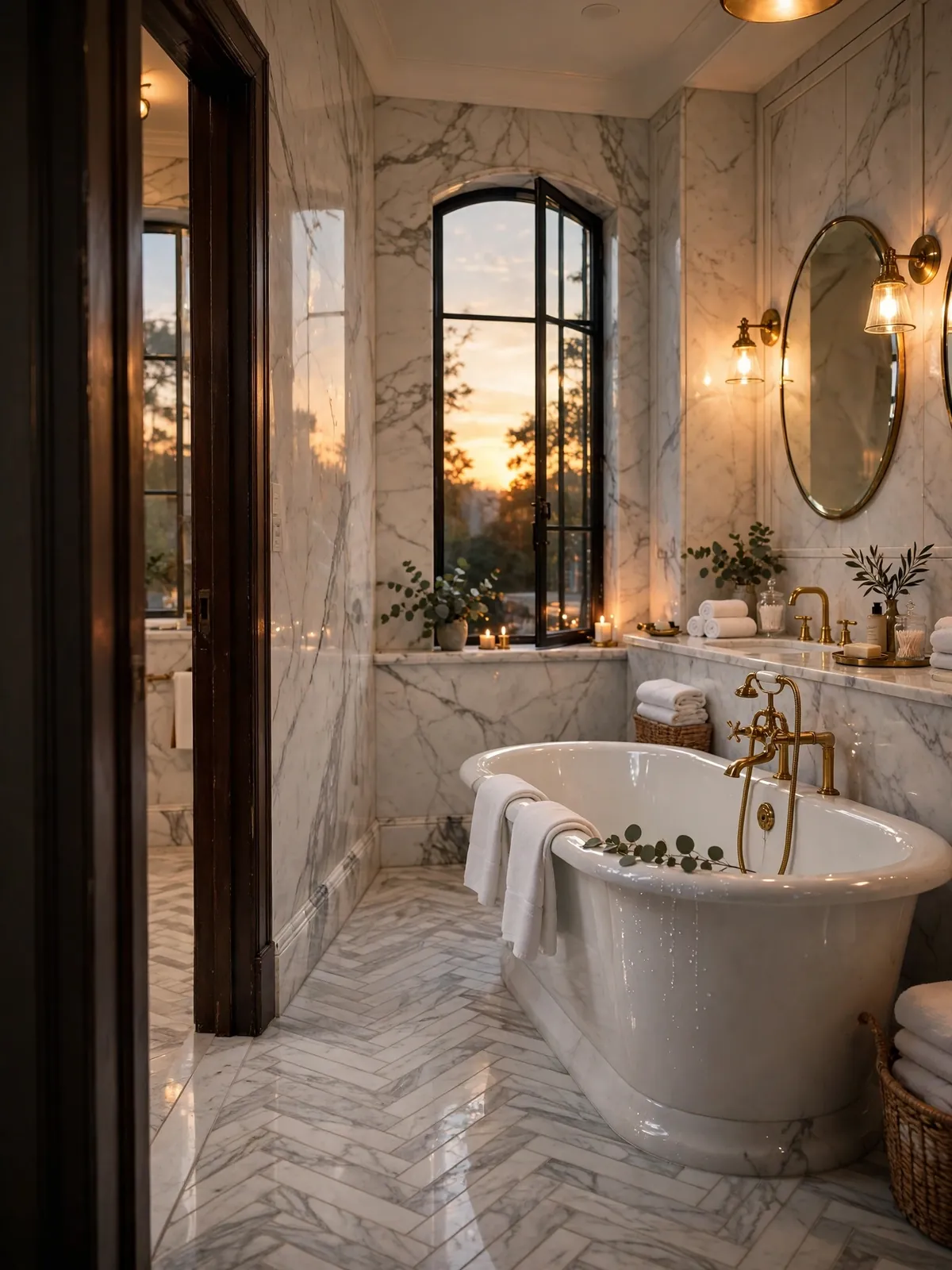
The last of these marble bathroom ideas is the principle behind them all, and it is worth stating plainly because it is the difference between a bathroom that looks good in a photograph and one that feels beautiful every day: great marble design is not one expensive slab, it is the combination of the right stone in the right place — a calm large-format floor underfoot, a bold vein where the eye lands, a honed finish where you walk and a polished one where you look, warm wood or brass to soften the cool stone, and sealing done properly before the room is ever used — working together so that the floor, the walls, the grout and the fixtures all support each other instead of competing for attention, and the room rewards you every time you walk in rather than only on the day it was finished. Here, a white Carrara and warm gold bathroom pulls it together — herringbone marble floor, marble walls, brass fixtures and a freestanding tub — and nothing in the room is there by accident. The lesson is to choose the stone first, since it sets the palette and the maintenance, then pick one feature for the boldest vein, match the fixtures to the stone’s warmest tone, and let the rest of the room stay calm, because a bathroom built in that order stays beautiful with very little effort, even in a small bathroom, even on a modest budget, and even when you change only one thing at a time. View the actual slab before you buy, seal it before use, and the marble stops being a surface you worry about and becomes the reason the whole room feels finished.
Quick tips:
- Choose the stone first — it sets the palette and the upkeep.
- Pick one feature for the boldest veining.
- Match fixtures to the stone’s warmest tone.
- Seal before use and reseal every year.
FAQs
How much does a marble bathroom cost?
A marble bathroom costs far more than a porcelain one, because real marble slabs and tiles are expensive and need specialist installation. Carrara is the most affordable real marble, marble-look porcelain costs a fraction of the price, and using real marble on one feature wall with porcelain elsewhere gives you the luxury look at a manageable budget.
Can I use marble in a shower?
Yes, marble works beautifully in a shower, but it must be sealed before use and resealed regularly, because it is porous and sees constant water. Use large-format tiles to reduce grout lines, choose a honed finish on the shower floor for grip, and clean only with a pH-neutral stone cleaner.
Does marble stain easily in a bathroom?
Marble stains from acidic substances like citrus, vinegar, some shampoos and hair dyes, because the acid etches the surface. Wipe spills immediately, keep coloured toiletries on a tray rather than directly on the stone, and seal the marble yearly to slow staining — but never expect marble to stay perfect, since its patina is part of its charm.
What is the difference between Carrara and Calacatta marble?
Carrara marble has soft, feathery grey veining on a white or blue-grey background and is the most affordable and widely available. Calacatta has bolder, more dramatic veining in gold and grey, is rarer and more expensive, and is usually saved for feature walls and slab vanities.
How do I clean a marble bathroom?
Clean marble only with a pH-neutral stone cleaner or warm water with a drop of mild dish soap, and dry the surface afterwards to avoid water spots. Never use vinegar, bleach, lemon cleaners or abrasive sponges, because they etch or scratch the stone. Squeegee shower walls after every use to keep the marble looking new.
Conclusion
Marble turns a bathroom into a retreat, and the 27 ideas above show that you can bring real stone into your bathroom at almost any budget — whether you wrap the room in Carrara slabs, crown the vanity with a single Calacatta piece, add a marble niche or medallion, or use marble-look porcelain where the room works hardest. Start with the stone, pick one feature for the boldest veining, match the fixtures to the stone’s warmest tone, and seal everything before the room is ever used. Do that, and your marble bathroom stops being a room you worry about and becomes a space that feels designed, durable and quietly luxurious every single day.