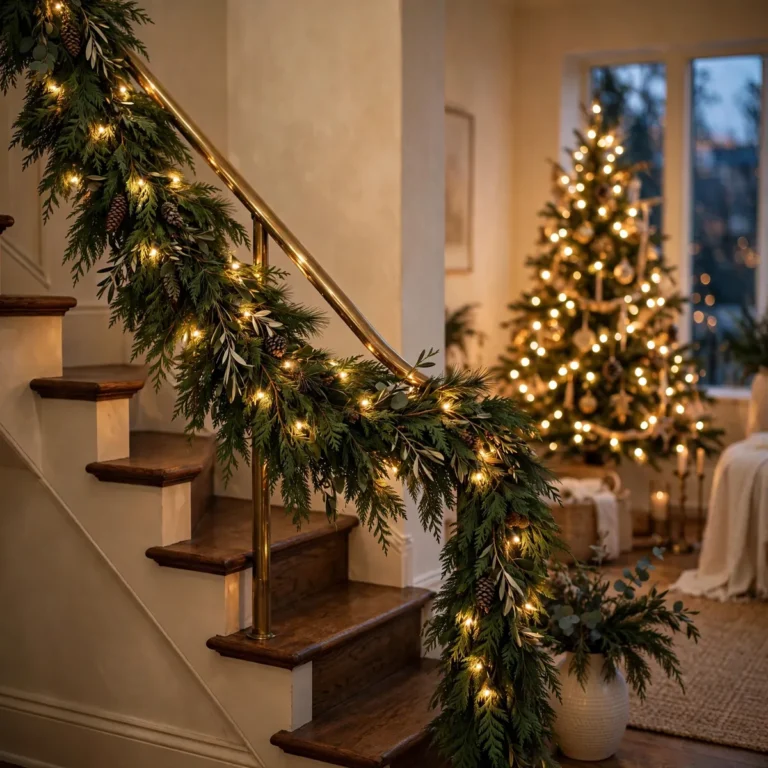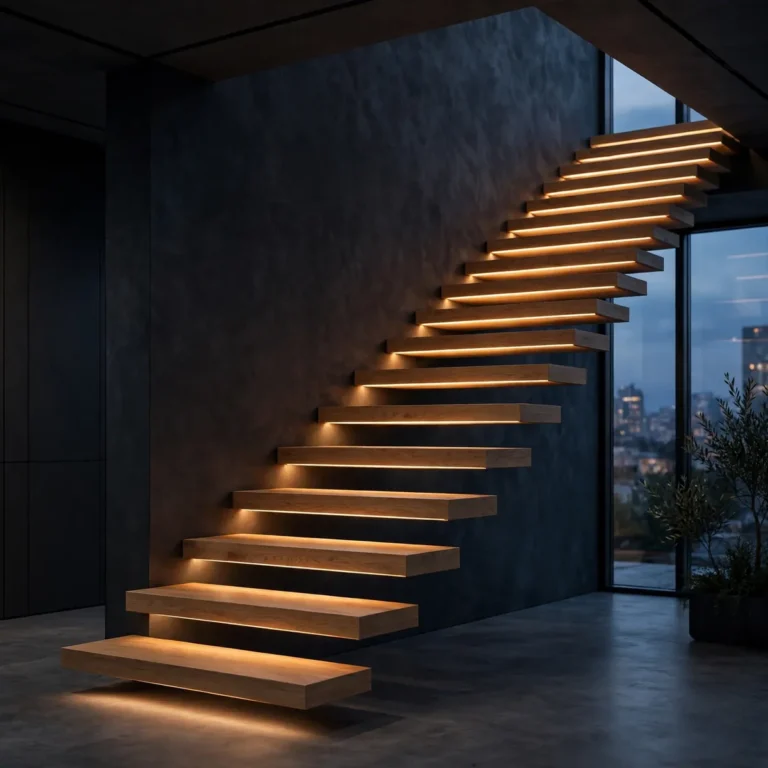
25 Double Height Staircase Wall Ideas, From Gallery Walls to Grand Chandeliers
Gallery walls, tall paneling, cascading chandeliers — 25 ideas for styling the towering wall beside your staircase.
Double height staircase wall ideas solve the most awkward blank space in the house: that towering, two-story stretch of wall running alongside your stairs. Leave it bare and the whole entry feels unfinished; decorate it wrong and it looks cluttered from every angle. The trick is thinking in vertical layers — one big gesture up high, rhythm through the middle, and something grounding at the bottom.
The easiest place to start is art, and these staircase gallery wall ideas pair perfectly with the paneling, lighting, and large-scale pieces below.
Build a Floor-to-Ceiling Salon Gallery Wall
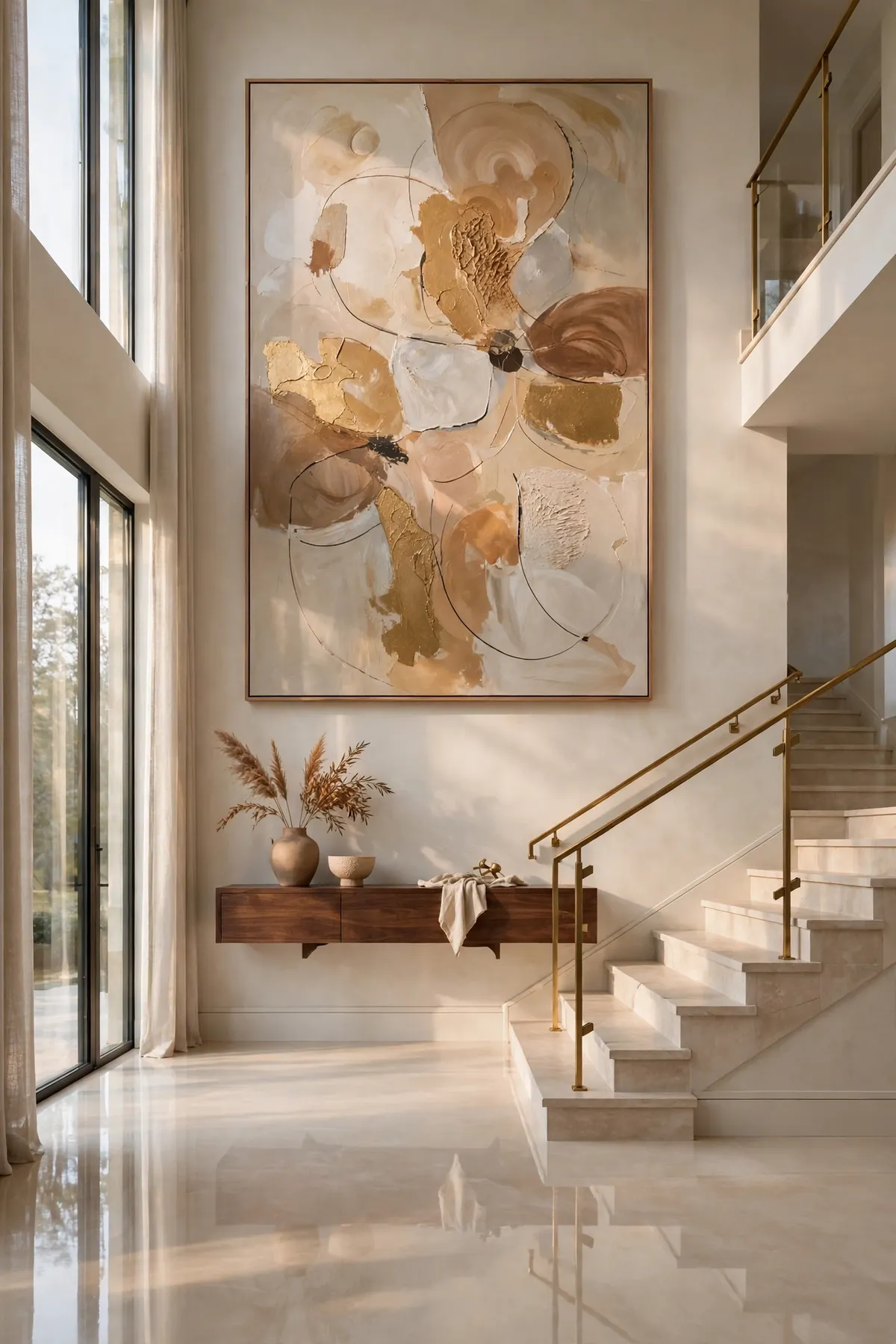
A salon-style gallery wall that climbs the full height of the stair wall is the classic double-height move — mixed frames, mixed sizes, arranged to rise with the stairs. The secret is planning it on the floor first and keeping a consistent thread: all black frames, all wood frames, or one color story across the art. It fills the vertical space without a single piece having to be enormous.
- Lay the arrangement on the floor and photograph it before hanging.
- Keep 2–3 inches between frames for a collected feel.
- Start hanging from the middle outward, following the stair angle.
One Oversized Canvas, Centered and Breathing

The opposite of a gallery wall: one huge canvas, centered on the tall wall, with nothing else competing. In a double-height space, scale is everything — the art should span at least two-thirds of the visible wall width, or it will look lost. Abstracts, soft landscapes, and large-scale photography all work; the frame should be minimal or nonexistent.
- Measure the visible wall, not the whole wall — stairs block the lower part.
- Hang the center slightly above the stair midpoint.
- One big piece needs good lighting to earn its place.
A Triptych That Climbs With the Stairs
Three matching panels hung in a rising diagonal that echoes the staircase angle — a triptych in motion. It gives you the impact of large-scale art with the flexibility of smaller pieces, and the diagonal arrangement feels made for the space. Choose one image split across three panels, or three related prints.
- Keep gaps between panels equal and narrow.
- The diagonal should roughly match the stair pitch.
- Identical frames keep the trio reading as one piece.
Tall Board-and-Batten Panels in a Single Color
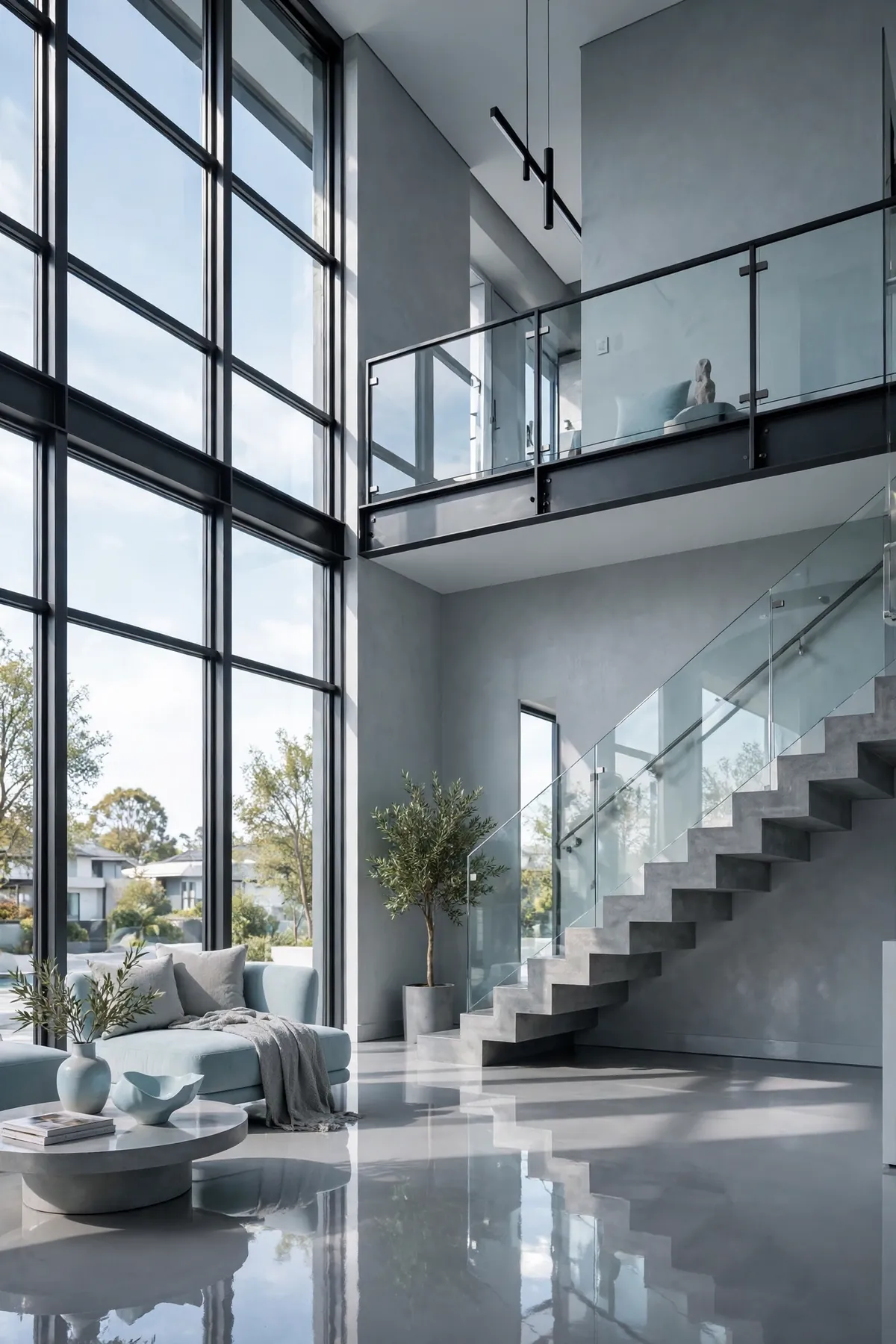
Full-height board-and-batten — vertical battens running floor to ceiling, painted the same color as the wall — adds architecture to a flat tall wall without adding visual noise. The monochrome finish keeps it calm while the shadows in the trim give it depth. Wider batten spacing suits tall walls better than fussy narrow grids.
- Paint wall and battens one color for a seamless look.
- Wider spacing (18–24 inches) suits double height.
- Caulk every joint — tall walls show gaps in raking light.
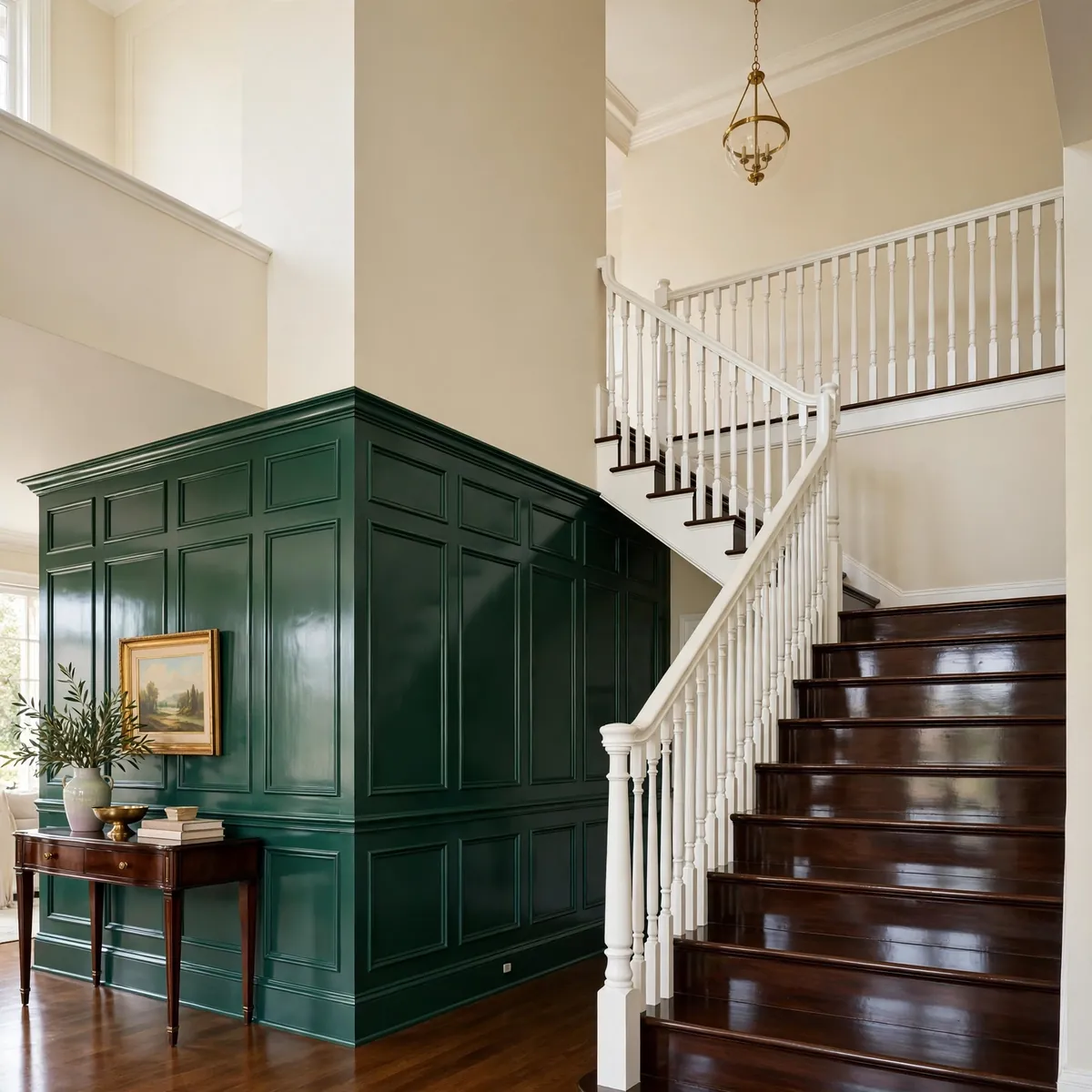
Picture-Frame Moulding in a Full-Height Grid
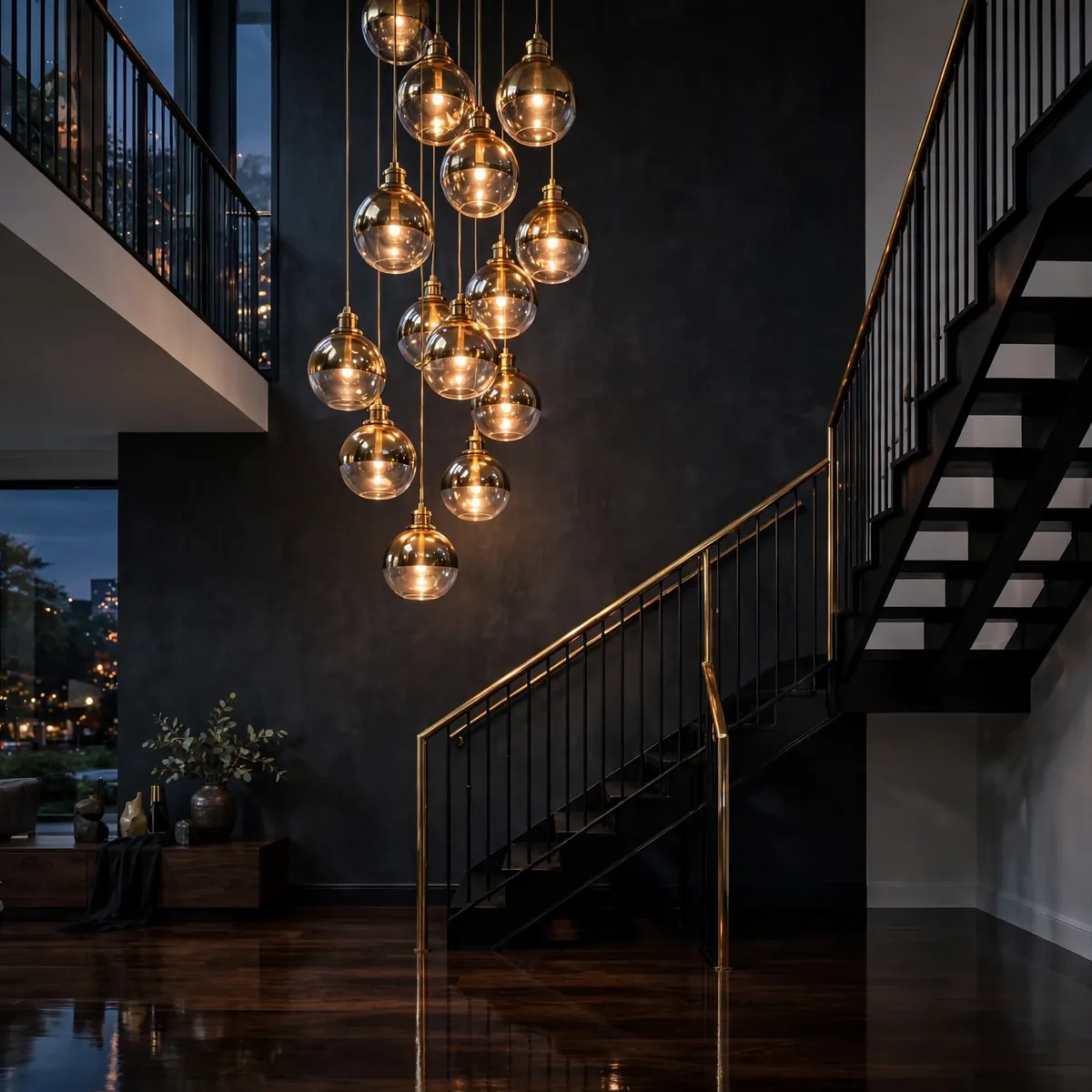
Applied picture-frame moulding in a tall grid turns a plain stair wall into paneled elegance. Repeat the rectangles floor to ceiling, sizing them to the wall’s proportions rather than standard sizes. Painted the wall color, it reads as architecture; painted in contrast, it becomes the decoration itself.
- Sketch the grid to scale first — tall walls punish bad proportions.
- Keep the bottom row aligned with the stair base.
- Use lightweight moulding on drywall to avoid heavy fixings.
Vertical Shiplap to Stretch the Eye Upward
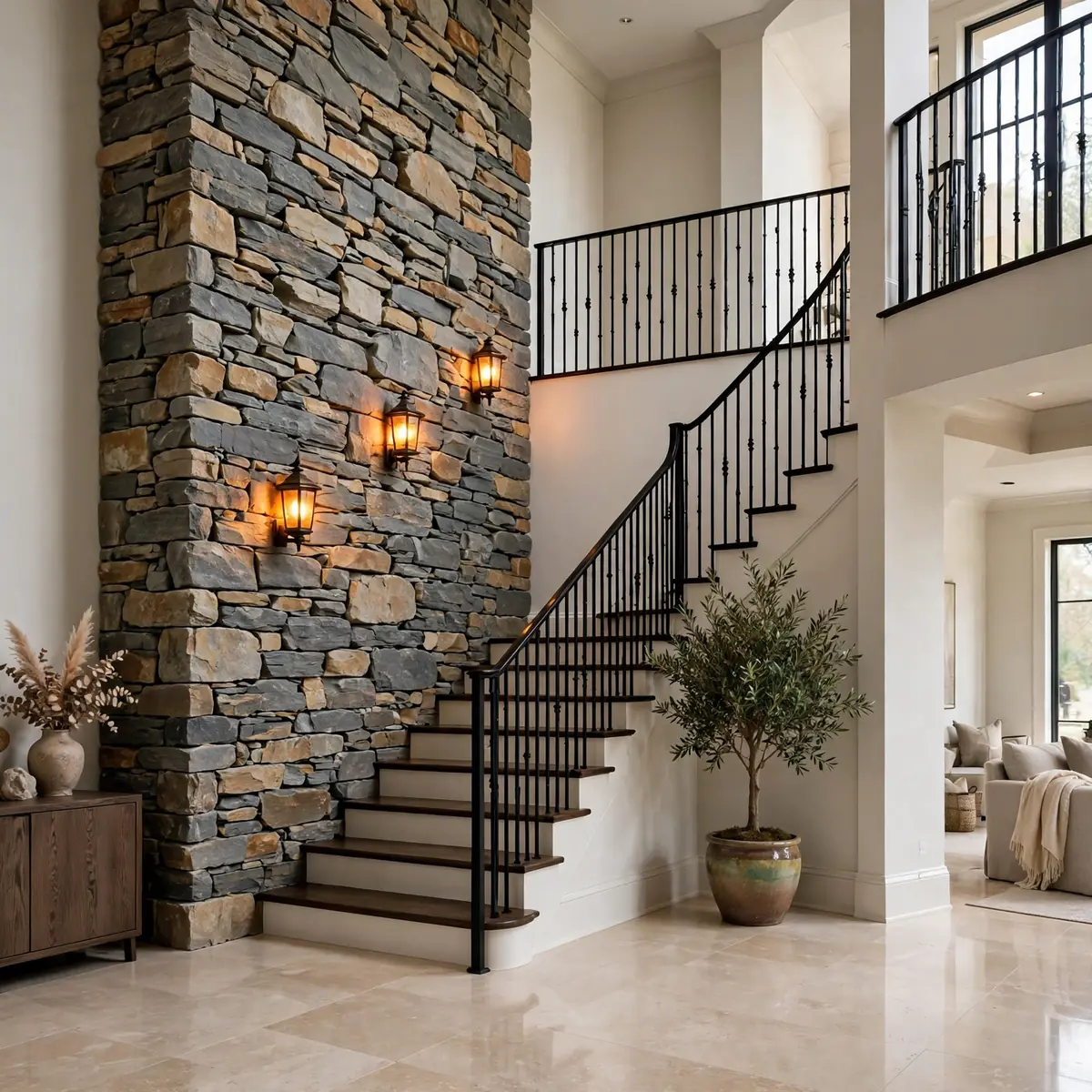
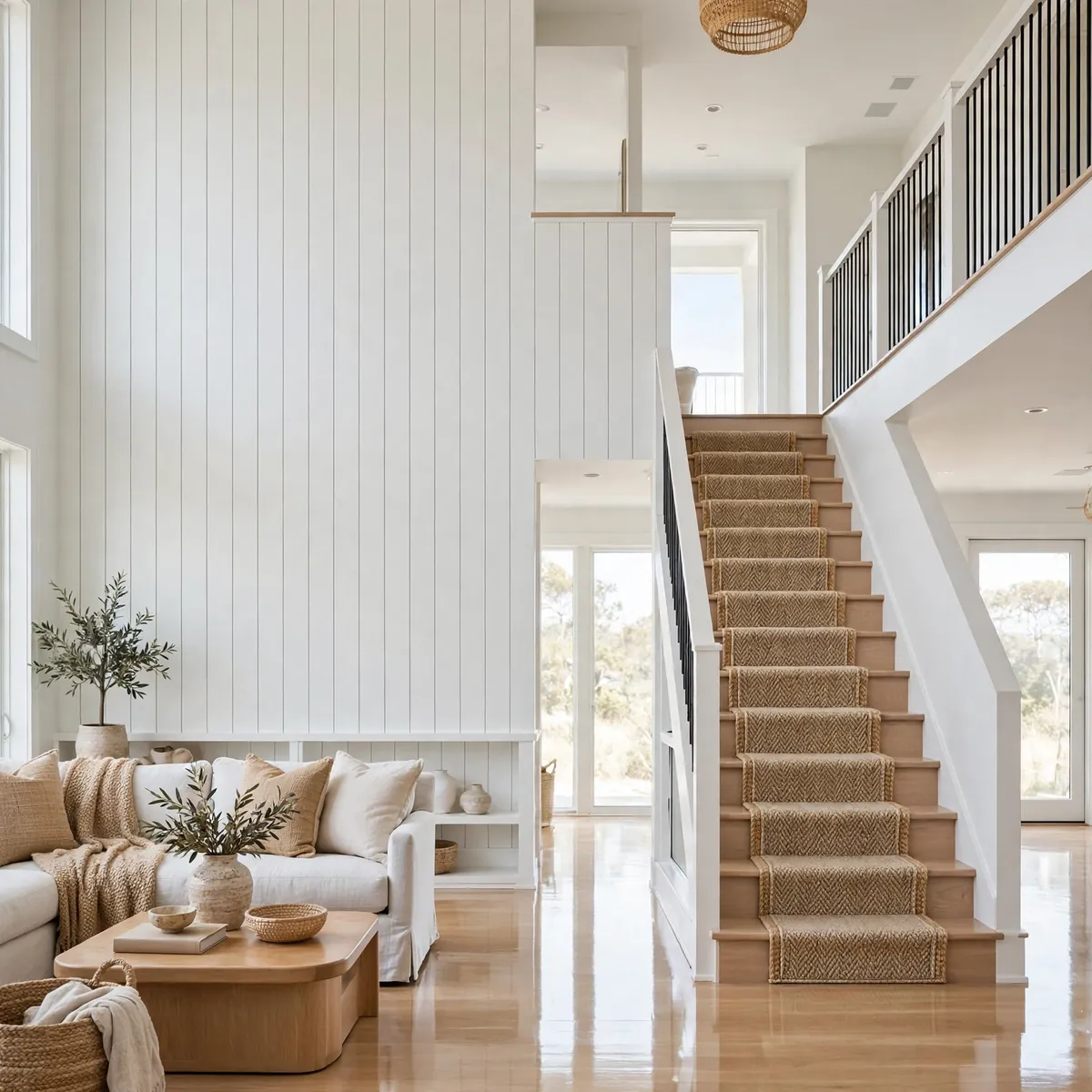
Vertical shiplap boards running the full height of the stair wall pull the eye straight up and make the ceiling feel even higher. Painted white or warm white it’s coastal-calm; painted a deep color it’s dramatic. The thin shadow lines between boards give the wall rhythm without any decor.
- Run boards vertically, not horizontally, for the height effect.
- Paint after installation for the cleanest finish.
- Nickel-gap (thin shadow line) looks more refined than wide gaps.
Floor-to-Ceiling Wood Slats in Warm Oak

Slim vertical wood slats from floor to ceiling bring warmth and texture to a tall stair wall, and they have a bonus: they soften echoes in big open stairwells. Warm oak suits cozy and Scandinavian homes; dark walnut slats turn the wall into a dramatic backdrop. Leave small gaps between slats for the shadow-line effect.
- Secure slats to battens, not directly to drywall, for a flat finish.
- Oak plus a black metal stair rail is a classic pairing.
- Slats also hide imperfect walls beautifully.
Limewash the Whole Wall in a Soft Mineral Tone

A full-height limewash in a soft mineral tone — warm greige, pale clay, muted sage — gives a towering wall movement and depth that flat paint can’t. The cloudy texture catches light differently at every height, so the wall feels alive as you climb. It’s the quietest dramatic choice on this list.
- Use a mineral primer over previously painted drywall.
- Work in loose, overlapping strokes.
- Two thin coats beat one thick one.
Double Height Staircase Wall Ideas for Narrow Stairwells

Narrow stairwells with double-height walls are the trickiest version of this problem, because every choice is seen up close and there’s no room for furniture to help. The approach that works is restraint plus one vertical gesture: keep the wall a single light color so the narrow space doesn’t close in, then choose exactly one tall element — a slim vertical mirror, a single column of floating shelves, one narrow piece of art hung high, or a line of small sconces — and let it run the full height. What ruins narrow double-height walls is the instinct to fill them: a busy gallery wall in a three-foot-wide stairwell feels chaotic because you’re always inches from it, and deep shelves or protruding decor make the passage feel tighter than it is. Keep everything flat to the wall or recessed, keep the palette to two or three tones, and put the visual interest in the upper two-thirds where the eye naturally travels. A narrow tall wall styled this way feels like a designed slot of light rather than a tunnel, and it costs less than any other idea here because restraint is doing the work.
- Everything flat to the wall — nothing protruding in a narrow stair.
- Put the interest in the upper two-thirds.
- Two to three tones maximum.
Two-Tone Color Blocking That Follows the Stair Angle
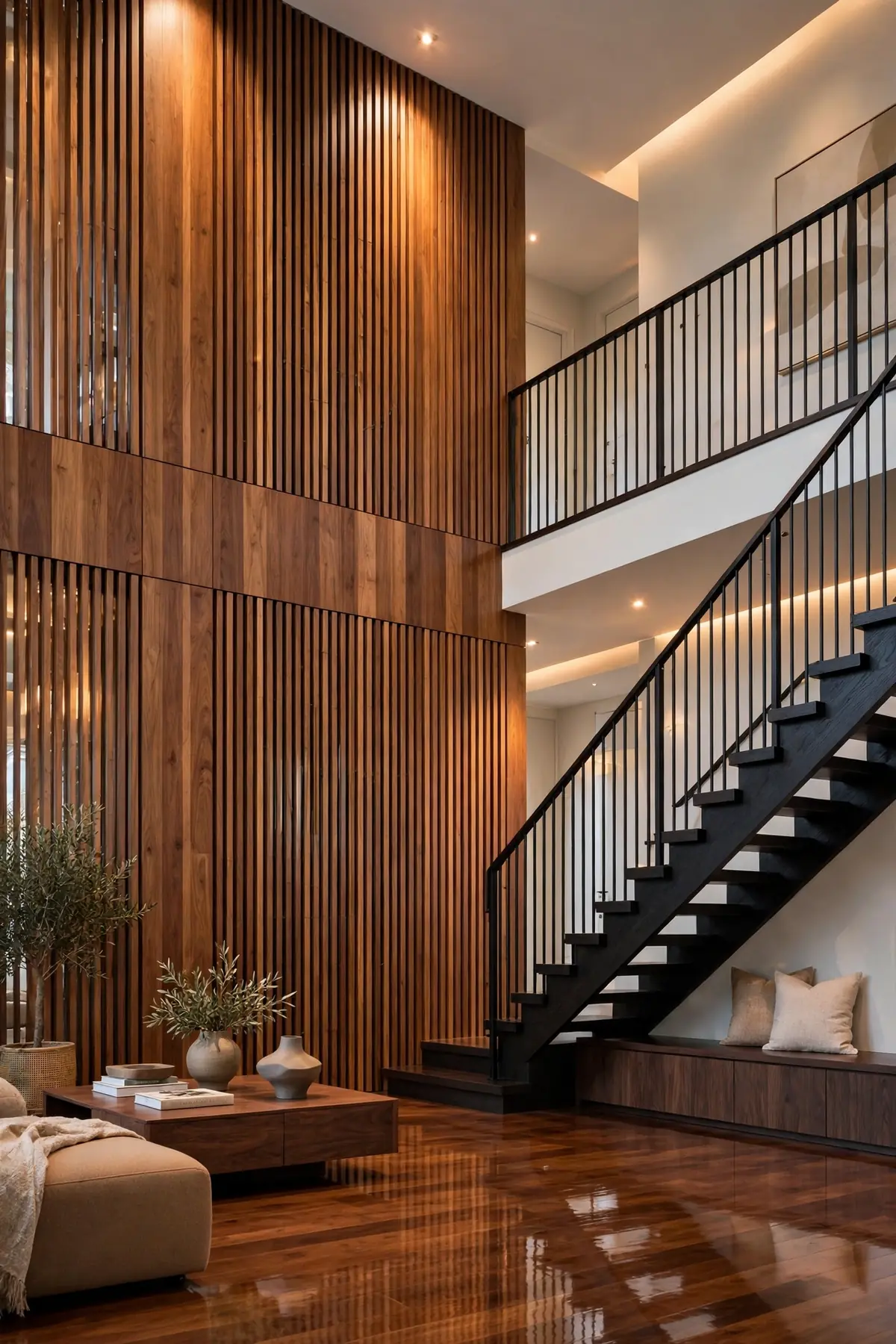
Paint the tall wall in two tones with the dividing line running parallel to the staircase — a deep color below the line, pale above, or vice versa. The diagonal break echoes the architecture instead of fighting it, and it visually anchors the lower half while letting the upper wall breathe. Deep navy below and warm white above is the timeless version.
- Mark the line with a laser level following the stair pitch.
- Crisp tape lines matter — seal tape edges with the base color first.
- The darker tone usually works better on the lower section.
A Full-Height Ombré Fade From Dark to Light
An ombré wall that starts rich at the bottom and dissolves into pale at the top feels almost sky-like in a double-height stairwell. Deep teal fading to mist, or charcoal to soft grey — the gradient mimics how natural light behaves, so it never looks artificial. It’s artistic but easy to live with because there are no hard edges.
- Blend with a dry roller while the paint is wet.
- Work in horizontal bands, top to bottom.
- Test the fade on a large board first — small swatches lie.
Bold Wallpaper on the Tall Wall Only
One wall of bold wallpaper — a large-scale botanical, an abstract mural print, a dramatic damask — turns the double-height stair wall into the home’s statement. Keeping the other walls plain lets the pattern own the space. Large-scale prints suit tall walls far better than small busy patterns, which turn to noise at height.
- Large-scale motifs only — small prints disappear up high.
- Paste-the-wall papers handle tall drops best.
- Order 15% extra for pattern matching on tall walls.
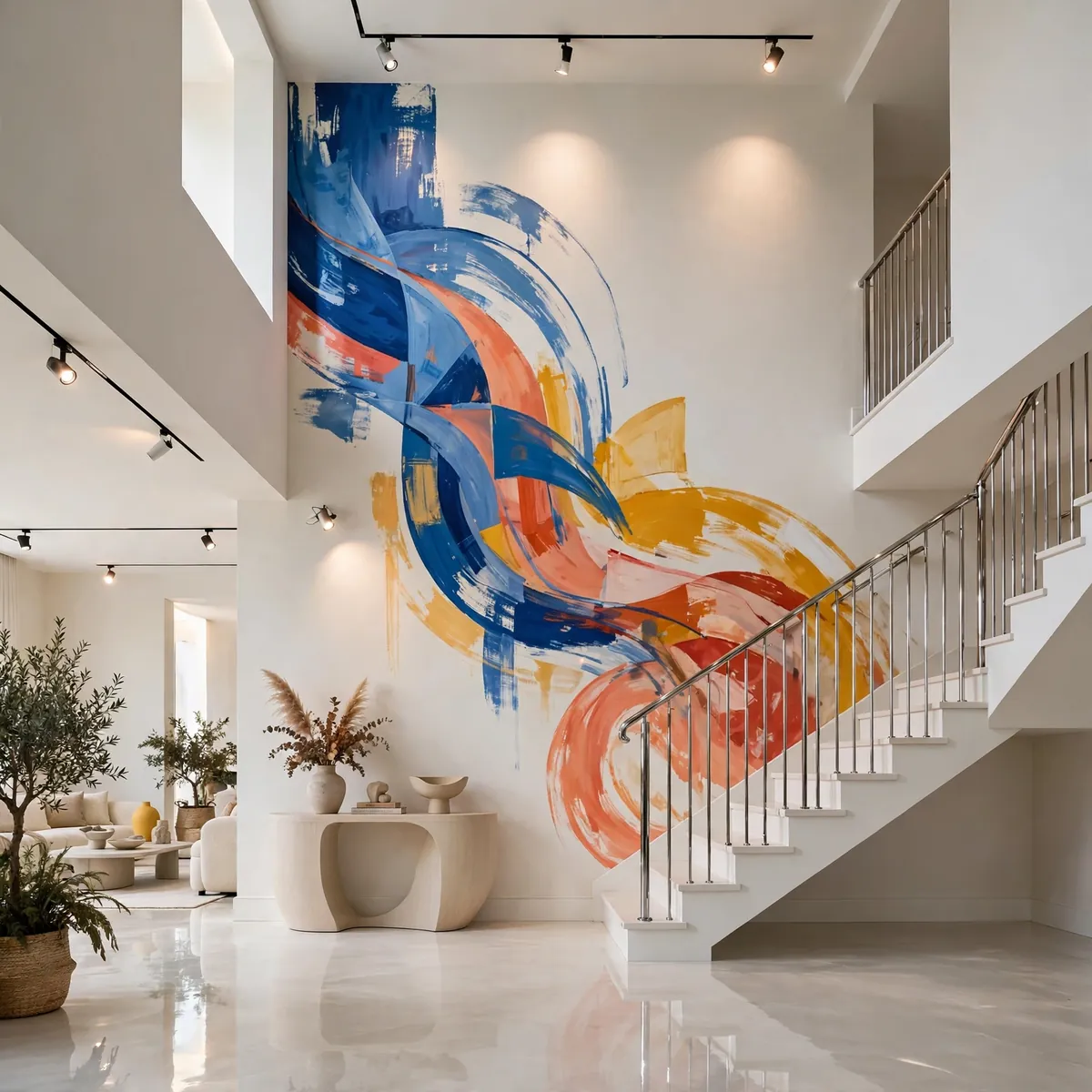
A Hand-Painted Mural Up the Stairwell
A hand-painted mural — rolling hills, abstract washes, a climbing vine — makes the stair wall a one-of-a-kind feature that no wallpaper can match. It becomes immersive as you climb, revealing itself step by step. Commission an artist for the full effect, or try a simple landscape gradient yourself with sample pots.
- Keep surrounding decor minimal — the mural is the hero.
- A simple design executed well beats an ambitious one done badly.
- Photograph the wall in sections to plan the composition.
Exposed Brick or Stone for Full-Height Texture
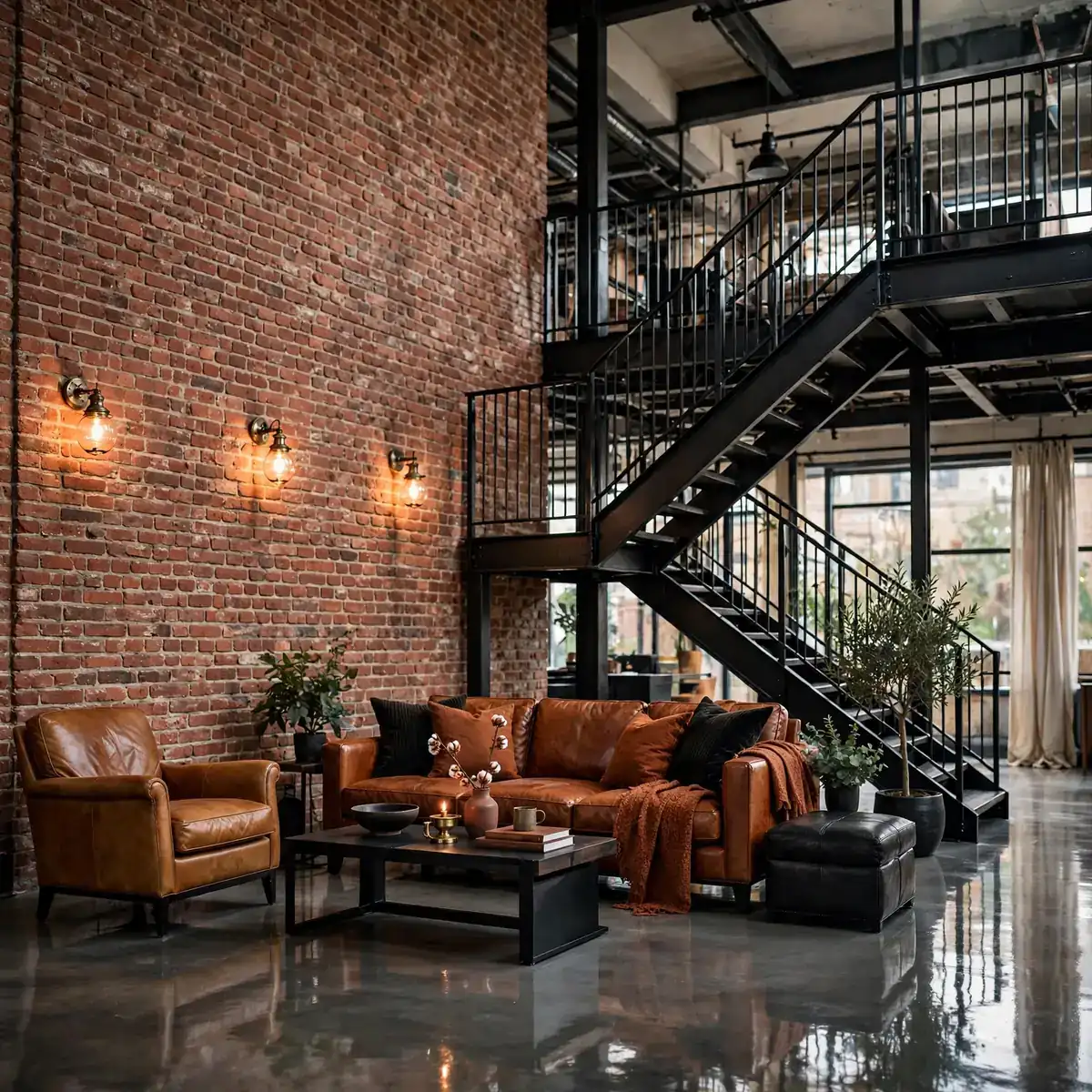
Cladding the entire double-height wall in brick or stone — real or good faux panels — gives you drama with zero frames and zero paint tricks. Texture does all the work, and at night, sconces grazing across the surface throw shadows that feel almost cinematic. It suits rustic, industrial, and Mediterranean homes especially.
- Faux panels are lighter and easier on tall walls.
- Seal real brick to control dust.
- Graze lighting across the surface, don’t flood it.
One Dramatic Oversized Round Mirror
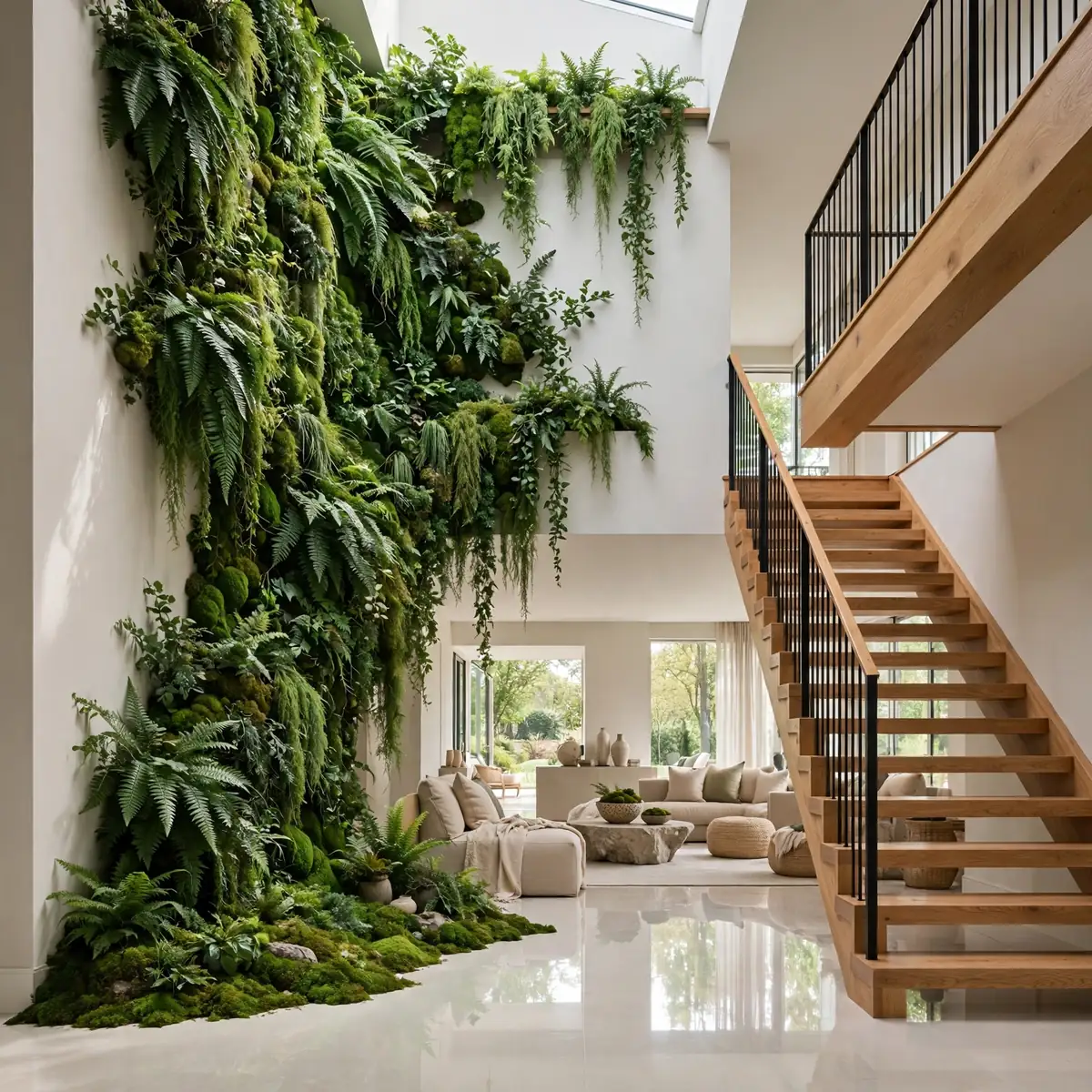
An oversized round mirror — four feet across or more — hung high on the tall wall softens all the stairwell’s hard angles and throws light deep into the space. The round shape is the key: against all those straight lines and diagonals, a big circle feels intentional and calming. A thin brass or black frame keeps it refined.
- Hang it to reflect a window or chandelier, not a blank wall.
- Round mirrors need a secure anchor — they’re heavy.
- One big mirror beats two medium ones at this scale.
A Cluster of Antique Mirrors Climbing the Wall
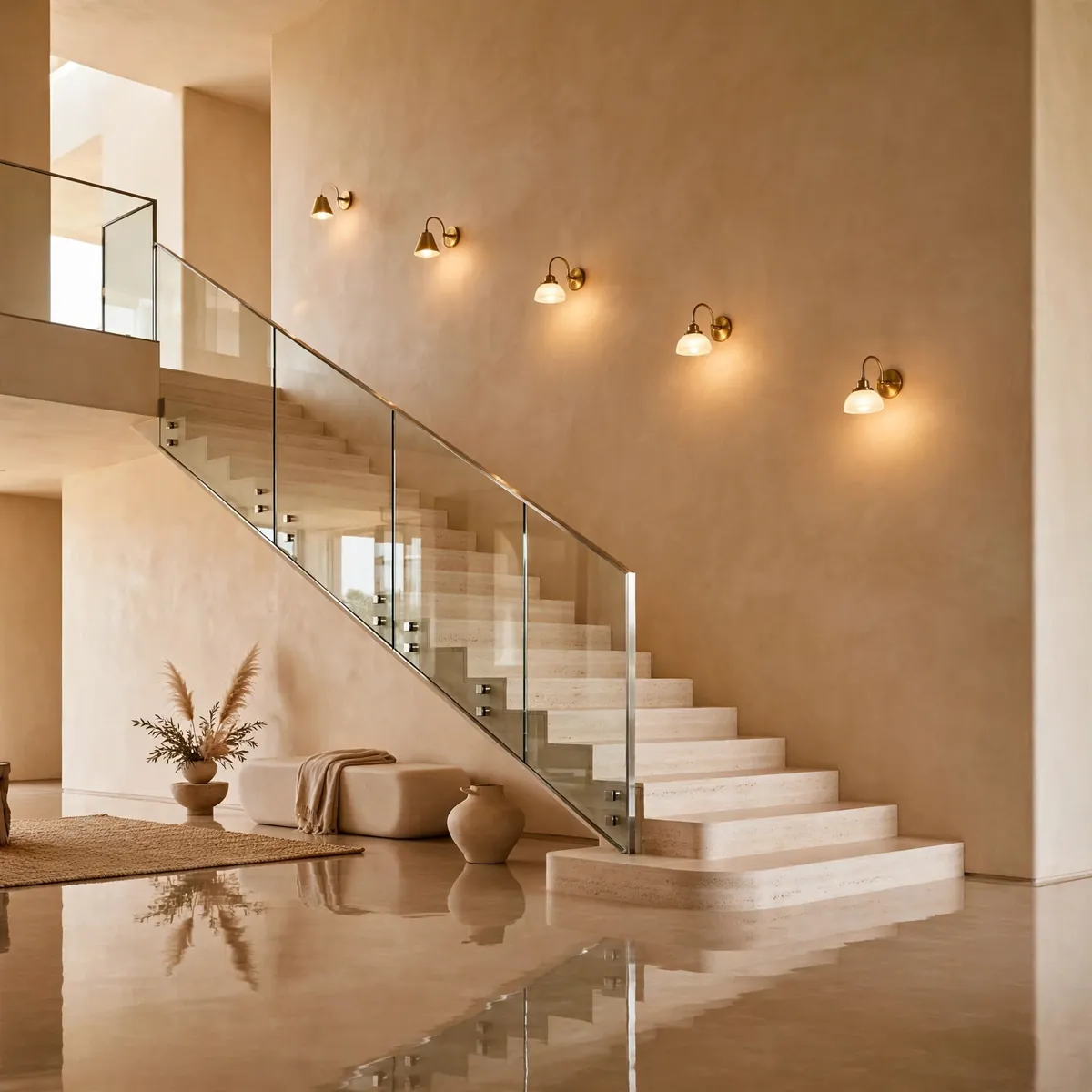
A climbing cluster of vintage and antique mirrors — different shapes, aged frames, foxed glass — turns the tall wall into a collected, storied display. Each mirror catches light differently, so the wall sparkles as you move. It’s the maximalist answer to the single-mirror idea, and it works best with simple stairs.
- Mix shapes but keep frames in one metal family.
- Odd numbers of mirrors look most natural.
- Check each mirror’s hanging hardware — old ones fail.
A Cascading Chandelier Down the Wall
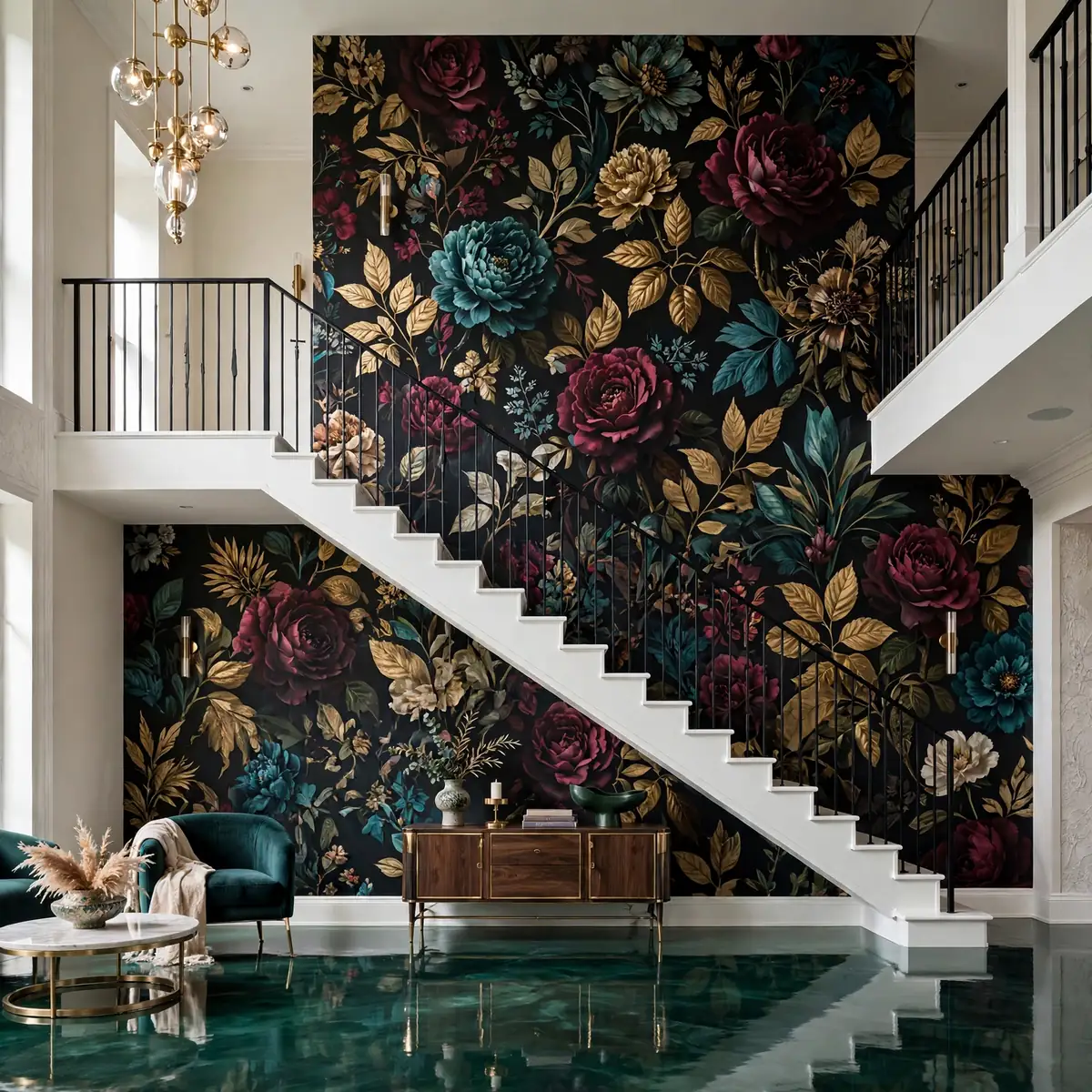
A cascading chandelier — crystals, glass drops, or sculptural rings falling two stories — is the jewelry of a double-height stairwell. It fills the vertical void with light and movement, and it’s visible from both floors, so it works twice as hard as any wall art. Hang it to clear the tallest person’s head on the stairs with room to spare.
- Measure drop height from the stair nosing, not the floor.
- Put it on a dimmer — bright chandeliers glare at night.
- A winch or pulley system saves future bulb-change misery.
Sconces in a Single Vertical Line
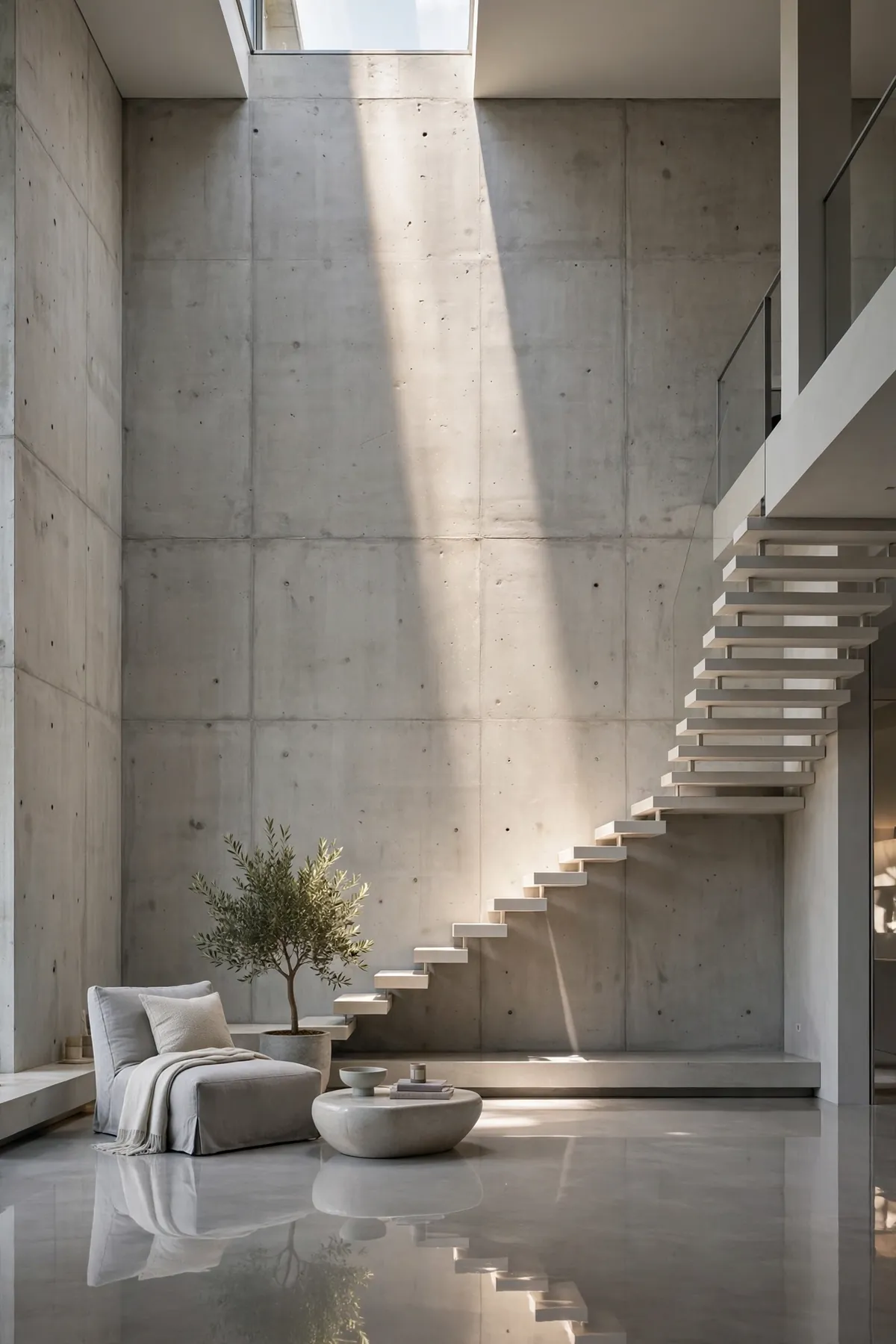
A single vertical column of small sconces running up the tall wall is lighting as architecture — a dotted line of warm light that emphasizes the height. It works on walls too narrow for art and too tall to leave bare. Keep the sconces small and identical; the repetition is the design.
- Space them evenly — measure, don’t eyeball.
- All on one dimmer switch.
- Small opaque shades throw the prettiest pools of light.
Uplight the Wall With Recessed Spots
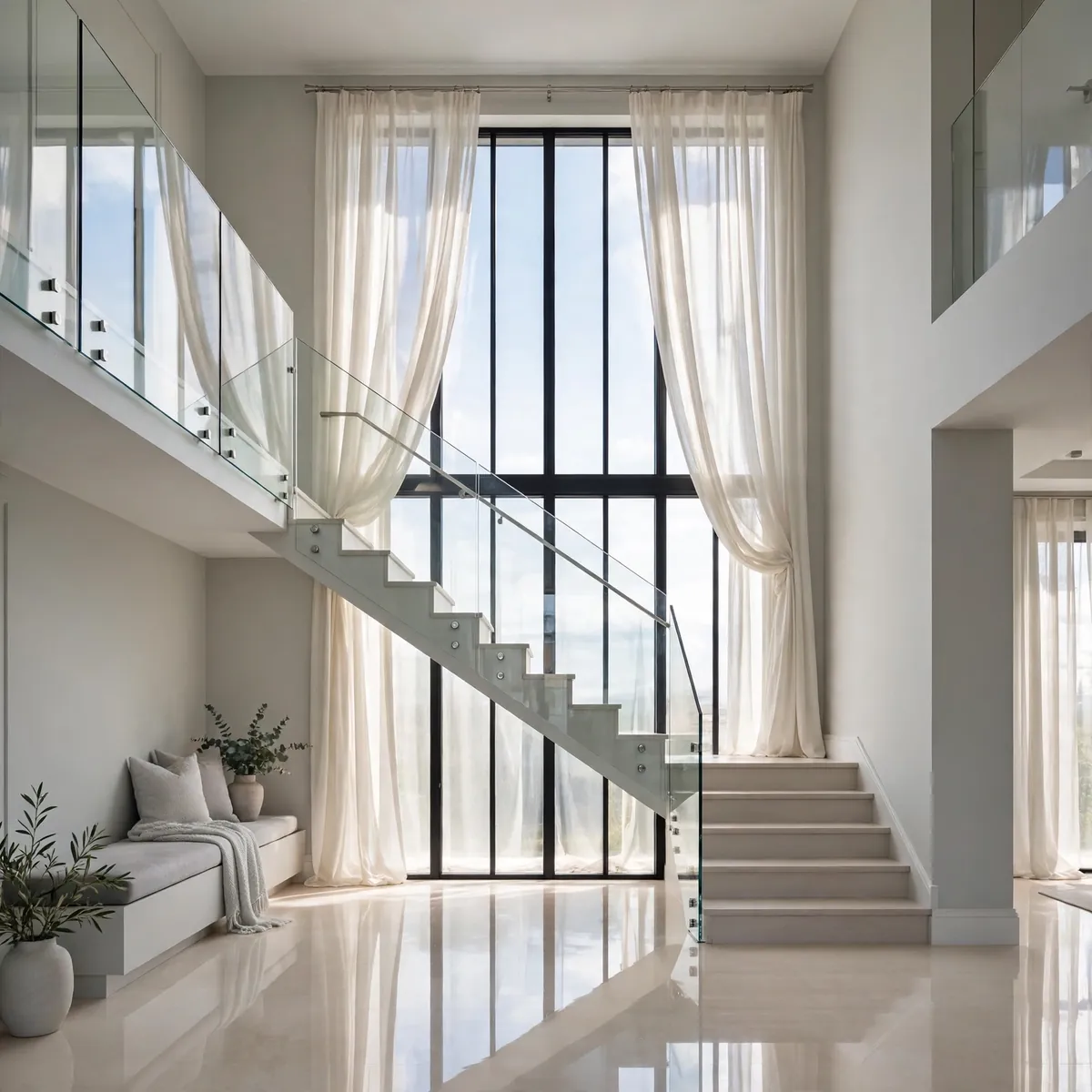
Recessed spotlights in the ceiling or floor that wash light up the tall wall make the architecture itself the decoration. No frames, no shelves — just a glowing plane of plaster with soft shadows. It’s the most minimal idea here and, done well, the most luxurious: restraint at double height reads as confidence.
- Warm white bulbs only — cool light looks stark on tall plaster.
- Aim for even washing, not hot spots.
- Three to five spots usually cover a stair wall.
Tall Windows That Turn the Wall Into Light
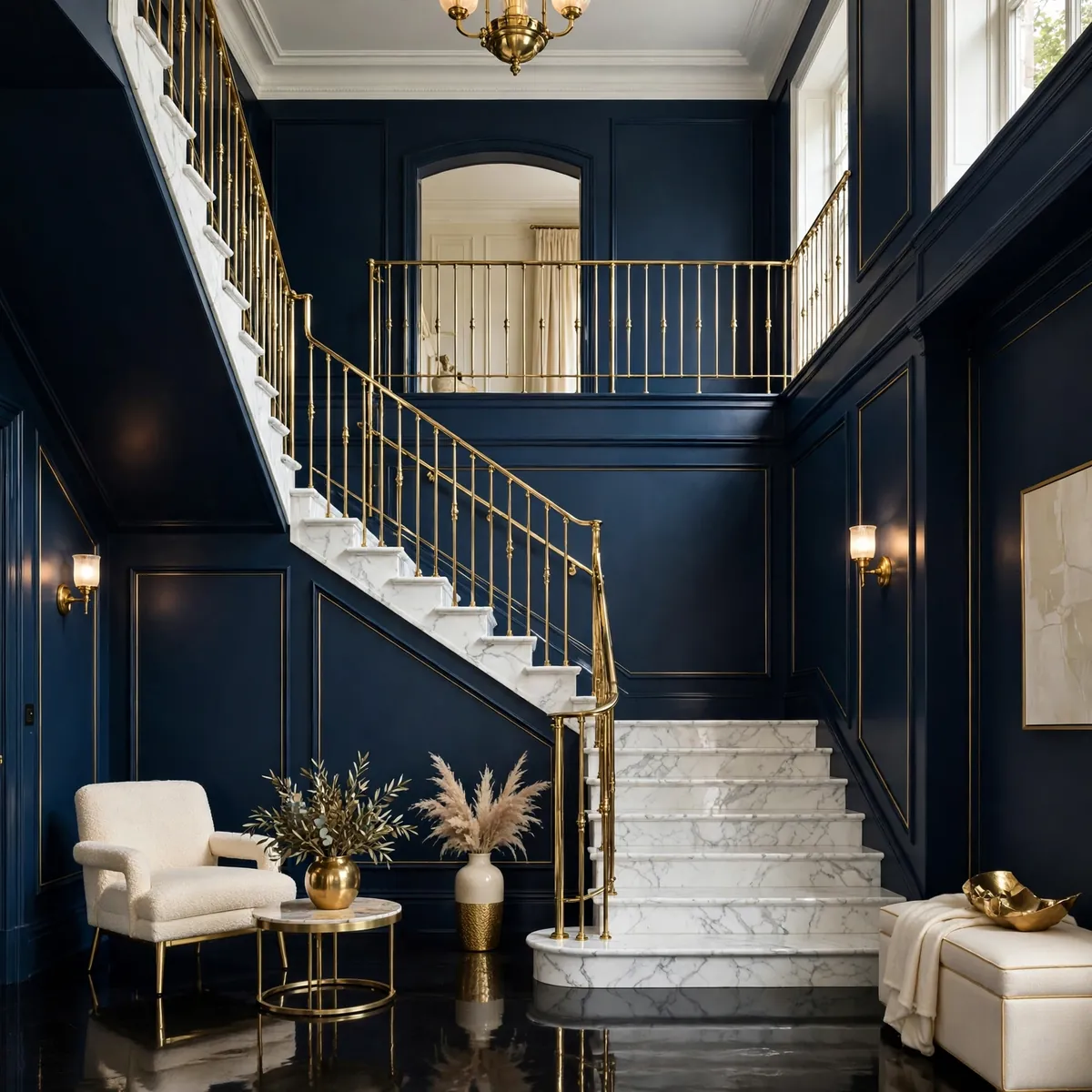
If you’re building or renovating, tall windows on the stair wall turn the whole double-height space into a light shaft. The view becomes the art, the daylight does the decorating, and the stairs get the best natural light in the house. Even one tall narrow window transforms a dark stairwell.
- Plan window placement around stair landings for the view.
- Low-E glass controls heat in tall south-facing glass.
- Add simple shades for privacy without bulk.
Sheer Double-Height Curtains for Softness
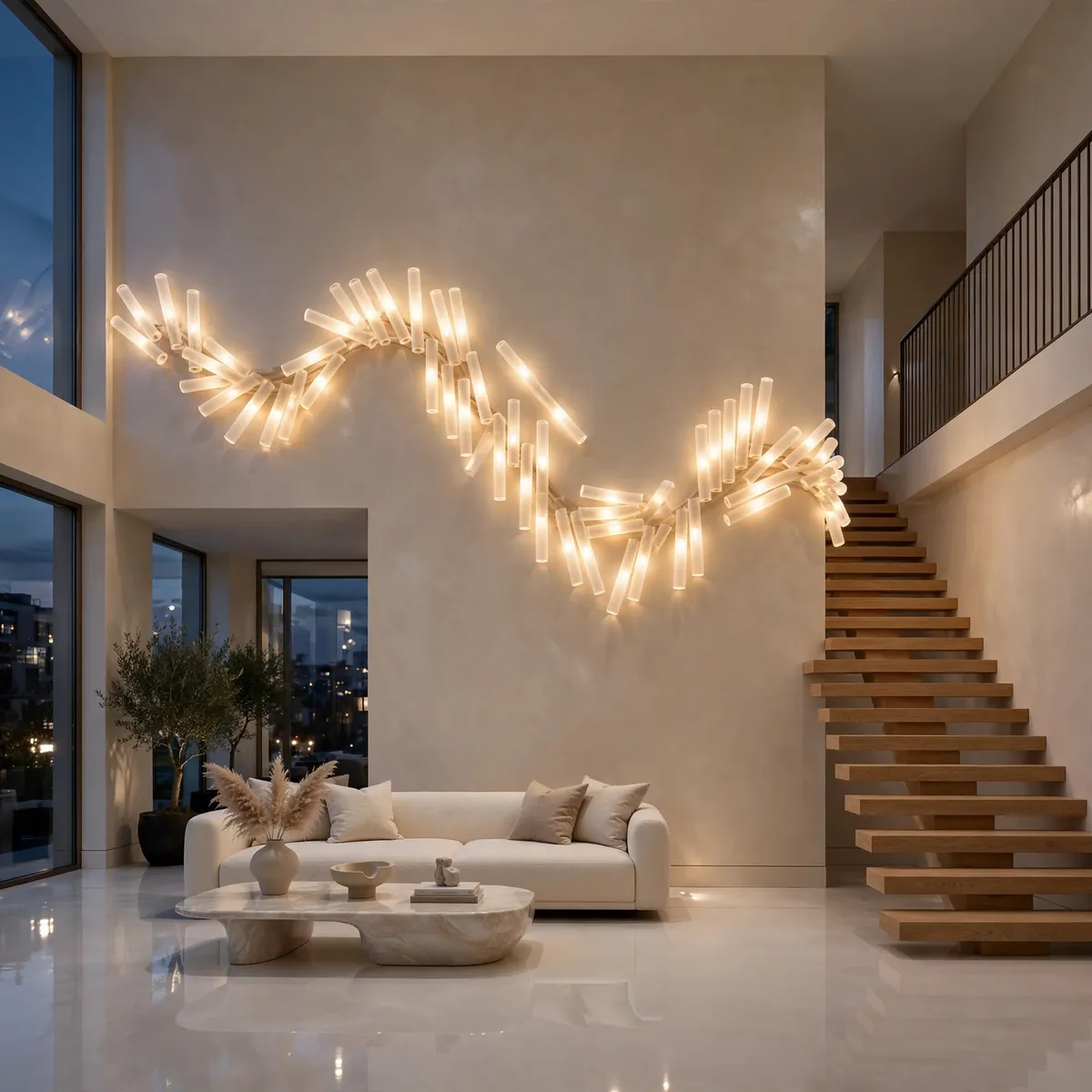
Floor-to-ceiling sheer curtains on a tall stairwell window soften the light and add movement — fabric drifting two stories is inherently dramatic. They filter harsh sun, add privacy, and make the tall wall feel dressed even where there’s no art. Choose a sheer linen or voile that glows when backlit.
- Hang the track at ceiling height, not window height.
- Sheers need fullness — twice the window width.
- Weighted hems keep tall sheers hanging straight.
Staggered Floating Shelves With Ceramics and Books
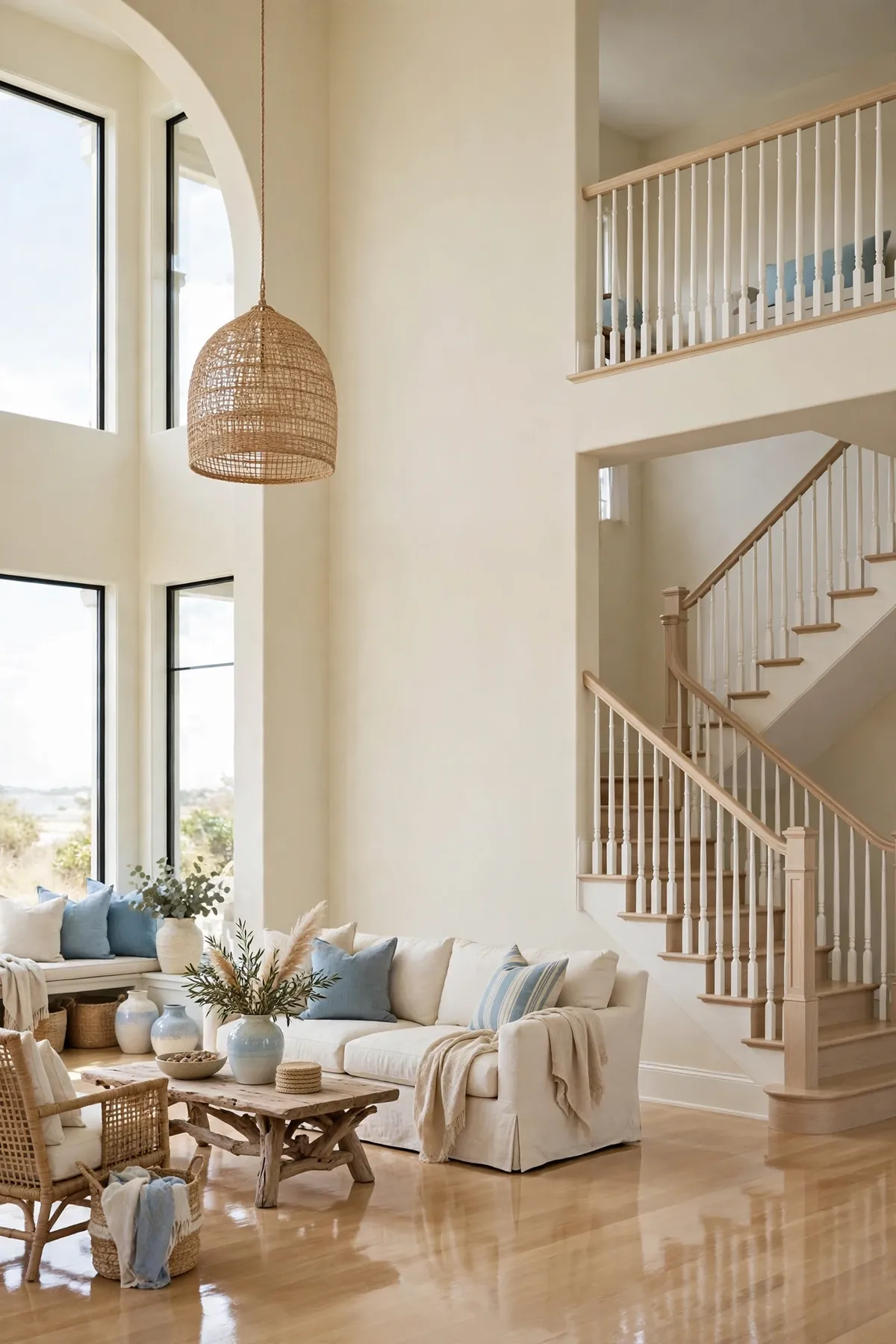
Slim floating shelves that step upward with the staircase give you display space that follows the architecture. Style them sparsely — ceramics, a few books, one trailing plant — and leave plenty of negative space. It feels lighter and more modern than a full gallery wall, and you can restyle it seasonally.
- Keep shelves shallow (6–8 inches) on stair walls.
- Don’t overcrowd — negative space is the point.
- Anchor into studs; tall walls magnify any sag.
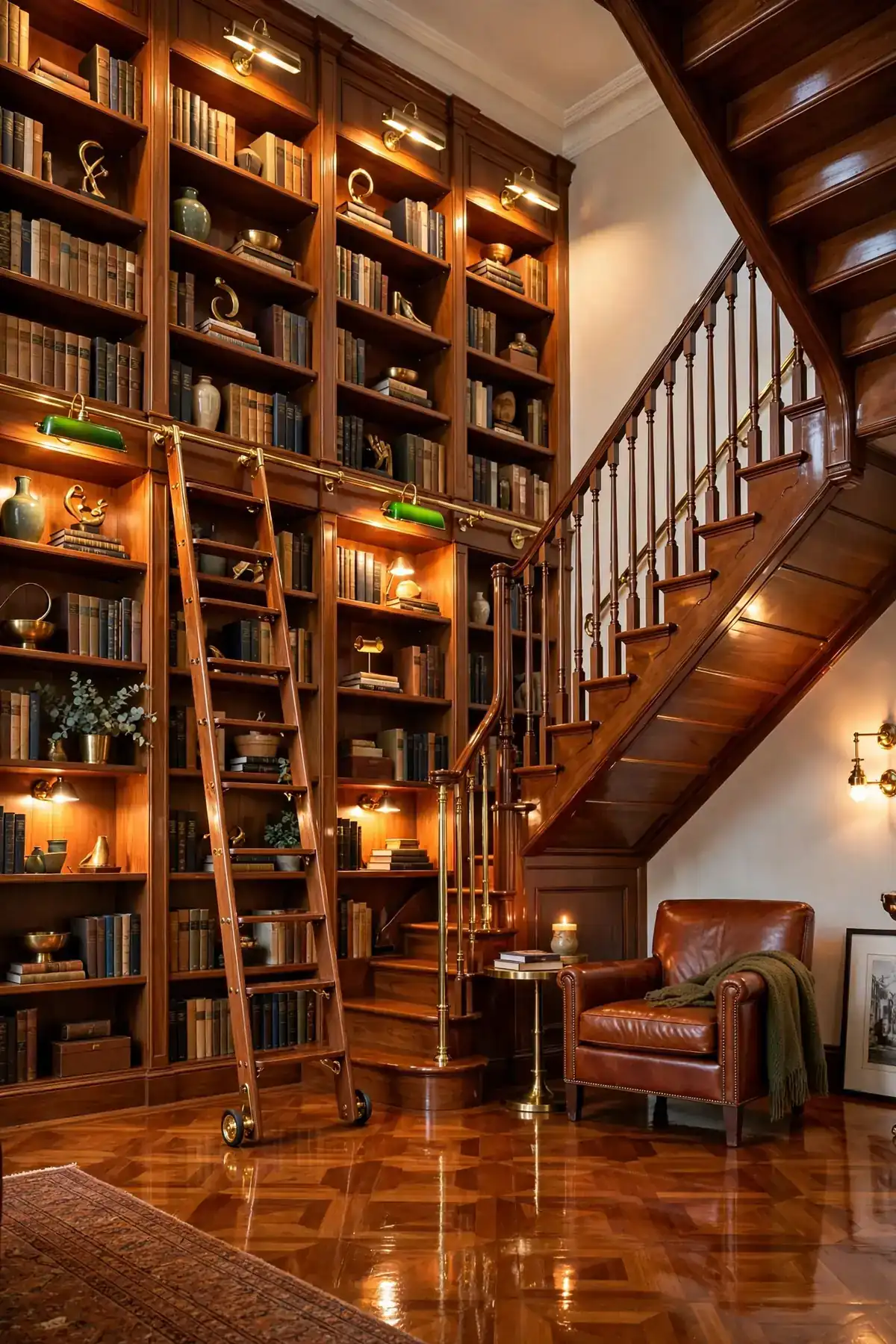
A Tall Built-In Bookcase Along the Wall
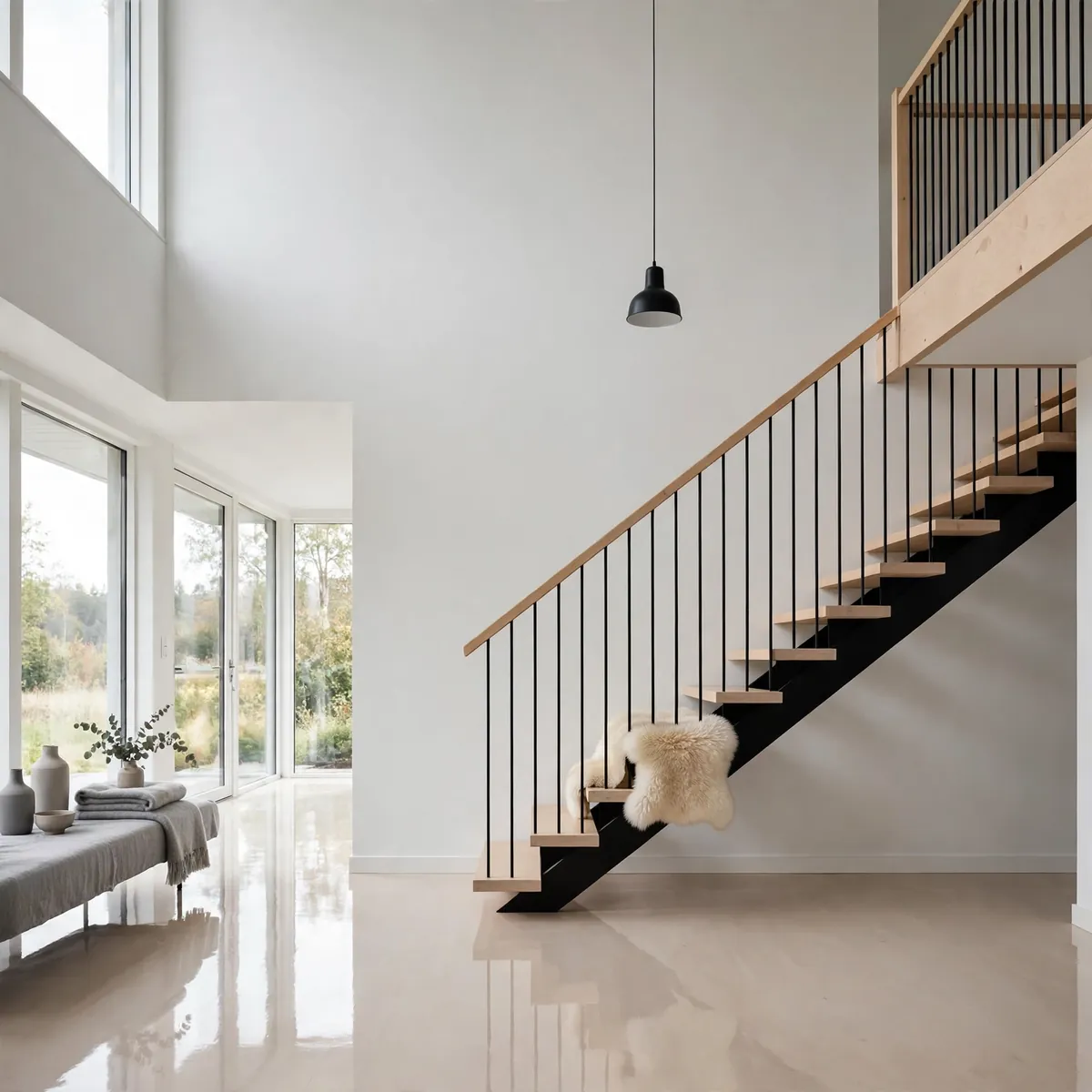
A built-in bookcase running up the stair wall turns dead vertical space into a library. Run it full height, style the shelves with books plus breathing room, and add picture lights or LED strips on a few shelves. In a double-height space, a bookcase wall feels like something from a grand old house.
- Build it flush — protruding cases narrow the stairs.
- Leave some shelves sparse for visual rest.
- Add lighting; tall shelves go dark in the middle.
Oversized Woven Hangings for Warmth and Scale
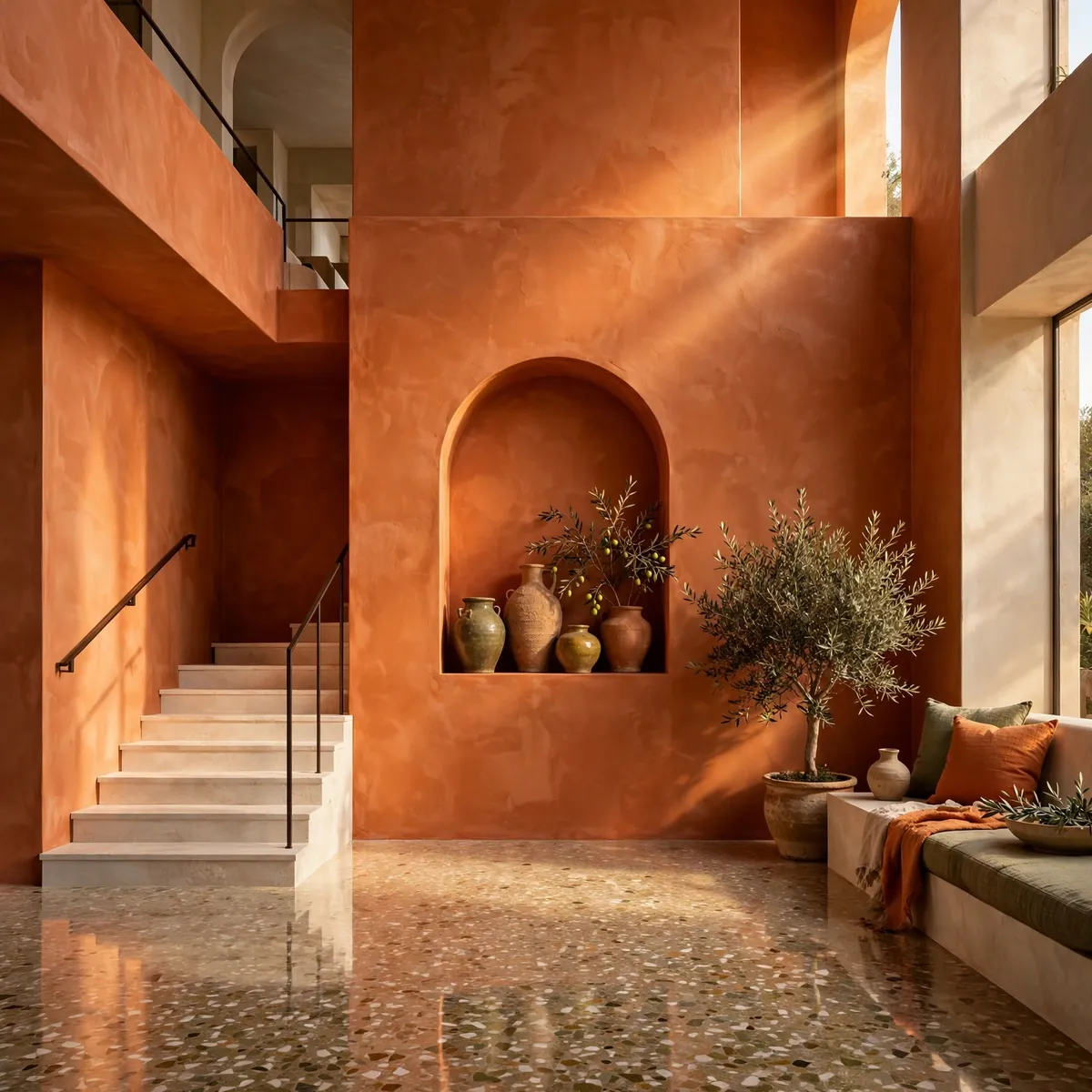
One or two oversized woven wall hangings — a large macramé piece, a textured tapestry, a flat-weave kilim — bring softness and craft to a tall hard wall. Textiles absorb sound in echoey stairwells, and their handmade texture contrasts beautifully with crisp architecture. Scale up boldly; small hangings vanish at double height.
- Go big — at least 4 feet in one dimension.
- Natural fibers suit most palettes.
- A slim wooden dowel or brass rod finishes the top cleanly.
Leave It Nearly Bare: Plaster, Light, and Shadow
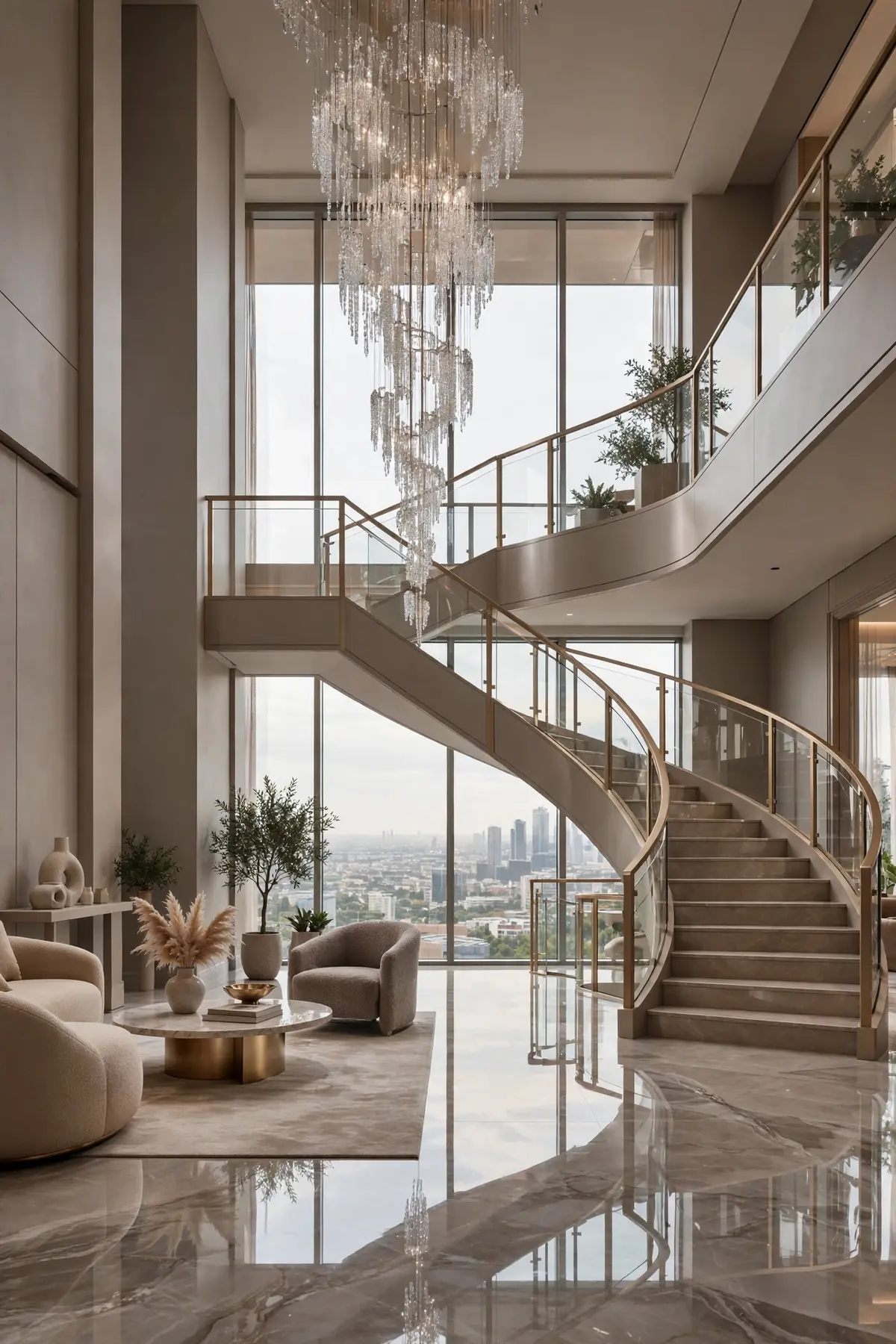
Sometimes the bravest double-height choice is almost nothing: a beautiful plaster or limewash wall, one perfect light washing up it, and the shadows of the stairs themselves as decoration. It takes confidence, and it takes good architecture — but when the proportions are right, restraint feels more luxurious than any gallery wall. Let the space breathe.
- The wall finish must be flawless — light shows everything.
- One architectural light fixture is enough.
- This works best with interesting stair architecture.
FAQs
How do you hang art on a double-height staircase wall safely?
Use a tall ladder or scaffolding, never a chair on the stairs. For heavy pieces, anchor into studs or use proper wall anchors — tall walls magnify any tilt, so a level is essential.
Should the decor follow the stair angle or stay level?
Both work, but pick one logic. Gallery walls and shelves usually follow the stair’s rise; single large pieces and paneling usually stay level. Mixing the two on one wall looks accidental.
What’s the cheapest way to style a double-height stair wall?
Paint. A two-tone color block or an ombré fade costs a few tins of paint and transforms the whole wall. Large-scale art prints in simple frames are the next cheapest high-impact move.
Conclusion
A double-height staircase wall is the largest canvas in most homes, and it rewards the boldest simple choice: one big piece of art, one strong color move, one dramatic light. The mistake is rarely doing too much — it’s doing a little of everything. Pick the idea that fits your wall’s proportions, commit to it fully, and the whole house will feel more considered from the day it’s done.