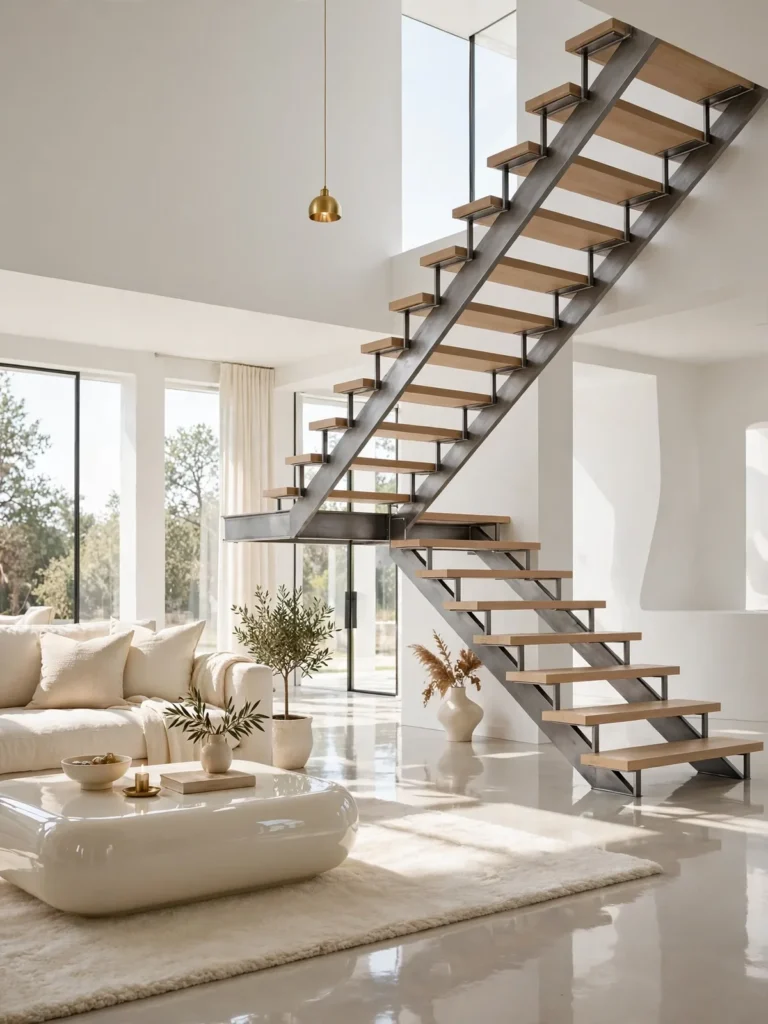
25 Stunning Panelled Staircase Ideas That Instantly Make Your Hallway Look Elegant, Warm and Expensive
A panelled staircase does far more than cover a plain wall — it gives the whole hallway structure, warmth and a finished, expensive feeling. These 25 ideas show how Shaker panels, board and batten, picture-frame moulding, deep colours, warm timber and clever lighting can turn a bare stair wall into the most character-filled part of your home.
A panelled staircase is a staircase whose walls are dressed with framed timber or MDF panels — Shaker-style rectangles, board and batten, picture-frame moulding or fluted slats — painted or stained to add texture, depth and a finished, architectural feeling to the stairwell. The panels follow the angle of the stairs, so a plain, often narrow hallway gains rhythm and character without any extra furniture.
If you love a taller, more dramatic flight, these grand staircase ideas show how panelled walls can give a grand stair the same polished, finished feeling. The 25 ideas below cover the whole stair — its panel style, its colour, its handrail, its lighting, and the space around it — so you can choose a panelled look that suits a cosy cottage, a calm family home, or a bold modern hallway.
Key Takeaways
What is a panelled staircase?
A panelled staircase is a staircase with framed panels — Shaker rectangles, board and batten, picture-frame moulding or fluted slats — fitted to the walls beside the stairs. The panels add texture and architectural character to a plain stairwell.
Do panelled staircases suit a small or narrow hallway?
Yes — they are one of the best choices for a narrow hallway, because slim panels painted in a pale colour add interest without taking up any floor space, and they make a plain stairwell feel finished rather than boxed in.
What materials work best for a panelled staircase?
Moisture-resistant MDF is the most affordable and smoothest to paint, while oak, ash or pine give a warmer, natural timber look. Painted poplar and primed MDF suit classic styles; solid oak suits a richer, more traditional panelled staircase.
Are panelled staircases hard to clean and maintain?
No — a quick dust with a soft cloth and an occasional wipe with a damp cloth keeps painted panels looking fresh. Satin or semi-gloss paint resists scuffs best on a busy stairwell, and a small pot of the same paint makes touch-ups easy.
What colour should I paint a panelled staircase?
Pale cream, soft sage or warm white keeps a small hallway bright, while deep teal, charcoal or forest green adds drama in a larger stairwell. Paint the panels and the wall the same tone for a calm, seamless look, or contrast them for a bolder feature.
A Classic Panelled Staircase in Warm Cream and Honey Oak
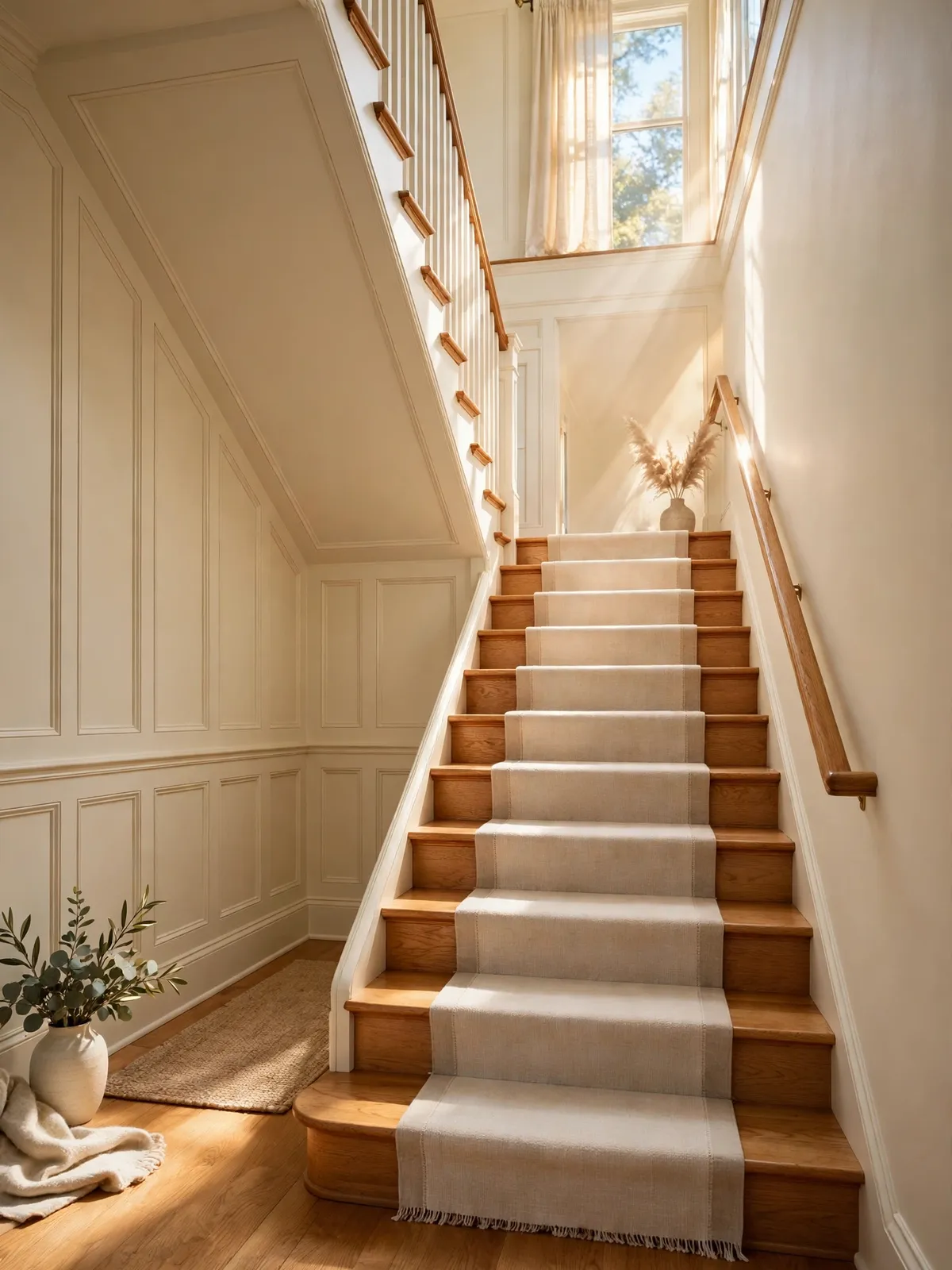
A classic panelled staircase in warm cream and honey oak is the timeless starting point, because it suits almost any home and never dates. In one family hallway, warm cream Shaker panels, each about 600 mm wide and 900 mm tall, run up the stair wall in neat rectangles, following the angle of the flight, while 40 mm thick honey oak treads, each 950 mm wide and 280 mm deep, bring warmth to every step. A slim oak handrail on slim black brackets ties the two tones together, and a pale linen runner, 700 mm wide, softens the centre of the treads. The cream paint is a warm, soft white rather than a stark white, so the hallway glows in the morning light instead of feeling cold, and the honey oak keeps the whole stair feeling welcoming rather than formal. It is the kind of stair that looks just as good in a cottage as it does in a new-build home, and it gives every room it connects a calm, finished feeling.
Quick tips:
- Choose a warm cream, not a stark white, so the panels glow softly.
- Keep the panel rectangles even and aligned with the stair angle.
- Pair cream panels with honey oak treads for instant warmth.
- Use a pale linen runner to soften the centre of the treads.
Tall Wainscot Panels in Soft Sage and Pale Stone
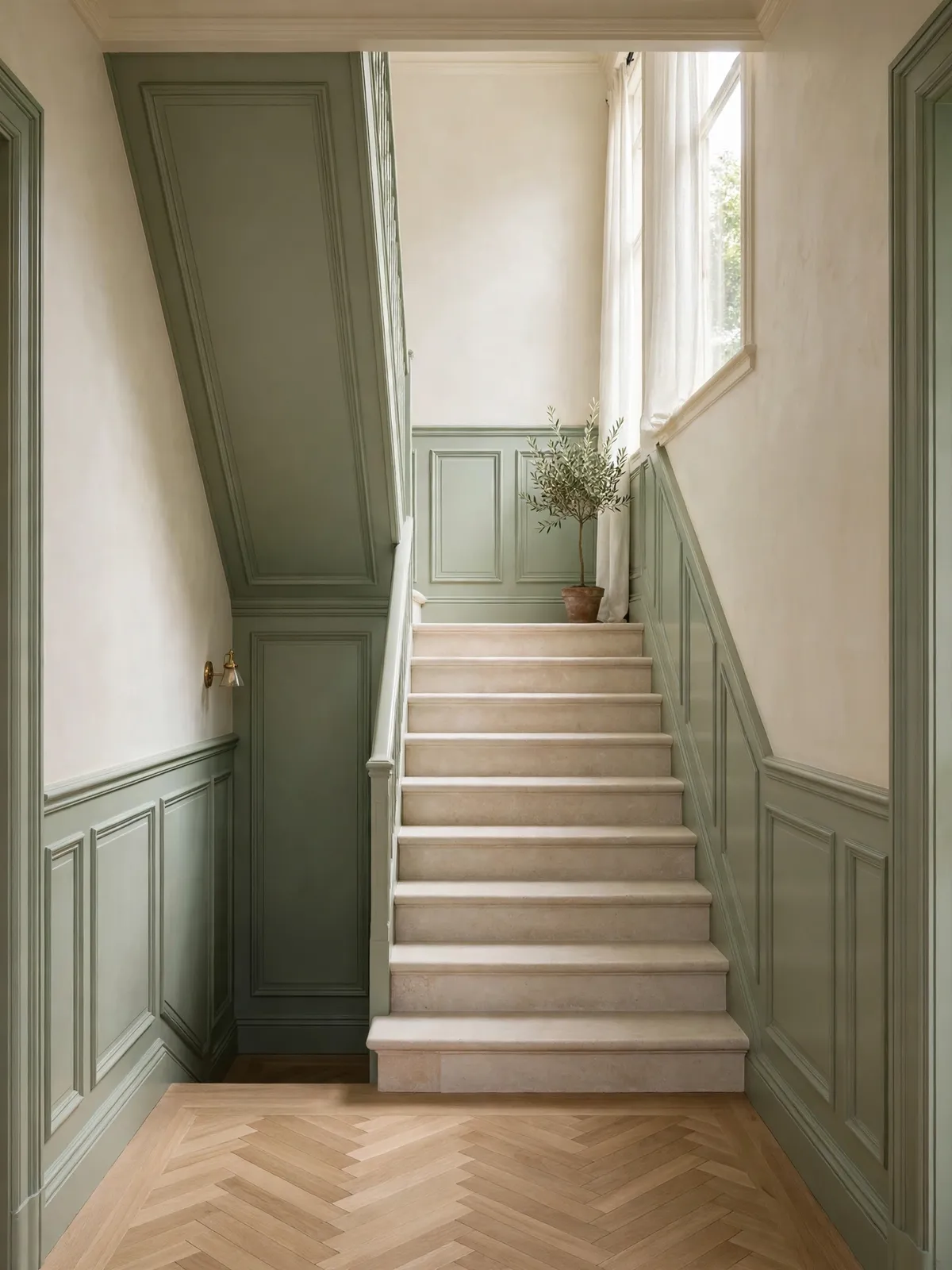
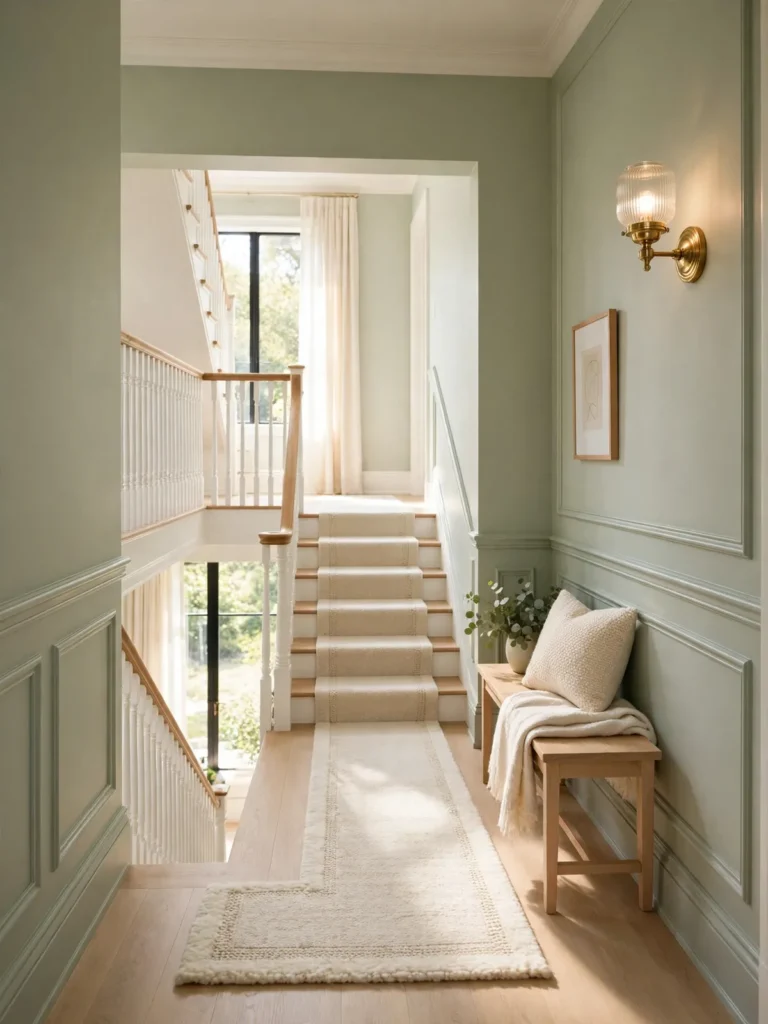
Tall wainscot panels in soft sage give a stairwell a calm, garden-like feeling, especially when the upper wall stays pale. Here, sage-green panels rise 1.2 metres up the stair wall, each rectangle about 500 mm wide, with a slim chair rail on top and a cream plaster wall above. Pale stone treads, each 900 mm wide, keep the stair light underfoot, while a small potted olive tree on the landing picks up the sage tone. The sage is muted, not bright, so it feels restful rather than bold, and it pairs beautifully with natural timber and linen nearby.
Quick tips:
- Take wainscot panels to 1.2 metres high for a generous, balanced look.
- Keep the wall above the panels pale cream so the sage stays soft.
- Use pale stone treads to stop a green stairwell feeling dark.
- Add one small plant on the landing to echo the sage tone.
Deep Teal Panelled Walls With Brushed Brass Stair Rods
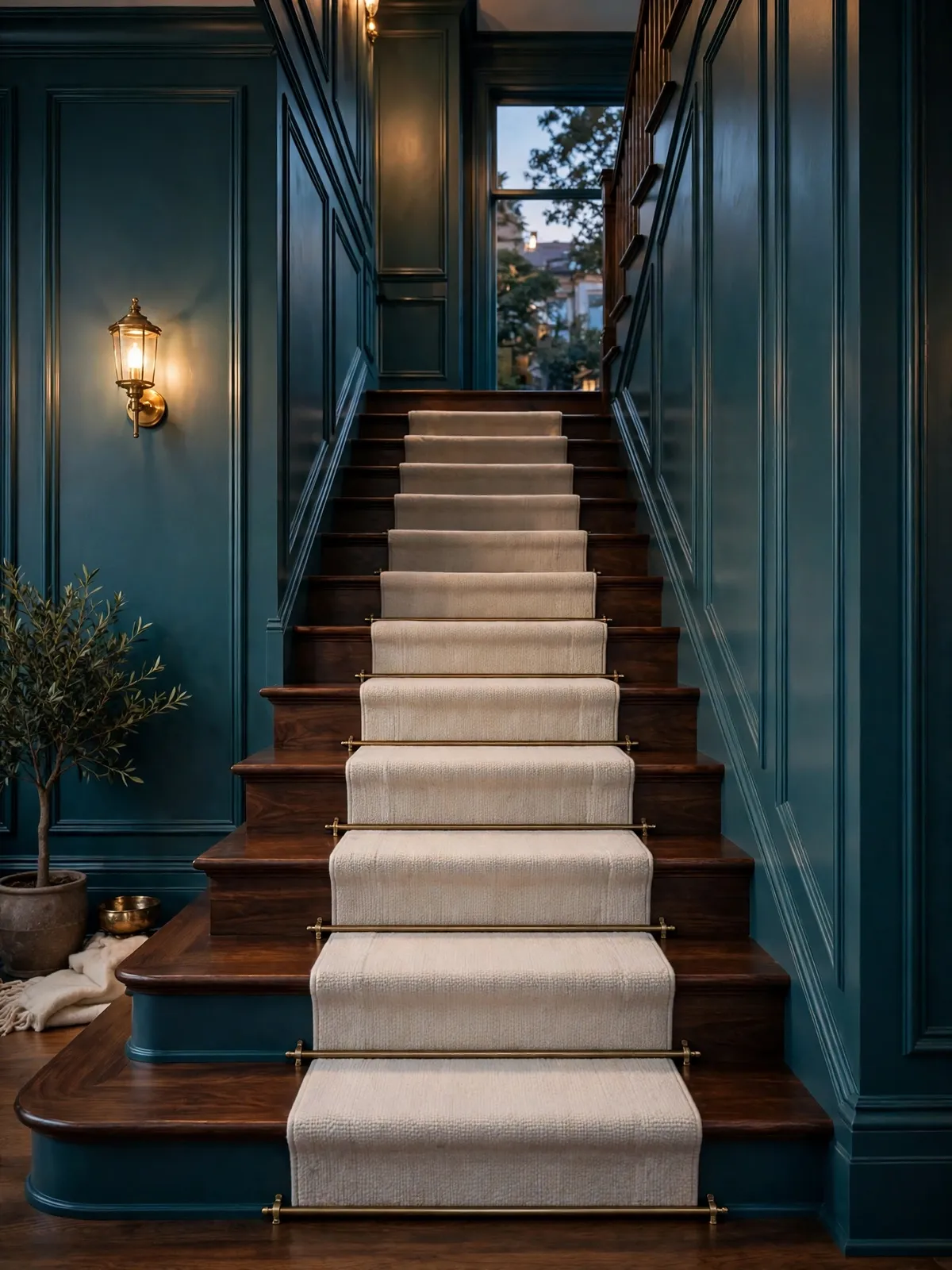
Deep teal panels turn a plain stairwell into a rich, cocooning space, and brushed brass lifts the colour so it never feels heavy. On this stair, deep teal Shaker panels cover the full stair wall, with a cream wool runner, 700 mm wide, held in place by slim brushed-brass stair rods on every third tread. Dark walnut treads, each 950 mm wide, ground the teal, while a warm brass wall sconce on the landing casts a soft evening glow across the panels. The teal feels dramatic yet calm, like a deep lake, and the brass catches the light on every step.
Quick tips:
- Pair deep teal with warm brass, not chrome, for a rich finish.
- Use a cream runner so the dark panels do not overwhelm the stair.
- Choose walnut treads to ground a bold panel colour.
- Add a brass sconce on the landing for warm evening light.
Board-and-Batten Panels in Dusty Blue With White Oak Treads
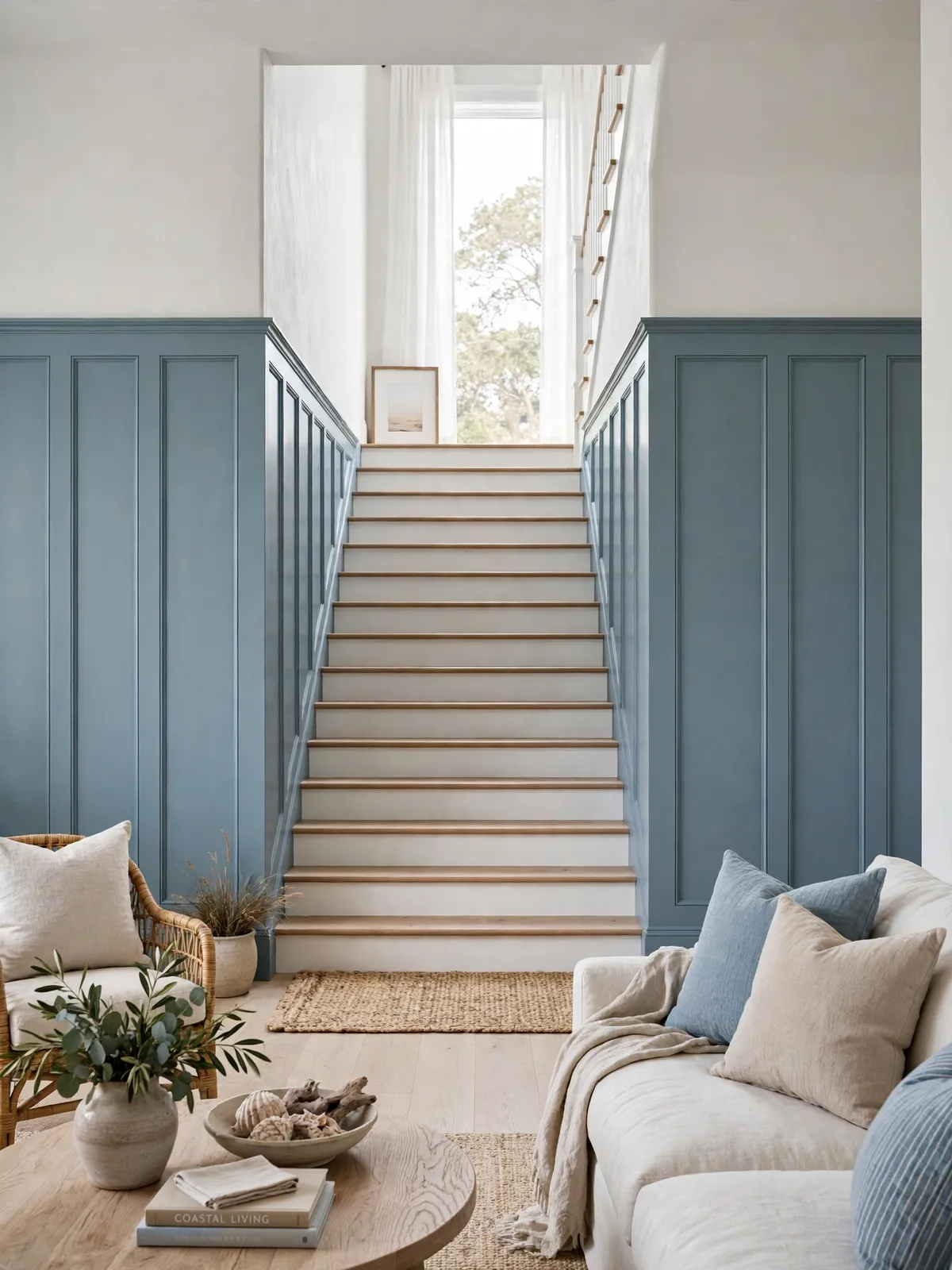
Board-and-batten panels in dusty blue guide the eye upward, because the vertical battens follow the line of the climb. In this hallway, dusty-blue vertical battens, each 60 mm wide with 300 mm gaps, run up the stair wall over a flat board backing, with a white plaster wall above. White oak treads, each 280 mm deep and 950 mm wide, keep the stair pale and bright, while a woven jute rug at the base and sheer white curtains on the landing window add soft, natural texture. The dusty blue is calm and slightly coastal, and it makes a narrow stairwell feel taller.
Quick tips:
- Keep battens slim and evenly spaced so the eye travels upward.
- Paint the board behind the battens the same dusty blue for depth.
- Use white oak treads to keep a blue stairwell bright.
- Add a natural jute rug at the base for soft texture.
Picture-Frame Panels in Blush Pink and Ivory
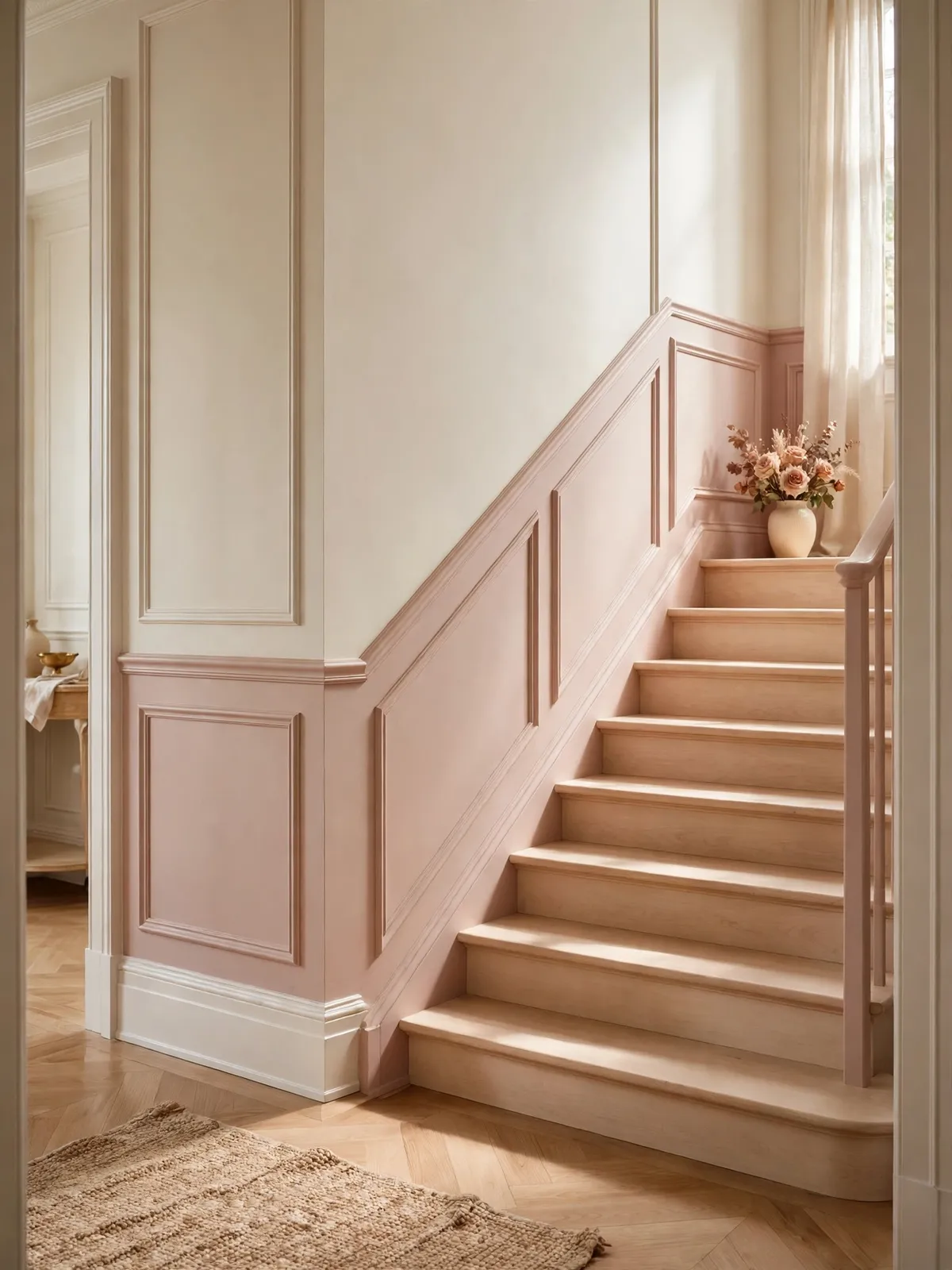
Picture-frame panels in blush pink add a gentle, romantic softness to a stairwell without any fuss. Here, slim blush-pink moulding rectangles, each about 550 mm wide, are fitted to an ivory stair wall, with the moulding painted the same blush pink as the panel behind it for a tone-on-tone effect. Pale maple treads, each 900 mm wide, keep the stair light, while a small vase of dried roses on the landing picks up the pink. The blush is pale and powdery, so it reads as warm and calm rather than sweet, and it suits a bedroom hallway beautifully.
Quick tips:
- Keep blush pale and powdery so it stays calm, not sweet.
- Paint the moulding and the panel the same blush for a tone-on-tone look.
- Use pale maple treads to keep a pink stairwell light.
- Add one small vase of dried flowers on the landing.
A Charcoal Panelled Staircase Wall With a Warm Walnut Handrail
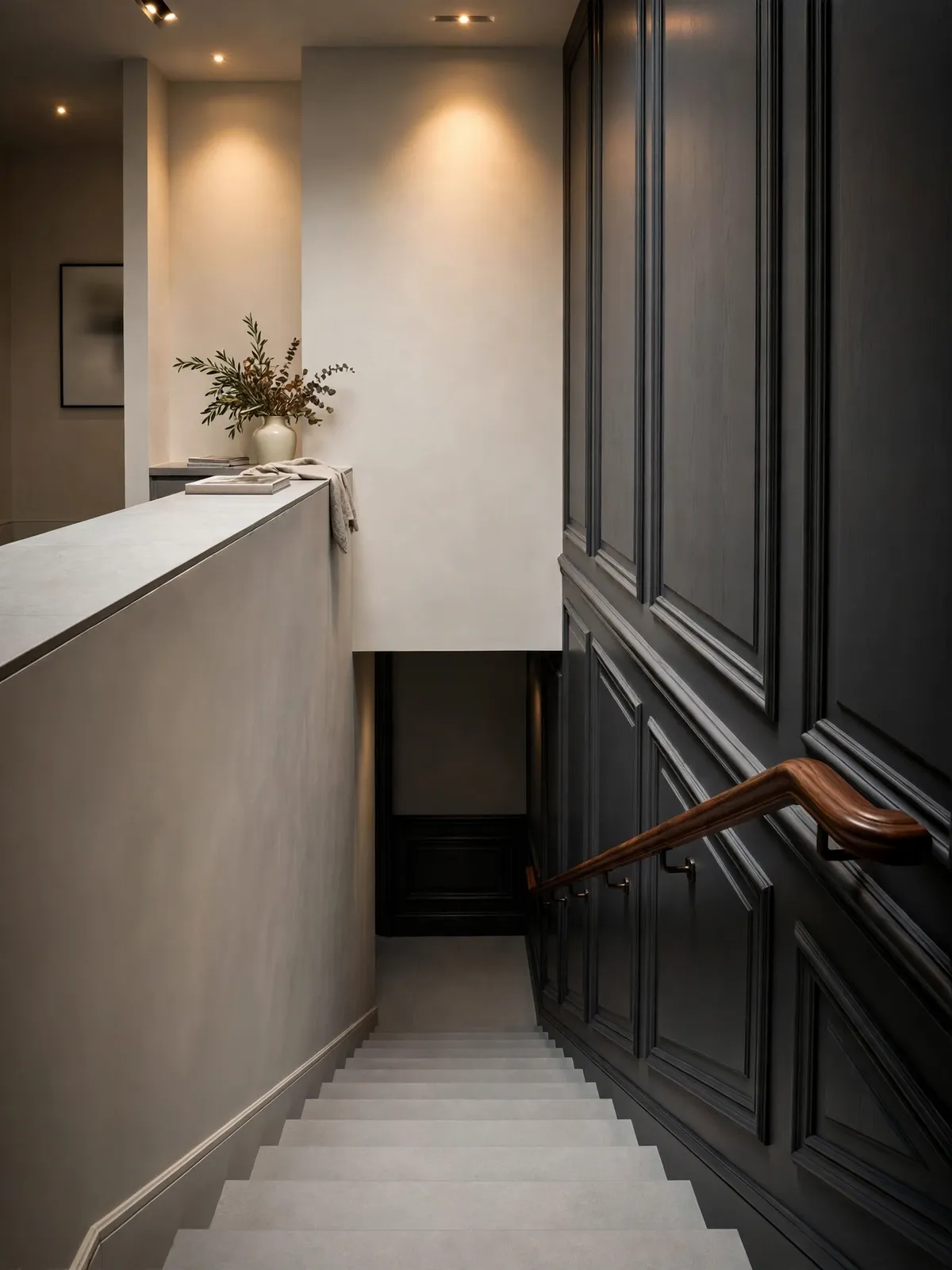
A charcoal panelled wall with a warm walnut handrail is the bold, grown-up version of a panelled staircase. The charcoal panels, in large Shaker rectangles, cover the full stair wall, while a warm walnut handrail, 60 mm wide, runs along the top of the panels and curves gently around the landing. Pale grey treads keep the stair itself light underfoot, and the soft ivory wall opposite stops the charcoal from closing the hallway in. Warm spotlights wash down the panels in the evening, so the charcoal glows softly instead of feeling flat.
Quick tips:
- Balance charcoal panels with a warm walnut handrail.
- Keep the opposite wall pale ivory so the stairwell stays open.
- Use pale grey treads to lighten a dark panelled wall.
- Add warm spotlights to make charcoal glow in the evening.
Vertical Fluted Panels in Pale Ash and Soft Grey
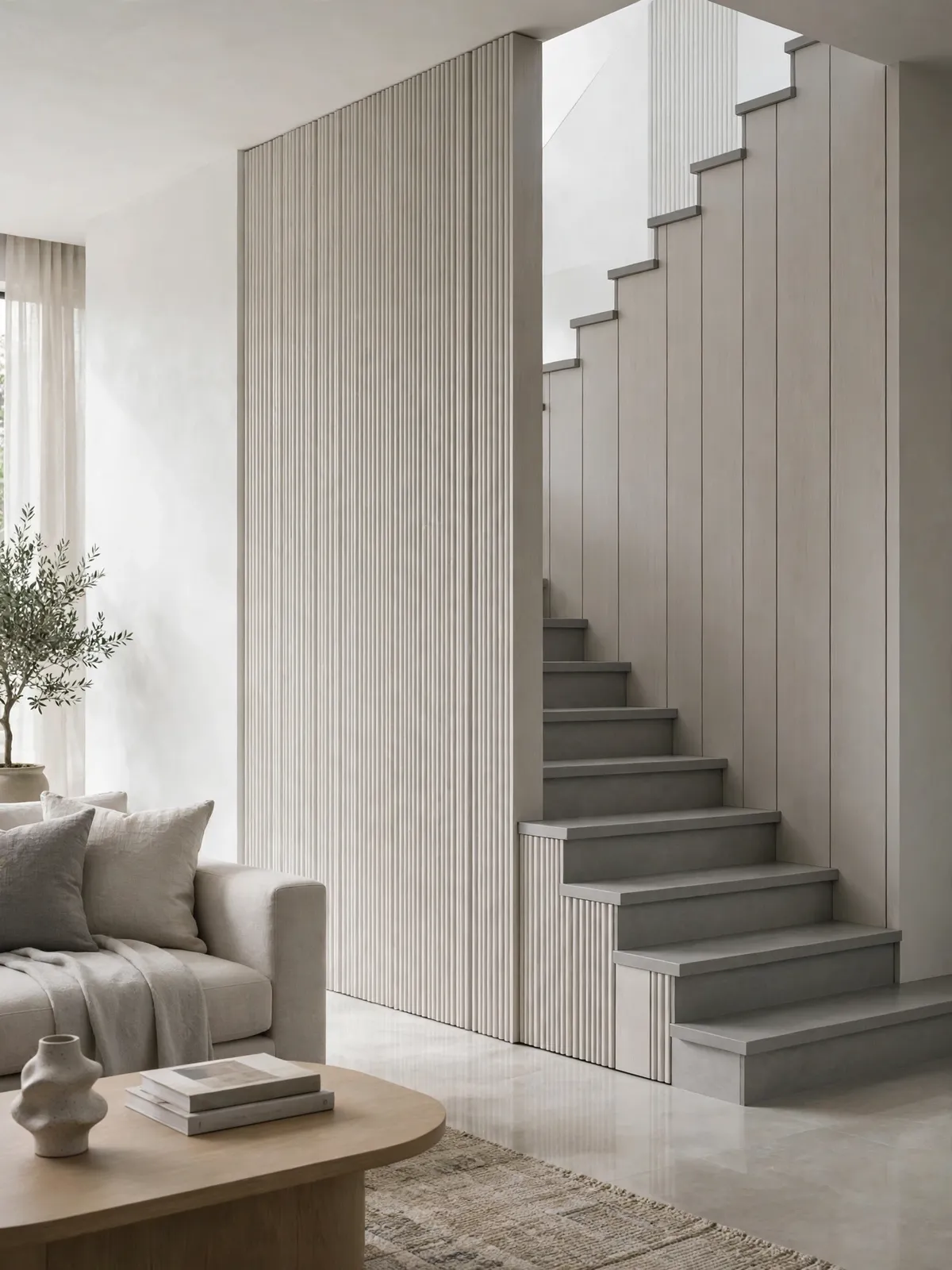
Vertical fluted panels in pale ash give a panelled staircase a modern, architectural rhythm that flat panels cannot match. Slim ash flutes, each 30 mm wide, run floor to ceiling beside the stair, catching the daylight in soft vertical shadows. Soft grey treads, each 950 mm wide, sit calmly against the pale timber, while a small sculptural ceramic vase on the landing adds one quiet, handmade detail. The flutes feel contemporary yet warm, and they make a straight stairwell feel taller and more considered.
Quick tips:
- Keep flutes slim and even so the shadows fall in a clean rhythm.
- Use pale ash for warmth, or a soft grey stain for a cooler look.
- Pair fluted panels with plain grey treads so the texture stays the star.
- Leave the landing clear so the fluted wall reads as one clean line.
Two-Tone Panels in Olive Green and Warm Linen
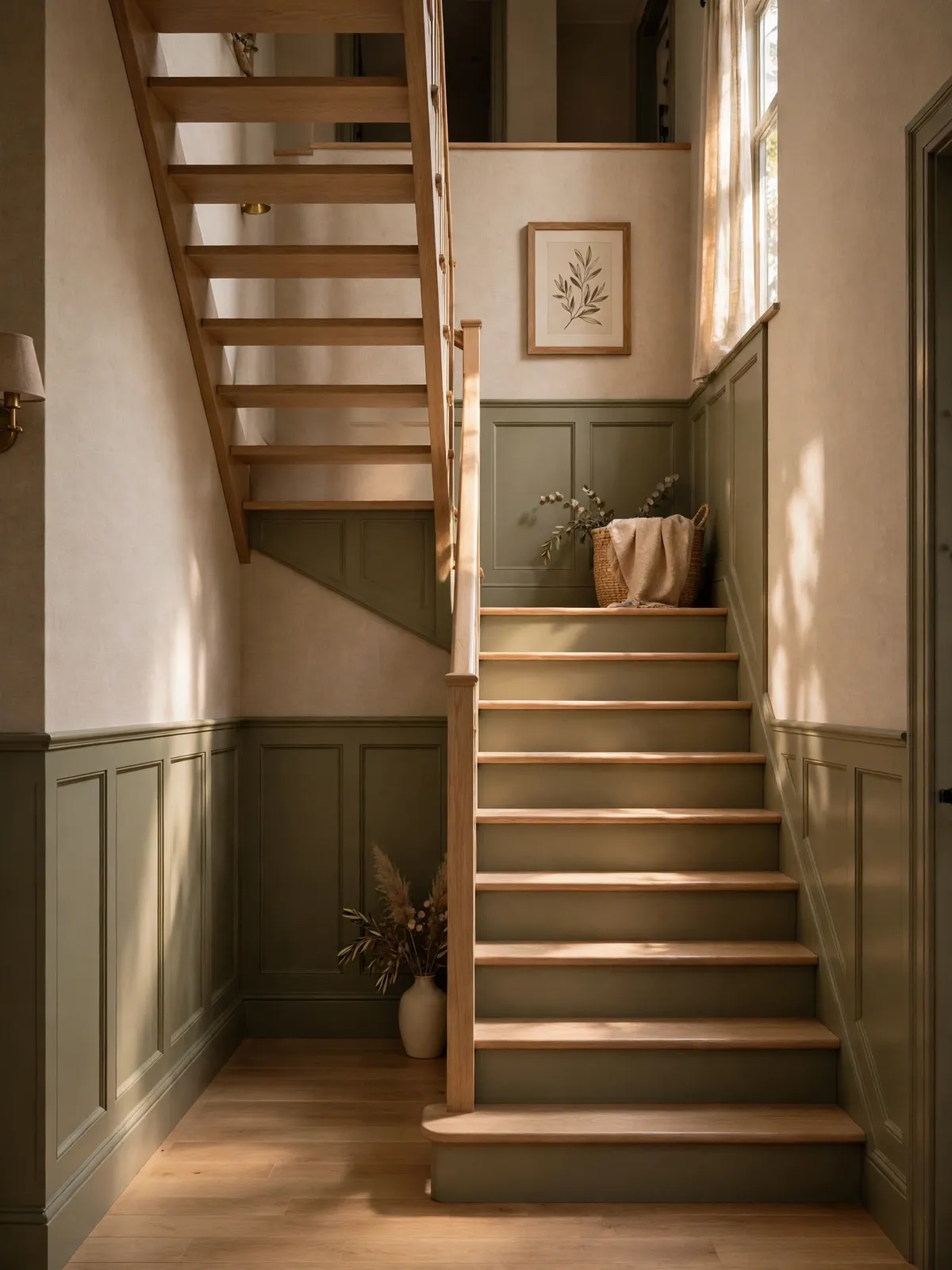
Two-tone panels in olive green and warm linen anchor the stair while keeping the upper wall airy. The lower panels, in deep olive green, rise to chair-rail height and follow the stair angle, while the wall above is painted a warm linen cream. Light oak treads, each 900 mm wide, bridge the two tones, and a woven basket on the landing adds a natural, earthy touch. The olive is rich and grounded, like a garden hedge, and the linen above keeps the stairwell feeling open and calm.
Quick tips:
- Choose tones from the same warm family so they sit happily together.
- Keep the darker tone below the chair rail and the paler tone above.
- Use light oak treads to bridge the two wall colours.
- Test both paint samples side by side in daylight before committing.
Oversized Square Panels in Terracotta and Cream
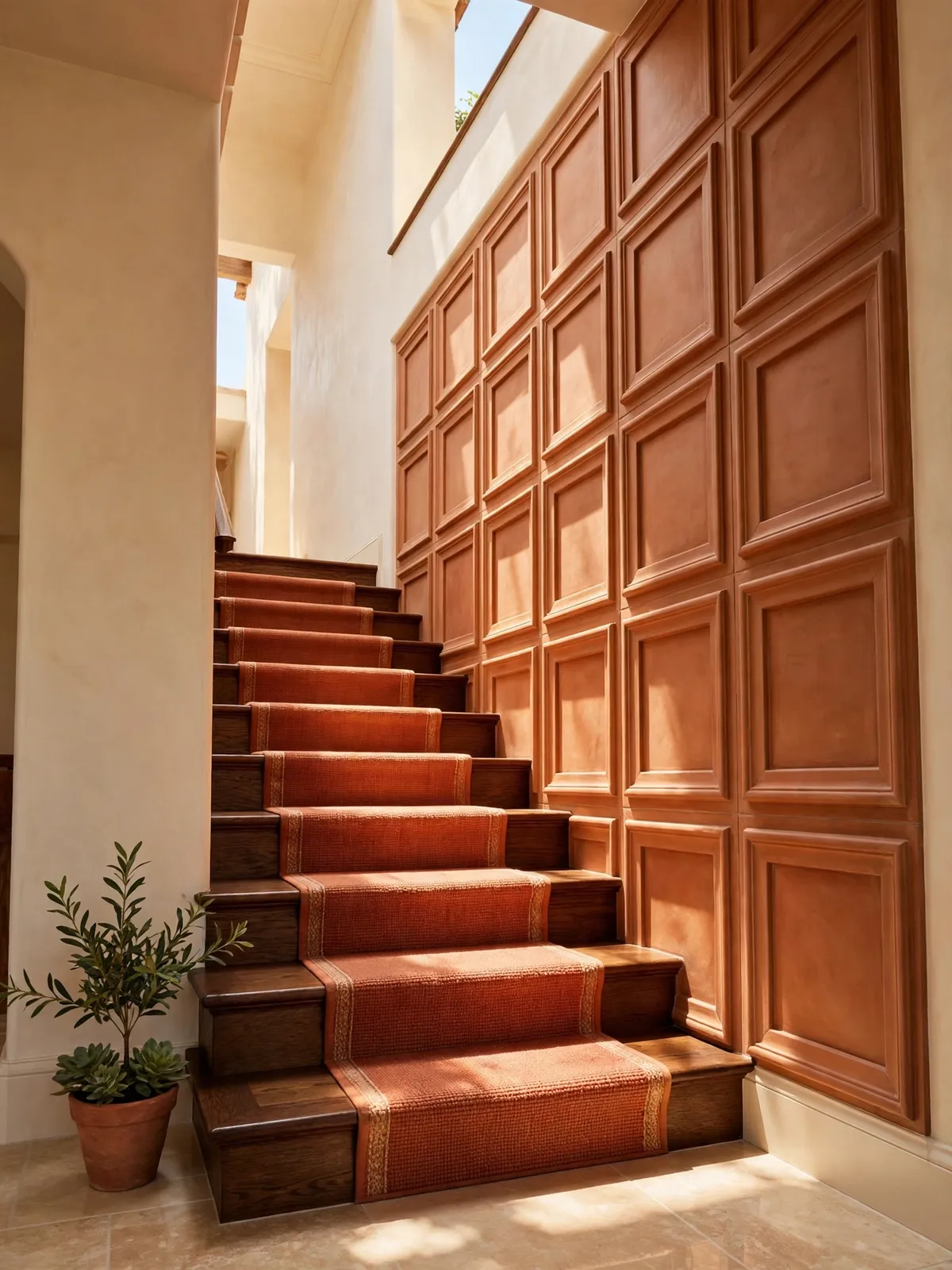
Oversized square panels in terracotta make a stairwell feel bold and sun-warmed, like a Mediterranean courtyard. Instead of many small rectangles, this stair uses just three large square panels per flight, each about 900 mm square, painted a warm terracotta, with cream walls between them. Dark oak treads ground the colour, a terracotta stair runner echoes the panels, and a small clay pot with a green plant sits on the landing. The large panels feel expensive and uncluttered, and they suit a tall stairwell where small panels would look busy.
Quick tips:
- Use fewer, larger panels in a tall stairwell for a cleaner look.
- Keep the wall between panels cream so the terracotta stands out.
- Echo the panel colour in the stair runner for a pulled-together look.
- Add one green plant to freshen a warm terracotta palette.
A Panelled Staircase With a Patterned Runner in Navy and Mustard
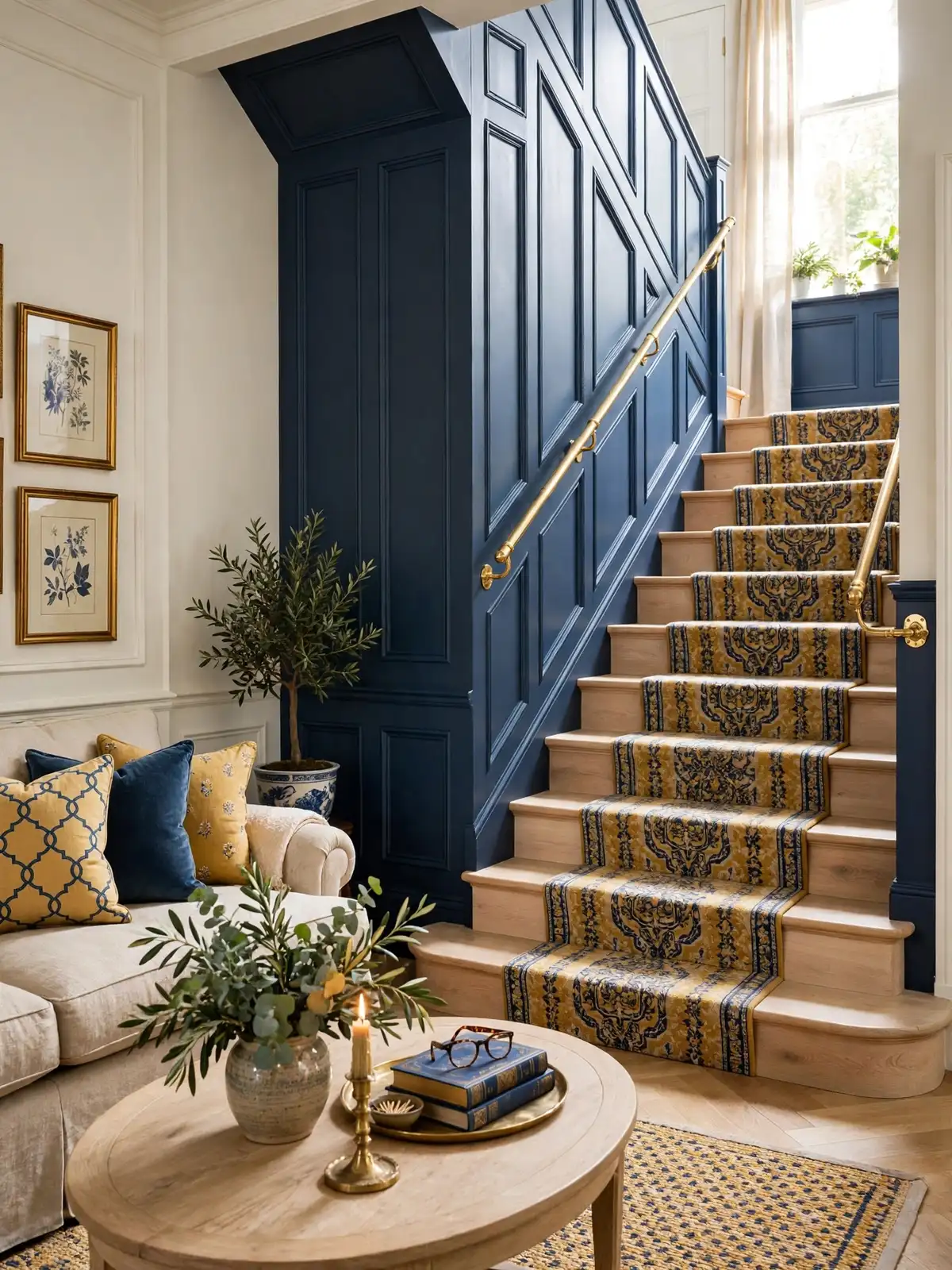
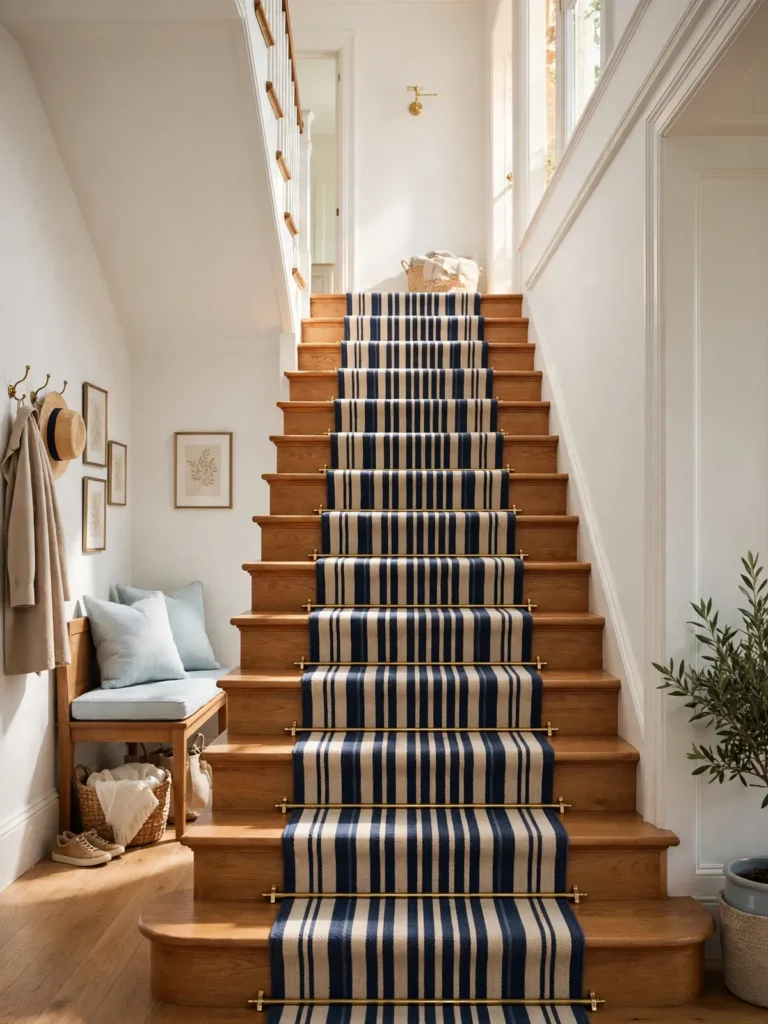
A patterned runner in navy and mustard brings a panelled staircase to life, because the pattern plays against the calm, flat panels. Here, navy-blue Shaker panels cover the stair wall, while a patterned runner in navy, mustard and cream, 700 mm wide, runs down the centre of pale oak treads, held by slim brass rods. The mustard in the runner picks up the brass brackets on the handrail, and the navy panels make the pale oak treads look even warmer. It is a classic, cheerful combination that suits a busy family hallway.
Quick tips:
- Choose a runner pattern that shares at least one colour with the panels.
- Keep the runner width to about 700 mm so the oak treads show at the edges.
- Use brass stair rods to pick up a warm colour in the runner.
- Vacuum the runner weekly to keep the pattern crisp.
Slim Geometric Panels in Slate Grey and Pale Gold
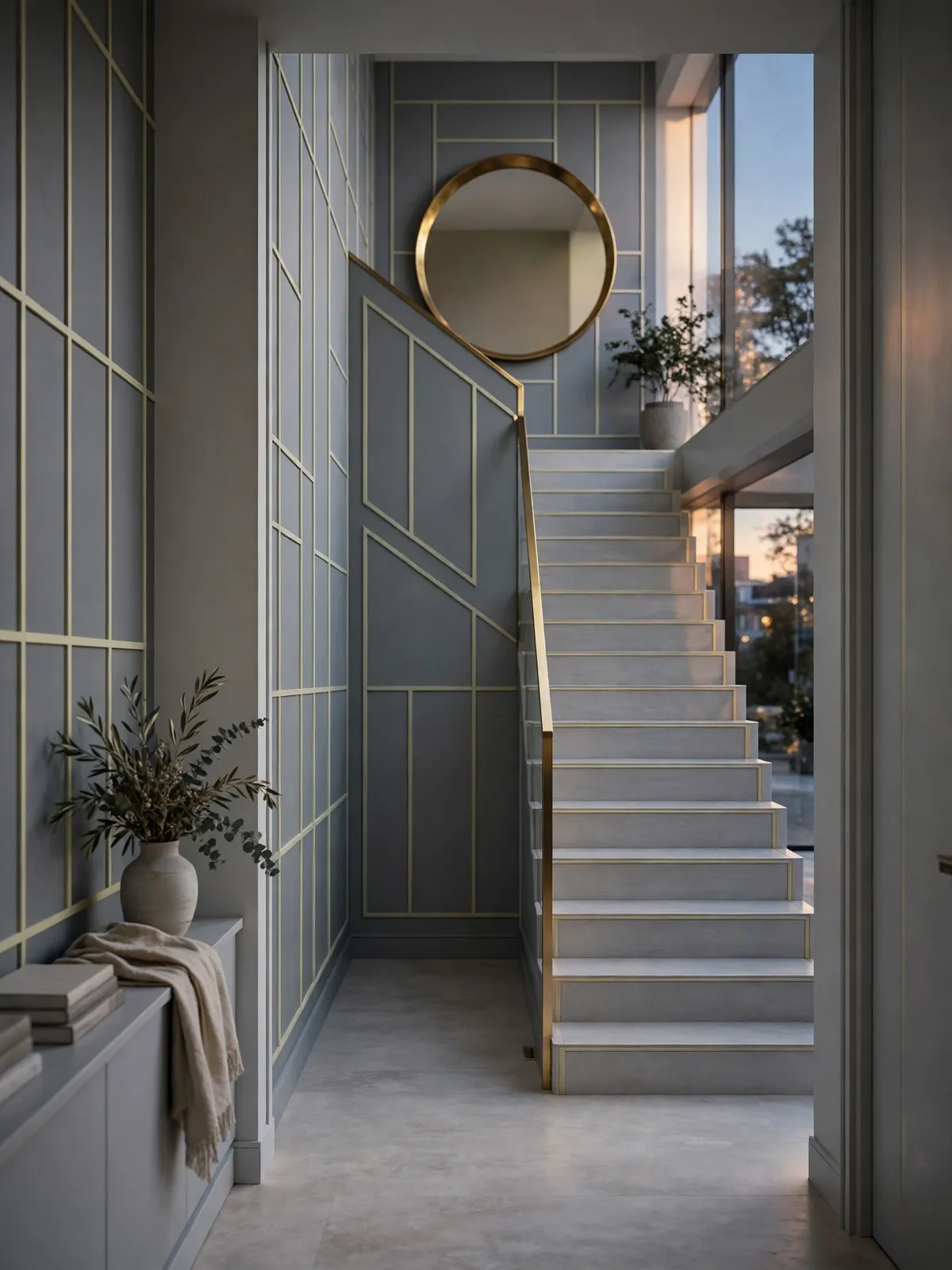
Slim geometric panels in slate grey and pale gold give a panelled staircase a crisp, contemporary edge. The panels are tall, narrow rectangles, each about 300 mm wide, stacked in a neat grid up the stair wall, with a thin pale gold trim line inside each one that catches the light. Light grey treads keep the stair calm, while a large round brass mirror on the landing reflects the gold trim and doubles the light. The slate grey is cool and smart, and the gold keeps it feeling warm and luxurious rather than cold.
Quick tips:
- Keep geometric panels tall and narrow for a modern, tailored look.
- Use a thin gold trim inside each panel, not a thick one, for subtle shine.
- Pair slate grey with light grey treads for a calm, tonal stair.
- Hang a round mirror on the landing to bounce light back down the stair.
A Panelled Landing With a Round Mirror in Emerald and Brass
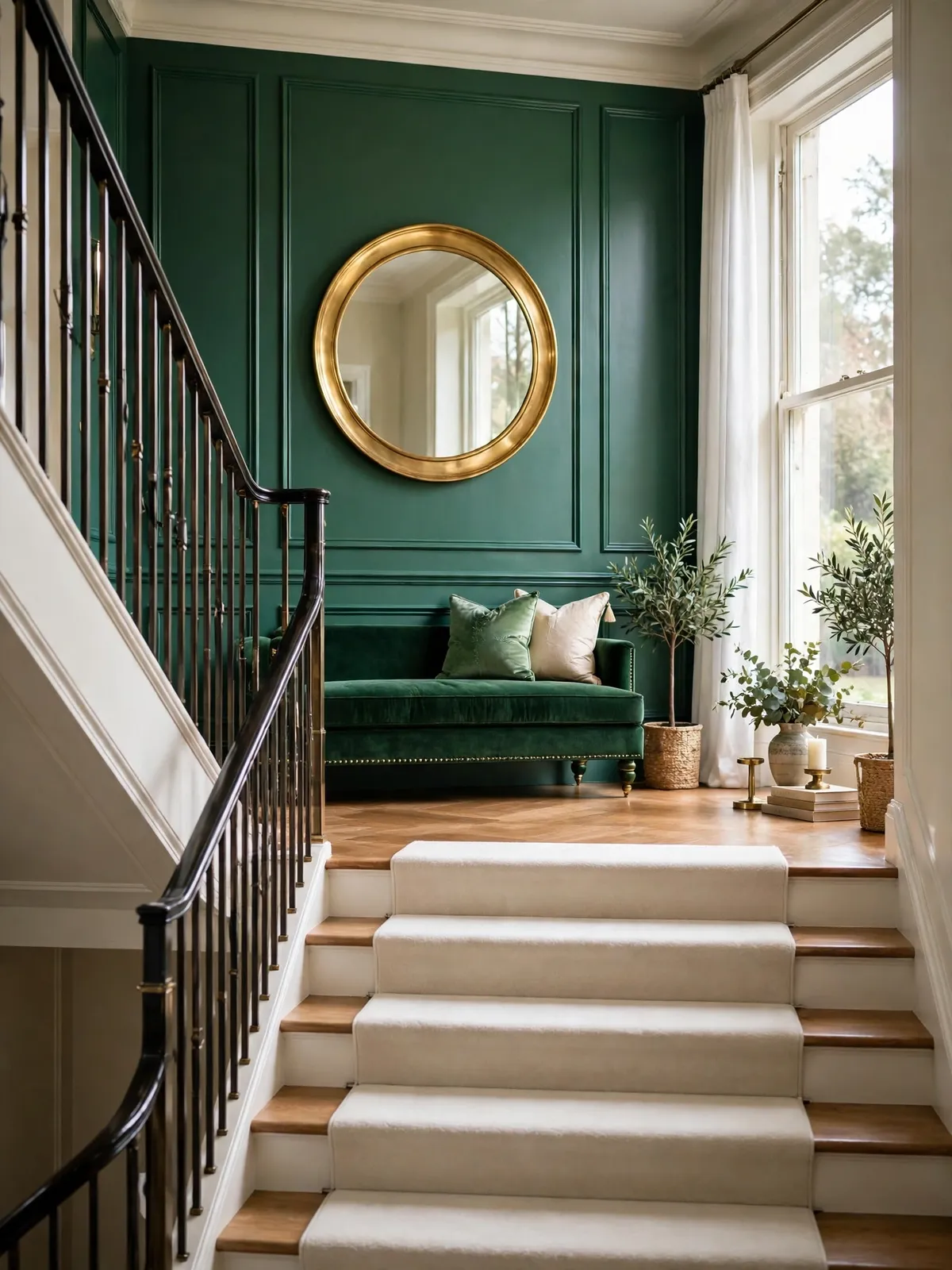
A panelled landing with a round mirror in emerald and brass turns the turn of the stair into a small, glamorous moment. The landing walls are panelled in deep emerald green, and a large round brass mirror, 800 mm across, sits centred inside the largest panel, acting as a built-in frame. Cream treads lead up to the landing, where a deep green velvet bench, 1.1 metres wide, offers a place to pause. Daylight from the landing window reflects in the mirror and back down the stair, so the emerald feels rich rather than dark.
Quick tips:
- Centre the mirror inside one large panel so it looks built in.
- Keep the mirror round to soften the straight panel lines.
- Match the bench velvet to the panel colour for a pulled-together landing.
- Put the mirror opposite a window so it reflects real daylight.
Warm Timber Panels in Rich Mahogany and Soft Beige
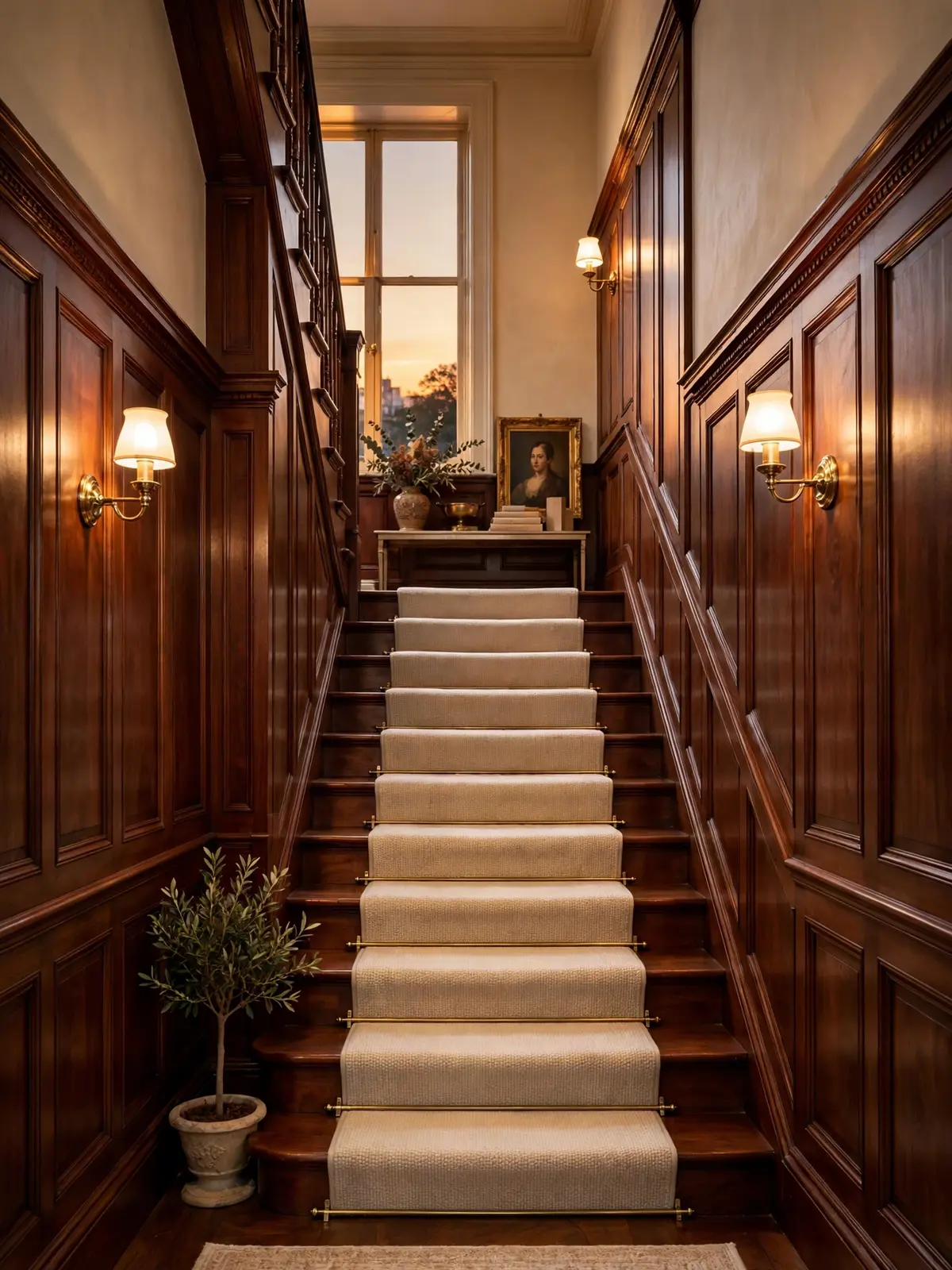
Warm timber panels in rich mahogany give a panelled staircase a deep, traditional richness that painted panels cannot match. The mahogany panels, in classic raised rectangles, cover the stair wall, with soft beige plaster above and a cream carpet runner, 700 mm wide, down the centre of the treads. Brass wall lights on the landing cast a warm evening glow across the timber grain, and the mahogany handrail, polished smooth, feels warm to the touch. It is a look that suits a period home, a library hallway, or any house that loves classic wood.
Quick tips:
- Use a satin finish on mahogany so the grain glows without glare.
- Keep the wall above the panels soft beige to lighten the timber.
- Choose a cream runner to soften dark timber treads.
- Polish the handrail regularly so it stays smooth and warm.
Panelled Walls With Hidden Under-Stair Cupboards in Pale Eucalyptus
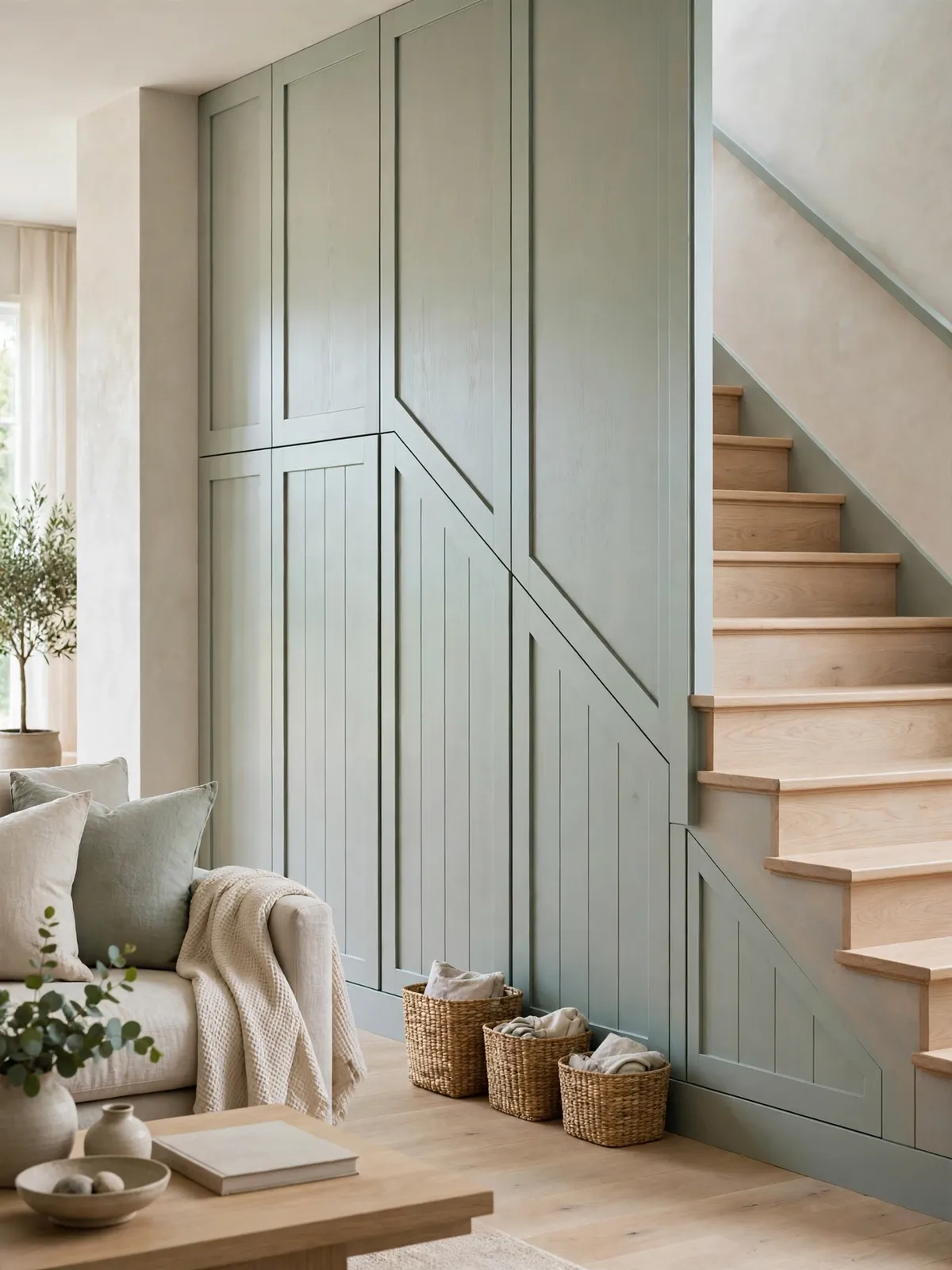
Panelled walls with hidden under-stair cupboards in pale eucalyptus turn a panelled staircase into quiet, invisible storage. The cupboard doors are built into the panel lines, so the eucalyptus panels run uninterrupted across the under-stair wall, with push-to-open catches and no visible handles at all. White oak treads keep the stair bright, and small woven baskets inside the cupboards hold shoes, coats and board games. From the hallway, you would never know the storage was there — the wall simply looks beautifully panelled.
Quick tips:
- Align cupboard doors exactly with the panel lines so they disappear.
- Use push-to-open catches so no handles break the panel pattern.
- Paint the cupboard interiors pale so you can find things easily.
- Store only light, everyday items in under-stair cupboards.
Soft Lavender Panels With a White Stair and Chrome Details
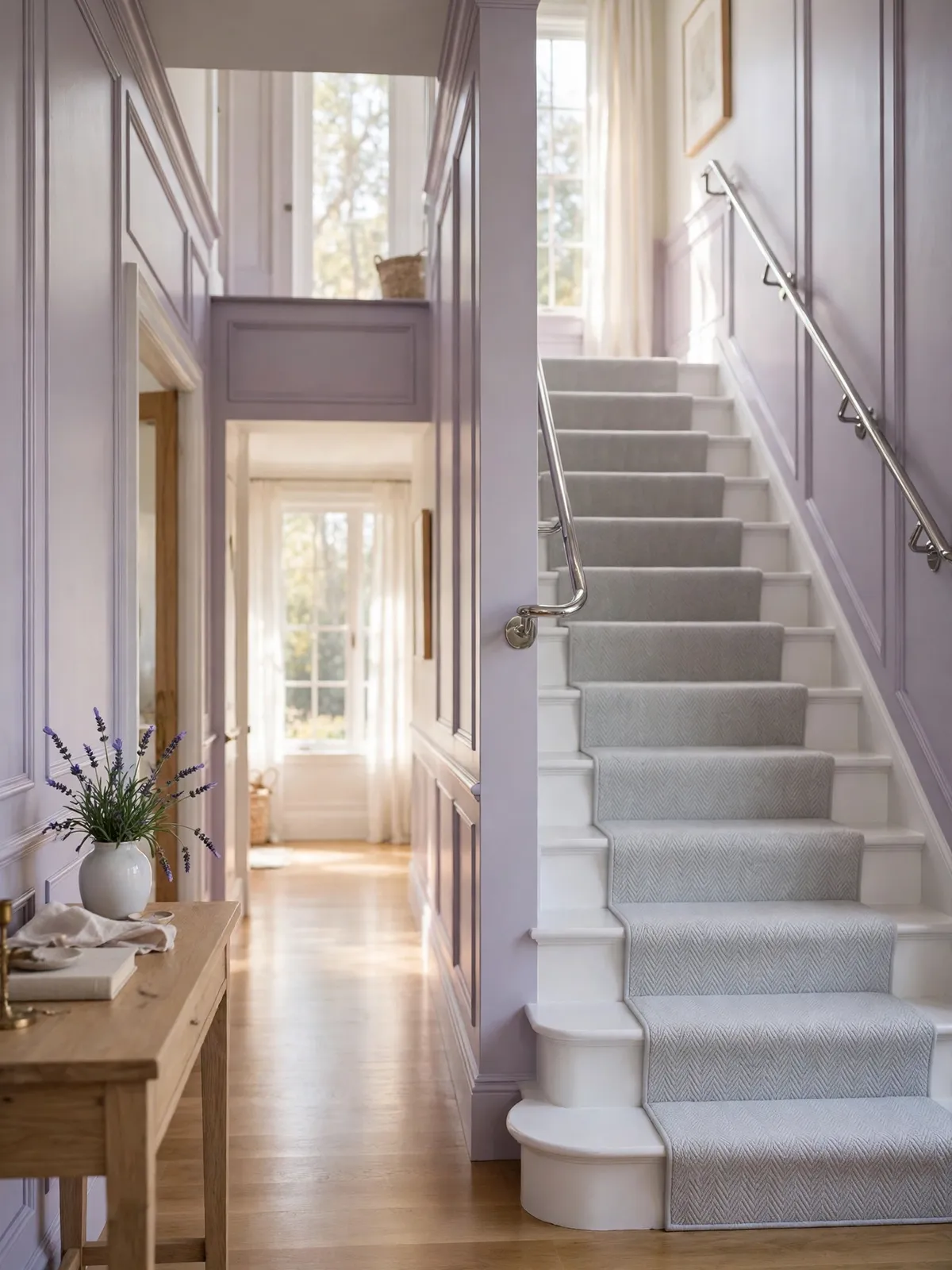
Soft lavender panels with a white stair and chrome details give a panelled staircase a fresh, serene softness. The lavender panels, in neat Shaker rectangles, cover the stair wall in a pale, powdery lilac, while the stair itself stays crisp white — white treads, white risers, white stringer. Slim chrome handrail brackets add a cool, modern shine, a pale grey runner softens the treads, and a small vase of lavender sprigs on the landing echoes the wall colour. The lavender is gentle enough for a bedroom hallway, and the white stair keeps it feeling bright.
Quick tips:
- Keep lavender pale and powdery so it stays serene, not sugary.
- Pair lavender panels with a crisp white stair for brightness.
- Use chrome, not brass, for a cool, fresh finish with lavender.
- Add a small vase of real lavender on the landing for scent and colour.
A Panelled Staircase in Deep Forest Green With Cream Treads
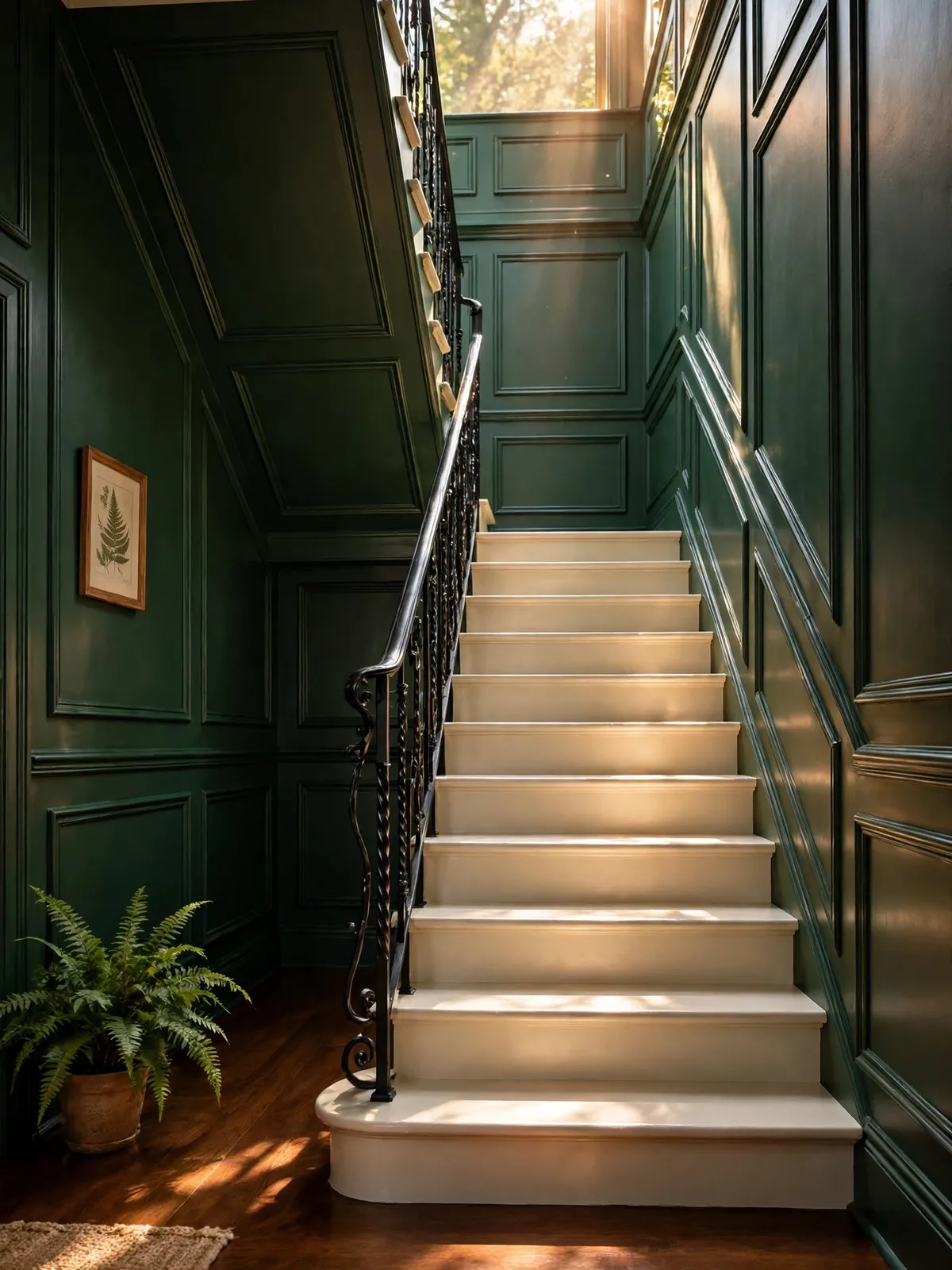
A panelled staircase in deep forest green with cream treads feels like a walk through a quiet wood, calm and deeply cocooning. The forest-green panels, in tall Shaker rectangles, cover the stair wall, while cream-painted treads, each 950 mm wide, keep every step bright against the dark green. A slim black iron handrail adds a crisp, modern edge, and a small framed botanical print on the landing picks up the green. The forest green is rich and earthy, and it suits a home with lots of natural timber, linen and plants.
Quick tips:
- Pair forest green panels with cream treads for a bright, balanced stair.
- Use a black iron handrail for a crisp contrast against the green.
- Keep the landing print small and botanical to echo the colour.
- Add a warm lamp on the landing so the green glows in the evening.
Moulded Panels With a Gallery of Black-and-White Prints
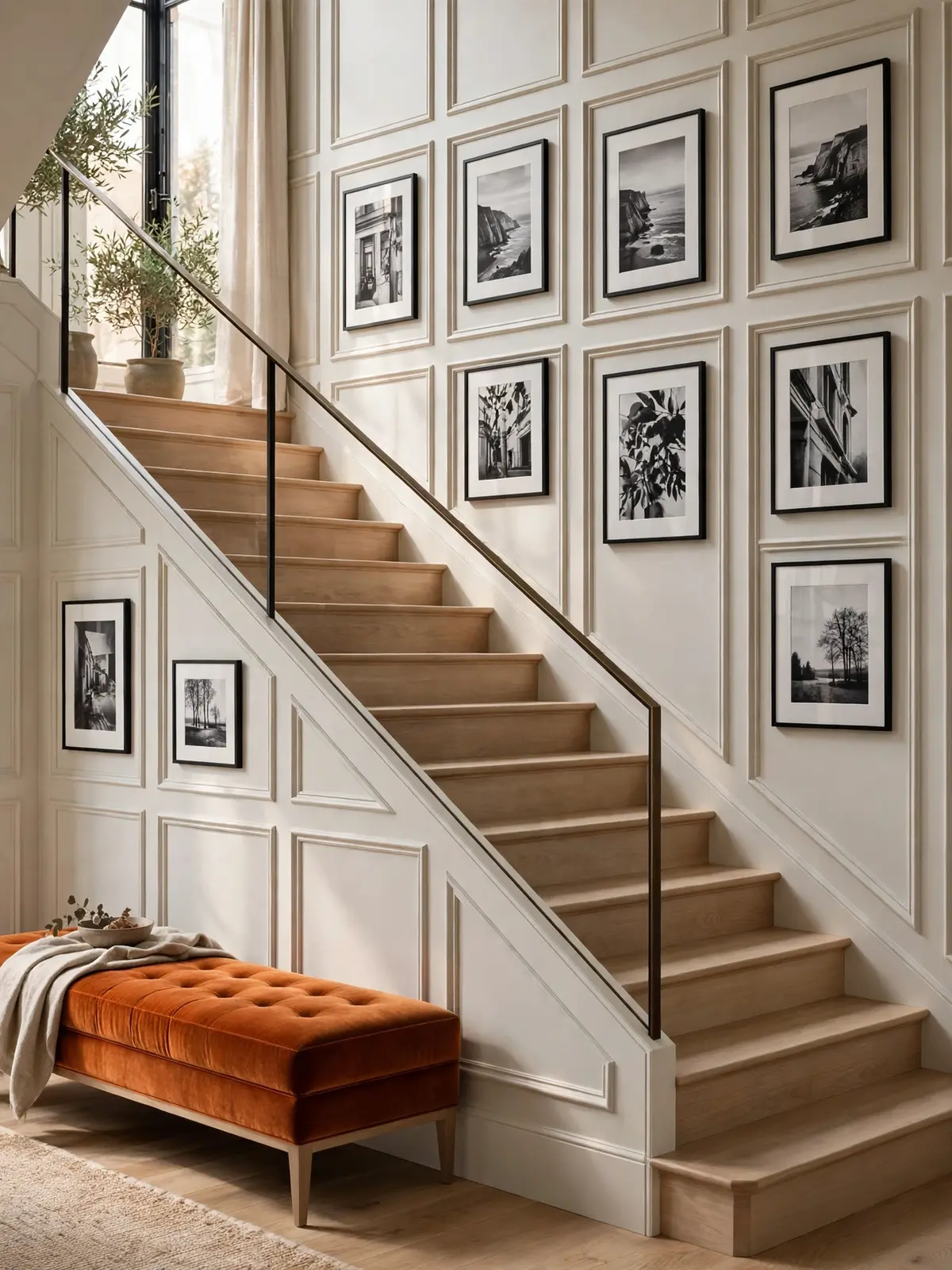
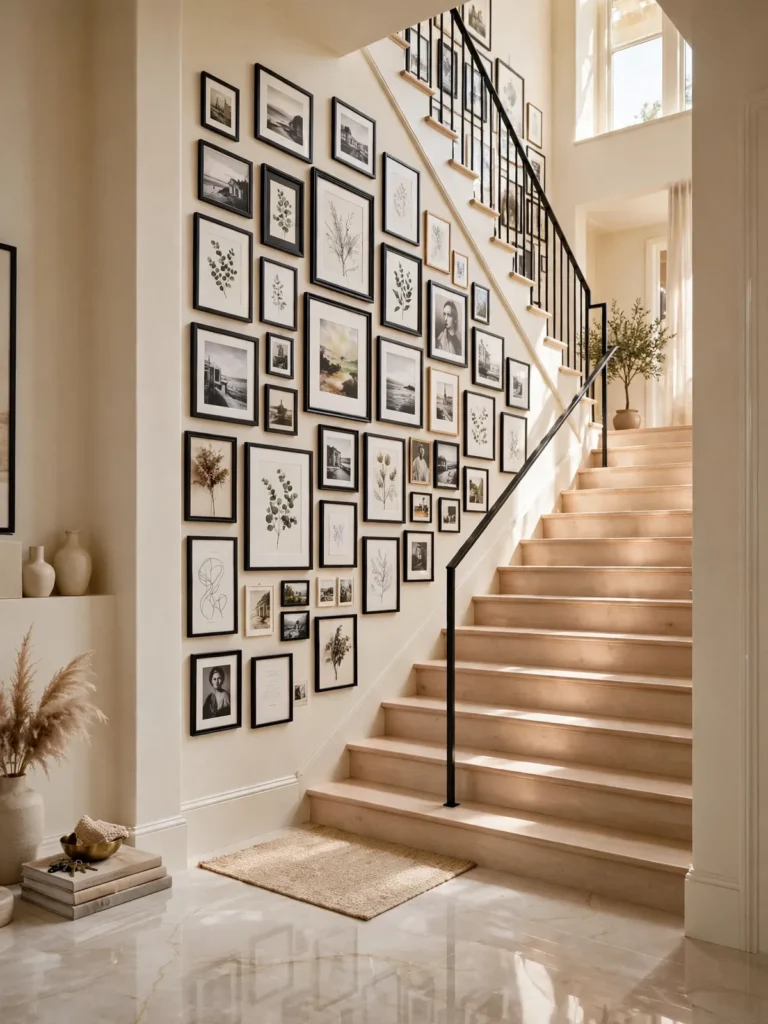
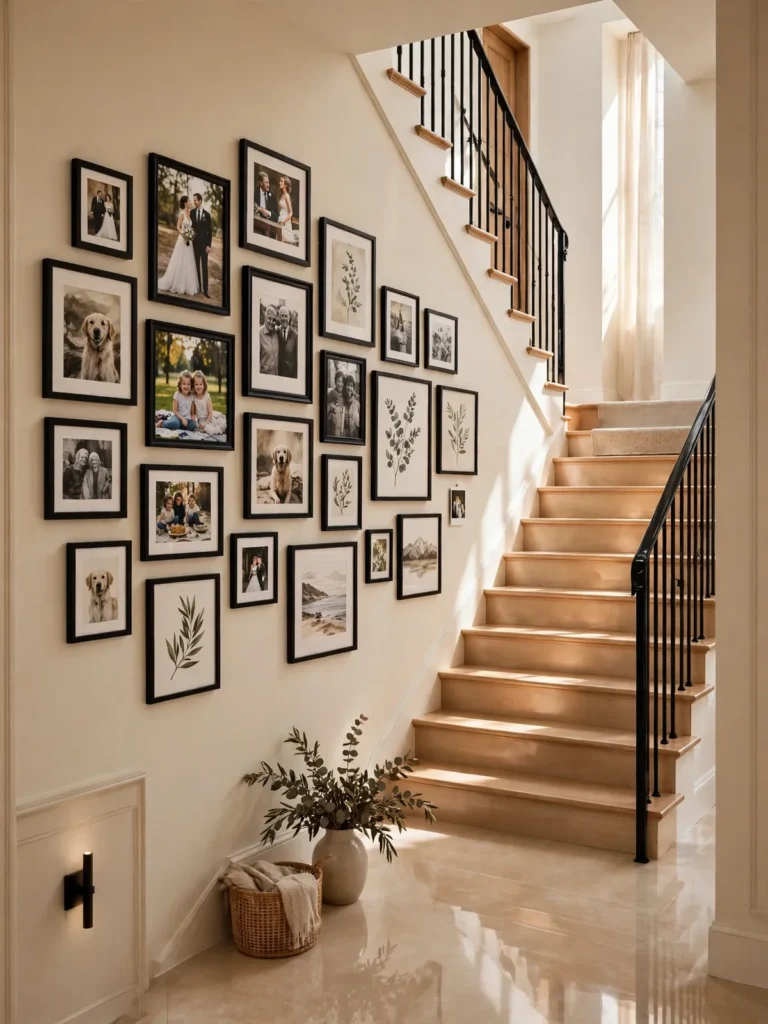
Moulded panels with a gallery of black-and-white prints turn a panelled staircase into a private art gallery. Each panel frames one print — a family photograph, a landscape, a city street — hung dead centre inside its moulding, with equal spacing between them as they climb the stair. Pale oak treads keep the stair warm, while a burnt-orange velvet bench at the base adds one bold, warm accent against the monochrome wall. The panels make the gallery feel intentional and curated, never random, and the black-and-white prints keep the whole wall calm and cohesive.
Quick tips:
- Hang one print centred inside each panel, never two.
- Keep all prints black and white for a calm, cohesive gallery.
- Use matching slim black frames inside every panel.
- Add one warm accent, like a burnt-orange bench, to stop monochrome feeling cold.
A Panelled Staircase With LED Glow Behind Raised Panels in Midnight Blue and Copper
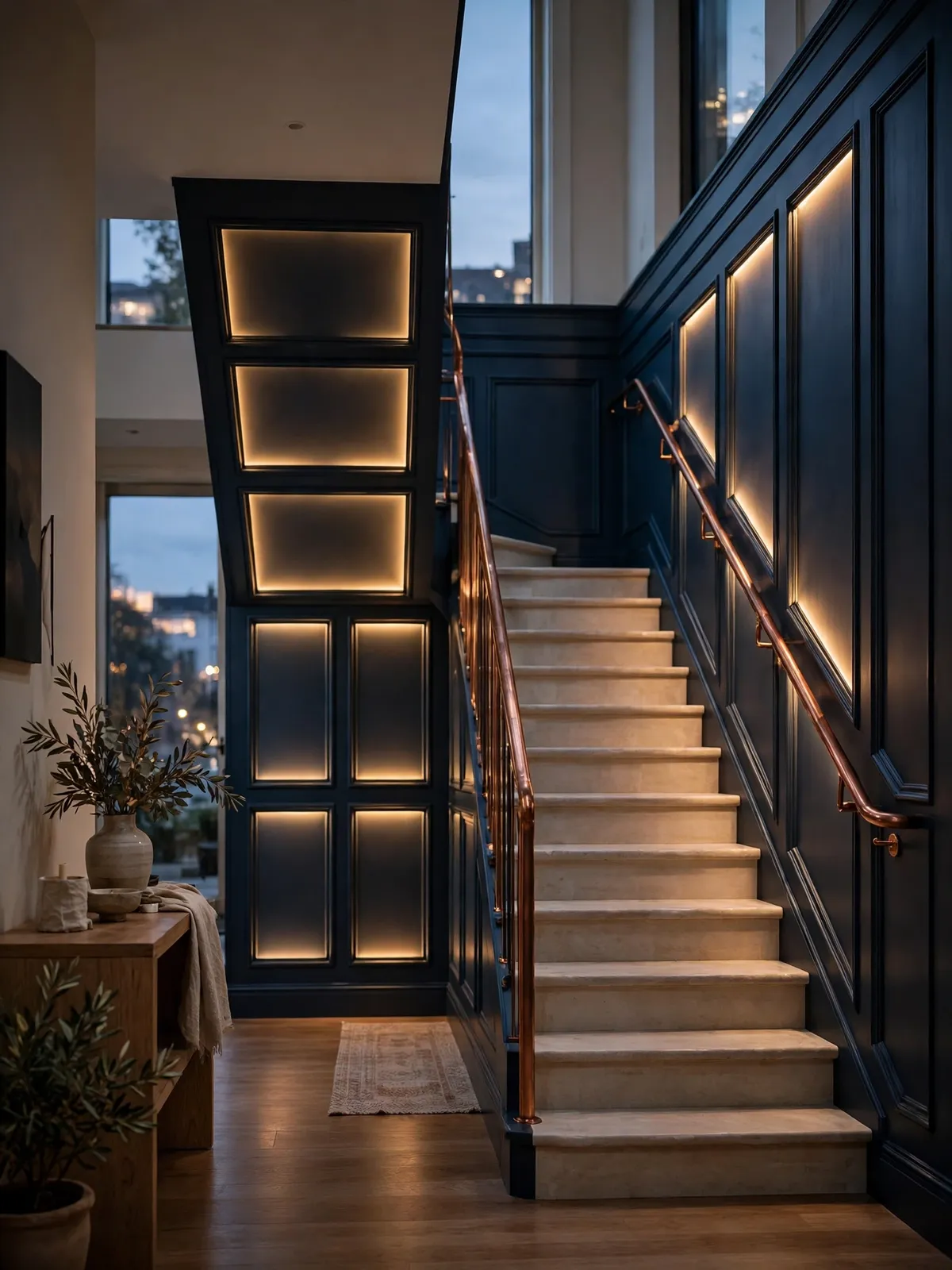
LED glow behind raised panels in midnight blue and copper turns a panelled staircase into a soft lantern after dark. The midnight-blue panels sit slightly proud of the wall, with warm-white LED strips, 2700K, hidden behind their edges, so each panel glows gently from behind in the evening. A slim copper handrail catches the glow and shines softly, while pale stone treads, each 900 mm wide, reflect the light down the flight. It is bright enough to guide you safely at night, and soft enough for a bedroom hallway.
Quick tips:
- Use warm-white LEDs, 2700K to 3000K, for a soft evening glow.
- Put the lights on a dimmer or motion sensor so they stay subtle.
- Pair midnight blue with copper, not silver, for the warmest glow.
- Hide the strips fully behind the panel edges for a clean finish.
A Panelled Wall With Built-In Bookshelves in Warm Taupe and Burgundy
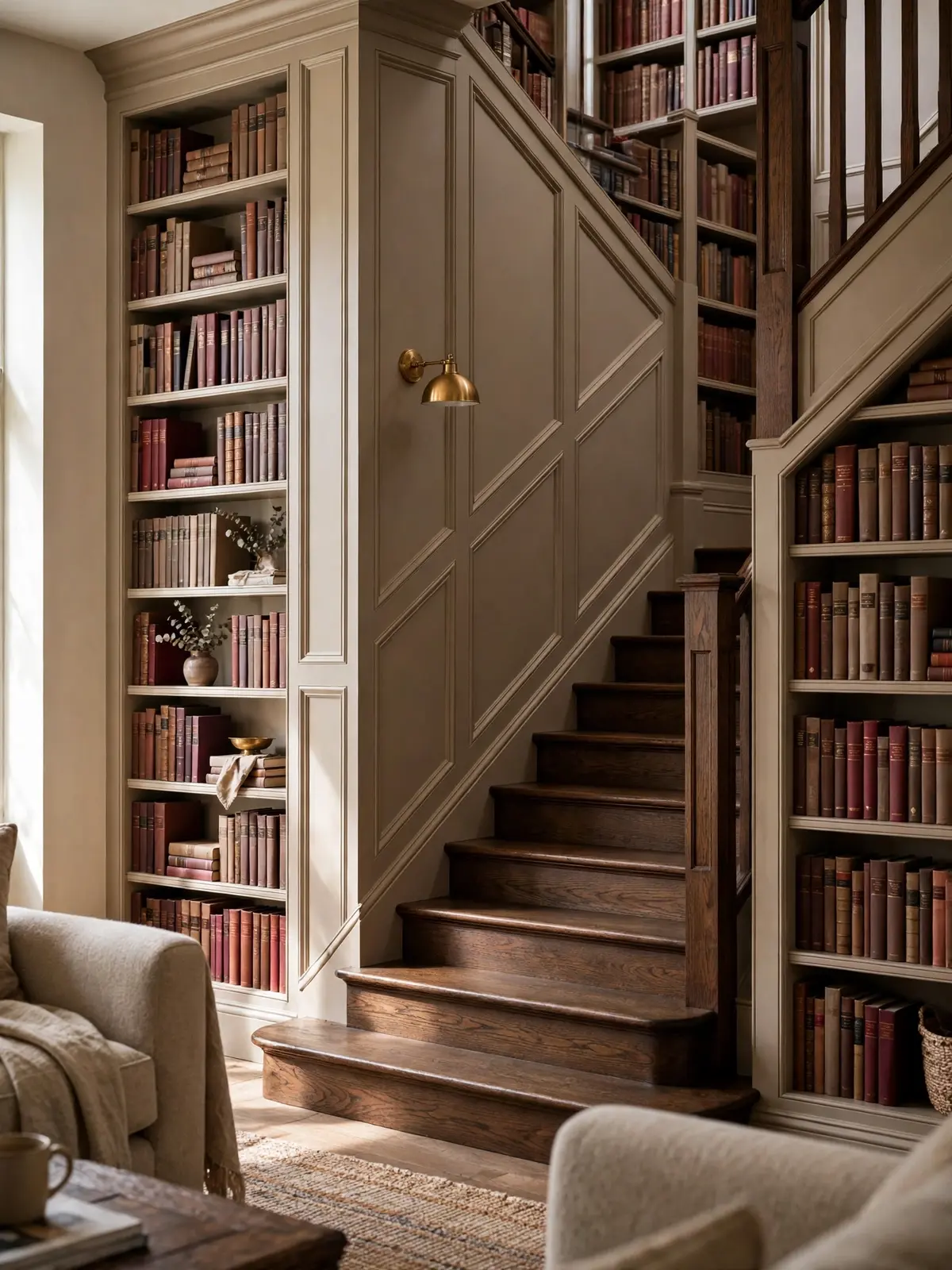
A panelled wall with built-in bookshelves in warm taupe and burgundy turns a long stair wall into a small library. Shallow bookshelves, 200 mm deep, sit between the taupe panels, holding books in burgundy, cream and olive, with a small brass reading lamp on the landing shelf. Dark oak treads ground the warm palette, and the taupe panels frame the shelves so the whole wall looks custom-built. It invites you to pause halfway up, pull out a book, and stay a while.
Quick tips:
- Keep shelves shallow, about 200 mm deep, so they never crowd the stair.
- Group books by colour so the shelves look calm, not cluttered.
- Frame each shelf bay with a panel so the wall looks custom-built.
- Add one small brass lamp on the landing shelf for evening reading.
A Panelled Staircase in Soft Peach and Pale Walnut
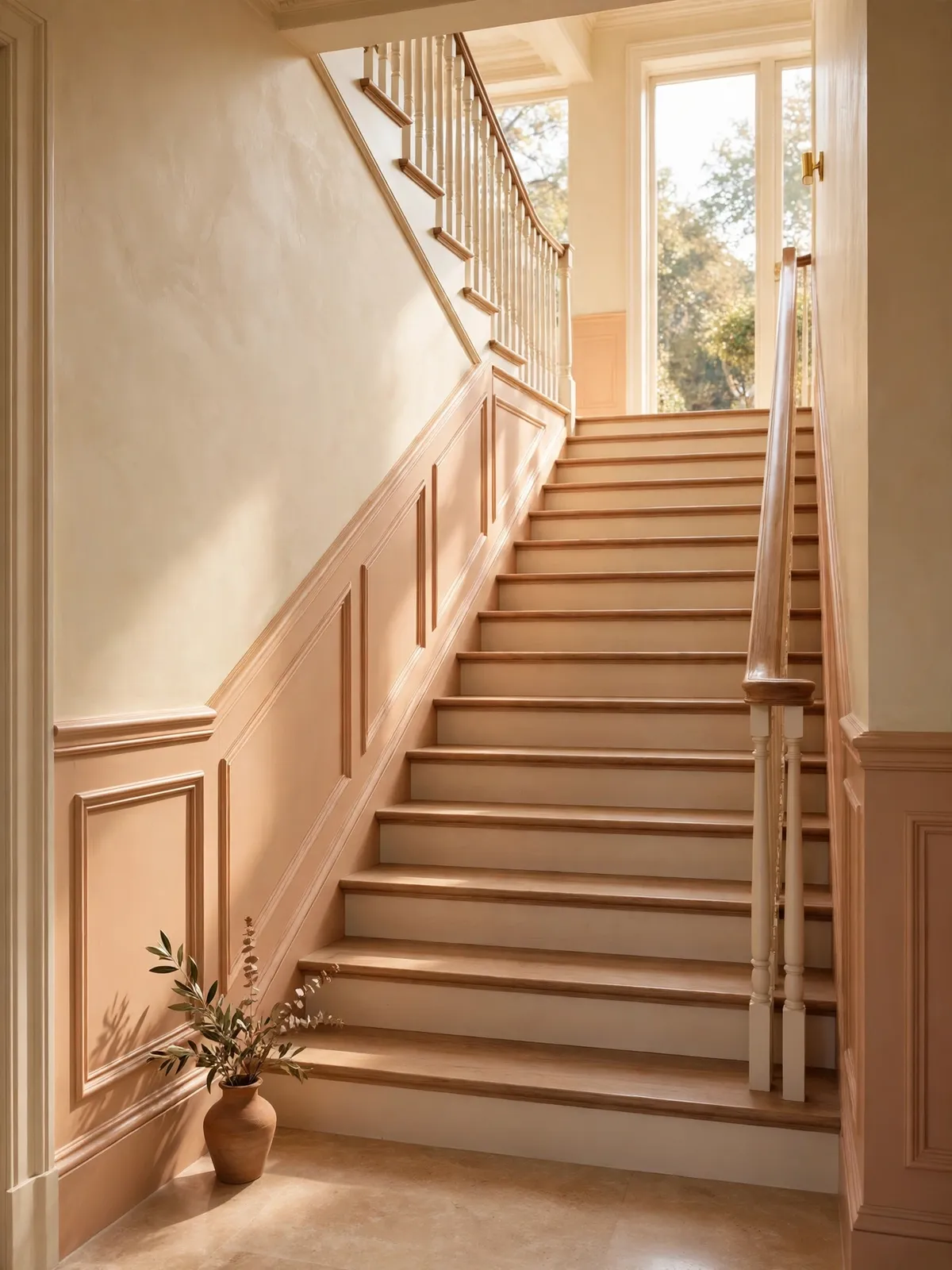
A panelled staircase in soft peach and pale walnut feels like warm afternoon sun, even on a grey day. The peach panels, in classic Shaker rectangles, cover the stair wall in a pale, apricot tone, while pale walnut treads, each 950 mm wide, add a gentle honey-brown warmth underfoot. The wall above the panels stays cream plaster, a small terracotta vase sits on the landing, and the golden afternoon light makes the peach glow softly. It is a cheerful, welcoming combination that suits a sunny hallway or a home that loves warm colour.
Quick tips:
- Keep peach pale and apricot-toned so it glows, never shouts.
- Pair peach panels with pale walnut treads for gentle warmth.
- Keep the wall above the panels cream to lighten the peach.
- Add one terracotta vase on the landing to echo the warm tone.
A Panelled Staircase With Fluted Oak and a Glass Balustrade in Warm Sand
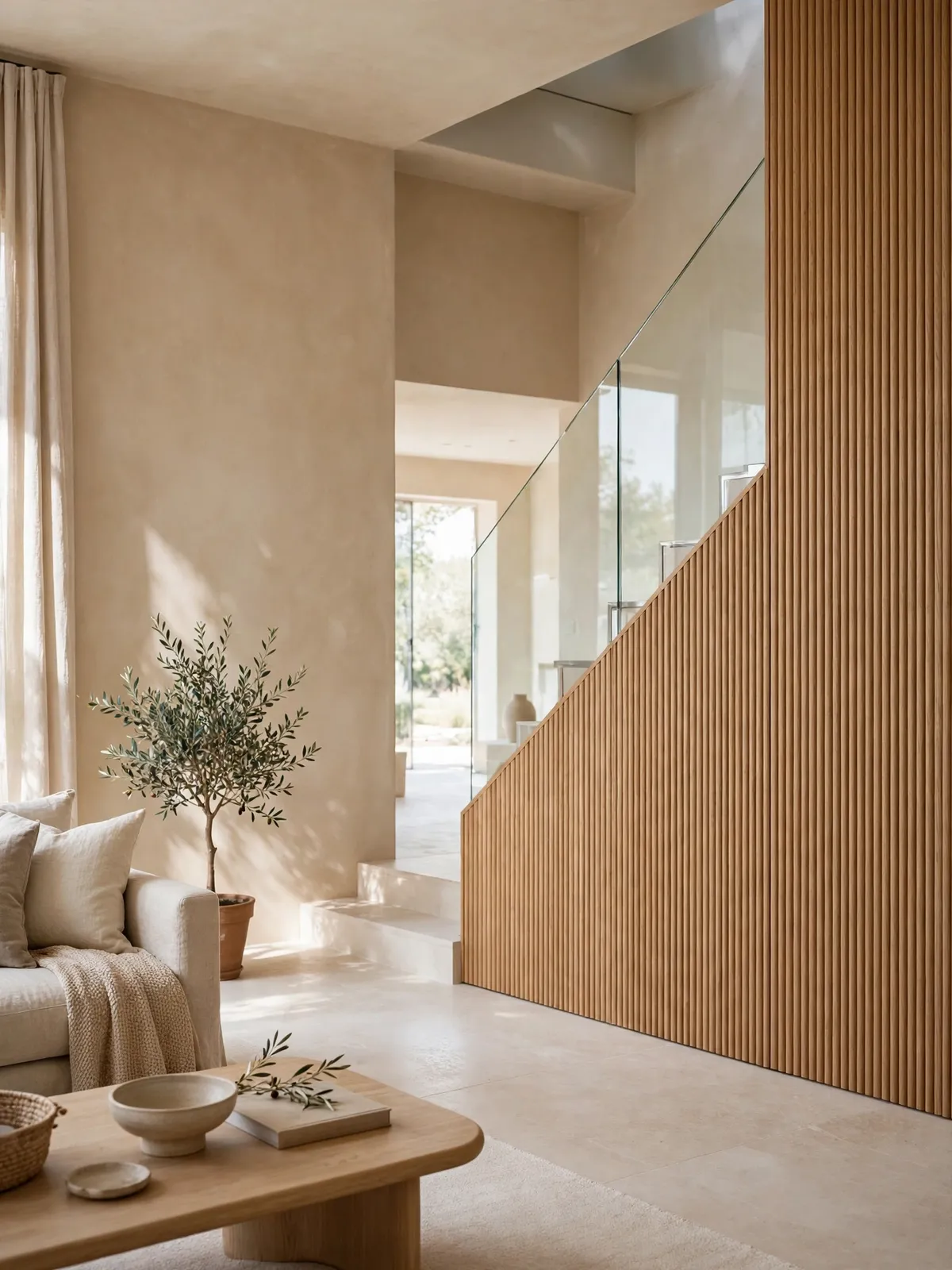
Fluted oak panels with a glass balustrade in warm sand give a panelled staircase a light, architectural feeling that still feels warm. The fluted oak panels run up the stair wall in slim vertical ribs, while a clear glass balustrade on the open side lets daylight travel straight through the stair. Warm sand-coloured walls and a pale stone floor keep the palette soft and sun-warmed, and a small olive tree at the base adds a living green accent. The oak flutes add texture, the glass adds light, and the sand tones tie them together.
Quick tips:
- Pair fluted oak panels with clear glass so light still travels through.
- Keep the wall colour warm sand, not stark white, for a sun-warmed feel.
- Use a pale stone floor to reflect daylight up the stair.
- Add one small olive tree at the base for a living green accent.
A Panelled Staircase in Pale Butter Yellow and White
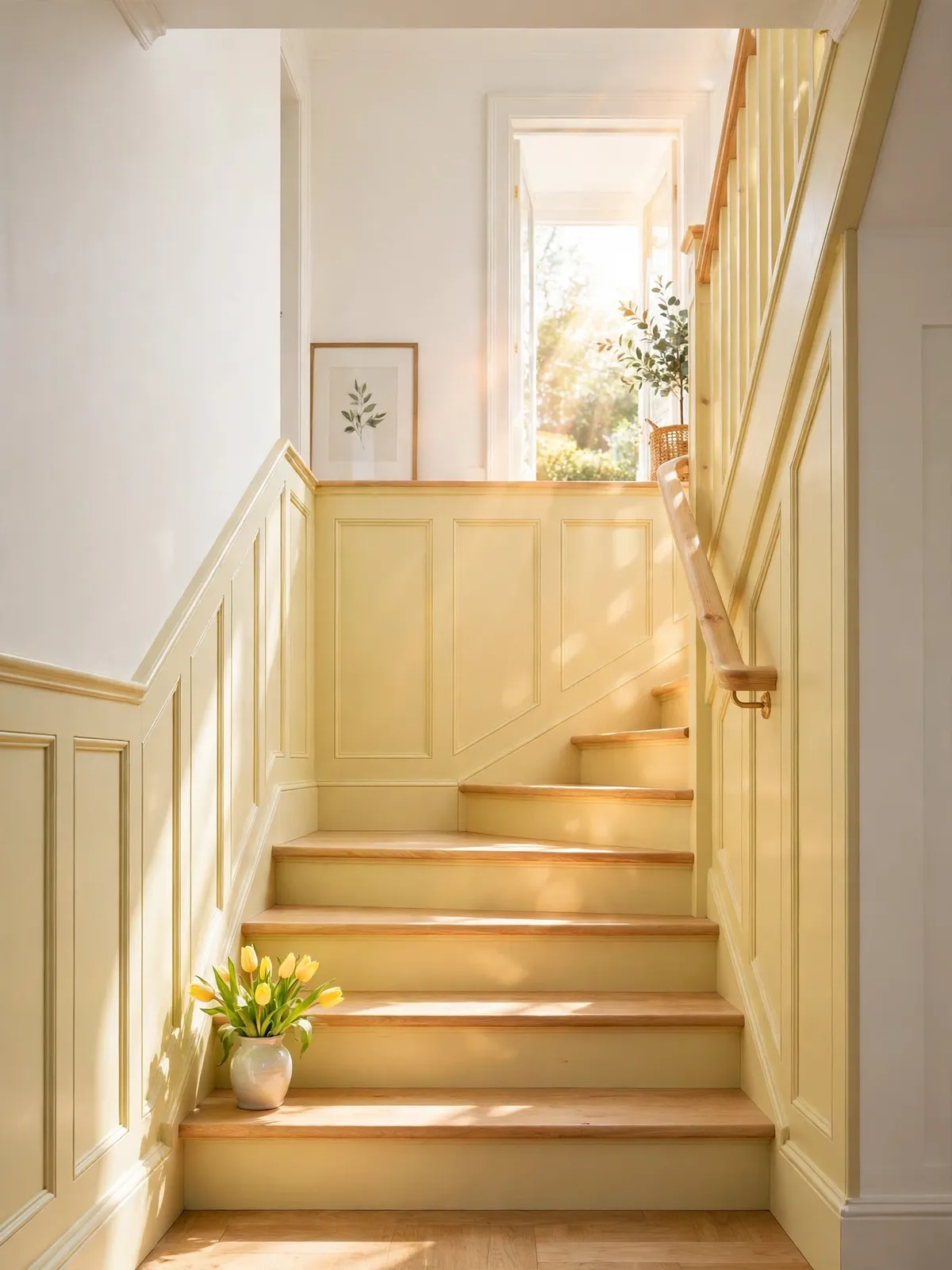
A panelled staircase in pale butter yellow and white is the sunniest panelled look of all, and it works wonders in a dark hallway. The butter-yellow panels, in neat Shaker rectangles, cover the stair wall in a soft, creamy yellow, while the stair itself stays crisp white — white treads, white risers, white handrail. Light pine treads would be too pale here, so the white stair keeps the yellow feeling fresh, and a small vase of yellow tulips on the landing echoes the wall colour. The yellow is pale enough to feel calm, yet warm enough to make a north-facing hallway feel sunny.
Quick tips:
- Keep butter yellow pale and creamy so it feels sunny, not loud.
- Pair yellow panels with a crisp white stair for freshness.
- Use the same yellow in one small landing detail, like tulips.
- Paint the hallway ceiling white so the yellow glows, never closes in.
A Panelled Staircase With Dark Plum Panels and a Velvet Runner
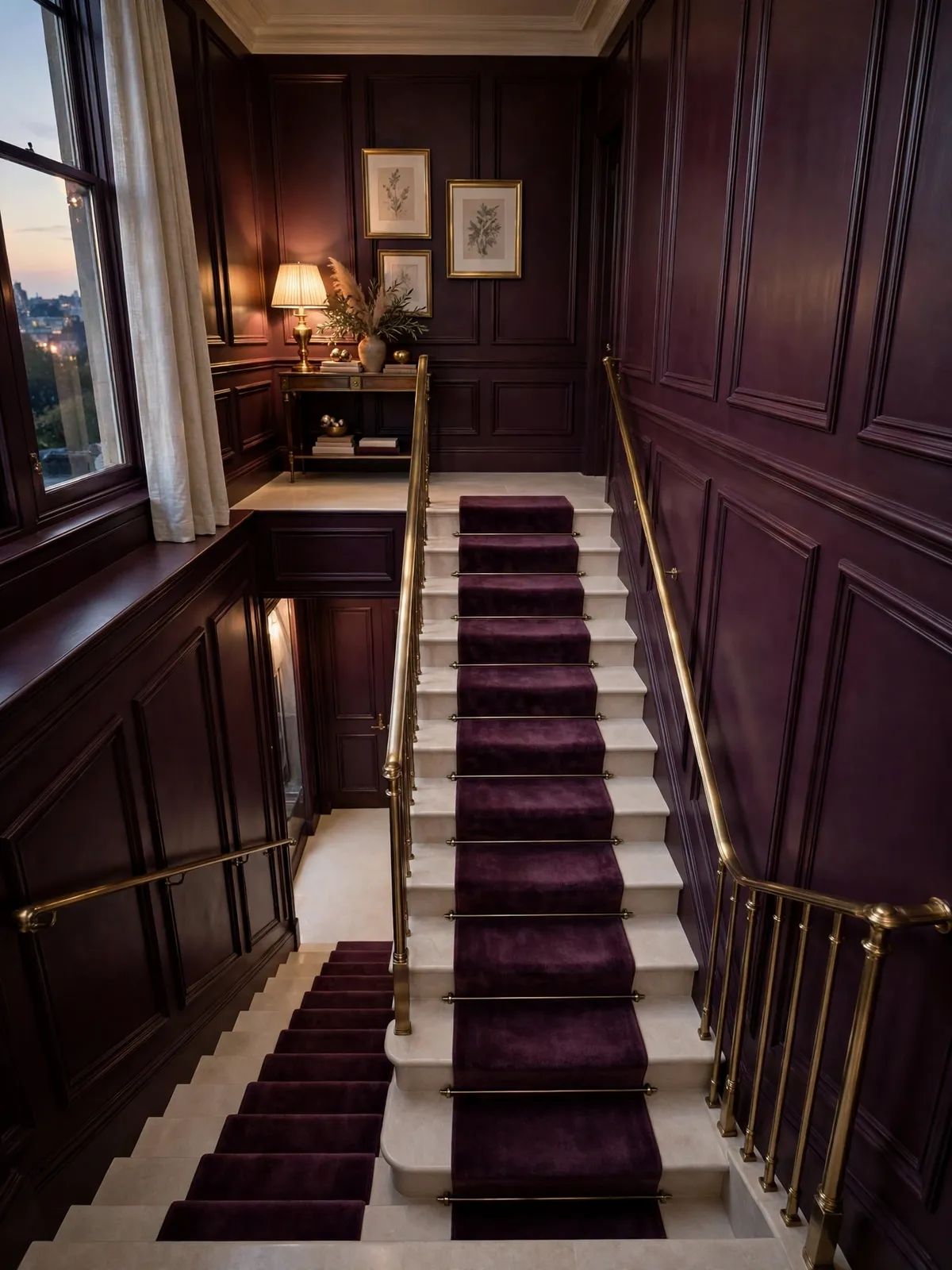
Dark plum panels with a velvet runner give a panelled staircase a rich, opulent feeling, like a boutique hotel stair. The plum panels, in large Shaker rectangles, cover the stair wall, while a deep plum velvet runner, 700 mm wide, runs down the centre of pale cream treads, held by slim brushed-brass stair rods. A brushed-brass handrail catches the evening light, and the pale cream treads stop the plum from feeling heavy. It is a dramatic, luxurious look that suits a hallway you want guests to remember.
Quick tips:
- Balance dark plum panels with pale cream treads.
- Choose velvet for the runner — it catches light beautifully.
- Use brushed brass, not polished, for a softer shine with plum.
- Keep the landing clear so the plum stair stays the feature.
A Panelled Staircase in Coastal White and Seafoam With Rattan
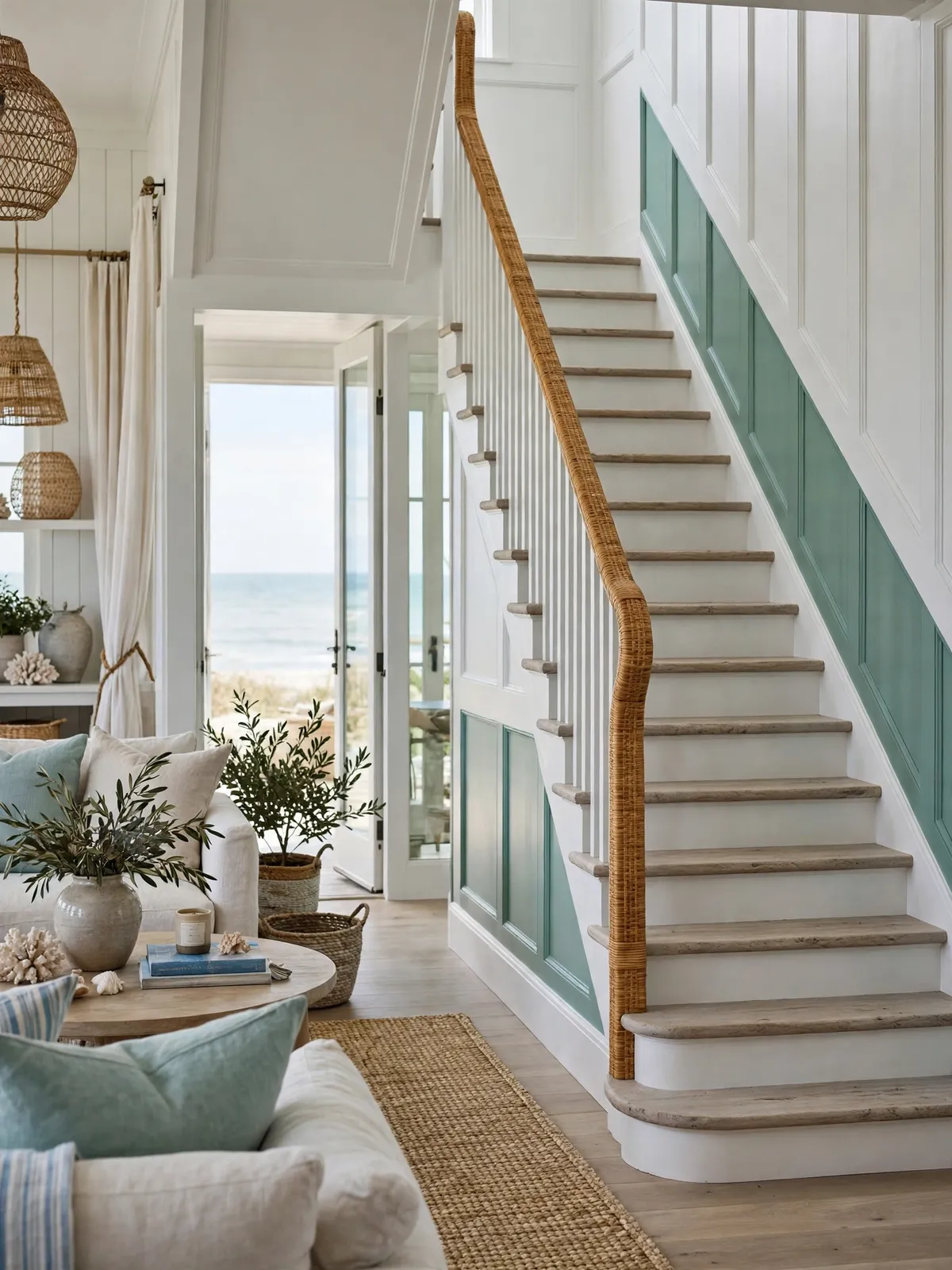
A panelled staircase in coastal white and seafoam with rattan brings a breezy, seaside calm to the stairwell. White Shaker panels cover the stair wall, with a single seafoam-green panel on the landing as a gentle accent, while pale driftwood treads, each 950 mm wide, keep the stair light and weathered. A rattan wrap around the handrail adds natural texture, a woven seagrass rug sits at the base, and soft sea light from the landing window washes across the white panels. The whole stair feels like a breath of fresh sea air.
Quick tips:
- Keep the panels white and use seafoam as one gentle accent only.
- Use pale driftwood treads for a relaxed coastal feel.
- Add rattan or seagrass textures to soften the white panels.
- Choose seafoam accents that echo the sea without overdoing the theme.
A Floor-to-Ceiling Panelled Feature Wall in Warm Greige and Black Iron
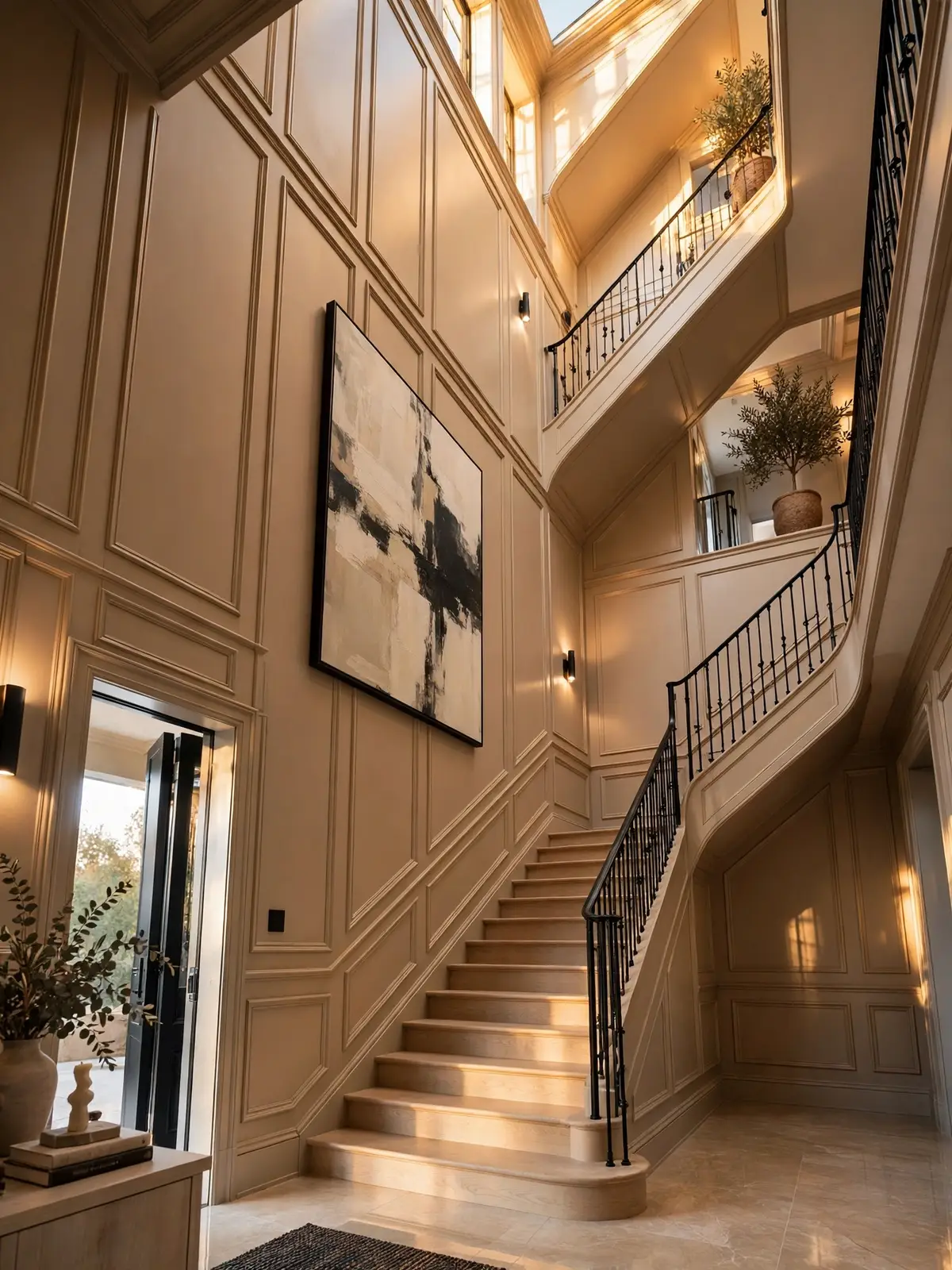
A floor-to-ceiling panelled feature wall in warm greige and black iron is the boldest way to finish a panelled staircase, because it turns the whole stairwell into one grand statement. The greige panels — a warm mix of grey and beige — run from the floor to the ceiling in tall, even rectangles, following the angle of the stair and wrapping around the landing, so the stairwell reads as one continuous, architectural wall. Pale oak treads, each 950 mm wide, keep the stair itself light against the full-height panels, while a slim black iron handrail runs the whole flight in one clean, unbroken line, and a large abstract painting in cream and charcoal, 1.2 metres wide, hangs on the landing wall inside the panel rhythm, adding one quiet piece of art without breaking the panel pattern. Warm golden light from the landing window falls across the greige panels in the evening, so the texture glows softly, and the stairwell feels grand yet calm, like a beautifully finished hotel entrance rather than a plain hallway. It works best in a home with a tall stairwell and an open-plan living area, where the stair is visible from the living room and deserves to be a feature, and it needs almost no other decoration — the panels themselves are the decoration, and anything more would only compete with them. Keep the furniture below the stair simple, keep the landing clear, and let the full-height panels do all the talking.
Quick tips:
- Take the panels floor to ceiling so the stairwell reads as one statement wall.
- Keep the panel rectangles tall and even for a grand, uncluttered look.
- Pair warm greige with a slim black iron handrail for a clean contrast.
- Hang one large piece of art on the landing, never several small ones.
FAQs
How much does a panelled staircase cost?
Costs vary with the panel material, the size of the stairwell and whether you hire a joiner or do it yourself. Painted MDF panels on a straight stair are usually the most affordable option, while solid oak panels, fluted timber or a full floor-to-ceiling feature wall cost far more because of the materials and the fitting time. Always get at least two detailed quotes that include the panels, the handrail, the painting and the finishing, not just the timber.
Can I add panels to an existing staircase myself?
Yes, if you are comfortable with basic DIY. Painted MDF Shaker panels and board-and-batten panels are the easiest to fit yourself, using a mitre saw, adhesive and pins, then caulk and paint for a seamless finish. Curved stairs, fluted panels and solid timber panels are harder to fit neatly, so those are best left to a joiner.
Do panelled staircases suit a narrow hallway?
Yes — they are one of the best choices for a narrow hallway, because slim panels add character without taking up any floor space at all. Paint them in a pale colour, keep the rectangles slim, and use a light tread colour so the hallway feels brighter and more finished, not narrower.
What is the best paint finish for a panelled staircase?
Satin or semi-gloss paint is the best finish for a panelled staircase, because it resists scuffs and fingerprints on a busy stairwell and wipes clean easily. Matte paint looks softer, but it marks more easily on a stair wall that hands and bags brush past every day, so save matte for a low-traffic landing.
How do I clean a panelled staircase?
Dust the panels weekly with a soft cloth or a feather duster, paying attention to the top edges of the moulding where dust settles. Wipe scuffs with a damp cloth and a little mild soap, and keep a small pot of the same paint for quick touch-ups on the corners and handrail height, where wear shows first.
Conclusion
A panelled staircase is not just a way to dress a plain wall — it is a way to give the whole hallway structure, warmth and a finished, expensive feeling. Whether you choose classic cream Shaker panels, deep teal with brass, warm mahogany timber, a gallery of prints inside the moulding, or a full floor-to-ceiling feature wall in warm greige, the best panelled staircase is the one that suits the rooms around it. Keep the panels even, the colours warm, the handrail honest, and the landing clear, and your stair will make every room it connects feel more polished, more welcoming and more like home.