25 Stunning Staircase Handrail Ideas That Instantly Make Your Stairs Safer, Smarter and More Beautiful
A staircase handrail is the part of the stair you hold every single day, so getting it right matters more than most people think. These 25 staircase handrail ideas cover the height, the grip, the clearance, the materials and the installation — so your handrail feels comfortable, keeps your family safe, and looks beautiful in your home.
A staircase handrail is the rail you grip as you climb — fixed to the wall or to the top of the balustrade — and it is different from the railing itself, which is the whole protective barrier of handrail, balusters and newel posts. The best staircase handrail sits at a comfortable height, usually 34 to 38 inches above the tread nosing, with a grip you can close your hand around and a small gap from the wall so your knuckles never scrape.
For a full look at how the rail works with the rest of the stair, these modern staircase railing ideas show slim steel, glass and timber railings in bright modern homes. The 25 ideas below cover the whole handrail — its height, its grip, its fixings, its materials, its installation and its care — so you can choose and fit a rail that suits your home and keeps everyone safe.
Key Takeaways
What is a staircase handrail?
A staircase handrail is the rail you grip as you climb, fixed to the wall or to the top of the balustrade. It is different from the railing, which is the whole protective barrier — handrail, balusters and newel posts together — and from the balustrade, which is the row of balusters below the handrail.
What is the standard handrail height for stairs?
In most places the standard handrail height is 34 to 38 inches, measured vertically from the front edge — the nosing — of each tread up to the top of the rail. Measure at several treads along the flight, because the rail must follow the slope of the stair at a constant height. Always check your local building rules, as the exact range can vary.
What is the correct grip size for a stair handrail?
A round handrail should be about 1.25 to 2 inches in diameter, so most hands can close around it comfortably. A rectangular rail should be about 1.25 to 2.75 inches wide with softly rounded edges. If the rail is too thick to grip or too thin to hold firmly, it will not help you on the stairs.
How far should a handrail be from the wall?
A wall-mounted handrail should sit about 1.5 inches clear of the wall, so your fingers fit behind the rail without scraping your knuckles. The brackets that hold the rail should be fixed into wall studs, spaced evenly along the flight, so the rail can take the full weight of a person leaning on it.
When is a handrail required by building code?
In most places a handrail is required on any stair with four or more risers, on at least one side of the flight, and on both sides when the stair is very wide. Open sides above a drop also need a guardrail. Building rules vary by country and region, so check your local code before you build or replace a handrail.
A Staircase Handrail Set at the Standard 36-Inch Height
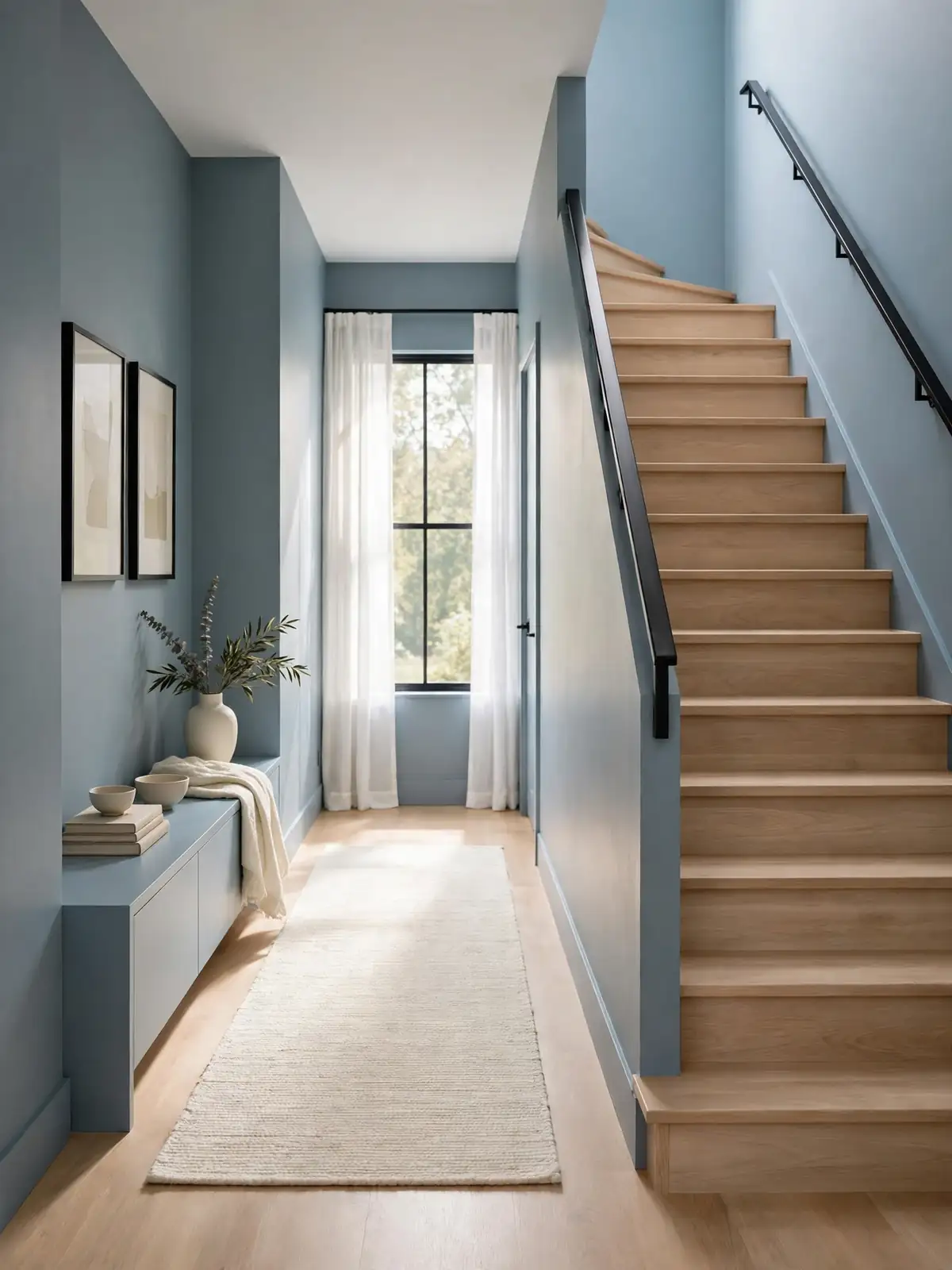
A handrail set at 36 inches above the tread nosing feels right for almost everyone, because it sits naturally at hip height as you climb. On this stair, a slim pale oak handrail runs the full flight at a constant 36 inches, measured vertically from the nosing of every tread, beside pale oak treads, each 950 mm wide. Soft dusty-blue walls and a cream rug keep the hallway calm, while slim black brackets hold the rail firmly to the wall and the height never changes along the slope.
Quick tips:
- Measure the height vertically from the tread nosing, not along the slope.
- Keep the height constant — about 36 inches — along the whole flight.
- Check the height at three or four treads, not just one.
- Always confirm the allowed range in your local building rules.
A Staircase Handrail With a Comfortable 1.75-Inch Grip
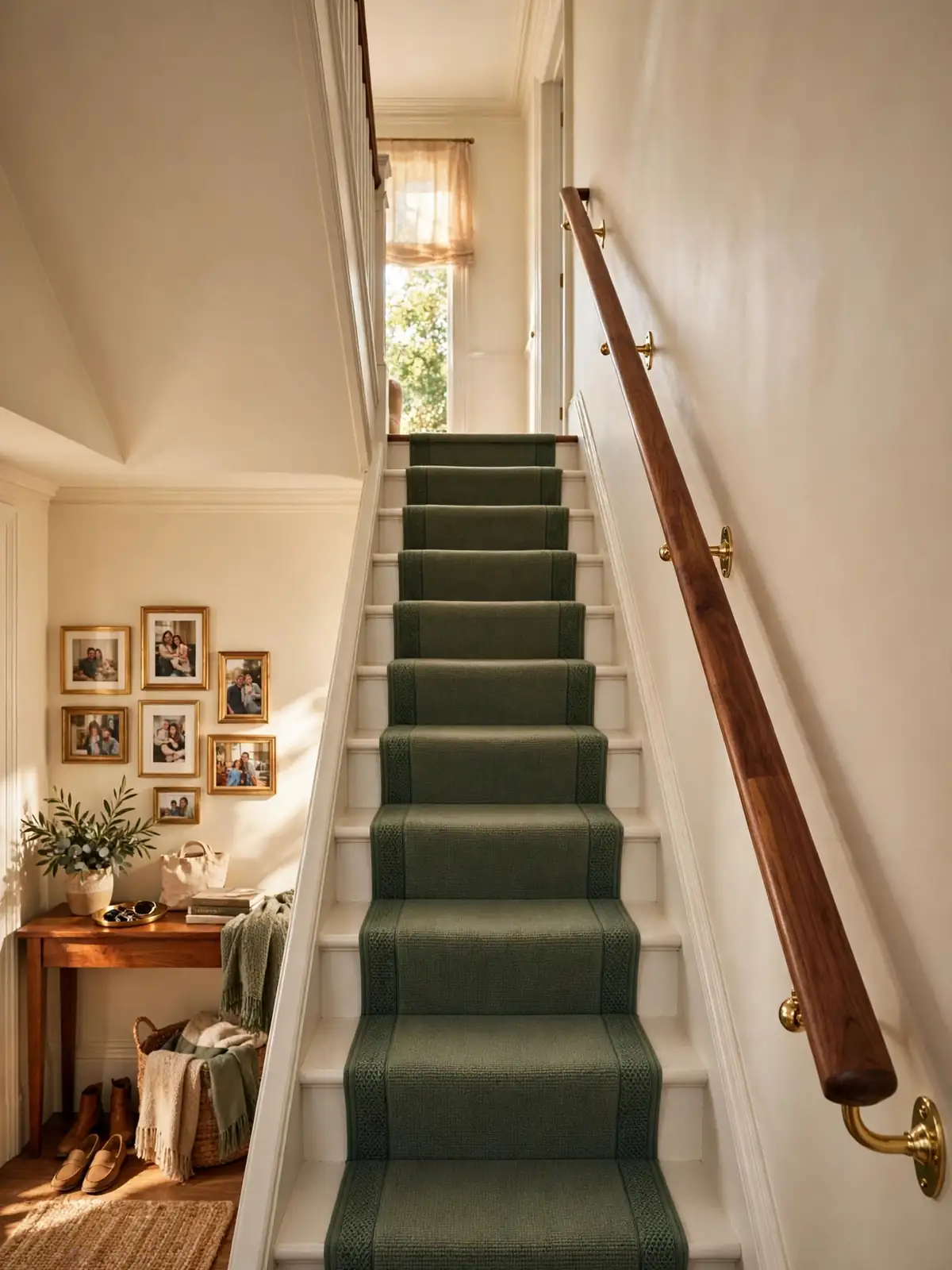
A handrail you can close your hand around is a handrail that will actually save you if you slip, and a 1.75-inch round grip suits most hands perfectly. Here, a warm walnut handrail, 1.75 inches in diameter with a softly rounded top, runs beside a deep sage-green runner on pale oak treads, each 950 mm wide. Soft cream walls keep the hallway bright, while slim brass brackets hold the rail firmly and the walnut feels warm and smooth under the hand on every step.
Quick tips:
- Choose a round grip of about 1.75 inches for most hands.
- Round the edges of a rectangular rail so it never feels sharp.
- Test the grip yourself before you commit to a profile.
- Avoid rails thicker than 2 inches — most hands cannot close around them.
A Staircase Handrail Fixed 1.5 Inches Clear of the Wall
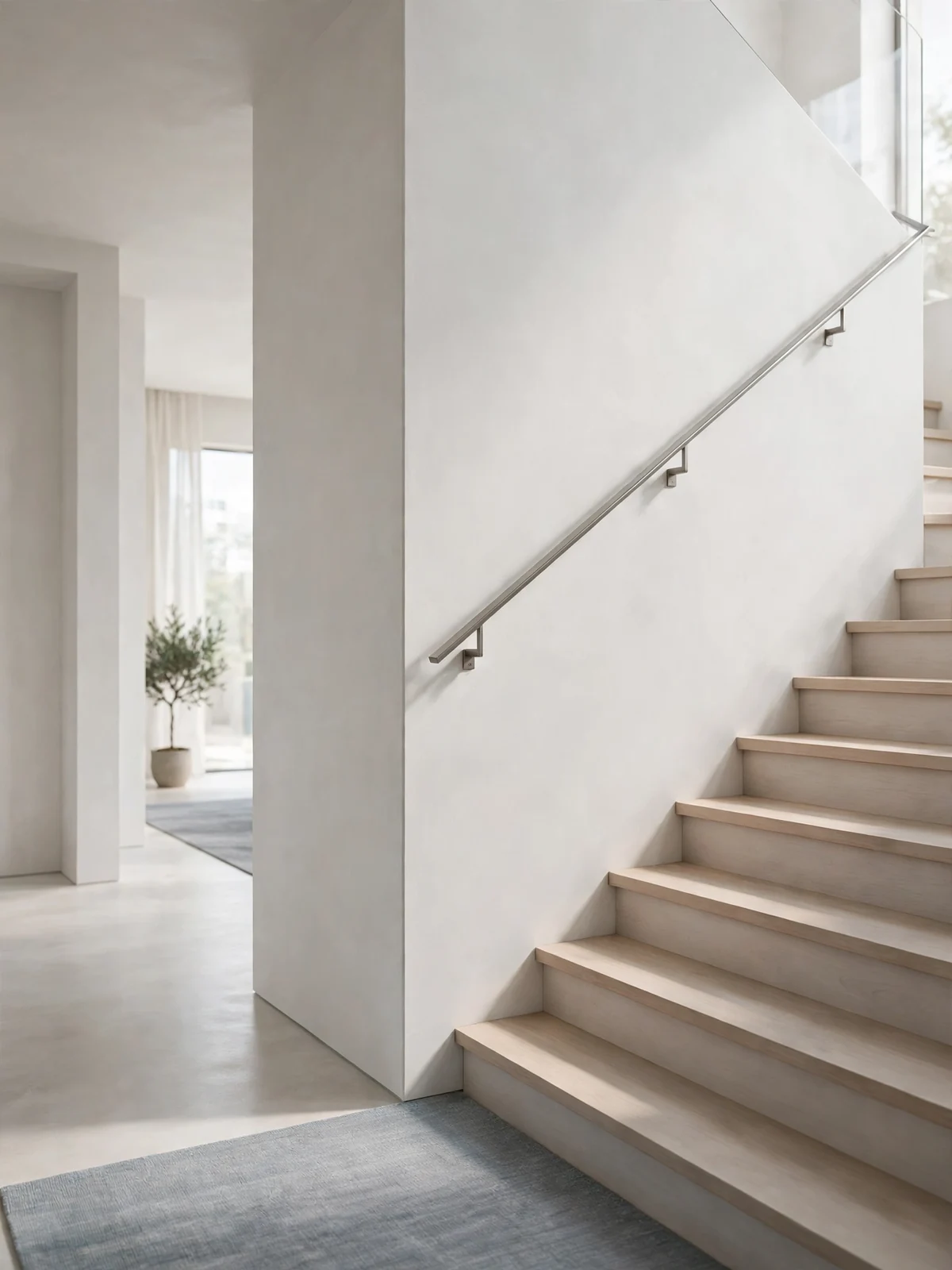
A handrail fixed 1.5 inches clear of the wall gives your fingers room to wrap around the rail without scraping your knuckles, and that small gap makes a big difference every day. On this stair, a slim pale ash handrail is held 1.5 inches from a smooth white plaster wall on slim steel brackets, beside pale ash treads, each 950 mm wide. A soft grey-blue rug at the base and gentle daylight keep the hallway calm, while the gap between rail and wall stays constant along the whole flight.
Quick tips:
- Keep the gap at about 1.5 inches along the whole flight.
- Use brackets that hold the rail firmly at that exact distance.
- Check the gap with your own hand before the brackets are fixed.
- Never fix a rail flush to the wall — your knuckles will scrape.
A Staircase Handrail Installed on Both Sides of a Wide Stair
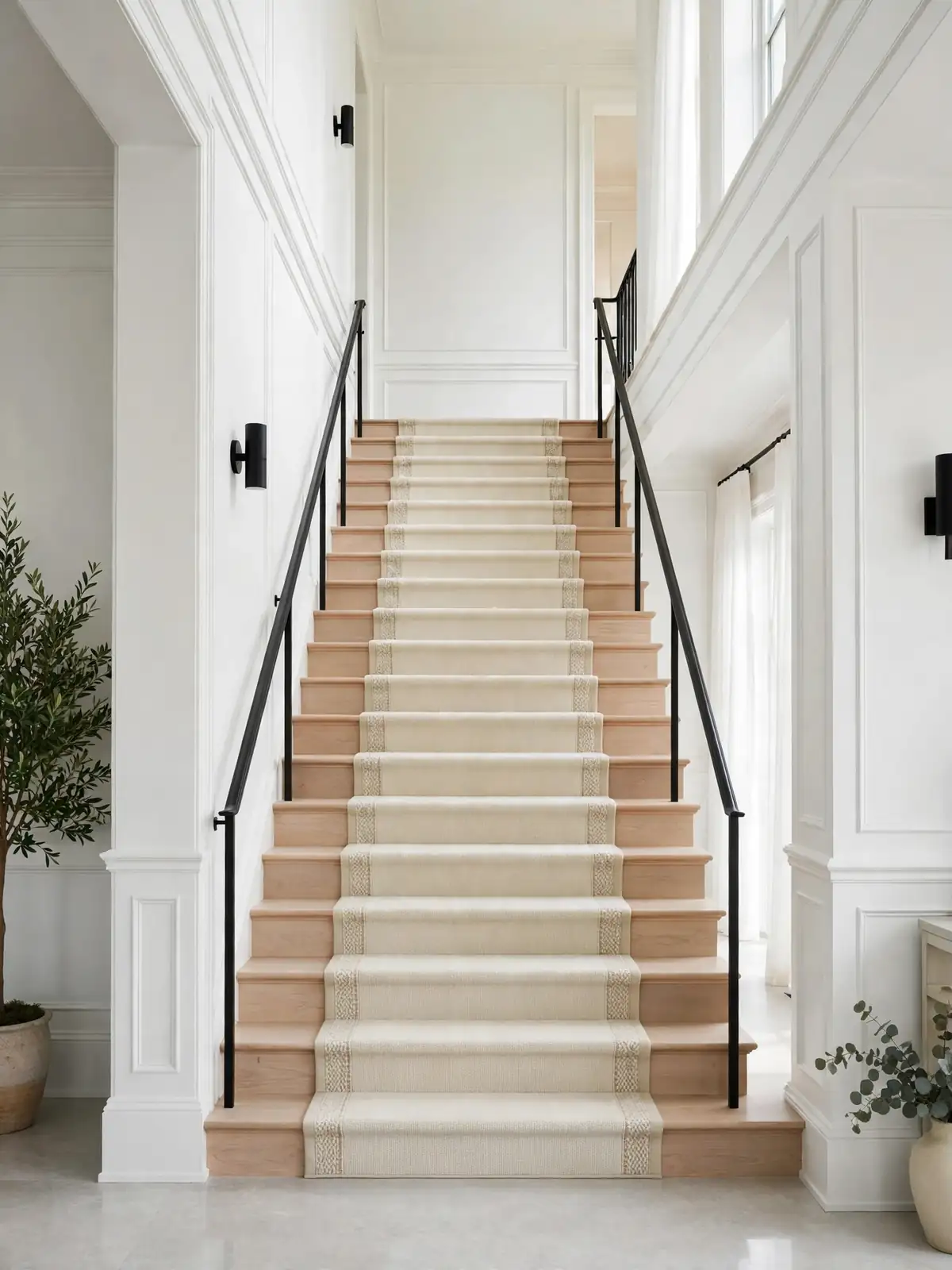
A wide stair needs a handrail on both sides, because nobody should have to cross a 1.5-metre flight to find something to hold. On this stair, two slim black handrails run the full flight, one fixed to each wall, beside pale maple treads, each 1.5 metres wide, with a cream runner down the centre. White walls keep the entry bright, while the twin rails frame the stair symmetrically and make the climb feel secure from either side, whichever hand you favour.
Quick tips:
- Fit rails on both sides when the stair is wider than about 1.1 metres.
- Keep both rails at exactly the same height for balance.
- Match the two rails in material and colour.
- Add a runner down the centre so the wide stair feels intentional.
A Staircase Handrail With Brackets Spaced Every 900 mm
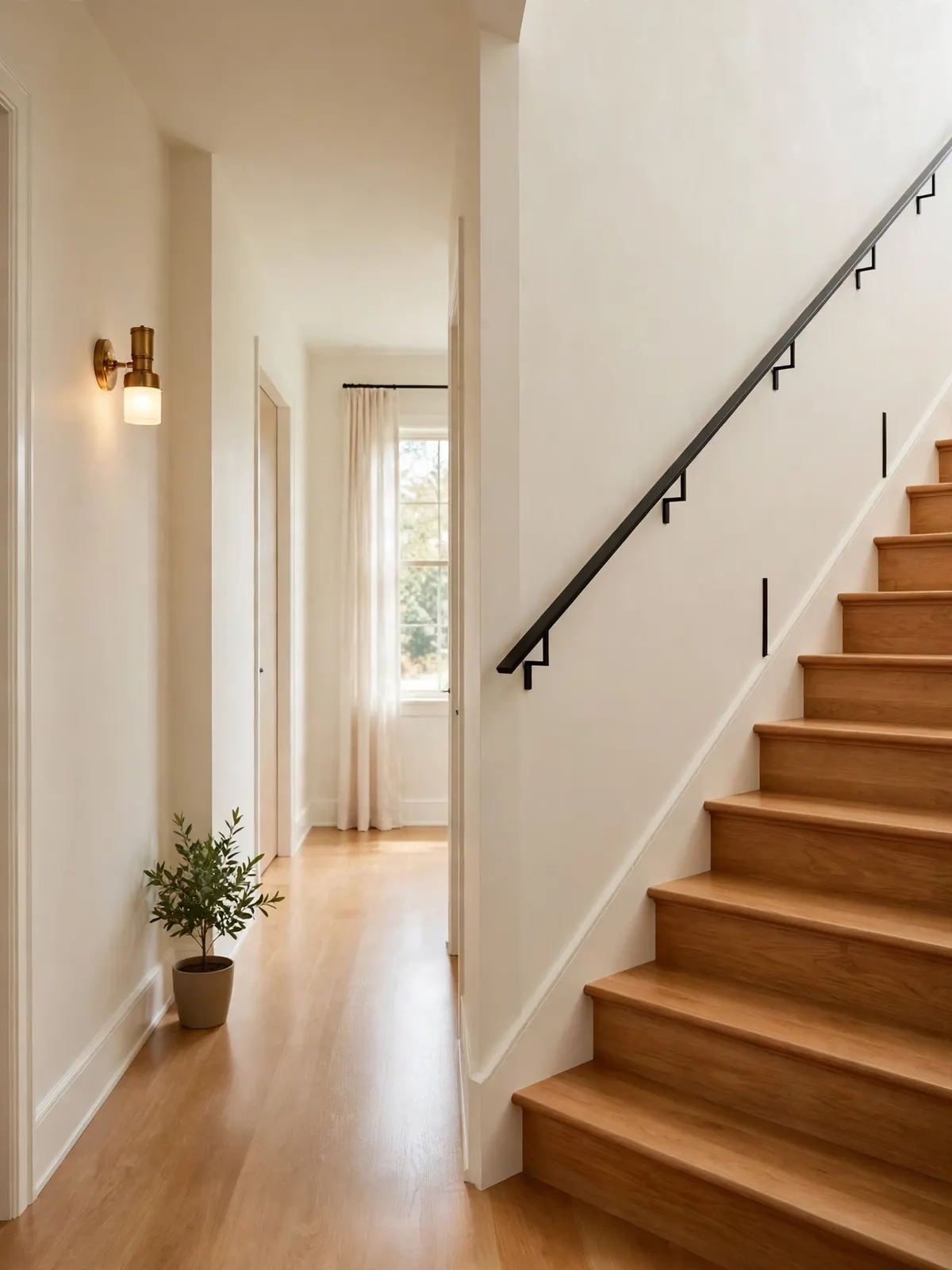
Brackets spaced evenly every 900 mm hold a handrail firmly along the whole flight, and the regular rhythm looks neat as well as safe. Here, a warm honey oak handrail is held by five slim black brackets, spaced exactly 900 mm apart, fixed into the wall studs beside honey oak treads, each 950 mm wide. Soft ivory walls and a small green plant keep the hallway fresh, while a brass wall sconce glows softly above the landing and the even brackets give the plain wall a crafted, finished look.
Quick tips:
- Space the brackets evenly, about 900 mm apart.
- Fix every bracket into a wall stud, never just into plasterboard.
- Use the same bracket shape along the whole flight.
- Check the rail for flex after fitting — it should not move at all.
A Staircase Handrail Measured From the Tread Nosing
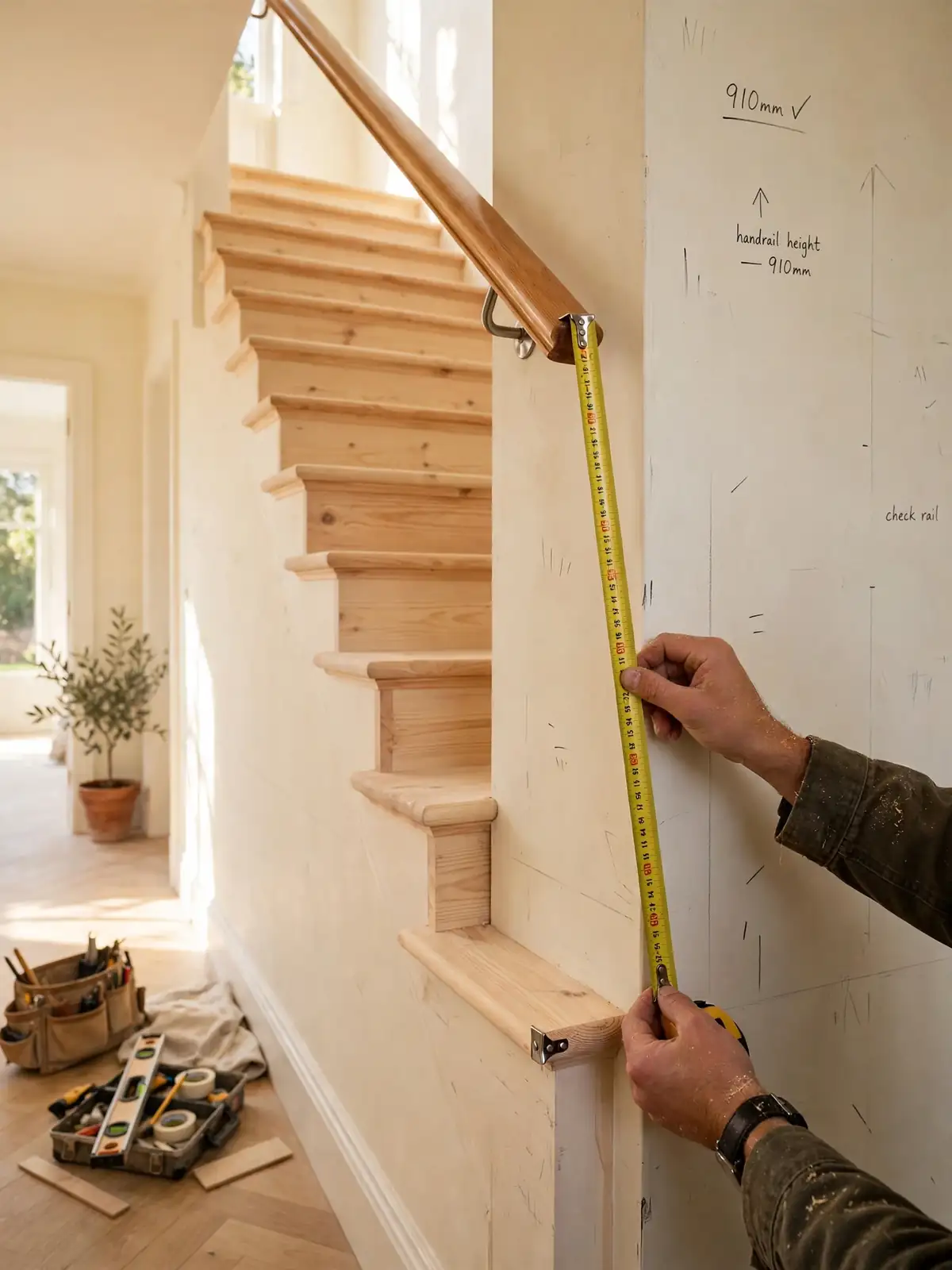
Measuring a handrail from the tread nosing is the step most DIY installers get wrong, and getting it right is what makes the rail feel comfortable. On this stair, the installer marks the wall 36 inches vertically above the nosing of the first, middle and last treads, then joins the marks with a chalk line that follows the slope exactly, beside pale pine treads, each 900 mm wide. Soft cream walls carry the pencil marks clearly, and the chalk line shows exactly where the brackets must go before a single hole is drilled.
Quick tips:
- Measure vertically from the nosing, never along the slope.
- Mark at least three treads — first, middle and last — before you draw the line.
- Use a chalk line to join the marks so the rail follows the slope.
- Double-check the line with a spirit level before you drill.
A Staircase Handrail in Warm Timber for Cold Hands
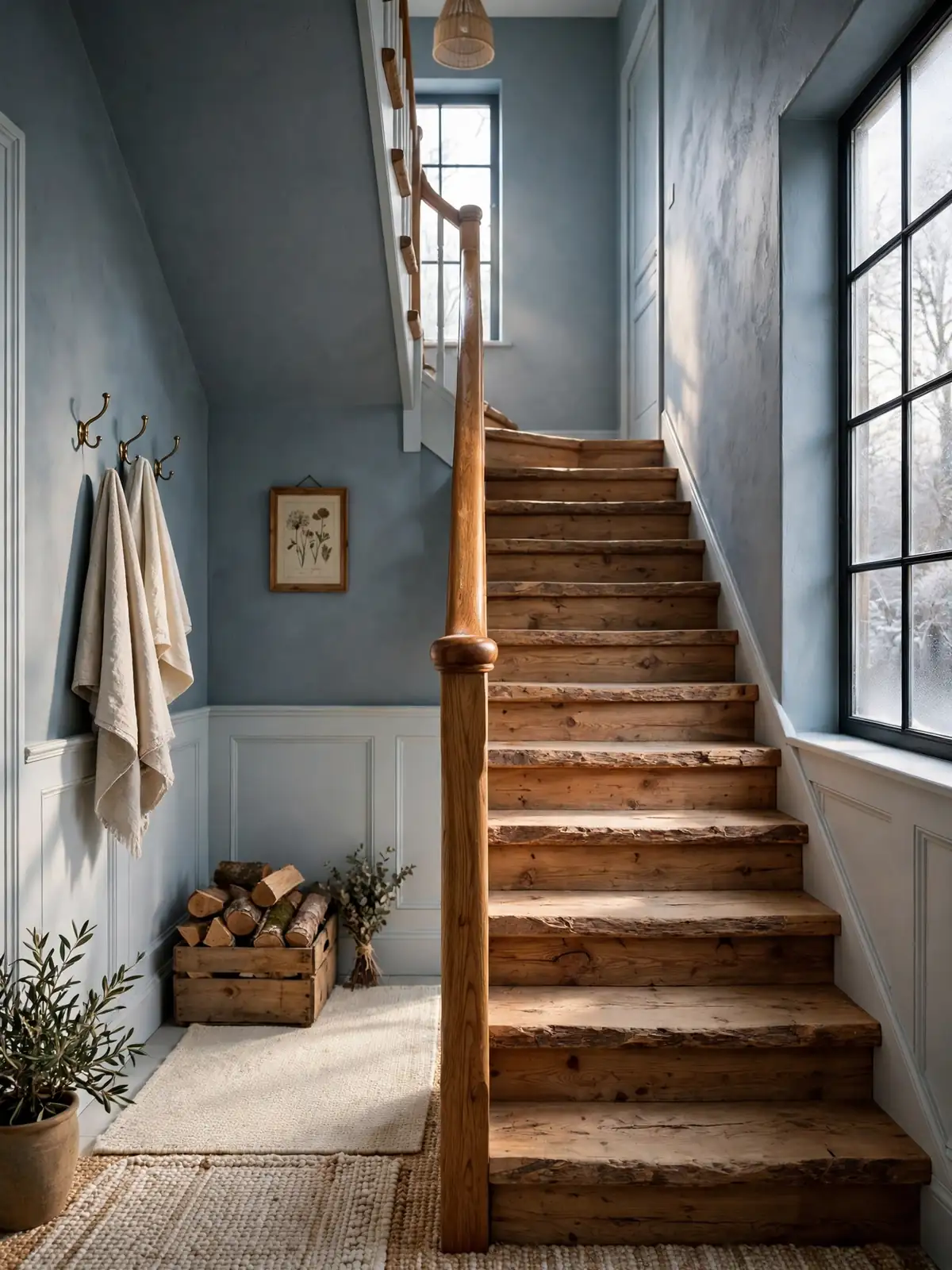
A warm timber handrail feels kind on a cold morning, when a steel rail would feel icy under the hand. Here, a warm oak handrail, sanded smooth and oiled, runs beside rough-hewn pine treads, each 900 mm wide, in a cottage hallway where the mornings are cold. Soft dusty-blue walls and a cream woven rug at the base keep the palette fresh, while a small wooden crate of firewood beside the stair adds a practical, lived-in touch and the oak rail is warm from the first touch.
Quick tips:
- Choose oak, walnut or ash for the warmest handrail in a cold house.
- Oil the timber so it stays smooth and warm to the touch.
- Avoid bare steel rails in unheated hallways or cold climates.
- Pair a warm timber rail with a woven rug for a cosy climb.
A Staircase Handrail With a Rounded Top for Comfort
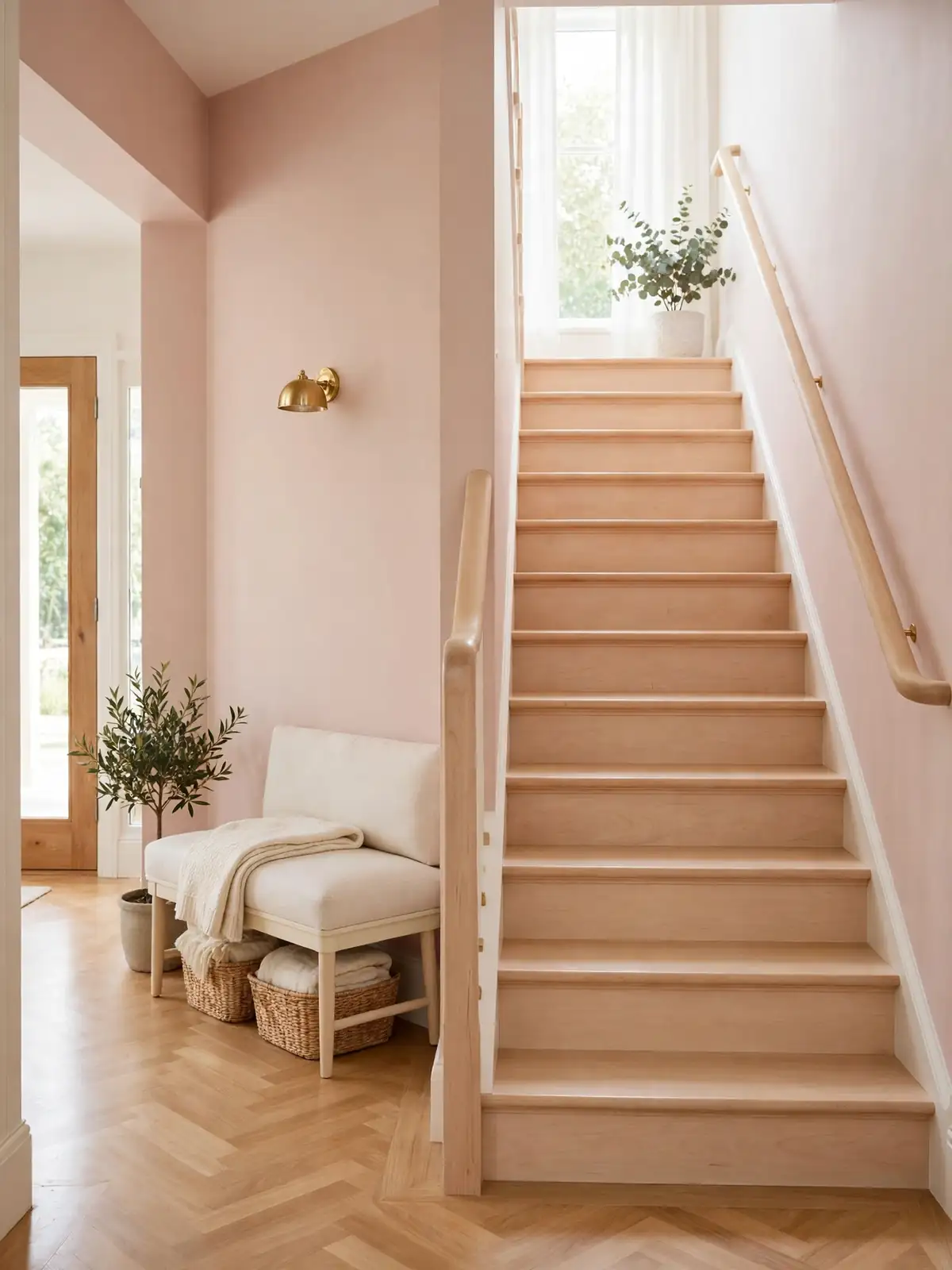
A handrail with a softly rounded top is comfortable for every hand, from a small child to an elderly grandparent, because there are no sharp edges to press into the palm. On this stair, a pale beech handrail with a fully rounded top runs beside pale maple treads, each 950 mm wide, in a bright family hallway. Soft blush-pink walls and a cream bench at the base keep the hallway gentle, while a small brass wall light glows above the rail in the evening and the rounded profile feels smooth on every step.
Quick tips:
- Round the top of the rail fully — a flat top presses into the palm.
- Choose beech or ash for a smooth, even grain.
- Sand the rail to a fine finish so no splinters ever catch a hand.
- Test the profile with the whole family before you fit it.
A Staircase Handrail That Continues Around the Landing
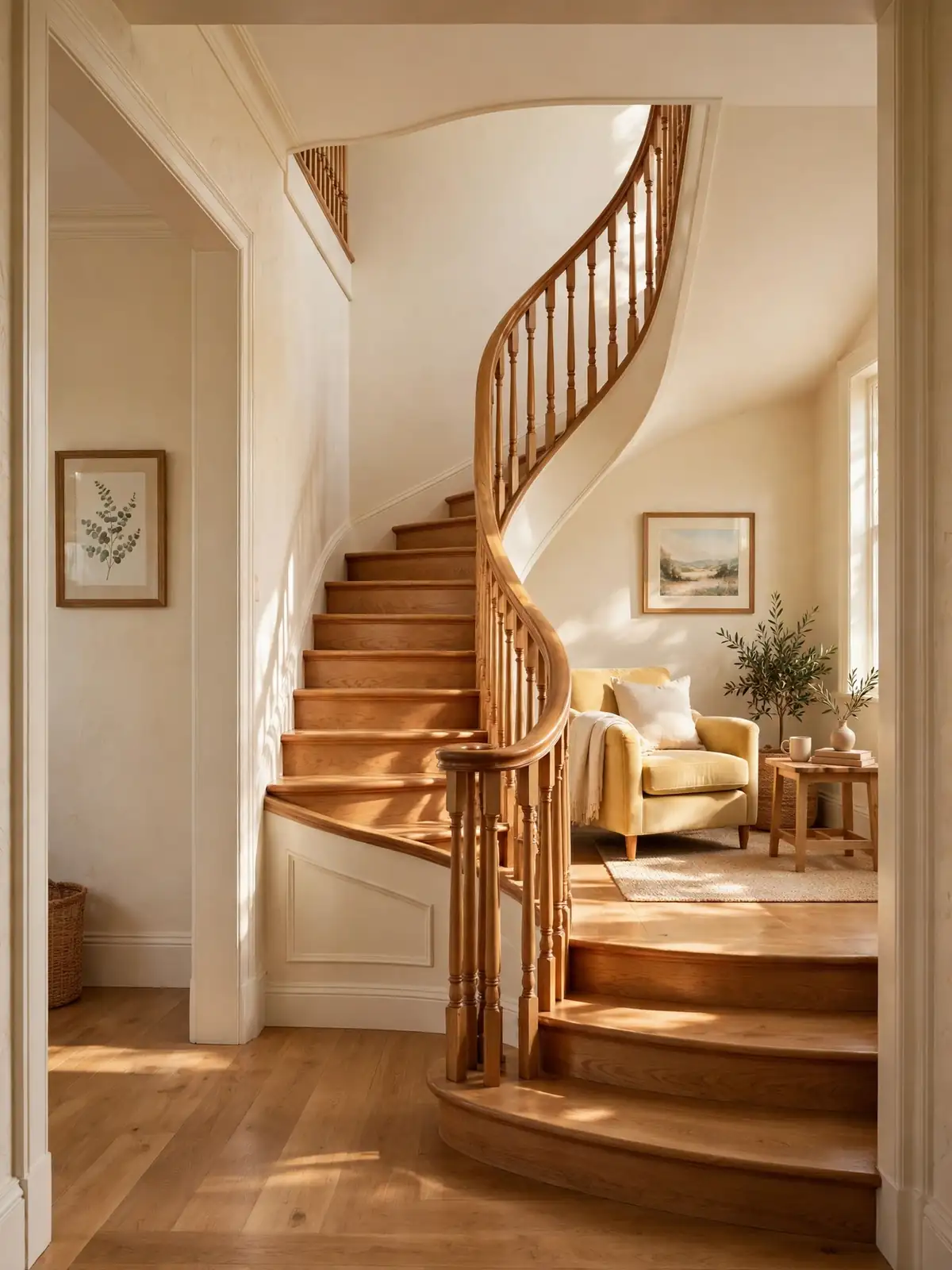
A handrail that continues around the landing never leaves you without something to hold, and the unbroken line looks beautiful as well as safe. In this home, a honey oak handrail runs up the first flight, curves smoothly around the landing, and continues up the second flight without a single break, beside honey oak treads, each 950 mm wide. A soft butter-yellow armchair and a small wooden side table sit on the landing, while cream walls and warm afternoon light keep the space bright and the rail guides the hand around the whole turn.
Quick tips:
- Keep the rail continuous around the landing — never end it at the turn.
- Use a smooth curved fitting, not a sharp joint, at the corner.
- Match the rail height exactly on both flights.
- Keep the landing clear so the continuous rail stays easy to follow.
A Staircase Handrail With a Child-Height Second Rail
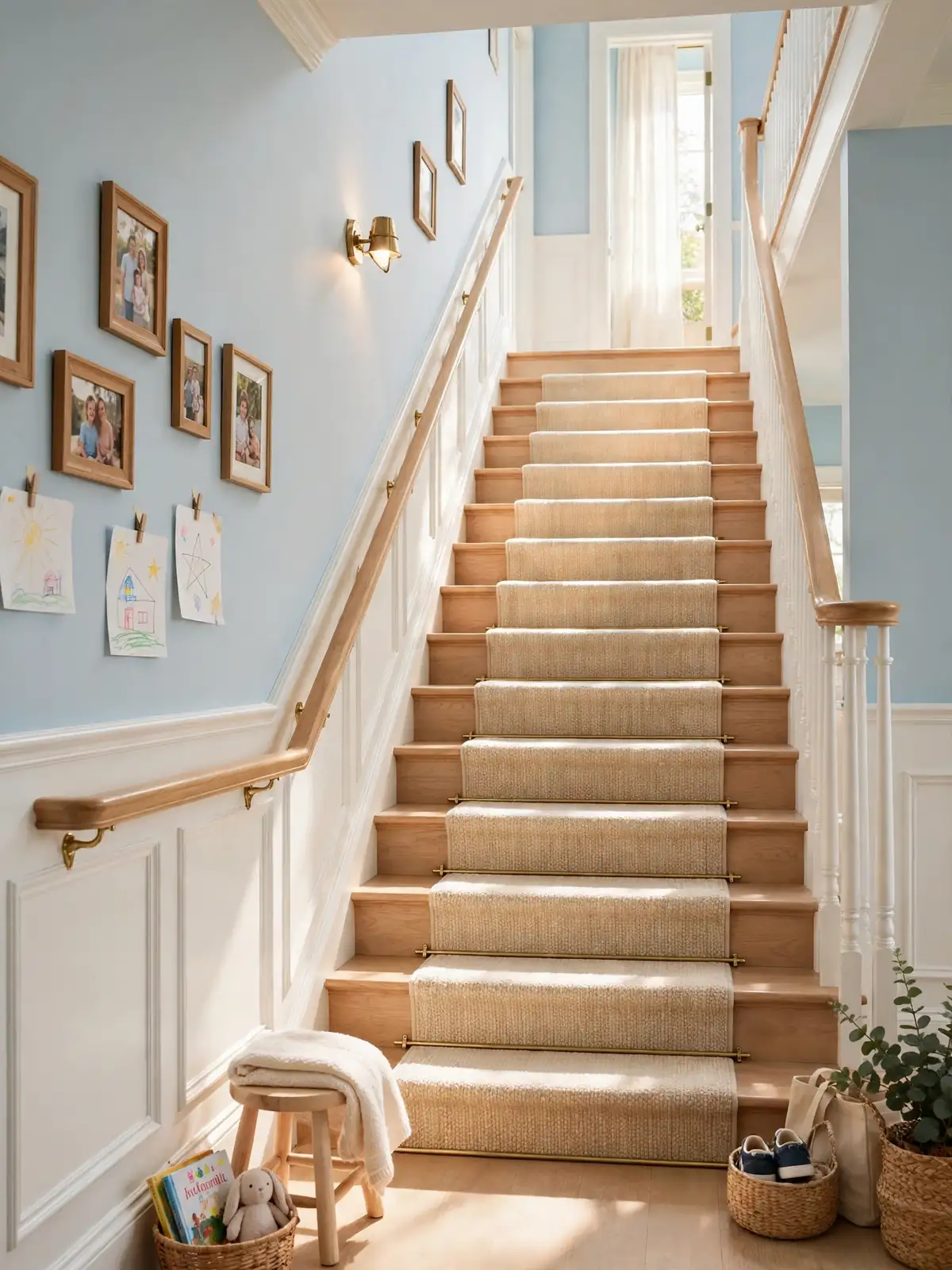
A second handrail at child height means small hands can hold on properly, instead of reaching up to a rail made for adults. On this family stair, a slim pale oak handrail runs at the standard 36 inches, while a second slim rail runs 24 inches above the treads, fixed to the same wall on smaller brackets, beside pale oak treads, each 950 mm wide. Soft sky-blue walls and a cream runner keep the hallway cheerful, while a small wooden stool at the base holds shoes and the low rail gives children confidence on every step.
Quick tips:
- Fit the second rail at about 24 inches above the tread nosing.
- Use the same timber as the main rail for a unified look.
- Fix the low rail into studs just like the main rail.
- Remove the low rail later when the children grow — the holes patch easily.
A Staircase Handrail for Elderly Hands With an Easy Grip
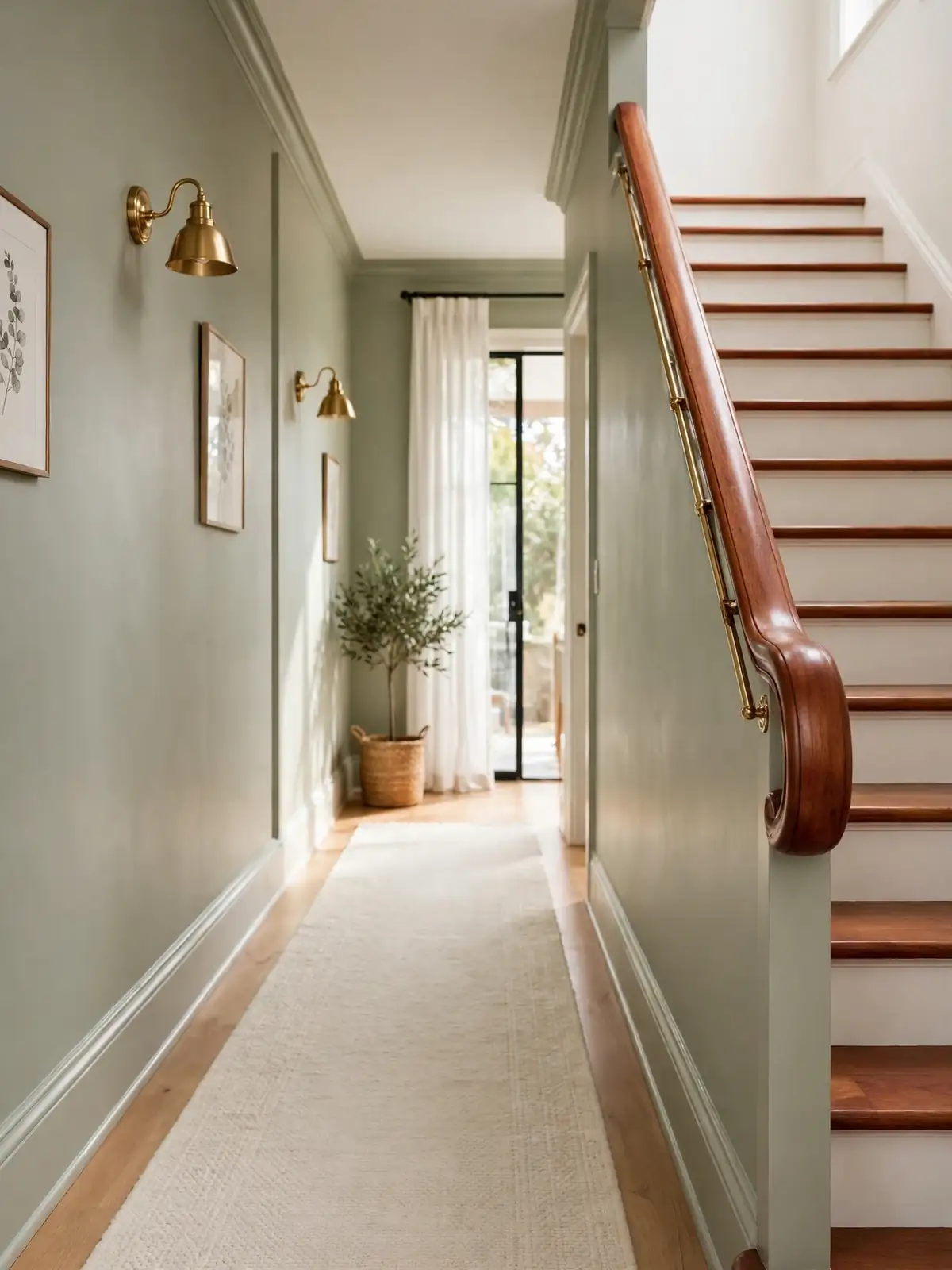
An easy oval grip is the kindest handrail for elderly hands, because the flattened shape is easier to hold than a round rail when grip strength is limited. Here, a warm cherry wood handrail with a soft oval profile, 1.75 inches wide and 1.25 inches deep, runs beside pale oak treads, each 950 mm wide, in a calm hallway. Soft sage-green walls and a cream rug keep the space gentle, while brass wall sconces glow warmly above the rail and the oval shape lets a weaker hand rest on the rail as well as grip it.
Quick tips:
- Choose an oval profile — about 1.75 by 1.25 inches — for weaker hands.
- Use warm cherry or oak so the rail feels kind to the touch.
- Add a second rail on the open side so there is always a handhold.
- Keep the rail well-lit so it is easy to find at night.
A Staircase Handrail Installed Into Wall Studs for Strength
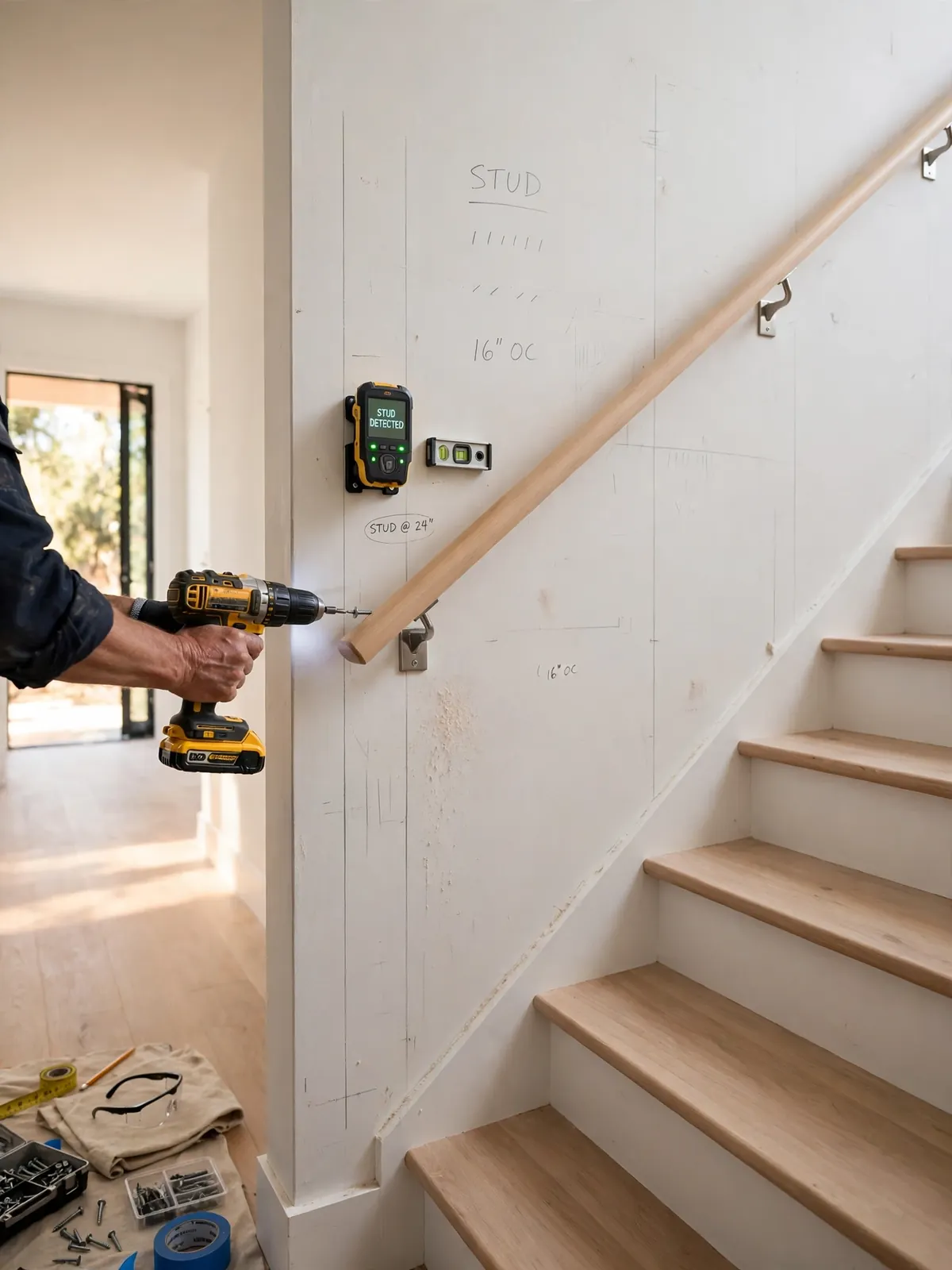
A handrail is only as strong as its fixings, and brackets screwed into wall studs will hold the full weight of a person leaning hard on the rail. On this stair, the installer uses a stud finder to mark every stud along the flight, then fixes slim steel brackets into the solid timber with long screws, beside pale ash treads, each 950 mm wide. Soft white walls carry the pencil marks clearly, and once the rail is fitted it does not flex at all, even when pulled hard — the difference between a rail that saves you and one that comes away in your hand.
Quick tips:
- Find every stud with a stud finder before you mark the bracket positions.
- Use long screws that bite deep into the stud, not just the plasterboard.
- Never rely on plasterboard fixings alone for a handrail.
- Test the rail by pulling hard on it before you call the job done.
A Staircase Handrail With a Return to the Wall at Each End
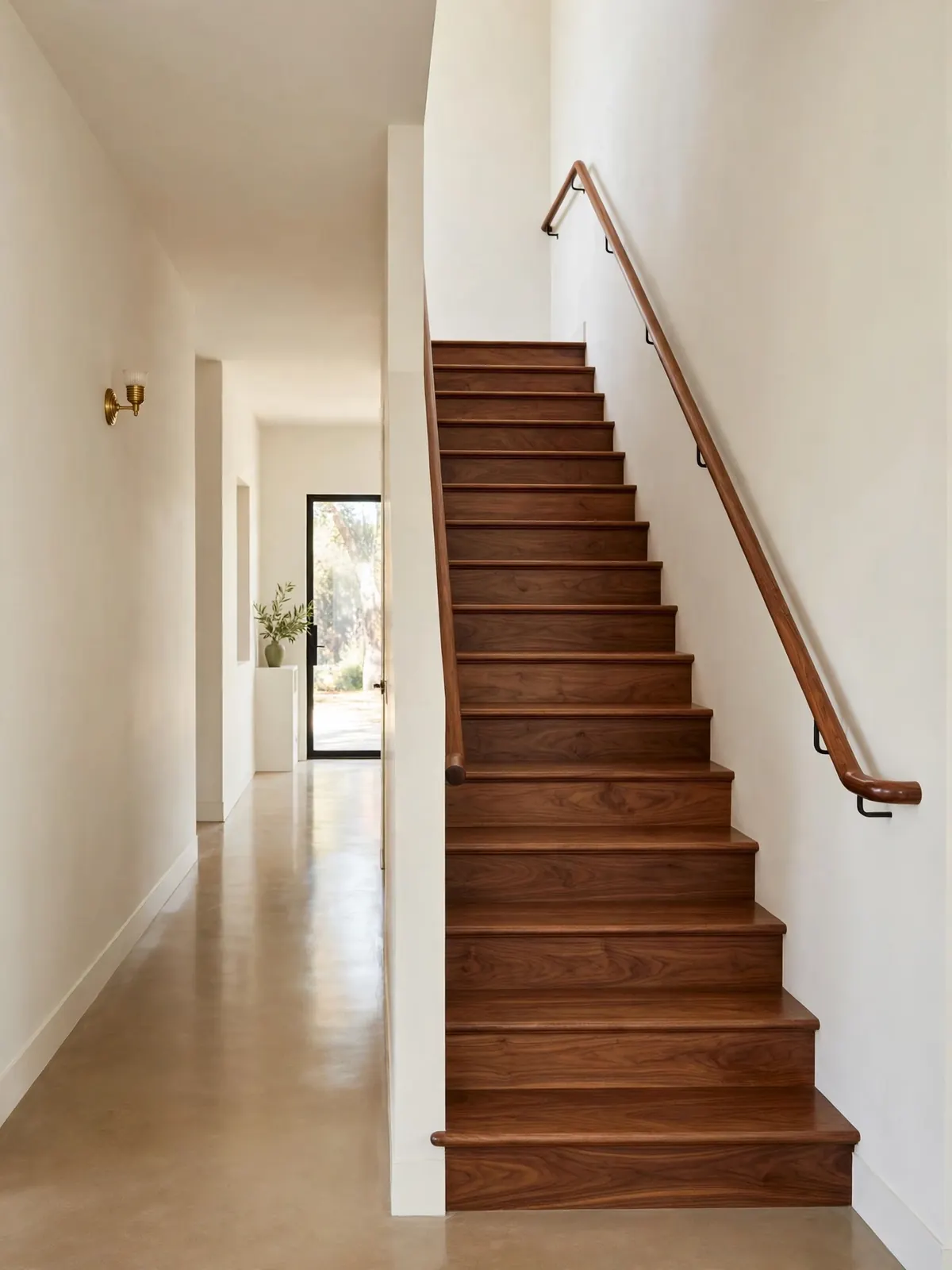
A handrail that returns to the wall at each end is safer and neater, because there is no open rail end to catch a sleeve, a bag strap or a child’s clothing. On this stair, a warm walnut handrail curves gently back to the soft ivory wall at the bottom and the top of the flight, beside warm walnut treads, each 950 mm wide. Slim black brackets hold the rail firmly, while a small brass wall light glows above the landing and the returned ends give the whole stair a finished, professional look.
Quick tips:
- Return the rail to the wall at both ends, not just one.
- Use a smooth curved return, not a sharp right angle.
- Keep the return short — about 100 mm — so it never blocks the walkway.
- Match the return fitting to the rail material for a seamless finish.
A Staircase Handrail in Matte Black Steel for a Modern Home
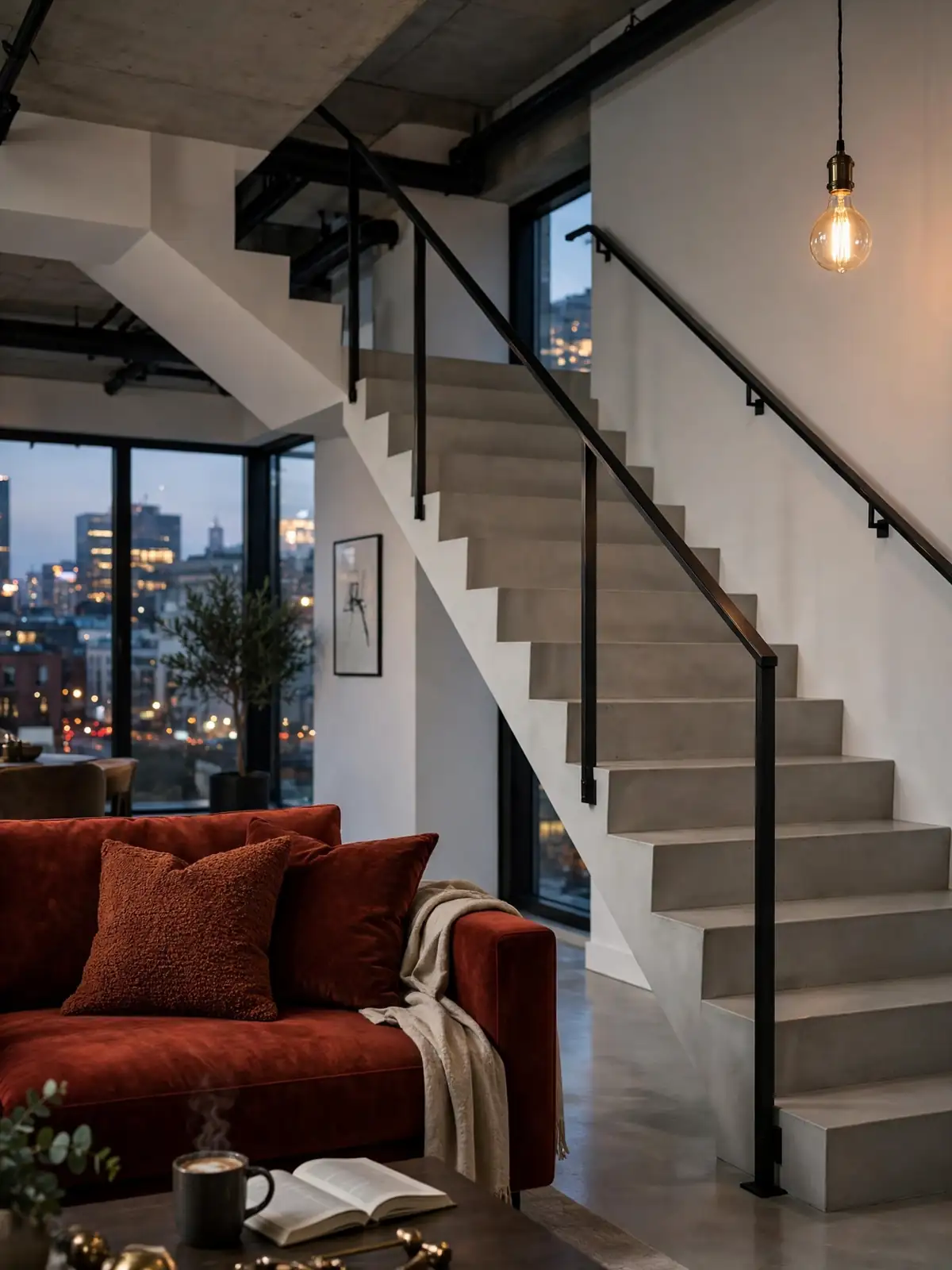
Matte black steel is the strongest and most modern handrail material, and it suits a loft or contemporary home perfectly. Here, a 40 mm diameter matte black steel handrail runs the full flight on slim black brackets, beside pale concrete treads, each 950 mm wide, with a warm brick wall on the far side. A deep rust-red sofa below picks up the brick’s tones, while an Edison bulb pendant glows warmly above the landing and the black rail draws a crisp, graphic line through the room.
Quick tips:
- Use a 40 mm diameter steel rail for a comfortable grip.
- Choose a matte finish so the steel never looks shiny or cheap.
- Pair black steel with warm brick or timber for balance.
- Wipe the steel with a dry cloth so fingerprints never build up.
A Staircase Handrail With Balusters Spaced Under 100 mm
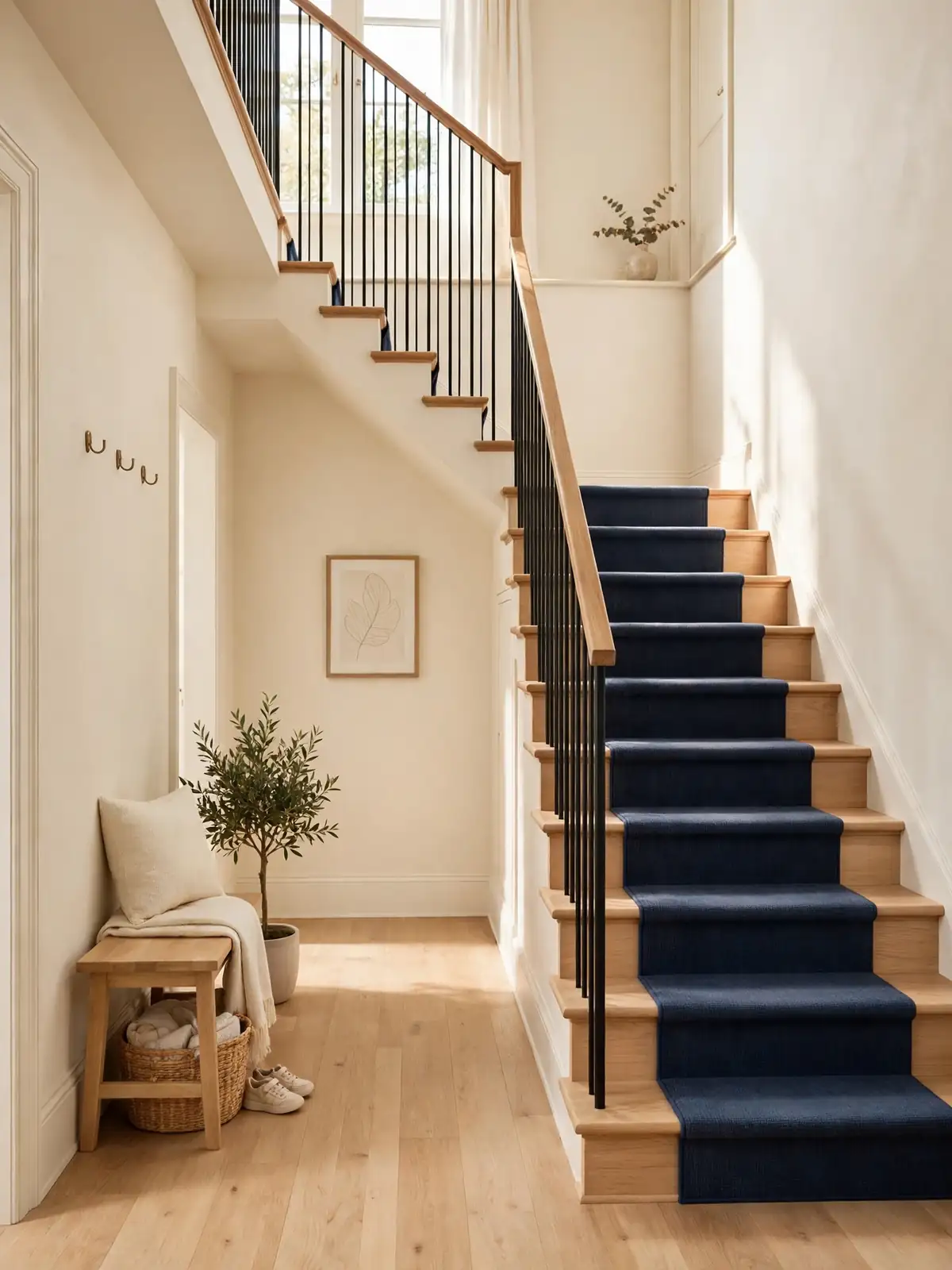
Balusters spaced under 100 mm apart keep small children safe, because a child’s head cannot fit through the gap. On this family stair, slim pale oak balusters, each 20 mm square, are spaced 90 mm apart beneath a warm oak handrail, beside pale oak treads, each 950 mm wide, with a navy-blue runner down the centre. Soft cream walls and a small wooden bench at the base keep the hallway calm, while the close balusters make the stair feel solid and safe without looking heavy or closed in.
Quick tips:
- Keep baluster gaps under 100 mm — about 90 mm is ideal.
- Measure the gap between balusters, not from centre to centre.
- Use slim balusters so close spacing never looks heavy.
- Check the spacing again after fitting, before you call the job done.
A Staircase Handrail You Can Install in a Weekend
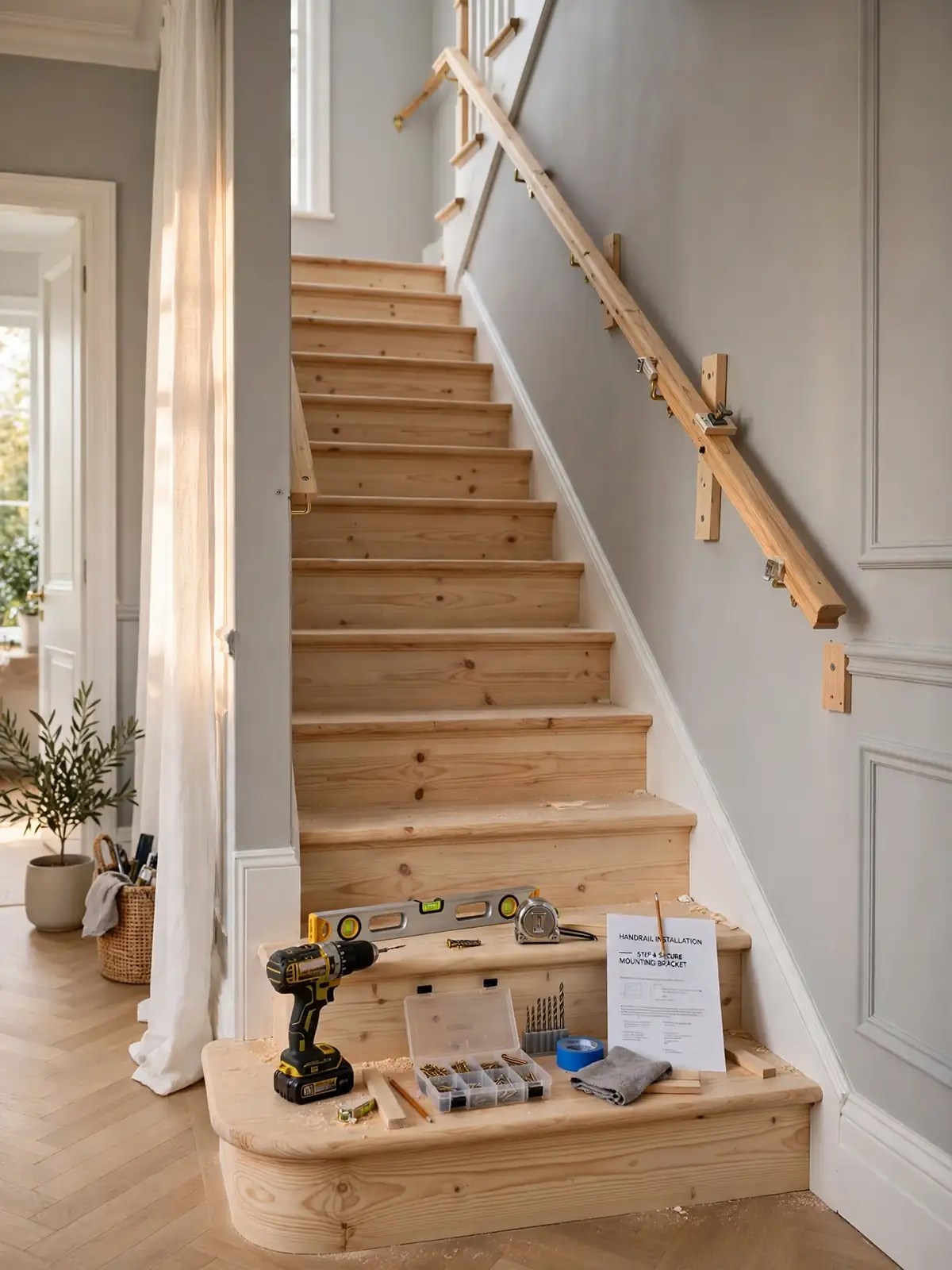
A wall-mounted handrail is one of the most achievable weekend DIY jobs in the house, because it needs only a drill, a level, a stud finder and a free afternoon. On this stair, the tools are laid out neatly on the bottom tread — drill, spirit level, stud finder, tape measure and pencil — beside pale pine treads, each 900 mm wide, and soft grey walls marked with the bracket positions. The job is simple: find the studs, mark the height line, drill, fix the brackets, and fit the rail — and by Sunday evening the stair is safer than it has ever been.
Quick tips:
- Gather every tool before you start — drill, level, stud finder, tape.
- Mark the full height line before you drill a single hole.
- Drill one bracket first and test it before you drill the rest.
- Keep the afternoon free — rushing a handrail is how mistakes happen.
A Staircase Handrail Replaced Without Rebuilding the Stair
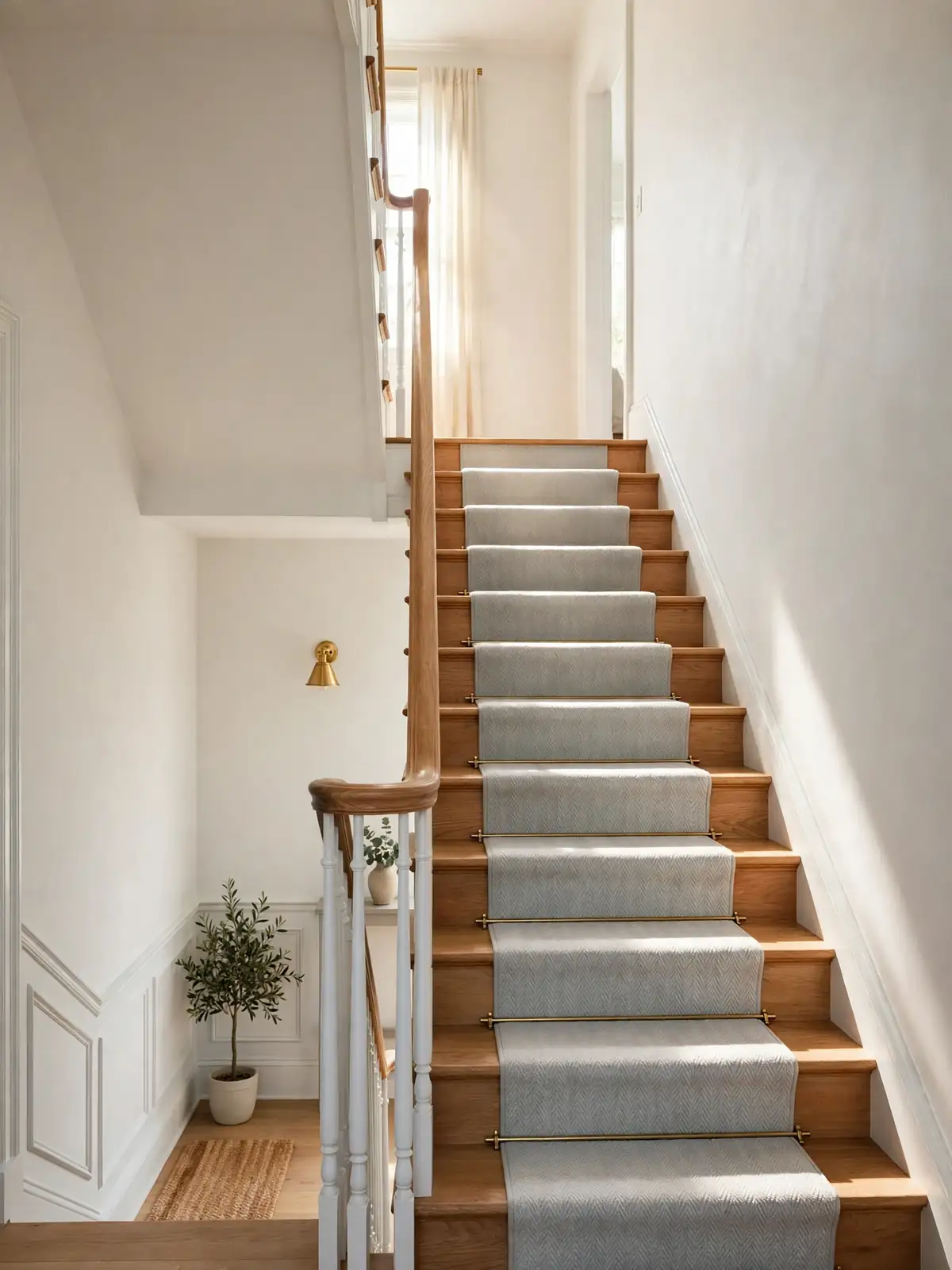
Replacing just the handrail is the smartest staircase upgrade, because a new rail transforms the look of the stair without touching the treads or the balusters. Here, a brand-new slim oak handrail, 60 mm wide with a softly rounded top, has been fitted to the original painted balusters, beside warm honey oak treads, each 950 mm wide, with a pale grey runner down the centre. Soft white walls and a small brass wall sconce keep the hallway fresh, while the new rail makes the whole stair feel rebuilt for a fraction of the cost.
Quick tips:
- Keep the original balusters if they are sound — replace only the rail.
- Match the new rail to the tread timber for a unified look.
- Check the old newel posts before you fit the new rail.
- Sand and oil the new rail before fitting so the finish is perfect.
A Staircase Handrail With a Non-Slip Finish for Wet Hands
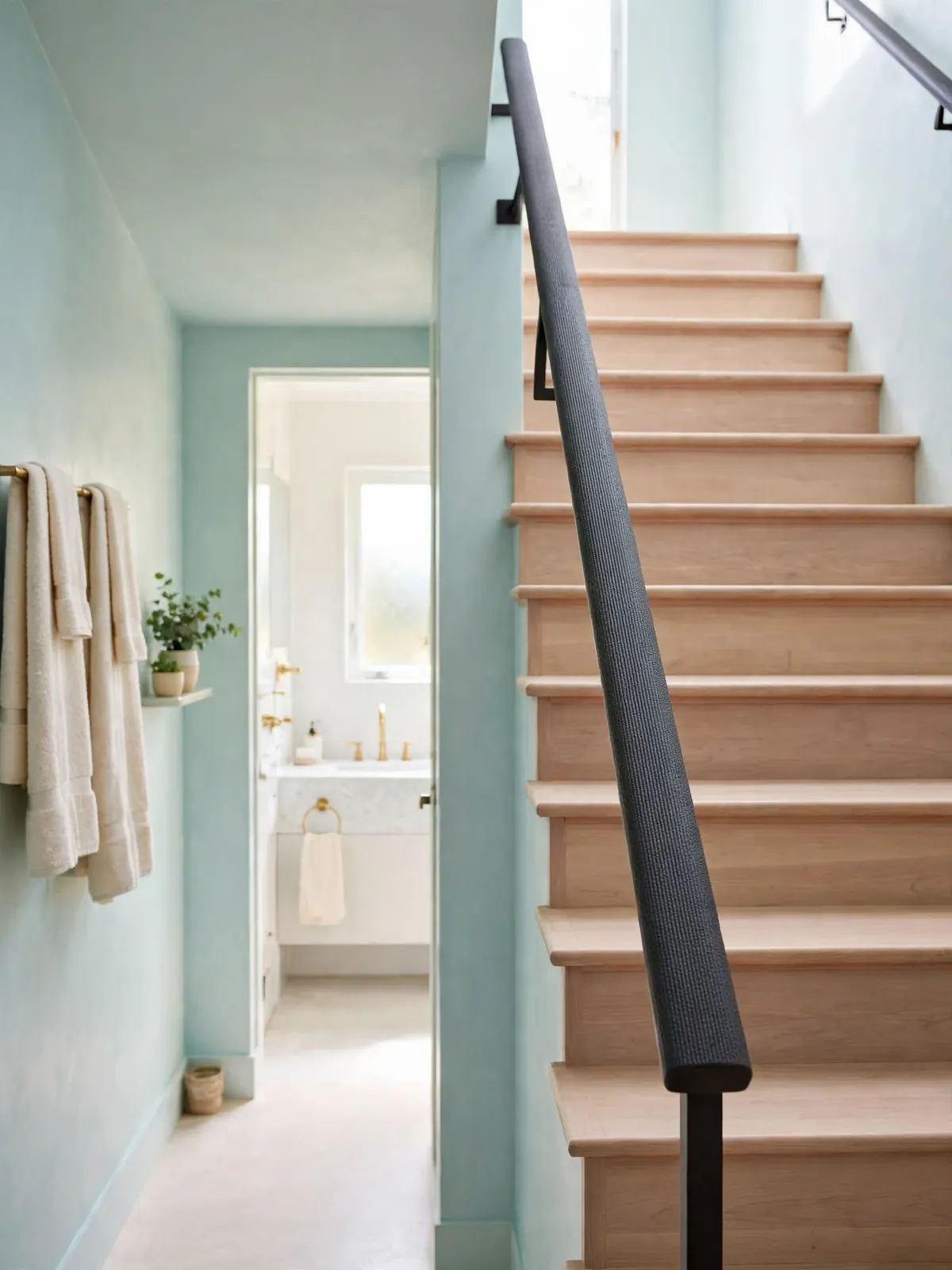
A non-slip handrail matters most on the stairs near a bathroom or a back door, where wet hands are part of daily life. Here, a pale teak handrail with a lightly textured, matte oil finish runs beside pale teak treads, each 900 mm wide, in a hallway that leads from the bathroom to the bedrooms. Soft aqua walls and cream towels nearby keep the palette fresh, while a small potted plant adds life and the textured finish gives wet hands a secure grip that a glossy varnished rail never could.
Quick tips:
- Choose a matte oil finish, not gloss varnish, for grip.
- Avoid polished metal rails near bathrooms — wet hands slip on them.
- Test the finish with damp hands before you commit.
- Re-oil a timber rail once a year to keep the texture.
A Staircase Handrail for an Outdoor Stair in Weatherproof Steel
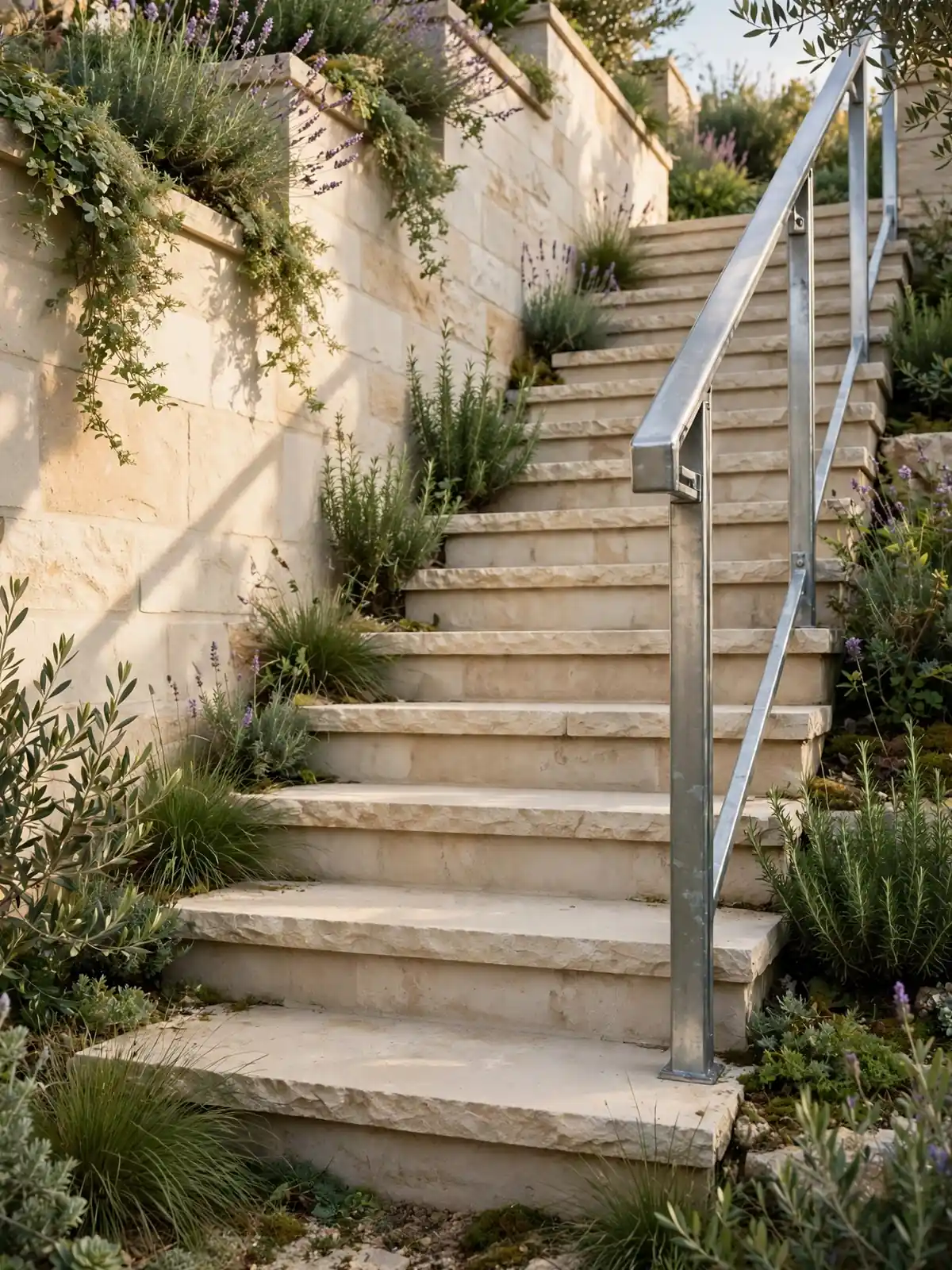
An outdoor handrail must survive rain, frost and sun, and galvanised steel is the material that does it best. Here, a galvanised steel handrail, 40 mm in diameter, runs beside rough stone treads, each 1 metre wide, on an outdoor stair leading from the garden to a terrace, fixed on sturdy steel posts set into the stonework. Soft green planting and a cream stone wall frame the stair, while warm afternoon light catches the galvanised finish and the rail stays solid and rust-free through every season.
Quick tips:
- Use galvanised or stainless steel outdoors — never untreated timber or iron.
- Fix the posts into the stonework, not just onto the surface.
- Keep the grip diameter at 40 mm so the rail is comfortable in gloves.
- Check the fixings every spring after the winter frost.
A Staircase Handrail With a Slim Profile for a Narrow Hall
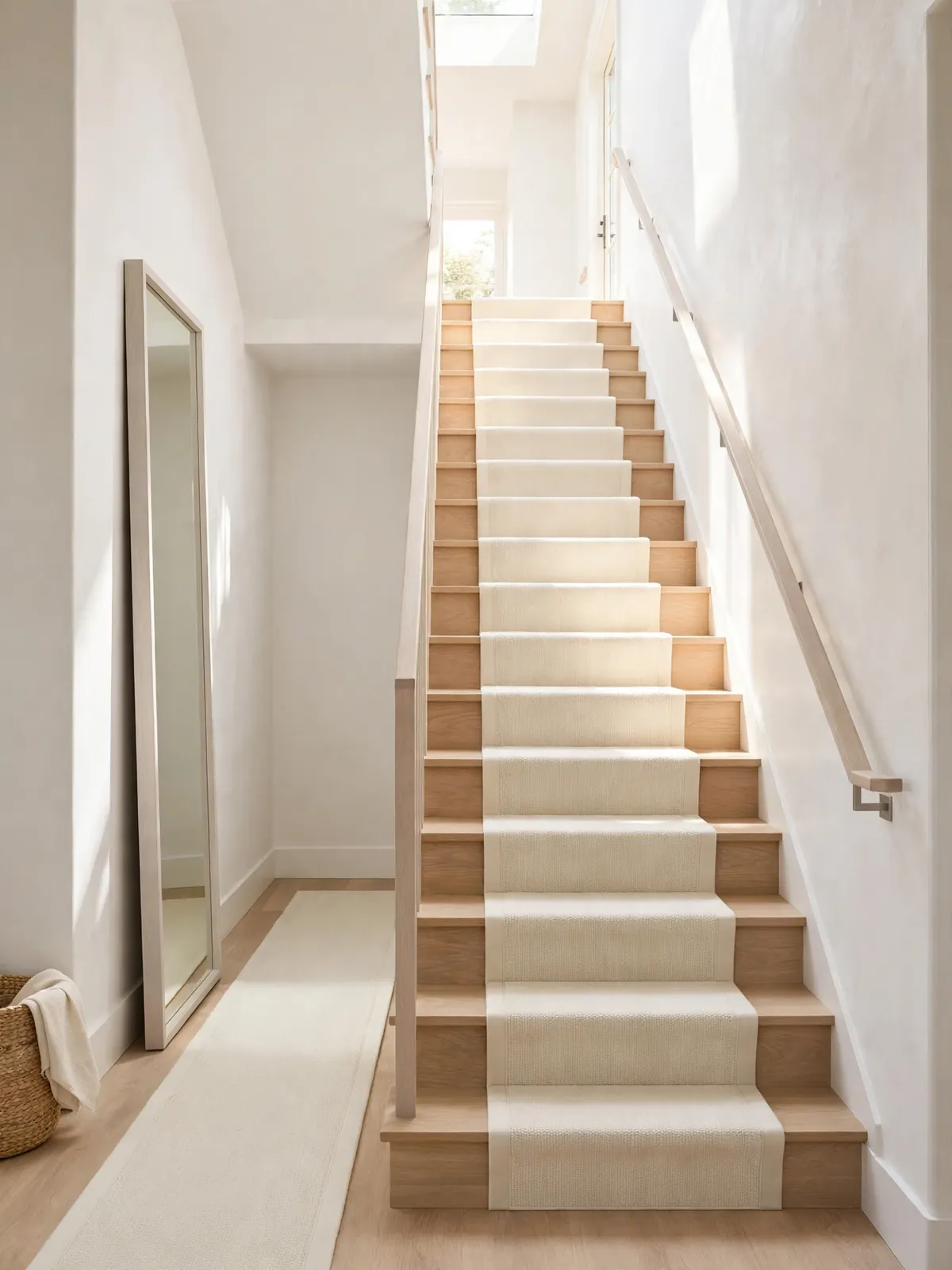
A narrow hall needs a slim handrail, because a chunky rail eats into the walking width and makes the stair feel cramped. In this compact home, a slim pale ash handrail, just 45 mm wide, is fixed flat to a soft white wall on slim brackets, beside pale oak treads, each 850 mm wide, while a tall mirror, 1.8 metres high, doubles the daylight and a cream runner softens the climb. The rail is slim, pale and close to the wall, so the stair feels twice as wide as it really is.
Quick tips:
- Use a slim rail — about 45 mm wide — in a narrow hallway.
- Fix the rail close to the wall so it never eats into the walking width.
- Choose pale timber so the rail blends with the wall.
- Add a tall mirror to double the daylight in a tight stairwell.
A Staircase Handrail That Meets Code on a Spiral Stair
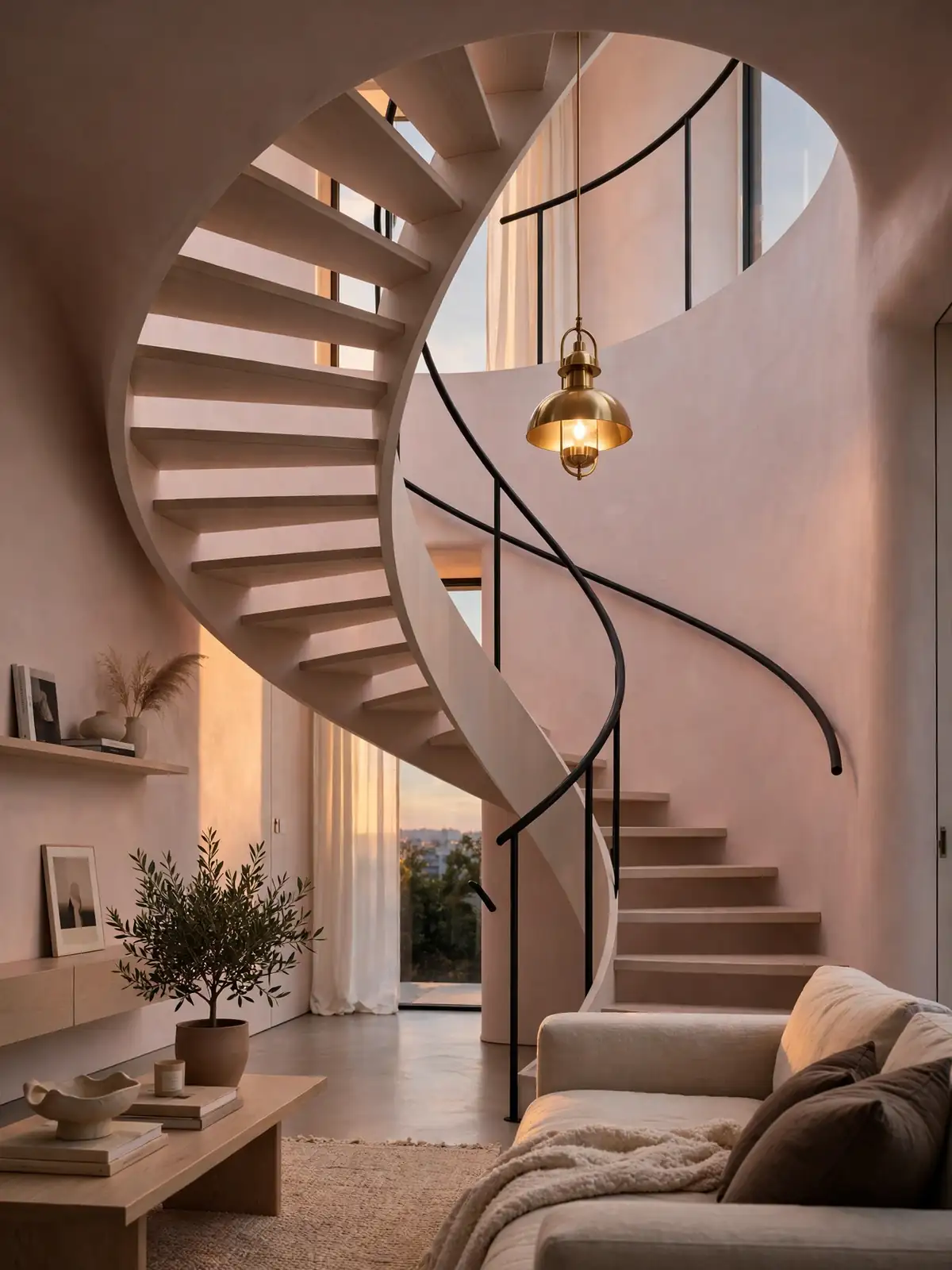
A spiral stair still needs a handrail at the correct height, and the rule is the same — 34 to 38 inches above the tread nosing, measured at the walking line. Here, a slim matte black steel handrail follows the curve of a compact spiral stair, 1.4 metres across, its height checked at every third tread along the walking line, beside pale ash treads, each 700 mm deep at the outer edge. Soft blush-pink walls and a brass pendant light warm the steel in the evening, while the rail stays at a constant height all the way up the spiral.
Quick tips:
- Measure the height at the walking line, about 300 mm from the outer edge.
- Check the height at every third tread along the spiral.
- Use a continuous rail — never break it halfway up the spiral.
- Confirm the spiral rules in your local code before you build.
A Staircase Handrail With a Strong Newel Post at the Base
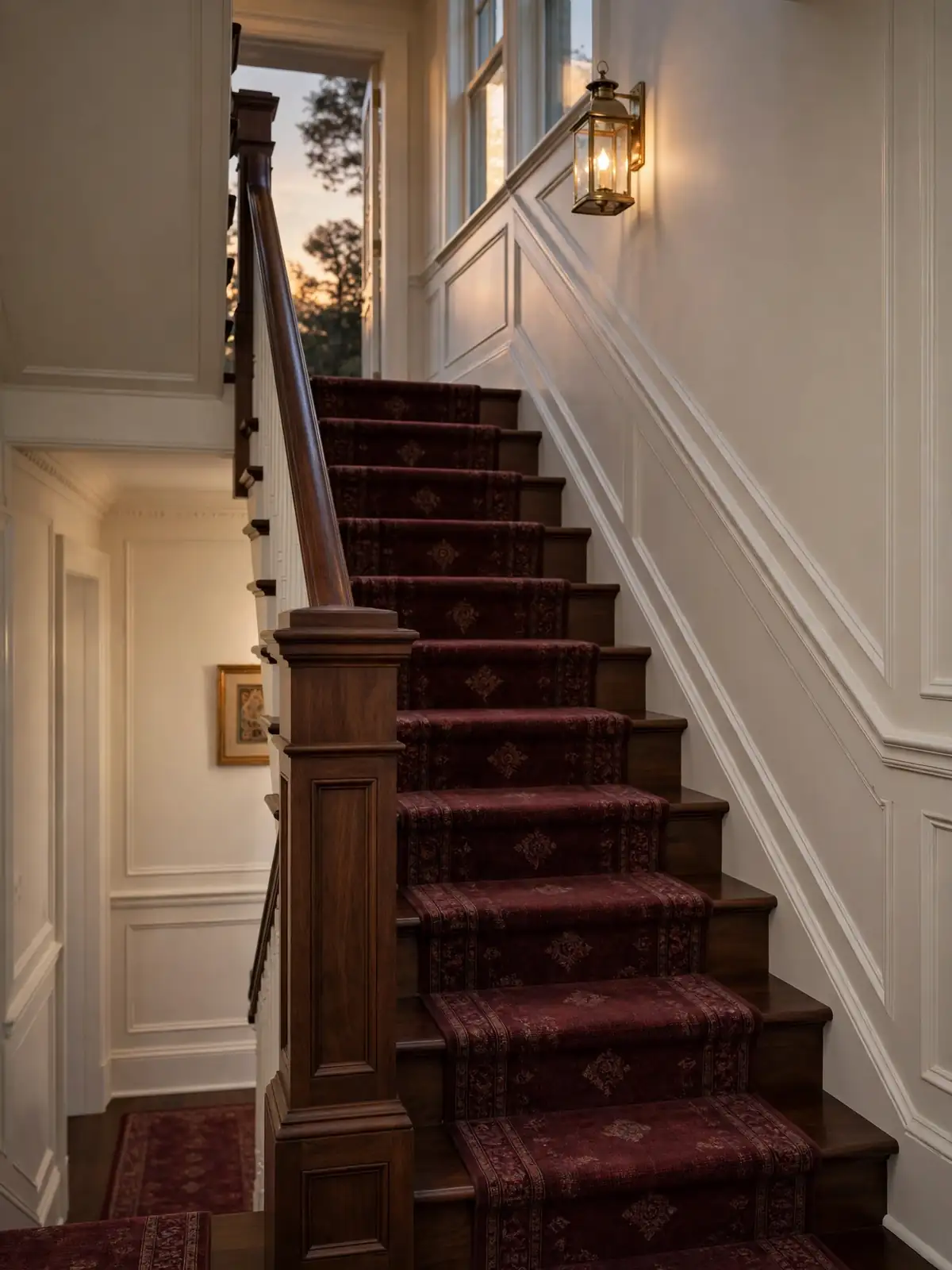
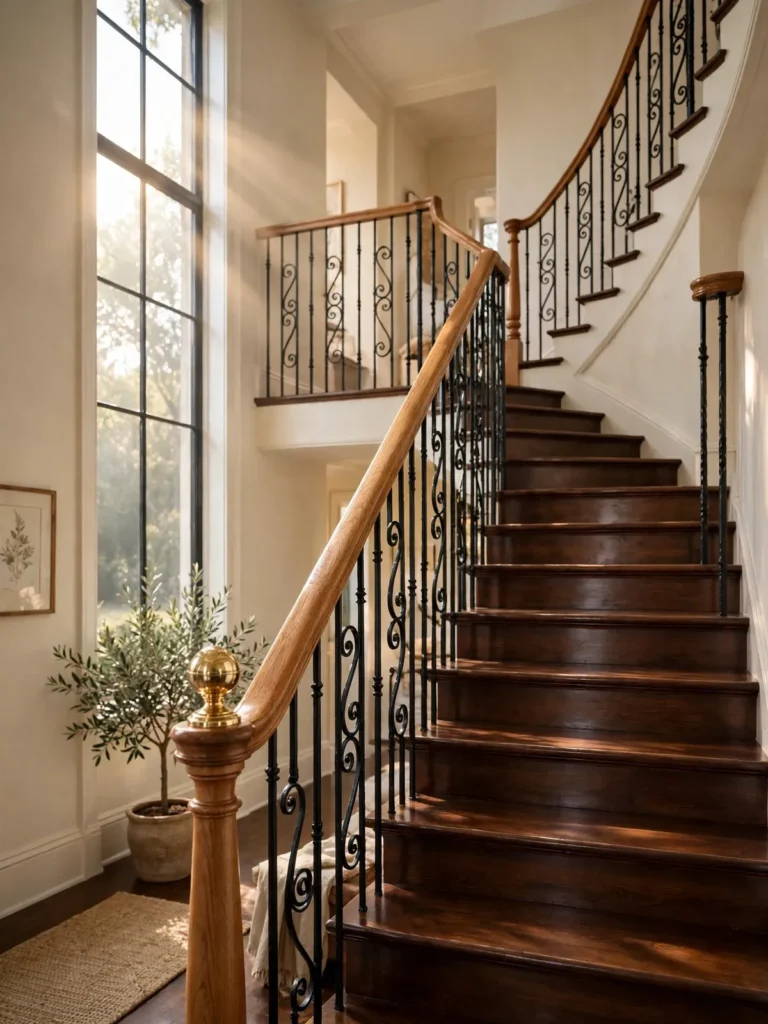
A strong newel post at the base anchors the whole handrail, and it is the post that takes the force when someone leans hard on the rail. On this stair, a chunky square newel post, 100 mm square, is bolted firmly through the floor at the base, holding a dark walnut handrail above dark walnut treads, each 1 metre wide. Soft ivory walls and a deep burgundy runner keep the hallway traditional, while a brass lantern on the landing glows softly in the evening and the newel post stands solid and unmoving.
Quick tips:
- Make the newel post chunky — about 100 mm square — for real strength.
- Bolt the newel through the floor, never just onto the surface.
- Match the newel timber to the handrail for a unified look.
- Test the newel by pushing it hard before you fit the rail.
A Staircase Handrail Kept Clean With a Simple Weekly Wipe
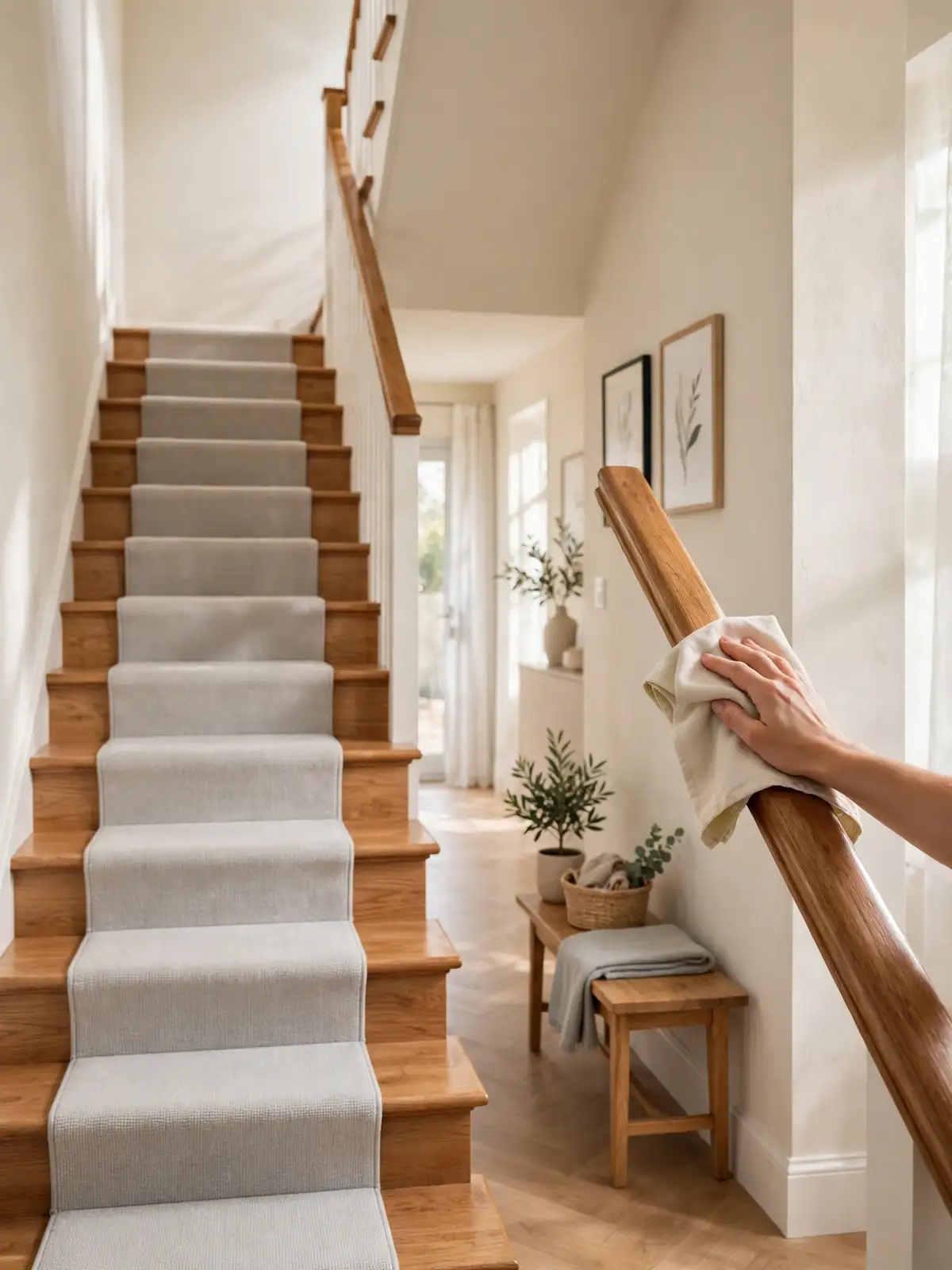
A handrail is touched by every hand in the house, so a simple weekly wipe keeps it clean, hygienic and beautiful. Here, a warm oak handrail is wiped with a soft damp cloth, then dried, beside warm oak treads, each 950 mm wide, with a pale grey runner down the centre. Soft cream walls and a small wooden bench at the base keep the hallway calm, while the weekly wipe takes two minutes, keeps the oil finish rich, and stops the build-up of dust and fingerprints that makes a rail look tired.
Quick tips:
- Wipe a timber rail weekly with a soft damp cloth, then dry it.
- Use a dry microfibre cloth on steel or brass rails.
- Re-oil a timber rail once a year to keep the finish rich.
- Never use harsh chemicals on a handrail — they strip the finish.
A Staircase Handrail With a Double Rail for a Split-Level Home
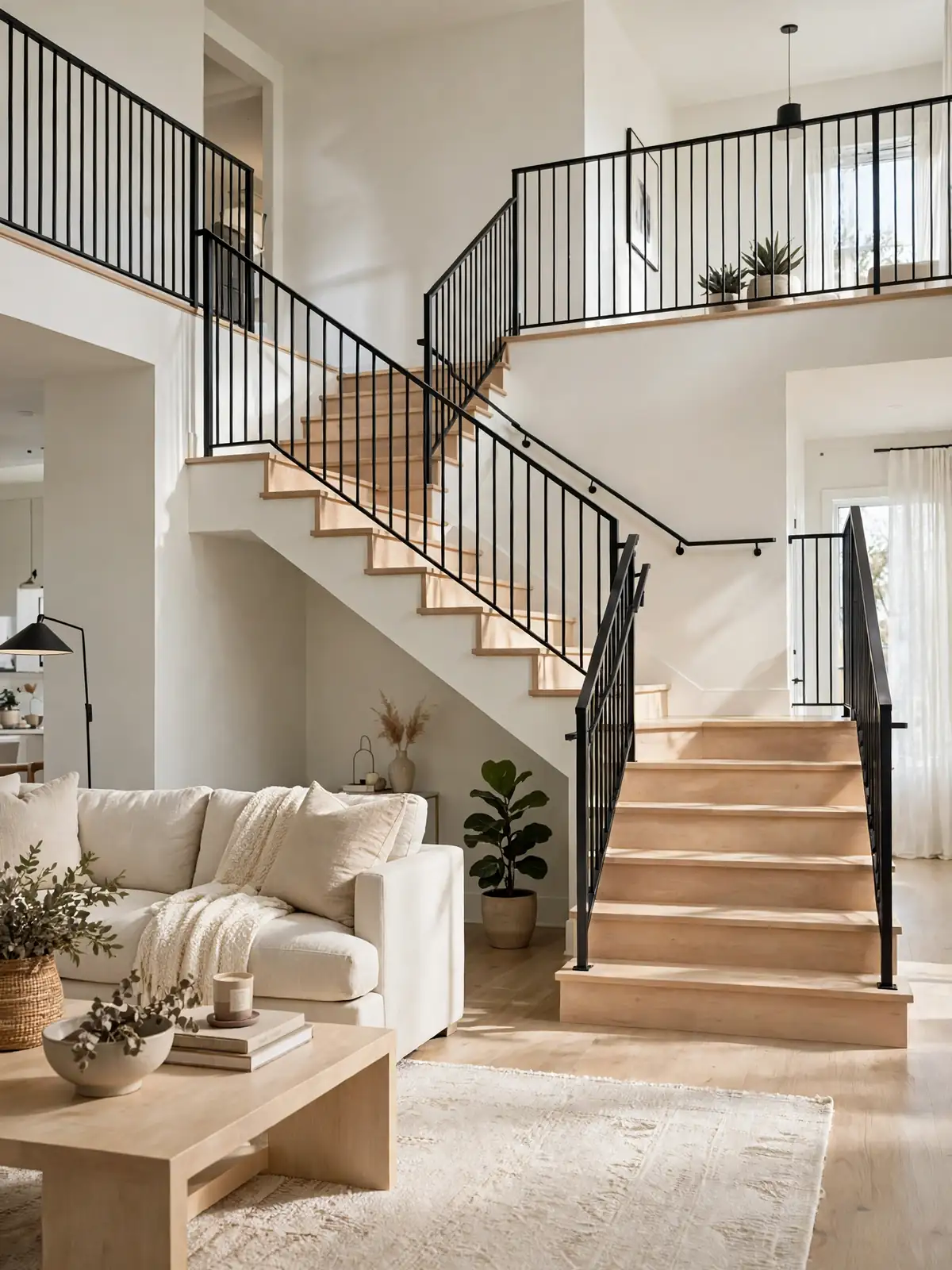
A split-level home has short flights between levels, and a double rail — one on each side of the short flight — makes every level change feel safe. Here, two slim black handrails run the short five-step flight between the living room and the bedroom level, beside pale maple treads, each 950 mm wide, with a cream rug below. Soft white walls keep the space bright, while the twin rails frame the short flight and make the step between levels feel secure, even in the dark.
Quick tips:
- Fit rails on both sides of short split-level flights.
- Keep both rails at the same height — about 36 inches.
- Match the rails to the main stair rail for a unified look.
- Add a small light at each level change so the short flight is visible.
A Staircase Handrail That Makes Every Climb Feel Safer
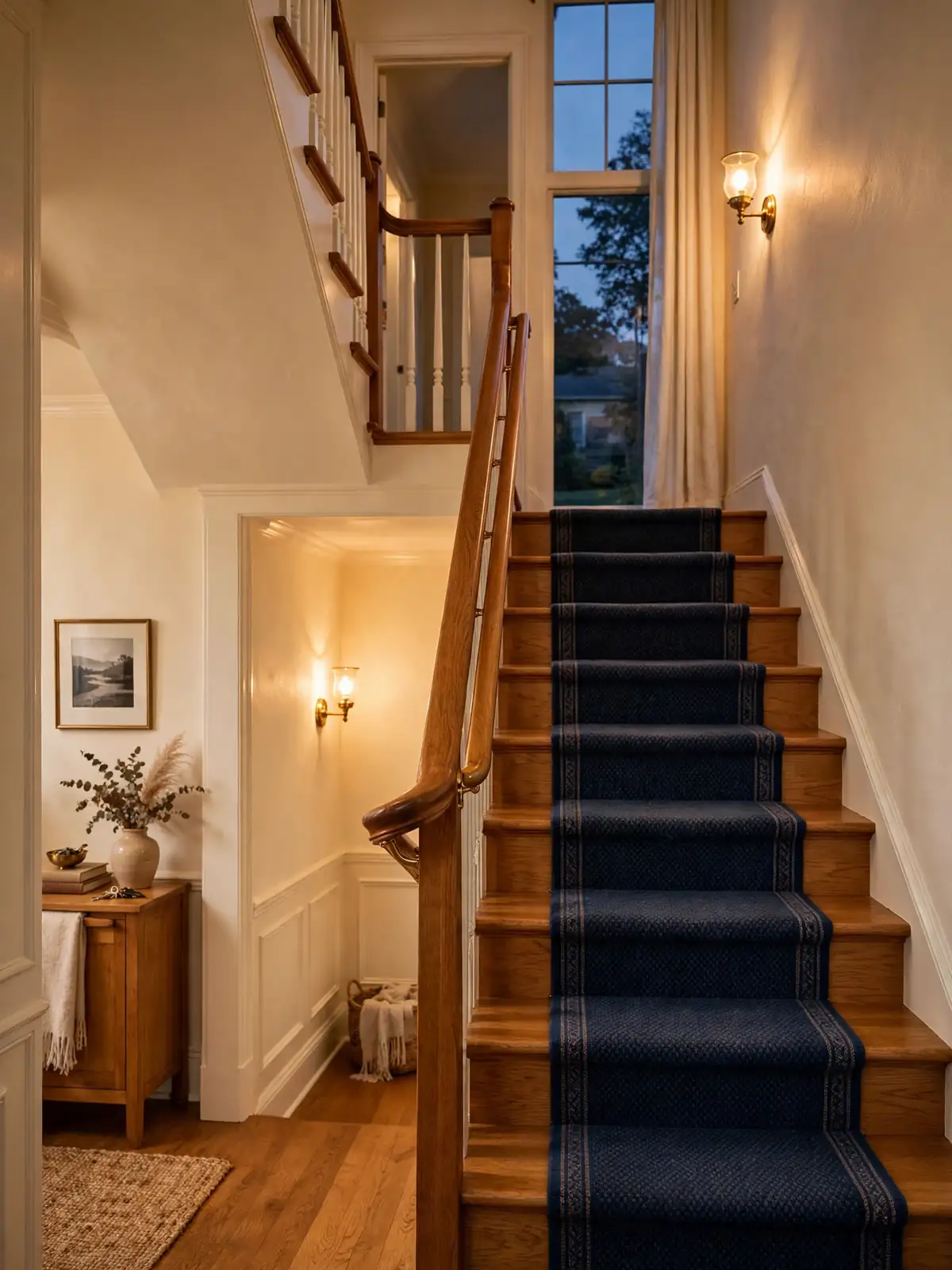
The best staircase handrail is the one that makes every climb feel safer — the right height, a comfortable grip, a firm fixing, and warm light above it. In this family home at dusk, a warm honey oak handrail runs at 36 inches beside honey oak treads, each 950 mm wide, with a navy-blue runner down the centre, while brass wall sconces glow warmly above the rail and light every step. Soft cream walls keep the hallway bright, and the combination of height, grip, strength and light means nobody in the family ever climbs in the dark or without something solid to hold.
Quick tips:
- Combine the right height, grip and lighting — safety needs all three.
- Choose warm timber so the rail feels kind in the hand.
- Add wall sconces above the rail so every step is lit.
- Test the rail yourself at night before you call the job done.
FAQs
What is the standard handrail height for stairs?
In most places the standard handrail height is 34 to 38 inches, measured vertically from the front edge — the nosing — of each tread up to the top of the rail. Measure at several treads along the flight, because the rail must follow the slope of the stair at a constant height. Always check your local building rules, as the exact range can vary by country and region.
How high should a handrail be, and how is it measured?
A handrail should sit 34 to 38 inches high, measured vertically from the tread nosing straight up to the top of the rail — not along the slope of the stair. Mark the height at the first, middle and last treads, join the marks with a chalk line, and fit the rail along that line so the height stays constant along the whole flight.
What is the correct grip size for a stair handrail?
A round handrail should be about 1.25 to 2 inches in diameter, so most hands can close around it comfortably. A rectangular rail should be about 1.25 to 2.75 inches wide with softly rounded edges, and an oval rail of about 1.75 by 1.25 inches suits elderly hands best. If the rail is too thick to grip or too thin to hold firmly, it will not help you on the stairs.
How do I install a stair handrail myself?
Find the wall studs with a stud finder, mark the height line 34 to 38 inches above the tread nosings, drill the bracket positions into the studs, fix the brackets with long screws, and fit the rail. You need a drill, a spirit level, a stud finder, a tape measure and a pencil. If the wall has no studs where you need them, or the stair is curved, hire a professional.
How far should a handrail be from the wall?
A wall-mounted handrail should sit about 1.5 inches clear of the wall, so your fingers fit behind the rail without scraping your knuckles. The brackets that hold the rail should be fixed into wall studs, spaced evenly along the flight, so the rail can take the full weight of a person leaning on it.
Conclusion
A staircase handrail is not just a safety feature — it is the part of the stair you hold every day, and the detail that makes the whole climb feel secure. Whether you set it at the standard 36-inch height, choose a comfortable 1.75-inch grip, fix it 1.5 inches clear of the wall, add a second rail for children, fit it into solid studs, or simply keep it clean and well-lit, the best staircase handrail is the one that feels right in the hand and holds firm when you need it. Keep the height constant, the grip comfortable, the fixings strong and the light warm, and your handrail will make every climb safer, easier and more beautiful.