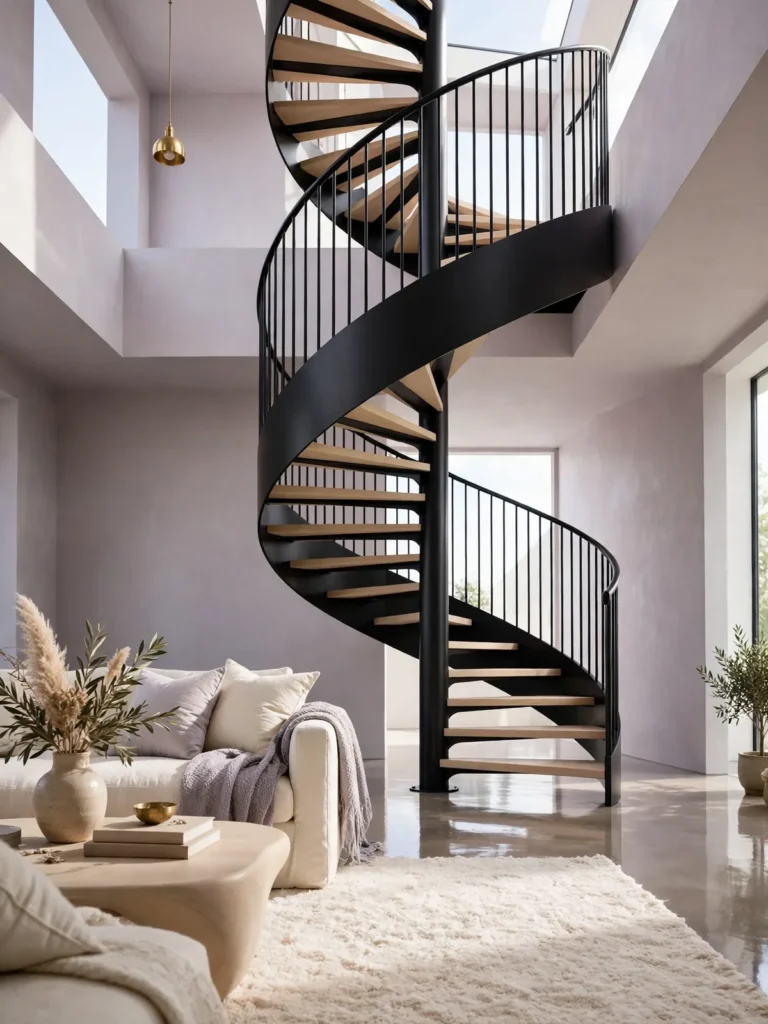
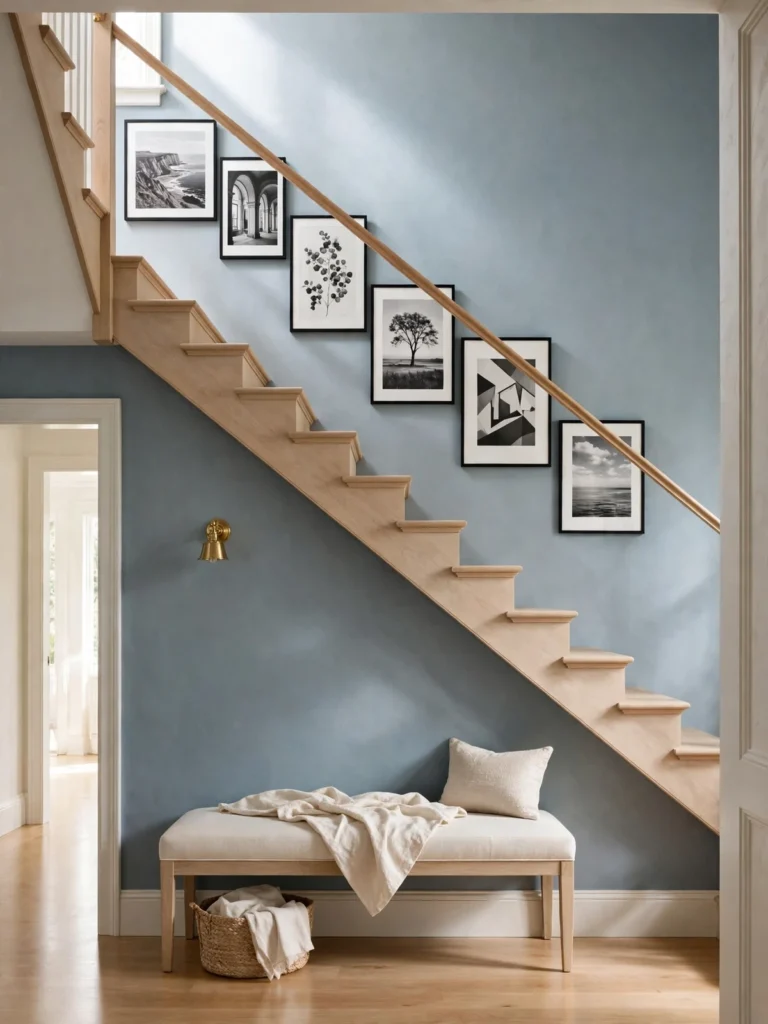
22 Stunning Staircase Wall Design Ideas That Turn a Plain Stair Into a Beautiful Feature Wall
A staircase wall is one of the tallest, most visible surfaces in a home, yet it is usually left blank. These 22 staircase wall design ideas cover materials, layouts, panelling, colour, art and lighting across classic, farmhouse, coastal and modern styles, so you can give your stairwell the design attention it deserves.
Staircase wall design ideas are the answer to the blank wall every home seems to have, because the wall beside a stair is tall, visible from several rooms, and seen every single day — yet most homes leave it plain white. A good staircase wall design makes the whole house feel more finished: it adds colour, texture, personality and light to a space that is otherwise just a passage.
If you want a more contemporary take on the same wall, these modern staircase wall design ideas show how clean lines, slim slats and restrained colour keep a stairwell feeling light and architectural. The 22 ideas below cover every approach — panelling, paint, wallpaper, stone, wood, art, mirrors and lighting — across styles, so you can choose a design that suits your home, your budget and the way your family actually lives.
Key Takeaways
What is the best way to design a staircase wall?
Start with the wall itself before adding decor. Decide whether it needs colour, texture or structure first — paint, panelling or wallpaper — and then add art, mirrors or lighting on top. A wall with one clear design move, such as full-height panelling or a bold colour, always looks more intentional than a blank wall covered in small random frames.
Should a staircase wall be painted a different colour from the rest of the house?
Yes, a staircase wall is one of the best places to use a different colour, because it is a transitional space rather than a living room. A deep green, navy, terracotta or charcoal on the stair wall adds drama without overwhelming any single room, and it makes the stair feel like a designed feature rather than a leftover space.
What material works best on a staircase wall?
It depends on your style and how much wear the wall gets. Wood slats and panelling add warmth and hide scuffs; stone or brick slips add texture and weight; wallpaper adds pattern quickly and cheaply; plaster or limewash adds soft depth. In busy family homes, choose a wipeable finish such as painted panelling or scrubbable paint.
How do I decorate a very tall staircase wall?
Use the height instead of fighting it. Run panelling, slats or wallpaper from floor to ceiling without a break, hang one oversized piece of art or a tall mirror, or build a gallery wall that climbs with the stairs. Avoid small frames scattered at eye level only — they make a tall wall look unfinished.
Can I design a staircase wall on a small budget?
Yes. Paint is the cheapest transformation — one bold colour or a two-tone split costs very little and changes the whole stair. Picture ledges, a small gallery of prints you already own, or a single large mirror are all low-cost moves that make a staircase wall feel designed without any building work.
Full-Height Vertical Panelling in Warm White
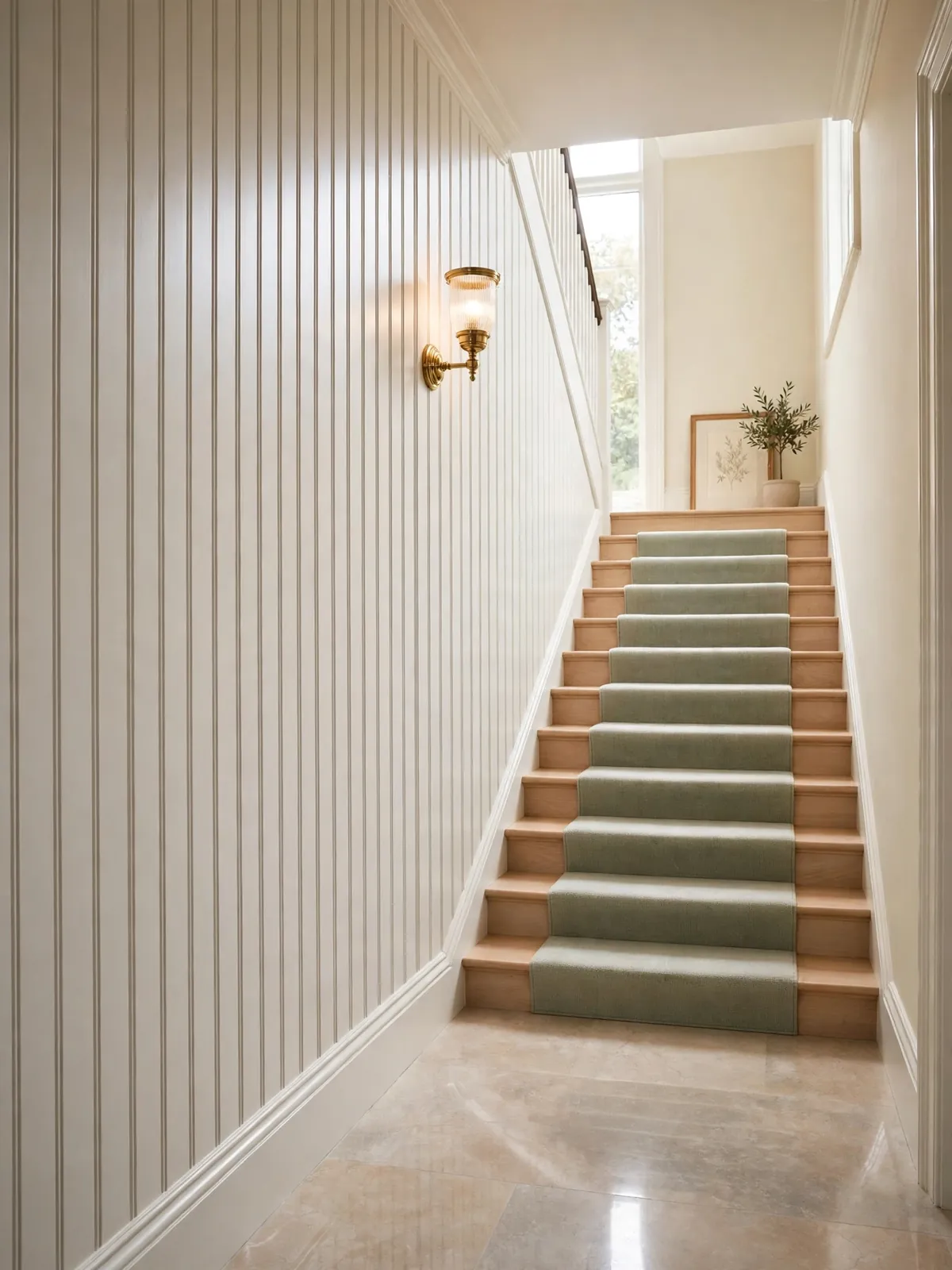
Full-height vertical panelling in warm white is the most reliable staircase wall design idea, because it adds structure and height to the stair without adding clutter. Here, slim vertical boards run from the skirting to the ceiling beside pale oak treads, each 950 mm wide, painted in a soft warm white that catches the daylight. A sage-green runner softens the steps, a small brass wall light warms the panelling in the evening, and the vertical lines quietly make the stair feel taller than it really is.
Quick tips:
- Run the panelling floor to ceiling without a break for the tallest effect.
- Choose warm white, not brilliant white, so the wall feels soft.
- Keep the runner muted so the panelling stays the feature.
- Use a satin paint so scuffs wipe off easily.
A Bold Deep Green Staircase Wall
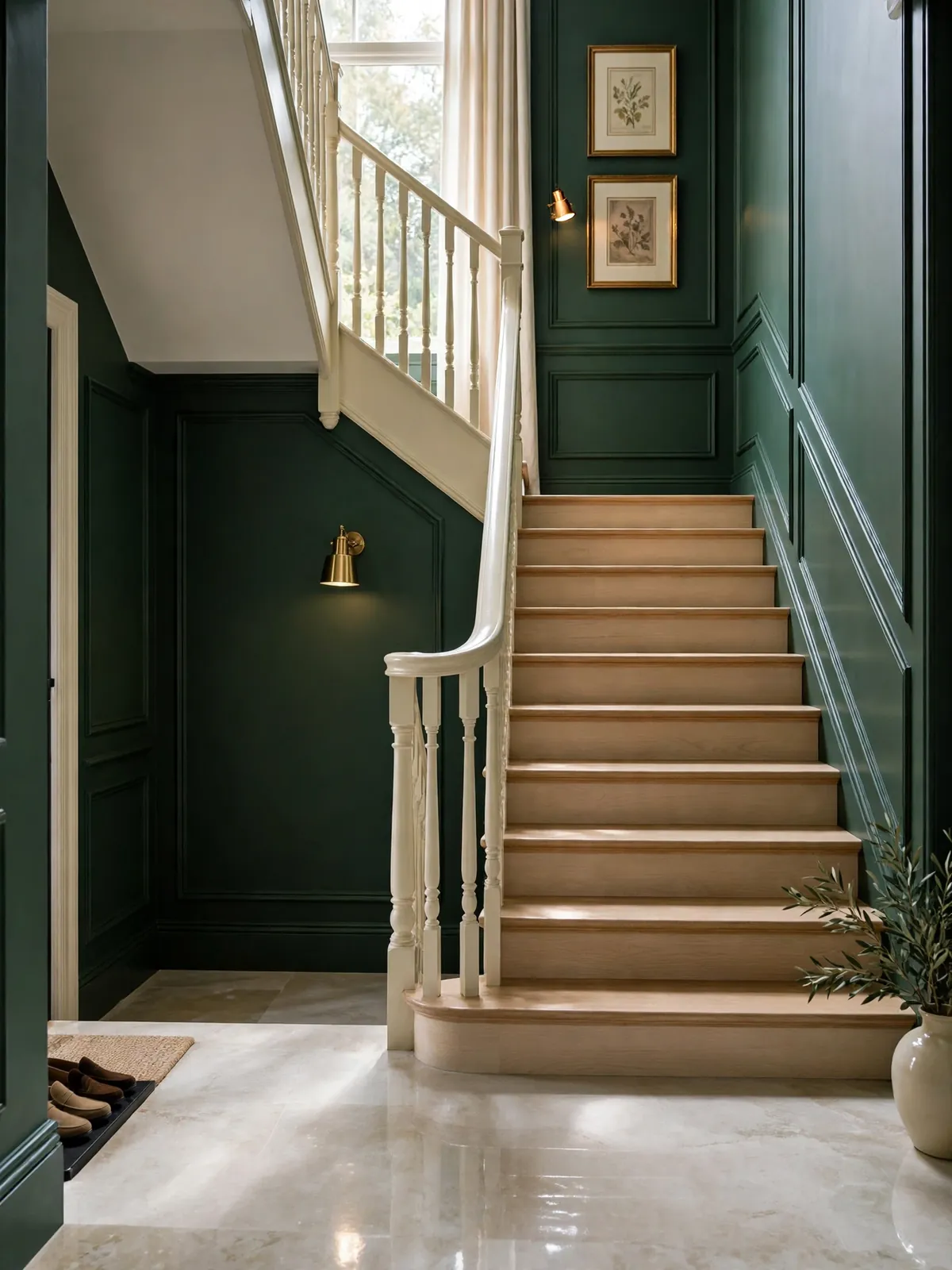
A bold deep green staircase wall turns a plain stair into a statement, because the colour is rich enough to feel deliberate yet calm enough to live with every day. On this stair, the full wall is painted deep forest green, while the handrail stays cream and the treads stay pale oak, so the green reads as a designed backdrop rather than a dark tunnel. A brass picture light above a single framed print adds warmth, and daylight from the landing window keeps the green glowing rather than flat.
Quick tips:
- Test the green in morning and evening light before committing.
- Keep the handrail and treads pale for contrast.
- Add one brass accent to warm the deep colour.
- Use a durable matte paint that hides scuffs.
Warm Wood Slats That Run With the Stair
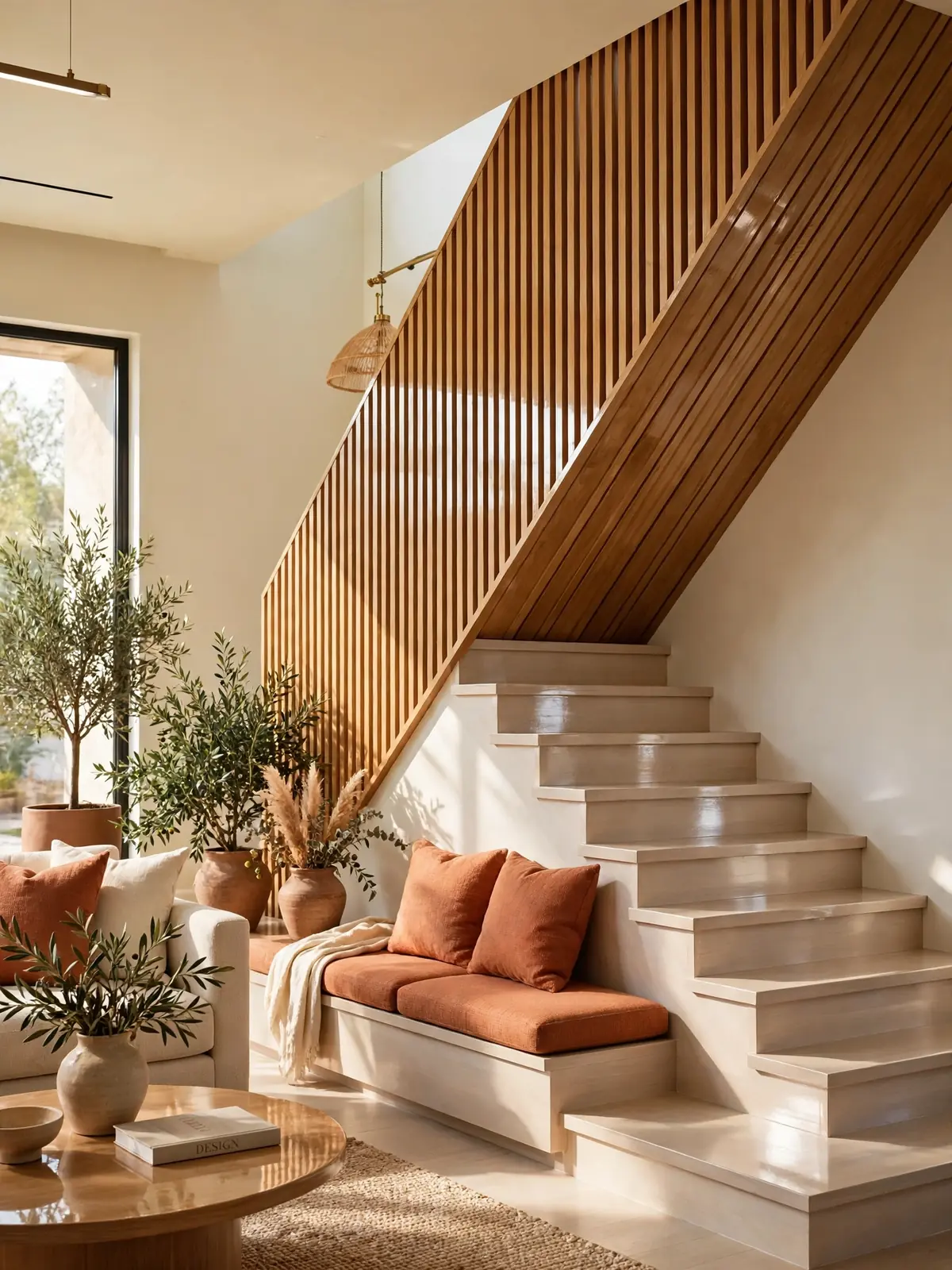
Warm wood slats that follow the stair angle add rhythm and warmth to a staircase wall, because the repeated lines guide the eye upward and soften the hard edges of the stair. Here, slim oak slats, each 40 mm wide, run diagonally beside pale ash treads, each 950 mm wide, with a small bench in terracotta cushions at the base. The slats cover only the lower half of the wall, leaving cream plaster above, so the stair feels warm without feeling boxed in.
Quick tips:
- Follow the stair angle exactly so the slats feel custom-made.
- Use oak or ash for warmth that suits most homes.
- Leave the upper wall plain so the room breathes.
- Seal the slats so they resist fingerprints and dust.
A Gallery Wall That Climbs With the Steps
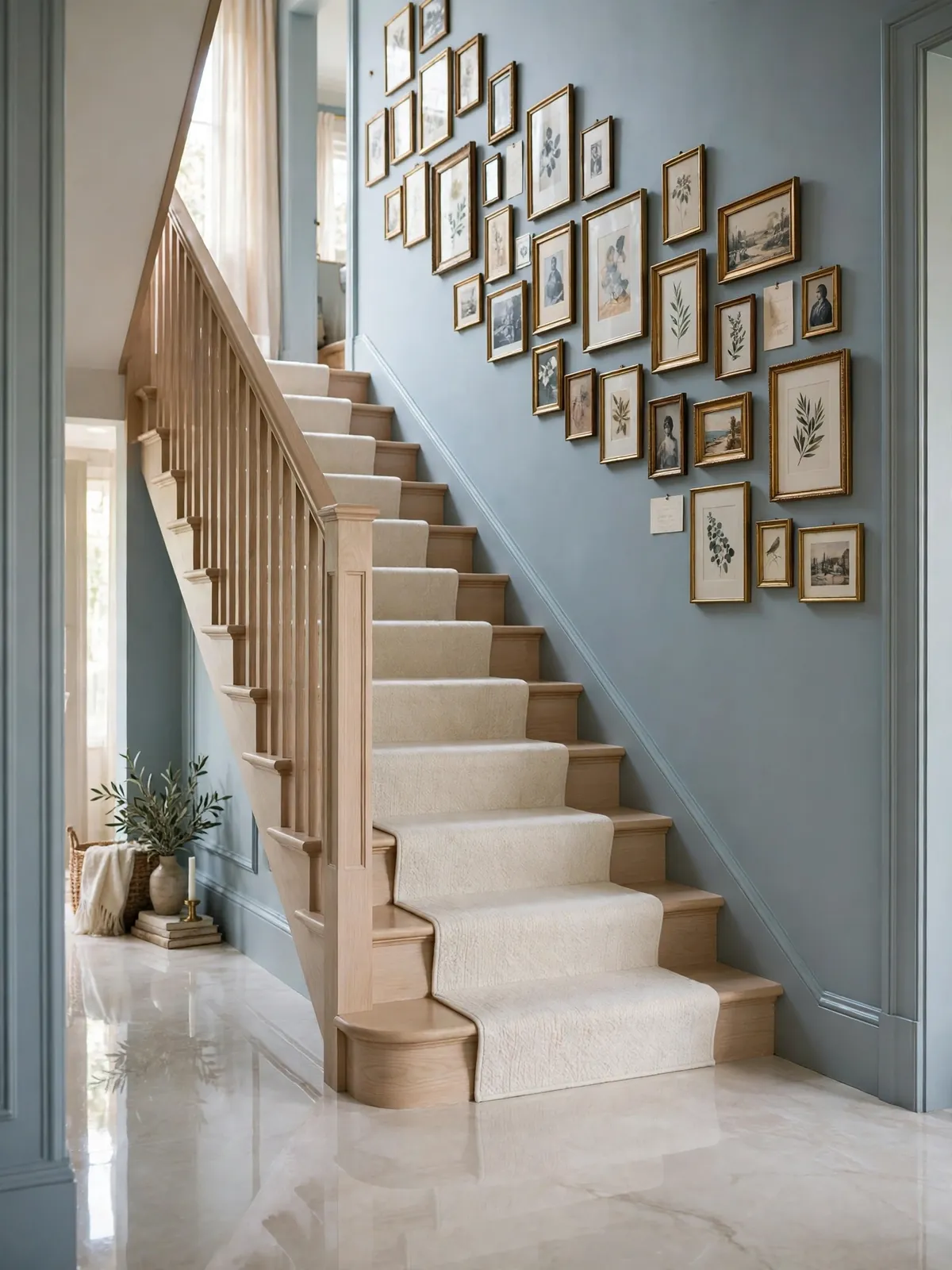
A gallery wall that climbs with the steps is the most personal staircase wall design idea, because it turns the stair into a story told in pictures. Here, mixed frames in black, brass and pale wood follow the stair angle, holding family photographs, travel prints and one small landscape painting, spaced evenly above pale oak treads. Soft dusty-blue walls keep the collection calm, a cream runner softens the climb, and because the frames follow the slope, the whole wall feels like it is moving with you.
Quick tips:
- Follow the stair angle with the bottom edge of the frames.
- Mix frame sizes but keep two finishes maximum.
- Space frames evenly, about 60 mm apart.
- Start with the largest frame at the bottom.
Classic Wainscoting With a Painted Upper Wall
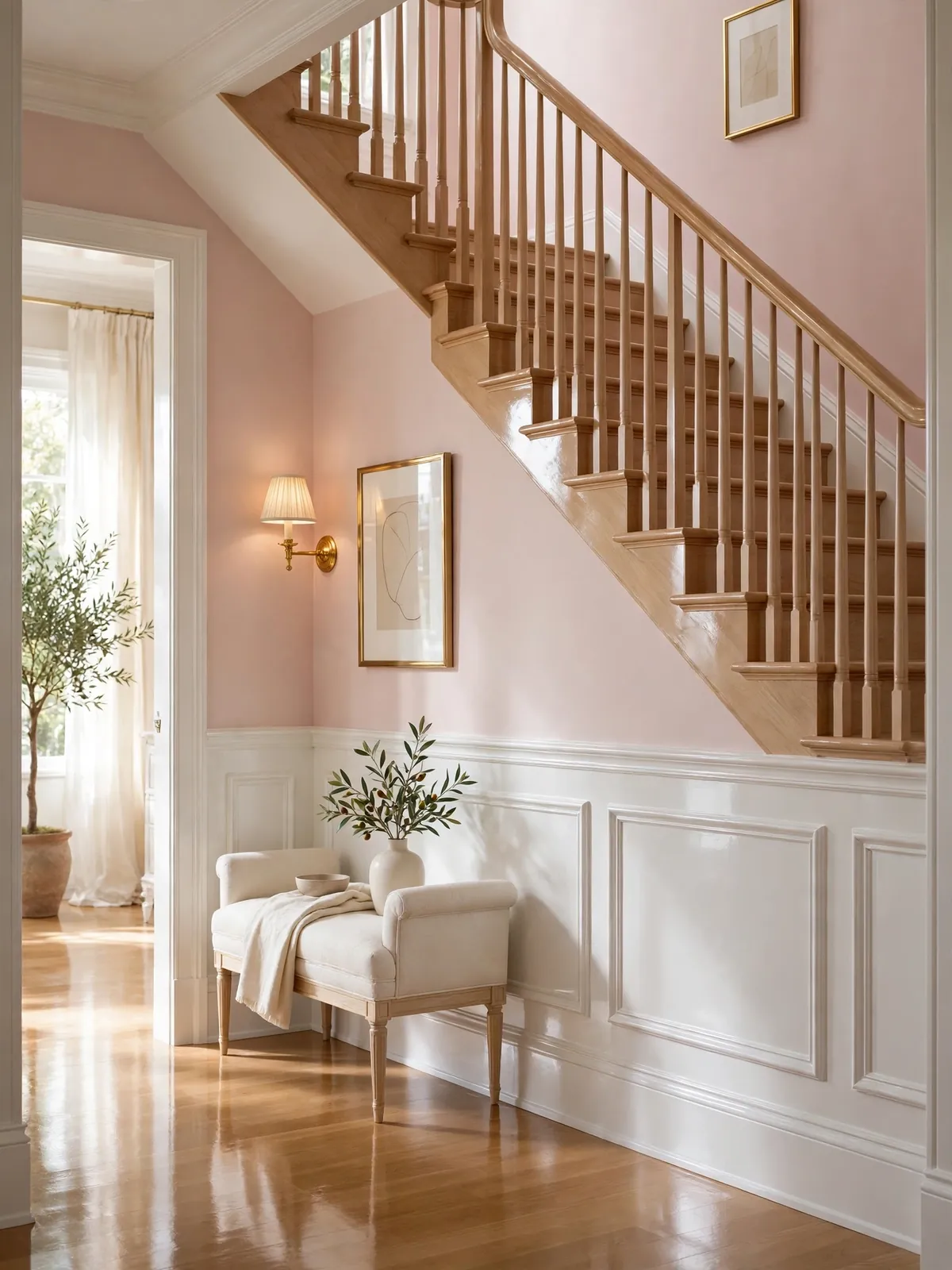
Classic wainscoting with a painted upper wall brings quiet elegance to a staircase, because the lower panelling protects the wall while the colour above adds personality. On this stair, white wainscoting runs along the lower wall beside pale oak treads, each 950 mm wide, while the upper wall is painted soft blush pink. A cream bench at the base and a brass wall sconce keep the hallway warm, and the two-tone split makes the stair feel taller and more considered.
Quick tips:
- Paint the wainscoting and the skirting the same white.
- Choose a soft upper colour, such as blush or sage.
- Keep the handrail timber to match the treads.
- Use satin paint on the wainscoting for easy cleaning.
Stone Veneer for Texture and Weight
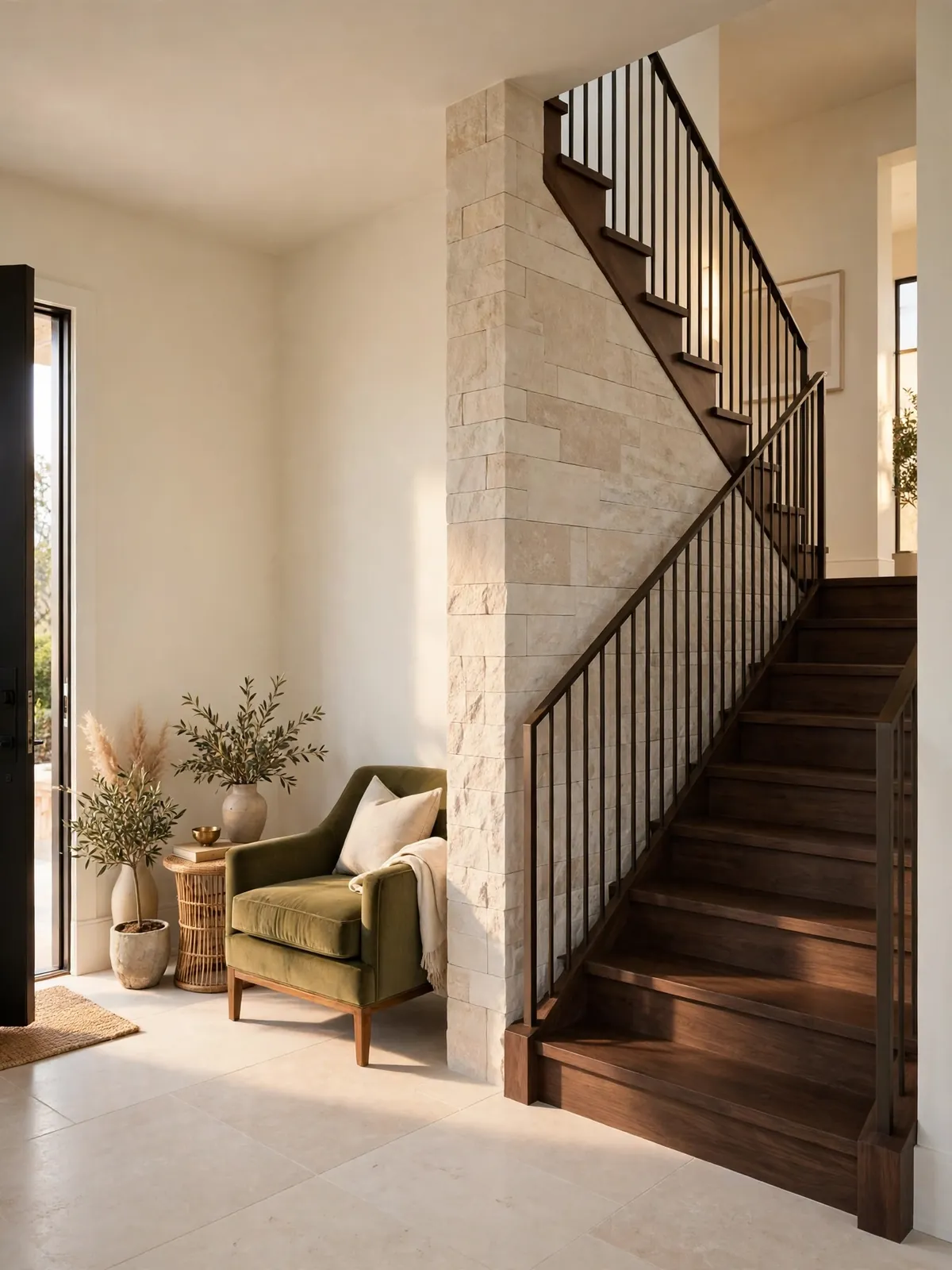
Stone veneer gives a staircase wall texture and weight that paint alone cannot, because the uneven surface catches light and shadow as you climb. Here, pale limestone slips cover the full stair wall beside dark walnut treads, each 1 metre wide, with a soft olive-green armchair at the base picking up the stone’s natural tones. The stone grounds the entry, the walnut warms it, and the combination makes the stair feel like part of the architecture rather than a decorated afterthought.
Quick tips:
- Choose pale stone in small halls so the wall does not feel heavy.
- Keep the treads dark for contrast against the stone.
- Seal the stone so it resists dust and marks.
- Pair stone with one soft fabric nearby for balance.
Colour Blocking That Follows the Stair Line
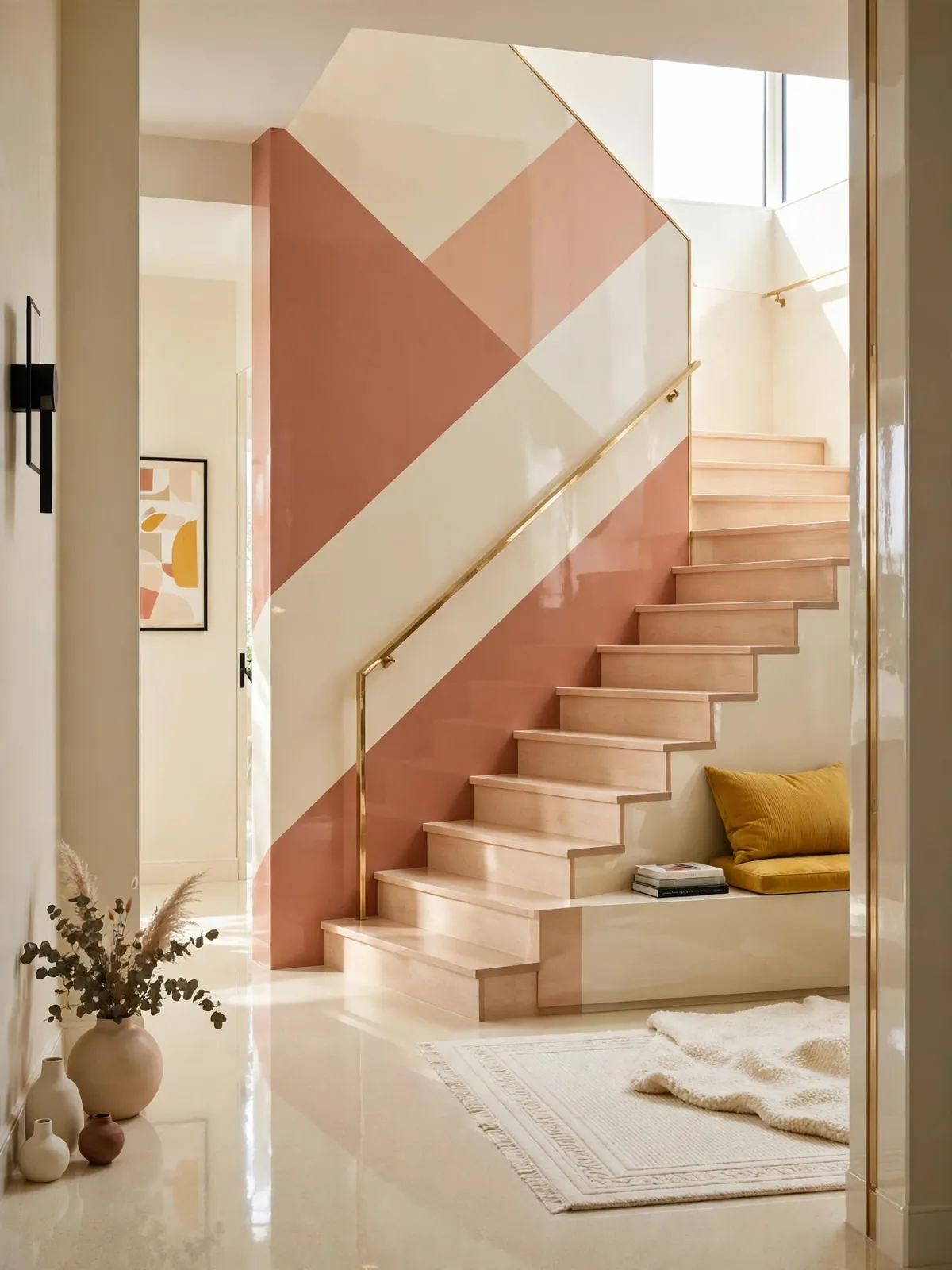
Colour blocking that follows the stair line is a graphic staircase wall design idea that costs almost nothing, because it uses paint alone to draw attention to the architecture. Here, the lower wall is painted soft clay and the upper wall cream, with the dividing line stepping up exactly with the treads, each 900 mm wide. A mustard-yellow cushion on a small bench at the base picks up the clay, a cream rug softens the floor, and the stepped colour line makes the stair itself the decoration.
Quick tips:
- Use painter’s tape and a level for crisp stepped lines.
- Choose muted tones such as clay, sage or dusty blue.
- Keep the treads pale so the colour stays the feature.
- Echo one blocked colour in a cushion or rug.
A Hand-Painted Mural That Follows the Climb
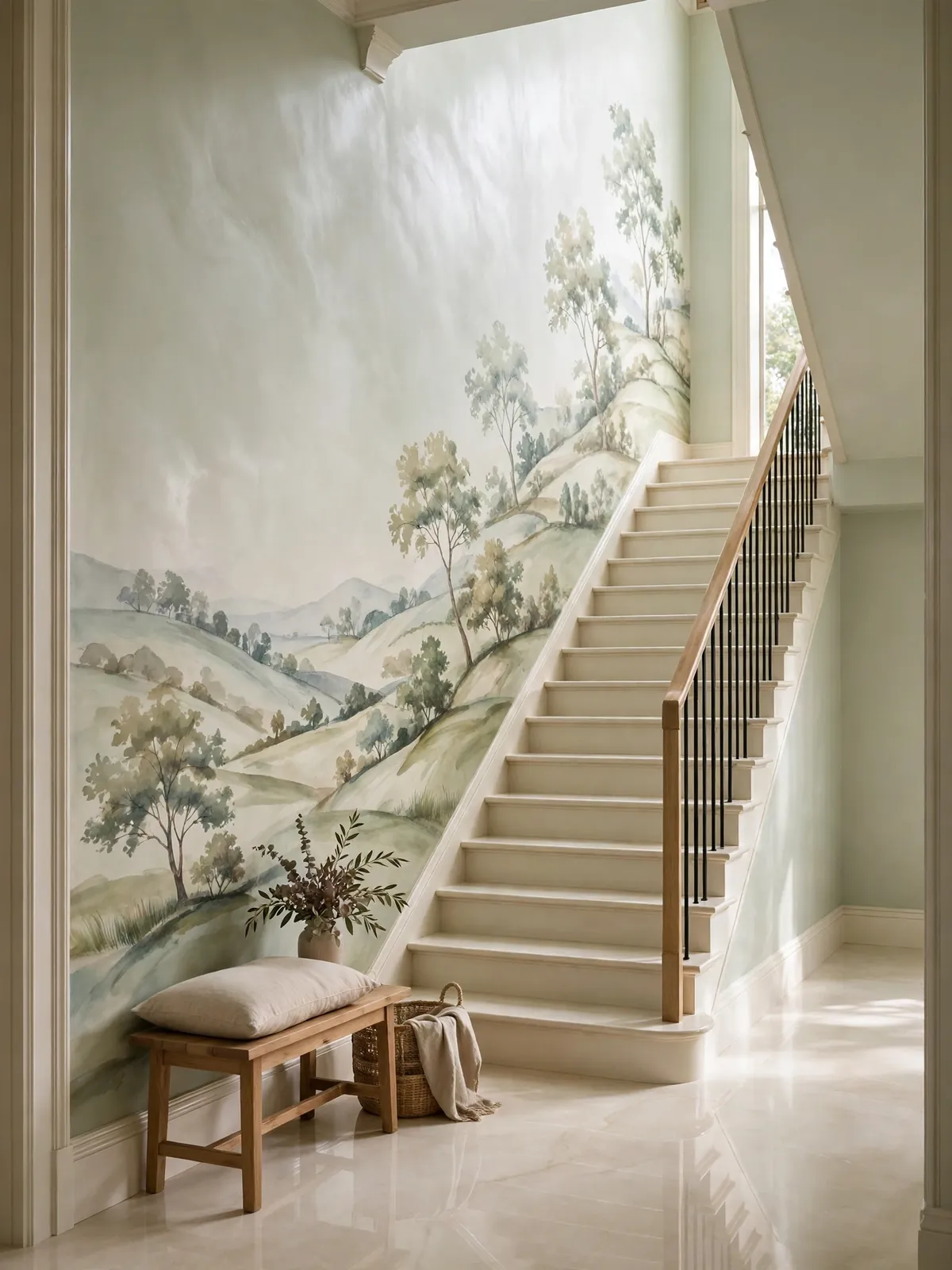
A hand-painted mural that follows the climb turns a staircase wall into a piece of art, because the design moves with you instead of sitting flat like a framed print. On this stair, soft flowing hills in sage, cream and dusty blue rise gently along the wall beside cream treads, each 950 mm wide, with a small wooden bench at the base. The mural is deliberately simple — broad curves, muted colours — so it feels calm rather than busy, and the stair becomes a quiet landscape you walk through twice a day.
Quick tips:
- Keep the mural palette to three muted colours maximum.
- Let the design follow the stair angle, not fight it.
- Sketch the shapes in chalk before painting.
- Seal the mural with a clear matte coat for protection.
Black-and-White Photography in Matching Frames
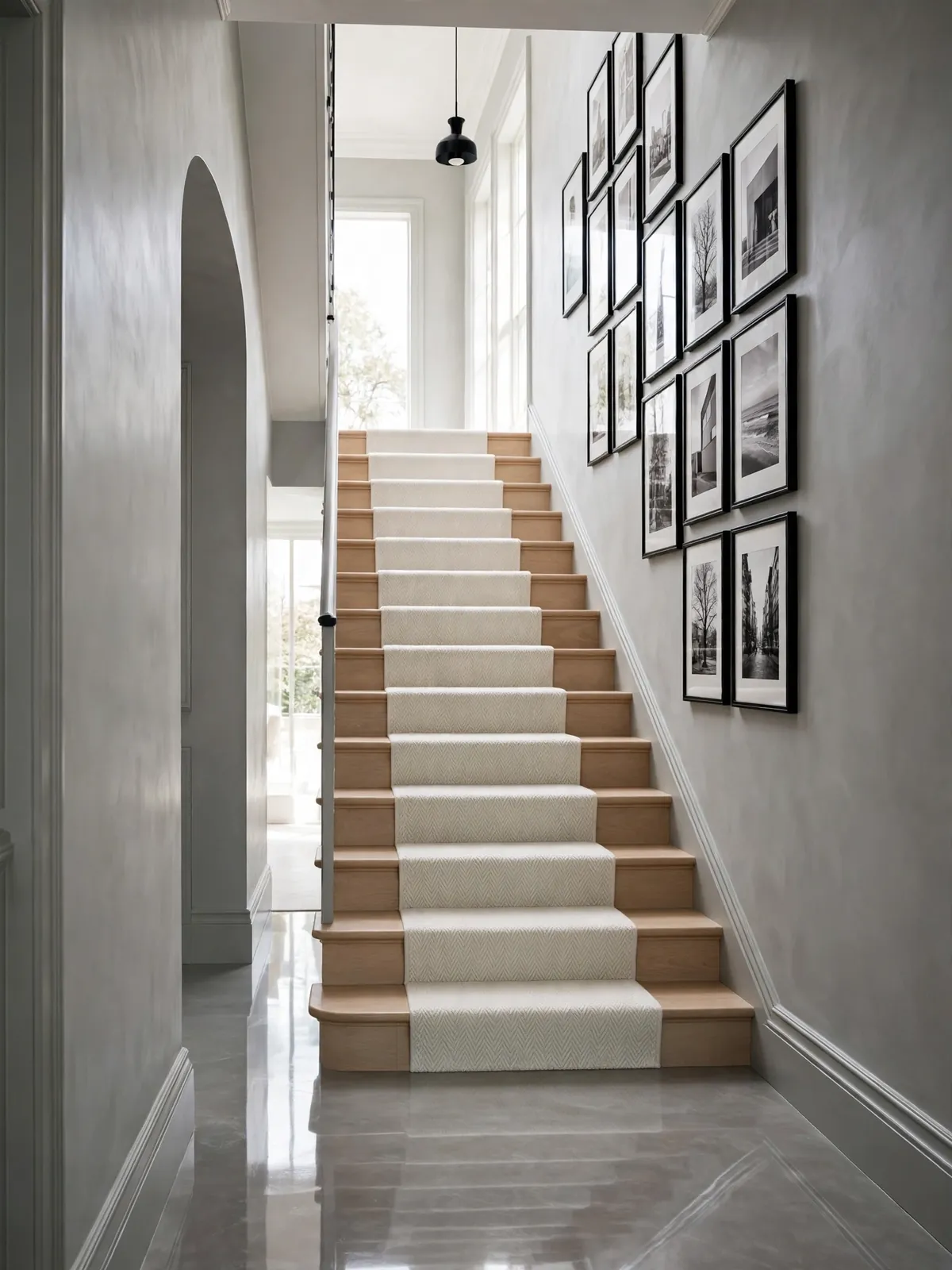
Black-and-white photography in matching frames is the calmest gallery idea for a staircase wall, because removing colour removes visual noise and lets the images speak. Here, eight photographs in identical slim black frames climb the soft grey wall beside pale oak treads, each 950 mm wide, with a cream runner softening the steps. The consistent frames make the wall feel curated and editorial, while the monochrome images — family portraits, travel scenes, architecture — stay cohesive even though their subjects differ.
Quick tips:
- Use identical frames and identical mats for unity.
- Print all photos in the same black-and-white tone.
- Keep spacing consistent, about 50 mm between frames.
- Hang the largest image at the centre of the climb.
Picture Ledges for Flexible, Changeable Art
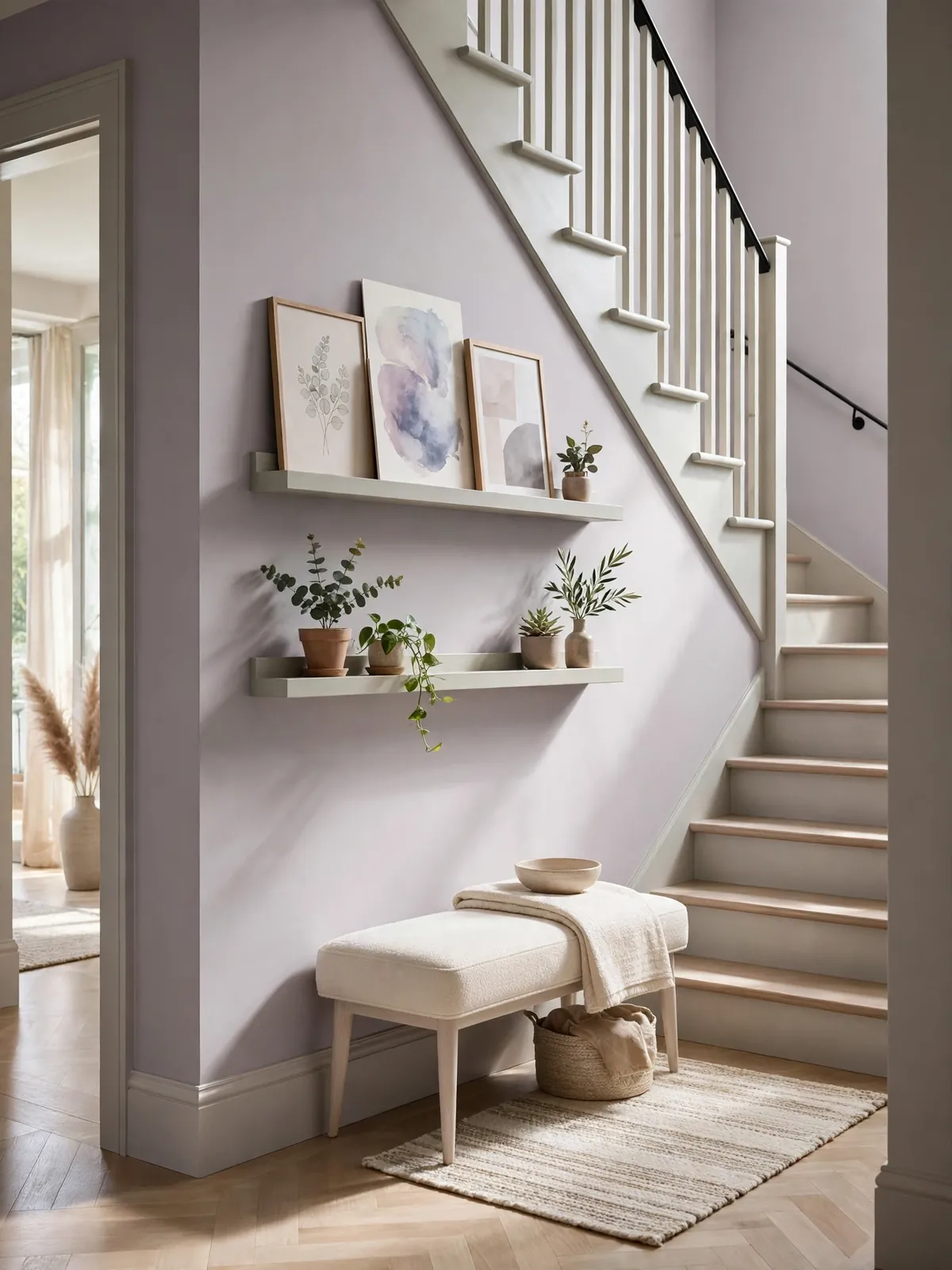
Picture ledges are the most flexible staircase wall design idea, because art leans on them instead of being nailed in, so the wall can change with the seasons. Here, three pale timber ledges run parallel to the stair angle on a soft lilac-grey wall, holding leaning prints, a small framed photograph and two trailing plants above pale ash treads. The ledges make styling easy — swap a print in seconds — and the layered frames give the stair a relaxed, collected feel that a fixed gallery wall cannot match.
Quick tips:
- Fix ledges parallel to the stair angle for a custom look.
- Layer a large frame behind a smaller one for depth.
- Keep the ledges shallow so the stair stays clear.
- Add one small plant per ledge for life and softness.
A Tall Mirror That Doubles the Light
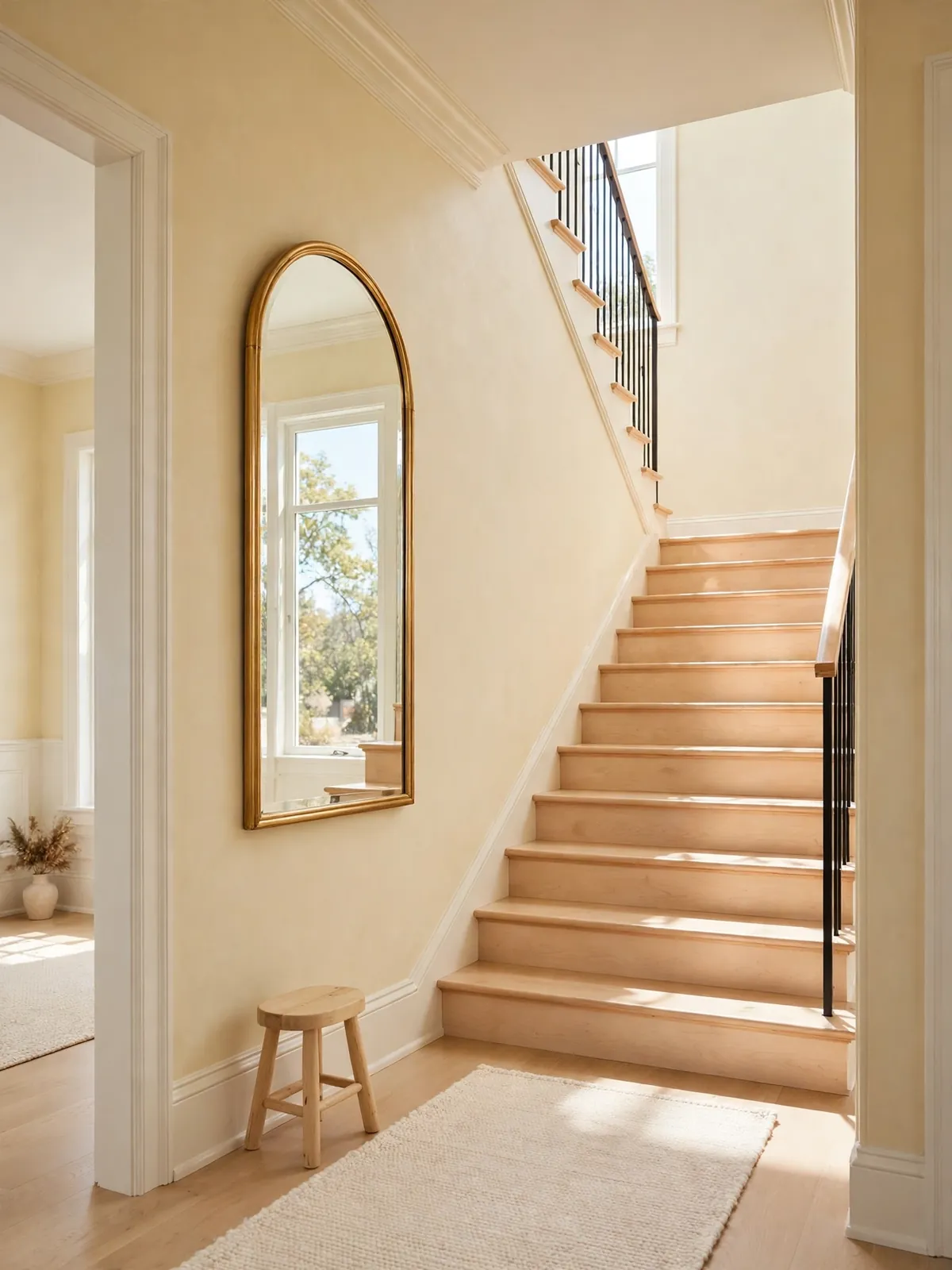
A tall mirror on a staircase wall doubles the light in the stairwell, because it catches daylight from the landing window and throws it back down the stair. Here, a tall arched mirror, 1.8 metres high, hangs on a soft butter-yellow wall beside pale maple treads, each 900 mm wide, with a cream rug at the base and a small wooden stool nearby. The mirror makes a narrow stair feel twice as wide, and because it reflects the window rather than a blank wall, the whole stair feels brighter and more open.
Quick tips:
- Hang the mirror where it catches a window, not a blank wall.
- Choose an arched or tall rectangular shape for height.
- Keep the frame slim so the mirror stays the feature.
- Clean it weekly — smudges show in bright stairwells.
Limewash Plaster for Soft, Cloudy Depth
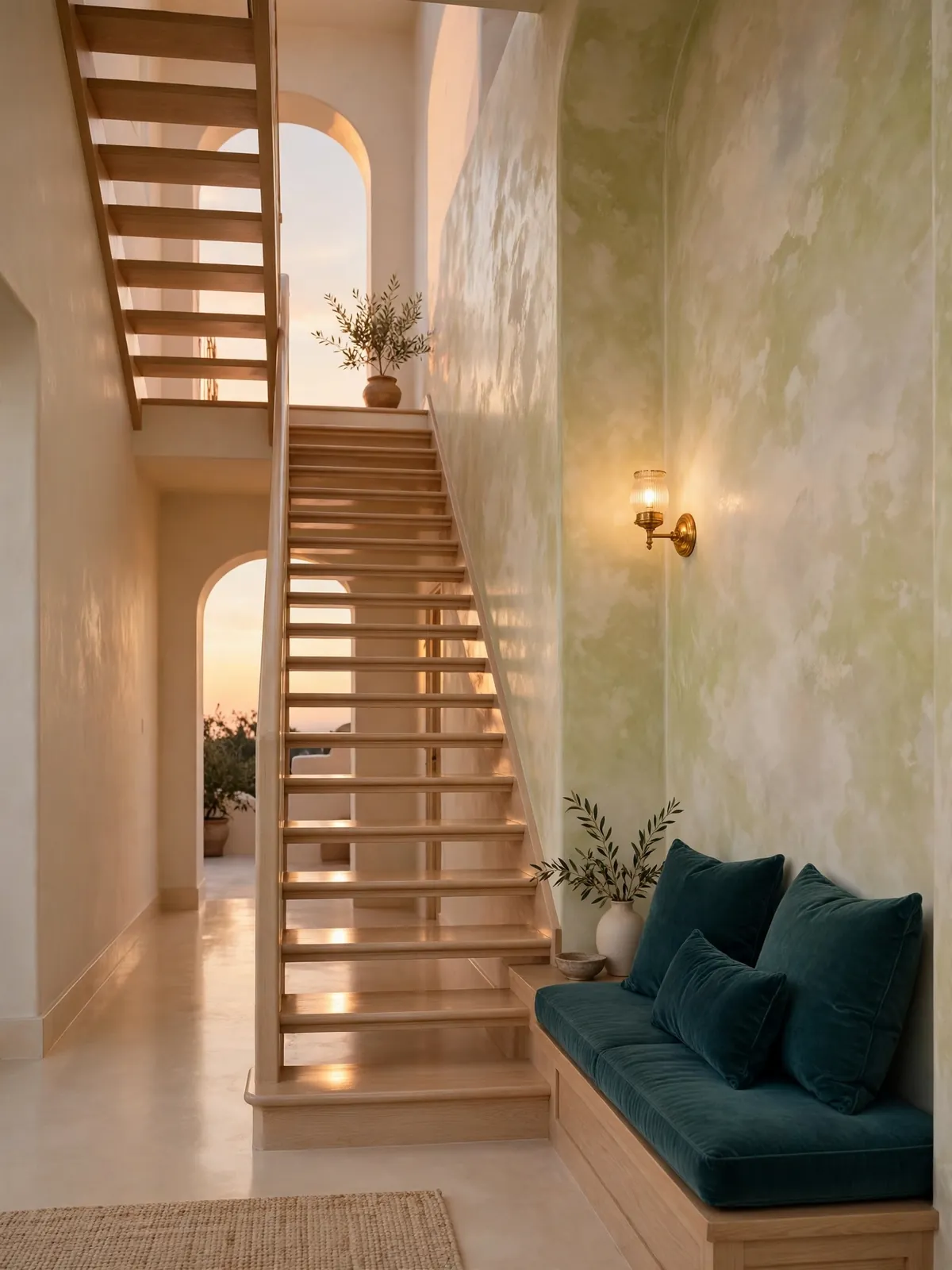
Limewash plaster gives a staircase wall soft, cloudy depth that flat paint cannot match, because the mineral finish catches light differently across the wall. On this stair, the full wall is finished in a warm greige limewash beside pale oak treads, each 950 mm wide, with deep teal cushions on a bench at the base and a small brass sconce warming the texture in the evening. The wall feels handmade and calm, the stair feels warmer, and the whole hallway gains a quiet Mediterranean softness without any pattern or colour risk.
Quick tips:
- Choose a warm greige or soft clay limewash tone.
- Apply two thin coats for an even cloudy effect.
- Keep the treads pale oak so the wall stays the feature.
- Seal limewash in busy family halls for durability.
Board and Batten in a Moody Colour
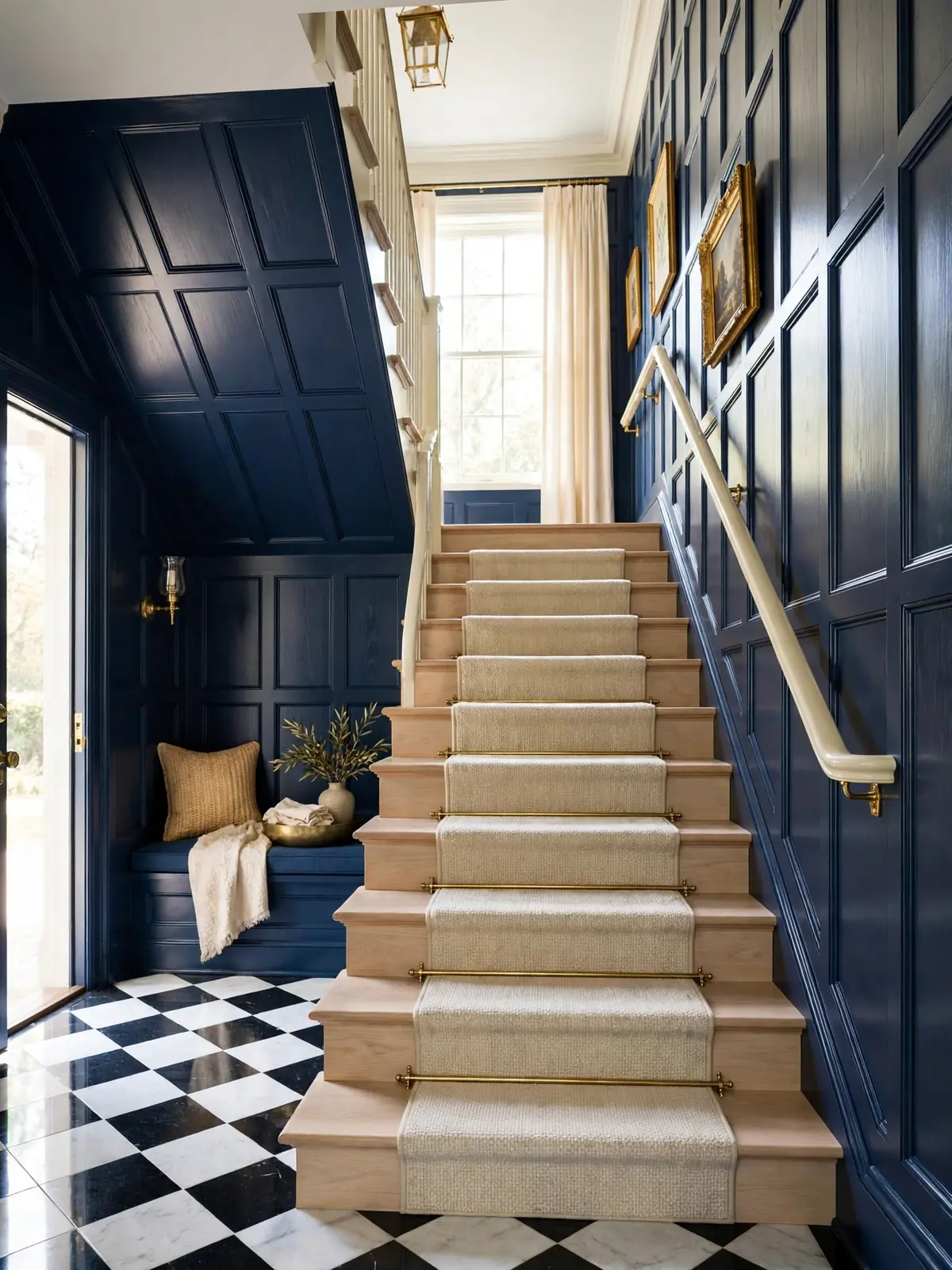
Board and batten painted in a moody colour is a staircase wall design idea that feels both classic and bold, because the traditional panelling shape is given a modern, confident colour. Here, vertical battens in deep navy run up the full stair wall beside pale oak treads, each 950 mm wide, with a cream handrail breaking the navy and brass stair rods on the runner echoing the warmth. The navy makes the stair feel dramatic, the panelling keeps it structured, and the pale treads stop the dark wall from feeling heavy.
Quick tips:
- Paint battens and wall the same colour for a seamless look.
- Keep the handrail and treads pale for contrast.
- Use a durable satin finish on the battens.
- Add one brass accent to warm the dark colour.
Wallpaper on the Landing Wall Only
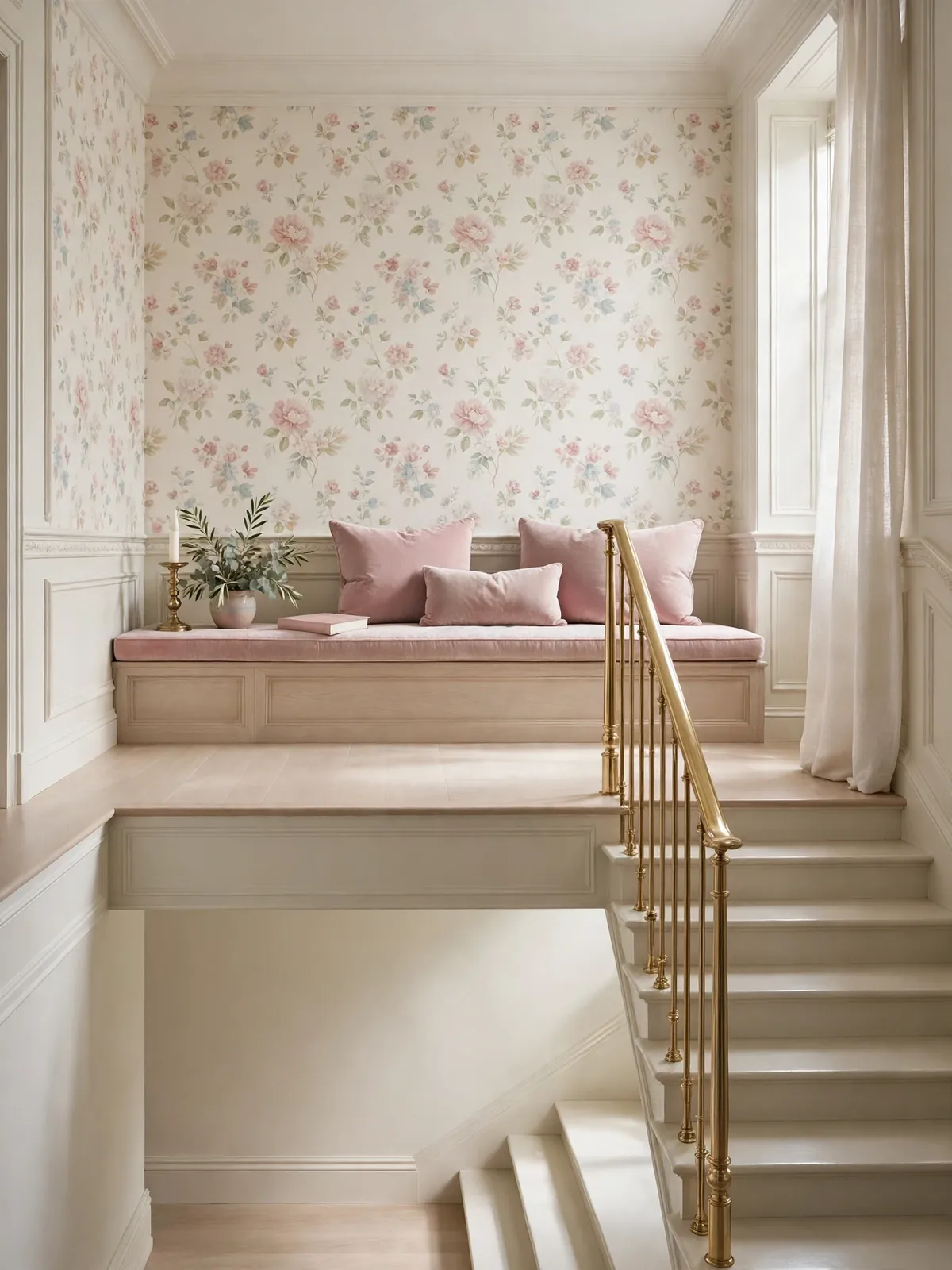
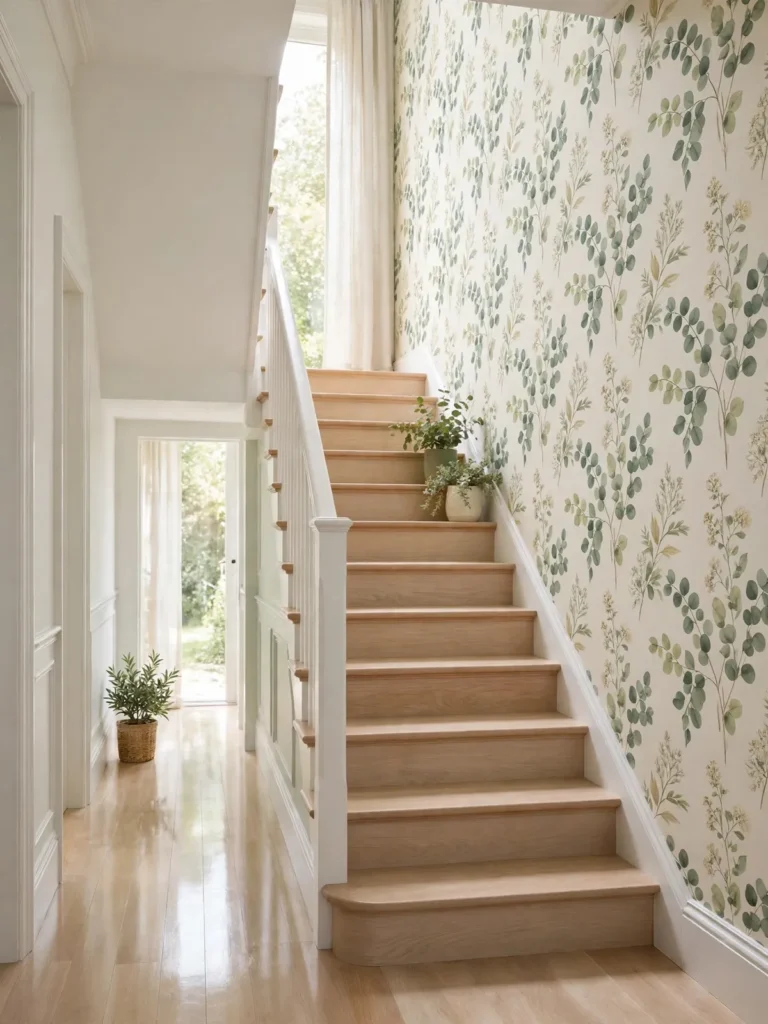
Wallpaper on the landing wall only is a clever staircase wall design idea, because it creates a focal moment where the stair pauses without covering the whole climb in pattern. Here, a soft floral wallpaper in dusty rose and cream covers just the landing wall, while the stair walls stay pale cream beside pale oak treads. The landing becomes a small destination — a framed view at the top of the climb — and the pattern feels special rather than overwhelming, which is exactly how wallpaper works best on a stair.
Quick tips:
- Wallpaper only the landing wall to create a focal pause.
- Choose a pattern with a light background in dark stairwells.
- Keep the stair walls plain so the wallpaper shines.
- Match one wallpaper colour to a cushion or runner.
Integrated Wall Lighting That Washes the Wall
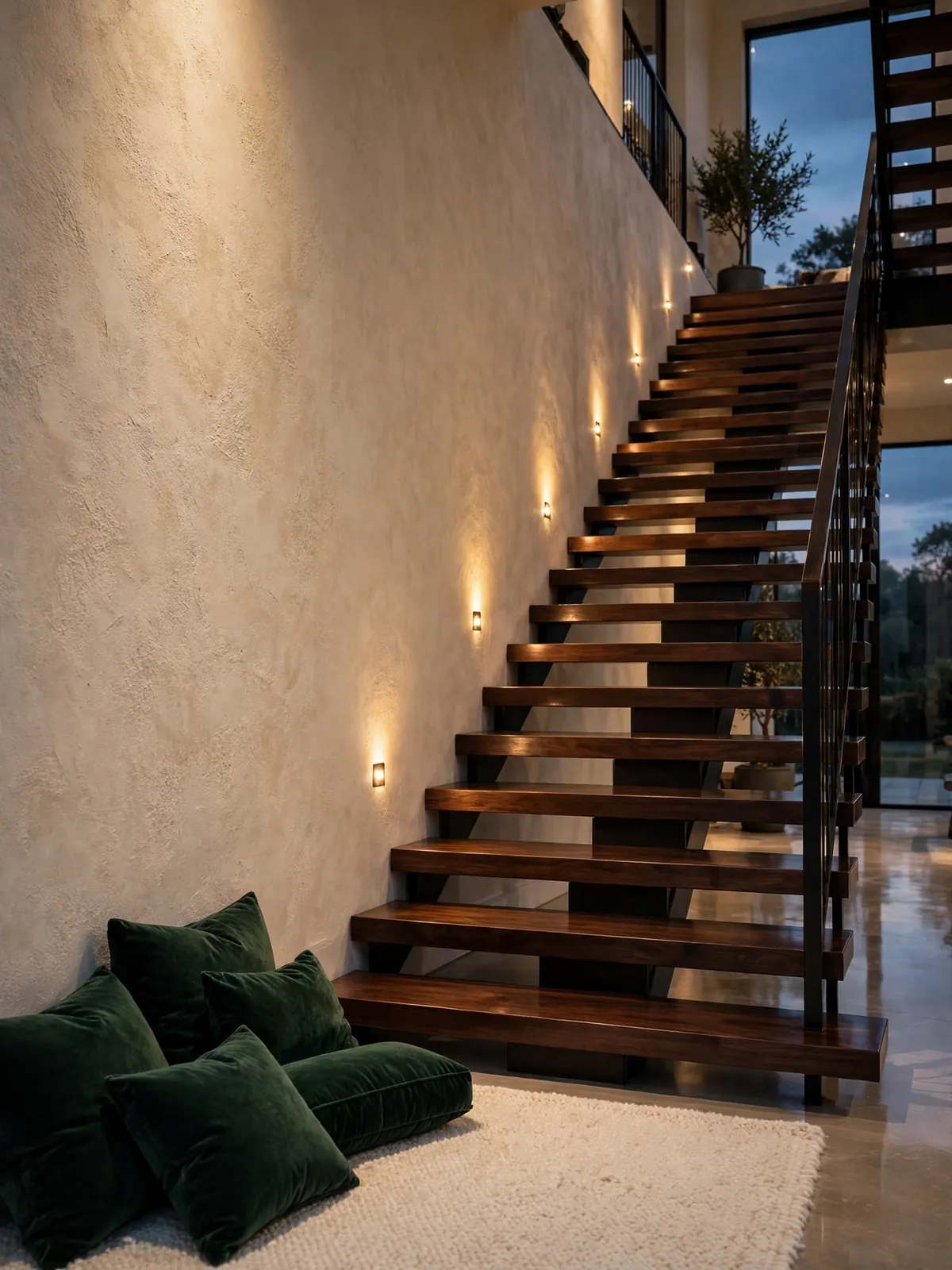
Integrated wall lighting that washes the wall turns a staircase wall into a feature after dark, because the light itself becomes the decoration. Here, small recessed lights set into the wall cast warm pools of light down a textured plaster surface beside dark walnut treads, each 1 metre wide, with deep emerald cushions on a bench at the base. By day the wall is quiet and pale; by night the lighting makes the texture glow, the stair feels safer, and the whole hallway reads as intentional and atmospheric.
Quick tips:
- Use warm white lights, about 2700K, for a cosy glow.
- Space the lights evenly, about one per three treads.
- Put the lights on a dimmer for evening control.
- Choose a textured wall finish so the light has something to show.
Exposed Brick Slips for a Loft Feel
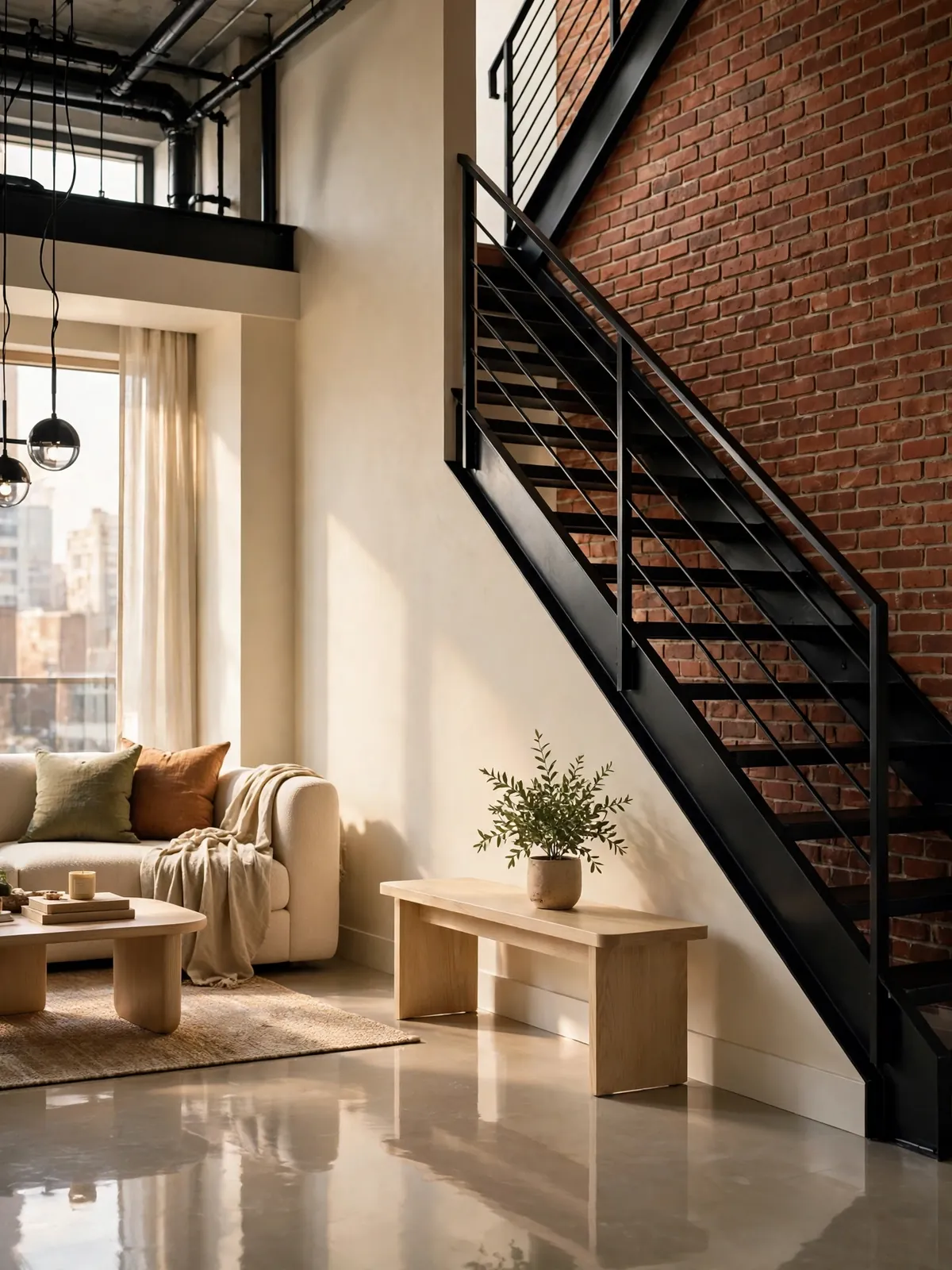
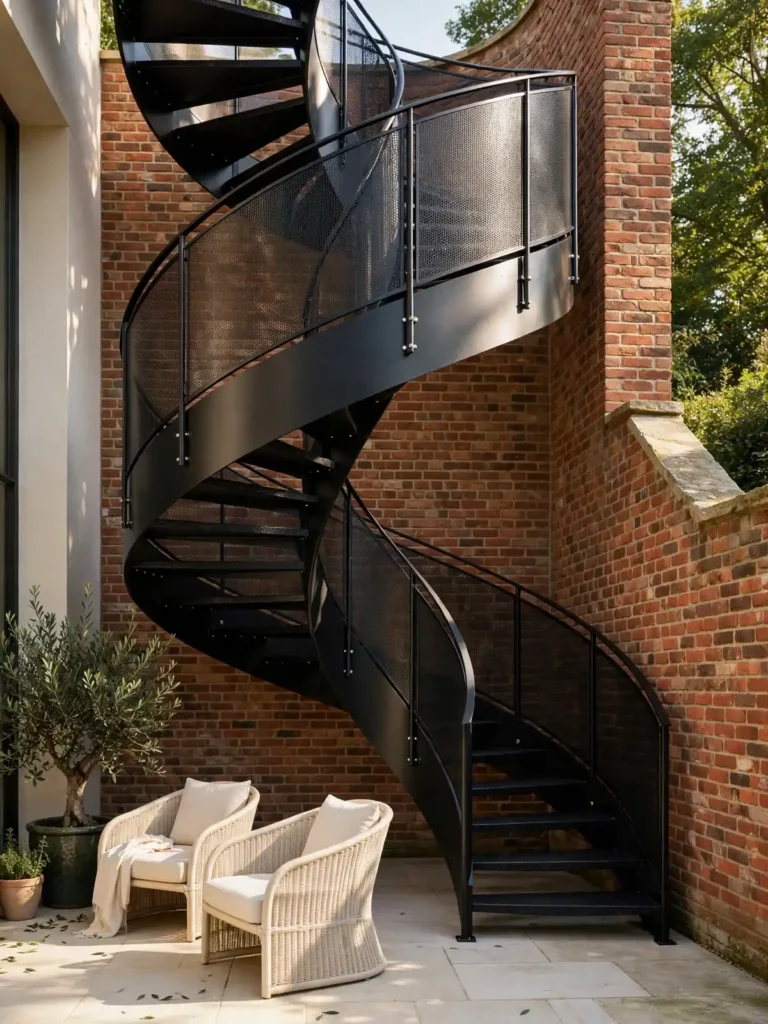
Exposed brick slips give a staircase wall a loft feel, because the rough texture and warm red tones contrast beautifully with smooth modern stairs. On this stair, warm red brick slips cover the full wall beside slim black metal treads, each 950 mm wide, with a pale oak bench and a small green plant at the base softening the brick. The wall grounds the room, the black steel keeps it modern, and the combination works in industrial, farmhouse and eclectic homes alike.
Quick tips:
- Choose warm red or whitewashed brick to suit your palette.
- Keep the treads slim and dark for contrast.
- Seal the brick so it does not shed dust.
- Add one soft fabric, such as a bench cushion, nearby.
A Minimalist Art Grid in Matching Frames
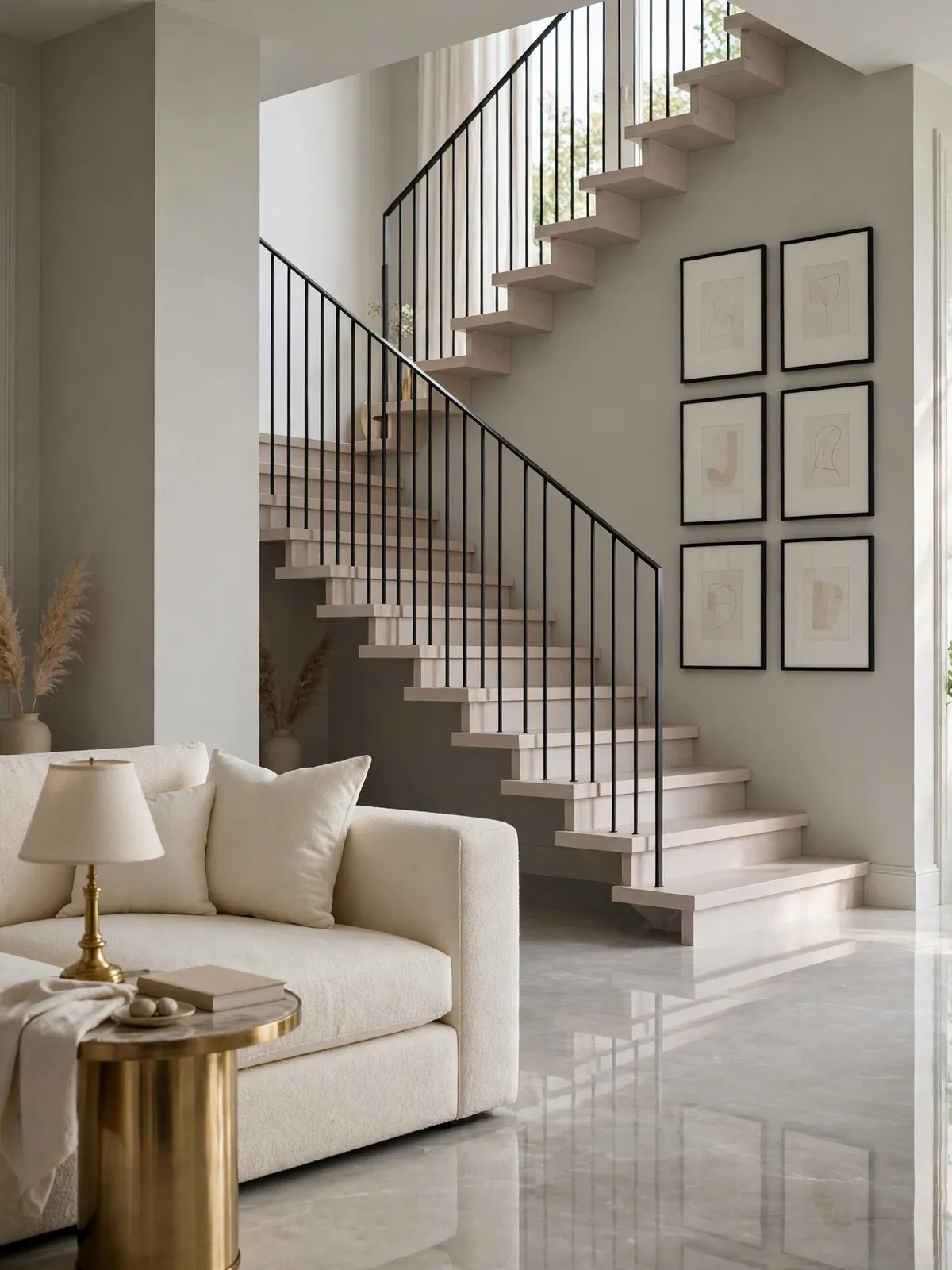
A minimalist art grid brings calm structure to a staircase wall, because identical frames in a strict grid feel orderly against the diagonal line of the stair. Here, six matching frames in pale wood hold abstract prints in soft grey, cream and sage, arranged in two neat rows on a soft grey wall beside pale ash treads. The grid contrasts with the stair’s slope in a satisfying way, the palette stays quiet, and the wall feels designed without demanding attention every time you climb.
Quick tips:
- Use identical frames, identical sizes and identical spacing.
- Choose art in a shared palette for cohesion.
- Hang the grid as one block, not scattered pieces.
- Keep the wall colour soft so the grid stays calm.
A Sculptural Handrail as the Wall Feature
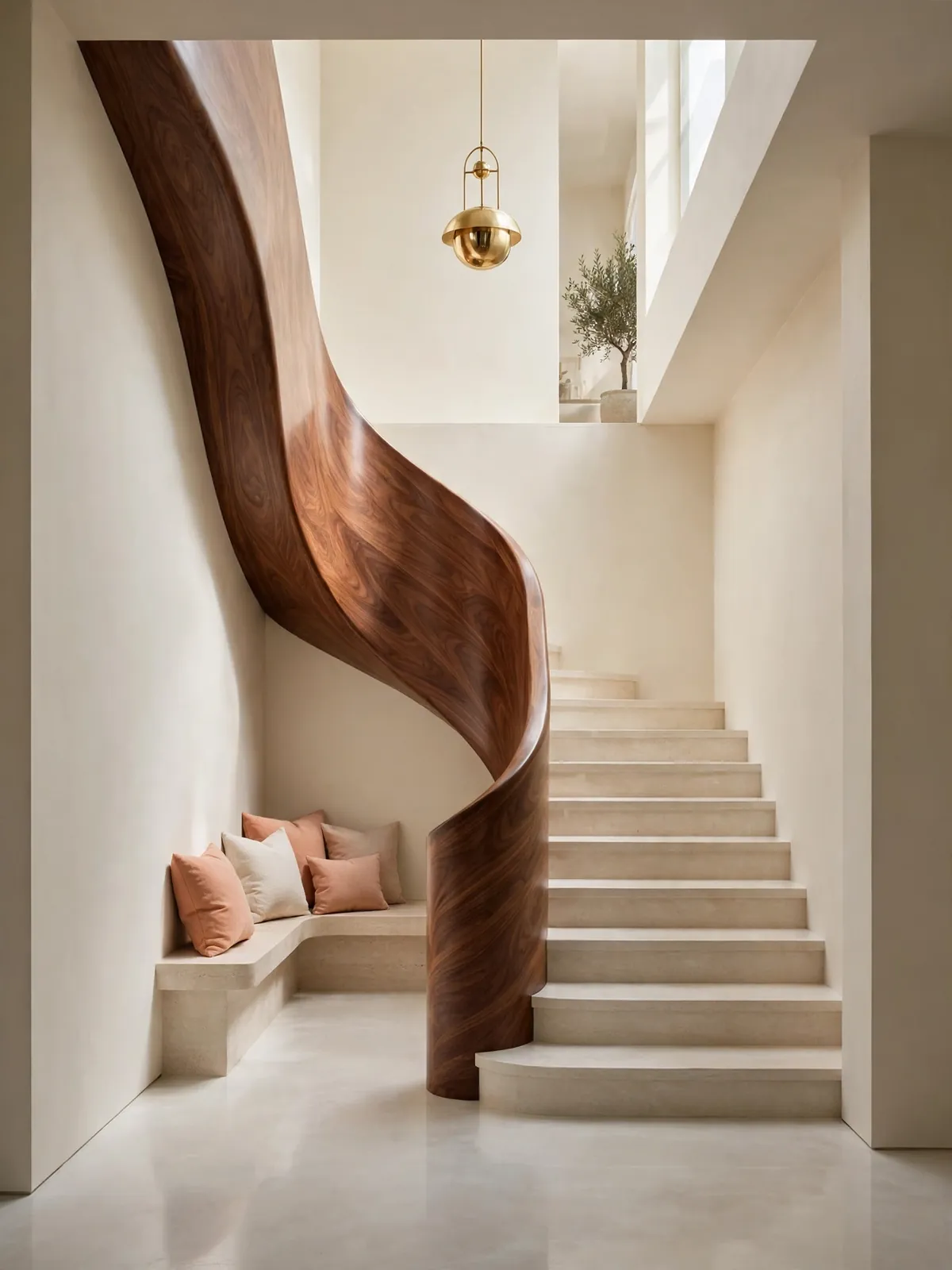
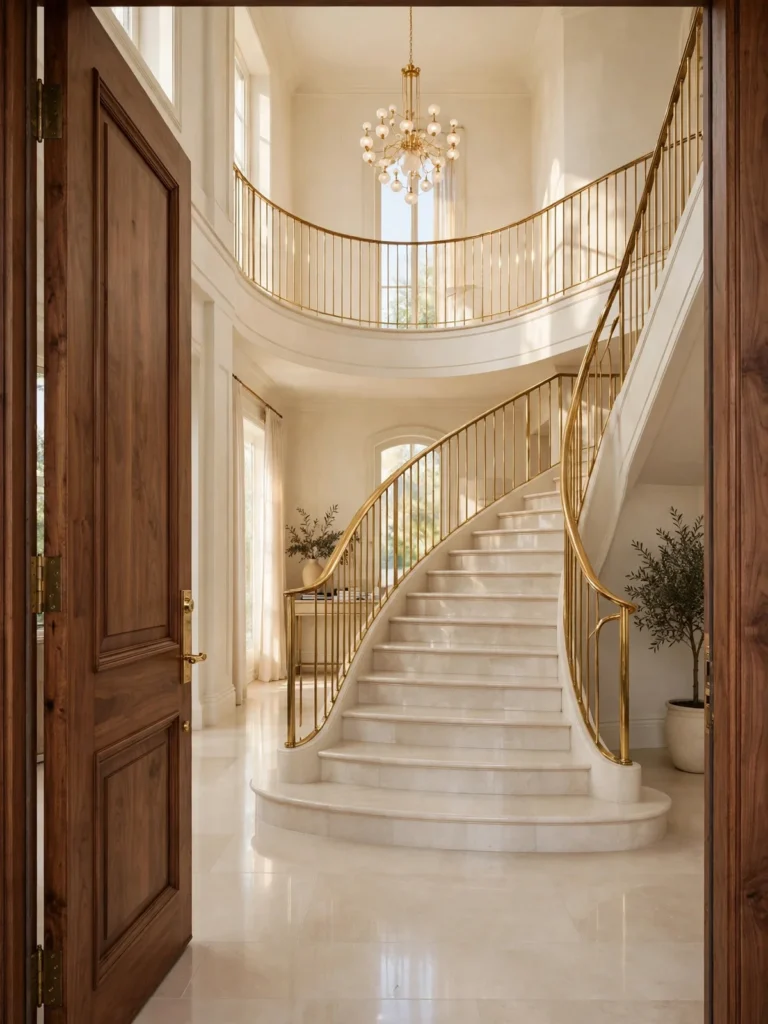
A sculptural handrail can be the staircase wall’s feature all on its own, because a beautiful curved rail against a plain wall needs nothing else. Here, a smooth walnut handrail curves gently along a plain cream wall beside pale stone treads, each 1 metre wide, with soft coral cushions on a bench at the base and a brass pendant above the landing. The wall stays deliberately empty so the handrail’s shape shines, and the stair reads as architecture rather than decoration — a quiet, confident design move.
Quick tips:
- Keep the wall plain so the handrail shape stands out.
- Choose a warm timber, such as walnut or oak, for the rail.
- Match the handrail timber to one other element nearby.
- Let the rail curve at the landing for a graceful finish.
Trailing Plants on Wall-Mounted Planters
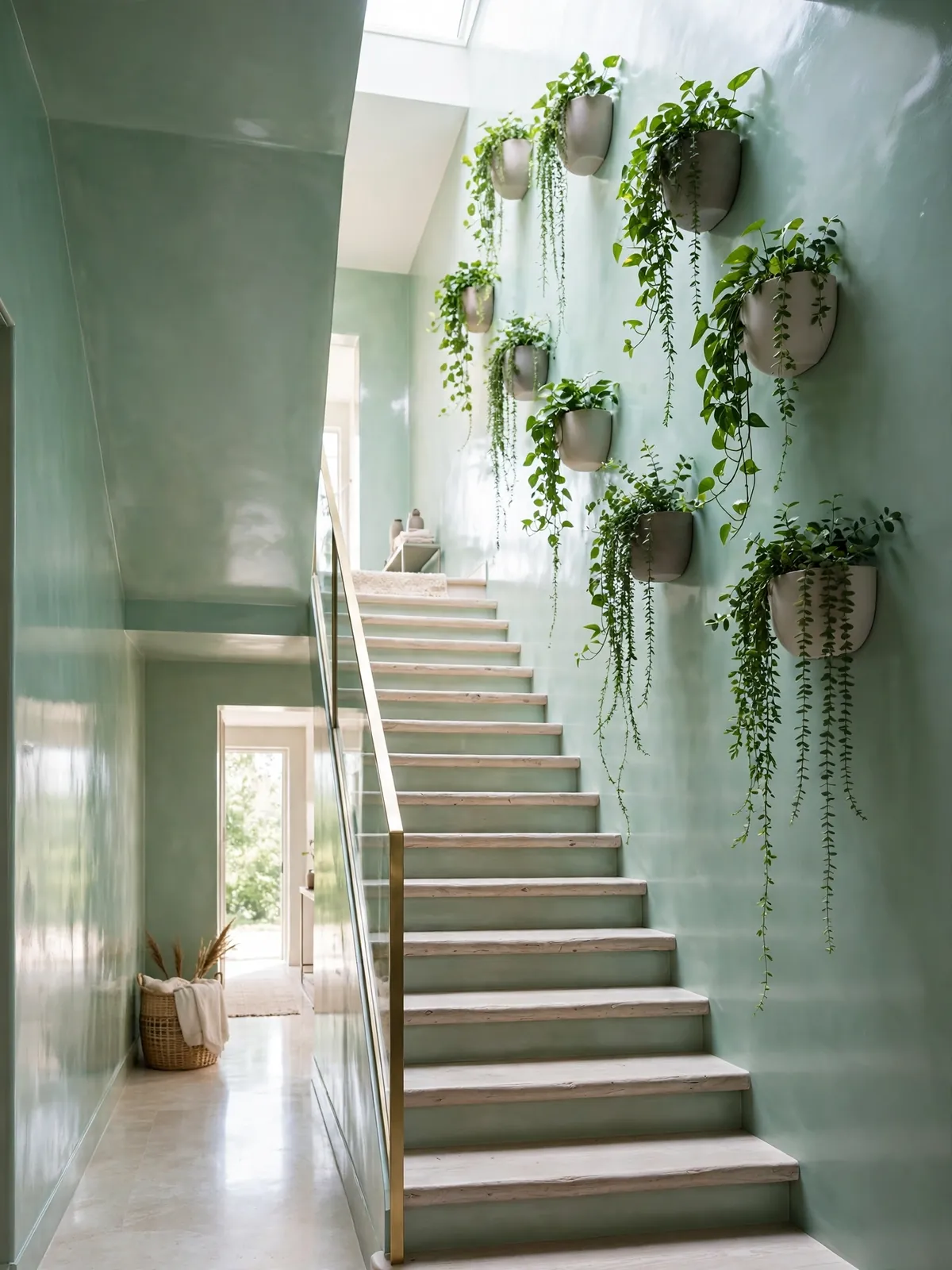
Trailing plants on wall-mounted planters bring life to a staircase wall, because the greenery softens hard edges and makes a transitional space feel alive. Here, three small brass planters are fixed to a soft seafoam wall beside pale driftwood treads, each 850 mm wide, with trailing pothos spilling gently downward and a woven basket at the base. The plants add movement and freshness, the seafoam wall keeps the stair calm, and the whole climb feels like passing through a small indoor garden.
Quick tips:
- Choose trailing plants such as pothos or ivy for movement.
- Use matching planters for a tidy, intentional look.
- Water carefully — drips stain stair walls quickly.
- Use realistic faux plants if the stair gets little light.
Two-Tone Paint Split at the Dado Line
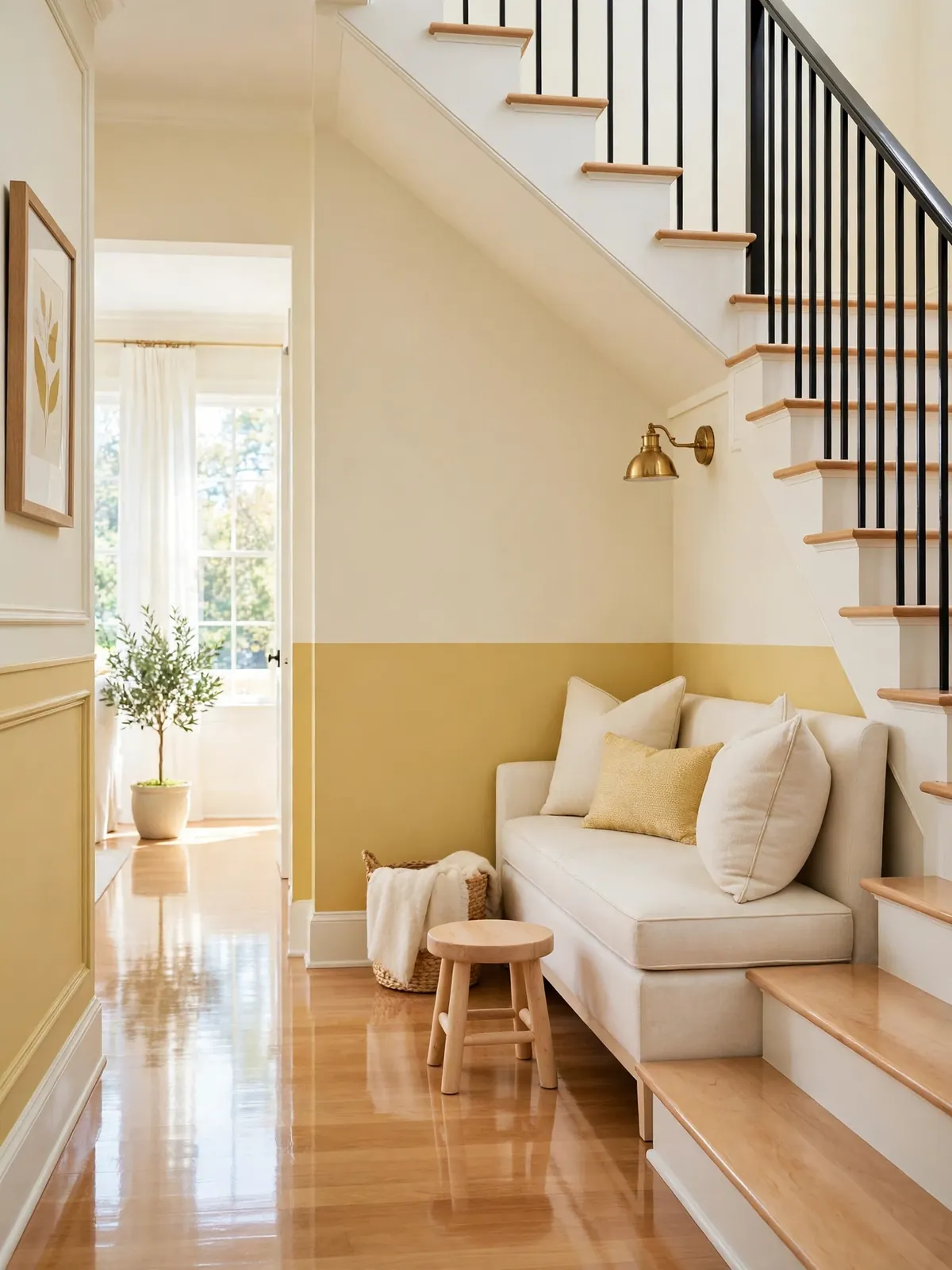
A two-tone paint split at the dado line is a simple, tailored staircase wall design idea, because the horizontal split adds structure to a tall wall without any building work. Here, the lower wall is painted soft mustard and the upper wall cream, with a slim white dado rail marking the split beside pale maple treads, each 900 mm wide. A cream bench at the base and a small wooden stool keep the hallway practical, while the mustard below grounds the stair and the cream above keeps it bright.
Quick tips:
- Place the split at dado height, about 900 mm from the tread nosing.
- Choose a warm lower colour and a pale upper colour.
- Add a slim dado rail for a finished, tailored edge.
- Echo the lower colour in one cushion or frame.
A Slim Console and Leaned Art on the Landing
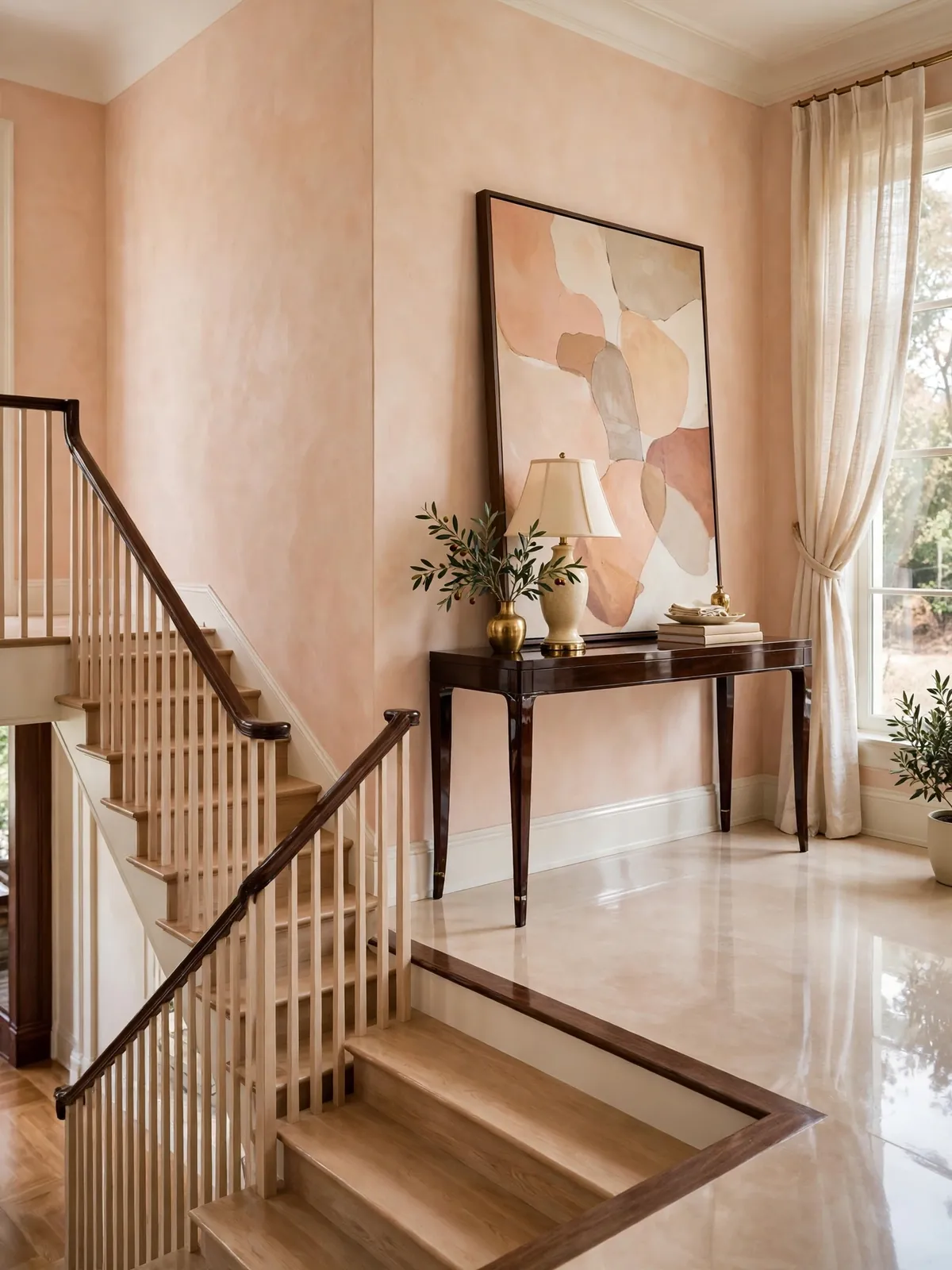
A slim console with leaned art on the landing turns the pause point of a stair into a styled moment, because the landing is the one place on a stair where furniture can sit without blocking the climb. Here, a slim dark walnut console, 250 mm deep, stands against a soft peach landing wall, with a large leaned canvas above it, a cream lamp and a small brass vase on top, beside pale oak treads. The landing stops feeling like leftover space and starts feeling like a small room of its own.
Quick tips:
- Keep the console under 300 mm deep so the landing stays clear.
- Lean one large artwork rather than hanging several small ones.
- Add one lamp for warmth in the evening.
- Keep the surface mostly clear — one vase, one book.
Staircase Wall Design Ideas That Leave Space to Breathe
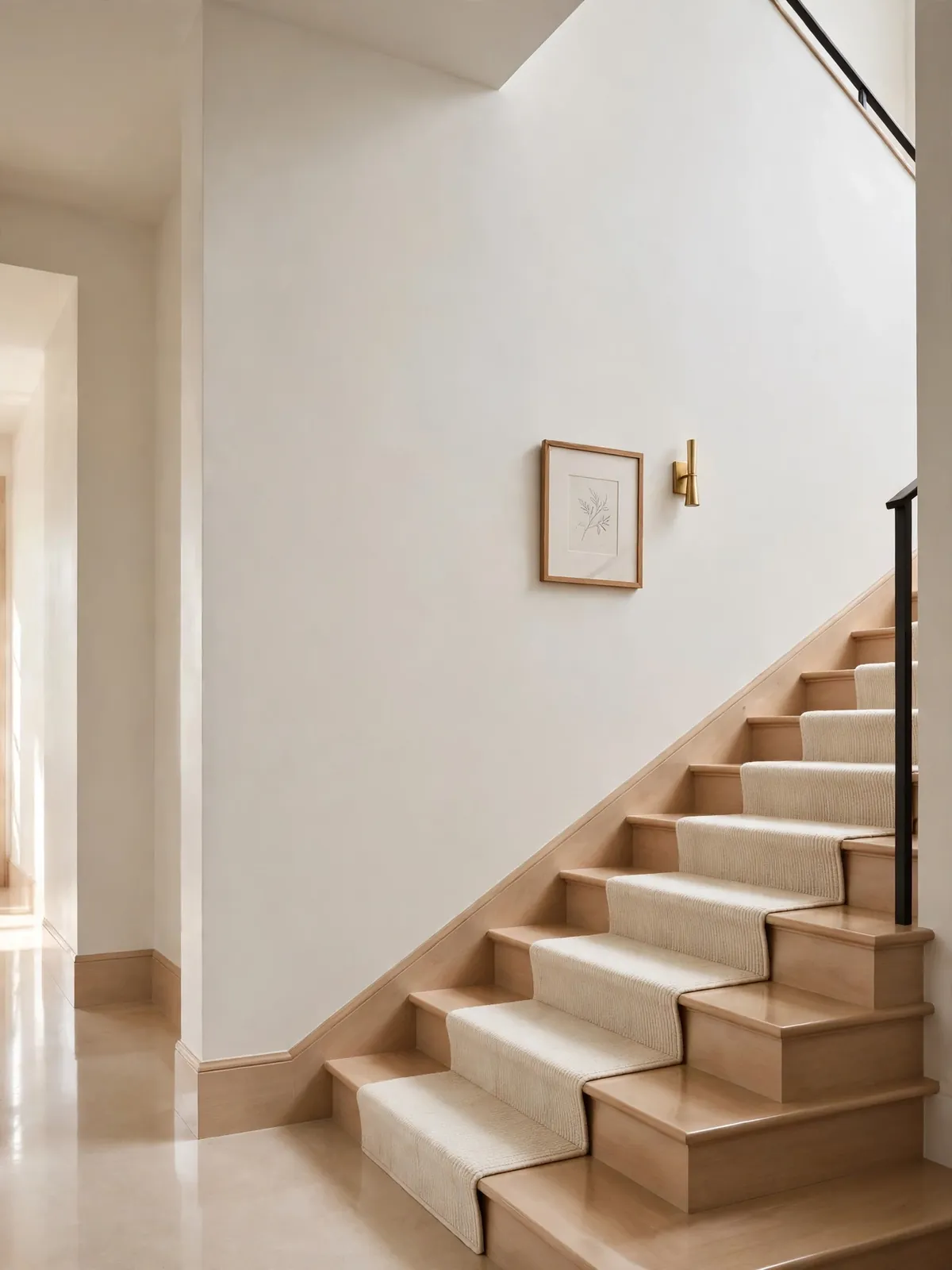
The last of these staircase wall design ideas is restraint itself: leaving most of the wall empty on purpose, because a staircase wall does not need to be filled to feel designed. Here, a soft warm white wall holds just one small framed print and a slim brass sconce beside pale oak treads, each 950 mm wide, with a cream runner softening the climb. The empty space lets the light, the shadows and the architecture breathe, and the single print feels more important than a dozen frames would. If every other idea in this guide adds something, this one reminds you that knowing when to stop is a design decision too — and often the most confident one.
Quick tips:
- Leave at least half the wall empty for a calm effect.
- Choose one strong piece — a print, a mirror or a sconce.
- Keep the wall colour warm white, not stark white.
- Let the stair’s own lines be the decoration.
FAQs
What colour should I paint a staircase wall?
Choose a colour that suits the light your stair gets. North-facing stairs suit warm colours such as terracotta, warm green or mustard; bright south-facing stairs can take deep navy, charcoal or forest green. If you are unsure, paint the stair wall one shade deeper than the hallway colour — it adds definition without a dramatic change.
How do I hang art on a sloped staircase wall?
Follow the stair angle. Mark the centre line of each frame along the slope, keeping the bottom edges parallel to the treads, and space frames evenly, about 50 to 60 mm apart. Use a paper template on the wall first, step back, and check the line from the bottom of the stairs before hammering any nails.
Is panelling a good idea on a staircase wall?
Yes, panelling is one of the best choices for a staircase wall, because it adds texture, hides scuffs from bags and shoes, and makes a tall wall feel structured. Vertical panelling suits modern and classic homes; board and batten suits farmhouse and traditional homes. Paint it the same colour as the wall for subtle texture, or a contrasting colour for drama.
Can I use wallpaper on a staircase wall?
Yes, but choose the right type. Paste-the-wall wallpaper is easiest on a tall stair wall, and peel-and-stick wallpaper suits renters or anyone who likes to change things. Avoid very busy patterns in narrow stairwells, and always order extra rolls — stair walls use more paper than flat walls because of the slope and the height.
How much does it cost to redesign a staircase wall?
A paint-only redesign can cost very little — a tin of paint and a weekend. Panelling or wood slats usually cost a few hundred pounds in materials for a confident DIY job, while stone veneer, a mural or a full-height gallery with framing can run into the low thousands. Start with paint, live with it for a month, then add panelling or art if the wall still feels unfinished.
Conclusion
A staircase wall deserves the same design attention as any room, because it is one of the tallest and most-seen surfaces in the home. Whether you choose full-height panelling, a bold deep green, warm wood slats, a climbing gallery wall, stone veneer, a tall mirror or simply the confidence to leave space empty, the best staircase wall design is the one that suits the rooms around it and the way your family lives. Start with the wall itself — colour, texture or structure — then add art and light on top, and your stair will stop being a passage and start being a feature you notice every single day.