30 Stunning Vintage Bathroom Ideas That Bring Old-World Charm Home
A vintage bathroom is a room with a past, even when everything in it is brand new. These 30 vintage bathroom ideas cover clawfoot tubs, pedestal sinks, checkerboard floors, floral wallpaper, antique brass taps and the small details that make the difference, so you can build a bathroom that feels collected over decades — with modern plumbing that actually works.
A vintage bathroom works when it feels like it grew over time, not like it was bought in one afternoon: a clawfoot tub, a gilded mirror, brass taps that have started to patina, and one piece of floral wallpaper that looks like it has always been there. The best vintage bathroom ideas start with that feeling and then solve the practical questions — which era you are borrowing from, how the old look copes with steam and splashes, and where to spend so the room feels authentic rather than themed.
If you love the look of stone and classic fixtures, these marble bathroom ideas show how to pair timeless surfaces with vintage details. The 30 ideas below cover the fixtures, the floors, the walls, the lighting and the finishing touches, with an era style guide in the middle, so you can build a vintage bathroom that feels romantic, characterful and genuinely usable every day.
Key Takeaways
What makes a bathroom look vintage?
A bathroom looks vintage when it borrows period details — a clawfoot tub or pedestal sink, cross-handle brass taps, patterned floor tiles, floral wallpaper or beadboard, and aged finishes like patinaed brass or worn wood. One or two strong period pieces plus a consistent palette matter more than filling the room with antiques.
Which vintage era should I choose for my bathroom?
Victorian bathrooms suit ornate mirrors, clawfoot tubs and dark wood; Edwardian rooms favour white porcelain, subway tiles and nickel; Art Deco loves black-and-white geometry, chrome and bold colour; and mid-century vintage suits pastel walls, mint tiles and simple wooden vanities. Pick one era and let it decide the fixtures and the palette.
Can I have a vintage bathroom in a small space?
Yes — a small vintage bathroom works best with a pedestal sink instead of a vanity, one patterned element such as a checkerboard floor or a floral accent wall, and a large gilded mirror to bounce light. Keep the palette pale and the floor visible so the room feels open rather than crowded.
How do I mix vintage style with modern plumbing?
Keep the visible parts vintage and the hidden parts modern: period-style taps with modern ceramic valves, a clawfoot tub with a modern thermostatic shower, and a high-tank toilet look with a modern concealed cistern. You get the old-world look with reliable water pressure, easy cleaning and no leaks.
Where should I spend and where should I save on a vintage bathroom?
Spend on the pieces you touch every day — taps, the tub, the mirror and the lighting — because cheap versions of those look and feel wrong. Save on accessories, wallpaper, rugs and storage, where flea-market finds, reproduction pieces and paint give you the same character for far less.
A Clawfoot Tub in Soft Sage and Cream That Anchors the Room
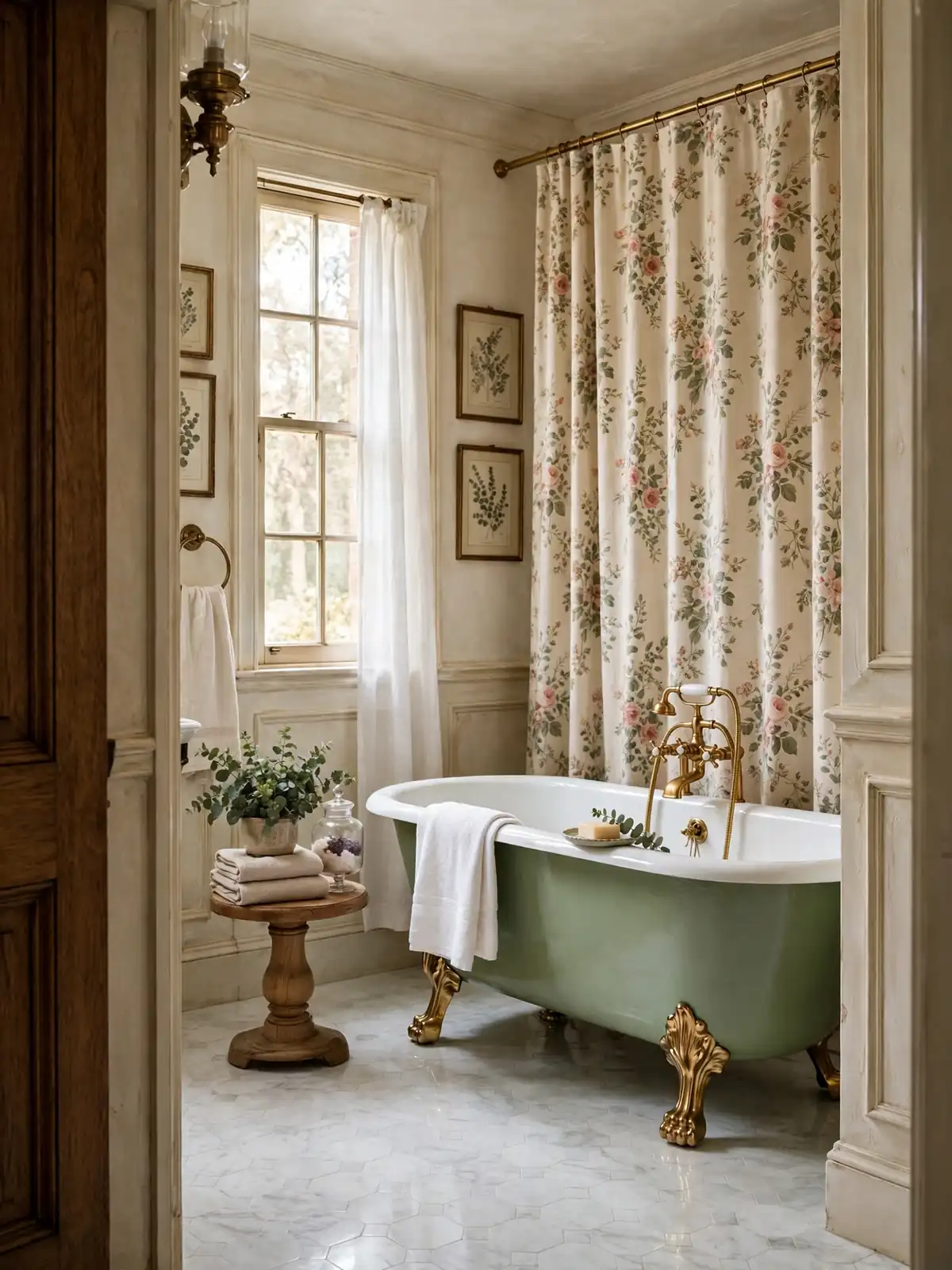
A clawfoot tub is the single most convincing vintage bathroom statement, because nothing else in the room reads as instantly period — the curved body, the raised feet and the freestanding shape make the whole bathroom feel like it belongs to another era. Here, a white clawfoot tub with a sage green painted exterior and brass claw feet stands against cream walls, with a soft floral shower curtain and a brass floor-mounted tap completing the picture. The design suits anyone who loves long baths and has a medium or large bathroom, it becomes the room’s focal point without any other decoration, and it photographs beautifully. The weakness is practicality: a clawfoot tub needs floor space around it, it is awkward to shower in without a proper curtain ring, and it is heavier than a built-in bath, so check the floor can take the weight.
Quick tips:
- Paint the tub exterior in sage, dusty rose or powder blue for a period feel.
- Use a brass floor-mounted tap and a full curtain ring for showers.
- Leave at least 10 cm of clear floor around the tub for cleaning.
- Add a small wooden bath tray so the tub feels used, not staged.
A Gilded Ornate Mirror That Crowns the Vanity
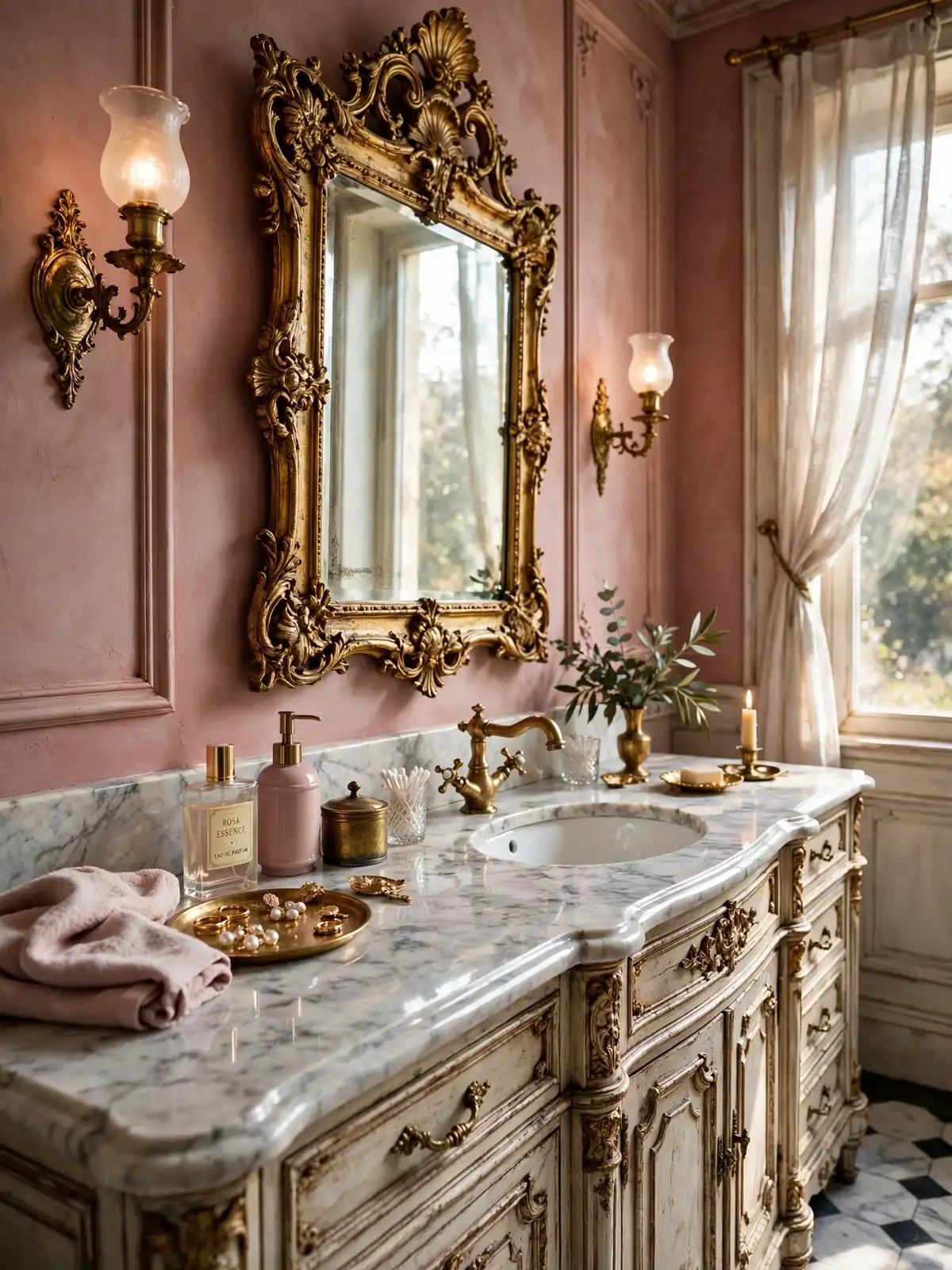
A gilded ornate mirror turns an ordinary vanity into a piece of theatre, because the carved gold frame catches the light and makes even a plain sink feel like it belongs in a grand hotel. Here, a large baroque mirror with a carved gold frame hangs above a white marble countertop, with dusty rose walls and brass sconces warming the composition. The design suits bathrooms that feel too plain or too modern, it is one of the cheapest ways to add vintage drama, and it reflects light into dark corners. The weakness is scale: a mirror that is too small looks lost above a wide vanity, and a very heavy antique frame needs proper wall fixings, so measure the vanity and use a stud or masonry anchor.
Quick tips:
- Choose a mirror at least two-thirds as wide as the vanity.
- Match the gold tone to the taps or the light fittings.
- Hang it at eye level, with the centre around 150 cm from the floor.
- Use proper wall anchors for heavy antique frames.
Classic Black-and-White Checkerboard Floors With Bold Retro Drama
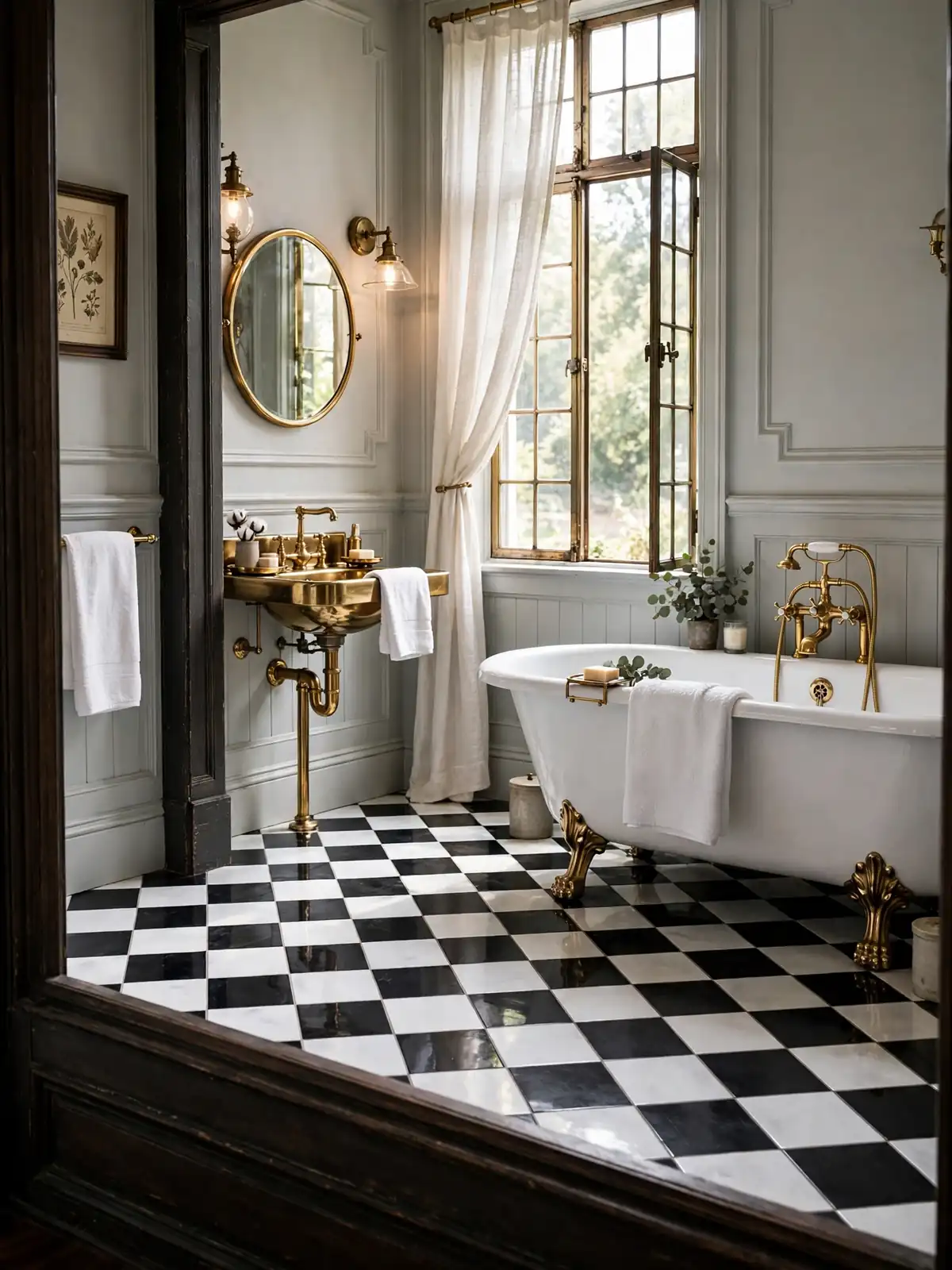
Black-and-white checkerboard floors are the boldest vintage bathroom foundation, because the graphic squares set the tone of the whole room before a single fixture is chosen, and they pair with almost every period style from Victorian to Art Deco. Here, matte black and white checkerboard tiles run under a white clawfoot tub, with brass fixtures and pale grey walls keeping the rest of the room calm. The design suits bathrooms of any size, it hides dirt better than plain white tile, and it makes a small room feel designed rather than improvised. The weakness is visual noise: in a very small room the pattern can feel busy, so keep the walls plain and the accessories minimal, and use larger tiles in a tiny space so the grid reads as calm.
Quick tips:
- Use matte tiles for a soft retro feel, glossy for more drama.
- Keep walls plain so the floor stays the star.
- Choose larger squares in a small bathroom to calm the pattern.
- Seal the grout well, since black grout shows limescale.
Floral Wallpaper With a Vintage-Worn Finish on One Feature Wall
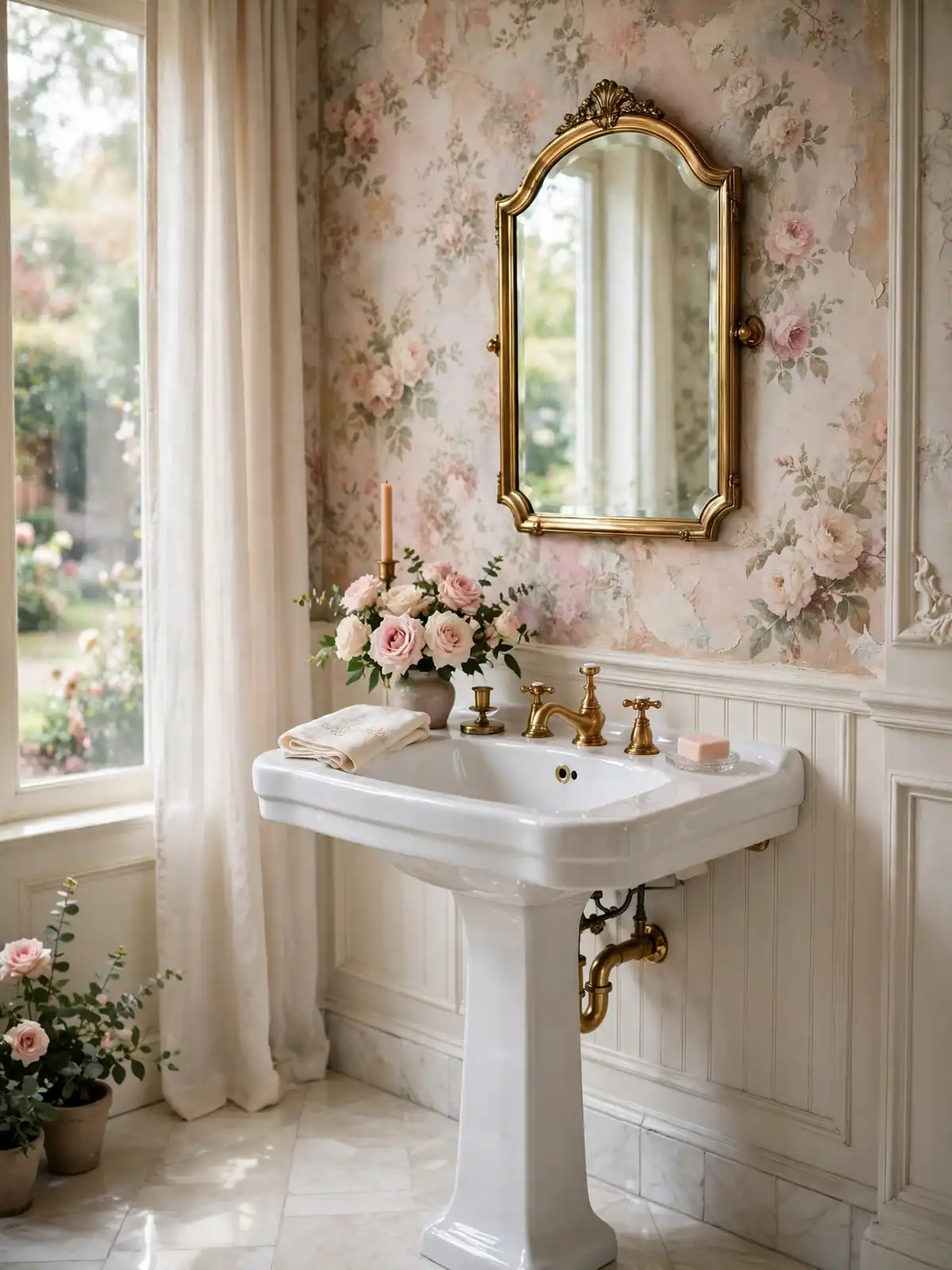
Floral wallpaper with a faded, vintage-worn finish gives a bathroom the feel of a room that has been loved for decades, because the soft, slightly muted pattern adds romance without the sharpness of a brand-new print. Here, blush pink and cream roses cover the wall behind the vanity, with a white pedestal sink and a brass-framed mirror keeping the rest of the room quiet. The design suits plain bathrooms that feel forgettable, it is a weekend job, and it makes the room photograph like a boutique hotel. The weakness is moisture: ordinary wallpaper peels in steam, so use a bathroom-rated or vinyl-coated paper, ventilate well, and keep it away from direct shower spray.
Quick tips:
- Wallpaper one wall only, behind the vanity or the tub.
- Choose a bathroom-rated or vinyl-coated paper.
- Pull one colour from the paper into the towels.
- Keep the other walls pale and plain so the pattern breathes.
A Pedestal Sink With Cross-Handle Taps for Period Elegance
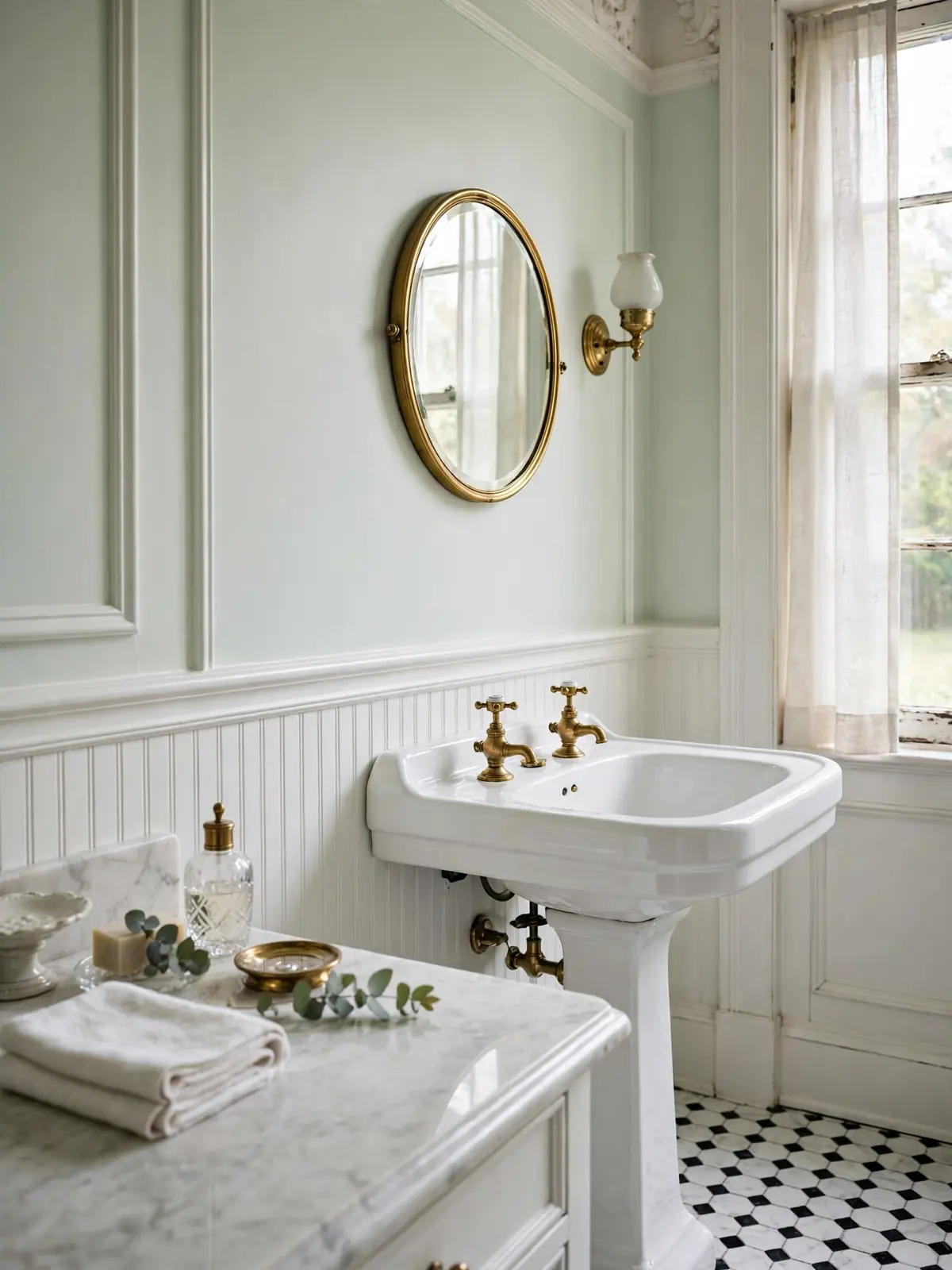
A pedestal sink with cross-handle taps is the quietest kind of vintage elegance, because the slender column and the ceramic handles say period without shouting, and the open floor underneath makes a small bathroom feel larger. Here, a white porcelain pedestal sink with ceramic cross-handle brass taps stands against pale mint walls, with a small round mirror and a folded linen towel completing the look. The design suits small vintage bathrooms best, it is easy to clean around, and it pairs with every era from Edwardian to mid-century. The weakness is storage: a pedestal sink holds nothing, so add a wall cabinet, a shelf or a basket for toiletries, and keep the counter clear.
Quick tips:
- Choose ceramic cross handles for authentic period detail.
- Add a mirrored wall cabinet for the storage the sink lacks.
- Keep the floor under the pedestal clear to show the shape.
- Match the tap finish to the mirror frame or light fittings.
A High-Tank Pull-Chain Toilet for True Old-World Theatre
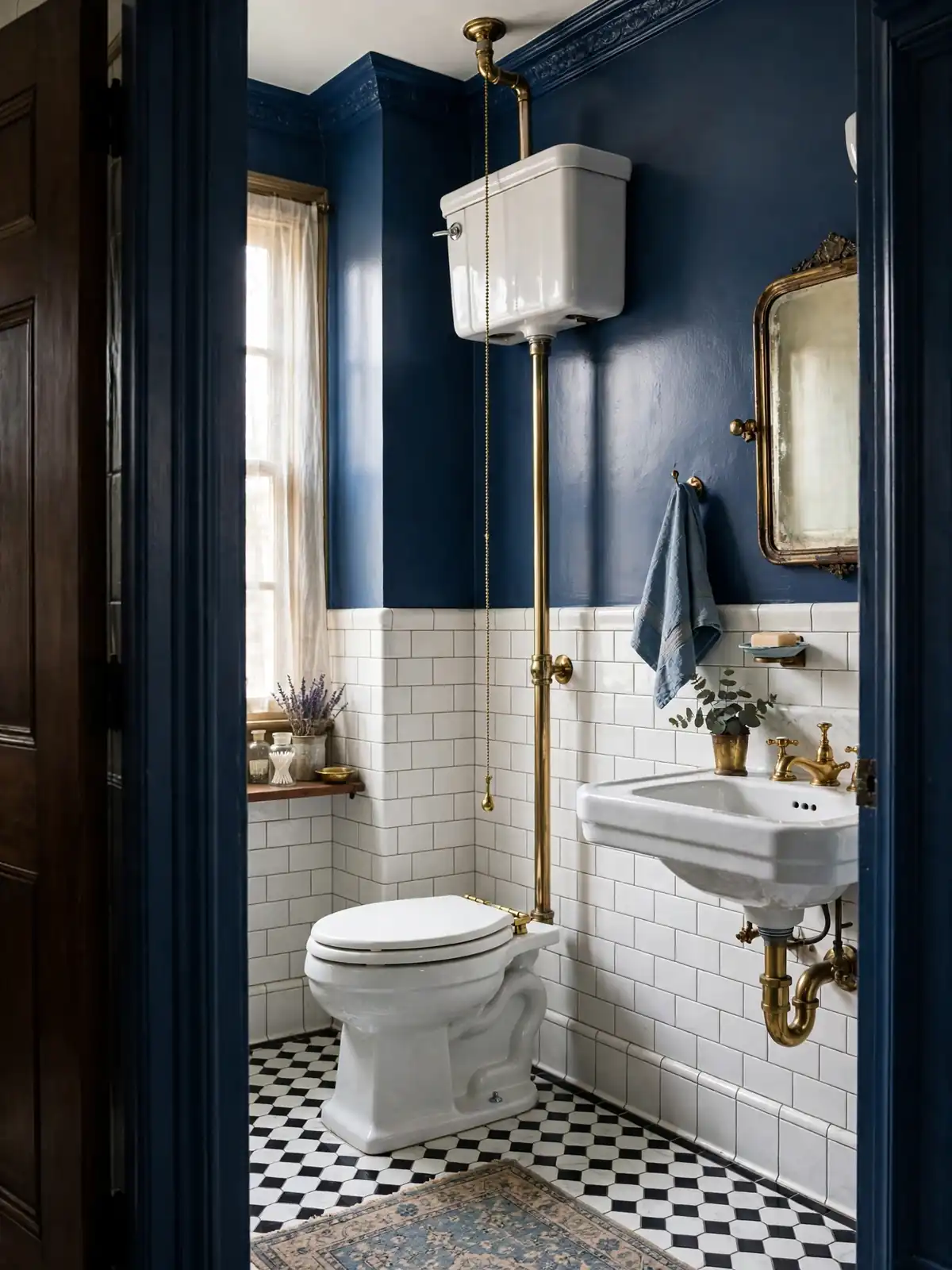
A high-tank pull-chain toilet is the most theatrical vintage bathroom fixture, because the elevated tank, the long brass chain and the exposed pipe turn an ordinary necessity into a conversation piece that guests will remember. Here, a white porcelain tank mounted high on a navy blue wall connects to the bowl by a brass pipe, with white subway tiles and a brass towel ring completing the room. The design suits bathrooms with a sense of humour and a love of period detail, and it becomes the room’s talking point on its own. The weakness is practicality: genuine high-tank toilets are expensive, the flush is louder than a modern close-coupled toilet, and parts can be hard to find, so many people choose a modern toilet with a vintage-look lever instead.
Quick tips:
- Check the wall can take the tank’s weight before fitting.
- Choose a long brass chain that hangs within easy reach.
- Keep the pipe polished, since it is part of the look.
- Consider a modern toilet with a vintage lever if budget is tight.
A Curvy Vintage Vanity With Ornate Hardware and Carved Legs
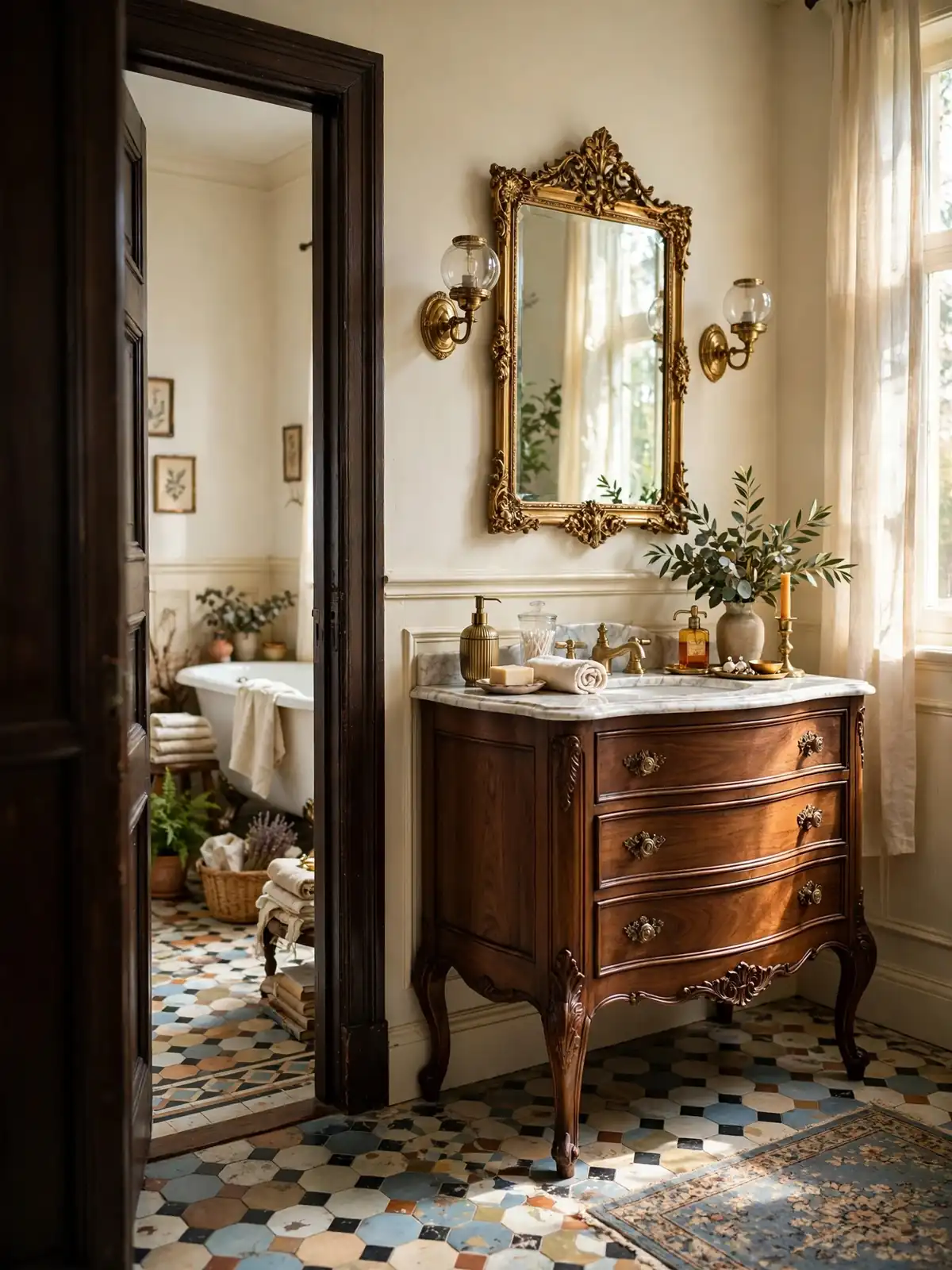
A curvy vintage vanity with ornate hardware gives a bathroom the feel of a collected piece of furniture rather than a bathroom unit, because flowing lines, carved legs and delicate brass knobs carry a history that a plain box vanity cannot. Here, a walnut vanity with carved legs and ornate brass knobs sits under a marble-look countertop, with cream walls and a simple oval mirror keeping the rest of the room quiet. The design suits bathrooms that feel too new or too plain, it becomes the focal point on its own, and it hides everyday essentials behind drawers. The weakness is upkeep: curved wood and ornate hardware collect dust and water marks, so seal the countertop well and wipe the legs and knobs regularly.
Quick tips:
- Let the vanity be the star and keep the rest simple.
- Use antique brass or aged bronze hardware throughout.
- Seal the countertop well, since vintage pieces see spills.
- Add a small tray on top so toiletries never sit directly on the wood.
Antique-Style Brass Taps That Work Like Jewellery for the Room
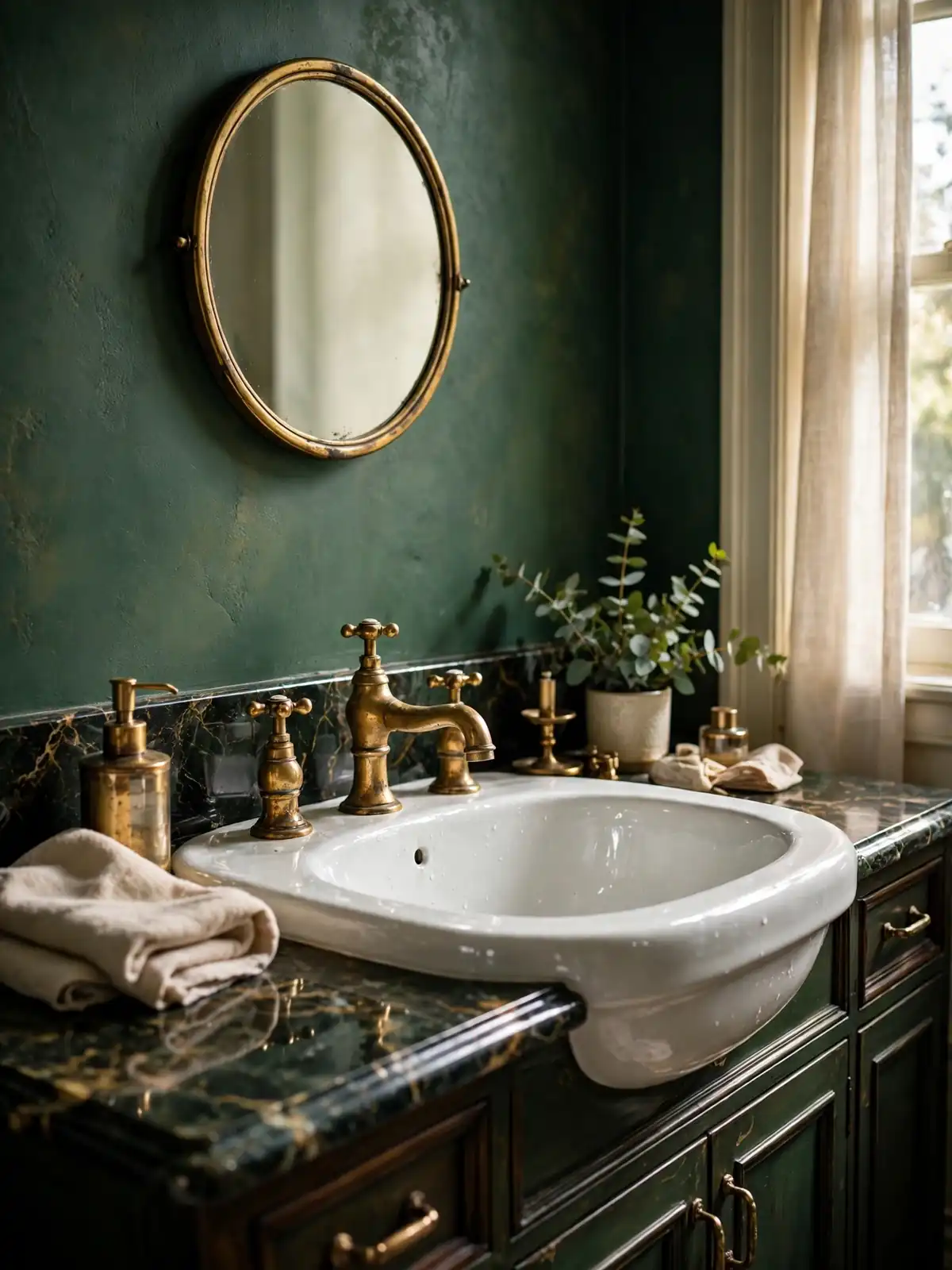
Antique-style brass taps are the smallest change with the largest effect in a vintage bathroom, because the warm gold tones work like jewellery against white porcelain and pale walls, and the patina that develops over time only adds to the character. Here, aged brass cross-handle taps sit on a white porcelain basin against deep green walls, with a small brass-framed mirror above. The design suits any vintage bathroom, it is a relatively cheap upgrade, and it ties the whole room together when the mirror frame and light fittings match. The weakness is maintenance: unlacquered brass tarnishes and shows water spots, so wipe the taps after use or choose a lacquered finish if you prefer a consistent shine.
Quick tips:
- Match the tap finish to the mirror frame and light fittings.
- Choose modern ceramic valves inside for reliable water flow.
- Wipe unlacquered brass after use to control the patina.
- Pair brass with porcelain, pastel walls or patterned tile.
Beadboard Wainscoting for Texture, Charm and Splash Protection
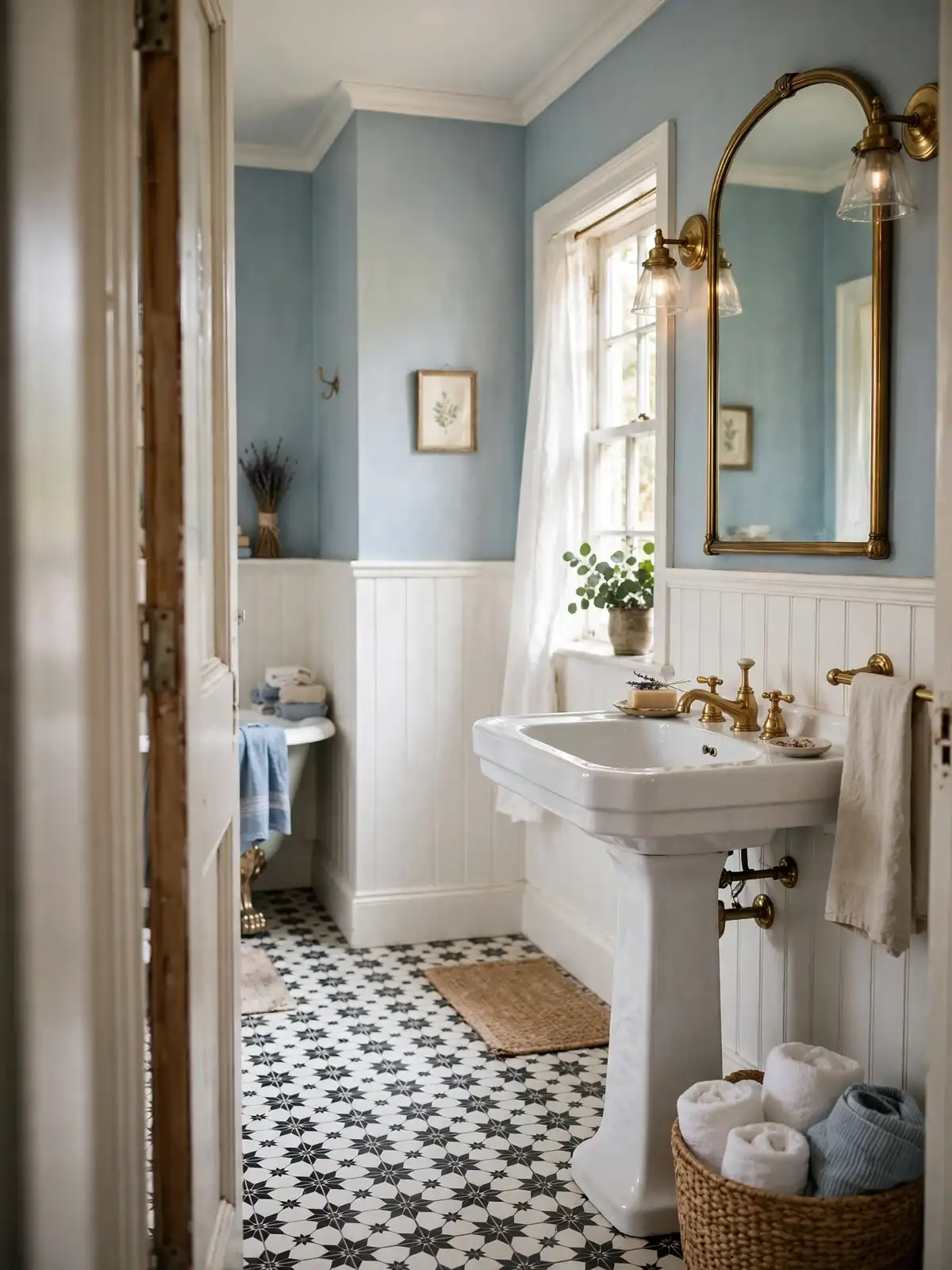
Beadboard wainscoting adds instant vintage character to a bathroom, because the vertical panels bring architectural texture to plain walls while protecting them from splashes, and the look suits everything from a country cottage to a classic Edwardian home. Here, white beadboard runs to chair-rail height under soft blue upper walls, with a white pedestal sink, brass fixtures and a woven basket completing the cottage feel. The design suits bathrooms with plain walls, it is a weekend DIY job, and it hides uneven plaster. The weakness is moisture: unpainted or poorly sealed beadboard swells in steam, so use moisture-resistant panels, paint them with bathroom-rated paint, and seal the top edge.
Quick tips:
- Paint beadboard with bathroom-rated paint for steam resistance.
- Run it to chair-rail height, around 90 cm from the floor.
- Cap it with a small ledge that can hold a candle or plant.
- Keep the upper wall colour soft so the room stays light.
Subway Tiles With Dark Grout for an Old-World Apothecary Feel
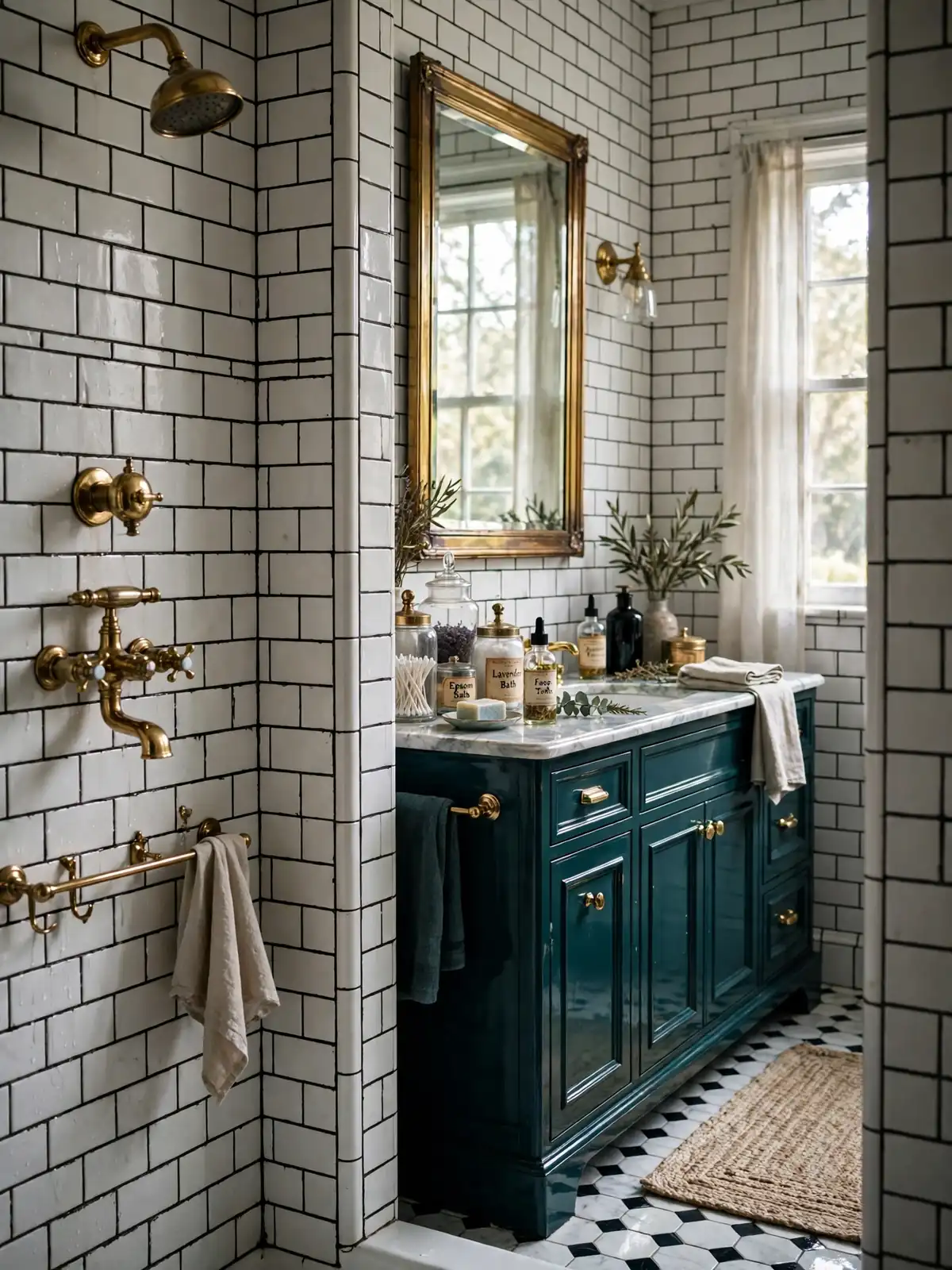
Subway tiles with dark grout give a bathroom an old-world apothecary feel, because the dark lines define every tile and turn a plain white wall into a crisp geometric pattern that reads as deliberately vintage. Here, white subway tiles with charcoal grout cover the shower wall, with brass fittings and a deep teal vanity adding warmth and colour. The design suits showers, splashbacks and full feature walls, it hides stains better than white grout, and it works with every vintage era. The weakness is cleaning: dark grout shows limescale and soap scum, so seal it after fitting and wipe the shower wall down after use.
Quick tips:
- Use charcoal or dark grey grout, not pure black, for a softer look.
- Seal the grout after fitting to resist stains.
- Keep the tile layout in a classic brick pattern.
- Pair with brass fittings and one strong accent colour.
Frosted Glass Sconces That Cast a Soft, Flattering Vintage Glow
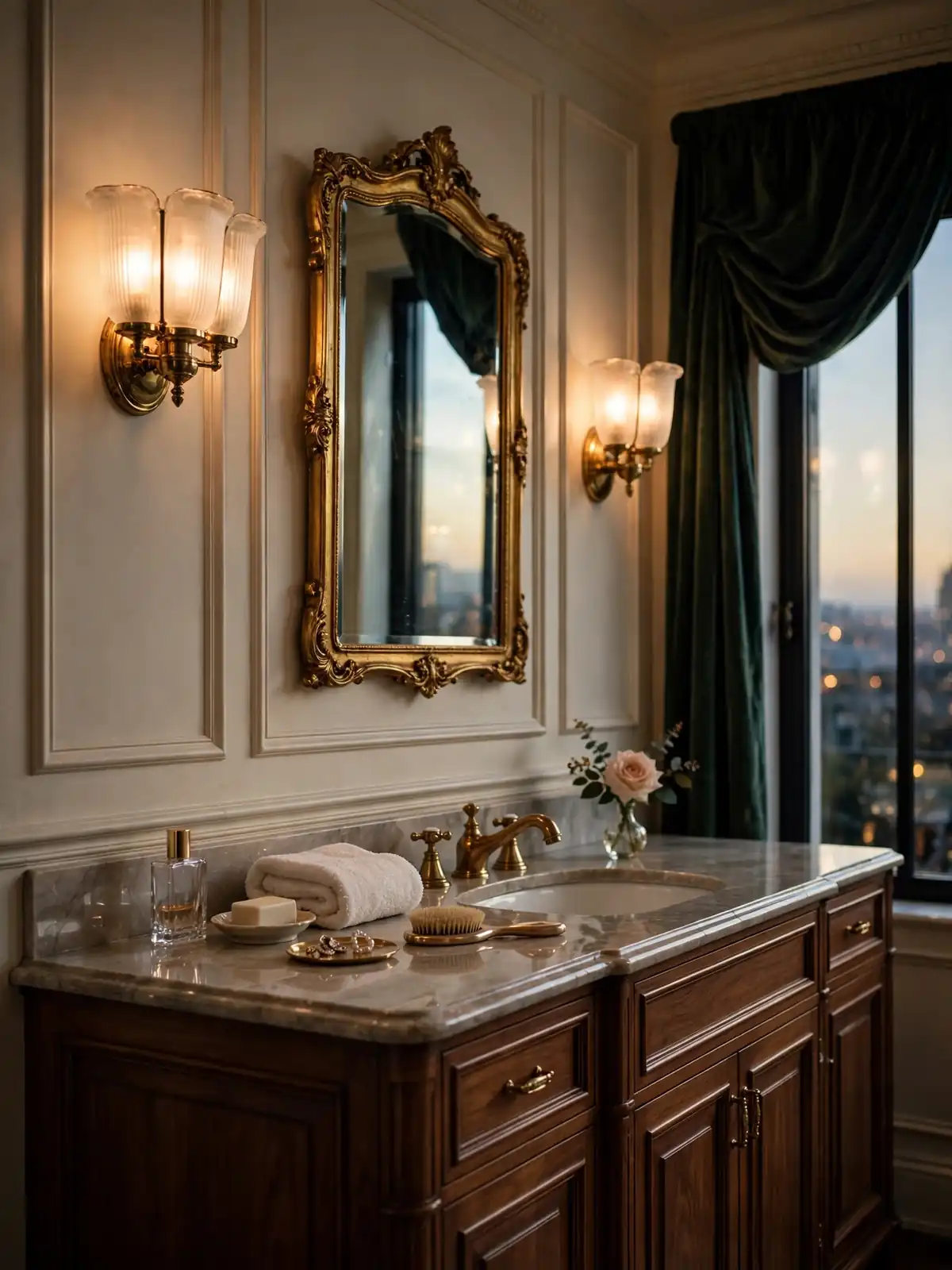
Frosted glass sconces are the vintage bathroom lighting choice that flatters everyone, because the diffused glass softens the light at face level and the old-Hollywood shape adds instant period glamour to the mirror wall. Here, two frosted glass sconces flank a gilded mirror above a walnut vanity, with ivory walls and brass taps completing the warm composition. The design suits bathrooms where people get ready, it improves the light more than any overhead fitting, and it hides fingerprints on the glass. The weakness is brightness: frosted glass dims the bulb, so choose bulbs a little brighter than you would for clear glass, and use warm 2700K bulbs for a flattering tone.
Quick tips:
- Mount sconces at face level, not above the mirror.
- Choose warm bulbs around 2700K for flattering light.
- Pick a slightly brighter bulb to allow for the frosted glass.
- Match the sconce metal to the taps and mirror frame.
Choose Your Vintage Era and Let It Decide the Whole Room
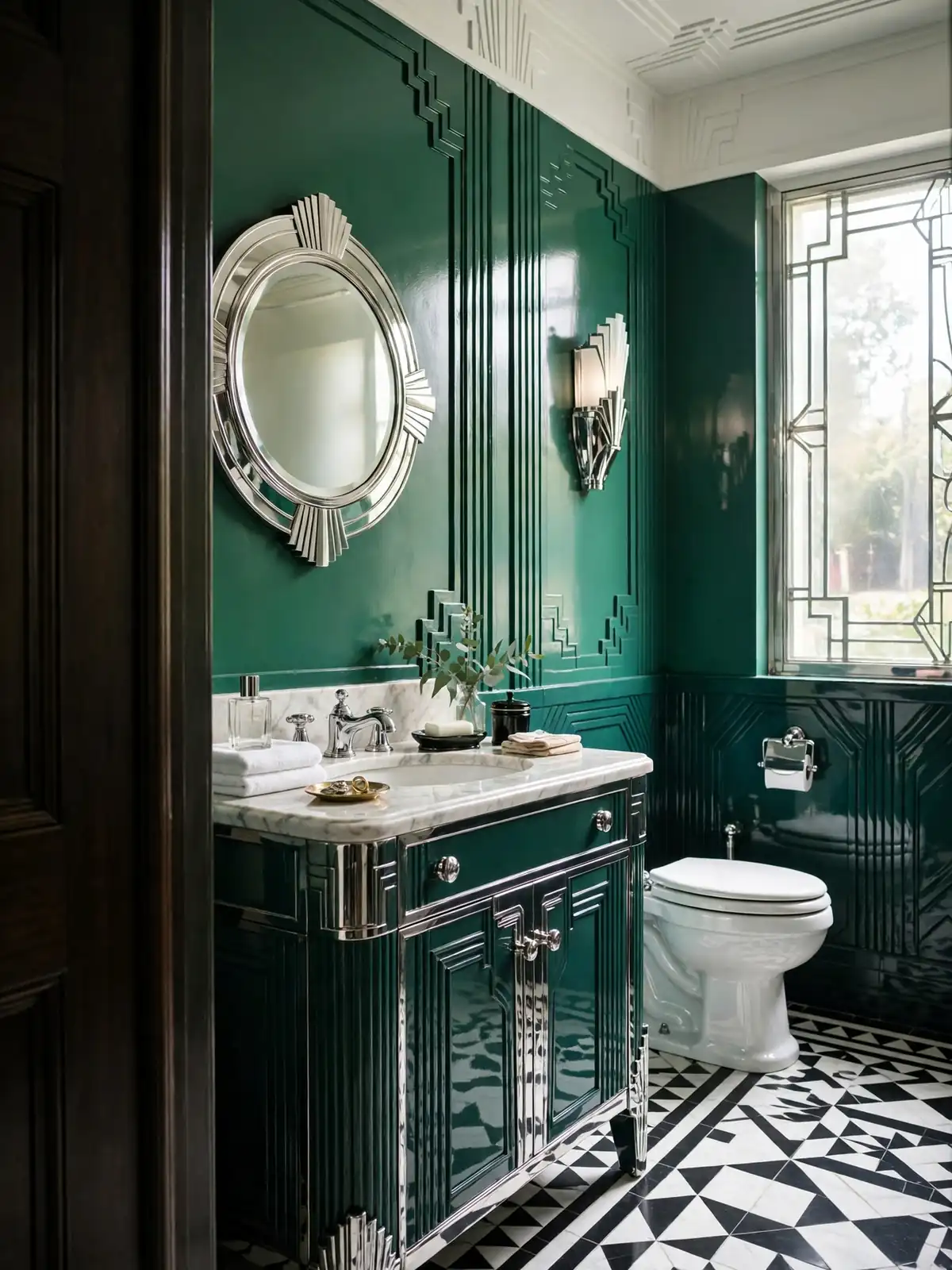
Choosing one vintage era keeps a bathroom from becoming a random collection of old-looking things, because a defined period gives you a palette, a set of fixtures and a rule for every later decision — if it does not fit the era, it does not go in the room. Here, an Art Deco bathroom shows how it works: black-and-white geometric floor tiles, chrome fixtures, bold emerald green walls and a round mirror, all pulling in the same direction. The design suits anyone starting a vintage bathroom from scratch, it prevents expensive mismatches, and it makes the room feel intentional rather than themed. The weakness is rigidity: an era followed too strictly can feel like a museum, so leave room for one modern comfort, like a heated towel rail or a good shower, and one personal item, like a framed family photograph.
Quick tips:
- Pick the era that matches the rest of your home.
- Write the palette down before you buy anything.
- Keep the fixtures in one finish throughout.
- Allow one modern comfort so the room stays practical.
| Vintage era | Best for | Colours | Key fixtures |
|---|---|---|---|
| Victorian | Ornate, dramatic rooms | Deep red, navy, dark wood, brass | Clawfoot tub, gilded mirror, high-tank toilet |
| Edwardian | Light, classic bathrooms | White, cream, pale blue, nickel | Pedestal sink, subway tiles, beadboard |
| Art Deco | Bold, glamorous spaces | Black, white, emerald, chrome | Geometric tiles, round mirror, chrome taps |
| Mid-century | Small, relaxed bathrooms | Mint, dusty rose, butter yellow | Pastel tub, wooden vanity, simple mirror |
| French Country | Soft, romantic rooms | Lavender, sage, cream, aged brass | Floral wallpaper, ceramic pitcher, lace curtains |
A Vintage Apothecary Cabinet With Small Drawers and Glass Fronts
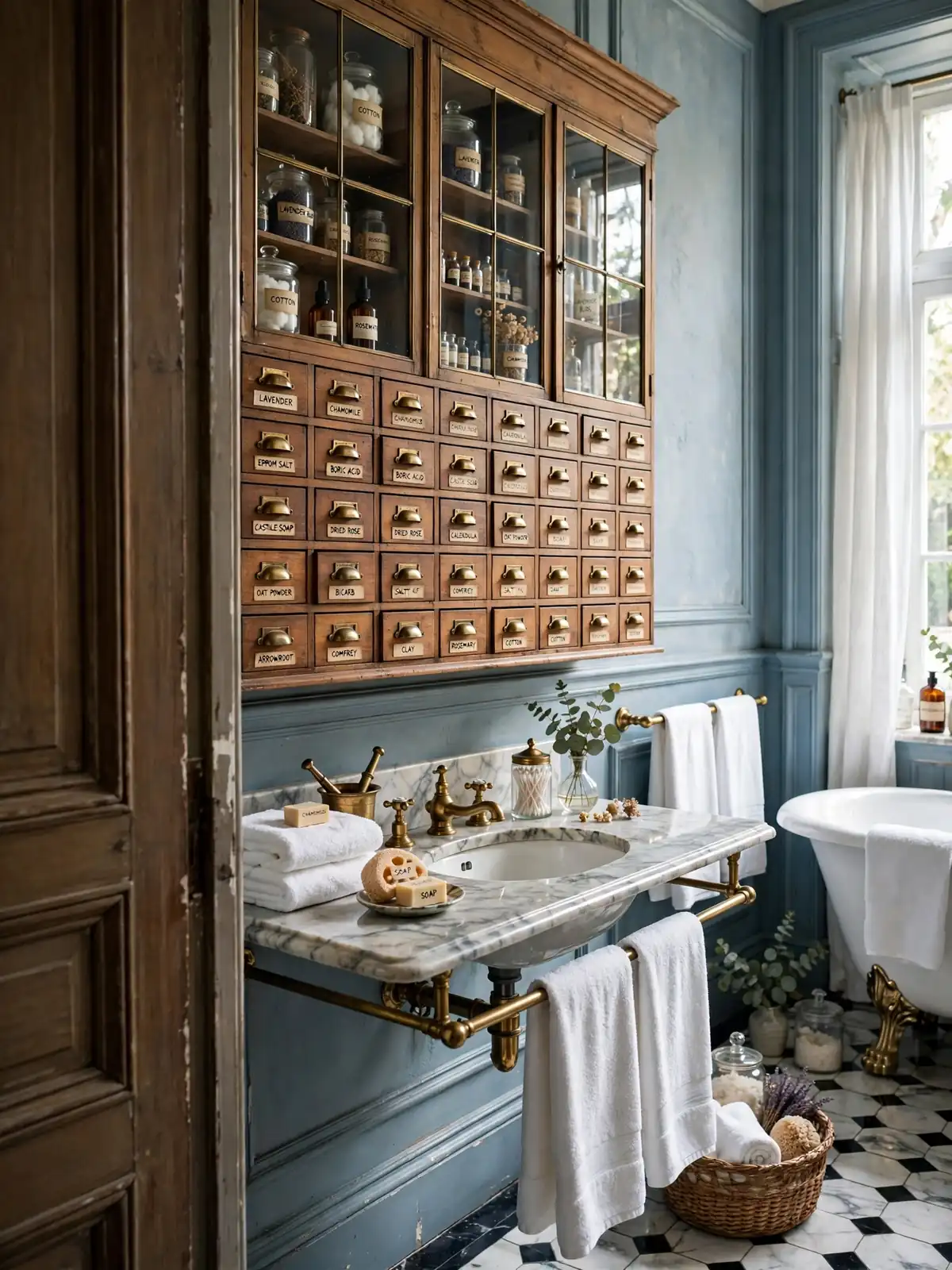
A vintage apothecary cabinet turns ordinary bathroom storage into a piece of history, because the small drawers and glass-front compartments recall an old chemist’s shop and make even cotton pads and bath salts look curated. Here, a worn wooden apothecary cabinet with brass pulls stands against dusty blue walls, its glass compartments holding folded white towels and amber jars. The design suits bathrooms that need storage with character, it keeps small items organised, and a slightly chipped or worn cabinet only adds authenticity. The weakness is capacity: small drawers hold little, so use the cabinet for display and daily essentials, and keep bulk supplies in a vanity or a linen cupboard.
Quick tips:
- Use the cabinet for daily essentials and display, not bulk storage.
- Label the drawers with small brass or paper tags.
- Keep one compartment for display only, with a candle or dried flowers.
- Choose a worn finish — chips and patina add authenticity.
A Delicate Chandelier or Crystal Pendant Above the Tub
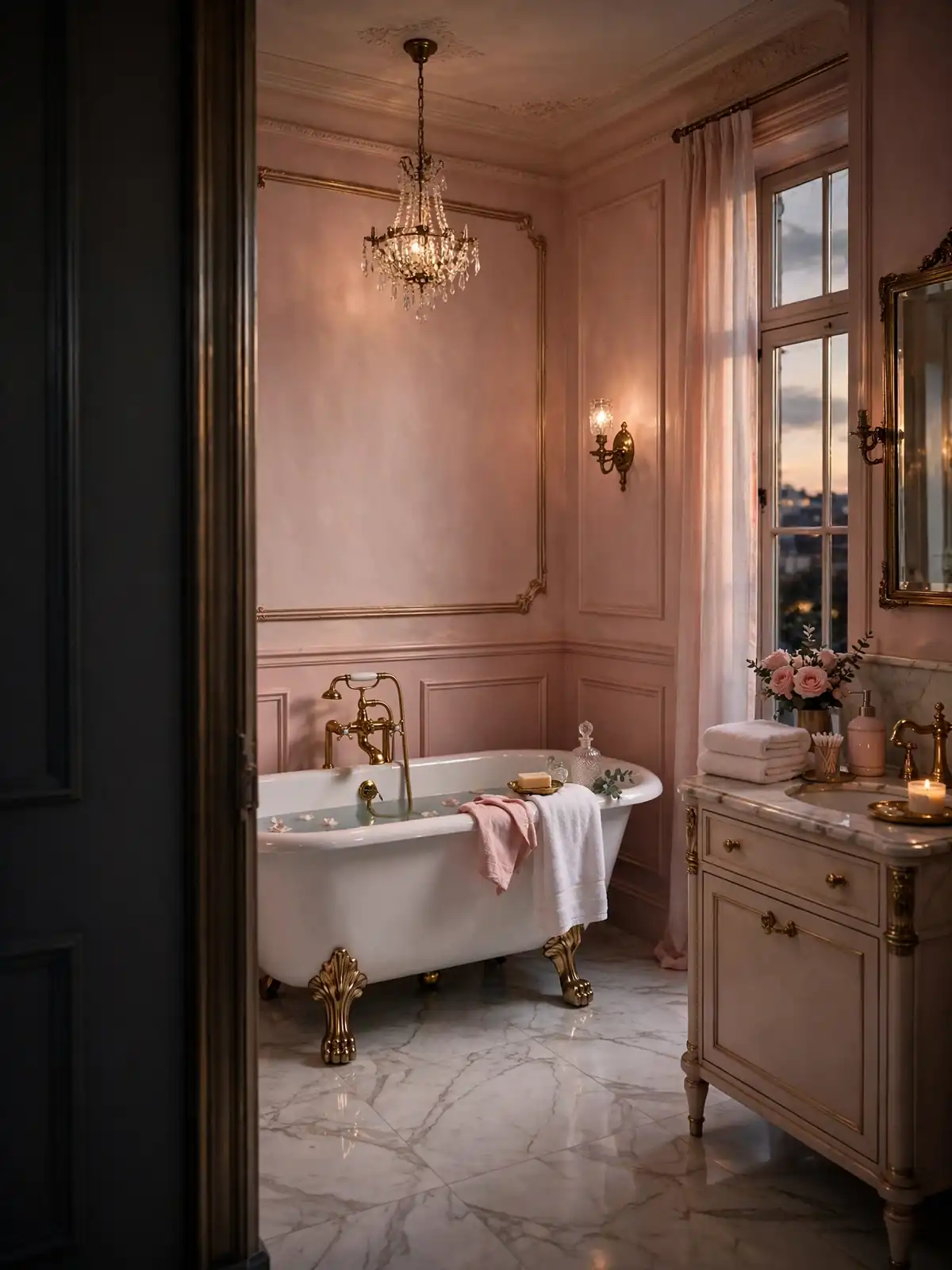
A small chandelier or crystal pendant above the tub turns an ordinary bath into a ritual, because the sparkle and the warm light make the room feel like a grand hotel suite, and the fixture becomes the bathroom’s jewellery. Here, a modest crystal chandelier with brass accents hangs above a white clawfoot tub, with blush pink walls and a marble floor completing the glamorous composition. The design suits bathrooms with enough ceiling height, it is the most glamorous lighting choice on this list, and even an affordable pendant feels opulent when it is thoughtfully placed. The weakness is safety and scale: a chandelier over a bath needs proper clearance and a bathroom-rated fitting, and a fixture that is too large overwhelms a small room, so measure the ceiling height and choose a modest size.
Quick tips:
- Choose a bathroom-rated fitting with proper clearance above the tub.
- Keep the chandelier modest in size for a small room.
- Use dimmable bulbs so the light can be soft for baths.
- Match the metal to the taps and mirror frame.
Lace Curtains or Café-Style Drapes That Soften the Window
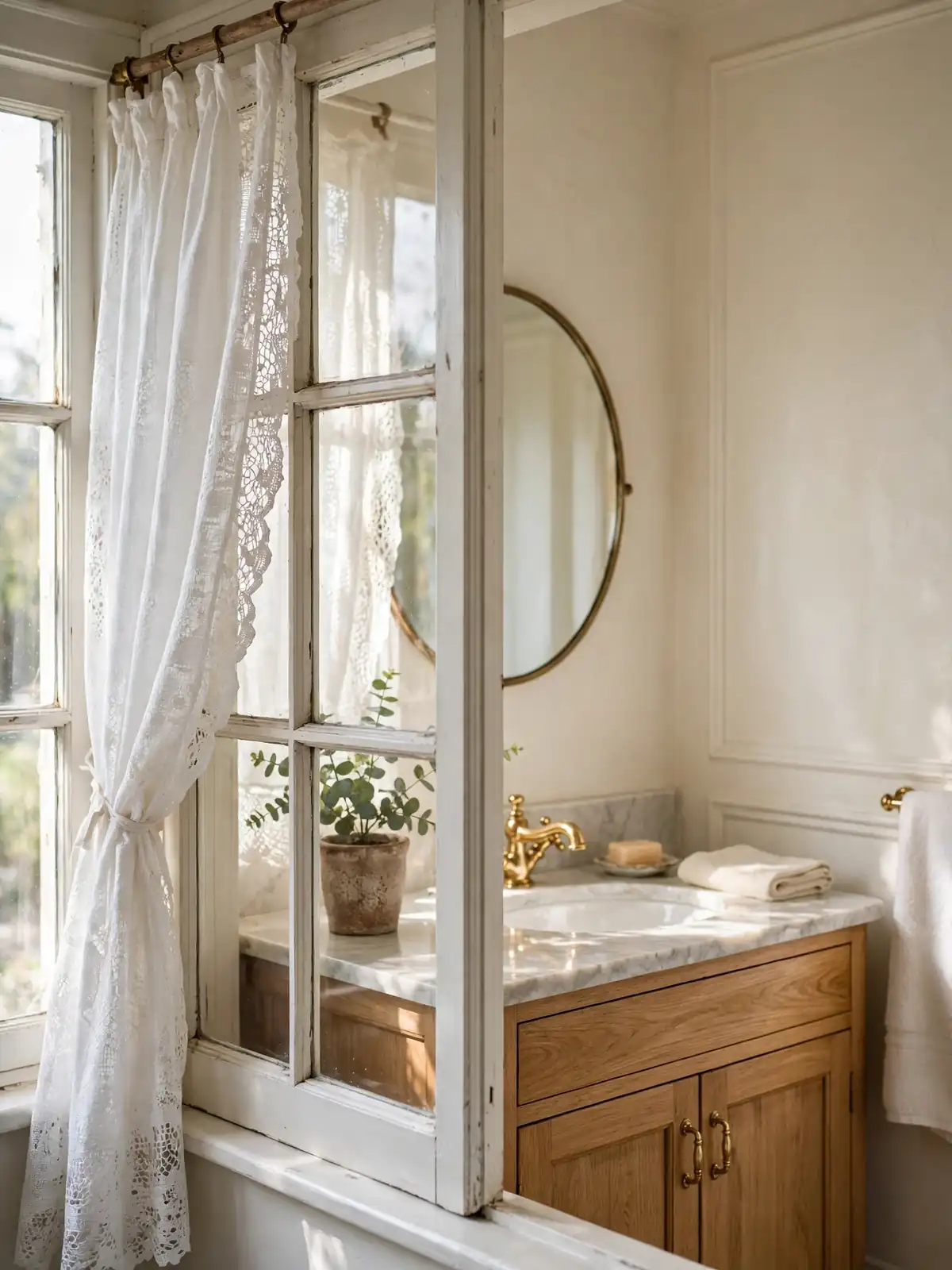
Lace curtains or café-style drapes soften a bathroom window in a way no blind can, because the delicate fabric diffuses sunlight into a warm glow and instantly gives the room a vintage cottage feel. Here, white lace café curtains cover the lower half of the window, with cream walls, a light oak vanity and a small plant on the sill completing the airy look. The design suits bathrooms with a window that needs privacy without darkness, it is easy to fit, and it adds movement when a breeze catches the fabric. The weakness is damp: lace in a steamy bathroom mildews, so choose washable cotton or polyester lace, keep it away from direct shower spray, and wash it regularly.
Quick tips:
- Choose washable lace so it survives steam and laundry.
- Fit café curtains on the lower half for light and privacy.
- Keep the fabric away from direct shower spray.
- Use white or cream to keep the room bright.
An Antique Rug in Muted Reds or Faded Blues for Warmth Underfoot
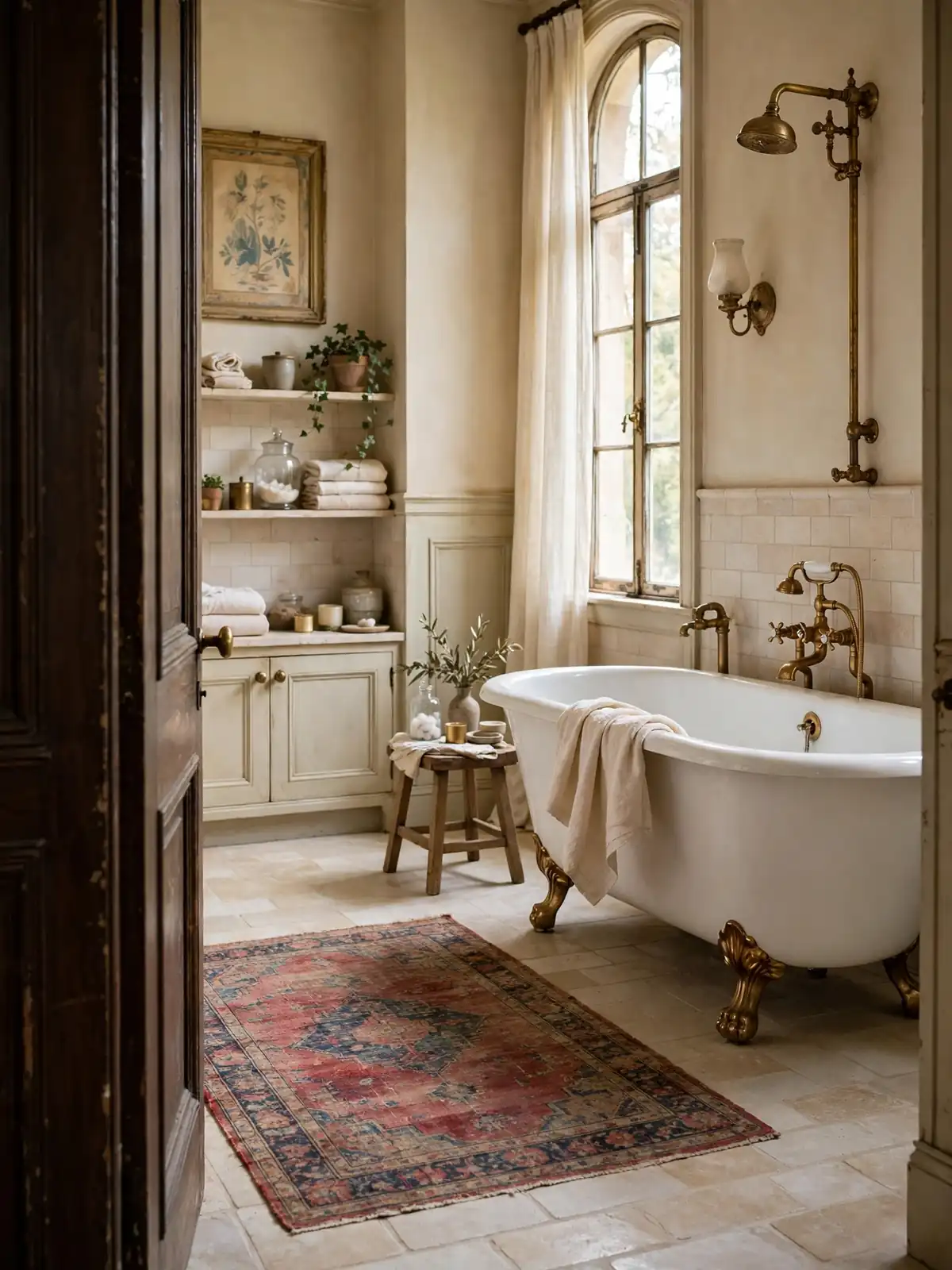
An antique rug brings warmth, pattern and personality to a bathroom floor, because the faded reds and blues, the worn edges and the imperfect threads tell a story that a new bath mat cannot, and the room instantly feels lived-in. Here, a faded antique rug in muted reds and blues lies beside a white freestanding tub, with brass fixtures and pale stone tiles completing the warm palette. The design suits bathrooms with cold tile floors, it adds colour without paint, and it is the detail guests notice first. The weakness is moisture: a valuable antique rug suffers in a wet bathroom, so use a reproduction or a washable vintage-style rug, keep it away from the shower, and dry it quickly if it gets wet.
Quick tips:
- Use a reproduction or washable rug, not a valuable antique.
- Keep the rug away from the shower and the tub splash zone.
- Add a non-slip pad underneath for safety.
- Choose muted reds, faded blues or soft greens for authenticity.
Vintage Perfume Bottles on a Mirrored Tray for Countertop Glamour
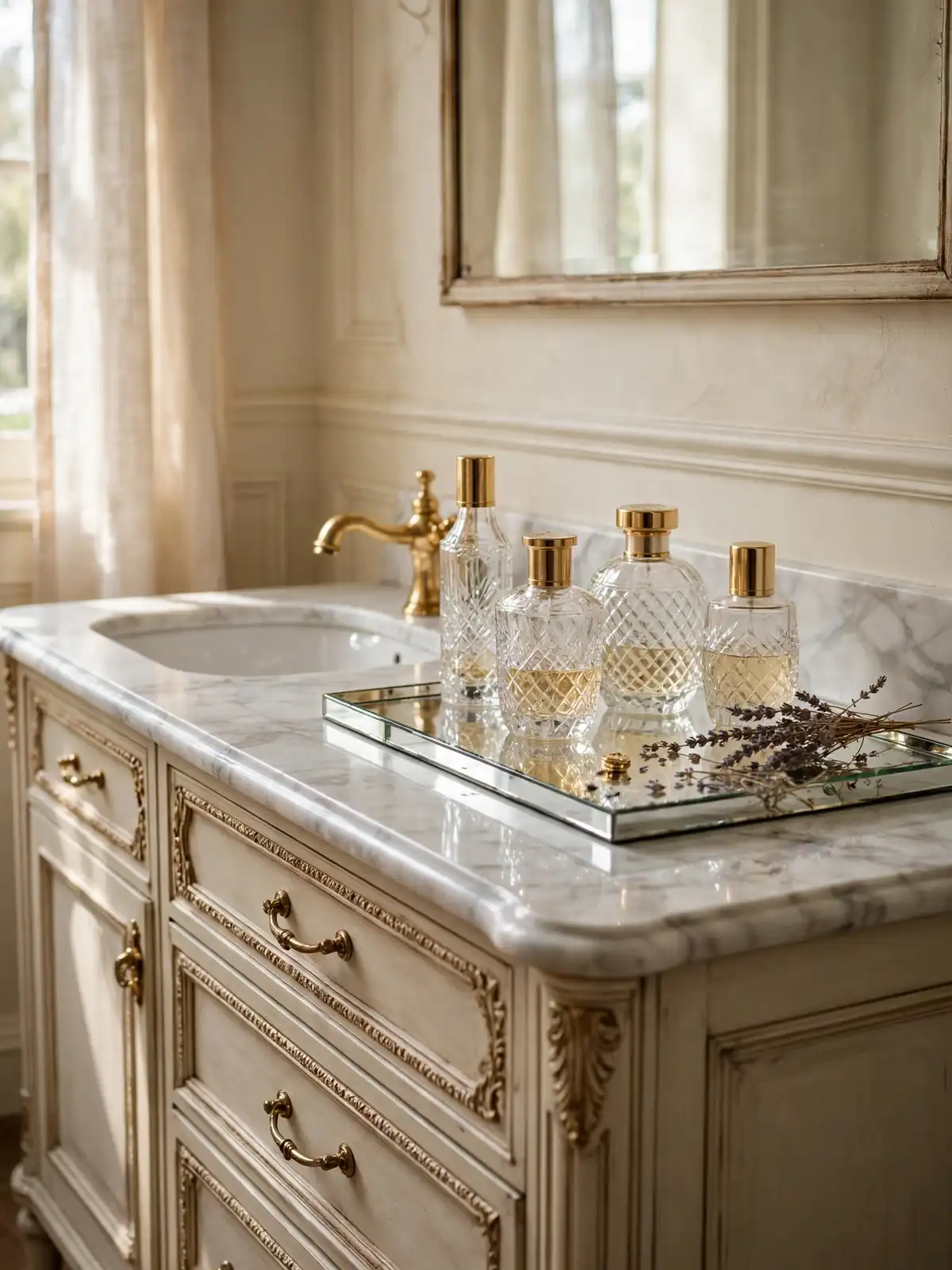
Vintage perfume bottles on a mirrored tray turn a bathroom countertop into a small display of glamour, because cut glass, gold rims and apothecary shapes catch the light and make the vanity feel curated rather than cluttered. Here, a collection of cut-glass and gold-rimmed bottles sits on a mirrored tray beside a sprig of dried lavender, on a marble countertop against cream walls. The design suits vanities that feel bare, it costs very little when the bottles come from flea markets, and even empty bottles add sparkle and personality. The weakness is dust: glass bottles and a mirrored tray show every fingerprint and water mark, so wipe the tray weekly and keep the arrangement to five or six bottles.
Quick tips:
- Keep the arrangement to five or six bottles for a curated look.
- Mix cut glass, gold-rimmed and apothecary shapes.
- Add one dried lavender sprig for scent and colour.
- Wipe the mirrored tray weekly to keep it sparkling.
Enamel Soap Dishes and Toothbrush Holders for Small Vintage Details
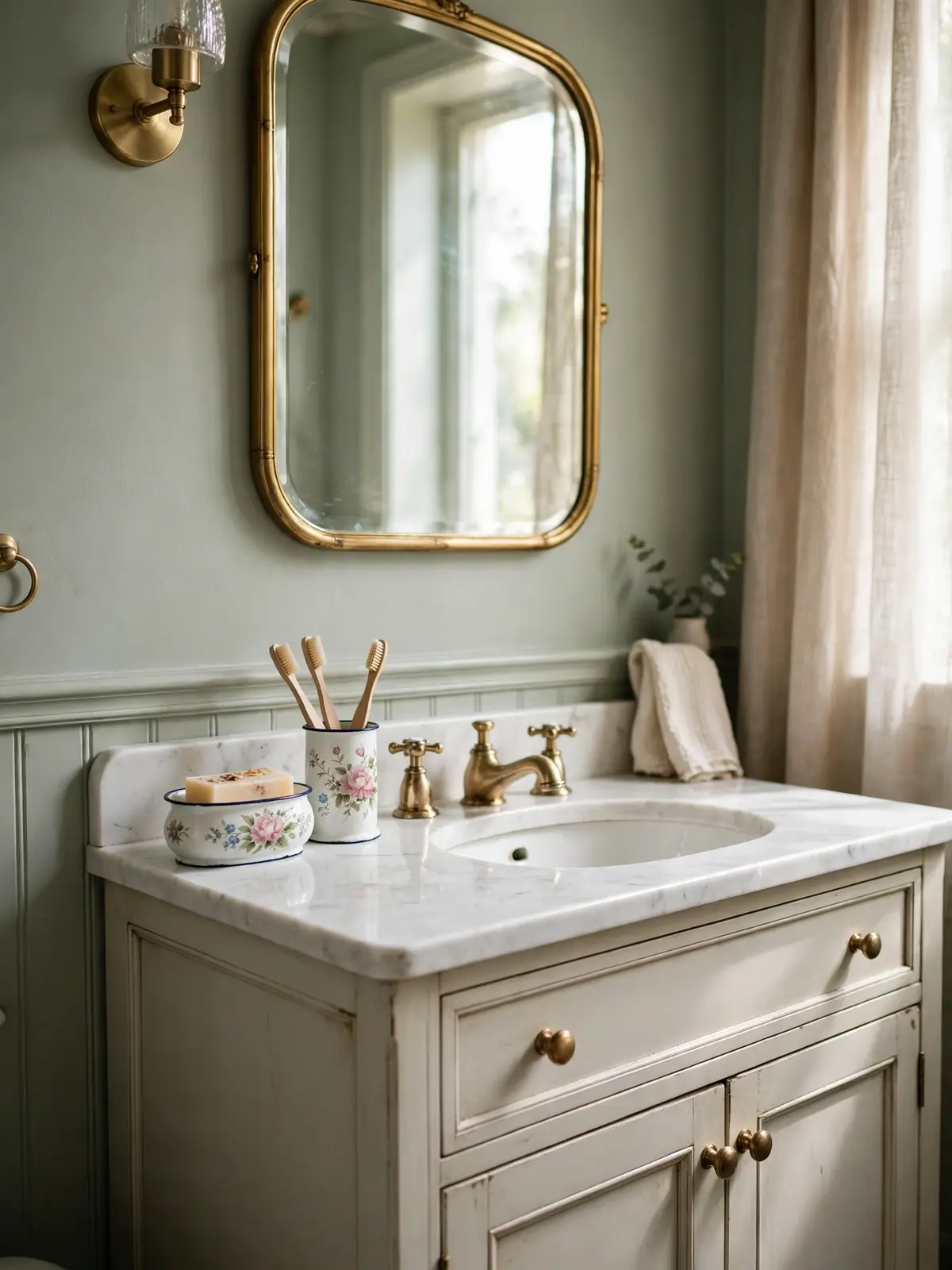
Enamel soap dishes and toothbrush holders are the small vintage details that make a bathroom feel considered, because swapping plastic for hand-painted enamel instantly adds charm, retro style and a sense of permanence to the countertop. Here, a hand-painted floral enamel soap dish and a matching toothbrush holder sit on a white stone countertop with brushed brass taps, against soft sage walls. The design suits any vintage bathroom, it is one of the cheapest upgrades on this list, and soft chips or wear only add to the appeal. The weakness is fragility: enamel chips if dropped on tile, so keep the pieces on a tray or a mat, and buy a spare if you love the pattern.
Quick tips:
- Choose hand-painted or floral enamel for authentic charm.
- Keep enamel pieces on a tray to protect them from drops.
- Match the enamel colour to the towels or the walls.
- Buy a spare of a pattern you love, since enamel is fragile.
A Painted Ceiling in Soft Ivory or Pale Blue That Lifts the Room
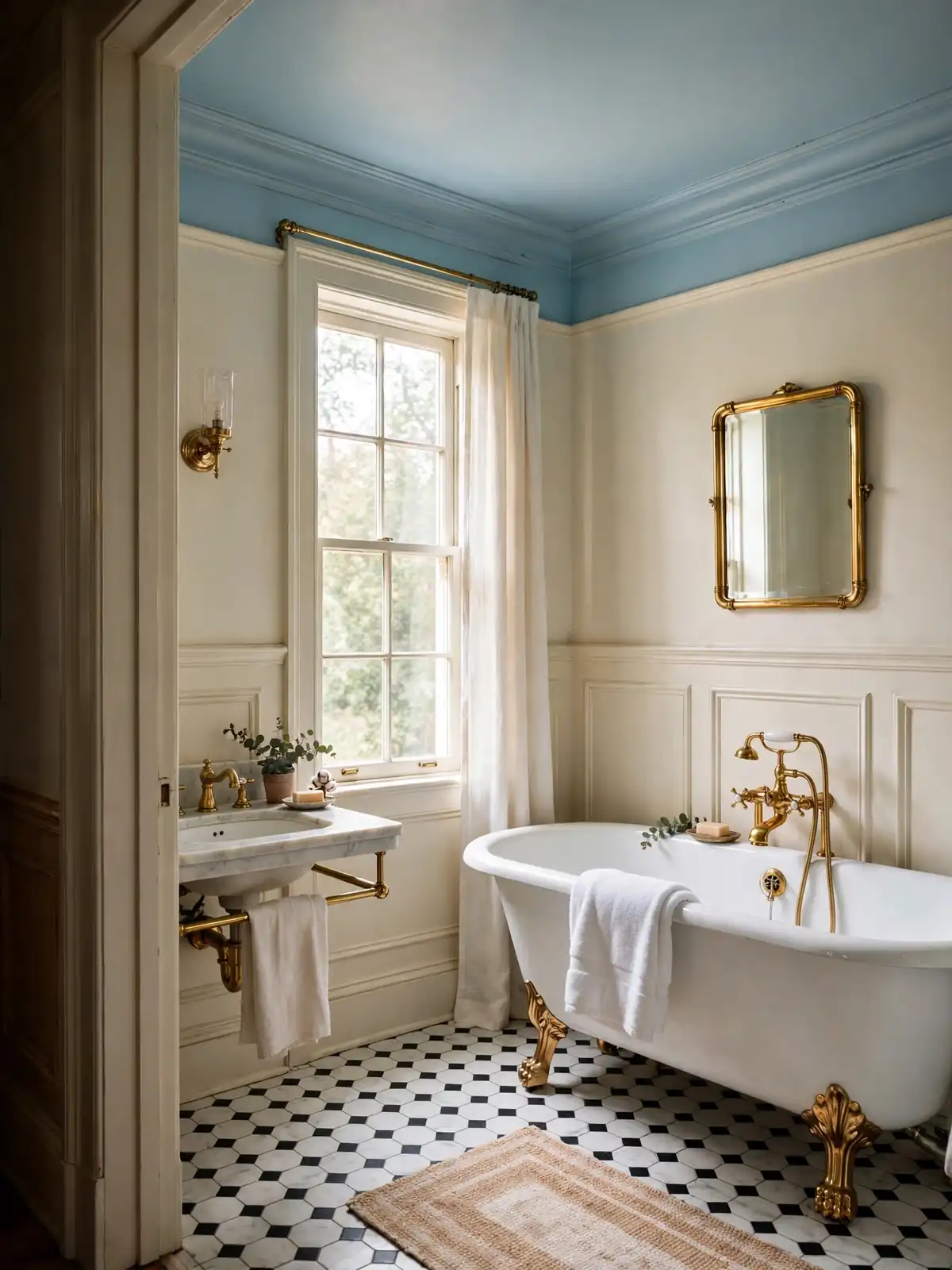
A painted ceiling in soft ivory or pale blue is the vintage bathroom detail most people forget, because the eye rarely looks up, yet a coloured ceiling lifts the room, ties the palette together and makes a bath feel like lying under an open sky. Here, a pale sky blue ceiling sits above cream walls and a white clawfoot tub, with brass fixtures warming the composition. The design suits bathrooms with plain white ceilings, it costs one tin of paint, and it makes the room feel taller and more considered. The weakness is steam: a ceiling above a bath or shower needs bathroom-rated paint, or it peels, so use a moisture-resistant finish and ventilate the room after every bath.
Quick tips:
- Use bathroom-rated paint on the ceiling to resist steam.
- Choose pale blue for openness or soft ivory for warmth.
- Paint the ceiling before the walls for a clean edge.
- Ventilate the room after every bath to protect the paint.
An Old Dresser Transformed Into a Charming Sink Vanity
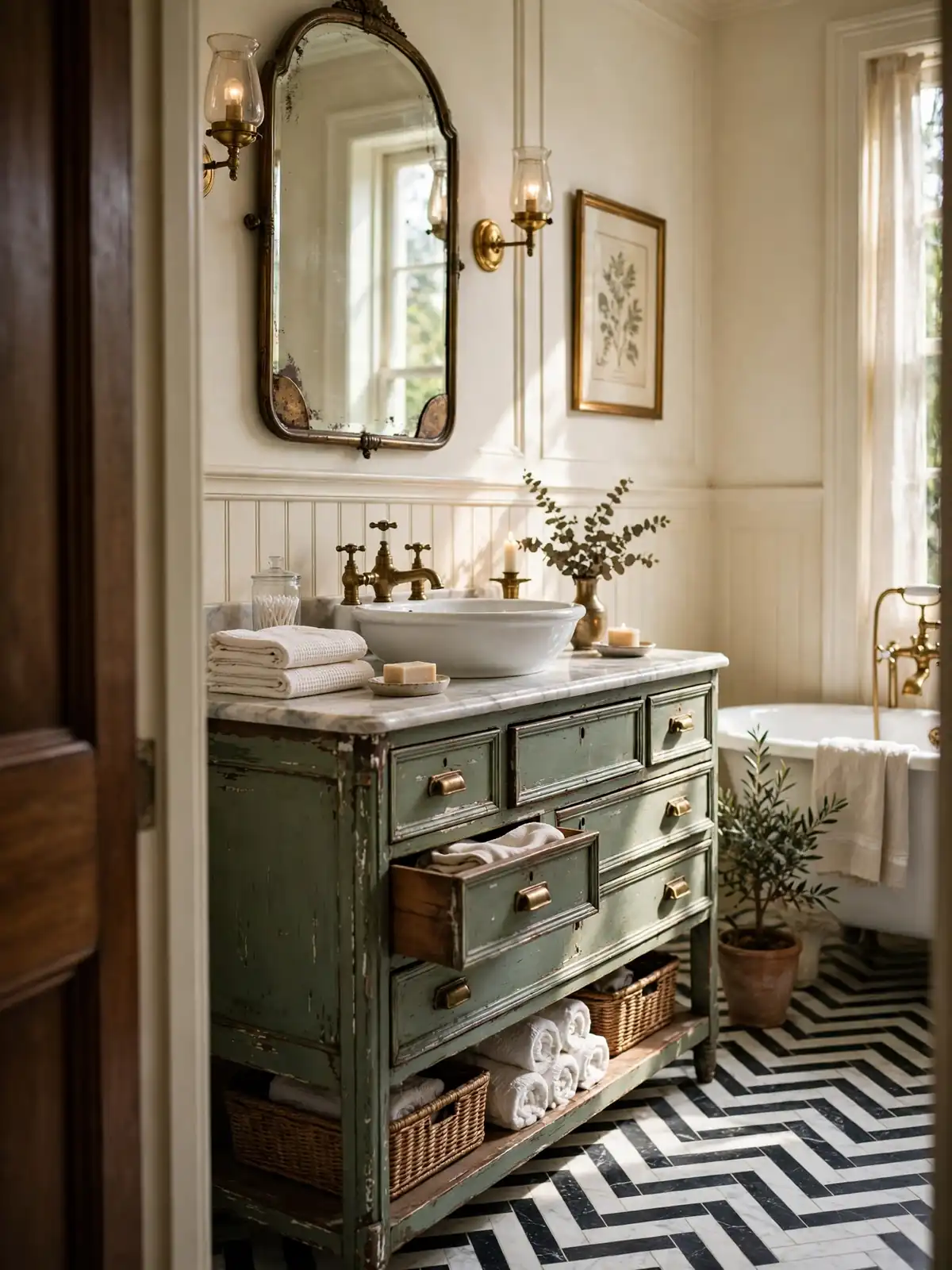
An old dresser transformed into a sink vanity is the most characterful way to furnish a vintage bathroom, because a pre-loved piece with curving drawers, unique knobs and a little wear brings a history that no new vanity can fake. Here, a distressed sage green dresser with a white vessel sink and brass taps stands against cream walls, its drawers still giving generous storage. The design suits anyone who loves one-of-a-kind pieces, it is often cheaper than a new vanity, and guests will always ask where it came from. The weakness is plumbing: a dresser needs cutting for the basin and pipes, and the wood needs sealing against water, so budget for a plumber and a good waterproof finish.
Quick tips:
- Choose a dresser with deep drawers for real storage.
- Seal the wood thoroughly against water damage.
- Budget for a plumber to cut the basin and pipe openings.
- Keep the original knobs if they are in good condition.
Amber Glass Jars and Bottles for a Warm Apothecary Shelf
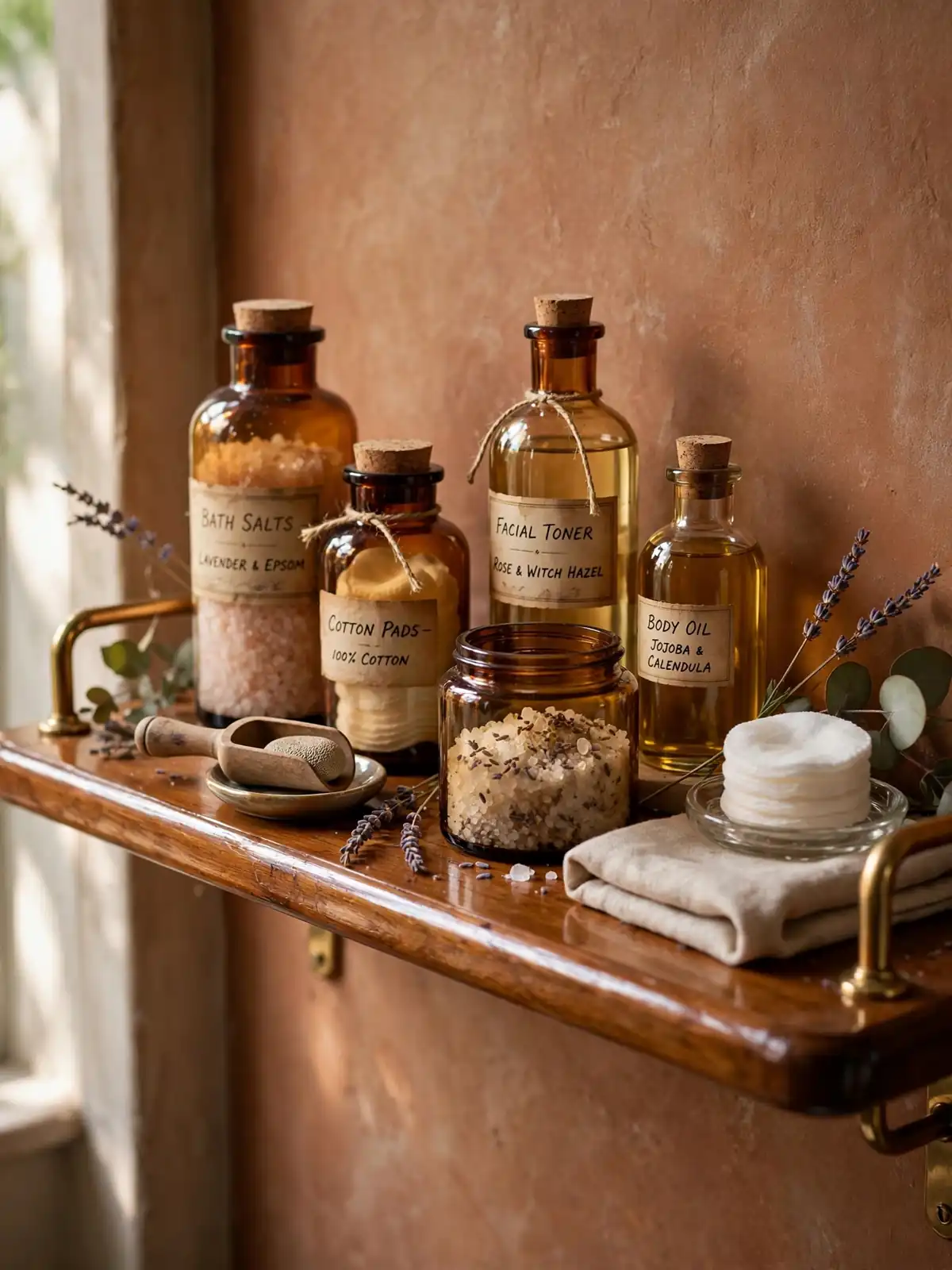
Amber glass jars and bottles bring a warm, moody glow to a bathroom shelf, because the rich amber colour recalls an old apothecary shop and makes even bath salts and cotton pads look luxurious. Here, amber jars with cork stoppers hold bath salts, cotton pads and dried herbs on a wooden shelf against warm terracotta walls. The design suits open shelves and vanity tops, it is cheap to build from flea-market finds, and the glass keeps contents visible and easy to reach. The weakness is clutter: too many jars look like a shop, so keep it to five or six, and label them clearly so guests know what is inside.
Quick tips:
- Keep the collection to five or six jars for a curated look.
- Choose cork stoppers or aged labels for authenticity.
- Label each jar so guests know what is inside.
- Use the jars for real essentials, not just display.
A Thick Wooden Shelf With Vintage-Style Iron Brackets
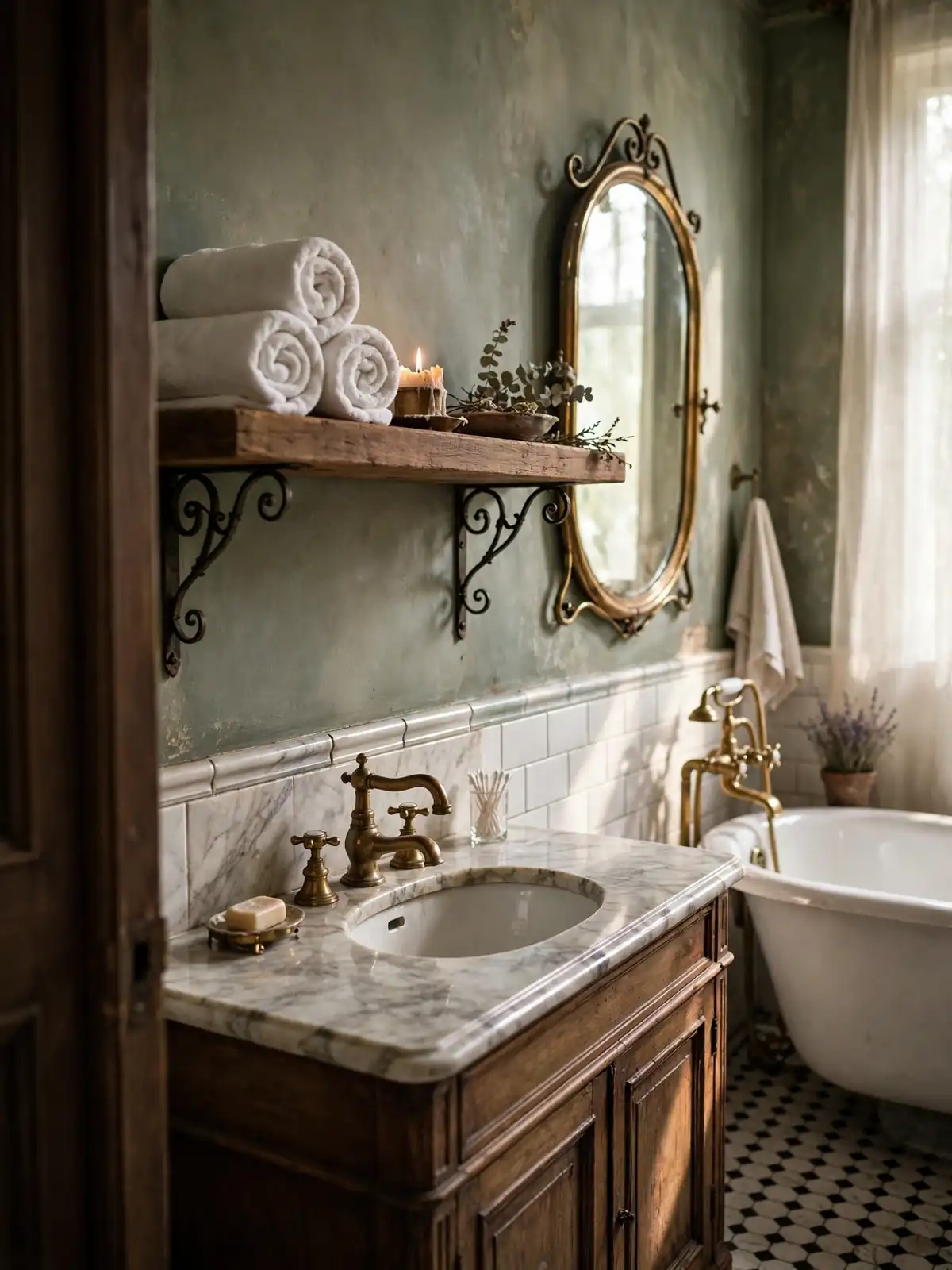
A thick wooden shelf on vintage-style iron or brass brackets turns storage into decoration, because the wood grain and the aged metal give the wall a lived-in, countryside-cabin warmth that a plain floating shelf cannot. Here, a thick oak plank on ornate iron brackets holds rolled white towels and a small candle against dusty green walls, with a brass mirror nearby. The design suits bathrooms that need open storage, it is easy to fit, and it displays towels, candles and small antiques beautifully. The weakness is weight: a thick plank with heavy brackets needs proper wall fixings, and an overloaded shelf sags, so use a stud or masonry anchor and keep the load light.
Quick tips:
- Use a stud or masonry anchor for a thick wooden shelf.
- Keep the load light — towels, candles and small antiques.
- Match the bracket metal to the taps or mirror frame.
- Seal the wood against steam and splashes.
Pressed Flowers in Antique-Inspired Frames for a Soft Romantic Touch
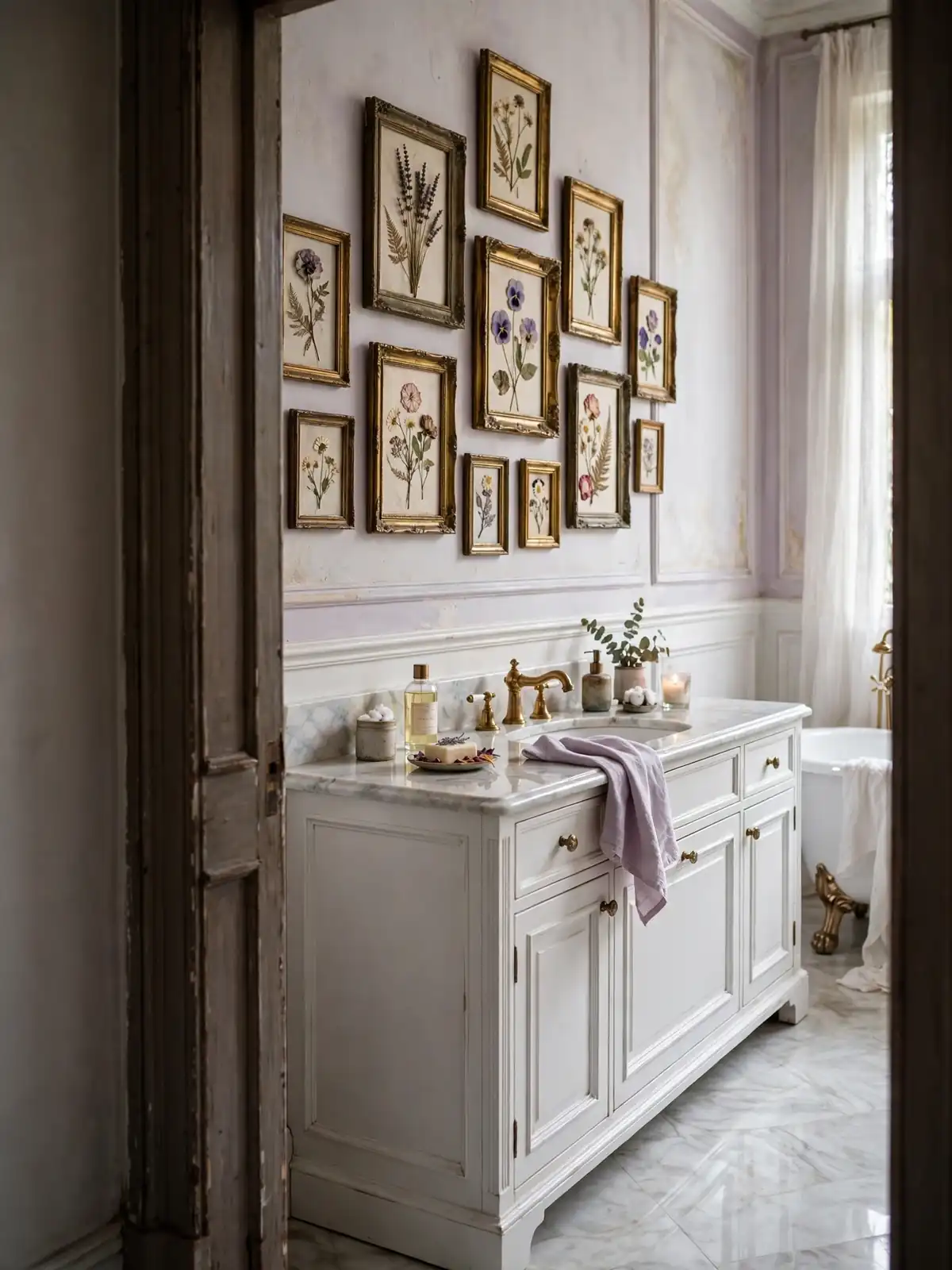
Pressed flowers in antique-inspired frames bring a soft, romantic touch to a bathroom wall, because the delicate blooms and the tarnished frames feel like tiny love letters from nature, and the display adds intimacy without clutter. Here, three small pressed-flower frames in tarnished gold hang above a white vanity against pale lilac walls. The design suits bathrooms with a spare wall, it is cheap to make from garden blooms, and it draws the eye without overwhelming the room. The weakness is moisture: pressed flowers fade and curl in steam, so seal the frames well, hang them away from the shower, and use UV-protective glass if the room gets strong sun.
Quick tips:
- Seal the frames well against bathroom steam.
- Hang them away from the shower and the tub.
- Use UV-protective glass in a sunny bathroom.
- Group three small frames rather than one large one.
A Ruffled or Embroidered Shower Curtain With Old-World Softness
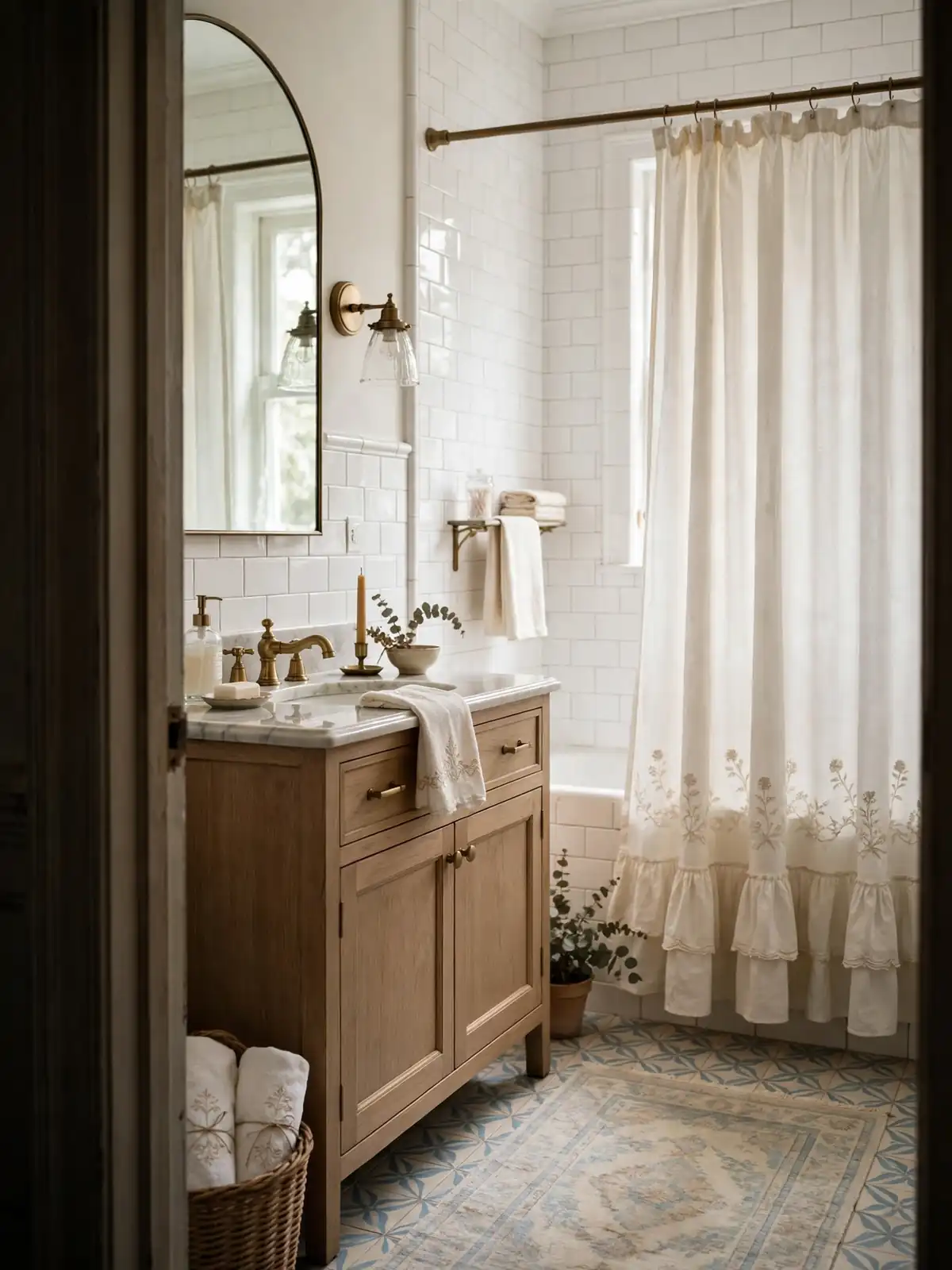
A ruffled or embroidered shower curtain adds old-world softness to a bathroom in one purchase, because the frills, the lace trim and the gentle pattern turn a functional screen into a piece of textile design. Here, a cream ruffled curtain with delicate embroidery hangs from a brass rod, with white tiled walls, a light wood vanity and matte brass fixtures tying the palette together. The design suits bathrooms with a tub or shower, it is a one-hour change, and it adds pattern without touching the tile. The weakness is damp: a fabric curtain in a steamy room needs a waterproof liner and regular washing, or it mildews, so always use a liner and wash the curtain monthly.
Quick tips:
- Always use a waterproof liner behind a fabric curtain.
- Choose muted shades or gentle patterns for a vintage feel.
- Hang the rod a little higher to make the ceiling feel taller.
- Wash the curtain and liner monthly to prevent mildew.
A Ceramic Pitcher and Bowl Set for an Antique Washstand Vibe
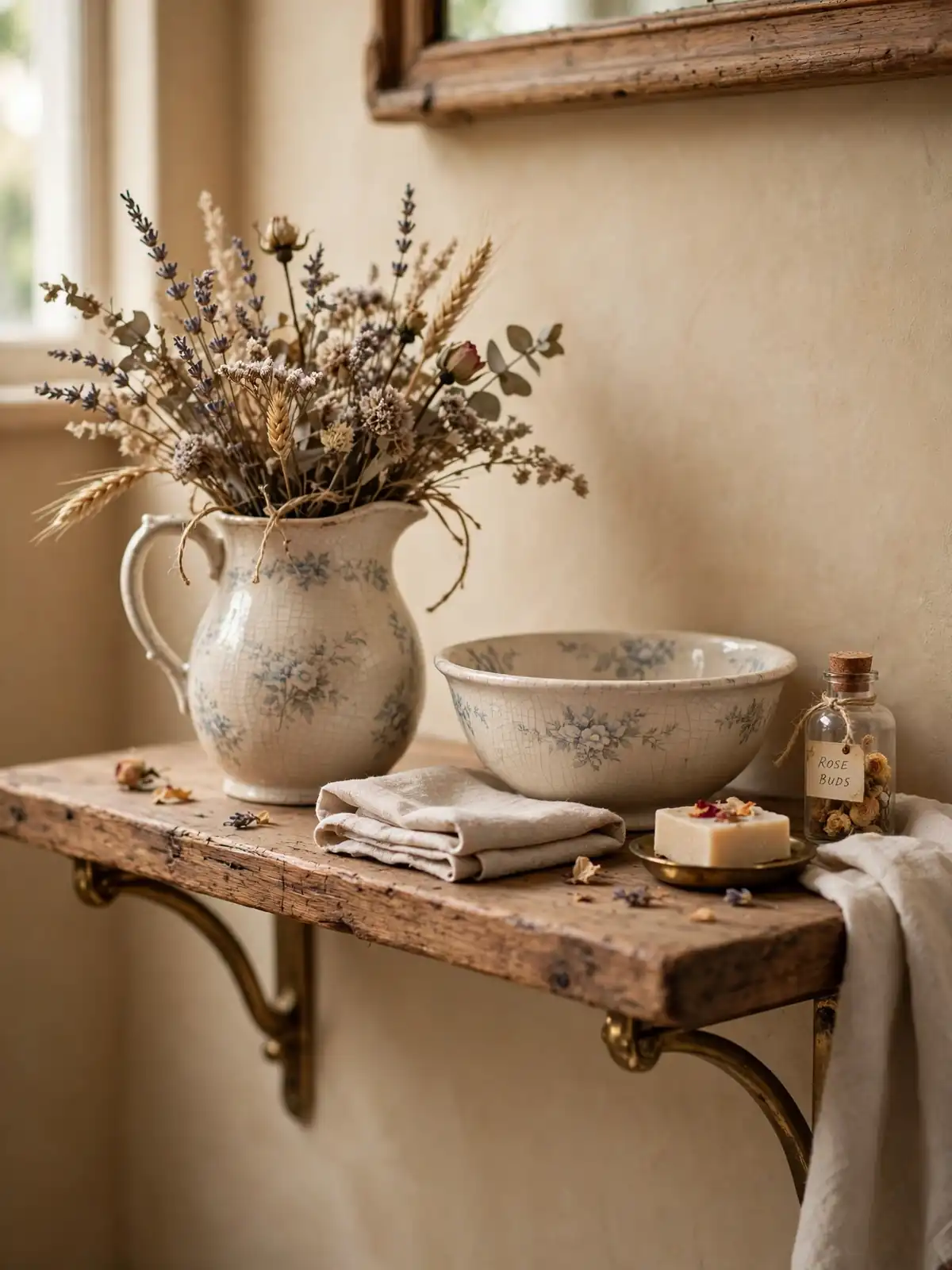
A ceramic pitcher and bowl set brings an antique washstand vibe to a bathroom shelf, because the crackled glaze, the floral motifs and the simple shapes recall the days before indoor plumbing, and the set adds elegance even when it is purely decorative. Here, a white ceramic pitcher and bowl with a crackled glaze and subtle floral motifs sit on a wooden shelf with dried flowers, against warm beige walls. The design suits shelves, vanity tops and window sills, it is easy to find at flea markets, and it gives the room a sense of history and grace. The weakness is fragility: ceramic chips easily on tile, so keep the set on a stable shelf away from the shower, and never use a cracked piece for water.
Quick tips:
- Choose crackled glaze or floral motifs for authenticity.
- Keep the set on a stable shelf away from the shower.
- Pair it with dried flowers or small vintage trinkets.
- Never use a cracked piece for water.
A Rotary-Style Wall Clock or Antique Alarm Clock as a Visual Anchor
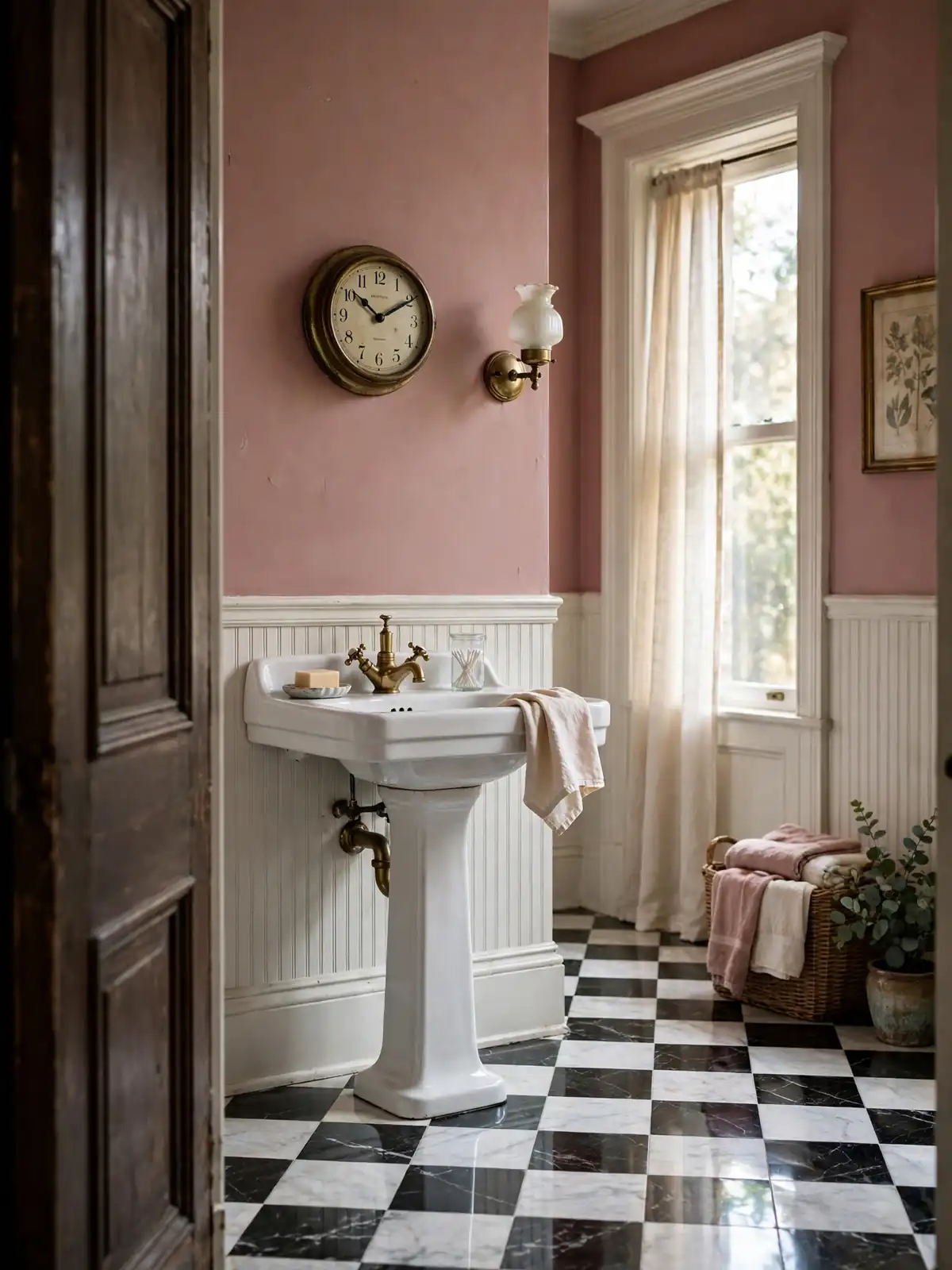
A rotary-style wall clock or an antique alarm clock gives a vintage bathroom a visual anchor, because the aged brass rim, the cream face and the soft ticking add personality and nostalgia to a wall that would otherwise be bare. Here, a round wall clock with an aged brass rim hangs on a dusty rose wall above a white pedestal sink. The design suits any vintage bathroom, it is practical as well as decorative, and it contrasts nicely with modern technology in the rest of the home. The weakness is steam: a clock in a steamy bathroom fogs and rusts, so hang it away from the shower, choose a moisture-resistant model, and keep it out of direct spray.
Quick tips:
- Hang the clock away from the shower and the tub.
- Choose an aged brass or cream face for period charm.
- Pick a quiet ticking mechanism for a calm bathroom.
- Check the clock still runs in steam before buying a valuable antique.
Towels in a Wire Basket or Vintage Wooden Crate for Flea-Market Flair
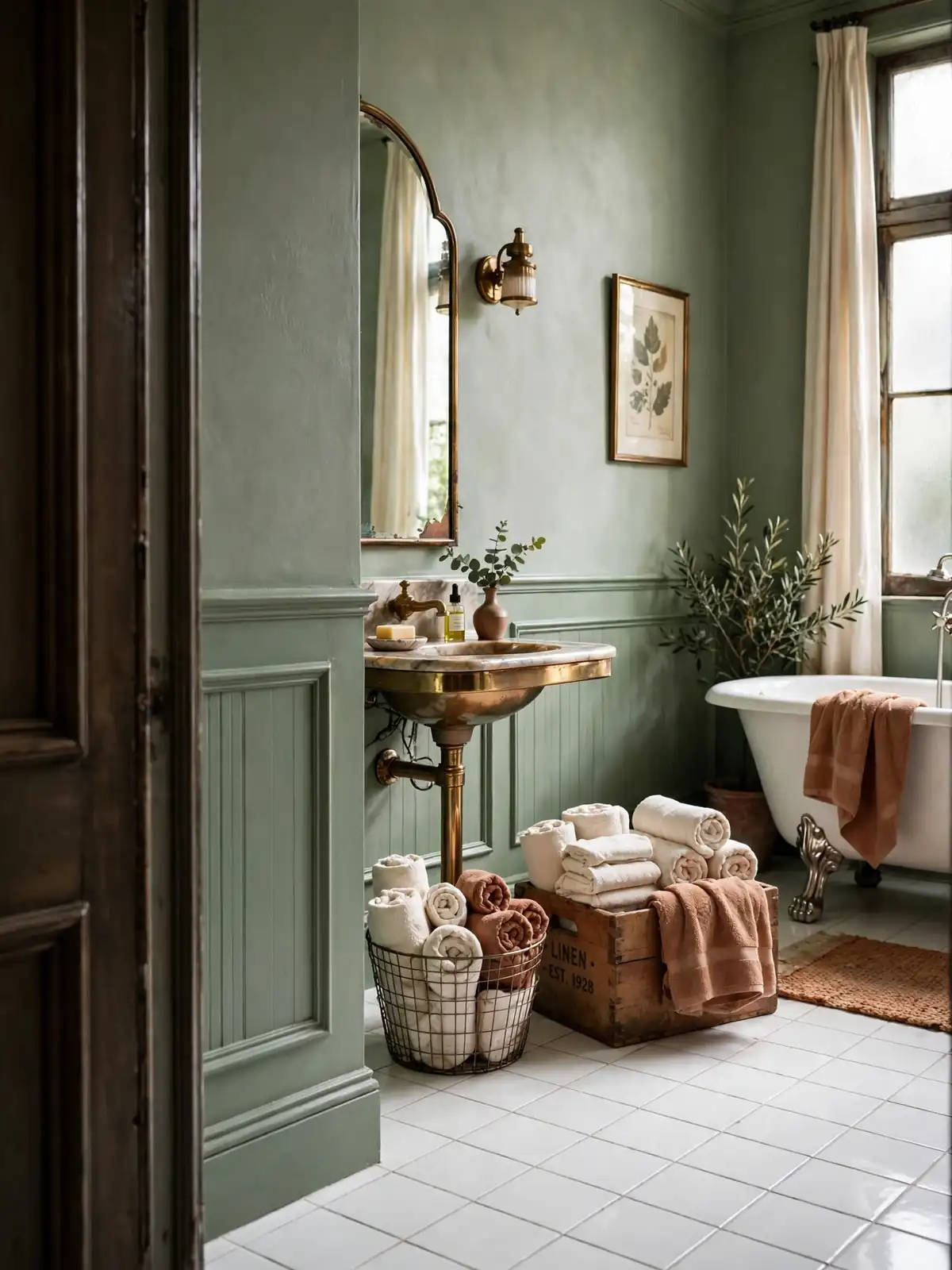
Towels in a wire basket or a vintage wooden crate bring flea-market flair to a bathroom, because the texture of wire or worn wood adds rustic charm while keeping everything visible and within reach. Here, rolled cream and terracotta towels sit in a wire basket beside a vintage wooden crate on a white tiled floor, against sage green walls. The design suits bathrooms short on storage, it is cheap to put together, and it gives the room a boutique bed-and-breakfast feel. The weakness is damp: towels in an open basket in a steamy bathroom stay damp, so keep the basket away from the shower, use it for fresh towels only, and wash them regularly.
Quick tips:
- Roll towels neatly so the basket looks intentional.
- Keep the basket away from direct shower spray.
- Use the crate for fresh towels, not damp ones.
- Match the towel colours to the room’s palette.
Black-and-White Photos in Ornate Baroque Frames for a Gallery Wall
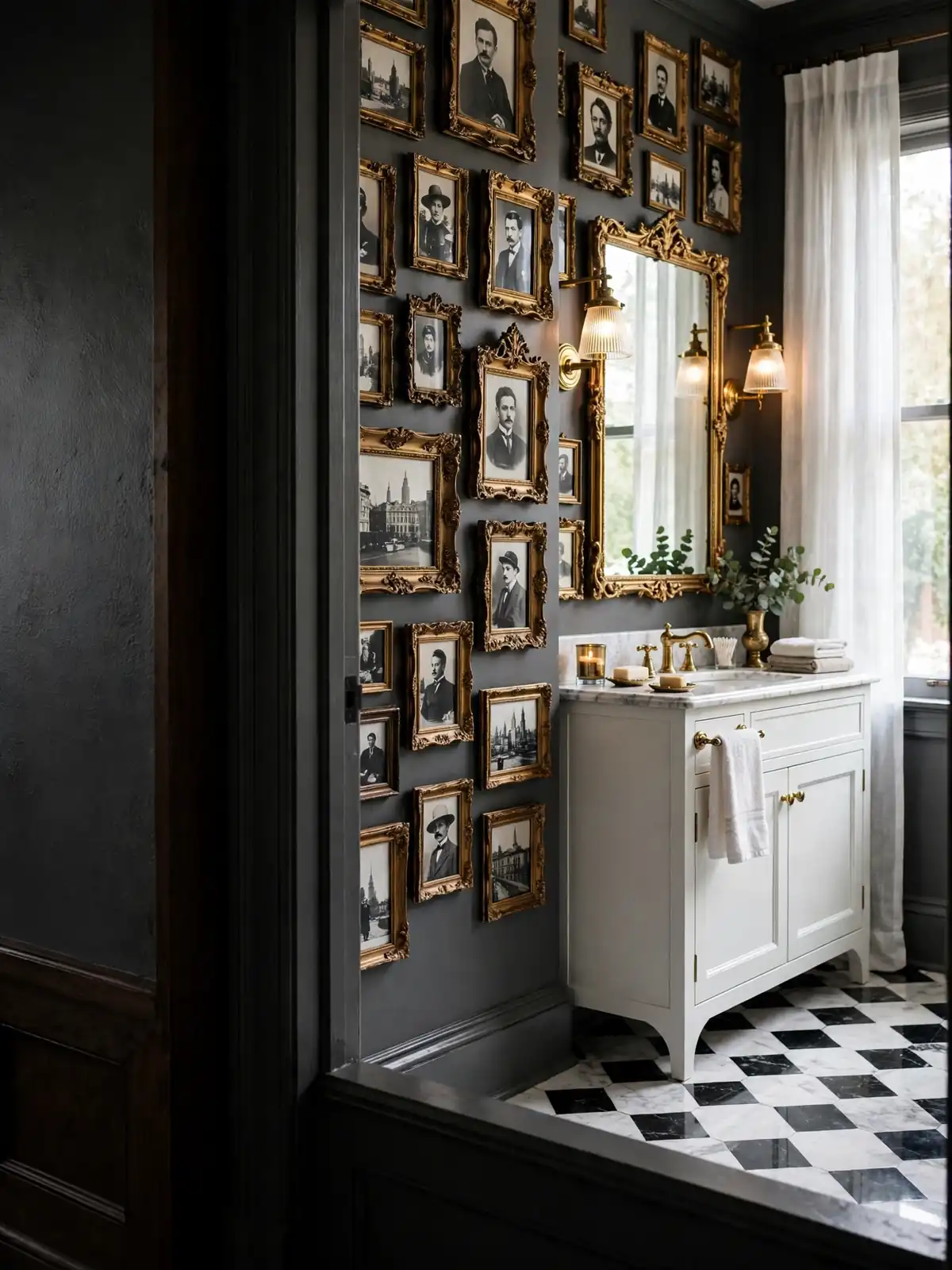
Black-and-white photos in ornate baroque frames turn an ordinary bathroom wall into an intimate gallery, because the contrast between monochrome images and lavish gold frames instantly elevates the room and gives it a story. Here, a small gallery of black-and-white family portraits and retro fashion shots in gold baroque frames hangs on a charcoal grey wall above a white vanity. The design suits bathrooms with a spare wall, it costs little when the frames come from thrift shops, and it starts conversations with guests. The weakness is moisture: paper photographs in a steamy bathroom need sealed frames and a spot away from the shower, so use copies rather than original family photos.
Quick tips:
- Use copies of family photos, never irreplaceable originals.
- Seal the frames and hang them away from the shower.
- Mix portrait sizes for a collected gallery feel.
- Keep the frame finish matched to the mirror or taps.
Claw-Style Feet on a Cabinet That Turn Storage Into a Statement
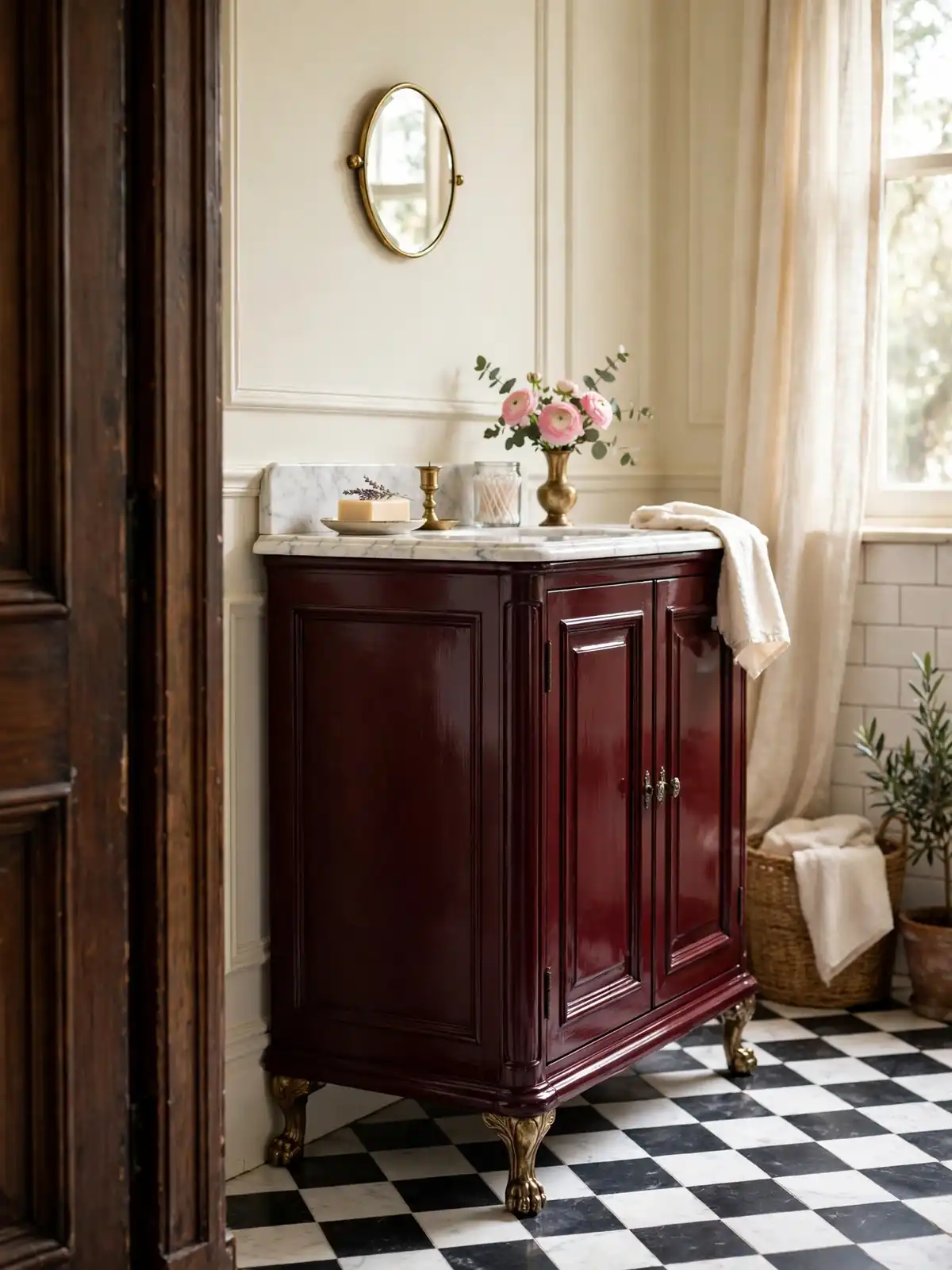
Claw-style feet on a cabinet turn ordinary storage into a vintage statement, because the small brass or painted feet lift the piece off the floor and give it the drama of an antique, even when the cabinet itself is new. Here, a deep burgundy cabinet with brass claw feet and a white marble top stands against cream walls, with a small brass mirror above. The design suits bathrooms that need storage with character, it is a cheap upgrade to an existing cabinet, and it makes the whole room feel more cohesive and luxe. The weakness is stability: claw feet raise the cabinet’s centre of gravity, so fix the cabinet to the wall, keep heavy items low, and check the feet are level.
Quick tips:
- Fix the cabinet to the wall for stability on claw feet.
- Keep heavy items in the lowest drawer.
- Choose brass, silver or painted feet to suit the room.
- Check the feet are level so the cabinet never wobbles.
Vintage Bathroom Ideas That Pull the Whole Room Together
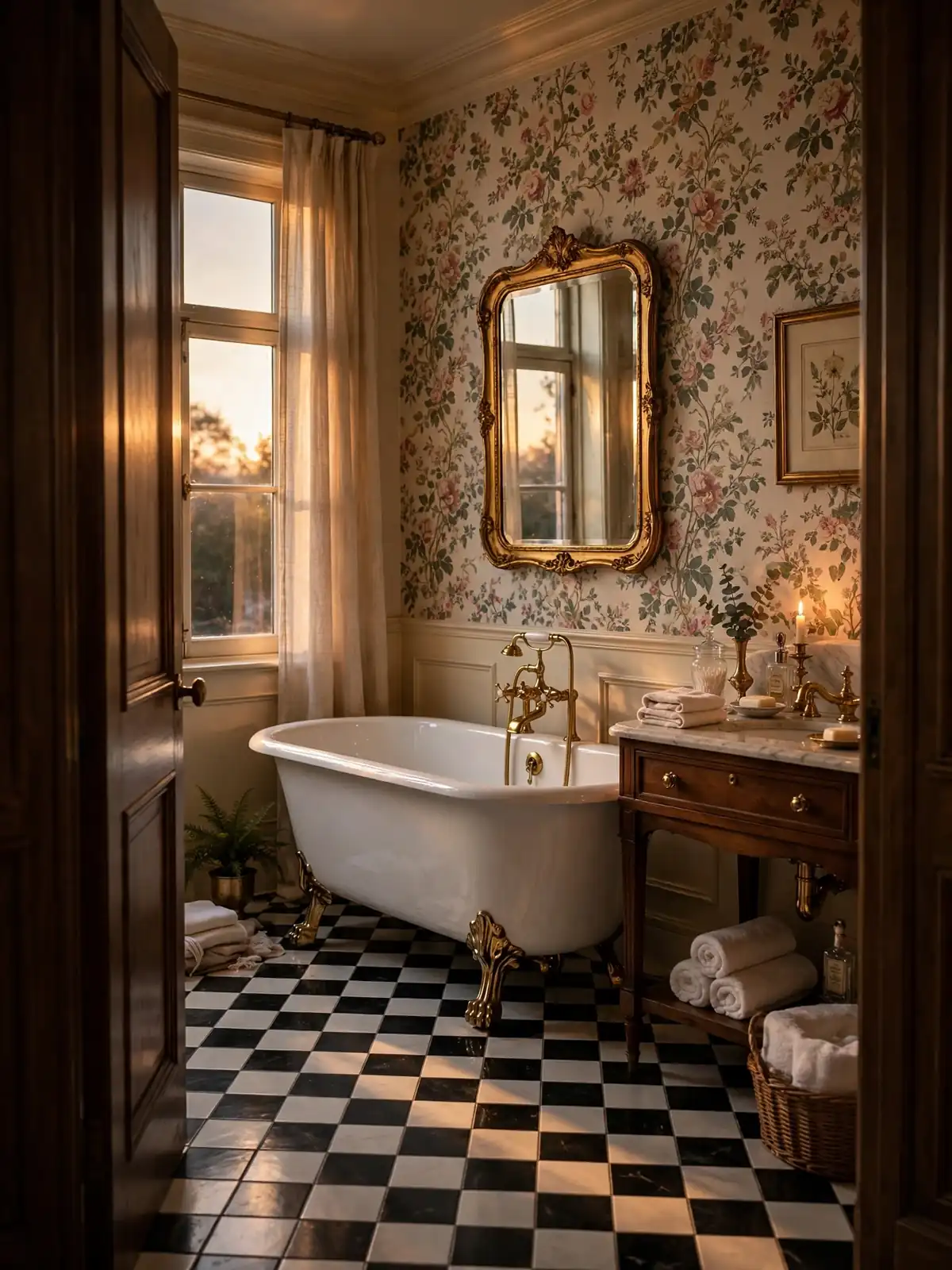
The last of these vintage bathroom ideas is the principle behind them all, and it is worth stating plainly because it is the difference between a bathroom that looks good in a photograph and one that feels like it has a past: a great vintage bathroom is not one expensive antique, it is the combination of the right period pieces in the right places — a clawfoot tub or pedestal sink, brass taps that have started to patina, one patterned element such as a checkerboard floor or a floral accent wall, a gilded mirror lit at face level, and one personal touch like a ceramic pitcher or a framed family photograph — working together so that the room feels collected over decades rather than bought in one afternoon, and the room rewards the owner too, because a bathroom built in that order is easy to clean, easy to update and easy to keep beautiful between visits. Here, a warm vintage bathroom pulls it together — white clawfoot tub, black-and-white checkerboard floor, floral wallpaper accent wall, gilded mirror and brass taps — and nothing in the room is there by accident. The lesson is to start with one era, pick the two or three period pieces that matter most, spend on the taps and the lighting, save on the accessories and the wallpaper, and let the patina build over time, because a vintage bathroom designed around those choices stays romantic with very little effort, even in a small room, even on a modest budget, and even when you change only one thing at a time. Pick the three ideas from this list that solve your biggest problem first, add one luxury that makes you smile, and your vintage bathroom stops being the room you wish looked older and becomes the room your visitors mention when they get home.
Quick tips:
- Start with one vintage era and let it decide the palette.
- Spend on taps, the tub and the lighting first.
- Save on accessories, wallpaper and rugs.
- Let the patina build — a vintage room should age gracefully.
FAQs
What is the cheapest way to create a vintage bathroom?
The cheapest vintage bathroom changes are antique-style brass taps, a floral wallpaper accent wall, enamel accessories, an antique rug and a gilded thrift-shop mirror — together they cost far less than a new tub and change the whole feel of the room. Paint the ceiling pale blue, add lace curtains and swap the shower curtain for a ruffled one, and the room looks period without any building work.
Can I make a modern bathroom look vintage without a renovation?
Yes — a modern bathroom can look vintage with surface changes alone: swap chrome taps for antique brass, hang a gilded mirror, add a floral wallpaper accent wall or beadboard, lay a vintage-style rug, and replace plastic accessories with enamel and amber glass. Keep the modern shower and toilet, since hidden modern plumbing is the practical heart of a vintage look.
What colours work best in a vintage bathroom?
Soft, muted colours work best in a vintage bathroom: dusty rose, sage green, powder blue, mint, cream and butter yellow, with black-and-white floors or deep green and navy as accents. Avoid bright, saturated modern colours, and repeat one accent colour in the towels, the rug and the wallpaper so the room feels collected rather than random.
How do I keep a vintage bathroom from looking like a theme park?
Pick one vintage era and stick to it, keep the palette to three or four colours, and mix one or two genuine period pieces with good reproductions rather than filling every surface with antiques. Leave some breathing room — a plain wall, a clear counter, a simple towel — so the period details stand out instead of competing with each other.
Is a clawfoot tub practical for everyday use?
A clawfoot tub is practical for baths but less so for daily showers, because it needs a curtain ring, the water can splash the floor, and getting in and out is harder than with a built-in bath. It suits households that love baths and have a separate shower, or a family bathroom where the tub is used mainly for soaking. If you shower daily, pair the tub with a proper curtain ring and a non-slip mat.
Conclusion
A vintage bathroom does not need a renovation to feel like it has a past — it needs the right period pieces, done thoughtfully. The 30 ideas above show that a clawfoot tub, a gilded mirror, brass taps, a checkerboard floor and one floral accent wall can turn a plain modern bathroom into a space that feels romantic, characterful and collected over decades. Start with one era and let it decide the palette, spend on the pieces you touch every day, save on the accessories, and let the patina build over time. Do that, and your vintage bathroom stops being the room you wish looked older and becomes the room your visitors remember.