21 Gorgeous Grey Bathroom Ideas for a Calm, Expensive-Looking Space
Grey bathrooms used to feel cold — too safe, too plain. These 21 grey bathroom ideas show how layered shades, warm textures, soft lighting and one or two rich accents can turn grey into the calmest, most sophisticated colour in the house.
Grey bathroom ideas work when grey is layered rather than flat: charcoal floors, mid-tone cabinets, pale walls, warm wood and brass, and soft lighting together make grey feel calm, expensive and surprisingly warm. The mistake most grey bathrooms make is using one identical shade everywhere, which is when the room starts looking dull and cold.
If you want to push the calm, layered feeling further, these bathroom aesthetic ideas show how light, texture and focal points work together in any neutral bathroom. The 21 ideas below cover shades, lighting, vanities, showers, textures and styling, with a grey shade guide in the middle, so you can build a grey bathroom that feels warm, layered and quietly luxurious.
Key Takeaways
How do I make a grey bathroom feel warm instead of cold?
Layer warm greys rather than cool ones, add natural wood, brass or matte black fixtures, use warm white bulbs (around 2700K), and add soft textiles such as cream towels and a wooden stool. Warm lighting and wood are what stop a grey bathroom feeling cold.
What colours go with a grey bathroom?
Warm white, cream, walnut, brass, sage green, dusty blue, blush pink and matte black all work with a grey bathroom. Sage and blush soften grey, brass warms it, and black adds definition. Avoid stark white trim and cool chrome, which can make grey look chilly.
Does a grey bathroom work in a small bathroom?
Yes, and grey suits small bathrooms well, because pale grey reflects light and makes the walls feel further away. Use large-format grey tiles to reduce grout lines, a floating vanity to show more floor, and one large mirror to bounce light. Keep the palette to three or four shades so the room reads as calm, not busy.
Should I use warm grey or cool grey in a bathroom?
Warm grey suits most bathrooms, especially north-facing or windowless rooms, because its brown or beige undertone makes the space feel cosy. Cool grey suits bright, sunny bathrooms and modern schemes. If your bathroom feels cold, choose a warm grey; if it feels too warm or dated, a cool grey may suit it better.
How do I stop a grey bathroom looking boring?
Layer at least four shades of grey, mix matte and soft reflective finishes, repeat textures throughout the room, and add one contrasting element such as brass taps, a wood vanity or a single bold accent. A grey bathroom looks boring only when it uses one shade, one finish and no contrast.
| Grey shade | Undertone | Best pairing | Mood it creates |
|---|---|---|---|
| Warm grey | Brown-beige | Walnut, brass, cream | Cosy, soft and welcoming |
| Cool grey | Blue | Chrome, white, black | Crisp, modern and tailored |
| Greige | Grey-beige | Oak, linen, matte black | Balanced, calm and versatile |
| Charcoal | Deep neutral | Brass, marble, cream | Dramatic, luxurious and cocooning |
| Mushroom grey | Pink-grey | Cream, brass, sage | Gentle, cocooning and soft |
| Slate grey | Blue-grey | Teak, nickel, white | Grounded, spa-like and serene |
Layered Shades of Grey Instead of One Flat Tone
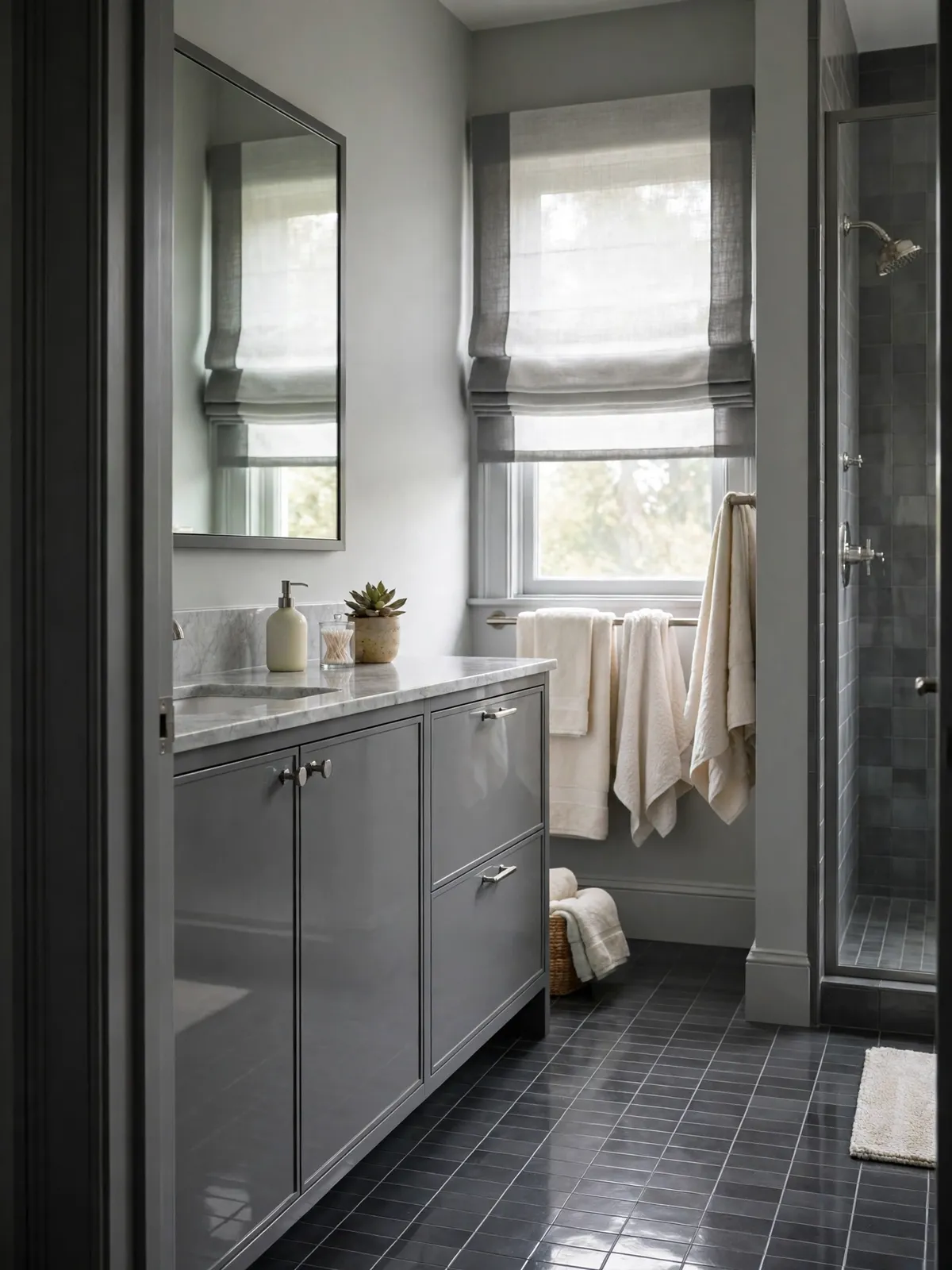
Layering different shades of grey is the first rule of a good grey bathroom, because one identical shade everywhere makes a room look dull, while charcoal floors, mid-tone cabinets and pale walls together give the room depth and movement. Here, charcoal floor tiles anchor a bathroom with mid-grey cabinets, pale grey walls and cream towels, and the room feels designed rather than accidental. The design suits any bathroom size, it is easy to live with, and it never dates. The weakness is undertone: mixing warm and cool greys carelessly makes the room feel muddy, so choose one undertone family and stay in it.
Quick tips:
- Use at least four shades of grey in one room.
- Mix warm and cool greys carefully — pick one undertone family.
- Add cream towels to soften the grey palette.
- Repeat textures throughout the room for cohesion.
A Backlit Mirror for a Soft Hotel-Style Glow
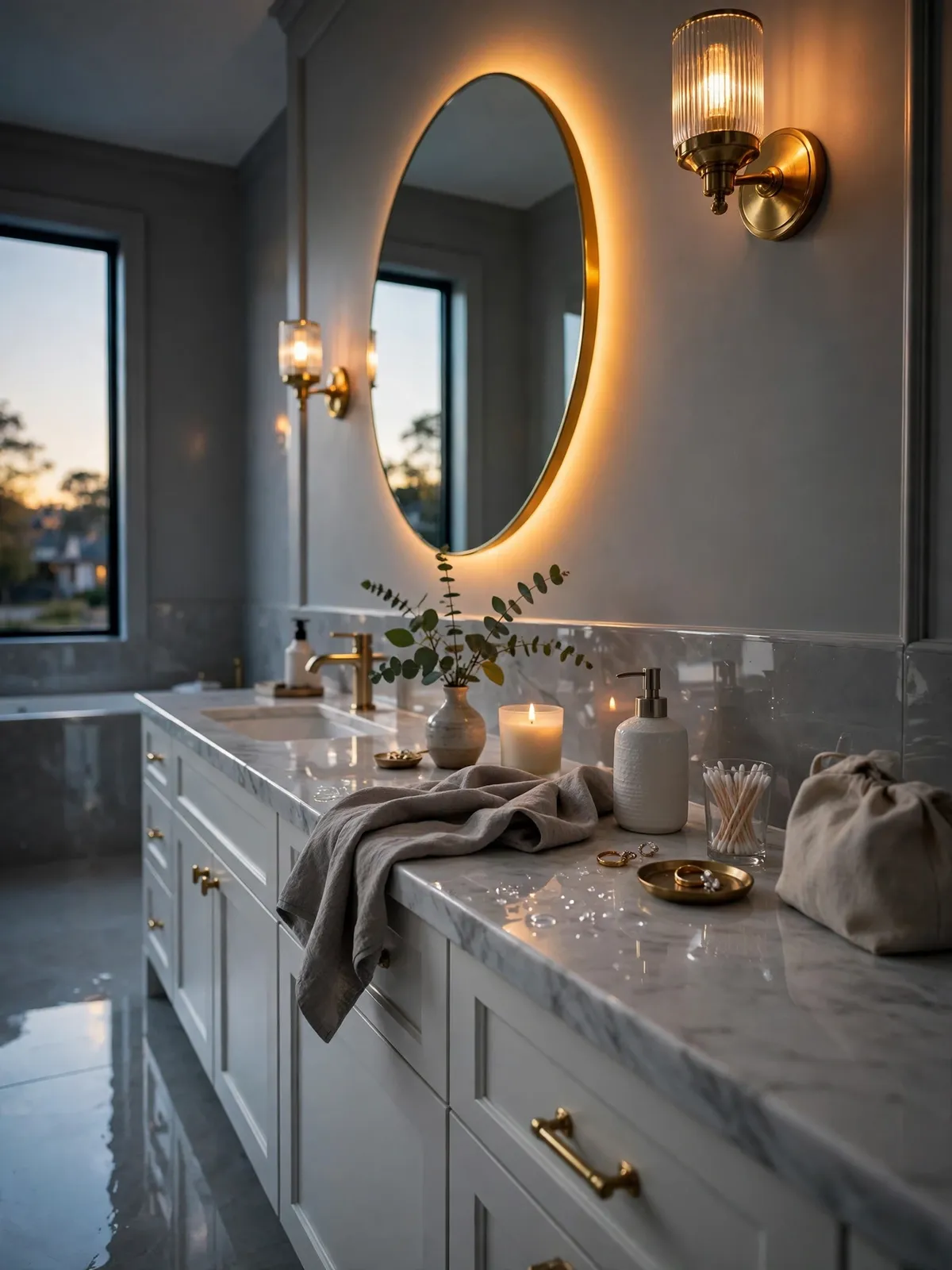
A backlit mirror creates a dreamy glow around the vanity that instantly makes a grey bathroom feel calmer and more luxurious, because the soft light warms the grey tones and flatters the person in the mirror. Here, a round backlit mirror floats above a white vanity against mid-grey walls, with brass sconces adding a second layer of warmth. The design suits every bathroom size, it softens grey beautifully, and it doubles as evening mood lighting. The weakness is wiring: a backlit mirror needs a power point behind it, and a cheap mirror with a cold glow looks clinical.
Quick tips:
- Choose warm white light (around 2700K) for a flattering glow.
- Pick a mirror slightly narrower than the vanity below it.
- Pair it with dimmable sconces for evening mood lighting.
- Keep the countertop clear so the glow stays the focus.
Open Shelves Styled With Calming Neutral Accessories
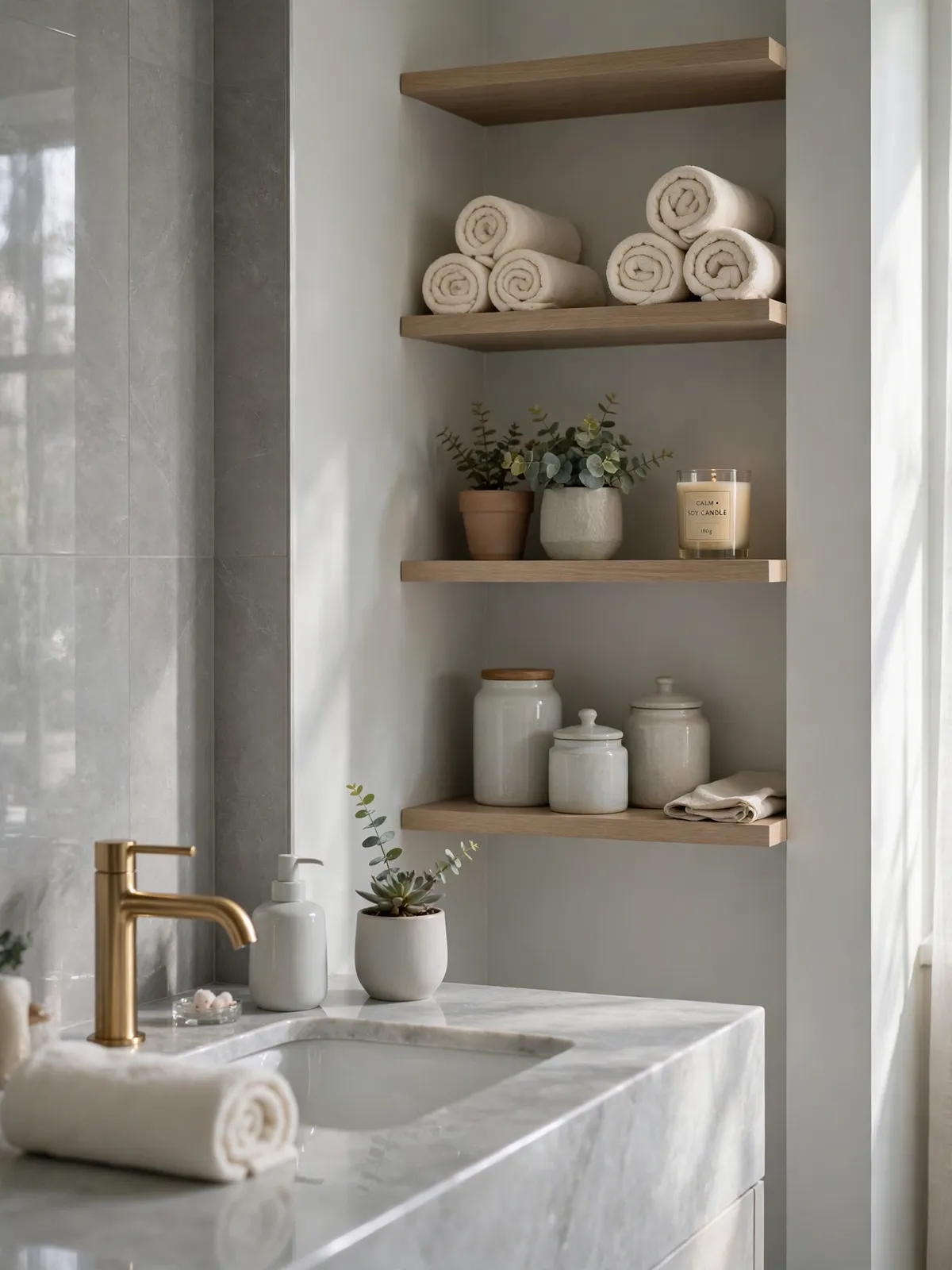
Open shelves styled with calming neutral accessories warm a grey bathroom, because rolled towels, candles, ceramic jars and a small plant add softness to a room that can otherwise feel visually flat. Here, pale grey walls hold wooden shelves with cream towels, a candle, ceramic jars and a tiny plant, and the room feels soft rather than stark. The design suits any bathroom, it costs little, and it is the fastest way to add warmth to grey. The weakness is clutter: open shelves in a grey bathroom show everything, so keep the display to three or four items per shelf.
Quick tips:
- Limit each shelf to three or four beautiful items.
- Use neutral accessories so the grey stays the star.
- Add one small plant for a touch of green.
- Keep the shelves away from direct shower spray.
A Floating Vanity That Makes the Room Feel Airier
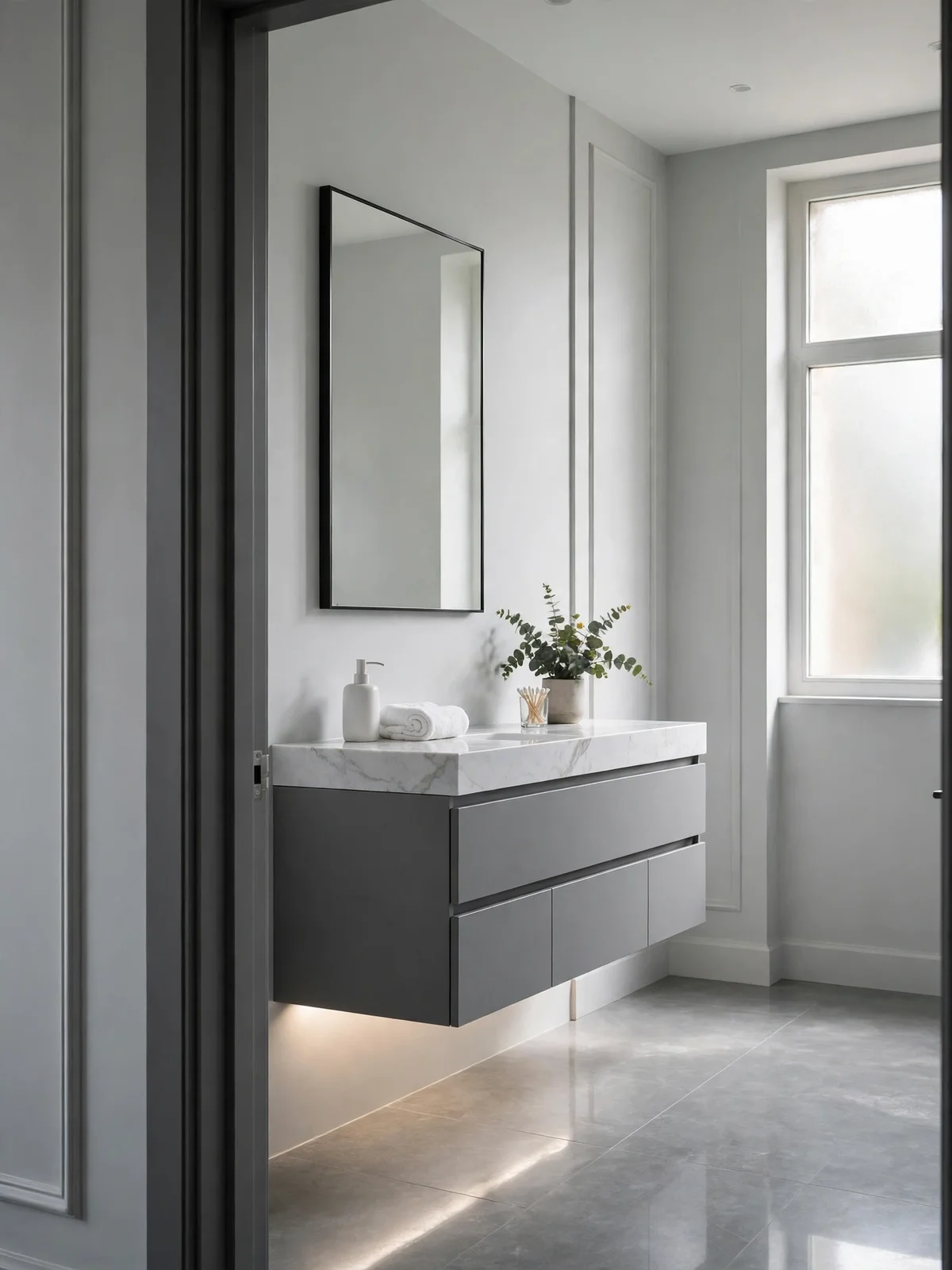
A floating vanity makes a grey bathroom feel larger almost instantly, because the exposed floor underneath creates visual breathing room and helps heavier grey tones feel lighter and less bulky. Here, a mid-grey floating cabinet with a white stone countertop sits against pale grey walls, with under-vanity lighting glowing softly beneath it. The design suits small and medium bathrooms, it makes cleaning the floor easier, and it feels cleaner and more architectural than a floor-standing unit. The weakness is storage: a floating vanity holds less than a floor-standing one, and the wall must be strong enough to carry it.
Quick tips:
- Check the wall can carry a floating unit before ordering.
- Add under-vanity lighting for a luxurious nighttime glow.
- Choose wall-mounted hardware in the same finish as the taps.
- Keep the countertop clear so the vanity reads as light.
Concrete Textures Softened With Warm Grey Finishes
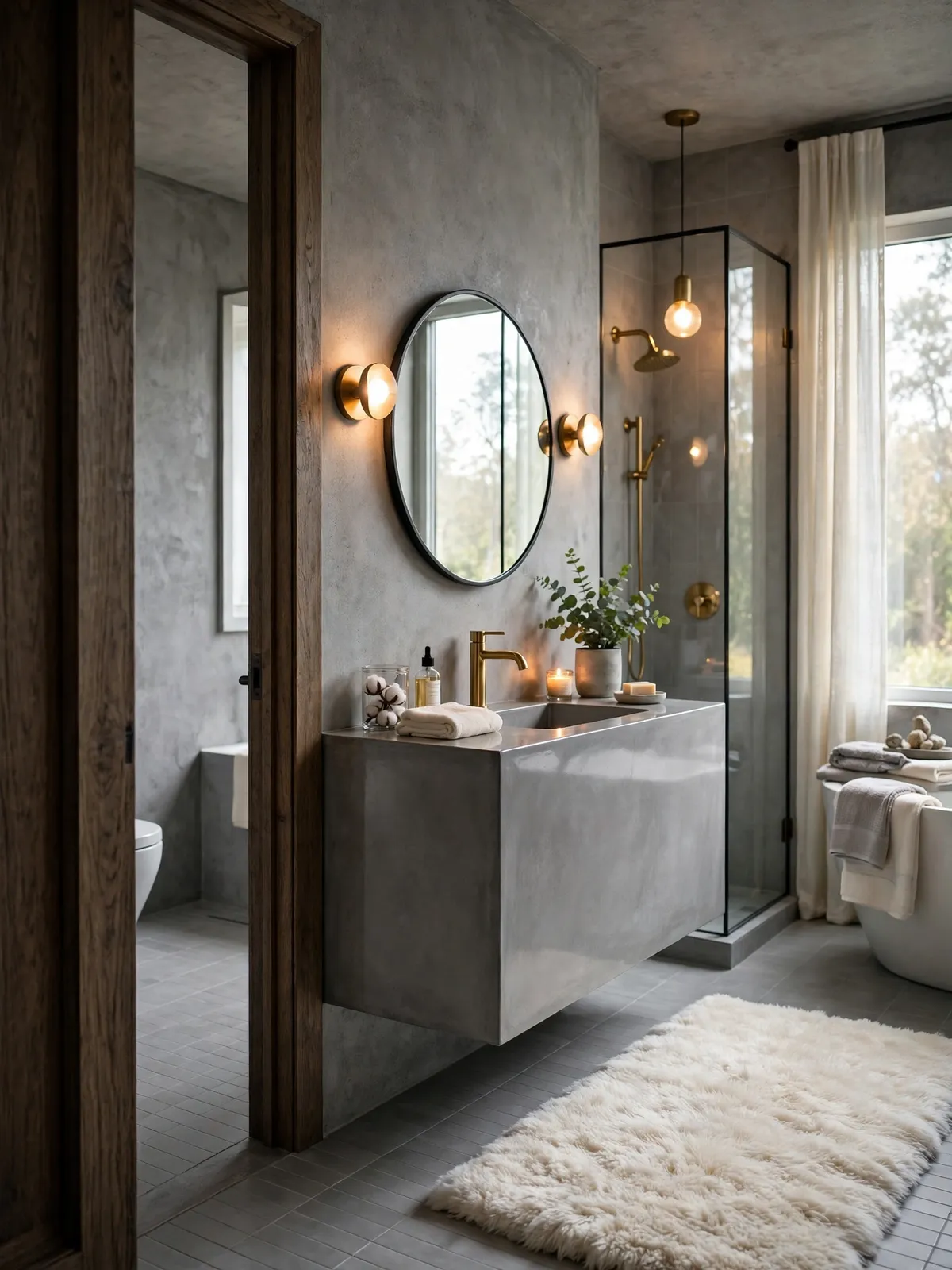
Concrete and grey together just work, but the trick is balance: raw concrete walls or countertops feel harsh if everything else is hard too, so softening the look with plush rugs, warm lighting and rounded mirrors creates a bathroom that is modern but cosy. Here, concrete-look walls sit beside soft grey tiles, a plush cream rug, warm lighting and a round mirror, and the contrast between industrial and cosy feels intentional. The design suits modern bathrooms, it looks like a boutique hotel, and it ages well. The weakness is coldness: too much concrete with no softness feels like a car park, so add textiles and wood.
Quick tips:
- Soften concrete with plush rugs, warm lighting and wood.
- Use concrete-look porcelain tile, not real concrete, for easy care.
- Pair concrete with warm greige paint, not cold white.
- Add a round mirror to soften the hard lines.
Wall Sconces Beside the Vanity Mirror for Warm Side Light
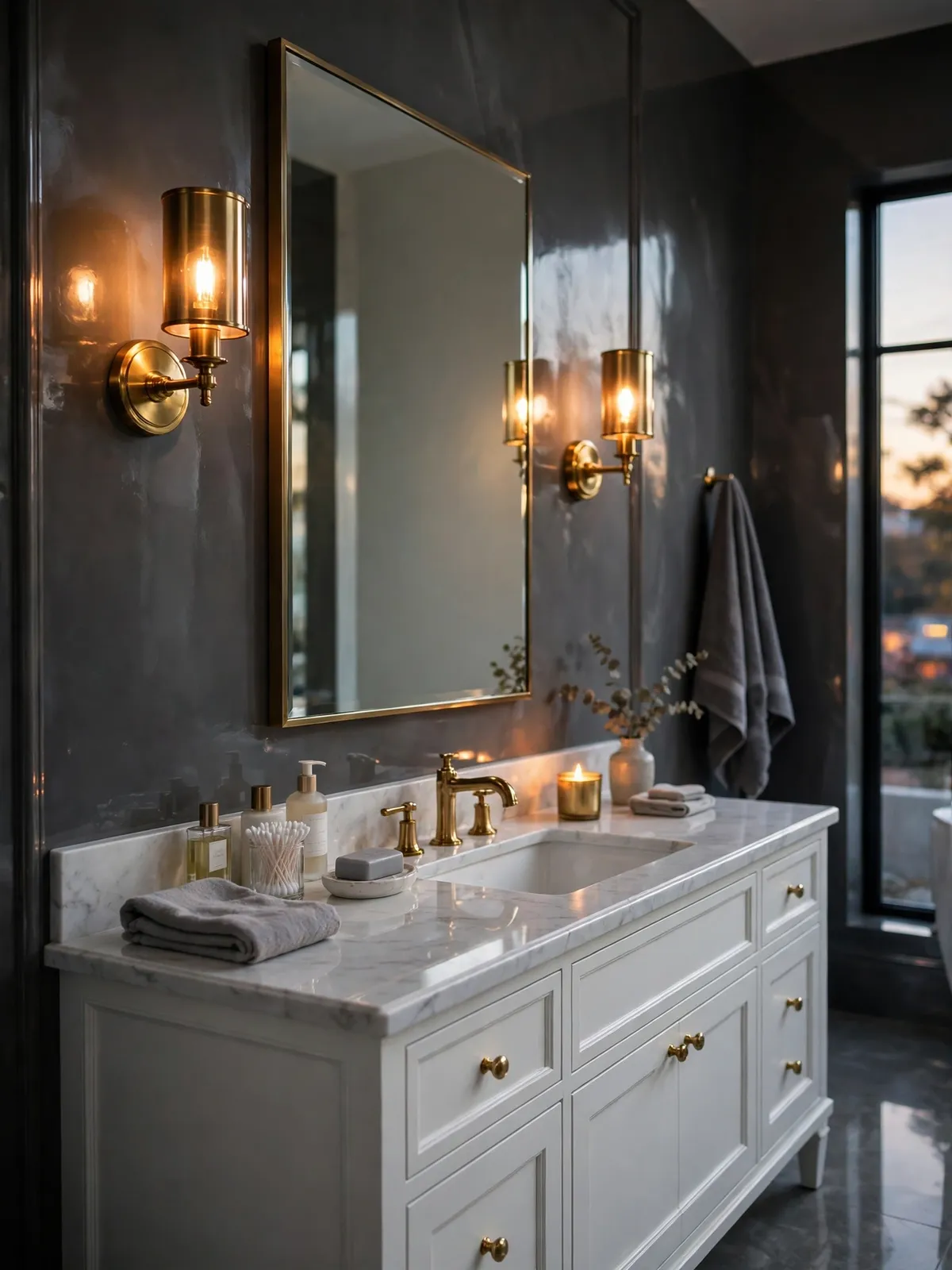
Side sconces beside the vanity mirror make a grey bathroom feel warmer immediately, because soft side lighting creates gentler shadows than harsh overhead light and adds an upscale boutique-hotel feeling. Here, warm brass sconces glow beside a round mirror against charcoal walls, with a white vanity below and the whole room warm in the evening. The design suits any bathroom, it flatters the face in the mirror, and it is one of the most effective warm-grey upgrades. The weakness is wiring: sconces need a power point on either side of the mirror, so plan the wiring early.
Quick tips:
- Mount sconces at eye level beside the mirror, not above it.
- Choose warm bulbs, because cool white makes grey feel sterile.
- Match the sconce finish to the taps for a pulled-together look.
- Put the sconces on a dimmer for evening baths.
Soft Grey Walls With Creamy White Trim
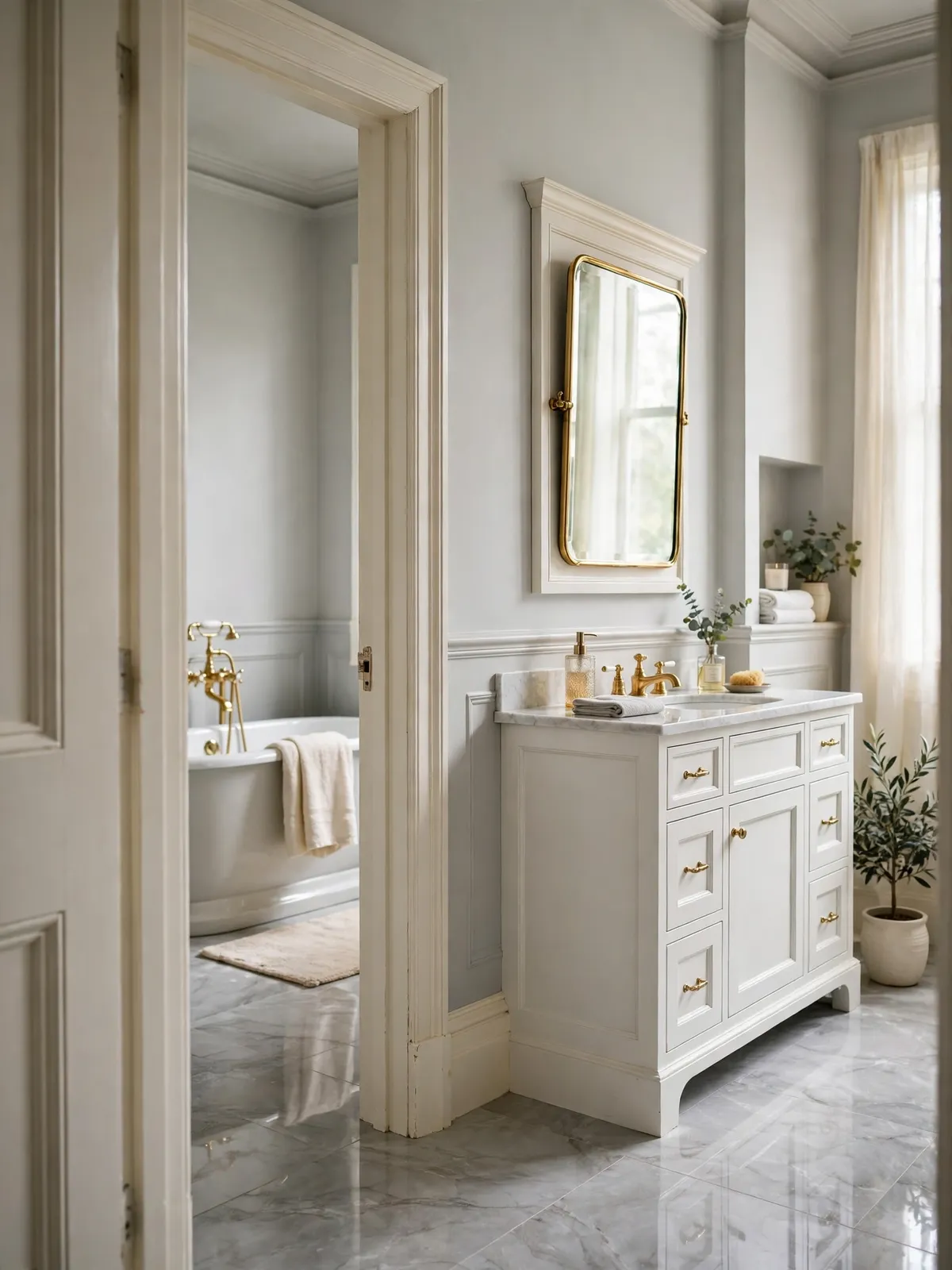
Soft grey walls with creamy white trim feel classic every single time, because crisp white trim can feel too sharp beside grey walls, while creamier whites soften the transition and make the bathroom feel more welcoming. Here, pale grey walls meet warm ivory trim around a white vanity with brass taps, and the contrast stays clean without becoming cold. The design suits period homes and modern bathrooms alike, it is a small detail with a large effect, and it helps older homes feel less stark after renovation. The weakness is colour matching: a cream that is too yellow clashes with a cool grey, so test the two together.
Quick tips:
- Use warm ivory trim, not pure white, beside grey walls.
- Test the trim and wall colours together in your own light.
- Pair the combination with brass, not chrome, fixtures.
- Keep towels soft cream, not stark white, for cohesion.
A Seamless Walk-In Shower in Grey Microcement
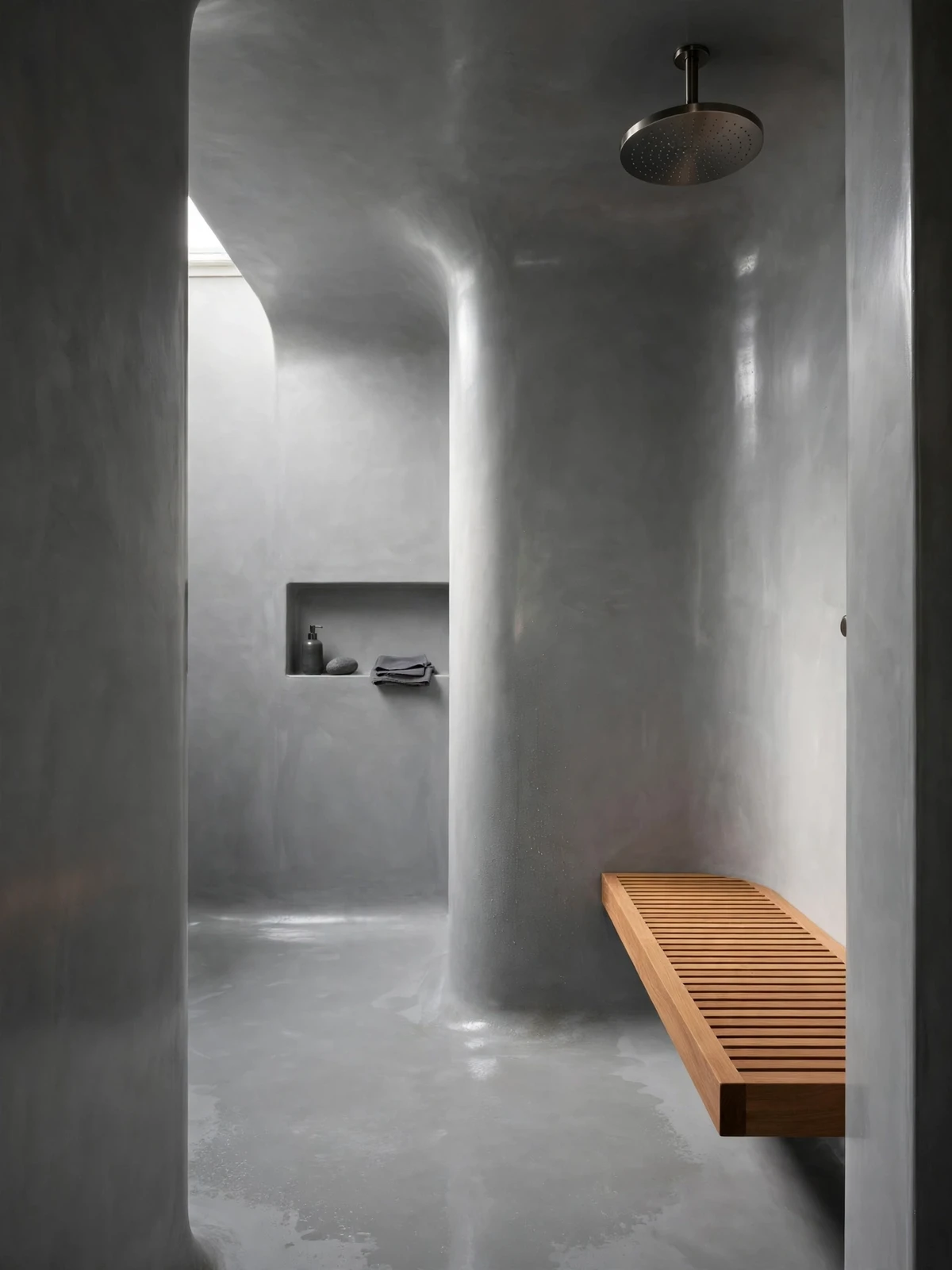
Grey microcement in a walk-in shower looks insanely sleek when done well, because the continuous finish across walls and floors removes visual breaks and makes the bathroom feel bigger and calmer instantly. Here, soft grey microcement wraps a walk-in shower with a rain head and a teak bench, and the whole space feels sculptural and quiet. The design suits modern bathrooms, it has almost no grout lines to clean, and it creates a soft architectural look that feels modern but not cold. The weakness is cost and skill: microcement needs a specialist applicator, and a bad job shows every flaw.
Quick tips:
- Hire a specialist microcement applicator, not a general tiler.
- Choose a warm grey microcement, not a cold one.
- Add a teak bench to warm the grey finish.
- Seal microcement properly so it stays waterproof.
Fluted Grey Panels Behind the Vanity for Quiet Luxury
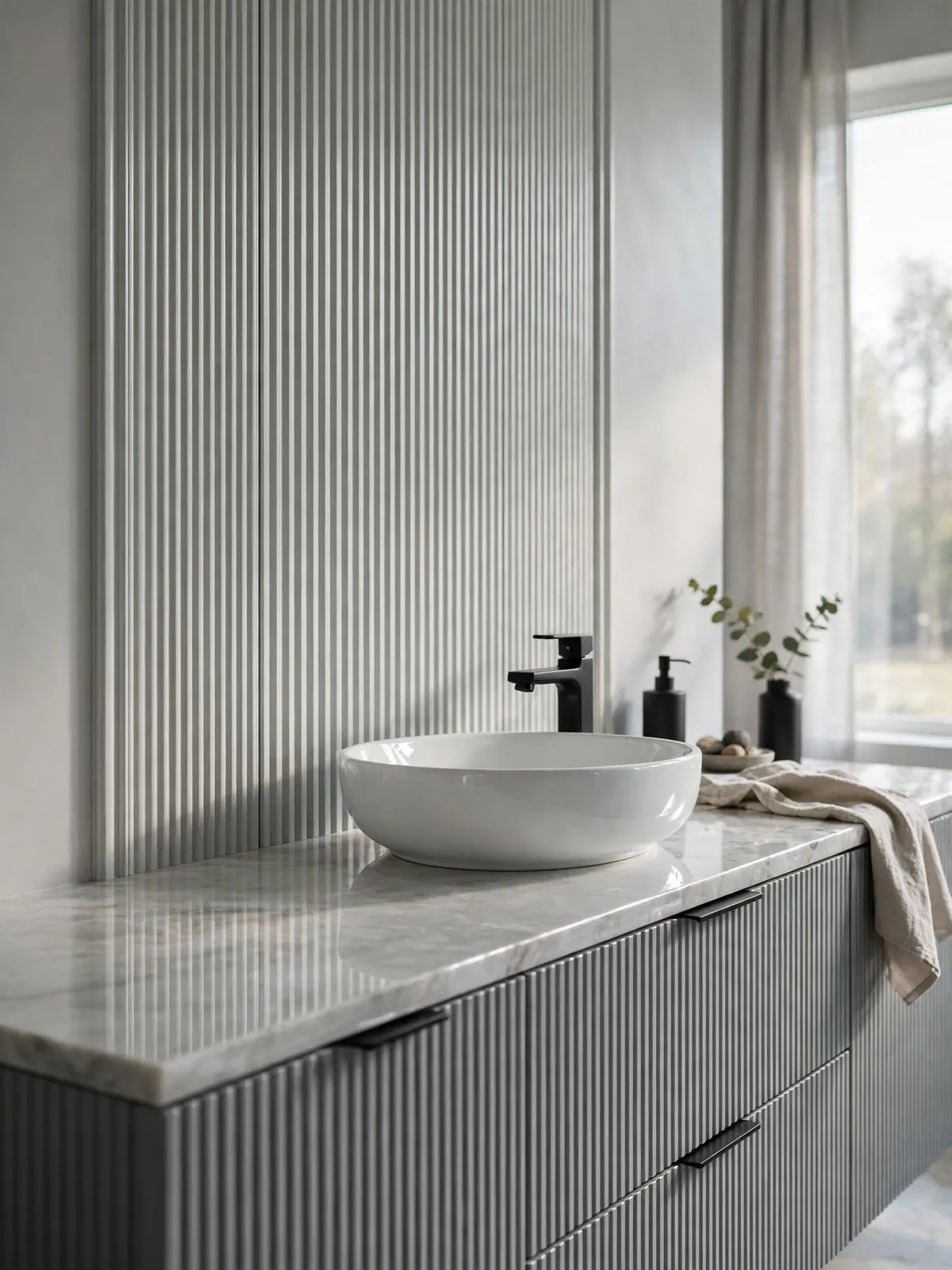
Fluted grey panels behind the vanity add subtle movement that makes a grey bathroom feel more luxurious and architectural instantly, because the vertical grooves create shadows that shift through the day. Here, pale grey fluted panels cover the wall behind a white vessel sink, with matte black taps and a round mirror completing the custom look. The design suits modern bathrooms, it creates a focal point without bold colour or busy pattern, and it ages beautifully. The weakness is dust: the grooves collect dust, so wipe the panels regularly.
Quick tips:
- Use fluted panels behind the vanity only, not every wall.
- Pair fluted grey with matte black taps for contrast.
- Wipe the grooves weekly so dust never builds up.
- Keep the rest of the room plain so the panels shine.
Smoked Glass Shower Panels for a Softer Modern Look
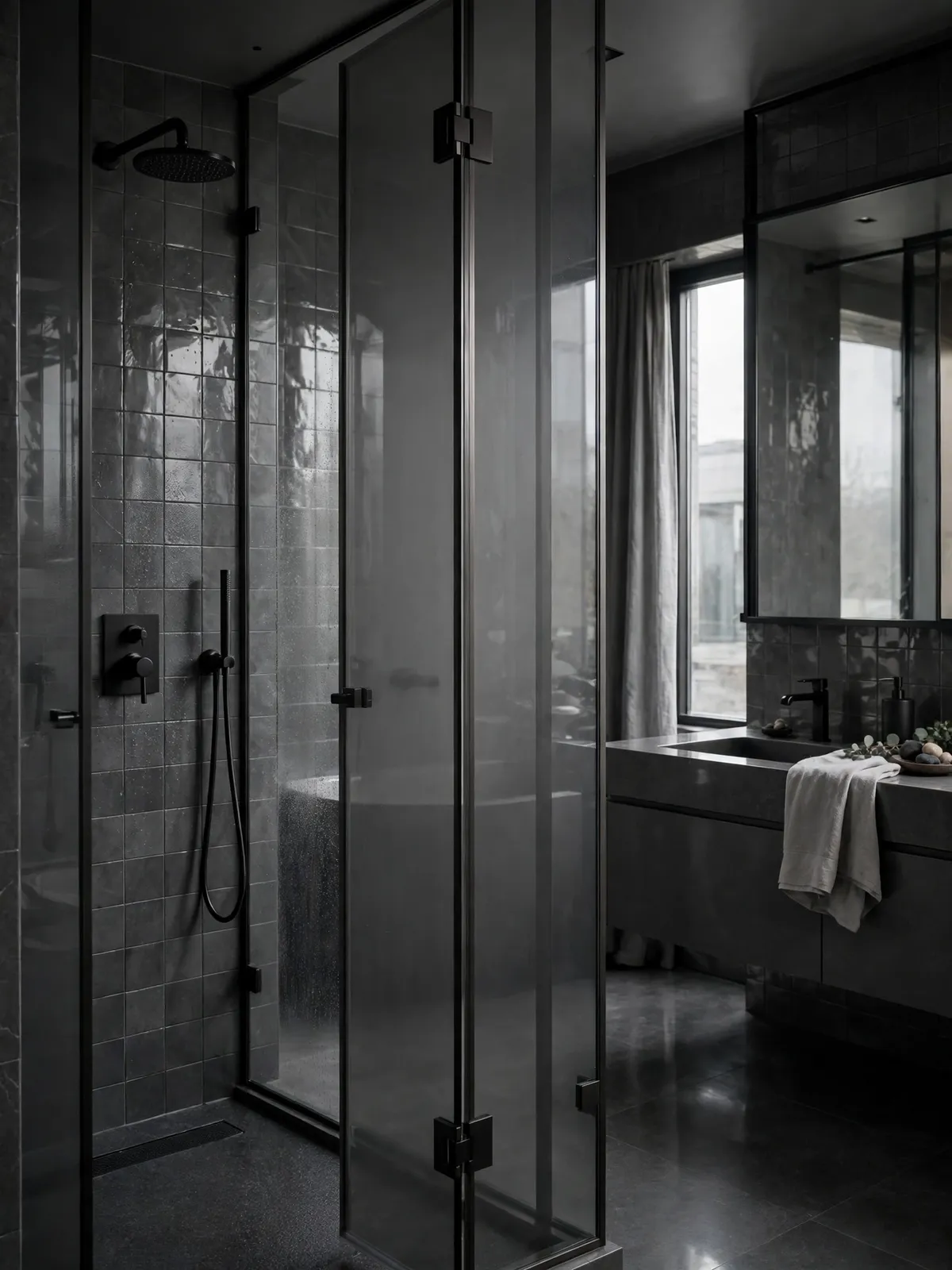
Smoked glass shower panels soften a grey bathroom beautifully, because the slight tint creates privacy and adds a sleek, moody elegance that pairs perfectly with grey tile and matte black fixtures. Here, smoked glass panels enclose a charcoal-tiled shower with matte black fittings, and the glass subtly reflects the surrounding tones without feeling overly reflective. The design suits larger bathrooms, it feels airy and open unlike frosted glass, and it adds a layer of sophistication. The weakness is cleaning: smoked glass shows water marks, so squeegee it after every shower.
Quick tips:
- Use smoked glass in larger bathrooms where it has room to breathe.
- Pair it with matte black fixtures for a cohesive look.
- Squeegee the glass after every shower to prevent marks.
- Keep the shower tiles pale so the smoked glass glows.
A Monochrome Grey Bathroom With Tonal Layering
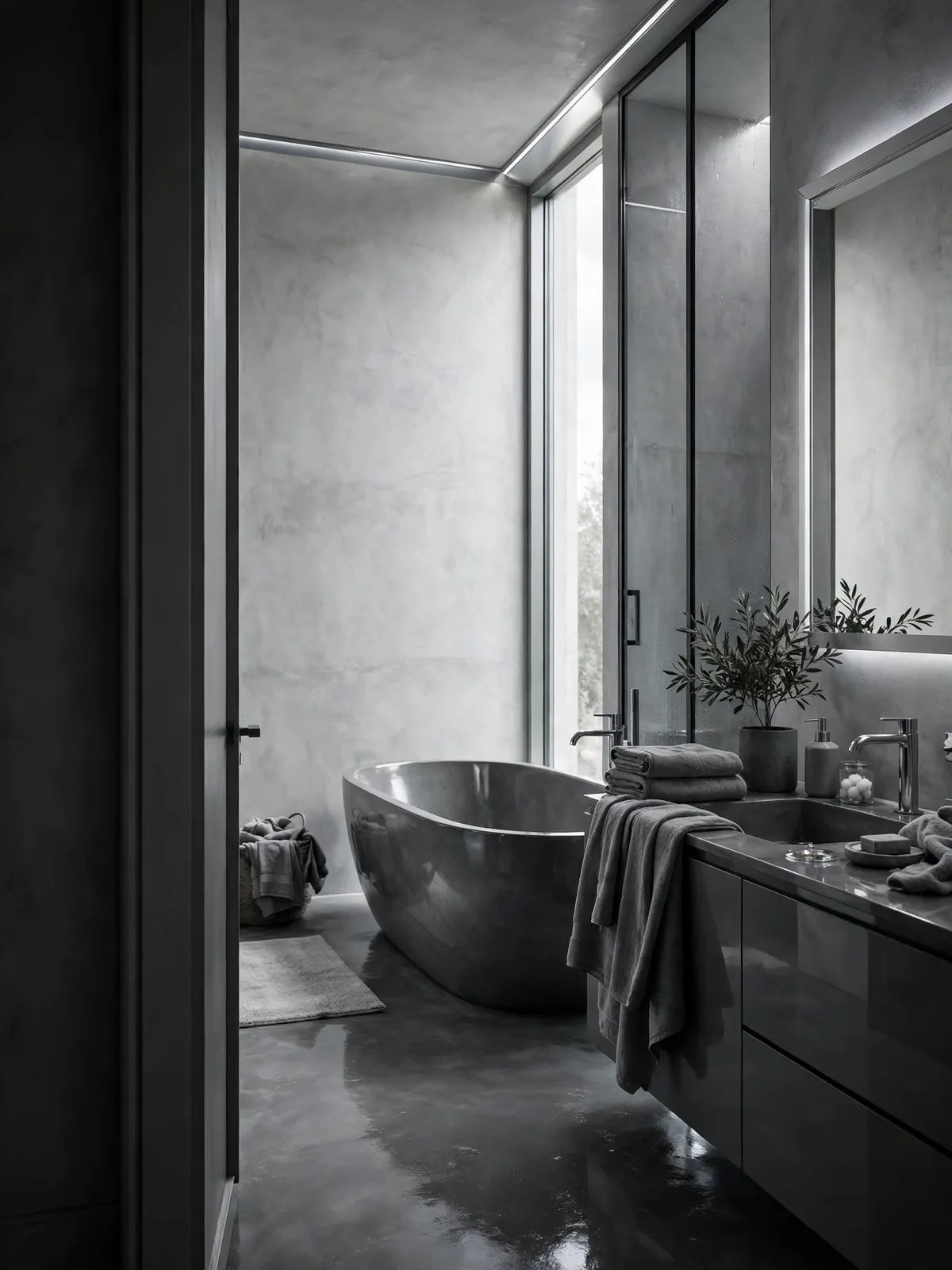
A monochrome grey bathroom feels calmer than a highly colourful one when the layering is right, because pale walls, smoky towels, concrete textures, charcoal accents and silver lighting create richness through variation rather than colour. Here, a grey bathroom mixes at least four shades with matte and soft reflective finishes, and the room feels like it has room to breathe. The design suits small bathrooms especially well, because the consistent palette makes the space feel more spacious. The weakness is flatness: monochrome grey needs texture variation on every surface, or it looks like one flat tone.
Quick tips:
- Use at least four shades of grey in a monochrome room.
- Mix matte and soft reflective finishes.
- Repeat textures throughout the room.
- Add warm lighting everywhere so the grey never feels cold.
Grey and Brass Together for Warm, Golden Contrast
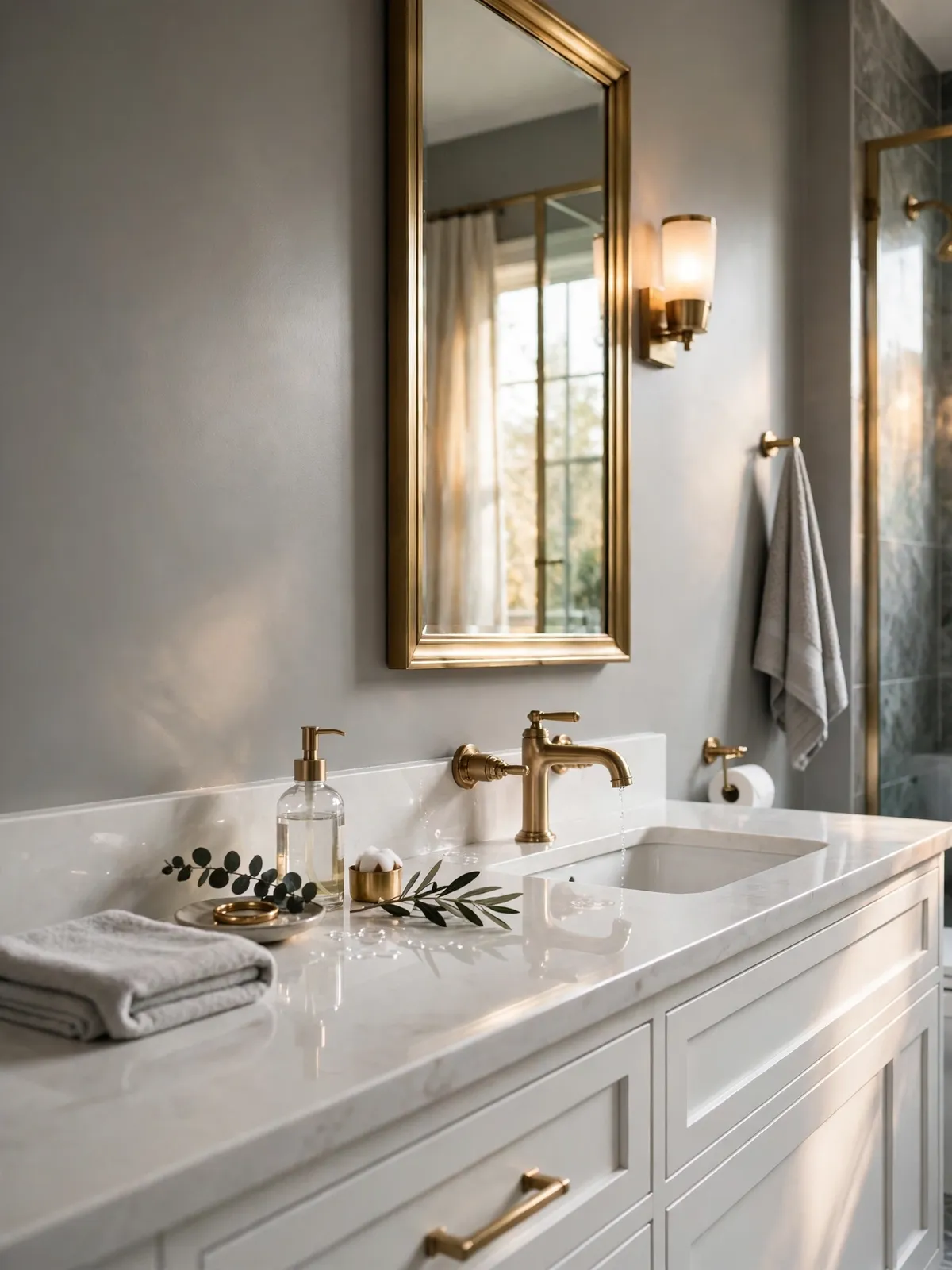
Grey and brass together are the warmest pairing in this list, because the golden metal echoes the warm undertones of the grey and the whole room feels richer for it. Here, brushed brass taps, a brass-framed mirror and brass sconces sit against mid-grey walls with a white vanity, and the metal ties the room together. The design suits any grey bathroom being refreshed, it photographs beautifully, and brass ages gracefully where chrome can look dated. The weakness is matching: brass finishes vary wildly between brands, so buy all fixtures from one range.
Quick tips:
- Buy all brass fixtures from one range so the tone matches.
- Choose brushed brass over polished for a softer, modern look.
- Repeat brass in at least three places so it looks deliberate.
- Clean brass with a soft cloth, never abrasive cleaners.
Grey and Wood Together for Natural Warmth
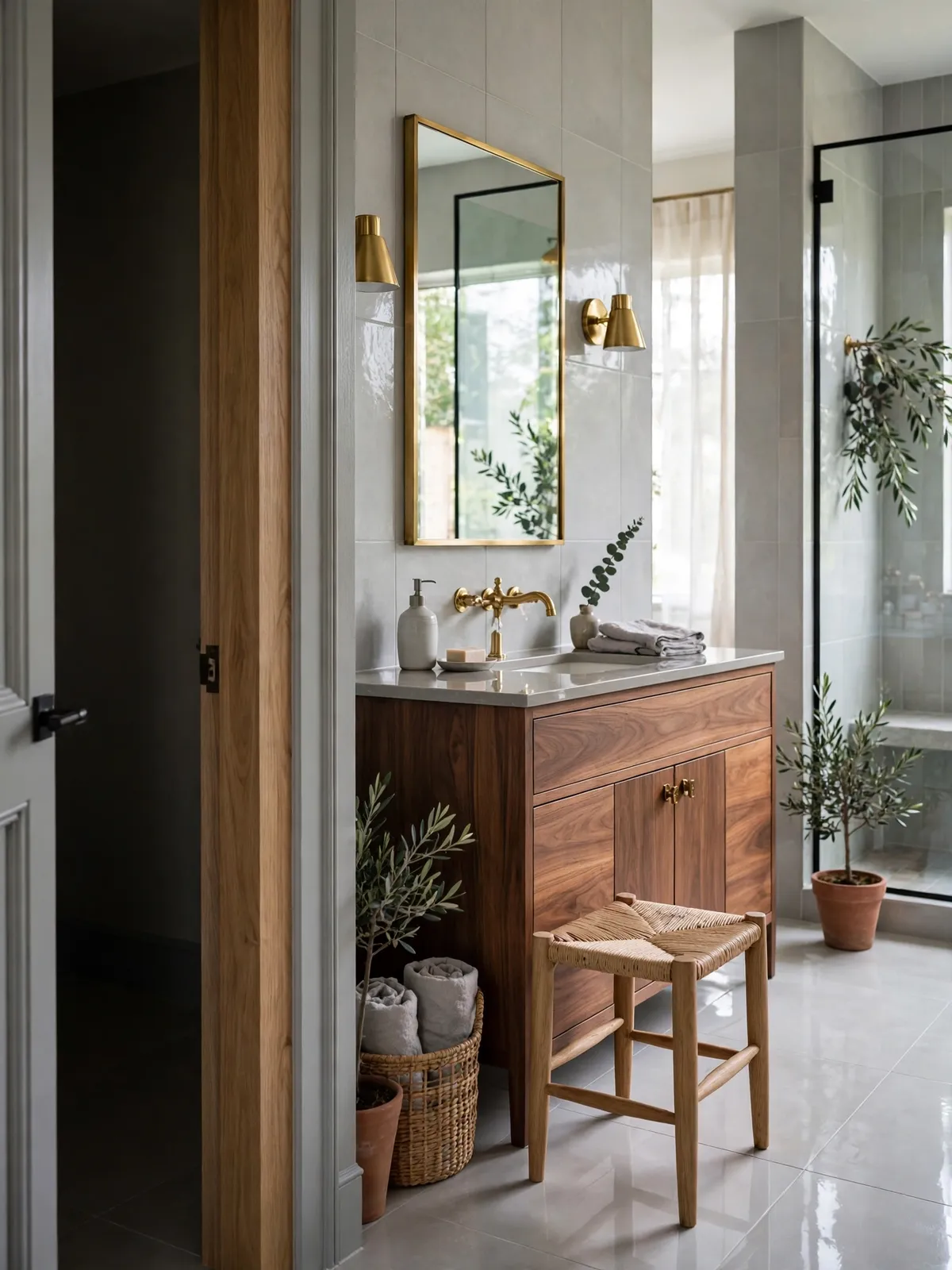
Grey and wood together give a bathroom the grounded, organic feeling that all-grey rooms often miss, because the wood grain adds warmth and depth that paint and porcelain cannot. Here, a warm walnut vanity and an oak stool sit against pale grey tiles, with brass fixtures and cream towels completing the natural palette. The design suits bathrooms of every size, it ages well because natural materials never look dated, and it pairs beautifully with plants and linen. The weakness is water: untreated wood swells and stains in a bathroom, so choose sealed timber only.
Quick tips:
- Choose sealed stone and lacquered or oiled timber only.
- Keep wood away from direct splash zones.
- Pair grey tiles with walnut or oak for the warmest result.
- Add linen towels to soften the hard natural textures.
Grey Marble for Classic, Veined Luxury
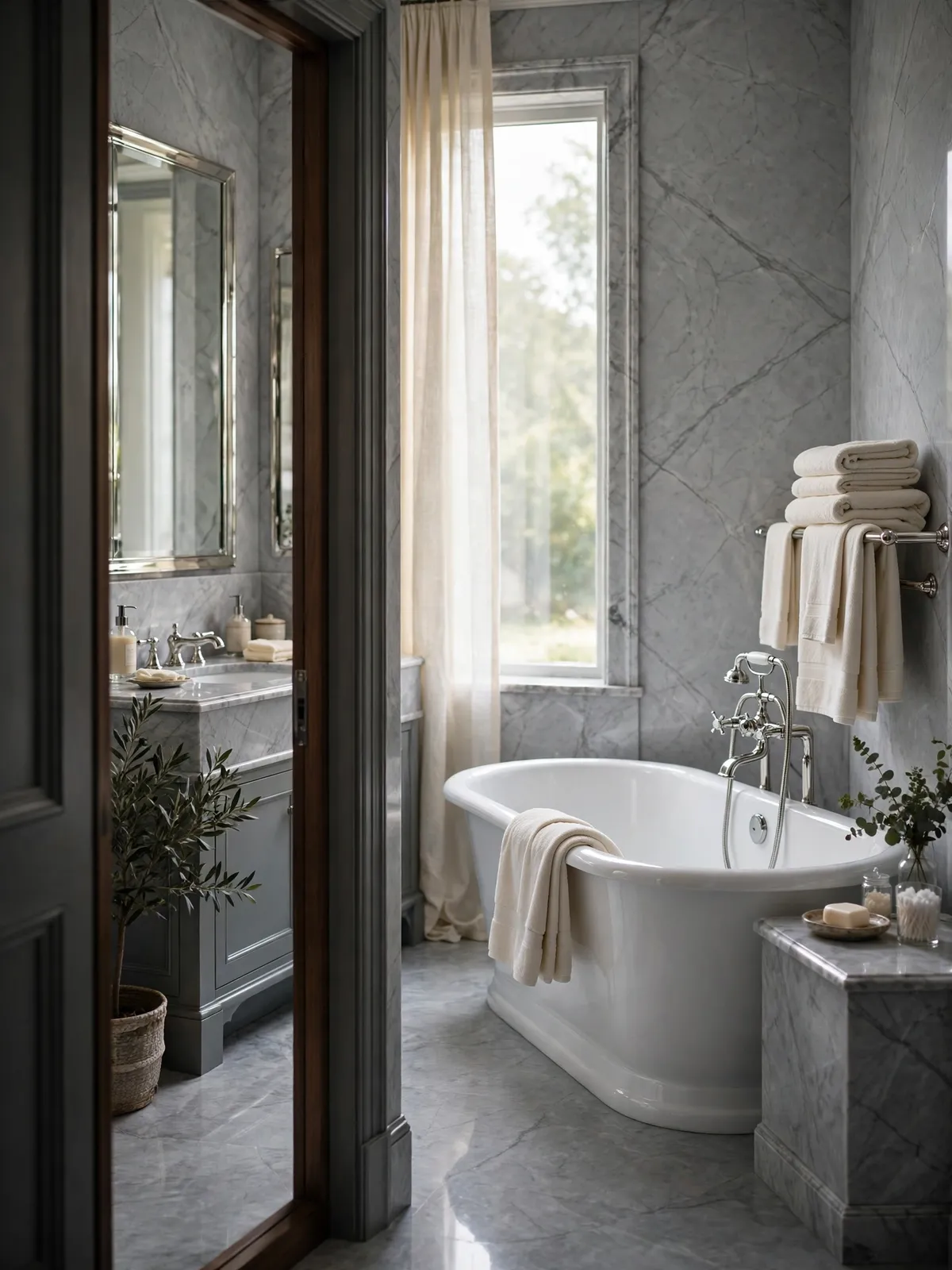
Grey marble is the classic luxury pairing for a bathroom, because the soft grey veining adds movement to the neutral palette while the white stone keeps the room bright and timeless. Here, grey-veined marble covers the walls around a white freestanding tub, with chrome fixtures and cream towels keeping the contrast calm. The design suits bathrooms being renovated or refreshed with new surfaces, it adds real value, and it photographs beautifully. The weakness is care: marble stains easily and needs sealing, so it suits people who will maintain it.
Quick tips:
- Seal marble before use and reseal every six months.
- Choose marble with soft grey veining, not bold black.
- Pair grey marble with cream, not bright white, towels.
- Wipe water and toothpaste off the marble the same day.
Grey Subway Tiles in Herringbone for Quiet Pattern
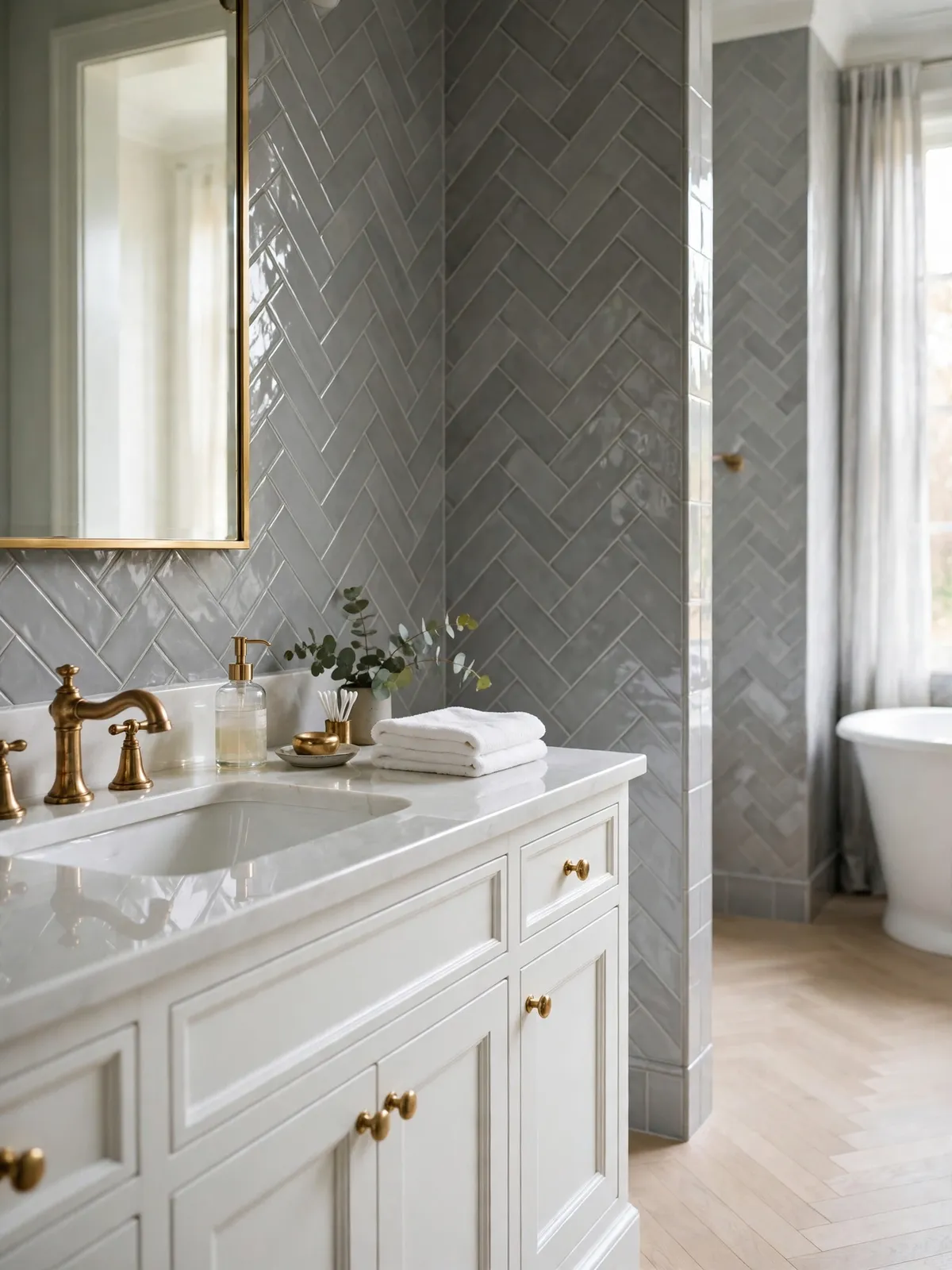
Grey subway tiles laid in herringbone add quiet pattern to a bathroom, because the zigzag layout creates movement and texture while the soft grey keeps the room calm. Here, grey herringbone covers the vanity wall, with a white vanity, brass taps and a pale wood floor keeping the palette warm. The design suits bathrooms that feel flat, it costs little more than a straight layout, and it makes the wall feel designed rather than tiled. The weakness is cost: herringbone needs more tiles and more cutting than a straight layout.
Quick tips:
- Use herringbone on one wall, not the whole room.
- Order 15% extra tile for herringbone cuts.
- Match the grout to the tile so the pattern reads as texture.
- Pair grey herringbone with brass or wood for warmth.
Grey and Blush Together for a Soft, Romantic Room
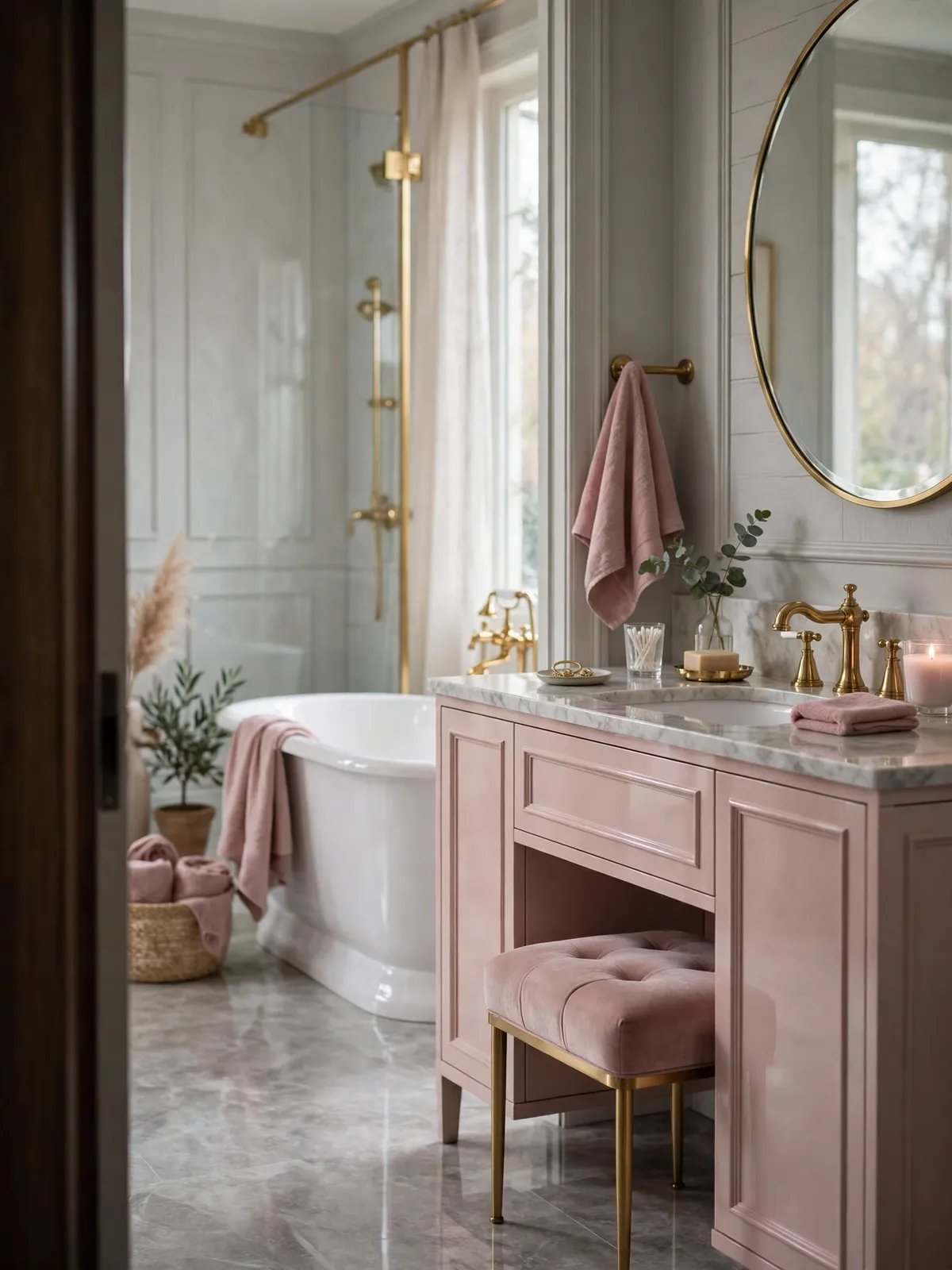
Grey and blush together give a bathroom a soft, romantic feeling, because the warm pink softens the grey and the two colours flatter each other in a way that neither can do alone. Here, pale grey walls meet dusty rose towels, a blush stool and brass fixtures, and the room feels like a boutique dressing room. The design suits bathrooms that feel cold or stark, it is one of the most flattering colour pairs for a mirror wall, and it works in both traditional and modern rooms. The weakness is balance: too much blush looks sweet rather than sophisticated, so keep blush to towels and one or two accessories.
Quick tips:
- Keep blush to towels and one accessory, not the walls.
- Choose a dusty, muted blush, not a bright pink.
- Pair grey and blush with brass, not chrome.
- Use pale grey on the walls so the blush pops gently.
Grey and Sage Green Together for a Natural, Calming Room
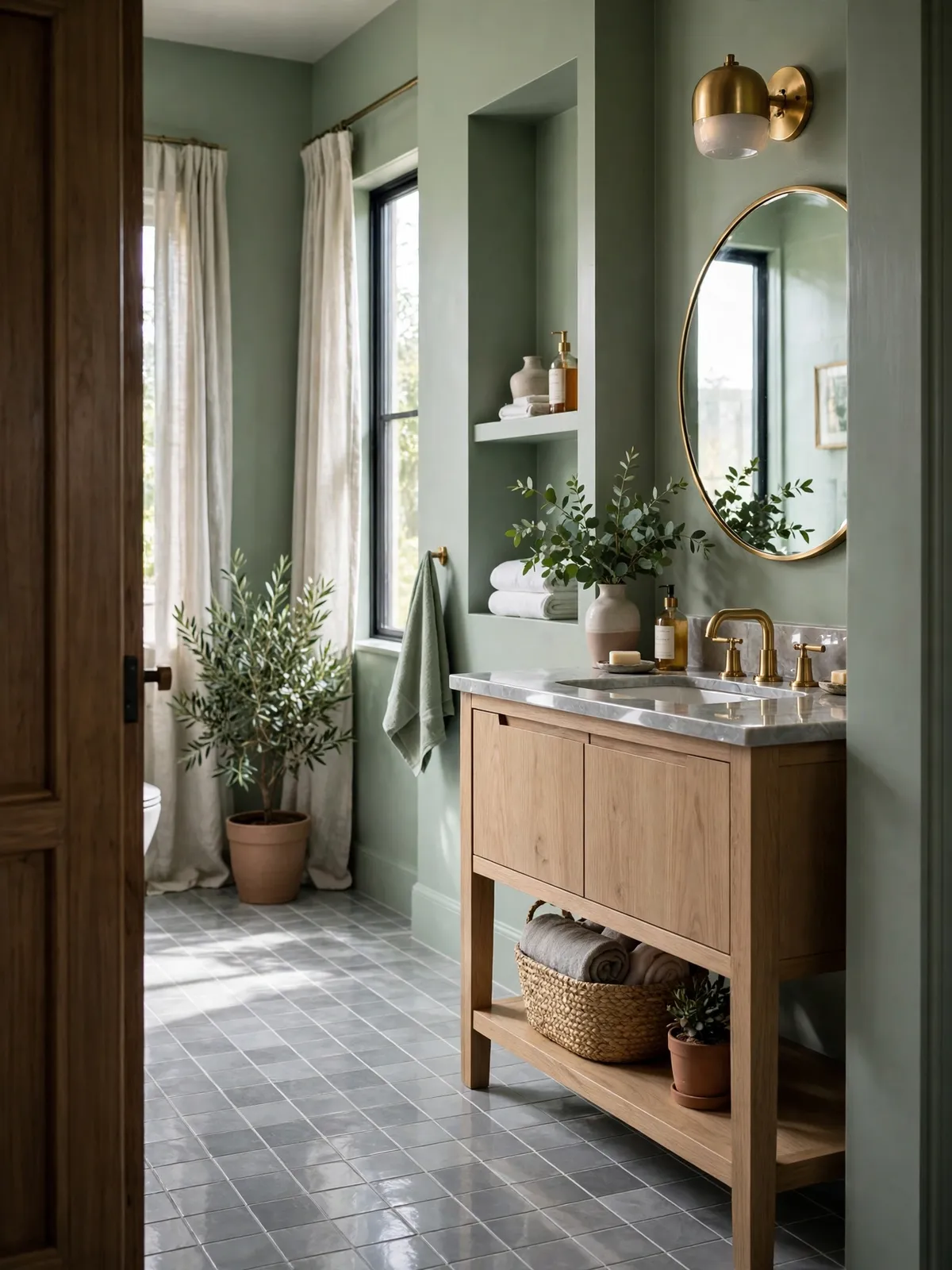
Grey and sage green together bring the outdoors into a bathroom, because the muted green feels natural and calm while the grey grounds it and keeps the room sophisticated. Here, sage walls meet grey floor tiles, a light oak vanity and brass taps, and the room feels fresh and serene. The design suits bathrooms of every size, it never dates, and it is one of the most forgiving colour pairs for a first grey bathroom. The weakness is undertone: a sage with too much yellow can clash with a cool grey, so test the two together in your own light.
Quick tips:
- Test sage and grey together in morning and evening light.
- Use sage on the walls and grey on the floor for balance.
- Add light oak or walnut to warm the pairing.
- Use brass fixtures, not chrome, with sage and grey.
Grey and Navy Together for a Bold, Boutique Contrast
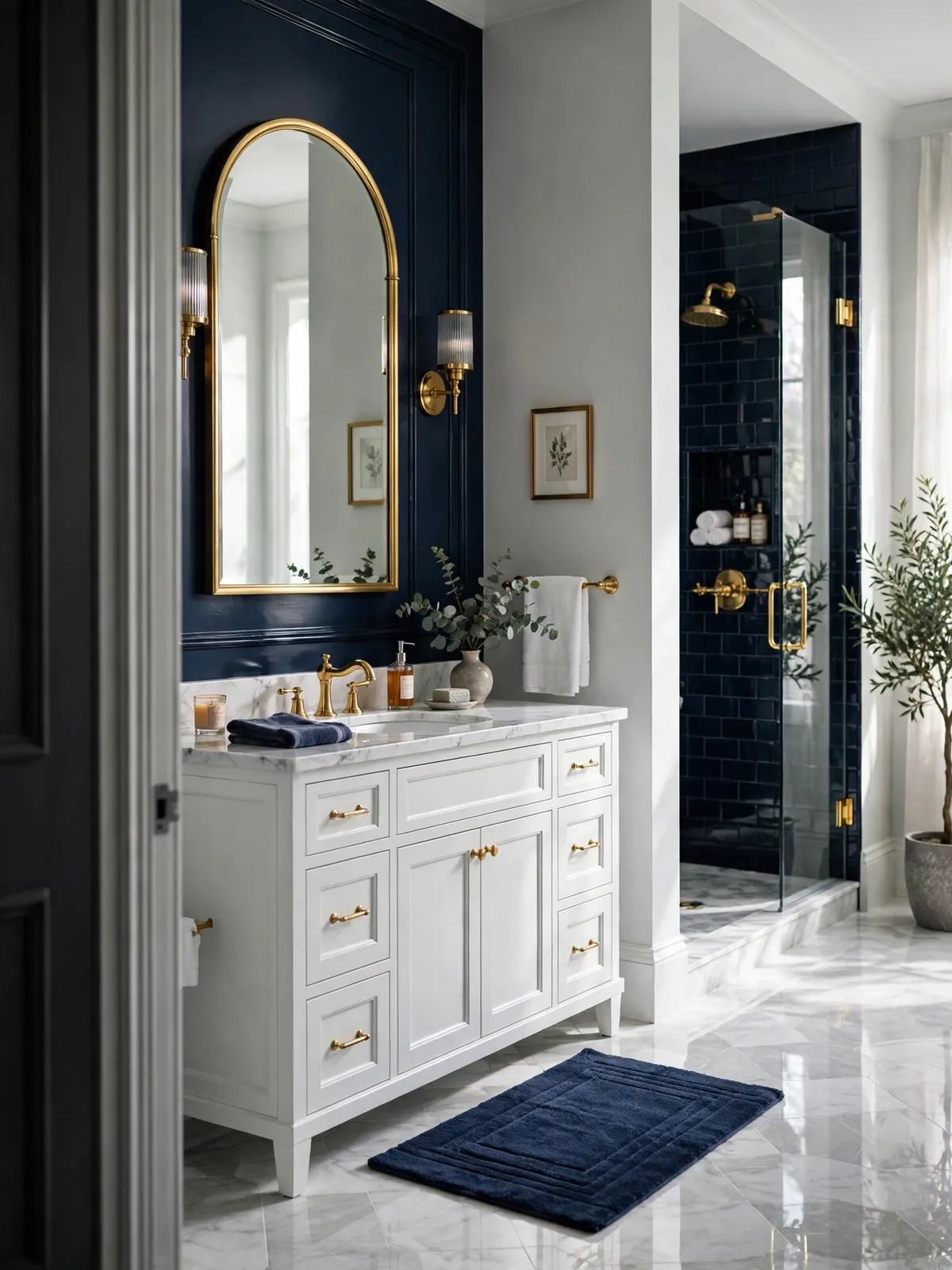
Grey and navy together create a bold, boutique contrast, because the deep blue adds drama while the pale grey keeps the room from feeling dark. Here, a navy accent wall sits behind a white vanity in a pale grey bathroom, with brass fixtures and cream towels softening the contrast. The design suits bathrooms that feel plain, it adds instant character, and it photographs with a richness pale bathrooms cannot match. The weakness is light: a navy wall in a small bathroom can feel heavy, so keep navy to one wall and balance it with a large mirror.
Quick tips:
- Keep navy to one accent wall, not the whole room.
- Balance navy with a large mirror and warm lighting.
- Use brass fixtures to warm the navy and grey.
- Keep towels and the ceiling pale to lift the room.
A Small Grey Bathroom That Feels Larger With One Big Mirror
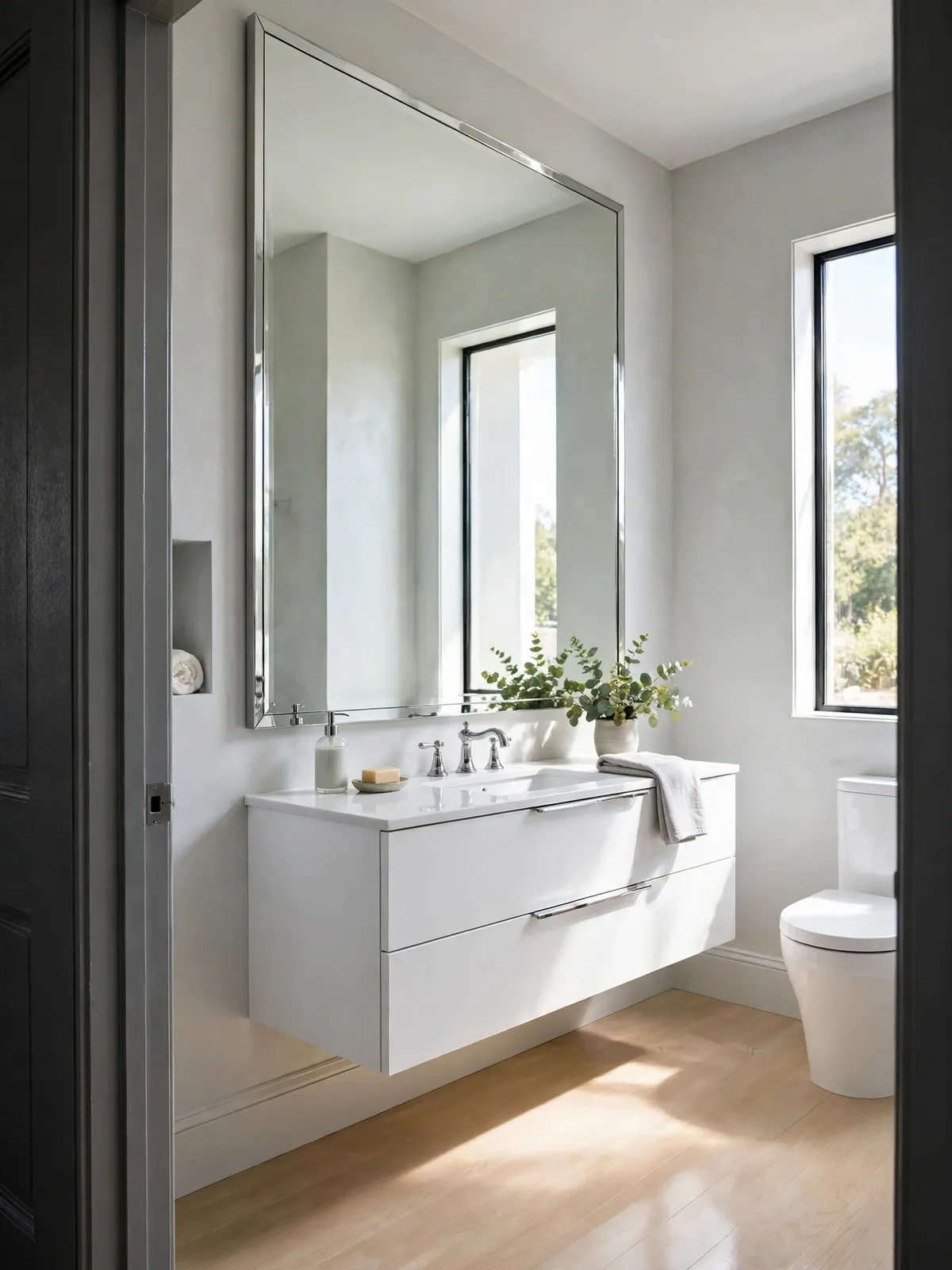
A small grey bathroom that feels larger with one big mirror is the most useful idea in this list for compact homes, because a single oversized mirror bounces light, doubles the sense of space and turns a plain wall into a design feature. Here, a floor-to-ceiling mirror fills the wall above a white floating vanity in a pale grey bathroom, with chrome taps, a pale wood floor and a single white orchid, and the room feels twice its real size. The design suits cloakrooms, en suites and flats, it costs far less than moving a wall, and it makes a small bathroom feel like a deliberate design choice. The weakness is reflection: a huge mirror also reflects clutter, so the room must stay tidy.
Quick tips:
- Take the mirror almost to the ceiling to stretch the room upward.
- Keep the vanity floating so more floor shows below the mirror.
- Use pale grey so the reflection stays bright.
- Hide clutter completely — a big mirror shows everything.
Grey and Black Together for a Moody, Cocooning Room
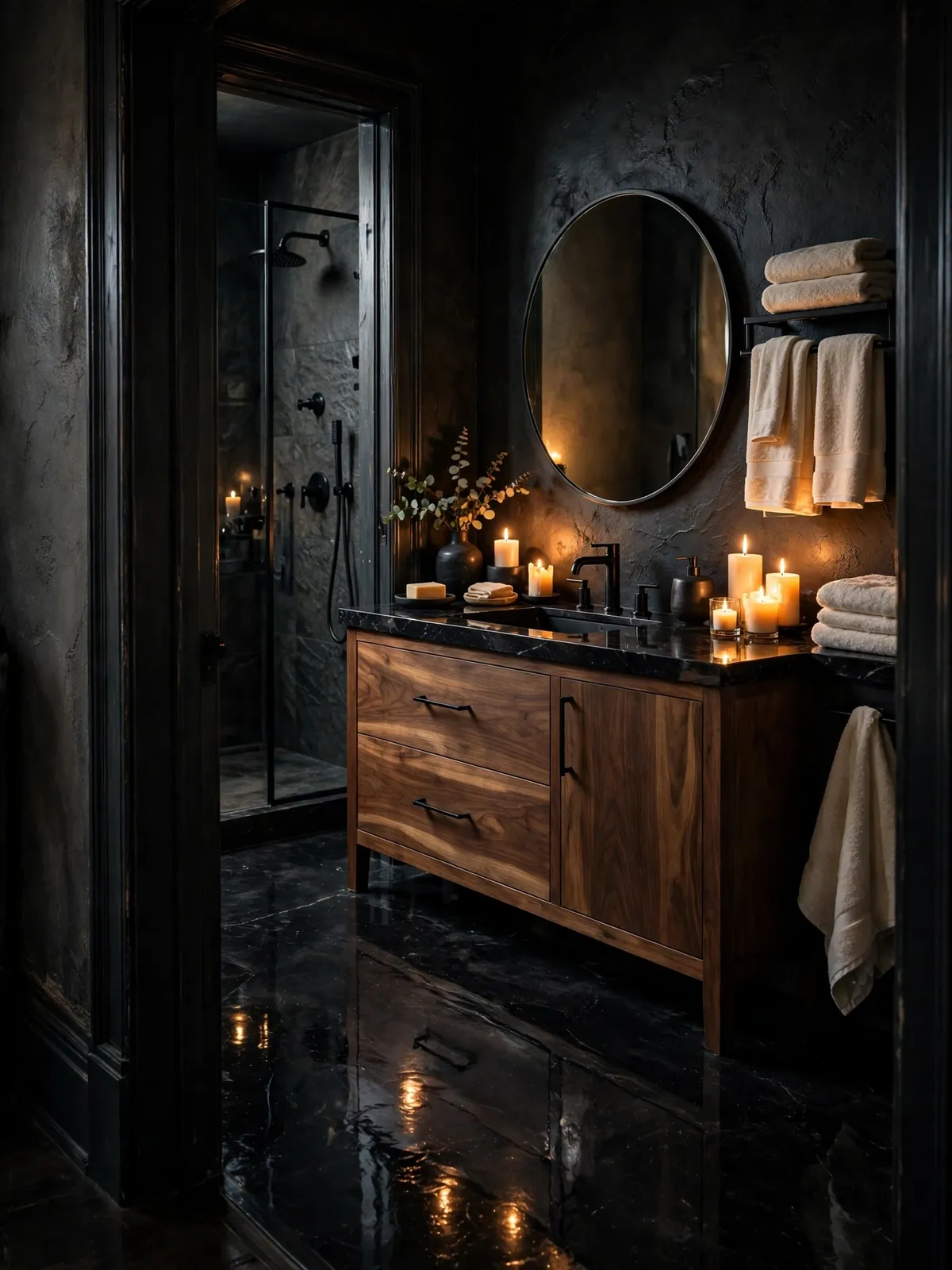
Grey and black together turn a bathroom into a moody, cocooning retreat, because the charcoal walls absorb light while the black fixtures add structure and the walnut vanity keeps the darkness warm. Here, charcoal walls wrap a walnut vanity with matte black fixtures, cream towels and warm candlelight, and the room feels private and indulgent. The design suits larger bathrooms and evening bathers, it makes a freestanding tub feel like a ritual, and it hides the everyday wear that white walls show. The weakness is light: a dark bathroom with a small window can feel gloomy in the morning, so balance it with a large mirror and warm bulbs.
Quick tips:
- Keep the ceiling and towels pale to lift a dark grey room.
- Use warm bulbs, never cool white, with charcoal walls.
- Repeat black in at least two places so it looks deliberate.
- Test the grey in morning and evening light before painting.
Grey Bathroom Ideas That Pull the Whole Room Together
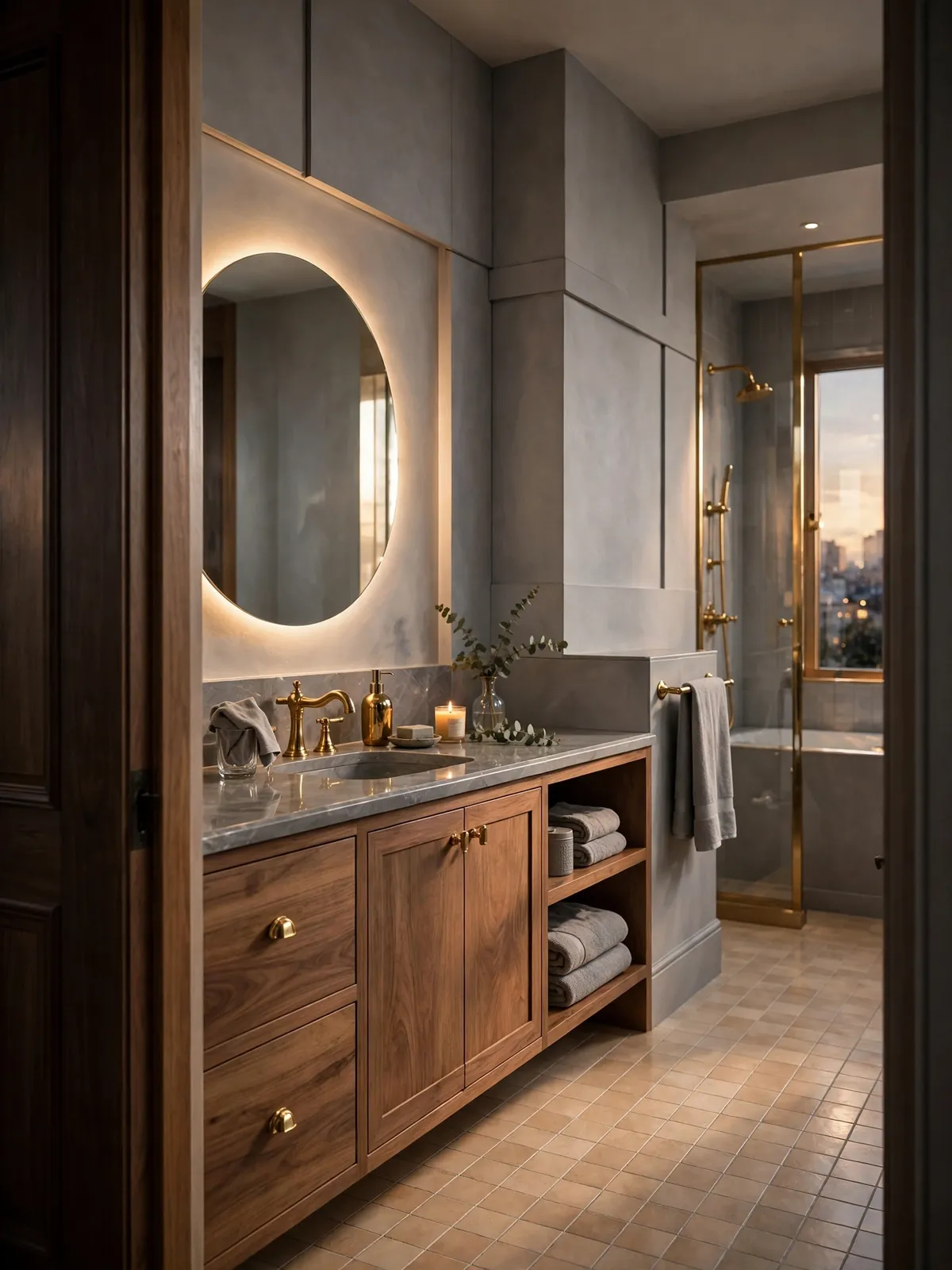
The last of these grey bathroom ideas is the principle behind them all, and it is worth stating plainly because it is the difference between a grey bathroom that looks cold in a photograph and one that feels warm every single day: a great grey bathroom is not one shade of grey, it is the layering of three or four shades — charcoal floors, mid-tone cabinets, pale walls and one warm accent — with natural wood, brass and soft lighting doing the work that colour does in a bolder room, so that every surface supports the others and the room feels calm the moment you walk in rather than only on the day it was finished. Here, a soft grey bathroom pulls it together — layered greys, a backlit mirror, brass fixtures, a walnut vanity and warm beige tiles — and nothing in the room is there by accident. The lesson is to choose your grey by its undertone first, since a warm grey and a cool grey are entirely different rooms, then layer two more shades and one natural texture, add a single dark accent for definition, and let the lighting follow, because a bathroom built in that order stays beautiful with very little effort, even in a small bathroom, even on a modest budget, and even when you change only one thing at a time. Measure your space, pick the two or three ideas from this list that fit it best, and grey stops being the safe choice and becomes the calmest, most sophisticated room in your home.
Quick tips:
- Choose your grey by undertone first, then layer two more shades.
- Add one natural texture — wood, stone or linen — in every zone.
- Use one dark accent for definition so grey never looks flat.
- Keep the lighting warm so the grey always reads as warm.
FAQs
Is grey a good colour for a bathroom?
Yes, grey is one of the best bathroom colours, because it suits every style, never dates quickly, and works with almost any accent colour. The key is layering: use several shades of grey, add warm wood and brass, and use warm lighting so the room feels calm and expensive rather than cold and flat.
What is the best grey paint for a bathroom?
The best grey paint for a bathroom is a warm grey or greige with a brown or beige undertone, in a moisture-resistant satin finish. Test two or three samples on the wall and look at them in morning and evening light before you commit, because grey shifts dramatically under different bulbs.
How do I stop a grey bathroom looking cold?
Use warm grey instead of cool grey, add natural wood and brass, swap the bulbs for warm white (around 2700K), and add soft textiles such as cream towels and a wooden stool. A backlit mirror and a layered rug also warm the room quickly, and they cost very little.
What flooring goes with a grey bathroom?
Charcoal large-format porcelain, pale grey stone-look tile, warm wood-look tile and cream terrazzo all work with a grey bathroom. Choose a floor one shade darker than the walls so the room has grounding, and use a matte finish for grip.
Can I mix grey and beige in a bathroom?
Yes, and the combination is called greige — a grey with a warm beige undertone that suits almost every bathroom. Mix warm grey walls with beige tiles, cream towels and walnut wood, and the room feels balanced and calm. Avoid mixing a cool blue-grey with a yellow beige, which can look muddy.
Conclusion
Grey bathrooms used to feel cold, but the 21 ideas above show that grey can be the warmest, calmest and most sophisticated colour in the house, whether you layer four shades of grey, add a backlit mirror and brass fixtures, tile a microcement shower, or simply swap the bulbs for warm white and roll cream towels into a basket. Choose your grey by its undertone, layer two or three more shades, add natural wood in every zone, and keep the lighting warm. Do that, and your grey bathroom stops being the safe choice and becomes the calm, expensive-looking retreat you look forward to every single day.