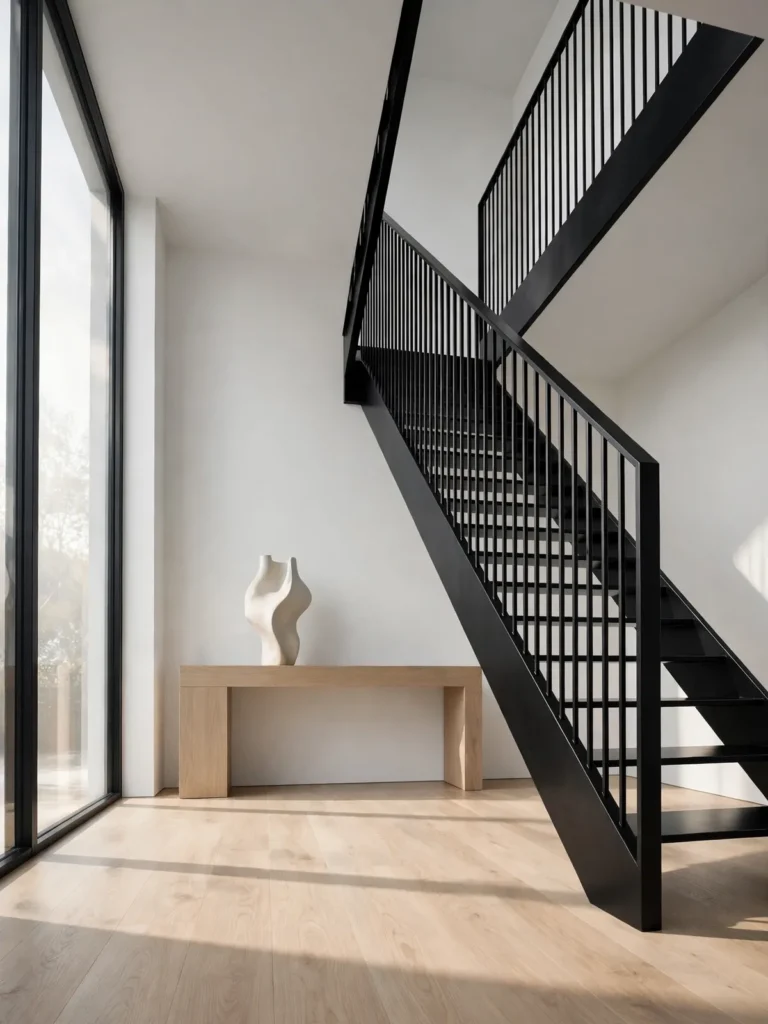
29 Stunning Wooden Staircase Ideas That Bring Warmth and Style to Every Room
A wooden staircase is the warmest feature a home can have, and the right look turns it from a way upstairs into the room’s best design moment. These 29 wooden staircase ideas cover every style — Scandinavian, farmhouse, coastal, mid-century, industrial, classic and more — with decor pairings, runners, railings and lighting so you can choose a look that fits your home.
Wooden staircase ideas work in almost any home because wood brings warmth to a structure that would otherwise feel purely functional, and the look you choose — pale Scandinavian oak, dark traditional mahogany, or rustic reclaimed planks — sets the tone for the whole hallway and the rooms around it. The secret is to treat the stair as part of the room, not as a separate piece of joinery: match its tone to your flooring, repeat one metal finish from the railing in your lighting, and style the wall beside it so the stair reads as a designed feature rather than a passage.
If you are still deciding on the shape and layout of your stair before you choose a look, these staircase design ideas show how the stair’s form — straight, L-shaped, floating or curved — shapes everything that follows. The 29 looks below are organised by style and room, from bright Scandinavian entries to moody lodge stairs, so you can find the one that fits your home and steal its decor pairings too.
Key Takeaways
What is the best look for a wooden staircase?
The best look matches the style of the rooms the stair connects. Pale wood with white walls suits Scandinavian and coastal homes; dark wood with a patterned runner suits classic and Georgian homes; wood with black metal suits farmhouse and industrial homes. The stair should echo the flooring and one other wood tone in the house so it feels connected rather than random.
How do I choose a runner for a wooden staircase?
Choose a runner that contrasts gently with the wood so the steps stay visible and safe. A patterned wool runner suits traditional stairs, a flat-weave jute runner suits coastal and farmhouse stairs, and a plain runner in a solid colour suits modern stairs. Always fit a proper underlay and fix the runner firmly at the back of each tread.
What railing works best with a wooden staircase?
The railing should match the mood of the look. Black iron balusters suit farmhouse and industrial stairs, slim brass spindles suit mid-century and Art Deco stairs, glass panels suit contemporary and open-plan stairs, and turned wooden spindles suit classic and country stairs. Keep one metal finish consistent across the railing, lighting and door hardware.
How do I decorate the wall beside a wooden staircase?
Style the wall to suit the stair’s look: a gallery of framed art climbing the slope suits classic and eclectic homes, a single large mirror suits small entries, vertical wood slats suit modern homes, and a bold paint colour or wallpaper suits a stair you want as a feature. Keep the scale generous — small pictures get lost on a tall stair wall.
Can a wooden staircase look modern?
Yes. Pale wood, open risers, glass or cable railings, a chunky handrail and minimal styling make a wooden staircase feel thoroughly modern. The wood keeps it warm while the clean lines and uncluttered wall keep it contemporary, which is why floating wooden stairs appear in so many modern open-plan homes.
A Scandinavian Light-Oak Stair in a Bright Entry Hall
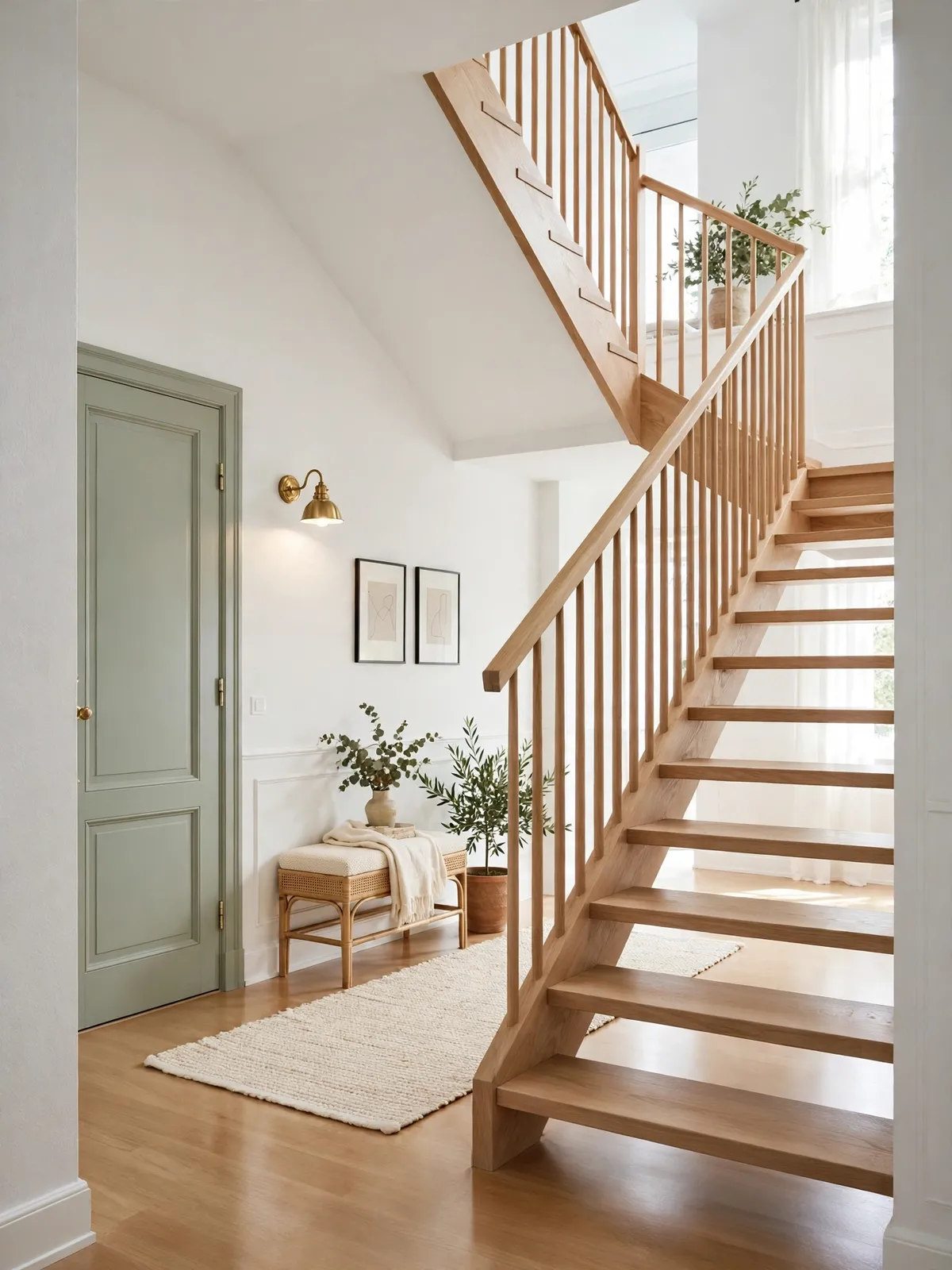
A Scandinavian light-oak stair in a bright entry hall is the freshest of all wooden staircase ideas, because pale wood against white walls makes even a small hallway feel open and calm. Here, light-oak treads float up a white wall with slim white balusters, a soft sage-green front door and a cream woven rug below. The look suits apartments and small homes, it bounces daylight around the entry, and it never fights with the furniture around it. The weakness is that pale wood shows scuffs and dirt faster than dark wood, so choose a hard-wearing matte finish and keep a doormat at the door.
Quick tips:
- Keep walls white so the pale wood reads as the feature.
- Add one soft colour, like sage or dusty blue, for warmth.
- Use slim white balusters to keep the stair feeling light.
- Choose a matte finish — glossy pale wood looks plastic.
A Modern Farmhouse Wooden Stair With Black Iron and Shiplap
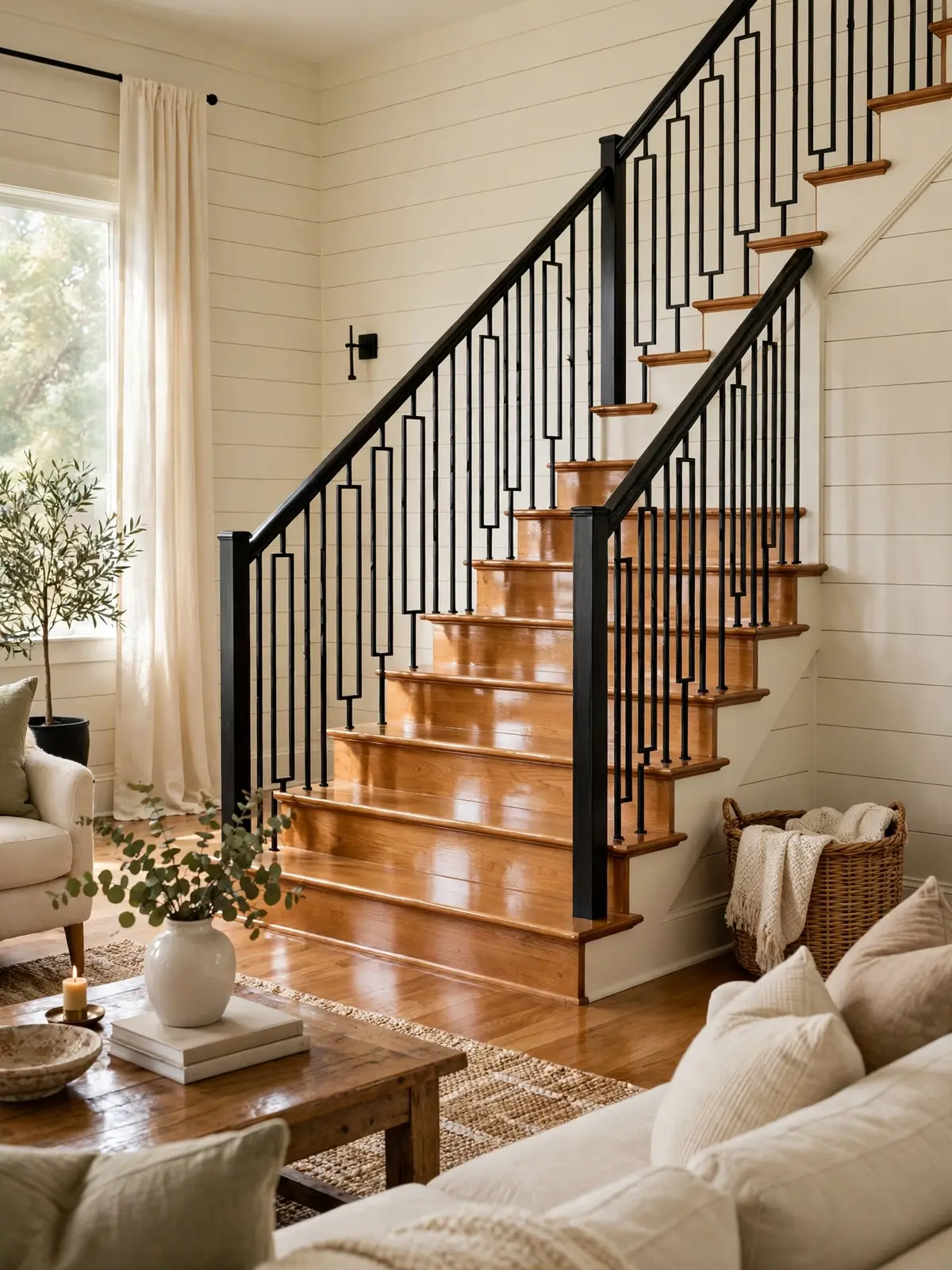
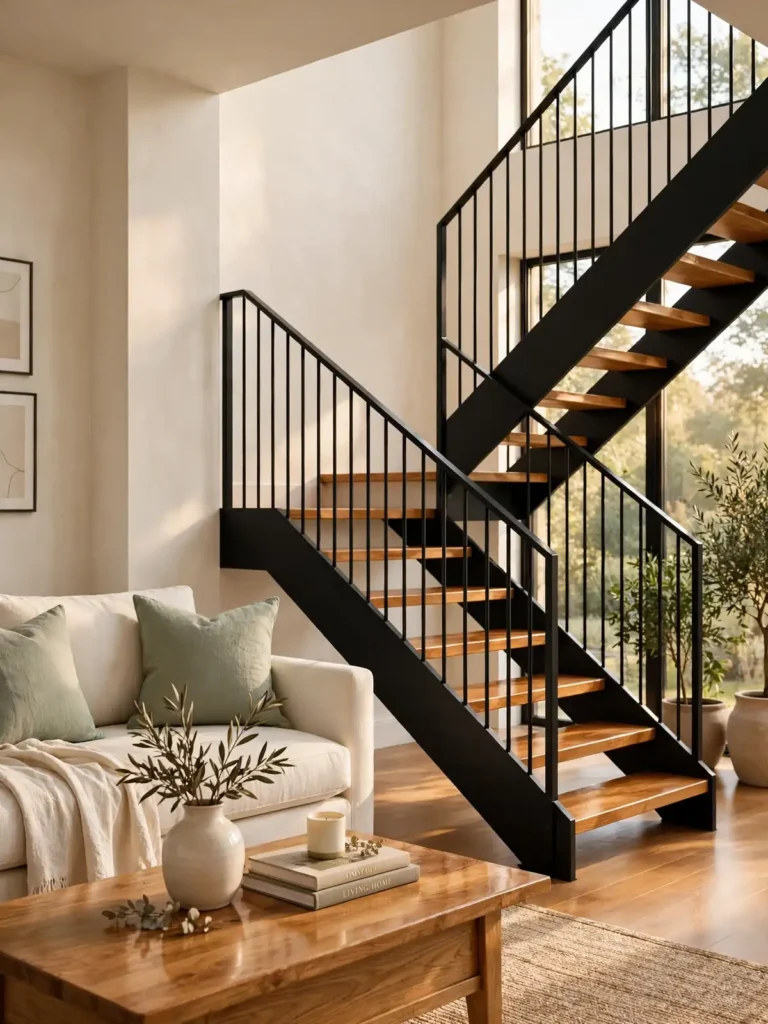
A modern farmhouse wooden stair with black iron and shiplap is the look most people picture when they think of a cosy family home, because honey-oak treads against cream shiplap with a black iron railing feel both traditional and current. Here, the black balusters give the stair a strong graphic rhythm, while a woven basket and a cream runner soften it. The look suits family homes and open-plan kitchens, it hides everyday wear well, and it pairs with almost any furniture. The weakness is that shiplap collects dust in its grooves, so wipe it down regularly — and keep the black iron finish consistent with your lighting and door hardware or the room starts to look busy.
Quick tips:
- Repeat the black iron finish in your lighting and hardware.
- Add a cream runner to soften the stair and quiet footsteps.
- Keep the shiplap pale so the black railing stands out.
- Style the landing with a woven basket, not clutter.
A Coastal Whitewashed Wooden Stair With Linen and Seagrass
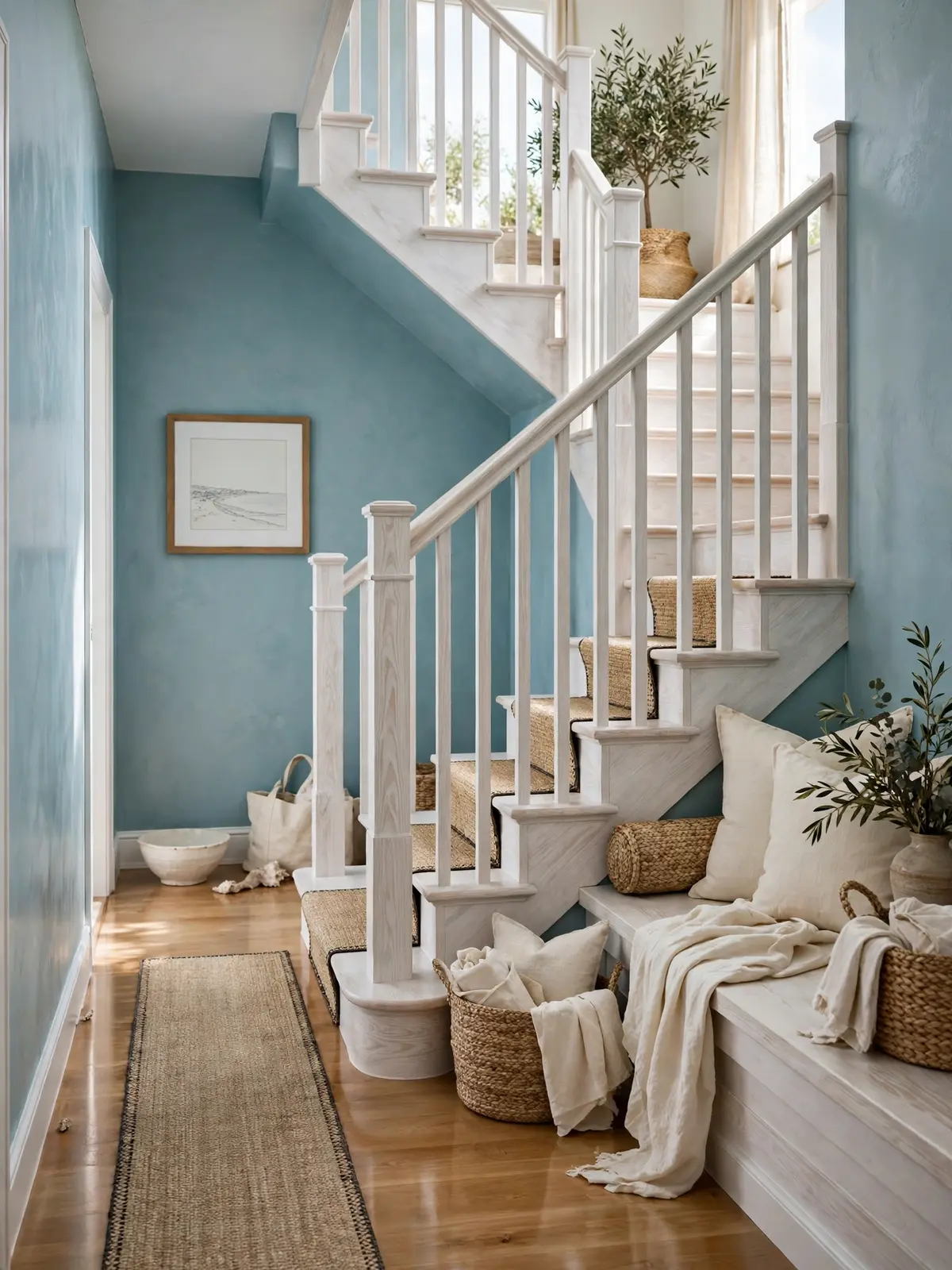
A coastal whitewashed wooden stair with linen and seagrass brings a beach-house calm to any home, because whitewashed oak keeps the wood grain visible while the pale, sun-bleached tone feels light and relaxed. Here, the stair climbs a seafoam-blue wall with a natural seagrass runner, cream linen cushions on the landing bench and a woven pendant above. The look suits cottages, beach homes and light-filled apartments, it makes narrow halls feel wider, and it pairs beautifully with woven textures. The weakness is that whitewash can look washed-out in a dark hallway, so this look needs good natural light — and the seagrass runner needs regular vacuuming to stay fresh.
Quick tips:
- Test the whitewash on one tread first — tones vary a lot.
- Pair with seagrass, jute and linen, not shiny fabrics.
- Keep the wall colour soft, like seafoam or pale aqua.
- Add a woven pendant above the stair for evening warmth.
A Rustic Lodge Stair With Stone and Antler Lighting
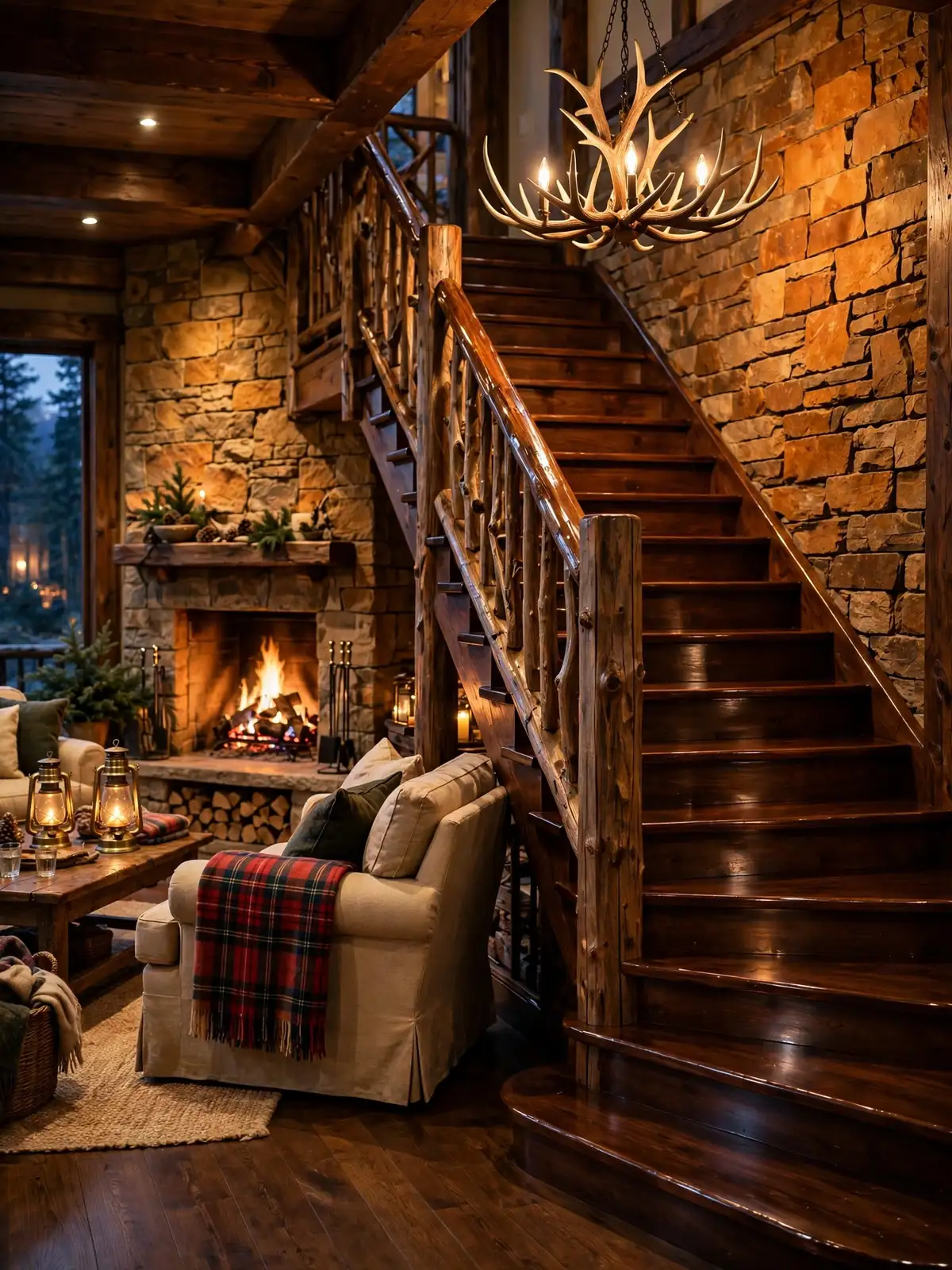
A rustic lodge stair with stone and antler lighting is the warmest look in this collection, because dark walnut treads against warm amber stone feel like a mountain cabin even in a suburban house. Here, chunky walnut treads climb beside a stone wall, with a plaid wool throw draped over the handrail and brass lanterns glowing on the landing. The look suits homes with fireplaces, exposed beams or cabin character, it feels grounded and generous, and it makes winter evenings feel special. The weakness is that dark wood and stone together can feel heavy in a small room, so this look needs a generous hallway and plenty of warm light to avoid feeling like a cave.
Quick tips:
- Balance the dark wood with warm amber lighting.
- Add plaid or wool textiles to soften the stone.
- Keep the handrail chunky — slim rails look lost here.
- Use brass or bronze, never chrome, with dark walnut.
A Mid-Century Modern Stair With Walnut and Brass Accents
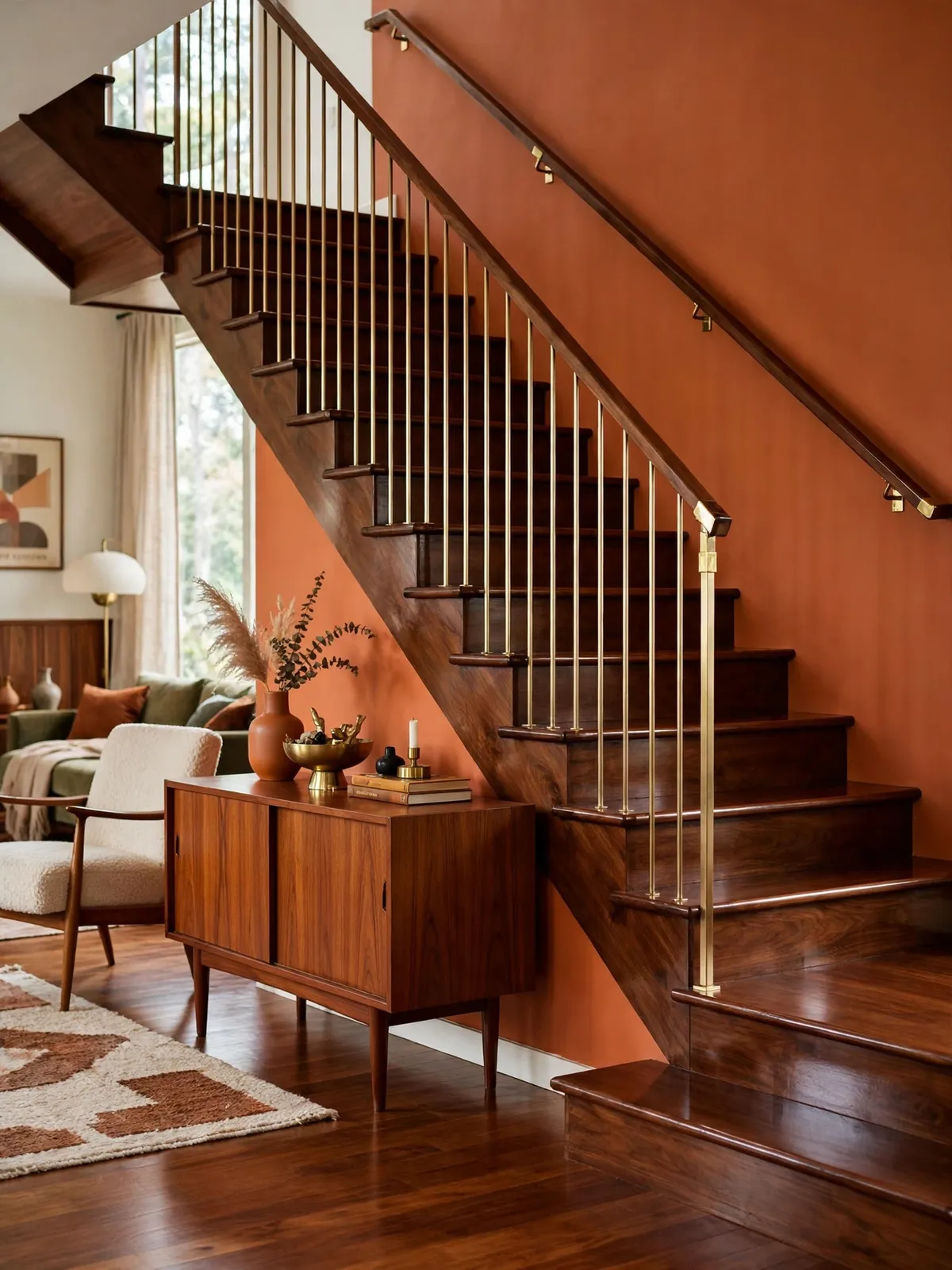
A mid-century modern stair with walnut and brass accents is the most stylish look for homes that love the 1950s and 60s, because rich walnut with slim brass spindles and a burnt-orange accent wall feels designed rather than decorated. Here, the walnut treads run straight up a white wall, the brass spindles catch the light, and a teak console with a sculptural vase sits at the base. The look suits apartments and retro-inspired homes, it photographs beautifully, and it pairs with low-slung furniture and bold art. The weakness is that brass tarnishes and walnut scratches, so choose lacquered brass and a durable finish on the treads — and keep the styling minimal, because clutter kills the mid-century line.
Quick tips:
- Use lacquered brass so the spindles stay bright.
- Add one bold colour, like burnt orange, on the stair wall.
- Keep the styling minimal — one sculptural object is enough.
- Pair with low, clean-lined furniture at the base.
A French Country Stair With Soft Blue and Toile
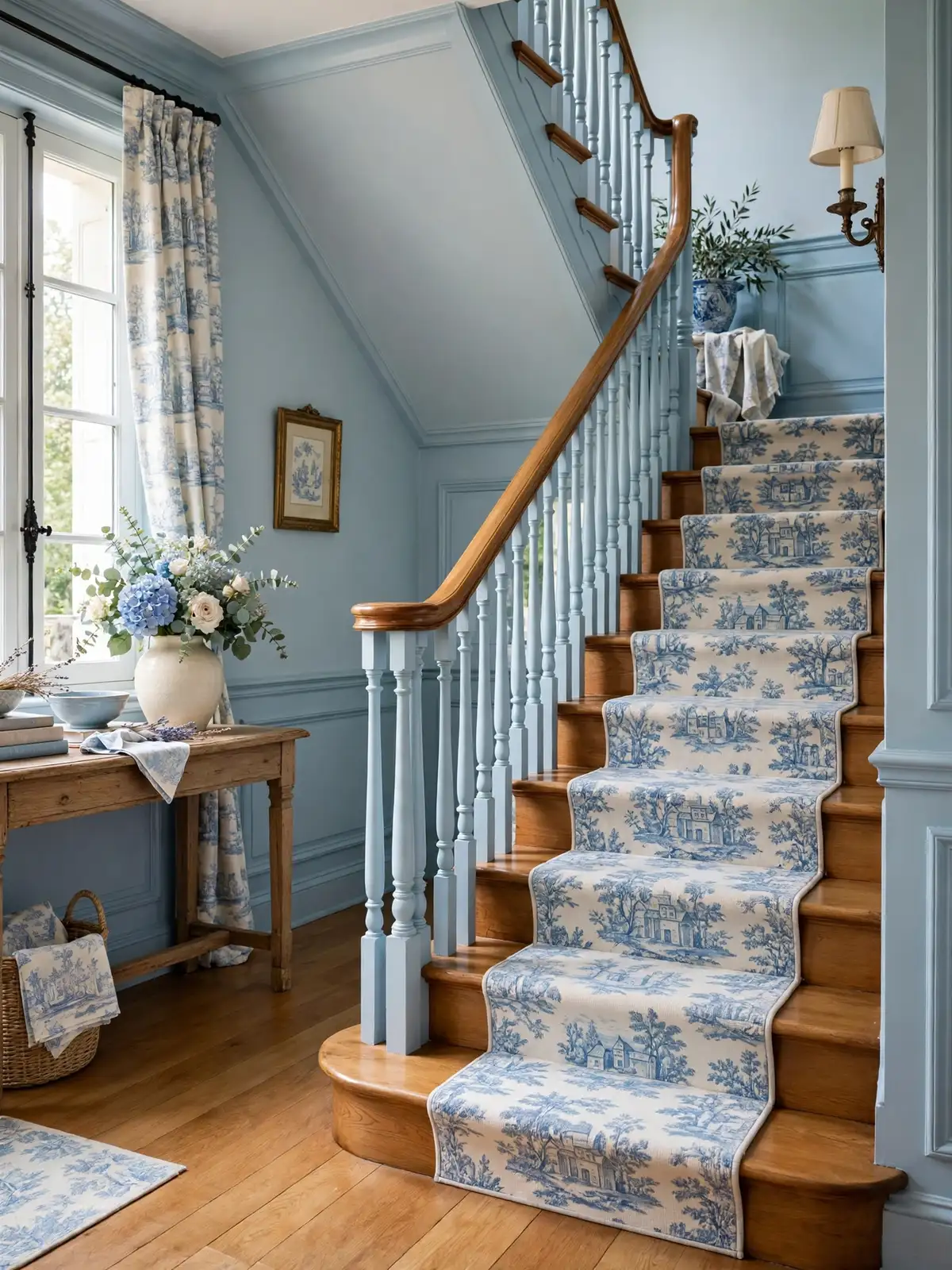
A French country stair with soft blue and toile feels like a Provençal farmhouse, because honey-oak treads against powder-blue walls with a toile runner are romantic without being fussy. Here, the stair climbs past a cream ceramic vase on the landing and a small gilt-framed print, with the toile pattern echoing in a cushion on the bench below. The look suits country homes and romantic interiors, it feels soft and lived-in, and it works beautifully with linen curtains and painted furniture. The weakness is that toile and powder blue can tip into twee if overdone, so keep the pattern to the runner and one cushion, and let the wood and the wall colour do the rest.
Quick tips:
- Limit the toile pattern to the runner and one cushion.
- Pair powder blue with cream, not with more pattern.
- Add a gilt frame or two for a French touch.
- Keep the handrail simple — ornate rails fight the toile.
A Japandi Stair With Pale Timber and Paper Lanterns
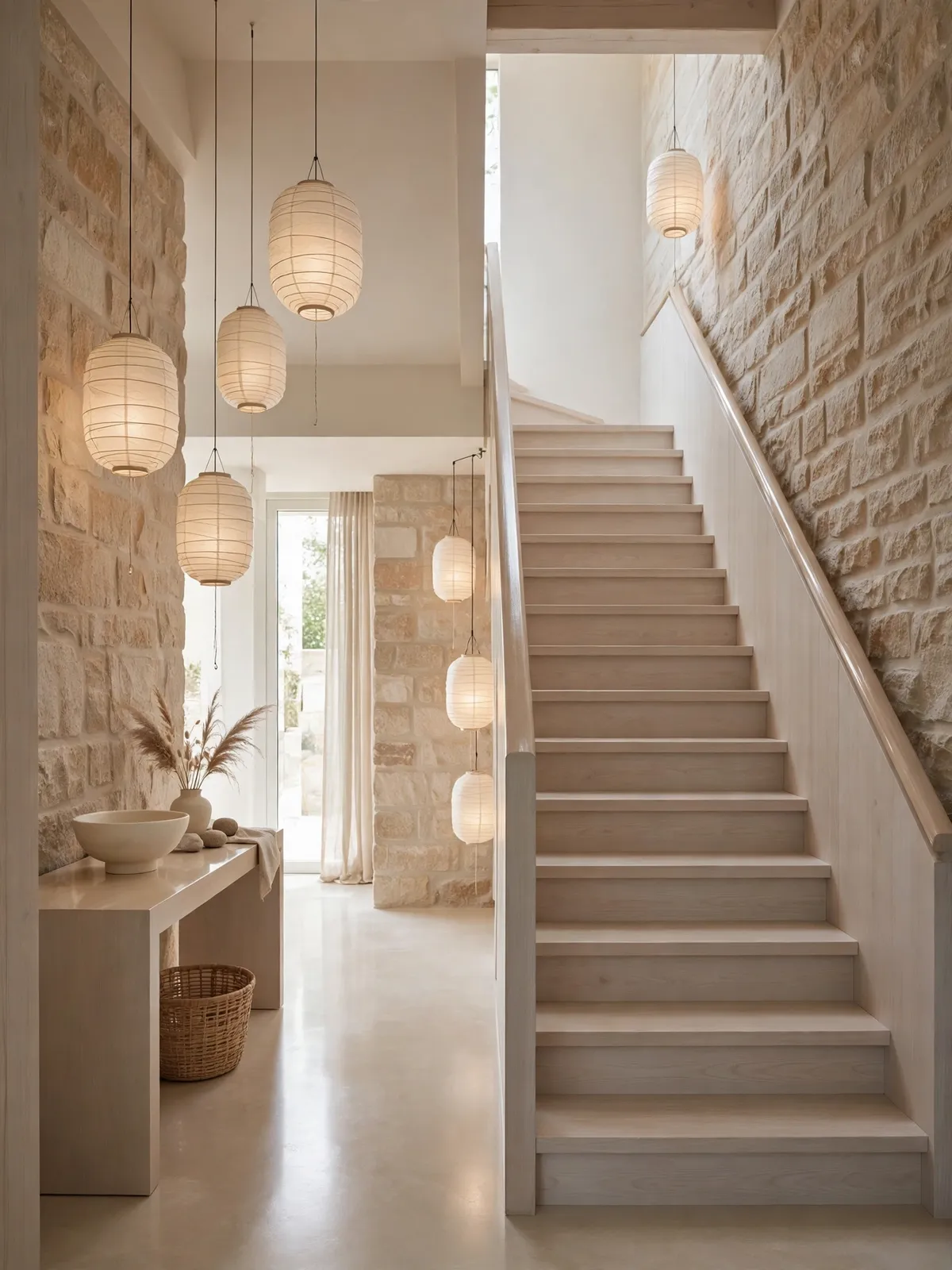
A Japandi stair with pale timber and paper lanterns is the calmest look in this collection, because pale ash treads, warm stone walls and a single paper lantern create a space that feels like a deep breath. Here, the stair has no runner and no clutter — just the pale wood, a low ceramic bowl on the landing and the soft glow of the lantern. The look suits minimalist homes and anyone who wants their entry to feel like a retreat, it ages beautifully, and it makes the hallway feel larger. The weakness is that this look shows every scuff and every object out of place, so it demands a tidy household and a hard-wearing finish on the treads.
Quick tips:
- Keep the stair bare — no runner, no clutter.
- Use one paper lantern as the only decoration.
- Choose warm stone or plaster walls, never bright white.
- Pick a hard-wearing finish for pale ash treads.
An Industrial Loft Stair With Wood Treads and Exposed Brick
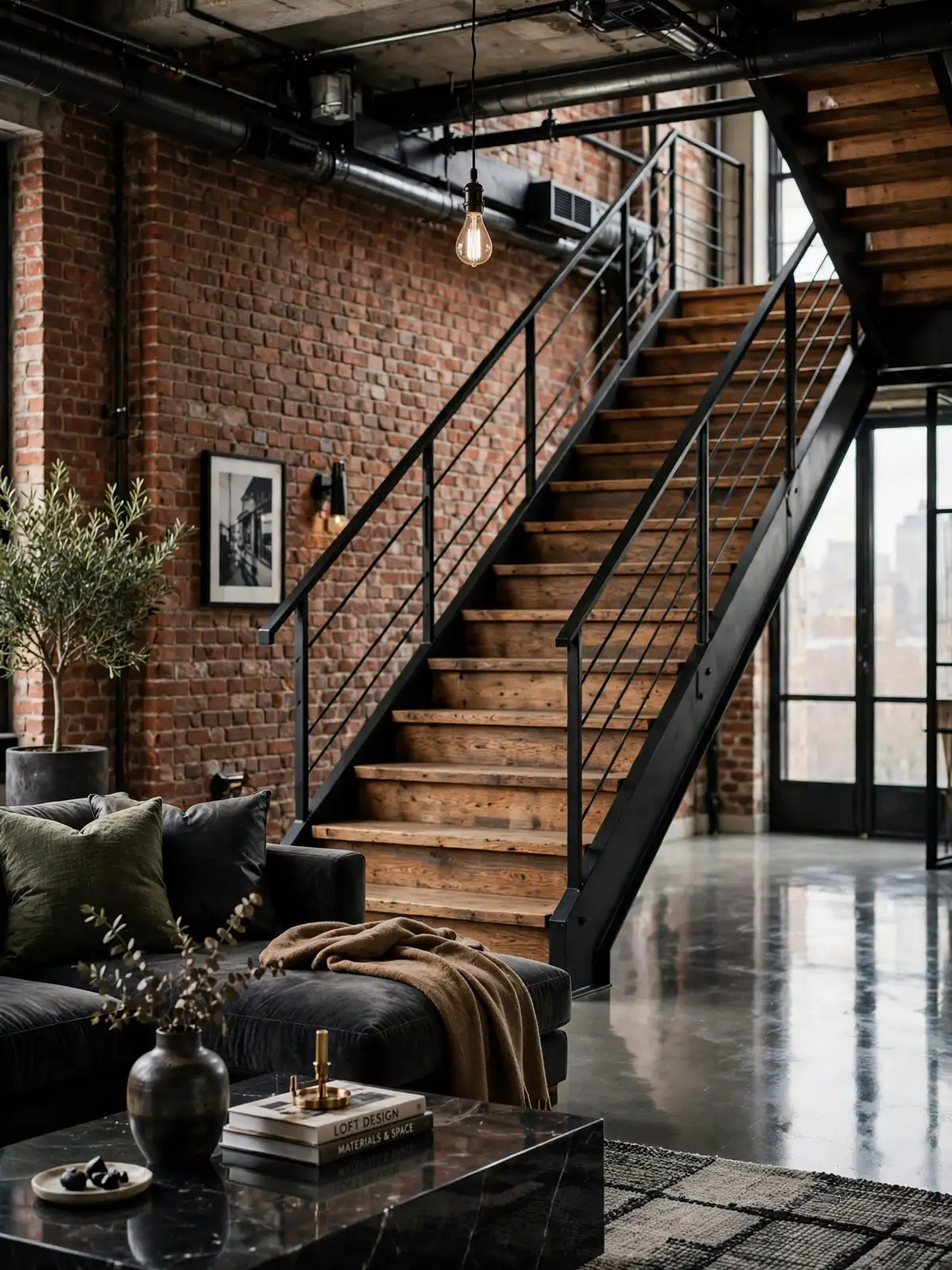
An industrial loft stair with wood treads and exposed brick is the boldest look for open-plan living, because reclaimed oak against rust-red brick with a matte black steel railing feels like a converted warehouse even in a new build. Here, the thick oak treads float beside the brick wall, Edison bulbs hang above the landing, and a leather chair anchors the space below. The look suits lofts, converted spaces and modern homes with character, it hides wear brilliantly, and it pairs with leather, steel and concrete. The weakness is that exposed brick sheds dust and the open risers can feel cold underfoot, so seal the brick and consider a runner if the stair gets heavy barefoot use.
Quick tips:
- Seal the brick wall so it stops shedding dust.
- Keep the steel railing matte black for an authentic edge.
- Add Edison bulbs above the landing for warmth.
- Pair with leather and steel furniture at the base.
A Classic Georgian Stair With a Patterned Runner
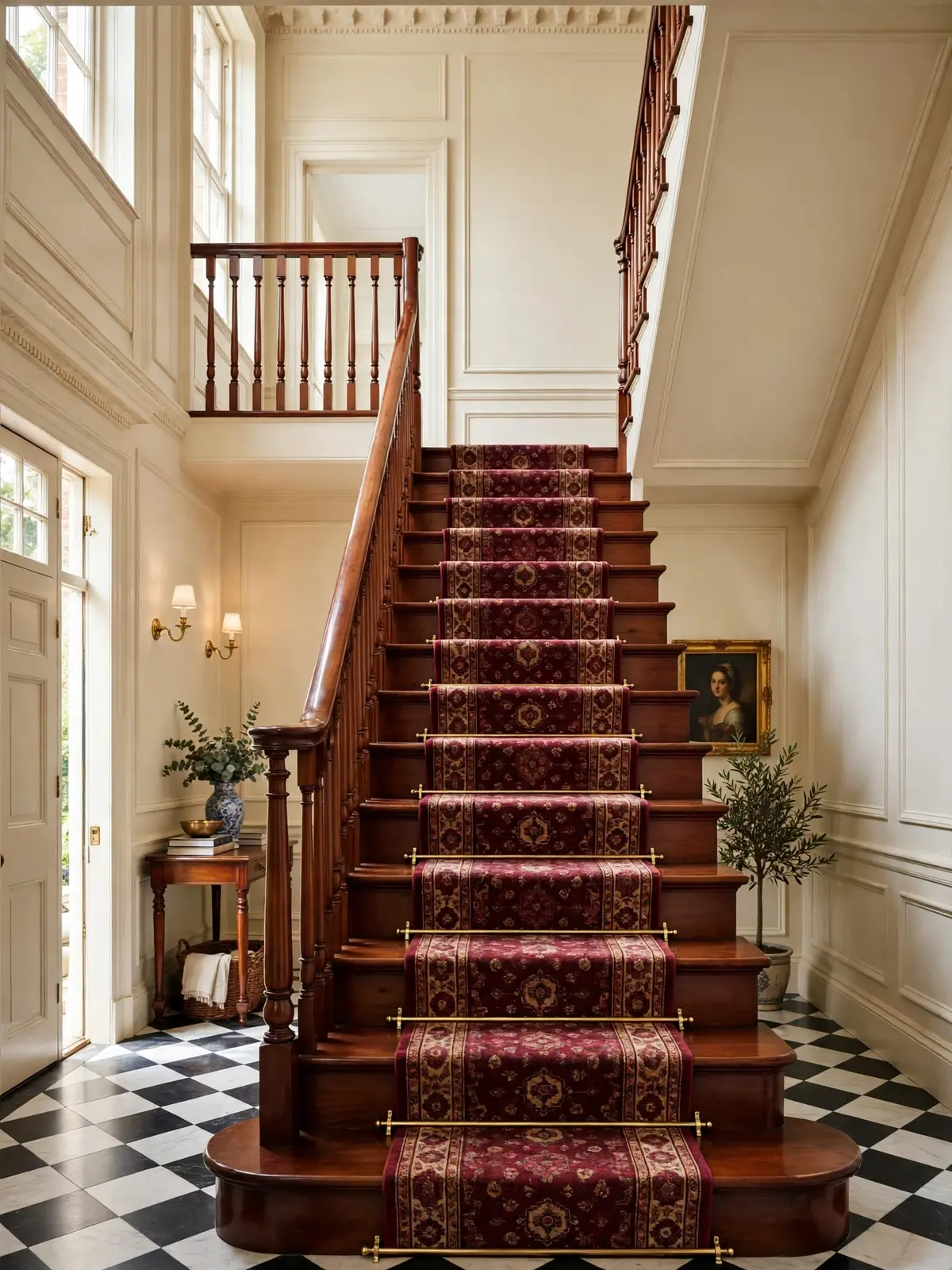
A classic Georgian stair with a patterned runner is the most elegant look for period homes, because polished mahogany with a deep burgundy runner and brass stair rods feels like it has always been there. Here, the runner climbs the centre of the stair with brass rods at each tread, the cream walls carry framed oil paintings, and a crystal chandelier hangs in the stairwell. The look suits Georgian, Victorian and traditional homes, it makes a grand first impression, and it adds value to a period property. The weakness is cost — a quality wool runner with brass rods is not cheap — and the polished mahogany needs regular care to keep its shine.
Quick tips:
- Choose a wool runner — it lasts decades and wears gracefully.
- Use brass stair rods to hold the runner and add detail.
- Hang framed art on the stair wall, not small prints.
- Keep the walls cream so the mahogany stays the star.
A Boho Stair With a Woven Runner and Layered Textiles
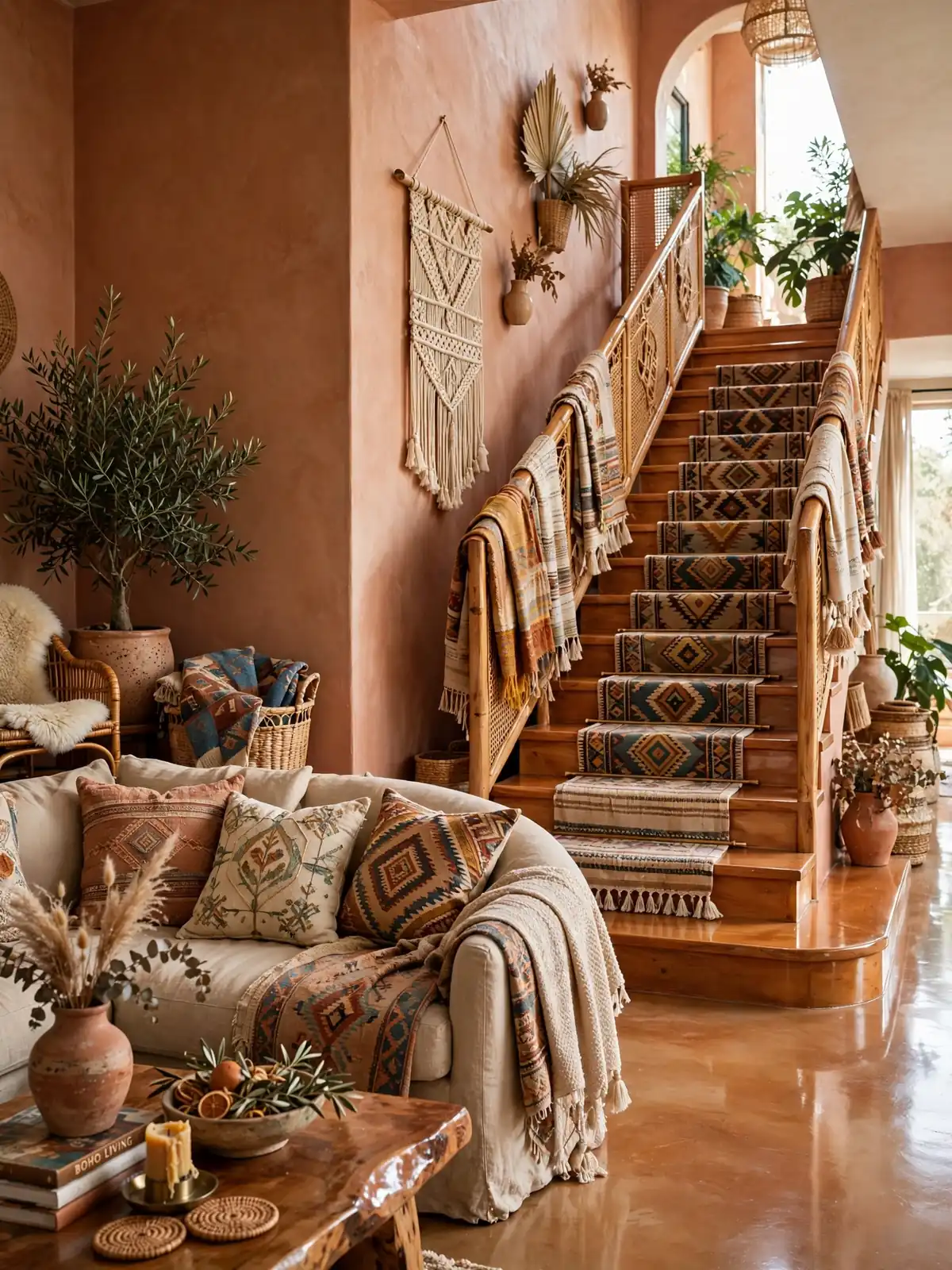
A boho stair with a woven runner and layered textiles is the most joyful look in this collection, because honey-pine treads against terracotta walls with a patterned kilim runner feel collected and personal rather than designed. Here, a macrame wall hanging climbs the slope, woven baskets sit on the landing, and plants soften every corner. The look suits creative homes and renters, it is easy to change with the seasons, and it forgives mismatched furniture. The weakness is that too many patterns and textures can tip into clutter, so keep the wall colour to one warm tone and let the runner be the only strong pattern.
Quick tips:
- Let the kilim runner be the only strong pattern.
- Add plants and baskets, not more artwork.
- Keep the wall to one warm tone, like terracotta.
- Use a flat-weave runner — thick pile trips on stairs.
A Contemporary Open-Plan Stair With Glass and Pale Wood
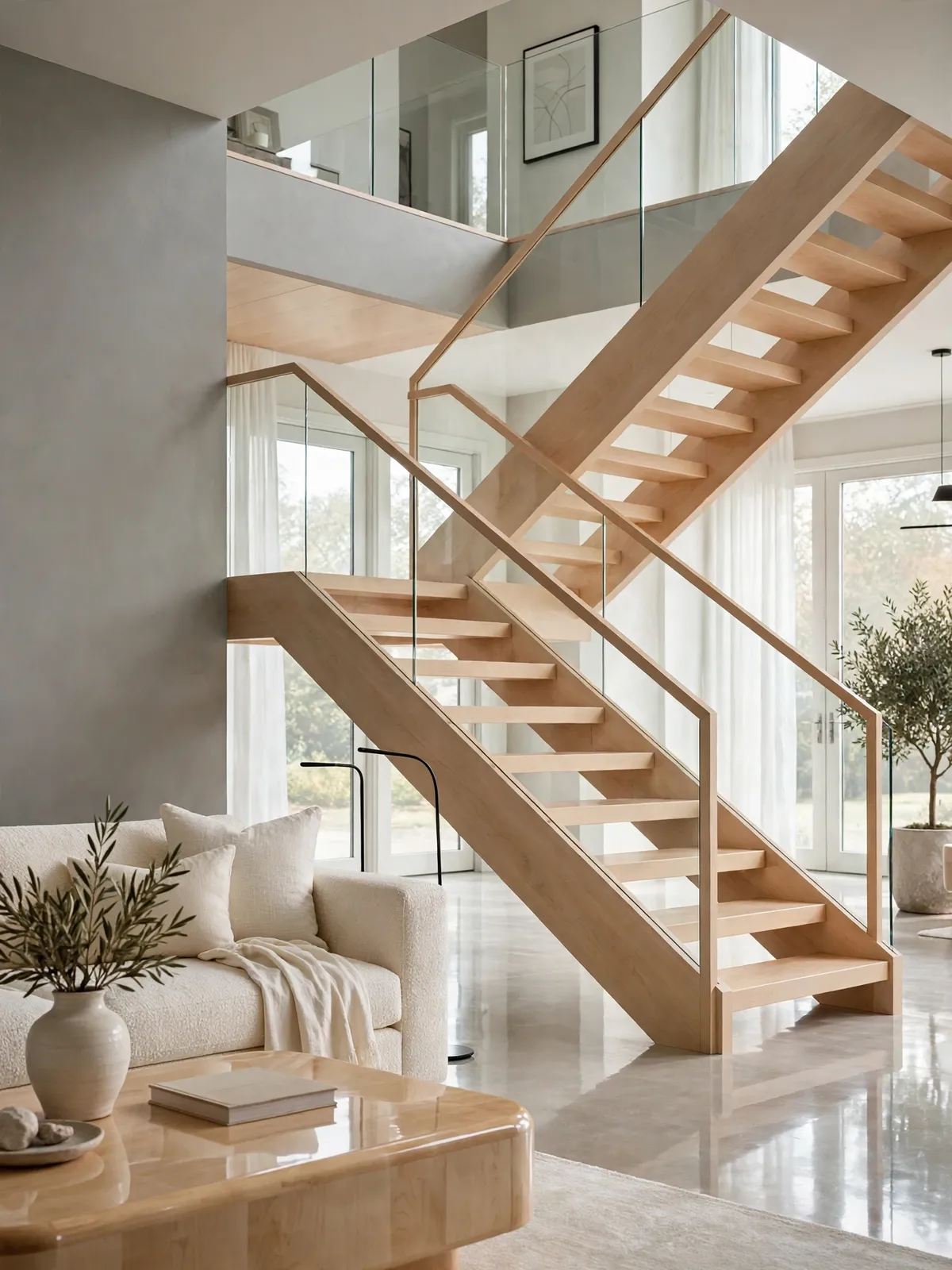
A contemporary open-plan stair with glass and pale wood is the cleanest look for modern homes, because pale maple treads with a frameless glass balustrade let light flow through the room instead of blocking it. Here, the stair rises beside a dove-grey wall with a single abstract canvas, and the cream sofa below faces it like a piece of sculpture. The look suits open-plan living rooms and new builds, it makes small spaces feel bigger, and it keeps the stair from dominating the room. The weakness is that glass shows fingerprints and smears, so keep a glass cloth handy — and the pale maple needs a durable finish, because it marks easily in a busy household.
Quick tips:
- Keep a glass cloth nearby — fingerprints show fast.
- Use one large artwork on the stair wall, not a cluster.
- Choose a durable finish for pale maple treads.
- Repeat the dove grey in soft furnishings to tie the room together.
An English Cottage Stair With Beadboard and Gingham
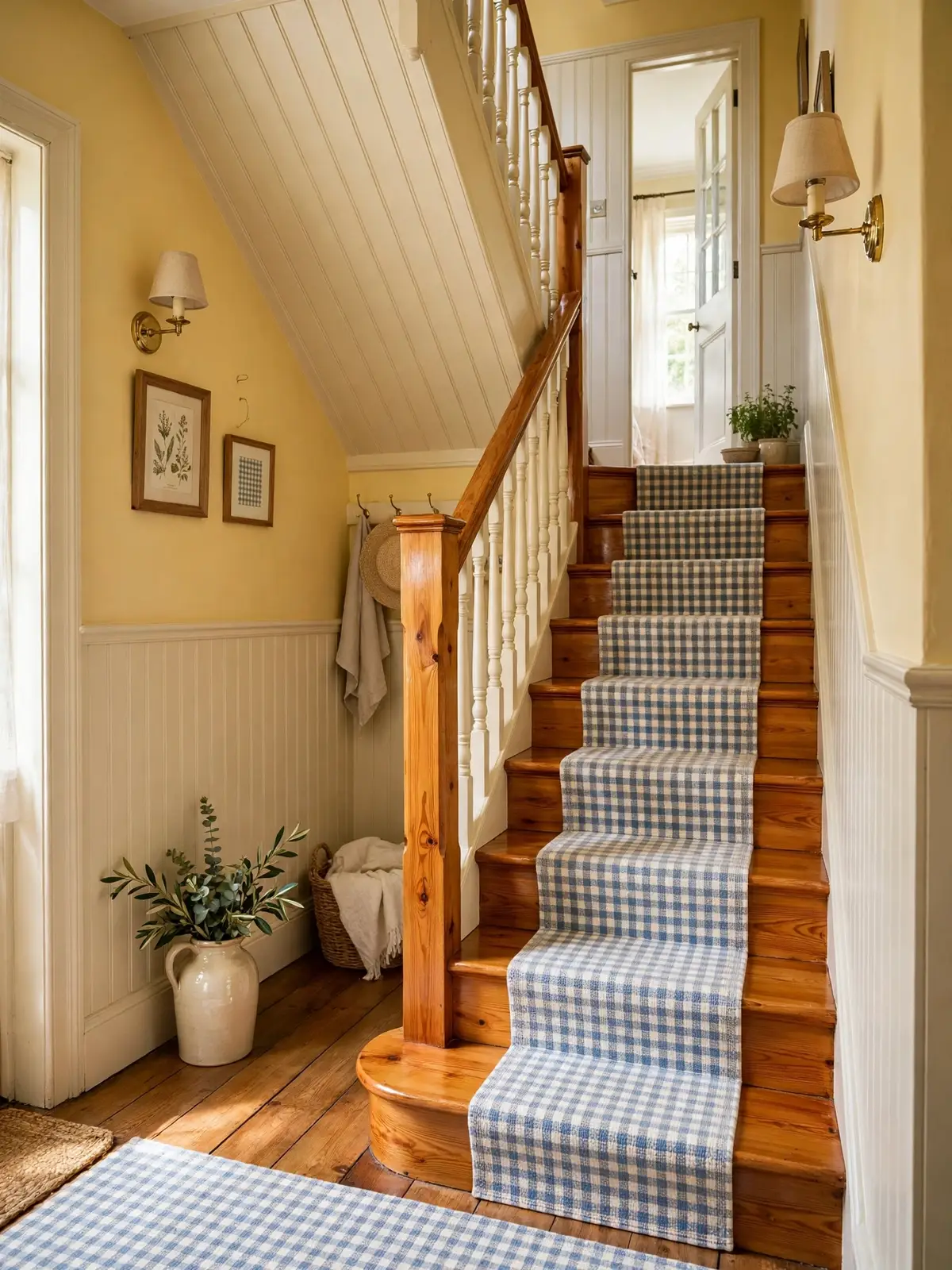
An English cottage stair with beadboard and gingham is the cosiest look for small homes, because warm pine treads against butter-yellow walls with cream beadboard feel like a storybook cottage. Here, a gingham runner climbs the stair, a ceramic jug of flowers sits on the landing, and a small window seat waits at the turn. The look suits cottages and country homes, it feels cheerful in every season, and it works in the narrowest hallways. The weakness is that gingham and beadboard together can feel busy in a tight space, so keep the gingham to the runner and the beadboard to one wall, and let the pine do the rest.
Quick tips:
- Keep the gingham to the runner only.
- Paint the beadboard cream, not white, for warmth.
- Add a ceramic jug of flowers on the landing.
- Choose a washable runner — cottage stairs get muddy.
An Art Deco Stair With Brass Inlay and Bold Geometry
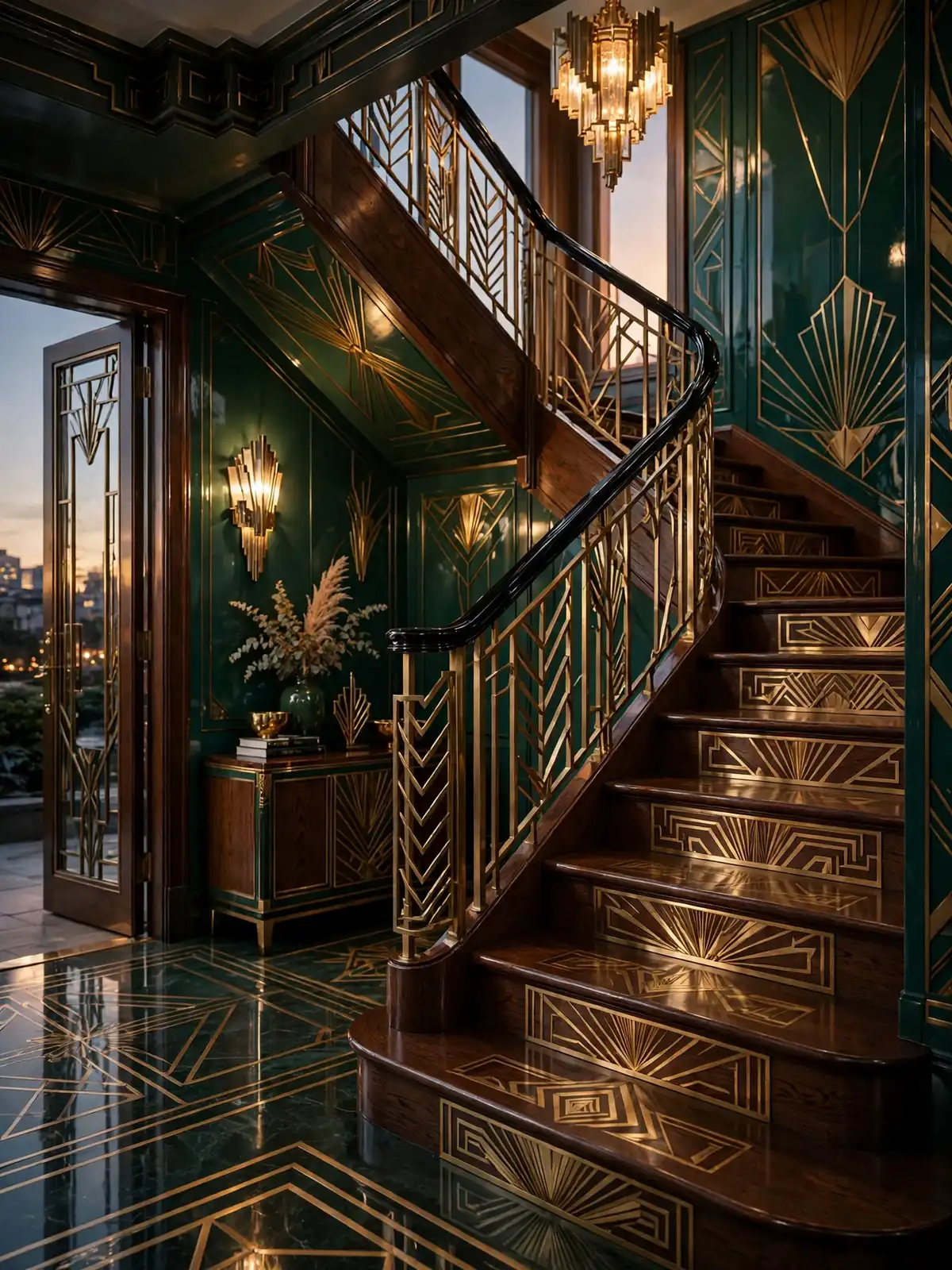
An Art Deco stair with brass inlay and bold geometry is the most glamorous look for homes that love drama, because dark oak with brass geometric inlay against emerald-green walls feels like a 1920s hotel lobby. Here, the brass inlay runs in chevrons across the risers, the black lacquered handrail sweeps up in a clean curve, and a sunburst mirror crowns the landing. The look suits period apartments and glamorous homes, it makes a small entry feel grand, and it pairs with velvet and mirrored furniture. The weakness is that brass inlay is a specialist job and emerald walls need excellent lighting, so budget for both — and keep the rest of the hallway simple, because this stair is already the statement.
Quick tips:
- Hire a specialist for brass inlay — it is not a DIY job.
- Keep the rest of the hallway simple and uncluttered.
- Add a sunburst or arched mirror on the landing.
- Use warm lighting so the emerald walls glow, not glare.
A Mediterranean Stair With Terracotta and Arched Niches
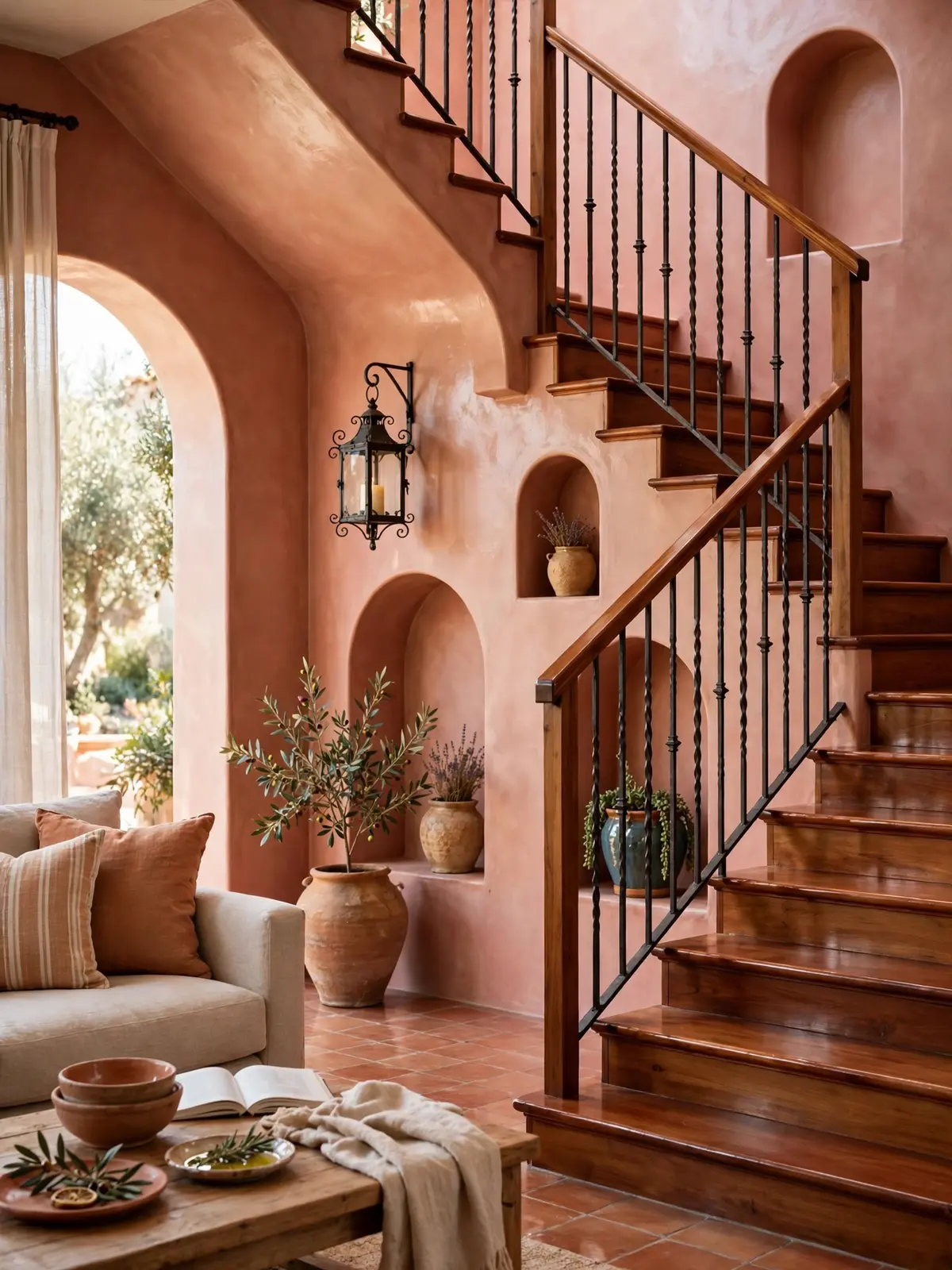
A Mediterranean stair with terracotta and arched niches brings holiday warmth into the home, because warm chestnut treads against terracotta-rose walls with an arched niche feel like a villa in the sun. Here, ceramic pots sit in the niche, a wrought-iron lantern hangs above the landing, and the stair climbs past a terracotta-tiled floor. The look suits warm climates and homes with arched doorways, it feels relaxed and generous, and it pairs with olive branches and linen. The weakness is that terracotta walls can overwhelm a north-facing hallway, so this look needs good light — and the wrought iron must be sealed, or it will rust in a humid home.
Quick tips:
- Use terracotta on one wall only in a dark hallway.
- Add an arched niche for ceramics or a candle.
- Seal wrought iron so it never rusts.
- Pair with olive branches and linen for a villa feel.
A Minimalist Monochrome Stair With Pale Wood and White Walls
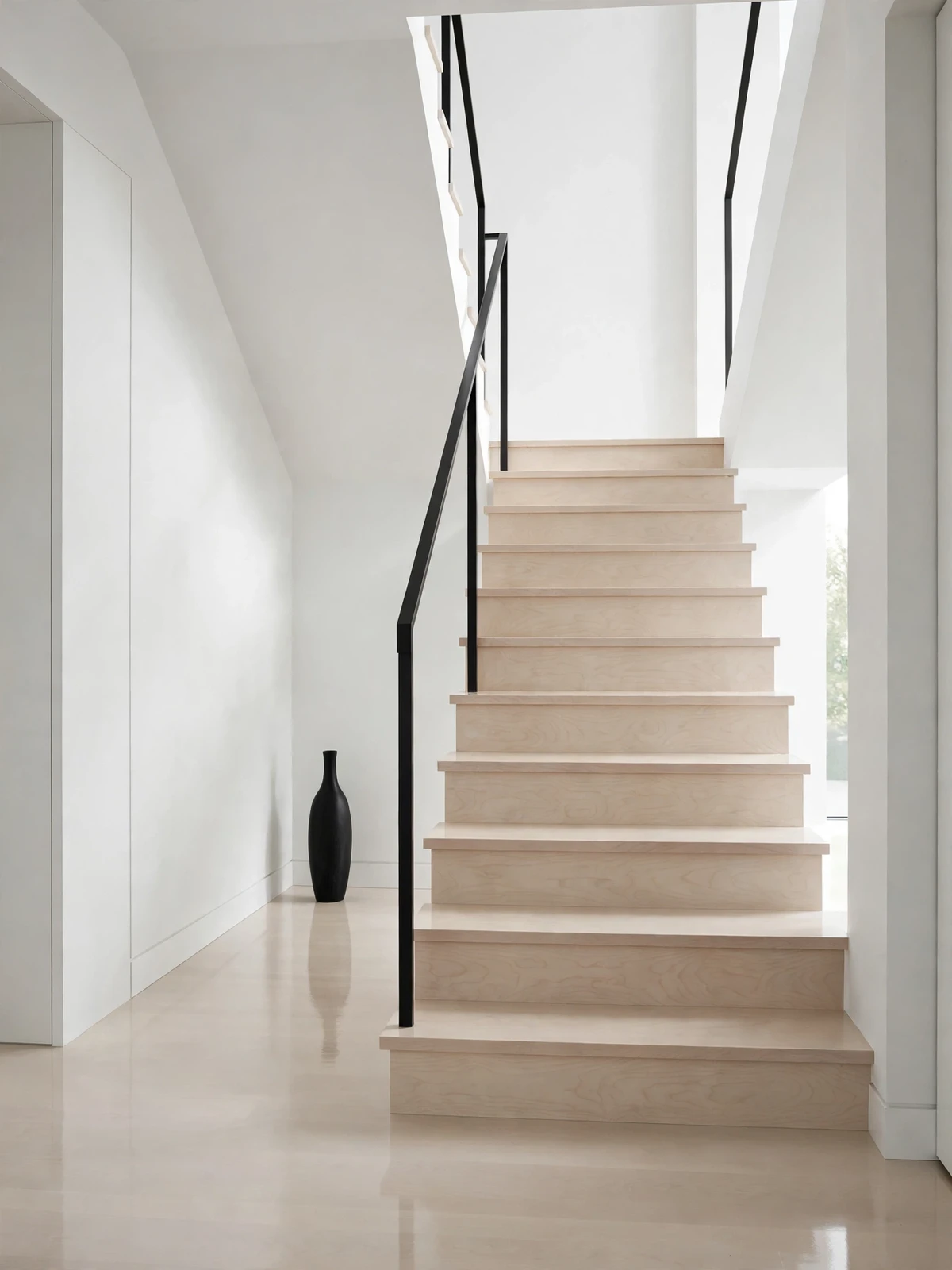
A minimalist monochrome stair with pale wood and white walls is the sharpest look for homes that love order, because pale birch treads with a single graphite-black handrail against white walls feel like a gallery, not a hallway. Here, there is no runner, no art and no clutter — just the stair, a single black vase on the landing, and the clean line of the handrail. The look suits modern apartments and minimalist homes, it makes the stair feel architectural, and it never dates. The weakness is that white walls scuff and pale birch marks, so choose a washable wall paint and a tough finish on the treads — and accept that this look only works if the hallway stays tidy.
Quick tips:
- Use washable paint on the white walls.
- Keep the styling to one object on the landing.
- Choose a graphite-black handrail for the monochrome contrast.
- Pick a tough, scuff-resistant finish for pale birch.
An English Country Manor Stair With Florals and Dark Oak
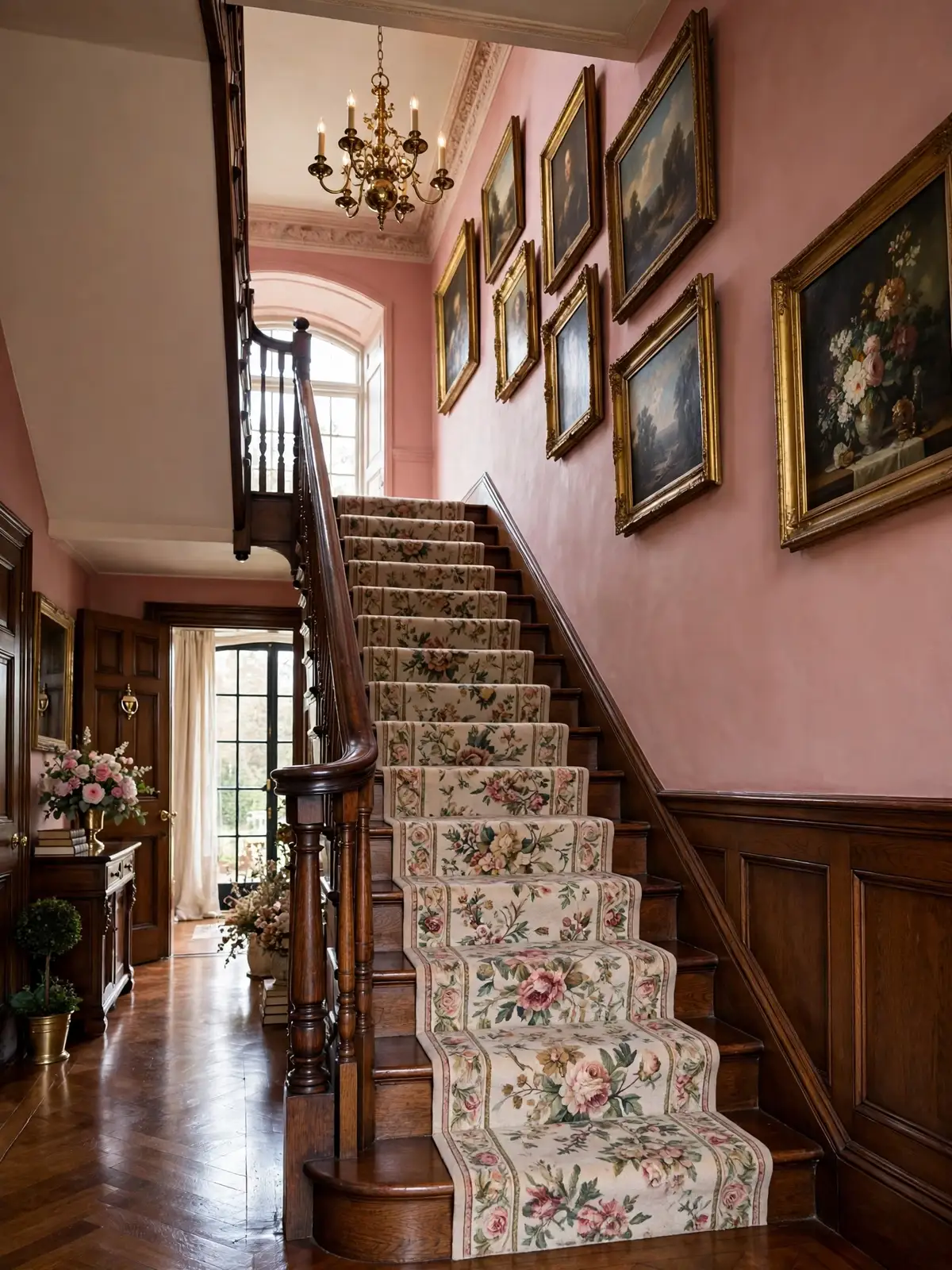
An English country manor stair with florals and dark oak is the most romantic traditional look, because dark oak treads against soft rose walls with a floral runner and oil paintings feel like a country house that has been loved for generations. Here, the floral runner climbs the stair, gilt-framed portraits hang on the wall, and a brass chandelier lights the landing. The look suits large traditional homes, it makes a wonderful first impression, and it pairs with antiques and fresh flowers. The weakness is that dark oak and rose together can feel heavy in a small hallway, so this look suits generous stairwells — and the floral runner needs a professional clean now and then.
Quick tips:
- Hang gilt-framed art in a single line up the wall.
- Add fresh flowers on the landing for a manor feel.
- Keep the runner floral but the walls plain.
- Use a brass chandelier, not a modern pendant, above the stair.
A Hollywood Regency Stair With Lacquer and Mirror
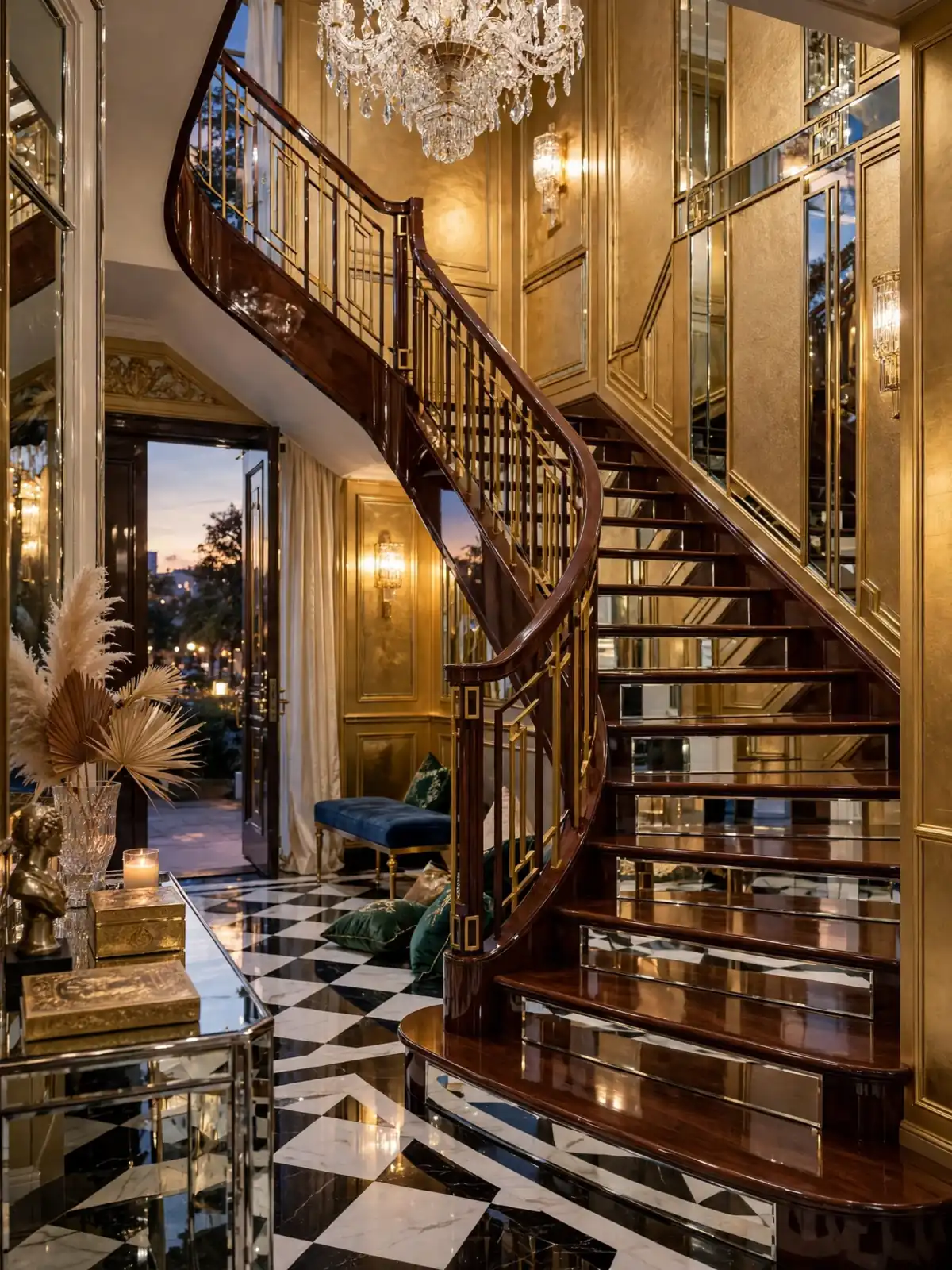
A Hollywood Regency stair with lacquer and mirror is the most opulent look in this collection, because lacquered walnut with mirrored risers and a crystal chandelier turns an ordinary stair into a stage. Here, the mirrored risers catch the chandelier light and bounce it around the entry, gold walls glow behind the stair, and a velvet bench waits at the base. The look suits glamorous homes and anyone who loves old Hollywood, it makes a small entry feel grand, and it photographs like a film set. The weakness is maintenance — mirrored risers show every footprint and lacquer shows every scratch — so this look suits a household that enjoys keeping things pristine.
Quick tips:
- Use mirrored risers only if you enjoy cleaning them.
- Add a crystal chandelier above the stairwell.
- Keep the walls gold or cream, never busy wallpaper.
- Place a velvet bench at the base for the full effect.
A Mountain Cabin Stair With Log Beams and Plaid
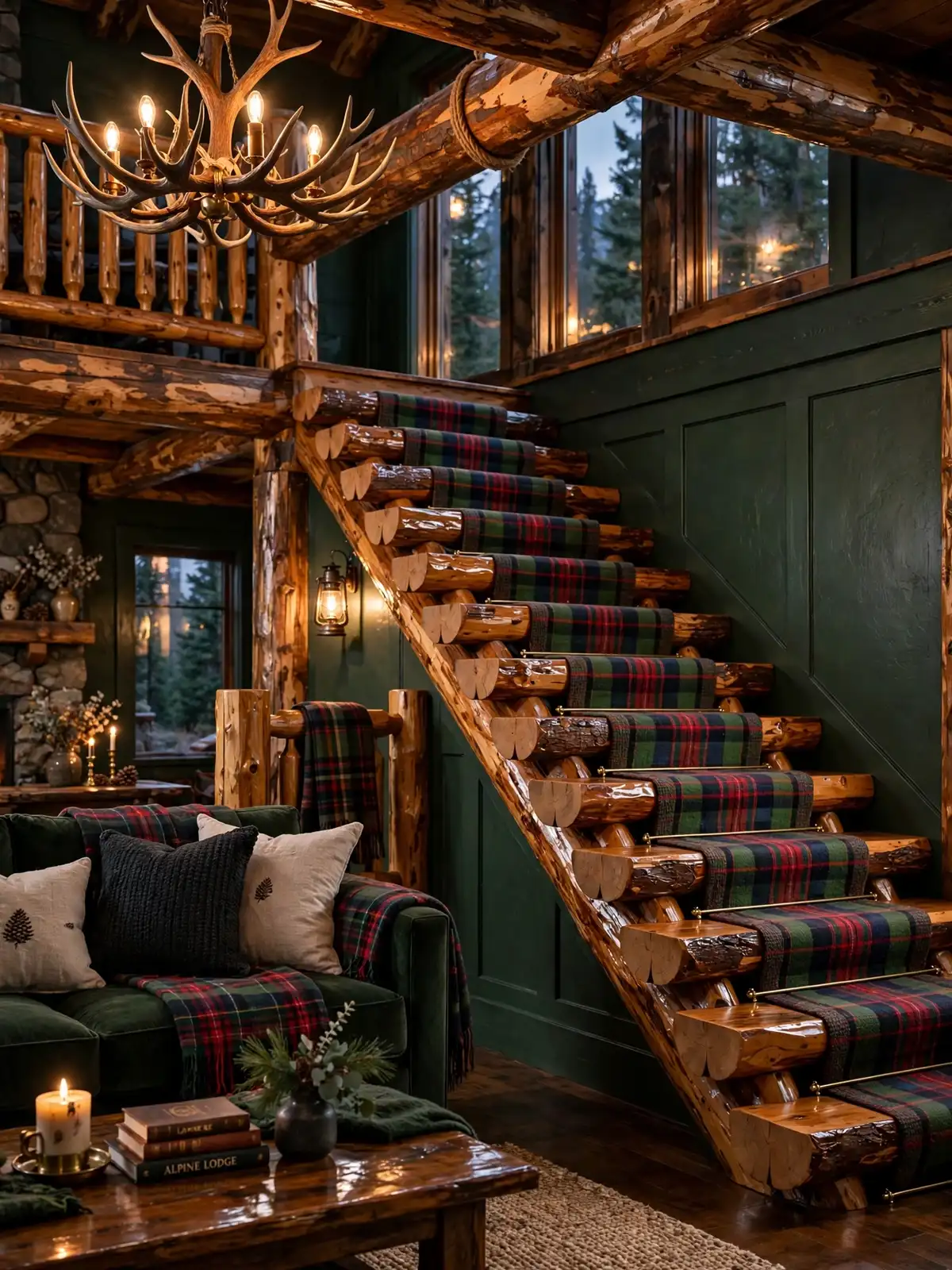
A mountain cabin stair with log beams and plaid is the most rugged look for homes that love the outdoors, because rough log-pine treads against forest-green walls with a plaid wool runner feel like a ski lodge. Here, log beams frame the stairwell, an antler chandelier hangs above, and a plaid throw drapes over the handrail. The look suits cabins, lodges and homes with timber frames, it hides wear and mud brilliantly, and it feels wonderful in winter. The weakness is that rough pine splinters and forest green darkens a hallway, so sand the treads smooth, seal them well, and add plenty of warm lighting.
Quick tips:
- Sand and seal rough pine treads so they never splinter.
- Add warm lighting — forest green needs it.
- Use a plaid wool runner for warmth and grip.
- Keep the handrail chunky and natural.
A Transitional Stair With Greige Walls and Mixed Metals
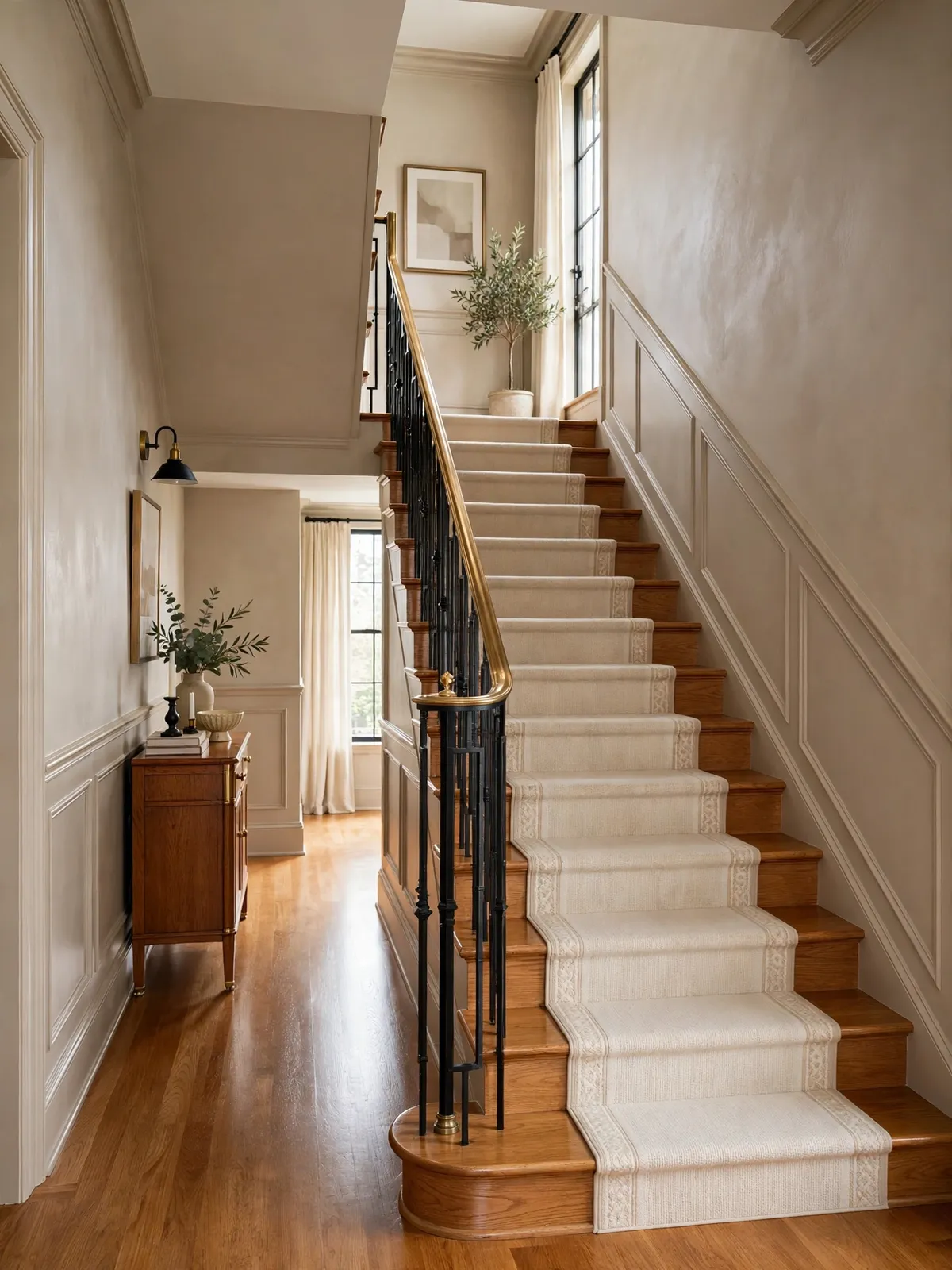
A transitional stair with greige walls and mixed metals is the safest look for homes that sit between traditional and modern, because warm oak treads against greige-taupe walls with a brass-and-black railing feel current without chasing trends. Here, the stair climbs a calm greige wall, a cream runner softens the steps, and the mixed metals repeat in the lighting and door hardware. The look suits almost any home, it is the easiest to live with long term, and it lets you change the decor around it without redoing the stair. The weakness is that greige can look flat if the lighting is poor, so add a picture light or a wall sconce on the stair wall to give the colour depth.
Quick tips:
- Add a wall sconce so greige walls never look flat.
- Mix brass and black iron, but keep to two metals only.
- Choose a cream runner to soften the oak.
- Repeat the greige tone in nearby soft furnishings.
A Maximalist Stair With Colour-Blocked Risers
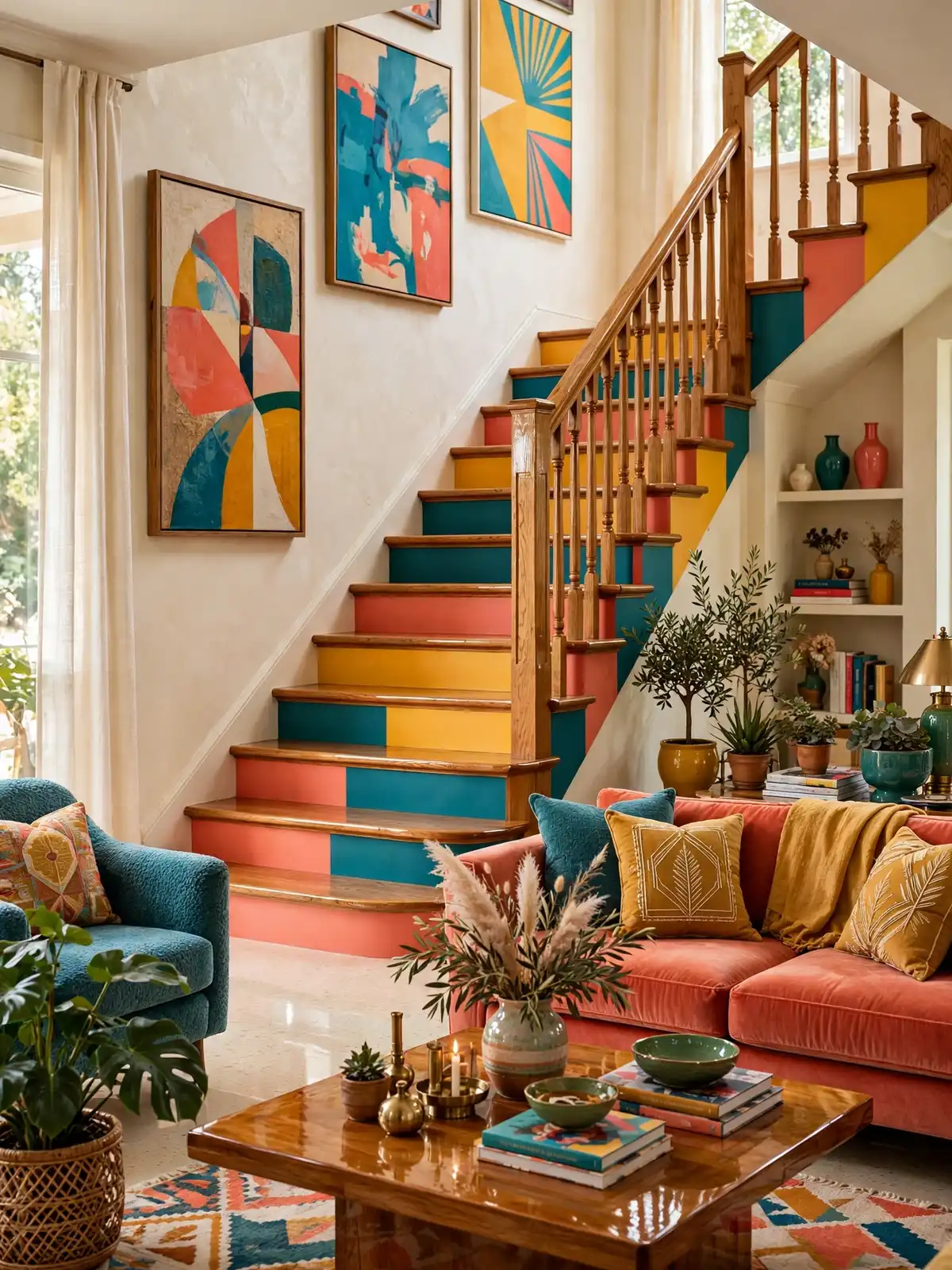
A maximalist stair with colour-blocked risers is the most playful look in this collection, because natural oak treads with coral, teal and mustard risers turn the stair into a piece of art you walk on. Here, each riser carries a different bold colour, the cream walls keep the room calm, and a large abstract canvas hangs on the landing. The look suits creative homes and families with children, it costs almost nothing beyond paint, and it makes the stair the happiest part of the house. The weakness is that bold risers can date fast and tire the eye, so choose colours you genuinely love and keep the rest of the room neutral — and use a durable paint, because risers get kicked.
Quick tips:
- Choose three colours you love, not a whole rainbow.
- Use durable, scuff-proof paint on the risers.
- Keep the walls cream so the risers stay the star.
- Repeat one riser colour in a cushion or artwork nearby.
A Craftsman Stair With a Built-In Window Seat and Stained Glass
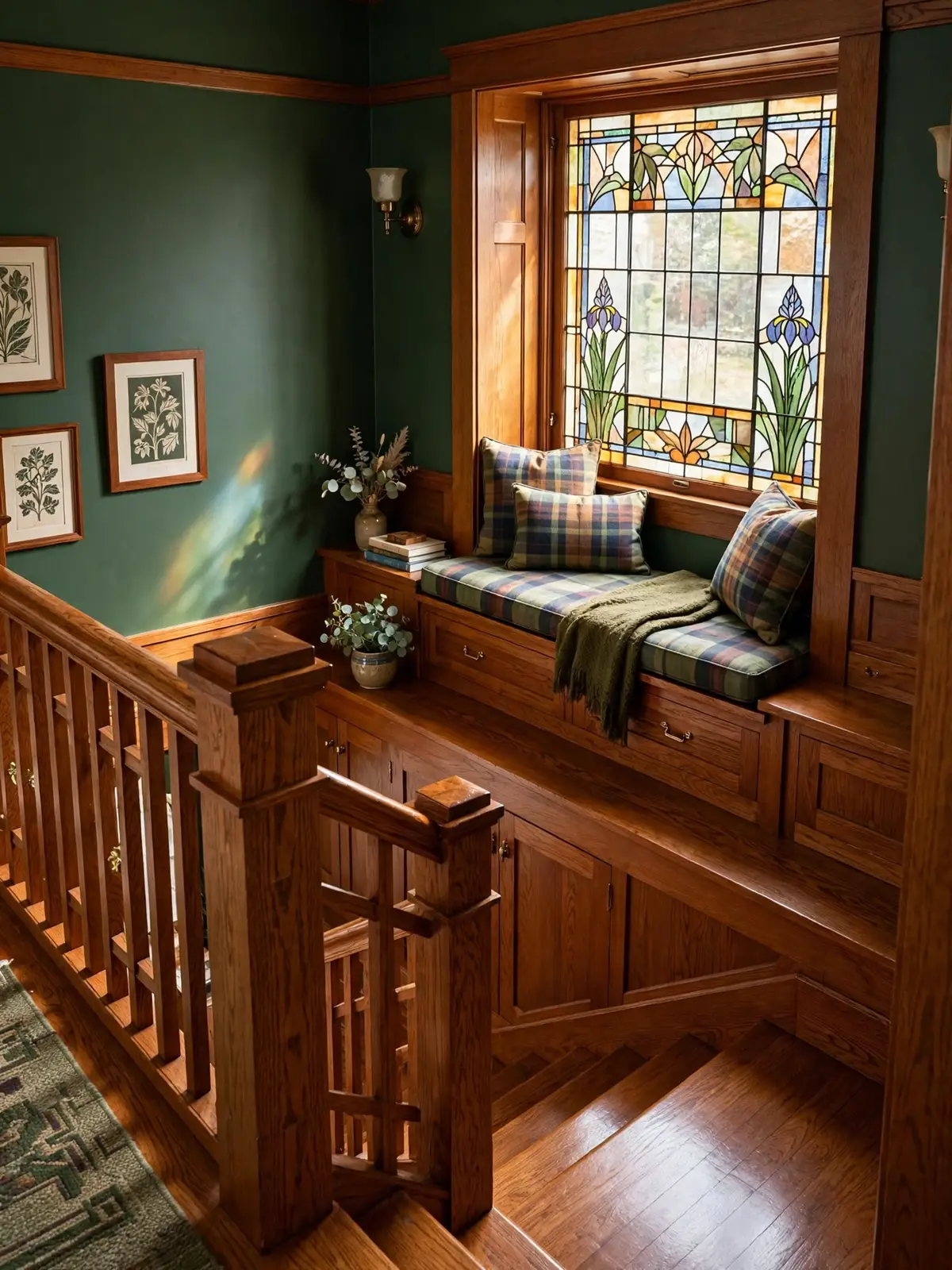
A Craftsman stair with a built-in window seat and stained glass is the most characterful look for Arts and Crafts homes, because quarter-sawn oak with deep-green walls and a stained-glass window feels handcrafted in the best sense. Here, the stair turns at a landing with a built-in window seat, plaid cushions invite you to sit, and the stained glass throws coloured light across the oak. The look suits Craftsman and bungalow homes, it adds a reading spot to the stair, and it honours the house’s original details. The weakness is that stained glass and built-in seats are specialist work, so budget for a craftsperson — and keep the cushions in a durable fabric, because a window seat gets daily use.
Quick tips:
- Hire a craftsperson for the stained glass and seat.
- Use durable fabric on the window seat cushions.
- Keep the woodwork oak throughout for a unified look.
- Add a small shelf on the landing for books.
An Urban Modern Stair Framed by a Slatted Timber Screen
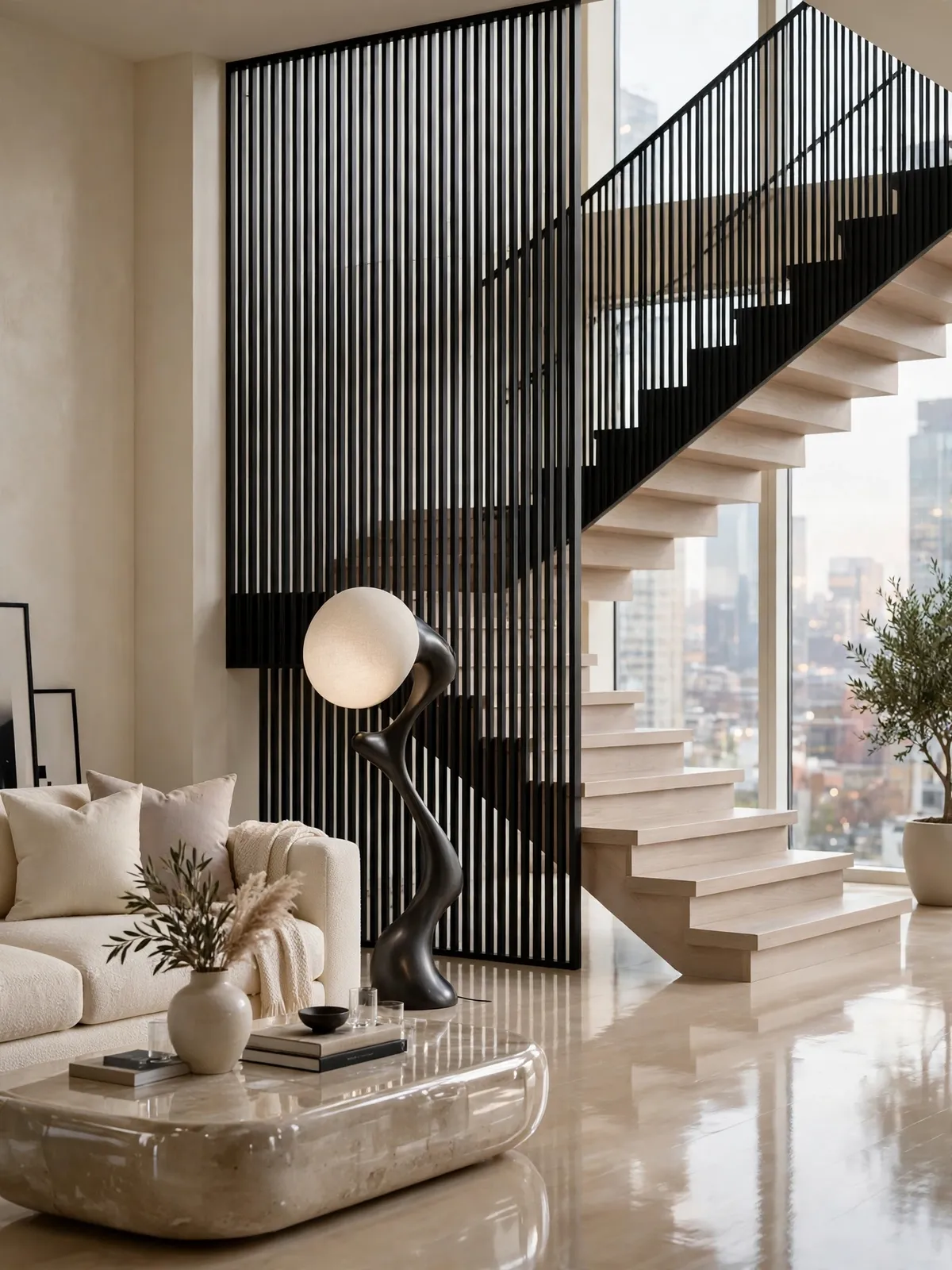
An urban modern stair framed by a slatted timber screen is the smartest look for city apartments, because pale ash treads behind an ink-black slatted screen feel private without closing the stair off from the room. Here, the vertical slats filter the light and hide the stair from the sofa, a sculptural floor lamp stands at the base, and the cream walls keep the space bright. The look suits apartments and townhouses, it adds architectural interest to a plain stair, and it works as a room divider in open-plan living. The weakness is that slats collect dust and the dark screen can darken the stair, so add a light inside the stairwell and wipe the slats down regularly.
Quick tips:
- Add a light inside the stairwell behind the screen.
- Keep the slats vertical and evenly spaced.
- Pair the black screen with pale ash, not dark wood.
- Use the screen as a room divider in open-plan living.
A Colonial Heritage Stair With Turned Spindles and Brass
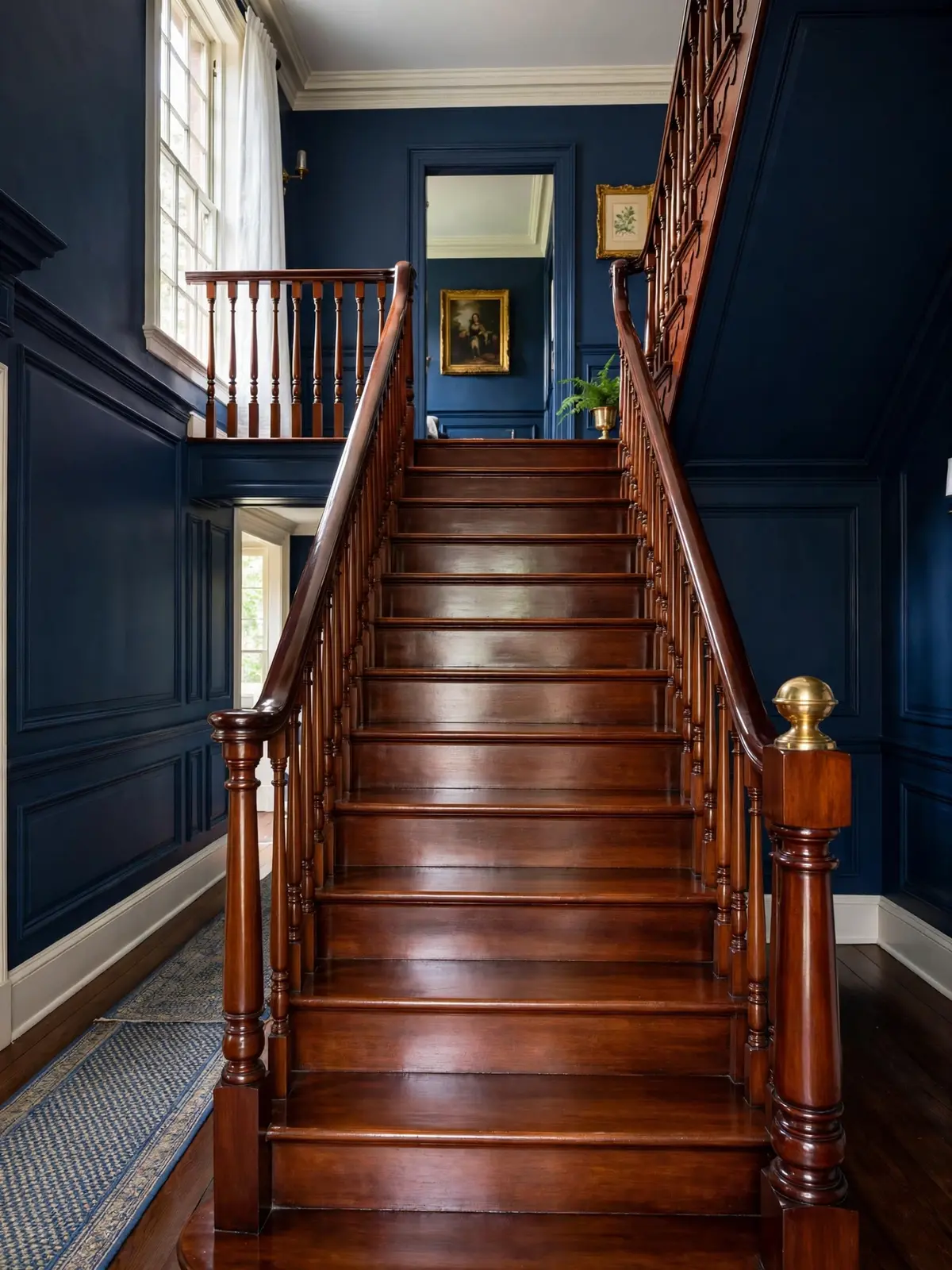
A colonial heritage stair with turned spindles and brass is the most dignified look for historic homes, because polished mahogany with turned wooden spindles and a brass newel cap against navy-blue walls feels like it belongs in a museum — in the best way. Here, the spindles turn in a classic pattern, the navy walls carry framed maps, and a brass lantern hangs above the landing. The look suits colonial and historic homes, it adds real value to a period property, and it pairs with antiques and Oriental rugs. The weakness is that turned spindles are hard to dust and mahogany needs polishing, so this look suits a household that enjoys traditional housekeeping — and the navy walls need good lighting to stay rich rather than gloomy.
Quick tips:
- Dust turned spindles with a soft brush, not a cloth.
- Hang framed maps or prints on the navy wall.
- Use a brass lantern above the landing for period charm.
- Keep the runner plain so the spindles stay the feature.
A Wabi-Sabi Stair With Weathered Wood and Limewash Plaster
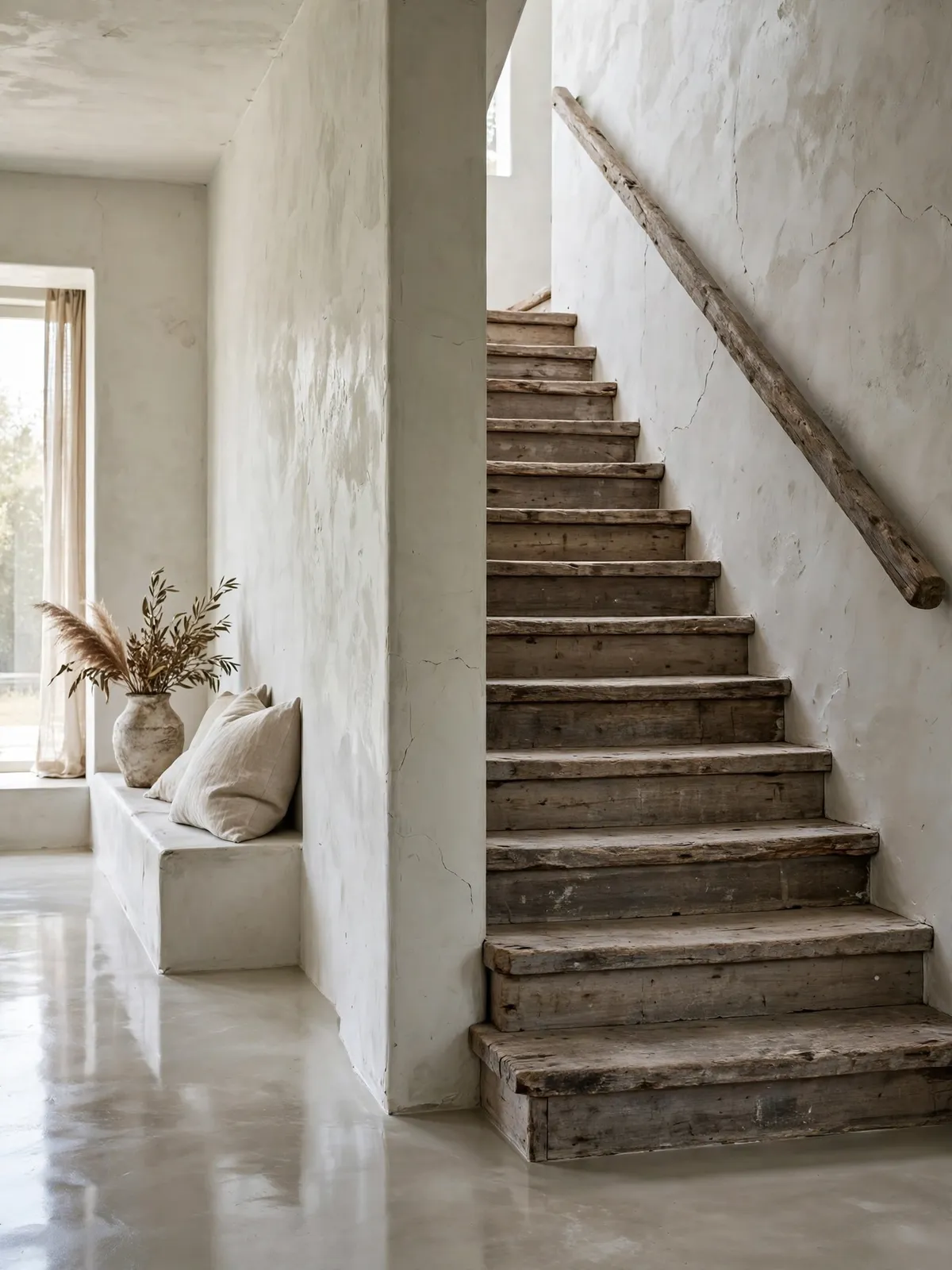
A wabi-sabi stair with weathered wood and limewash plaster is the most soulful look for homes that value imperfection, because weathered grey-brown treads against clay-white plaster feel calm, honest and beautifully unfinished. Here, the stair has no runner and no railing fuss — just the worn wood, a handmade ceramic vase on the landing and a linen cushion on the step below. The look suits earthy, minimalist and handmade homes, it forgives wear because wear is the point, and it never looks dated. The weakness is that weathered wood can feel unfinished to guests who expect polished floors, so this look suits a confident homeowner — and the treads must still be sealed, however rustic they look.
Quick tips:
- Seal weathered treads so they stay safe and clean.
- Keep the styling to one handmade object.
- Use limewash plaster, not flat paint, for depth.
- Let the wood’s imperfections show — that is the look.
A Parisian Apartment Stair With Herringbone Floors and a Gilt Mirror
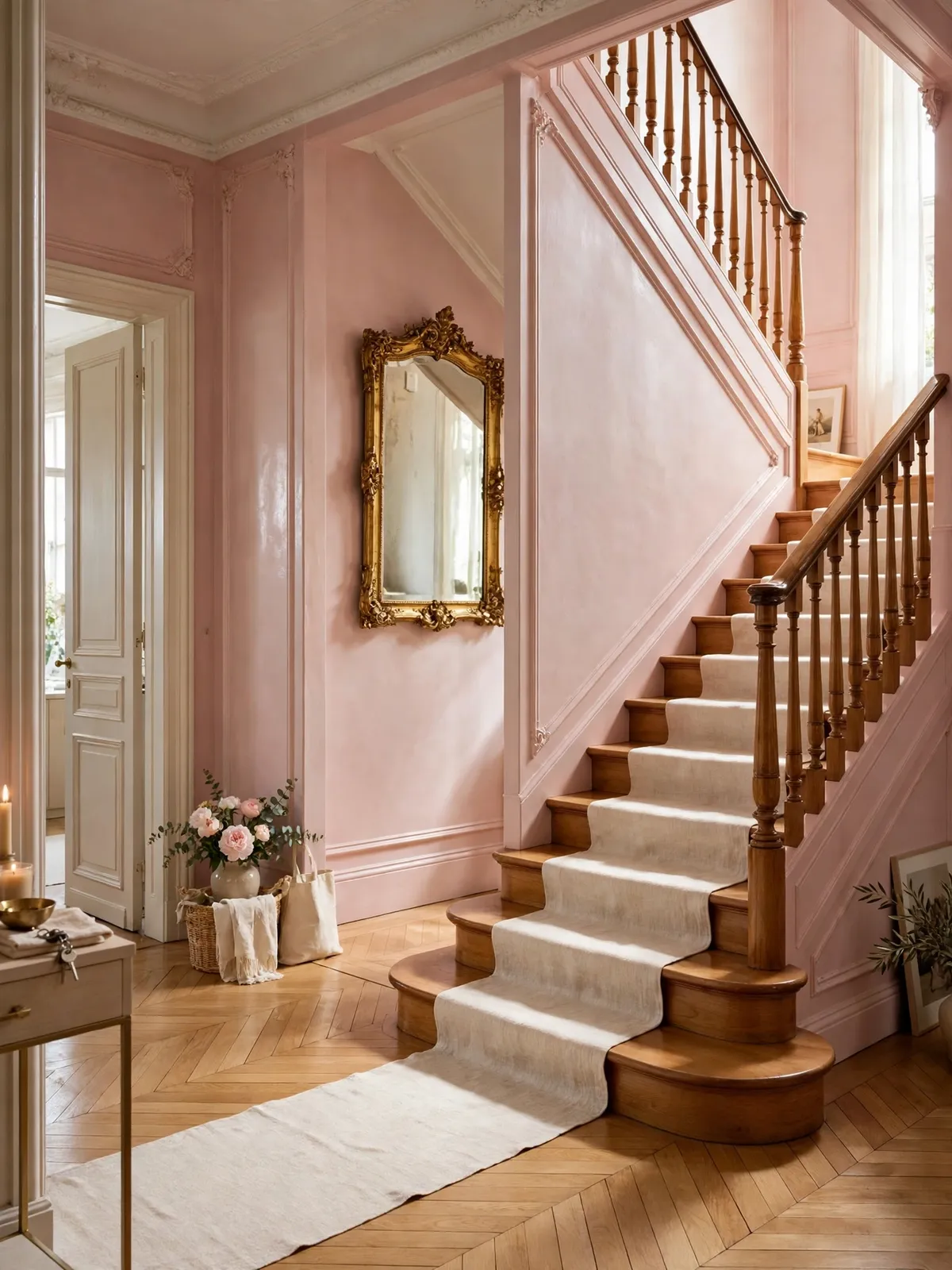
A Parisian apartment stair with herringbone floors and a gilt mirror is the chicest look for homes that love French style, because honey-oak treads flowing into a herringbone oak floor with a gilt mirror above the landing feel effortlessly elegant. Here, blush-pink walls soften the stair, a cream linen runner quiets the steps, and a small marble-topped console holds a vase of peonies. The look suits apartments and romantic homes, it makes a small entry feel grand, and it pairs with ornate mirrors and linen. The weakness is that herringbone flooring is expensive to lay and blush walls need the right light, so test the paint in your hallway before committing — and keep the runner linen, not wool, for the Parisian lightness.
Quick tips:
- Test blush paint in your hallway light before committing.
- Use a linen runner for a light Parisian feel.
- Hang the gilt mirror opposite a window to bounce light.
- Add peonies or roses on the landing console.
A Desert Southwest Stair With Warm Wood and Adobe Walls
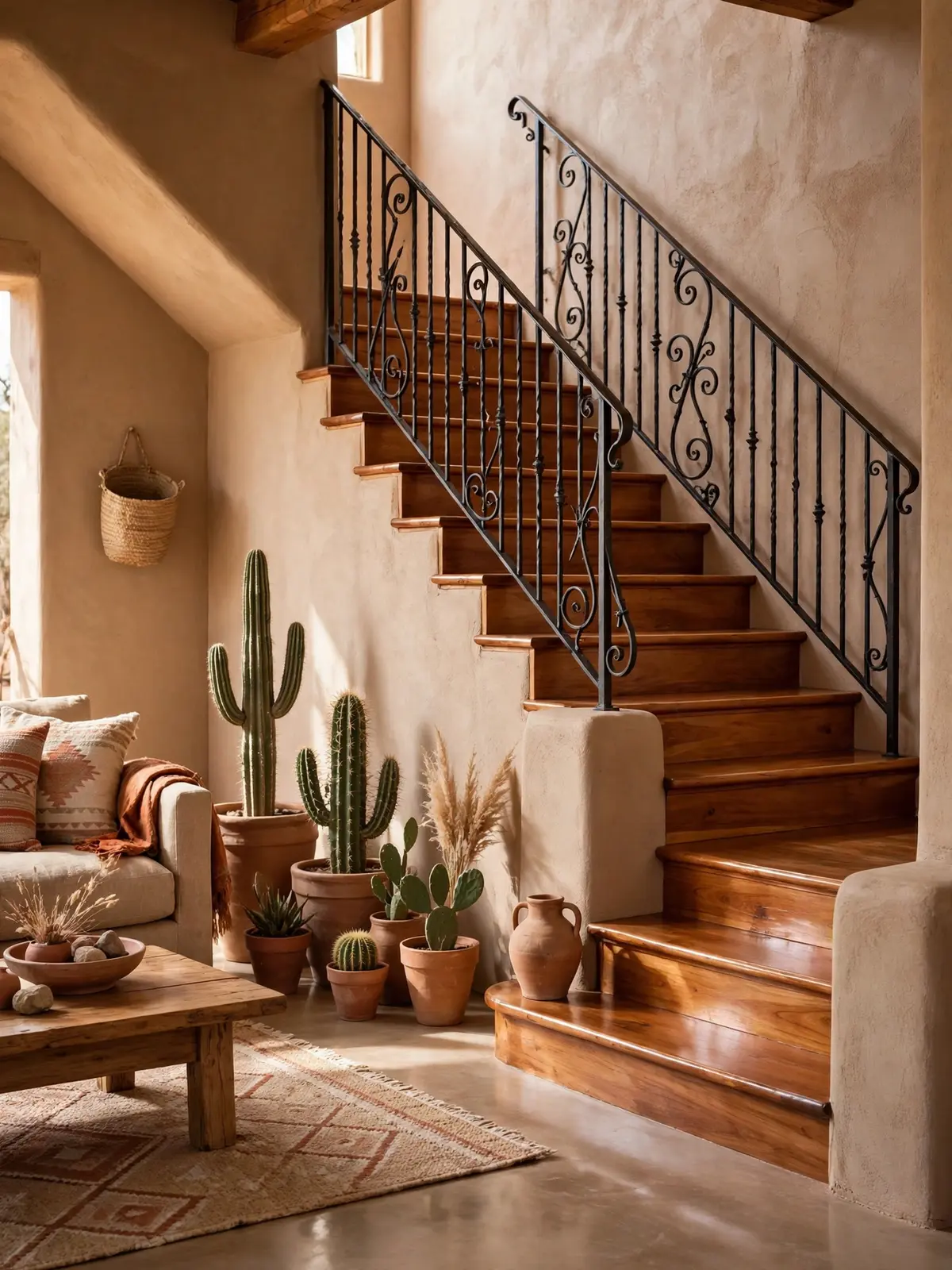
A desert southwest stair with warm wood and adobe walls brings the warmth of the American Southwest indoors, because warm mesquite treads against sand-coloured adobe walls with terracotta pots feel sun-baked and grounded. Here, a wrought-iron railing climbs the stair, a cactus stands on the landing, and a woven rug in rust and cream softens the floor below. The look suits southwestern and desert-inspired homes, it feels warm in every season, and it pairs with leather, clay and woven textiles. The weakness is that adobe walls mark easily and mesquite is a hard wood that is difficult to work, so hire a specialist for the treads and use a washable plaster finish on the walls.
Quick tips:
- Use a washable plaster finish on adobe-style walls.
- Hire a specialist for mesquite treads.
- Add terracotta pots and a cactus on the landing.
- Pair with leather and woven textiles at the base.
A Library Stair That Runs Beside a Floor-to-Ceiling Book Wall
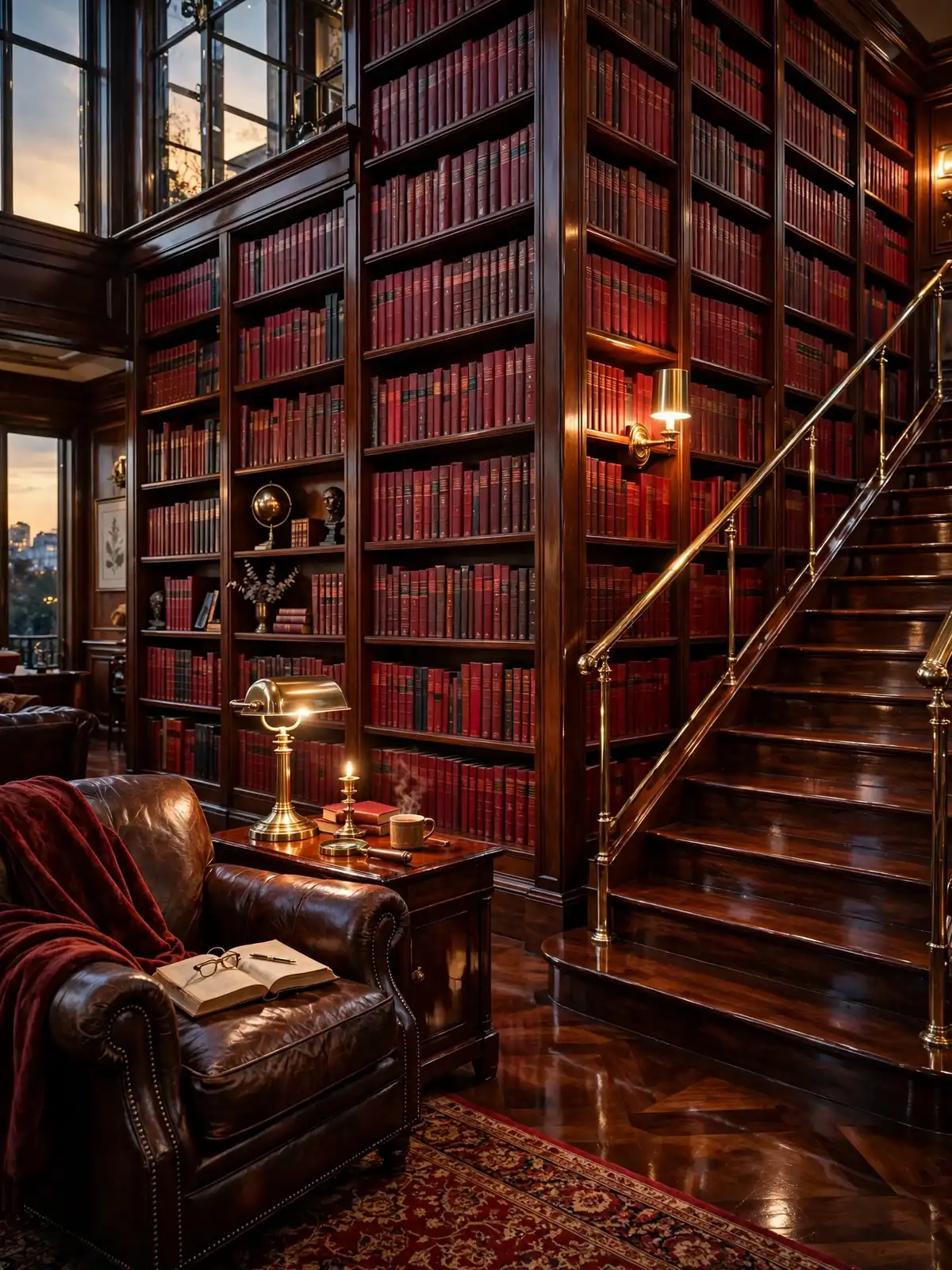
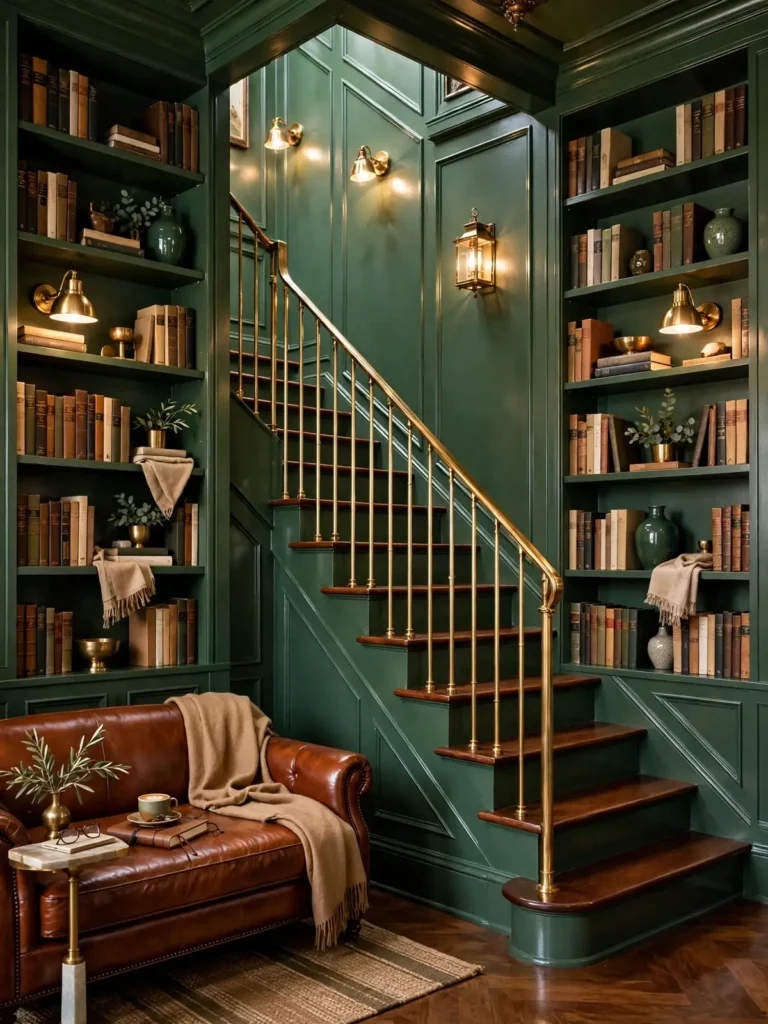
A library stair that runs beside a floor-to-ceiling book wall is the most bookish look in this collection, because dark walnut treads climbing past an oxblood-red book wall with brass library lights feel like a private club. Here, the books climb with the stair, a leather armchair waits at the base, and the brass lights glow warmly in the evening. The look suits readers and homes with large book collections, it turns the stair into a destination, and it makes the hallway feel intellectual and warm. The weakness is that floor-to-ceiling books collect dust and the dark wall needs strong lighting, so fit picture lights above the shelves and keep a step stool nearby for the top rows.
Quick tips:
- Fit brass picture lights above the book shelves.
- Keep a step stool nearby for the top rows.
- Use dark walnut so the stair matches the book wall.
- Place a leather armchair at the base for reading.
A Statement-Lighting Stair With a Sculptural Chandelier Above
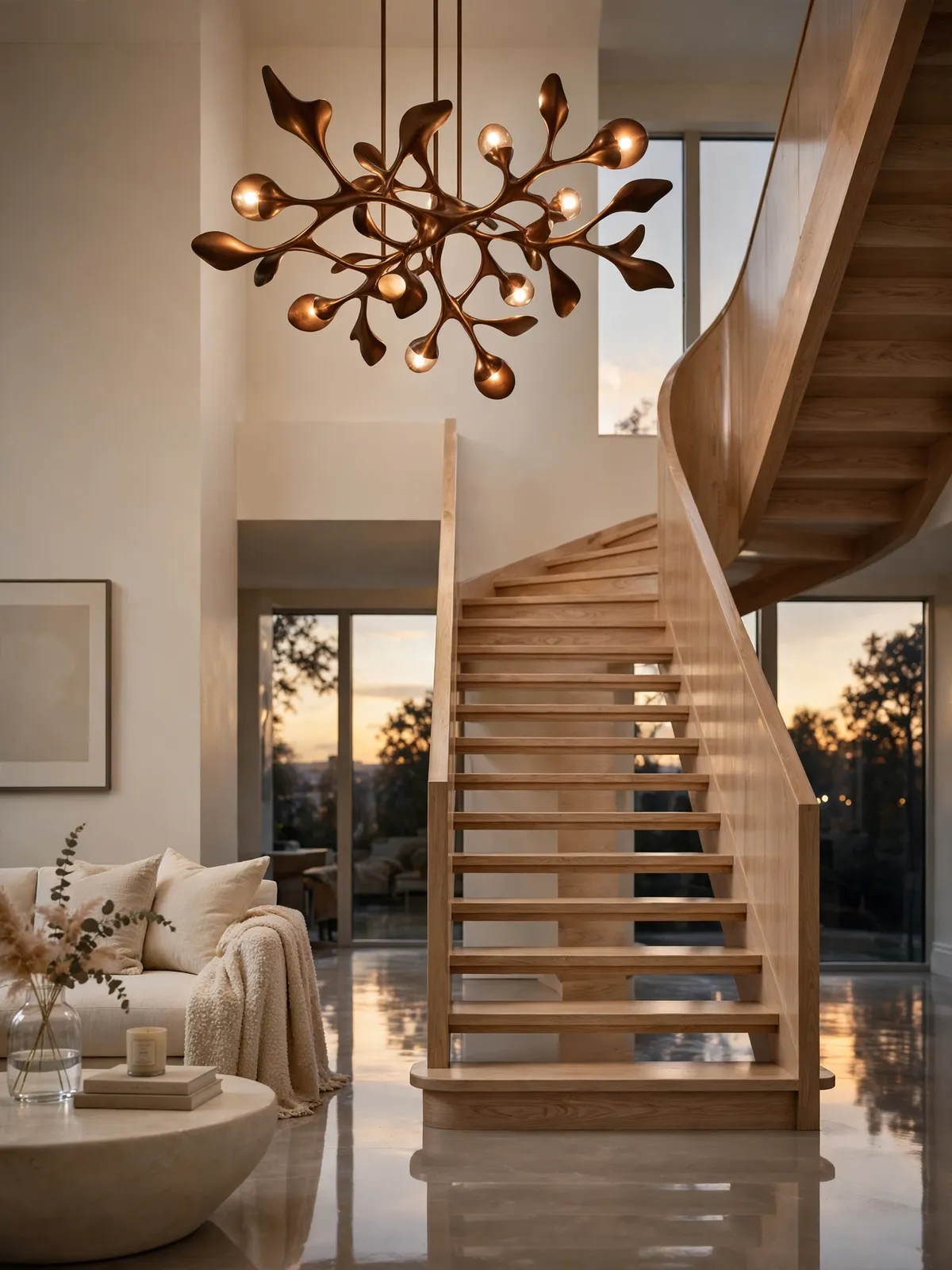
A statement-lighting stair with a sculptural chandelier above is the most dramatic look for a stairwell with height, because pale oak treads under a warm bronze chandelier turn the stairwell into a light-filled sculpture. Here, the chandelier hangs two storeys high, its warm light washes the cream walls, and a glass vase on the landing catches the glow. The look suits double-height entries and homes with tall stairwells, it makes the stair the centrepiece of the house, and it works with almost any stair style underneath. The weakness is that a large chandelier needs a winch or a tall ladder for cleaning and bulb changes, so plan access before you hang it — and choose warm bulbs, because cool white light kills the wood’s warmth.
Quick tips:
- Plan access for cleaning and bulb changes before hanging.
- Choose warm bulbs — cool white kills the wood’s warmth.
- Hang the chandelier two storeys high in a tall stairwell.
- Keep the stair itself simple so the light stays the star.
Wooden Staircase Ideas That Tie the Whole Home Together
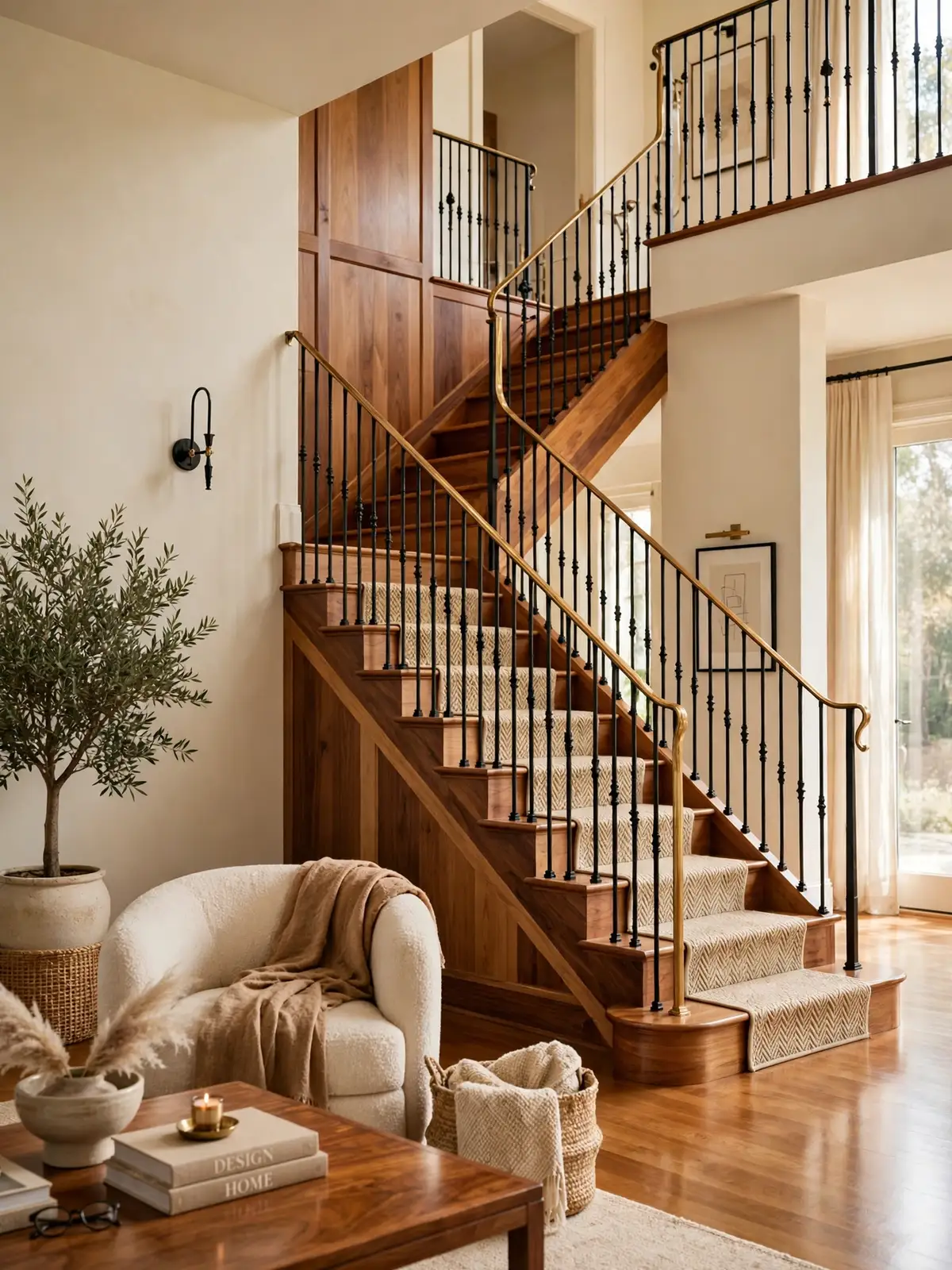
The last of these wooden staircase ideas is the principle behind them all: a wooden stair ties a home together when it repeats the tones, materials and metals used elsewhere in the house. Here, warm wood treads echo the oak floor, the brass handrail matches the kitchen handles, the black iron balusters match the lighting, and a woven runner softens the steps — so the stair feels like part of the home rather than an afterthought. The look suits every style, because it is not a style at all but a method: pick your wood tone from your flooring, pick your metal from your lighting, and style the wall beside the stair to match the room it serves. Get those three choices right and any of the 28 looks above will feel like it was always meant to be there.
Quick tips:
- Match the stair’s wood tone to your flooring.
- Repeat your lighting’s metal finish on the railing.
- Style the stair wall to match the room it serves.
- Choose one look, commit to it, and keep the rest simple.
FAQs
What wood colour works best for a staircase?
Pale woods like oak, ash and birch suit bright, modern and Scandinavian homes because they keep the hallway light. Mid-tones like honey oak and walnut suit most homes and hide wear well. Dark woods like mahogany and walnut suit traditional and grand homes but need good lighting. Match the stair to your flooring tone rather than choosing a colour in isolation.
Should a wooden staircase have a runner?
A runner is worth adding in most homes: it quiets footsteps, adds grip, protects the wood from wear, and gives you a chance to add pattern or colour. A flat-weave wool or jute runner suits most stairs. Skip the runner only if you love the bare wood and your household is small and light-footed.
How do I keep a wooden staircase looking new?
Sweep it weekly, wipe the treads with a damp cloth and a wood-safe cleaner, and re-oil or re-lacquer the treads every few years depending on traffic. Fit a runner in high-traffic homes, keep a doormat at the entry, and touch up scuffs with a matching wood marker before they deepen.
Can I change the look of an existing wooden staircase without replacing it?
Yes. Paint the risers, change the balusters or handrail, add a runner, repaint the stair wall, or swap the lighting above the stair — any one of these changes the look dramatically for far less than a new stair. A runner and a new handrail together are the highest-impact, lowest-cost combination.
What lighting works best above a wooden staircase?
Warm lighting always suits wood. A pendant or chandelier in the stairwell, wall sconces on the stair wall, or LED strips under the treads all work — choose one main light and one accent. Avoid cool white bulbs, which make wood look grey and cold.
Conclusion
A wooden staircase is far more than a way upstairs — it is the warmest, most visible piece of joinery in the home, and the right look turns it into the feature that ties every room together. Whether you choose a pale Scandinavian stair, a farmhouse stair with black iron, a coastal whitewashed stair, a mid-century walnut stair, an industrial loft stair, a classic Georgian stair with a patterned runner, or simply a sculptural chandelier above a simple oak stair, the rule stays the same: match the wood to your flooring, repeat one metal finish, and style the wall beside the stair to suit the room. Pick the look that fits your home, borrow its decor pairings, and your stair will feel like it was designed — not just built.