19 Clever Bathroom Shelves Ideas That Add Storage and Style to Every Wall
Bathroom shelves are the easiest way to add storage without a renovation: the right shelf in the right spot holds daily essentials, frees the counter and makes the whole room look finished. These 19 bathroom shelves ideas show which shelf types suit which wall, how high to hang them and how to style them so they stay beautiful every day.
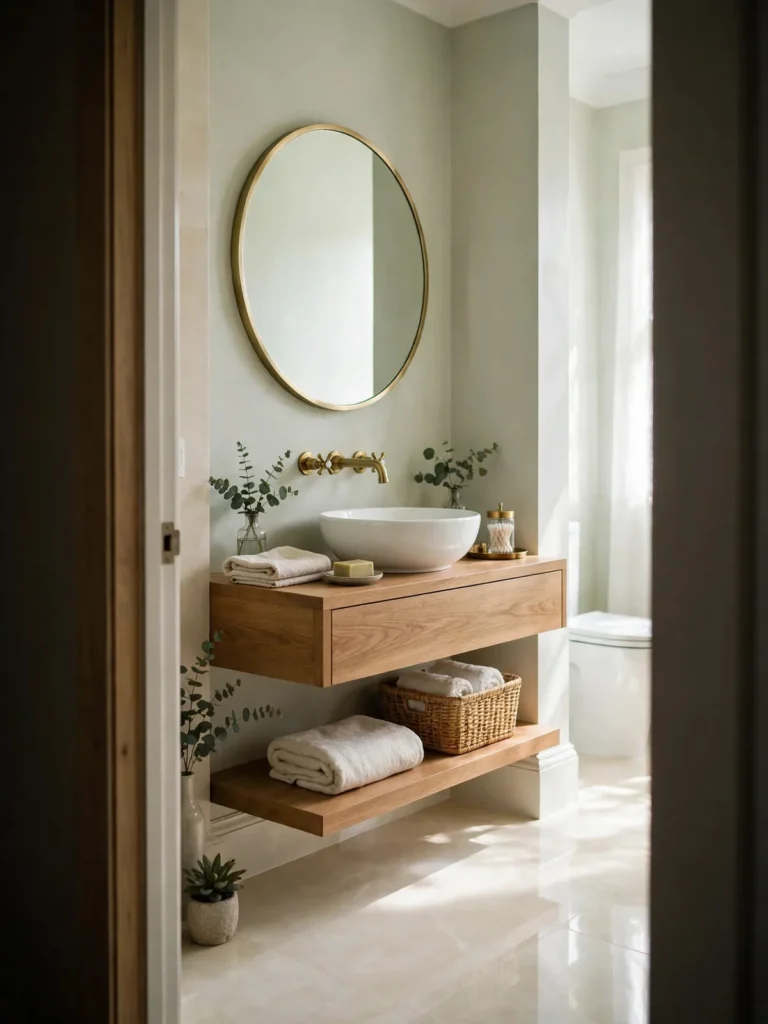
Bathroom shelves work because a bathroom rarely needs more floor space — it needs more wall space used well, and a shelf above the toilet, beside the mirror or inside the shower turns an empty stretch of wall into storage that also looks intentional. Bathroom shelves mean open, wall-mounted or recessed ledges that hold towels, toiletries, plants and beautiful objects where you can reach them, without the bulk of a cabinet, and they suit every bathroom size because the shelf itself takes up no floor at all.
If your bathroom is short on floor space, these small bathroom ideas show how floating vanities, large mirrors and clever storage can make the same room feel twice as big. The 19 ideas below cover wood, glass, brass, ladder, corner and recessed shelves, plus the height, spacing and weight rules that keep them safe and useful, so you can pick the shelves that fit your walls, your budget and the way your household actually uses the bathroom.
Key Takeaways
What are the best bathroom shelves for a small bathroom?
Floating shelves above the toilet, a narrow ledge beside the mirror and a corner shelf unit work best in a small bathroom, because they use wall space that is otherwise wasted and take up no floor. Keep them slim, no deeper than 20 cm, and style only three or four items per shelf so the room stays calm.
How high should bathroom shelves be hung?
Hang the lowest shelf at eye level or just above it, around 150 to 160 cm from the floor, so you can reach it without stretching, and leave 30 to 40 cm between shelves so tall bottles fit. Shelves above the toilet should sit at least 60 cm above the tank so you never bump your head.
How much weight can bathroom shelves hold?
It depends on the fixing, not the shelf: a shelf fixed into studs or solid masonry with proper wall plugs can hold towels, bottles and jars easily, while a shelf held by adhesive strips or plasterboard fixings should carry only light items such as a plant or folded flannels. Always check the bracket rating and fix into a stud or solid wall for anything heavy.
Are open bathroom shelves practical, or do they just collect clutter?
Open shelves are practical when every item has a purpose and a place: daily toiletries at eye level, spare towels folded neatly, and one or two beautiful objects for styling. They only look cluttered when they hold random half-empty bottles, so decant products into matching containers and keep cleaning supplies behind a closed door.
Which shelf material is best for a humid bathroom?
Sealed wood, tempered glass, powder-coated metal and stone handle bathroom humidity best, because they resist warping, rust and water marks. Untreated softwood and unsealed MDF swell and stain in steam, so choose a sealed, lacquered or oiled finish and wipe shelves dry after very steamy showers.
| Shelf type | Install difficulty | Cost level | Best for |
|---|---|---|---|
| Wooden shelves above the toilet | Easy | Low | Spare towels and small bathrooms |
| Floating glass shelves | Medium | Medium | Vanity zones and light, airy rooms |
| Corner shelves | Medium | Low to medium | Awkward corners and showers |
| Ladder shelf | Easy, no drilling | Low | Renters and quick storage |
| Rope-hung shelves | Medium | Low | Coastal and relaxed bathrooms |
| Recessed shower shelves | Hard, needs renovation | Medium to high | Showers and built-in storage |
| Brass and glass shelves | Medium | Medium to high | Hotel-style vanity displays |
| Metal pipe shelves | Medium to hard | Medium | Industrial bathrooms and heavy loads |
Wooden Shelves Above the Toilet That Turn Dead Space Into Storage
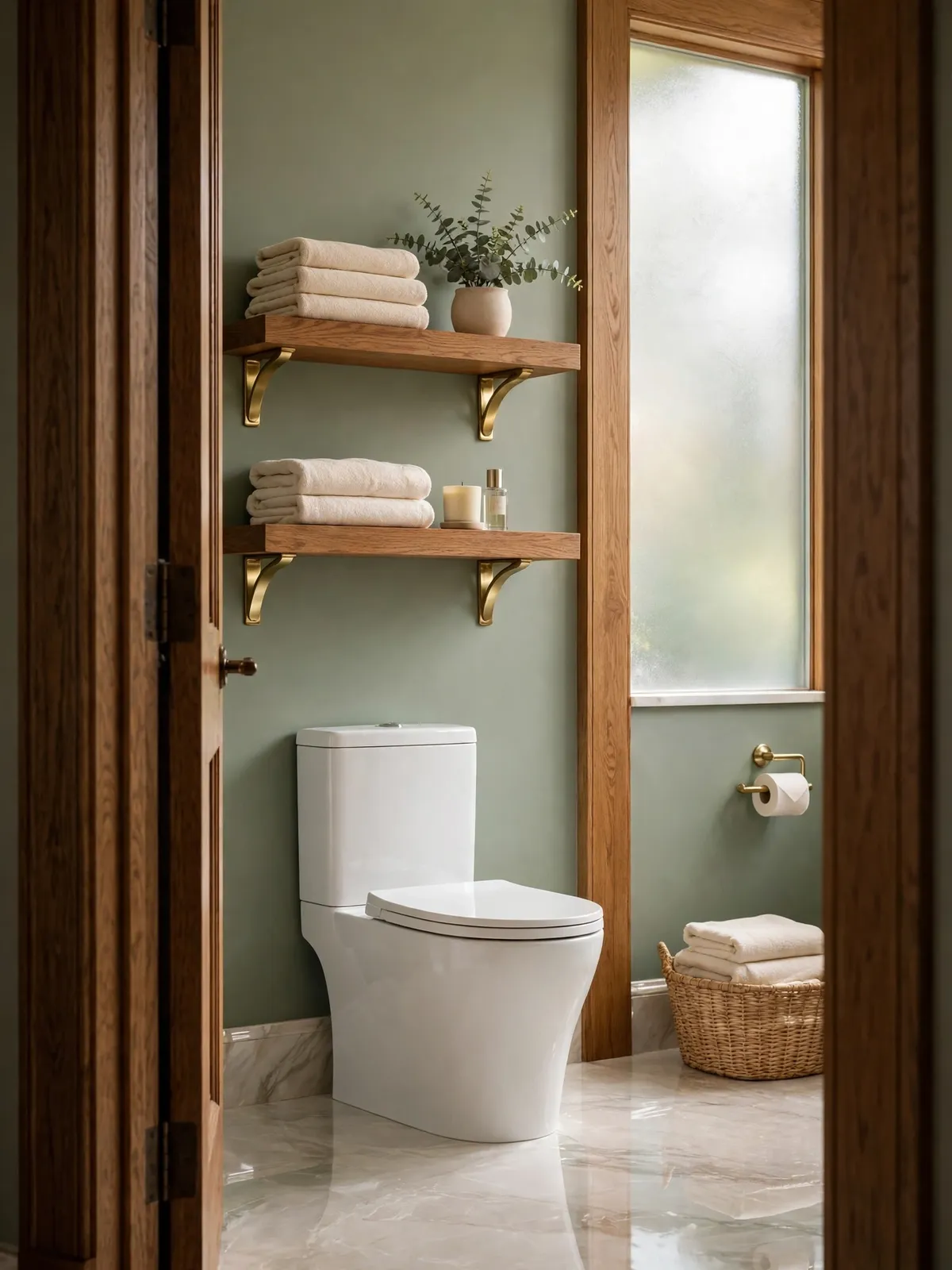
Wooden shelves above the toilet turn the most wasted wall in a bathroom into its most useful one, because the space above the tank is almost never used and two slim shelves there hold spare towels, a plant and the items you reach for every day. Here, two warm oak shelves with brushed brass brackets sit on a sage-green wall above a white toilet, holding cream folded towels, a small potted eucalyptus and a glass jar of cotton pads. The design suits small bathrooms best of all, it costs very little, and it keeps the counter clear because the everyday items move up and out of the way. The weakness is headroom: shelves hung too low invite bumps, and shelves loaded with heavy jars can pull out of a weak wall — so hang the lowest shelf at least 60 cm above the tank and fix the brackets into studs or solid masonry.
Quick tips:
- Hang the lowest shelf at least 60 cm above the toilet tank.
- Fix brackets into studs or solid masonry, never plasterboard alone.
- Keep shelves no deeper than 20 cm so they never overhang the tank.
- Style towels and one plant; hide spare toilet rolls in a basket below.
Floating Glass Shelves Between Two Mirrors
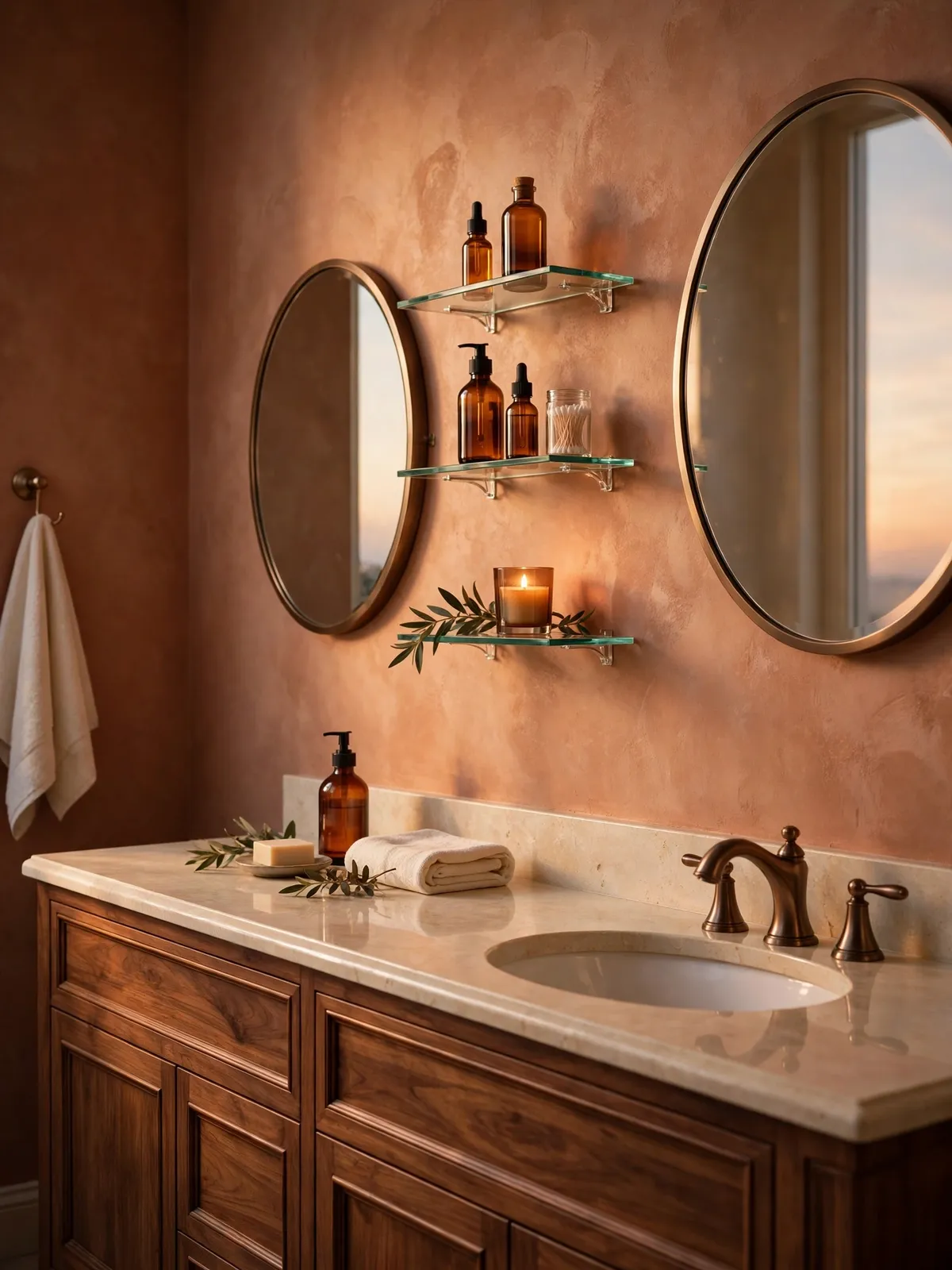
Floating glass shelves between two mirrors add storage without adding visual weight, because the clear glass almost disappears against the wall and the mirrors on either side bounce light straight through the shelf. Here, two tempered glass shelves sit between twin round mirrors above a warm walnut vanity, holding amber glass bottles, a small vase and a folded cream flannel against terracotta plaster walls. The design suits bathrooms that already feel busy, it makes the vanity zone feel wider, and it is the best choice when you want storage that does not darken the room. The weakness is honesty: glass shows dust, water spots and every fingerprint, and it holds less weight than wood — so keep the load light, choose tempered glass at least 8 mm thick, and wipe the shelves weekly.
Quick tips:
- Choose tempered glass at least 8 mm thick for safety.
- Keep the load light — bottles and jars, never stacks of towels.
- Wipe glass shelves weekly to stop water spots building up.
- Match the brackets to the tap finish for a pulled-together look.
Corner Shelves That Rescue Awkward Bathroom Corners
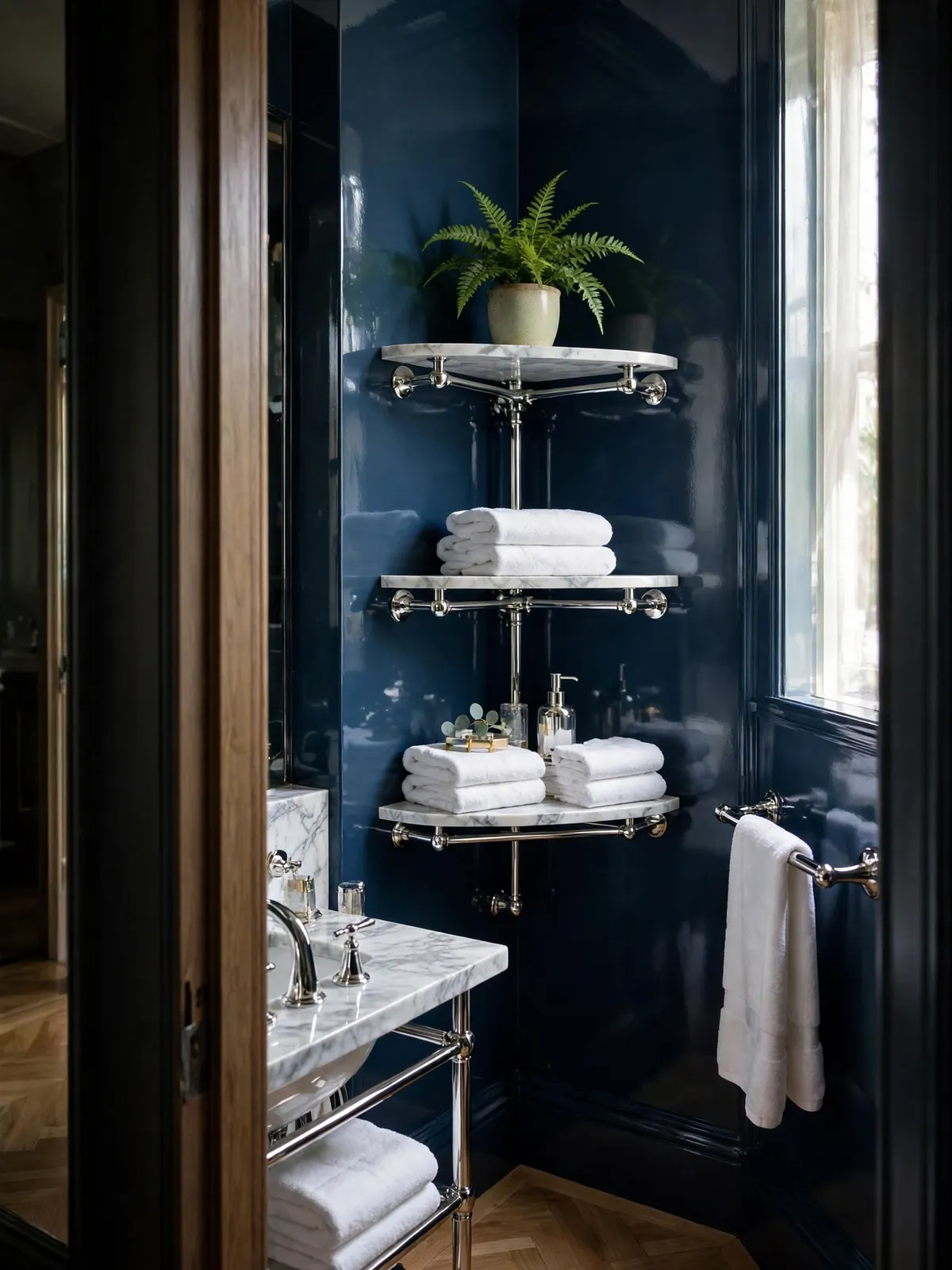
Corner shelves rescue the awkward corner that no cabinet ever fits, because a triangular or curved shelf turns dead space beside the bath or shower into three or four useful ledges. Here, three white marble-look corner shelves wrap the corner of a deep navy bathroom, holding folded white towels, a small green fern and amber bottles, with chrome fittings catching the light. The design suits square bathrooms and en-suites with an unused corner, it costs far less than a custom corner cabinet, and it keeps bottles off the edge of the bath where they always fall in. The weakness is reach: the deepest corner is hard to clean and easy to overload, so keep the shelves shallow, store only items you use weekly, and leave the top shelf for display.
Quick tips:
- Keep corner shelves shallow so the back corner stays reachable.
- Use the top shelf for display and the lower ones for daily items.
- Choose a waterproof material — stone, glass or sealed wood.
- Wipe the corner joint regularly, as steam collects there first.
A Ladder Shelf Leaning Against the Wall
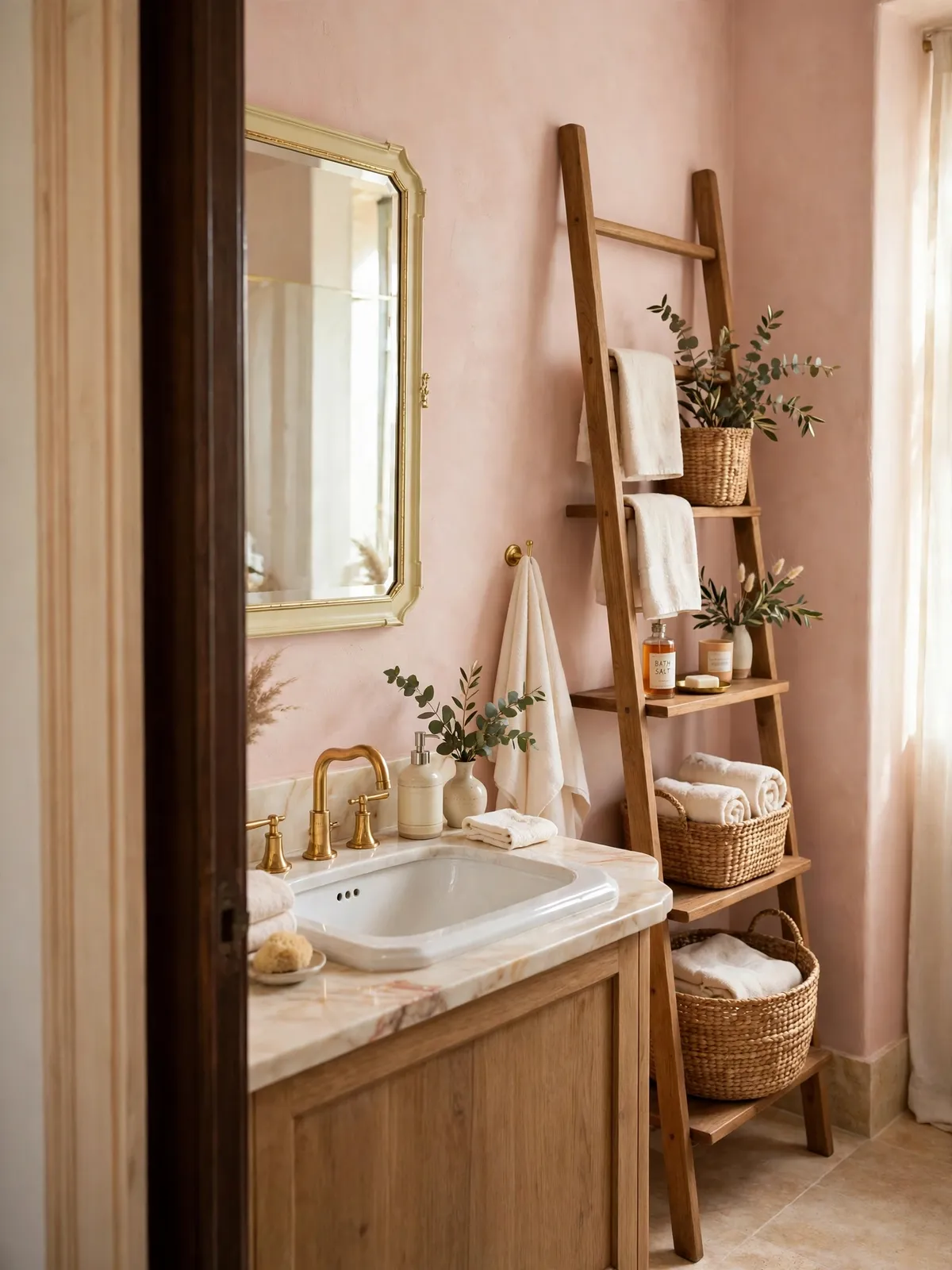
A ladder shelf leaning against the wall is the easiest shelf a bathroom can have, because it needs no drilling, it moves when you move, and its widening rungs hold towels at the bottom and small display pieces at the top. Here, a pale pine ladder shelf leans against a blush-pink wall beside a white ceramic sink, with cream towels draped over the lower rungs, woven baskets on the middle shelf and a small plant on top. The design suits renters and anyone who wants storage without fixing anything to the wall, it costs very little, and it adds a relaxed, lived-in layer that balances sleek tiles. The weakness is stability: a ladder on a smooth tiled floor can slip, and a top-heavy ladder can tip — so fix the top rail to the wall with a small bracket, keep heavy items low, and never lean it where the shower sprays.
Quick tips:
- Fix the top rail to the wall so the ladder cannot slip or tip.
- Keep heavy baskets low and light display items high.
- Choose a ladder no wider than the wall space beside the vanity.
- Rotate towels weekly so none stay damp against the wall.
Rope-Hung Shelves for a Relaxed Coastal Feel
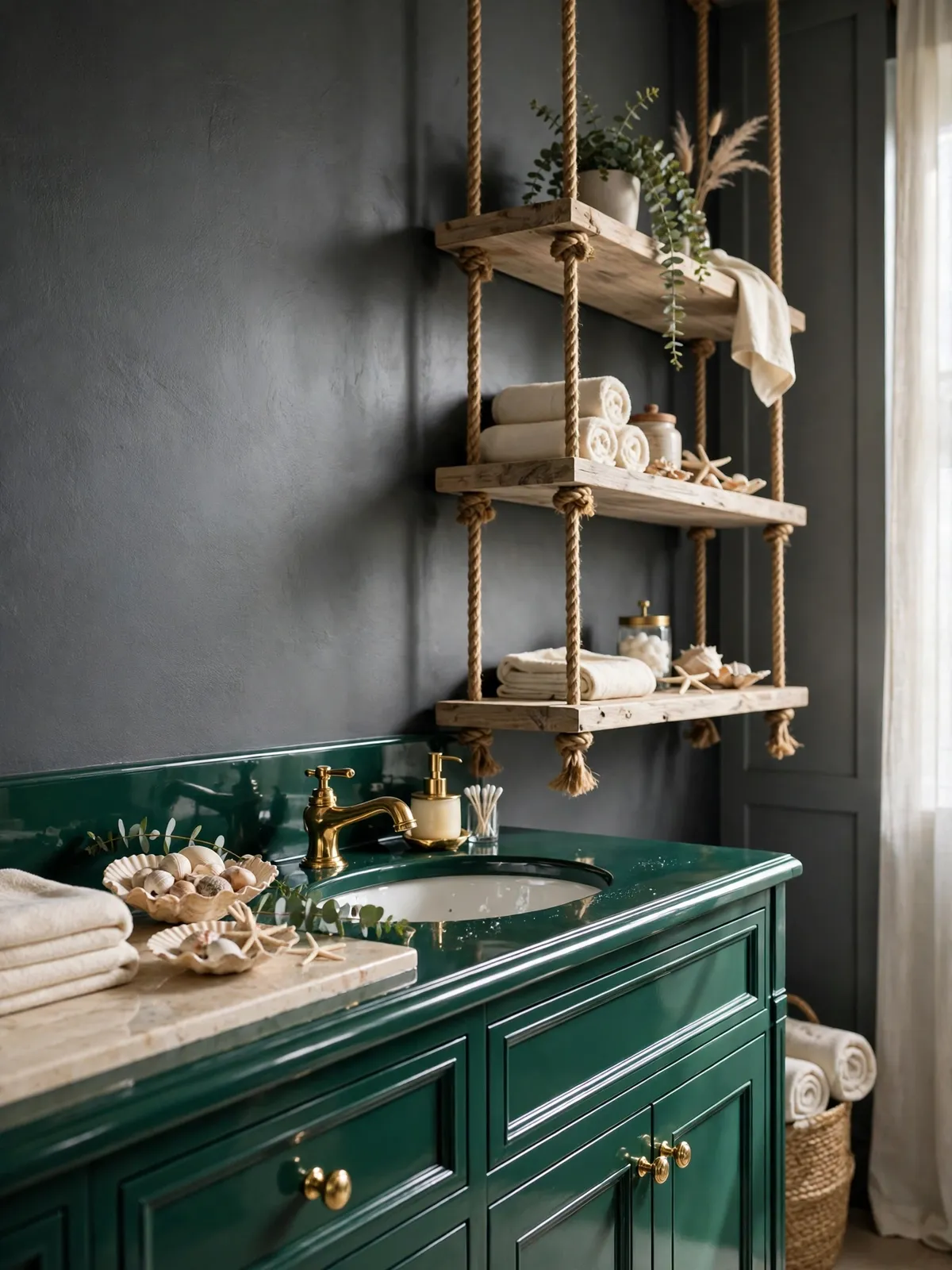
Rope-hung shelves bring a relaxed coastal feeling to a bathroom that plain brackets never can, because the thick natural rope softens the shelf, adds texture, and makes a simple wooden plank look like a considered design choice. Here, two driftwood shelves hang from natural rope against a charcoal-grey wall above an emerald-green vanity, holding cream towels, a small seashell dish and a glass bottle of hand wash. The design suits bathrooms with a coastal, boho or relaxed style, it costs very little to make, and the rope adds warmth to rooms full of tile and chrome. The weakness is swing and sag: rope stretches over time, and a shelf hung from rope alone can tilt if the load is uneven — so use thick, knotted rope, fix the ceiling hooks into a joist, and balance the weight evenly on both sides.
Quick tips:
- Fix ceiling hooks into a joist, never into plasterboard alone.
- Use thick rope and knot it firmly under each shelf corner.
- Balance the weight evenly so the shelf never tilts.
- Check the rope yearly and re-tension it if it stretches.
Recessed Shelves Built Into the Shower Wall
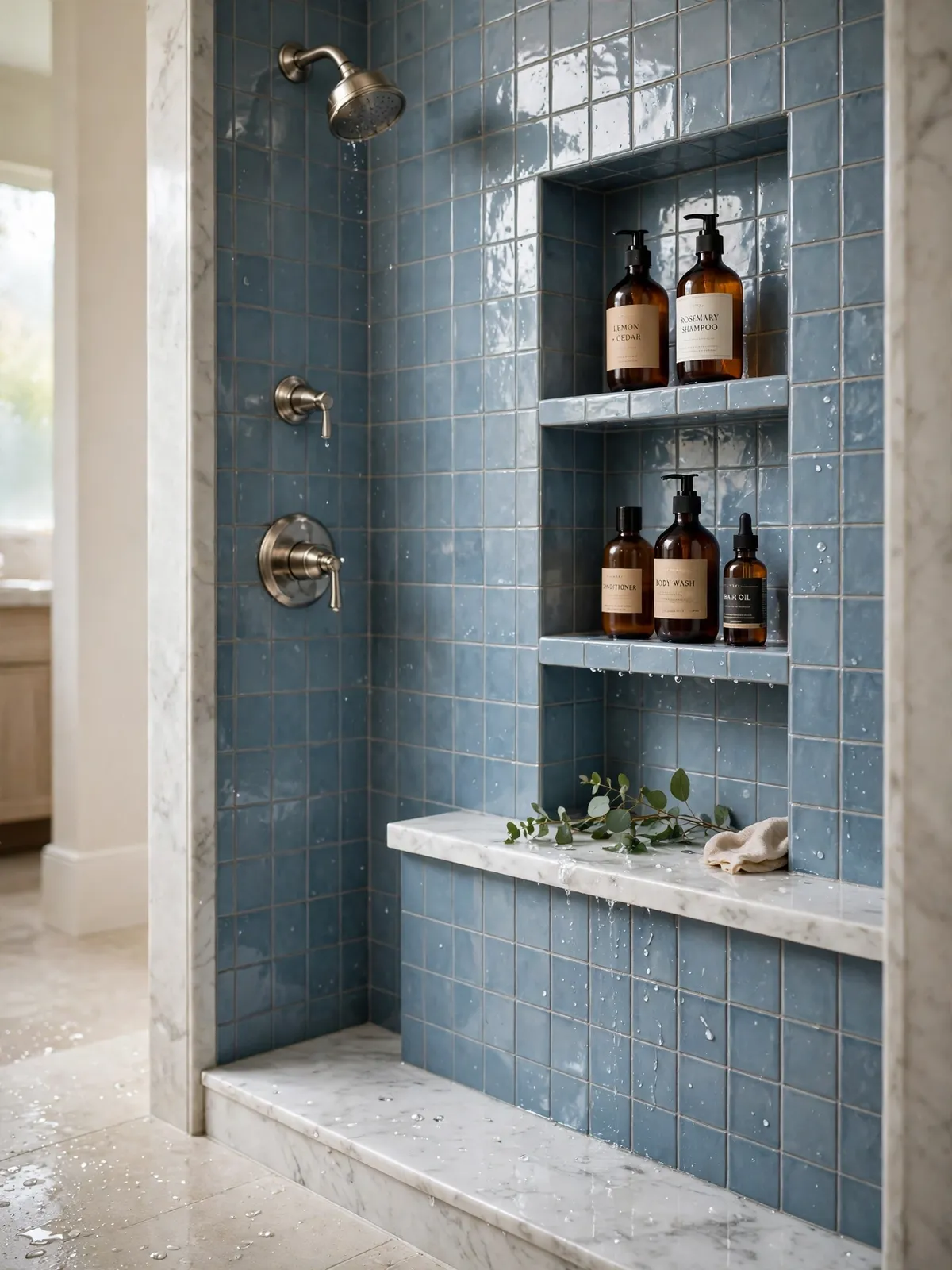
Recessed shelves built into the shower wall are the tidiest shelves a bathroom can have, because the storage sits inside the wall itself, so shampoo and soap never fall off a ledge and nothing hangs in a rusting caddy. Here, two recessed niches with dusty-blue tiles and a white marble ledge hold amber glass bottles in the shower, with brushed nickel fittings and a single folded cloth. The design suits every shower, it keeps the shower looking built-in rather than improvised, and it makes even a small shower feel designed. The weakness is timing: a recessed shelf must be planned before the wall is tiled, and it must be waterproofed properly or water leaks into the wall — so decide the height and depth during a renovation, slope the base slightly so water drains out, and have the tiler seal it carefully.
Quick tips:
- Plan recessed shelves before tiling, never after.
- Slope the shelf base slightly so water drains out.
- Make the niche deep enough for full-size bottles.
- Line the niche with the same tile as the wall for a built-in look.
Brass and Glass Shelves for a Polished Hotel Look
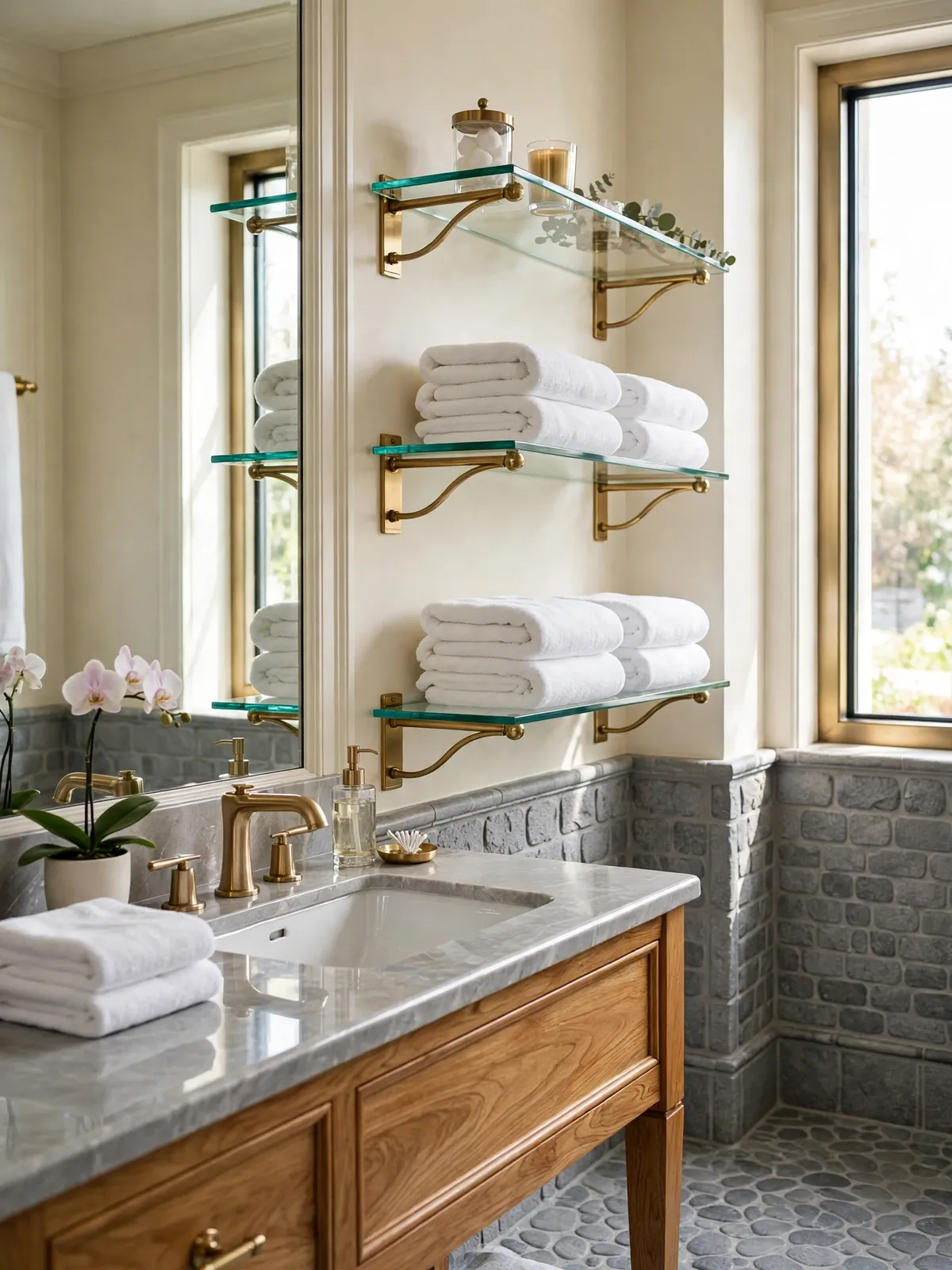
Brass and glass shelves give a bathroom the polished hotel look that plain wood never quite reaches, because the warm brass brackets catch the light and the clear glass keeps the wall feeling open while the shelf itself looks expensive. Here, two glass shelves on brushed brass brackets sit above a honey-oak vanity against river-stone grey tiles, holding folded white towels, a small orchid and a crystal perfume bottle. The design suits bathrooms being refreshed with new fixtures, it photographs beautifully, and brass ages gracefully where chrome can look dated. The weakness is matching: brass finishes vary wildly between brands, and mixing polished and brushed brass looks accidental — so buy the brackets and the taps from one range, and clean the brass with a soft cloth rather than abrasive cleaners.
Quick tips:
- Buy brackets and taps from one range so the brass tone matches.
- Choose brushed brass over polished for a softer, modern look.
- Keep the shelves light — glass and brass suit display, not bulk storage.
- Clean with a soft cloth, never abrasive cleaners.
Open Oak Shelves Above the Vanity
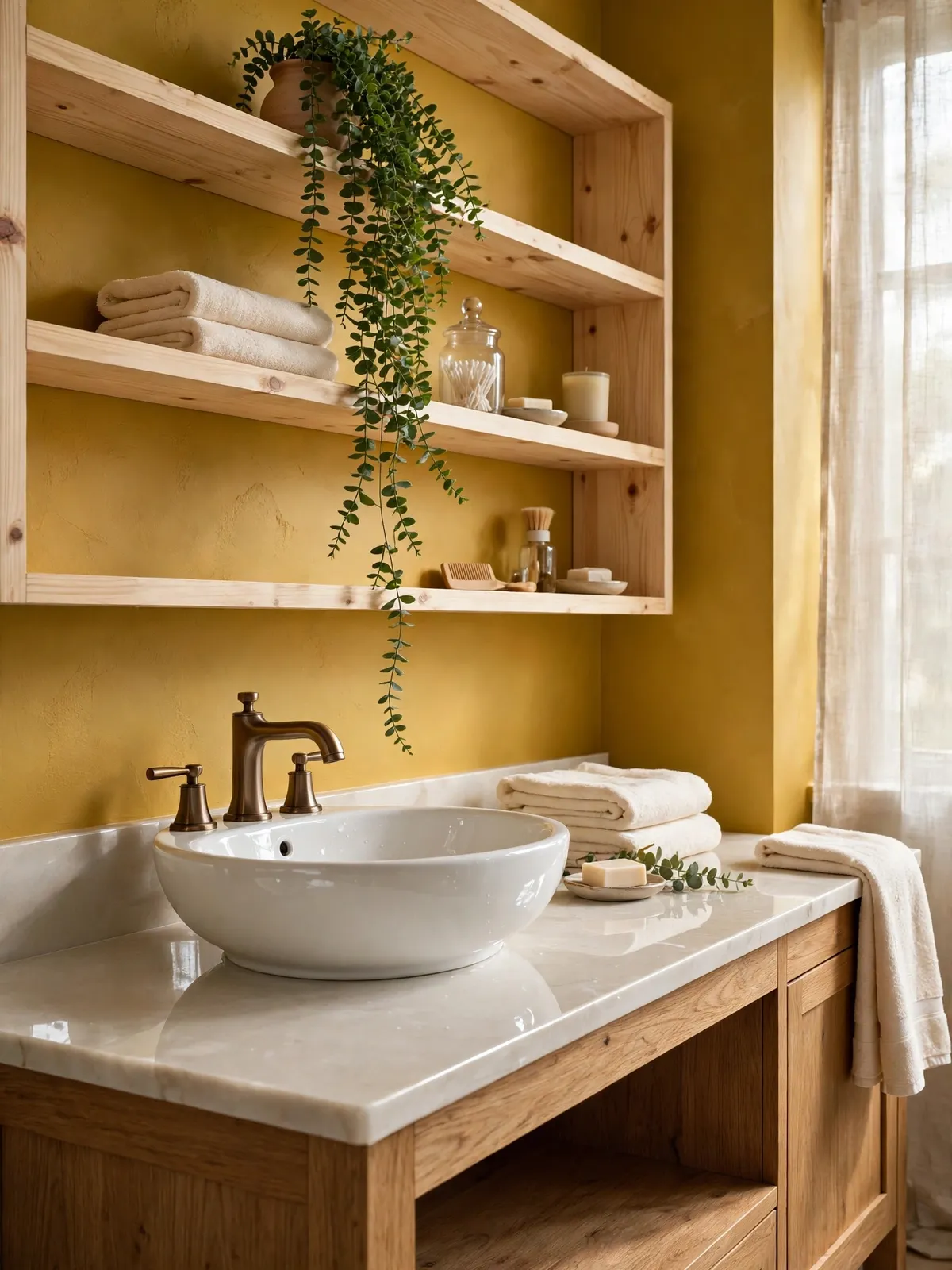
Open oak shelves above the vanity replace the closed cabinet with warmth and display, because the wood grain adds a natural layer to a room full of porcelain and tile, and everything you use every morning sits at eye level. Here, two pale pine shelves sit on a mustard-yellow accent wall above a white vessel sink, holding cream towels, a trailing green plant, matching glass jars and a small framed print. The design suits bathrooms that feel cold or clinical, it makes the vanity zone the warmest part of the room, and it is one of the cheapest ways to change the whole feeling of the bathroom. The weakness is exposure: open shelves above a basin collect toothpaste spray and water spots, so choose a sealed or lacquered oak finish, keep the shelves clear of the direct splash zone, and wipe them down every few days.
Quick tips:
- Choose sealed or lacquered oak so steam and spray never stain it.
- Keep the lowest shelf at least 40 cm above the basin splash zone.
- Decant daily products into matching jars for a calm look.
- Leave one shelf partly empty so the display can breathe.
A Slim Shelf Above the Door for Spare Towels
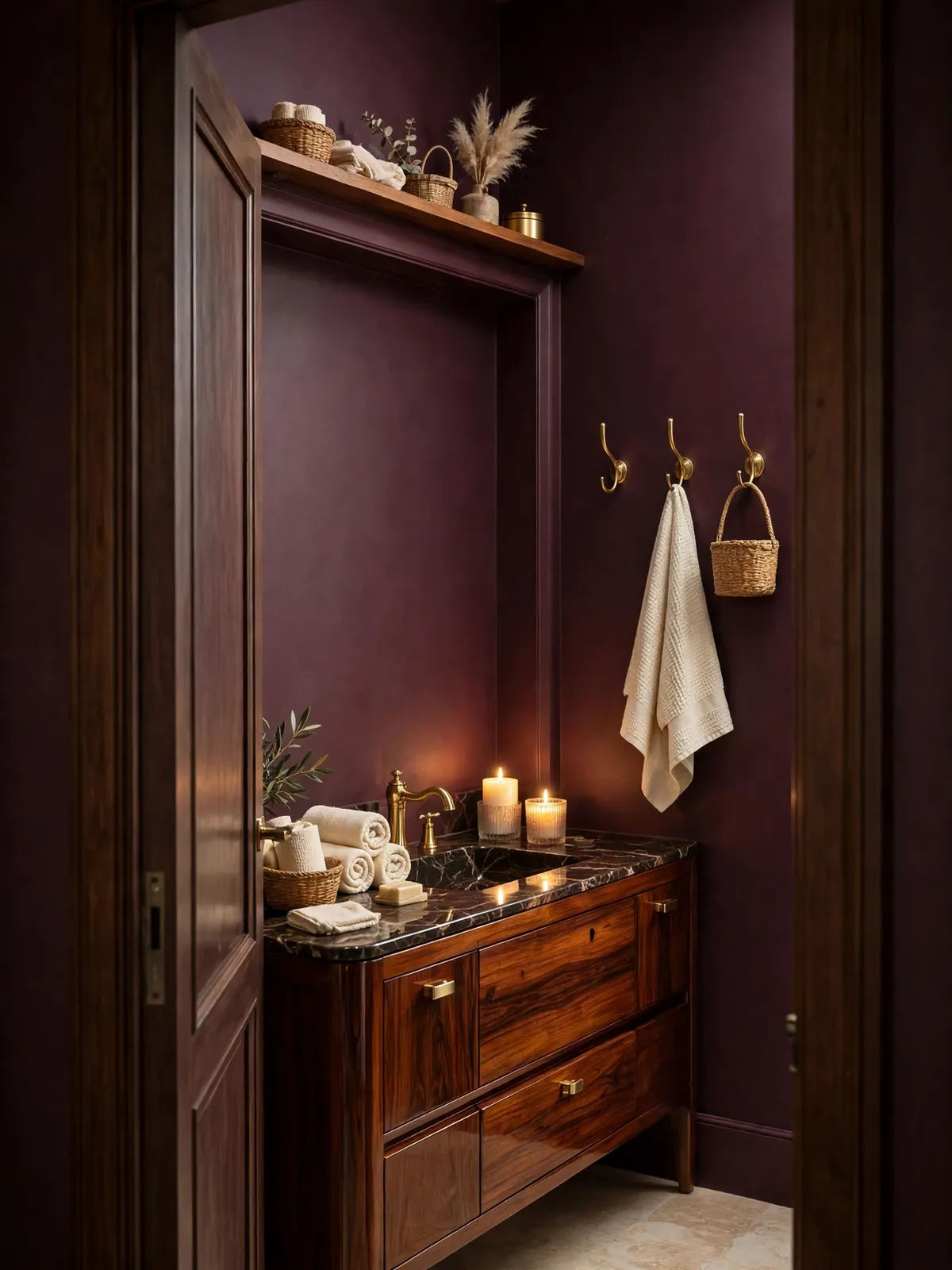
A slim shelf above the door uses the one wall every bathroom forgets, because the strip above the door frame is high, empty and perfect for spare towels and toilet rolls that you only need once a week. Here, a single rosewood shelf runs above the door in a deep plum bathroom, holding cream rolled towels and a small woven basket of spare toilet rolls, with champagne brass hooks below it. The design suits tiny bathrooms and family bathrooms that never have enough towel storage, it costs almost nothing, and it keeps spares out of the way without a new cabinet. The weakness is reach: the shelf is too high for daily use and for anyone short, so reserve it for spares only, keep a small step stool nearby, and never store anything heavy or breakable up there.
Quick tips:
- Reserve the above-door shelf for spares, never daily items.
- Keep the shelf shallow, no deeper than 15 cm, so it never overhangs the door.
- Roll towels tightly so they hold their shape up high.
- Keep a small step stool in the bathroom for safe reaching.
Tiered Shelves Beside the Bathtub
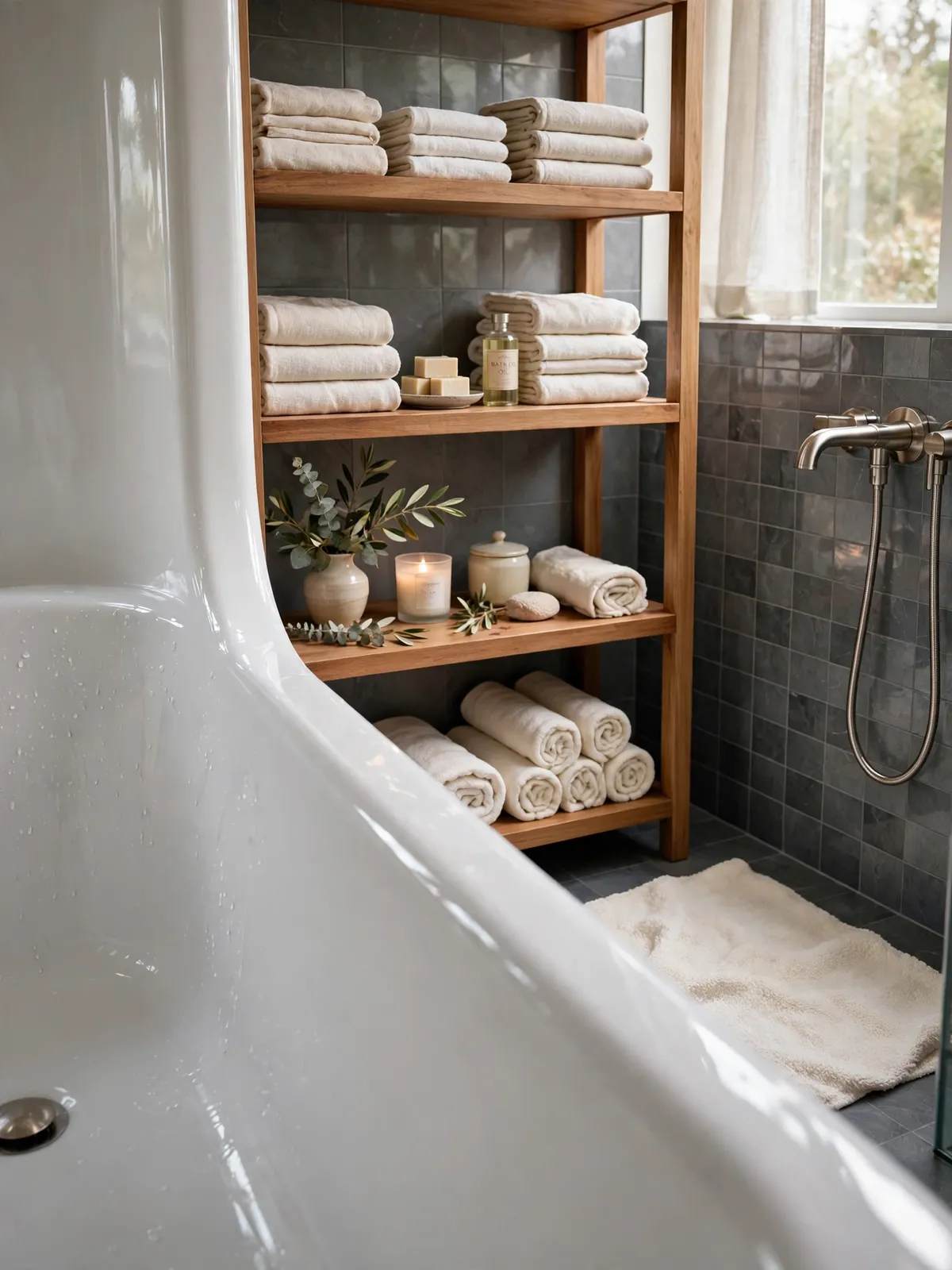
Tiered shelves beside the bathtub put everything a bath needs within arm’s reach, because the stepped design holds a book, a candle, bath oil and a towel on separate levels, so nothing balances on the edge of the tub. Here, three teak shelves step down beside a white freestanding tub against slate-grey tiles, holding a folded linen towel, a candle in a glass jar, a bottle of bath oil and a small stack of books. The design suits anyone who baths regularly, it turns the bath into a ritual rather than a quick wash, and the teak handles steam far better than untreated wood. The weakness is water: shelves beside a tub get splashed every time someone climbs out, so choose teak, stone or sealed wood, keep books and candles on the highest tier, and wipe the shelves dry after each bath.
Quick tips:
- Choose teak or sealed wood — both handle splashes well.
- Put books and candles on the top tier, towels on the lowest.
- Keep the shelf unit at least 15 cm from the tub edge.
- Wipe the shelves dry after each bath to stop water marks.
A Fold-Down Shelf That Doubles as a Vanity Tray
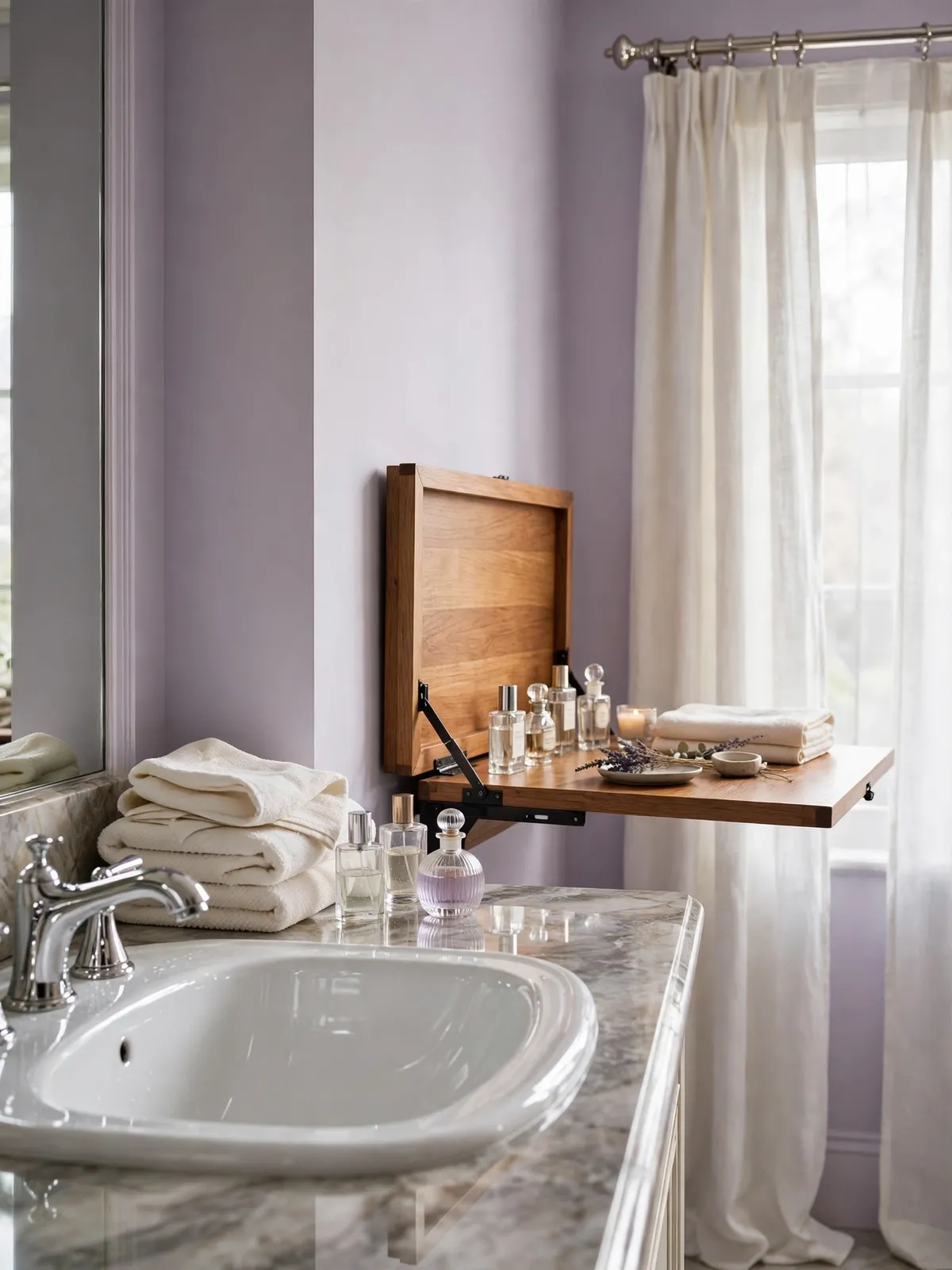
A fold-down shelf that doubles as a vanity tray is the cleverest shelf for a bathroom that is short on counter space, because it folds flat against the wall when you do not need it and drops down into a small tray for makeup, shaving or styling hair when you do. Here, a pale wood fold-down shelf sits beside a white ceramic sink in a soft lavender bathroom, holding small glass perfume bottles and a makeup brush jar while it is down, with silver fixtures and linen-white curtains softening the light. The design suits tiny bathrooms and shared bathrooms where two people need the counter at different times, it costs little, and it disappears completely when folded away. The weakness is the hinge: a cheap hinge sags under weight and a shelf that will not stay flat is useless — so choose a sturdy bracket rated for at least 10 kg, fix it into a stud, and keep the load to light items only.
Quick tips:
- Choose a bracket rated for at least 10 kg and fix it into a stud.
- Keep the load light — perfume, brushes and a small mirror only.
- Fold the shelf flat after use so the room stays clear.
- Match the wood to the vanity so the shelf looks built-in.
Metal Pipe Shelves for an Industrial Edge
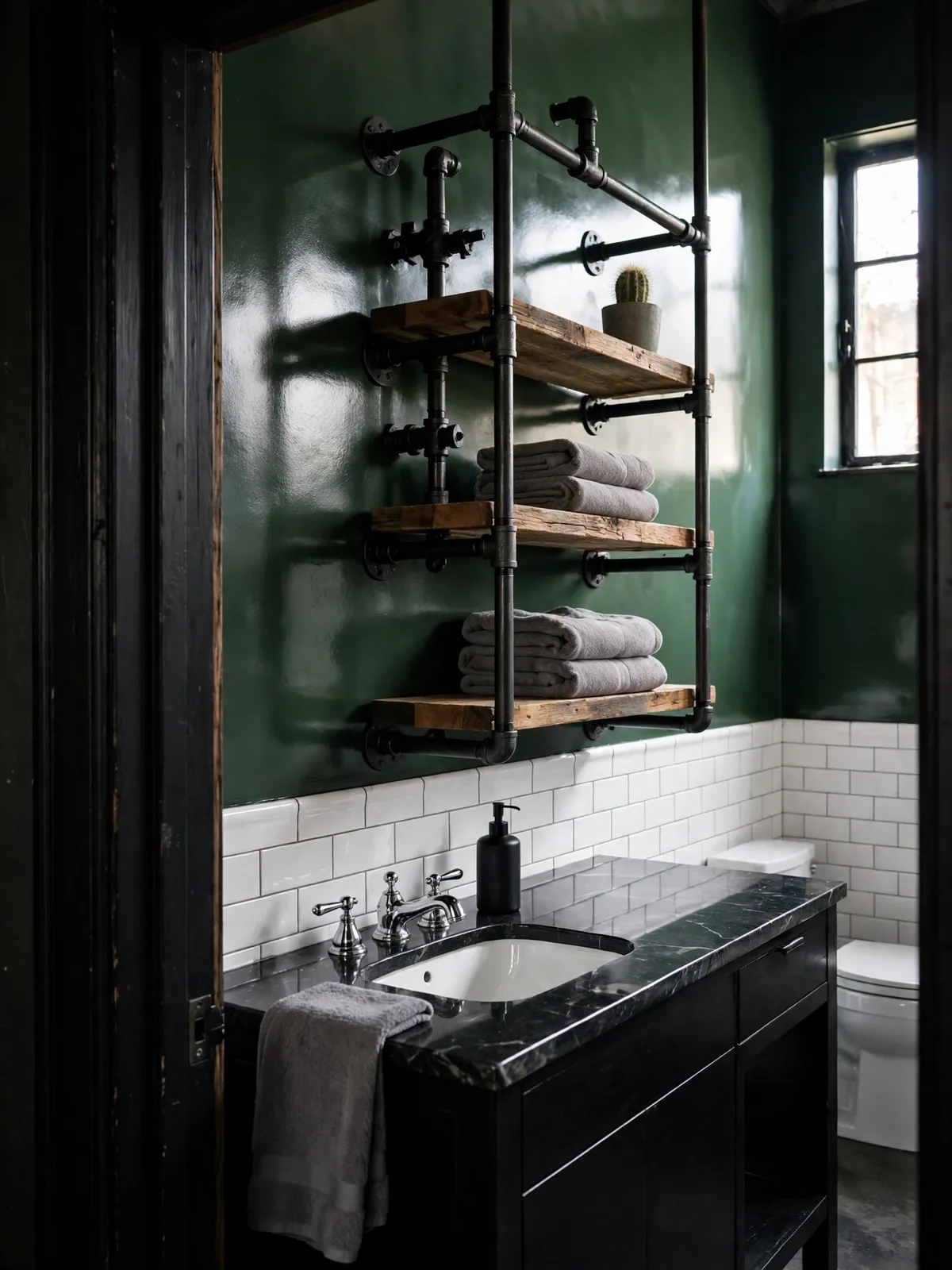
Metal pipe shelves give a bathroom a bold industrial edge that soft wood and glass never can, because the dark iron pipes and reclaimed wood together add contrast, texture and a workshop character that suits loft-style and modern bathrooms. Here, three reclaimed wood shelves on matte black iron pipes run along a forest-green wall above white subway tiles, holding folded grey towels, a small cactus, black storage jars and a rolled hand towel. The design suits bathrooms that feel too plain or too pretty, it is very strong when fixed properly, and the open pipe frame makes the shelves look custom rather than shop-bought. The weakness is rust and weight: iron pipes rust in steam unless they are powder-coated or sealed, and the shelves are heavy, so fix every pipe flange into a stud or solid wall and wipe the pipes dry after steamy showers.
Quick tips:
- Choose powder-coated or sealed pipes so steam never rusts them.
- Fix every flange into a stud or solid masonry wall.
- Seal reclaimed wood so it resists steam and splashes.
- Balance the look with soft towels and one plant.
A Plant Shelf That Brings Life to a Plain Wall
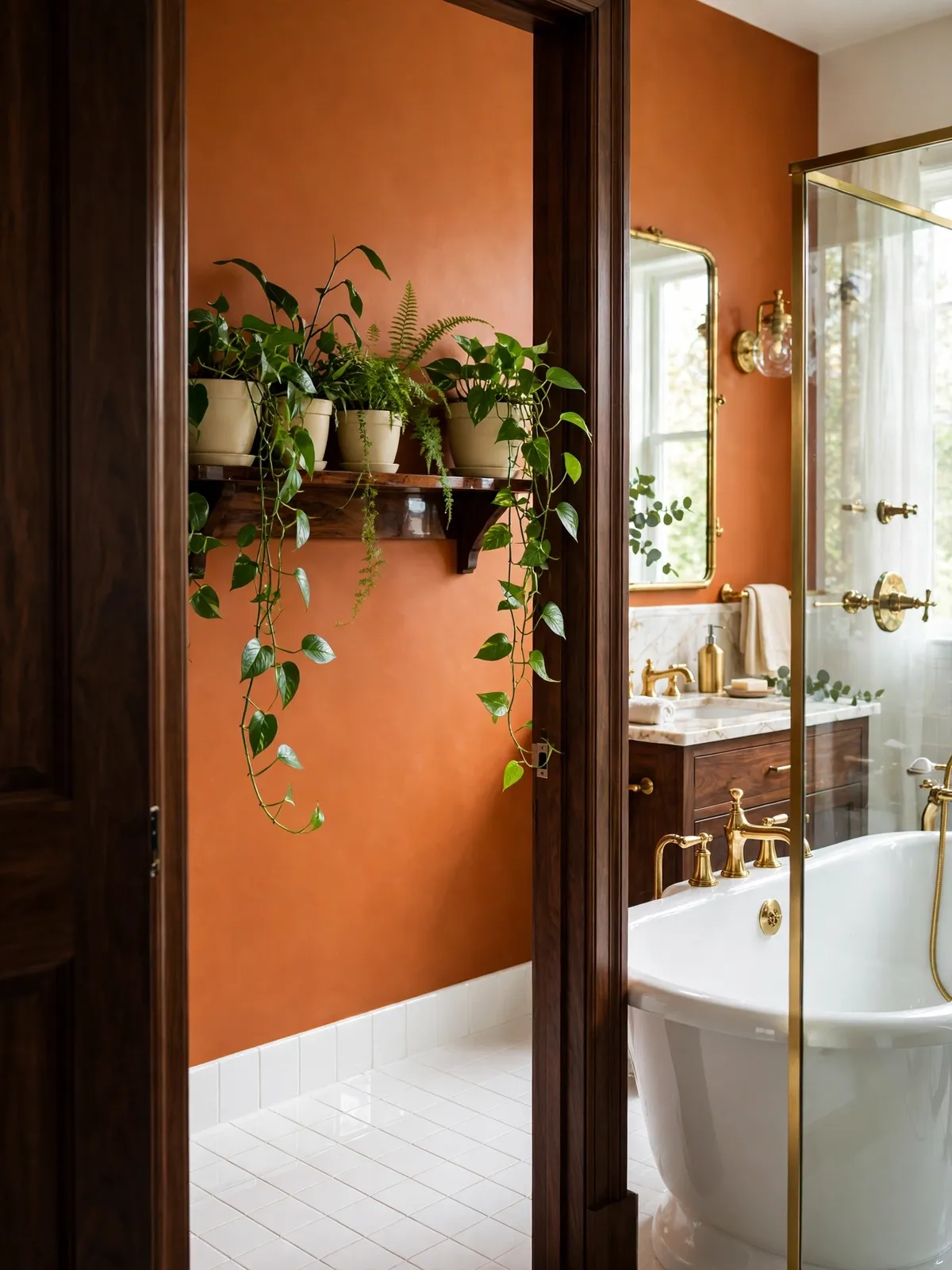
A plant shelf brings life to a plain bathroom wall in a way no accessory can, because trailing pothos and ferns soften every hard surface, and the steam from every shower keeps humidity-loving plants thriving with almost no effort. Here, a dark walnut shelf on a burnt-orange wall holds cream pots of trailing pothos and a small fern, with brass fixtures and white tiles keeping the rest of the room calm. The design suits bathrooms with even a little natural light, it costs very little, and it makes the room smell fresher and feel calmer. The weakness is light and water: a windowless bathroom will starve most plants, and overwatering in a humid room rots roots fast — so choose plants that genuinely suit your light level, use pots with drainage, and water less often than you would in a dry room.
Quick tips:
- Choose pothos, ferns or peace lilies for humid bathrooms.
- Use pots with drainage and a saucer to protect the shelf.
- Hang one trailing plant so greenery falls at eye level.
- Water less often than in dry rooms — humidity does the work.
Shelves With a Built-In Towel Rail Underneath
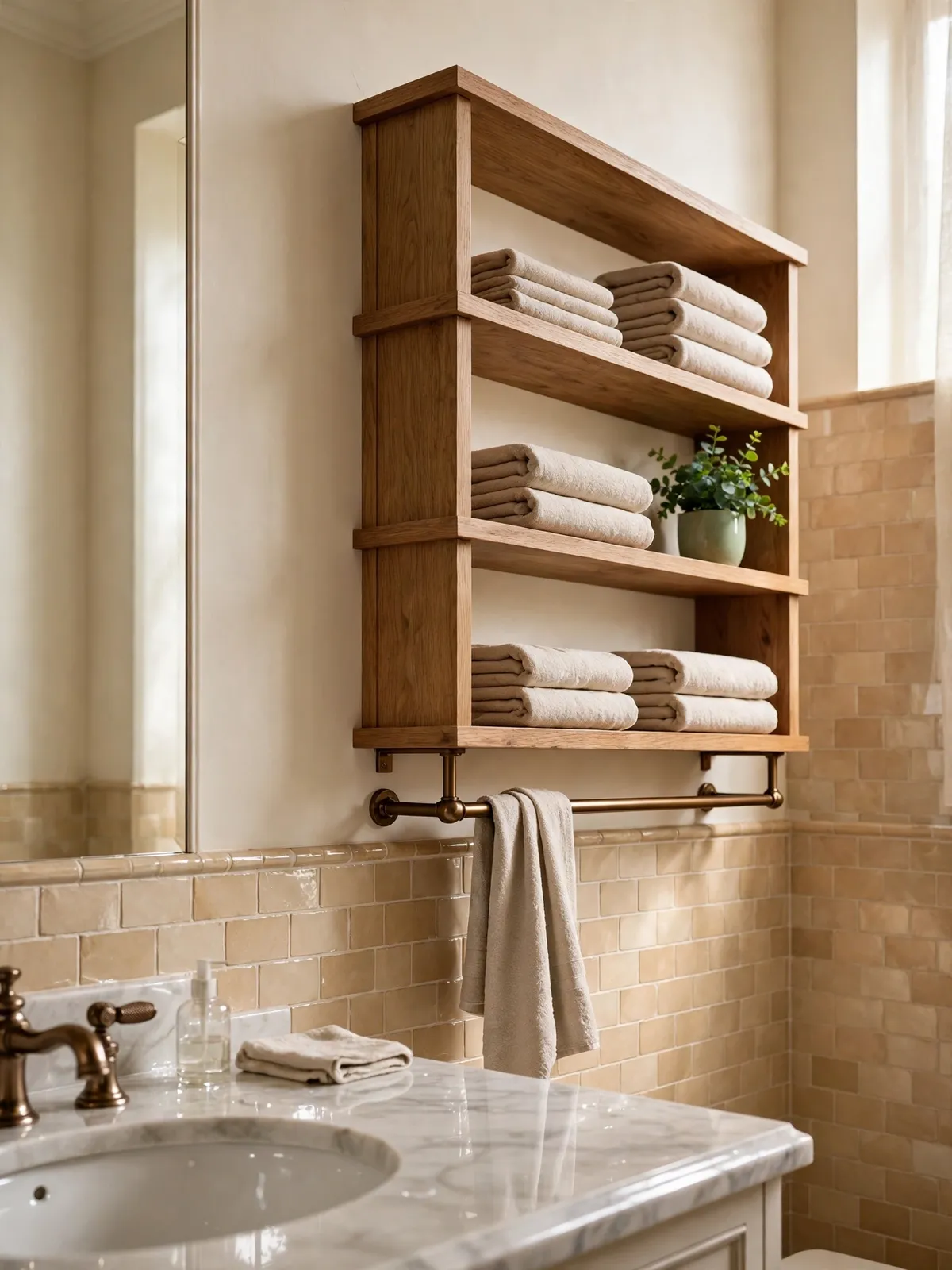
Shelves with a built-in towel rail underneath do two jobs in the space of one fixture, because the shelf above holds jars and folded towels while the rail below holds the hand towel exactly where you need it after washing. Here, a sand-coloured wooden shelf with a bronze rail underneath sits on a cream wall beside the vanity, holding folded beige towels and a small green plant above, with a cream hand towel hanging from the rail below. The design suits small bathrooms and guest bathrooms, it keeps the hand towel off the counter and off the floor, and it looks far more considered than a separate shelf and a separate rail. The weakness is drips: a wet hand towel drips onto the floor below, so hang the rail over a tiled floor rather than a rug, leave a gap between the rail and the wall so the towel dries, and never hang a soaking towel there.
Quick tips:
- Leave a gap between the rail and the wall so towels dry fully.
- Hang the rail over tile, never over a rug or wooden floor.
- Keep the shelf above light so the rail never carries extra weight.
- Choose a rail finish that matches the taps.
A Narrow Ledge Shelf for Perfume and Small Bottles
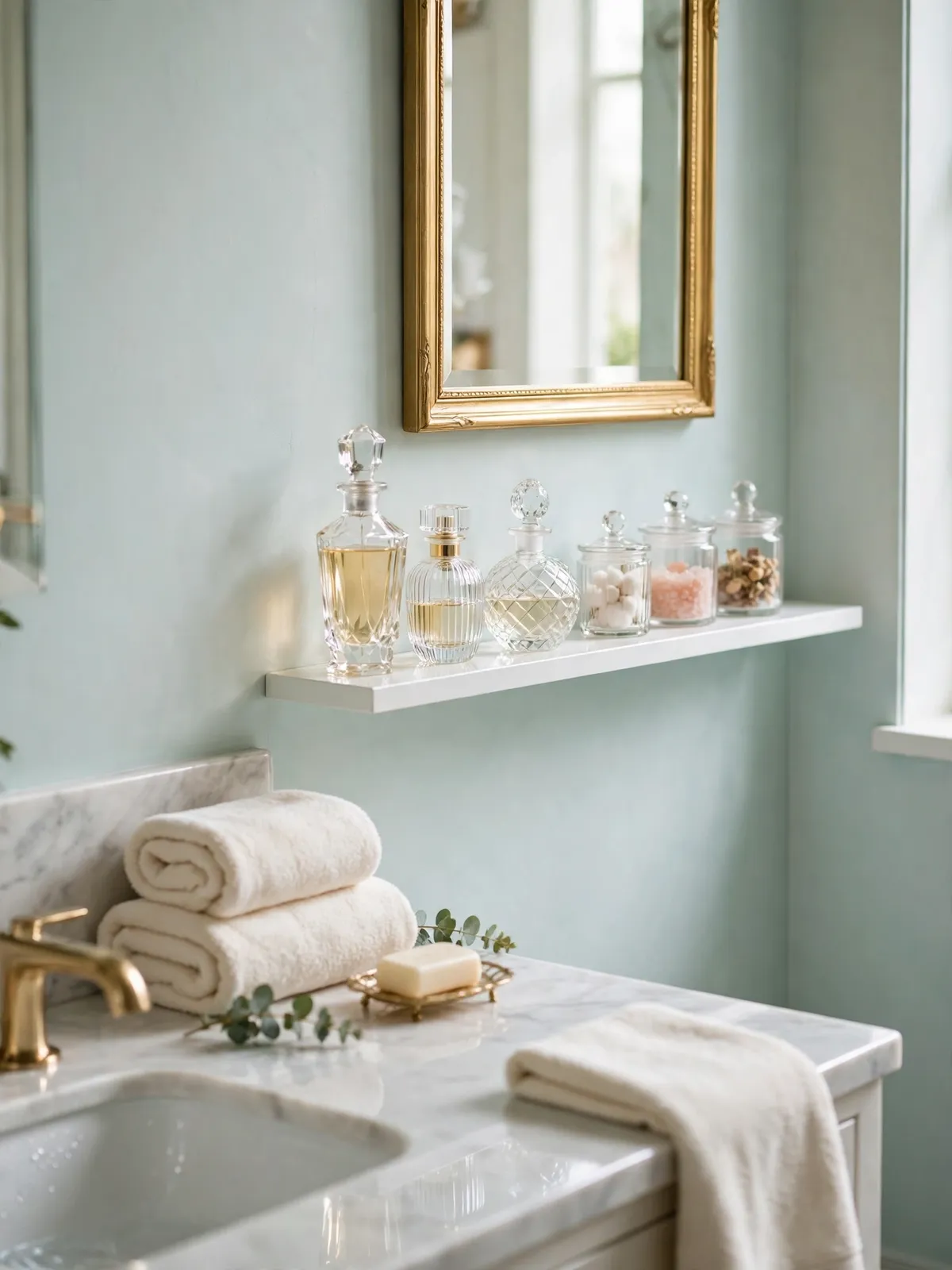
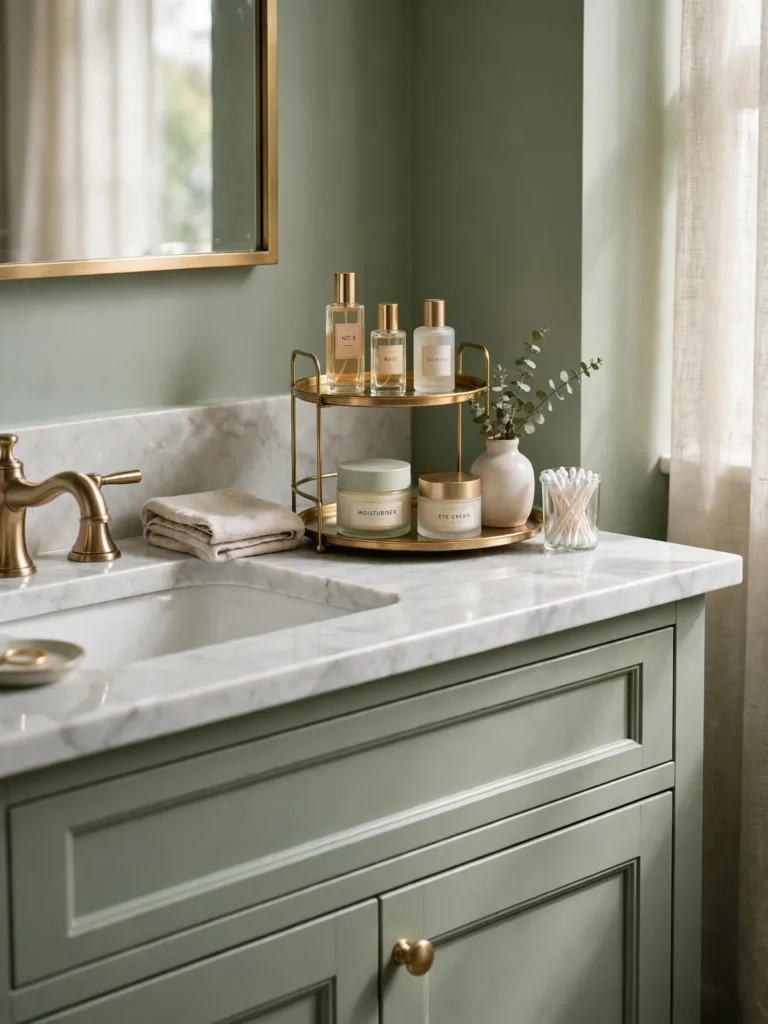
A narrow ledge shelf for perfume and small bottles is the prettiest shelf a bathroom can have, because a slim ledge just deep enough for a bottle turns a collection of perfume, oils and small jars into a display instead of a cluttered counter. Here, a white ledge shelf runs along a pale aqua wall beside a gold-framed mirror, holding crystal perfume bottles, small glass jars and a single cream flower in a bud vase. The design suits vanity areas and dressing tables, it keeps fragile bottles safe from knocks on the counter, and it costs almost nothing to install. The weakness is depth: a ledge deeper than 10 cm invites clutter, and a ledge with no lip lets bottles slide off — so choose a ledge with a small raised lip, keep it no deeper than 10 cm, and display only the bottles you actually use.
Quick tips:
- Choose a ledge with a small raised lip so bottles never slide off.
- Keep the ledge no deeper than 10 cm to stop clutter building up.
- Display only the bottles you use — store the rest in a drawer.
- Group bottles by height, tallest at the back, for a tidy look.
Marble Shelves That Match the Countertop
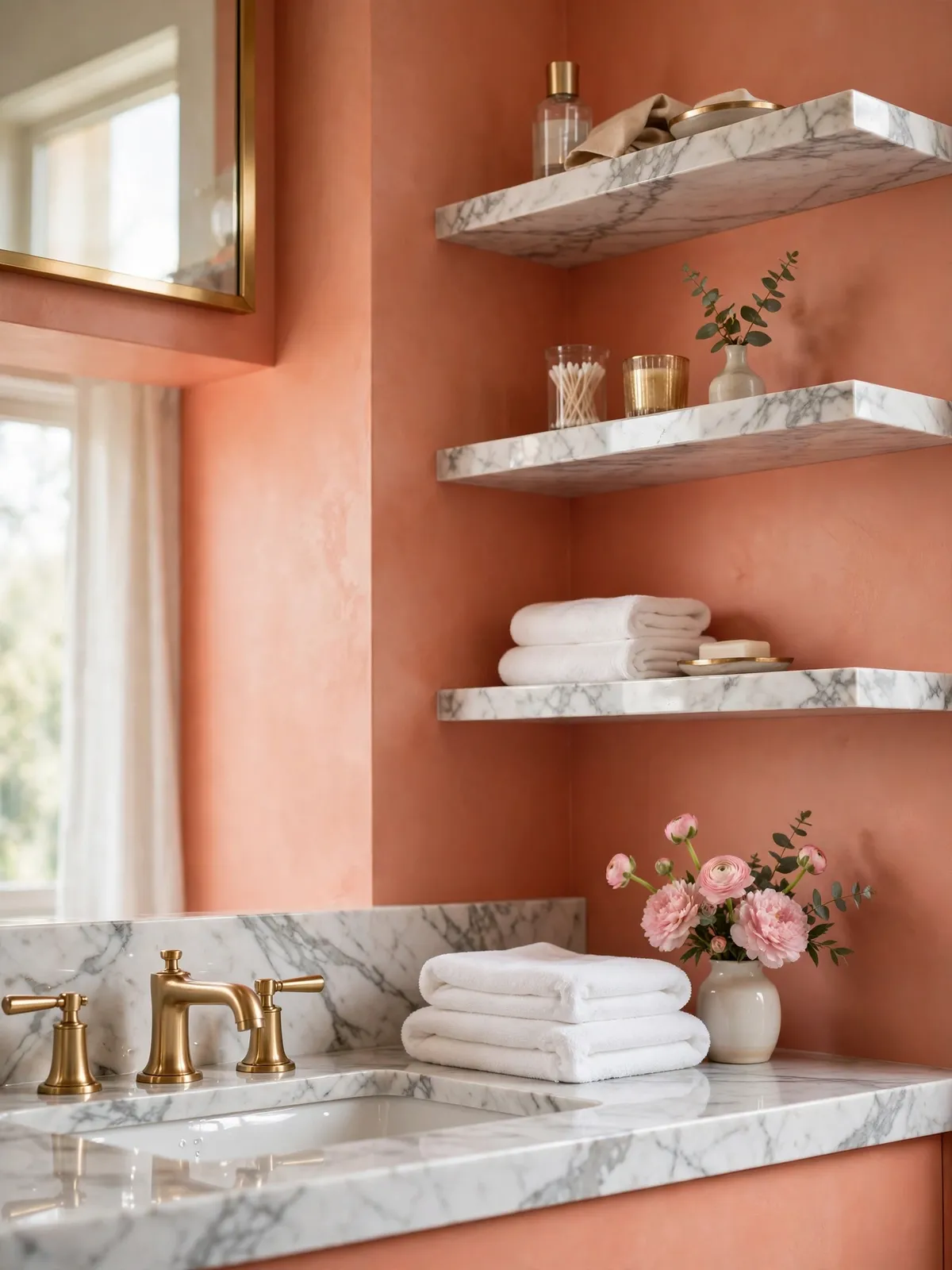
Marble shelves that match the countertop make a bathroom look like it was designed in one piece, because the same stone running from the vanity top up the wall ties the whole vanity zone together and makes even a small bathroom feel expensive. Here, two white marble shelves sit above a matching white marble vanity top against coral-peach walls, holding folded white towels, a small vase of pink flowers and a glass soap dispenser, with brushed gold taps tying the palette together. The design suits bathrooms being renovated or refreshed with a new vanity, it is easy to clean, and it photographs beautifully. The weakness is weight and staining: marble is heavy and needs strong brackets fixed into solid wall, and it stains if perfume or hair dye sits on it — so seal the marble yearly, fix into studs or masonry, and wipe up spills straight away.
Quick tips:
- Seal marble shelves yearly to stop staining.
- Fix marble brackets into studs or solid masonry — never plasterboard.
- Wipe up perfume and hair dye spills straight away.
- Repeat the marble once more, in a soap dish or tray, for a finished look.
Baskets on Open Shelves for Hidden Clutter
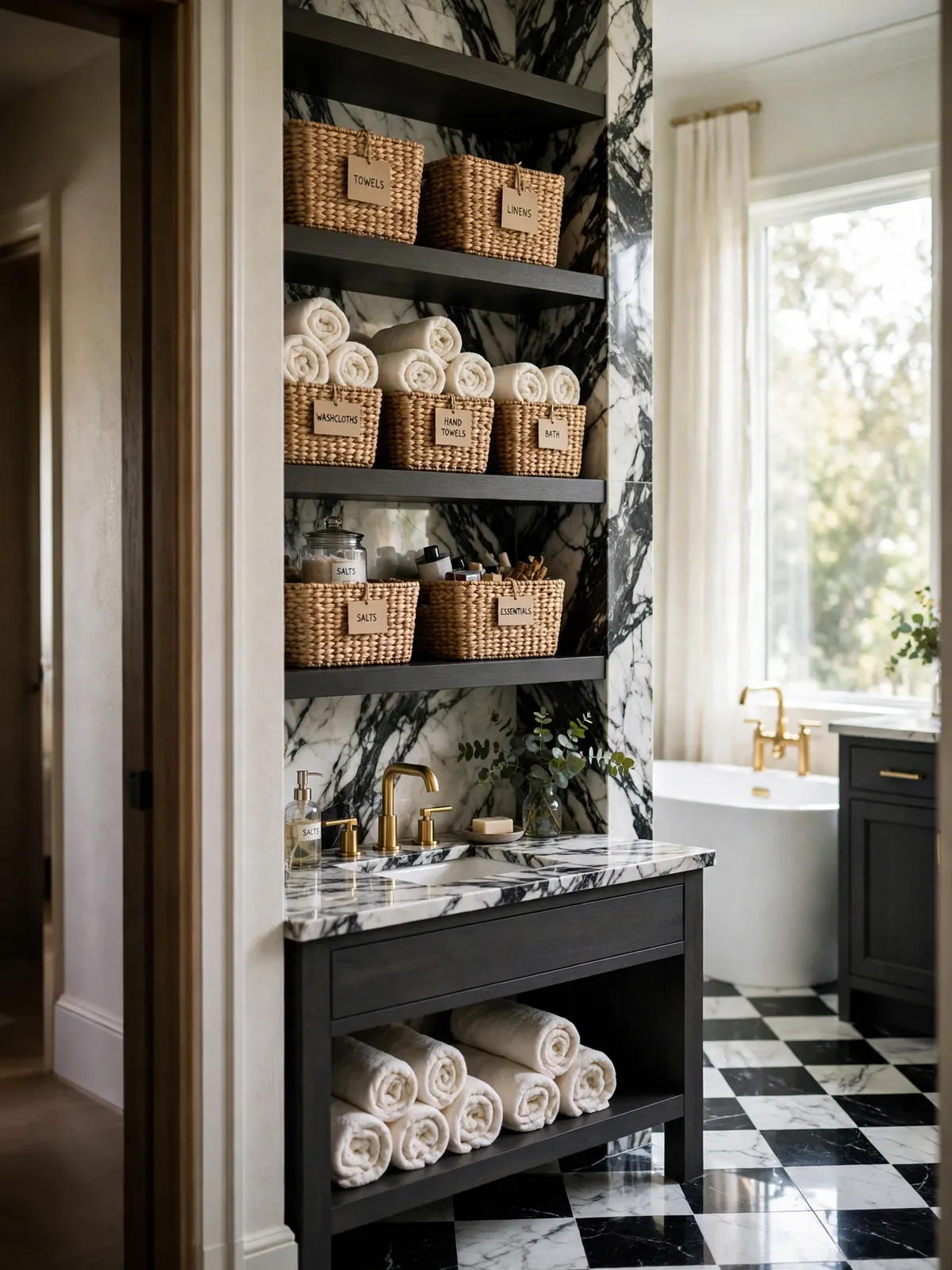
Baskets on open shelves give you the look of open storage with the tidiness of closed storage, because the baskets hide spare toilet rolls, cleaning cloths and hair tools while the shelves themselves still look styled and intentional. Here, three charcoal shelves on a black and white marble-tiled wall hold natural seagrass baskets with small labels, cream rolled towels and a single plant, with brushed gold fixtures warming the contrast. The design suits family bathrooms where clutter builds up fast, it costs little, and it lets you sort everything by basket — one for towels, one for cleaning, one for hair tools. The weakness is damp: seagrass and woven baskets go musty in a steamy bathroom if they never dry, so choose baskets with an open weave, keep them away from direct spray, and air them out weekly.
Quick tips:
- Label each basket so everyone in the house knows where things live.
- Choose open-weave baskets that dry quickly in steam.
- Keep baskets away from direct shower spray.
- Air baskets out weekly so they never smell musty.
A Shelf and Mirror Combination That Saves Wall Space
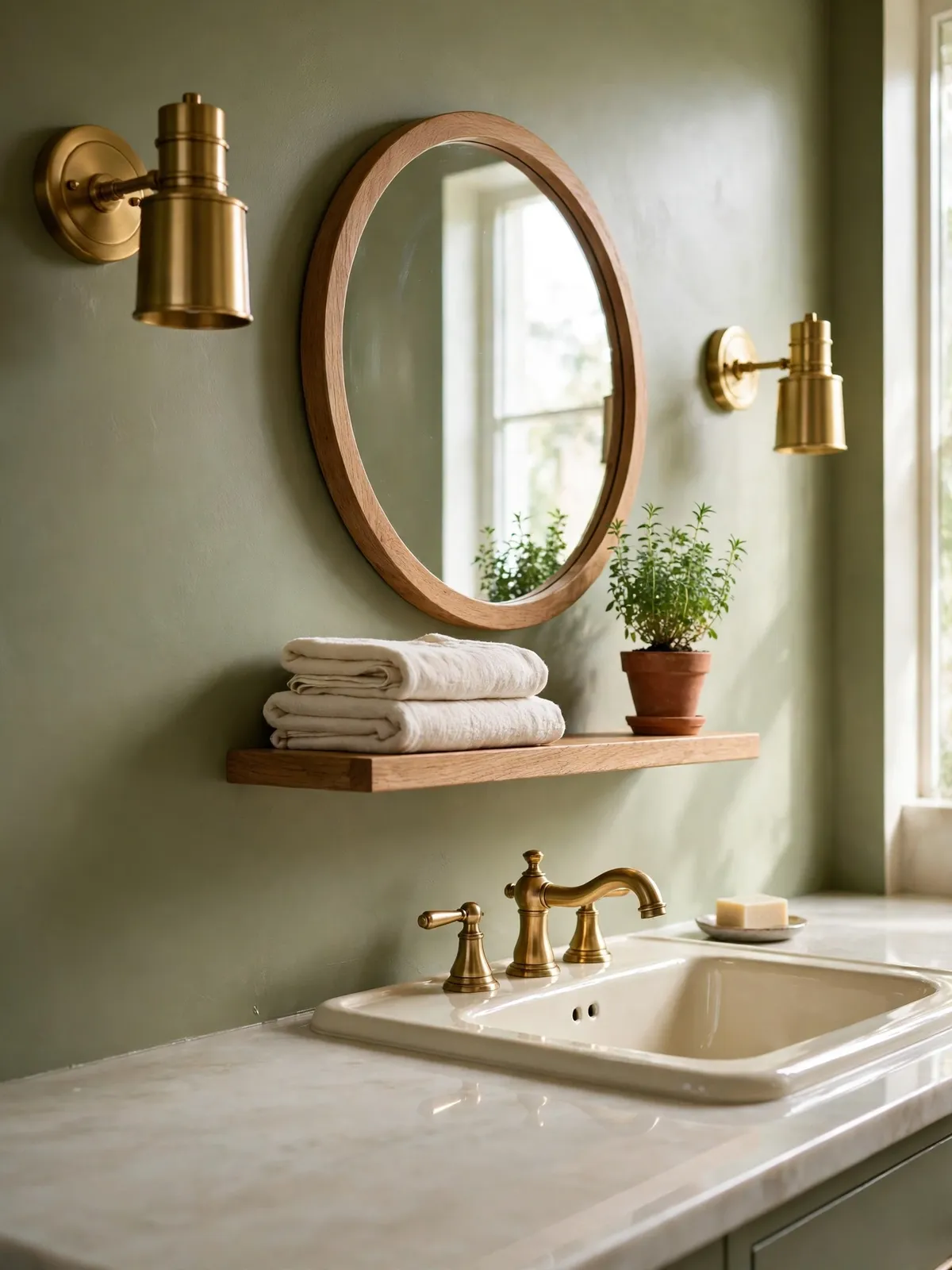
A shelf and mirror combination saves wall space by merging two fixtures into one, because the mirror you need anyway gains a small shelf underneath for the toothbrush, the soap and the one or two items you reach for every morning. Here, a round mirror with a slim wooden shelf below it hangs on an olive-green wall above a cream ceramic sink, with brass sconces on either side, folded linen towels and a small potted herb on the shelf. The design suits tiny bathrooms, en-suites and cloakrooms where one wall must do everything, it costs little, and it keeps the counter completely clear. The weakness is splash: a shelf directly under a mirror sits in the toothpaste spray zone, so choose a wipe-clean wood or stone shelf, keep only two or three items on it, and wipe it after the morning routine.
Quick tips:
- Keep only two or three daily items on the mirror shelf.
- Choose a wipe-clean finish — sealed wood or stone.
- Hang the mirror so its centre sits at eye level.
- Wipe the shelf after the morning routine to stop toothpaste spots.
Bathroom Shelves Ideas That Make Every Wall Work Harder
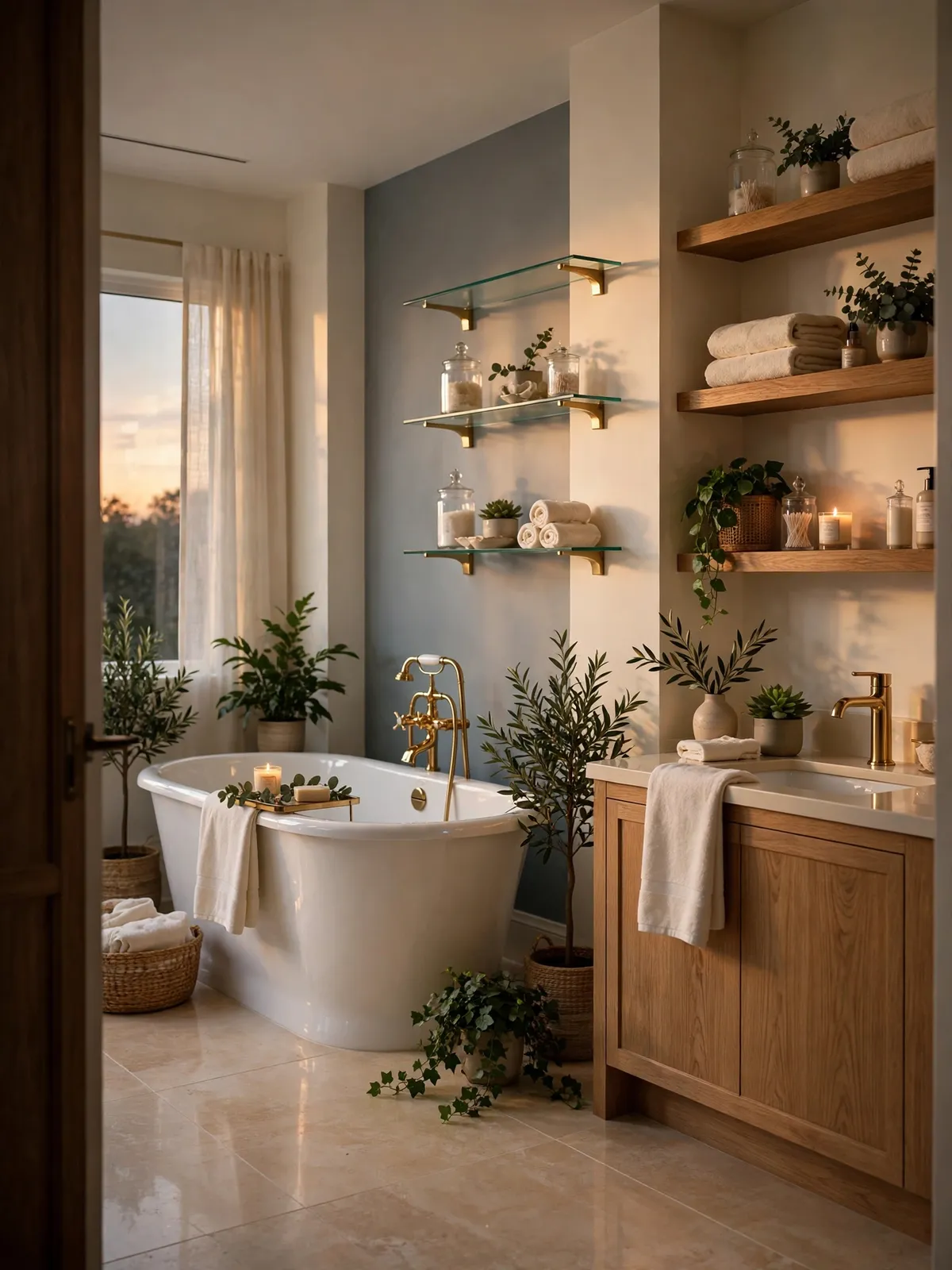
The last of these bathroom shelves ideas is the principle behind them all, and it is worth stating plainly because it is the difference between a bathroom that looks styled in a photograph and one that stays useful every day: a bathroom works hardest when every wall has a job, so the shelves above the toilet hold the spares, the glass shelves beside the mirror hold the daily bottles, the recessed niche in the shower holds the shampoo, the ladder shelf by the door holds the towels, and the plant shelf on the plain wall holds the greenery that makes the whole room feel alive, and none of those shelves competes with the others because each one was chosen for its spot, its weight and its height, with the heavy items fixed into studs, the daily items at eye level, the spares up high, and the beautiful objects given one shelf of their own where they can be seen without getting in the way, and when the shelves follow those rules the counter stays clear, the floor stays clear, and the room feels calm even on a busy morning. Here, an ivory bathroom pulls it together — warm oak shelves above the toilet, glass shelves beside the mirror, a freestanding tub, champagne-gold fixtures, cream towels and green plants against a soft grey-blue accent wall — and nothing in the room is there by accident. The lesson is to start with the wall you use least, choose the shelf type that suits that spot, fix it properly, style it lightly, and then move to the next wall, because a bathroom built one good shelf at a time stays beautiful with very little effort, and the shelves stop being decoration and start being the reason the bathroom works.
Quick tips:
- Give every wall a job — spares up high, daily items at eye level.
- Fix heavy shelves into studs or solid masonry, always.
- Style lightly: three or four items per shelf, never a crowded row.
- Leave one shelf partly empty so the room can breathe.
FAQs
How many bathroom shelves do I need?
Most bathrooms need two or three shelves, not a wall full of them: one above the toilet for spares, one beside the mirror for daily items, and one in the shower for shampoo and soap. Add a fourth only if a wall is still empty and you have a clear use for it — a shelf with no job quickly becomes clutter.
Can I put shelves above a toilet safely?
Yes, as long as you hang them high enough and fix them properly. Keep the lowest shelf at least 60 cm above the tank so you never bump your head, keep the shelves no deeper than 20 cm, and fix the brackets into studs or solid masonry so a shelf full of towels and jars never pulls away from the wall.
What should I put on bathroom shelves?
Put daily items at eye level, spares up high and beautiful objects where they can be seen: folded towels, a plant, matching jars for cotton pads and soap, and one or two decorative pieces per shelf. Keep cleaning products, medicines and anything you do not want guests to see behind a closed door instead.
Do bathroom shelves work in a rental?
Yes. A ladder shelf, a leaning shelf unit and a tension-rod shelf need no drilling at all, and a suction or adhesive shelf works for very light items in a shower. Choose freestanding pieces that move with you, and avoid drilling into tiles unless your landlord has agreed to it in writing.
How do I keep bathroom shelves from looking cluttered?
Style each shelf with three or four items at most, group similar items together, decant products into matching containers, and leave empty space on every shelf. Hide the random half-empty bottles in baskets or behind a cabinet door, and edit the display once a month — if an item has not been used, remove it.
Conclusion
Bathroom shelves are the simplest storage a bathroom can have, and the 19 ideas above show that the right shelf in the right spot does more than hold things — it frees the counter, uses the walls you forgot you had, and makes the whole room look finished, whether you hang two wooden shelves above the toilet, build a recessed niche into the shower, lean a ladder shelf against the wall, or combine glass, brass and oak across the room. Start with the wall that wastes the most space, choose the shelf type that suits it, fix it properly into a stud or solid wall, style it lightly with three or four items, and then move to the next wall. Do that, and your bathroom stops being a room where things pile up and becomes a calm, organised space where everything has a place.