25 Carpeted Staircase Ideas for Soft, Quiet, Beautiful Steps
25 carpeted staircase ideas that bring warmth, quiet comfort, and
A carpeted staircase does three jobs at once: it softens footsteps, quiets the house, and turns a plain stairwell into a designed feature. Whether you choose a classic neutral runner or a bold pattern, carpet is one of the highest-impact, lowest-risk upgrades a staircase can get.
The carpeted staircase ideas below cover runners, full carpeting, patterns, textures, and the practical details — padding, stair rods, durability — that separate a staircase you love from one you regret.
Start with how you live. Busy households with kids and pets need durable, pattern-forgiving carpet; quieter homes can indulge in plush velvet or pale wool. And always budget for quality padding — it’s the invisible layer that determines whether your stairs feel luxurious or flat. Once the carpet is chosen, look up: the wall above the stairs deserves the same care. These staircase gallery wall ideas show how framed art climbing alongside carpeted steps completes the whole composition.
Oatmeal Wool Runner on Honey Oak Steps
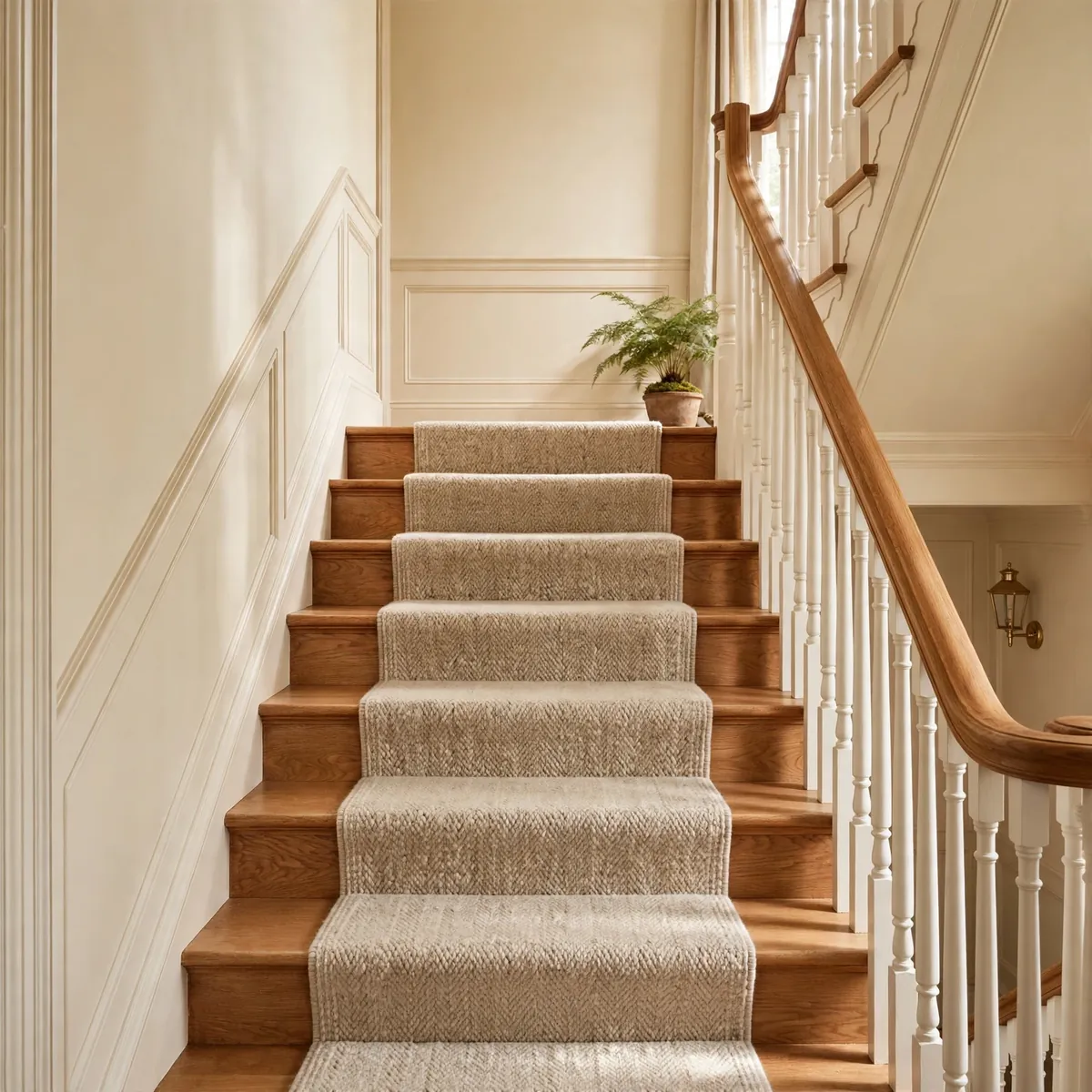
An oatmeal wool runner on honey oak steps is the timeless combination that works in nearly every home. The neutral wool adds warmth underfoot without competing with anything, while the exposed wood edges frame it like a picture. Wool’s natural stain resistance and durability make it the smart long-term choice for stairs.
- Choose 100% wool or a high wool blend for durability.
- Leave equal wood exposure on both sides for symmetry.
- Vacuum with suction only to protect wool fibers.
Charcoal Carpet Against Crisp White Walls
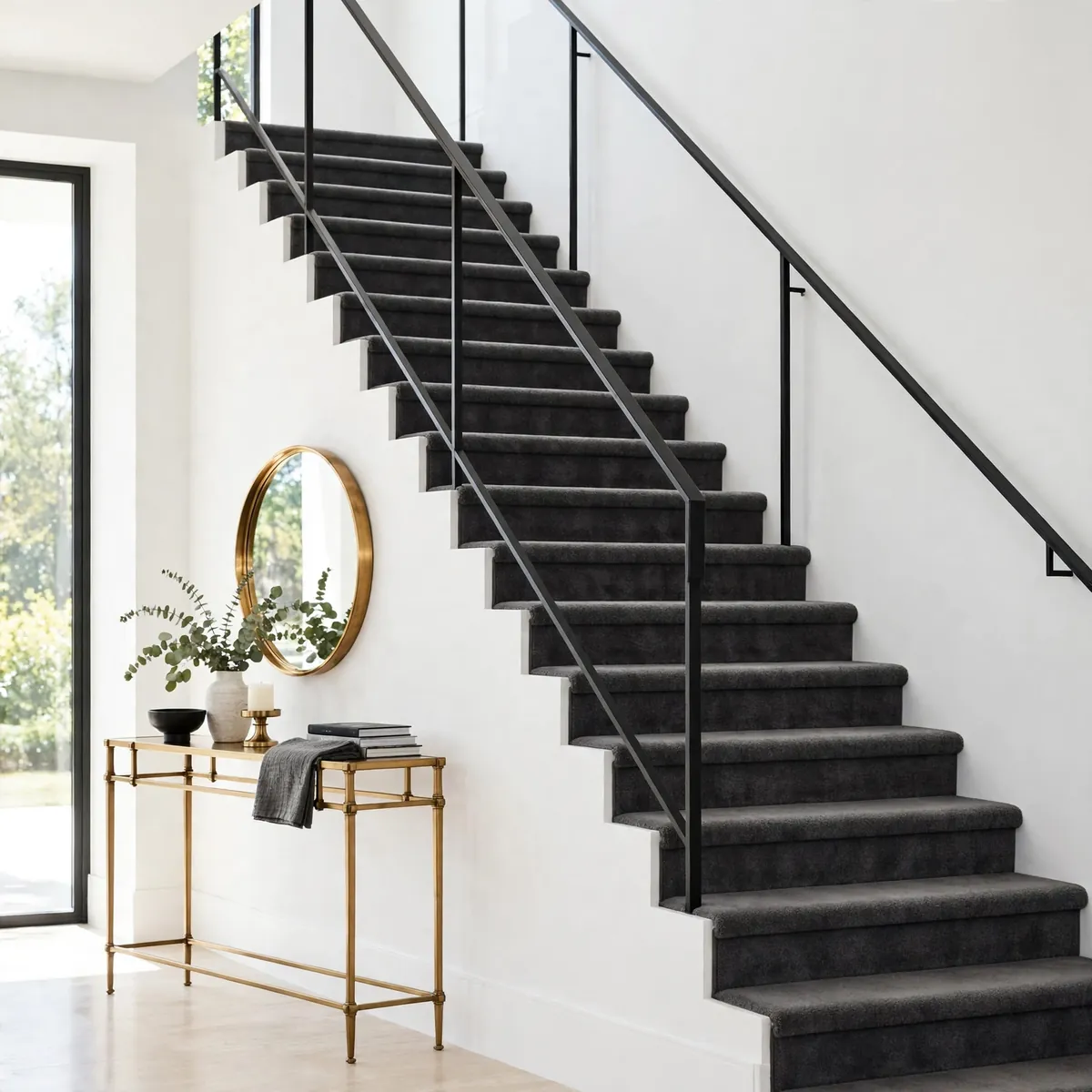
Charcoal carpet with white walls is tailored contrast at its best — dramatic, sophisticated, and surprisingly practical since dark carpet hides traffic patterns. The light walls keep the stairwell bright while the dark stairs ground it. This pairing flatters modern, transitional, and even traditional homes when the trim stays crisp.
- Pick charcoal over pure black; it’s softer and hides dust better.
- Keep walls bright white for maximum contrast.
- Add warm lighting so the dark stairs feel rich, not gloomy.
Chunky Sisal-Weave Runner in Natural Jute
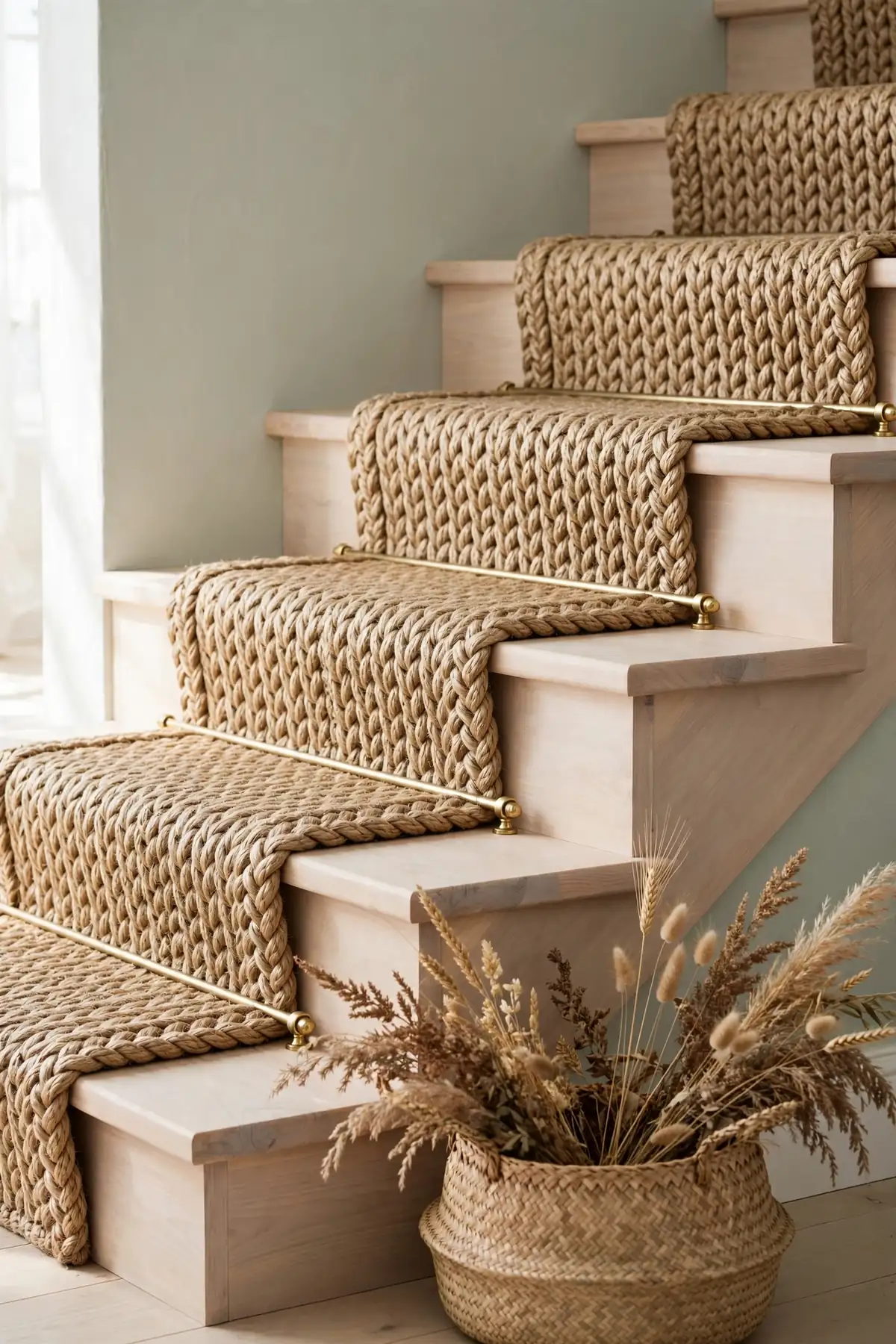
A chunky sisal-weave runner brings organic texture that makes a staircase feel rich and intentional even in a simple color palette. The woven texture catches light and shadow, adding depth that flat carpet can’t match. Run your hand across samples before buying — texture matters as much as color on stairs you’ll touch daily.
- Choose a tight, low-profile weave to reduce snagging.
- Add a dense pad; sisal alone feels hard underfoot.
- Avoid in homes with cats; claws love sisal.
Bold Diamond-Pattern Runner in Slate and Cream
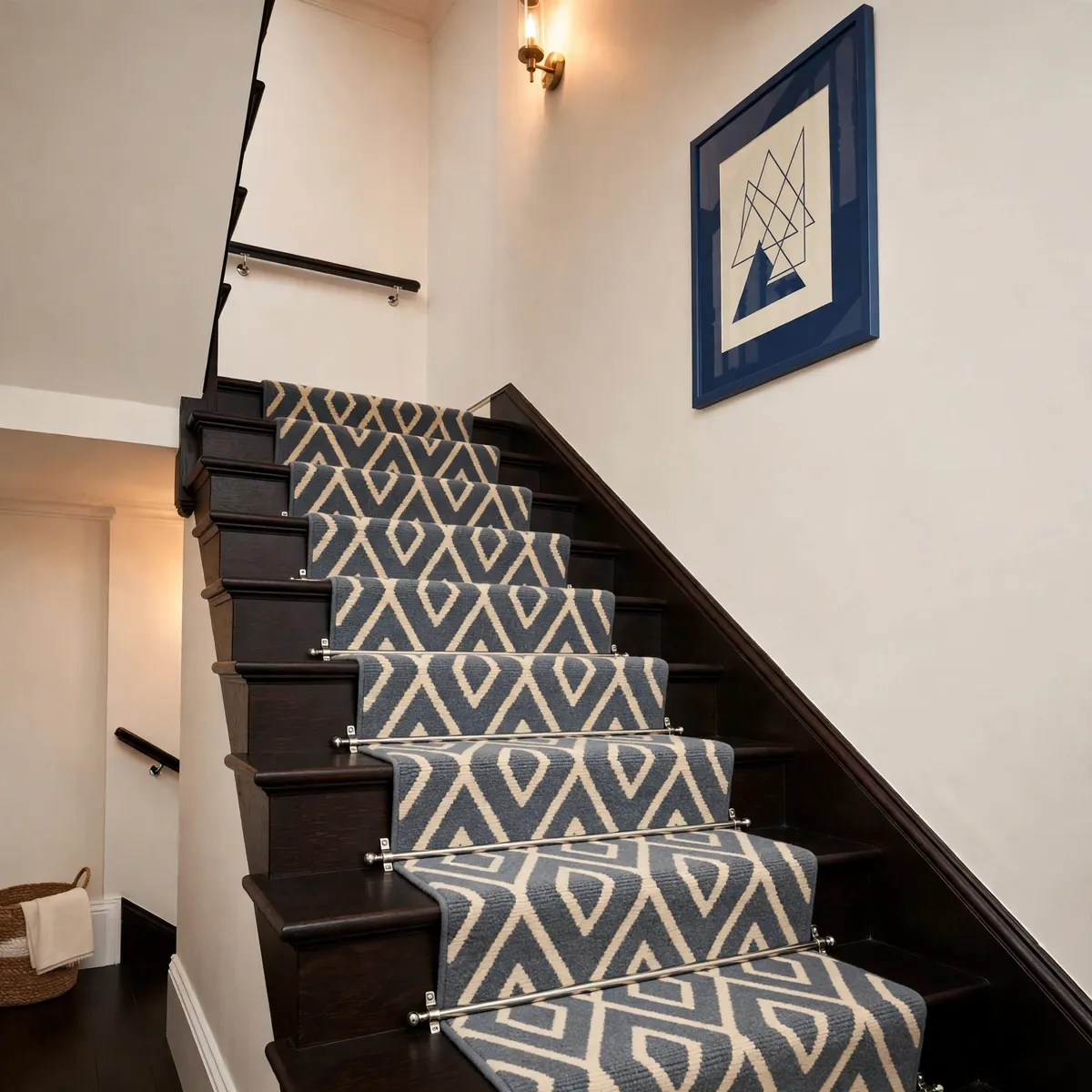
A bold diamond pattern in slate and cream turns the staircase into a designed feature rather than a pathway. Geometric patterns bring energy and a custom feel, especially in modern and transitional homes. Keep nearby decor calm — when the carpet is the star, everything else should play supporting roles.
- Center the pattern precisely; asymmetry shows on stairs.
- Balance busy carpet with simple railings and walls.
- Choose a pattern scale that suits your stair width.
Taupe Runner Framed by Dark Walnut Edges

Install a taupe runner and leave dark walnut exposed along both edges for a look that feels polished and custom. The wood frames the carpet beautifully, adding warmth and contrast while showcasing the staircase’s craftsmanship. It’s the detail that makes guests assume you hired a designer.
- Stain or refinish exposed edges before laying the runner.
- Keep the runner width consistent on every tread.
- Match walnut tone to nearby flooring for flow.
Herringbone Weave in Warm Greige
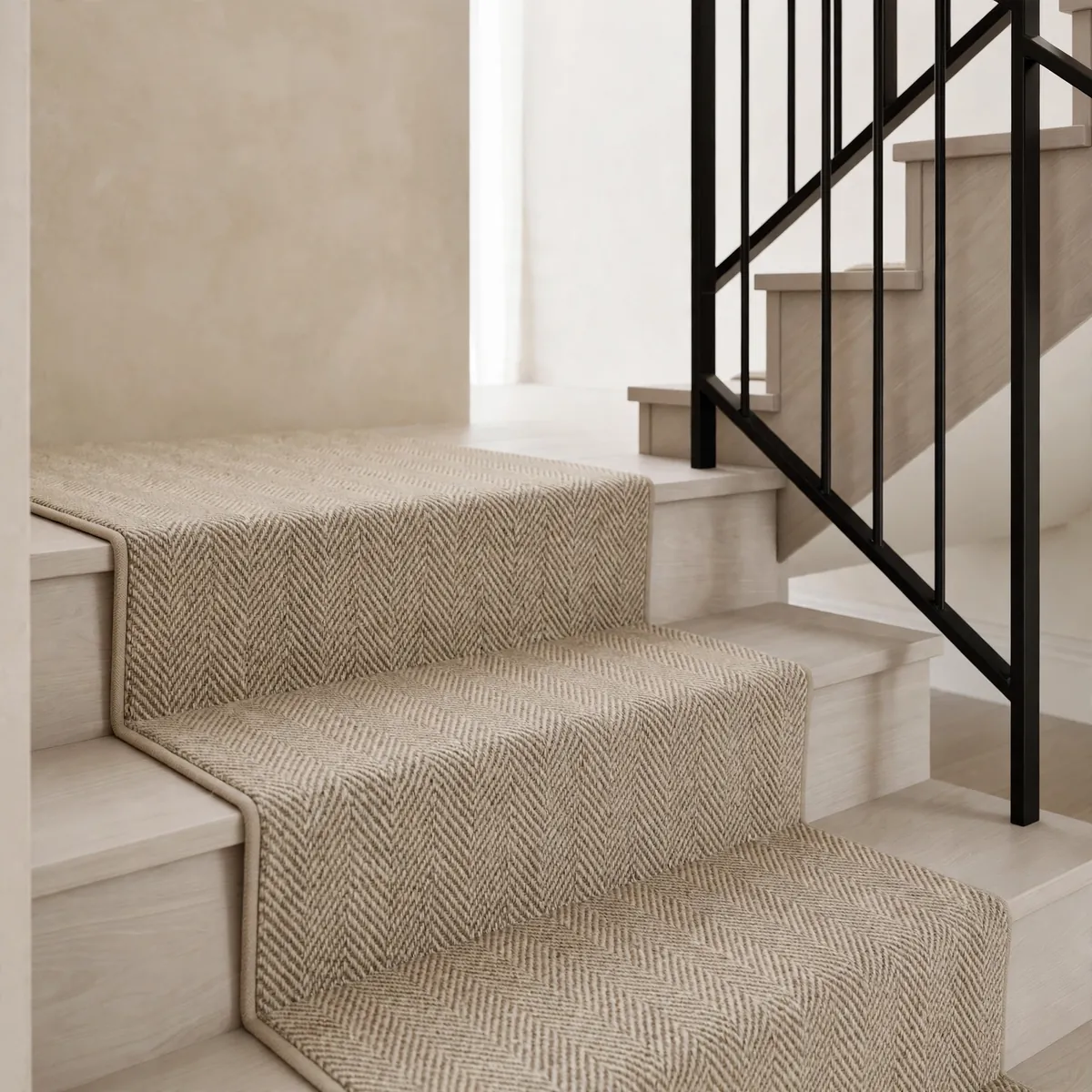
Herringbone has incredible staying power — detailed up close, quiet from a distance. In warm greige it blends with almost any decor while adding subtle movement to every step. It’s the pattern for people who want interest without commitment, and it ages gracefully as trends shift around it.
- Align the herringbone direction consistently up the flight.
- Choose greige over cool gray for broader compatibility.
- Pair with simple walls to let the weave texture show.
Powder-Blue Runner for a Coastal Feel
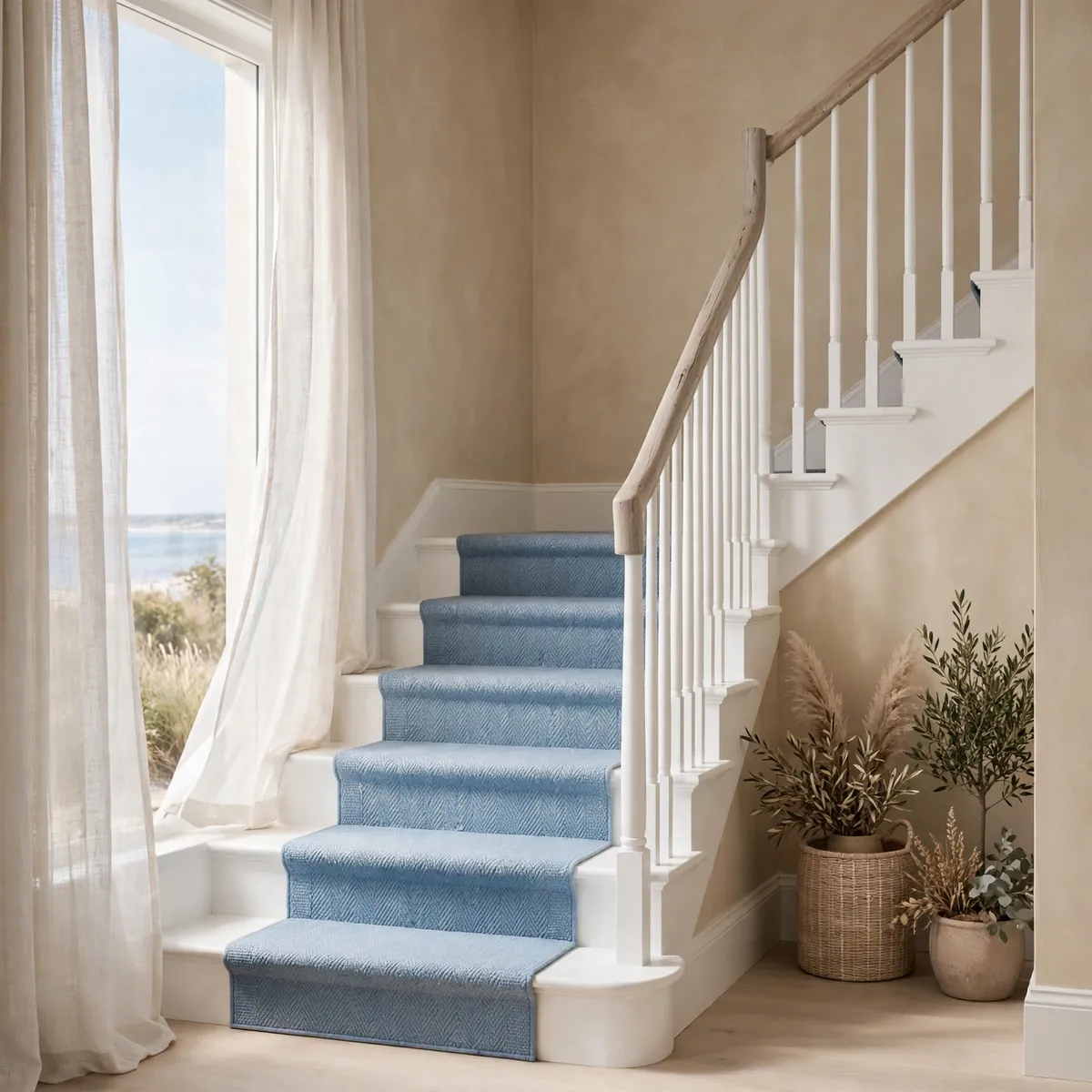
A powder-blue runner instantly sets a relaxed coastal tone, especially with white walls and natural wood accents nearby. It feels breezy and welcoming year-round — not just in beach houses. Keep the blue soft and muted; dusty tones age better than bright ones and pair with more decor styles.
- Choose muted, dusty blues over saturated ones.
- Pair with white risers for a fresh, airy feel.
- Add natural textures nearby (jute, rattan, linen).
Antique Brass Stair Rods on a Neutral Runner

Decorative stair rods in antique brass turn even a simple neutral runner into something that looks intentional and collected. They add a jewelry-like horizontal line at the back of each tread and a subtle metallic warmth. Once purely functional, rods are now chosen for their visual payoff — the detail guests notice on the second look.
- Match rod finish to other metals in the hallway.
- Install rods snugly so they don’t rattle.
- Choose classic finials for a timeless look.
Terracotta Carpet Warming a White Stairwell

Terracotta carpet brings immediate warmth — earthy, grounded, and inviting without going dark. It pairs beautifully with white walls, wood furniture, and linen textures, making the staircase feel like part of an organic, collected home. In farmhouse, Mediterranean, and rustic interiors, it feels utterly natural.
- Sample terracotta in your light; it shifts warm to cool.
- Pair with natural materials for a cohesive story.
- Choose a forgiving weave; terracotta shows lint.
Navy Border Trim on a Natural Sisal Runner
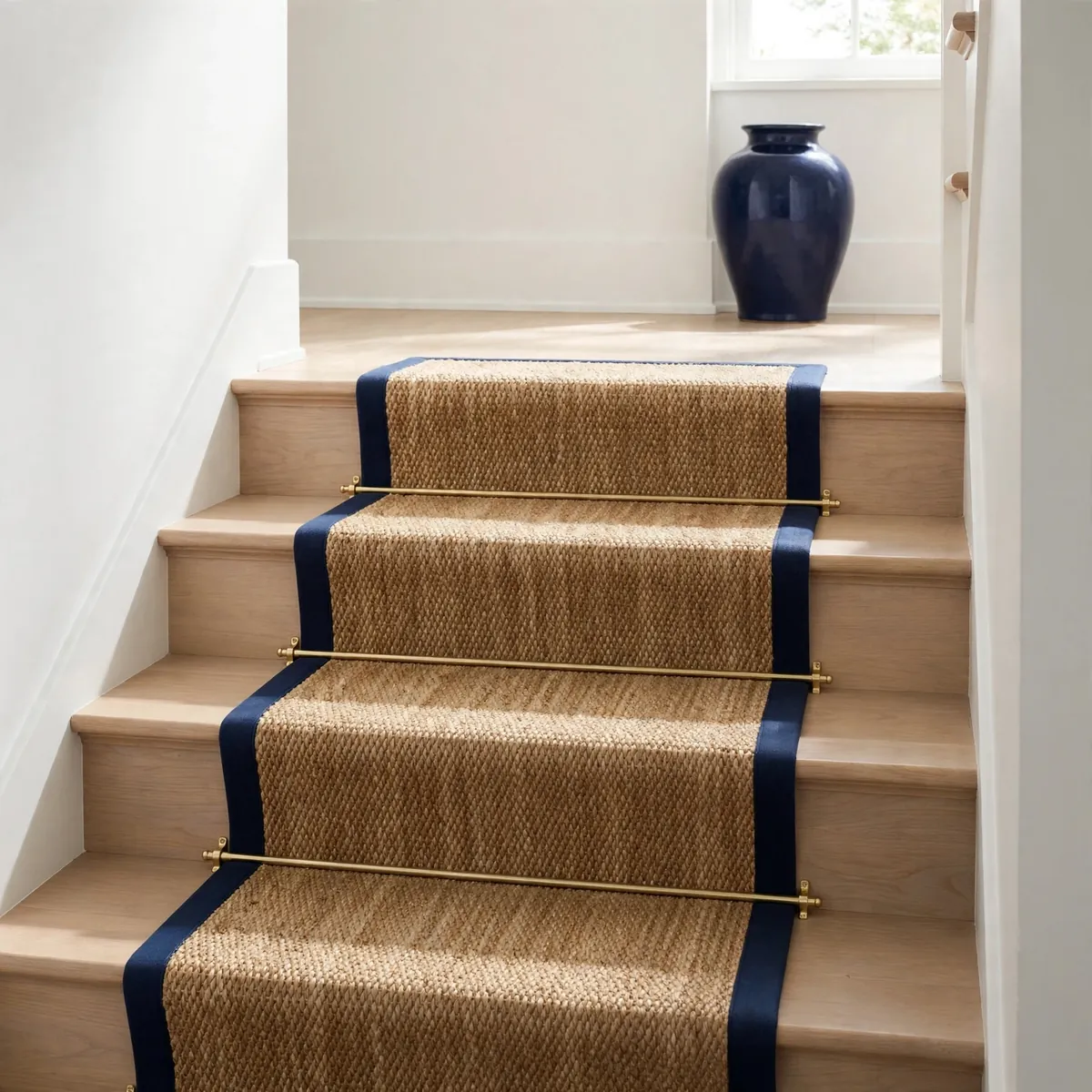
A contrasting border transforms a plain runner into a tailored one. Navy binding on natural sisal feels classic and nautical; the dark edge defines each step crisply while the natural field keeps things relaxed. Match the border color to nearby railings or hardware for a cohesive, thought-through result. This is the long paragraph because the border decision deserves nuance: the border width changes the whole read — a slim one-inch binding feels preppy and precise, while a wide three-inch border feels bold and contemporary. Consider the stair’s proportions before choosing, since narrow stairs can feel pinched by wide borders. Also think about maintenance: dark borders hide the edge wear that stairs collect fastest, which is exactly where a runner ages first. A bound edge also prevents fraying, so the border is doing structural work as well as decorative work — one of the rare details that’s both.
- Match border color to railings or hardware nearby.
- Keep border width proportional to stair width.
- Bind edges professionally to prevent fraying.
Muted Tartan Plaid in Forest and Camel
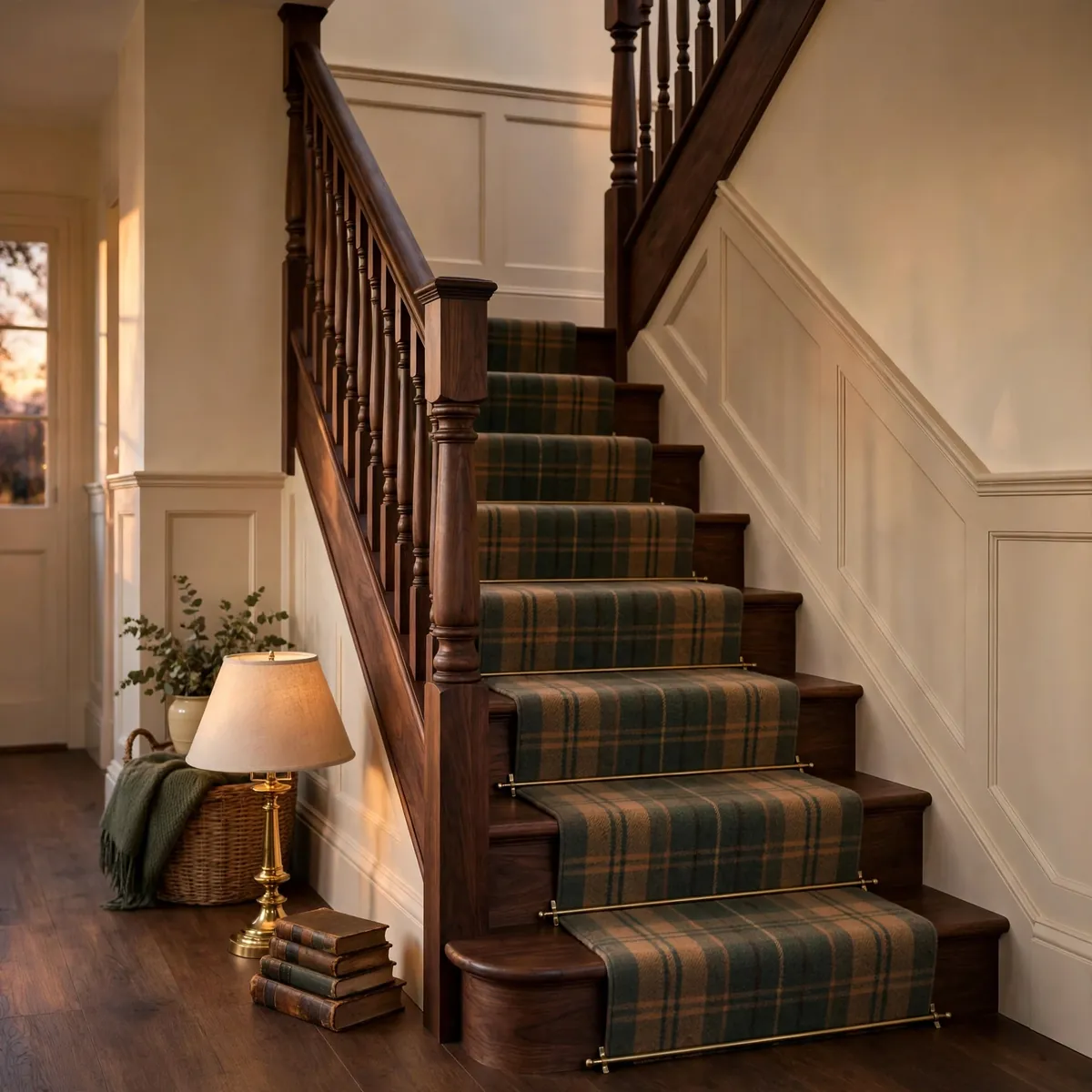
Muted tartan plaid in forest green and camel brings cozy, traditional charm that feels right in cottages, colonials, and mountain homes. Choose muted over saturated plaids — they age better and pair with more. The pattern’s warmth makes the staircase feel welcoming the moment guests arrive.
- Choose muted plaids; bright ones date quickly.
- Keep walls and railings simple to balance the pattern.
- Repeat one plaid color in nearby textiles.
Leopard-Print Runner With a Simple Black Rail
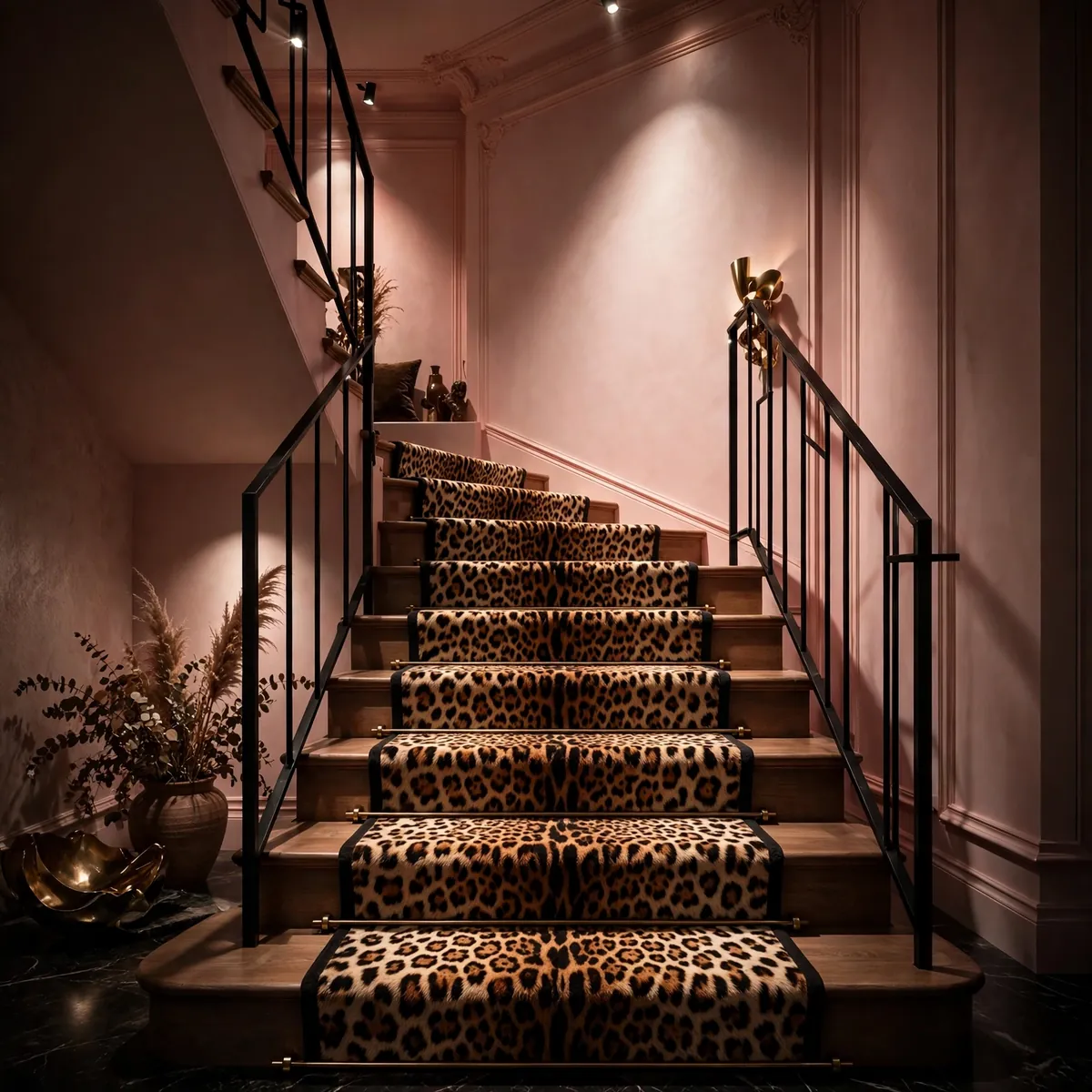
Leopard print on stairs is the confident maximalist move — and it works because animal print reads as a neutral in interiors. Keep the railing simple black and the walls quiet, and the runner becomes a shot of personality that somehow goes with everything. It’s the staircase equivalent of leopard flats: bolder than it looks, easier than it seems.
- Keep everything else in the stairwell simple.
- Choose a classic brown-black leopard, not novelty colors.
- Commit fully; half-hearted leopard looks accidental.
Velvet-Look Carpet in Deep Emerald
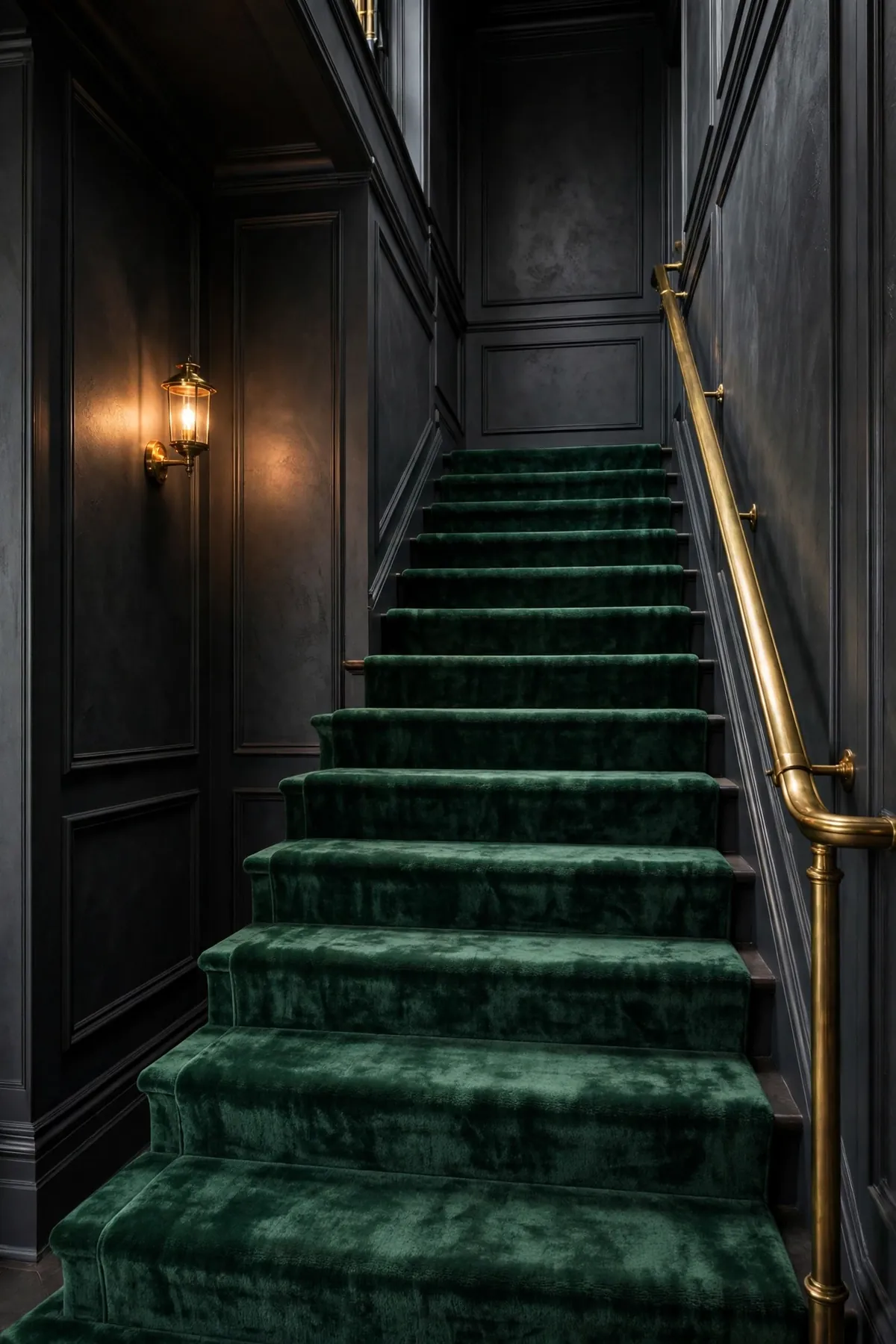
Velvet-look carpet in deep emerald is pure drama — rich, light-catching, and unapologetically luxurious. It suits formal entryways and moody interiors where the staircase is meant to be a focal point. The deep pile glows under lighting and feels incredible underfoot. Reserve this for lower-traffic stairs; velvet-look shows wear faster than loop pile.
- Reserve for lower-traffic staircases.
- Brush the pile regularly to keep it even.
- Pair with warm metallic accents for full glamour.
Matching Carpet Flowing From Hallway to Stairs

Run the same carpet from the upper hallway straight down the stairs for seamless visual flow. The continuity makes the whole level feel connected and calm, and the staircase becomes a bridge rather than a separate element. Match undertones carefully and compare samples in natural light — hallway and stair lighting differ.
- Compare samples in both hallway and stair light.
- Use the same padding throughout for consistent feel.
- Keep the transition at the landing clean and bound.
Extra-Wide Runner for a Grand Double Staircase

Grand staircases need grand runners — a standard narrow runner looks lost on a wide flight. Choose a generously scaled runner that occupies most of each tread, leaving balanced wood exposure on the sides. The width gives the staircase visual weight to hold its own against high ceilings and large foyers.
- Scale runner width to stair width proportionally.
- Leave equal wood margins on both sides.
- Use premium padding; wide runners show lumps easily.
Textured Fog-Gray Runner in a Minimal Home
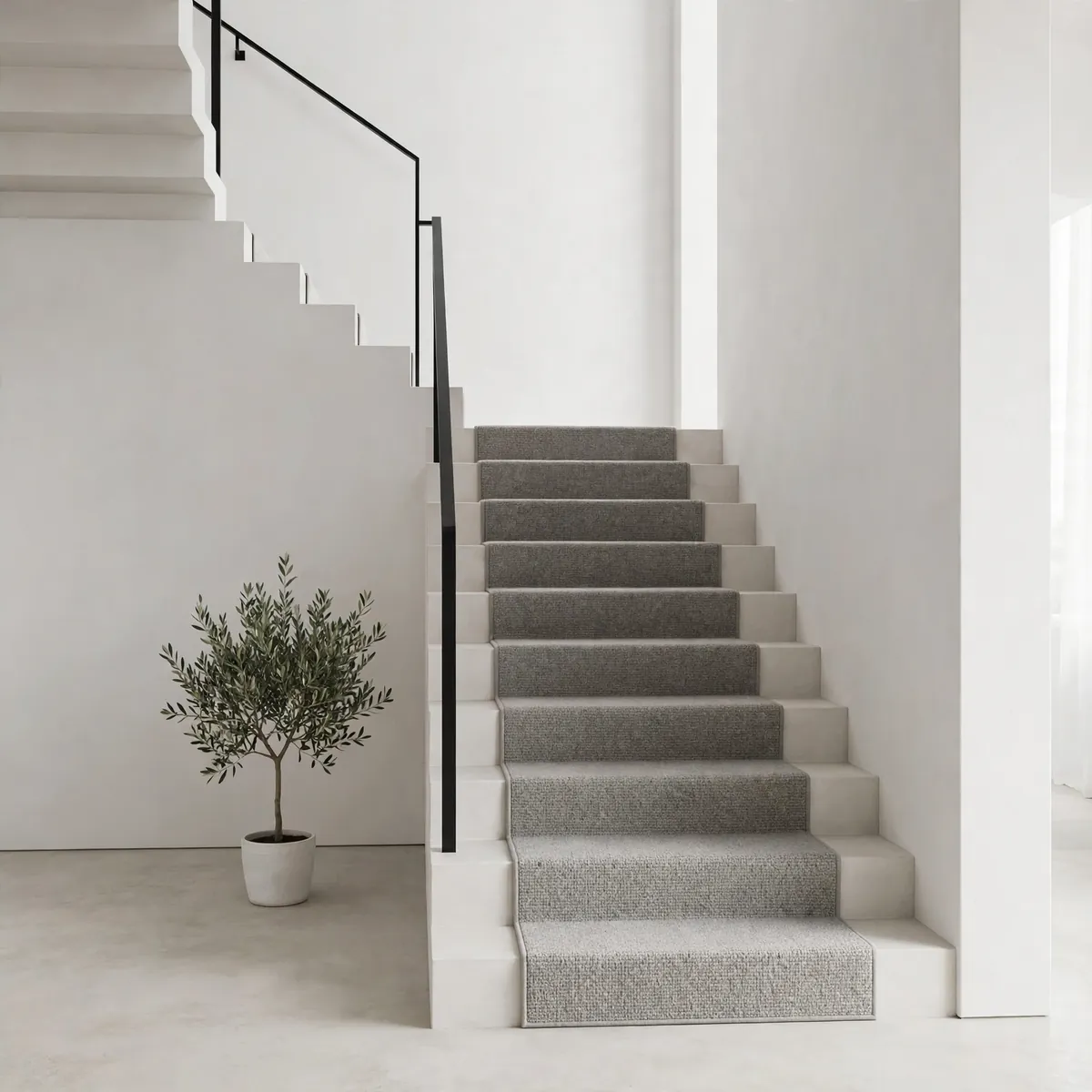
In minimal homes, a textured fog-gray runner adds warmth without adding visual noise. The texture provides interest while the quiet color lets the architecture speak. Gray’s superpower is compatibility — switch accent colors anywhere in the house and the stairs keep working. Choose texture over pattern for the calmest effect.
- Choose texture over pattern in minimal spaces.
- Pick a warm gray to avoid a cold feeling.
- Keep the weave tight for a tailored look.
Black-and-Cream Trellis Pattern for Boutique Style
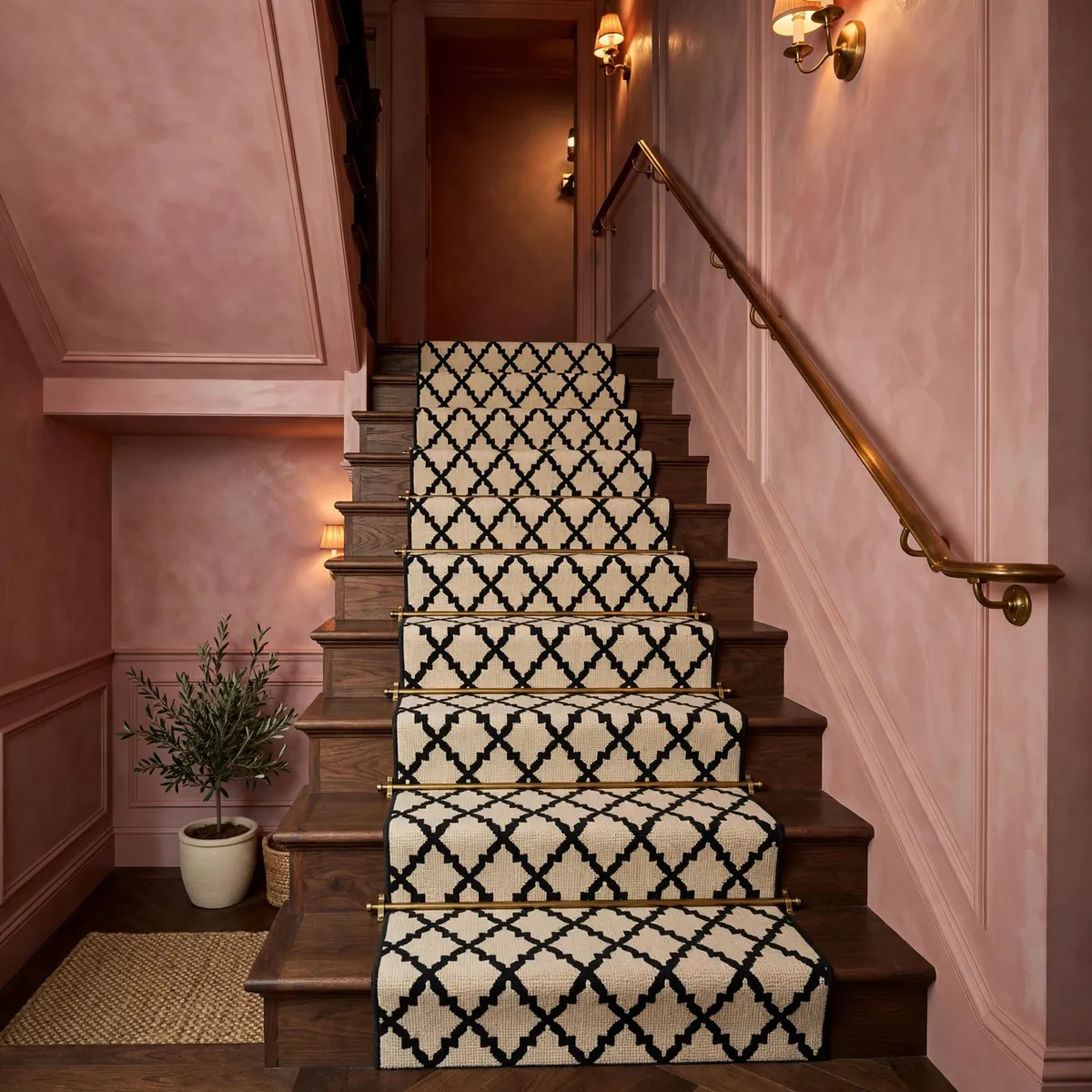
A black-and-cream trellis pattern delivers boutique-hotel polish — curated, confident, and memorable. The high contrast makes the staircase a feature, so keep surrounding walls simple and hardware consistent. It suits townhouses and modern homes where the architecture is already strong and the carpet gets to celebrate it.
- Keep surrounding walls simple and light.
- Use consistent hardware finishes throughout.
- Avoid mixing other patterns nearby.
Hand-Knotted Wool Runner With Tassel Ends
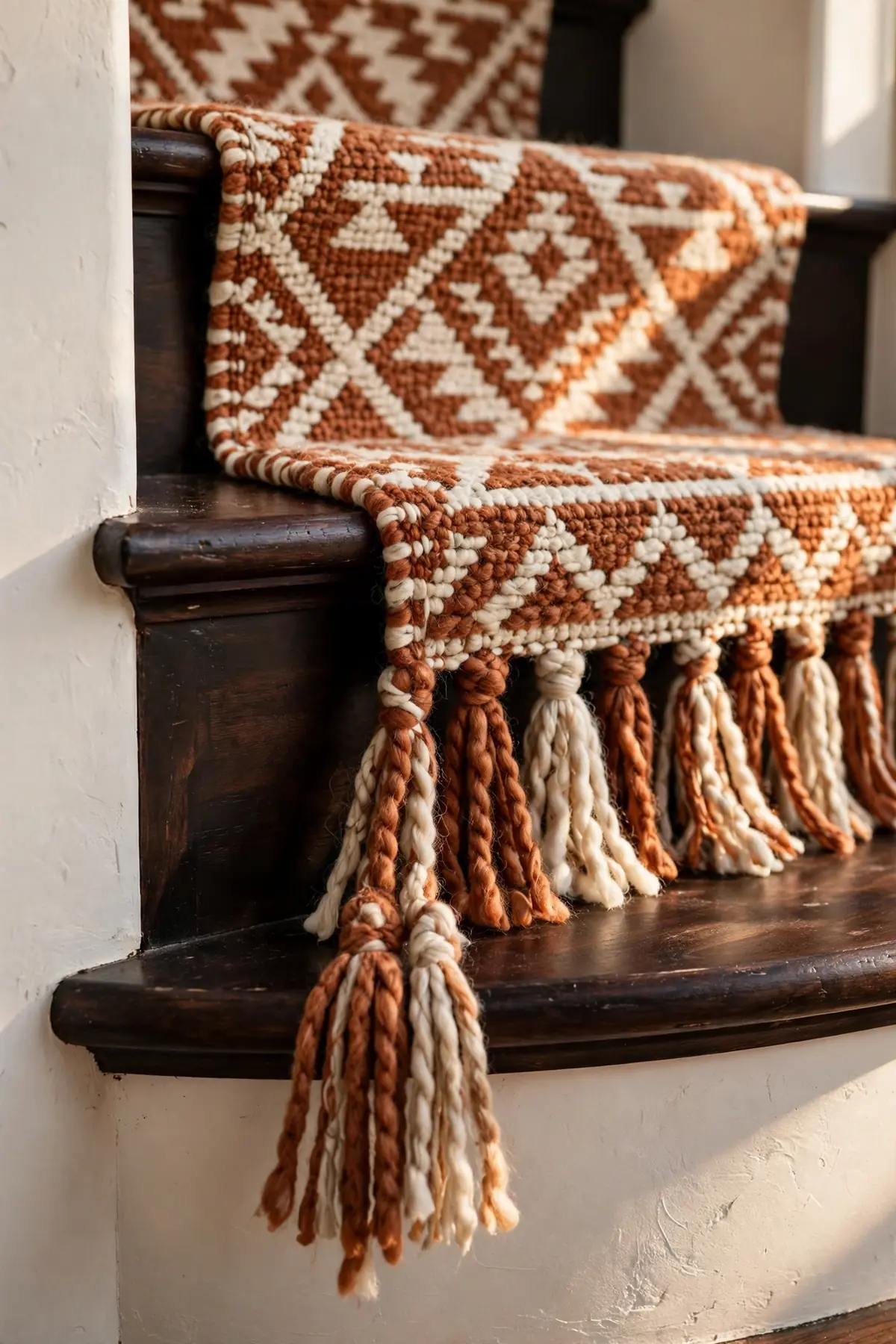
A hand-knotted wool runner with tassel ends brings craft and character to the stairs — each knot visible, each end finished by hand. It suits farmhouse, collected, and artisanal interiors where handmade details matter. Wool’s durability means the investment lasts decades, and the texture only gets better with age.
- Verify it’s truly hand-knotted, not machine-made.
- Keep tassels trimmed and straight.
- Rotate end-to-end yearly for even wear.
Dusty Rose Carpet for a Soft Romantic Stair
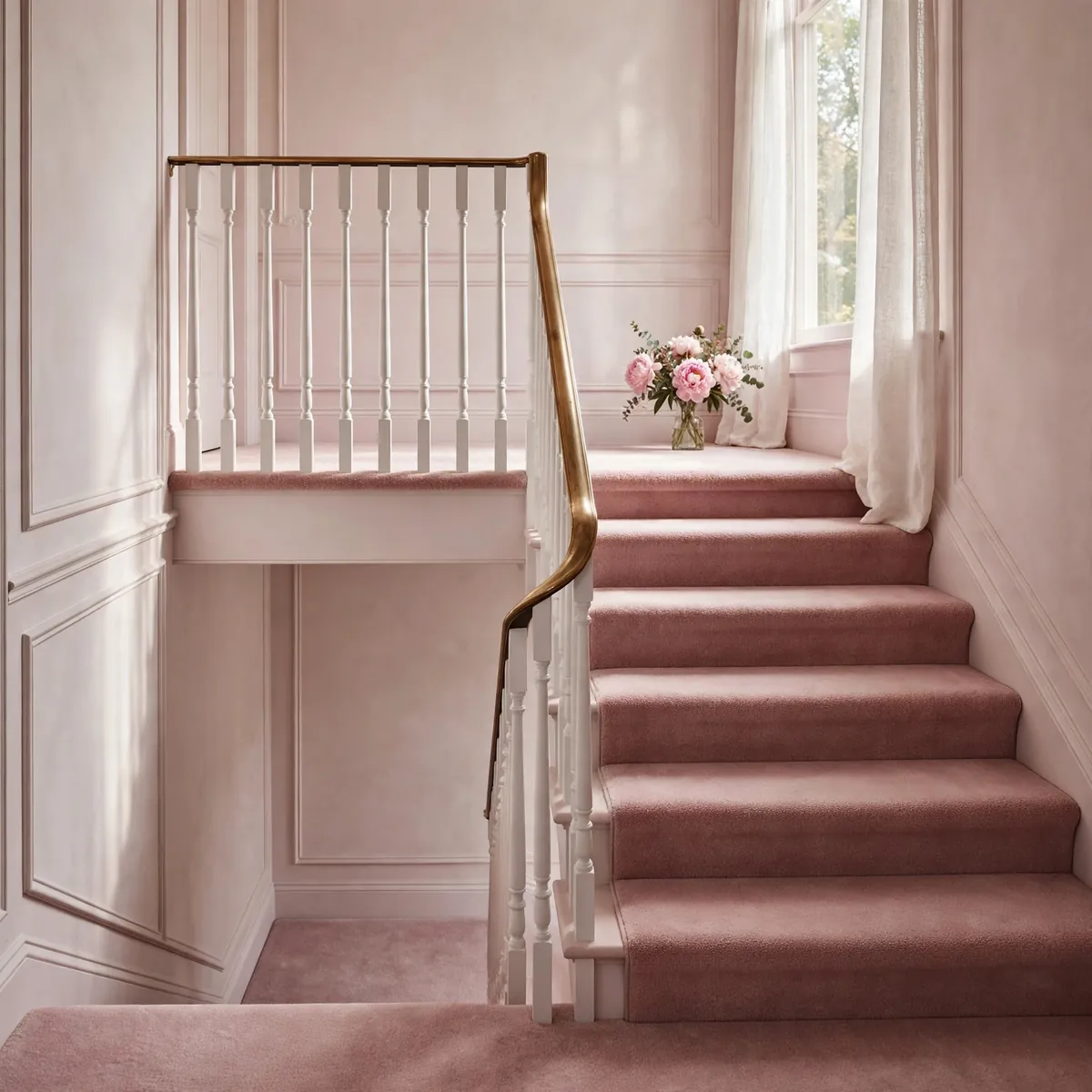
Dusty rose carpet is the unexpected romantic — soft, warm, and quietly confident. It flatters traditional and feminine interiors, pairing beautifully with cream walls and antique brass. Keep the rose muted and dusty; bubblegum pink is a different staircase entirely. This is the color for people who want their stairs to feel like a hug.
- Choose dusty, muted rose — never bright pink.
- Pair with cream walls and warm metals.
- Test for fading if the stairwell gets strong sun.
Dense Memory-Foam Padding Under a Plush Pile
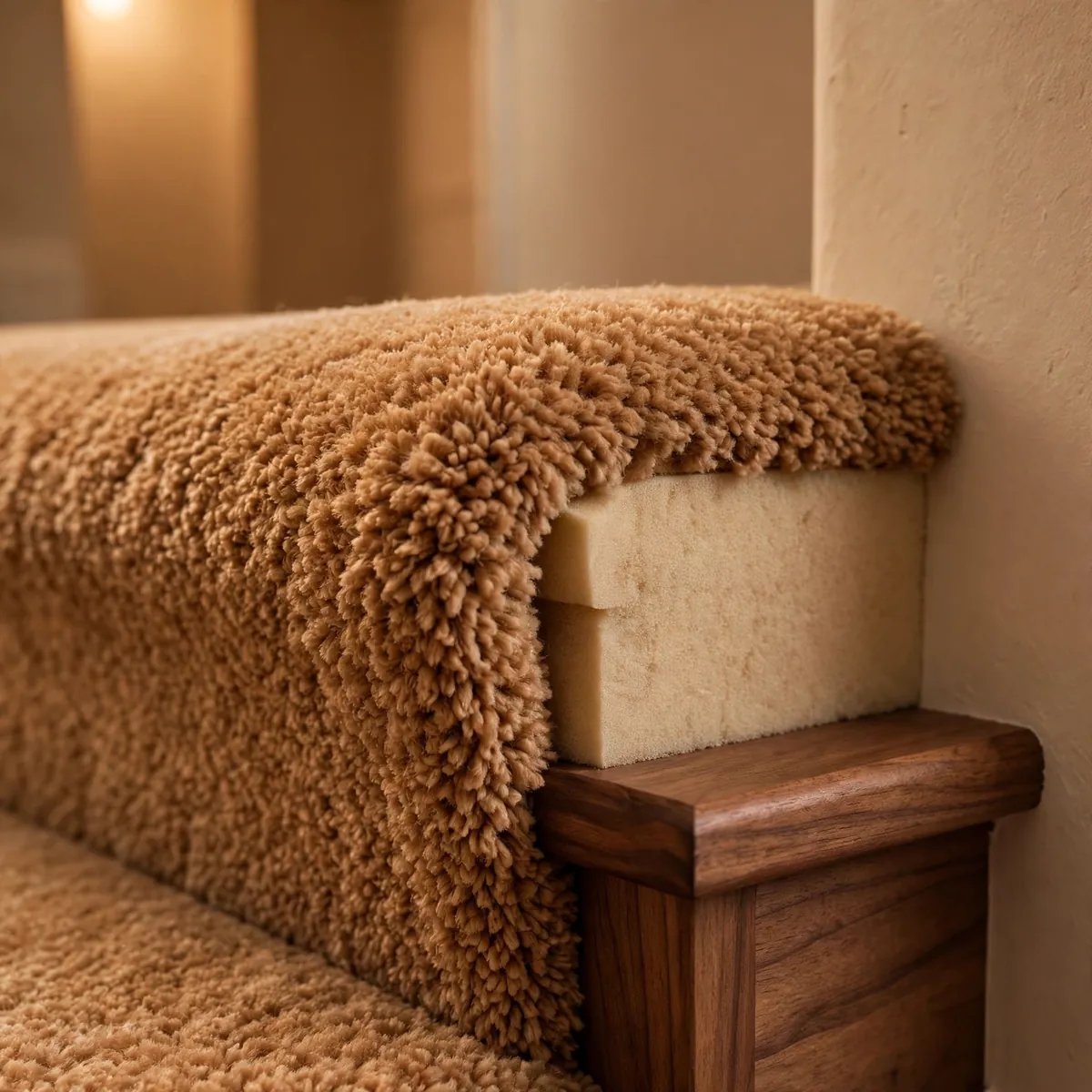
Great carpet starts underneath. Dense padding — memory foam or high-density rebond — determines comfort, sound absorption, and how long the carpet lasts. It makes every step quieter and softer, and it protects the carpet backing from stair-edge wear. Even if professionals install the carpet, understanding padding helps you specify the right one.
- Specify dense, stair-rated padding, not standard.
- Thicker isn’t always better; density matters more.
- Replace padding when you replace carpet.
Striped Runner in Sand and Chocolate
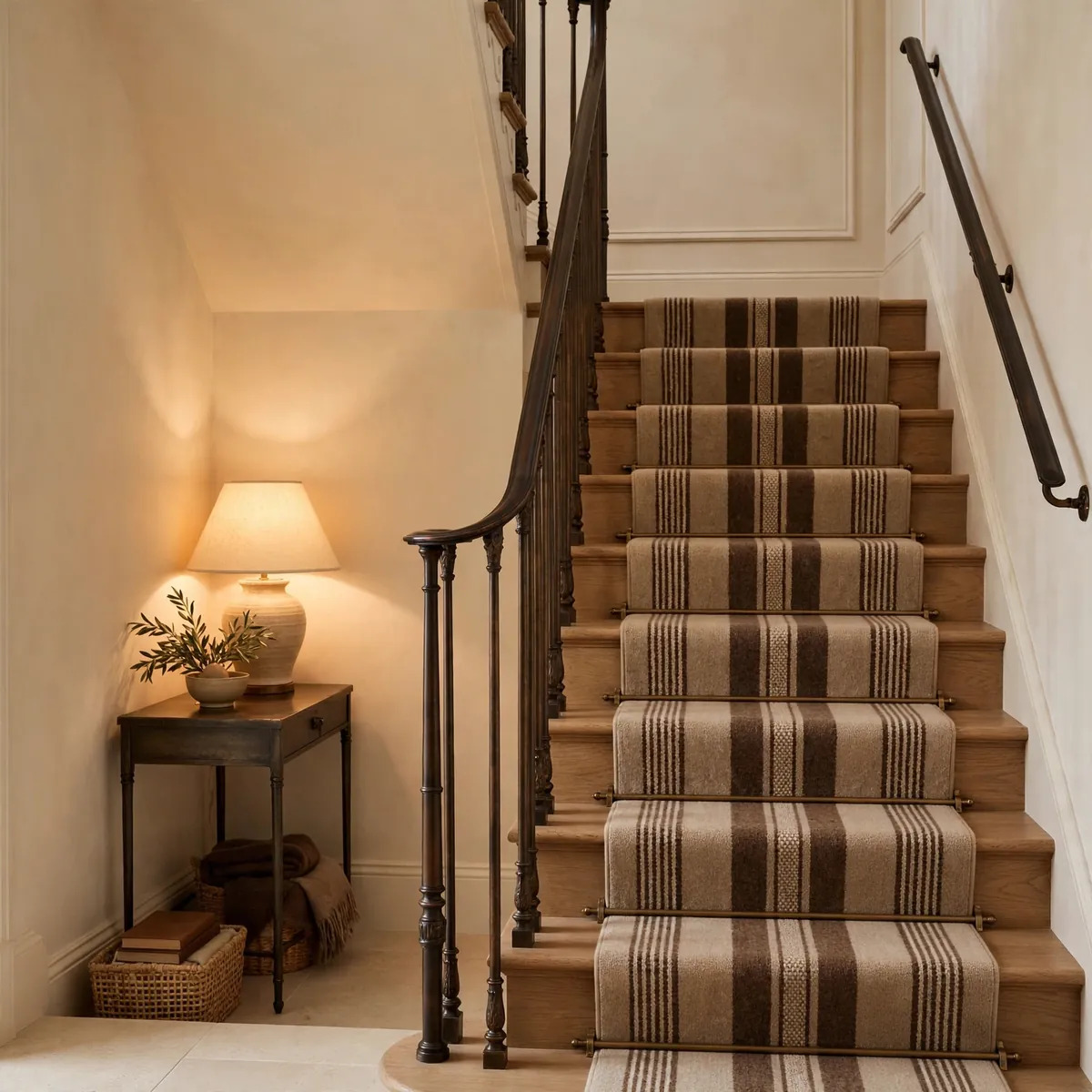
Sand and chocolate stripes bring warmth and rhythm without the starkness of black and white. The earthy pairing suits transitional and traditional homes, elongating the flight visually while hiding wear gracefully. It’s the stripe for people who find monochrome stripes too graphic but still want movement.
- Keep stripe widths even for a tailored look.
- Pair with wood tones that echo the chocolate.
- Choose low pile so stripes stay crisp.
Botanical-Print Runner in Sage and Ivory

A botanical print in sage and ivory brings the garden indoors — soft leaves and stems climbing the stairs in the calmest possible palette. It suits cottage, coastal, and organic-modern homes where nature-inspired details feel at home. Keep the print’s scale modest so it reads as texture from across the room.
- Keep print scale modest for stair proportions.
- Pair with plain walls to avoid pattern competition.
- Choose washable fibers for easy maintenance.
Two-Tone Border: Charcoal Edge on Oatmeal Field

A charcoal-bound edge on an oatmeal runner is tailored minimalism — the dark border frames each step crisply while the light field keeps things airy. It’s the runner equivalent of a well-cut blazer: simple, sharp, and appropriate everywhere. The dark edge also hides the wear that collects fastest at stair edges.
- Keep the border width consistent on all four sides.
- Match the charcoal to nearby trim or railing.
- Professionally bind for a clean, durable edge.
Pet-Friendly Loop Pile in Warm Brown

Pets and stairs are a high-traffic combination, so choose accordingly: a tight loop pile in warm brown resists snagging from claws, hides pet hair between vacuums, and stands up to daily zoomies. Solution-dyed fibers resist stains best. It’s the practical choice that still looks warm and intentional — no one needs to know it was chosen for the dog.
- Choose tight loop pile; avoid cut pile with pets.
- Pick solution-dyed fibers for stain resistance.
- Vacuum frequently with a pet-hair attachment.
Runner Paired With Painted Risers in Deep Green
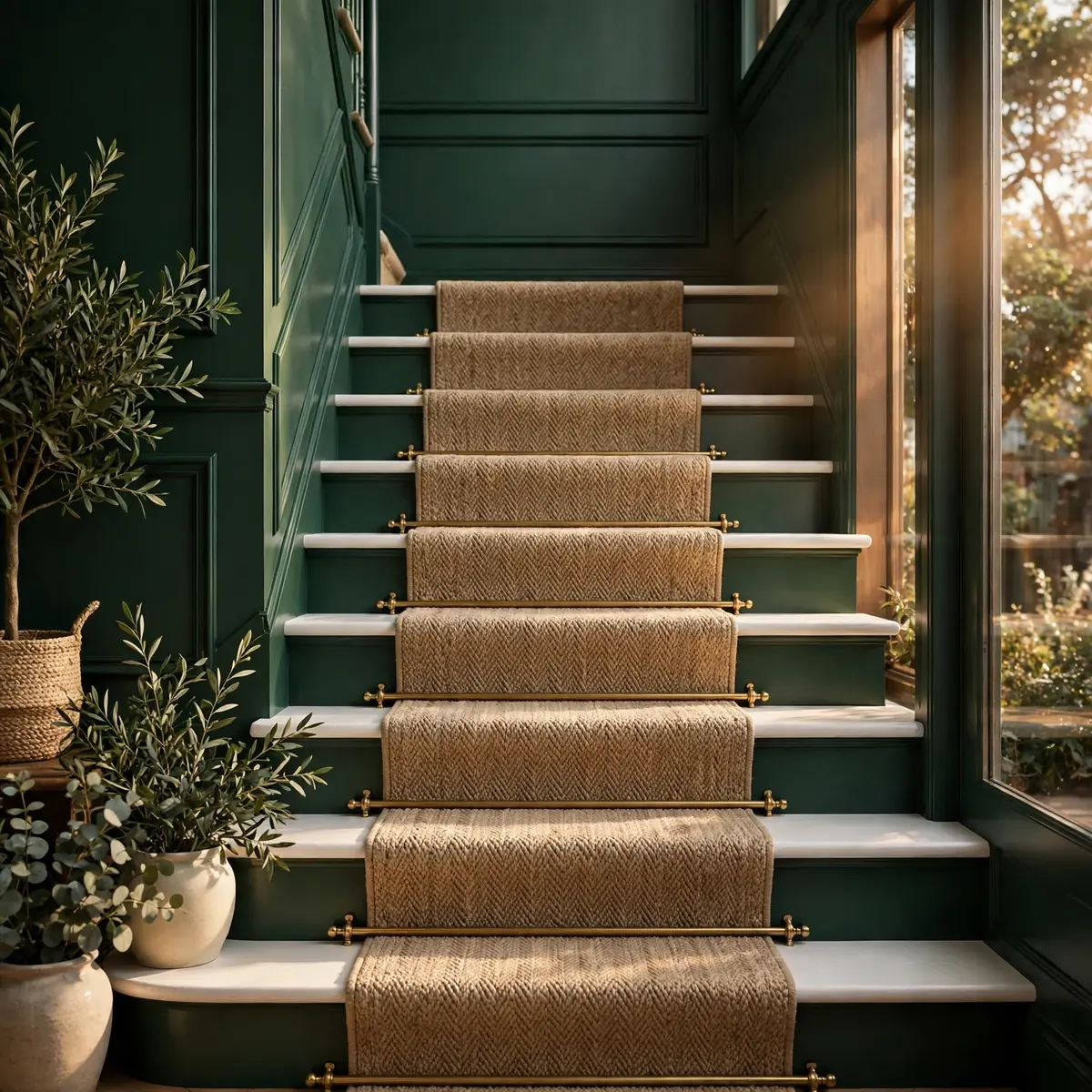
Pair a neutral runner with risers painted deep green for a look that’s both classic and current. The green adds rich color at every step while the runner keeps things soft underfoot — the best of paint and carpet in one staircase. It suits traditional homes with a modern streak and looks stunning with brass stair rods.
- Use satin paint on risers for wipeable durability.
- Keep the runner neutral so the green stays the star.
- Repeat the green in a nearby door or cabinet for cohesion.
FAQs
Is carpet or a runner better for stairs?
A runner leaves wood edges exposed for a tailored look and is easier to replace; wall-to-wall carpet maximizes softness and soundproofing. Choose based on whether you want to showcase the staircase woodwork or prioritize comfort.
What type of carpet lasts longest on stairs?
Tight loop pile or low, dense cut pile in wool or solution-dyed nylon, installed over dense stair-rated padding. Avoid plush shag and loose weaves — stairs concentrate wear on the tread nosing.
How do I clean a carpeted staircase?
Vacuum weekly with suction or a brush attachment (no beater bar on wool or sisal), spot-clean spills immediately, and have it professionally cleaned once a year in busy households.
Conclusion
The right carpet turns stairs from a thoroughfare into a destination — softer, quieter, and more beautiful with every step. Start with the idea that matches how you live, invest in the padding no one sees, and enjoy the rare upgrade that pleases both feet and eyes.