Iron Staircase Ideas: 25 Bold Designs That Make Your Home Look Expensive
A complete guide to iron staircase designs — spiral stairs, industrial lofts, iron paired with timber, stone and glass — with 25 ideas, concrete examples and quick tips for every home style.
An iron staircase is a full stair design built around iron — its structure, treads, balusters and handrail — and it suits far more homes than the industrial lofts it is famous for. A slim black iron stair can disappear into a minimalist hallway, a curved iron stair can anchor a double-height living room, and a wrought iron spiral can turn a tight corner into the most photographed spot in the house. The trick is matching the iron’s finish, weight and detailing to the room around it, so the stair feels designed rather than installed.
If your stair continues outside, the same thinking applies to exterior staircase ideas — weatherproof finishes and a design that ties the garden stair back to the house. In this guide, you will find 25 complete iron staircase designs, each with a concrete example and practical tips, so you can picture exactly which one belongs in your home.
Key Takeaways
What is an iron staircase?
An iron staircase is a complete stair system — stringers, treads, risers, balusters and handrail — built primarily from iron or steel, rather than a wooden stair with iron decoration added on top.
Which home styles suit an iron staircase?
Almost all of them: black iron suits modern and minimalist homes, wrought iron suits traditional and farmhouse rooms, and raw industrial iron suits lofts and converted barns.
Are iron staircases safe for families?
Yes, when the baluster spacing is tight enough that a small child cannot slip through, the handrail is at a comfortable height, and the treads have a non-slip finish or runner.
Is iron better than wood for a staircase?
Iron is stronger, slimmer and longer-lasting than wood, and it needs less structural bulk, but it feels colder underfoot and louder underfoot, so many homeowners pair iron frames with timber treads.
How much does an iron staircase cost?
A simple straight iron stair costs far less than a curved or spiral wrought iron design, and powder coating is the budget-friendly alternative to hand-forged custom work. —
Sleek Black Iron Railings for a Modern Minimal Iron Staircase
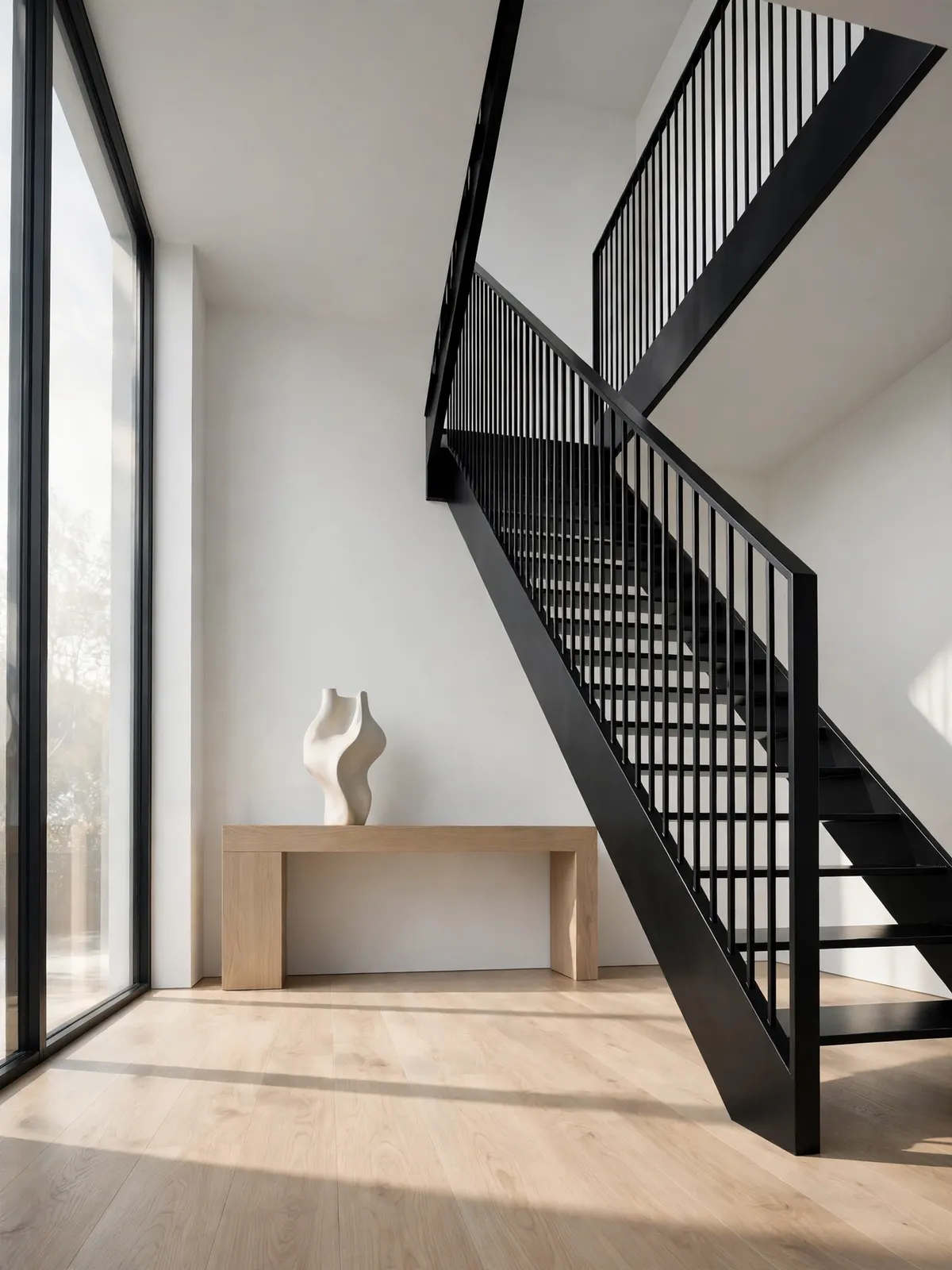
A modern minimal iron staircase works because the iron is reduced to its simplest lines: slim 12 mm square balusters, a flat 40 mm handrail, and matte black powder coating throughout. Picture a straight flight of 14 steps in a white hallway with pale oak flooring, where the stair rises against one wall and the only decoration is a single black-framed mirror at the landing. The iron stays quiet so the architecture speaks, and the stair reads as part of the room rather than a feature fighting it.
Quick tips:
- Keep balusters slim and evenly spaced for a calm, uncluttered line.
- Use matte black powder coating to hide fingerprints and dust.
- Pair black iron with pale wood floors so the stair does not darken the hall.
- Add a single oversized mirror at the landing to bounce light back down.
Iron Railings With a Live-Edge Timber Handrail
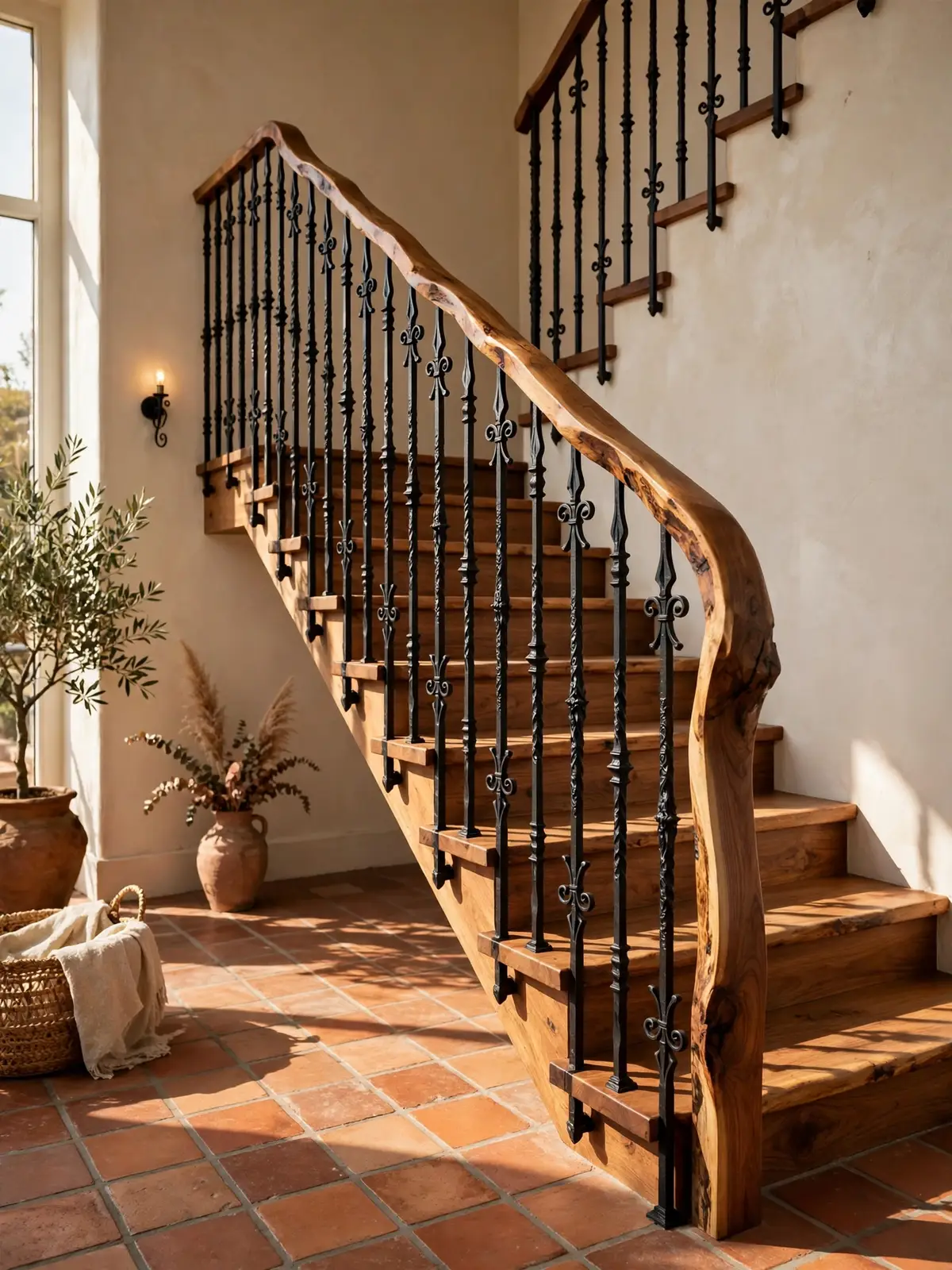
The contrast here is the whole point: cool, precise black iron below and one warm, imperfect slab of live-edge walnut on top. Imagine a 3.6-metre straight stair where the handrail is a single 60 mm thick walnut board, its natural edge left visible, sanded smooth and oiled, running over simple vertical iron balusters. The timber softens the iron, warms the hand, and gives a plain stair the feel of a crafted piece of furniture.
Quick tips:
- Choose a handrail at least 50 mm thick so the live edge reads as solid, not flimsy.
- Oil the timber rather than varnishing it, for a soft natural sheen.
- Keep the iron balusters plain so the timber stays the star.
- Match the walnut tone to a side table or shelf nearby for a deliberate echo.
Powder-Coated Iron Instead of Custom Forging
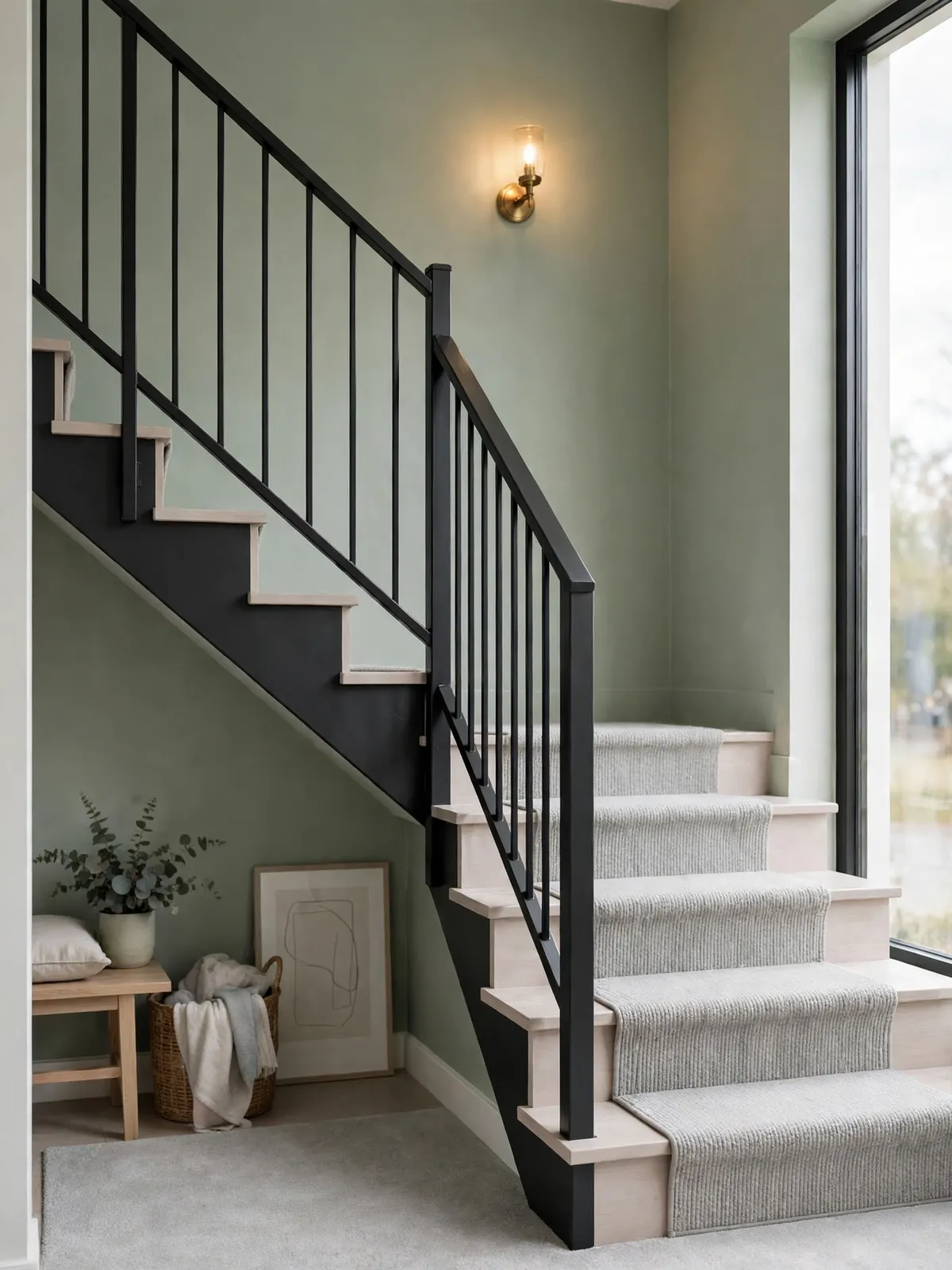
Powder coating gives you the look of a custom iron stair at a fraction of the price of hand forging, because the ironwork is made from standard sections and finished in a tough, even coat. Take a straight 13-step stair in charcoal powder coat with pale ash treads and a sage green wall behind it: the colour does the design work, the finish resists chips and scratches, and the whole stair can be recoated years later if tastes change. It is the smartest route when the budget matters more than bespoke scrollwork.
Quick tips:
- Ask for a textured powder coat to hide small scuffs in busy family homes.
- Choose a mid-tone colour like charcoal so dust shows less than on pure black.
- Keep the design to standard straight balusters to control the cost.
- Save the budget for one statement detail, such as a brass newel cap.
Matte White Iron Treads With a Black Railing for Contrast
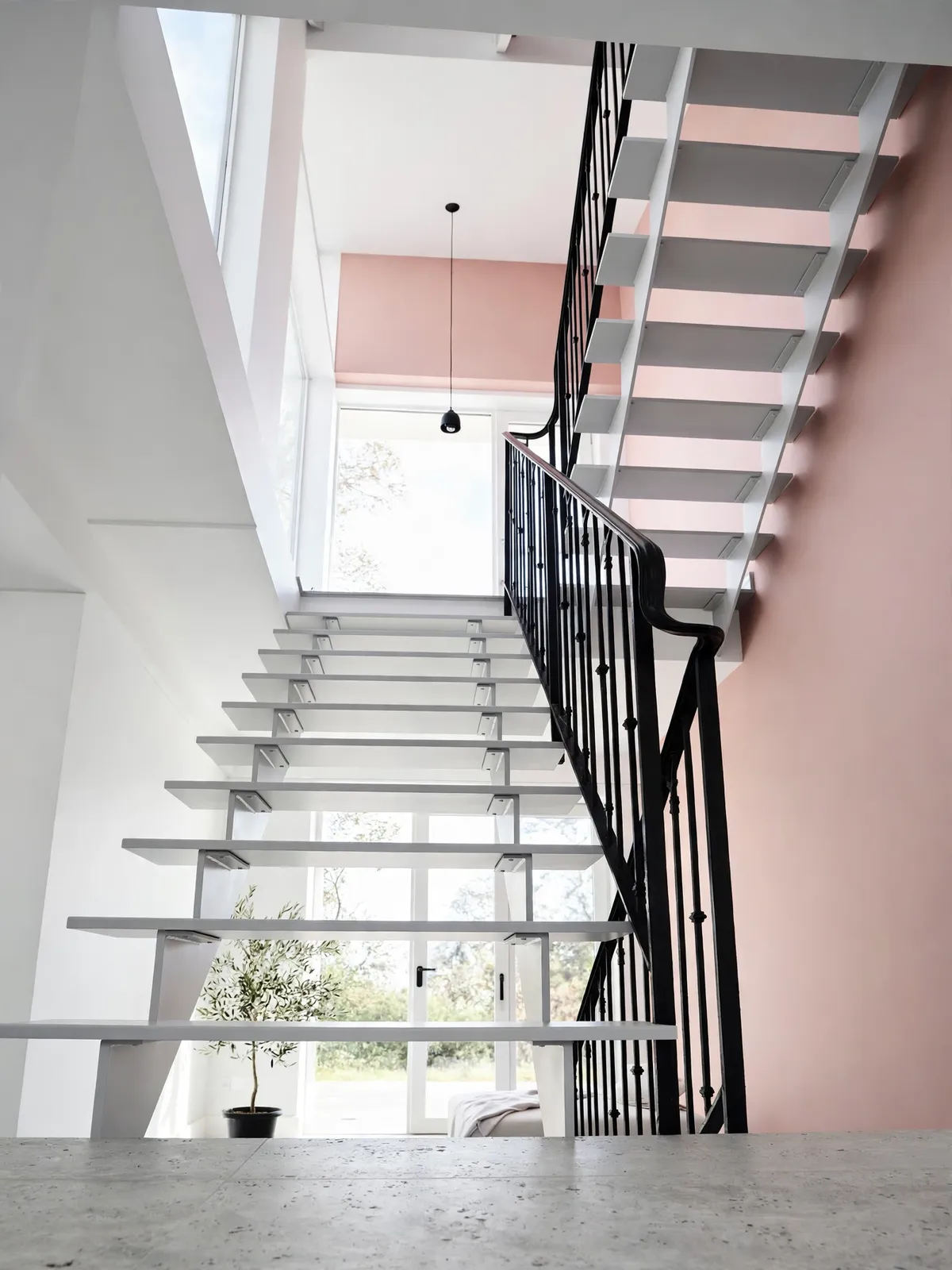
White treads with a black railing is a high-contrast pairing that makes a stair feel graphic and deliberate, almost like a drawing. Picture 15 matte white steel treads, each 900 mm wide, floating on a black iron spine, with slim black balusters and a blush pink wall behind the flight. The white steps reflect light upward, so a dark hallway feels brighter, while the black rail gives the eye a strong line to follow.
Quick tips:
- Use a matte finish on white treads to cut glare from overhead lights.
- Add anti-slip strips in a matching white so safety stays invisible.
- Keep the wall behind the stair a single soft colour to frame the contrast.
- Clean white treads weekly — they show dust faster than dark ones.
Iron Spindles Arranged in a Chevron Pattern
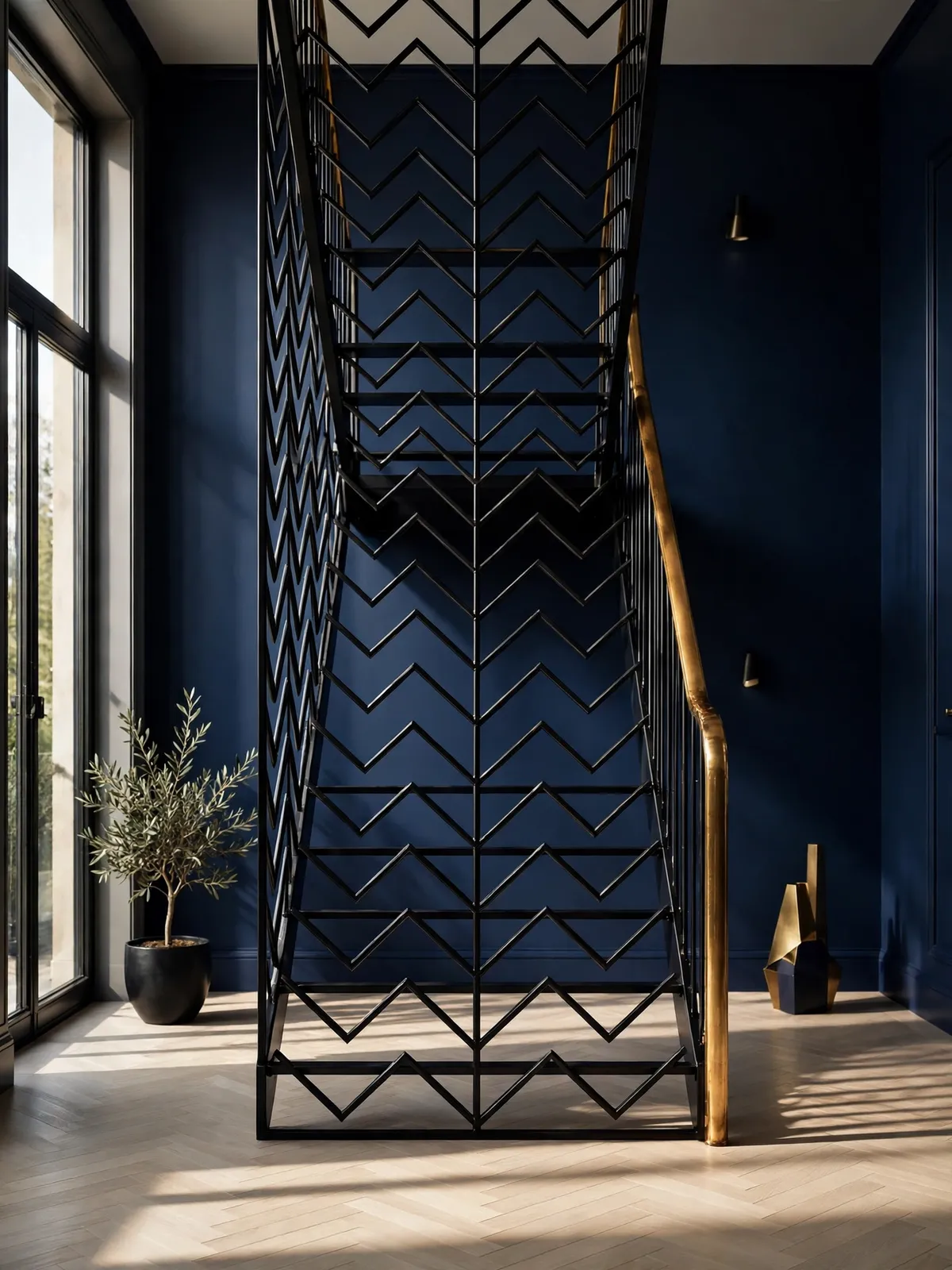
Chevron spindles turn a plain balustrade into a pattern: the iron bars angle left and right in a repeated zigzag, creating movement even when nobody is on the stairs. Imagine a 12-step stair against a navy blue wall, where black chevron spindles sit between a brass handrail and pale herringbone flooring. The geometry is the decoration, so the rest of the room can stay quiet — and the pattern looks different from every angle as you walk past.
Quick tips:
- Keep the chevron angle consistent, around 45 degrees, for a tidy rhythm.
- Use a dark wall behind the stair so the iron pattern stands out.
- Pair with a simple straight handrail so the pattern is not competing.
- Test the spacing for safety — chevrons must still block a child’s head.
Iron Cable Railings for an Ultra-Modern, Almost Invisible Look
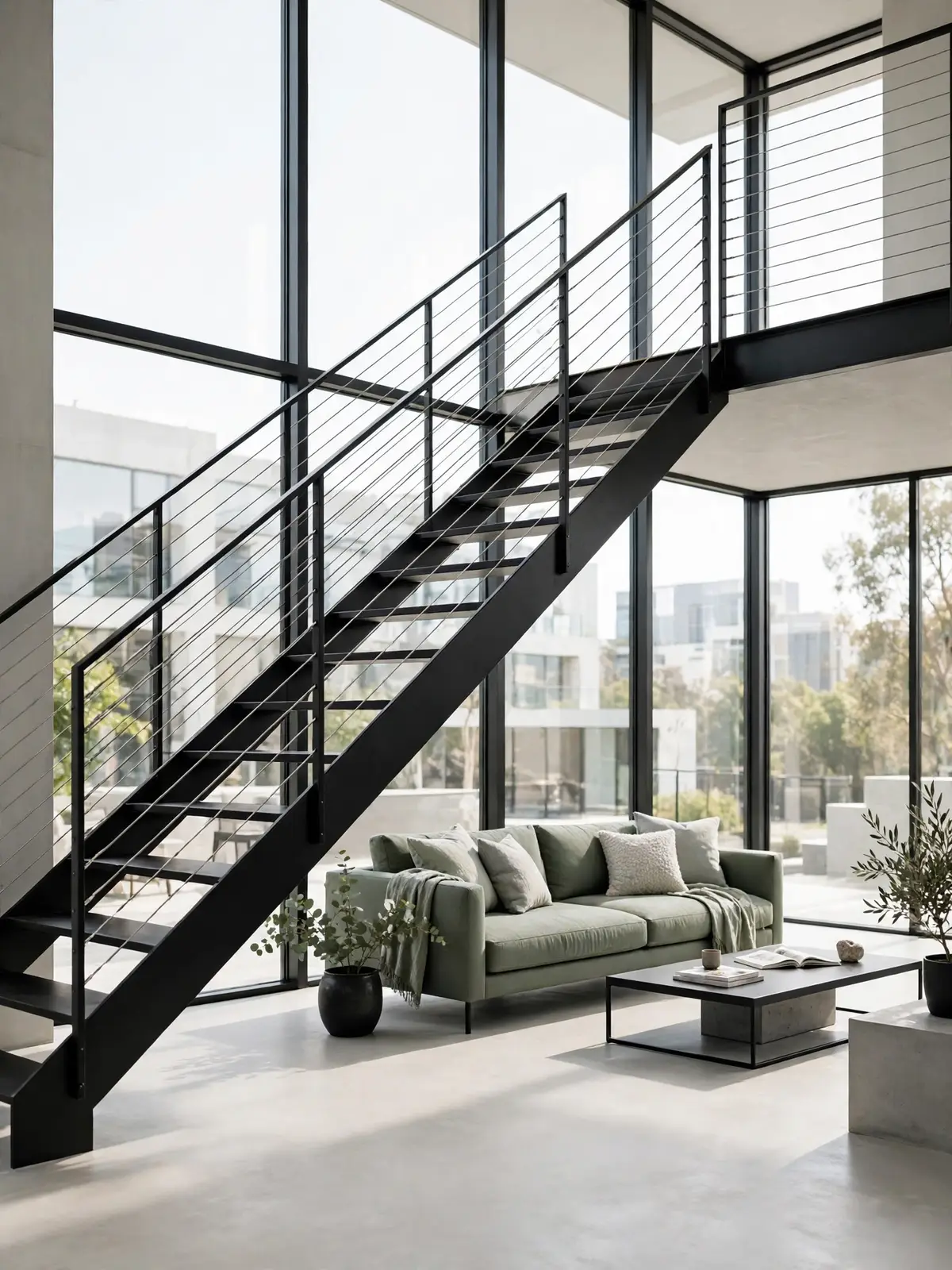
Cable railings replace solid balusters with thin horizontal steel cables, so the stair almost disappears and the view through it stays open. Visualise a floating stair of 14 pale concrete treads on a black iron spine, with four taut cables running between slim black posts, in front of floor-to-ceiling windows. Light passes straight through, the room feels twice as large, and the stair becomes a sculpture rather than a barrier.
Quick tips:
- Tension the cables properly at installation so they never sag.
- Choose marine-grade stainless cable for a lasting shine.
- Keep the handrail slim and dark so the cables stay the focus.
- Clean cables with a dry cloth to avoid water marks.
A Spiral Iron Staircase as a Dramatic Focal Point
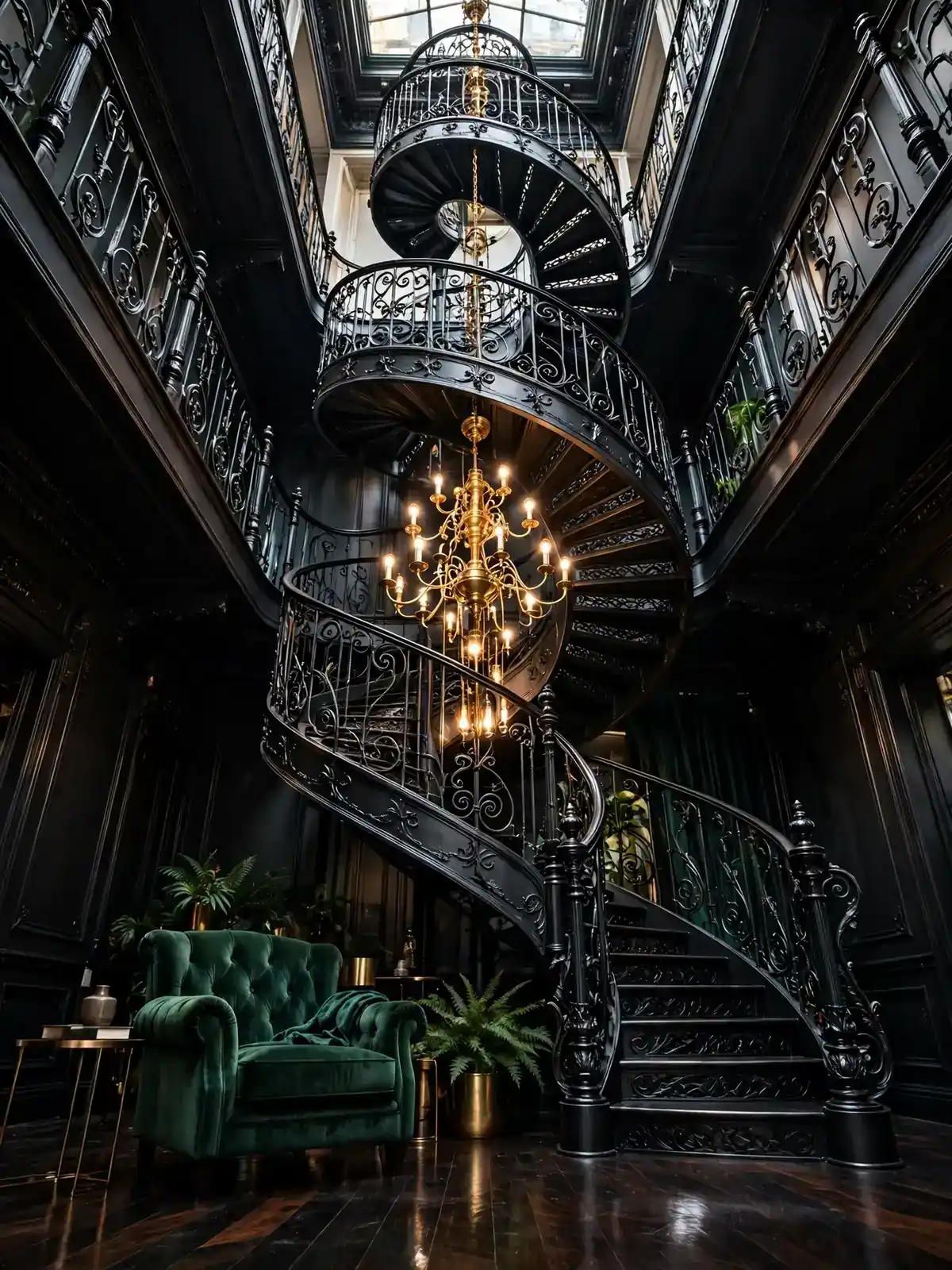
A spiral iron staircase is the most dramatic iron stair there is: it coils upward, saves floor space, and becomes the room’s centrepiece by default. Picture a 2-metre diameter black spiral with 18 wedge-shaped treads, ornate curved balusters and a brass chandelier dropping through its open centre, above a deep emerald velvet armchair. It suits a double-height atrium or a loft corner, and it needs almost no other decoration in the room.
Quick tips:
- Allow at least 1.8 metres of diameter so the stair is comfortable to climb.
- Hang a pendant light through the centre to show off the spiral.
- Keep furniture low and simple underneath so the stair dominates.
- Check headroom at every turn before ordering — spirals are unforgiving.
An Iron Staircase With a Bold Black Feature Wall Behind It
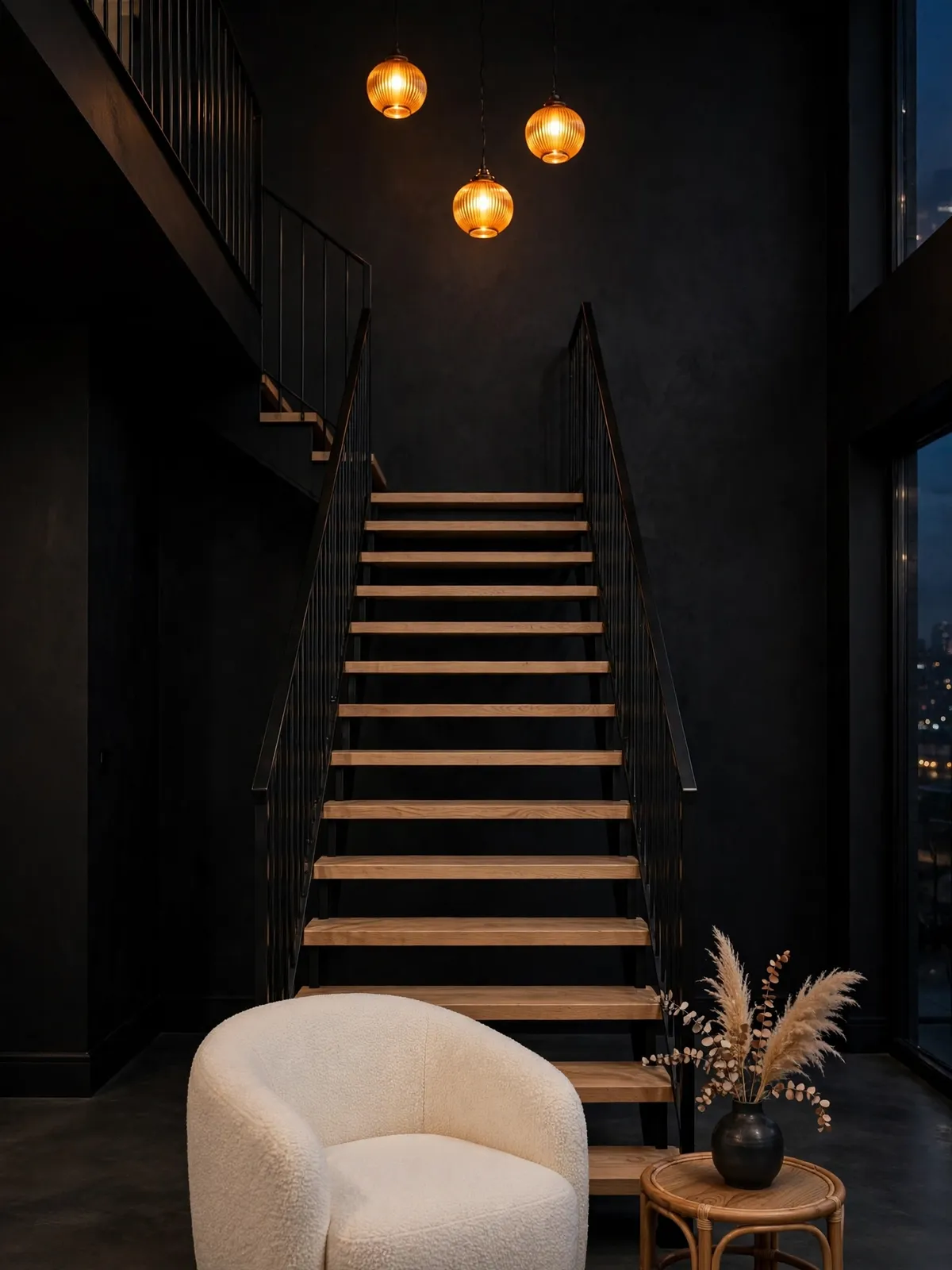
A black feature wall behind a black iron stair sounds like too much darkness, but it works because the stair’s silhouette is picked out by light and texture instead of colour. Imagine a straight flight with light oak treads and slim black balusters rising against a matte black panelled wall, lit by two warm amber pendants. The oak steps glow against the dark wall, the iron reads as a fine line drawing, and the whole stairwell feels like a boutique hotel.
Quick tips:
- Use matte paint on the feature wall to avoid shiny reflections.
- Light the treads, not the wall, so the steps stand out.
- Add warm timber treads to stop the black-on-black feeling cold.
- Keep the landing art small and light-toned for contrast.
An Industrial Loft-Style Iron Staircase
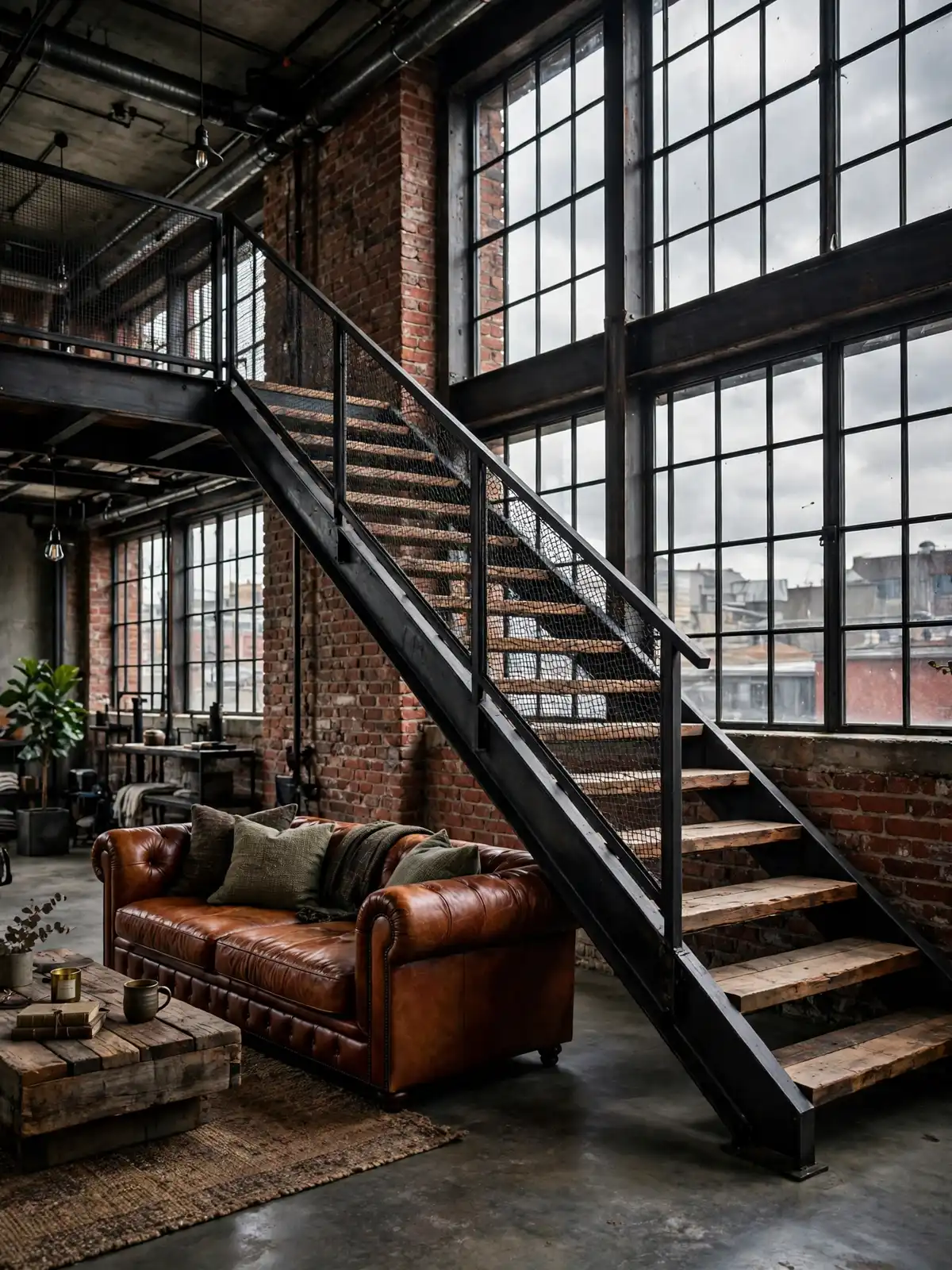
The industrial loft iron stair is honest about its materials: raw black steel, reclaimed timber, exposed brick, and nothing hidden or smoothed away. Think of a 16-step open-riser stair with 50 mm reclaimed pine treads, black steel stringers and mesh balustrade panels, rising beside a brick wall in a converted warehouse with steel-framed windows. A cognac leather sofa at its foot completes the look. It is the stair for homes that celebrate structure instead of covering it up.
Quick tips:
- Let welds and bolts show — they are part of the industrial character.
- Use reclaimed timber treads at least 40 mm thick for a solid feel.
- Add mesh panels rather than open balusters for a true factory look.
- Soften the hardness with leather, wool or linen nearby.
Thin Iron Trims Highlighting Every Stair Edge
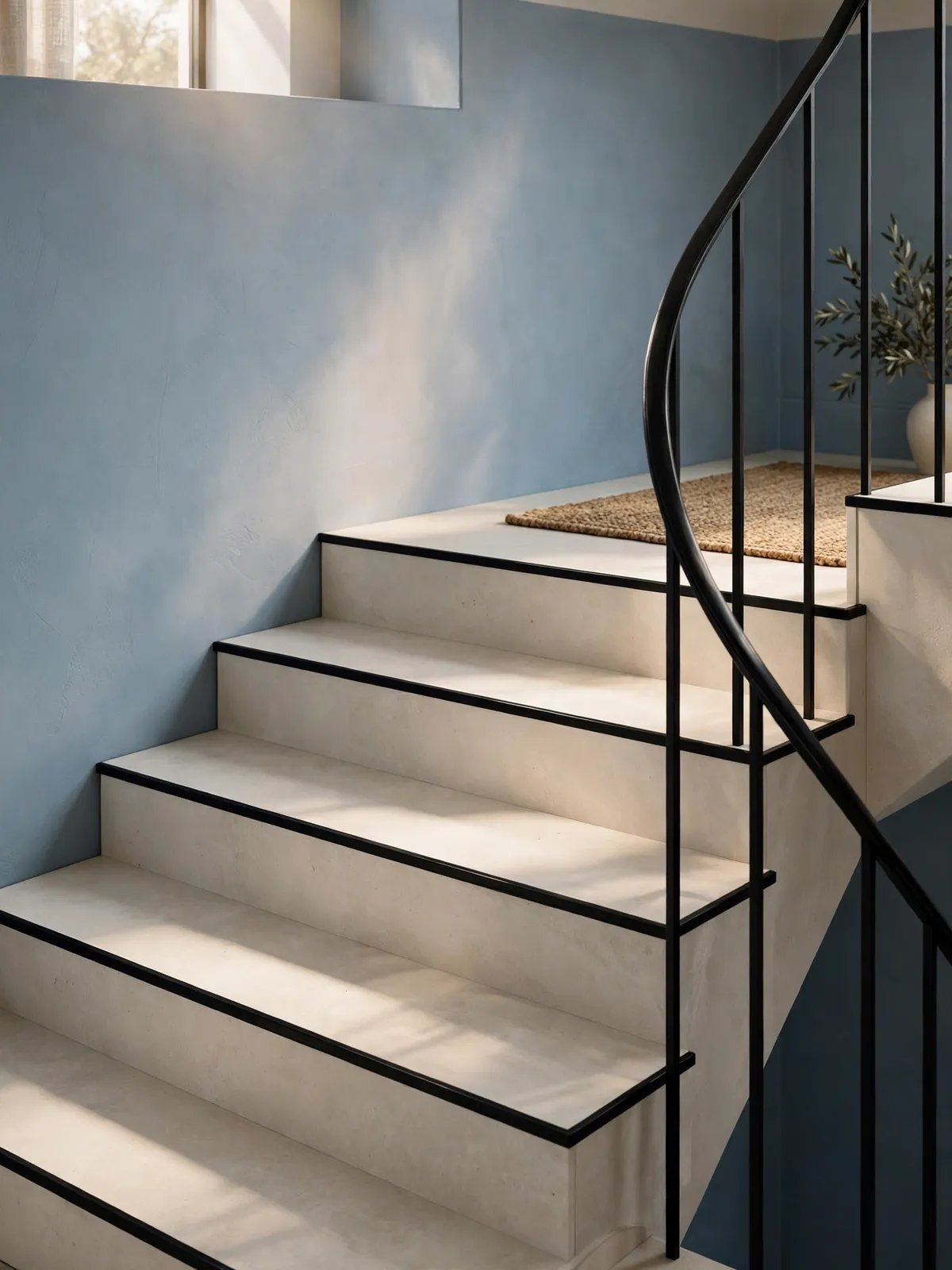
Thin iron trims are a small detail with an outsized effect: a slim black metal nosing on every tread edge turns a plain stair into a tailored one. Picture a flight of pale limestone treads, each finished with a 10 mm black iron strip along its front edge, against a dusty blue wall with a jute runner at the landing. The iron lines draw the eye upward step by step, protect the stone edges from chips, and give a builder-grade stair a custom finish.
Quick tips:
- Keep the trim flush with the tread so it never catches a shoe.
- Use the same black tone as the handrail for a coordinated look.
- Choose a matte trim finish to avoid glare on bright steps.
- Add the trim during the tread installation, not as a retrofit.
A Double-Height Iron Staircase in a Converted Barn
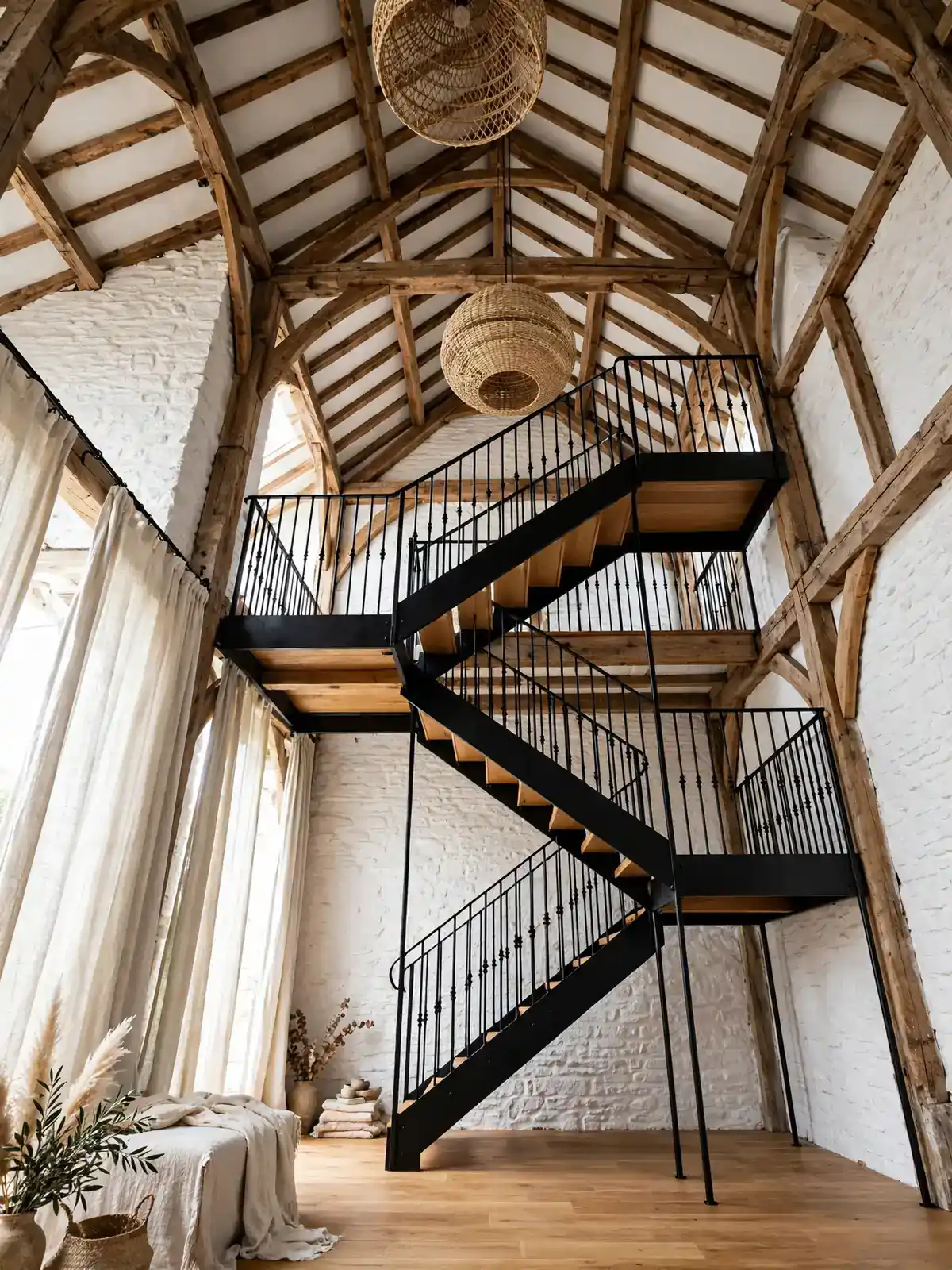
In a converted barn, the stair has to hold its own against double-height ceilings and massive timber beams — and a tall iron stair does exactly that. Imagine a straight black iron flight rising 5 metres to a galleried landing, with simple vertical balusters, honey oak treads, and a woven pendant light hanging beside it. The whitewashed stone walls keep the space bright, while the black iron gives the soaring room a strong vertical anchor.
Quick tips:
- Run the balustrade all the way to the galleried landing for safety.
- Use a landing light at mid-height, not just at the top.
- Keep treads in warm timber to balance the barn’s stone and iron.
- Check the stair’s fixings against the barn’s structure early — old walls vary.
A Curved Iron Staircase That Sweeps Around a Central Column
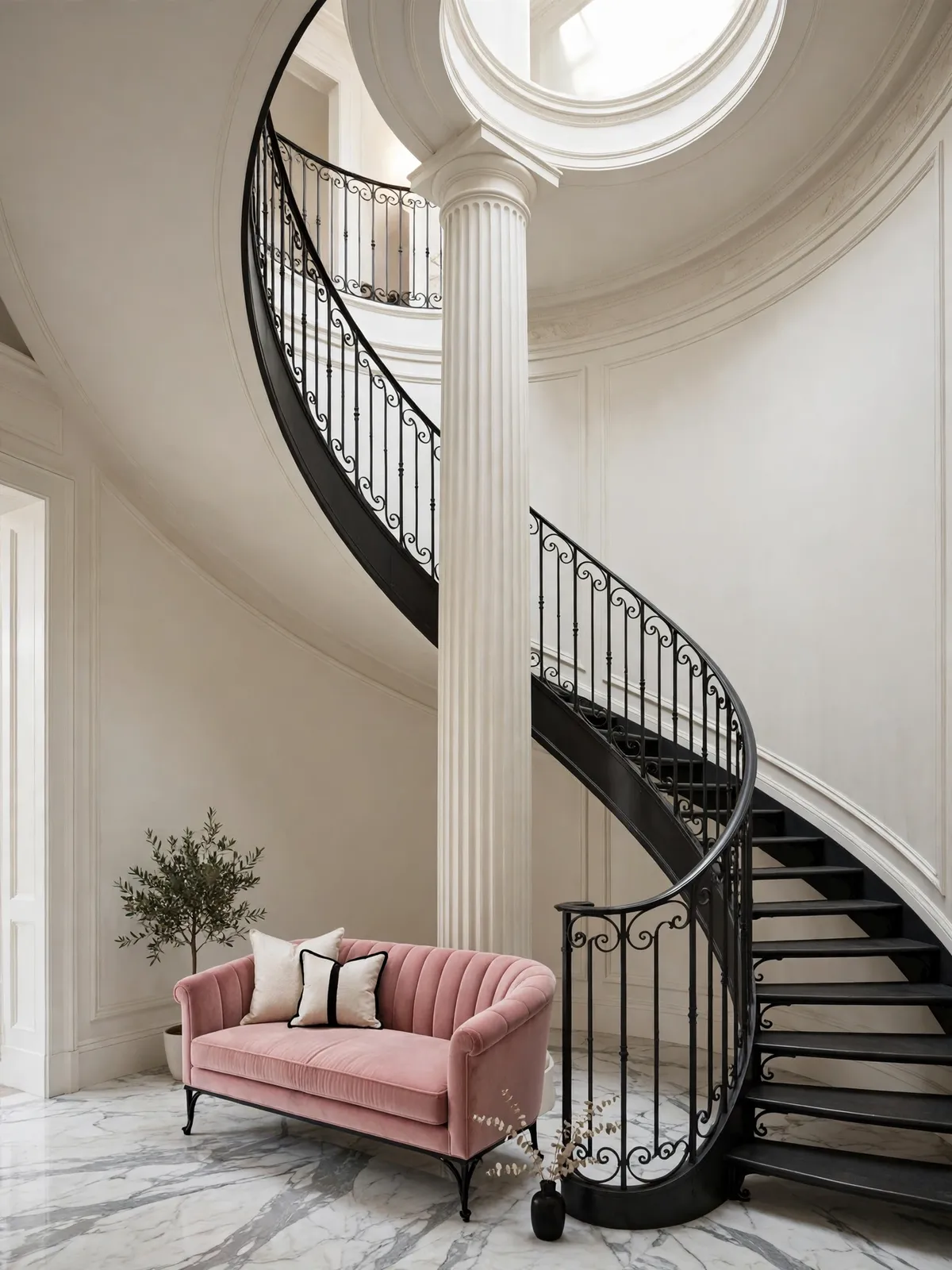
A curved iron staircase sweeping around a central column is the most graceful iron stair shape, and it suits grand entries and double-height halls. Visualise a gentle curve of 20 black iron balusters following a fluted central column, with polished marble treads, ivory plaster walls and a rose pink velvet bench at the base. The curve slows you down as you climb, the column gives the stair its structure, and the whole arrangement feels calm and classical.
Quick tips:
- Commission the curve from a specialist — bending iron evenly takes skill.
- Keep the central column slim so the curve feels open, not heavy.
- Use a continuous handrail with no joints for a smooth sweep.
- Place a bench or console at the base to anchor the curve in the room.
LED Step Lights Set Into Iron Stair Risers
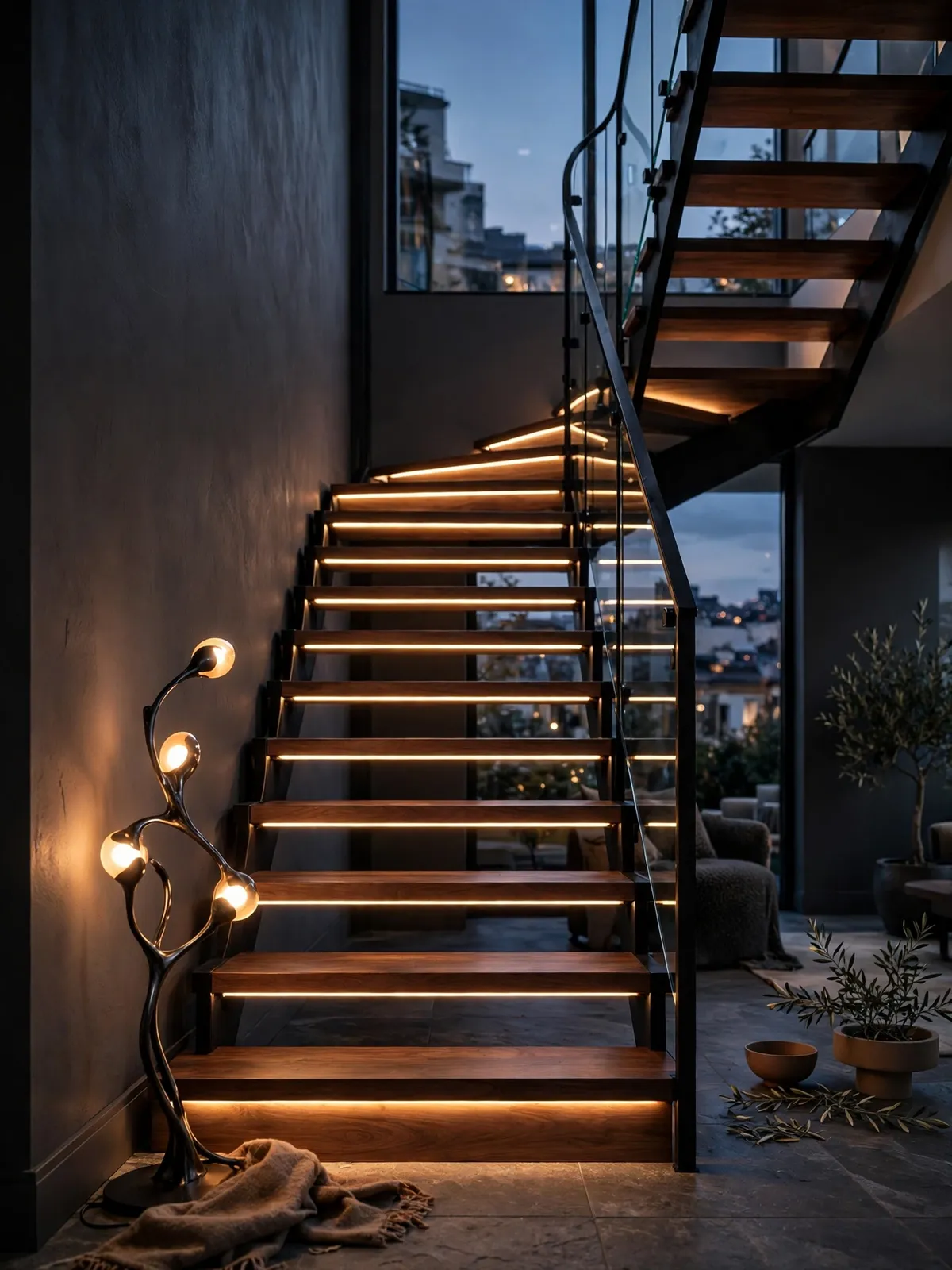
LED lights set into iron risers turn a stair into a safe, glowing path after dark — and they look spectacular. Picture a straight flight of walnut treads on a black iron frame, each riser fitted with a slim warm-white LED strip, glowing softly against a charcoal wall with glass balustrade panels. The light washes each tread, so every step is visible, and the stair becomes the room’s evening feature without a single extra lamp.
Quick tips:
- Choose warm white LEDs, around 2700K, for a cosy rather than clinical glow.
- Put the lights on a motion sensor or dimmer for easy control.
- Recess the strips so the light source itself is never visible.
- Keep a spare driver accessible — it is the part most likely to need replacing.
Aged Copper Iron Finishes for a Rich, Earthy Warmth
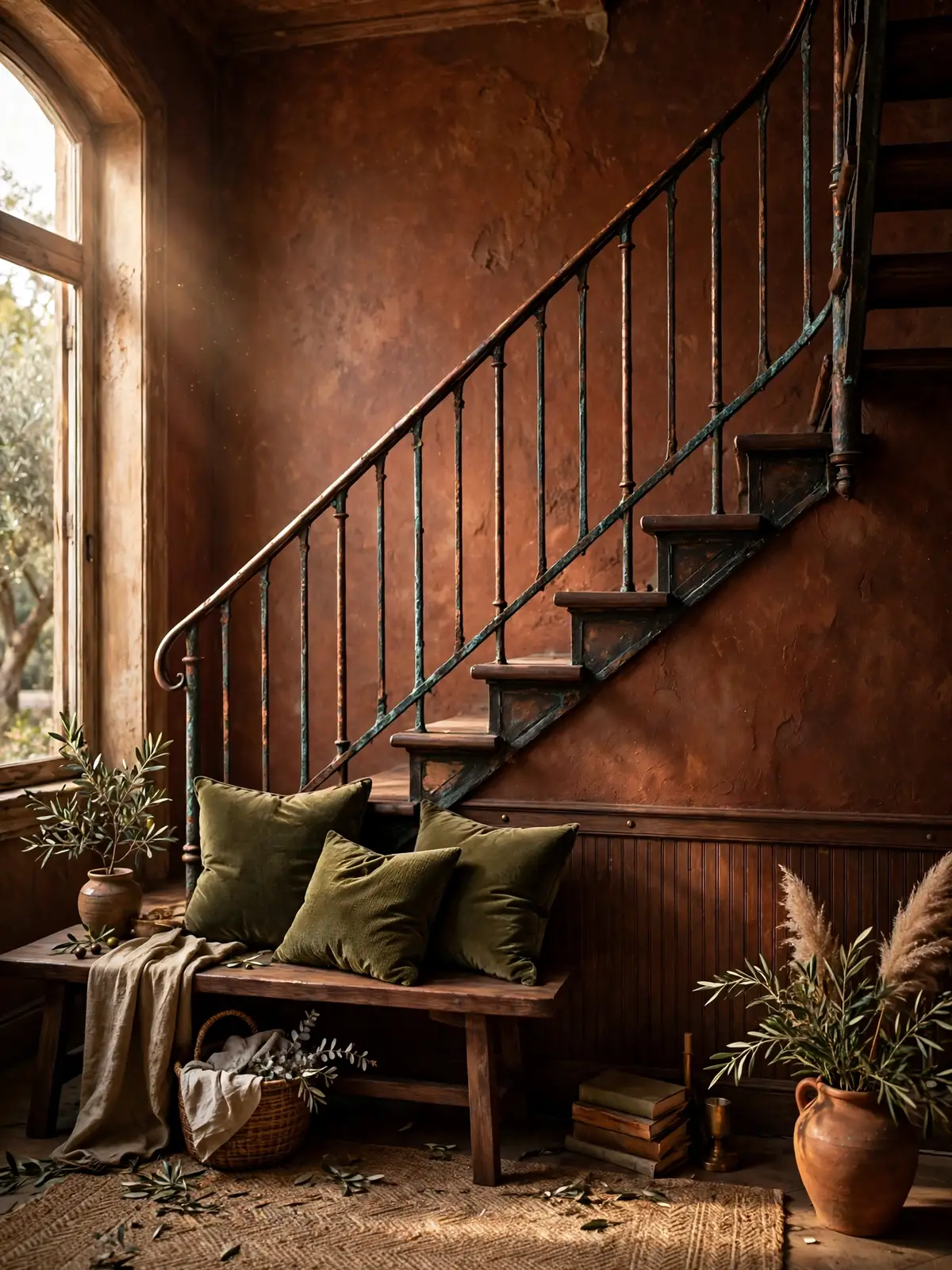
An aged copper finish gives iron a warmth that black paint never can — a soft, mottled glow that changes with the light. Imagine a straight stair with copper-patinated balusters and handrail, dark walnut treads, and a rust-coloured plaster wall behind it, with olive green velvet cushions on a bench at the foot. The copper reads as old and handcrafted, so the stair suits earthy, artisan and Mediterranean-style rooms beautifully.
Quick tips:
- Seal a copper patina with lacquer so it does not rub off on hands.
- Pair copper iron with walnut, rust and olive for a cohesive earthy room.
- Keep the wall texture simple so the patina stays the focus.
- Test a sample in your light first — patina shifts dramatically by room.
Iron Railings Mixed With Stone Steps
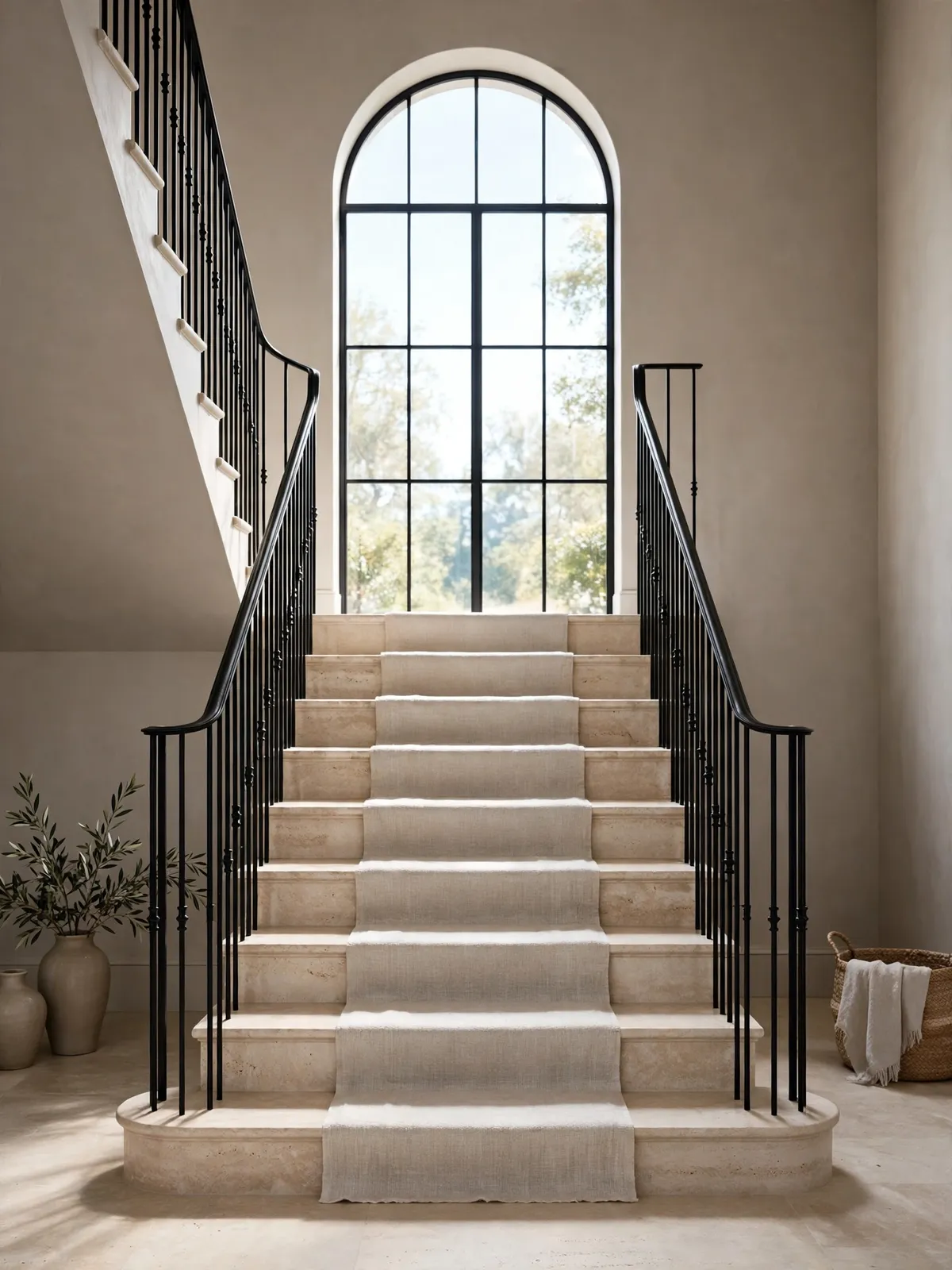
Iron and stone are a classic pairing: the stone gives the stair weight and permanence, while the slim iron railing keeps it from feeling heavy. Picture a wide flight of honed travertine steps, each 1.1 metres across, with a slim black iron balustrade and a simple flat handrail, rising toward a large arched window in a taupe-walled hall. A pale linen runner softens the stone underfoot, and the whole stair feels like it has always belonged in the house.
Quick tips:
- Hone the stone, don’t polish it, so the treads are not slippery.
- Keep the iron railing slim so the stone stays the dominant material.
- Seal travertine treads to protect them from stains.
- Use a runner if the household includes children or older relatives.
A Double-Rail Iron System for Safety and Style
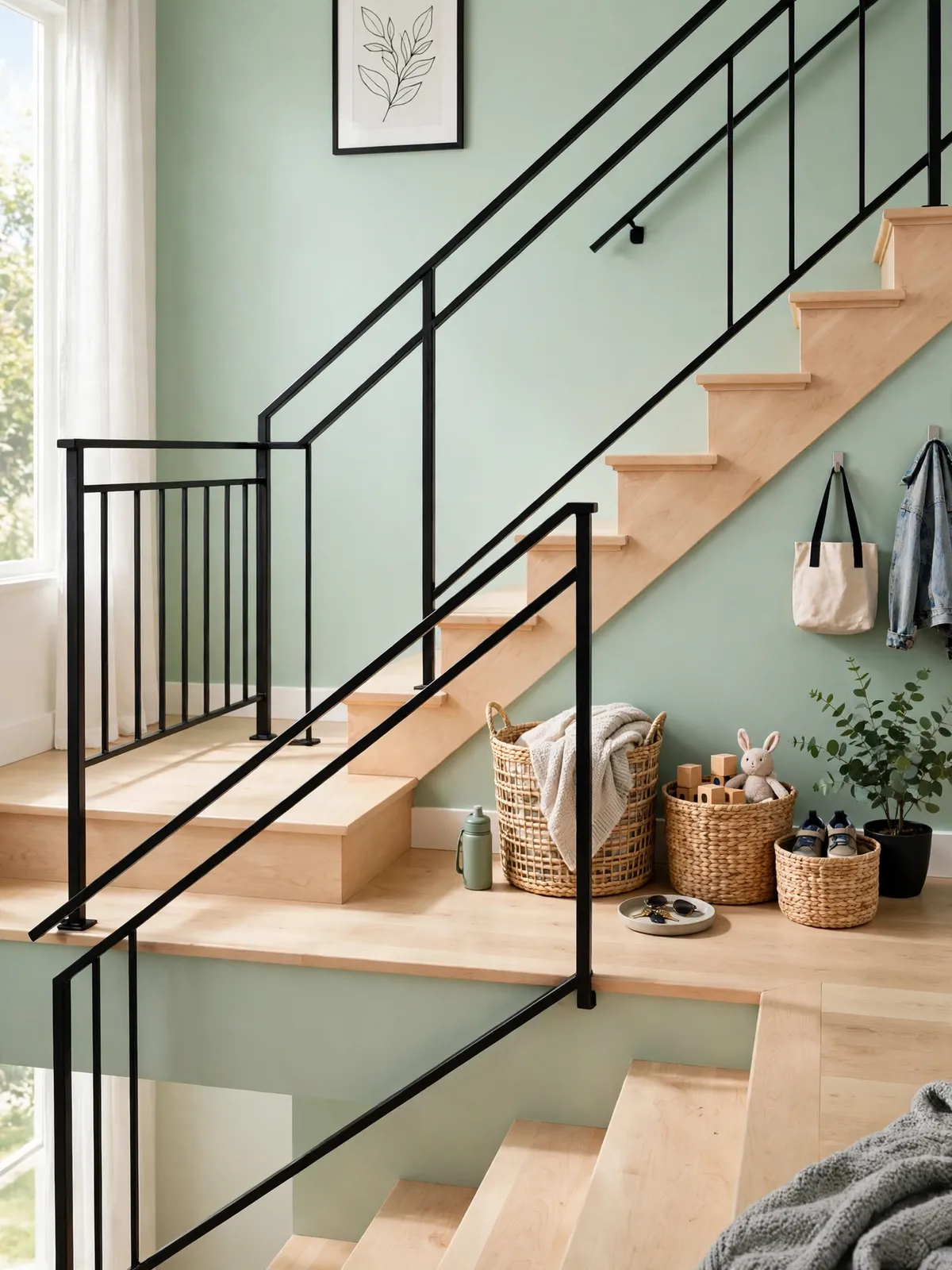
A double-rail iron system puts two handrails at different heights on the same balustrade — one for adults, one for children — and it looks intentional rather than improvised. Imagine a family stair with pale maple treads, a soft mint wall, and black iron rails at 900 mm and 600 mm, so a four-year-old can hold on comfortably while an adult uses the upper rail. The lower rail doubles as a design line, and the stair is genuinely safer for every age.
Quick tips:
- Set the lower rail between 550 and 650 mm for young children.
- Keep both rails in the same finish so they read as one system.
- Add a child-height rail on the landing balustrade too.
- Check the lower rail does not create a climbing foothold for toddlers.
A Slim Iron Staircase Designed for a Small Space
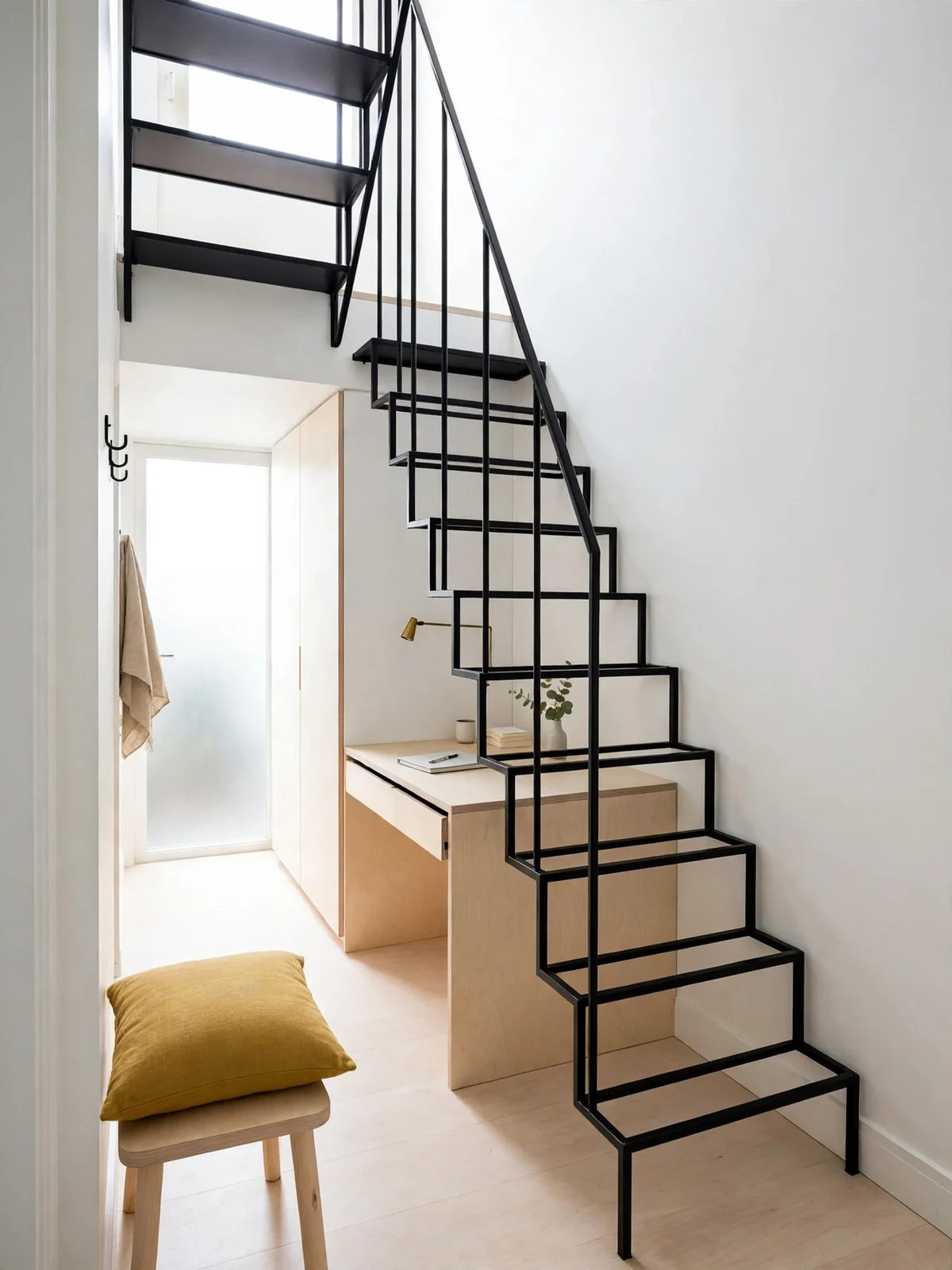
A slim iron staircase is the answer for a small home, because iron’s strength lets the stair be far narrower and lighter than a timber one. Picture a 750 mm wide open-riser stair in a compact apartment, with thin black iron stringers, pale birch treads, and a tiny built-in desk tucked underneath the flight. A mustard yellow cushion on a stool adds one warm accent. The stair takes up barely a metre of floor, and the space beneath it works hard instead of going to waste.
Quick tips:
- Keep the width at 750 to 800 mm for a comfortable but compact climb.
- Use open risers so light passes through and the stair feels lighter.
- Build storage or a desk under the flight — never waste that space.
- Choose a pale tread to keep a narrow stairwell feeling bright.
Iron Railings Layered With Wood Accents for Depth
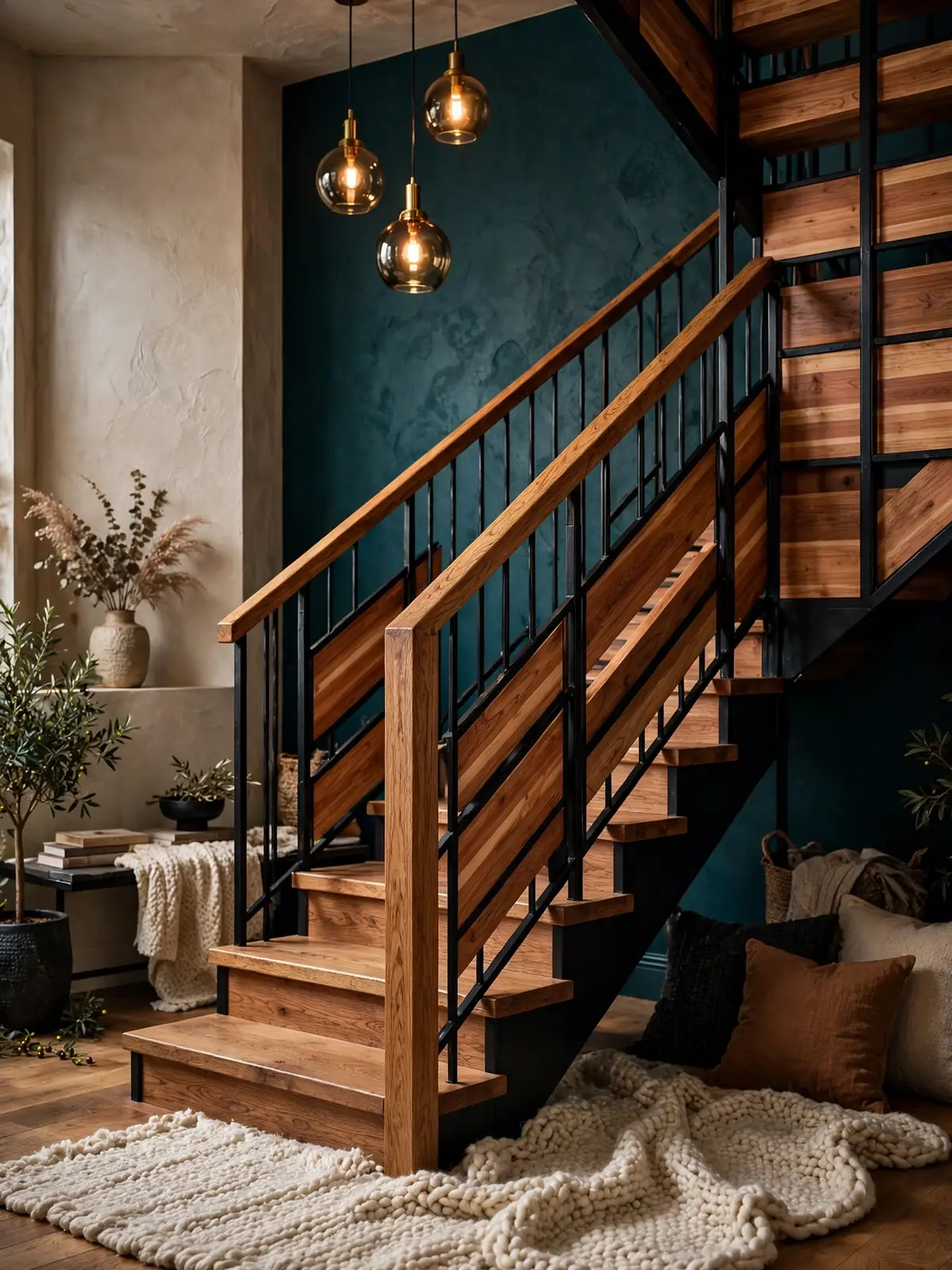
Layering wood accents over iron railings adds depth: the iron gives structure, the wood gives warmth, and the two together feel richer than either alone. Imagine a stair with black iron balusters, cedar wood panels fitted behind the lower balustrade, a chunky oak handrail, and a deep teal feature wall. A cream wool rug at the base softens the landing. The cedar panels make the stair feel solid and private, while the open upper balusters keep the light moving.
Quick tips:
- Use the wood panels only on the lower half so the stair stays airy.
- Match the handrail timber to the panels for a layered, deliberate look.
- Keep the wall colour deep so both materials stand out against it.
- Seal cedar panels to prevent them drying out near radiators.
An Iron Staircase With a Wrought Iron Gate at Its Foot
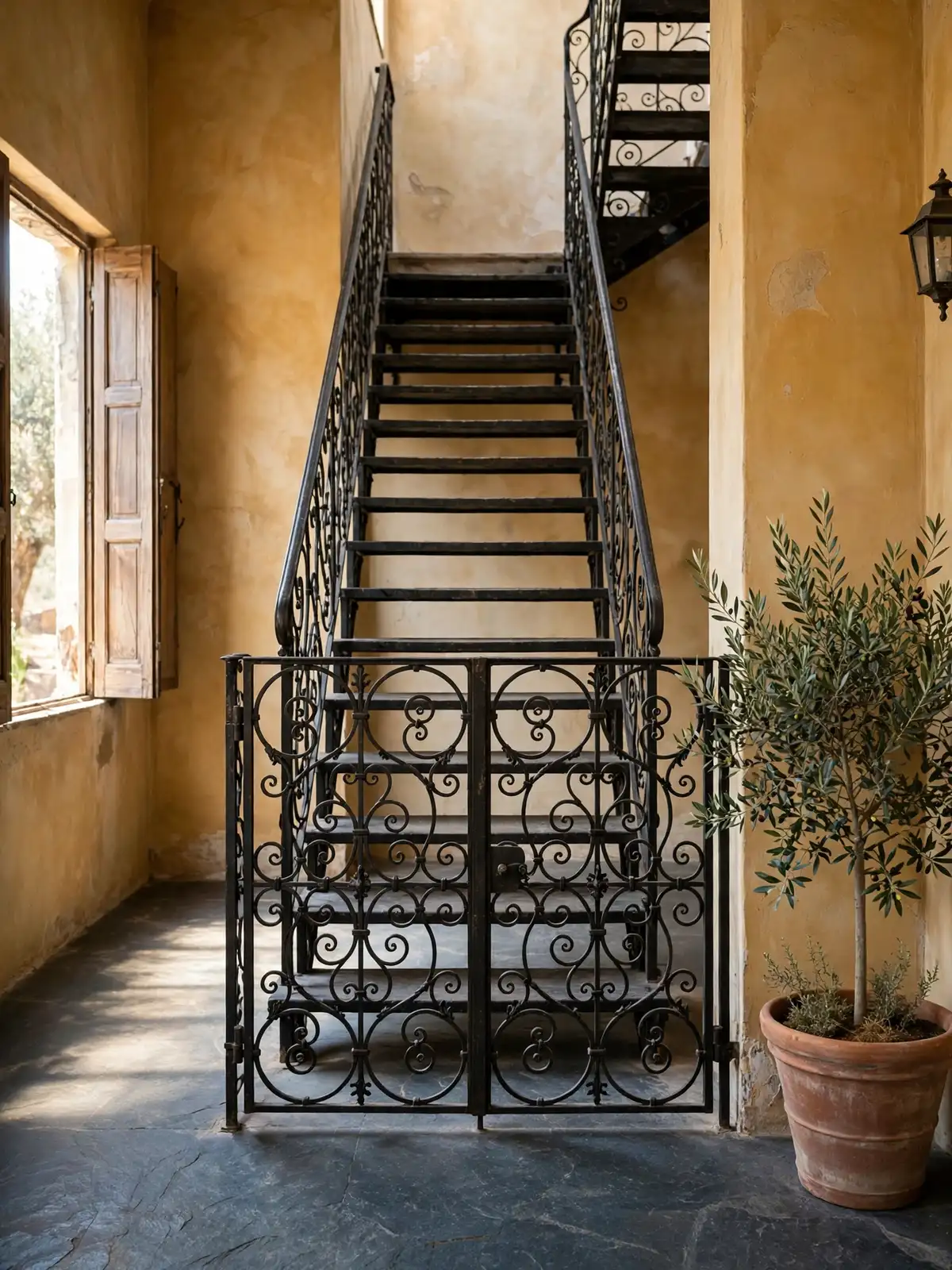
A wrought iron gate at the foot of the stair is both practical and romantic: it keeps toddlers and pets safely upstairs, and it gives the entry a crafted, old-world character. Picture a straight stair behind a scrolled black iron gate with a simple latch, set against warm ochre walls and a dark slate floor, with a terracotta pot holding a green olive tree beside it. The gate can stand open most of the day and close at night, and it turns the stair into a small architectural moment.
Quick tips:
- Fit the gate with a latch an adult can open one-handed.
- Keep the gate’s scrollwork in the same style as the balusters.
- Make sure the gate opens fully flat against the wall when not in use.
- Choose a gate height of at least 900 mm for real child safety.
An Iron Staircase With a Rustic Timber Landing
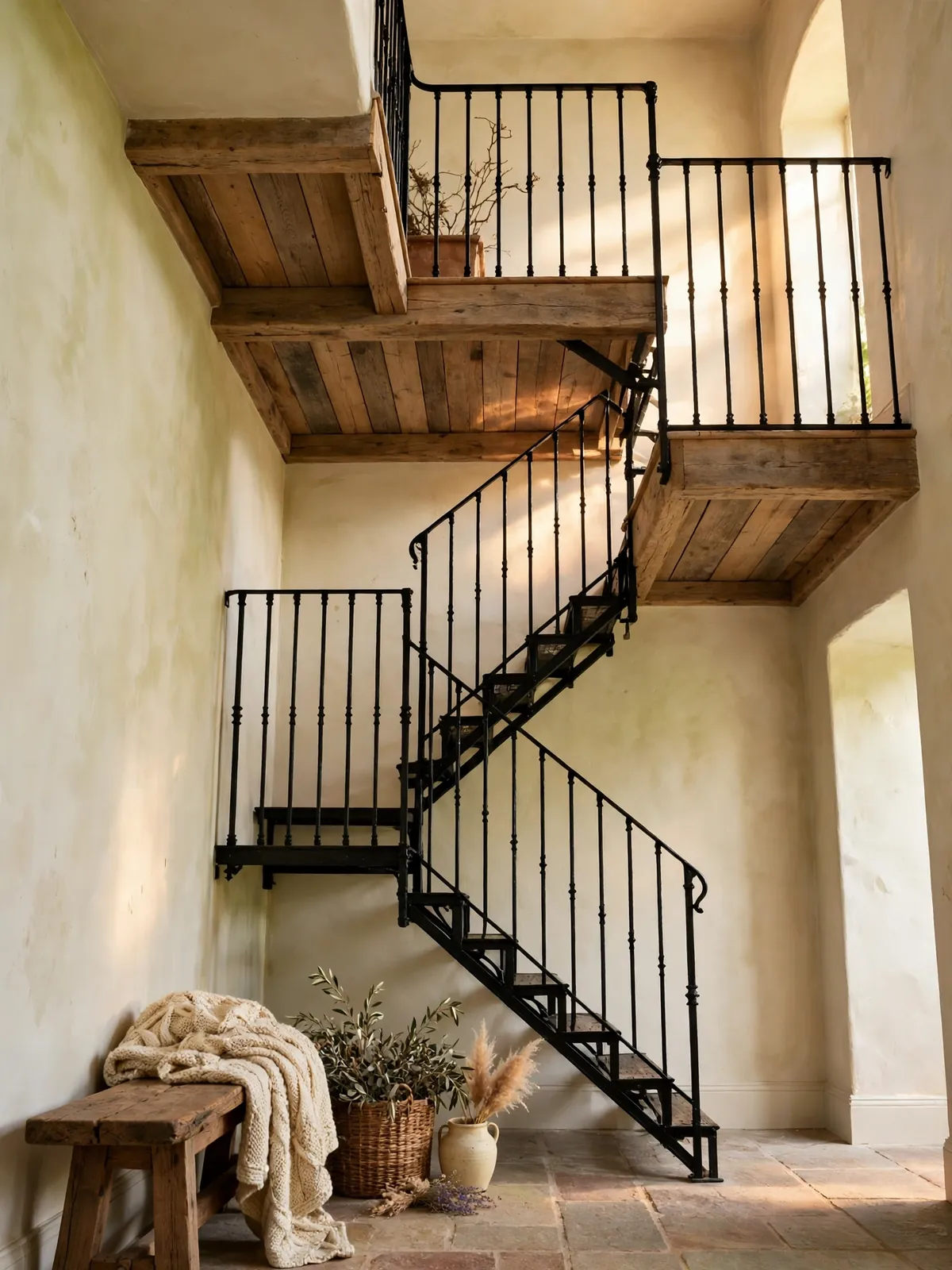
A rustic timber landing gives an iron stair somewhere warm to arrive: wide reclaimed oak planks, a chunky knitted throw on a bench, and cream limewashed walls. Imagine climbing a black iron stair with simple balusters and arriving at a landing of 200 mm wide reclaimed oak boards, worn smooth by years of use, with a bench and a woven basket waiting there. The iron feels crisp and modern by contrast, and the landing feels like a small room of its own rather than a corridor.
Quick tips:
- Use reclaimed planks at least 25 mm thick so the landing feels solid.
- Oil the landing boards so they age gracefully under foot traffic.
- Add a bench and a basket to make the landing a usable pause point.
- Keep the iron balusters plain so the timber landing stays the feature.
An Iron Staircase With a Library Wall Alongside
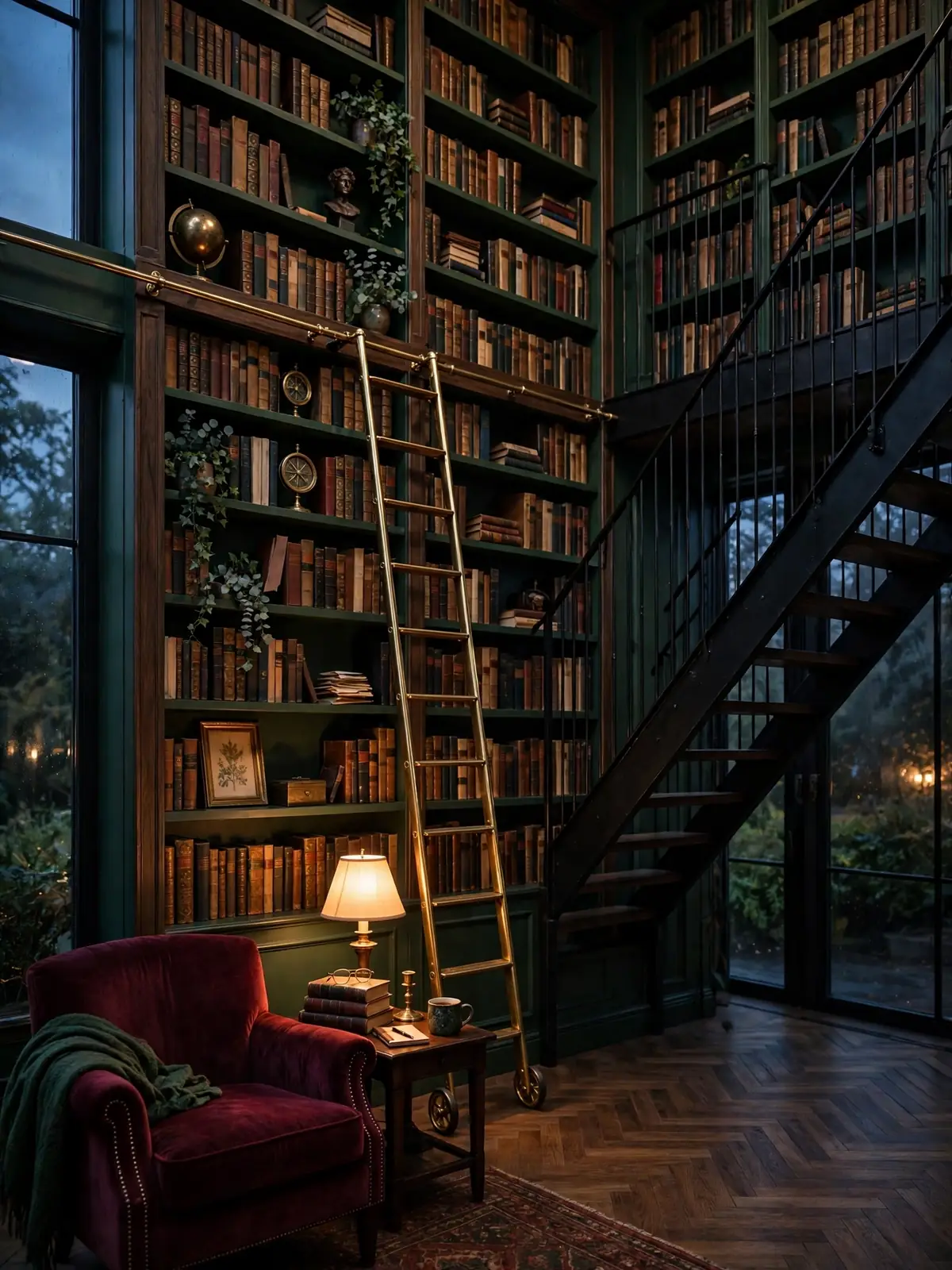
A library wall alongside an iron stair turns a circulation space into a reading room: shelves climb with the stair, and every step passes books. Picture a straight black iron stair rising beside a full-height wall of dark wood shelves painted forest green, filled with books, with a brass library ladder and a burgundy armchair waiting at the base. A warm reading lamp glows on the landing. The iron stays slim so the books dominate, and the stair becomes the best seat in the house.
Quick tips:
- Build the shelves to follow the stair’s slope for a fitted look.
- Keep the iron railing slim and dark so it never fights the books.
- Add a reading lamp at the landing, not just overhead light.
- Leave one shelf near the stair for books you are currently reading.
An Iron Staircase in a Farmhouse Entry With Shiplap Walls
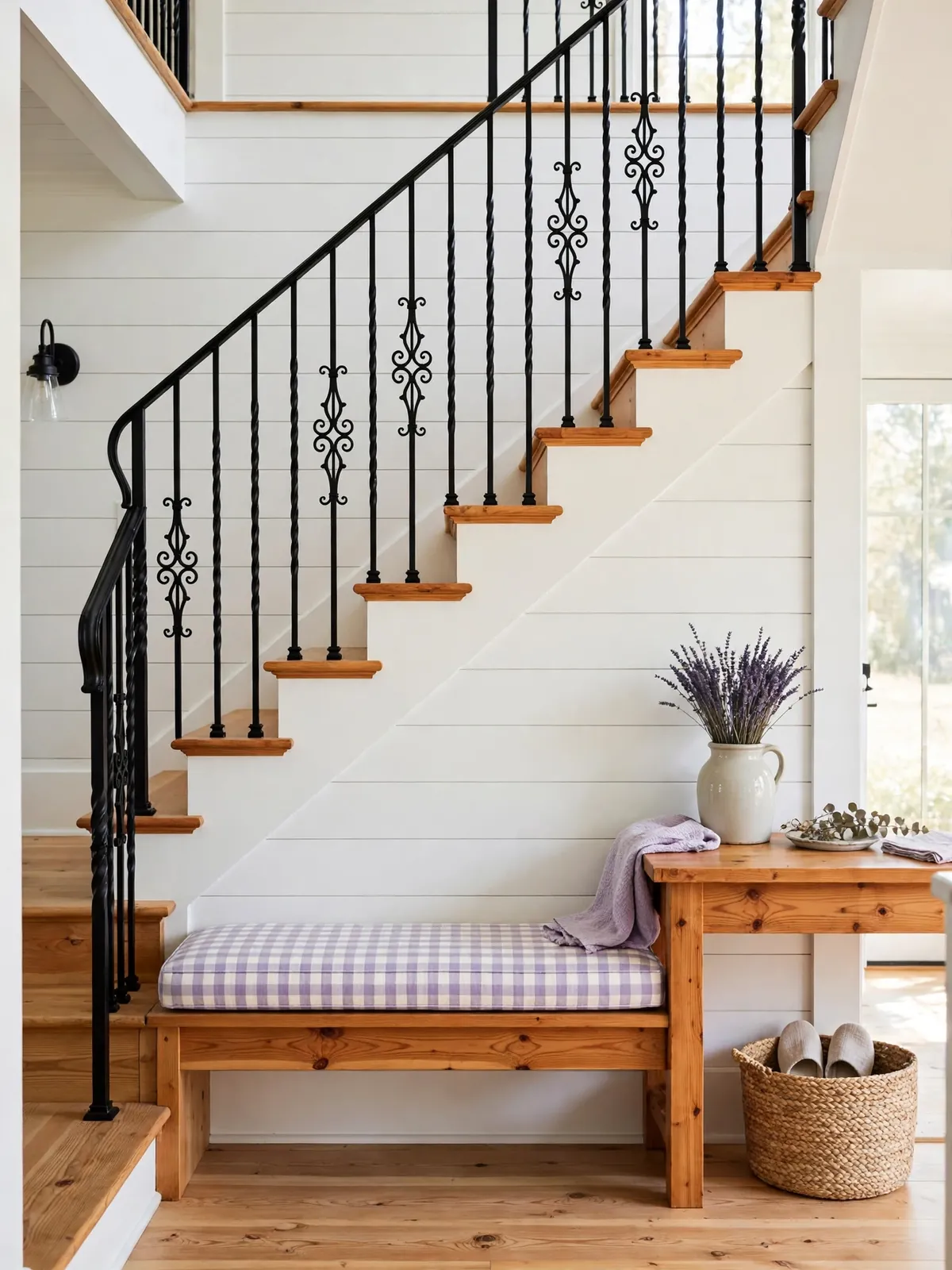
In a farmhouse entry, a black wrought iron stair against white shiplap is a perfect match: the shiplap keeps the room bright and relaxed, while the iron adds the structure a farmhouse needs. Imagine a straight stair with classic wrought iron balusters, warm pine treads, white shiplap walls, a gingham bench cushion at the foot, and dried lavender in a jug on the console. The stair feels traditional without being formal, and it suits muddy boots as well as Sunday best.
Quick tips:
- Choose simple wrought iron balusters rather than ornate scrolls for a farmhouse feel.
- Use pine or oak treads for warmth against the white shiplap.
- Add a bench and hooks at the foot for coats and shoes.
- Keep the shiplap painted a warm white, not a cold blue-white.
An Iron Staircase With a Bold Colour-Painted Riser Wall
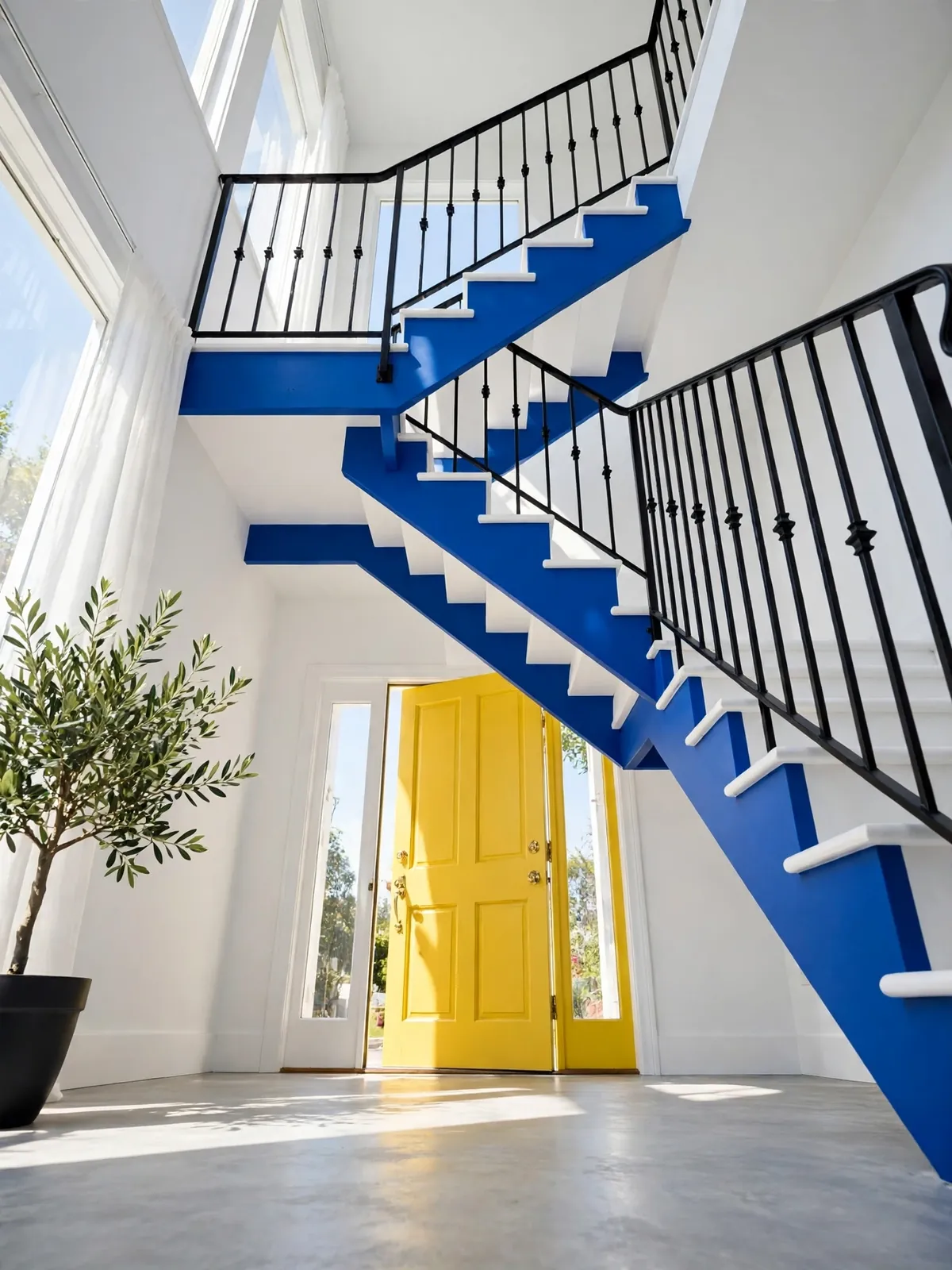
Painting the riser wall a bold colour is the cheapest way to make an iron stair unforgettable: the iron stays black and simple, and the colour does all the talking. Picture a straight stair with white treads and slim black railings rising against a cobalt blue riser wall, with a sunshine yellow front door visible at the foot and a pale grey floor. The blue makes the white steps pop, the yellow door adds a second surprise, and the whole entry feels joyful the moment you walk in.
Quick tips:
- Pick one bold colour and commit — a timid blue will look like a mistake.
- Use a durable eggshell paint so scuffs wipe off easily.
- Keep treads white or pale so the colour wall stays the star.
- Echo the wall colour once more in the room, in a cushion or artwork.
An Iron Staircase That Leads to a Glass-Walled Home Office
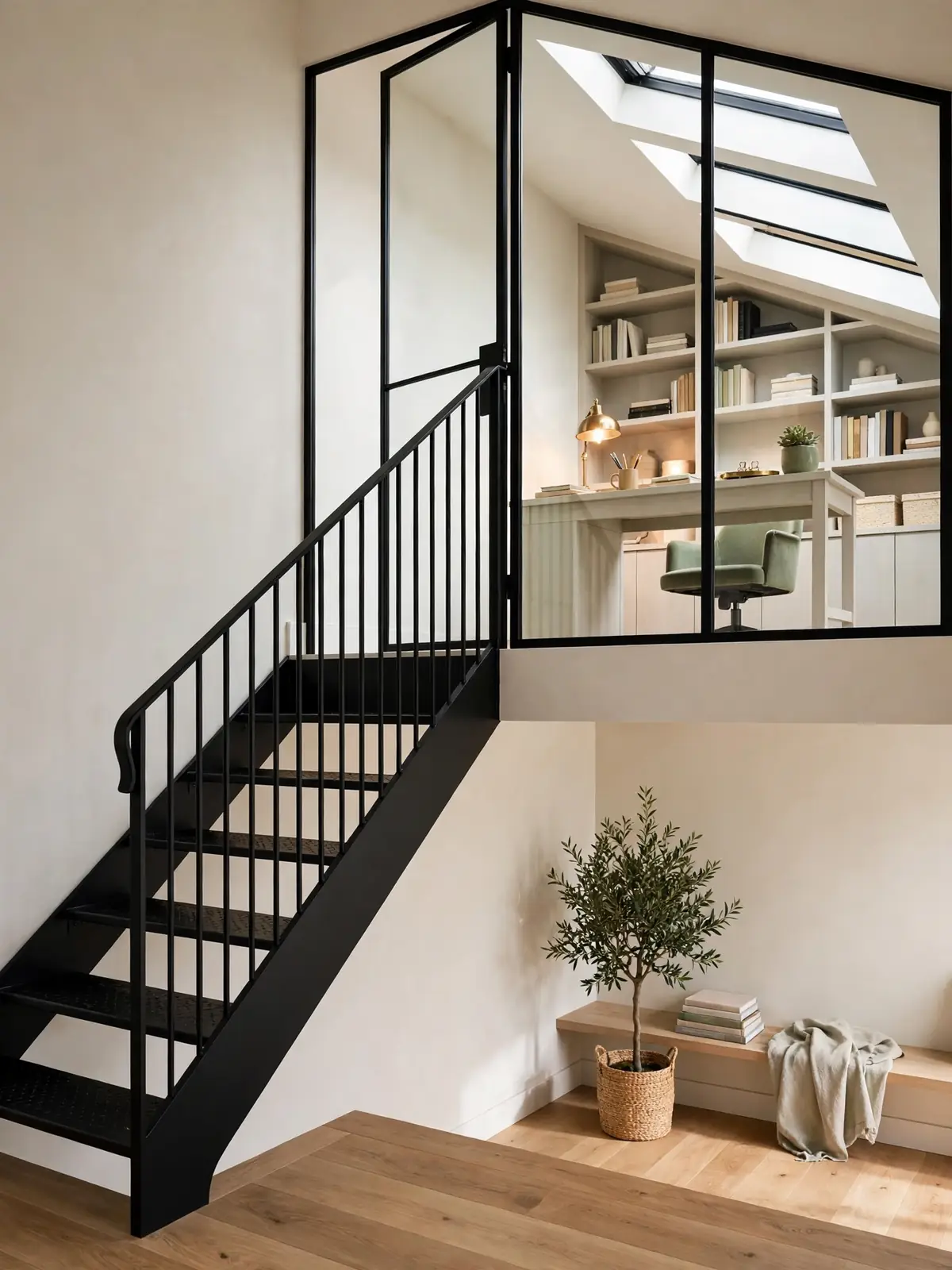
An iron stair leading to a glass-walled home office makes the journey to work feel designed: you climb a slim black iron flight and arrive at a bright, visible workspace. Imagine a straight stair with open risers and a slim black railing, rising to a landing where a glass wall reveals a pale ash desk, sage green chair and brass desk lamp inside the office. The glass keeps the office connected to the house, the iron keeps the stair light, and the whole arrangement suits a modern work-from-home household.
Quick tips:
- Use open risers so the stair does not block light to the office.
- Choose frosted glass on the lower office panels for privacy.
- Add a small landing shelf for books and chargers.
- Keep the office chair colour calm so the glass wall stays serene.
An Iron Staircase With a Statement Rug Runner in Deep Red
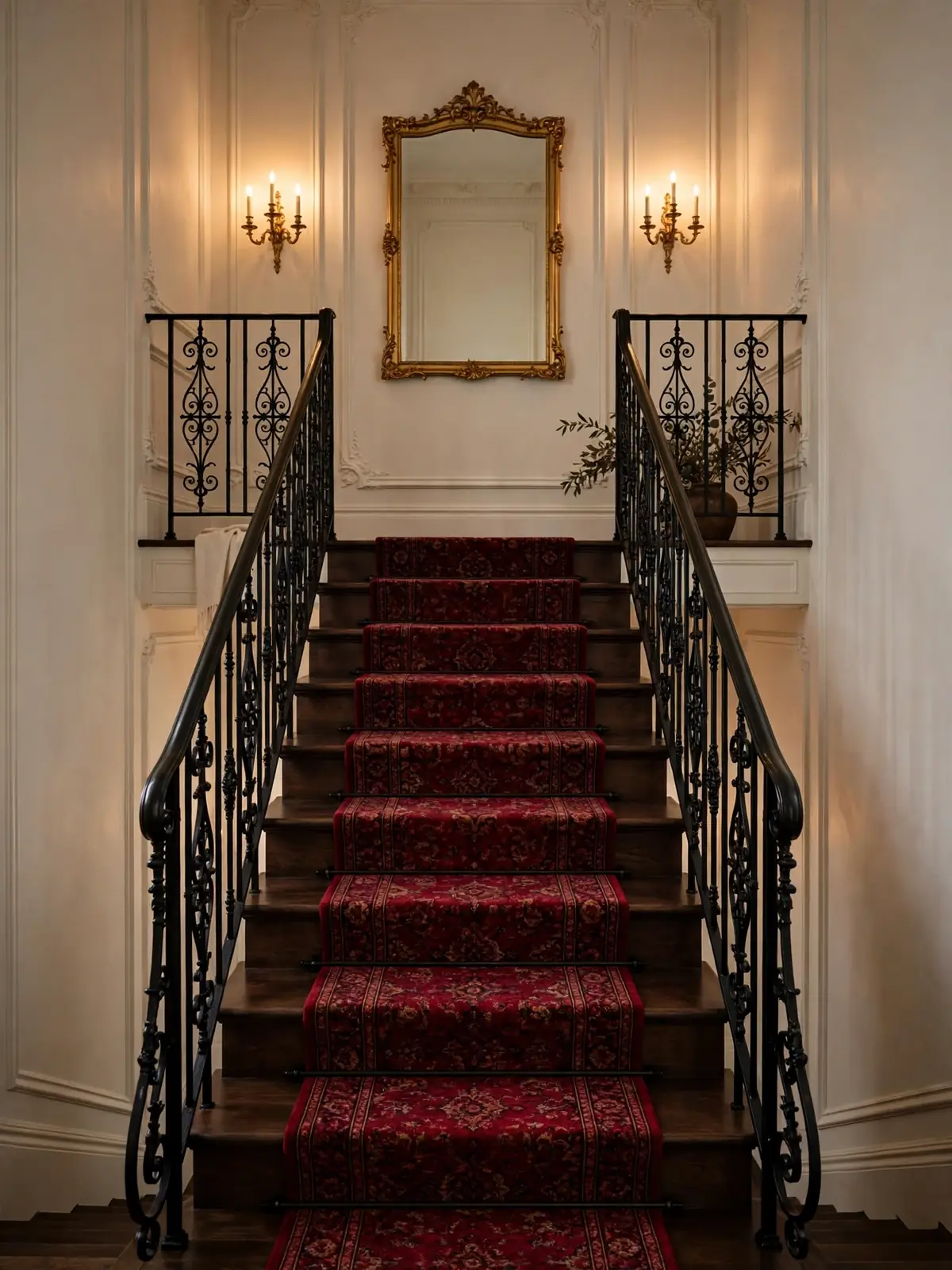
A deep red rug runner is the classic finishing touch for an iron stair: it softens the metal, quiets the footsteps, and adds a band of rich colour down the centre of the flight. Picture a straight stair with dark wood treads, slim black iron balusters, and a deep red patterned runner held by brass stair rods, rising toward a gold-framed mirror on the landing, with warm sconce light glowing on ivory walls. The runner makes the stair feel dressed and deliberate, like a grand hotel staircase in a family home.
Quick tips:
- Choose a wool runner — it wears better and grips the treads.
- Use brass stair rods to hold the runner and add a classic detail.
- Pick a pattern with a dark border so the edges hide wear.
- Vacuum the runner weekly and rotate it yearly for even wear.
FAQs
Is an iron staircase noisy to walk on?
An iron staircase can sound hollow or metallic if the treads are thin metal, but the noise is easy to control. Timber treads, a rug runner, or rubber pads under the treads all absorb sound, and a well-built iron frame with tight fixings will not rattle. If noise matters in your home, ask the fabricator about acoustic pads during the build rather than trying to fix it afterwards.
Can an iron staircase be installed in an existing home?
Yes, an iron staircase can be retrofitted into most existing homes, and it is often easier than a timber stair because the iron frame is made off-site and assembled in place. The installer will need accurate measurements of the opening, the floor-to-floor height, and the wall structure for fixings. Straight and L-shaped iron stairs retrofit most easily, while spiral and curved designs need more precise site measurements.
How do I keep an iron staircase from rusting indoors?
Indoor iron stairs rarely rust if the finish is intact, because the main cause of rust is moisture. Keep the stair dry, wipe up spills promptly, and touch up any chips in the powder coating or paint as soon as they appear. In humid rooms such as a basement entry or a pool house, choose a galvanised or stainless base under the finish for extra protection.
What handrail height should an iron staircase have?
The handrail on an iron staircase is usually set between 900 mm and 1000 mm above the tread nosing, which is a comfortable height for most adults. The exact height depends on local building rules, so check the requirement in your area before ordering. A second lower rail for children, as in the double-rail idea above, is a practical addition for family homes.
Does an iron staircase add value to a home?
An iron staircase can add value when it is well designed and suits the house, because buyers notice a striking stair and associate it with quality. A cheap or poorly fitted iron stair can do the opposite, so the value comes from the design, the finish and the fit with the rest of the home rather than from the iron alone. Choose a design that matches the house’s style and have it installed by a specialist.
Conclusion
An iron staircase is far more than a way to get upstairs: it is a piece of architecture that can set the tone for a whole home. The 25 ideas in this guide show how the same material can be minimal or ornate, industrial or farmhouse, bold or almost invisible — and the right choice is always the one that fits the room it lives in. Start with the style of your home, pick a finish and a tread material that work with it, and use one concrete detail — a live-edge handrail, a copper patina, a deep red runner — to make the stair yours. Done well, an iron staircase will be the feature people remember long after they have forgotten the rest of the room.