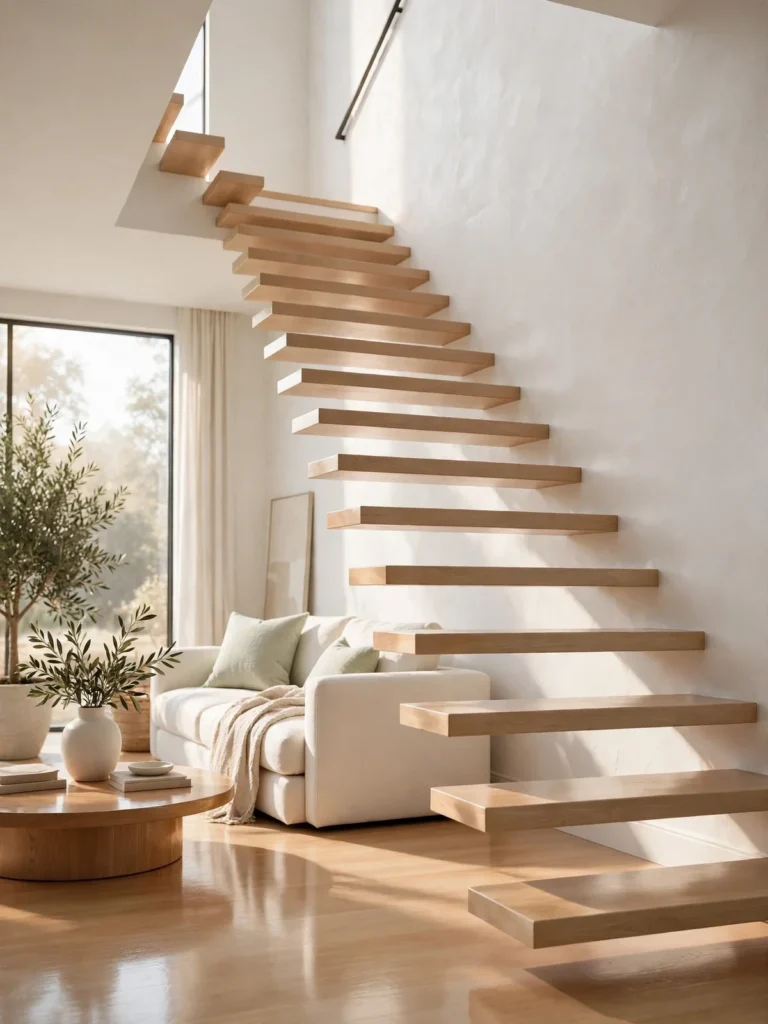
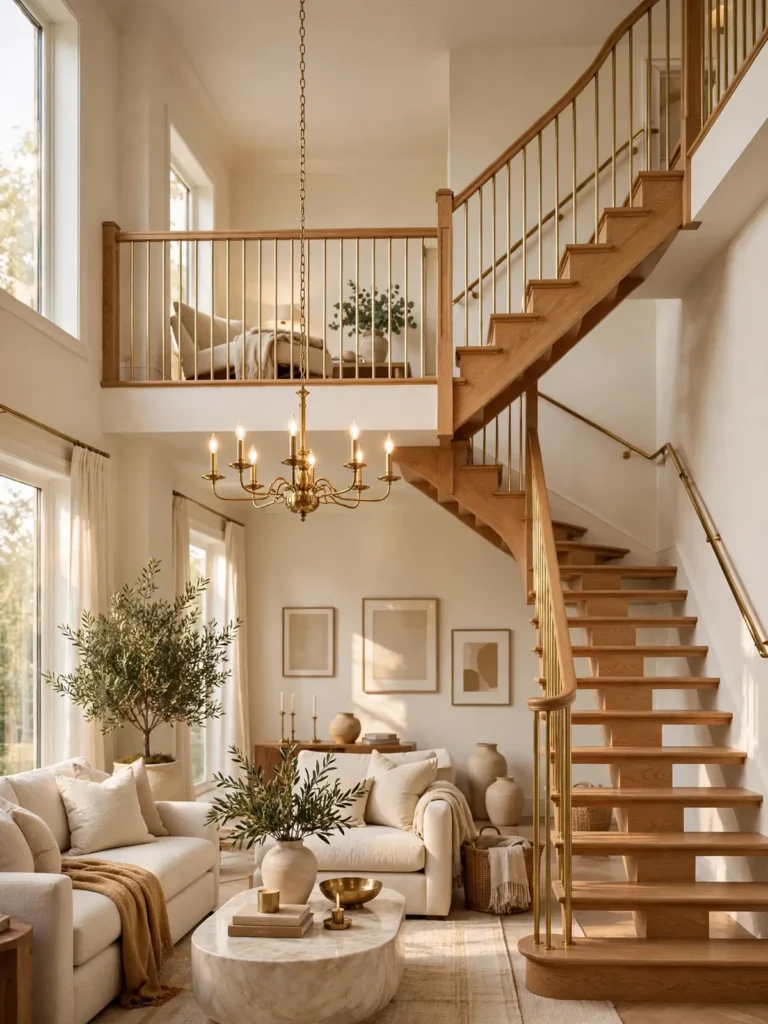
25 Stunning Metal Staircase Ideas That Instantly Make Your Home Look Modern, Expensive and Put Together
A metal staircase does more than carry you between floors — it adds strength, slim lines and modern character to the whole home. These 25 ideas show how steel, brass, copper and black metal pair with wood, glass, marble and light to make hallways brighter, rooms feel larger, and everyday movement feel calm and luxurious.
A metal staircase is a strong, slim stair built from steel, iron, brass, copper or aluminium, with treads in metal, wood, stone or glass and railings in rods, cables, panels or glass. It suits a modern home because its thin frame takes up less visual space than a solid timber stair, lets light pass through, and pairs easily with warm wood, soft plaster, marble or bold colour. Matte black feels graphic and modern, brushed brass and copper add warmth, and stainless steel stays cool and clean.
If you love the open, double-height feeling of a slim stair, these duplex staircase ideas show the same light-led approach on a larger scale. The ideas below cover the whole staircase — its shape, its finish, its setting, and the rooms around it — so you can choose a look that suits a compact entry, a bright loft, or a calm family home.
Key Takeaways
What makes a metal staircase a good choice for a modern home?
Its slim frame is strong without looking bulky, so it takes up less visual space than a solid stair, lets light pass through, and works with wood, glass, stone and bold colour.
Does a metal staircase suit a small home?
Yes — it is one of the best choices for a compact home, because open risers, slim rods and cable railings keep sightlines open and make a narrow hallway feel wider.
What materials pair best with metal on a staircase?
Warm oak or walnut treads, white marble, pale plaster, leather, brass details and clear glass all soften metal beautifully while keeping the look modern.
Is a metal staircase practical for a family home?
Yes, when it has a secure handrail, non-slip tread strips, closed or guarded gaps for small children, and a powder-coated or sealed finish that is easy to wipe clean.
Where should a metal staircase sit in the home?
Near a window, beside an open-plan living area, or in an entryway where its slim frame can carry daylight deep into the home and set a modern tone from the front door.
A Matte Black Metal Staircase With Warm Oak Treads
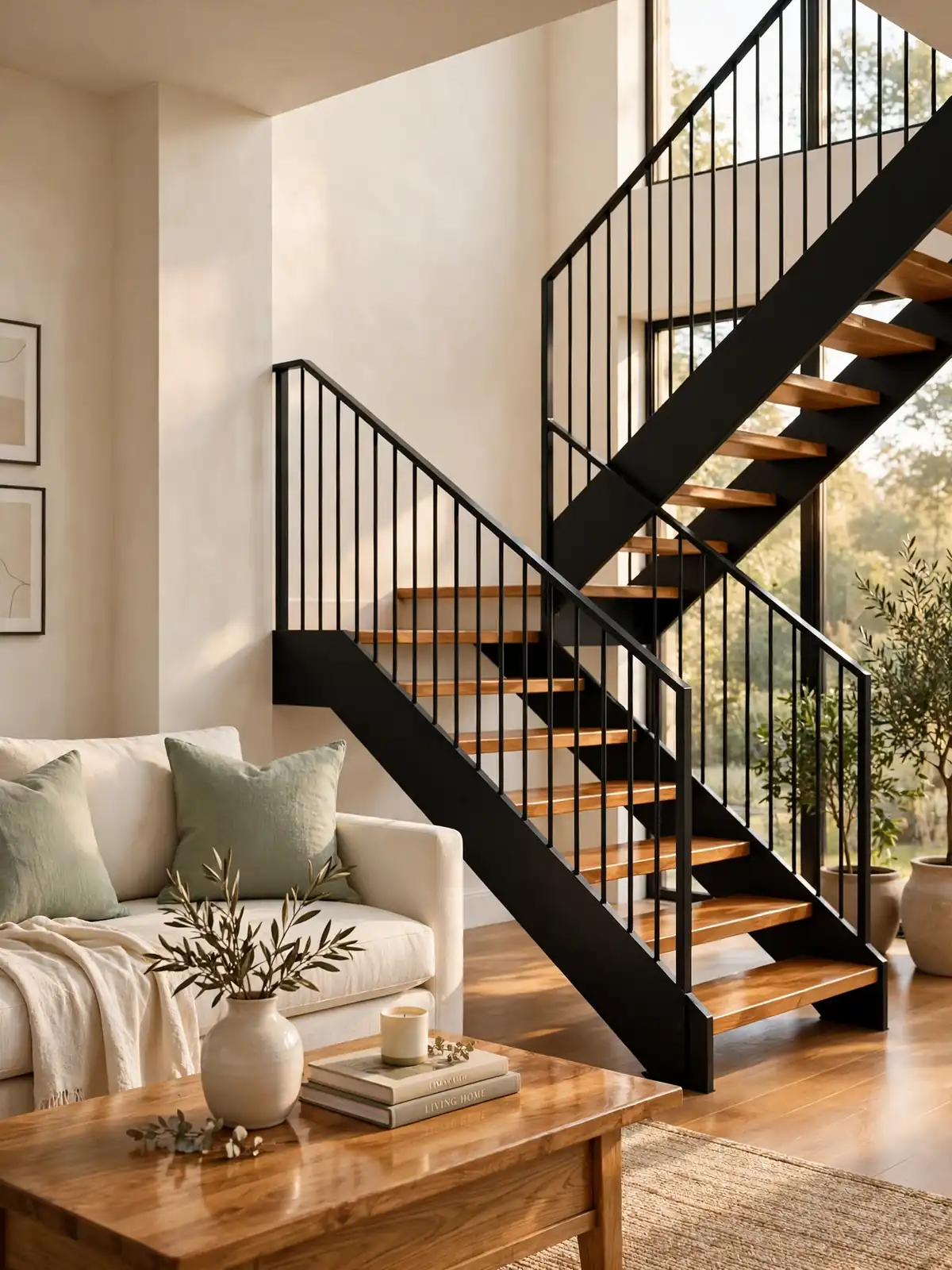
Matte black metal and warm oak are the classic pairing for a metal staircase because the black gives structure and the wood gives warmth. Picture a straight flight, 1 metre wide, with 40 mm thick oak treads, each 280 mm deep, set into a matte black steel frame with slim vertical rods spaced 100 mm apart. Below, a cream linen sofa and sage-green cushions echo the calm palette, while the oak grain is the decoration — no extra pattern is needed. From the sofa, the black frame reads as a series of clean lines, not a heavy block.
Quick tips:
- Choose matte black, not gloss black, for a softer modern finish.
- Match the oak tread tone to a timber sideboard or coffee table nearby.
- Keep the wall behind the stair pale ivory so the black frame stands out.
- Seal the oak treads well so they stay glossy and easy to clean.
Brushed Brass Accents on a Metal Staircase for Instant Warmth
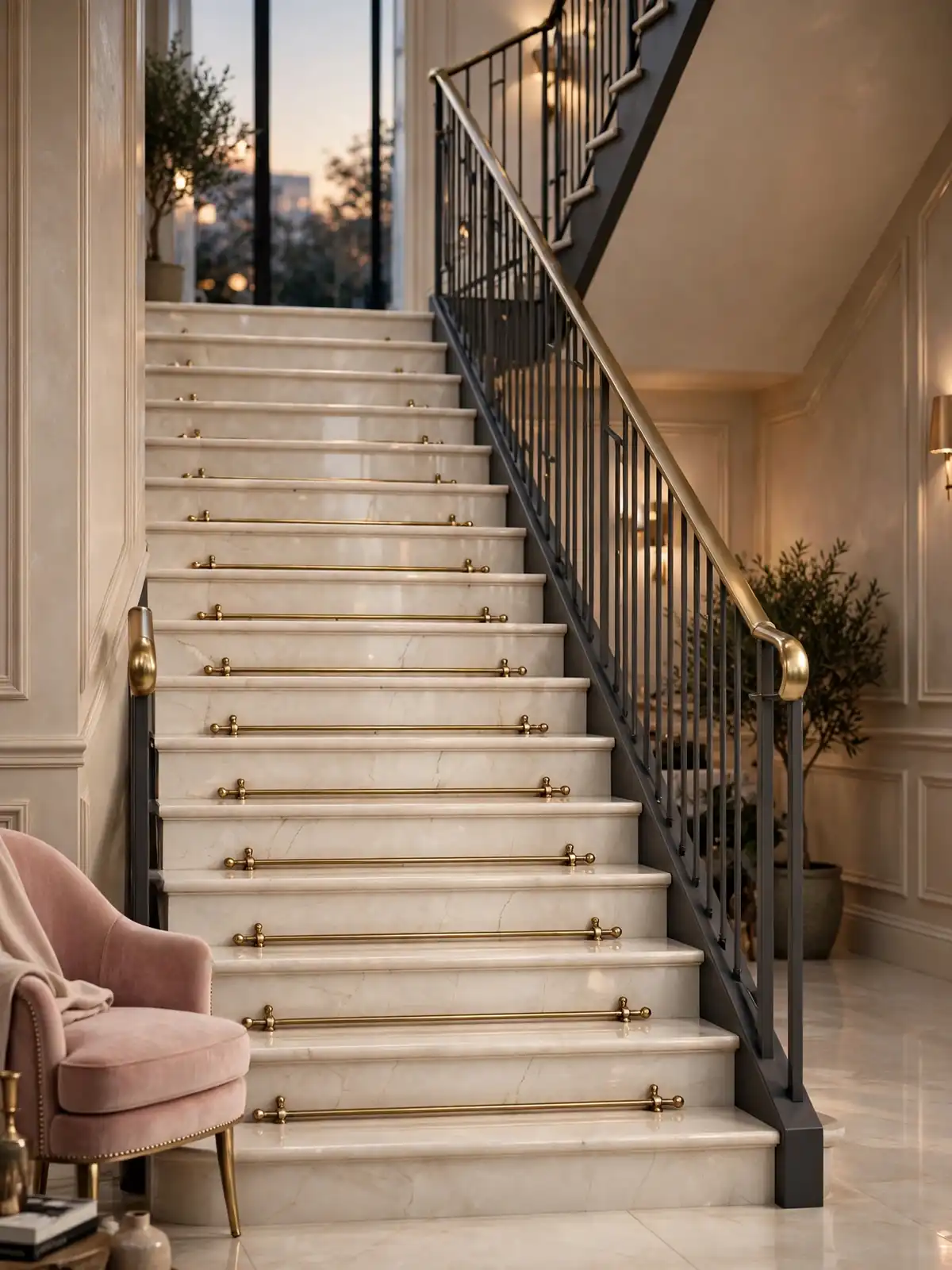
Brass is the quiet warmth that black or steel metal needs — just enough shine, never too much. On this stair, cream marble treads, each 900 mm wide and 30 mm thick, sit in a charcoal-grey steel frame topped by a slim brushed-brass handrail, with small brass clamps holding each vertical rod. The champagne-coloured walls and a blush-pink velvet chair add softness, while the brass catches the evening light and glows gently. It feels luxurious without feeling formal.
Quick tips:
- Use brushed brass, not polished brass, for a softer, modern shine.
- Keep brass to the handrail, caps and fixings — let the metal frame stay the star.
- Pair brass with cream marble or pale wood for warmth.
- Match the brass tone to a lamp or mirror nearby.
An Industrial Metal Staircase With Exposed Brick and Leather
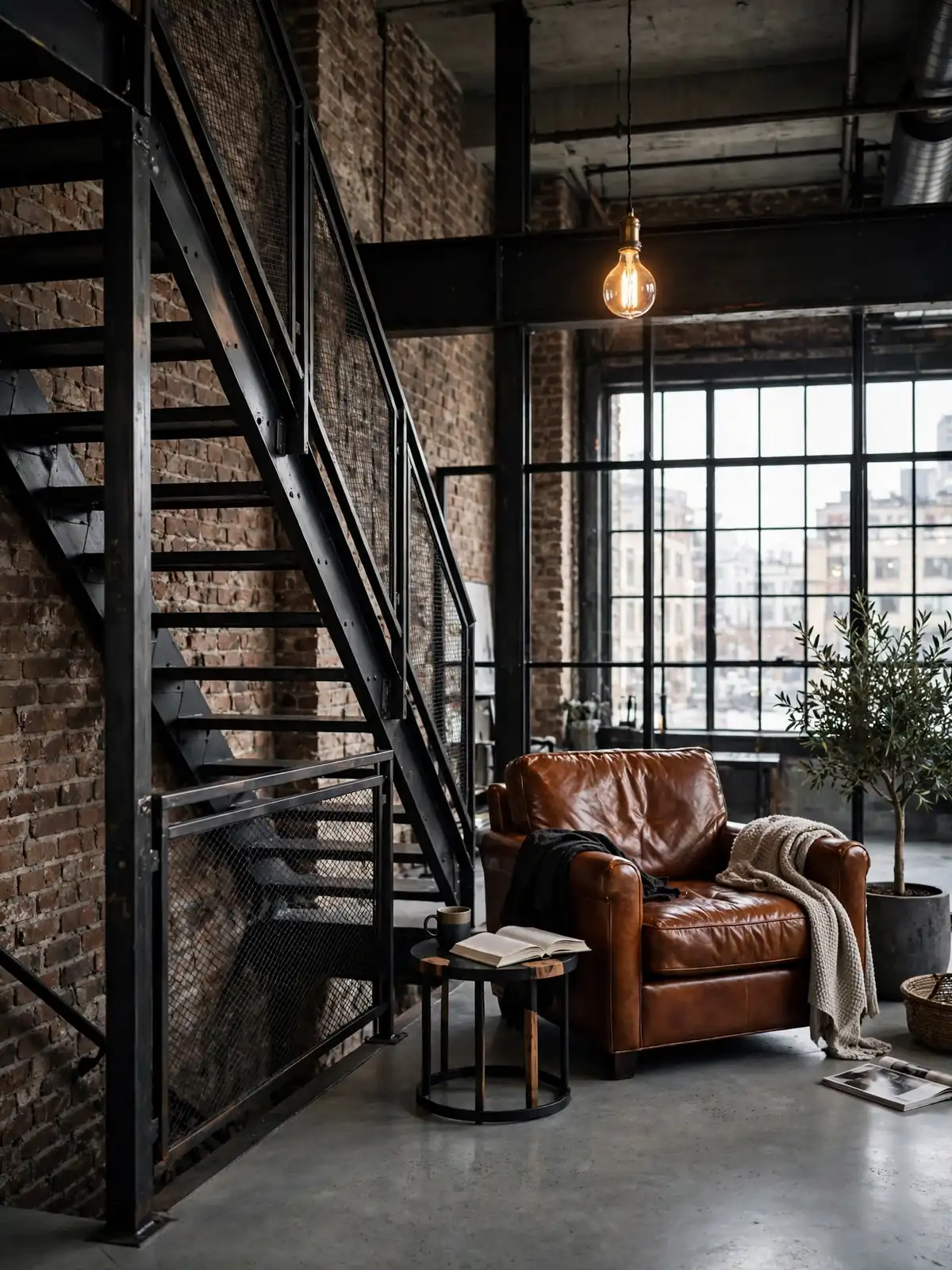
Raw steel softens beautifully against brick and leather, and together they suit a loft perfectly. Here, a straight flight of black steel treads, each 1 metre wide with a soft non-slip finish, rises beside a warm red-brown exposed brick wall, with a cognac leather armchair at the base and a warm Edison bulb pendant above. The black steel window frames tie the stair to the room, while daylight floods the polished concrete floor. The stair feels solid and lived-in at once.
Quick tips:
- Seal steel treads so they stay smooth and dust-free.
- Use black steel details to tie the stair to loft-style windows.
- Add one warm material, like cognac leather or timber, to soften the steel.
- Keep the floor the same polished concrete for a seamless look.
A White Powder-Coated Metal Staircase for a Small Hallway
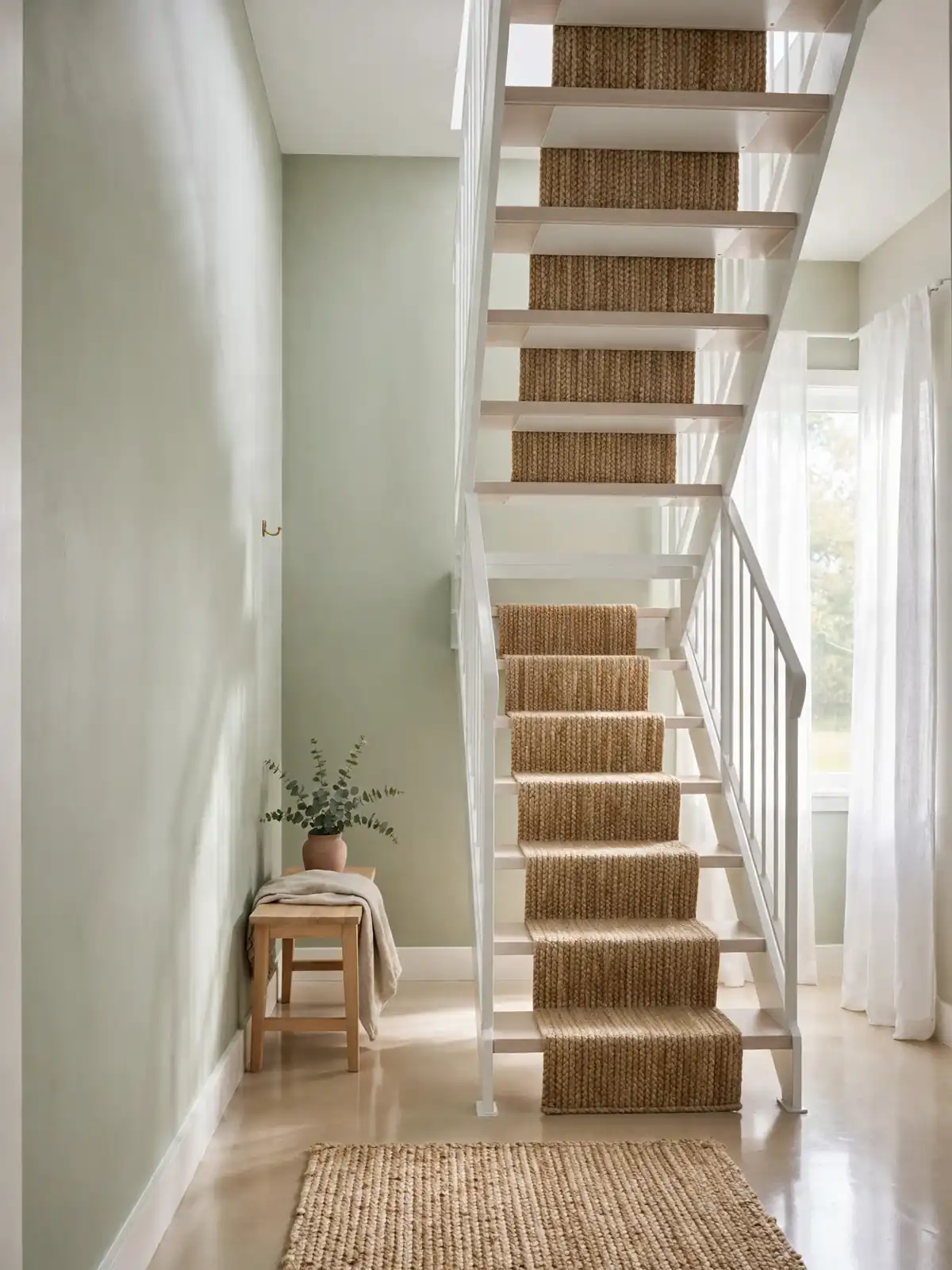
White powder-coated metal is the kindest choice for a small hallway because it almost disappears against a pale wall. In this home, a 900 mm wide straight stair has a white steel frame, pale ash treads, each 260 mm deep, and slim white vertical rods that blend into the pale sage-green wall behind them. A woven jute runner on the landing and a small wooden bench at the base add texture without adding visual weight. The hallway feels wider because the stair does not block the light.
Quick tips:
- Paint the metal frame the same white as the trim for the calmest effect.
- Choose pale ash or beech treads to keep the floating feeling.
- Add a slim handrail on the wall side for extra confidence.
- Keep the hallway free of tall furniture that could block the stair.
A Floating Metal Staircase With Open Risers and a Slim Steel Spine
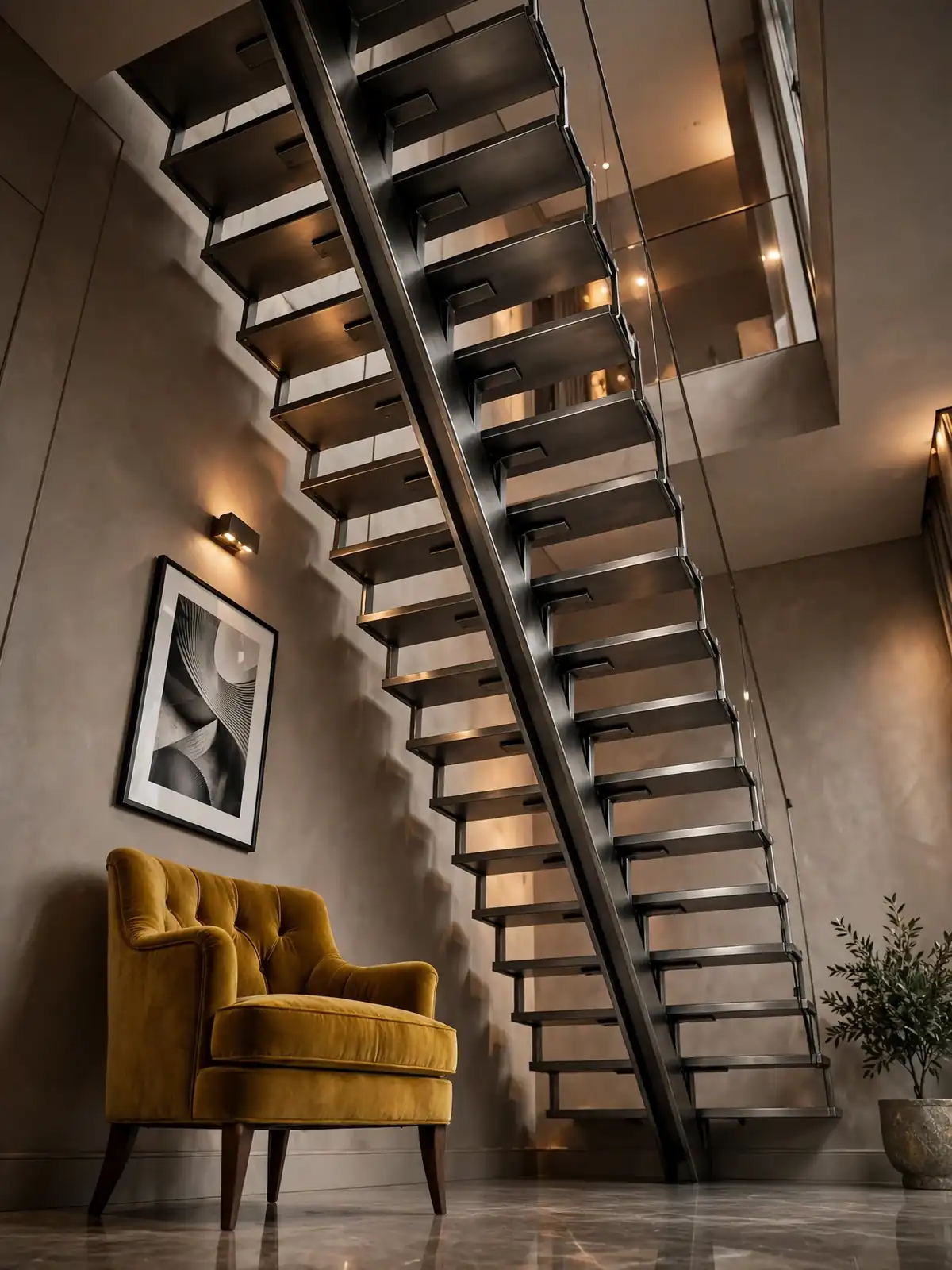
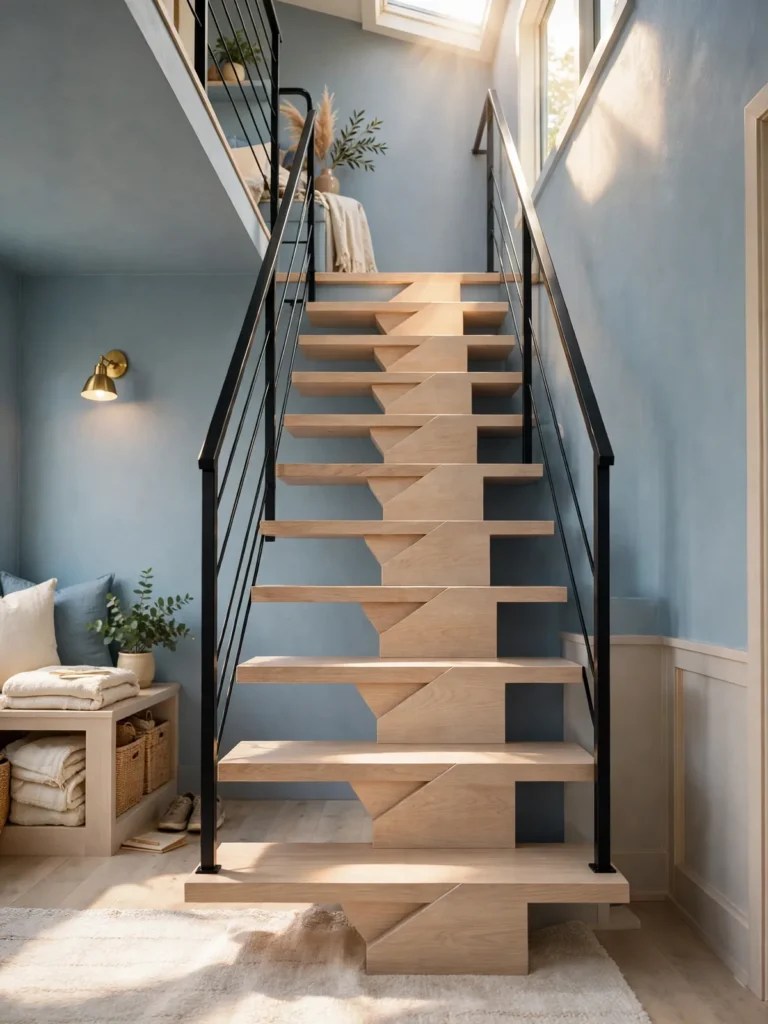
A central steel spine turns a metal staircase into sculpture. Here, one thick central spine of matte black steel, 150 mm wide, supports floating pale stone treads that extend 450 mm on each side, with 180 mm open gaps between them and no side balustrade at all — just the spine and a slim wall rail. The warm taupe walls and a mustard-yellow velvet chair below make the pale stone and black steel feel warm, while a black-and-white art print on the landing adds a graphic finish. It is a bold look that still feels light because the centre is so slim.
Quick tips:
- Keep treads pale so the black steel spine stays visible.
- Add a slim wall handrail for safety on a spine-only stair.
- Use one strong accent colour below the stair to balance the drama.
- Keep the landing art simple so it does not compete with the spine.
A Spiral Metal Staircase That Saves Space in a Corner
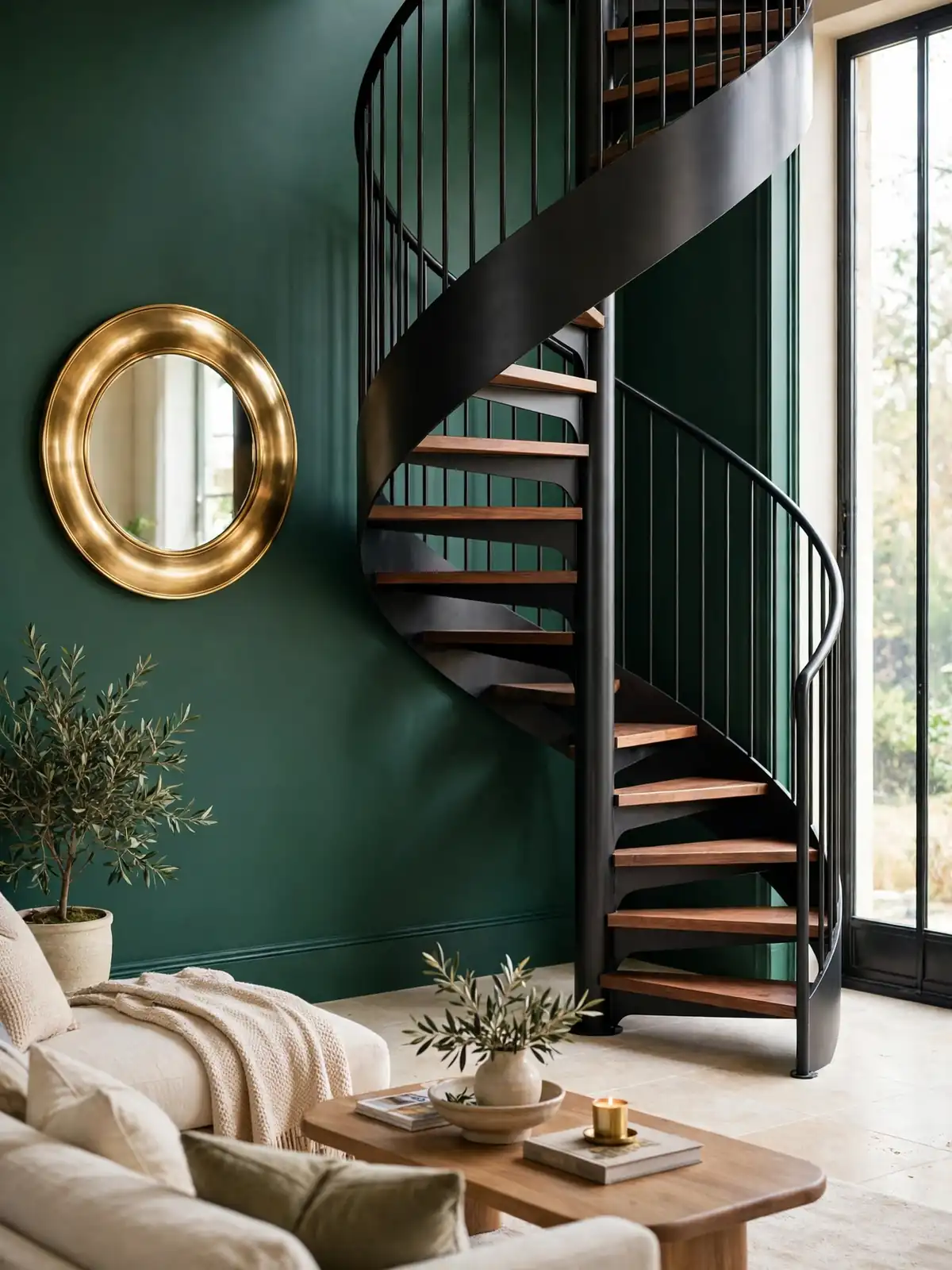
A spiral metal staircase is the smartest way to fit a stair into a tight corner, because its round footprint needs far less floor space than a straight flight. In this home, a 1.4-metre-diameter spiral in matte black steel rises through two floors, with warm walnut treads, each 700 mm long at the outer edge, and a slim black handrail that follows the curve. A deep emerald-green wall behind it and a large round brass mirror opposite make the corner feel intentional, not leftover. The stair becomes the room’s centrepiece.
Quick tips:
- Measure the diameter carefully — 1.4 to 1.6 metres suits most homes.
- Choose walnut or warm oak treads to soften black steel on a curve.
- Add a mirror opposite to bounce light around the spiral.
- Keep the centre pole slim so the stair feels open, not crowded.
A Metal Staircase With Cable Railings for a Light, Open Look
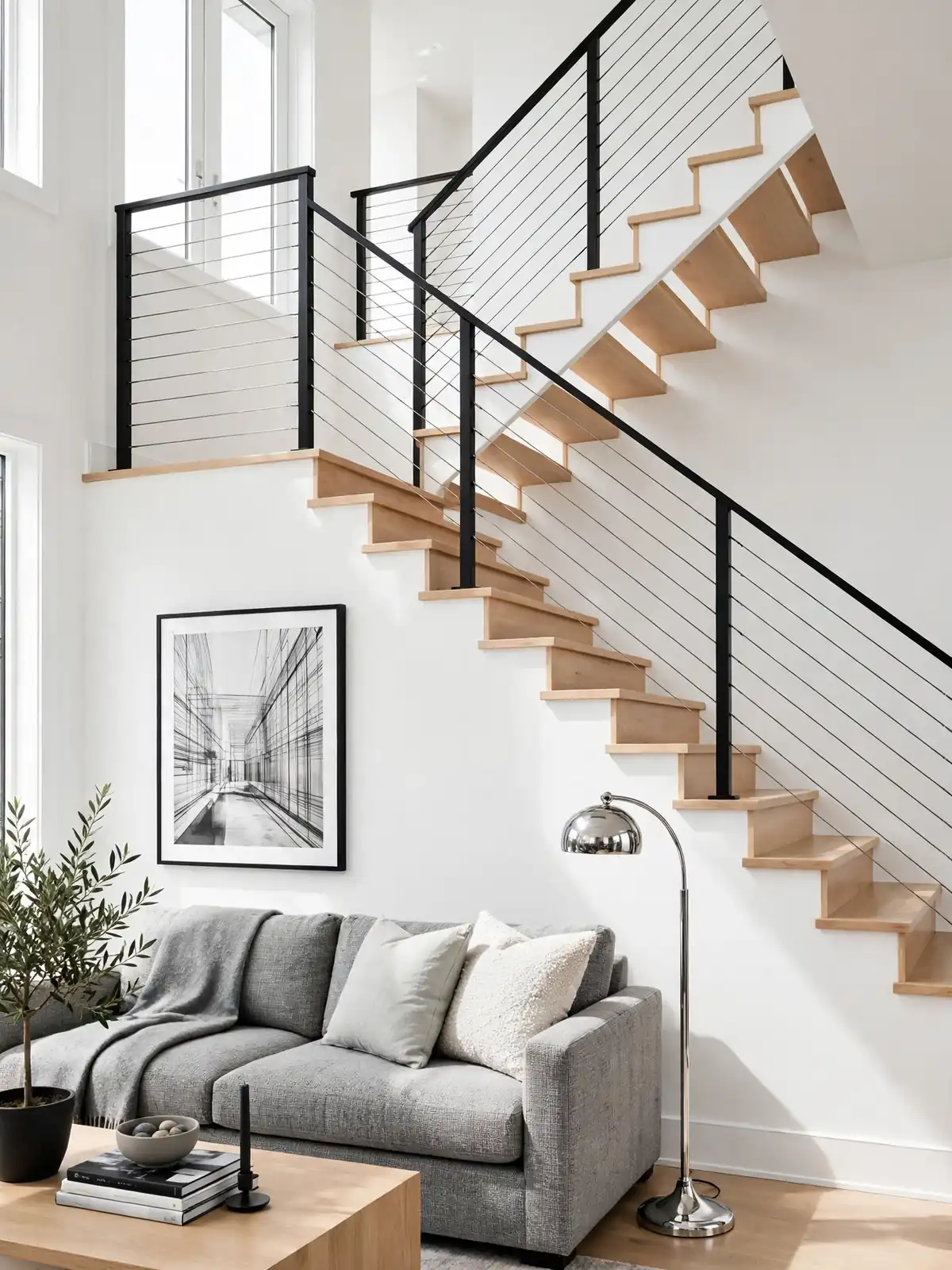
Thin horizontal cables keep a metal staircase safe without blocking sightlines, so the room stays visually open. On this stair, 1-metre-wide pale maple treads sit in a matte black frame, with eight slim stainless-steel cables running horizontally between black posts spaced 1.2 metres apart. The white walls, a soft grey sofa and a chrome floor lamp keep the room calm, while a monochrome art print on the landing echoes the black-and-white palette. You can see straight through the stair to the window beyond.
Quick tips:
- Keep cables taut and evenly spaced for a clean, safe finish.
- Paint posts the same colour as the frame so cables stay the focus.
- Choose pale treads to make the open effect stronger.
- Check cable tension every few months to keep the railing firm.
Perforated Metal Panels That Add Pattern Without Blocking Light
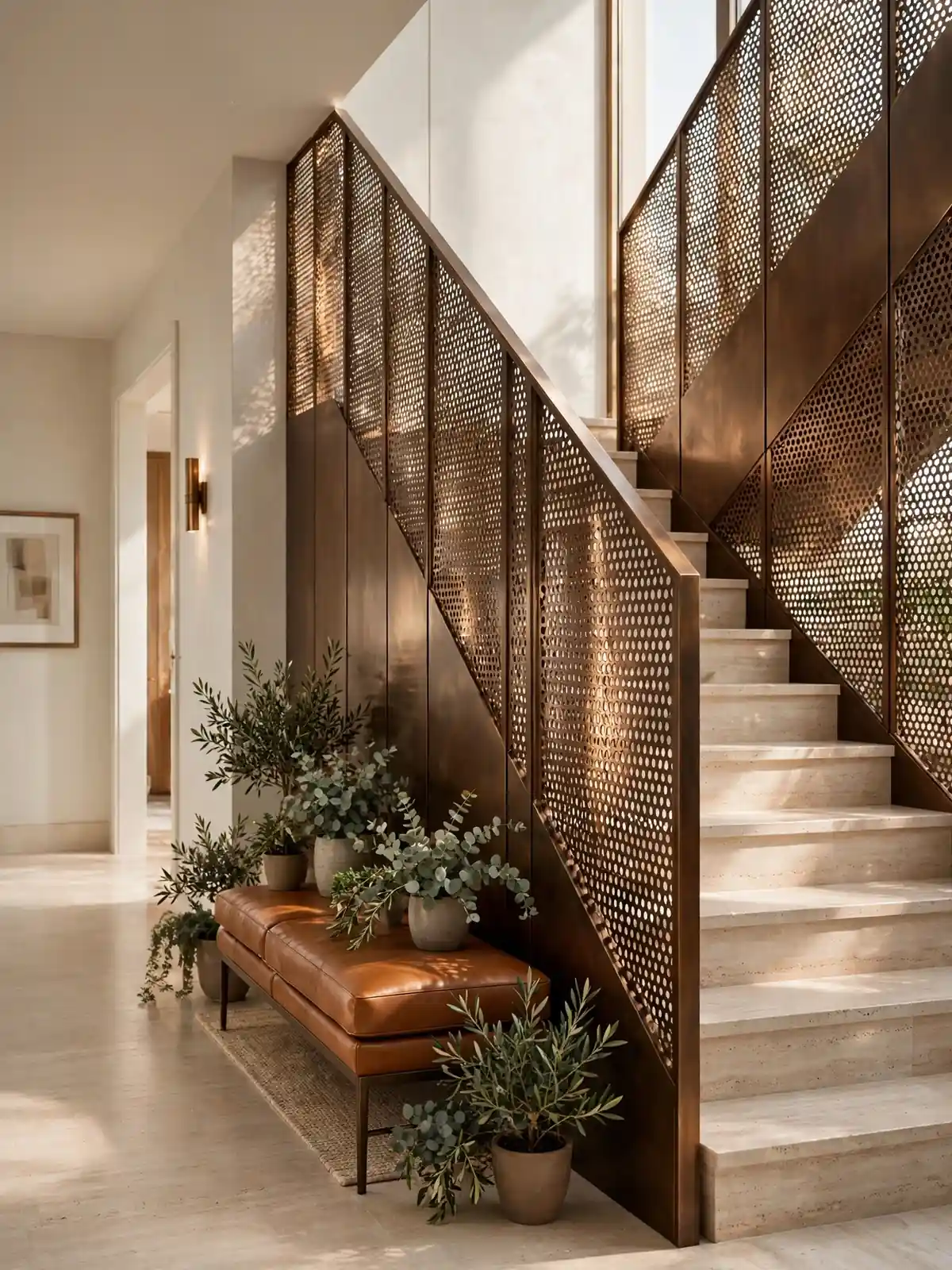
Perforated metal adds pattern and texture without the heavy feeling of a solid panel. This stair uses warm bronze perforated panels, with small 10 mm round holes in a regular grid, beside pale travertine treads, each 280 mm deep, with a warm caramel leather bench at the base and soft sage-green plants nearby. Daylight still passes through the tiny holes, casting a soft dotted pattern on the travertine in the afternoon. It feels richer than plain steel, but just as open.
Quick tips:
- Choose a small, regular hole pattern so the panel reads as texture, not clutter.
- Pair perforated panels with pale stone treads for the best light play.
- Use a warm bronze or brass finish to avoid a cold factory look.
- Test a sample panel in daylight before committing to the pattern.
A Metal Staircase With Glass Panels in Slim Black Frames
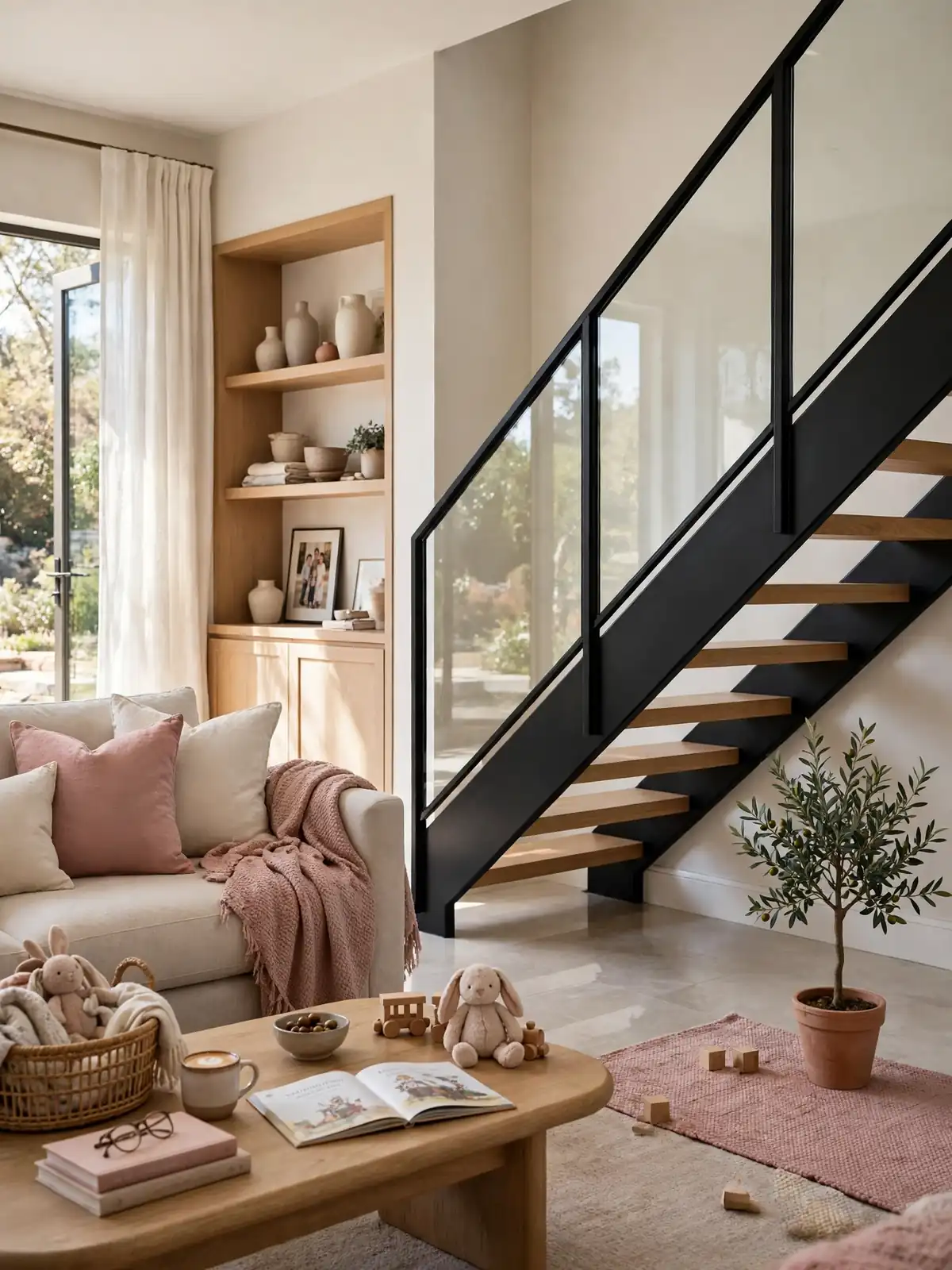
Slim black metal frames around clear glass give a metal staircase transparency with structure. In this home, 12 mm clear glass panels sit in 20 mm black steel frames beside light oak treads, each 1 metre wide, with a slim oak handrail on top for a comfortable grip. A dusty-rose rug at the base softens the landing, a small olive tree adds life, and the glass lets you see through the stair to the living room beyond. The metal frame makes the glass feel secure and finished.
Quick tips:
- Keep the steel frame slim — 20 mm is enough to look strong without looking heavy.
- Add a timber handrail on top of the glass for a warm grip.
- Use low-iron glass for the clearest, least green finish.
- Wipe glass panels weekly with a microfibre cloth to keep them clear.
Brushed Stainless Steel Against a Deep Charcoal Wall
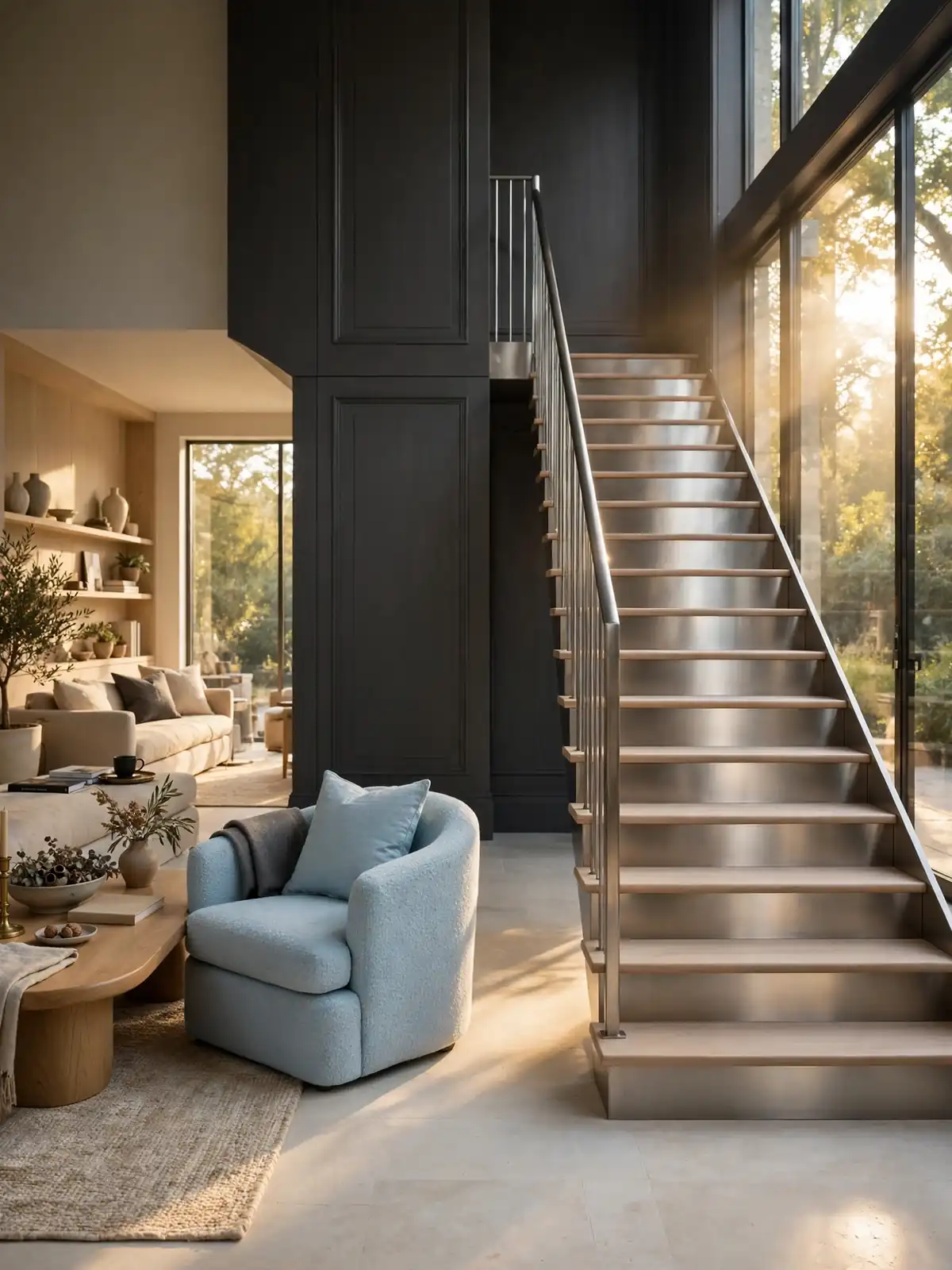
Brushed stainless steel against a deep charcoal wall creates drama that still feels calm, because the steel’s soft sheen catches the light. Here, a straight stair with brushed stainless-steel stringers and slim rods sits against a charcoal-grey panelled wall, with pale beech treads, each 950 mm wide, softening the contrast. A soft sky-blue armchair and a pale stone floor pick up the cool morning light, while the steel changes tone through the day — silky in the morning, moody in the evening. The stair needs little else around it.
Quick tips:
- Choose brushed steel, not mirror-polished steel, to avoid harsh glare.
- Keep walls and soft furnishings in one deep tone for a calm backdrop.
- Add one soft colour, like sky blue, to balance the cool steel.
- Keep the stair wall free of clutter so the contrast stays the feature.
A Metal Staircase With Geometric Balusters as Wall Art
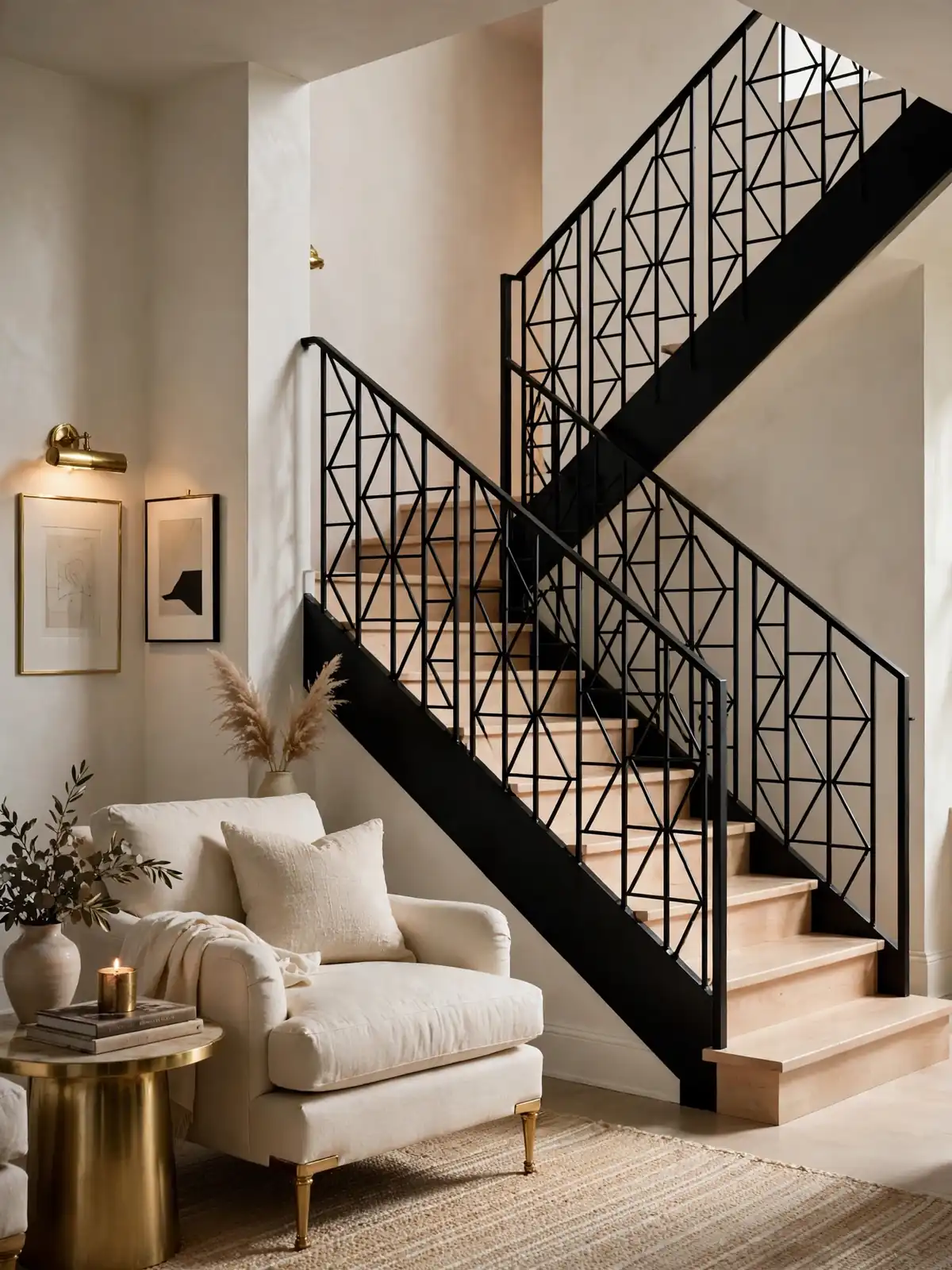
Geometric balusters turn a metal staircase railing into art. This stair uses matte black balusters in a repeating triangle pattern, each triangle 300 mm tall, set between pale maple treads, each 900 mm wide, and a slim black handrail. A gold picture light above the stair and a cream linen armchair nearby soften the geometry, while polished brass details pick up the warmth of the maple. The pattern draws the eye up the stair, so the ceiling feels taller.
Quick tips:
- Choose one repeating shape — triangles or squares — and keep it consistent.
- Keep the baluster colour neutral if the pattern is bold.
- Test a small section of the pattern before full fabrication.
- Use pale treads so the black pattern stands out clearly.
A Metal Staircase With a Leather-Wrapped Handrail
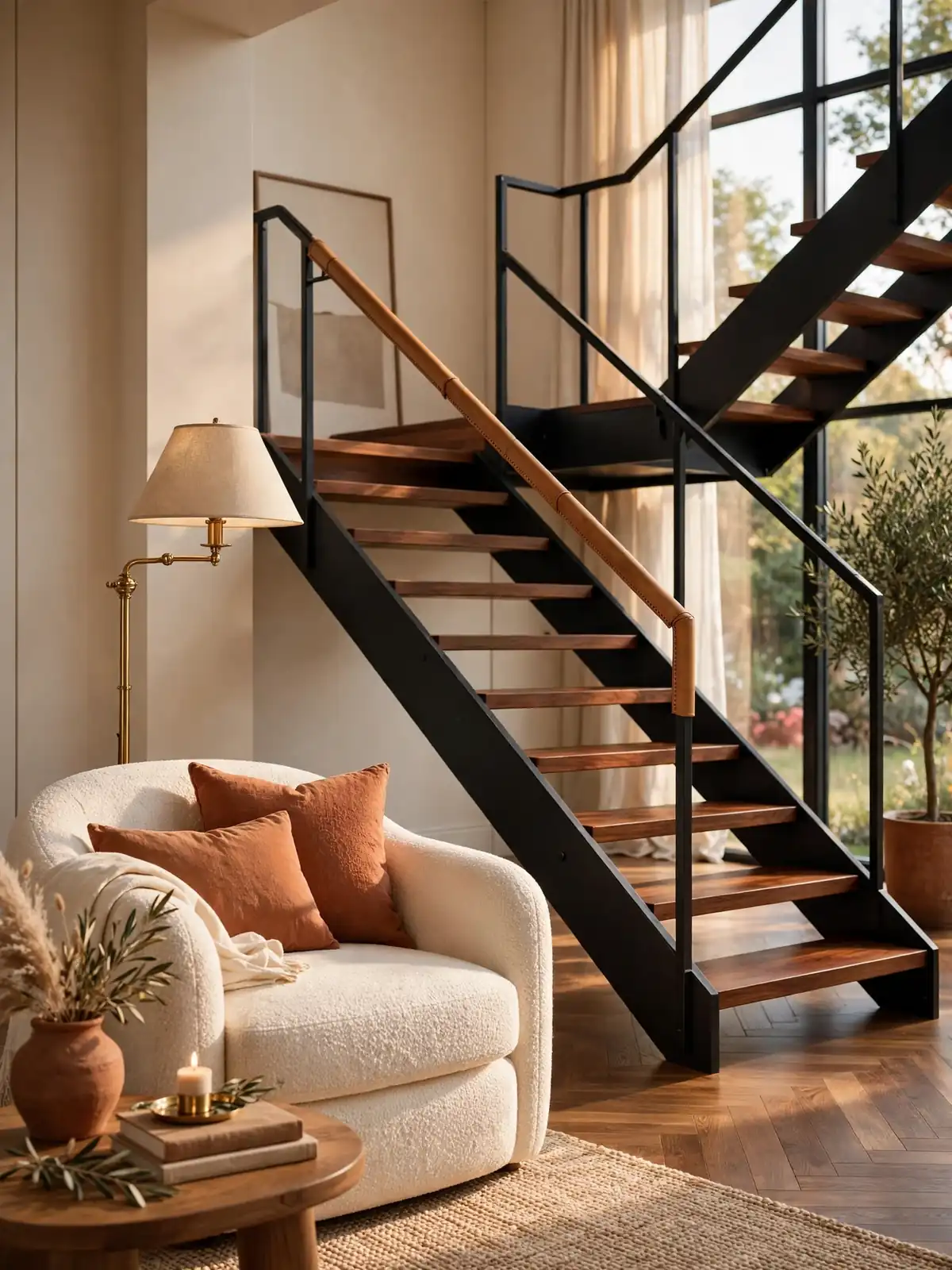
Wrapping a metal handrail in leather is a small change with a big effect — the cold metal becomes warm and tactile under your hand. On this stair, a 50 mm diameter black steel handrail is wrapped in smooth tan leather with hidden stitching underneath, running beside warm walnut treads, each 40 mm thick and 900 mm wide. Below, a cream boucle armchair and terracotta cushions echo the leather tone, while a brass floor lamp adds a soft glow in the evening. The stair feels crafted, not just built.
Quick tips:
- Use real leather for longevity, not faux leather that peels.
- Secure the wrap with hidden stitching underneath the rail.
- Match the leather tone to furniture nearby, like a chair or bench.
- Condition the leather twice a year to keep it soft and rich.
A Bold Runner on a Metal Staircase for Colour and Comfort
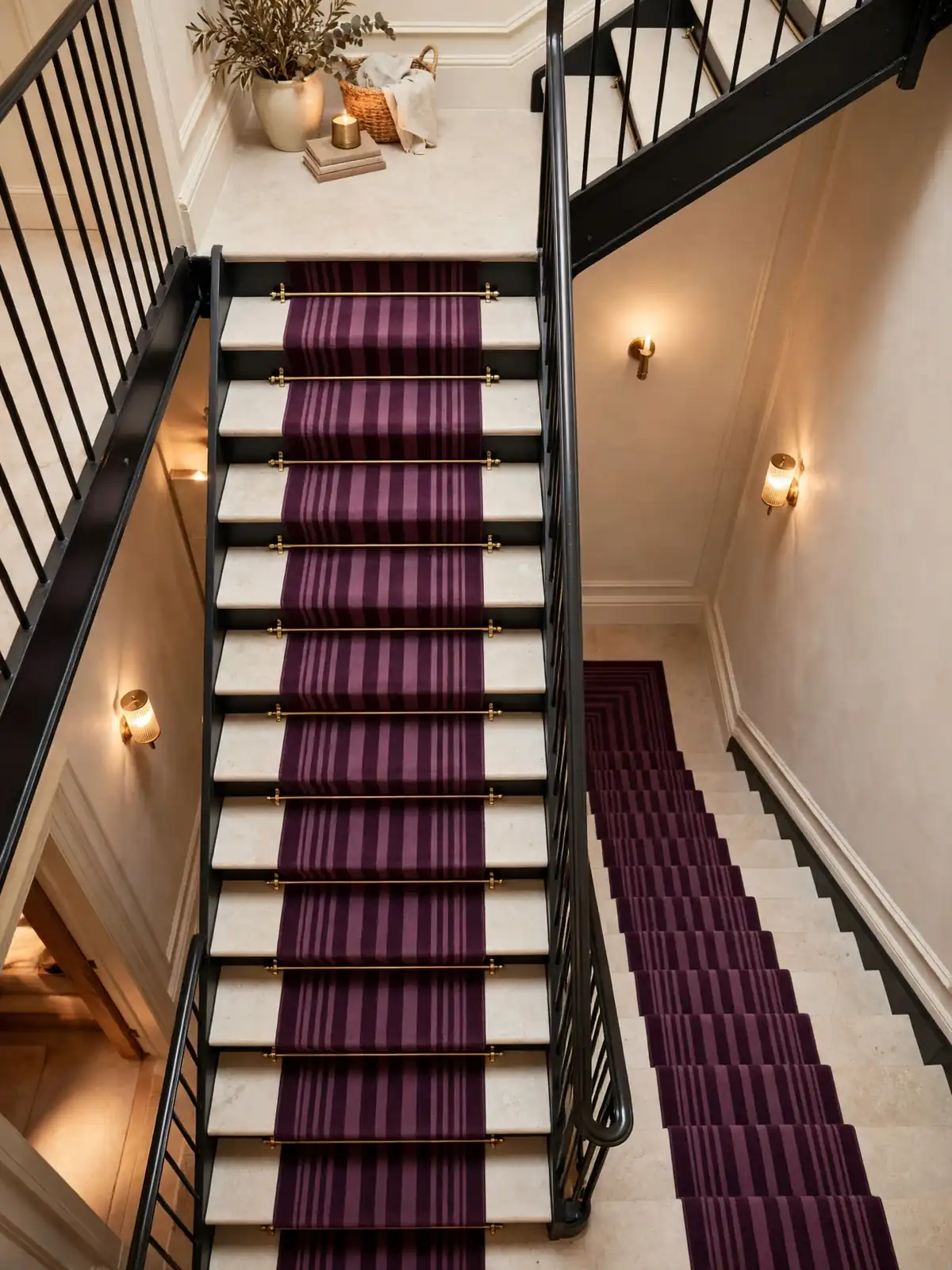
A bold runner softens a metal staircase underfoot and adds colour exactly where the eye travels. Here, a straight flight with pale stone treads, each 280 mm deep, is dressed with a deep plum runner with thin cream stripes, 800 mm wide, held by slim brass stair rods on each tread. The ivory walls and warm lighting make the plum feel rich, not heavy, and the black steel frame keeps the look modern. The runner also quiets footsteps on the hard metal and stone.
Quick tips:
- Choose a striped runner to make the stair look longer.
- Use slim brass or black stair rods to hold the runner neatly in place.
- Pick a low-pile, durable runner that is easy to vacuum.
- Add a non-slip underpad so the runner never moves underfoot.
A Metal Staircase Suspended From the Ceiling on Slim Rods
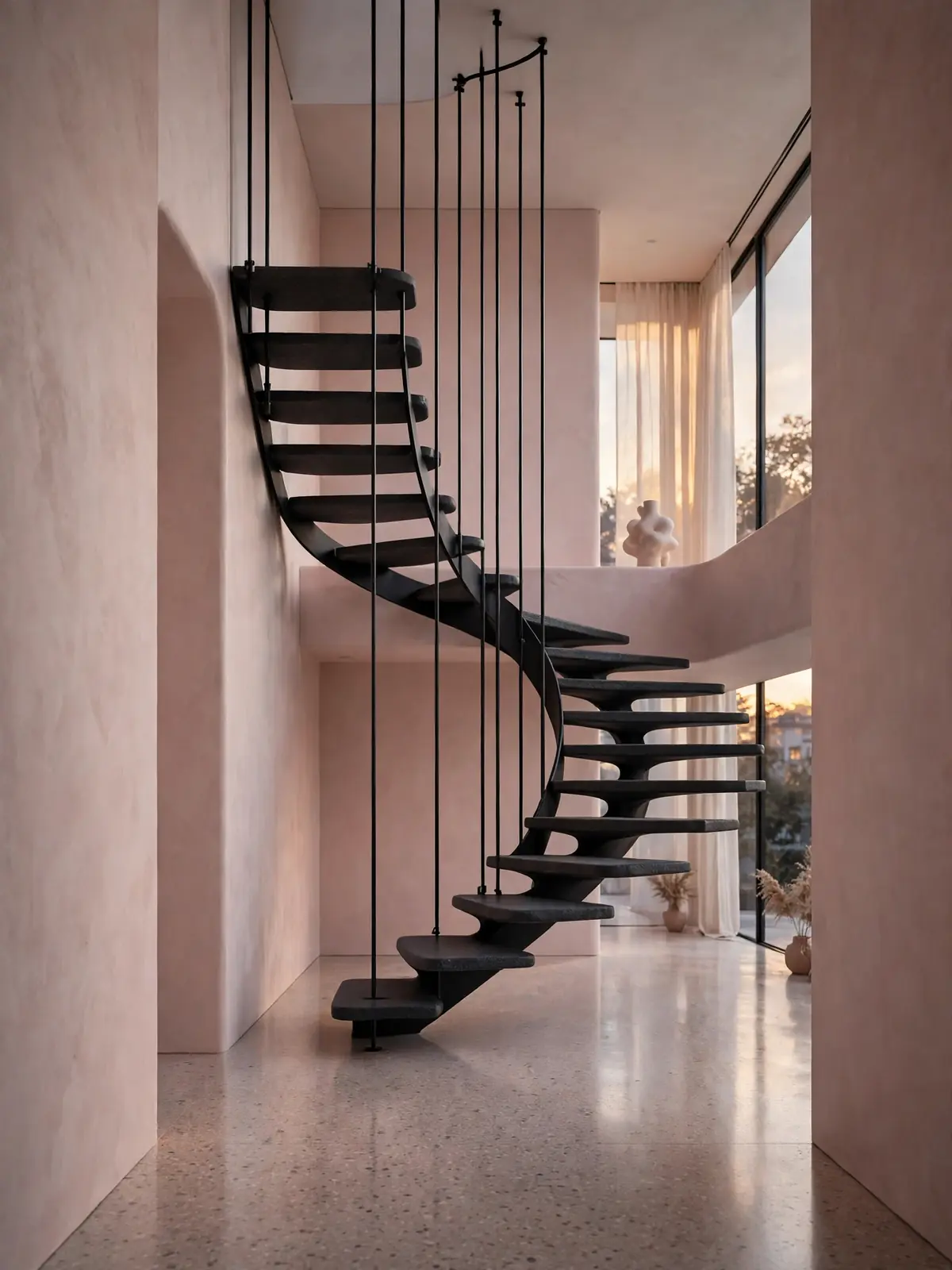
Suspending a metal staircase from the ceiling creates a floating effect that feels almost like art. In this home, thin 12 mm black steel rods hang from a reinforced ceiling beam and hold floating charcoal-grey treads, each 1 metre wide, with no visible support underneath. The blush-pink plaster wall beside the stair catches the evening light, and a small sculptural vase on the landing is the only decoration. It is a professional build, not a DIY project, but the result is unforgettable.
Quick tips:
- Ask a structural engineer to check the ceiling support before planning this stair.
- Keep treads dark so the slim rods stay visible against them.
- Put the stair on a dimmer-lit circuit so the floating effect glows at night.
- Keep the landing clear so the suspended stair is the focal point.
Patterned Metal Riser Inserts That Cast Soft Shadows
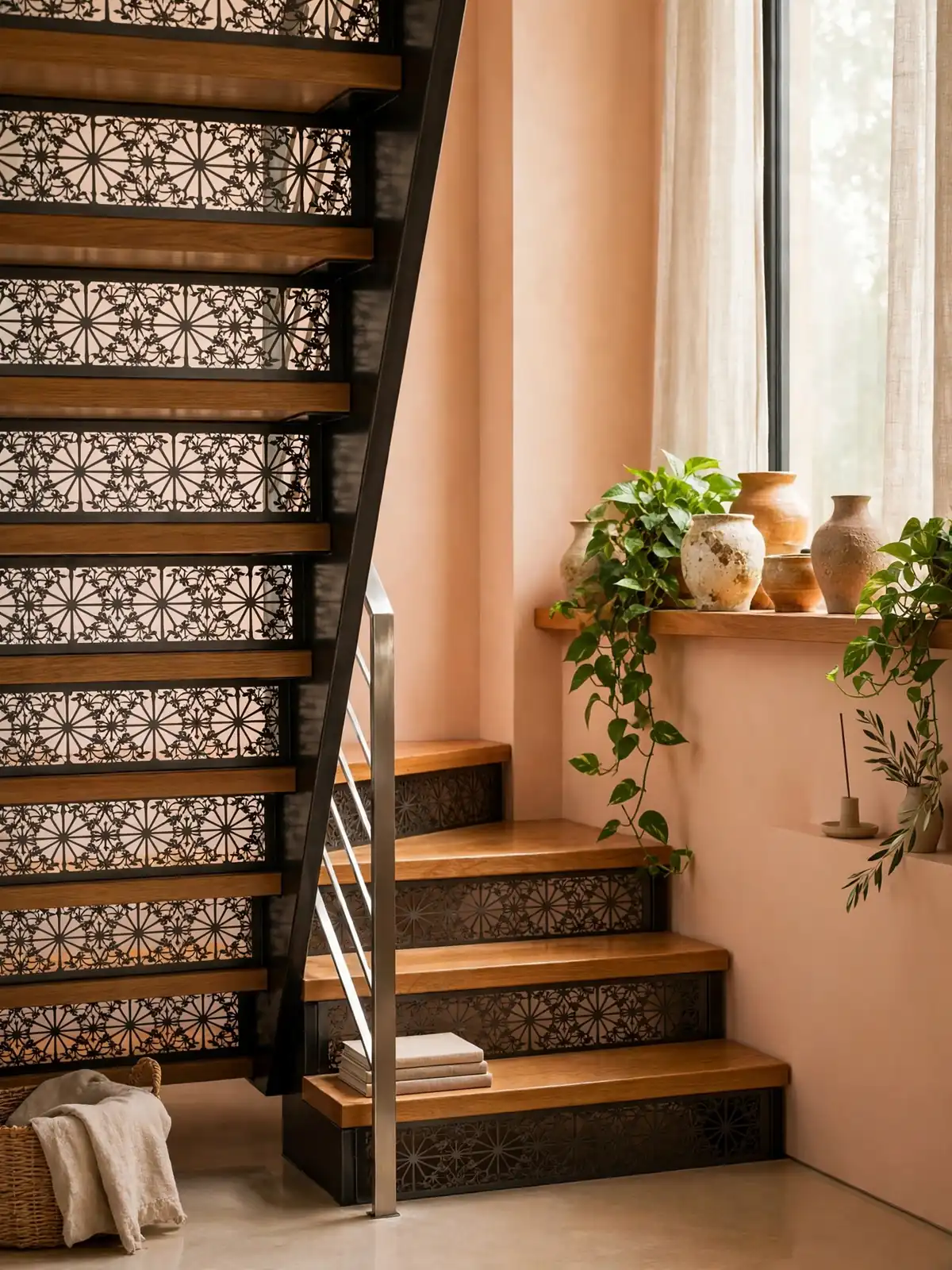
Laser-cut riser inserts add detail exactly where light hits the stair, so the pattern changes through the day. On this stair, each 180 mm high riser holds a slim laser-cut panel in a restrained leaf pattern, set into a matte black frame beside warm oak treads, each 900 mm wide. In daylight the pattern is subtle; in the evening, a warm light behind the stair casts soft leaf shadows on the soft peach wall. The stair feels personal and crafted, not mass-produced.
Quick tips:
- Keep the cut pattern restrained — one simple motif, repeated cleanly.
- Use warm light behind the risers so shadows stay soft, not harsh.
- Pair patterned risers with plain oak treads so the pattern stays the focus.
- Keep the wall colour warm to catch the shadow play.
A Monochrome Metal Staircase Painted to Match the Walls
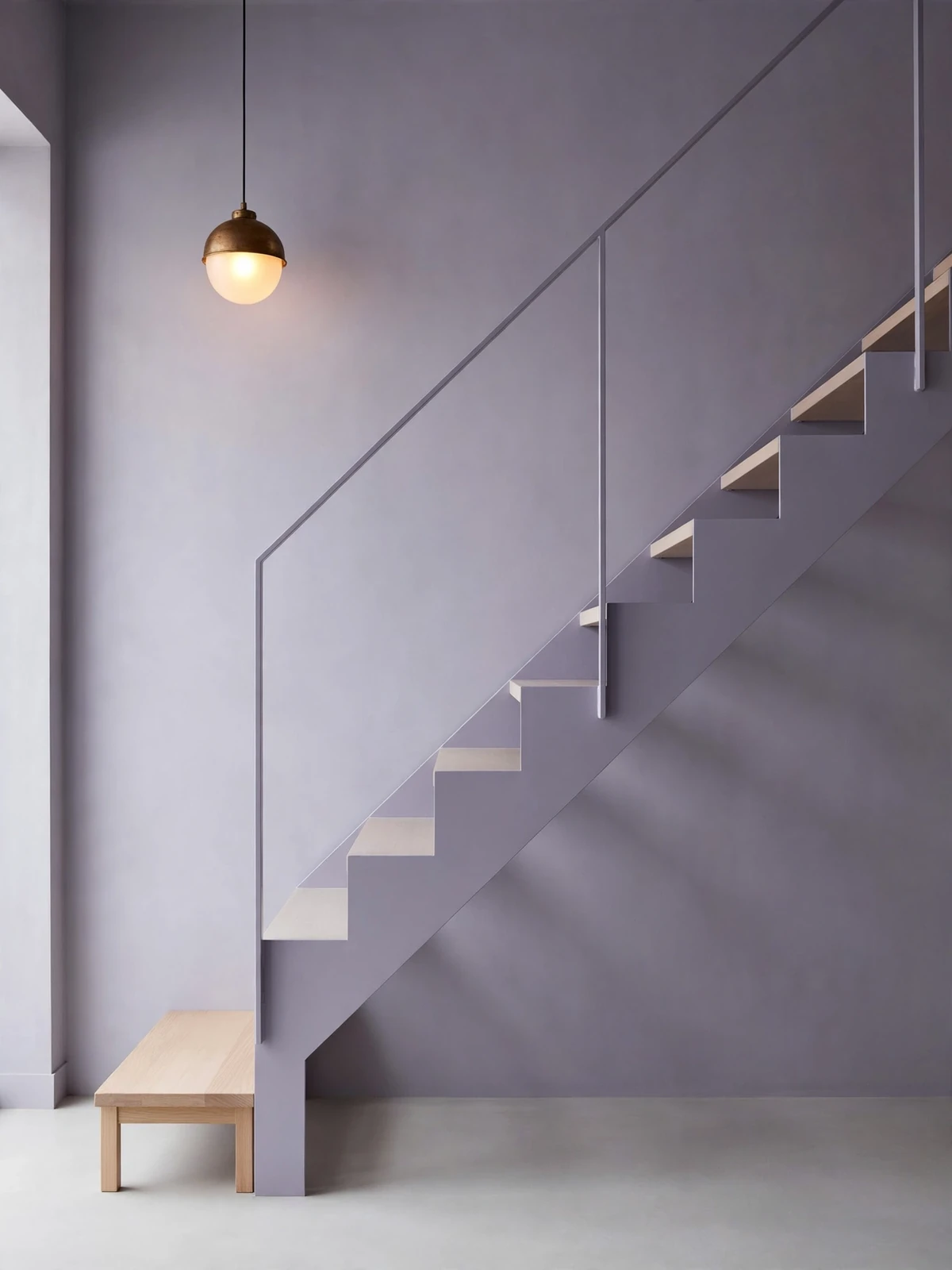
Painting a metal staircase the same colour as the walls makes it blend in beautifully, which is ideal in a small home where visual clutter makes a room feel cramped. In this home, the whole steel frame — stringers, rods and handrail — is painted the same soft lavender-grey as the wall, with pale ash treads, each 280 mm deep, providing the only contrast. A small wooden bench at the base and a warm pendant light add quiet comfort. The stair feels calm because nothing about it shouts for attention.
Quick tips:
- Choose one colour and commit — do not mix two wall colours on one stair.
- Use a durable powder-coat or metal paint so the finish lasts.
- Keep treads pale so the stair is still easy to see and safe to use.
- Test the paint colour in daylight before committing to the whole stair.
Built-In Metal Shelving Under the Staircase for Smart Storage
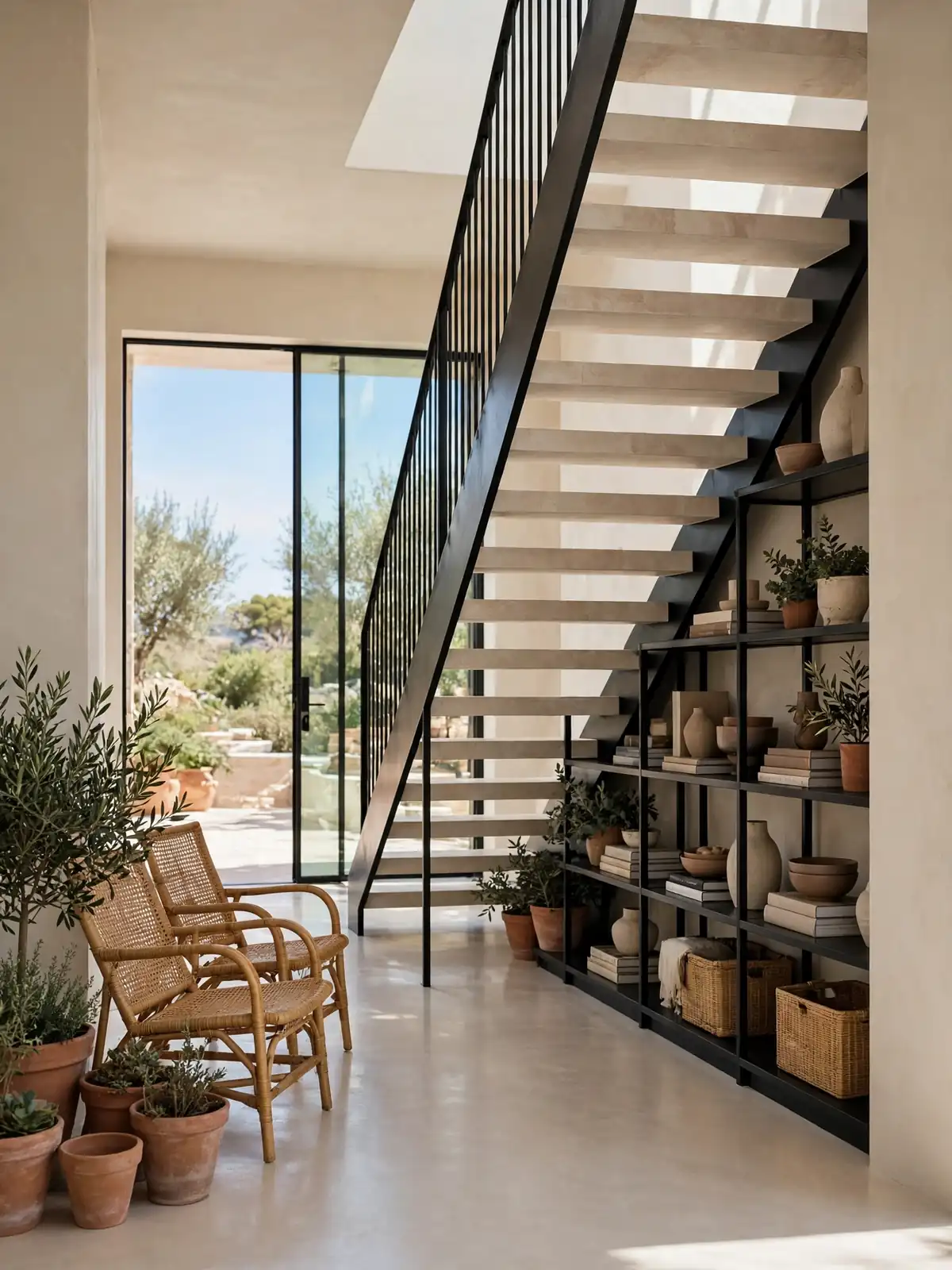
The space under a metal staircase is too useful to waste, and slim black metal shelving fits it perfectly. Under this stair, custom black steel shelves, each 300 mm deep, hold books, plants and art objects in a calm, curated row, while the pale limestone treads above, each 280 mm deep, let light fall across the shelves. The shelves are anchored securely to the wall and the stair frame, and the styling stays minimal — a few favourite pieces, not a crowded row. Storage becomes part of the design.
Quick tips:
- Measure headroom carefully before fitting shelves under a sloping stair.
- Anchor shelving securely to the wall and the stair frame.
- Keep styling minimal — books, plants and one or two art objects.
- Leave one shelf empty so the display can breathe.
A Metal Staircase With Integrated LED Lighting Under Each Tread
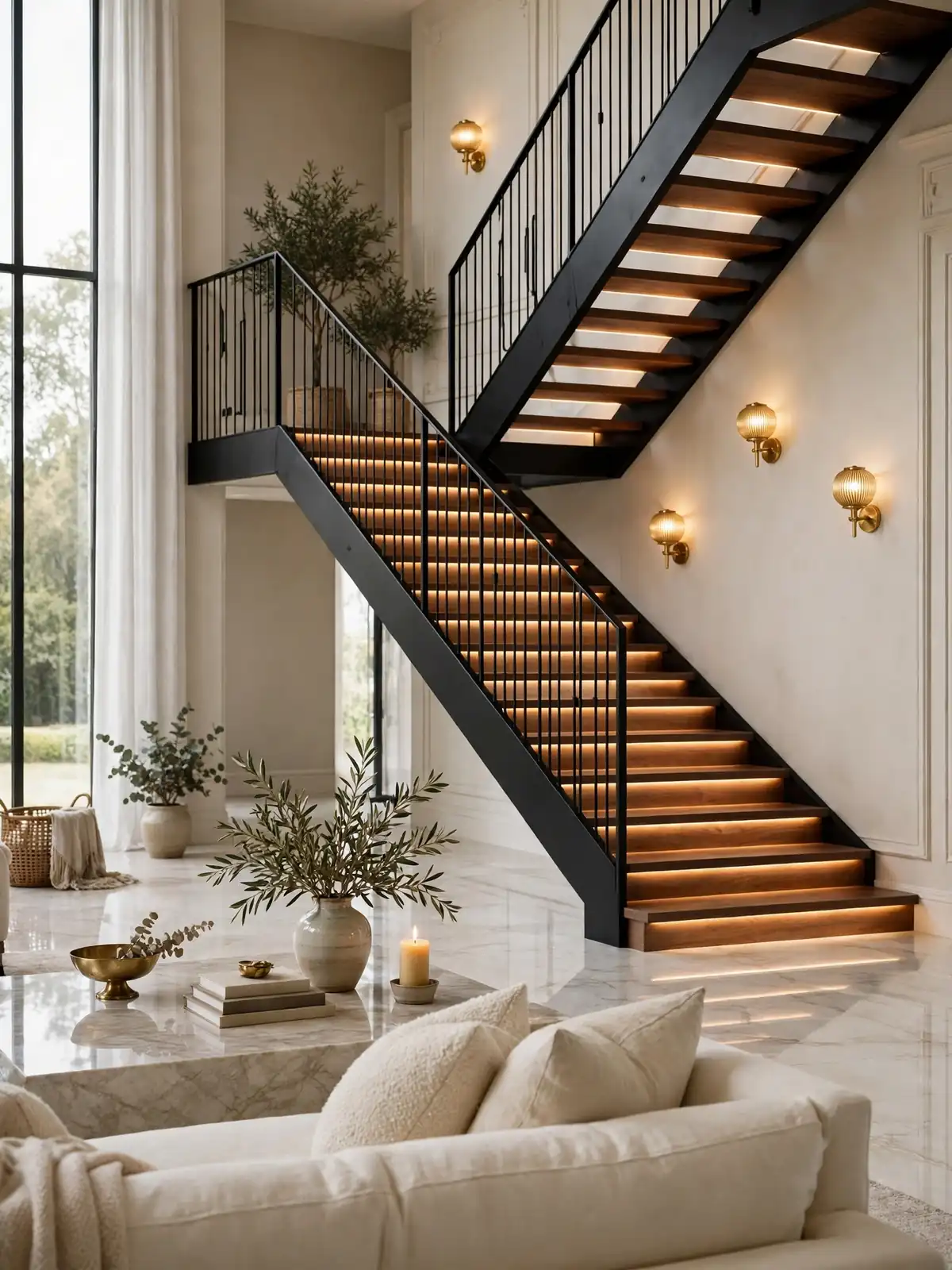
LED strips under each tread turn a metal staircase into a gentle guide at night and a feature in the evening. On this stair, a warm-white LED strip, hidden under the front edge of each 40 mm thick walnut tread, washes soft light down the riser below, so the whole flight glows without any visible bulbs. The matte black steel frame disappears into the glow, gold wall sconces on the white marble wall add warmth, and a cream sofa opposite keeps the room soft. The light is practical and beautiful at once.
Quick tips:
- Use warm-white LEDs, not cool white, for a soft evening glow.
- Put the lights on a dimmer and a motion sensor for night-time use.
- Hide the strips fully under the tread nosing so no bulb shows.
- Pair lit treads with dark metal so the glow stands out.
A Copper Metal Staircase With Warm Grey Walls
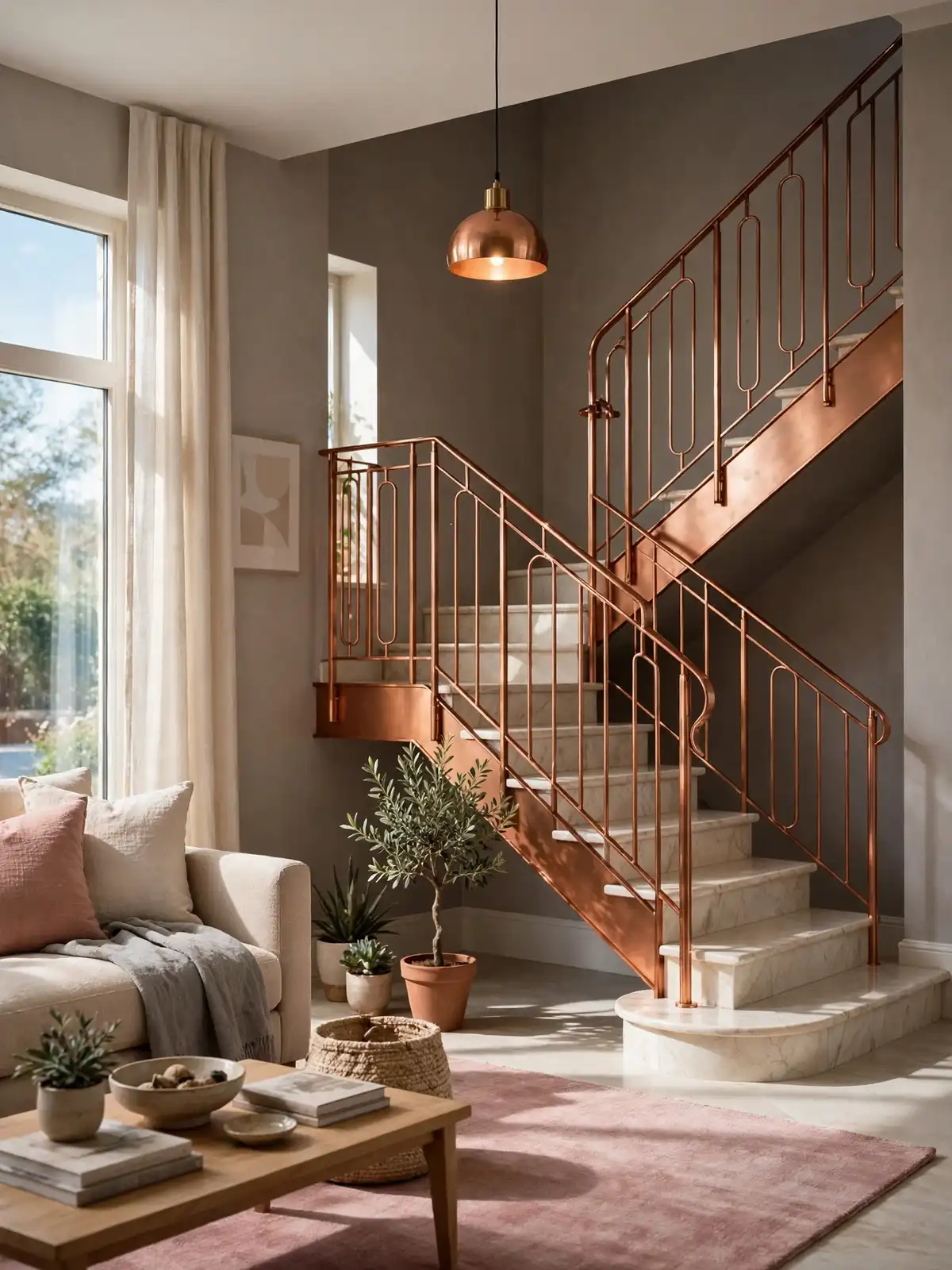
Copper is the warmest metal for a staircase — it glows in daylight and deepens beautifully with age. In this home, a straight stair with a brushed copper frame and slim copper rods rises beside warm grey walls, with cream marble treads, each 900 mm wide and 30 mm thick, softening the metal. A dusty-rose rug at the base, a small olive tree and a warm pendant light complete the palette. The copper catches the sun in the morning and glows amber in the evening, so the stair changes mood through the day.
Quick tips:
- Choose brushed copper, not polished copper, to avoid fingerprints showing.
- Pair copper with warm grey, cream or dusty rose — not cold blue.
- Seal the copper if you want to keep its bright tone, or let it patina naturally.
- Match the copper tone to a pendant light or tap nearby.
A Metal Staircase in a Coastal Home With Pale Timber and Linen
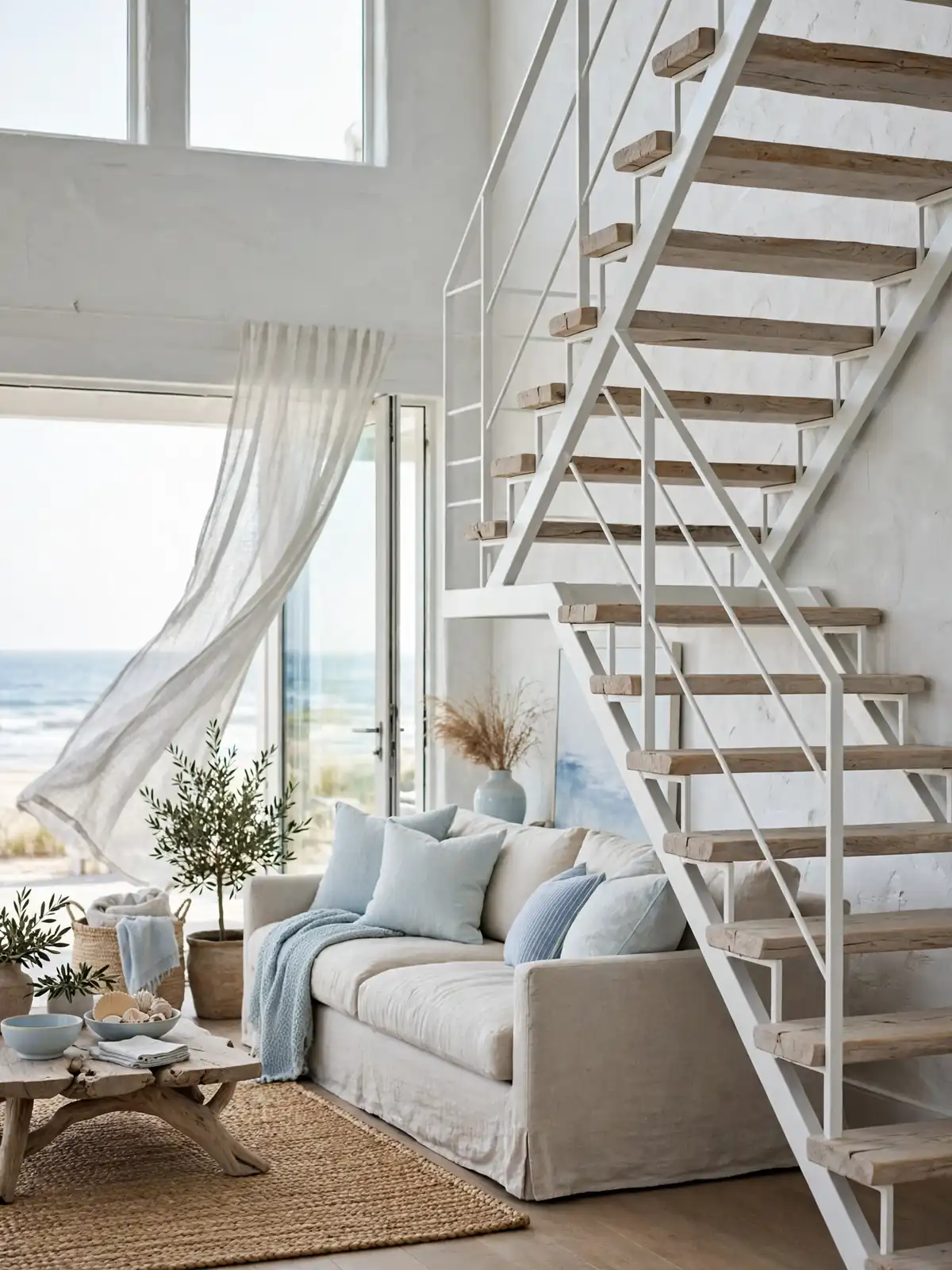
A metal staircase suits a coastal home when its frame is pale and its treads are weathered timber, because it keeps the sea light moving through the house. In this beach house, pale driftwood treads, each 950 mm wide, sit in a white powder-coated steel frame with slim white rods, beside whitewashed walls, a natural linen sofa, a woven seagrass rug and pale blue cushions. Daylight from the sea-facing windows passes straight through the open stair, so the hallway feels as bright as the living room. The whole home feels like one breezy, open space.
Quick tips:
- Use pale, weathered timber for a relaxed coastal feel.
- Keep the metal frame white so sea light bounces through it.
- Add linen and seagrass textures to soften the steel.
- Choose pale blue accents to echo the sea without overdoing the theme.
A Metal Staircase With a Reading Nook Tucked Underneath
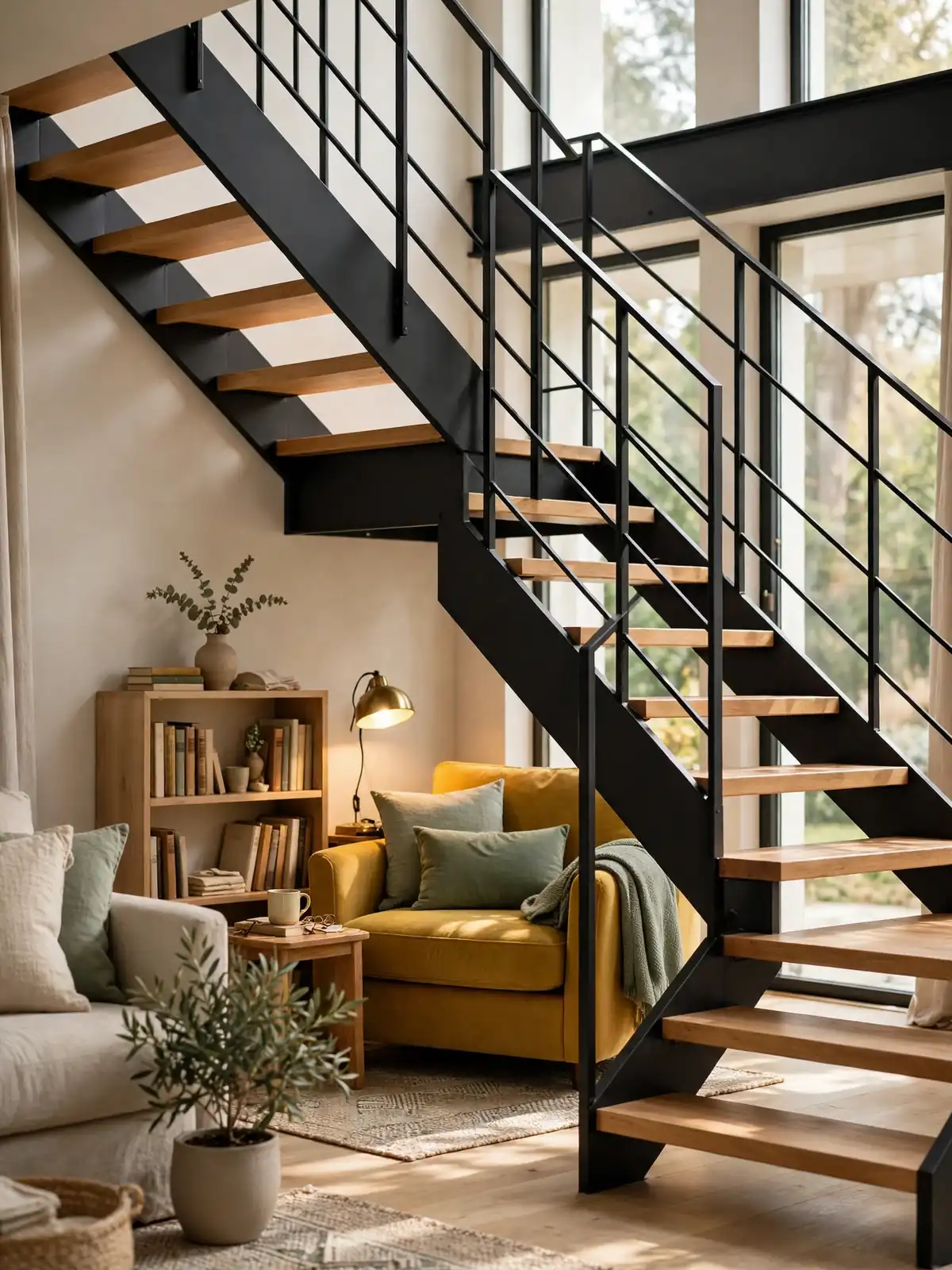
Because a metal staircase with open risers lets light through, the space under it stays bright enough for reading. Under this stair, a mustard armchair with sage-green cushions sits beside a small wooden bookshelf, with a warm reading lamp and a soft throw. The light oak treads and slim black steel frame above filter daylight down into the nook, so it never feels dark or closed in. It is a quiet corner that feels private, yet still connected to the living room.
Quick tips:
- Choose a compact armchair that fits neatly under the stair slope.
- Add a small bookshelf or basket for books within arm’s reach.
- Use a warm lamp for evening reading in the nook.
- Keep the nook palette warm so it feels cosy under the black steel.
An Outdoor Metal Staircase That Links the Garden to a Terrace
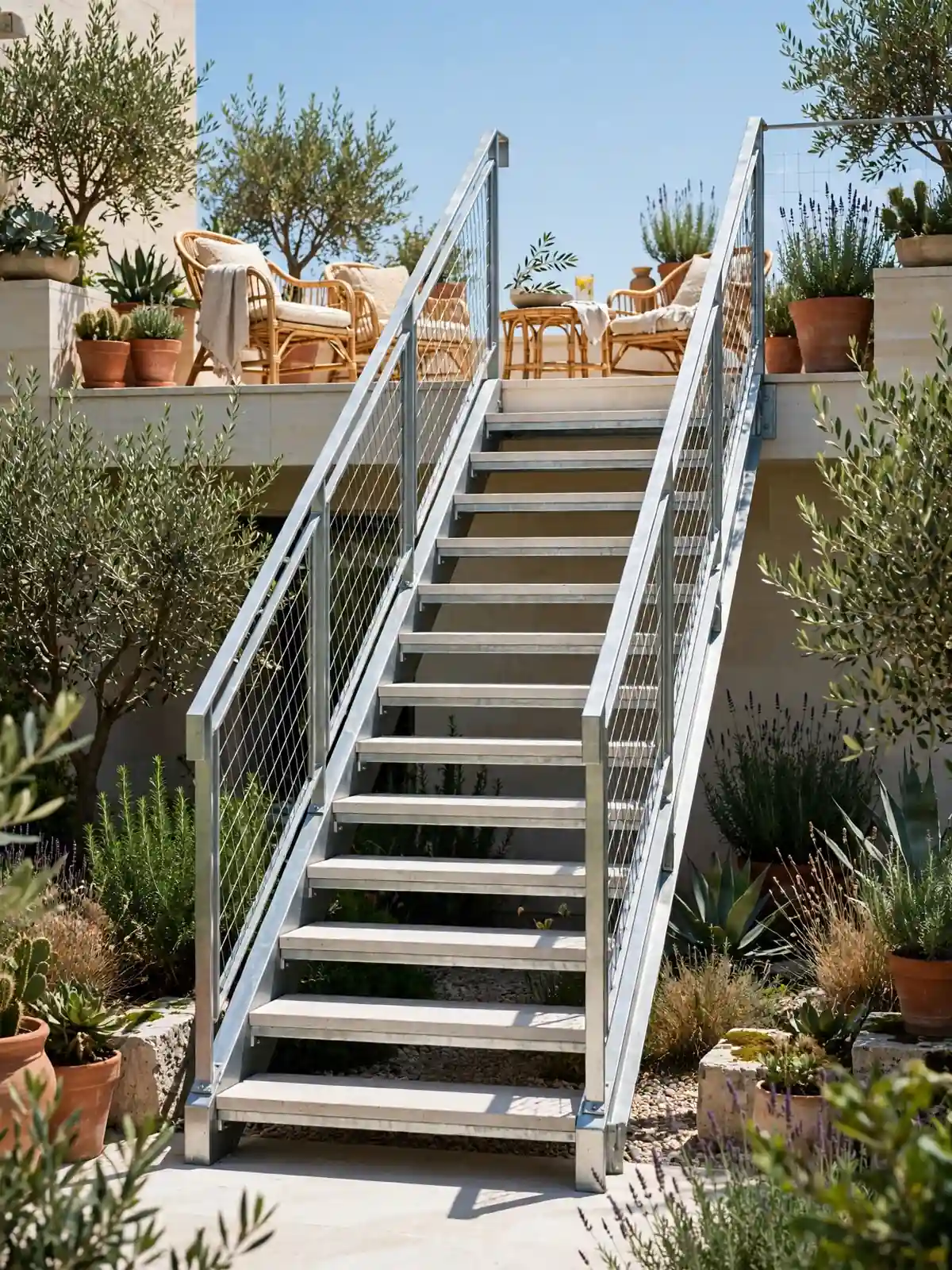
An outdoor metal staircase is the practical, good-looking way to link a garden to a raised terrace, because galvanised steel stands up to rain and sun. In this home, a galvanised steel stair with pale limestone treads, each 900 mm wide with a non-slip finish, rises from the garden lawn to a sunny terrace with rattan chairs and terracotta pots. From the garden, you can see through the open risers to the sky, and the limestone treads echo the terrace paving, tying garden and terrace together.
Quick tips:
- Choose galvanised or powder-coated steel for outdoor use so it resists rust.
- Use non-slip treads and a secure handrail for wet weather.
- Match indoor tread stone to the terrace paving for continuity.
- Add a washable mat at the terrace door for wet feet in summer.
A Metal Staircase With Marble Treads and Gold Details
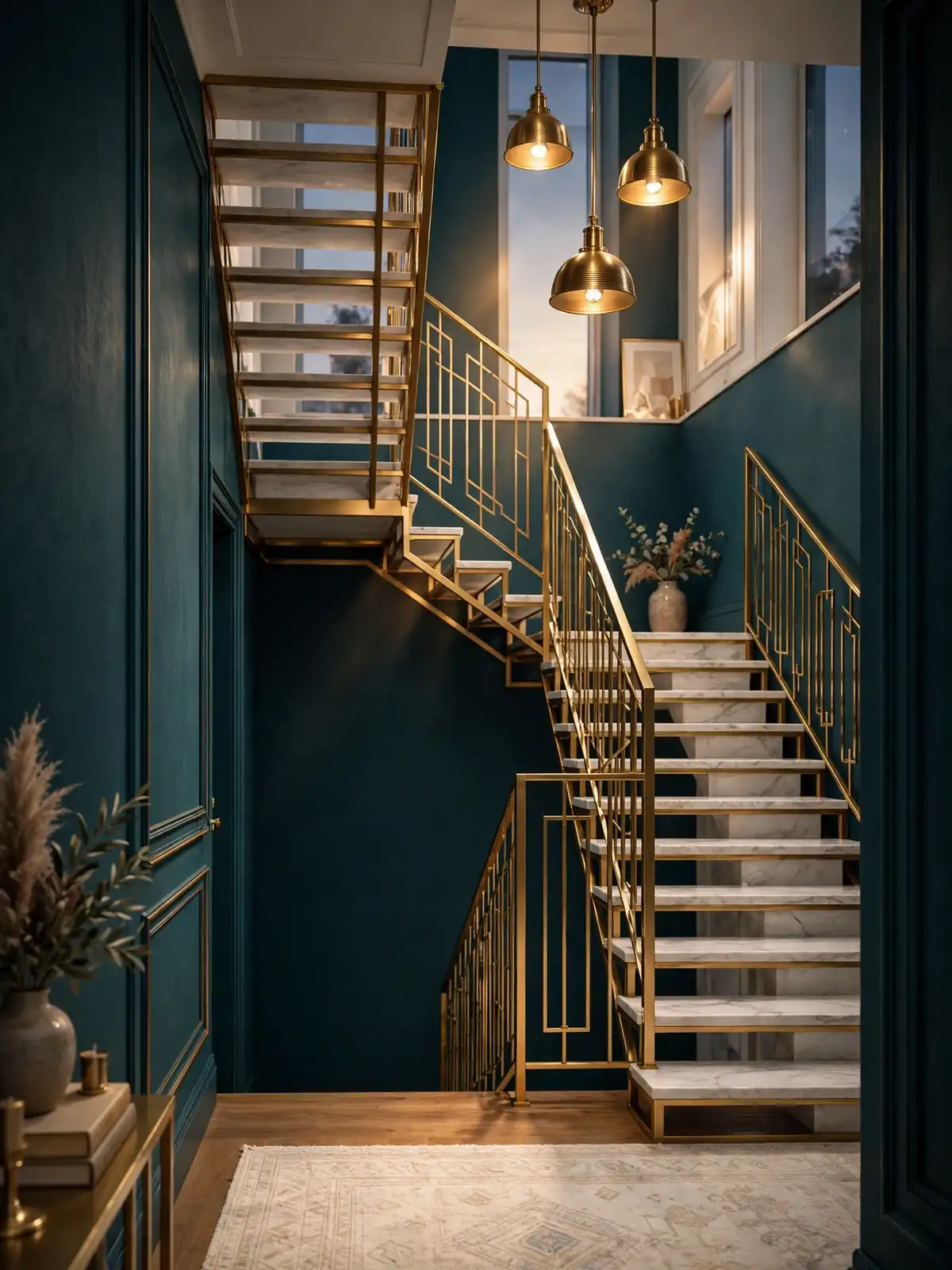
White marble and gold metal are a classic luxury pairing — both pale, both reflective, both calm. Here, a full flight with white marble treads, each 1 metre wide with soft grey veining, sits in a matte black steel frame with slim gold handrail caps and gold fixings. A deep teal wall behind the stair makes the gold glow richer, brass pendant lights add warmth, and a cream rug at the base softens the landing. The stair feels like part of a calm, hotel-like living room.
Quick tips:
- Choose marble with soft, fine veining so it does not overwhelm the metal.
- Use gold only on the handrail caps and fixings — let the marble stay the star.
- Add warm lighting to warm up the cool marble and steel.
- Seal marble treads so they resist stains and stay polished.
A Metal Staircase in a Loft With a Double-Height Window
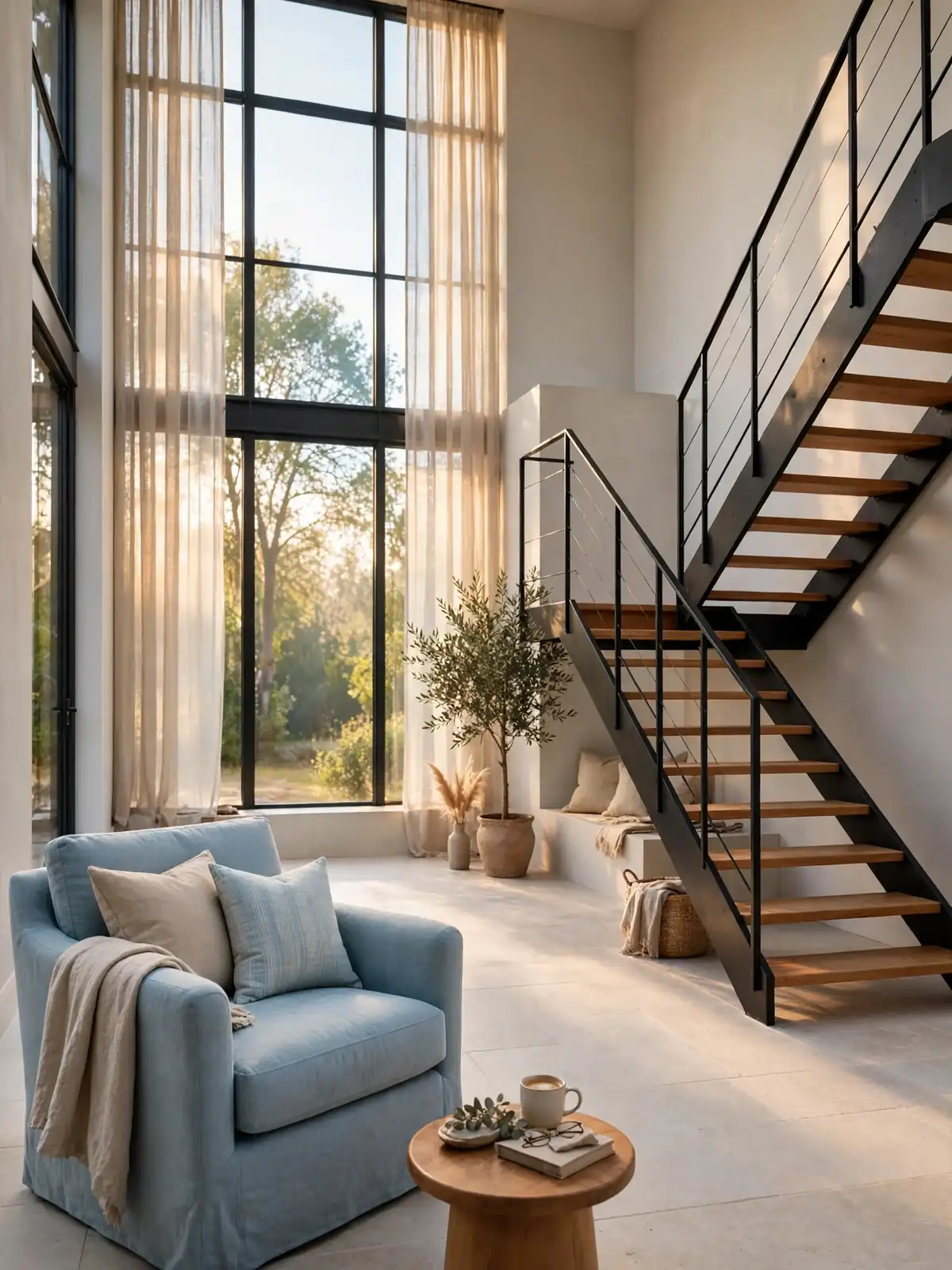
A double-height window turns a metal staircase into a light-filled centrepiece. In this loft, a 5-metre-tall window with sheer linen curtains runs beside a straight metal stair with warm beech treads, each 950 mm wide, and a slim black steel frame that disappears against the daylight. A soft sky-blue armchair and a pale stone floor pick up the cool morning light, while the sheer curtains soften the sun without blocking it. Morning light falls straight through the open risers and across the floor.
Quick tips:
- Use sheer linen, not heavy curtains, on a double-height window.
- Align the stair with the window so light falls through the open risers.
- Choose warm wood treads to balance cool window light.
- Keep the window sill clear so nothing blocks the view through the stair.
A Metal Staircase That Turns a Dark Hallway Into the Brightest Spot in the Home
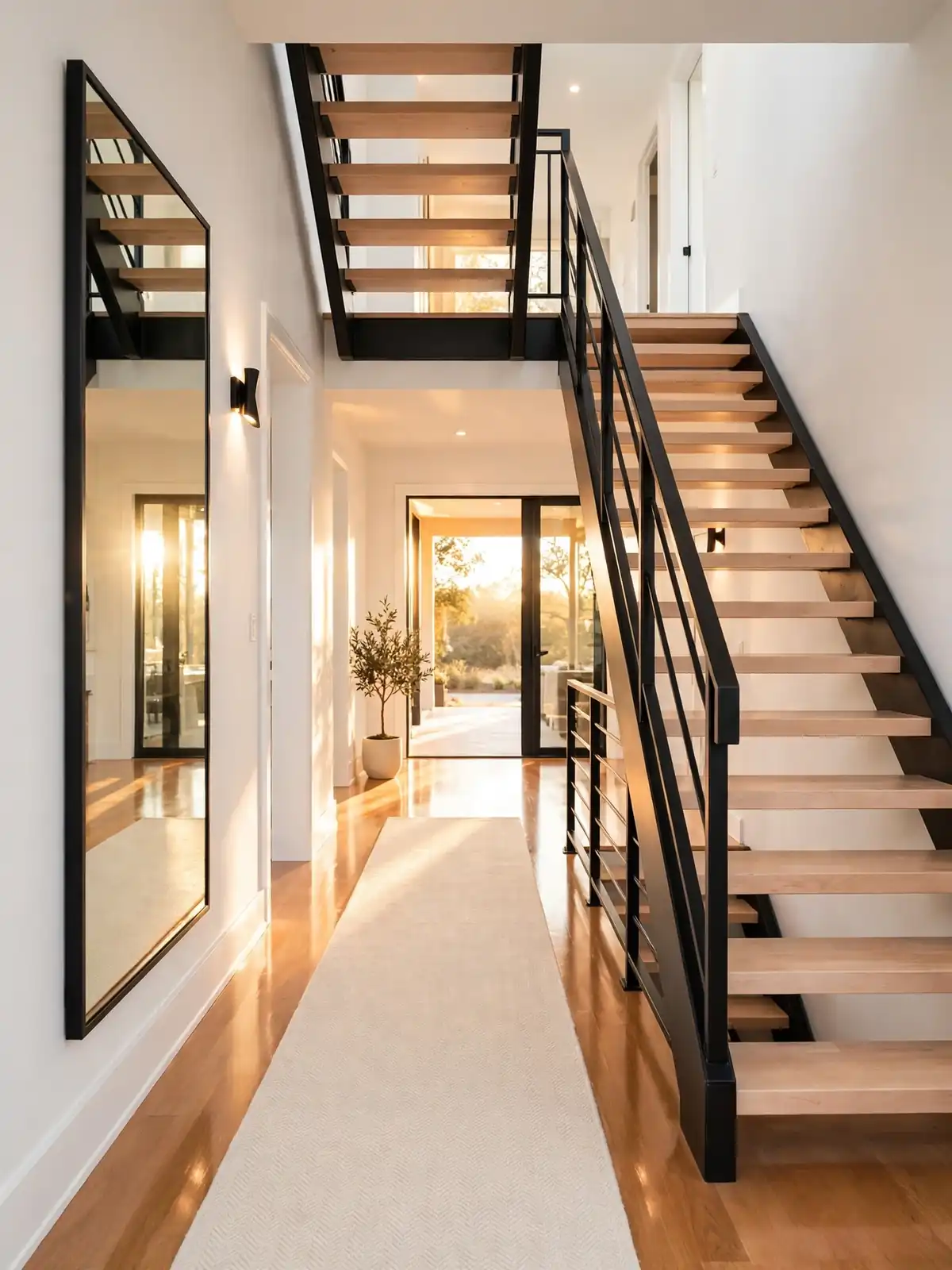
A dark hallway is where a metal staircase makes the biggest difference. In this home, a narrow hallway with only one small window was opened up with a straight metal stair — pale maple treads, a slim black steel frame with open risers, white walls, and a large mirror opposite the stair to bounce the light further. A cream runner softens the floor, and the golden light from the landing window now travels through the open stair and across the whole hallway. What was once the darkest room is now the brightest.
Quick tips:
- Paint the hallway white so it reflects every bit of light.
- Add a large mirror opposite the stair to double the brightness.
- Choose the palest treads you love for the most light.
- Keep the hallway free of tall furniture that could block the stair.
FAQs
Is a metal staircase noisy?
It can sound firmer underfoot than a carpeted timber stair, so a runner, a rug at the base, soft furnishings nearby and rubber tread strips help soften footsteps and voices. In an open-plan home, those soft touches are usually enough to keep the stair feeling calm.
Is a metal staircase safe for a family home?
Yes, when it is built well. Choose a secure handrail at a comfortable height, keep baluster or cable gaps narrow enough that a small child cannot climb through, add non-slip strips on the treads, and check fixings regularly. For very young children, a stair gate at the top and bottom adds extra peace of mind.
How much does a metal staircase cost?
The cost varies widely with the design, the metal, the size and the finish. A simple straight steel stair with a powder-coated frame costs far less than a custom spiral, a suspended stair or one with marble treads and brass details. Ask two or three specialist fabricators for itemised quotes for the same design, so you can compare the frame, treads, railings and fitting separately.
How do I stop a metal staircase from rusting?
Choose galvanised or powder-coated steel for damp rooms and outdoor stairs, wipe up spills promptly, and keep the finish intact — chips and scratches are where rust starts. Touch up any damage quickly with matching metal paint, and check joints and fixings once a year, especially on an outdoor stair.
Can a metal staircase work in a traditional home?
Yes, if the metal is paired with classic materials. Warm oak treads, a leather-wrapped handrail, a soft neutral wall and traditional furniture keep the stair feeling at home in a period house, while the slim metal frame quietly adds light without changing the character of the rooms.
Conclusion
A metal staircase is not just a way to move between floors — it is a way to add strength, slim lines and modern character to the whole home. Whether you choose matte black with warm oak, brass or copper for warmth, glass panels for openness, a spiral to save space, or lighting and a runner to make the stair feel soft underfoot, the best metal staircase is the one that suits the rooms around it. Keep the palette warm, the sightlines open, and the space under and beside the stair intentional, and your stair will make every room it touches feel brighter, larger and more welcoming.