25 Stunning Staircase Decor Ideas That Instantly Make Your Hallway Feel Warmer, Brighter and More Beautiful
A staircase is the one part of the home you pass every single day, yet it is often the last place to get any decoration. These 25 staircase decor ideas show how a gallery wall, a patterned runner, warm lighting, fresh greenery and a few thoughtful details can turn a plain stair into a bright, welcoming feature.
Staircase decor ideas are the finishing touches that turn a plain stair into a feature — a gallery wall on the stairwell, a patterned runner on the treads, warm lighting on the landing, plants on the windowsill and art that draws the eye upward. The best staircase decor works with the stair you already have: it adds colour, texture and personality without blocking the climb or crowding the hallway.
For a fuller look at the wall that climbs with the stair, this staircase gallery wall shows how framed prints, family photos and mirrors can fill the tall stairwell beautifully. The 25 ideas below cover the walls, the treads, the landing and the space underneath, so you can decorate a grand stair, a narrow hallway stair, or a small landing with equal ease.
Key Takeaways
What are the easiest staircase decor ideas?
A framed gallery wall along the stairwell, a patterned runner on the treads, a mirror on the landing, a small plant on a windowsill and warm wall lights. These five touches change the whole stair without any building work.
How do you decorate a staircase wall?
Hang art in a rising line that follows the angle of the stair, spacing frames evenly about 15 cm apart. Mix sizes for a collected look, keep the centre of the arrangement at eye level as you climb, and add one mirror to bounce light around the stairwell.
What is the best runner for a staircase?
A flat-weave wool runner in a pattern that suits the room, about 60 to 70 cm wide so the timber shows on both sides, held in place with slim stair rods. Wool wears well, hides dust, and feels soft underfoot.
How do you light a staircase beautifully?
Layer the light — wall sconces at every third step, a pendant or lantern over the landing, and small step lights or LED strips under the handrail. Warm bulbs around 2700K keep the stair feeling cosy rather than stark.
Can you decorate the space under the stairs?
Yes — the space under the stairs suits a reading nook with a chair and lamp, open shelves for books, a small desk, a plant display, or neat storage with baskets and cupboards. Keep the area tidy so it reads as intentional, not cluttered.
Staircase Decor Ideas for a Gallery Wall Above the Landing
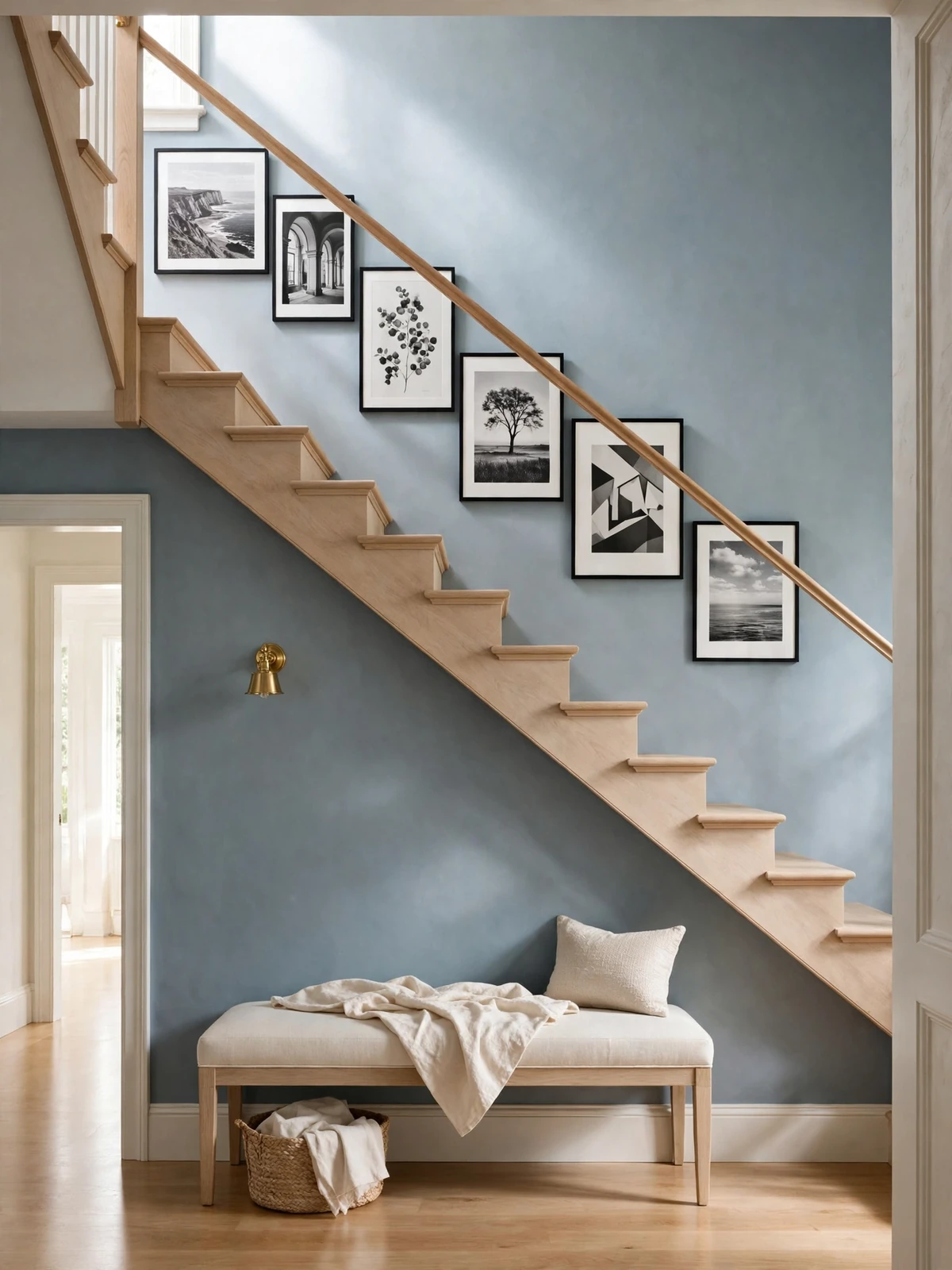
A gallery wall that rises with the stair is the classic staircase decor idea, and it works because it turns an empty, awkward wall into a story. In this hallway, twelve framed prints in slim black frames climb the dusty-blue wall in a diagonal line that follows the pale oak treads, each frame spaced about 15 cm apart, with the largest print — a 50 by 70 cm black-and-white landscape — anchoring the landing. A cream linen bench below gives the eye a place to rest, and a small brass wall sconce warms the frames in the evening. The mix of family photos, landscapes and line drawings keeps the wall personal, not like a shop display.
Quick tips:
- Hang frames in a rising line that follows the angle of the stair.
- Keep frames the same colour but vary the sizes for a collected feel.
- Space frames about 15 cm apart so the wall breathes.
- Anchor the landing with one large frame, about 50 by 70 cm.
A Patterned Runner in Terracotta and Cream
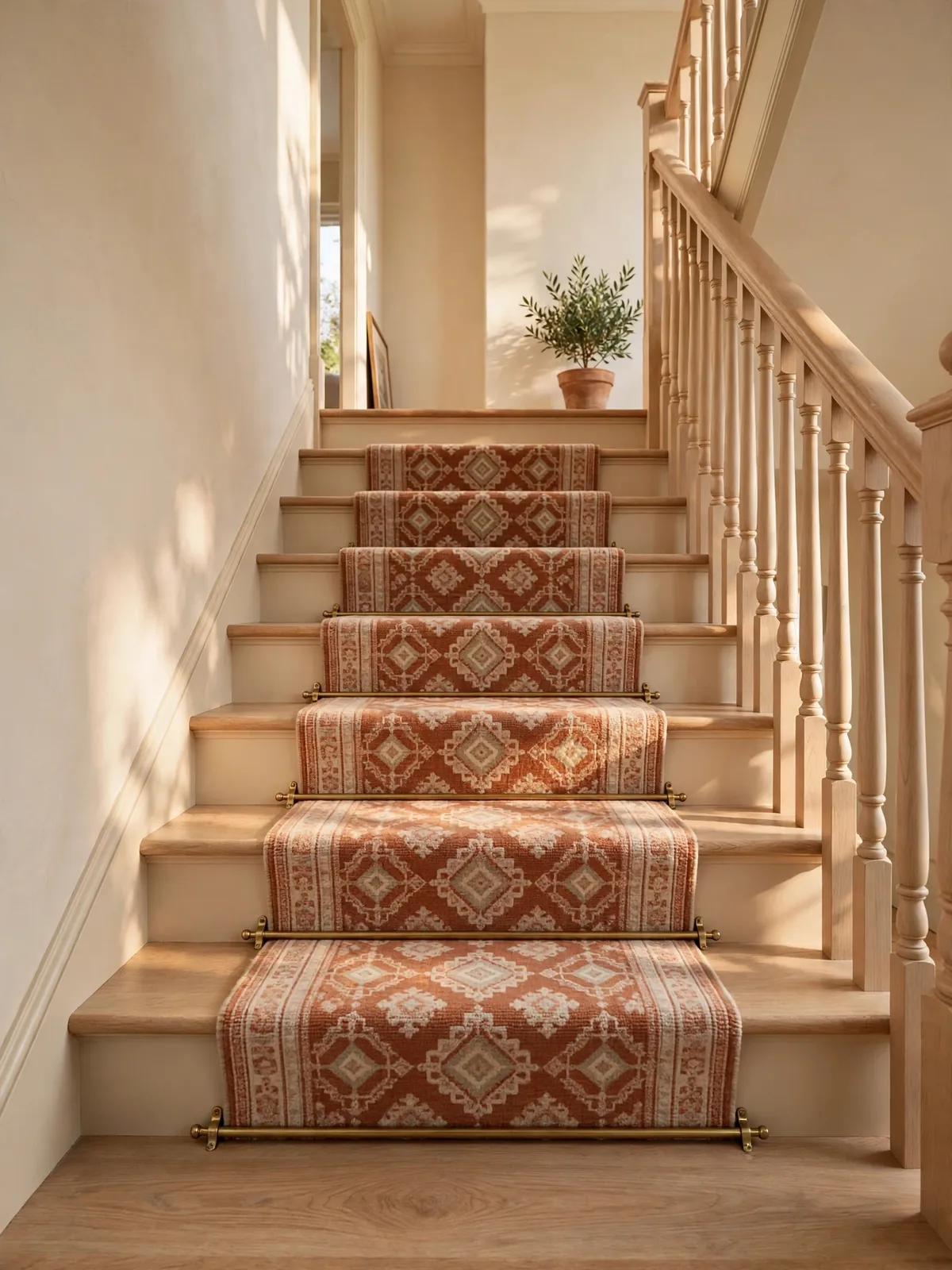
A patterned runner is the fastest way to give a plain stair warmth and personality. Here, a flat-weave wool runner in a terracotta and cream geometric pattern, 65 cm wide, runs down the centre of pale oak treads, leaving a strip of warm timber visible on each side, held in place by slim brass stair rods. A small terracotta pot with a green plant on the landing picks up the runner’s colour, while warm cream walls keep the hallway bright. The runner softens every footstep and makes the climb feel quieter and more cared for.
Quick tips:
- Choose a runner about 65 cm wide so timber shows on both sides.
- Use wool — it wears well and hides dust between cleans.
- Pick slim brass rods to hold the runner neatly in place.
- Vacuum the runner weekly and rotate it yearly for even wear.
Warm Brass Sconces Along a Deep Green Stairwell
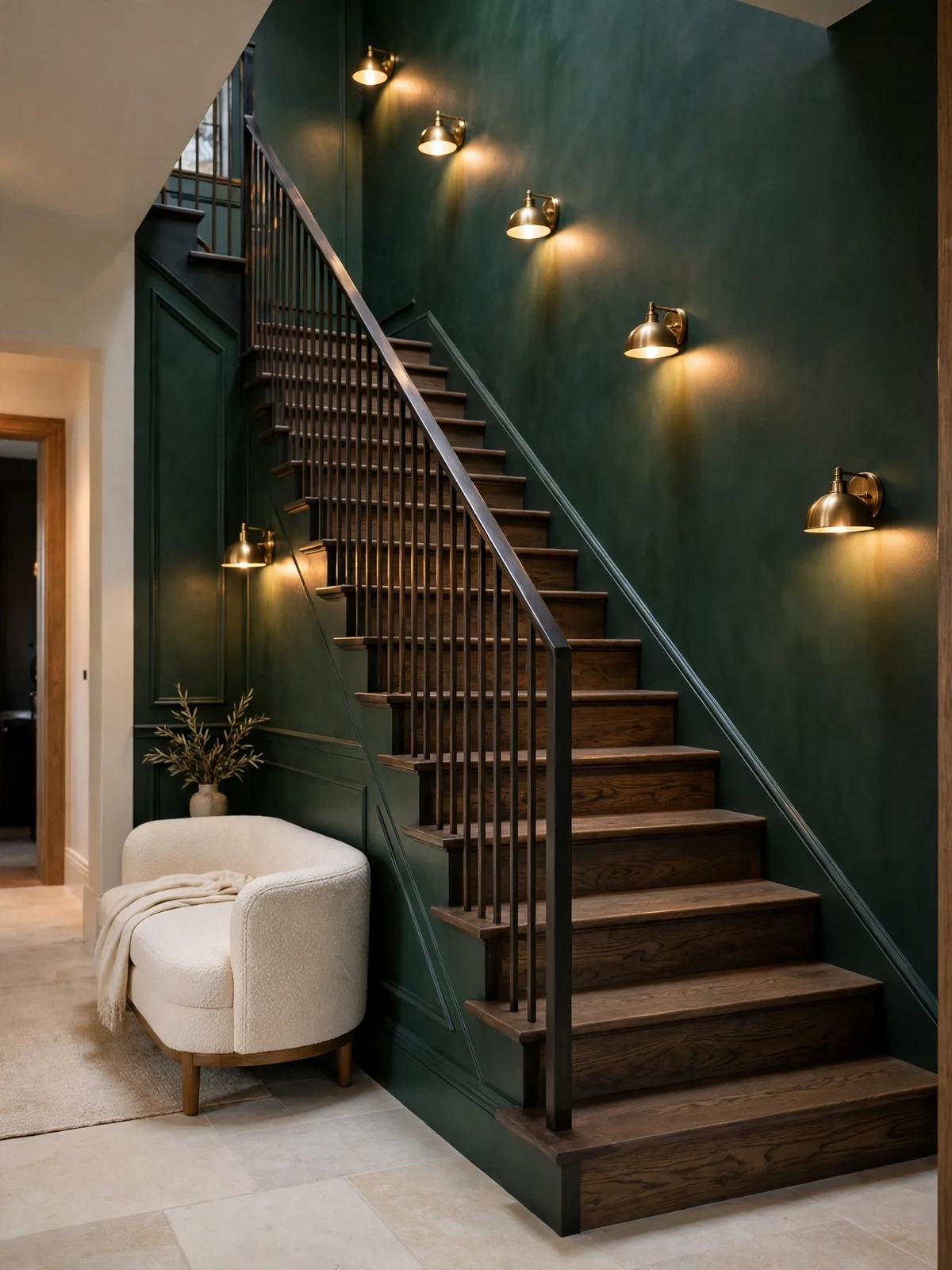
Wall sconces turn a dark stairwell into a warm, glowing passage. On this stair, three slim brass sconces with warm 2700K bulbs are fixed to a deep forest-green wall at every third step, washing soft pools of light down the smoked oak treads and across the pale stone floor below. A cream boucle bench at the base gives the hallway a soft landing spot, and the green wall makes the brass glow even richer in the evening. The stair feels like a quiet hotel corridor — calm, warm and a little bit luxurious.
Quick tips:
- Space sconces every third step for even, gentle light.
- Choose warm 2700K bulbs so the stair feels cosy, not stark.
- Pair brass sconces with a deep wall colour for the richest glow.
- Fit a dimmer so the light can be softened at night.
A Round Mirror on the Landing That Doubles the Light
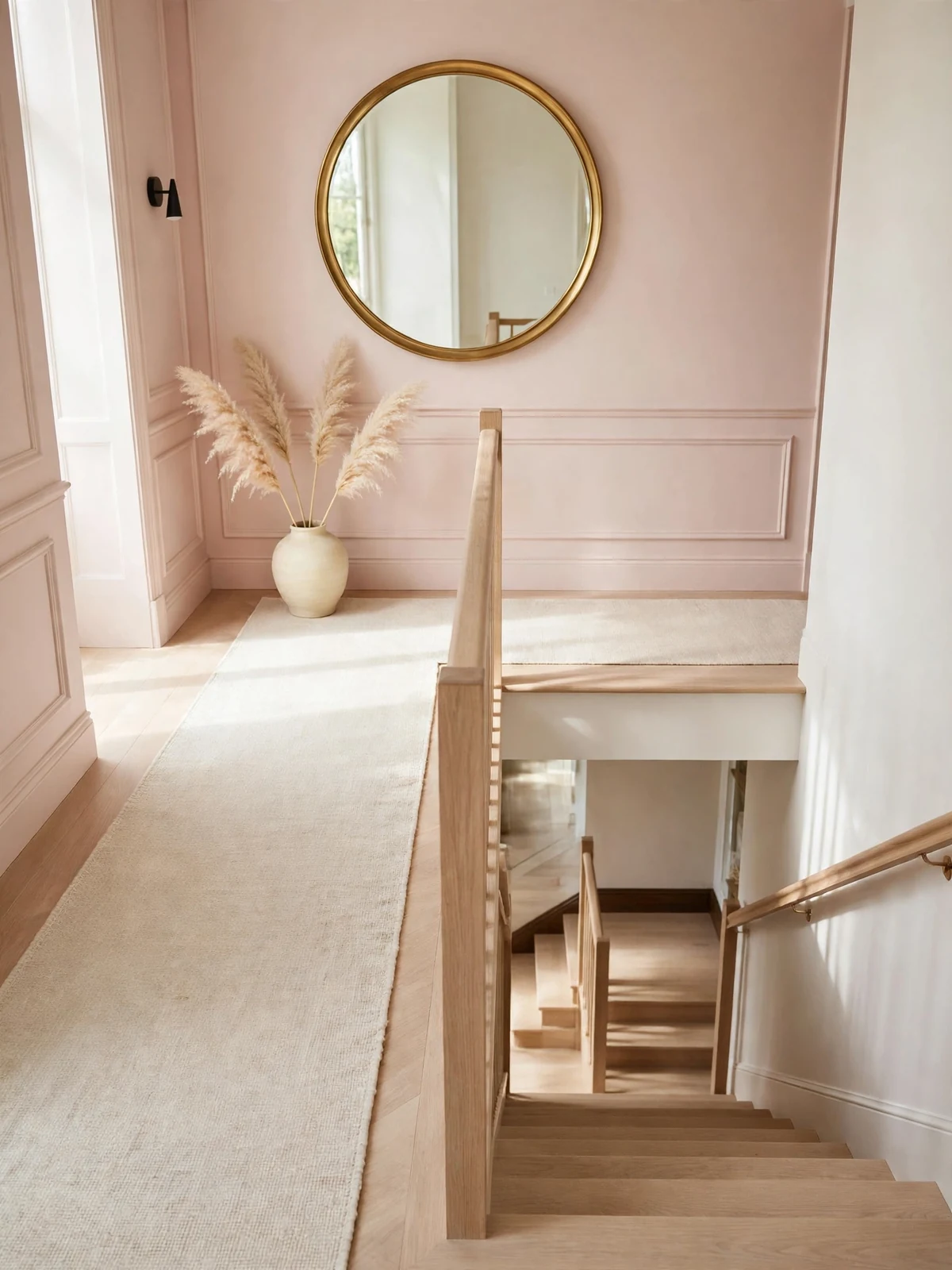
A round mirror on the landing catches the light from the hall window and throws it back down the stair, so the whole stairwell feels brighter. In this home, a 90 cm round mirror in a slim brass frame hangs on a blush-pink landing wall, centred at eye level above a small console, with a cream ceramic vase holding dried pampas grass beside it. A pale linen runner softens the landing floor, and the pale oak treads below catch the reflected light all the way down. The mirror also gives you a last glance before you head out the door.
Quick tips:
- Hang the mirror opposite a window so it catches real daylight.
- Choose a round mirror about 90 cm wide for a landing wall.
- Keep the console below slim so the landing stays easy to pass.
- Use dried pampas or eucalyptus for a soft, low-maintenance display.
Fresh Greenery on Every Landing Windowsill
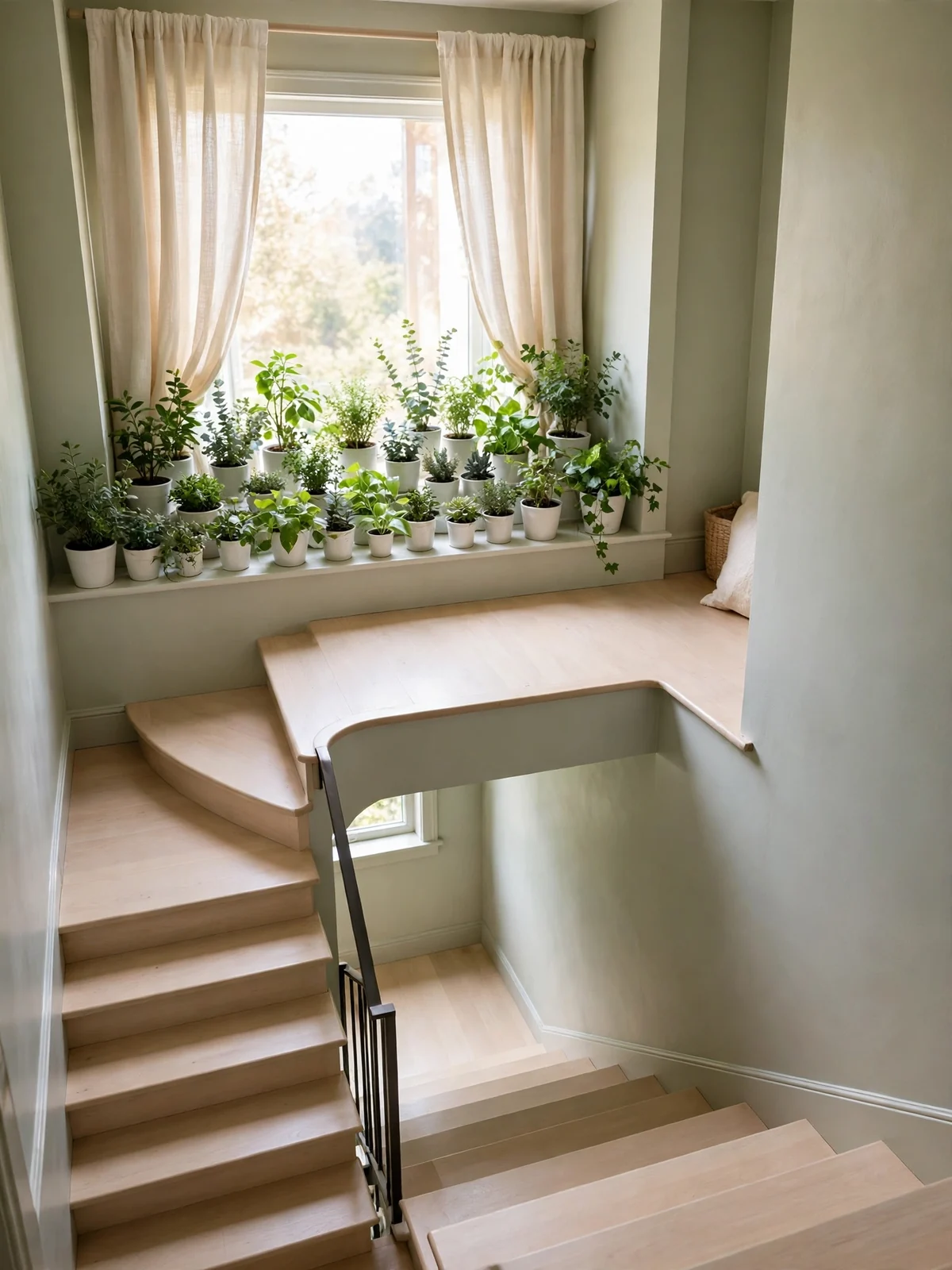
Plants on the landing windowsill bring life to a stair that is otherwise all timber and plaster. Here, five small plants — a trailing pothos, a compact fern, a small olive, a pilea and a sprig of rosemary — sit in matching white ceramic pots along a wide landing windowsill, their green leaves catching the daylight against soft sage-green walls. Pale birch treads rise below the window, and cream linen curtains frame the glass without blocking the light. The plants need only a weekly water and a wipe of their leaves, and they make the landing feel like a small garden.
Quick tips:
- Group plants in odd numbers — three or five — for a natural look.
- Use matching pots so the display reads as one arrangement.
- Choose low-maintenance plants like pothos, fern and pilea.
- Water weekly and rotate the pots so the plants grow evenly.
A Cosy Reading Nook Under the Stairs
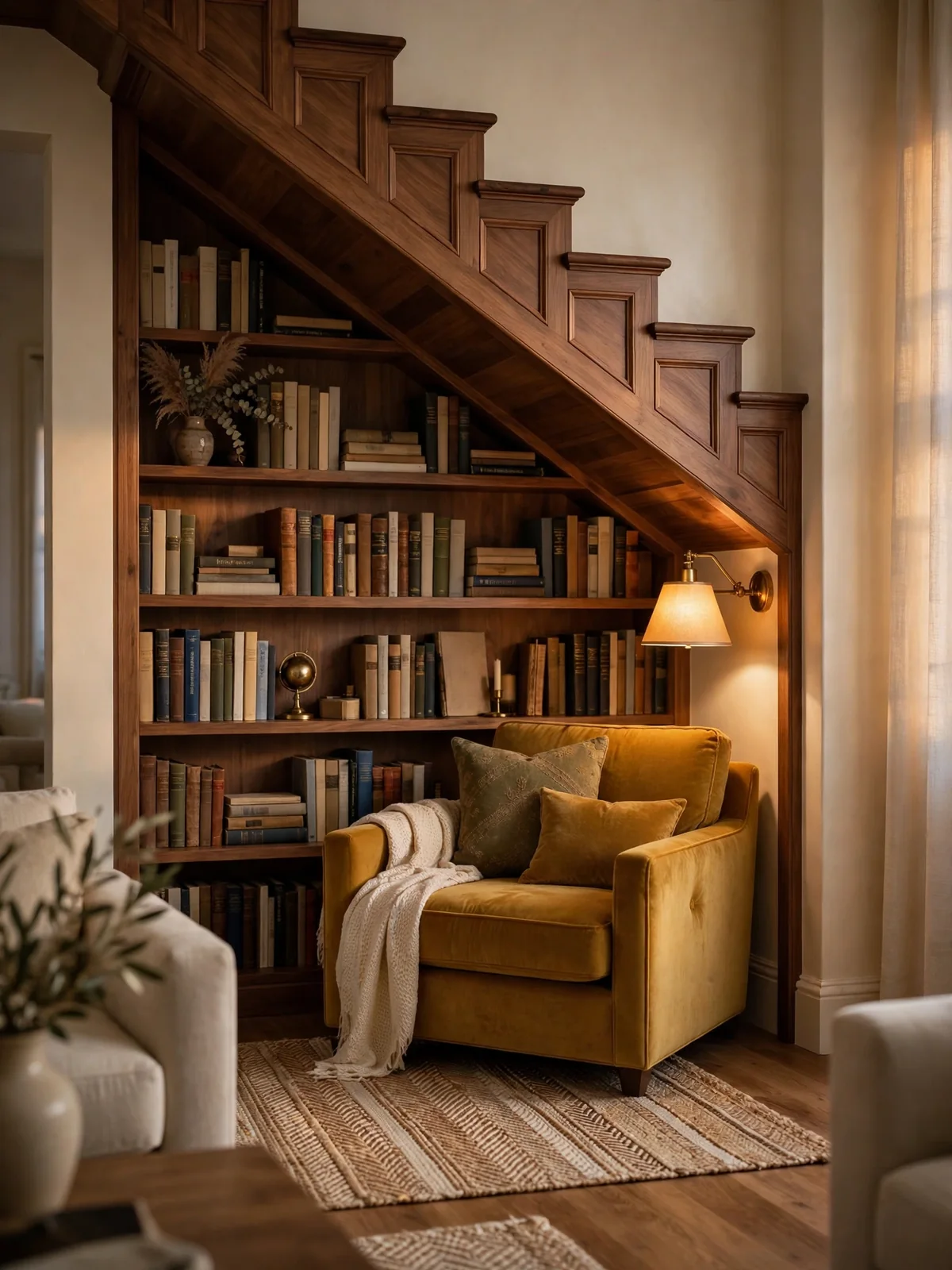
The space under the stairs is the perfect size for a reading nook, and it turns wasted space into the most loved corner of the house. In this home, a mustard-yellow velvet armchair sits beneath the stair, facing a set of warm walnut shelves built into the angled wall and filled with books, with a slim brass reading lamp beside the chair and a small woven rug underfoot. Soft cream walls keep the nook bright, and the lamp’s warm glow makes it inviting after dark. It is a seat you will fight over on rainy afternoons.
Quick tips:
- Choose an armchair that fits the lowest part of the slope comfortably.
- Build shelves into the angled wall to use every centimetre.
- Add a brass reading lamp for warm evening light.
- Keep a woven basket for blankets beside the chair.
A Seasonal Garland Along the Handrail
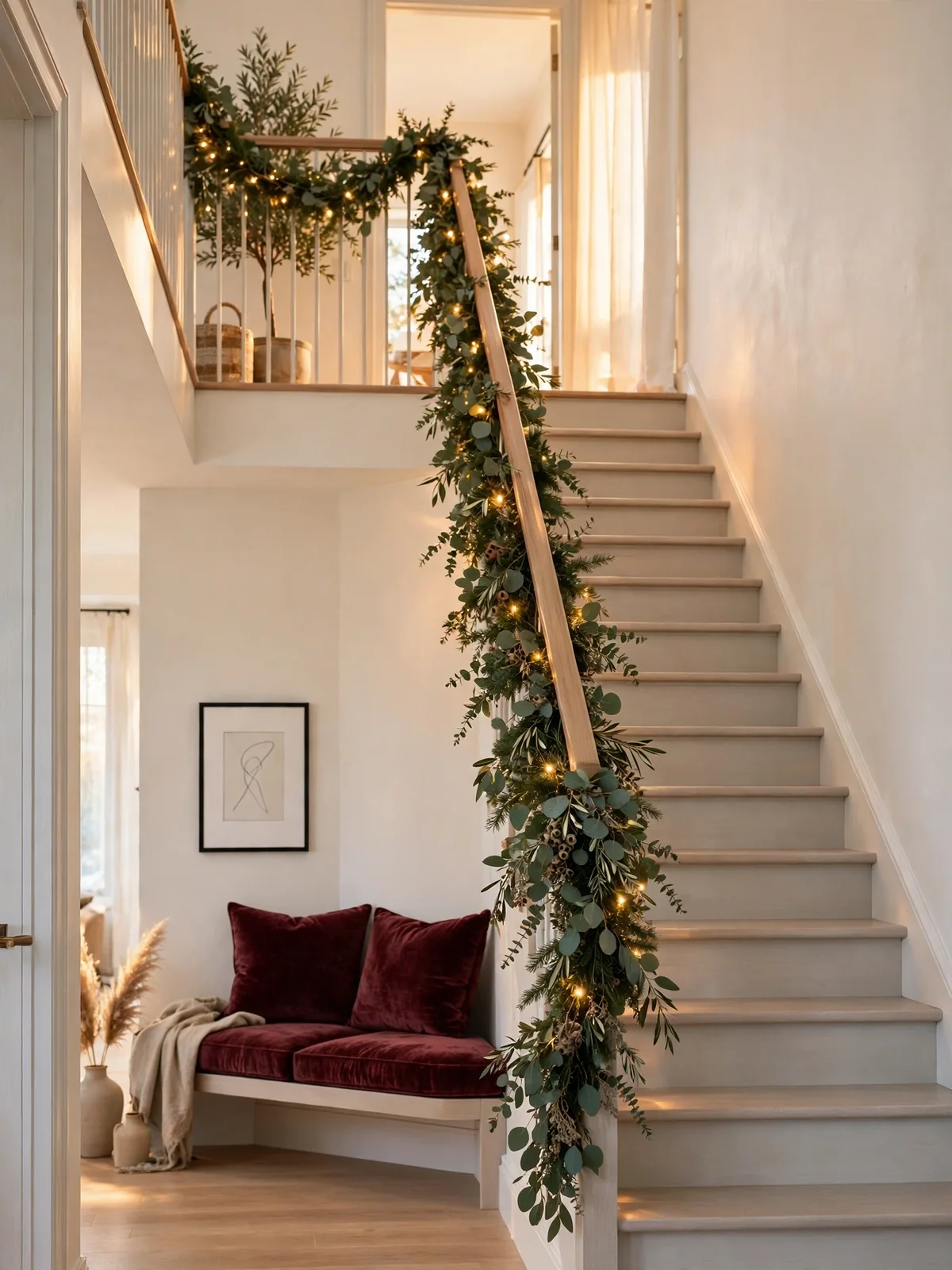
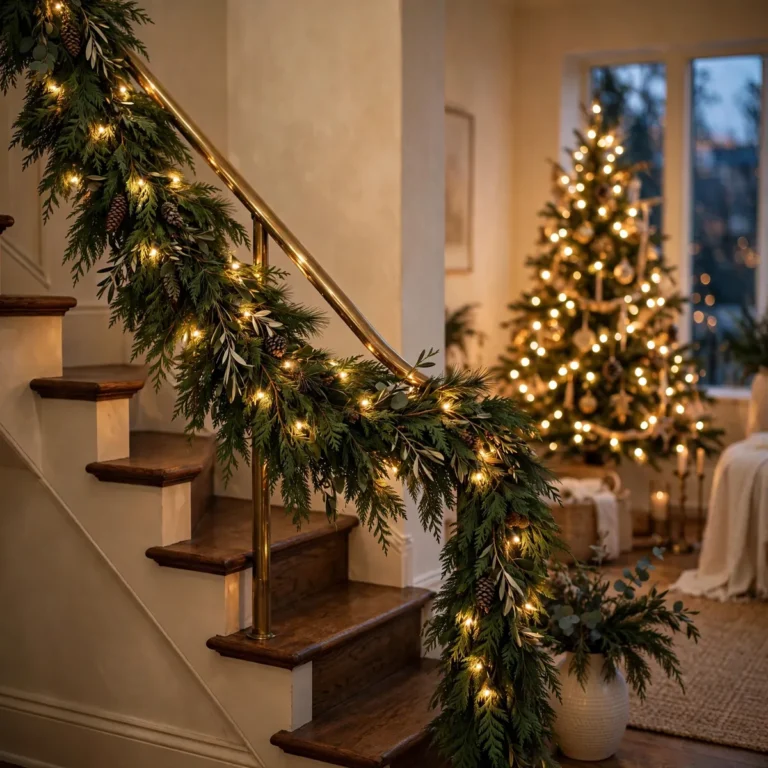
A garland along the handrail is the easiest seasonal decoration for a staircase, and it changes the whole hallway in ten minutes. Here, a lush eucalyptus garland is draped loosely along the slim black steel handrail, its green leaves spilling softly over the pale ash treads, with a string of warm fairy lights woven through it and burgundy velvet cushions on the bench below. Soft ivory walls keep the display light, and the golden glow of the fairy lights makes the stair feel festive and welcoming. Swap the garland with the seasons — eucalyptus in winter, blossom in spring, dried grasses in autumn.
Quick tips:
- Drape the garland loosely so it sways softly, not stiffly.
- Weave warm fairy lights through the garland for evening glow.
- Tie the garland with ribbon at every third baluster so it stays put.
- Choose faux greenery if the stair is in direct sun.
Framed Botanical Prints in a Narrow Hallway Stair
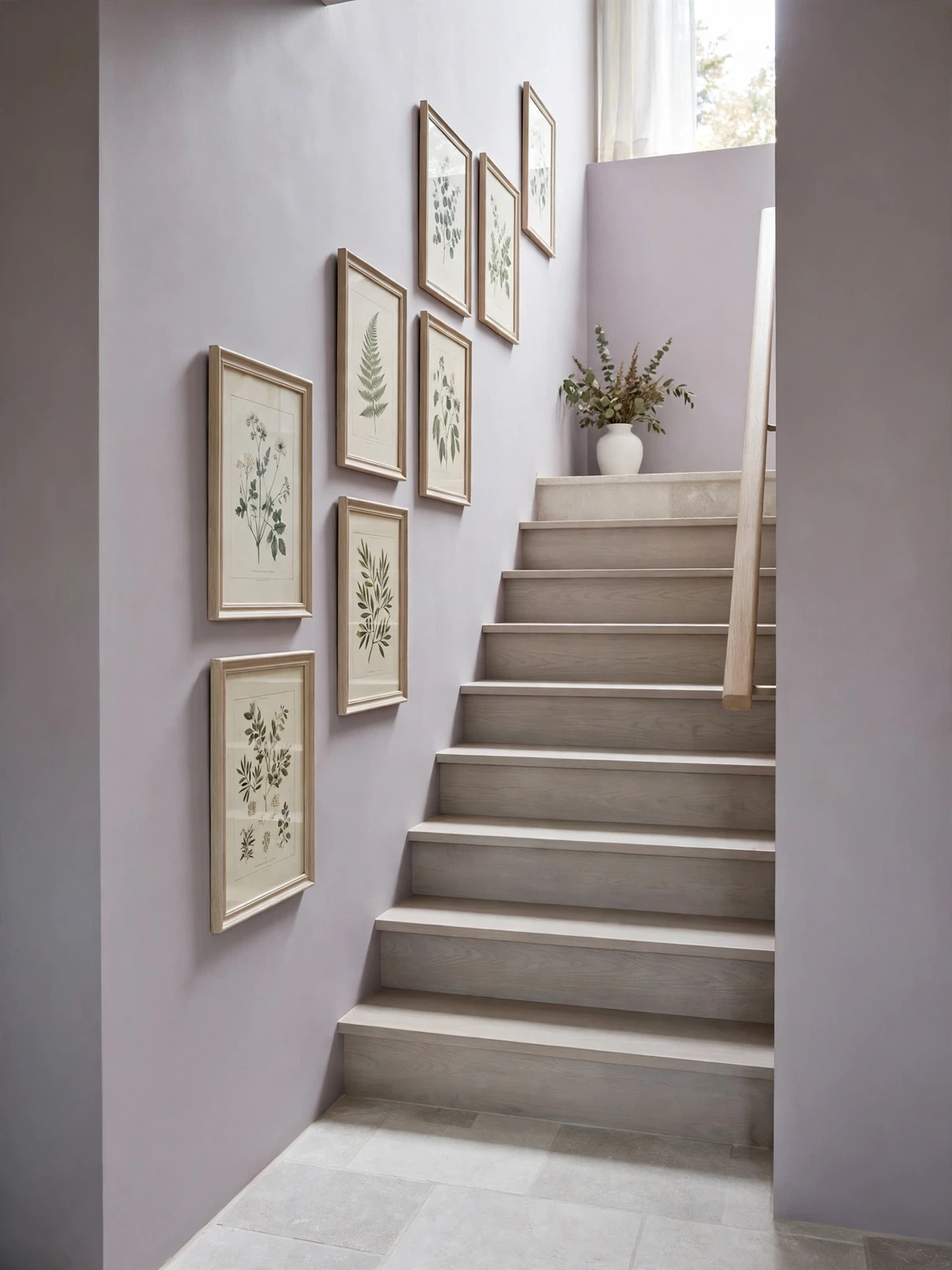
Botanical prints suit a narrow stair because their soft greens and pale frames add life without crowding the wall. Along this narrow flight, six framed botanical prints in pale oak frames hang in two neat rows on a soft lilac-grey wall, each print 30 by 40 cm, rising gently with the pale grey oak treads. A white ceramic vase on the landing and a pale stone floor keep the palette calm, and daylight from the hall window falls across the prints. The stair feels like a quiet garden walk, even in the smallest hallway.
Quick tips:
- Hang prints in neat rows on a narrow stair — no diagonal needed.
- Keep frames pale oak so the prints stay soft and light.
- Use the same print size, about 30 by 40 cm, for a calm grid.
- Add one vase on the landing to echo the botanical theme.
A Bold Colour-Blocked Wall Beside the Stair
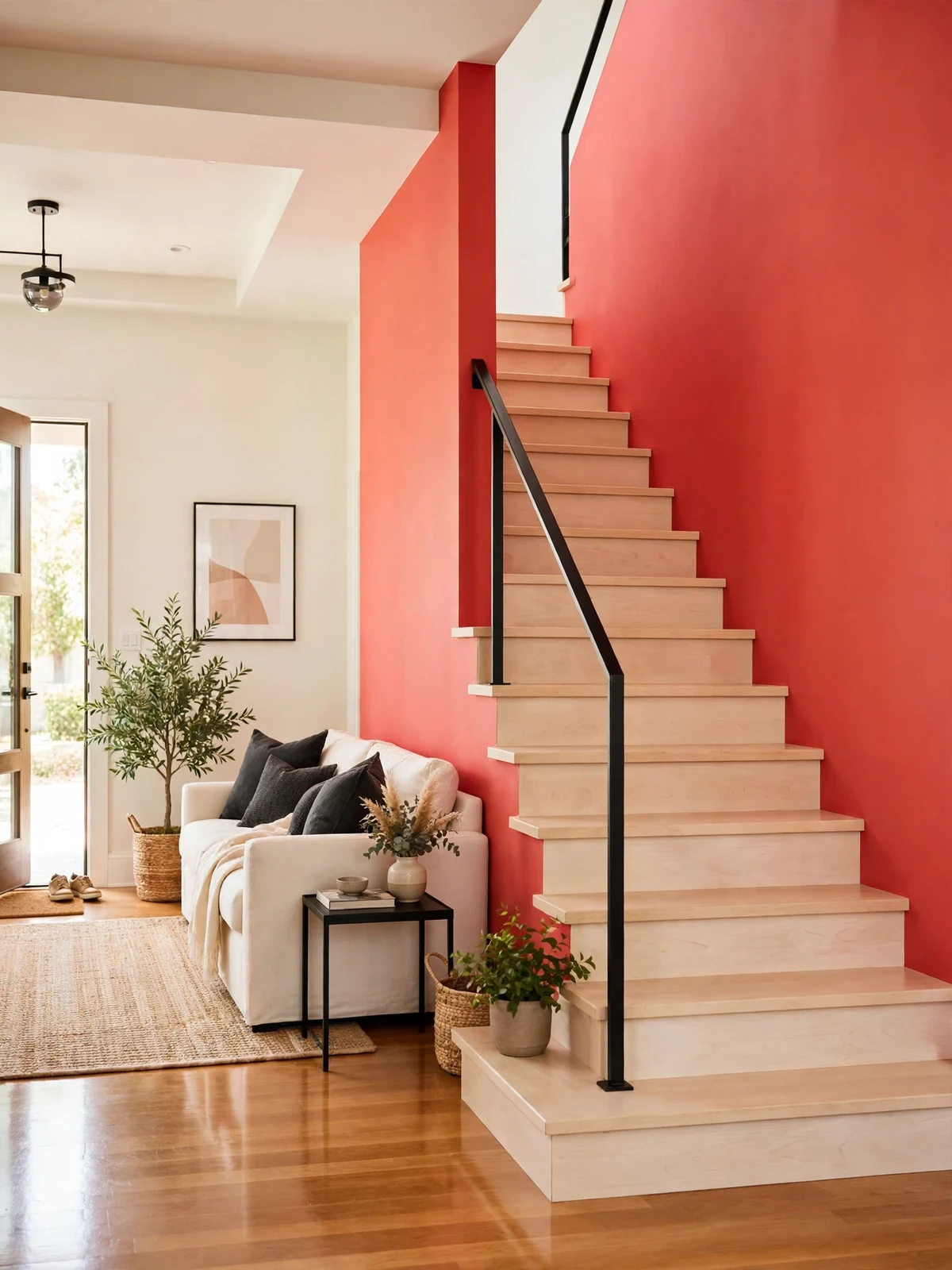
A colour-blocked wall gives a stair instant personality for the cost of one tin of paint. In this entryway, the wall beside the stair is painted in two blocks — coral-red on the lower half following the angle of the pale maple treads, and warm cream above — with a slim black steel handrail cutting a clean line between them. A cream sofa and charcoal cushions below pick up the contrast, and daylight makes the coral glow. The stair feels cheerful and modern, and the paint can be changed in a weekend whenever you fancy a new colour.
Quick tips:
- Paint only the stair wall in colour blocks, keeping the rest pale.
- Follow the angle of the stair with the lower colour block.
- Pair a bold colour with pale timber treads for balance.
- Use a slim black handrail to cut a clean line through the colour.
A Full-Length Runner With a Vintage Persian Pattern
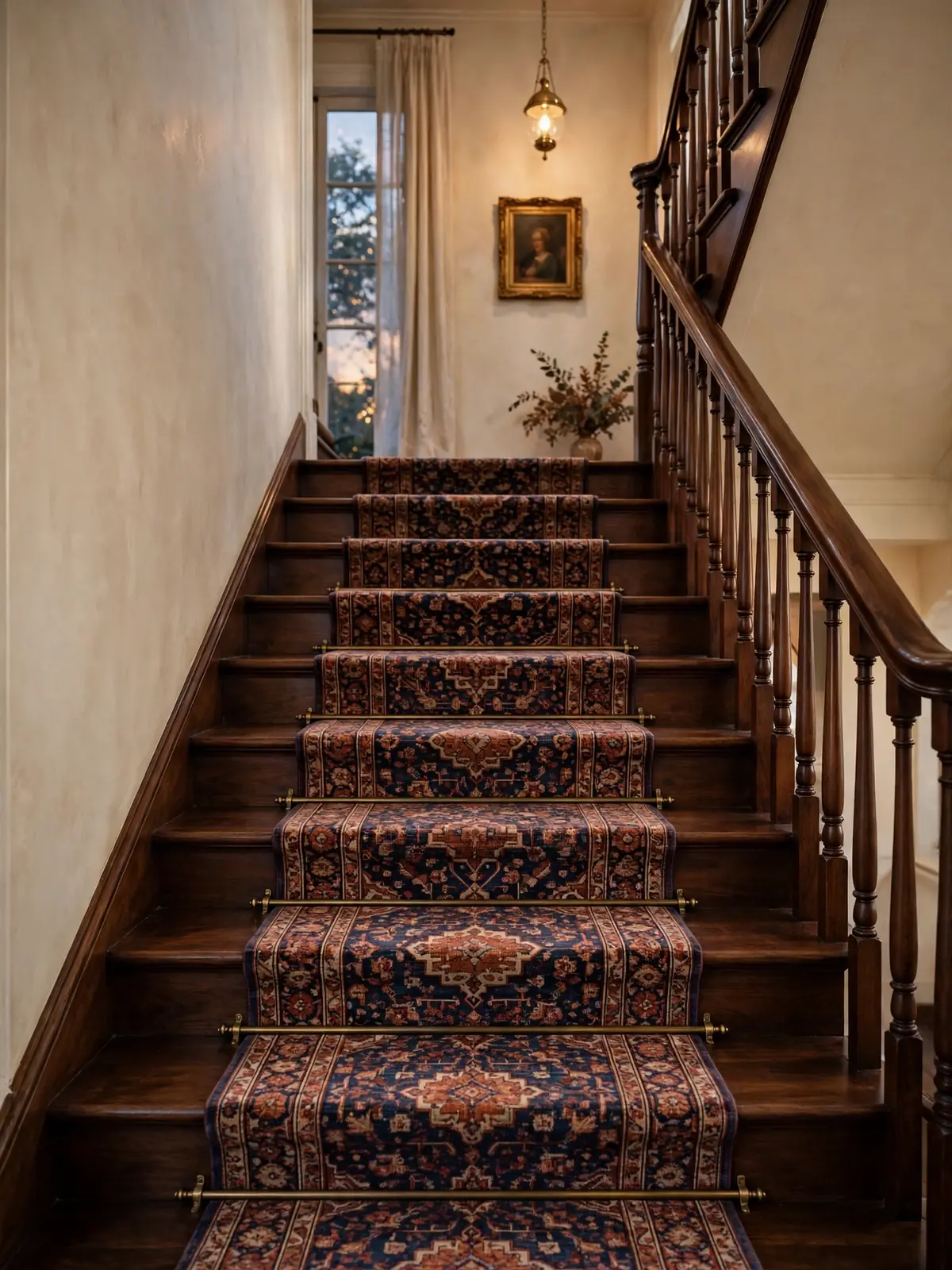
A vintage Persian-patterned runner is one of the most forgiving and most beautiful staircase decor ideas, because the busy pattern hides dust and scuffs while adding a layer of history and warmth that a plain carpet never can, and on dark walnut treads the deep indigo, rust and ivory of the pattern look richer with every year of wear. In this home, the runner is 70 cm wide and runs the full flight, each step held by an antique brass stair rod, with the pattern’s ivory border framing every tread like a picture. Warm cream walls and a small brass pendant light over the landing keep the hallway glowing, while the runner’s deep colours make the dark walnut treads feel intentional rather than heavy. It is the kind of stair that looks better at ten years old than it did on the day it was fitted, because the pattern softens, the wool settles, and the colours deepen into something no new carpet can copy. If the budget is tight, a good flat-weave copy in the same palette gives most of the look for a fraction of the price, and a thin underlay beneath it keeps the runner from slipping while cushioning every step.
Quick tips:
- Choose a runner about 70 cm wide so the timber border shows on both sides.
- Use antique brass stair rods for a vintage, collected finish.
- Add a thin underlay beneath the runner to stop slipping.
- Pick a busy pattern — it hides dust and scuffs beautifully.
Floating Shelves With Books and Ceramics on the Stairwell
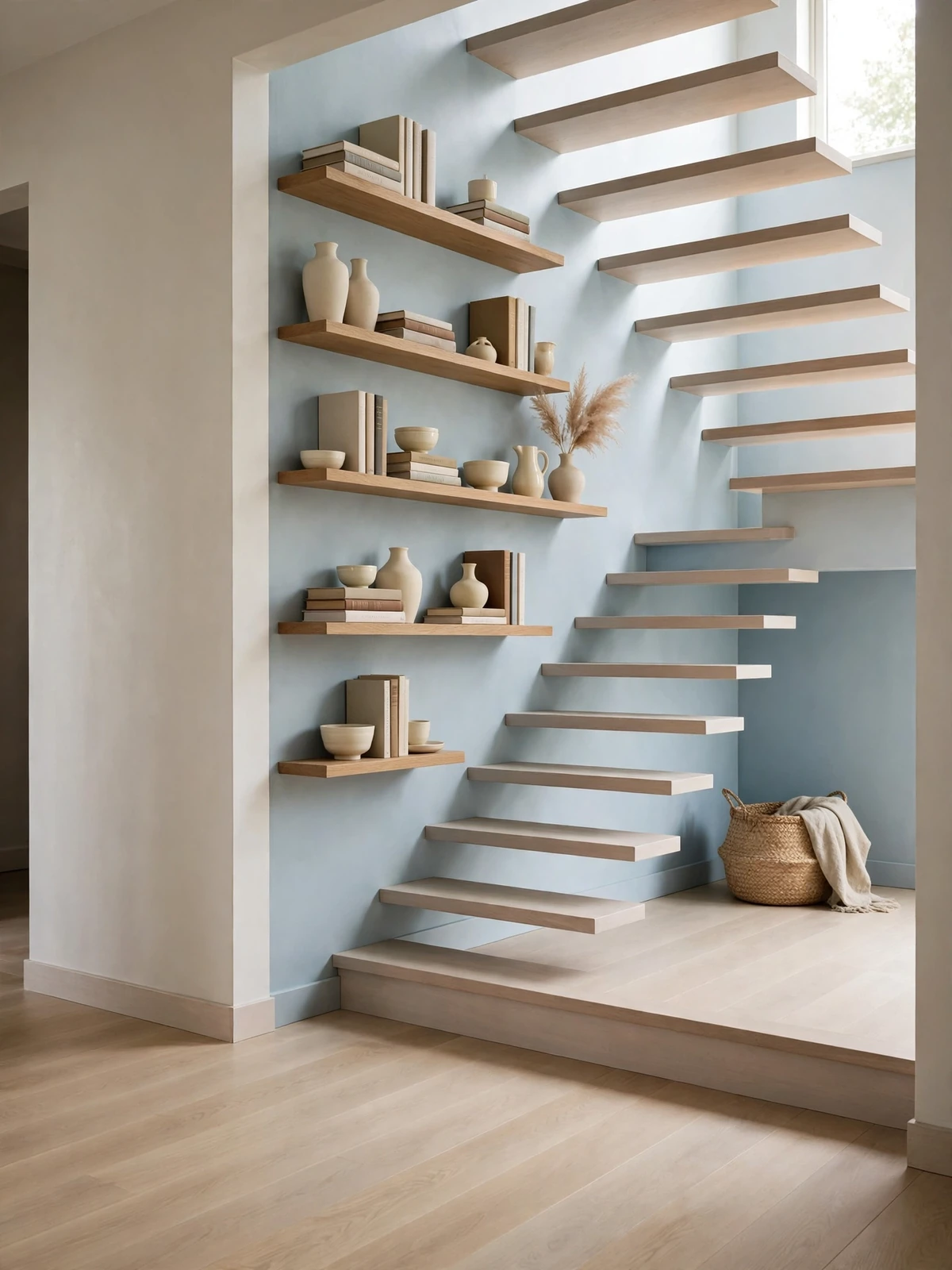
Floating shelves on the stairwell wall turn the climb into a small display. Here, three slim oak shelves, each 80 cm long, are fixed to a soft sky-blue wall following the rise of the stair, holding a few books, cream ceramics and one small trailing plant. Pale ash treads and a pale wood floor keep the hallway light, while a woven basket on the landing holds scarves and gloves. The shelves are deliberately sparse — three or four objects each — so the display reads as curated, not cluttered.
Quick tips:
- Fix shelves following the rise of the stair, not in a flat line.
- Keep each shelf sparse — three or four objects at most.
- Mix books, ceramics and one small plant per shelf.
- Use oak shelves to match pale timber treads.
A Statement Pendant Light Over the Landing
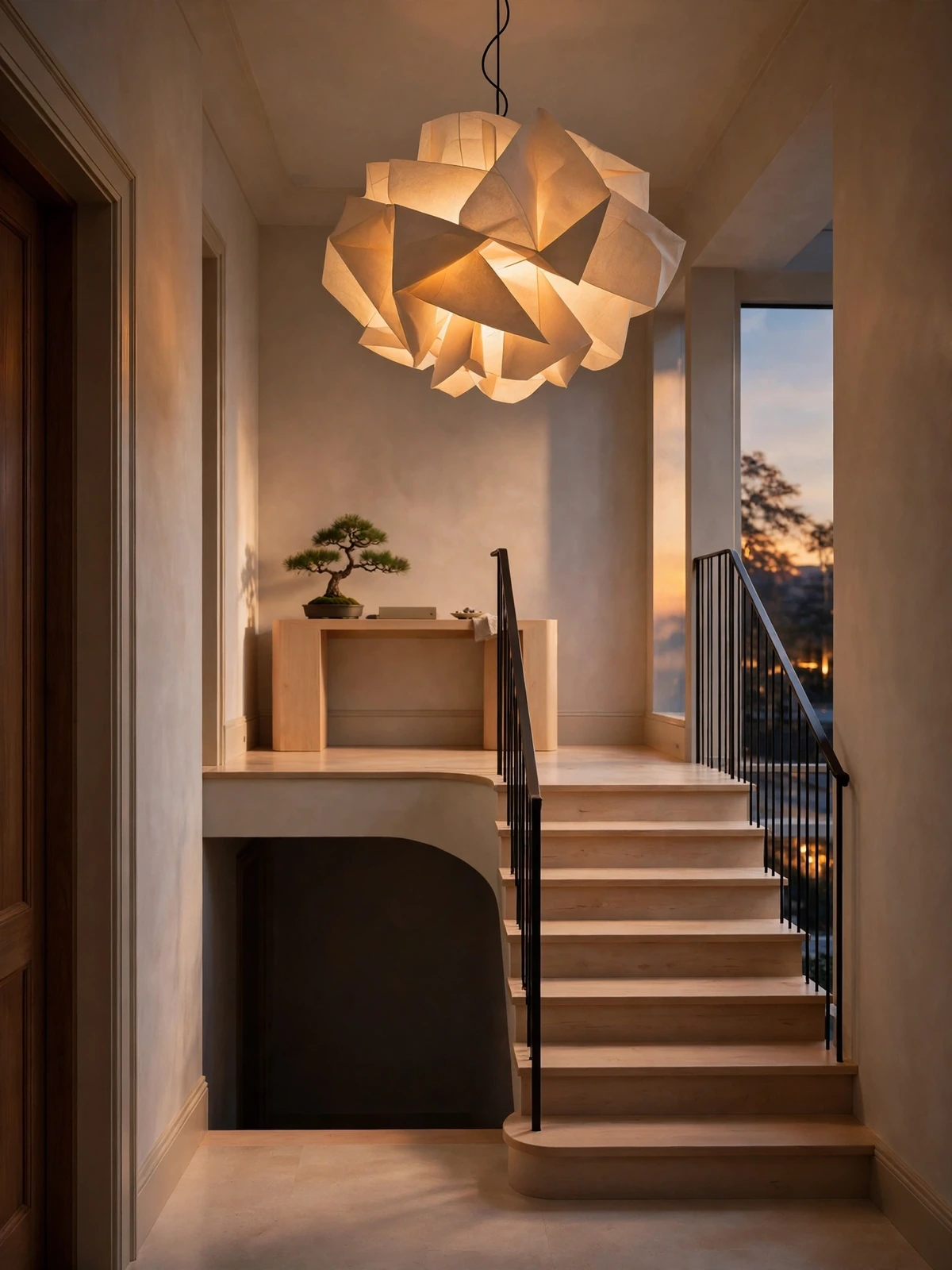
A statement pendant over the landing is the single light that defines the whole stairwell. In this hallway, a large paper lantern, 60 cm wide, hangs low over the landing, its warm glow falling softly across the pale maple treads and soft beige walls below. A small bonsai on a slim landing console adds a living detail, and the lantern’s diffused light makes the stair feel calm and welcoming after dark. Hang it so its base sits about 2.1 metres above the landing floor — low enough to glow, high enough to walk beneath.
Quick tips:
- Hang the pendant about 2.1 metres above the landing floor.
- Choose a warm bulb so the lantern glows softly, not starkly.
- Keep the landing console slim so the pendant stays the feature.
- Add one living detail, like a bonsai, beneath the light.
A Black-and-White Photo Staircase of Family Memories
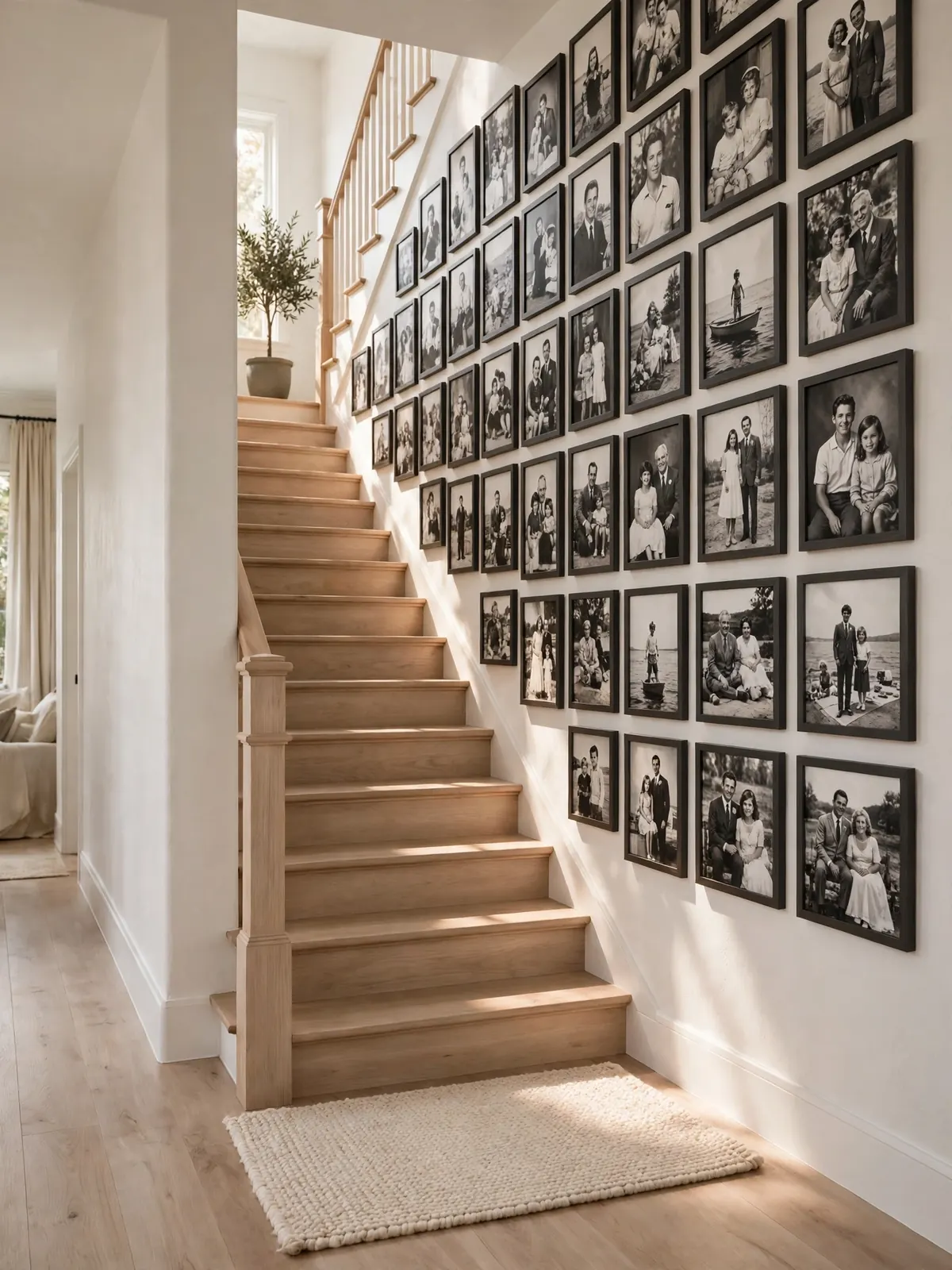
A stairwell full of black-and-white family photos is the most personal staircase decor of all, and the monochrome palette keeps even a crowded wall looking calm. Along this stair, eighteen photographs in matching slim charcoal frames climb the soft white wall in a loose diagonal, from a grandparent’s wedding photo at the base to the children’s school portraits at the landing, each frame spaced about 12 cm apart. Pale oak treads and a cream wool rug at the base keep the hallway warm, and the afternoon light falls across the frames. Every climb becomes a small walk through the family’s story.
Quick tips:
- Use matching frames and black-and-white prints for a calm, unified wall.
- Mix portrait and landscape orientations for a natural feel.
- Space frames about 12 cm apart so the wall never looks crowded.
- Start with the oldest photo at the base and end with the newest at the top.
A Slim Console Table With a Vase on the Landing
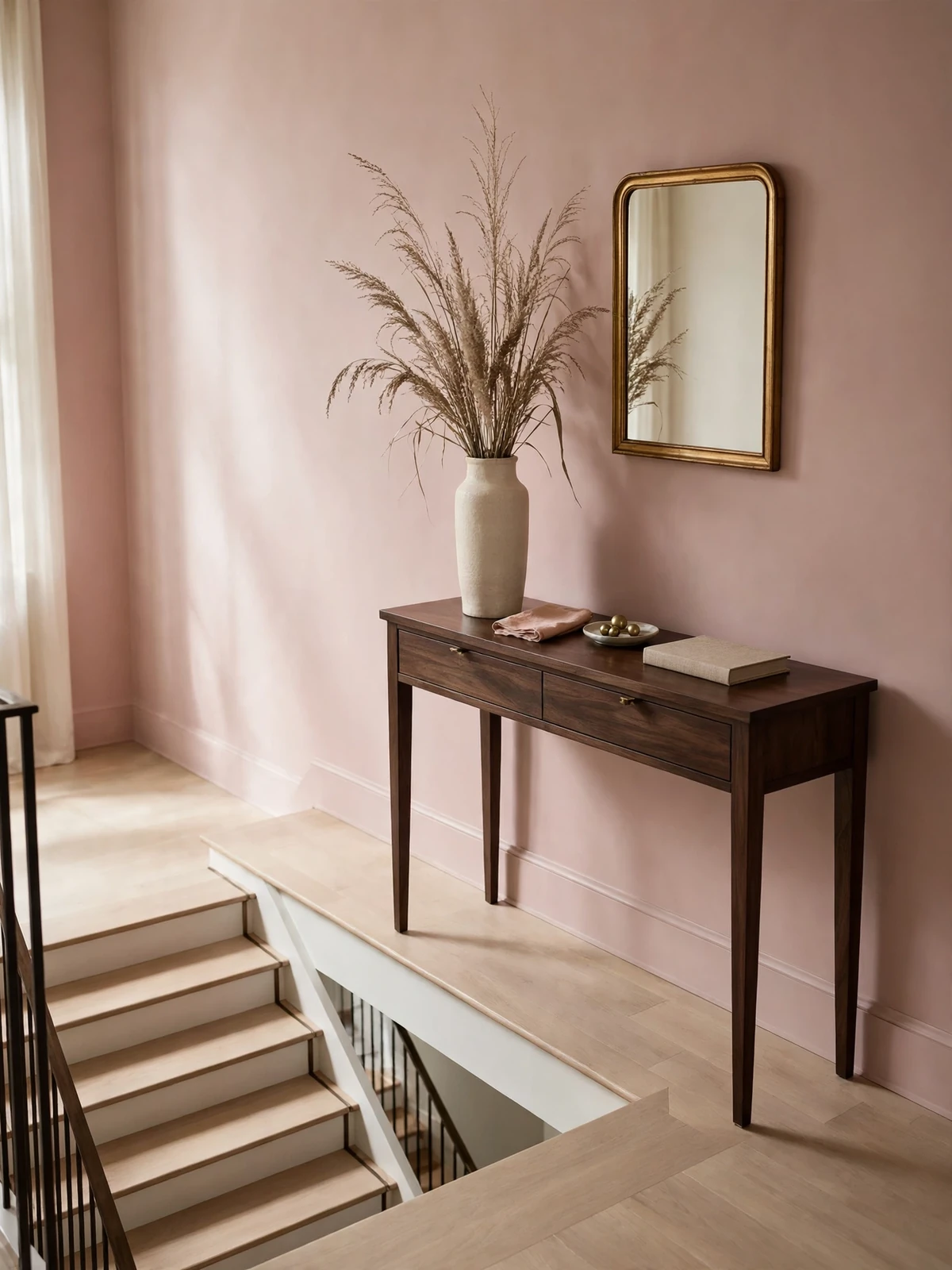
A slim console table on the landing gives the stair a place for one beautiful object — and nothing else. Here, a dark walnut console, 90 cm wide and only 25 cm deep, sits against a soft dusty-rose landing wall, holding a tall cream ceramic vase with dried grasses and a small brass-framed mirror above it. Pale oak treads rise below, and the morning light catches the brass frame. The console is too narrow to block the landing, yet it makes the whole stair feel finished and considered.
Quick tips:
- Choose a console no deeper than 25 cm so the landing stays passable.
- Keep one vase and one mirror — no more — on the console.
- Match the console timber to the stair treads or handrail.
- Use dried grasses for a display that never needs watering.
Woven Baskets as Stairwell Storage and Decor
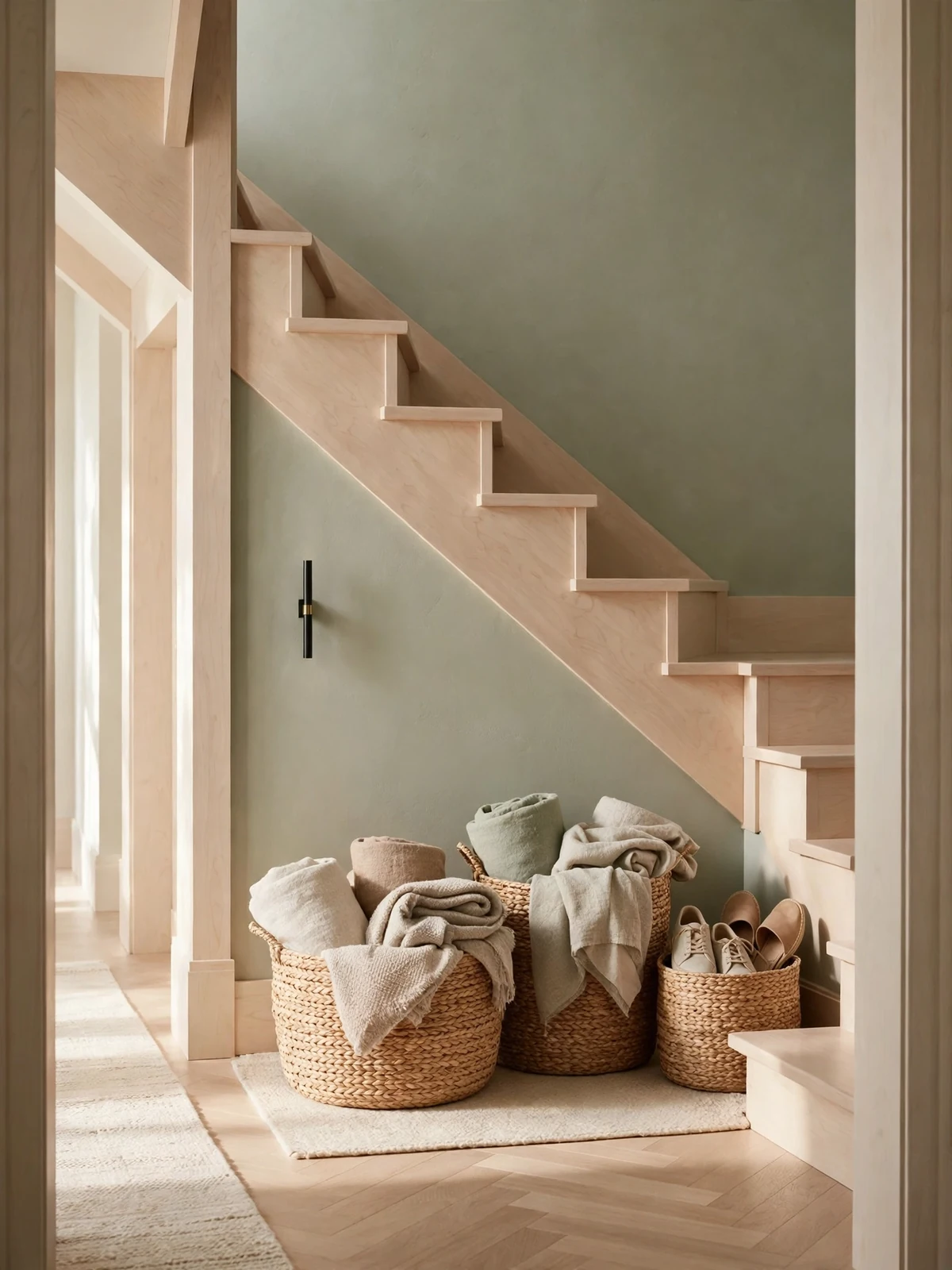
Woven baskets at the base of the stairs are decoration and storage in one — they hide the clutter that always gathers by a stair. In this hallway, three seagrass baskets in graduated sizes sit beside the pale birch treads, one holding folded blankets, one holding shoes, and the smallest holding dog leads and scarves. A soft sage-green wall and a cream rug keep the palette calm, and the baskets’ natural texture warms the whole entry. Label the baskets with small leather tags so everyone in the house knows where things belong.
Quick tips:
- Use three baskets in graduated sizes for a natural grouping.
- Choose seagrass or rattan for warmth and texture.
- Label each basket with a small leather tag.
- Keep the baskets at the stair base, never on the treads themselves.
A Strip of Wallpaper Up the Stairwell
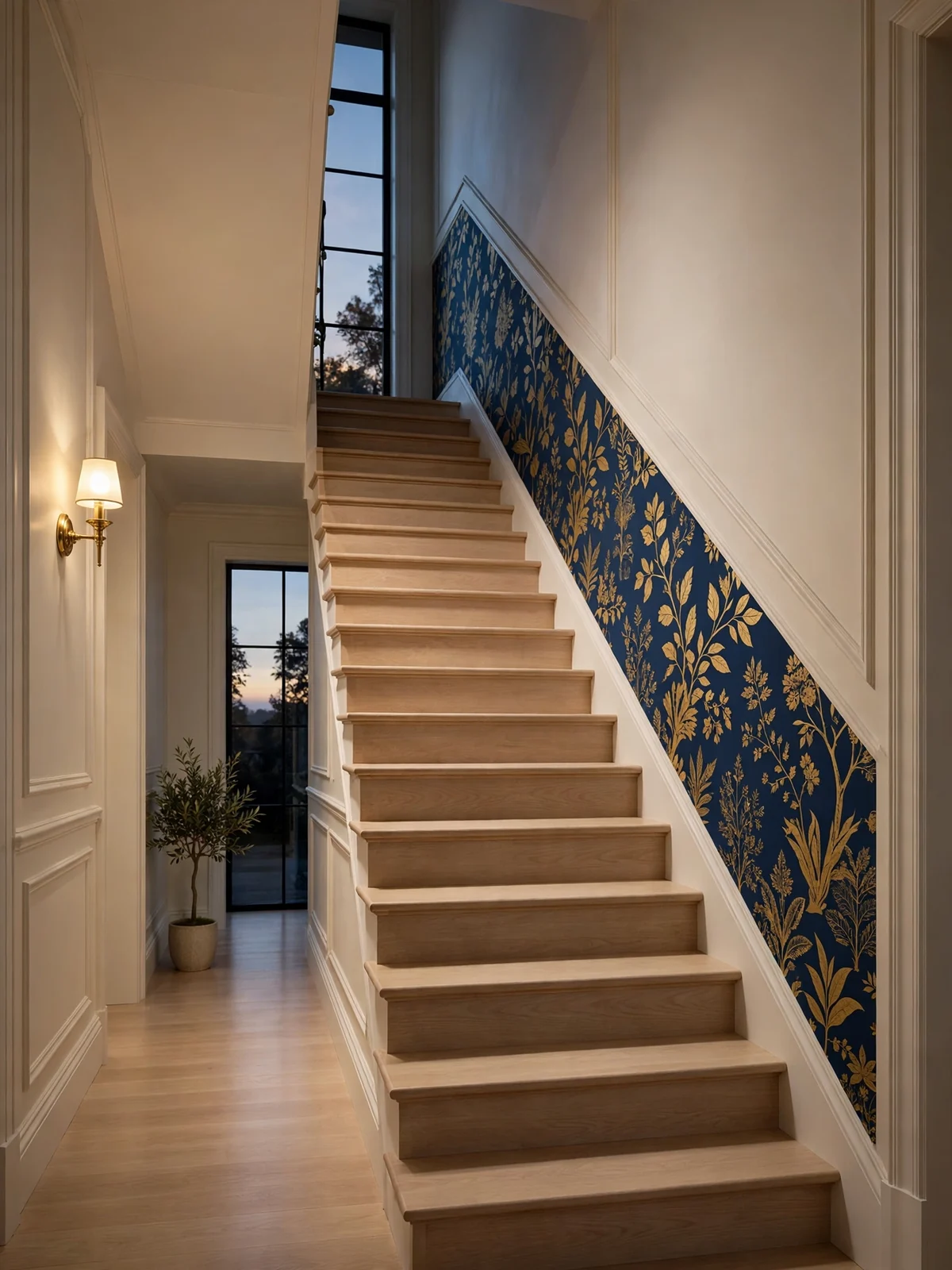
A single strip of wallpaper up the stairwell gives the drama of a feature wall for a fraction of the cost. Here, one vertical strip of navy and gold botanical wallpaper, 70 cm wide, runs from the skirting board to the landing ceiling, following the stair’s rise, with pale oak treads and cream walls on either side. A brass wall sconce beside the strip warms the gold in the pattern in the evening, and the rest of the wall stays plain so the strip reads as a deliberate ribbon of pattern. It is the easiest way to try bold wallpaper without committing to a whole room.
Quick tips:
- Keep the wallpaper strip about 70 cm wide for a ribbon effect.
- Choose a bold pattern — navy, gold or botanical — for impact.
- Leave the surrounding walls plain so the strip stands out.
- Use paste-the-wall paper for an easier, neater fit on a tall wall.
Step Lights That Glow After Dark
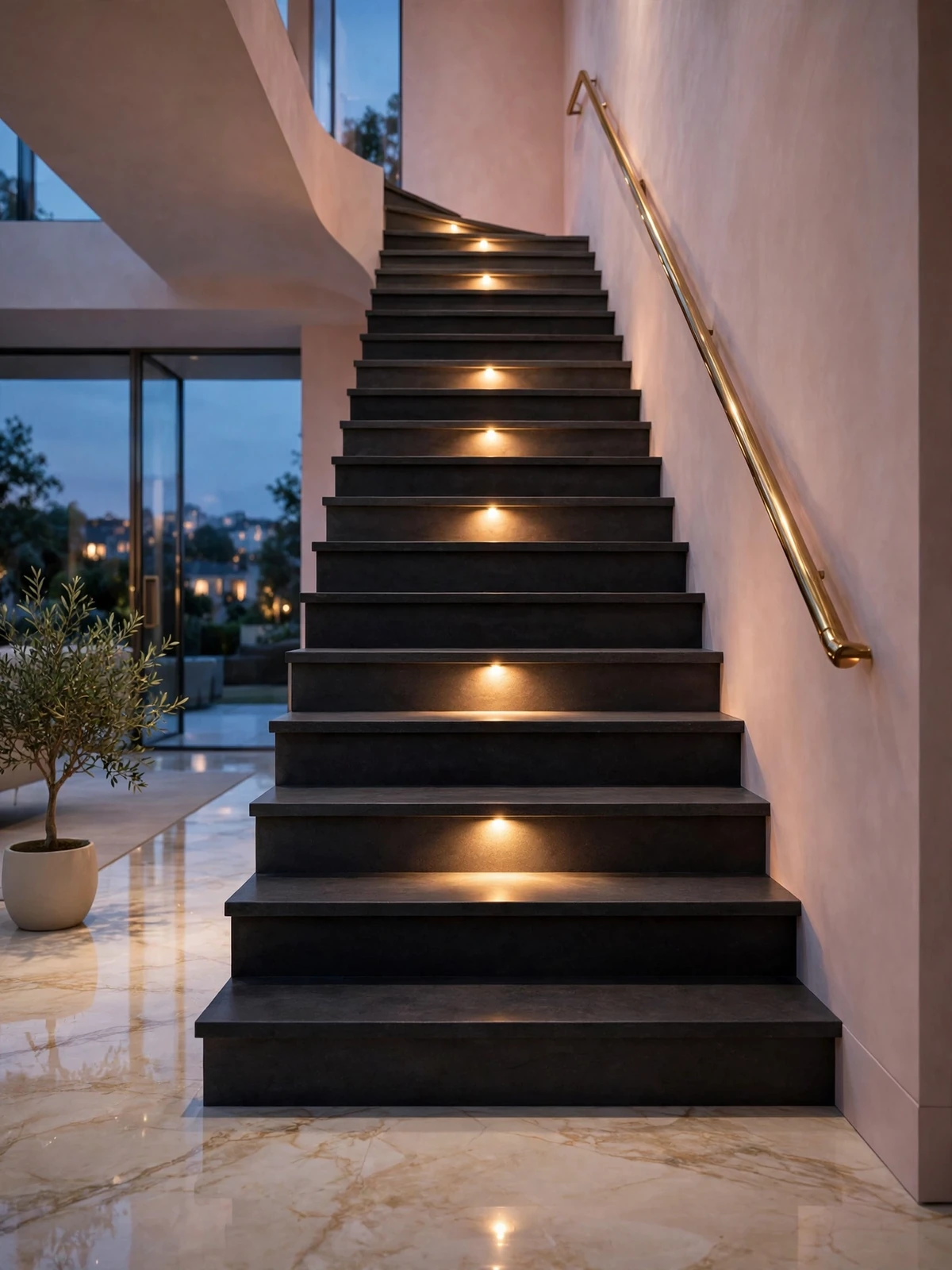
Recessed step lights make a staircase safe and beautiful after dark, and they are the detail guests always notice. On this stair, small warm LED lights are set into the wall just above every third charcoal tread, casting soft pools of light across the treads and the cream marble floor below. A soft blush-pink wall and a slim brass handrail keep the palette warm, and the lights switch on automatically at dusk. The stair glows like a runway — practical, safe, and quietly glamorous.
Quick tips:
- Fit step lights on every third tread for even, gentle pools of light.
- Choose warm LEDs around 2700K for a soft glow.
- Use a dusk sensor or timer so the lights switch on automatically.
- Keep the wall colour pale so the light pools show at their best.
A Large-Scale Abstract Canvas on the Stairwell
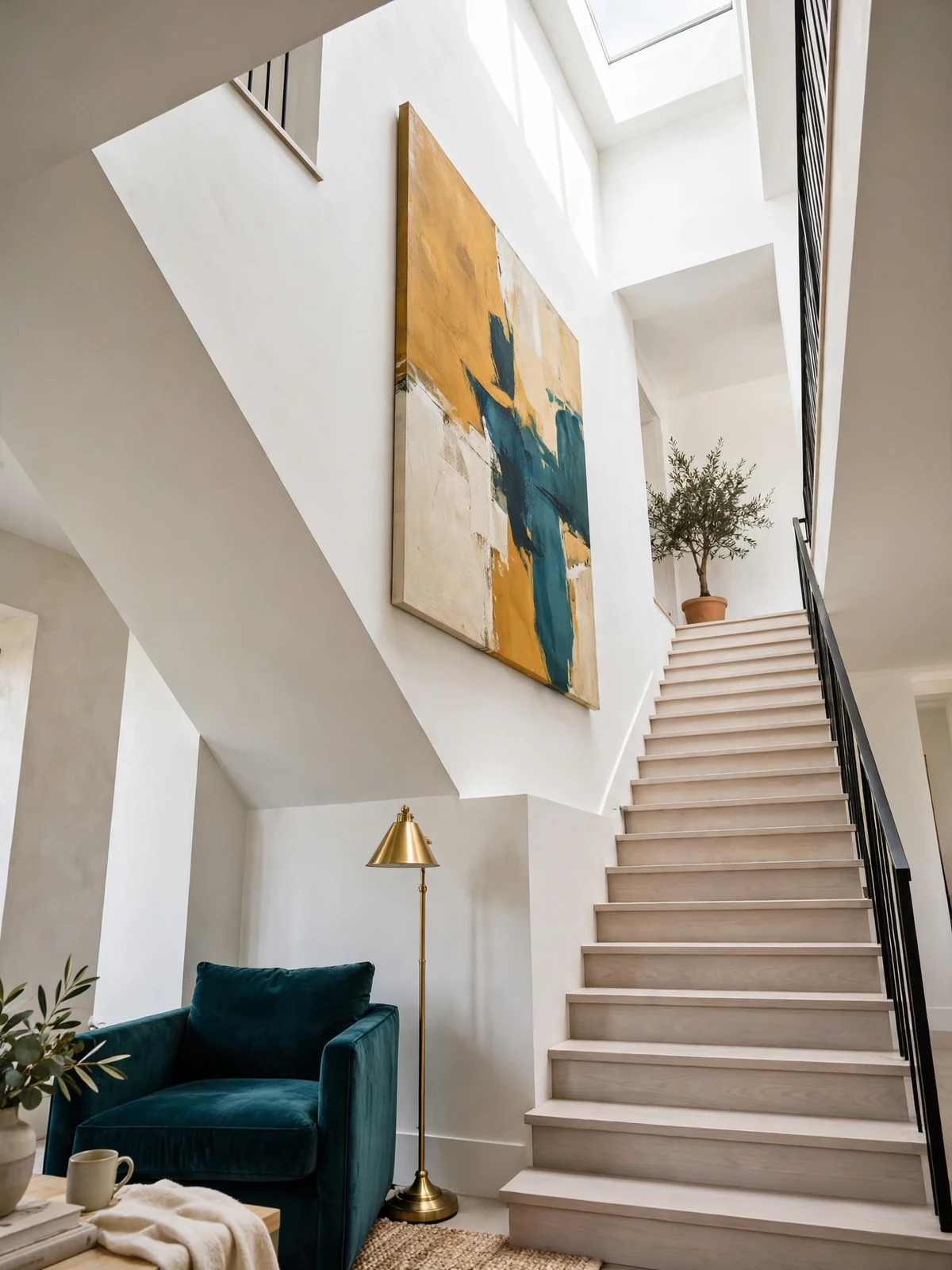
One large abstract canvas can carry a whole stairwell, and it suits a tall wall that smaller frames would get lost on. In this living room, a single canvas, 120 cm by 90 cm, in ochre, teal and cream hangs on the tall white stairwell wall, its colours picked up by a deep teal velvet chair and an ochre cushion below. Pale ash treads and a brass floor lamp complete the palette, and daylight from the hall window falls across the canvas. The stair feels like a gallery, and the canvas needs nothing else beside it.
Quick tips:
- Choose a canvas at least 120 by 90 cm for a tall stairwell wall.
- Pick up one colour from the canvas in a chair or cushion below.
- Hang the canvas centred on the wall, about eye level from the landing.
- Keep the rest of the stairwell bare so the canvas stays the star.
A Window Seat on a Wide Landing
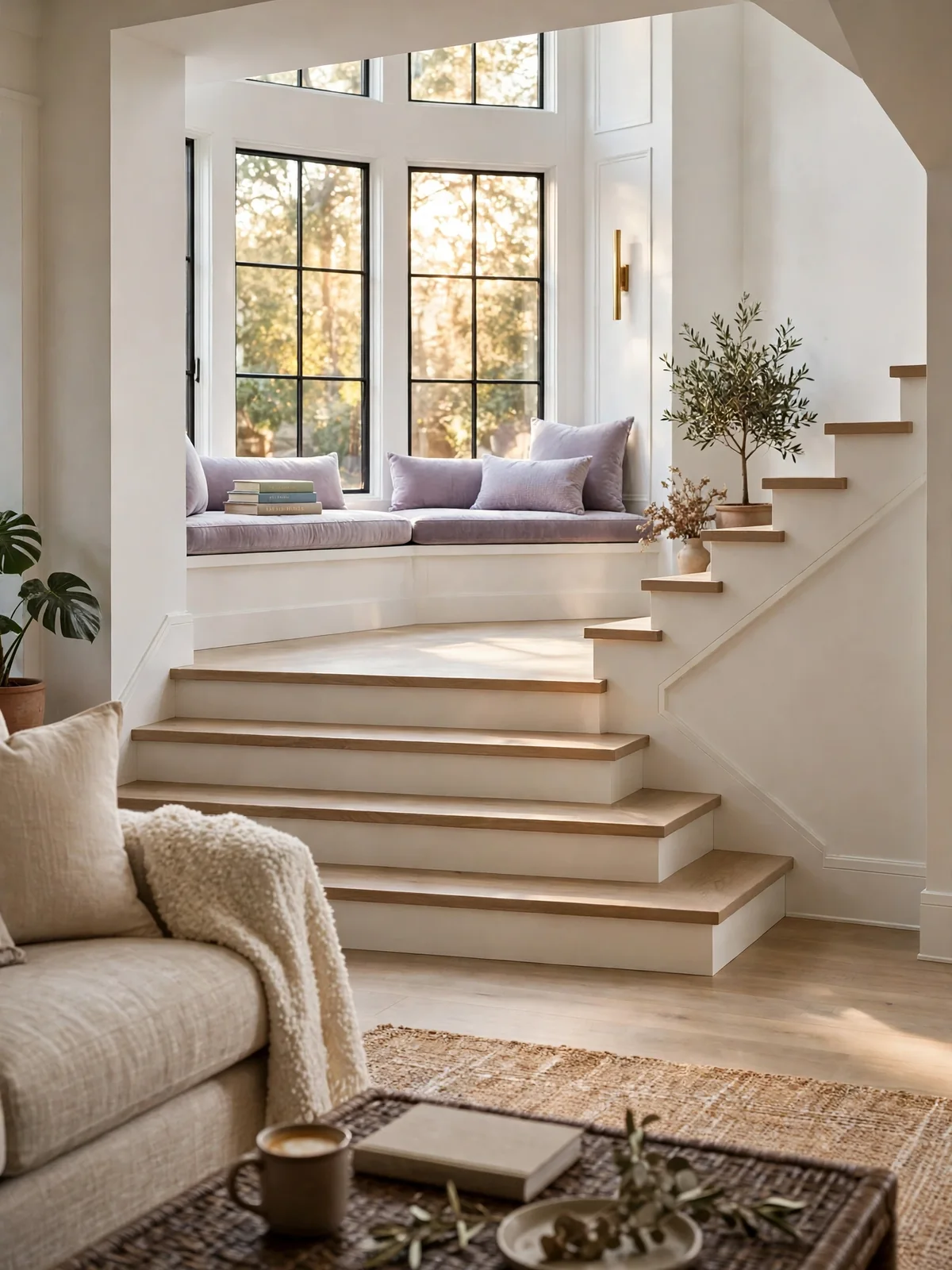
A window seat on a wide landing turns a pause in the climb into the best seat in the house. In this home, the landing is 1.1 metres square, with a built-in window seat, 50 cm deep, dressed in soft lavender cushions and a small stack of books, looking out over the garden. Pale oak treads rise on either side, white walls keep the space bright, and the afternoon sun warms the cushions. Children read there after school, and adults pause there with a coffee on slow mornings.
Quick tips:
- Make the window seat at least 50 cm deep so it is comfortable.
- Use washable cushion covers for a family window seat.
- Keep the landing window clear of heavy curtains.
- Add a small stack of books or a plant to make the seat inviting.
A Chalkboard Wall for Notes and Doodles by the Stair
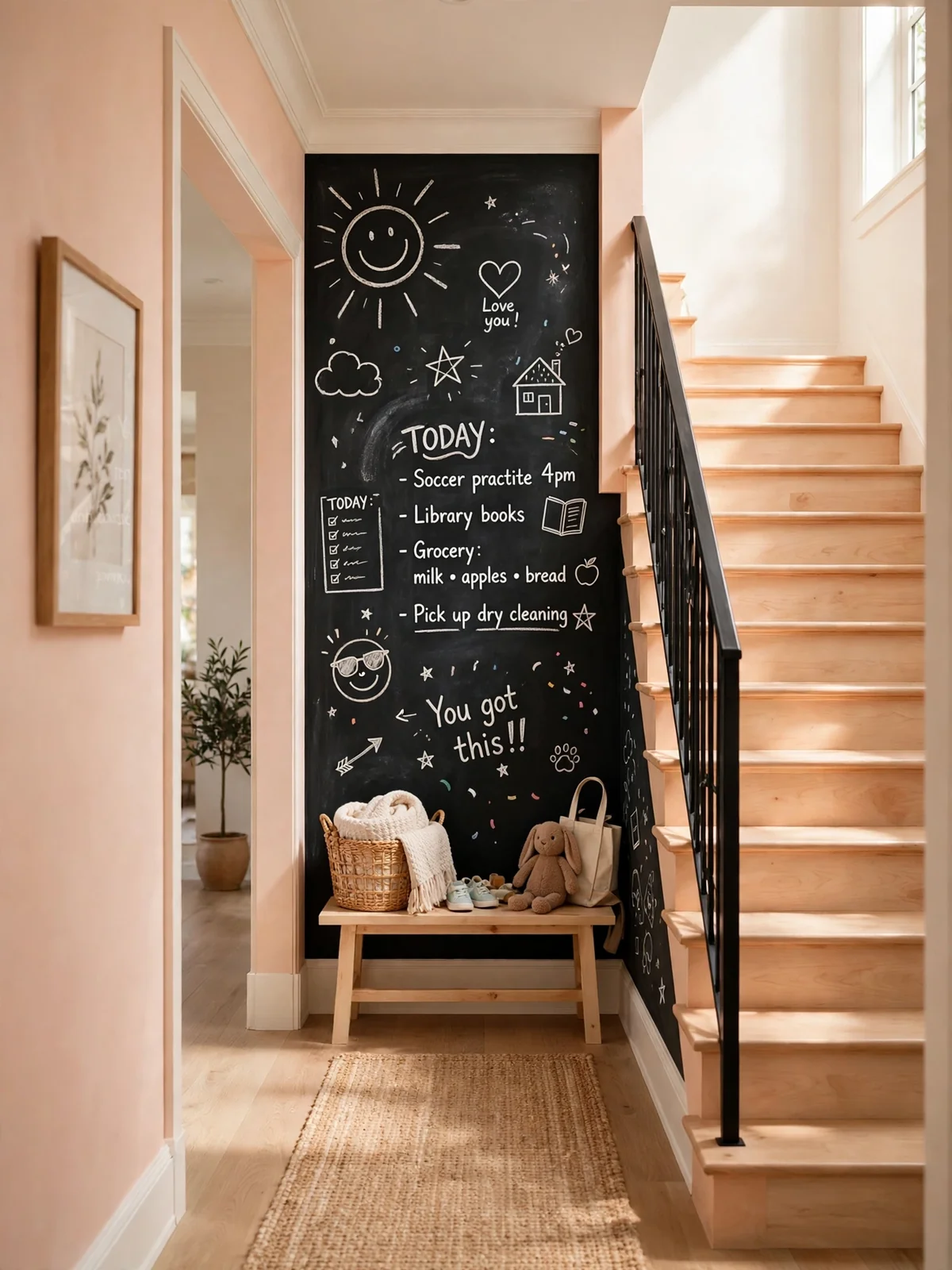
A chalkboard wall beside the stair gives a family home a playful, ever-changing decoration that costs almost nothing. Here, one wall beside the pale maple treads is painted in chalkboard paint, covered in white chalk drawings, shopping lists, birthday countdowns and the children’s doodles, with a small wooden bench below holding a pot of chalks. Soft peach walls keep the hallway warm, and the chalkboard can be wiped clean and redrawn every week. It is the stairwell decoration that never gets boring.
Quick tips:
- Paint only one wall in chalkboard paint, keeping the rest pale.
- Keep a small pot of chalks on a bench below the board.
- Wipe the board clean once a week for a fresh start.
- Use chalk markers for neater notes and plain chalk for doodles.
A Tall Sculptural Vase on the First Step Landing
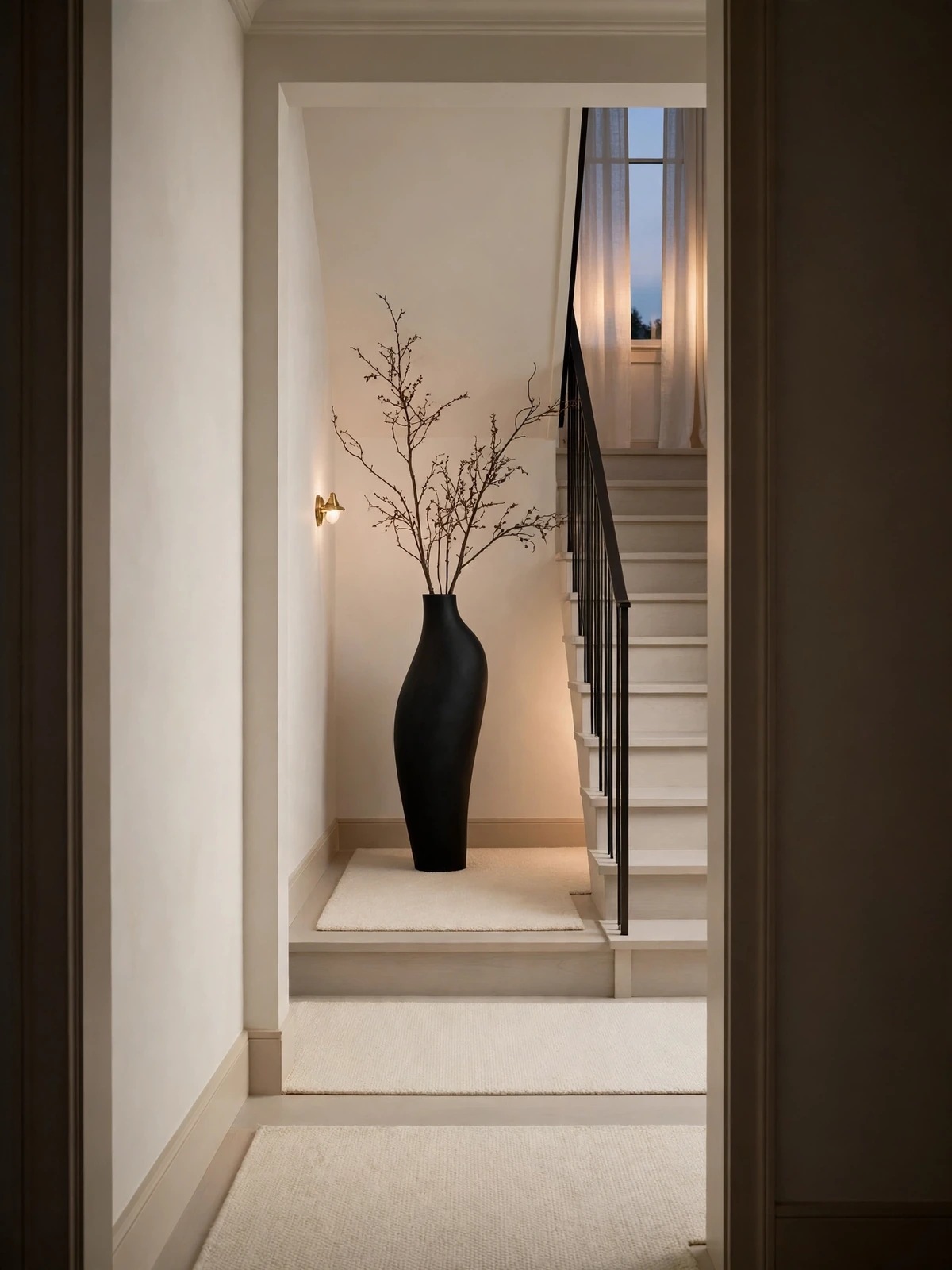
A tall sculptural vase on the first landing stops the eye mid-climb and gives the stair a moment of drama. On this landing, a matte-black vase, 70 cm tall, holds a few dried branches and stands in the corner where the stair turns, catching the light from a small brass wall sconce. Pale ash treads and soft ivory walls keep the palette calm, while a cream rug softens the landing floor. The vase is too tall to knock over easily and too striking to ignore.
Quick tips:
- Choose a vase at least 70 cm tall so it holds its own on the landing.
- Use dried branches or pampas for a display that lasts for months.
- Place the vase in the corner of the turn, never in the walking line.
- Pair a dark vase with pale walls for the strongest contrast.
A Rug at the Base of the Stairs That Sets the Tone
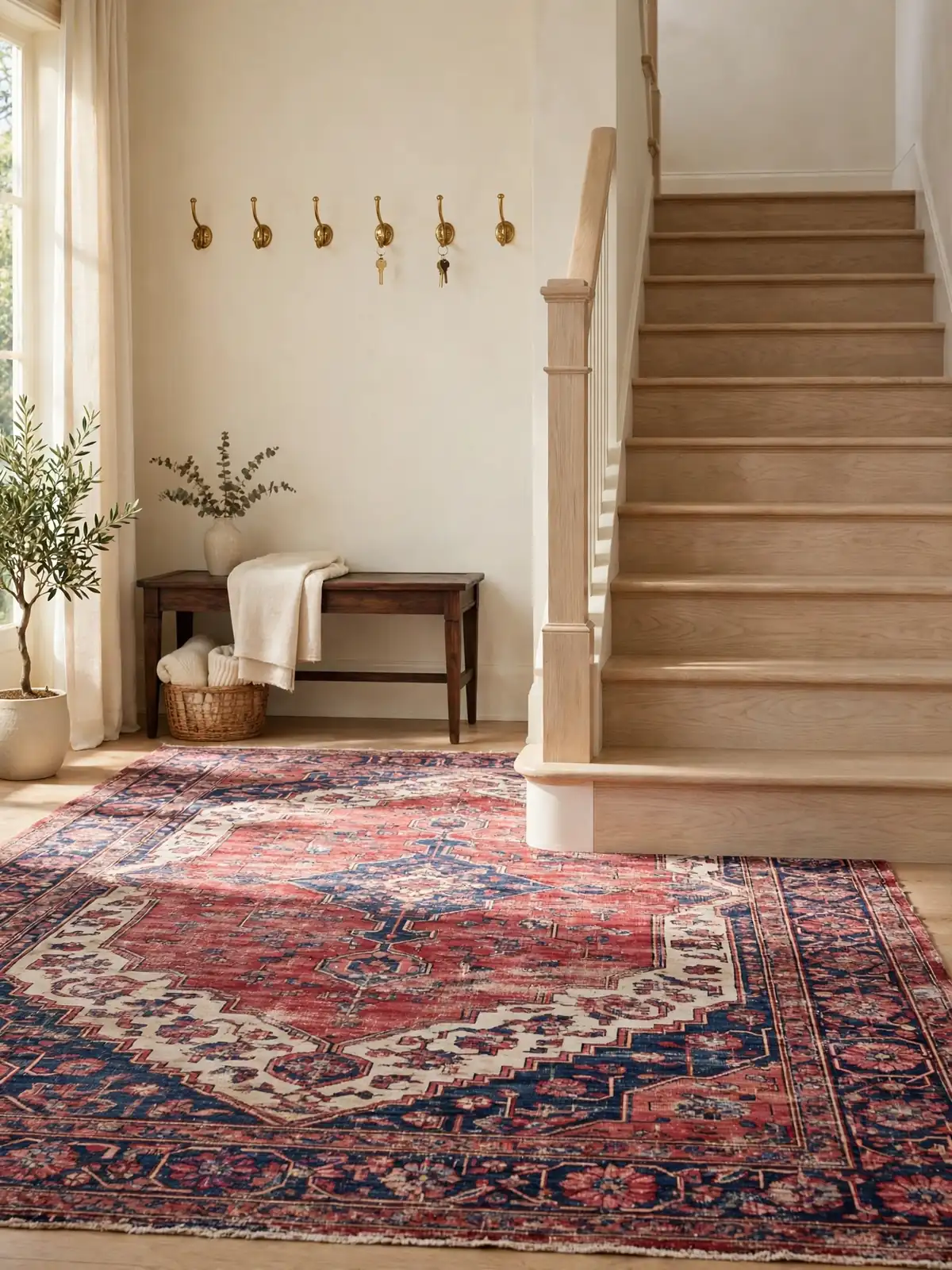
A rug at the base of the stairs is the welcome mat for the whole home — it sets the tone before anyone takes a single step. In this entryway, a large vintage-style rug in faded crimson, indigo and cream, 160 by 230 cm, lies at the foot of the pale oak treads, its colours picked up by a dark wood bench and brass coat hooks on the soft cream wall. The rug softens the entry, catches the dirt from shoes, and makes the stair feel like the start of something warm. Choose a low-pile rug so the front door opens over it easily.
Quick tips:
- Choose a rug at least 160 by 230 cm so it fills the entry properly.
- Pick a low-pile rug so doors open over it without catching.
- Use a vintage pattern — it hides footprints and wear.
- Add a non-slip pad beneath the rug for safety.
A Row of Small Framed Prints on the Riser Faces
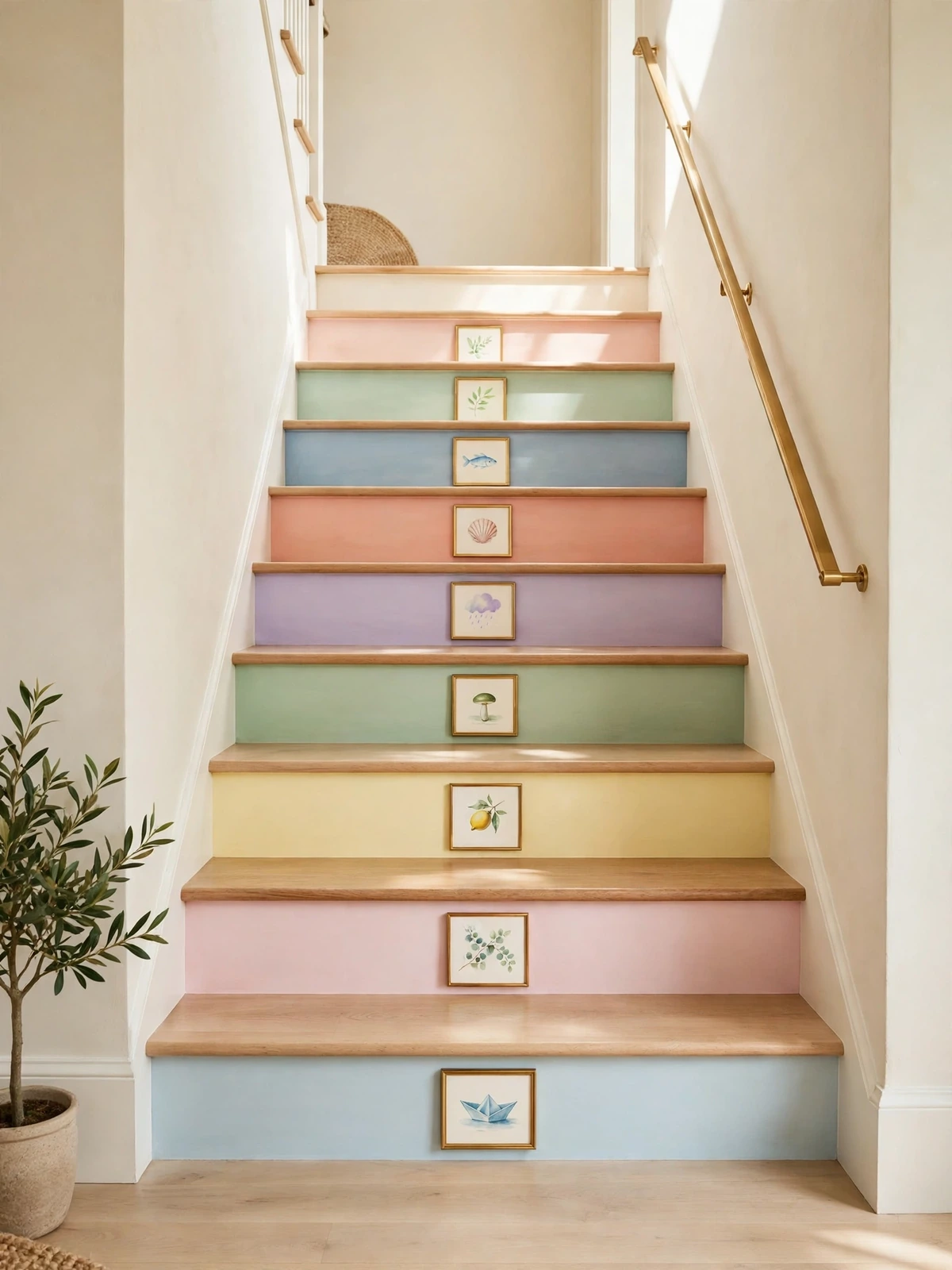
Decorating the riser faces is a staircase decor idea that surprises everyone who climbs it. On this stair, each riser carries a small framed watercolour print, 20 by 15 cm, in soft blues, greens and pinks, so the climb becomes a gallery you only see from the front. Pale oak treads and cream walls keep the stair calm, while the small brass handrail adds a warm line above. The prints are fixed with removable strips, so they can be swapped with the seasons or the children’s latest artwork.
Quick tips:
- Use small prints, about 20 by 15 cm, so they fit the riser height.
- Fix prints with removable strips so they can be swapped easily.
- Keep the palette soft so the risers never feel busy.
- Leave every third riser plain for breathing space.
A Slim Bookcase Built Into the Stair Wall
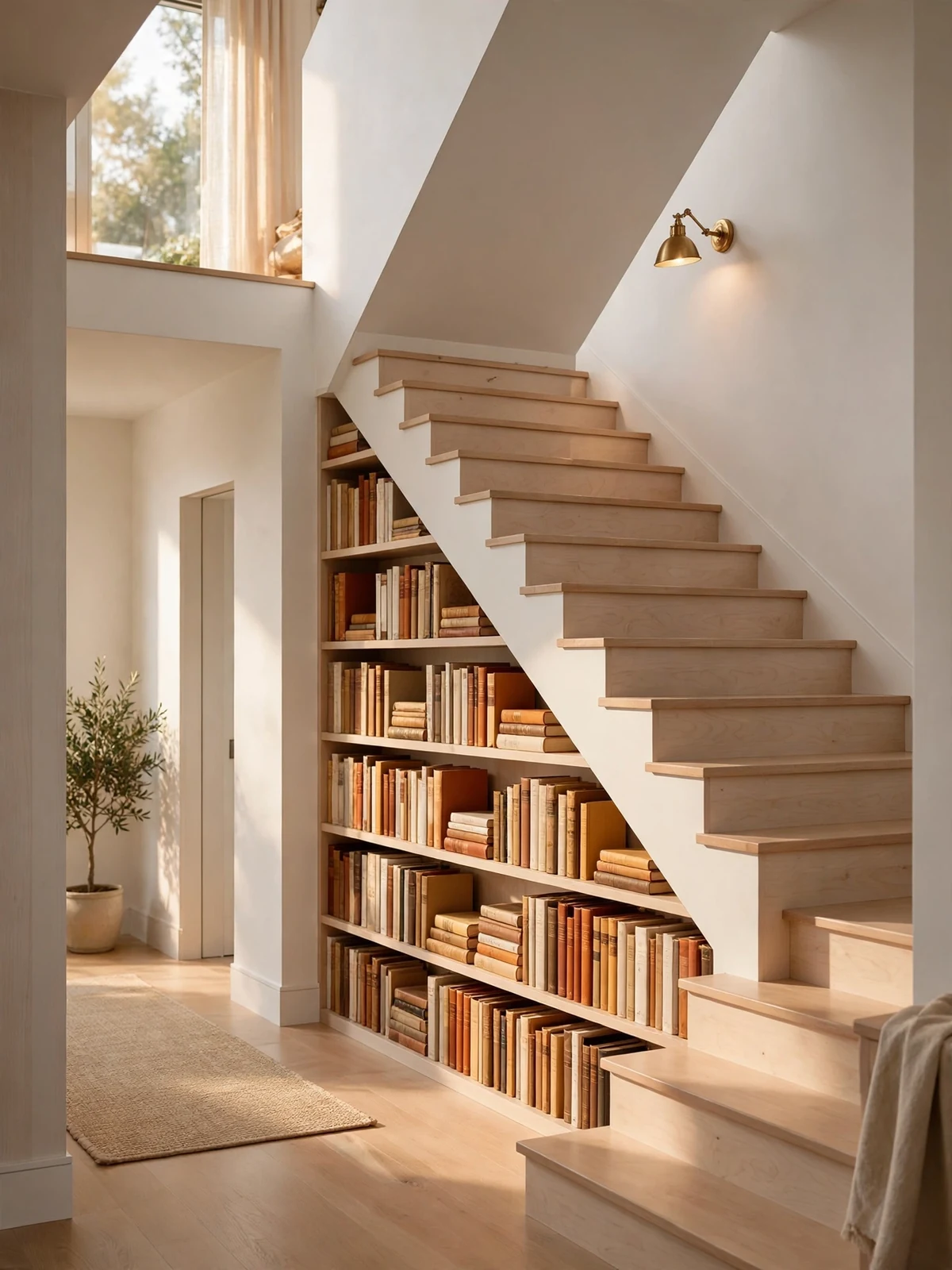
A bookcase built into the stair wall uses dead space and gives the stair a warm, lived-in feel. Here, a slim bookcase, 25 cm deep, is built into the wall beside the pale birch treads, its shelves filled with books in warm rust, ochre and cream spines, with a small brass reading light fixed above the middle shelf. Soft white walls keep the hallway bright, and the afternoon light falls across the spines. The stair becomes a library you walk through every day.
Quick tips:
- Build the bookcase no deeper than 25 cm so it stays flush with the wall.
- Group books by colour for a calm, curated look.
- Add a small brass reading light above the middle shelf.
- Leave one shelf partly empty so the bookcase never looks stuffed.
A Simple Linen Runner With a Hand-Painted Border
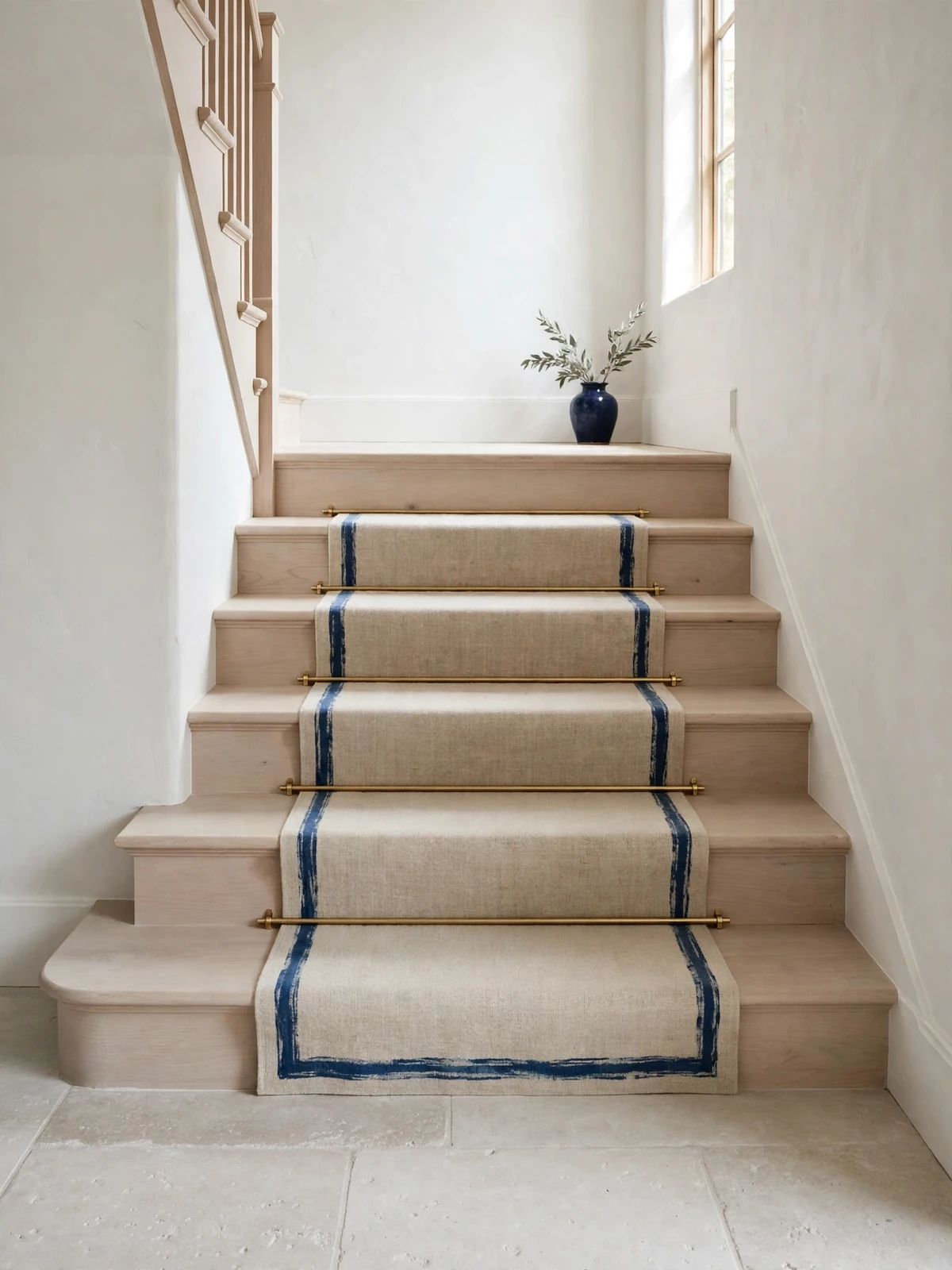
A linen runner with a hand-painted border is the quietest, freshest way to finish a staircase. On this stair, a natural linen runner, 60 cm wide, runs down the centre of the pale ash treads, its edges painted by hand in a slim navy border that matches a small navy ceramic vase on the landing. Soft white walls and a pale stone floor keep the hallway bright, and the morning light falls across the linen’s soft texture. The runner is washable, the border can be repainted in any colour, and the whole stair feels handmade and calm.
Quick tips:
- Choose natural linen for a soft, breathable runner.
- Paint the border in a colour that matches one object on the landing.
- Keep the runner about 60 cm wide so timber shows on both sides.
- Wash the runner gently and re-press it flat after drying.
FAQs
How do I decorate a staircase on a budget?
Start with paint, a runner and frames you already own. One tin of paint on the stairwell wall, a flat-weave runner in a bold pattern, and a gallery wall of prints from your own photos can transform a stair for very little money. Add plants from cuttings and a second-hand mirror, and the stair will look finished without a large spend.
What should I put on a staircase landing?
A landing suits one or two considered pieces, never a crowd. A round mirror, a slim console with a vase, a small plant, or a window seat all work well. Keep the walking line clear, choose pieces that suit the light — mirrors opposite windows, plants near daylight — and leave breathing space around each object.
How do I choose art for a staircase wall?
Choose art that suits the height and the climb. A tall wall takes one large canvas or a rising gallery wall; a narrow stair suits neat rows of small prints. Keep frames in one colour family, hang the centre of the arrangement at eye level as you climb, and pick subjects you love seeing every day — family photos, landscapes or botanical prints all work.
Can I decorate a staircase in a rented home?
Yes — choose removable options. Hang frames with removable picture strips, use a runner with a non-slip pad instead of fitted carpet, place baskets and plants at the stair base, and drape a garland along the handrail. All of these come away cleanly when you move, and none of them damages the walls or the treads.
How do I keep staircase decor safe?
Keep every tread clear, never place objects on the steps themselves, and keep the handrail free so it can be gripped at all times. Fix heavy frames and shelves securely into the wall, keep rugs and runners flat with non-slip pads, and choose battery or low-voltage lights where wiring is difficult. Decor should beautify the stair, never block it.
Conclusion
A staircase is the part of the home you touch every day, and a little decoration goes a long way there. Whether you choose a gallery wall, a patterned runner, warm sconces, a landing mirror, fresh greenery, a reading nook under the stairs, or a simple linen runner with a painted border, the best staircase decor is the kind that suits your home, your light and your life. Keep the treads clear, the handrail free, and the palette warm, and your stair will stop being a passage and start being one of the prettiest places in your home.