25 Stunning Staircase Paneling Ideas That Instantly Make Your Stairway Look Custom, Warm and Beautifully Finished
The walls around a staircase are prime real estate, and paneling is the update that makes them feel intentional. These 25 staircase paneling ideas show how shiplap, beadboard, reclaimed wood, raised panels, MDF and clever colour can transform an ignored stretch of wall into a warm, layered feature — whether your home is modern, farmhouse, traditional or somewhere in between.
Staircase paneling ideas are the wall treatments that turn the blank surface beside a flight of steps into architecture — the shiplap, beadboard, reclaimed timber, raised panels and MDF boards that give a long stairwell texture, rhythm and warmth. The best staircase paneling starts with the simplest move: evenly spaced square panels running up the wall, painted crisp white or soft greige, so the climb feels architectural and intentional.
For a warm, timber-led version of the same thinking, these farmhouse staircase ideas show how warm wood, iron and woven runners make a stair feel welcoming and lived-in. The 25 ideas below cover every style of paneling — classic, cottage, modern and dramatic — so you can choose a treatment that suits your home, your budget and the way your family actually lives.
Key Takeaways
What is staircase paneling?
Staircase paneling is a wall treatment — shiplap, beadboard, reclaimed wood, raised panels, MDF boards or tongue-and-groove — installed on the wall beside a staircase. It adds texture, warmth and structure to a long slanted wall, making a builder-grade stairwell feel custom and intentional.
What type of paneling looks best on a staircase wall?
Classic square panels suit almost every home, because their even rhythm follows the stair angle and reads as timeless. Vertical shiplap suits farmhouse and coastal homes, beadboard suits cottages, and tall slat or fluted panels suit modern homes that want texture without ornament.
How much does staircase paneling cost?
A DIY MDF paneling treatment costs a few hundred pounds in materials and takes a weekend. A carpenter-installed shiplap or raised-panel stair wall usually runs into the low thousands, depending on the height of the stairwell and the complexity of the pattern. Reclaimed wood costs more, because the boards need sourcing and preparation.
Should staircase paneling be painted the same colour as the wall?
Painting the paneling and the trim the same colour removes visual noise and makes the texture the star instead of the contrast. A contrasting colour — white paneling on a deep green wall, or dark paneling on a pale wall — makes the pattern bolder and more graphic.
Can I install staircase paneling myself?
Yes — MDF paneling, shiplap and beadboard are all confident DIY jobs with a mitre saw, a nail gun and a spirit level. Raised panels, recessed panels and anything that wraps a corner neatly are better left to a carpenter, because the angled cuts take patience and precision.
Evenly Spaced Square Staircase Paneling That Makes the Climb Feel Architectural
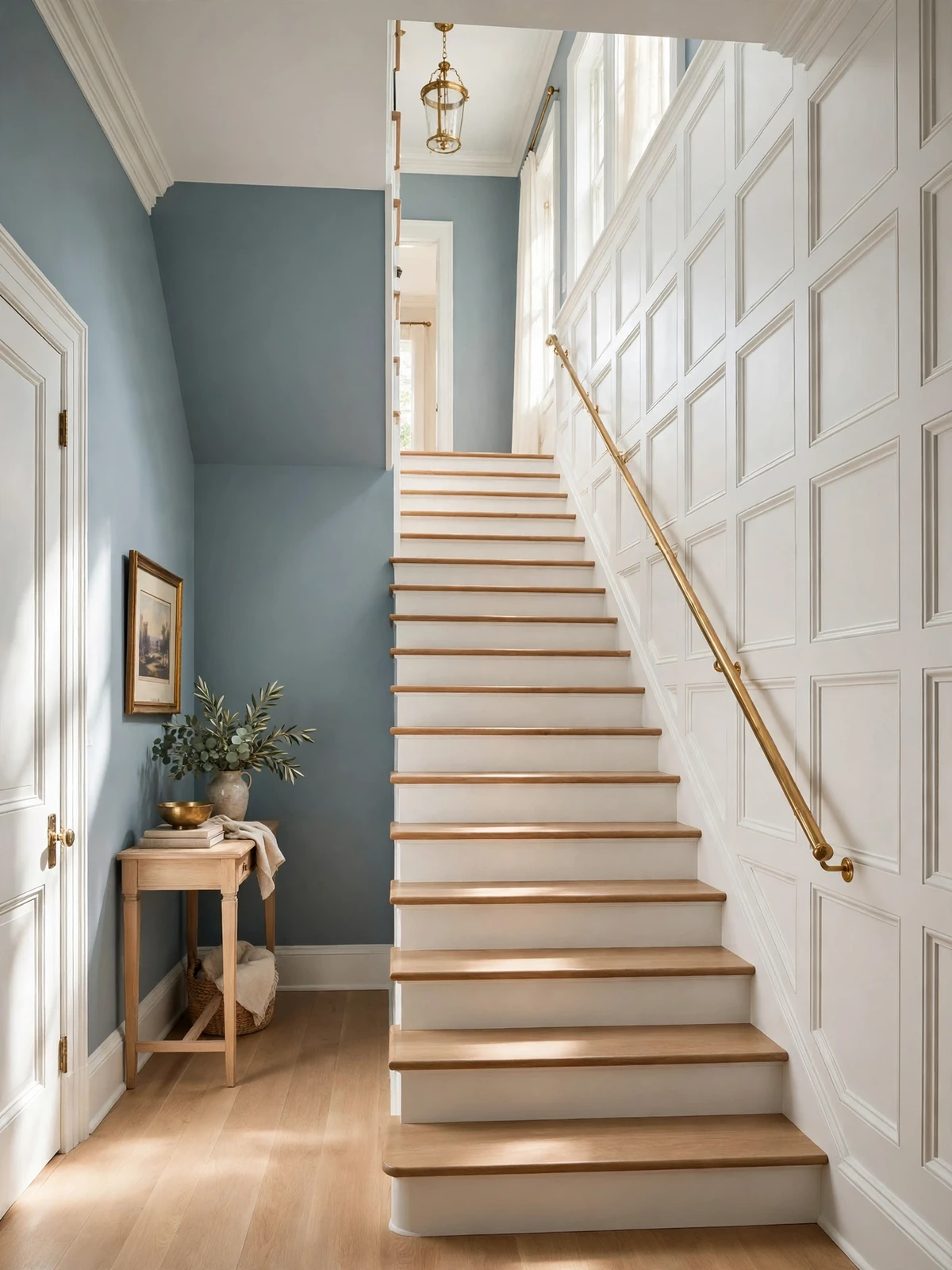
You can never go wrong with clean, symmetrical box paneling, and evenly spaced square panels running up the staircase wall make the climb feel architectural, structured and intentional. Along this stair, six square panels in crisp white, each 700 mm across, climb the soft dusty-blue wall beside pale oak treads, each 950 mm wide, with a slim brass handrail running the full flight. The repetition feels calming, the grid draws your eye upward, and the staircase feels taller without trying too hard.
Quick tips:
- Keep the panel spacing consistent so the grid feels calm.
- Paint the panels crisp white for a traditional look, or soft greige for modern-classic.
- Use evenly spaced squares — repetition feels calming and elegant.
- Match the handrail to the panel colour for a pulled-together look.
Vertical Shiplap Staircase Paneling for Subtle Texture
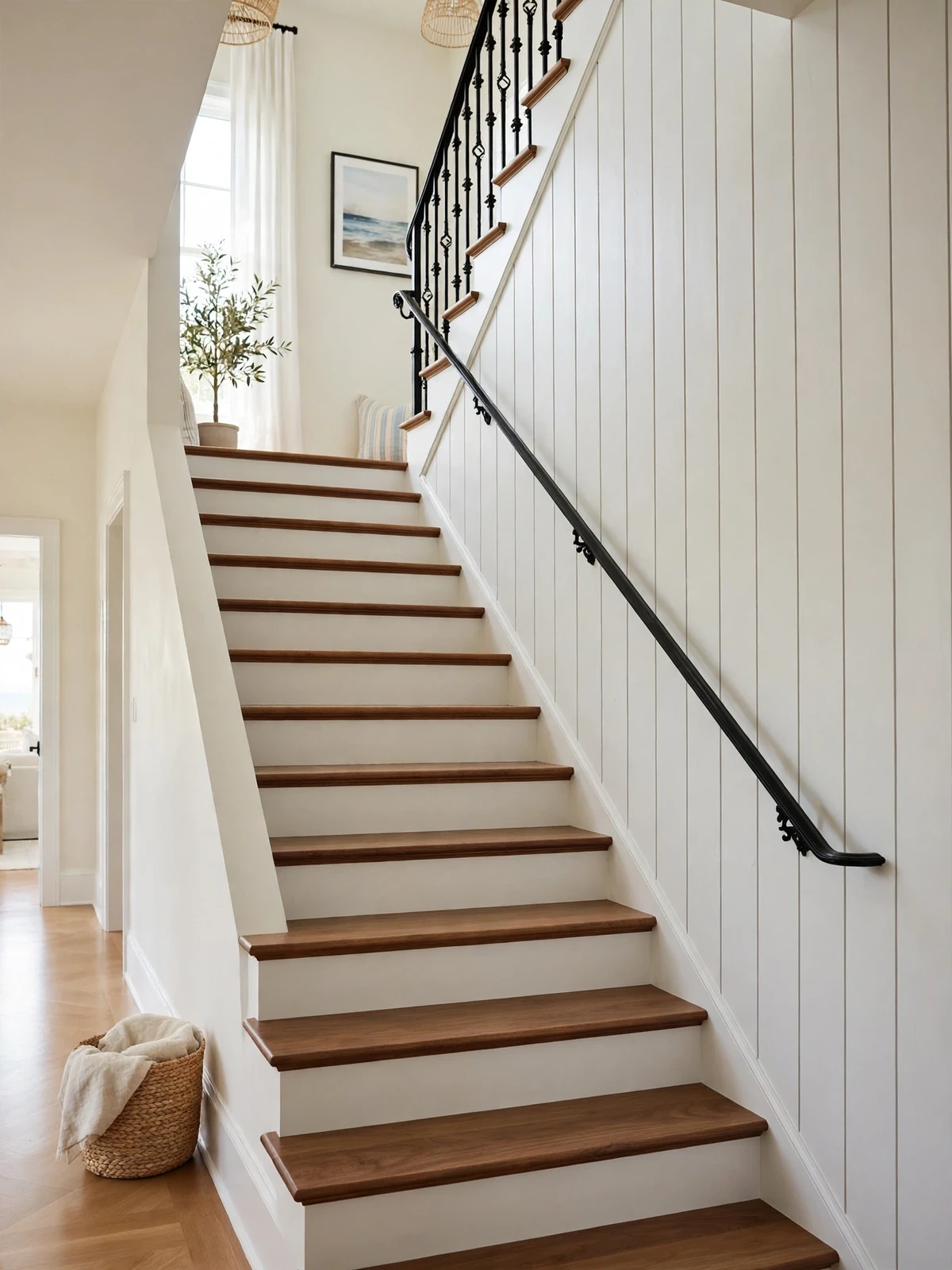
Vertical shiplap on a staircase wall is so underrated, because running the boards up the stairs instead of across them elongates the space and feels fresh compared to horizontal farmhouse boards. Along this stair, narrow white shiplap boards, each 100 mm wide with a 3 mm shadow gap, run vertically beside warm walnut treads, each 950 mm wide, with a slim black iron handrail and a small woven basket at the base. The lines draw the eye upward, and the stairwell feels taller, lighter and quietly textured.
Quick tips:
- Run the shiplap boards vertically so the wall feels taller.
- Keep the gaps narrow, about 3 mm, for a refined feel.
- Paint the paneling and the trim the same colour to remove visual noise.
- Pair white shiplap with warm walnut treads for contrast.
Moody Charcoal Staircase Paneling That Wraps the Stair in Drama
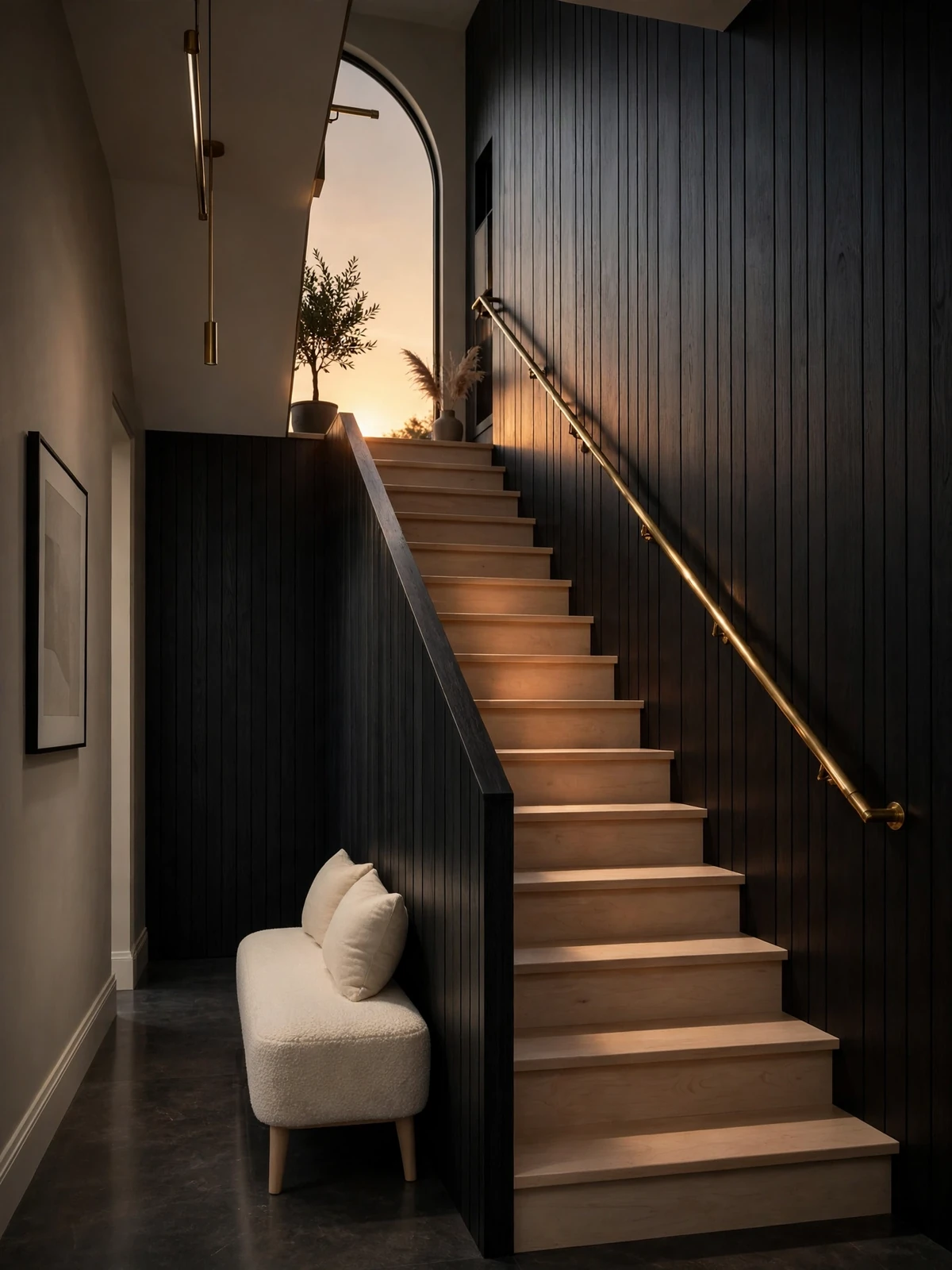
Paneling does not have to be white or safe, and painting it a deep charcoal or forest green wraps the staircase in drama — especially stunning when the stair treads are light wood. Here, square paneling in deep charcoal covers the stair wall beside pale maple treads, each 950 mm wide, with a slim brass handrail and a cream bench below catching the warm evening light. The darker colour creates a cocoon effect, and the staircase feels grounded and intentional rather than simply transitional.
Quick tips:
- Paint the paneling deep charcoal or forest green for drama.
- Keep the treads pale so they glow against the dark panels.
- Add a brass handrail to warm the dark paint.
- Use matt paint so the dark panels feel soft, not shiny.
Beadboard Staircase Paneling for Cottage Warmth
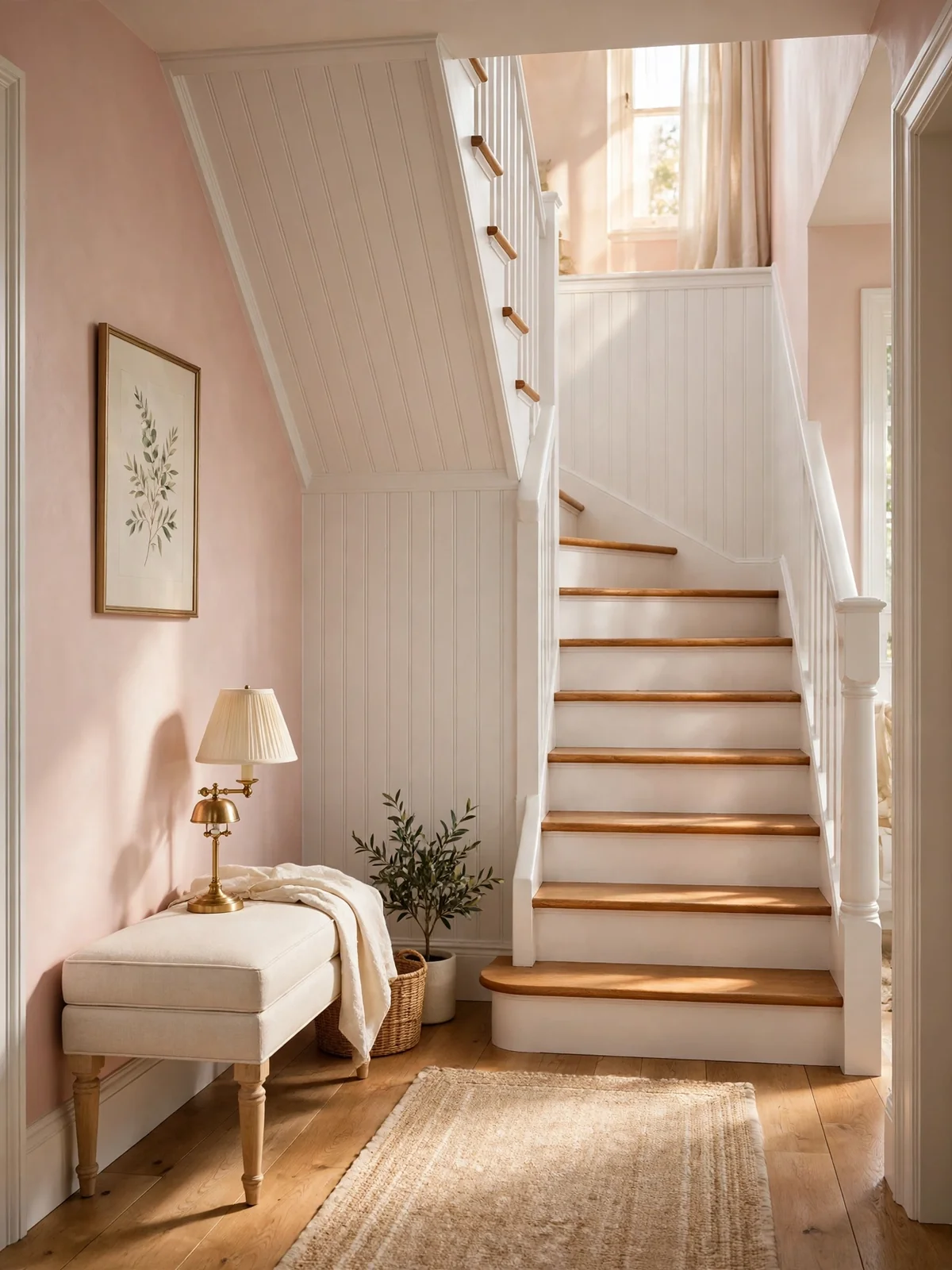
Beadboard has that gentle groove texture that feels instantly welcoming, and it works beautifully in smaller staircases where you want softness instead of heavy molding. Along this stair, white beadboard panels, 900 mm high, follow the incline beside honey oak treads, each 950 mm wide, with soft blush-pink walls above and a small brass lamp glowing on the cream bench below. The beadboard whispers charm instead of shouting it, and the stairwell feels like a cottage rather than a corridor.
Quick tips:
- Use beadboard in smaller staircases where you want softness.
- Pair beadboard with warm lighting and a woven runner.
- Paint the beadboard soft white and keep the upper wall pale.
- Choose beadboard for cottage, coastal and vintage-inspired homes.
Staircase Paneling Extended Onto the Risers for Hidden Dimension
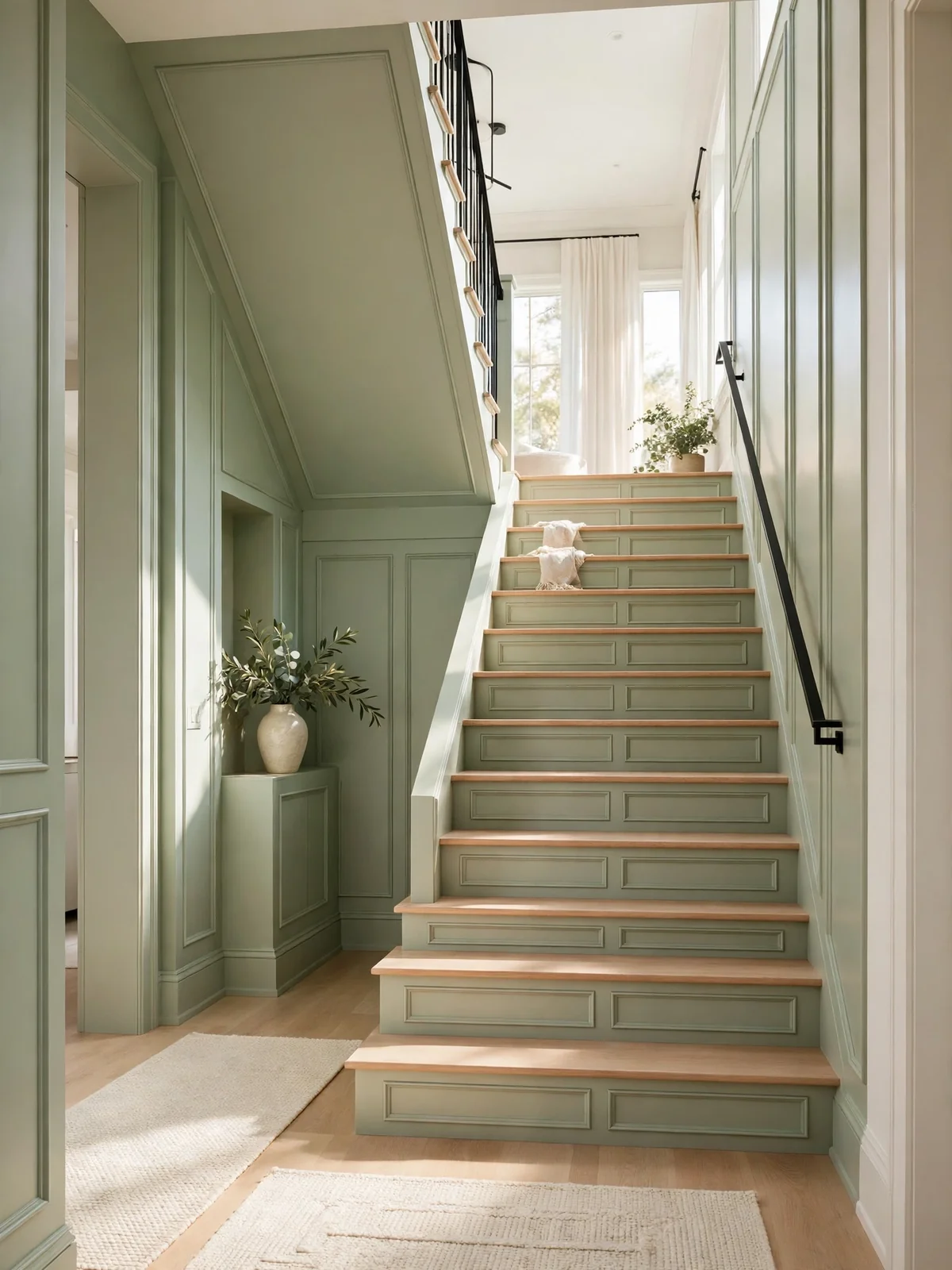
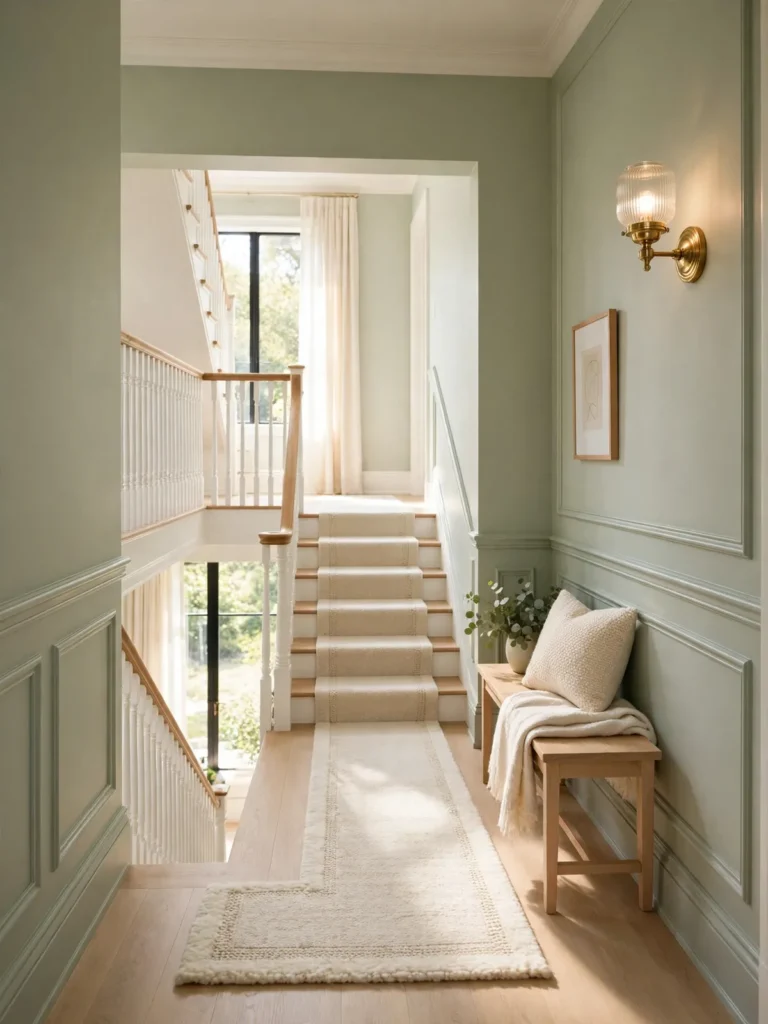
Instead of stopping at the wall, panel detailing on the stair risers themselves adds dimension when you look up the staircase from below — a bold move that rewards the climb. On this stair, thin white molding strips frame each 175 mm riser beneath pale oak treads, each 950 mm wide, painted the same soft white as the wall paneling so the whole flight reads as one built-in piece. Soft sage-green walls and a cream rug below keep the hallway calm, while the paneled risers catch the daylight and make every step feel considered.
Quick tips:
- Use lightweight trim on the risers instead of solid wood.
- Paint the riser trim the same colour as the wall paneling.
- Keep the strips thin so the risers stay light, not heavy.
- Match the handrail to the darkest tone nearby for balance.
Reclaimed Wood Staircase Paneling That Brings History Into the Stairwell
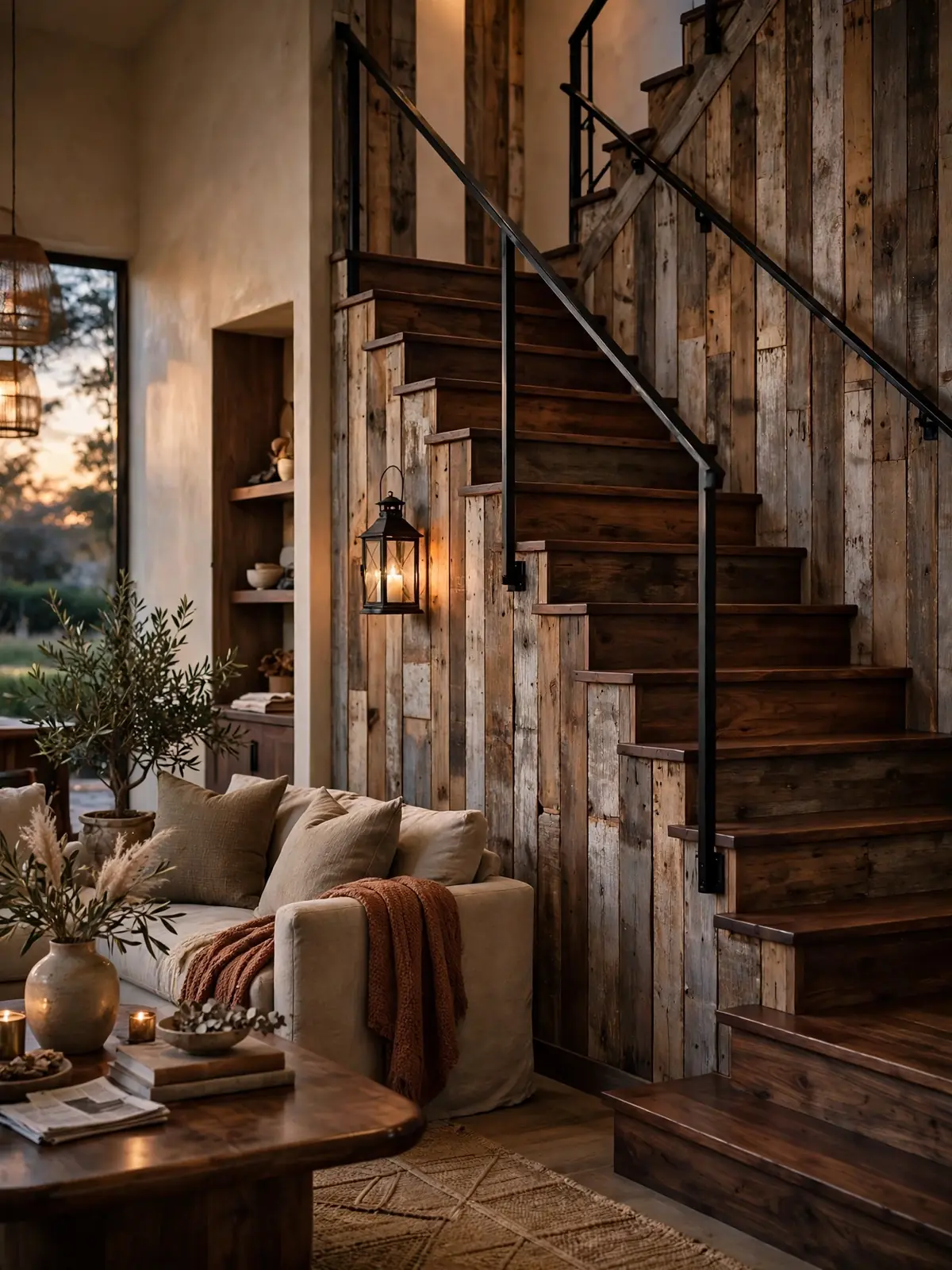
Reclaimed wood panels bring history into a staircase, because the natural variation, knots and wear tell a story that new timber never can. Along this stair, weathered planks in warm honey and grey-brown tones cover the wall beside dark walnut treads, each 950 mm wide, with a matte black handrail and a small iron lantern glowing on the landing. The paneling feels lived-in and authentic, and the stairwell gains instant character without a single extra decoration.
Quick tips:
- Pair reclaimed wood with iron light fixtures or matte black railings.
- Seal the planks so they stay clean and easy to dust.
- Keep the rest of the stair simple so the wood stays the feature.
- Choose reclaimed wood for rustic, industrial and farmhouse homes.
Half-Wall Staircase Paneling With a Bold Paint Contrast Above
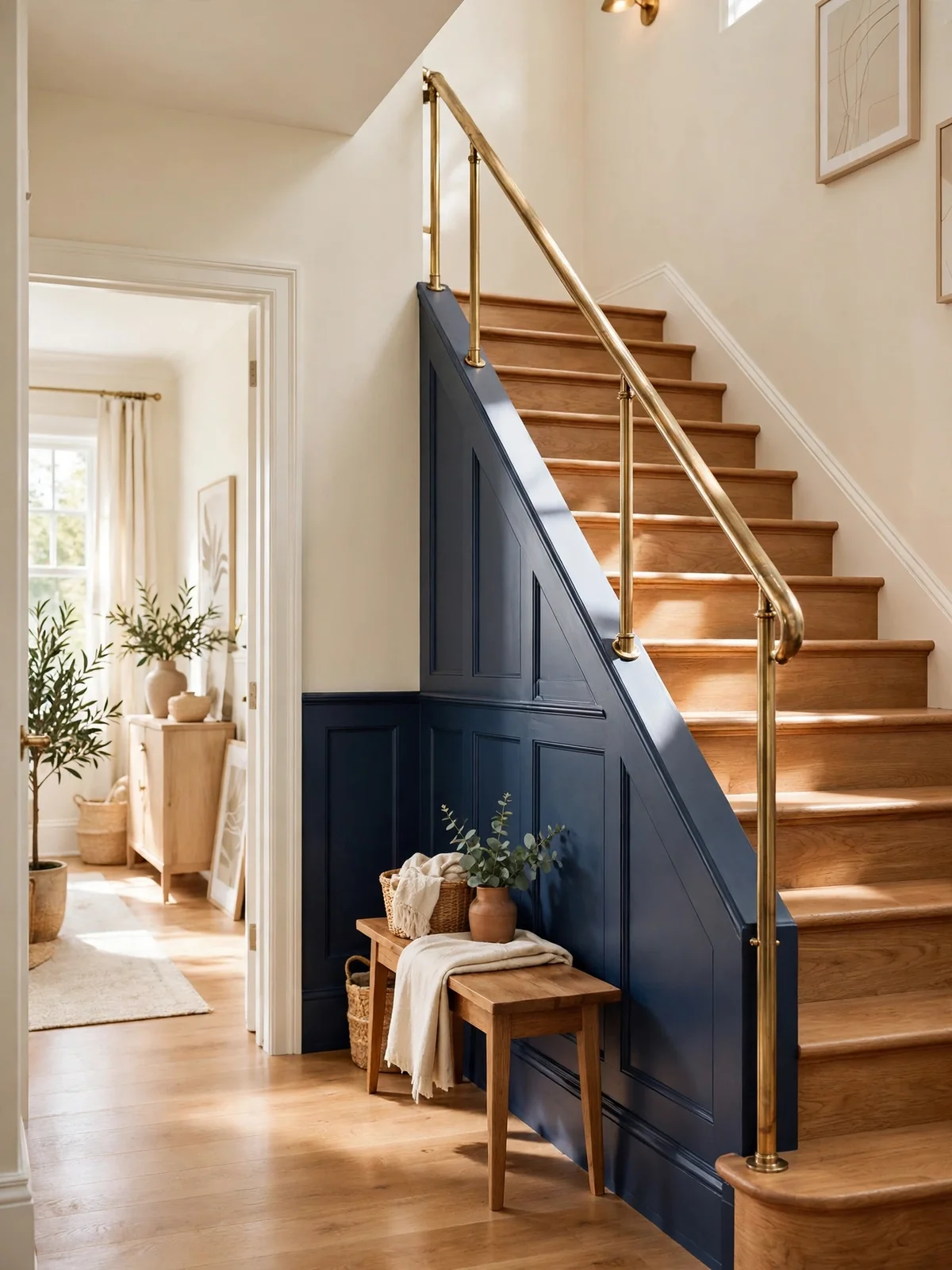
Install paneling on the lower half of the staircase wall only, then paint the upper half a contrasting colour, and the stair gains personality without overwhelming a smaller space. Here, deep navy paneling covers the lower half beside warm oak treads, each 950 mm wide, with soft cream paint above and a slim brass handrail running along the join. A small wooden bench at the base keeps the hallway warm, and the two-tone wall makes the stairwell feel designed rather than decorated.
Quick tips:
- Install the paneling on the lower half only for a lighter feel.
- Pair deep navy below with soft cream above for a classic contrast.
- Align the panel top with the stair height for a seamless finish.
- Keep the handrail slim so the two-tone wall stays the feature.
Raised Panel Staircase Paneling for Traditional Elegance
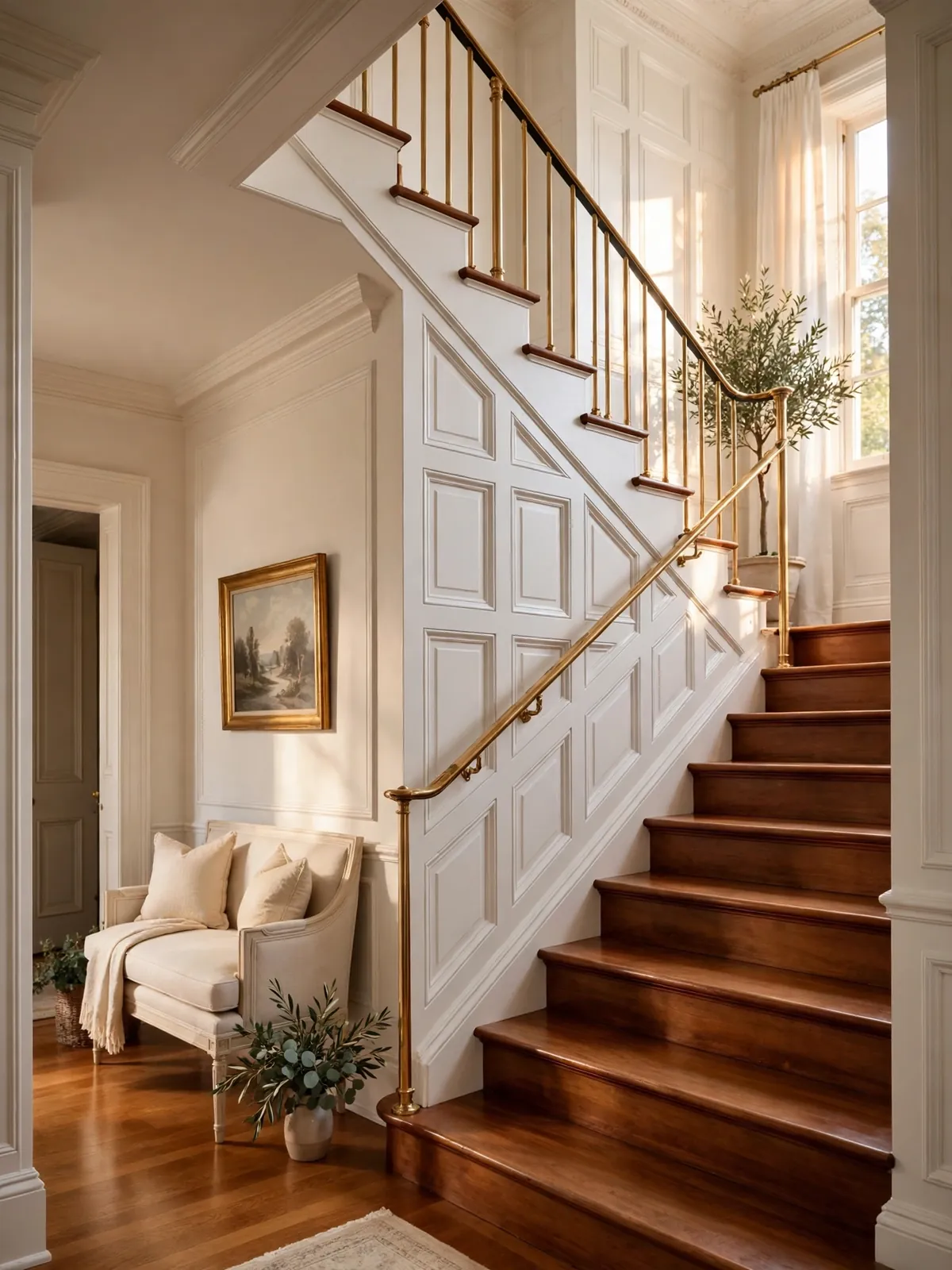
Raised panels feel more formal than flat molding, because they project slightly from the wall and create classic depth — old-townhouse charm that suits a traditional home perfectly. Along this stair, raised white panels, each 700 mm wide, climb the soft cream wall beside warm chestnut treads, each 950 mm wide, with a slim brass handrail and a cream bench below. Warm afternoon light from the landing window makes the raised panels cast subtle shadows, and under that light the stairwell feels pure sophistication.
Quick tips:
- Choose raised panels for traditional and formal homes.
- Paint the panels soft white and keep the wall pale.
- Add warm lighting so the raised shadows glow in the evening.
- Keep the handrail slim brass so the panels stay the feature.
Staircase Paneling and Ceiling Painted One Colour for a Wrapped, Cohesive Feel
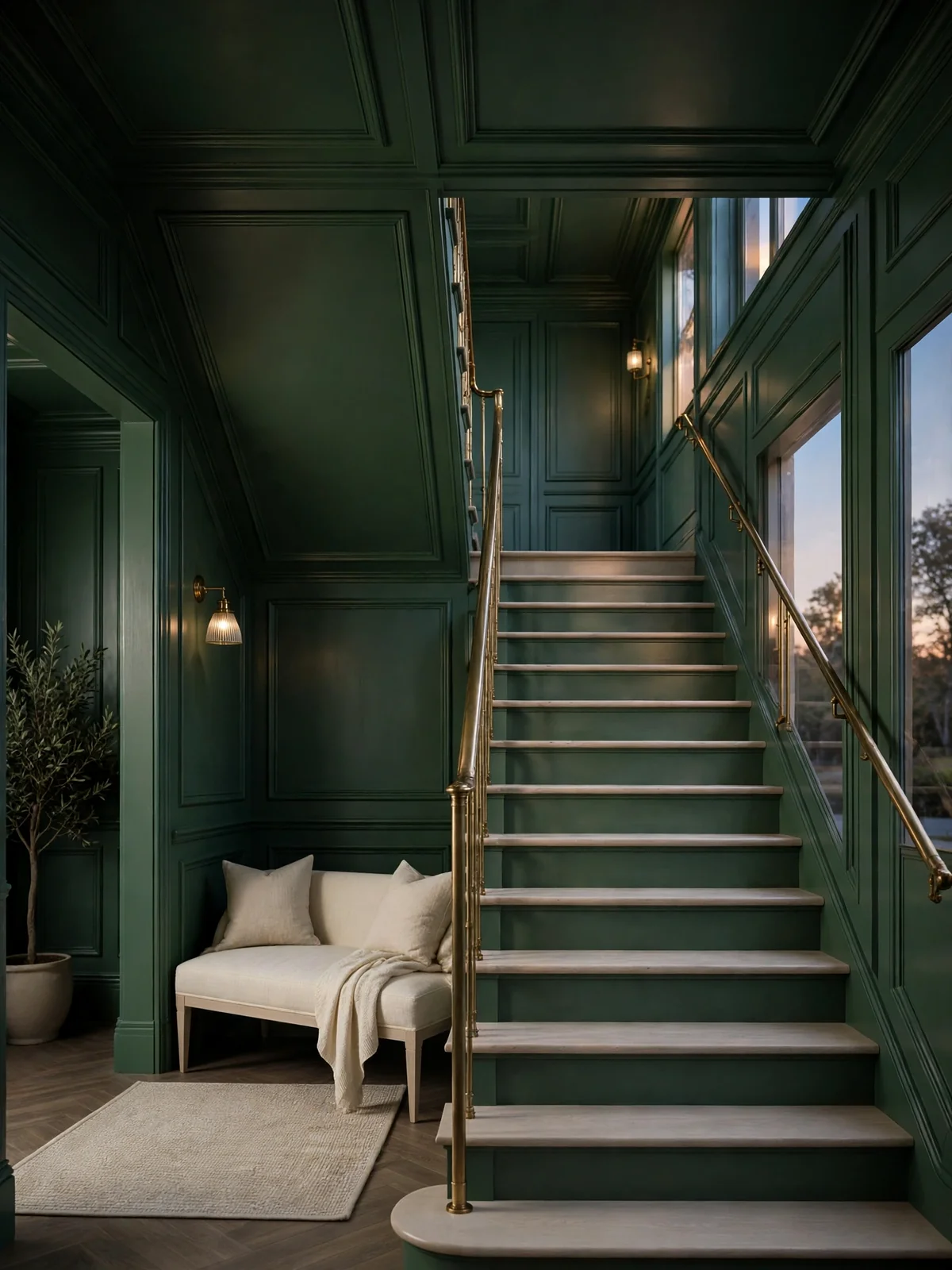
Want drama? Drench the space — install wall paneling, then paint the wall and the ceiling the exact same shade, and the stairwell feels wrapped and cohesive. Here, deep forest green covers the paneled walls and the sloped ceiling above pale ash treads, each 900 mm wide, with a slim brass handrail and a cream bench below. The wrapped colour makes the stairwell feel immersive, especially with its high ceiling, and the pale treads glow against the green like a path through a forest.
Quick tips:
- Paint the paneling and the ceiling the same shade for a wrapped feel.
- Choose a deep colour — forest green, charcoal or plum — for drama.
- Keep the treads pale so they glow against the dark walls.
- Use matt paint so the drenched colour feels soft, not shiny.
Budget-Friendly MDF Staircase Paneling That Looks Custom
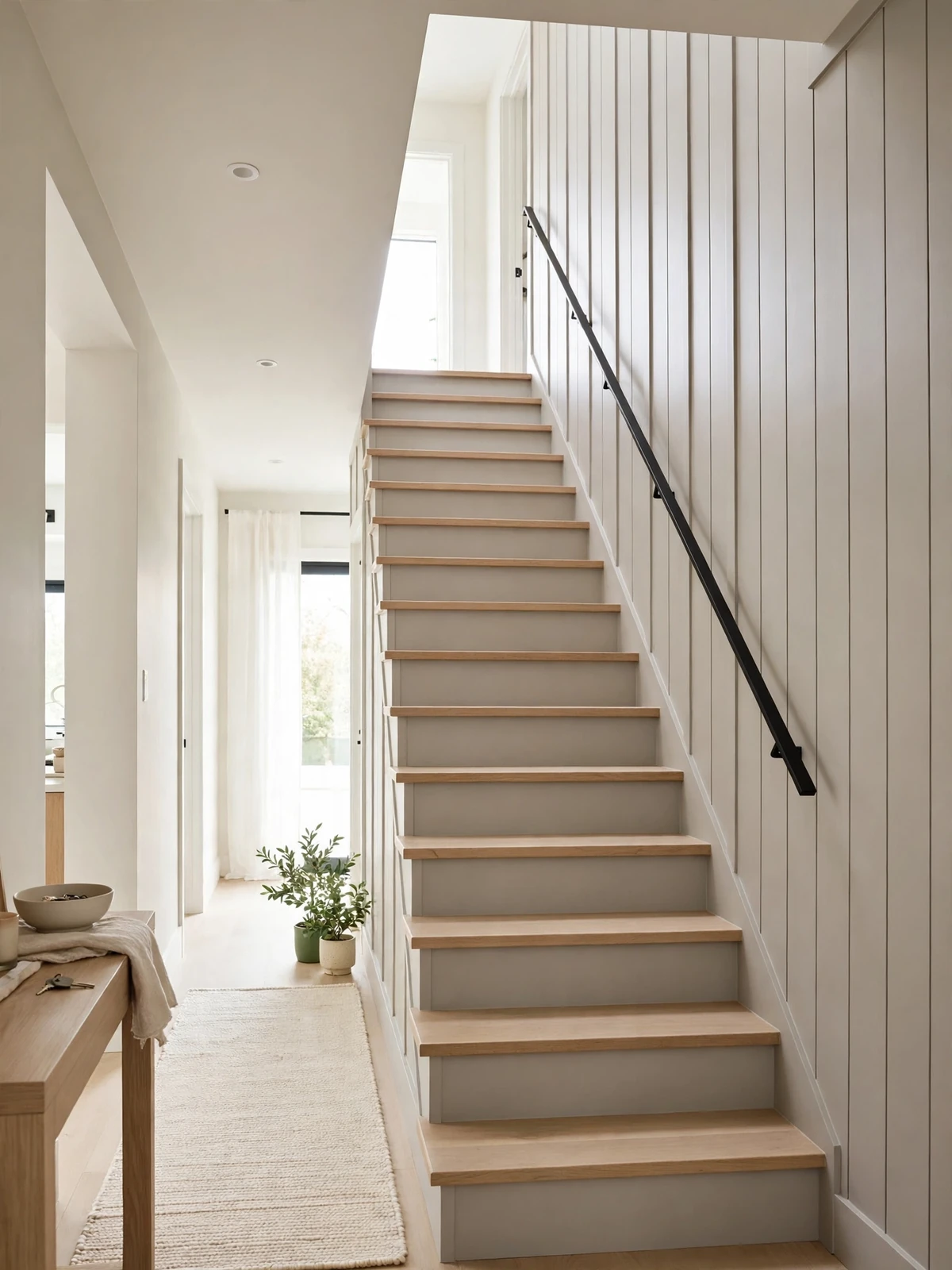
Not every project needs solid wood, and MDF paneling is smooth, affordable and easy to paint — perfect for custom box paneling on a tight budget. Along this stair, pre-primed MDF boards form even rectangular panels in soft greige beside pale oak treads, each 950 mm wide, with a slim black handrail and a cream rug below. A small green plant at the base adds one living accent, and the stairwell looks high-end without the high-end cost.
Quick tips:
- Use pre-primed MDF boards for a smooth, paint-ready surface.
- Stick to rectangular shapes for a clean, custom look.
- Paint the MDF in soft greige for a modern-classic feel.
- Install the panels over a weekend with a nail gun and adhesive.
Staircase Paneling That Runs Up to a Gallery Wall Above
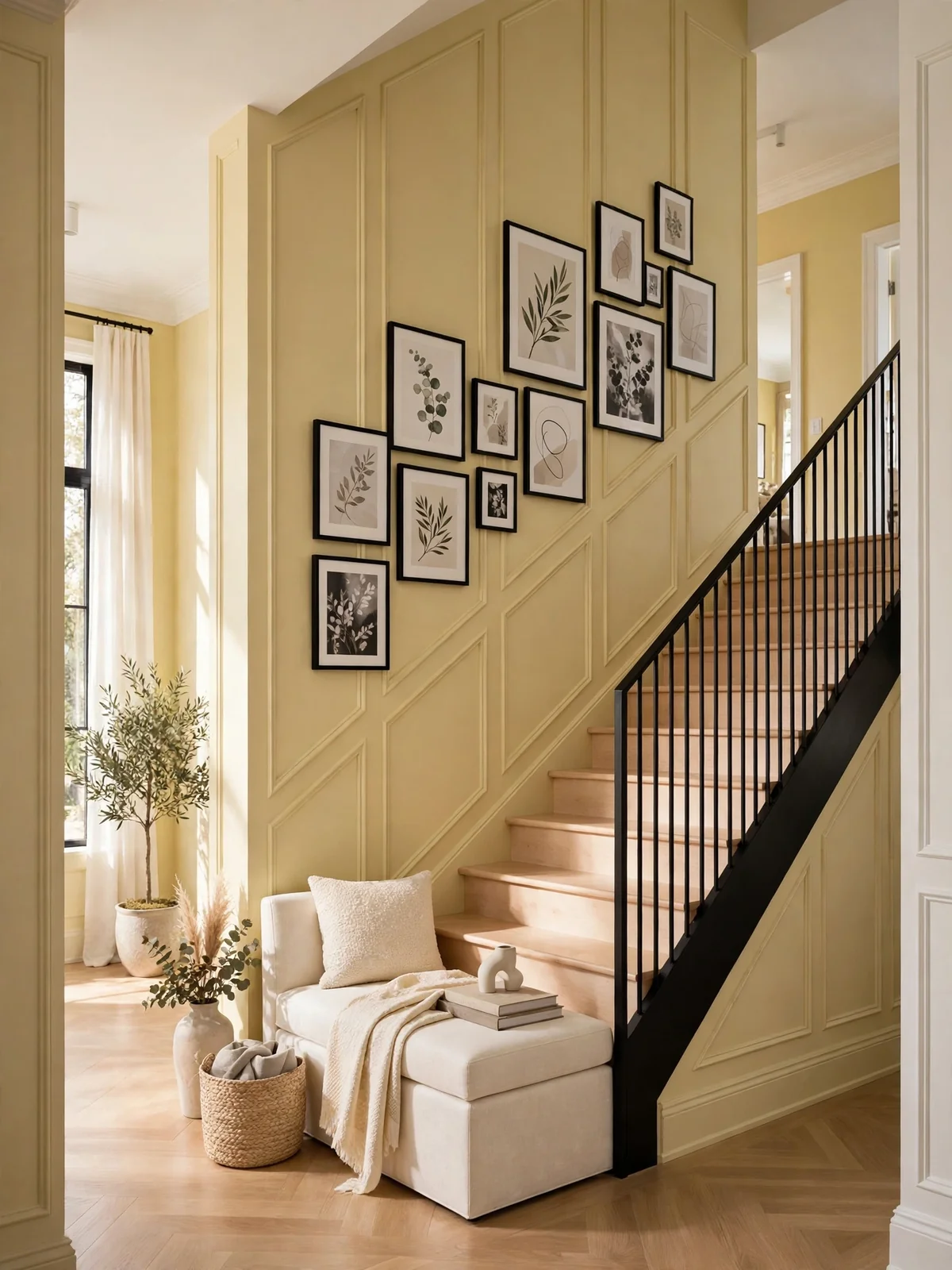
Panel the lower two-thirds of the staircase wall, then use the upper third for a curated gallery wall, and the paneling anchors the frames beautifully. Here, soft white paneling covers the lower wall beside pale maple treads, each 950 mm wide, while twelve framed photographs in slim black frames climb the soft butter-yellow upper wall. A cream bench below keeps the hallway warm, and the paneling gives the art structure to lean on — without it, the frames would feel floaty.
Quick tips:
- Panel the lower two-thirds and leave the upper third for art.
- Keep the frame colours cohesive — black, brass or wood, pick one.
- Paint the paneling the same colour as the lower wall for calm.
- Space the frames evenly above the paneling for a curated look.
Tongue-and-Groove Staircase Paneling for a Clean, Coastal Look
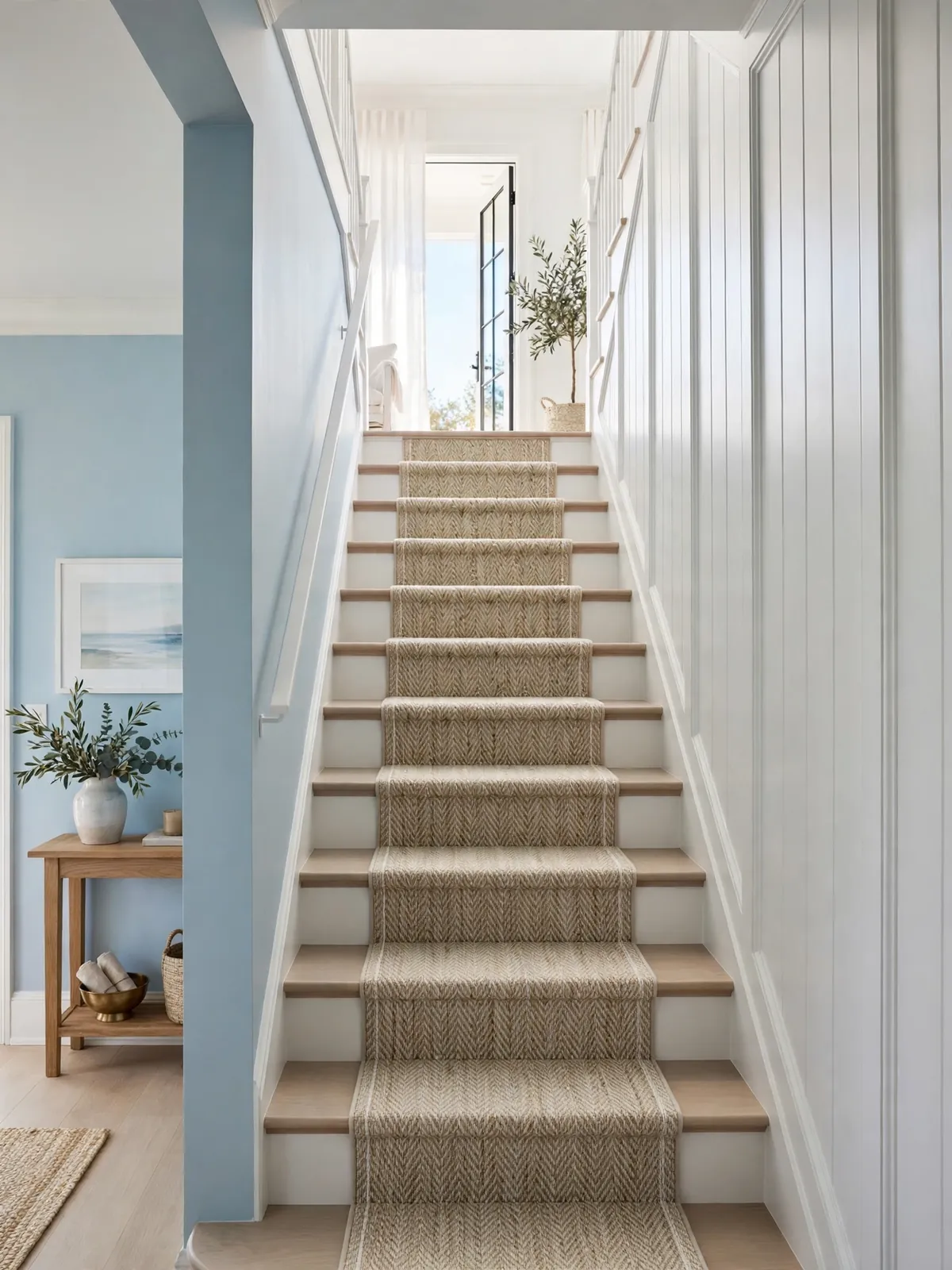
Tongue-and-groove paneling is the clean, coastal cousin of shiplap — narrow boards that lock together with a fine shadow line, giving the stair wall a crisp, tailored finish. Along this stair, soft white tongue-and-groove boards, each 80 mm wide, run vertically beside pale ash treads, each 900 mm wide, with soft sky-blue walls above and a woven runner down the centre of the flight. Gentle morning light from the landing window makes the fine grooves glow, and the stairwell feels breezy and bright.
Quick tips:
- Run tongue-and-groove boards vertically for a taller feel.
- Paint the boards soft white and keep the upper wall pale blue.
- Keep the grooves fine — about 3 mm — for a tailored look.
- Pair the paneling with a woven runner for a coastal feel.
Mirror Inserts Set Into Staircase Paneling That Bounce Light Up the Stair
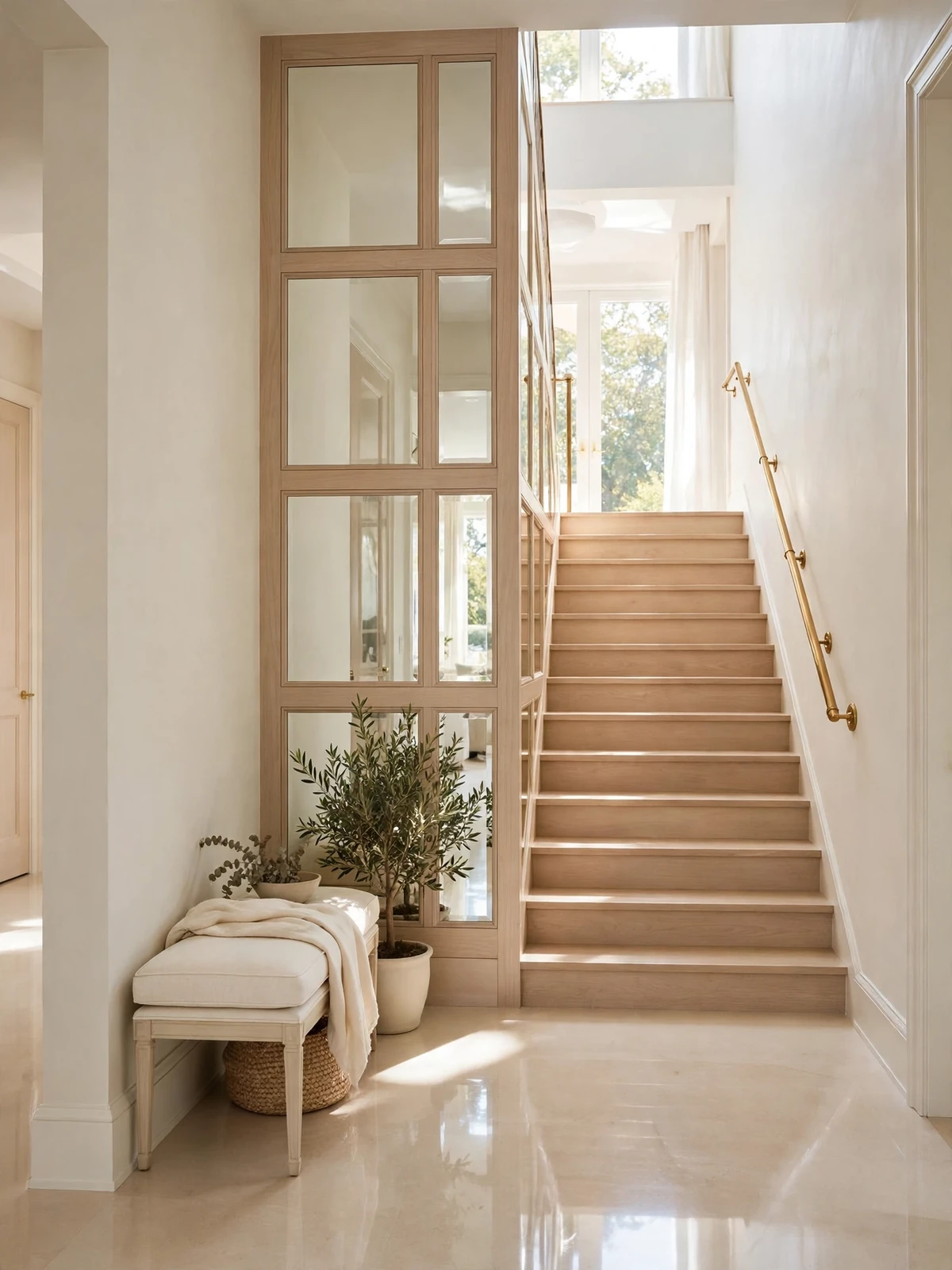
Install classic box paneling, then replace a few inner panels with mirror inserts, and the reflection bounces light up the staircase beautifully — especially in darker hallways. On this soft ivory wall, three mirror panels sit inside white molding frames beside pale oak treads, each 950 mm wide, with a slim brass handrail and a cream bench below. The mirrors are used sparingly, just three of them, so the stairwell feels twice as open without feeling dated or flashy.
Quick tips:
- Use mirror inserts in only a few panels, not every one.
- Keep the mirror shapes clean and the frames minimal.
- Place the mirrors where they catch the landing window light.
- Wipe the mirrors with a microfibre cloth to keep them streak-free.
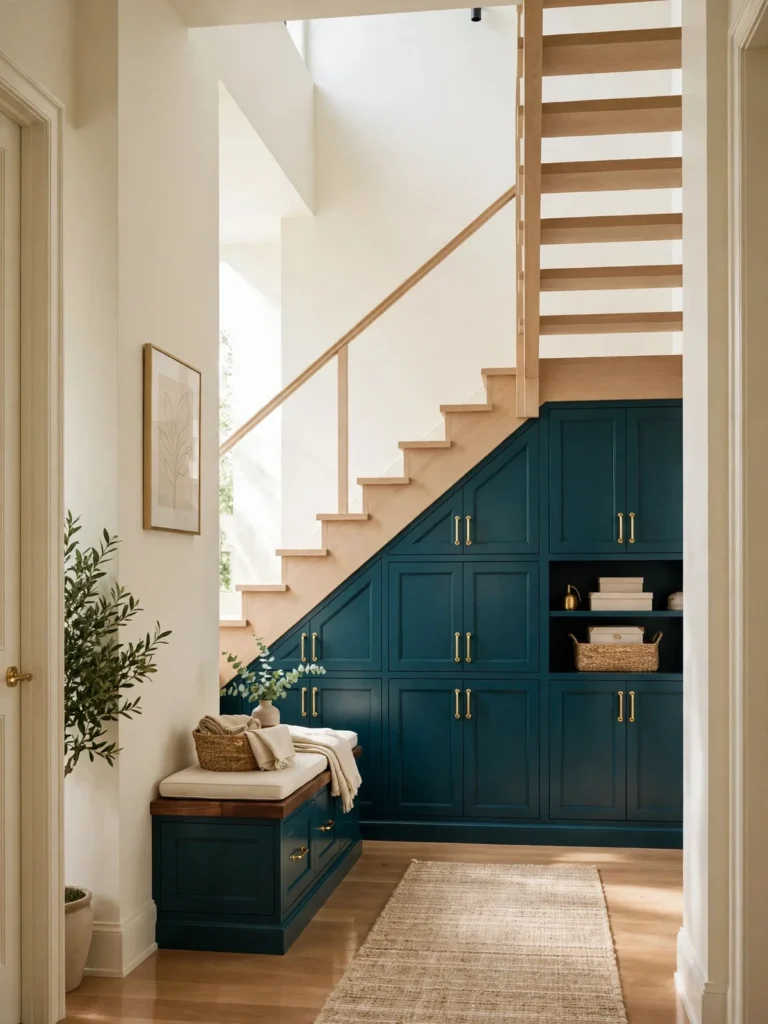
Staircase Paneling With Hidden Storage Built Into the Wall
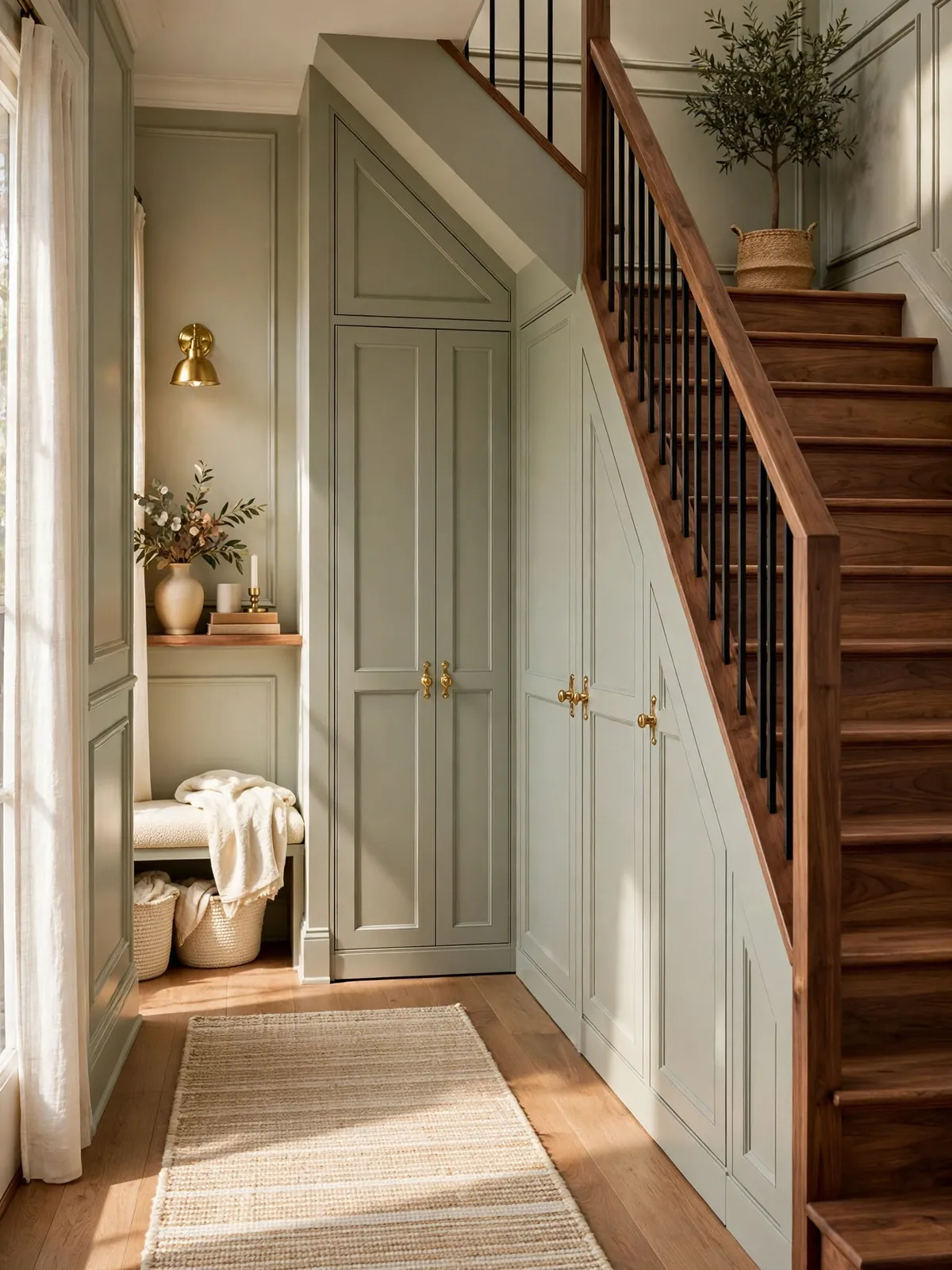
If you have space beneath or beside the staircase wall, build paneled cabinet doors that blend seamlessly into the wall design — hidden storage, concealed shelves, even a coat closet that looks like decorative paneling from the outside. Here, three paneled doors in soft sage green sit flush in the wall beside warm walnut treads, each 950 mm wide, with slim brass handles and cream baskets inside holding shoes and scarves. From the outside it looks like paneling; inside, it is pure function.
Quick tips:
- Build the cabinet doors flush with the paneling so they disappear.
- Use the same paint on the doors and the panels for a seamless look.
- Add slim brass handles that match the handrail.
- Plan the storage early — it takes measuring, but it is worth it.
Staircase Paneling That Continues Overhead Onto the Ceiling
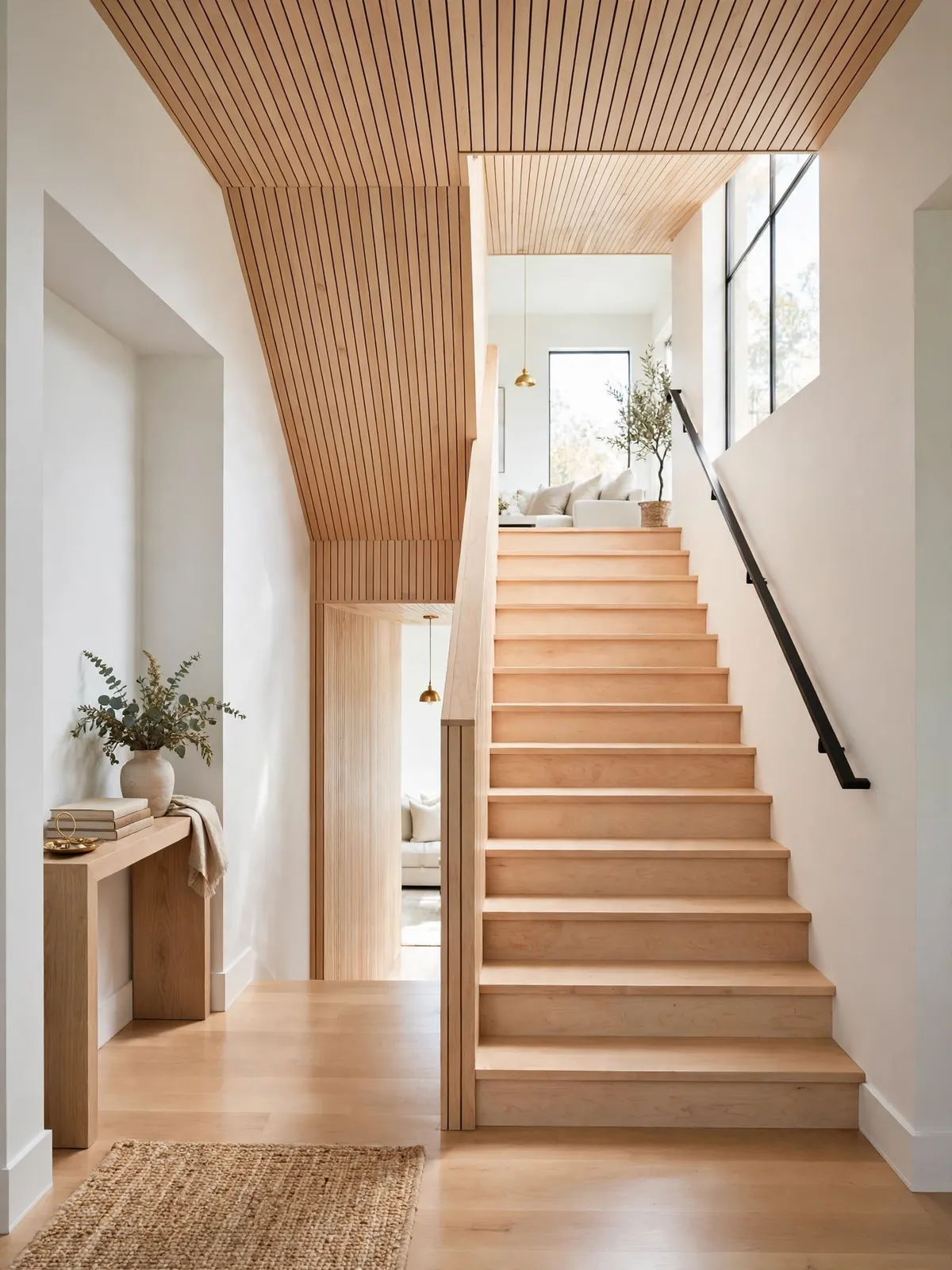
If the staircase has a defined ceiling above it, continue the paneling overhead — vertical walls and matching ceiling panels wrap the stairwell entirely, and the effect feels immersive and incredibly custom. Here, soft white paneling runs up the wall and across the sloped ceiling above pale maple treads, each 950 mm wide, with a slim black handrail and a small brass pendant hanging from the paneled ceiling. The wrapped paneling makes the stairwell feel like a designed room rather than a passage.
Quick tips:
- Continue the same paneling from the wall onto the ceiling.
- Use smooth painted MDF for modern homes, light wood shiplap for farmhouse.
- Keep the ceiling panels the same colour as the wall panels.
- Hang one small pendant from the paneled ceiling for warmth.
An Ombré Gradient Painted Across Staircase Paneling
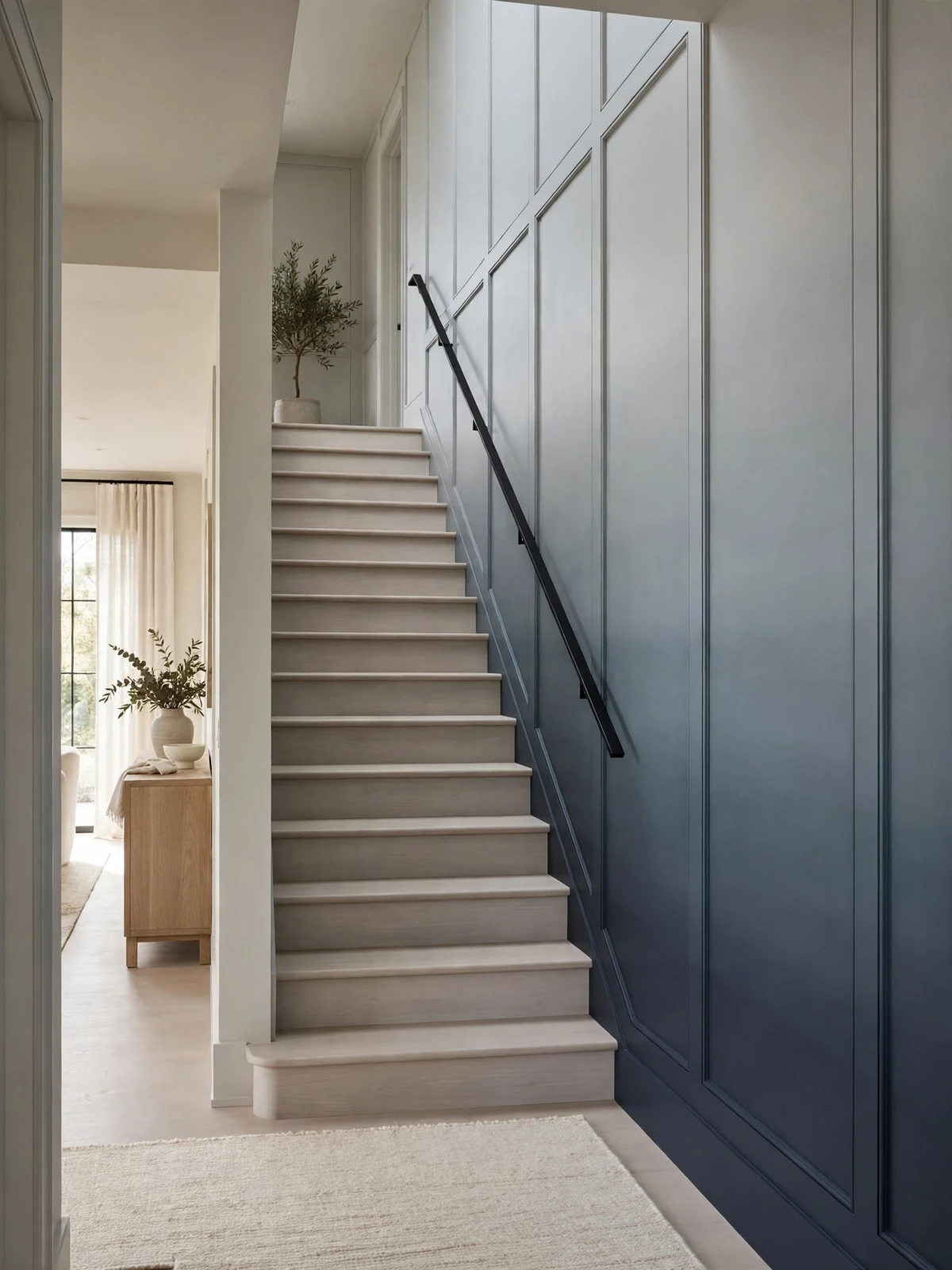
Start darker at the bottom of the staircase and gradually lighten the paneling colour as it climbs, and the gradient makes a narrow staircase appear longer, because the eye naturally follows the colour shift upward. On this wall, square panels fade from deep slate at the base through soft grey to pale grey at the landing, beside pale ash treads, each 900 mm wide, with a slim black handrail and a cream rug below. The tones stay within one colour family, so the effect is artistic but controlled — and surprisingly calming.
Quick tips:
- Blend the gradient within one colour family — slate to pale grey, or forest to sage.
- Test the colours with sample pots before painting the whole wall.
- Keep the treads pale so the gradient stays the feature.
- Blend carefully at each panel join for a smooth fade.
Painted Staircase Paneling in a Soft Two-Tone Scheme for a Calm Climb
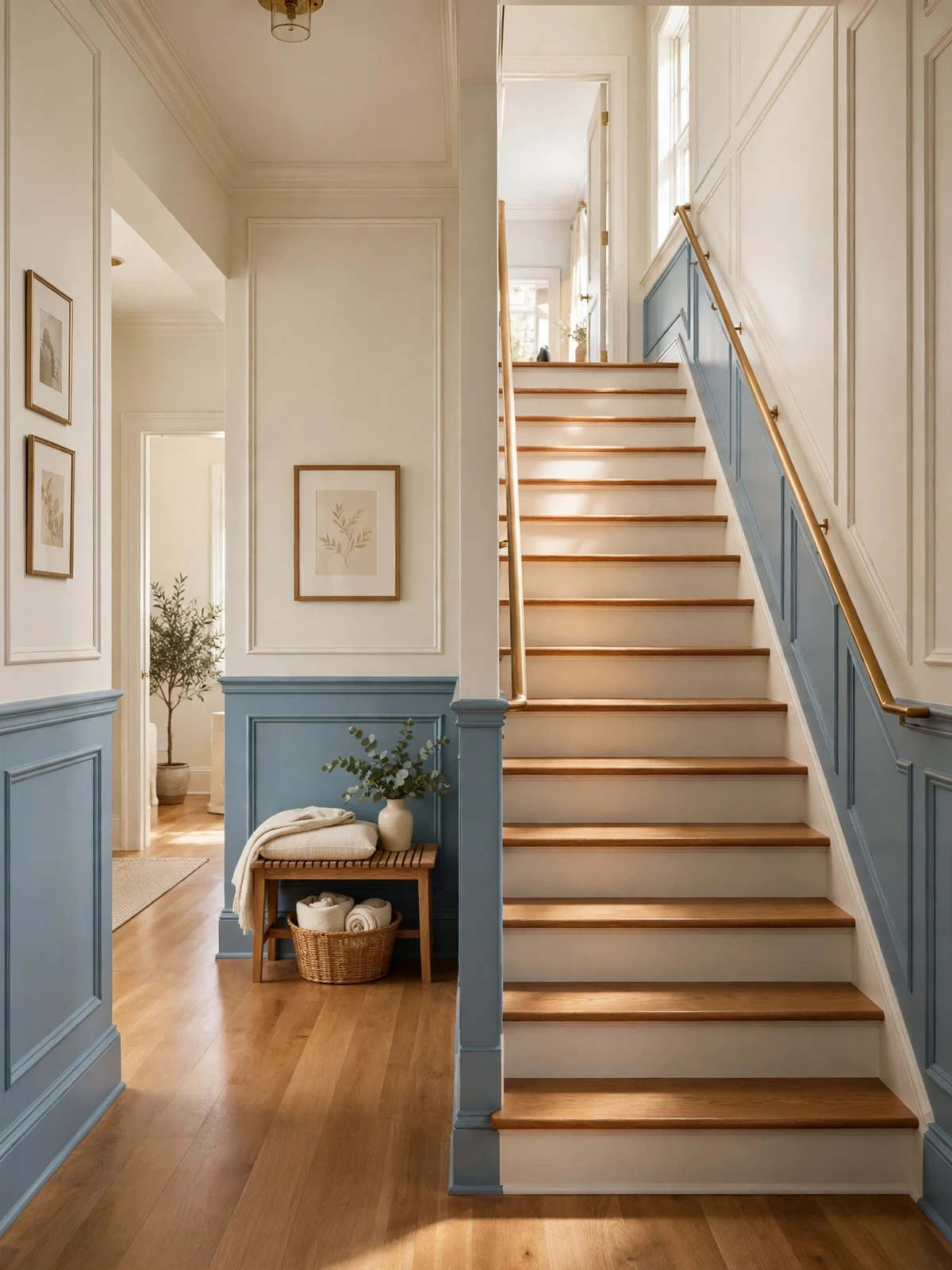
A soft two-tone scheme on staircase paneling is the calmest way to add colour — dusty blue panels below, cream wall above, and the stair feels grounded below and airy above. Here, square panels in dusty blue cover the lower wall beside honey oak treads, each 950 mm wide, with cream paint above and a slim brass handrail running along the join. A small wooden bench at the base keeps the hallway warm, and the two tones make the stairwell feel designed without a single bold gesture.
Quick tips:
- Choose two soft tones — dusty blue and cream, or sage and white.
- Align the colour change with the panel top for a clean line.
- Paint the panels the darker tone and the upper wall the lighter one.
- Keep the handrail slim brass so it glows against the soft palette.
Staircase Paneling Wrapped Around the Stair Corner for a Seamless Flow
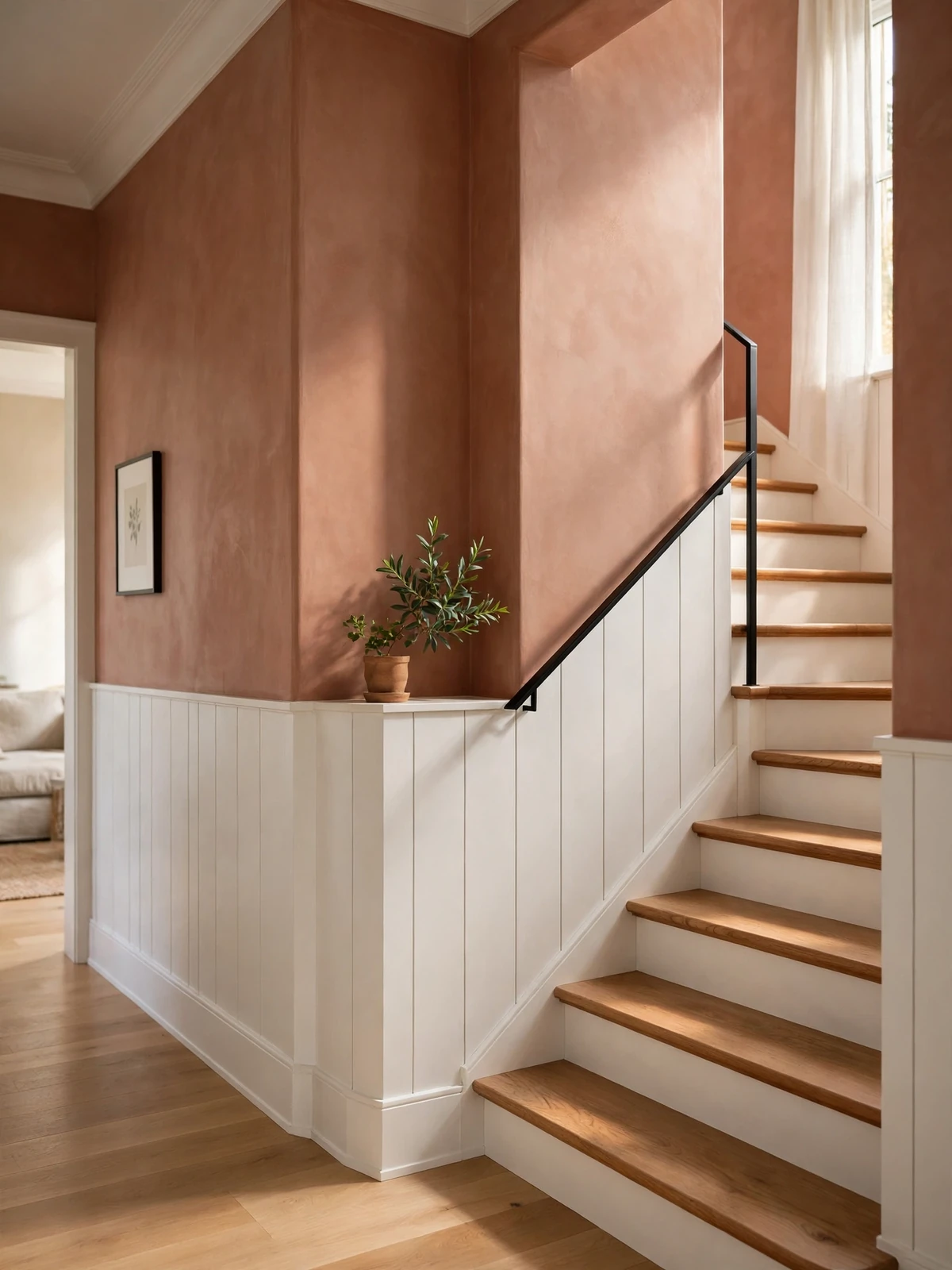
Do not stop the paneling when the staircase turns — wrap it around the corner so it flows seamlessly along the adjacent walls, and everything feels intentional instead of like an afterthought. Here, white square panels run up the stair wall and continue around the corner onto the landing wall beside warm oak treads, each 950 mm wide, with soft terracotta walls and a slim black handrail. A small green plant sits on the landing, and the wrapped paneling makes the turn feel like part of one continuous design story.
Quick tips:
- Wrap the paneling around the corner — continuity beats convenience.
- Keep the panel size consistent on both walls for a seamless flow.
- Mitre the corner joints carefully so the wrap looks professional.
- Paint the panels the same colour on both walls for unity.
Wide-Plank Timber Staircase Paneling for a Warm, Rustic Stairwell
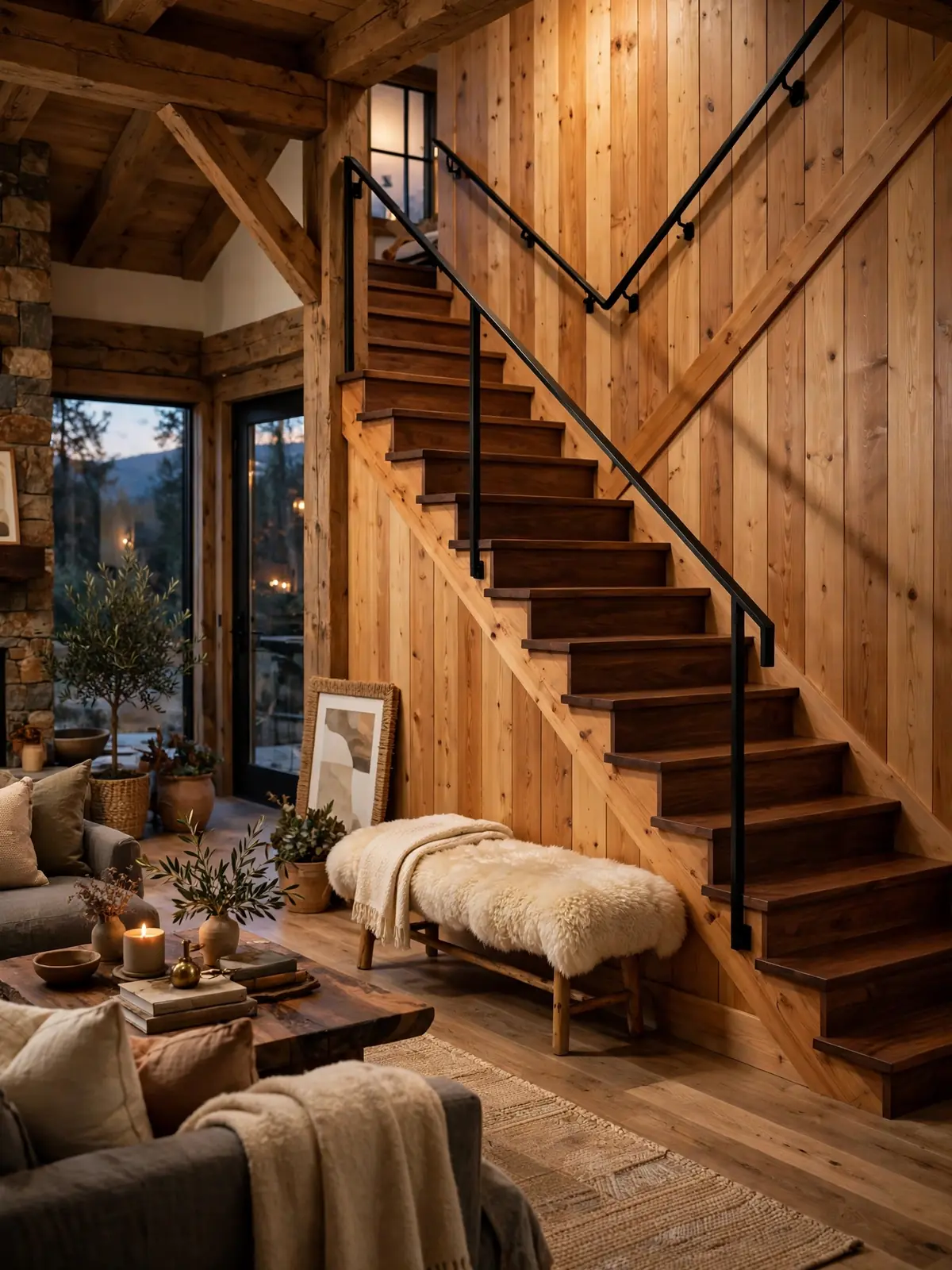
Wide-plank timber paneling brings a warm, rustic feeling to a stairwell that no painted panel ever can, because the broad boards show the grain, the knots and the natural variation of real wood. Along this stair, wide honey pine planks, each 200 mm across, run vertically beside dark walnut treads, each 950 mm wide, with a matte black handrail and a cream sheepskin bench below. Soft evening light from a pendant above the landing makes the pine glow, and the stairwell feels like a cabin — warm, honest and deeply comfortable.
Quick tips:
- Use wide planks, about 200 mm, so the grain shows beautifully.
- Seal the timber so it stays clean and easy to dust.
- Pair wide-plank paneling with dark walnut treads for contrast.
- Keep the handrail matte black to echo the rustic iron details.
Staircase Paneling in a Deep Forest Green for a Cocooning Climb
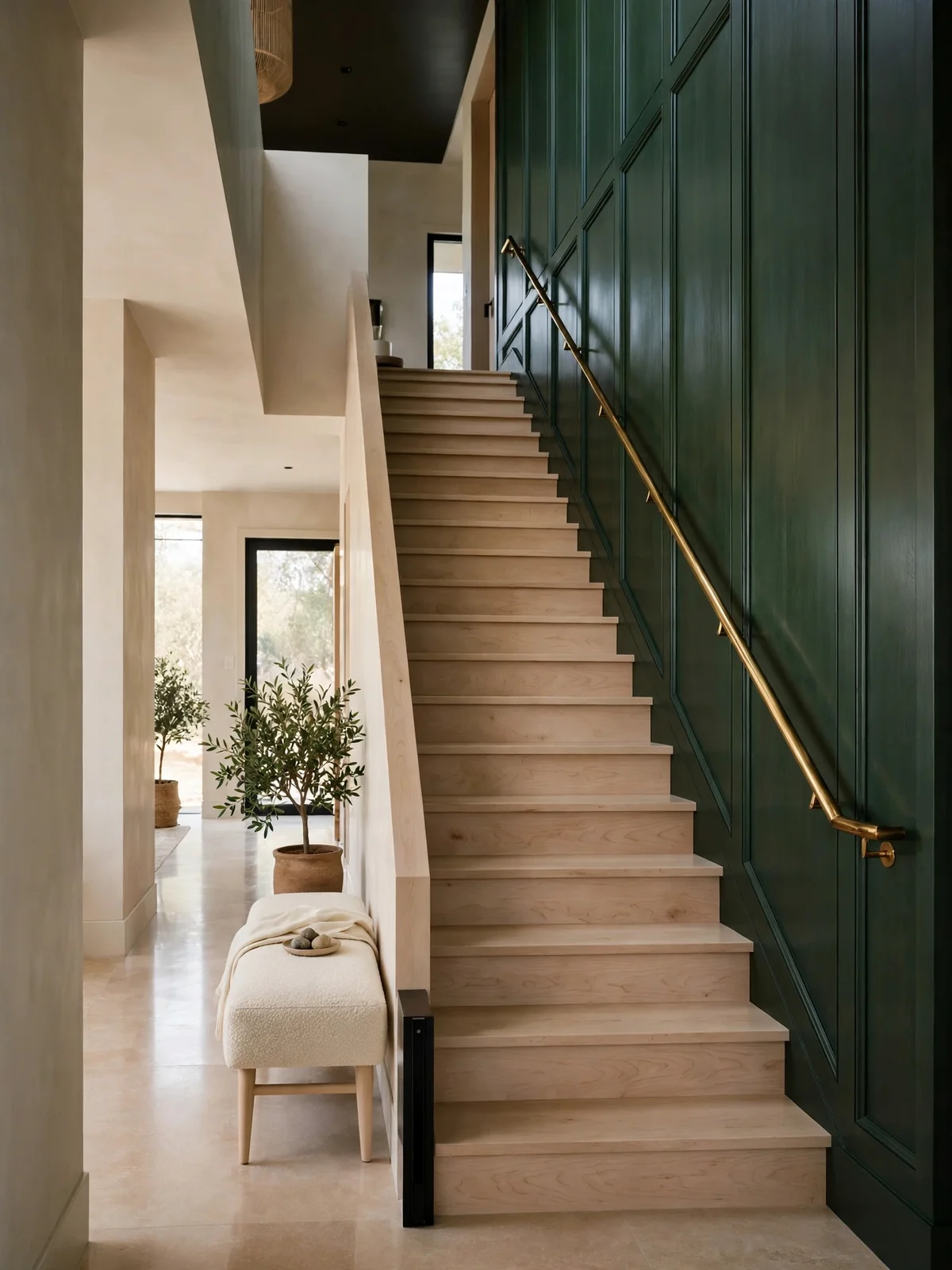
Deep forest green paneling wraps a staircase in a cocooning climb — the colour is rich, calm and enveloping, and it makes pale treads glow against it. Here, square panels in deep forest green cover the stair wall beside pale maple treads, each 950 mm wide, with a slim brass handrail and a cream bench below. A small olive tree in a clay pot sits at the base, and daylight from the landing window makes the green glow gently while the pale treads stand out crisply against it.
Quick tips:
- Choose deep forest green for a cocooning, enveloping feel.
- Keep the treads pale so they glow against the dark panels.
- Add a brass handrail to lift the green.
- Keep the opposite wall plain so the green stays the feature.
Staircase Paneling Ideas That Turn a Narrow Stairwell Into a Warm, Layered Passage
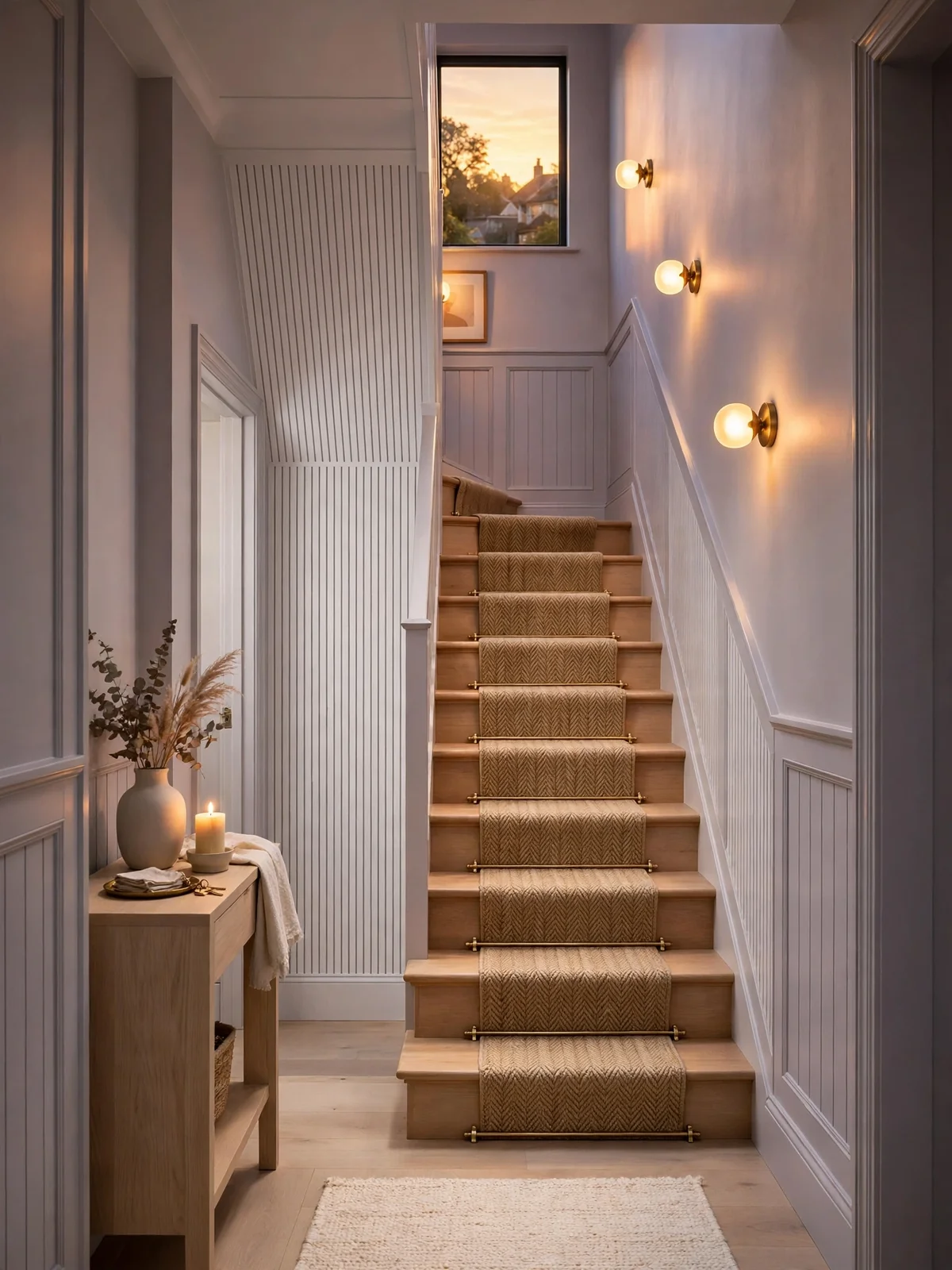
A narrow stairwell does not need to feel like a tunnel — it needs layers, and staircase paneling is the layer that changes everything, because it gives a tight wall texture, rhythm and warmth all at once. In this compact home, soft white square panels climb the lilac-grey wall beside pale oak treads, each 850 mm wide, with a woven runner in cream and oatmeal softening the climb and two slim brass sconces washing warm light across the panels in the evening. The panels are painted the same soft white as the ceiling, so the stairwell reads as one continuous surface rather than a collection of parts, and the sconces make the panel shadows glow gently after dark. A cream rug at the base catches the light from the landing window, and the whole passage feels warm, layered and intentional — the opposite of a tunnel. The key is restraint: one panel style, one paint colour, one runner, two sconces, and nothing else competing for attention. The stairwell is only 900 mm wide, but the paneling makes it feel like a designed room, because every surface has been considered — the wall has texture, the treads have warmth, the runner has softness, and the light has somewhere to land. That is what paneling does best in a narrow stair: it turns a constraint into a feature, and a passage into a place.
Quick tips:
- Use one panel style and one paint colour in a narrow stairwell.
- Add two slim brass sconces so the panel shadows glow in the evening.
- Choose pale oak treads so a narrow stair feels wider.
- Keep the hallway free of bulky furniture so the stair breathes.
Staircase Paneling in Soft Greige for a Modern-Classic Look
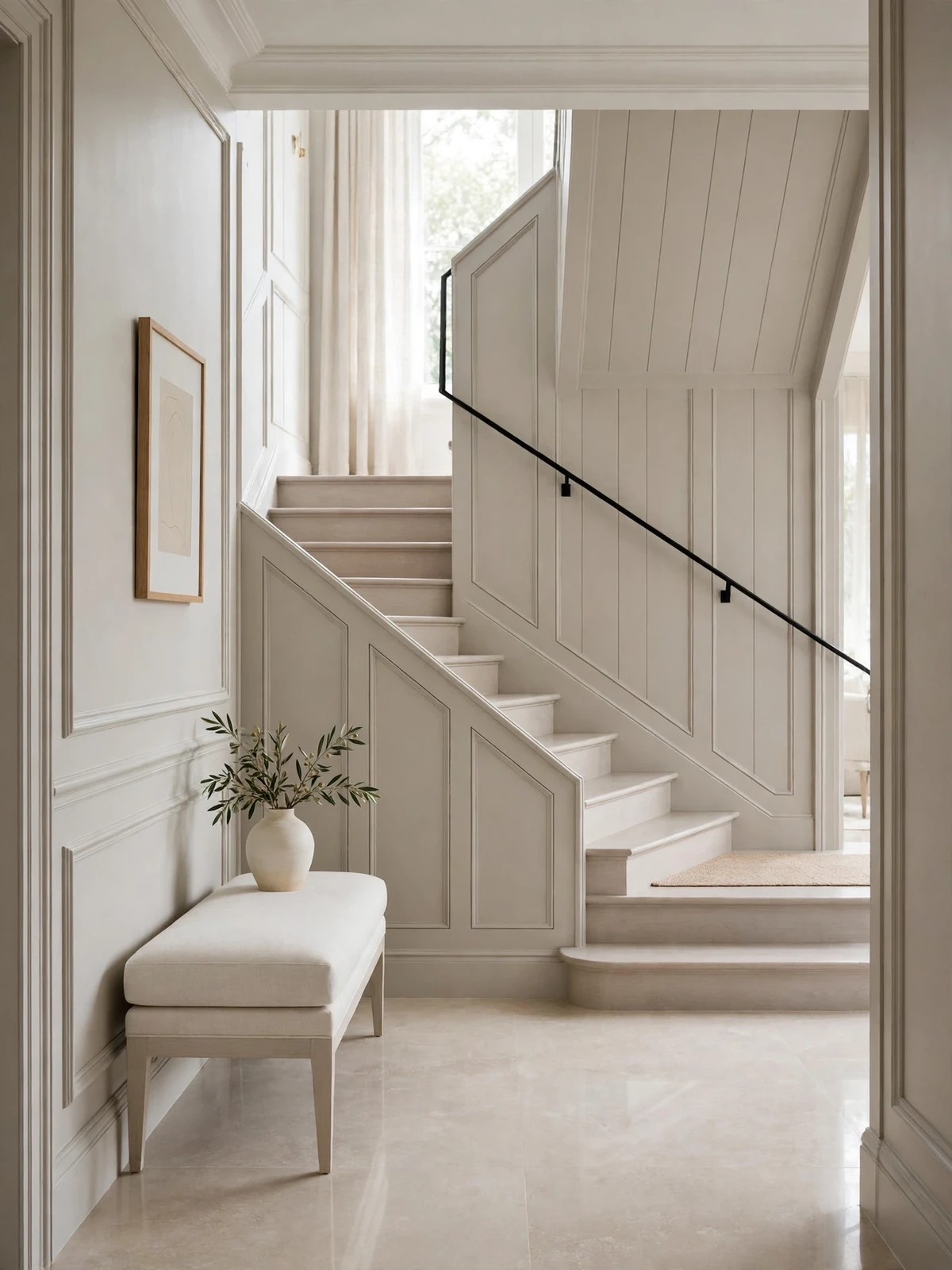
Soft greige — the warm grey-beige in between — is the modern-classic paneling colour, because it feels calm, expensive and easy to live with. Along this stair, square panels in soft greige climb the pale wall beside pale ash treads, each 900 mm wide, with a slim black handrail and a cream bench below. A small ceramic vase on the bench adds one quiet accent, and the greige panels make the stairwell feel tailored rather than decorated, modern rather than trendy.
Quick tips:
- Choose soft greige for a modern-classic look that never dates.
- Paint the panels and the wall the same greige for a subtle effect.
- Pair greige paneling with pale ash treads for a calm palette.
- Keep the handrail slim black for a crisp, modern contrast.
Staircase Paneling Behind a Slim Console Table at the Base of the Stair
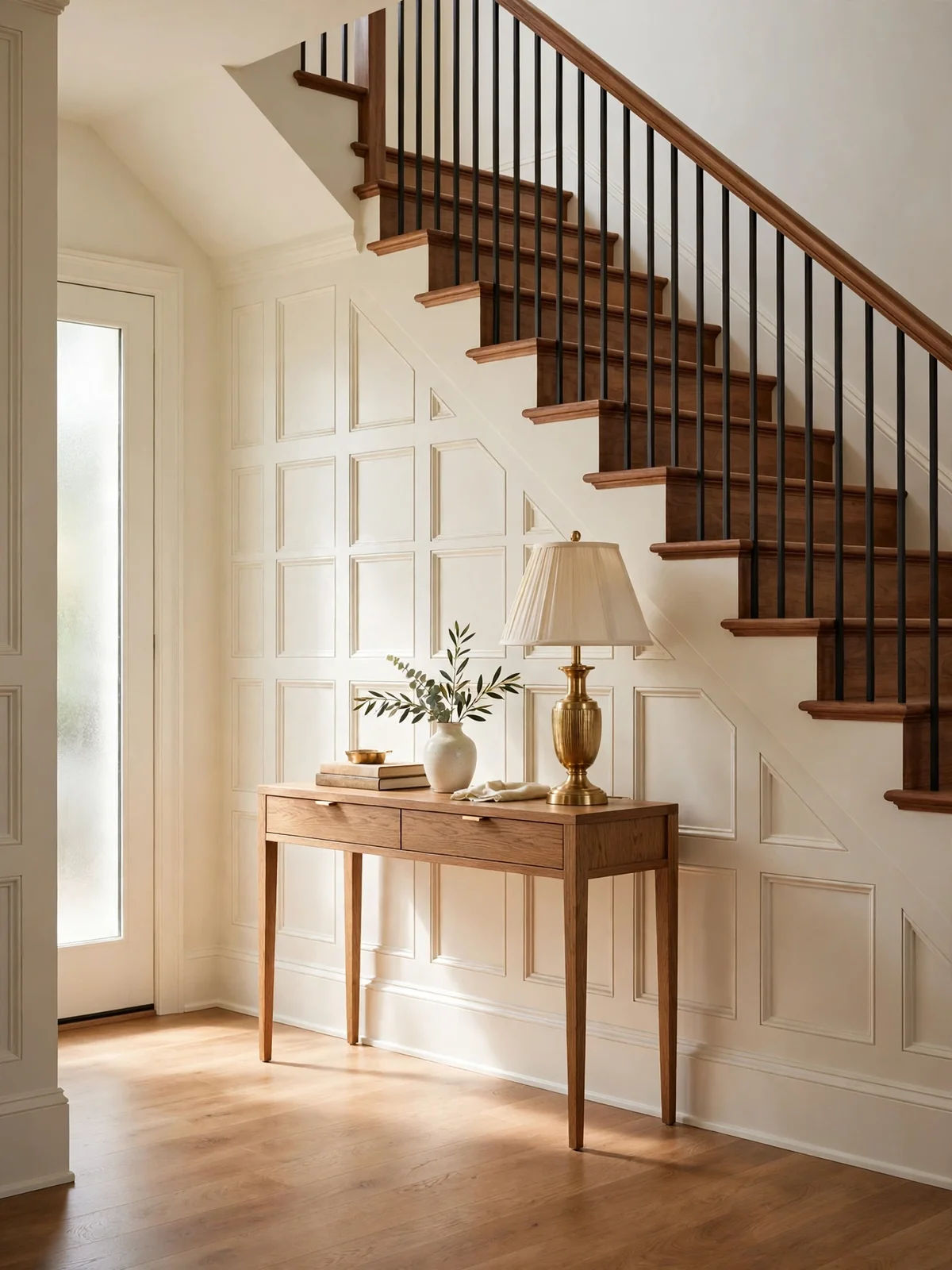
A slim console table at the base of the stair turns the entry into a finished room, and paneling behind it makes the table feel built in rather than placed there. Here, soft white square panels cover the wall behind a slim oak console table, 1.1 metres long and 300 mm deep, holding a small ceramic vase and a brass table lamp, beside warm walnut treads, each 950 mm wide. Soft ivory walls keep the entry bright, and the paneling gives the console a backdrop that makes the whole base of the stair feel designed.
Quick tips:
- Keep the console slim, about 300 mm deep, so it never blocks the stair.
- Panel the wall behind the console so the table feels built in.
- Add one small lamp so the entry glows in the evening.
- Match the console timber to the treads for a unified look.
Staircase Paneling With a Built-In Picture Ledge for Rotating Art
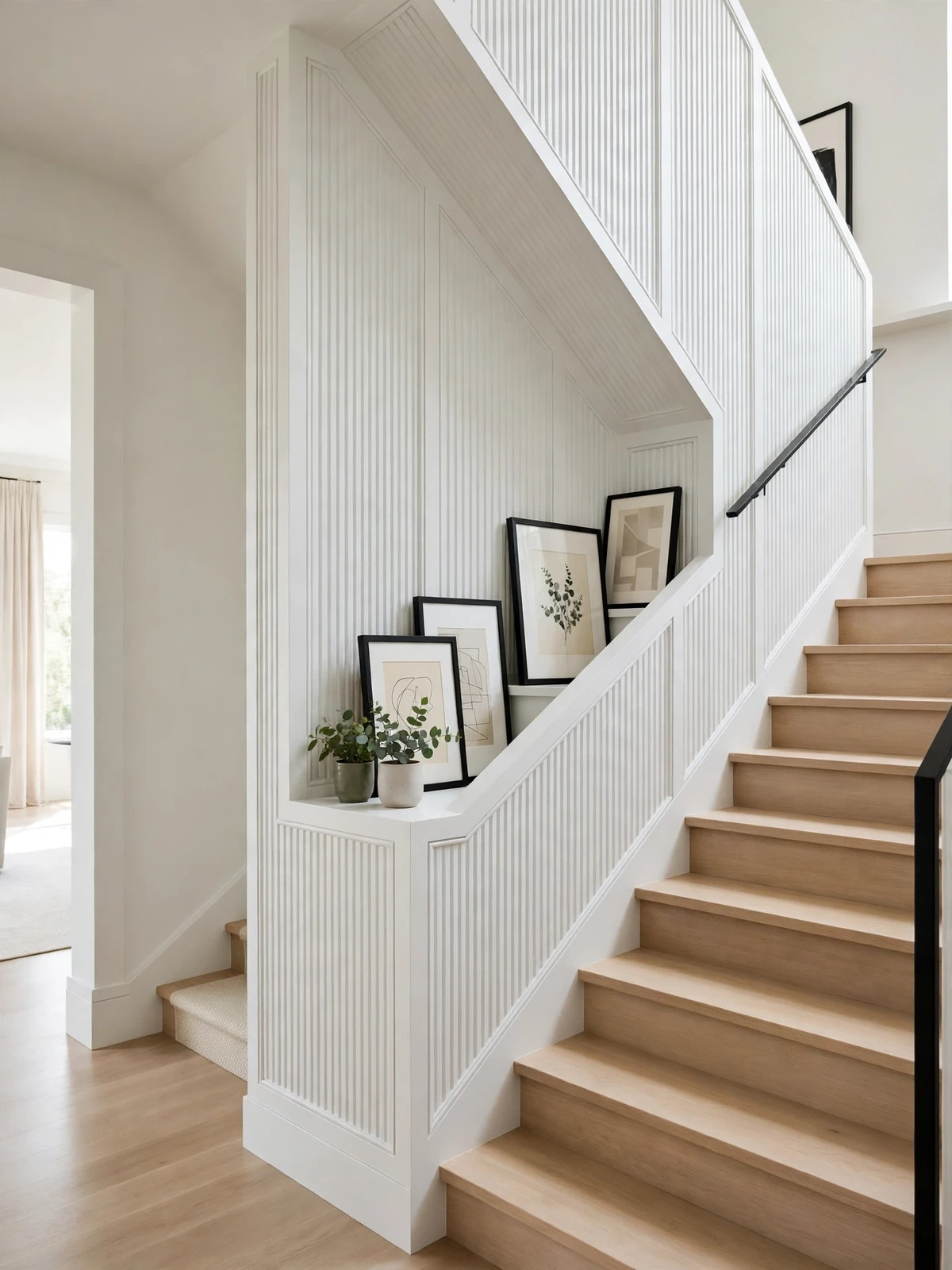
A built-in picture ledge on a paneled stair wall is the most flexible gallery idea of all, because you can lean frames, swap photographs and add small decor pieces without a single new nail hole. Along this stair, a slim white picture ledge, 100 mm deep, runs along the top of the soft white paneling beside pale oak treads, each 950 mm wide, holding three slim black frames and a small green plant. The photographs rotate with the seasons, the paneling stays put, and the stair wall never feels finished — in the best way.
Quick tips:
- Build the ledge along the top of the paneling for a clean line.
- Keep the ledge slim, about 100 mm deep, so frames lean safely.
- Rotate the photographs seasonally to keep the wall feeling alive.
- Use one frame colour across the ledge for a unified look.
A Paneled Staircase That Feels Like It Was Always Part of the House
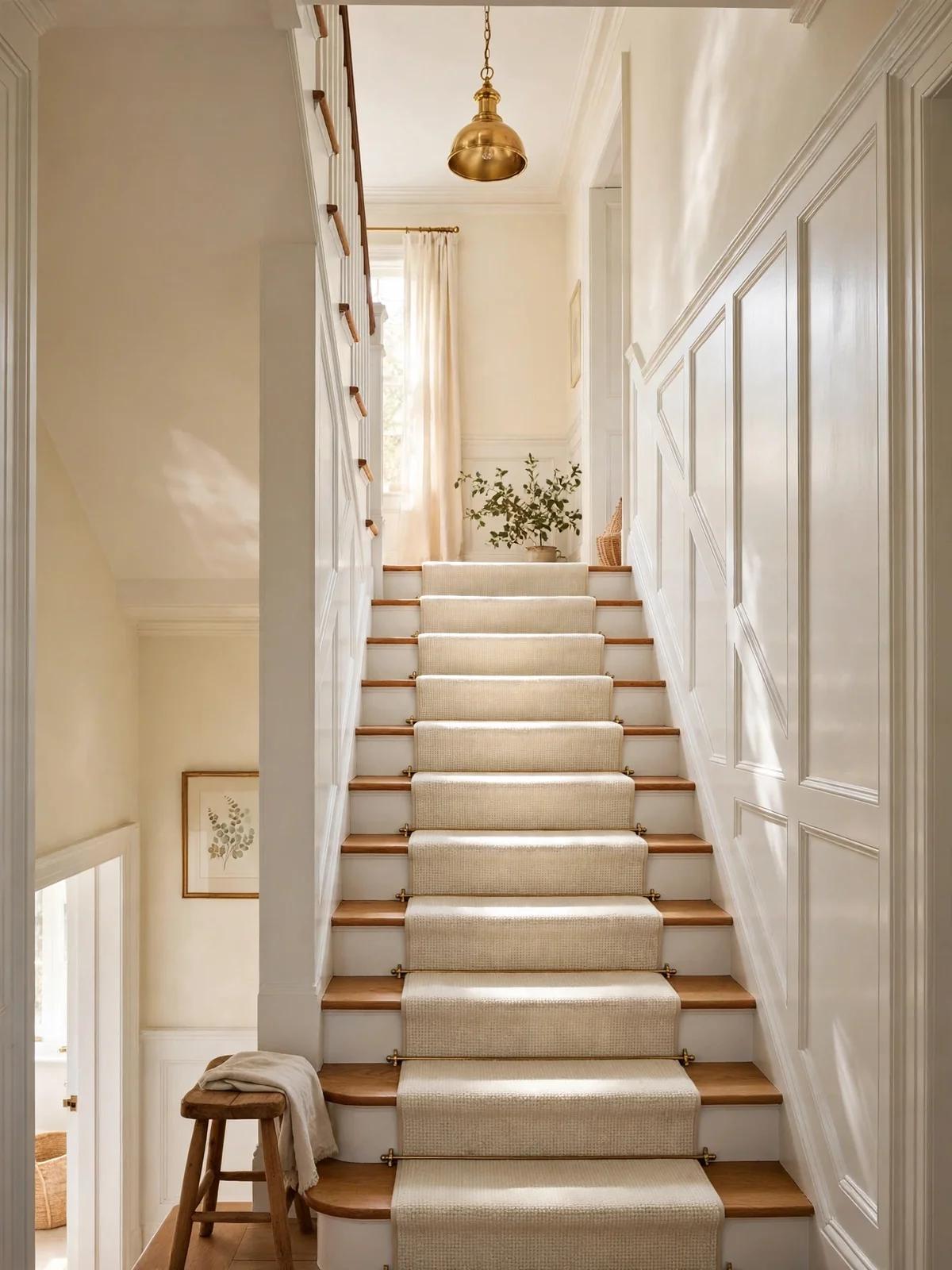
The best paneled staircase feels like it was always part of the house — not added, not decorated, simply there, as if the home was built around it. In this home, soft white square panels climb the cream wall beside warm oak treads, each 950 mm wide, with a cream runner softening the climb, a slim brass pendant hanging above the landing, and a small wooden stool at the base. The panels match the trim on the doors nearby, the handrail matches the brass on the pendant, and the whole stair feels settled — the kind of detail that makes a house feel like a home.
Quick tips:
- Match the paneling to the trim on nearby doors for a settled look.
- Choose a timeless panel style — square, not trendy — for longevity.
- Keep the palette warm: cream walls, oak treads, brass details.
- Let the paneling run the full flight so the stair feels complete.
FAQs
How do I install shiplap paneling on a staircase wall?
Measure the wall and cut the boards to length, starting at the bottom of the flight and working upward. Fix each board with a nail gun and wood adhesive, keeping a consistent 3 mm gap, and use a spirit level to check the line as you climb. Fill the nail holes, caulk the edges, and paint the boards the same colour as the trim for a clean finish.
What is the difference between paneling and molding on a staircase?
Paneling covers the wall with boards or panels — shiplap, beadboard, raised panels or MDF — giving the whole surface texture. Molding is slim trim applied to the wall in frames or lines, giving the surface pattern and shadow. Paneling feels warmer and more substantial; molding feels lighter and more graphic. Many staircases use both.
Can paneling make a small staircase look bigger?
Yes — vertical paneling, shiplap and tall square panels all draw the eye upward and make a stairwell feel taller. Pale colours, a tall mirror on the stair wall and a slim handrail help too, while bulky newel posts, dark paint and heavy runners make a narrow stair feel smaller.
How do I clean staircase paneling?
Dust the panels weekly with a microfibre cloth or a soft brush, and wipe them with a damp cloth and mild soap when they need more. Painted MDF and shiplap wipe clean easily; reclaimed wood needs a gentle dusting and an occasional re-seal to keep the timber protected.
How much does it cost to panel a staircase wall?
A DIY MDF paneling treatment costs a few hundred pounds in materials and takes a weekend. A carpenter-installed shiplap or raised-panel stair wall usually runs into the low thousands, depending on the height of the stairwell and the complexity of the pattern. Reclaimed wood costs more, because the boards need sourcing and preparation.
Conclusion
Staircase paneling is the wall treatment that turns an ignored stretch of wall into the warmest feature in a home. Whether you choose classic square panels, vertical shiplap, beadboard, reclaimed wood, raised panels, budget-friendly MDF, or a deep forest green that wraps the whole stairwell, the best staircase paneling is the one that suits the rooms around it. Keep the panels even, the colour considered, the materials honest and the lighting generous, and your stair wall will make every room it touches feel more intentional, more elegant and more beautiful.