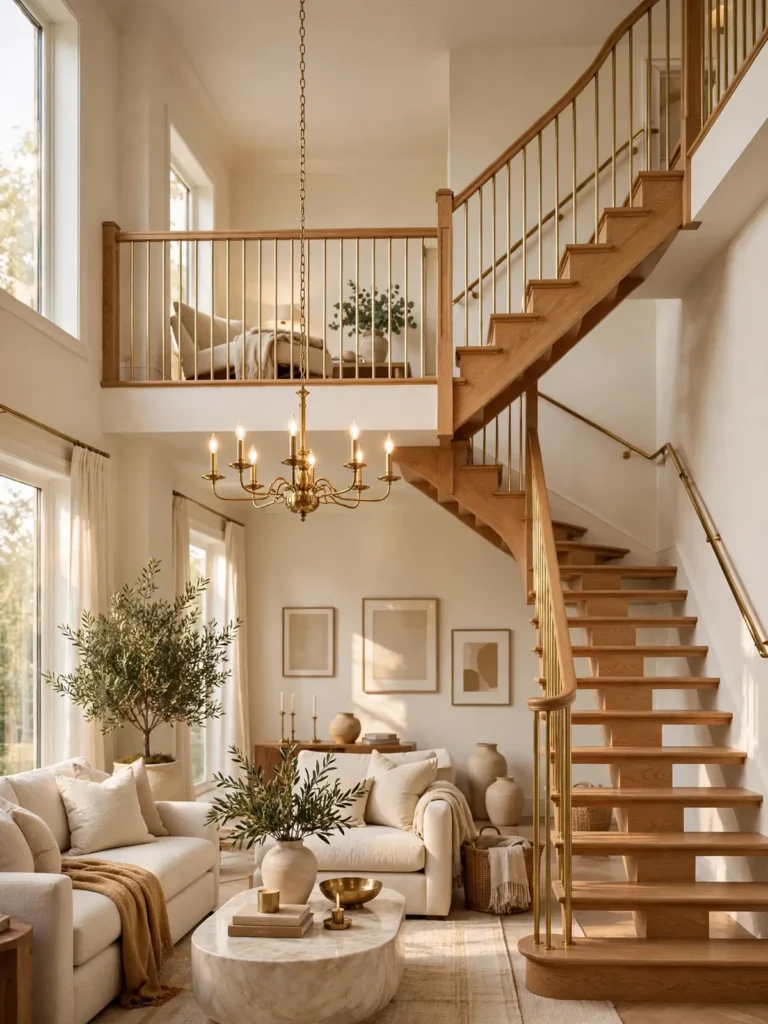
27 Stunning Wooden Staircase Designs Ideas That Add Warmth, Style and Serious Wow Factor
Wood brings warmth to a staircase like no other material, and the right design turns a functional stair into the most admired feature of your home. These 27 wooden staircase designs ideas cover floating stairs, reclaimed timber, curved and spiral shapes, finishes, railings, runners and storage, so you can choose a wooden staircase that suits your home, your budget and your style.
Wooden staircase designs ideas work because wood is warm, solid and timeless, and a well-designed wooden staircase turns the journey between floors into a design moment rather than a forgotten corridor. The best wooden staircase designs balance three things: the wood species and finish, the shape of the stair, and the railing and lighting around it. Get those three right and the staircase becomes the first thing guests notice when they walk in.
If you are planning the stair as part of a wider project, these staircase design ideas show how shape, materials and railings work together across every staircase style. The 27 designs below cover floating stairs, reclaimed timber, curved and spiral shapes, dark and pale finishes, runners, panelling, lighting and clever storage, so you can find a wooden staircase that fits your floor plan, your budget and the way your family actually lives.
Key Takeaways
What is the best wood for a staircase?
Oak is the best all-round choice for a wooden staircase because it is hard-wearing, takes stain evenly and suits almost every style, from farmhouse to modern. Walnut gives a richer, darker look for statement stairs, maple suits pale Scandinavian designs, and reclaimed timber adds character in rustic homes. Choose a hardwood for the treads, where wear is heaviest, and save softer woods for risers and panelling.
Are wooden staircases expensive?
A wooden staircase costs more than a basic carpeted stair but far less than stone or steel, and the price depends on the wood species, the shape and the railing. A straight flight in oak with a simple railing is the most affordable option. Floating treads, curved shapes, glass balustrades and premium hardwoods like walnut raise the cost significantly. A budget refresh — sanding, restaining and painting the risers — can transform an existing wooden stair for under $500.
How do I keep a wooden staircase looking new?
Sweep it weekly, mop the treads with a barely damp cloth and a wood-safe cleaner, and re-oil or re-wax oiled finishes once a year. Add a stair runner on the busiest flights to protect the centre of the treads, fit felt pads under any furniture that sits nearby, and deal with scratches quickly with a matching stain pen before they deepen. Never flood a wooden stair with water.
Are open-riser wooden stairs safe?
Open-riser wooden stairs are safe for most adults when they are built to local building codes, with treads deep enough for a full foot and a secure handrail. They are less suitable for homes with small children or pets, because small feet and paws can slip through the gaps. If you love the airy look but need safety, keep the gap between treads under 100 mm or fit a slim glass panel behind the open risers.
Which wooden staircase design suits a small home?
A straight or L-shaped wooden staircase in a pale wood, with open risers and a glass or slat balustrade, suits a small home best because it lets light pass through and keeps the space feeling open. A spiral staircase saves the most floor space but is harder to carry furniture up. Avoid heavy dark woods and solid balustrades in small entries, because they close the space in.
A Floating Wooden Staircase With a Glass Balustrade
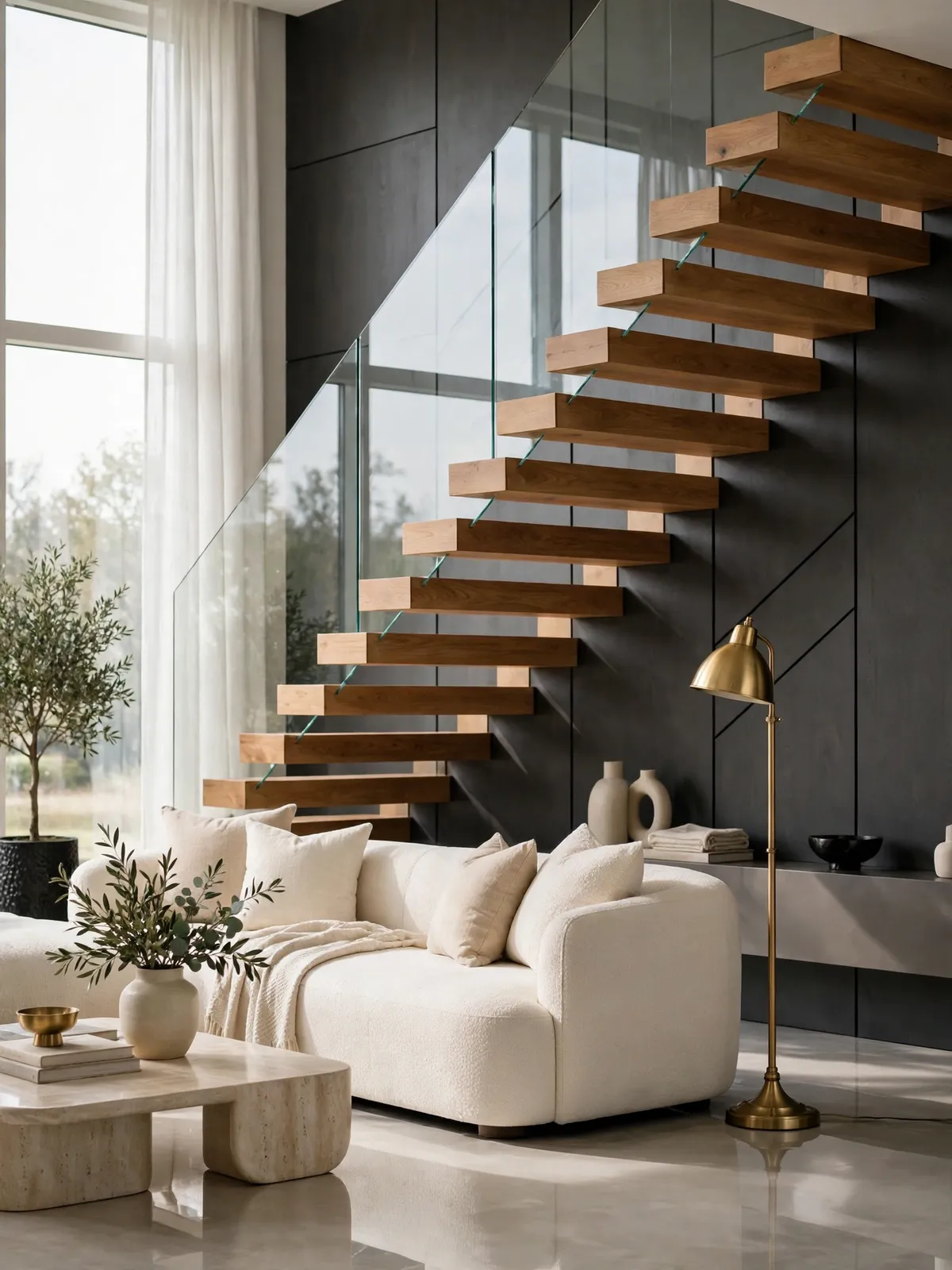
A floating wooden staircase with a glass balustrade is the most dramatic wooden staircase design, because each thick tread appears to hover in mid-air while the glass keeps the view completely open. Here, honey-oak treads cantilever from a charcoal wall, with a frameless glass balustrade and a slim steel handrail, so the staircase reads as sculpture rather than structure. The design suits modern and open-plan homes, it makes a small entry feel twice as large, and it lets daylight travel through the stair instead of stopping at it. The weakness is cost and engineering — floating treads need a steel spine or a reinforced wall, and the glass must be toughened — so this is a design to plan with a specialist, not a weekend project.
Quick tips:
- Keep the wall behind the stairs plain so the floating effect stays the hero.
- Choose thick treads, at least 50 mm, so the floating look feels solid.
- Use toughened frameless glass for the balustrade.
- Add LED strips under the treads for a glowing evening effect.
Wood and Matte Black Metal for Industrial Warmth
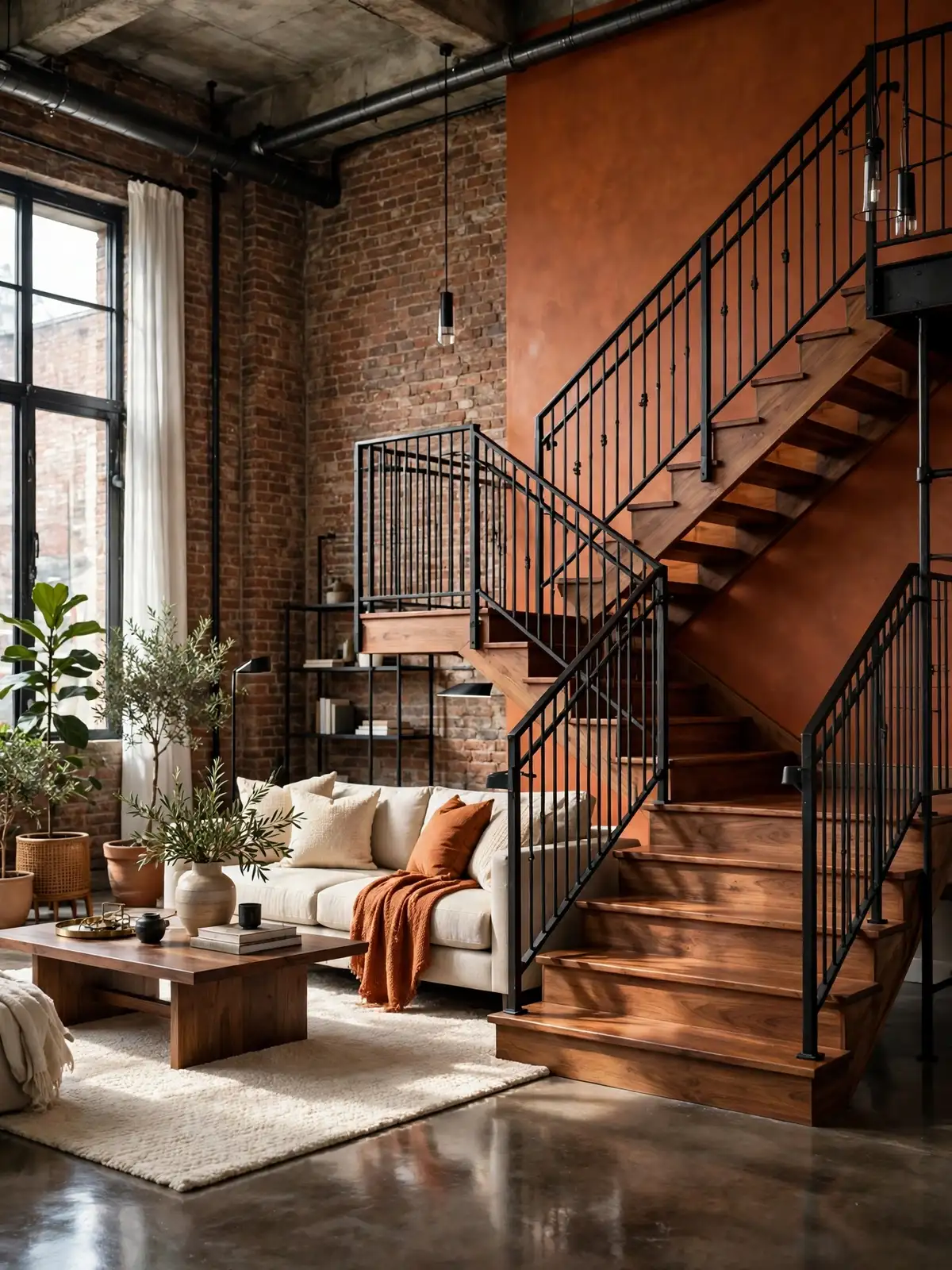
Wood and matte black metal is the pairing that gives a wooden staircase industrial charm without making the room feel cold, because the warm walnut treads soften the hard black iron and the iron gives the wood an edge it would never have alone. Here, solid walnut treads sit on a black steel stringer, with slim vertical iron balusters and a chunky walnut handrail, against a rust-orange accent wall and exposed brick. The design suits lofts, modern farmhouses and urban apartments, it hides scuffs well, and it adapts to almost any wall colour. The weakness is weight — the look feels grounded and heavy, so it suits larger rooms better than narrow halls — and black metal shows dust, so wipe the railings weekly.
Quick tips:
- Pair warm walnut treads with matte black, not shiny chrome.
- Keep the balusters slim and vertical for a clean loft look.
- Add a chunky wooden handrail to warm up the metal.
- Let brick or plaster walls add texture behind the stair.
Reclaimed Wood Treads With Visible Grain and Knots
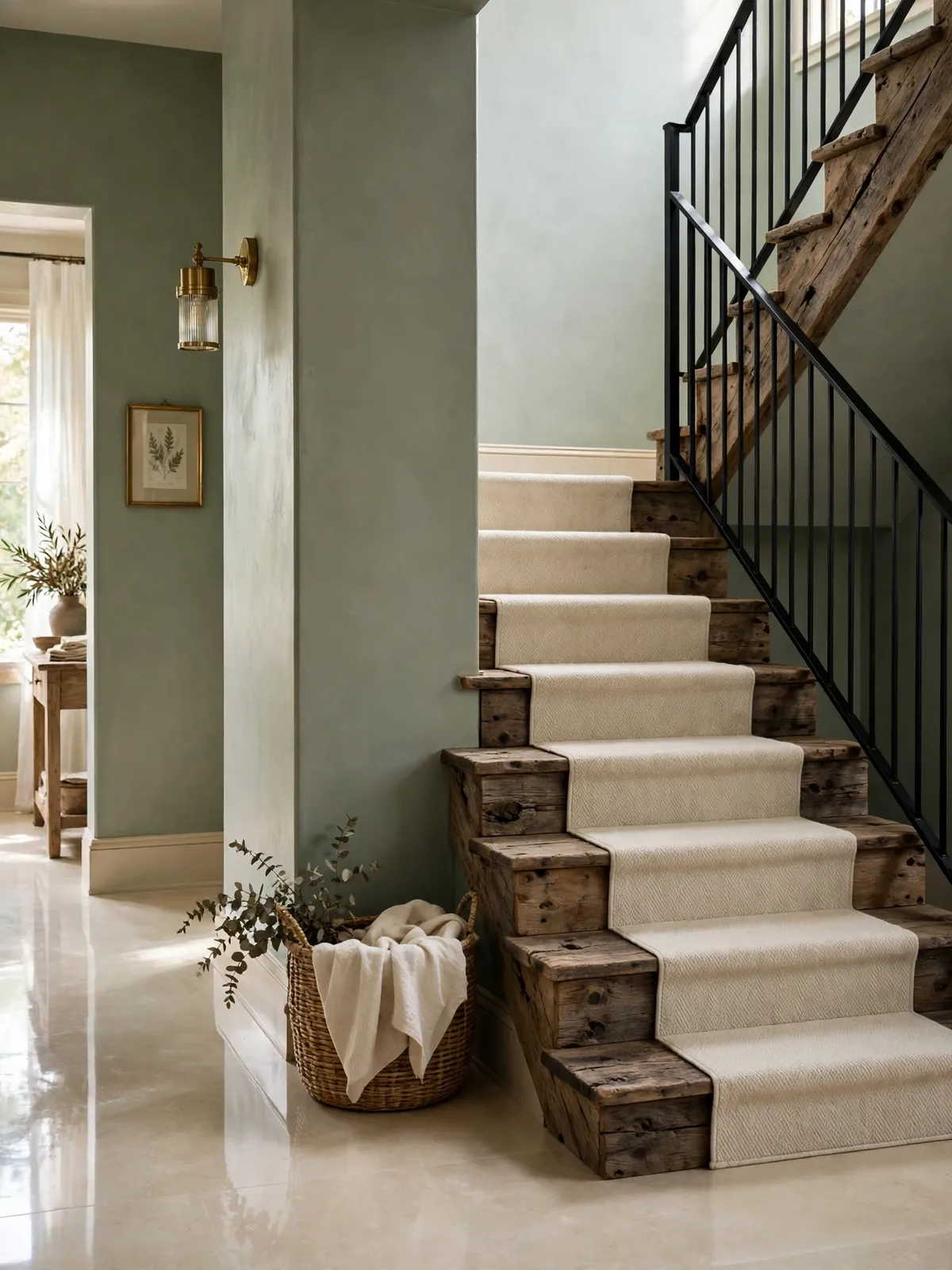
Reclaimed wood treads with visible grain and knots bring history into a staircase, because every plank carries imperfections — knots, weathered edges, old nail marks — that new timber simply cannot copy. Here, thick reclaimed boards form the treads, sealed in a matte finish that protects the grain without hiding it, against soft sage-green walls with a cream runner down the centre. The design suits country homes, cabins and farmhouse interiors, it is the most eco-friendly wooden staircase choice, and it makes the stair feel soulful rather than showroom-perfect. The weakness is sourcing — matching reclaimed boards takes time, and the treads must be checked for hidden nails and structural soundness — so buy from a reputable reclaimed timber yard and let a joiner inspect every board.
Quick tips:
- Seal reclaimed treads in a matte finish so the grain stays visible.
- Check every board for nails and structural soundness first.
- Pair reclaimed wood with plain walls so the timber stays the star.
- Add a runner if the reclaimed surface feels rough underfoot.
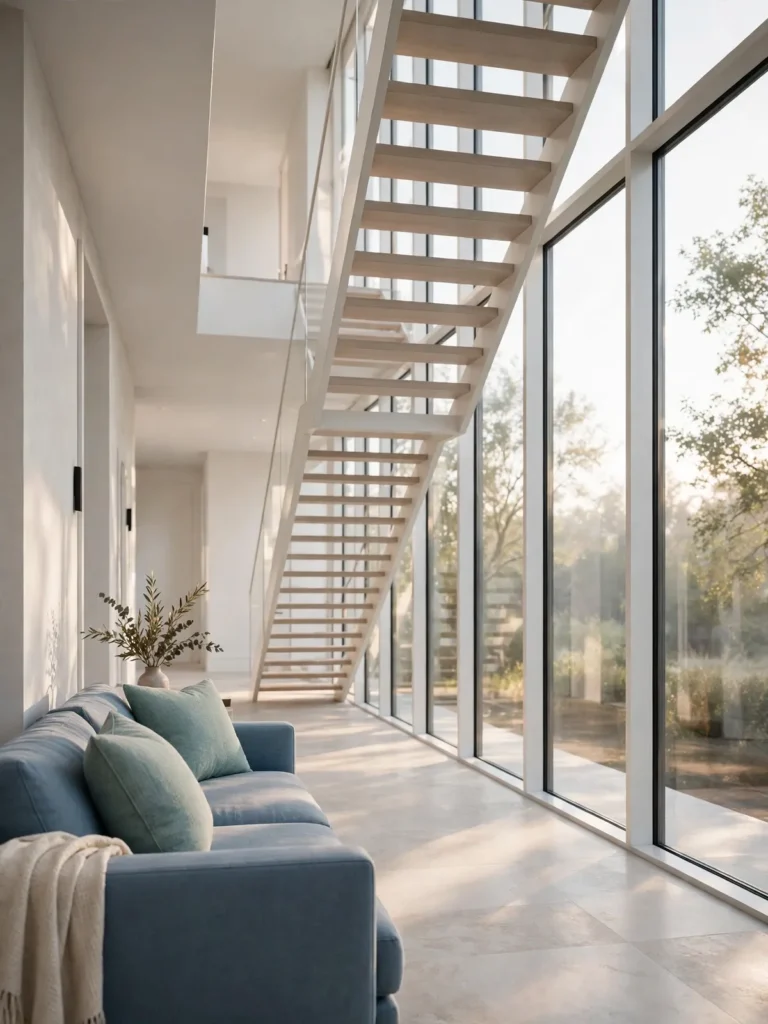
Open-Riser Wooden Stairs That Let the Light Through
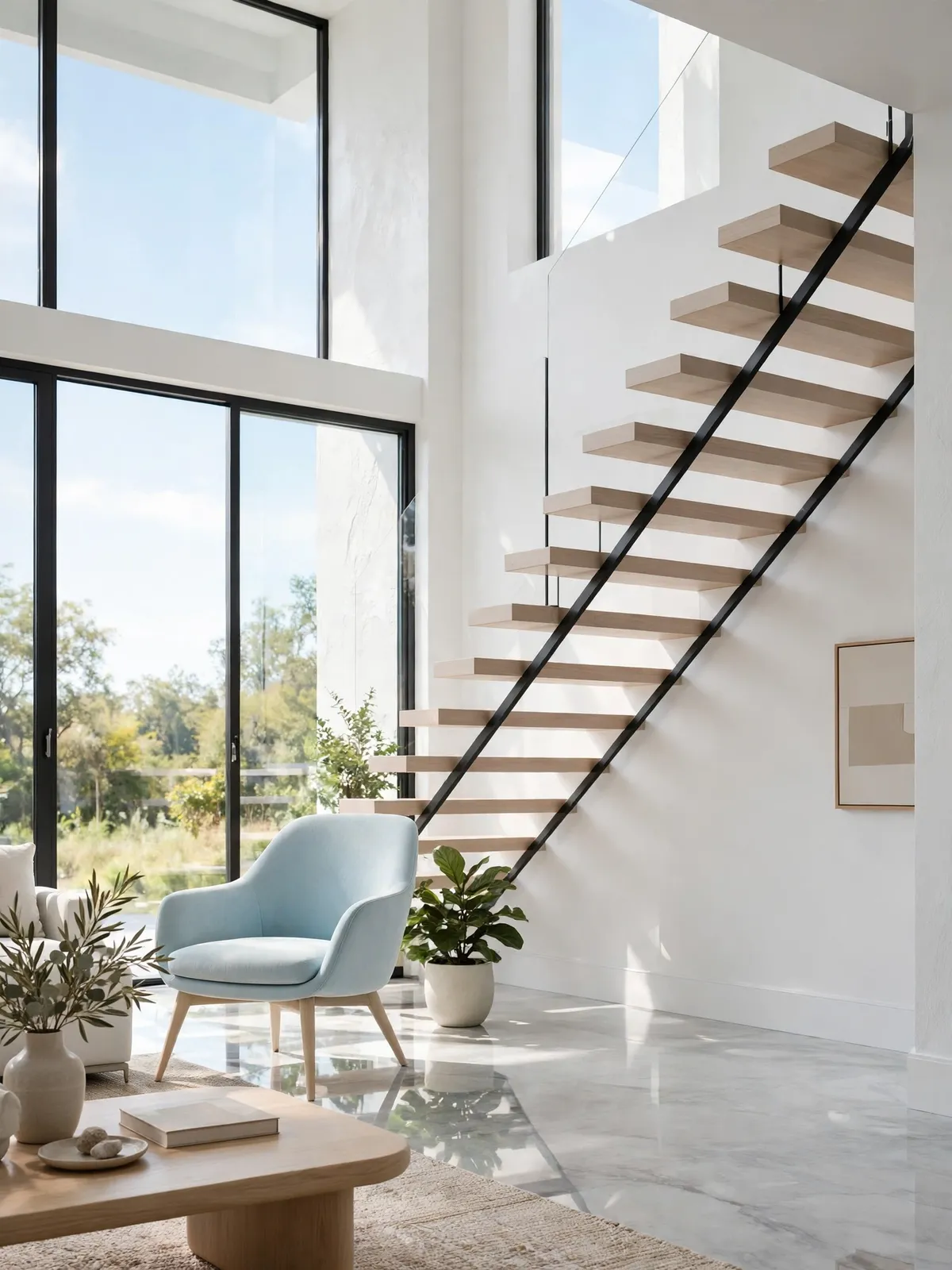
Open-riser wooden stairs let light pass straight through the staircase, because removing the risers turns a solid stair into a ladder of light that makes the whole room breathe. Here, pale ash treads float between two slim stringers, with a simple steel handrail and a large window beside the stair, so daylight spills under every tread. The design suits modern homes with big windows, it makes small entries feel larger, and it shows off the wood from below as well as above. The weakness is safety — small children and pets can slip through the gaps — so keep the gap between treads within local building codes, fit anti-slip strips on the tread nosings, and choose treads thick enough that the open design still feels solid underfoot.
Quick tips:
- Keep the gap between treads within local building codes.
- Fit anti-slip strips on every tread nosing.
- Choose thick treads so the open stair feels solid.
- Pair open risers with a large window for maximum light.
LED Lighting Under Every Wooden Tread
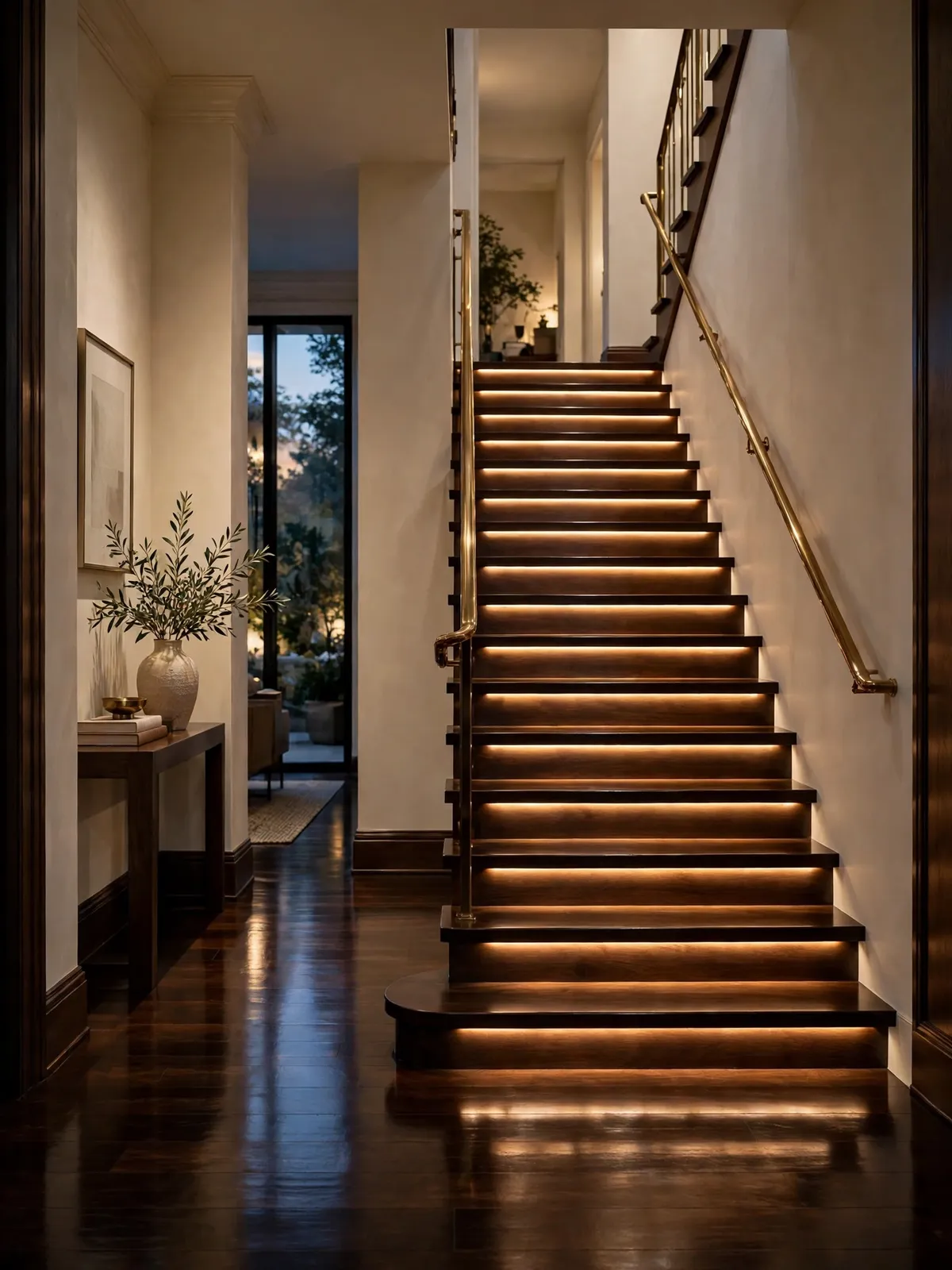
LED lighting under every wooden tread is the fastest way to make an ordinary wooden staircase look extraordinary after dark, because a warm strip of light under each tread turns the stair into a glowing ribbon that guides you safely upstairs. Here, espresso-stained treads carry warm-white LED strips on their undersides, with a slim brass handrail and cream walls, so the staircase glows softly without a single visible bulb. The design suits every style of wooden staircase, it improves night-time safety, and motion sensors make it feel luxurious without any effort. The weakness is installation — the strips need a hidden power supply and a tidy cable route — so plan the lighting before the treads go in, and choose warm white (2700K) rather than cool white, which makes wood look grey.
Quick tips:
- Choose warm-white LEDs (2700K) so the wood stays warm.
- Fit motion sensors so the lights switch on automatically.
- Hide the power supply inside a cupboard or under the stair.
- Plan the lighting before the treads are fitted.
Dark Walnut Stairs Against Crisp White Walls
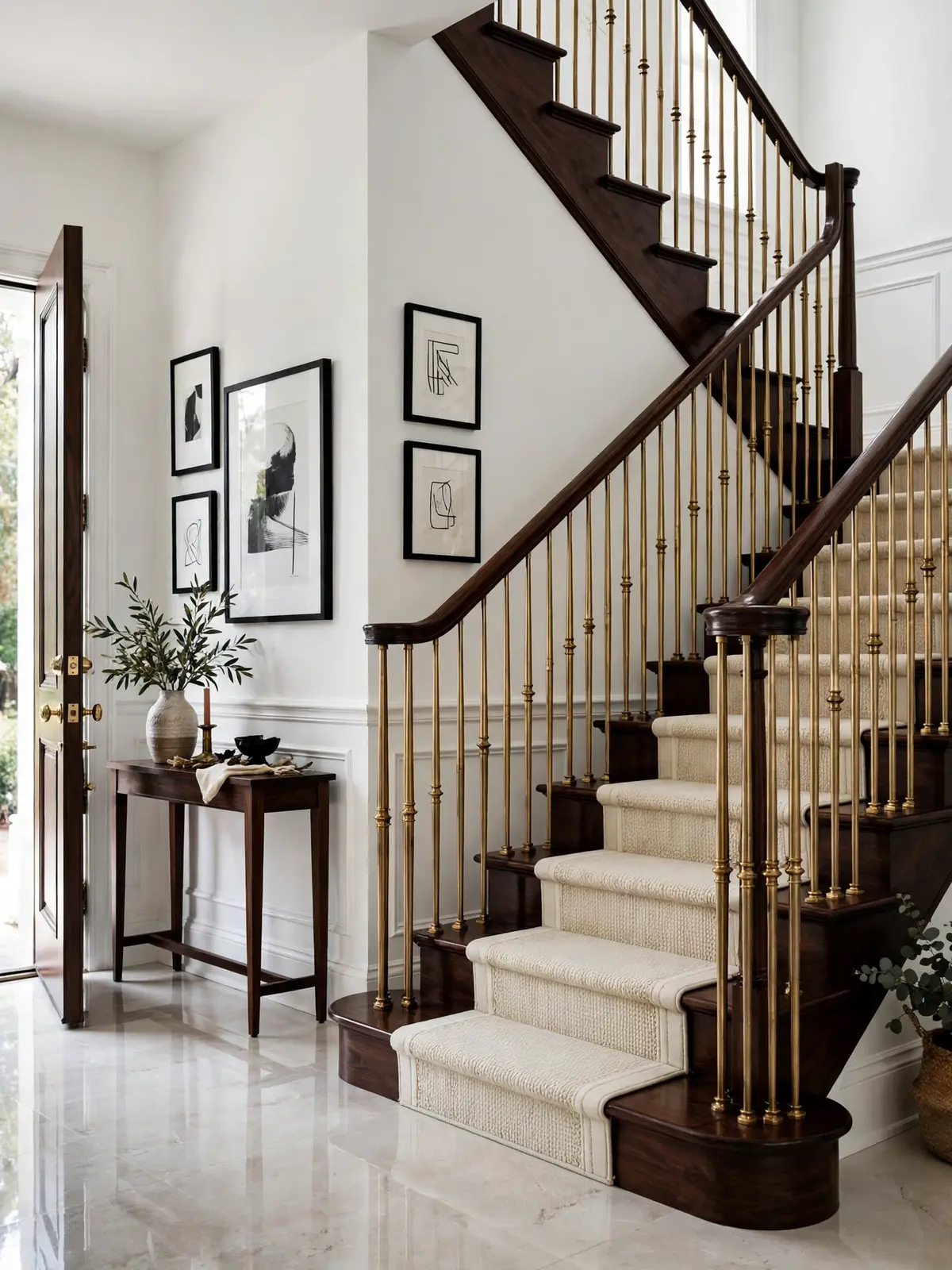
Dark walnut stairs against crisp white walls create classic high-contrast drama, because the deep brown treads read as bold architecture while the white walls keep the room bright and calm. Here, espresso-toned walnut treads and risers climb against plain white plaster, with slim brass balusters and a cream runner softening the centre, so the staircase feels moody and elegant rather than heavy. The design suits traditional and transitional homes, it adds depth to pale interiors, and it photographs beautifully. The weakness is dust — dark wood shows every footprint and speck — so sweep the treads daily in busy homes, and keep the wall truly white, because a cream wall against dark walnut can look muddy.
Quick tips:
- Keep the walls crisp white, not cream, for clean contrast.
- Add brass balusters for a warm metallic accent.
- Use a cream runner to soften the dark treads underfoot.
- Sweep dark treads often — dust shows on dark wood.
A Curved Wooden Staircase for a Grand Entryway
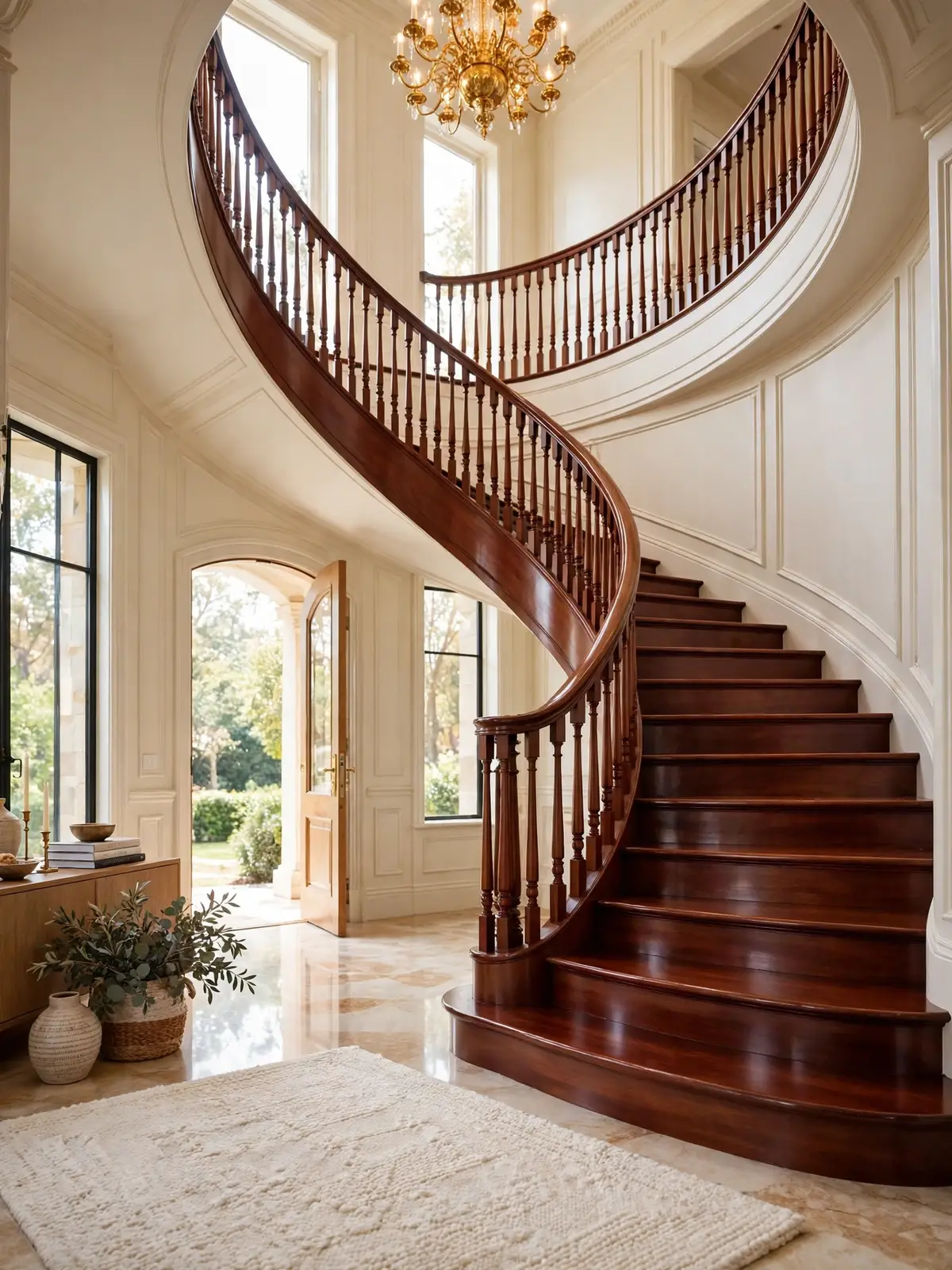
A curved wooden staircase is pure theatre, because the sweep of the curve invites you upstairs and makes the entryway feel like a grand hotel lobby rather than a hallway. Here, rich mahogany treads flow in a gentle arc through a double-height entry, with a curved handrail, turned balusters and a gold chandelier hanging above the curve, so the staircase is the first and last thing you notice in the room. The design suits large homes with high ceilings, it softens architecture in a way straight stairs never do, and it turns arrival into an occasion. The weakness is cost and space — a curved stair needs a specialist joiner, a large footprint and a generous budget — so it is a design for homes that can give the staircase room to breathe.
Quick tips:
- Keep the surrounding walls neutral so the curve stays the hero.
- Hang a chandelier above the curve for evening drama.
- Use rich hardwoods like mahogany for maximum effect.
- Allow a generous footprint — curves need space.
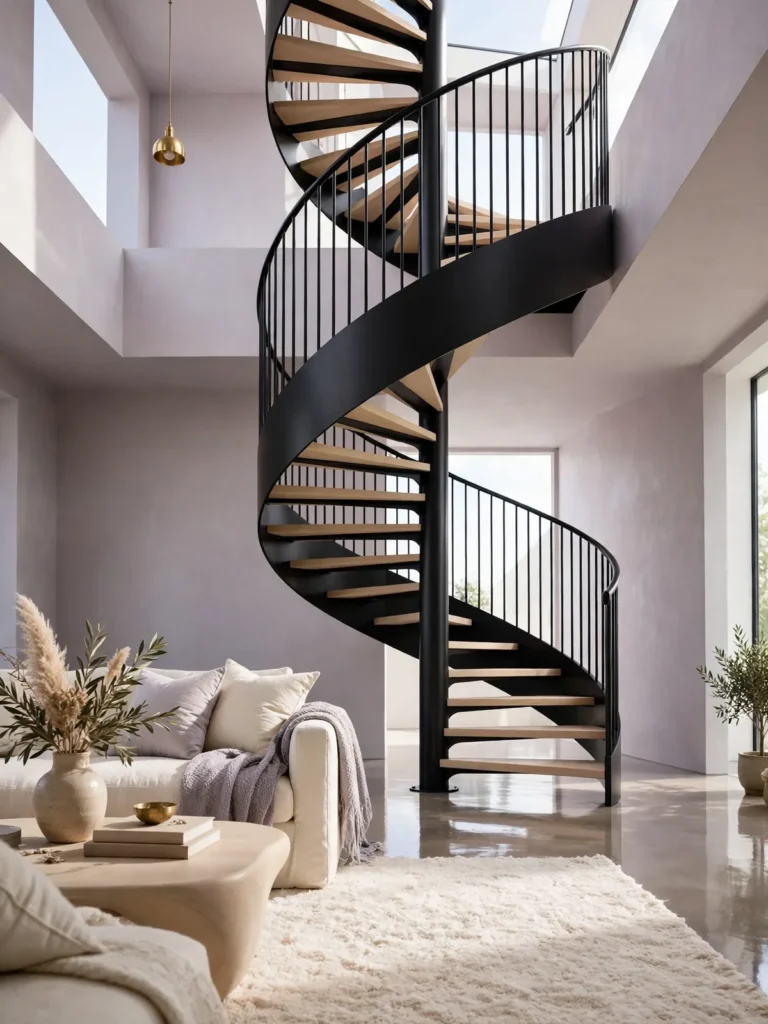
A Spiral Wooden Staircase That Saves Floor Space
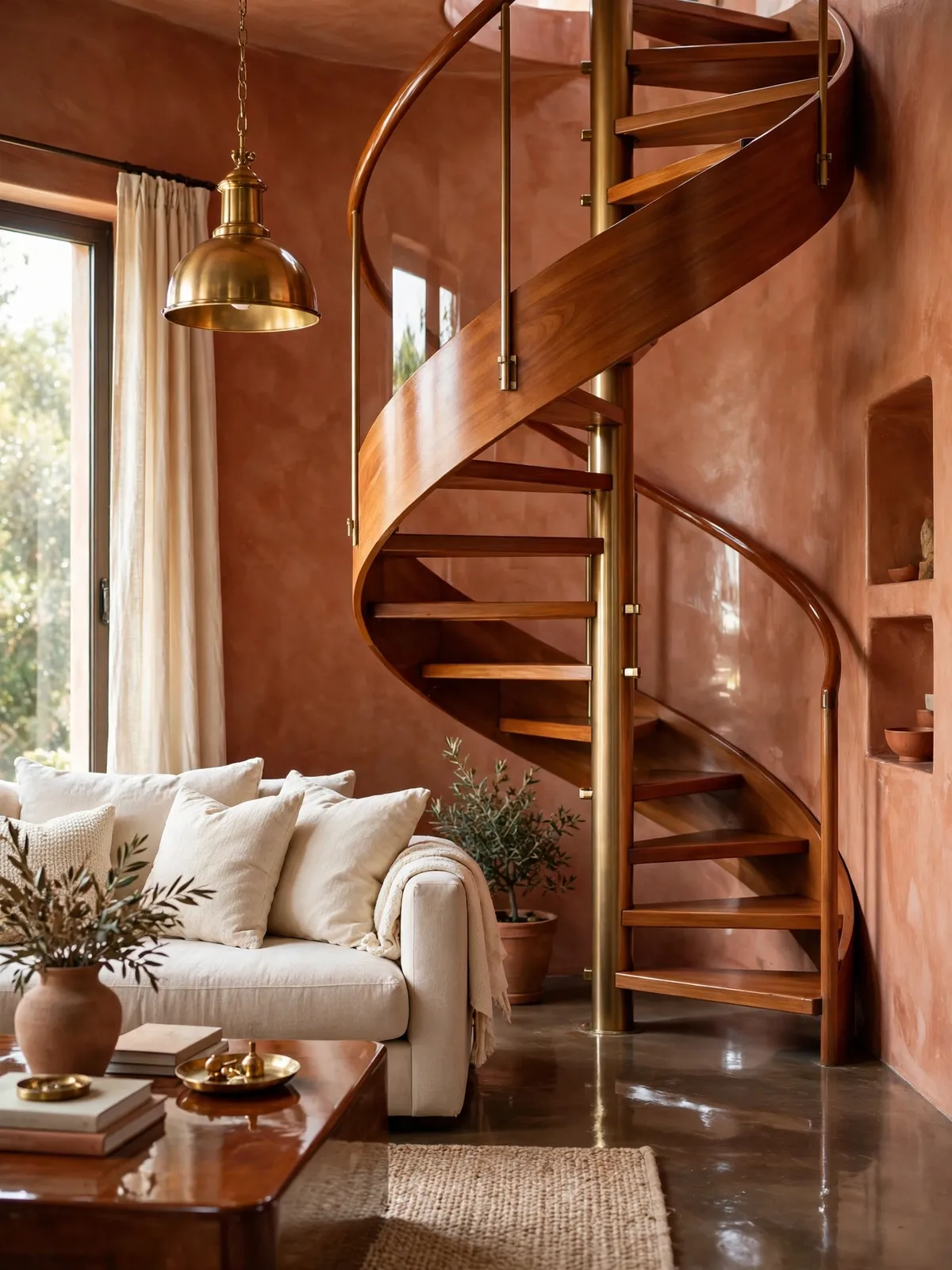
A spiral wooden staircase saves more floor space than any other wooden staircase design, because the treads wind around a central pole and the whole stair fits into a circle barely wider than a doorway. Here, warm teak treads spiral upward around a dark steel pole, with a continuous wooden handrail and a brass pendant hanging through the centre, against terracotta walls. The design suits small homes, lofts, garden rooms and attic conversions, it becomes a sculptural feature in its own right, and it frees up floor space a straight stair would swallow. The weakness is practicality — spiral stairs are awkward for carrying furniture, and the treads narrow toward the centre — so keep the outer edge wide, fit a secure handrail on both sides where possible, and never choose a spiral as the only stair to a main bedroom.
Quick tips:
- Keep the outer edge of each tread wide enough for a full foot.
- Fit a continuous handrail for safety on the spiral.
- Hang a pendant light through the centre of the spiral.
- Avoid a spiral as the only stair to a main bedroom.
Wide Wooden Treads for a Luxurious Hotel Feel
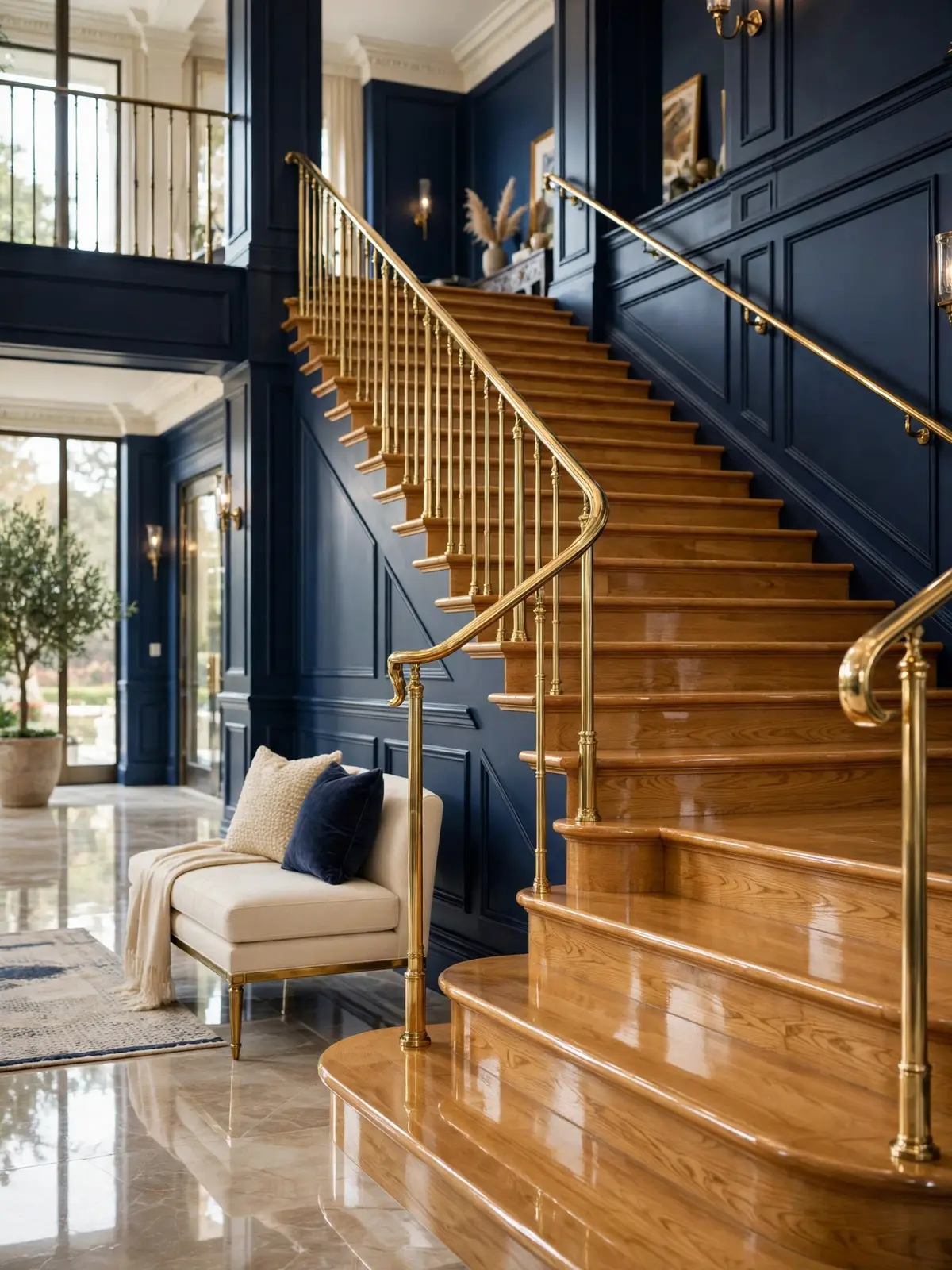
Wide wooden treads give a staircase a luxurious hotel feel, because broad steps slow you down and make every ascent feel grand rather than hurried. Here, extra-wide golden oak treads — far broader than a standard flight — climb through an open foyer with deep navy walls, a brass handrail and a cream bench at the base, so the staircase reads as architecture rather than utility. The design suits open foyers and large entries, it makes a home feel generous, and the wide treads are safer underfoot because there is more room for each step. The weakness is cost — wider treads use 15 to 25 percent more timber, and premium hardwoods push the price higher still — so budget for the extra material and choose a wood that looks good in large, uninterrupted planes.
Quick tips:
- Budget 15 to 25 percent extra timber for wide treads.
- Choose a wood with a calm grain so wide treads look serene.
- Add a bench or console at the base to anchor the foyer.
- Keep the handrail slim so the wide treads stay the focus.
A Stair Runner Layered Over Natural Oak
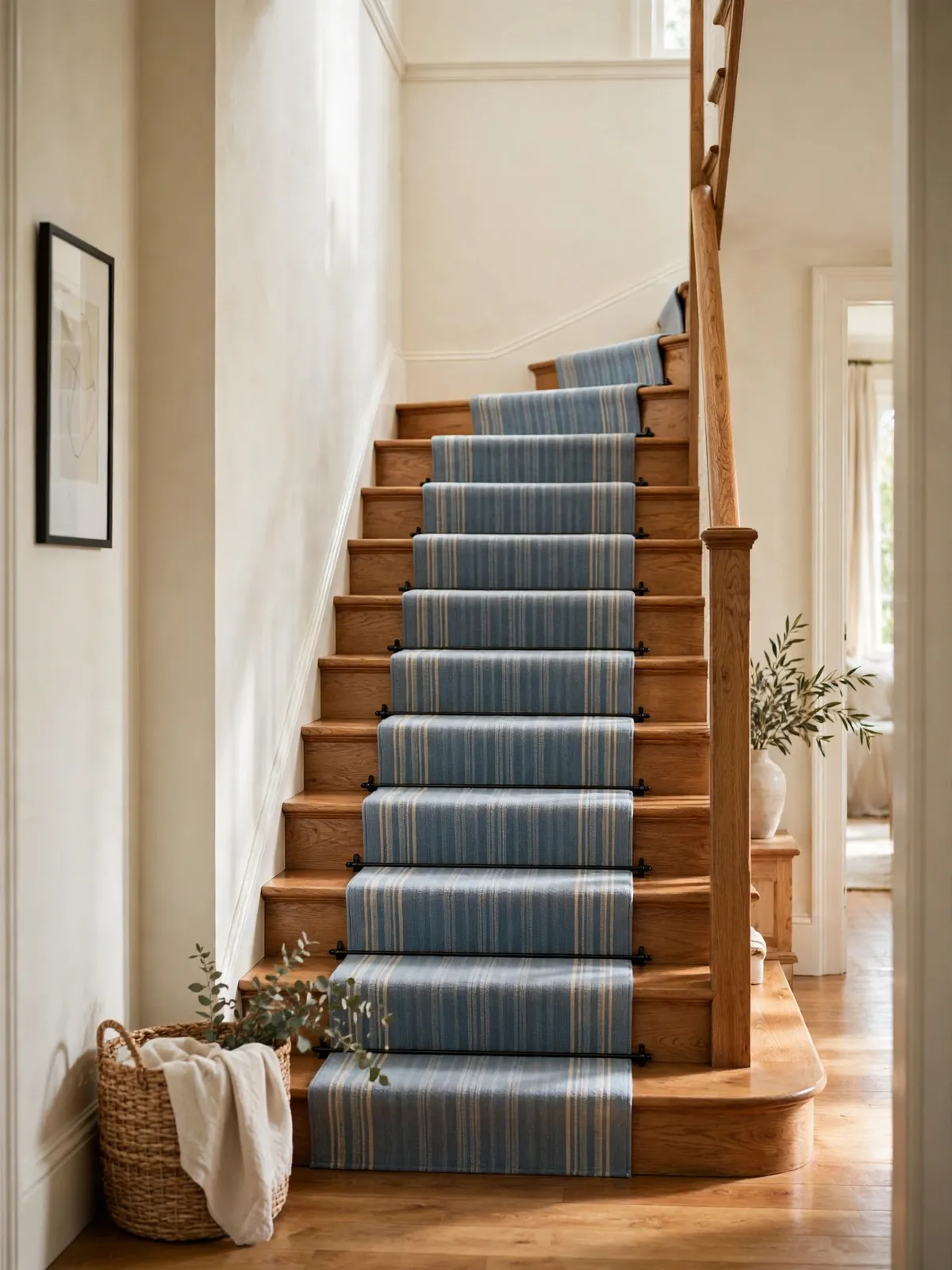
A stair runner layered over natural oak softens a wooden staircase in every sense, because the fabric adds texture underfoot, absorbs sound and protects the centre of the treads from wear. Here, a dusty-blue striped runner runs down the middle of natural oak treads, held by black stair rods, with the warm oak showing on either side like a frame. The design suits family homes, it makes the stair quieter and safer, and changing the runner is the easiest way to refresh a wooden staircase without touching the wood. The weakness is cleaning — runners collect dust and pet hair — so vacuum them weekly, choose a hard-wearing wool or jute blend, and keep the runner narrower than the treads so the wood still shows.
Quick tips:
- Choose a hard-wearing wool or jute runner for busy stairs.
- Keep the runner narrower than the treads so the wood frames it.
- Fit stair rods for a classic finished look.
- Vacuum the runner weekly to keep it fresh.
Two-Tone Wooden Stairs: Dark Treads, Painted Risers
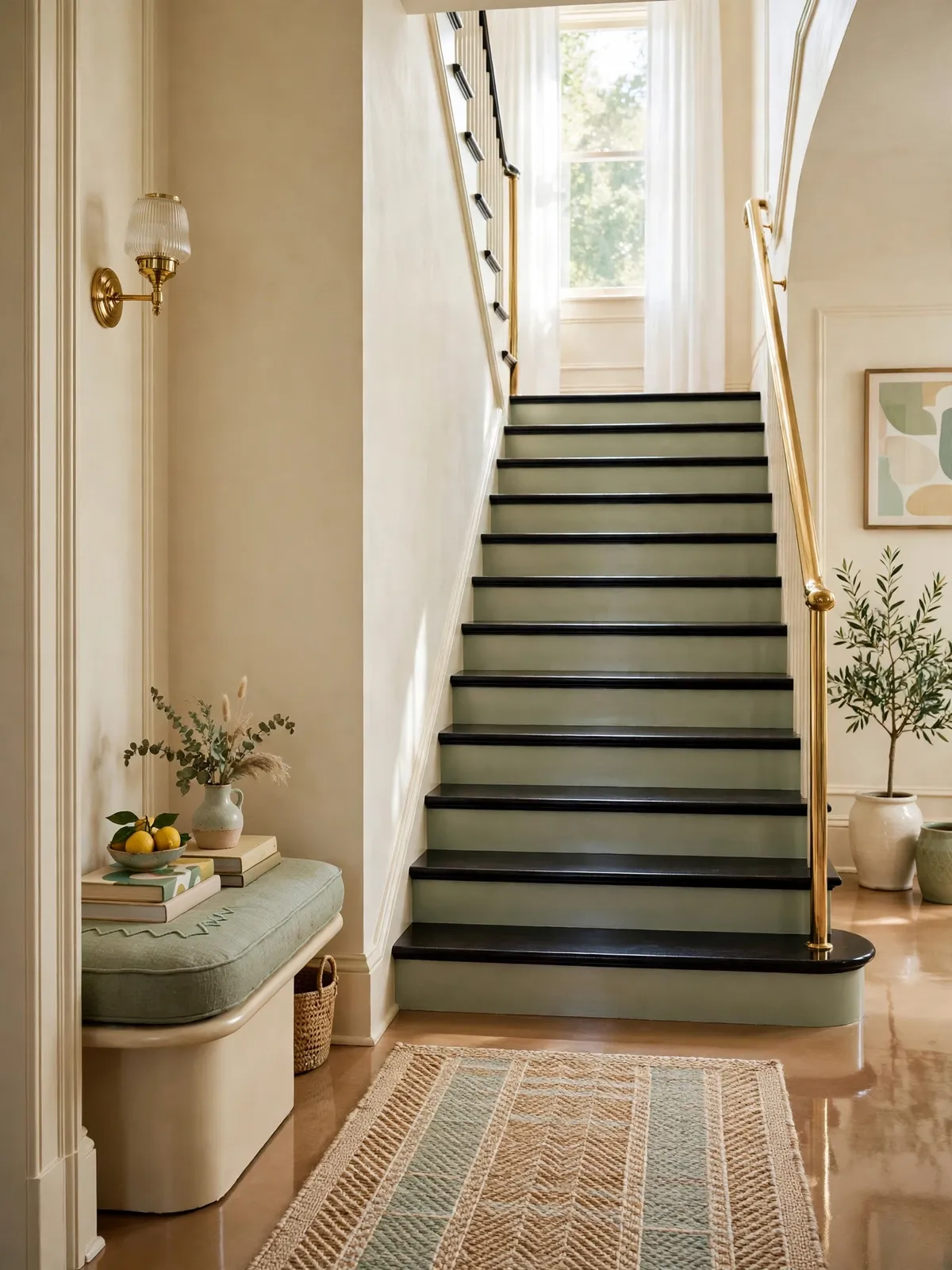
A two-tone wooden staircase adds depth without chaos, because dark treads and painted risers create a rhythm that a single-tone stair never achieves. Here, dark ebony treads contrast with soft sage-green risers, a brass handrail and cream walls, so each step reads clearly and the staircase feels both playful and refined. The design suits transitional and modern homes, it is a manageable upgrade for an existing stair, and the painted risers are easy to refresh when tastes change. The weakness is balance — too strong a contrast can feel busy — so test stain and paint samples in natural light, keep the wall colour calm, and seal the treads in a matte finish so the two tones sit comfortably together.
Quick tips:
- Test stain and paint samples in natural light first.
- Keep the dominant tone on the treads, the accent on the risers.
- Seal the treads in a matte finish for a calm contrast.
- Choose a soft riser colour if the room is already busy.
Wooden Stairs That Match the Flooring Exactly
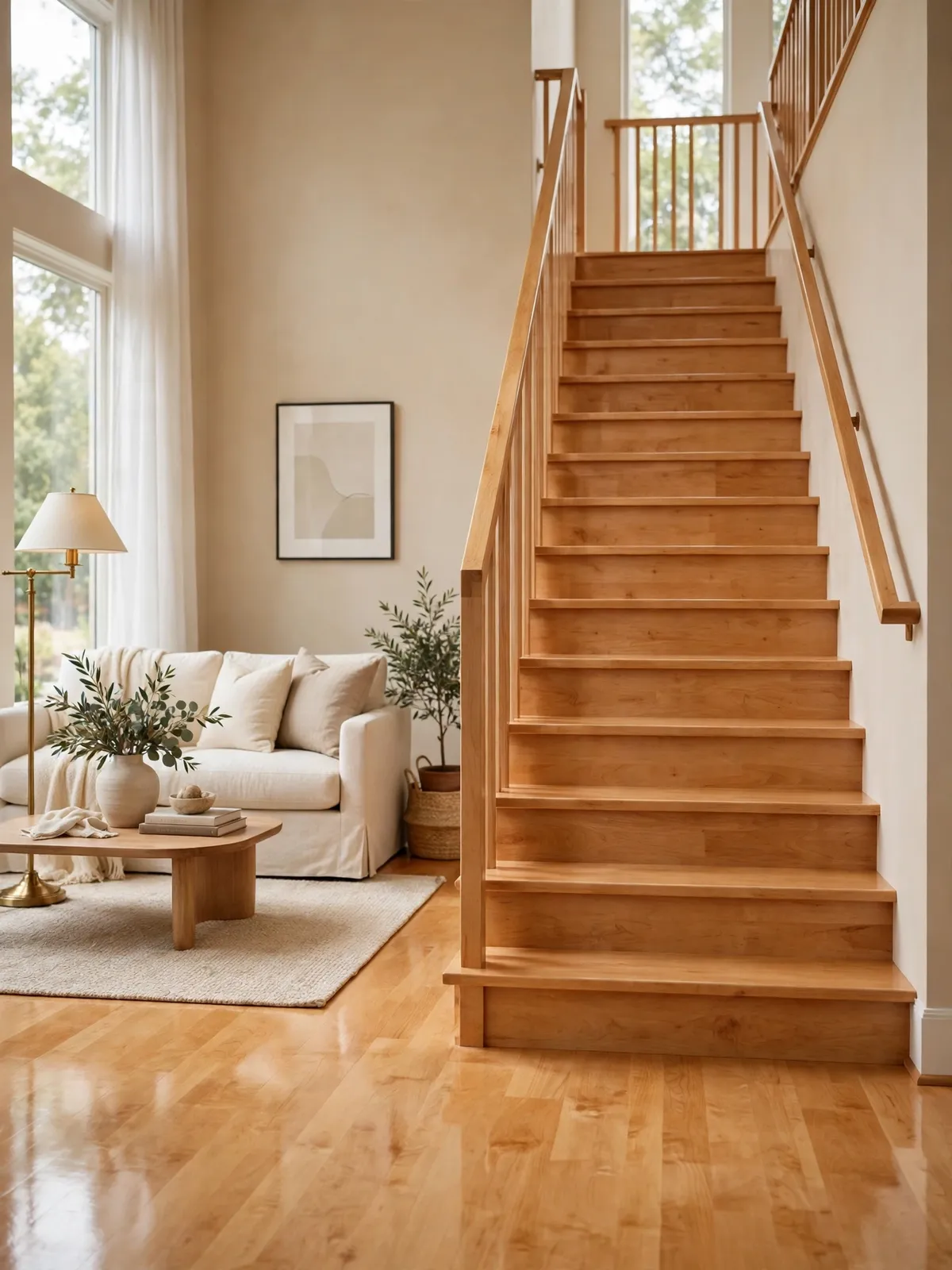
Wooden stairs that match the flooring exactly create calm cohesion, because the same wood and the same finish flowing from floor to stair removes every visual break and makes the space feel larger. Here, honey-maple treads continue the honey-maple floor without a change in tone, with warm greige walls and a cream sofa, so the staircase feels like a natural fold in the floor rather than a separate object. The design suits minimalist and open-plan homes, it makes small spaces feel bigger, and it is the easiest wooden staircase to style because nothing clashes. The weakness is precision — a slightly different stain will clash instead of complementing — so order the stair timber and the flooring from the same supplier, finish them together, and check the match in daylight before installation.
Quick tips:
- Order stair timber and flooring from the same supplier.
- Finish both together so the tone matches exactly.
- Check the match in daylight before installation.
- Keep the walls calm so the seamless wood stays the feature.
Carved Wooden Railings and Turned Newel Posts
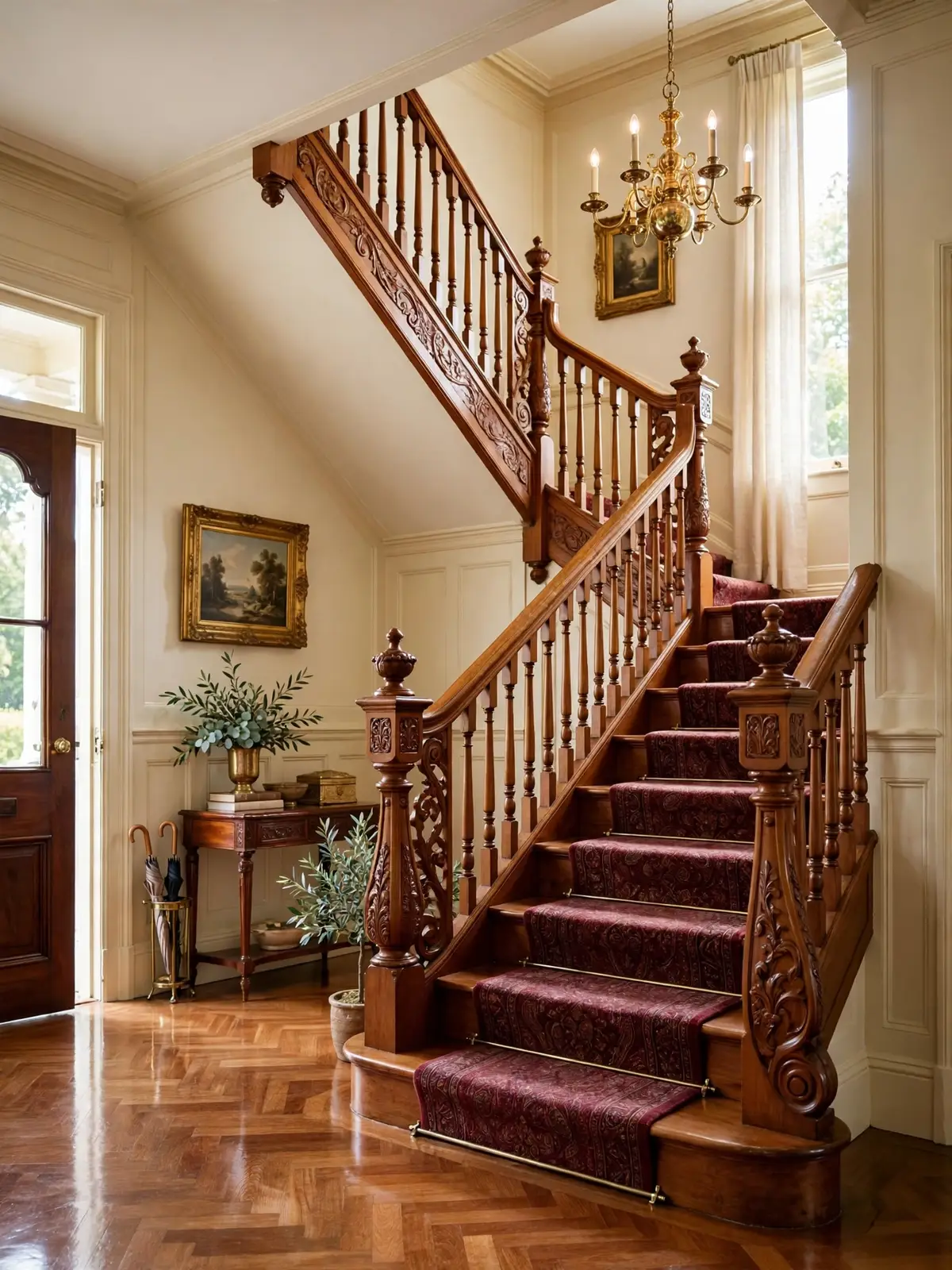
Carved wooden railings and turned newel posts bring traditional elegance to a wooden staircase, because intricate balusters, turned posts and decorative newel caps turn the railing into craftsmanship you can admire every day. Here, cherry-wood balusters with turned profiles climb beside a burgundy runner, with a carved newel post anchoring the base and a brass chandelier above, so the staircase feels stately and romantic. The design suits heritage, colonial and classic homes, it adds value in period properties, and it pairs beautifully with a runner down the centre. The weakness is visual weight — the more detailed the railing, the simpler the surrounding decor must be — so keep the walls plain, the art minimal, and let the carving carry the room.
Quick tips:
- Keep the surrounding decor simple so the carving shines.
- Add a runner down the centre for softness underfoot.
- Choose turned newel posts with decorative caps.
- Balance ornate railings with plain walls and minimal art.
A Statement Newel Post That Anchors the Whole Stair
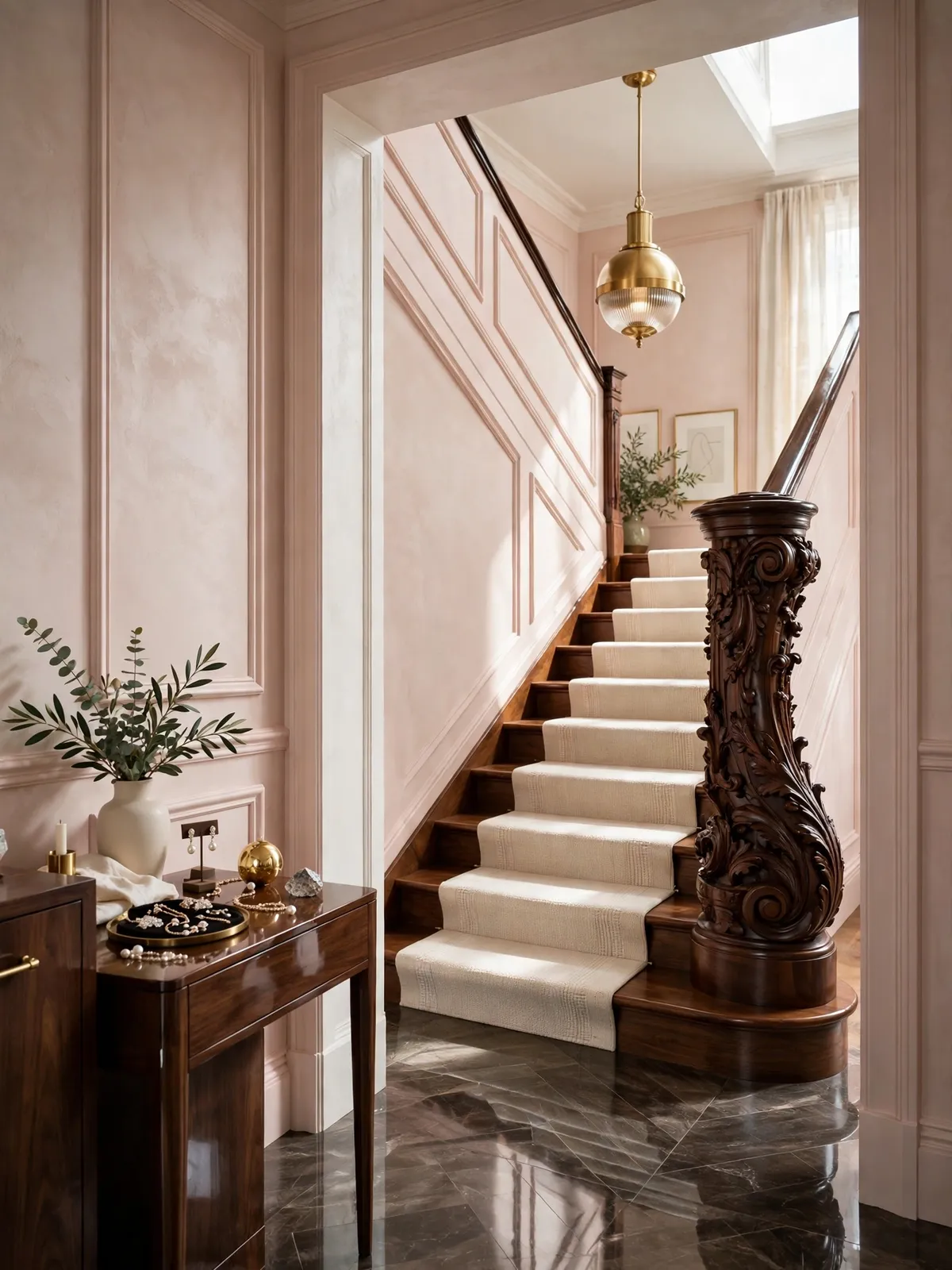
A statement newel post anchors a whole wooden staircase, because one oversized, sculpted post at the base gives the eye a place to land and makes the entire stair feel intentional. Here, a dark walnut newel post — taller and bolder than the balusters around it — stands at the foot of the stair, with simple spindles, a cream runner and blush-pink walls, so the post reads like jewellery on an otherwise quiet staircase. The design suits transitional homes, it is the cheapest way to make a plain stair feel luxurious, and it works when the rest of the staircase is deliberately simple. The weakness is proportion — a post that is too small disappears, and one that is too ornate fights the balusters — so go oversized but keep the balusters plain, and choose a contrasting wood tone if you want the post to demand attention.
Quick tips:
- Go oversized — a timid newel post disappears.
- Keep the balusters simple so the post stays the focus.
- Try a contrasting wood tone for the post.
- Think of the newel post as jewellery for the staircase.
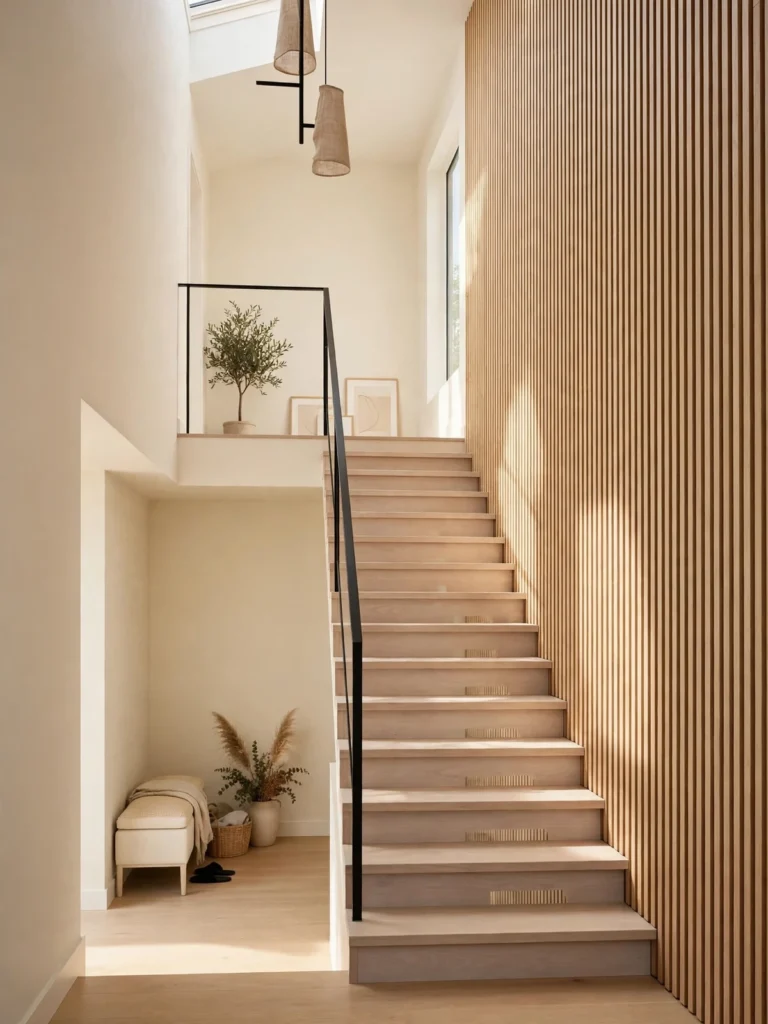
Vertical Wooden Slats as a Light-Filtering Divider
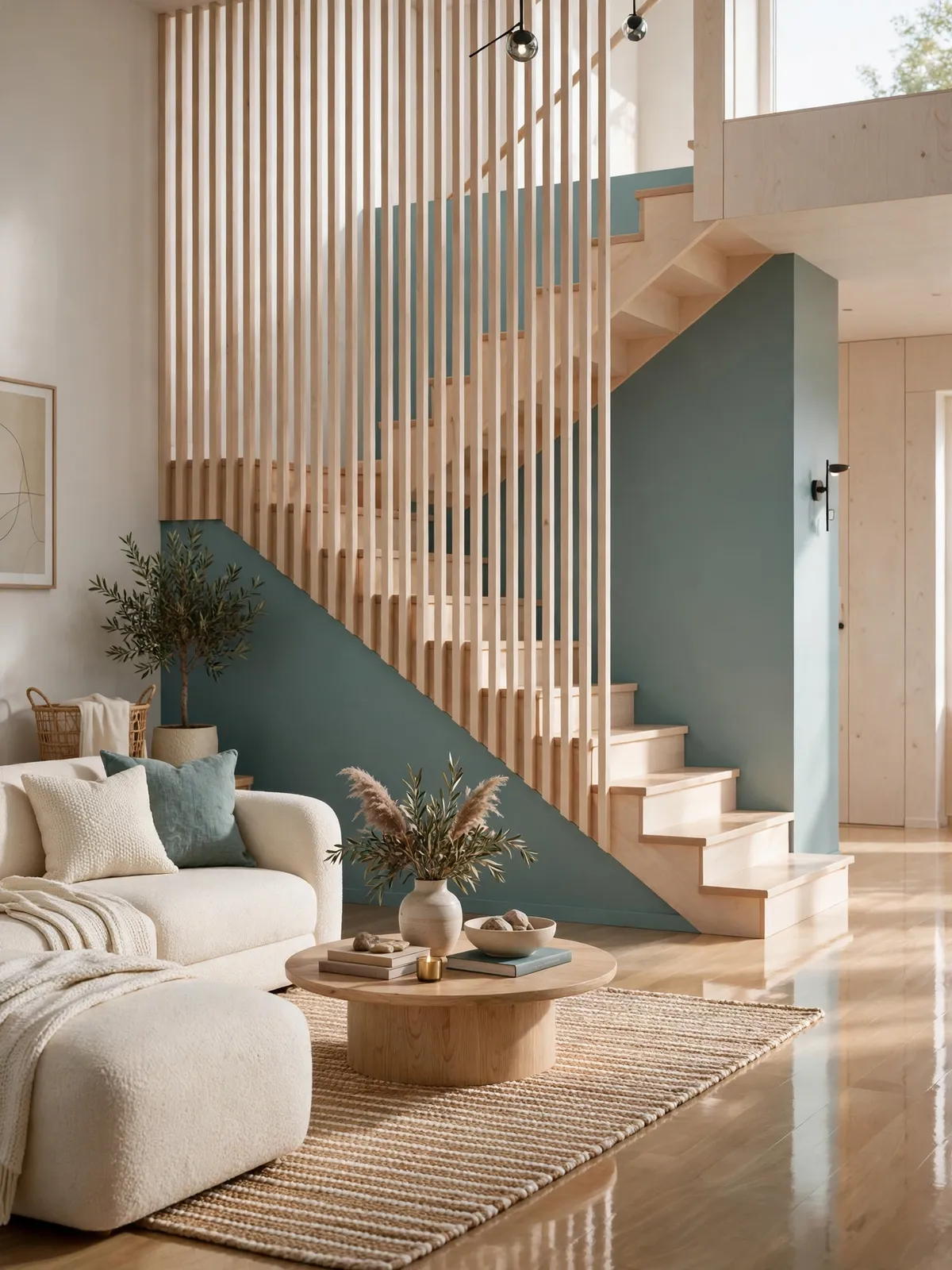
Vertical wooden slats as a divider replace a traditional railing with rhythm and light, because the slim battens create privacy without blocking daylight or closing off the room. Here, pale birch slats run floor to ceiling beside the stair, filtering light into soft stripes, with a dusty teal accent wall and a cream sofa nearby, so the staircase feels open yet defined. The design suits Scandinavian and modern open-plan homes, it echoes the warmth of the treads, and it doubles as a room divider in studio-style layouts. The weakness is safety — slats must be fixed firmly and spaced closely enough that a child cannot slip through — so check local spacing rules, fix the slats top and bottom, and keep the tread wood warm enough to match the slats.
Quick tips:
- Space the slats closely enough to meet safety rules.
- Fix the slats firmly top and bottom.
- Match the slat wood to the tread wood for rhythm.
- Use slats as a room divider in open-plan layouts.
A Wooden Staircase Wrapped Around a Brick Feature Wall
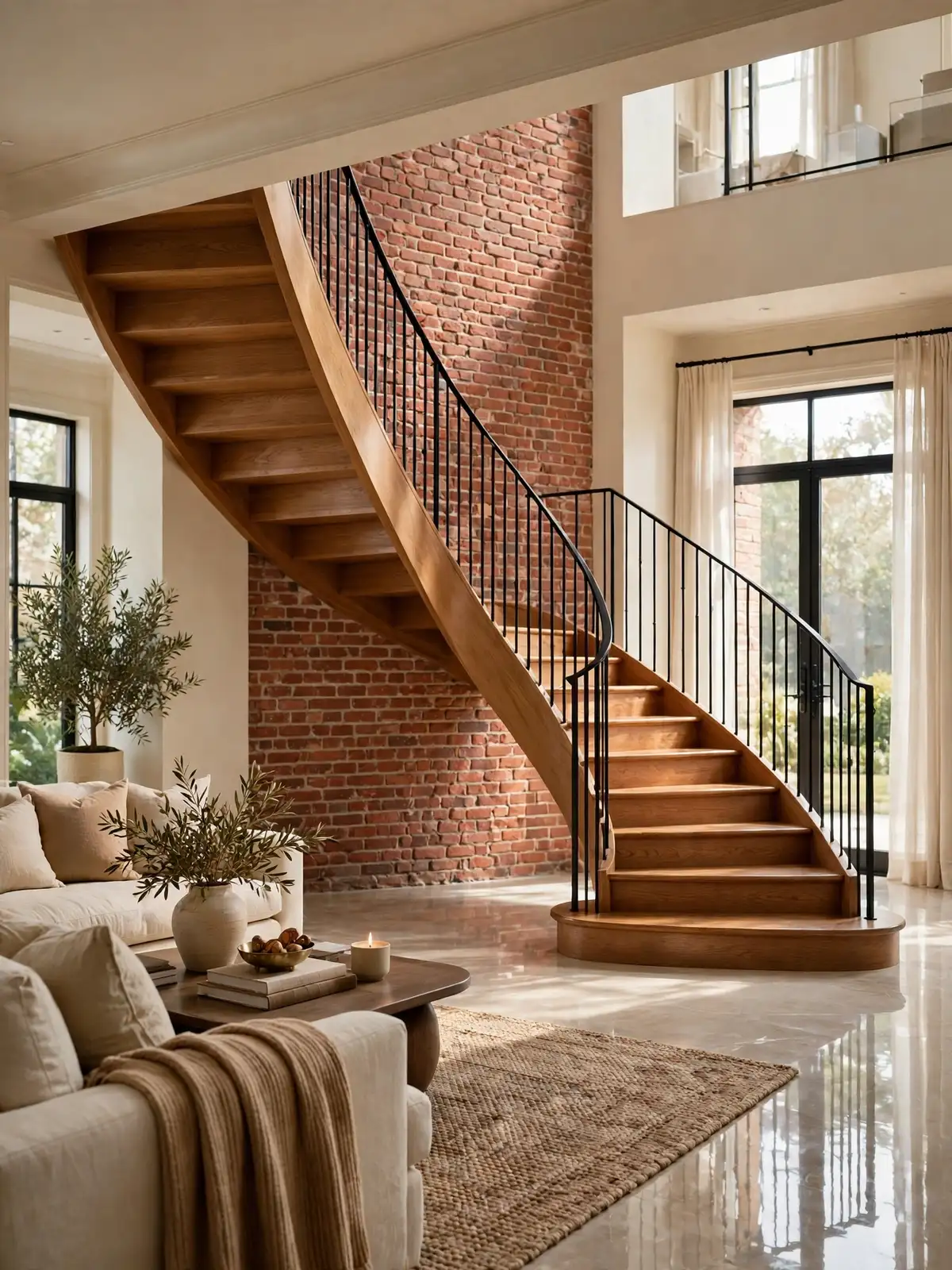
A wooden staircase wrapped around a brick feature wall turns circulation space into architecture, because the warm oak treads soften the hard brick while the brick gives the stair a backdrop no plain wall could offer. Here, the stair turns around a full-height exposed brick wall, with warm oak treads, a slim black metal handrail and cream walls elsewhere, so the staircase becomes a sculptural journey around a textured centre. The design suits double-height entries and industrial homes, it creates a focal point visible from several angles, and it makes the wood look warmer by contrast. The weakness is that it needs ceiling height and floor space — a feature-wall stair squeezed into a low hallway feels cramped — so use it where the stair can be admired from more than one angle.
Quick tips:
- Use the feature wall only where ceiling height allows.
- Keep the other walls plain so the brick stays the focus.
- Choose warm oak to soften the hard brick.
- Let the stair wrap the wall so it reads as sculpture.
Decorative Wooden Panelling Along the Stair Wall
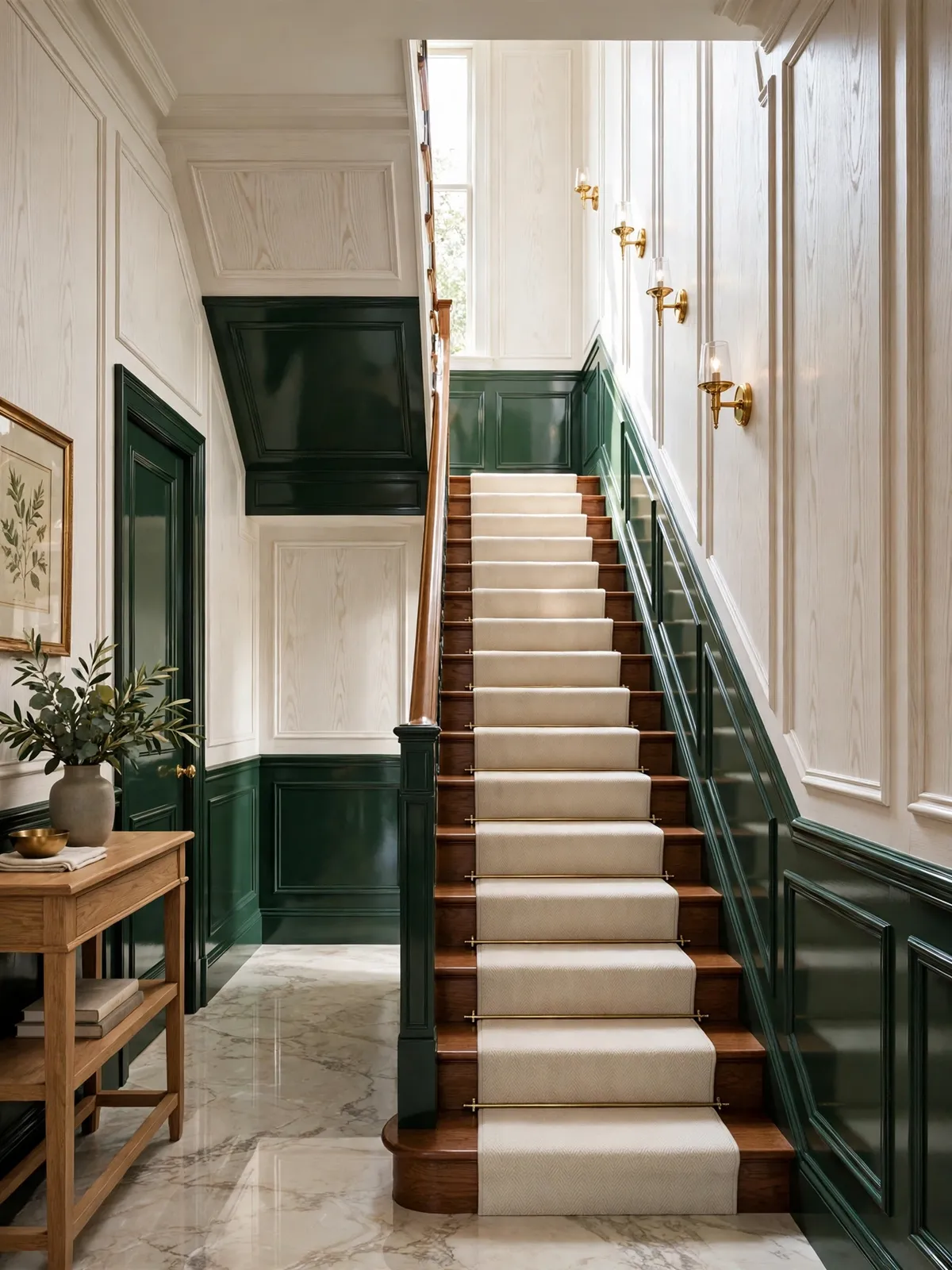
Decorative wooden panelling along the stair wall makes a wooden staircase feel intentional, because board-and-batten, shiplap or vertical panels add depth to a wall that would otherwise be a blank climb. Here, white oak vertical panels run up the stair wall above a deep forest-green lower section, with a cream runner and brass wall lights, so the wall itself becomes part of the staircase design. The design suits transitional and classic homes, it photographs beautifully, and it is a relatively affordable upgrade that looks expensive. The weakness is tone matching — panels in a clashing wood tone look wrong — so keep the panel wood complementary to the treads rather than identical, and choose the panel style to match the house: shiplap for coastal, vertical slats for modern, board-and-batten for transitional.
Quick tips:
- Keep panel tones complementary to the treads, not identical.
- Match the panel style to the house: shiplap, slats or board-and-batten.
- Add wall lights so the panelling casts soft shadows.
- Paint the lower wall a deep tone for a tailored look.
A High-Gloss Wooden Finish That Reflects the Light
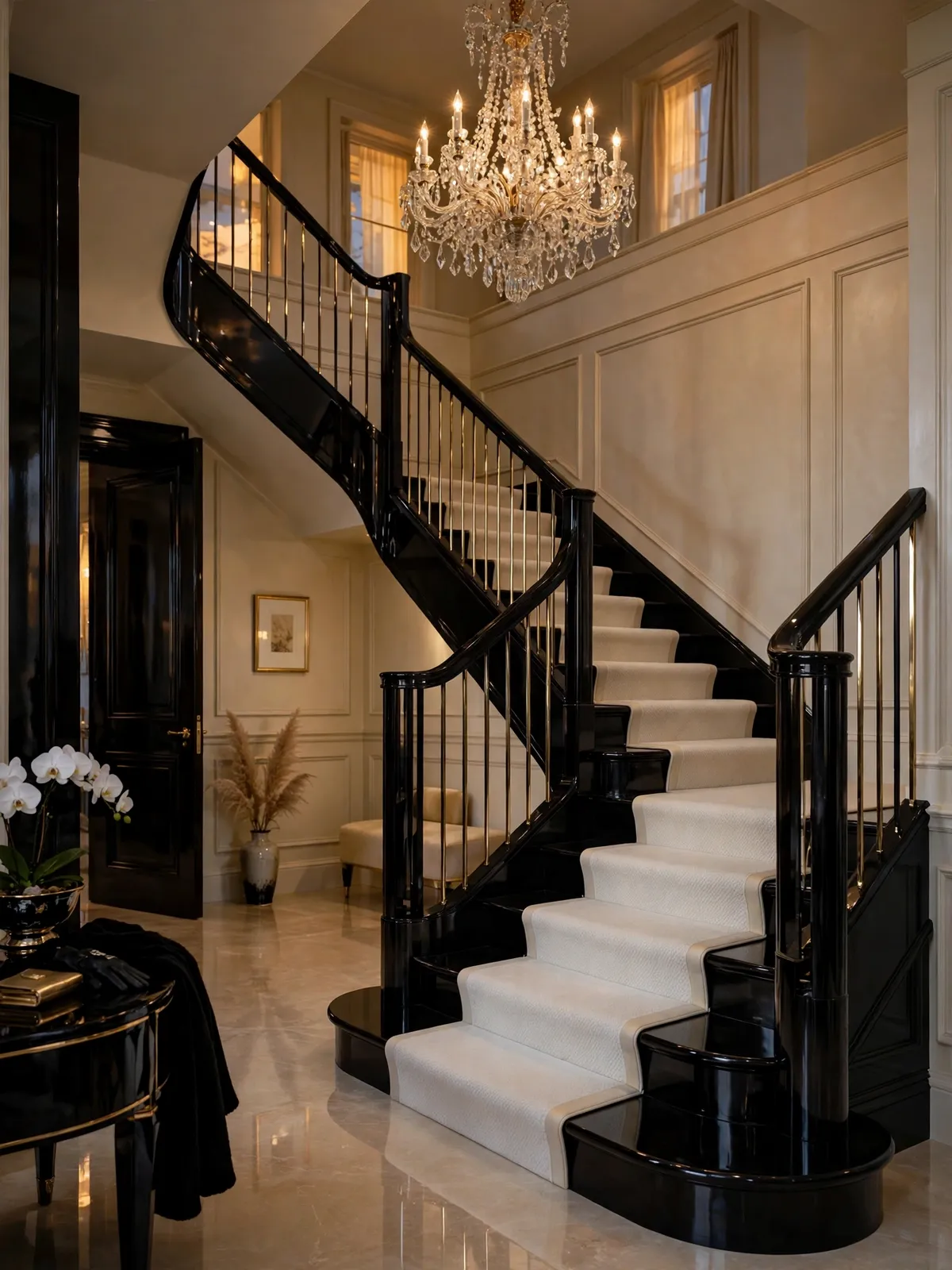
A high-gloss wooden finish makes a staircase feel glamorous, because the polished surface reflects light and turns the treads into dark mirrors that catch every glint from the chandelier above. Here, ebony treads finished to a mirror shine climb beside champagne walls, with an ivory runner softening the centre and a crystal chandelier overhead, so the staircase feels dressed for a black-tie event. The design suits contemporary and art-deco-inspired homes, it makes a dark stair feel luminous rather than heavy, and it is unforgettable in an entryway. The weakness is honesty — gloss amplifies both beauty and flaws, so the prep work must be flawless, and the finish shows footprints and dust — so refinish only on perfectly sanded timber, allow three to five days for drying, and plan the lighting carefully.
Quick tips:
- Prep the timber flawlessly — gloss shows every flaw.
- Allow three to five days for refinishing and drying.
- Plan the lighting so the gloss reflects it beautifully.
- Expect more cleaning — gloss shows dust and footprints.
Storage Drawers Built Into Every Wooden Step
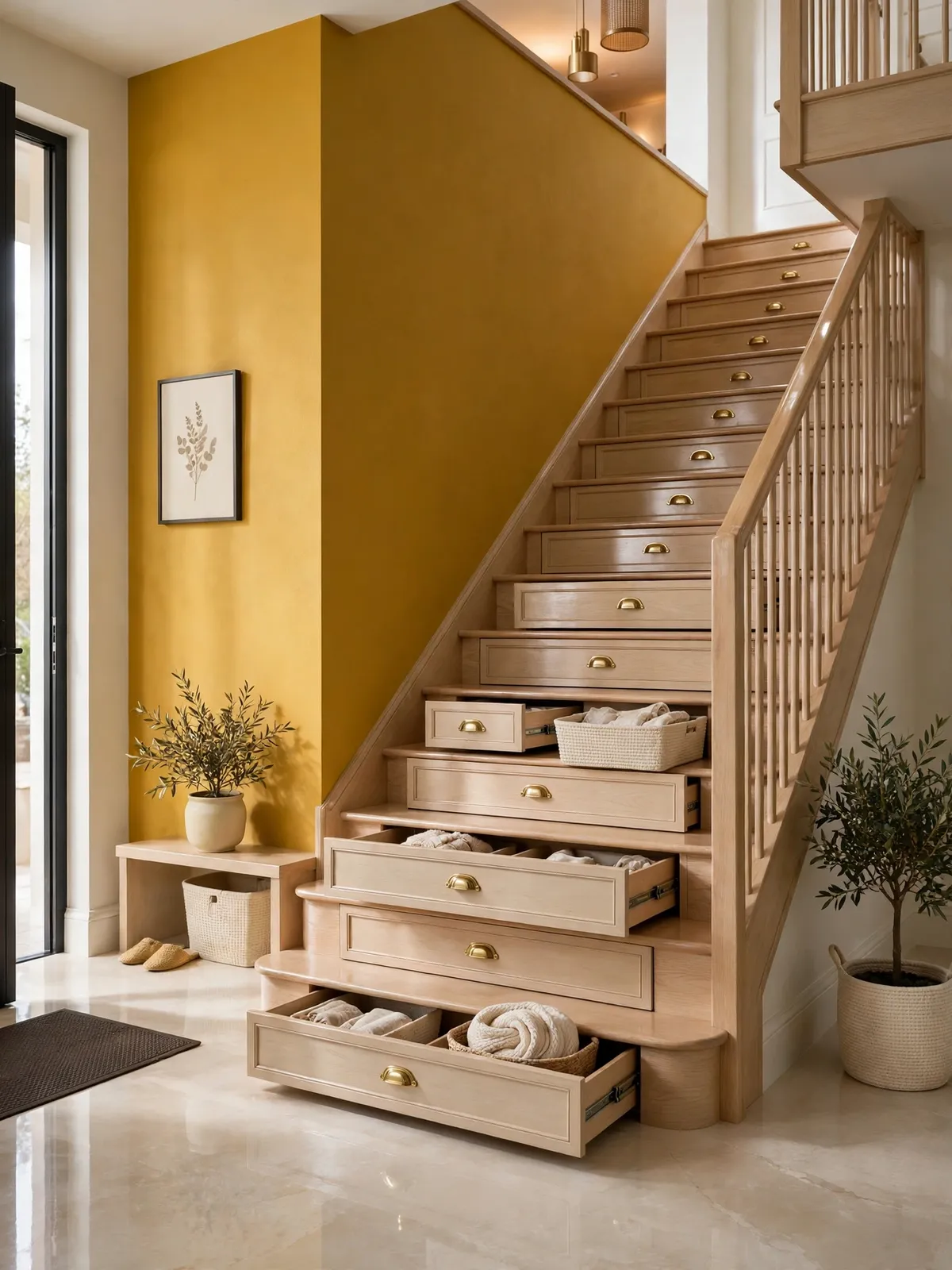
Storage drawers built into every wooden step turn wasted space into the most useful storage in the house, because each tread hides a drawer for shoes, hats, gloves or games. Here, pale oak treads lift or pull out to reveal deep drawers with brass handles, against a mustard-yellow accent wall, so the staircase looks like a beautiful stair and works like a chest of drawers. The design suits small homes and busy entries, it changes an entryway completely, and it keeps clutter out of sight without adding a single piece of furniture. The weakness is cost and planning — custom drawers under each tread need a joiner, and the drawer depth must be measured before installation — so plan the cabinetry before the stair goes in, and keep the heaviest items in the lowest, deepest drawers.
Quick tips:
- Measure the depth of each tread before planning drawers.
- Plan custom cabinetry before the stair is installed.
- Keep heavy items in the lowest, deepest drawers.
- Use soft-close runners so the drawers feel premium.
A Farmhouse Wooden Staircase With a Chunky Handrail
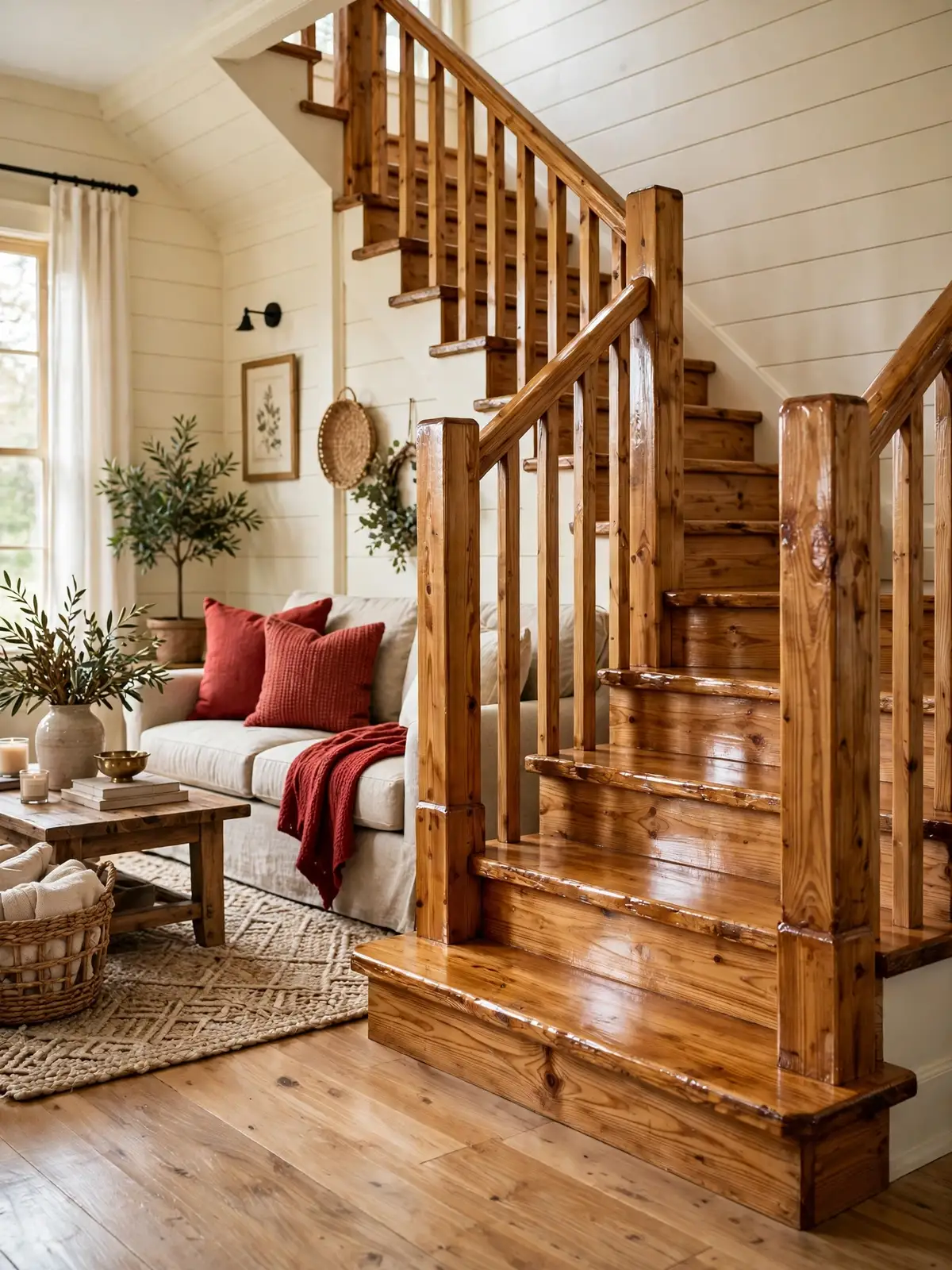
A farmhouse wooden staircase with a chunky handrail feels like home the moment you touch it, because the thick handrail, rustic pine treads and cream shiplap walls carry the warmth of a country kitchen into the stairwell. Here, wide pine treads with a natural matte finish climb beside shiplap walls, with a chunky handrail, black iron balusters and a woven rug at the base, so the staircase feels sturdy, honest and welcoming. The design suits farmhouse, cottage and country homes, it hides wear well, and it pairs beautifully with a runner in a muted stripe. The weakness is that rustic pine is softer than oak, so the treads dent more easily — so choose a hard-wearing matte seal, fit a runner on the busiest flights, and accept that a few dents only add to the farmhouse character.
Quick tips:
- Seal pine treads with a hard-wearing matte finish.
- Pair the chunky handrail with slim black iron balusters.
- Add a muted striped runner for softness.
- Accept small dents — they add farmhouse character.
Scandinavian Pale Wood Stairs in a Bright Minimal Home
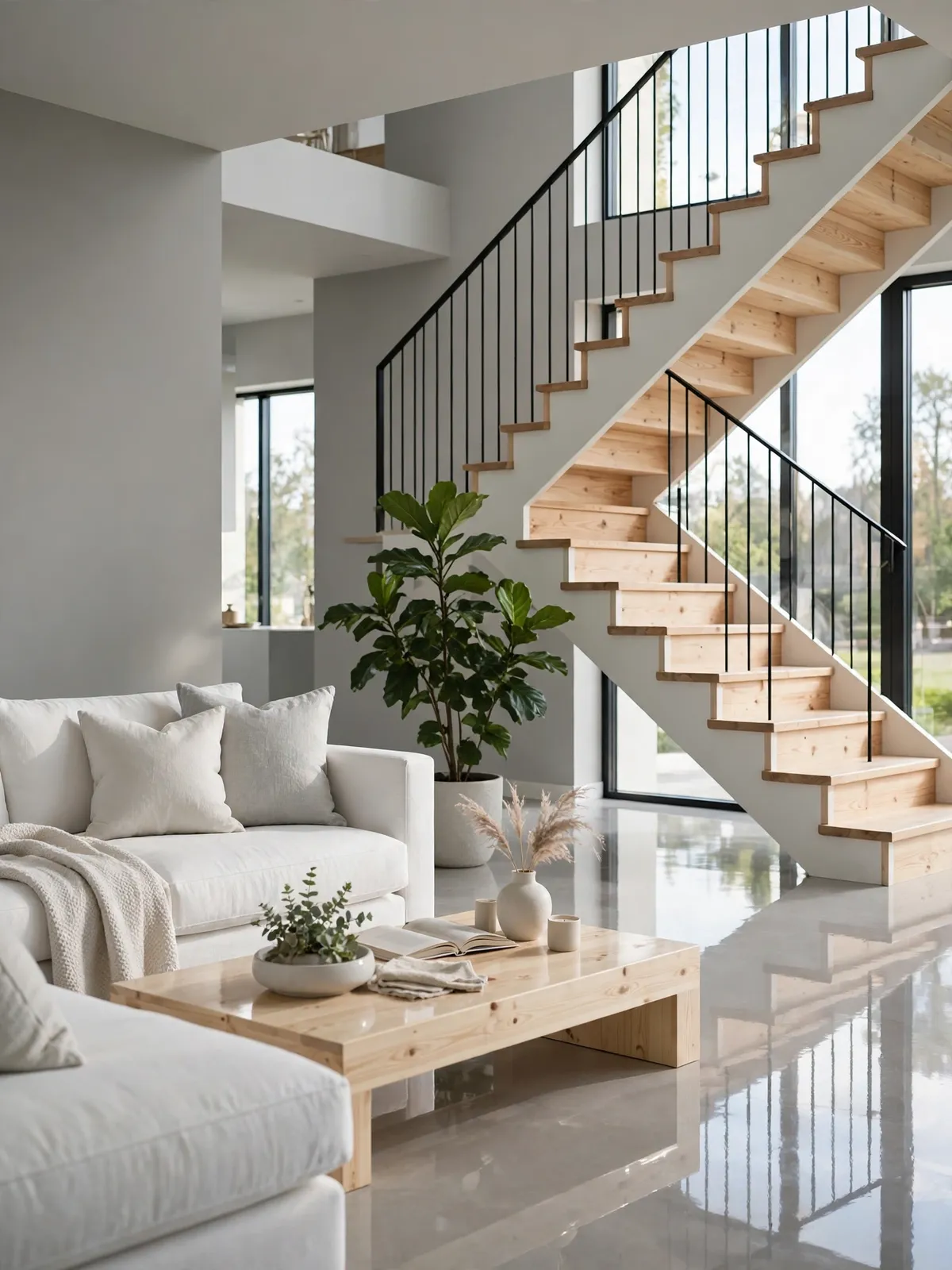
Scandinavian pale wood stairs bring calm to a bright minimal home, because light pine treads, white risers and a near-absence of ornament let the geometry of the staircase speak for itself. Here, pale pine treads climb against soft grey walls, with a slim white balustrade, a white sofa and a single green plant nearby, so the staircase feels light, clean and unhurried. The design suits modern, coastal and minimalist homes, it makes small rooms feel larger, and pale wood ages gracefully because it never tries too hard. The weakness is marking — pale finishes show scuffs and dirt faster than dark ones — so choose a wipe-clean finish, keep shoes off the stair where you can, and use a pale runner if the household is busy.
Quick tips:
- Choose a wipe-clean finish for pale treads.
- Keep the balustrade slim and white for lightness.
- Add one green plant for a soft natural accent.
- Use a pale runner in busy households.
A White-Painted Wooden Staircase With Oak Treads
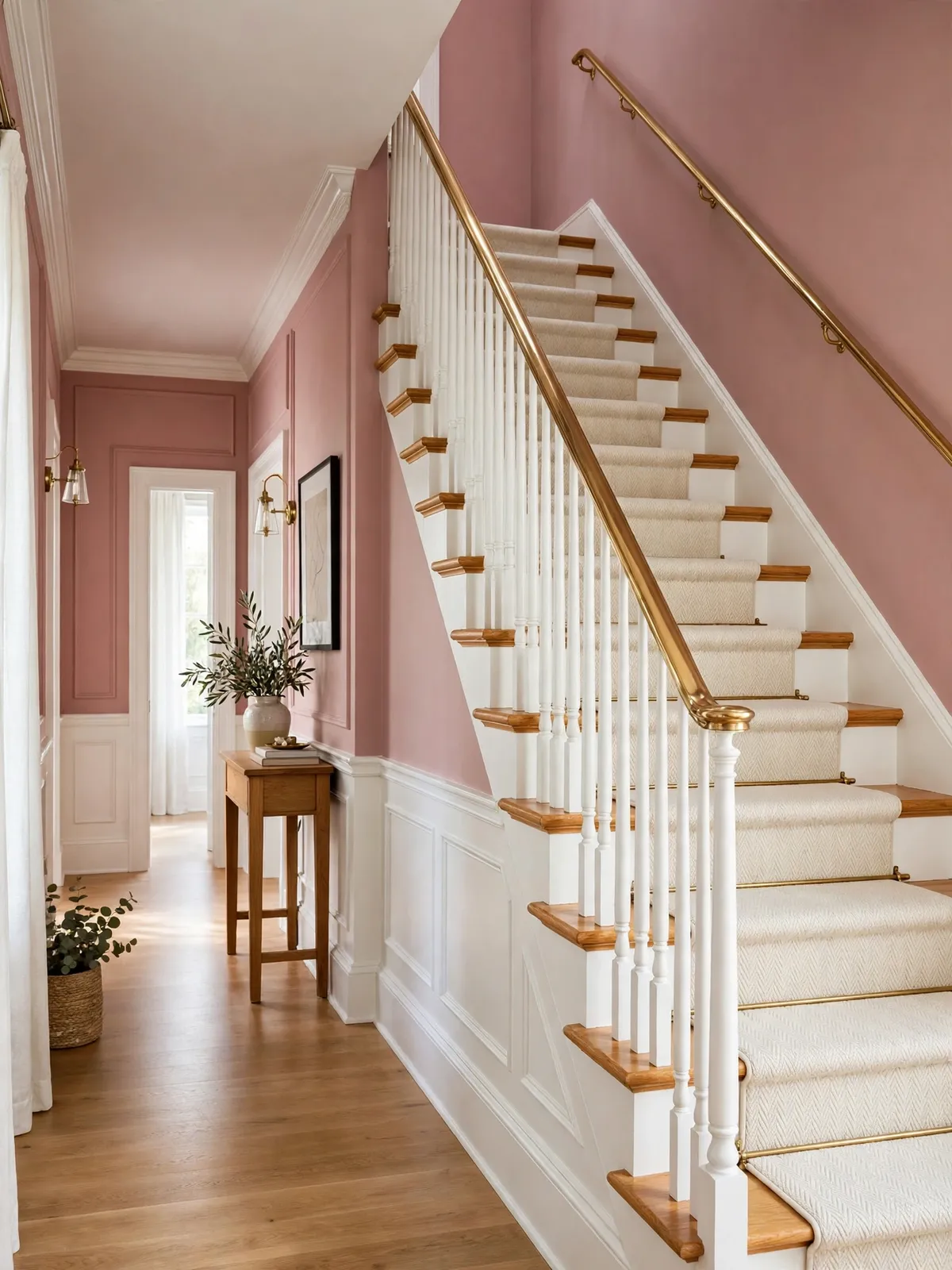
A white-painted wooden staircase with oak treads is the fresh classic that suits almost any home, because the white risers, stringers and balusters keep the stair bright while the honey-oak treads add the warmth that an all-white stair would lack. Here, crisp white paint covers every vertical surface, honey-oak treads provide the only wood tone, and dusty-rose walls with a cream runner soften the whole composition. The design suits cottages, coastal homes and traditional interiors, it makes narrow halls feel wider, and the painted surfaces are easy to refresh with a single coat. The weakness is maintenance — white paint chips and scuffs show quickly on a busy stair — so use a hard-wearing satin paint, keep a small pot for touch-ups, and choose oak treads thick enough to take a refinish when they wear.
Quick tips:
- Use hard-wearing satin paint on all white surfaces.
- Keep a small pot of paint for quick touch-ups.
- Choose thick oak treads so they can be refinished later.
- Add a runner to protect the painted risers from scuffs.
Black-Painted Wooden Stairs With Brass Details
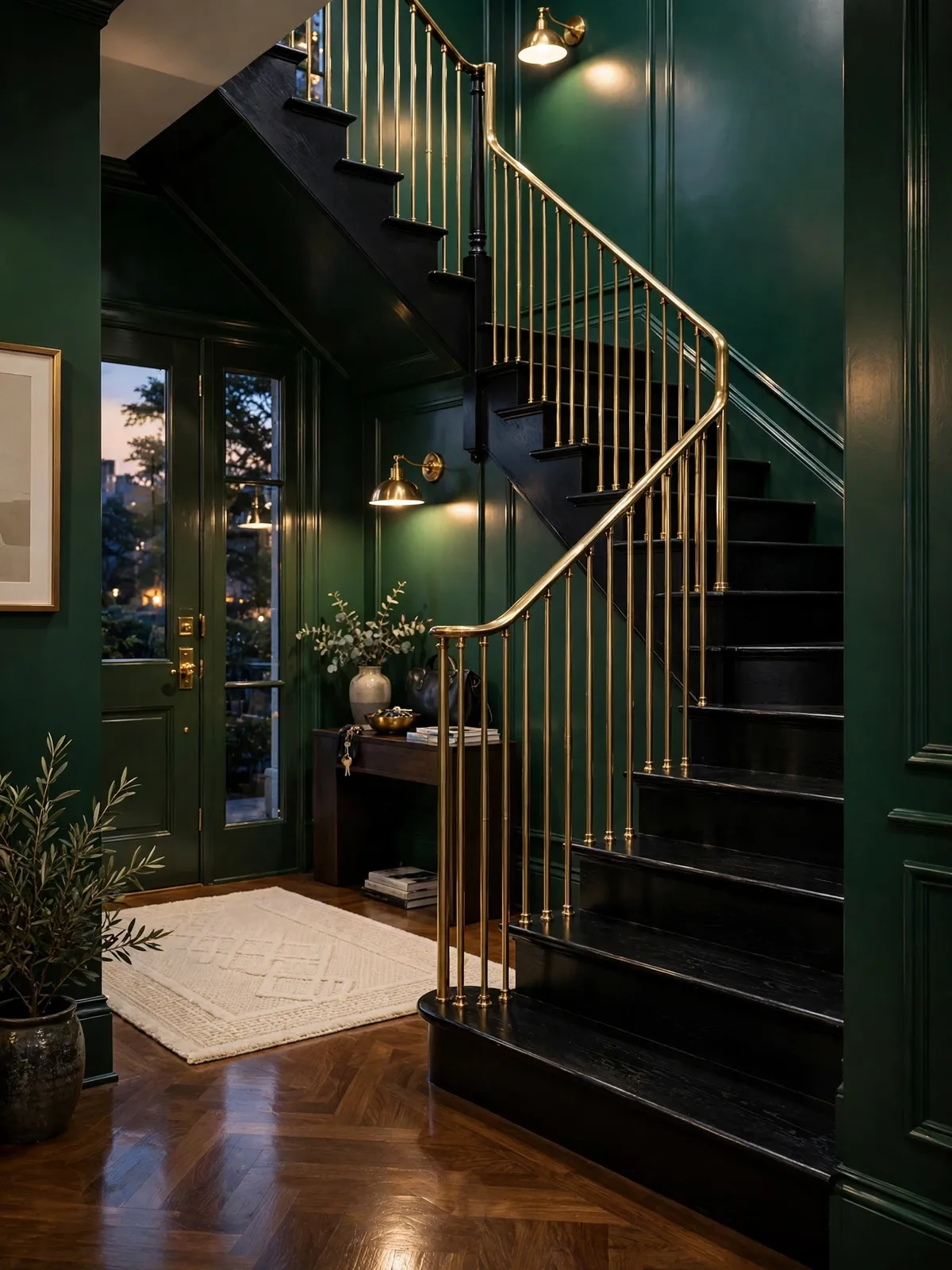
Black-painted wooden stairs with brass details make the boldest statement in this collection, because the matte black treads and risers turn the staircase into a sculptural shadow, while the brass handrail and balusters add a line of warm light along its edge. Here, black-painted wood climbs against deep emerald walls, with a brass handrail, brass balusters and warm wall lights, so the staircase feels sophisticated, dramatic and deliberately modern. The design suits contemporary and moody interiors, it hides wear better than white paint, and it pairs beautifully with dark floors. The weakness is light — a black stair in a dark hallway can feel like a tunnel — so keep the walls a rich but lighter tone than the stair, add warm lighting at every landing, and use a cream rug at the base to anchor the composition.
Quick tips:
- Keep the walls lighter than the black stair to avoid a tunnel feel.
- Add warm lighting at every landing.
- Use brass, not chrome, for warmth against the black.
- Place a cream rug at the base to anchor the stair.
A Wooden Staircase With a Built-In Landing Library
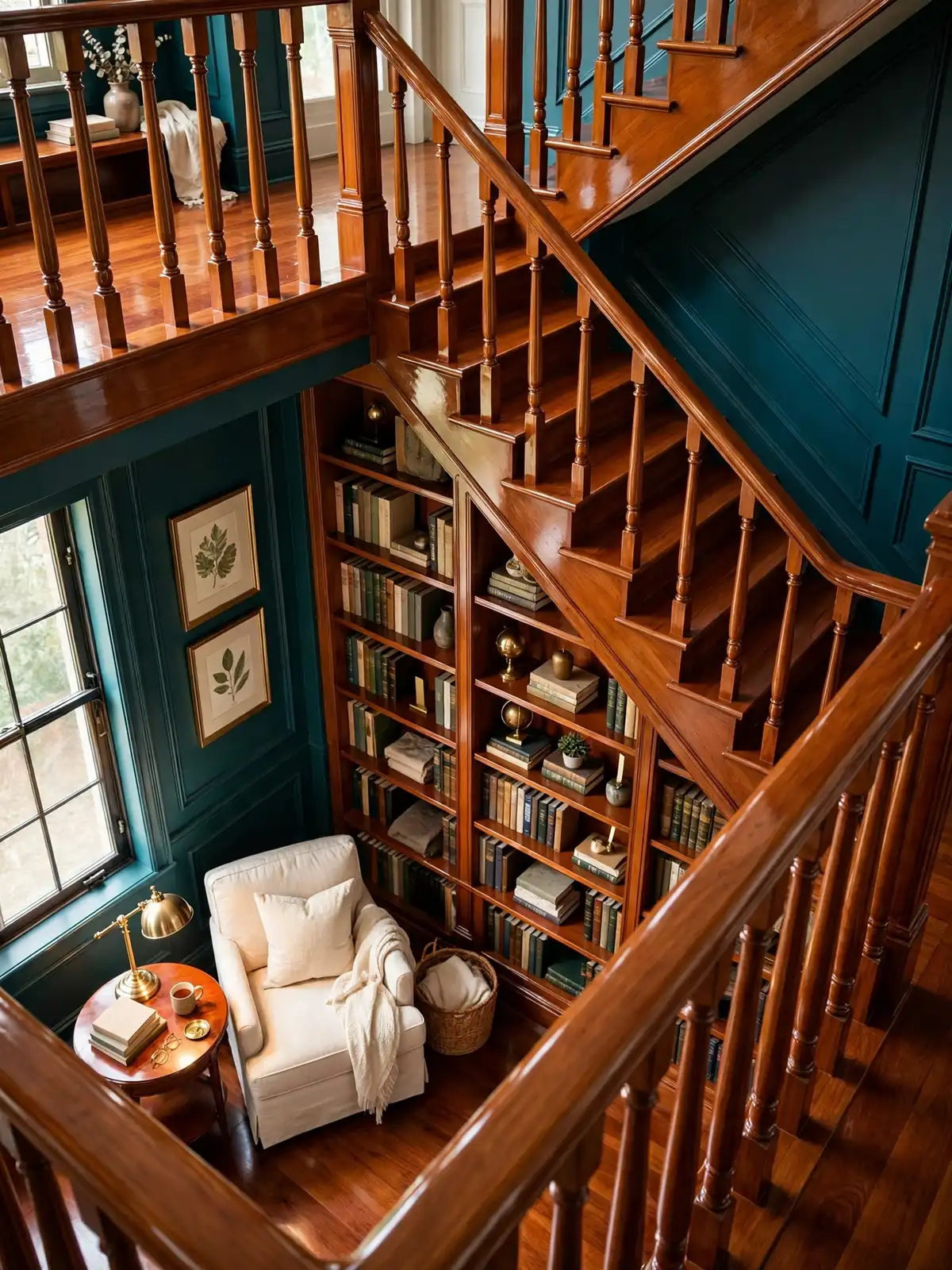
A wooden staircase with a built-in landing library turns the halfway point of the climb into a destination, because bookshelves built into the landing wall give you a reason to pause and a place to linger. Here, warm chestnut shelves wrap the landing, filled with books stacked both ways, with a brass reading lamp, a cream armchair and deep teal walls, so the landing feels like a small library rather than a corridor. The design suits book lovers and homes with a generous half-landing, it uses space that would otherwise be empty, and it makes the staircase feel like part of the living space. The weakness is headroom and light — a landing library needs a reading lamp and enough depth for the shelves — so keep the shelves shallow, fit a dedicated lamp, and leave a clear walking line so the library never blocks the stair.
Quick tips:
- Keep the landing shelves shallow so the walkway stays clear.
- Fit a dedicated brass reading lamp on the landing.
- Stack books both ways for a curated look.
- Leave a clear walking line past the shelves.
A Winder Wooden Staircase for an Awkward Corner
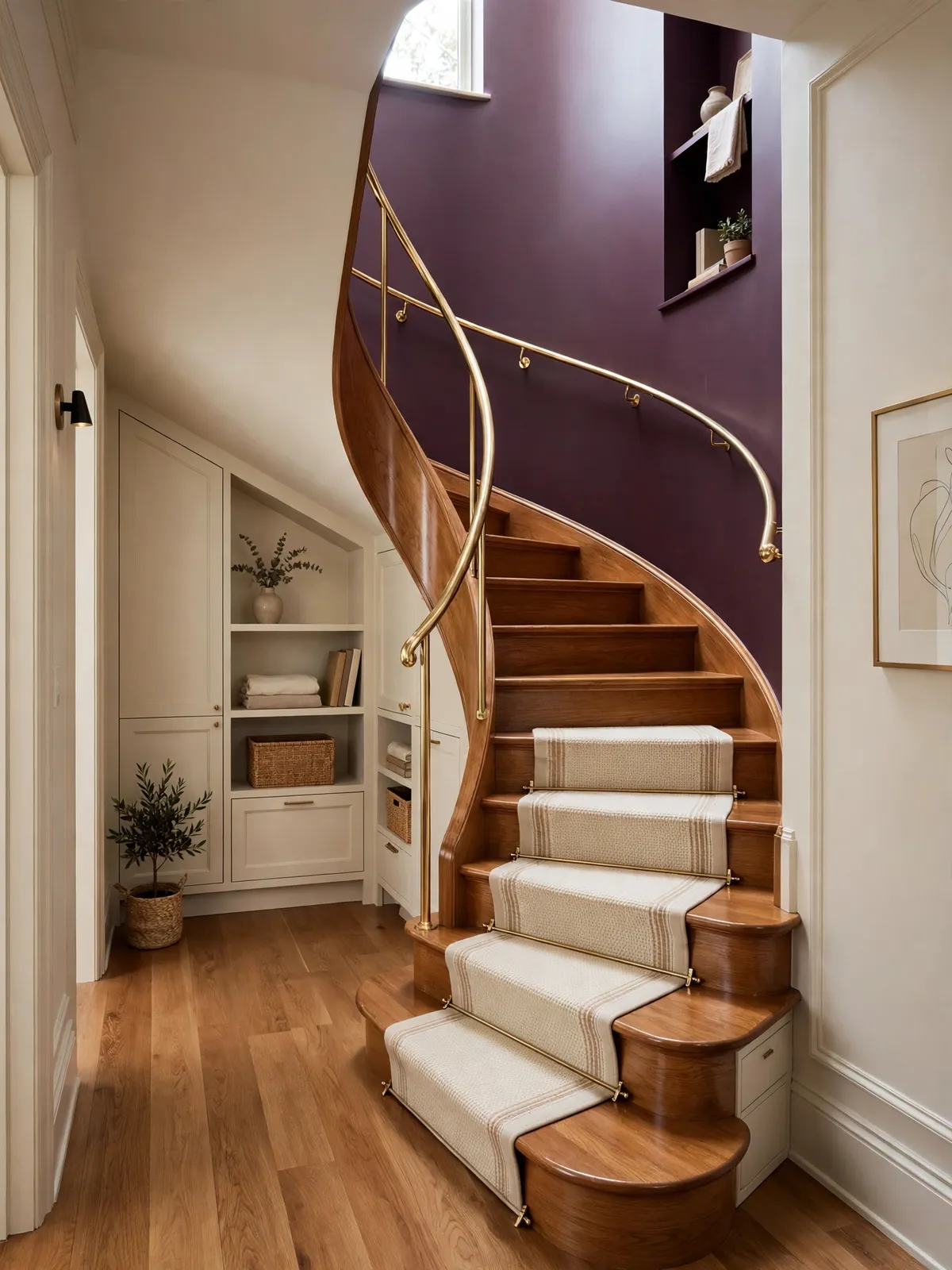
A winder wooden staircase solves the awkward corner that a straight flight cannot, because the treads fan out around the turn and the stair changes direction without needing a full landing. Here, medium oak winder treads turn through a tight corner, with a plum accent wall, a cream runner and a continuous brass handrail, so the stair feels intentional rather than squeezed in. The design suits small and irregular floor plans, it saves the floor space a landing would consume, and it keeps the staircase compact without resorting to a spiral. The weakness is the narrow end of each winder tread — the inner edge is too narrow for a full foot — so always step on the outer, wider edge, fit a continuous handrail, and add anti-slip strips to the winder nosings for safety.
Quick tips:
- Always step on the outer, wider edge of winder treads.
- Fit a continuous handrail around the turn.
- Add anti-slip strips to every winder nosing.
- Use winders only where a landing genuinely will not fit.
A Budget Wooden Staircase Refresh Under $500
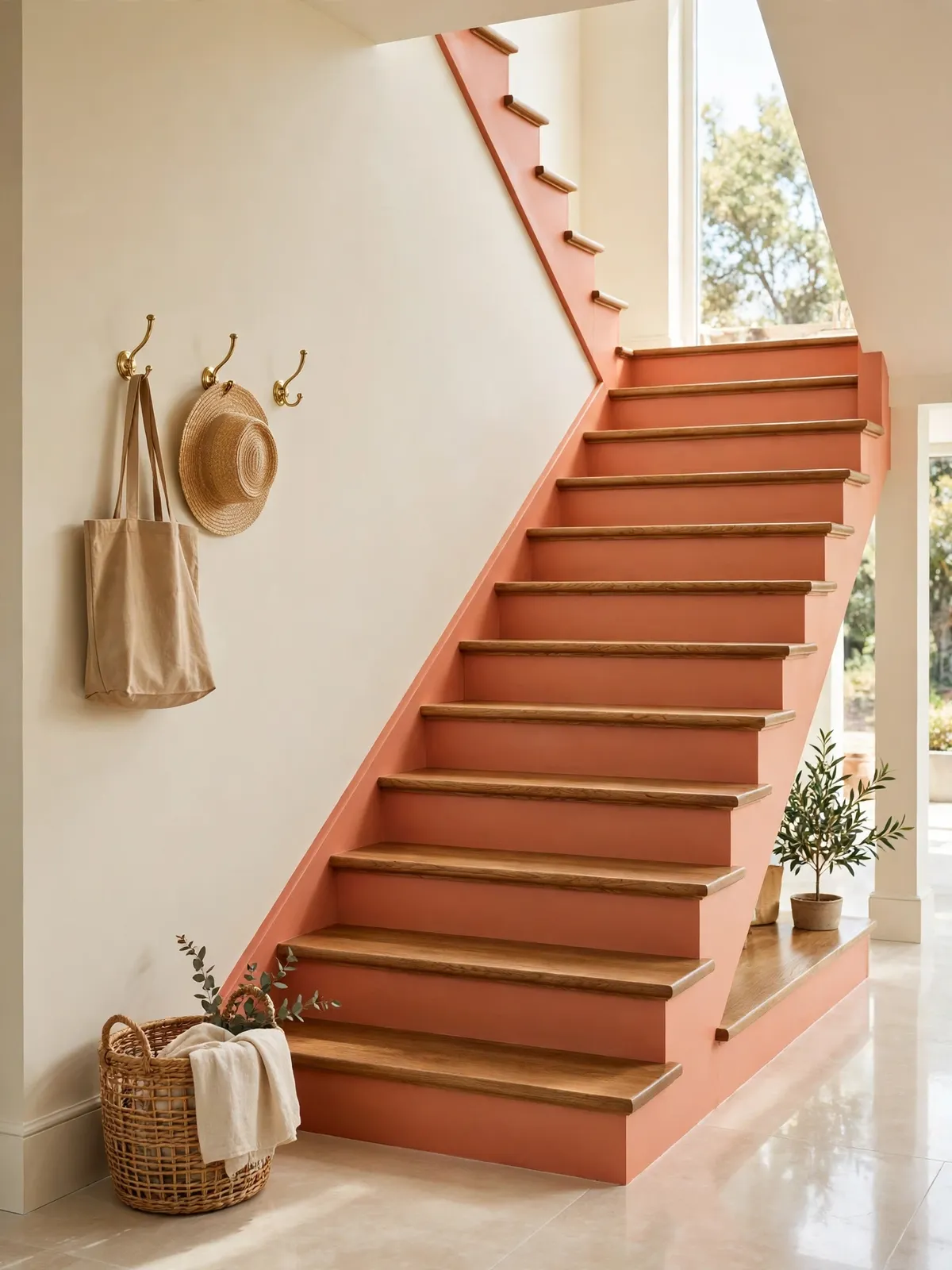
A budget wooden staircase refresh under $500 proves that you do not need a new staircase to get a new staircase, because sanding, restaining, painting the risers and swapping the balusters can transform a tired stair in a single weekend. Here, mid-tone oak treads have been sanded and restained, the risers painted a soft coral, the old balusters replaced with slim black spindles, and a woven basket placed at the base, so the stair looks custom without a custom price. The design suits anyone prepping a home for sale or craving a change without a renovation, it delivers the biggest visual payoff per pound of any idea in this article, and every step is a genuine DIY job. The weakness is prep — a rushed sand leaves a patchy stain — so sand evenly, test the stain on a hidden tread first, and seal the finish before the household walks on it again.
Quick tips:
- Sand evenly — rushed sanding leaves a patchy stain.
- Test the stain on a hidden tread first.
- Replace outdated balusters for the biggest single change.
- Paint the risers for contrast on a tiny budget.
Wooden Staircase Designs Ideas That Make Your Home Feel Warm and Grand
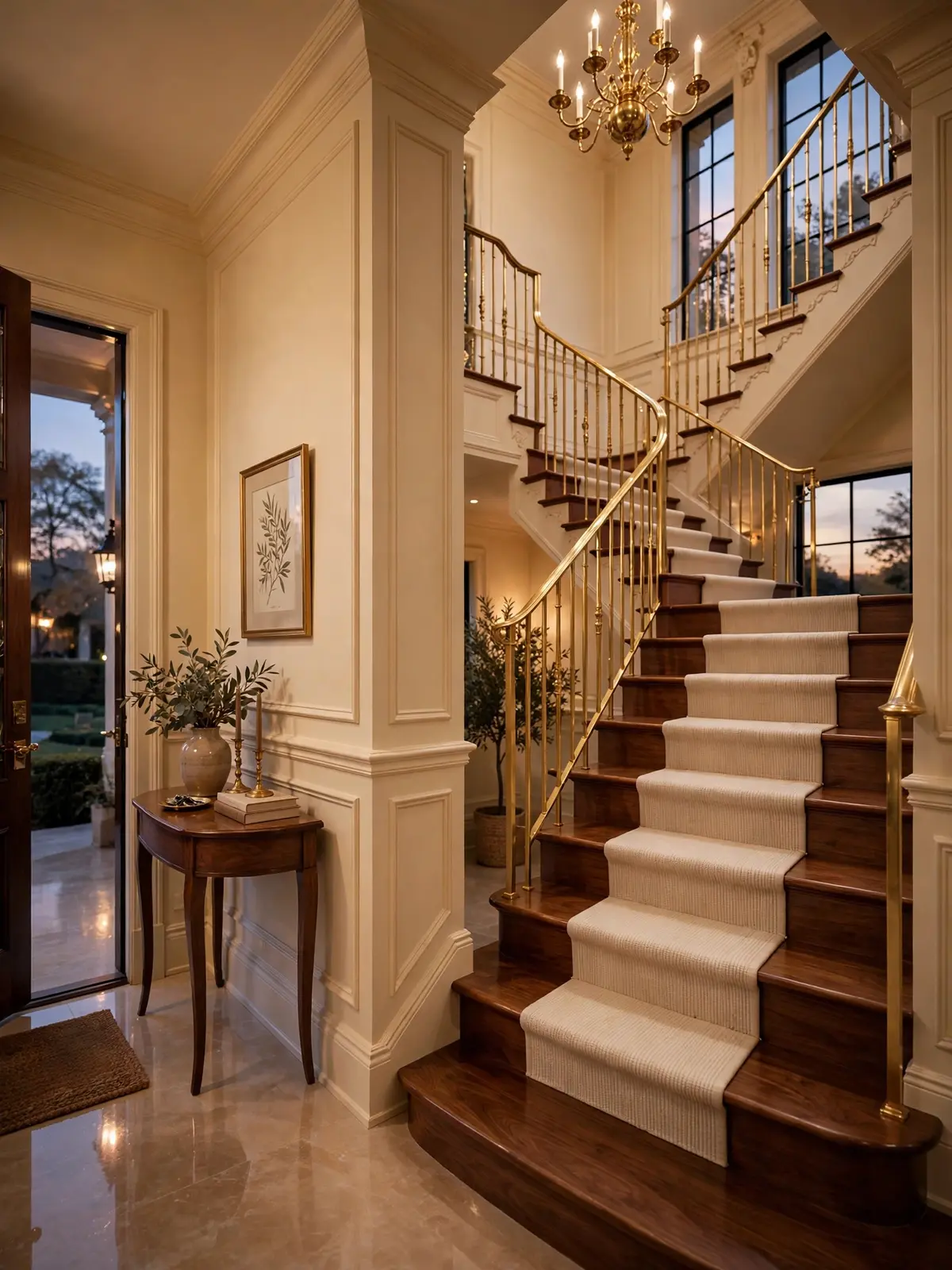
The last of these wooden staircase designs ideas is the principle behind them all: a wooden staircase succeeds when the wood, the shape and the details work together to make your home feel warm and grand at the same time. Here, rich walnut treads climb beside warm cream walls, with a gold handrail, a cream runner and a brass chandelier above, so the staircase gathers every lesson of this article into one stair — a beautiful wood, a shape that fits the room, a railing worth looking at, lighting that works after dark and a runner that softens every step. Choose the wood you love, match the shape to your floor plan, keep the railing simple enough to let the timber shine, and your wooden staircase will be the feature your home is remembered for.
Quick tips:
- Choose the wood you love first, then design around it.
- Match the stair shape to your floor plan, not the other way round.
- Keep the railing simple so the timber stays the hero.
- Plan lighting and a runner before the staircase is finished.
FAQs
How much does a wooden staircase cost?
A straight wooden staircase in oak with a simple railing is the most affordable option, while floating treads, curved shapes, glass balustrades and premium hardwoods like walnut raise the cost significantly. A budget refresh of an existing wooden stair — sanding, restaining, painting the risers and replacing balusters — can be done for under $500. Always get a quote that separates timber, joinery, railing, lighting and finishing before committing.
What is the best wood for staircase treads?
Oak is the best all-round choice because it is hard-wearing, takes stain evenly and suits almost every style. Walnut gives a richer, darker look for statement stairs, maple suits pale Scandinavian designs, and reclaimed timber adds character in rustic homes. Always use a hardwood for the treads, where wear is heaviest, and save softer woods for risers and panelling.
Are wooden stairs slippery?
Bare wooden stairs can be slippery in socks, especially with a high-gloss finish. A stair runner, anti-slip strips on the tread nosings, or a matte or satin finish all reduce slipperiness significantly. In homes with children or older family members, a runner down the centre of the stair is the simplest and most effective safety upgrade.
Can I paint a wooden staircase?
Yes. Painted risers with natural wood treads are one of the most popular wooden staircase designs, and a fully painted stair in white or black can transform a dated staircase completely. Sand the surfaces first, use a primer made for wood, and finish with a hard-wearing satin or eggshell paint so the paint survives daily foot traffic.
Do wooden staircases add value to a home?
Yes, when they are well built and well maintained. A beautiful wooden staircase — especially in oak or walnut, with a good handrail and lighting — reads as craftsmanship to buyers and becomes a memorable feature of the home. A worn, creaky or badly finished wooden stair does the opposite, so keep the treads sealed, fix squeaks promptly and refresh the finish before selling.
Conclusion
A wooden staircase is never just a way to get upstairs. Whether you choose floating treads with a glass balustrade, reclaimed timber full of character, a curved stair for a grand entry, a spiral that saves floor space, dark walnut against white walls, a two-tone finish, a stair runner, built-in storage or a simple budget refresh, the best wooden staircase is the one that matches your home, your budget and the way your family lives. Pick the wood you love, match the shape to your floor plan, plan the lighting early, and your staircase will be the warmest and most admired feature of your home.