23 Stunning Bathroom Tile Ideas That Transform Any Bathroom Into a Luxury Retreat
Bathroom tile does more than protect your walls and floors from water — it sets the whole mood of the room. These 23 bathroom tile ideas cover patterns, materials, finishes and layouts, so you can choose tiles that look beautiful, suit your bathroom’s size and stay easy to live with.
Bathroom tile is the surface that decides how your bathroom feels: large-format tiles make a small room feel wider, handmade zellige catches the light like jewellery, and a single patterned floor can carry a whole plain room. The best bathroom tile choices balance three things — the look you love, the maintenance you will actually do, and the grip and grout that keep the room safe and clean.
If you are planning the floor first, these bathroom flooring ideas show how tile, stone and wood-look options compare across the whole room. The 23 ideas below cover floors, walls, showers, niches and splashbacks, with a tile-type guide in the middle, so you can pick the tiles that fit your bathroom, your budget and the way you actually use the room.
Key Takeaways
What is the best bathroom tile for a small bathroom?
Large-format tiles in a pale colour are the best bathroom tile choice for a small bathroom, because fewer grout lines make the walls and floor read as one continuous surface. Use the same tile on the floor and walls, match the grout to the tile, and keep the finish matte on the floor for grip.
Which bathroom tile is easiest to clean?
Large-format glazed porcelain is the easiest bathroom tile to clean, because it has few grout joints, a non-porous surface and no sealing. Small mosaics and natural stone need more upkeep: mosaics have many grout lines to scrub, and stone must be sealed regularly.
What grout colour should I use with bathroom tile?
Match the grout to the tile when you want a calm, seamless look, and use a contrasting grout — such as charcoal with white subway tile — only when you want the tile pattern to be the feature. Dark grout hides stains on floors, while pale grout keeps small rooms feeling bright.
Is matte or glossy bathroom tile better?
Glossy bathroom tile suits walls, because it reflects light and wipes clean easily. Matte bathroom tile suits floors, because it gives better grip when wet. Mixing the two — glossy walls with a matte floor in the same colour — is one of the easiest ways to add depth without adding colour.
How do I choose bathroom tile that will not date quickly?
Choose a classic shape in a neutral colour — subway, hexagon, large-format stone-look or marble-look porcelain — and put the trend in one replaceable place, such as a single accent wall or a patterned floor. Classic tiles age well; bold patterns date fast when they cover every surface.
| Tile type | Best use | Cost level | Maintenance |
|---|---|---|---|
| Glazed porcelain | Floors, walls and showers | Low to medium | Very low — no sealing, few grout joints |
| Ceramic subway | Walls and splashbacks | Low | Low — wipe clean, grout needs sealing |
| Natural stone (marble, travertine) | Feature walls and floors | High | High — seal yearly, avoid acidic cleaners |
| Zellige (handmade glazed) | Accent walls and showers | Medium to high | Medium — seal grout, colour varies by batch |
| Terrazzo | Floors and feature walls | Medium to high | Low to medium — seal occasionally, hides dirt |
| Mosaic | Niches, borders and inlays | Low to medium | Medium — many grout joints to clean |
| Wood-look porcelain | Floors and accent walls | Medium | Very low — looks like wood, handles water |
A Floor-to-Ceiling Herringbone That Makes the Room Feel Designed
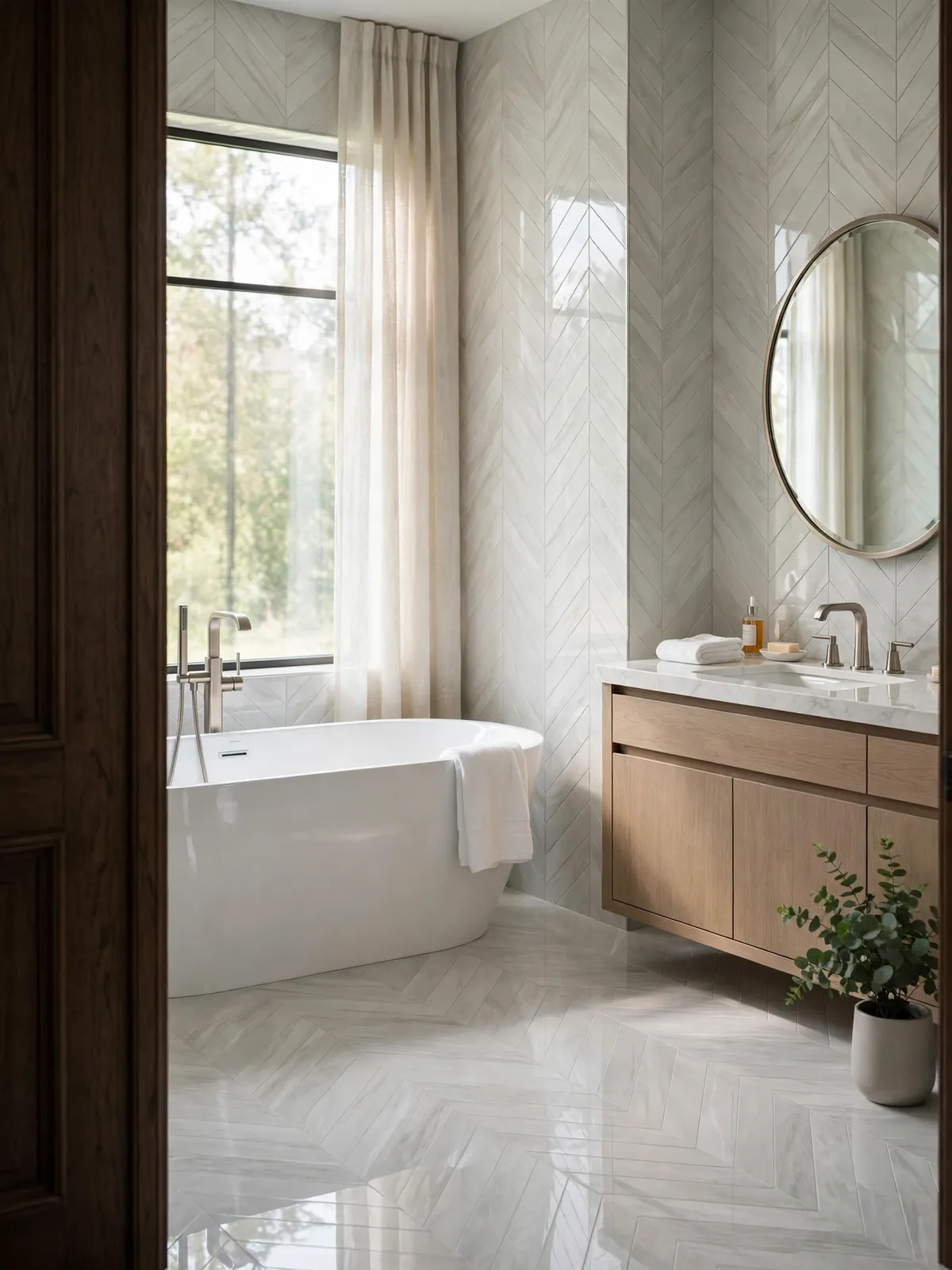
A floor-to-ceiling herringbone makes a bathroom feel designed the moment you walk in, because the zigzag pattern creates movement on every wall and turns plain tile into architecture. Here, pale grey marble-look herringbone runs from floor to ceiling around a white freestanding tub, with brushed nickel fixtures and a single green plant as the only colour. The design suits bathrooms that feel flat or boxy, it makes the ceiling feel higher, and it photographs beautifully from every angle. The weakness is cost and waste: herringbone needs more cuts and more tiles than a straight layout, and it demands a skilled tiler.
Quick tips:
- Use a pale, low-contrast tile so the pattern reads as texture, not noise.
- Order 15% extra tile for herringbone cuts and breakages.
- Keep fixtures simple so the pattern stays the star.
- Hire a tiler who has laid herringbone before.
Matte and Glossy Tiles Mixed for Quiet Depth
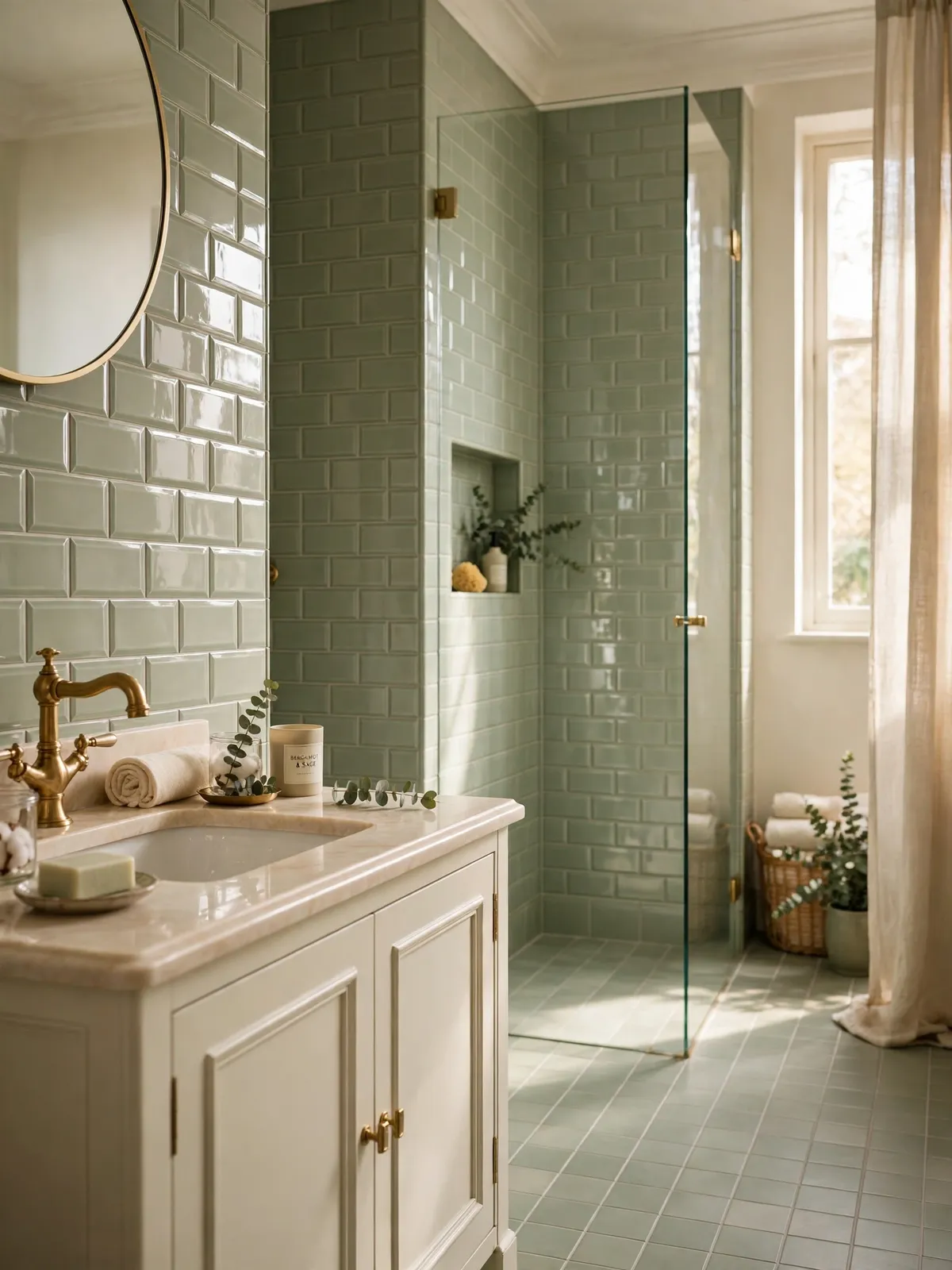
Mixing matte and glossy bathroom tile adds depth without adding colour, because the two finishes catch the light differently and the walls quietly shift as you move around the room. Here, glossy sage subway tiles cover the walls while matte sage floor tiles anchor the room, with a cream vanity and brass taps warming the palette. The design suits anyone who loves neutrals but finds all-matte bathrooms flat, it is easy to live with, and it costs no more than a single finish. The weakness is matching: two tiles that look the same colour in the shop can read as different shades once installed, so check samples together in your own light.
Quick tips:
- Keep the colour identical and let the finish do the work.
- Use glossy on walls and matte on the floor for grip.
- Check both samples side by side in daylight and evening light.
- Repeat the glossy finish once more, on a niche or splashback.
A Moroccan Tile Accent Wall That Feels Like a Getaway
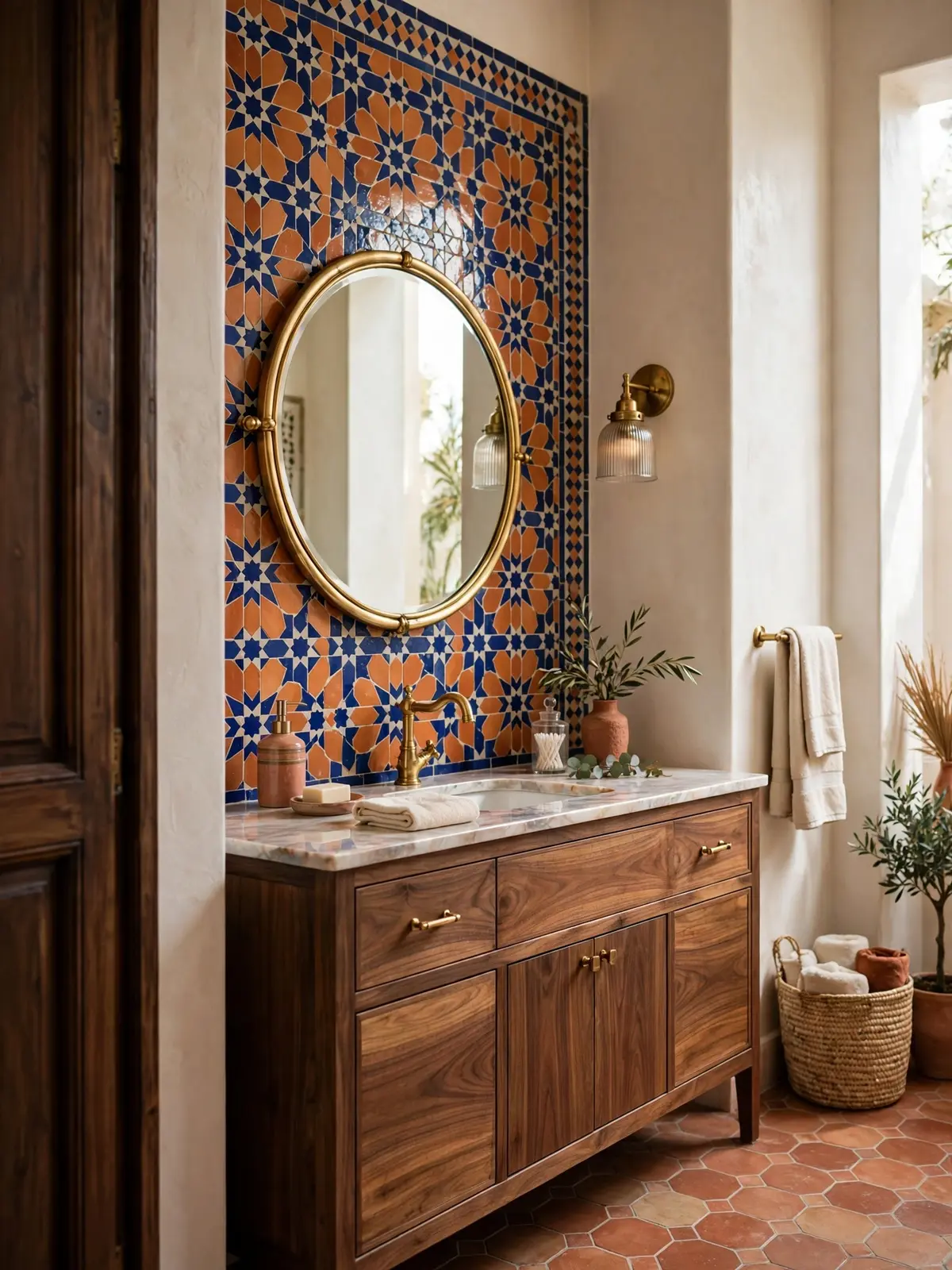
A Moroccan tile accent wall concentrates all the colour and pattern of a bathroom onto one surface, so the room feels rich and travelled without becoming overwhelming. Here, terracotta and cobalt patterned tiles cover the wall behind a walnut vanity, while the other walls stay cream plaster and a brass-framed mirror ties the palette together. The design suits plain bathrooms that need personality, it costs far less than tiling the whole room, and the handmade look of the pattern hides small imperfections. The weakness is commitment: a bold pattern is hard to live with if you tire of it, so keep it to one wall you can retile later.
Quick tips:
- Tile the wall you face when you enter the room.
- Keep the other walls plain and pale.
- Repeat one colour from the pattern in a towel or vase.
- Seal handmade-look tiles so the pattern stays vivid.
Patterned Tiles Behind the Sink for a Small, High-Impact Splashback
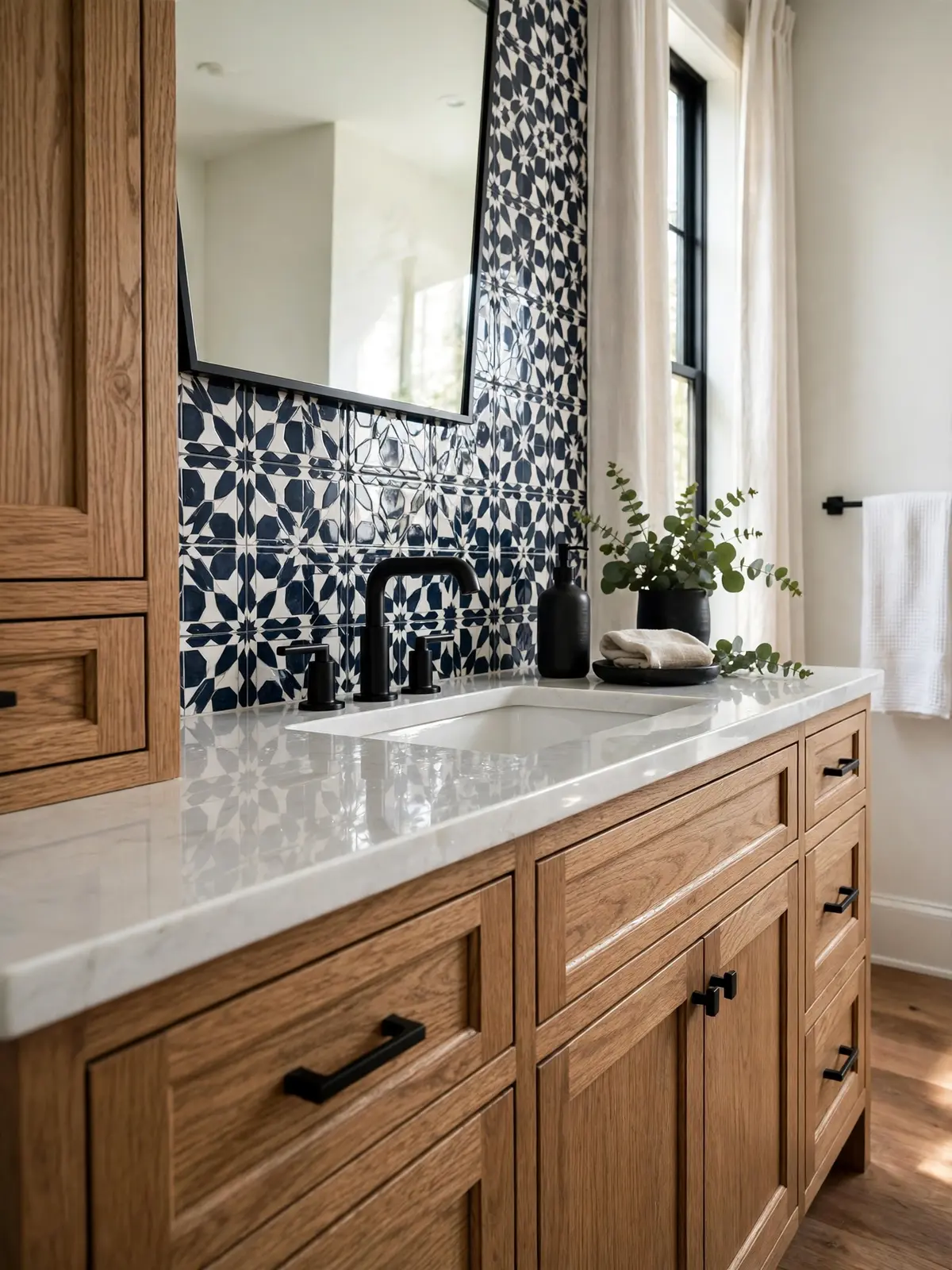
Patterned tiles behind the sink give you a bold look in the smallest possible area, because the splashback is the surface you look at every morning and the one most likely to be splashed. Here, navy and white geometric tiles run behind a white stone countertop and oak vanity, with matte black taps echoing the darkest line in the pattern. The design suits renters and renovators alike — it is a weekend job, not a full retile — and it protects the wall while looking deliberate. The weakness is scale: a pattern that looks charming on a sample can feel busy across a wide splashback, so test a full row before committing.
Quick tips:
- Run the pattern the full width of the vanity, no further.
- Choose a pattern with one dark colour that matches the taps.
- Use a grout colour close to the lightest tile.
- Keep the mirror frame plain so the pattern stays the focus.
Hexagon Tiles on the Floor for Playful Geometry
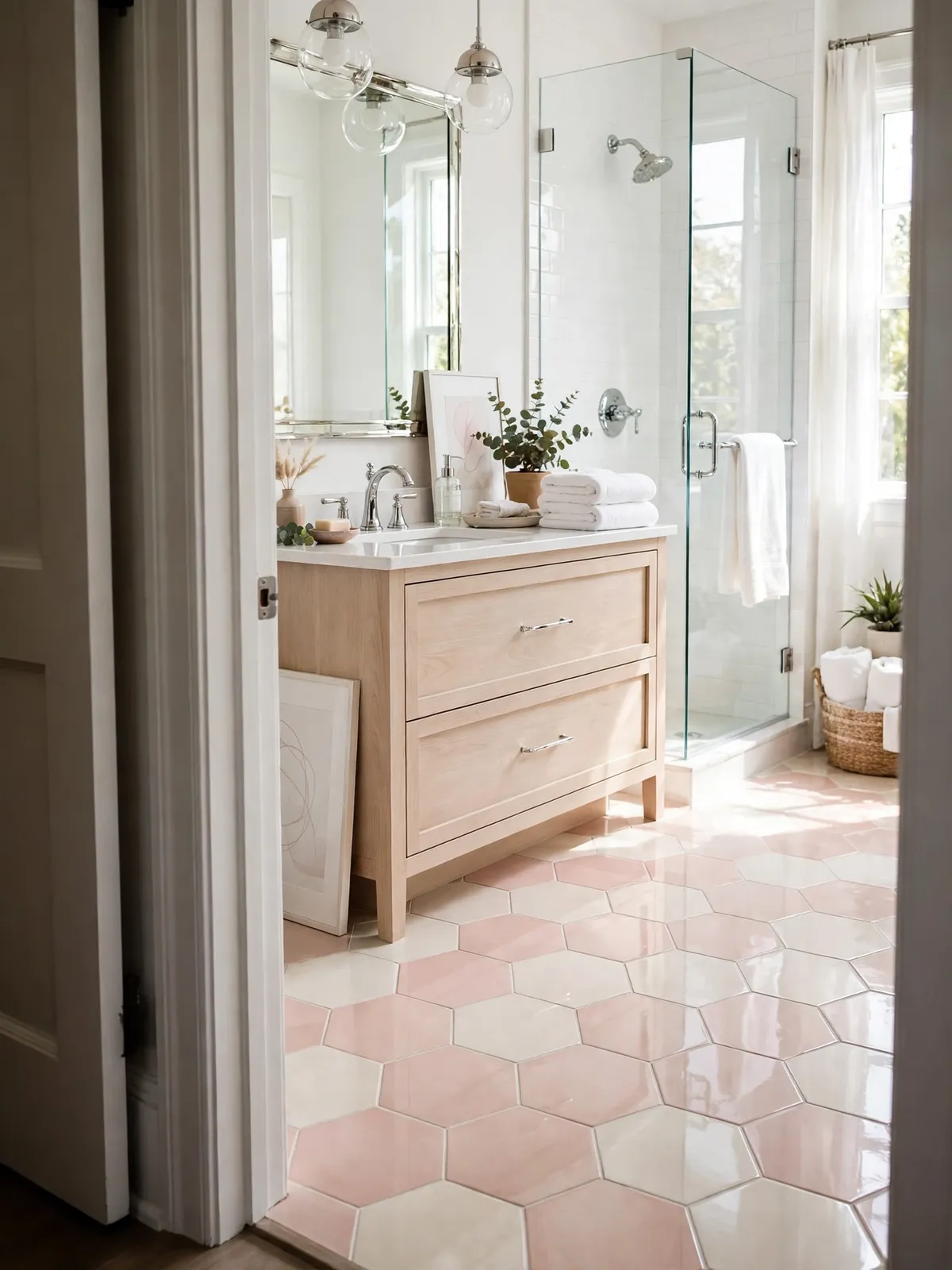
Hexagon tiles bring instant character to a bathroom floor, because the honeycomb shape reads as both playful and refined, and it breaks up the grid of ordinary square tiles. Here, large blush and cream hexagons cover the floor of a white bathroom, with a pale wood vanity and chrome fixtures keeping the rest of the room calm. The design suits small bathrooms especially well — the shape distracts from the room’s size — and the many grout joints give the floor natural grip. The weakness is grout: a hexagon floor has far more grout lines than a large-format floor, so it needs more cleaning and a grout colour that hides dirt.
Quick tips:
- Use large hexagons to reduce the number of grout joints.
- Choose a mid-tone grout that hides dirt but shows the shape.
- Keep wall tiles plain so the floor stays the feature.
- Seal the grout on a hexagon floor every year.
Oversized Tiles That Make a Small Bathroom Feel Larger
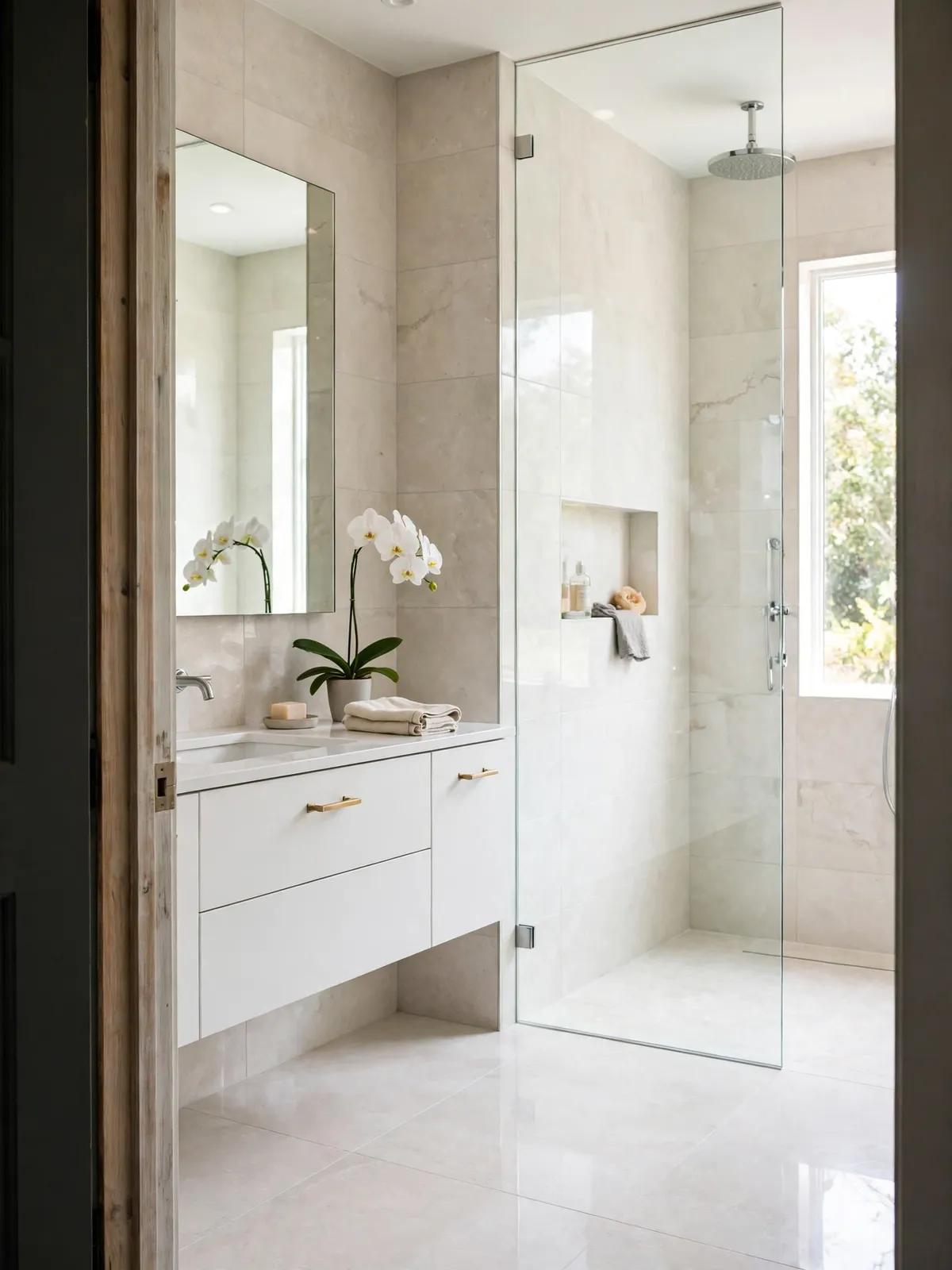
Oversized tiles are the simplest way to make a small bathroom feel larger, because fewer grout lines mean fewer visual breaks, and the walls and floor read as one calm, continuous surface. Here, large pale stone-look tiles run across the floor and up the walls of a compact bathroom, with a floating white vanity and a frameless glass shower keeping every line clean. The design suits cloakrooms and en suites best of all, it is easier to clean than small tiles, and it looks expensive without a luxury price. The weakness is installation: large tiles need perfectly flat walls and a skilled tiler, and they can crack if the floor underneath moves.
Quick tips:
- Use the same tile on floor and walls for a seamless look.
- Match the grout colour to the tile so joints disappear.
- Choose a matte finish on the floor for grip.
- Hire a tiler experienced with large-format tiles.
Pastel Tiles for a Soft, Spa-Like Calm
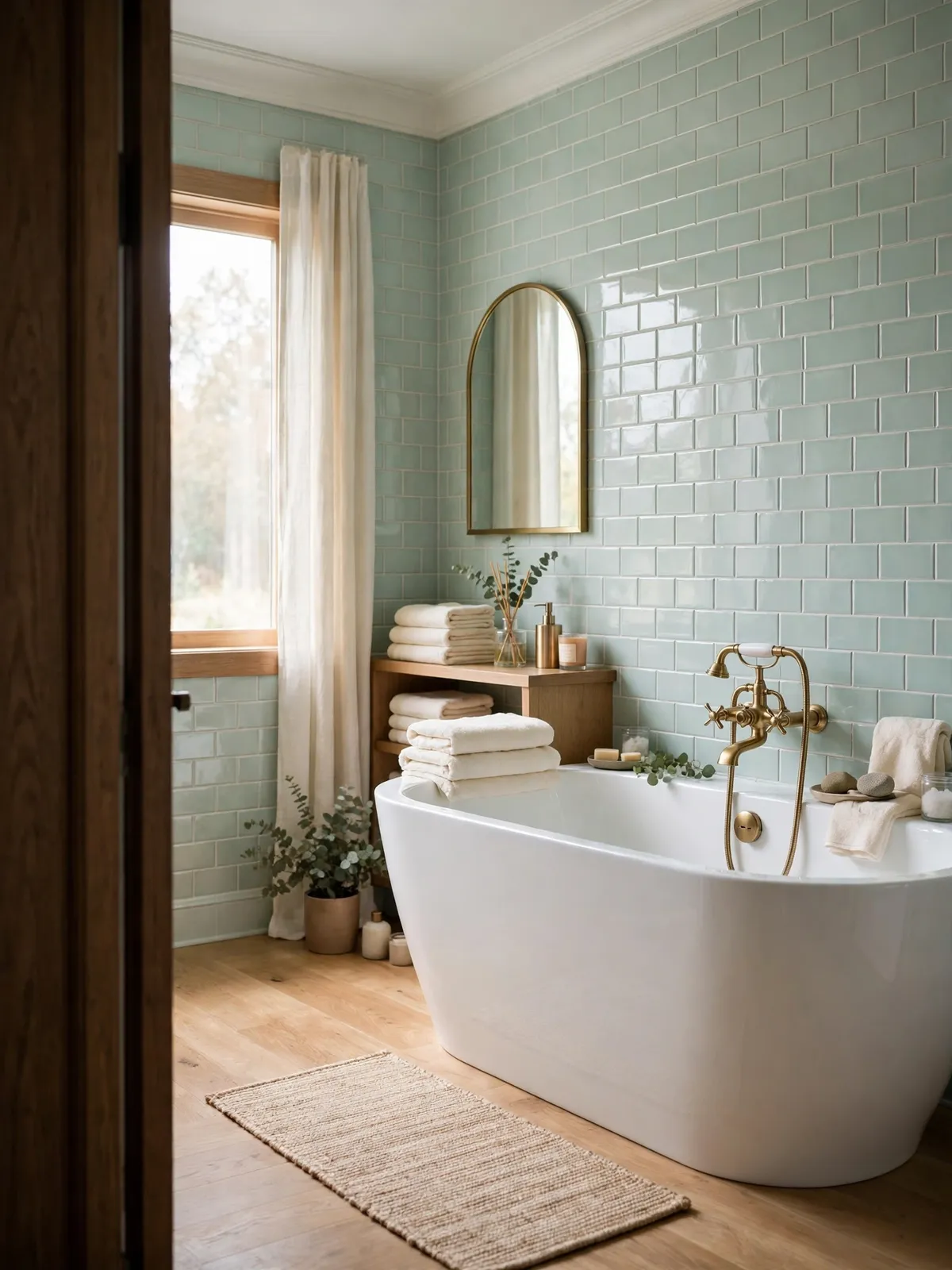
Pastel tiles turn a bathroom into a calm retreat, because soft blush, mint or powder blue reflect light gently and make the room feel like a spa rather than a utility space. Here, mint subway tiles cover the walls around a white freestanding tub, with a light oak floor, brushed brass fixtures and cream towels keeping the palette warm. The design suits bathrooms with good natural light, it brightens small rooms, and it pairs beautifully with natural wood and white. The weakness is colour matching: pastels shift dramatically under different bulbs, so a mint tile can look grey under cool white light.
Quick tips:
- Test pastel samples under warm white bulbs (around 2700K).
- Pair pastels with warm wood, not cold chrome.
- Keep the floor pale so the room stays bright.
- Use one pastel only, with white and wood as the rest.
Black Grout That Turns Simple Tiles Into a Graphic Feature
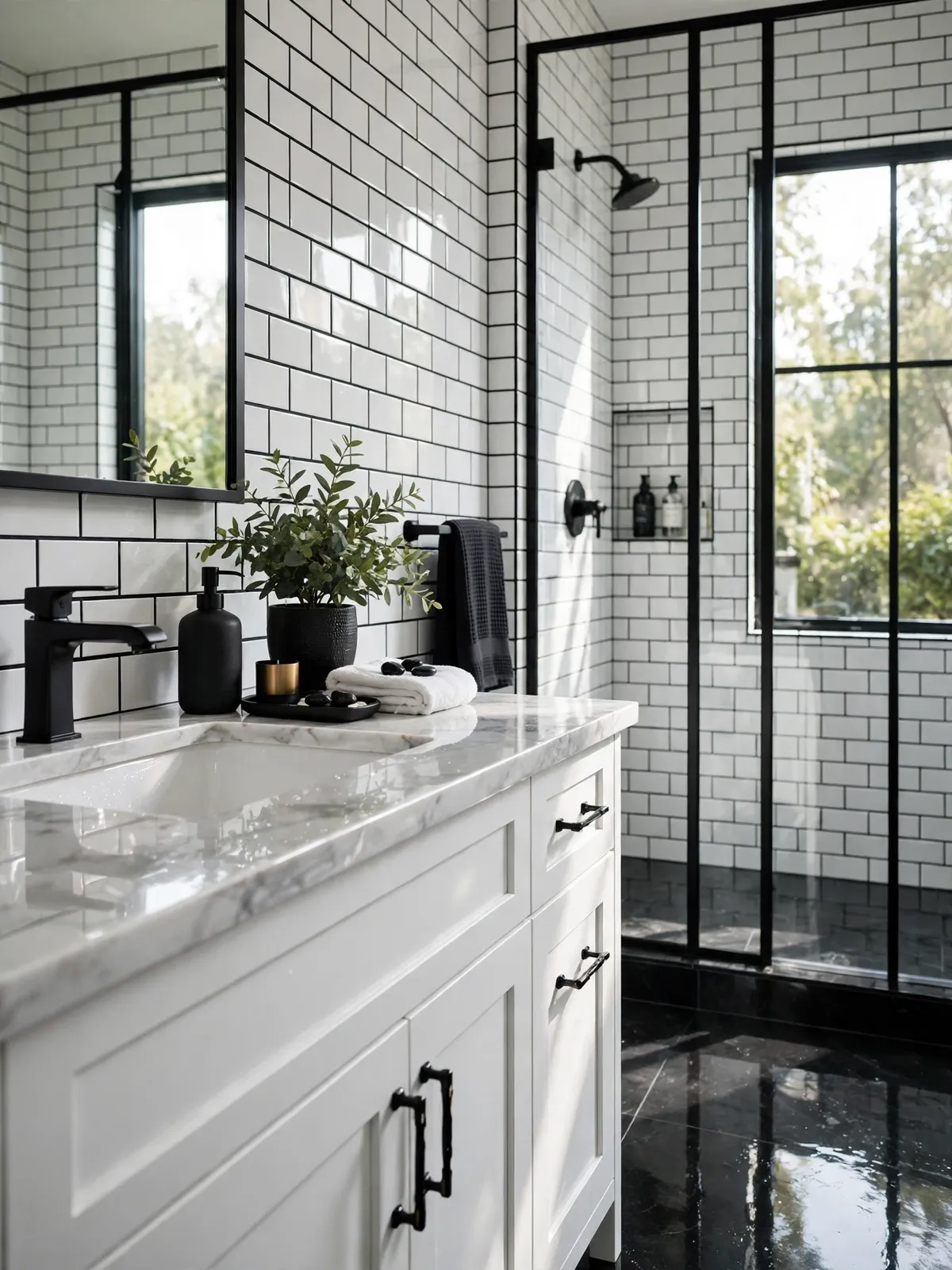
Black grout against light tiles is the cheapest dramatic change in bathroom tile design, because it draws the shape of every tile in bold lines and turns even the plainest subway tile into a graphic feature. Here, white subway walls with charcoal grout sit above charcoal floor tiles, with matte black fixtures and a white vanity keeping the contrast deliberate. The design suits modern and industrial bathrooms, it hides dirt and stains far better than white grout, and it costs nothing extra beyond the grout itself. The weakness is mess: dark grout can stain light tiles during installation, and a sloppy grout job shows twice as clearly.
Quick tips:
- Use black grout on walls first, where it stays cleaner.
- Seal dark grout so it keeps its colour.
- Match the grout to the darkest fixture finish.
- Keep the rest of the room plain so the grout pattern breathes.
Mosaic Tile Inlays That Work Like Jewellery
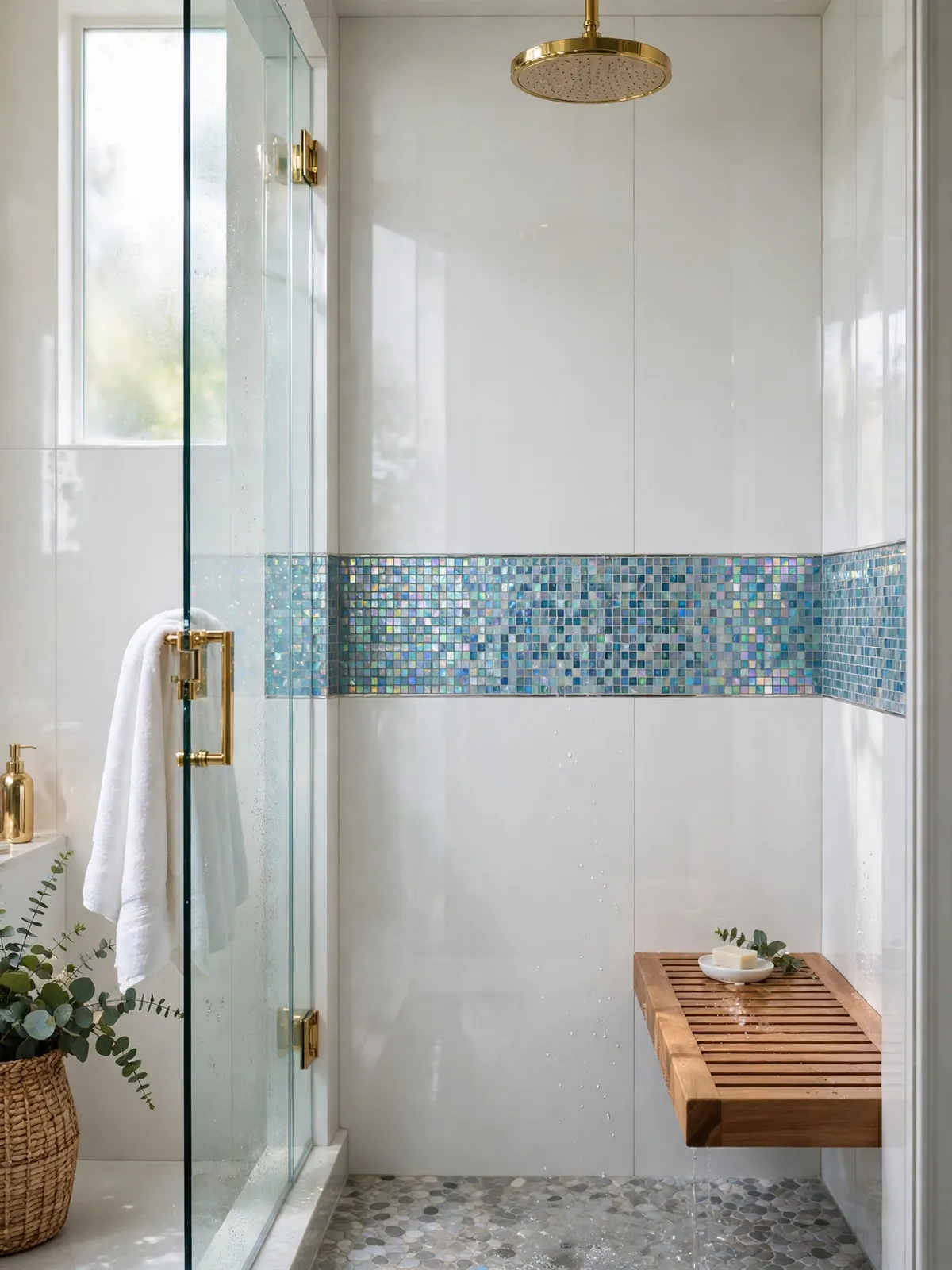
Mosaic tile inlays work like jewellery for a bathroom, because a narrow band of shimmering mosaic draws the eye exactly where you want it — a shower niche, a border, a strip behind the mirror — without covering the room in pattern. Here, an iridescent blue and pearl mosaic band runs through a white large-format shower, with a rain head and teak bench completing the spa feeling. The design suits bathrooms that are mostly plain, it adds colour and sparkle for very little money, and it is easy to change later. The weakness is grout: mosaic sheets have many joints, so keep the inlay small and seal the grout well.
Quick tips:
- Keep mosaic inlays to one band or one niche.
- Use mosaic where you want the eye to land, not everywhere.
- Seal mosaic grout twice, since it sees the most water.
- Match the mosaic’s lightest colour to the wall tile.
Iridescent Tiles Framing the Mirror for a Soft Glow
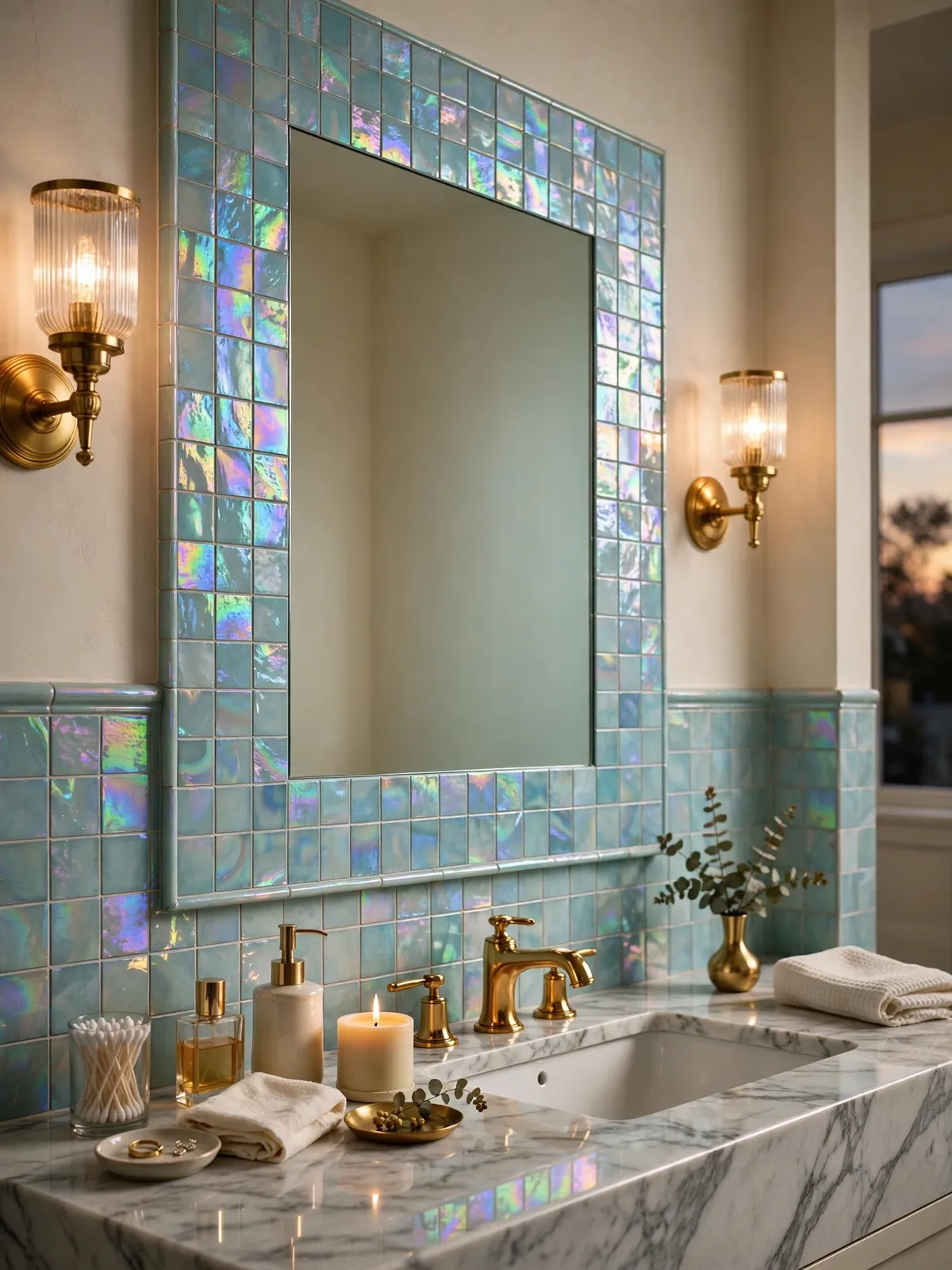
Iridescent tiles framing a mirror add glamour without a renovation, because the pearlescent surface catches the light and shifts colour as you move, making the mirror the glowing centre of the room. Here, aqua iridescent tiles frame a round mirror above a marble vanity, with gold sconces and cream walls keeping the rest of the room calm. The design suits bathrooms that feel plain, it photographs beautifully, and it is a small job with a large visual return. The weakness is taste: iridescent tile can look cheap if the tile quality is low, so choose a reputable brand and keep the area small.
Quick tips:
- Frame only the mirror, never a whole wall, with iridescent tile.
- Pair it with warm lighting so the shimmer reads as gold, not cold.
- Keep the vanity top plain marble or stone.
- Use a grout colour close to the tile’s lightest tone.
Natural Stone Tiles for Timeless, Organic Luxury
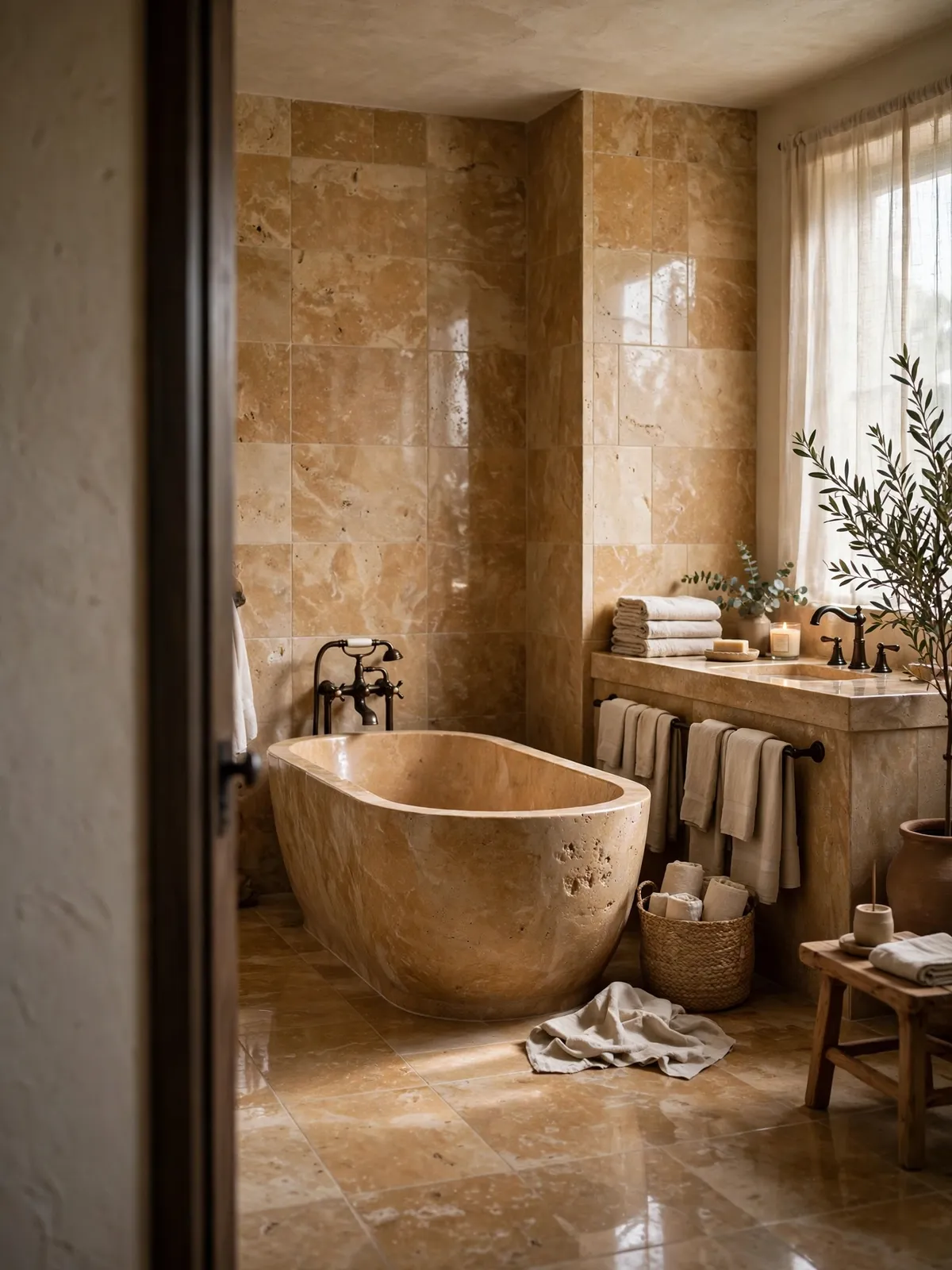
Natural stone tiles — marble, travertine or slate — give a bathroom a luxury that manufactured tile cannot copy, because every piece carries its own veining and colour variation, and the room feels like it was carved rather than built. Here, warm honey travertine covers the walls around a freestanding stone tub, with dark bronze fixtures and linen towels adding depth. The design suits bathrooms meant to last decades, it ages gracefully, and it adds real value to a home. The weakness is care: stone is porous, it stains, and it must be sealed regularly, so it suits people who will maintain it.
Quick tips:
- Seal natural stone before use and reseal every year.
- Choose honed stone over polished for floors, to avoid slipping.
- Keep acidic cleaners away from marble and travertine.
- Mix stone with wood to keep the room warm.
Two-Tone Tile Walls for Depth Without a Full Pattern
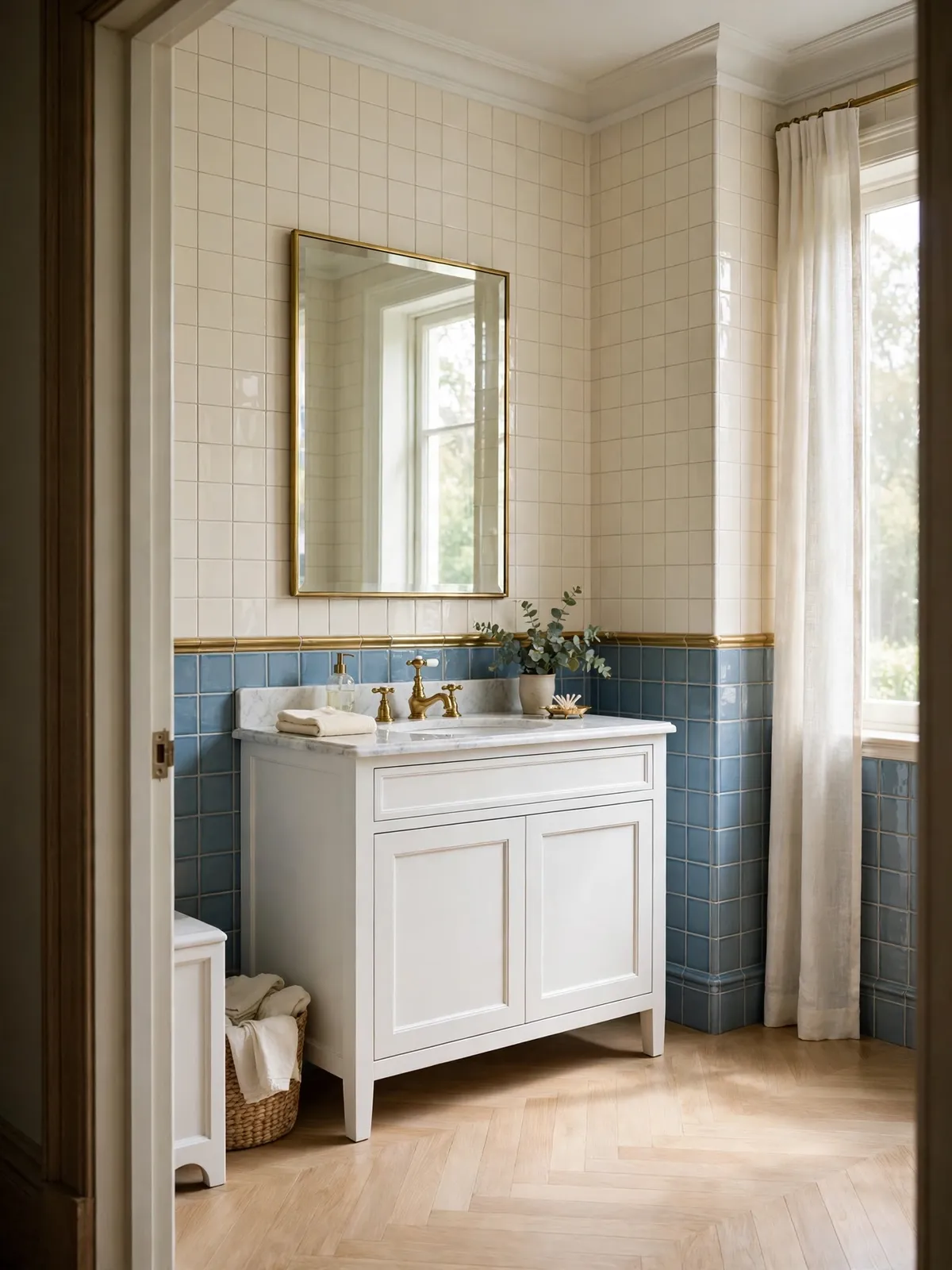
Two-tone tile walls add depth to a bathroom without committing to a pattern, because two colours — one darker below, one paler above — give the room a tailored, layered look that a single colour cannot. Here, dusty blue tiles cover the lower half of the walls with cream tiles above, a white vanity and brass taps tying the two tones together. The design suits bathrooms that feel one-note, it is budget-friendly, and it works with almost any colour pair. The weakness is the dividing line: a wobbly or badly finished horizontal break ruins the effect, so finish the join with a slim tile trim or a painted rail.
Quick tips:
- Put the darker colour on the lower half, the paler above.
- Finish the join with a tile trim or a slim metal strip.
- Repeat the darker colour once more, in a towel or the vanity.
- Keep the floor neutral so the two tones stay the focus.
Terrazzo Tiles That Hide Dirt and Add Retro Charm
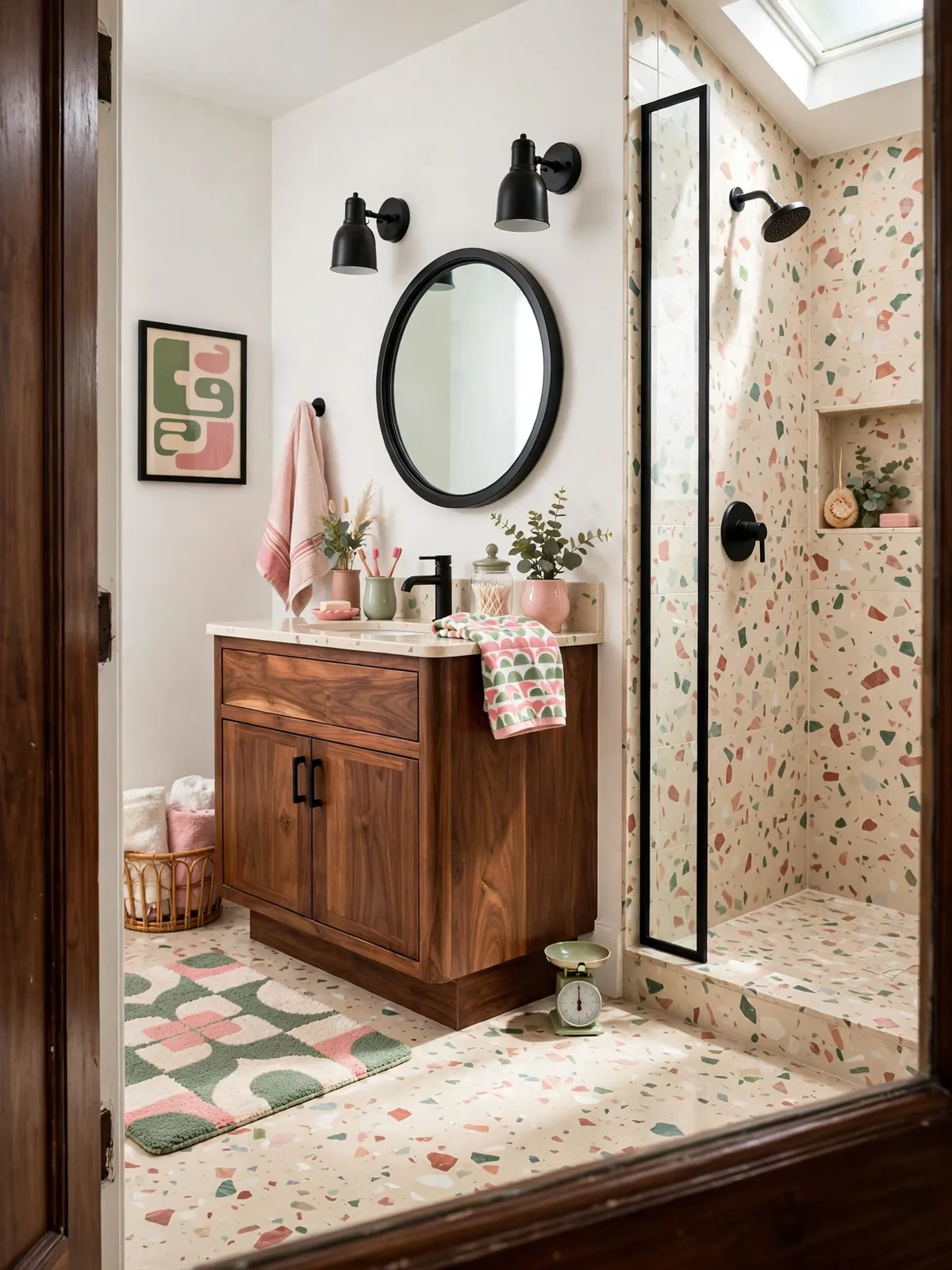
Terrazzo tiles bring retro charm and practical magic to a bathroom floor, because the speckled mix of coloured chips hides dirt, water spots and hair far better than any plain tile. Here, cream terrazzo with rose and sage chips covers the floor of a white bathroom, with a walnut vanity and matte black fixtures grounding the playful pattern. The design suits family bathrooms and anyone who hates cleaning, it works on floors, walls and splashbacks, and it feels both nostalgic and current. The weakness is pattern scale: large chips can overwhelm a tiny bathroom, so choose a fine chip for small rooms.
Quick tips:
- Choose fine chips for small bathrooms, larger chips for big rooms.
- Pair terrazzo with one plain colour pulled from the chips.
- Seal terrazzo floors so the chips keep their colour.
- Keep wall tiles plain so the floor carries the pattern.
Textured Neutral Tiles for Calm With Personality
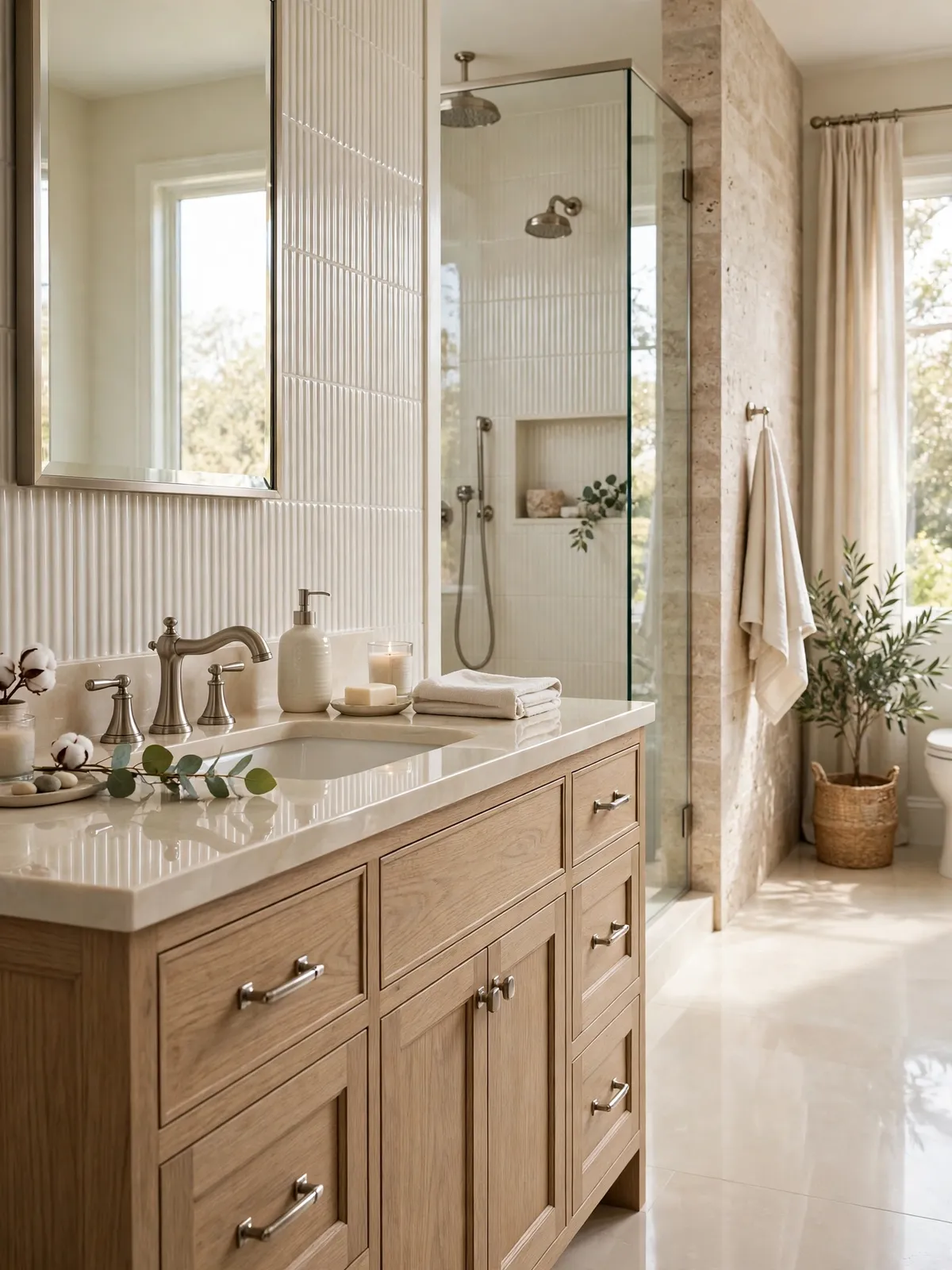
Textured neutral tiles prove that a calm bathroom does not have to be a boring one, because ridges, waves and relief patterns add shadow and touch to a palette that stays entirely neutral. Here, ridged ivory tiles cover the vanity wall while smooth cream tiles cover the floor, with a light oak vanity and brushed nickel taps keeping the room soft. The design suits people who love minimalism but want the room to feel intentional, it hides water marks better than flat gloss, and it never dates. The weakness is cleaning: deep ridges collect dust and soap, so choose a shallow relief near the shower.
Quick tips:
- Use texture on one wall only, not every surface.
- Choose shallow relief near wet areas for easy cleaning.
- Pair textured tiles with smooth ones in the same colour.
- Light the textured wall from the side so the shadows show.
Encaustic Tile Floors That Make the Floor the Star
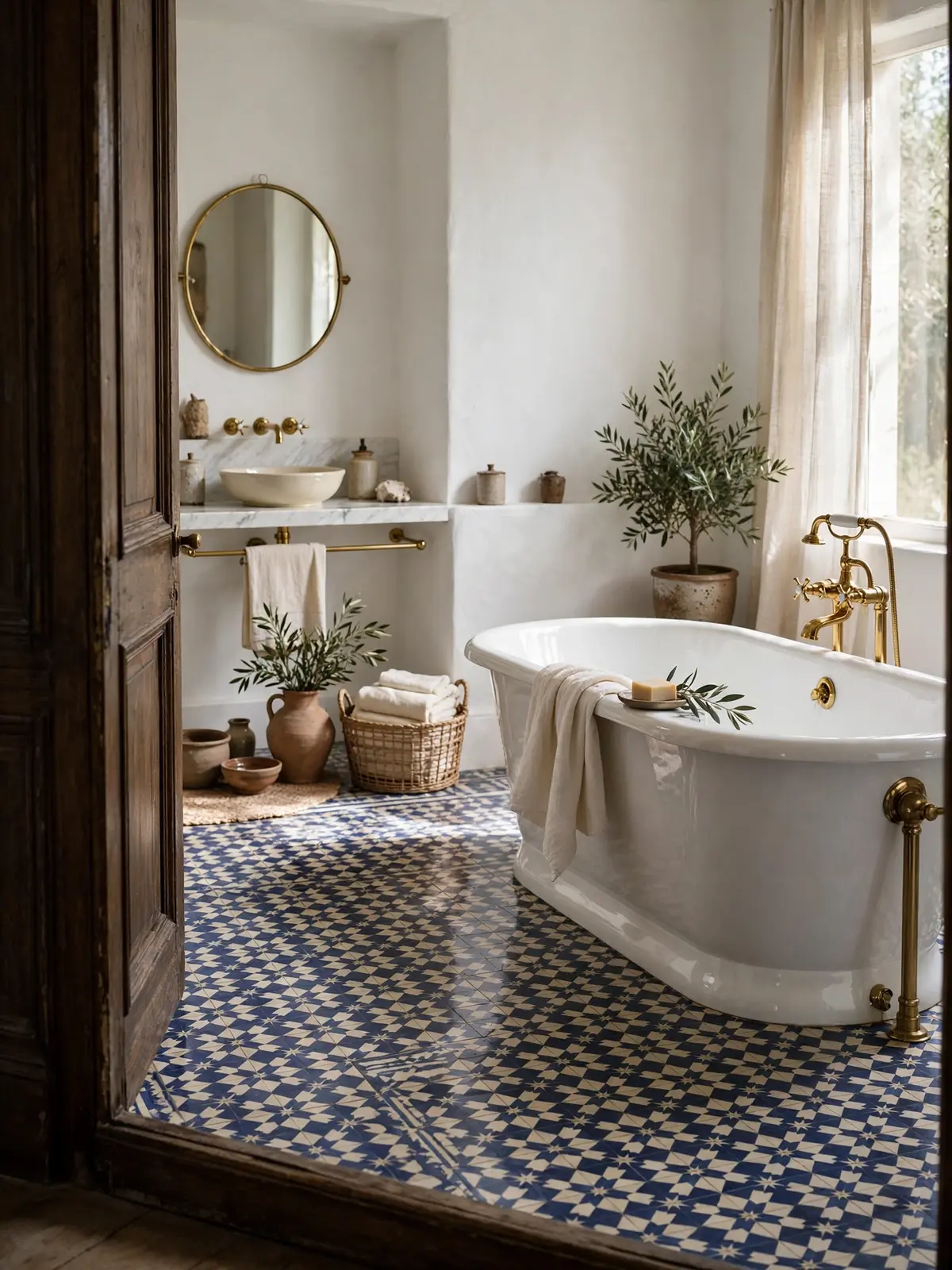
An encaustic tile floor turns the least-noticed surface in a bathroom into the star of the room, because the bold geometric or floral pattern gives the floor a personality that plain walls can simply frame. Here, an indigo and cream encaustic pattern covers the floor beneath a freestanding tub, with plain white walls and brass fixtures letting the floor speak. The design suits bathrooms with plain walls and simple fixtures, it is durable enough for wet areas, and it feels artisanal and handmade. The weakness is sealing: encaustic tiles are porous and must be sealed before and after grouting, or they stain.
Quick tips:
- Seal encaustic tiles before grouting and again after.
- Keep walls plain white or cream so the floor stays the star.
- Choose a pattern with one colour that matches the fixtures.
- Use a neutral grout so the pattern reads clearly.
Wood-Look Tiles That Warm a Bathroom Without Water Worries
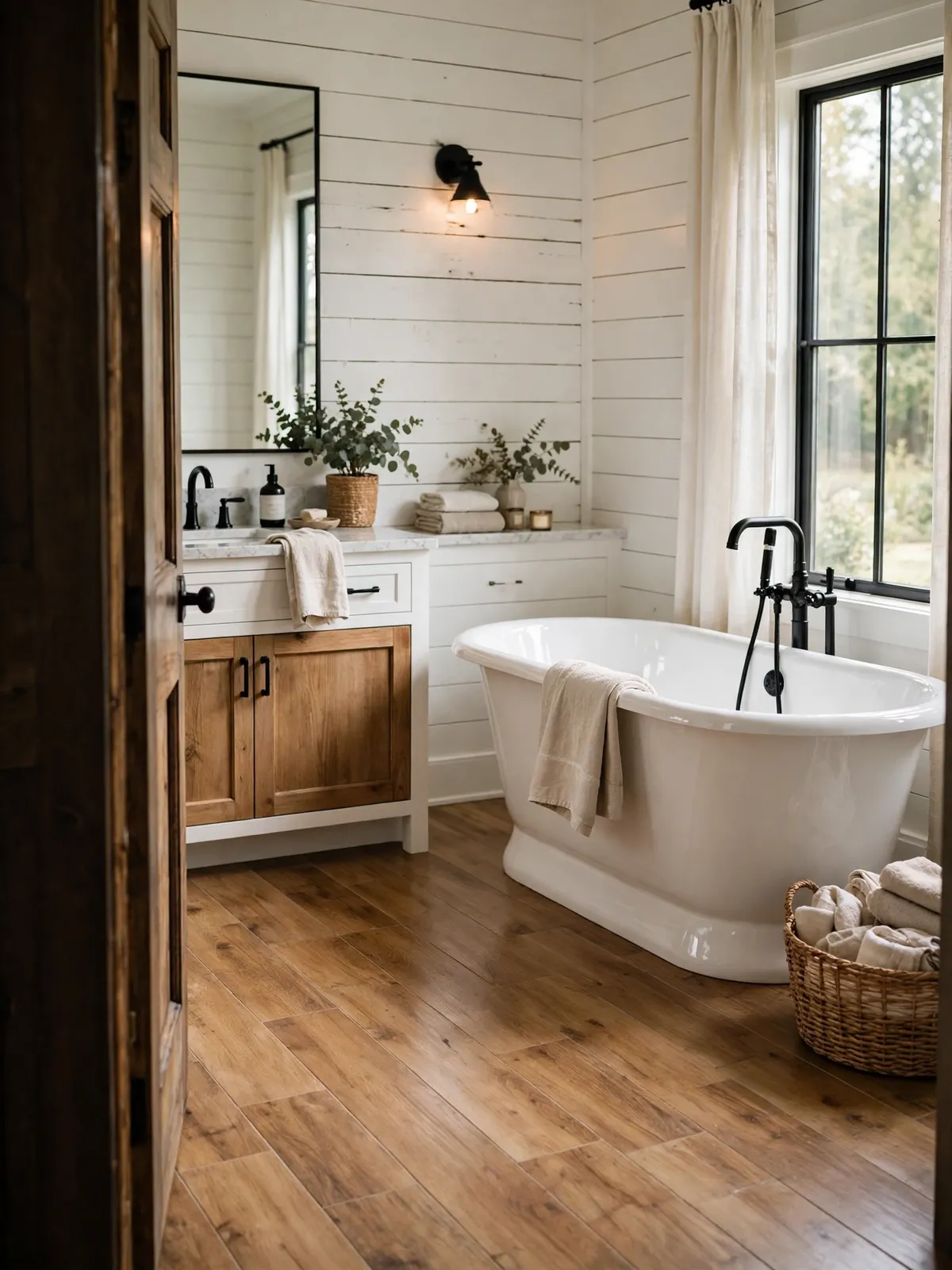
Wood-look tiles give a bathroom all the warmth of timber with none of the water worries, because porcelain planks look like oak or walnut but never swell, stain or rot in steam. Here, honey-oak wood-look planks cover the floor of a white bathroom, with a freestanding tub, black fixtures and a woven basket adding rustic layers. The design suits family bathrooms, wet rooms and anyone who loves wood but fears moisture, and it is as easy to clean as any porcelain floor. The weakness is realism: cheap wood-look tiles repeat the same grain pattern too obviously, so choose a range with many different plank designs.
Quick tips:
- Choose a range with at least six different plank patterns.
- Lay planks in a staggered pattern, like real wood flooring.
- Pair wood-look floors with white or cream walls.
- Use a matte finish so the planks read as wood, not tile.
Metallic Tile Highlights That Add Glamour in a Single Strip
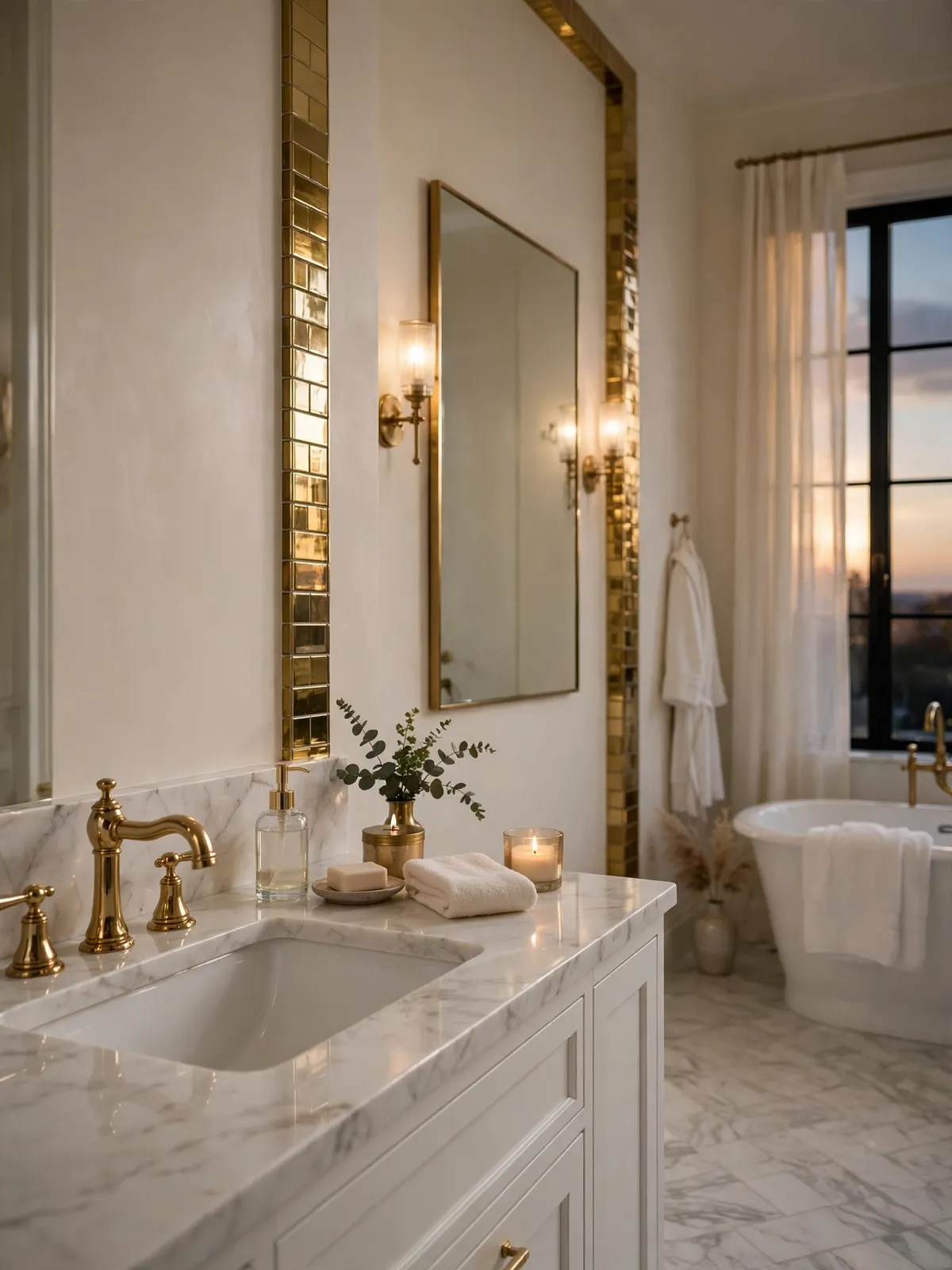
A single strip of metallic tile adds glamour to a bathroom the way jewellery adds glamour to an outfit — a little goes a long way, and the shine catches the light every time you move. Here, a gold metallic strip runs through cream wall tiles above a marble vanity, with brass taps echoing the gold. The design suits bathrooms that feel too plain, it costs very little because the area is tiny, and it works as a border, a splashback or a niche lining. The weakness is overuse: a whole wall of metallic tile looks gaudy and dates fast, so keep it to one strip.
Quick tips:
- Use metallic tile as a single horizontal strip, not a wall.
- Match the metal tone to the taps and mirror frame.
- Keep the surrounding tiles plain and pale.
- Choose a brushed or satin metal, not high-shine mirror.
Scallop Tiles That Add Movement and a Coastal Feel
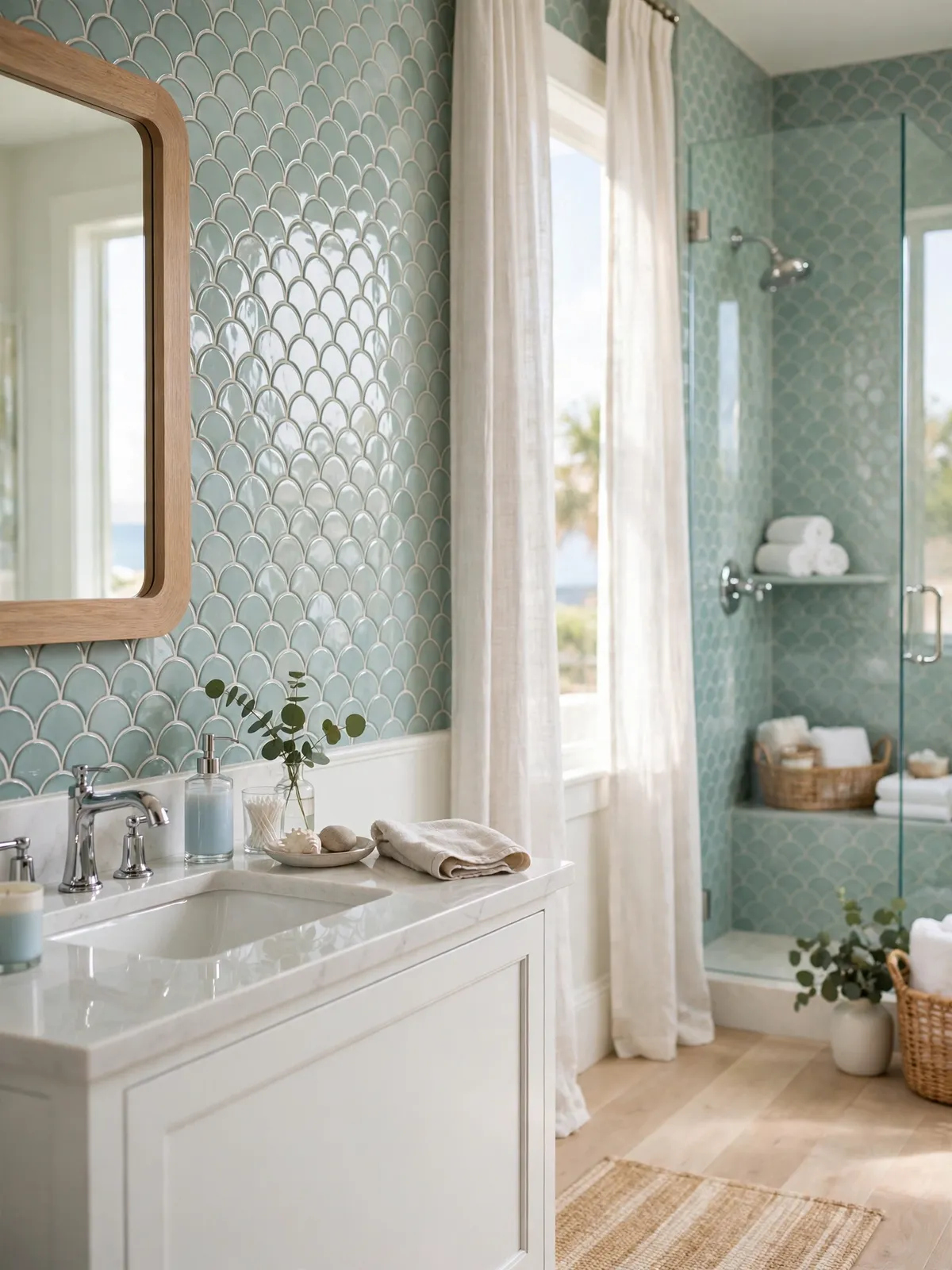
Scallop or fish-scale tiles add movement to a bathroom wall, because the curved, overlapping shape feels like water and gives the room a soft, coastal rhythm that square tiles cannot. Here, seafoam green scallops cover the shower wall, with a white vanity, light wood mirror frame and chrome fixtures keeping the room fresh. The design suits shower walls and splashbacks, it works in soft colours for calm and bold colours for drama, and it is one of the most photographed tile shapes for a reason. The weakness is grout and cutting: scallops have many curved joints, so they take longer to install and clean.
Quick tips:
- Use scallops on one wall or in the shower only.
- Choose soft colours for calm, bold colours for drama.
- Seal the grout well, since scallops have many joints.
- Pair scallops with plain large-format tiles elsewhere.
Navy or Deep Green Tiles for a Moody, Boutique-Hotel Feel
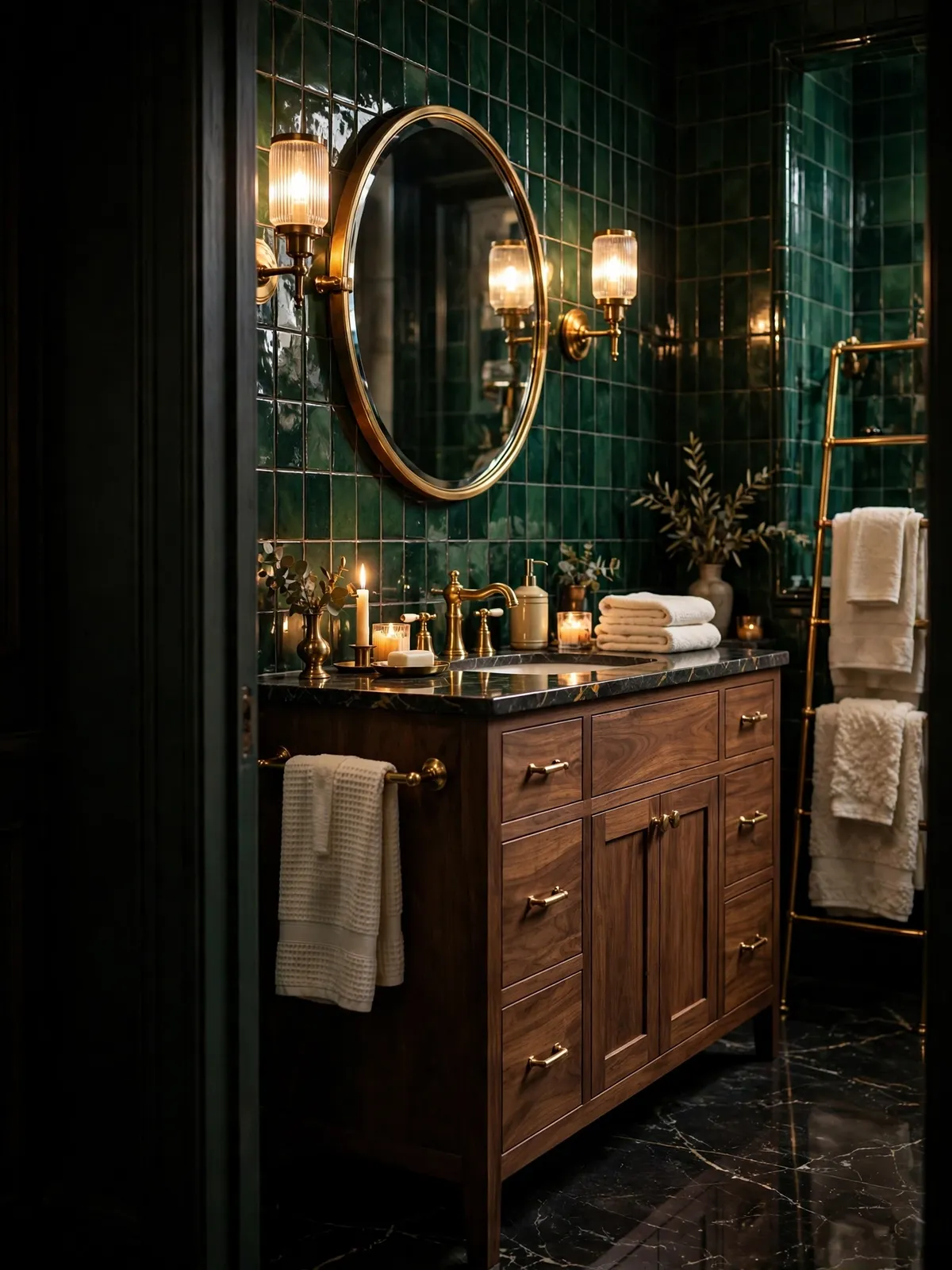
Deep navy or emerald tiles turn a bathroom into a moody, boutique-hotel retreat, because dark glazed tile reflects candlelight and lamplight in a way that pale tile never does. Here, emerald green tiles wrap the walls of a bathroom with a walnut vanity, brass fixtures and cream towels, and the room feels private and indulgent. The design suits larger bathrooms and evening bathers, it hides water marks better than white tile, and it makes a freestanding tub feel like a ritual. The weakness is light: a dark-tiled bathroom with a small window can feel gloomy in the morning, so balance it with a large mirror and warm bulbs.
Quick tips:
- Balance dark tiles with a large mirror and warm lighting.
- Keep the ceiling and towels pale to lift the room.
- Use brass or gold fixtures with dark tiles, not chrome.
- Test the tile in morning and evening light first.
Light-Coloured Tiles That Brighten Even a Windowless Bathroom
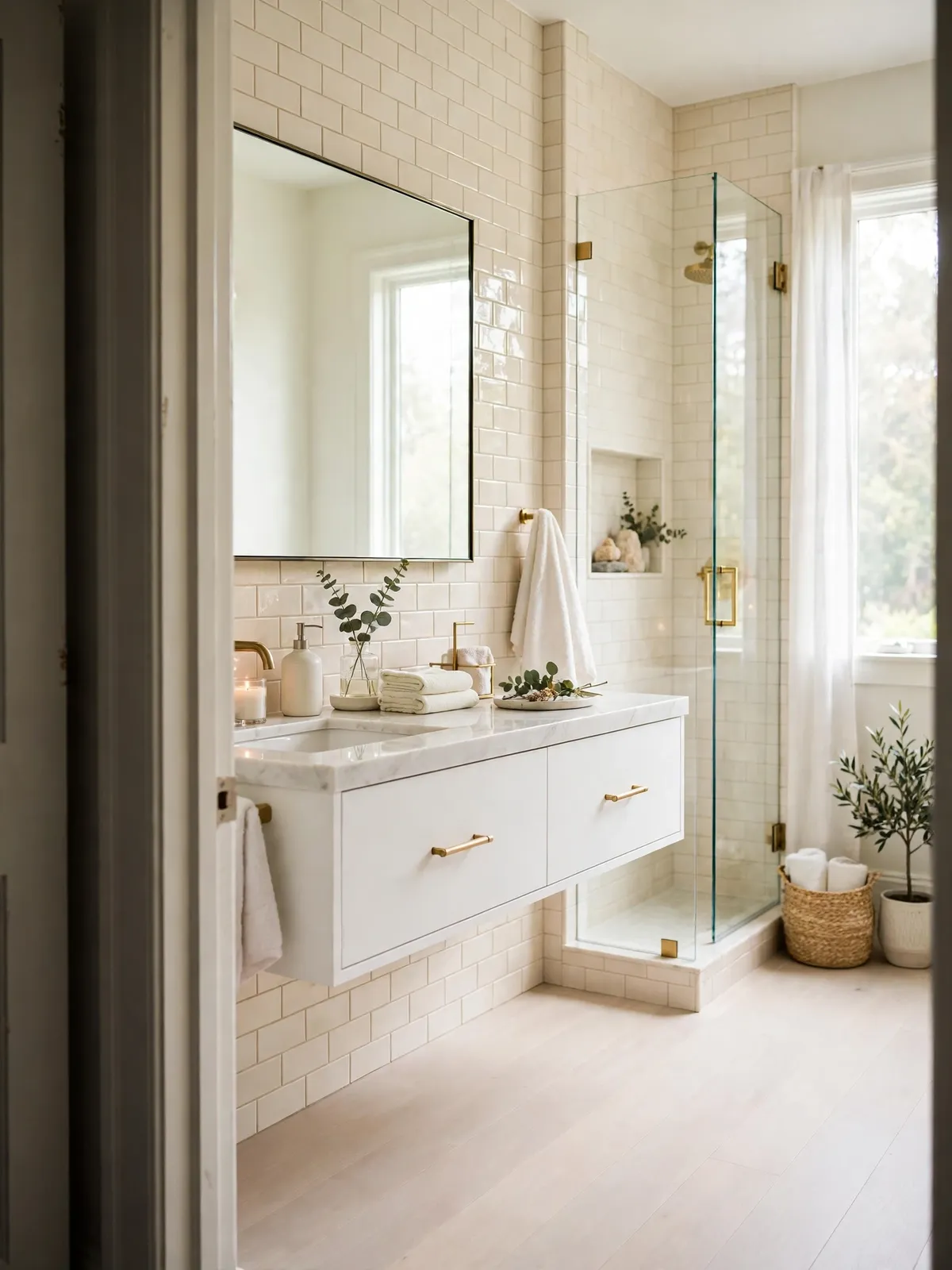
Light-coloured tiles are the most reliable way to brighten a bathroom, because soft white, cream and pale grey reflect whatever light exists and make even a windowless room feel fresh. Here, cream tiles cover the walls and floor of a compact bathroom, with a floating white vanity, a large mirror and a pale ash floor bouncing the light further. The design suits small, dark or windowless bathrooms best of all, it makes the room feel larger, and it pairs with any fixture finish. The weakness is grout: pale grout on a floor shows dirt quickly, so use a slightly darker grout on the floor than on the walls.
Quick tips:
- Use a slightly darker grout on floors than on walls.
- Pair light tiles with a large mirror to bounce light.
- Choose a warm cream over stark white for a softer feel.
- Keep the finish glossy on walls, matte on the floor.
One Colour Throughout for a Calm, Cohesive Retreat
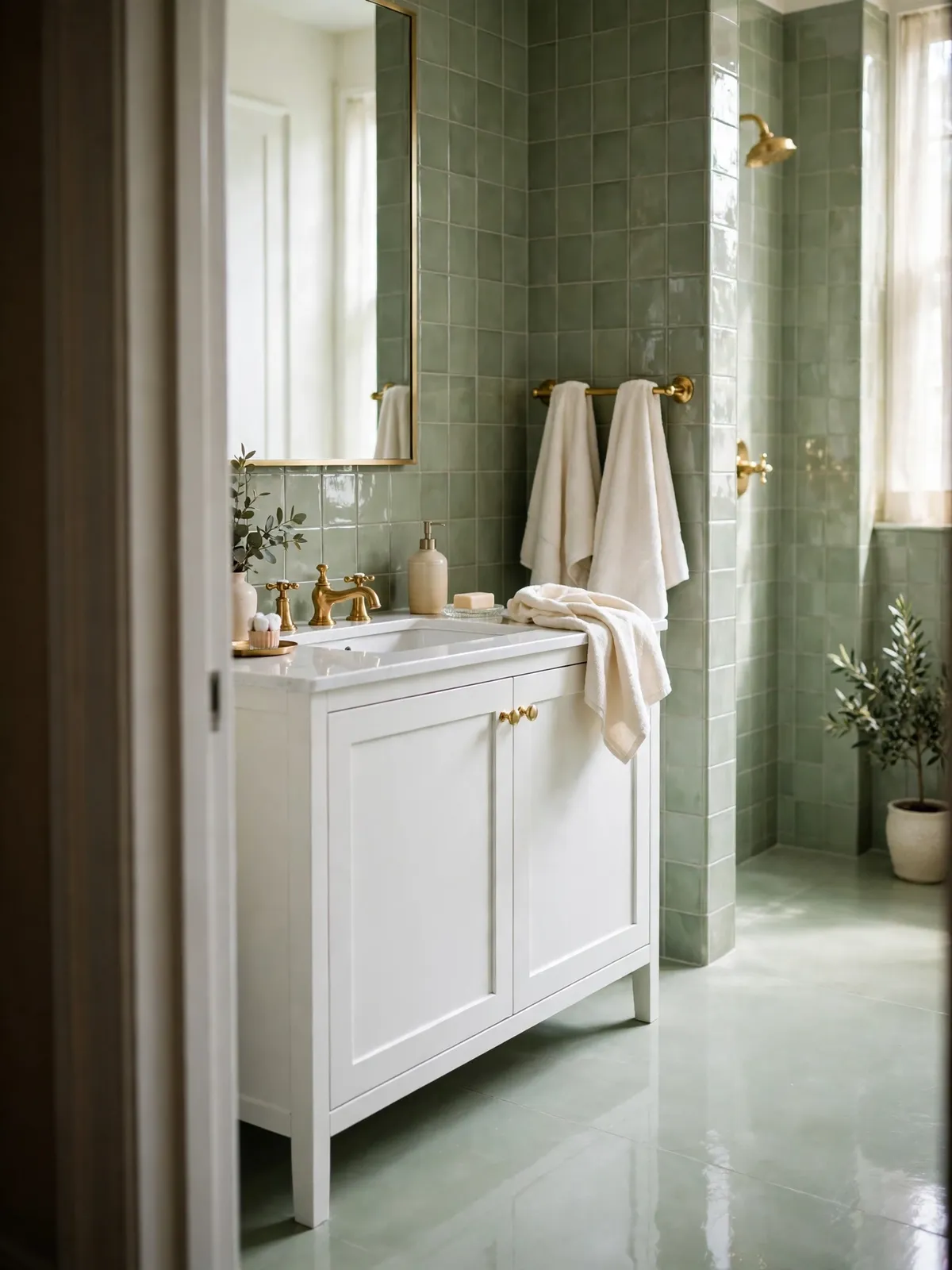
Using one tile colour throughout a bathroom creates a calm, cohesive retreat, because the eye moves across the room without interruption and the space feels larger and more intentional. Here, soft sage tiles cover the floor and walls, with a white vanity, brass taps and cream towels providing the only contrast. The design suits small bathrooms and anyone who finds patterned rooms tiring, it is easy to shop for, and it never clashes with itself. The weakness is flatness: a single colour in a single finish can look dull, so vary the tile size or finish between floor and walls.
Quick tips:
- Vary the tile size or finish between floor and walls.
- Add one contrasting element, such as brass taps or a wood vanity.
- Choose a soft, muted colour, not a saturated one.
- Keep towels and accessories in the same colour family.
Handmade Zellige Tiles That Catch the Light Like Jewellery
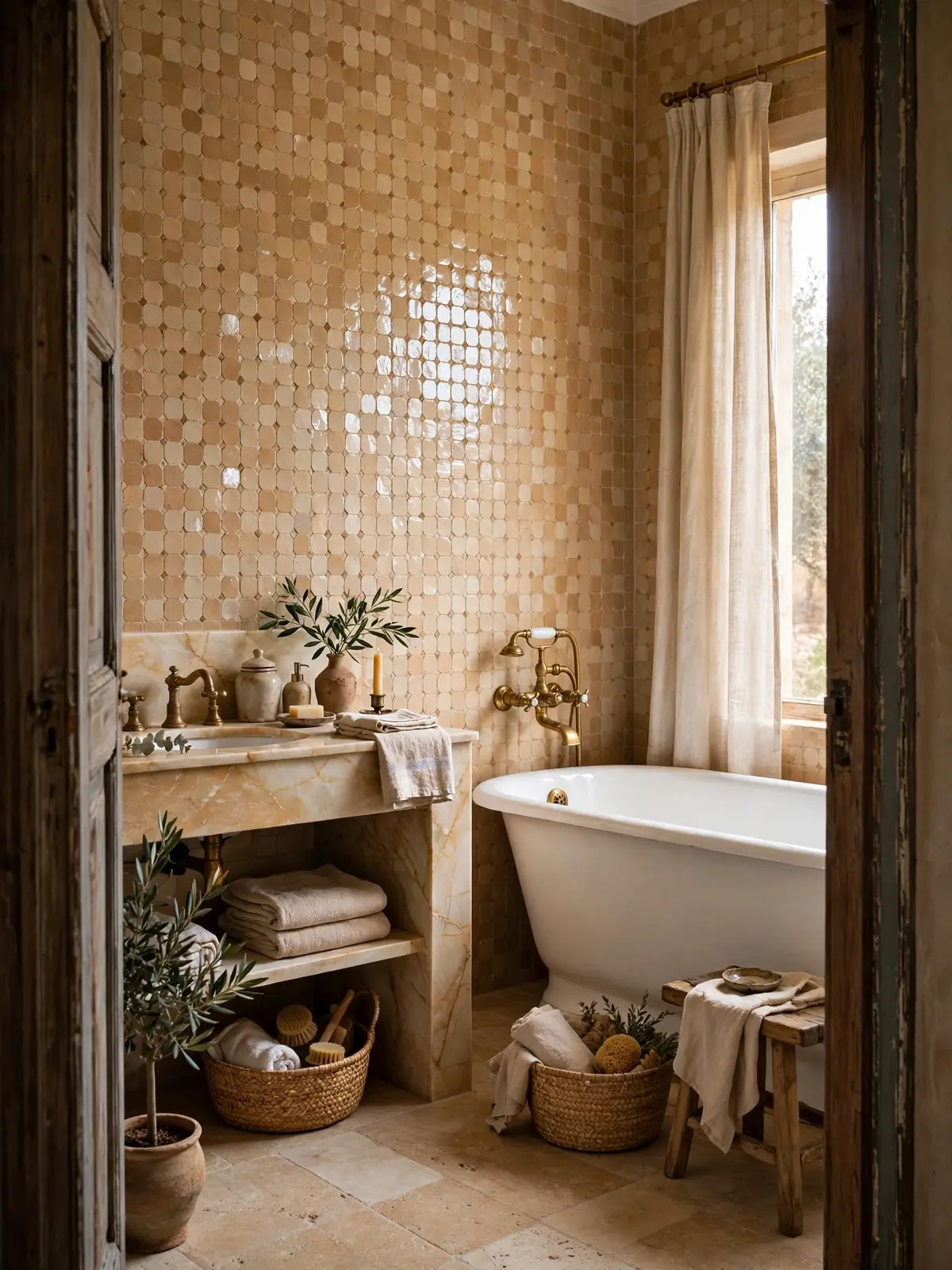
Handmade zellige tiles catch the light like no factory tile can, because each tile has a slightly uneven glaze, so the wall shimmers and shifts as the light changes through the day. Here, warm sand zellige covers the shower wall, with a white freestanding tub, aged brass fixtures and a linen curtain softening the room. The design suits bathrooms that need soul, it feels artisanal and one-of-a-kind, and it pairs beautifully with wood and brass. The weakness is variation: zellige tiles vary in colour and thickness from batch to batch, so order all your tiles at once and expect a handmade look.
Quick tips:
- Order all zellige tiles from one batch.
- Expect colour variation — it is the point of handmade tile.
- Use zellige on one wall, not the whole room, to control cost.
- Seal the grout, since handmade tiles have uneven joints.
Bathroom Tile Ideas That Pull the Whole Room Together
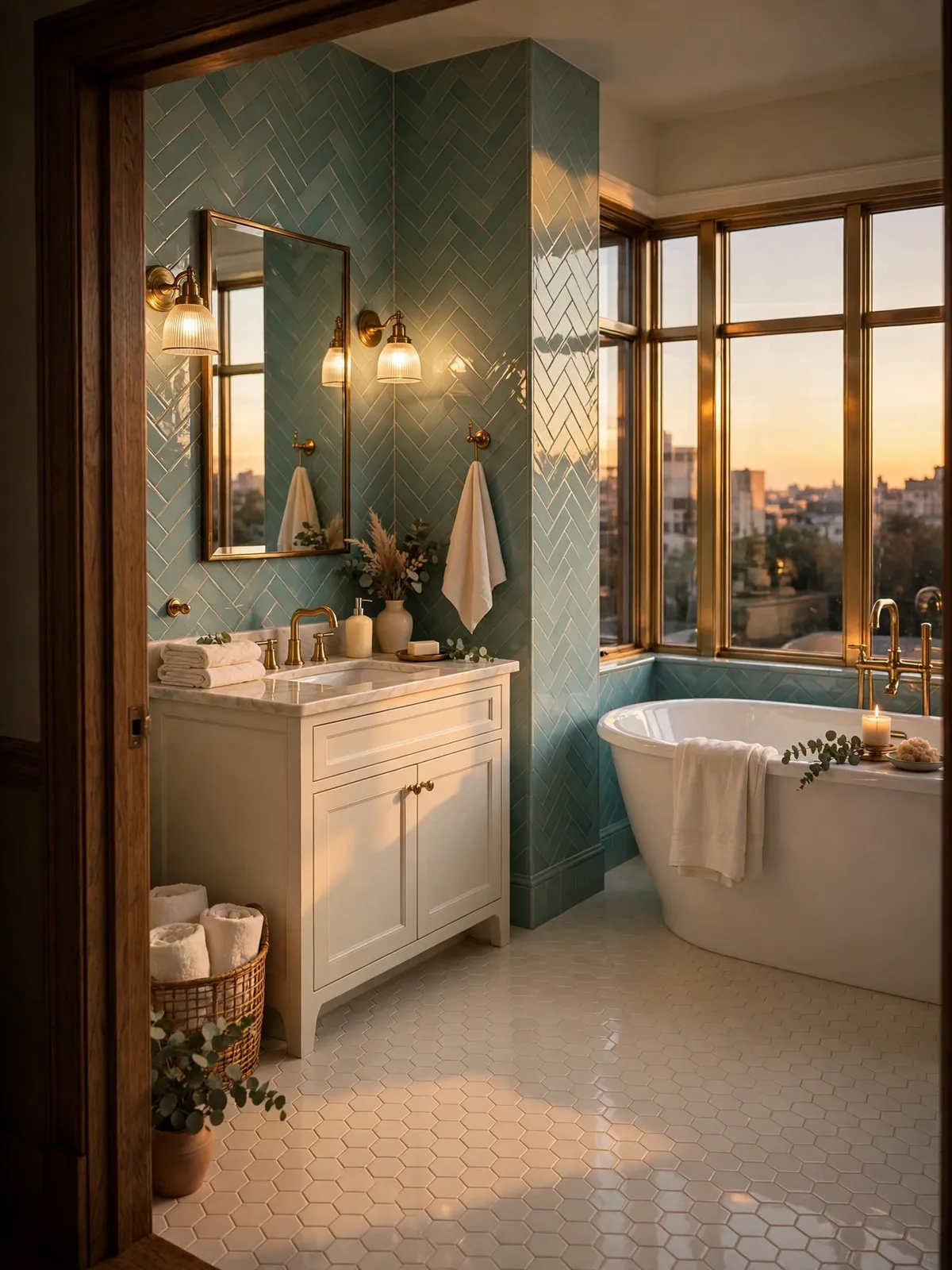
The last of these bathroom tile ideas is the principle behind them all, and it is worth stating plainly because it is the difference between a bathroom that looks good in a photograph and one that feels beautiful every day: great tile design is not one expensive feature, it is the combination of the right tile in the right place — a calm large-format floor underfoot, a patterned accent where the eye lands, a matte finish where you walk and a glossy one where you look — working together so that the floor, the walls, the grout and the fixtures all support each other instead of competing for attention, and the room rewards you every time you walk in rather than only on the day it was finished. Here, a soft teal and cream bathroom pulls it together — herringbone walls, a hexagon floor, brass fixtures and a freestanding tub — and nothing in the room is there by accident. The lesson is to choose the floor tile first, since it covers the most area and sets the maintenance, then pick one accent tile for the wall you face when you enter, match the grout to the mood you want, and let the fixtures follow, because a bathroom built in that order stays beautiful with very little effort, even in a small bathroom, even on a modest budget, and even when you change only one thing at a time. Measure your space, pick the two or three ideas from this list that fit it best, and the tiles stop being a surface you walk on and become the reason the whole room feels finished.
Quick tips:
- Choose the floor tile first — it sets the maintenance and the mood.
- Pick one accent tile for the wall you face when you enter.
- Match the grout to the look you want: seamless or graphic.
- Keep the finish matte underfoot and glossy where you look.
FAQs
What is the cheapest bathroom tile?
Glazed ceramic subway tile is usually the cheapest bathroom tile, and it looks far more expensive when it is laid well with a contrasting grout or a herringbone pattern. Large-format porcelain is also affordable per square metre and needs less grout. Save money by tiling one feature wall and painting the rest.
Can I tile over existing bathroom tile?
Yes, in many cases you can tile over existing tile if the old tiles are firmly fixed, flat and clean, and you use a suitable primer and adhesive. It saves demolition mess, but it raises the floor level and can cause problems around doors and fixtures, so check the height difference before you commit.
What size tile is best for a bathroom floor?
Large-format tiles (60 cm square or larger) suit most bathroom floors, because fewer grout lines make the room feel bigger and cleaning easier. In very small bathrooms, medium tiles around 30 cm work better, because large tiles need many cuts. Always choose a matte or textured finish on the floor for grip.
How do I stop bathroom tile grout going mouldy?
Use an epoxy grout in wet areas, seal cement grout after installation and once a year afterwards, and ventilate the room after every shower so the grout dries. Wipe the shower walls down after use, and fix any leaking sealant quickly, because standing water is what lets mould take hold.
Do I need to seal bathroom tile?
Porcelain and glazed ceramic tiles do not need sealing, but their grout does. Natural stone, terrazzo, encaustic and zellige tiles do need sealing, because they are porous and will stain without it. Seal before grouting where the maker recommends it, and reseal stone and terrazzo once a year.
Conclusion
Bathroom tile is the surface that carries the whole room, and the 23 ideas above show that you can get a beautiful result at almost any budget, whether you lay a herringbone feature wall and a hexagon floor, choose calm large-format porcelain, or simply swap the grout colour and add a mosaic inlay. Start with the floor tile, pick one accent for the wall you face when you enter, match the grout to the mood you want, and keep the finish matte underfoot and glossy where you look. Do that, and your bathroom stops being a room you rush through and becomes a space that feels designed, durable and quietly luxurious every single day.