24 Stunning Bathroom Aesthetic Ideas That Make Your Bathroom Feel Like a Luxury Spa
A bathroom aesthetic is not about buying the most expensive fixtures — it is about light, texture, colour and one or two beautiful focal points working together. These 24 bathroom aesthetic ideas show how to turn an ordinary bathroom into a calm, luxurious retreat, whether you are renovating fully or styling what you already have.
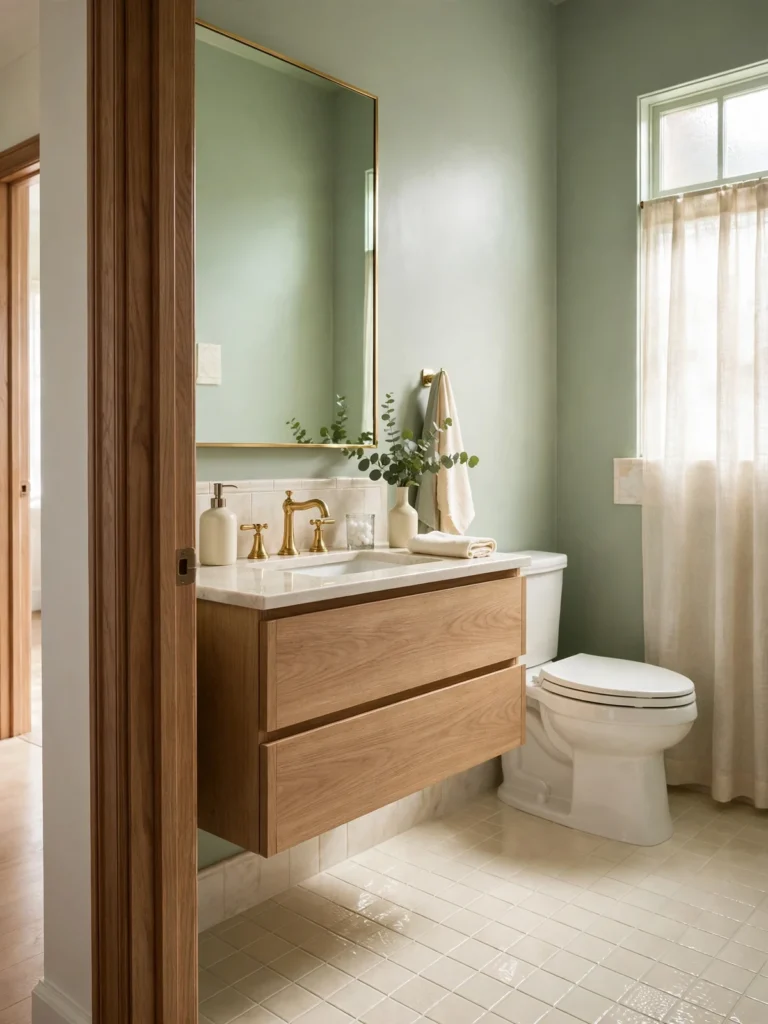
A bathroom aesthetic works when a bathroom feels intentional rather than assembled at random: a calm colour palette, one clear focal point such as a freestanding tub or a beautiful mirror, layered lighting instead of one harsh ceiling light, and natural textures like wood and stone make the room feel finished and calm. A bathroom aesthetic does not need a full renovation, because a backlit mirror, a new palette, a floating vanity or a rain shower can change the whole feeling of the room, and the best results come from choosing the mood first and then letting the fixtures, tiles and styling follow it.
If you want to push the spa feeling even further, these bathroom spa ideas show how to layer steam, scent, sound and soft textures into a full at-home spa experience. The 24 ideas below cover tubs, vanities, tiles, lighting, plants, storage, small bathrooms and styling, so you can pick the changes that fit your bathroom, your budget and the mood you want every single day.
Key Takeaways
What makes a bathroom aesthetic?
A bathroom aesthetic comes from intention: a calm palette of two or three colours, one clear focal point such as a freestanding tub or a beautiful mirror, layered warm lighting, natural textures like wood and stone, and surfaces kept mostly clear. The room should feel calm and finished, not filled with random decoration.
How can I get a bathroom aesthetic on a budget?
Start with the changes that cost least and show most: repaint in a warm or moody shade, swap the mirror for a backlit or arched one, roll towels into a basket, add a humidity-loving plant, and change the bulbs to warm white. Paint, lighting, styling and one statement piece beat a dozen small decorations.
What colours work best for a bathroom aesthetic?
Soft neutrals, warm whites, sage green, dusty blue and warm grey suit most bathrooms and never date quickly. Deep forest green, navy, charcoal and plum create a moody, cocooning feel in larger bathrooms or on a single accent wall. Keep the palette to three main colours so the room reads as calm rather than busy.
Does a bathroom aesthetic work in a small bathroom?
Yes, and small bathrooms benefit most from it, because every choice shows. Use large-format tiles to reduce grout lines, a floating vanity to show more floor, a large mirror to bounce light, and one statement fixture instead of several small ones. Pale colours and clear surfaces make a small bathroom feel larger, not smaller.
How do I keep a bathroom aesthetic looking good every day?
Build the look around habits, not just purchases. Give every toiletry a home inside a niche or cabinet, keep the counter to three or four beautiful items, wipe the mirror and taps after use, and refresh towels and plants weekly. A bathroom aesthetic stays beautiful when the storage is as considered as the styling.
| Palette | Mood it creates | Best for | Cost level |
|---|---|---|---|
| Warm white, sage and light oak | Calm, fresh and airy | Small bathrooms and rentals | Low — paint, mirror and styling |
| Cream, terracotta and bronze | Warm, earthy and welcoming | Family bathrooms and warm light | Low to medium — paint and vanity |
| Pale grey, white and chrome | Clean, minimal and bright | Small bathrooms and modern homes | Medium — large-format tiles |
| Forest green, blush and brass | Bold, elegant and dramatic | Larger bathrooms and feature walls | Medium — one tiled accent wall |
| Deep plum, rosewood and champagne brass | Moody, intimate and cocooning | Evening baths and larger rooms | Medium to high — paint and fixtures |
| Slate, teak and nickel | Spa-like, grounded and indulgent | Walk-in showers and wet rooms | High — rain shower and bench |
A Freestanding Oval Tub as the Room’s Centrepiece
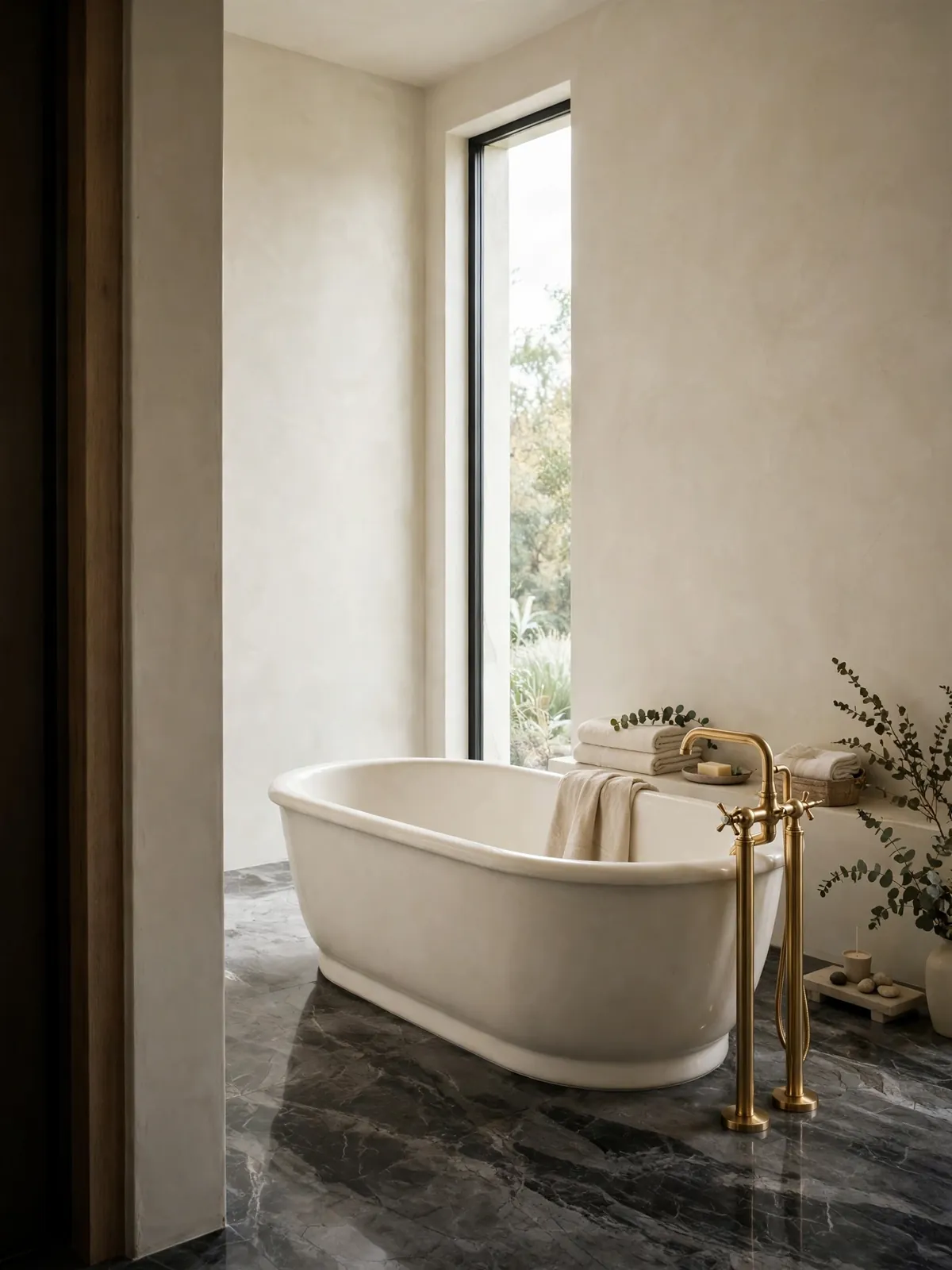
A freestanding oval tub as the room’s centrepiece is the single most powerful bathroom aesthetic idea, because the tub stops being a fixture and becomes sculpture. Here, an ivory oval tub sits on a charcoal marble floor with a brushed gold floor-mounted tap, and everything else — the cream walls, the minimal vanity, the single plant — is arranged to frame it rather than compete with it. The design suits bathrooms with enough floor space for the tub to breathe, it makes the whole room feel like a boutique hotel, and it photographs beautifully from every angle. The weakness is practical: a freestanding tub needs floor space, a floor-mounted tap costs more than a wall tap, and cleaning around the base takes longer than cleaning a built-in bath.
Quick tips:
- Give the tub at least 30 cm of clear space on every side.
- Choose a floor-mounted tap in a finish that matches the other fixtures.
- Keep the wall behind the tub plain so the tub stays the star.
- Add a small stool beside the tub for a book, a candle or a towel.
A Backlit Round Mirror That Flatters and Glows
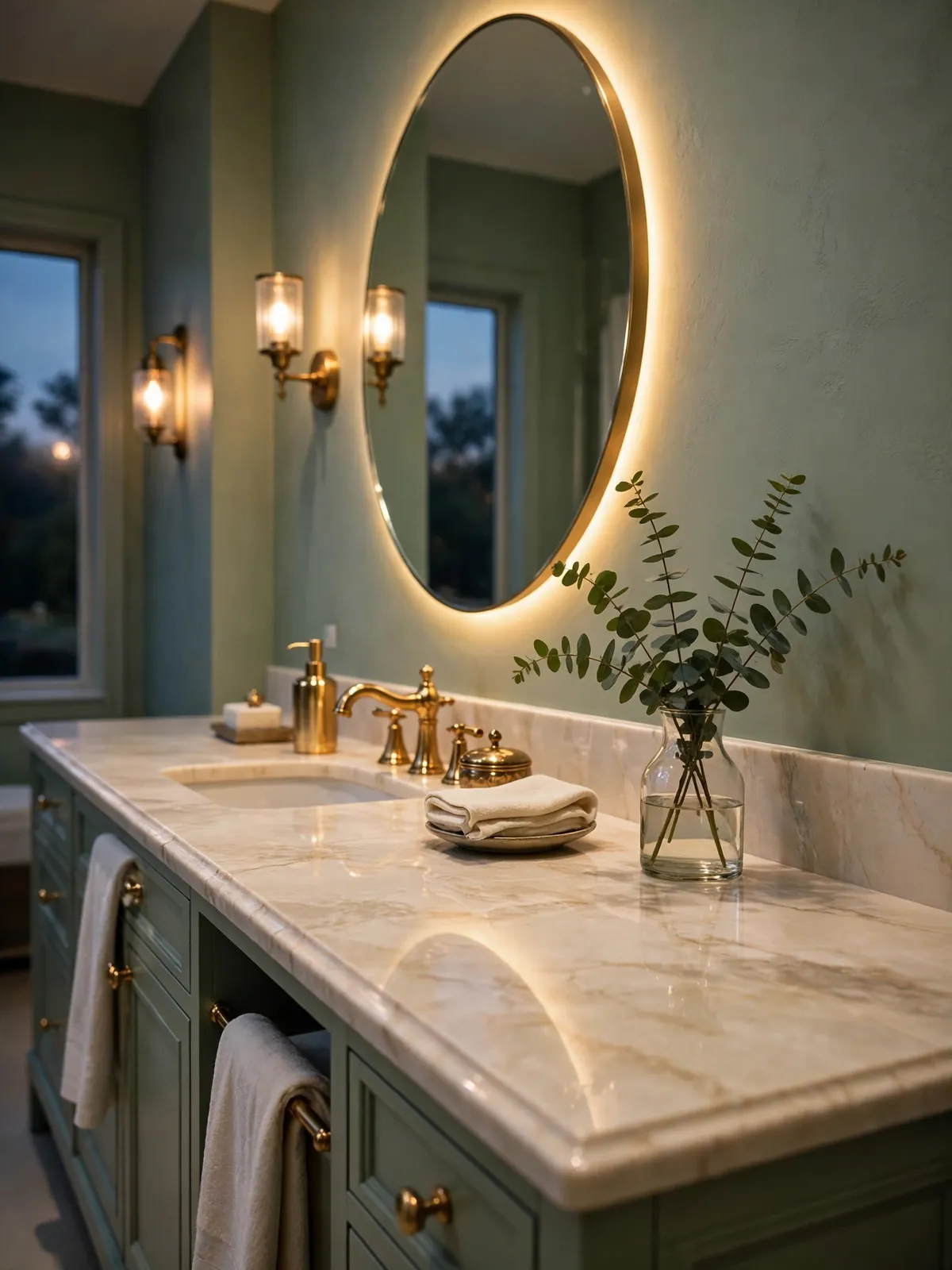
A backlit round mirror that flatters and glows changes a bathroom more than almost any other single swap, because it replaces harsh overhead light with a soft halo that makes both the room and the person in the mirror look better. Here, a round backlit mirror floats above a cream stone countertop against sage-green walls, with slim brass sconces on either side and a single eucalyptus sprig in a glass vase. The design suits every bathroom size, it makes morning routines feel calmer, and it doubles as evening mood lighting when the ceiling light stays off. The weakness is wiring: a backlit mirror needs a power point behind it, and a cheap mirror with a cold, blue-toned glow looks clinical rather than warm.
Quick tips:
- Choose warm white light (around 2700K) for a flattering glow.
- Pick a mirror slightly narrower than the vanity below it.
- Pair it with dimmable sconces for evening mood lighting.
- Keep the countertop clear so the mirror’s glow stays the focus.
A Floating Vanity in Warm Oak
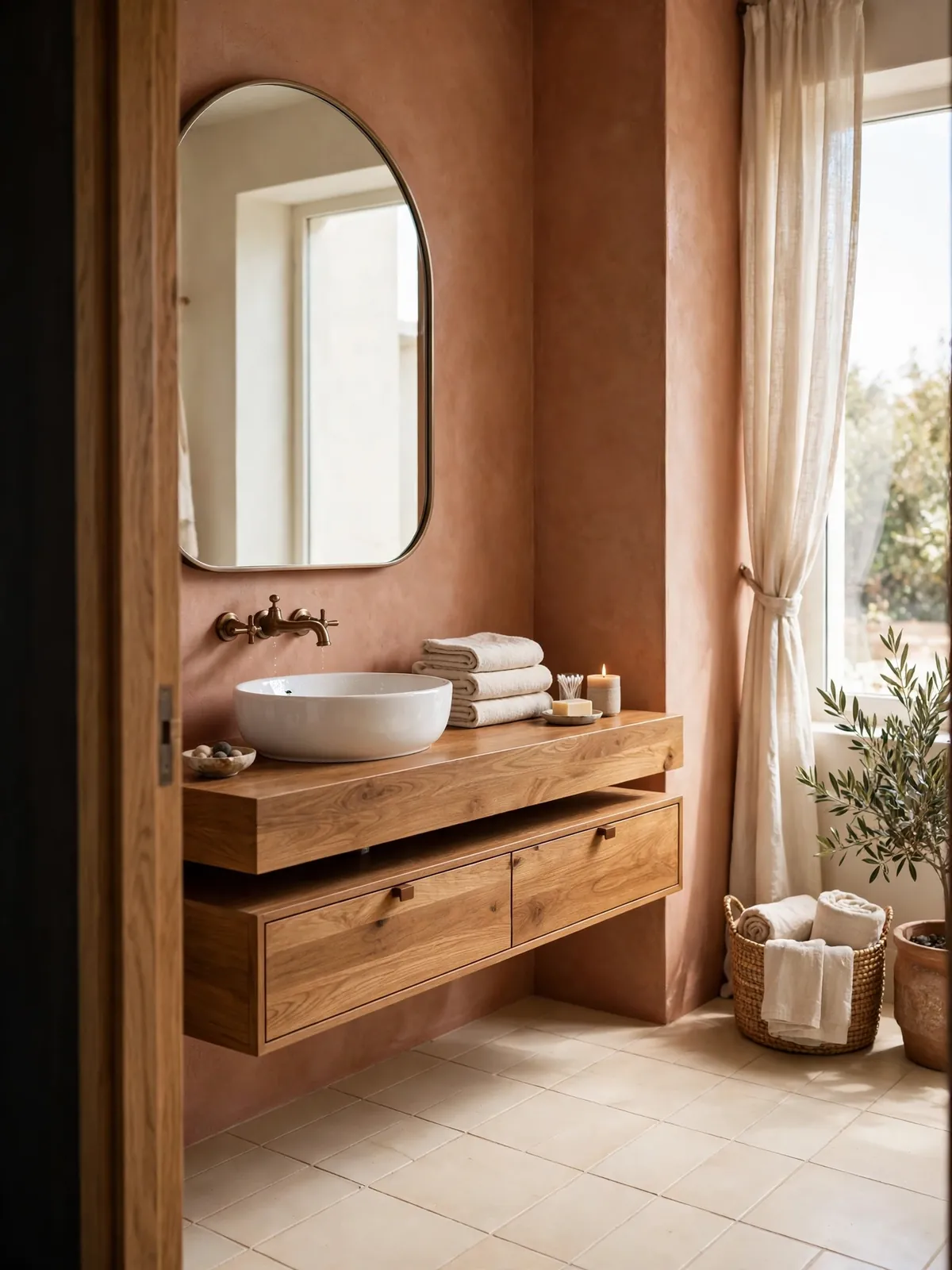
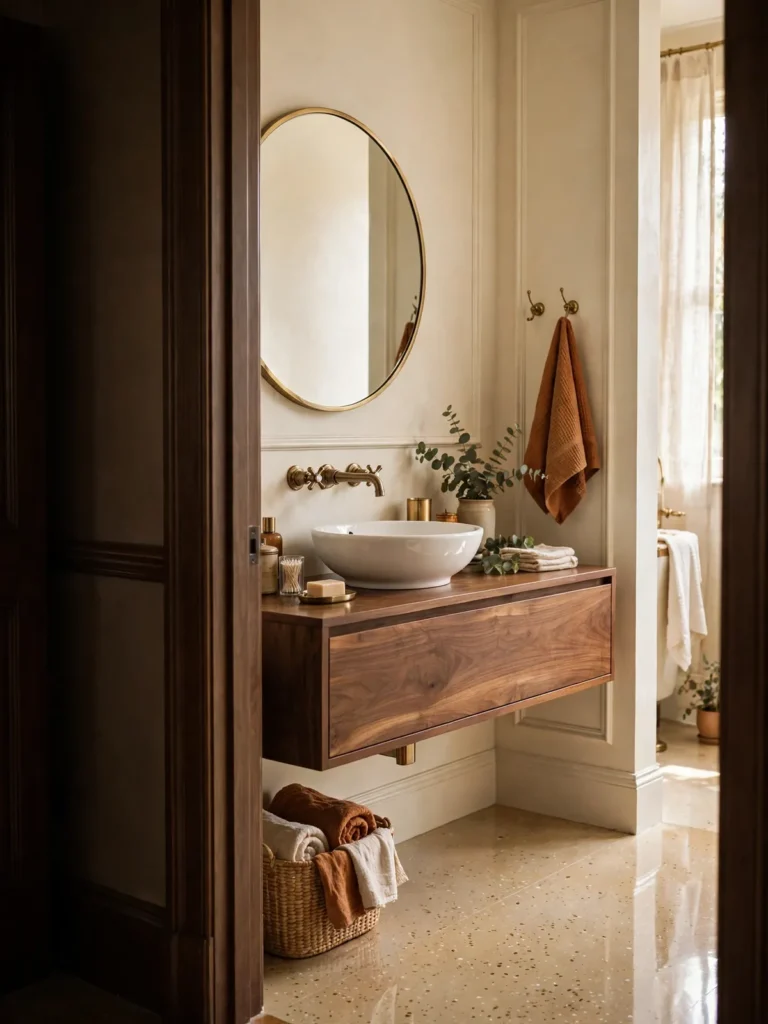
A floating vanity in warm oak gives a bathroom instant lightness, because lifting the cabinet off the floor shows more tile, makes the room feel larger, and turns the vanity into a piece of furniture rather than a box. Here, a warm oak floating unit with a white vessel sink sits against terracotta plaster walls, with brushed bronze taps and a stack of folded linen towels underneath. The design suits small and medium bathrooms especially well, it makes cleaning the floor easier, and the wood grain adds warmth that cold white bathrooms often lack. The weakness is storage: a floating vanity holds less than a floor-standing unit, and the wall behind it must be strong enough to carry the weight.
Quick tips:
- Check the wall can carry a floating unit before ordering.
- Choose a vessel sink to add height and sculptural shape.
- Store daily items inside and keep the top nearly clear.
- Match the wood tone to the mirror frame for a finished look.
Large-Format Tiles With Barely-Visible Grout
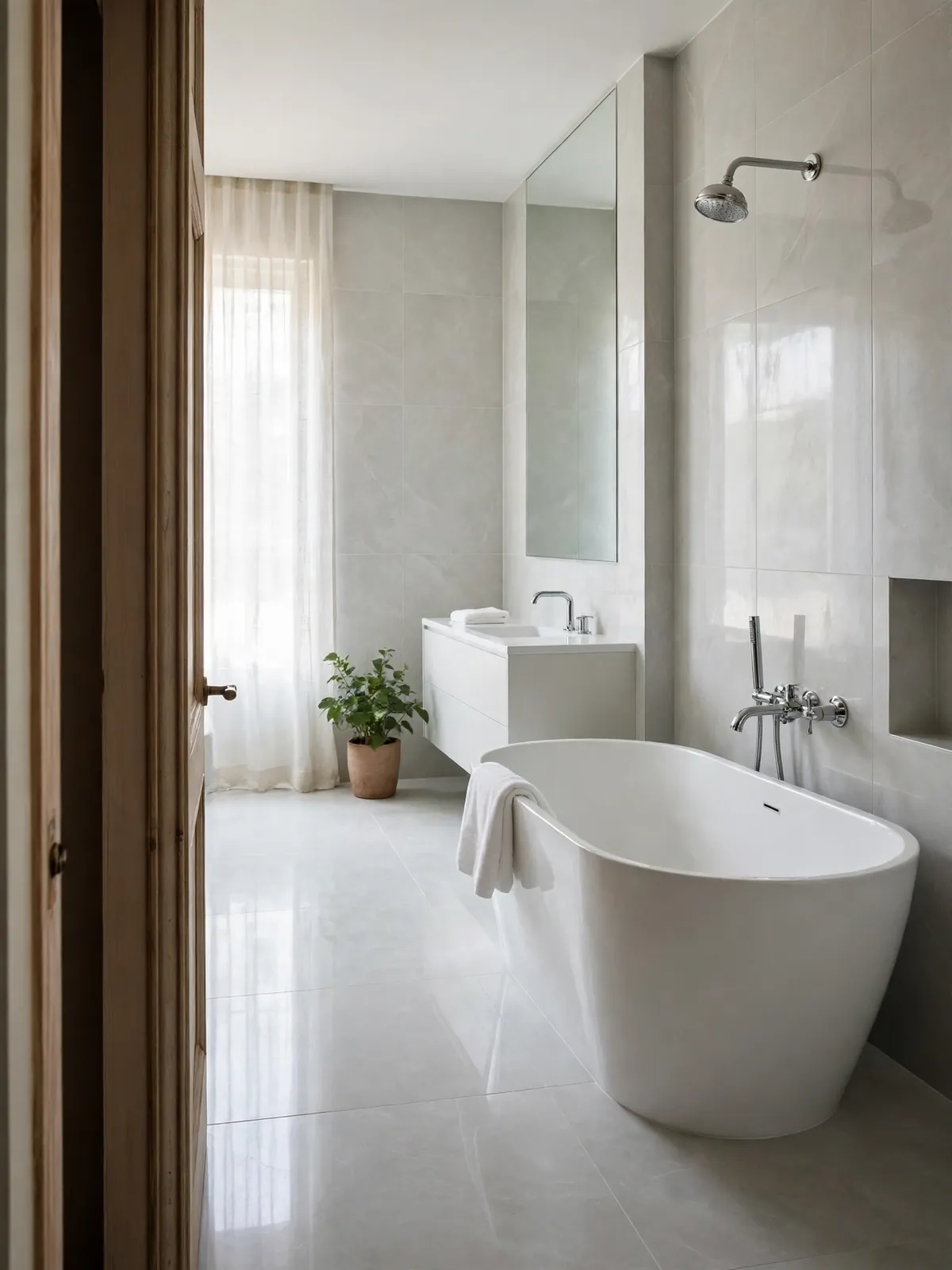
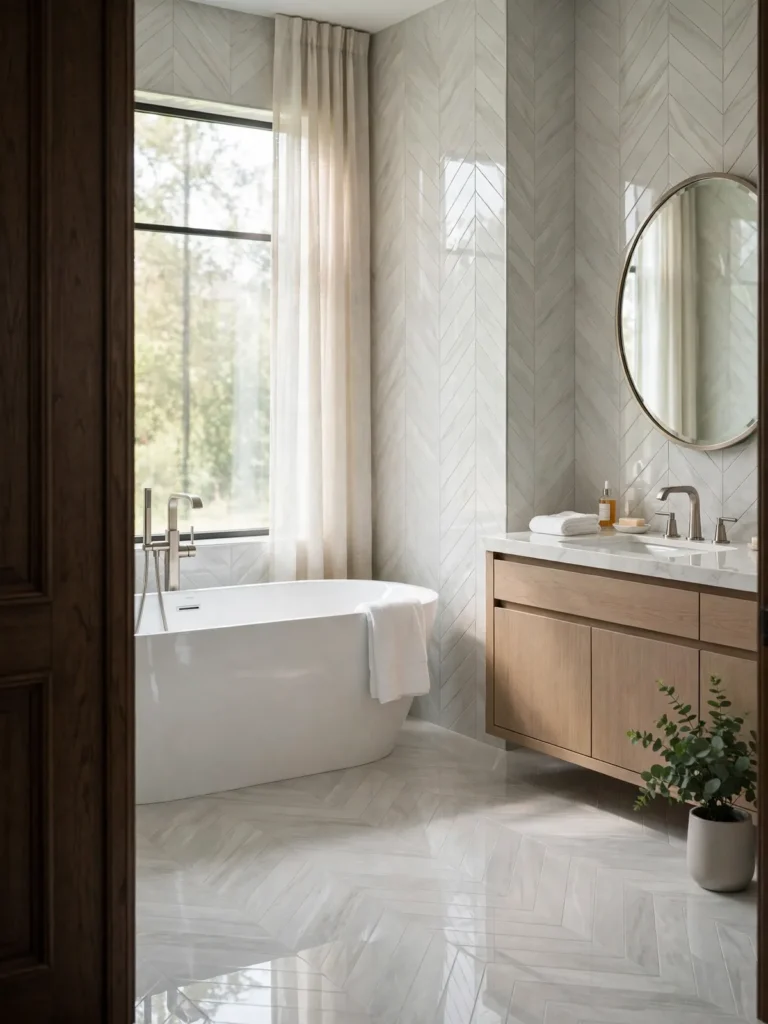
Large-format tiles with barely-visible grout are the quiet foundation of a bathroom aesthetic, because fewer grout lines mean fewer visual breaks, and the walls read as one calm, continuous surface instead of a grid. Here, large pale grey tiles run from floor to ceiling, with a white freestanding tub and chrome fixtures standing out against them and a single green plant adding the only colour. The design suits small bathrooms most of all, because it makes the space feel wider, and it is easier to clean than small mosaic tiles with their many grout joints. The weakness is installation: large tiles need a perfectly flat wall and a skilled tiler, and they cost more per tile than standard sizes.
Quick tips:
- Match the grout colour to the tile so joints disappear.
- Use the same tile on floor and walls for a seamless look.
- Hire a tiler experienced with large-format tiles.
- Keep the tile matte in wet areas to avoid slipping.
A Statement Accent Wall Behind the Tub
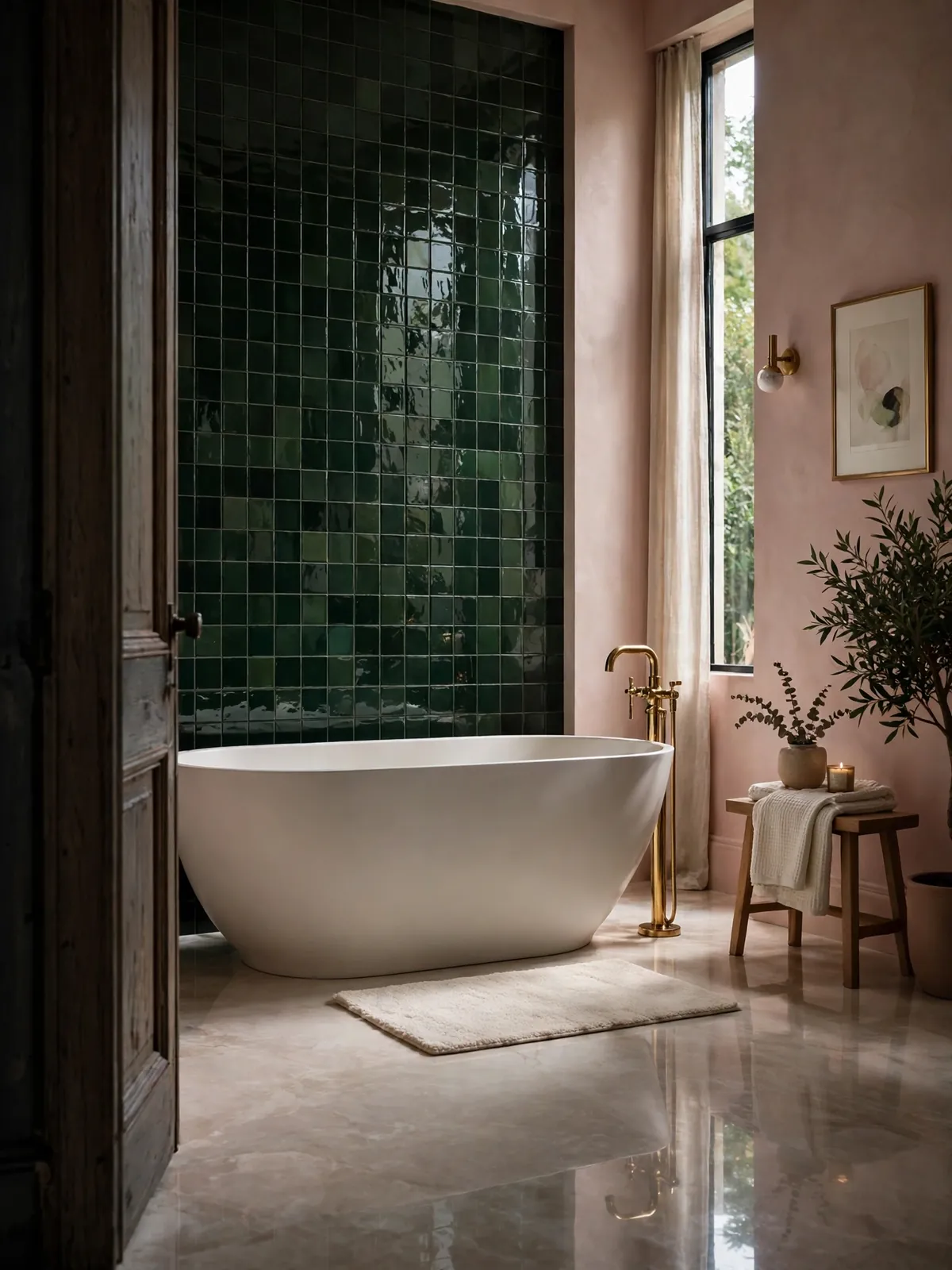
A statement accent wall behind the tub concentrates all the drama of a bathroom into one surface, because a bold colour, pattern or texture in a single place gives the eye somewhere to land without overwhelming the room. Here, deep forest-green tiles cover the wall behind the tub while the other walls stay blush pink, with a brass floor tap and a cream bath mat tying the palette together. The design suits bathrooms that feel plain or dated, it costs far less than tiling the whole room, and it lets you be bold in a way that is easy to change later. The weakness is balance: if the accent wall is too busy and the rest of the room is also patterned, the bathroom feels chaotic.
Quick tips:
- Choose the wall you face when you enter the room.
- Keep the other walls plain so the accent stays the star.
- Use waterproof paint or tile, never standard wallpaper, in wet zones.
- Repeat one colour from the accent wall in a towel or accessory.
Humidity-Loving Plants on Open Shelves
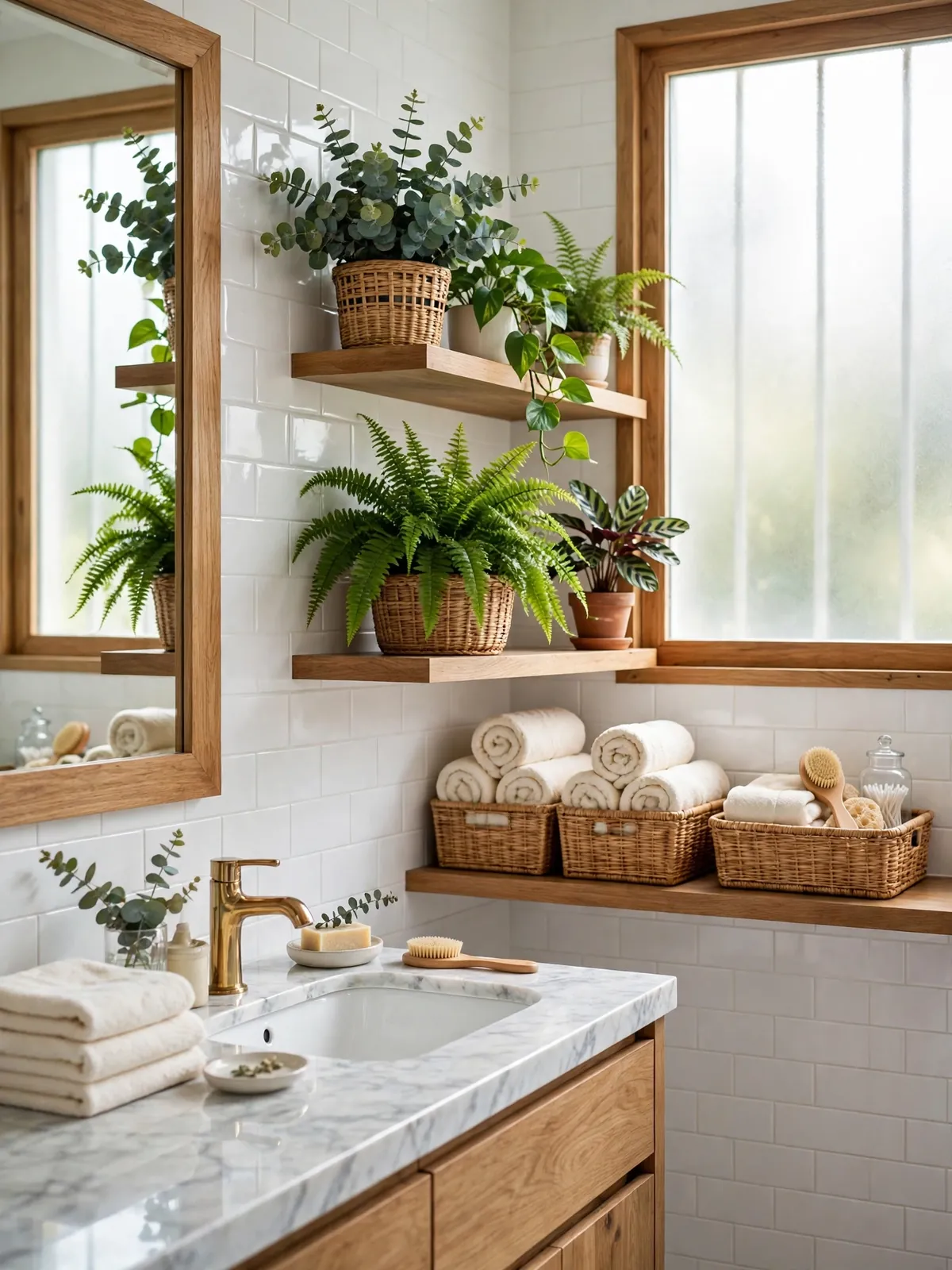
Humidity-loving plants on open shelves bring a bathroom to life in a way no accessory can, because the steam from every shower keeps plants like pothos, ferns and peace lilies thriving with almost no effort. Here, trailing pothos and a small fern sit on open wooden shelves against white tiles, with rattan baskets and cream towels below them, and the green softens every hard surface in the room. The design suits bathrooms with even a little natural light, it costs very little, and it makes the room smell fresher and feel calmer. The weakness is light and care: a windowless bathroom will starve most plants, and overwatering in a humid room rots roots fast.
Quick tips:
- Choose pothos, ferns or peace lilies for humid bathrooms.
- Hang one trailing plant so greenery falls at eye level.
- Water less often than in dry rooms — humidity does the work.
- Keep plants out of direct splash zones near the shower.
Recessed Niches That Look Built-In
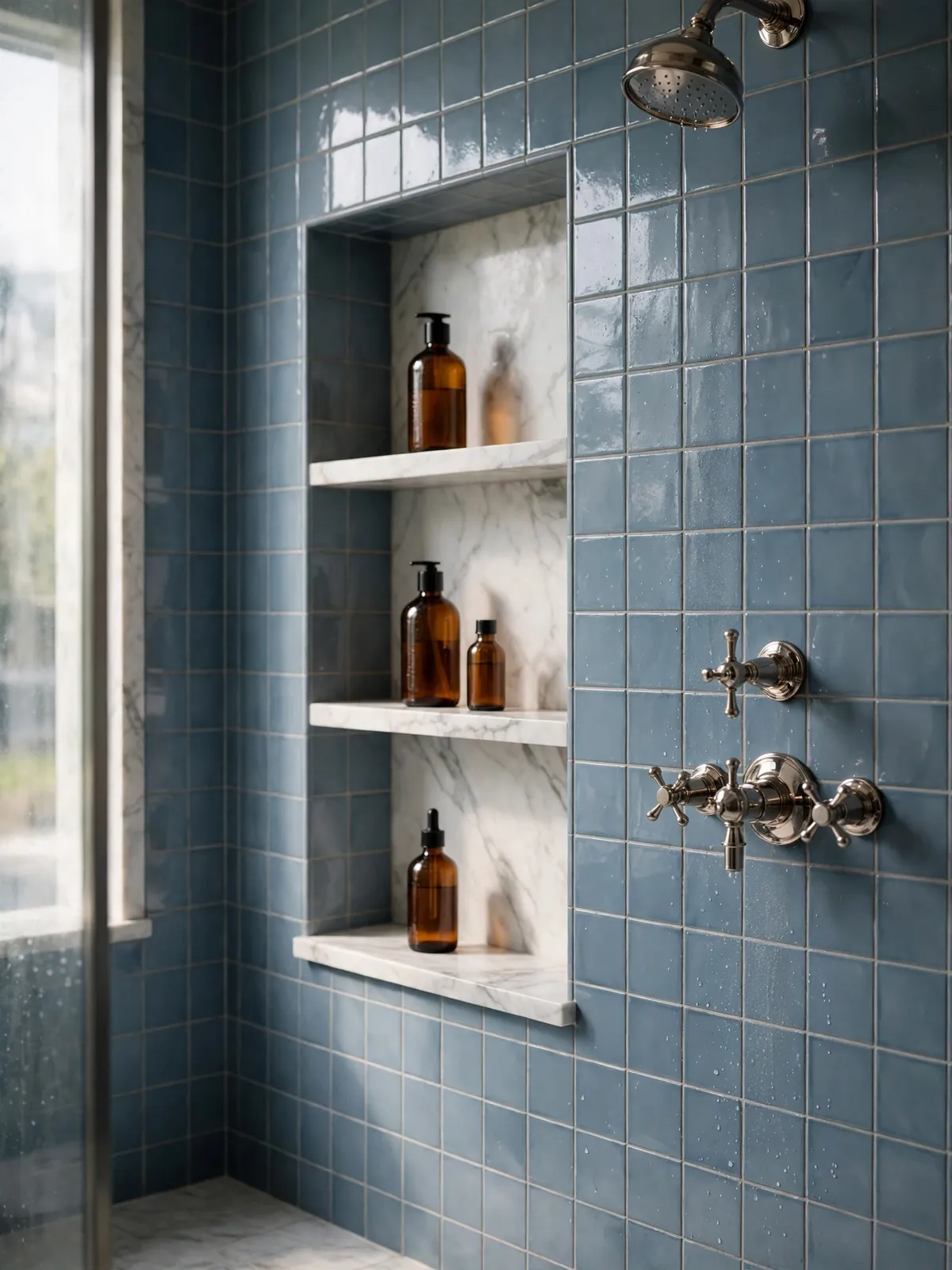
Recessed niches that look built-in solve the ugliest problem in most bathrooms — bottles and jars piled on the edge of the tub — by carving storage into the wall itself, so everything has a place and nothing sits on a surface. Here, a dusty-blue tiled niche with a white marble ledge holds amber glass bottles in the shower, with nickel fittings and a single folded cloth, and the niche reads as architecture rather than storage. The design suits showers and baths alike, it keeps counters clear, and it makes even a small bathroom feel designed rather than improvised. The weakness is the wall: a niche needs a cavity deep enough to hold bottles, and it must be waterproofed properly or it leaks into the wall.
Quick tips:
- Plan niches during renovation, not after tiling is done.
- Make the niche deep enough for full-size bottles.
- Line it with the same tile as the wall for a built-in look.
- Decant products into matching amber or glass bottles.
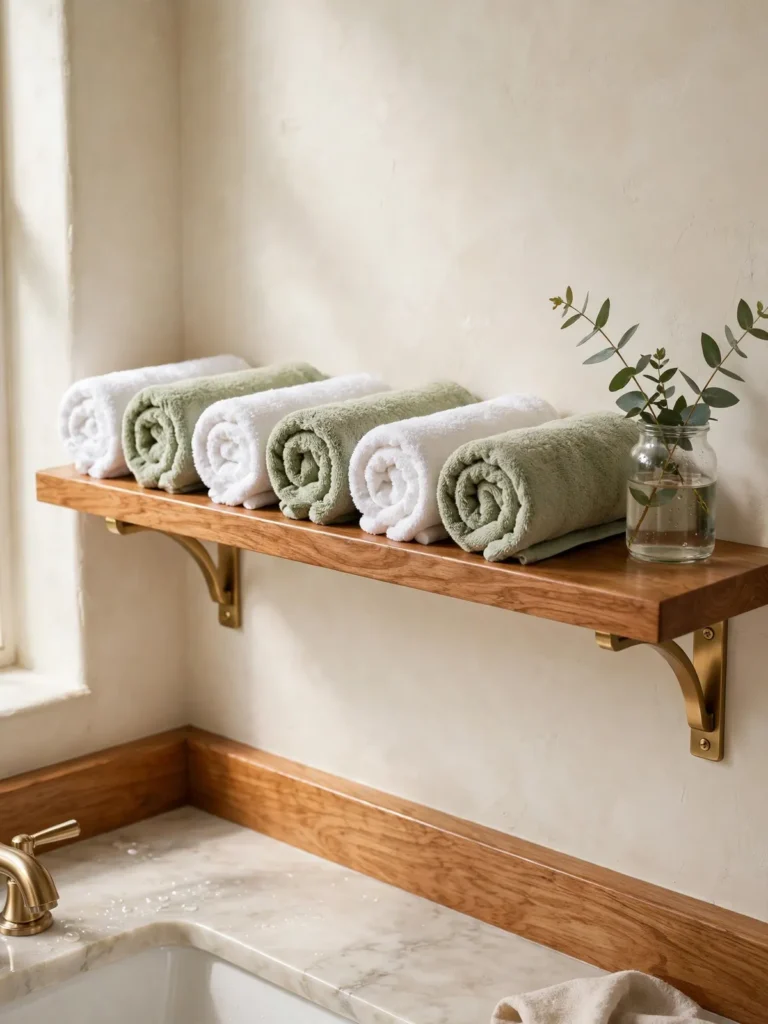
Rolled Towels Displayed Like a Spa
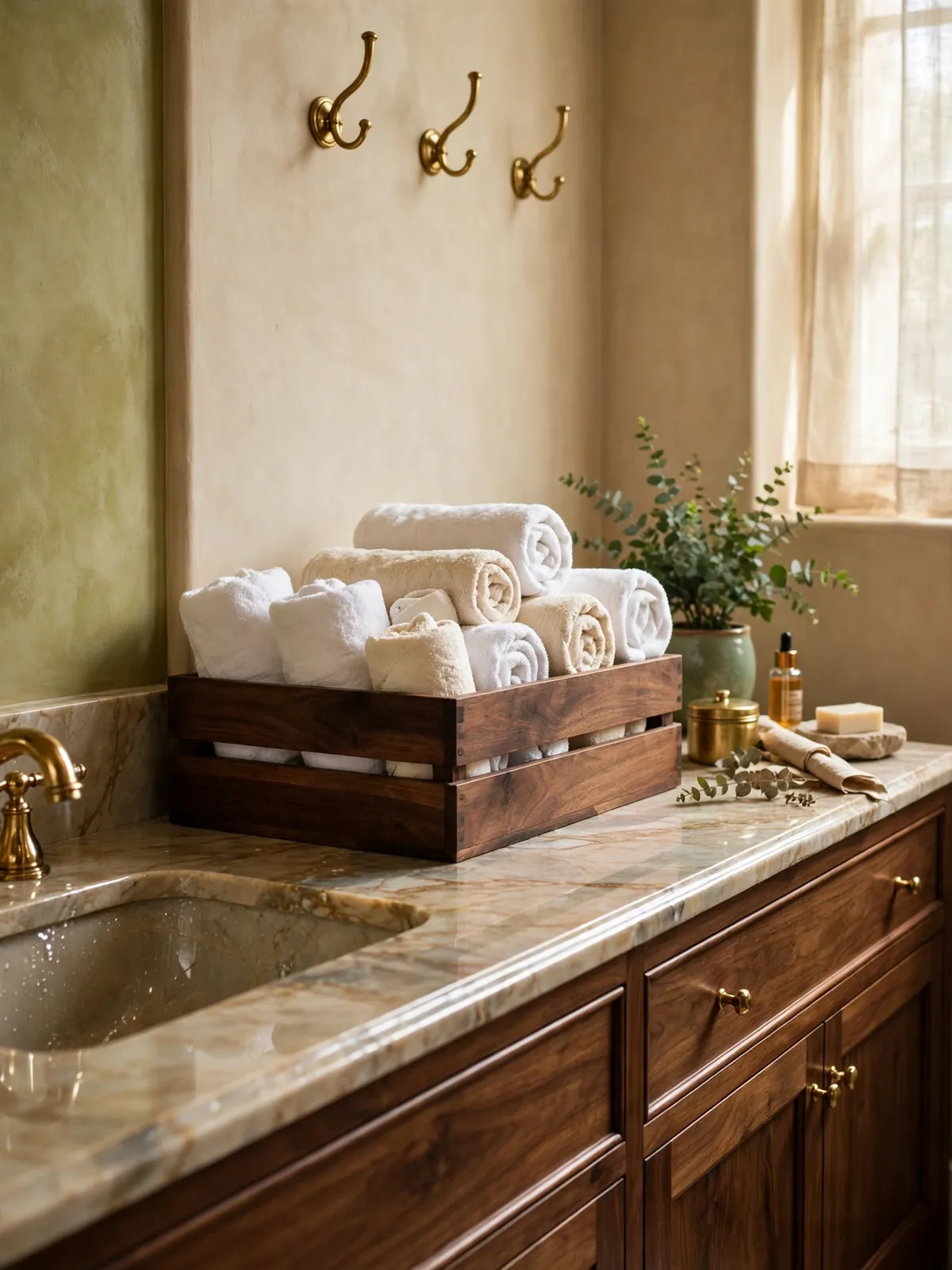
Rolled towels displayed like a spa turn the most ordinary bathroom item into decoration, because a neat roll in a wooden crate or basket reads as a boutique hotel, while a folded stack on a shelf reads as a linen cupboard. Here, cream and white towels are rolled tightly into a dark walnut crate against sand-coloured walls, with brass hooks above and a small green plant beside them. The design suits any bathroom and costs almost nothing, it makes guests feel looked after, and it encourages you to keep the towel supply tidy. The weakness is damp: rolled towels in a humid bathroom can smell musty if they sit too long, so rotate them regularly and never roll a towel that is even slightly damp.
Quick tips:
- Roll towels tightly so they hold their shape in the crate.
- Mix cream and white for a layered, hotel-like look.
- Rotate the display weekly so towels never sit damp.
- Use a wooden crate or woven basket, not a plastic box.
Gallery Art in Moisture-Safe Frames
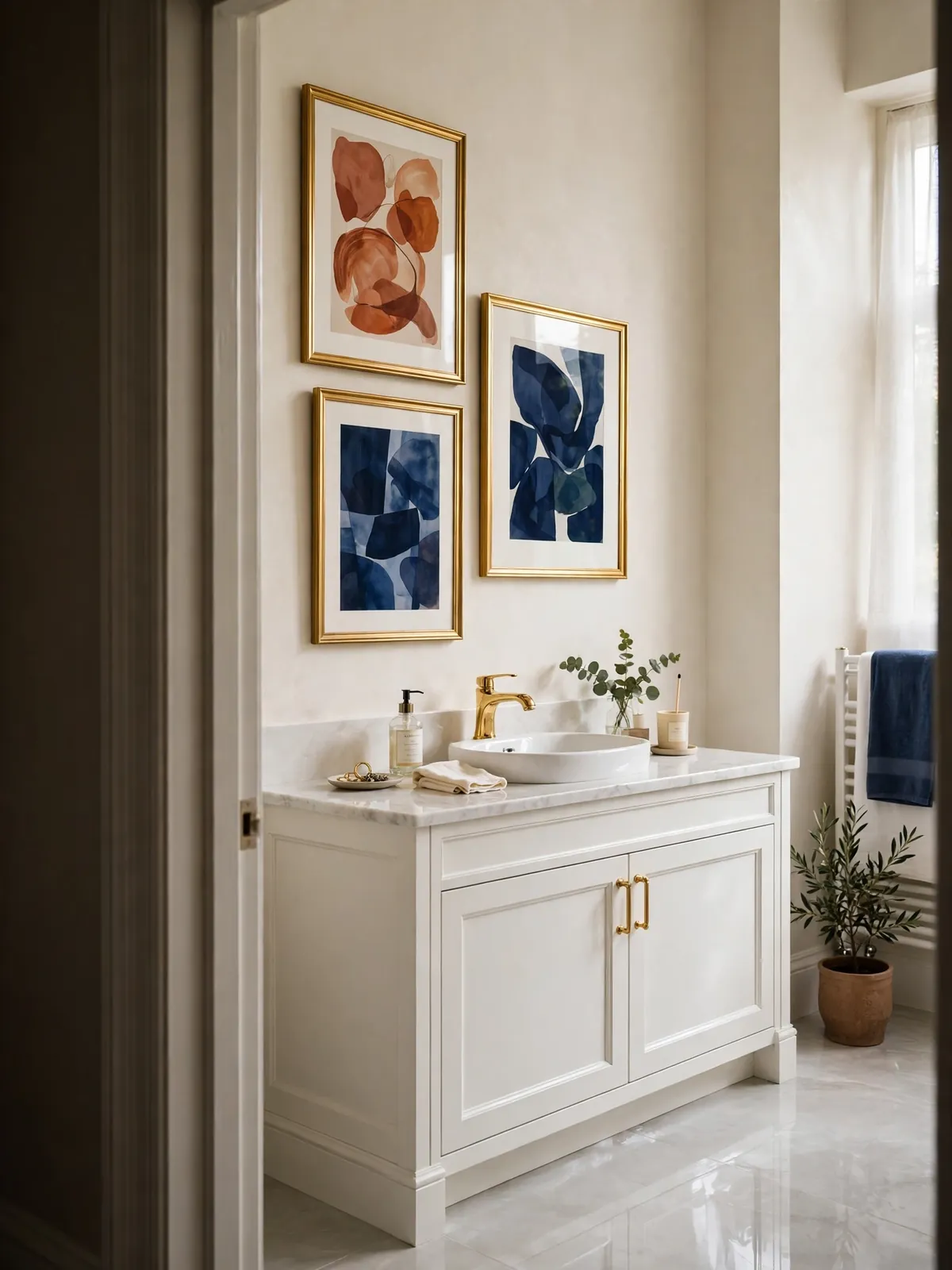
Gallery art in moisture-safe frames gives a bathroom the personality that tiles and fixtures alone cannot, because a framed print or photograph turns a functional room into a space that reflects the person who lives there. Here, terracotta and navy abstract prints in slim gold frames hang above a white vanity on cream walls, protected by acrylic glazing and sealed frames that keep steam out. The design suits bathrooms with a dry wall away from the shower, it costs little, and it is the easiest way to add colour without repainting. The weakness is moisture: ordinary frames warp and prints cockle in steam, so choose acrylic glazing over glass and a wall that never gets direct spray.
Quick tips:
- Use acrylic glazing and sealed backs to keep steam out.
- Hang art on a dry wall, never inside the shower zone.
- Choose prints that echo one colour already in the room.
- Keep frames slim so the art reads as intentional, not cluttered.
A Sculptural Pendant Over the Vanity
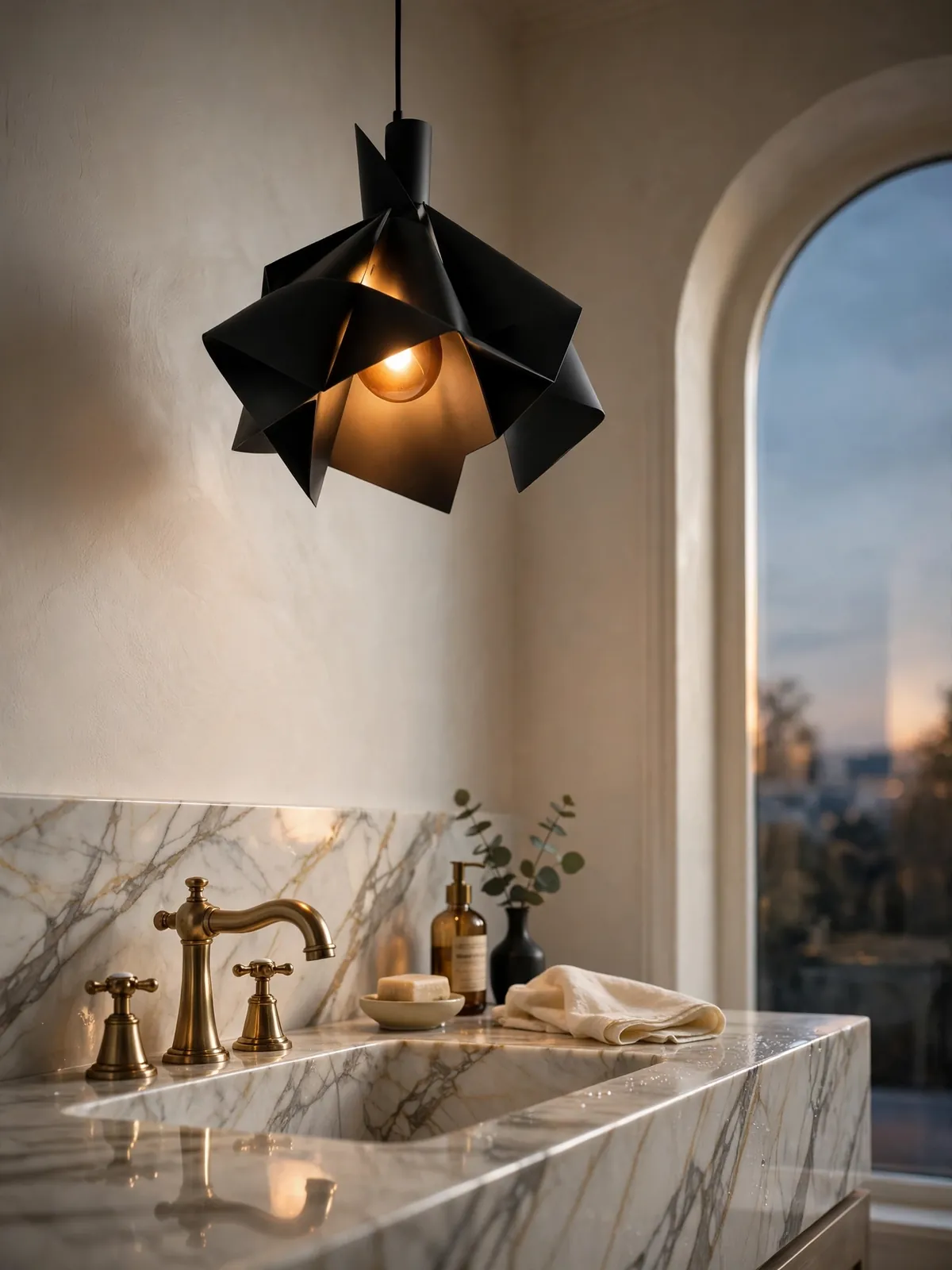
A sculptural pendant over the vanity works like jewellery for a bathroom, because a beautiful light fixture draws the eye upward, adds a warm pool of light exactly where you need it, and gives the room a focal point that is not the mirror or the tub. Here, a matte black sculptural pendant glows warm amber above a marble countertop, with brushed brass taps and cream walls keeping the rest of the room calm. The design suits bathrooms with enough ceiling height for a hanging light, it transforms the room at night, and it is one of the cheapest ways to make a plain bathroom feel designed. The weakness is height and glare: a pendant hung too low blocks the mirror, and a bare bulb glares in the eyes.
Quick tips:
- Hang the pendant at least 75 cm above the countertop.
- Choose a shaded or frosted bulb to avoid glare.
- Match the pendant finish to the taps or mirror frame.
- Put the pendant on a dimmer for evening baths.
A Warm Moody Palette for Evening Calm
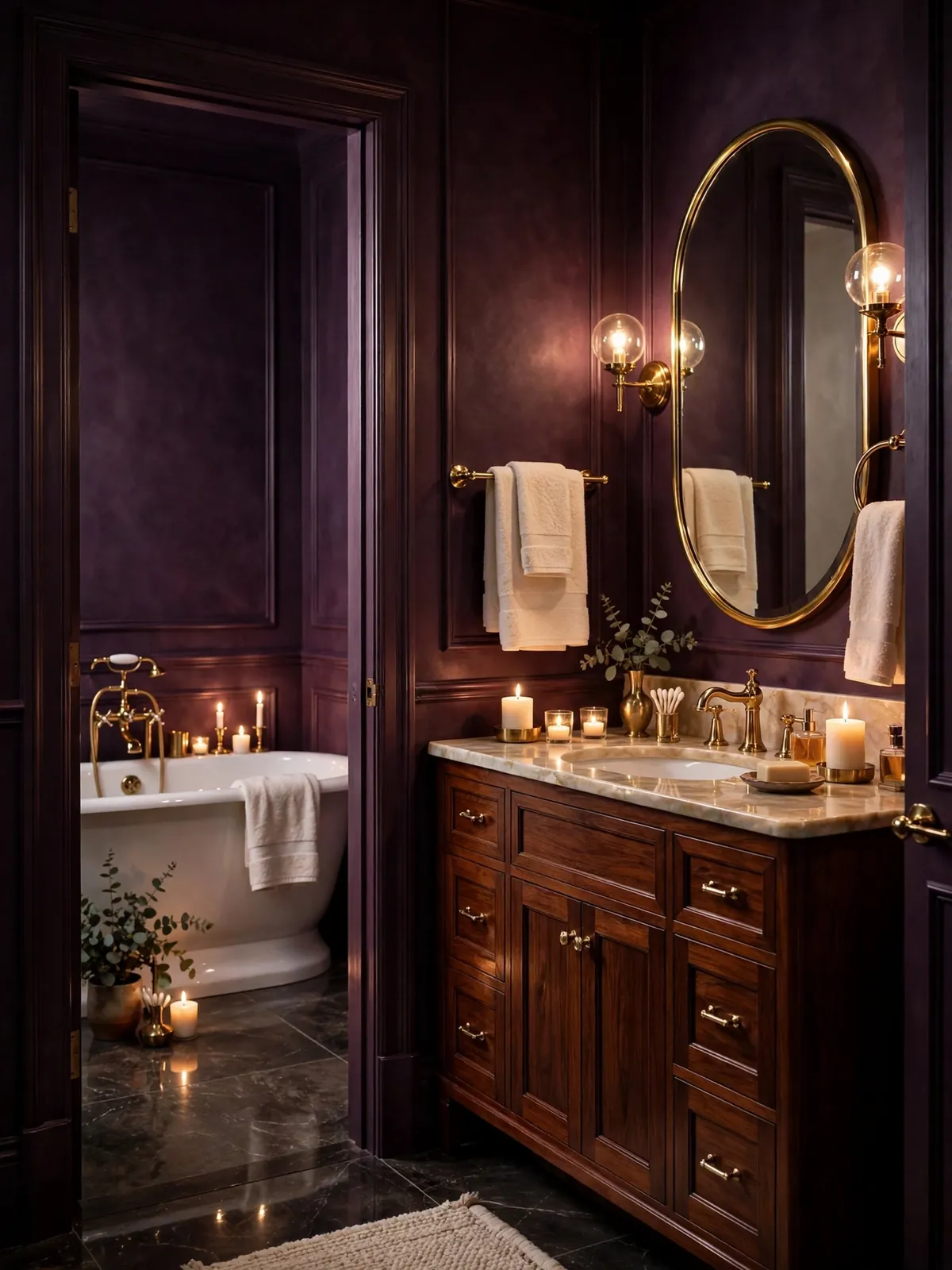
A warm moody palette for evening calm turns a bathroom into a cocoon, because deep colours absorb light, soften edges and make the room feel private and enveloping rather than bright and clinical. Here, deep plum walls wrap a rosewood vanity with champagne brass fixtures, and cream towels and candlelight keep the darkness warm instead of cold. The design suits larger bathrooms and evening bathers, it makes a freestanding tub feel like a ritual, and it hides the everyday wear that white walls show. The weakness is daylight: a dark bathroom with a small window can feel gloomy in the morning, so balance the palette with a large mirror, warm lighting and at least one pale surface.
Quick tips:
- Test dark paint in morning and evening light first.
- Add a large mirror to bounce whatever light there is.
- Keep towels and the ceiling pale to lift the room.
- Use warm bulbs, never cool white, in a moody bathroom.
A Rain Shower With a Built-In Bench
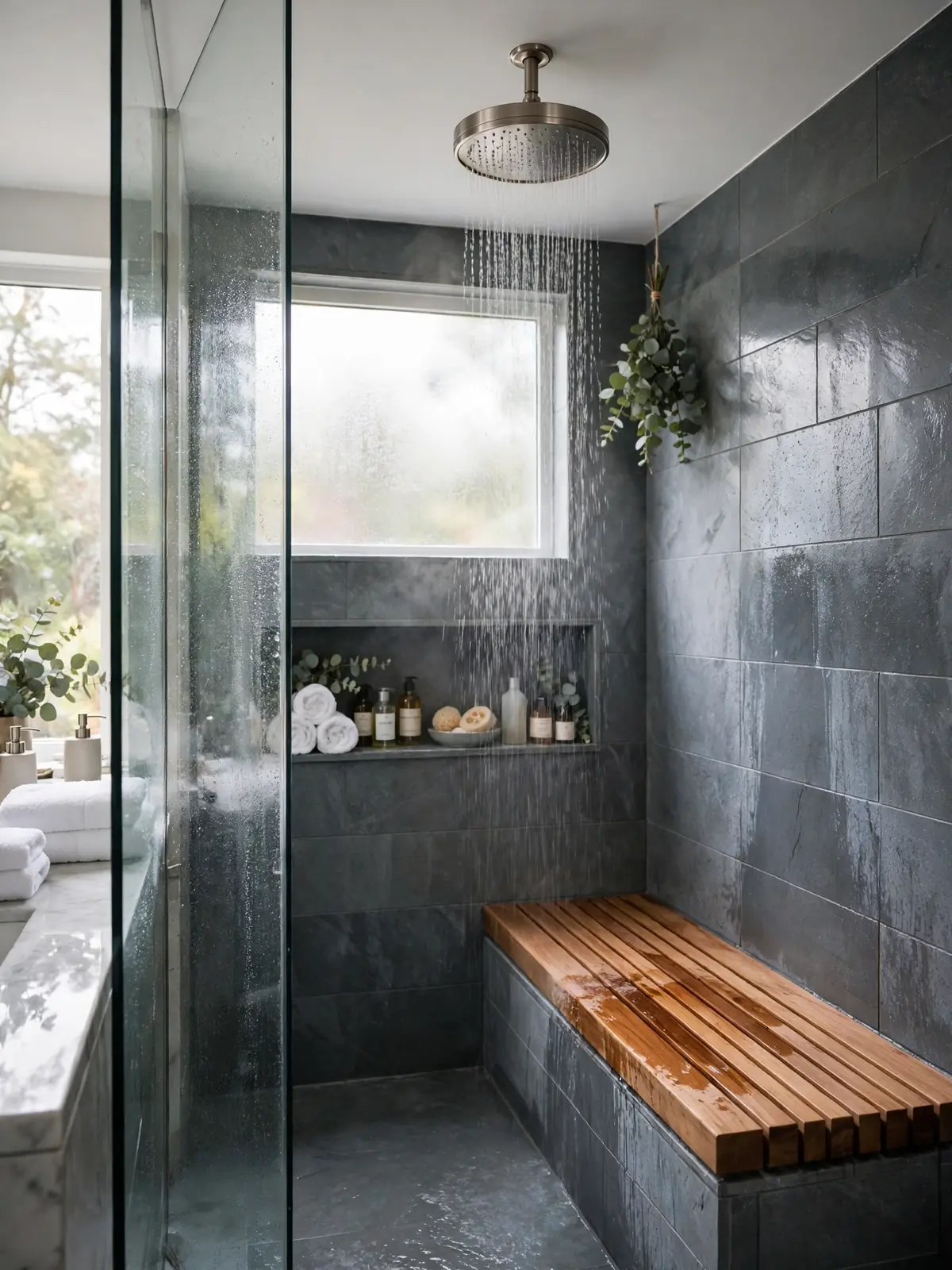
A rain shower with a built-in bench turns the daily shower into the best part of the day, because wide, gentle water falling from above feels like rainfall, and the bench gives you somewhere to sit, shave or simply pause under the water. Here, a brushed nickel rain head hangs over a slate-grey tiled shower with a teak bench built into the wall, and the stone and wood together make the shower feel like a spa rather than a cubicle. The design suits walk-in showers with enough floor space for a bench, it adds real comfort for older users and anyone who likes long showers, and it looks far more luxurious than a standard shower head. The weakness is water pressure and space: a rain head needs good pressure to feel generous, and a bench eats floor space in a small shower.
Quick tips:
- Check water pressure before choosing a rain head.
- Make the bench at least 40 cm deep so it is actually comfortable.
- Use teak or stone for the bench — both handle water well.
- Add a hand shower alongside the rain head for rinsing.
An Arched Mirror That Softens the Room
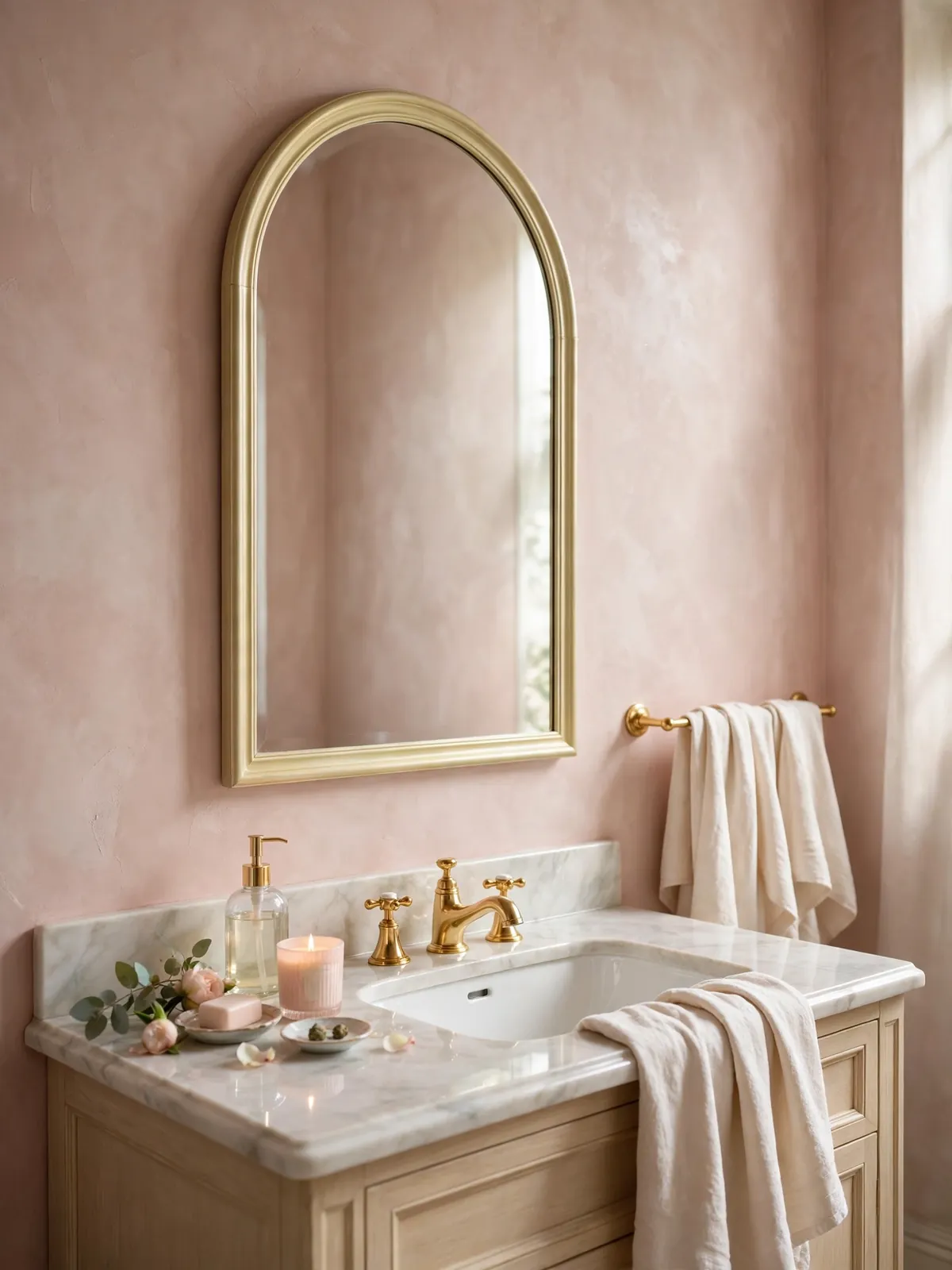
An arched mirror that softens the room works because bathrooms are full of hard rectangles — tiles, vanities, windows — and a single curve breaks the geometry and makes the whole space feel gentler. Here, a tall arched mirror with a pale gold frame hangs above a white ceramic sink against blush-pink plaster walls, with cream towels and a small vase softening the vanity below. The design suits almost any bathroom, it makes the ceiling feel higher, and it is one of the simplest swaps you can make. The weakness is proportion: a mirror that is too narrow looks lost above a wide vanity, and an arch that is too tall can crowd a low ceiling.
Quick tips:
- Choose a mirror about two-thirds the width of the vanity.
- Leave at least 20 cm between the arch top and the ceiling.
- Match the frame finish to the taps for a pulled-together look.
- Hang the mirror so its centre sits at eye level.
Natural Timber and Stone for Warmth
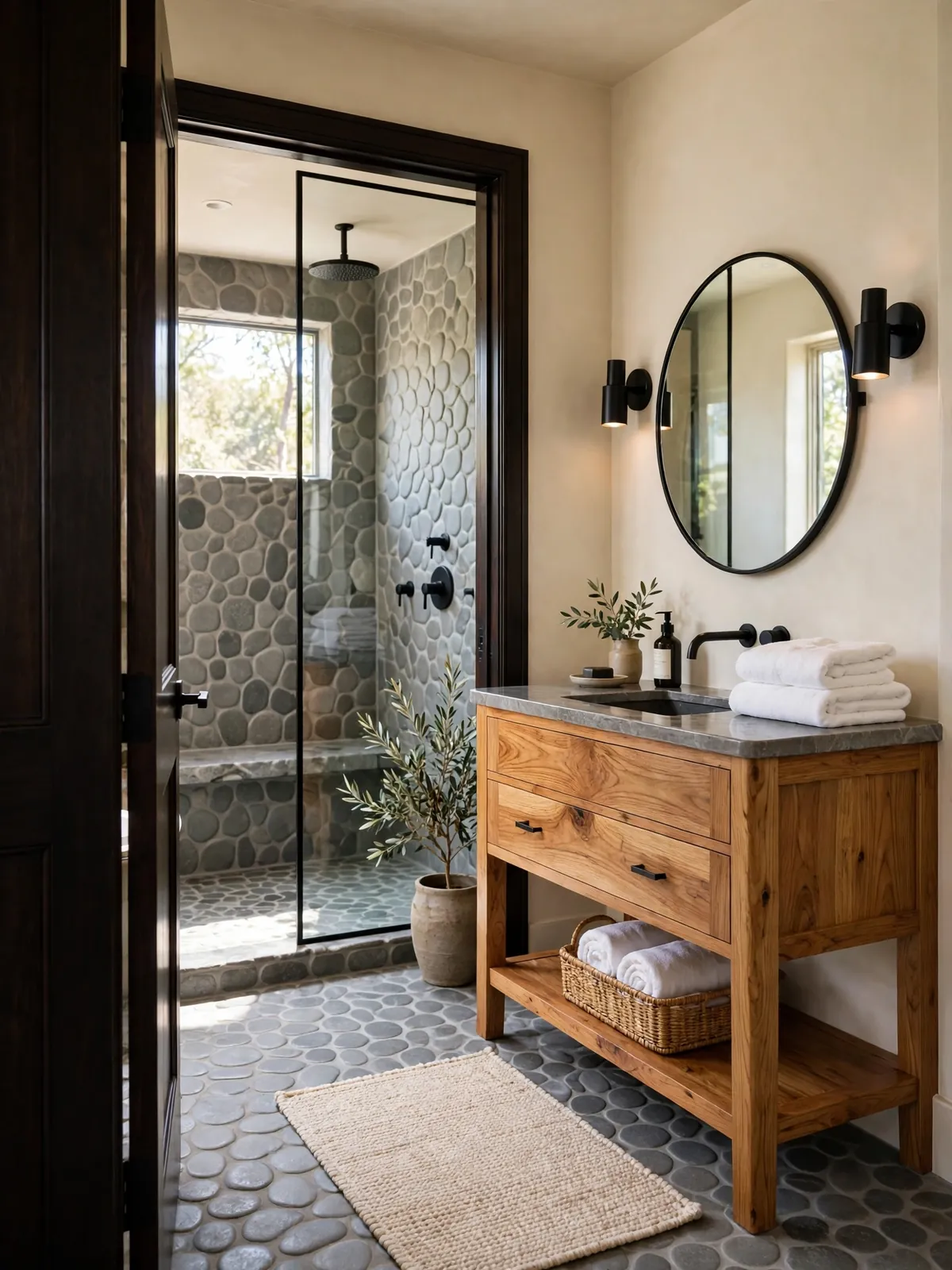
Natural timber and stone for warmth give a bathroom the grounded, organic feeling that all-white bathrooms often miss, because wood grain and stone texture add depth that paint and porcelain cannot. Here, a honey-oak vanity sits against river-stone grey tiles with cream walls and black fixtures, and the mix of warm wood and cool stone makes the room feel both natural and refined. The design suits bathrooms of every size, it ages well because natural materials never look dated, and it pairs beautifully with plants and linen. The weakness is water: untreated wood swells and stains in a bathroom, and porous stone needs sealing.
Quick tips:
- Choose sealed stone and lacquered or oiled timber only.
- Keep wood away from direct splash zones.
- Pair timber with stone or concrete for balance.
- Add linen towels to soften the hard natural textures.
Sheer Linen Panels That Filter the Light
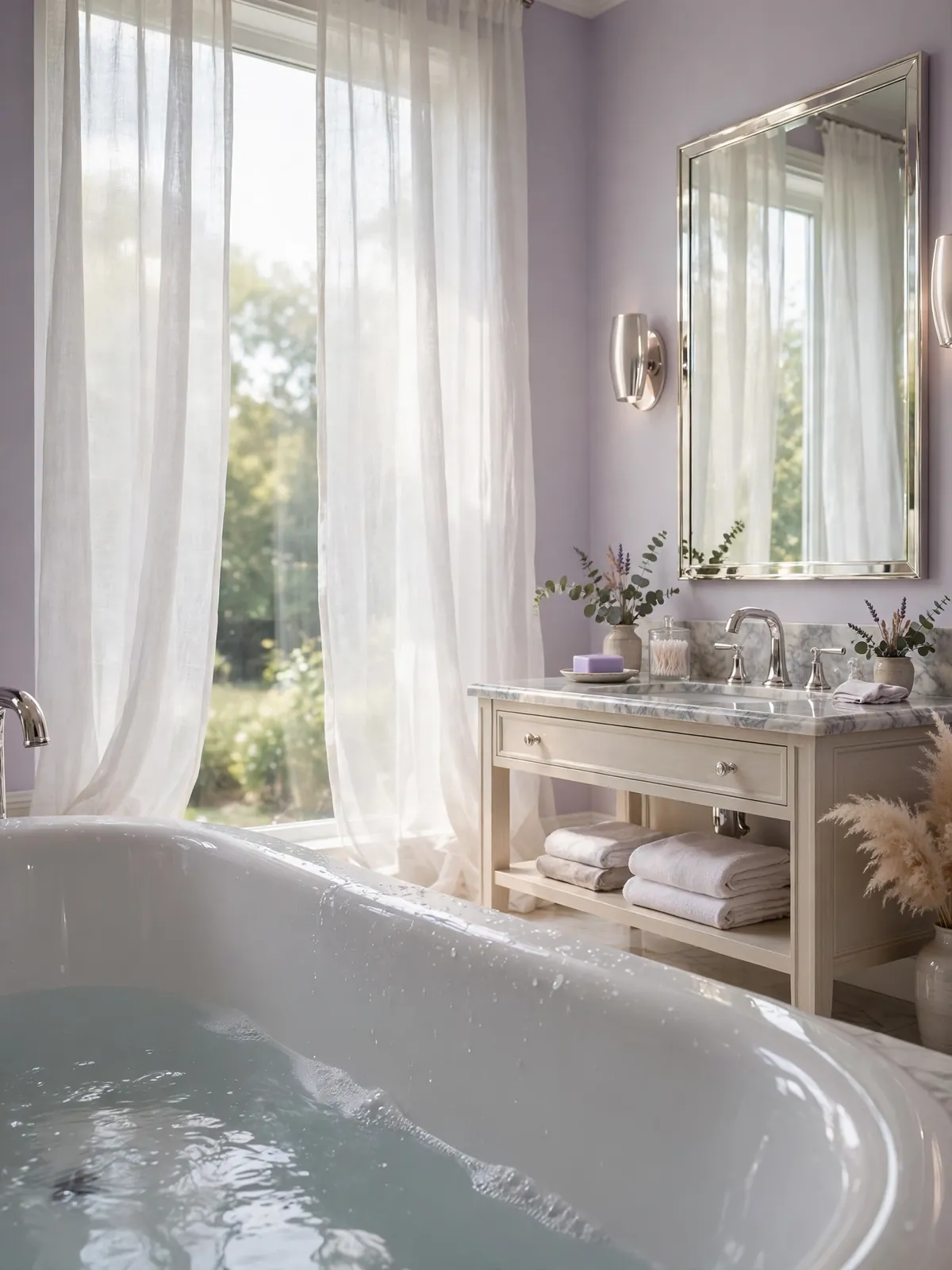
Sheer linen panels that filter the light turn a bathroom window from a practical opening into a design feature, because the fabric softens harsh sunlight into a gentle glow and gives privacy without blocking the light the way a blind does. Here, linen-white sheer panels hang beside a window in a soft lavender bathroom, with a white freestanding tub below and silver fixtures catching the diffused light. The design suits bathrooms with a window near the tub or vanity, it costs little, and it makes morning light feel like a spa rather than an interrogation. The weakness is moisture and length: linen in a steamy bathroom needs airflow or it smells damp, and panels that touch the floor will wick up water.
Quick tips:
- Hang panels clear of the floor to avoid wicking water.
- Choose a washable linen blend, not pure dry-clean linen.
- Keep the panels light so they diffuse rather than block light.
- Open the window after showers so the fabric dries fully.
A Vintage Towel Ladder and Woven Baskets
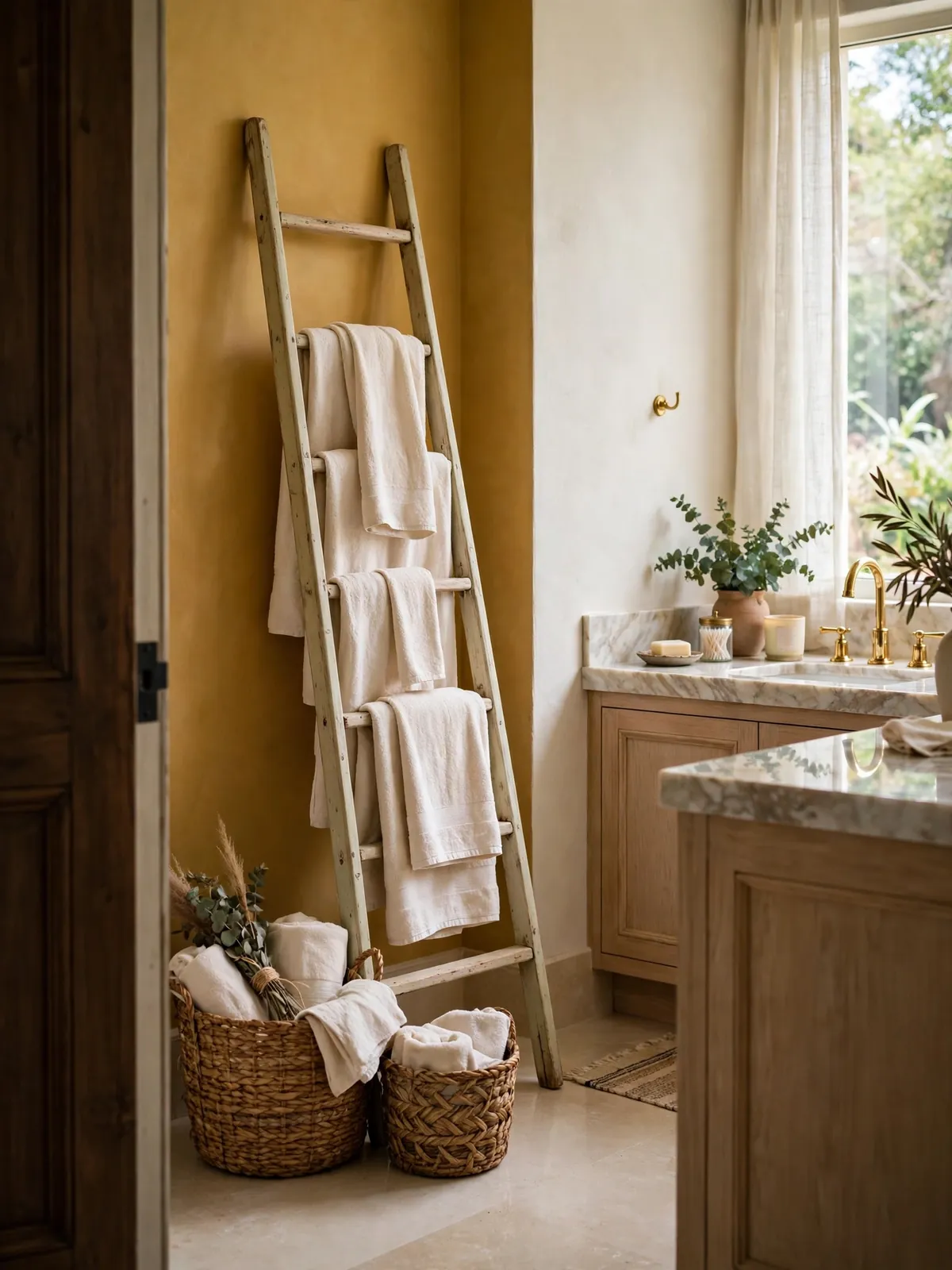
A vintage towel ladder and woven baskets give a bathroom relaxed, lived-in charm without a renovation, because a leaning ladder uses vertical wall space for storage and the woven baskets underneath hide everything you do not want on display. Here, a pale pine ladder leans against a mustard-yellow accent wall holding cream towels, with woven baskets below for spare rolls and toiletries. The design suits bathrooms short on cabinet space, it costs very little, and it adds a rustic layer that balances sleek tiles and chrome. The weakness is stability and damp: a ladder that is not secured can slip on a tiled floor, and towels hung against a cold wall can feel damp.
Quick tips:
- Fix the top of the ladder to the wall so it cannot slip.
- Keep the ladder away from direct shower spray.
- Use woven baskets below for spare towels and toiletries.
- Rotate towels weekly so none stay damp against the wall.
Brushed Brass Fixtures Against Marble
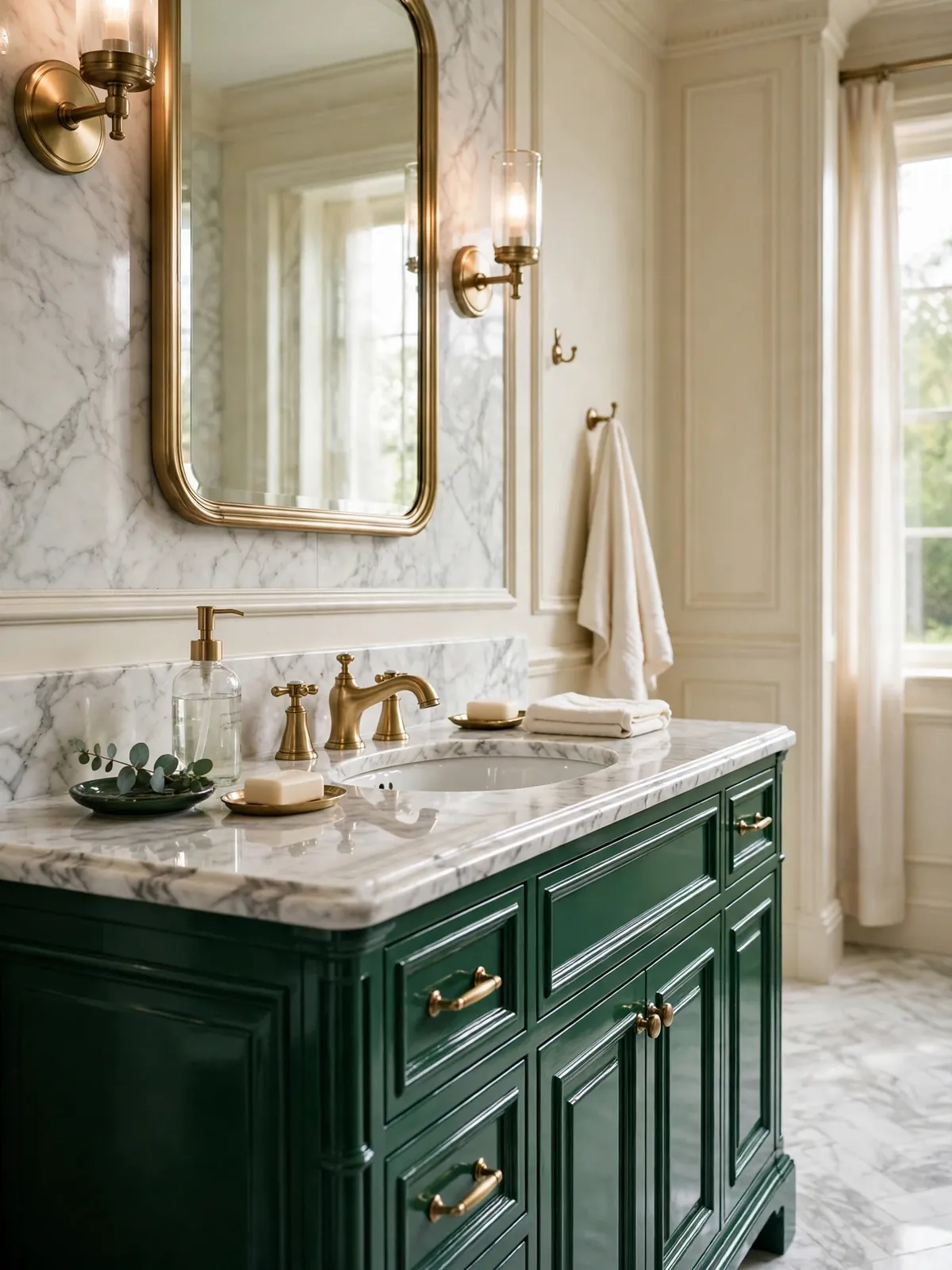
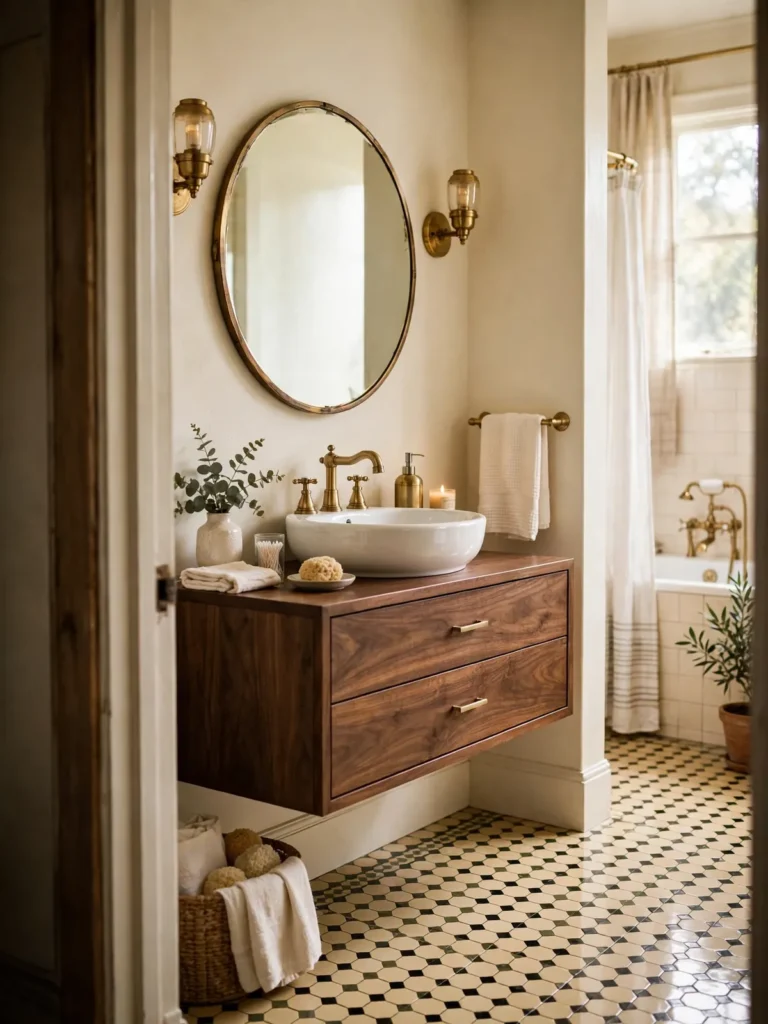
Brushed brass fixtures against marble are the classic luxury pairing for a reason, because the warm gold of the brass softens the cool white of the marble, and together they make even a simple vanity look expensive. Here, brushed brass taps and a brass-framed mirror sit on a white marble countertop with an emerald-green painted vanity below, and the cream walls keep the contrast calm rather than loud. The design suits bathrooms being renovated or refreshed with new fixtures, it photographs beautifully, and brass ages gracefully where chrome can look dated. The weakness is matching: brass finishes vary wildly between brands, and mixing polished and brushed brass looks accidental.
Quick tips:
- Buy all brass fixtures from one range so the tone matches.
- Choose brushed brass over polished for a softer, modern look.
- Clean with a soft cloth, never abrasive cleaners.
- Repeat the brass once more — a mirror frame or light — so it looks deliberate.
A Candle and Scent Ritual Corner
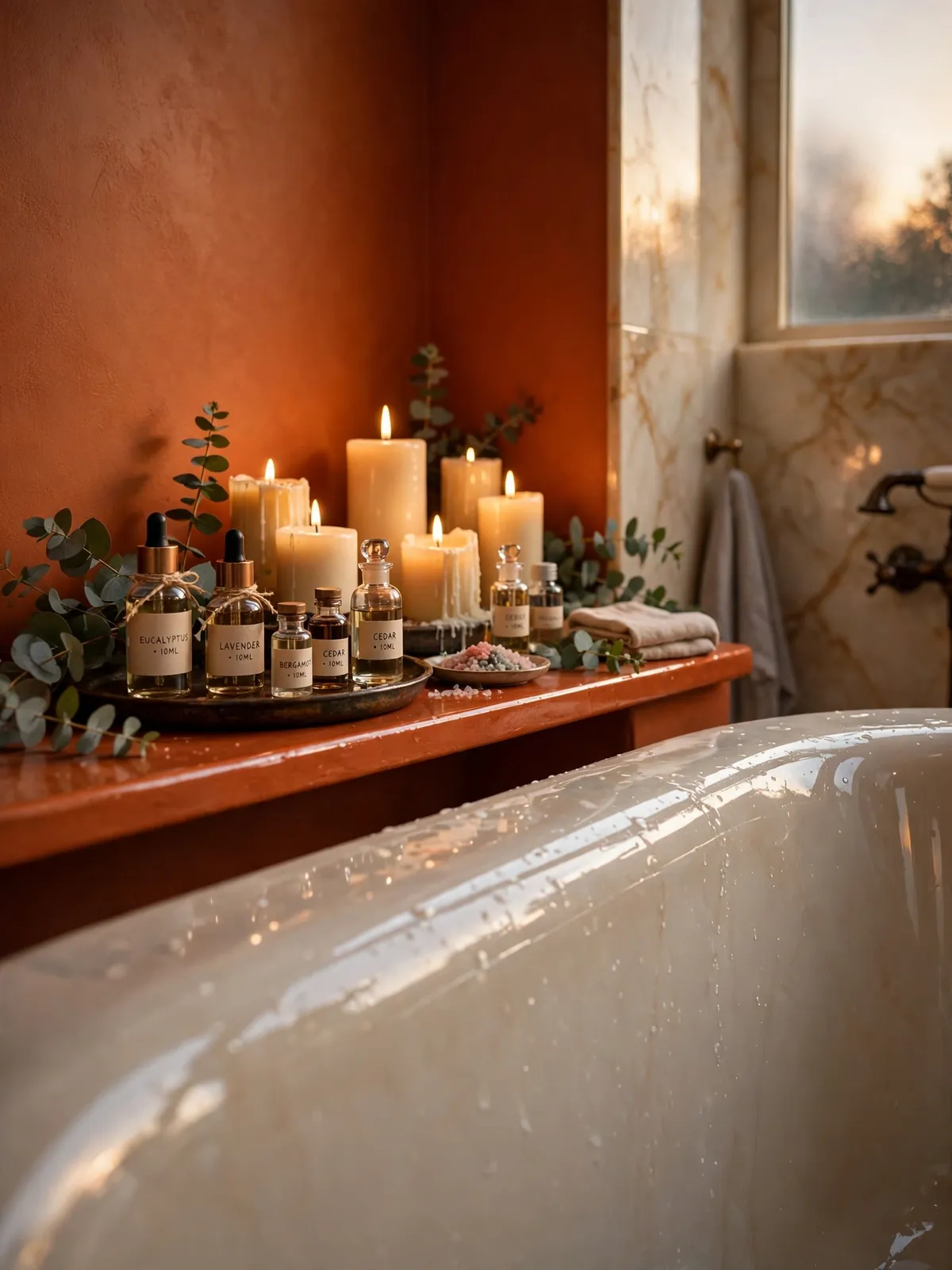
A candle and scent ritual corner costs almost nothing and changes how a bathroom feels more than most renovations, because scent and flickering light signal to the brain that this is a place to slow down, not a room to rush through. Here, cream candles sit on a dark bronze tray on a burnt-orange painted shelf beside the tub, with eucalyptus sprigs and small glass bottles of bath oil arranged around them. The design suits any bathroom, it takes five minutes to create, and it turns an ordinary evening bath into a ritual. The weakness is safety and clutter: candles near towels or curtains are a fire risk, and a shelf crowded with bottles looks messy rather than calm.
Quick tips:
- Keep candles on a stable tray, away from towels and curtains.
- Never leave a burning candle unattended in the bathroom.
- Limit the display to three or four beautiful items.
- Choose one signature scent and repeat it in oil and candle.
A Japandi Bathroom in Warm Beige and Light Ash
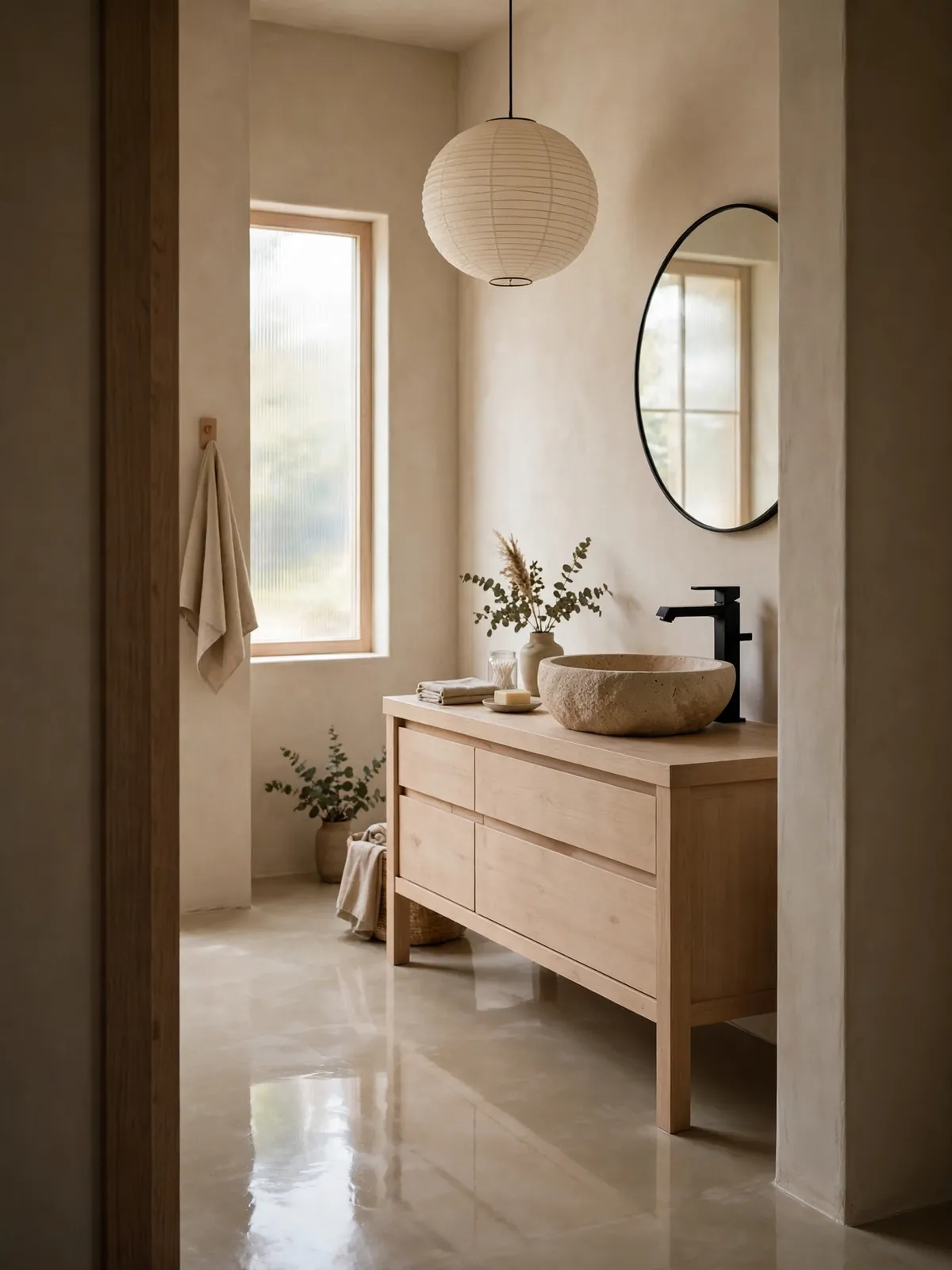
A Japandi bathroom in warm beige and light ash brings together Japanese calm and Scandinavian warmth, and it works because it removes everything unnecessary and lets a few beautiful materials do all the work. Here, a low light-ash vanity with a stone vessel sink sits against warm beige plaster walls, with matte black taps, a paper lantern pendant and a single folded towel, and the room feels quiet the moment you walk in. The design suits bathrooms of every size, especially small ones, because the low furniture and pale palette make the space feel open, and it is easy to keep tidy when there is simply less in the room. The weakness is discipline: Japandi only works if the surfaces stay clear, so it suits people who are happy to store everything away, and a single cluttered shelf breaks the whole effect.
Quick tips:
- Keep the palette to warm beige, ash wood and one dark accent.
- Choose a stone vessel sink as the single sculptural piece.
- Store everything inside the vanity and keep the top clear.
- Add one paper lantern or linen shade for soft, warm light.
A Small Bathroom That Feels Larger With One Big Mirror
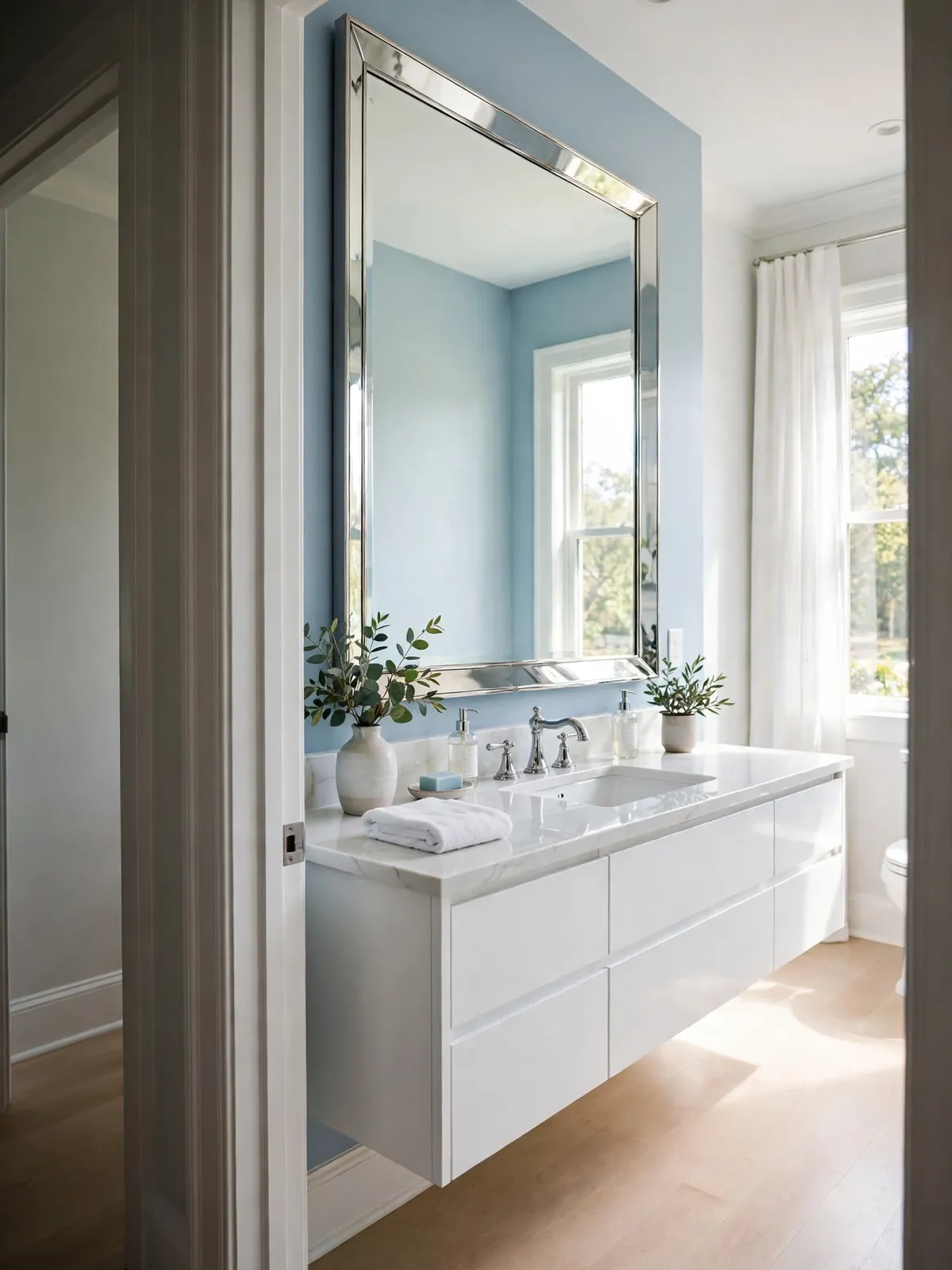
A small bathroom that feels larger with one big mirror is the most useful bathroom aesthetic idea for compact homes, because a single oversized mirror does the work of three smaller changes: it bounces light, doubles the sense of space, and turns a plain wall into a design feature. Here, a floor-to-ceiling mirror fills the wall above a white floating vanity in a powder-blue bathroom, with chrome taps, a pale wood floor and a single white orchid, and the room feels twice its real size. The design suits cloakrooms, en suites and flats best of all, it costs far less than moving a wall, and it makes a small bathroom feel like a deliberate design choice rather than a compromise. The weakness is reflection: a huge mirror also reflects clutter, so the room must stay tidy, and the mirror needs proper fixing on a solid wall.
Quick tips:
- Take the mirror almost to the ceiling to stretch the room upward.
- Keep the vanity floating so more floor shows below the mirror.
- Use pale powder blue or warm white so the reflection stays bright.
- Hide clutter completely — a big mirror shows everything.
A Vintage Clawfoot Tub With Dusty Rose Styling
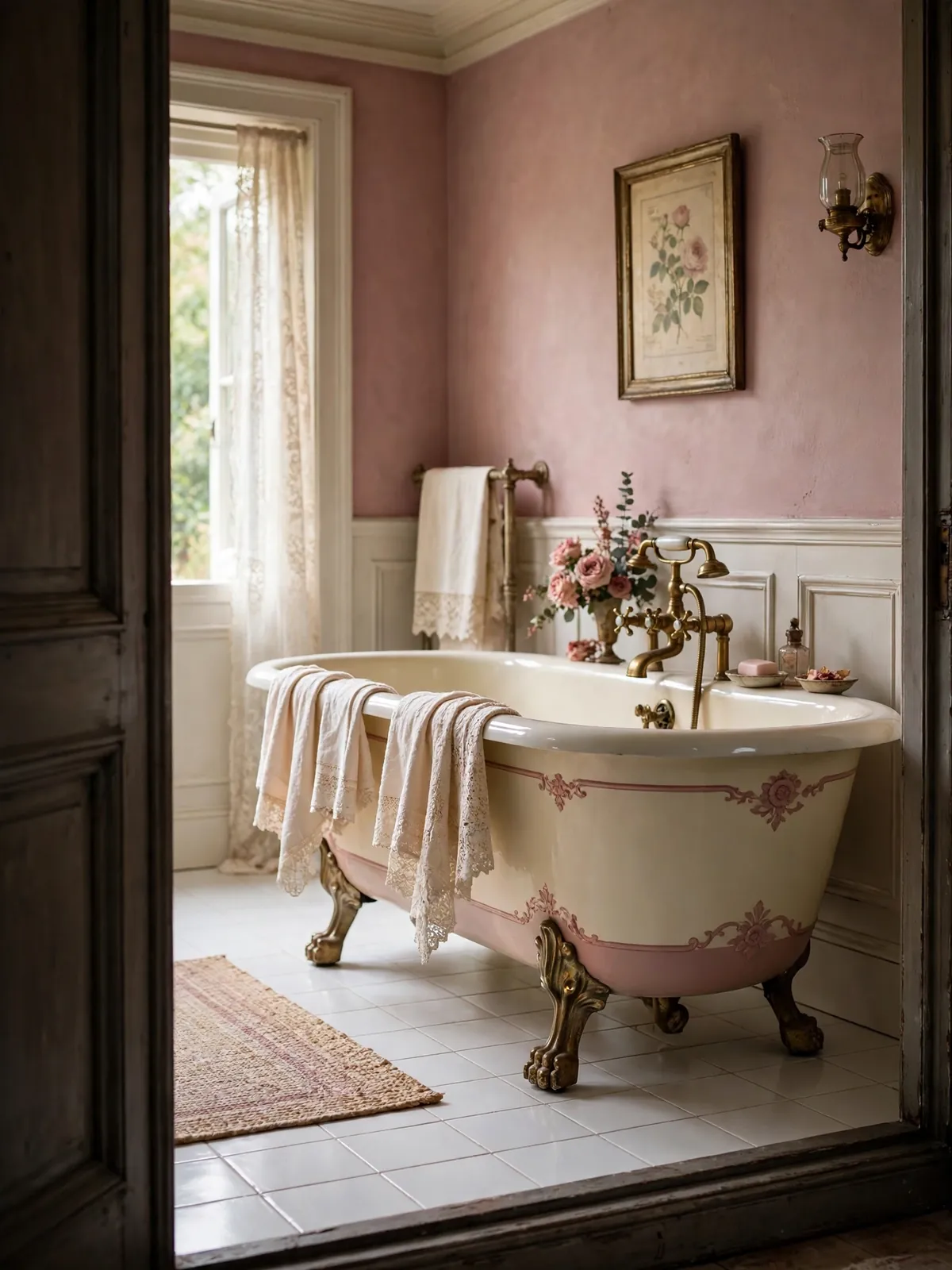
A vintage clawfoot tub with dusty rose styling gives a bathroom a romantic, heritage feeling that a modern tub cannot match, because the curved feet, the aged brass and the soft pink walls together tell a story rather than simply filling a room. Here, a cream clawfoot tub with aged brass feet and taps stands against dusty rose walls, with a white tiled floor, lace-edged towels and a small vase of dried roses on a wooden stool. The design suits period homes and larger bathrooms, it makes the tub the unmistakable star of the room, and it pairs beautifully with traditional taps and patterned floor tiles. The weakness is practical: a clawfoot tub is heavy, hard to clean underneath, and the shower attachment over it splashes more than a built-in bath, so it suits bathers more than daily shower users.
Quick tips:
- Check the floor can carry the weight of a filled clawfoot tub.
- Pair it with aged brass, not chrome, for a period-correct look.
- Use a freestanding shower riser if you need a shower over the tub.
- Keep the walls soft pink so the tub stays the focus.
A Midnight Navy Bathroom With Copper Accents
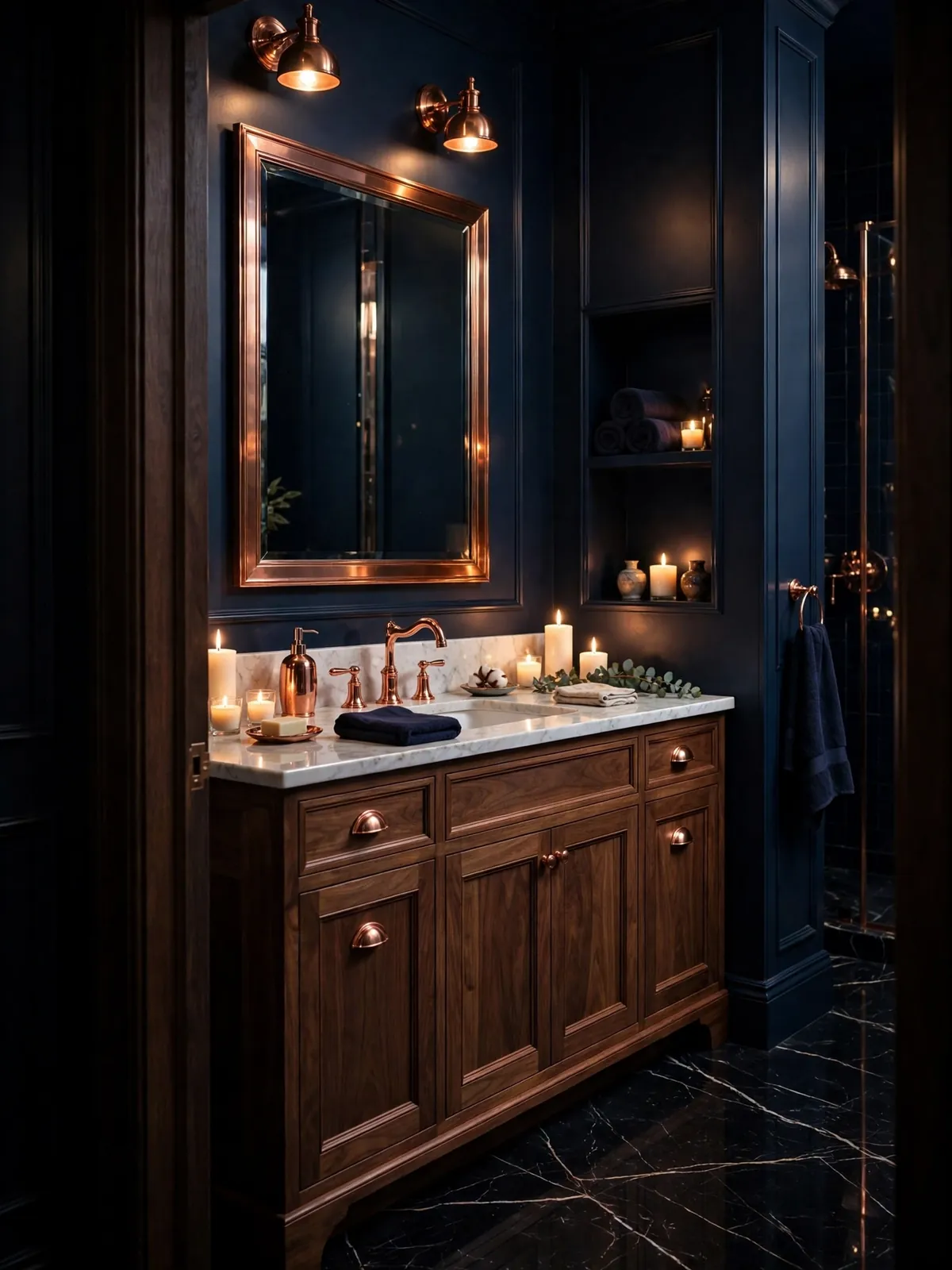
A midnight navy bathroom with copper accents is the boldest moody bathroom aesthetic in this list, because the deep blue makes the room feel like night, while the copper catches the light and keeps the darkness warm and luxurious rather than cold. Here, deep navy walls wrap a walnut vanity with copper taps and a copper-framed mirror, a white stone countertop, and warm candlelight reflected in the metal. The design suits larger bathrooms and confident decorators, it makes an evening bath feel like a private club, and it photographs with a richness that pale bathrooms cannot match. The weakness is light: a navy bathroom with a small window can feel dark in the morning, so it needs a large mirror, warm bulbs and a pale ceiling to stay usable all day.
Quick tips:
- Keep the ceiling and towels white to lift a navy room.
- Use warm bulbs, never cool white, with navy walls.
- Repeat copper in at least two places so it looks deliberate.
- Test the navy in morning and evening light before painting.
A Wooden Slat Feature Wall Behind the Vanity
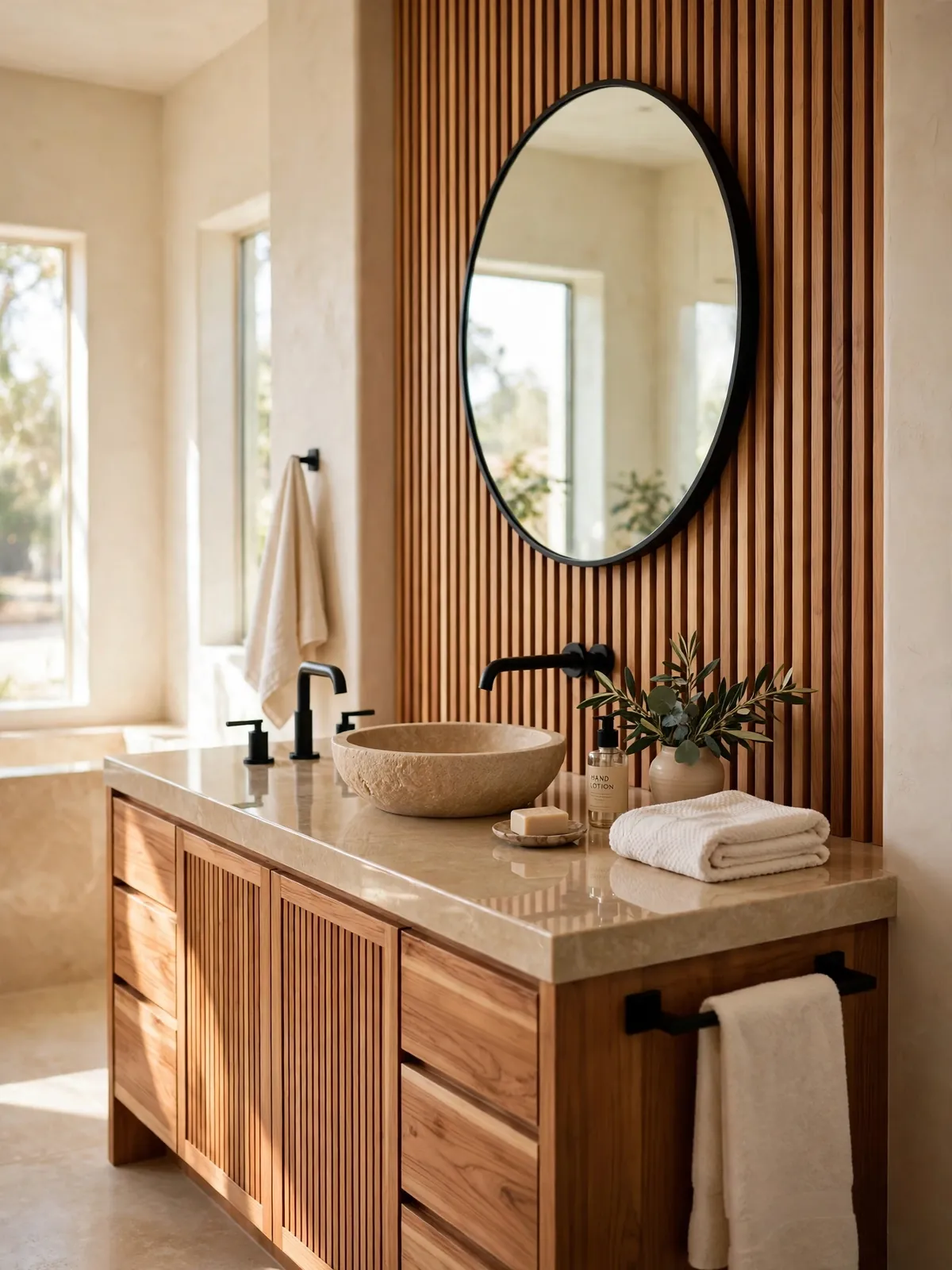
A wooden slat feature wall behind the vanity adds instant architecture to a plain bathroom, because the vertical cedar slats draw the eye upward, add texture without colour, and turn a flat wall into a crafted backdrop for the mirror and sink. Here, vertical cedar slats cover the wall behind a round stone sink, with matte black taps, warm white plaster on the other walls and cream towels folded below, and the slats make the vanity zone feel like a separate, designed space. The design suits modern and Japandi bathrooms, it costs less than retiling the whole room, and it hides an uneven wall far better than paint. The weakness is moisture: slats near a shower need sealing, and cedar in a steamy room needs airflow, so keep the slat wall on the dry vanity side and seal it properly.
Quick tips:
- Keep the slat wall on the dry vanity side, away from the shower.
- Seal cedar slats so steam does not warp them.
- Use vertical slats to make the ceiling feel higher.
- Match the slat tone to the vanity wood for a finished look.
Bathroom Aesthetic Ideas That Pull the Whole Room Together
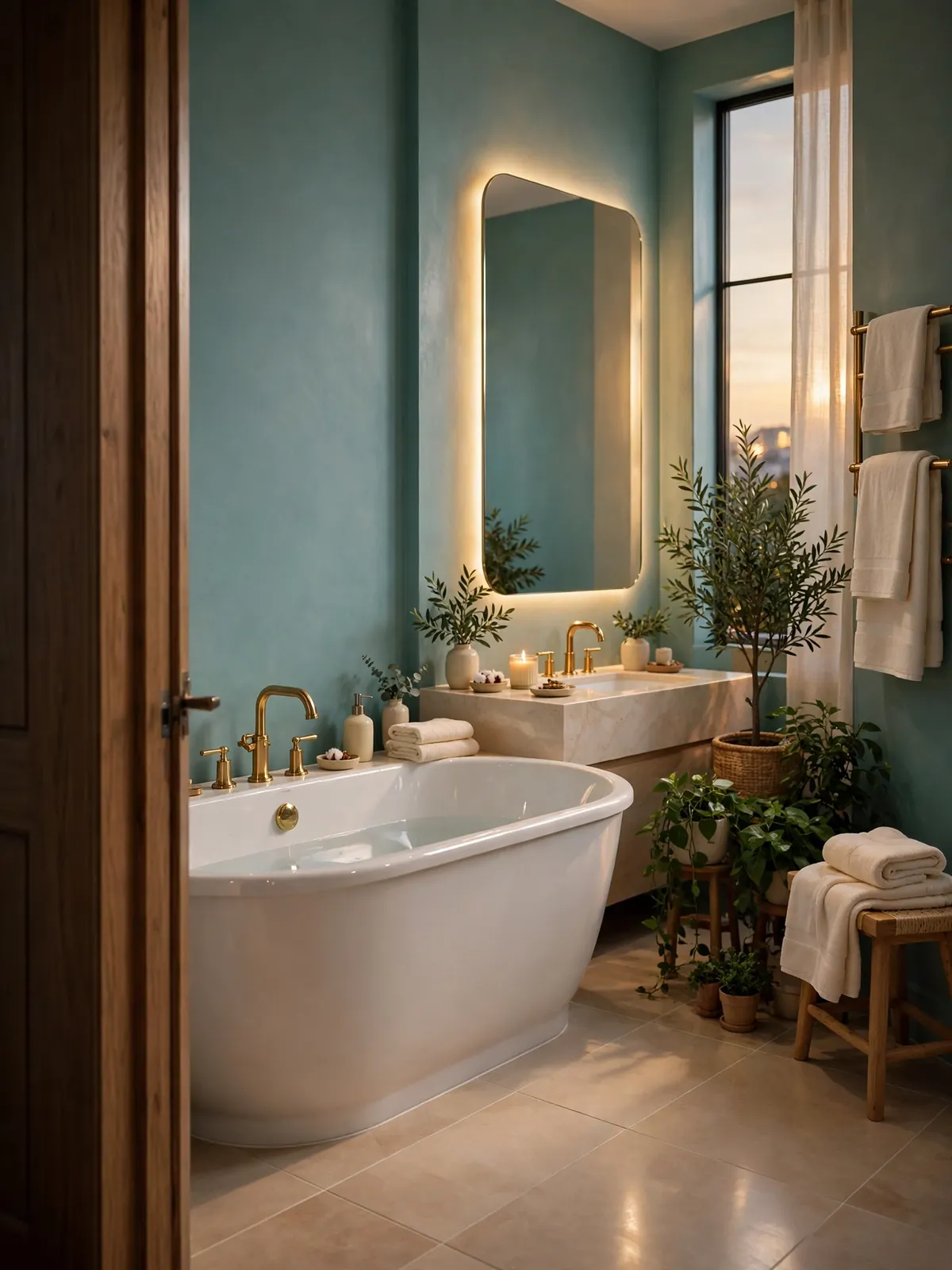
The last of these bathroom aesthetic ideas is the principle behind them all, and it is worth stating plainly because it is the difference between a bathroom that looks styled in a photograph and one that feels beautiful every day: a retreat is not one expensive feature, it is the combination of a calm palette, one clear focal point, layered light and clear surfaces working together, so that the freestanding tub, the backlit mirror, the plants and the rolled towels all support each other instead of competing for attention, and the room rewards you every time you walk in rather than only on the day it was finished. Here, a soft teal bathroom pulls it together — a freestanding tub, a backlit mirror, warm beige floor tiles, brass fixtures and cream towels — and nothing in the room is there by accident. The lesson is to start with the mood you want, choose the palette and the focal point first, add lighting second, and let the styling follow, because a bathroom built in that order stays beautiful with very little effort, even in a small bathroom, even on a modest budget, and even when you change only one thing at a time. Measure your space, pick the two or three ideas from this list that fit it best, and the bathroom stops being a room you rush through and becomes the calmest corner of your home.
Quick tips:
- Choose the mood and palette before buying anything.
- Pick one focal point and let everything else support it.
- Layer the lighting — mirror, pendant and candles — never rely on one ceiling light.
- Keep surfaces mostly clear so the room reads as calm.
FAQs
What is the cheapest way to get a bathroom aesthetic?
Start with paint, lighting and styling: repaint in a calm or moody shade, swap to warm bulbs, add a backlit or arched mirror, roll towels into a basket, and add one humidity-loving plant. These five changes cost far less than new fixtures and change the feeling of the room immediately.
What is the best colour for a small bathroom aesthetic?
Pale, warm colours work best in small bathrooms — warm white, pale sage, dusty blue or soft grey — because they reflect light and make the walls feel further away. Pair them with a large mirror and large-format tiles, and use one darker accent, such as a vanity or a towel, so the room has depth without feeling small.
Can I make a rental bathroom look aesthetic without renovating?
Yes. Use freestanding pieces that need no fixing: a towel ladder, a leaning mirror, woven baskets, a plant, rolled towels in a crate, candles on a tray and a sheer curtain over the window. Choose pieces that follow your palette and remove them all when you move — the landlord never needs to know.
How do I stop a bathroom aesthetic from looking cluttered?
Give every product a home inside a niche, drawer or basket, and keep the counter to three or four beautiful items at most. Decant shampoo and soap into matching bottles, hide cleaning products completely, and edit the styling regularly — if an object does not earn its place, remove it.
Do I need expensive fixtures for a bathroom aesthetic?
No. Expensive fixtures help, but the look comes mostly from light, colour and order: a good mirror, warm lighting, a calm palette and clear surfaces do more than a luxury tap. Spend first on the mirror and the lighting, then on one statement piece, and let the rest be simple.
Conclusion
A bathroom aesthetic is not a showroom — it is a room that makes ordinary days feel calmer, and the 24 ideas above show that you can get there at almost any budget, whether you install a freestanding tub and a rain shower, repaint in a moody plum or midnight navy, or simply roll your towels, light a candle and hang a plant. Start with the mood you want, choose a palette and one focal point, layer the light, and give everything a home so the surfaces stay clear. Do that, and your bathroom stops being the room you rush through and becomes the small retreat you look forward to every single day.