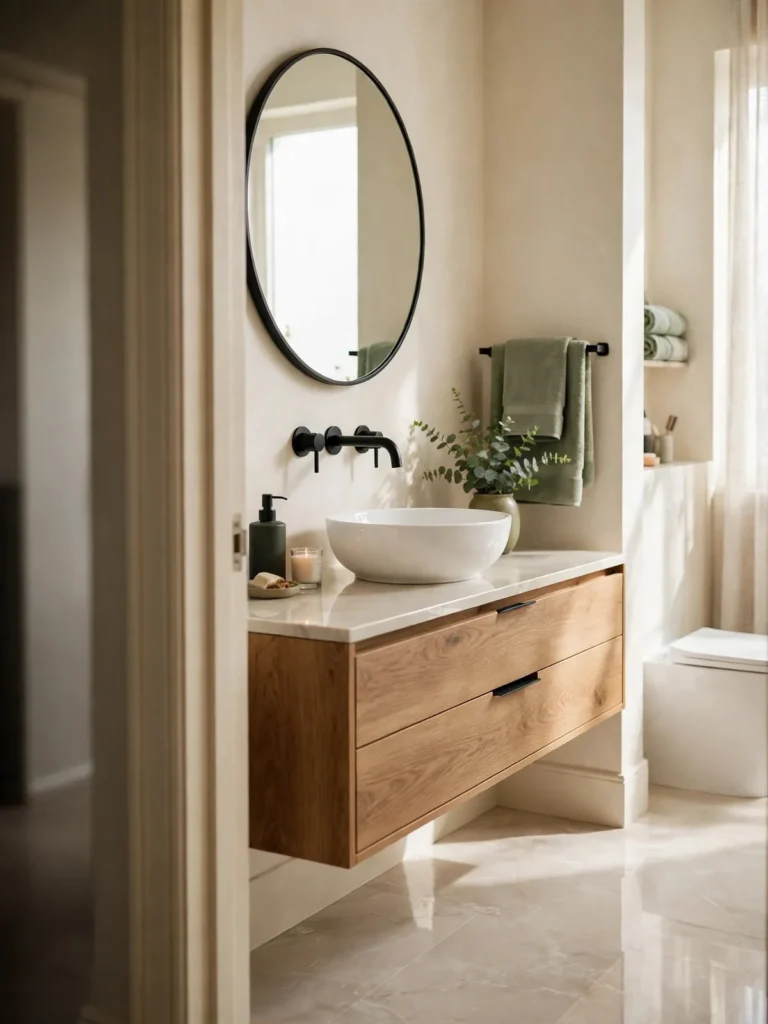
29 Brilliant Bathroom Organization Ideas for a Calmer, Clutter-Free Bathroom
Bathroom organization is not about buying more boxes — it is about giving every bottle, towel and tool a home that matches how you actually use it. These 29 bathroom organization ideas build a simple zone system for the vanity, shower, linen cupboard and cleaning supplies, so the room stays calm long after the tidy-up.
Bathroom organization means giving every item in the room a fixed home, grouped by where you use it — daily toiletries at the vanity, shampoo and soap in the shower, fresh towels in the linen zone, and cleaning supplies under the sink — so the counter stays clear, the morning routine takes less time, and nothing gets lost at the back of a cupboard. A calm bathroom is not a bigger bathroom, it is a bathroom where the toothpaste, the hairdryer, the spare toilet rolls and the plasters each have one obvious place, and where the storage matches the habit: open storage for things you grab every day, closed storage for things you want hidden, and labelled bins for everything in between.
If your bathroom is short on space, these small bathroom ideas show how to make a compact room feel larger before you reorganize a single drawer. The 29 ideas below are arranged as a zone system, so you can start with the vanity, then fix the shower, the linen cupboard and the cleaning corner, one zone at a time.
Key Takeaways
What is the best way to start organizing a bathroom?
Start by zone, not by buying storage: empty the vanity first, then the shower, then the linen cupboard and the under-sink cupboard, keeping only what you actually use and grouping the rest by where it is used. Give each zone one storage type — dividers at the vanity, a caddy or niche in the shower, bins in the linen cupboard — before you buy anything new.
How do I keep a bathroom counter clear?
Keep only the four or five things you use every single day on the counter, corralled on one small tray, and move everything else into a drawer, cabinet or basket. A clear counter is a habit, not a purchase: if an item has no home inside a drawer or cupboard, it will always end up back on the counter.
What storage works best in a small bathroom?
In a small bathroom, use the walls and the door: floating shelves, hooks on the back of the door, a narrow rolling cart in a gap, and a tall slim cabinet beat a wide vanity every time. Open storage works for pretty, everyday items; closed storage hides the rest, so the room looks bigger than it is.
Should bathroom storage be open or closed?
Use both, on purpose. Open storage suits rolled towels, plants and the few beautiful bottles you reach for daily, because you can see them at a glance. Closed storage suits medicines, cleaning products, spare stock and anything in mismatched packaging, because hiding it makes the room look instantly calmer.
How do I stop bathroom organization from falling apart after a week?
Keep the system small and obvious: label every bin, keep a daily reset basket by the door for stray items, and do a two-minute reset each evening — counter wiped, towels hung, stray bottles back in their zone. A system with ten rules fails; a system with three labelled zones lasts.
| Storage type | Best for | Strength | Watch out for |
|---|---|---|---|
| Open shelves and baskets | Rolled towels, plants, pretty everyday bottles | You can see everything at a glance and grab it with one hand | Shows clutter if it is overfilled, and collects steam and dust |
| Closed cabinets and drawers | Medicines, cleaning products, spare stock, mismatched packaging | Hides the mess and makes the room look instantly calmer | Items get lost at the back unless you use dividers, trays or a lazy Susan |
| Hidden door and wall storage | Hair tools, bobby pins, robes, spare rolls | Uses dead space on doors and walls with no floor space needed | Needs the right fixings — hollow doors and plasterboard will not hold heavy items |
| Rolling carts and caddies | Overflow, cleaning supplies, narrow gaps | Pulls out when you need it and disappears when you do not | Tips easily if heavy items sit on the top tier |
A Vanity Drawer Divider System That Ends the Morning Hunt
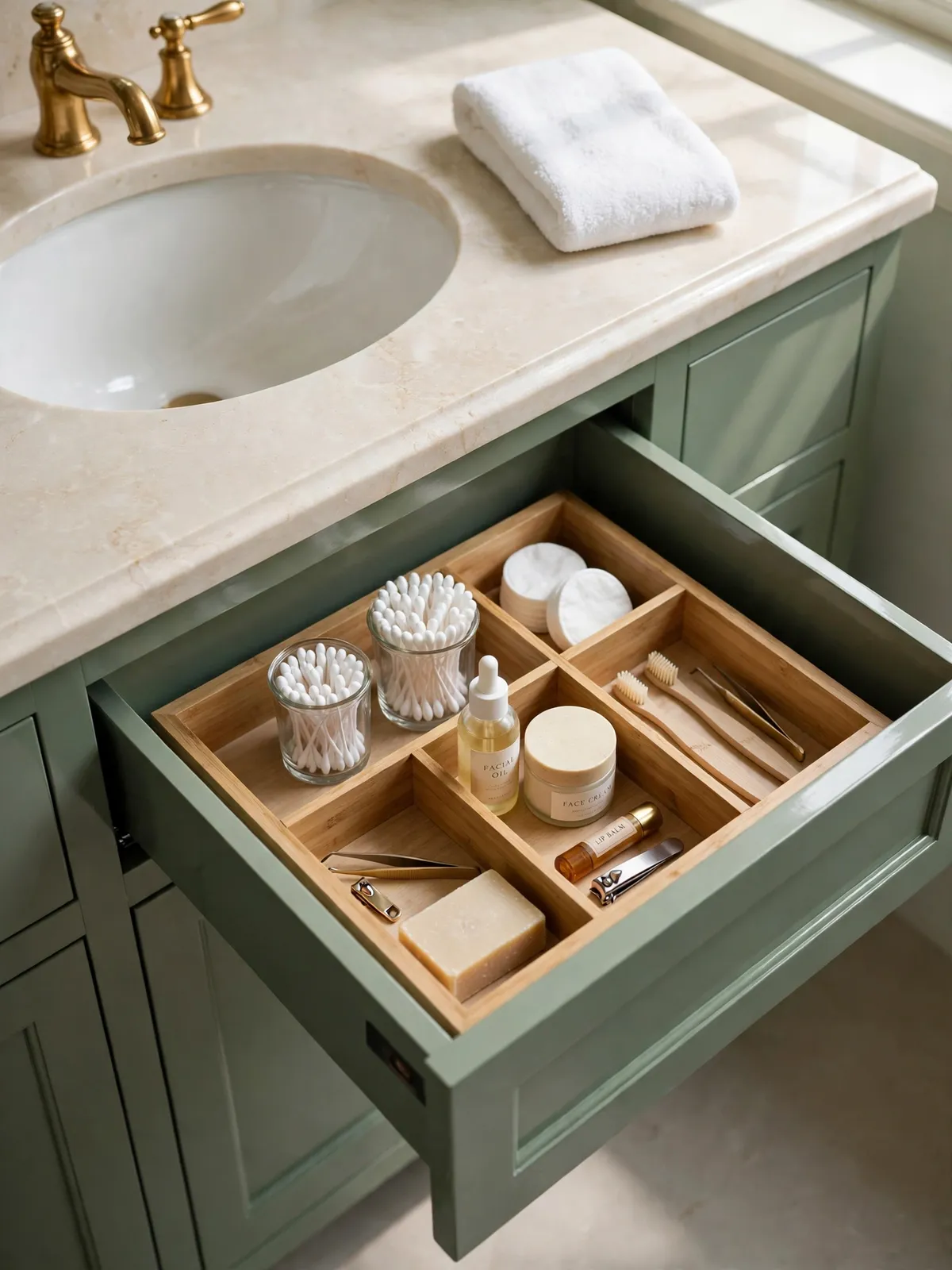
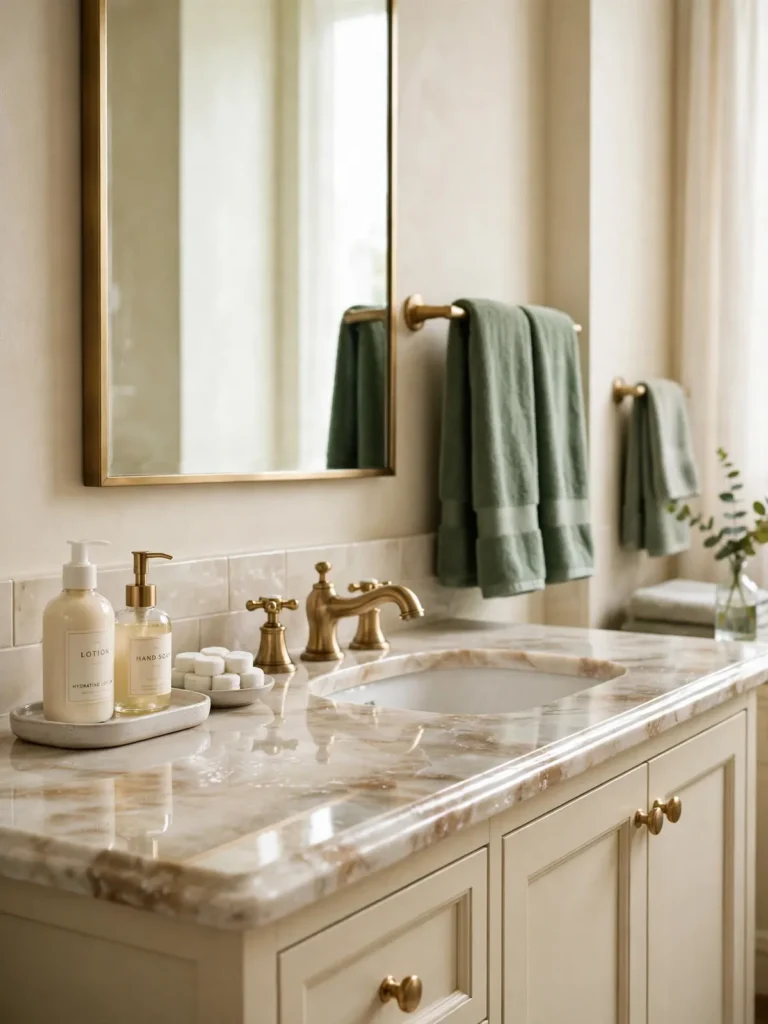
A vanity drawer divider system that ends the morning hunt is the single most useful bathroom organization idea, because a drawer without dividers becomes a jumble within days, while the same drawer with dividers keeps the toothbrush, the moisturiser, the hairbrush and the spare batteries in the same place every morning. Here, slim bamboo dividers split a deep drawer into narrow slots for brushes, a square section for skincare jars and a long slot for the hairdryer, inside a sage-green vanity with a cream stone countertop and brass taps. The system suits any vanity with at least one deep drawer, it saves minutes every morning, and it costs far less than a new vanity. The weakness is measuring: dividers bought without measuring the drawer leave gaps where small items slide underneath, so measure the inside of the drawer first and choose adjustable dividers that fit snugly wall to wall.
Quick tips:
- Measure the drawer inside before buying any dividers.
- Give each person in the household their own section.
- Keep daily items at the front and spare stock at the back.
- Wipe the dividers weekly so toothpaste and spills never build up.
Clear Acrylic Organizers Inside the Medicine Cabinet

Clear acrylic organizers inside the medicine cabinet work because you can see everything without moving anything, and in a bathroom the things you need in a hurry — plasters, painkillers, eye drops, contact lens solution — are the things you least want to hunt for behind a row of bottles. Here, two small clear acrylic trays sit on the cabinet shelves, one holding plasters and small boxes upright, the other holding eye drops and lip balm in a row, against dusty-blue walls with a white ceramic sink and chrome taps. The system suits a shallow cabinet where bottles fall over easily, it stops small items sliding to the back, and it makes expiry dates visible at a glance. The weakness is overfilling: a clear organizer packed to the brim looks just as messy as a bare shelf, so keep one spare of each item and store the rest elsewhere.
Quick tips:
- Use one tray per shelf so nothing slides to the back.
- Keep medicines upright so labels and expiry dates stay visible.
- Store only what you use weekly in the cabinet.
- Check expiry dates once a month when you restock.
A Tiered Lazy Susan Under the Sink
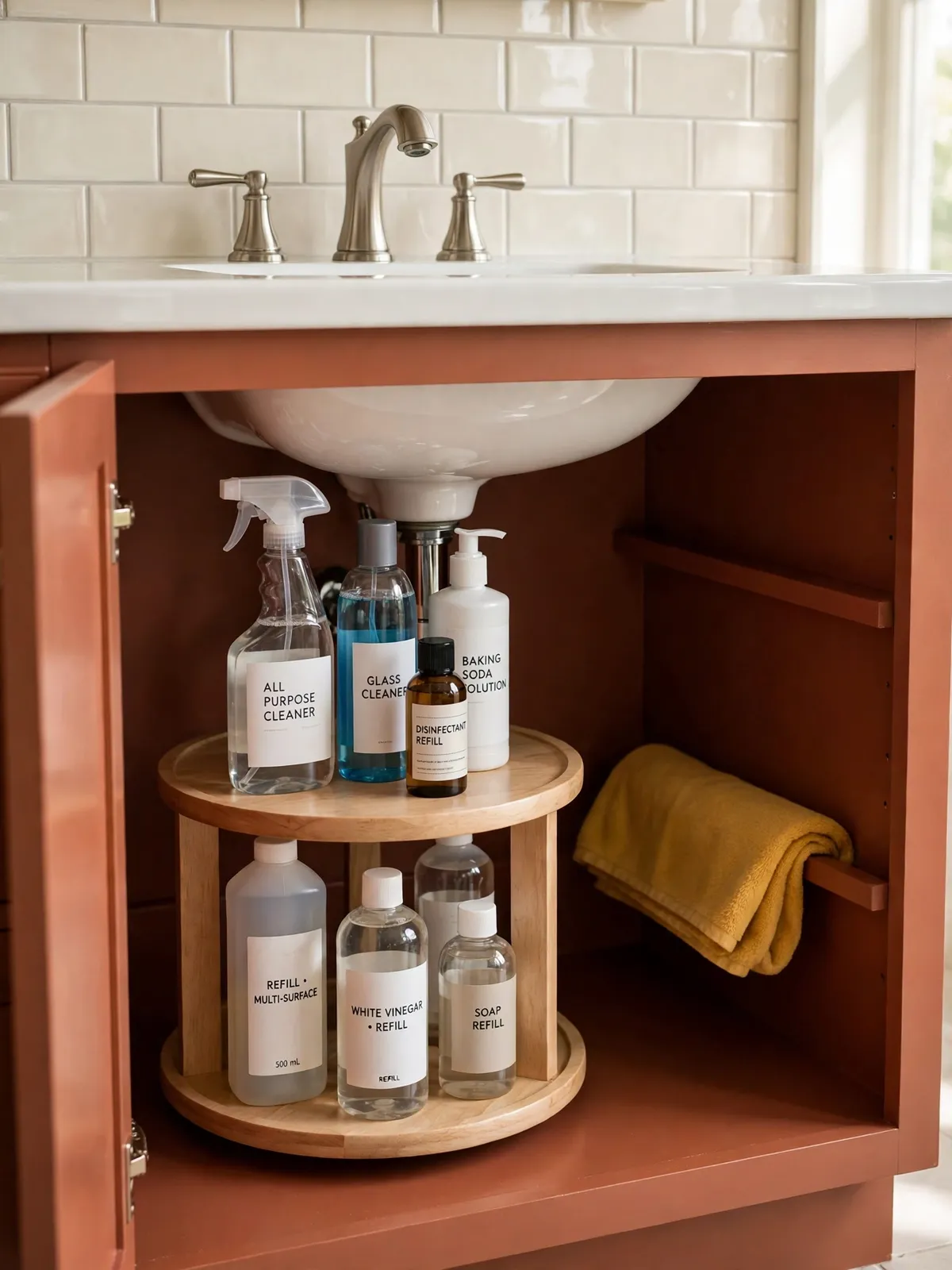
A tiered lazy Susan under the sink turns the deepest, darkest cupboard in the bathroom into the easiest one to use, because a single spin brings the cleaning spray, the spare shampoo or the bleach to the front instead of forcing you to pull out five bottles to reach the one at the back. Here, a two-tier white turntable sits on the floor of the under-sink cupboard, holding tall cleaning sprays on the bottom tier and smaller spare bottles on the top, with the pipes running neatly behind it. The system suits cupboards with a flat floor and enough height for two tiers, it stops bottles tipping over, and it makes the weekly clean faster because everything is reachable. The weakness is the pipes: a turntable that is too wide catches on the trap and the water pipes, so measure around the plumbing first and choose a turntable with a cut-out or a smaller diameter that spins freely.
Quick tips:
- Measure around the pipes before choosing a turntable size.
- Put tall bottles on the bottom tier and small items on top.
- Keep cleaning products on the turntable and spare toiletries in a separate bin.
- Spin it once a week to check for leaks behind the bottles.
Floating Shelves Above the Toilet for Everyday Essentials
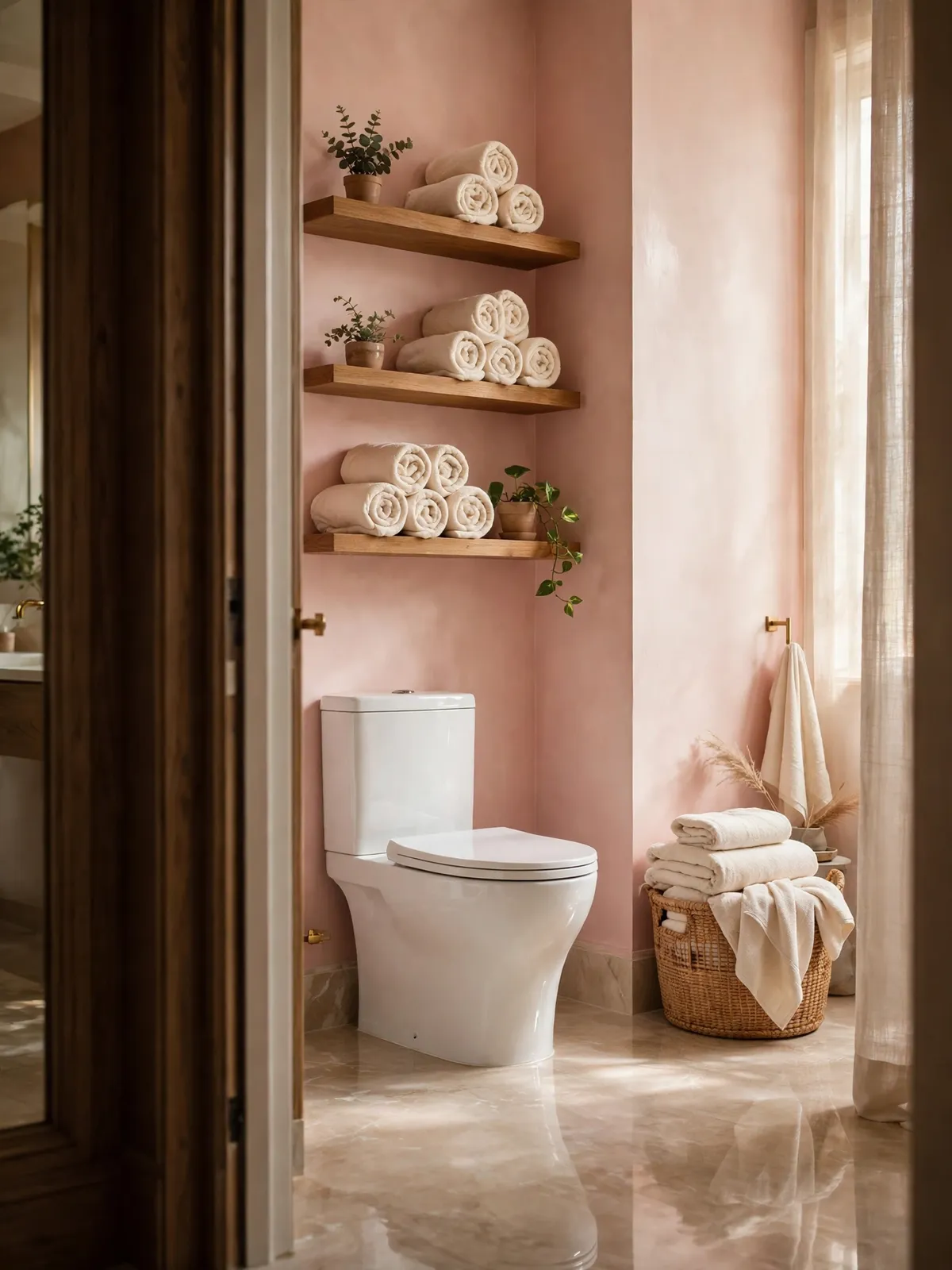
Floating shelves above the toilet use the one stretch of wall every bathroom wastes, because the space over the cistern is too high for a cabinet and too awkward for a picture, yet it is exactly at eye level for the things you reach for every day. Here, two pale pine shelves sit above a white toilet against blush-pink walls, holding rolled cream towels, a small trailing plant and a rattan basket of spare toilet rolls. The system suits small bathrooms with no floor space to spare, it costs very little, and it keeps the essentials within arm’s reach without crowding the vanity. The weakness is weight and steam: shelves fixed with the wrong plugs pull out of plasterboard, and anything stored above a toilet gets steamy, so fix them into studs or use proper plasterboard fixings, and keep medicines and paper items somewhere drier.
Quick tips:
- Fix shelves into studs or use proper plasterboard fixings.
- Keep the bottom shelf high enough to clear the cistern lid.
- Store rolled towels and spare rolls here, not medicines.
- Leave one shelf partly empty so the display reads as calm.
Woven Baskets on Open Shelves for Rolled Towels
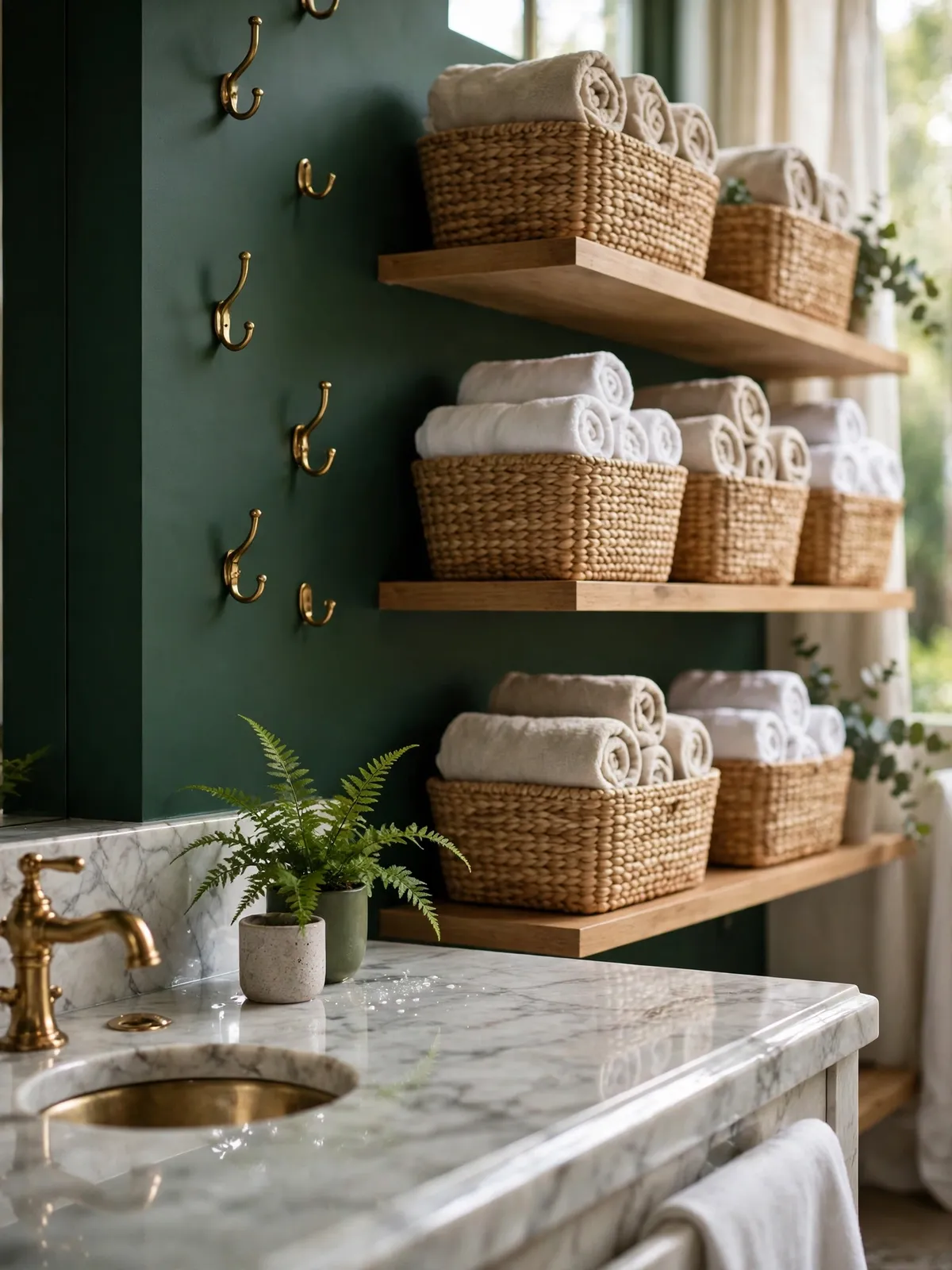
Woven baskets on open shelves for rolled towels turn linen storage into decoration, because a neat roll in a seagrass basket reads as a boutique hotel, while a folded stack on a bare shelf reads as a linen cupboard, and the basket hides the uneven edges that make folded towels look untidy. Here, three seagrass baskets sit on open shelves against deep forest-green walls, each holding tightly rolled white and sand-coloured towels with a small fern beside them. The system suits bathrooms with open shelving and no linen cupboard, it makes towels easy to grab with one hand, and it adds a warm natural texture that balances cold tiles. The weakness is damp: baskets in a steamy bathroom can smell musty if towels sit too long, so rotate the stock weekly and never roll a towel that is even slightly damp.
Quick tips:
- Roll towels tightly so they hold their shape in the basket.
- Label one basket per person or per towel size.
- Rotate the stock weekly so no towel sits damp for long.
- Choose seagrass or rattan, not fabric baskets, in a humid room.
A Shower Caddy That Actually Drains
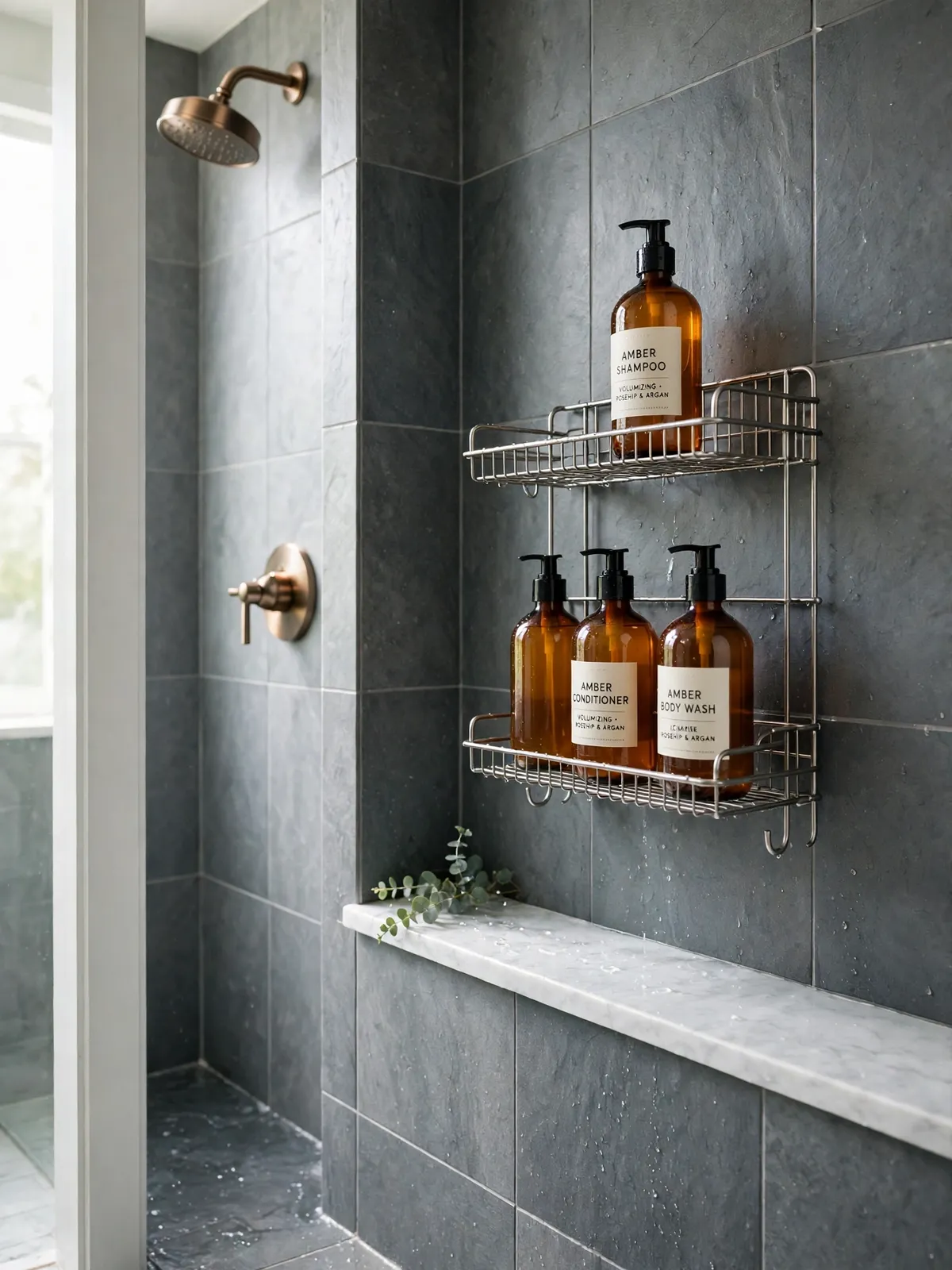
A shower caddy that actually drains is the difference between a tidy shower and a shelf of bottles standing in a puddle, because a caddy with solid shelves traps water, breeds mould and makes every bottle slimy, while a wire or mesh caddy lets the water run straight through and the bottles dry between showers. Here, a brushed bronze wire caddy hangs from the shower head over slate-grey tiles, holding amber shampoo and conditioner bottles with a white marble ledge below for a bar of soap. The system suits showers with no niche, it costs little, and it keeps the bottles off the floor and the bath edge where they always get knocked over. The weakness is weight: a caddy loaded with full-size bottles slides down the shower pipe, so choose a caddy with a suction cup or a tension pole, and keep only the bottles you use daily in it.
Quick tips:
- Choose wire or mesh shelves, never solid plastic trays.
- Keep only daily-use bottles in the caddy.
- Rinse the caddy weekly to stop soap scum building up.
- Use a tension-pole caddy if the shower head hook keeps slipping.
Recessed Shower Niches for Bottles and Jars
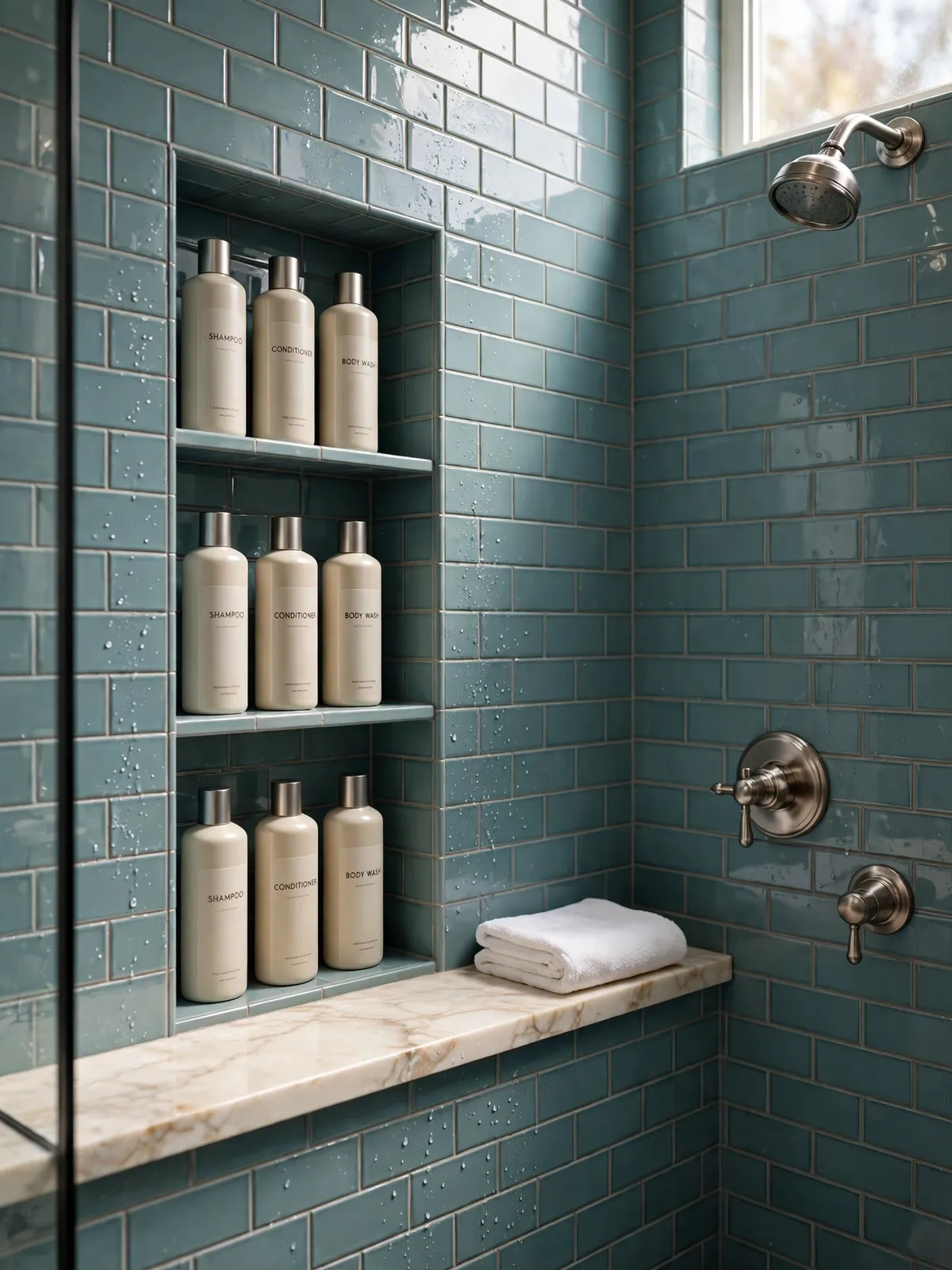
Recessed shower niches for bottles and jars solve the ugliest problem in most showers — bottles piled on the bath edge or the shower floor — by carving storage into the wall itself, so everything has a place and nothing sits on a surface where it gets knocked over. Here, a dusty teal tiled niche with a cream marble ledge holds matching amber glass bottles in the shower, with nickel fittings and a single folded white cloth, and the niche reads as architecture rather than storage. The system suits showers being retiled or built new, it keeps the shower floor clear, and it makes even a small shower feel designed rather than improvised. The weakness is the wall: a niche needs a cavity deep enough to hold bottles, and it must be waterproofed properly or it leaks into the wall — so plan niches during a renovation, never as an afterthought, and have the tiler seal them carefully.
Quick tips:
- Plan niches during renovation, not after tiling is done.
- Make the niche deep enough for full-size bottles.
- Line it with the same tile as the wall for a built-in look.
- Decant products into matching bottles for a calm, tidy look.
Hooks on the Back of the Door for Robes and Towels
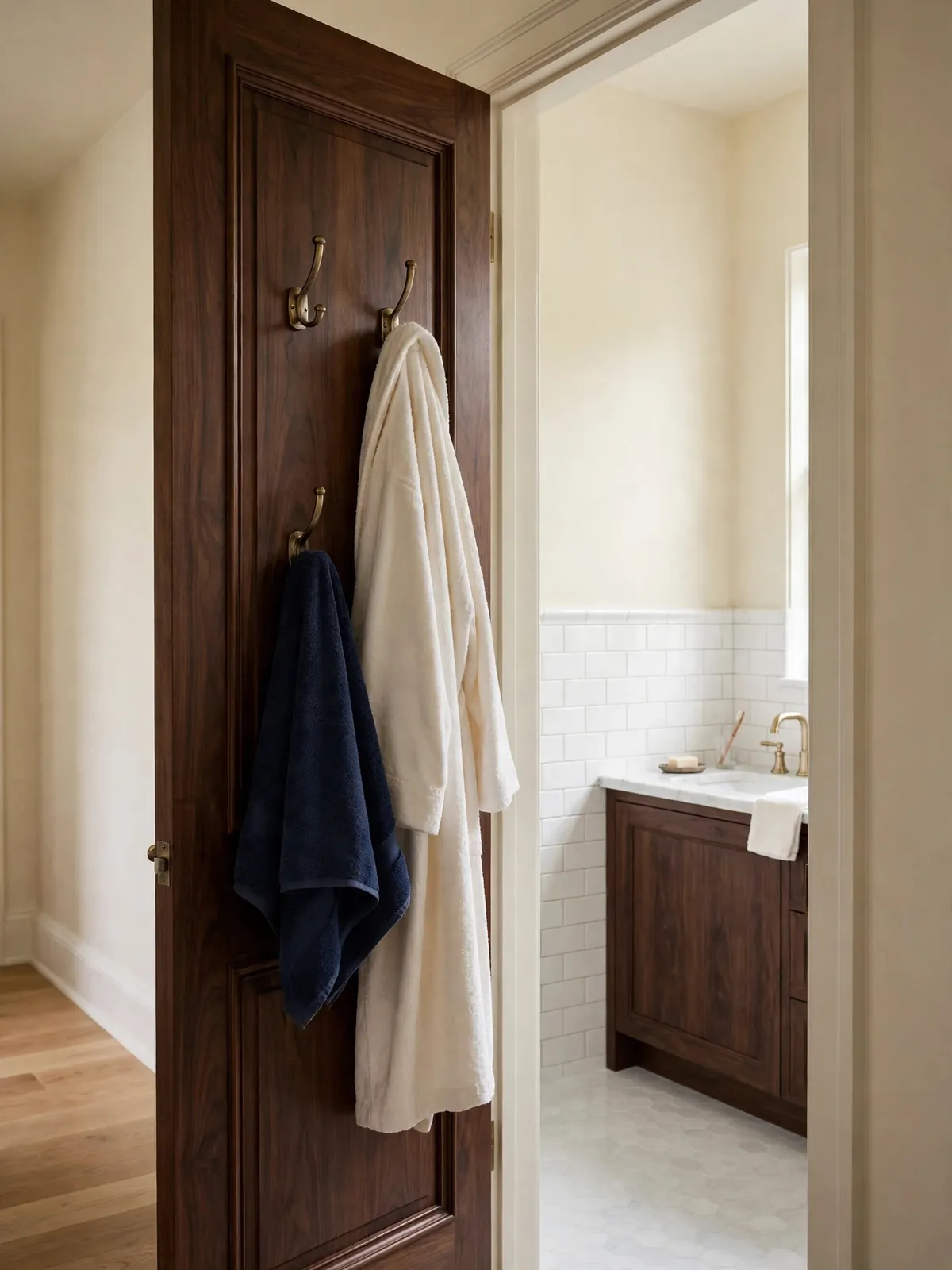
Hooks on the back of the door for robes and towels use space that is otherwise completely wasted, because the back of a bathroom door is a full-height wall that nobody sees, yet it is exactly where a robe, a towel or a pair of pyjamas wants to hang while you shower. Here, three brushed brass hooks sit in a neat row on a dark walnut door, holding a cream robe and a folded navy towel against warm cream walls. The system suits every bathroom, it costs almost nothing, and it frees the towel rail for the towel that is actually drying. The weakness is the door itself: hooks screwed into a hollow door pull out under a heavy wet towel, so use over-door hooks that need no screws, or fix into the solid edge of the door, and keep the heaviest towel on the lowest hook.
Quick tips:
- Use over-door hooks on hollow doors to avoid screws pulling out.
- Give each person one hook so robes never pile up.
- Hang the heaviest towel on the lowest hook.
- Keep the door hooks for robes and drying towels, not for storage.
A Rolling Cart That Slides Into a Narrow Gap
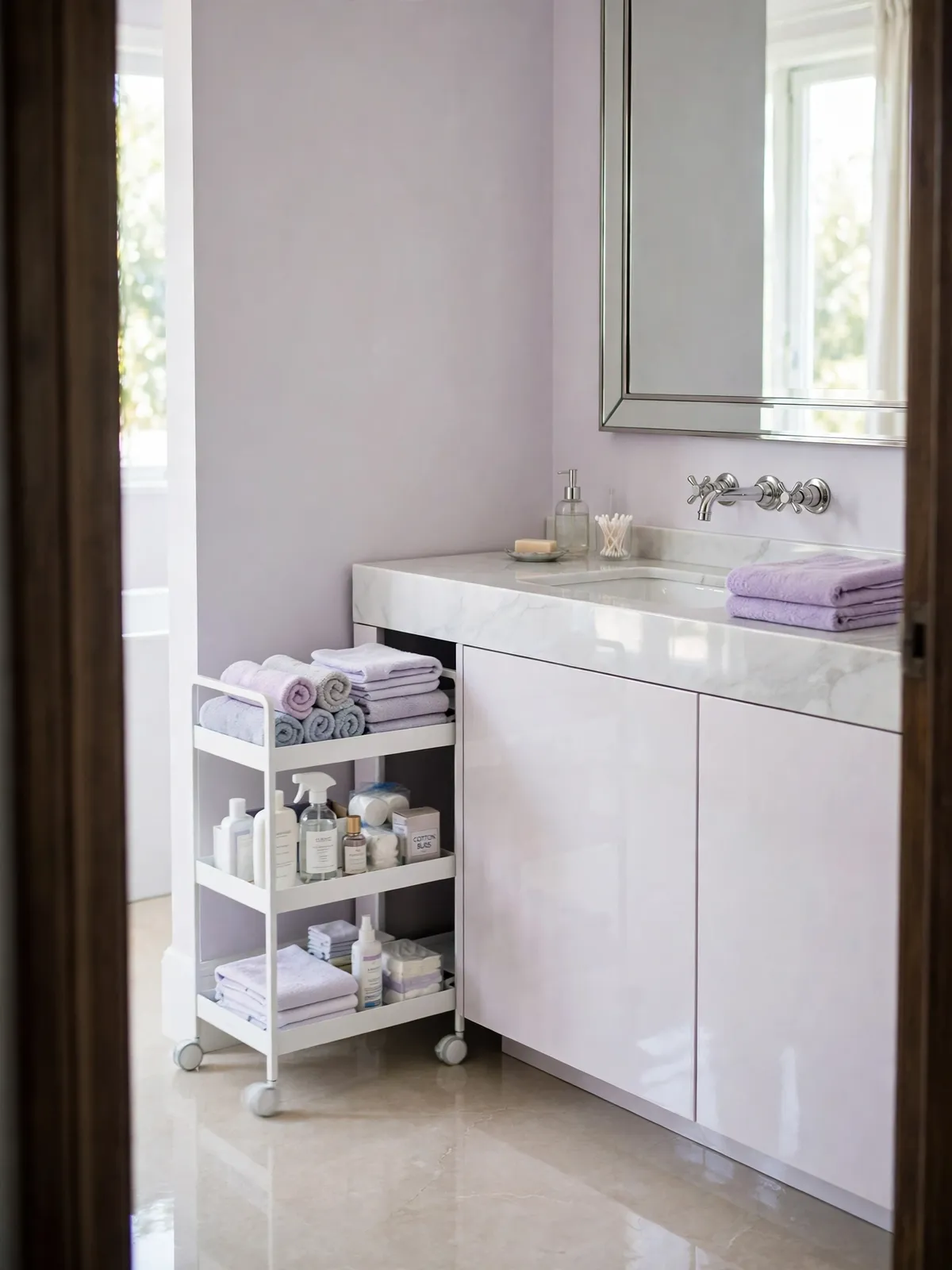
A rolling cart that slides into a narrow gap rescues the dead space beside the vanity or the toilet, because most bathrooms have a gap of fifteen or twenty centimetres that is too narrow for a cabinet and too wide to ignore, and a slim cart on wheels turns that gap into three tiers of storage that pull out when you need them and disappear when you do not. Here, a slim white three-tier cart slides out from beside a pale lavender vanity, holding spare shampoo, cleaning cloths and a spare toilet roll on its shelves. The system suits small bathrooms and rented homes, it needs no fixing, and it holds the overflow that would otherwise crowd the counter. The weakness is tipping: a tall narrow cart loaded with heavy bottles topples when it is pulled out quickly, so keep heavy items on the bottom tier and light items on top, and choose a cart with a locking wheel.
Quick tips:
- Measure the gap before buying — carts come in several widths.
- Keep heavy bottles on the bottom tier to stop tipping.
- Use the top tier for daily items and the bottom for spares.
- Choose a cart with at least one locking wheel.
Labelled Jars and Canisters on the Vanity Top
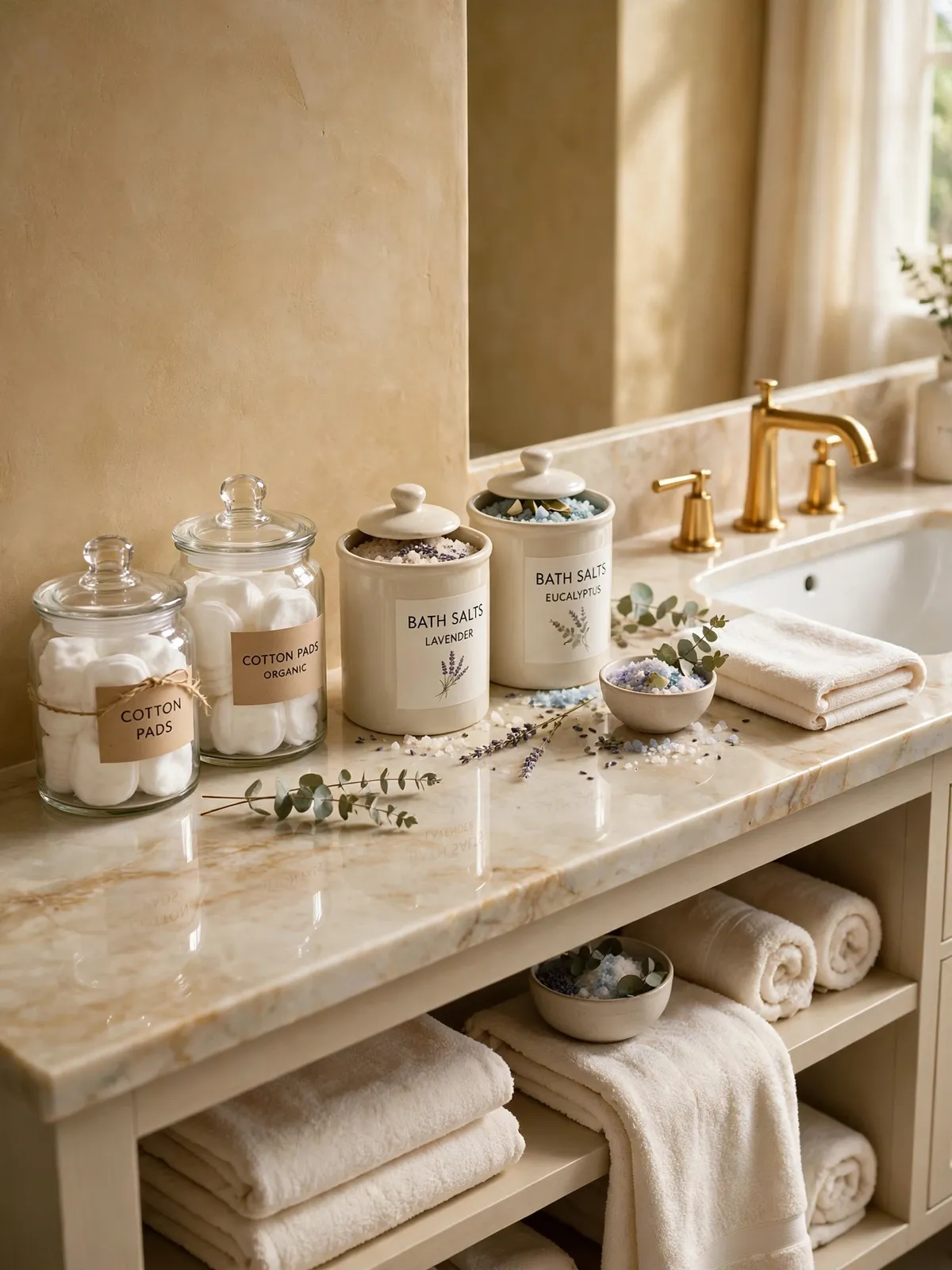
Labelled jars and canisters on the vanity top work because the things you use every day — cotton pads, cotton buds, bath salts, hair ties — come in noisy, mismatched packaging, and decanting them into matching jars with a small label turns visual clutter into a calm display in one move. Here, three clear glass jars and a cream ceramic canister sit on a vanity against warm sand-coloured walls, holding cotton pads, bath salts and hair ties, each with a small cream label, beside a white ceramic sink with brushed gold taps. The system suits a vanity top that always looks busy, it makes it obvious when something is running low, and it stops small items rolling into the sink. The weakness is maintenance: jars that are never refilled become empty decoration, so keep the refill stock in one labelled bin under the sink and top the jars up on the same day each week.
Quick tips:
- Decant only daily-use items, not everything you own.
- Use one matching set of jars so the display reads as calm.
- Keep refill stock in a labelled bin under the sink.
- Label every jar — an unlabelled jar is just another mystery box.
A Linen Tower for Fresh Towels and Spare Toiletries
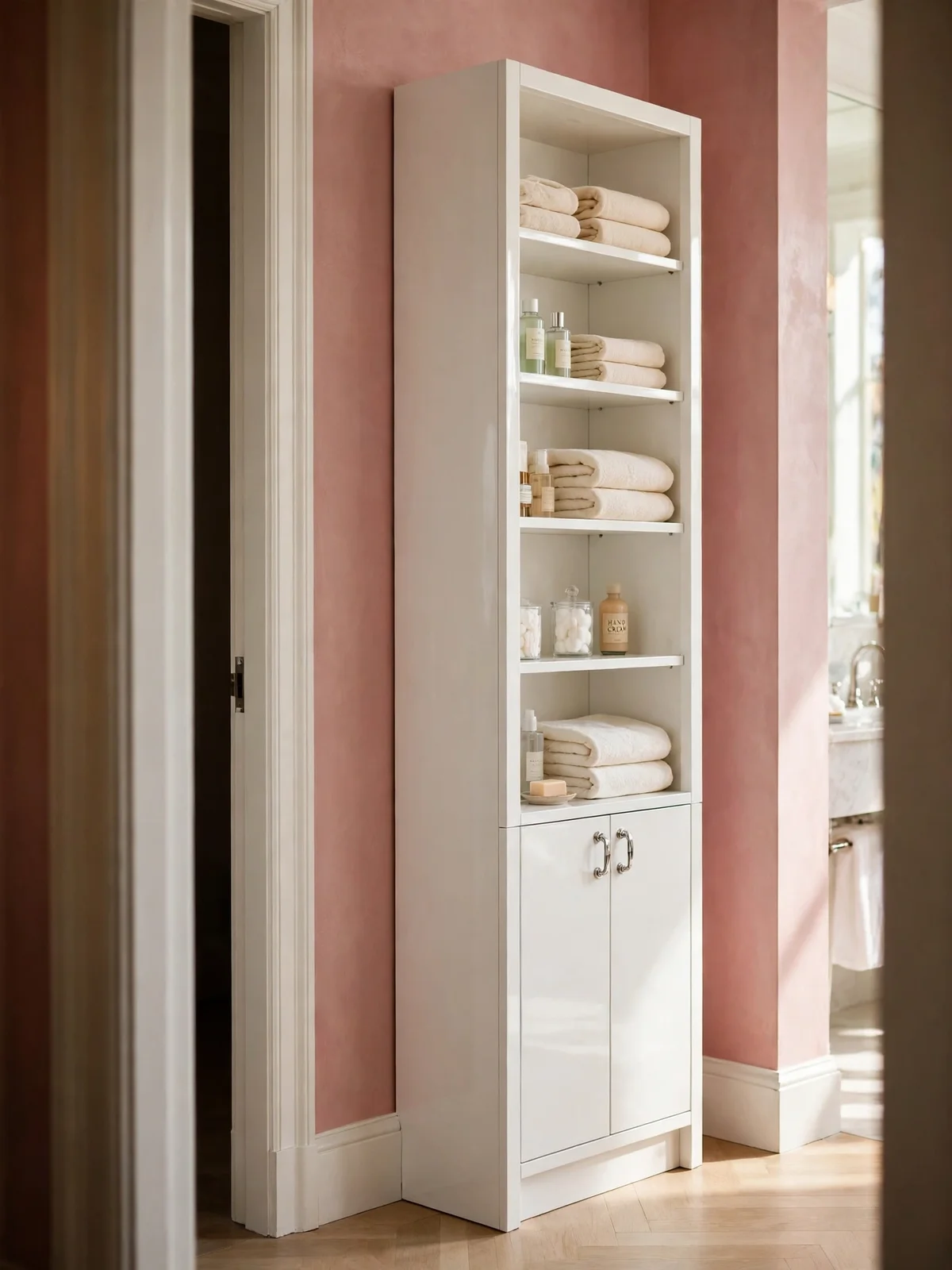
A linen tower for fresh towels and spare toiletries is the best answer when a bathroom has no linen cupboard, because a tall narrow cabinet uses vertical space that a wide vanity cannot, and it keeps the fresh towels, the spare shampoo and the guest toiletries in one obvious place instead of scattered across three rooms. Here, a tall white linen tower stands beside a vanity against soft rose-pink walls, its open shelves holding folded cream towels, a stack of flannels and a row of spare toiletries in matching bottles. The system suits bathrooms with a spare corner or a stretch of wall beside the vanity, it holds a surprising amount for its footprint, and it makes the weekly towel change a one-minute job. The weakness is depth: a tower that is too deep swallows small items at the back, so choose a shallow tower, roll the towels so they sit at the front, and keep the spare stock in labelled bins on the lower shelves.
Quick tips:
- Choose a shallow tower so nothing gets lost at the back.
- Roll towels so they sit at the front of each shelf.
- Keep spare toiletries in labelled bins on the lower shelves.
- Reserve the top shelf for guest towels and the prettiest items.
A Hair Tool Holder Mounted Inside a Cabinet Door
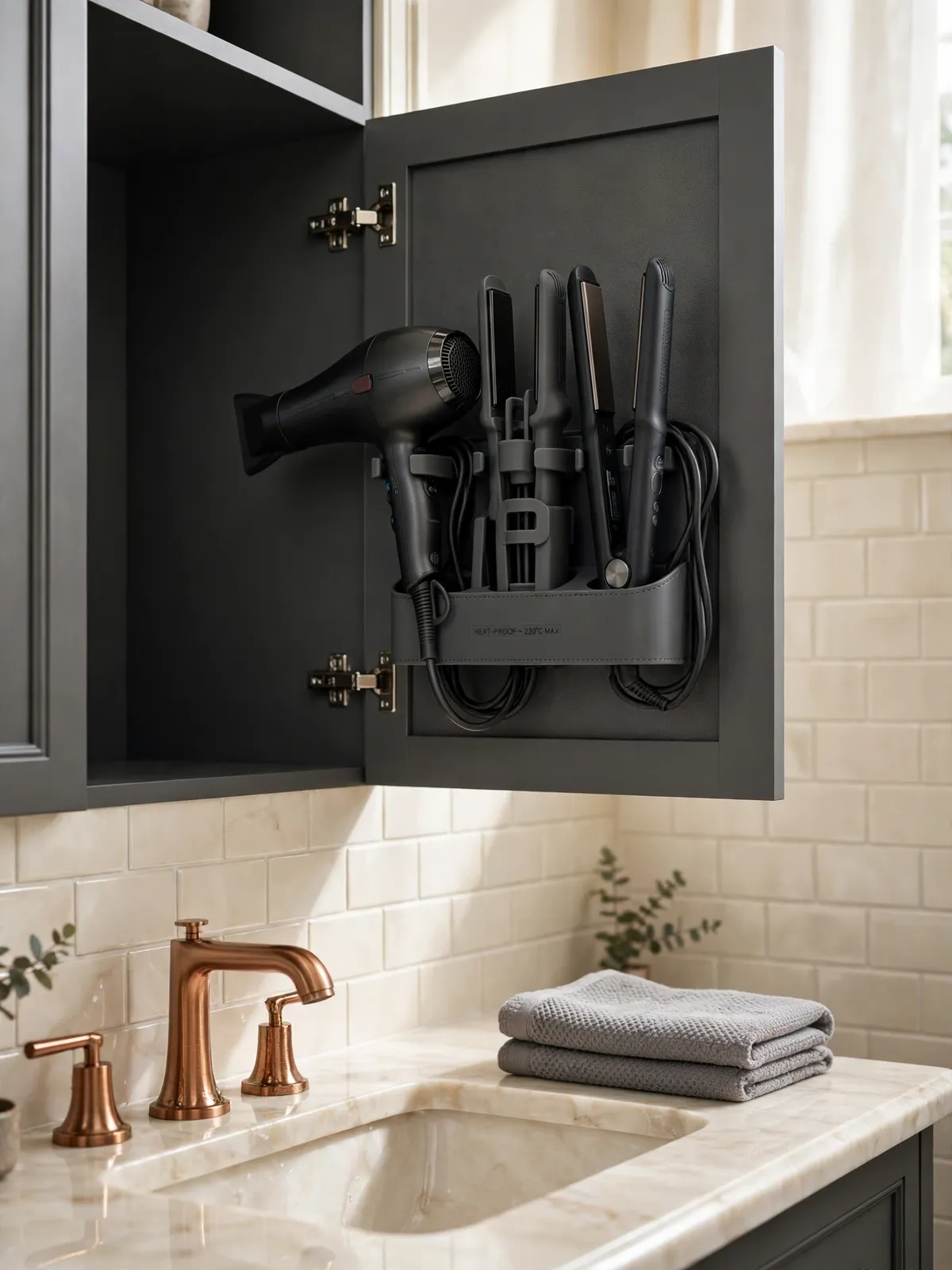
A hair tool holder mounted inside a cabinet door hides the two bulkiest items in most bathrooms — the hairdryer and the straighteners — in the one place they are never in the way, because the inside of a cabinet door is dead space until you mount a heat-proof holder on it, and then the tools hang neatly out of sight with their cords coiled beside them. Here, a heat-proof metal holder sits inside a charcoal-grey cabinet door, holding a cream hairdryer and a pair of straighteners with the cord wrapped on a small hook below. The system suits anyone whose hair tools live on the counter, it frees the whole vanity top, and it keeps hot tools away from water and small hands. The weakness is heat: straighteners put away while still hot can scorch the holder or the door, so choose a holder rated for heat, let the tools cool for a few minutes first, and never store them plugged in.
Quick tips:
- Choose a heat-proof holder rated for hot styling tools.
- Let straighteners cool before putting them away.
- Coil the cord on a small hook so it never tangles.
- Keep the holder on the door you open least, so it stays out of the way.
A Small Tray That Keeps the Counter to Four Items
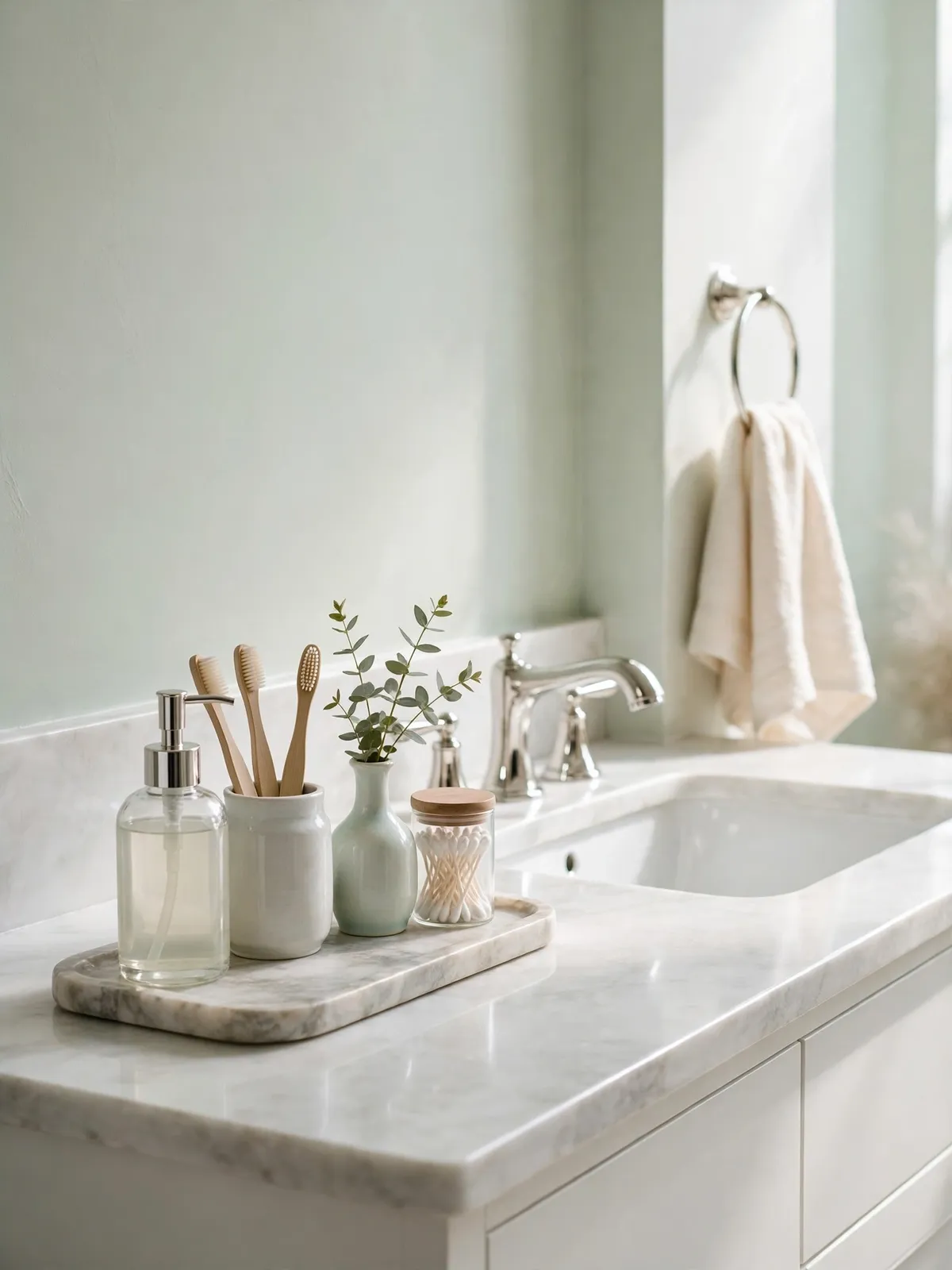
A small tray that keeps the counter to four items is the simplest bathroom organization idea on this list, because a tray draws a visible boundary on the counter, and once the boundary is set, the fifth, sixth and seventh bottle have nowhere to go — so they go back in the drawer where they belong. Here, a small white marble tray sits on a vanity against pale mint-green walls, holding a soap dispenser, a toothbrush holder, a hand cream and a small vase, with the rest of the cream stone countertop completely clear. The system suits any bathroom, it costs very little, and it makes wiping the counter a ten-second job because you lift one tray instead of moving a dozen bottles. The weakness is size: a tray that is too large invites clutter back in, so choose a tray that holds exactly four items and no more, and resist the urge to add a fifth.
Quick tips:
- Choose a tray that holds exactly four items, no more.
- Pick daily-use items only — soap, toothbrushes, hand cream.
- Lift the whole tray to wipe the counter underneath.
- If an item does not fit on the tray, it lives in a drawer.
Stackable Bins in the Linen Cupboard
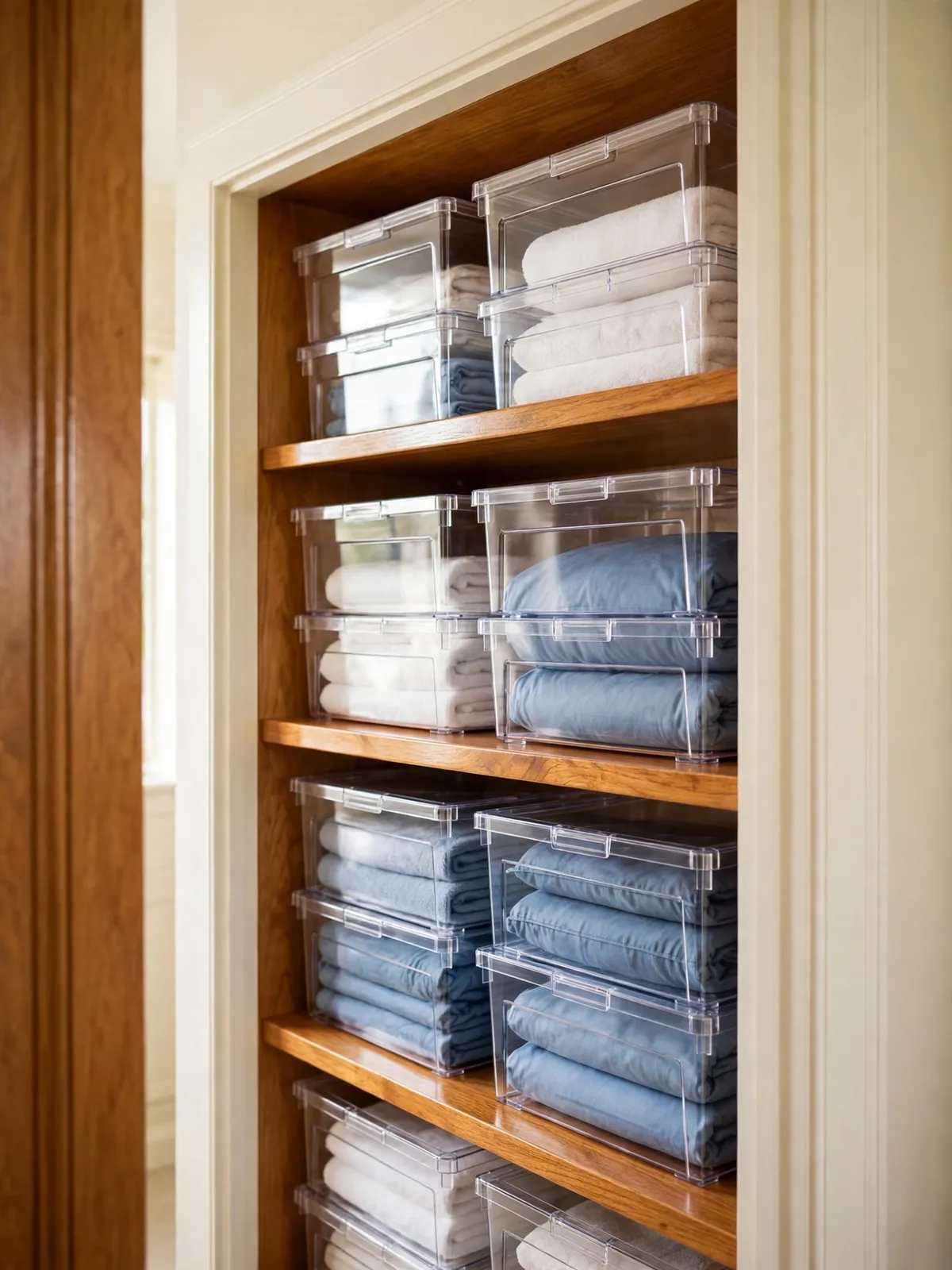
Stackable bins in the linen cupboard turn a deep shelf into two or three usable layers, because a tall cupboard shelf wastes half its height on air, while a stack of clear bins lets you store hand towels above bath towels above spare bedding, and pull out one bin without disturbing the rest. Here, clear stackable bins sit on warm honey-oak shelves in a linen cupboard, holding folded white towels in one bin, blue bedding in another, and spare flannels in a third, each labelled on the front. The system suits a linen cupboard with tall shelves, it stops the familiar avalanche when you pull a towel from the bottom of a pile, and it makes it obvious when stock is low. The weakness is weight: a bin stacked too high with wet or heavy towels is hard to lift down safely, so keep heavy bedding on the lowest shelf and light towels up high, and never stack more than two bins.
Quick tips:
- Never stack more than two bins high.
- Keep heavy bedding low and light towels high.
- Label the front of every bin so you can find it at a glance.
- Fold towels the same size so each bin stays neat.
A Cleaning Caddy Stored Under the Sink
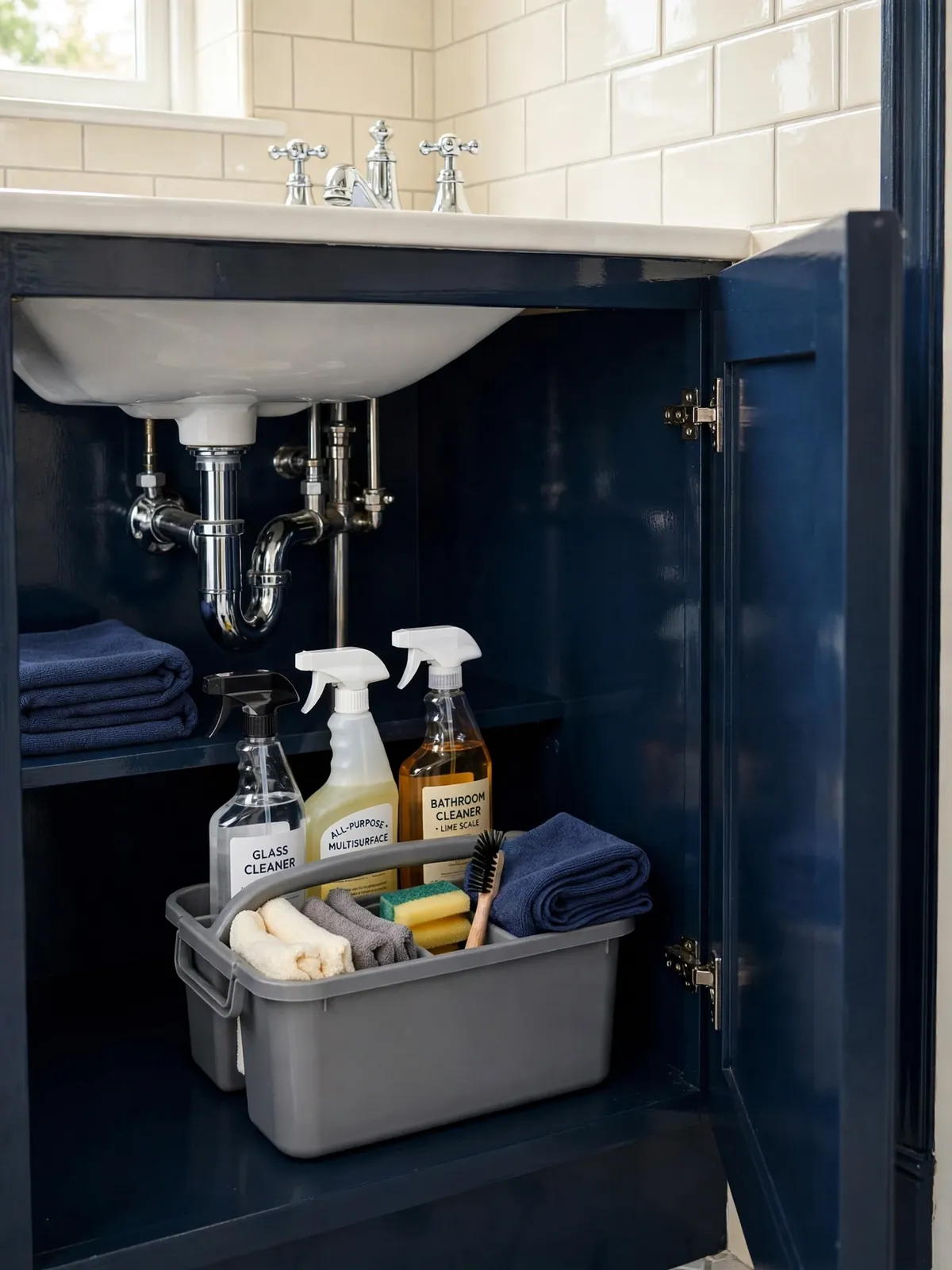
A cleaning caddy stored under the sink keeps every cleaning product together in one grab-and-go box, because the alternative — sprays, cloths, bleach and scrubbers scattered across the cupboard floor — means the weekly clean starts with a ten-minute hunt, and a caddy with a handle means you lift it out, clean the whole bathroom, and put it back in one move. Here, a deep navy caddy with a handle sits under the sink holding two spray bottles, a small bottle of bleach and a stack of folded navy cloths, with the rest of the cupboard floor clear. The system suits every bathroom, it stops cleaning products leaking onto spare towels, and it makes it obvious when a spray is running low. The weakness is size: a caddy that is too wide will not fit past the pipes, so measure the cupboard opening first and choose a caddy with a handle that folds flat.
Quick tips:
- Measure the cupboard opening before buying a caddy.
- Keep cloths and sprays in the same caddy so nothing is forgotten.
- Store the caddy at the front so it lifts out in one move.
- Check for leaks monthly — a leaking bottle ruins the caddy.
A Wall-Mounted Dispenser Station for Shampoo and Soap
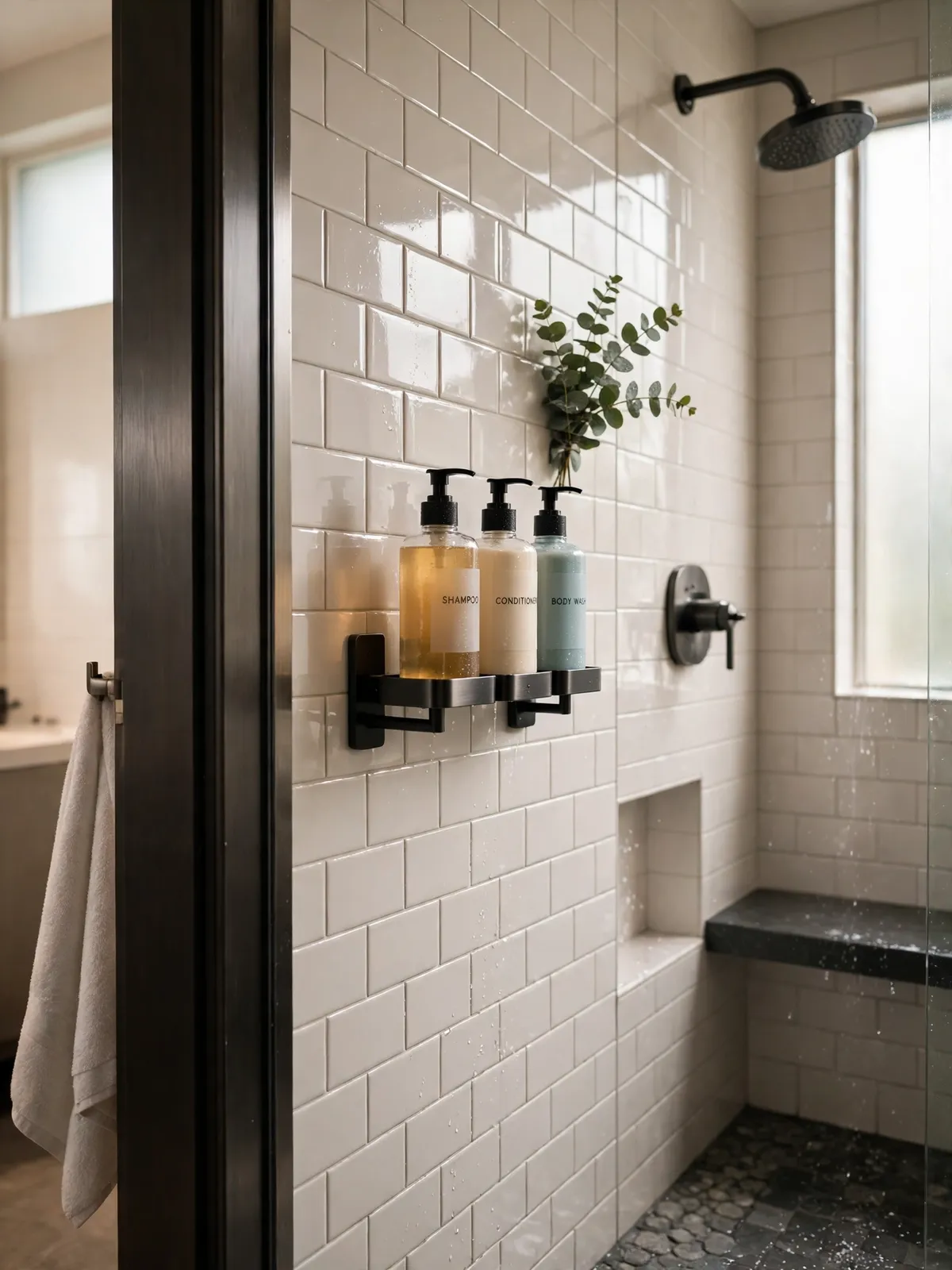
A wall-mounted dispenser station for shampoo and soap removes three bottles from the shower in one move, because the bottles are fixed to the wall at hand height, they refill from a large bottle kept under the sink, and the shower floor and ledge stay completely clear. Here, three brushed black dispensers sit in a neat row on warm white shower tiles, labelled shampoo, conditioner and body wash, with a single eucalyptus sprig beside them and brushed black shower fittings above. The system suits a shower used by the whole family, it cuts plastic waste because you refill from large bottles, and it stops the daily shuffle of bottles falling off the ledge. The weakness is the fixing: dispensers stuck on with suction cups fall off a wet tiled wall, so choose a screw-fixed or strong adhesive mount rated for bathrooms, and check the pump works with thick shampoo before you commit.
Quick tips:
- Choose screw-fixed or strong adhesive mounts, not suction cups.
- Refill from large bottles kept under the sink.
- Label each dispenser clearly so guests never guess.
- Clean the pumps monthly so thick shampoo never clogs them.
A Towel Bar With a Shelf Above It
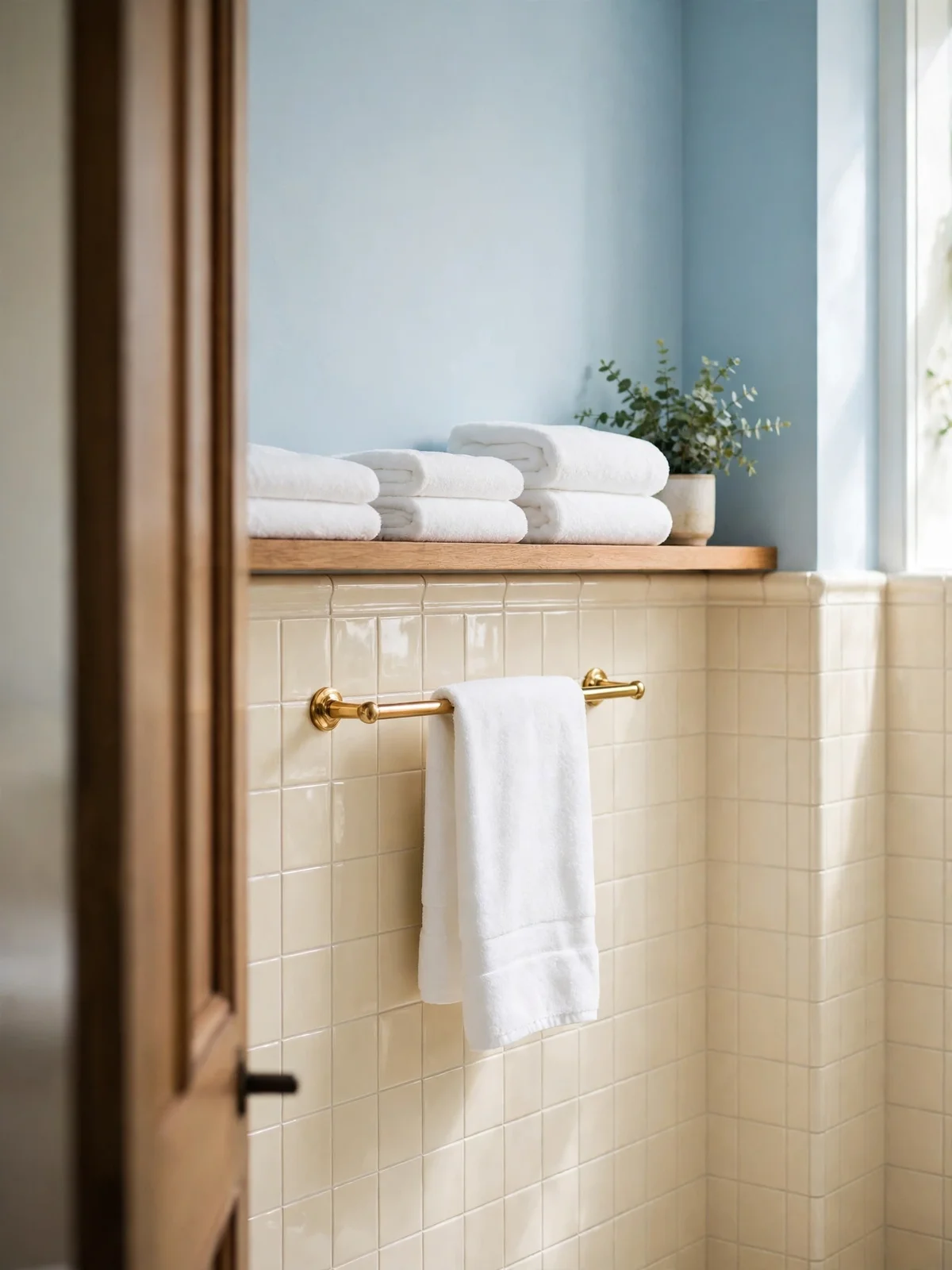
A towel bar with a shelf above it doubles the storage on one stretch of wall, because the bar holds the towel that is drying while the shelf above holds the fresh towels, the spare toilet roll or a small plant, and the whole arrangement takes up no floor space at all. Here, a brass towel bar sits on a soft sky-blue wall with a pale wooden shelf above it, holding folded white towels and a small trailing plant, with cream tiles below. The system suits small bathrooms and the wall beside the bath, it keeps the fresh towel within reach of the bath, and it looks far more finished than a bare towel rail. The weakness is dripping: a wet towel hung below a shelf drips onto the shelf above only if the shelf is too shallow, so choose a shelf at least twenty centimetres deep and hang the towel so it falls clear of the wall.
Quick tips:
- Choose a shelf at least 20 cm deep so it clears the towel below.
- Keep fresh towels on the shelf and the drying towel on the bar.
- Fix the bar into studs so it holds a heavy wet towel.
- Leave one end of the shelf empty for a plant or a candle.
A Magnetic Strip for Bobby Pins and Small Metal Tools
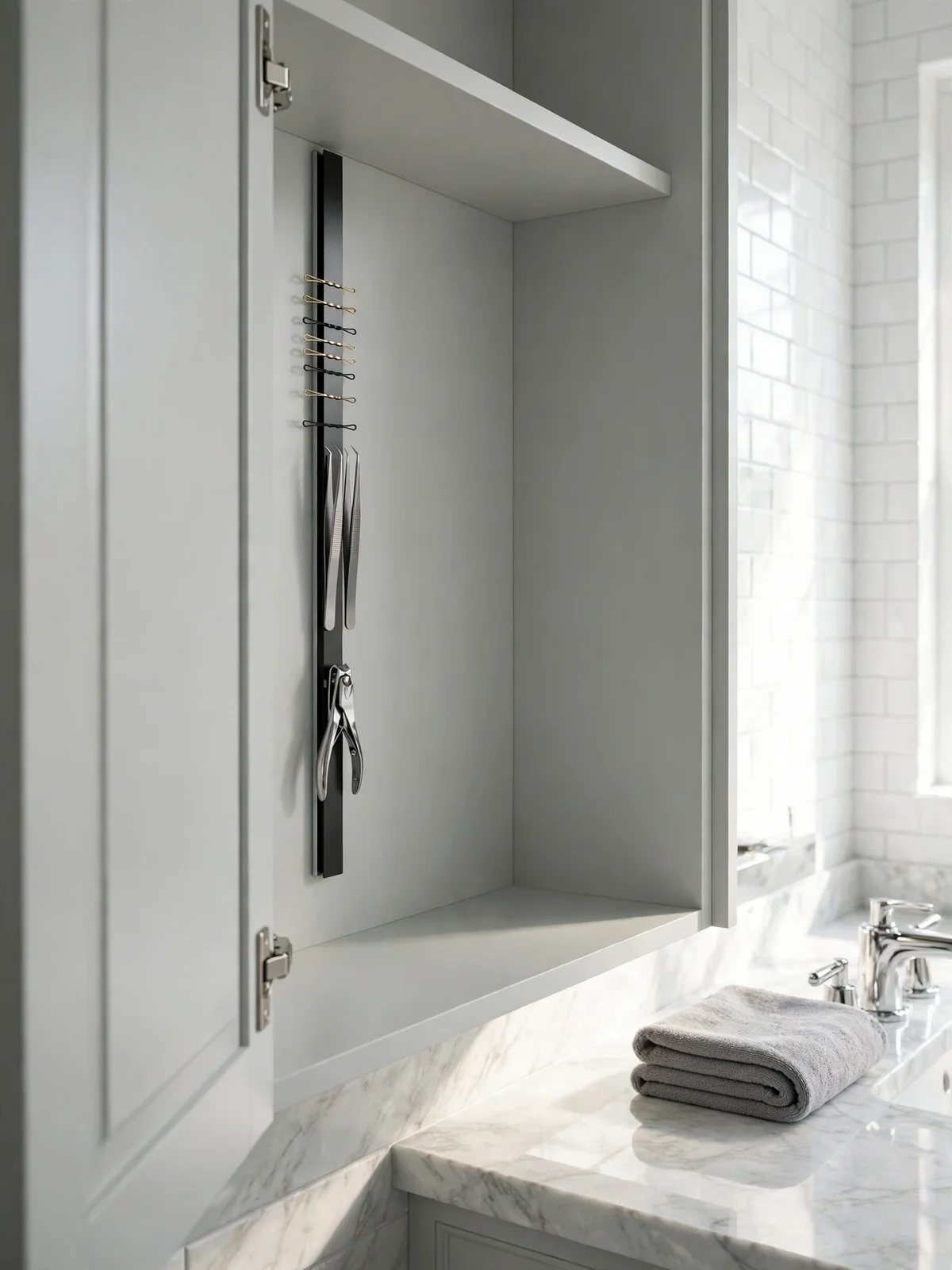
A magnetic strip for bobby pins and small metal tools rescues the smallest, most losable items in the bathroom, because bobby pins, tweezers, nail clippers and small scissors vanish into drawers and never come back, while a slim magnetic strip inside a cabinet door holds them in a neat visible row where you can grab one with a fingertip. Here, a slim silver magnetic strip sits inside a pale grey cabinet door, holding a row of bobby pins, a pair of tweezers and a small pair of nail clippers, with the rest of the cabinet kept for larger items. The system suits anyone who loses bobby pins daily, it costs almost nothing, and it keeps sharp tools out of reach of small hands. The weakness is strength: a weak magnet drops the pins every time the door closes, so choose a strong neodymium strip, fix it with screws rather than adhesive, and keep it away from medicines with magnetic packaging.
Quick tips:
- Choose a strong neodymium strip, not a weak fridge magnet.
- Fix it with screws so it never drops off the door.
- Keep sharp tools on the strip, out of reach of children.
- Wipe the strip monthly so hair and dust never build up.
A Hamper That Hides Dirty Laundry in Plain Sight
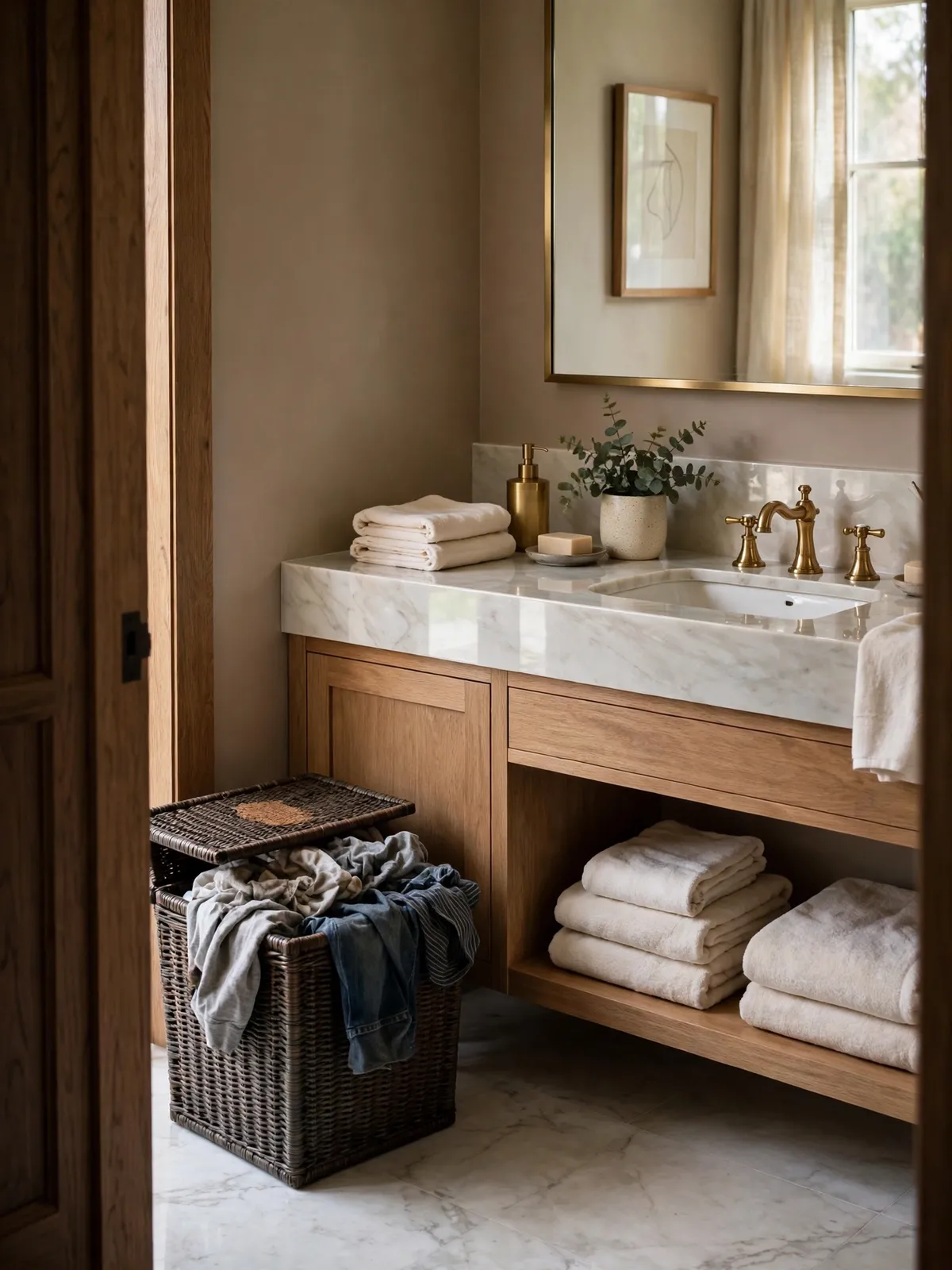
A hamper that hides dirty laundry in plain sight solves the pile-on-the-floor problem, because without a hamper, used towels and clothes land on the bathroom floor or the bath edge, while a lidded hamper beside the vanity gives them one obvious home and keeps the floor clear. Here, a dark rattan hamper with a lid sits beside a vanity against warm taupe walls, holding the day’s used towels, with cream towels folded on the vanity above it. The system suits a family bathroom, it stops the floor pile, and a lidded hamper keeps damp laundry from smelling up the room. The weakness is damp and size: a hamper that is too small overflows by midweek, and a hamper with no ventilation smells musty, so choose a hamper with a ventilated lid or slatted sides, and empty it every two or three days.
Quick tips:
- Choose a ventilated or slatted hamper so damp laundry can breathe.
- Empty it every two or three days, never once a week.
- Keep it beside the vanity so clothes go straight in.
- Use a removable liner bag so emptying it takes seconds.
A Pull-Out Drawer Organizer for Makeup and Skincare
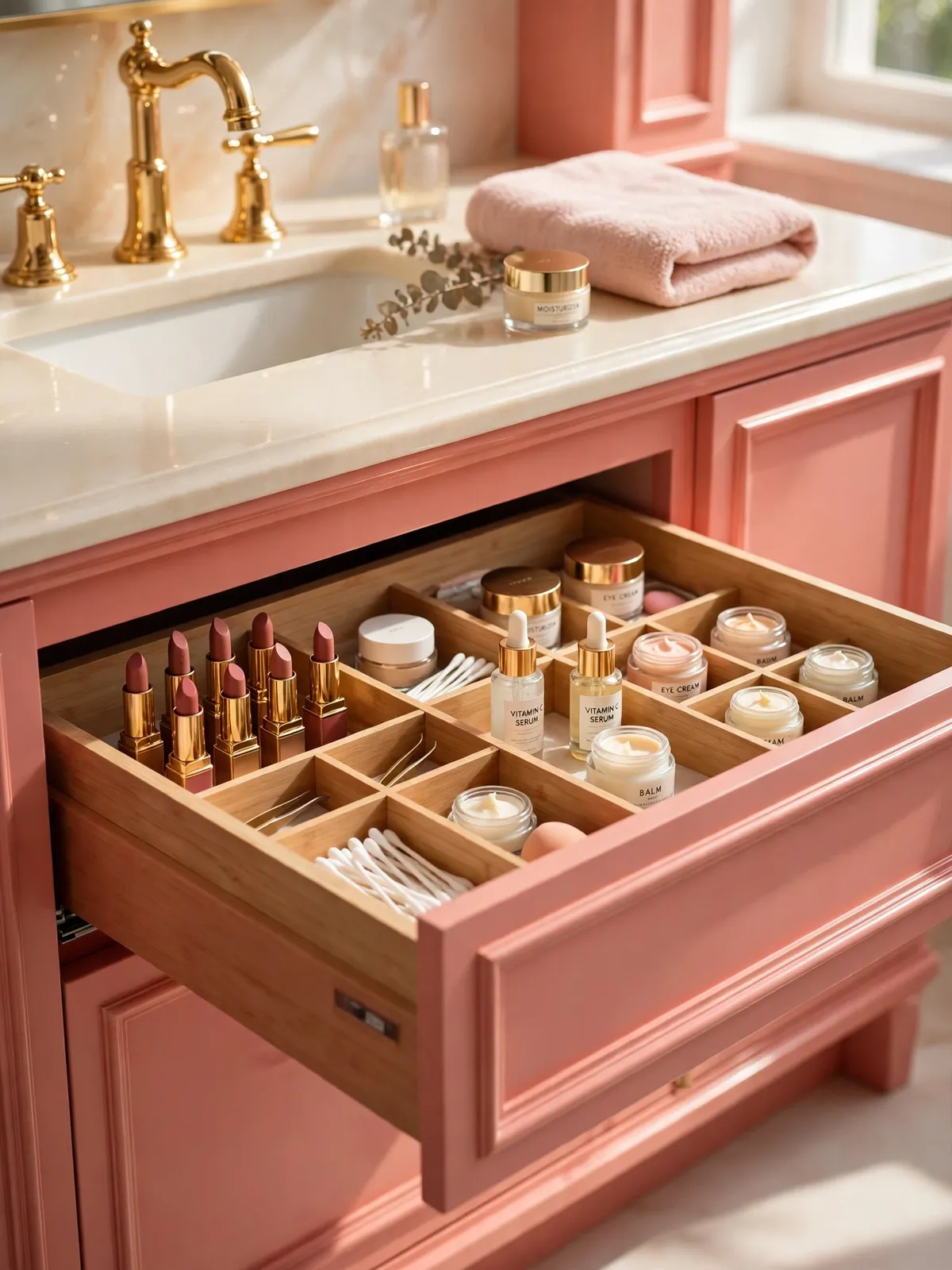
A pull-out drawer organizer for makeup and skincare works because makeup and skincare come in dozens of small tubes, pots and palettes that slide around a drawer and get lost, while a shallow organizer with narrow compartments keeps lipsticks upright, creams in a row and brushes in their own slot, so you can see every shade at a glance. Here, a cream pull-out organizer sits inside a soft coral-pink vanity drawer, holding lipsticks upright in one row, small cream jars in another, and brushes in a slim slot, with a blush towel folded beside the vanity. The system suits anyone with more than a handful of makeup items, it stops the daily rummage, and it protects palettes from cracking under heavier items. The weakness is depth: a deep organizer in a shallow drawer will not close, so measure the drawer depth first and choose a low-profile organizer that leaves room for the drawer to shut cleanly.
Quick tips:
- Measure drawer depth before buying a low-profile organizer.
- Keep daily makeup at the front and occasion makeup at the back.
- Store brushes upright in their own slot to protect the bristles.
- Declutter the organizer monthly — expired makeup hides in drawers.
A Shower Bench With Hidden Storage Underneath
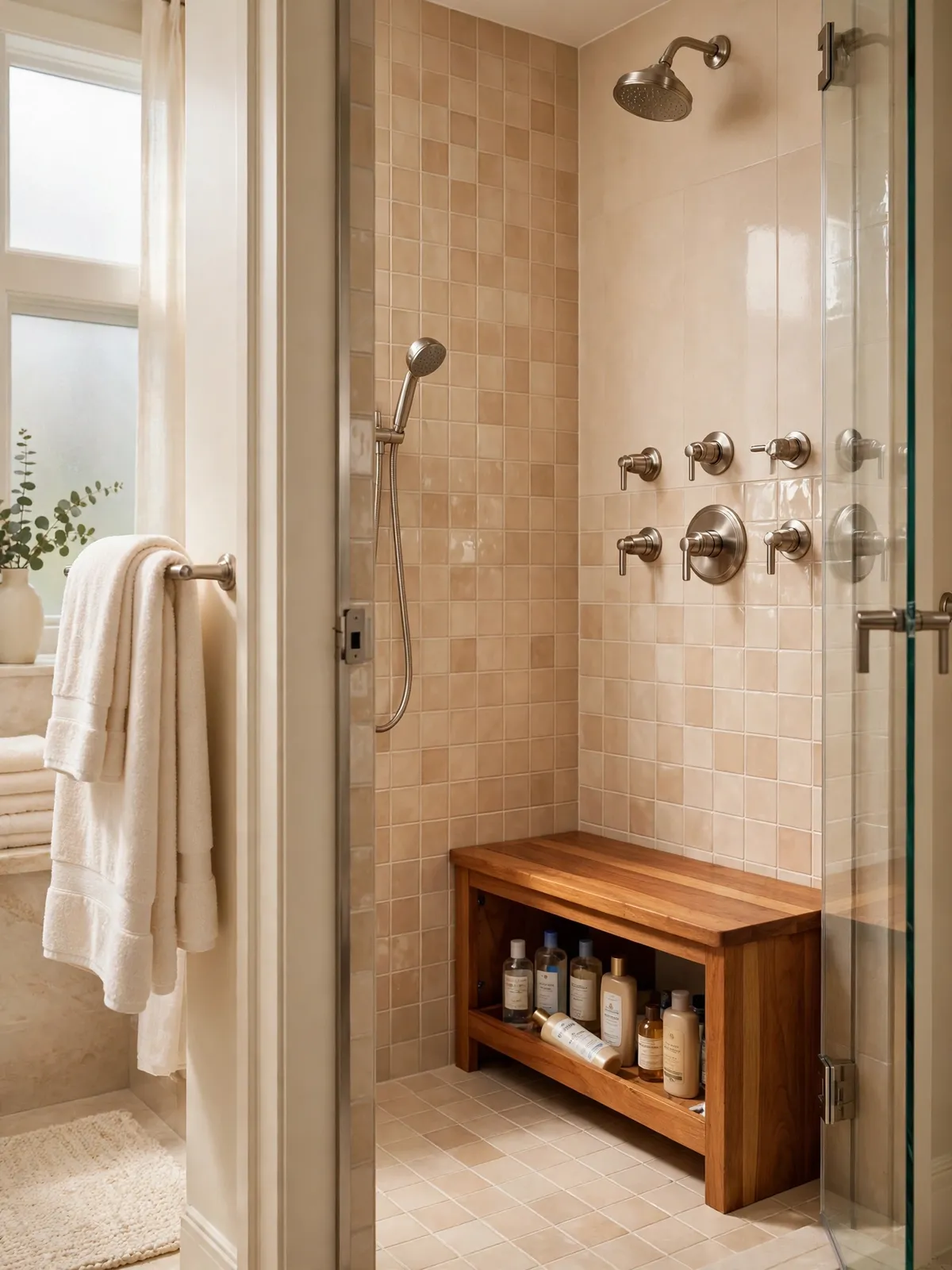
A shower bench with hidden storage underneath does two jobs at once, because the bench gives you somewhere to sit, shave or rest a foot while you wash, and the space beneath it holds the spare shampoo, the bath salts and the cleaning cloths that would otherwise crowd the shower ledge. Here, a teak bench sits in a walk-in shower against warm beige tiles, with spare bottles tucked in a low basket beneath it and brushed nickel fittings above. The system suits a walk-in shower with enough floor space, it adds real comfort for older users and anyone who likes long showers, and it hides the spare stock in the room where it is used. The weakness is space and water: a bench in a small shower eats the standing room, and wood that is never dried rots, so only add a bench where the shower is wide enough, and choose teak or a waterproof material that dries quickly.
Quick tips:
- Only add a bench where the shower is wide enough to stand comfortably.
- Choose teak or waterproof material that dries quickly.
- Keep spare bottles in a basket under the bench, not loose on the floor.
- Dry the bench after use so water never pools underneath.
A First-Aid and Medicine Box With a Clear Lid
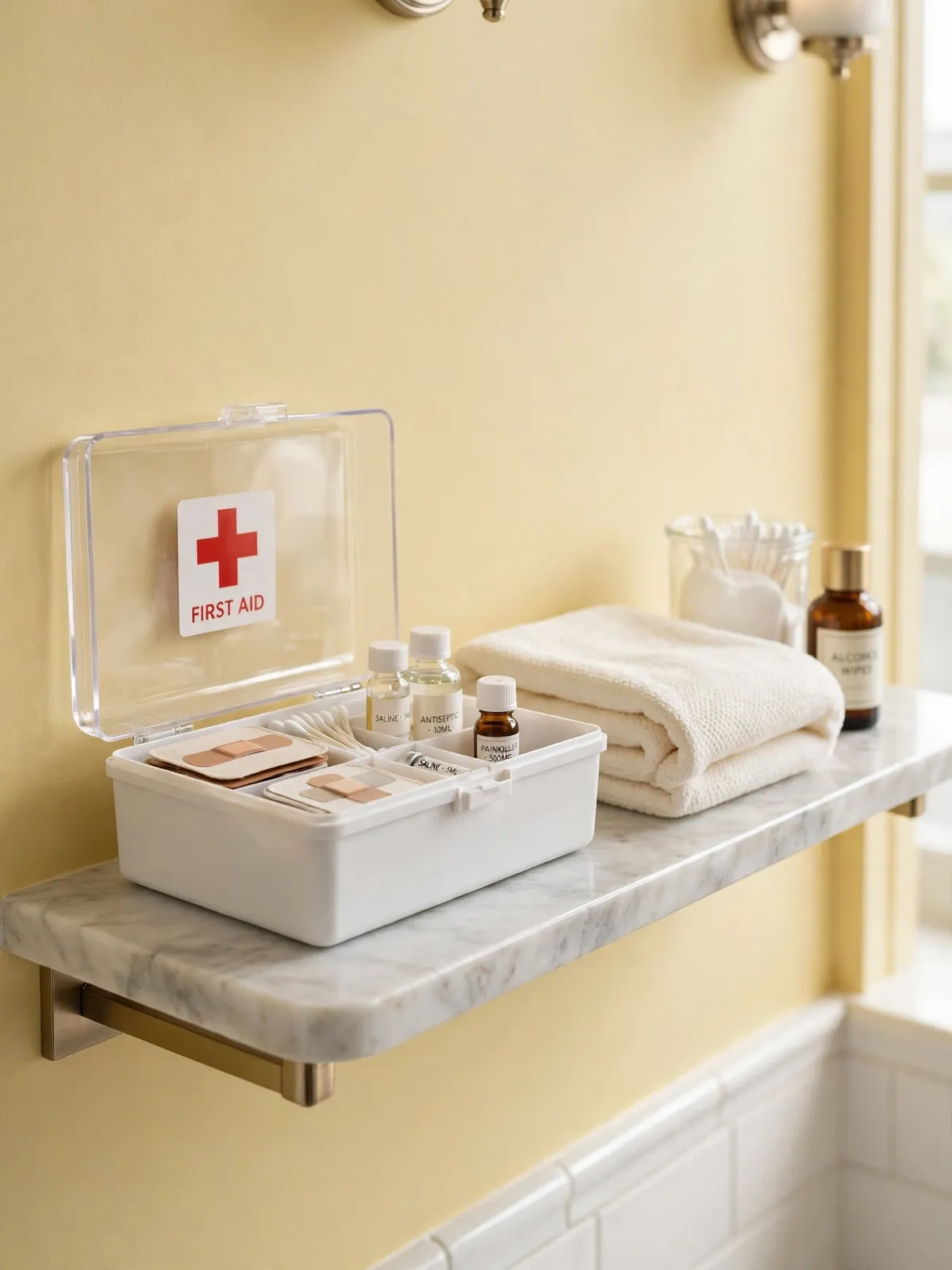
A first-aid and medicine box with a clear lid keeps the things you need in an emergency in one place you can find in seconds, because plasters, antiseptic, painkillers and bandages scattered across three cupboards are useless when someone is bleeding, while a single labelled box on a shelf is obvious to everyone in the house. Here, a white box with a clear lid and a small red cross label sits on a shelf against soft butter-yellow walls, holding plasters, antiseptic wipes and small medicine bottles in neat rows. The system suits a family bathroom, it makes it obvious when stock is low, and it keeps medicines together and out of reach of small children when the box sits on a high shelf. The weakness is access: a box stored too high is useless in a hurry, so keep it on a shelf an adult can reach without a step, and check the contents every month for expired items.
Quick tips:
- Keep the box where an adult can reach it without a step.
- Label the lid clearly so guests can find it too.
- Check expiry dates monthly and replace anything out of date.
- Keep children’s medicines in a separate labelled section inside the box.
A Small Bin System for Recycling and Bathroom Waste
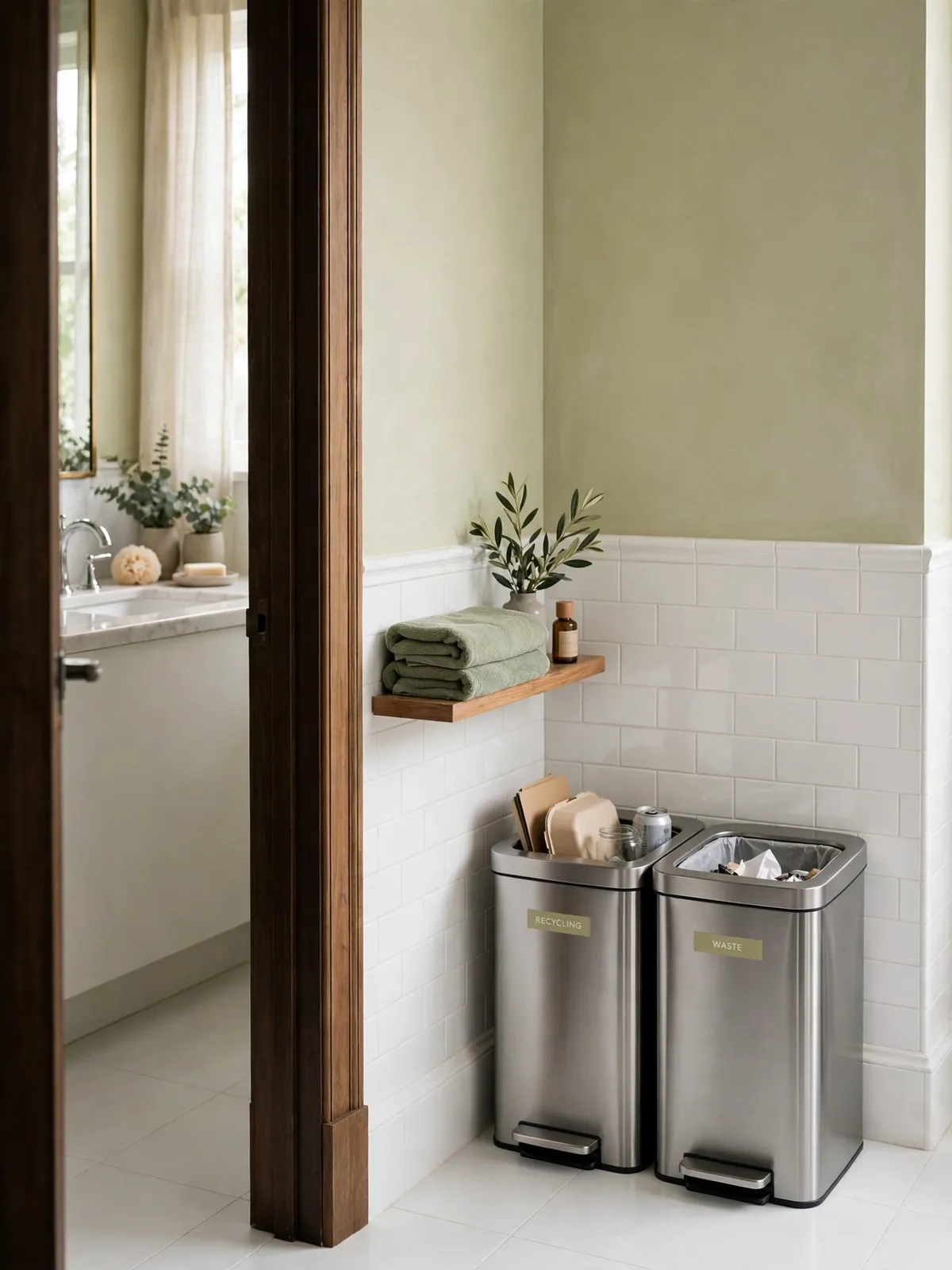
A small bin system for recycling and bathroom waste stops the bathroom bin overflowing with the wrong things, because empty shampoo bottles, cardboard boxes and cotton pads all end up in one bin when there is only one bin, while a slim dual bin — one side for recycling, one side for waste — makes sorting automatic and keeps the floor clear. Here, two slim brushed steel bins sit side by side against pale olive-green walls, one labelled for recycling and one for waste, with folded sage towels on a shelf above them. The system suits a bathroom with space beside the vanity or the door, it keeps empty bottles out of the general waste, and it makes the weekly clean faster because the bins are emptied together. The weakness is size: a bathroom bin that is too large invites general household rubbish, so choose slim bins that fit the bathroom’s waste, and empty them twice a week so cotton pads and tissues never pile up.
Quick tips:
- Choose slim bins that fit the bathroom, not the kitchen.
- Label one side recycling and one side waste.
- Empty both bins twice a week so they never overflow.
- Line each bin so emptying it takes seconds.
A Child’s Step Stool With a Toothbrush Station
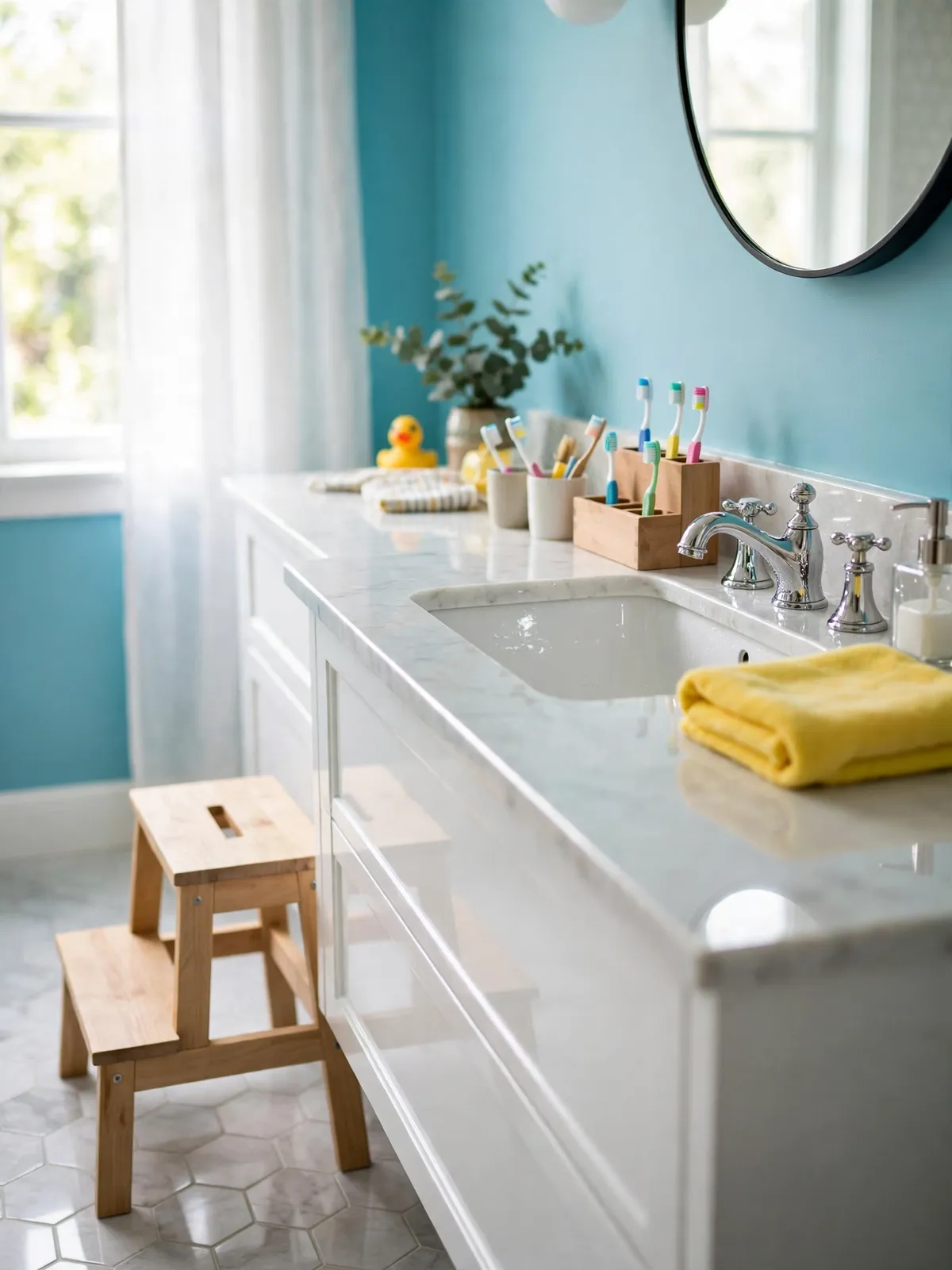
A child’s step stool with a toothbrush station gives small children their own bathroom zone, because a child who cannot reach the sink leaves toothpaste on the counter and brushes on the floor, while a low stool and a small station with their own brush, cup and flannel turns brushing teeth into a routine they can do alone. Here, a pale wooden step stool stands beside a vanity against cheerful aqua-blue walls, with a small station on the counter holding two children’s toothbrushes in coloured cups and a folded yellow towel. The system suits a family bathroom, it keeps children’s items off the adult counter, and it teaches independence without a daily battle. The weakness is safety: a stool that slides on a wet tiled floor is dangerous, so choose a stool with non-slip feet and a wide base, and keep it tucked against the vanity when it is not in use.
Quick tips:
- Choose a stool with non-slip feet and a wide base.
- Give each child their own coloured cup and brush.
- Keep the station low so children can reach it alone.
- Tuck the stool against the vanity when it is not in use.
A Spare-Roll Holder That Shows When Stock Is Low
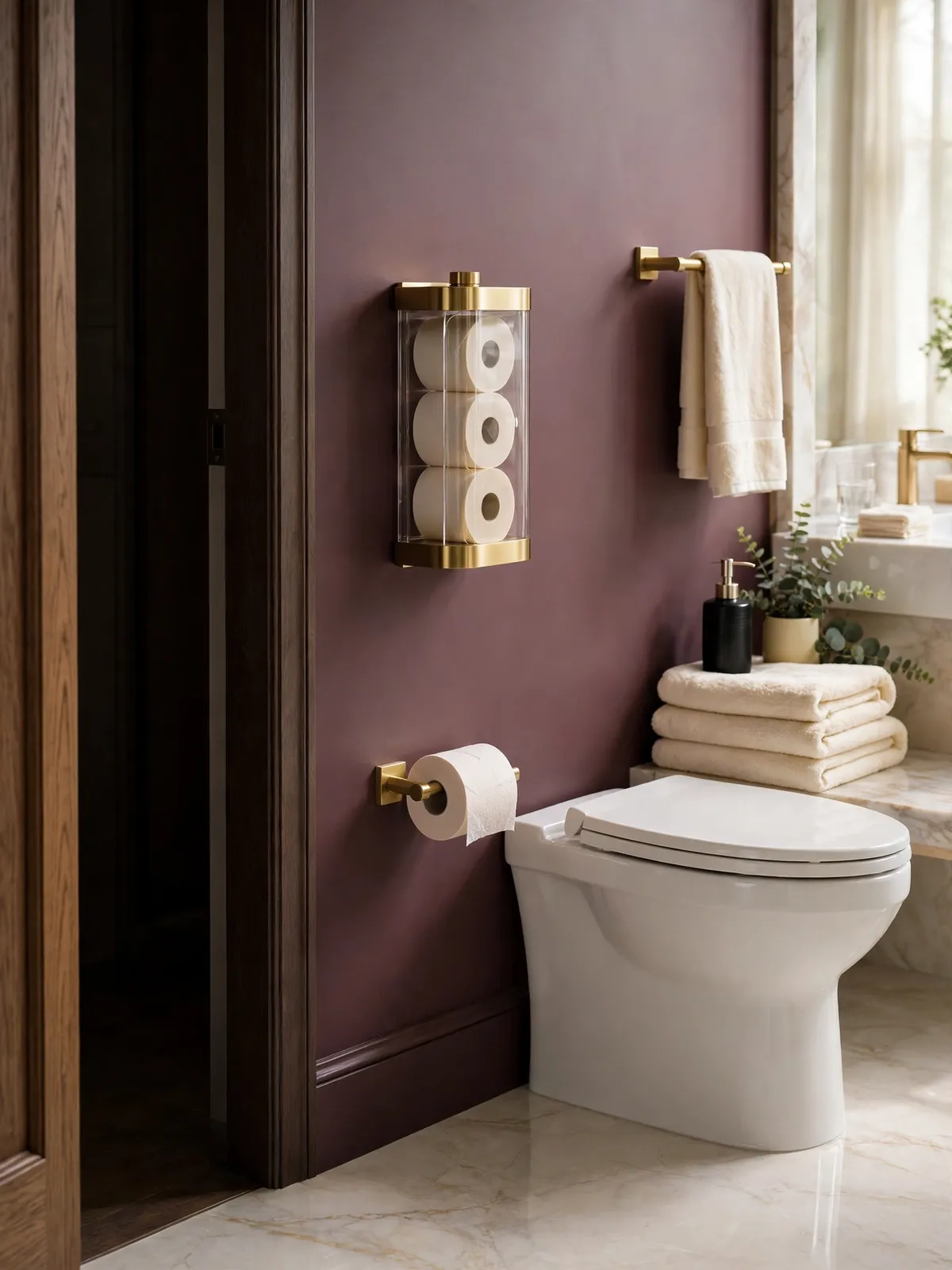
A spare-roll holder that shows when stock is low ends the most annoying bathroom surprise, because a closed cupboard hides the fact that the last spare roll was used yesterday, while a holder with a clear front or an open design shows at a glance that only one roll is left and it is time to restock. Here, a brushed gold holder with a clear front stands beside a white toilet against warm plum walls, holding three spare rolls with the top one visible, and cream towels folded on a shelf above. The system suits a family bathroom, it costs very little, and it makes restocking a habit instead of an emergency. The weakness is placement: a holder beside the toilet that is too low gets splashed, and one that is too far away is never used, so place it within arm’s reach of the toilet and above the splash zone.
Quick tips:
- Place the holder within arm’s reach of the toilet.
- Keep it above the splash zone so rolls stay dry.
- Restock when only one roll is left, not when the holder is empty.
- Keep the bulk stock in the linen cupboard, not in the bathroom.
A Fold-Down Shelf for a Small Bathroom
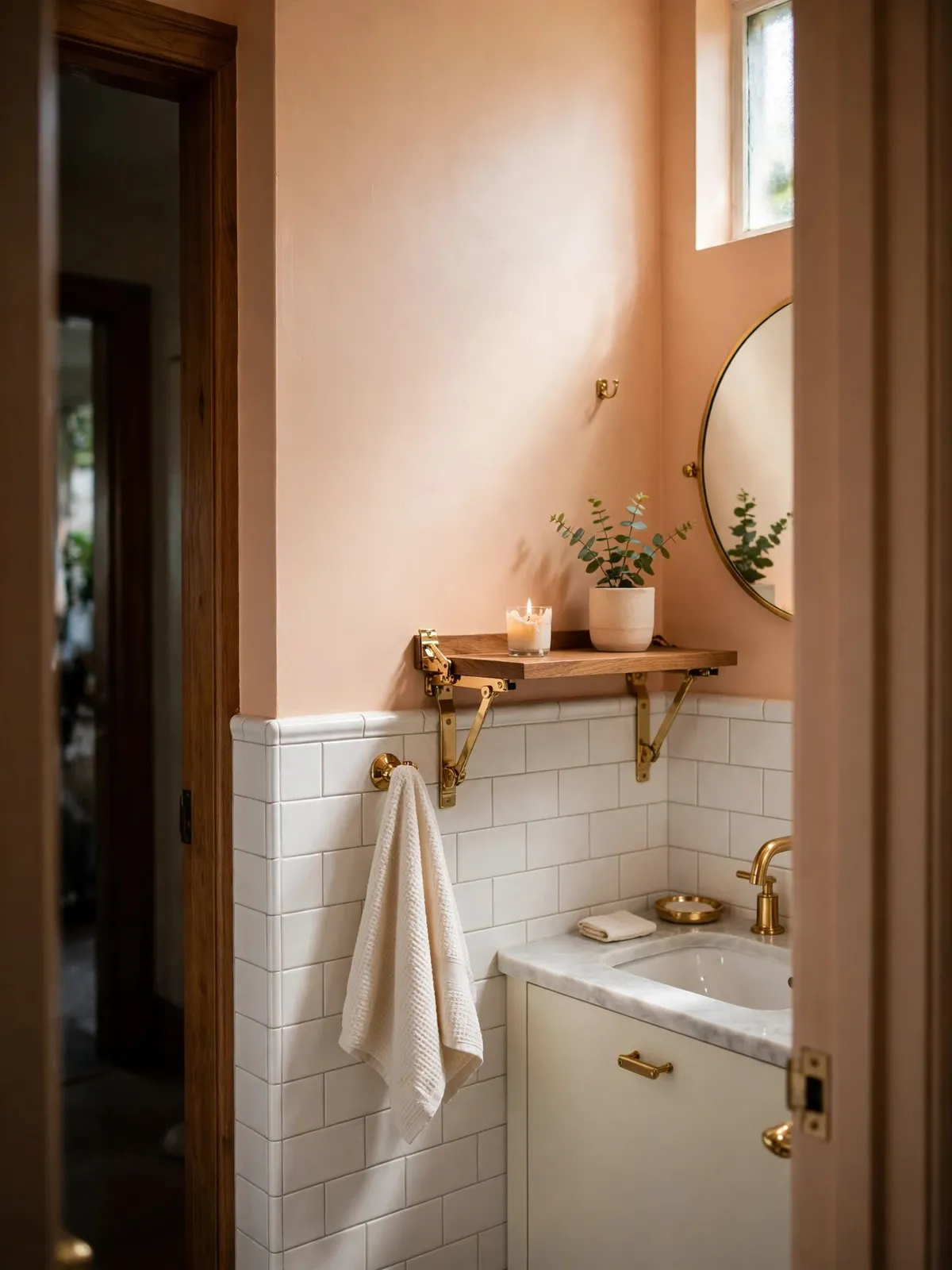
A fold-down shelf for a small bathroom gives you a surface exactly when you need it and takes it away when you do not, because a fixed shelf in a tiny bathroom crowds the room, while a shelf on brass brackets folds flat against the wall after use and leaves the floor and the sightlines clear. Here, a pale wooden fold-down shelf sits open on a soft peach wall, holding a small candle and a trailing plant, with white tiles below and a cream hand towel on a hook beside it. The system suits a very small bathroom or a cloakroom, it holds a book, a phone or a cup of tea during a bath, and it folds away in seconds. The weakness is weight: a fold-down shelf fixed with weak brackets sags under a heavy book, so fix the brackets into studs, choose a shelf rated for the weight you will put on it, and never lean on it.
Quick tips:
- Fix the brackets into studs so the shelf holds weight safely.
- Fold it flat after use so the room stays open.
- Keep only light items on it — a candle, a plant, a book.
- Choose a shelf depth that clears the door swing when folded down.
A Daily Reset Basket for Clutter That Wanders In
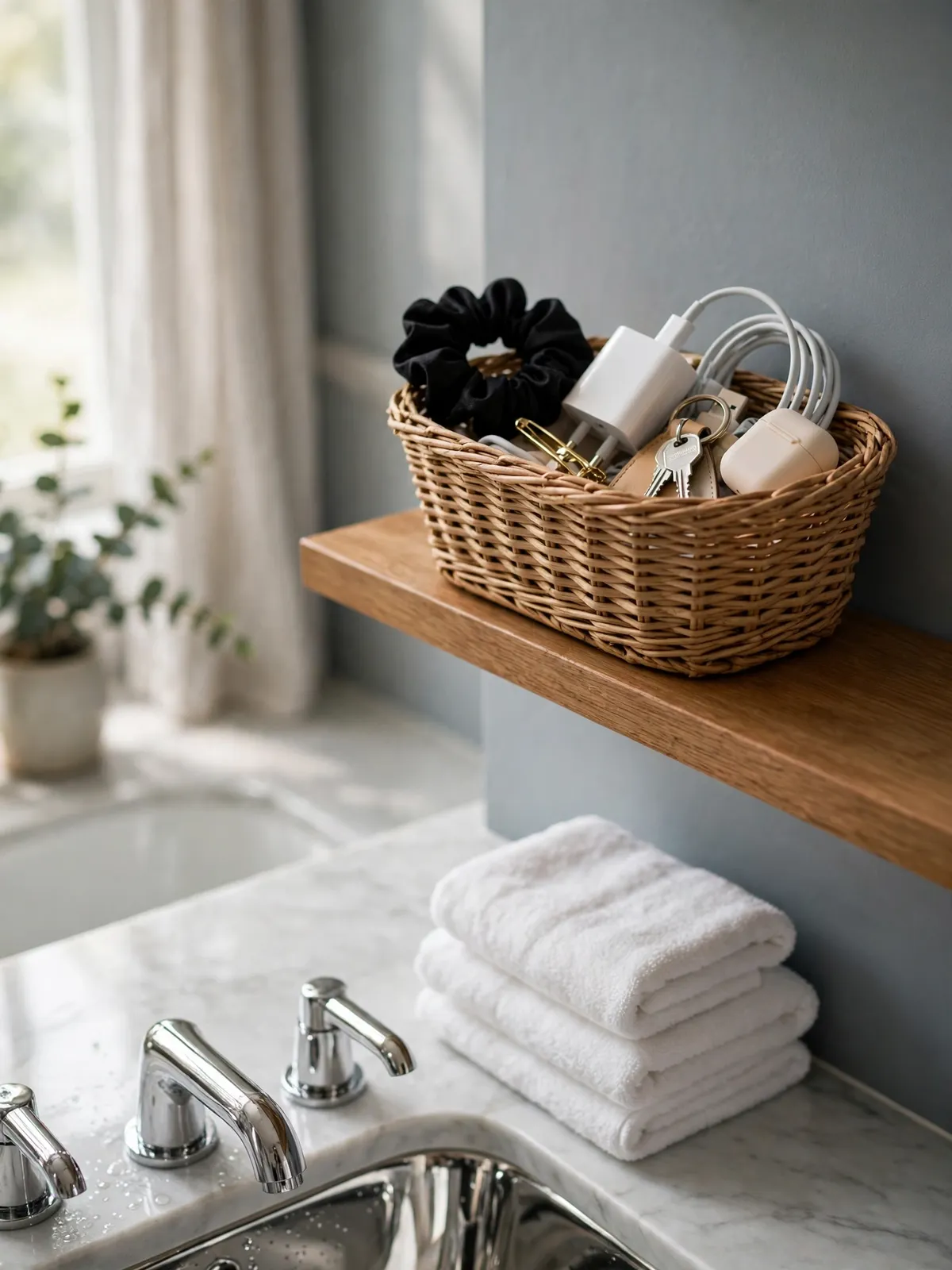
A daily reset basket for clutter that wanders in is the habit that keeps every other idea on this list working, because hair ties, phone chargers, jewellery, reading glasses and half-finished products drift into a bathroom all day, and a single basket by the door catches them all so the counter stays clear until the two-minute evening reset puts each one back where it belongs. Here, a woven basket sits on a shelf against soft grey-blue walls, holding a hair tie, a phone charger and a small tube of cream, with white towels folded beside it. The system suits every bathroom, it costs almost nothing, and it turns tidying from a weekend job into a two-minute evening habit. The weakness is the basket itself: a reset basket that is never emptied becomes just another clutter box, so empty it every evening without exception, and keep it small enough that it forces you to put things away.
Quick tips:
- Empty the basket every evening, without exception.
- Keep the basket small so it forces a real reset.
- Place it by the door so stray items land in it first.
- Return each item to its zone — the basket is a waiting room, not a home.
A Seasonal Swap Box for Out-of-Season Products
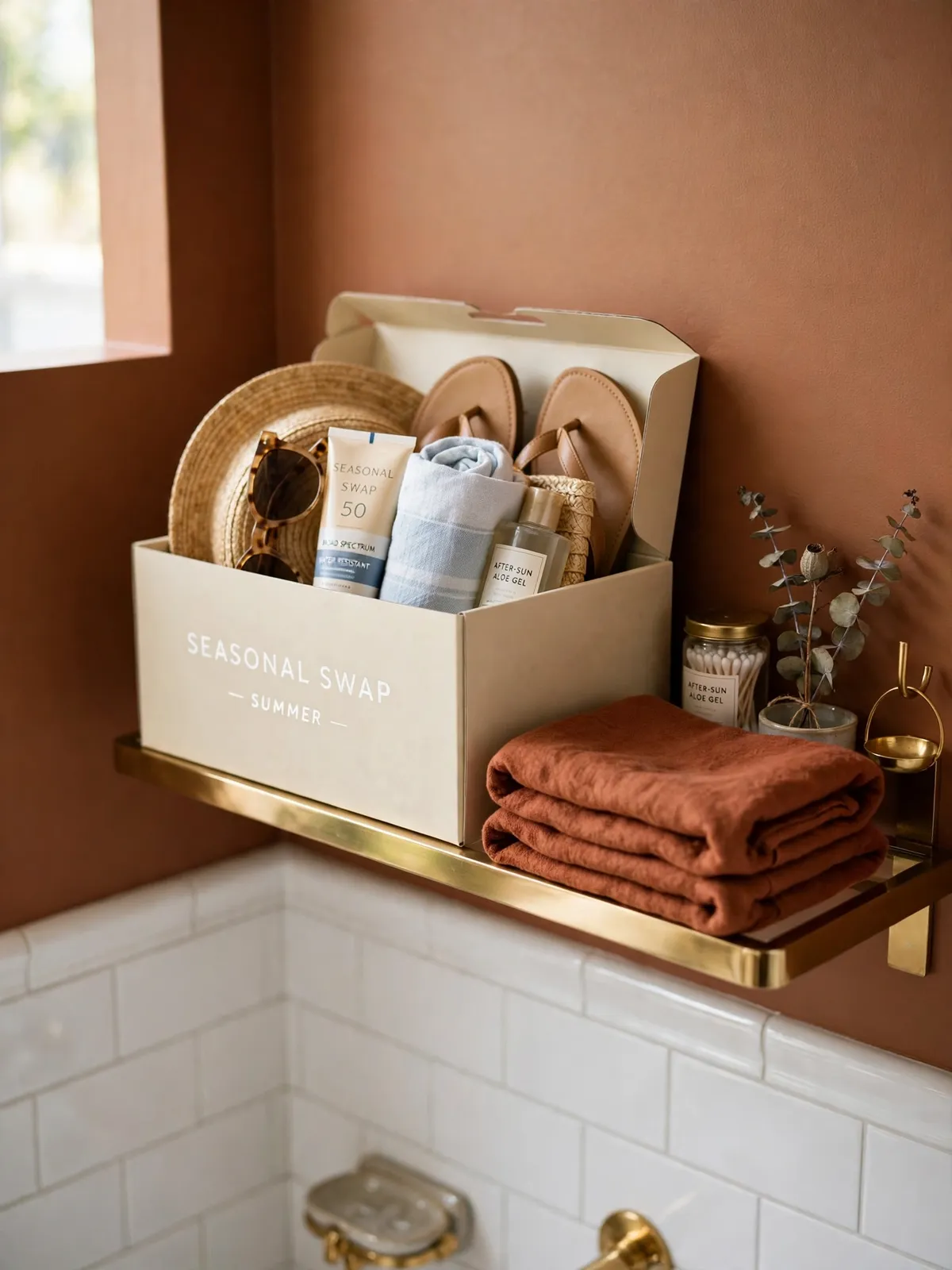
A seasonal swap box for out-of-season products frees the bathroom from the products you are not using right now, because sun cream, after-sun, heavy winter balms and festive bath sets all crowd the vanity for months after their season ends, while a single labelled box on a high shelf holds them until they are needed again. Here, a cream labelled box sits on a high shelf against warm cinnamon-brown walls, holding sun cream and after-sun in one section and heavy winter balms in another, with a folded rust towel beside it. The system suits a bathroom that feels full for no clear reason, it makes the seasonal changeover a ten-minute swap, and it stops you buying a duplicate of something you already own. The weakness is forgetting: a box on a high shelf that is never opened is just hidden clutter, so label it with the season and the contents, and swap it over on the first day of each season.
Quick tips:
- Label the box with the season and the contents inside.
- Swap it over on the first day of each season.
- Keep the box on a high shelf, out of daily reach.
- Check expiry dates when you swap — sun cream expires faster than you think.
Bathroom Organization Ideas That Keep the Whole Room Calm Every Day
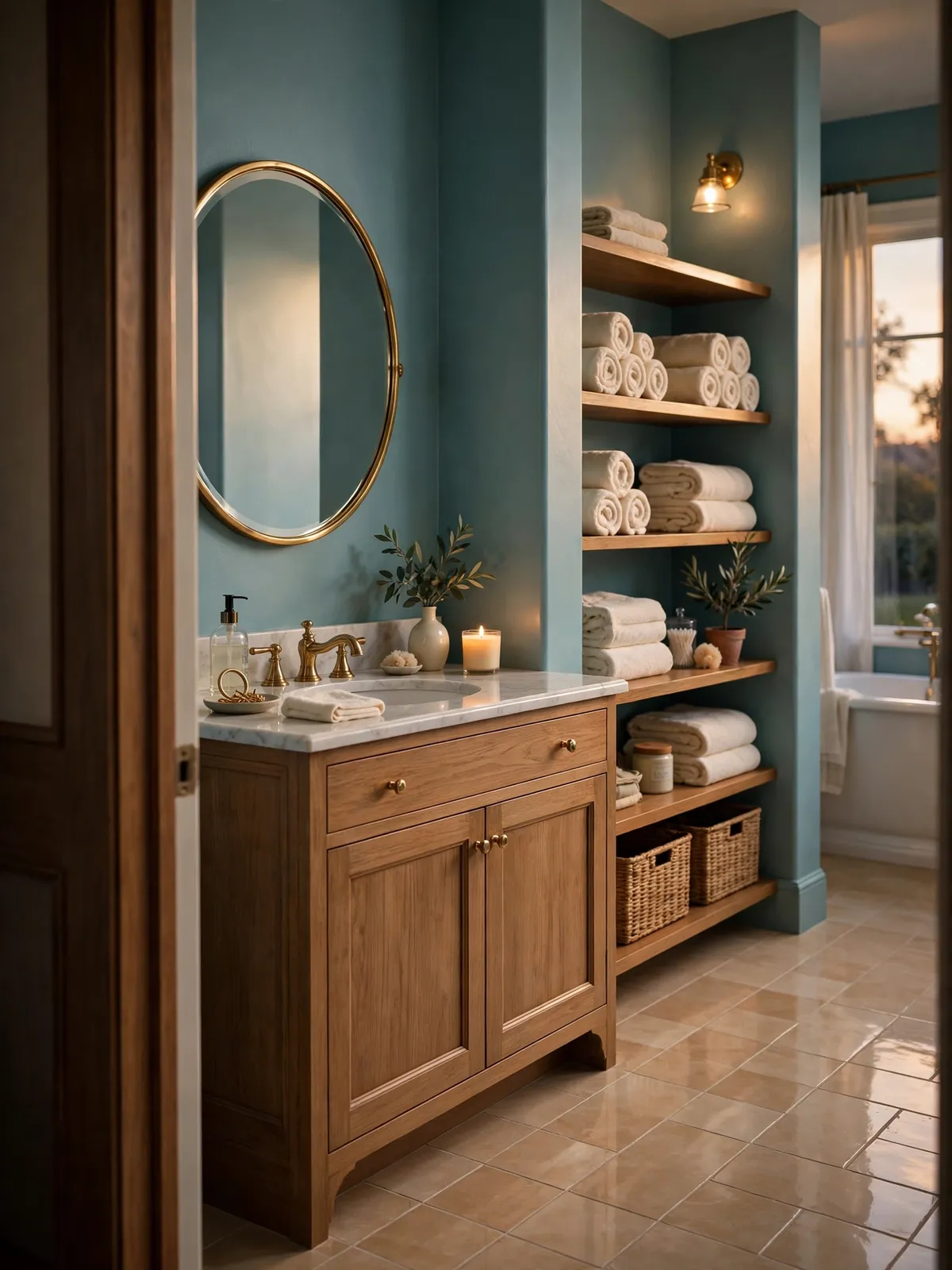
The last of these bathroom organization ideas is the principle behind them all, and it is worth stating plainly because it is the difference between a bathroom that looks tidy in a photograph and one that stays calm every day: organization is not one clever product, it is the combination of a zone for the vanity, a zone for the shower, a zone for linen and a zone for cleaning, each with its own storage type, so that the drawer dividers, the lazy Susan, the shower niche, the linen tower and the reset basket all support each other instead of competing for attention, and the room rewards you every time you walk in rather than only on the day it was tidied. Here, a soft teal bathroom pulls it together — a tidy vanity with a marble tray, open shelves with rolled cream towels, a clear shower niche and brass fixtures — and nothing in the room is there by accident. The lesson is to start with the zone that annoys you most, fix that one zone properly with labelled storage, then move to the next zone, because a bathroom organized in that order stays calm with very little effort, and the two-minute evening reset — counter wiped, towels hung, stray bottles back in their zone — is what keeps it that way. Measure your space, pick the two or three ideas from this list that fit it best, and the bathroom stops being the room you dread opening and becomes the calmest corner of your home.
Quick tips:
- Start with the zone that annoys you most, then move on.
- Label every bin, jar and box so the system is obvious to everyone.
- Do a two-minute reset every evening — counter, towels, stray items.
- Keep surfaces mostly clear so the room reads as calm.
FAQs
How do I organize a bathroom with no storage?
Use the walls and the door first: floating shelves above the toilet, hooks on the back of the door, a narrow rolling cart in the gap beside the vanity, and a small tray on the counter. A tall slim cabinet or a linen tower adds storage without taking floor space, and labelled baskets on open shelves hold the rest. If there is truly no room for furniture, a shower caddy, a door-mounted hair tool holder and a magnetic strip inside the cabinet door add storage with no footprint at all.
How do I organize under the bathroom sink?
Empty the cupboard completely, then group what is left into cleaning products, spare toiletries and first-aid items, and give each group its own container — a tiered lazy Susan for cleaning sprays, a caddy with a handle for the weekly clean, and a labelled bin for spare stock. Keep the cleaning caddy at the front so it lifts out in one move, and check for leaks behind the bottles once a week, because a slow leak under the sink ruins everything stored there.
What is the best way to store towels in a small bathroom?
Roll towels instead of folding them, because rolled towels take up less space, are easier to grab with one hand, and look tidier in a basket or on a shelf. Use a towel bar with a shelf above it for the drying towel and the fresh ones, woven baskets on open shelves for the spare stock, and a linen tower if there is a spare corner. Rotate the stock weekly so no towel sits damp for long.
How can I keep my bathroom organized with children?
Give each child their own zone: a step stool and a toothbrush station they can reach alone, a labelled basket or hook for their towel and robe, and a small tray for their own toiletries. Keep medicines, cleaning products and sharp tools on high shelves or inside a locked cabinet, and do the two-minute evening reset together so tidying becomes a habit rather than a chore.
How often should I declutter the bathroom?
Do a quick declutter once a month and a full one at the start of each season: throw away expired medicines and makeup, empty bottles and dried-out products, and move out-of-season items into the seasonal swap box. A monthly check takes ten minutes and stops the slow build-up that turns a tidy bathroom back into a cluttered one.
Conclusion
Bathroom organization is not a weekend project you finish once — it is a small system of zones, labels and habits that makes every morning easier, and the 29 ideas above show that you can build it at almost any budget, whether you fit drawer dividers and a lazy Susan, add a linen tower and a shower niche, or simply put a tray on the counter, a basket by the door and a hook behind it. Start with the zone that annoys you most, give every item one obvious home, label the bins so everyone in the house can follow the system, and finish each day with the two-minute reset. Do that, and your bathroom stops being the room where things get lost and becomes the calm, clutter-free space you walk into with relief every single day.