25 Stunning Staircase Lighting Ideas That Instantly Make Your Stairs Safer, Brighter and More Beautiful
Good staircase lighting does far more than brighten a hallway — it keeps every step safe, guides you at night, and makes the whole stairwell feel warm and welcoming. These 25 staircase lighting ideas show how layered plans, LED strips, step lights, sensors, dimmers and smart scenes can light any stair type, from a straight flight to a spiral, in any ceiling height.
Staircase lighting ideas are about designing how a staircase should be lit — not just which fixture to buy, but how ambient, task and accent light work together so every tread is visible, safe and beautiful. A good staircase lighting plan layers a main ceiling light with step lights or LED strips, adds a sensor or dimmer for night-time use, and matches the brightness and colour temperature to the stair type and ceiling height.
For a fresh take on the stair itself, these modern staircase ideas show the shapes and styles this lighting can bring to life. The 25 ideas below cover the full system — layered plans, LED strips, recessed step lights, sensors, smart scenes, lumens, spacing, building-code basics, colour temperature, and lighting by stair type and ceiling height — so you can design a staircase that is safe at night and beautiful by day.
Key Takeaways
How many lumens do I need for staircase lighting?
Aim for about 100 to 200 lumens per square metre of stairwell, which usually means 300 to 800 lumens in total for a standard flight, depending on the size and the wall colour. Step lights add about 20 to 50 lumens each, so a flight of 13 steps needs roughly 300 to 500 lumens from its step lights alone, plus the main ceiling light.
What are the building code requirements for stairway lighting?
Most building codes require a light at the top and bottom of every stairway, a switch at each level, and enough light to see every tread clearly — usually at least 10 lux on the treads. Handrails must be easy to see and grip, and any recessed step light must sit flush so it never becomes a trip hazard. Always check your local code, because the exact rules vary by area.
Are motion-sensor stair lights worth it?
Yes, for most homes they are well worth it. Motion sensors switch the stair lights on the moment you step onto the flight and switch them off after you leave, so you never climb in the dark and never waste electricity. They are especially useful for night-time trips, children, older family members and basement stairs.
How far apart should step lights be on stairs?
Place step lights every two to three treads for even light with no dark gaps — usually one light on every second or third step, alternating sides on a wide flight. On a standard flight of 13 steps, that means four to six step lights, spaced about 60 to 90 cm apart along the slope.
How do you layer lighting on a staircase?
Start with ambient light from a ceiling fixture, add task light from step lights or LED strips that mark every tread, then finish with accent light such as a wall sconce, picture light or a soft landing lamp. Put the ambient and task layers on separate dimmers or sensors so you can brighten the stairs for safety and soften them for mood.
Staircase Lighting Ideas: A Layered Lighting Plan for Your Staircase
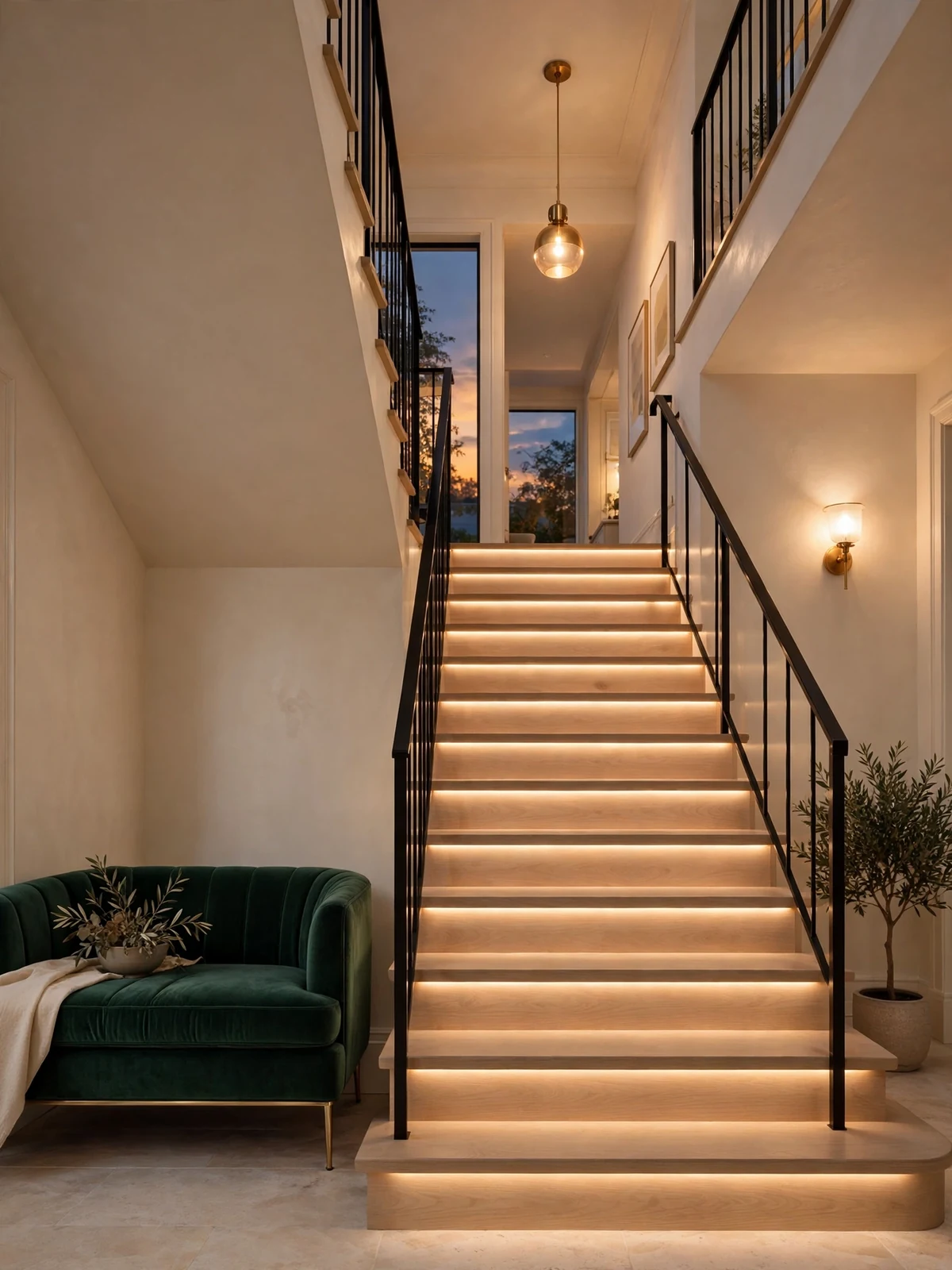
A layered lighting plan is the foundation of every well-lit staircase, because no single light can do the whole job on its own. In this stairwell, a warm ceiling pendant gives ambient light across the whole space, LED strips under each tread give task light that marks every step, and a soft wall sconce on the landing gives accent light that warms the wall. Pale oak treads, each 950 mm wide, catch all three layers, while a deep emerald-green velvet bench on the landing adds rich colour and the cream walls bounce the layered glow down the flight.
Quick tips:
- Plan three layers: ambient, task and accent light.
- Put the ambient and task layers on separate switches or dimmers.
- Use warm 2700K light for all three layers so they blend.
- Test the layers together at night before you finish the install.
LED Strips Under Each Stair Tread for a Floating Glow
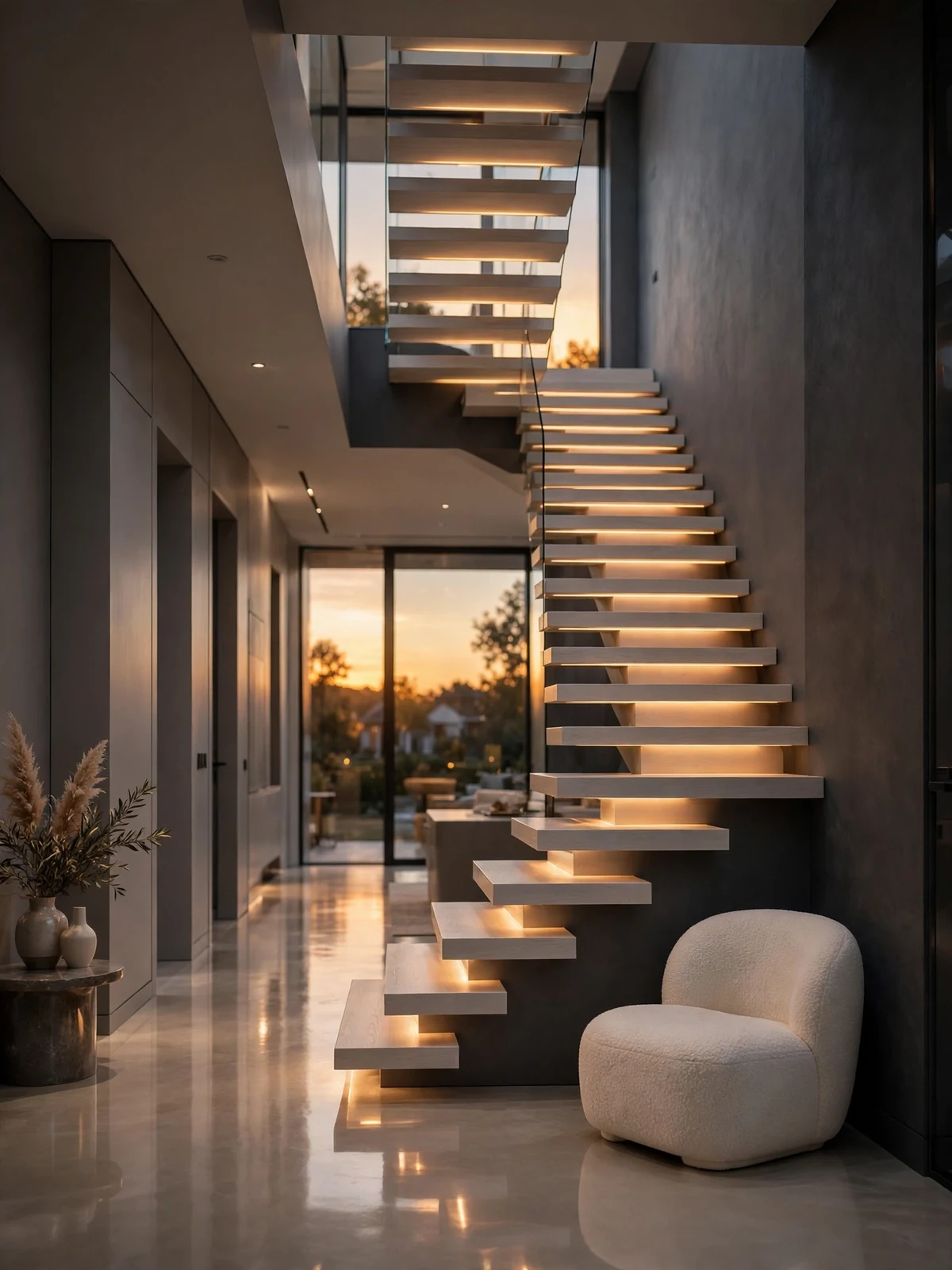
LED strips under each tread make the steps look as if they are floating, and they mark every tread edge so clearly that you can climb safely in near darkness. Here, a warm 2700K LED strip sits in a slim aluminium channel under the nosing of every pale ash tread, each 1 metre wide, throwing a soft line of light down onto the tread below. Soft charcoal walls make the glow stand out, while a cream boucle chair at the base keeps the palette soft and the whole stair feels like it is hovering.
Quick tips:
- Use warm 2700K LED strips for a soft, comfortable glow.
- Set the strip in an aluminium channel so the light is even.
- Hide the strip under the nosing so the source is never visible.
- Choose a dimmable strip so you can soften the glow at night.
LED Strips Along the Handrail for a Guided Climb
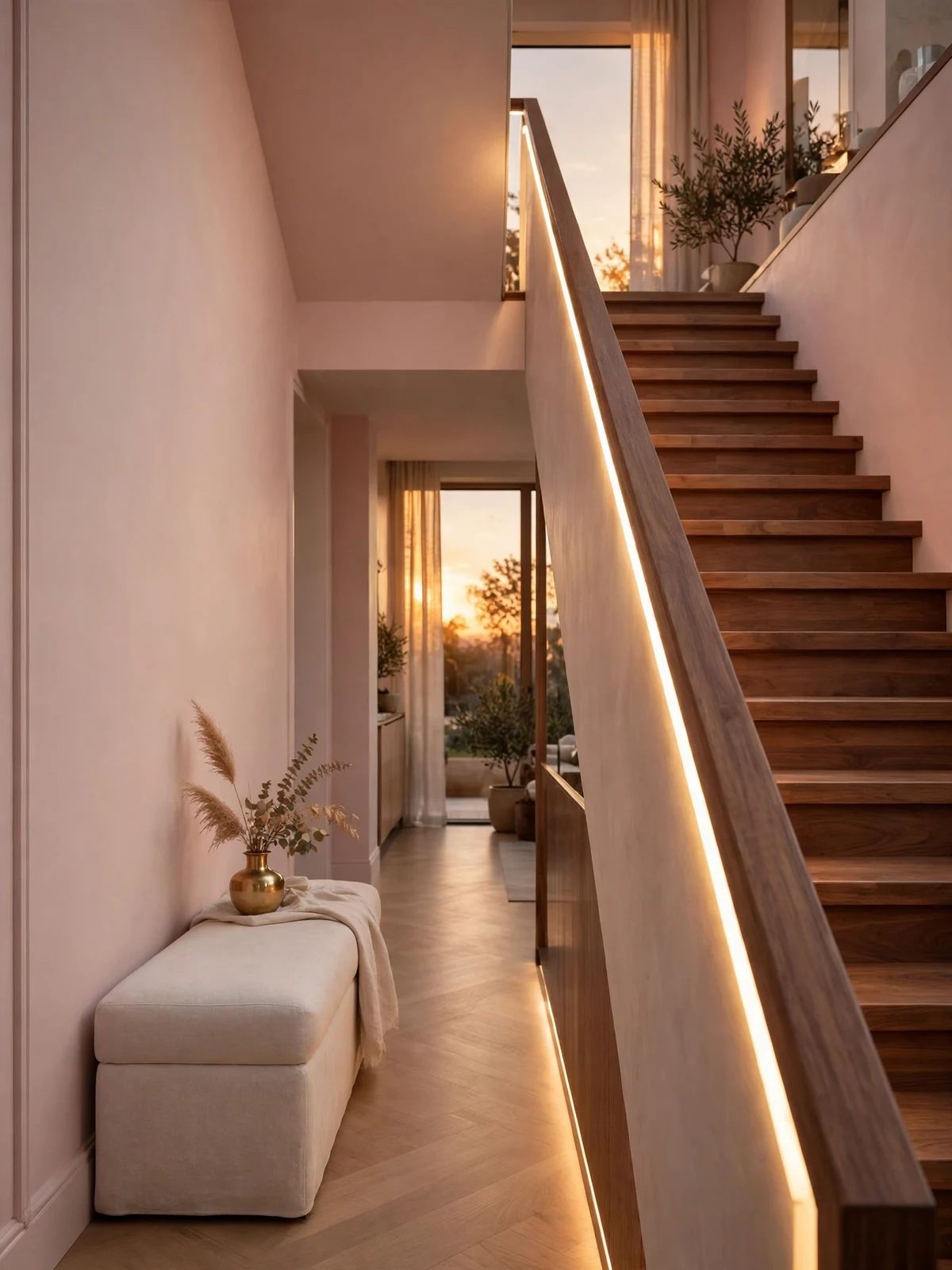
An LED strip along the handrail lights the way your hand already travels, so the climb feels guided and safe. On this stair, a slim LED strip runs along the underside of a warm walnut handrail, its soft glow falling across warm walnut treads, each 950 mm wide, and soft blush-pink walls. A pale linen bench at the base and a small brass vase on the landing add quiet warmth, while the handrail light means you can find the rail and the steps in the dark without switching on the main light.
Quick tips:
- Run the strip along the underside of the handrail, not the top.
- Use a warm strip so the glow feels gentle on the eyes.
- Pair handrail light with one step light for full coverage.
- Choose a continuous strip, not spots, for an even line.
Recessed Step Lights Set Into the Stair Wall
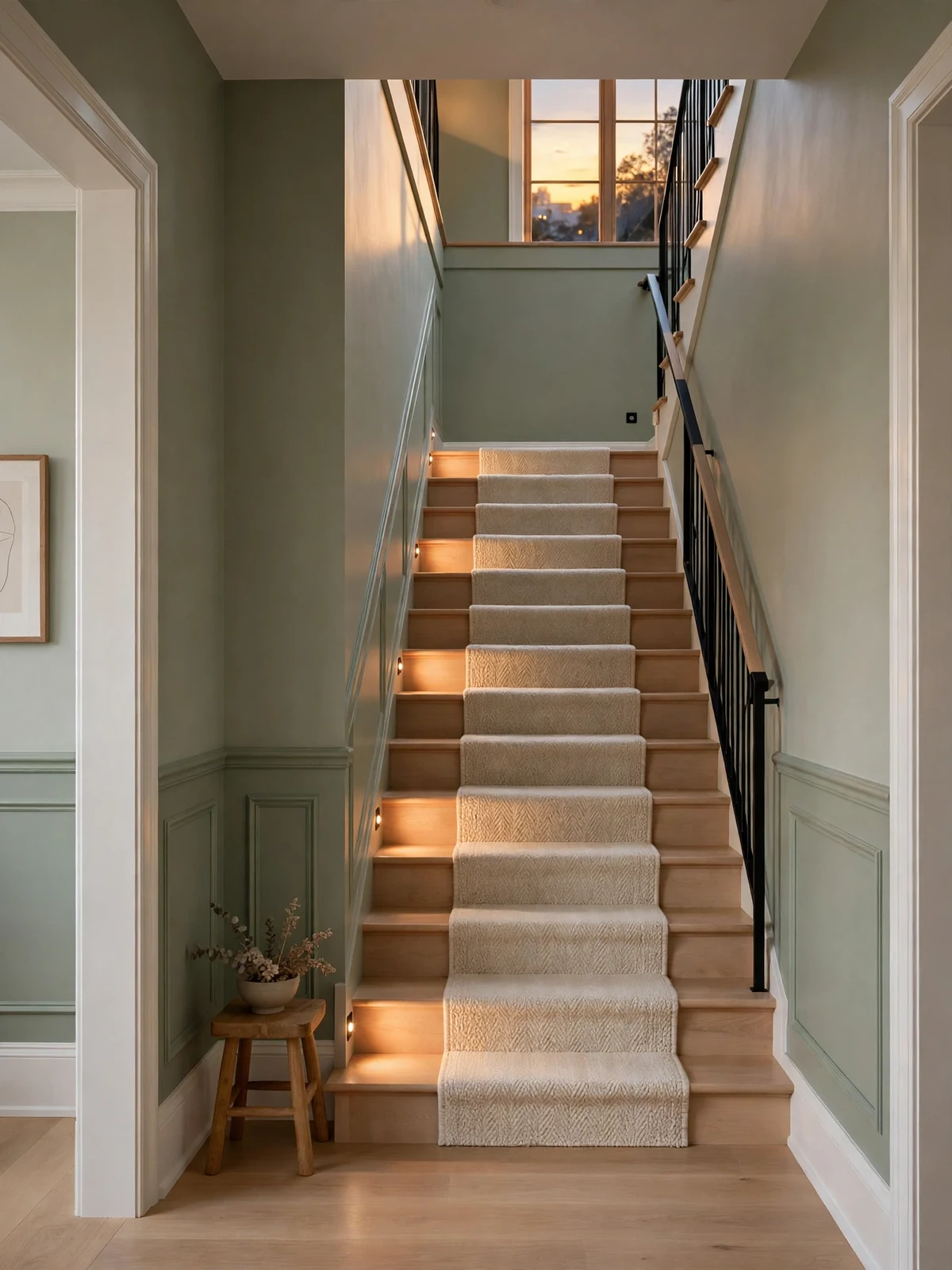
Recessed step lights set into the wall are the neatest way to light a staircase, because they sit flush with the plaster and throw a soft wash across each tread. Along this flight, small round recessed lights, each 8 cm wide, sit in the soft sage-green wall beside every third tread, their warm beams washing across pale maple treads, each 900 mm wide. A cream runner softens the steps, while a small wooden stool at the base adds a practical touch and the flush fittings never catch a sleeve or a shoe.
Quick tips:
- Place one recessed light every two to three treads.
- Set the fitting flush with the wall so it never snags.
- Mount the lights low, about 15 cm above the tread.
- Use warm 2700K bulbs so the wash feels soft, not stark.
Riser Lights That Outline Every Step
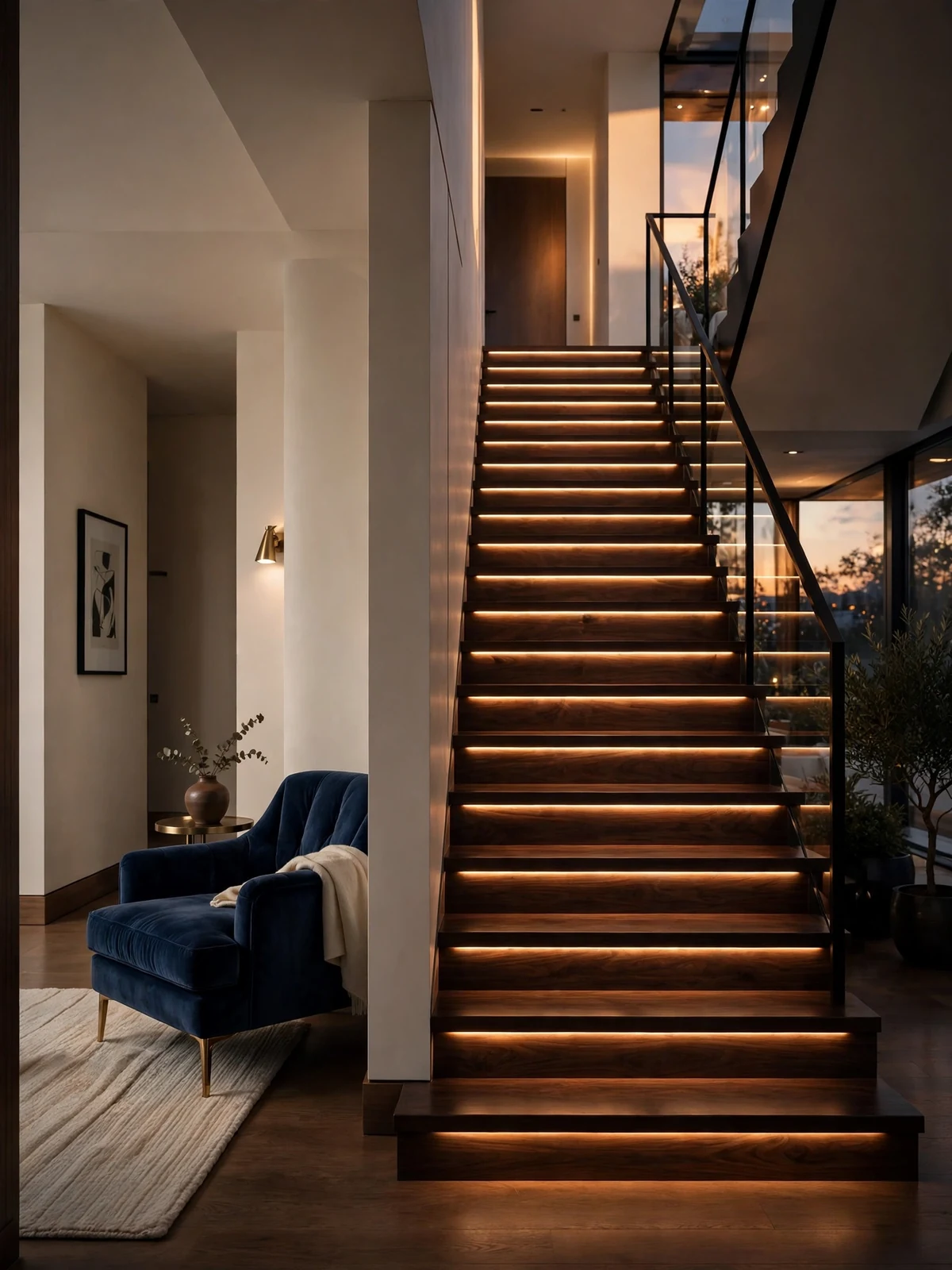
Riser lights outline every step with a thin line of light, so the shape of the whole staircase reads clearly even in a dark hallway. Here, a slim LED line sits on every riser of a dark walnut stair, each tread 950 mm wide, its warm glow separating each step from the next against soft ivory walls. A navy-blue velvet armchair at the base grounds the palette, while the even lines of light make the stair feel like a piece of architecture rather than just a passage.
Quick tips:
- Light every riser for the clearest step outline.
- Use a slim LED line so the light reads as a fine edge.
- Pair riser lights with dark treads for the strongest contrast.
- Dim the riser lights at night so they glow softly.
Nosing Lights That Make Each Tread Edge Visible
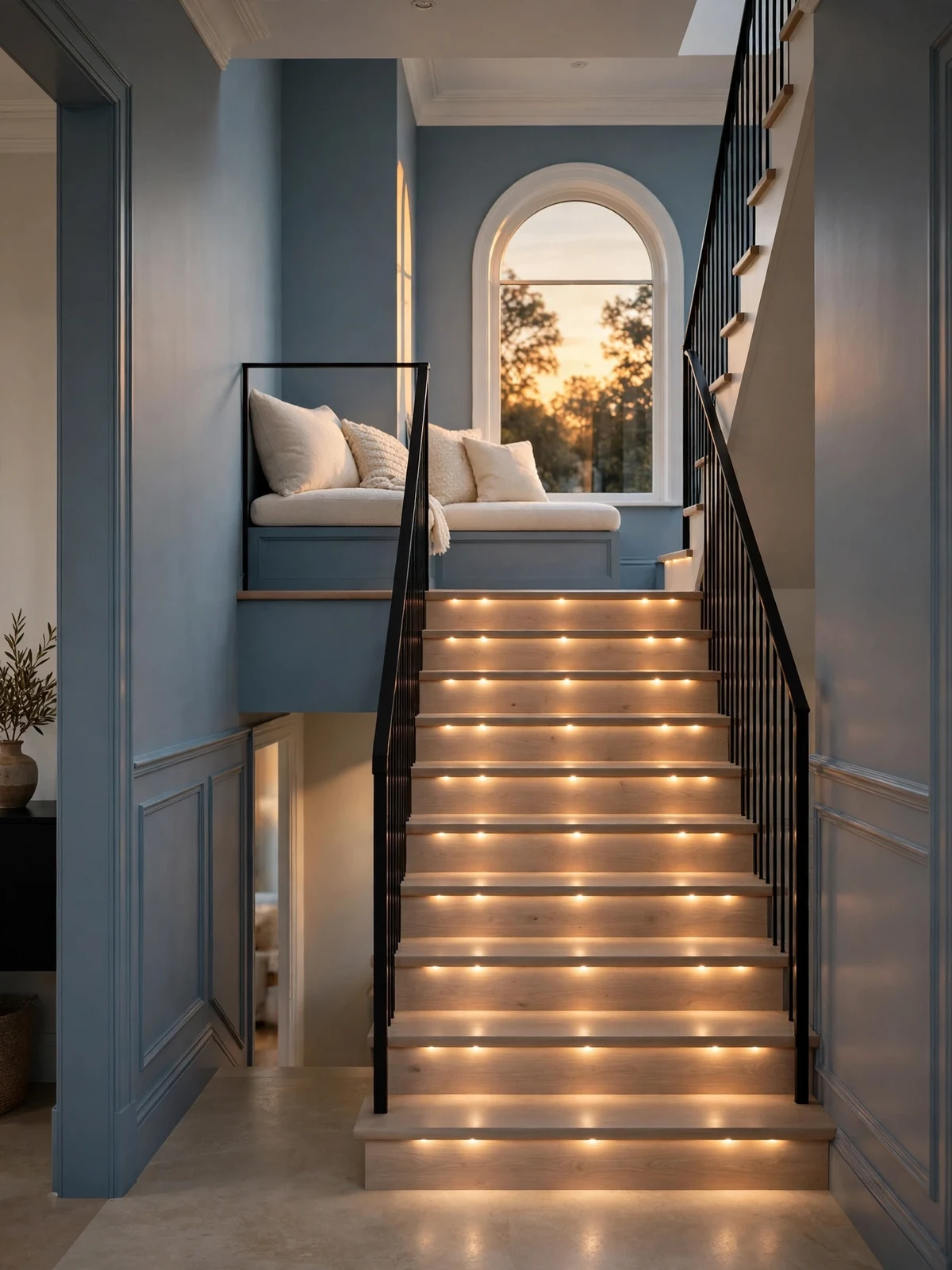
Nosing lights sit right on the front edge of each tread, which is exactly where your foot needs to land, so they are the most practical safety light a staircase can have. On this stair, a tiny LED dot sits under the nosing of every pale beech tread, each 900 mm wide, its warm glow marking the edge clearly against soft dusty-blue walls. Cream cushions on a landing bench add softness, while the nosing lights mean the stair is safe to climb even when the main light is off.
Quick tips:
- Place the nosing light under the tread overhang, not on top.
- Light every tread for the safest result on a busy family stair.
- Use warm light so the edge glows gently, not harshly.
- Combine nosing lights with a dimmer for night-time use.
Motion-Sensor Stair Lights That Switch On as You Climb
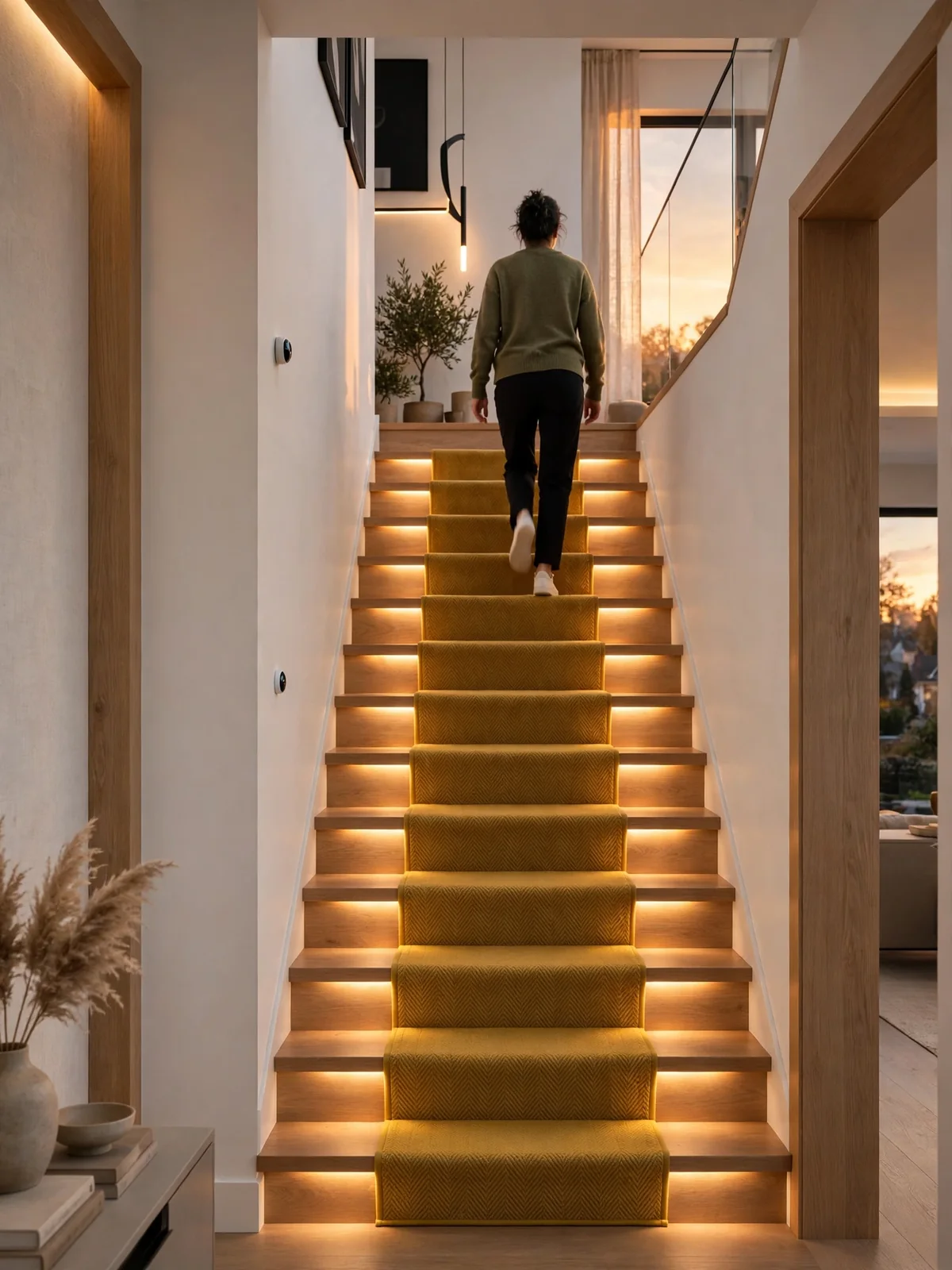
Motion-sensor stair lights switch on the moment you step onto the flight and switch off after you leave, so you never climb in the dark and never waste electricity. In this hallway, a discreet sensor set into the soft white wall at the foot of the stairs triggers warm step lights along light oak treads, each 950 mm wide, the moment a foot touches the first tread. A mustard-yellow runner adds cheerful colour, while the sensor’s 30-second timer means the lights fade gently once the landing is reached.
Quick tips:
- Place the sensor at the foot and the top of the stairs.
- Set the timer to 30 to 60 seconds for a comfortable climb.
- Use warm step lights so the sensor glow feels welcoming.
- Choose a sensor with a daylight mode so it stays off by day.
Dimmers That Let You Set the Staircase Mood
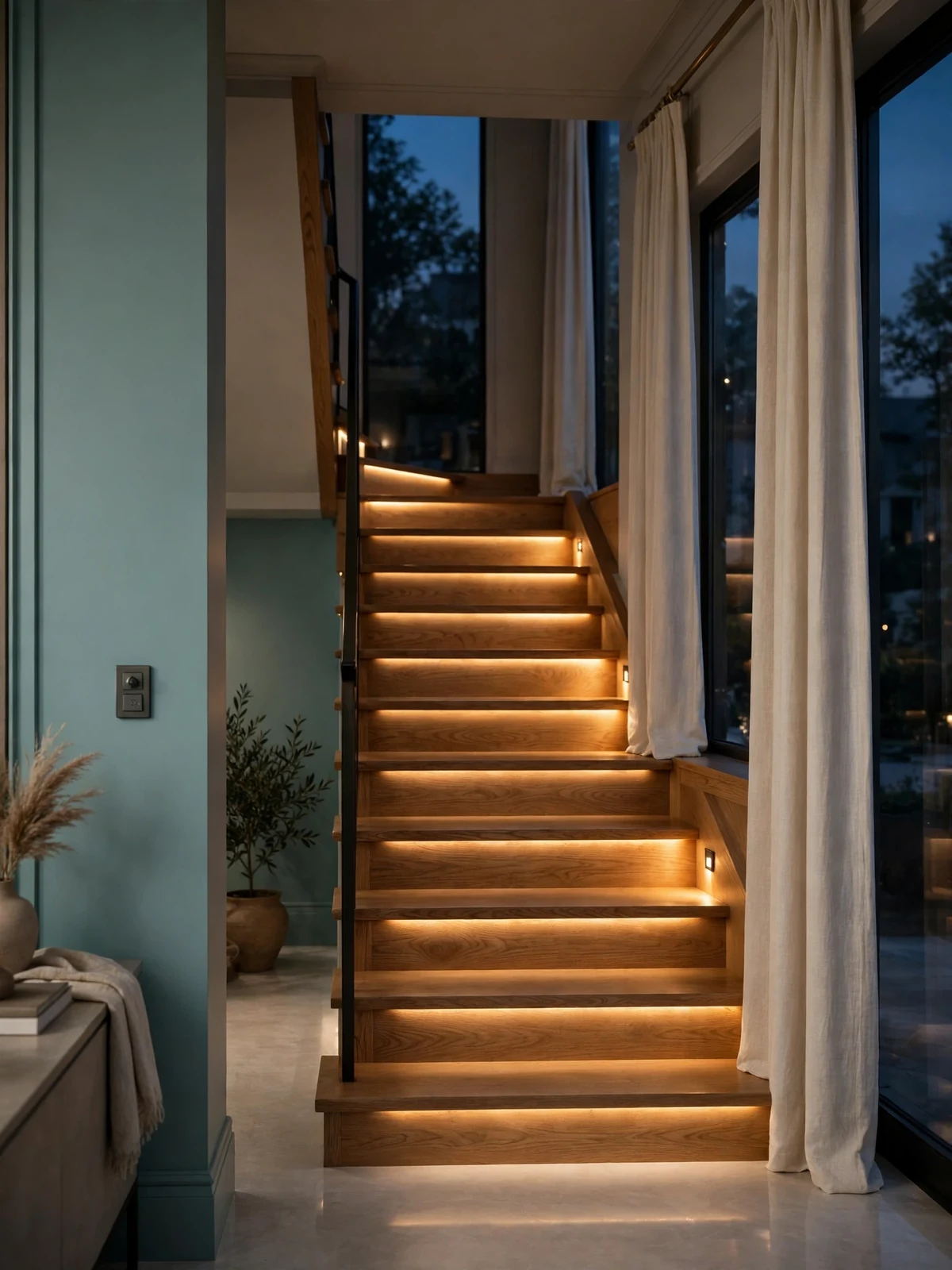
A dimmer turns staircase lighting from a single bright setting into a choice, so the same stair can be bright for safety and soft for evening mood. Here, the ceiling light and the step lights over honey oak treads, each 950 mm wide, run through one dimmer switch on the soft teal wall, set low in the evening so the stair glows gently. Cream linen curtains at the landing window soften the light further, while the dimmer means the stair never glares when you climb at night.
Quick tips:
- Put the ceiling light and step lights on separate dimmers.
- Use LED-compatible dimmers so the lights dim smoothly.
- Set the evening level to about 30 percent for a soft glow.
- Place a dimmer switch at both the top and bottom of the stairs.
Smart Lighting Scenes for Your Staircase
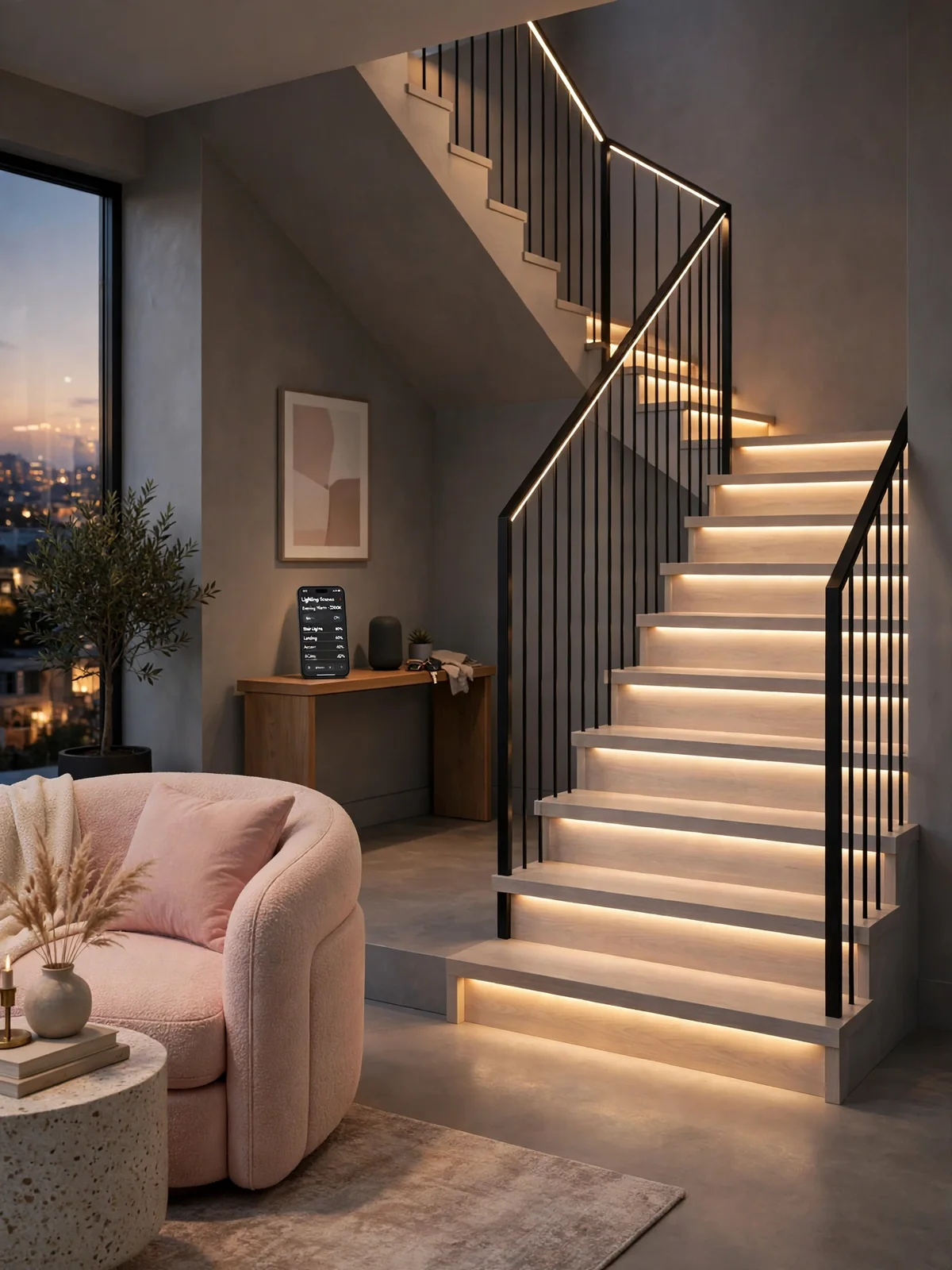
Smart lighting scenes let your staircase change with the day: bright white in the morning, warm and low in the evening, and a soft night light after bedtime. In this home, the stair lights over pale ash treads, each 900 mm wide, run through a smart system with three scenes — Morning, Evening and Night — set from a phone on the landing table. Soft charcoal walls make the warm glow stand out, while a blush-pink armchair on the landing adds soft colour and the Night scene leaves just the step lights glowing at 10 percent.
Quick tips:
- Set three scenes: bright morning, warm evening, soft night.
- Keep the night scene at 10 percent so it guides without waking.
- Use one app for the stair lights so the scenes stay simple.
- Test each scene at the time of day it will actually run.
Colour-Changing LED Stair Lights for Evenings and Parties
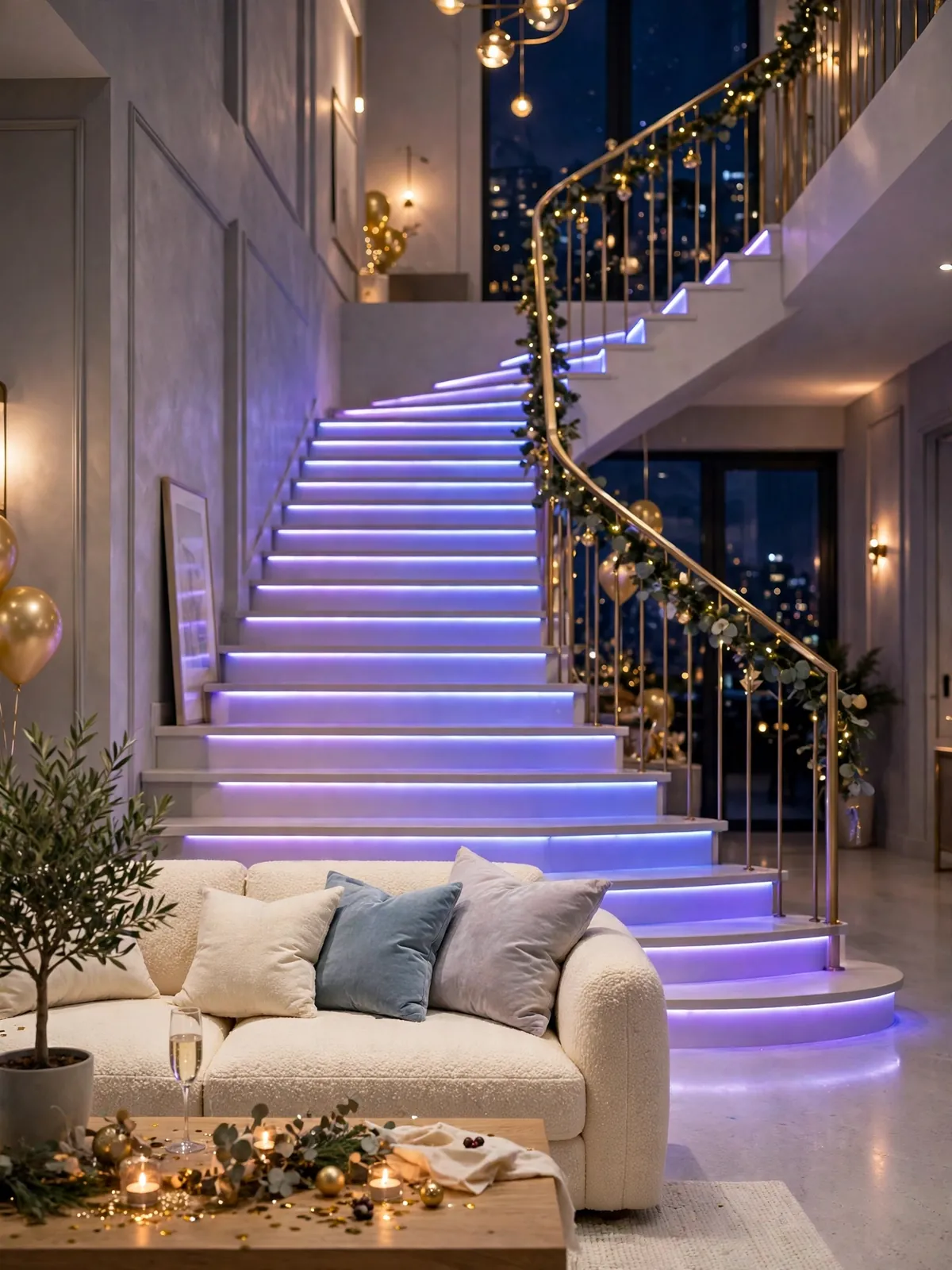
Colour-changing LED stair lights turn an ordinary staircase into a party feature, because the whole flight can shift from warm white to violet, blue or green at the touch of a button — and when the strips run under every pale white tread, the colour washes down the soft grey walls and across the cream sofa at the base, so the entire hallway changes mood in seconds. In this home, RGB LED strips sit in slim channels under each tread, each 1 metre wide, set to a soft violet for an evening gathering, with the colour controlled from a small remote on the landing. The strips return to warm white at 2700K for everyday use, so the party colours never get in the way of safe, normal climbing, and the pale treads bounce the colour gently rather than glaring. It is a playful layer that sits on top of a sensible lighting plan, not instead of it, and because the colour strips are dimmable, the violet can be softened to a whisper for a quiet evening or brightened for a celebration.
Quick tips:
- Use RGB strips so you can switch back to warm white daily.
- Set party colours to a soft level, not full brightness.
- Keep the treads pale so the colour washes gently.
- Control the colour from a remote kept on the landing.
How Many Lumens Your Staircase Really Needs
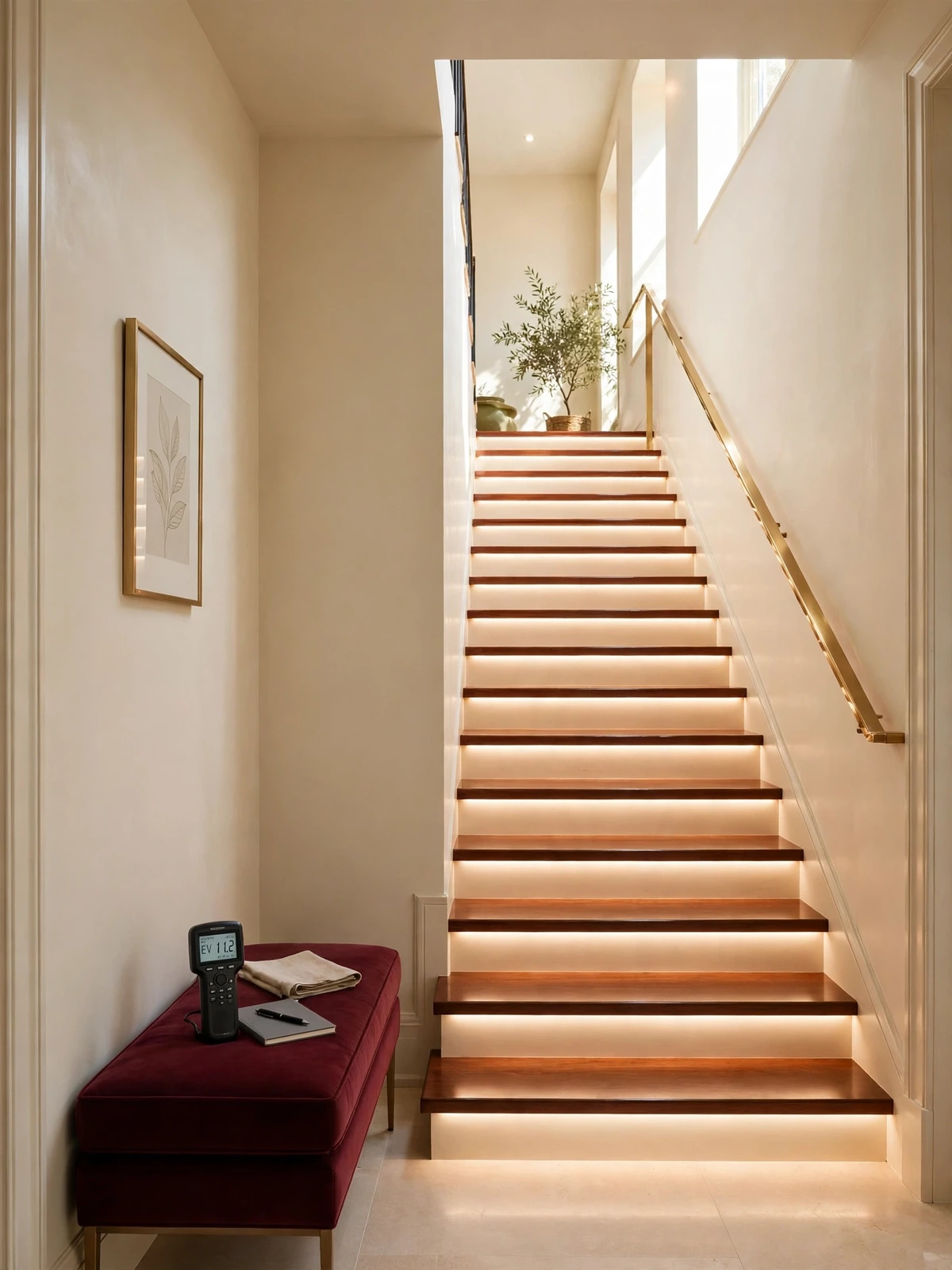
Lumens are simply a measure of how much light a bulb gives off, and a staircase needs enough of them to see every tread clearly without glare. As a guide, aim for 100 to 200 lumens per square metre of stairwell, which usually means 300 to 800 lumens in total for a standard flight, with step lights adding 20 to 50 lumens each. In this hallway, a 600-lumen ceiling light plus six 40-lumen step lights give 840 lumens over warm chestnut treads, each 950 mm wide, and the soft cream walls bounce the light so evenly that no step is left dim. A deep burgundy bench at the base adds rich colour without absorbing the light.
Quick tips:
- Aim for 100 to 200 lumens per square metre of stairwell.
- Add up the ceiling light and the step lights together.
- Use pale walls to bounce lumens further down the flight.
- Check the glow at night, not by day, before you finish.
Step-Light Spacing: One Light Every Two to Three Treads
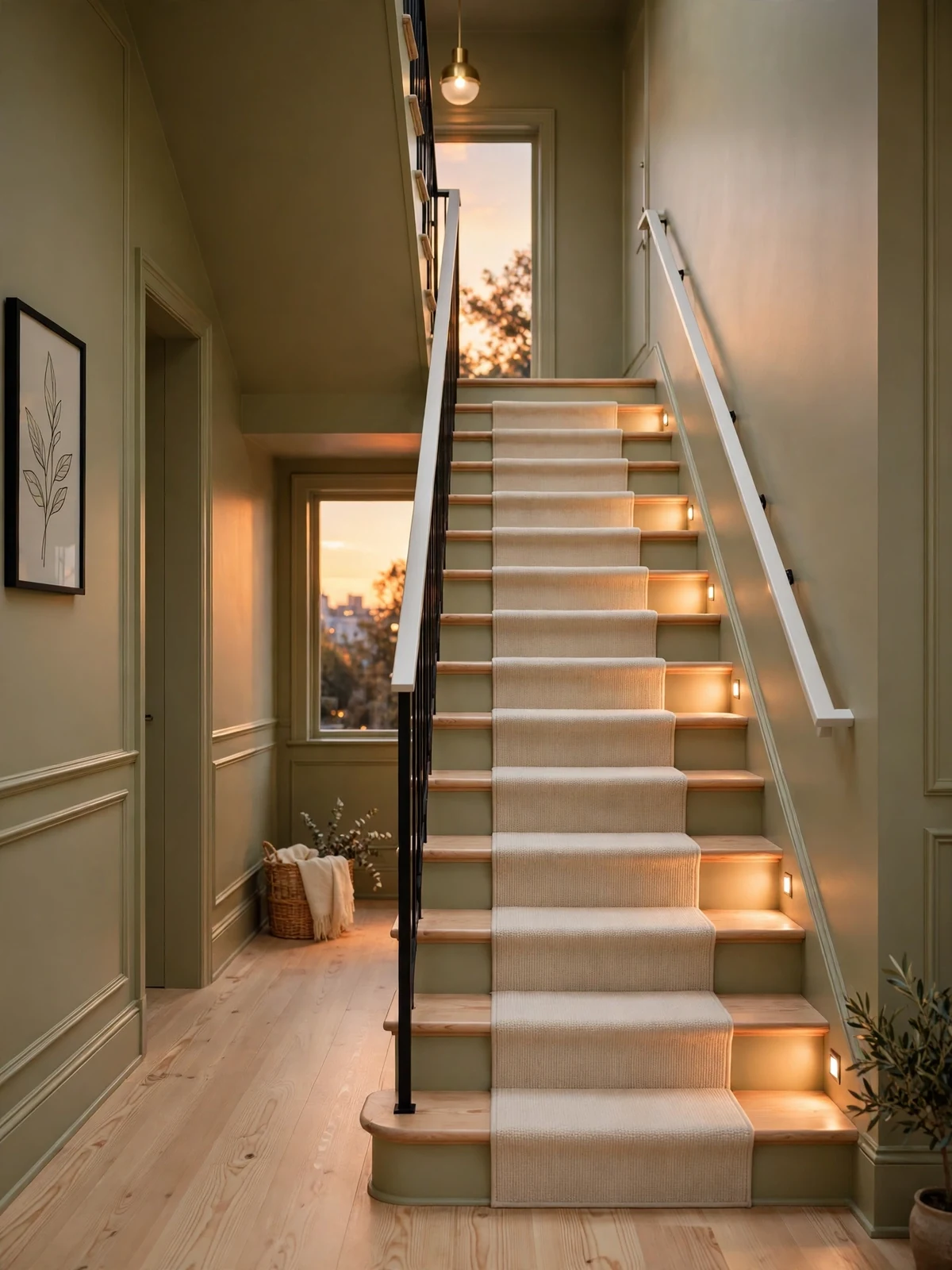
Step-light spacing is a simple rule with a big effect: one light every two to three treads gives even light with no dark gaps, while lights on every tread can glare and lights every five treads leave shadows. Along this flight, a small warm step light sits beside every third pale pine tread, each 900 mm wide, spaced about 75 cm apart along the slope, so the light pools overlap gently. Soft olive-green walls catch the glow, a cream runner softens the steps, and a small basket at the base keeps the hallway tidy.
Quick tips:
- Space step lights every two to three treads for even coverage.
- Keep the spacing even — about 60 to 90 cm along the slope.
- Alternate sides on a wide flight for balanced light.
- Use the same warm colour temperature for every step light.
Building-Code Basics for Stairway Lighting
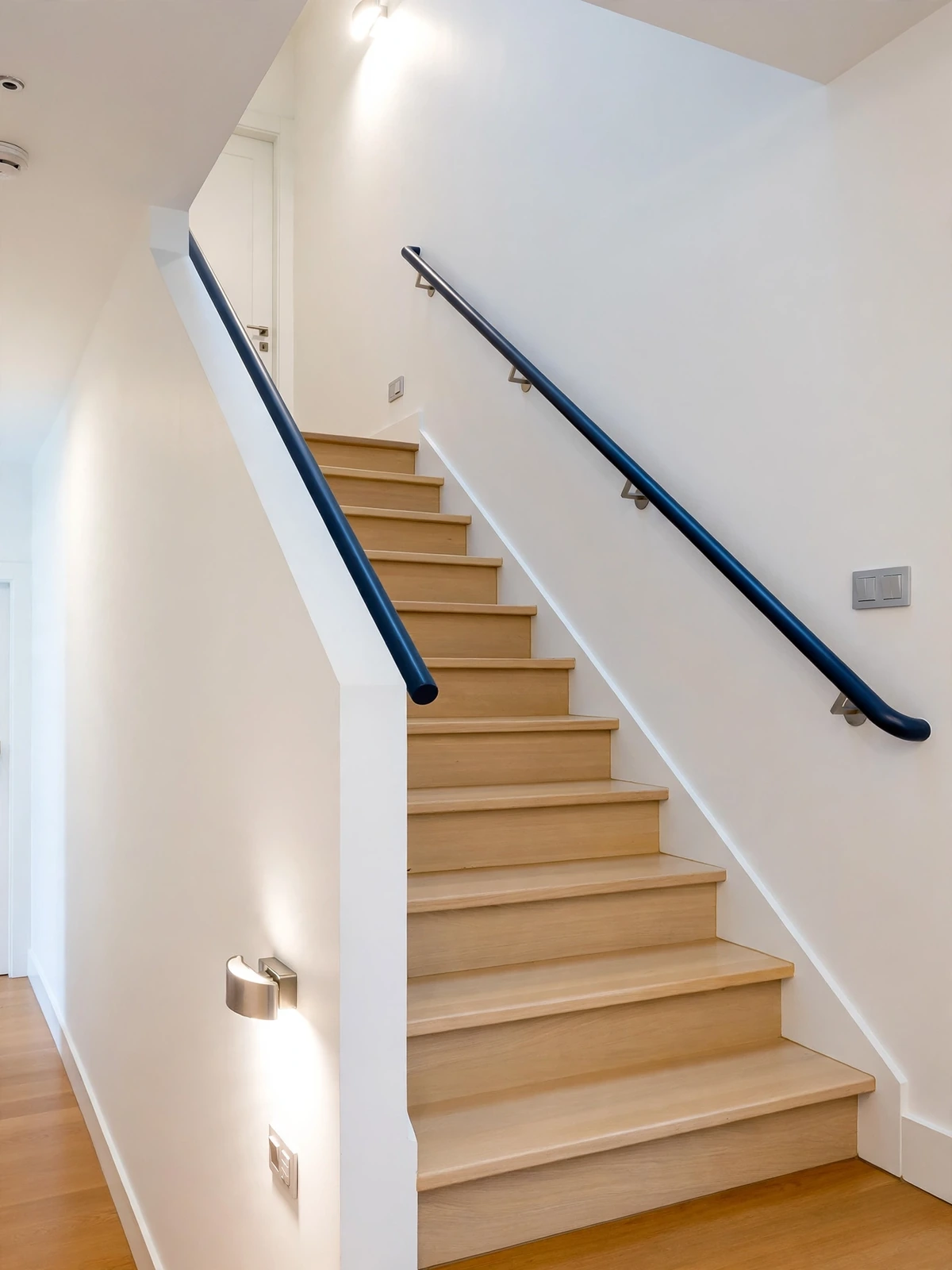
Building codes exist to keep stairs safe, and their lighting rules are simple: a light at the top and the bottom of every stairway, a switch at each level, and enough light to see every tread clearly. In this stairwell, a ceiling light at the top landing and a wall light at the foot of the stairs, both switched from either level, light pale oak treads, each 950 mm wide, with a navy-blue handrail that is easy to see and grip. Soft white walls keep the light bright, and every recessed fitting sits flush so nothing becomes a trip hazard.
Quick tips:
- Fit a light at the top and the bottom of every stairway.
- Put a switch at each level so the light works from both ends.
- Keep every recessed fitting flush with the wall or tread.
- Check your local code, because the exact rules vary by area.
Choosing the Right Colour Temperature for Staircase Lighting
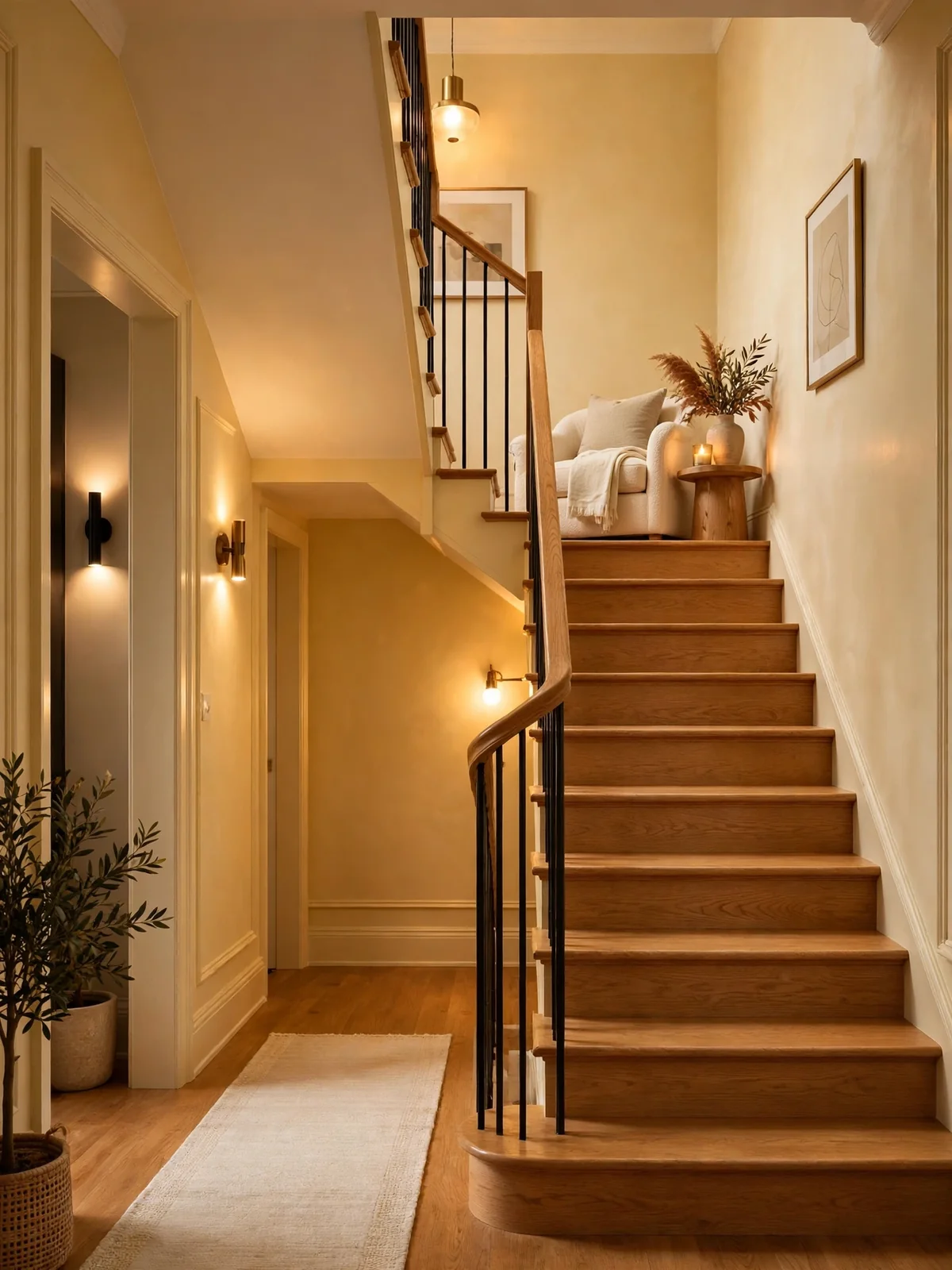
Colour temperature decides whether staircase light feels warm and welcoming or cold and clinical, and the wrong choice can make a beautiful stair feel like an office corridor. Warm white at 2700K suits most homes, giving honey oak treads, each 950 mm wide, a golden glow against soft butter-yellow walls, while neutral white at 3000K suits a modern stair and cool white above 4000K should be avoided on stairs because it feels harsh and makes shadows sharper. A cream armchair on the landing catches the warm glow, and the single rule is simple: use the same colour temperature for every light on the stair, so the ceiling light, the step lights and the sconces blend into one warm wash.
Quick tips:
- Choose 2700K warm white for most homes.
- Use 3000K neutral white only for a very modern stair.
- Avoid cool white above 4000K on stairs — it feels harsh.
- Match the colour temperature of every light on the stair.
Lighting a Straight Staircase From Top to Bottom
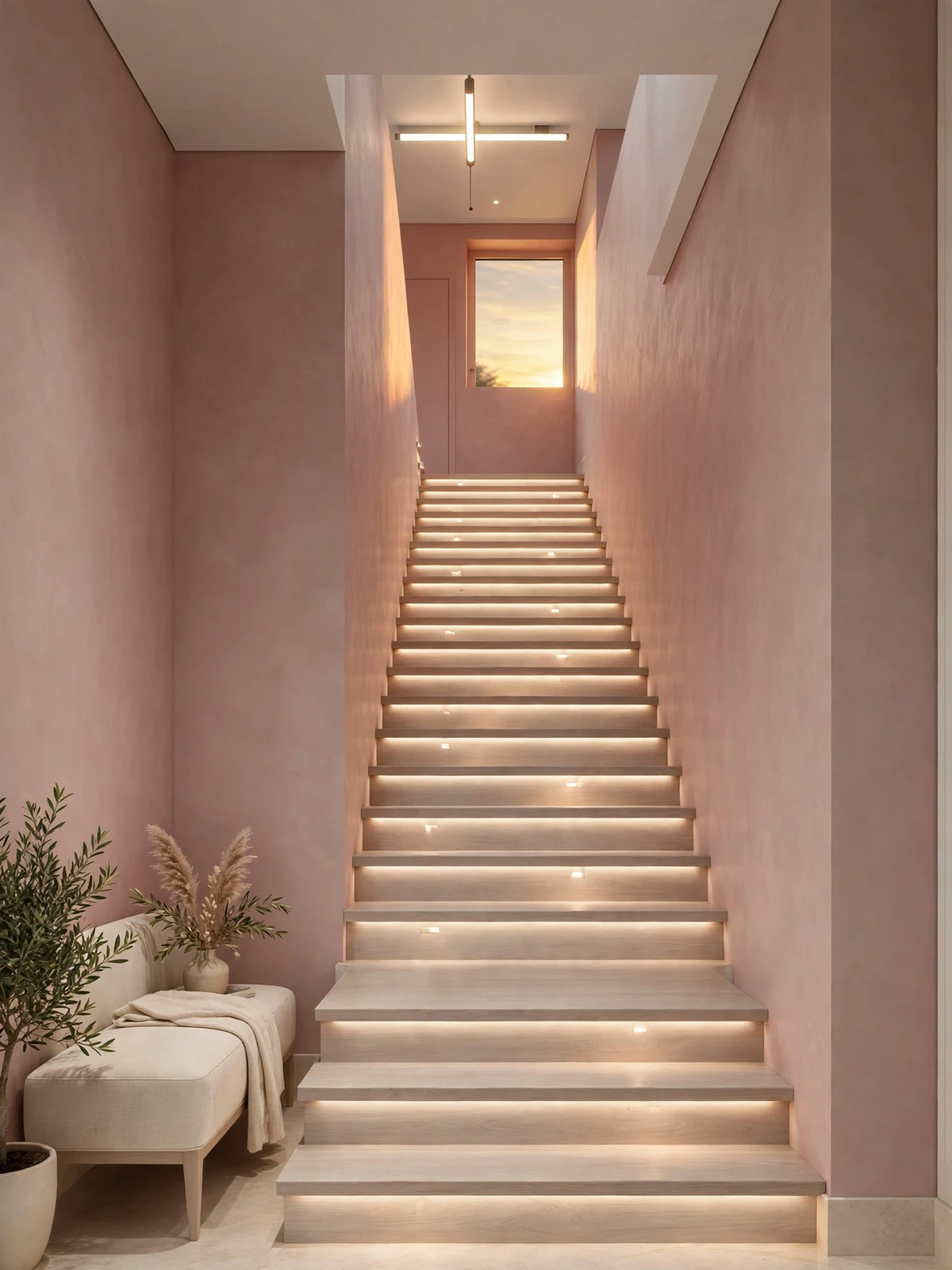
A straight staircase is the simplest shape to light, because one ceiling light at the top and one at the bottom, plus step lights along the flight, cover the whole run evenly. Here, a warm ceiling light at the top landing and a wall light at the foot light pale ash treads, each 900 mm wide, from end to end, with small step lights every third tread filling any shadows in the middle. Soft dusty-rose walls catch the warm glow, while a cream bench at the base adds softness and the straight run means no corner is ever left dark.
Quick tips:
- Put a light at the top and the bottom of a straight flight.
- Add step lights every third tread to fill the middle.
- Use one warm colour temperature for the whole flight.
- Keep the walls pale so the light travels the full run.
Lighting an L-Shaped Staircase Around the Turn
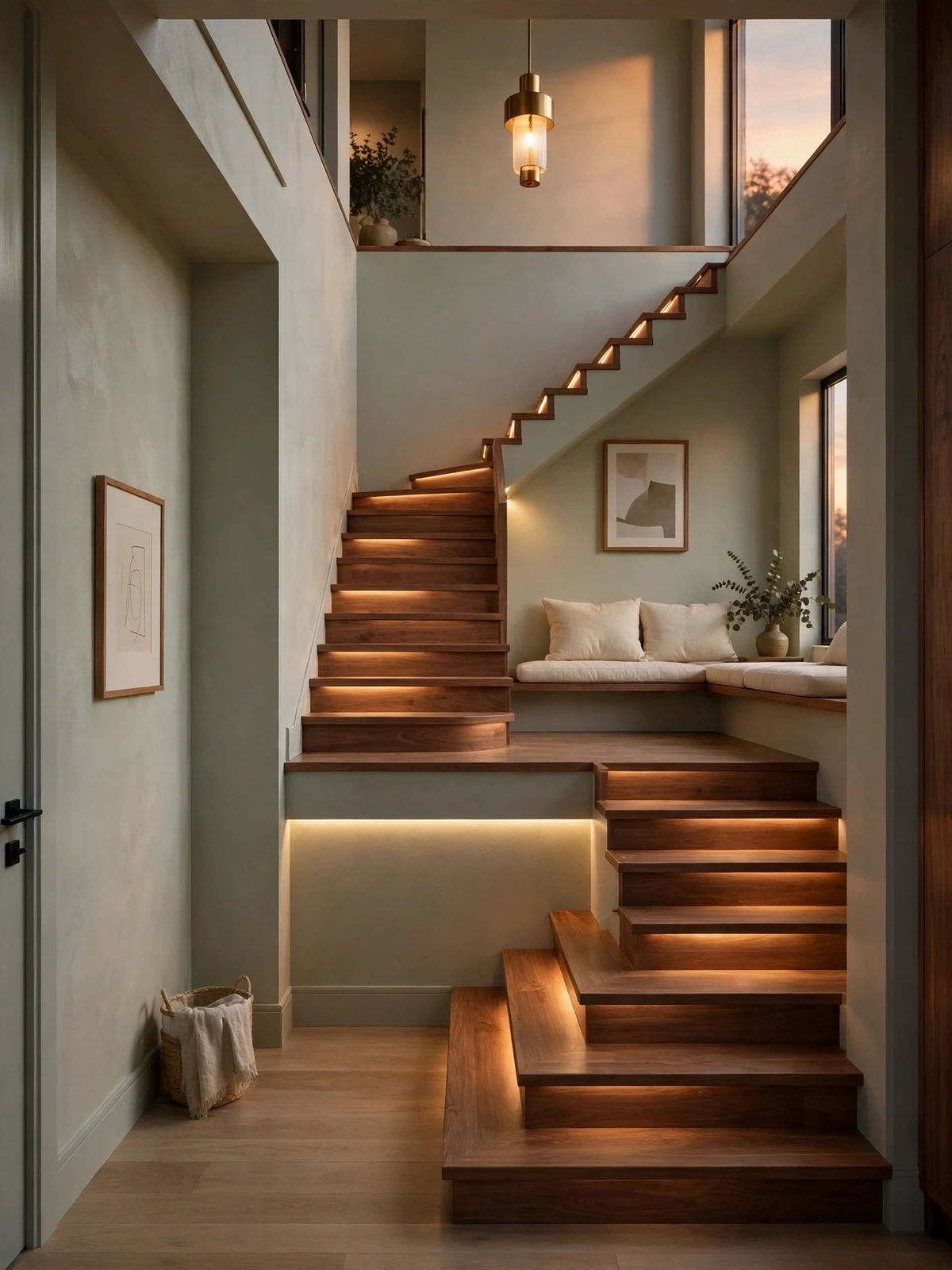
An L-shaped staircase needs light at the turn most of all, because the corner is where shadows gather and where you change direction. In this home, a warm pendant hangs over the square landing at the turn, while step lights run along both flights of warm walnut treads, each 950 mm wide, so the light follows you around the corner. Soft sage walls bounce the glow, cream cushions on the landing bench add softness, and a second switch on the landing means the turn light works from either flight.
Quick tips:
- Hang a pendant or wall light directly over the landing turn.
- Run step lights along both flights, not just one.
- Put a switch on the landing as well as at top and bottom.
- Keep the landing clear so the turn light reaches both flights.
Lighting a U-Shaped Staircase Across Two Landings
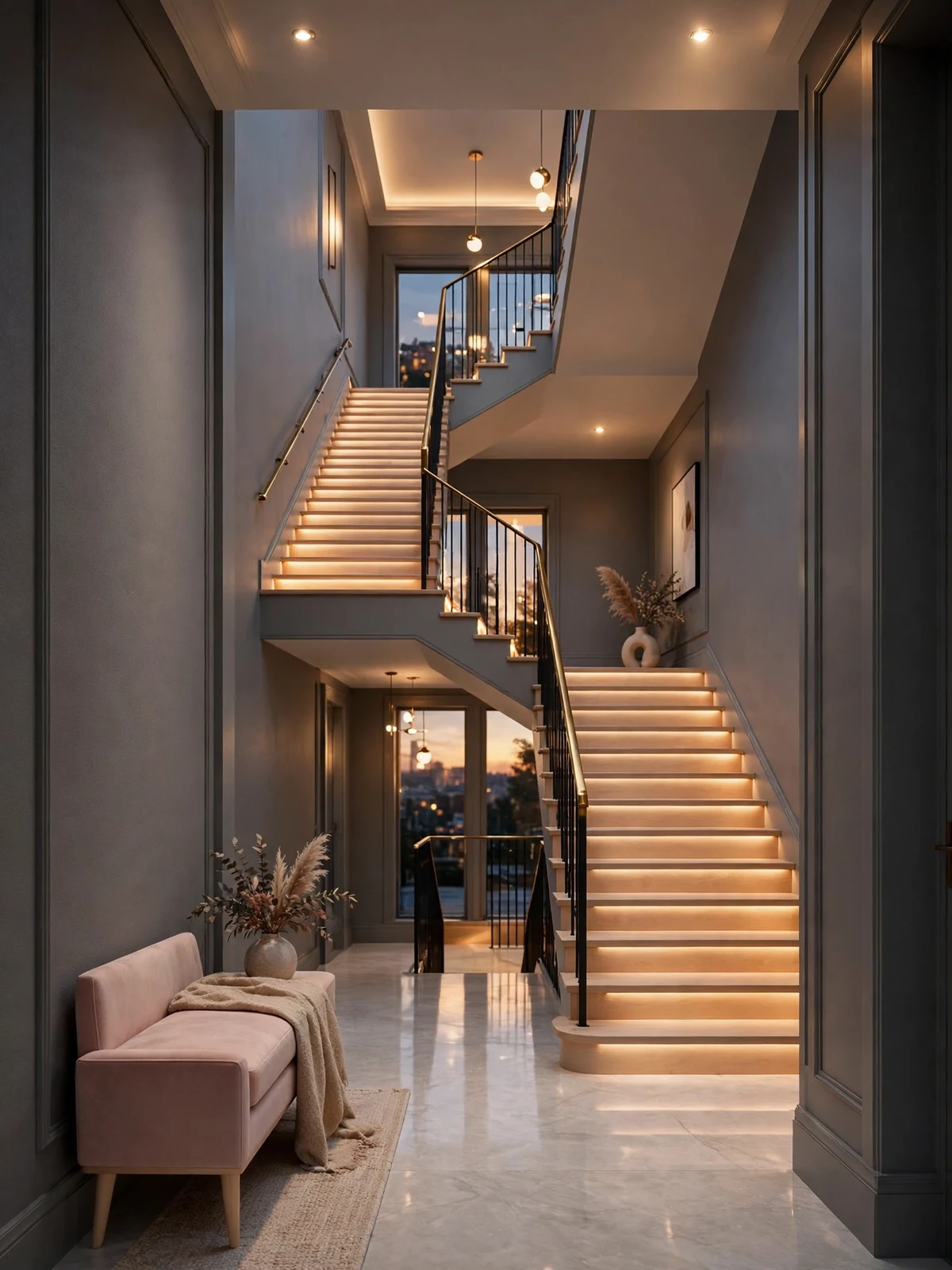
A U-shaped staircase has two flights and two landings, so it needs light planned as two linked staircases rather than one. Here, a warm ceiling light sits over each landing, step lights run along both flights of pale maple treads, each 900 mm wide, and the two flights face each other across a narrow well that the light fills evenly. Soft charcoal walls make the warm glow stand out, while a blush-pink bench on the lower landing adds soft colour and the balanced lighting means neither flight is ever darker than the other.
Quick tips:
- Light each landing separately with its own ceiling light.
- Run step lights along both flights for balanced brightness.
- Use the same warm colour temperature on both flights.
- Keep the well between the flights clear so light crosses it.
Lighting a Spiral Staircase Without Dark Corners
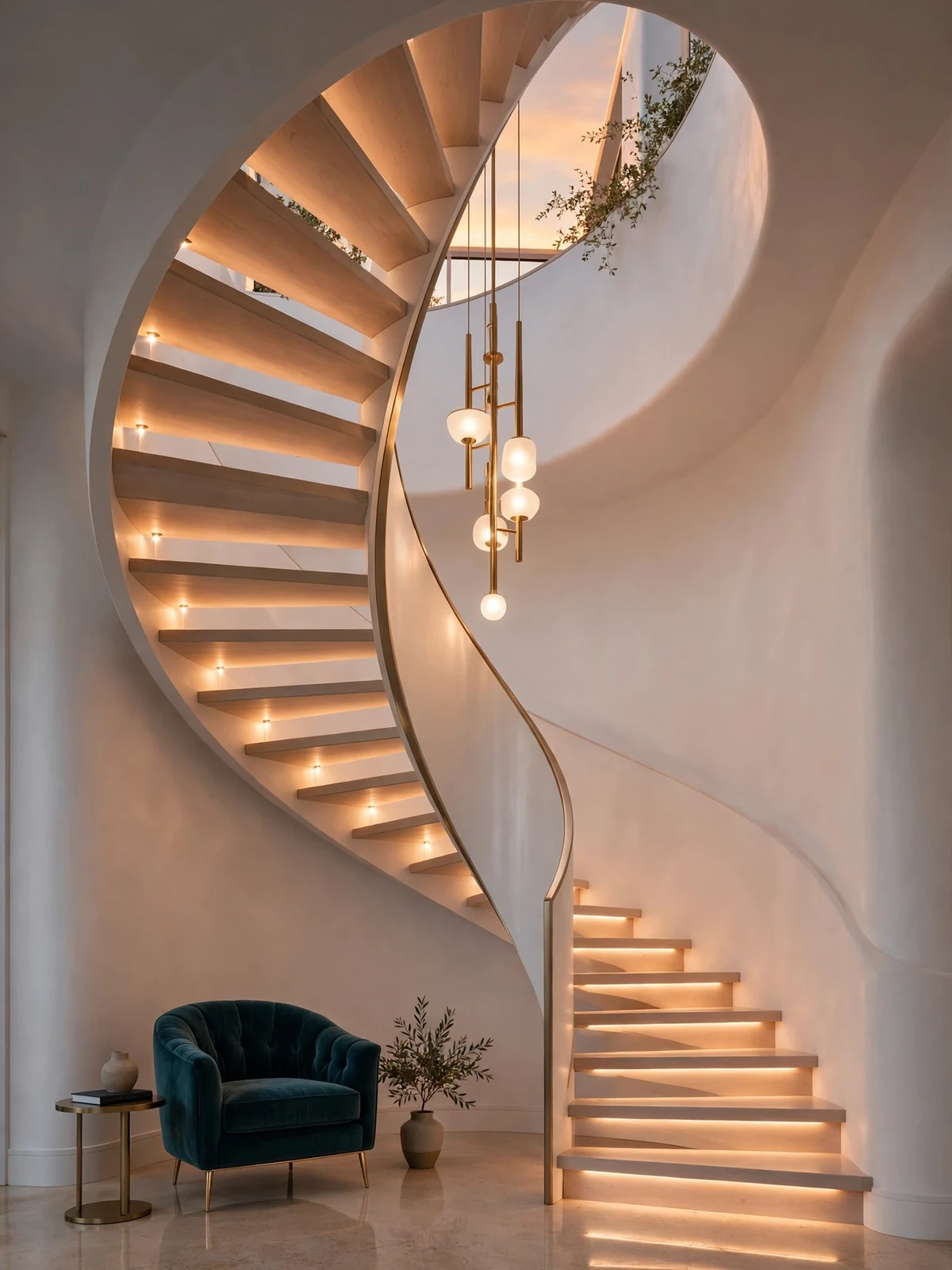
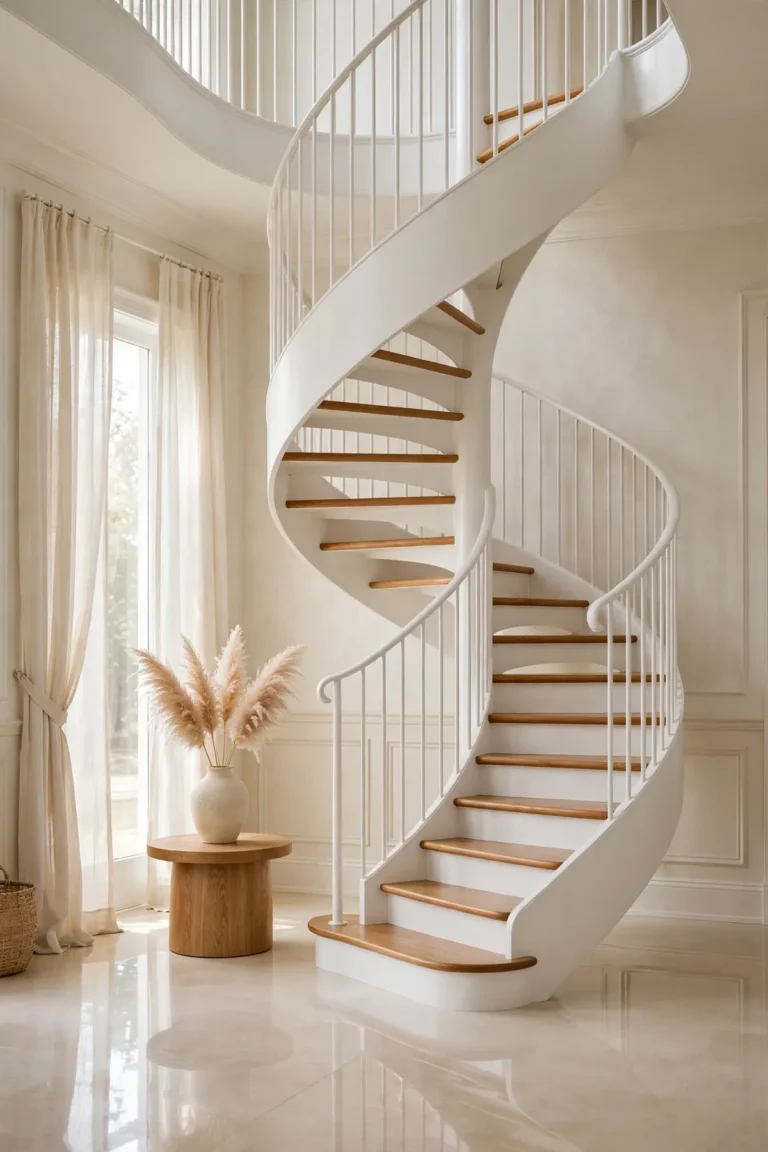
A spiral staircase curves, so its treads are narrow at the centre and wide at the edge, and the lighting must follow the curve or the inner edge falls into shadow. In this home, a small warm step light sits on every tread of the spiral, pale birch treads each 900 mm wide at the outer edge, while a slim central pendant hangs down the middle of the spiral, its glow reaching every turn. Soft white walls bounce the light around the curve, while a deep teal velvet chair at the base adds rich colour and the even lighting means the narrow inner edge is as visible as the wide outer edge.
Quick tips:
- Light every tread on a spiral, not every third one.
- Hang a slim central pendant down the middle of the spiral.
- Use warm step lights so the curve feels soft, not stark.
- Keep the centre pole slim so it never blocks the light.
Lighting a Floating Staircase With Hidden LED Channels
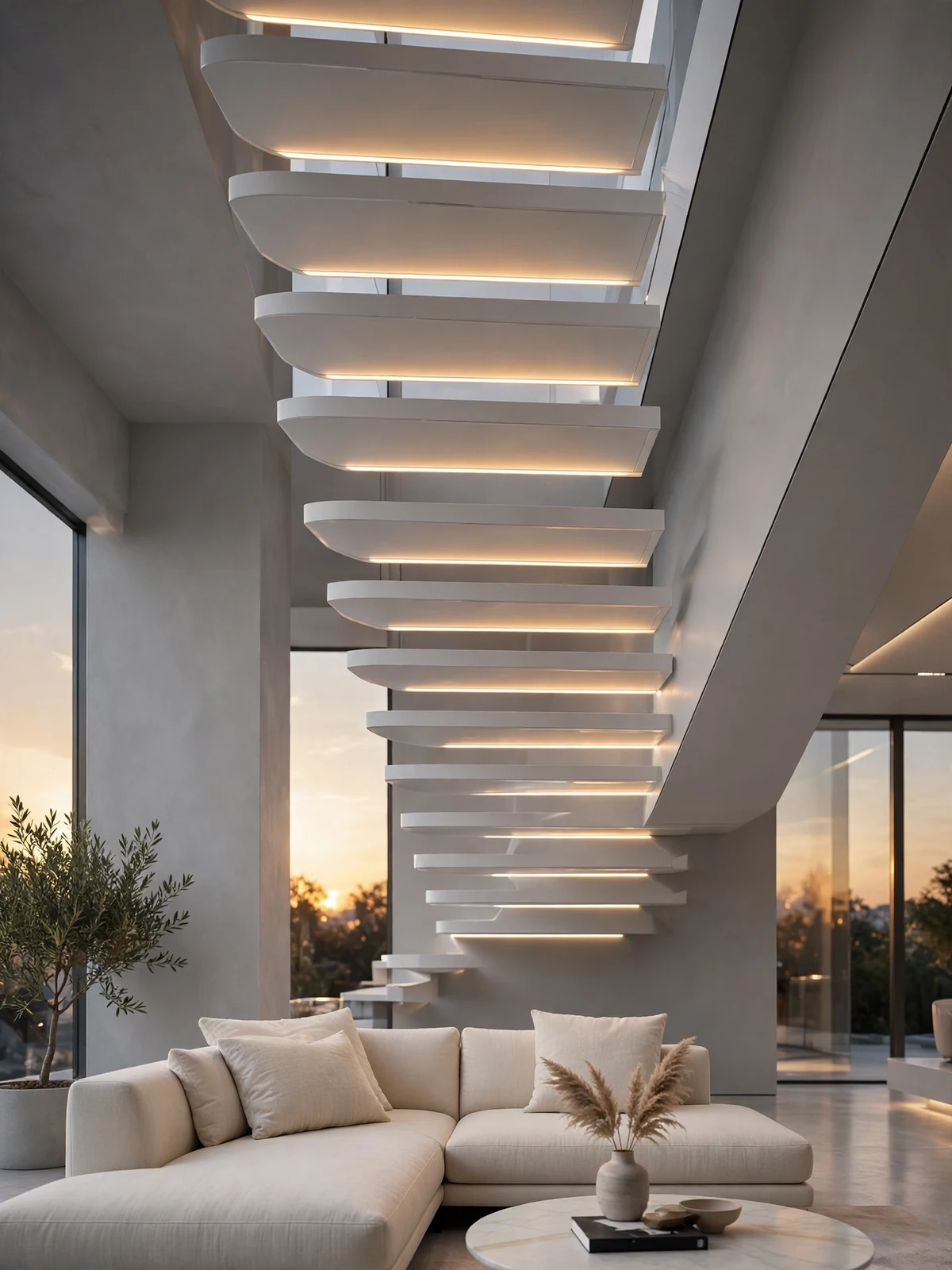
A floating staircase has no risers and open sides, so hidden LED channels under each tread are the perfect light — they make the treads glow while keeping the floating look completely clean. Here, slim LED channels sit under every pale white tread, each 1 metre wide, their warm glow washing down onto the tread below and across soft grey walls. A cream sofa below the stair catches the soft light, while the hidden channels mean no fitting is ever visible and the stair still looks as if it is floating in mid-air.
Quick tips:
- Hide the LED channel under the tread so no fitting shows.
- Use warm 2700K strips for a soft floating glow.
- Light every tread on a floating stair for the safest result.
- Pair the glow with pale grey walls so it reads clearly.
Lighting a Basement Staircase That Has No Natural Light
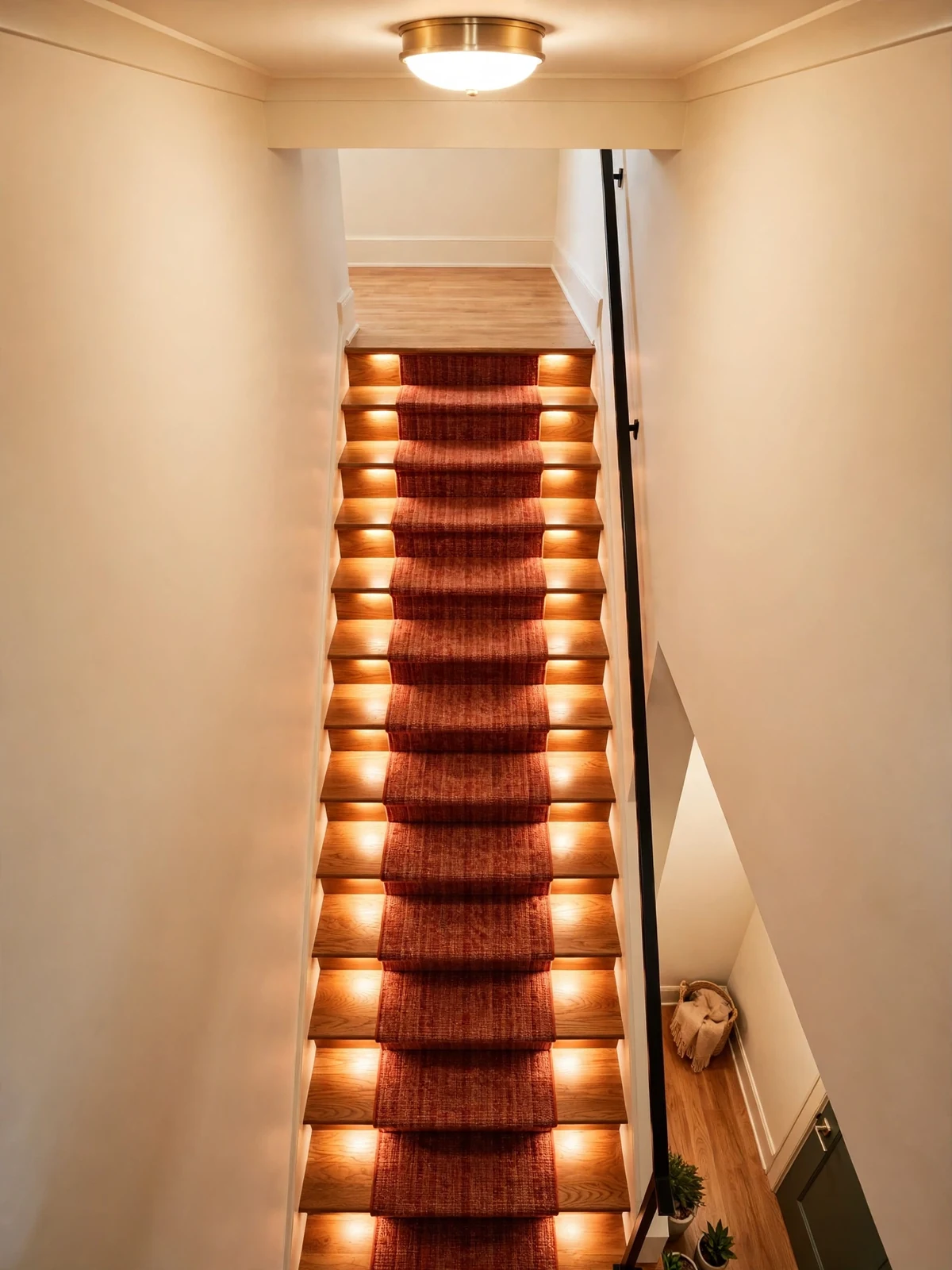
A basement staircase has no window, so its lighting must do the whole job on its own, day and night. In this basement stair, a bright ceiling light plus a warm step light on every tread light warm oak treads, each 900 mm wide, so evenly that the stair feels as bright as the hallway above. Soft cream walls bounce the light, a rust-red runner adds warmth and grip, and a motion sensor at the top means the lights switch on before you take the first step down.
Quick tips:
- Use a brighter ceiling light in a basement stair than upstairs.
- Light every tread with a step light for full safety.
- Add a motion sensor so the lights switch on before you descend.
- Keep the walls cream so the light bounces as far as possible.
Lighting a Low-Ceiling Staircase Without Glare
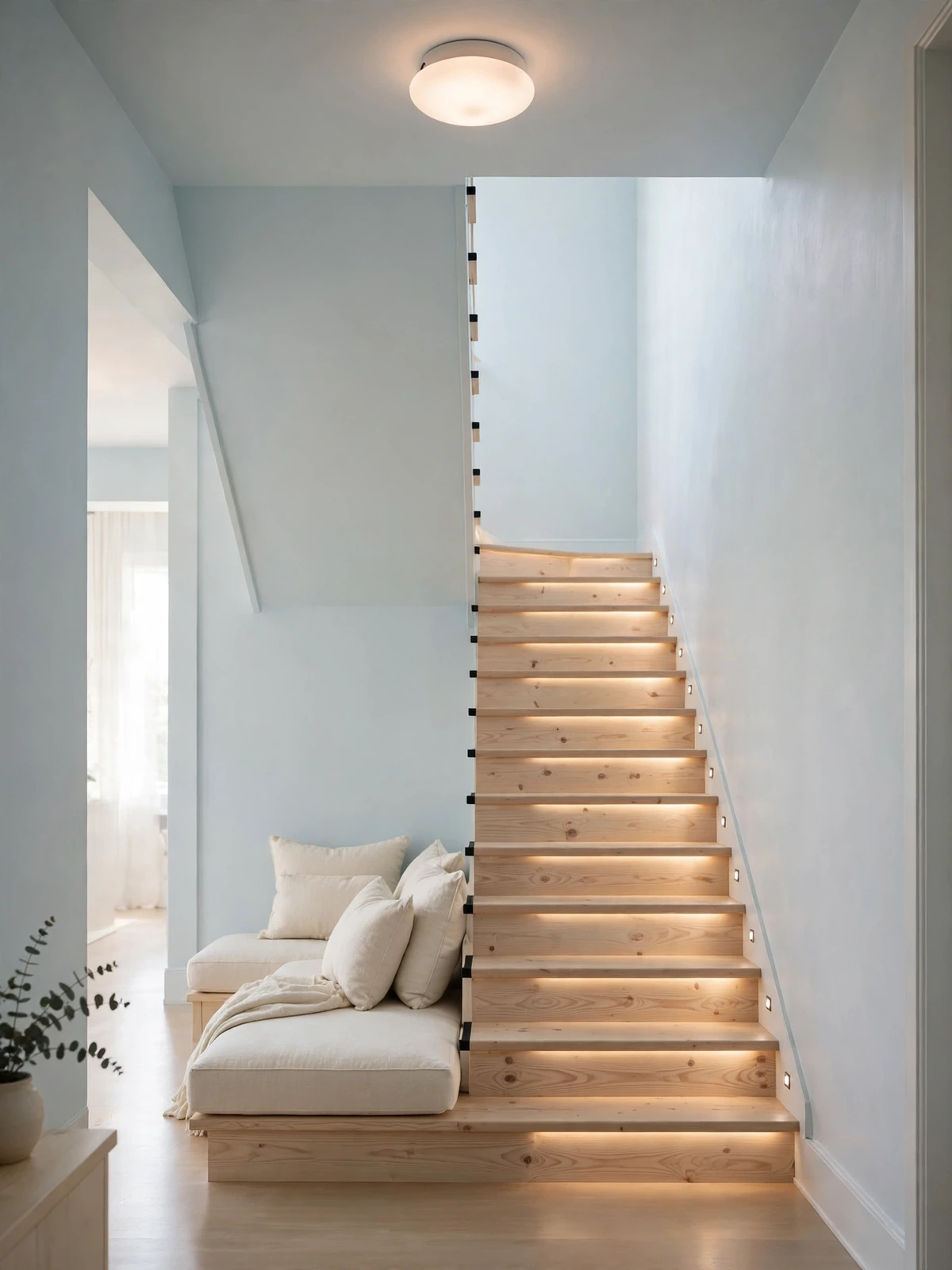
A low-ceiling staircase glares easily, because the ceiling light sits close to your eyes, so the trick is to keep the main light flush and let the step lights do most of the work. Here, a slim flush ceiling light and recessed step lights every third tread light pale pine treads, each 900 mm wide, with a soft diffused glow that never shines directly into your eyes. Soft pale-blue walls keep the space bright, cream cushions on a small bench add softness, and the low light levels mean the stair feels calm rather than dazzling.
Quick tips:
- Use a flush ceiling light, never a hanging pendant, on a low stair.
- Let recessed step lights carry most of the brightness.
- Choose diffused fittings so no bulb is ever directly visible.
- Keep the walls pale blue or cream to lift the low ceiling.
Lighting a Double-Height Staircase From Floor to Ceiling
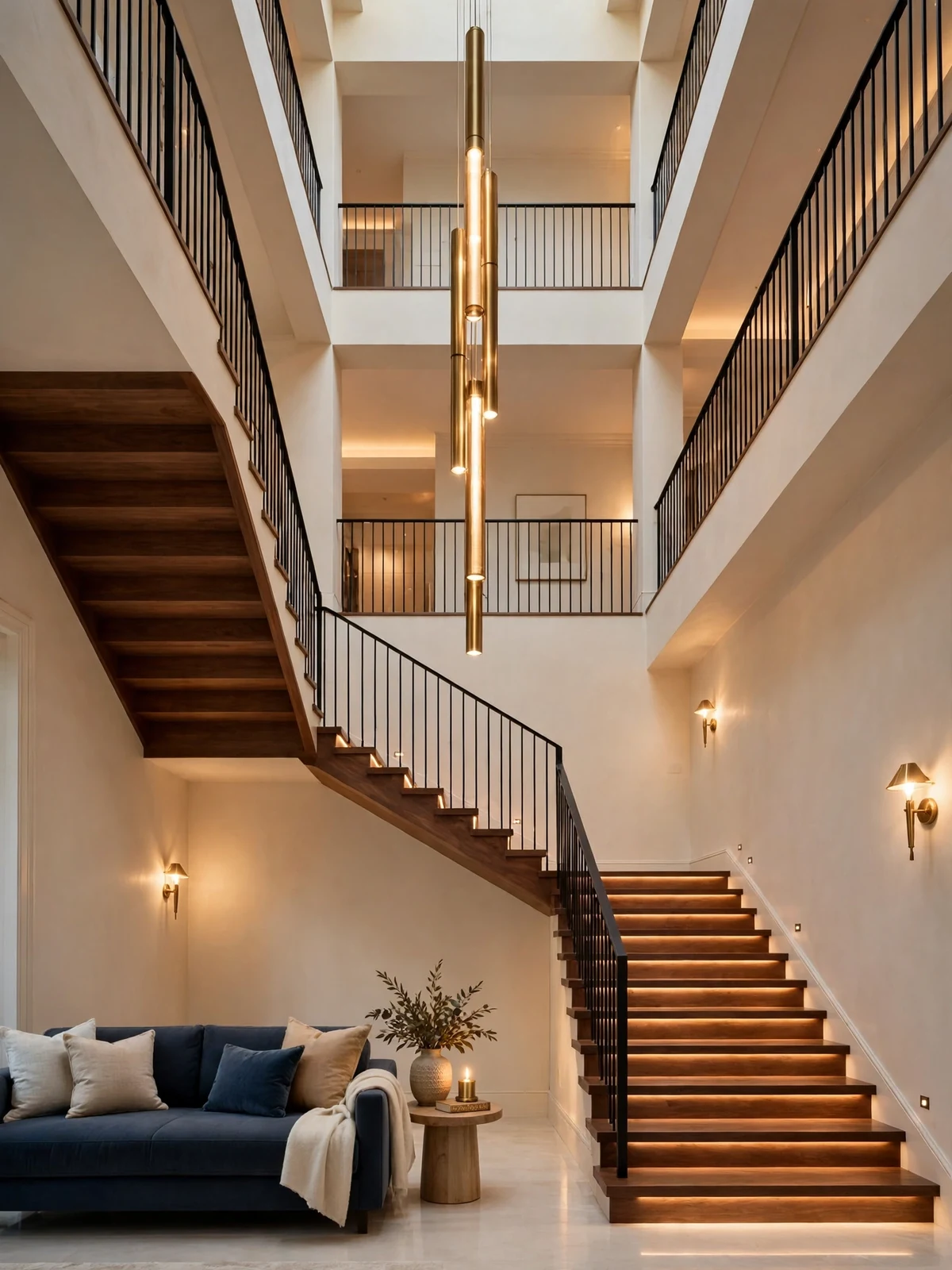
A double-height staircase needs light at every height, because a single ceiling light leaves the lower steps dim and a single wall light leaves the top dark. In this tall stairwell, a long pendant drops from the ceiling 6 metres above, wall sconces sit at the mid landing, and step lights run along warm walnut treads, each 1 metre wide, so the light reaches from the floor to the ceiling. Soft ivory walls bounce the layered glow, while a navy-blue sofa at the base grounds the grand space and the three heights of light mean no part of the tall stair is ever in shadow.
Quick tips:
- Light a double-height stair at three heights: top, middle and steps.
- Use a long-drop pendant for the upper half of the stairwell.
- Add sconces at the mid landing for the middle height.
- Run step lights along the whole flight for the lower half.
DIY Stair Lighting Versus Hiring an Electrician
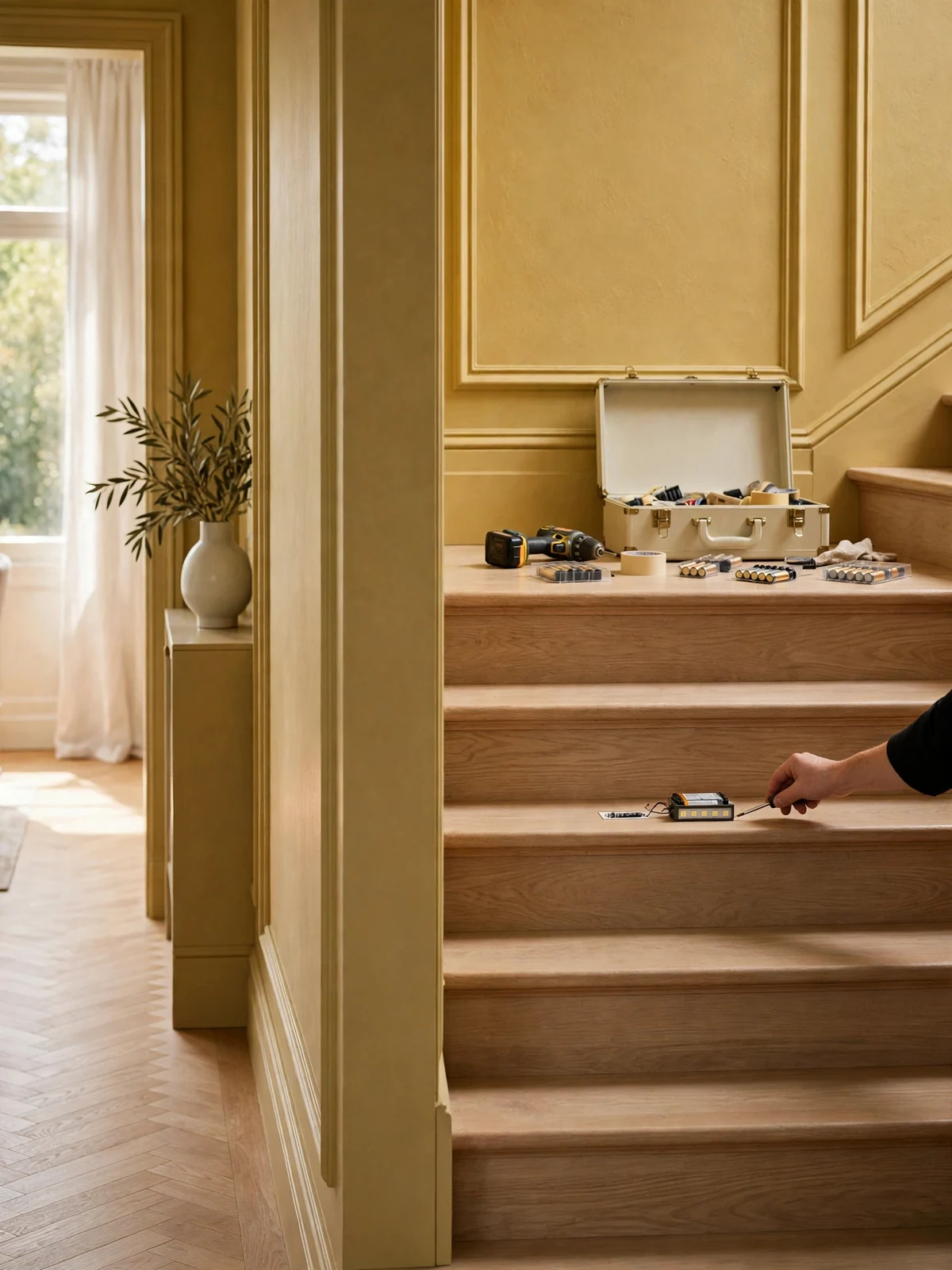
Some stair lighting is a simple weekend job and some needs a professional, and knowing the difference keeps the project safe. Battery-powered LED strips and plug-in step lights can be fitted by hand in an afternoon — here, slim battery strips are being pressed under pale oak treads, each 950 mm wide, against soft mustard-yellow walls — while any hardwired light, new circuit, dimmer or recessed fitting must be wired by a qualified electrician. A cream toolbox on the landing holds the simple tools for the DIY parts, and the rule is simple: if it plugs in or sticks on, you can do it; if it needs new wiring, call a professional.
Quick tips:
- DIY only battery or plug-in stair lights, never hardwired ones.
- Hire an electrician for new circuits, dimmers and recessed lights.
- Start with one flight of battery strips to test the look.
- Keep the electrician’s quote in writing before work starts.
Common Staircase Lighting Mistakes to Avoid
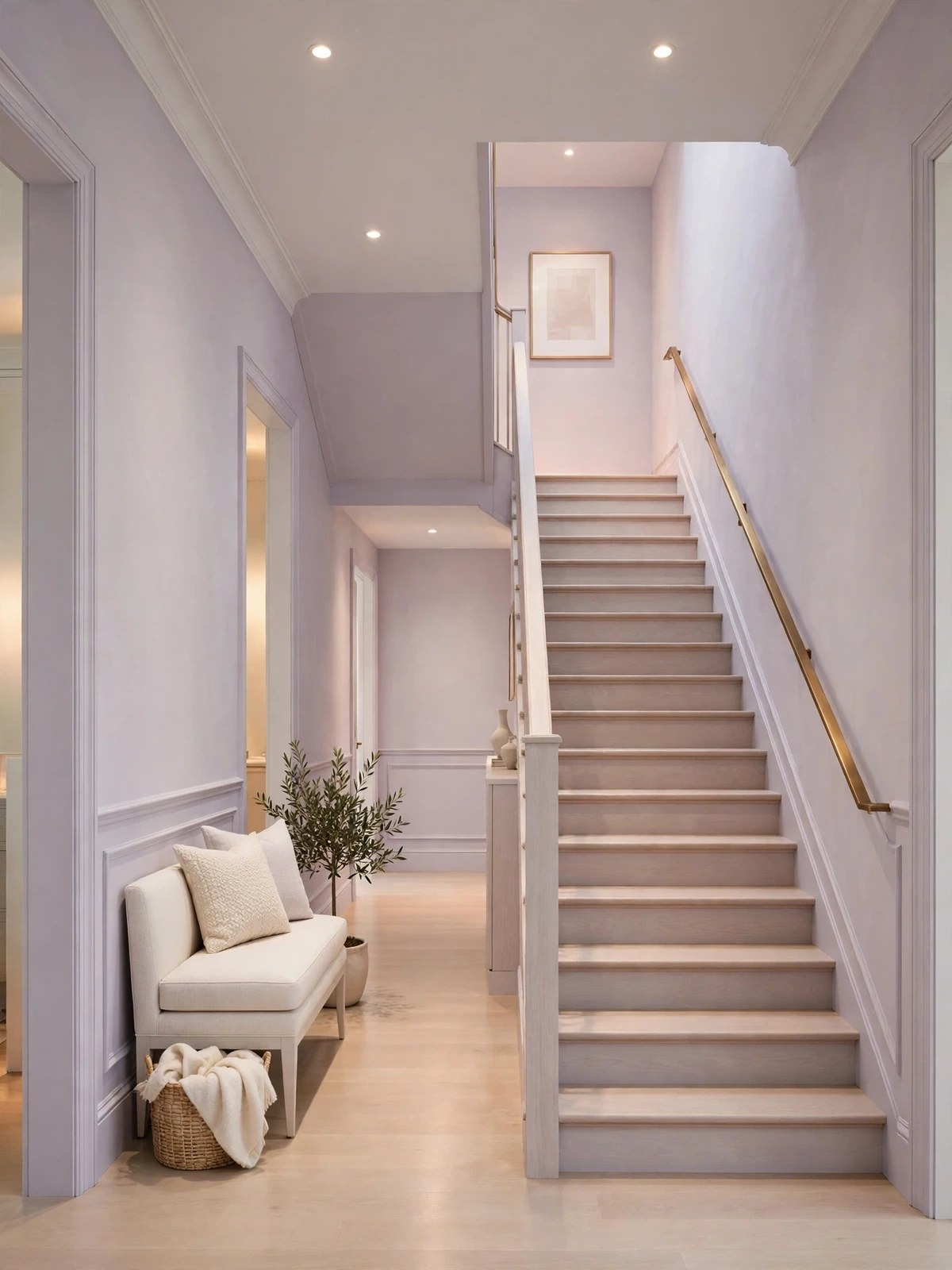
The most common staircase lighting mistakes are easy to avoid once you know them: mixing colour temperatures so the stair glows warm at the top and cold at the bottom, hanging the main light too high so the steps sit in shadow, and using bare bulbs that glare into your eyes on the climb. In this hallway, the lighting is done correctly — one warm 2700K temperature throughout, a ceiling light low enough to reach the steps, and diffused fittings that never glare — so pale ash treads, each 950 mm wide, glow evenly against soft lavender walls. A cream bench at the base adds softness, and the even light means there are no dark corners and no bright spots anywhere on the flight.
Quick tips:
- Use one colour temperature for every light on the stair.
- Hang the main light low enough to reach the steps.
- Choose diffused fittings, never bare bulbs, to avoid glare.
- Check the stair at night for dark corners before you finish.
Lighting the Landing and Outdoor Stairs for Safe Night-Time Steps
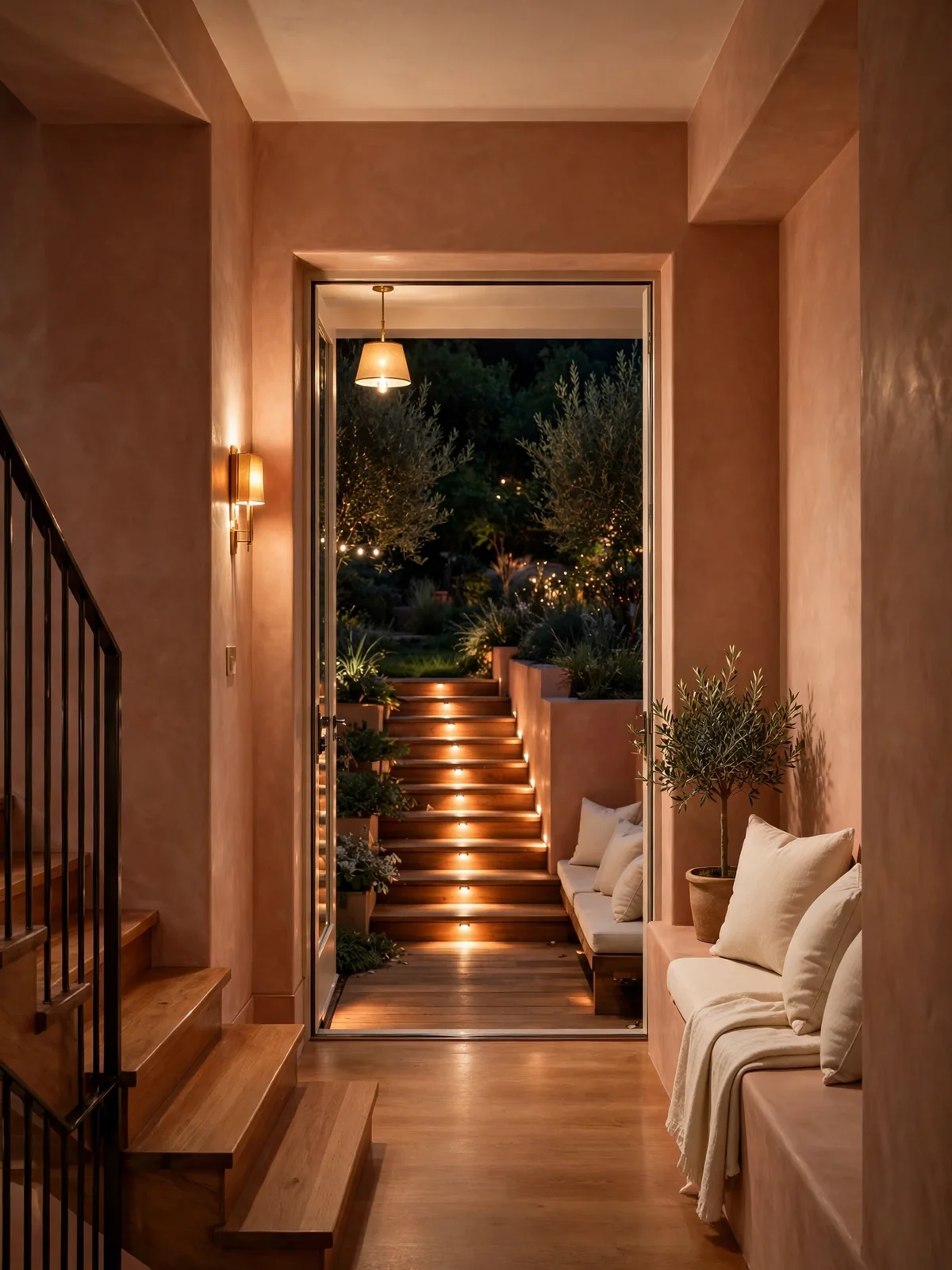
Landings and outdoor stairs are the steps most often forgotten, yet they are the ones you use in the dark most often. In this home, the indoor landing glows with a warm wall light and a soft step light, while the outdoor garden steps, in warm timber, carry weatherproof step lights that switch on with a dusk sensor. Soft terracotta walls inside catch the warm glow, cream outdoor cushions sit beside the garden steps, and the outdoor lights are rated for rain so they keep working through every season.
Quick tips:
- Light every landing, not just the flights between them.
- Use weatherproof fittings rated for outdoor use on garden steps.
- Add a dusk sensor so outdoor stair lights switch on at sunset.
- Keep the outdoor step lights warm, matching the indoor stair.
FAQs
How many lumens do I need for staircase lighting?
Aim for about 100 to 200 lumens per square metre of stairwell, which usually means 300 to 800 lumens in total for a standard flight, depending on the size and the wall colour. Step lights add about 20 to 50 lumens each, so a flight of 13 steps needs roughly 300 to 500 lumens from its step lights alone, plus the main ceiling light.
What are the building code requirements for stairway lighting?
Most building codes require a light at the top and bottom of every stairway, a switch at each level, and enough light to see every tread clearly — usually at least 10 lux on the treads. Handrails must be easy to see and grip, and any recessed step light must sit flush so it never becomes a trip hazard. Always check your local code, because the exact rules vary by area.
Are motion-sensor stair lights worth it?
Yes, for most homes they are well worth it. Motion sensors switch the stair lights on the moment you step onto the flight and switch them off after you leave, so you never climb in the dark and never waste electricity. They are especially useful for night-time trips, children, older family members and basement stairs.
How far apart should step lights be on stairs?
Place step lights every two to three treads for even light with no dark gaps — usually one light on every second or third step, alternating sides on a wide flight. On a standard flight of 13 steps, that means four to six step lights, spaced about 60 to 90 cm apart along the slope.
How do you layer lighting on a staircase?
Start with ambient light from a ceiling fixture, add task light from step lights or LED strips that mark every tread, then finish with accent light such as a wall sconce, picture light or a soft landing lamp. Put the ambient and task layers on separate dimmers or sensors so you can brighten the stairs for safety and soften them for mood.
Conclusion
Good staircase lighting is a system, not a single fixture: a layered plan that combines ambient, task and accent light, marks every tread with LED strips or step lights, switches on with a sensor when you need it, dims for the evening, and matches the brightness and colour temperature to your stair type and ceiling height. Whether your stair is straight, L-shaped, U-shaped, spiral, floating or in a basement, the same rules apply — light every tread, keep one warm colour temperature, space the step lights every two to three treads, and check the result at night. Design it that way and your staircase will be safe after dark, beautiful by day, and a pleasure to climb every time.