20 Gorgeous Bathroom Flooring Ideas That Transform Your Bathroom From the Ground Up
The floor sets the mood of the whole bathroom, and the right choice can make a small room feel larger, a plain room feel luxurious, and a busy family bathroom far easier to live with. These 20 bathroom flooring ideas cover tile, stone, wood-look and patterned floors, with honest notes on waterproofing, grip and upkeep so you can choose with confidence.
Bathroom flooring ideas matter more than most people expect, because the floor is the largest single surface in the room, it takes every splash, step and spill, and it decides whether the bathroom feels calm, luxurious or dated before you notice anything else. Good bathroom flooring means a surface that handles water without damage, feels comfortable under bare feet, is easy to clean, and suits the style of the rest of the room — and the best choice is rarely the prettiest tile in the showroom, but the one that fits your household, your budget and how the bathroom is actually used.
If you are choosing the rest of the room to match the floor, these aesthetic bathroom ideas show how colour, fixtures and styling can pull the whole look together. The 20 ideas below cover porcelain, stone, terrazzo, mosaic, wood-look and patterned floors, so you can compare them side by side and pick the floor that will still look good after years of daily use.
Key Takeaways
What is the best flooring for a bathroom?
Porcelain tile is the safest all-round choice for most bathrooms, because it is waterproof, hard-wearing, easy to clean and available in marble, stone, wood and concrete looks. Natural stone and terrazzo look beautiful but need sealing, while waterproof wood-look planks suit people who want warmth without the risk of real wood swelling.
Which bathroom flooring is most waterproof?
Glazed porcelain and ceramic tiles are the most waterproof options, because the glaze stops water soaking into the tile itself. The weak point is never the tile but the grout and the joints, so a waterproof membrane underneath and sealed grout matter just as much as the tile you choose.
Which bathroom floor is least slippery when wet?
Small mosaic tiles, textured stone and matt-finish porcelain give the best grip when wet, because the many grout lines and the textured surface give bare feet something to hold onto. Large polished tiles look elegant but can be slippery, so choose a matt or lightly textured finish in a family bathroom or a shower area.
Can I use wood flooring in a bathroom?
Solid wood is a poor choice for a bathroom because it swells, warps and stains when it stays wet. Wood-look porcelain tiles and waterproof luxury vinyl planks give the same warm look without the water damage, and they are the sensible way to get a timber floor in a bathroom.
How do I choose a bathroom floor colour?
Pale floors make a small bathroom feel larger and brighter, mid-tones hide dust and water marks best, and dark floors look dramatic but show every footprint and water spot. Pick the floor after the vanity and wall colour, and test a sample in your own bathroom light before ordering.
| Material | Cost level | Waterproof | Slip resistance | Best for |
|---|---|---|---|---|
| Porcelain tile | Medium | High | Good with a matt finish | Most bathrooms, families, showers |
| Marble-look porcelain | Medium | High | Good with a matt finish | Luxury look without stone upkeep |
| Natural stone (slate, marble) | High | Medium, needs sealing | Good, naturally textured | Spa-style and earthy bathrooms |
| Terrazzo | High | Medium, needs sealing | Good | Modern and retro statement floors |
| Wood-look porcelain or vinyl planks | Low to medium | High when fully waterproof | Good | Warmth without real-wood risk |
| Pebble mosaic | Medium | High with sealed grout | Excellent | Shower floors |
| Concrete-look porcelain | Medium | High | Good with a matt finish | Modern and industrial bathrooms |
| Terracotta | Medium to high | Low unless sealed | Good | Mediterranean and rustic bathrooms |
Large-Format Porcelain Tiles in Warm Greige
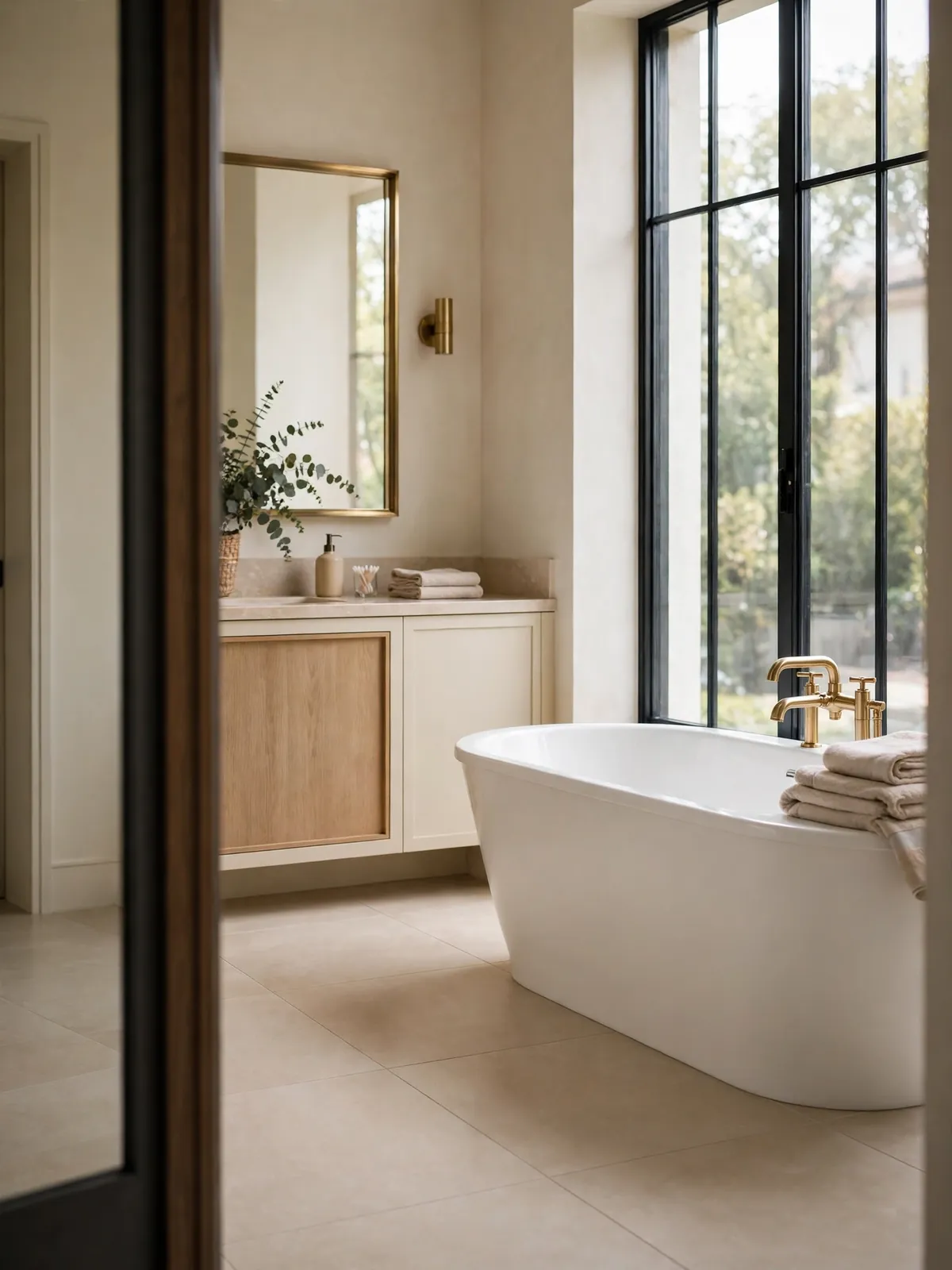
Large-format porcelain tiles in warm greige are the easiest way to make a bathroom feel calm and spacious, because the big tiles mean fewer grout lines, and the warm grey-beige tone sits comfortably between cool grey and cream. Here, large greige tiles run across the whole floor under a white freestanding tub with brushed brass taps, cream walls and folded beige towels, and the room feels larger because the floor reads as one continuous surface. The design suits small and large bathrooms alike, it hides dust better than pure white, and porcelain is waterproof, hard-wearing and easy to mop. The weakness is grip and fitting: large polished tiles can be slippery when wet, and they need a flat subfloor and a skilled tiler — so choose a matt or lightly textured finish and budget for proper installation.
Quick tips:
- Choose a matt or lightly textured finish for better grip.
- Use the same tile on the shower floor in a smaller size for grip.
- Match the grout to the tile so the joints almost disappear.
- Check the subfloor is level before large tiles go down.
Marble-Look Porcelain That Feels Like Real Stone
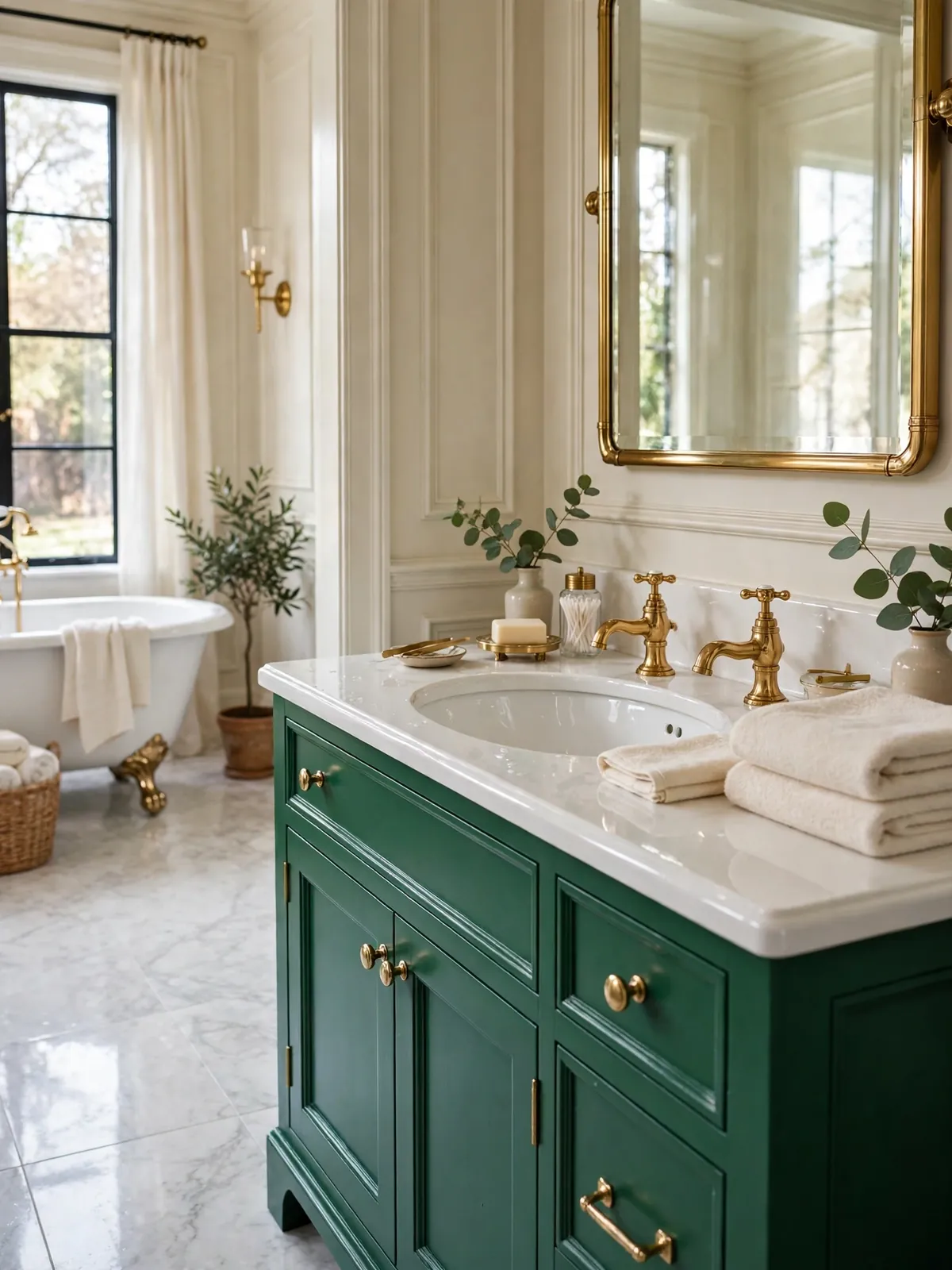
Marble-look porcelain gives you the veined beauty of real marble without the sealing, staining and softness that make real marble hard work in a bathroom. Here, white marble-look porcelain with soft grey veining covers the floor beneath an emerald-green painted vanity, with brass taps, a white ceramic sink and cream towels keeping the room classic rather than cold. The design suits bathrooms that want a luxury hotel feel, it pairs beautifully with both brass and chrome, and the porcelain surface resists water, shampoo and cleaning products that would mark real stone. The weakness is realism up close: the printed veining repeats across tiles, and a cheap marble-look tile can look flat — so order several samples, check the pattern repeat, and choose a tile with varied veining.
Quick tips:
- Order several samples to check the veining does not repeat obviously.
- Pair marble-look floors with a plain wall so the veins stay the star.
- Choose a matt finish in wet areas and polished only in dry zones.
- Seal the grout, not the tile, to keep the joints clean.
Terrazzo Tiles With a Playful Speckled Finish
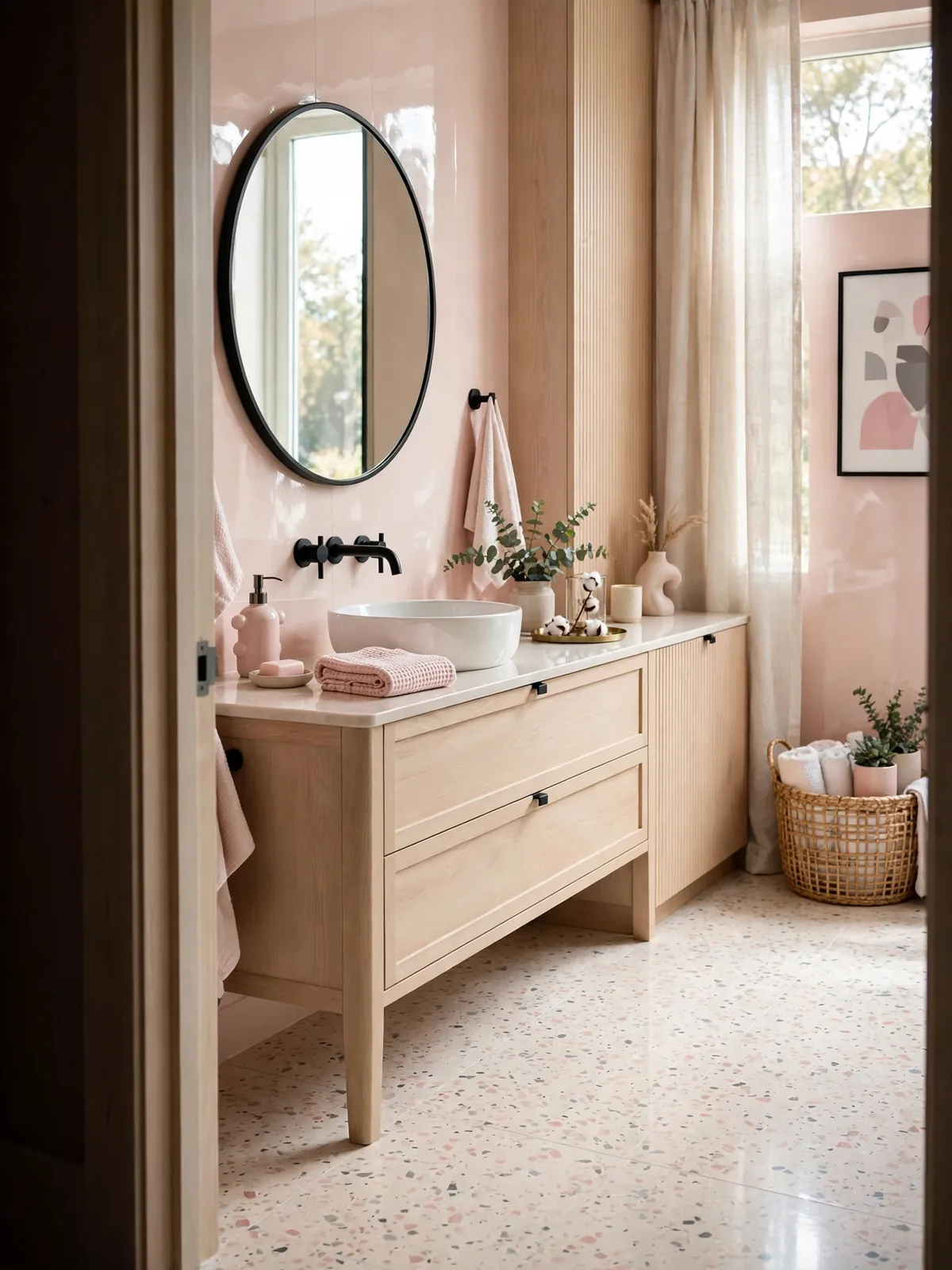
Terrazzo tiles with a playful speckled finish bring energy to a bathroom floor without needing a bold colour on the walls, because the chips of stone and glass scattered through the tile give the floor a confetti-like pattern that hides dust and water marks. Here, cream terrazzo with blush-pink and grey speckles sits under a pale oak vanity with matte black taps and a white vessel sink, and the floor feels cheerful yet calm because the walls stay plain. The design suits modern and retro bathrooms, it is hard-wearing and waterproof when sealed, and it works in both small cloakrooms and large family bathrooms. The weakness is cost and sealing: real terrazzo costs more than plain porcelain, and the surface needs sealing to stop stains — so budget for the tile and the sealer, and reseal when water stops beading on the surface.
Quick tips:
- Keep walls plain so the speckled floor stays the feature.
- Seal terrazzo after fitting and reseal when water stops beading.
- Choose small chips for a subtle look and large chips for drama.
- Match one speckle colour in a towel or accessory.
Penny Round Mosaic Tiles for a Soft Retro Feel
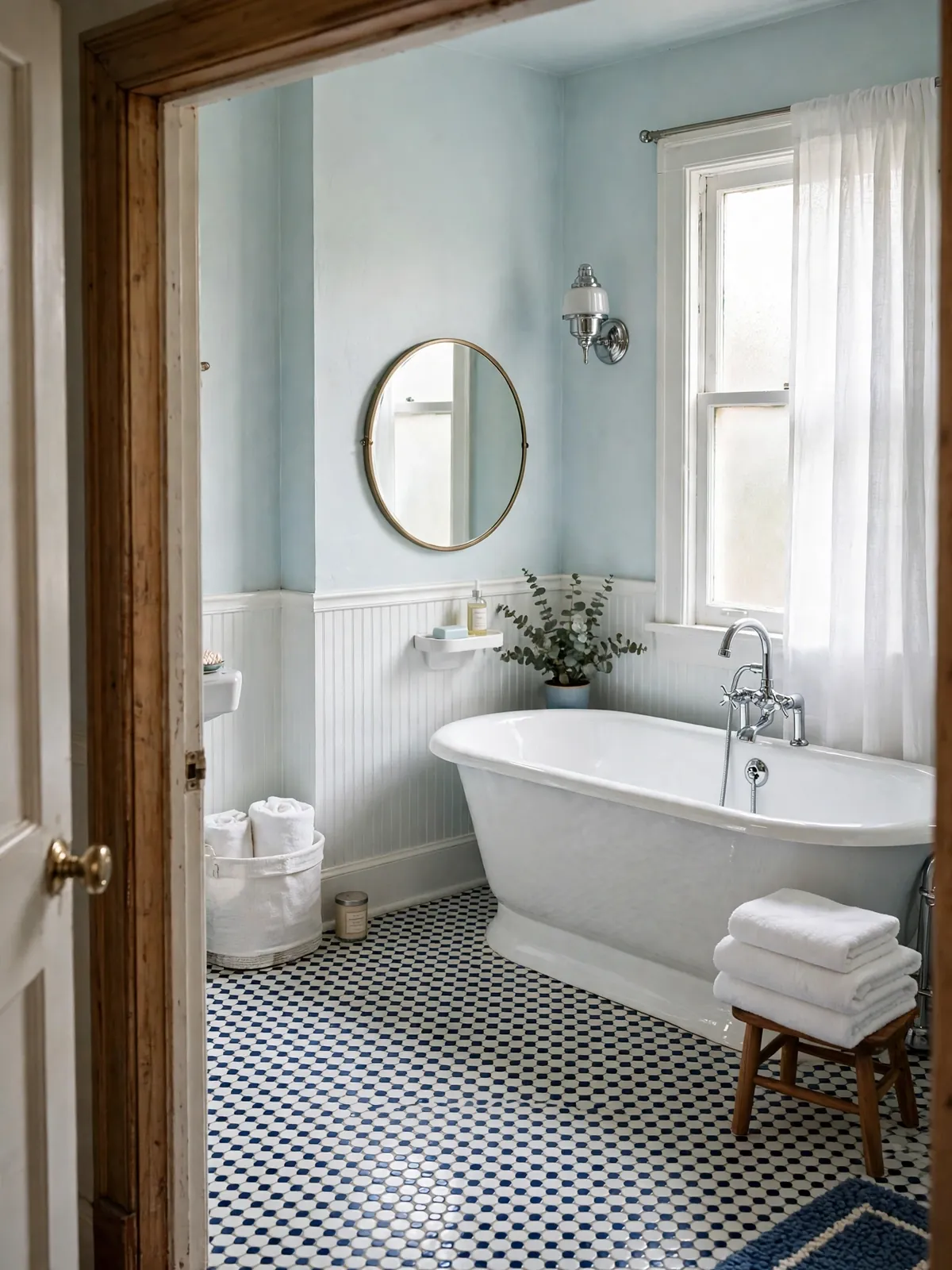
Penny round mosaic tiles give a bathroom floor a soft, retro feel that square tiles never quite manage, because the small circles and their many grout lines create a gentle, almost fabric-like texture underfoot. Here, white penny rounds with a navy border pattern cover the floor beneath a white freestanding tub, with pale blue walls, chrome fixtures and folded white towels keeping the room fresh. The design suits vintage, coastal and cottage bathrooms, it gives excellent grip in the shower because of all those grout lines, and it is forgiving of an uneven subfloor. The weakness is grout: so many joints mean more grout to clean, and light grout can stain in a busy bathroom — so choose a mid-tone grout, seal it well, and expect to scrub the joints now and then.
Quick tips:
- Choose a mid-tone grout that hides stains better than white.
- Seal the grout after fitting and top it up yearly.
- Use penny rounds on the shower floor for extra grip.
- Keep the pattern simple — one border or one accent colour is enough.
Hexagon Tiles That Add Shape Without Shouting
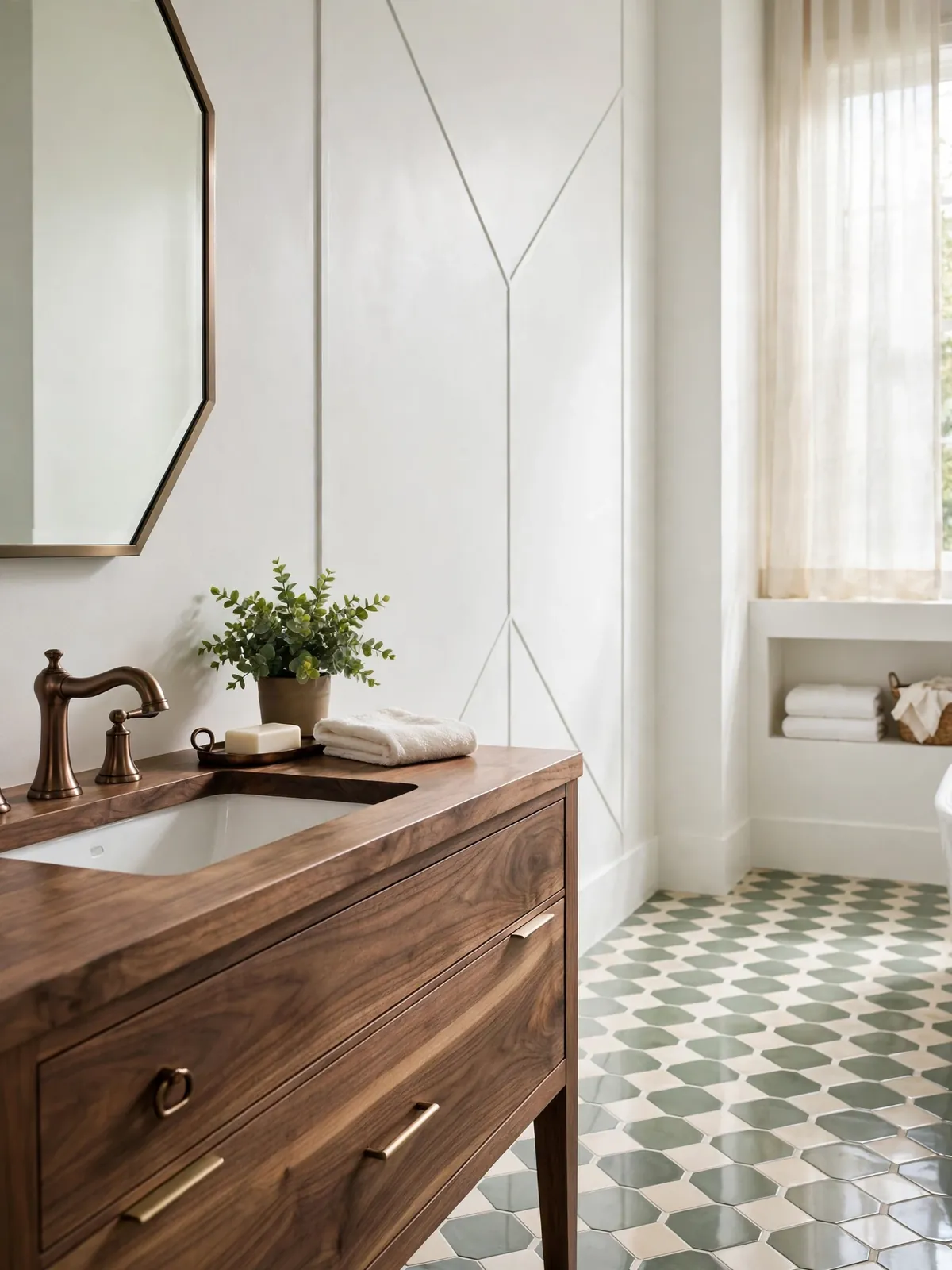
Hexagon tiles add shape to a bathroom floor without shouting, because the six-sided pattern reads as a quiet geometric texture rather than a loud print, and it works with almost any wall colour. Here, soft sage-green and cream hexagons cover the floor under a walnut vanity with brushed bronze taps, white walls and a small green plant, and the floor feels designed without competing with the rest of the room. The design suits modern, Scandinavian and mid-century bathrooms, it gives good grip in smaller sizes, and it can zone a shower area simply by changing the hexagon colour. The weakness is cutting and waste: hexagons need careful setting out, and cutting around the toilet and vanity wastes more tile than square tiles — so order extra tiles and hire a tiler who has laid hexagons before.
Quick tips:
- Dry-lay the hexagons first to plan the pattern around the toilet and vanity.
- Order extra tiles to allow for cutting waste.
- Use small hexagons in the shower for grip and large ones in the main room.
- Keep the walls plain so the shape of the floor shows.
A Classic Black-and-White Checkerboard Floor
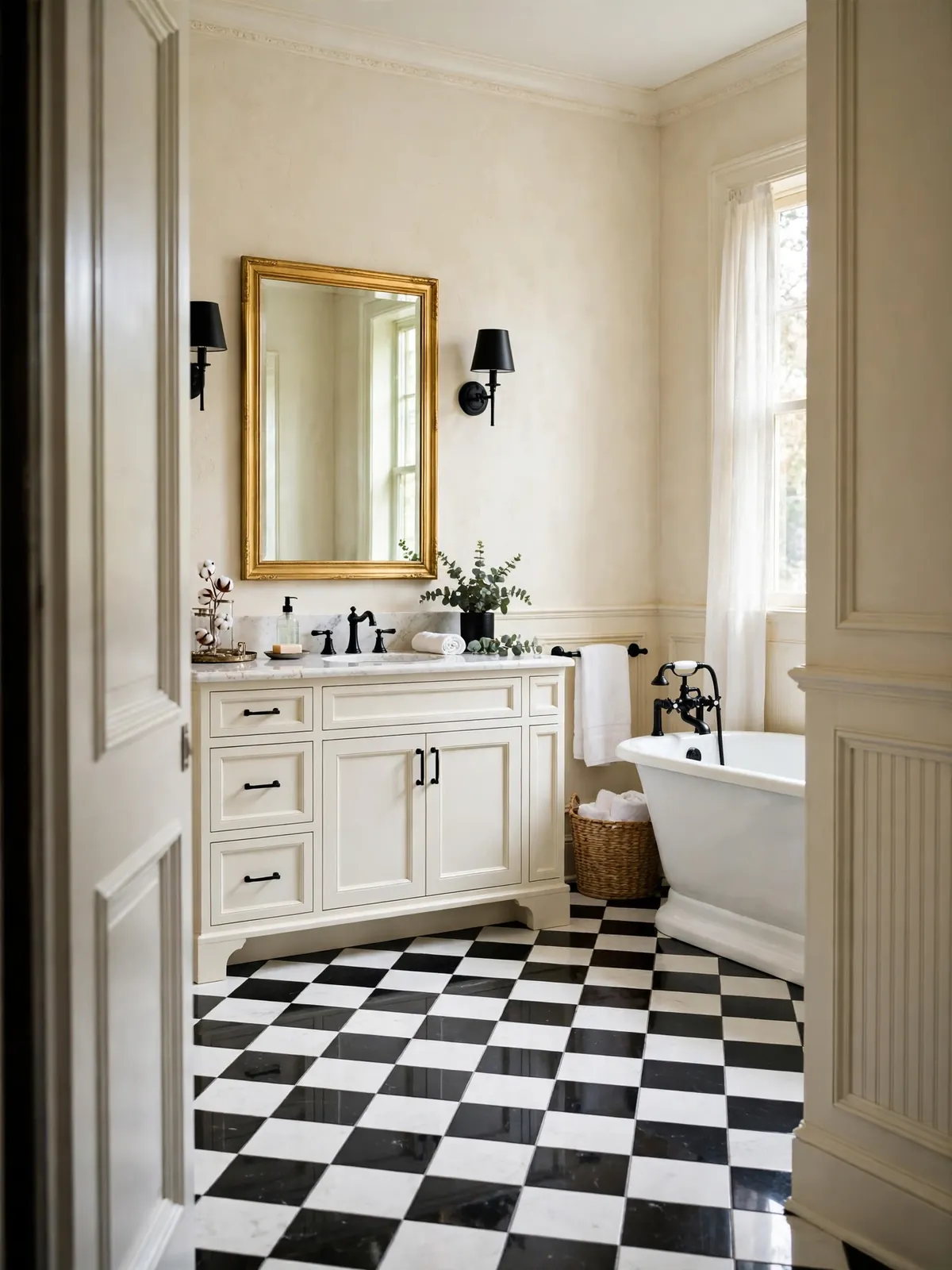
A classic black-and-white checkerboard floor never dates, because the bold contrast gives a bathroom instant character, and it works with everything from vintage clawfoot tubs to sleek modern vanities. Here, the checkerboard runs under a white vanity with a gold-framed mirror, cream walls and black fixtures, and the floor alone makes the room feel finished. The design suits period homes and bold modern bathrooms alike, it hides dirt better than an all-white floor, and porcelain checkerboard tiles are waterproof and easy to clean. The weakness is visual busyness: in a very small bathroom the strong pattern can feel overwhelming, and black tiles show dust, hair and water spots — so use larger squares in small rooms and keep a quick mop handy.
Quick tips:
- Use larger squares in a small bathroom so the pattern feels calmer.
- Lay the squares on the diagonal to make the room feel wider.
- Pair the floor with plain walls and one metallic accent.
- Choose a matt finish so the black tiles do not show every mark.
Herringbone Wood-Look Tiles for Warmth Without Worry
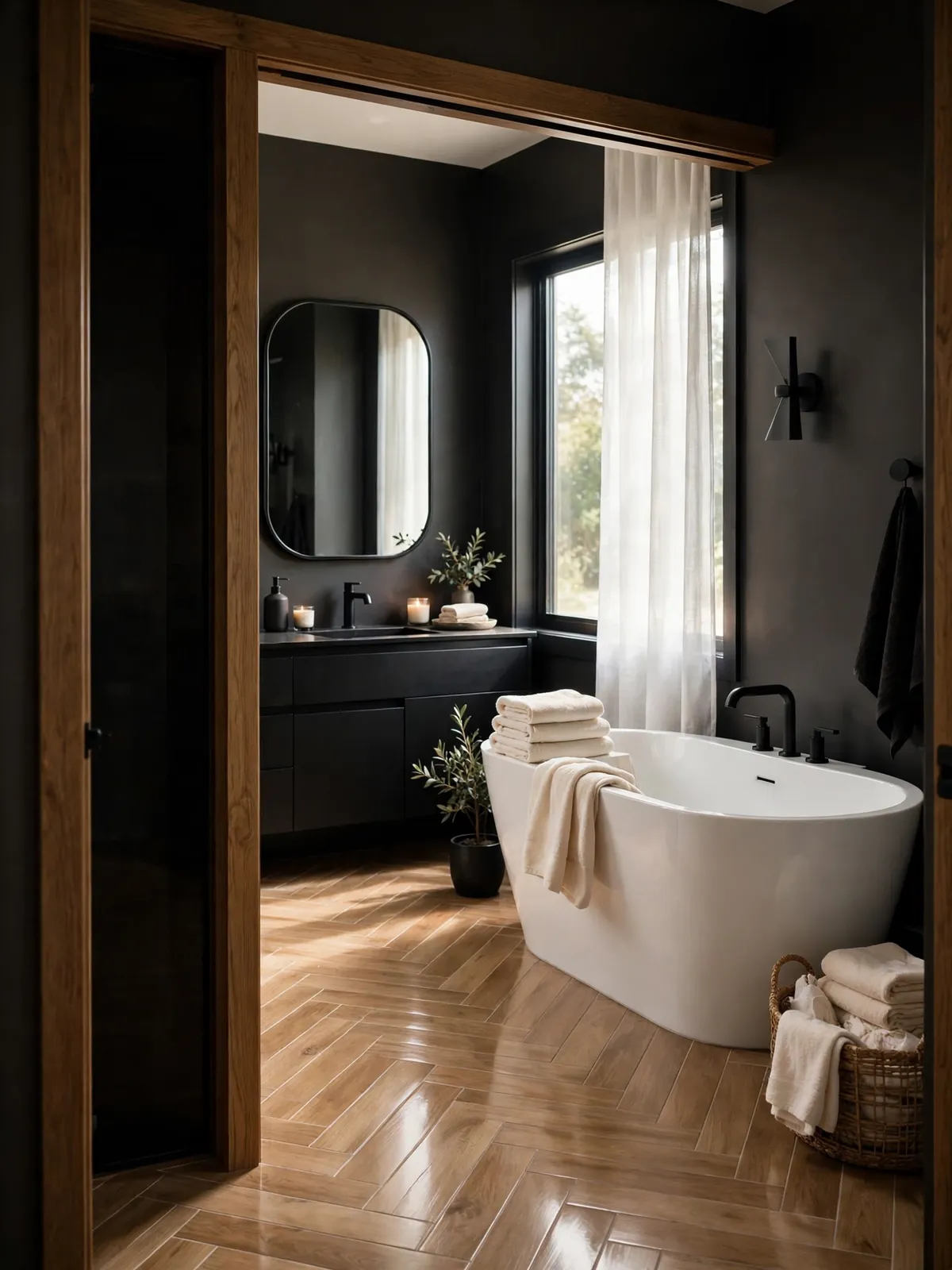
Herringbone wood-look tiles give a bathroom the warmth of timber and the practicality of porcelain, because the zigzag pattern adds movement and craft while the tile itself shrugs off water completely. Here, honey-oak herringbone porcelain runs beneath a white freestanding tub against charcoal walls, with matte black taps and folded cream towels, and the floor feels warm even though the palette is dark. The design suits bathrooms that want a cosy, lived-in feel, it never swells or warps like real wood, and it pairs beautifully with both dark and pale walls. The weakness is cost and complexity: herringbone takes longer to lay and wastes more tile than straight planks — so budget for extra tiles and a tiler experienced in herringbone.
Quick tips:
- Hire a tiler who has laid herringbone before.
- Order extra tiles for the many angled cuts.
- Choose a wood tone that matches the vanity or a towel.
- Use a grout colour close to the tile so the pattern reads cleanly.
Natural Slate Tiles for a Spa-Like, Earthy Floor
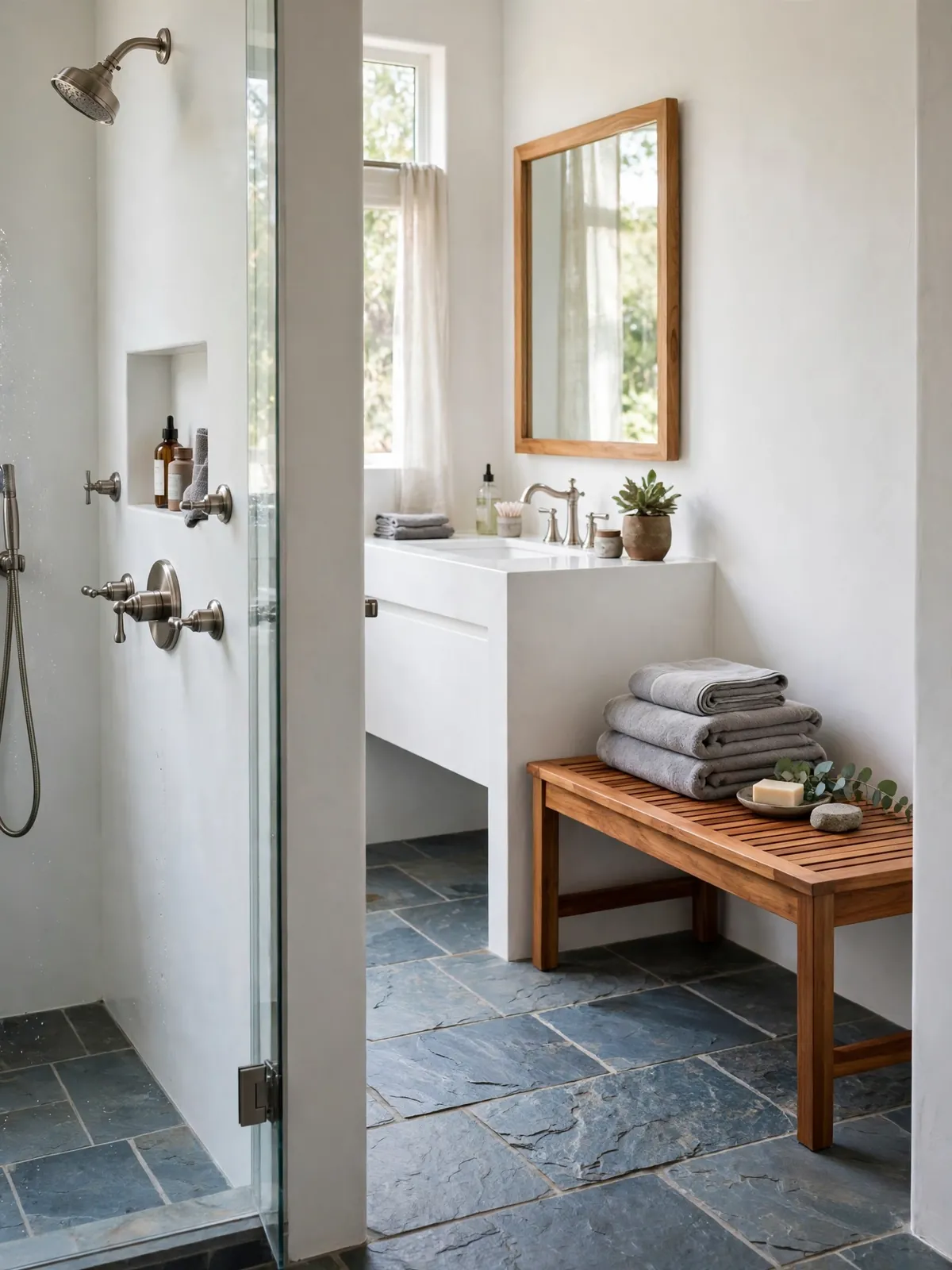
Natural slate tiles give a bathroom floor a spa-like, earthy character that manufactured tiles struggle to copy, because every slate tile has its own variation in colour and texture, and the slightly rough surface feels good under bare feet. Here, blue-grey slate covers the floor of a walk-in shower with a teak bench, white walls, brushed nickel fittings and folded grey towels, and the room feels like a natural spa rather than a tiled box. The design suits earthy, rustic and spa-style bathrooms, it gives excellent grip when wet, and it hides water marks well. The weakness is maintenance: slate is porous, so it must be sealed before use and resealed regularly, and it can feel cold underfoot — so seal it properly, consider underfloor heating, and use a stone-safe cleaner.
Quick tips:
- Seal slate before grouting and reseal it regularly.
- Use a stone-safe cleaner, never acidic or abrasive products.
- Pair slate with warm wood to balance its cool, earthy tone.
- Consider underfloor heating, because slate feels cold barefoot.
Concrete-Look Tiles for a Clean Modern Finish
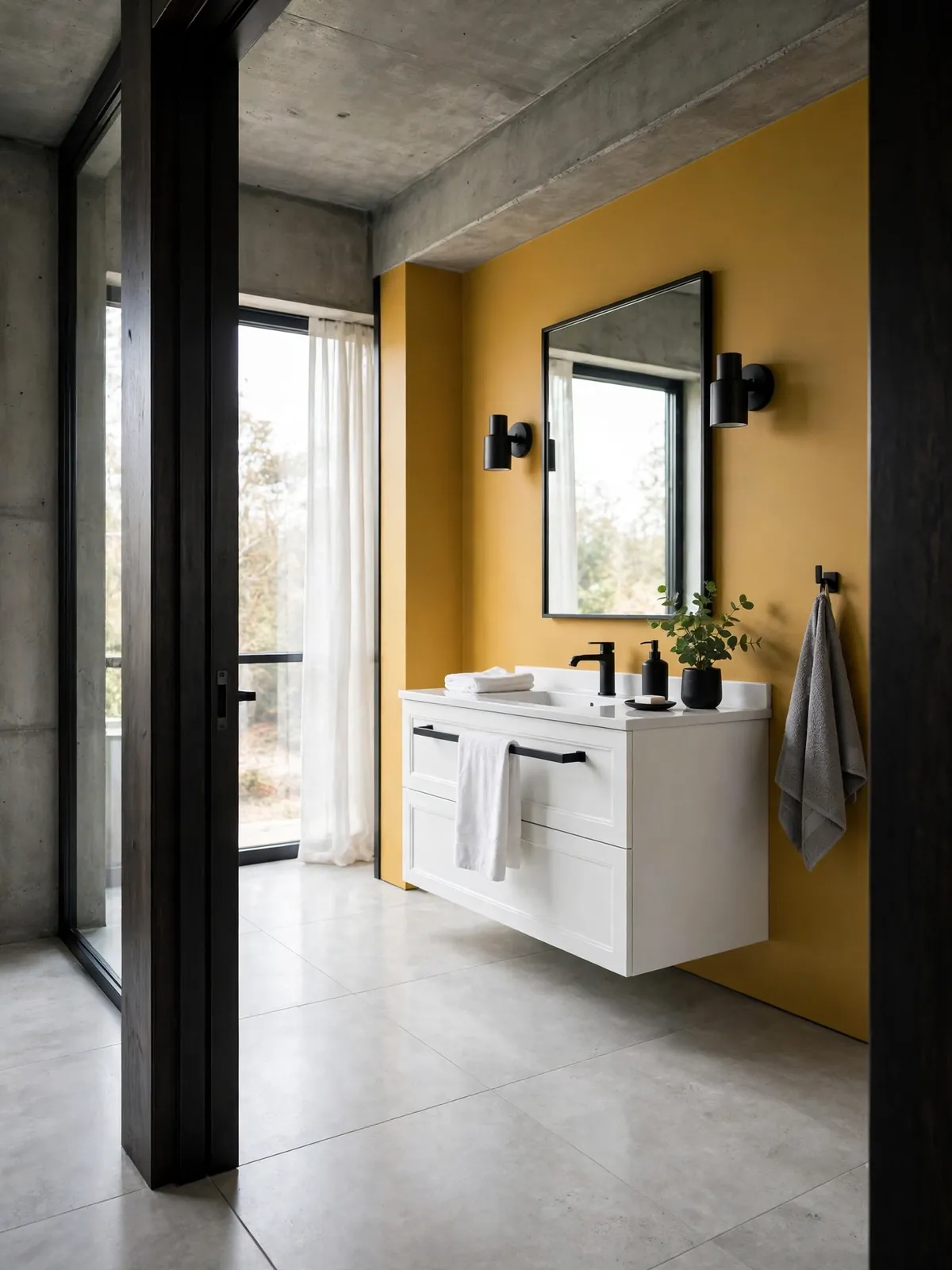
Concrete-look tiles give a bathroom a clean modern finish without the coldness, cracking and sealing that real polished concrete brings, because the porcelain surface copies the soft mottled tone of concrete while staying waterproof and easy to clean. Here, pale grey concrete-look tiles run under a white vanity against a mustard-yellow accent wall, with matte black fixtures and a small green plant adding warmth. The design suits industrial, minimalist and modern bathrooms, it hides dust and footprints well, and it pairs with wood, black metal and bold colour alike. The weakness is flatness: a plain grey floor can feel cold and stark if the rest of the room is also grey — so add warmth with wood, a coloured wall or warm towels, and choose a tile with visible tonal variation.
Quick tips:
- Add warmth with wood, a coloured wall or warm textiles.
- Choose a tile with tonal variation so the floor does not look flat.
- Use large-format concrete-look tiles to reduce grout lines.
- Keep the grout close in colour to the tile.
Patterned Encaustic-Look Tiles as a Floor Feature
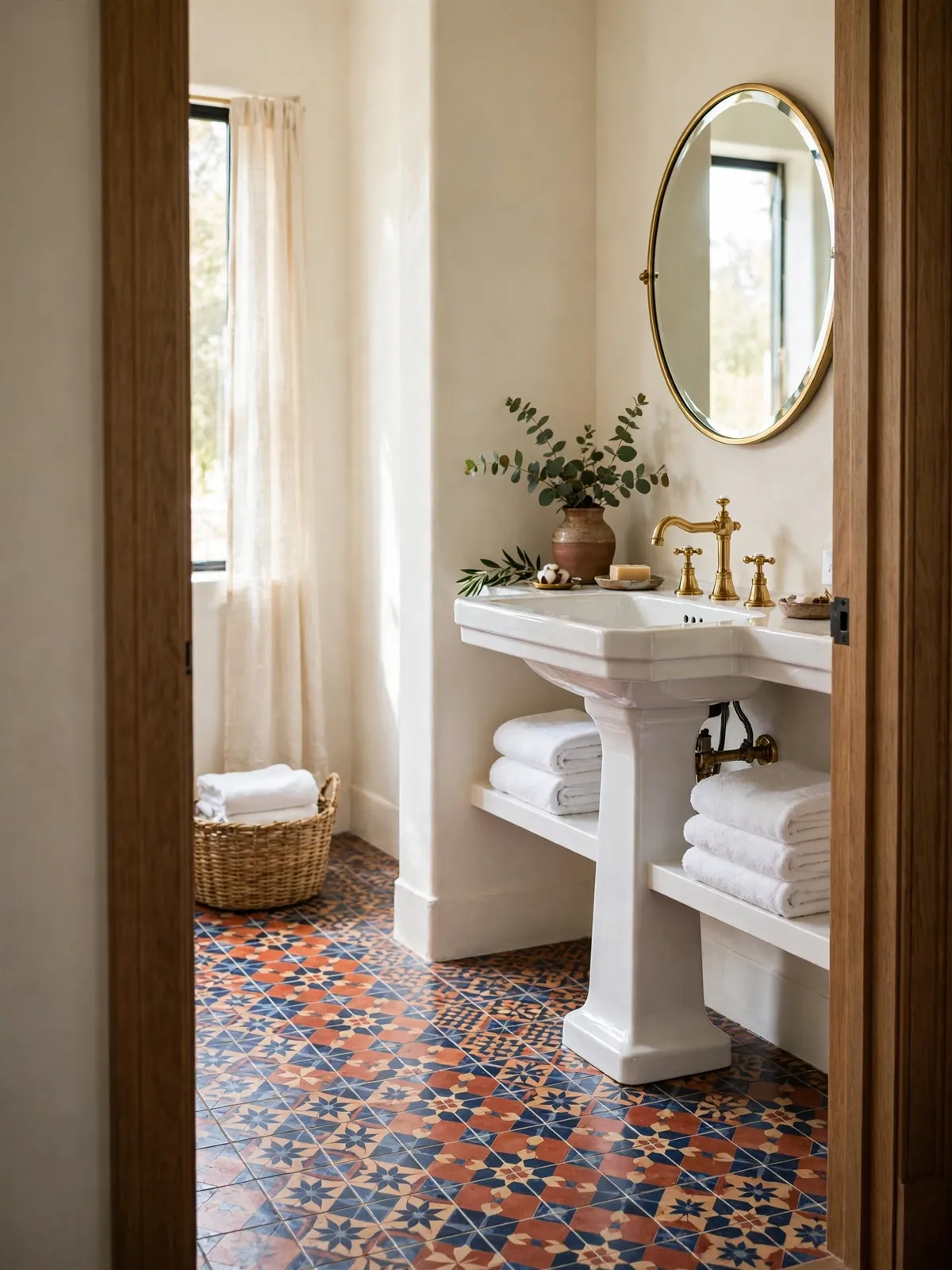
Patterned encaustic-look tiles turn the bathroom floor into the feature of the room, because a bold repeated pattern gives the eye somewhere to land and lets the walls, vanity and fixtures stay simple. Here, indigo and terracotta patterned tiles cover the floor under a white pedestal sink, with cream walls, brass taps and folded white towels keeping the rest of the room quiet. The design suits Mediterranean, bohemian and eclectic bathrooms, it makes a small bathroom feel intentional rather than plain, and porcelain encaustic-look tiles are waterproof and far easier to maintain than real cement tiles. The weakness is commitment: a strong pattern is hard to live with if you tire of it, and it limits the colours you can add later — so keep the walls plain, test a large sample at home, and use the pattern on the whole floor or not at all.
Quick tips:
- Test a large sample in your own bathroom light before ordering.
- Keep walls, vanity and towels plain so the pattern stays the star.
- Pick one colour from the pattern for a towel or accessory.
- Use patterned tiles on the whole floor, not a small patch.
Pebble Tiles for a Textured Shower Floor
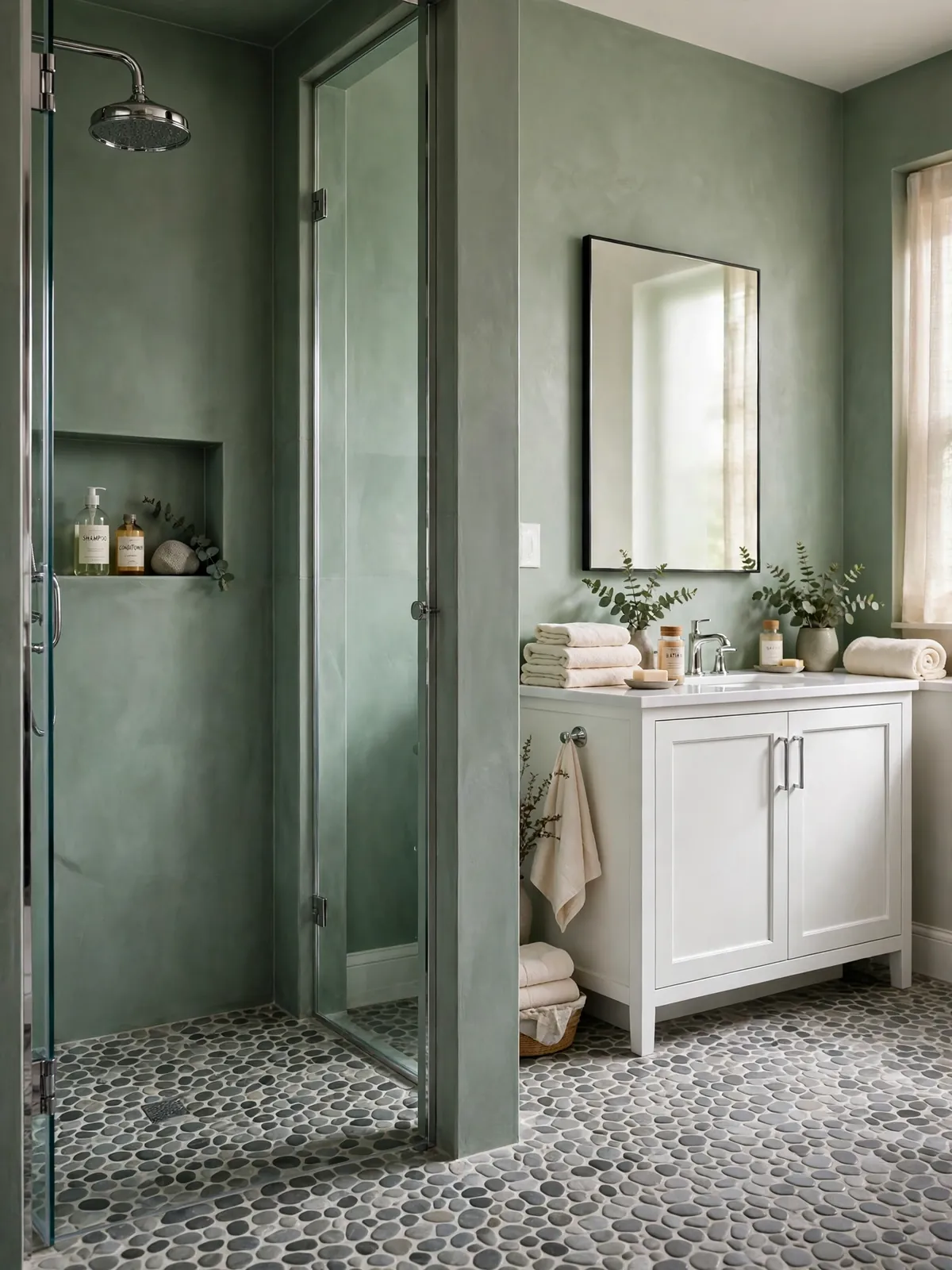
Pebble tiles give a shower floor a textured, almost massaging feel underfoot, because the smooth rounded stones create a natural, uneven surface that grips well and feels like standing on a riverbed. Here, river-grey pebbles cover the shower floor against eucalyptus-green walls, with a chrome rain shower, a white vanity and folded cream towels, and the shower feels like a small natural spa. The design suits spa-style and nature-inspired bathrooms, it gives the best wet grip of any floor on this list, and it drains well because the many joints let water through. The weakness is cleaning and comfort: the uneven surface traps soap and dirt, and the stones can feel hard on sensitive feet — so seal the pebbles well, scrub the joints regularly, and try standing on a sample barefoot first.
Quick tips:
- Try standing on a sample barefoot before committing.
- Seal pebble tiles well to stop soap staining the grout.
- Scrub the joints regularly so dirt does not build up.
- Use pebbles in the shower only, with a smoother tile outside it.
Waterproof Wood-Look Planks for a Cosy Feel
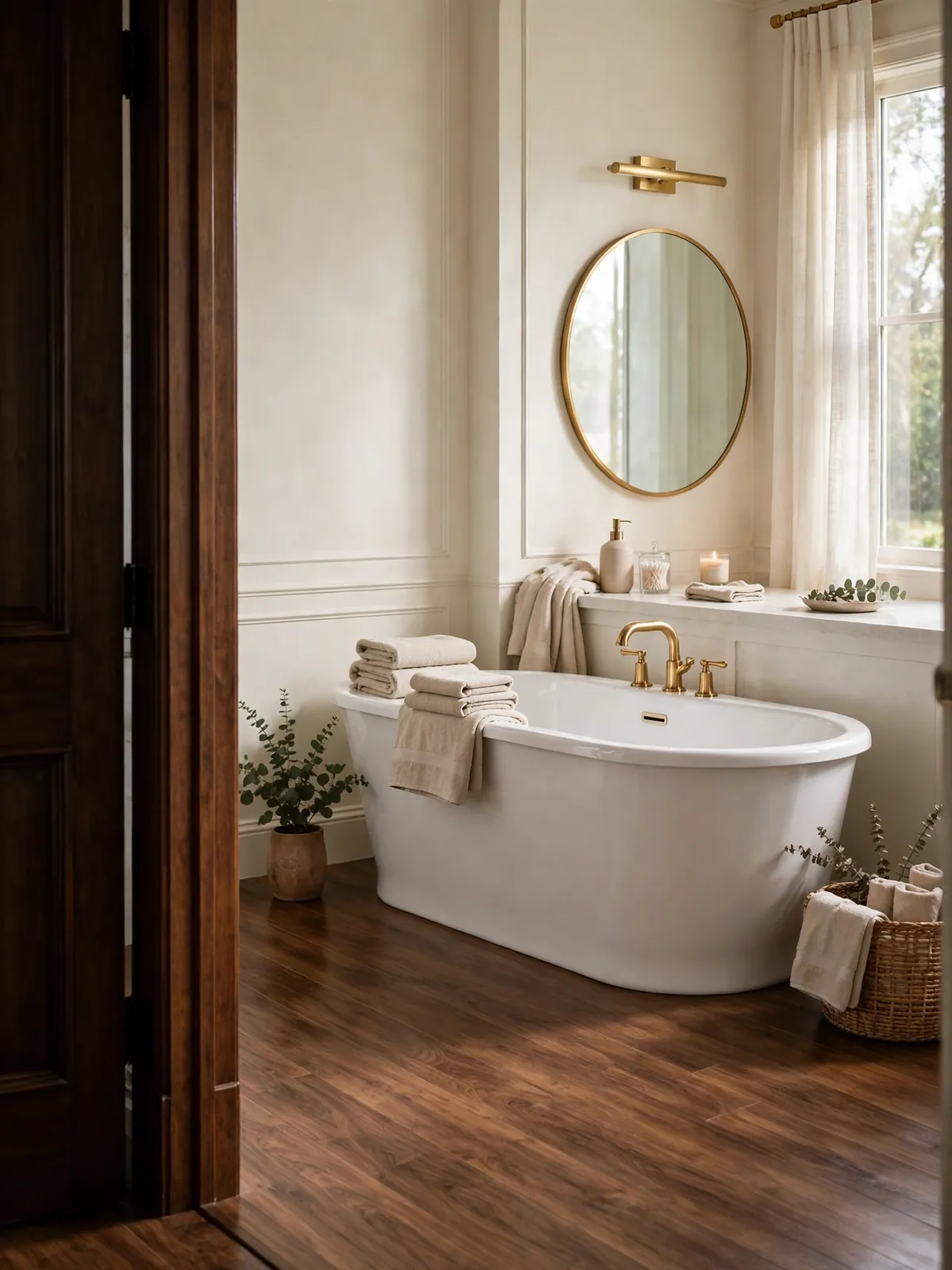
Waterproof wood-look planks give a bathroom the cosy feel of a timber floor with none of the water worry, because luxury vinyl planks and wood-look porcelain are made to handle splashes, steam and mopping. Here, warm walnut planks run beneath a white freestanding tub with brushed gold taps, ivory walls and folded beige towels, and the room feels like a bedroom rather than a wet room. The design suits bathrooms that open onto a bedroom, period homes and anyone who dislikes cold tile underfoot, and it is warmer and softer to walk on than stone or porcelain. The weakness is the seams: vinyl planks rely on tight click joints and a waterproof core, and a poor installation lets water creep underneath — so choose a fully waterproof product, have it fitted carefully, and wipe up standing water rather than leaving it.
Quick tips:
- Choose planks labelled fully waterproof, not just water-resistant.
- Wipe up standing water instead of leaving it to seep into joints.
- Run the planks in the same direction as the longest wall.
- Match the plank tone to the vanity for a pulled-together look.
Glossy Zellige-Look Tiles That Catch the Light
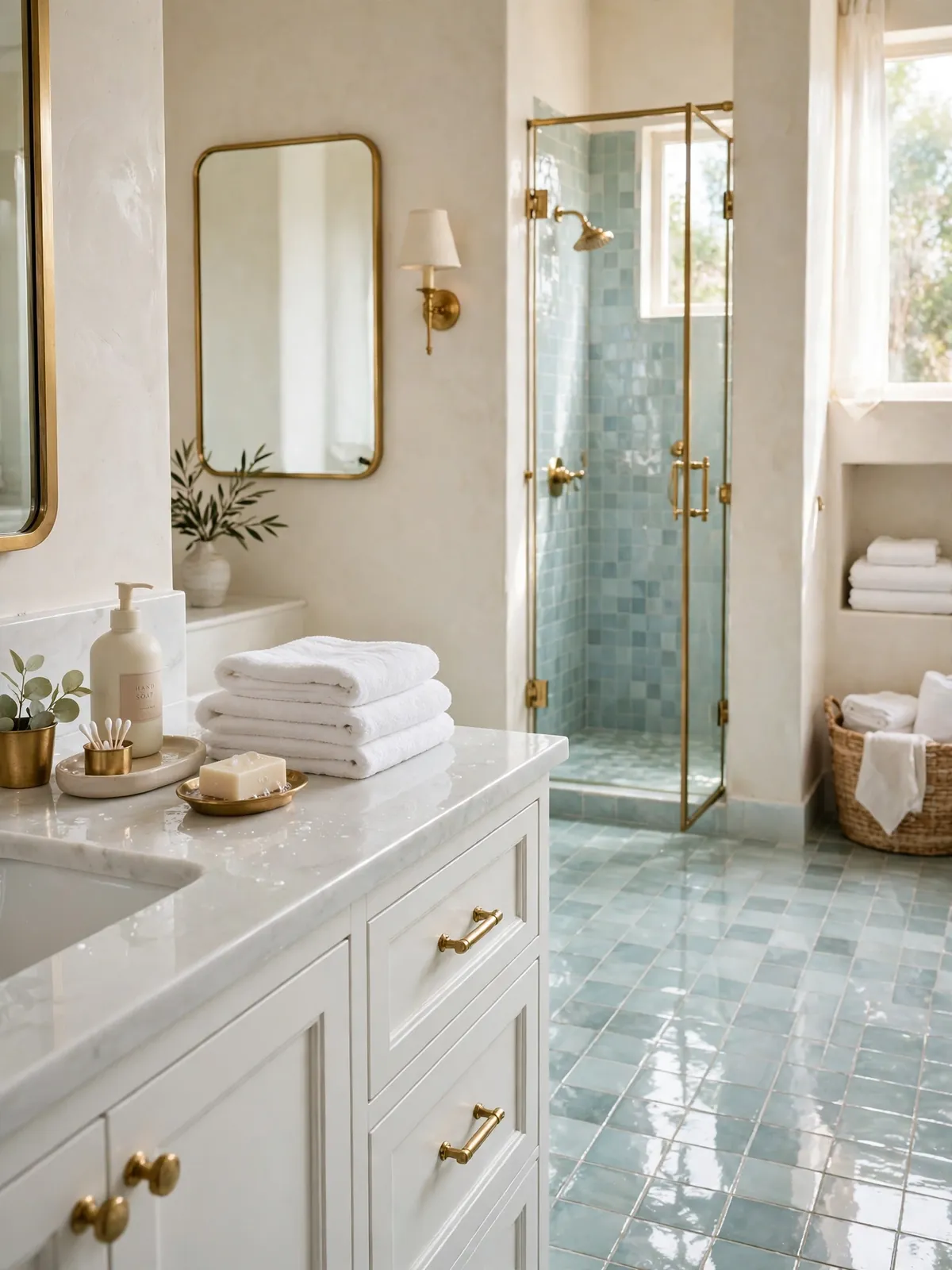
Glossy zellige-look tiles catch the light in a way matt tiles never do, because the handmade-style glaze has subtle ripples and colour variation, so the floor shimmers gently as the light moves across it. Here, soft aqua zellige-look tiles cover the floor under a white vanity with brass fixtures, cream walls and folded white towels, and the bathroom feels luminous even on a dull day. The design suits Mediterranean, Moroccan and artisan-style bathrooms, it makes a small bathroom feel brighter, and the glaze is waterproof and easy to wipe clean. The weakness is slip and variation: a glossy floor can be slippery when wet, and the colour varies from tile to tile — so use it in the dry area of the bathroom, mix tiles from several boxes, and add a bath mat where feet are wettest.
Quick tips:
- Use glossy tiles in the dry area and a matt tile in the shower.
- Mix tiles from several boxes so the colour variation looks even.
- Add a bath mat where wet feet step out of the shower or tub.
- Keep the walls pale so the glossy floor can shine.
Basketweave Marble Mosaic for Quiet Luxury
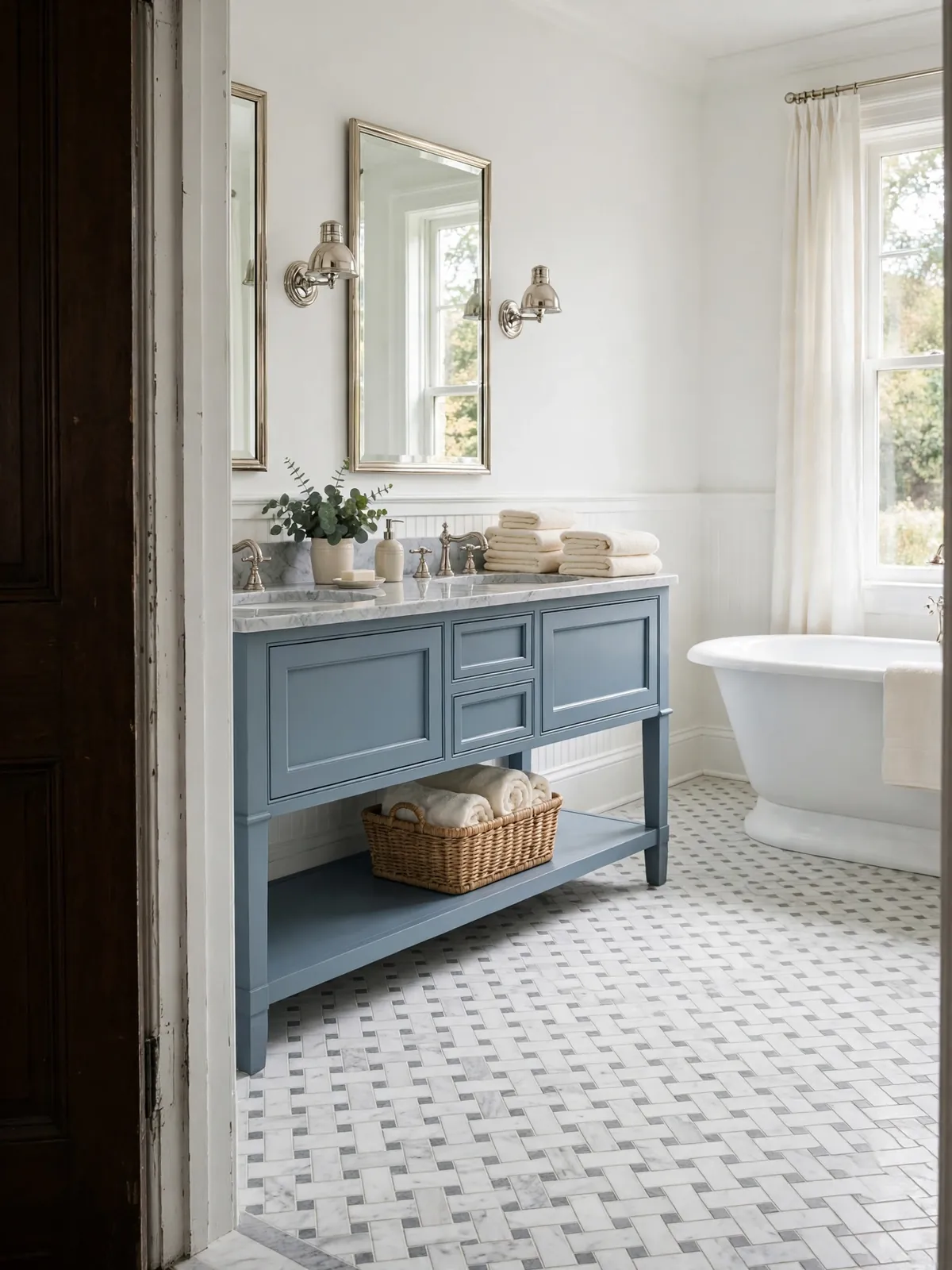
Basketweave marble mosaic gives a bathroom floor quiet luxury, because the woven pattern of small rectangles and dots reads as classic and crafted without the drama of a large marble slab. Here, white and soft grey basketweave mosaic covers the floor beneath a dusty-blue painted vanity, with nickel taps, white walls and folded cream towels, and the room feels refined rather than showy. The design suits classic, traditional and elegant modern bathrooms, it gives good grip because of the many grout lines, and the small scale suits cloakrooms and small bathrooms. The weakness is grout and sealing: the mosaic has many joints to clean, and real marble needs sealing against stains — so seal the marble, choose a mid-tone grout, and keep acidic cleaners away from the stone.
Quick tips:
- Seal the marble after fitting and reseal it regularly.
- Choose a mid-tone grout that will not show stains quickly.
- Never use acidic cleaners on marble — use a stone-safe product.
- Keep the rest of the room simple so the weave pattern shows.
Dark Charcoal Tiles for a Bold Moody Bathroom
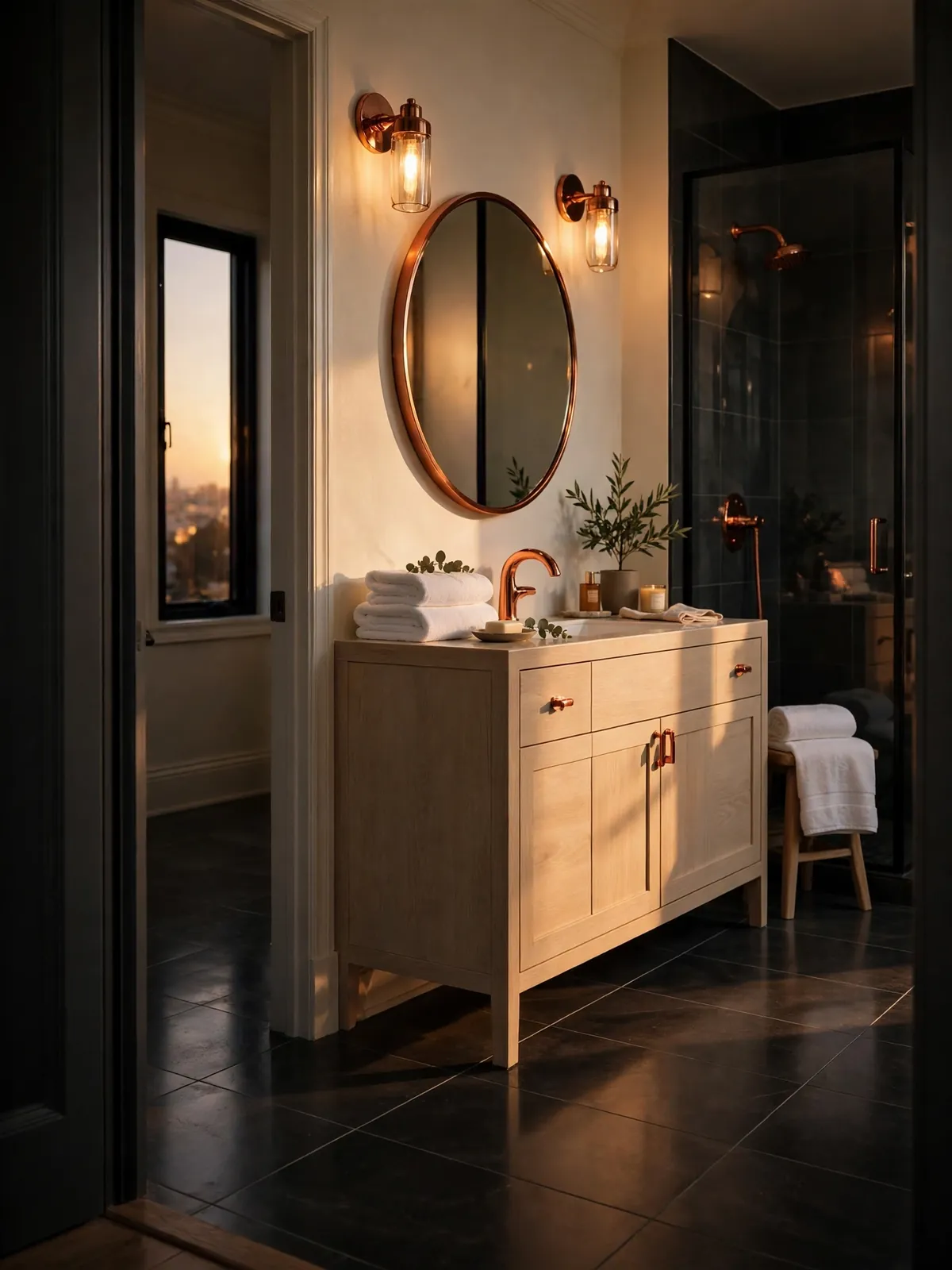
Dark charcoal tiles make a bold moody bathroom feel cocooning and dramatic, because the deep floor grounds the room, hides the edges of the space, and makes pale walls, a light vanity and metallic fixtures stand out. Here, large charcoal tiles run under a pale oak vanity with copper fixtures, cream walls and folded white towels, and the contrast makes the whole room feel designed rather than decorated. The design suits larger bathrooms and evening bathers, it hides dirt and stains well, and it pairs beautifully with wood, copper and brass. The weakness is light and marks: a dark floor can make a small windowless bathroom feel gloomy, and it shows dust, hair and water spots clearly — so balance it with pale walls and good lighting, and accept that it needs a quick mop more often.
Quick tips:
- Balance a dark floor with pale walls and a large mirror.
- Use warm lighting so the charcoal reads as warm, not cold.
- Keep a quick mop handy for dust and water spots.
- Repeat the dark tone once, in a vanity or a towel, so it looks deliberate.
Terracotta Tiles for Warm Mediterranean Charm
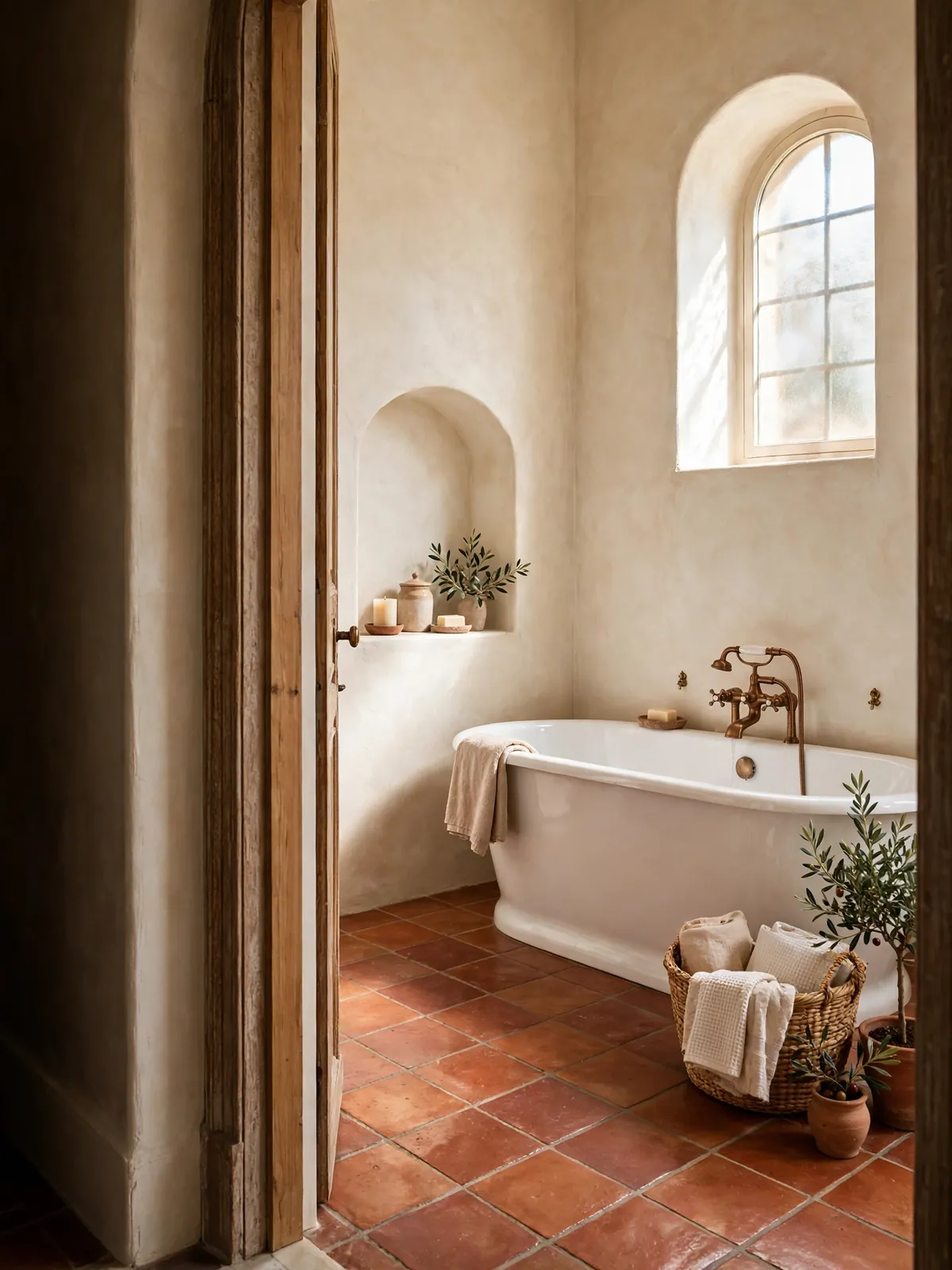
Terracotta tiles bring warm Mediterranean charm to a bathroom floor, because the earthy rust colour feels sun-baked and handmade, and it makes even a plain white bathroom feel warm and welcoming. Here, terracotta tiles run beneath a white freestanding tub with brushed bronze taps, cream plaster walls and a woven basket, and the room feels like a villa bathroom rather than a modern box. The design suits Mediterranean, rustic and bohemian bathrooms, it hides dust well, and it pairs beautifully with cream, olive green and natural wood. The weakness is sealing: real terracotta is porous and stains easily, so it must be sealed thoroughly and resealed regularly — or choose a terracotta-look porcelain tile for the same colour with far less upkeep.
Quick tips:
- Seal real terracotta thoroughly and reseal it regularly.
- Consider terracotta-look porcelain for the colour without the upkeep.
- Pair terracotta with cream walls and natural wood.
- Use a warm-toned grout that blends with the tile.
Pale Blue-Grey Tiles for a Calm Coastal Floor
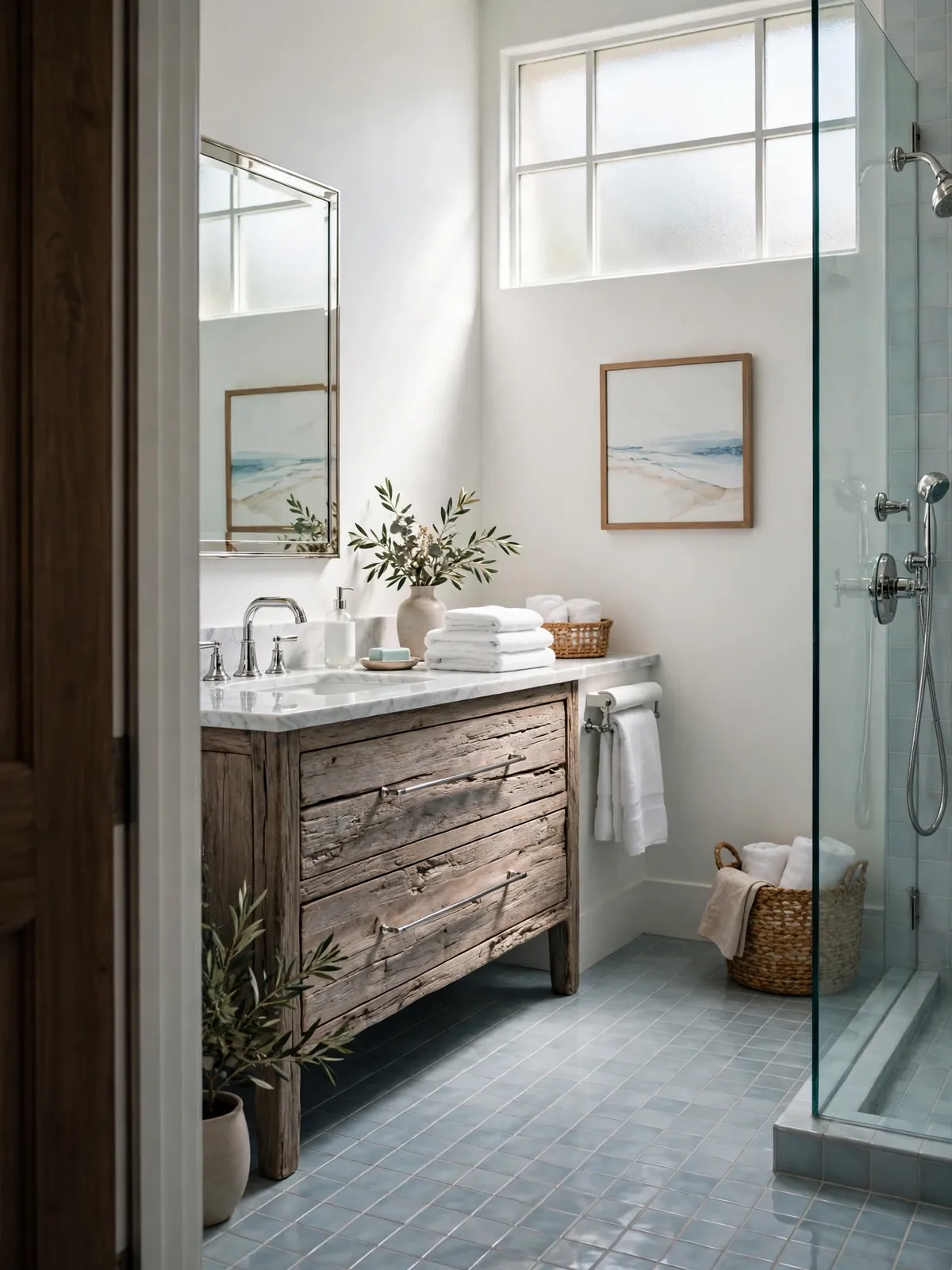
Pale blue-grey tiles give a bathroom floor a calm coastal feeling, because the soft watery colour suggests the sea without turning the room into a beach theme, and it makes the space feel fresh and airy. Here, pale blue-grey tiles run under a driftwood vanity with chrome fixtures, white walls and folded white towels, and the bathroom feels like a quiet morning by the coast. The design suits coastal, Scandinavian and calm modern bathrooms, it makes a small bathroom feel larger, and it hides water marks better than pure white. The weakness is coldness: a blue-grey floor can feel chilly in a north-facing bathroom, so warm it up with wood, warm lighting and soft textiles, and choose a warm grey grout rather than a cold white one.
Quick tips:
- Warm a blue-grey floor with wood and warm lighting.
- Choose a warm grey grout, not cold white.
- Pair the floor with white walls and one natural texture.
- Test the tile in your own bathroom light, because blue-greys shift a lot.
Deep Green Tiles for a Rich Boutique-Hotel Look
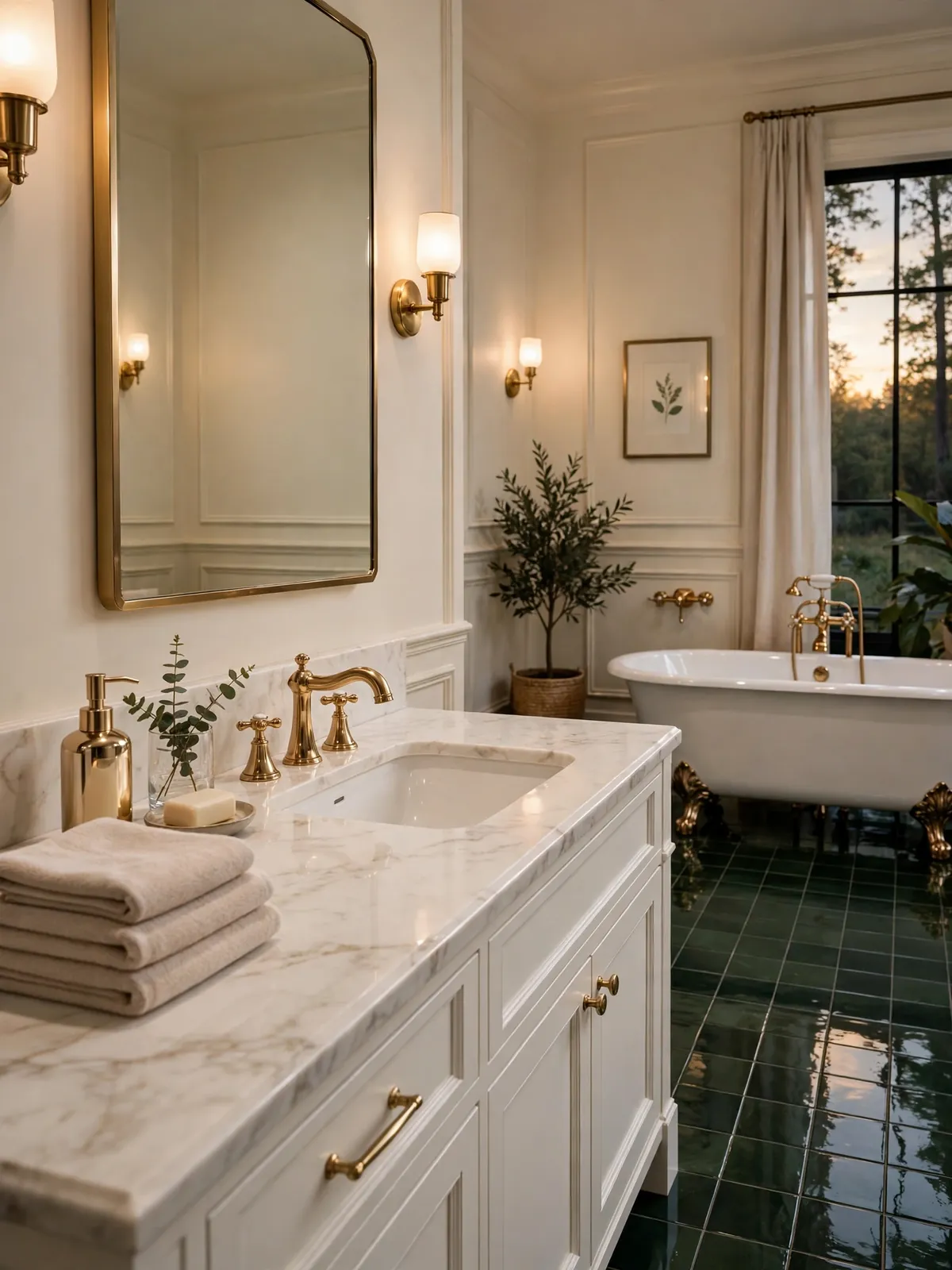
Deep green tiles give a bathroom floor a rich boutique-hotel look, because the dark jewel tone feels luxurious and enveloping, and it turns an ordinary bathroom into a room that feels designed by a hotel. Here, deep forest-green tiles cover the floor under a white vanity with champagne brass fixtures, cream walls and folded beige towels, and the green makes the brass glow. The design suits larger bathrooms and anyone who loves bold colour, it hides dirt well, and it pairs beautifully with brass, cream and natural wood. The weakness is light: a dark green floor in a small, dim bathroom can feel heavy, so it needs good lighting, pale walls and a large mirror to lift it — and like other dark floors, it shows dust and footprints.
Quick tips:
- Pair deep green with pale walls and a large mirror.
- Use warm lighting so the green reads as rich, not murky.
- Repeat the green once, in a towel or a plant pot, so it looks deliberate.
- Choose a matt finish for better grip and fewer visible marks.
Heated Flooring Beneath Stone-Look Tiles
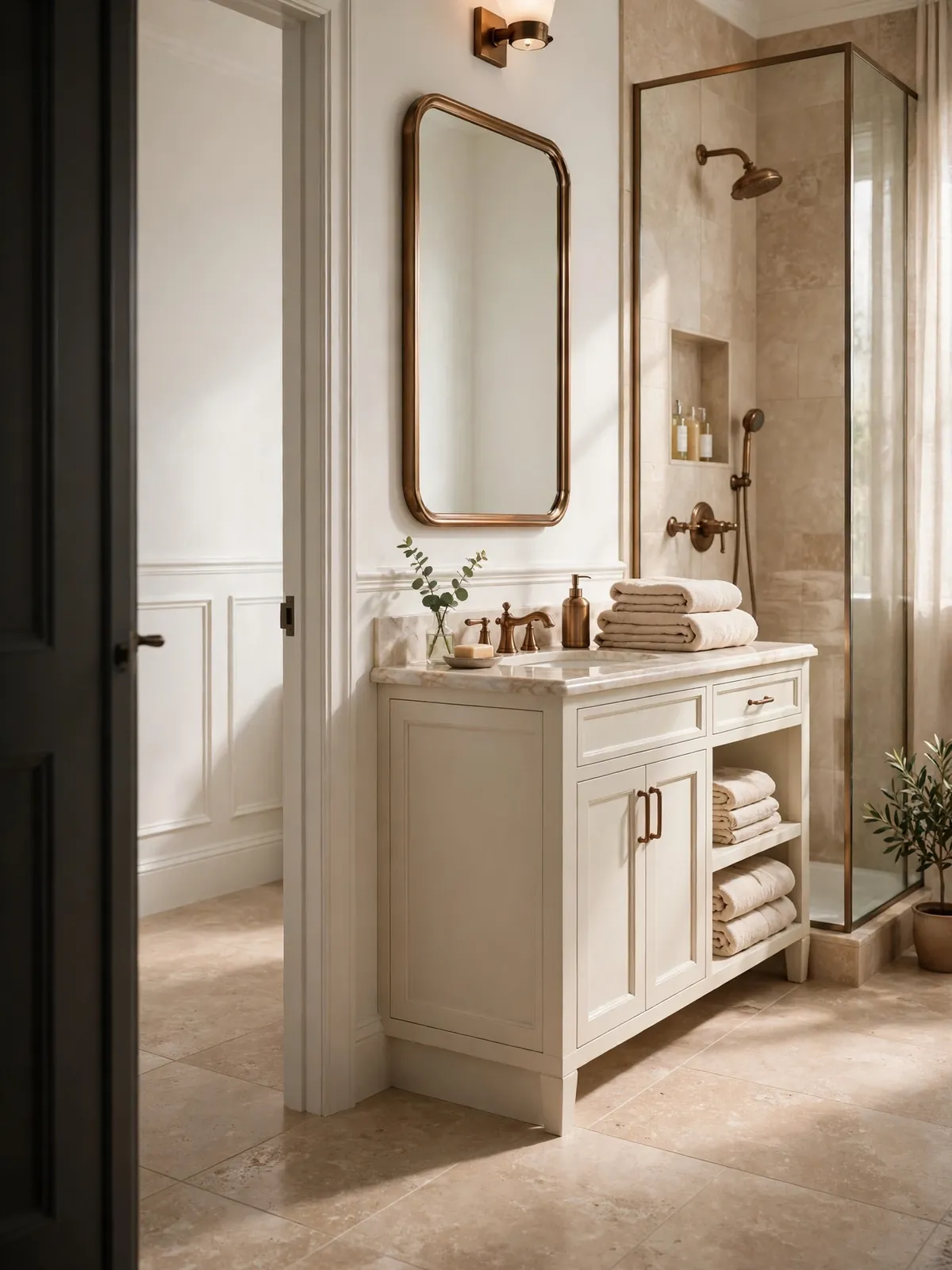
Heated flooring beneath stone-look tiles solves the one complaint almost every tiled bathroom has, because the tiles that look best and handle water best are also the coldest under bare feet on a winter morning. Here, warm beige stone-look tiles sit over underfloor heating beneath a cream vanity with bronze fixtures, white walls and folded sand-coloured towels, and the floor feels warm the moment you step out of the shower. The design suits any tiled bathroom, it dries the floor faster after showers, and it removes the need for a cold tile versus warm wood compromise. The weakness is cost and timing: underfloor heating must be planned before the tiles go down, it adds to the renovation cost, and it needs a thermostat and a suitable subfloor — so decide on it during the renovation, never after the tiles are laid.
Quick tips:
- Decide on underfloor heating before the tiles go down, never after.
- Choose a programmable thermostat so the floor is warm when you need it.
- Pair heating with stone or porcelain, which conduct heat well.
- Budget for both the heating mat and the electrician’s fitting.
Bathroom Flooring Ideas That Tie the Whole Room Together
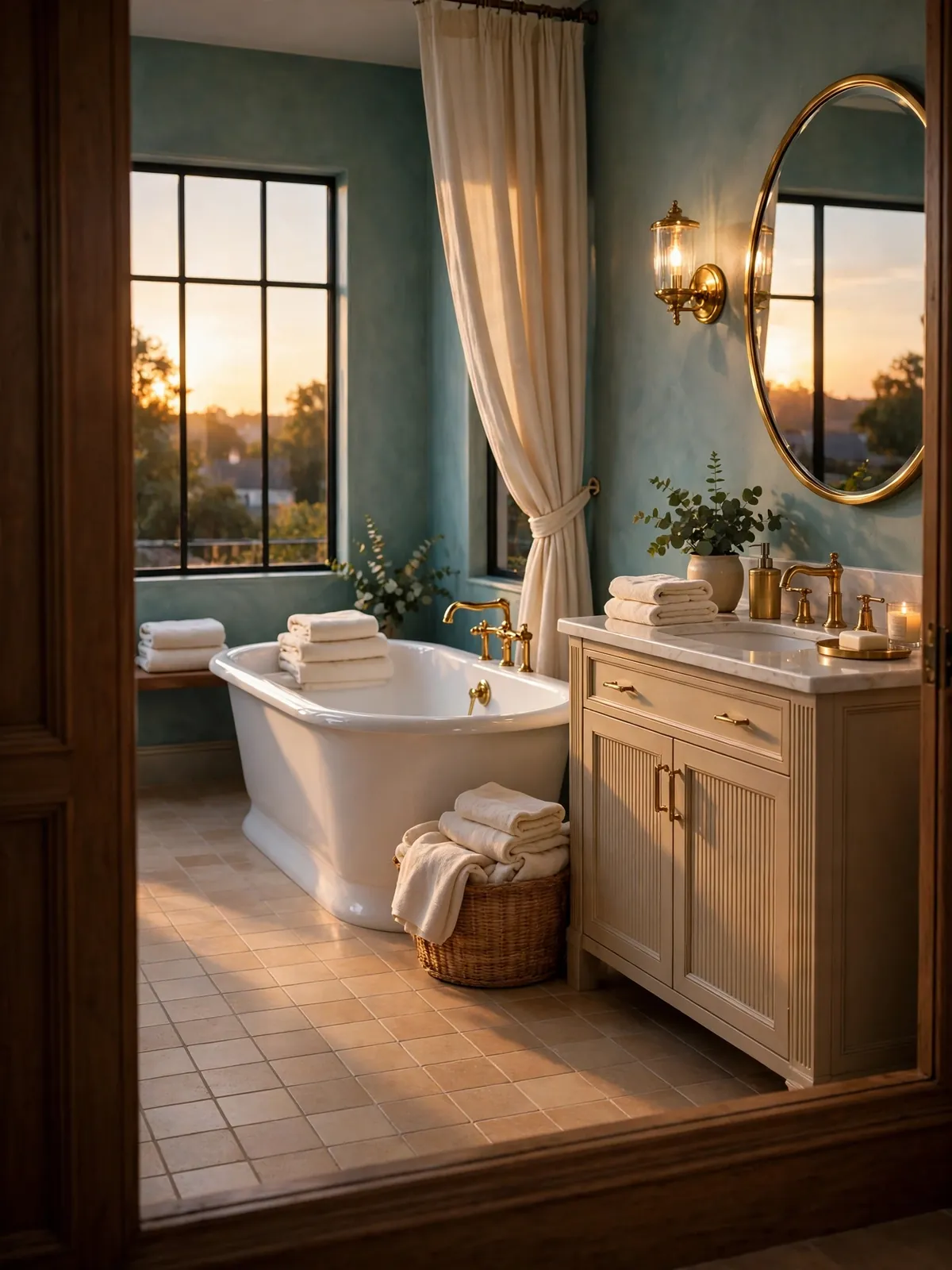
The last of these bathroom flooring ideas is the principle behind them all, and it is worth stating plainly because it is the difference between a bathroom that looks good in a photograph and one that feels good every single day: the floor is not a separate choice from the rest of the room, it is the foundation that every other decision sits on, so the vanity, the wall colour, the mirror, the lighting and the towels should all be chosen to work with the floor rather than against it, and when the floor, the walls and the fixtures share one palette and one mood, the whole bathroom reads as calm, finished and intentional instead of a collection of separate purchases. Here, a soft teal bathroom pulls it together — warm beige floor tiles, brass fixtures, a white freestanding tub and cream towels — and nothing in the room is there by accident, because the floor’s warm tone sets the palette, the walls echo it in a cooler shade, and the brass and cream details bridge the two. The lesson is to choose the floor first, then let it guide the vanity, the walls and the styling, and to test the floor sample in your own bathroom light with the vanity and wall samples beside it, because a floor that looks perfect in a showroom can look cold or busy at home, while a floor chosen alongside the rest of the room will still look right years later. Measure your space, check the waterproofing and the grip, pick the two or three ideas from this list that fit your household and your budget best, and the bathroom stops being a room you rush through and becomes the calmest corner of your home.
Quick tips:
- Choose the floor first, then let it guide the vanity and wall colour.
- Test floor, wall and vanity samples together in your own bathroom light.
- Check waterproofing and grip before falling in love with a tile.
- Keep the palette to three main colours so the room reads as calm.
FAQs
What is the cheapest bathroom flooring that is still waterproof?
Glazed ceramic and porcelain tiles are usually the cheapest fully waterproof option, especially in plain colours and standard sizes. Waterproof vinyl planks can also be affordable, but check that the product is labelled fully waterproof rather than only water-resistant, and remember that fitting costs matter as much as the tile price.
Which bathroom flooring is easiest to clean?
Large-format glazed porcelain is easiest to clean, because the smooth surface wipes clean and the large tiles mean fewer grout lines to scrub. Small mosaics, pebbles and natural stone have more joints or texture, so they trap more dirt and need more regular cleaning.
Can I lay new bathroom flooring over old tiles?
Sometimes, but it depends on the condition of the old floor and the height of the new one. The old tiles must be sound, clean and level, and the extra height must not stop the door opening or create a trip at the threshold. Ask a tiler to check the old floor first, because a poor base will crack or loosen the new floor.
How do I stop bathroom floor grout going mouldy?
Keep the grout sealed, ventilate the bathroom after showers, and wipe up standing water rather than leaving it to sit in the joints. Use a grout sealer after fitting, top it up when water stops beading, and clean the joints regularly with a bathroom cleaner rather than letting mould build up.
Should the bathroom floor match the wall tiles?
It does not have to match exactly, but it should share a tone or a colour with the walls so the room feels pulled together. A common approach is to use the same tile on the floor and one wall in a different size, or a plain floor with a patterned wall, so the room has contrast without clashing.
Conclusion
Bathroom flooring is the foundation of the whole room, and the 20 ideas above show that the right floor is the one that fits your household as well as your taste — porcelain for easy waterproof living, stone or terrazzo for spa-like character, wood-look planks for warmth, and mosaic or pebble where grip matters most. Compare the materials in the table, test samples in your own bathroom light, check the waterproofing and the slip resistance, and choose the floor first so the rest of the room can follow it. Do that, and your bathroom floor will not just look beautiful on the day it is fitted, it will still feel right every morning for years to come.