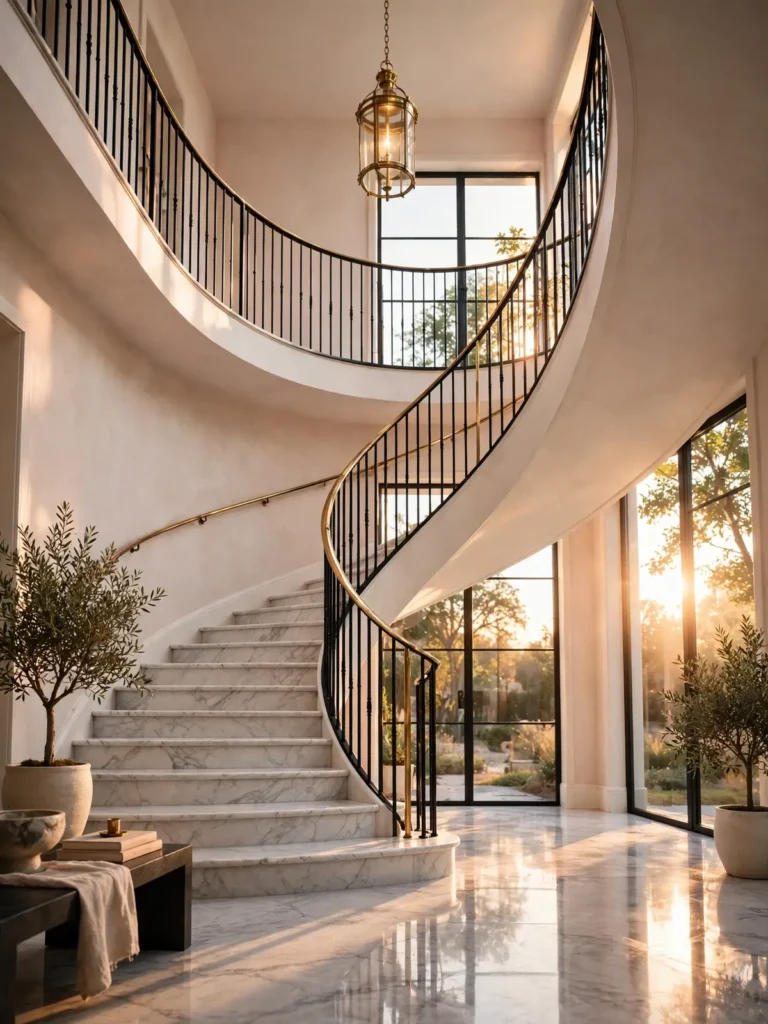
25 Stunning Staircase Handrail Designs That Instantly Make Your Stairs Look Expensive and Beautiful
The handrail is the part of the staircase you touch every single day, so its design matters more than most people think. These 25 staircase handrail designs cover every material and every style — warm oak, matte black steel, clear glass, cognac leather, brass, cable and marble — so you can find a design that feels good in the hand and looks beautiful in your home.
Staircase handrail designs are the many ways a handrail can look and feel — its material, its shape, its colour and the way it is fixed to the wall or the balustrade. The best staircase handrail design suits the home around it: warm oak for a farmhouse, matte black steel for a modern loft, brass for a traditional hallway, and glass for a stair that needs to stay light and open.
For a bolder take on the same metal-and-timber idea, these iron staircase railing ideas show how black iron railings pair with timber treads in a family home. The 25 designs below are organised by material and look — wood, metal, glass, leather, cable and stone — with a comparison of cost, durability and grip, so you can choose the design that fits your style, your budget and the way your family uses the stairs.
Key Takeaways
What are the most popular staircase handrail designs?
Classic solid oak, floating wall rails with hidden brackets, matte black steel, glass panels with a timber top rail, and leather-wrapped rails. Each suits a different home: oak for traditional and farmhouse homes, steel and glass for modern homes, and leather for a warm, tactile feel in any style.
What material is best for a stair handrail — wood, metal, glass or cable?
Wood is the warmest and most comfortable to grip, metal is the strongest and most modern, glass keeps the stair light and open, and cable suits a minimal, airy look. The best choice depends on your home’s style, your budget, and who uses the stairs — wood and leather are kindest to hands, while steel and glass are easiest to clean.
What is the difference between a handrail and a railing?
A handrail is the rail you grip as you climb, fixed to the wall or to the top of the balustrade. A railing — also called a balustrade — is the whole protective barrier: the handrail plus the balusters or panels below it that stop you falling from the open side of the stair.
Which handrail design is best for a modern home?
Floating rails with hidden brackets, matte black steel, glass panels with a slim timber top rail, and cable systems all suit modern homes, because they keep the stair light and architectural. Pair them with pale oak or walnut treads so the stair never feels cold.
Can I mix materials on a handrail?
Yes — mixed materials usually look more designed than a single material alone. Timber with black steel, glass with brass, leather over a steel core, and oak with iron brackets are all classic combinations. Keep one material dominant and the second as an accent, so the rail reads as one clear design.
A Classic Solid Oak Handrail Design With Turned Newel Posts
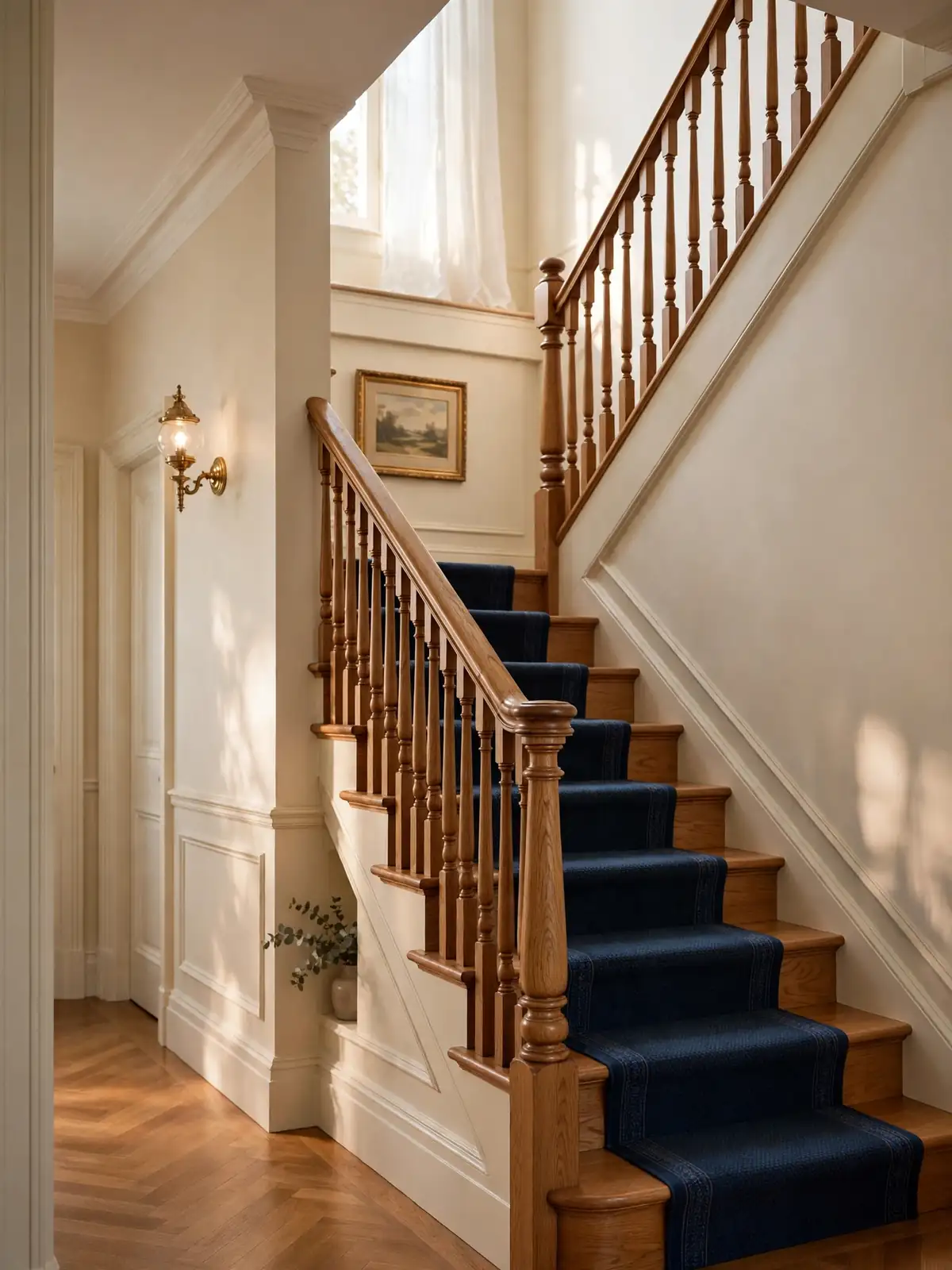
A classic solid oak handrail is the most loved staircase handrail design of all, because warm timber feels good in the hand and suits almost any home. On this stair, a chunky oak handrail, 60 mm wide with a softly rounded top, runs along warm honey oak treads, each 950 mm wide, supported by turned newel posts at the base and the landing. A deep navy-blue runner and cream walls keep the hallway classic, while a brass wall sconce glows warmly above the landing in the evening.
Quick tips:
- Choose solid oak for the warmest, most comfortable grip.
- Use turned newel posts for a classic, traditional finish.
- Pair oak with a navy runner for a timeless hallway look.
- Oil the oak once a year to keep the grain rich and protected.
A Floating Wall Handrail Design With Hidden Brackets
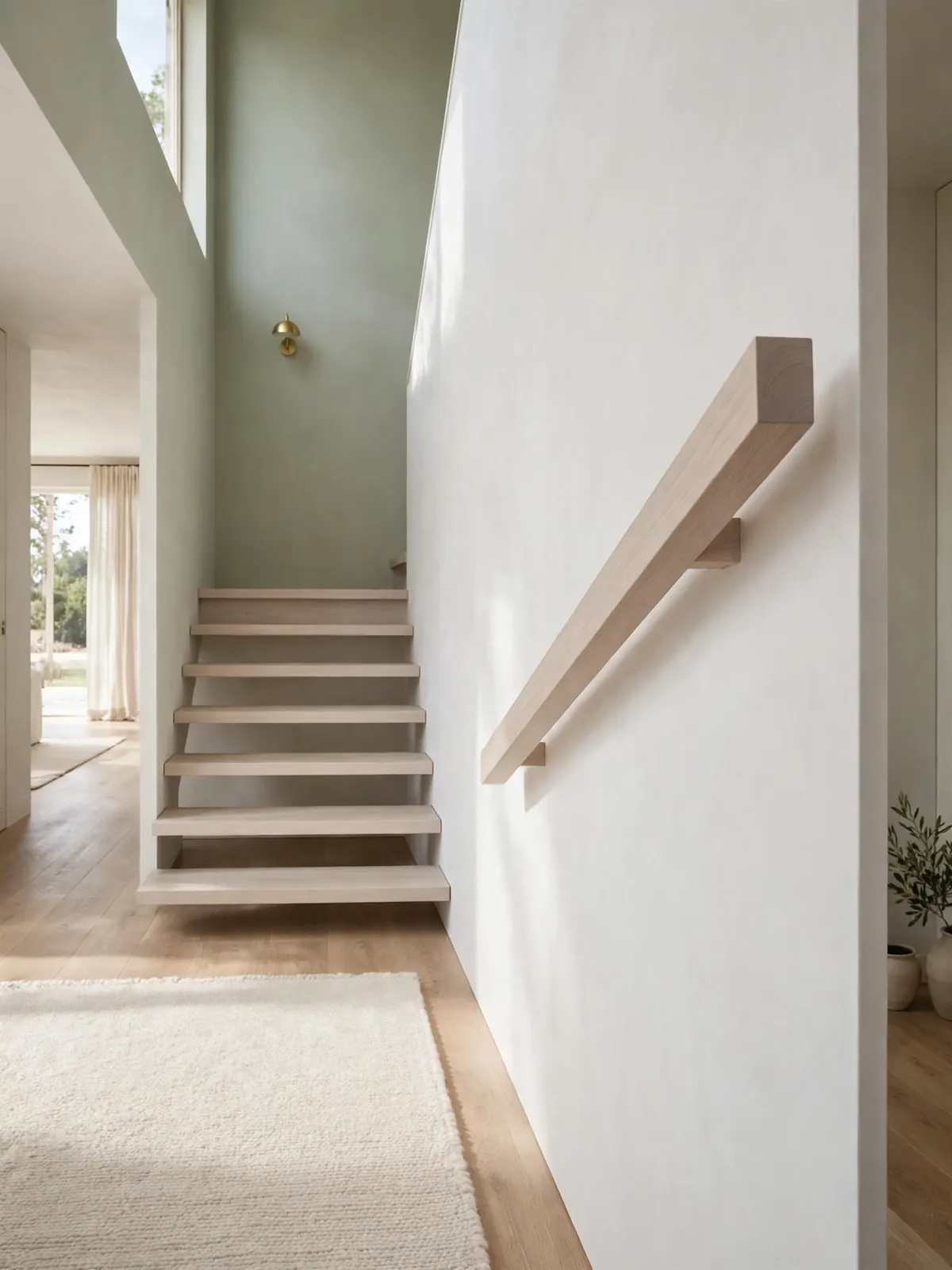
A floating handrail seems to hover beside the wall, and that clean line is what makes it one of the most modern staircase handrail designs. Here, a slim pale ash handrail, 50 mm wide, is fixed to a smooth white plaster wall on hidden brackets, so no metal shows at all, beside pale ash treads, each 950 mm wide. Soft sage-green walls and a cream rug keep the hallway calm, while a small brass wall light glows softly above the rail in the evening.
Quick tips:
- Use hidden brackets for the cleanest, most minimal look.
- Choose pale ash so the rail blends gently with the wall.
- Fix the brackets into wall studs so the rail is completely secure.
- Add one warm wall light so the floating rail is easy to find at night.
A Glass Panel Handrail Design With a Warm Timber Top Rail
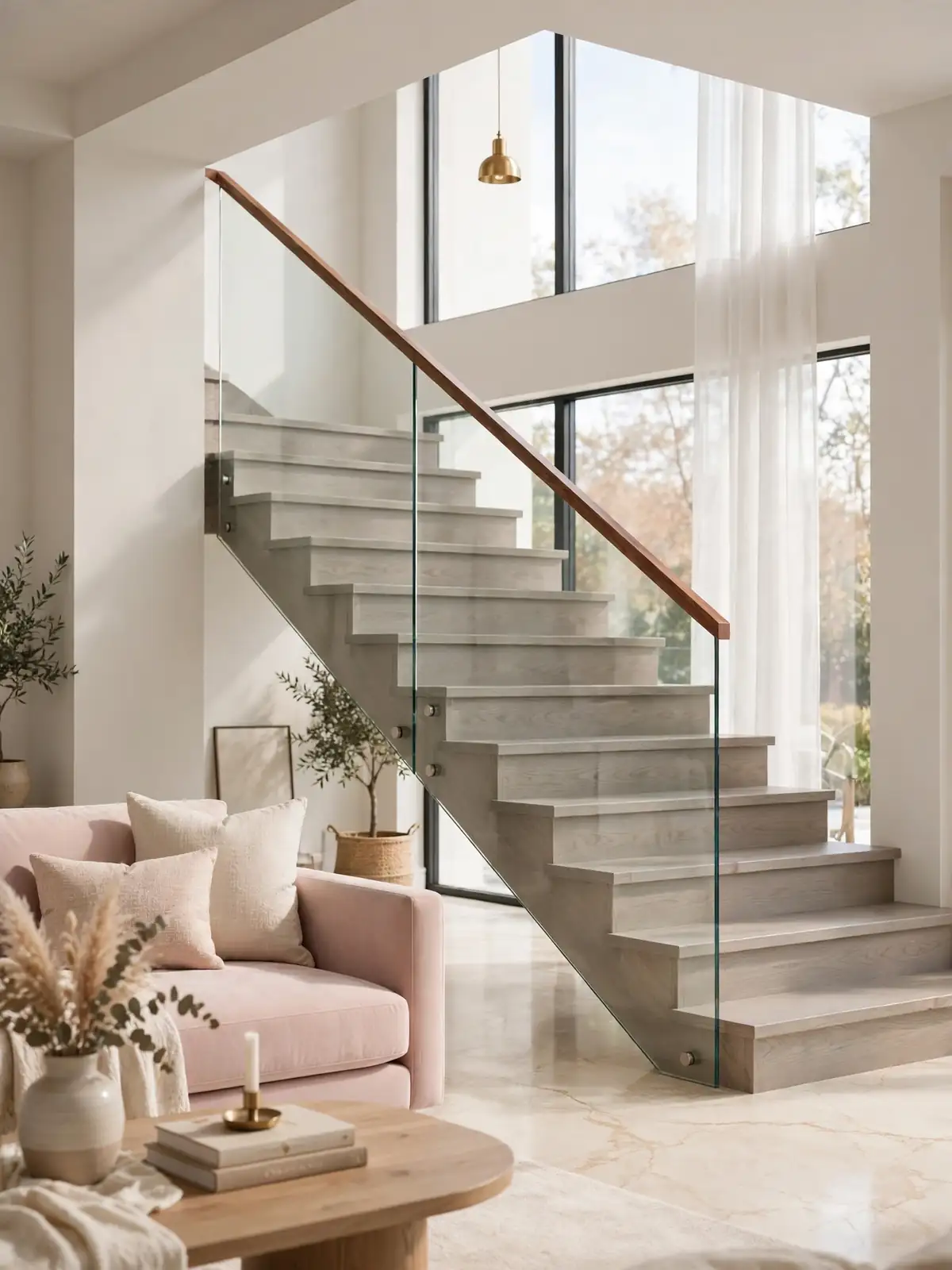
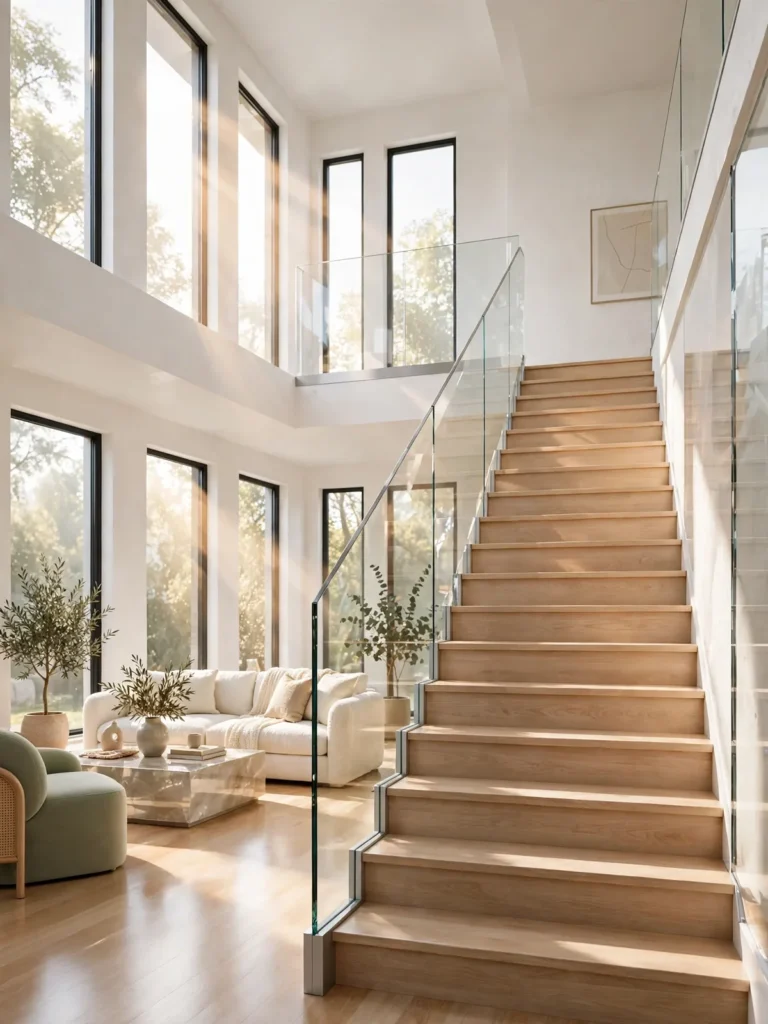
Glass panels with a warm timber top rail give you the lightness of glass and the comfort of wood in one staircase handrail design. On this stair, 12 mm thick clear glass panels run along a flight of pale grey oak treads, each 950 mm wide, held in slim steel channels, while a warm walnut top rail, 60 mm wide, caps the glass and gives your hand something warm to hold. A soft blush-pink sofa and a cream marble floor below keep the palette gentle and light.
Quick tips:
- Use low-iron glass so the panels stay crystal clear.
- Choose walnut for the top rail so it feels warm in the hand.
- Keep the treads pale so the glass reads as invisible.
- Wipe the glass with a microfibre cloth to keep it streak-free.
An Industrial Pipe Handrail Design in Matte Black Steel
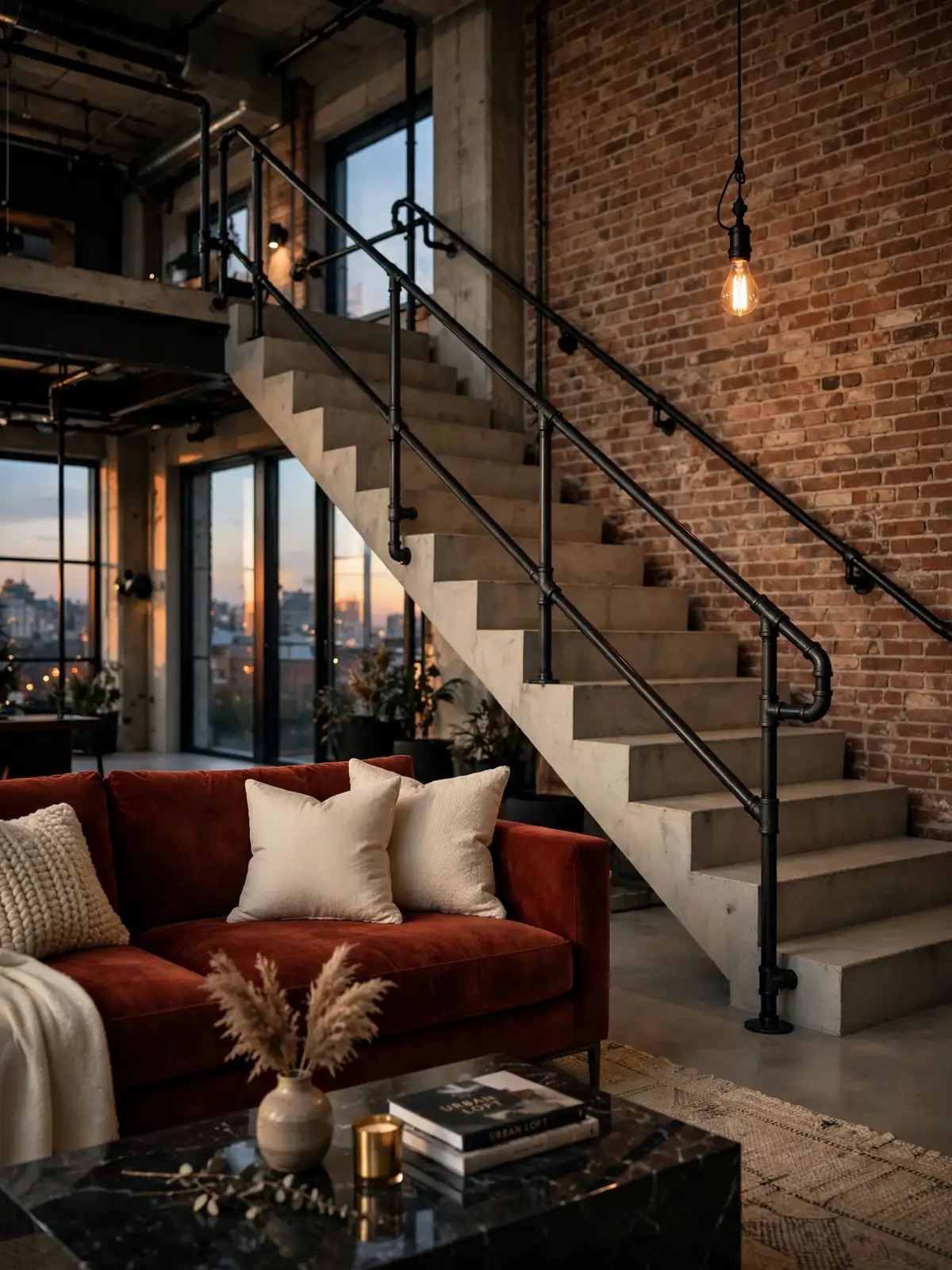
An industrial pipe handrail is the boldest of the metal staircase handrail designs, and it suits a loft or converted warehouse perfectly. Here, a 40 mm diameter matte black steel pipe runs the full flight on chunky black flanges, beside pale concrete treads, each 950 mm wide, and a warm exposed brick wall. A deep rust-red sofa and cream cushions below pick up the brick’s tones, while an Edison bulb pendant glows warmly above the landing and makes the black pipe look sculptural.
Quick tips:
- Use 40 mm pipe for a comfortable, industrial grip.
- Fix the pipe on chunky flanges for an authentic workshop look.
- Pair black pipe with warm brick for balance.
- Choose a matte finish so the pipe never looks shiny or cheap.
A Handrail Design Painted the Same Colour as the Wall
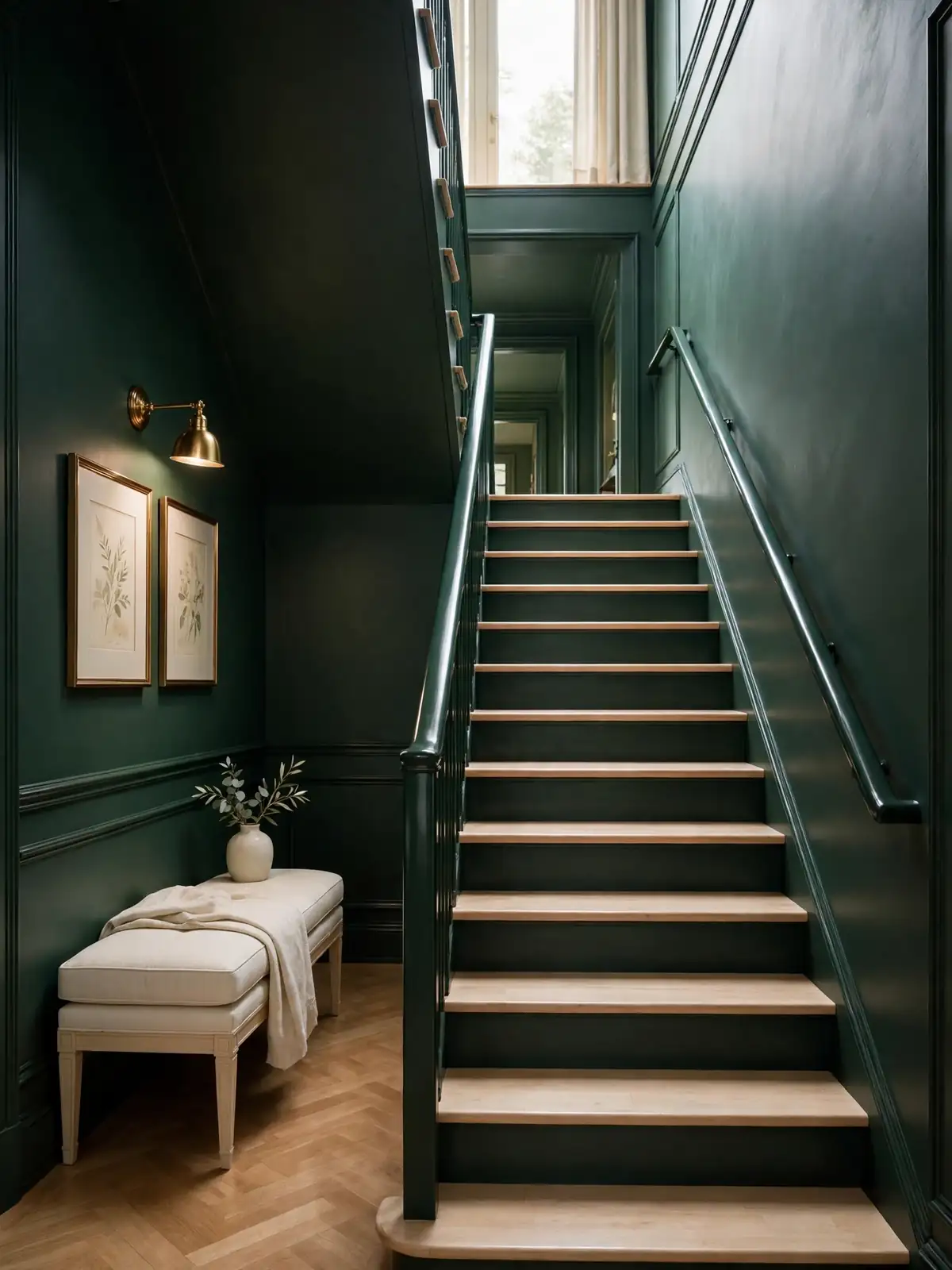
Painting the handrail the same colour as the wall makes it disappear, and that quiet trick is one of the cleverest staircase handrail designs for a small hallway. On this stair, a slim timber handrail is painted the same deep forest green as the wall behind it, beside pale maple treads, each 900 mm wide, so the rail reads as a shadow line rather than a feature. A cream bench at the base and a brass picture light above the landing add warmth, while the green wall makes the pale treads glow.
Quick tips:
- Paint the rail and the wall in exactly the same colour and finish.
- Use a durable satin paint so the rail wipes clean.
- Pair a dark painted rail with pale treads for contrast.
- Add one brass fitting to warm the painted wall.
A Rustic Reclaimed Timber Handrail Design With Iron Straps
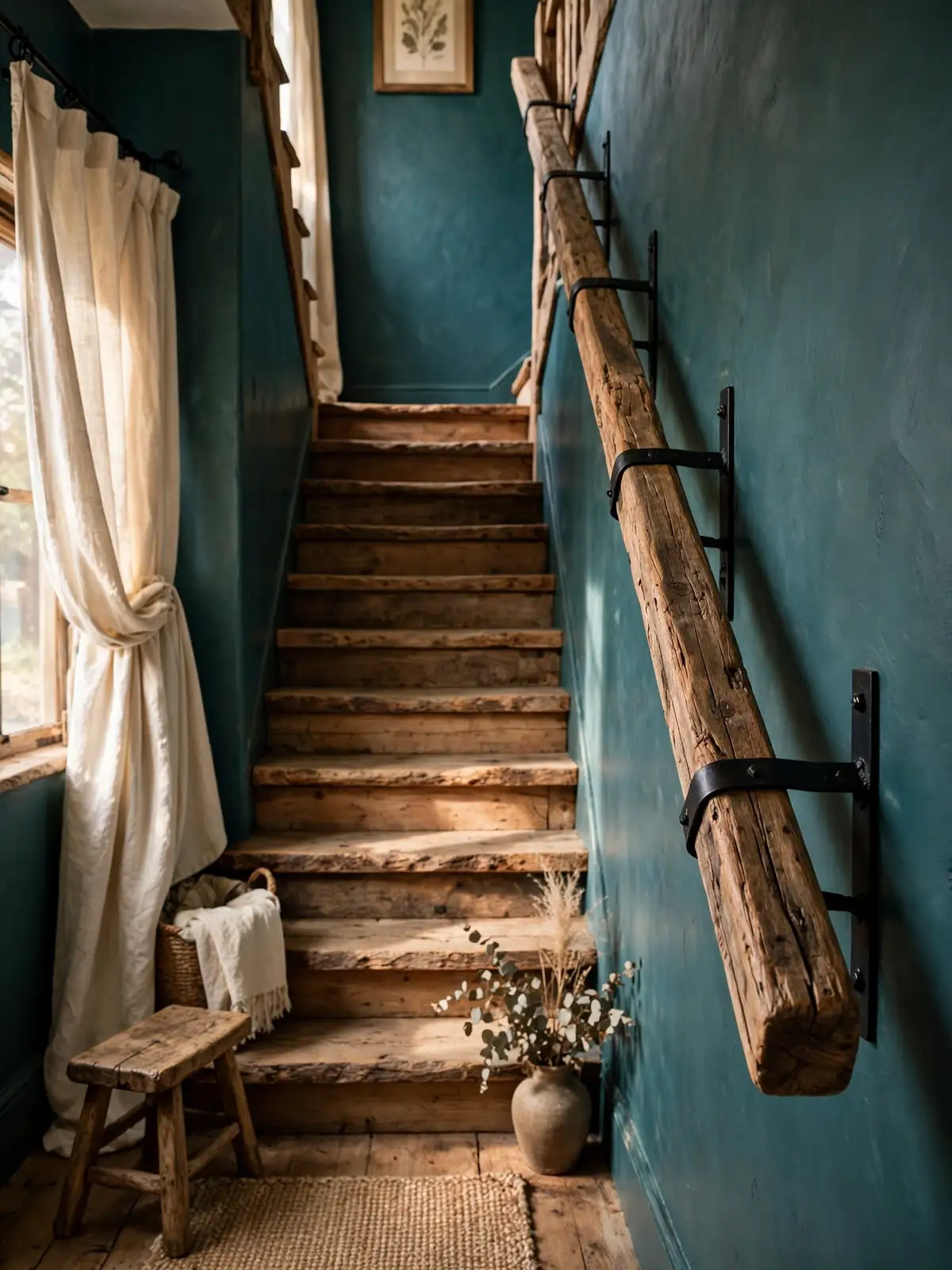
A reclaimed timber handrail held by iron straps is the kind of detail a blacksmith would have made a hundred years ago, and it still feels right today. Here, a chunky reclaimed oak handrail, 100 mm wide, sanded smooth on top and left rough underneath, runs along a flight of rough-hewn pine treads, each 950 mm wide, held by hand-forged black iron straps every 600 mm. Deep teal walls and cream linen curtains frame the stair, while a small wooden stool at the base holds a stack of books.
Quick tips:
- Make the handrail chunky — about 100 mm wide — for a real grip.
- Space the iron straps evenly, about 600 mm apart.
- Pair reclaimed oak with deep teal for a rich, homely contrast.
- Sand the top of the rail smooth and leave the underside rough.
A Leather-Wrapped Handrail Design in Cognac and Walnut
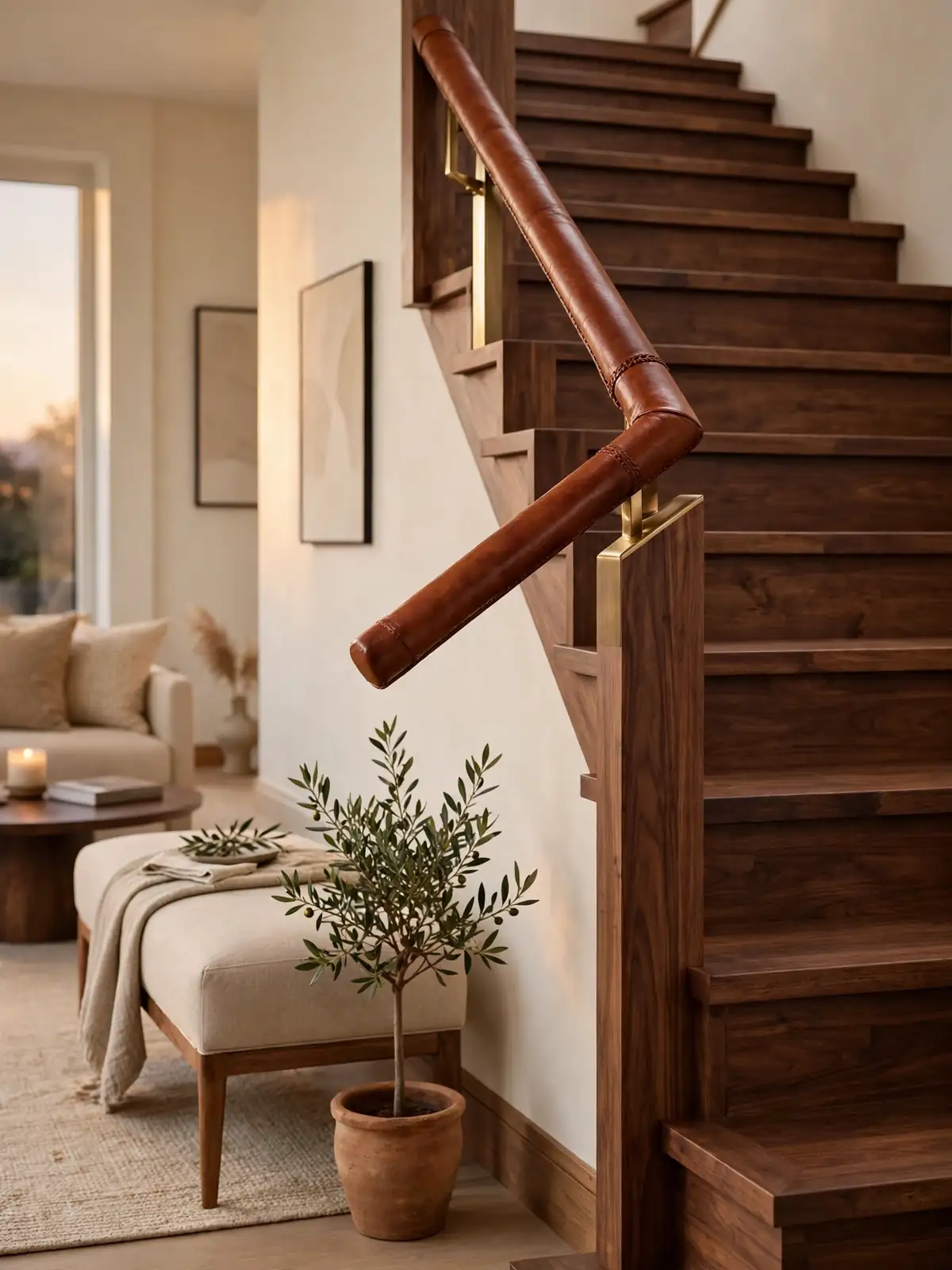
A leather-wrapped handrail turns a staircase into something you want to touch, and cognac leather over walnut is the warmest of all the staircase handrail designs. On this stair, warm walnut treads, each 1 metre wide and 280 mm deep, pair with a slim steel-core handrail wrapped in smooth cognac leather, stitched neatly along its underside. A soft beige linen bench sits at the base, a small olive tree in a clay pot adds life, and the cream walls catch the evening light.
Quick tips:
- Choose cognac leather for the warmest contrast with walnut.
- Keep the handrail slim so the leather wrapping stays neat.
- Add one clay or terracotta pot to echo the leather tone.
- Condition the leather once a year so it stays soft and rich.
A Brass Handrail Design Against Deep Green Walls
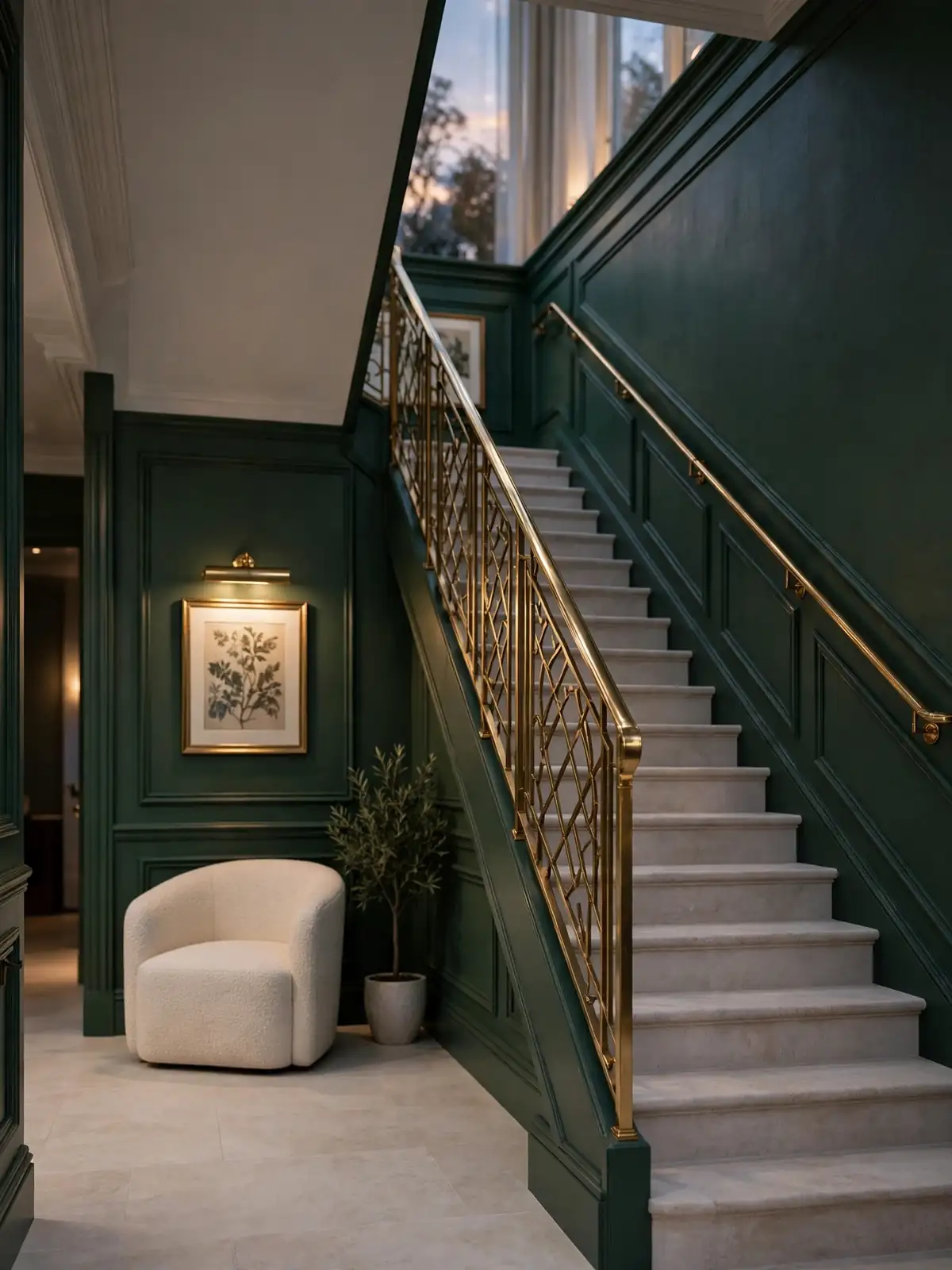
Brass against deep green is one of the most glamorous staircase handrail designs, because the warm metal glows against the dark wall like jewellery. Here, a slim brushed-brass handrail, 40 mm in diameter, runs the full flight on slim brass brackets, beside pale stone treads, each 900 mm wide, and a deep forest-green wall. A cream boucle armchair below and a brass picture light above the landing warm the green in the evening, while the pale stone floor keeps the hallway from feeling dark.
Quick tips:
- Use brushed brass, not polished, for a softer, richer shine.
- Keep the green wall to one side only, with the rest pale.
- Add brass fittings elsewhere so the rail feels intentional.
- Use a matte tread finish to avoid glare in low light.
A Wide Flat Handrail Design That Doubles as a Display Ledge
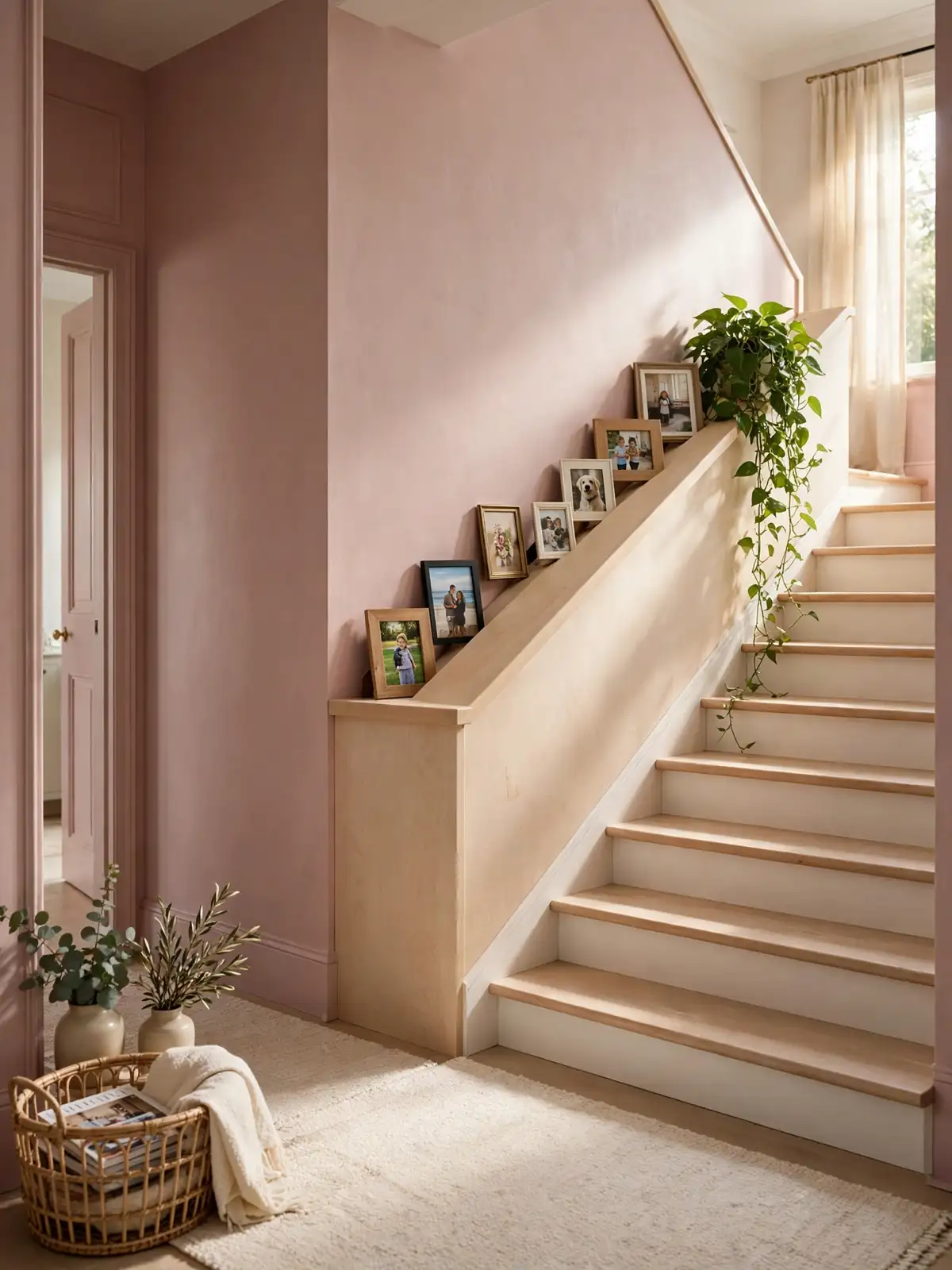
A wide flat handrail that doubles as a ledge is one of the most charming staircase handrail designs, because it turns the rail into a shelf for the things you love. On this stair, a flat handrail, 120 mm wide, runs along pale birch treads, each 900 mm wide, its broad top holding three small framed photographs and a trailing green plant in a ceramic pot. Soft dusty-rose walls and a cream rug keep the hallway gentle, while the ledge makes the stair feel personal and lived-in.
Quick tips:
- Make the ledge about 120 mm wide so small frames sit safely.
- Keep the objects light — frames and small plants only.
- Choose pale birch so the ledge feels fresh, not heavy.
- Leave gaps between objects so the ledge never looks cluttered.
A Handrail Design With LED Light Glowing Beneath the Rail
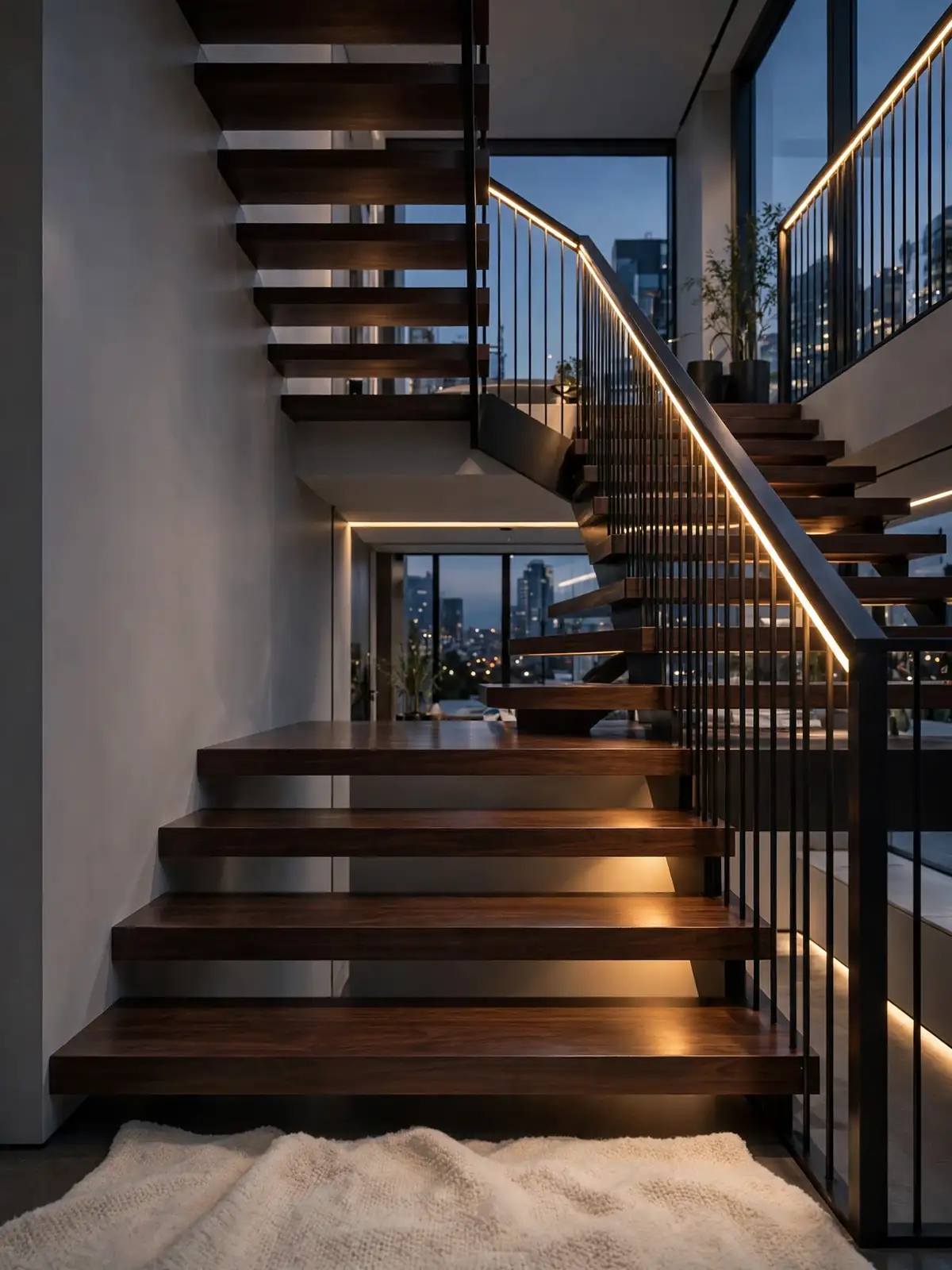
A handrail with LED light glowing beneath it turns the rail into a ribbon of light after dark, and it guides the climb safely at the same time. Here, a warm white LED strip, 2700K, is set into a slim channel beneath a dark walnut handrail, so a soft golden line runs the full flight above dark walnut treads, each 1 metre wide. Soft grey walls and a cream rug below keep the room calm, while slim black balusters frame the glow and the whole stair reads as floating light.
Quick tips:
- Choose warm white LEDs — about 2700K — for a cosy glow.
- Set the strip in a channel under the rail so the light washes down.
- Put the strip on a motion sensor so it switches on as you approach.
- Keep the treads dark so the glow stands out clearly.
A Wrought Iron Handrail Design With Scrollwork Balusters
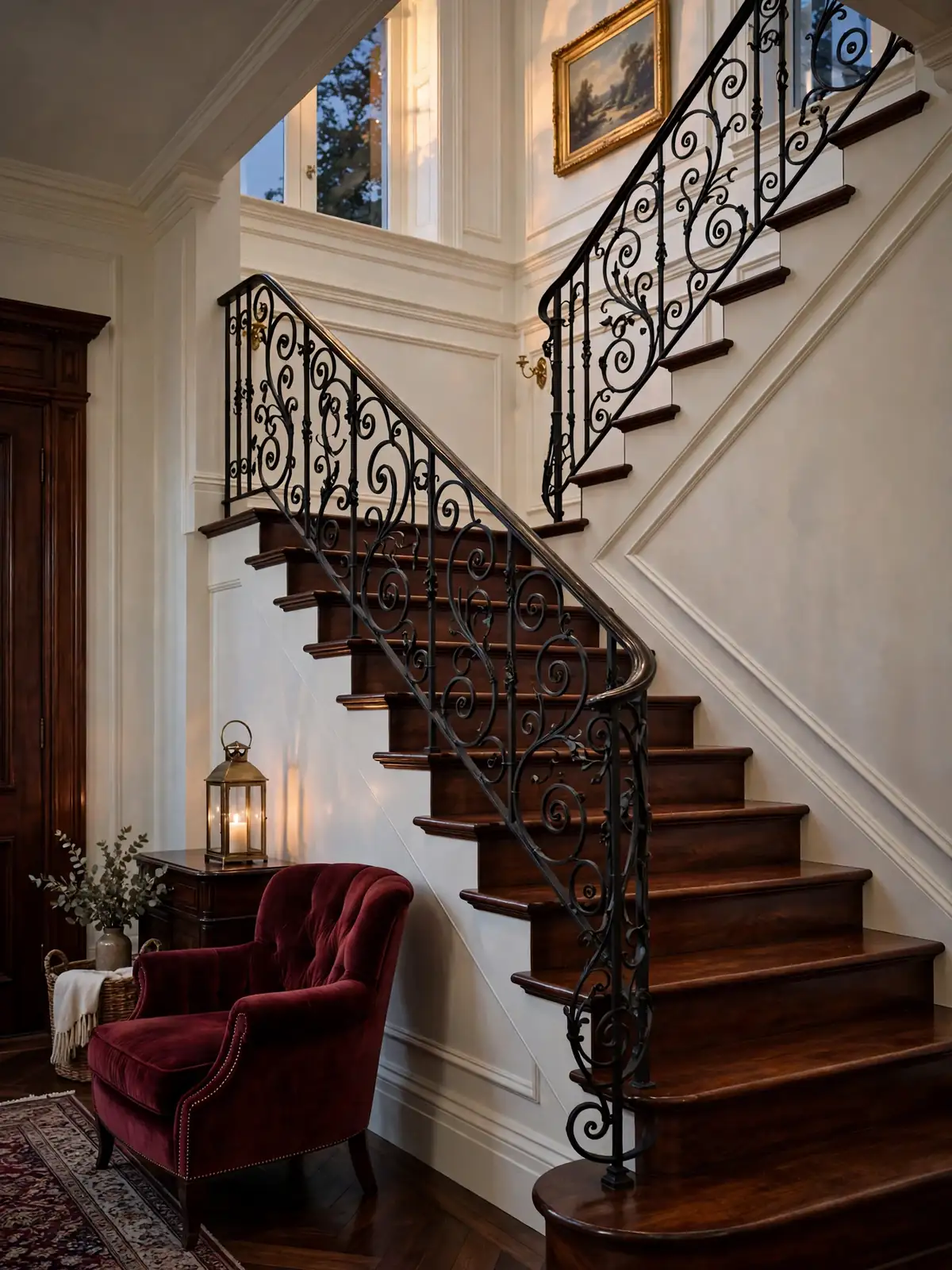
Wrought iron scrollwork is the most traditional of all staircase handrail designs, and it turns a stair into the centrepiece of a formal entry. On this stair, a slim wrought iron handrail runs above hand-forged scrollwork balusters, each one slightly different from the hammer, beside dark mahogany treads, each 1 metre wide. Soft ivory walls and a deep burgundy velvet armchair below add rich comfort, while a brass lantern on the landing glows softly in the evening and picks out the ironwork.
Quick tips:
- Choose hand-forged scrollwork, not cast copies, for real character.
- Pair wrought iron with dark mahogany for a stately look.
- Add a brass lantern to warm the iron in the evening.
- Keep the walls ivory so the black ironwork stands out cleanly.
A Cable Handrail Design for a Light, Open Look
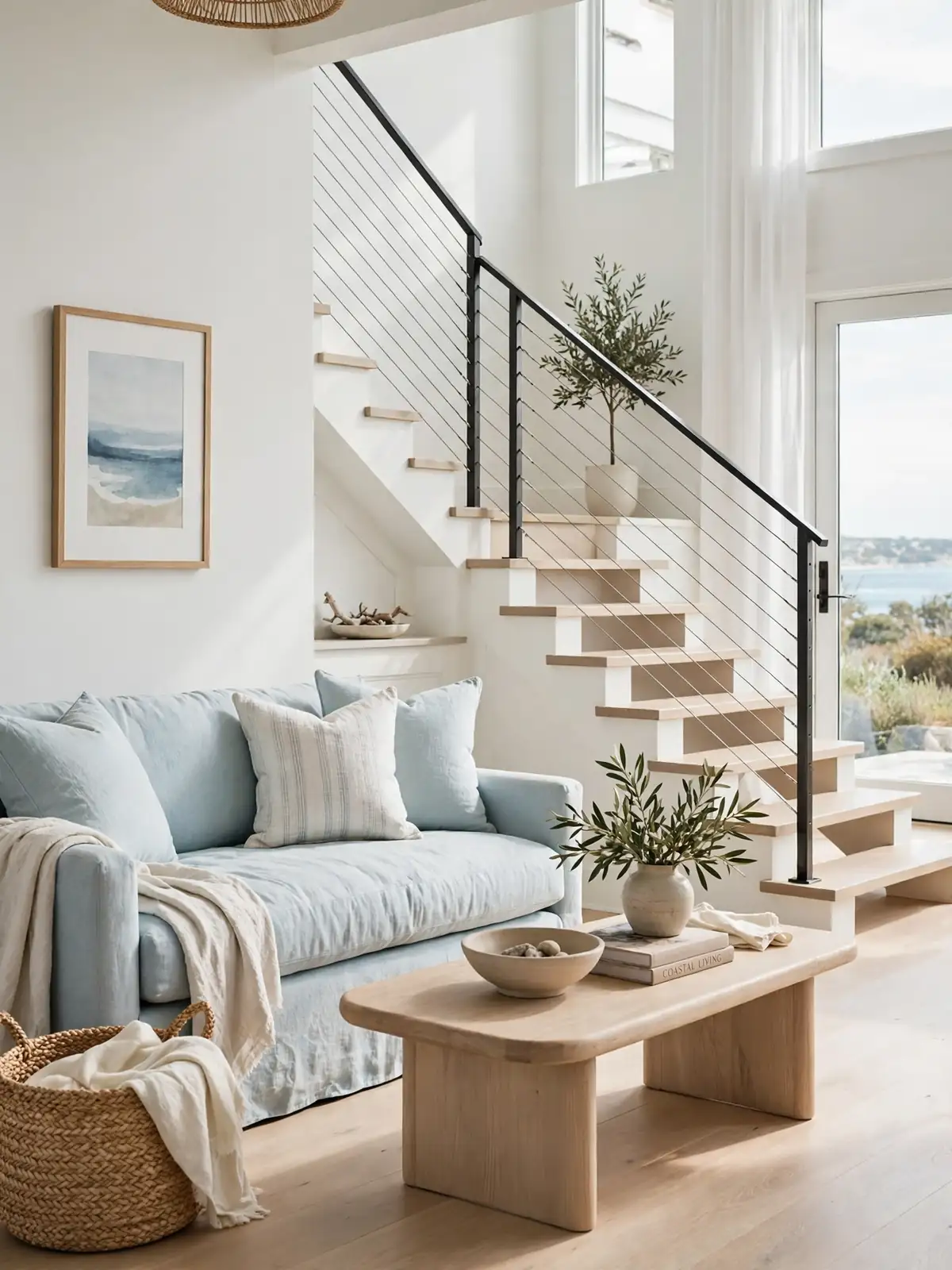
A cable handrail is the lightest of the metal staircase handrail designs, because slim horizontal cables almost disappear and leave the stair completely open. Here, five slim stainless steel cables, each 4 mm thick, run horizontally between slim steel posts beside pale ash treads, each 950 mm wide, with a slim ash handrail on top. Soft white walls, a pale blue linen sofa and a woven seagrass basket keep the room breezy, while daylight passes straight through the cables and across the pale floor.
Quick tips:
- Keep the cables slim — about 4 mm — for the lightest look.
- Space the cables evenly, about 100 mm apart.
- Use stainless steel so the cables never rust or stain.
- Add a timber top rail so the hand has something warm to hold.
A Marble Handrail Design for a Luxurious Entry
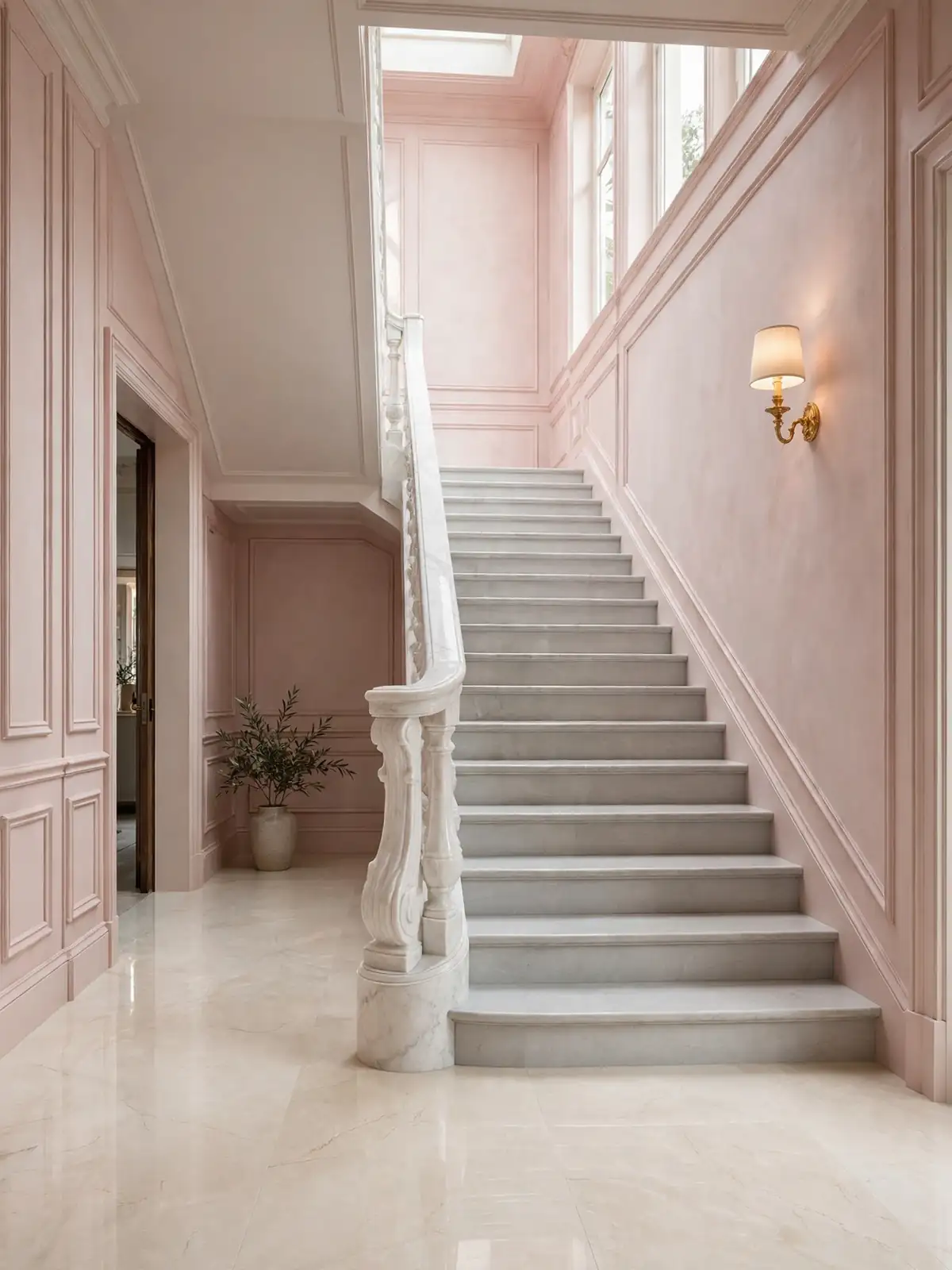
A marble handrail is the most luxurious of all staircase handrail designs, and it turns an entry into a hotel lobby. On this stair, a smooth white Carrara marble handrail, 70 mm wide with softly rounded edges, runs above slim brass balusters, beside pale grey treads, each 1 metre wide. Soft blush-pink walls and a cream marble floor keep the palette gentle, while a gold wall sconce on the landing echoes the brass and makes the marble glow softly in the evening.
Quick tips:
- Choose Carrara marble for the classic white-and-grey look.
- Round the edges of the marble so it is comfortable to grip.
- Pair marble with brass, not chrome, for warmth.
- Seal the marble well so it stays stain-free.
A Handrail Design With Carved Decorative Details in the Timber
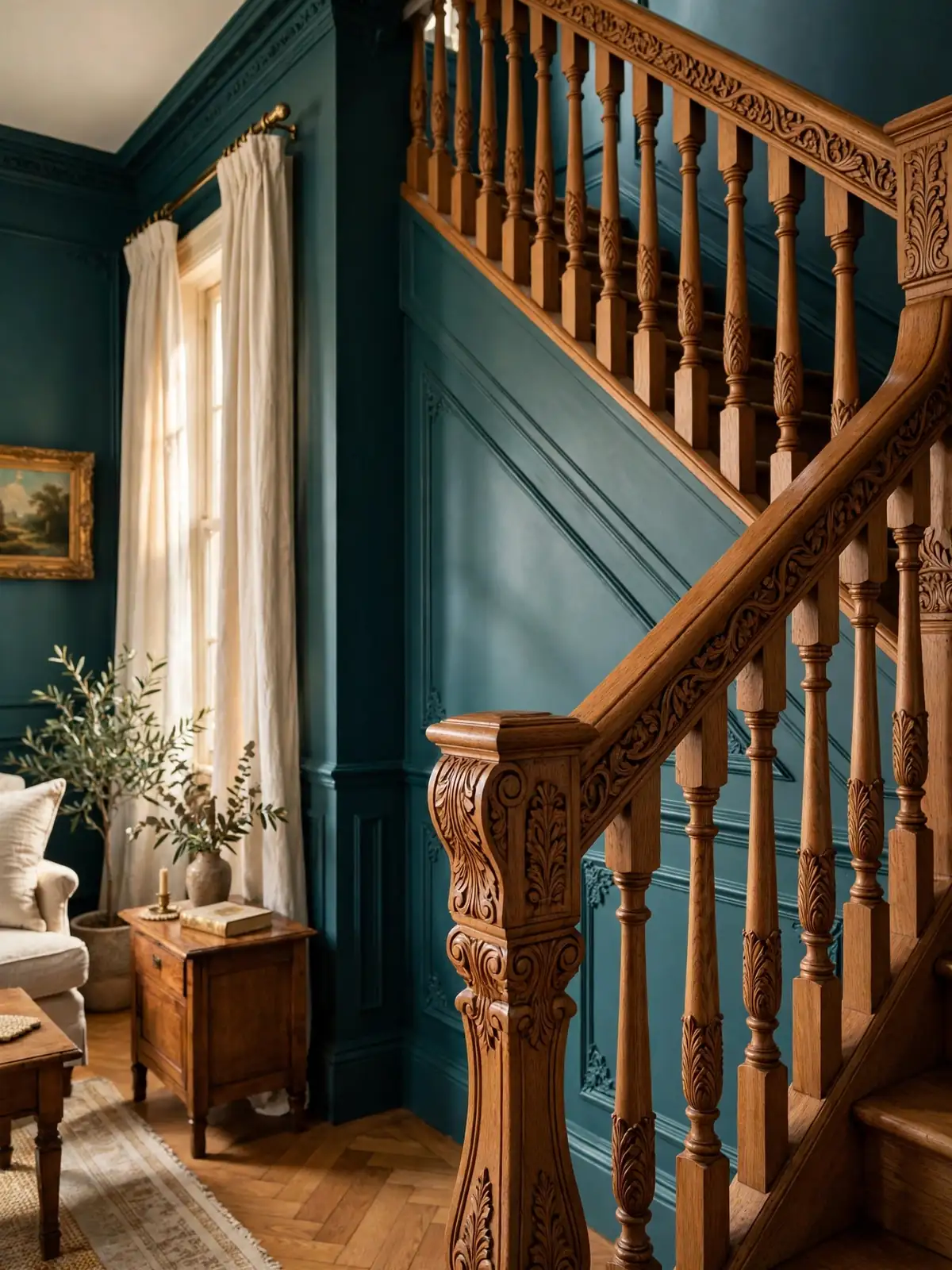
A carved handrail is the most crafted of the timber staircase handrail designs, and the carving turns a functional rail into a piece of furniture. Here, a warm oak handrail carries a slim carved rope pattern along its outer face, running beside pale oak treads, each 950 mm wide, with a turned newel post at the base. Deep teal walls and cream linen curtains frame the stair, while a small wooden side table at the base holds a stack of books and the carving catches the afternoon light.
Quick tips:
- Choose a simple carved pattern — rope or leaf — for a timeless look.
- Keep the carving on the outer face so the grip stays smooth.
- Pair carved oak with deep teal for a rich, heritage contrast.
- Oil the carving well so dust never settles in the grooves.
A Two-Tone Handrail Design in Black Steel and Pale Ash
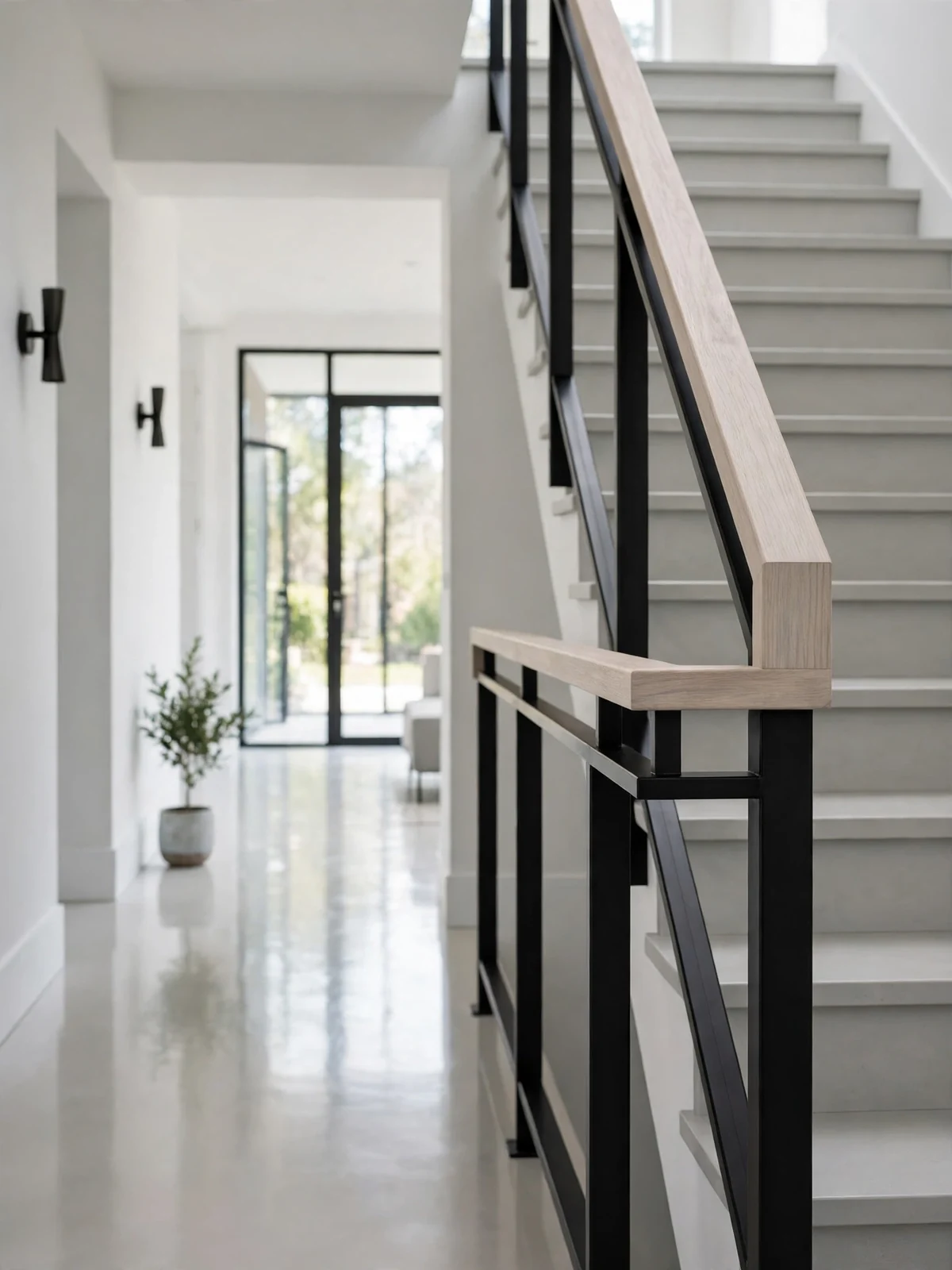
A two-tone handrail — black steel below, pale ash on the grip — is one of the smartest staircase handrail designs for a modern home, because it is graphic and comfortable at once. On this stair, a slim handrail runs the full flight beside pale grey treads, each 950 mm wide: its outer face is matte black steel, while the top surface you actually hold is pale ash, sanded smooth. Soft white walls and a small green plant keep the hallway fresh, while the black line draws the eye upward.
Quick tips:
- Keep the timber grip on top and the black steel below for comfort.
- Match the black steel to window frames or light fittings nearby.
- Use pale grey treads so the two-tone rail stands out cleanly.
- Sand the ash grip smooth so it is pleasant to hold every day.
A Rope Handrail Design for a Coastal Cottage Stair
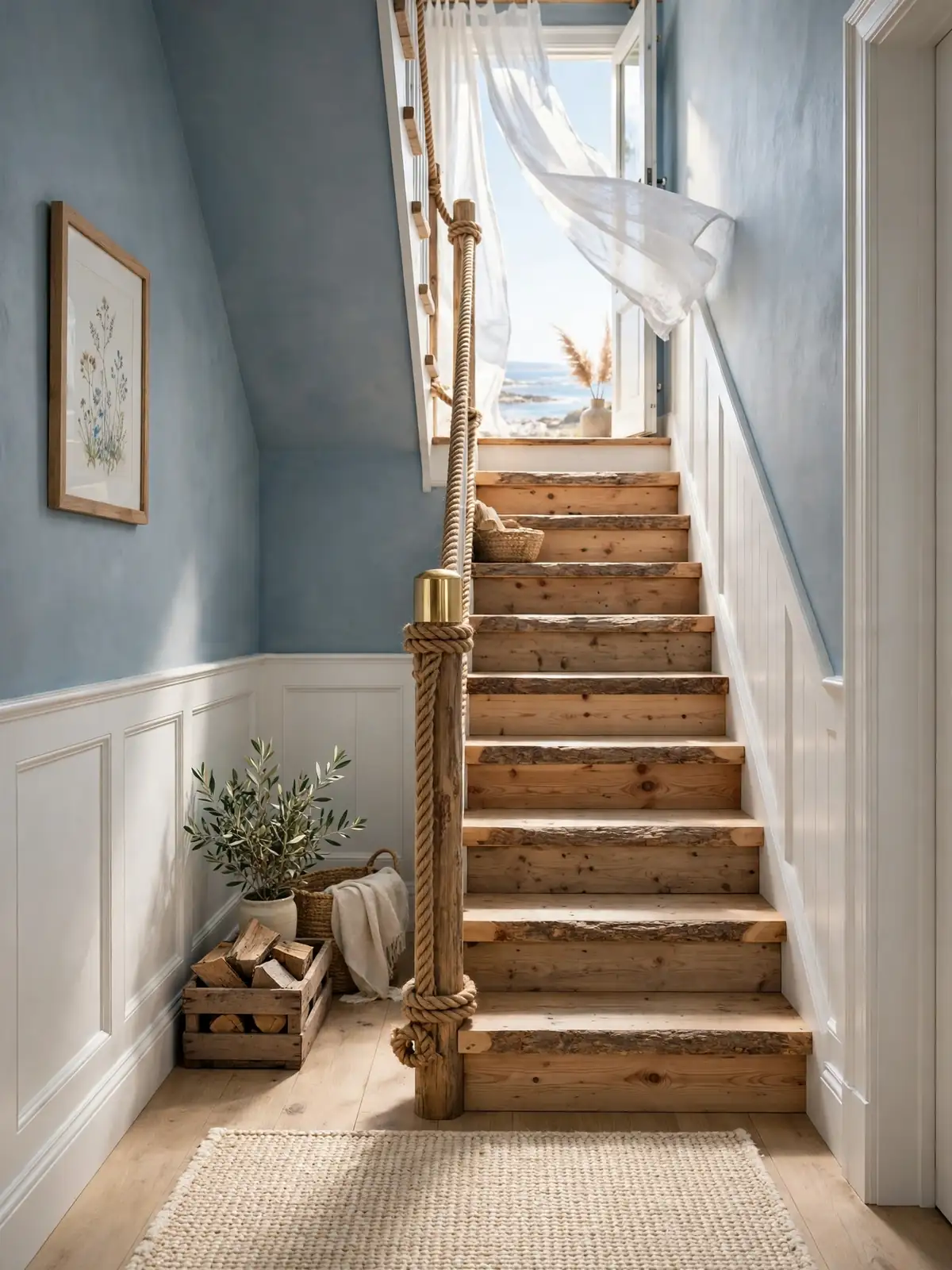
A thick rope handrail turns a simple pine stair into a seaside cottage feature, and it feels wonderful under the hand. Here, rough-hewn pine treads, each 900 mm wide and 40 mm thick, show their saw marks and knots, while a 40 mm diameter natural hemp rope runs through black iron eyelets as the handrail. Soft dusty-blue walls and a cream woven rug at the base keep the palette fresh, while a small wooden crate of firewood beside the stair adds a practical, lived-in touch.
Quick tips:
- Choose thick hemp rope — about 40 mm — for a comfortable grip.
- Fix the rope through black iron eyelets for a nautical look.
- Pair rough pine with dusty blue for a fresh cottage feel.
- Keep the rug cream and woven so the stair stays the feature.
A Handrail Design With a Slim Shelf Ledge Above the Rail
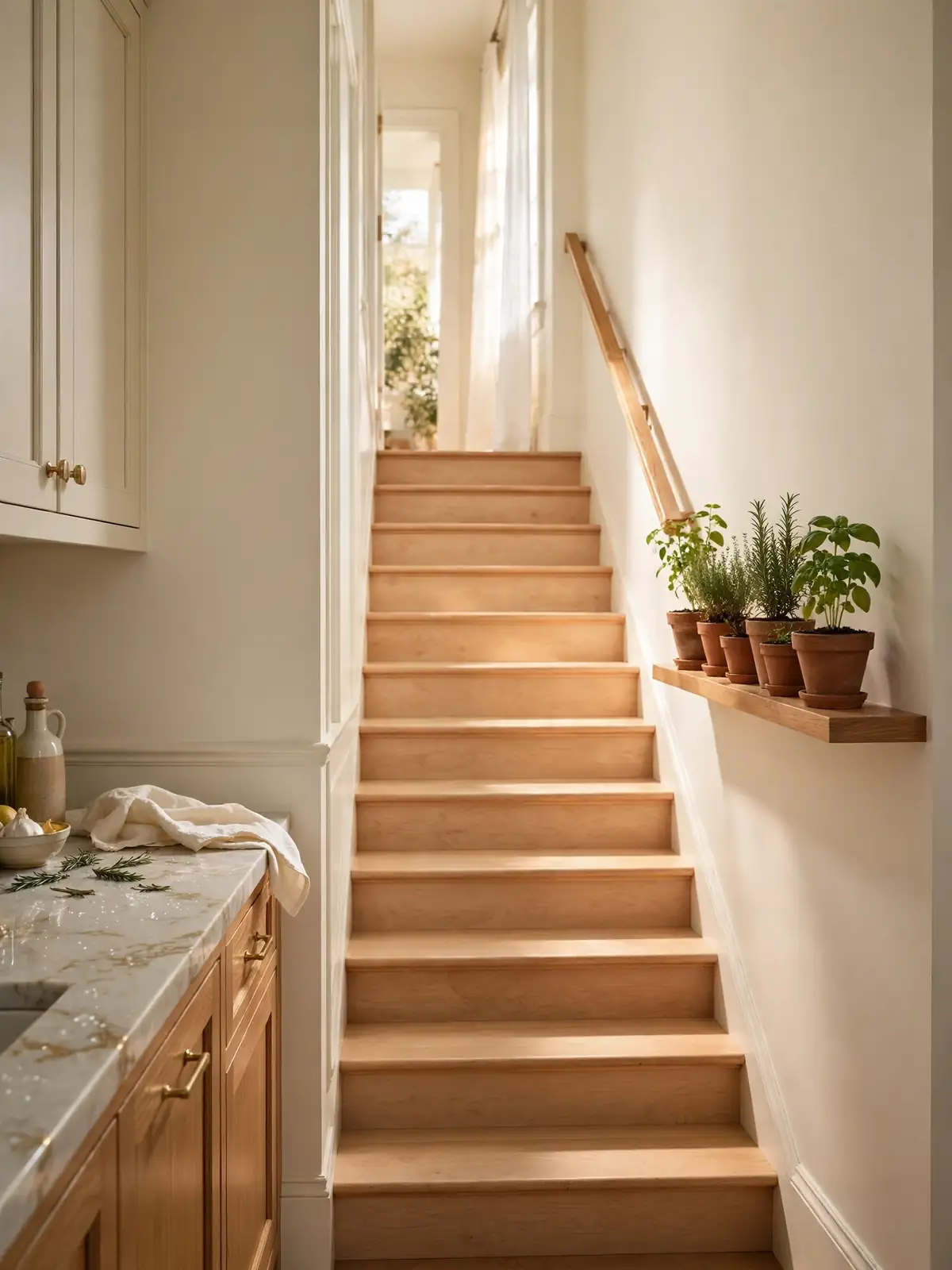
A slim shelf ledge above the handrail is one of the most practical staircase handrail designs, because it turns the rail into a home for small plants and objects. Here, a slim pale oak shelf, 150 mm deep, runs above a simple timber handrail beside pale birch treads, each 900 mm wide, holding small terracotta pots with trailing rosemary and thyme that spill gently toward the floor below. Soft cream walls and warm morning light keep the room bright, while the herbs soften the timber and fill the stairwell with a fresh, green scent.
Quick tips:
- Keep the shelf slim — about 150 mm deep — so it does not block the light.
- Choose trailing herbs that spill softly, not tall plants that block the view.
- Use terracotta pots for warmth against pale timber.
- Water the herbs with a small can to avoid spills on the treads.
A Velvet-Wrapped Handrail Design for a Glamorous Stair
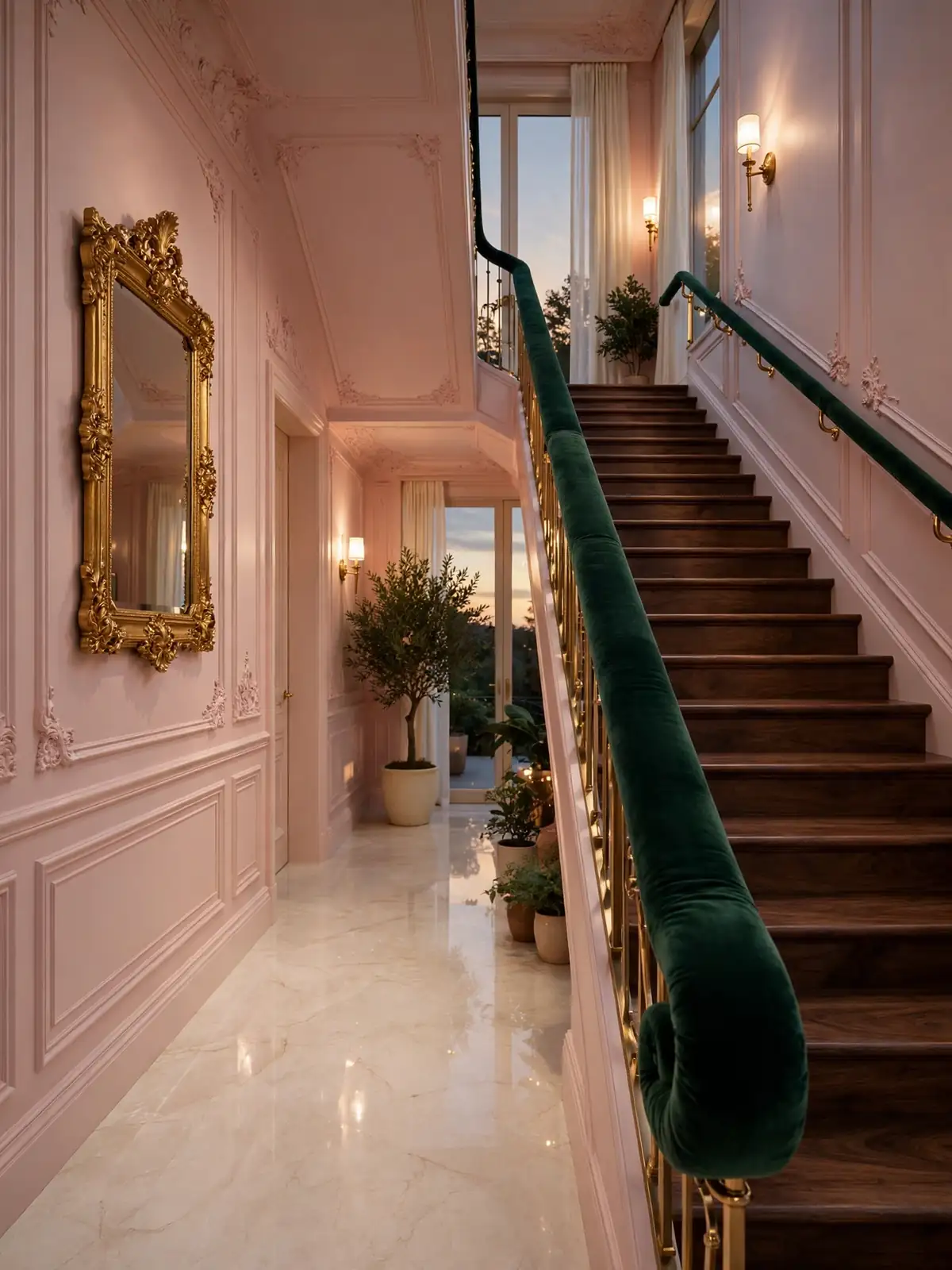
A velvet-wrapped handrail is the most glamorous of all staircase handrail designs, and it makes a stair feel like a theatre. On this stair, a slim steel-core handrail is wrapped in deep emerald velvet, soft and rich under the hand, running beside dark walnut treads, each 950 mm wide. Soft blush-pink walls and a gold mirror on the landing reflect the evening light, while the cream marble floor keeps the hallway bright and the emerald velvet glows against the dark timber.
Quick tips:
- Choose a deep jewel velvet — emerald, sapphire or burgundy — for drama.
- Keep the handrail slim so the velvet wrapping stays neat.
- Pair velvet with dark walnut for a rich, theatrical contrast.
- Brush the velvet weekly so it stays soft and even.
A Handrail Design Extended Into a Bench at the Bottom of the Stairs
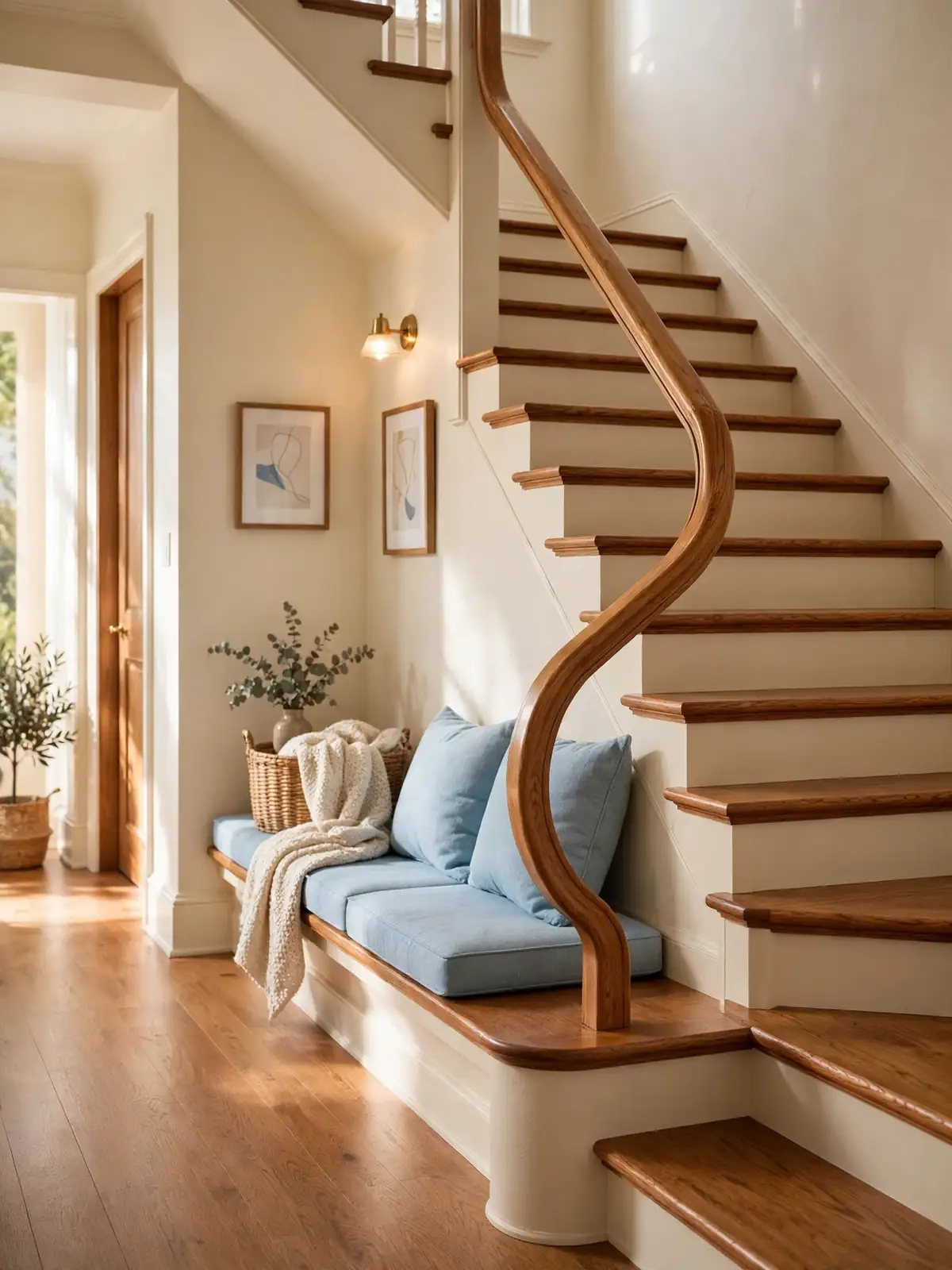
A handrail that flows into a bench at the bottom of the stairs is one of the cleverest staircase handrail designs, because one continuous piece of timber does two jobs at once. Here, a warm oak handrail curves gently down at the base of the flight and extends into a bench, 1.1 metres long and 450 mm deep, dressed with soft sky-blue cushions, while a woven basket below holds shoes and scarves. Warm oak treads, each 950 mm wide, and cream walls keep the hallway bright, and the bench is a place to sit, tie a shoe, or rest a bag on the way up.
Quick tips:
- Let the rail curve smoothly into the bench, not join it at an angle.
- Build the bench in the same oak as the rail for a unified look.
- Add washable cushion covers for a family hallway.
- Keep a basket below the bench so the entry stays tidy.
A Curved Handrail Design That Follows a Sweeping Stair
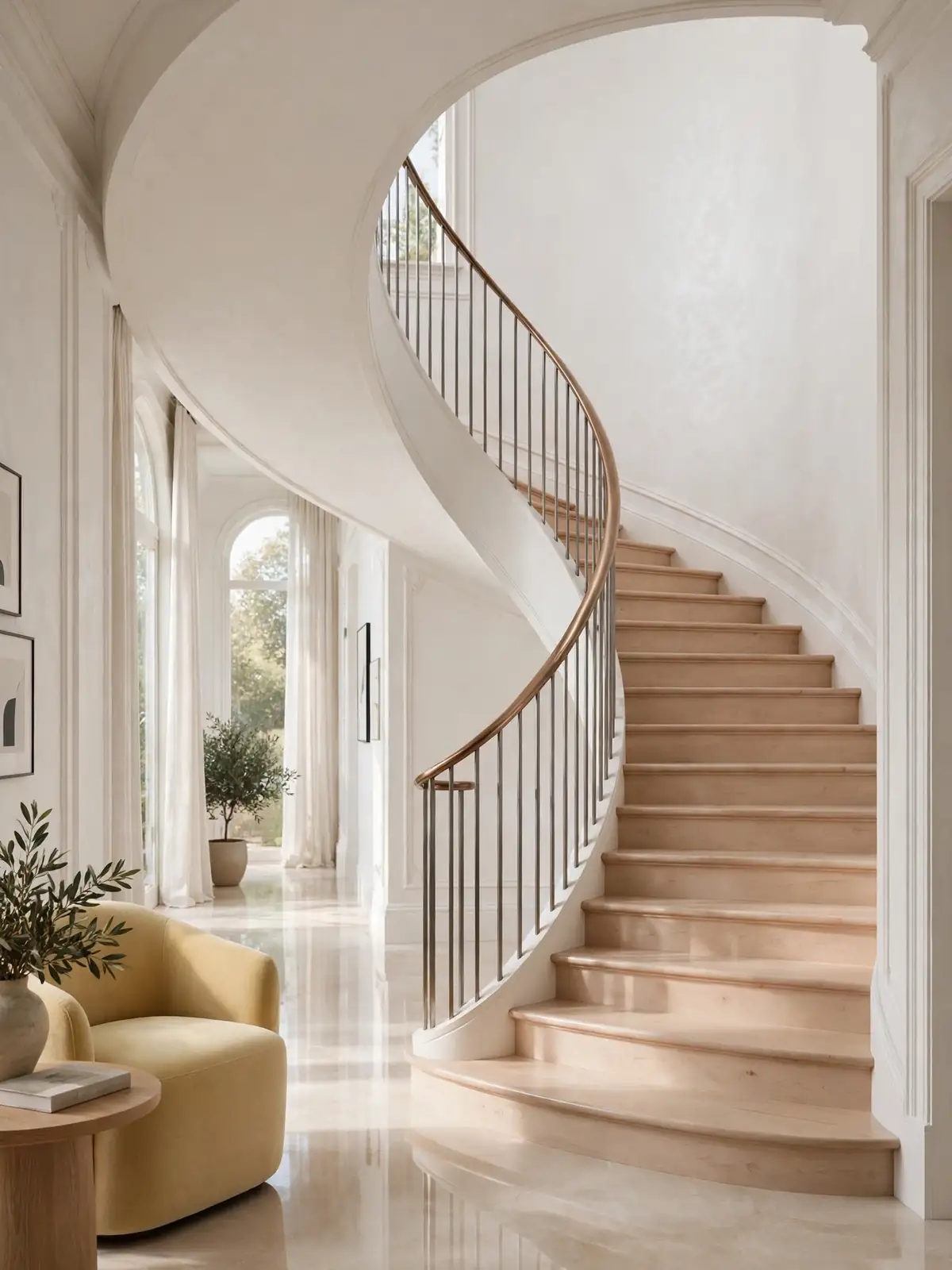
A curved handrail that follows a sweeping stair is the most graceful of all staircase handrail designs, because the rail becomes a flowing line through the room. On this stair, a slim pale maple handrail, steam-bent into a gentle curve, runs above slim steel balusters beside pale maple treads, each 1 metre wide at the outer edge. White walls keep the hallway bright, while a soft butter-yellow armchair at the base catches the morning sun and the curve of the rail draws the eye smoothly upward.
Quick tips:
- Use steam-bent timber for a smooth, continuous curve.
- Keep the balusters slim so the curve stays the feature.
- Pair pale maple with white walls for a light, graceful look.
- Add one warm accent, like a butter-yellow chair, at the base.
A Handrail Design in Smoked Oak With Brass Brackets
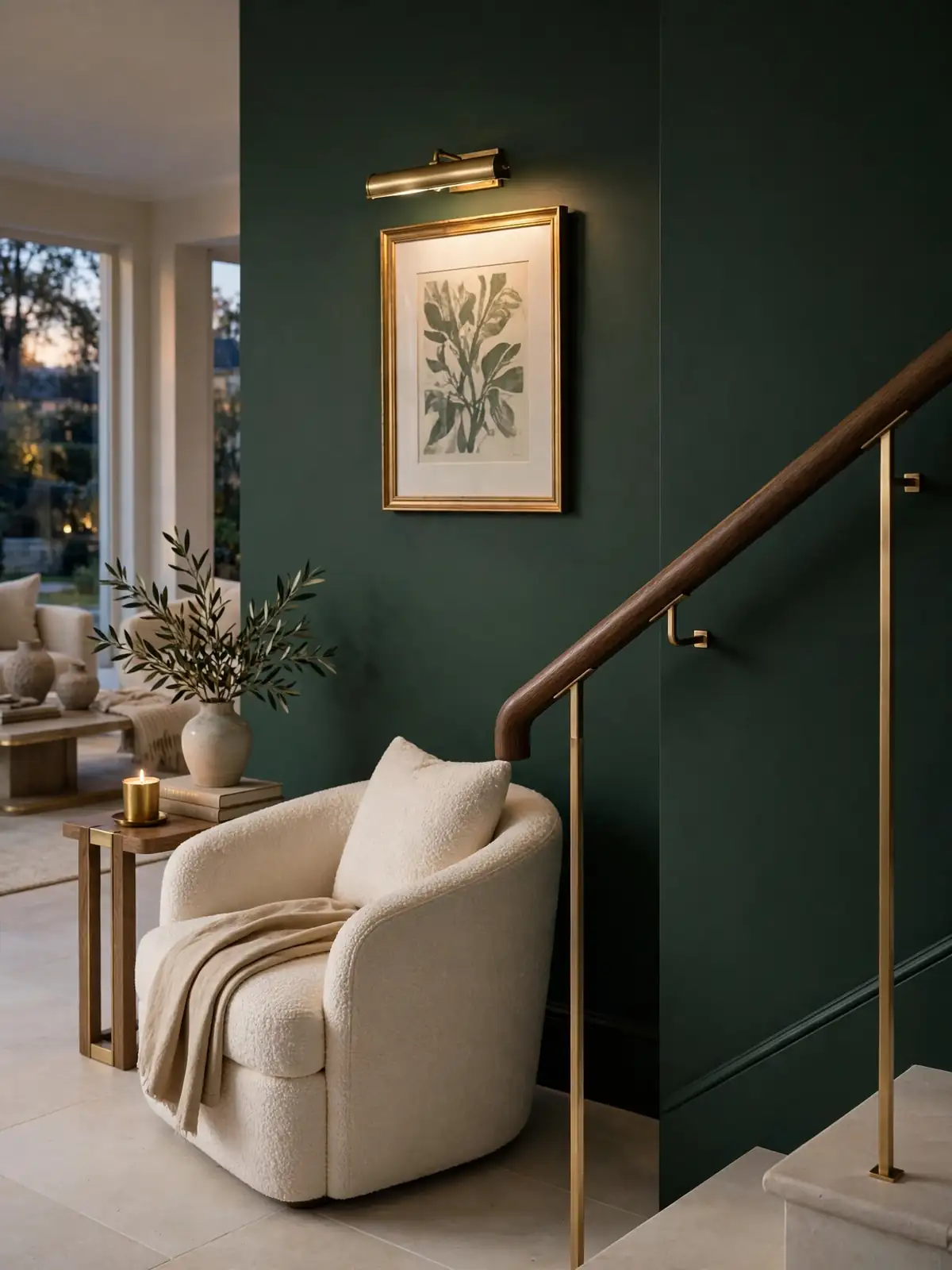
Smoked oak with brass brackets is one of the richest staircase handrail designs, because the dark timber and warm metal flatter each other perfectly. Here, a smoked oak handrail, 60 mm wide with a softly rounded top, runs on slim brass brackets beside a deep forest-green wall, with pale stone treads, each 900 mm wide, below. A cream boucle armchair and a brass picture light warm the green in the evening, while the pale stone floor keeps the room from feeling dark.
Quick tips:
- Choose smoked oak for depth without the harshness of black.
- Keep the brass brackets slim so they read as jewellery, not hardware.
- Add brass fittings elsewhere so the rail feels intentional.
- Use a matte tread finish to avoid glare in low light.
A Handrail Design With Decorative Metal Brackets
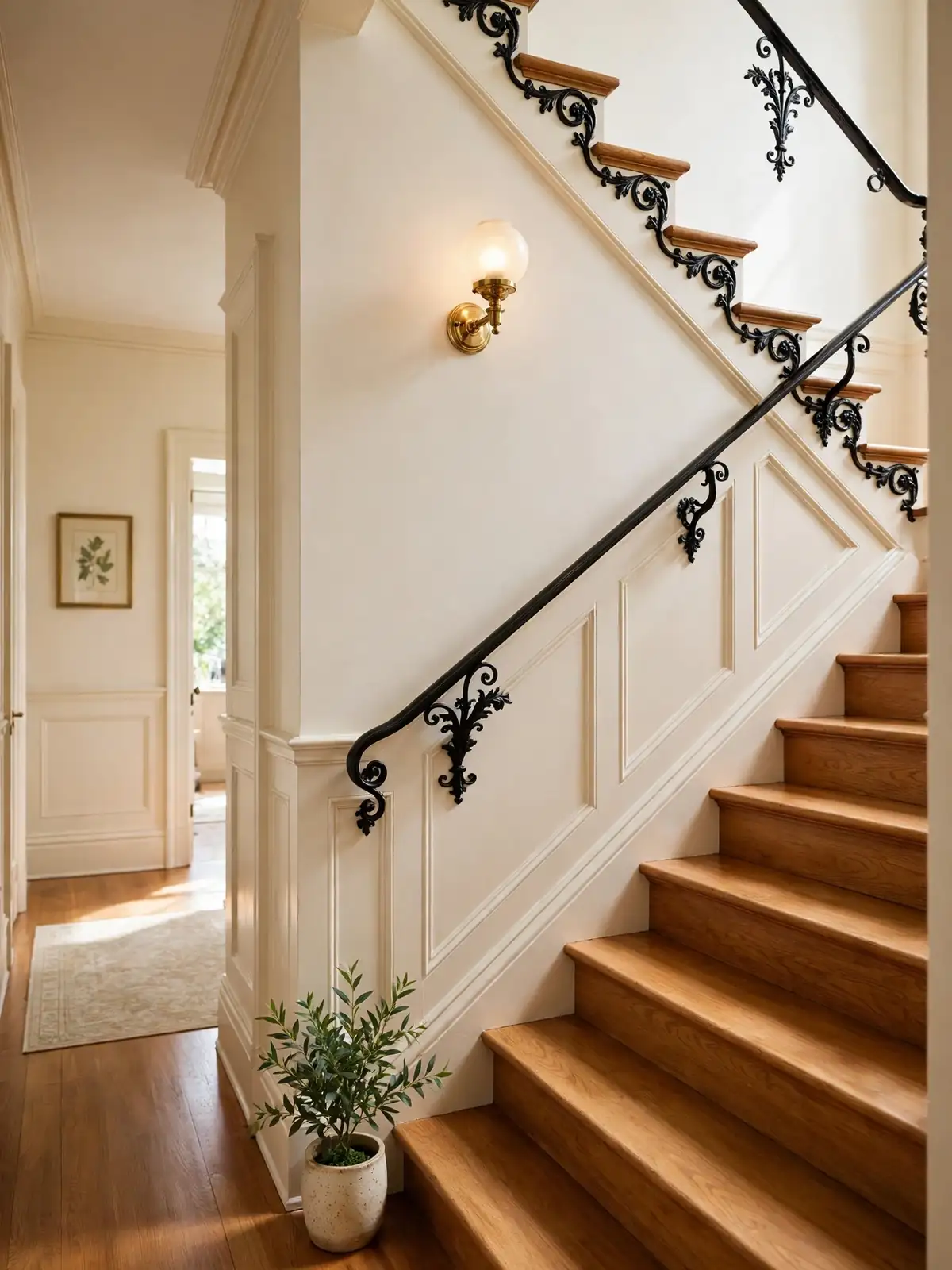
Decorative brackets turn the fixings of a handrail into a feature, and they are the detail that lifts a simple staircase handrail design into something special. On this stair, a warm honey oak handrail is held by five decorative black metal brackets, each one shaped into a simple scroll, fixed to a soft ivory wall beside honey oak treads, each 950 mm wide. A small green plant and a brass wall sconce add quiet warmth, while the scroll brackets catch the daylight and give the plain wall a crafted, finished look.
Quick tips:
- Choose one bracket shape and repeat it evenly along the flight.
- Space the brackets about 900 mm apart for a balanced rhythm.
- Match the bracket metal to the handrail fixings nearby.
- Keep the wall plain so the brackets stay the feature.
A Handrail Design in Pale Birch for a Scandinavian Stair
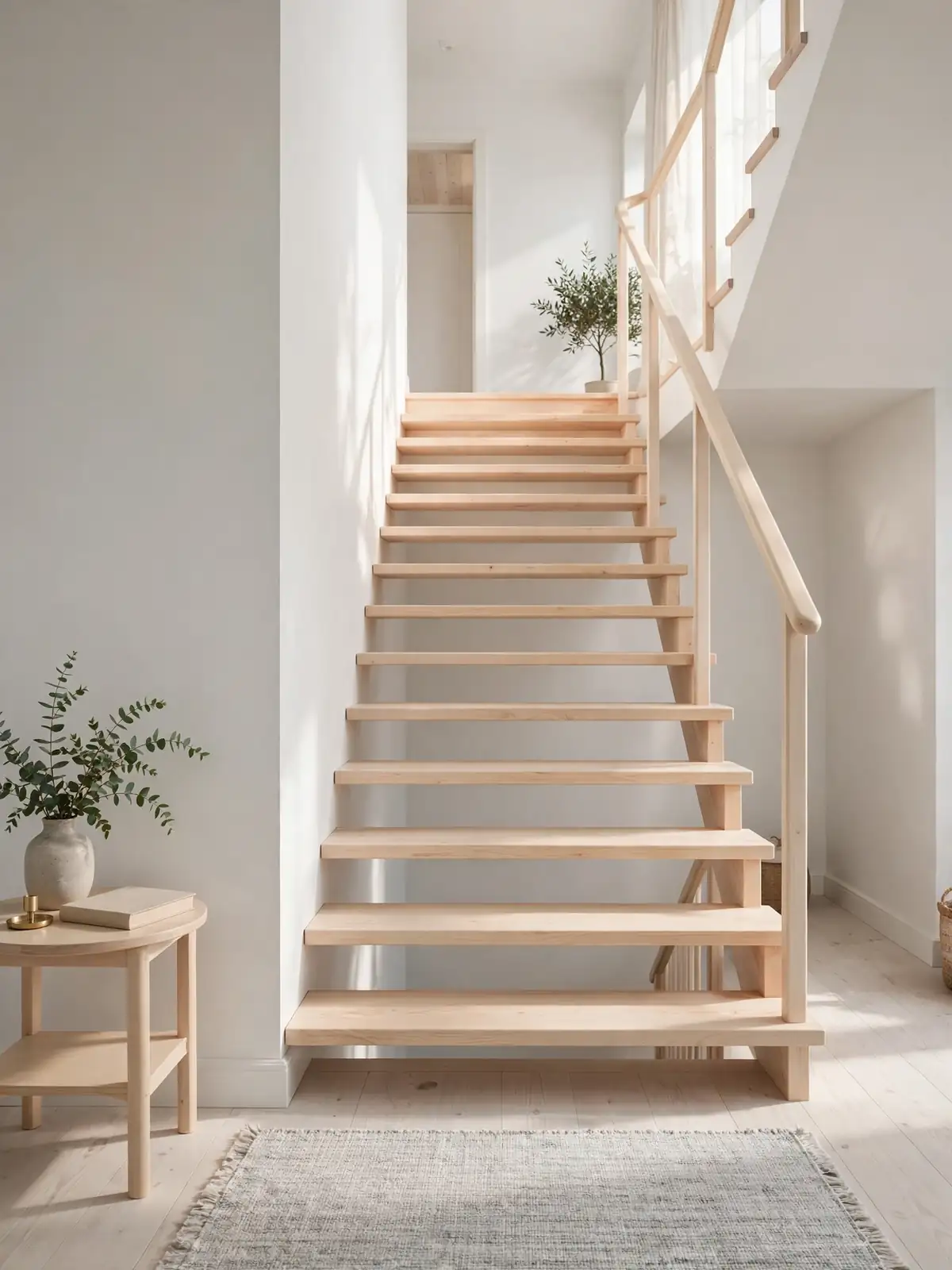
Pale birch is the freshest of all the timber staircase handrail designs, and it suits a Scandinavian stair perfectly. Here, a slim pale birch handrail, 50 mm wide, runs on slim white-painted brackets beside pale pine treads, each 900 mm wide, with whitewashed risers, 175 mm high. Soft white walls, a pale grey rug and a small wooden side table keep the hallway calm, while morning light falls across the birch and makes the whole stair shine softly.
Quick tips:
- Choose pale birch for the palest, freshest timber look.
- Use white brackets so the rail seems to float on the wall.
- Pair the stair with soft grey or pale peach furnishings.
- Oil the birch lightly so the grain stays visible.
An Art-Deco Handrail Design With Geometric Brass Inlay
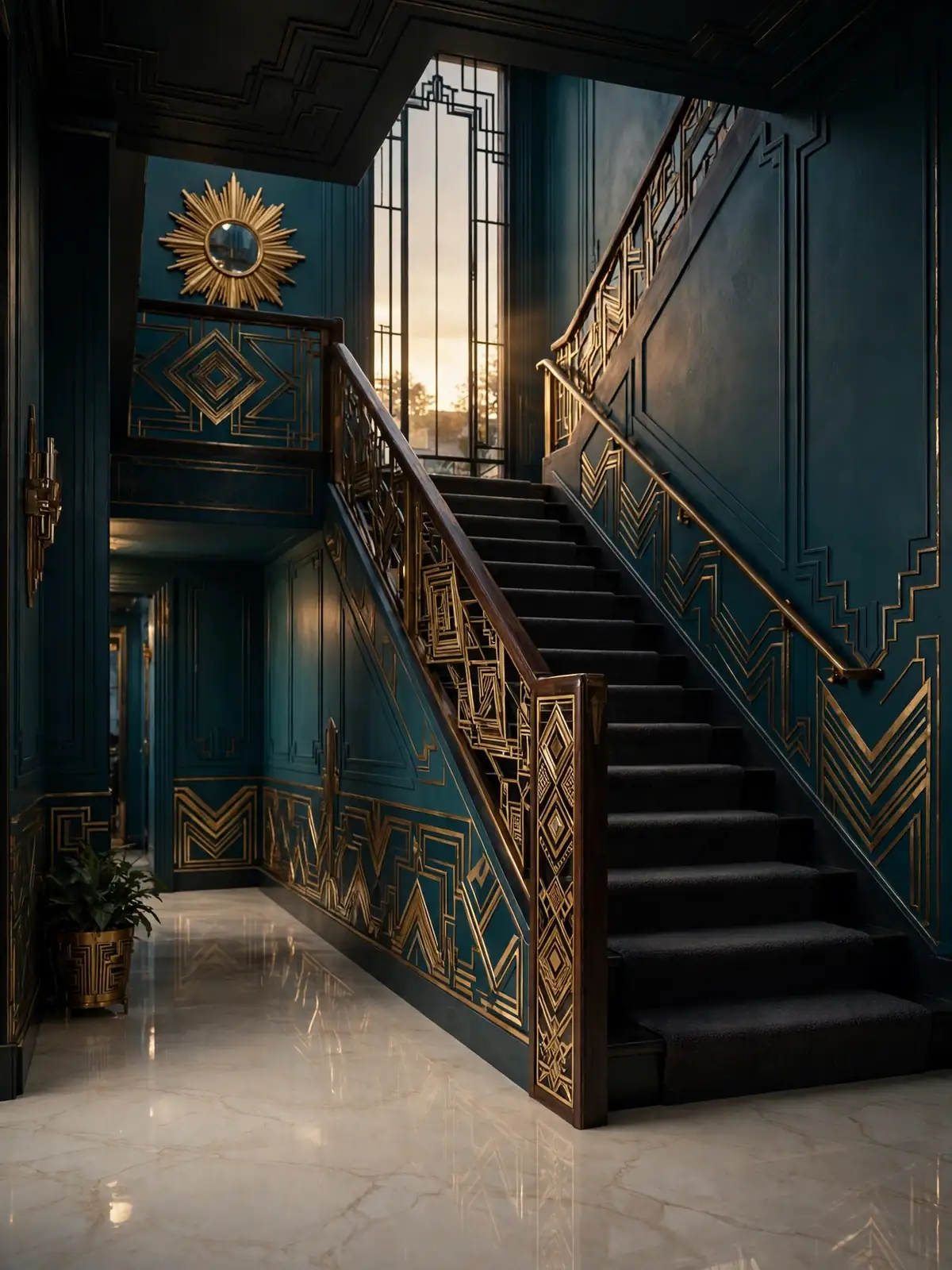
An Art-Deco handrail with geometric brass inlay is the boldest of the decorative staircase handrail designs, and it turns a stair into a piece of jewellery. Here, a dark walnut handrail carries a slim geometric brass inlay — a repeating fan pattern — along its outer face, running beside dark charcoal treads, each 950 mm wide, and a deep teal wall. A gold sunburst mirror on the landing and a cream marble floor keep the hallway glamorous, while the brass inlay catches the evening light on every step.
Quick tips:
- Use a simple geometric inlay — fans or chevrons — for a true Deco look.
- Keep the inlay on the outer face so the grip stays smooth.
- Pair dark timber with deep teal for a rich, dramatic contrast.
- Match the brass tone to a mirror or sconce nearby.
Staircase Handrail Designs That Suit a Narrow Hallway
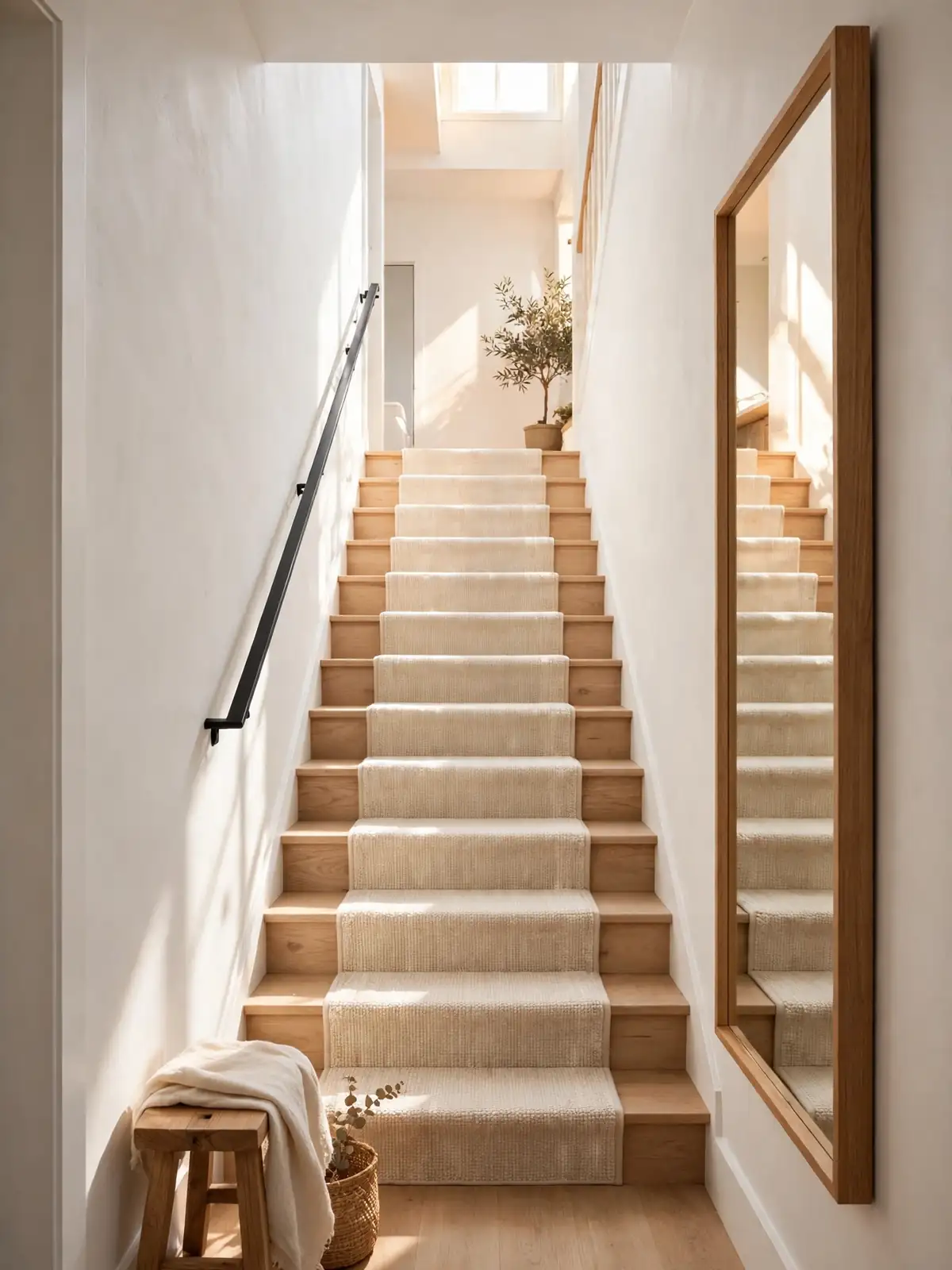
A narrow hallway needs a handrail design that disappears, and the best staircase handrail designs for a tight space are the slim ones. In this compact home, a slim pale oak handrail, just 45 mm wide, is fixed flat to a soft white wall on slim brackets, beside pale oak treads, each 850 mm wide, while a tall mirror, 1.8 metres high, doubles the daylight and a cream runner softens the climb. A small wooden stool at the base keeps the hallway uncluttered, and because the rail is slim, pale and close to the wall, the stair feels twice as wide as it really is.
Quick tips:
- Use a slim rail — about 45 mm wide — in a narrow hallway.
- Fix the rail close to the wall so it never eats into the walking width.
- Choose pale timber so the rail blends with the wall.
- Add a tall mirror to double the daylight in a tight stairwell.
FAQs
What are the most popular staircase handrail designs?
Classic solid oak, floating wall rails with hidden brackets, matte black steel, glass panels with a timber top rail, and leather-wrapped rails are the most popular right now. Oak suits traditional and farmhouse homes, steel and glass suit modern homes, and leather suits any home that wants a warm, tactile feel. The most popular design is usually the one that matches the home around it.
What material is best for a stair handrail?
Wood is the warmest and most comfortable to grip, metal is the strongest and most modern, glass keeps the stair light and open, and cable suits a minimal, airy look. For a family home, wood or leather is kindest to hands; for a modern home, steel or glass is easiest to clean. There is no single best material — the best choice is the one that suits your home’s style and the people who use the stairs every day.
What is the difference between a handrail and a railing?
A handrail is the rail you grip as you climb, fixed to the wall or to the top of the balustrade. A railing — also called a balustrade — is the whole protective barrier: the handrail plus the balusters or panels below it that stop you falling from the open side of the stair. You hold the handrail; the railing is what keeps you safe.
Which handrail design is best for a modern home?
Floating rails with hidden brackets, matte black steel, glass panels with a slim timber top rail, and cable systems all suit modern homes, because they keep the stair light and architectural. Pair them with pale oak or walnut treads so the stair never feels cold, and keep the fixings slim so the rail reads as one clean line.
Can I mix materials on a handrail?
Yes — mixed materials usually look more designed than a single material alone. Timber with black steel, glass with brass, leather over a steel core, and oak with iron brackets are all classic combinations. Keep one material dominant and the second as an accent, so the rail reads as one clear design rather than a collection of competing finishes.
Conclusion
A staircase handrail design is not just a safety feature — it is the part of the stair you touch every day, and the detail that tells visitors what kind of home they are in. Whether you choose classic solid oak, a floating rail with hidden brackets, glass with a walnut top rail, industrial pipe, leather, brass, cable, marble or a carved timber rail, the best staircase handrail design is the one that feels good in the hand and suits the rooms around it. Keep the material honest, the grip comfortable, and the fixings neat, and your handrail will make every climb feel considered, comfortable and beautiful.