25 Stunning Accent Wall Staircase Ideas for a Dramatic Home Upgrade
Your staircase wall is the largest blank canvas in the
An accent wall staircase is a staircase wall deliberately treated as a design focal point — with bold paint, wallpaper, paneling, a mural, or layered lighting — so the climb between floors becomes a visual experience instead of a forgotten transition. Because stair walls are tall, narrow, and seen in motion, they carry drama better than almost any other wall in the house: color looks richer, texture reads stronger, and art arranged along the slope creates natural movement.
The best approach depends on your light, your stair layout, and how bold you want to go. Paint and removable wallpaper deliver the biggest change for the least money; paneling and stone cost more but age beautifully. If your stairs open directly off the entry, tie the look together with coordinated hallway decor ideas so the whole route from front door to upper floor feels like one intentional design. Below are 25 ideas, each with the practical notes that actually matter before you commit.
A Color-Drenched Accent Wall Staircase in Deep Teal
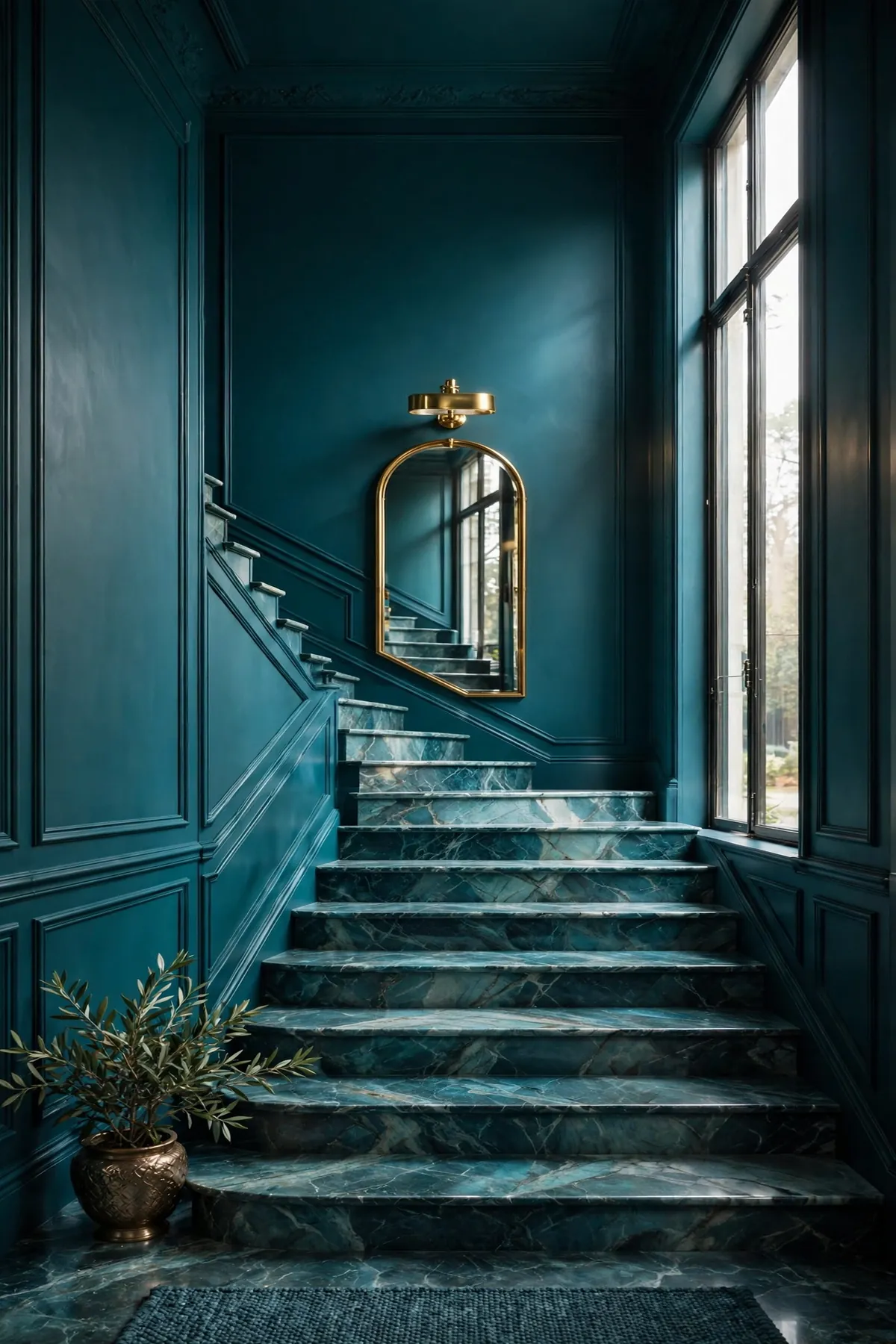
Color-drenching takes the wall, the stair treads or risers, and often the trim, and paints them all in one saturated shade — here, a deep teal. It works because it erases the visual clutter of white trim lines and door frames, making a narrow stairwell feel like a deliberate architectural volume rather than a leftover gap. Best for: confident color lovers with decent natural light; deep teal reads green in daylight and near-black at night, which is half the charm. Weakness: it demands light — in a windowless stairwell it can feel cave-like — and painted treads scuff faster than stained wood, so keep touch-up paint on hand.
- Paint treads and risers too, or at least the risers, so the color feels structural rather than applied.
- Use a satin or eggshell finish on the wall and a tougher satin enamel on treads for durability.
- Test a large swatch at both the top and bottom of the stairs — light changes dramatically along the climb.
Floor-to-Ceiling Vertical Wood Slats
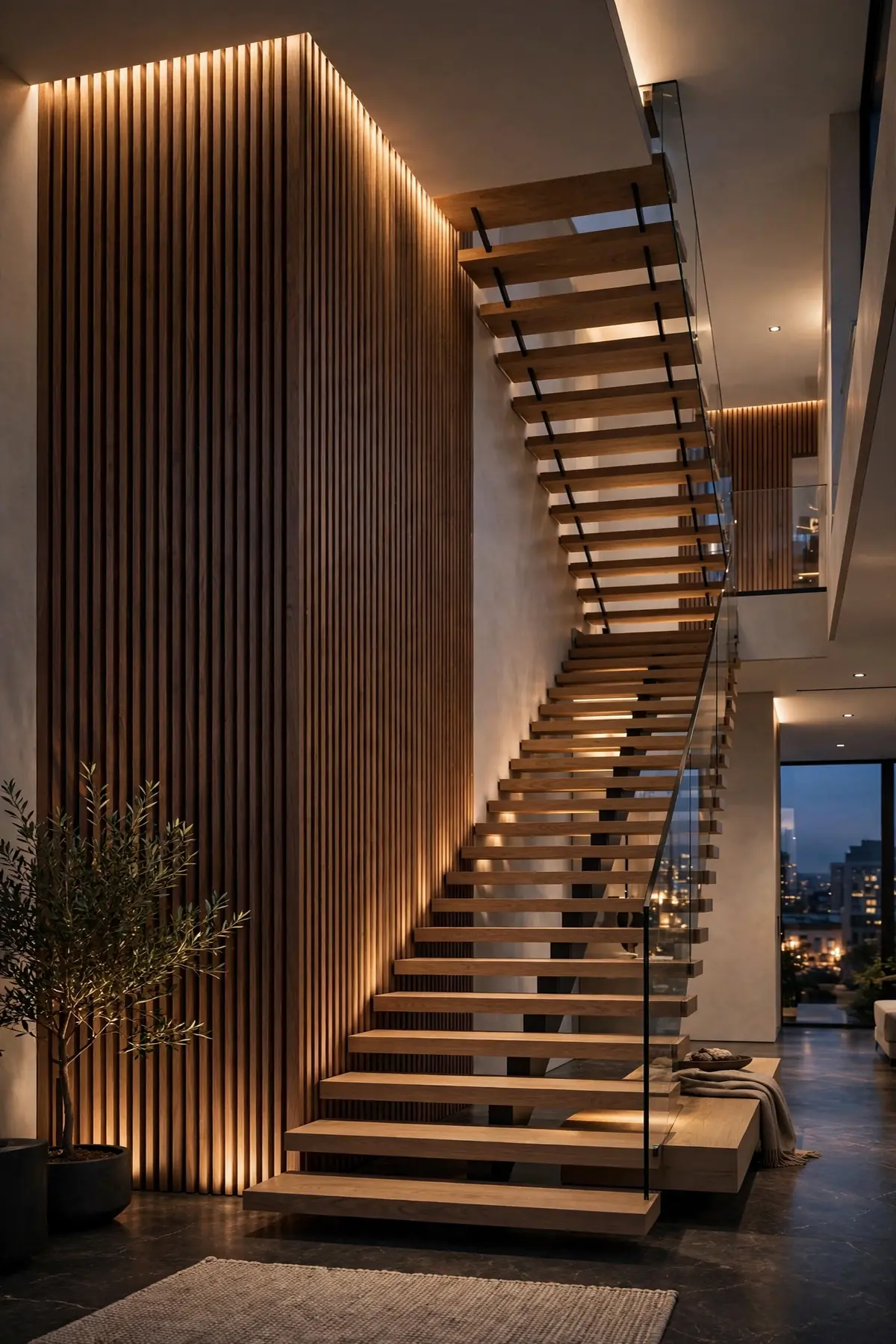
Vertical walnut or oak slats run the full height of the stair wall, with narrow gaps that add shadow and rhythm. The vertical lines pull the eye upward and make low ceilings feel taller, while the wood brings warmth that painted walls can’t. Best for: modern and Japandi-style homes, and stairwells that feel cold or echoey — slats over acoustic felt backing noticeably soften sound. Weakness: dust collects between slats and they’re unforgiving to install crooked; buy pre-made slat panels rather than individual battens unless you’re precise.
- Mount slats on black acoustic felt so the gaps read as deliberate shadow lines, not wall showing through.
- Run slats past the top landing and onto a short return wall so the feature doesn’t end awkwardly mid-climb.
- Seal with matte polyurethane — glossy finishes make wood slats look dated fast.
Moody Green Walls with Brass Sconces

A deep forest or hunter green wall paired with a row of small brass sconces climbing the slope gives the stairwell a dark-academia, members-club feel. The green absorbs light while the brass throws warm pools of it back, so the wall feels layered rather than flat. Best for: traditional and transitional homes, and anyone who wants drama without wallpaper’s commitment. Weakness: green undertones shift with light bulbs — test with your actual sconce bulbs (2700K warms it; 4000K can turn it muddy).
- Space sconces evenly by stair count (one per two or three treads) rather than by wall measurement for a natural rhythm.
- Choose hardwired sconces with dimmers; battery puck lights look cheap in this setup.
- Keep the handrail dark wood or black metal — chrome fights the moody palette.
Full-Height Botanical Mural Panels
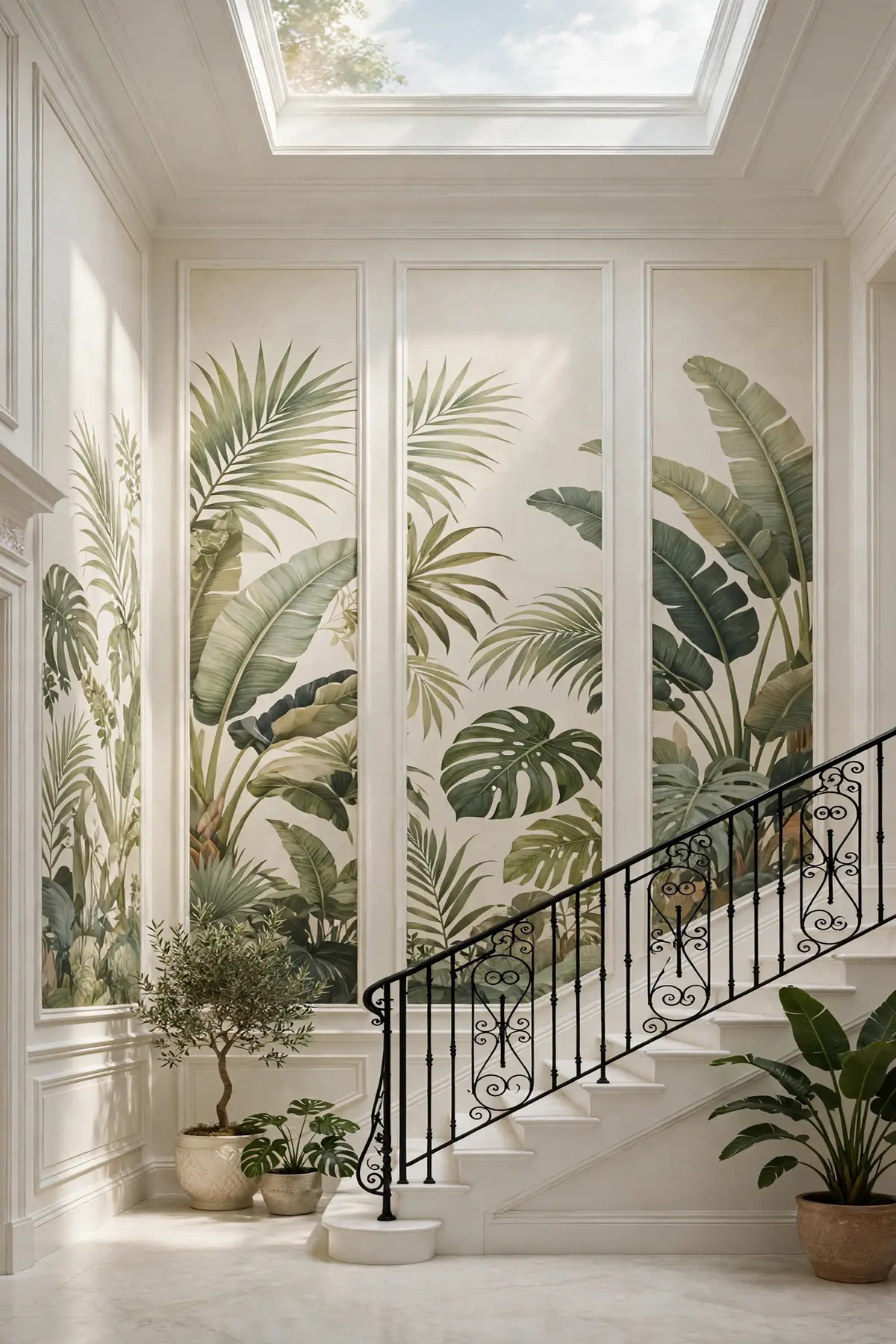
Oversized botanical mural panels — banana leaves, palms, or eucalyptus at 2–3x real scale — turn a tall stair wall into a conservatory moment. Unlike repeating wallpaper patterns, a mural is one continuous scene, so the eye travels it the way you’d walk a garden path. Best for: double-height stairwells where a single repeating pattern would feel busy; also great for bringing life to windowless stairs. Weakness: murals are printed to your wall’s exact dimensions, so measure twice — and they don’t forgive bumpy walls.
- Order the mural 5–10 cm taller than the wall and trim at the ceiling line for a clean fit.
- Keep the stair railing simple (thin black metal or glass) so the mural stays the hero.
- Choose a mural with a light background if your stairwell lacks windows; dark murals need light to read.
Soft-Movement Limewash Plaster
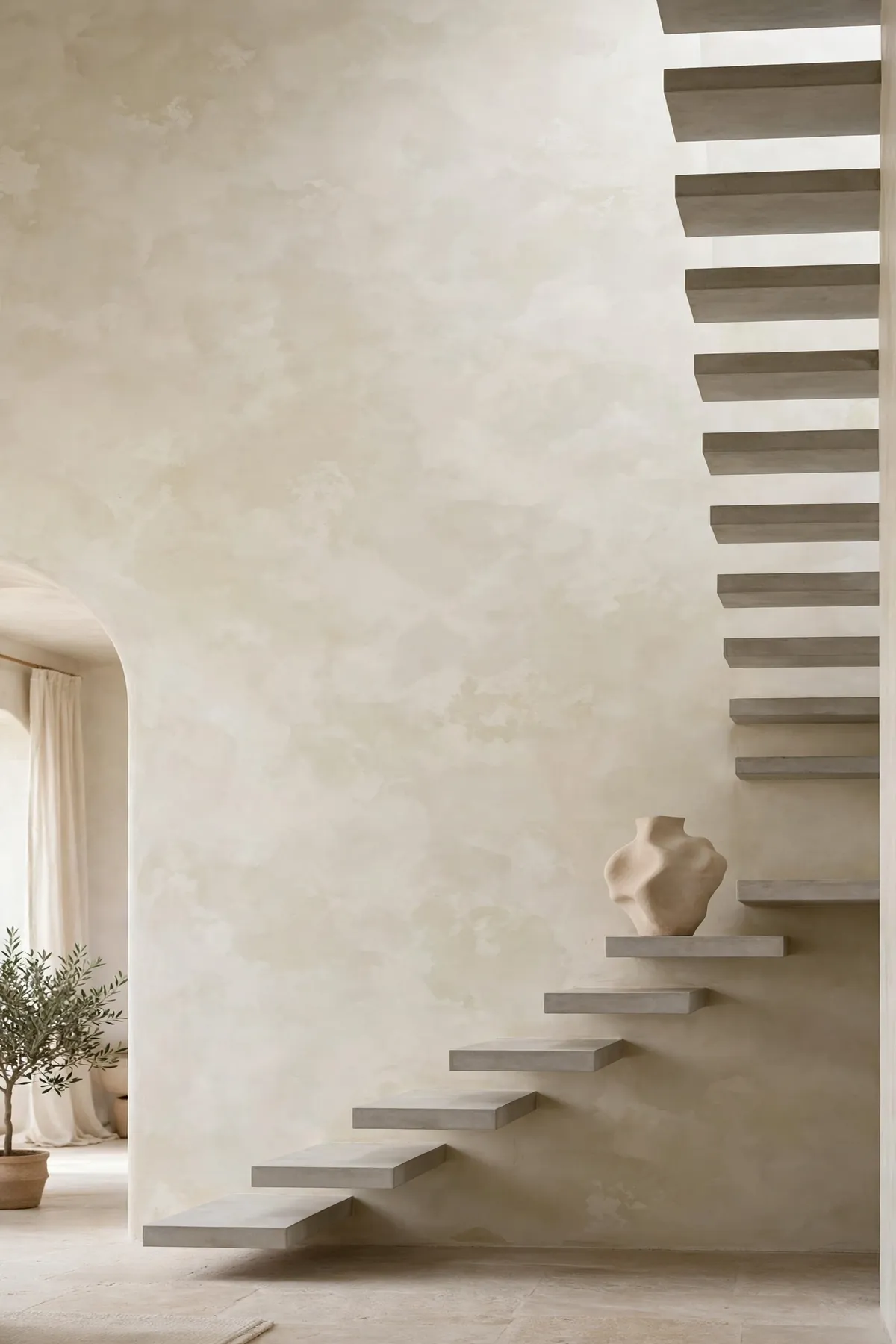
Limewash paint, brushed on in overlapping X-strokes, gives plaster walls a soft cloudy movement that flat paint can’t replicate. In an ivory or warm greige tone it keeps the stairwell calm and quiet-luxury while adding the depth that makes tall walls feel finished rather than blank. Best for: minimalists who find plain white boring but patterned wallpaper too loud. Weakness: limewash is a finish, not a fix — it won’t hide bad drywall seams, and touch-ups are nearly impossible to blend invisibly.
- Apply with a large block brush in random crisscross strokes; roller application defeats the purpose.
- Use a mineral primer first on previously painted walls or adhesion suffers.
- Two coats minimum — the first coat always looks patchy and alarming.
Board-and-Batten That Follows the Slope
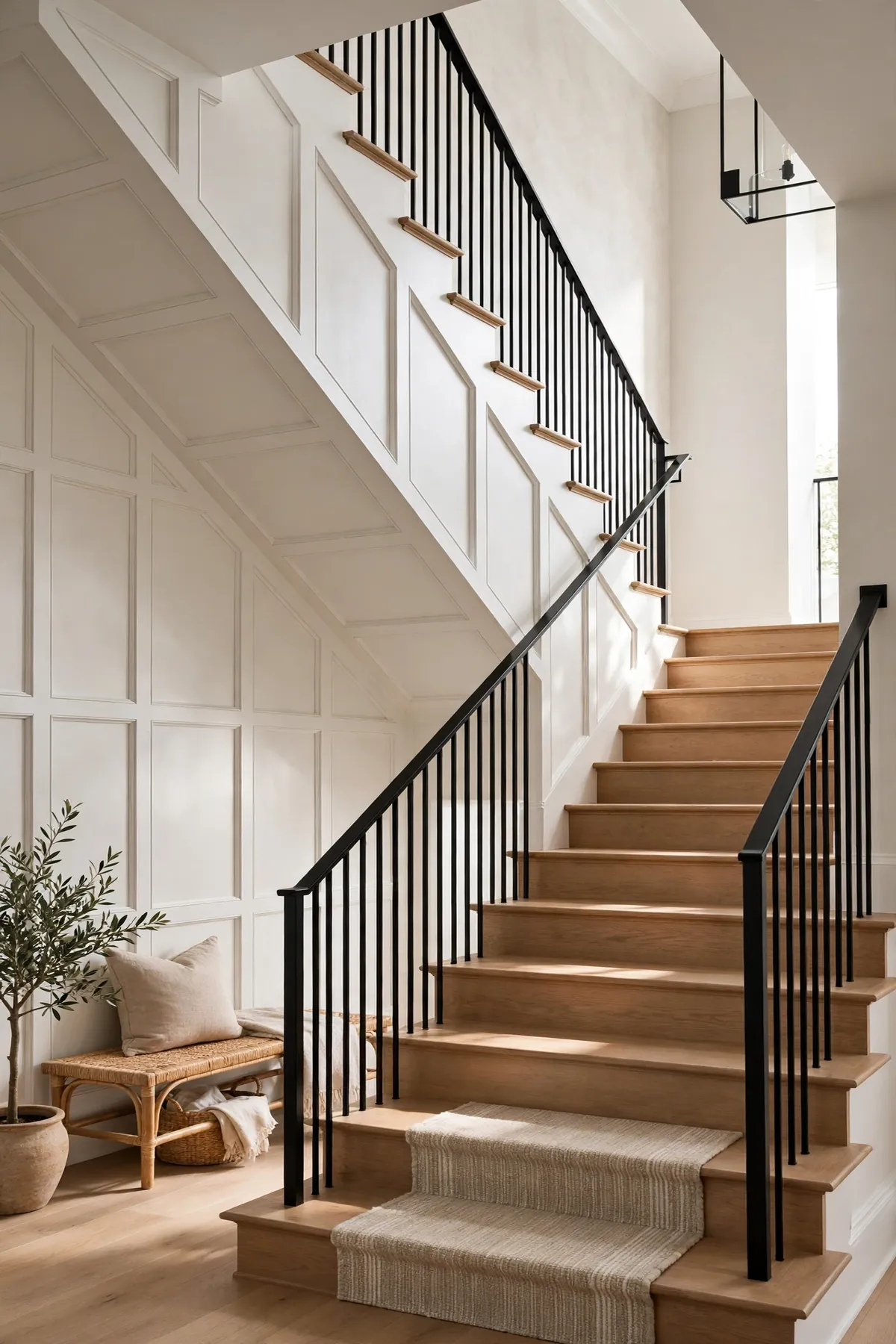
Instead of stopping paneling at a horizontal chair rail, board-and-batten boxes are cut to follow the staircase’s diagonal slope, so the geometry climbs with you. Painted warm white, it adds classic structure to a tall wall without the formality of full wainscoting. Best for: farmhouse, transitional, and coastal homes; excellent at breaking up a wall that’s tall but narrow. Weakness: every angle must be measured from the actual stair pitch — a degree off compounds across the wall, so this is a measure-twice project.
- Cap the top of the paneling with a small ledge rail; it catches dust but adds a finished furniture-like edge.
- Paint the paneling and the wall above in the same white to keep it airy, or two tones for contrast.
- Use MDF battens indoors — real wood moves with humidity and opens joints on long diagonal runs.
An Ascending Black-and-White Photo Ribbon
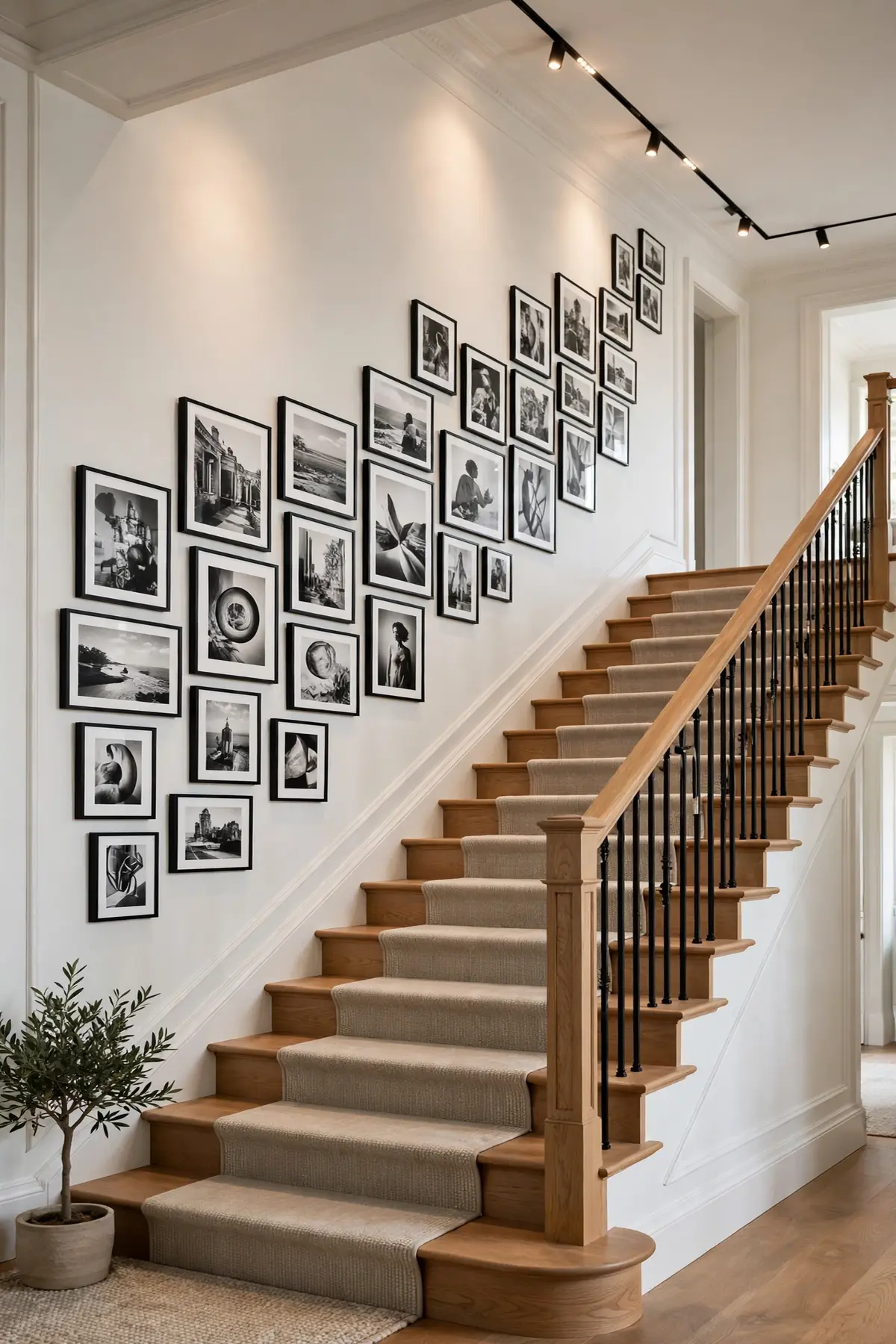
A ribbon of black-and-white photographs in thin matching frames flows diagonally up the wall, following the stair pitch like a film strip. Restricting every image to monochrome is what makes it work — color photos at this scale turn chaotic, while black-and-white reads as one curated piece. Best for: personalizing a stairwell with family or travel photos without the cluttered look of mixed frames. Weakness: it needs enough frames to feel like a ribbon (think 15+); too few and it looks like random pictures on a wall.
- Lay the arrangement on the floor first, then transfer it using paper templates taped to the wall.
- Keep 5–7 cm gaps between frames and align the bottom edges to an imaginary line parallel to the stair slope.
- Mix orientations (portrait, landscape, square) but keep frame sizes to two or three for cohesion.
Fluted Oak Paneling with a Hidden LED Cove
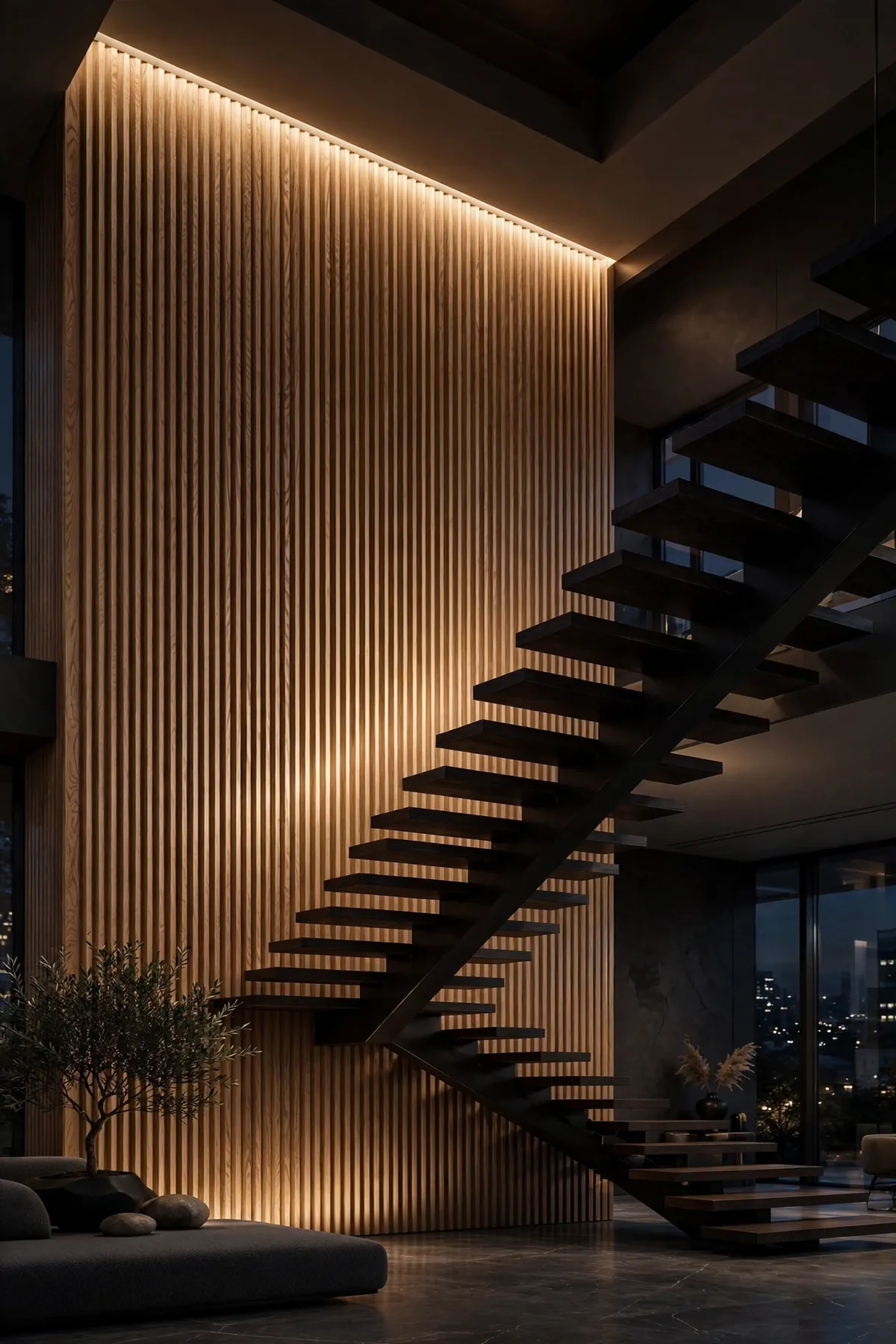
Fluted (reeded) oak panels cover the stair wall while a concealed LED strip at the top edge washes warm light down the flutes, turning the texture into evening theater. By day it’s a warm wood wall; by night the grazing light makes every flute cast a shadow line. Best for: modern luxury homes and anyone whose staircase is a main evening view from the living area. Weakness: the cove detail needs a small pelmet or shadow gap to hide the strip — surface-mounted LED tape with visible dots ruins the effect.
- Use high-CRI (90+) LED strips at 2700K so the oak glows amber, not green-gray.
- Hide the strip in a 5 cm recessed channel at the ceiling junction; a diffuser prevents dot-spotting.
- Put it on a dimmer or smart switch — full brightness flattens the flute shadows.
One Oversized Painting in a Tall Arched Niche
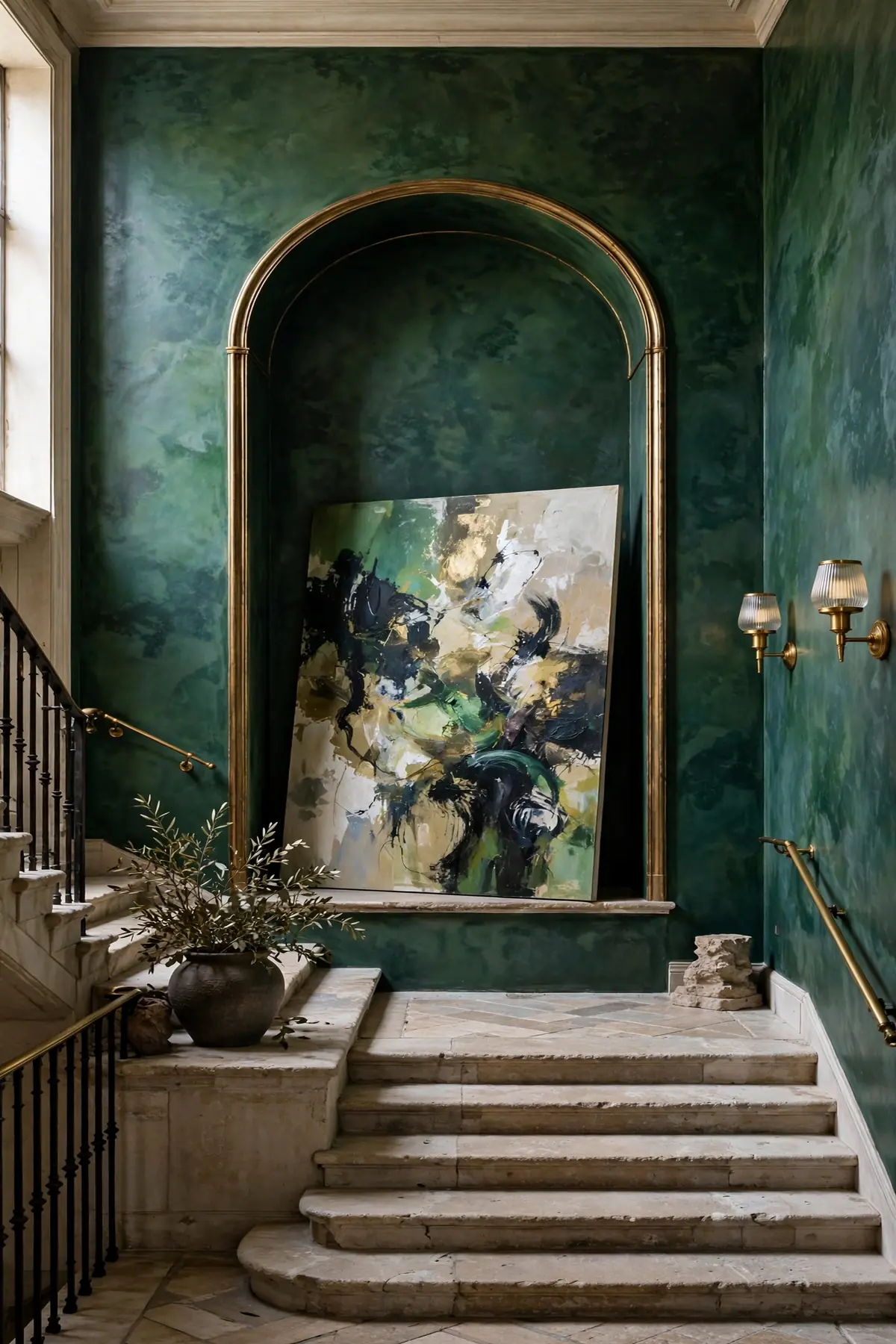
Rather than many small frames, one large-scale painting leans inside a tall arched niche on the landing wall — a single confident gesture instead of a gallery. The arch frames the art architecturally, so even an abstract piece feels intentional and collected. Best for: landings with a flat wall section and high ceilings, where a gallery wall would feel fussy. Weakness: scale is everything — an artwork that looks big in the shop often reads small on a stair wall, so go larger than your instinct (at least 1.2 m on the long side).
- Lean the canvas rather than hanging it for a relaxed gallery feel; secure the bottom with museum putty if you have kids or pets.
- Paint the niche interior a tone darker than the surrounding wall to create depth around the art.
- Light it with a slim picture light or a directional recessed spot — oversized art dies in flat ambient light.
Charcoal Walls with a Glowing Reeded-Glass Railing
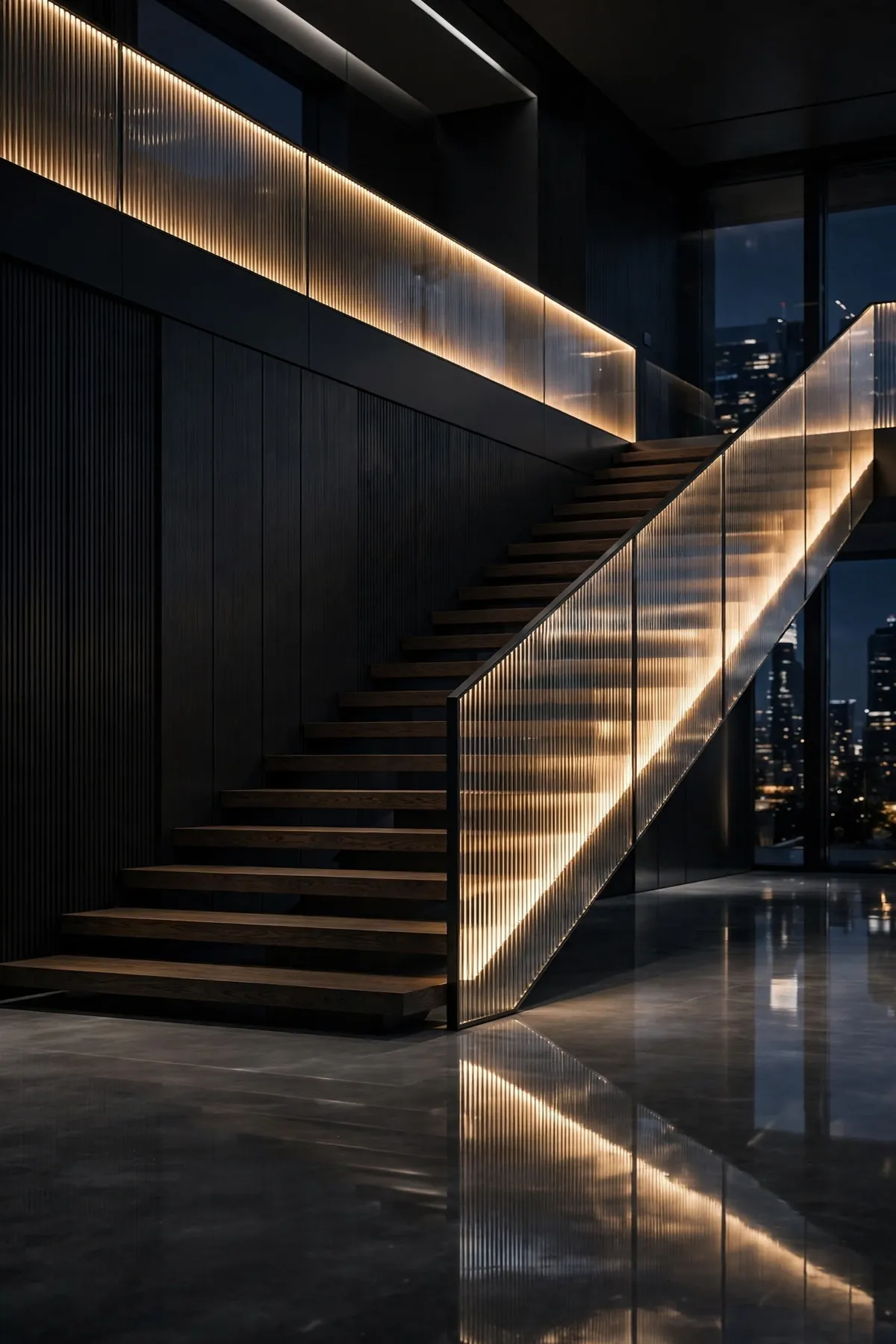
The wall goes near-black charcoal while the stair railing becomes the light source: reeded (fluted) glass panels with concealed backlighting glow like a lantern against the dark wall. It’s the inverse of the usual approach — the railing, not the wall, is the accent — and it makes evening stair climbs feel cinematic. Best for: contemporary homes and staircases visible from the main living space at night. Weakness: backlit glass shows every fingerprint and dust speck, and the electrical work for the railing lighting is a pro job, not a weekend DIY.
- Choose reeded over clear glass — the flutes diffuse the light and hide smudges far better.
- Keep the charcoal matte, not satin; sheen on dark walls highlights every drywall imperfection.
- Balance the glow with one warm downlight at the top landing so the top of the stairs isn’t a dark void.
Natural Grasscloth for Quiet Texture
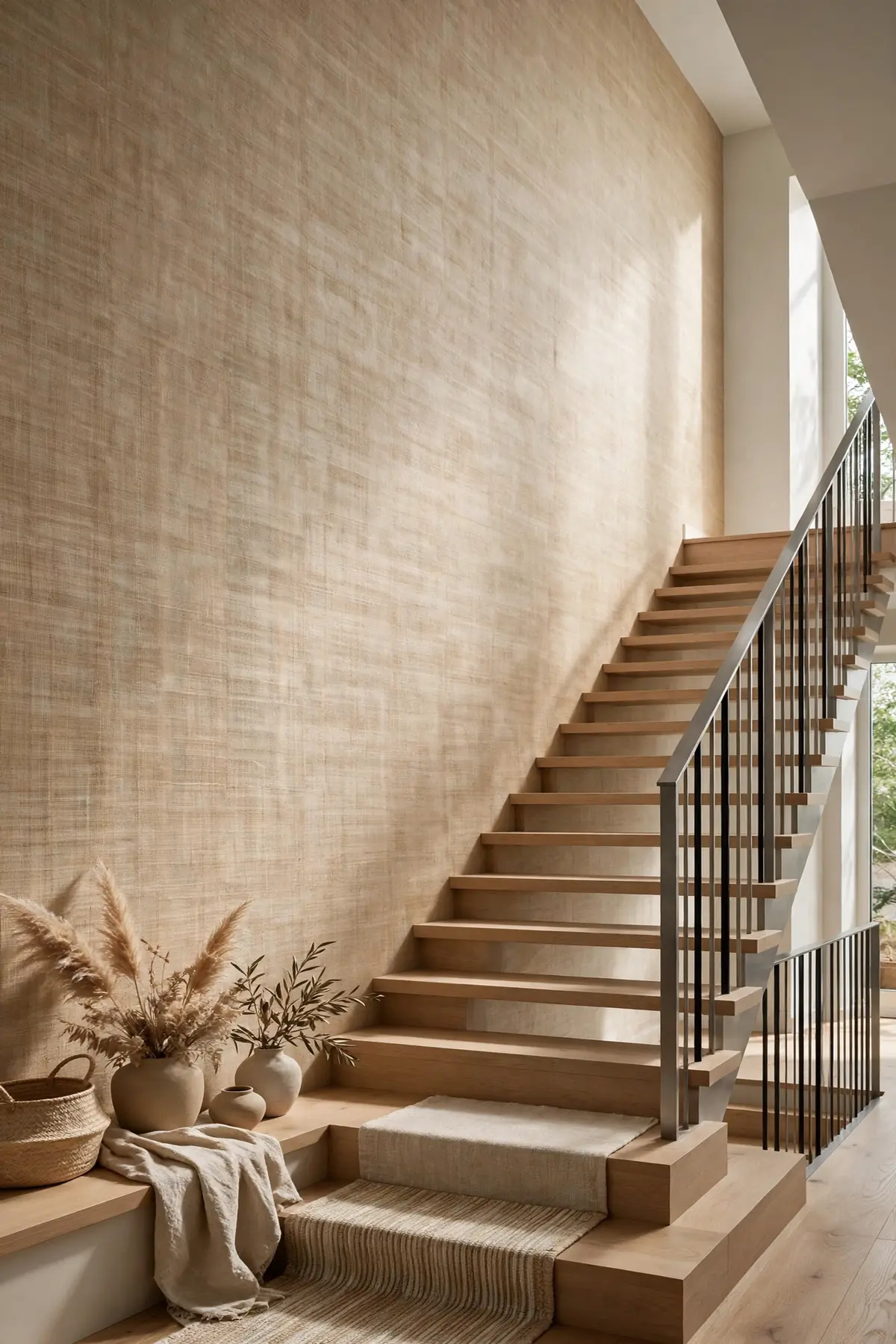
Grasscloth — woven natural fibers in linen, beige, or pale gold — gives the stair wall a tactile, light-catching surface that reads as quiet luxury rather than decoration. It doesn’t shout; it makes the wall feel expensive in the way a good suit feels expensive. Best for: neutral interiors where you want texture without pattern, and for softening the hard acoustics of a tall stairwell. Weakness: it’s genuinely delicate — scuffs and stains don’t clean out of natural fibers, so skip it on stairs used by kids with backpacks or pets with claws.
- Hang grasscloth with the seams planned on paper first; the weave pattern makes seams more visible than painted wallpaper.
- Order all rolls from the same dye lot — natural fibers vary noticeably between batches.
- Apply a clear matte wallpaper sealer if the stairs get heavy hand traffic along the wall.
Painted Terracotta Arches Climbing the Wall
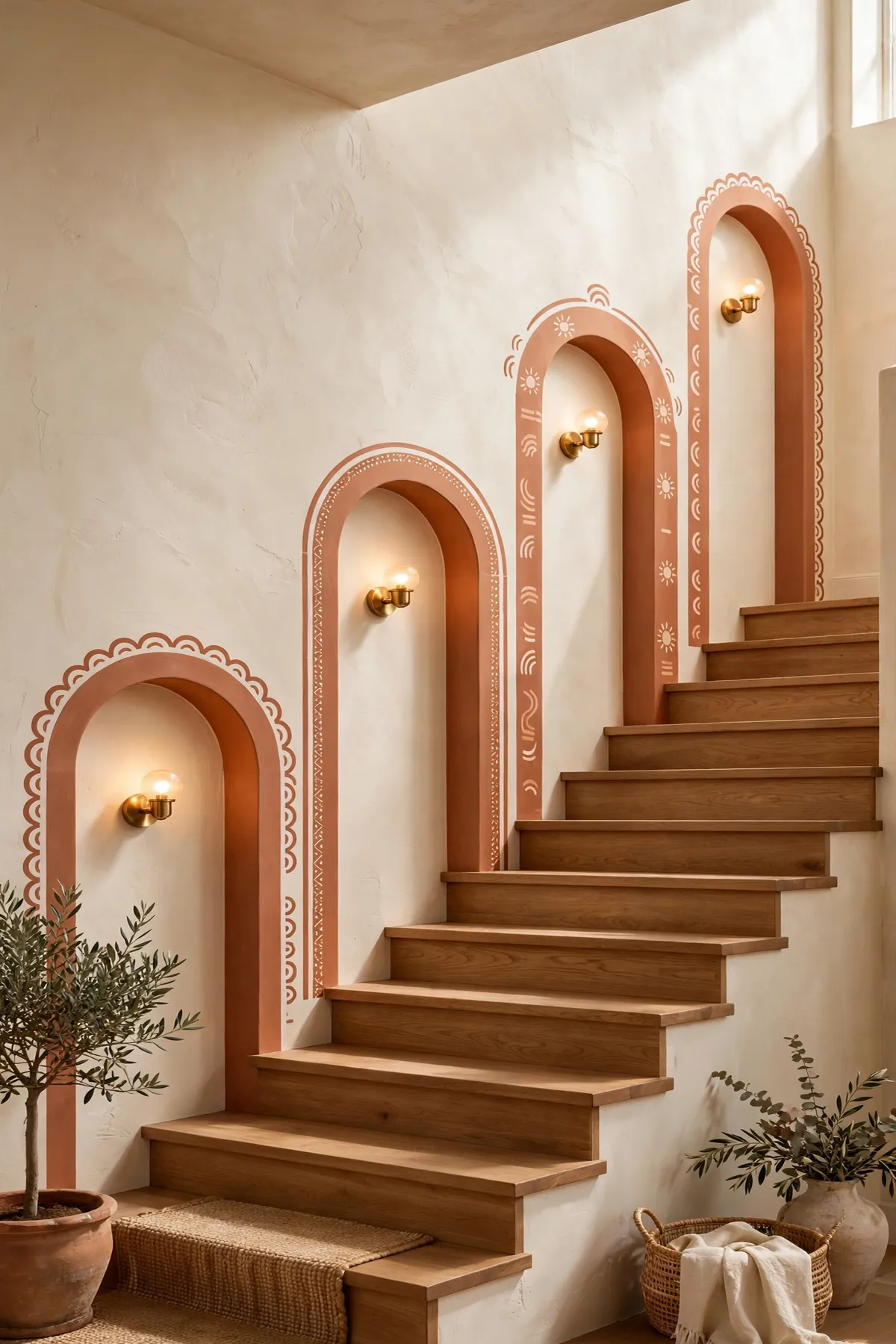
A series of painted arches in warm terracotta steps up the cream wall in time with the stairs, each arch framing a small brass sconce. It’s architectural paint — no construction, just geometry — and it gives a plain wall rhythm and a Mediterranean warmth for the cost of two paint colors. Best for: renters and budget makeovers (it’s just paint), and for breaking up a long, monotonous stair wall. Weakness: arch edges must be crisp — wobbly lines make the whole thing look crafty instead of designed — so use a good compass or arch stencil, not freehand.
- Draw arches with a pin-and-string compass directly on the wall for perfect curves.
- Seal the edge with the base-coat color under the painter’s tape line first to prevent bleed.
- Repeat the terracotta somewhere small nearby (a runner, a pot) so the color feels connected to the home.
Reclaimed Wood Planks Laid Vertically
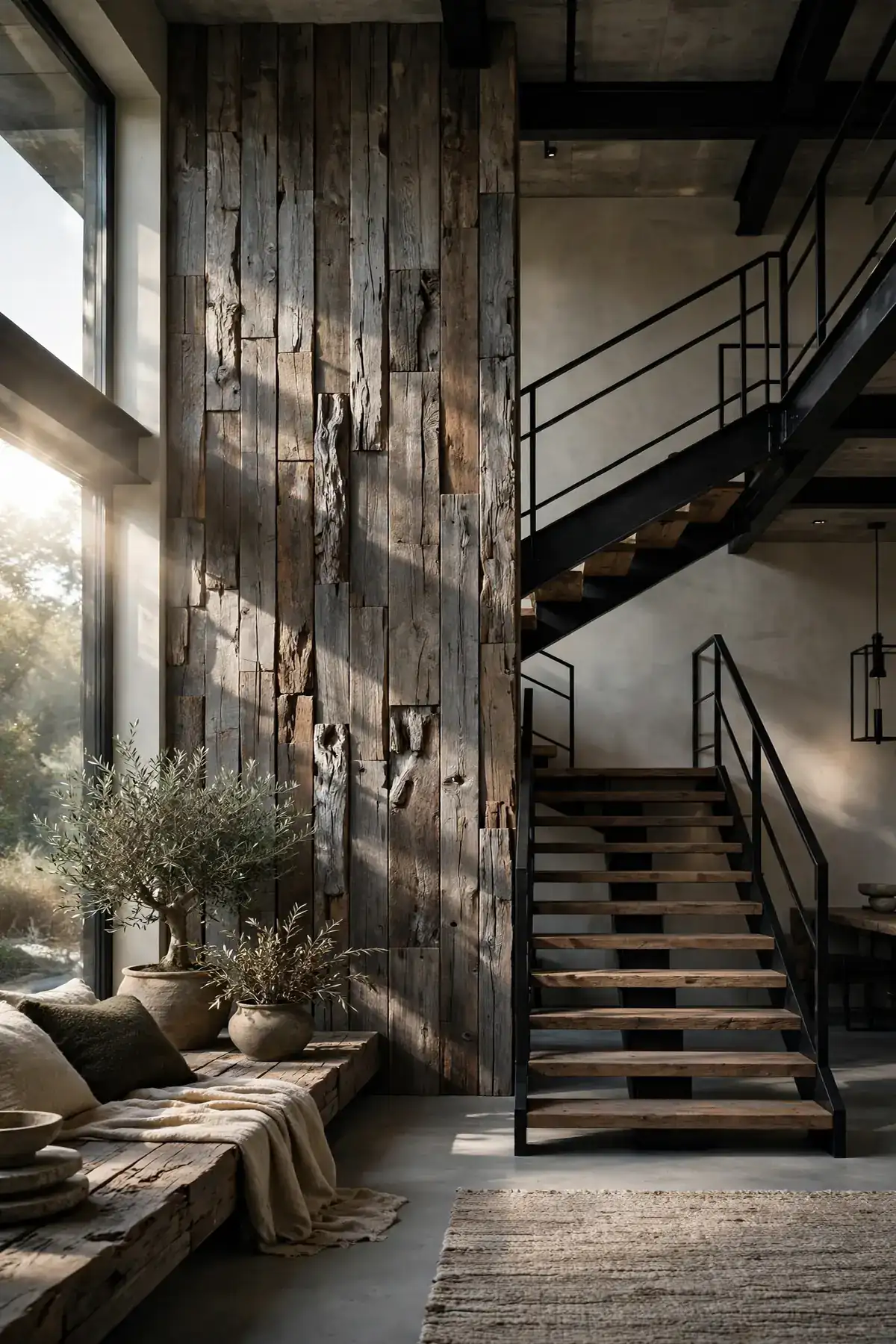
Weathered reclaimed planks run vertically up the stair wall, their gray-brown grain variation doing all the decorative work. Against a black steel staircase the combination lands industrial-rustic without tipping into cabin kitsch. Best for: modern farmhouse and industrial lofts; also a strong choice when the staircase itself is simple and needs a textural partner. Weakness: reclaimed wood is inconsistent by nature — budget 15–20% extra for boards you’ll reject — and it must be kiln-dried and sealed or it can harbor pests and off-gas.
- Source kiln-dried, sealed reclaimed boards from a reputable dealer, not a demolition freebie.
- Run planks floor-to-ceiling with no horizontal joints; stagger joints only if the ceiling is beyond board length.
- Keep the finish matte and skip stain — the weathered variation is the entire point.
A Jewel-Tone Geometric Mural
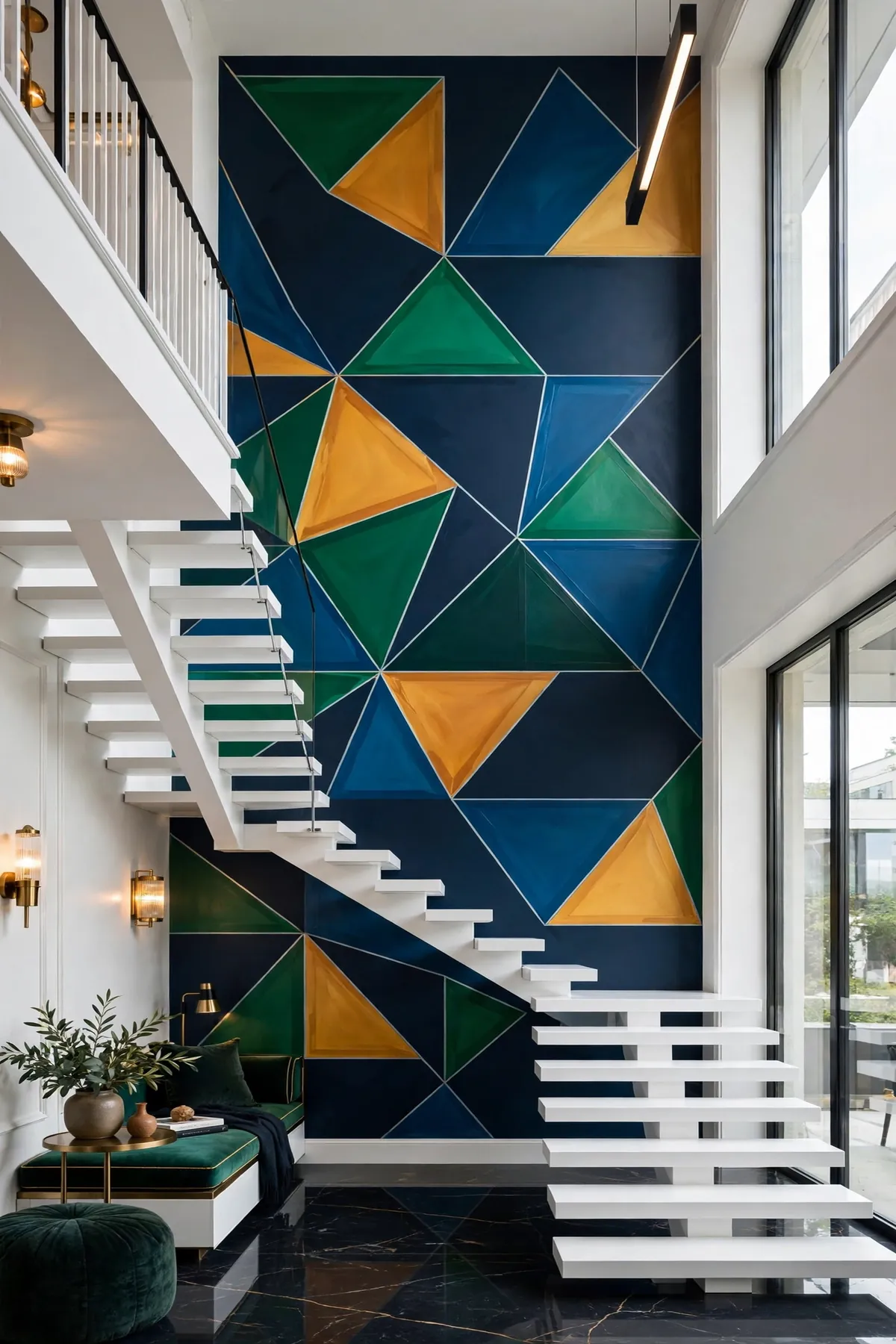
Sharp triangles in emerald, sapphire, and amber on a deep navy ground turn the stair wall into large-scale graphic art. Done with painter’s tape and sample pots, it’s the highest visual impact per dollar of any idea on this list — a full weekend project that photographs like a mural commission. Best for: bold modern homes and anyone comfortable with precision taping; renters can do a version in removable vinyl. Weakness: it’s unforgiving — crooked tape lines and paint bleed are visible from across the room, and the boldness dates faster than neutral options.
- Sketch the geometry on graph paper to scale before taping a single line.
- Remove tape while the paint is still slightly tacky for the crispest edges.
- Limit the palette to three colors plus the base — more than that turns graphic into chaotic.
A Backlit Onyx Panel as a Glowing Focal Point
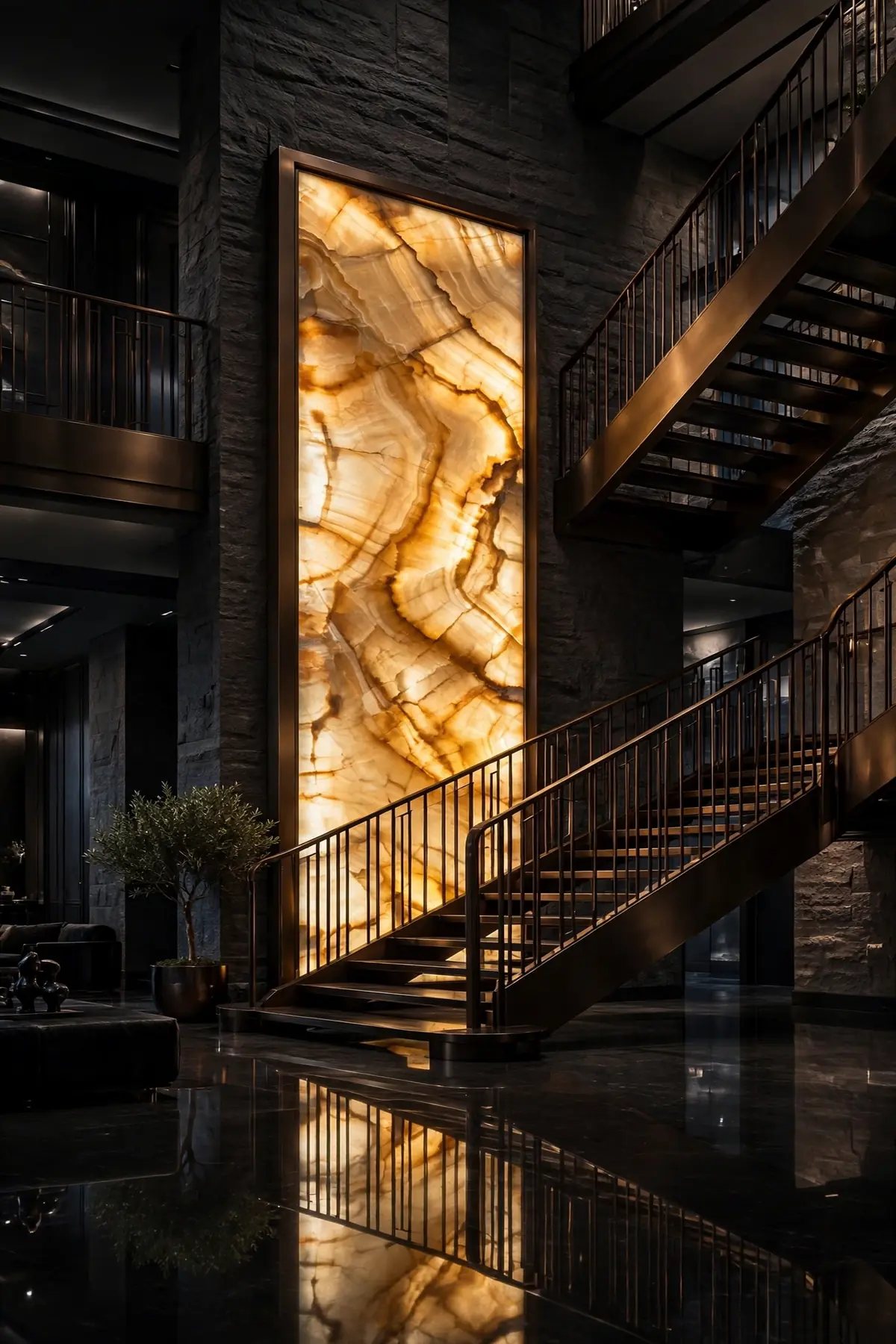
A single slab of backlit onyx — honey, amber, and rust veining glowing from within — mounted as a full-height panel on the stair wall is the most luxurious single move on this list. Stone lit from behind becomes translucent, so the wall carries its own light source and the veining reads like a sunset frozen in rock. Best for: high-end projects where the staircase is the home’s centerpiece; it doubles as ambient lighting. Weakness: genuine onyx panels with backlighting are a five-figure commitment and need professional mounting — this is a commission, not a DIY.
- Backlight with even, dimmable LED panels (not spotlights) so the glow is uniform across the veining.
- Book-match two slabs for a symmetrical mirror image if the wall is wide enough.
- Keep surrounding finishes dark and simple — bronze, charcoal, black — so the stone is the undisputed star.
A Diagonal Line of Sculptural Sconces
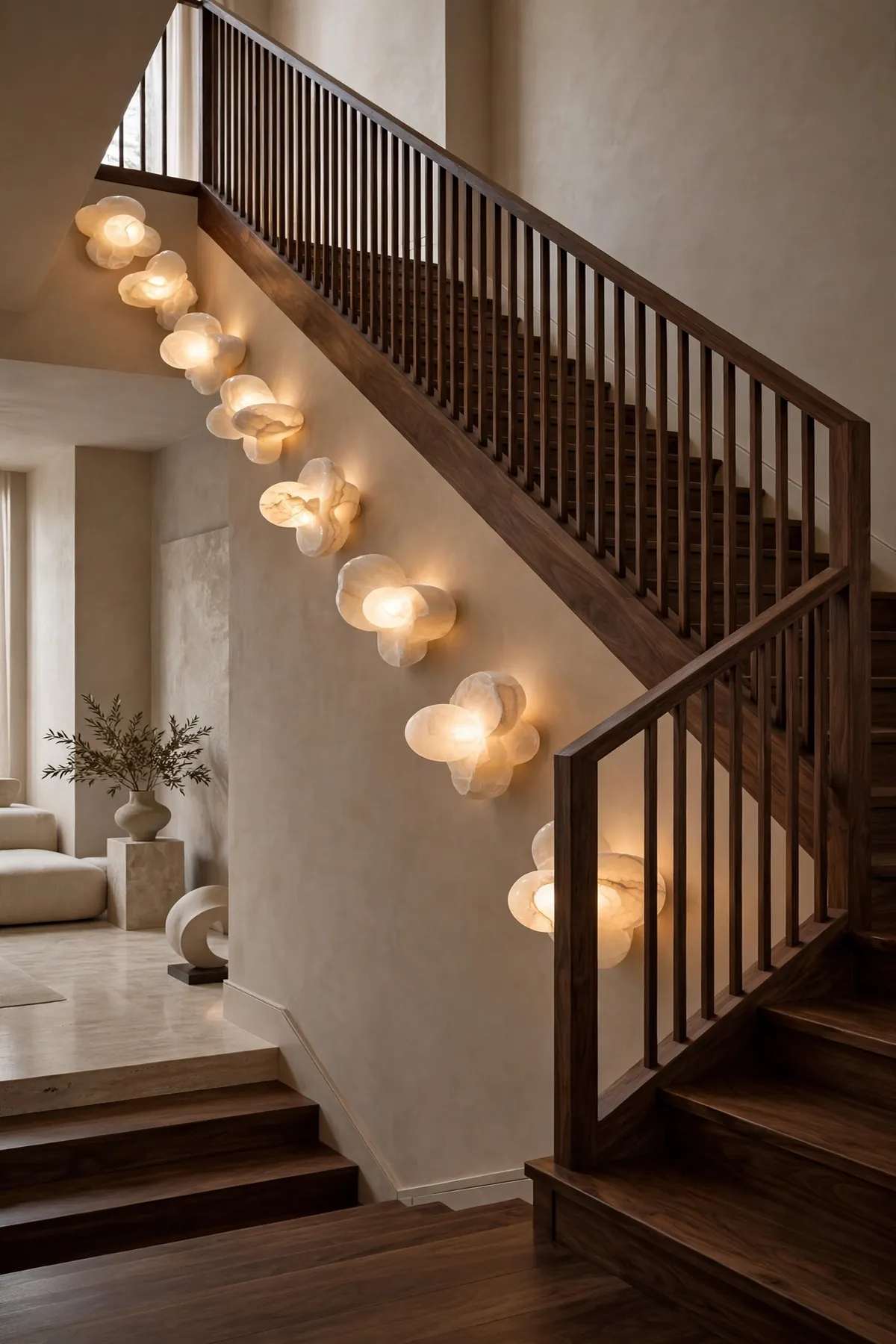
Instead of art, the wall carries a constellation of sculptural sconces — alabaster orbs, folded plaster forms, ribbed glass — ascending on the stair diagonal. The fixtures are the decoration; by day they’re objects, by night they’re light. Best for: minimalists who don’t want framed art but find a bare wall unfinished, and for stairwells where wiring already exists along the wall. Weakness: sculptural sconces cost more than decorative ones, and mixing too many different shapes turns constellation into clutter — pick one design and repeat it.
- Repeat one sconce design at regular stair intervals for rhythm; variety belongs in a gallery, not a light line.
- Choose ADA-compliant shallow sconces if the stair is narrow — deep fixtures become head hazards.
- Wire them on a single dimmer circuit so the whole diagonal glows as one gesture.
A Bold-Color Reading Nook on the Half Landing
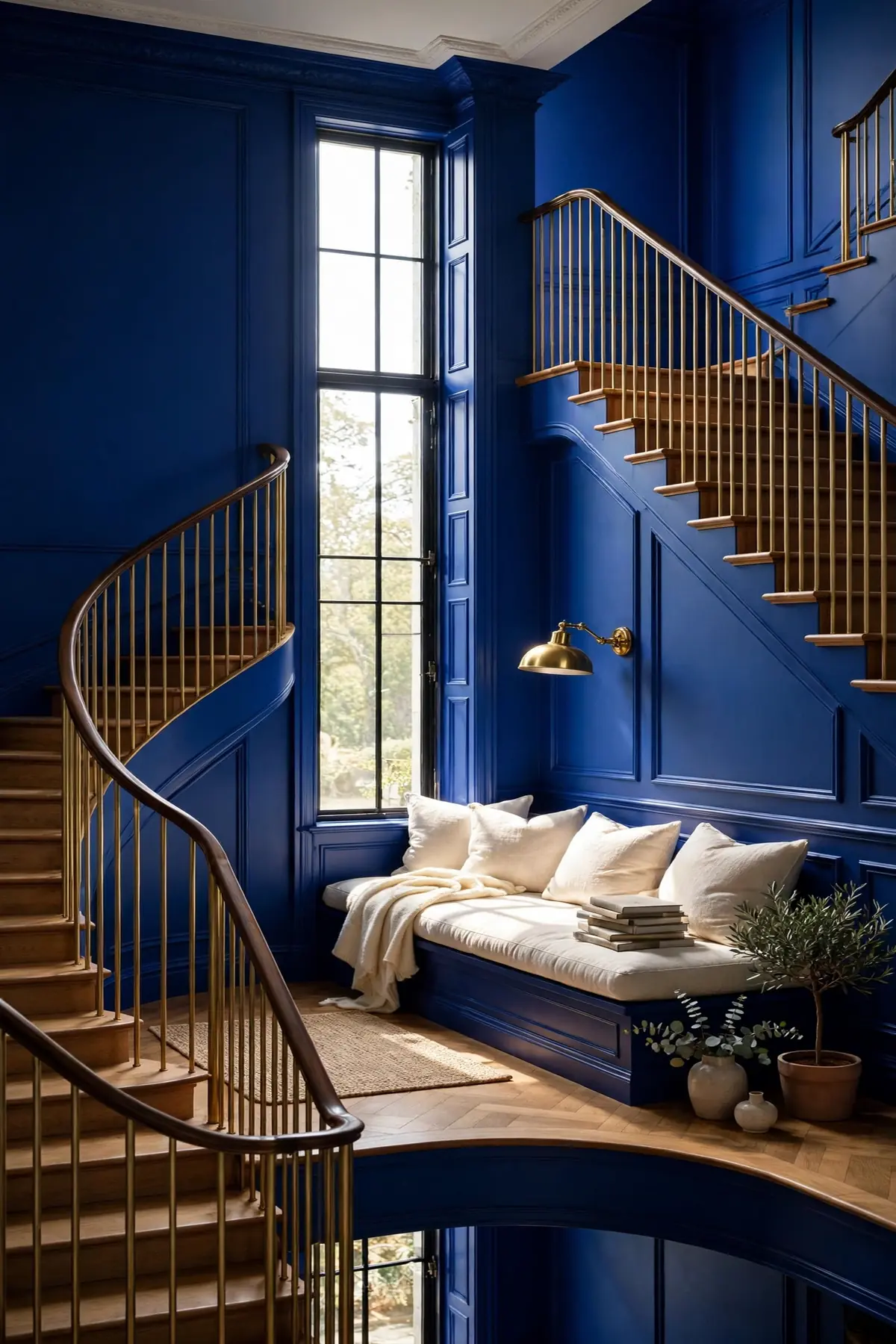
Paint the half-landing walls a saturated cobalt or ink blue, add a built-in bench with cushions and a brass reading lamp, and the dead space of the landing becomes the home’s most coveted seat. The accent isn’t just the wall — it’s a function the stairs never had. Best for: families (kids claim landing nooks instantly) and anyone with a wide, underused half landing. Weakness: it only works where the landing is genuinely deep enough for a bench (at least 90 cm); on a tight switchback it just obstructs the walking line.
- Build the bench with storage inside — landing nooks earn their keep as linen or shoe storage.
- Add a small sconce or picture light at bench height; overhead stair lighting rarely reaches a seated reader.
- Use washable cushion covers — landing benches collect dust and foot traffic.
A Strict Grid of Identical Frames
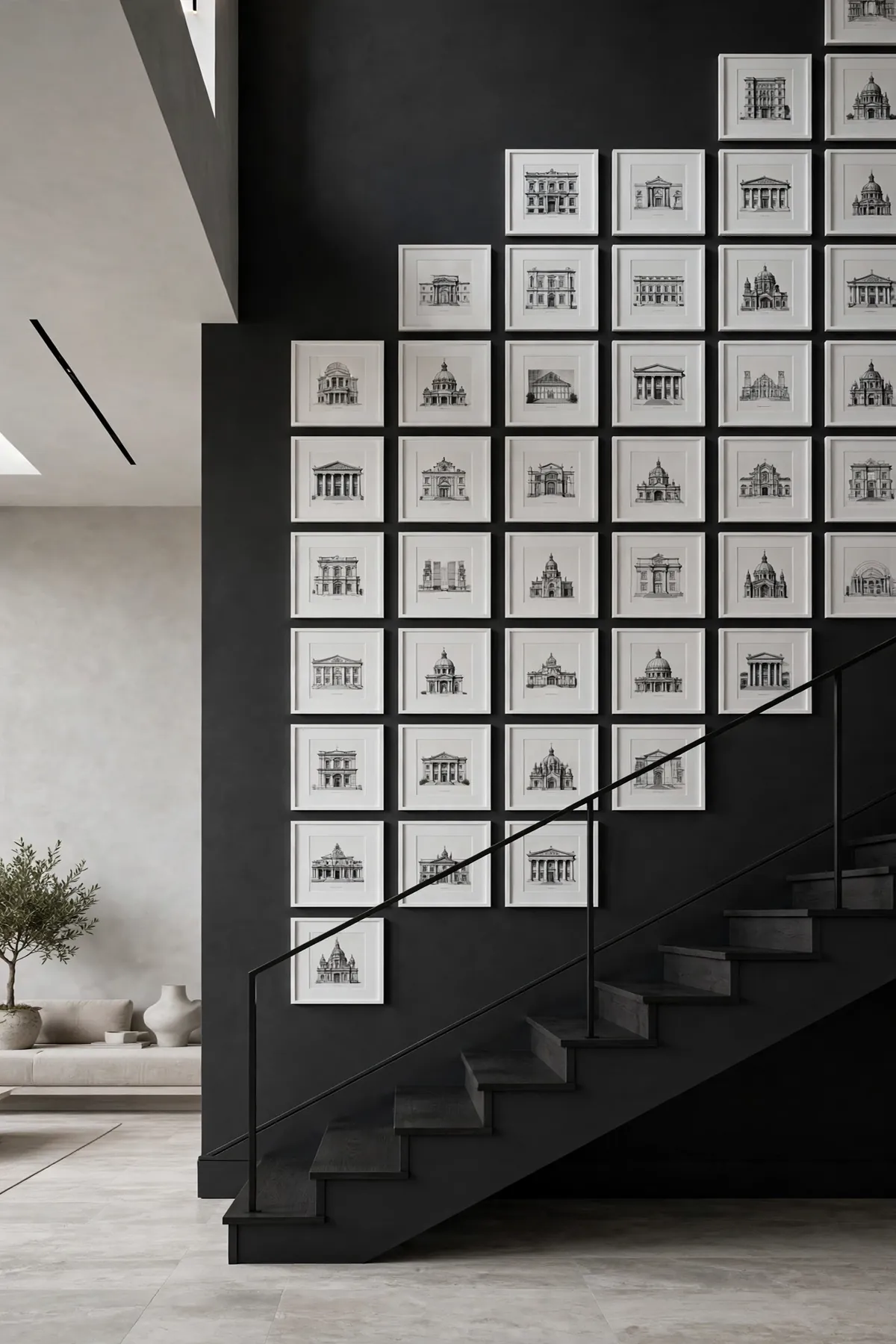
Identical thin frames in a strict ascending grid — same size, same mat, same spacing — bring museum discipline to the stair wall. Where the flowing gallery ribbon feels personal, the grid feels curated and architectural; black-and-white architectural or botanical prints suit it best. Best for: modern and minimalist homes where the casual salon-style gallery would feel messy. Weakness: the grid must be mathematically consistent while following a slope, which means careful layout — and identical frames in bulk can cost more than a mixed set of thrifted ones.
- Use a laser level projected along the stair angle as your layout baseline, not the floor.
- Buy all frames from one line so profiles and finishes match exactly.
- Keep mats wide and images small within them — generous matting is what makes grids look expensive.
A Hand-Painted Floral Mural
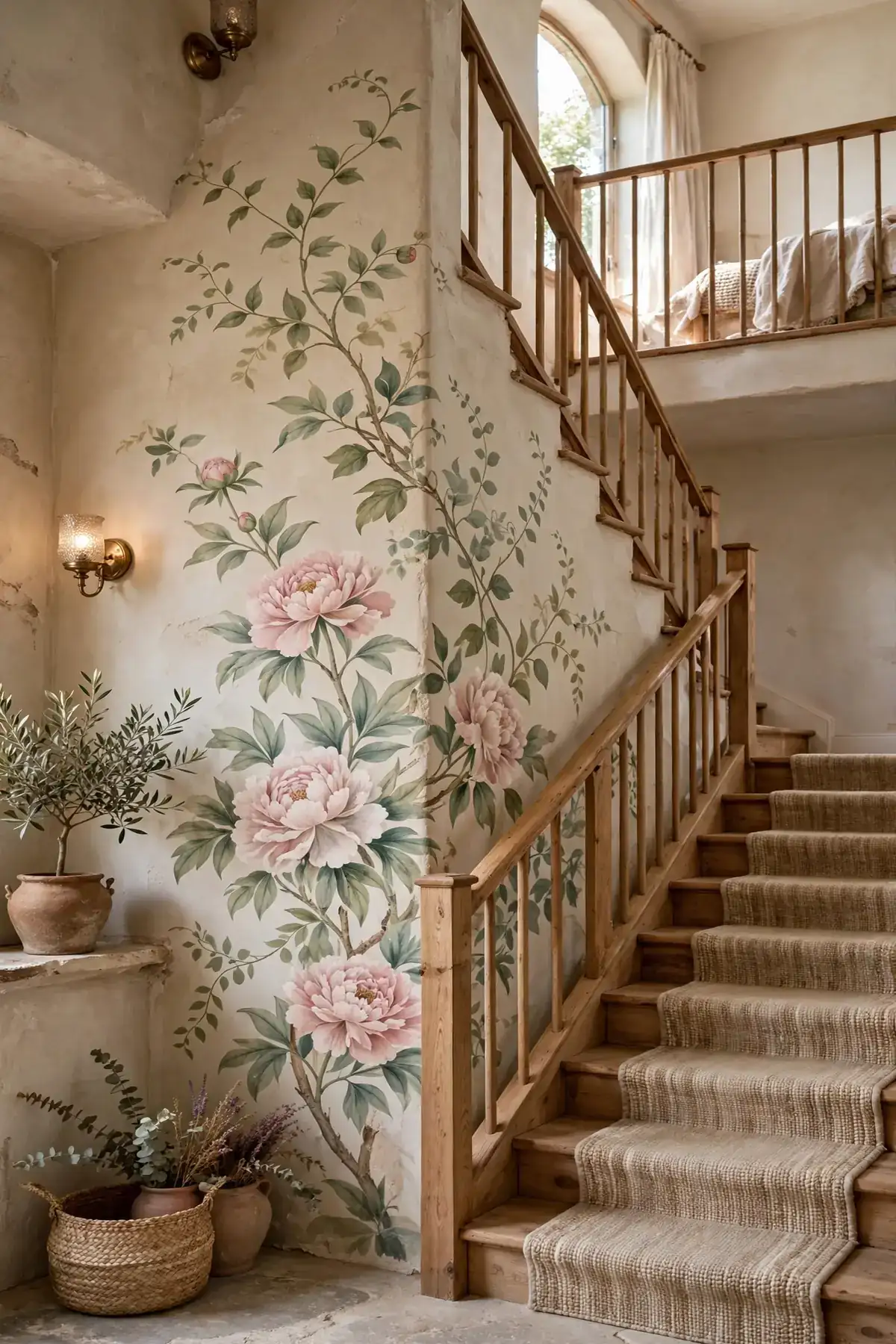
An artisan-painted floral mural — oversized peonies and climbing vines in sage and blush on warm plaster — gives the stair wall something no printed wallpaper can: visible brushwork and one-of-a-kind imperfection. It climbs naturally with the stairs, so the composition can be designed around the slope rather than fighting it. Best for: romantic, cottage, and collected interiors where craftsmanship is the point; a strong choice for a stairwell that feels too stark. Weakness: hand-painted means artist rates and scheduling — and a mural you love in the artist’s portfolio photos may read differently at your wall’s scale, so ask for a scaled sketch first.
- Commission a to-scale sketch or digital mockup on a photo of your actual wall before the artist starts.
- Keep the palette to three or four tones pulled from adjacent rooms so the mural connects to the house.
- Seal with a matte clear coat in high-traffic stairwells — unsealed mural paint scuffs.
Dark Soffit, Light Wall: High-Contrast Architecture
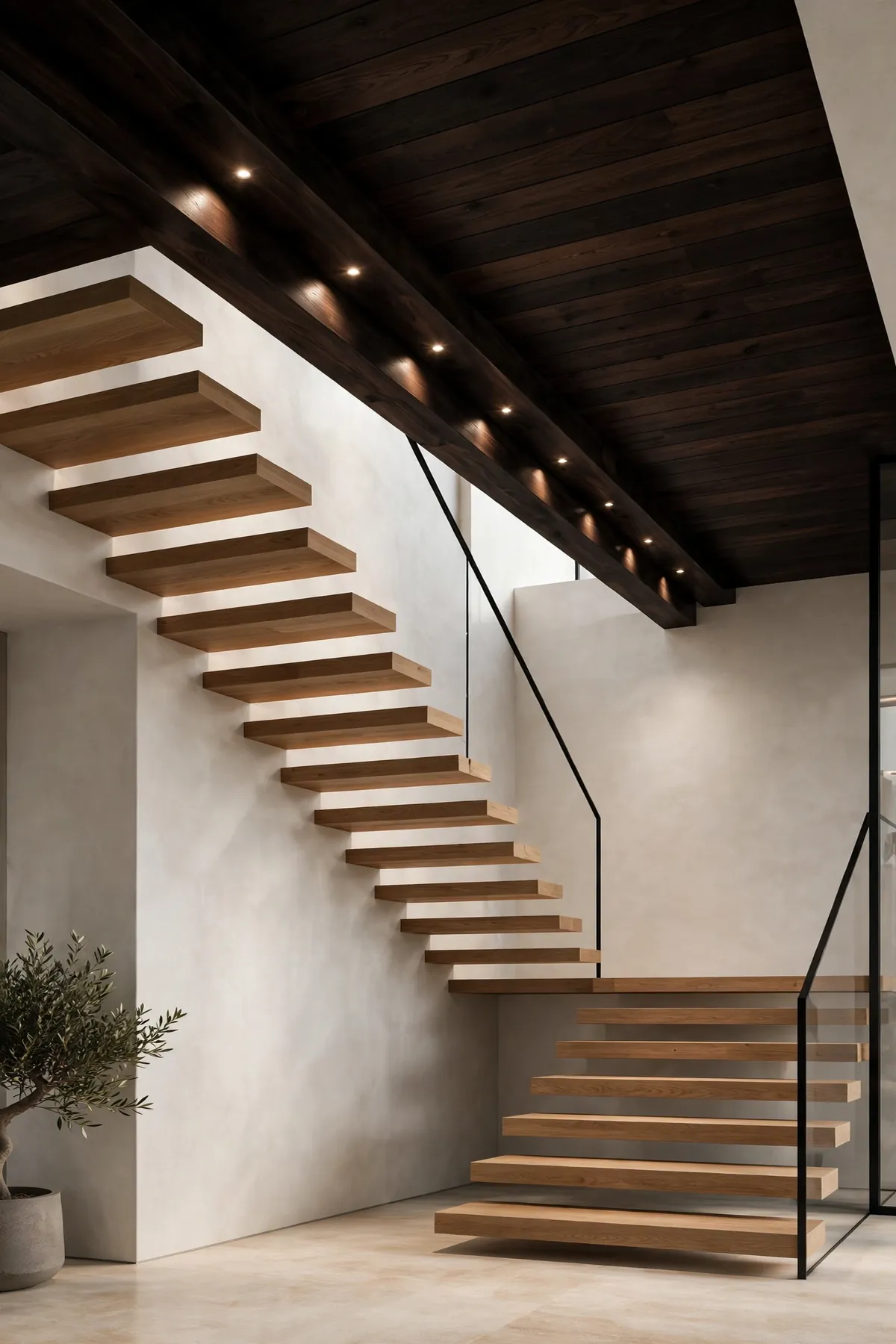
Paint or clad the sloped ceiling (soffit) above the stairs in dark stained timber while keeping the wall light warm-white, with recessed downlights set into the dark plane. The contrast frames the stairwell like a picture frame turned inside out — the dark above compresses, the light wall expands — and it makes even a builder-grade staircase feel architect-designed. Best for: modern homes with a defined stair soffit; especially effective where the stair runs under a landing and the ceiling feels oppressive. Weakness: dark overhead planes can feel heavy in stairwells with low headroom — you need at least 2.1 m of clearance for this to feel dramatic rather than claustrophobic.
- Use recessed adjustable downlights in the soffit aimed at the wall, not straight down, to wash the accent wall.
- Extend the dark finish one full wall at the top or bottom of the stairs so it reads as intentional, not accidental.
- Keep treads light (oak or pale stone) to balance the dark overhead.
Ink-Navy Vertical Shiplap
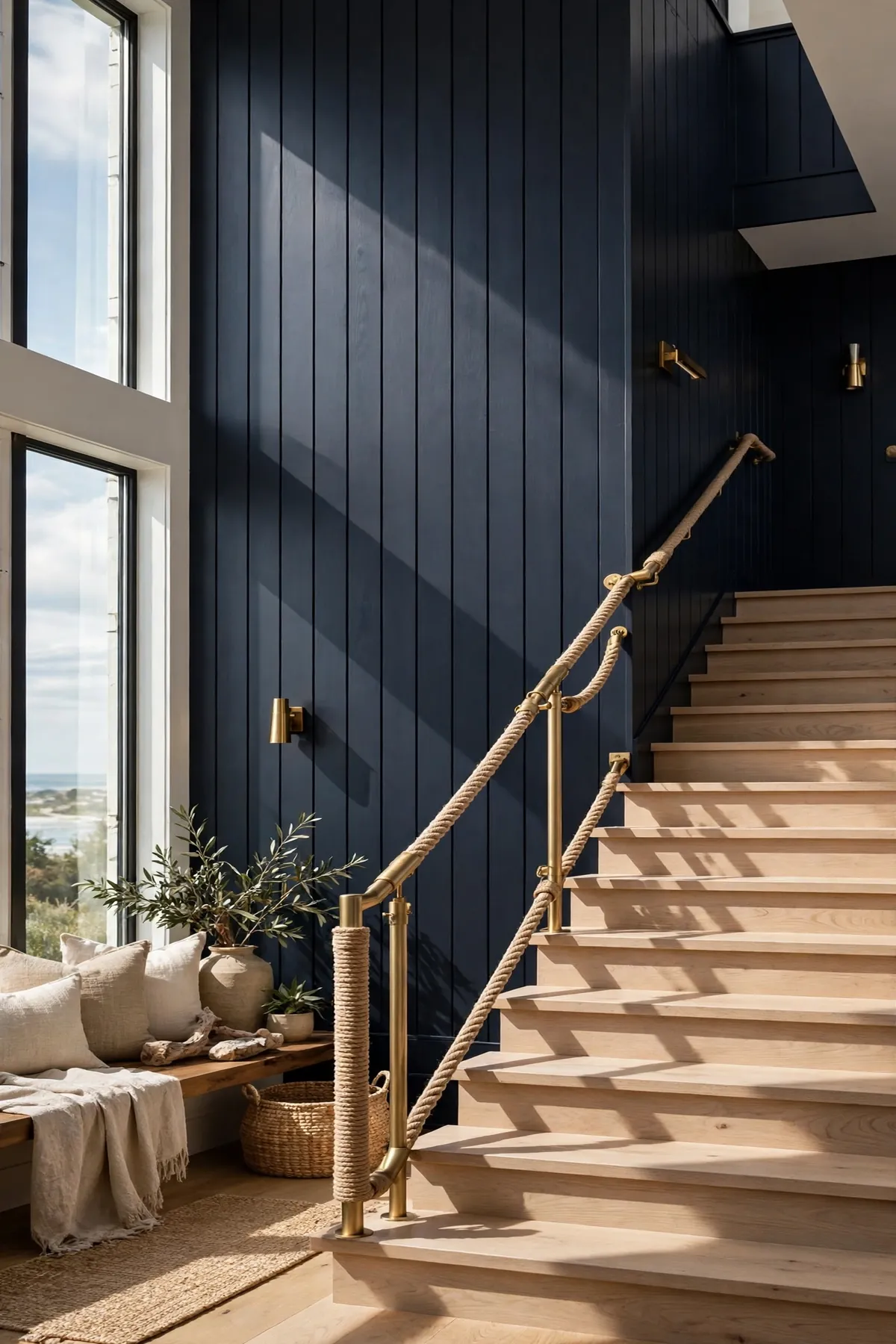
Vertical shiplap painted deep ink navy brings coastal-modern structure to the stair wall — the crisp shadow gaps between boards add rhythm while the dark blue keeps it current rather than cottage-cliché. Vertical orientation is key on stairs: horizontal shiplap fights the diagonal, vertical boards echo the climb. Best for: coastal, modern farmhouse, and nautical-leaning interiors; also forgiving on walls that aren’t perfectly flat, since the boards create their own plane. Weakness: shiplap collects dust in the grooves along a stairwell’s air currents, and navy shows every scuff from bags brushing the wall.
- Use nickel-gap (not tight-joint) shiplap so the shadow lines stay consistent.
- Paint after installation with a sprayer for a factory-smooth finish; brushed paint telegraphs in the grooves.
- Pair with a natural rope or oak handrail to lean into the coastal story.
A Tapestry-Scale Woven Wall Hanging
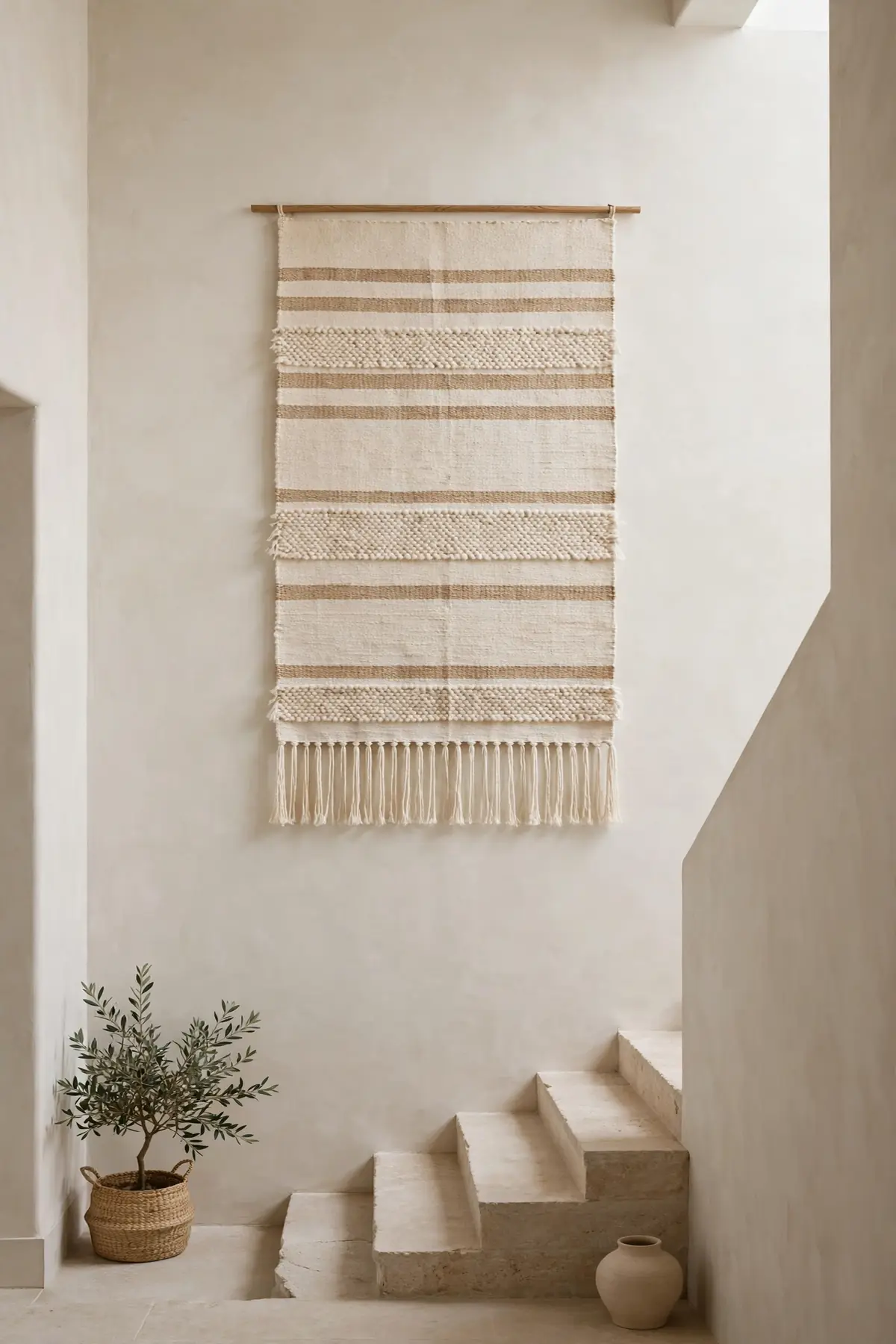
A single oversized woven textile — abstract earth tones, visible weave, a soft fringe — hung from a wooden dowel covers the tall stair wall in one move, adding the softness and sound absorption that hard stairwells desperately need. It’s the fastest transformation on this list: one mounting point, instant texture. Best for: renters, bohemian and warm-minimalist homes, and echoey stairwells where hard surfaces make every footstep loud. Weakness: textiles and stairwells are a dust combination — expect to vacuum it with an upholstery attachment seasonally — and keep it clear of handrail height where hands will grab it.
- Mount the dowel on two discreet brackets, not a nail; large hangings are heavy and pull nails out of drywall.
- Size the hanging to fill at least two-thirds of the wall width — too small and it looks like an afterthought.
- Choose wool or cotton weaves over synthetics; they hang straighter and age better.
A Vertical Two-Tone Color Block

Split the stair wall vertically — ochre gold on one side, warm cream on the other — with the dividing line aligned to the stair angle or a door frame, so the color break feels architectural rather than arbitrary. It’s bolder than a horizontal split and rarer, which is exactly why it photographs well and feels custom. Best for: modern and art-inspired homes; a strong fix for a stair wall that’s too long and featureless, since the split creates two zones. Weakness: the dividing line must land on something — a corner, a trim edge, the stair stringer — or it looks like a painting mistake; and two-tone walls demand confident furniture nearby or the wall outshouts the room.
- Align the color break with an existing architectural line (stringer edge, doorway, or window jamb).
- Choose colors with the same undertone (both warm, both cool) so the pairing feels deliberate.
- Use the bolder color on the smaller section — roughly a one-third to two-thirds split.
Sculptural 3D Plaster Relief Panels

Three-dimensional plaster panels — interlocking hexagons, waves, or fluted reliefs — turn the stair wall into sculpture that changes with the light; morning raking light and evening sconce light give you two different walls in one day. In matte ivory the effect is gallery-quiet; the shadows do all the talking. Best for: luxury minimal interiors where you want drama without color or pattern, and for stairwells with strong side light from a window or skylight. Weakness: relief panels are a dusting commitment on a tall wall, and they need that directional light — in a flat-lit stairwell the 3D effect nearly disappears.
- Install panels so the relief pattern runs continuously across seams; misaligned repeats break the illusion.
- Light from the side (a window or wall-washer) rather than head-on to maximize shadow play.
- Keep the finish matte — any sheen on relief panels creates hot spots and looks plastic.
A Library Wall of Floating Shelves
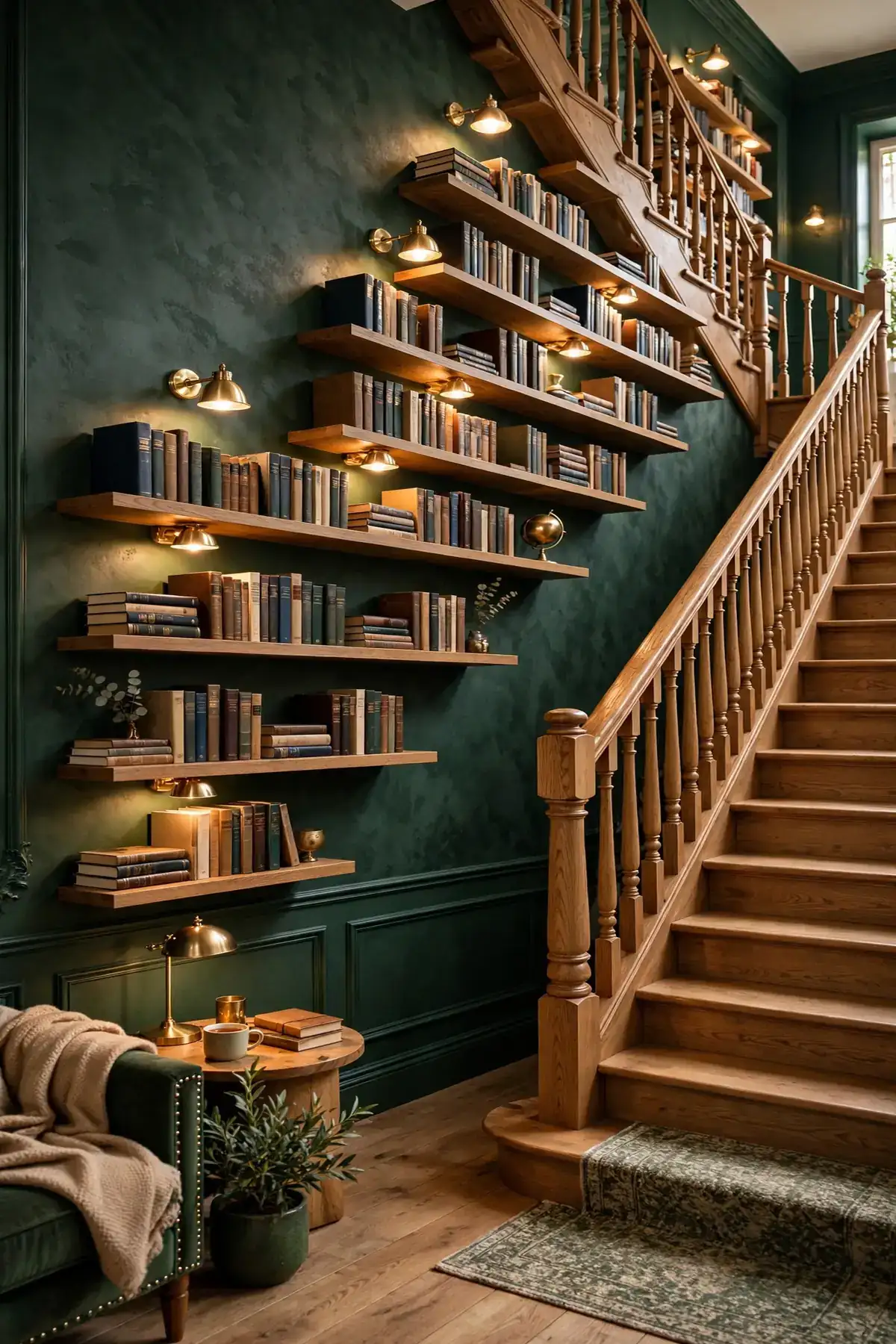
Floating oak shelves climb the stair wall diagonally, filled with books and a few objects, backed by a deep green wall with small brass picture lights above. It turns dead wall space into the home’s library and gives the staircase a scholarly, collected soul — guests stop mid-climb to browse spines. Best for: readers, obviously, and for wide stairwells where the wall sits well clear of the walking line. Weakness: books are heavy — each shelf needs stud anchoring, not drywall plugs — and the shelves must sit high enough (or shallow enough) that nobody clocks their head on the way up.
- Anchor every shelf into studs with hidden steel brackets; a loaded bookshelf on drywall anchors is a collapse waiting to happen.
- Keep shelf depth to 20–25 cm and mount the lowest shelf above shoulder height on the stair slope.
- Style shelves at 70% books, 30% objects — all books looks like storage, all objects looks like a shop.
FAQs
What is the best paint finish for a staircase accent wall?
Eggshell or satin for the wall — flat marks too easily in high-traffic stairwells and gloss highlights drywall flaws. Use a durable satin enamel on any painted treads or handrails.
How do you hang art on a sloped staircase wall?
Align the bottom edges of frames to an imaginary line parallel to the stair slope, keep spacing consistent (5–7 cm), and lay the arrangement on the floor first or use paper templates on the wall before drilling.
Can I do a staircase accent wall in a rental?
Yes — peel-and-stick wallpaper or mural panels, a large leaning artwork, a tapestry-scale textile, and painted arch shapes done in removable paint alternatives all come down cleanly. Avoid anything requiring studs, hardwiring, or permanent adhesive.
Conclusion
The staircase wall earns its drama honestly — it’s the tallest uninterrupted surface most homes have, and you pass it every single day. Whether you go bold with color-drenching or an onyx panel, or quiet with limewash, grasscloth, or a book-lined slope, the rule is the same: commit to one strong gesture rather than several small ones. Pick the idea that fits your light, your budget, and your nerve, start with the wall, and let the stairs become the part of the house everyone remembers.