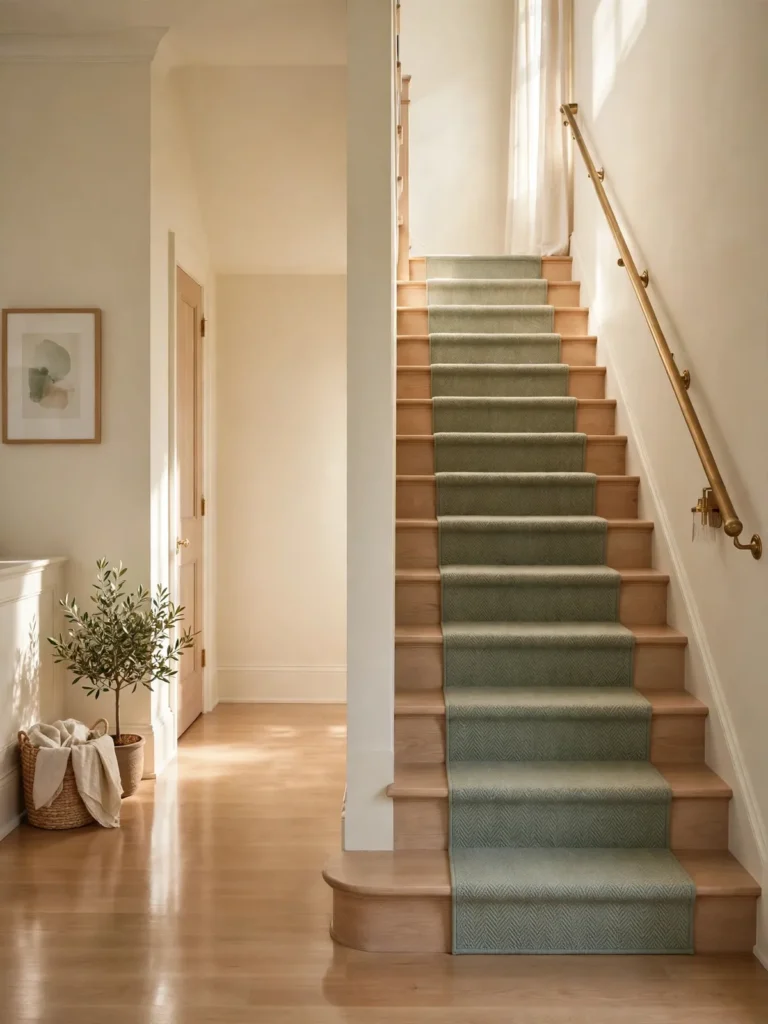
25 Stunning Marble Staircase Ideas That Make Your Home Look Expensive and Timeless
A marble staircase does more than connect two floors — it sets the tone for the whole home. These 25 ideas show how white, black, green and veined marble pairs with wood, brass, glass and light to make a hallway brighter, a foyer grander, and everyday steps feel quietly luxurious.
A marble staircase makes a home feel luxurious and timeless because the stone itself does the work — cool, polished, veined with natural pattern, and strong enough to last for decades. White marble brightens a dark hallway, black marble adds drama to a tall foyer, and a warm wood handrail or brass detail keeps the stone from feeling cold. The best marble staircase suits the rooms around it: a straight flight for a compact entry, a curved flight for a grand hallway, or floating treads for a bright modern living room.
If you love the open, light-led feel of stone and clear panels together, these glass staircase ideas show how glass softens a solid stair in the same way. The ideas below cover the whole staircase — its stone, its shape, its railings, and the rooms around it — so you can choose a look that fits a small home, a family hallway, or a grand entrance.
Key Takeaways
What makes a marble staircase feel luxurious?
The natural veining, the cool polished surface, and the weight of real stone. Even a simple straight flight in white marble with soft grey veining looks expensive because no two slabs have exactly the same pattern.
Does a marble staircase suit a small home?
Yes — pale marble with open risers or a slim glass balustrade keeps a small hallway bright, because the light stone reflects daylight instead of absorbing it the way dark wood can.
What materials pair best with marble on a staircase?
Warm walnut or oak, brushed brass, matte black steel, clear glass and pale plaster all work beautifully. Wood and brass warm the stone, while glass and black steel keep it modern.
Is a marble staircase practical for a family home?
Yes, when it is sealed properly, given a honed or lightly textured finish on the treads, and fitted with a secure handrail. Polished marble can be slippery when wet, so an anti-slip treatment matters in a busy home.
Where should a marble staircase sit in the home?
In an entryway or beside an open-plan living area, where its veining and shine can be seen from the front door, or near a tall window where daylight can fall across the stone.
Classic White Marble Staircase With Soft Grey Veining
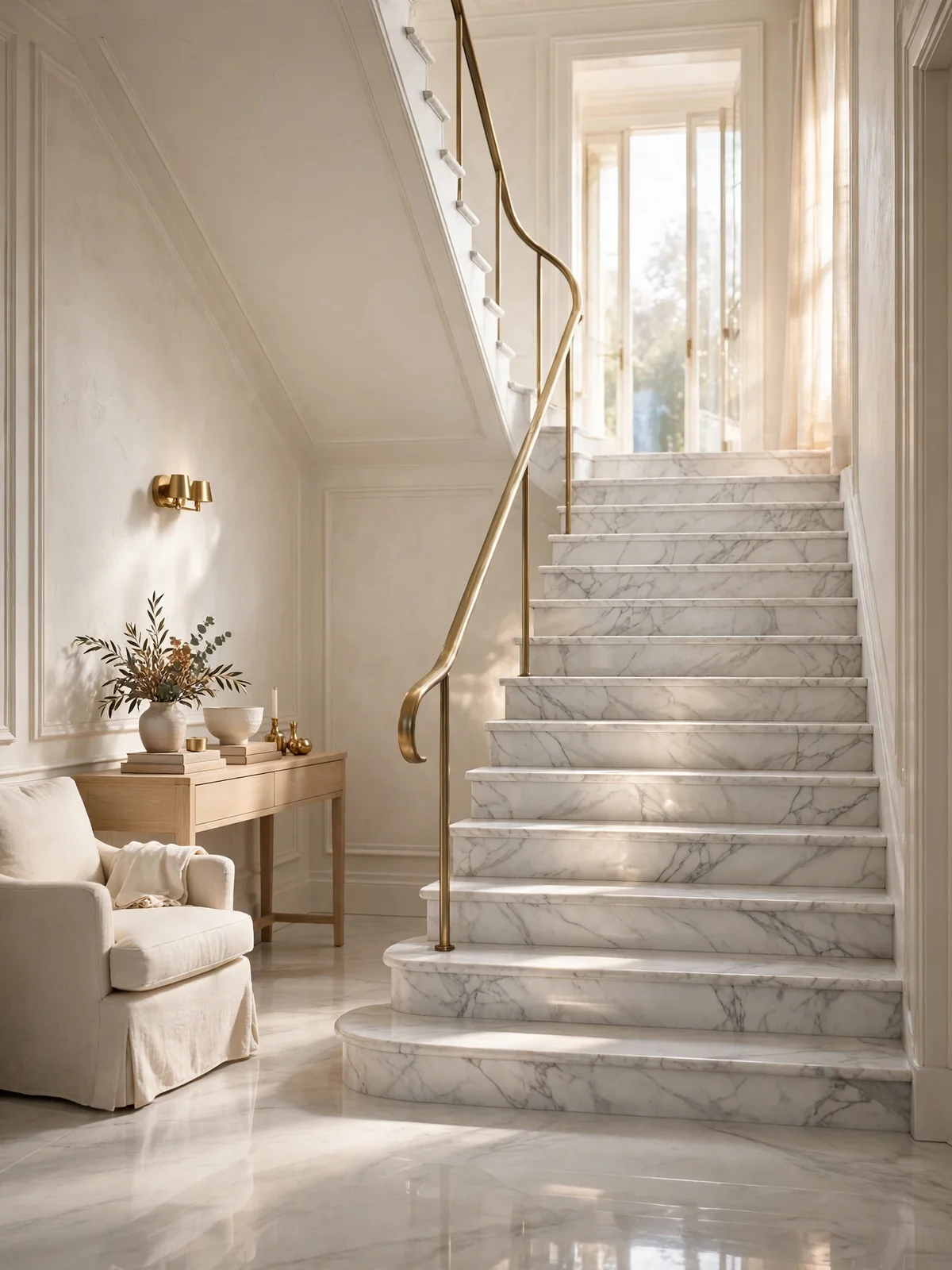
A classic white marble staircase is the safest way to make a hallway feel expensive, because the stone is timeless and the veining does the decorating. In one entrance hall, 20 mm thick Carrara marble treads, each 1 metre wide and 280 mm deep, run up a straight flight beside ivory plaster walls, with a slim brushed-brass handrail on the wall side and a cream linen armchair at the base. The soft grey veins run diagonally across the treads, so the eye follows the pattern upward, and the brass catches the morning light without shouting.
Quick tips:
- Choose Carrara or a similar white marble with soft, fine veining for a timeless look.
- Keep the walls ivory or pale cream so the grey veining stands out.
- Use brushed brass, not polished gold, for a softer, modern shine.
- Seal the marble every year so spills and scuffs do not stain the stone.
Waterfall Marble Staircase Where the Stone Flows Down Each Riser
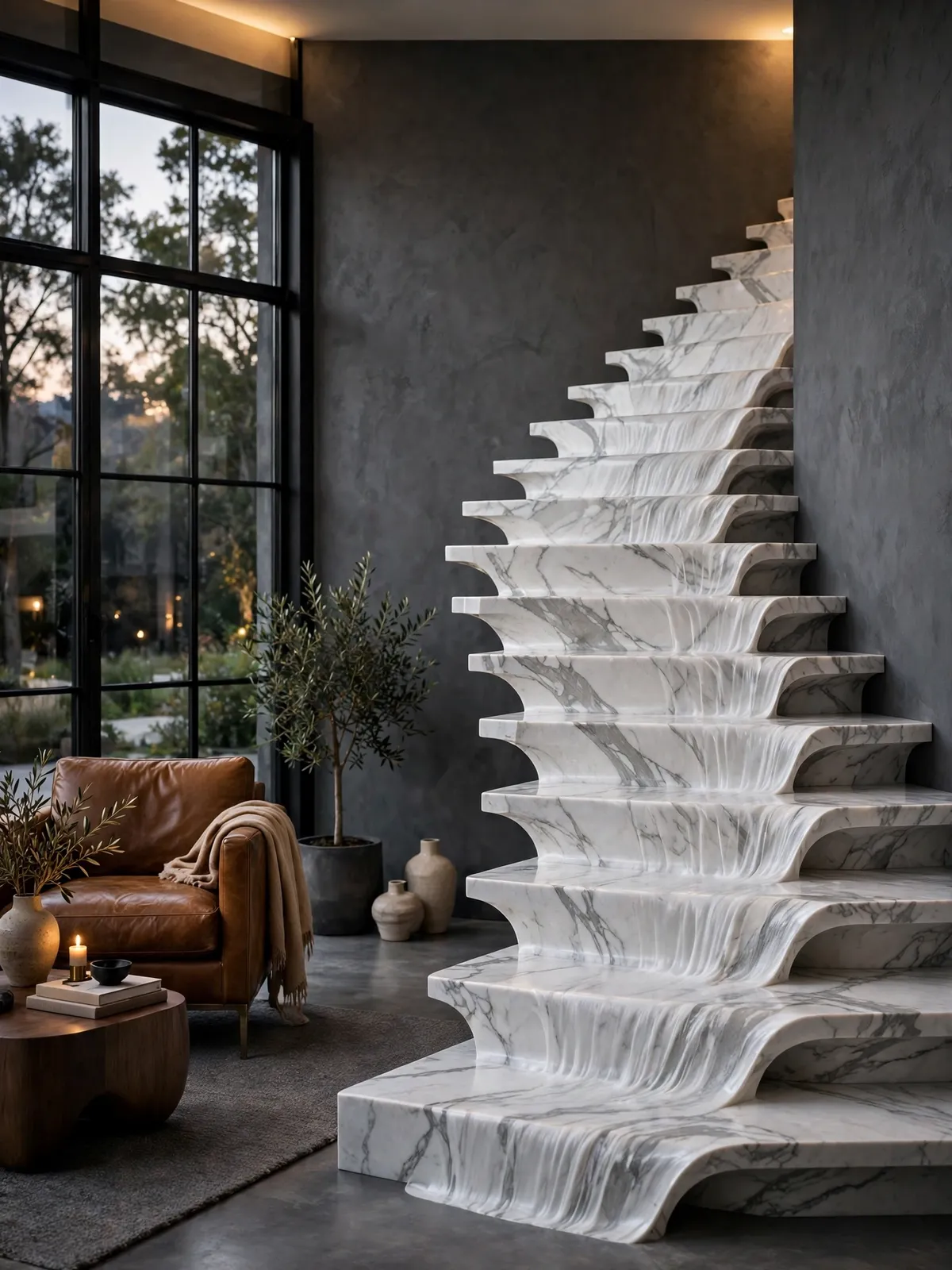
A waterfall edge lets the marble flow from each tread straight down the riser, so the whole flight reads as one sculpted piece. On this stair, book-matched Calacatta marble slabs, cut from the same block so the gold-grey veins line up, wrap over 40 mm thick treads, each 950 mm wide, and down 180 mm risers without a visible break. The charcoal-grey wall behind the stair makes the white stone glow, while a caramel leather chair at the base warms the cool marble.
Quick tips:
- Ask for slabs cut from the same block so the veining flows without interruption.
- Keep the wall behind the stair dark or plain so the waterfall edge is the feature.
- Use a single warm accent, like leather or timber, to soften the stone.
- Budget for a skilled stone installer — a waterfall edge shows every uneven cut.
Dramatic Black Marble Staircase With White and Gold Veining
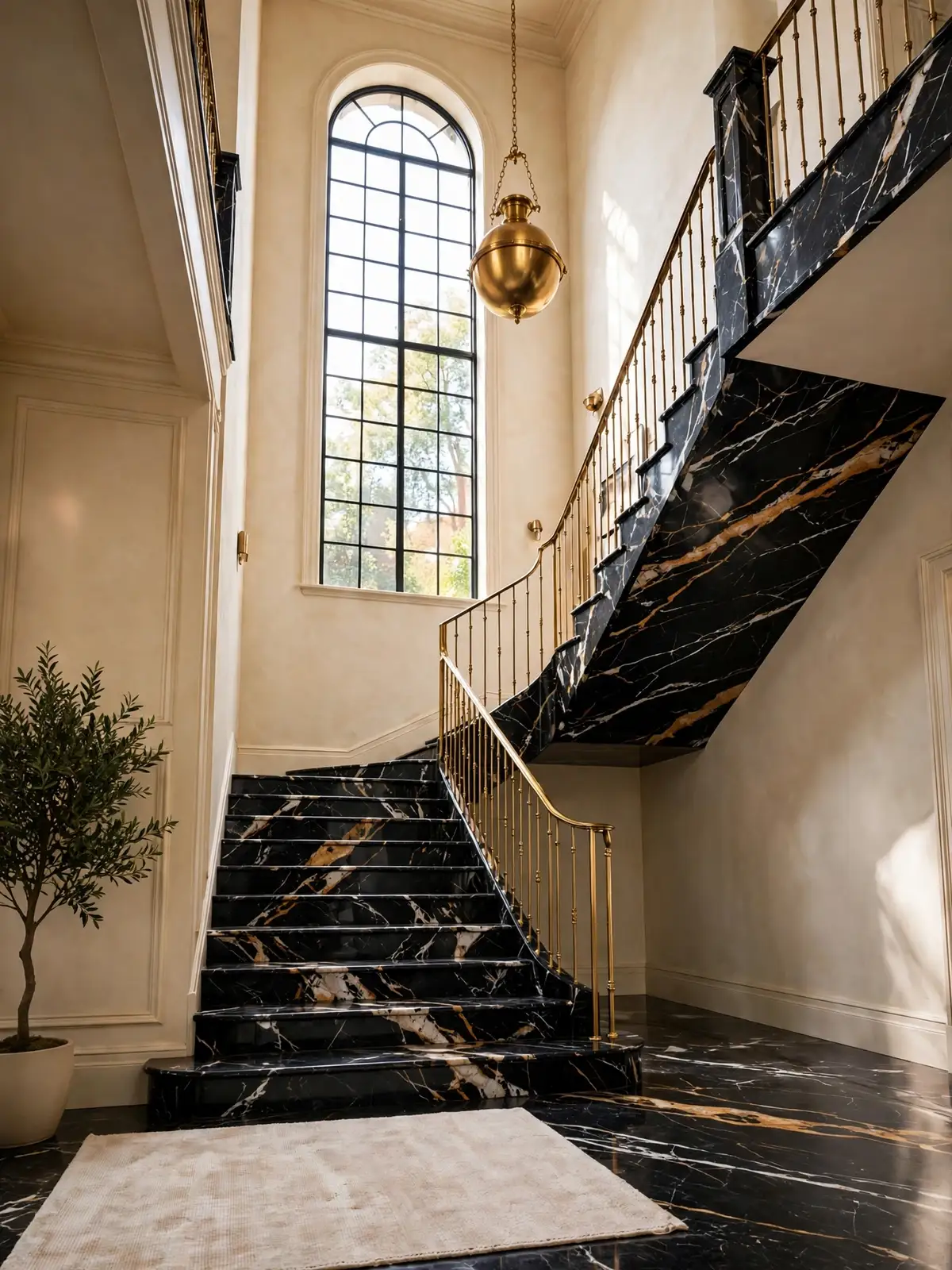
Black marble turns a staircase into a statement, especially in a tall foyer where the stone has room to breathe. Here, Nero Marquina marble treads, each 1.1 metres wide with bold white veins and fine gold threads, rise beside warm cream walls, with a large brass pendant hanging above the landing and a pale beige rug softening the floor at the base. The black stone absorbs light, so the brass and the arched window keep the hallway from feeling dark.
Quick tips:
- Use black marble only where the hallway has good daylight or warm lighting.
- Pair it with cream walls and brass to keep the drama warm, not cold.
- Keep the floor pale so the black treads stand out clearly.
- Choose a honed finish on black treads to reduce visible dust and footprints.
Marble Staircase With Warm Walnut Risers for a Softer Look
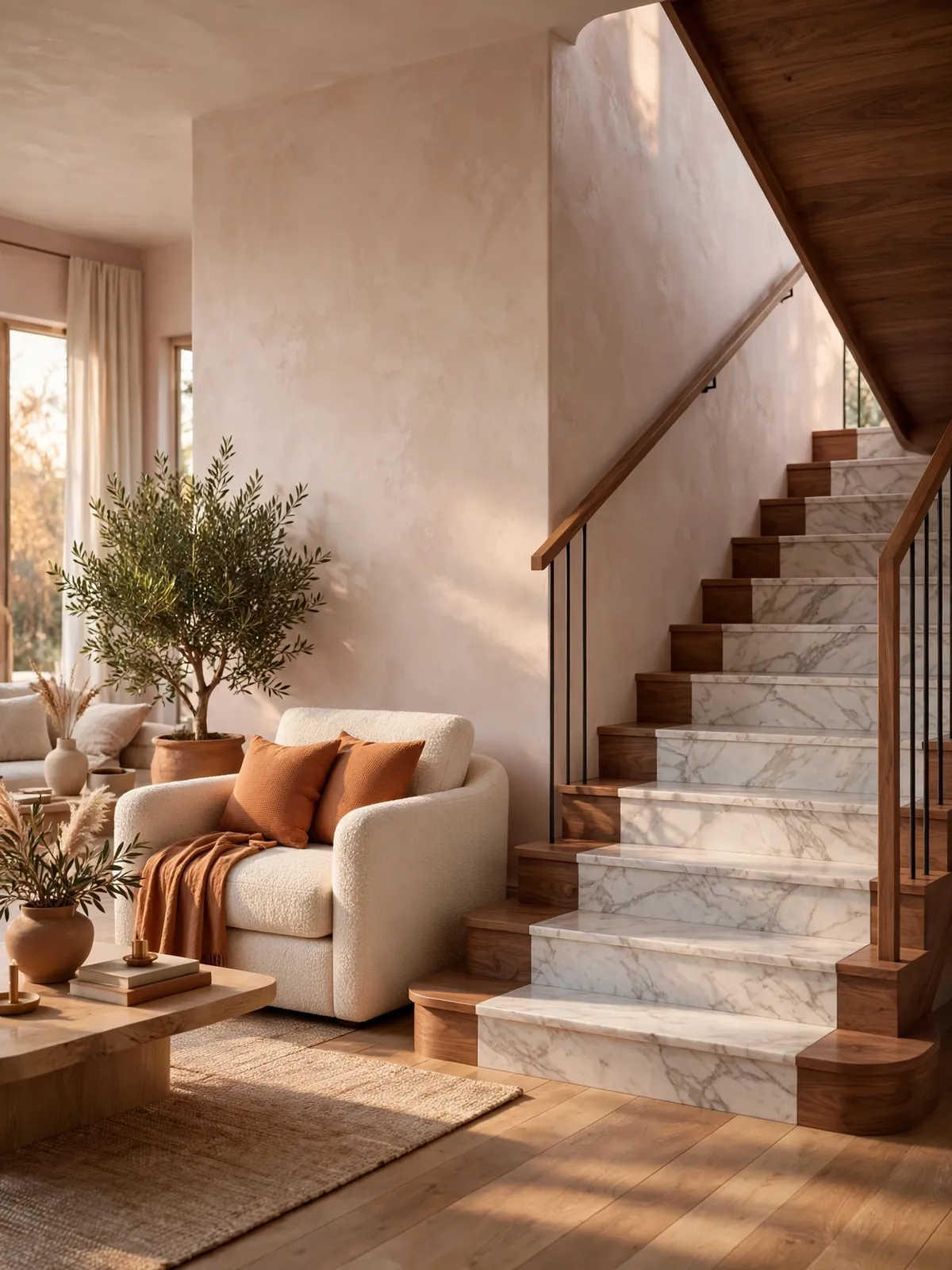
Marble treads with walnut risers give you the luxury of stone without the cold feeling of a full marble flight. Picture a straight stair with 30 mm thick white marble treads, each 900 mm wide, and rich walnut risers, each 180 mm high, set against a soft blush-pink wall. A cream boucle armchair and terracotta cushions below echo the walnut tone, while the white marble keeps the stair bright. The wood warms every step, and the stone keeps it elegant.
Quick tips:
- Match the walnut risers to a timber sideboard or coffee table nearby.
- Keep the wall colour soft and warm so the wood and marble feel balanced.
- Seal the marble treads well so they stay glossy and easy to clean.
- Use the same walnut on the handrail to tie the stair together.
Backlit Marble Staircase Steps That Glow After Dark
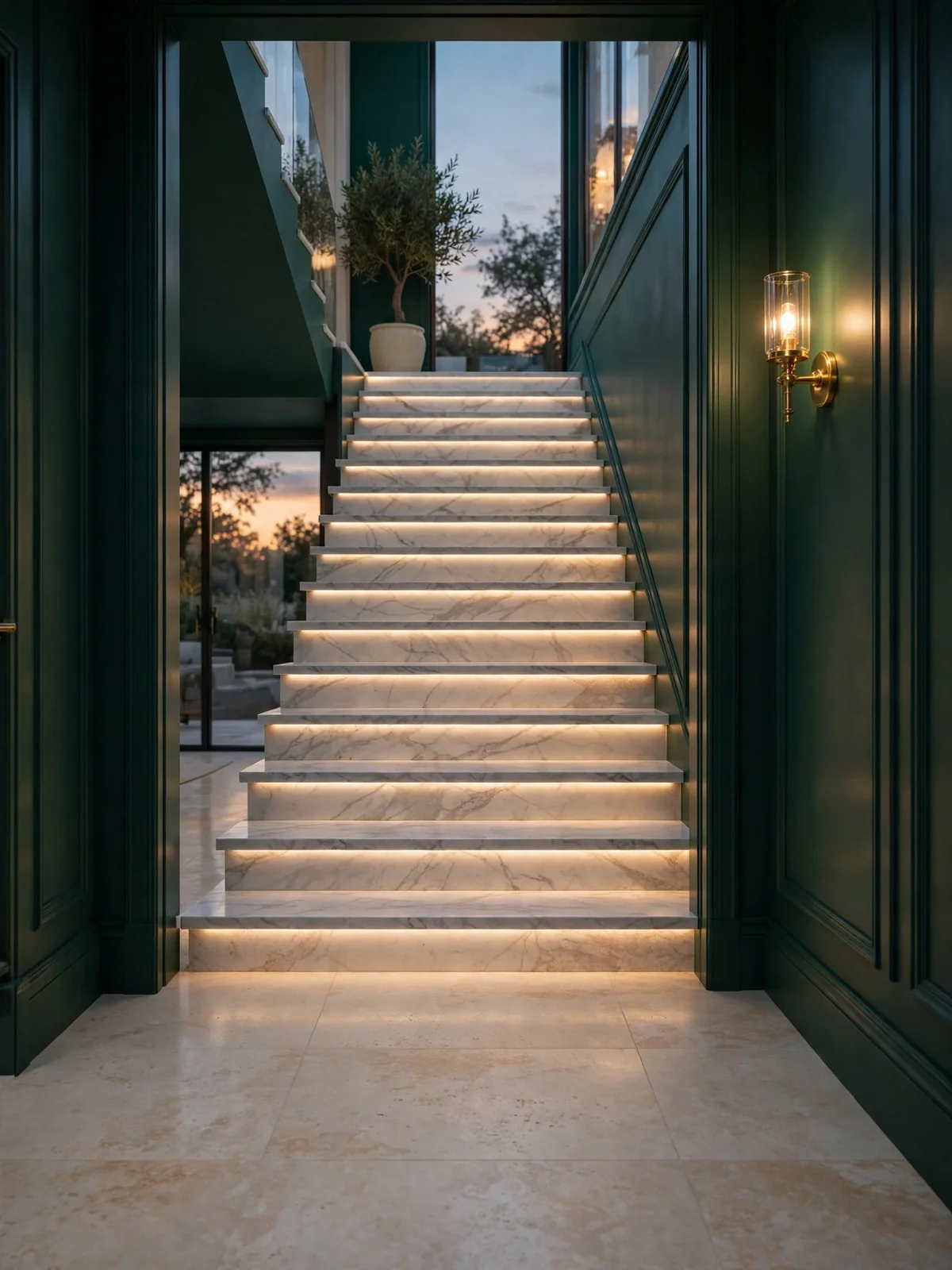
Backlit marble steps glow like a lantern built into the stair, and they make night-time trips safer too. On this flight, warm-white LED strips, 2700K, are hidden beneath each 35 mm thick white marble tread, each 1 metre wide, so the light washes down the risers and onto the cream stone floor below. The deep emerald-green wall beside the stair catches the glow and makes it richer, while a single gold wall sconce adds a soft pool of light at the landing.
Quick tips:
- Use warm-white LEDs, not cool white, so the marble glows softly, not starkly.
- Put the lights on a dimmer so the glow can stay subtle in the evening.
- Pair backlit steps with a dark wall for the strongest contrast.
- Hide the LED drivers in a cupboard under the stair for a clean finish.
Honed Marble Staircase With a Soft Matte Finish for Family Homes
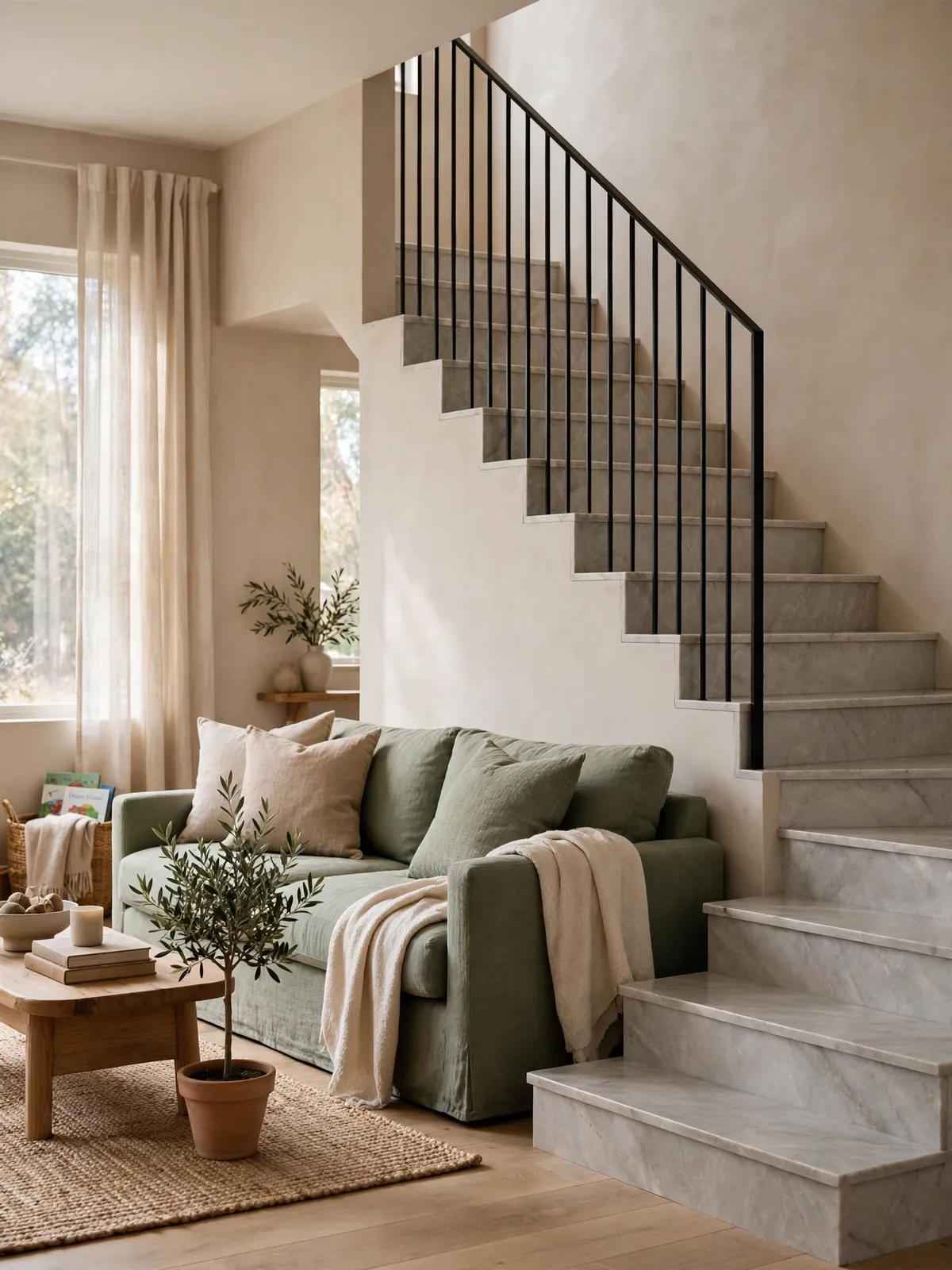
Honed marble has a soft matte finish that feels modern and understated, and it is kinder underfoot than polished stone. In this family living room, honed Botticino marble treads, each 950 mm wide with a warm beige tone and faint cream veining, rise beside warm beige walls, with a sage-green sofa and a woven jute rug at the base. The matte surface hides small scratches and feels less slippery, while a small olive tree adds life beside the stair.
Quick tips:
- Choose honed marble if you have children or pets — it hides marks better.
- Seal honed marble properly, as the matte surface is more porous than polished.
- Pair it with warm beige or sage tones to keep the look soft and homely.
- Keep the landing rug low-pile so it does not catch feet on the top step.
Marble Staircase With Slim Black Metal Railings for Clean Contrast
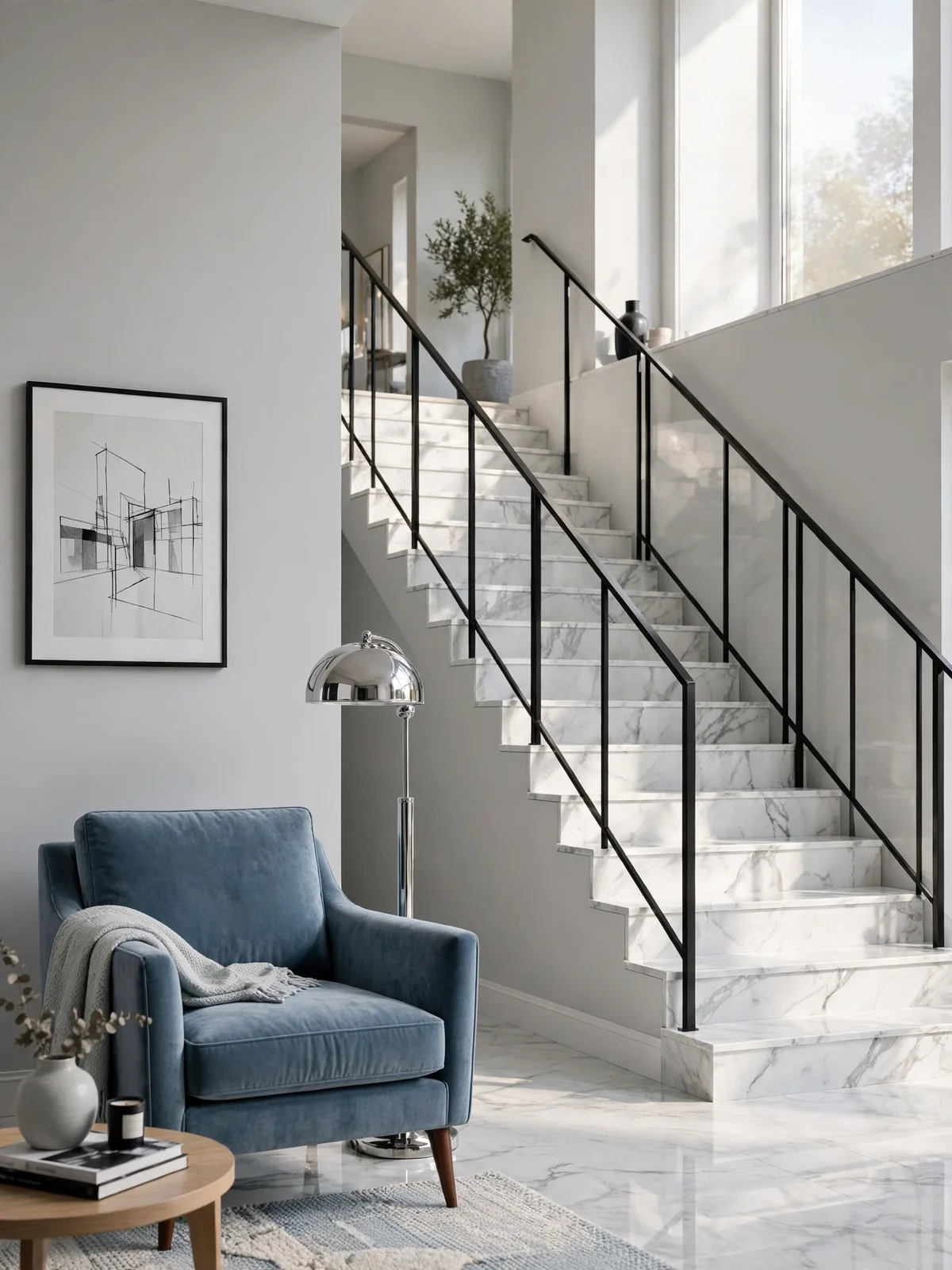
Crisp white marble against slim black metal railings feels architectural and fresh, with strong lines and no clutter. Here, white marble treads, each 1 metre wide, are edged with matte black steel balusters, 16 mm square, spaced 110 mm apart, and a slim black handrail that runs the full flight. The pale grey walls, a dusty-blue velvet chair, and a monochrome art print on the landing keep the room calm, while the black railings frame the white stone like a drawing.
Quick tips:
- Keep the black railings slim so they frame the marble without hiding it.
- Use matte black, not gloss, for a softer, modern finish.
- Pair the look with one cool accent, like dusty blue, to balance the contrast.
- Check the baluster spacing meets your local safety rules before fitting.
Curved Marble Staircase Wrapped in Continuous Stone
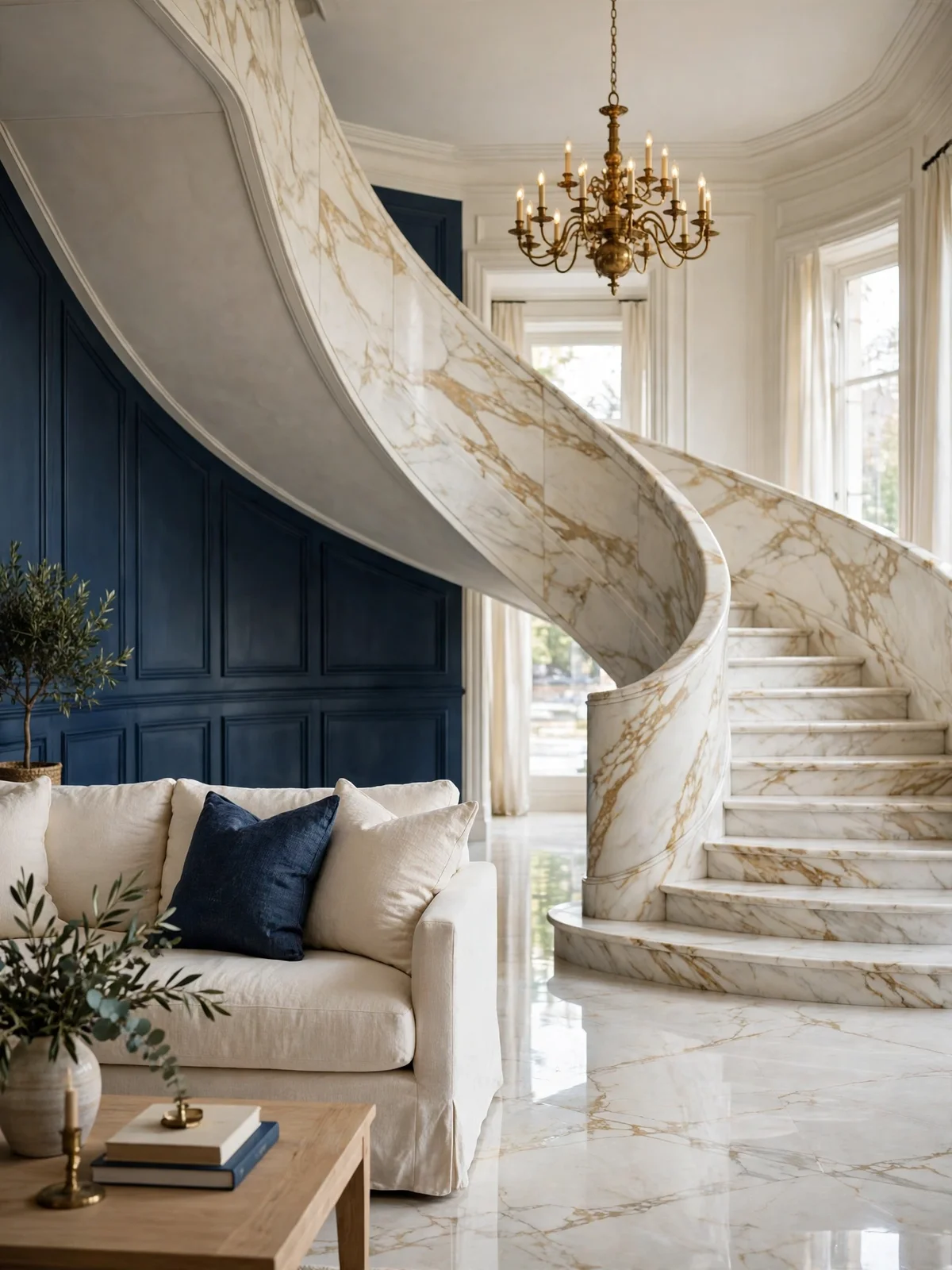
A curved marble staircase feels grand because the stone flows around the bend without a break, like a sculpture in the middle of the room. In this double-height entrance, curved Calacatta marble cladding, 20 mm thick, wraps the outer curve of the stair, with treads 1.2 metres wide at the outer edge and a deep navy-blue panelled wall behind it. A brass chandelier hangs above the curve, a cream linen sofa sits opposite, and the polished marble floor reflects the daylight from the tall windows.
Quick tips:
- Allow extra budget and time — curved marble needs templating and skilled cutting.
- Keep the wall behind a curved stair bold and plain so the curve is the feature.
- Use a chandelier or pendant above the curve to draw the eye upward.
- Keep furniture clear of the curve so the sweep of the stair stays visible.
Marble Staircase With a Soft Wool Runner for Warmth and Grip
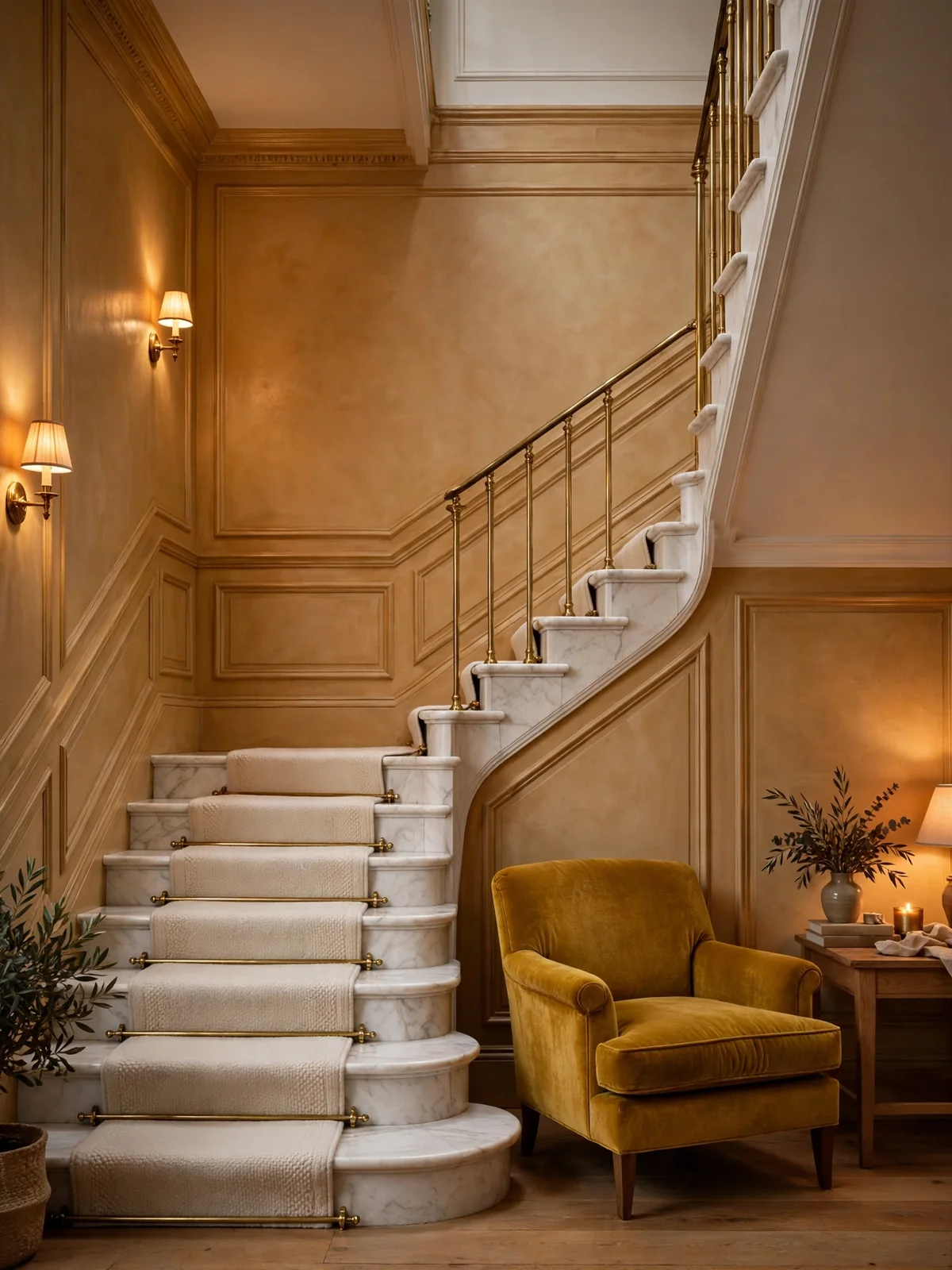
A wool runner on a marble stair adds warmth, softens footsteps, and gives grip without hiding the stone at the edges. On this straight flight, a cream wool runner, 700 mm wide, runs down the centre of white marble treads, each 1 metre wide, held in place by slim brass stair rods at each riser. The warm honey-toned walls and a mustard-yellow velvet chair beside the stair make the cream runner feel rich, while the marble edges still show on both sides.
Quick tips:
- Choose a low-pile wool runner so it stays neat and easy to vacuum.
- Leave at least 150 mm of marble showing on each side for the luxury effect.
- Use brass rods that match the handrail finish for a unified look.
- Fit a thin anti-slip underlay beneath the runner for extra safety.
Grey Marble Staircase Paired With Warm Beige Walls
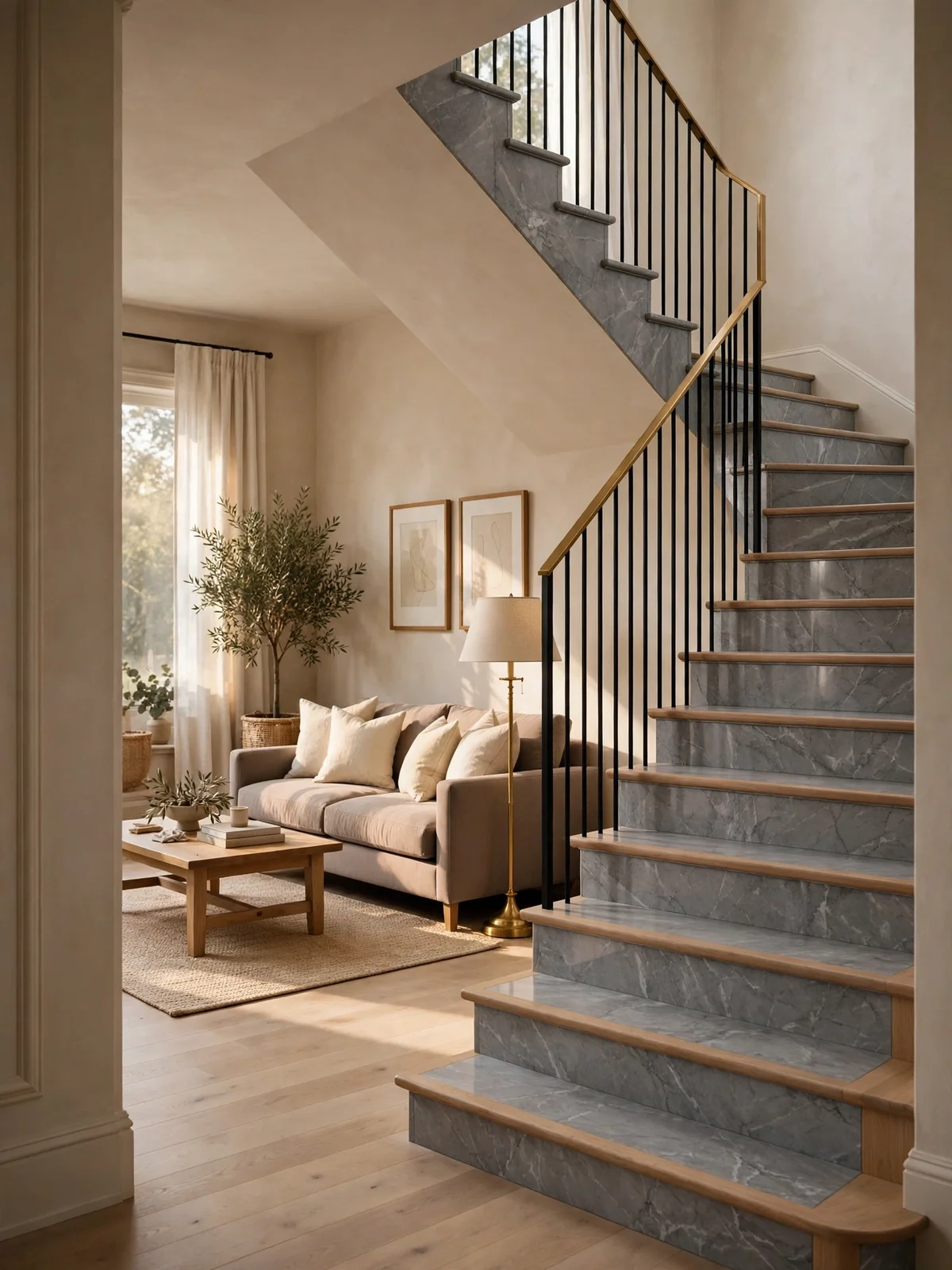
Grey marble can feel cold on white walls, but warm beige walls make it feel balanced and calm. This stair uses grey marble treads with soft white veining, each 950 mm wide, beside creamy beige walls, with a soft taupe sofa, cream cushions, and a warm brass floor lamp at the base. The beige warms the grey stone, the brass picks up the warmth, and the whole hallway feels like a transitional home — neither starkly modern nor old-fashioned.
Quick tips:
- Choose warm greige or creamy beige, not bright white, beside grey marble.
- Add one warm metallic, like brass, to keep the grey from feeling cold.
- Keep soft furnishings in taupe and cream to echo the wall colour.
- Test a wall sample beside the marble in daylight before painting the whole stairwell.
Floating Marble Staircase Treads on Hidden Steel Supports
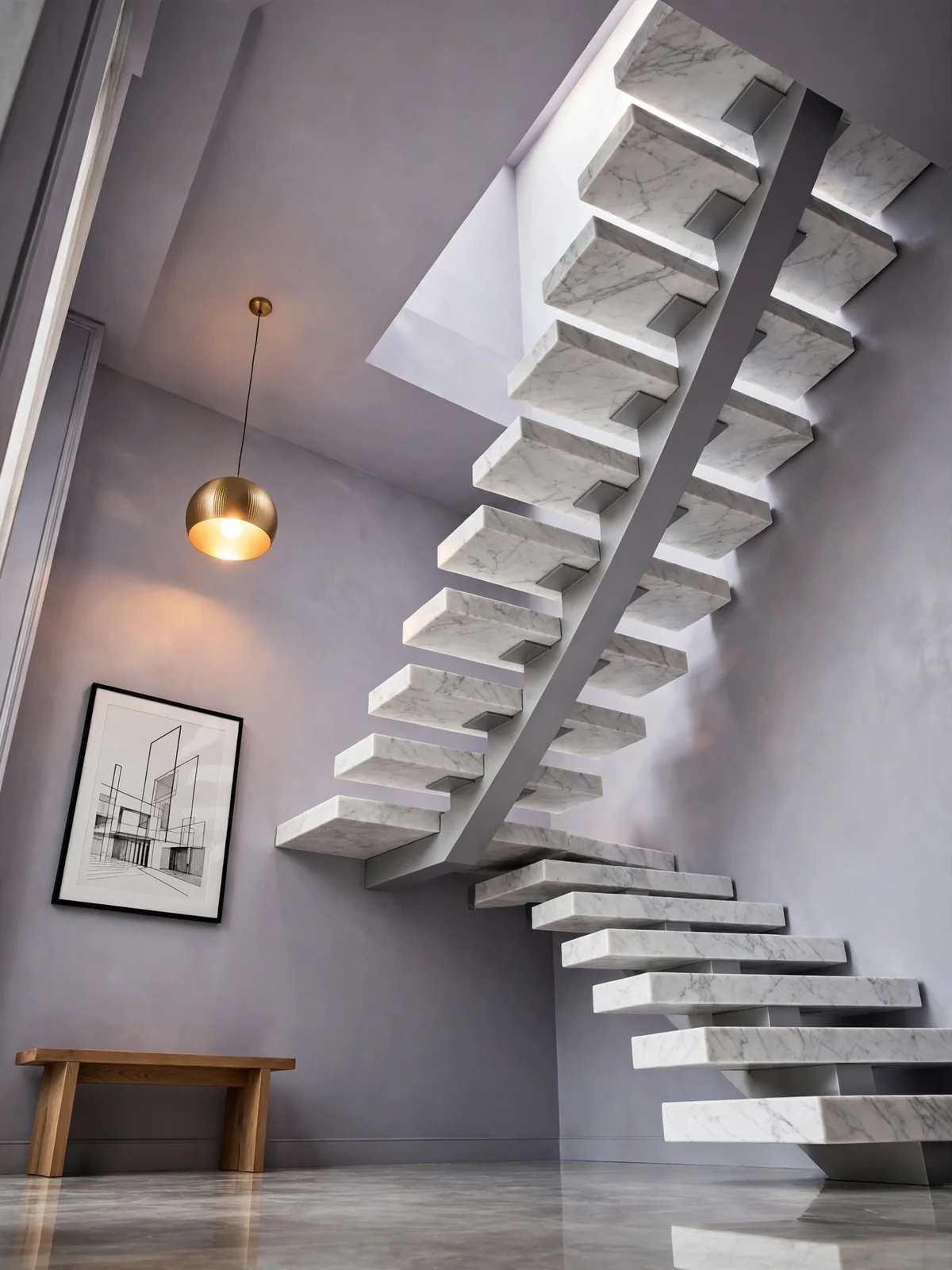
Floating marble treads look sculptural because the risers are open and the stone appears to hover in the air. Here, 50 mm thick white marble treads, each 900 mm wide, are mounted on hidden steel brackets set into the soft lavender-grey wall, with 180 mm gaps between them and no risers at all. A small wooden bench sits below, a black-and-white art print hangs on the landing, and a warm pendant light falls across the floating stone.
Quick tips:
- Keep marble treads at least 40 mm thick so floating treads look solid, not fragile.
- Add a slim wall handrail for safety on an open-riser floating stair.
- Keep the space under the stair clear so light flows through the gaps.
- Use a structural engineer to size the hidden steel supports correctly.
Marble Staircase With Contrasting Risers in a Second Stone
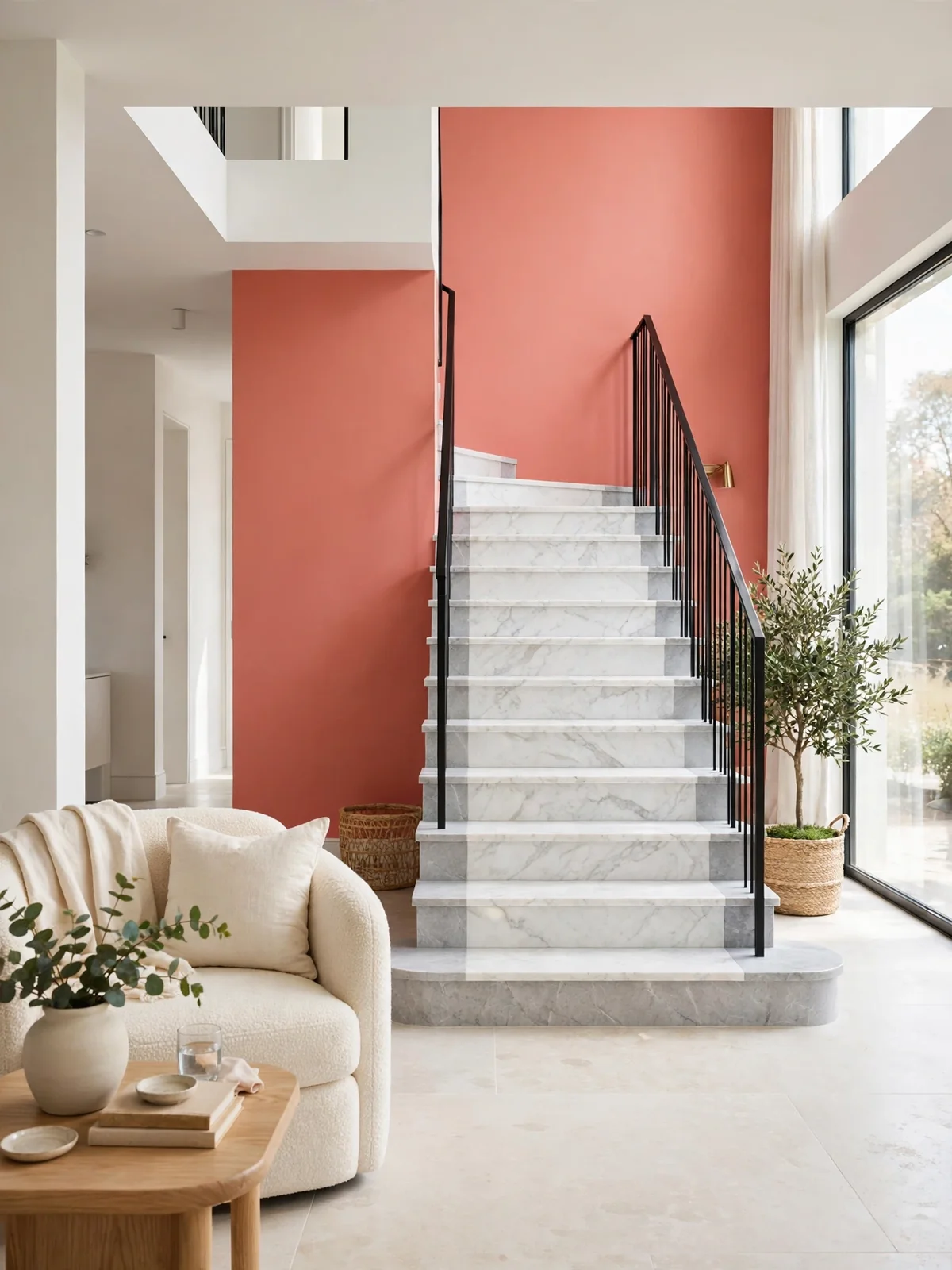
Using one marble for the treads and another for the risers adds dimension without overwhelming the eye. On this stair, white marble treads, each 1 metre wide, meet soft grey marble risers, each 180 mm high, so every step has a gentle two-tone rhythm. The coral-pink accent wall beside the stair and a cream armchair at the base keep the look fresh, while the pale stone floor ties the two marbles together.
Quick tips:
- Keep the two marbles in the same colour family so the contrast feels calm.
- Use the paler stone on the treads, where light falls, and the darker on the risers.
- Keep the wall colour simple so the two-tone steps stay the feature.
- Order both stones from the same supplier so the finishes match.
Marble Skirting That Finishes the Staircase Wall Beautifully
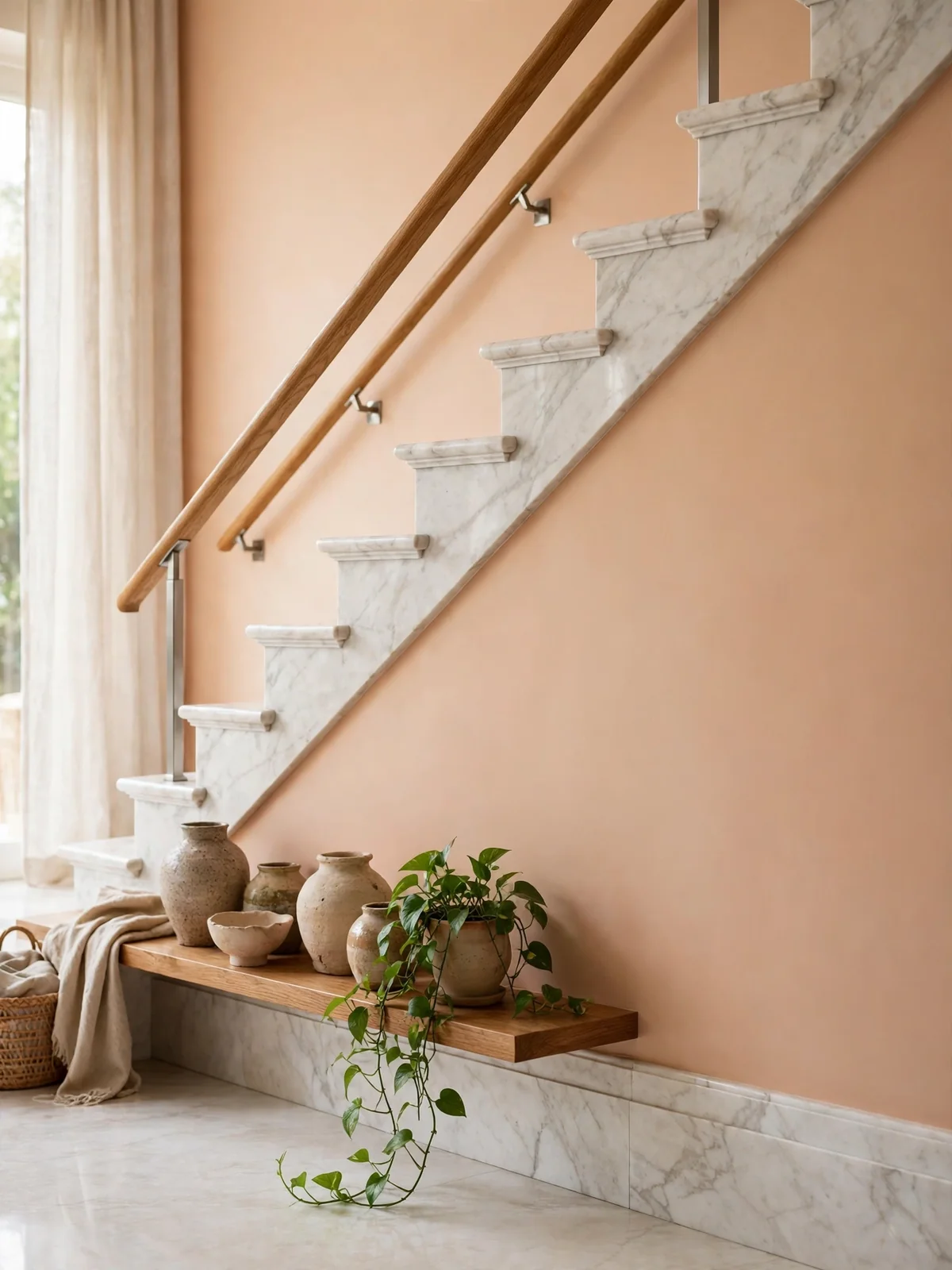
Most people stop at the treads, but matching marble skirting along the side wall gives the stair a finished, cohesive look. Along this flight, 150 mm high white marble skirting, cut to follow the slope of the steps, runs beside white marble treads, each 950 mm wide, with a warm oak handrail above it. The soft peach wall, handmade pottery on a low shelf, and a trailing green plant make the stair feel personal, while the skirting protects the wall from scuffs.
Quick tips:
- Match the skirting thickness to the tread thickness for a seamless transition.
- Use the same marble for skirting and treads so the colours line up.
- Keep the skirting height consistent as it steps up the wall.
- Add the skirting before painting the stairwell so the edges sit cleanly.
Grand Marble Staircase Entrance With Full Stone Cladding
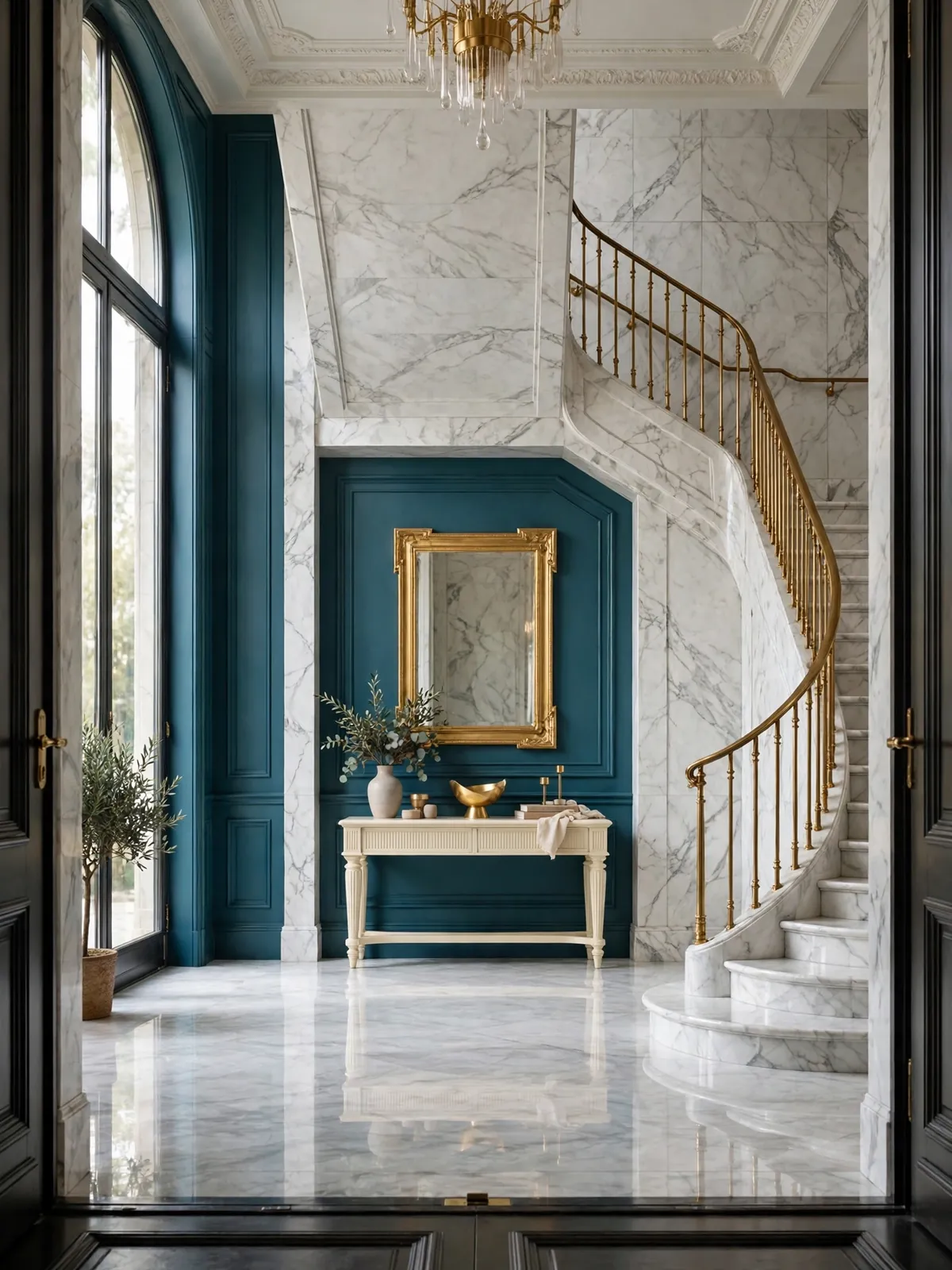
When the staircase greets guests at the front door, cladding the walls and landing in the same marble makes the entrance feel like a boutique hotel. In this foyer, white marble with soft grey veining covers the treads, the risers, the landing, and the full-height wall beside the stair, with deep teal accents on the opposite wall, a gold-framed mirror, and a cream console table. The stone is the decoration, so the furniture stays minimal and the veining can breathe.
Quick tips:
- Choose slabs with flowing, intentional veining for a full-cladding entrance.
- Keep furniture minimal — one console and one mirror are enough.
- Add warm lighting to soften a large expanse of cool marble.
- Invest in professional sealing, as a large marble area shows stains quickly.
Marble Staircase With a Solid Wood Handrail for Warmth
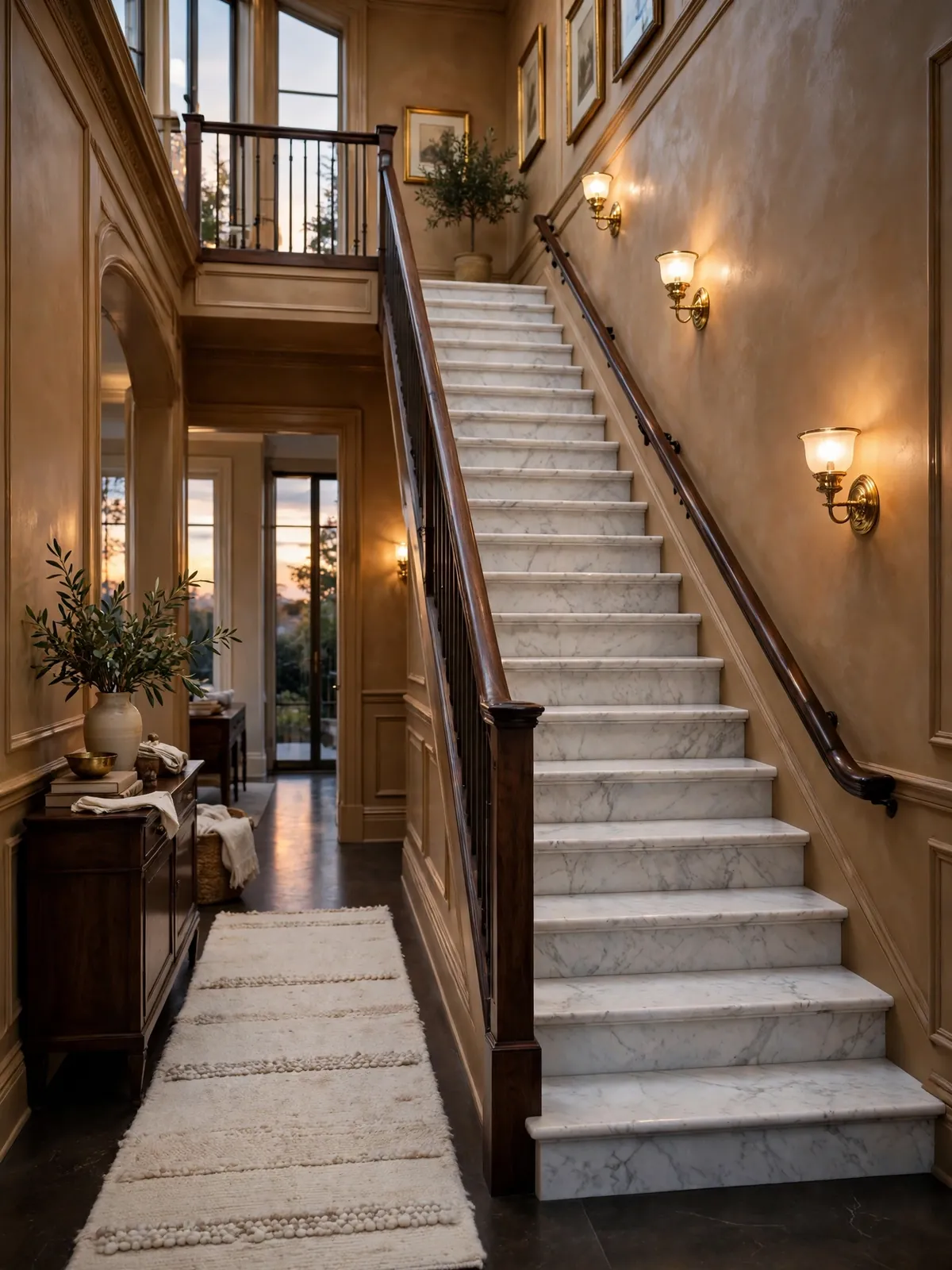
Marble alone can feel a little cold, and a solid wood handrail softens it the moment your hand touches it. On this stair, white marble treads, each 1 metre wide, are paired with a dark walnut handrail, 60 mm wide, running on slim black steel brackets, beside warm caramel walls. A cream rug at the base and brass wall sconces add warmth, while the walnut handrail gives the cool stone a warm, natural counterpoint.
Quick tips:
- Choose walnut for white marble and natural oak for black marble for the best balance.
- Keep the handrail height at about 900 mm above the tread nosing for comfort.
- Match the handrail timber to a piece of furniture nearby.
- Oil the handrail regularly so it stays smooth and rich in colour.
Green Marble Staircase That Adds Rich Colour to a Calm Hallway
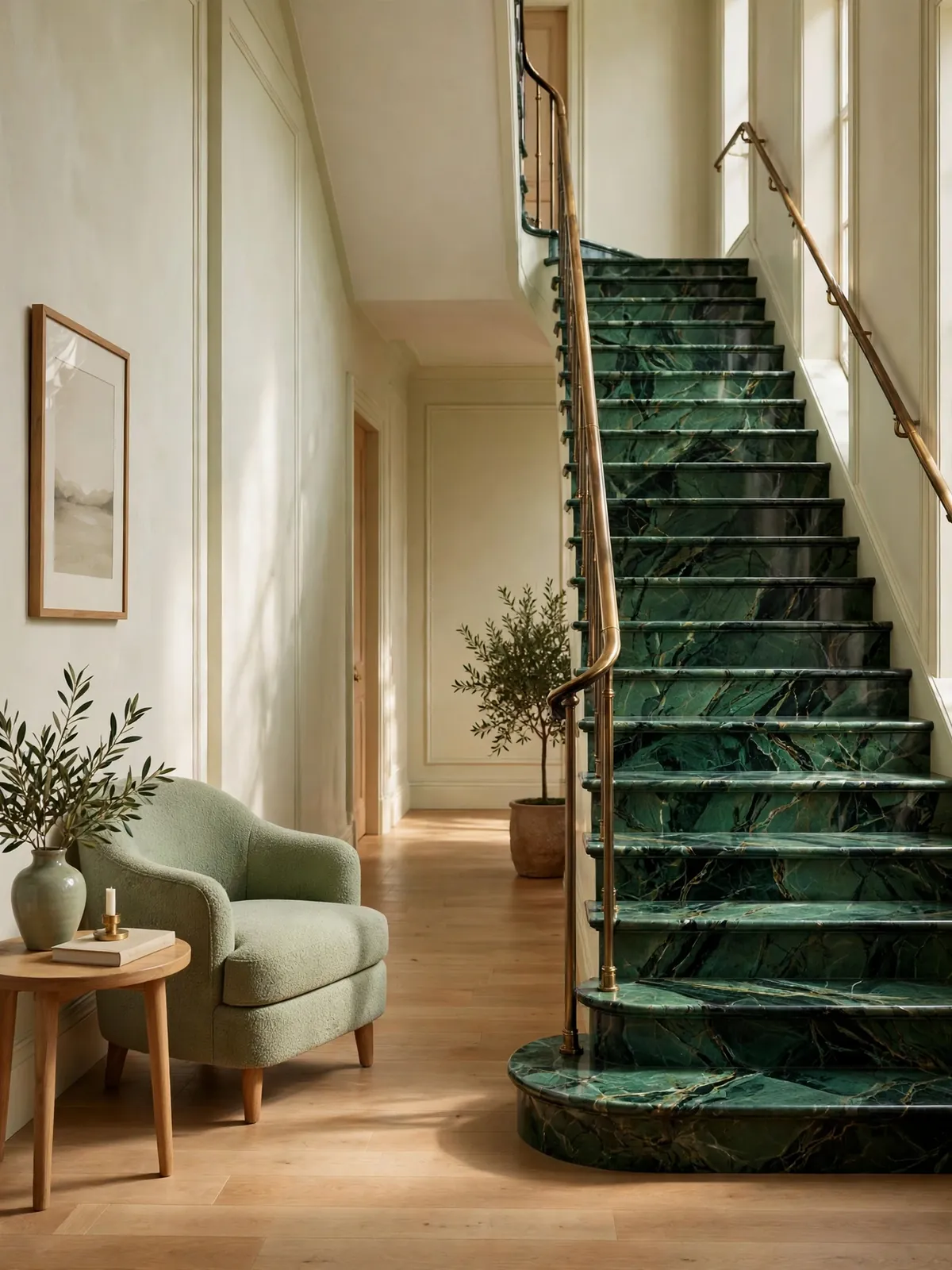
Green marble adds rich colour without needing paint or wallpaper, because the stone itself is the colour. This stair uses Verde Guatemala marble treads, each 950 mm wide, with deep emerald and white veining, beside pale cream walls and a light oak floor. A slim brass handrail runs along the wall side, a soft sage-green armchair sits at the base, and the green stone feels calm rather than loud because everything around it is pale and quiet.
Quick tips:
- Pair green marble with cream walls and pale oak so the colour stays calm.
- Use brass, not chrome, with green marble for a warmer, richer finish.
- Keep the hallway furniture simple so the green stone is the feature.
- Seal green marble well, as darker stones can show water marks more clearly.
Marble Staircase With Subtle Gold Hardware for a Quiet Glamour
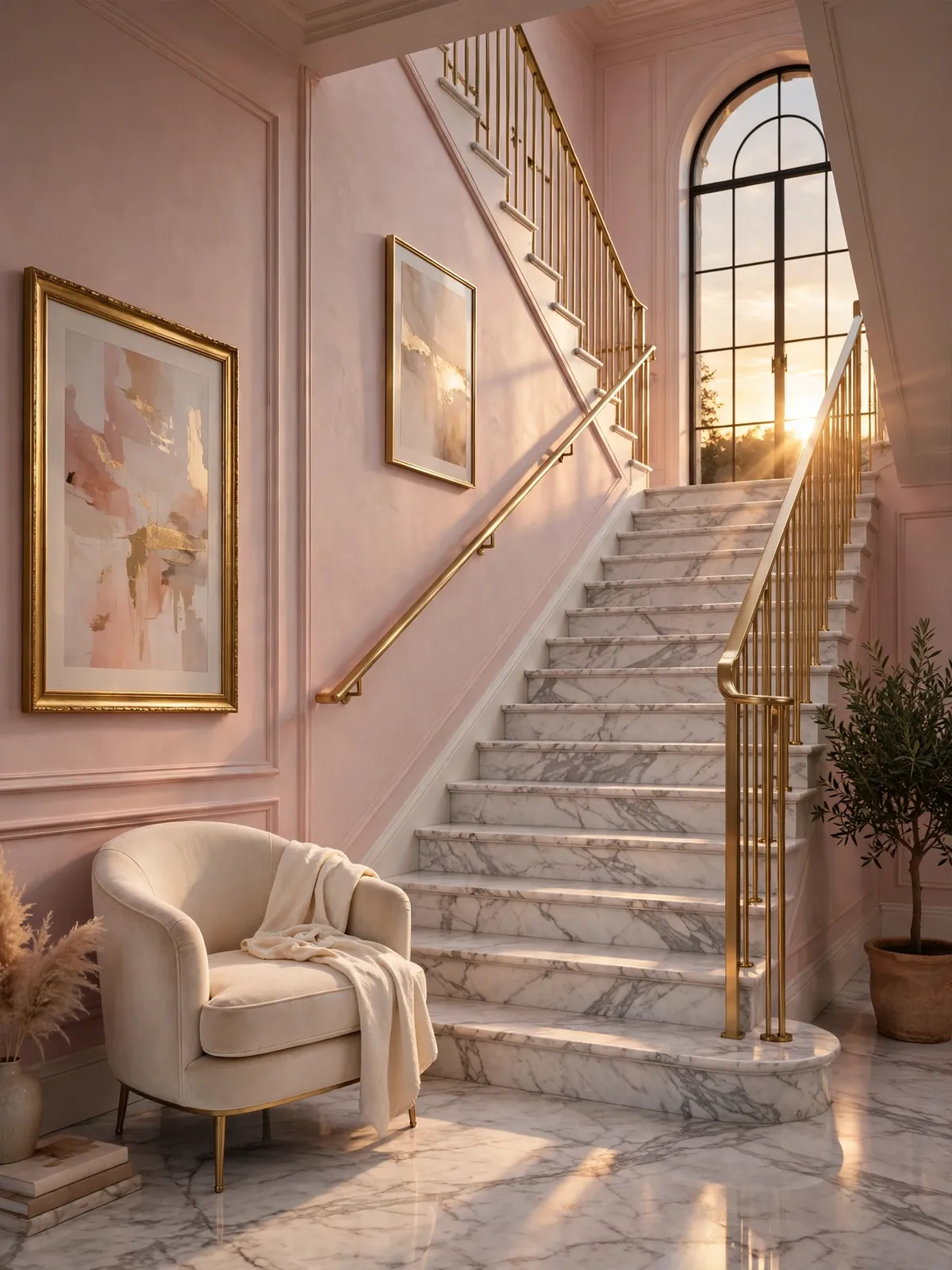
You do not need a gold explosion to make marble feel glamorous — small brushed-gold touches are enough. On this stair, white marble treads, each 900 mm wide, are edged with slim brushed-gold stair nosings and gold railing brackets, beside soft blush-pink walls. A velvet cream chair and a gold-framed art print on the landing pick up the gold tone, while the warm evening light makes the brass glow softly without looking flashy.
Quick tips:
- Use brushed or satin gold, not polished, to avoid a flashy finish.
- Keep gold to the nosings, brackets and handrail fixings — let the marble stay the star.
- Pair gold hardware with blush, cream or champagne walls for warmth.
- Match the gold tone to a lamp or mirror nearby for a unified look.
Large-Format Marble Slabs That Keep a Wide Staircase Seamless
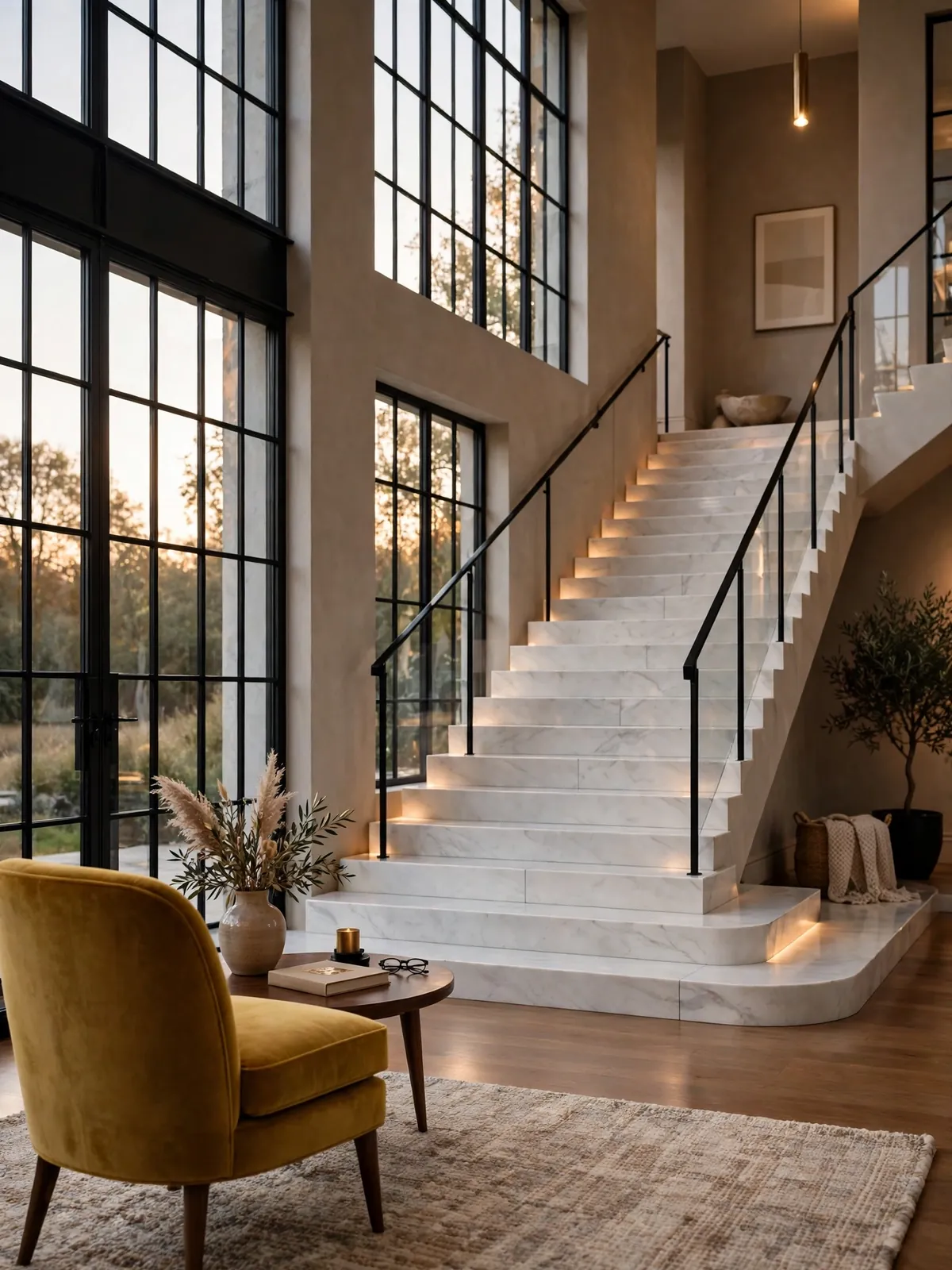
More seams mean more visual clutter, so large-format slabs make a wide staircase look smoother, cleaner and more expensive. Here, a 1.4-metre-wide flight is built from large-format Calacatta marble slabs, each tread cut from a single piece 1.4 metres long and 300 mm deep, with only one seam per step. The warm taupe walls and a mustard-yellow velvet chair below add warmth, while the black steel window frames give the pale stone a crisp outline.
Quick tips:
- Use the largest slab size your stair width and budget allow for the fewest seams.
- Check that large slabs can be carried up the stairwell before ordering.
- Keep the wall colour plain so the seamless stone stays the focus.
- Ask the supplier about slab availability early — large pieces may need ordering ahead.
Anti-Slip Marble Staircase That Stays Safe Without Losing Its Shine
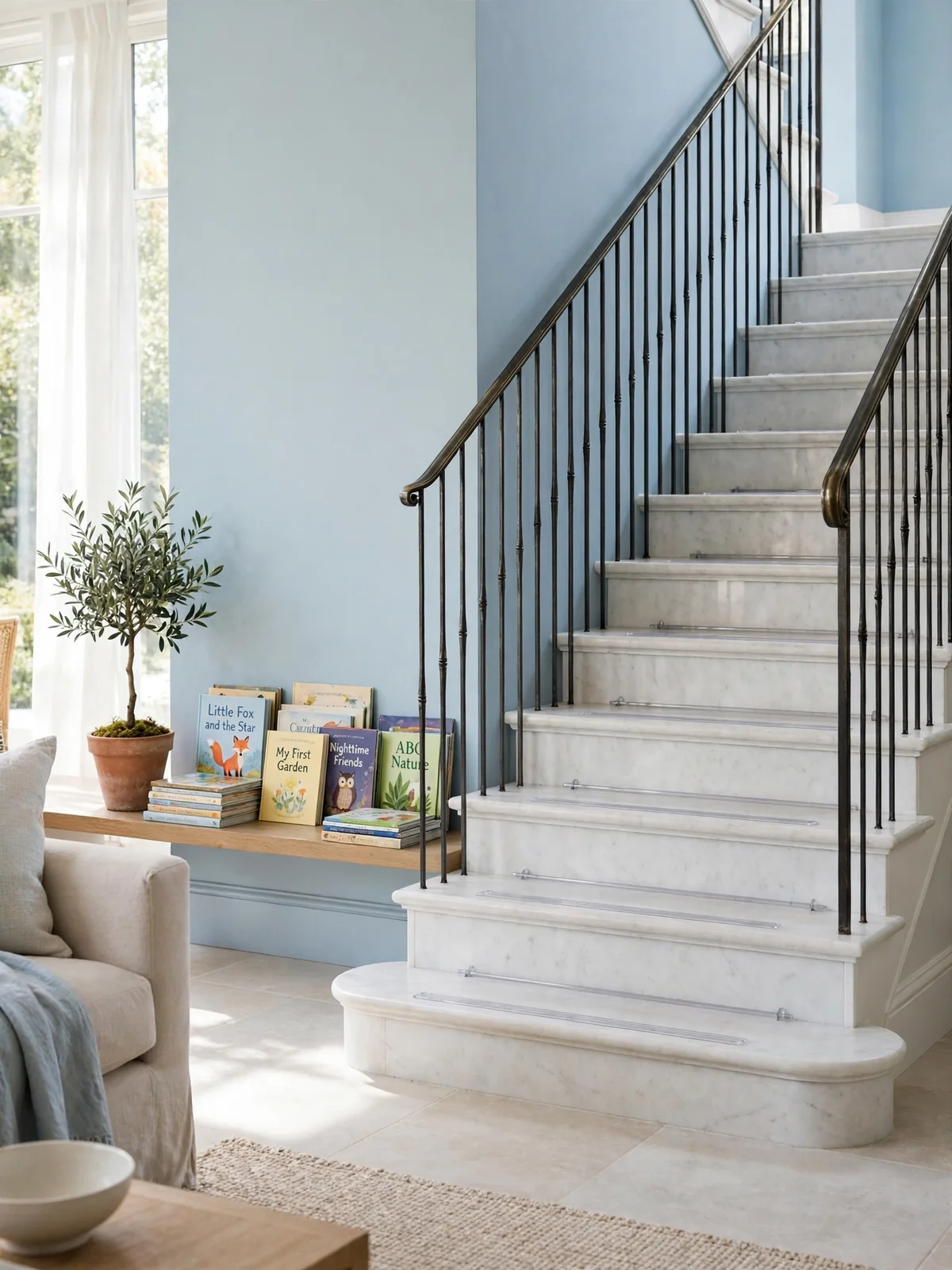
Safety matters on a marble stair, and discreet anti-slip strips keep the shine without adding bulky grip pads. In this family home, white marble treads, each 1 metre wide, carry thin transparent anti-slip strips, 25 mm wide, set 20 mm back from each nosing, so they are almost invisible in daylight. The soft sky-blue walls, a pale stone floor, a small olive tree, and a low shelf of children’s books show the stair belongs in a real family living room.
Quick tips:
- Choose transparent strips or an etched anti-slip treatment, not bulky rubber pads.
- Place strips near the nosing, where feet land first on each step.
- Reapply a clear anti-slip treatment every year in a busy home.
- Pair anti-slip strips with a secure handrail and good lighting for full safety.
Marble Staircase Against Dark Charcoal Walls for Sculptural Drama
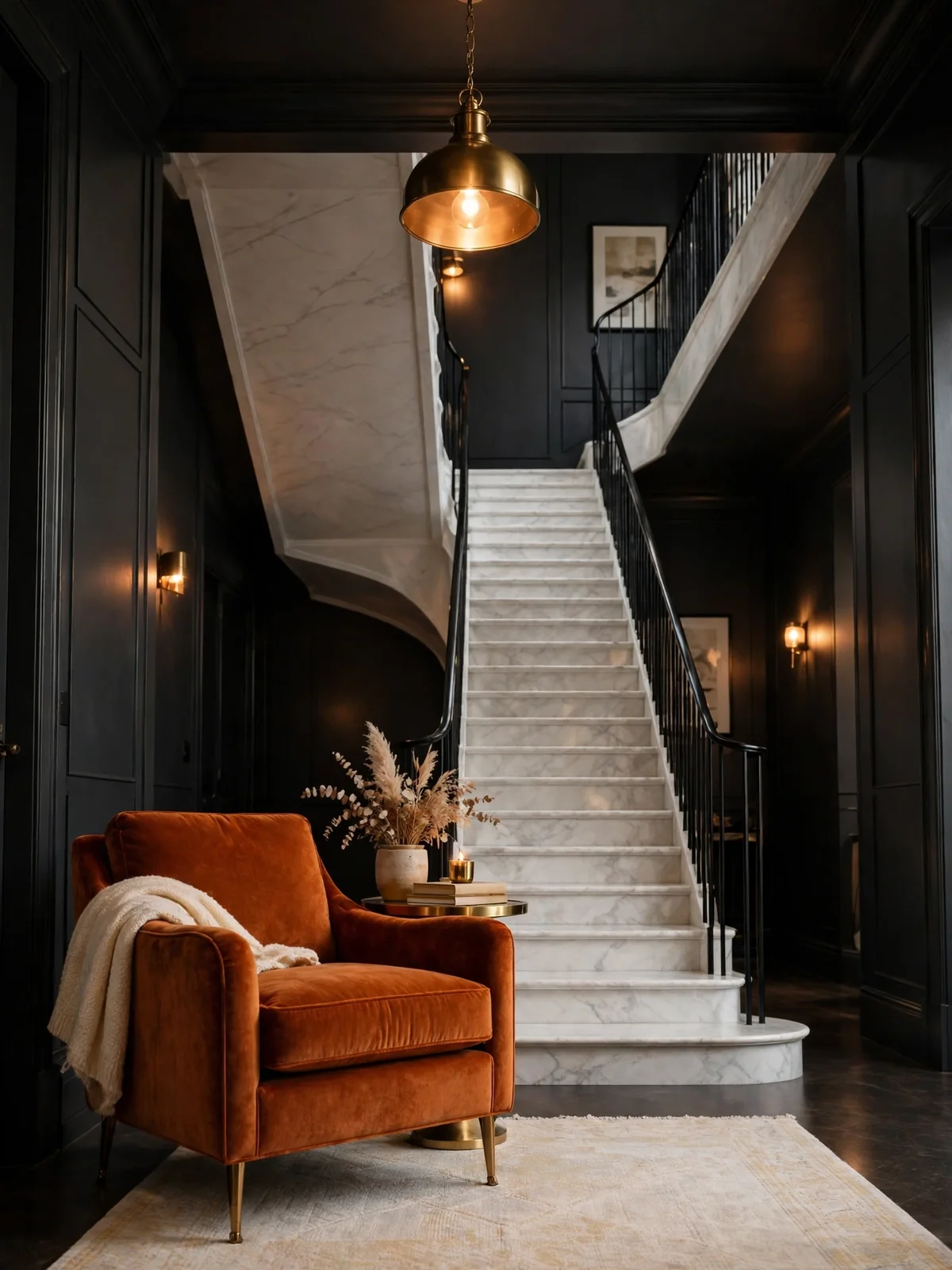
Light marble pops against dark walls, and the staircase becomes sculptural art in its own right. This stair uses white marble treads with soft grey veining, each 950 mm wide, against deep charcoal walls, with a burnt-orange velvet chair at the base, a warm brass pendant above the landing, and a pale cream rug softening the floor. The dark walls make the white stone glow, while the orange chair and brass light keep the moody hallway feeling cosy, not cold.
Quick tips:
- Paint the stairwell charcoal or deep navy only if the hallway has warm lighting.
- Add warm bulbs and brass to soften a dark wall beside white marble.
- Use one warm accent colour, like burnt orange, to balance the drama.
- Keep the floor pale so the dark walls do not close the hallway in.
Marble Landing Designed as a Small Moment Between Floors
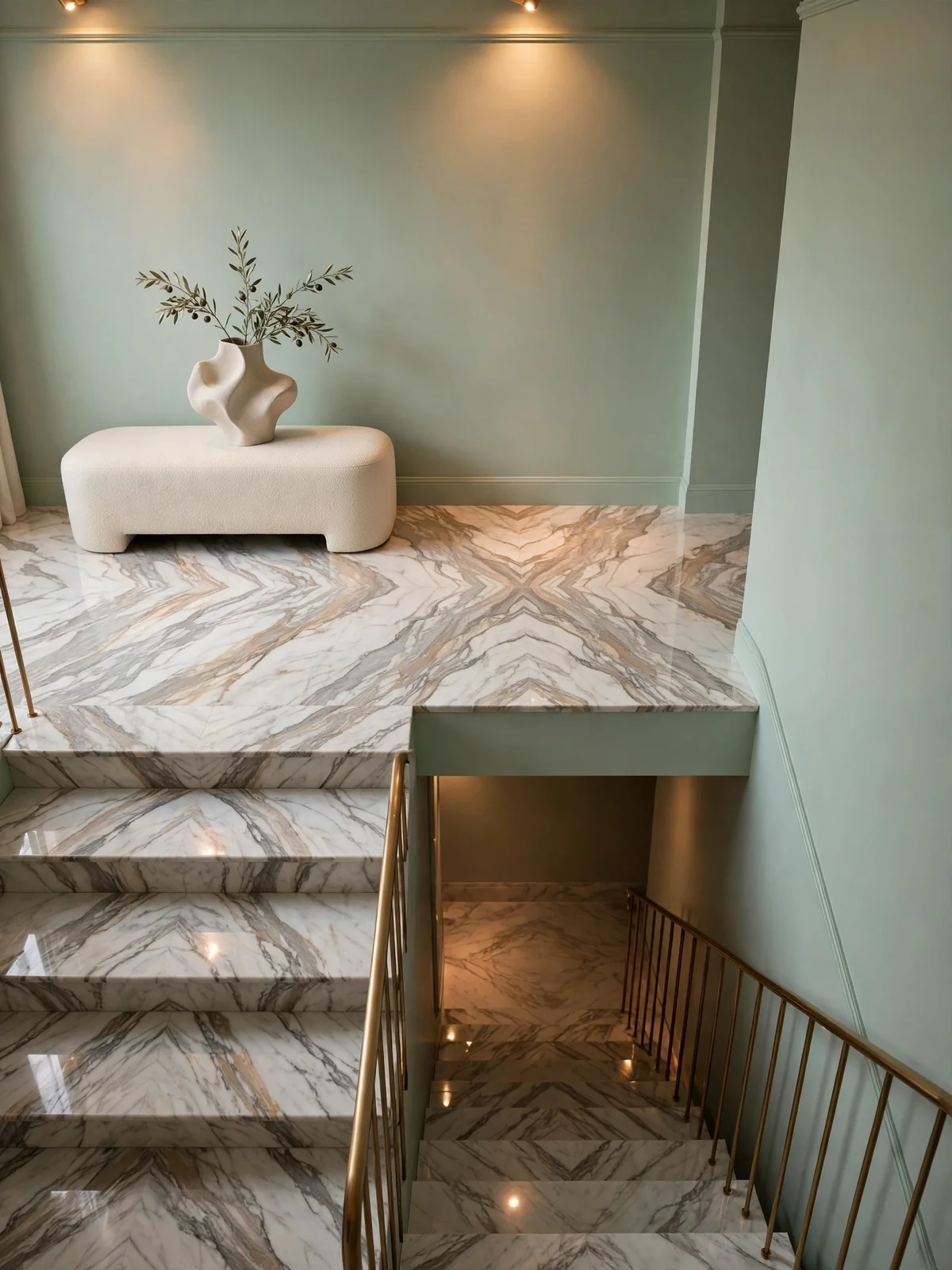
A landing should not be an afterthought — it is a small design moment between floors. On this half-landing, book-matched white marble, with the veins mirrored like an open book, covers the floor in a 1.5-metre square, while a soft mint-green wall, a sculptural ceramic vase, and a cream bench complete the pause. Warm spotlights fall across the mirrored veins, and the marble pattern gives the landing its own identity before the next flight begins.
Quick tips:
- Use book-matched marble on the landing to create a framed pattern.
- Keep the landing furniture to one bench and one vase — nothing more.
- Add a warm spotlight so the landing pattern is visible in the evening.
- Change the veining direction on the landing to mark the pause between flights.
Marble Staircase With Brushed Stainless Steel for a Modern Edge
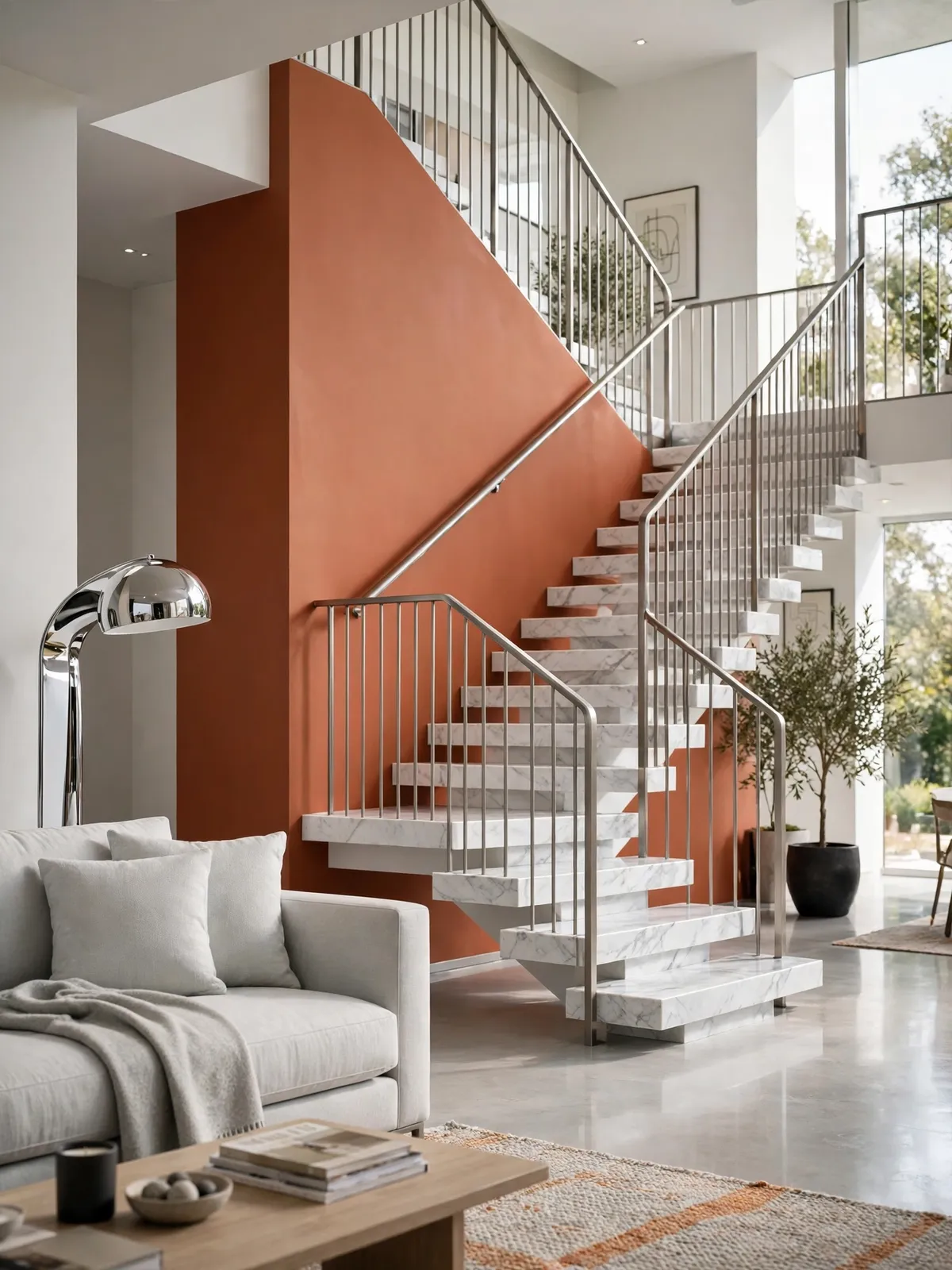
Brushed stainless steel with marble feels sleek, crisp and modern, without the cold glare of mirror-polished metal. Here, white marble treads, each 1 metre wide, are paired with brushed stainless steel balusters and a slim steel handrail, beside a soft rust-orange accent wall. A pale grey sofa and a chrome floor lamp nearby echo the steel tone, while the rust-orange wall warms the whole look and keeps the steel from feeling industrial.
Quick tips:
- Choose brushed steel, not mirror-polished, to avoid glare beside marble.
- Pair steel railings with one warm wall colour to keep the look balanced.
- Keep the steel finish consistent across railings, brackets and light fittings.
- Wipe steel railings with a soft cloth to keep fingerprints from showing.
Marble Staircase Edges Only — A Small Luxury Upgrade
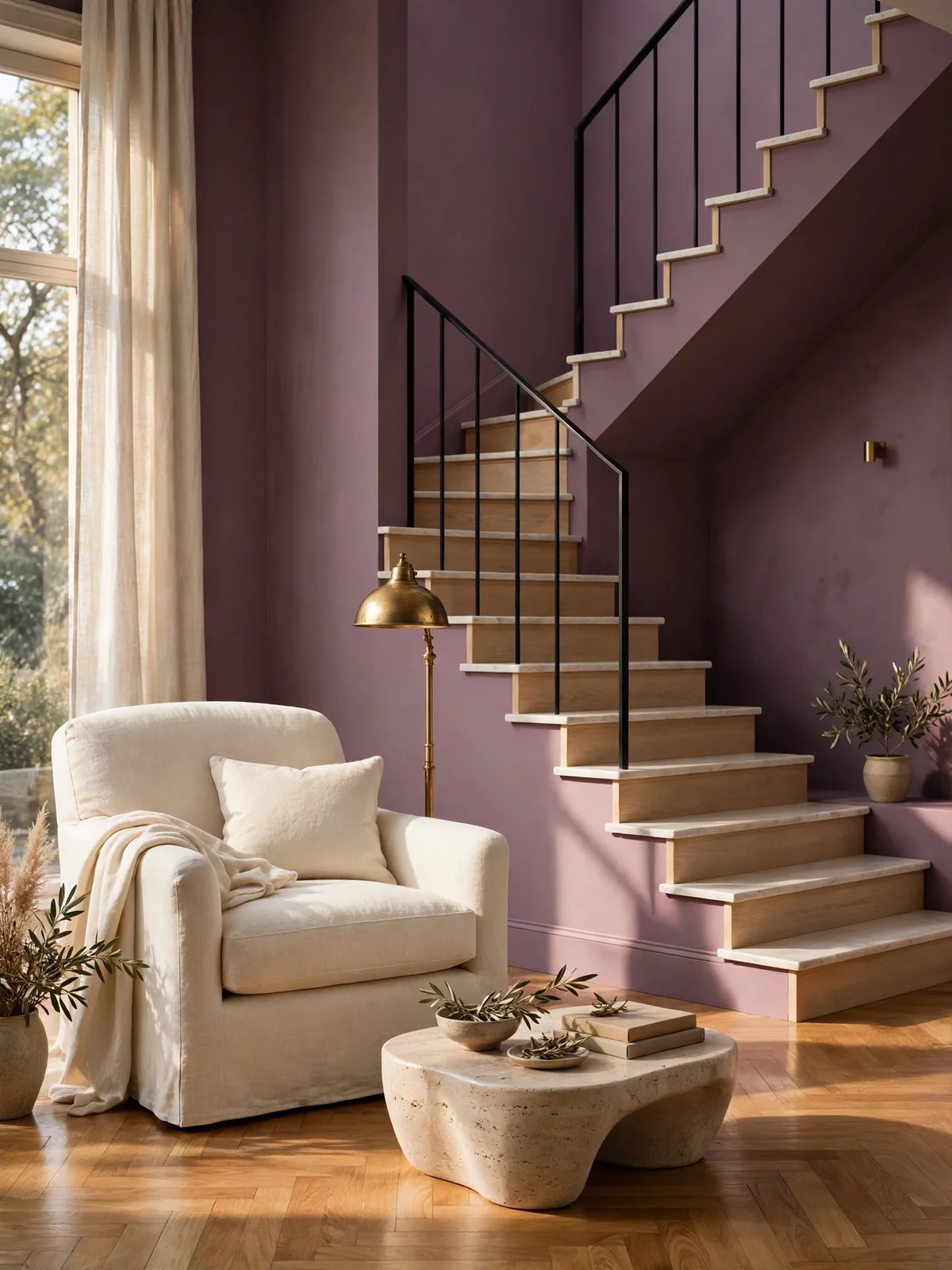
Not ready for a full marble stair? Cladding just the front edges in marble gives you the luxury touch without the full investment. On this stair, pale oak treads, each 950 mm wide, carry a 40 mm wide white marble nosing on each front edge, beside a soft plum-purple wall. A cream linen armchair and a brass floor lamp at the base keep the look warm, while the thin marble edge catches the light on every step.
Quick tips:
- Start with marble nosings if a full marble stair is outside your budget.
- Keep the rest of the tread in pale oak so the marble edge stands out.
- Use the same marble on the nosings and a small landing for continuity.
- Seal the marble nosings well, as the edges take the most wear.
Spiral Marble Staircase That Saves Space in Style
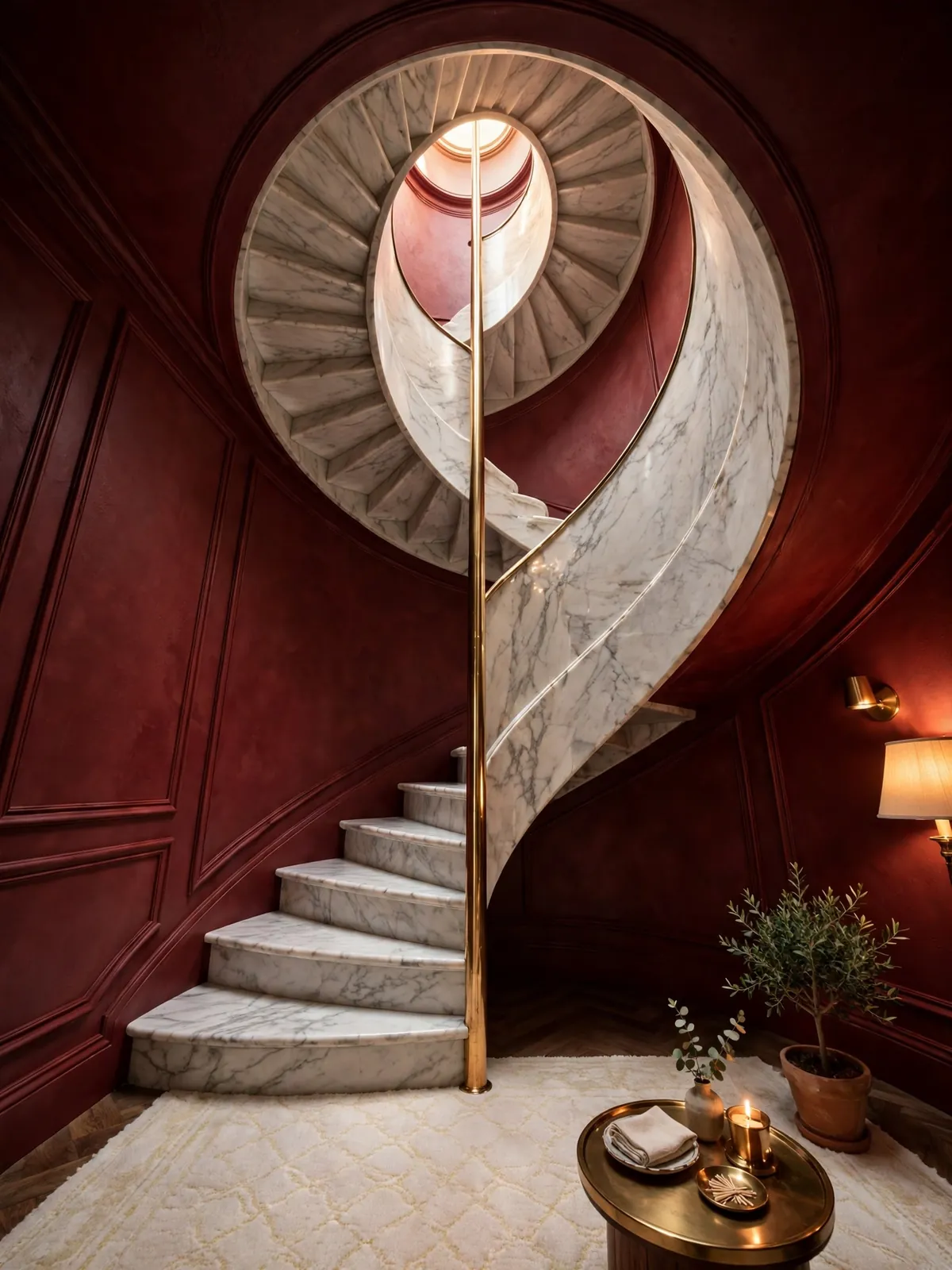
A spiral marble staircase saves space while still feeling grand, because the stone winds upward in a tight, sculptural coil. In this compact hallway, white marble treads, each 800 mm wide at the outer edge and 200 mm at the centre, wind around a slim brass central pole, beside a deep burgundy-red wall. A cream rug at the base and a small round side table keep the small space feeling intentional, while the spiral shape leaves the rest of the room free.
Quick tips:
- Keep spiral treads at least 800 mm wide at the outer edge for comfortable footing.
- Use a slim central pole in brass or black steel to anchor the spiral.
- Add a warm wall colour beside a spiral stair so the small space feels cosy.
- Fit a continuous handrail on the outer edge for safety on the curve.
Marble Staircase That Turns a Dark Hallway Into the Brightest Room
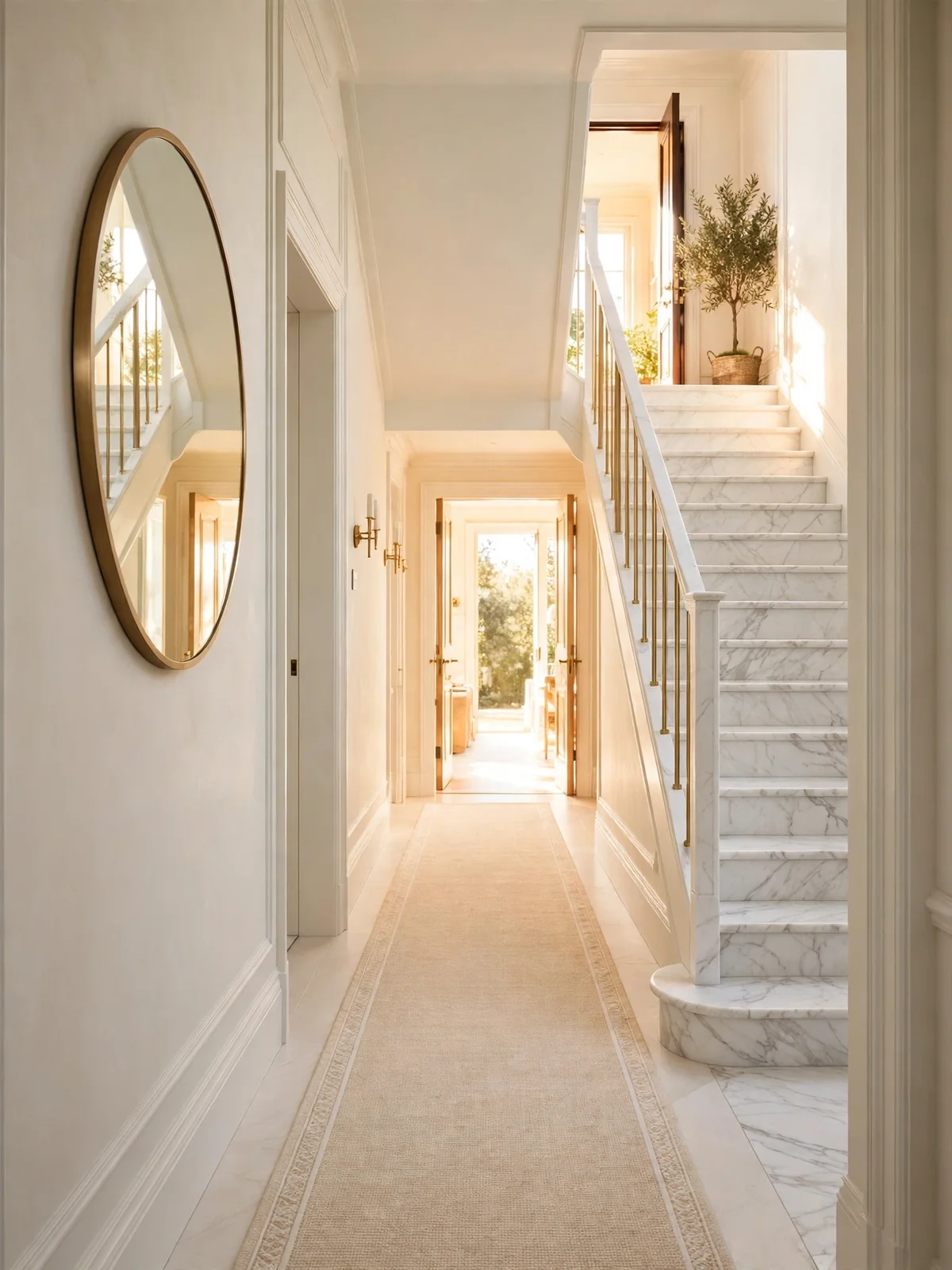
A dark hallway is where a marble staircase makes the biggest difference, because the pale stone reflects every bit of light it can find. In this narrow hallway, a straight flight of white marble treads, each 900 mm wide, with a large round mirror opposite the stair, pale cream walls, and a pale beige runner, now carries golden light from the landing window down the whole flight. What was once the darkest room in the house is now the brightest, and the marble is the reason.
Quick tips:
- Paint the hallway pale cream so it reflects every bit of light from the marble.
- Add a large mirror opposite the stair to double the brightness.
- Choose the palest marble you love for the most light in a dark hallway.
- Keep the hallway free of tall furniture that could block the stair and its light.
FAQs
How much does a marble staircase cost?
A marble staircase usually costs more than a timber or tiled stair because the stone, cutting and skilled fitting all add up. The final price depends on the marble type, the size of the flight, whether the risers and walls are clad too, and your location, so get at least two itemised quotes from stone specialists before you commit.
Is marble slippery on stairs?
Polished marble can be slippery, especially when wet, but honed marble, a lightly textured finish, or a clear anti-slip treatment makes it much safer. A secure handrail, good lighting, and a runner or anti-slip strips near each nosing add further protection in a family home.
How do I clean and care for a marble staircase?
Wipe marble treads with a soft cloth and a pH-neutral stone cleaner, and avoid vinegar, bleach or harsh bathroom sprays, which can etch the surface. Blot spills quickly, reseal the stone once a year, and use felt pads under any furniture that sits near the stair.
Can a marble staircase work in a small home?
Yes — pale marble with open risers or a slim glass balustrade keeps a small hallway bright, because the light stone reflects daylight instead of absorbing it. Keep the flight straight, the walls pale, and the furniture minimal so the stair does not overwhelm the room.
Which marble is best for a staircase?
White Carrara and Calacatta are the most popular choices for their timeless veining and brightness, while Nero Marquina suits a bold, dramatic look and honed Botticino works well in a family home. Choose the stone by how it looks in your hallway light, not only by its name, and always see a full slab before ordering.
Conclusion
A marble staircase is not just a way to move between floors — it is the stone that sets the mood for the whole home. Whether you choose classic white marble with soft grey veining, dramatic black stone with gold threads, warm walnut risers, backlit steps that glow at night, or a curved flight that turns the hallway into a grand entrance, the best marble staircase is the one that suits the rooms around it. Keep the palette warm where the stone feels cool, the sightlines open where the hallway feels small, and the finish practical where the stair is used every day, and your marble staircase will look luxurious, feel welcoming, and last for decades.