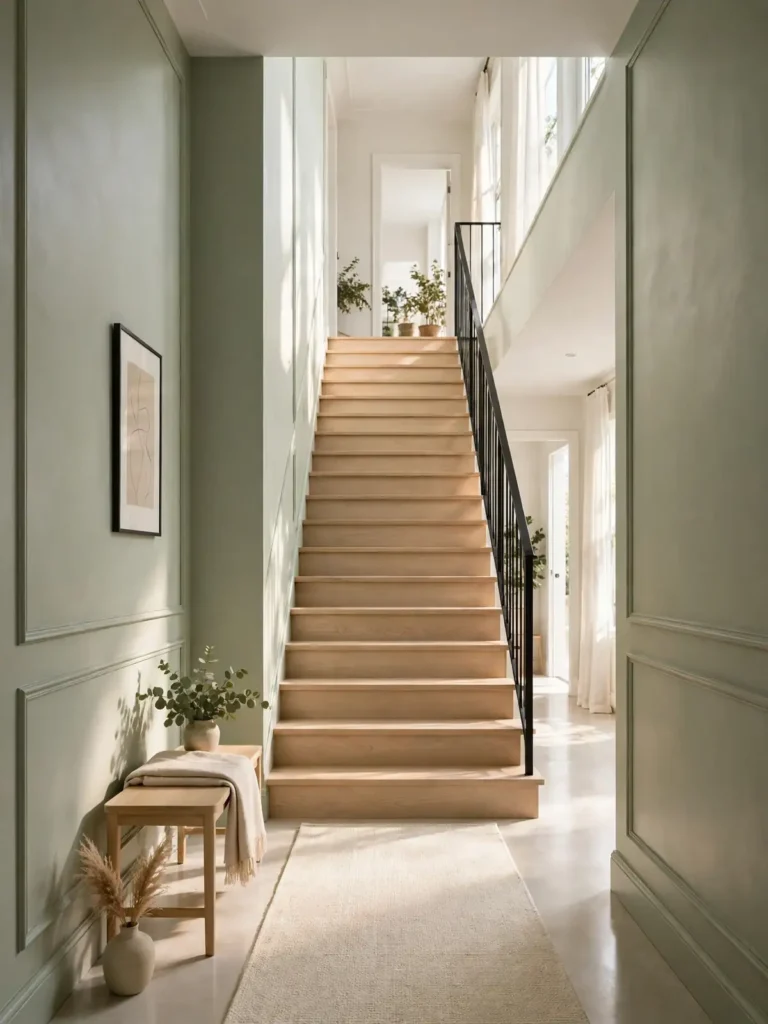
25 Stunning Spiral Staircase Ideas That Instantly Make Your Home Feel Elegant, Spacious and Luxurious
A spiral staircase does far more than save space — it turns the climb between floors into a moment of beauty. These 25 ideas show how white steel, warm walnut, cast iron, glass treads and soft colour can make a small corner feel open, a hallway feel grand, and an everyday stair feel sculptural and luxurious.
A spiral staircase is a stair that winds upward around a central pole or open well in a continuous curve, with wedge-shaped treads that narrow toward the centre and widen at the outer edge, so it needs far less floor space than a straight flight — often a circle just 1.5 to 2 metres across. Its curved shape carries the eye upward, lets light travel between floors, and turns even a small corner into a sculptural feature.
If your spiral stair will live outside, these outdoor spiral staircase ideas cover weatherproof steel, galvanised finishes and garden settings in more detail. The 25 ideas below cover every part of the spiral — its materials, its railings, its lighting, and the space beneath and around it — so you can choose a design that suits a compact flat, a bright loft, or a grand family home.
Key Takeaways
What is a spiral staircase?
A stair that winds upward around a central pole or an open well in a continuous curve, with wedge-shaped treads that narrow at the centre and widen at the outer edge. It fits into a circle as small as 1.5 metres across, so it saves far more floor space than a straight flight.
Does a spiral staircase suit a small home?
Yes — it is one of the best choices for a small home, because a compact spiral needs only about 2 to 3 square metres of floor space, leaves the rest of the room free, and its open curve keeps the corner feeling light rather than boxed in.
What materials work best for a spiral staircase?
White powder-coated steel, warm walnut or pale oak treads, cast iron, glass treads, brass railings and stone or terracotta bases. Warm timber or a soft wall colour keeps steel and glass from feeling cold, while brass or black iron adds definition to the curve.
Is a spiral staircase safe for a family home?
Yes, when it uses a sturdy central pole, deep treads at the walking line, a secure handrail on the outer edge, non-slip finishes and good lighting. Wider treads and a handrail on both sides help children and older family members, while open risers suit adults best.
Where should a spiral staircase sit in the home?
In a corner, beside a window, or in the centre of an open-plan room where its curve can be seen from all sides and its open shape can carry daylight between the floors.
A White Steel Spiral Staircase With Pale Oak Treads in a Bright Living Room
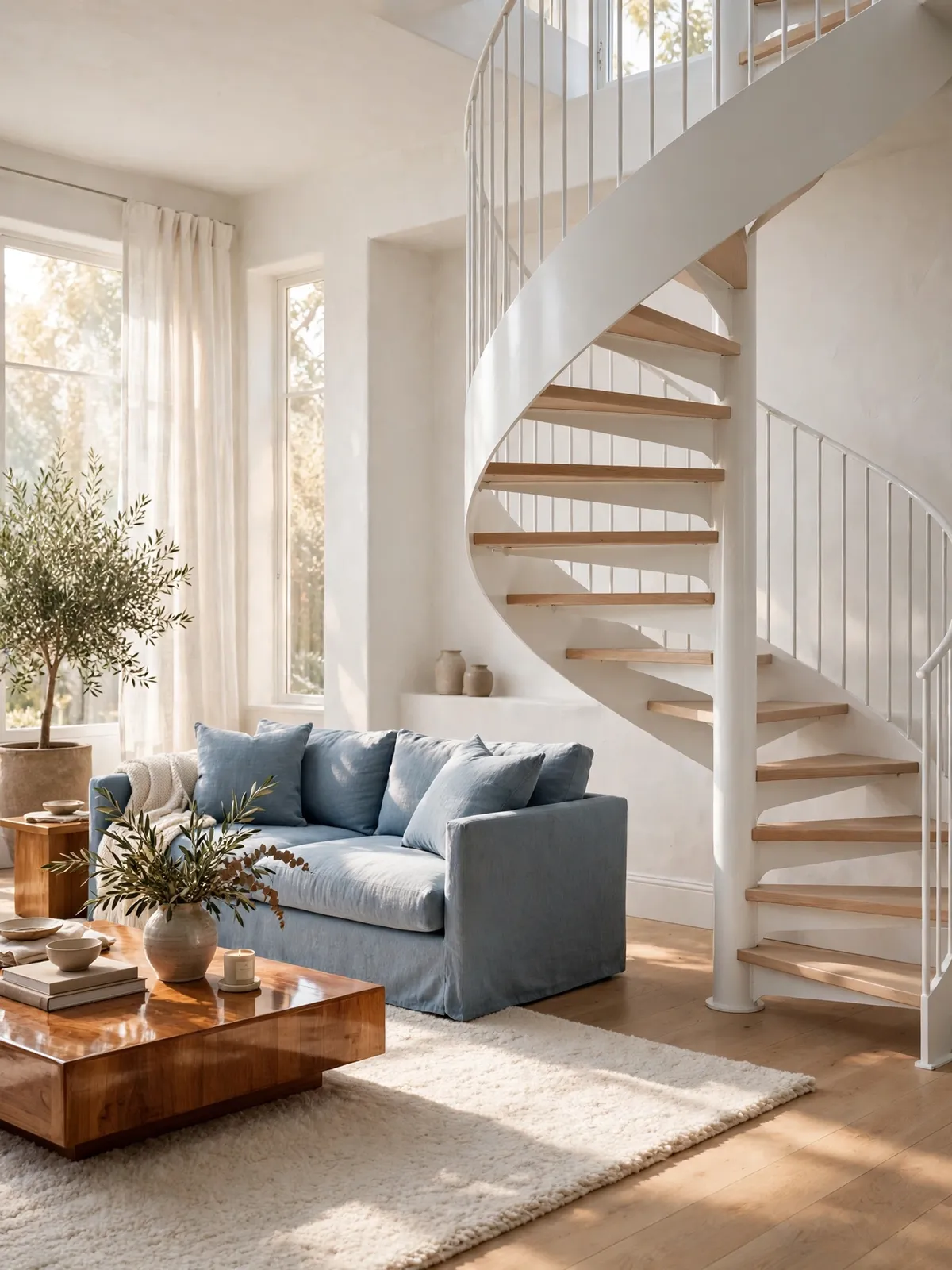
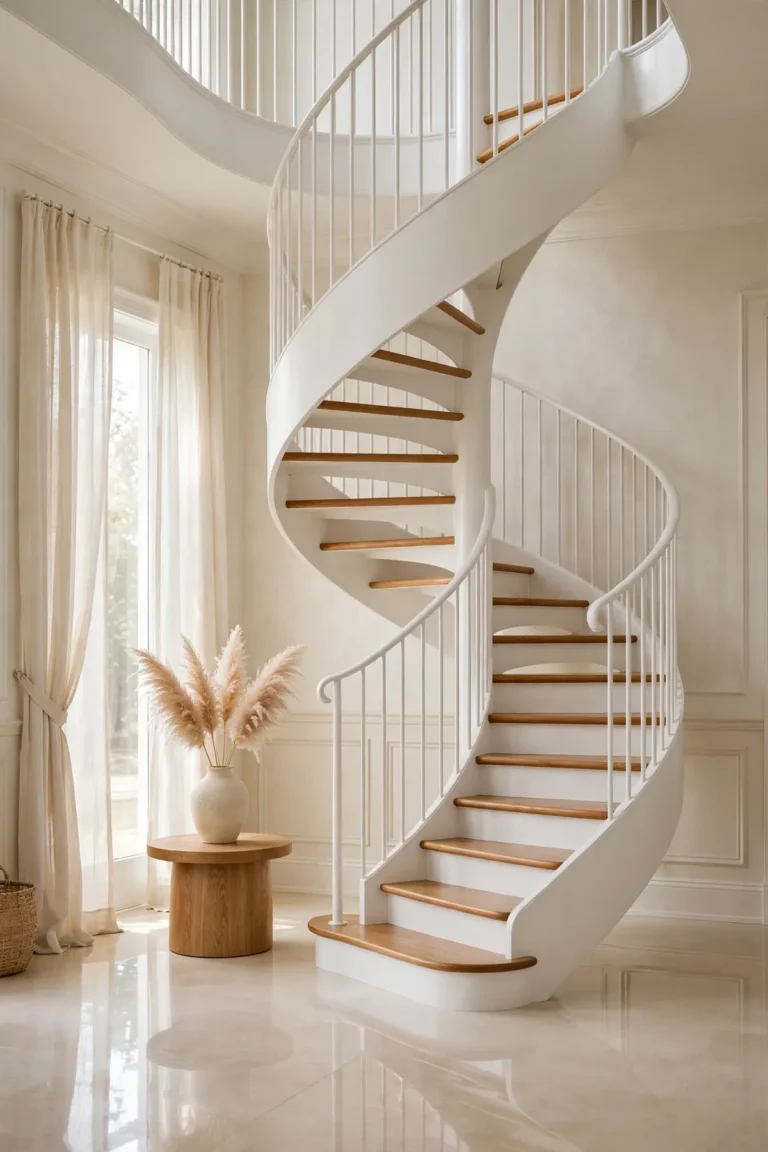
A white steel spiral staircase with pale oak treads is the lightest way to add a spiral to a living room, because the white steel almost disappears against a pale wall while the oak brings warmth to every step. In one open-plan home, the spiral rises through a circle 1.8 metres across, with treads 800 mm wide at the outer edge and a slim white steel handrail following the curve, while a dusty-blue linen sofa and an ivory wool rug sit nearby. Daylight falls through the open risers and across the pale floor, so the stair feels like sculpture rather than structure.
Quick tips:
- Choose white powder-coated steel so the spiral stays light and bright.
- Use pale oak treads for warmth against the white frame.
- Keep the wall behind the stair plain white so the curve stands out.
- Add a slim handrail that follows the spiral exactly.
A Warm Walnut Spiral Staircase With a Black Iron Railing
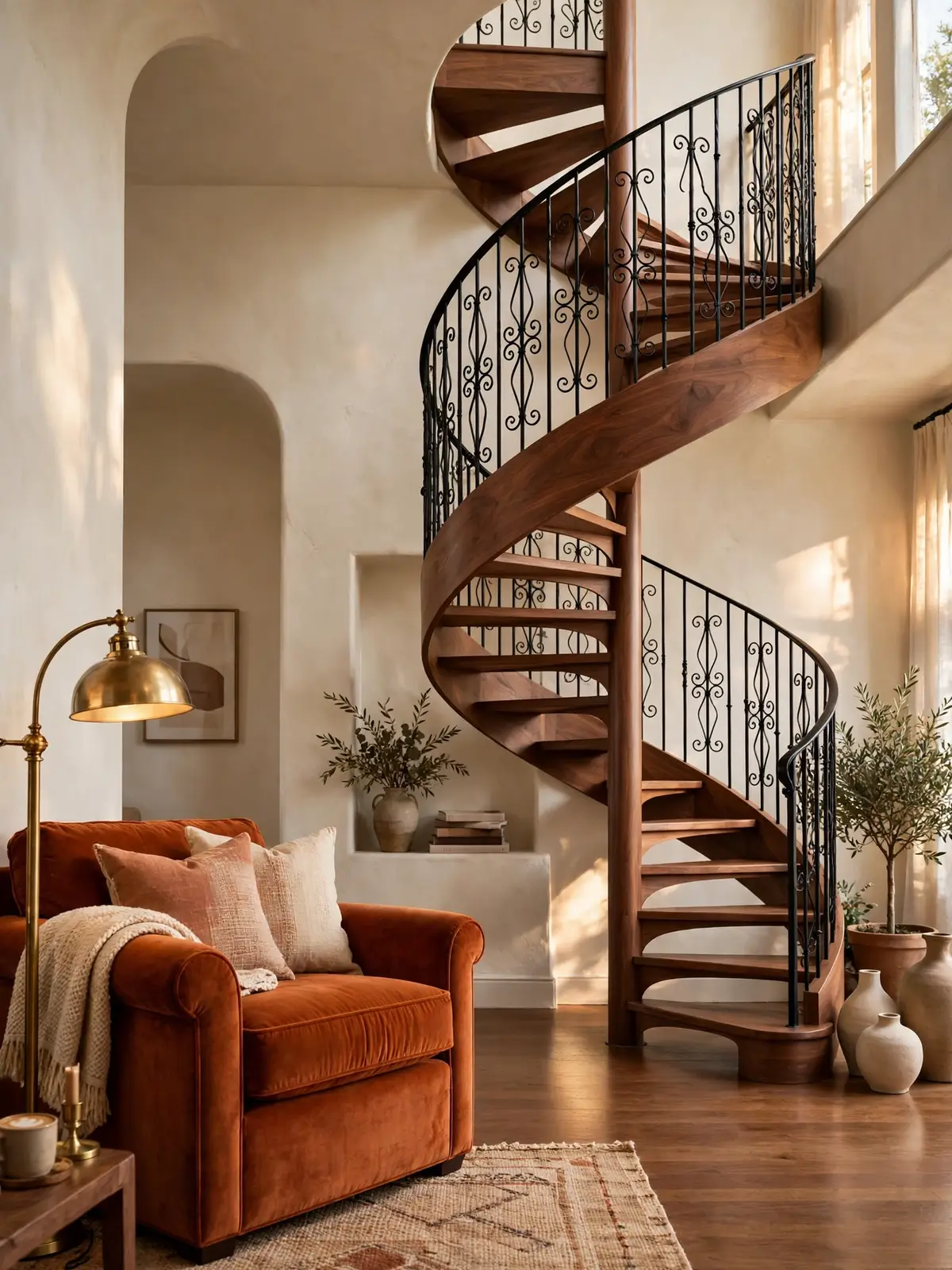
Warm walnut treads and black iron make a spiral staircase feel rich and grounded, like a piece of furniture built into the room. Here, the spiral rises through a 2-metre circle with 40 mm thick walnut treads, each 850 mm wide, and a black iron balustrade of slim vertical spindles that follows the curve. A burnt-orange velvet armchair below echoes the walnut tone, while a brass floor lamp adds a soft evening glow. The dark iron outlines the curve, so the stair reads clearly from every corner of the room.
Quick tips:
- Choose walnut treads for depth and warmth against black iron.
- Keep the spindles slim so the railing stays elegant, not heavy.
- Pair the stair with one warm accent, like burnt orange or rust.
- Match the iron tone to window frames or light fittings nearby.
A Cast Iron Spiral Staircase With a Vintage Scrollwork Railing
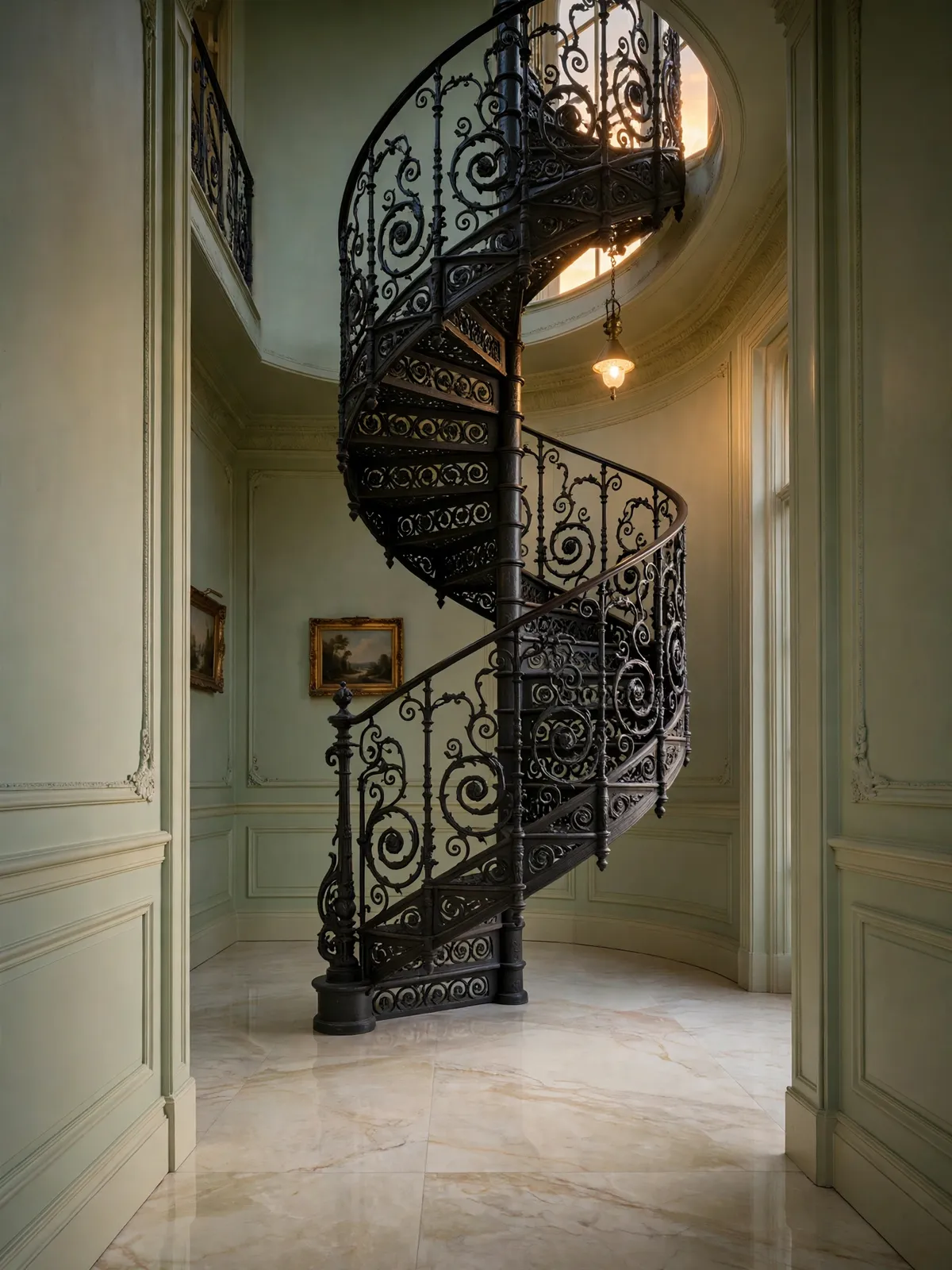
A cast iron spiral staircase with scrollwork brings old-world romance to a hallway, and its curves echo the spiral itself. On this stair, dark cast iron treads, each 750 mm wide, wind around a central pole, while the railing is made of hand-forged scrolls that curl and loop along the curve. Soft sage-green walls and a cream marble floor keep the palette gentle, and a small brass pendant light glows above the landing. The ironwork is the decoration, so the rest of the room can stay calm.
Quick tips:
- Choose cast iron in a matte finish so the scrollwork reads clearly.
- Pair ornate iron with soft sage or cream walls for balance.
- Add one brass fitting to warm the dark iron.
- Keep the floor pale so the dark stair stands out.
A Glass-Tread Spiral Staircase That Lets Light Fall Through
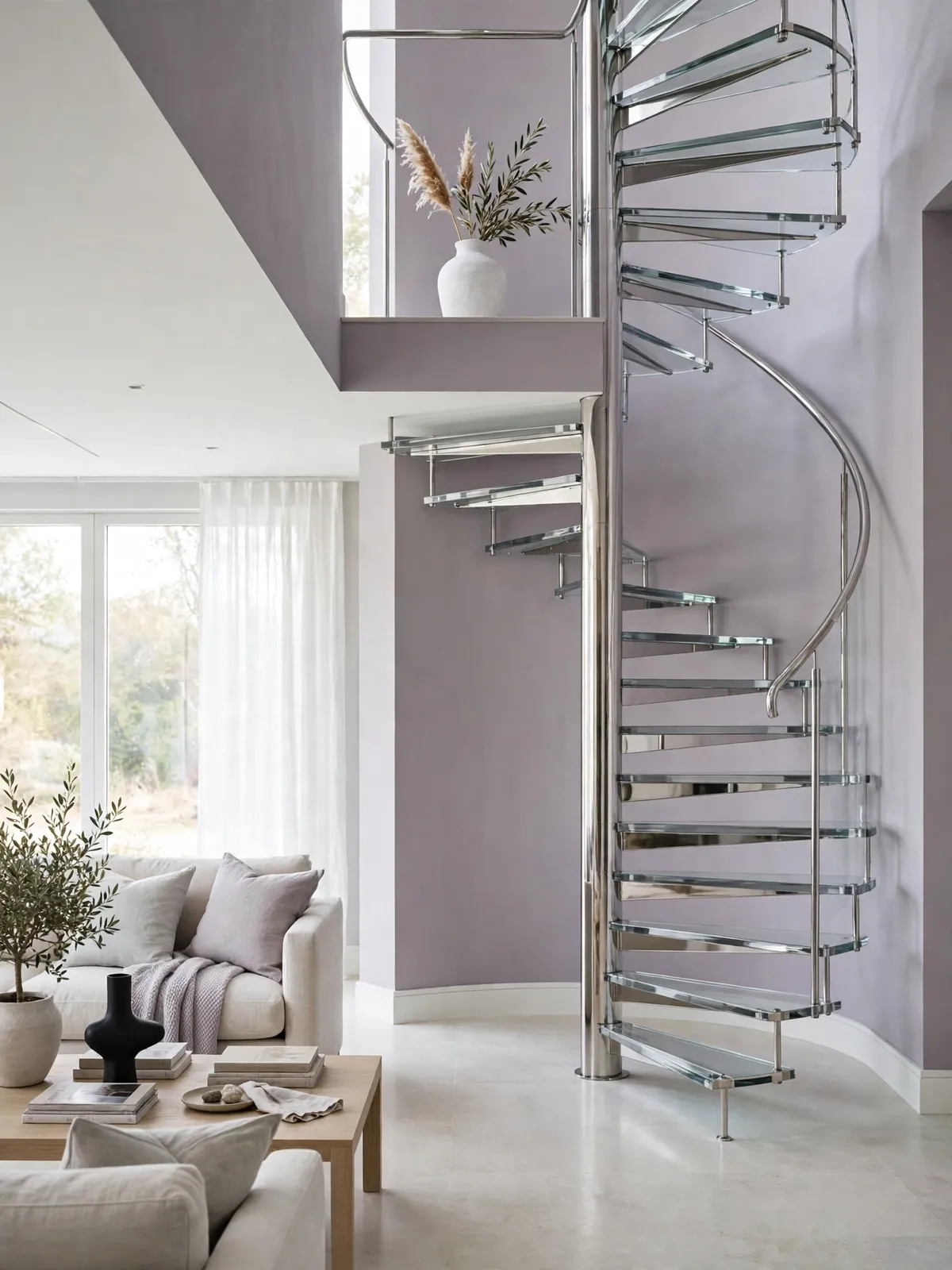
Glass treads turn a spiral staircase into a column of light, because daylight passes straight through every step instead of stopping at it. Here, 30 mm thick laminated glass treads, each 800 mm wide, wind around a slim steel pole, with a polished chrome handrail following the curve above them. Soft lilac-grey walls and a white ceramic vase on the landing keep the palette calm, while the pale stone floor catches the light that falls through the glass. The stair feels almost invisible, yet its curve shapes the whole room.
Quick tips:
- Use laminated glass treads, at least 30 mm thick, for safety.
- Choose a frosted non-slip strip on each tread edge for grip.
- Keep the wall colour pale so the light through the glass shows at its best.
- Wipe the treads weekly to keep them crystal clear.
A Spiral Staircase in Terracotta and Cream for a Mediterranean Feel
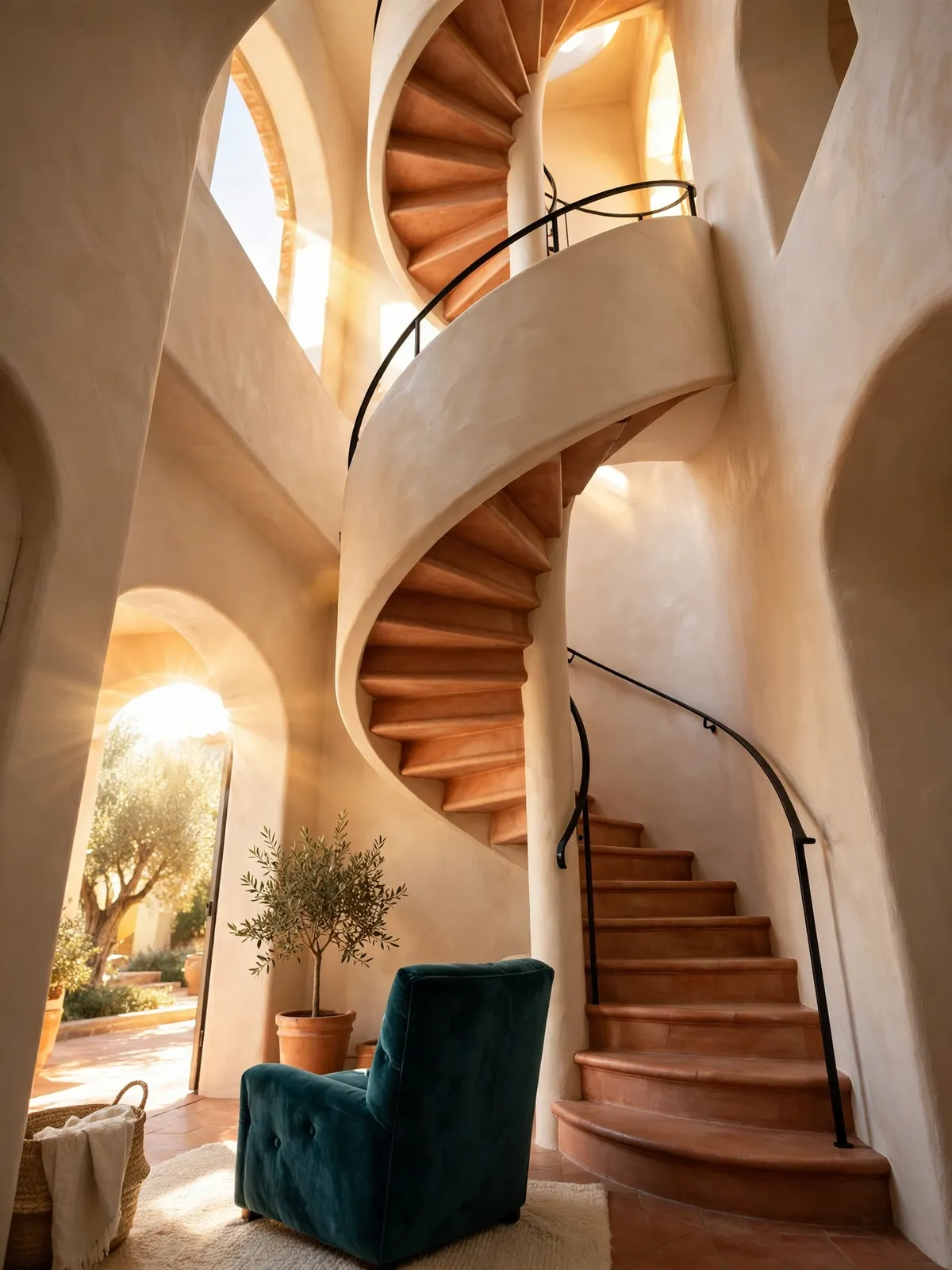
A terracotta spiral staircase brings Mediterranean warmth to a hallway, and its curved plaster form feels hand-built rather than manufactured. On this stair, terracotta plaster treads, each 850 mm wide, wind upward beside cream plaster walls, with a slim black steel handrail fixed to the outer edge. A deep teal velvet chair at the base adds a rich contrast, while a cream rug softens the floor. The golden afternoon light warms the terracotta even further, so the whole stairwell glows.
Quick tips:
- Seal terracotta plaster well so the treads stay smooth and easy to clean.
- Pair terracotta with cream walls, not dark timber, for balance.
- Add one deep teal or green accent to contrast the warm stair.
- Use a slim black handrail so it does not compete with the colour.
A Spiral Staircase With a Brass Handrail and Charcoal Treads
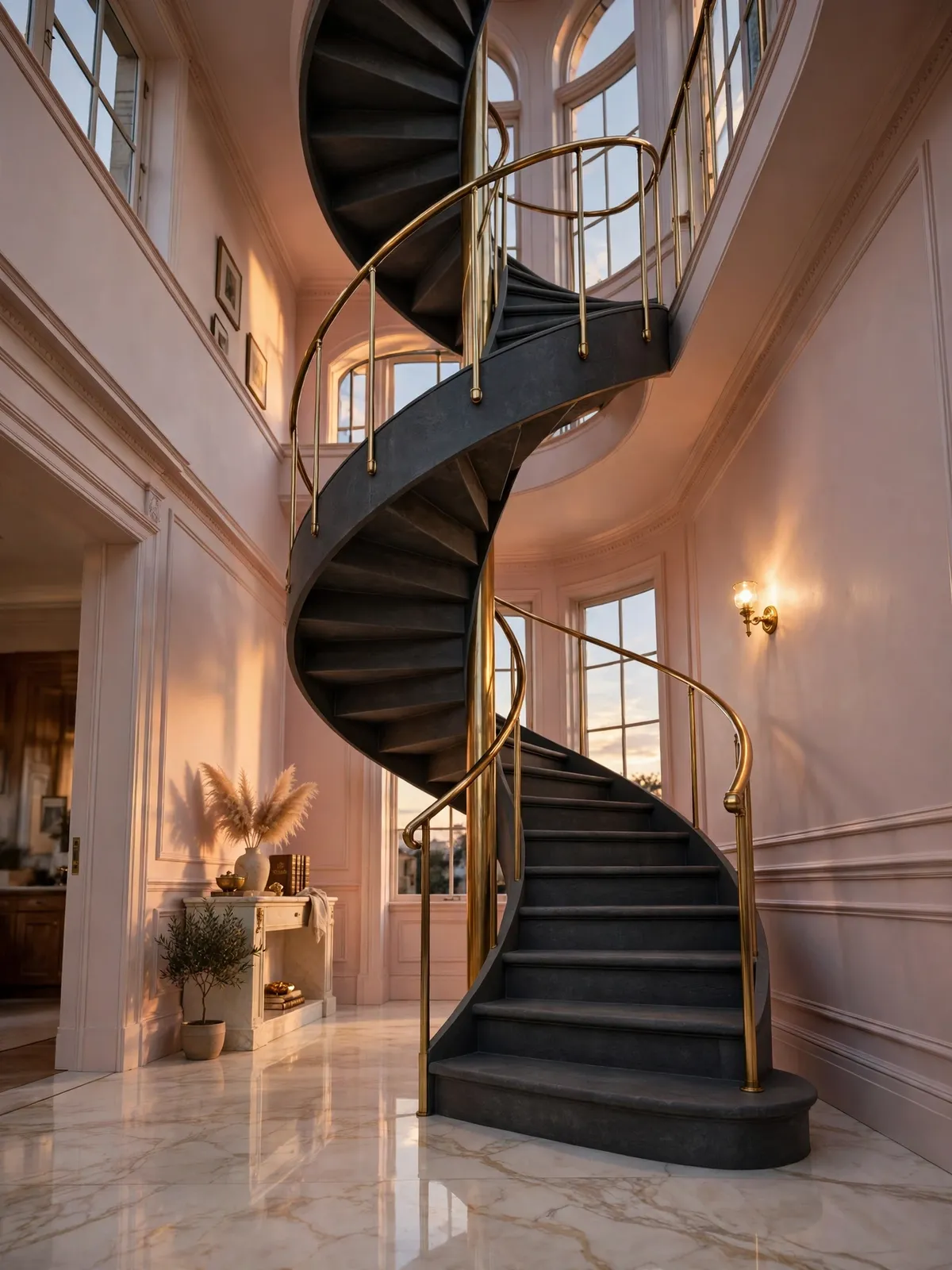
A polished brass handrail winding up a charcoal spiral staircase turns the climb into a piece of jewellery. Here, dark charcoal treads, each 800 mm wide, carry a continuous brass handrail that spirals upward in one unbroken line, catching the light on every turn. Blush-pink walls and a cream marble floor keep the palette soft, while a small brass wall sconce on the landing echoes the rail. The brass glows gently in the evening and guides the eye all the way up.
Quick tips:
- Use polished brass for the handrail so it catches the light.
- Keep the treads dark charcoal so the brass stands out.
- Pair the stair with blush or pale pink walls for softness.
- Match the brass tone to a sconce or mirror nearby.
A Compact Spiral Staircase for a Tiny Loft Bedroom
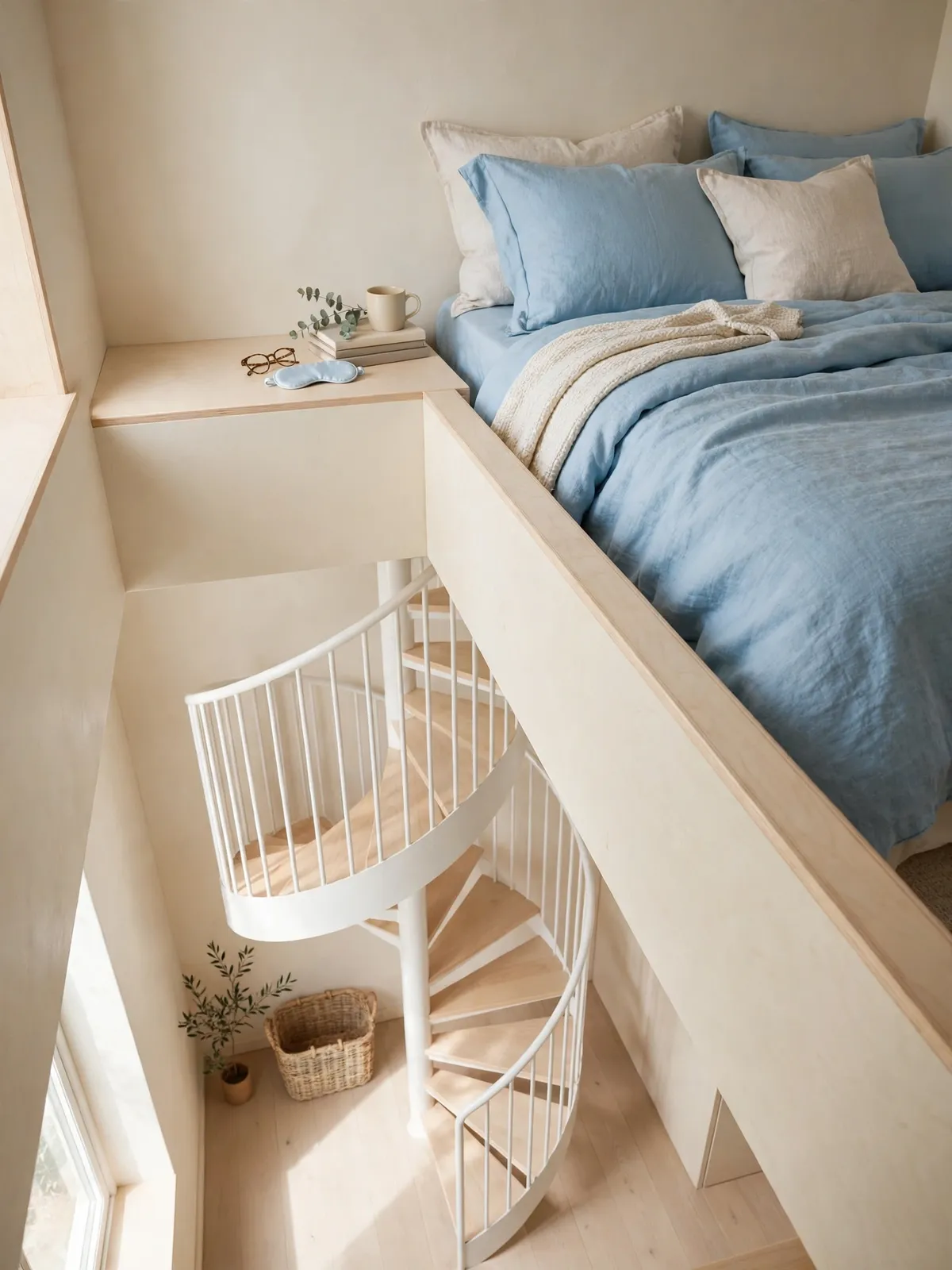
A compact spiral staircase is the cleverest way to reach a loft bedroom, because it needs only a circle about 1.4 metres across and leaves the rest of the room free. In this small home, a white steel spiral with pale birch treads, each 700 mm wide, rises from the bedroom to a loft platform 2.6 metres above, with a slim white handrail on the outer edge. Soft sky-blue bedding and cream walls keep the room bright, while a woven basket below the stair holds blankets and books. The stair tucks neatly into the corner, so the loft feels like a room of its own.
Quick tips:
- Keep the spiral diameter small — about 1.4 metres — for a loft.
- Use pale birch treads so the compact stair stays light.
- Add a handrail on the outer edge for confidence on the climb.
- Use the space under the stair for storage baskets.
A Spiral Staircase With a Sage Green Steel Frame and Cream Treads
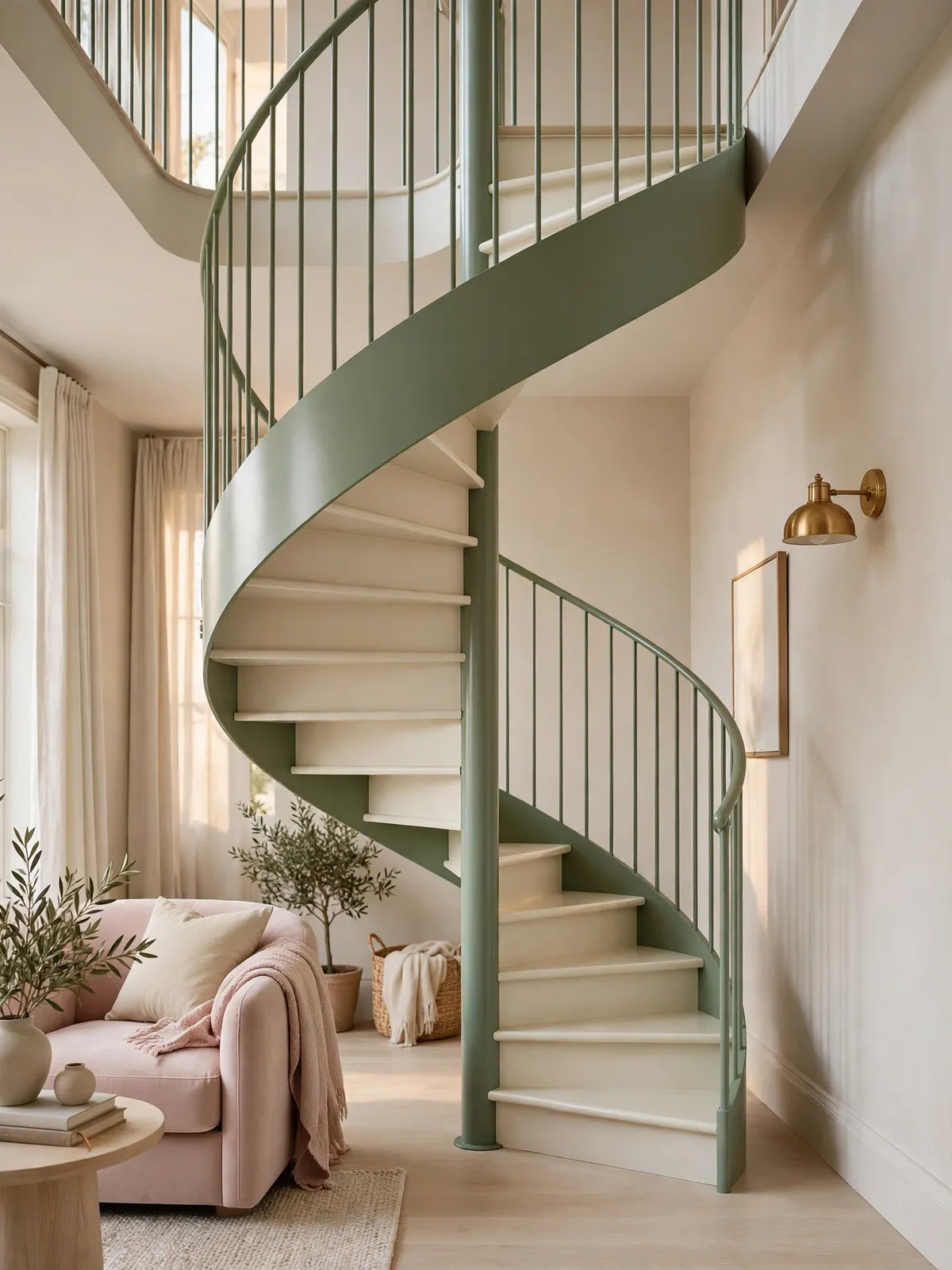
Sage green steel is a softer alternative to black for a spiral staircase — modern, but gentle. On this stair, a sage green powder-coated steel pole and slim sage spindles support cream treads, each 800 mm wide, with a slim sage handrail following the curve. A soft blush-pink armchair below adds a warm contrast, while a brass wall light glows softly in the afternoon. The green feels calm and natural, like a garden colour brought indoors, and the cream treads keep the stair bright.
Quick tips:
- Choose sage green in a matte powder coat for a soft, modern finish.
- Pair sage steel with cream treads so the stair stays bright.
- Add one blush or warm pink accent to contrast the green.
- Match the steel tone to a cushion or plant pot nearby.
A Spiral Staircase With a Built-In Reading Nook Underneath
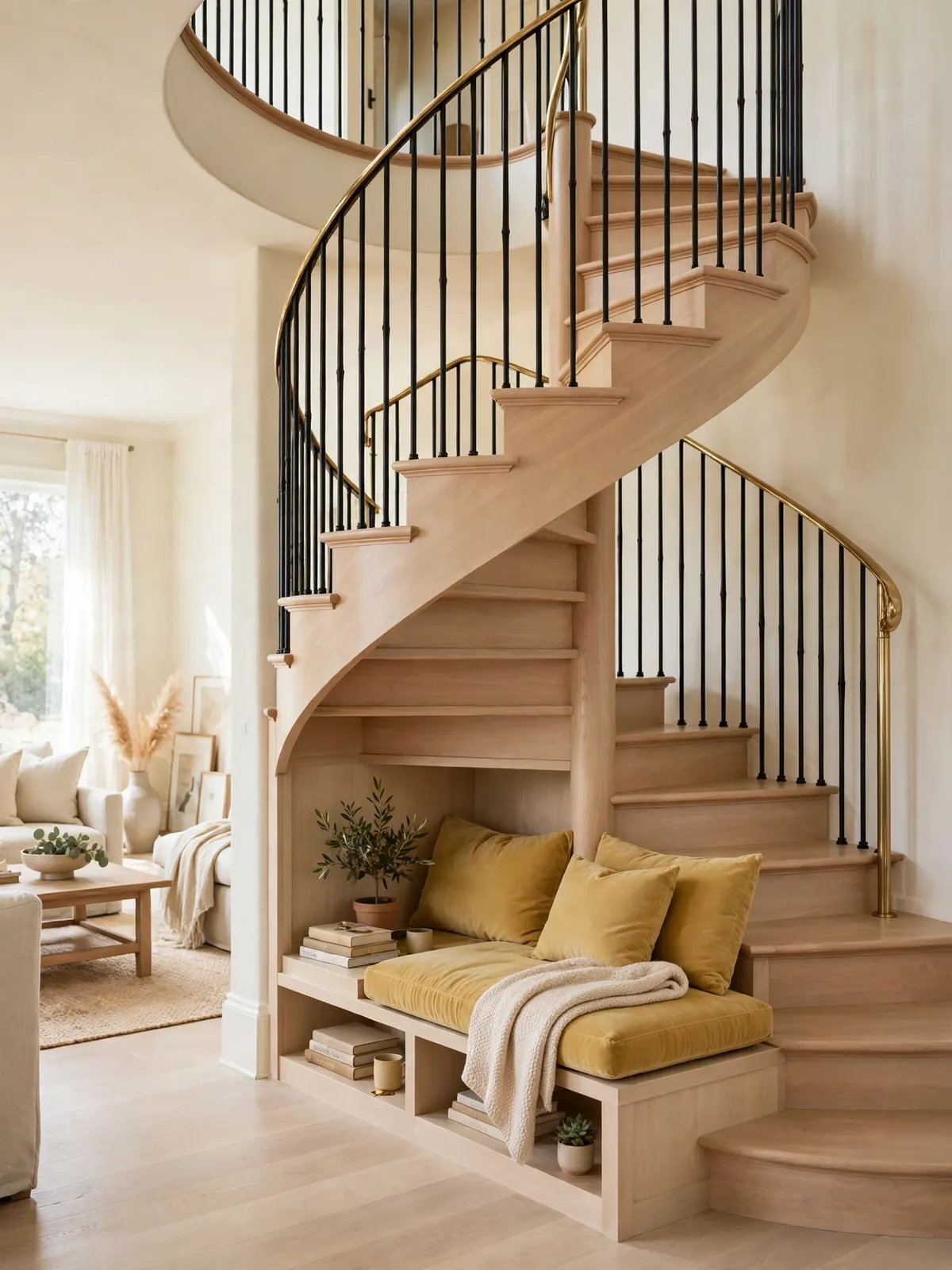
The space beneath a spiral staircase is naturally curved and sheltered, which makes it the perfect spot for a small reading nook. Under this stair, a built-in bench, 900 mm long, curves to follow the spiral above, dressed with soft mustard-yellow cushions and a small stack of books. Pale oak treads wind overhead, while cream walls and a pale wood floor keep the living room bright. A small brass reading light fixed to the underside of the stair makes the nook usable in the evening, and children and adults alike claim it as their favourite corner.
Quick tips:
- Shape the bench to follow the curve of the spiral above.
- Use washable cushion covers for a family reading nook.
- Add a small brass light under the stair for evening reading.
- Keep the nook clear of clutter so it stays inviting.
A Spiral Staircase Beneath a Round Skylight That Floods the Stairwell With Light
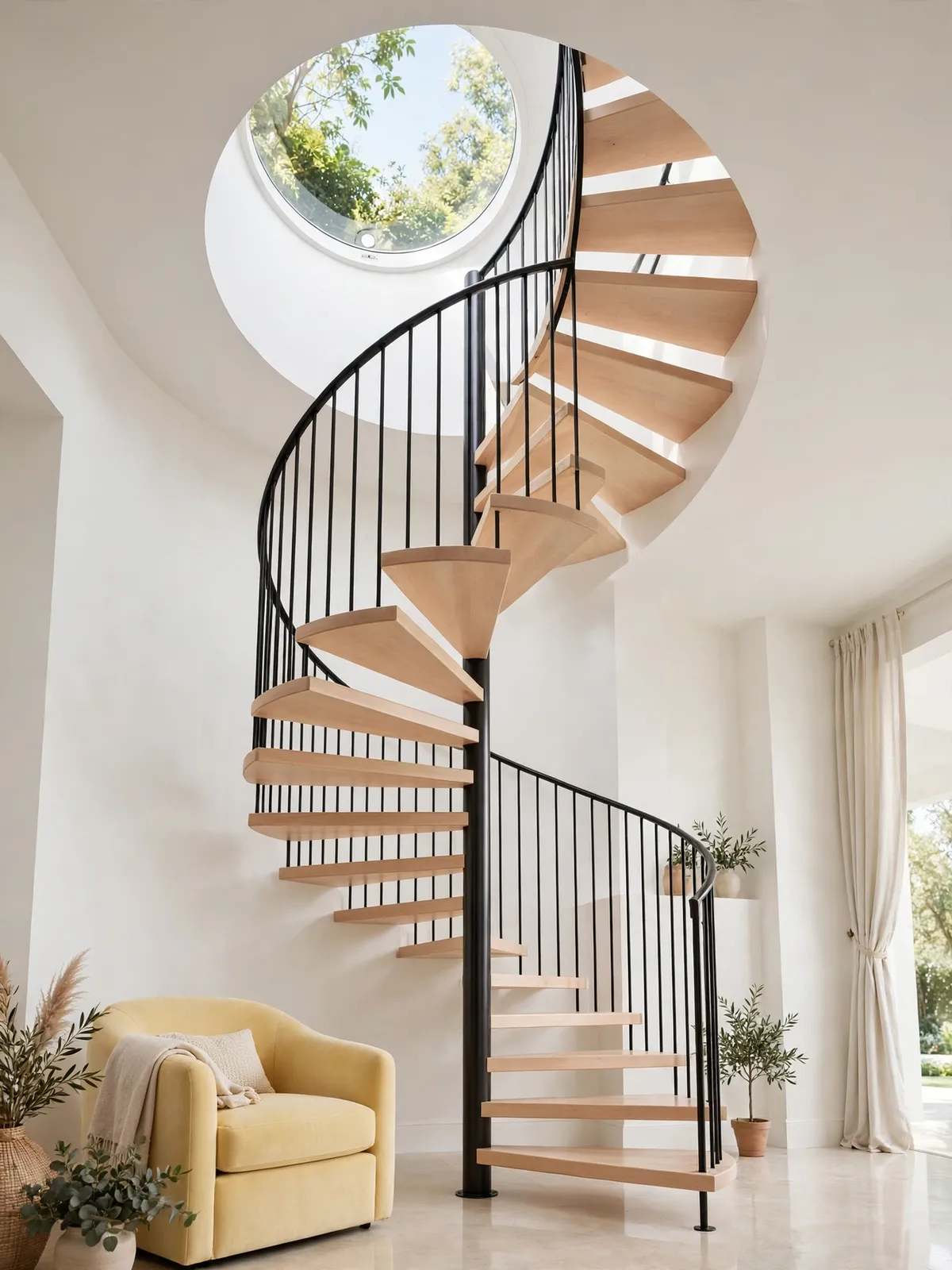
A round skylight above a spiral staircase is one of the most beautiful pairings in home design, because the circle of the skylight mirrors the circle of the stair below it, and the daylight that pours through it does not stop at the top landing — it spirals down with the treads, bouncing off pale maple and white plaster, warming every step, and reaching the hallway below, so a stairwell that could have felt dark and enclosed becomes the brightest route in the house. In this home, the skylight is 1.2 metres across, set directly above a spiral with pale maple treads, each 850 mm wide, winding around a slim white steel pole, while a soft butter-yellow armchair sits on the landing below, catching the morning sun. The white walls catch and scatter the light, and on a clear day the blue sky itself becomes the ceiling of the stairwell, so every climb feels like walking up toward the open air. The stair feels less like a passage and more like a destination, and because the skylight is round rather than square, it keeps the spiral’s soft geometry while flooding the whole stairwell with light from dawn until dusk.
Quick tips:
- Centre the skylight directly above the spiral so light falls evenly.
- Use pale maple treads to bounce the skylight light further down.
- Choose a skylight that opens, so warm air can escape in summer.
- Keep the landing clear so the skylight stays the focal point.
A Spiral Staircase in Smoked Oak Against a Deep Navy Wall
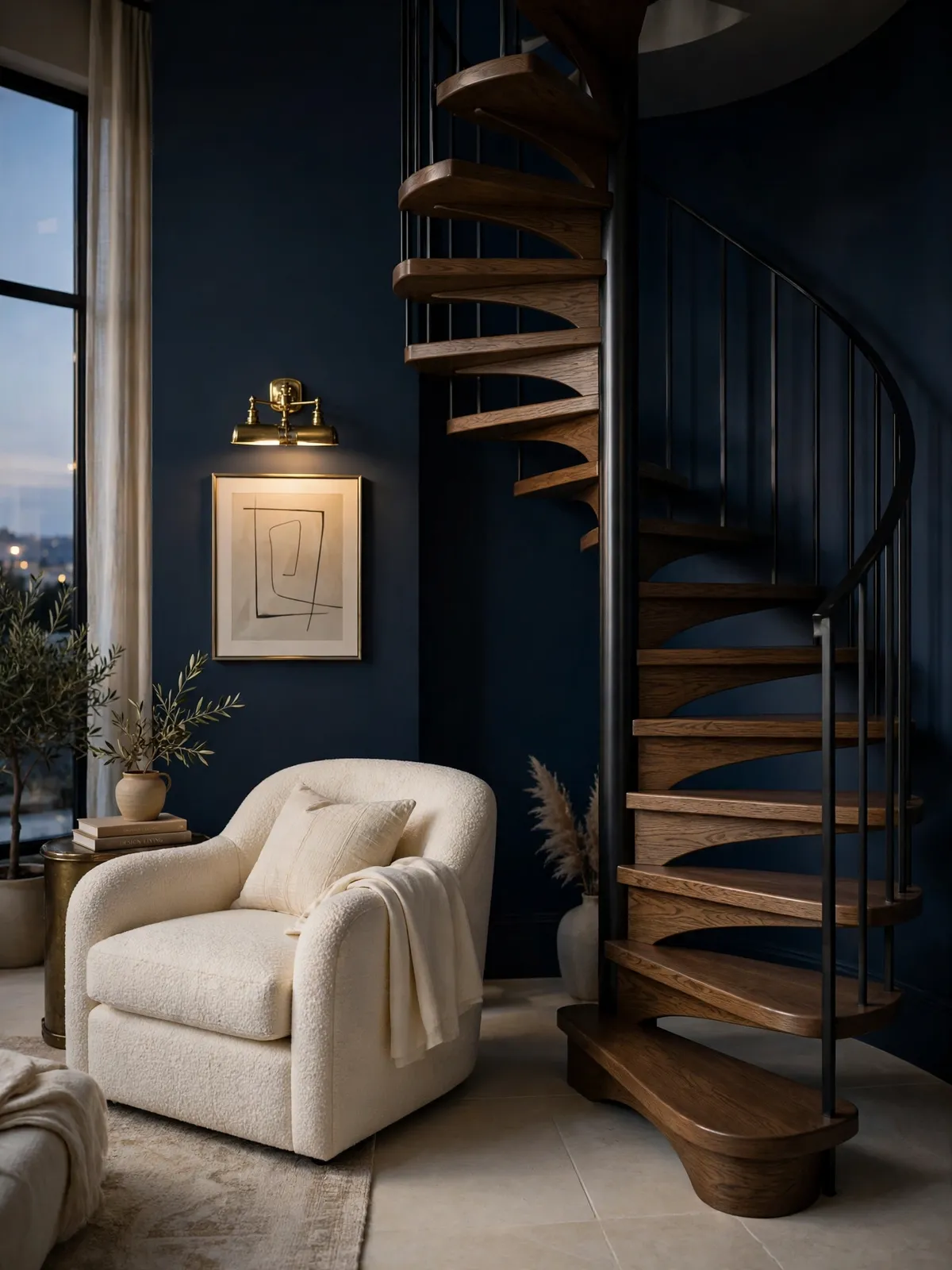
Smoked oak and deep navy make a spiral staircase feel rich and calm, like a quiet library stair. Here, smoked oak treads, each 800 mm wide with a soft matte finish, wind beside a deep navy wall, with a slim brass handrail following the curve and a cream boucle armchair below. A brass picture light above the landing warms the navy in the evening, while the pale stone floor keeps the room from feeling dark. The stair feels dramatic, yet completely liveable.
Quick tips:
- Choose smoked oak for depth without the harshness of black.
- Keep the navy wall to one side only, with the rest pale.
- Add brass fittings to warm the deep navy.
- Use a matte tread finish to avoid glare in low light.
A Spiral Staircase With a Natural Jute Runner on Every Tread
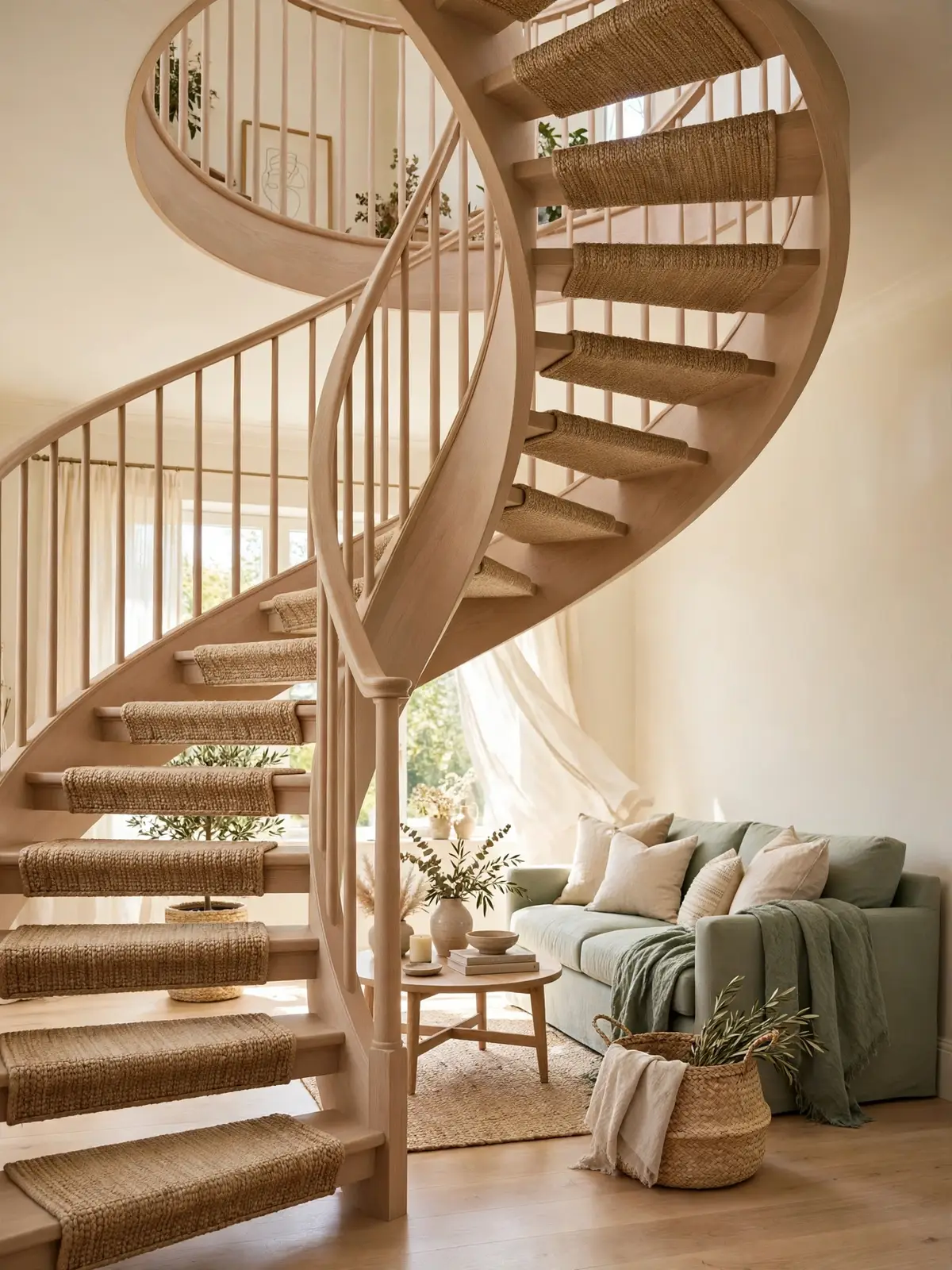
A jute cover on each wedge-shaped tread adds texture, warmth and grip to a spiral staircase while keeping the timber visible at the edges. In this home, natural jute tread covers, cut to the wedge shape of each step, sit on pale oak treads, each 850 mm wide, held neatly by slim brass clips. A soft sage-green sofa and a woven seagrass basket nearby complete the relaxed palette, while cream walls keep the hallway bright. The jute softens every footstep and makes the spiral feel quieter and safer underfoot.
Quick tips:
- Cut each jute cover to the wedge shape of its tread.
- Use brass clips to hold the covers neatly in place.
- Choose natural jute for texture, not a patterned carpet.
- Vacuum the covers weekly to keep the fibres clean and flat.
A Spiral Staircase With Recessed Wall Lights on Every Turn
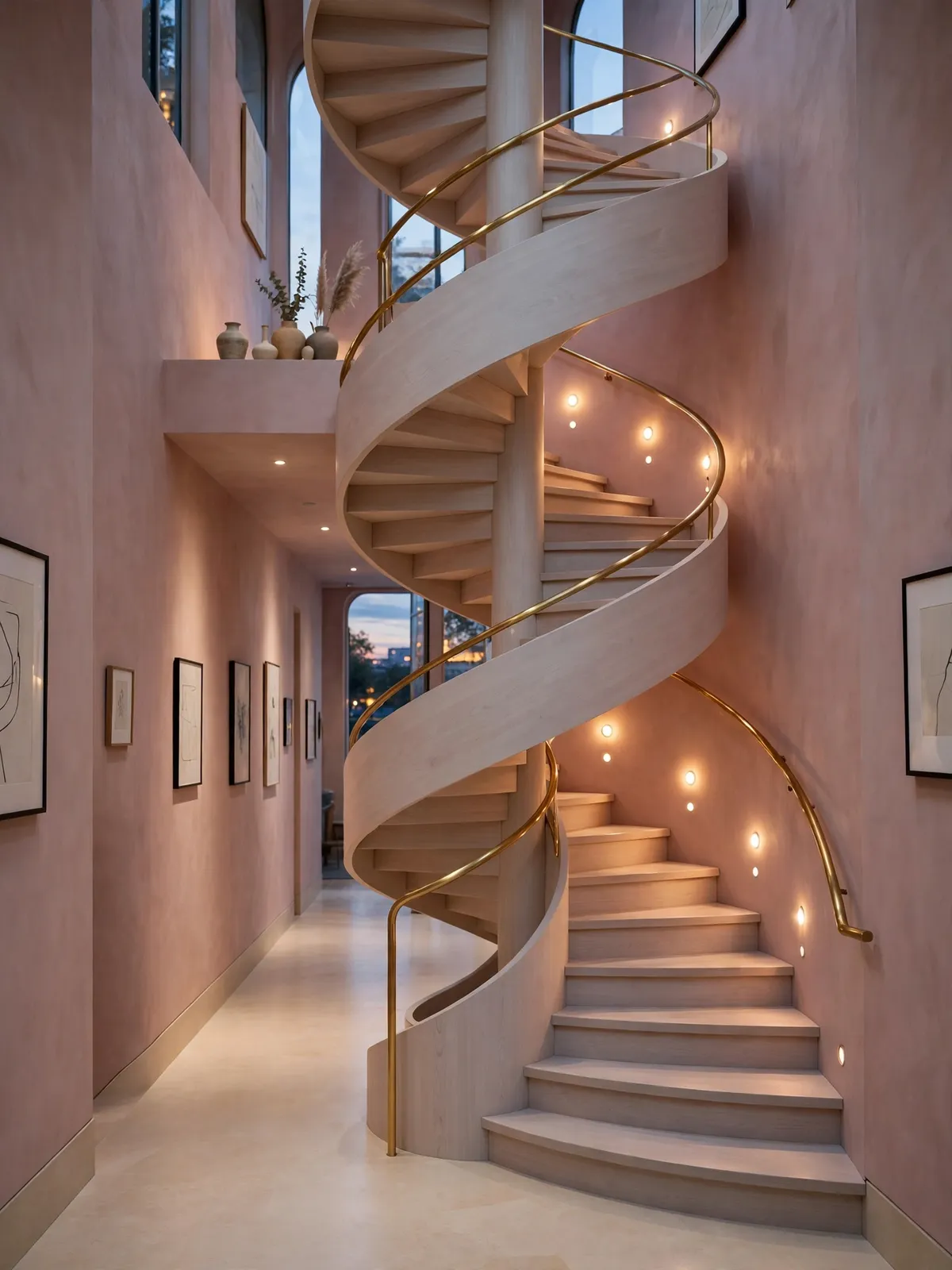
Small recessed lights set into the wall at every turn of a spiral staircase make the climb safe at night and beautiful in the evening. Along this stair, warm recessed lights, spaced one per turn, are set into the wall following the curve of the flight, each one washing a soft pool of light across the pale ash treads below it. The treads, each 800 mm wide, and soft dusty-rose walls keep the palette gentle, while the cream stone floor reflects the lights softly. The stair feels curated, like a gallery that you walk through.
Quick tips:
- Space the lights evenly, one per turn, following the curve.
- Use warm bulbs, about 2700K, for a soft evening glow.
- Keep the wall colour pale so the light shows at its best.
- Fit the lights on a dimmer so you can lower them at night.
A Spiral Staircase With a Slim Timber Handrail Winding Around Glass Panels
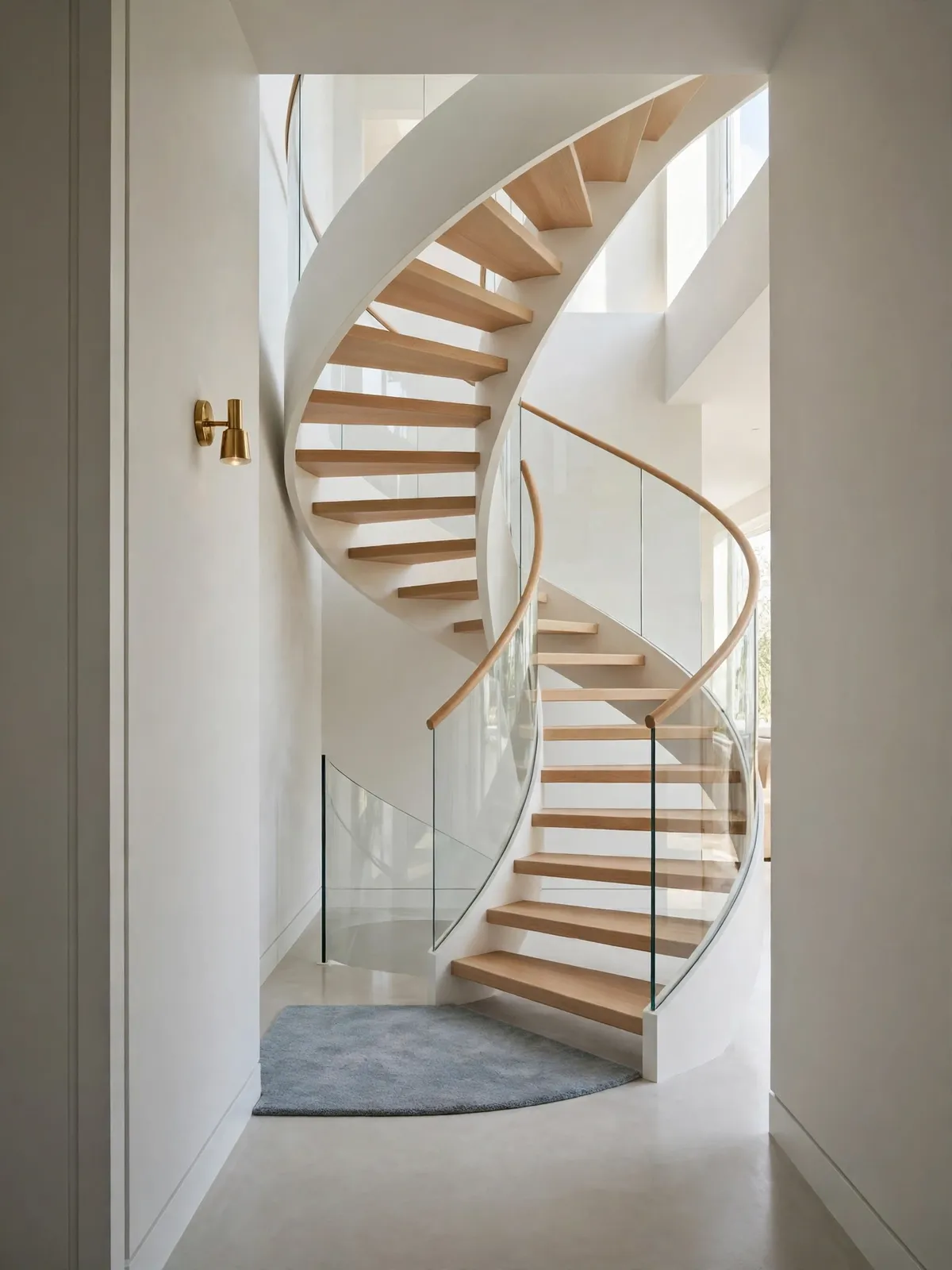
Curved glass panels with a slim timber handrail give a spiral staircase the most open, architectural look of all. On this stair, clear curved glass panels follow the spiral beside light beech treads, each 800 mm wide, while a slim timber handrail, bent to the same curve, runs along the top of the glass. A soft grey-blue rug at the base and a small brass wall light add quiet warmth, while the white wall stays completely clean and unbroken. The glass lets light travel through the stair, so the hallway feels twice as wide.
Quick tips:
- Use curved laminated glass panels, made to the spiral’s exact radius.
- Choose a pale timber handrail so it stays light against the glass.
- Keep the wall beside the stair plain white for a clean look.
- Add one warm wall light so the stair is easy to find at night.
A Spiral Staircase in Blonde Maple With White Risers for a Scandinavian Look
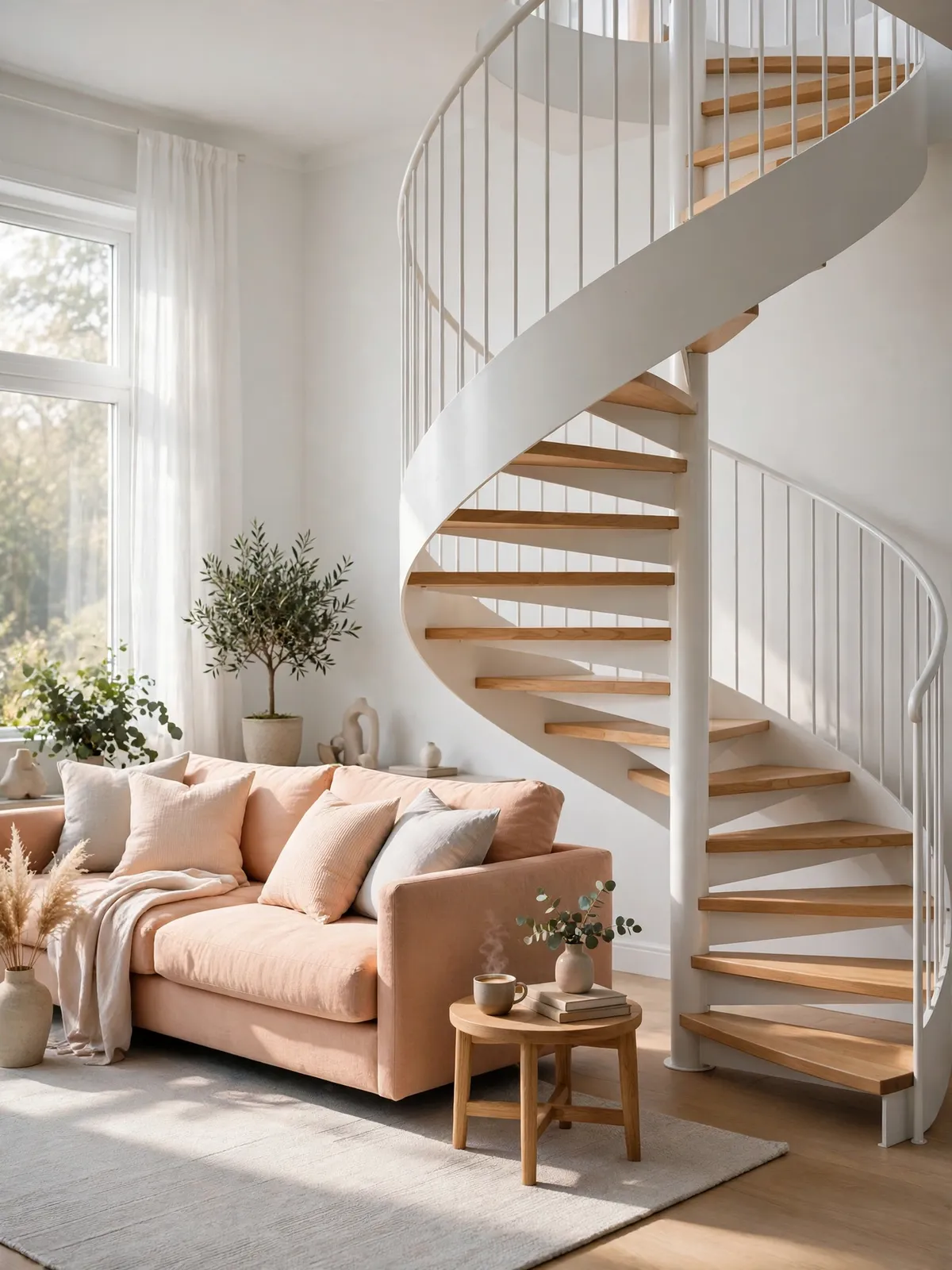
Blonde maple treads with matte white risers make a spiral staircase feel fresh and Scandinavian, because the pale timber glows against the crisp white. Here, 40 mm thick blonde maple treads, each 800 mm wide, wind around a white steel pole, with white risers closing the gaps between them and a slim white steel handrail above. A soft peach linen sofa and a pale grey rug below keep the room warm, while morning light falls across the maple and makes the whole stair shine softly.
Quick tips:
- Choose blonde maple for the palest, freshest timber look.
- Keep risers matte white so the maple treads stand out.
- Pair the stair with soft peach or pale grey furnishings.
- Use a white steel handrail to match the risers.
A Spiral Staircase With a Small Landing Shelf for Plants and Books
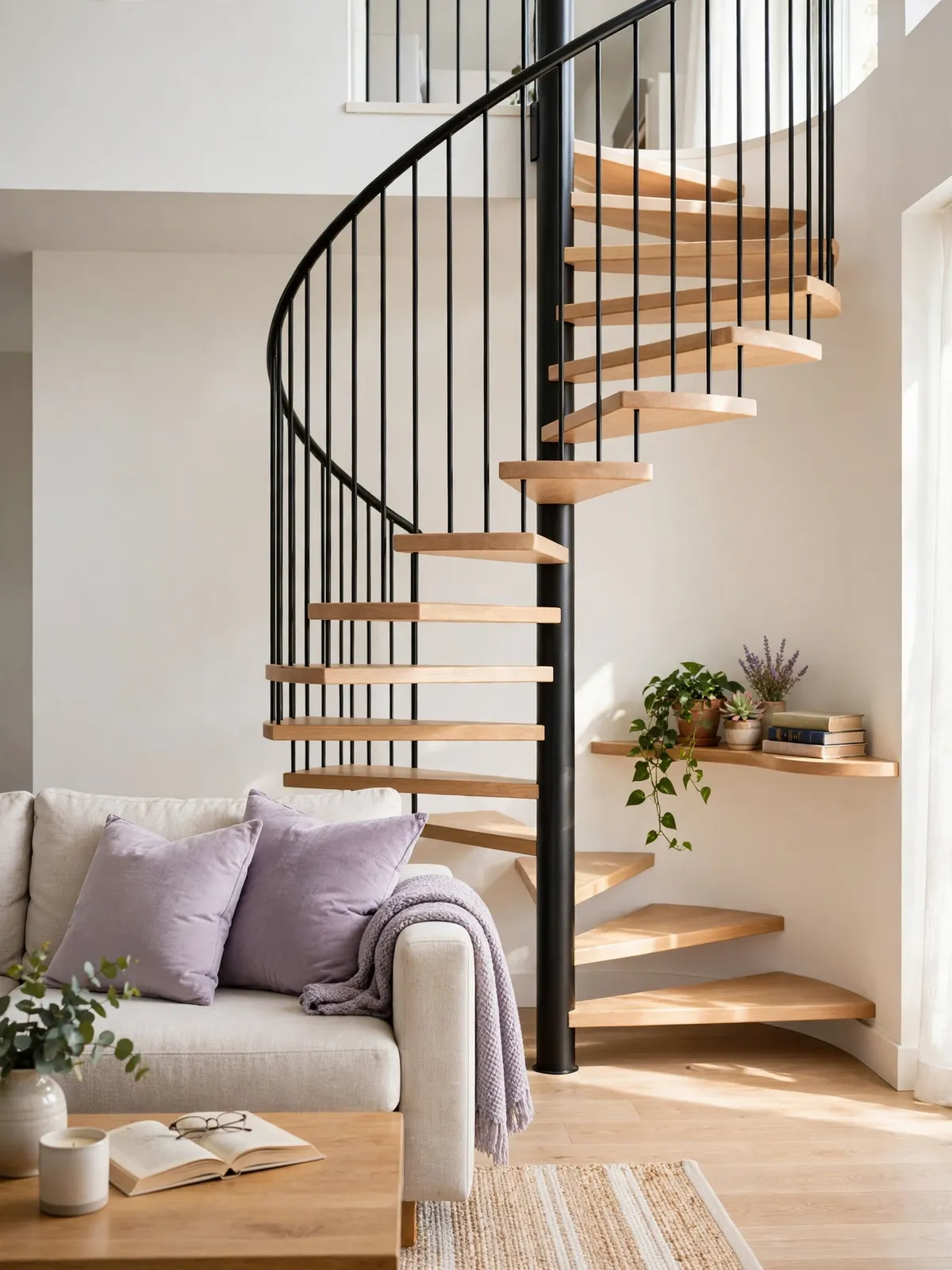
A small curved shelf built into the landing of a spiral staircase turns a pause in the climb into a useful, welcoming spot. In this home, the landing is 1 metre across, with a slim curved shelf, 250 mm deep, built into the wall, holding a trailing green plant, a small stack of books and a ceramic vase. Pale oak treads, each 850 mm wide, wind on either side, while white walls and warm daylight keep the space bright. It is a place to rest a book, water a plant, or pause with a coffee on the way up.
Quick tips:
- Make the shelf follow the curve of the spiral for a seamless look.
- Use trailing plants that spill softly, not tall plants that block the view.
- Keep the shelf items small — one plant, one stack of books.
- Choose pale oak treads so the landing feels open, not boxed in.
A Spiral Staircase With a Mustard Accent Wall Behind the Curve
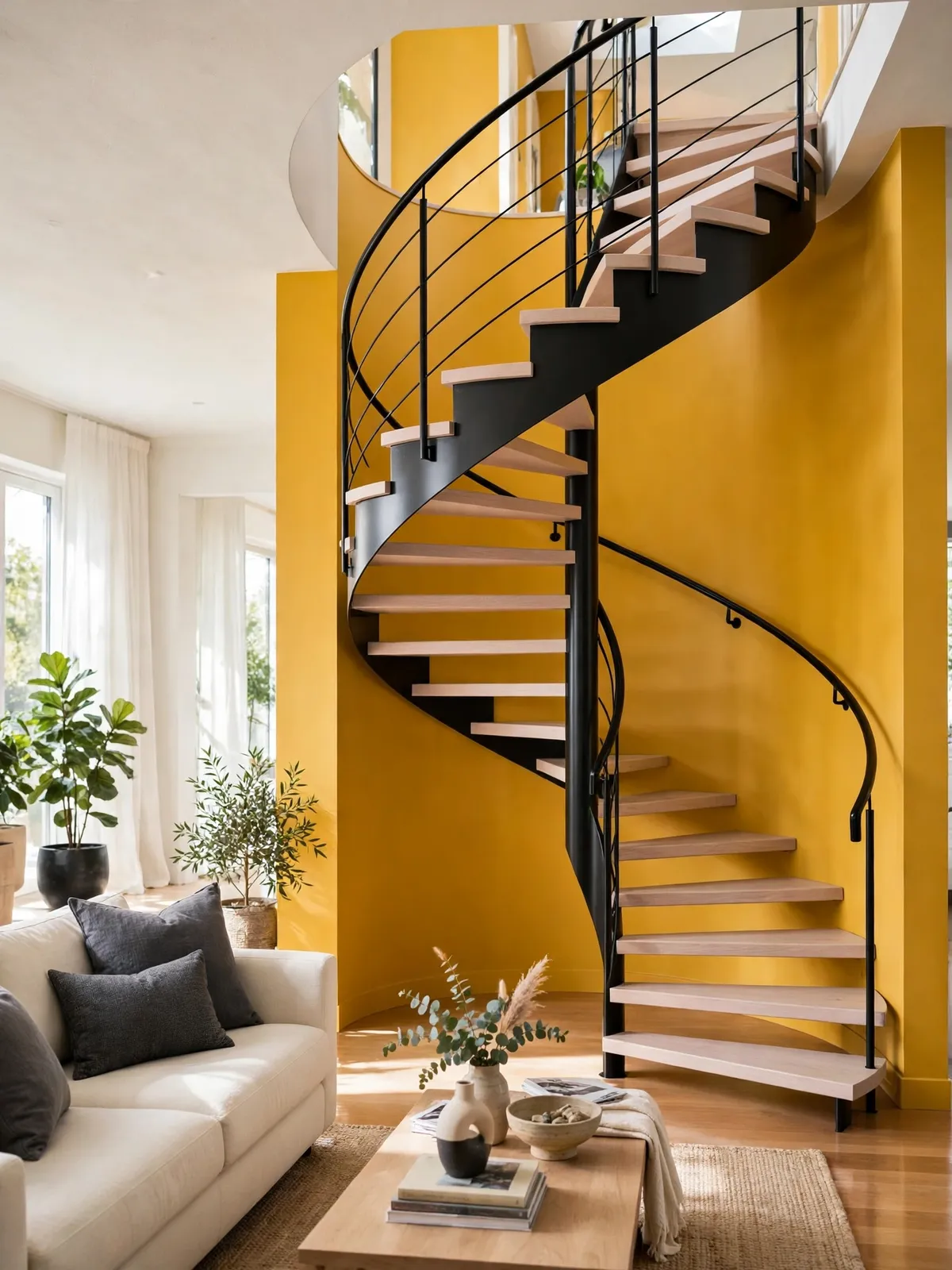
A mustard accent wall behind a spiral staircase adds one bold, joyful moment to an otherwise calm modern home. Here, the curved wall behind the stair is painted a warm mustard yellow, while pale ash treads, each 800 mm wide, and a slim black steel handrail keep the stair itself clean and simple. A cream sofa and charcoal cushions below pick up the contrast, and daylight from a nearby window makes the mustard glow. The stair feels cheerful without feeling loud.
Quick tips:
- Paint only the wall behind the spiral mustard, keeping the rest pale.
- Pair mustard with pale ash and black steel for balance.
- Add one charcoal cushion to ground the bright wall.
- Keep the floor clear so the mustard wall stays the feature.
A Spiral Staircase With a Slim Black Handrail and a Pale Stone Floor
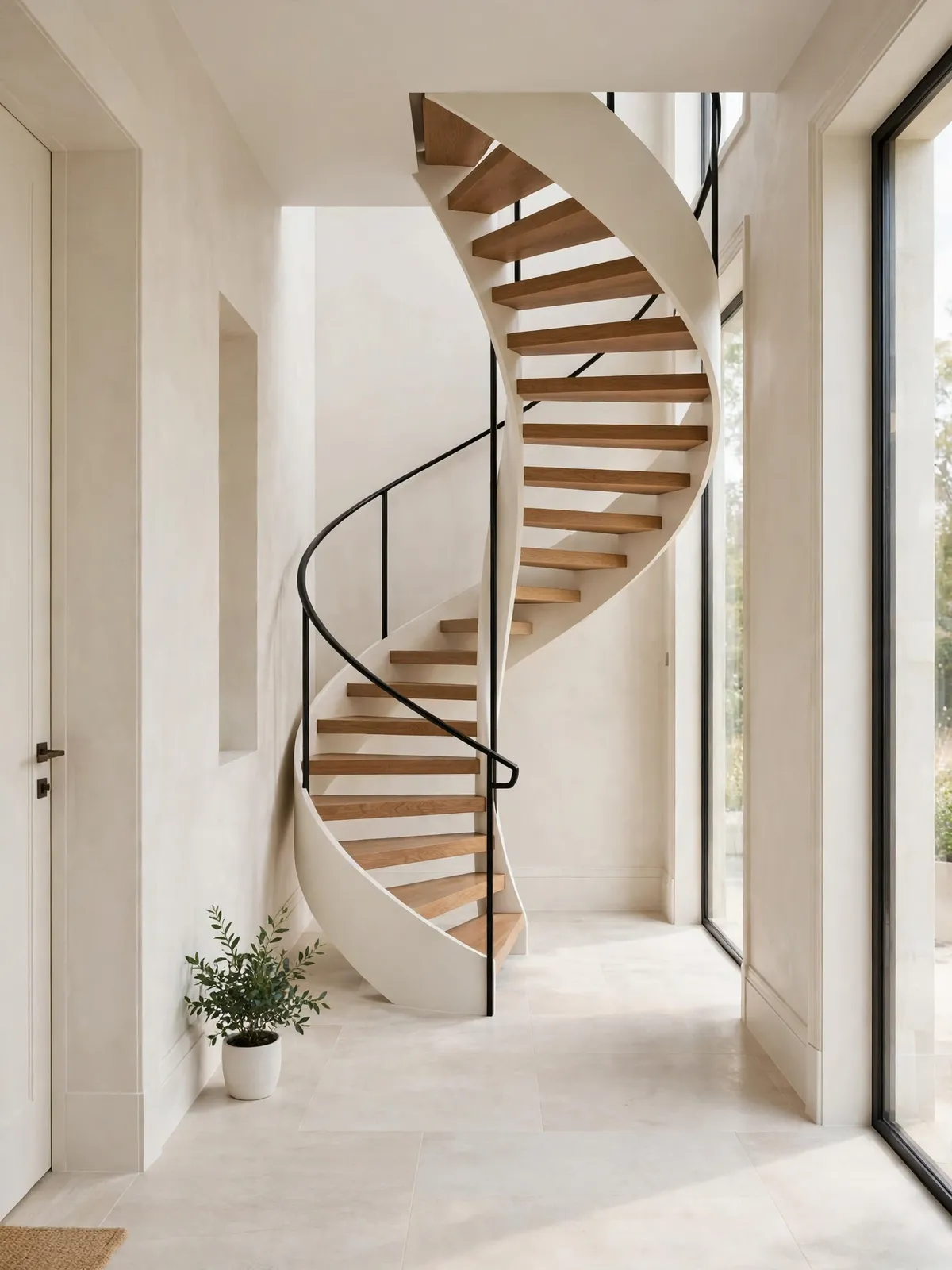
A slim black handrail against pale stone is a study in contrast — dark line, light floor, warm timber in between. On this stair, warm oak treads, each 850 mm wide, wind above a pale limestone floor, with a 40 mm diameter matte black steel handrail running the full length of the spiral on slim posts. Soft ivory walls and a small green plant in a white pot keep the hallway fresh, while daylight reflects off the limestone and up the treads. The black line draws the eye upward without closing the stair in.
Quick tips:
- Keep the handrail slim — about 40 mm in diameter — for a light look.
- Choose pale limestone so the black handrail stands out cleanly.
- Use warm oak treads to soften the black-and-stone contrast.
- Keep the floor free of rugs so the stone reflects the light.
A Spiral Staircase With a Plant Shelf Running Along the Outer Edge
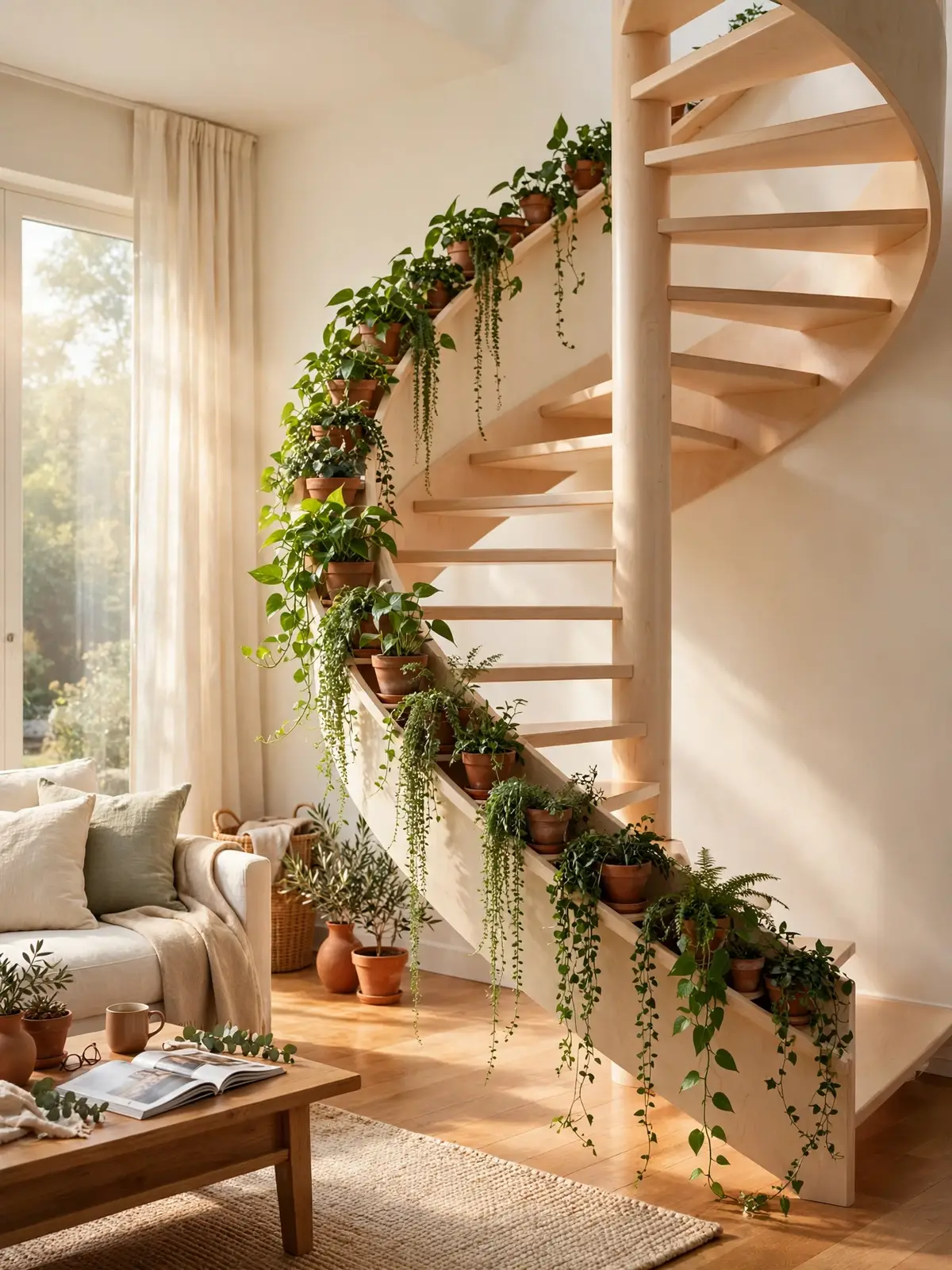
A plant shelf along the outer edge of a spiral staircase brings greenery into the climb itself. Here, a slim pale timber shelf, 150 mm deep, runs along the outside of the spiral beside pale birch treads, each 800 mm wide, holding small terracotta pots with trailing green plants that spill gently toward the floor below. Soft cream walls and warm morning light keep the room bright, while the plants soften the steel and timber. The stair feels alive, not just architectural.
Quick tips:
- Keep the shelf slim — about 150 mm deep — so it does not block the light.
- Choose trailing plants that spill softly, not tall plants that block the view.
- Use terracotta pots for warmth against pale timber.
- Water the plants with a small can to avoid spills on the treads.
A Spiral Staircase in Soft Coral With Cream Treads and Brass Details
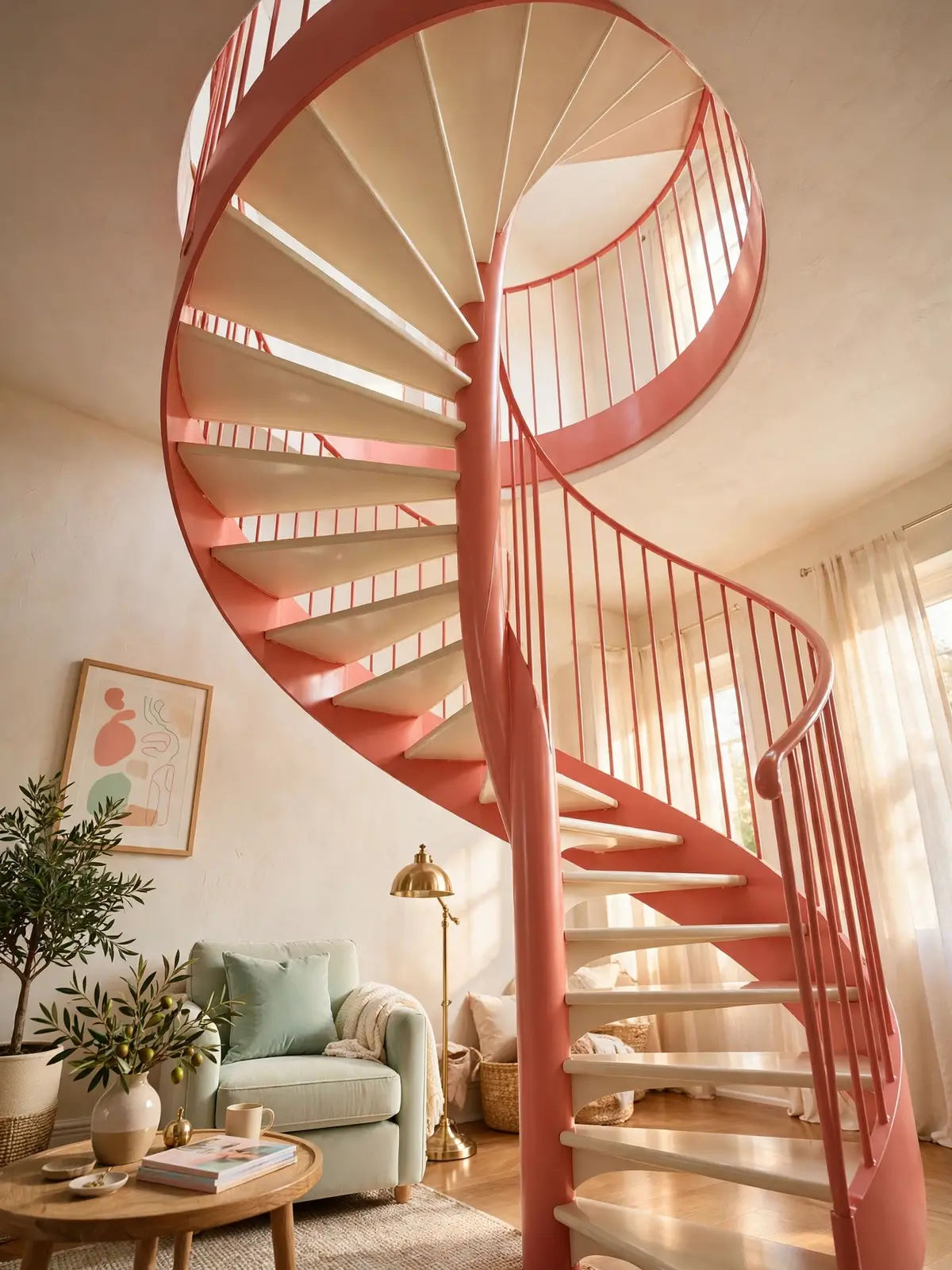
Soft coral steel gives a spiral staircase a playful, elegant character that suits a bright, cheerful home. On this stair, a coral-pink powder-coated steel pole and slim coral spindles support cream treads, each 800 mm wide, with a slim brass handrail following the curve. A pale mint-green armchair below adds a fresh contrast, while a brass floor lamp glows softly in the afternoon. The coral feels warm and joyful, and the cream treads keep the stair light.
Quick tips:
- Choose coral in a matte powder coat for a soft, modern finish.
- Pair coral steel with cream treads so the stair stays bright.
- Add one mint or pale green accent to contrast the coral.
- Match the brass tone to a lamp or mirror nearby.
A Spiral Staircase With Mirrored Risers That Double the Light
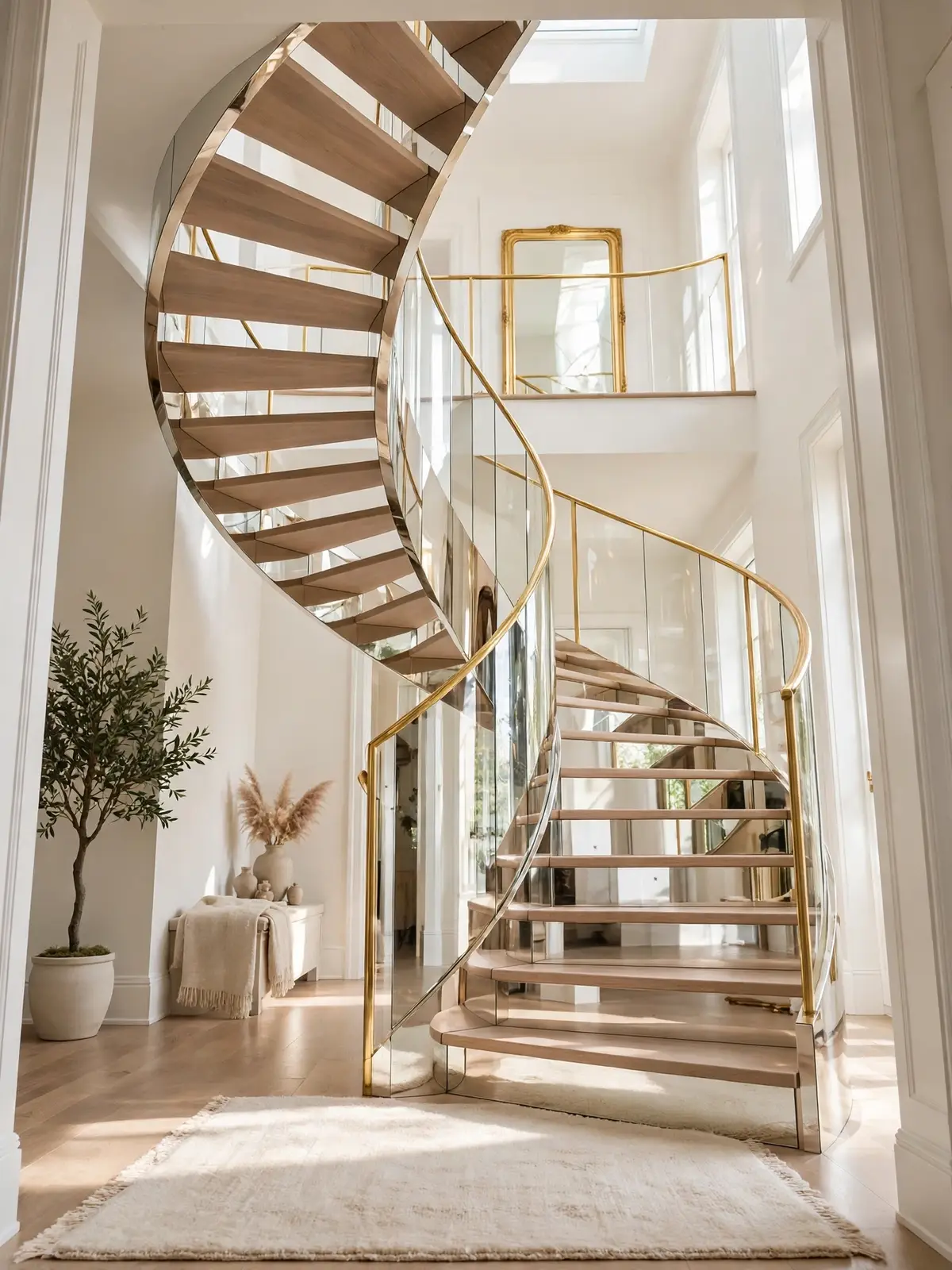
Mirrored risers reflect the room back onto the stair, so the spiral seems to disappear into light. Here, pale walnut treads, each 800 mm wide, wind around a slim steel pole on mirrored risers, 175 mm high, that catch the daylight from the entry window and bounce it across the hallway. Soft white walls and a gold-framed mirror on the landing add to the glow, while a cream rug at the base softens the floor. The stair looks longer, brighter and more open than it really is.
Quick tips:
- Use mirrored risers only where the stair gets good daylight.
- Pair mirrors with pale walnut, not dark timber, for a bright result.
- Keep the walls white so the mirrors reflect light, not clutter.
- Wipe the risers weekly to keep the reflections clear.
A Spiral Staircase Beside a Warm Cork Feature Wall
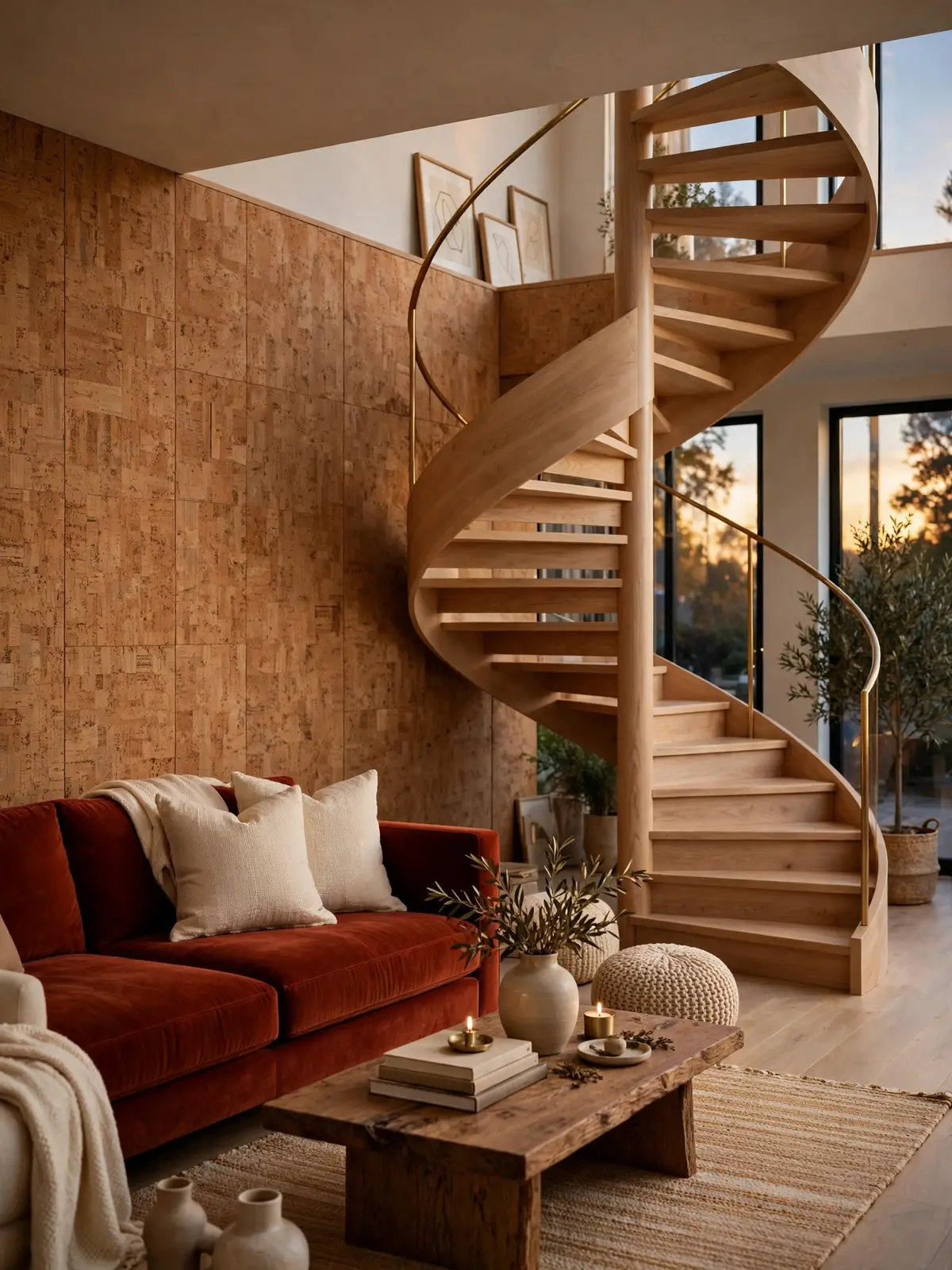
Cork is warm, quiet and tactile — a surprising but beautiful wall beside a spiral staircase. On this stair, pale oak treads, each 850 mm wide, wind beside a full-height curved natural cork wall, with a slim brass handrail fixed to the cork. A deep rust-red sofa and cream cushions below pick up the cork’s warm tones, while soft evening light makes the wall glow gently. The cork also softens sound, so the stair feels quieter underfoot.
Quick tips:
- Seal the cork wall so it stays clean and easy to dust.
- Pair cork with pale oak for a warm, natural palette.
- Add a brass handrail to lift the cork’s earthy tone.
- Keep the sofa colour warm — rust, ochre or deep red — to match the wall.
A Spiral Staircase That Links a Mezzanine Library to the Living Room
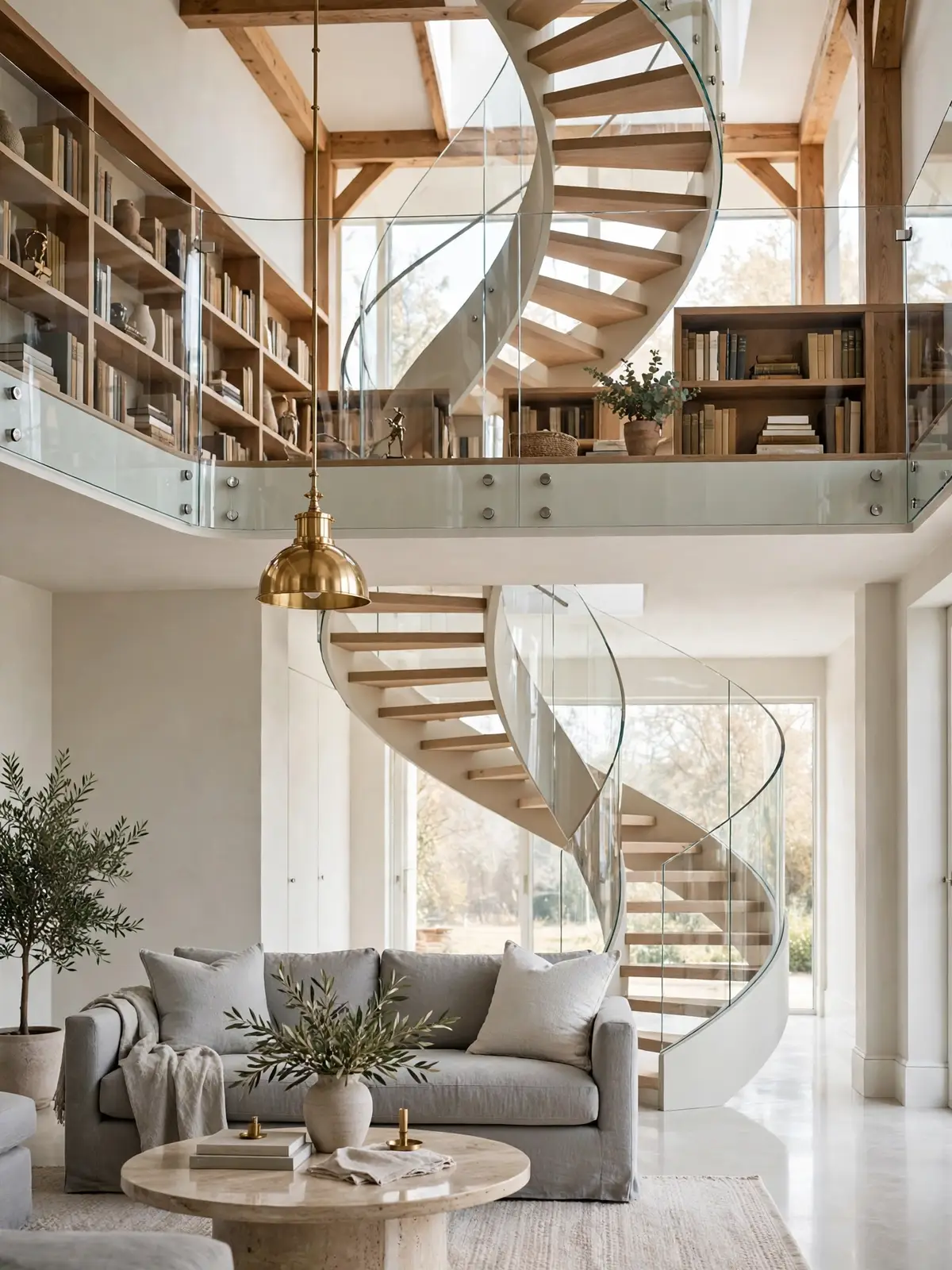
A stair to a mezzanine library connects reading and living without a wall between them. In this open-plan home, a spiral staircase with pale oak treads, each 850 mm wide, and a clear glass balustrade rises from the living room to a mezzanine library, where warm timber bookshelves and a brass pendant light sit above a soft grey sofa below. Daylight from the living room windows travels up the glass to the mezzanine, so the library feels bright and the living room feels taller. The stair is the link that makes both levels feel like one room.
Quick tips:
- Use clear glass on the mezzanine side so light reaches the library.
- Match the bookshelf timber to the stair treads for a unified look.
- Keep the mezzanine railing slim so the living room stays open.
- Add a brass pendant above the reading chair for warm evening light.
A Spiral Staircase With a Slim Oak Newel and a Paper Lantern Above
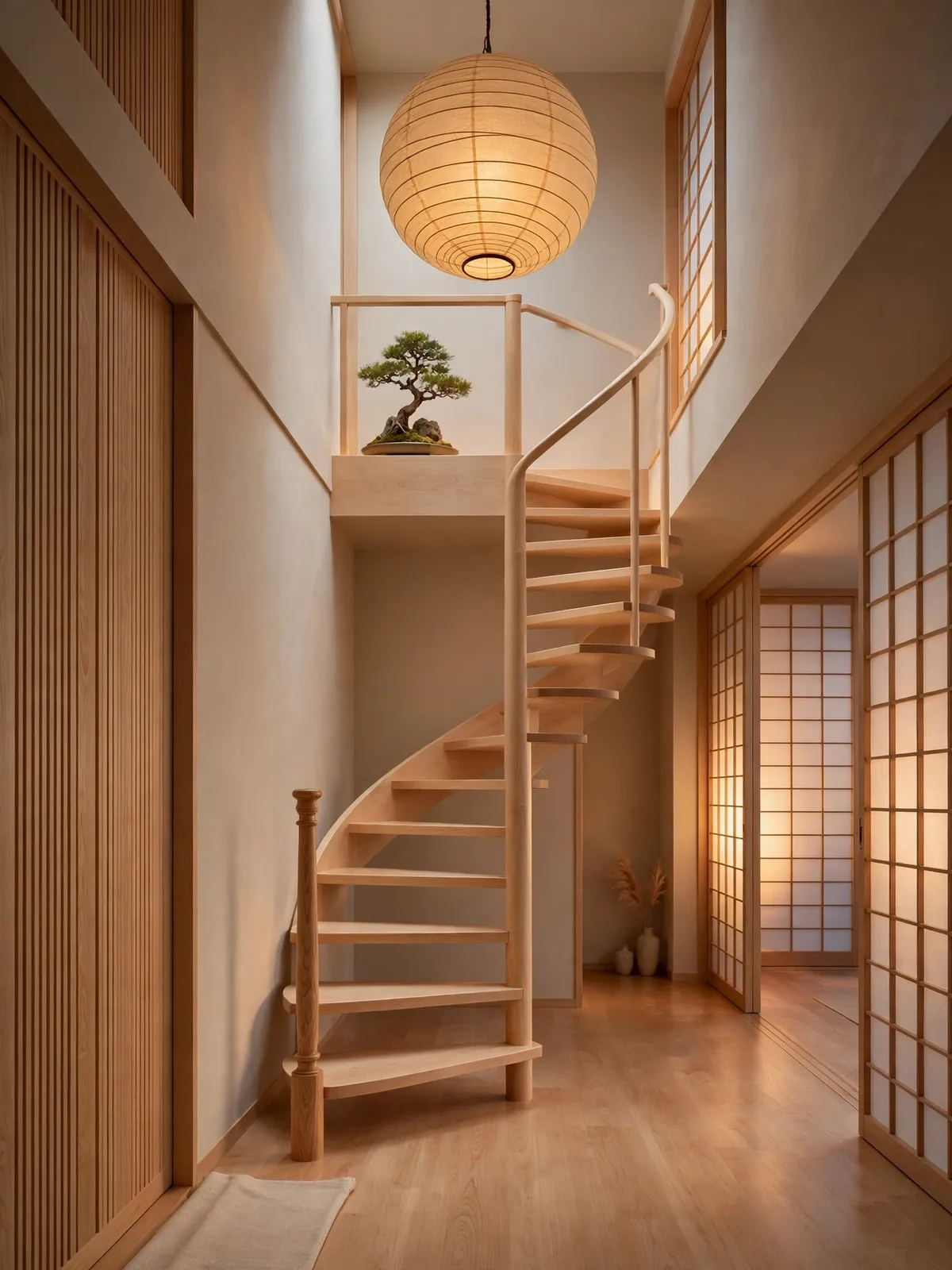
A slim oak newel and a paper lantern give a spiral staircase a calm, Japanese-inspired warmth. On this stair, pale maple treads, each 800 mm wide, wind upward from a slim oak newel post, 80 mm square, at the base, while a large paper lantern, 600 mm wide, hangs above the landing and glows warmly in the evening. Soft beige walls and a small bonsai on the landing complete the quiet palette, and the lantern’s diffused light falls softly across every tread.
Quick tips:
- Keep the newel slim — about 80 mm square — for a light, modern look.
- Hang the lantern above the landing, not the middle of the flight.
- Choose a warm bulb so the lantern glows softly, not starkly.
- Add one living detail, like a bonsai, on the landing.
An Outdoor-Inspired Spiral Staircase in Galvanised Steel and Warm Timber
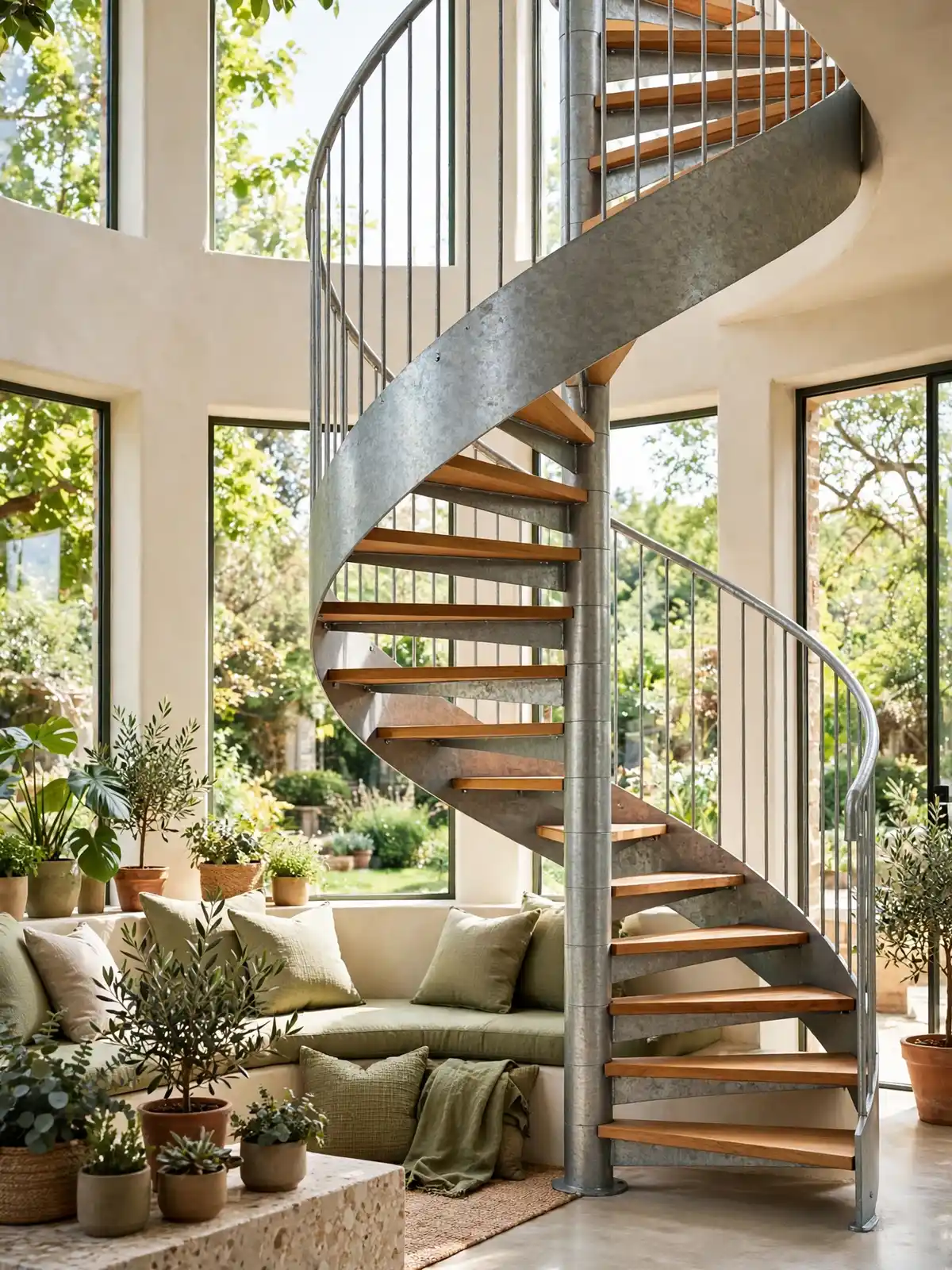
Galvanised steel and warm teak bring an outdoor spirit indoors, and a spiral staircase is the perfect place for that fresh, garden-room feeling. Here, a galvanised steel spiral with warm teak treads, each 850 mm wide, rises in a bright garden room, with large windows opening onto the garden and soft olive-green cushions on a bench below. Cream plaster walls keep the room light, while the steel’s silvery tone echoes the garden’s metal planters outside. The stair feels sturdy, natural and connected to the outdoors.
Quick tips:
- Choose galvanised steel for a silvery, weatherproof look.
- Pair it with warm teak treads for natural warmth.
- Add olive-green or leafy cushions to echo the garden outside.
- Keep the windows clear so the garden view frames the stair.
FAQs
How much floor space does a spiral staircase need?
A compact spiral staircase fits into a circle about 1.4 to 1.5 metres across, while a comfortable family spiral needs about 1.8 to 2 metres. That is roughly 2 to 3 square metres of floor space, far less than a straight flight, which is why spirals suit small homes, lofts and tight corners so well.
Are spiral staircases safe?
Yes, when they are built well. A sturdy central pole, treads that are deep enough at the walking line, a secure handrail on the outer edge, non-slip finishes and good lighting make a spiral safe for everyday use. Wider treads and a handrail on both sides help children and older family members, while open risers suit adults best.
Can you carry furniture up a spiral staircase?
Large furniture is the main drawback of a spiral staircase, because the curved, narrow treads do not suit a big sofa or a wide wardrobe. Most homeowners move large pieces through a window, a balcony, or a second straight stair, and use the spiral for everyday living. Plan your furniture route before you build.
What is the best material for a spiral staircase?
There is no single best material — it depends on the look and the space. White steel keeps the stair light, walnut or oak adds warmth, cast iron brings vintage character, glass treads let light through, and brass details add glamour. Choose the treads first, then the railing, so the two materials balance each other.
Does a spiral staircase add value to a home?
A well-built spiral staircase can add value, especially in a small home where it frees up floor space, or in a home where its sculptural shape becomes a feature buyers remember. A poorly built or very steep spiral can put buyers off, so keep the treads generous, the handrail secure, and the headroom comfortable.
Conclusion
A spiral staircase is not just a space-saving way to move between floors — it is a sculpture that shapes the whole room around it. Whether you choose white steel with pale oak, walnut with black iron, cast iron scrollwork, glass treads, terracotta plaster, or a skylight above the curve, the best spiral staircase is the one that suits the rooms around it. Keep the treads generous, the handrail secure, and the palette warm, and your spiral will make every room it touches feel brighter, larger and more welcoming.